IN MEMORIAM IN MEMORIAM
56
Tristram Smith, PhD
Robert G. Newman (’62 MD)
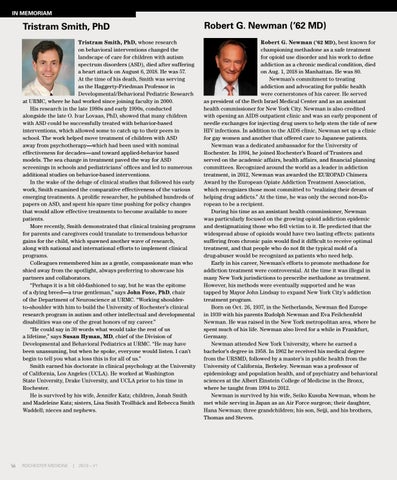
Tristram Smith, PhD, whose research on behavioral interventions changed the landscape of care for children with autism spectrum disorders (ASD), died after suffering a heart attack on August 6, 2018. He was 57. At the time of his death, Smith was serving as the Haggerty-Friedman Professor in Developmental/Behavioral Pediatric Research at URMC, where he had worked since joining faculty in 2000. His research in the late 1980s and early 1990s, conducted alongside the late O. Ivar Lovaas, PhD, showed that many children with ASD could be successfully treated with behavior-based interventions, which allowed some to catch up to their peers in school. The work helped move treatment of children with ASD away from psychotherapy—which had been used with nominal effectiveness for decades—and toward applied-behavior based models. The sea change in treatment paved the way for ASD screenings in schools and pediatricians’ offices and led to numerous additional studies on behavior-based interventions. In the wake of the deluge of clinical studies that followed his early work, Smith examined the comparative effectiveness of the various emerging treatments. A prolific researcher, he published hundreds of papers on ASD, and spent his spare time pushing for policy changes that would allow effective treatments to become available to more patients. More recently, Smith demonstrated that clinical training programs for parents and caregivers could translate to tremendous behavior gains for the child, which spawned another wave of research, along with national and international efforts to implement clinical programs. Colleagues remembered him as a gentle, compassionate man who shied away from the spotlight, always preferring to showcase his partners and collaborators. “Perhaps it is a bit old-fashioned to say, but he was the epitome of a dying breed—a true gentleman,” says John Foxe, PhD, chair of the Department of Neuroscience at URMC. “Working shoulderto-shoulder with him to build the University of Rochester’s clinical research program in autism and other intellectual and developmental disabilities was one of the great honors of my career.” “He could say in 30 words what would take the rest of us a lifetime,” says Susan Hyman, MD, chief of the Division of Developmental and Behavioral Pediatrics at URMC. “He may have been unassuming, but when he spoke, everyone would listen. I can’t begin to tell you what a loss this is for all of us.” Smith earned his doctorate in clinical psychology at the University of California, Los Angeles (UCLA). He worked at Washington State University, Drake University, and UCLA prior to his time in Rochester. He is survived by his wife, Jennifer Katz; children, Jonah Smith and Madeleine Katz; sisters, Lisa Smith Trollbäck and Rebecca Smith Waddell; nieces and nephews.
Robert G. Newman (’62 MD), best known for championing methadone as a safe treatment for opioid use disorder and his work to define addiction as a chronic medical condition, died on Aug. 1, 2018 in Manhattan. He was 80. Newman’s commitment to treating addiction and advocating for public health were cornerstones of his career. He served as president of the Beth Israel Medical Center and as an assistant health commissioner for New York City. Newman is also credited with opening an AIDS outpatient clinic and was an early proponent of needle exchanges for injecting drug users to help stem the tide of new HIV infections. In addition to the AIDS clinic, Newman set up a clinic for gay women and another that offered care to Japanese patients. Newman was a dedicated ambassador for the University of Rochester. In 1994, he joined Rochester’s Board of Trustees and served on the academic affairs, health affairs, and financial planning committees. Recognized around the world as a leader in addiction treatment, in 2012, Newman was awarded the EUROPAD Chimera Award by the European Opiate Addiction Treatment Association, which recognizes those most committed to “realizing their dream of helping drug addicts.” At the time, he was only the second non-European to be a recipient. During his time as an assistant health commissioner, Newman was particularly focused on the growing opioid addiction epidemic and destigmatizing those who fell victim to it. He predicted that the widespread abuse of opioids would have two lasting effects: patients suffering from chronic pain would find it difficult to receive optimal treatment, and that people who do not fit the typical mold of a drug-abuser would be recognized as patients who need help. Early in his career, Newman’s efforts to promote methadone for addiction treatment were controversial. At the time it was illegal in many New York jurisdictions to prescribe methadone as treatment. However, his methods were eventually supported and he was tapped by Mayor John Lindsay to expand New York City’s addiction treatment program. Born on Oct. 26, 1937, in the Netherlands, Newman fled Europe in 1939 with his parents Rudolph Newman and Eva Feilchenfeld Newman. He was raised in the New York metropolitan area, where he spent much of his life. Newman also lived for a while in Frankfurt, Germany. Newman attended New York University, where he earned a bachelor’s degree in 1958. In 1962 he received his medical degree from the URSMD, followed by a master’s in public health from the University of California, Berkeley. Newman was a professor of epidemiology and population health, and of psychiatry and behavioral sciences at the Albert Einstein College of Medicine in the Bronx, where he taught from 1994 to 2012. Newman is survived by his wife, Seiko Kusuba Newman, whom he met while serving in Japan as an Air Force surgeon; their daughter, Hana Newman; three grandchildren; his son, Seiji, and his brothers, Thomas and Steven.
ROCHESTER MEDICINE | 2019 – V1