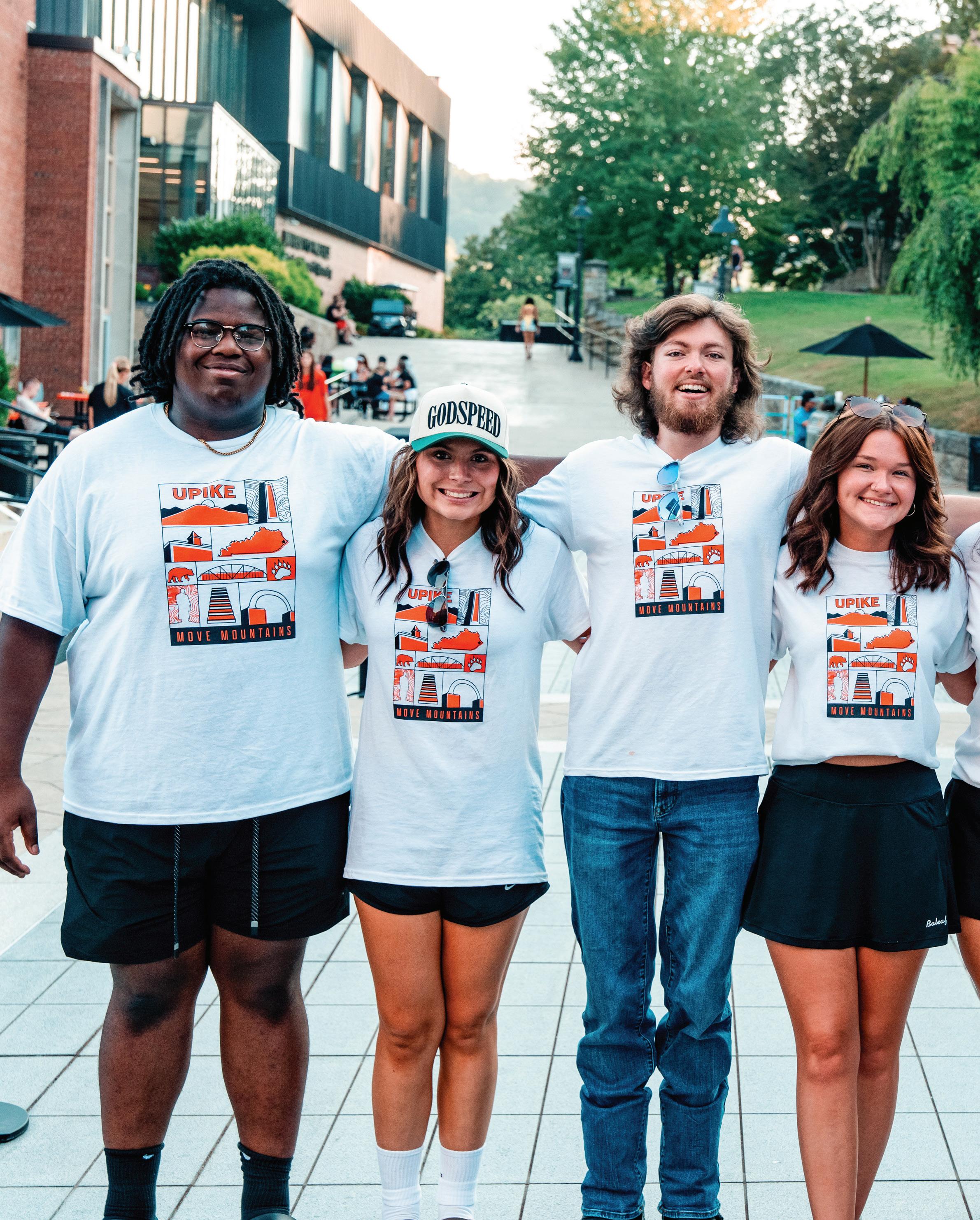
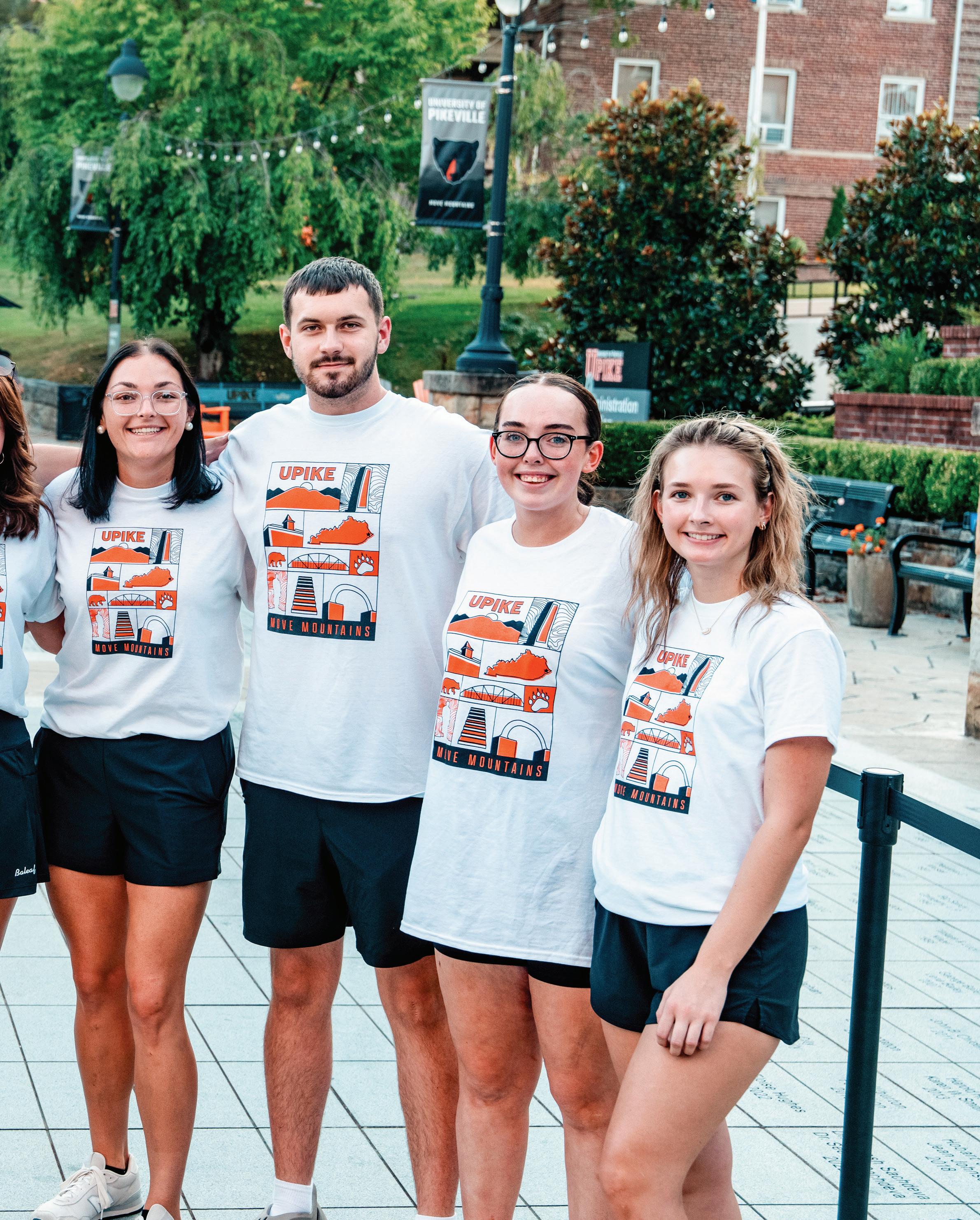
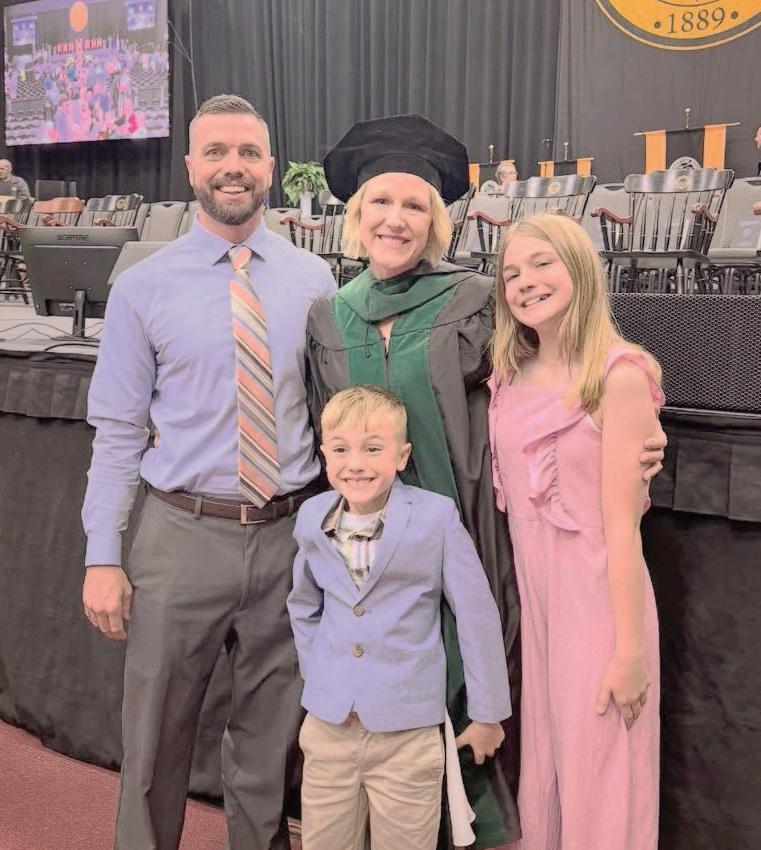
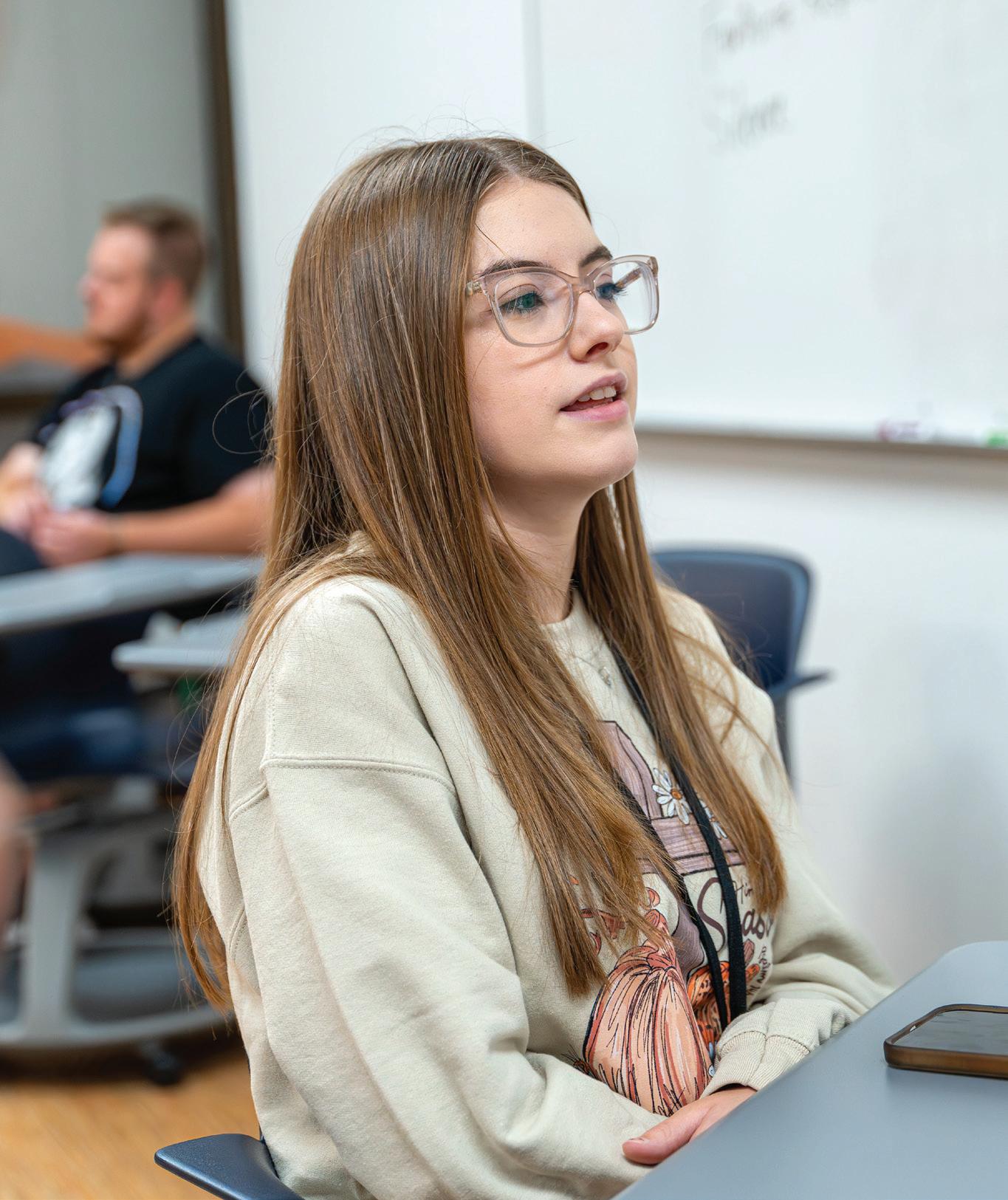
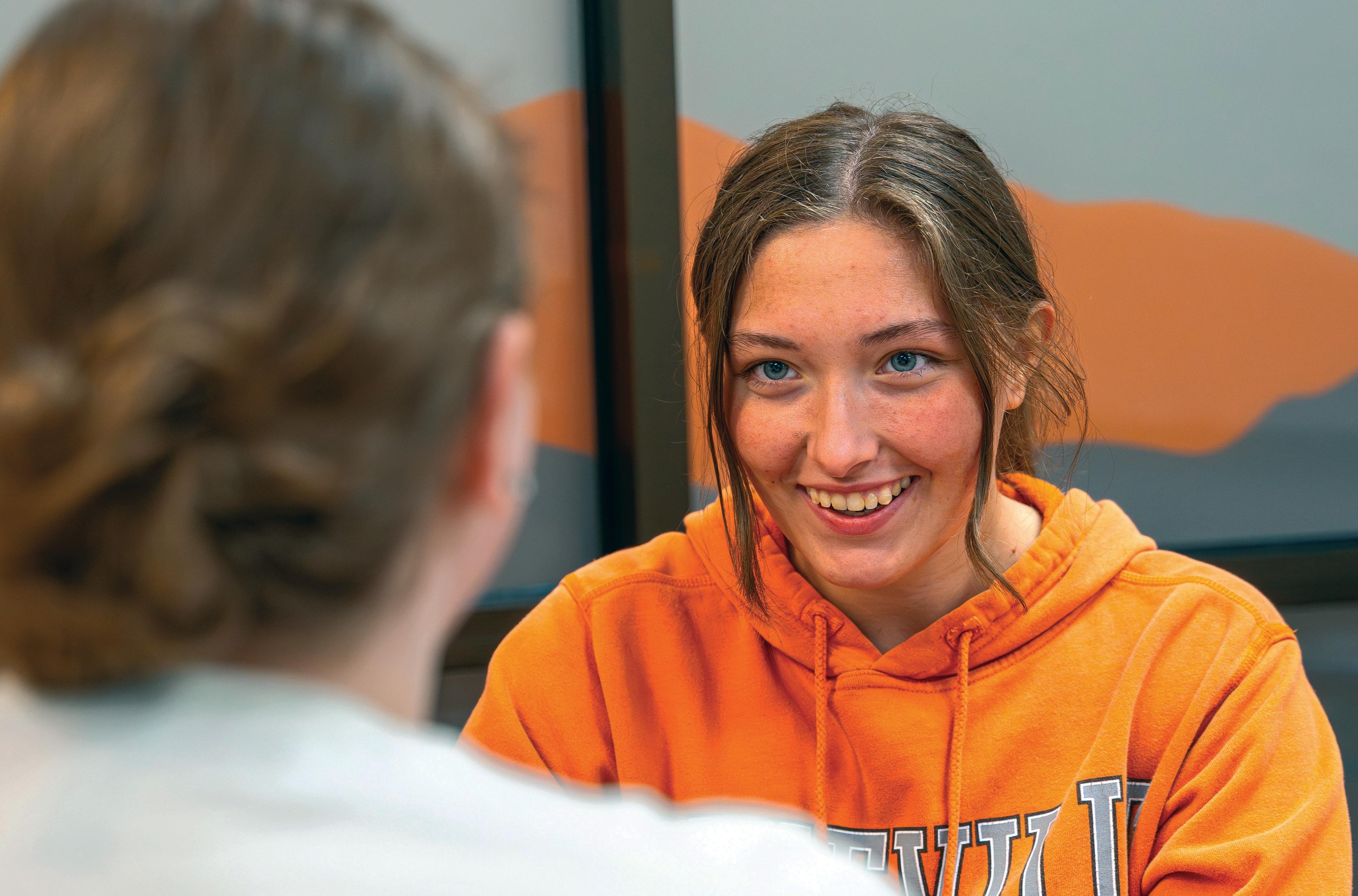
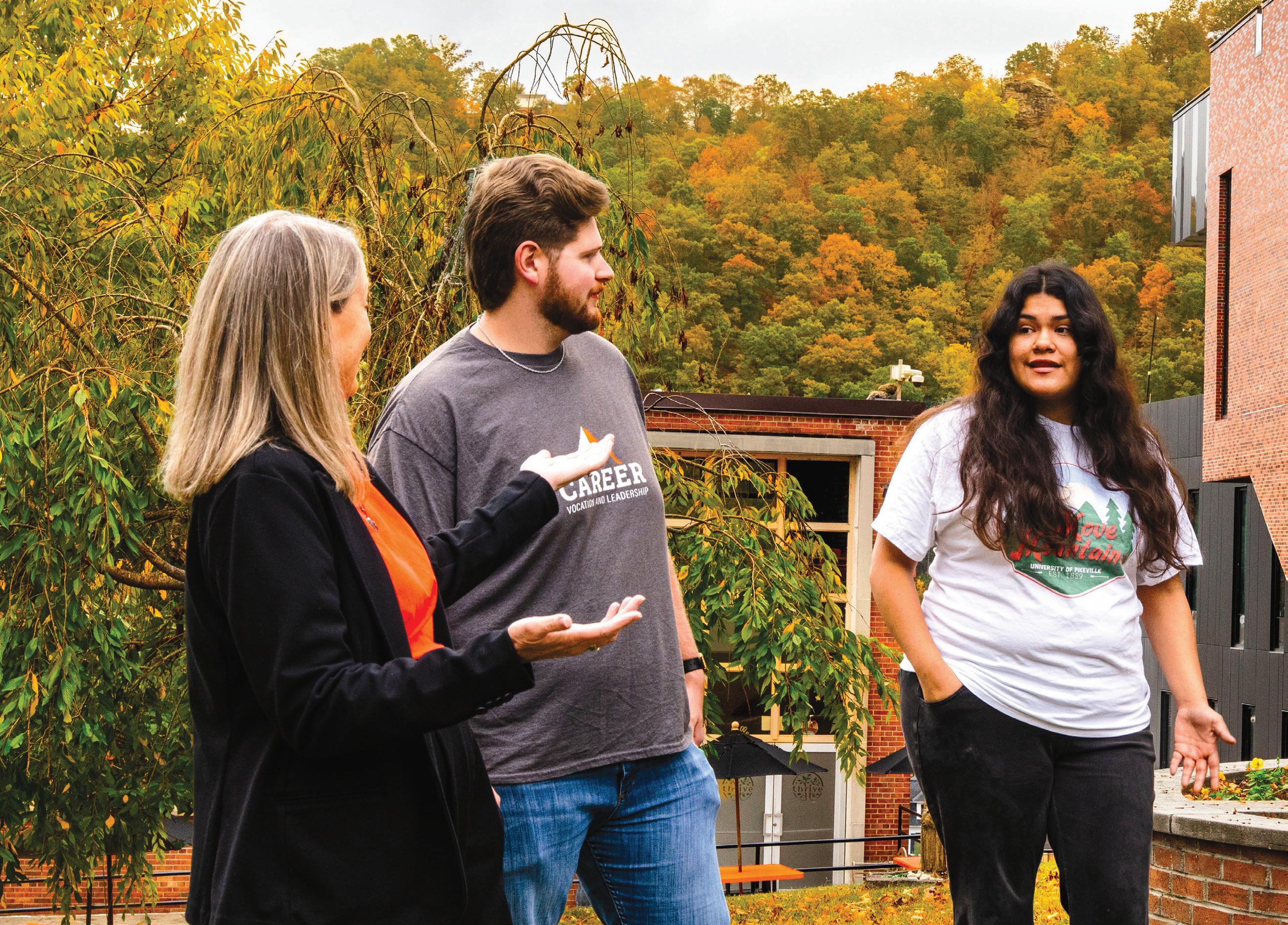
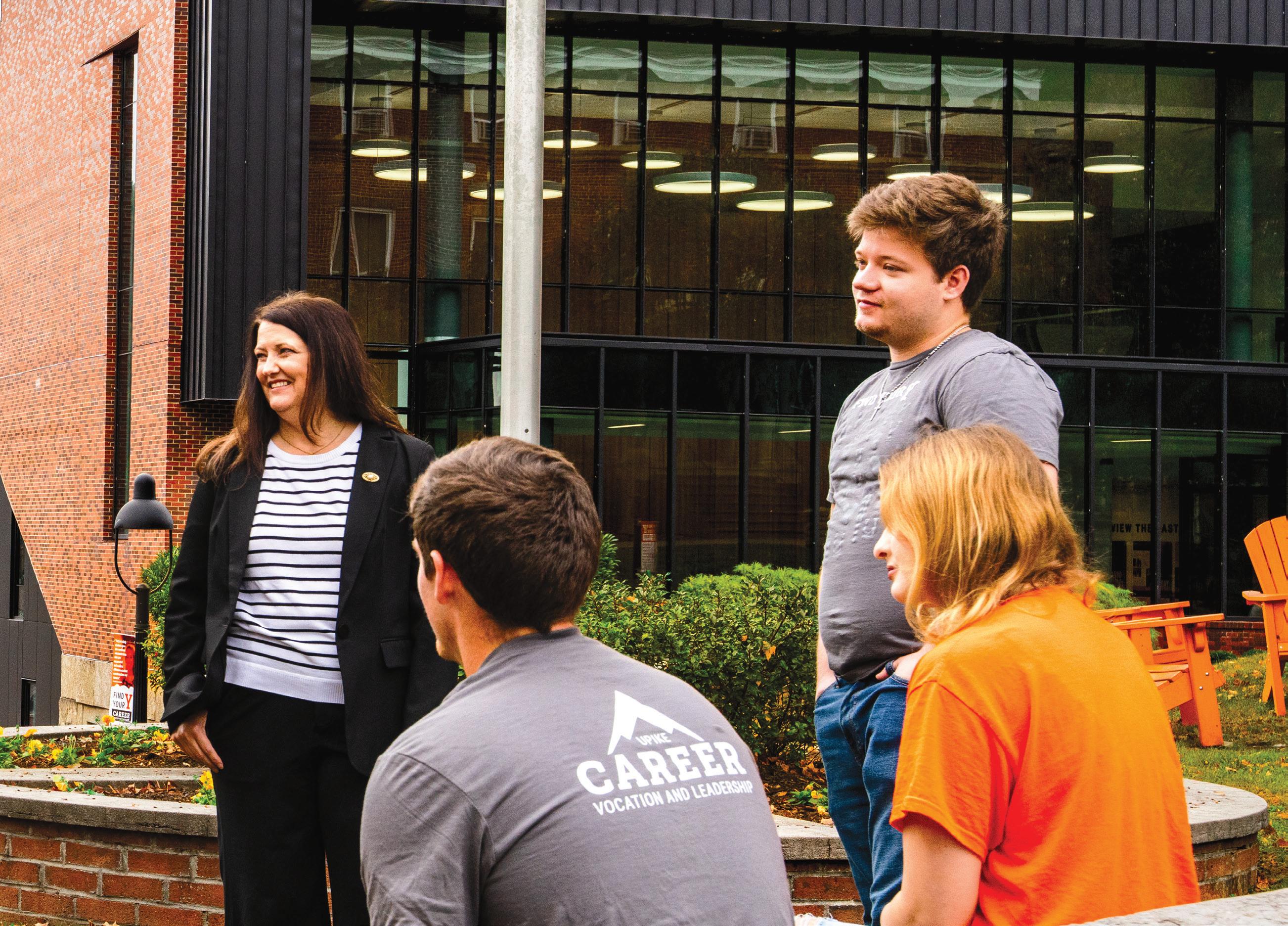
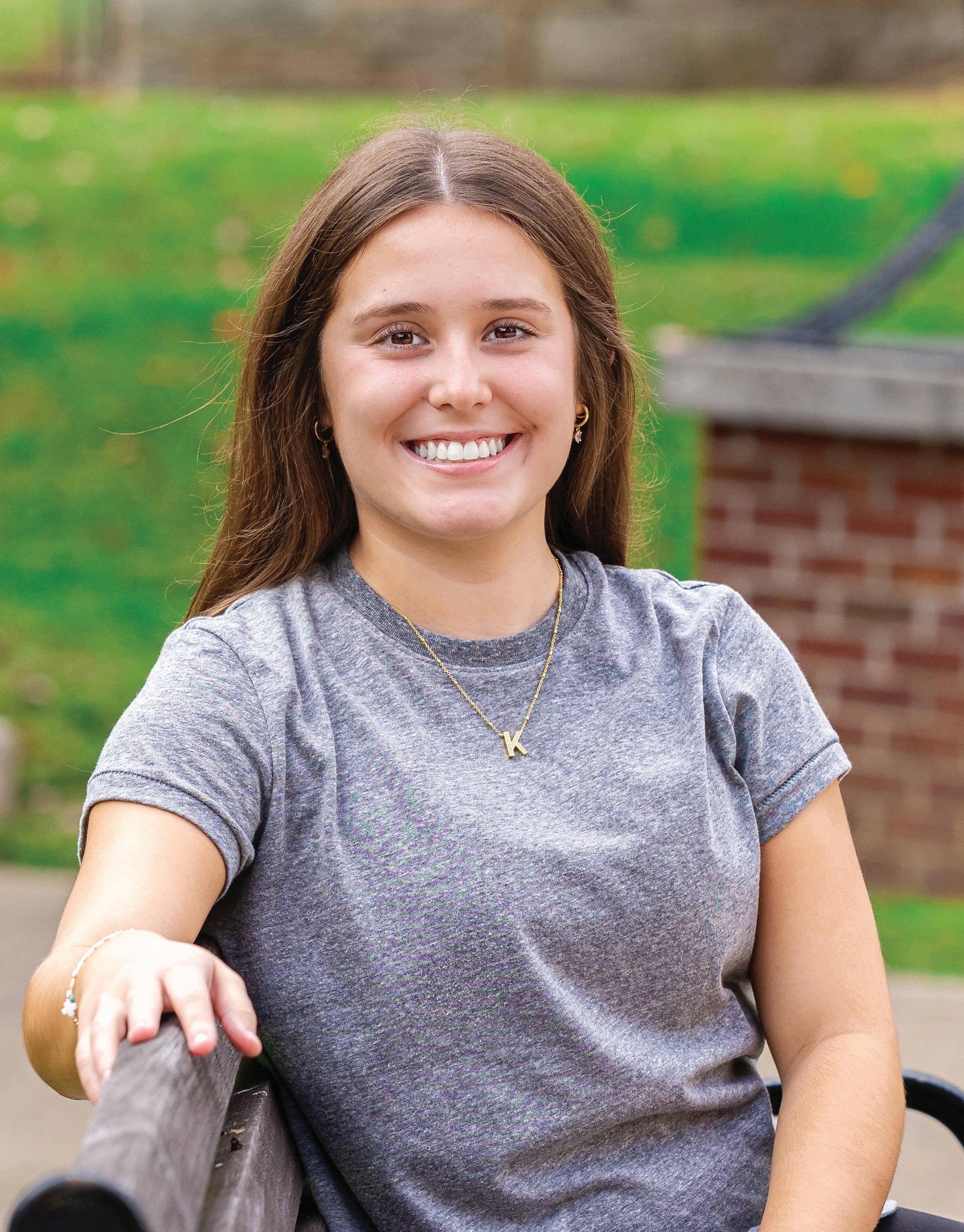
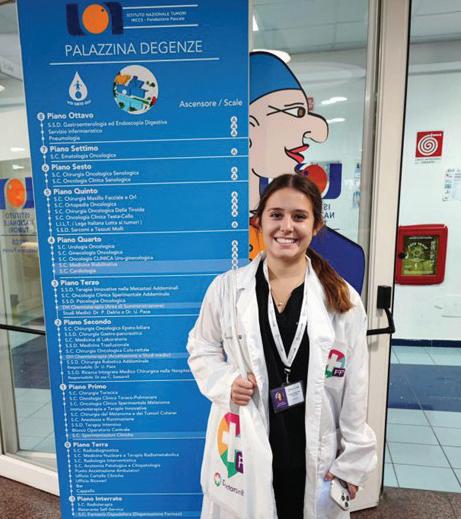
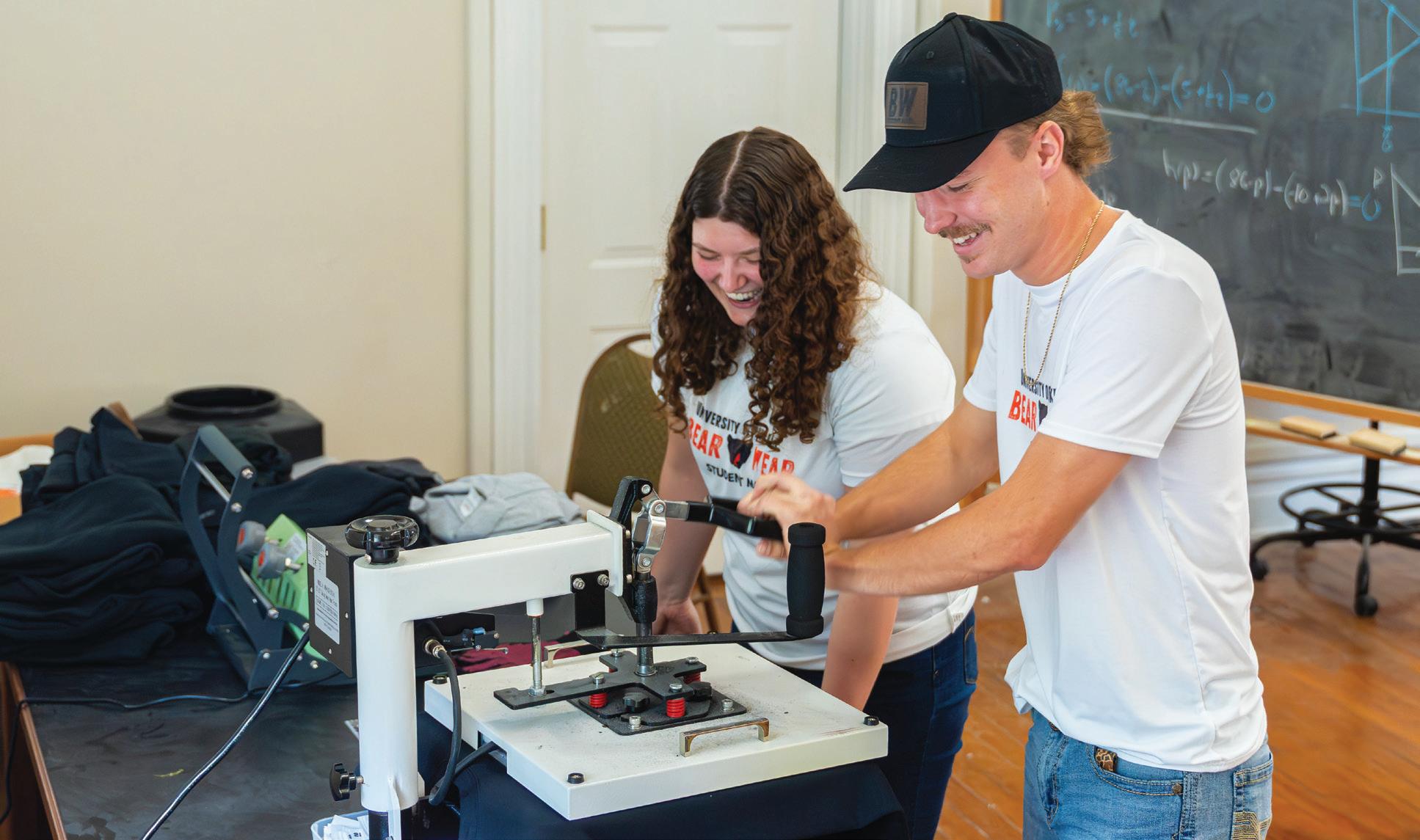
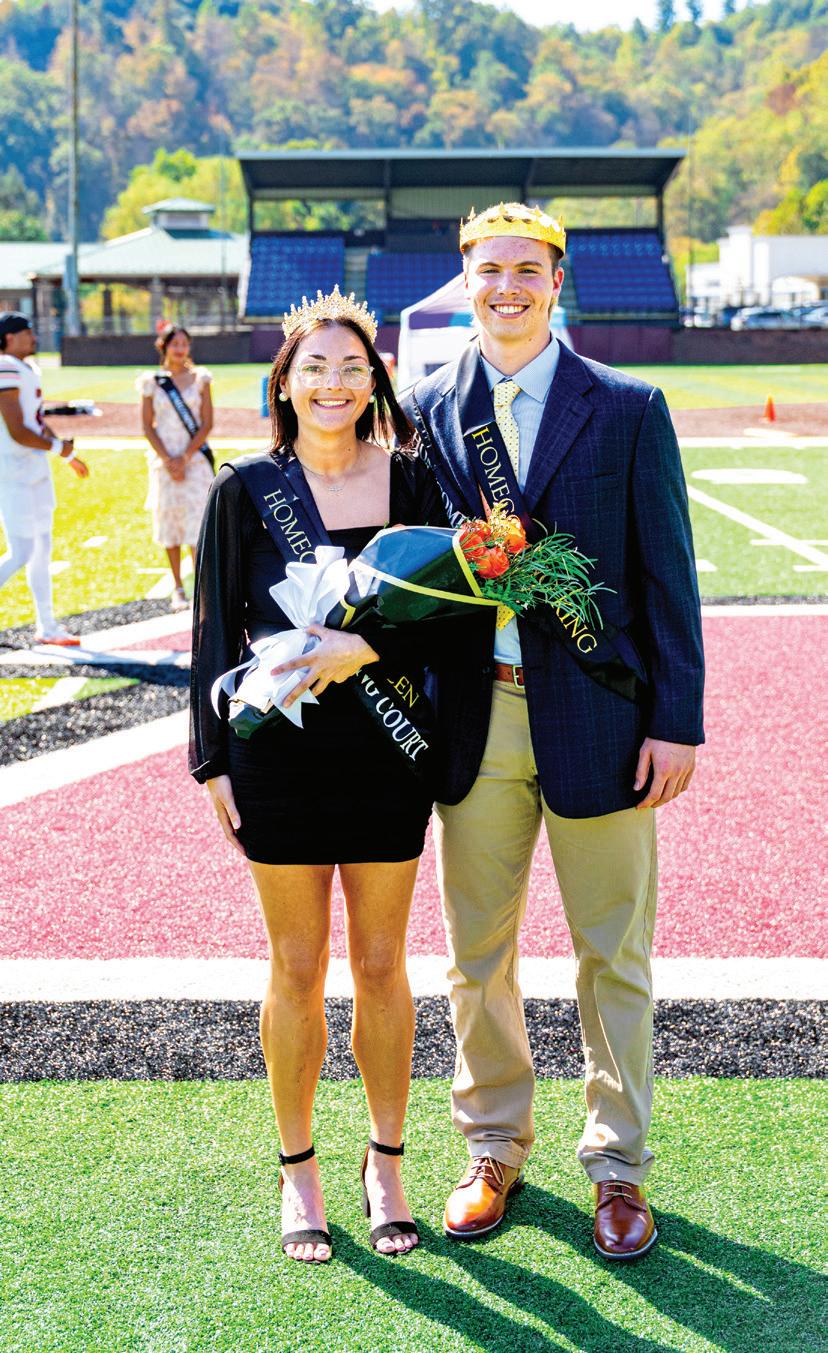
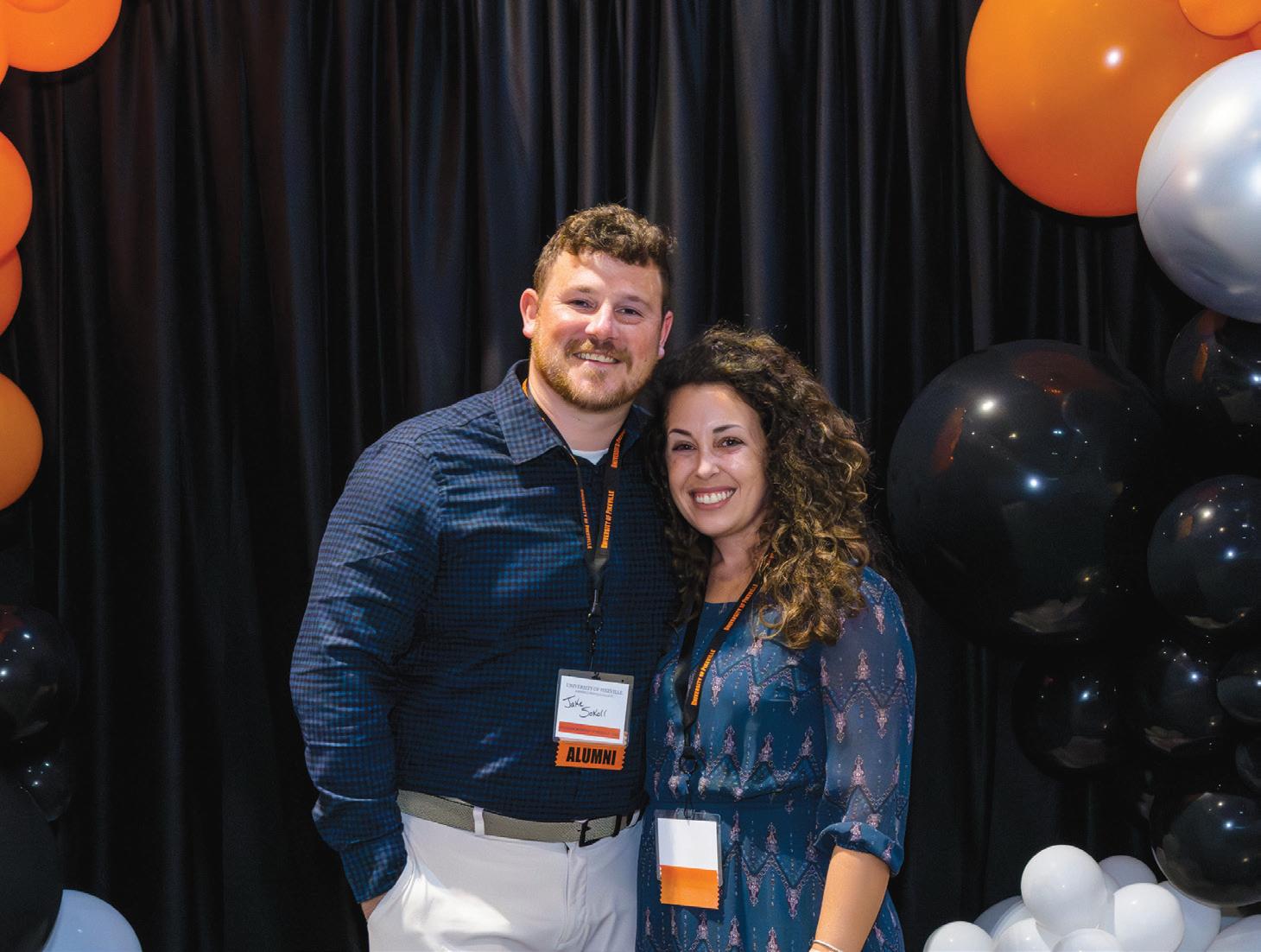
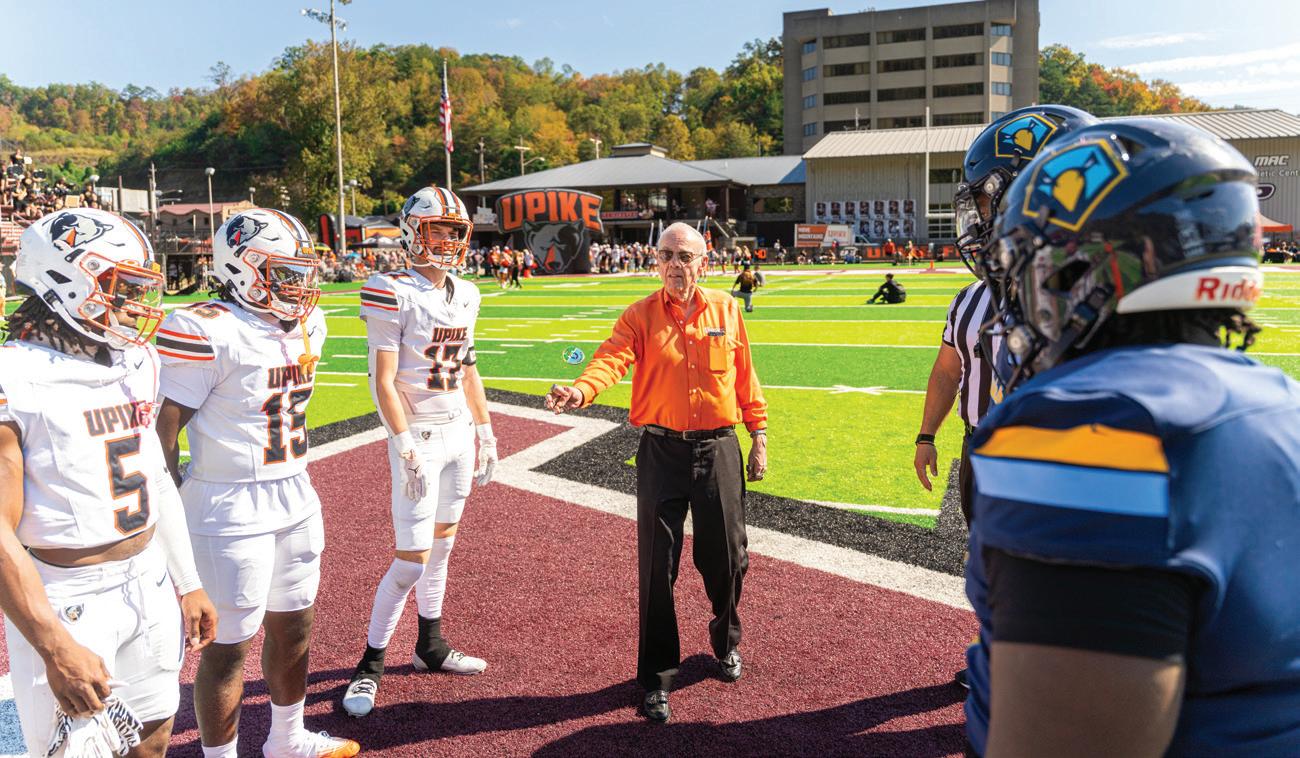
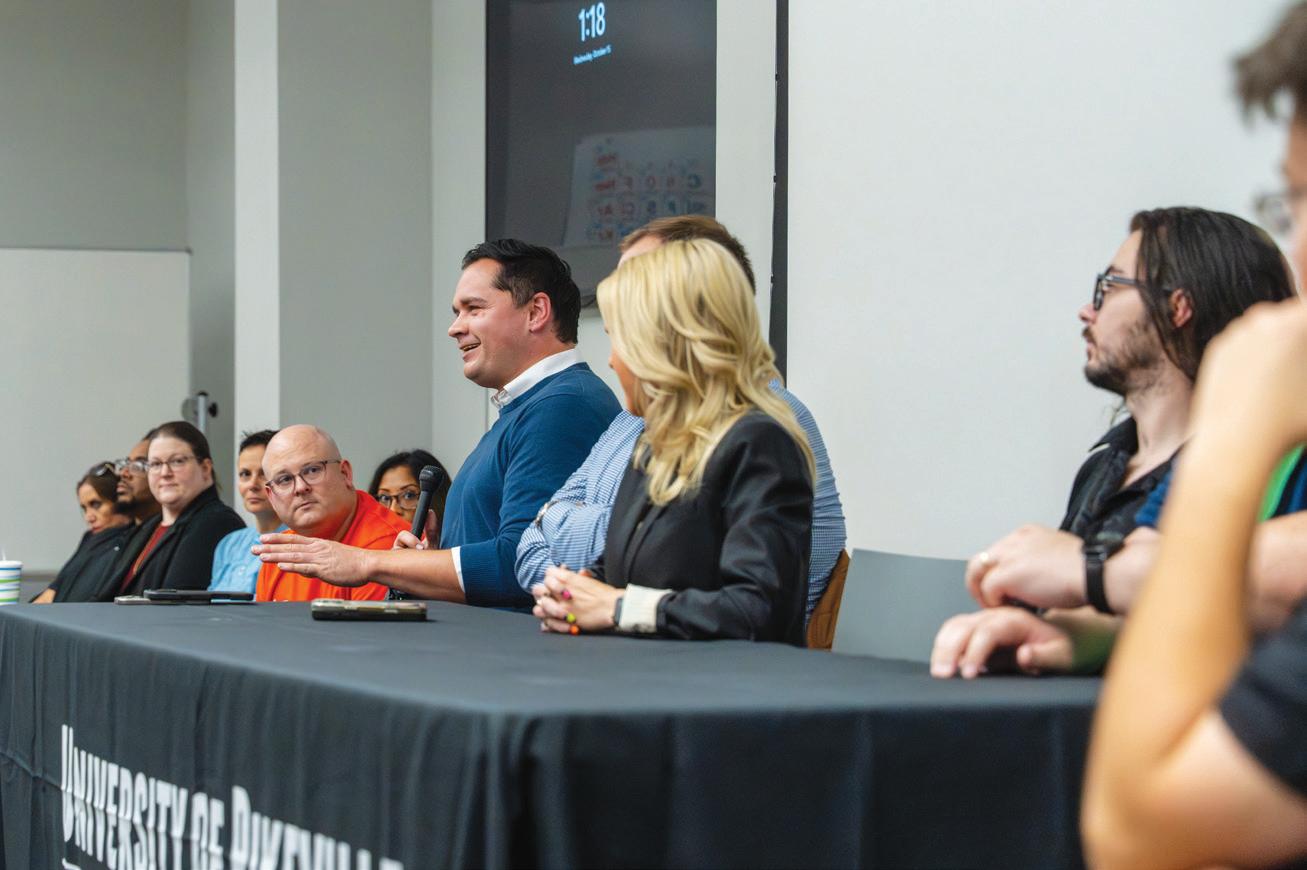
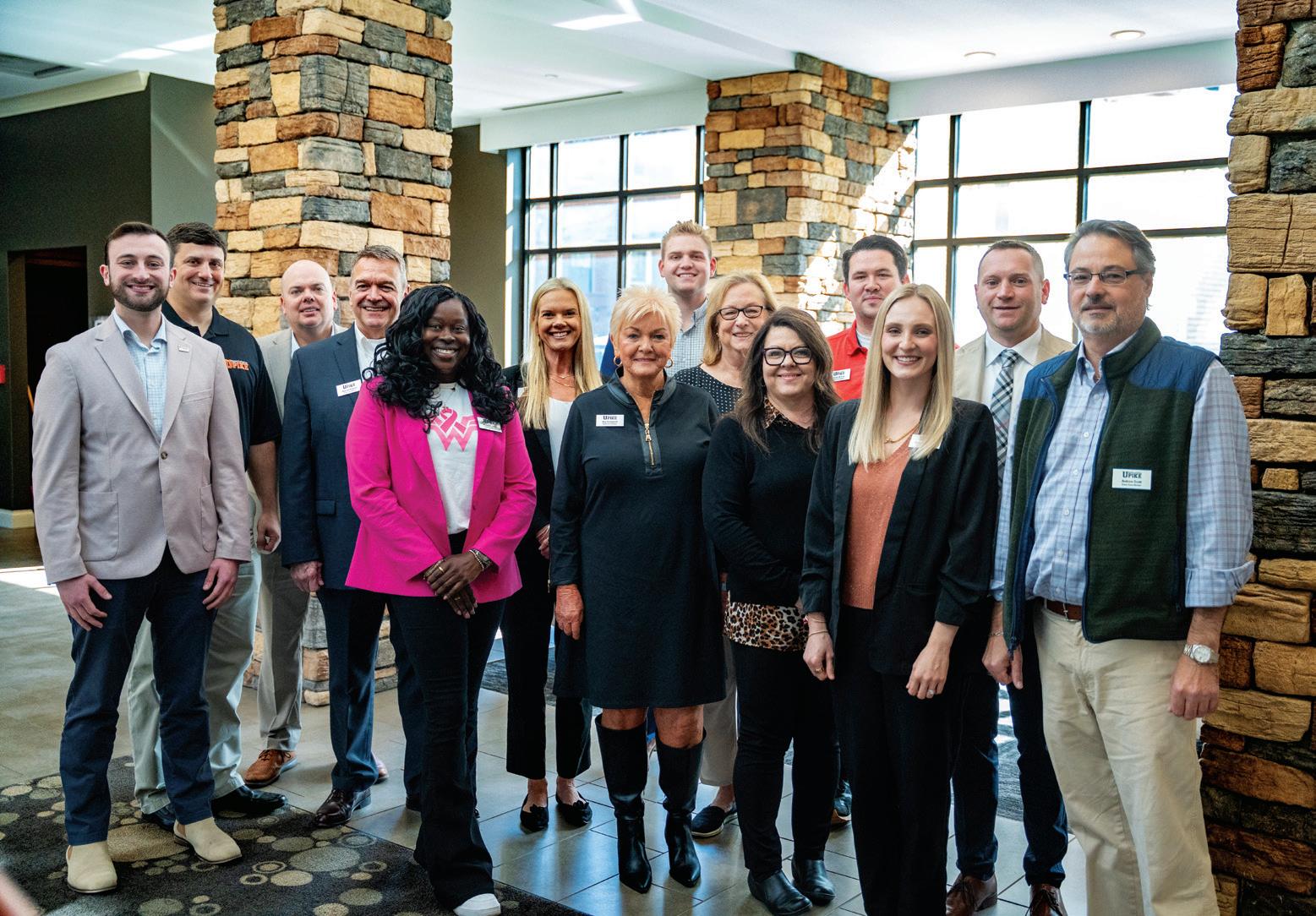
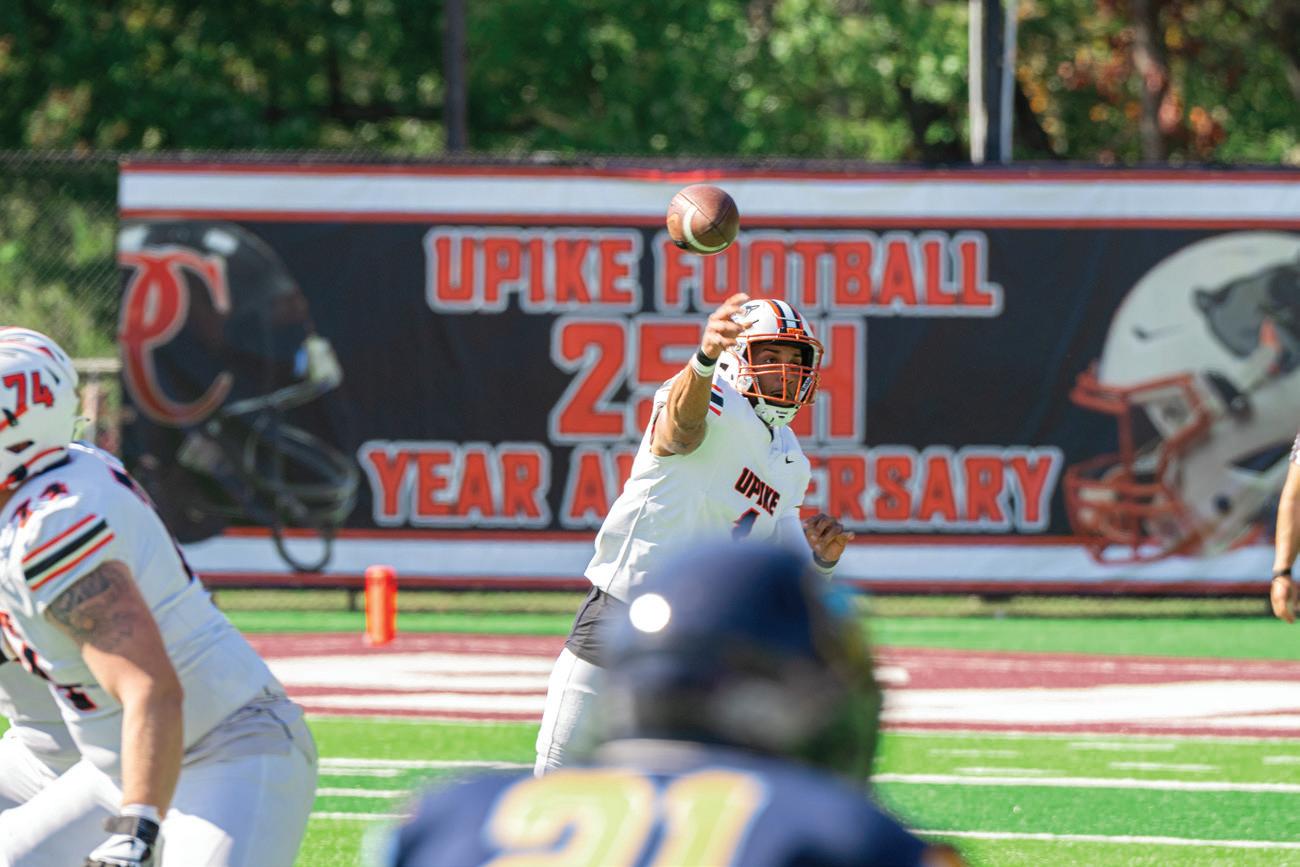
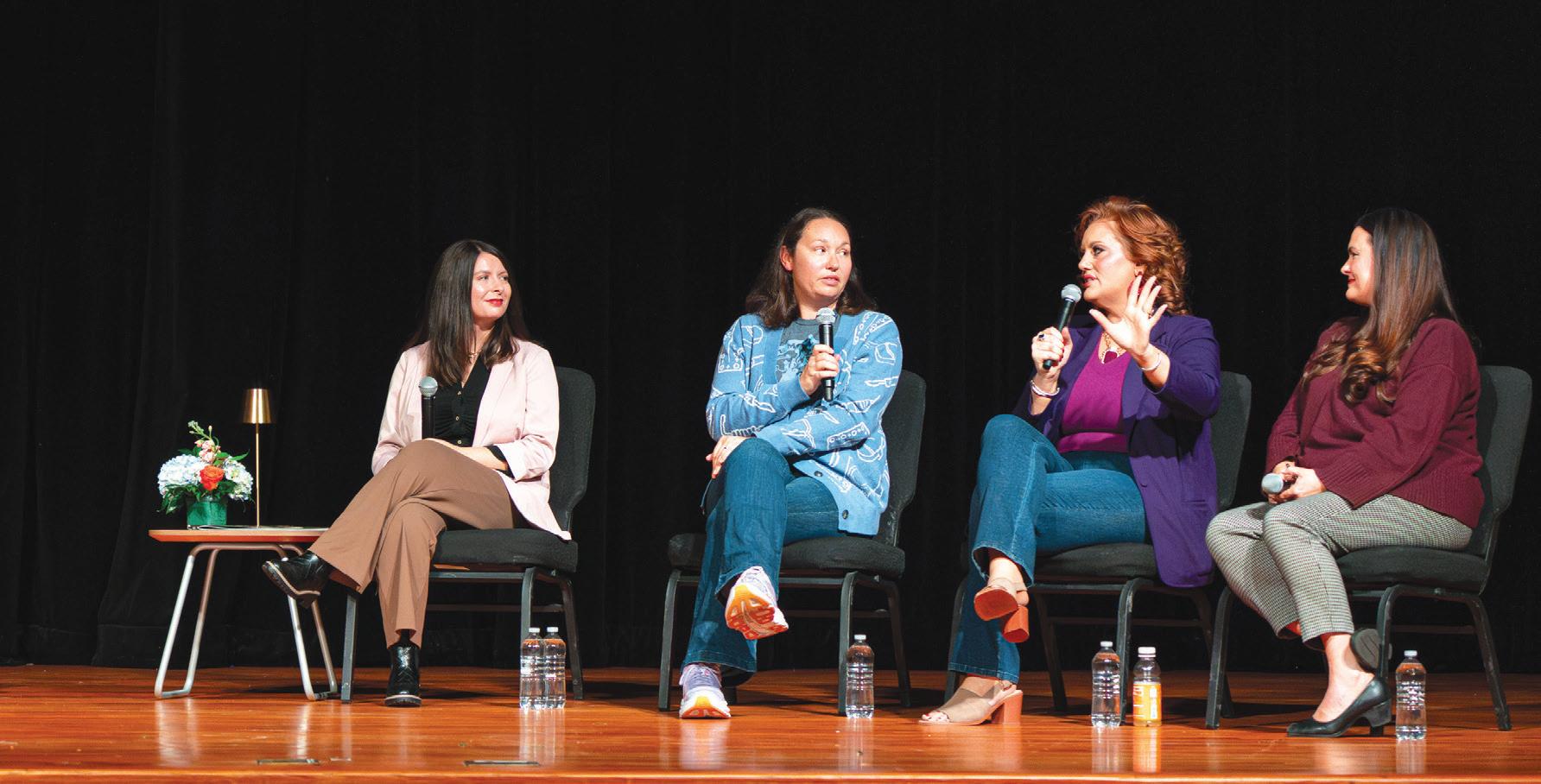
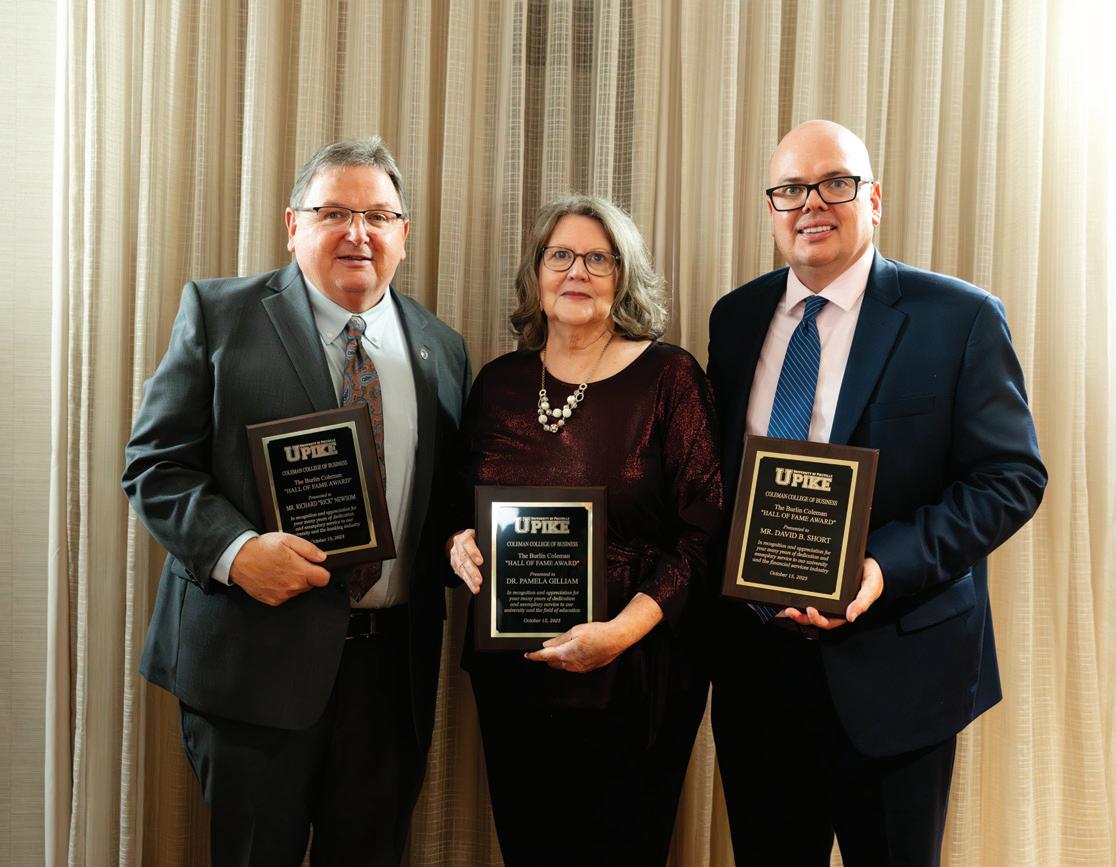
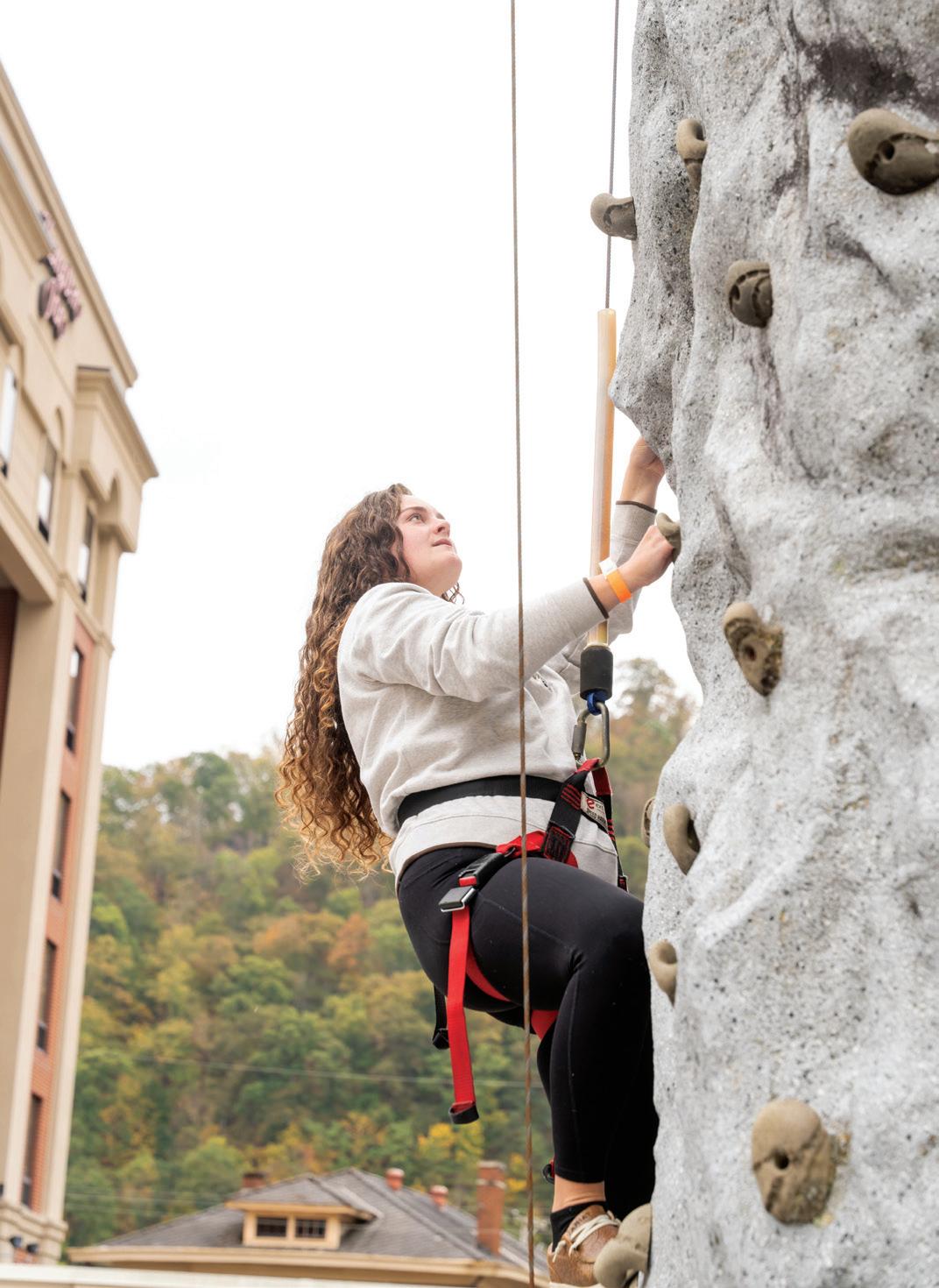
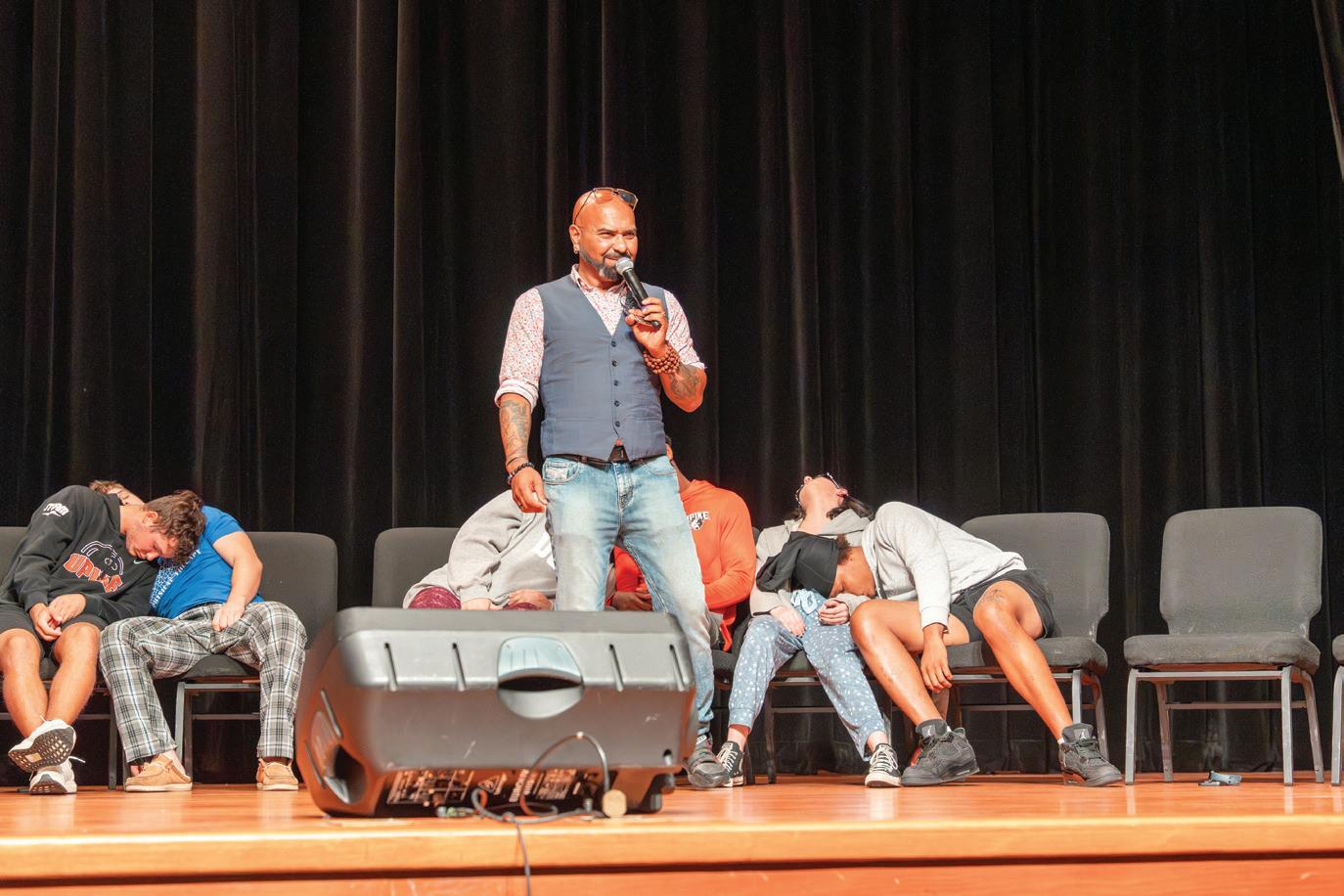
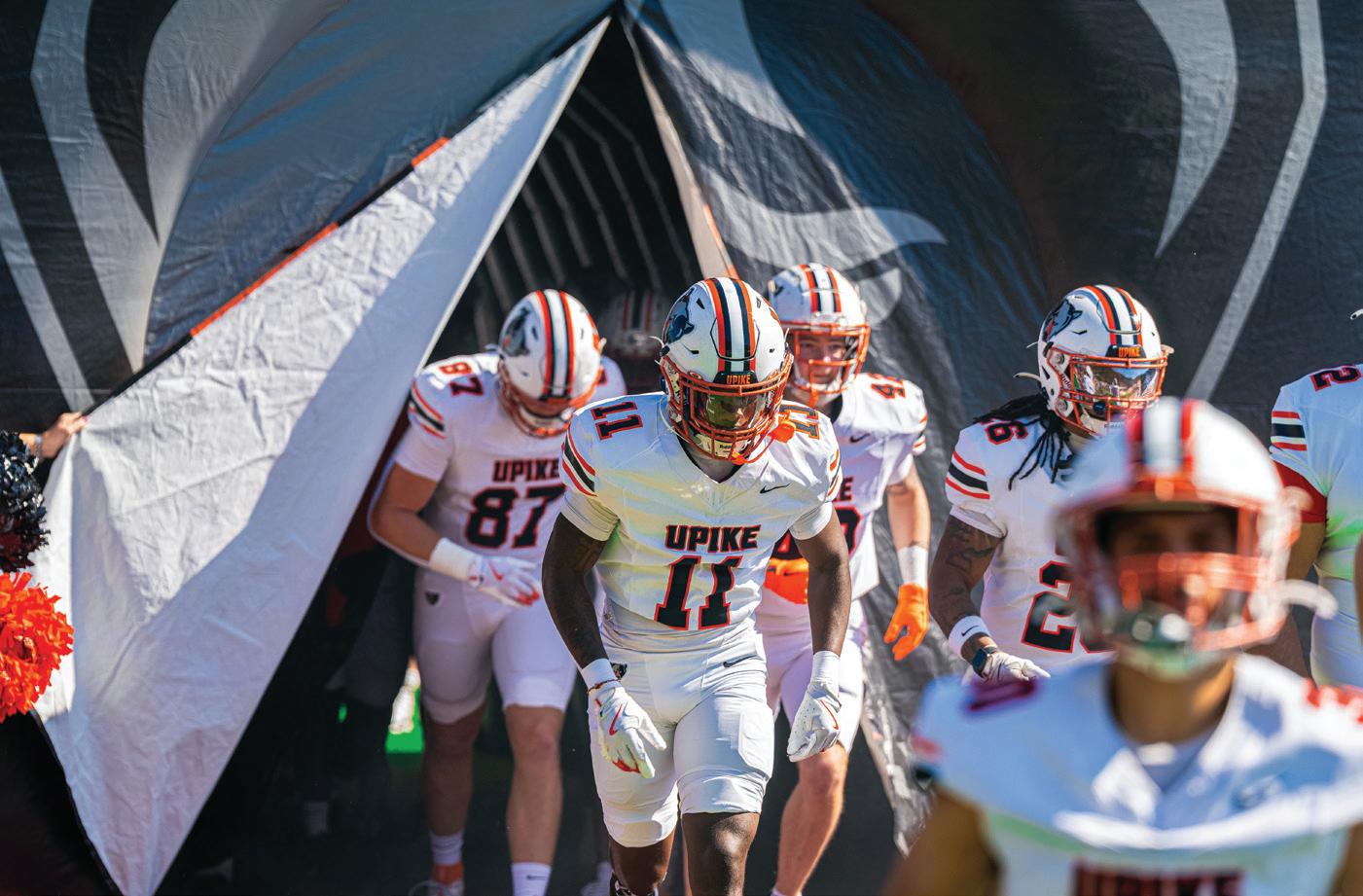
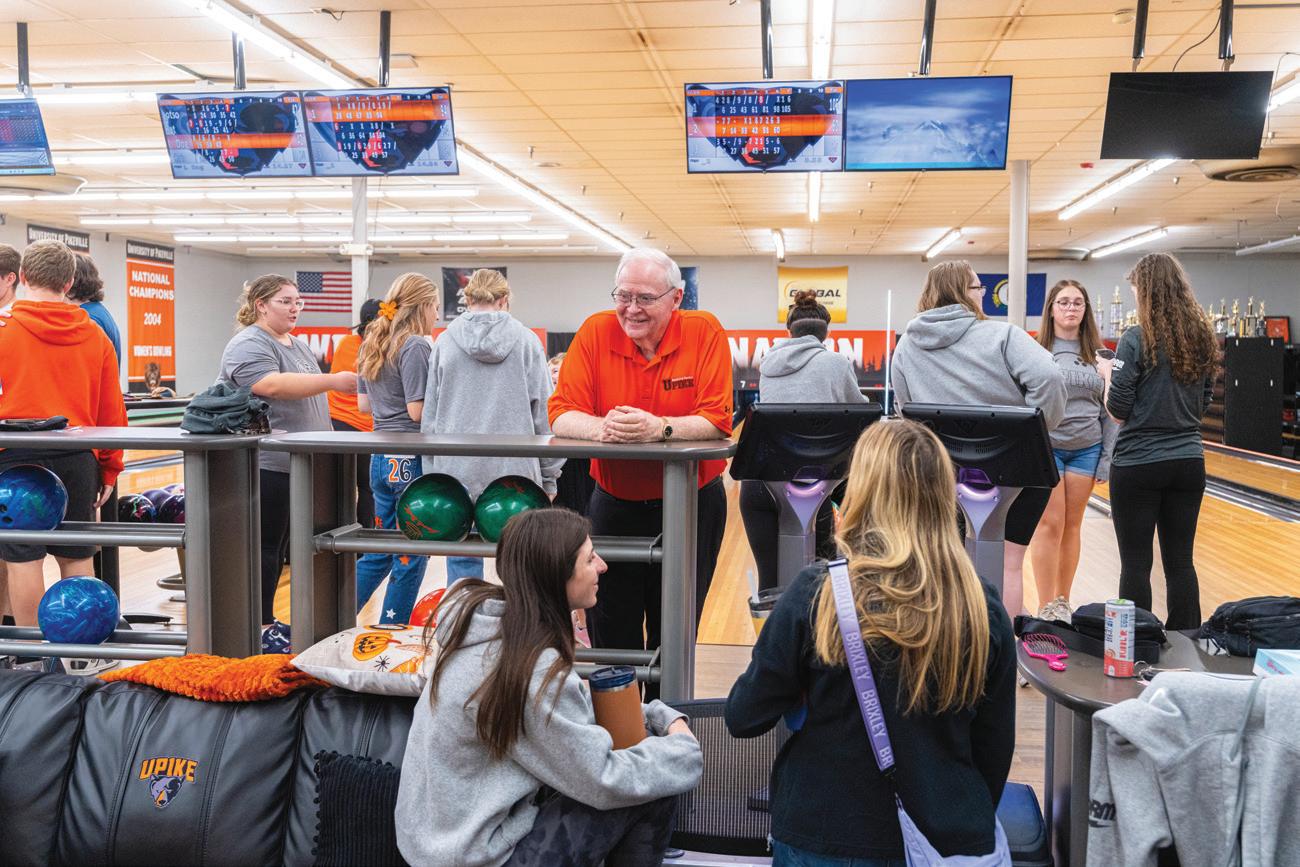
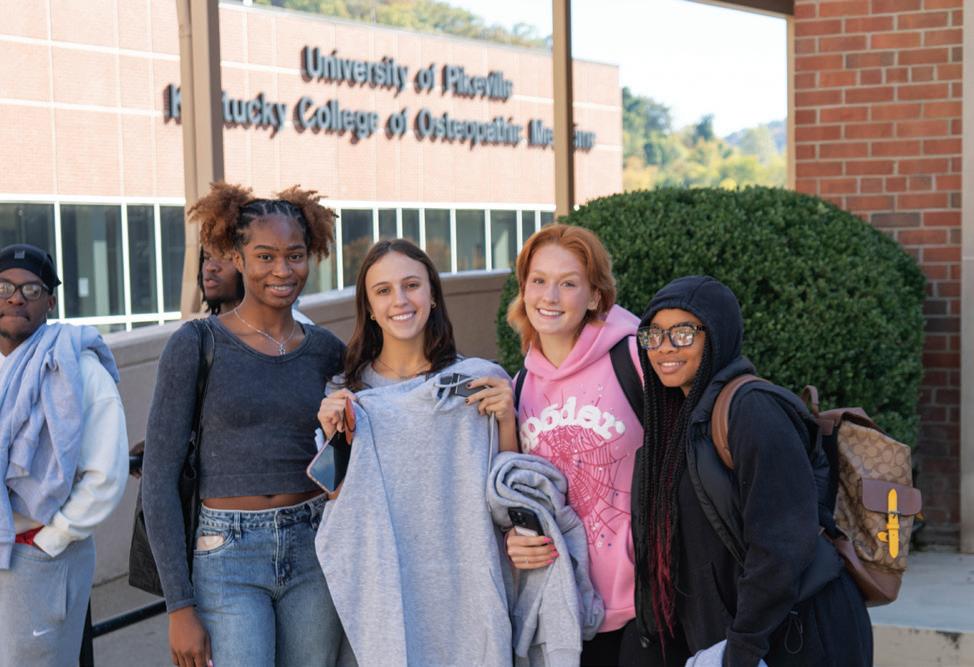
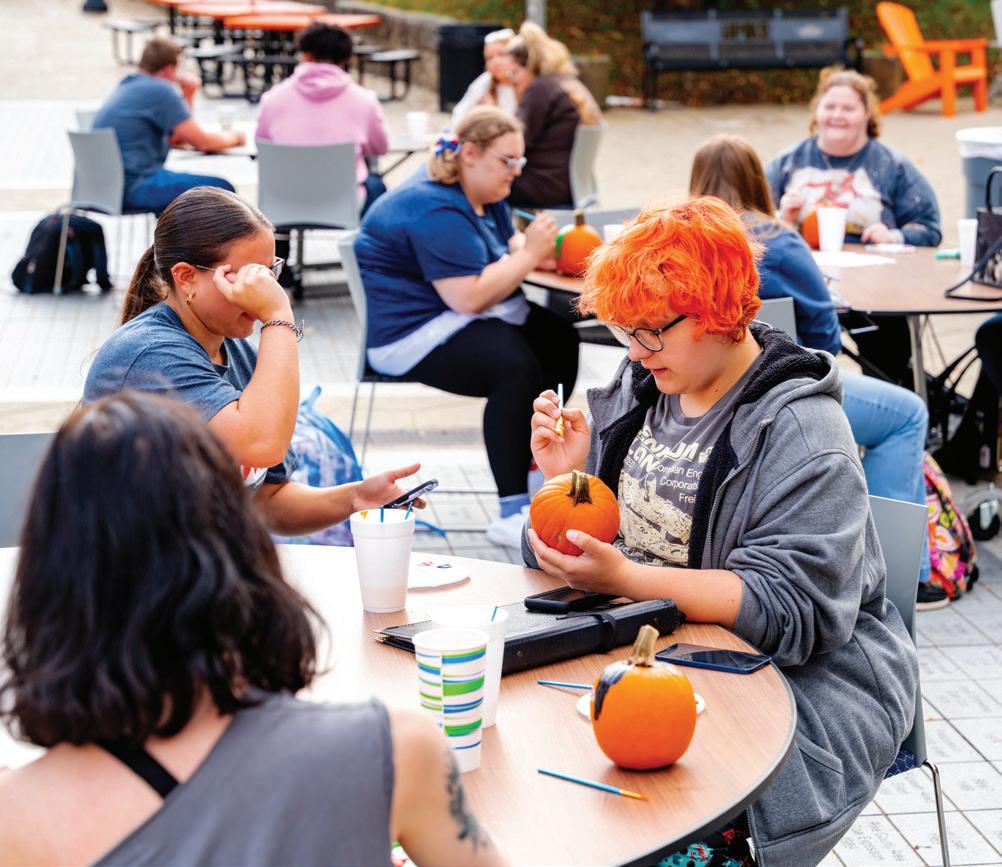
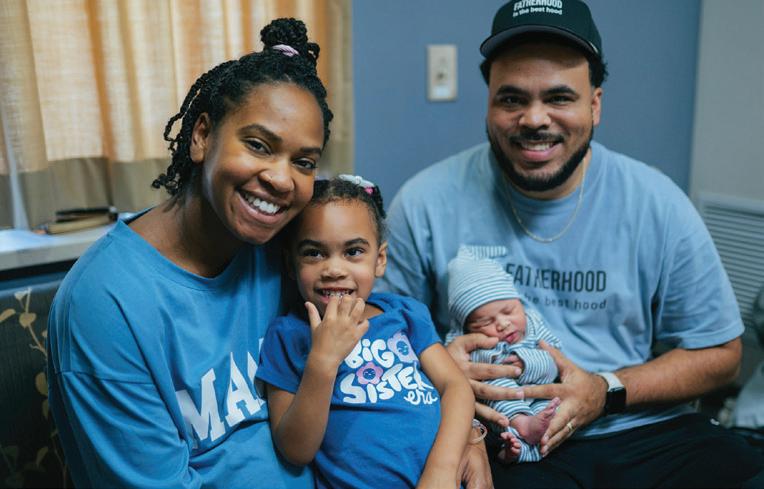
UPIKE celebrated a record enrollment of 2,118 students this fall, with undergraduate retention reaching a historic 85.5 percent. More than 420 new undergraduates filled residence halls to capacity and joined in the tradition of “the climb” during UPIKE First Week. Another 135 new graduate students added to the momentum of a growing, vibrant campus community. First-year students are supported by student mentors (pictured) through the First-Year Experience program, helping them transition and thrive during their first year.
MAGAZINE STAFF
Burton J. Webb, Ph.D.
Werth, Ph.D.
&
Katie Ray ’24 editor@upike.edu
PHOTOGRAPHERS
Larry Epling Dusty Layne
CONTRIBUTORS
Amy Charles, MBA ’23
Laura Damron, MBA ’19
Kate Hensley, MBA ’23
Sherrie Marrs
Brooke Thacker ’04
Stacey Walters
LETTER FROM THE FIRST LADY
What’s your WHY?
I first encountered this question nearly 30 years ago, while grappling with who I was and who I wanted to become. Up to that point, I had only ever responded to life’s expectations: work hard, get a good education and trust that happiness would follow. And I was happy— surrounded by a solid family and great friends, active in our local church, and working a steady job to help support our family and achieve our financial goals.
But something still seemed to be missing. Did my work align with my sense of calling? Did my service in the church and community make use of my unique gifts and abilities?
It was during that season of life that I took a step back from my efforts as a “human doing” and began to consider what it meant to understand myself as a human being. Through months of deep reflection and meaningful conversations, I began to engage with life in more intentional ways. Slowly, I started to understand my calling—and my WHY—more clearly.
Since discovering my own WHY, I’ve learned that my greatest sense of alignment between who I am and what I do comes when helping others uncover their own giftedness and express it through service to those around them. My work is now more purposeful, intentional and deeply connected to my calling.
At the University of Pikeville, we are cultivating a culture of vocational exploration that enables students to connect their identity with their calling—helping them discover their purpose. We see that spirit of purpose reflected in alumni who carry their UPIKE experience into communities near and far, in donors whose generosity plants seeds that grow beyond themselves, and in the leaders whose vision and dedication continue to shape this university and region.
So, what’s your WHY?
As you turn these pages, you will encounter stories of purpose and calling—stories of intentional living, divine guidance and the quiet ways God reveals meaning through being. I hope you are encouraged to reflect on your own calling. When we find our WHY and live it fully, we not only shape our own lives, but the lives of those around us.
With deepest gratitude,
Lillian Kay Webb, Ph.D. First Lady and Center for Career, Vocation and Leadership Director
CAMPUS NEWS
Follow @UPIKEBears for up-to-date campus news.
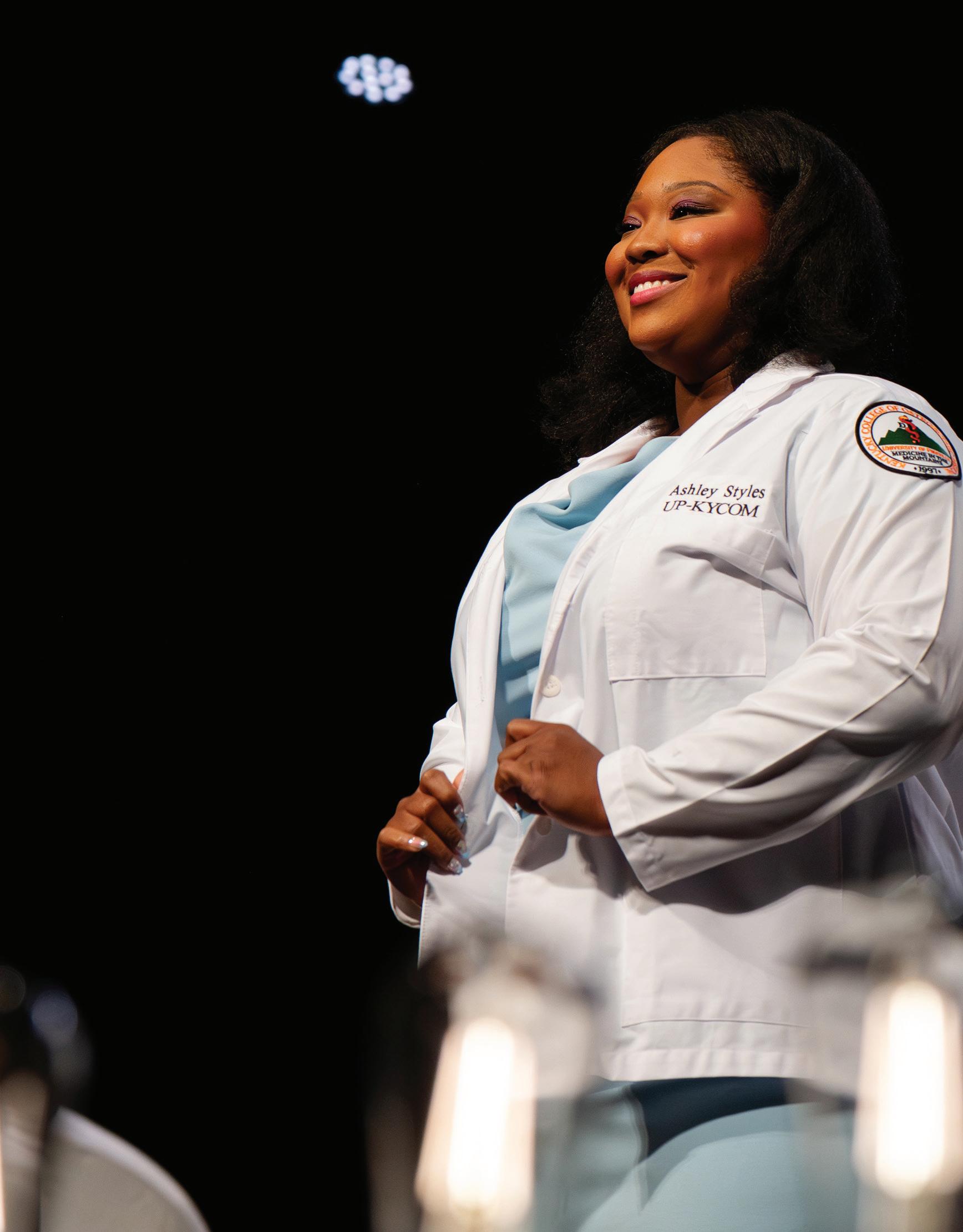
KYCOM CELEBRATES CLASS OF 2029 IN ANNUAL WHITE COAT CEREMONY
The Kentucky College of Osteopathic Medicine celebrated a major milestone on September 20, as 145 first-year medical students participated in the annual White Coat Ceremony at the Mountain Arts Center in Prestonsburg, Ky. The ceremony marked the students’ symbolic entry into the medical profession as they donned their white coats for the first time.
UPIKE President Burton J. Webb, Ph.D., welcomed attendees and reflected on the significance of the day, while KYCOM Dean Joe Kingery, D.O., KYCOM ’06, MBA ’18, FACOFP, FAAFP, shared remarks about the students’ commitment to becoming compassionate and skilled physicians.
“Today is a remarkable day. The White Coat Ceremony is among the most meaningful events in a medical student’s history. It represents a commitment to professionalism and empathy in medicine,” said Kingery. “Today, we welcome the Class of 2029 to the KYCOM family. The white coat is more than just clothing; it represents the trust patients place in you. As you put it on, remember you are stepping into a tradition of excellence.”
TANNER COLLEGE OF DENTAL MEDICINE EARNS INITIAL ACCREDITATION
The Tanner College of Dental Medicine is steadily moving from vision to reality as it prepares to welcome its first class in June 2026. The college recently earned initial accreditation from the Commission on Dental Accreditation (CODA) and is now accepting applications, a major milestone that demonstrates TCDM is ready to provide high-quality education and clinical training.
CODA’s recognition confirms that the college’s programs and curriculum meet rigorous national standards. It also ensures that graduates will be eligible for licensure and prepared to deliver comprehensive, compassionate care.
“This historic accomplishment affirms the strength of our vision to prepare compassionate, skilled dental professionals dedicated to serving rural and underserved communities,” said Dean of TCDM Jill Keaton, DMD. “The response from prospective students has been remarkable. With more than 1,300 applications already submitted, the enthusiasm for our inaugural class is clear.”
A SUMMER ABROAD
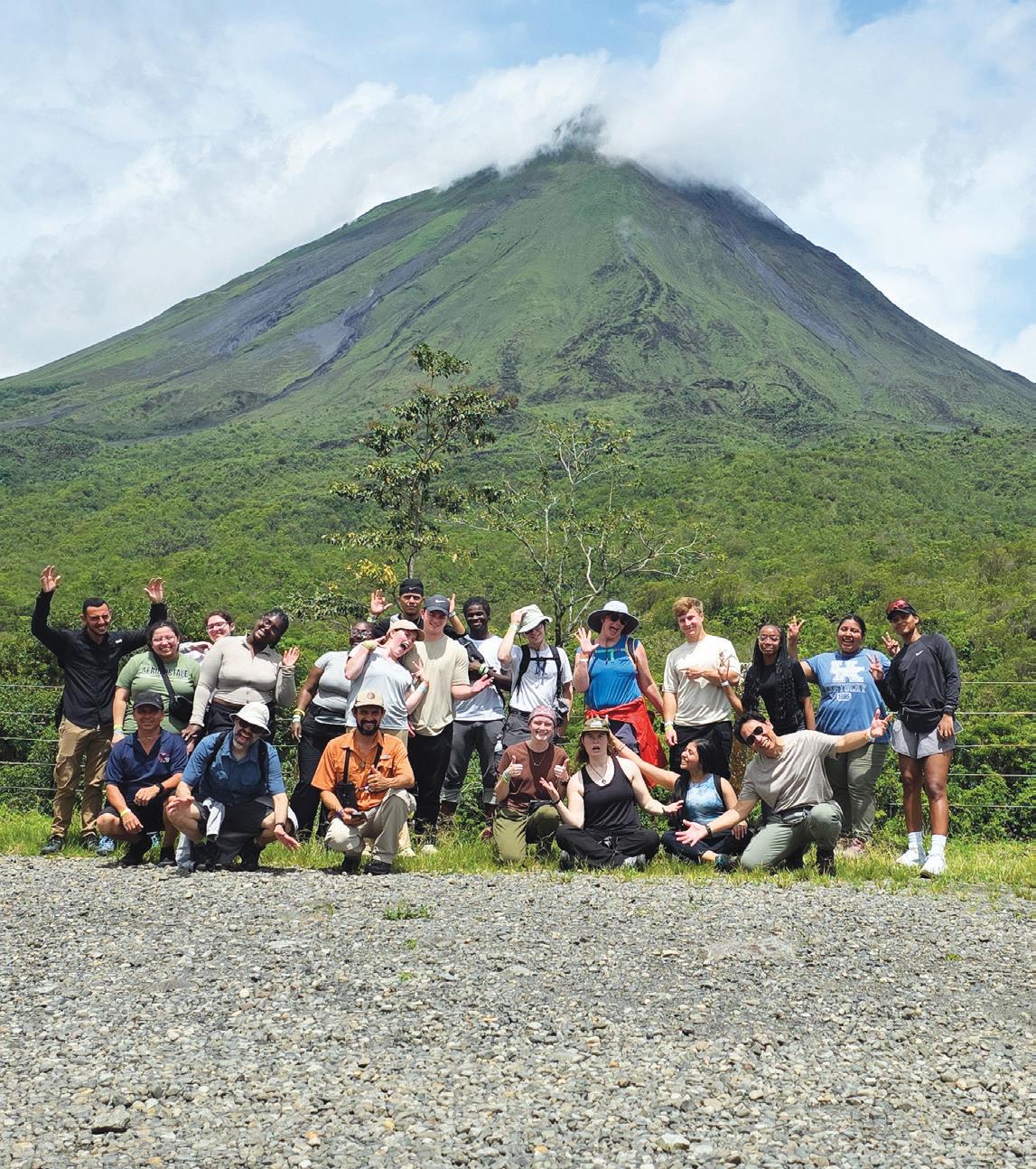
This past summer, Professor of Biology Agus Sofyan, Ph.D., led UPIKE students on a month-long study abroad program in Costa Rica through the Kentucky Institute of International Study. The trip blended classroom learning with hands-on experiences in some of the country’s most ecologically rich regions, including Arenal Volcano, Monteverde Cloud Forest, Catarata La Danta, Manuel Antonio National Park and Los Quetzales National Park. At Arenal, students saw how geothermal energy supports Costa Rica’s renewable goals while relaxing in hot springs heated by the volcano. In Monteverde, they studied clouddependent ecosystems from hanging bridges high in the misty canopy, spotting howler monkeys, orchids and even the resplendent quetzal. A challenging hike to Catarata La Danta highlighted the importance of preserving remote rainforests. Manuel Antonio offered a firsthand look at the challenges of balancing tourism and wildlife conservation, while Los Quetzales capped the trip with lessons in reforestation and carbon sequestration.
“Studying abroad in Costa Rica reminded me that learning doesn’t just happen in classrooms,” said Sofyan. “If you’re considering going abroad—do it. The world is the best teacher you’ll ever have.”
BEARS IMMUNIZATION STATION
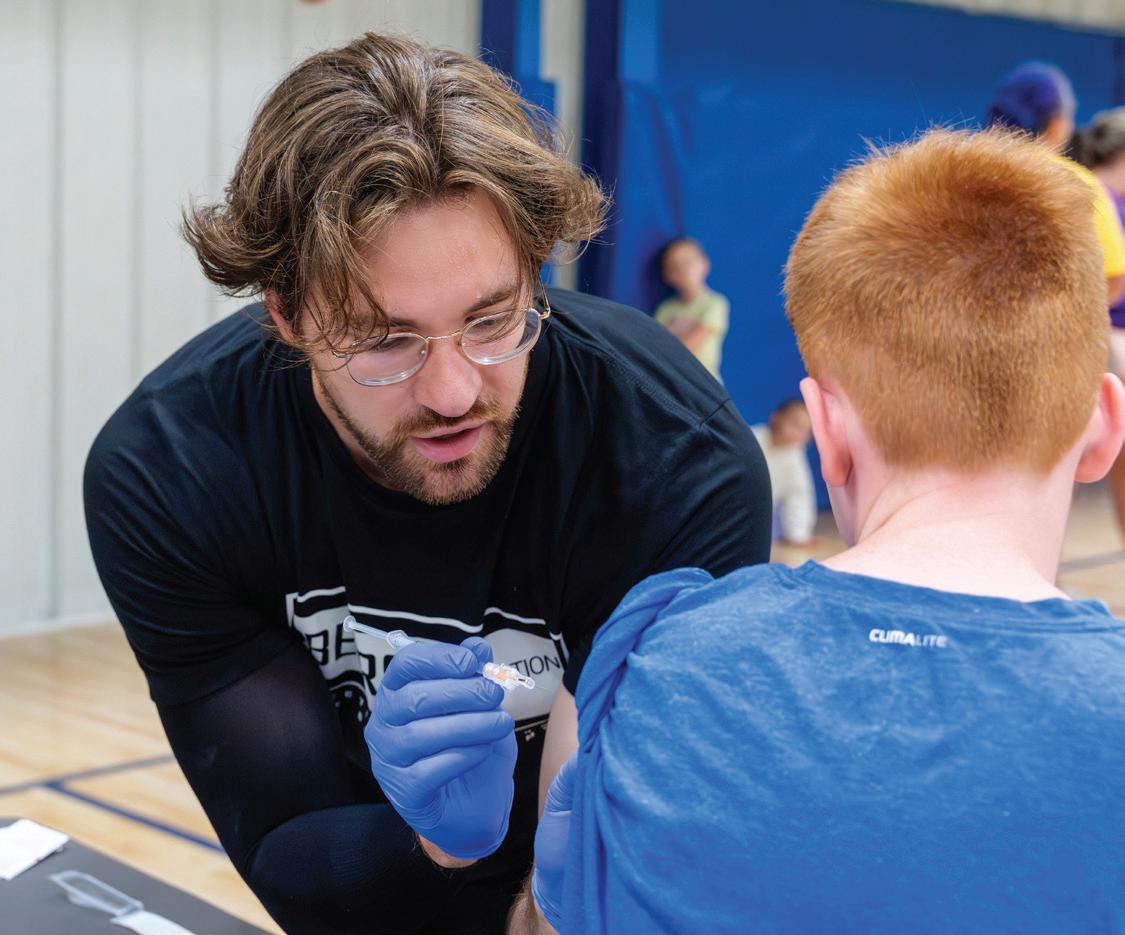
Before the school year began, the Pike County Health Department teamed up with UPIKE and Ronald McDonald House to host a free vaccine clinic for students ages 11 and older. The event provided families with required immunizations and gave students from the Elliott School of Nursing and the Kentucky College of Osteopathic Medicine valuable hands-on experience.
NEW NAME SAME
NEW NAME SAME
The University of Pikeville is reaffirming its commitment to making college accessible for Kentucky students with a refreshed name for its signature tuition-assistance program: the UPIKE Pledge.
The UPIKE Pledge provides the same necessary support previously offered through the Pikeville Promise Scholarship. The program covers the cost of tuition and books after state and federal grants and other tuition-only scholarships are applied, allowing qualifying Kentucky students to focus on their education rather than financial barriers.
“For the last 15 years, UPIKE has been committed to helping the students of Kentucky achieve their educational dreams in an affordable way,” said President Burton J. Webb, Ph.D. “The UPIKE Pledge continues to provide tuition-free education for students who qualify. We make the pledge, you keep the promise.”
FULL TUITION COVERAGE
PROMISE
PROMISE
To qualify, students must apply and be admitted to UPIKE, submit their transcripts (and test scores if required) and file the FAFSA as early as possible, as funding is awarded on a funds-available basis. Students are automatically considered for the UPIKE Pledge once they are admitted and determined to be eligible, and no additional application is required. Eligibility is reserved for Kentucky residents who are awarded the full Pell Grant, the full College Access Program Grant and the Kentucky Tuition Grant. Transfer students from Kentucky are also fully eligible for the program. The UPIKE Pledge is renewable for up to four years.
By Stacey Walters
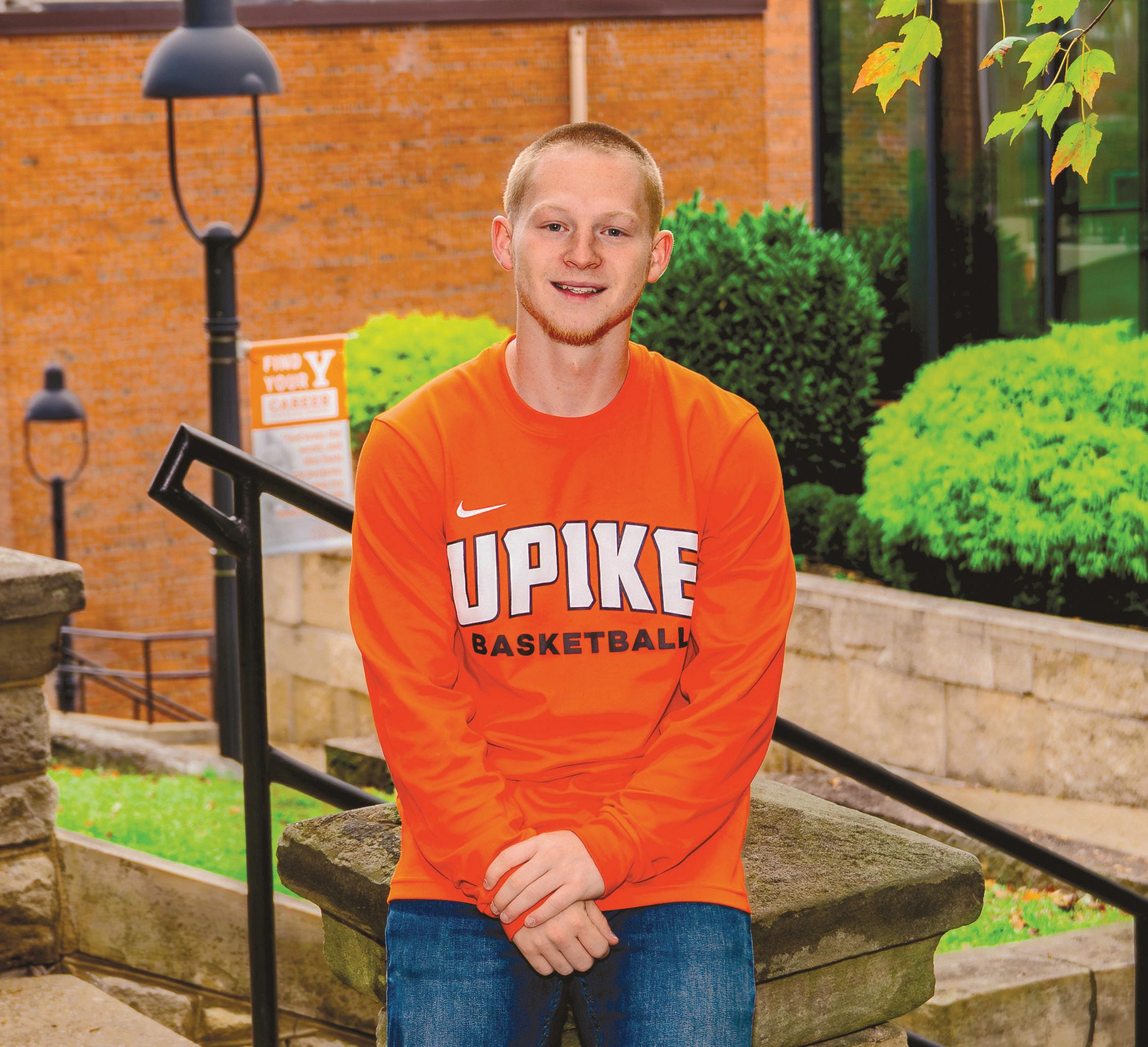
Senior Keian Worrix believes the decision to attend the university was driven by both the strength of its support system and the opportunities made possible through the UPIKE Pledge.
“I chose UPIKE because it’s home. The support system here is incredible, and I knew staying close to home would help me thrive. The UPIKE Pledge also played a major role in my decision,” said Worrix. “I’m only the second person in my family to attend college, so it means a lot to be able to do something that hasn’t been common in my family. The scholarship has allowed me to focus on my education and basketball without the financial stress.”
M YOURasteringFuture
By AMY CHARLES, MBA ’23
The University of Pikeville continues to expand opportunities for professional advancement by launching new graduate programs: the Master of Legal Studies (MLS), the Master of Science in Strategic Communication (MSC), the Master of Arts in Teaching (MAT) and soon the Master of Science in Information Technology Management (MITM). All programs are designed for flexibility to meet the needs of today’s workforce.
Expanding Access to Legal Education
The new Master of Legal Studies program, developed in partnership with the Appalachian School of Law, provides working professionals with a comprehensive understanding of the American legal system. The program is ideal for those in fields such as human resources, compliance, healthcare and business who seek to strengthen their legal knowledge without pursuing a traditional law degree.
“This program was built with today’s professionals in mind,” said Justin Hazlewood, Ph.D., program director and UPIKE associate professor of criminal justice. “Whether in HR, compliance or another field where legal knowledge gives you a competitive edge, the MLS offers both the academic rigor and the flexibility you need to succeed.”
Courses include Employment Law and Workplace Regulation, Contractual Law and Drafting, Legal Skills, Research, and Analysis and Writing. Students may complete the degree in one year or extend their studies to two years, depending on their schedules.
MLS MSC
Strategic Communication in the Age of Artificial Intelligence (AI)
UPIKE has also launched a Master of Science in Strategic Communication, designed to prepare graduates for success in an AI-driven world. The 30-credit-hour program, part of the College of Arts and Sciences, equips students with advanced skills in digital media, public relations, crisis communication and leadership.
“We are thrilled to offer a master’s degree in strategic communication, and I am confident this degree will prepare students for today’s workplace needs,” said Chandra K. Massner, Ph.D., professor and coordinator of UPIKE’s communication program. “This program integrates theory, practice and artificial intelligence to help students thrive in a digital, fast-changing environment.”
Students gain hands-on experience with emerging tools that enhance audience engagement and campaign performance. The program is ideal for recent graduates and professionals seeking to advance in technology, healthcare, politics and corporate communication.
Preparing Future Educators
Beginning in Spring 2026, pending required approvals, UPIKE will launch the Master of Arts in Teaching programs in Elementary, Middle Grades and Secondary Education. The program is designed to address a growing need for skilled teachers in the region, preparing graduates to make an immediate impact in classrooms.
“Our region needs dedicated, well-prepared educators now more than ever,” said Dean of the Patton College of Education, Coletta Parsley, Ed.D. “The MAT program is designed to meet that need by preparing teachers who can make an immediate impact in classrooms while providing both traditional and alternative pathways to teacher certification. In addition, possible access to the TEACH Grant for qualified applicants provides a means to support their journeys.”
The MAT offers two routes: a two-year, 36-credithour Option 6 pathway for candidates who will be employed as teachers while completing required coursework, including practicum courses, and a 39-credit-hour traditional route with required coursework, field experiences and student teaching. Applicants must hold a bachelor’s degree in a certifiable major with an overall GPA of 2.75, and a transcript review ensures completion of required prerequisites.
MAT
MITM
Looking Ahead: Information Technology Management
UPIKE also plans to launch the Master of Science in Information Technology Management program, pending required approvals, in 2026. The MITM will prepare students for leadership roles in IT, blending technical expertise with business strategy and communication. The program will emphasize real-world application, industry certifications and the unique challenges of managing technology in rural communities.
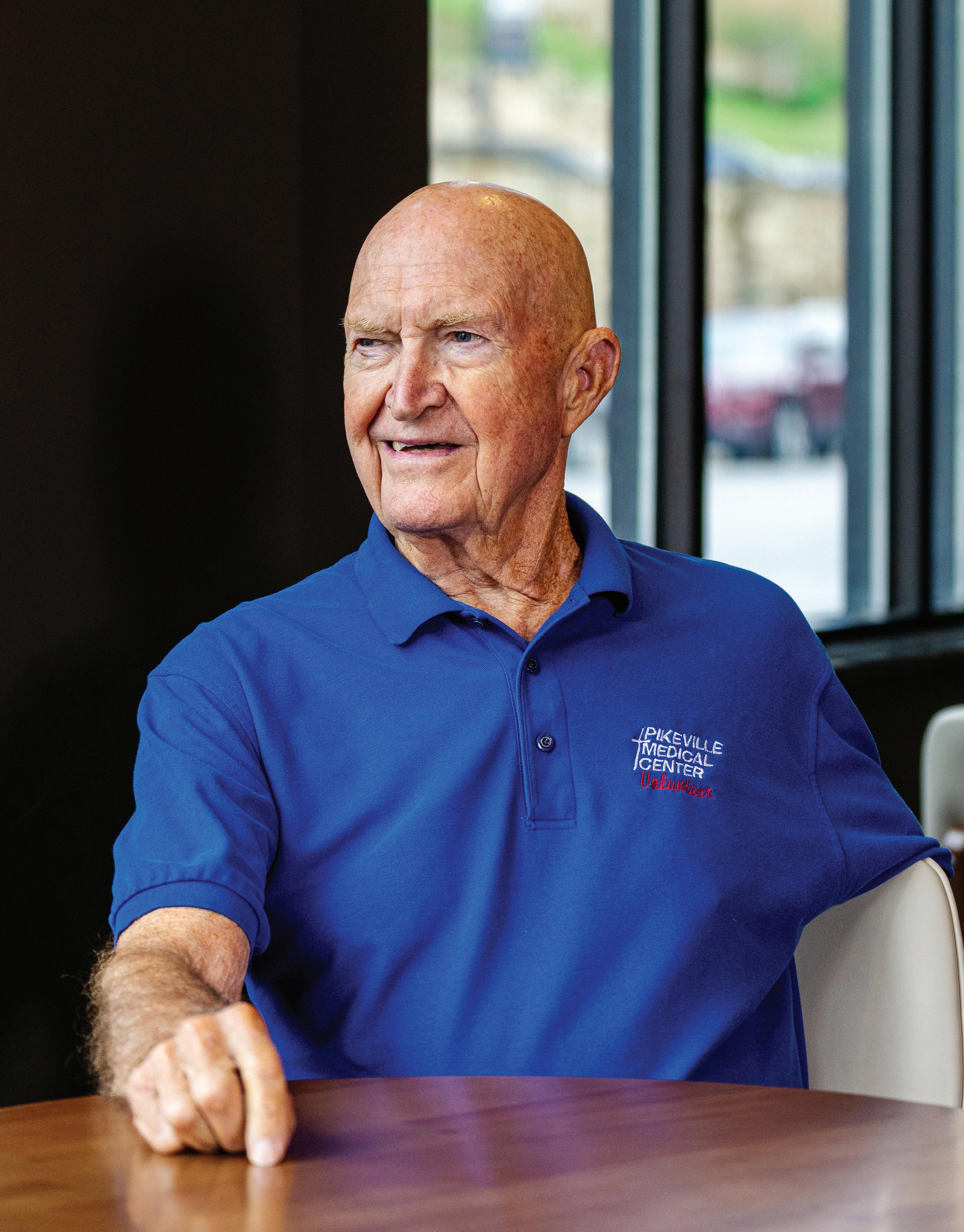
“I received opportunities and accepted challenges, knowing that hard work could produce positive outcomes. It’s allowed me to be willing and able to give back, and I hope it inspires others to do the same.”
By KATIE RAY ’24
When Roger Ratliff ’61 mailed his first gift of $25 to then Pikeville College in 1979, it was an instinctive act of gratitude.
“I had a little extra money,” said Ratliff. “I wanted to give something back to the college that started me on my path.”
DECADES OF Dedication
Through his most recent gift of $25,000 to the University of Pikeville, he established the Roger Ratliff Health Profession Endowed Fund, which provides financial assistance to students studying at the Kentucky College of Osteopathic Medicine, the Kentucky College of Optometry, the Elliott School of Nursing and the new Tanner College of Dental Medicine.
Born and raised in Pike County at Mayflower, he enrolled in Pikeville College in 1957. It had just transitioned from a junior college to a four-year institution, and the athletics program was on the rise. Ratliff was watching it all while balancing his studies and working at the then Pikeville Methodist Hospital.
“I worked evenings, weekends and holidays at the front office and information desk,” said Ratliff. “That job let me see up close how people care for others in their most vulnerable moments, and it shaped how I see service.”
The experience paid his bills and made it possible to graduate on time with a degree in elementary education. It also planted a seed for the volunteer service that would later define his retirement.
After graduation, Ratliff was offered a high school teaching position but instead accepted a job in the educational publishing business.
“What began as a sales role soon became a career of more than 40 years with companies such as Prentice-Hall, McGraw-Hill and Random House. I moved to marketing and editorial positions that required me to travel and visit colleges and universities across the country in search of new authors, reviewers and supporting cast members,” said Ratliff. “I built textbooks in government, history, sociology and criminal justice at a time when our country was wrestling with civil rights and social change, and I had the privilege of working with people who were part of those conversations.”
Over the decades, he lived and worked in Washington, D.C., Boston and Cambridge, Mass., as well as San Francisco and San Antonio. In 2009, after retiring from the Thomson Group in Texas, Ratliff returned to Pike County to care for his sister and the family home. Once the house was in order, he looked for a way to give back. In 2014, he learned of a volunteer opportunity at the new Pikeville Medical Center Clinic Information Desk. He spent the next 11 years assisting patients and visitors, guiding them to appointments, pushing wheelchairs or simply offering a friendly face. By the time he stepped back in June, he had logged more than 7,700 volunteer hours.
“When I came home, I knew I wanted to do more than just keep busy. I wanted to help people right here where I started,” said Ratliff. “Volunteering at the hospital felt like coming full circle.”
Now, taking some time for himself, he also serves as secretary of the Big Sandy Chapter of the Sons of the American Revolution. In that role, he helps honor the region’s Revolutionary War ancestors, organizes memorial services and is preparing for the 250th anniversary of American independence.
“We try to educate people about the sacrifices of the men and women who built this country and settled this region,” said Ratliff. “We do a patriot grave memorial service, recognizing that person and putting up markers of their dedication. We also have other events that aim to highlight their services, such as placing a bench at the Pike County Courthouse. The upcoming 250th anniversary is going to be an exciting time.”
It is no surprise that his largest gift to UPIKE supports the health professions. Out of the goodness learned from parents, relatives and business associates, Ratliff felt it was time to contribute.
“Healthcare is the backbone of Eastern Kentucky. Deciding to contribute to health professions students was easy,” said Ratliff. “If we want stronger communities, we have to support the people who will serve in hospitals, clinics and labs for decades to come.”
He hopes that students who benefit from the fund will be inspired to serve others.
Built on Faith, Sustained by Service
By KATIE RAY ’24
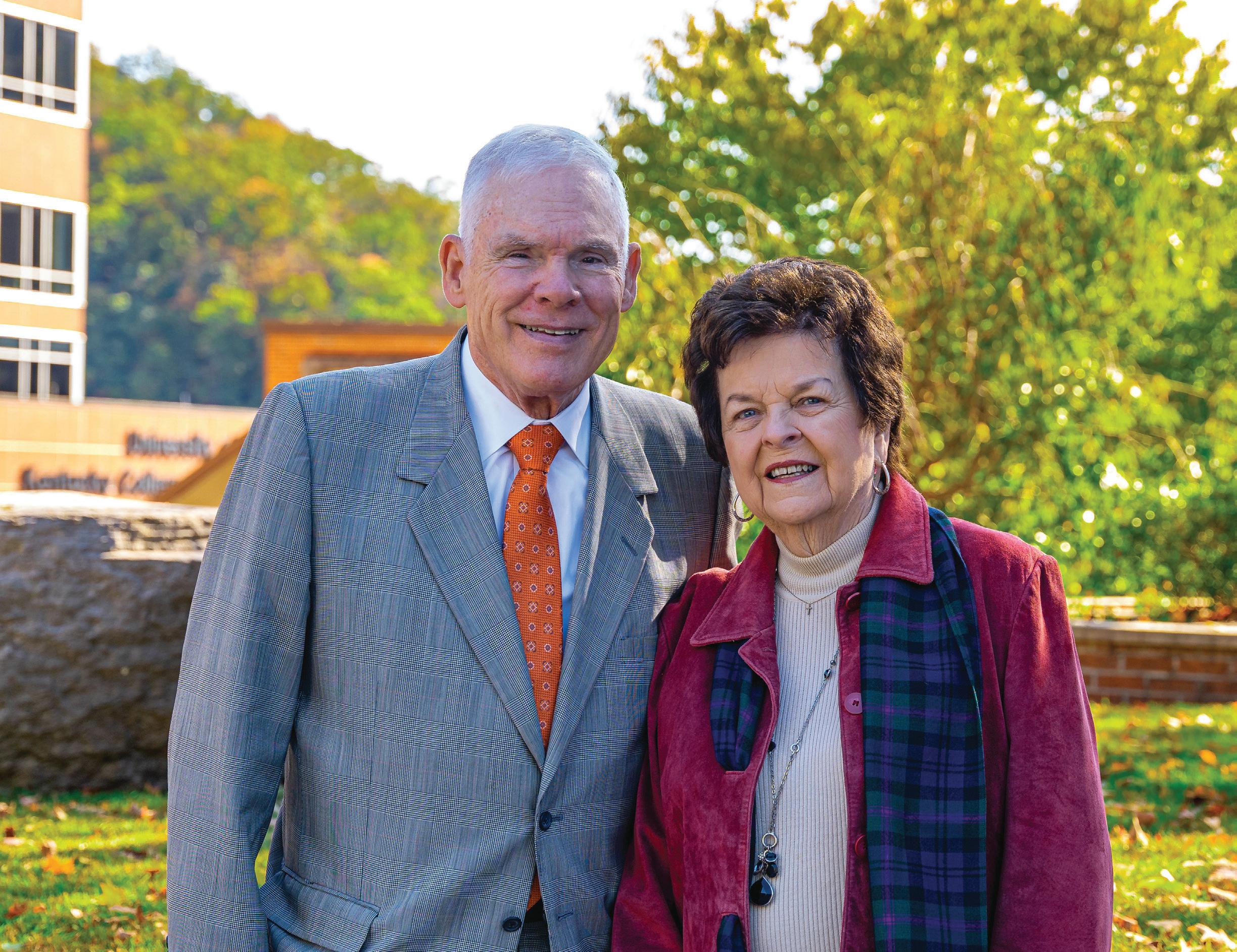
For Bill ’66 and Kaye Baird ’66, Pikeville College is more than the place where they earned their degrees. It is the heart of their family story, the home of their faith and a place where they have spent a lifetime investing in generations of students. Their roots on the hill stretch back nearly a century, beginning with Bill’s mother, Florane ’36, who attended the Junior College and Pikeville Collegiate Academy in the early 1930s.
After earning a degree in English with minors in religion and music from another institution, Kaye came to Pikeville in 1962 to serve as an educational assistant at Pikeville United Methodist Church. Soon, she was asked to teach kindergarten despite having no formal training. She began classes at Pikeville College and, in 1966, walked across the graduation stage just steps ahead of Bill, earning a degree in elementary education.
“Bill has always said I did not get fully educated until I came to Pikeville,” said Kaye. “Pikeville College gave me what I needed to truly become a teacher.”
A standout athlete, Bill spent three years at Duke University playing football before returning home. With encouragement from Kaye and a determination to finish his degree, he enrolled at Pikeville College and earned a bachelor’s in history and political science. He then continued his studies at the University of Kentucky College of Law, where he earned his Juris Doctor degree.
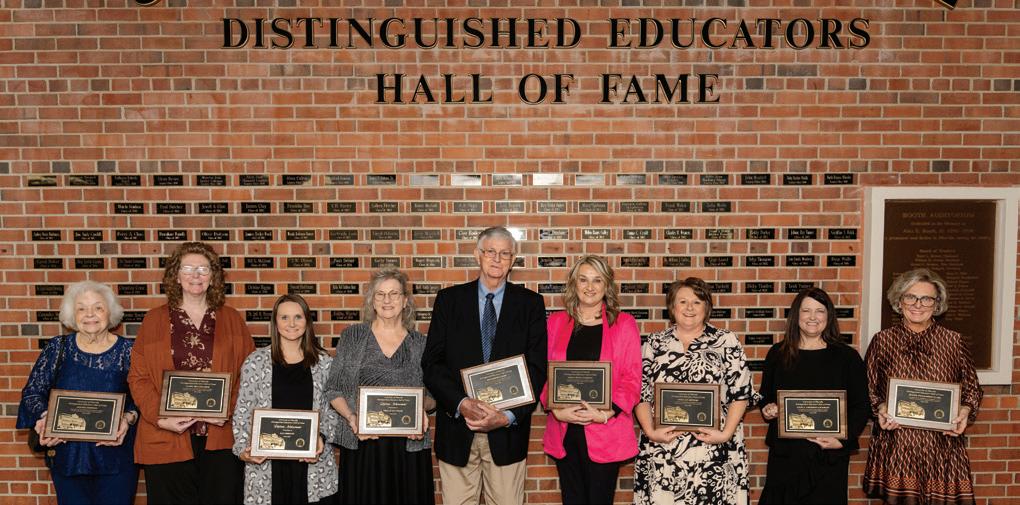
Service became the common thread of their lives. Kaye taught in Clark and Pike counties, shaping young lives through education. In 2010, she was inducted into UPIKE’s Distinguished Educators Hall of Fame, a testament to her lasting impact on students and the profession. Bill launched a successful law career and continued his family’s legacy of service on the UPIKE Board of Trustees, following in the footsteps of his father, William J. Baird II, and alongside his brother, Charles Baird. He began his service on the board in 1977 and was vice chairman for 20 years. He now holds the title of trustee emeritus.
Their three daughters enrolled in classes at UPIKE, with Elizabeth ’95 earning a degree in education. Their grandchildren, Cate and Olivia, have continued the tradition, stepping onto campus this fall with softball and volleyball scholarships. Today, Bill and Kaye can often be found in the stands cheering them on.
Bill also served as the head softball coach from 1995 to 2000, coaching Elizabeth, and led the effort to build the softball and baseball fields with the support of volunteers and the community. Kaye supported him throughout his tenure, traveling with teams and encouraging young athletes. Elizabeth was inducted into the UPIKE Athletics Hall of Fame in 2001, and Bill in 2002.
Over the years, the Baird family has established multiple scholarships to support students across the university, including the William J. and Florane Baird Endowed Scholarship, the William J. and Kaye Baird Endowed Scholarship, the Zach and Lucretia Charles Justice Endowed Scholarship and the Bill Baird Family Scholarship. Through these opportunities, countless students have pursued their education without financial strain.
“That’s all we ever wanted, to bridge a gap,” said Bill. “I am very thankful God chose to use me in this way.”
Each year, the Baird family receives letters from students, often first-generation, who might otherwise have been unable to continue their studies without scholarship support.
“This scholarship has been a saving grace,” wrote Austin Walker Collins, a biology major from Hindman, Ky. “I was at the end of my education, unsure if I could stay. Thanks to the Bill Baird Family Scholarship, I can continue. UPIKE has become home away from home to me. I don’t know where I’d be without that support.”
Faith, family and service have guided Bill and Kaye throughout their lives, inspiring generosity that has poured significant resources into the university. When asked why, Bill replied, “A desire to serve–first the Lord, then others. This university was founded as a mission in the mountains, and it still is. It’s a miracle on the hill.”
For Kaye, pride in the region and its people is where she finds her why. She sees UPIKE as proof of what Eastern Kentucky and Central Appalachia can build and become.
“We don’t hang our heads. We’re from these hills,” said Kaye. “I am proud to say, look up there, that’s the University of Pikeville.”
In 2018, UPIKE presented Bill with the inaugural Baird Family Service Award in recognition of his impact on the lives of others through service to the university, the Appalachian region and humanity.
“Without individuals like Bill and Kaye, and the entire Baird family, this university would not be what it is today. Their devotion has shaped not only our campus, but the very spirit of service that defines UPIKE,” said President Burton J. Webb, Ph.D. “For more than half our history, a Baird has stood at the heart of this institution, ensuring future students have a place to belong, to learn and to lead. They see potential others might overlook, and they make sure opportunity finds them.”
The Bairds often reflect on how drastically the campus has grown, from mandatory chapel services and small class sizes to a full university with colleges in medicine and optometry, and dental education on the horizon.
“People do not believe it until they see it,” said Kaye. “When we tell them everything happening here, they are amazed. And they should be. This place is a beacon.”
They continue to quietly support students at UPIKE, hoping their efforts motivate others to help students reach their full potential.
“Jesus said, ‘I came to serve, not to be served.’ That is how we try to live,” said Bill.
“If someone reads our story, I hope they find the blessing in giving back. Not just money, but time, support and care. UPIKE has given us a place to learn, to serve and to grow. It needs all of us, and we’re not done yet.”
MISSION DRIVEN & FOCUSED ON
VI SION
By KATIE RAY ’24
The University of Pikeville’s Kentucky College of Optometry is expanding its footprint and its impact across Eastern Kentucky, unveiling new facilities, reopening trusted clinics and celebrating alumni who now teach and serve the region they call home.
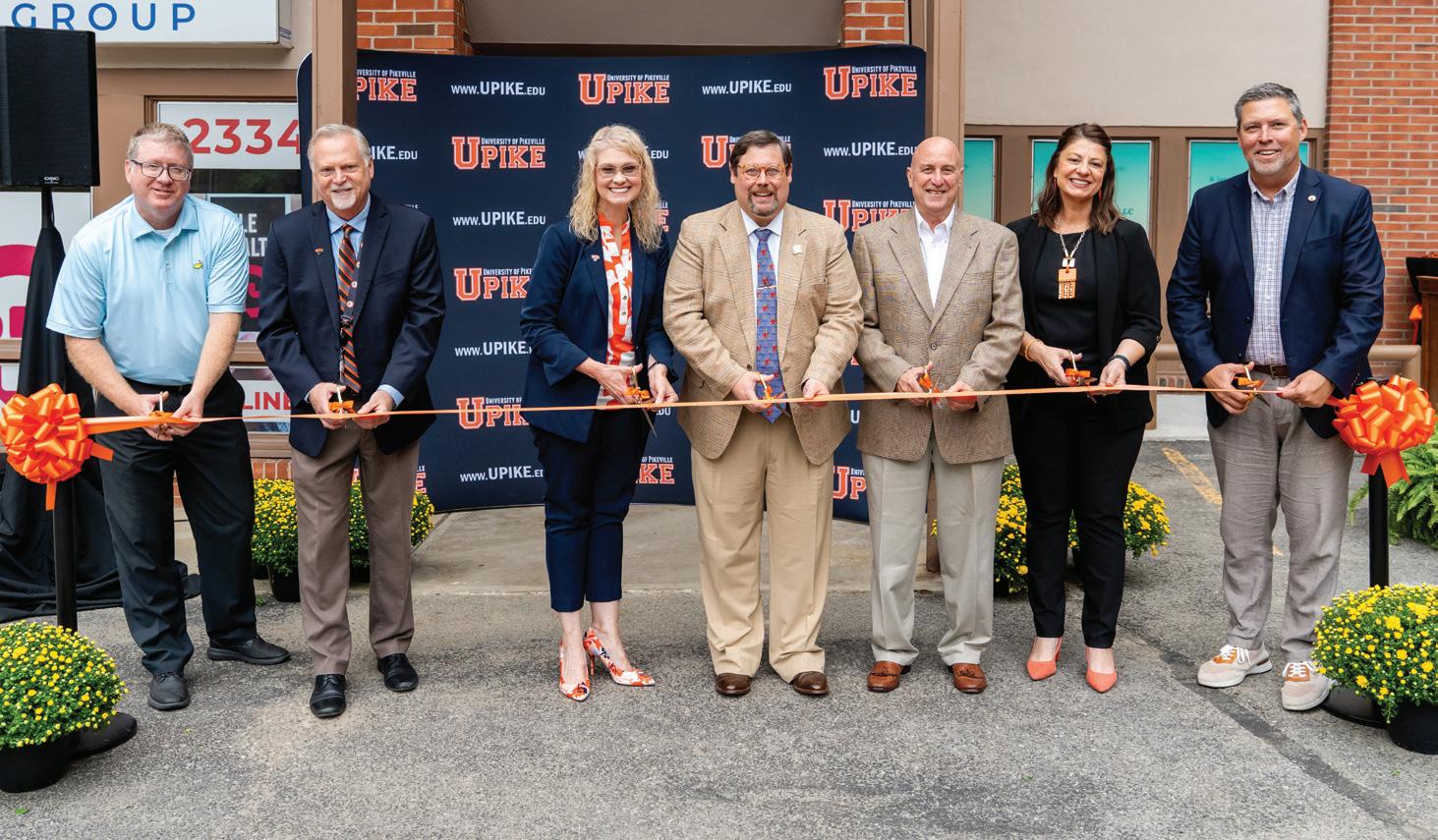
On a warm fall morning, faculty, staff and local leaders gathered at 387 Town Mountain Road in Pikeville to cut the ribbon on the Town Mountain Eye Clinic. The office, once an ophthalmology practice, now stands ready to provide a full spectrum of optometric services to the community while offering state-of-the-art training for future doctors of optometry.
“We know this region has historically faced limited access to eye care. Too many neighbors have gone without timely exams, diagnoses and treatment,” said Dean of KYCO Renee Reeder, O.D., FAAO, FBCLA, FSLS, FIACLE.
“With this renovation, we affirm our role as good members of the community, standing with Pikeville residents to ensure excellent care is available close to home.”
Inside, patients will find advanced diagnostic technology and a team committed to compassionate, high-quality care. Services range from routine eye exams to contact lens fittings and treatment for ocular conditions.
Just days before the Town Mountain celebration, KYCO held a ceremony for the reopening of the Martin Eye Clinic at 41 Triangle Street. Temporarily closed following severe flooding earlier this year, the clinic has long been a lifeline for patients in Floyd County and surrounding communities.
“Losing the Martin Clinic didn’t just impact the community; it disrupted education,” said Reeder.
“Our students lost a site where they trained to become doctors. The faculty lost a space where they mentored. And our patients lost trusted providers right in their own backyard. So today is not just a reopening. It’s a recommitment to care, to education and to showing up, again and again. The Martin Clinic stands stronger today; rebuilt not just with tools, but with trust.”
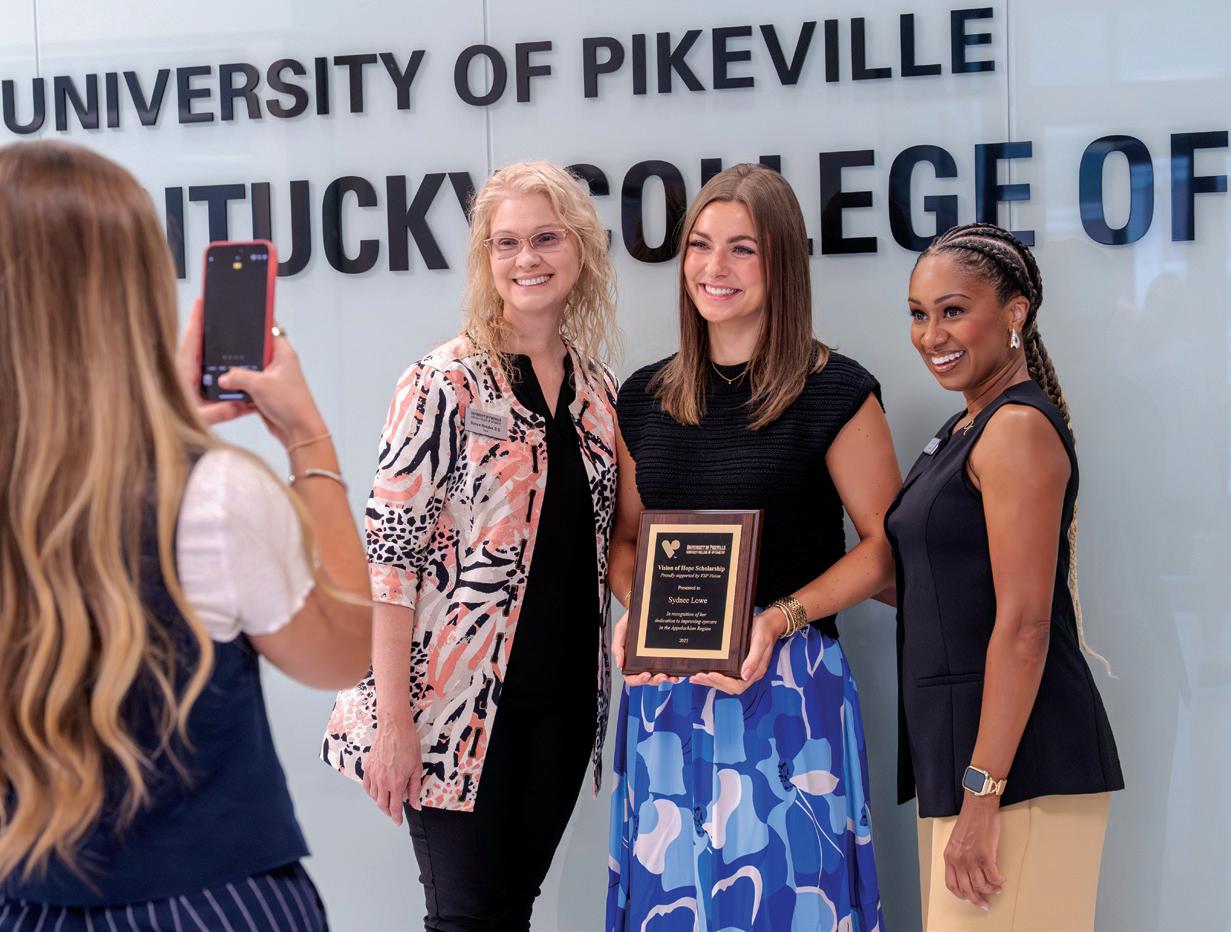
Alongside expanded clinical access, KYCO is also celebrating student achievement. In partnership with VSP Vision™, the college recently awarded the $5,000 Vision of Hope Scholarship to first-year student
Sydnee Lowe of Pikeville.
From left: Barry Bentley, Cliff Caudill, Renee Reeder, Kentucky State Senator Phillip Wheeler, J.D., Ophthalmologist Charles Wheeler, M.D., Lori Werth and Burton J. Webb
From left: Renee Reeder, Sydnee Lowe and VSP Vision’s Shenay Rich
“Receiving this scholarship really reflects the support of this amazing community. I’m from Pikeville, so it’s such an honor to represent my hometown through this,” said Lowe. “I know it’s going to help me grow as an optometrist and allow me to serve the people here in the future.”
Each year, this scholarship is awarded to an incoming optometry student at KYCO who is committed to practicing in the Appalachian region, providing care to underserved patient populations.
“We at KYCO are so appreciative of our longstanding partnership with VSP Vision and their commitment to supporting our students and their desire to serve the underserved here in Appalachia,” said Reeder. “We’re also really excited about this year’s recipient, Sydnee Lowe, what she represents, the character she shows and the way she’ll continue to give back to this community in the future.”
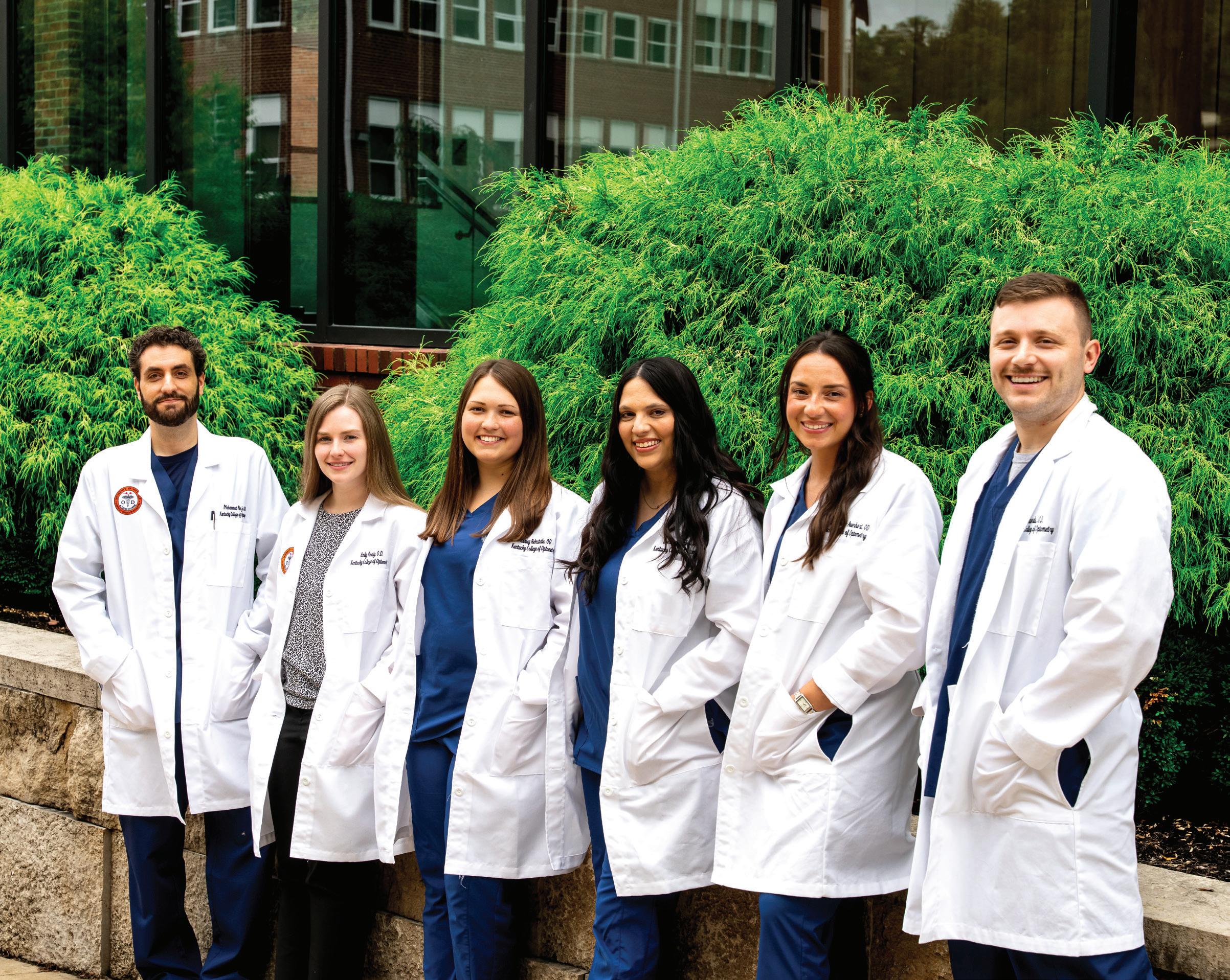
One of KYCO’s proudest achievements is seeing its own graduates return to teach and practice in the region. Today, six full-time faculty members are KYCO alumni, with a seventh, Brittany Varney, O.D., KYCO ’22, working at Big Sandy Health Care alongside students. Several others are caring for patients in their own practices across Eastern Kentucky.
(Pictured above from left) Mohammed Naja, O.D., KYCO ’21, Emily Konig, O.D., KYCO ’21, Ashley Reinstetle, O.D., ’19, KYCO ’23, Dominique Fulk, O.D., KYCO ’22, Caitlynn Estevez, O.D., KYCO ’23 and P.J. Sowards, O.D., ’19, KYCO ’23 bring both practical experience and a deep understanding of the region to their teaching. Their firsthand knowledge of the challenges and opportunities in Appalachian eye care allows them to mentor students with insight and authenticity, preparing them for the realities of practice in rural communities.
“Our goal of bringing eye care to the region is being realized,” said Reeder. “Our alumni are proof that KYCO’s impact extends far beyond the classroom. They teach, practice and lead in ways that transform lives. This is the heart of our mission, bringing high-quality eye care to the communities that need it most.”
A Road Less Traveled
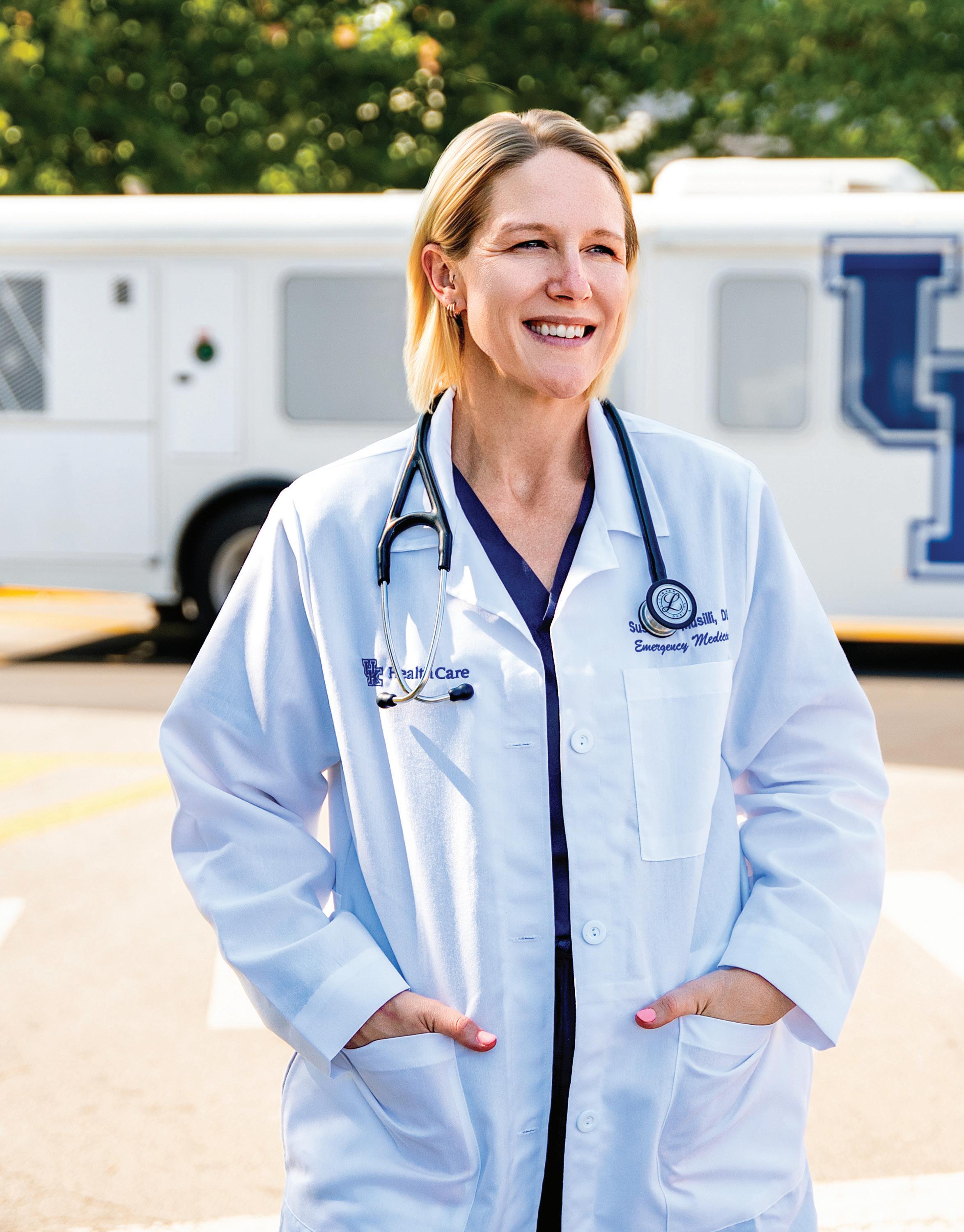
Susan Musilli, D.O., KYCOM ’25 never set out to become a physician. Raised in the small farming town west of Paducah, in Wickliffe, Ky., Musilli thought nursing would be her career path. It was a noble and practical profession that could provide for a family and make a meaningful contribution to the lives of others. And it did.
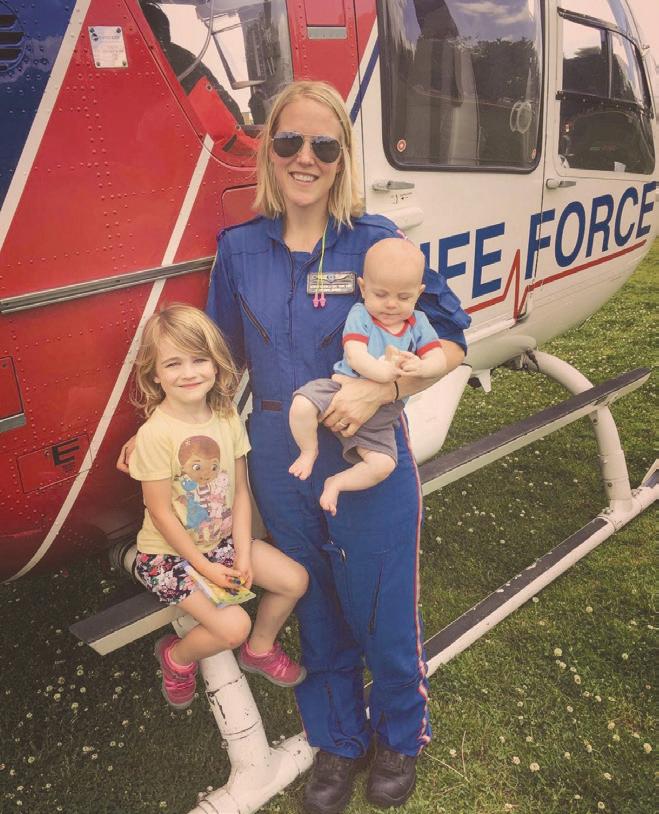
For more than a decade, Musilli built a dynamic nursing career, beginning in the emergency room and advancing to the neuro-intensive care unit. She ultimately took to the skies as a flight nurse, an elite and intense position that would ultimately change her entire trajectory.
Working in helicopter emergency medical services for Life Force, one of the top programs in the country based at Erlanger Hospital in Chattanooga, Tenn., Musilli found herself making fast-paced, life-saving decisions in high-stress environments. The experience opened her eyes to the kind of impact emergency medicine physicians could have.
“I never intended to become a physician,” said Musilli. “But I realized I wanted to have a broader impact on patients. Being a flight nurse helped me see that I had more to give and to learn. That role gave me a different perspective. I admired the autonomy, responsibility and leadership in the field, and realized I wanted to do more of that.”
Still, the leap to medical school was not easy. Musilli was the first woman in her family to go to college. Her father held a degree in agriculture, and she grew up steeped in the values of hard work and perseverance learned on the family farm. But the decision to attend the University of Pikeville’s Kentucky College of Osteopathic Medicine felt natural.
“There was a lot of self-doubt. People from my area didn’t typically pursue professional degrees, certainly not later in life as a career change. I didn’t fully understand how to navigate that process,” said Musilli. “KYCOM embraced me. They celebrated me and made it clear they wanted me to be there. I’d never even been to Pikeville before, but I felt welcomed from day one.”
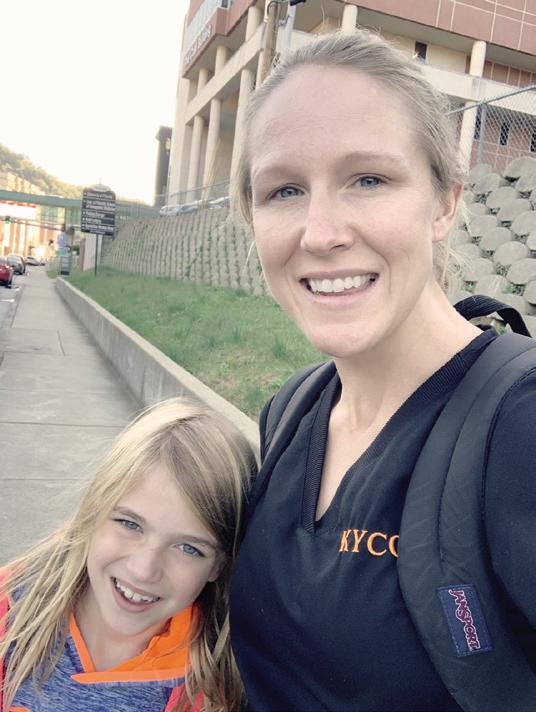
Musilli started KYCOM in 2021 and graduated in 2025. In those four years, she did not just survive medical school; she thrived. She served as president of the Emergency Medicine Club and helped mentor fellow students as a liaison and peer tutor. She juggled coursework, clinicals and parenting two young children, Caroline, now 12, and Lincoln, seven, while her husband, Craig, supported the family as an electrical engineer
“I absolutely couldn’t have done it without him,” said Musilli. “I supported him when he earned his degree, and he was happy to do the same for me. His support is one of the biggest reasons I was successful.”
Musilli’s why for becoming a physician became clear through years of experience, pushing past self-doubt and ultimately deciding that care is care, and everyone deserves it. She remembers the day she cared for a four-year-old with a head injury that he would not survive. She gave his family just a few seconds to kiss him goodbye before they took him back. Later, Musilli received a message from the child’s mother expressing her gratitude for the kindness she showed their family that day.
“People deserve a champion in their corner,” said Musilli. “They deserve life-changing moments to have some positivity in them, even if they’re tragic. Emergency medicine allows me to be that champion.”
Now an emergency medicine resident physician at the University of Kentucky, in the same department she started in as a new graduate nurse, she believes she ended up exactly where she needed to be.
“Emergency medicine fits me; it allows me to be that champion. The pace, the variability and the opportunity to be there in someone’s worst moment suits how I operate,” said Musilli. “My experiences as a nurse and nontraditional student push me to be the best doctor I can be. Those experiences will keep me grounded and motivated to continually strive for improvement. It is an honor of a lifetime to treat patients in my home state.”
By AMY CHARLES, MBA ’23
Basketball &
When Virginia native Rze Culbreath ’19 stepped onto the University of Pikeville’s campus for the first time, he was looking for more than just a chance to finish out his college basketball career. He was searching for a purpose.
“Being the first person in my family to graduate was the goal,” said Culbreath. “UPIKE was one of the top NAIA programs in the country, but it was also a place where people cared. The ACE [Academic and Cultural Enrichment] Program, the resources, the way everyone made me feel welcomed—it was where I needed to be.”
Culbreath’s path to Pikeville was far from straightforward.
After a year at Mt. Zion Prep, he spent two seasons sharpening his game at Garrett College in Maryland. With two years of basketball eligibility remaining and a degree to finish, he and his parents drove nearly eight hours to visit UPIKE. What he found was more than a team.
“I loved the campus and the culture,” said Culbreath. “Everyone made me feel comfortable right away. They showed me they wanted to see people succeed, no matter what challenges they faced. UPIKE felt like home.”
Culbreath played basketball over the next three years and later joined the men’s soccer team. He became active in the Black Student Union and pursued a degree in business. He learned the ins and outs of sport management, marketing and business development.
“UPIKE taught me the value of having a vision, believing in yourself, building teamwork, making sacrifices and playing a role,” said Culbreath.
After graduation, he returned to Virginia, eager to put the lessons he had learned into practice. He began working at Service Master, a local restoration business, while also mentoring young men in his community.
“I worked one-on-one with students through a mentoring program,” said Culbreath. “I built my own schedule so I could meet with them and their families after school, while balancing it with my regular work.”
A few years later, a professional basketball opportunity took him to Armenia, where he further honed his skills and perspective. Returning to the U.S., he moved to New York and joined the Tri-State Admirals of The Basketball League (TBL). TBL was founded in 2018 by Evelyn Magley and is now considered the third-largest men’s professional basketball league in the country behind the NBA and NBA G League. The league features 37 teams across the country and Canada. With the Admirals, he continued mentoring students while pursuing his athletic career.
“We’re talking about high-level talent, athletes who’ve played at both the college and international level. TBL gives players a platform to build their resumes and earn opportunities overseas, with live stats and games streamed to more than 140 countries,” said Culbreath. “One example is Lindy Waters III, who’s now in the NBA after being called up from TBL. At its core, this league is about community, giving back and making an impact on and off the court.”
Photos by Cassandra Lynn Photography
Beyond
In 2022, he and his parents, Rodney and Tina, founded the Virginia Valley Vipers of TBL, bringing the first professional basketball team to the commonwealth. Choosing the symbolism of rebirth and transformation, the Vipers provide athletes from all backgrounds the chance to compete at a higher level while serving the Winchester community.
“We’re focused on strengthening youth, families and communities here in Winchester through mentoring and support,” said Culbreath. “We work with young people who’ve experienced trauma or tough circumstances and help them find their path. Through programs like Live Life Forward and Project Positive, we create experiences that help youth and adults overcome obstacles.”
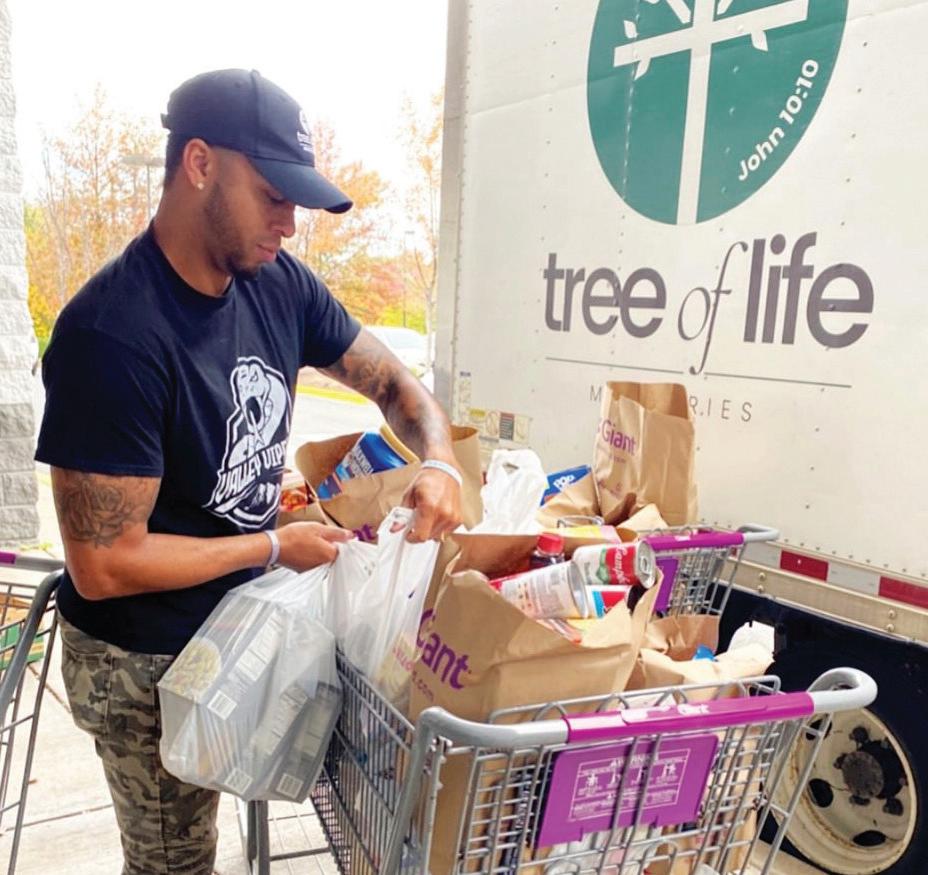
Under Culbreath’s leadership, the Vipers have become a strong presence in the community. They have organized food drives with Tree of Life Ministries and Giant Foods, donating more than 3,000 pounds of food to local families. The team also collaborates with the parks and recreation department to run basketball camps, offering scholarships and transportation to ensure all children can participate.
“Being the first and only professional basketball team in Virginia is a blessing. Post-college playing options can be limited, but what truly motivates me is the work we do off the court,” said Culbreath. “From food drives to volunteering with the Congregational Community Action Project and running youth basketball programs, we strive to support families and create opportunities for kids. Connecting with the community and seeing the difference we make is incredibly rewarding.”
The family also co-founded the “I’m Just Me Movement,” the charity of choice for the Vipers, which provides mentorship and training for youth and families. The nonprofit works with local schools, mentoring at-risk students and serving as a role model in their lives.
For Culbreath, his why has grown beyond personal achievement. It is now about community, mentorship and creating opportunities for others to thrive. From the beginning, his drive has been rooted in family. Watching the sacrifices his parents made, he knew he had to give his very best. When his mother survived stage 4 breast cancer, it strengthened that purpose, and his two-year-old son has become a part of it as well. At the same time, his experiences at UPIKE helped him learn how to turn that drive into meaningful action.
“UPIKE didn’t just help me earn a degree; it helped me find direction in life. Being surrounded by mentors, teammates and programs that cared about my growth showed me how to lead, manage a business and make an impact. I truly feel like God sent me there for a reason.”
By KATIE RAY ’24
From the 99
By Stacey Walters
to the Lowcountry
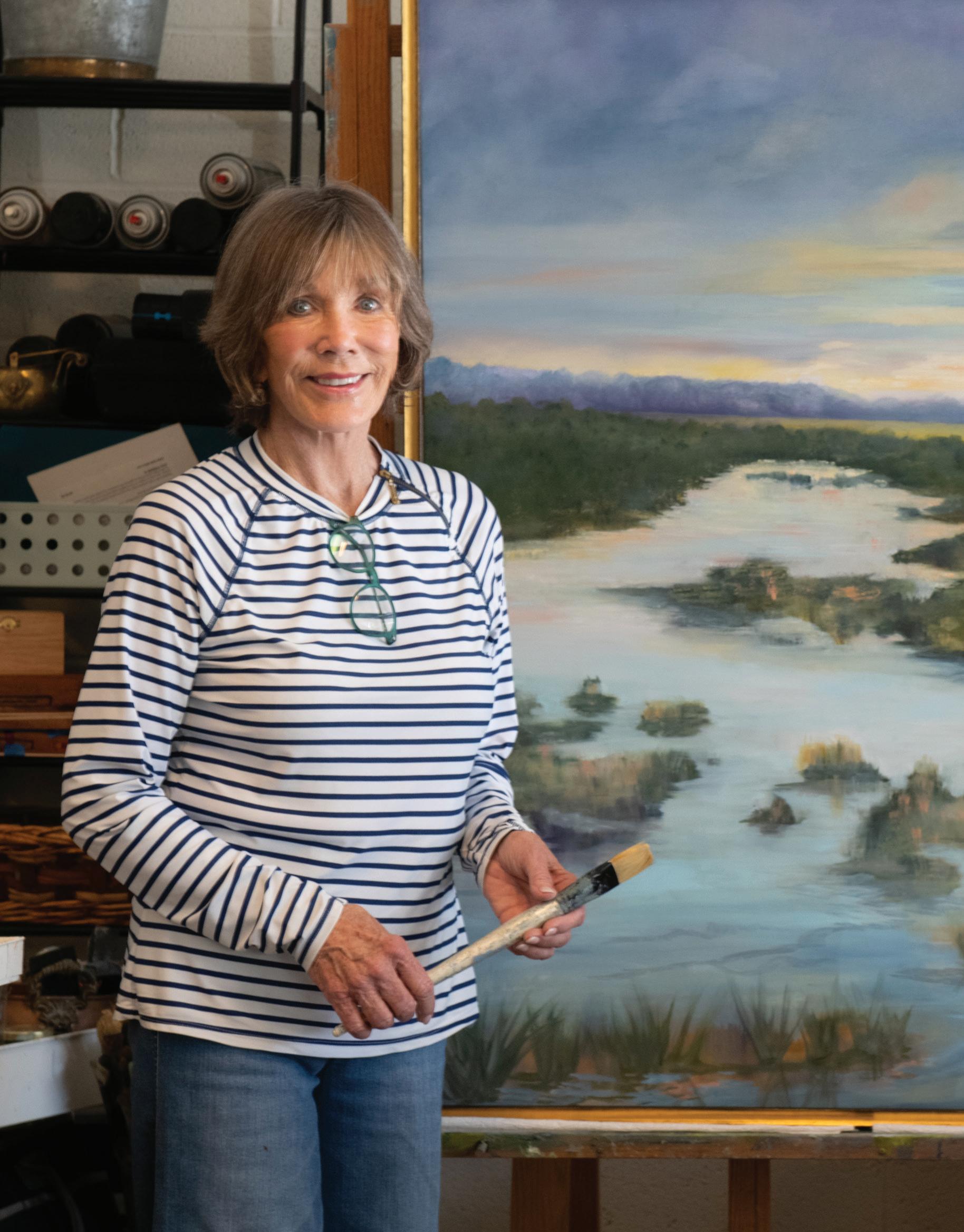
Judy Walters ’72 is best known for her vibrant art, which captures the salt-kissed marshes of South Carolina while honoring Appalachian life, memory and resilience. Before her art was displayed in galleries, Walters, a coal miner’s daughter, grew up on a working farm outside Pikeville. She was a first-generation college student and came to then Pikeville College on a Daughters of the American Revolution Scholarship. She earned a degree in general business with minors in English and psychology. On the hill, she formed some of her fondest memories of campus life, friendships and the close-knit community that remains with her today.
“I remember climbing the 99 steps to cheerleading practice and basketball games. I treasure the great times in the Bears Den, the assembly meetings that brought us together, and the religion classes with Miss Culton. I will always cherish Dr. Rediford Damron, his warm smile and love for the students,” said Walters. “The mountains will always be home for me.”
Walters’ devotion to her alma mater continued after graduation. Following a successful career in the real estate industry, she joined the University of Pikeville Board of Trustees in 1999 and was involved with the establishment of the Kentucky College of Osteopathic Medicine.
“We recognized the need to have more doctors and nurses in the region,” said Walters. “It was gratifying to be a part of something that will impact the area for generations.”
During those years, Walters also served on the Historic Preservation Commission and poured her energy into preserving historic buildings in downtown Pikeville, including the transformation of the Flat Iron building into office suites.
“I enjoyed taking over older homes and buildings, revamping them and seeing them thrive again,” said Walters. “I loved seeing older neighborhoods turned into beautiful areas.”
After retiring in 2008, she turned her creative energy toward painting, and in 2016, she and her husband, Jack, moved to Charleston, S.C., to be closer to family. There, her daughter-in-law introduced her to the city’s thriving art scene. Her path would eventually take her across the world, from studying at the Florence Academy of Art in Italy to attending immersive workshops in Africa, France, Portugal and across the United States.
Within a year, Walters was juried into two prestigious spaces: Perspective Gallery in Mount Pleasant and the Charleston Art Guild Gallery, which was voted the city’s top gallery for five consecutive years. Her work draws inspiration from the South Carolina lowcountry’s ever-changing skies, brilliant sunrises and colorful marshlands. But her Kentucky roots remain in every brushstroke.
“Nothing will ever replace the colors I found in Eastern Kentucky,” said Walters. “I love the blue of the snow when the light would hit it a certain way, the golden hay bales in the fall and the morning fog rising over the mountains.”
Her creative process often begins outside, painting small plein air from a boat before refining them in her Daniel Island studio. Whether capturing the quiet drama of a tidal creek or the glow of a mountain sunset, Walters infuses her work with a sense of place and memory.
Looking back, Walters is grateful for UPIKE’s impact in Appalachia, which not only opened doors for her as a student but also continues to transform lives throughout the region.
“In my view, it started in Pikeville—with the land, the light and a love of learning that’s stayed with me every step of the way,” said Walters. “Anything that reflects the university’s importance to this region deserves to be shared. For anyone seeking an education, UPIKE is the place where dreams become reality.”
Destined for Dentistry
For Jacob Justice, DMD, ’13 the path to dentistry began long before he stepped into a classroom. He was only 10 when he started helping in his father’s dental office, mixing materials and learning the rhythms of patient care. By the age of 14, he was assisting patients alongside his father, James Justice, DMD, ’92. That early experience shaped his career and instilled in him a deep sense of purpose and a commitment to community service.
Jacob’s journey to the University of Pikeville followed two associate degrees through the Kentucky Community and Technical College System. After transferring to UPIKE, he majored in biology, joined Tri-Beta, volunteered with Remote Area Medical and found a mentor in the nowretired religion professor James Browning, Ph.D.
“I’ve basically been raised in a dental office,” said Jacob. “By the time I got to UPIKE, I knew I wanted to
stay close to home and continue learning here. It gave me confidence and taught me that I could accomplish anything with hard work.”
After graduation, he attended the University of Louisville School of Dentistry and returned home to practice alongside his father. From 2017 to 2020, the two worked side by side at Elkhorn Dental. Today, Jacob owns Norton Dental in Norton, Va., but the two still coordinate to serve patients throughout the region.
“School teaches the science and the basics, but nothing beats real-world experience,” said Jacob. “At times, it felt like drinking from a firehose. But I had my dad to lean on—a seasoned veteran who had seen it all. He’d draw diagrams, walk me through procedures step by step, and push me to do 20 more. That mentoring made me the dentist I am today.”
For James, dentistry was never the initial plan. Born in Pikeville, he spent part of his childhood in Chicago before returning to Eastern Kentucky. He graduated from then Pikeville College with a triple major in history, political science and psychology, originally intending to become an attorney. A five-year stint as a Kentucky State Trooper made him reconsider his career path.
“I realized all I would have done as a lawyer is paperwork,” said James. “I wanted something hands-on. Dentistry just made sense. I thought about dentistry for years, but I never believed it was possible with my non-science majors. A friend encouraged me, and I realized I could make it work.”
James’ path to the dental chair was winding, including service in the Air Force, substitute teaching and even driving a gravel truck. He opened Elkhorn Dental in 1998 and became known for handling complex cases in a region often lacking specialists. From orthodontics to oral surgery, James has helped families who might have had nowhere else to turn.
“You can change people’s lives,” said James. “I’ve seen patients cry when they look in the mirror after we’ve restored their smiles.”
Jacob credits his father’s mentorship not only for his technical skill but for shaping his sense of duty to the community.
After serving on his children’s school-based decision-making council and city council, he joined the Pike County Health Department Board of Directors. In 2023, he was elected to the Kentucky House of Representatives for the 94th District. In Frankfort, he sponsored legislation to protect rural hospitals and received the Kentucky Hospital Association’s Hero Award.
“I view every policy decision through the lens of what is best for our people back home,” said Jacob. “We are humble, hardworking and proud of our mountain heritage.”
Both men are eager to see UPIKE’s newest venture, the Tanner College of Dental Medicine, open its doors. Jacob sees it as a chance to expand healthcare access in Appalachia, while James hopes it will help prepare the next generation of dentists to serve the region.
“The dental college is another stepping stone for our area to flourish, expand, improve and modernize healthcare,” Jacob said. “I’m ecstatic and can appreciate the extreme difficulty and years of dedication it took for this to come to fruition. I’d love to be part of the Tanner College of Dental Medicine one day.”
For the Justices, the college represents more than a building. It shows students across the region that they do not have to leave their mountains to pursue a world-class education or make a difference in their own communities.
“I’ve lived in many places, but I always came back home,” said James. “Kentucky has been good to me. I’m glad to see UPIKE growing so the next generation can stay here and build their future too.”
By KATIE RAY ’24
The Patton
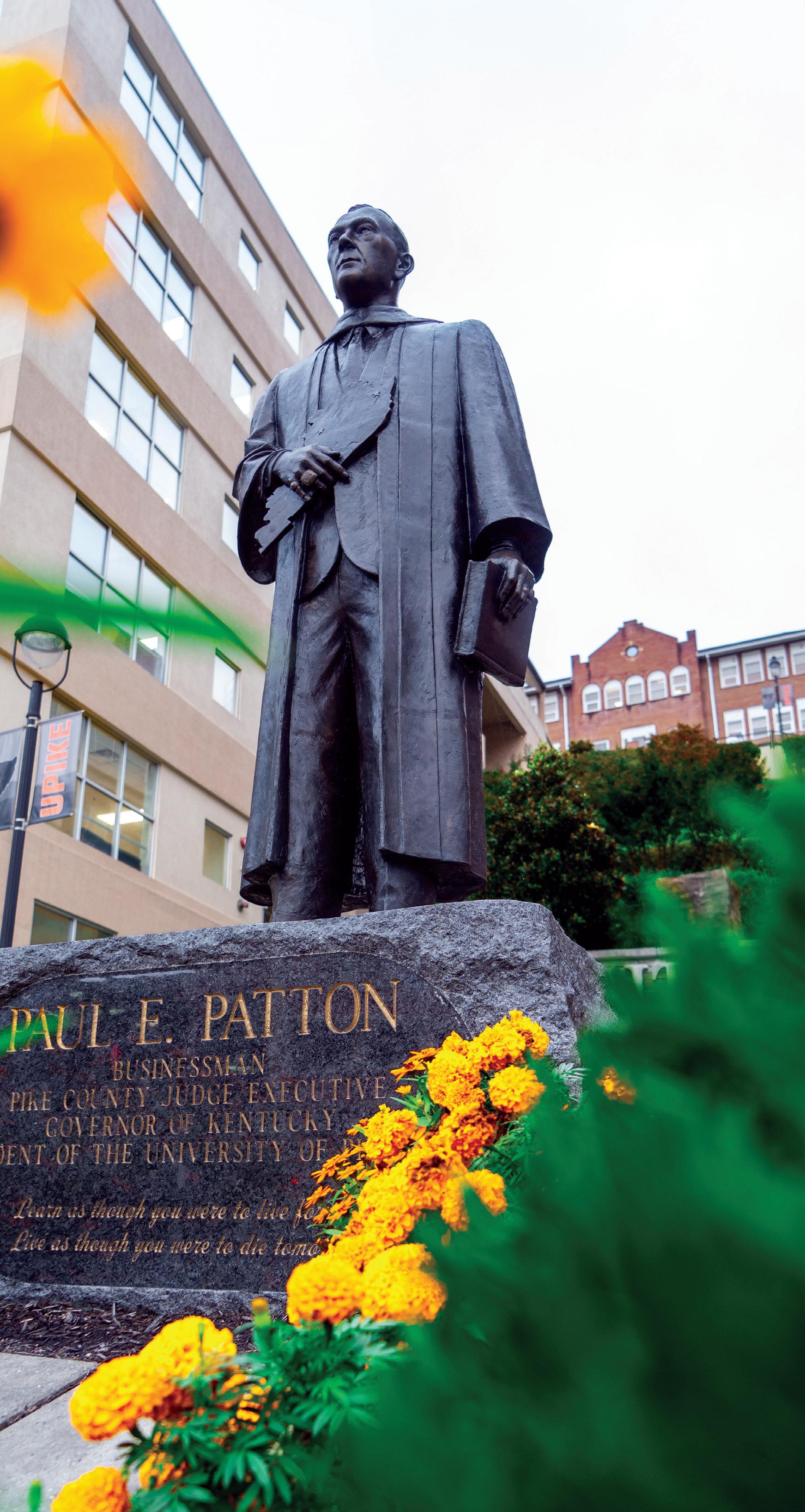
Abronze statue stands at the base of the 99 steps on the University of Pikeville’s hillside campus. The figure holds the outline of Kentucky in one hand and a book in the other, his face steady, his gaze fixed on the future. A lifetime of service is cast in bronze. At his feet, an inscription reads, “Learn as though you are to live forever. Live as though you were to die tomorrow.”
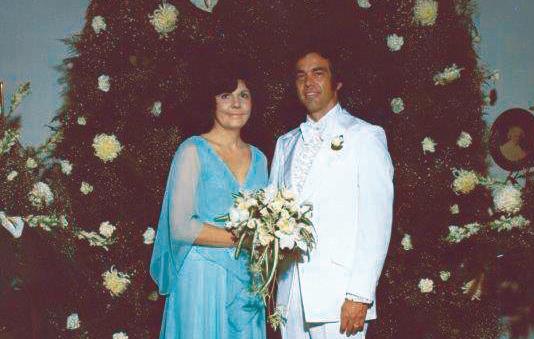
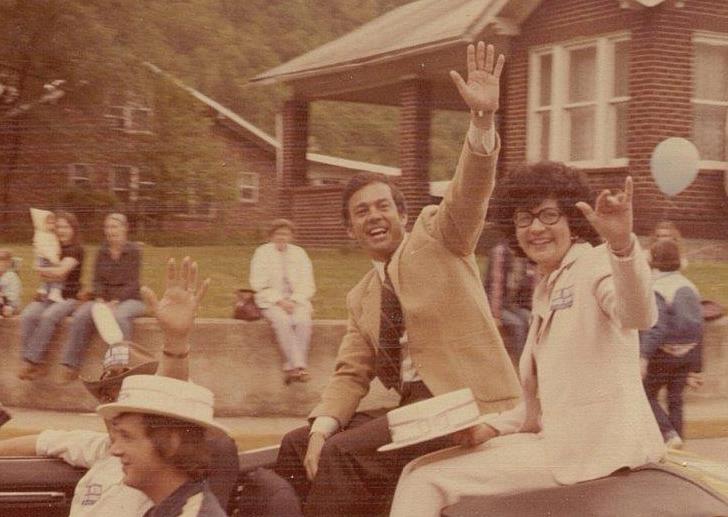
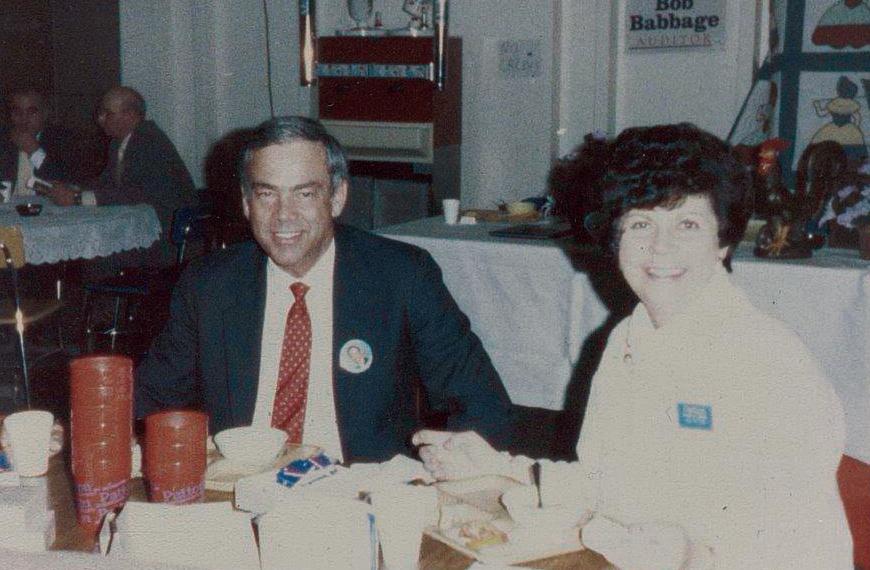
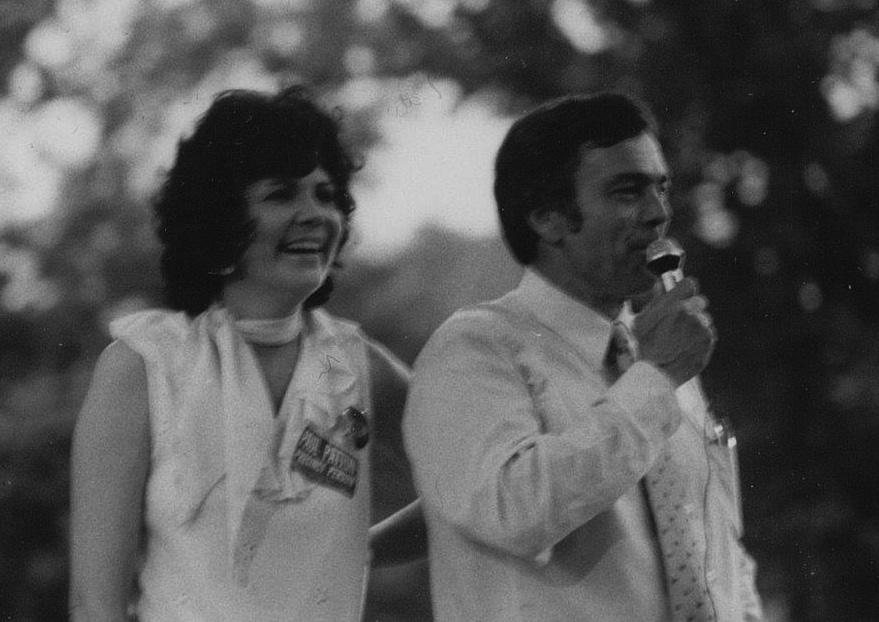
Students pass it every day on their way to class, often unaware of how deeply Paul and Judi Patton have helped shape their path. The monument bears Paul’s likeness, yet the story it represents belongs to both. Together, they built a life defined by education, service and compassion, changing the course of communities across Eastern Kentucky.
Roots in the Mountains
Paul E. Patton was born in 1937 in Lawrence County, the son of a teacher. Frequent moves for his father’s work gave him an early understanding of the challenges Appalachian families face, and those early years taught him the value of hard work.
“I grew up before television, so I had no idea how big the world really was,” said Paul. “I didn’t realize how isolated we were until I left home. But I knew one thing—when people are given education and opportunity, they can do anything.”
Electricity did not reach his school until seventh grade. The cafeteria was a converted hallway, and the textbooks were hand-me-downs from more wellfunded districts. His father’s love of learning and his mother’s determination instilled in him a lifelong respect for effort and perseverance.
“I’ve been very blessed in life,” said Paul. “I’ve had good parents, good friends and I was raised in a good community.”
Judi Jane Conway grew up in Pikeville in a home built on courage and conviction. Her father, the county sheriff, was assassinated in 1950 after vowing to root out corruption. Her mother, Esta, refused to let grief define her. She stepped into her husband’s role, becoming one of Kentucky’s first female sheriffs, and carried out his mission.
“They did not know what to do with a mountain woman who had both grit and grace,” said Judi. “She cleaned up the county and showed everyone what determination looked like.”
Legacy
By KATIE RAY ’24
Esta became a social worker known for taking in women and children in crisis. Judi remembers never knowing how many people would gather around the dinner table, only that everyone there would feel safe.
“That is where I learned compassion,” said Judi. “Mama showed me that you help people find their footing, even if all you have to offer is a meal and a little hope.”
Building a Partnership
After earning a degree in mechanical engineering from the University of Kentucky in 1959, Paul went to work in the coal industry. By the 1970s, he had built a successful company in Pikeville, creating jobs and learning firsthand how infrastructure could shape a region’s destiny.
“Coal taught me about more than energy,” said Paul. “It taught me about the people whose lives depend on good roads, good schools and good leadership.”
In 1977, Paul married Judi, a widowed mother with a strong sense of purpose. Their marriage blended practicality and compassion, faith and determination.
Twenty years in the coal industry taught Paul about both the ruggedness of the land and the resilience of its people. He learned that roads were more than pavement. Without them, children could not reach schools or doctors. Without fire stations, a home lost to flames was more than property. As Pike County judge-executive from 1981 to 1991, he focused on those essentials, laying the groundwork that would benefit generations.
The Governor’s Mansion
Paul’s success in local government propelled him to statewide service. In 1991, he was elected lieutenant governor, and just four years later, he became Kentucky’s 59th governor. Serving from 1995 to 2003, he made history as the first Kentucky governor in two centuries to be elected to a second consecutive term.
He entered office determined to strengthen education from preschool through college. Known as Kentucky’s “education governor,” he pushed for early childhood
SERVICE, EDUCATION AND A LIFETIME OF IMPACT
programs, improved public schools and created new pathways for adult learners. The Postsecondary Education Improvement Act of 1997 became a cornerstone of his administration, expanding access to higher education and modernizing technical colleges.
“Education is the great equalizer,” said Paul. “It is how we honor our potential as individuals and as a state.”
While Paul focused on classrooms and campuses, Judi transformed the role of First Lady. Guided by her mother’s legacy of service, she founded the Office of Women and Children’s Advocacy, the first of its kind in Kentucky. The office became the driving force behind more than two dozen pieces of legislation addressing child abuse, domestic violence and victims’ rights.
“When I arrived in Frankfort, people told me you could not pass laws about domestic violence or child abuse,” said Judi. “They did not realize that mountain women do not back down.”
Her leadership established a network of children’s advocacy centers across all 16 of Kentucky’s Area Development Districts. Each center provides forensic interviews, counseling and medical care for young victims.
Judi also championed women’s health, leading the effort to require insurance coverage for breast cancer treatments. She created the Celebration of Life, an annual gathering for survivors to celebrate hope and friendship.
“That was the happiest bunch of women I’ve ever been around. For the first time, they were with their own. We eventually outgrew the governor’s mansion, so we moved it to the Derby Tent,” said Judi. “They taught me how to live each day fully. It was a joy to be around them, an absolute joy.”
Leading Kentucky Forward
Judi’s Place for Kids, a nonprofit dedicated to child abuse victims in Pikeville, became a model for the state and continues to serve children across Eastern Kentucky.
“Every child deserves to grow up safe and heard,” said Judi. “If you look into a child’s eyes, you know that vision is worth fighting for.”
Her advocacy also reflected her Cherokee heritage. As founder of the Kentucky Native American Heritage Commission, she worked to ensure schoolchildren learned about Indigenous history and culture.
Her portrait now hangs in the Capitol’s Kentucky Women Remembered exhibit. “It is not about me,” said Judi. “It is about every woman who stood up when someone told her she could not.”
From the Mansion to the Hill
Chairman of the UPIKE Board of Trustees Terry Dotson ’72 remembers the first time he saw Paul, decades before the governor’s mansion and university boardrooms, back in the early 1970s at a meeting in Knoxville.
“He was wearing a white suit,” said Dotson. “I told somebody, ‘I don’t know who that is, but he’s going to be something someday.’ And I was right.”
When Paul completed his second term in 2003, the Pattons returned to Pikeville. Retirement was never part of the plan. In 2009, Paul accepted the presidency of then Pikeville College with a mission to strengthen higher education in Appalachia. He expanded academic offerings, increased enrollment and oversaw significant campus improvements. In 2011, the institution achieved university status, becoming the University of Pikeville.
“He was instrumental in building the foundation for the Kentucky College of Osteopathic Medicine, a project that required political will, collaboration and deep belief in the region’s potential,” said Dotson. “Paul saw potential where others saw limits. He understood that the region’s future would be built in its classrooms.”
In 2013, he became UPIKE’s first chancellor, continuing to mentor students and champion access to education. Two years later, the university honored him by naming the Patton College of Education in recognition of his lifelong commitment to learning.
Judi remained deeply involved in campus life, hosting events, encouraging students and welcoming visitors.
“My parents met at Pikeville College, and without it, I would not be here. Neither would Paul,” said Judi. “It gave my parents a chance, and now it gives new generations the same opportunity.”
When the university unveiled his statue in 2016, students, community members and legislators gathered to honor him. Paul joked that people usually wait until someone is gone for such tributes, but he was glad they did not.
Speakers remembered his work as judge-executive, building roads, overcoming budget shortfalls and insisting on fire stations. They recalled his tenure as governor, during which he fought for endowed professorships and new schools, and expanded healthcare training in Eastern Kentucky.
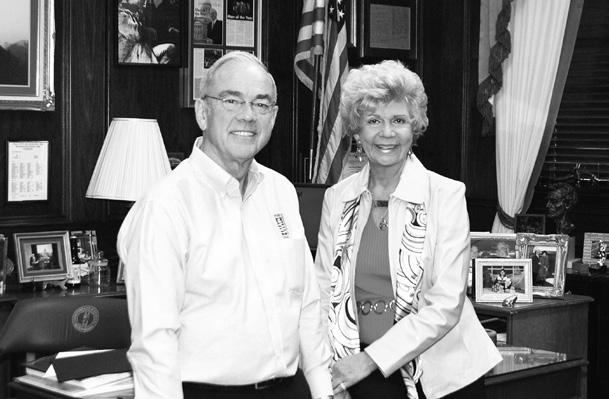
Still on campus today, the Pattons’ presence is tangible. Their offices in UPIKE’s Administration Building are replicas of their offices in Frankfort and serve as physical reminders of how state leadership and local vision converge. Just outside those offices stands a touch screen housing The Patton Legacy Museum, preserving and showcasing their life, work and memorabilia.
Continuing a Legacy of Care
Judi’s lifelong advocacy found new expression in 2021 with the opening of the Judi Patton Center for Families by WestCare. The residential facility offers substance use treatment for women and allows mothers to stay with their children during recovery. Several women credited her efforts with saving their lives.
“Women should not have to choose between getting well and caring for their children,” said Judi. “This center gives them hope, dignity and a second chance.”
Even at 86, Paul continued to share his story. In 2023, he released a book titled “The Coal Miner Who Became Governor,” chronicling his life from the coalfields of Eastern Kentucky to Frankfort and beyond.
The couple’s influence continues through the Southeast Kentucky Chamber of Commerce’s Patton Leadership Institute, which develops civic and business leaders across eight Eastern Kentucky counties. Each class studies government, healthcare, education and economic development, then applies those lessons in their own communities.
“Paul looks at the big picture,” said Judi. “I look at the people inside the picture. Together, we try to make sure everyone has a place in it.”
A Lasting Impact
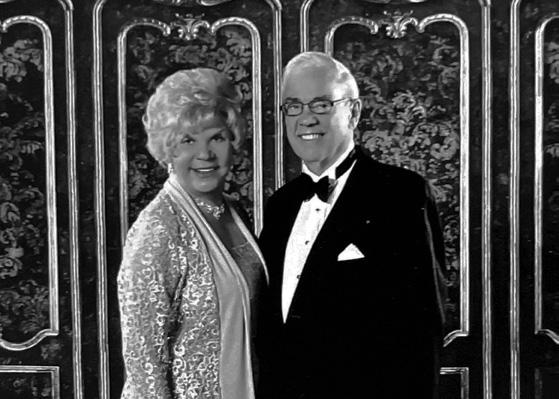
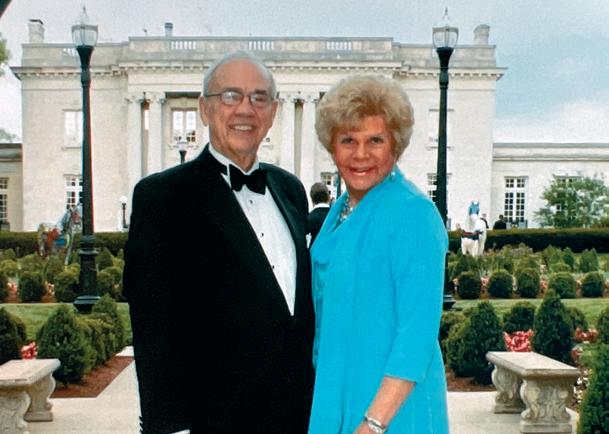
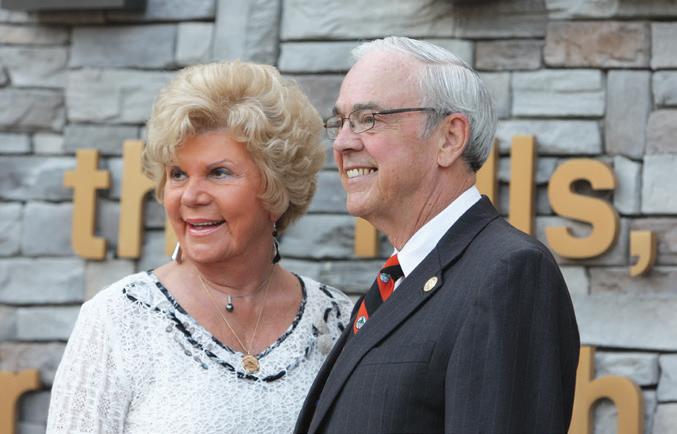
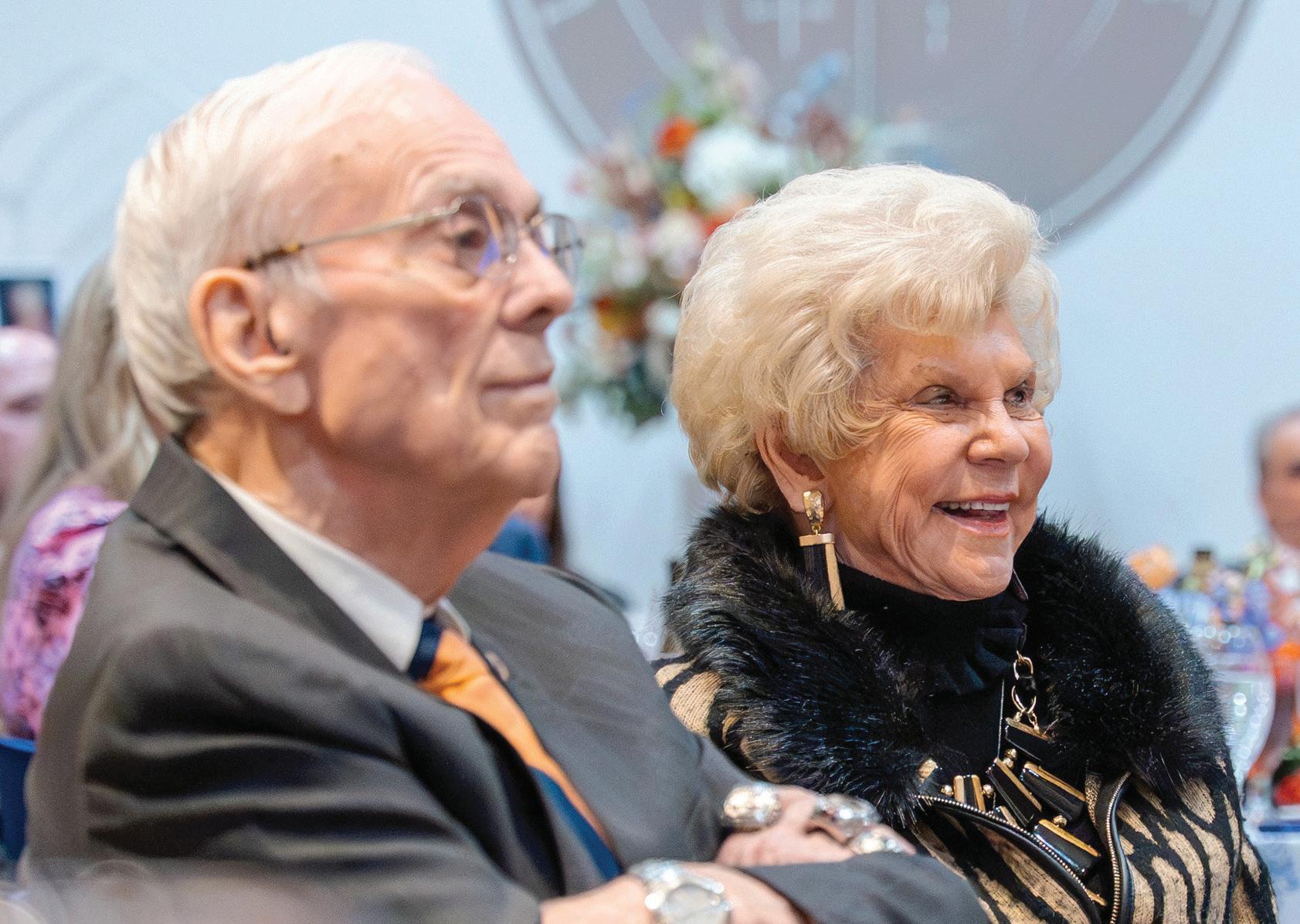
This fall, UPIKE hosted a special celebration honoring the Pattons, bringing together generations of colleagues and friends. The event reflected on their decades of public service, their commitment to education and the legacy they built in the heart of Appalachia.
“Paul proved that with vision and will, a university in the heart of the mountains can meet the world’s highest academic and professional standards. His leadership continues to inspire students and faculty to serve with integrity, humility and purpose,” said President Burton J. Webb, Ph.D. “While Paul was working to transform systems, Judi was working to protect the people within them. Her advocacy for women, children and families created care where there was none. Together, they showed Kentucky what leadership with purpose looks like.”
The evening was not just a tribute, but a promise. Through a silent auction featuring Judi’s famous Derby hat, along with a live auction of limited-edition bourbon bottles created in their honor and specially packaged cigars, guests helped raise funds to establish an endowed scholarship in the Pattons’ name. The scholarship will
carry their legacy forward, opening doors for future generations of UPIKE students just as they have done throughout their lives.
The Pattons’ legacy is not confined to buildings or bronze. It lives in the students who cross the commencement stage at UPIKE, in the children who find healing at advocacy centers and in the families rebuilding their lives through recovery programs.
“Success comes through effort, and failure is part of the journey,” said Paul. “If you have never failed, you have never tried.”
Judi measures success differently.
“My greatest achievement is hearing my mama say, ‘Judi, well done,’” said Judi. “Everything I have done, I have done for her and for the people she taught me to love.”
Together, they have spent a lifetime building foundations of knowledge, courage and compassion. No words can fully capture the depth of their influence. Their names may grace programs and buildings, but their true legacy endures in the lives they have touched and the communities they have strengthened.
Was there a moment in your career when you felt your purpose became especially clear?
Q A Q A Q A Q A
During my clinical rotations, I cared for a patient who was overwhelmed by fear and uncertainty. I realized that while my medical knowledge mattered, what truly made a difference was taking the time to listen, explain and reassure them. That moment clarified for me that my purpose isn’t only to treat disease, but to be a steady presence for patients when they feel most vulnerable.
What inspired you to join the University of Pikeville’s Board of Trustees?
I believe deeply in the university’s mission of serving the region and expanding opportunity through education. UPIKE has a unique role in training future leaders, particularly in healthcare, and I wanted to contribute my perspective as a physician to help shape that vision. For me, it’s a way to give back, support students and strengthen a community that has given me so much.
How does your experience as a KYCOM alumnus shape the way you approach your trustee role?
Alumni perspectives help trustees understand not just the student experience, but also how UPIKE graduates contribute in the real world, whether in healthcare, education or community leadership. That connection between past and present strengthens the board’s ability to guide the university strategically, making sure we stay true to our mission while preparing for the future.
What do you hope to accomplish during your time as a trustee?
I hope to help UPIKE continue to grow as both an academic and community leader. That means supporting initiatives that strengthen healthcare education, expanding opportunities for students from our region and ensuring the university has the resources and partnerships to thrive in a changing world. Ultimately, my goal is to leave UPIKE even stronger for the next generation of students and the communities they will serve.
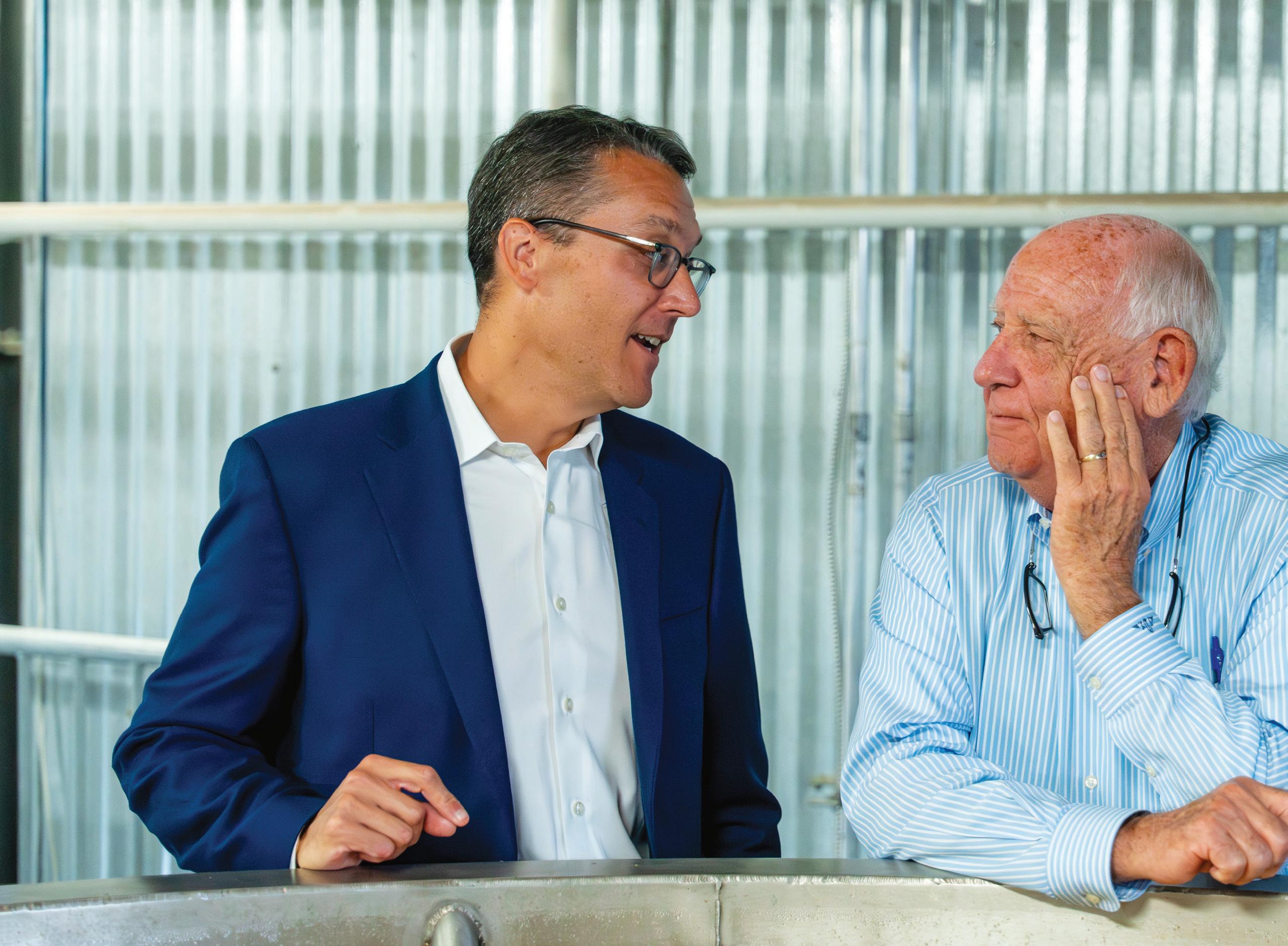
UPIKE Trustee Gregory Harris, D.O., KYCOM ’10, and Board Chairman Terry L. Dotson ’72 tour Wilderness Trail Distillery in Danville, Ky., founded by Shane Baker and former KYCOM faculty member Pat Heist, Ph.D.
TEE
Gregory Harris, D.O., KYCOM ’10, joined the University of Pikeville Board of Trustees in 2023. A hematologist and oncologist at Harbin Clinic in Rome, Ga., Harris is committed to advancing osteopathic medicine and mentoring the next generation of physicians. In this spotlight, he shares his vision for UPIKE, the importance of giving back and what inspires him to serve as a trustee. Q A Q A Q A Q A
SPOTLIGHT with Dr. Harris
By KATIE RAY ’24
You and your wife, Sonbol Shahid-Salles, D.O., MPH, KYCOM ’10, have supported students through travel and research scholarships. Why is philanthropy important to you?
Philanthropy, to us, is about strengthening the mission of UPIKE and KYCOM. Supporting students directly through scholarships is one way, but the bigger picture is ensuring the university has the resources to innovate, expand opportunities and serve the region. Education and healthcare are both about lifting communities, and philanthropy helps accelerate that work. For us, giving back isn’t just about helping individual students succeed— it’s about helping UPIKE remain a force for growth and transformation in Appalachia and beyond.
What do you see as UPIKE’s biggest strengths today?
Its people and its adaptability. The university has a close-knit, mission-driven community that truly supports students, while at the same time embracing innovation and partnerships that keep it moving forward.
What role do you believe UPIKE plays in addressing healthcare needs in Appalachia and beyond?
KYCOM, in particular, has a strong track record of training graduates who return to underserved areas, helping to fill critical gaps in access to care. Beyond producing providers, UPIKE also fosters community partnerships and educational pipelines that strengthen healthcare delivery across the region. In that way, its impact extends well beyond the campus—it directly contributes to healthier communities and a stronger future for Appalachia.
What advice would you give to current students about finding their own purpose?
Stay open to the experiences that shape you. When you first start, your purpose may feel tied to academics or career goals, but often it becomes clearer through the patients you serve, the mentors you meet and the challenges you face. Pay attention to the moments that move you, because those will guide you toward a deeper sense of why you’re in medicine. Purpose isn’t something you find all at once—it’s something you grow into.
ANSWERING THE CALL TO SERVE
At the University of Pikeville, the call to serve runs deep. For decades, UPIKE graduates have carried that mission into classrooms, clinics and communities across the region. Today, the College of Nursing and Human Services School of Social Work is building on that legacy in bold new ways with flexible degree pathways, funded opportunities and groundbreaking curriculum in psychedelic-assisted therapy.
MEETING STUDENTS
WHERE THEY ARE
Social work attracts people from all walks of life. Some are traditional college students. Others are parents, career changers or community college graduates who want to continue their education while balancing work and family responsibilities.
That is why UPIKE now offers its Bachelor of Social Work (BSW) entirely online, in-person or through a hybrid model. The flexibility ensures
By KATIE RAY ’24
that students do not have to choose between their education and other responsibilities.
“Our new online BSW Program opens doors to meaningful work in a wide variety of settings in mental health, addiction treatment, healthcare, schools and more,” said Director of Undergraduate Social Work Program Ashton Bartley, MSW ’11. “For those already working in these fields, it provides the knowledge and skills to advance in their careers. Designed with flexibility in mind, it’s a perfect fit for working professionals, parents and returning students. Plus, it offers a direct path to our one-year MSW program, expanding opportunities even further.”
Graduates of the program are eligible for advanced standing in UPIKE’s fully online Master of Social Work (MSW) program. For many, that means a one-year master’s degree is just within reach. It is a fast track to leadership in a growing and essential profession.
ALUMNI IN ACTION
Since earning his BSW, Ethan Doebel ’24 has devoted his career to supporting youth in Eastern Kentucky. He began working at the Mountain Comprehensive Care Center Prestonsburg Clubhouse during his undergraduate years, first in the adult crisis stabilization unit and later leading the transition-age youth program. The center provides a safe, non-clinical space where young people can access resources, work on personal goals and develop life skills in a supportive environment.
“I always knew I wanted to help others, but it wasn’t until I entered UPIKE’s BSW program and discovered the real impact I could have on people’s lives that I realized social work was where I was meant to be,” said Doebel. “No matter who I am serving, I have the tools to leave people a little better than when I first met them.”
Under Doebel’s leadership, the Clubhouse has become a youth-driven space, with every aspect shaped by the young people it serves. Participants set personal goals such as obtaining a driver’s license, learning independent living skills or preparing for college, while staff provides guidance, mentorship and access to community resources.
“The Clubhouse is about giving youth a voice in their own development,” said Doebel. “They help shape the experience by voting on meals, choosing activities and even participating in staff selection. It is empowering for them and rewarding for us to see their growth.”
The program also helps tackle barriers like transportation and limited access to services. Doebel and his team provide rides to appointments, organize experiential outings and help participants navigate challenges that might otherwise prevent them from achieving their goals.
Pursuing his MSW while working fulltime, Doebel has continued to expand his professional skills.
“I chose to continue with UPIKE for my MSW because of the compassion and support I experienced in my undergraduate program, and that same understanding has carried into the master’s level. The program’s 100% online flexibility has made it possible for me to pursue graduate education while working full-time, with quick and accessible faculty communication easing the transition,” said Doebel. “It has also taught me to balance education, career and life in a meaningful way.”
For Doebel, the work is deeply personal. Serving young people in the same region where he grew up allows him to connect with them on a meaningful level.
“Many of these youths are people I have seen in school and around town,” said Doebel. “Being able to guide them through challenges and help them build their futures is incredibly fulfilling.”
SUPPORTING CHILD WELFARE LEADERS
UPIKE has launched a unique partnership with the Child Welfare Prepare, Retain, Engage and Partner (CW PREP) Program for students called to work with children and families. CW PREP, supported by the Kentucky Cabinet for Health and Family Services and a network of university social work programs, is designed to recruit, prepare and retain highly skilled child welfare professionals. The initiative provides financial support, including in-state tuition coverage, stipends, paid practicums and specialized coursework in child welfare practice. Students will participate in training retreats, receive one-on-one advising, complete field placements with the Department for Community-Based Services and transition directly into public child welfare roles after graduation. In return, graduates commit to at least two years of service in the Social Service Worker classification. “This partnership is an incredible opportunity for our students and the children and families of Eastern Kentucky. Funded opportunities like this not only remove financial barriers, but they also give our students the training, advising and field experience they need to step into these critical roles confidently,” said Bartley. “We’re looking for students who want to make a lasting difference. CW PREP aligns perfectly with UPIKE’s mission to prepare career-ready graduates committed to their communities. Together, we are building a well-prepared workforce to meet the needs of Kentucky’s most vulnerable.”
ACCELERATED PATHWAYS FOR EVERY JOURNEY
UPIKE is expanding its social work offerings to give motivated undergraduates a faster path to success. Two new accelerated pathways enable students to earn both a Bachelor of Social Work (BSW) and a Master of Social Work (MSW) in a shorter timeframe than ever before.
The 2+1 pathway is ideal for community college graduates or students who already hold an associate degree. In just two years, they can finish their BSW and transition directly into UPIKE’s one-year MSW program.
The 4+1 pathway is designed for current undergraduates, both traditional and nontraditional, who want to complete their BSW and MSW in just five years. Students who meet advanced standing criteria after finishing an accredited BSW program may also complete the MSW in only one year.
With built-in academic support, close advising and dedicated faculty, students receive the guidance they need to meet MSW admissions requirements and graduate on time.
“Our new BSW+MSW pathways offer flexible, efficient options for students at different stages of life and education,” said Bartley. “Both options prepare students for advanced roles in clinical practice, mental health, addiction treatment and more, opening doors to meaningful, impactful careers.”
EXPLORING THE FUTURE OF MENTAL HEALTH
The School of Social Work is also leading in innovation. UPIKE was recently selected to join the University Psychedelic Education Program (U-PEP), a national initiative training faculty to teach evidence-based content on psychedelic-assisted therapy.
Faculty from both nursing and social work have been engaged in intensive training through U-PEP. Their work will lead to new curriculum modules, experiential simulations and interprofessional workshops that prepare students to understand and ethically apply emerging research in mental health.
“Being accepted into U-PEP is a tremendous honor, not just for our faculty, but for our students and the communities they will serve,” said Chair of the School of Social Work and UPIKE’s lead U-PEP Faculty Fellow Genesia Kilgore-Bowling, Ph.D., MSW, CSW. “Psychedelic-assisted therapy is an emerging field grounded in rigorous science and cultural humility. Through this program, we’re equipping our students with the tools they’ll need to lead in tomorrow’s behavioral health landscape, especially in underserved and rural areas.”
For students, it means learning new approaches that are at the forefront of treating conditions such as posttraumatic stress disorder, depression, addiction and end-of-life anxiety.
“I’m excited to bring this content into the Elliott School of Nursing curriculum, helping to keep our students at the forefront of new and emerging therapies, specifically in mental health,” said Clinical Simulation Educator Sarah Stratton, BSN, RN. “This work also strengthens our interprofessional collaboration with social work as we look to expand on what we’ve learned, create new opportunities and move forward with a shared commitment to implementing ethical, equitable and culturally respectful practices across all disciplines.”
The goal is not simply to graduate students, but to graduate servant-leaders who are prepared to address Kentucky’s most pressing needs.
“The common thread through all of this is service,” said Kilgore-Bowling. “We are shaping students who want to do meaningful work, and we are giving them the skills, the support and the opportunities to carry that work forward.”
CULTIVATING CALLING AND CAREER AT UPIKE
AT THE UNIVERSITY OF PIKEVILLE, EDUCATION IS ABOUT MORE THAN EARNING A DEGREE—IT IS ABOUT DISCOVERING PURPOSE. AT THE HEART OF THAT MISSION IS THE CENTER FOR CAREER, VOCATION AND LEADERSHIP, LED BY DIRECTOR KAY WEBB, PH.D.
The center is helping students find their WHY and explore how their skills, interests and values connect to meaningful lives and careers. The work is rooted in the idea of vocation, not just as employment, but as a calling.
“This work has been happening on our campus for years through individual efforts by faculty and staff,” said Webb. “What we are doing now is bringing those efforts together with intentionality. Students are realizing it isn’t just about what they do, but who they are becoming.”
The center’s work is supported in part by a Vocation Across the Academy grant from the Network for Vocation in Undergraduate Education, administered by the Council of Independent Colleges with funding from the Lilly Endowment Inc. The grant, along with a matching contribution from the Joseph W. Craft III Foundation, is helping UPIKE expand vocational exploration.
Additional support is provided by a $1.85 million Title III grant from the U.S. Department of Education, distributed over five years. This grant will enhance the center’s efforts by establishing a comprehensive career pathways model to improve student retention, graduation rates and employability.
Key initiatives focus on broadening the center’s reach across academic units, offering faculty development aligned with career pathways and using strengths-based assessments to enhance student readiness for life after graduation. The project also emphasizes collaborative input from faculty, staff, students and community stakeholders as the program evolves.
This funding supports a vision Webb has spent years cultivating, helping students identify personal meaning within their academic and career goals. It is a passion that
grew from her own journey, one she describes as marked by following what others told her she was good at, rather than what truly mattered to her.
“No one ever asked me what was meaningful to me,” said Webb. “I was just doing what others expected. It wasn’t until later in life that I started asking what gives me energy and where I feel most connected. That’s the experience I want students to have while they’re here, not 20 years down the road.”
Angela Lockhart ’97, the center’s new assistant director, is joining Webb in this mission. Lockhart is a former educator who spent 28 years in the classroom before transitioning into her new role.
“Our program goals are focused on two primary student learning outcomes: career readiness and leadership,” said Lockhart. “Within these goals, we work on communication, professionalism and teamwork. Our center is committed to providing opportunities for students to combine coursework knowledge with professional skills. We ultimately want our graduates to find career paths that suit their purpose and passion and become successful contributors to the workforce.”
UPIKE has plans to expand the internship program and develop career preparation courses to support students at every stage of their academic journey.
The center is also working to engage faculty, staff and coaches across campus to share their own vocational stories, helping students see a variety of paths to purpose with the Find Your Y initiative. Whether through mentoring, storytelling or skill-building, the center aims to create an environment where students feel seen, supported and inspired to pursue meaningful lives.
“We want calling and purpose to be part of our everyday conversation,” said Webb. “When students arrive on campus, we want them to know that they are in a place where they matter.”
By AMY CHARLES, MBA ’23
Center for Career, Vocation and Leadership Director Kay Webb, Ph.D., and Assistant Director Angela Lockhart talking with students about purpose and career pathways.
INSPIRING YOUNG LEADERS THROUGH
C IVIC E DUCATION
By AMY CHARLES, MBA ’23
In just three years, the University of Pikeville’s Center for Public Service has grown into a nationally recognized initiative, poised to shape the future of civic education in Appalachia. Under the leadership of Assistant Professor of Political Science Jeffery Tyler Syck, Ph.D., the center has become a hub for public service and community engagement.
Syck, a native of Pikeville, joined UPIKE in 2023 with a clear vision to create a space that promotes civic education and addresses regional issues from within the region itself.
“When I was a Ph.D. student, I noticed many institutions had centers focused on civic education,” said Syck. “But there was nothing in Appalachia. No place embedded here that focuses on the issues we face and how to solve them. When I was hired, I was asked to come up with something new, and this is what I envisioned. I wanted to start something like this in my home region.”
This fall, the center received a significant boost from a three-year grant of more than half a million dollars from the U.S. Department of Education. The grant will expand the center’s staffing and fund a series of professional development workshops designed specifically for social studies teachers.
“This is a transformative amount of money,” said Syck. “It allows us to bring 50 social studies teachers to UPIKE’s campus and equip them with better tools for teaching primary source documents. That has a real, tangible impact on classrooms across the region.”
The center marked another milestone this past summer with the launch of the inaugural Allegheny Civic Fellowship. The program, born from a partnership with two Yale University students, brought a unique summer camp experience for high school students to Pikeville. They reached out to Syck with a desire to serve in a region they had never visited, and saw Appalachia as the perfect fit.
With support from UPIKE leadership, the fellowship came to life. Former Kentucky Governor and UPIKE Chancellor Paul Patton contributed funds for Yale student stipends and daily meals for campers, while Simon & Schuster donated nearly $2,000 in books. The camp is set to become an annual program.
“My favorite part about this program was just having people to talk about these sorts of issues. There aren’t a lot of places around here where you can really enjoy a good political discussion,” said recent high school graduate Landon Williams. “I really enjoyed being able to meet and discuss with people, not only from around here but very close to my age who had the same kinds of thoughts I did. We went through poetry, Shakespeare and plays into legal documents and thinkers, and I just did not expect it to be that vast of a course.”
Recognizing its impact, the Center for Public Service was recently named an official “Oasis of Excellence” by the American Council of Trustees and Alumni. The designation places UPIKE among a select group of institutions nationwide committed to fostering civic responsibility and liberal arts education.
At the heart of the center’s mission is a desire to cultivate leadership rooted in service.
“I hope students find something in themselves,” said Syck. “I think Appalachia is the best place in the world to live. But to flourish, it needs a new generation of leaders. The center aims to help students discover what it means to be a servant leader and the value of service. No matter your profession, you can serve your community.”
I think Appalachia is the best place in the world to live. But to flourish, it needs a new generation of leaders. The center is about helping students discover what it means to be a servant leader and the value of service. No matter your profession, you can serve your community.”
Compassion
By KATIE RAY ’24
Across Cultures
Thousands of miles from home in Italy, University of Pikeville senior Kassidy Blackburn spent her summer in the halls of Naples’ National Cancer Institute alongside doctors as they delivered diagnoses and guided patients through some of the most vulnerable moments of their lives. For Blackburn, a biomedical science major with dreams of becoming a physician, those moments were humbling and transformative.
Founded in 2018, the Doctors in Italy Fellowship Program connects students from around the world with hospitals and clinics across the country. The fellowship is designed to immerse participants in the daily life of healthcare professionals while offering intensive clinical shadowing experiences. From oncology wards in Naples to veterinary programs in Florence, the program opens doors for students who want to learn how medicine is practiced across cultures.
For Blackburn, the placement was especially meaningful. She was assigned to the Istituto Nazionale Tumori–IRCCS “Fondazione Giovanni Pascale,” one of the most prestigious cancer research and treatment centers in Southern Italy. There, she shadowed doctors in radiology and oncology.
“Since we were at the National Cancer Institute, I felt that all the patient interactions I had were at very vulnerable moments in their lives,” said Blackburn. “It was comforting to see how well the doctors treated them and how kindly the patients responded.”
While language differences posed occasional challenges, Blackburn soon learned that compassion and care often speak louder than words. Some conversations required hand gestures and patience, but the effort to connect was always met with warmth.
“Most people spoke at least a little English, and even if we couldn’t fully communicate, we could still get our point across,” said Blackburn. “I quickly realized that many people are willing to help and enjoy teaching others about their passions, even if we don't speak the same language.”
For Blackburn, these experiences underscored a lesson that cannot be found in a textbook. Medicine is not only science but also connection, trust and respect.
“It has opened my eyes to how important patient and doctor interactions can be, and how treating everyone with respect can improve their trust,” said Blackburn. “Even in another country, patients being able to talk to
doctors about how their diagnosis might affect them changed how they viewed their illness.”
While she has always known she wanted to be a doctor, her time in Italy helped her picture the kind of physician she hopes to become. She envisions herself as a doctor who not only delivers diagnoses but also listens, comforts and ensures patients feel seen. The experience reinforced her plans to pursue medical school after graduation, and she credits UPIKE with preparing her for the challenge.
“I have always been drawn toward medicine. I knew I wanted to be involved with it in some way, but I wasn’t sure how. Since starting college and being exposed to various aspects of medicine, I have realized that I want to continue that track,” said Blackburn. “UPIKE has given me great resources to further my education and understand the work that goes into becoming a doctor. I got to learn how healthcare works in another country, and most importantly, I came home with a new perspective on the kind of physician I want to be.”
IN THE BUSINESS
TURNING IDEAS INTO IMPACT
The Coleman College of Business is helping students turn big ideas into real opportunities through Start Something, an initiative created by Entrepreneur-in-Residence Jared Arnett to connect aspiring innovators with entrepreneurs across Eastern Kentucky.
In the spring, nearly 100 students, faculty and community members gathered atop Bears Tower for the first Start Something Demo Day. This event showcased student-led business ventures from CCOB’s New Venture Creation class in partnership with Shaping Our Appalachian Region (SOAR) Innovation. The celebration welcomed Pikeville Mayor Jimmy Carter, City of Pikeville leadership and local entrepreneurs who came together to support a growing culture of innovation.
“For me, the event was a catalyst for a movement to get our community believing in what’s possible with entrepreneurship and its important role in the future economic development of our region,” said Arnett. “Seeing our students leading the way was incredible.”
Start Something has partnered with many innovative businesses in the region such as BitSource, JigSaw Enterprises, Ryan Hall Y’all, Pikeville Medical Center and Community Trust Bank. CCOB’s goal is to provide students with mentorship, internships, expertise and opportunities to witness entrepreneurship in action, while building the network connections that could lead to future employment.
“We have an incredible regional network through SOAR giving students access to mentors, extracurricular opportunities and funding. Especially through their new Angel Investor group,” said Arnett.
Recent graduate Ethan Garland ’25 has transformed opportunity into action through Start Something, launching Status Light Systems, a technology startup designed to help small and mid-sized medical clinics streamline operations with smarter scheduling tools.
“UPIKE gave me more than just a business foundation. It gave me the confidence to go after something like this,” said Garland. “Launching Status Light Systems has been a big step forward for me. It’s given me the chance to grow into leadership, learn what it takes to scale something from the ground up and see how much impact focused ideas can have.”
Garland and his team have already partnered with Compassion Pediatrics in Pikeville, allowing them to refine their product and directly improve patient care.
“If entrepreneurship is a craft, that means we can’t just teach it; we have to allow the students to practice it,” said Arnett. “Status Light Systems is the perfect example of how students can take a concept, test it out and begin to build something that could potentially be scaled nationally.”
OF BUSINESS
By Stacey Walters
TURNING STUDENTS INTO ENTREPRENEURS
At CCOB, students are learning what it takes to run a successful business by managing their own. From designing products, ordering and receiving inventory, to the moments of customer interaction and watching new products being sold, students see firsthand the experience it takes to work and succeed in an actual business.
When Professor of Business Eric Vitatoe, MBA, D.B.A., joined the CCOB faculty in 2023, he brought years of experience and fresh ideas. During his first semester, he worked closely with students to shape the vision for the program, guiding them as they named the business, BearWear, and prepared for its launch as an official class in 2024.
“Students choose BearWear because it offers a vastly different experience from a traditional class,” said Vitatoe. “At first, many arrive unsure of what to expect, but as the semester progresses, they begin to realize they are part of something significant and real. The course provides them with a genuine perspective on what it takes to run a small business, including the daily challenges of growth and sustainability.”
For senior Tyler Robinson, BearWear has shaped his college experience, providing him with opportunities to learn, create and connect with others in a way that few other programs have.
“I love the way it feels like I’m actually working in a real, small local business and being an intern feels like a promotion,” said Robinson. “It has given me a hands-on experience of what it’s like to be a business owner without the stress of owning it. Plus, making tumblers, shirts and flags is a lot of fun.”
For senior Paige Ayler, the experience is just as meaningful for the opportunities it has given her to have an impact through business in the real world.
“To me, being a part of BearWear means giving back to the community,” said Ayler. “Through this experience, I’ve had the opportunity to grow personally and professionally by applying the concepts I’ve learned in the classroom to real projects and people.”
Looking ahead, Vitatoe envisions BearWear continuing to grow and provide even more opportunities for students.
“Our next step is securing a larger, more permanent space and transitioning from a class to an internship-based model,” said Vitatoe. “This shift will allow students to take on bigger projects, expand production and experience every aspect of running a business from management to accounting, preparing them for life after graduation.”
When You Miss the Mountains, Come Home
Homecoming
By KATIE RAY ’24
The University of Pikeville’s campus came alive October 13–19 for Homecoming 2025, a week filled with energy, connection and school spirit. Every event reflected what it means to be part of the UPIKE family.
Students kicked off the celebration with the Homecoming Hypnotist, setting a lighthearted tone that carried through “Bear Days,” chapel services and the Distinguished Educators Hall of Fame ceremony. On Wednesday, past and present Bears came together for the 15th Annual Communication Alumni Panel and the Coleman College of Business honored the 2025 inductees at the Burlin Coleman Hall of Fame Induction dinner.
On Friday, the spirit of tradition took center stage at the Alumni Board of Directors meeting, where new members Jake Rainey ’24 and David B. Short ’01 were inducted. The Founders Day Picnic on Benefactors Plaza brought together students, alumni and friends, followed by a major announcement of the Reaching New Heights Capital Campaign—a record-breaking $50 million fundraising initiative set to reshape education, healthcare, athletics and student success in Central Appalachia. That evening, generations of Bears shared memories and milestones at the All-Class Reunion Dinner. Athletic pride took the spotlight throughout the weekend as UPIKE hosted volleyball, soccer and football matchups, along with bowling’s 20th year reunion honoring inaugural coach Ron Damron.
Before Saturday’s Homecoming Game, fans gathered for a lively tailgate at Hambley Athletic Complex, where Gov. Paul Patton took the field as honorary coach. The Bears delivered a commanding 62–10 win over Point University, highlighted by the crowning of Senior Homecoming King Trenton Adkins and Queen Sophia Sims, and Junior Homecoming King Najmir Bellegarde and Queen Sydney Thompson.
Senior Homecoming King Trenton Adkins & Queen Sophia Sims
Downtown Pikeville buzzed with energy during the Mountain Grrl Experience, sponsored by UPIKE. Senior Zoe Howard lit up the Main Street stage with her voice, and a special “Front Porch Panel: The Power of Appalachian Women” featured Danna Barnett, Brandis Bradley, Ashley Tackett Lafferty and Hayley Trimble, M.D. The week concluded with the Homecoming Dance and a Sunday afternoon band concert closed the celebration on a high note.
No matter how far life takes you, when you miss the mountains—come home.
Junior Homecoming King Najmir Bellegarde & Queen Sydney Thompson
Homecoming 2025
GO BEARS
Honorary coach Gov. Paul Patton
New alumni board members Jake Rainey ’24 and David B. Short ’01
Front Porch Panel: The Power of Appalachian Women
Zoe Howard
Burlin Coleman Hall of Fame
ALUMNI UPDATES
1960 s
↓ Jeanne Williamson Clark ’69, Glenda Cochran Johnson ’65, Angela Anderson Lockhart ’97, Richard Maynard ’68, Sandy Mims ’87 and Kay Sproles ’77 (posthumously) were inducted to UPIKE’s Distinguished Educators Hall of Fame.
1970 s
← On August 13, P.D. ’65 and Pamela Young Scott ’67 celebrated their 60th wedding anniversary. They met on her first day on campus and have been together ever since.
1990s
Community Trust Bank
Senior Vice President
← Jody Thompson ’95 was promoted to regional senior lender in Pikeville.
Jeffery Jones ’97 recently completed coaching a flag football season in which his team finished in the top 10 nationally, with appearances on ESPN and ABC. They also placed in the top four at the NFL Nationals and won bronze at the inaugural Junior Olympics Flag Football event. Jones was a top-five finalist for NFL FLAG Coach of the Year.
Tina Hurley ’99 started a new job as a career and technical education teacher at Phelps High School.
2000s
Pikeville Chief Regional Circuit Judge Eddy Coleman ’77 was awarded the Kentucky Bar Association’s 2025 Distinguished Judge Award for outstanding service to the legal profession.
1980s
Kathie Blackburn Daniels ’84 retired from Human Resources with Big Sandy Area Community Action Program and began a new career in Human Resources with Mountain Enterprises.
Forcht Bank announced that Senior Vice President and Commercial Banking Officer Larry Forester ’05 → has been appointed to the state Commission on Race and Access to Opportunity. He joins four other members to study disparities in education, child welfare, economic opportunity, criminal justice and other areas, identifying ways to improve services and opportunities for minority communities.
← Ricky Thacker ’07 was named principal of Mullins Elementary School. Thacker taught Algebra I for 10 years at Betsy Layne High School. He also served at Prestonsburg High School as assistant principal for four years and then four years as principal.
Born with type 1 neurofibromatosis, Whitney Scheibel ’08 → received the Sunshine Award at the Make NF Visible Awards Ceremony.
2010s
← Josh “Scotty” Samarco ’10 and his wife Jasmine welcomed their son August Josaí on August 29.
Theresa Case, D.O., KYCOM ’11 joined the Memorial Physician Clinics pulmonology practice.
Kayla Vogan ’11 → and her husband Andrew welcomed their third child Juniper Drew on July 15, two days after their sixth wedding anniversary. Vogan teaches third grade in Versailles, Ky.
Matthew Bauer, D.O., KYCOM ’12 joined the Texas Health Action leadership team as chief medical officer.
Devon Akers, MBA ’13 was promoted to key account manager with PepsiCo Food Service in Louisville, Ky.
← Julia Burchett, D.O., ’13, KYCOM ’17 and her husband
Hisham Hirzallah welcomed their third child Nora on December 6, 2024. Julia is a hospitalist at UK King’s Daughters and completed her residency in internal medicine at Marshall University.
Justin Prater ’13, MBA ’16 → and his wife Kiana welcomed their son Silas Graham on September 25. In April, he rejoined Truist Bank, where he previously served for five years. He now works as vice president and senior small business direct consultant. Within six months, he ranked first in new business revenue and lending production in the Mid-Atlantic/Greater Washington market.
Matthew Baker, D.O., ’14, KYCOM ’19 joined Pikeville Medical Center’s general surgery team.
← Kyle Farley, D.O., KYCOM ’15 and his wife Emily welcomed their son Cameron Christopher on July 30. The family lives in Cleveland, Ohio, where Kyle practices as a family physician.
Nikki Layne ’15 → has opened her own private practice, Counseling in the Holler LLC, offering affirming mental health services with a focus on supporting the LGBTQ+ community. She credits the encouragement of her family, especially her wife, for helping make her dream a reality.
← Kaylee Taylor-Miller ’15 began her career as an instructor of English at Southern West Virginia Community and Technical College. She is vice chair of the Distance Education Committee, a member of the Curriculum and Instruction Committee and helped create Sigma Kappa Delta.
Tellis Kennedy ’16 was promoted to finance manager at Procter & Gamble.
Maleena Hughes, O.D., ’17, KYCO ’21 → and her husband Timothy welcomed their daughter Paisley Rose on September 23.
← Jamie Castle, D.O., ’18, KYCOM ’22 married Justin Philpot on September 2, 2024. In June, Jamie completed her pediatric residency at East Carolina University in Greenville, N.C., and began a new job as a pediatrician at Rivertown Pediatrics in Columbus, Ga., in July.
Max ’18 and Emily Hall ’21 → welcomed their son Stone Elliott on June 1.
← Bruce Bell ’19 married De’jah on December 5, 2024.
2020s
Tosha ’20 and her husband Luke Adkison, D.O., ’21, KYCOM ’25 → welcomed their daughter Emilia June on April 4. The family recently moved to Charleston, W.Va., where Luke is in residency as an emergency medicine physician.
McKenzie Van Dyke Bright, O.D., KYCO ’20 became a partner in Appalachian Eye Care. The practice also employs Josiah Bolyard, O.D., KYCO ’22 and Amanda Putorek, O.D., KYCO ’25.
← Ralph King ’20, who serves with the City of Fairfield Police Department in Ohio, welcomed his son Ryker William on May 9.
Andrew and ← Ashley Mora ’20, MSW ’21, MBA ’24 were married on July 30.
Bryce Peek, O.D., KYCO ’21 → and his wife Sarah welcomed their son Reece Tanner on April 14. The family lives in Hurricane, W.Va., where Peek practices at Bailey Eye Care.
Autumn Jones ’23 → married Dillion Norman on September 14.
↓ Eli ’24 and Megan Sammons ’22 were married at UPIKE, where they met, on July 5. They live in Greenup, Ky., where Megan teaches kindergarten and Eli works for SunCoke Energy.
← Maya Seif-Mazgaj, O.D., KYCO ’22 married Frank Mazgaj Jr. on June 28 in Akron, Ohio. Maya practices alongside her twin sister
Michelle Seif-Mlachak, O.D., KYCO ’22 at MyEyeDr.
Rebecca Thigpen Crawford, O.D., KYCO ’22 welcomed her son Bryan Moore Crawford III on August 22.
Ryan ’24 and Zoë SartinSlone, MBA ’23 → were married on June 30. The couple resides in Paintsville, Ky., and both teach at Johnson Central High School, where they serve as assistant coaches for the softball and baseball teams.
UPIKE Admissions Counselor
← Jesse ’24 and his wife KYCO Assistant Professor Dominique Fulk, O.D., KYCO ’22 welcomed their daughter Scottie Mae on September 3.
Grayson Harris ’24 married Bailey Birchfield ’24 → on May 31. Grayson is an eighth-grade social studies teacher at Mullins Elementary School, where he also coaches basketball and baseball. Bailey is a second-year optometry student at KYCO.
Tamara Grass ’25 → married John David Roberts on June 14.
← Annishia Smith, MSW ’24 accepted a new position as a family therapist with Gro Community. She was also promoted to substance use disorder supervisor at A Ray of Hope Counseling Services after earning her independent license in chemical dependency counseling. She is currently pursuing a doctorate in psychology.
Sidney Collins ’25 → married Dylan Ousley on September 13. The couple resides in Elkhorn City, Ky., and she is a registered nurse in the Surgical Trauma ICU at Pikeville Medical Center.