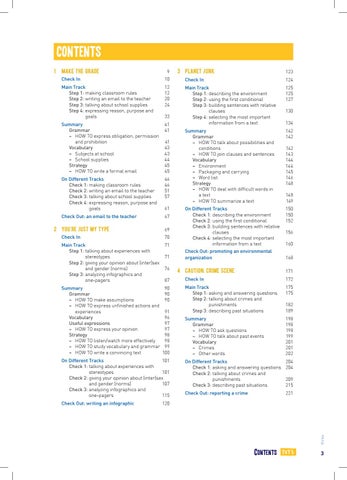
CONTENTS 1 Make the grade Check In
9 10
Main Track 12 Step 1: making classroom rules 12 Step 2: writing an email to the teacher 20 Step 3: talking about school supplies 24 Step 4: expressing reason, purpose and goals 33 Summary Grammar – HOW TO express obligation, permission and prohibition Vocabulary – Subjects at school – School supplies Strategy – HOW TO write a formal email
41 41 41 43 43 44 45 45
On Different Tracks Check 1: making classroom rules Check 2: writing an email to the teacher Check 3: talking about school supplies Check 4: expressing reason, purpose and goals
46 46 51 57
Check Out: an email to the teacher
67
2 You’re just my type Check In
61
69 70
Main Track 71 Step 1: talking about experiences with stereotypes 71 Step 2: giving your opinion about (inter)sex and gender (norms) 76 Step 3: analyzing infographics and one-pagers 87
3 Planet Junk
123
Check In
124
Main Track 125 Step 1: describing the environment 125 Step 2: using the first conditional 127 Step 3: building sentences with relative clauses 130 Step 4: selecting the most important information from a text 134 Summary 142 Grammar 142 – HOW TO talk about possibilities and conditions 142 – HOW TO join clauses and sentences 143 Vocabulary 144 – Environment 144 – Packaging and carrying 145 – Word list 146 Strategy 148 – HOW TO deal with difficult words in a text 148 – HOW TO summarize a text 149 On Different Tracks 150 Check 1: describing the environment 150 Check 2: using the first conditional 152 Check 3: building sentences with relative clauses 156 Check 4: selecting the most important information from a text 160 Check Out: promoting an environmental organization
4 Caution: crime scene
168 171
Check In
172
Summary 90 Grammar 90 – HOW TO make assumptions 90 – HOW TO express unfinished actions and experiences 91 Vocabulary 96 Useful expressions 97 – HOW TO express your opinion 97 Strategy 98 – HOW TO listen/watch more effectively 98 – HOW TO study vocabulary and grammar 99 – HOW TO write a convincing text 100
Main Track 175 Step 1: asking and answering questions 175 Step 2: talking about crimes and punishments 182 Step 3: describing past situations 189
On Different Tracks 101 Check 1: talking about experiences with stereotypes 101 Check 2: giving your opinion about (inter)sex and gender (norms) 107 Check 3: analyzing infographics and one-pagers 115
On Different Tracks 204 Check 1: asking and answering questions 204 Check 2: talking about crimes and punishments 209 Check 3: describing past situations 215 Check Out: reporting a crime
198 198 198 199 201 201 202
221
120
three
Check Out: writing an infographic
Summary Grammar – HOW TO ask questions – HOW TO talk about past events Vocabulary – Crimes – Other words
Contents
T'n'T 5
3
5 Step up to the plate Check In
223 224
Main Track 225 Step 1: describing eating habits 225 Step 2: ordering from a food truck menu 229 Step 3: reading and writing restaurant reviews 234 Summary 243 Grammar 243 – HOW TO say how often something happens 243 Vocabulary 244 – Describing the food truck experience 244 Strategy 245 – HOW TO order from a food truck 245 On Different Tracks 247 Check 1: describing eating habits 247 Check 2: ordering from a food truck menu 251 Check 3: reading and writing restaurant reviews 257 Check Out: organizing a food truck fest
6 Life is music
265
Check In
266
Main Track Step 1: revising past tenses Step 2: describing people, their taste in music and their clothes Step 3: reporting what people say
267 267
Summary Grammar – HOW TO talk about past events – HOW TO report what someone said Vocabulary – Musical instruments – Describing people: appearance – Describing people: clothes Strategy – HOW TO read a text more effectively – HOW TO listen/watch more effectively
291 291 291 293 294 294 295 298 299 299 300
On Different Tracks Check 1: revising past tenses Check 2: describing people, their taste in music and their clothes Check 3: reporting what people say
301 301
Check Out: an interview with your favourite musician or band
four
4
263
T'n'T 5
Contents
278 285
306 311 317
STARTEN MET TRACK 'N' TRACE Welkom in Track ‘n’ Trace. We leggen graag even uit hoe je met dit boek aan de slag gaat.
1 / Op weg met Track ‘n’ Trace Het leerwerkboek bestaat uit zes units en elke unit is op dezelfde manier opgebouwd. Op de voorpagina van elke unit vind je terug wat je zult leren om de taak aan het einde van de unit, de Check Out, goed uit te voeren. Deze voorpagina toont je de weg die je zult afl eggen.
UNIT 2: YOU'RE JUST MY TYPE check in Step 1: talking about experiences with stereotypes
main track
Step 3: analyzing infographics and one-pagers
Step 2: giving your opinion about (inter)sex and gender (norms)
In de Check In maak je kennis met het thema van de unit.
summary
trace your steps
CHECK IN Are you sure about that? 1
Sort the following activities under ‘boy stuff’, ‘girl stuff’ or ‘boy and girl stuff’ and discuss with the class.
SPOKEN INTERACTION
becoming a DJ – free running or parkour – going camping in nature – gossiping with friends – ice skating – playing basketball – playing football – playing soccer – putting on make-up – sewing clothes – skateboarding – taking ballet classes – taking up a fighting sport – weight lifting
on different tracks check out: writing an infographic
De Main Track is opgebouwd uit verschillende Steps. In elke Step leer je een afzonderlijke bouwsteen om de taak aan het einde van de unit te kunnen maken.
Boy stuff
Girl stuff
Boy and girl stuff
MAIN TRACK
Step 1
Assume nothing
Talking about experiences with stereotypes
1 / You must be joking!
1 Watch the clips about stereotypes and answer the questions.
listening
2
Can you think of any other activities that you would associate with boys or girls in particular? If so, add them to the grid in exercise 1.
3
Watch the videos and indicate the activities you see in exercise 1. Would you still put the activities in exercise 1 where youvideos put them first? Why (not)? a Which stereotypes are the about?
listening
4
definition below. Read the
SPOKEN INTERACTION
b Write down as many stereotypes as you can. stereotype /'steriətaɪp/ An oftenMen unfair and untrue belief that many people have about all people or things with a particular Women characteristic. Most stereotypes are racial, religious, cultural or gender based. Source: www.learnersdictionary.com
a Did you make any stereotypical assumptions in exercise 1? If so, which ones?
Aan het einde van elke Step zie je een verwijzing naar een Check. Die Check vind je terug in het onderdeel On Different Tracks. In On Different Tracks ga je na of je de bouwsteen al onder de knie hebt. b Can you give a few other examples of stereotypes?
seventy
CHECK 1, p. 98
UNIT 2:
70
2
YOU'RE JUST MY TYPE
The Always video starts with a basic question: ‘Have you ever been told that because you’re a girl, you should not do something?’ a What type of word is ‘should’? Check the grammar in the Summary on How to express obligation, permission and prohibition in Unit 1, Make the Grade, page 41-42. b Try to rewrite some of the stereotypes in exercise 1 b using ‘should’ or a similar type of verb. 1
Voor je start met On Different Tracks is er een Summary: een overzicht van de grammatica, woordenschat, strategieën en veelgebruikte uitdrukkingen.
2
HOW TO make assumptions
a Prepare 5 questions you want to ask them. Use the present perfect simple or continuous.Modal auxiliary verbs of probability UNIT 2: YOU'RE JUST MY TYPE What?! They're back together? Use the prompts, then form your own questions. Look, she's crying. You can't be serious! Questions
She must be fighting with her
Person boyfriend. 1
Person 2
seventy-one
3 SUMMARY
4 experiences at school. Interview 3 people in your class about their (good and bad)
GRAMMAR
2
71
Person 3
1 Have you ever
2 How long have you
FORM & USE
3
– We use some modal verbs when we want to guess what happened to a person or guess what that person is like. – They are used to show that we believe something is certain, probable or possible. – They can refer to the present or future: • modal + base of the verb: e.g. She must like ice cream. • modal + 'be' + ing-form of the verb e.g. He could be getting ready. – They can refer to the past: • modal + have + past participle e.g. He may have gone home. • modal + have been + ing-form of the verb e.g. I can’t have been dreaming!
4 5
How certain are you?
Positive (+)
b Ask your questions and tick the boxes in the grid.
100 %
Must e.g. You haven’t eaten all day. You must be hungry.
SPOKEN INTERACTION
Talking about experiences with stereotypes
May not e.g. You may not believe it, but I passed the test ...
e.g. He may invite Izzy, but she’s very shy, so I really don’t know. Might e.g. She might come tonight, but she still had some work to do.
Make (stereotypical) assumptions about the people in these photos. Look at the example. Make sure to use different modal auxiliary verbs.
1
WRITING
work. (=1 of many possibilities)
Here are some of the conclusions from the short survey May I conducted:
1
Mustn’t / must not e.g. Jonah failed the test. He must not have studied very much.
Je leerkracht zal je zeggen wanneer je de Check, die bij een bepaalde Step hoort, kunt maken in On 1Different Tracks. Afhankelijk van je resultaat kun je – helemaal volgens jouw tempo en niveau – de leerstof 2 nog even herhalen, extra oefenen of meer verdiepende oefeningen 3 maken.
ON DIFFERENT TRACKS Check 1
Negative (-) Can’t / cannot e.g. He can’t be home yet, he only left 10 minutes ago and it’s a 30-minute drive.
c Draw some conclusions. Write at least 5 sentences using a present perfect simple or continuous, as in the example. e.g. 3 people I interviewed have already cheated on a Could test. e.g. If it’s not 5 p.m., Jess could still be at
Might not e.g. Don’t call him, it’s only 8 a.m., he might not be awake yet.
< 50 %
2
ninety
90
3
4
4 5
Je kunt je traject in On Different Tracks helemaal zelfstandig doorlopen, met een partner of samen met de klas. Aan de hand van de handige scorewijzers weet je meteen welke oefeningen je moet maken.
5
6
<4
4 – 5 ex. 2
one hundred and one
Next exercise
UNIT 2:
YOU'RE JUST MY TYPE
101
one hundred and two
Score
3
102
YOU'RE JUST MY TYPE
Score
<6
6 – 8
>8
Next exercise
ex. 3
ex. 5
ex. 6
Write the sentences in the present perfect simple. 1 (they / to pass / the final test?)
2 (you / to read / the newspaper / today?)
3 (we / not to see / ‘The Godfather’)
4 (they / not to visit / the Eiffel Tower / yet) 5 (why / he / to do his homework / already?)
UNIT 2:
fi ve
e.g. They are sneezing a lot, they must have a cold!
UNIT 2:
YOU'RE JUST MY TYPE
Starten met Track 'n' Trace
T'n'T 5
5
Als je alle bouwstenen in de Main Track hebt doorlopen en ze voldoende hebt ingeoefend in On Different Tracks, dan ben je zeker klaar voor de Check Out, de taak aan het einde van de unit. Hier kun je alles wat je geleerd hebt in de unit toepassen.
CHECK OUT: WRITING AN INFOGRAPHIC Orientation You will create a one-pager or an infographic informing people about one of the themes discussed in this unit: stereotypes, gender (in)equality, intersexuality, etc.
Preparation 1
READING
Work in a group of maximum 3. Choose an issue discussed in the unit and find students with more or less the same opinion on the topic as you. This will make the creation process easier and will give you a better final product. If you can’t find an issue in this unit, consult the teacher. Decide on the topic your group will write about:
2
Read the steps for writing a good infographic again (Step 3). Follow the steps you wrote down.
3
Find some articles or websites with relevant data about your topic and that you want to use in your infographic. Write down your sources here:
Elke Check Out gebruikt de OVUR-strategie:
– – – – –
Orientation
Reflection 4
Answer the following questions based on the information you found in your sources. CONTENT AND STRUCTURE
Action
Length one-pager or infographic print or digital
3 Reflect on your task by filling in the checklist. Text –
Preparation
Checklist: describing your holiday
– –
Yes
I think so
–
Refl ection
No
1 Preparation • I described my friends’ holiday activities. • I wrote my note or postcard in draft first.
–
Data – – one hundred and twenty
– – –
2 Content • I wrote about 75 words. YOU'RE JUST MY TYPE • I included all the necessary elements. • I respected the rules for writing an informal note or postcard.
Reflection 6
We willen graag dat je vorderingen maakt en dat je refl ecteert op je taken en leert uit 3 Language use • I used the correct vocabulary to describe the activities and the feedback. UNIT 2:
120
Reflect on your task by filling in the checklist. Checklist: infographic
Yes
I think so
No
1 Content and structure • We used numbers adequately in our infographic. • We used imagery and pictograms adequately in our infographic. • We used colour adequately in our infographic. • We used lettering adequately in our infographic. • We used the tips for infographics. • We mentioned our sources.
weather. • I used the past simple tense correctly. • I paid attention to the structure of my sentences. • I checked my spelling and punctuation.
2 Language • We used correct grammar. • We used the correct words. • We used correct spelling and punctuation. Feedback
Feedback 7
Reflect on your teamwork by filling in this checklist. Share your feedback with your group members.
Ten slotte kun je na elke unit je online portfolio op diddit individueel of samen met je leerkracht invullen. Zijn er dingen die nog niet zo goed lopen, dan krijg je meteen ook digitale oefeningen bij je werkpunten. Peer 1
Checklist: teamwork
Trace your steps on diddit.
3
Yes
Peer 2
I think so
No
Yes
I think so
No
• Contributed positively to group discussions and decisions, helped to keep the group on track of the task. • Completed the work in time or made alternative arrangements. • Worked accurately, the quality of the work was good. • Worked well with the other team members and was respectful of other members’ opinions. • Did a fair share of the work and helped others when necessary.
Have a closer look at the verb forms in the following sentences.
Feedback
a Indicate the verb forms. Which event comes first? Which one is next?
2 / Nuttig voor onderweg first next e.g. After he had decided to go solo, he played in several movies.
b Rephrase the sentence using ‘after’ and ‘before’.
– Tupac’s mother had spent several months in jail before he was born on June 16, 1971 in East Harlem.
one hundred and twenty-two
After
Trace your steps on diddit.
In de loop van elke unit word je ondersteund door een aantal hulpmiddelen. – He began his musical career after he had won many rap competitions at school. He before 4
The new tense used in the sentences in exercise 3 is the past perfect (simple). Fill in the grammar box below.
122
UNIT 2:
YOU'RE JUST MY TYPE 8
GRAMMAR
How to talk about past events
SUMMARY HOW TO talk about past events
tense to talk about something that
happened in the past
something else in the past happened.
Past simple
and which is completely
e.g. She tried to save a pigeon with a broken wing last week. 2004 Kanye recorded his first album
past simple See p. 292
a Complete the grid from left to right with your own examples. Then complete the rule on how to form the past perfect.
2012 He met Kim Kardashian
Form of the past perfect simple Positive (+)
Negative (-)
pagenumber
3rd p. sing.
1 Past simple
The week before Debby got married, she had been in an accident.
Rule:
UNIT 6
226
UNIT 4:
In this case we can also use ‘used to + base form of the verb’ or ‘would + base form of the verb’:
e.g. As a teenager she would smoke Camels. / She used to smoke Camels.
See p. 291
LIFE IS MUSIC
OFF W E W ENT
275
READING
Read the Wikipedia profile of Tupac Shakur. Use the Strategy of Unit 3 (page 148) on 'how to deal with difficult words in a text' and also check the Strategy on 'how to read a text more effectively' in the box below.
1 FORM
Had you done something wrong?
2nd p. sing.
Now
– We also use the past simple for past habits and routines.
2 / Who was Tupac?
I hadn’t talked to her before her wedding.
1st p. sing.
2014 When his daughter North was born, he hadn’t gotten married to Kim yet
Questions (?)
two hundred and seventy-five
Subject
. There is often a specific time indication: three years
ago, last week, last January, when…
past perfect
After he had won rap competitions at school, he decided to start a musical career. past perfect
Grammaticale GRAMMAR regels staan in de Main Track altijd in een kader, met een duidelijk voorbeeld erbij. Hier vul je zelf een aantal basiskenmerken van de regel in. Hoe je de grammatica gebruikt, vind je vervolgens terug in de Summary. Aan de hand van nog meer voorbeelden en illustraties schetsen we de context waarin je de grammatica kunt gebruiken.
– We use simple the past simple when we talk about an action that happened in the Past simple and past perfect
e.g. Before Tupac won rap competitions at school, his family had moved to Baltimore. past simple
GRAMMAR
We use
Review when the past simple is used and fill in the sentences in the grammar box. How to talk about past events
Past perfect (simple)
Subject
Positive (+)*
Negative (-)
Questions (?) .
1st p. sing.
I talked to him.
I didn’t talk to him.
2nd p. sing.
You talked to him.
You didn’t talk to him.
Did I talkato Are him?the statements about Tupac true or false? Highlight Did you talkproof to him? in the text.
3rd p. sing.
She talked to him.
He didn’t talk to him.
1st p. plur.
We talked to him.
We didn’t talk to him.
Did we talk to him?
2nd p. plur.
You talked to him.
You didn’t talk to him.
Did you talk to him?
3rd p. plur.
They talked to him.
They didn’t talk to him.
Did they talk to him?
Rule:
Subject + base of the verb + (e)d
Subject + didn’t / did not + base of the verb
Did she talk to him?
Did He didn’t die in 1997, but in 1996. + subject + base of the verb?
b Correct the false statements. First make the sentence negative and then add the corrected statement. Make sure you use the past simple correctly. e.g. He died in 1997.
* Irregular verbs! Mind the irregular verbs in the positive form: e.g. I saw, you drew, she did, we drank USE - to talk about an action which happened in the past and that is completely over. There is often a specific time indication; three years ago, last week, last January, when…!
STRATEGY
look at the pictures and read the title(s) try to answer the WH-questions: who, what, where, how, why and when? look for context clues look for keywords, synonyms or related words look for numbers use a highlighter to mark the information you need
UNIT 6
LIFE IS MUSIC
HOW TO read a text more effectively 1
Before reading
See p. 299
291
UNIT 6
LIFE IS MUSIC
two hundred and seventy-one
How to read a text more effectively – – – – – –
two hundred and ninety-one
Omdat leerstrategieën ontzettend belangrijk zijn, vind je die ook in de Main Track terug wanneer je ze nodig hebt. Elke leerstrategie kun je via een handig schema of overzicht nog eens rustig bekijken in de Summary, ook als je er later nog eens gebruik van wilt maken.
- to talk about habits and routines in the past. In this case we can also use ‘used to + verb’ or ‘would + verb’! e.g. They used to get drunk during concerts all the time.
The basics Look at the picture(s). Read the title(s) first. Who wrote this?
Who is the text meant for?
Why did he/she write it?
271
Ask yourself What do you need to do with the text? Why do you have to read it?
What type of questions will you get?
2 While reading Global reading Try to answer the WH-questions: who / what / where / how / why / when?
Reading for details Look for context clues.
six
6
How to express your opinion
How to express your preferences
In my opinion … Personally, I think … I’d / I would say that … I believe that…
I hate … I don’t like … I like … / I like … (much) more than … I prefer … / I prefer … to … / I have a (slight) preference for … I’m fond of … I love …
How to agree with someone
How to disagree with someone
You’re (absolutely) right. I agree! I think so too. That’s just what I was thinking. That’s true.
I don’t agree with you. I’m sorry to disagree with you, but … I don’t think so. See p. 97
Who is your most and least favourite person in the video? Why? Try to use some of the expressions above.
6
Read what other people answered about who their favourite was. Highlight the items of clothing that are mentioned in green and the characteristics of people in blue. Then fill them in in the grid on the next page. Do you know who they are talking about?
1
Anna
person number
3
Tami
Starten met Track 'n' Trace
‘There was a woman with long straight black hair. She has a round face and she looks a bit Asian. She is wearing a black
3
Check your understanding If possible, reread difficult passages. Have you understood the main points?
Have you completed the task?
UNIT 6
SPOKEN INTERACTION
‘My favourite person is the guy with the beard and the heavy eyebrows. He has a long face. He is wearing a blue cap and a person T-shirt in a matching colour. He’s also wearing a hoodie under number a black leather jacket. He has long dark wavy hair in a ponytail. I like that. He looks broad-shouldered, maybe a little overweight.’
‘There was this guy with an oval face. He has a beard and rather heavy eyebrows. He looks well-built and he is wearing a grey hoodie under a jeans jacket. He looks really friendly.’
After reading
Use a highlighter or a pencil to flag up the information you need.
What would you do differently next time?
5
T'n'T 5
Omdat je Engels wilt gebruiken in een realistische context, reiken we je graag ook veelgebruikte uitdrukkingen aan.
USEFUL EXPRESSIONS
Look for keywords, synonyms or related words.
two hundred and ninety-nine
How to express your opinion
Look for numbers if a year, an amount or a date is asked for.
Rico
person number
2
LIFE IS MUSIC
299
Word
Translation
My notes
STEREOTYPES an assumption
aanname, veronderstelling
a prejudice
vooroordeel, vooringenomenheid
a stereotype
stereotype, verwachtingspatroon
sexual misconduct (attempted) murder
domestic abuse
rape
kidnapping
SEX AND GENDER
CRIMES INVOLVING PEOPLE
1 CRIMES
VOCABULARY
violation of probation
trespassing
fraud
OTHER CRIMES
possession of narcotic(s)
possession of drugs drug trafficking
CRIMES INVOLVING NARCOTICS CRIMES INVOLVING PROPERTY
Never have I ever
VOCABULARY
CHECK IN
De woordenschat van elke unit geven we je graag mee via mindmaps of via een overzichtelijke woordenlijst met ruimte om je eigen woorden en zinnen toe te voegen.
WORD LIST
sex
(biologisch) geslacht
intersex
interseks (bij interseks vertoont een lichaam biologische gezien zowel mannelijke als vrouwelijke kenmerken)
gender
gender (maatschappelijk en cultureel bepaalde normen van geslacht)
male
(biologisch) mannelijk
female
(biologisch) vrouwelijk
masculine
(maatschappelijk bepaald) mannelijk
feminine
(maatschappelijk bepaald) vrouwelijk
gender identity
genderidentiteit
transgender
transgender (wanneer je genderidentiteit niet overeenkomt met je biologische geslacht)
queer
in deze context: andersgeaard
testes
teelballen, testikels
challenging
moeilijk
contraception
anticonceptie, geboortebeperking
feminism
feminisme
to generalize
veralgemenen
to mutilate
verminken, met opzet beschadigen
non-conforming
niet zoals de norm
an ob-gyn
(obstetrician-gynecologist) gynaecoloog
to provide
voorzien in (geld, voedsel …), zorgen voor
to pump some iron
gewichtheffen
talkative
praatgraag
a wuss
angsthaas
CAUTION! CRIME SCENE
two hundred and one
speeding
Source: S. Bukley / Shutterstock.com
hit-and-run
UNIT 4:
ninety-six
Source: Kathy Hutchins / Shutterstock.com
burglary
a Combine the picture with the short biography.
96
201
UNIT 2:
YOU'RE JUST MY TYPE
READING
Source: Tinseltown / Shutterstock.com
DUI / driving under influence
Read the information about the four players in the game.
Source: Tinseltown / Shutterstock.com
mugging/robbery
assault and battery
shoplifting
TRAFFIC VIOLATION
2
robbery (at gunpoint)
pickpocketing
petty theft
geslachtsdelen, geslachtsorganen Watch the introduction of the game Ellen DeGeneres is talking about.genitals What is the aim of the listening GENERAL game? to buck up opschieten, in actie schieten
1
Vaardigheden zijn een belangrijk onderdeel bij het leren van een nieuwe taal. Daarom geven we bij elke oefening aan op welke vaardigheid je het meest aan het oefenen bent: listening, reading, b Action: find another pair of students and present your newsflash. 1 Martha Stewart is an American media mogul best known for her television show and speaking , spoken interaction writing c Reflect on your presentation. Fill in the checklist for yourself and then ask your 'audience' to Living. Stewart became famous as the,author of books on. magazine, Martha Stewart cooking, entertaining and decorating. She then expanded her brand to include a magazine and television program, serving as CEO of Martha Stewart Omnimedia. Stewart resigned her post in 2002, after charges of insider trading of which she was also convicted later on. 2 Listen to a live version of Arctic Monkeys’ ‘R U mine’. 2 Born Calvin Broadus on October 20, 1971, in Long Beach, California, Snoop Dogg got ahis Which instruments you recognize? nickname from his do mother because she thought he looked like the character in the hissong. way to theyou No. 1 spot Billboard's hip-hop and Top 200 bPeanuts Watchcartoon. the videoHe ofclimbed the same Can name theoninstruments on stage? charts, and his music and trouble with the law have kept him in the headlines ever since. He has the honour of having the most Grammy nominations of any music artist — 17 to 3 Fill in each band member’s instrument(s). Choose from the words below. Not all words are used some have to be used more than once. date and — but never having won one.
listening
READING
SPEAKING
listening
SPOKEN Checklist: breaking news report WRITING INTERACTION 1 Content and structure
3 / Fijn en handig voor onderweg
Classmate No
Yes
I think so
No
Feedback
Wanneer er moeilijke woorden voorkomen in het authentieke tekstmateriaal, worden die uitgelegd Score <7 ≥7 Next exercise ex. 4 Check 2, p. 107 in de glossary.
one hundred and seventy-two
4 Anna Kendrick was born on August 9, 1985, in Portland, Maine. In 2008, she landed a role in Twilight. Reprising her role, she appeared in the sequels New MoonTURNER , Eclipse and Breaking ALEX Dawn Part 1. In 2009, Kendrick earned raves for her earn raves: receive positive feedback work in Up in the Air. She also appeared in the insider trading: doing business when popular musical comedy Pitch Perfect (2012). you have information that is not made Source: www.biography.com public, which is illegal mogul: powerful person reprise: repeat JAMES COOK staunch: loyal, strong
CAUTION! CRIME SCENE
I think so
2 Language • We used the present perfect correctly. • We used the correct words. • We minded our pronunciation.
MATT HELDERS
UNIT 4:
Me Yes
• We made an original and entertaining story. • We prepared well (in English!) and were convincing.
vocals bassin guitar - drums - guitarEllen - keyboards - lead – piano - sax(ophone) – 3 Born backing on January 26, -1958, Metairie, Louisiana, DeGeneres hitvocals it big as a standtrumpet up comedian before starring on her own sitcom, Ellen-. violin In 1997, she came out as gay, and became a staunch advocate of LGBT rights. She has been the host of her own awardwinning talk show, The Ellen DeGeneres Show, since 2003, and married girlfriend Portia de Rossi in 2008.
6
Look at the pictures from the graphic novel The Suppressed Anger of the Pakistani Obedient WRITING Daughter by Ayesha Tariq. a Preparation: choose 3 scenes from the graphic novel.
NICK O’MALLEY
b Action: write a few sentences about each scene assuming what happened. – Write about 70-100 words in total. – Use modal auxiliary verbs correctly to make assumptions. – Check your language, spelling and punctuation.
Soms krijg je extra uitleg bij een boek, een auteur of een fi lm.
THE SUPPRESSED ANGER OF THE PAKISTANI OBEDIENT DAUGHTER BY AYESHA TARIQ The Suppressed Anger of the Pakistani Obedient Daughter by Ayesha Tariq explains how the typical Pakistani daughter is obedient, does as she is told, holds no arguments and if she has anger issues, she bottles them up. The book shows the issues Sarah goes through in her daily life and that upset her. However, she doesn’t voice her opinion because it would hurt her parents. Source: www.behance.net
In de Did You Know-kaders vind je leuke weetjes en achtergrondinformatie.
Did you know? If you play an instrument, you usually use the definite article. e. g. I play the guitar. She plays the piano.
UNIT 6
LIFE IS MUSIC
UNIT 2:
YOU'RE JUST MY TYPE
one hundred and five
piano/keyboards,
two hundred and eighty-three
105
283
De volgende iconen helpen je ook nog een eind op weg. Het luisterfragment dat hierbij hoort, vind je ook online terug. Het beeldfragment dat hierbij hoort, vind je ook online terug. Als je dit icoon ziet, moet je iets online opzoeken of vind je extra materiaal terug op diddit.
seven
172
SPEAKING
do this too.
Starten met Track 'n' Trace
T'n'T 5
7
het onlineleerplatform bij Track ‘n’ Trace Leerstof kun je inoefenen op jouw niveau. Je krijgt meteen feedback aan de hand van theoriekaders en instructiefi lmpjes. Je kunt vrij oefenen en de leerkracht kan ook voor jou oefeningen klaarzetten.
Hier vind je de opdrachten terug die de leerkracht voor jou heeft klaargezet. Hier kan de leerkracht toetsen en taken voor jou klaarzetten. Trace Your Steps: vul hier jouw portfolio in om aan te duiden wat je al beheerst. Benieuwd hoe ver je al staat met oefenen en opdrachten? Hier vind je een helder overzicht van je resultaten. Hier vind je het lesmateriaal per unit (o.a. audio- en videobestanden). Alle instructiefi lmpjes en leerbladen uit de Summary zijn hier verzameld, ook die van de vorige jaren.
WORD LIST Word
Translation
My notes
HOW TO express your opinion
STEREOTYPES an assumption
aanname, veronderstelling
a prejudice
vooroordeel, vooringenomenheid
a stereotype
stereotype, verwachtingspatroon
1 Formulating your opinion
FORM & USE – We use some modal verbs when we want to guess what happened to a person or guess what that person is like. – They are used to show that we believe something is certain, probable or possible. – They can refer to the present or future: • modal + base of the verb: e.g. She must like ice cream. • modal + 'be' + ing-form of the verb e.g. He could be getting ready. – They can refer to the past: • modal + have + past participle e.g. He may have gone home. • modal + have been + ing-form of the verb e.g. I can’t have been dreaming!
sex
(biologisch) geslacht
intersex
interseks (bij interseks vertoont een lichaam biologische gezien zowel mannelijke als vrouwelijke kenmerken)
gender
gender (maatschappelijk en cultureel bepaalde normen van geslacht)
male
(biologisch) mannelijk
female
(biologisch) vrouwelijk
masculine
(maatschappelijk bepaald) mannelijk
feminine
(maatschappelijk bepaald) vrouwelijk
gender identity
genderidentiteit
transgender
transgender (wanneer je genderidentiteit niet overeenkomt met je biologische geslacht)
queer
in deze context: andersgeaard
testes
teelballen, testikels
genitals
geslachtsdelen, geslachtsorganen
How certain are you? Positive (+)
100 %
Must e.g. You haven’t eaten all day. You must be hungry.
Negative (-) Can’t / cannot e.g. He can’t be home yet, he only left 10 minutes ago and it’s a 30-minute drive.
Could e.g. If it’s not 5 p.m., Jess could still be at work. (=1 of many possibilities) May e.g. He may invite Izzy, but she’s very shy, so I really don’t know.
May not e.g. You may not believe it, but I passed the test ...
Might e.g. She might come tonight, but she still had some work to do.
Might not e.g. Don’t call him, it’s only 8 a.m., he might not be awake yet.
to buck up
opschieten, in actie schieten
challenging
moeilijk
contraception
anticonceptie, geboortebeperking
feminism
feminisme
to generalize
veralgemenen
to mutilate
verminken, met opzet beschadigen
non-conforming
niet zoals de norm
an ob-gyn
(obstetrician-gynecologist) gynaecoloog
to provide
voorzien in (geld, voedsel …), zorgen voor
to pump some iron
gewichtheffen
talkative
praatgraag
a wuss
angsthaas
< 50 % ninety UNIT 2:
YOU'RE JUST MY TYPE ninety-six
90
2 Agreeing
96
What words come to mind?
Type of text/video What kind of text/video are you going to listen to / watch?
Task Do you understand the task?
I don't agree with you. However … That's not entirely true. On the contrary … I'm sorry to disagree with you, but … I'm afraid I have to disagree. I'm not so sure about that.
4 Partly agreeing
2 While listening/watching Focus on what you hear/see Think ahead: what might happen next? Take short notes.
'That’s partly true, but surely not in Western and most European countries!'
5 Closing the discussion
Focus on key words and facts.
After listening/watching
'I think we’re going to have to agree to disagree on this matter.'
YOU'RE JUST MY TYPE
Check your understanding If possible, listen again to difficult passages.
YOU'RE JUST MY TYPE
97
Have you completed the task?
Read your notes.
Have you understood the main points?
ninety-eight
eight
DIDDIT
Listen to the intonation and stress of the speakers.
Ignore the words you think are less important.
I agree up to a point, but ... I see your point, but ... Although you are right about …, I think … I'm not so sure about that.
Let's just move on, shall we? Let's drop it. UNIT 2:
What do you already know about this type of text/video?
Read through the questions and highlight key words.
'I’m afraid I have to disagree with you. Lots of women in the world don’t have any rights at all.'
3 Disagreeing
1
Topic What do you know about the topic?
98
T'n'T 5
Before listening/watching
You're absolutely right. Yes, I agree. That's a good point. I don't think so either. I agree with you entirely. That's just what I was thinking.
UNIT 2:
8
HOW TO listen/watch more effectively
'I couldn’t agree more, there is hardly any difference anymore.'
GENERAL
Mustn’t / must not e.g. Jonah failed the test. He must not have studied very much.
'As far as I’m concerned, women and men have equal rights in this day and age.' In my opinion/view ... Generally speaking, I think ... To my mind ... I’m quite convinced that ... To be quite honest / frank ... If you ask me ... The way I see it …
SEX AND GENDER
STRATEGY
Modal auxiliary verbs of probability What?! They're back together? You can't be serious!
Look, she's crying. She must be fighting with her boyfriend.
ninety-seven
VOCABULARY
HOW TO make assumptions
USEFUL EXPRESSIONS
GRAMMAR
SUMMARY
UNIT 2:
YOU'RE JUST MY TYPE
3
UNIT 1: MAKE THE GRADE check in main track
Step 3: talking about school supplies
Step 1: making classroom rules
Step 2: writing an email
summary Step 4: expressing reason, purpose and goals
trace your steps
on different tracks check out: an email to the teacher
UNIT 2: YOU'RE JUST MY TYPE check in main track
Step 3: analyzing infographics and one-pagers
Step 1: talking about experiences with stereotypes
Step 2: giving your opinion about (inter)sex and gender (norms)
summary
trace your steps
on different tracks check out: writing an infographic
UNIT 3: PLANET JUNK check in main track
Step 3: building sentences with relative clauses
Step 1: describing the environment
Step 2: using the fi rst conditional
summary Step 4: selecting the most important information from a text
trace your steps
on different tracks check out: promoting an environmental organization
UNIT 4: CAUTION! CRIME SCENE check in main track
Step 1: asking and answering questions
Step 2: talking about crimes and punishments
Step 3: describing past situations
summary
trace your steps
on different tracks check out: reporting a crime
UNIT 5: STEP UP TO THE PLATE check in main track
Step 3: reading and writing restaurant reviews
Step 1: describing eating habits
Step 2: ordering from a food truck menu
summary
trace your steps
on different tracks check out: organizing a food truck fest
UNIT 6: LIFE IS MUSIC check in main track
Step 3: reporting what people say
Step 1: revising past tenses
Step 2: describing people, their taste in music and clothes
summary
trace your steps
on different tracks check out: an interview with your favourite musician or band