James A. McClure Center, a UI public policy research arm, as a home base.
As the Idaho state legislature attempted to balance a $40 million budget deficit, 16 University of Idaho students advocated for higher education programs in the statehouse this week.
The group of students and ASUI members traveled to Boise for the 2026 ASUI Legislative Ambassador trip, an annual opportunity for students to learn about the state’s legislative process firsthand and promote UI interests.
The university-funded trip was planned by Alma Azocar Agurto, ASUI’s director of legislative affairs. From Jan. 25-27, students stayed at the Hampton Inn and used the
Little still committed to ed. funding despite deficit Joshua Reisenfeld ARGONAUT UI says issues caused by system update fixed, urges students to check MyUI
Nearly 5,000 University of Idaho students received unexpected emails about their spring 2026 health insurance coverage because of a recent system update, according to school officials.
While the system errors have been addressed, the university recommends that students check their insurance status in MyUI to ensure they have the correct coverage.
UI, in compliance with the Affordable Care Act, must verify that eligible students—defined as fulltime for undergraduate, graduate and law students, student athletes taking one or more credits and all international students— have sufficient insurance coverage.
Each semester, students must submit a waiver that includes their health insurance coverage information, or they will automatically be enrolled in the university’s Student Health Insurance Program. The deadline to submit a waiver for the spring semester was Jan. 14.
“This requirement is designed to ensure that students who fall under
“The beautiful thing about Moscow is that it can be isolated from other places, but when it comes to [the] state government, it can feel very far away. It’s a good opportunity to teach students through experiences,” Agurto said.
The Idaho state legislature is currently running on an estimated deficit of $40.3 million, according to the Idaho Capitol Sun. To balance the budget, some legislators are turning toward cutting fundamental programs such as the Idaho Launch Scholarship, special education funding and Medicaid funding.
“We wanted to focus on Idaho Launch, Idaho Opportunity and the importance of higher education in a place that doesn’t put a lot of attention into it,” Agurto said. Students sat in on the Senate Education
Committee meeting on Monday, Jan. 26, where committee members discussed ways to decrease the deficit while still meeting educator needs.
Debbie Critchfield, Idaho’s superintendent of instruction, spoke on a solution to these issues at an open forum during the committee meeting.
Critchfield proposed making Idaho an “EdFlex” state, allowing for student support-oriented choices for standardized testing. In Idaho elementary schools, both the state and the federal government require students to take a standardized third grade reading test, which Critchfield pointed out was redundant. Becoming an “Ed-Flex” state would allow Idaho to opt out of the federal test. To implement these changes, the Idaho State Board of Education would need to apply for a waiver.
these categories have access to essential medical care without facing significant financial hardship and are protected from gaps in coverage, as college-aged adults are among the most uninsured and underinsured populations,” Anita Packwood, operations manager at the Vandal Health Clinic, wrote in an email to The Argonaut.
On Jan. 19, students who had submitted waivers for SHIP received an email saying they had been enrolled in the program automatically when the system incorrectly identified a pending waiver as a rejected one.
On Jan. 22, another email was sent to roughly 5,000 SHIP-eligible students, saying they had not completed the insurance submission requirement.
It was intended only for those who had not yet begun an audit or enrolled in SHIP but was received by students already enrolled in SHIP, or with pending audits, adding to the confusion.
“Once the error surfaced, the administration quickly investigated, identified the cause within the new system workflow, and implemented a fix,” Packwood said.
Students also may have received emails about a negative balance on their student account and potential late fees because of the $1,206 SHIP fee.
Packwood said that any late fees caused solely by pending SHIP charges will be automatically waived once the audit is processed,
and no action or appeal is required by the student. Tuition and other fees can be paid by subtracting the SHIP cost from the total balance.
An email from the Dean of Students, Blaine Eckles and Packwood was sent to all students on Jan. 26 in response to the error.
“This occurred as the university implemented a new process linking approved insurance information to the billing system,” Eckles wrote.
The issue has been corrected and the new system will improve processing moving forward despite the momentary confusion, according to Eckles.
Some students affected by this issue reported that, around Jan. 24, they had received an email stating that their audit had been processed.
Many students also reported noticeably longer processing times for waivers this semester compared to previous semesters.
Health insurance waivers can take up to 10 business days to process, meaning that students who submitted the audit on time should have the charge drop from their account by Jan. 29.
Students who are unsure whether their waiver was successfully submitted or approved can contact the SHIP office at studentinsurance@ uidaho.edu for direct assistance.
Moscow holds “ICE Out for Good” protest
response to rising tensions with U.S. Immigration and Customs Enforcement agents in Minneapolis, Minnesota, and the murder of Renee Good on Jan. 7 by an ICE agent, identified as Jonathan Ross.
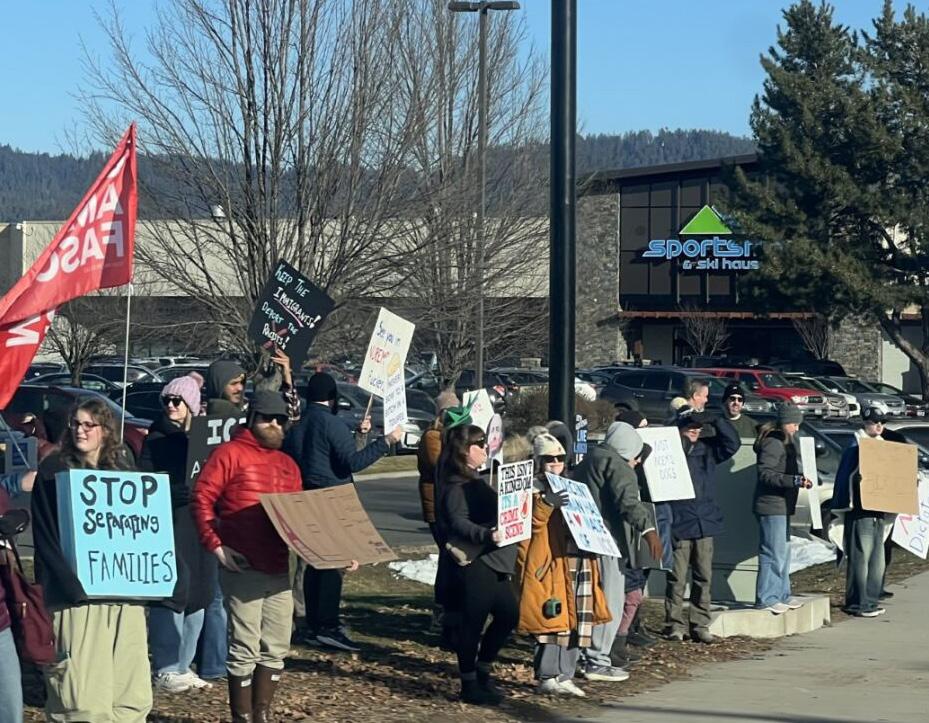
An “ICE Out for Good” protest was held in Moscow on Friday, Jan. 23, in solidarity with the Minnesota general strike. The strike was held in
The Moscow protest was held at the intersection of Farm Road and West A Street from 3-4 p.m. and was organized by Indivisible Moscow, which previously organized local Hands Off, No Kings and Labor Day protests.
“We are standing on this corner in solidarity with immigrants and with the people of Minnesota. We are standing against the normalization of what ICE is doing,” said Annette Bridges, a volunteer organizer with Indivisible Moscow.
Around 25 people showed up in 27-degree weather and held signs reading: “Skin color is not probable cause” and “ICE agents are criminals.”
Many of these individuals said they were past or current educators, scared citizens and allies.
“When I say I am concerned about citizens, I do include also my
concern about those who may be here without documentation. I do not believe that human rights are exclusive to American citizens,” said Todd Bailey, a Moscow native and teacher at Moscow High School.
“What I hope [this protest] does is establish a historical record of dissent and also illustrate to those that pass us that there are those who are as dedicated as we are and therefore maybe some people who disagree with us will be forced to reconsider,” Bailey added. The school teacher said he remains hopeful because without it, much of life would be impossible.
“It became personal the day Donald Trump was elected...This is my country. I can’t feel any other way about it,” said Margaret Handley, who said she decided to protest due to her patriotism for her country. There were no direct counter protesters but multiple vehicles who drove by the intersection rolled down their window to flip off or shout at the protesters.
John Keegan | Argonaut
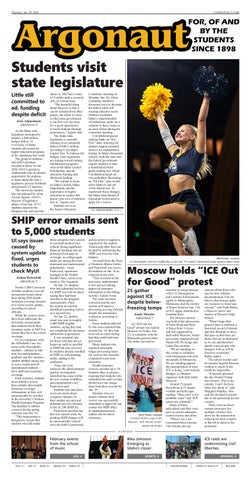
UI cheerleader Syncere Griffin flies at the Jan. 15 women’s basketball game against Idaho State
Josie Adjanohoun
Ethan Matsui | Argonaut
A woman holds a sign at the Moscow “ICE Out for Good” protest on Friday
Idaho faces potential Medicaid cuts to balance state budget
Gov. Little recommends a $22 million cut
In order for Idaho to manage expected budget deficits, Medicaid, a federally and state funded low-cost health coverage program for people in need across the nation, is at risk of facing $22 million in cuts from state funding.
According to the Idaho Capital Sun, Idaho will end Fiscal Year 2026 with a deficit around $40.3 million, following an already significant 3% budget cut to state agencies and departments of over $450 million in August 2025.
The state budget deficit is following five years of tax cuts approved by the Idaho Legislature, which reduced Idaho’s revenue by an estimated $4 billion.
Gov. Brad Little proposed that a $22 million cut in Medicaid funding, on top of a potential $23 million cut to doctor pay rates, would help to balance the state budget.
A controversial suggestion amongst lawmakers and Idaho residents alike, the suggested budget cuts were discussed by the Joint Finance-Appropriations Committee on the Division of Medicaid, on Thursday, Jan. 22.
Alex Williamson, senior analyst of the budget and policy analysis division, led the presentation with a slideshow illustrating which funds distributed to the division of Medicaid the governor suggests slashing. In the outline, hospital rates and residential habilitation rates could face reductions, while 12 other areas, including physical, occupational and speech therapy, could be removed altogether.
“In addition to the savings from the provider rate reduction, the governor recommends an ongoing reduction of $22 million from the general fund and $45 million from federal funds to balance the FY 2027 budget,” the presentation said.
As of May 2025, nearly 355,000 Idahoans rely on Medicaid for health coverage, according to data from the Kaiser Family Foundation.
According to 2024 U.S. Census Bureau data, Idaho has just over 2 million residents, which means that around 18% of Idahoans
Sarah Zabel to run against Rep.
Russ Fulcher
Independent rep. candidate discusses women’s rights and climate change
Mackenzie Davidson ARGONAUT
Sarah Zabel, a retired U.S. Air Force Major General, is running as an independent candidate in the congressional race for Idaho’s first district. Zabel is up against Republican Rep. Russ Fulcher, who has held the seat since 2019.
On Jan. 27 and 28, Zabel held a “Meet the Candidate” event at the University Inn, where Latah County residents were able to learn more about her campaign.
One of Zabel’s goals, if elected, will be to “challenge both parties to stop calling each other names and get to the issues at hand,” she said during the event.
The overwhelming theme of the night was Zabel’s dedication to a sound economy. The first point on her agenda is to reduce borrowing and health care costs and support small businesses by removing hidden taxes.
Zabel’s campaign website includes policy proposals that address her congressional agenda, including hopes to support the working class through challenges such as artificial intelligence.
“You’ve got to protect the workers [and] protect the people,” said Zabel in an interview with The Argonaut.
Many of the event’s attendees discussed their concerns with job security and the protection of local agriculture. One lentil farmer from Genessee shared an experience where foreign buyers are no longer willing to do business with American growers.
Zabel said she hopes to “get rid of the self-inflicted wounds,” noting that the damage done to foreign relations is being reflected in trade.
Alongside issues surrounding the nation’s relationship with former allies, Zabel discussed domestic damage, referring to the U.S Immigration and Customs Enforcement, or ICE, as “a criminal organization.”
Zabel said she hopes authorities are preserving evidence and that those responsible will be held accountable.
While Zabel was willing to share her beliefs on the activities of ICE and its members, she was unable to do the same for the Trump Administration, citing the Uniform Code of Military Justice, Contempt toward Officials, Article 88, which states, “Any commissioned officer who uses contemptuous words against the president...shall be punished as a court-marital may direct.”
Zabel would only go as far as saying, “I do think that the administration is stretching the law and that some of the agents that are acting under them are breaking the law. But I think that justice will catch up with them.”
Other concerns brought to Zabel’s attention were climate change and women’s health. Zabel was clear on her stance for both.
“Climate change is real. It’s real, it’s measurable, it’s a fact,” Zabel said. While she is opposed to solutions like The Green New Deal, proposed by Rep. Alexandria Ocasio-Cortez (Dem-NY) and Sen. Bernie Sanders (Dem-V), which she feels does not propose solutions that are “valid or feasible,” she is in favor of funding research to provide solutions that work for the average American.
On women’s health, Zabel said, “I have signed the petition to get the women’s reproductive rights on the Idaho Constitution.”
Idaho currently has a total abortion ban, which was enacted after the 2022 overturning of Roe v. Wade.
In a comment to The Argonaut after Zabel’s Meet the Candidate event, Native American Democratic Caucus of Idaho Chairwoman, Trish Carter-Goodheart, showing her support for Zabel’s campaign, said, “She represents most people, not just the 1%.”
Addressing the whole of Idaho’s voters, Zabel had one message to share: “[You] are not powerless. [You] have a choice.”
utilize Medicaid.
Due to this, many residents have expressed disdain over the potential budget cuts, as confirmed by several senators. In the meeting held on Jan. 22, many reported they had received an outpouring of public input via email and phone calls.
Sen. Carl Bjerke is one of the senate members who attested to receiving messages from the public. For him, it sparked the conversation around the necessity of prioritization.
“I’ve said since I’ve been in the legislature, when it comes to Medicaid and when it comes to what our service is here—to our constituents—that I desire to do the most for the most,” Bjerke said in the meeting. “But when it comes to Medicaid, I want the money to be driven and given to the people that are most vulnerable.”
Bjerke then went on to reference an example of prioritization in the healthcare system and how he would rather use resources to assist a single mother of an autistic child than support adult dental care, though he recognized both are important.
Sen. Melissa Wintrow expressed concern in using prioritization in the healthcare system.
“We’re really picking winners and losers here, and it doesn’t feel good,” Wintrow said.
She emphasized how much progress has been made in recent years toward developing better wellness programs for Idaho, especially in regard to mental health resources and how these recommended budget cuts will interrupt the process.
“It’s just pulling out the rug from everything we’ve created,” Wintrow continued. “What a waste of resources—creativity, energy and staffing—that we’ve built up to help our citizens and now we’re cutting it back.”
In 2025, approximately $4.9 billion was spent on Medicaid funding in Idaho, according to the charts presented by Williamson. Of that total, 1.5% was spent on personnel and operating costs, while the other 98.5% was spent directly on Medicaid services.
Though Idaho is going into a deficit this upcoming year, it’s still uncertain how and where the funds will be made up.
Beginning on Monday, Jan. 26, the legislature separated into work groups where they began making the final budgeting decisions.
ASUI introduces the 2026 Winter Social Resolution
passes celebrating 20 years
of sustainability
Josie Adjanohoun ARGONAUT
The 2026 Winter Social, and a resolution on 20 years of university sustainability, was introduced during this Wednesday’s ASUI Senate meeting.
The Winter Social will be held on Wednesday, Feb. 25, from 5 p.m. to 8 p.m. in the ISUB. The event has been likened to Palousafest, with student clubs, small businesses, games and networking opportunities. More information on the Winter Social will be announced at a later date.
Director of Sustainability, Nicole Rice,
introduced Senate Resolution S26-R, which commemorates the Student Sustainability Cooperative and the Office of Sustainability for 20 years of service.
“It’d be really cool if we honored 20 years through a resolution, and it would be one of the first resolutions of the year,” said Rice. The resolution passed unanimously.
ASUI President Seyi Arogundade, Vice President Bryant Sitts and other members of the senate congratulated Director of Legislative Affairs, Alma Azocar Argurto, for planning the legislative ambassador trip.
“Everybody that went on the trip gained exponential return on their time investment,” said Sen. Gunner Cavender during his project report.
ASUI Senate meetings are open to the public and are held on Wednesdays at 7 p.m. in the Clearwater-Whitewater room of the ISUB.
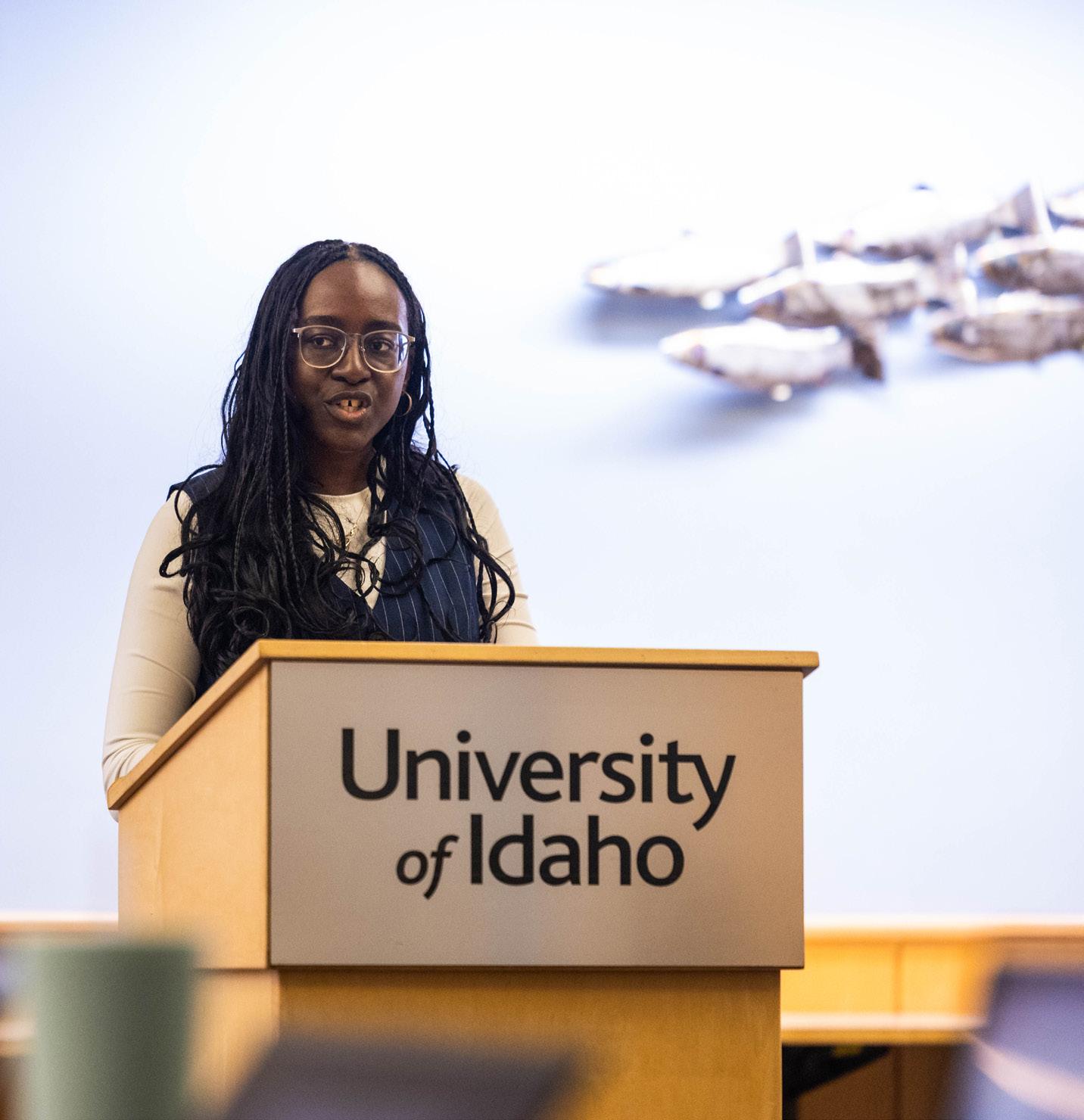
John Keegan | Argonaut ASUI President Seyi Arogundade addresses the Senate during their meeting
Idaho sen. proposes new protection of public lands
It will be on the Nov. ballot if it receives approval
Paige Wilton ARGONAUT
On Wednesday, Jan. 21, Sen. Ben Adams, R-Nampa, proposed an amendment to the Idaho state constitution to prevent new public lands acquisition by the state from being sold.
The amendment, which would apply to any new land received by the state from the federal government, would ensure the security of those lands from permanent impairment.
Adams, having been involved with the legislature since 2020, said to the Senate State Affairs Committee on Wednesday that public opinion helped to shape his proposal, ac-
cording to the Idaho Capital Sun.
“I wanted feedback. I wanted a lot of feedback, because it deals with a very personal matter for every Idahoan, and that is our public land here in Idaho,” Adams said.
Though the amendment was originally introduced in August and has since undergone minor alterations, Adams claims the intent behind it remains the same.
While the changes would be applicable to land acquired in the future, it would not affect the 2.5 million acres of state endowment lands that could still be sold.
“I do not anticipate that the amendment will make waves, but I do hope that it ignites interest in and conversations about public lands, public lands policy
and their impact on people and communities,” said Chelsea Pennick, associate director of the University of Idaho policy analysis group and research assistant professor of natural resources policy and administration.
Pennick said she does not have high expectations that the amendment would be approved by voting Idahoans, but recognizes it indicates change.
“Based on the response of Idahoans and westerners to Sen. Lee’s proposal to sell off public lands, I would not expect the majority of Idahoans to vote in favor of this bill,” Pennick continued. “However, I do believe the persistence of proposals like this does indicate a need to revisit some of the public land policies to gauge whether they are working for states,
for local communities, for local governments and for citizens at large.”
For the amendment to be passed, it must first be approved by two-thirds of the legislature.
If they vote in favor of the change, it would appear on the 2026 Idaho ballot and would require a simple majority.
Jack Adams, an international studies major and avid outdoor enthusiast at UI, believes that public lands are critical to all those who utilize them.
“I like to think that most people in Idaho would think the same as I do in that way, but I also think that there is a wealth disparity gap, and those who truly enjoy the great outdoors are also not the ones who are trying to buy it,” he said.
AMBASSADORS
FROM PAGE 1
Afterward, students met with Gov. Brad Little, where he affirmed his commitment to the Idaho Launch program. The program was introduced by Little in 2023 as a grant for Idaho students seeking a two-year, fouryear or technical degree after high school if they are entering an in-demand career field.
As Little is nearing the end of his second term as governor, he also talked about his legacy: improved literacy, making the lives of Idaho’s children better, protecting state resources and creating better jobs in the state were milestones achieved in the past eight years that Little highlighted in a Q&A.
In a similar meeting with Lt. Gov. Scott Bedke, ASUI representatives asked questions about the importance of the Launch program and about his addition to the McClure Center Board of Directors.
Bedke said that the research being conducted at UI, specifically the McClure Center, would be influential to convincing legislators of the importance of four-year education.
“When we advocate for more funding for [postsecondary] education, we have to show them that their investment leads to quantifiable results,” Bedke said. He also asked student representatives who received the Idaho Launch scholarship to share their stories with legislators.
Idaho Senate Pro Tempore Kelly Anthon echoed Little and Bedke’s recommendation of protecting the Idaho Launch program, but said he wanted to prioritize students wanting to enter a trade or receive a two-year degree.
Joshua Reisenfeld ARGONAUT
U.S. diplomat to visit UI for forum on Wednesday, Feb.
4
The former U.S. ambassador to Kosovo from 20222024, Jeff Hovenier, will speak about international relationships with Europe at 5:30 p.m. on Wednesday, Feb. 4, in the Pitman Center’s International Ballroom. Admission is free and part of the Martin Institute forum series.
During Hovenier’s week-long visit to Moscow, he will also teach a short course on U.S.-Europe relations and meet with students, including those in international studies and political science courses.
Before his posting in Kosovo, Hovenier was the temporary ambassador and deputy chief of mission in Turkey and held positions at U.S. embassies in Germany, Peru, Greece, Croatia, Paraguay and Panama.
He also served on the National Security Council as the director for Central and Southeastern European affairs and held multiple positions in the Department of State’s Bureau of European and Eurasian Affairs.
AI boosts efficiency and worker safety at Idaho sugar plant
Amalgamated Sugar partnered with the Center for Intelligent Industrial Robotics at the University of Idaho Coeur d’Alene campus to develop an automated monitoring system for its steam dryer.
The steam dryer reduces the moisture content of the beet pulp after the sugar has been diffused by hot water. Excess pulp, incorrect temperature or steam pressure or a mass that sticks and begins to burn can all cause problems which previously required employees to enter the dryer and unplug it.
The solution, developed by UI graduate student Hunter Hawkins and CIIR director John Shovic, uses a combination of AI algorithms to monitor the plant’s steam dryer and create a predictive model reaching 5-20 minutes in the future.
“Not having to send our people in there to unplug it is one of the biggest safety opportunities we have,” said Trent Holcomb, plant manager at Amalgamated Sugar in a UI press release.
The Artificial Intelligence Predictive Appliance notifies the end user when and, more importantly, where an issue might take place. This will allow for plant works to address a clog prior to a plugging event and have the dryer restarted within an hour, rather than the complete shutdown necessary for personnel to enter, find and unclog the machine.
DoD funds $1.3 million in PTSD and machine learning research
Anthon also spoke on his vote on House Bill 93, which was signed into law in 2025, granting tax credits for parents to use on private education.
“There are some people who want education to stay the same as it always has been. It must change as people change,” Anthon said.
A coalition of public schools, including the Moscow School District, filed a lawsuit against Idaho’s first private school choice program in September. The next hearing is
scheduled for Feb. 11.
Students also met with State Board of Education president Kurt Liebich and vice president William G. Gilbert, who answered questions about the decision to increase in-state tuition by 3.5% in May of 2025. They also spoke about how education pathways need to become more dynamic, broadly applicable and focused on skills-based learning.
Though students were attending the trip to represent the university, there were many opportunities for
students to network for their own personal career growth. Students returned to Moscow with the contact information of legislators and leaders in their field of choice and other resources helpful to their future career.
“It’s cool to see how deeply some members of the state government care about students and to see how deep the Vandal social network is,” said Lauren Olsen, a sophomore who participated in the trip.
The U.S. Department of Defense has invested a total of $1.3 million into machine learning research on posttraumatic stress disorder and military family health at the University of Idaho as part of a larger, multi-institutional collaborative project.
Research is being led by Colin Xu, an assistant professor in the Department of Psychology and Communication at UI. Of the funding, $974,000 will be used to study how smart wearable devices that monitor biochemical markers and biophysical signals can improve PTSD screening and diagnosis.
“PTSD is a complex multifaceted disorder,” Xu said in a UI press release. “By applying machine learning models to this multimodal biosensor data, we can better understand the biological signatures of PTSD and help clinicians improve diagnosis and early detection.”
The other $361,000 will focus on understanding how deployment-related stress affects military families and increases risk for harmful behaviors.
The PTSD and wearable technologies project will span four years, and the military family health project will run for three years, having begun in 2025.
Local coffee shop Red Star Coffee Co. opens new location on campus
Red Star Coffee Co., a local coffee shop founded in Moscow, has moved to a new location at 880 W 3rd St., across the road from the University of Idaho Student Recreation Center. Its previous location in the Stinker gas station parking lot on Pullman Road and Peterson Drive closed on Jan. 19, with the new location opening the next day. Operating hours at the new location are Mondays through Fridays from 5 a.m.-9 p.m., Saturdays from 6 a.m.-9 p.m. and Sundays from 7 a.m.-9 p.m. The building includes a walk-up and a drive-thru
To
giveaway.
Joshua Reisenfeld | Argonaut Summer wildflowers bloom in Idaho’s Sawtooth mountain range
Austin Kieckhefer ARGONAUT
Courtesy
ASUI legislative trip ambassadors in the Idaho State Capital bu ilding
Feb. events from school of music
The lineup of concerts to kick off the spring semester
Shelby Sandford ARGONAUT
The Lionel Hampton School of Music presents its February calendar of events, a month with many large ensemble events and new unique performances to start off the semester.
Jazz Bands & Jazz Choirs (Tuesday, Feb. 10)
At 6:30 p.m. in the Administration Building Auditorium, the LHSOM presents their three jazz bands and two jazz choirs for a night of performances. Tickets are $12 for adults and $10 for students, seniors and children under 12. Tickets can be bought online or at the door with a card.
Convocation I (Thursday, Feb. 12)
From 2:30 to 3:30 p.m. in the Haddock Performance Hall in the LHSOM building, there will be solos and ensemble performances from select students. This event is free and open to the public.
Faculty Recital—Roger McVey (Tuesday, Feb. 17)
At 7:30 p.m. in the Haddock Performance Hall, University of Idaho professor, Roger McVey, will give a performance on piano. The performance will include solos and great works for the piano. This event is
Crumbs:
free and open to the public.
Women in Composition Concert (Thursday, Feb. 19)
At 7:30 p.m. in the Haddock Performance Hall, the UI chapter of Sigma Alpha Iota, the international music fraternity, will be hosting the women in composition concert. Admission to the concert is free, and this event is open to the public. SAI will also be accepting donations of women’s sanitary products.
Wind Ensemble & Orchestra (Friday, Feb. 20)
At 7:30 p.m. in the Administration Building Auditorium, the UI Wind Ensemble and Symphony Orchestra will be performing. Tickets can be bought online or at the door with a card. General tickets are $12 and student tickets are $10.
Saxophones to NASA—Fundraiser Recital (Tuesday, Feb. 24)
At 7:30 p.m. in the Haddock Performance Hall, the LHSOM saxophone studio is hosting a fundraising recital to help fund their trip as part of the North American Saxophone Alliance. Donations can be made via cash, check or Venmo.
Jazz Combos (Thursday, Feb. 26)
At 7:30 p.m. in the Haddock Performance Hall, the LHSOM presents their jazz combos for a night of fun music. Multiple jazz combos will be performing with UI music students. Tickets can be bought
online or at the door with a card. General tickets are $12 and student tickets are $10.
All Choirs Concert (Friday, Feb. 27)
At 7:30 p.m. in the Haddock Performance Hall, the LHSOM presents the University Choir and Vandaleers. Members
from the Palouse
and the WSU
will also be joining this night of choral
Tickets can be bought online or at the door with a card. General tickets are $12 and student tickets are
Chicken Caesar salad sandwiches
A unique twist on a classic and fan-favorite salad
Brooklynn Jolley ARGONAUT
This quick and easy recipe makes a great meal for lunch or dinner. It’s a twist on the classic Caesar salad that’s perfect for fans of the salad and sandwich lovers alike. It pairs nicely with a side of vegetables, or it could become a new staple for spring and summer-time picnics with friends or family.
Ingredients:
For the chicken:
2 chicken breasts, thinly sliced
1 c. panko breadcrumbs
¼ c. grated parmesan cheese
Garlic powder*
Paprika
Salt Pepper
2 large eggs, beaten
For the Caesar salad filling:
2 c. chopped iceberg or romaine lettuce
Caesar dressing
1 tbsp. grated parmesan cheese
Pepper
For the sandwich assembly:
2 ciabatta rolls or buns of your choice
2 slices bacon, cooked to your liking
1 tbsp. butter or oil for toasting
Directions: Prepare the chicken: preheat the air fryer or oven to 400 degrees Fahrenheit.
If the chicken breasts are too large, cut in half. Pat the chicken dry and season lightly with salt and pepper.
Coat the chicken: in one bowl, add the beaten eggs.
In another, mix panko, parmesan, garlic powder, paprika, salt and pepper.
Dip each chicken breast in the egg, then coat evenly in the breadcrumb mixture.
Cook the chicken: air fry or cook in the oven for about 20 minutes, flipping halfway, until they’re golden brown and fully cooked. The internal temperature should be at least 165 degrees Fahrenheit.
While your chicken is cooking, cook your bacon on the stove to your desired texture.
Make the Caesar filling: in a bowl, toss the chopped lettuce with Caesar dressing, grated parmesan, and pepper until evenly coated.**
Toast the bread: slice the rolls in half and lightly butter or oil them. Toast in a pan or in the oven until crisp and golden.
Assemble the sandwich: place cooked
2026 MLK Art Awards open for submissions
An artwork, poetry and prose competition inspired by the words of MLK Jr.
Brooklynn Jolley ARGONAUT
The 2026 MLK Art and Writing Competition is now open for submissions of various formats.
These pieces are to be inspired by this year’s prompt, one of MLK Jr.’s famous statements: “Intelligence plus character— that is the goal of true education.”
Scholarship prizes will be awarded to the winning pieces in four categories.
All entries are due by 5 p.m. Friday, Feb. 20.
Eligibility requirements are as follows: applicants must be full-time students at any of the University of Idaho campuses.
For undergraduate entries, applicants must be pursuing a degree and enrolled full time in the spring 2025 semester.
For graduate entries, applicants must be active graduate or professional students that are enrolled and attending classes full-time.
Short-form writing must be submitted in either a Word document or PDF format, and for visual art, entries must be submitted in JPG or PNG format.
To apply, entries should be sent as an email attachment in the appropriate formats to jritcher@uidaho.edu.
Entries should not be pasted into the email body.
There is no entry fee for this contest, but the applicants are responsible for any expenses that may arise when creating or submitting their work.
All submissions must be original work that is created by the student entering the competition. AI is not allowed.
Students may enter both art and writing submissions, but they must be submitted separately.
Winners in each of the four categories will be announced in early March.
Choral Society
music program
music.
$10.
chicken on the bottom half of the roll, top with bacon slices, then add the Caesar salad mix. Drizzle a little extra dressing if desired. Slice in half and enjoy!
Chef Notes: *All seasoning is to taste. **Optional: chop up your bacon and add it to the salad mixture.
Shelby Sandford | Argonaut
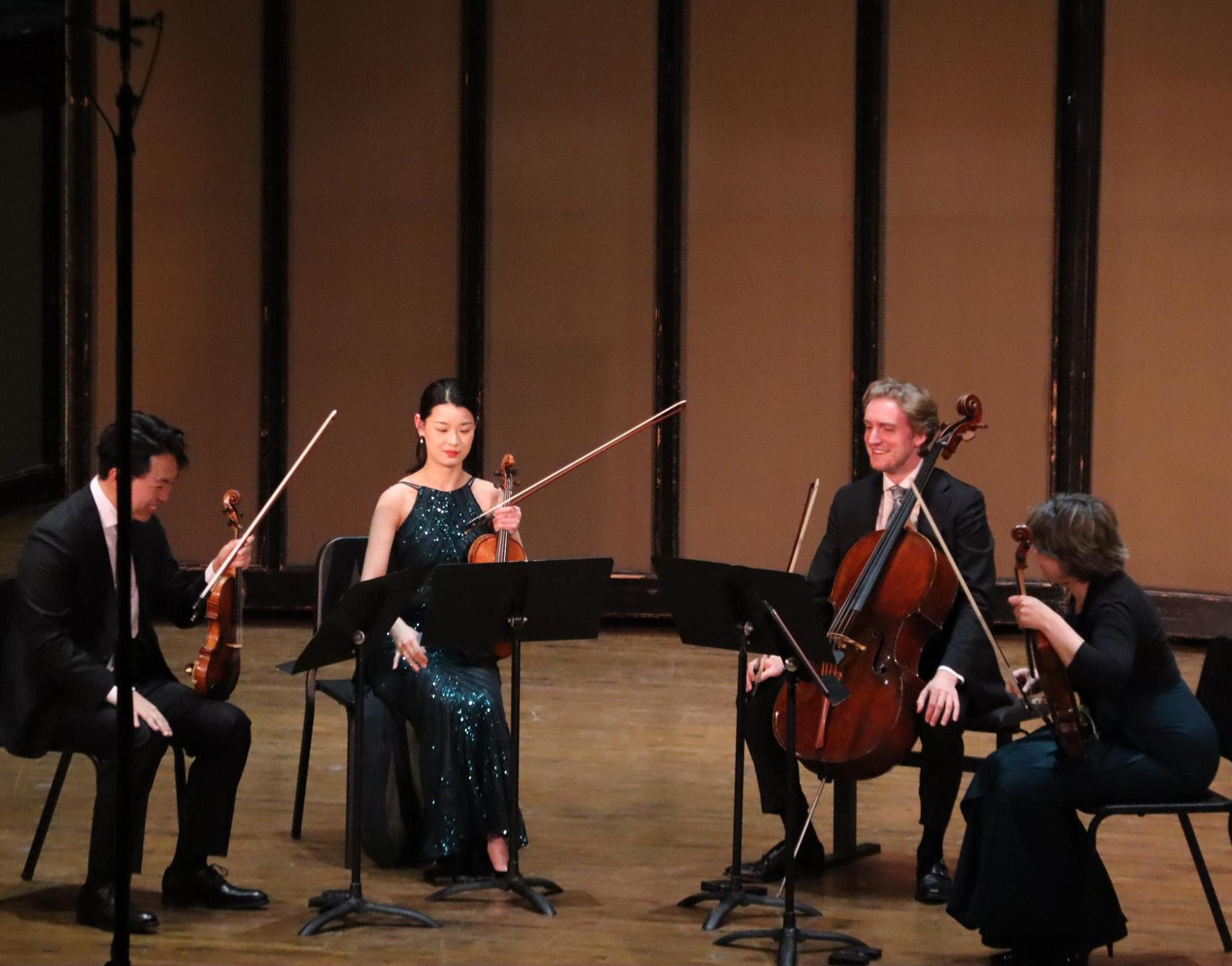
The Viano Quartet performed on Friday, Jan. 23 on behalf of ACMS and the school of music
Brooklynn Jolley | Argonaut
A delicious, savory chicken sandwich recipe with a tangy and refreshing crunch
February horoscopes and predictions
other people in your life.
Leo (July 23 – Aug. 22)
Aries (March 21 – April 19)
At the turn of the new year, you may have been feeling like life has been too busy and that you’re falling behind. Keep your priorities in order and take things one task at a time to combat this busy schedule. Rest often and don’t let your workload overwhelm you. Take a deep breath and push forward.
Taurus (April 20 – May 20)
Reflect on your close personal relationships this month. You may have been feeling like people are taking more than they give in your relationships, so February is the month to assess the balances in these friendships. Don’t be afraid to advocate for yourself and set firm boundaries.
Gemini (May 21 – June 20)
February will be the month for self-care. Sit back and relax more often. Go out and have fun or do some retail therapy. You’ve been working very hard recently, but a balance between work and play is important. Take some time to have fun this month and indulge in the nice things that you’ve been pushing off for work.
Cancer (June 21 – July 22)
Maybe you’ve been feeling emotional lately and a little neglected by your loved ones. You’ve been pushing your feelings aside for theirs. This month will be the time to put yourself first. Reflect on how to satisfy your needs rather than the needs of
“A
February will be a month of good news and joy. These past few months may have been hard on you. Perhaps you’ve been very busy, or maybe you’ve received bad news recently. However, things will start to look up soon. Keep an eye out for signs. Allow yourself to be optimistic and joyful this month.
Virgo (Aug. 23 – Sept. 22)
February is the month to give it your all. Work hard at your job, school or other things that you’ve been pursuing. Putting in some hard work this month will bring you great rewards. It may seem too difficult in the moment, but if you push forward, you may be surprised by the outcome.
Libra (Sept. 23 – Oct. 22)
Focus on what you want your life to look like at the present moment. Reflect on your relationships, your job and your future plans. Make sure that things are aligned in your life and that your plans reflect your own wants, not the wants of others. It’s okay to be selfish sometimes and push for ideas that you want.
Scorpio (Oct. 23 – Nov. 21)
You will be very lucky this month. Keep an eye out for signs and symbols that will guide you forward. Be open to new possibilities and experiences. You tend to stick to a strict routine, but February will be the month to break away from that. You may be surprised at the results.
Sagittarius (Nov. 22 – Dec. 21)
Take small steps in the direction you want to go. Whether you’re pursuing a new job, a relationship or something else
entirely, don’t be afraid to work toward it. Every step forward counts. Don’t let you worries and inhibitions hold you back this month.
Capricorn (Dec. 22 – Jan. 19)
Pursue a change of scenery this month. Travel, read a new book or try something new. You may have been feeling stuck recently, so putting a new experience into your life may help abolish that feeling. You may be surprised at how it makes you feel, and you may discover something that you love.
Aquarius (Jan. 20 – Feb. 18)
You will be very productive this month. You may be rewarded with financial or per-
sonal gains. Keep up the good work and this month will prove to be very fruitful. Don’t let yourself get stuck in your head. Remember that you possess all the necessary skills you need to succeed.
Pisces (Feb. 19 – March 20)
You may have had a personal or professional revelation recently, and now things feel off in your life. Take some time to reflect on this new discovery and decide where you want to go from here. No idea is a bad idea while you’re brainstorming, but it may be useful to connect with your loved ones for advice. Do some soul-searching and decide what steps to take next.
Problem Shared is a Problem Halved” By Dakota Steffen
Standout Vandal Spotlight:
Biko Johnson: Emerging as Idaho’s closer
Johnson is becoming the X-factor of Idaho’s backcourt
Liam Bradford ARGONAUT
In the Big Sky Conference, every team searching for consistency amidst the grind of conference play needs a player who can remain steady the moment when the pressure rises. For the Idaho Vandals (12-8, 4-3), Biko Johnson has emerged as a top option late in games.
The Carson, California native has found his rhythm at exactly the right time for Idaho, delivering three straight 20-point performances, including two in just 48 hours last week against Sacramento State and Portland State.
Johnson transferred to Idaho from Division II Fort Lewis College, where he was a do-it-all guard for the Skyhawks. In his lone season there, Johnson played in all 31 games and averaged 16.3 points per game, ranking second in the RMAC. He shot 39.8% from the field and 35.4% from three for the Skyhawks, while also contributing 2.5 assists and 2.1 steals per game, finishing second in the conference in steals.
With the absence of last year’s leading scorer, Kristian Gonzalez, the Vandals have increasingly looked to Johnson to create a spark. Johnson is third on the team with 13.6 points per game, and is one of four Vandals who average double figures. He’s hit 39 three-pointers in 20 games at a 33.9% clip
and is shooting just under 40% from the floor overall. But his impact stretches beyond scoring. Johnson has already recorded 30 steals, establishing himself as one of Idaho’s best on-ball defenders and a constant source of disruption on the perimeter.
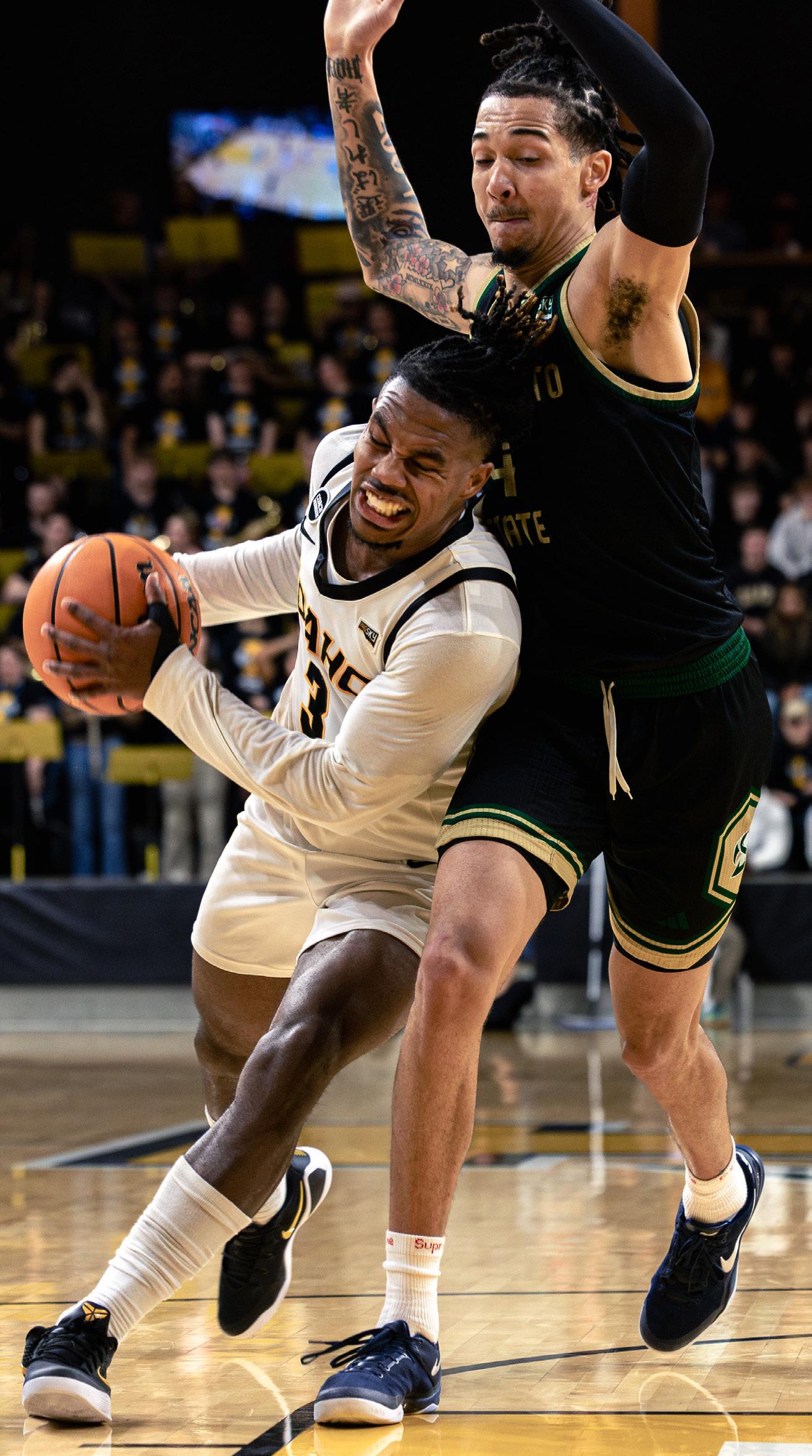
Against Sacramento State on Jan. 22, Johnson played a major role in helping Idaho secure an 86-76 home victory. With the Vandals needing a steady offense in the second half, Johnson delivered, finishing with 20 points and four assists. He helped Idaho maintain control as the Hornets pushed to keep the game within reach.
Facing Portland State just two days later, the Vandals were locked in a tight battle down the stretch. Johnson poured in 20 points and grabbed six rebounds, but his biggest moment came late. With Idaho trailing, he fought through contact to drill a clutch three-pointer to cut the deficit to 65-64.
Entering the Portland State matchup, the Vandals were 6-0 when Johnson scored 20 or more. Head coach Alex Pribble has taken notice of Johnson’s late-game presence.
“Biko Johnson is turning into a closer,” Pribble said. “He can make plays down the stretch.”
For a senior who took an unconventional path from Division II standout to Division I difference-maker, Johnson increasingly seems to be exactly what the Vandals needed this season.
16 first-place finishes, Vandals excel in Lauren McCluskey
Vandals start spring campaign strong with great showing Gage
The University of Idaho’s track and field team hosted the Lauren McCluskey memorial track meet inside the Kibbie Dome. This three-day meet was held from Thursday, Jan. 22, to Saturday, Jan. 25. With amazing performances in all events, the Idaho Vandals took home a combined 16 first-place finishes throughout the three-day meet.
The Lauren McCluskey memorial is meant to honor former standout track and field athlete Lauren McCluskey, who grew up in Pullman, Washington. Although she was a star athlete at the University of Utah and finished no.10 in the Pentathlon in school history, Lauren trained at the University of Idaho’s indoor track in the Kibbie Dome. Sadly, in 2018, she lost her life at the age of 21.
To honor her memory, the University of Idaho track and field program decided to name its indoor season opener after her. The meet serves as a tribute to her love for the sport and the mark she left on her teammates and competitors.
Once inside the Kibbie Dome, the vibe was nervous but quietly hummed with ex-
memorial track and field meet
citement, as fans all were waiting patiently between each event. In between events, the dome was quiet, almost church-like.
As the starting gun went off, the dome echoed with cheer. Like an explosion, fans and fellow teammates cheered for their schools and players. Every sprint, jump and throw felt electric, as athletes pushed themselves to their limits. By the end of the day, whether celebrating personal bests or not, everyone was left inspired.
Thursday
The Thursday part of the meet saw the Vandals bring home four first-place finishes. In the men’s one-mile, senior Zach Knapp scored a PR with his outstanding 4.16-minute mile, which was good enough to give him first in the event. But it wasn’t just Knapp who controlled the track; junior Hanna Tait dominated in both track and field and finished the day with three first-place finishes.
Tait scored a PR in the 60-meter hurdles with a time of 8.64 seconds. She also recorded a personal best in the high jump, with a 1.67-meter jump. Although not a PR, Tait also received first in the long jump with a 5.90-meter jump to end the day for her.
Friday
On Friday, the Vandals would add to their four first-place finishes by including five more, bringing the total to eight. The women’s 200-meter dash saw the three top placers all from Idaho. Junior Rhyon Madden hit a PR and took first with a 24.31 time, followed close by fellow Vandal junior
Jana Willems, who also got a PR with a 24.43 time. Coming behind her at third was junior Blossom Omogor, with a time of 24.49.
The women’s 3,000-meter event saw the same thing, as all three top placers were from Idaho. Coming in first was sophomore Jesse Redding who achieved a PR with a stellar time of 9.52 minutes.
Sophomore Alex Terry finished second with a 9.53 time. In third came sophomore Pia Kircher with a time of 10.01. On the field side of the events, the Vandals took home first and second in the women’s weight throw.
Senior Beatriz Marciano got a personal best by throwing 16.87 meters, easily taking first. In second for the event was freshman Kathryn Brunette who threw for 15.74 meters. In the same event for the men, junior Caden Hottman took first with an 18.48-meter throw, which was a season best for him.
Coming in second was sophomore Mason Andulajevic, who got a PR with a 18.44-meter throw.
Finally, in the women’s high jump, sophomore Cami Cvitkovich took first with a 1.75-meter jump, making her the no. 65 best in the entire NCAA and no. 58 in Division I.
Saturday
The last day of the meet was the best day for the Vandals in terms of total firstplace finishes, with a total of seven. In the 60-meter finals, Jena Willems took gold with a time of 7.47 seconds. In the men’s
300 meters, sophomore Myron Rethymniotakis finished with a personal best 34.33 seconds, good enough for the gold in the entire event.
In the women’s 300 meters, the Vandals dominated.
Eight out of the top 10 finishers were from Idaho, with Rhyan Madden leading the way with a personal best of 38.61 seconds. The female Vandals also took gold in the 4x100 relay. Rhyan Madden, Blossom Omogor, Maiya Brunoro and Lara Holzhauer led the way for a season best of 3.43 minutes.
On the field side, the men took gold in the shot put as junior Gioele Tengattini threw the put for 17.30 meters, making him the no. 99 best in the NCAA and no. 84 in Division I. In the triple jump event for the men, Shawn Twumasi-Ampofo took first with a PR of 15.84 meters, making him the no. 15 best in the NCAA and Division 1.
Finally, in the women’s triple jump, senior Sydnie Zywina took first place with a 12.26-meter jump.
Overall, the 2026 Lauren McCluskey memorial showcased not only the talent and hard work of the UI Vandals but also the spirit that makes track and field so special.
Idaho tennis splits weekend matches
Both teams get their first wins of the 2026 season
Jayden Barfuss ARGONAUT
The Idaho Vandals men’s tennis team has had a tough start to the season heading into this past Sunday’s home opener at the P1FCU Kibbie Dome. The Vandals split their doubleheader, dropping a close 4-3 battle to the University of North Dakota before rolling to a dominant 7-0 win over George Fox University.
North Dakota
Coming into the match, the Vandals were 0-4 and searching for their first win of the season. Idaho started strong as junior Mikolaj Lis and freshman Sander Paradis defeated the duo of sophomore Leo Galliano and junior Kotaro Matsumura 6-1, giving the Vandals an early edge.
North Dakota rebounded when freshman Justin Ilic and Darrshan Suresh Kumar defeated senior Chetanna Amadike and sophomore Gabriel Moroder 6-4.
Idaho regained momentum behind sophomores Paul Janson and Eric Wang, who defeated senior Alex Christos and junior Walker Valentine 6-1 to claim the doubles point and give the Vandals a 1-0 lead.
In singles play, North Dakota rattled off two straight wins. Galliano defeated Amadike 6-3, 7-6, and Suresh Kumar defeated Lis 7-6, 6-2 to take a 2-1 lead.
Janson tied the match with a 7-5, 6-4 victory over Ilic. The teams traded wins as Matsumura defeated Paradis 6-2, 6-4, and Moroder defeated Valentine 6-3, 6-4 to knot the match at 3-3.
In the deciding match, North Dakota’s
Christos defeated freshman Xavier Martin Roca 6-4, 6-2 to secure the 4-3 victory.
George Fox
After the tough loss, the Vandals had little time to regroup before facing George Fox in search of their first win of the season.
Idaho swept all doubles matches. Lis and Paradis defeated seniors Ikuho Ebisu and Keita Shoji 7-6. Amadike and Moroder defeated junior Zach Moore and freshman Aiden Cruz 6-3. Janson and Wang defeated seniors Luis Hernandez and Joseph Vece 6-2 to claim the doubles point.
In singles, the Vandals won all six matches. Amadike defeated Moore 6-3, 6-1. Lis defeated Shoji 6-1, 1-0 (retired). Martin Roca topped Hernandez 6-4, 6-4. Sophomore Noe De Col rolled to a 6-0, 6-1 victory over Cruz. Wang defeated Vece 6-1, 6-1. Finally, freshman Valentin Glasl defeated junior Bernardo Martinez 6-0, 6-2 to put the Vandals in the win column.
The Vandals return to the Kibbie Dome this weekend to host Oral Roberts on Saturday, Jan. 31, at 10 a.m. Later that afternoon, the Vandals will welcome Lewis and Clark State College at 3 p.m.
Women’s Tennis
The Vandals traveled to Eugene, Oregon, and took on the Oregon Ducks and the New Mexico State Aggies. Idaho fell to the Ducks 4-0 before rebounding with a 4-3 victory over the Aggies to move to 1-2 on the season.
Oregon
On Saturday, Jan. 24, the Vandals opened strong at the Duck Invitational behind junior doubles duo Jessica Matthews and Naomi Schraeder, who defeated their Oregon opponents 6-2. However,
the Ducks responded with victories in the second and third doubles matches, both 6-4, to claim the doubles point. Oregon carried that momentum into singles play, rolling to three straight victories to take the 4-0 win.
New Mexico State
The Vandals entered Sunday’s match against New Mexico State hungry for their first win of the season. Matthews and Schraeder again started Idaho strong, defeating the Aggies’ senior Anna Pinaieva and junior Whitney Moon 6-4 in doubles.
After a draw in the second doubles match, Idaho’s sophomore Hanna Koprowska and junior Ida Johansson rose to the challenge, defeating sophomores Nadia Nemeth and Emma Petton 6-4 to earn Idaho’s first doubles point of the season and a 1-0 lead.
In singles play, Matthews continued her strong weekend with a 6-3, 6-1 victory over Nemeth to put the Vandals up 2-0. The Aggies got on the board when Pinaieva defeated Schraeder 7-6, 6-4.
Moon tied it at 2-2 with a 6-2, 6-4 victory, putting pressure on Idaho.
Sophomore Montana Parkinson-Lubold put the Aggies ahead 3-2 with a 6-1, 6-2 victory over sophomore Chenyue Xu. Johansson stood firm in a pressurepacked match, defeating Petton to tie it at 3-3 and send it to a deciding seventh match.
Senior Mariam Hatem Ibrahim took the court against freshman Anna Kilmova. Kilmova won the first set 6-2, but Hatem Ibrahim countered with a 7-5 second set victory to force a deciding third set. The senior used her experience to pull away 6-2 in the final set, clinching the match for
on Saturday at noon.
Idaho seeks statement win against Northern Colorado
Vandals
Jayden Barfuss ARGONAUT
The last time Idaho hit the road against a top Big Sky team, they got demolished. Montana State ran the Vandals off the floor 99-66 on Jan. 10, exposing every weakness and testing their championship mettle. Now, with a four-game win streak behind them, Idaho gets another chance to prove they can win the big one on the road Thursday versus Northern Colorado at 11 a.m.
The Vandals (15-5, 6-1), second in the Big Sky, come in on a four-game winning streak and are riding the momentum. The Bears (15-6, 6-2), third in the Big Sky, also come in hot, having won six of their last eight games. The two losses came to defending Big Sky champions, the Montana State Bobcats, just like the Vandals.
Northern Colorado, after being picked seventh in the Big Sky preseason poll, has been a huge surprise, now in third place. They come in averaging 71 points per game and have one of the better defenses in the country, allowing 60.4 per game.
The Bears are led by sophomore guard tandem Neenah George and Heather Baymon. George leads the team with 13.6 points and 3.0 rebounds per game. Baymon is close behind at 12.9 PPG and 2.9 rebounds per game.
Northern Colorado has four players that average in double figures and will be a test to the inconsistent Vandal defense, which allows 68.2 points per game.
This will be the Vandals’ second big road game in the Big Sky. That game in Bozeman was the first test for the Vandals this season, and they failed in every category, losing in every statistical measure. Most importantly, they lost on effort. This fact did not sit right with head coach
Arthur Moreira.
“I was the unhappiest person in that gym in Bozeman,” Moreira said postgame versus Weber State. “It could have been a good thing for us if we learn from it. If we approach every single week like we did this week, this team is going to be really good. Moving forward, we’ve got to be ready to go, we’ve got to be tough, and you’ve got to grind those games out.”
As the team made their trip back to Moscow after the crushing loss, they responded the only way they knew how: getting back in the gym. Since then, Idaho has rattled off four wins in a row with victories over Idaho State, Weber State, Sacramento State and Portland State, three of those by double digits.
Hassmann, alongside senior guard Kyra Gardner, has formed a lethal backcourt duo at the core of Idaho’s Big Sky leading offense.
As a team, the Vandals average 79.9 points per game. Their fast tempo and ability to score at all three levels have given opponents nightmares all season.
Gardner leads the Vandals with 13.9 points and seven rebounds per game, shooting 42% from the field with a teamhigh 41 three-pointers. Hassmann is just behind at 13.4 points per game, adding 3.7
rebounds and 4.2 assists. Hassmann’s aggressive, rim-attacking style has made her one of the conference’s best passers with 84 assists in 20 games.
Alongside the backcourt duo has been the surprising emergence of sophomore guard Ana Pinheiro. Pinheiro has emerged as a scorer, averaging 10.7 points and 5.5 rebounds. She has been a key figure on both sides of the ball.
The Vandals also command two of the best frontcourt players in San Francisco transfers, redshirt seniors Lorena Barboa and Debora dos Santos.
Barbosa averages 12 points and 4.8 rebounds, while dos Santos adds 10.4 points and 7.5 rebounds off the bench.
Idaho will be tested by a Northern Colorado team that is efficient on offense and stingy on defense in a tough road environment.
Championship teams need to win in all sorts of environments and under pressure.
The Vandals have a spectacular 7-1 record at Idaho Central Credit Union Arena, but can the Vandals get that signature win on the road and show they can win against the top teams in the Big Sky?
Thursday, the talking stops and the basketball will decide what team the Vandals really are.
the Vandals. Idaho travels to California this weekend for the Pacific Invitational, opening with Pacific University on Friday, Jan. 31, at 1 p.m., followed by a match against the University of Nevada
James Taurman-Aldrich | Courtesy Senior Chetanna Amadike walks out for the tennis match versus North Dakota
Letter to the editor Response to the letter
Idaho universities should end illegal DEI mandates
The Goldwater Institute GUEST VOICE
Is diversity, equity, and inclusion (DEI) dead at universities? No—not even in Idaho, a state with strong legal protections against political indoctrination in higher education.
That’s why today, the Goldwater Institute and its allies at the Idaho Freedom Foundation sent a letter urging Idaho Attorney General Raúl Labrador to investigate efforts by the Idaho State Board of Education and state colleges and universities that allowed the schools to undermine a law that bans mandatory DEI instruction for most students.
Idaho was the first state to adopt the Goldwater Institute’s Freedom from Indoctrination Act, a powerful reform that helps end political indoctrination and restores public universities to their core academic purposes.
Under the law, public universities may not require students to take courses, trainings or programs “derived from or that promote the tenets or concepts of critical theory” or DEI, a toxic ideology that promotes blatant race and sex discrimination.
By design, the law restores student choice and ensures that degree completion is not conditioned on ideological indoctrination, except in a narrow set of cases expressly allowed by statute. When the act is violated, the Idaho Attorney General is required to investigate the allegations and is authorized to bring legal action to ensure compliance.
After the act was passed, the Idaho Board of Education issued guidance that publicly funded colleges and universities have used to continue mandating DEI coursework for a slew of degree programs in direct violation of the law. The guidance significantly expanded the exceptions for DEI course-
work beyond the narrow boundaries of the statute. First, the colleges have redefined what the phrase “derived from” DEI means. Under this view, a course is only considered derived from DEI when 90% or more of its material is focused on DEI—a requirement not found in the statute, and which drastically narrows the range of DEI-related courses that fall under the law’s prohibition.
Second, the guidance allows any academic program whose descriptions, not just their titles, say that DEI is important to the major to request exemptions.
This includes when a major isn’t clearly labeled as ethnic, gender or racial studies. Under this interpretation, even programs like psychology, counseling or social work, which do not qualify under the statute’s title-based exemption, may now request and receive approval to mandate DEI courses for those majors.
Unsurprisingly, due to the expansive and lenient standards, several schools, including Boise State University, Idaho State University and the University of Idaho, have obtained permission to mandate DEI courses. The University of Idaho requires students seeking sociology degrees to take “Introduction to Inequity and Justice.”
Fortunately, the Idaho Attorney General can put a stop to this political indoctrination and take steps to ensure compliance with the law. Idaho took an important step toward protecting academic freedom, student choice and intellectual diversity when it passed the Freedom from Indoctrination Act.
Now it must ensure that the universities and state agencies charged with implementing the law do not circumvent its protections.
DEI is losing ground across America, especially on college campuses. The Goldwater Institute will continue to push back against divisive agendas by passing, and defending, legislative reforms to eliminate DEI mandates across the country.
The letter to the editor makes a weak argument when it comes to diversity initiative
Christopher Sprague ARGONAUT
On Jan. 20, the Goldwater Institute sent a letter to The Argonaut. In this letter, the Goldwater Institute makes an argument for why the Idaho Attorney General, Raúl Labrador, should investigate the Idaho State Board of Education about efforts to undermine DEI bans.
Last year, Idaho signed the Goldwater Institute’s Freedom from Indoctrination Act into law, which is in Idaho code as 67-5909D Freedom of Inquiry in Higher Education, Chapter 59, Title 67. This law prohibits public universities in Idaho from mandating that students take courses, programs, or instructions that are derived from or promote concepts of critical theory or “DEI.”
The purpose of this law is to supposedly prevent students from taking courses that promote ideological indoctrination, as well as to preserve student choice by not having these courses required for degrees or certificates. The key points of Goldwater Institute’s argument are that several public universities in Idaho are not complying with the new Freedom of Inquiry in Higher Education Act, specifically how students at the University of Idaho who are pursuing a bachelor’s degree in sociology are required to take SOC 2010 Introduction to Inequity and Justice.
Under section (3) of 67-5909D, an institution can have an exemption granted for a program or course: “Every institution of higher education in the state of Idaho shall provide a procedure to allow the governing board of the institution of higher education to exempt, upon written request to the board, any academic degree program requirements of any major, minor,
certificate, or department the title of which clearly establishes its course of study as primarily focused on racial, ethnic, or gender studies from the prohibitions of subsection (2)(f) and (g) of this section, provided that a student may not be required or otherwise compelled to enroll in any such program, department, or course in order to satisfy the requirements of any other academic degree program, including general education requirements, or any other major, minor, or certificate requirements.”
That is what UI did for several programs and courses, including SOC 2010 for sociology majors. They followed the legal route to have an exemption granted. The Goldwater Institute is arguing that, even though UI followed the law and was granted exemption by the State Board of Education, the Attorney General should still investigate UI.
The Goldwater Institute’s issue with courses at UI isn’t legal—UI followed the letter of the law and got approval from Idaho’s governing body of higher education. Goldwater Institute’s issue is purely ideological. Why are we letting the ideology of a lobbying group set standards for higher education? The Goldwater Institute claims that UI is committing “political indoctrination” by “mandating DEI courses.” However, isn’t it political indoctrination when an outside institution bans students from learning ideas, theories and prospectives that the institution disagrees with?
That is exactly what the Goldwater Institute is doing. They are trying to indoctrinate students to become less educated and informed about the diverse cultures and ideas in the world. They are trying to intimidate the university to follow what they believe is right by threatening the Idaho Attorney General.
They want to eliminate the idea of DEI, despite the law only eliminating its requirement. Students deserve a well-rounded education not dictated by a lobbying group.
ICE raids are undermining civil liberties
When ICE sweeps up innocent people, the American promise of safety for all is under attack
AJ Pearman ARGONAUT
Immigration and Customs Enforcement raids are no longer just about enforcing immigration law—they are about fear. Across the country and Idaho, ICE operations are increasingly targeting people with no violent criminal history, separating families and making entire communities afraid to leave their homes, go to work or even call the police. This is not public safety. This is state-sanctioned intimidation.
In Idaho, the dangers of these tactics became clear during a massive federal raid at a horse racing track in Wilder in 2023.
According to Idaho News 6, hundreds of people, including children, were detained during the operation, despite most not being charged with any crimes. Families were ziptied, questioned and held in holding areas without clear explanations. This wasn’t about violent offenders—it was about im-
migration status, and nothing more.
Even more alarming, a federal judge later ordered the release of several detainees from that raid, stating that their detention violated due process protections (Idaho News 6).
When a court has to step in and say people’s constitutional rights are violated, that should be a wake-up call. Instead, ICE raids have continued nationwide.
In Moscow and across North Idaho, immigration advocates say fear of ICE has driven undocumented residents away from hospitals, schools and even police stations.
While rumors of ICE activity sometimes spread faster than reality, the fact that people believe these rumors shows how deeply fear has taken root.
As KIVI-TV reported, the Blaine County Sheriff’s Office had to publicly deny ICE raid rumors because residents were panicking and afraid to leave their homes. When law enforcement must reassure people that they are not about to be detained by federal agents, something has gone terribly wrong.
Even more disturbing are cases of mistaken identity. According to Newsweek, U.S. citizens and legal residents have been
detained or questioned by ICE during raids simply because they “matched a description” or were in the wrong place at the wrong time.
In a country built on due process and constitutional protections, the idea that citizenship cannot protect someone from detention should terrify all of us, not just immigrants.
Civil liberties groups say ICE has also repeatedly violated the Fourth Amendment by entering homes without judicial warrants. The American Civil Liberties Union has documented multiple cases in which agents entered private residences without consent or legal authority, leading to illegal arrests and intimidation of families.
A federal judge in Minnesota even ruled that ICE violated the constitution by entering a home without a warrant, reinforcing what advocates have said for years: these raids do not just bend the law, they break it.
Supporters of ICE argue that immigration laws must be enforced. That may be true. But enforcement that tramples civil liberties, terrorizes families and detains innocent people is not law and order; it is abuse of power. When parents are taken
in front of their children. When workers disappear from jobs overnight. When people avoid hospitals because they fear deportation more than illness. That is not justice. That is cruelty.
In Moscow, and across the country, immigrant communities are not just afraid of deportation, they are afraid of existing. That fear doesn’t stay contained. It spills into classrooms, workplaces, churches and neighborhoods. It weakens public trust, discourages cooperation with law enforcement and undermines the very idea that everyone deserves basic rights and dignity.
This is no longer just an immigration issue. It is a civil rights issue.
ICE raids, as they currently operate, are violating constitutional protections, destabilizing families and turning everyday life into something dangerous for thousands of people. If the government can strip away rights from one group of people without consequence, it becomes easier to strip them from others.
The question is no longer whether ICE is enforcing immigration law. The question is whether the
United States is still committed to enforcing the constitution.
Jaelynn Durels Argonaut
Protestors in Coeur d’Alene against the U.S. Immigration and Customs Enforcement
Jaelynn Durels | Argonaut
Protestors lined on the street in Coeur d’Alene against recent ICE actions
Ballard residents moving to Stevenson
Josephine Adjanohoun GUEST VOICE
Last semester, the residents of the Ballard Wing of the Wallace Residence Hall were told that, at spring semester, they would be relocated to the newly renovated Stevenson Wing.
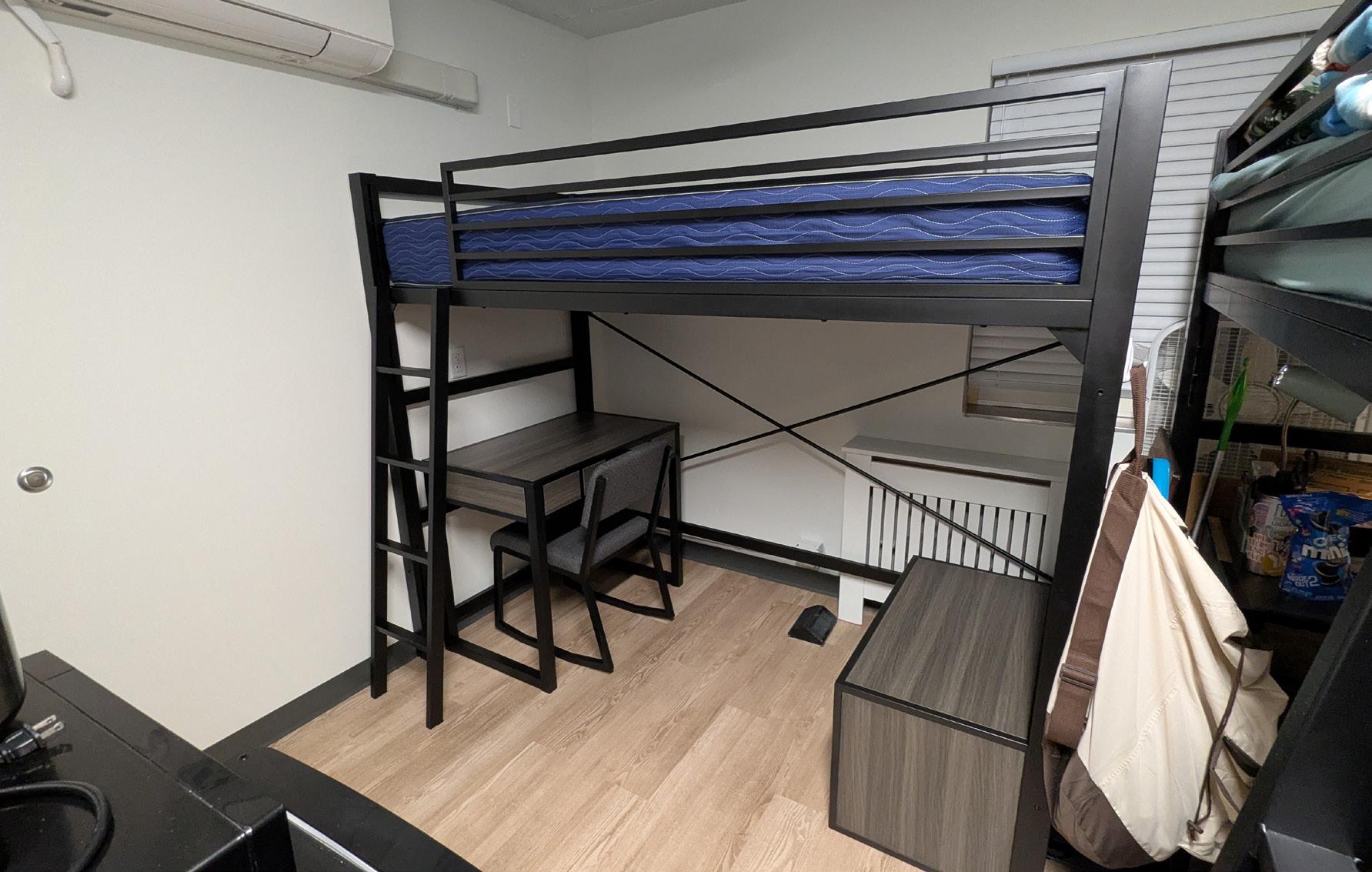
This was due to the deadline of the University of Idaho student housing construction project, with renovations starting with the first two floors of the Theopolis Tower residence hall, and the renovations on the Stevenson Wing. Eventually, all of the wings of Wallace will be fully renovated in this style. The university promoted this as an upgrade, and in a video tour, the renovated dorms shown in Stevenson are better than the dorms in Ballard. There are no weird smells, showers that function like showers and air conditioning. Unfortunately, those cons of the unrenovated Ballard have been replaced with new, and more frustrating issues, in the renovated Stevenson.
For example, yes, Stevenson does have air conditioning, but the air conditioning is not adjustable currently, and there seems to be no heat. There are also automatic lights that shut off when there seems to be no motion inside of the room. I assume the intent is positive, so that the university can save on energy, but once I sit down in my desk, the lights turn off after 15 minutes.
The decrease in space is also a huge disappointment. The Stevenson dorms were designed to be single room suites, and now they are doubles. This, coupled with the lack of built-in cabinets (which was bolstered as a way for students to have more control over their storage, aka “buy-it-yourself”) and storage, is very frustrating.
I personally am taking half of my items home that originally fit in my Ballard room because there is now no space for them. Many people who were curious about the renovated dorm buildings asked to come and see my dorm, and they were just as dis-
appointed with the space as I was. The dorms also had dings and dents in them when I moved in, and the floors were not swept on the move-in day.
My fellow floormates and I did not know about our relocation until two months into us living in Ballard. Though there was an option to move out of Ballard (which was given to us before we knew that we had to move), many students, including myself, did not want to relocate.
Before we even moved into Stevenson, many students were confused and concerned about the lack of communication given to us by the university. Most of the communication given to me was given a week before we had to set up for the move. In total, there were four to five emails sent out to students over the course of the fall semester giving specific details about the Stevenson move. The first email that was sent to us was in October of 2025, a month and a half after we settled into Ballard. This email was how many residents found out the move was occurring in the first place.
ally chose the first option, thinking that it would save me a lot of time and effort, which it did, but some of my items were lost in the move and brought to me at a later date.
There is also a $330 increase in housing price for students who moved over to Stevenson. Unfortunately, this $330 increase was divided up between both semesters, the first semester being in the unrenovated Ballard, and the second semester in the new Stevenson building.
I believe that I and other Ballard residents deserved more consistent communication from the university regarding our move. The final two emails that we received had the most information in them and they were sent two weeks before the winter break started.
Inside those emails, there was information on how our items could be moved. One option was where we packed up our items and they were delivered to our dorms, and another was leaving our items inside of the dorms and after winter break, we would have to move the items ourselves. I person-
I personally believe that residents are being charged for something that is an inconvenience to them, since we were moved on the university’s schedule. If the university wants to increase the price, it would make more sense to charge a higher price once the students moved into Stevenson, not tacking on the price to the beginning dorms. This division of cost seems suspicious.
I understand the university has a housing issue, but it is very disappointing that the university is mandating that freshman need to stay inside of dorms while there is not
enough space for all of the freshman to live. A solution to this problem is not to shove more students into cramped dorms. It is to create a new residence hall or drop the freshman live-on-campus mandate.
It is also frustrating that we as students have these bare minimum expectations and, unless we kick and scream loud enough, our problems will not be solved. It would be in housing’s best interest to refund the $330 upcharge and to publicly apologize to the students who had to inconvenience themselves throughout their winter break.
The dorms on visual terms look much nicer, but as living space for college students, the Stevenson dorms leave a lot up to the imagination. I hope the university takes these comments and concerns as they move forward in the rest of renovations and take into account that they are not relocating numbers, but people.
Josephine is a UI student who works for The Argonaut, but was not paid for this letter to the editor.
Josie Adjanohoun | Argonaut
A newly remodeled room from the Ballard Wing of Wallace Residence Hall
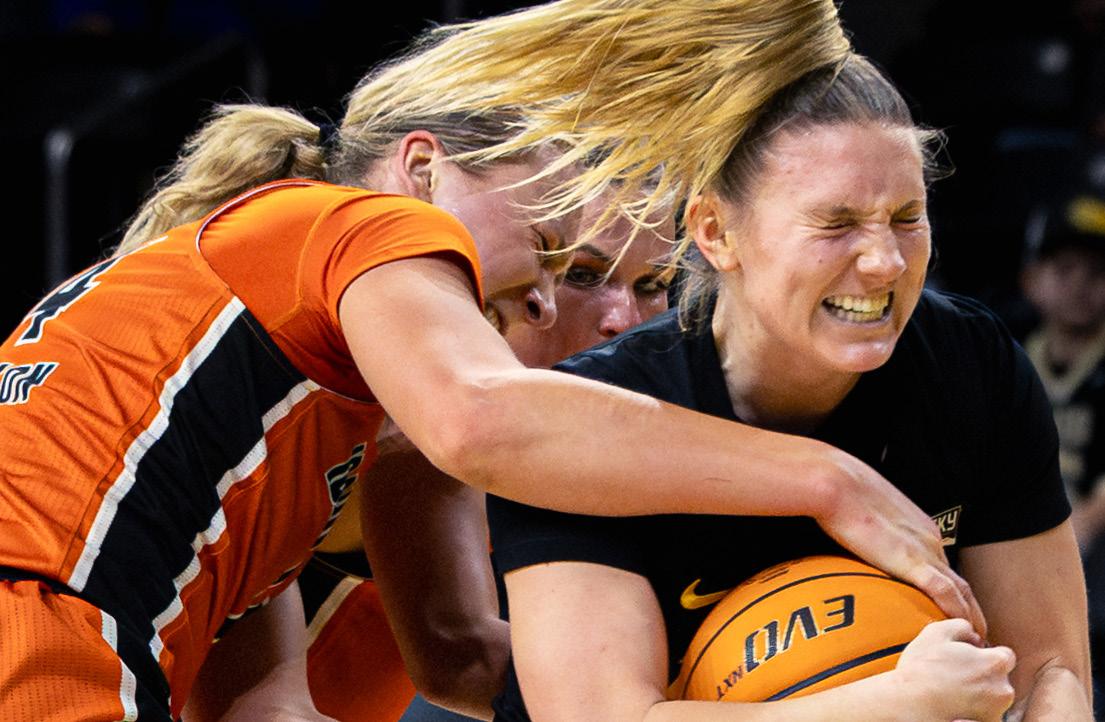
GALLERY: Vandal basketball soars into the back half of Big Sky play
John Keegan | Argonaut
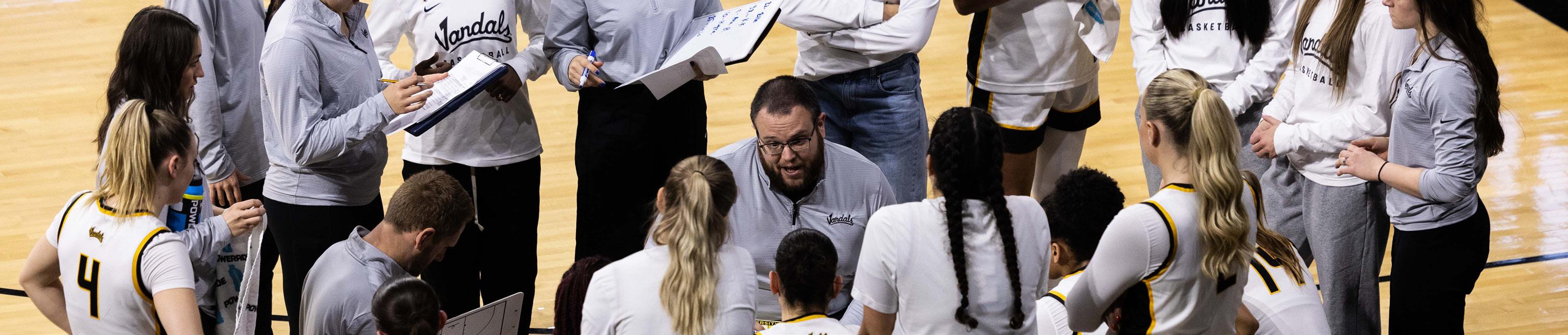
Head coach Arthur Moreira breaks down plays for the Vandals women’s basketball team during a timeout
Reagan Jones | Argonaut Vandals break a huddle in the game against Portland State