Homecoming continues
the ICCU Arena parking lot for the Vandal Rally. There will be a bonfire and a fireworks show afterward at 9 p.m. in the P1FCU Kibbie Dome parking lot.
Homecoming Parade (Saturday, Oct. 11)
The 2025 Homecoming celebration extends through Saturday, culminating in the Vandal football game against the Northern Colorado Bears at 2 p.m. in the Kibbe Dome.
Events have occurred all week, with many ending tonight.
Vandalize Moscow continues until 6 p.m. tonight, with student organizations working together to help businesses decorate their stores with school colors.
At the end, alumni judges, the homecoming president and advisors choose a winning store for best design.
Vandalize Campus continues until 5 p.m. today. Staff and students decorate various buildings, including the Administration Building, Greek houses, residence halls and more student spaces.
A blood drive continues until 4:30 p.m. today at the TLC in the ISUB. There are also drop boxes to donate school supplies in ISUB and the Pitman Center.
Here are the events for Friday and Saturday:
Tap the Keg Craft Brew Festival (Friday, Oct. 10)
From 4:30-7:30 p.m. at the Dan O’Brien Track and Field Complex, you can enjoy a night with selected craft brews, food from SmashHouse Burger and music from DoubleWide Surprise.
Serpentine and Vandal Rally (Friday, Oct. 10)
Starting at the UI Golf Course at 8 p.m., the Serpentine will begin with a walk across campus, led by the Vandal Marching Band, to
The Homecoming Parade will begin at 10 a.m. on Main Street in downtown Moscow.
Students will compete for the best float during the parade, decided by alumni judges. The Vandal Marching Band and many other organizations will march in the parade.
Vandal Village Tailgate (Saturday, Oct. 11)
The tailgate includes a pre-game celebration for the football game later that afternoon.
The tailgate will begin at 11 a.m. in the ICCU Arena Plaza, with local vendors serving food, a performance from the Vandal Marching Band and Spirit Squad and a visit from the Vandal football team. There will be games and giveaways as well.
Vandal Football Game
(Saturday, Oct. 11)
Ending homecoming week, one of the most spirited football games of the season will start at 2 p.m. in the P1FCU Kibbie Dome.
The 2-3 Vandals will face the 2-3 Northern Colorado Bears in a Big Sky Conference showdown. Show up in your Vandal gear and be ready to cheer.
At halftime, homecoming royalty will be presented and a halftime show will be performed by the Vandal Marching Band. The Vandaleers will sing the Alma Mater with the band accompanying.

MPD completes investigation into Sept. 24 campus fight
Case
passed onto prosecutor; driver continues to recover
Dakota Steffen ARGONAUT
Moscow Police
Chief Anthony Dahlinger told The Argonaut Wednesday that the police have finished their investigation into the Sept. 24 fight on the University of Idaho campus. The case has now been passed along to the Latah County Prosecutor’s Office.
Adam Dawson, Austen’s father, said he is continuing to recover, but the injuries were severe. “They drilled a hole in his head to monitor [his] brain swelling. He died in the ambulance and they brought him back. The police said that a sorority girl with medical training
is who saved him...We are very thankful for her, whoever she is!”
According to Adam Dawson, Austen’s injuries include head trauma, black eyes, a broken nose, bleeding and a brain clot. Austen is going through rehabilitation, according to Adam Dawson.
“He’s doing better than expected, for sure,” he said. “We’re working on all his mental skills and all that fun stuff.”
Austen Dawson, 26, was Life-Flighted to a hospital in Lewiston and put into a medically induced coma late Sept. 24 following a fight on UI’s Greek Row.
“We have wrapped up our investigation to this point,” Dahlinger said. “There’s always a chance when we do that [the prosecutor] come back to us...But for the most part, our investigation’s done,
and now it’s off to the prosecutor for their review.”
Adam Dawson said that Austen is now aware of what happened. “He’s pretty broken up about it, honestly,” he said. “He just can’t believe that someone would continue to punch him while he... already had a brain bleed at that point.”
Adam Dawson said he most recently spoke to an MPD officer last week before he returned to Boise. “He’s like, I’m finishing it up, it obviously takes time and then we’ve got to submit it to the prosecutor. So that might make a little time as well,” he said.
Dawson said he had also shared a recording of a Discord call between Austen and his friends with the police. “They were just kind of hanging out while they were gaming and everything. And his friends just
happened to record right then when they were gaming and have, catch the entire thing,” he said.
Dawson said he has heard nothing from UI.
“Our thoughts are with the delivery driver who was injured Sept. 24 and we are happy to hear he is doing better. We do not condone violence nor behaviors that put others at risk. Moscow Police Department is investigating the incident. University of Idaho has a student code of conduct that all students are expected to follow. Any violations of this code are reviewed and appropriate actions taken within the scope of the university’s capacity,” Jodi Walker, UI Executive Director of Communications, wrote. Walker declined to answer any other questions about the incident.
Vandals return to Kibbie Dome for Hoco showdown
Kibbie Dome for their Big Sky home opener in a Homecoming matchup against the Northern Colorado Bears at 2 p.m. on Saturday, Oct 11. Idaho was 3-0 coming out of bye weeks in the Jason Eck era.
Idaho returns to Kibbie Dome for Hoco Showdown
Vandals in need of their first conference win as Northern Colorado comes to town. After a much-needed bye week following two tough losses, the no. 11 Idaho Vandals return to the P1FCU
This will be the fourth all-time meeting between these two programs, with Idaho having won two of the first three, including a 27-13 victory in November of 2023. Their other win against Northern Colorado was also Idaho’s homecoming game, a 55-35 win in 2022. For the first time this season, Idaho enters this game outside the top 10
in the FCS coaches poll. This will be their first home game since they beat Utah Tech on Sept. 13. For Idaho, their return to the Kibbie Dome could not have come at a better time.
The team desperately needs to get back in the win column, and they have had a lot of success in the dome, including eight straight wins dating back to 2023.
Both teams enter the game with a 2-3 overall record and an 0-1 record in Big Sky Conference play.
Though neither team has gotten off to the right foot this season, they have been competitive in the majority of their games, combining for five one-
score losses out of their six total losses. Head coach Thomas Ford Jr. emphasized how Northern Colorado’s record does not tell the full story about how dangerous they are as a team. This is the second consecutive matchup against a conference opponent from Idaho for Northern Colorado after falling 26-18 against Idaho State on Sept. 27. Through the first three games, Idaho had only allowed about 103 rushing yards per game.
Bradford
Reagan Jones | Argonaut
Students enjoy dancing at Africa Night on Saturday, Oct. 4, an annual celebration of African culture. See gallery on page
Govt. shutdown affects UI operations
Sponsored funding work may stop temporarily
Dakota Steffen ARGONAUT
The federal government shutdown will temporarily affect University of Idaho research operations, university officials say.
Christopher Nomura, the Vice President of the Office of Research and Economic Development at UI, issued a memo on Oct. 1 detailing the impacts the shutdown may have on university operations.
Federal contracts will likely receive a stop-work order unless the work is determined to be essential by the funding agency. While payments may be stalled or held depending on the agency, most grants and cooperative agreements will be able to continue with minimal disruption, he wrote.
Federal laboratory spaces will be restricted or closed, and agency system access may be restricted. Proposal submissions may also be paused.
“We have not yet received guidance for operations from the government or sponsoring agencies, but we anticipate receiving operation plans from each agency,” Nomura wrote in the memo.
ORED plans to publish updates on its Government Shutdown site on Inside UI, which currently has FAQs and some agency plans. The office asks anyone who receives direct guidance from an agency during this period to share the information with them.
“It is imperative that only essential operational expenditures are incurred during the government shutdown period. With agencies closed and federal payment systems inaccessible, we will not be reimbursed by sponsors during the shutdown and thus must be prudent to ensure we can continue operations for the shutdown’s duration,” Nomura wrote.
After the U.S. Senate failed to pass a government funding bill on Sept. 30, all federal agencies are required to furlough any non-excepted employees. As of Oct. 8, the Senate continues its stalemate.
Excepted employees include those who protect life and property, according to AP News, and will continue to work during a shutdown, but will not be paid until after it ends. Furloughed employees will also be paid retroactively once the shutdown ends.
Many federally issued funds are also halted. While essential services such as health care, Social Security and Veterans Affairs will continue, any funding deemed non-essential will pause.
Faculty Senate reviews student support data
Members discuss student concerns, textbook access, Vandal Care report and homecoming plans
Scarlet Herway ARGONAUT
Blaine Eckles, vice provost and dean of student affairs, presented a 2025 Vandal Care report to the University of Idaho Faculty Senate, showing details of the 2,628 different concerns reported on Tuesday, Oct. 7.
The Faculty Senate meets weekly to hear from administrators about policy changes, financial operations and student services to improve the UI campus. Tuesday’s meeting focused heavily on student well-being and academic resources.
The Vandal Care system allows faculty, staff and students to submit reports about students who may need academic, mental or behavioral support.
In the 2024–25 academic year, Eckles said there were 2,628 reports of concern, of which 1,634 were from unique students. The highest number of reports were regarding academic concern, with mental health issues as the second highest.
According to Eckles, the primary colleges the reports come from are the College of Letters, Arts and Social Sciences, the College of Engineering and the College of Business and Economics. The most common majors are general studies, psychology and criminology.
“[Our] primary goal is to connect
students from a case management standpoint with support and assistance,” Eckles said.
Questions were raised to Tim Murphy, the UI Faculty Senate chair, about issues accessing the Inclusive Access program and certain textbooks. Discussion implied that instructors were aware of this issue based on personal experiences. Responses from the administration were not very detailed.
The Senate may invite the vendor, VitalSource, to a future Faculty Senate meeting.
Torrey Lawrence, provost and executive vice president, gave the weekly provost report to the faculty with details on strategic plan funding, faculty gatherings and reminders about participation for homecoming week.
Lawrence encouraged the Senate to participate in the campus events for Homecoming week and shared a link to the UI event calendar.
A faculty gathering will take place on Oct. 22, hosted by the College of Graduate Studies to celebrate the 100th anniversary.
The Faculty Senate will meet every Tuesday throughout the fall semester.
T he Argonaut mistakenly printed the Joshua Wood profile twice in the Sept. 25 edition. We regret the error. The Montana preview can be seen online.
ASUI introduces two pieces of legislation on conflict in Gaza
Condemnation of the Jimmy Kimmel Live show, and new senators welcomed Josie Adjanohoun ARGONAUT
Two resolutions were introduced at the ASUI Senate meeting on the ongoing Israel and Palestine conflicts occurring in the Gaza strip, on Wednesday, Oct. 8.
F25-R5 was a resolution commenting on the interception of the Global Sumud Flotilla by the Israeli government on Oct. 3. The flotilla was a group of international activists including Greta Thunberg, Ada Colau and Mandla Mandela, delivering food and aid to Palestinians in the Gaza strip.
Senator Leika Devi sponsored this resolution as a condemnation of the interception of by current prime minister of Israel, Benjamin Netanyahu. Senator Davi believes that it is ASUI’s responsibility to denounce these types of overreaches in government.
The second resolution was F25-R6, was A general condemnation of the violations of Human Rights in Gaza during the Israel-Palestine . The resolution focuses on the disproportionate amount of attacks on noncombatants, primarily women and children.
Sponsored by senator Andrea Leal, she said, “ASUI has a moral obligation to inform students and condemn the events occurring in Gaza.” Senator Zac
Knapp added during debate on the resolution that this is a bi-partisan issue, and said, “I have been shocked and appalled by the human rights violations that have occurred in the Gaza strip.” Knapp continued saying though peace negotiations are being presented to Israel, the public should not ignore the tragedies that occurred there.
Senator Gunner Cavener amended resolution F25-R6, adding a quantitative addition, “in Gaza there is a 83% civilian casualty rate, in contrast to WW2 when the Germans caused a 30% civilian causality rate.” The senator said that this would give students a better understanding of the severity of the issue.
Both resolutions are being sent to the Policy and Resolution Committee.
Senate resolution F25-03, a condemnation of the brief closure of the Jimmy Kimmel Live show was also passed on Wednesday’s meeting. Director of Finance, Lance Butikofer, spoke in support of the resolution during public forum, saying, “When we have presidents or public officials publicly asking for the closure of political speech, it’s a direct attack on democracy in America.”
The new senators have officially been welcomed and added to the ASUI senate, through bill F25-R5, which passed unanimously. Senator Leal sponsored this bill, stating that the senators are “going to kill it, and they are going to be amazing.”
ASUI will meet every Wednesday at 7 p.m. in the Clearwater-Whitewater room in the ISUB.
Meetings are open to the public.
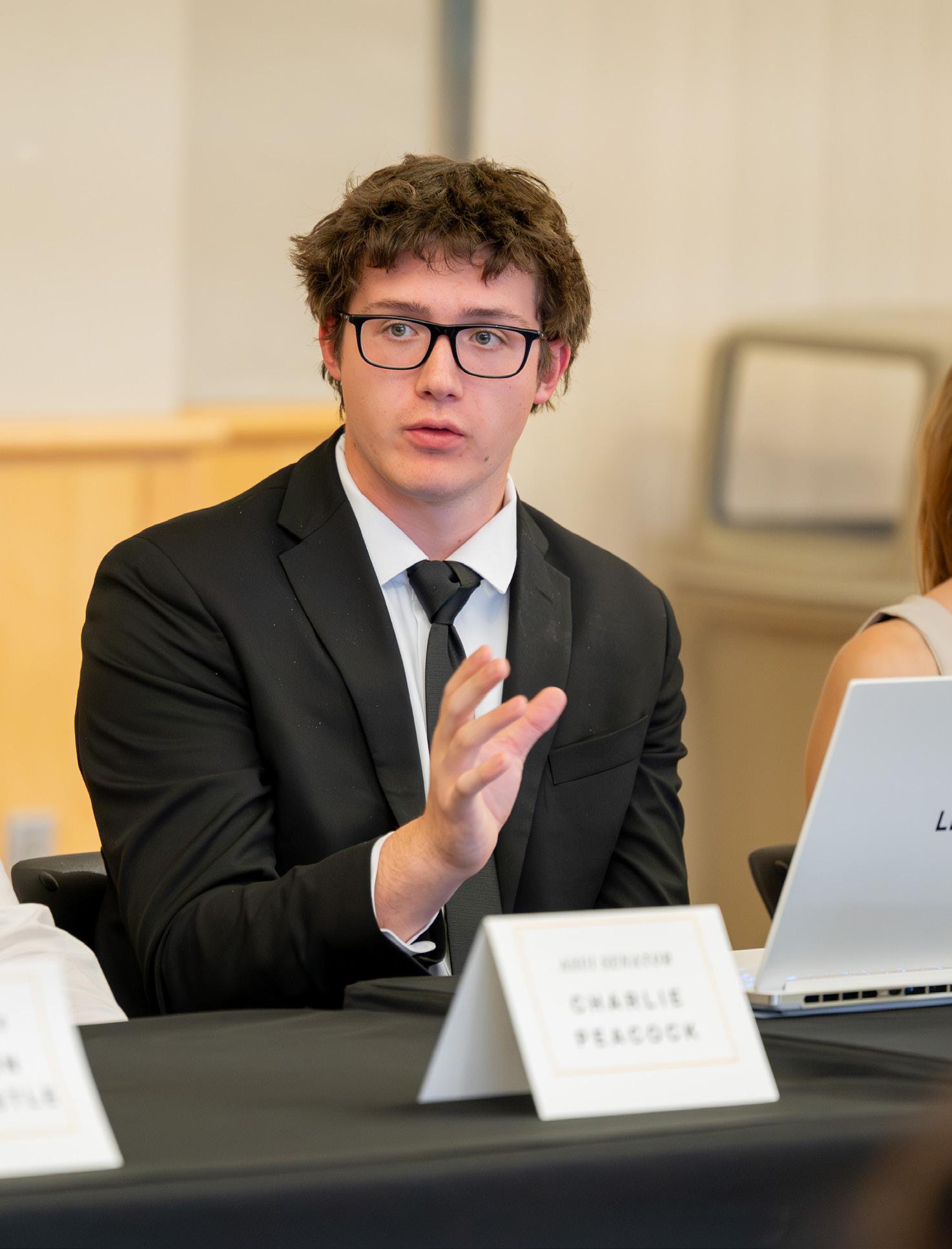


Colton Moore | Argonaut Gunner Cavener engages in discussion at this week’s ASUI meeting
Safety report shows decrease in arrests
Annual safety report for all UI campuses notes rise in referrals
Scarlet Herway ARGONAUT
Crimes on campus generally remained at stable figures in 2024 compared to the previous two years, according to the University of Idaho’s annual Clery report.
The report is required by federal law, known as the Clery Act, to provide campuses with crime statistics from the previous year and security information for the upcoming academic year.
UI’s 2025Annual Security and Fire Safety Report was emailed to all UI faculty, staff and students on Monday, Sept. 29, which contained safety information and crime statistics for all six campuses for the 2023-24 academic year. Statistics are separated into campus, non-campus and
public property violations; non-campus being properties within the UI campus boundary but are not owned by UI. Data from 2022 and 2023 was also included.
On-campus arrests for liquor law violations dropped from 35 in 2022 to 15 in 2024. Non-campus and public property arrests were significantly higher in 2023, compared to 2022 numbers, and dropped to their lowest in 2024 at two and 11 arrests, respectively.
On-campus arrests for drug abuse violations declined from 20 in 2022 to eight in 2024 with spikes in non-campus and public property violations in 2023. There were significantly fewer arrests at three each in 2024.
In contrast, disciplinary referrals for the same categories have increased.
On-campus liquor law violations rose from 44 in 2022 to 80 in 2023 and
59 in 2024. Non-campus referrals went from five in 2022 to eight in 2024, with an extreme spike of 82 in 2023.
Drug abuse violation referrals increased from 10 in 2022 to 17 in 2024 with no 2024 instances on non-campus locations and two on public property. Reported on-campus rape cases rose from zero in 2022 to seven in 2023 to eight in 2024, and had zero non-campus offenses. Domestic violence declined from six on campus and five noncampus offenses in 2022 to two and one offenses in 2024 respectively. Stalking had four on campus offenses and one noncampus offense, which were similar numbers to previous years.
Motor vehicle theft rose to seven on campus instances in 2024. Burglary, robbery, arson and murder all had zero instances in 2024. The
fire safety report showed that there had been zero fires in the 2022-2024 academic years.
In an email interview with The Argonaut, UI Director of Clery Compliance Shane Keen said, “We want students to know that their safety is our top priority—and that it’s a shared responsibility. This year’s report highlights not only the resources and reporting options available to enhance campus security, but also the importance of awareness, engagement and communication.”
Keen reminds students to use the UI programs and resources provided for students, such as Vandal Alert, Safe Walk and RAVE Guardian app. The full report is available on the UI website under public safety. The report contains resources on how to make reports and counseling options for those affected.
Colloquium on air quality effect
CNR professor talks impact on behavioral decision making
Reagan Jones ARGONAUT
On Tuesday, Oct. 7, University of Idaho Assistant Professor Chris Zajchowski explored the connection between levels of air quality and the effect it has on behavioral decision-making in his presentation ,”’Should I Stay or Should I Go?’: Air Quality and Behavioral Decision-Making.”
Zajchowski is an assistant professor of parks, tourism and recreation ecology. He is a part of the College of Natural Resources and the Idaho Department of Parks and Recreation.
Zajchowski directs UI’s Parks and Recreation Lab, and studies how people engage with nature, parks and protected areas, as well as environments experiencing poor air quality.
In his presentation, Zajchowski’s first point was that humans are the ones who make decisions
Campus Briefs
Joshua Reisenfeld ARGONAUT
Indigenous research speaker series in IRIC Thursday Afternoon
The Center for Interdisciplinary Indigenous Research and Education is hosting an interactive dialogue with the editorial team and board members of The SAGE Encyclopedia of Indigenous Education on Thursday, Oct. 9, at 12:30 p.m. in the Integrated Research and Innovation Center.
The series title is “Growing the Field: Shaping and Using Indigenous Education Resources and Texts.” It is planned to explore the indigenous education resources available in schools and community.
This event speakers will be Dr. Elizabeth Sumida Huaman (Wanka Quechua) from the University of Minnesota, Dr. Catherine Montoya (Diné) from New Mexico State University and Dr. Tiago Bittencourt from Universidad San Francisco de Quito.
CIIRE is an interdisciplinary research and resource institute with educational partnerships between the University of Idaho and Tribal Nations.
$1.4 million NSF grant to study children’s science learning at UI
University of Idaho researcher Shiyi Chen received a five-year $1.4 million grant from the National Science Foundation to study children’s developing metacognition—the ability to think about their own cognitive processes—and its role in science learning.
Chen will lead three interconnected research projects on 451 preschool and kindergarten aged children and 75 teachers that aim to identify effective teaching strategies.
Early childhood teachers often spend less time teaching science than other subjects, though exposure to science at a young age strongly correlates with better performance and stronger interest in science later in life, Chen said in a UI press release
The grant will support two graduate students, a postdoctoral researcher and a project coordinator throughout the five years. UI will also fund a postdoctoral researcher for the first two years. The first study is already underway.
UI Extension expanding 4-H AmeriCorps program to build children’s skills
University of Idaho Extension 4-H Youth Development received $597,000 from AmeriCorps plus $248,000 in matching funds devoted to building children’s skills over the 2025-26 school year.
The program is through AmeriCorps, which provides a living allowance and Segal Education Award of up to $7,395 for full-time service that can be used for student loans or future college expenses.
Work includes teaching STEAM curriculum in schools, aiding after-school programs and staffing 4H camps and day camps.
The first cohort of five full-time and eight parttime members began their terms Sept. 15. The program is recruiting for eight positions through January and 31 members who will start in May.
about air quality. He cited significant changes to the air quality index within recent years. Prior to 2024, 12 micrograms per cubic meter was considered good air quality. But during the Biden administration, the threshold was dropped to nine micrograms per cubic meter.
“The quality of our air is [as] we can objectively measure it, but we as a public get to decide what’s good air quality, what’s unhealthy for sensitive groups,” Zajchowski said. “We decide that; our rule makers decide that.”
Zajchowski said that different nation states are going to make sense of air quality in different ways.
He backed this statement up with a graphic from a 2023 paper, comparing how the U.S. and China label their air quality. Values that were considered “good” in the U.S. were labelled as “excellent” in China.
Zajchowski said that what he and his team
found is that the behaviors that people exhibited aligned with the theoretical foundations of recreation substitutability.
For example, Salt Lake City, where weather conditions can have the city trapped in smoke by the mountains, Zajchowski looked at how people leave these conditions for recreation, while also knowing they are contributing to the issue.
“We saw this wicked feedback loop where people would want to escape, then they’d have this tension between how to do it, they would be aware of their contribution, but try to either justify it or negotiated, and then emissions would be created,” Zajchowski said.
Zajchowski said that while people want to change time, place or activity due to the air quality, economic factors challenge that. Zajchowski referenced Daniel Kahneman’s work, in behavioral economics people will give more weight to loss then gains.
At a national level, Zajchowski said people do not avert or prevent air quality related discomfort, which he said some might consider somewhat irrational behavior.
Zajchowski raised the question of how new people in Idaho react to the air quality. Studies found new groups believed knowledge and self-efficacy mattered, and protective behaviors were important. Idaho natives did not have the same concerns.
“The hope is the work that we’re doing and that other people are doing informs the information and communication you’re getting about how to protect yourself and manage the risks that exist in these spaces,” Zajchowski said.
The next Renfrew Colloquium presentation will feature Melissa Davlin, the lead producer and host of Idaho Reports for Idaho Public Television. Davlin will be presenting on behind the scenes at “Idaho Reports.”
America250 to fund activities that commemorate U.S. anniversary
America250 is offering student groups up to $1,000 in funding for campus-based activities, projects or programs which commemorate the U.S.’s 250th anniversary. A total of $10,000 is available for student groups on all University of Idaho campuses. The student group must be a UI sanctioned club or organization sponsored by an academic department to be eligible.
Applications can be completed online and are due by Nov. 1, 2025. Funding decisions will be made in December, and funds will become available in Spring 2025.
Jonbo says: Go forward.
Beyond the blue horizon lies the future.
Jonbo has a radio show on KUOI FM 89.3 and www.kuoi.org.
7:00-9:00 PM Fridays.

John Keegan | Argonaut
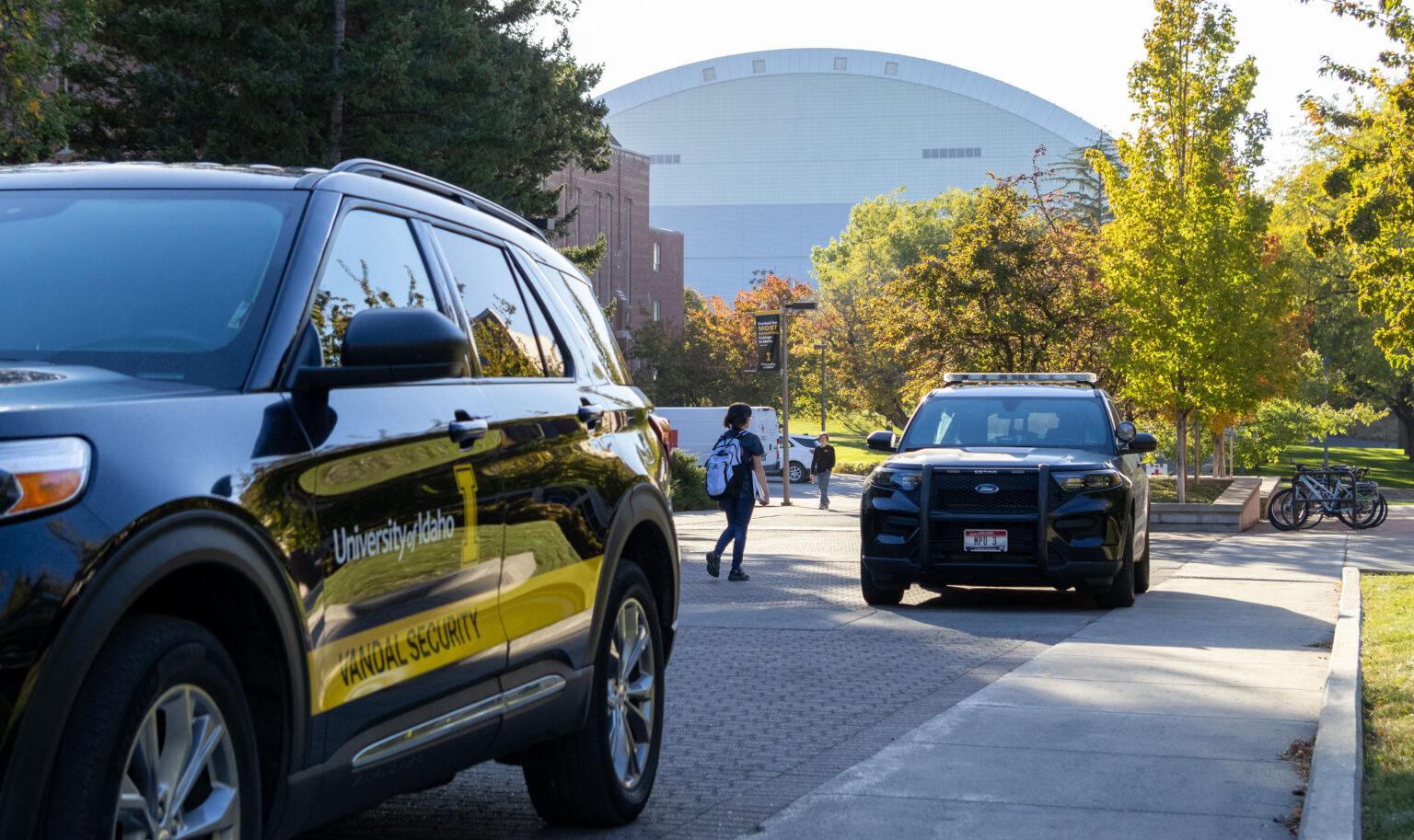
UI Vandal Security car and Moscow Police Department cruiser on campus by ISUB
Speakers highlight shifting world powers
Borah Symposium dicusses tarrifs, energy and new Cold War
Dakota Steffen and Scarlet Herway ARGONAUT
The 2025 Borah Symposium was held from Monday to Wednesday, Sept. 29-Oct. 1, with the theme of “Great Power Competition.” It contained four events with a keynote address on Oct. 1, from K.T. McFarland, a deputy national security advisor under President Donald Trump in 2017.
McFarland described the emerging conflict as a “new Cold War,” pitting authoritarian states such as China, Russia, North Korea and Iran against Western democracies. She stressed the role that energy production plays in this discord.
McFarland highlighted two U.S. advantages: energy independence through natural gas, petroleum, coal and renewables; and global leverage from being the world’s largest consumer, making other countries’ markets dependent on the U.S.
Artificial intelligence and quantum computing, which McFarland believes will be cold wars in and of themselves, will create an even greater energy demand. In 2023 alone, U.S. data centers used 4.4% of the nation’s energy, a figure expected to triple by 2028.
“We’re ready. We’re the best innovators and creators and technology wizzes,” she said. “But now we’re going to have the energy that other countries are not going to have.”
Quoting Italian Prime Minister Giorgia Meloni, McFarland said, “America innovates, China imitates and Europe regulates.” She used the line to argue that the U.S. can shape global events in Europe, Asia and the Middle East.
“If you think our energy needs are being met today, the future’s going to hit us fast,” McFarland said. “That’s not 10 years from now—we’re going to need more energy for artificial intelligence and quantum computing. It’s in like 12 months.”
McFarland also reflected on her time working closely with Trump, particularly during disputes with China over tariffs and the COVID pandemic.
“I know President Trump really well—always take him seriously, don’t take him literally,” she said. “He knows that at the end of the day, that country can’t survive without trading with the United States.”
Esther Brimmer, senior fellow in global governance at the Council on Foreign Relations, spoke on Tuesday evening about power competition in the Arctic and outer space. The global

economy has expanded greatly since the end of the Cold War, Brimmer said, bringing significant economic change.
“Manufacturing moved from developing countries to emerging economies, especially in Asia. Rapid, reliable maritime transport enabled production to occur thousands of miles away from consumption,” Brimmer said. “Keeping maritime channels open has become an economic necessity.”
As temperatures increase, the Arctic is affected much faster than the rest of the world, Brimmer said. Melting sea ice opens the Arctic Ocean as an alternative route for trade.
New technologies and new frontiers also allow for the harvest of more physical resources. However, Brimmer said the ability to communicate could also be considered a resource. “Being able to deliver a message or plant an idea in millions of minds in less than a day is also power in our age,” Brimmer said.
Human activity in outer space is represented in three areas: scientific, national security and commercial. Space has historically been a realm for scientific competition, especially during the Cold War-era Space Race, and it now serves as a place for new economic activity.
Despite the instability that comes from power competition, it does not need to lead to war if communication and cooperation are strengthened, Brimmer said.
“Great powers need to find ways to communicate with each other, to reduce misunderstandings and misinterpretations,” she said.
A period of significant U.S. global economic and political power is ending, visiting scholar Emine Arı said at the Tuesday afternoon’s Renfrew Colloquium. Russia and China, the rising world powers, are exploiting U.S. policy mistakes to move toward a multipolar world order. The battleground for this
new world order is the Middle East.
In the Middle East, Arı said the narrative of the last 10 years has focused on retreating U.S. influence, rising Chinese economic influence and a disruptive Russian role. But, Arı said, that is an oversimplifivcation.
“While adapting its approach, the U.S. continues to rely on heavily military and security partnerships in the region. China, on the other hand, emphasizes economic connectivity,” she said. Russia has involved itself in the weapons and energy sectors in the region to strengthen its presence.
“In reality, each power has its own strengths and strategies.”
Regional powers make use of the competition between the three great powers to gain power of their own.
Saudi Arabia, for example, balances U.S. defense systems, Russian energy production and Chinese Belt and Road Initiative infrastructure. Iran, on the other hand, uses its ties with China to sell oil and Russia to provide drone technology, despite U.S. pressure.
Tariffs are hitting American farmers and producers hard, speakers said at Monday night’s panel and the first event of the symposium.
“We could lower the cost of production by just getting along with each other around the world,” Tim McGreevy, CEO of USA Pulses and a local farmer, suggested. “Getting along with each other, that would lower the cost of production because the cost of goods and input would flow in their natural form to where they’re at their lowest cost.”
Tariffs are not a new concept in U.S. trade. However, the recent tariffs have some differences, according to Brett Wilder, an assistant professor of agricultural finance and business management.
“Doing it in such a broadbased format is a little different. It certainly has caused some damage for some of our large commodities, and especially commodities that rely on export trade,” Wilder said.
Tariffs and increasing trade deficits could also weaken the U.S.’s position in the global market, Xiaoli Etienne, a UI professor of agricul-
tural economics said.
“There’s a saying that a lost buyer today means a lost market for decades, because it’s really hard to build those trade relationships,” Etienne said. “The U.S. has gained a reputation of being a very reliable supplier in the global market, and I think losing the market because of trade war is very detrimental and it would be very hard to regain this market back.”
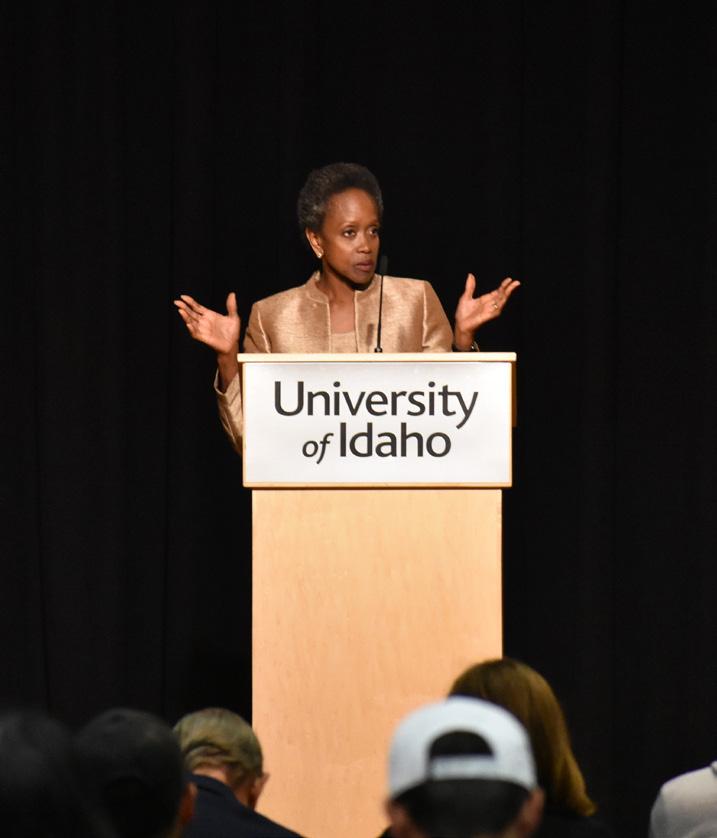
The Borah Symposium is an annual event at UI that aims to educate on and improve global peace and relations. Featuring lectures, panel discussions and community events, the symposium brings together international leaders, activists and scholars to discuss solutions to war and conflict.
The symposium is sponsored by the Borah Foundation, named in honor of Sen. William E. Borah, a leader in international cooperation and diplomacy. The 2025 symposium marked the 87th year and the 78th consecutive year of the program.
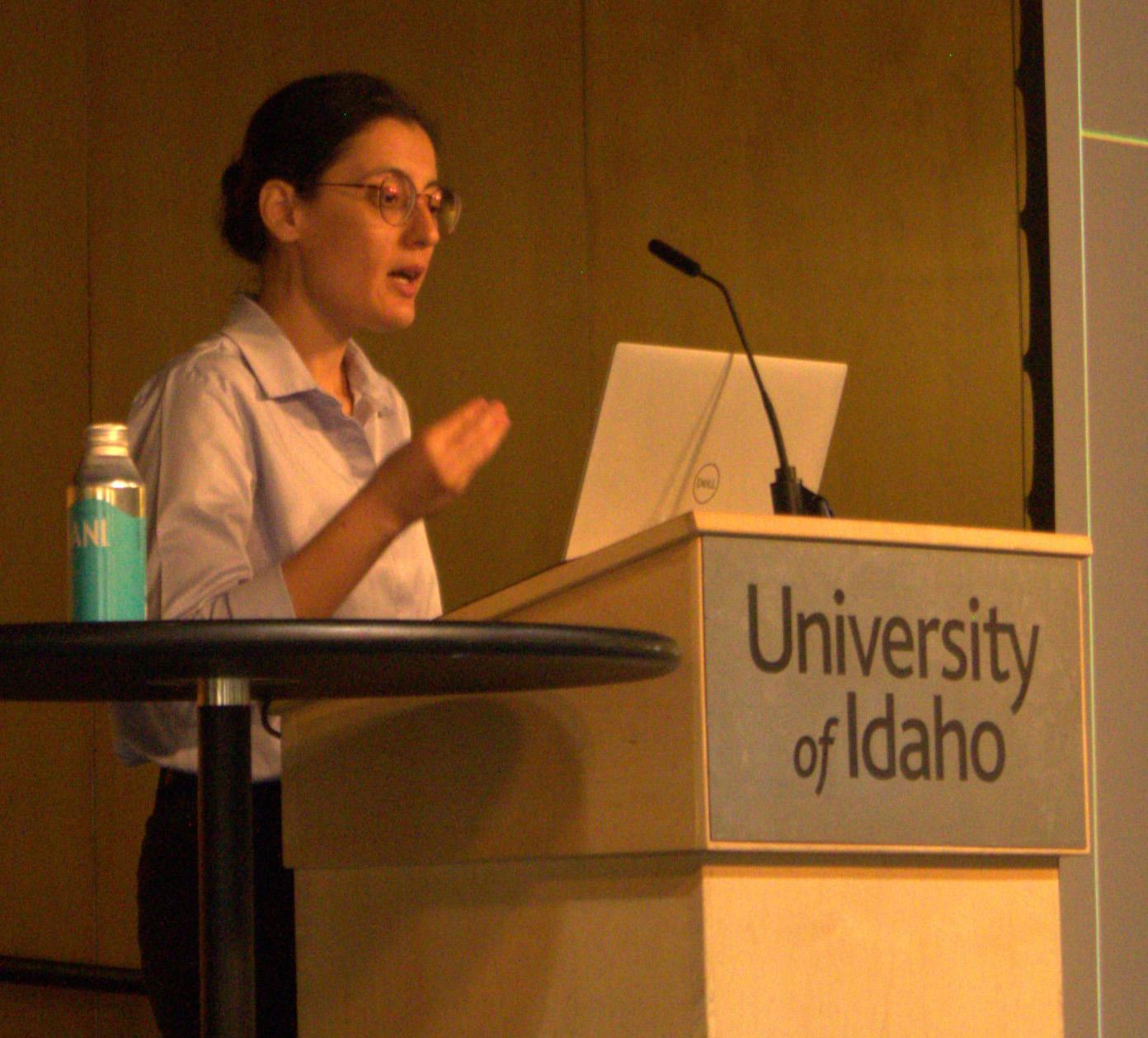
Judge rules to black out King Road photos
Court balances right to privacy against public records act
Joshua Reisenfeld ARGONAUT
A judge has ruled that the City of Moscow cannot publish photographs or videos from the King Road homicides without blacking out the bodies or blood of the victims.
Idaho Second District Judge Megan Marshall issued the judgment on Laramie v. City of Moscow on Wednesday, Oct. 1.
Karen Laramie, mother of Madison Mogen, sued the City of Moscow on Aug. 12 for unwarranted invasion of privacy from images, photos and audio released under the Idaho Public Records Act. Madison, Kaylee Goncalves, Xana Kernodle and Ethan Chapin were the four University of Idaho students murdered by Bryan Kohberger in November of 2022.
Following the filing of the suit, on Aug. 15, Marshall initially placed a temporary restraining order on all photos, videos and audio that depicted the inside of Madison’s bedroom. While the restraining order only applied to Madison’s bedroom, the city said in a press release that images and videos of the
other victims would also be withheld.
A hearing took place over zoom on Aug. 28 where Marshall took the issue under advisement and, at the city’s suggestion, maintained the temporary restrain order. Andrew Pluskal, the attorney representing the City of Moscow, called the case a “balancing test” between competing interests of privacy and public disclosure.
The accompanying decision identified the legal extent and legitimacy of the plaintiffs’ claims to a right of privacy based on a previous ruling from a district court in Ada County.
“Family members of a deceased person’ have a right to avoid ‘public disclosure of their deceased family member’s corpse and other death-scene images,’” the decision said.
During the hearing, Leander James, the attorney representing the plaintiffs, made a distinction between blurring, which the city had done so far, and redacting through means of black boxes. James also argued that blood was a part of the body and was neither blurred nor redacted when it should have been.
Marshall determined that the public gains little by seeing the bodies of the deceased, blood-soaked sheets, blood spatter or other death-scene depictions. The spread of these images online
would be in violation of the Ada County ruling as the plaintiffs may come upon them by accident. The court concluded that these certain investigatory records would constitute an unwarranted invasion of personal privacy.
The decision specified, in accordance with James’ argument, that the blurring was insufficient as it allows the viewer to see the outline of the deceased persons. For individuals who continue to investigate the murders even after the criminal case is closed, Marshal stated it will have minor effect upon them, whereas it will continue to have a profound effect upon the family of the deceased persons.
“The City may disclose the investigatory records in this matter, but must blackout any areas within the images, photographs, video, or other media that depict any portion of the decedents or their bodies and the blood immediately surrounding them.” Marshal wrote in the decision.
Substantial interest in public records related to the criminal investigation has been demonstrated by the over 1,150 record requests made since July 23, 2025, following the completion of the criminal case at the time of judgment.
The court found other items outlined by the plaintiff as violating their right
to privacy to have insubstantial weight compared to the public’s interest to disclosure.
These included audio, video, or photographs depicting, the exterior or interior of the residence with the noted exception of death-scene depictions; the personal property and items of the deceased which include containers of alcohol, underwear, ID cards and other personal items; and witnesses statements given to law enforcement officials, including audio of crying and extreme emotions.
Marshal addressed that despite the tragedy and distressing nature of the homicide, like many law enforcement investigatory records that invade the privacy of suspects, witnesses, victims, these are precisely what IPRA affords the public and do not substantially invade the privacy of the plaintiffs.
Furthermore, the outlined items of personal property may appear embarrassing but do not attack the character of the deceased in a way that constitutes an unwarranted invasion of personal privacy.
The decision ends with the acknowledgement of the harm that the plaintiffs have suffered due to the initial disclosures, even in their blurred form, and states that they are entitled to relief.
Dakota Steffen | Argonaut Esther Brimmer at plenary address
Colton Moore | Argonaut
K.T. McFarland delivers keynote address
Dakota Steffen | Argonaut International relations scholar Emine Arı at Borah Symposium
ASUI reworks club funding request process
Online application form for student clubs, new director of finance
Josie Adjanohoun ARGONAUT
ASUI has a new club funding initiative to improve transparency and accessibility. Clubs will now be assigned a senator who will bring a bill to the senate floor for vote.
The amount of funding and purpose of funding will now be publicly discussed and modified as needed to be voted on though. Previous funding requests were submitted to the ASUI president, ASUI director of internal affairs and the ASUI advisor.
“There wasn’t enough transparency. And when clubs were denied funding, there was no explanation why they got denied,” said ASUI President, Seyi Arogundade, in an interview with The Argonaut.
Arogundade had other concerns with the previous system such as the lack of a specific person in charge and limited club knowledge of the opportunity and application process. The new system created a director of finance position to solve this issue.
“Creating the director of finance position was super important to us and making sure that whoever has that position is knowledgeable in finances
would make sure we figure out a new system that works best,” said Arogundade.
Lance Butikofer is the first director of finance.
The form requires the name of the club, estimated number of members, amount of funding being requested and the purpose of funding. Once the form has been submitted, ASUI will assign a senator onto the case who will create a bill that will be presented on the Senate floor. This process is intended to ensure the bill will support the needs of both the club and ASUI.
Once introduced, senators will discuss and possibly modify the bill as needed. If the bill is passed, the club will receive the agreed amount of funding. If not, the bill will move back to the sponsoring senator for more substantial modifications.
Arogundade said this process would take one to two weeks depending on the amount of debate or edits applied to the bill. While the previous system was faster when requests were approved, Arogundade believes the transparency and collaboration with club with be a positive for both.
The funding is part of the total ASUI budget and is reserved for club funding requests.
Funding request forms for clubs are available at https://linktr.ee/asuidaho.
Idaho voter registration law challenged with suit
March for Our Lives Idaho brings previous ruling of 2023 law to court
Anna Capello ARGONAUT
Idaho’s law restricting voter registration using student IDs was challenged in a court of appeals on Wednesday, Sept. 17. The Seattle Ninth District Court of Appeals heard the case March for Our Lives Idaho v. McGrane.
When Idaho’s legislature passed House Bill 124 in 2023, preventing the use of student IDs for voter registration, the League of Women Voters and Babe Vote filed suit.
On April 11, 2024, the Supreme Court of Idaho came to a unanimous decision to uphold the law passed a year prior. The plaintiffs appealed the decision on Oct. 16, 2024.
David Fox, the attorney representing March for Our Lives Idaho, claimed “the record supports the conclusion that the amendments to the law were a targeted strike on young voters.” Fox identified three issues with the previous court’s decision: whether the ruling was correct, if this law somehow violated the 26th Amendment and if there
is a dispute of fact.
Fox said that March for Our Lives Idaho “has been unable to help 26% of its 18- and 19-year-old voters with registration after the law passed, creating a negative effect for voter turnout.” He asked the court to allow the decision to hold a trial.
Michael Zarin, the attorney representing Idaho Secretary of State Phil McGrane, said, “States have the Constitutional authority to make elections as easy and secure as possible.”
Student IDs are not a secure way for voting registration, as the only limitation to receiving one is that you must be a student.
The University of Idaho’s student ID cards read, “Not for Official Identification,” indicating that students can’t use their ID for anything that requires official identity verification, voting registration included.
“Most voters who have a student ID don’t use it, as they already have a driver’s license,” Zarin said, and since driver’s licenses are given by the state, they are an acceptable form of identification, along with state IDs. Zarin asked the court to affirm the previous decision in 2024.
The Appellate Court has yet to release a decision.

Extension receives $1.6 million donation
Mysterious donor revealed; funds to help for years to come
Emily Morales ARGONAUT
The University of Idaho Extension received a $1.6 million gift from an unknown donor who was later revealed as the late Harry Lawrowski.
The donation was given with no restrictions regarding how it may be
development, food production systems and health and wellbeing.
In Latah County, UI Extension offers programming in small farms, family finance and 4-H youth programs.
The endowment is expected to generate roughly $65,000 in annual earnings, beginning in the Fiscal Year 2027. UI Extension anticipates adding future gifts to the endowment to increase its return.
used. Barbara Petty, the associate dean and director of the UI Extension, chose to create a UI Extension Excellence Endowment.
This intends for the donation to have long-term impact for the university.
Totaling $1.6 million, the donation will help provide non-formal education to people throughout the country.
“It’s a testament to the quality of our work...community leaders such as the Lawrowskis recognize our work,” Petty said.
UI Extension is part of a national network of land grant universities conducting research and educating the public, according to their website.
UI Extension aims to bring education to students where they live, by partnering with local communities to provide research-based education and information on issues that are important to Idahoans, according to their website.
The program has a state-wide network of faculty of staff in 42 counties, where they work to transform knowledge into “solutions that work.”
These programs include 4-H youth
This revenue will help provide external support and enable UI Extension to address old problems with new solutions and provide support to ongoing programs in need.
Lawrowski was a chemical engineer and employee of Idaho National Laboratory for 15 years. He was superintendent and associate director of the Experimental Breeder ReactorII, amongst other jobs in the nuclear industry, before forming his own company in 1979.
Mary Ann Lawrowski, late wife of Harry Lawrowski, was a family and consumer sciences extension educator in Bonneville County for 33 years.
“It warms my heart to know that Harry and Marry Ann Lawrowski wanted their support of the Extension to be a big part of their legacy,” Petty said.
Petty succeeded Mary Ann Lawrowski at UI Extension, who left a lasting impression. Petty said she now introduces herself as the person who has the honor of sitting at Mary Ann Lawroski’s desk.
Courtesy University of Idaho
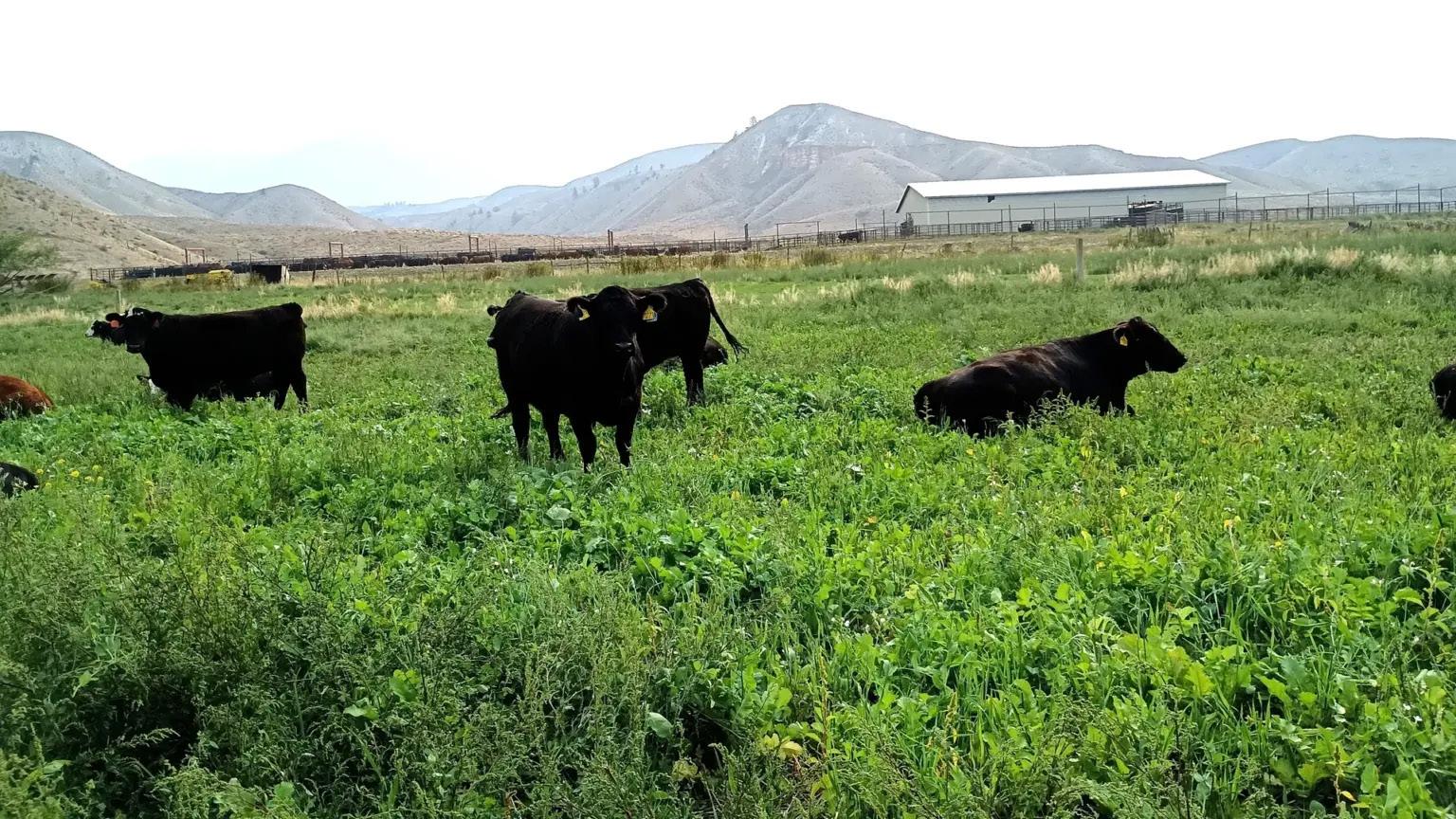
Heifers graze a blend of cover crops planted in the summer of 2025 following the harvesting of a triticale crop in the same field at University of Idaho’s Nancy M. Cummings Research, Extension and Education Center
UI alum receives Ari Keever Fellowship
Jacob McGaughey is the first recipient of this theater fellowship
Reese Garcia ARGONAUT
Recent graduate of the University of Idaho Theatre Department, Jacob McGaughey, has accepted a fellowship at the Boise Contemporary Theater in honor of late UI alum, Ari Keever. She was said to be energetic, crazy and free-spirited. Keever had been a passionate dancer since the age of 3.
At the age of 19, she found a love for the performing theatre arts. Later, Keever graduated from UI with a Bachelor of Fine Arts in Theatre Arts.
After graduating, she worked professionally at the BCT, where she continued to express her passion.
On April 1, 2020, Keever passed away, leaving many hearts broken. Since then, the community has found a way to carry on her legacy through UI to Boise.
Because of support from BCT, Trajectory Consulting and Solutions LLC and UI College of Letters, Arts and Social Sciences, the Ari Keever Trajectory Fellowship was created. McGaughey is the first recipient of this extraordinary opportunity.
McGaughey is currently in Boise working as the assistant director and an understudy in BCT’s current production, “Eureka Day” by Jonathan Spector.
Spending the majority of his days at the theater, McGaughey said in an interview with The Argonaut, “We’ll rehearse the play, we’ll do runs, I’ll offer feedback to Benjamin Berdick, the director.”
He continued, “It’s theater, home, theater, home…I’m in the theater between eight and 10 hours a day.”
Before moving to Boise, McGaughey spent his summer working a day job in Moscow.
After being back in the theater, he said, “Something I sort of realized is how much the arts fuel me.”
“No matter how long the hours are, there is still something so rewarding about being in such a strong community.”
He extended his love for his community by saying, “The people are so much fun, the director’s fun, the theater’s beautiful!”
The BCT is also in the works of trying to figure out next year’s produc-
tion lineup. Every Monday for five weeks, the company reads a play that they are considering for next year’s season. McGaughey said, “We’re still figuring out what that play is going to be.”
For anyone wanting to audition for the fellowship’s next season, McGaughey said, “Anybody who loves the theater...has a passion for this stuff, just show up, just audition.”
He said to go into the audition showing, “how much you love the
Fall fashion trends reappear
With the return of fall, we are greeted by familiar fashion ensembles
Macy Gilbert ARGONAUT
As the weather cools and the leaves change, tank tops turn into sweaters and familiar fashion trends reemerge.
Autumn is a season that feels like embracing familiarity, and while slightly different stylistic choices are present, certain trends seem to remain constant through the changing of the leaves.
Despite the fast-paced atmosphere that is the fashion world, with crisp air comes an array of flannels.
They can be styled in a variety of ways, from a grunge, thrifty look to having them classically tied around the waist.
The flannel, baggy jeans and Doc Martens combination has become a popular option, mixing a trendy aesthetic with the comfort and functionality of the flannel.
The flannel has yet to fail to bring about a sense of simplicity and enjoying the little things in life, a mindset embodied by the slowing down of life during this time of year.
The sweater is a staple of the season, leaning into the coziness that the chill air inspires. The versatility that comes with a sweater is nothing to sweat at.
An oversized sweater is perfect for comfort and akin to the warmth of a hug.
It can be styled with baggy pants for a casual, relaxed vibe, or it can be dressed up with an elegant skirt.
Along with sweaters comes cardigans, a garment that has been popularized in the last couple of years.
Cardigans are an optimal way to stay warm while also showing off the clothes underneath. They can keep you warm, without making you sweat too hard while walking to class.
Like with summer motivating bright and airy colors such as yellows, reds and turquoise, autumn brings about its own array of colors.
It is as if the volume of colors is turned down a couple notches, leading to a quieter, yet sophisticated palette. Darker greens, reds and oranges are
optimized, along with browns, olives and chestnut-colored items. These shades reflect the quiet comfort of watching the sun set earlier, and the beauty of the changing environment.
Nostalgic film characters such as Bella Swan, Elena Gilbert and Rory Gilmore’s outfits remain iconic and continue to inspire autumnal looks.
The layering of fitted long-sleeve shirts over lacy camisoles remains a sought-after look, despite “Vampire Diaries” ending eight years ago. Elena Gilbert embraces rich, romantic hues, such as a deep burgundy or a dark, royal blue.
The academic, girl-next-door ensemble that Rory Gilmore wears, inspired by the early 2000s, feels almost timeless.
Bella Swan’s ability to appear comfortable and effortless, yet incredibly cute and on theme for the season, influences the apparel of this time of year. She leans into the earthier tones of the season, reflective of her grounded and sensible style.
The thing that these three characters have in common is the emphasis of fall in their world, and the impact of that on
their wardrobe is clear.
Their repeated appearance on fall fashion Pinterest boards is indicative that many relate to and aspire to dress similarly.
As with the other seasons, every style has its way of conforming to fall. The preppy look invites people to lean into plaid and collared shirts under sweaters or crewnecks.
Cottagecore, while favoring the spring season, can be utilized in the fall with loose silhouettes and patterns of florals and ginghams.
Grunge outfits are set up for success, as the cooler days position jeans, tshirts, beanies and flannels well.
Fall fashion is about being reunited with the familiar and embracing comfort like an old friend.
Each year, we are met again with the same patterns, textures and colors, presented in a variety of ensembles.
Whether it’s through the warmth of a sweater, the nostalgia of a flannel or the cinematic influence of characters we grew up with, autumn flair reminds us to slow down, embrace simplicity and find beauty in the fading light of the season.
theater, how much you love the arts and see what happens.”
He is optimistic and excited about what the future of the fellowship holds.
“I am extremely honored to have been given this opportunity. It’s been incredible being able to honor somebody in this very participatory, very unique, very fun way,” he said.
He looks forward to setting the fellowship up for future UI theater students who “love the arts as much as I do.”
School
There will be jazz combos, recitals, bands and more
Shelby Sandford ARGONAUT
Wind Ensemble & Concert Band (Thursday, Oct. 9)
Join the school of music as they hold their first Wind Ensemble and Concert Band performance. This event will be held at the Administration Auditorium Building at 7:30 p.m. Tickets are $10 for students and $12 for general. Tickets are available online or at the door.
Guest Recital—Landon Chang (Monday, Oct. 13)
Come see saxophonist Landon Chang perform in Haddock Performance Hall in the LHSOM Building at 7:30 p.m. This recital is free to attend.
Convocation 2 (Thursday, Oct. 16)
Watch select students from the LHSOM perform solo or in an ensemble, in the Haddock Performance Hall in the LHSOM building at 2:30 p.m. This event is free to attend.
Opera Scenes (Friday, Oct. 17)
At 7:30 p.m. in the Haddock Performance Hall in the LHSOM building, you can enjoy an evening of performances from students of the school of music and from the theatre arts department. Tickets are $10 for students and $12 for general, bought online or at the door.
Student Chamber Recital (Friday, Oct. 24)
Join the school of music at 7:30 p.m., in the Haddock Performance Hall at the LHSOM building, for a student chamber recital concert. Free admission for all.
Faculty Recital—Miranda Wilson (Tuesday, Oct. 28)
Watch the school of music’s very own cello teacher in a faculty recital at the Haddock Performance Hall in the LHSOM building at 7:30 p.m. Admission to this event is free.
Tubaween (Friday, Oct. 31)
Enjoy a night of spooky music performed by low brass students, presented by the UI tuba and euphonium studio. Located in the Haddock Performance Hall at the LHSOM building at 7:30 p.m.
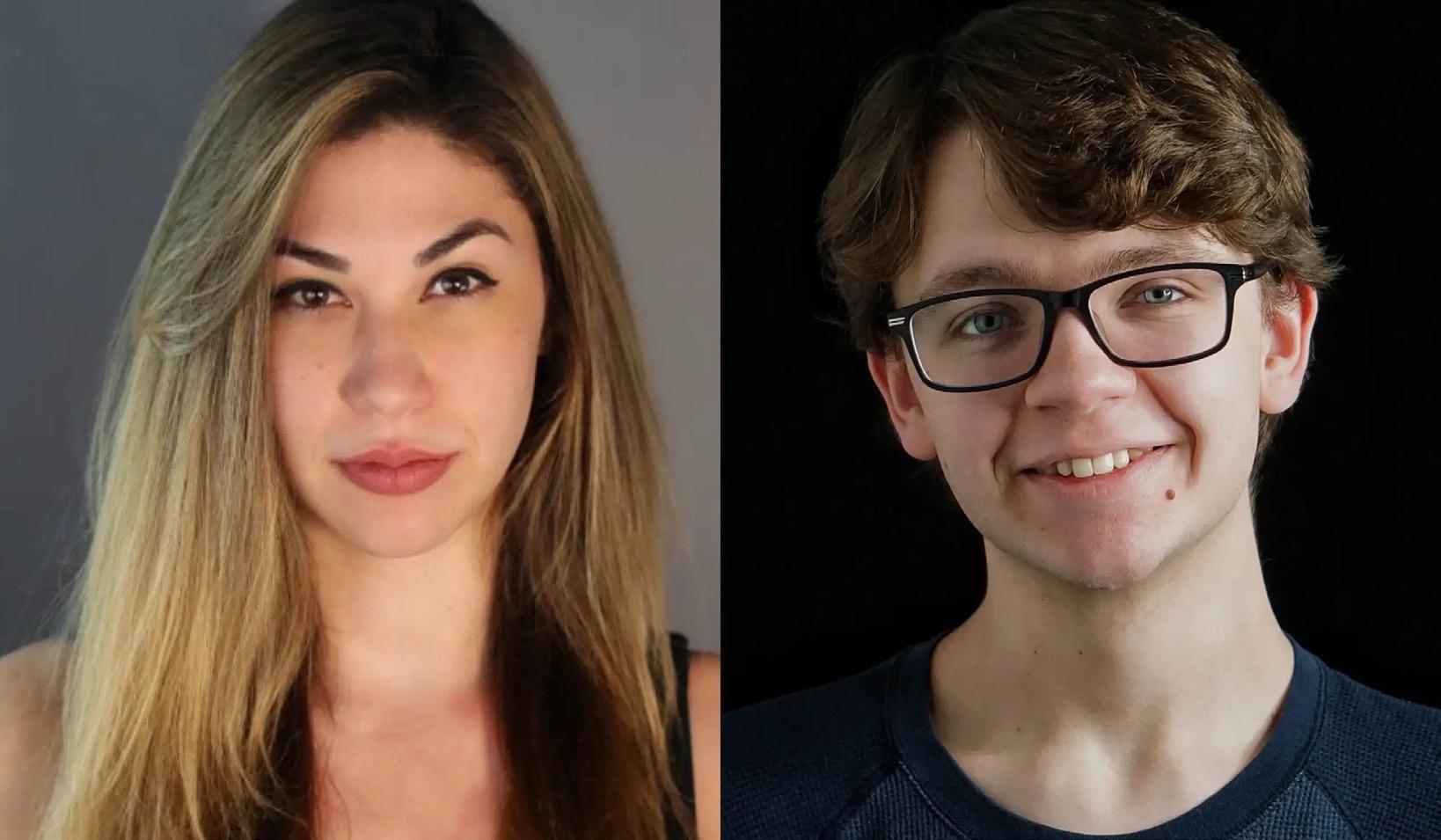
University of Idaho | Courtesy Ari Keever on the left and Jacob McGaughey on the right
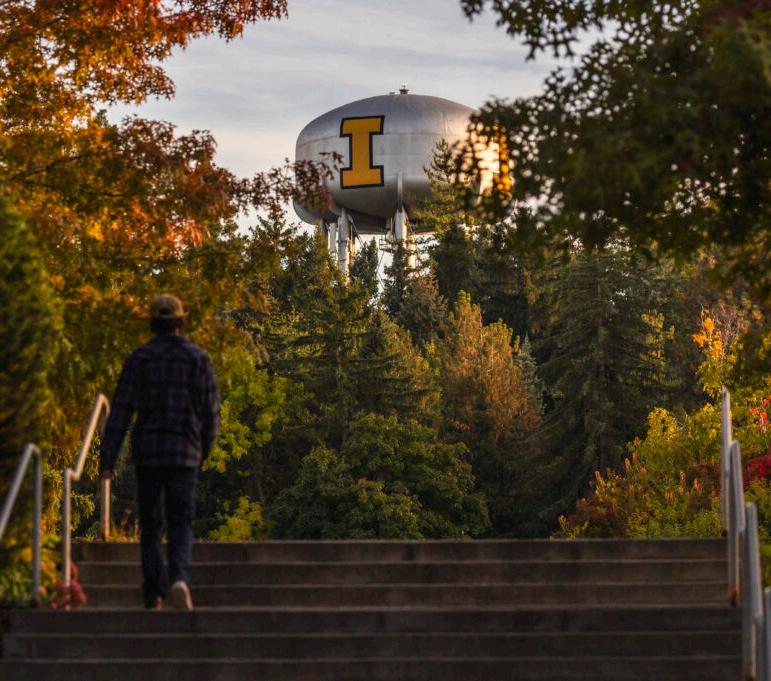
John Keegan | Argonaut The University of Idaho water tower as seen from campus
Chicken dumpling soup
A creamy soup that’s perfect for chilly fall days
Brooklynn Jolley ARGONAUT
As the days begin to get colder and fall creeps in, it becomes the perfect season for soup again. This recipe makes the perfect savory and creamy soup for those cold nights. Despite looking slightly intimidating, this recipe is simple and easy to make.
Ingredients:
3 ribs of celery (chopped)
1 yellow onion (chopped)
2 whole carrots (chopped)
1 sprig of rosemary (or 1 tbsp.)
3 cloves of garlic (minced)
Pinch of chopped chives
2 chicken breasts (shredded)
1 can evaporated milk (12 oz.)
5 c. chicken broth
½ c. milk
¼ c. sour cream
5 tbsp. butter
Drizzle of cooking oil
3 tbsp. flour
1 tsp. baking powder
Pinch of salt
Pinch of pepper
1 tbsp. garlic powder
Dried thyme
Smoked paprika
Directions:
Combine the salt, garlic powder, baking powder, 2 tbsp. of butter, milk and sour cream into a bowl. Mix until a dough-like consistency forms. This will be for your dumplings. Once mixed, add in a pinch of chopped chives.
Heat a pan on medium heat and drizzle some oil into the pan.
Add the celery, yellow onion, carrots and rosemary into the pan. Add a pinch of salt and pepper.
Once the onions are translucent, add in the garlic. Let it cook for about two

minutes.
Add 3 tbsp. of butter and the flour to the pan to make a roux. Mix immediately and let it cook for about two minutes.
Grab a whisk and slowly add the evaporated milk to your pan while whisking.
Once all the evaporated milk is mixed in, whisk in the chicken broth. Let this cook for about a minute.
Add two more cups of chicken broth and mix in the shredded chicken. Add one more cup of chicken broth and whisk.
Add the rosemary, dried thyme, smoked paprika, salt and pepper. Mix well and cover on medium heat for 10 minutes.
After the 10 minutes are up, you’ll make your dumplings and add them to the soup.
Take two spoons or a scooper and put about half a spoonful of the dumpling dough onto the spoon. Drop it into the soup. Repeat until the dough is used up.
Put the lid back on for about 15 minutes. The dumplings should puff up.
Add any extra seasonings to taste.
Serve and enjoy!
October horoscopes
What’s in store for the rest of this month?
Brooklynn Jolley ARGONAUT
Aries (March 21 – April 19)
Your life will flourish this month. Whether that’s in a romantic way or geared toward your career, October will bring many wonderful things for you. Reflect on your personal wants.
Taurus (April 20 – May 20)
Big things are coming your way this month. It may be a fun vacation, a promotion, new friendships or something else. Be perceptive to the signs and welcome new experiences that come your way. This month will be very positive and productive for you and you may feel like everything is starting to align.
Gemini (May 21 – June 20)
Spend some time reflecting on your friendships this month. Redefine your boundaries and don’t let people walk all over you. This month is the perfect time to figure out what you want in your life and assert your feelings with confidence.
Cancer (June 21 – July 22)
Take some time to cut through the drama that may have been in your life recently. Focus on what’s important, like your family and your career. Don’t be afraid to have difficult conversations and work things out with people.
Leo (July 23 – Aug. 22)
Work on cultivating some selflove this month and putting yourself first. You may have been dealing with some undesirable feelings recently, but October is the month to alleviate these pent-up emotions. Look into your heart and find yourself.
Virgo (Aug. 23 – Sept. 22)
Try to unplug this month and get away. You deserve a break and some time alone. Work on fostering stability and balance in your life. Don’t let
your overthinking take control this month and focus on the positive aspects instead.
Libra (Sept. 23 – Oct. 22)
Focus on your ambitions and desires this month. Don’t be afraid to chase what you want and let yourself shine. You may have felt like people underestimate you, but that will change this month. Your talents and skills will be on full display and others will see how hard you work.
Scorpio (Oct. 23 – Nov. 21)
Focus on fostering community and connections this month. You tend to pull away from others when life gets a little crazy but try to lean on your loved ones instead. You may be surprised at the results. Don’t neglect the people who are always there for you when things get tough.
Sagittarius (Nov. 22 – Dec. 21)
Let your confidence and passion shine this month. This will be a very intense month for you in terms of work and your personal life. This may manifest in new relationships, growth opportunities at work or spontaneity in your normal routine.
Capricorn (Dec. 22 – Jan. 19)
Be sure not to take on too much this month. Foster some relaxation time with friends and loved ones, and don’t be afraid to put your routine at rest to try new things. This month may reveal new aspects of your friendships that you didn’t know about before.
Aquarius (Jan. 20 – Feb. 18)
October will be a playful and fun-filled month for you. Foster your creativity and be sure to reconnect with friends. Sparks will fly this month and you’ll feel some clarity in various aspects of your life.
Pisces (Feb. 19 – March 20)
Take some time to focus on yourself and personal growth. Try to gain confidence and comfort from yourself without needing validation from others.

Submit your application or nomination to be an honorary
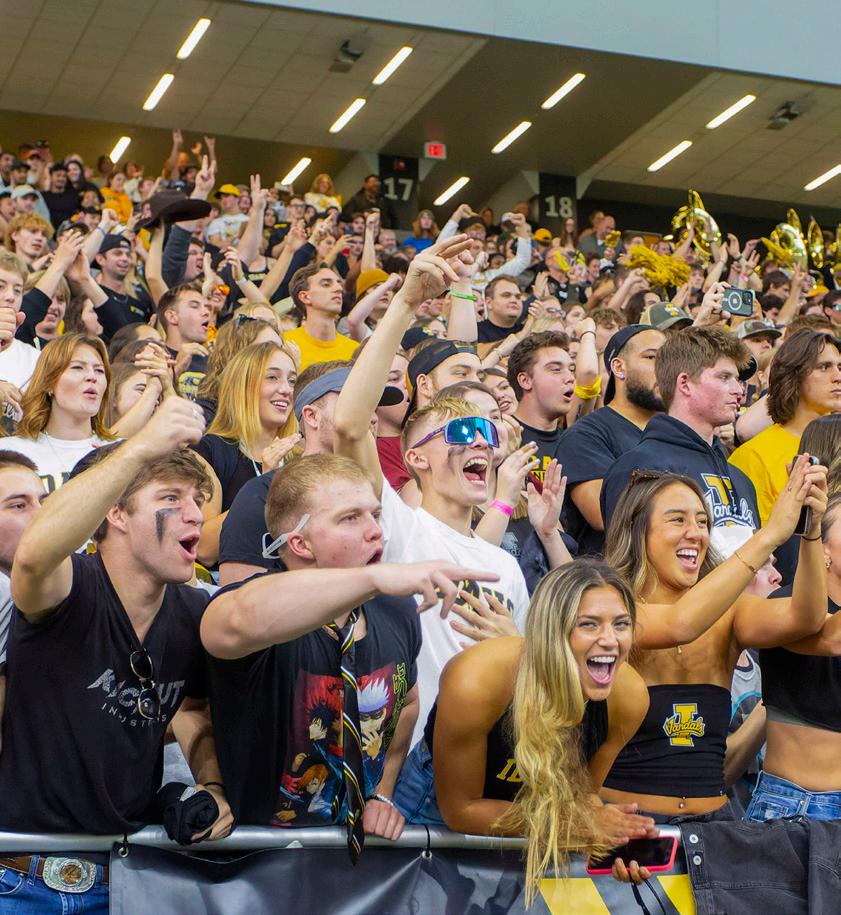
STUDENT COACH OF THE GAME
at each of the remaining Vandal home football games!
Each selected Student Coach of the Game will:
• Receive an all-access on-the-field game pass
• Walk the sideline and watch the Vandals on field during the game
• Be recognized with an announcement during the game
• Enjoy a behind-the-scenes experience with Vandal Athletics
• Join the team for pre-game, half-time and post-game coach talks
• Represent the student body as an ambassador of Vandal spirit
Scan the QR code below and fill out and submit your application or nomination by 5:00 p.m. Wednesday the week of a home game. Applications will be reviewed by a selection committee comprised of students and staff. Individuals selected will be notified by Thursday evening (or sooner) before the home game.

Brooklynn Jolley | Argonaut
A warm and savory soup for chilly fall nights
“No place like Dome”
UI celebrates 50 years of the Kibbie Dome
Dakota Steffen ARGONAUT
Seventeen years after graduating from the University of Idaho with a bachelor’s in architecture, Nels Reese returned as the director of facility planning, a position that came with a project that would become famous in architectural history.
Reese is a professor emeritus of architecture at UI, a member of the City of Moscow Planning and Zoning Commission and chair of the Moscow Historic Preservation Commission. Reese taught full-time at UI from 1987-2008.
“This is one old man’s view of the Kibbie,” he said. “Lots of people could tell different stories about the Kibbie. You could get 10 people on campus to tell interesting stories...But my story is about the architecture of the Kibbie.”
Reese shared the 50-year history of the P1FCU Kibbie Dome at the Sept. 9 Malcolm Renfrew Interdisciplinary Colloquium.
He began his story west of campus, where the Neale Stadium once stood. “For at least 30 years, we froze our, well, early in the season, it was nice like this, and then it would get cold.”
Neale Stadium first opened in 1937 but later was condemned due to soil erosion in the summer of 1969. A suspected arson burned a large portion of the stadium on Nov. 23, 1969. With its football field out of commission, the university needed a new stadium.
“I came here as a student in 1957 and watched Jerry Kramer, yes, play out in that field,” he said. After Reese graduated, he worked in Boise for Art Troutner as a drafter.
They worked at the Trus Joint Corp. designing and building trusses. Later, Reese returned to UI as the director of facility planning from 1979-87.
The idea for the Kibbie Dome began with a roof, Reese said. Ernest Hartung, the UI president at the time, needed a place to play football.
“Glenn Cline was the architect of choice. As the university wrote out [a request for proposal] to say, who would like to try and build a roof over our football field? Glenn Cline put up his hand,” Reese said.
Cline built a team with Trus Joist Corp. and archi-
tect Art Troutner.
The Trus Joist Corp.’s main product was the recently invented eponymous Trus joists, a building support material that used less wood and was stronger than standard supports.
According to Reese, the need for this product came from increasing deforestation. “There were no big trees left... [we] found that we couldn’t find enough wood that wasn’t full of knots to build a long truss.”
To address this, Troutner created Microllam laminated veneer lumber.
“He was going to...glue little tiny pieces of wood together and make a composite board,” Reese said. “[He was] one of the people who led the first move into high-tech wood, the wood that we know today. We’re now able to build a 30story building out of wood.”
“Glenn went to Art. They knew each other there in Boise. And he’s thinking, boy, I’ve got to build a roof. We need a cool idea for this roof. Flat, round, triangular. What’s it going to be?” Reese said. “And so, he goes to Art and he says, can you adapt any of your technologies to cover a 400-foot span and give me a clearance of about a 12-story building? Well, Art says, yeah, maybe I can do that. Maybe I can do that. Who knows?”
Troutner had flown in World War II as a navigator on a B-24 before coming to UI, where he graduated with a degree in architecture in 1949. Afterward, he returned to Boise, where he began to build “unusual houses,” as Reese put it.
“[Troutner] was a very creative guy. In fact, I will say that he was a genius.”
Troutner experimented with a new type of truss that had wood on the top with metal struts holding the frame together. A 7 ½ inch deep truss allowed him to span 30-40 feet without any beams or columns. This technology would become the Trus Joist, and later, the structure of the Kibbie Dome.
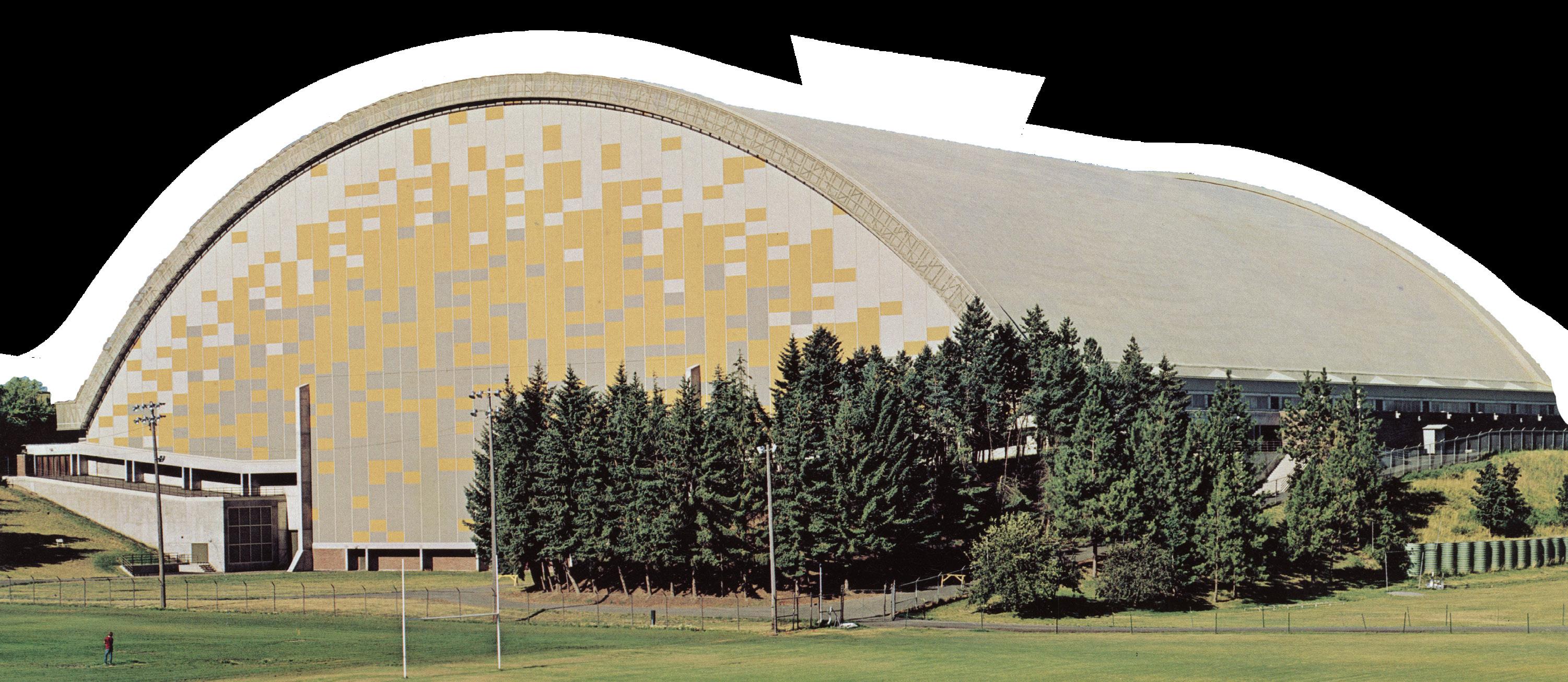
The Kibbie Dome was an entirely
new concept to the architects working on the project. “This was not an ordinary piece of architecture. This was a structure that had never been built before,” Reese said. They couldn’t rely on previous examples to build it.
“Putting this project together was irredeemably difficult. And if you read the book,
‘Raising the Roof,’ Peter will tell you that there came a moment in time where he said, we’re out of here. We can’t, whatever the price is, I don’t want to do this project because we can’t do this,” Reese said. But, with Troutner pushing on, they continued anyway.
“It’s almost impossible to describe, and I can only say that I wasn’t here on the day they built it,” Reese said. At the time, he and his wife were living in Boise, and he couldn’t afford to take a week off work to watch the construction. “I regret not being here,” he said.
The stadium had already been built, so the team knew how big the trusses had to be. They built each truss in groups – each had multiple 80-footlong, 24-inch-wide, 2-inch-deep curved pieces of Microllam that would be attached to the metal struts. Each truss would end up about 12 feet wide.
“This would have a magical day,” Reese said. “I’m sure that there were 200 people on the site who thought, s***, this is not going to happen. And it did. It happened.”
The roof trusses were covered in plywood and a 2-inch layer of spray-on foam. But within two years of being built, the university began to notice moisture in the dome’s roof.
“I’d been here two years as planner and director of facilities, and we’re freaking out because the word is around campus, there’s a problem with the Kibbie,” Reese said.
“Who is at fault here? Is the roof at fault? Did Trotter have a bad idea? Is the foam messing up? We don’t know. So, we began to take the roof off,” Reese said. In an attempt to patch the holes in the foam, they put more pieces of plywood over the top.
“And I can say this, that for some amazing piece of luck, the rot never went through the Microllam, all two inches,” Reese said. “For some reason, we caught it just at the 1 ½ inch level. Had we waited another winter, it would have probably been over.”
As the university hired multiple roofing contractors to fix the leaks, they brought Troutner back in. “Art was, of course, furious, and I think with probably good reason. He was kind of eyeballing the university as the maintenance people,” Reese said.
They decided, with Troutner’s guidance, to clear out the rot, fill the holes with fiberglass and patch more metal on the
bottom to strengthen it.
After the dome made it through the winter, they added more layers on top, including insulation, tarp paper and asphalt shingles. The university later replaced the shingles with a flexible metal covering, which has lasted ever since.
As innovative as it was, no one has
built something inspired by the Kibbie Dome, Reese said. “No one likes to say this, but I’m convinced that Trus Joist lost money on this.” The time and specialized material needed to build something like it turns many off the idea. That uniqueness earned it the American Society of Civil Engineers’ Structural Engineering Achievement Award in 1976, one year after it was built.
“They say at 50 years you can consider yourself old, as a piece of architecture,” he said. “And as a human being, I can tell you that at 88, you can definitely consider yourself old.”
“Enjoy the Kibbie. It’s one-ofa-kind in the world,” Reese said.
University of Idaho Special Collections
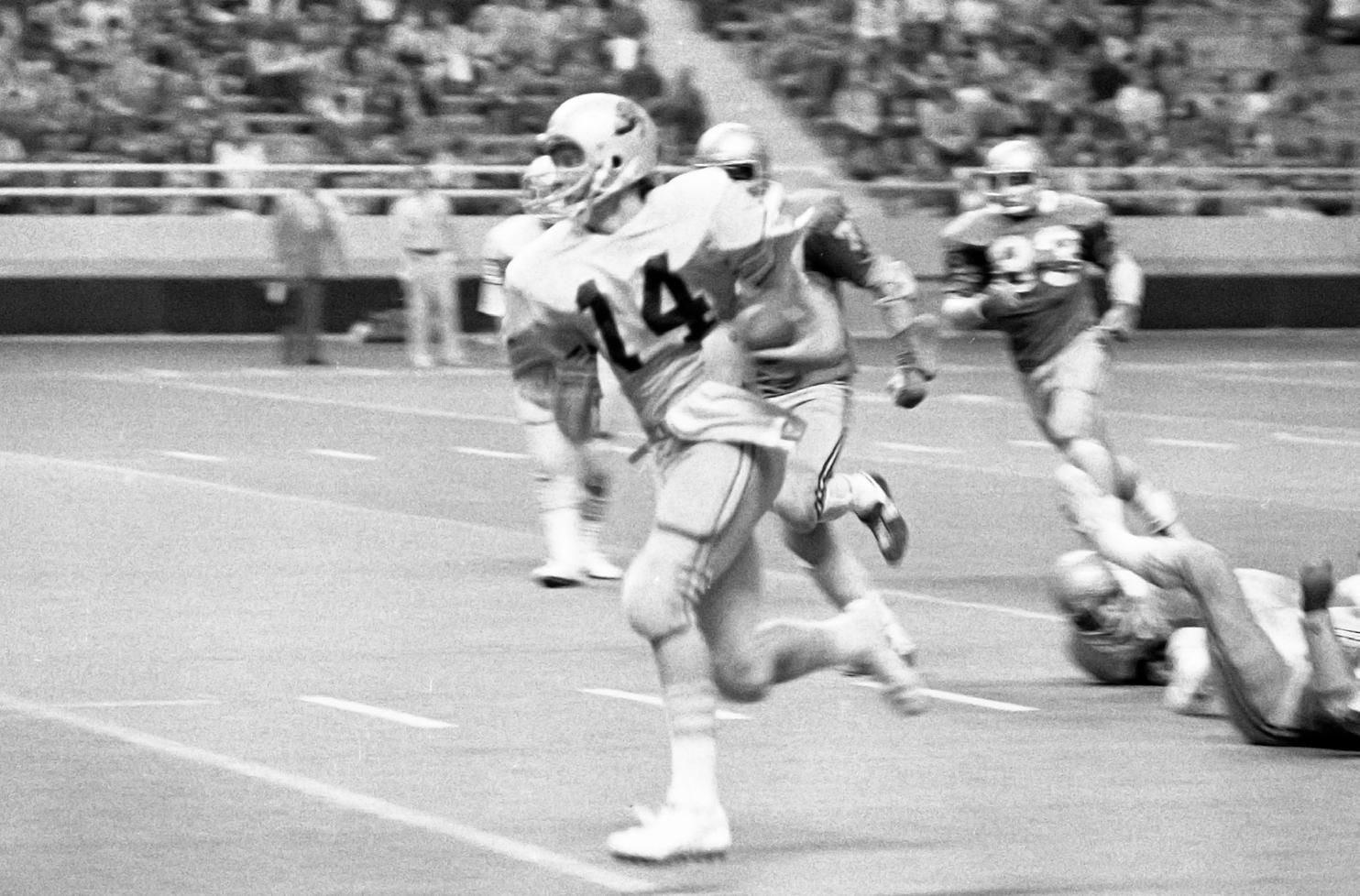
Vandal quarterback Dave Comstock carries the ball against the Montana State Bobcats in the 1975 Homecoming game, the first in the Kibbie Dome
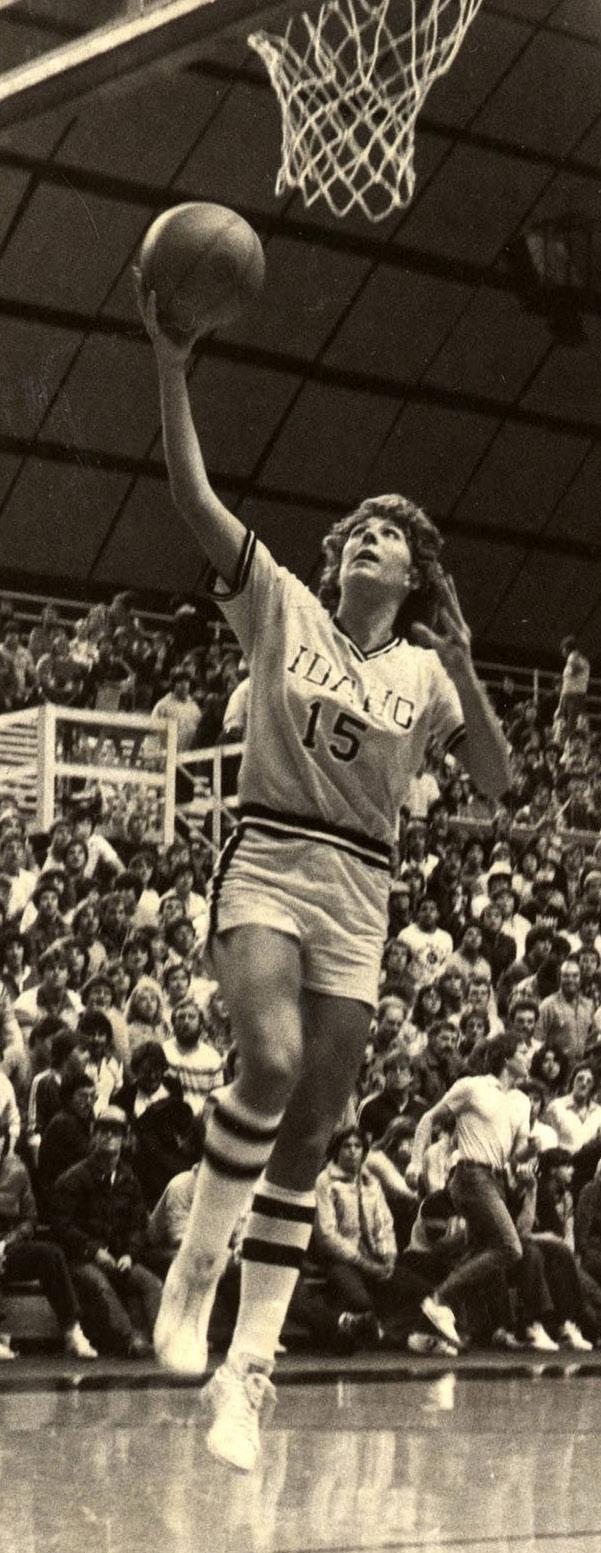
Argonaut Photograph Archive Vandals Women’s Basketball player Denise Brose (15) taking a shot against Weber State on Feb. 1, 1985
Argonaut Photograph Archive
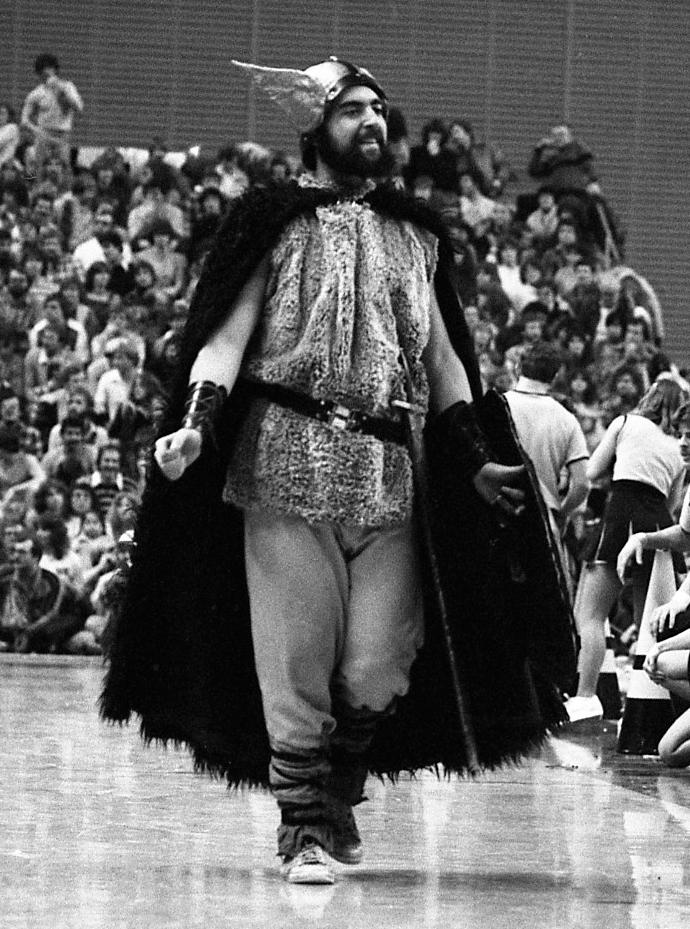
A student dressed as Joe Vandal walks through the dome in 1985
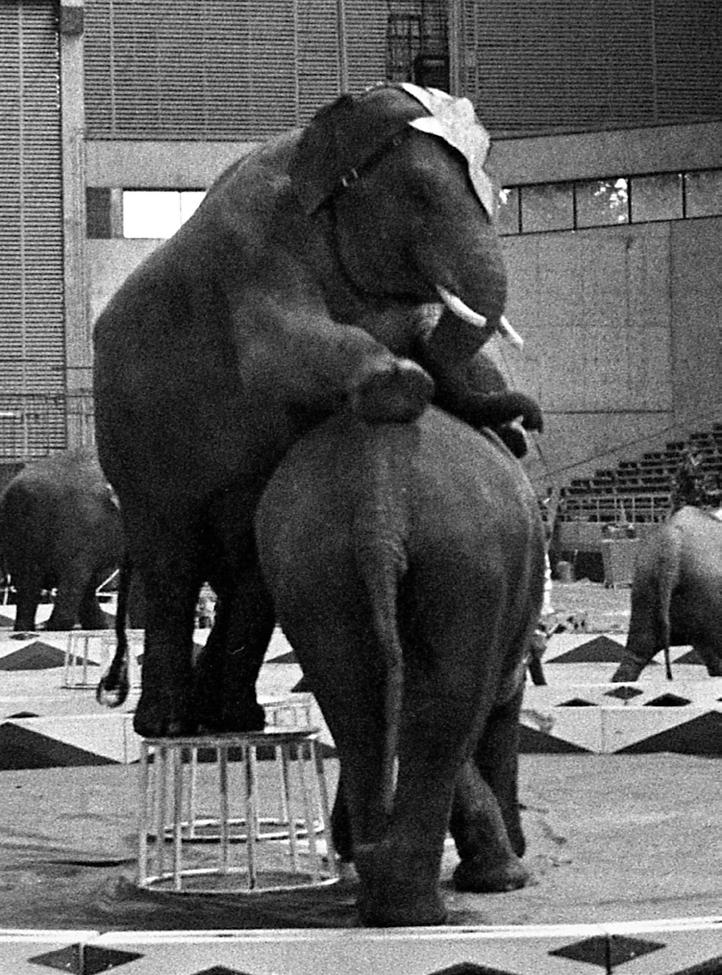
Argonaut Photograph Archive American Continental Circus elephants perform in the Kibbie Dome in 1977
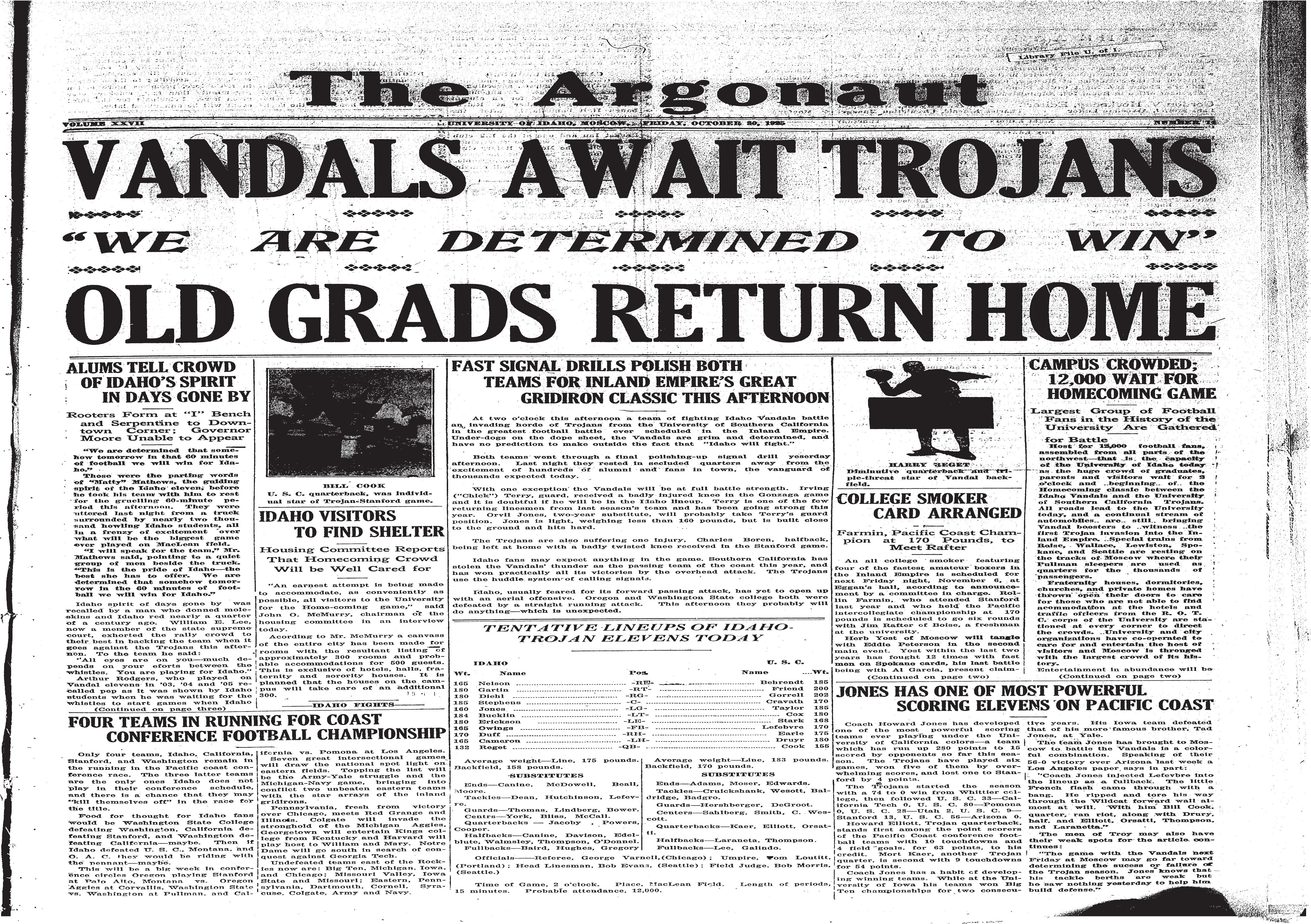
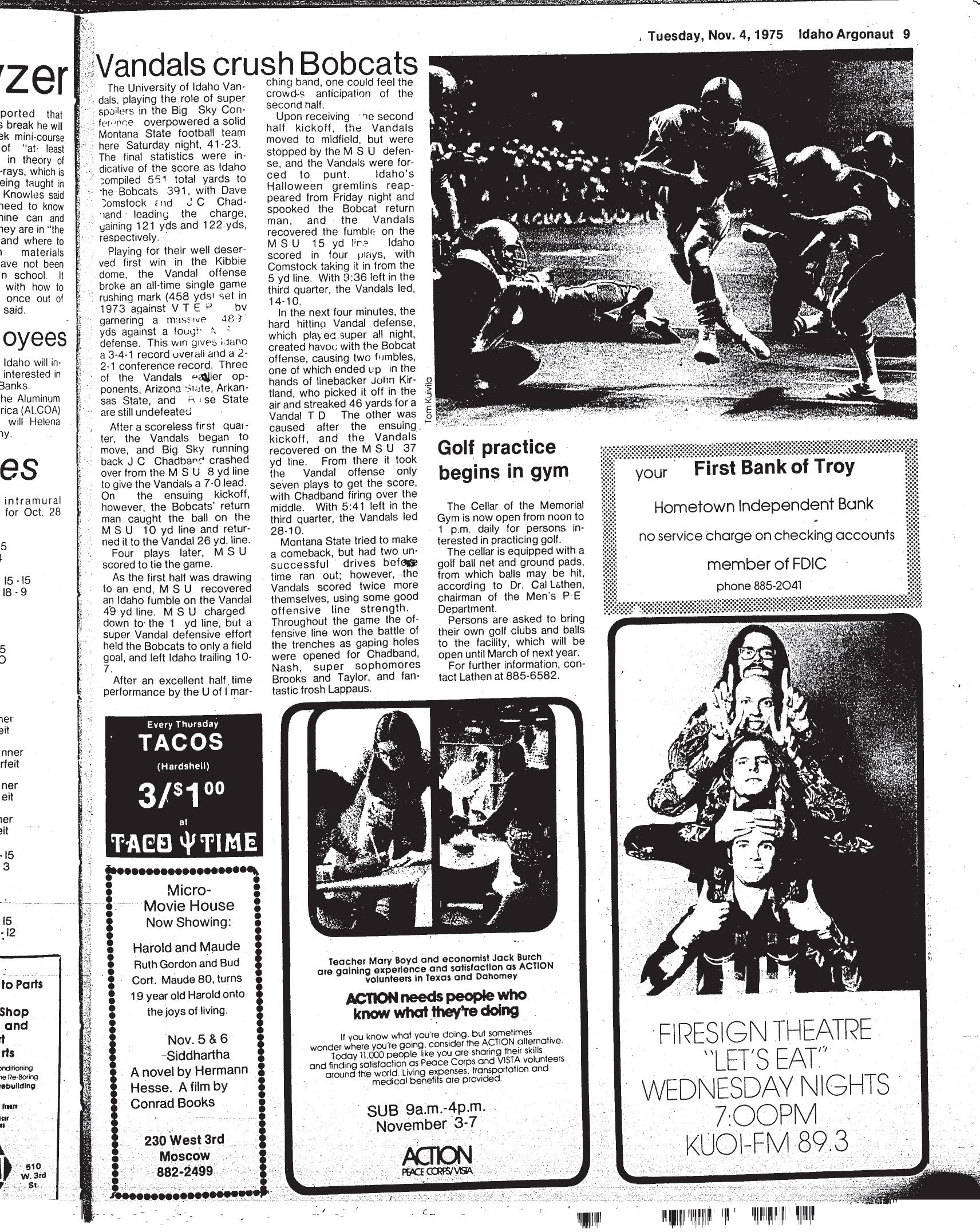
A Vandal football star from 125 years ago
Grand-nephew relates story of James Gibb, Class of 1902
Timmon Friel and Bart Jacquinet
ARGONAUT
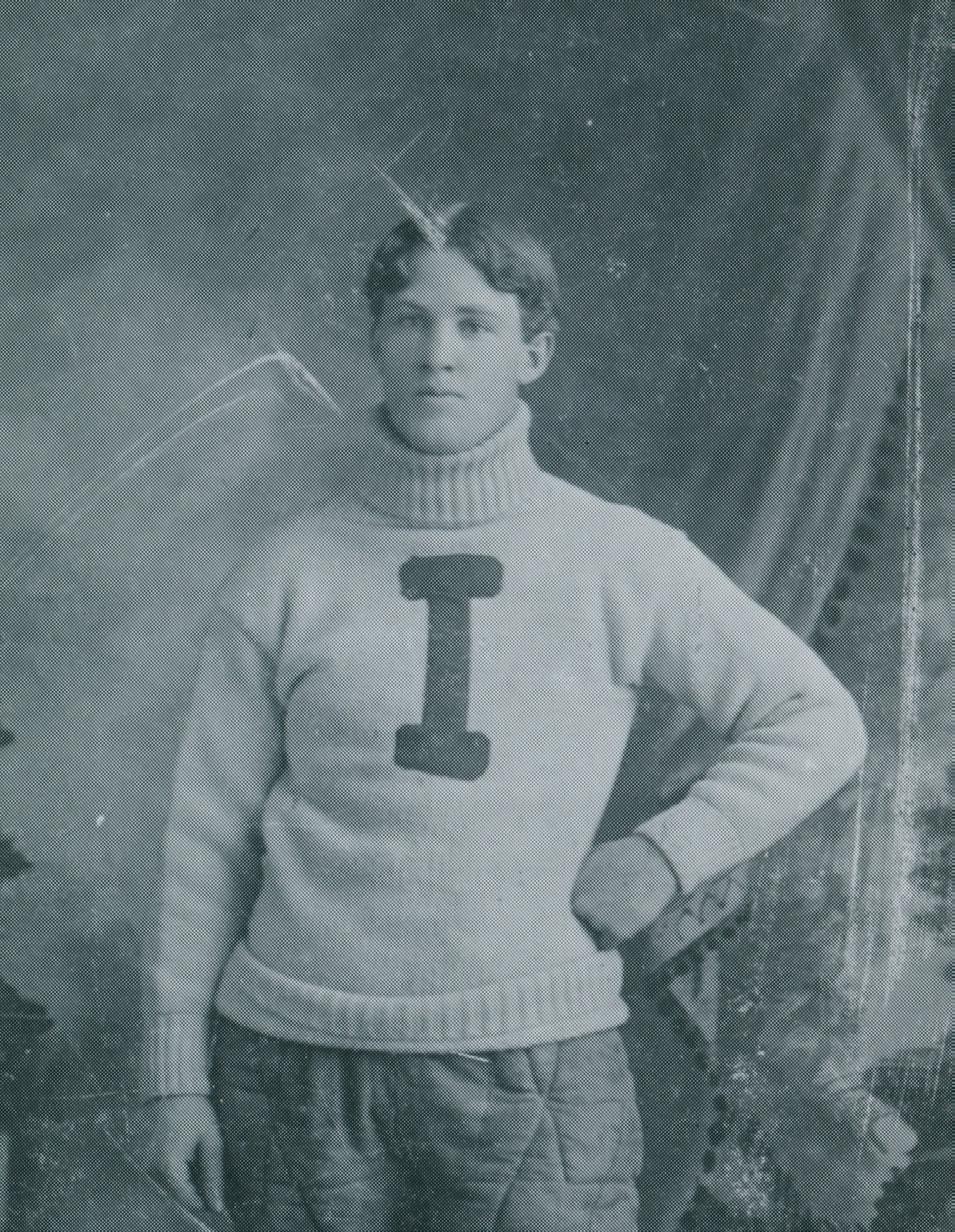
James Gibb was a phenomenal football player for Idaho from 1899-1901. He led the team as captain in 1901 and brought the Vandals key wins.
James Gibb was a multi-sport athlete with his brother, William Gibb. They played both football and baseball together.
James Gibb, nicknamed “Buck,” was a stud in football and was impactful for the history of the University of Idaho program. He was announced captain of the football team in 1901. He started playing for the Vandals in 1899, and his brother William Gibb joined him as well. James Gibb was a left halfback, which was equivalent to the current term of a running back.
Back in the 1900s, there was no forward pass, and the halfback was the player getting the ball most of the time. James Gibb ran either through the line or around the linebackers in dangerous styles of play. Football was very dangerous and this caused a lot of tactics to get banned.
Football gear during the turn of the 20th century was very primitive and had little protection compared to today.
Idaho played teams locally, and the furthest they ever went was Seattle. A neutral location was used for the 1900 Washington game, which was in Spokane.
Idaho won the game 12-6. James Gibb was called the “bright particular
star” in the 1899 game versus Lewiston by The Argonaut. In one of his “mad dashes” in that game, he “received a slight tap on the head rendering him temporarily insane.” He was then subbed out.
The Idaho 1901 team, which James Gibb captained, was led by Head Coach Fred Herbold. Idaho went 3-2-1 that year. James Gibb was a key player in Idaho history as he led Idaho to their first victory over Washington Agricultural College—now Washington State University—cementing his legacy as a Vandal.
Idaho also tied with Oregon, and lost to Washington after beating them the previous year. Now, Washington and Oregon are massive teams with millions of fans.
In 1901, The Argonaut said “Captain Gibb had good control of his men at all times.” James Gibb displayed his leadership and natural ability, proving why he was captain of the team.
The great nephew of James Gibb, Curtis Hermann, was very insightful on much of what he knew about his great uncle from the 29 years James Gibb was alive. Starting at Moscow Preparatory School along with his brother William Gibb and sister Mary Gibb, he chose the UI ROTC program in 1897.
“James’ father, in 1878, homesteaded ground south, 10 miles southeast of Genesee…that is about 50 miles from Moscow,” Hermann said in a Zoom interview. The family owned a plot of land in Moscow that they would live on in the winter, which is what started James Gibb’s commitment to go to UI.
James Gibb, shortly after enlisting into the ROTC, decided to volunteer for the Spanish-American war, in which he was one of the first volunteers. He enlisted at 5’9”, 152 pounds and was 21 years old.
“[When James Gibb] was shipped out, he got the mumps, and so he and Jim McClure came back to Idaho, where they both became football members,” Hermann said. Shortly after, they were moved from the San Francisco unit to the South Dakota unit. James Gibb was a part of the Old Guard and was shipped off on the Rio De Janeiro.
The unit saw the opening phases of the PhilippineAmerican War, and James Gibb was thrust into action. He fought before getting wounded in action on April 25, 1899.
“He had a cup that was attached to his knapsack, and the bullet went through his cup and through his shoulder,” Hermann said. He was discharged at Presidio, San Francisco. James Gibb’s story made such an impact that it created a deliberation of whether students should be sent to the war.
In 1902, James Gibb graduated with a Bachelor of Sciences from the mining department. After graduation, he accepted a job with Hercules Metals
mining company to become an assayer, where he gained the reputation of being one of the best in his profession.
Jerome Day of the mining company stated that his company couldn’t run without James Gibb. In 1907, James Gibb was elected president of the UI Alumni Board, where he served until 1908.
In 1909, James Gibb became unexpectedly sick, and it was discovered he had an aggressive form of appendicitis. Despite operation, James Gibb succumbed to appendicitis, dying unexpectedly at age 29 in the Gritman Medical Center in Moscow.
Idaho looks to soar against Eastern Washington Eagles
Vandals look to get back in the win column in rivalry matchup with Eagles
Jayden Barfuss
The Idaho Vandals women’s soccer team continues their Big Sky slate with a big-time rivalry matchup against the Eastern Washington Eagles after earning two much-needed positive results.
The Vandals started their conference slate on the wrong side of the table with a draw against Idaho State University and a disappointing 3-1 loss to Weber State. In the second week, the Vandals bounced back with a 2-0 win over Sacramento State. After three games on the road, they returned home to face the University of Montana, earning a 0-0 draw to move to 1-1-2 in Big Sky play.
The Eagles entered the contest with a 1-2-1 conference record and a 1-4-1 mark away from Cheney.
The Vandals are led by graduate midfielder Annika Farley, who is tied with junior forward Georgia Whitehead with a team lead three goals this season and will be a key piece of the Vandals’
midfield against the Eagles.
“I think just making sure that we keep it clean when we get tired, because that was definitely when we fall apart when we start to get tired and our touches just aren’t clean and we’re not passing to feet and giving the ball away,” Farley said. “When we get tired, we make stupid mistakes that just make our lives harder. We need to stay on top of that and make our lives easy, honing in on that aspect, I think then we’ll be fine.”
The Vandals’ front line, which has struggled at times, had a strong weekend with Whitehead scoring a brace against Sacramento State and redshirt sophomore Calli Chiarelli providing an assist.
For a group who are still young and learning how to play together, they have started to gel and get on the same page. The front line will be imperative to the Vandals’ success against Eastern and going forward in Big Sky play.
Defensively, the Vandals have been rock solid with eight shutouts this season, led by redshirt sophomore goalkeeper Paula Flores, who was awarded
However, in their last two games, they allowed 388 total yards on the ground. Playing against a Northern

Colorado team that struggles to run the ball, it is imperative for the Idaho defense to stop the run at all costs in this game.
Offensively, Idaho has been one of the best rushing teams in the Big Sky, averaging nearly 190 yards per game. After the Bears allowed 289 rushing yards against Idaho State, the Vandals, who will see the return of senior running back Elisha Cummings, will look to pound the rock early.
Though the defense has struggled as of late, the offense has taken massive strides forward since the season-opener against Washington State.
Joshua Wood has thrown at least 232 yards in three of four games
since the opener, and he threw his three longest passes of the season the last time out against Montana. He has 1,273 total yards through five games, and has done a great job of taking care of the ball, throwing only one interception on 130 attempts.
There will be all the typical homecoming events throughout the week leading up to the game, including serpentine and the annual Vandal Rally, accompanied by fireworks on Friday night.
“We’re excited to be back in the dome,” Ford said. “It seems like a long time since we’ve been back in the Kibbie Dome, but we’re excited to be in front of our home fans, especially for Homecoming.”
Big Sky defensive player of the week. Idaho will need to find the balance between great defense and offense in this game against the Eagles.
The Vandals will kick off against the Eagles at the P1FCU Kibbie Dome on Sunday, Oct. 13, at 1 p.m.
Curtis Hermann | Courtesy James Gibb was a star running back Idaho Vandals from 1889-1902
John Keegan | Argonaut
Midfielder Hallie Prinos-Grumbach controls the ball to make a move against Boise State
Reagan Jones | Argonaut
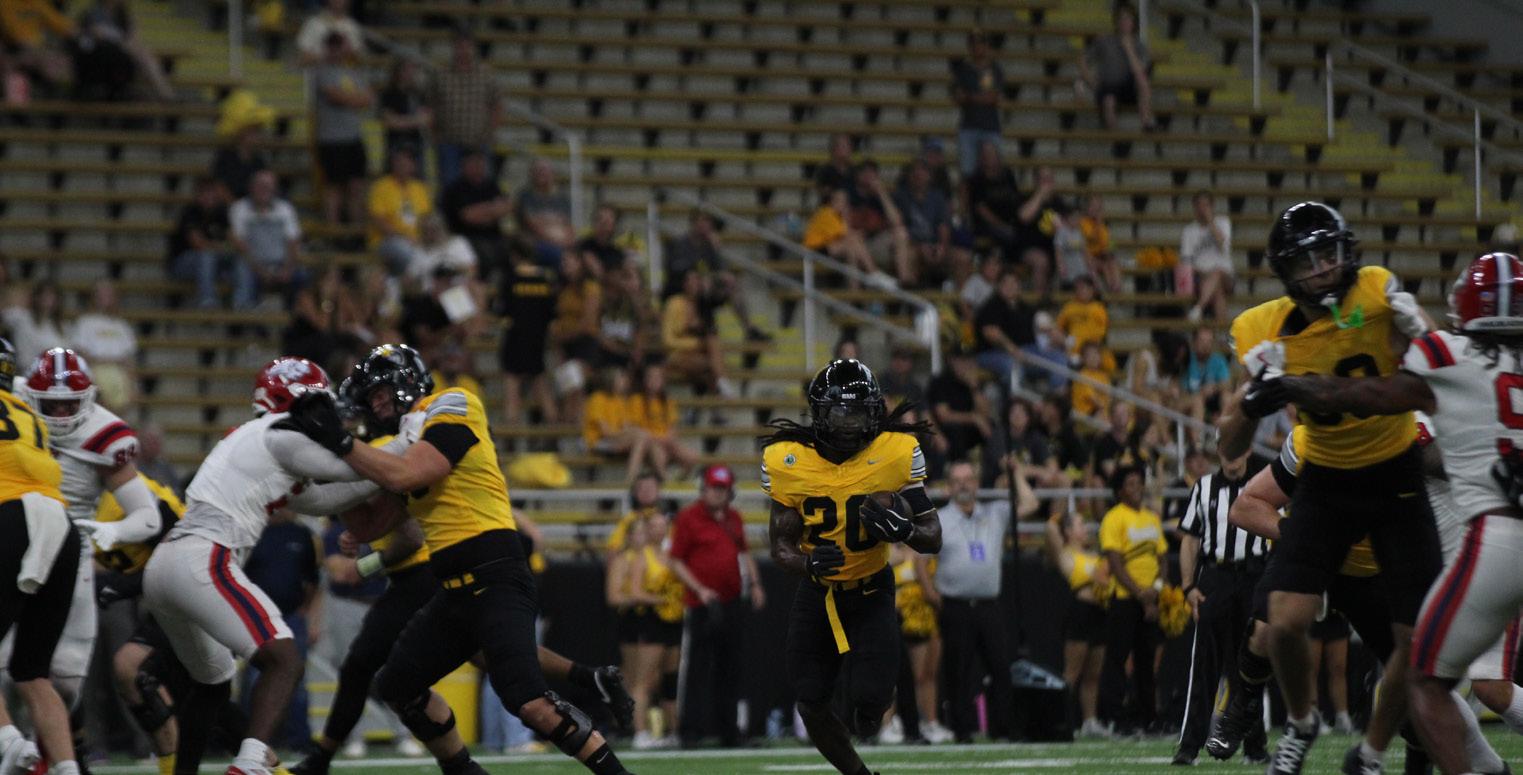
Running back Elisha Cummings runs into open space in game vs Ut ah Tech
More than a coach: Don Monson dies at 92, a Vandal until the end
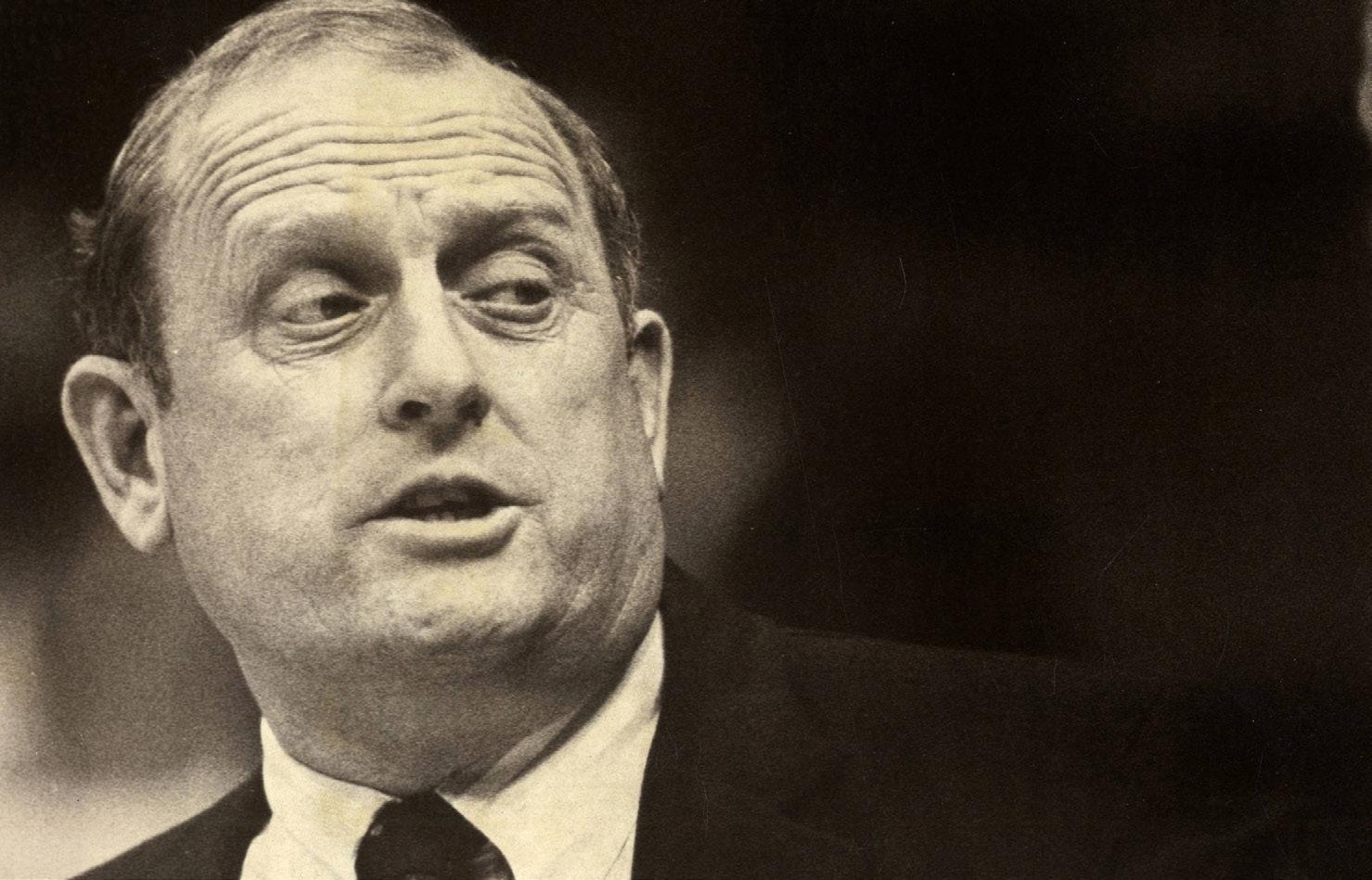
Monson’s legacy lives on throughout Idaho basketball
Jayden
Al Williams was a sophomore at North Idaho College in the spring of 1979 when he entered Don Monson’s office with a question: Could he walk on at Idaho?
Monson had just finished his first year as a Division I head coach with 11 wins and 15 losses. He was rebuilding. He had no scholarships left. But he looked at Williams and said, “I’m wide open right now. I can’t guarantee you anything, but I’ll give you a shot.”
The rest is now a bond that stretches back 46 years.
“He was a good person, a good family man, coach, mentor and, for me, a good friend,” Williams said. “He gave me a chance to fulfill my dream. I always appreciated him giving me that opportunity. He remained a friend and an impact on my life. When I became an athletic director, I would be able to call upon him. He was there for me, and it was nice that he was with us for as long as he was: 92 years, a pretty good run.”
Don Monson’s legacy was never about the wins. It was about the lives he changed.
The Coeur d’Alene native, who was not just a coach but a father figure and mentor to so many, died on Wednesday, Oct. 1, announced via his son’s social media, at 92, a Vandal until his final breath, proving that loyalty runs deeper than any game.
“Anybody that lives until 92 years
“He was a good person, a good family man, coach, mentor and, for me, a good friend,”
- Al Williams
old should be celebrated,” said Dan Monson, son of Don Monson and current head men’s basketball coach at
ball,” Pribble said in a Vandal Athletics press release. “He built this program into a powerhouse during his time here and impacted this university and this community in an incredible way. We are forever grateful for the foundation that he laid here. Our hearts are with the Monson family, along with the many players that he coached and impacted throughout his career.”
Five years that changed everything
Don Monson is a legend at the University of Idaho, and his five-year tenure changed the path of Vandal men’s basketball forever.
From 1978-83, Monson posted a record of 100-41, turning a program that went 4-22 the season before his arrival into a powerhouse with two NCAA tournament appearances and an NIT bid.
Fresh off helping Michigan State win a national championship as an assistant coach, Monson returned to Idaho, this time with a whistle around his neck and the weight of a program on his shoulders.
His first step was his first recruiting class, which included Vandal Hall of Fame members guard Brian Kellerman and forward Phil Hobson. Williams joined the following year, making the team and playing his final two seasons under Monson as the foundation came together in Moscow.
“As a coach, he was a fierce competitor, and I think that’s the way he was perceived by a lot of people,” Kellerman said. “To his players, he was hard, but in a good way. Off the floor, he was a warm, caring individual and a special person.”
Monson’s fierce coaching style and his hunger to win quickly rubbed off on his players. After an 11-15 start in year one, he improved the team to 17-10 in year two. That was only the beginning for the guys in black and gold.
In his third season, Monson led the Vandals to a 25-4 record and the school’s first trip to the NCAA tournament. Their magical season ended
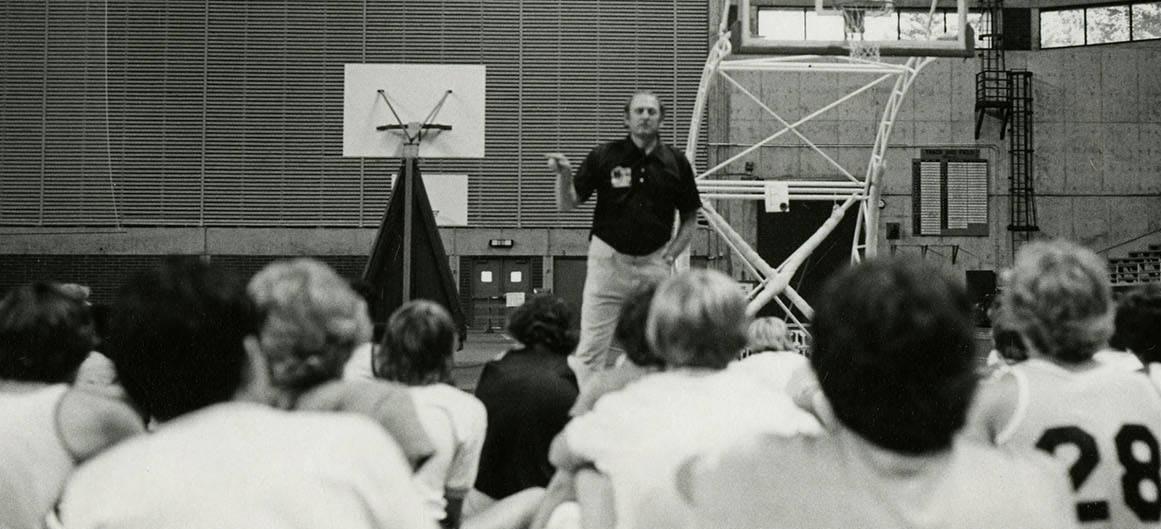
their season would end against Oregon State.
In Monson’s final year at Idaho, he finished 20-9 before taking the head coaching job at the University of Oregon.
Beyond the wins
The wins, trophies and banners were nice. But what Monson did for his players, both on and off the court, was what made him who he was and his legacy unbreakable.
“He did so much for so many people and impacted so many people in ways that other people never really knew about, beyond basketball,” Kellerman said. “He was a great coach, but a loyalto-the-core person, big-hearted. He was a father figure to a lot of players.”
Williams expressed similar sentiments and recalls his favorite memory of Monson and his superstitious ways.
“He was really superstitious,” Williams said, laughing. “If we had a winning streak going on, we had to make sure we stayed at the same hotel, whatever city we played at. Matter of fact, he even had his lucky underwear that he wore during winning streaks.
“I remember he would walk around the arena, we played in the Kibbie Dome, and he would take walks before the game. Unbeknownst to him, he was superstitious, so if he found a lucky coin on the ground, he thought it was going to be a good game. What he didn’t know was that the assistant coach on the squad at that time, Barry Collier, would strategically place coins around the Kibbie Dome. He thought it was going to be a lucky day, but he didn’t realize those coins were placed there by the assistant coach.”
A family legacy
Along for the ride throughout his coaching journey was his family: his wife, Deanna, and his three children, Dana, Dan and Darla.
Dan Monson was especially close to his dad, looking up to him both on and off the court. As he watched his father prowl the sidelines, a passion grew, a desire to be like him. All the lessons he learned led him to follow in his father’s footsteps and become a college basketball coach himself.
learned what it is to be a coach from my dad,” Dan Monson said. “There’s really a distinction there. To be a coach, you have to manage a lot of people, and every kid you can’t coach the same.”
“For my dad, I watched him take orange juice to players in the morning that were sick, or be there when their dads weren’t there, or discipline them for things that might not seem important to them. But he knew, as they grow up to be men…I learned so much from my dad. I went to every practice when I was a kid, and I just wanted to be able to impact other people’s lives as much as he did.”
Williams echoed the sentiment, remembering fondly his time playing under Don Monson.
“He was tough on us,” Williams said. “It was like tough love. He had to make us believe that we were winners and believe in ourselves first. He was able to bring that winning attitude to the program. It wasn’t easy. It was hard to play for him, I’ll be honest. But the ones that stuck around and believed in him and his program, as a coach, I don’t think his legacy will ever be surpassed in the history of Idaho basketball.”
A Vandal to the end
Until his final days, Don Monson was a Vandal.
Last weekend, Dan Monson went to visit his father, who asked him to pull up the Vandals football game on the iPad. It wasn’t on TV, so they had to stream it.
“I read somewhere where he proclaimed that he’s a Vandal for life, and he was a Vandal for his adult life,” Dan Monson said. “Last Saturday, I went down to see him, and he said, ‘Bring the iPad. I got to watch the Vandals football game, and it’s not on TV, so I got to get it on streams.’ He died a Vandal. And I appreciate what that means, because for him, he was very proud to say that.”
From the kid from Coeur d’Alene who grew up an hour and a half away, to the man who roamed the sidelines and led his alma mater, the team of his heart, to glory time and time again, Don Monson now rests.
But his legacy doesn’t rest with him. It lives in every player he gave a shot to. Every morning he showed up with because he cared too much not to. Every
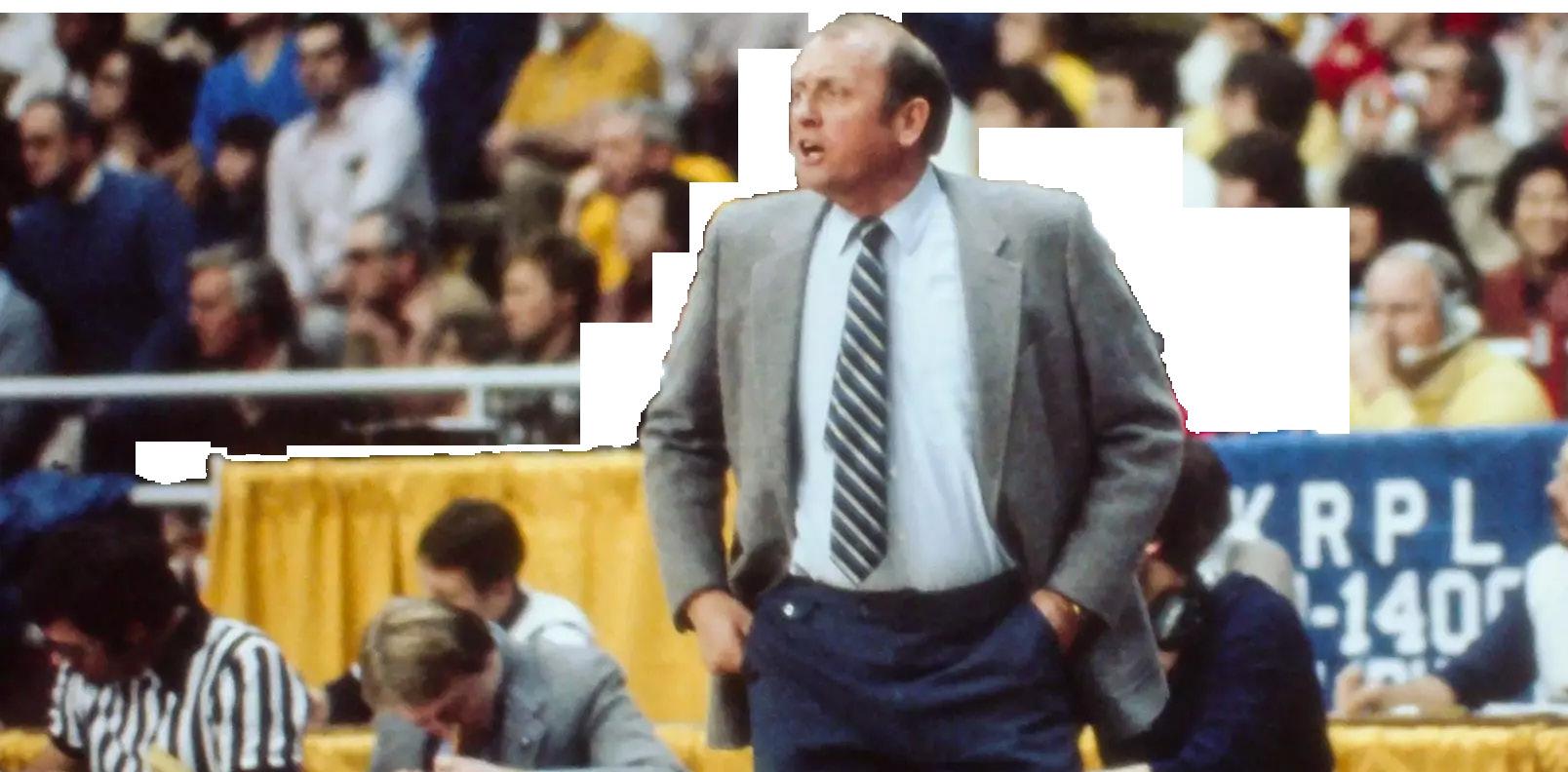
Archives | Argonaut
Don Monson was the Idaho basketball coach from 1978-83
Archives | Argonaut
Don Monson speaks to players at a summer basketball camp
Courtesy | Vandal Athletics Don Monson coaches from the bench
Georgia Whitehead shines in Black and Gold
Whitehead has been key to the Idaho Vandals
Jayden Barfuss ARGONAUT
Last fall, junior forward Georgia Whitehead was wearing crimson and black across the border for the Washington State Cougars. Now, she’s a key piece for the Idaho Vandals women’s soccer attack.
Whitehead was the difference maker this past weekend, with a twogoal performance against Sacramento State, finally breaking free from her bad luck with the crossbar and ending the Vandals’ scoring drought.
“It was obviously a fun day putting two goals in. My teammates set me up really nicely. It’s something that we needed,” Whitehead said. “We knew we needed to set a standard for ourselves after a rocky preseason and start to conference, so we knew we needed to set the standard high and keep that standard up. We were in a goal drought, so putting those two goals in was important for us, and I think it’s going to keep coming now that we broke that barrier.”
Head coach Jeremy Clevenger praised Whitehead for her brace and believes it raised the team’s confidence in the process.
“Georgia had a great day, and it was a really positive thing,” Clevenger said. “We needed to get the balls in the back of the net and give the team confidence. I think it was a good boost for our group.”
Whitehead also had a positive game against Montana on Sunday, Oct. 6, posting two shots—one that came mere inches from scoring.
A Coeur d’Alene native, Whitehead has been part of a revamped Vandal attack.
Through her career as a Vandal, she has logged three goals and has been one of their most dangerous pieces in the attack.
With Whitehead and the newly revamped front line gaining confidence, the Vandals could look a lot different heading into the back half of confence play and the Big Sky tournament.
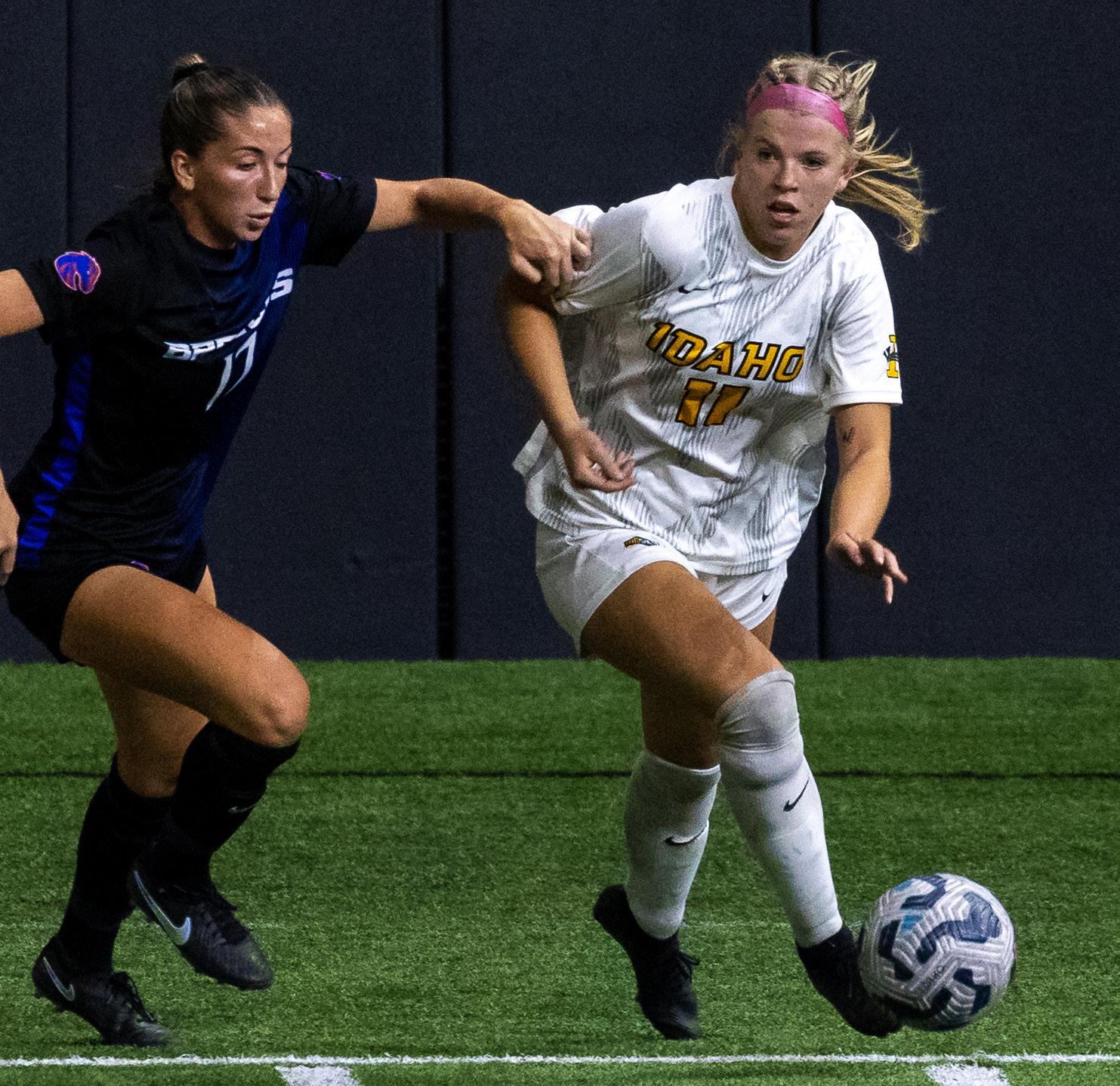
Isiah King leads Idaho into battle
tacklers from 2024, transferred, King became the most experienced returning linebacker on the 2025 roster under first-year head coach Thomas Ford Jr.
Behind every great collegiate defense, there are always one or two players who act as the anchor and lead the group in key situations. For the Idaho Vandals, that anchor is redshirt senior linebacker Isiah King.
“He’s an all-conference guy for a reason,” Ford said. “That guy comes to work every day ready to go. You saw his physicality, his length, his speed; he’s really the total package in terms of a second-level defender.”
King is a senior at the university, majoring in recreational sports tourism management. He was born and raised in San Diego, California. In 2021, he graduated from Montgomery High School, where he played wide receiver and safety.
Though his senior season was shortened due to COVID, King was first-team all-league as a junior after recording 25 tackles and three interceptions.
Despite being built more like a linebacker than a defensive back, he was recruited by Paul Petrino’s coaching staff as a safety. He played in three games during his redshirt season, accumulating three tackles to go along with a 20-yard reception.
After that season, Jason Eck took over the head coaching duties in Moscow, and King was moved to linebacker.
Since then, King has been a quintessential component of the Vandal defense as they earned their identity of constant physicality.
He played in six games as a redshirt freshman, finishing with 19 total tackles. This included a fivetackle game in the season finale, and a four-tackle game plus an interception against Portland State.
In his junior year, on a 2024 Idaho team that was very talented defensively, King played in all games but one, and was seventh on the team with 48 tackles. He also had two tackles for loss, a fumble recovery and two interceptions.
Though his 2024 season was certainly his best yet, King worked tirelessly all offseason to improve his game and make the jump from his junior to senior year. His main focus in terms of improvement throughout the offseason was tackling.
After Jaxton Eck and Zach Johnson, two of the teams’ top three
This is a very new group of guys consisting of a lot of freshmen and transfers, and King’s presence as a leader has been crucial.
“I just remember when I was a freshman, all the vets were helping me out,” King said. “It’s crazy just being in that position, being able to use my past experiences to help out these young guys and just help contribute wins to the football team.”
Prior to the season, King’s name always came up when Ford was asked who he looks for to lead his defense under a new coaching staff.
Ford loves the ferocity and the competitive edge that King carries with him in every snap.
“Isaiah is a special talent,” Ford said. “We all know it here. He does it at a very high level, and it’s not a surprise to anyone in our building.”
It didn’t even take one game for King to get back into the swing of things as the heart of the Vandal defense in 2025.
In the season opener against Washington State, King recorded career-highs of 10 tackles and two and a half tackles for loss.
Through five games, he has 36 tackles, five tackles for loss, one and a half sacks and a forced fumble.
Football and family have always gone hand-in-hand for King, who says he quickly felt a family-like bond upon his arrival in Moscow. King says his love for football developed when he was a kid and would watch his brother play.
“I have an older brother, and just watching him and going to his games, I just fell in love with it,” King said.
Aside from the obvious transition of going from safety to linebacker, King says the biggest change in his playstyle since his freshman year is his newfound football intelligence, specifically being patient in pursuit. He has made extreme strides in terms of mental growth as a Big Sky linebacker over the past few seasons.
He prides himself on his physicality and his speed, but also on his ballhawk abilities that he acquired through the years of playing wideout and safety.
Of all his moments donning the Vandal silver and gold, a few different moments from games against Big Sky rivals from Montana stand out to King.
He had an interception against Montana State in the FCS quarterfinals in 2024, and his favorite collegiate victory was winning the Brown Stein in 2023.
King is no stranger to personnel changes in the coaching staff, with this being the third different staff he’s played under at Idaho.
He said that despite most defenses running similar coverages, this year’s defense is more versatile than last year’s defense.
King said the culture throughout the program is pretty similar to how it was under Eck, but “we’re just a tight-knit group who cares about each other and we’re going to go to war for each other when it’s game day. Everyone on the team has a tight bond with each other.”
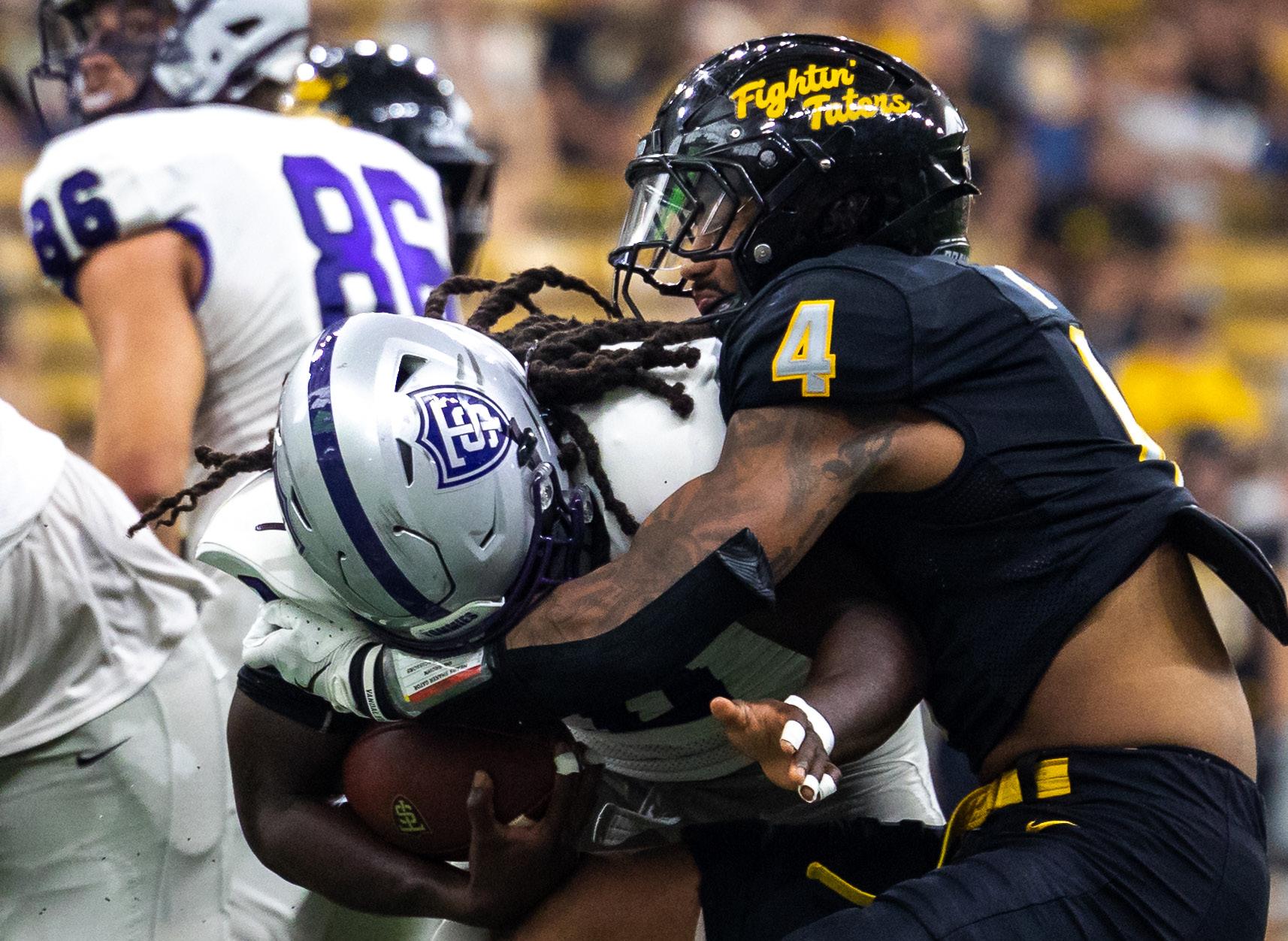
New beginnings for UI intramural sports
Jayden Barfuss ARGONAUT
With school starting, so does the fun of intramural sports. For the sports loving students at UI, intramurals can be a fun time to play a lot of different sports. New Coordinator of the Intramural and Youth Programs, Peyton Teevens, is excited about the new things she has planned for intramurals.
“We want everybody to come and play intramurals, there’s a space for everyone. I’m looking to add different sports and tournaments. More towards the end of the semester in spring, to hopefully help,” Teevens said. “It doesn’t have to be super competitive. That’s kind of the narrative I want to change.”
Session one of the intramurals is already in session. The next session’s registration, which includes kickball, ultimate frisbee, spikeball, volleyball, co-rec soccer and dodgeball, opens Oct. 13 and closes on Oct. 26.
Students can register either as a team or as a free agent on Imleagues.com for free, and if they have any questions, they can contact Teevens at pteevens@uidaho.edu.
Vandal Scoreboard
Jayden Barfuss ARGONAUT
Football
Watch the Vandals play the University of Northern Colorado on Saturday, Oct. 11, at 2 p.m at home.
Soccer
On Sunday, Oct. 12, the Vandals soccer team will face Eastern Washington University at 1 p.m at home.
Volleyball
The volleyball team plays today at Idaho State University, at 6 p.m., and on Saturday, Oct. 11, against Weber State at noon.
Women’s Tennis
The ITA Regional will take place Wednesday, Oct. 8, through Sunday, Oct. 12.
Women’s Swim
The women’s swim and dive team will compete at Northern Colorado on Saturday, Oct. 11.
John Keegan | Argonaut
Georgia Whitehead brushes by Boise State defender
Idaho LB Isiah King brings the hammer every game as a defensive leader
Liam Bradford ARGONAUT
John Keegan | Argonaut
Linebacker Isiah King tackling St. Thomas, running back





THE STUDIO
Podcasting


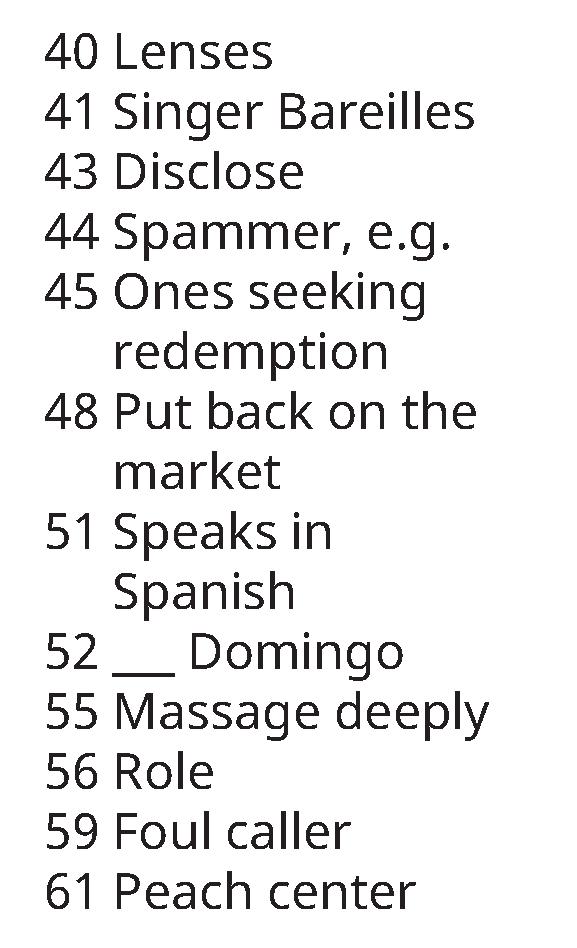



Homecoming is not just for students
Traditions for Homecoming should not exclude alumni
Lexie Yates
ARGONAUT
As Homecoming approaches, alumni book out hotels and prepare for the week-long event as they return to their alma mater to celebrate traditions that have been around since they were students. But does Homecoming really make everyone feel like they still belong?
Beth Ropski is four-time alumni of the University of Idaho, earning their two bachelor’s degrees from the College of Letters, Art and Social Sciences, a master’s degree from the College of Agriculture and Life Sciences and a Ph.D. from the College of Education, Health and Human Sciences and works as a case manager and adjunct faculty at UI.
“Many of the events feel like they target the younger college-aged demographic,” Ropski said. “While events like tailgating and the parade feel more accessible to all ages, it felt more awkward as an alumnus to enter the college space around the other events.”
Ropski also said that Homecoming is a different experience as an adult than when they were a student.
“I think that game-day experiences, like tailgating, are fun to share, but then offering events targeted at a variety of audiences would be nice as well,” Ropski said.
Jacob Navarrete, a senior studying political science, said he has never really been involved in Homecoming.
“Even though I am a senior, I have just never felt like Homecoming was something that I had much of an interest in,” Navarrete said. “I already am not too much of a football fan, and I am consistently busy juggling work, school and other activities. I felt like it wasn’t something I had too much stake in.”
Navarrete also said that he feels like Homecoming is more directed at students than alumni.
Lilyan Brizuela is the Homecoming royalty coordinator and a sophomore majoring in criminology and history.
“As of right now, I feel like Homecoming is for the students; however, there are definitely instances that I’ve noticed where it feels like the voices of the alumni outweigh the voices of the students,” Brizuela said. “That being said, the Homecoming committee actively voices the importance of student involvement and works hard to keep the Homecoming committee run by students instead of faculty.”
Brizuela said that she feels like Homecoming is more for students due to the events it features.
“Each event is meant to connect students and celebrate our Vandal pride. During the week of Homecoming, the role of the alumni is typically to judge and observe, leading the new generation to take the lead on the events,” Brizu-
Hoco safety is important
Drinking and driving remains a serious risk
AJ Pearman
ARGONAUT
As the University of Idaho gears up for another vibrant Homecoming week, the air around campus buzzes with excitement, marching band practices echo across the Palouse, the streets are painted with Vandal pride and alumni return to relive memories that shaped their lives. But amid the celebrations, there’s another reality that deserves attention: the rise in cases of driving under the influence.
Homecoming is one of the most anticipated times of year for students, alumni and Moscow residents alike. From parades to tailgates to the big game at the P1FCU Kibbie Dome, the week is a celebration of community and school spirit. Yet, it’s also a week when alcohol consumption is higher than normal, and that can have dangerous consequences.
Moscow Police Officer John Rosinsky explained that, while data doesn’t always show a consistent spike in DUI arrests during Homecoming week, the nature of the festivities makes it a riskier time. “I couldn’t necessarily say that they are higher or lower,” Rosinsky said.
“We know that Homecoming is a time where it brings our community together, where alcohol consumption may be greater, specifically [during] things like the Homecoming parade and the football game. Because, during football games, we know that you spend a lot of time with people drinking and tailgating. So, I would say that could be a possibility where the DUIs could be higher.”
Rosinsky emphasized that drinking and driving is taken seriously in Moscow, with a zero-tolerance policy. His advice to students and fans celebrating this week is simple but vital: create a plan. “If you are drinking during the tailgate, always have someone sober that you ride with,” he said. “Always
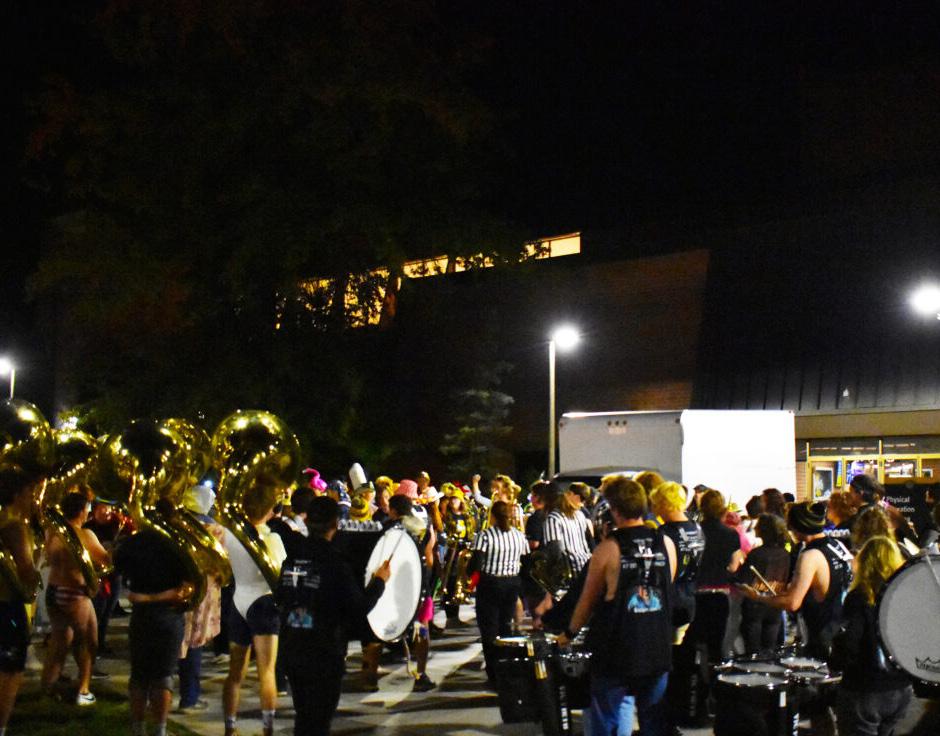
ela said. “One way I could see making the event equal for the students and alumni would be hosting events where the alumni participated,” she said. “I think this could be an interesting way to celebrate Homecoming that would tie the past to the future.”
Homecoming should be about more than football games and competitions. At its heart, it is about celebrating a community. While current students host the events and participate in them, alumni bring the legacy and financial support that help these traditions
have a contact with somebody who you can call, because in Moscow, drinking and driving is a zero tolerance, definitely within the police department.”
That reminder is critical especially in a college town where enthusiasm can easily blur into recklessness. While it’s tempting to believe that one drink won’t hurt, the reality is that even a small lapse in judgment can change lives in an instant. There are always campus resources to use like the Vandal Safe Walk or the student Lyft credits that renew every month. Make sure you know how you will be getting home if you plan to drink.
Drunk driving remains one of Idaho’s most persistent safety concerns. According to state crash reports, alcohol-impaired driving accounts for roughly one-third of all traffic fatalities in Idaho each year. Homecoming weekend, with its energy and emotion, creates the perfect storm for risky decisions particularly among young drivers.
Rosinsky was clear that Homecoming isn’t the root cause.
“I wouldn’t necessarily say the act of Homecoming is making people drink more,” Rosinsky said. “I think people are going to drink no matter what in the city of Moscow. I just think because of things that bring the community together again, like the football game and maybe the parade and stuff like that, those are a certain area, specifically more like the football game, where we’re going to probably see more people drink.”
In other words, Homecoming doesn’t cause the problem, but it can create the conditions where the problem thrives.
That’s where personal responsibility and community awareness come in. UI and local organizations often promote designated driver programs, safe ride options and public safety campaigns during big events. But those efforts only work if people use them.
Homecoming should be a time to celebrate the university’s history and pride, not a time when lives are put at risk.
continue on. There should be an equal chance for both groups to participate as they wish.
Students deserve a fun week full of traditions that are old and new, but alumni should have a chance to feel like they still belong. A truly successful Homecoming should bridge the gap between generations. As we celebrate Homecoming this week, it’s important to celebrate everyone—those who are experiencing Vandal pride for the first time and those who helped build what being a Vandal means in the first place.
Christ Church draws attention
Student group activities spark both support and criticism among students AJ Pearman ARGONAUT
The University of Idaho prides itself on being a place where diverse ideas can be explored freely, but one organization’s involvement on campus continues to stir debate about religion, free speech and inclusion. Christ Church, a conservative Christian congregation based in Moscow, has become a topic of contention for many students due to its active presence on campus through the student group Collegiate Reformed Fellowship.
For some students, CRF’s events and outreach efforts represent a welcoming space for Christian students to strengthen their faith and find community. For others, the group’s association with Christ Church raises concerns about exclusion, political influence and the blending of church and university life.
Matthew Gray, the student leader of CRF, said the group’s primary goal is to support Christian students who often feel isolated or criticized for their beliefs in academic spaces.
“There are many Christian students at UI,” Gray said. “Many of them feel that their faith is regularly attacked or ridiculed in the classroom. Christ Church, through the ministry of Collegiate Reformed Fellowship, seeks to encourage those students to not abandon their faith, but to grow and mature in it. We also encourage open discussion and debate between opposing worldviews. This is healthy for all, and I believe it adds the atmosphere of respect and freedom of thought, which should prevail in a university setting.”
CRF regularly hosts lectures and discussions through its “Colliding Worldviews” series, where students and speakers engage in debates over science, philosophy and faith. Gray said these events are designed to promote dialogue, not division. “Several times a year, CRF sponsors or puts on an event
in our ‘Colliding Worldviews’ Lecture Series,” Gray said. “Unfortunately, the one planned earlier this semester was canceled due to security concerns after the murder of Charlie Kirk. Students who value free speech and fair and open debate appreciate what we do and are glad to see us do it, even if they do not share our convictions.”
Still, CRF’s connection to Christ Church, a congregation that has faced controversy over its social and political stances, has made some students uneasy. Many on campus feel that the church’s conservative theology conflicts with the inclusive and pluralistic values the university promotes.
“I don’t mind religious groups being on campus,” said one UI junior, who asked not to be named. “But Christ Church has a reputation in town for being politically charged and outspoken about certain issues. It makes some of us feel like the university is giving them space to push those views on students.”
When asked about these concerns, Gray said the group’s mission isn’t political—it’s about challenging assumptions and creating opportunities for honest discussion. He also elaborated on why some students of faith feel tension in the classroom. “The prevailing worldview at UI is secular and built upon evolutionary assumptions,” Gray said. “The Christian faith asserts that there is a Creator and a distinction between the Creator and the creation. The theory of evolution is just that—a theory.”
Whether one agrees with Gray or not, his comments highlight the deeper question at the heart of the debate: What role should religion play in public education?
Christ Church’s campus involvement may make some students uncomfortable, but it also raises important conversations about the boundaries of free speech, faith and intellectual diversity. In a university setting where differing ideas are meant to be tested, debated and defended, that tension, however uncomfortable, might be exactly what higher education should provoke.
Ashley Kramer | Argonaut
Students attending the Homecoming event Serpentine last year
UI could do more to prevent illness
Better accommodations for sick students would help prevent the spread
Christopher Sprague ARGONAUT
Classrooms are often filled with coughs and sniffles, especially during the fall semester. By the next morning, students are waking up with sore throats or a headache but still need to attend classes.
Sickness and disease spread throughout campuses extremely quickly.
Calvin Williams, a freshman studying virtual technology and design, said, “I was mostly just sick with a sore throat, but I kind of couldn’t really afford to go miss any classes.”
This is a common student dilemma, attend class while sick because of attendance policies and exams or stay home and risk falling behind.
Sick students who attend class often spread colds and diseases to classmates. This is a big reason why it seems like everyone is sick on campus.
Charla Willis, the medical director of the Vandal Health Clinic, said, “When people come together to one place from many places, that is a classic time to spread germs. We are exposed to new variants of viruses that we haven’t seen before. So, the start of the semester often has more viral illnesses. Coming back from Christmas or spring break is also a classic time.”
One way to reduce the amount of common cold occurrences at UI would be to provide more options for students who are sick to prevent them from contacting other students. If more classes offered a Zoom meeting or recorded lecture where students can watch lectures from home, they could limit exposure to others.
Williams also said, “I wash my hands. That’s mainly it. I make sure to wash my hands before eating if I’ve been out a while.”
The best tried and true way of preventing the common cold is to wash your hands. According to the Centers for Disease Control and Prevention, washing hands reduces respiratory
illnesses, like colds, in the general population by 16-21%. If everyone washed their hands consistently, there could be a fifth less sick people on campus, which would hopefully mean that less illnesses spread to everyone else. “The best thing someone can do is to stay as healthy as possible,” Willis said. “Eating healthily, sleeping regularly, exercising. Avoiding smoking or vaping and any more than minimal alcohol. This gives your immune system and your mucosal barriers the best chance at keeping out germs or fighting the few invaders.”
The other good way to prevent infections is to get vaccinated, specifically the yearly flu shot. While the common cold and influenza are not the same thing, it is still a good prevention to be
aware of.
“The general ‘flu season’ is in cold weather when people are inside more, so the late fall and winter usually has a lot more influenza cases,” Willis said.
The Vandal Health Clinic starts offering flu shots in October. There are other places to get vaccinated in Moscow such as Walmart, Walgreens, Rosauers and Safeway. Many clinics offer free or low-cost vaccinations with insurance.
Another often-overlooked type of infection that gets spread around campus is sexually transmitted infections. These infections can also cause fevers, soreness and general illness symptoms, so it is important to be aware of what is going on with your body.
“We also see a lot of people at risk for sexually transmitted infections,”
Willis said. “It is so important to respect and care for yourself and others. Healthy relationships, not making decisions while impaired, communication; these are all a huge part of ‘safe sex,’ as much or more so than condoms and the decision about preventing some diseases with vaccination.”
STIs can be extremely dangerous, so it is important to engage in safe sex. If you suspect you have problems, you should go be seen by a medical professional.
Despite sickness running rampant on campus, there are easy ways to stay safe and healthy throughout the school year. If campus, classes and students can take extra steps to accommodate sick students, we could have a much healthier campus environment.
Countries should recognize Palestine
While most countries have, other countries refuse to
As more nations move to formally recognize Palestine as a state, the refusal by the United States, Israel and Japan to follow suit is becoming increasingly untenable. Recognition may not solve the conflict overnight, but continued delay sends a clear message: Palestinian statehood is not a right, but a privilege to be granted only when geopolitics allow.
More than 140 countries now recognize the state of Palestine, including recent additions like Norway, Ireland and Spain. The United Nations General Assembly upgraded Palestine’s status to
“non-member observer state” in 2021. Still, three of the world’s most influential democracies – Israel, the U.S. and Japan – refuse to recognize it as a state.
Each of these countries has its own reasons, but they share the common thread of resistance to unilateral recognition outside of a negotiated peace agreement.
Israel remains the most vocal opponent of Palestinian statehood. In September, Prime Minister Benjamin Netanyahu told his cabinet that “a Palestinian state will not arise,” and reaffirmed that Israel rejects all international moves to recognize one.
According to The New York Times, the Israeli government has long argued that such recognition “rewards terror-
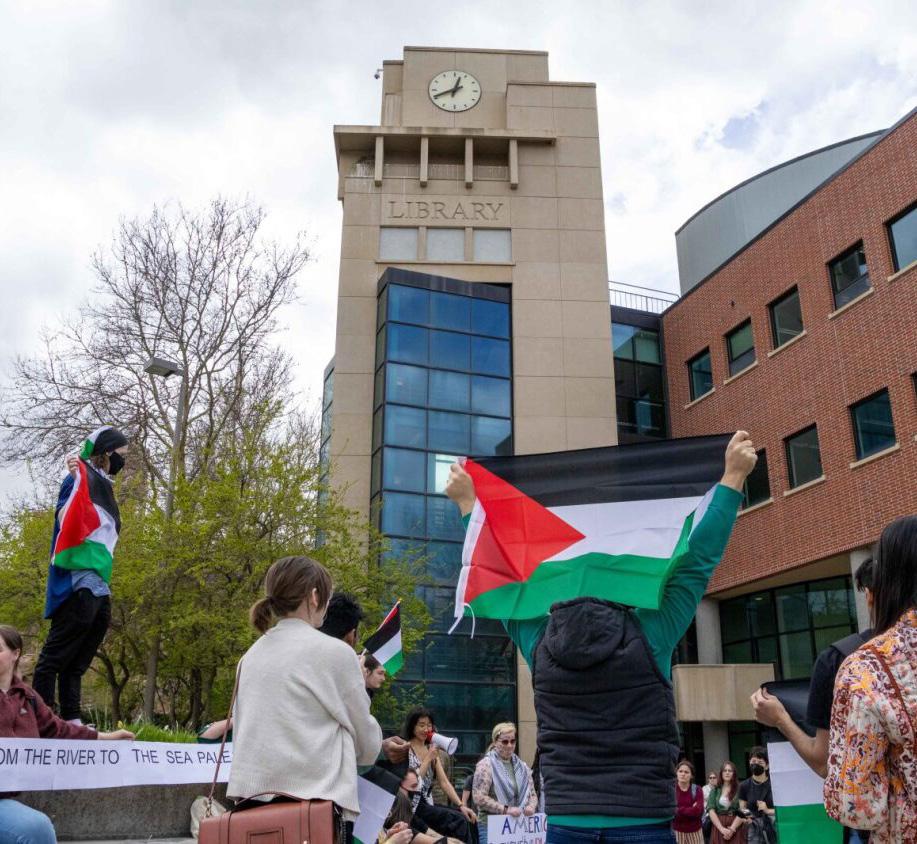
ism” and undermines future peace talks. In February, Israel’s cabinet passed a resolution declaring that recognition “would be a massive and unprecedented reward to terrorism.” The statement came just months after the Oct. 7, 2023, Hamas attack, which killed more than 1,200 people in Israel.
But recognizing Palestine does not equal recognition of Hamas. The Palestinian Authority, not Hamas, has been the internationally recognized representative body of Palestinians for decades. Conflating the two serves a political purpose: to block recognition and maintain the status quo.
The U.S. has long said it supports a two-state solution. But it continues to oppose recognizing Palestine outside of direct negotiations with Israel.
According to a U.S. Secretary of State report, “There can be no Palestinian state unless Israel agrees to it,” Secretary of State Marco Rubio said in August. Vice President J.D. Vance echoed that, saying the U.S had “no plans” to recognize Palestine and citing the lack of unified Palestinian government.
Yet in Congress, some lawmakers are pushing for a different approach. In September, Sen. Jeff Merkley introduced a resolution urging the U.S. to recognize a demilitarized Palestinian state alongside a secure Israel. “It’s the right thing to do,” Merkley said.
Japan’s position is more subtle, but no less consequential. In September, Foreign Minister Takeshi Iwaya said Japan had no plans to recognize Palestine during the U.N. General Assembly, though the country continues to support a two-state solution.
According to The New York Times,
Prime Minister Shigeru Ishiba later said that recognition is a matter of “when, not if.” Japan appears to be waiting for broader international alignment, and, like many U.S. allies, is reluctant to move ahead without American support.
Behind the scenes, Japanese officials admit their position closely follows Washington’s lead. According to Reuters, citing The Asahi Shimbun, Tokyo does not want to strain relations with Israel or undermine its diplomatic role in the Middle East.
Critics of unilateral recognition say it’s symbolic and does little to change facts on the ground. That’s partly true. Israeli settlement expansion, military control and lack of Palestinian sovereignty remain enormous obstacles. But symbolic acts matter especially when they challenge a decades-long imbalance.
Recognition isn’t a reward for good behavior. It’s an acknowledgement of a people’s right to exist within defined borders, with the same legal and diplomatic status afforded to others. Denying that right reinforces the idea that Palestinian freedom is conditional.
That idea is the heart of the problem. Peace cannot come from endless negotiations in which one party holds all the cards. Recognition of Palestine does not preclude talks; it sets the stage for them. It levels the diplomatic playing field, and it acknowledges the fundamental dignity of a people who have waited far too long for self-determination.
The U.S., Israel and Japan may believe they are acting with caution. Their inaction is a form of complicity. If they support a two-state solution, they should recognize both states, not just one.
Henry Halcomb | Argonaut Common items to relieve sickness in students
Things across the globe can remind of home
Familiarity can be found thousands of miles away
Paige Wilton ARGONAUT
When traveling abroad, or even from state to state, I believe a majority of people expect life to be drastically different in these new places.
In a lot of ways, new places do bring differences, but similarities occur between more places than one would think.
It’s no secret that culturally, cities and countries across the globe differ vastly from one another.
This is prominent — from the food they eat and the history they hold to the architecture that’s commonly featured and the varying lifestyles.
That being said, the more time I spend in places I’ve never been, the more I see similarities to my life at home.
Between the people I’ve met and the places I’ve seen in the month since I’ve left home, I’ve begun to see just how familiar new areas can become.
Regarding the Scotland landscape, it truly is a beautiful country. The lushness and greenery here can take the breath away easily.
However, I’m lucky enough to come from North Idaho, where we get to enjoy so much of the same natural luxuries.
Once a week, I hike up Dumyat Hill behind the University of Stirling campus, and each time I climb it I’m reminded more and more of home.
So much of the fauna, insects and weather is familiar to me in that way—it acts like a comfort at times.
I find the same familiarities in people. Though stereotypes can be harmful and do not represent anyone

fully, they exist as a way to group people together based on common traits.
The most common college student stereotypes, I’ve come to realize, can be found across college campuses worldwide.
The University of Stirling has a strong emphasis on athletics, which many people are involved with. There are even Olympic gold medalists currently studying here.
Though the student athlete population engages in different sports, like rugby and polo rather than American
football and basketball, many are reminiscent of the student athletes I’ve met at home.
I’ve found many similarities between the down-to-earth people that I’ve met here at the Garden Club and in the on-campus thrift store to the people I’ve met through the College of Natural Resources and the outdoors program in Moscow.
Even the flat mates I live with, though we all come from unique backgrounds and places, remind me of parts of my friends from home. This was
something I found to be unexpected, but it serves as a nice reminder that no matter our differences, we’re all connected in some way.
Ultimately, the life of a college student has more similarities across the world than people would think. We’re all here with the goal of getting an education in a field that interests us while wanting to enjoy our free time and our youth as much as possible.
The world offers a lot of variety, but if you look close enough, you can find bits of home everywhere you go.
Don’t Wait, Vaccinate!

Flu Clinic Hours: Tues- 8:30-11:15 Wed- 8:30-11:15 & 1:30-4:15 Thurs- 8:30-11:15 ASUI Address
The

The Vandal Health Clinic is excited to be able to offer flu vaccinations to students starting October 1st!

Schedule your appointment by:
• Patient Portal
• Calling the Clinic
• Walk-ins*
*Please note, due to limited space, scheduled appointments are preferred*
• Ask during your appointment with our medical providers

doesn’t wait, and neither should you. scan here to log onto

Paige Wilton | Argonaut A view from the top of Dumyat Hill in Stirling, Scotland
Africa Night celebrates community and culture
This year’s theme “Wazobia” emphasizes the strength to be found in diversity
Miriam Moore ARGONAUT
On Saturday, Oct. 4, the African Student Association held the annual Africa Night event at the International Ballroom in the Bruce M. Pitman Center. Emcee Ronald Bentil, a third year Ph. D. candidate in entomology at the University of Idaho, welcomed guests, ensured every child in the audience had coloring pages and introduced the ASA president and UI graduate research assistant, Listowell Darko. Darko donned an orange traditional Ghanaian kente wrap over his shoulder. He prompted the audience to open their “hearts to the rhythm, colors and tastes of Africa” and promoted the night’s theme: Wazobia.
“Wazobia” is a combination of the word meaning “come” in three African languages, “wa” in Yoruba, “zo” in Hausa and “bia” in Igbo. It was first used by Nigerian radio broadcasters in the 1970s to appeal to the country’s three main ethnic/language groups. Now, it is a term that symbolizes community and diversity. Each time Bentil called out “wazobia” the audience responded in turn, “I am because we are.”
The meaning of this was explained by ASUI president and member of the ASA, Seyi Arogundade. “Our strength is in our unity,” she said. She emphasized that “community will create long lasting effects.” Arogundade was followed by keynote speaker Dr. Dora Mtui, the laboratory services manager at the UI College of Natural Resources. Mtui called Africa Night “a night to showcase how great Mama Africa is.” She chronicled her experience moving from Tanzania to the U.S. as a student and encouraged other international students to create community and seek out resources. Mtui stressed the importance of fighting for the future of the African continent and shared an
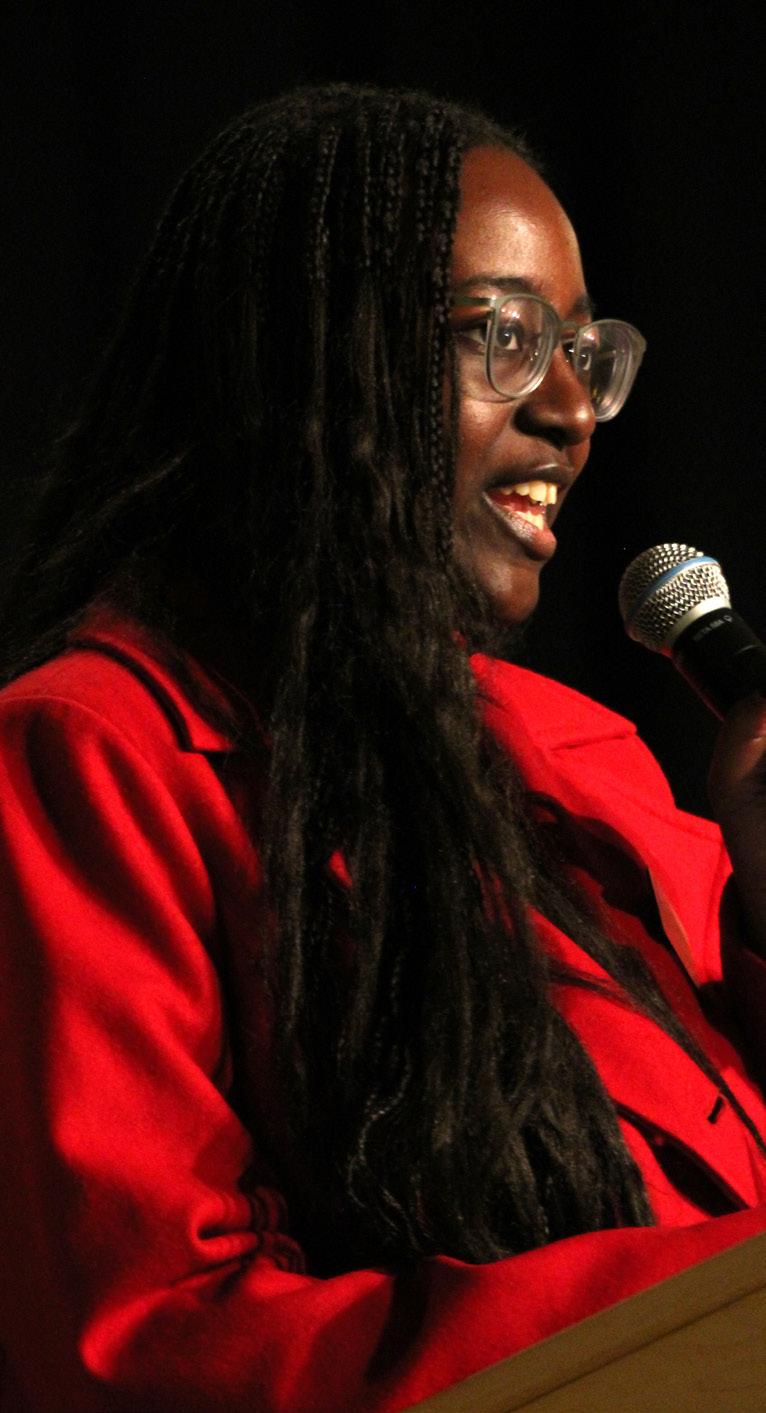
adage from her father that emphasized the importance of community. “If you going to go fast, go alone. If you going to go far, go together.”
Following Mtui’s remarks was the flag parade. Students from 20 African and Caribbean countries waved their flags as Bentil presented a slideshow highlighting population, number of languages and historical kingdoms of each state. At the end, every participant held their flags on the stage in a powerful display of strength in diversity. As food was served, a great array of dishes from across the African continent from Ghanaian hibiscus juice sobolo to the Nigerian egusi stew made with melon seed, goat meat and mackerel, Kwesi Asare recited a poem. His performance was emotional and promoted pride in African heritage. “Let our stories be heard, let our presence be felt,” he said.
The Washington State University Krimson Kouture dancers in blue pattered wrap skirts preceded the jàmá music and dance performance. A jubilant chorus of a dozen men, among them Bentil and Darko, sang a call and response song with such authenticity and pride that attendees spontaneously joined them on stage for a heavily layered performance of chanting, singing and drumming that lasted over fifteen minutes.
Immediately after, the ASA honored three members for their commitment to the association: Sodiq Yusuf, Bentil and Olugbenga Gideon. Gideon, in a purple patterned Nigerian Ankara, shared his gratitude for the opportunity “to share the culture of the huge continent of Africa with our hosts” in Moscow.
Professor Romuald Afatchao gave closing remarks, noting the African community is “here in Moscow as a family.” Bentil followed him sharing a translation of a Ghanaian adage, “when an elderly man speaks, the matter is finished.” The room was turned into an open dance floor until the end of the event.




Reagan Jones | Argonaut
A high-energy performance by the group JAMA during Africa Night
Reagan Jones | Argonaut
The Washington State University Krimson Kouture group takes the stage to perform
Reagan Jones | Argonaut
Food is dished out to hungry attendees
Reagan Jones
| Argonaut
The flag parade rushes the stage, displaying flags from 20 countries across Africa
Reagan Jones | Argonaut
ASUI President Seyi Arogundade speaks