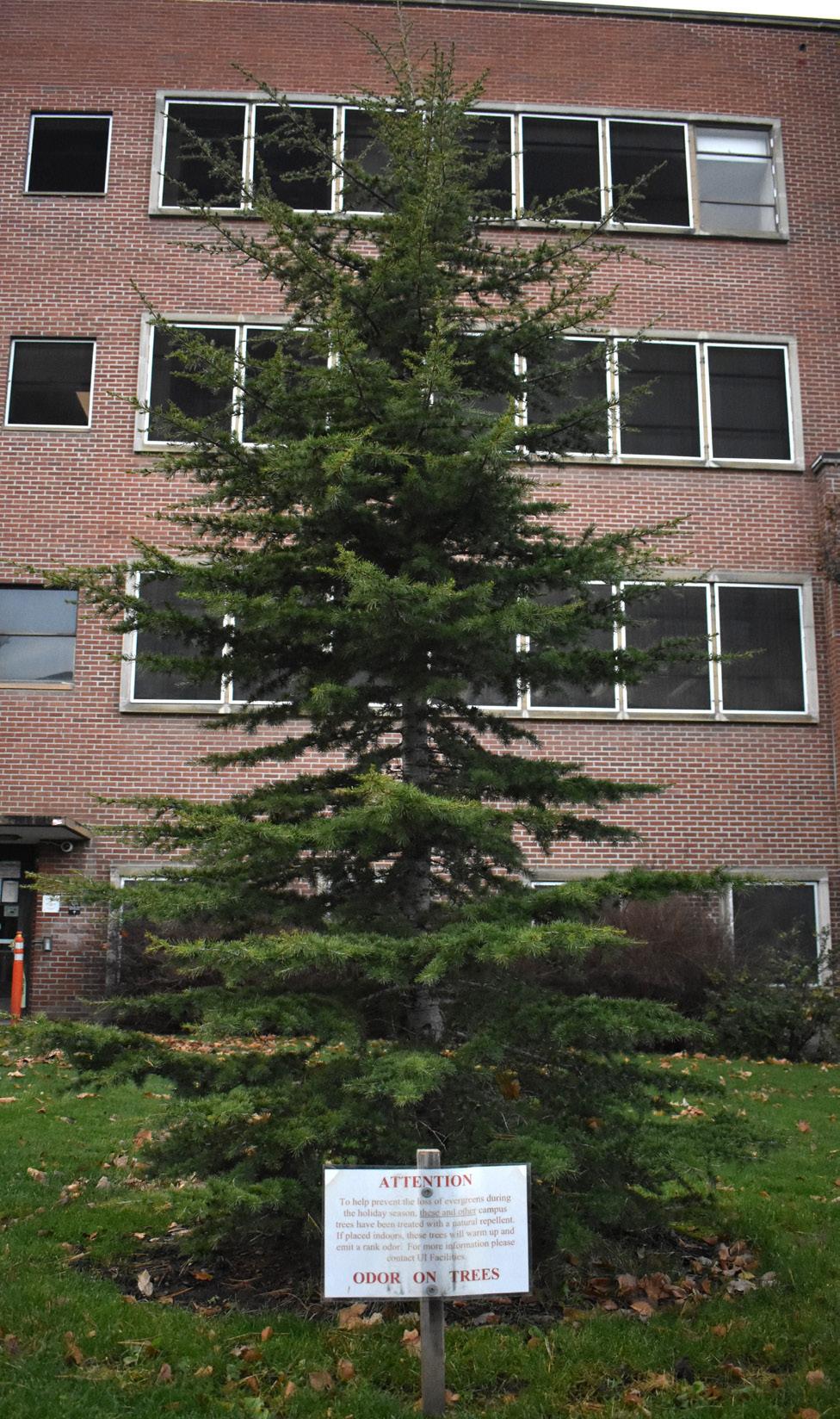
Facilities have sprayed skunk musk on campus trees to prevent theft. This anti-theft tactic, along with signage posted by smaller Christmas tree-sized evergreens around campus, was implemented in 1990 because of an annual average of four to five evergreen trees cut down and tree-napped around the winter holidays every year.
The repellent is non-volatile in the cold weather and does not affect passersby, but when brought inside the home and warmed to room temperature, the rancid smell of skunk musk releases. This stench can also seep into furniture and fabrics, making it a stinky holiday season.
Between 20 to 25 “smaller, easy to access” trees are sprayed all around campus every year, according to Craig Carson, the director of grounds and facilities.
Tree theft from private property has already been reported in Moscow this year by Moscow-Pullman Daily News, when a 12-foot tree was stolen from the 1400 block of Sunnyside Avenue around midnight on Wednesday, Dec. 3.
An alternative to treenapping is to cut down a tree on Idaho public land.
Permits can be obtained online or at Idaho Bureau of Land Management offices located in Boise, Twin Falls, Idaho Falls and Coeur d’ Alene and cost $1 with special pricing that will last through Jan. 26, 2026. Normal prices ranges from $5-$10 depending on the region.
There is a limit of three trees per person, a height limit of 20 feet and other restrictions, which can be read on the Idaho Bureau of Land Management website.
There are also U-Pick Christmas Tree farms around Moscow, such as Spring Valley Family Tree Farm, West Twin Tree Farm and Moscow Tree Farm.
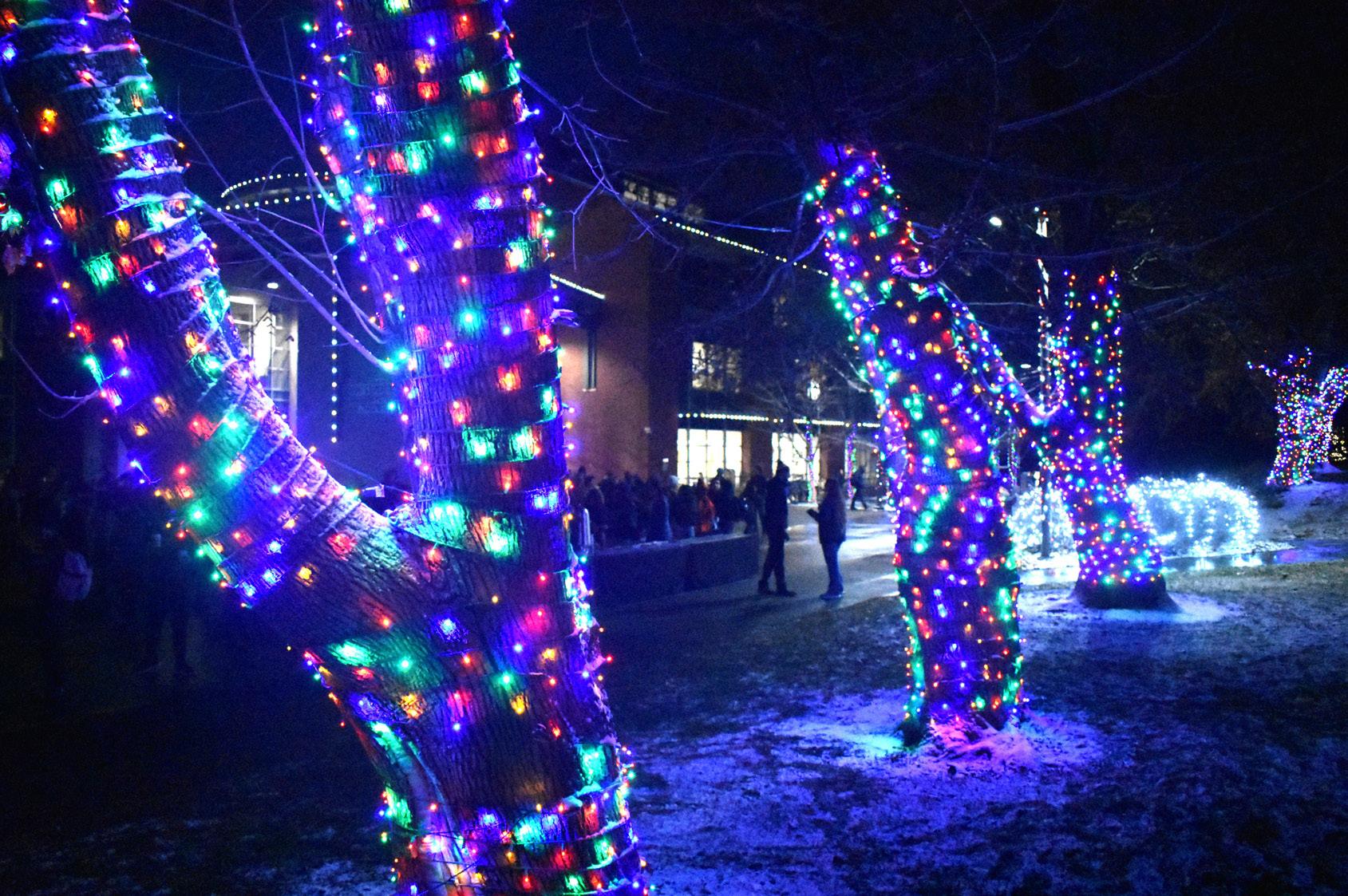
Other than anti-theft prevention, trees and signs for the holiday season, UI also decorates the campus with Christmas lights and other holiday decorations.
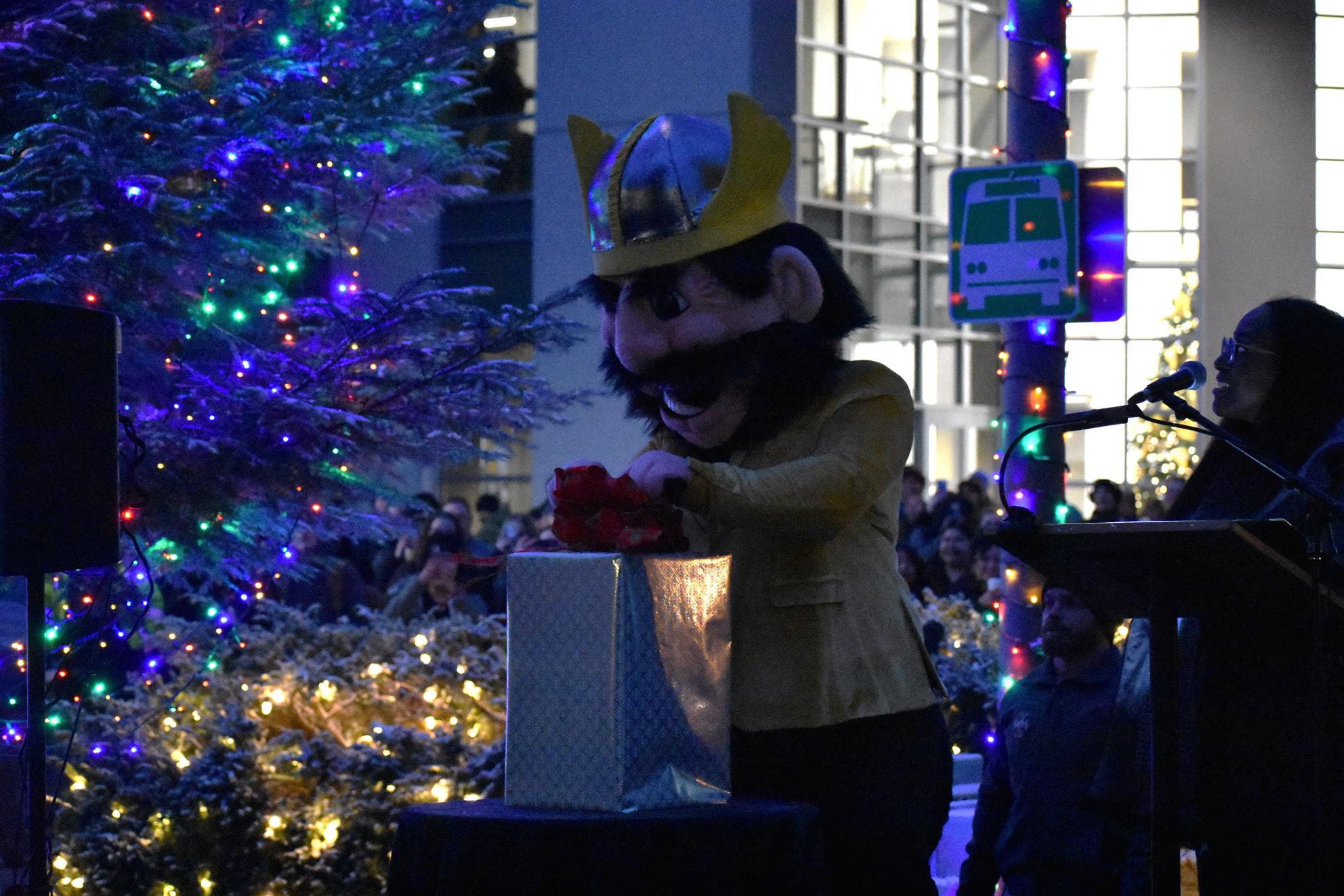
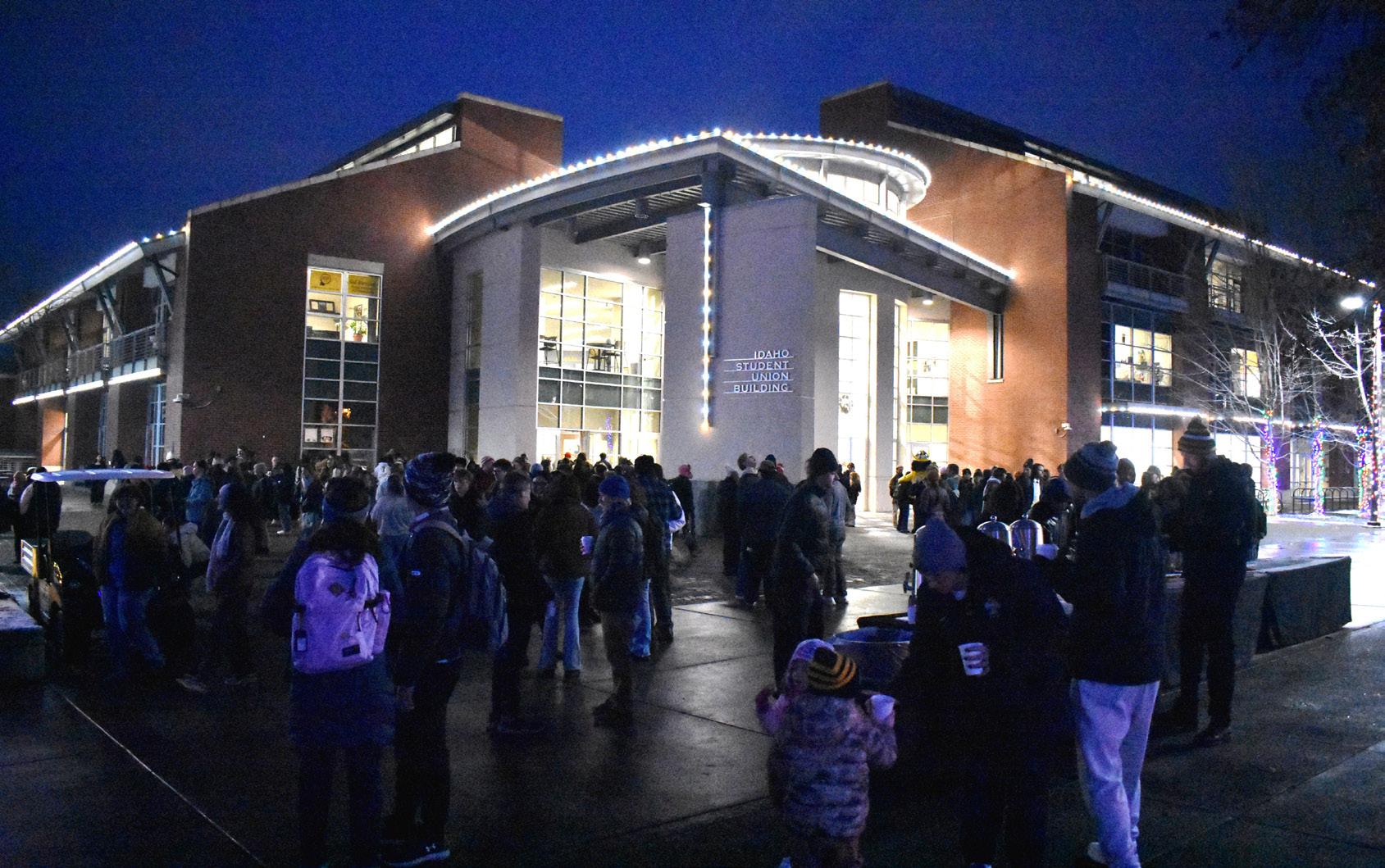
On Dec. 1, UI lit up the ISUB plaza with a towering evergreen Christmas tree. There is also a Vandal themed tree inside the ISUB and plenty of Christmas lights set up around campus.
“Since the ISUB tree went in, we want to keep that the focal point of the holiday season,” Carson said.
The safety of the tree itself is a priority for UI. Carson said the hardest part of decorating is ensuring it is being done safely without damaging the tree.
Director of Finance Lance Butikofer.
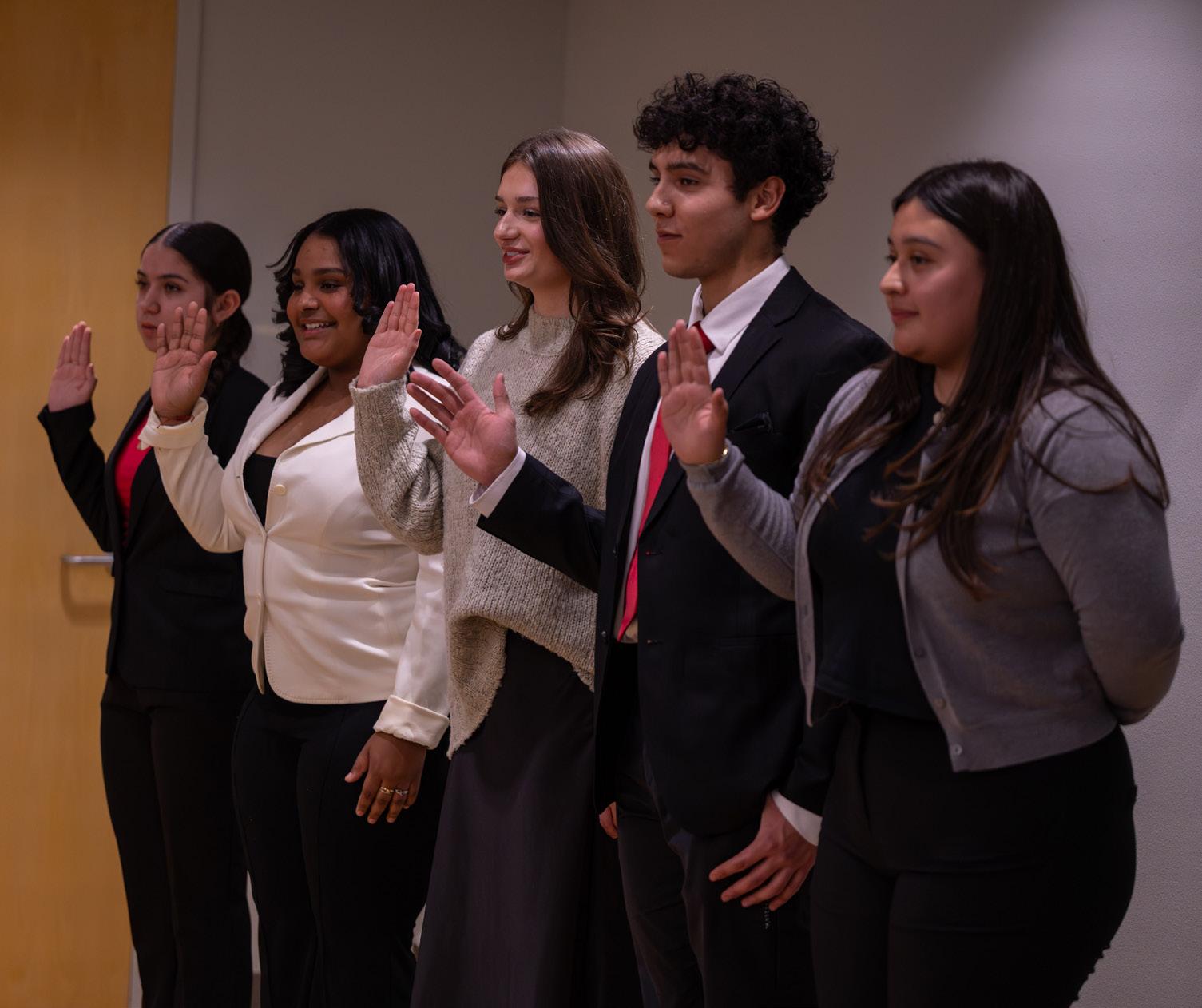
ASUI Senate election results were announced at the Dec. 10 meeting, with Envee Carter, Caroline Crow, Emilie Guardado and Saul Lorenzana elected as new senators and Sen. Andrea Leal re-elected for her second term.
ASUI also passed four resolutions commemorating the work of outgoing Sens. Izaak Krohn and Zoha Aqeel, Senate Adjutant Logan Michener and
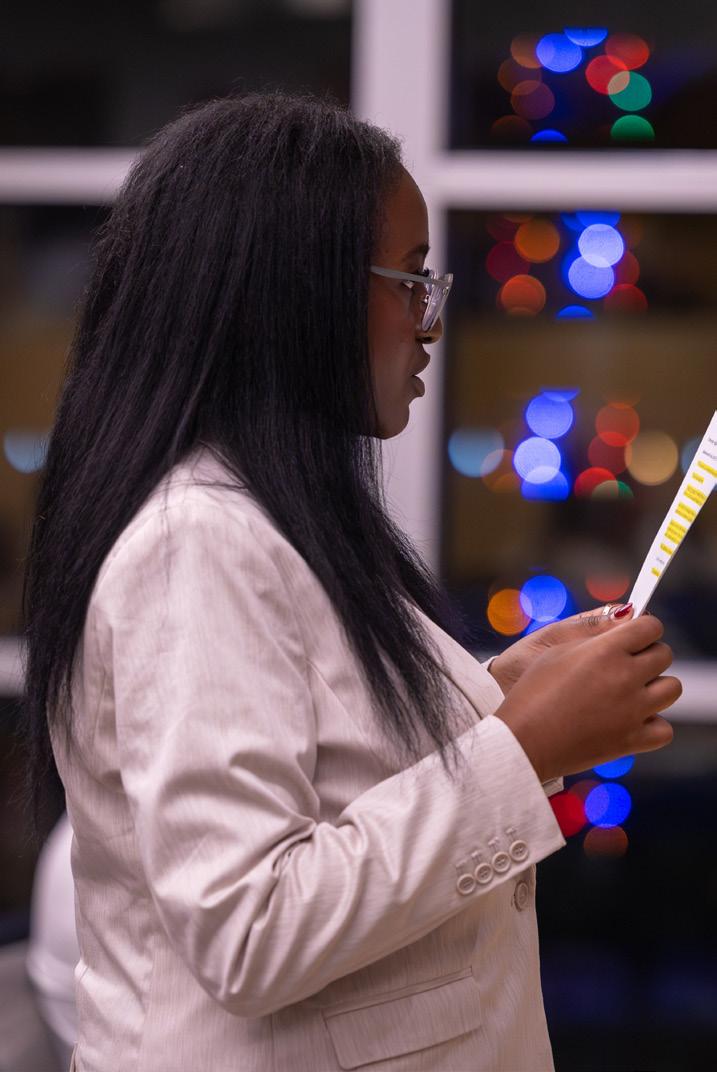
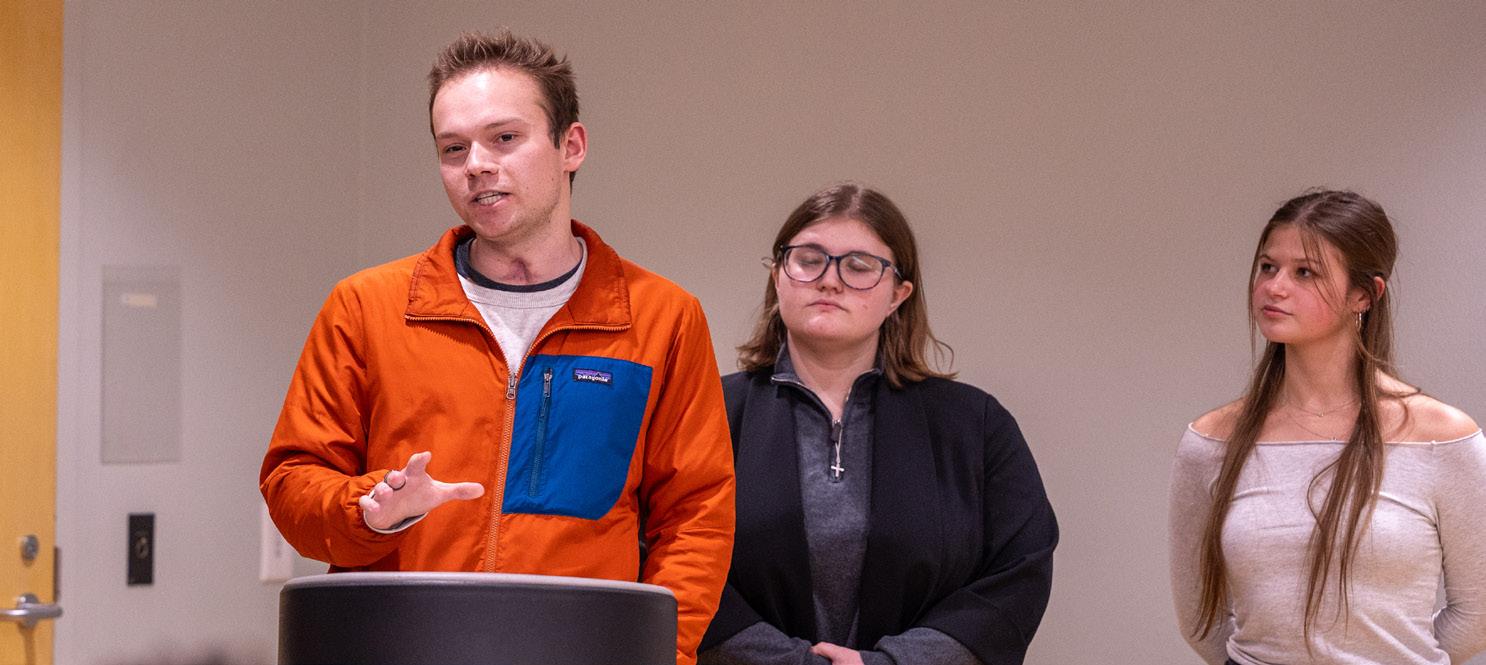
Bill F25-B20, a bill giving funding to the UI Photography Club, was heavily debated on. President of the UI Photography Club Theo Schultz spoke at public forum to clear up any confusion about the club’s 501 (c)(3) status. This status will exempt the club from federal income taxes and make them eligible for tax-deductible donations from donors.
“Last Wednesday, one of the senators brought up a really good question about ASUI sponsoring Photography Club as a 501(c)(3), saying that would be too political for
ASUI to engage with. I just wanted to address that really fast,” Schultz said. Schultz stated that Photography Club would include in its bylaws that the club wouldn’t be able to take funding from political entities.
“When I brought up the 501(c)(3) status, I was not concerned that you were going to become a political organization. But being a non-profit is, in its essence, a political organization, so that kind of opens the door to other organizations to pursue that,” Sen. Zac Knapp responded.
During debate on Bill F25-B20, sponsor of the bill Sen. Frances Camilli addressed Knapp’s
concerns. “I want to highlight [that] the main purpose of pursuing a non-profit status is long term sustainability for the club. It allows the group to accept donations, apply for grants, etc., which all means less dependence on ASUI. They’re setting themselves out to be selfsustaining,” Camilli said. Butikofer gave his official recommendation on the funding of this bill, saying, “paying for non-profit status is just not the kind of expense that falls under the scope of ASUI, and we don’t pay for organizational expansion in that kind of way.”
The University of Idaho’s Winter 2025 Commencement will be held on Saturday, Dec. 13, at the ICCU Arena in Moscow. Two ceremonies will be held at 9:30 a.m. and 2 p.m. respectively, with the ceremony attended depending on the graduate’s college. Attendance is voluntary.
There are currently 145 students registered to attend the morning ceremony and 134 students registered for the afternoon ceremony. A total of 602 UI students applied to graduate this fall. Of those, three will graduate with
associate degrees, 406 with bachelor’s degrees, 166 with master’s degrees, 28 with doctoral degrees, one with a specialist degree and eight with juris doctorates.
Another 74 will receive academic certificates and two will receive specialist certificates, according to Rebecca Frost, assistant registrar at UI.
The 9:30 a.m. ceremony will be for those graduating from the College of Agricultural and Life Sciences, College of Business and Economics, College of Engineering, College of Natural Resources and the College of Science.
The 2 p.m. ceremony will be students graduating from the College of Art and Architecture, College of Education, Health and Human Sciences, College of Law and the College of Letters Arts and Social Sciences.
Tickets are not required
for commencement
ceremonies and general seating is on a first-come, first-served basis. Academic regalia, commonly called a cap and gown, is required when participating in UI commencement ceremonies.
Graduates should arrive and be ready for the lineup one hour and fifteen minutes before the ceremony’s start time, according to the UI commencement FAQs. There will not be a rehearsal. Doors will open at approximately 8 a.m. for the morning ceremony and 12:30 p.m. for the afternoon ceremony to allow additional time for guests to go through the necessary security checks.
Graduating students should come dressed and are not permitted to have bags. UI will be enforcing its clear bag policy and conducting bag checks at all entrances for the
ceremonies. Guests will be allowed to have clear bags no larger than 12 inches by 6 inches by 12 inches, or non-clear wristlets, clutches, wallets and bags no larger than 4.5 inches by 6.5 inches. For a list of allowed and prohibited items, visit the UI venue polices website.
Flowers and memorabilia are available for preorder from The Commencement Group online. All orders will be ready for pickup at the ICCU Arena entrance on the day of the ceremony. Photography will be provided by GradImages, which will reach out to graduating students a few weeks following commencement regarding accessing ceremony photos. The ceremonies will be live streamed starting at 9 a.m. and 1:30 p.m. PST for each ceremony at uidaho. edu/newsroom/live.
Aubrey Sharp | Argonaut
Joe Vandal opens a present at the Dec. 1 tree lighting ceremony, “Winter Nights Under Vandal Lights.” See Gallery on page 16
Aubrey Sharp | Argonaut
odor when brought indoors
Butikofer officially recommended giving $400 to Photography Club, due to a precedent set by other club funding requests. The final amount awarded to the club was $800, and bill F25-B20 passed.
Bill F25-B19, giving the Real World Politics club $500, was passed without debate. During discussion, Camilli, sponsor of the bill, said, “When I first met with Madi [Madison Tisdale], the club’s president and founder, it was obvious how much time and
energy she spent into building something that will genuinely help students. The club is creating a space where students can learn about real-world issues without pressure.”
F25-B21, a bill reimbursing the International Students Organization $250 for the Thanksgiving dinner they held during fall break, was also passed.
ASUI is adjourning for the semester, and the Senate will reconvene on Wednesday, Jan. 21, 2026. This meeting will be at 7 p.m. in the Clearwater-Whitewater room in the ISUB. Meetings are open to the public.
UI faculty senate votes on academic changes across multiple colleges
Wendy Couture and Jessica McKinlay, proposed converting undergraduate law emphases to certificates for Juris Doctor students. This would create no new courses or costs and passed unanimously. Discussion concluded that certificates offer clearer credentials and align better with current ISBoE practices.
The University of Idaho Faculty Senate approved 17 University Curriculum Committee items regarding degree modifications, name changes, new programs and curricular updates.
Delivered by Steve Wang, UCC 615 proposed a new master’s degree in AI. The degree would use existing faculty and resources and be offered both in person and online. Concerns were raised by the senate that additional faculty may be needed if enrollment grows but passed unanimously.
Presented by Eric Mittelstaedt from the Department of Earth and Spatial Sciences, UCC 486 proposed changing the name of the climate change and solutions Bachelor of Science major to climate sciences and solutions, due to a request by the Idaho State Board of Education. Concerns were raised about political influence on course naming and academics. The item passed 18–2.
UCC items 175 and 602, given by
UCC 194, delivered by Sean Butterfield, director of the Lionel Hampton School of Music, proposed adding a new emphasis for non-auditioned students focused on contemporary music, digital audio workstation use and guitar. This was intended to address the need for broader access to applied music and passed unanimously.
Presented by Brian Fowler from the Department of Movement Sciences, UCC 280 sought to rename the sport and recreation management program, update the curriculum and change the Classification of Instructional Programs code to reflect a focus on sports management. The item passed unanimously. CIP codes are federal codes used for reporting, data collection, funding and tracking higher education programs.
UCC 301 passed unanimously to remove outdated courses, adding new courses and updating the CIP code for the operations and supply chain management major. UCC 294 was approved unanimously
The Argonaut
to add an online course content option for the sociology major with no curricular changes. UCC 3 proposed adding a Professional Golfers of America management option to the accounting major to align with other business majors and passed unanimously.
Delivered by James Moberly from the Department of Chemical and Biological Engineering, UCC 168 proposed a reduced credit load for the chemical engineering major. It aims to clarify catalog language and adjust to the ISBoE’s 120-credit requirement policy and passed unanimously.
UCC 613, presented by Shauna Correy and Xiao Hu, proposed a new interdisciplinary program for architecture, engineering and business, focusing on design-build integration. The senate debated whether the program should be housed in the institute undergraduate curriculum committee or the college. They also discussed general education recommendations versus requirements and the need for further review. The item passed 15–3, with the housing issue pushed to future discussion.
The UI Faculty Senate will meet every Tuesday throughout the remaining fall and spring semesters to discuss academic policy and campuswide events. Meeting agendas and minutes are available through the UI Faculty Senate website.
Ski resorts open late amid snow shortage
Warm temperatures bringing rain for most of December
Anna Capello ARGONAUT
The Thanksgiving break of 2025 saw no measurable snowfall, delaying the ski season. Last year, several resorts opened in November, with Lookout Pass opening the earliest on Nov. 8. Others followed at later dates; Brundage Mountain and Schweitzer opened Nov. 22, while Silver Mountain followed the next day.
This year, the resorts pushed back to December due to the lack of snowfall. Schweitzer opened on Dec. 3, followed by Lookout Pass opening only a few trails on the Dec. 5, Brundage is doing a preview on Dec. 7, and Silver Mountain only opened the beginner’s hill on Nov. 29, awaiting additional snowfall.
“Late snowfall is something that we’ve been used to for the last couple of years. Not enough coverage directly affects our training and performance every year,” said Patrick Du, president of the University of Idaho ski team, in an email interview with The Argonaut.
The team is hoping for more snowfall for the ski season. “Two years ago, we couldn’t even put our skis in the ground without hitting rock or dirt,” Du said.
Unfortunately for the Vandal ski team, snowfall will not happen until the second half of December, with rainfall predicted though Dec. 16, according to the National Weather Service.
Up to 2.86 inches of rain could fall during the month of December as temperatures remain between 39 to 55 degrees Fahrenheit through the weekend. Ski mountains such as Lookout Pass are forecasted to have heavy precipitation with temperatures between 38 and 42 degrees Fahrenheit though Friday, Dec. 12, and will not reach freezing temperatures for at least another week.
Temporary closures have been put in place as a result of changing weather patterns. Check weather forecasts and resort status in advance.
•
•
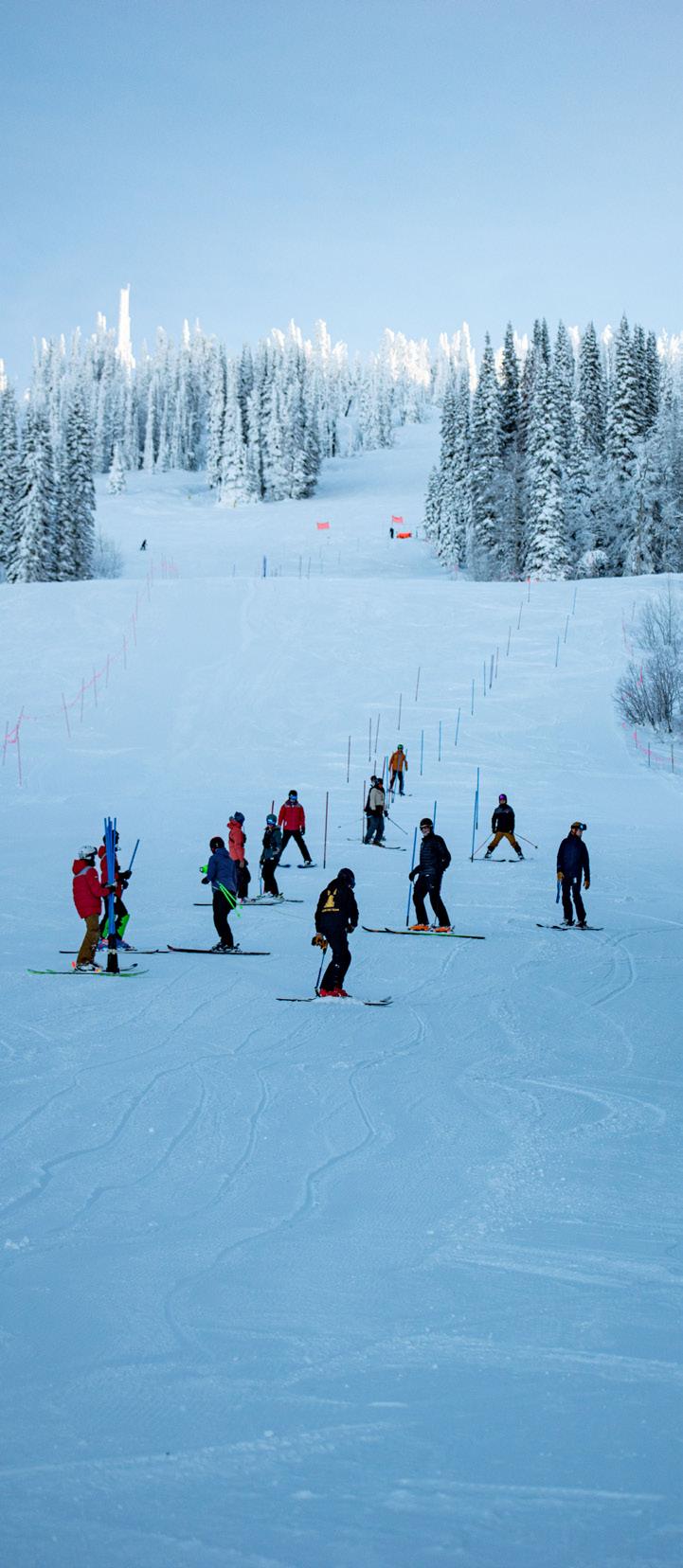
Joshua Reisenfeld | Argonaut UI and WSU ski teams set up slalom course on Brundage Mountian
Colton Moore | Argonaut
President Seyi Arogundade swears in new senators
Colton Moore | Argonaut
New senators get sworn in: left to right, Emilie Guardado, Envee Carter, Caroline Crow, Saul Lorenzana, Andrea Leal
Colton Moore | Argonaut UI Photography Club President Theo Schultz speaks during public forum
Colton Moore | Argonaut Lance Butikofer gives offical recomendation on Bill F25-B20
Idaho CAFE allocated an additional $3 million
Congressman Simpson backs UI dairy research
Scarlet Herway ARGONAUT
Idaho Congressman Mike Simpson announced on Nov. 13 that $3 million has been included in community project funding to the University of Idaho-led Idaho Center for Agriculture, Food and Environment in Rupert, Idaho.
The funding is to build a flexible manure handling system and develop manure-research infrastructure to evaluate manure separation and nutrient extraction technologies, according to Simpson.
Idaho CAFE, which is currently under construction, aims to address the lack of large-scale and applied research that could help Idaho’s dairy and agricultural industries improve sustainability, increase efficiency and strengthen environmental policy decisions.
The center is currently in phase two of construction with plans
to begin milking the first cows in early 2026, starting with 400 cows. It is estimated to cost $45 million by its completion and is located on 640 acres.
“Idaho CAFE is intentionally designed to be a teaching and research hub that integrates undergraduates at multiple points,” said Leslie Edgar, Dean of the College of Agricultural and Life Sciences, in an email interview with The Argonaut.
Idaho CAFE is designed to provide hands-on experience at a commercial scale that mimics real-world operations for students.
With a 2,000-cow research dairy, students will be able to work with modern technology such as a rotary milking parlor, precisionfeeding systems, environmental monitoring tools and data management systems.
The facility is expected to support wholefarm systems research that connects dairy operations with soil science, water management, renewable energy and crop production. Students will also have additional access
to undergraduate internships focused on dairy management, animal nutrition, forage systems, environmental monitoring and animal health.
“Idaho CAFE directly aligns training with the workforce needs of Idaho’s largest agricultural industries. Students will gain experience that employers consistently request but that has been difficult to provide on campus until now,” Edgar said.
The facility will give students on-site access to industry partners, UI Extension specialists and faculty, along with hands-on experience in data analysis and sustainability for business and food science students.
Key funding for the CAFE includes $23.25 million from the Idaho Board of Land Commissioners from the sale of endowment land in Caldwell, Idaho that UI no longer used for experimental farming.
In March 2019, land was purchased for the dairy in partnership with the Dairymen’s Association who gave $2 million to match UI’s land-sale proceeds for
the site purchase. Private donations, such as $1 million from Chobani, and significant contributions from others including Simplot, Power Engineers and the Idaho Farm Bureau Federation, totaled around $9 million.
Additional funding includes $2 million in community project funding, secured by Simpson in 2024 and $1 million in 2023.
Idaho legislature appropriated $10 million in 2017, which pays out $250,000 each year in ongoing maintenance funding.
Idaho is the fourthlargest dairy-producing state in the United States, with herd sizes averaging 1,600 to 2,000 cows.
Idaho producers are working toward net-zero emissions by 2050, aiming to balance greenhouse gas emissions with those removed from the atmosphere.
UI’s 58th annual Idaho Potato Conference to be held in January
Talks on water management, soil borne illnesses and concerns
Joise Adjanohoun ARGONAUT
The 58th annual Idaho Potato Conference and Eastern Idaho Ag Expo, presented by the University of Idaho, will be focused on water management, soil borne illnesses and updates from the leaders of the Idaho Potato Commission. The conference will be held Jan. 21-22, 2026, at Idaho State University in Pocatello, Idaho, with speakers and an adjacent trade show, which will have over 70 booths. The conference will be held from 8 a.m. to 5 p.m. on Jan. 21 and 8 a.m. to noon on Jan. 22, in ISU’s Pond Student Building.
Registration costs are $40 per person before Jan. 14, and will increase to $50 for
Joshua Reisenfeld ARGONAUT
Break bus tickets available for Boise route; Idaho Falls sold out
Vandal Break Bus tickets to Boise are still available for winter break, and tickets to Idaho Falls and Boise for spring break 2026 are available online through the parking and transportation website.
The Boise round trip route will cost $165 for winter break and $135 for spring break. The bus will stop at New Meadows, Weiser, Payette, Caldwell, Nampa, Meridian and Boise.
The Idaho Falls round trip route will cost $200 for spring break. The bus will stop at Mountain Home, Bliss, Twin Falls, Burley, Pocatello/Chubbuck, Blackfoot and Idaho Falls.
Vandal Break Buses leave campus early on Saturday, Dec. 20 and return on Sunday, Jan. 11, 2026. Each rider may bring no more than two pieces of luggage and one small carry-on item. The Vandal Break Bus is a subsidized round-trip charter bus service for fall, winter and spring breaks. Reservations are sold first-come, first-served and are available solely for students.
Over $30,000 donated to UI community on Giving Tuesday
The University of Idaho received $31,538 of publicly viewable donations on Giving Tuesday 2025, with multiple individual donations amounts as high as $3,000. The first Tuesday after Thanksgiving is a global generosity event focusing on philanthropy and altruism.
“I am grateful for all of the scholarships I received to help me pay for my undergraduate and graduate education. I hope this helps another student at least a bit,” wrote Jill Winkler-Moser, a UI alum and food scientist who donated a total of $250 to multiple finical aid programs.
The donation portal is open all year round at giving. uidaho.edu. The total amount received is unknown due to some anonymous donors and/or amounts, according to Marie Duncan, Senior Director of Annual Giving at UI.
“We definitely saw an up-tick in the number of donations as a whole,” said Duncan.
Nationwide, over $4 billion was donated on Giving Tuesday, with 13.5 million participants donating money and goods and 11.1 million people volunteering.
UI esports teams reach national championships; games this week
The University of Idaho Varsity Rocket League and League of Legends esports teams have qualified for the national championships.
The Rocket League team will play against Juniata College, located in Pennsylvania, on Thursday, Dec. 11 at 5 p.m. PST.
The League of Legends team will play against Concord University, located in West Virgina, on Friday, Dec. 12 at 4 p.m. PST.
Games will be played remotely from the Vandal esports Lab located in the Pitman Center basement.
“We would love to have people join us in the esports center supporting these teams,” said Wayne Ebenroth, esports Director at UI in an email from Dec. 10.
The matches will also be livestreamed at twitch.tv/uidahoesports and youtube.com/@uidahoesports.
Jazz Festival tickets are on sale now; festival in April 2026
The Lionel Hampton Jazz Festival is one of the most highly anticipated musical events that the University of Idaho produces. As one of the largest and oldest jazz festivals in the world, it’s an event that sells out quickly.
The 2026 festival will take place from April 22-25. Tickets for the festival are on sale now, and they can be purchased online.
Ticket prices vary depending on the event, type of ticket or other possible discounts.
on-site registration. These costs will include a potato bar lunch on Jan. 21, fried snacks throughout the two days and a hospitality room sponsored by the IPC.
James Woodhall, a UI extension professor based in Parma, Idaho, is introducing the conference as its first speaker on Jan 21. Woodhall is a plant pathologist who studies crops in the northwest and said that the conference is mainly for connecting with the potato growers.
“If students are looking for a snapshot of the potato growing industry, or they just want to look around, it’s a great opportunity to learn,” said Woodhall, in an interview with The Argonaut. He also said it is more beneficial as a post-graduate opportunity.
“It is one of the largest UI Extension outreaches that the university puts on. It originally began with sending researchers to specific farms, but as
it developed, the farmers come to the conference,” Woodhall said.
On the first day of the conference, a soil borne illness symposium will be held. The lecture will cover the methods and biology to control and prevent soil borne illnesses. One of these is Verticillium Wilt. The symposium will highlight the importance of selecting resistant varieties of crops, using proper irrigation and soil solarization.
There will be multiple panel discussions on topics, including powdery scab, potato mop-top virus, biological control products for disease management and potato agronomy.
There will additionally be talks on aphids, wireworms, soil types, nutrient management and drought management.
UI faculty members Emily Bedwell and Meetpal Kukal will present their research on hydrologic science and water manage-
ment. There will also be an adjacent panel discussion with the topic, “Water on the Line.”
Ben Ingalls, Chief Growth Officer at Industrial Ventilation, Inc., based in Nampa, Idaho will be presenting on how potato storage practices maybe impacted by the American Innovation and Manufacturing Act. The AIM act authorizes the Environmental Protection Agency to address and control the use of hydrofluorocarbons. Invited guest speakers include entomologist; Russell Groves from the University of Wisconsin; Mark Pavek, who is a potato specialist from Washington State University; and Amber Moore, a soil fertility specialist from Oregon State University.
More information about the conference is available on the UI IPC website, including a link to register for the conference.
Student tickets range from $25-35, and general admission tickets are $30-70. Series passes, which offer prices lower than individual tickets, range from $112-168.
The jazz festival features over 400 student performances, world-class artists that perform and nearly 100 workshops, clinics and exhibits to attend.
This has been a UI tradition since the 1960s to honor the late Lionel Hampton along with the art of music, dance and jazz.
Leslie Kiebert | Argonaut
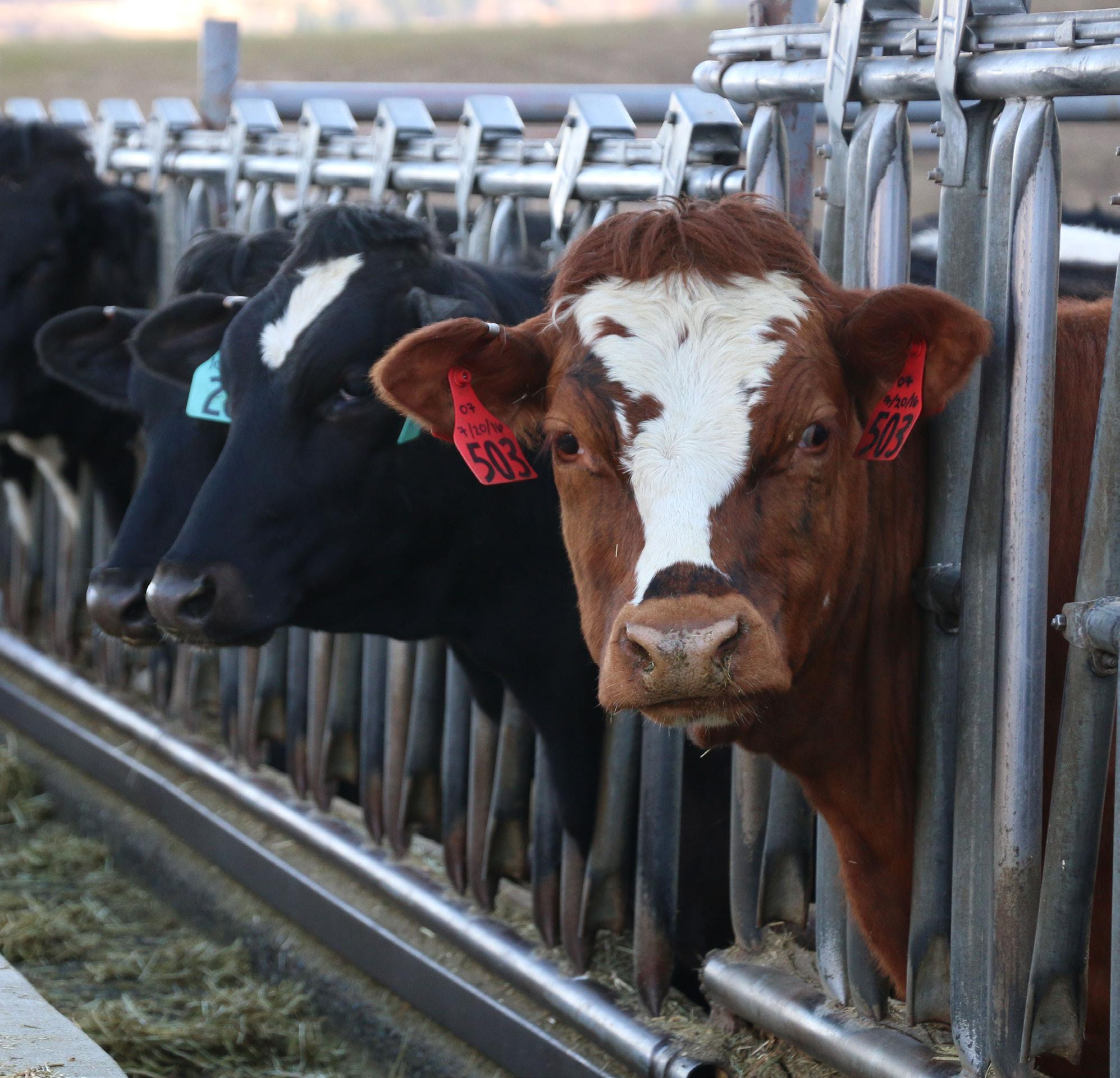
Dairy cows feed on hay at the University of Idaho Dairy Center
Brooklynn Jolley ARGONAUT
Swing Dance Club is open to all
The club hosts a weekly meeting of fun line and swing dancing with friends
Reese Garcia
ARGONAUT
On Thursday nights from 7 to 9 p.m., the Country Swing Dance Club is dancing away at the Animal Pavilion building on the west side of campus.
AJ Rose is a sophomore at the University of Idaho who brought the club back up and running at full speed this academic year.
“This year I made it a sanctioned club under the school,” Rose said.
The environment is casual and welcoming for newcomers. At each meeting, attendees are typically taught a line dance and three new moves.
“Sometimes, depending on the severity of the move, it’s going to be two moves,” Rose said.
At the end, they have a “free dance” where attendees can socialize, get to know other members and hang out while practicing what they have been taught throughout the night.
No matter your level of experience, all are welcome to attend the club.
“You can have absolutely no experience. Show up and we’ll be able to help you,” Rose said. “We’re teaching a lot of beginner moves…Once we start to grow, we’ll be able to teach the different beginner, intermediate and advanced.”
Something Rose thinks is unique about country swing dancing is how well it fits in with other music and dance paces.
“You can do it to so many songs and you can switch up the pace…With swing dancing, you can just have fun,” she said.
Kylie Scheib is a secondary education major at UI who is an active member of the Country Swing Dance Club.
After seeing an advertisement about the club, she and a friend decided to go and see what swing dancing was about.
“I wasn’t a huge dancer to start with, but getting into it, it’s just been so much fun,” Scheib said.
“[I’ve been] meeting all of these really amazing people through it as well. That’s been a huge reason why I keep going back.”
During club meetings, participants get to experience both line and swing dancing. Swing dancing includes partners while line dancing is individual.
Scheib describes the two as, “[Line dances] have set steps, whereas for swing dancing, in your partners, we teach different moves and then it’s up to you to put everything together into a dance.”
At the beginning of the meeting, members will introduce themselves to ease into the meeting with new members.
“Everyone does make a point to get to know each other at some point,” said Scheib.
Then, you can expect to start with line dances, move into learning a few new swing dance moves and then close the night by freestyling with a partner. This allows for creativity and fun while practicing.
Scheib shared her favorite songs to dance to. “If we’re doing just swing dancing, I really enjoy ‘Time is Love’ by Josh Turner. If we’re doing line dances, it’s probably between either ‘High Class’ by Eric Paslay or ‘Lonely Drum’ by Aaron Goodvin.”
Showing up is the first step into learning
the skill of country swing dancing. Scheib said, “Just show up and try to not be in your head too much.”
Learning something new can oftentimes be intimidating, but having fun and enjoying being in the moment is the most important thing to remember.
“When I started, I thought that everyone was looking at me and judging me while I was messing up line dances or not getting moves right away…We’re more happy to sit down and help you and walk you through it,” said Scheib.
The Country Swing Dance Club is open to any level of expertise. “Nobody’s watch-
ing you, I promise. And when you make mistakes, we just call it ‘adding flair,’” said Scheib.
Whether you have prior country swing dance experience or are wanting to learn something new, the Country Swing Dance Club offers a sense of supportive community and great skill. With new dance moves being taught weekly, this club is great for building swing dancing experience.
Thursdays with the Country Swing Dance Club are a great way to relieve stress and have a good time with new friends.
A guide to local skiing
Some of the best local places for engaging in winter sports
Miriam Moore
ARGONAUT
Freshman Anja Gudmundsen is on the university ski team, and she thinks “skiing is popular at the University of Idaho because it’s an easy way to meet new people while having a good time.” Skiing is really prominent among University of Idaho students, but budget and distance constraints can make it difficult for a student.
Here is a breakdown of some skiing mountains that are a day trip away from the UI campus and the costs associated with each location.
Silver Mountain
Just a little more than two hours away, Silver Mountain is in Kellogg, Idaho. It offers more than 1,600 acres and a 2,200 feet vertical drop. The resort opened on Friday, Dec. 5, with two lifts. As the season goes on, the other two will open.
Gus Colburn is head of marketing at Silver. He said the gondola that goes to the top of the mountain is “the longest in the USA.” The resort averages 340 inches of snow annually. Colburn said “the community at Silver Mountain is the best thing about the mountain.
An adult season pass is $879, but a student discount brings it down to $519. A season pass must be purchased by Dec. 20.
To get the college student discount, one must present a valid picture ID and a current class schedule. Student day lift tickets are $59 midweek, $69 on weekends and $75 on holidays (Dec. 20-Jan.4, Martin Luther King Jr. Day weekend and Valentine’s Day weekend). Student tickets for two hours of tubing are $30.
Lookout Pass
Lookout Pass is a two and a half hours’ drive to Mullan, Idaho, right on the border with Montana. There are five lifts and 59 named trails on the 1,023-acre skiable area. They claim a 1,650 feet vertical drop as the oldest ski area in Idaho.
Its season opened on Dec. 5 with 15 trails. The resort averages 450 inches of snow annually.
Matt Sawyer, the director of marketing at Lookout said the snow is “heavenly sent,
all natural.” Sawyer also said how, as it lies on the border of two different states and two different time zones, one can ski “into the future and back to the future in succession.”
A college student’s season pass is $167 compared to the adult season pass for $599. Day lift tickets are cheaper with a reservation. Prices are $55 for midweek, $62 for a weekend and $69 during holidays.
To qualify for a college season pass, one must be a full-time student taking at least nine credits per semester for undergraduate students or six credits a semester for graduate students. To get a college discount, one is required to bring a current schedule, a valid college ID and be between the ages of 17-35.
Schweitzer
Three hours north takes one to Schweitzer Mountain in Bonner County, just north of Sandpoint, Idaho. Schweitzer advertises 2,900 acres of tree skiing, a 2,400 feet vertical drop and 10 lifts. The resort averages 300 inches of lake-effect snow per year as it overlooks Lake Pend Oreille — the fifth deepest lake in the U.S.
The mountain’s backside “Outback Bowl” offers Idaho’s only cat ski access while its frontside “Schweitzer Bowl” offers wide open groomers best for intermediates.
Prices fluctuate daily, so check out Schweitzer’s website for specific days. A day college lift pass can be between $55 to $138. A young adult (18-25) unlimited season pass is $779 and an adult (26-79) unlimited season pass is $1,449.
Mt. Spokane
Mt. Spokane, a nonprofit mountain, is two and a half hours north of Moscow in Mead, Washington. The resort anticipates opening on Dec. 13. There are seven lifts and 53 runs on the resort’s more than 1,770 skiable acres and 2,071 feet vertical drop.
Lindsey Bangsburg, the digital media manager at Mt. Spokane, said, “students choose Mt. Spokane because we offer terrain for all ability levels, a strong Terrain Park and a community-focused experience that’s different from other mountains in the region.”
A college season pass is $749 compared to the adult $899. A student ID and proof of enrollment is required at the time of pass pickup. Lift tickets will not be on sale until the projected opening of the resort on Saturday, Dec. 13.
John Keegan | Argonaut
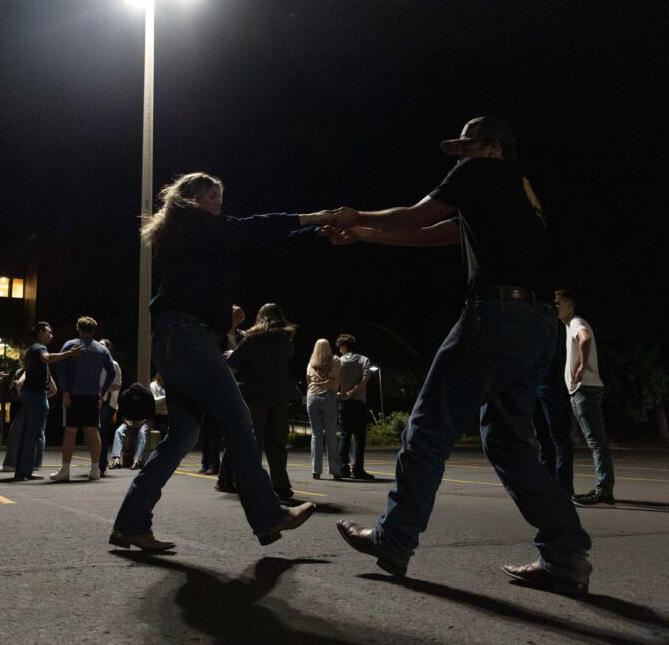
Students swing dance in the basketball court between Shoup Hall and McConnell Hall
GALLERY: “No Exit,” an existential drama staged by UI Theater Dept.
UI talent showed their take on the philosophical play
Macy Gilbert ARGONAUT
The University of Idaho Theatre Arts Department took the iconic, existential drama “No Exit” to the stage on Thursday, Dec. 4, with six additional performances following that.
The final three showings will be Friday and Saturday, Dec. 12 and 13 at 7 p.m. and Sunday, Dec. 14 at 2 p.m.
Students can experience this philosophical theater classic for free at the Shoup Hall Pocket Playhouse, with other tickets ranging from $6-26. Tickets are can be purchased at uitickets.com.
“No Exit,” originally written by French playwright Jean-Paul Sartre, traps the three characters and the audience in a room in Hell.
Inside these unchanging, hopeless walls are two women and one man bound for eternity.
While confined with no windows, no mirrors and no exit, the characters are forced to reckon with a punishment that is not physical, but far more threatening.
Sartre’s work challenges the familiar concept of Hell, and the burning, painful imagery that most associate with it.
He employs irony to emphasize the pain of psychological torment, and the impact of being confronted with one’s own sins.
Instead of torture devices or demons, the suffering in this story derives from humiliation and the unbearable presence of other people.
The characters are forced to reflect upon the nature of their relationships, their previous transgres provoking piece that pushes people
Reagan Jones | Argonaut
Kasey Coddington takes center stage under the eerie green spot light, looking up in dismay
Reagan Jones | Argonaut
Bryce Gowey sits paralyzed on the stage floor prcoessing the shock and horror
Reagan Jones | Argonaut
Wagnon and Gowey sink onto the stage floor in despair
Reagan Jones | Argonaut Coddington looks up, not yet realizing the horror of her entrapment in Hell
Reagan Jones | Argonaut
Alejandra Wagnon helps apply a fresh layer of dark red lipstick onto Coddington
Reagan Jones | Argonaut
Wagnon reaches for Gowey’s face and is met with resistance
Holiday gift guide
A look into gift ideas that are trending this season
Reese Garcia ARGONAUT
As the holiday season is rapidly approaching, it is time to search for that perfect gift for friends or family.
Finding the perfect gift for someone can be difficult, but not impossible. Whether you go to the store or shop online, there is a way to find exactly what you are looking for.
After going on Amazon and searching for “popular Christmas gifts for young adults,” a plethora of items pop up on the screen.
The most popular item is fuzzy socks. These are simple, easy and accessible in almost any store and are perfect for anyone.
Another popular gift is a blanket hoodie. These are oversized hoodies made from fleece material, making it a comfy and cozy present. With the cold winter months coming, this item is sure to keep you warm.
For those wanting to continue shopping online, Target’s website immediately gives the user inspiration for Christmas shopping.
Some popular items are an Owala water bottle, the Nintendo Switch 2, headphones and phone cases.
Shopping in stores can be just as easy as shopping online. With multiple stores
having websites, you can find the location of which store you are at, search for an item and find the specific aisle it is located in. This helps ensure that shopping experiences are simple, easy and stress-free.
Being on a budget during the holidays and giving presents can still be attainable.
Some of the best presents can be homemade. A personalized ornament made from air dry clay is simple but can mean the world to someone. Crayola air-dry clay starts at $4.49 at Michaels.
Handmade paintings or art pieces are always a memorable and loving gift. From acrylic paints to macaroni creations, they can be fun to make and the perfect addition to someone’s home.
Sometimes, the best present one can give is a home cooked dish. Sugar cookies, pies or casseroles are simple yet can show appreciation for someone, and may even help take some cooking pressure off during the holidays.
In the end, no matter what type of gift you give, it represents your love and appreciation for that person. The thought is what matters.
Options such as shopping online, in-store or making something with your hands are perfect for finding the right gift for someone. Holiday shopping can be fun, easy and accessible for this season of giving.
Dec. horoscopes
What does this December have in store for you?
Brooklynn Jolley
ARGONAUT
Aries (March 21 – April 19)
There is a big change coming this month. Many blessings are making their way to you, and you’ll feel so much love and abundance. With new changes comes some stress, so remember to be mindful and focus on the positivity that the month will bring.
Taurus (April 20 – May 20)
Try to be open and curious this month. Don’t be afraid to try new things and make new connections. This month will be good for your social life and fostering new relationships. You may be weary of opening up because of the past, but there’s nothing wrong with letting people in and allowing yourself to be vulnerable sometimes.
Gemini (May 21 – June 20)
Be cautious this month. There may be a lot of things coming your way, both good and bad. Remember your strength and don’t be afraid to lean on your friends and loved ones when life becomes overwhelming. Don’t let yourself burn out. Try to rejuvenate your energy when you can and find a healthy balance between work and play.
Cancer (June 21 – July 22)
Last month may have been tough for you, but December will bring many wonderful things. You’ve been putting effort into yourself and making your life better, and all that hard work will begin to pay off this month. People will recognize your strengths and your great work ethic.
Leo (July 23 – Aug. 22)
This month may be scary for you. You might have a lot on your plate and feel a bit overwhelmed. Don’t forget to make time for the things you love and be sure to appreciate the finer things in life. By focusing on the balance of good and bad things, you’ll come out on top this month.
Virgo (Aug. 23 – Sept. 22)
Keep your eye on the prize this month. Big things are coming your way, and you’ll start to see some major developments in your work and personal life. Follow your passions and don’t be afraid to go for what you want. Keep yourself focused on these new developments and invest in yourself and your future.
Libra (Sept. 23 – Oct. 22)
Don’t let the little things get you down this month. You may have felt like you’ve been messing up a lot recently, but you should remember that every mistake is an opportunity for growth. Keep your attitude positive and try to focus on the silver linings rather than your mistakes.
Scorpio (Oct. 23 – Nov. 21)
Don’t hold yourself back this month. Allow your creativity and personality to shine. Try to foster good communication with your loved ones this month and rekindle some of those relationships that may have been put on the back burner recently. This month will be good for nourishing your energy and close relationships.
Sagittarius (Nov. 22 – Dec. 21)
Keep yourself grounded this month. Don’t let irrational thoughts get to you and bring you down. Remember to take breaks when you need it, and don’t let yourself burn out. Taking time to devote yourself to relaxation will be key this month.
Capricorn (Dec. 22 – Jan. 19)
You may be feeling burnt out lately and like you can’t catch a break. Keep pushing forward because your hard work will pay off soon. It may seem like life has been all risk with no reward, but know that the reward is coming soon. Keep your schedule balanced and don’t take too much on at once.
Aquarius (Jan. 20 – Feb. 18) December is the month for you to show off your skills. Allow yourself to be confident this month, and don’t be afraid to step out of your comfort zone. Remember that you possess many wonderful qualities. Try to show people the side of you that you often keep hidden.
Pisces (Feb. 19 – March 20)
Focus on having meaningful conversations and connections this month. Take time to slow down and clear your mind. Life may have been a bit hectic lately, but it will begin to mellow out this month. Your actions and intentions should be very purposeful this month. Take time to think things through and imagine what each decision can bring you.
Tuesday Market takes on some holiday spirit
A great opportunity to purchase local goods and get some gifts for the upcoming holidays
Brooklynn Jolley
ARGONAUT
The Tuesday Holiday Market is a great opportunity to peruse local goods, experience some live music and find holiday gifts.
The holiday market will take place on Tuesday, Dec. 16, from 4-7 p.m. at the Latah County Fairgrounds.
There will be an opportunity to preorder a nice dinner meal that you can enjoy while listening to live music.
The food will be prepared by Wilder
Catering, who will be serving a lentil stew, either with chicken or vegetarian, and a coconut rice pudding for dessert.
On-site purchases will also be available.
The holiday market will feature many local goods, with some new arrivals as well.
Some options include holiday wreaths from the Flannigan Creek Farm; organic pumpkins, garlic and corn from the University of Idaho Soil Stewards Student Farm; and various meats from different places and more.
The holiday market will feature tons of local vendors, produce and activities for the youth. It’s a family-friendly event that welcomes everyone. If you have any questions, email tuesdaymarket@uidaho.edu for more information.
Brooklynn Jolley | Argonaut
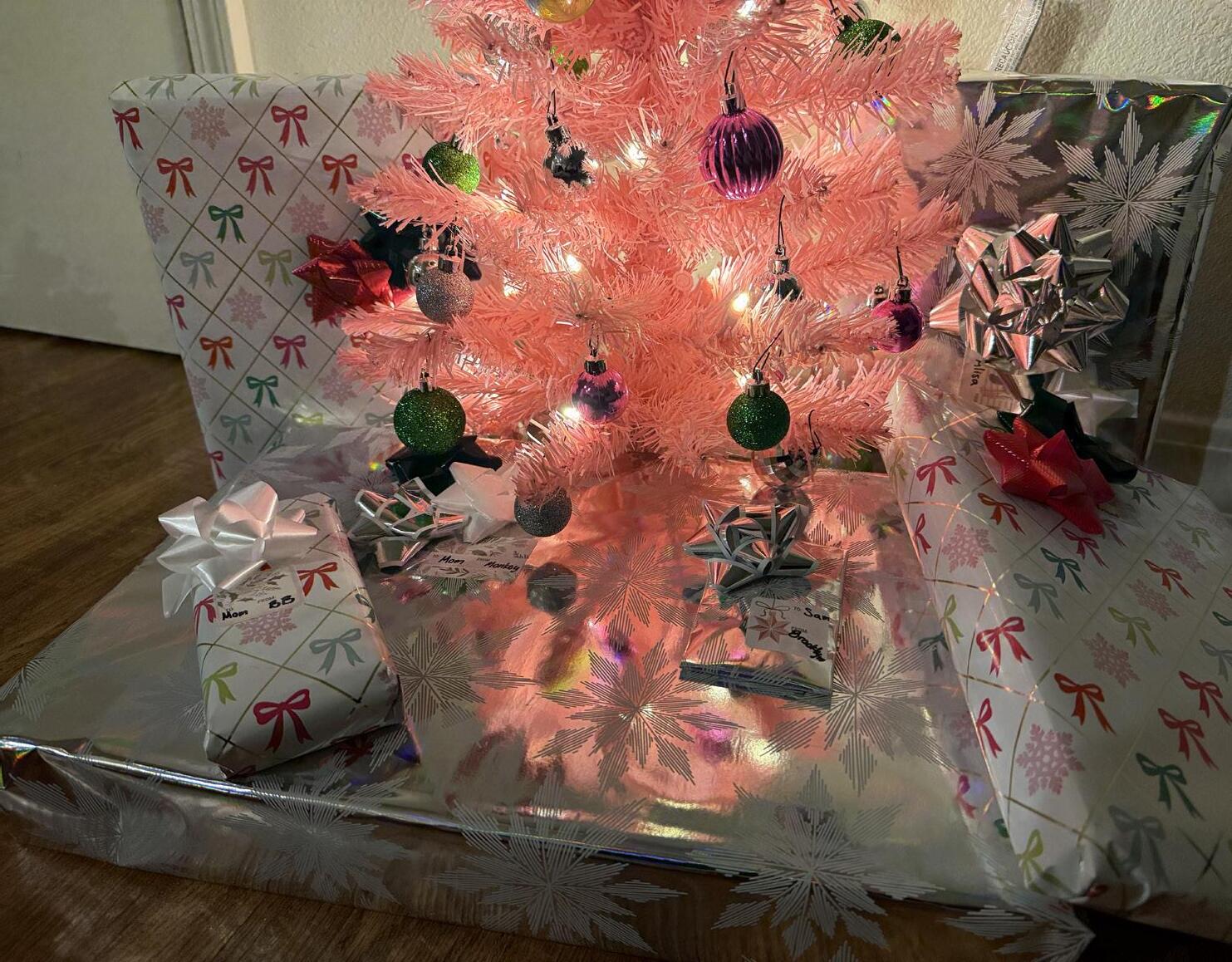
A pile of wrapped gifts for the upcoming holidays sit under a colorful Christmas tree
Connor Anderson | Argonaut
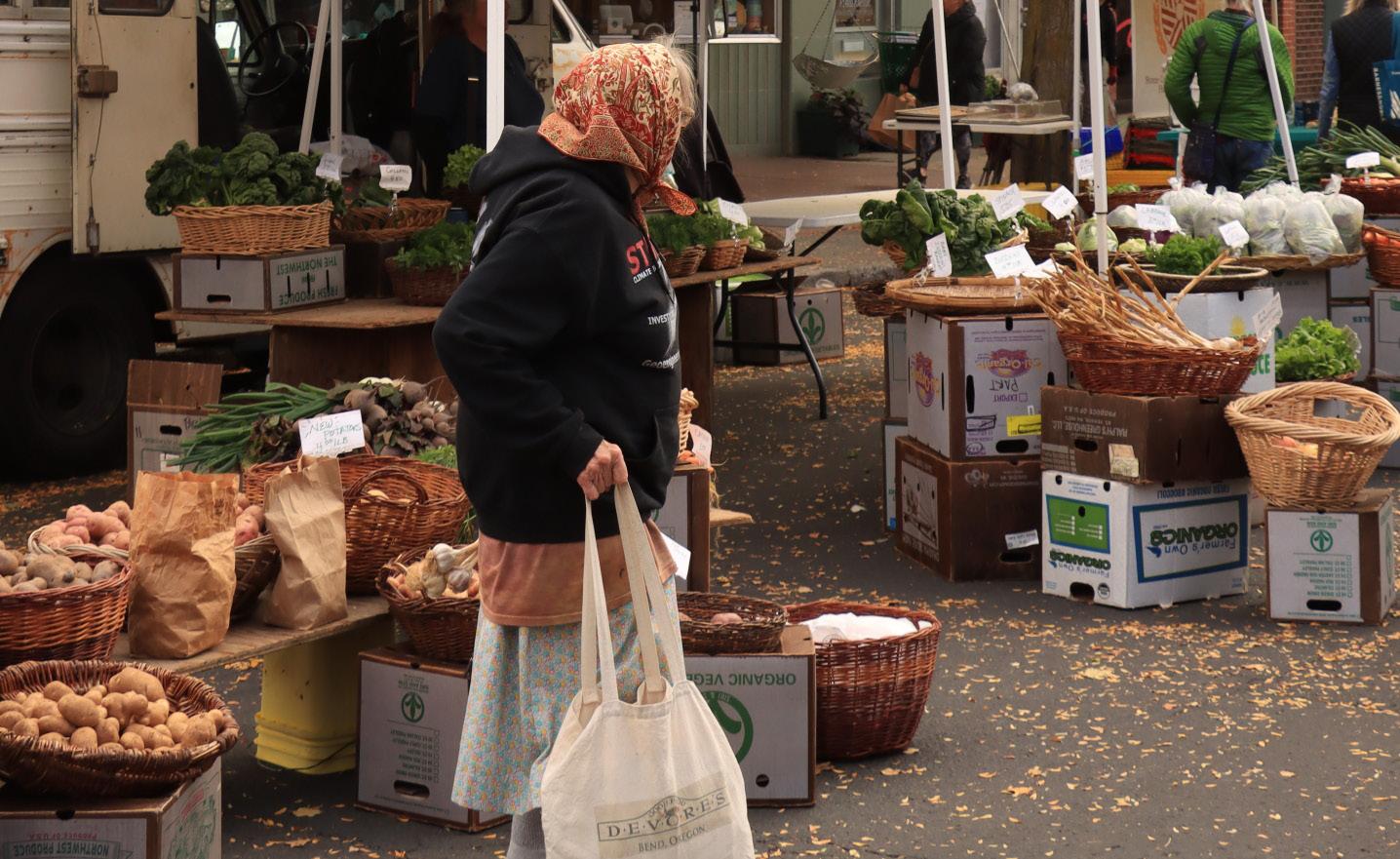
Farmer’s Market
The Creative Issue Fall 2025
Vandals prepare for final stretch of non-conference
Idaho makes an attempt to head into conference play with momentum
Taylan Hallum ARGONAUT
Off two impressive Summit League Challenge victories, the Idaho Vandals men’s basketball team are looking to finish non-conference play strong.
The Vandals battled but fell short to the Notre Dame Fighting Irish 80-65 and are preparing to host the Evergreen State Geoducks on Sunday, Dec. 14, at 2 p.m.
The Vandals have started the season off very well with a 6-4 record, and they hope to continue with a winning record and beat an underwhelming 0-4 Geoduck team. With home advantage and a better record, the Vandals certainly have the upper hand in this matchup against the Geoducks.
The Vandals have many impressive players this season with three averaging double figures so far. Freshman forward Jackson Rasmussen leads the Vandals and has gotten off to a superb start to his freshman season. Rasmussen comes into the weekend, averaging 15 points and four rebounds per game.
Redshirt sophomore guard Kolton Mitchell has had his ups and downs but is averaging 12 points and four assists a game. Off the bench, senior guard Isaiah Brickner has been outstanding, averaging 11 points per game.
Idaho heads into the matchup with the Geoducks 3-0 at the ICCU Arena. With the momentum of that three-game home winning streak, the Vandals will be sure to do well this weekend and improve their record and their standing in the Big Sky Conference.
Evergreen State has had a lack-luster season so far with a record of 0-4. However, the story is deeper than that; the Geoducks have played 10 games this season, including six exhibition games. Even with six exhibition games that they’ve played, on top of
the other four that have counted toward their record, the Geoducks have not won a single game this season.
Evergreen State played Portland State, another Big Sky Conference team, in an exhibition match on Nov. 19, where they
lost 90-61. The Idaho Vandals are right behind Portland State in the Big Sky Conference rankings; it’s so close that the match between Idaho and Evergreen State should result in the same outcome. This game could be a good opportunity for the Vandals to
shine and put on a show in their final home non-conference game. The Vandals and Geoducks will tip off from ICCU Arena on Sunday, Dec. 14, at 2 p.m.
Csenge Krakoczki’s long journey from Hungary to the U.S.
Krakoczki is an important piece of the Vandals’ future
Timmon Friel ARGONAUT
Csenge Krakoczki went from playing volleyball in a small town in Hungary to receiving over 90 emails from junior colleges and universities. This gave her a multitude of opportunities before she landed at the University of Idaho. After accepting her offer, she showed up despite never coming to the states and adapted to the new life of being a student athlete. Krakoczki is from a very small town in Hungary called Komarom, which is right on the border of Slovakia. This was a very small town without many chances for Krakoczki to pursue her volleyball dreams. She moved over to Balatonfured, a city that is right next to a beautiful lake with a population of
13,000 people.
Krakoczki was motivated to go play volleyball in Balatonfured after a coach had gone to one of her games and chosen to invite her to come watch the volleyball team play in the city and take a look at the school. After she saw it, it was the next part of her journey to go play for them.
Krakockzi had played on a club volleyball team while she was living in her hometown of Komarom and when she moved to play more serious volleyball, Krakoczki joined the school team, which was more like high school volleyball than club.
What made her want to come play volleyball in the United States, after never having traveled there, was when she was promoted from the smaller team to the adult team in Balatonfured.
Krakoczki said, “After that, I think that maybe I want to work more, and I had a lot of international players in the team, and I thought that I want to go also some other country and try it and maybe it’s working.
And I really love it here.”
The recruiting process for her was a lot different than a volleyball player from the states. Since she lived in Hungary, she had to hire a company, and they created highlight videos for her.
There was a lot of hype around her before she even stepped into the states. When choosing Idaho, she said she talked with head coach Romana Kriskova and liked her since she was nice, and that she spoke with some of the players as well.
The players she talked to told her the team was nice and so was the campus. Krakoczki started looking at the college through some pictures and looking on Google Maps. Krakoczki talked about the school and campus and how much she appreciates how nice people are and that it was really weird for her at first.
“I talked with my mom, and I said I really love the school. And she asked, ‘You are sick?’ Because I don’t love the school in Hungary, but here, I like it,” she said.
The transition to America was hard for her as well since she had to learn English, with Hungarian being her first language. Two years ago when she decided she wanted to come to the U.S., she learned and studied more English.
Krakoczki flew to Los Angeles, and spent a few days there with her teammate, and it was hard for her at first. After a while, it got easier for her, and people told her that she got better and better every day.
Since arriving from Hungary, Krakoczki has had a culture shock but is enjoying her time so far in the U.S.
“I think the cars [are] really big here. [In] Hungary, we don’t really use trucks, so it was really different. And the stores, it’s so weird that I can find everything in one store. And the packs are big, are huge,” she said. Krakoczki is currently studying hospitality and tourism and takes a nutrition class as well, which has been interesting for her. She can’t decide yet which one is better. She wants to travel a little bit and potentially play professional volleyball.
One of the main differences, according to Krakoczki, between the U.S. and Europe when it comes to volleyball is the style and pace of play.
“The games are really fast,” she said. “I think in Hungary it’s more slower, or in Europe, it’s slower and some rules [are] different.”
Krakoczki lives with her teammates and her two dogs, Pindi and Maji, and has enjoyed Moscow so far. When the athletes are not on the volleyball court, they go out and do fun things after games or practice. She knew some people before moving to America, and with 11 new people on the volleyball team this year, it has been a huge change for the whole team.
Since arriving, she has grown a lot and practice has helped her. The first few games were really different, and it was so new that she felt like she wasn’t playing well, but now it has improved a lot for her. Krakoczki said she wants to stay here for four years and help turn the Vandals around.
“Last year, I heard it was not that good. I think this year it’s better, and I hope the next year will be better.”
Krakoczki has a very bright future ahead of her and will go into next year with high hopes for the Idaho Vandals Volleyball team. The relatively new team will go into next year with a year of experience and chemistry, giving Krakoczki the support she needs to thrive.
Colton Moore | Argonaut Krakoczki
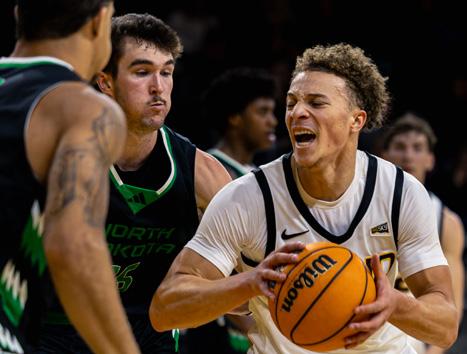
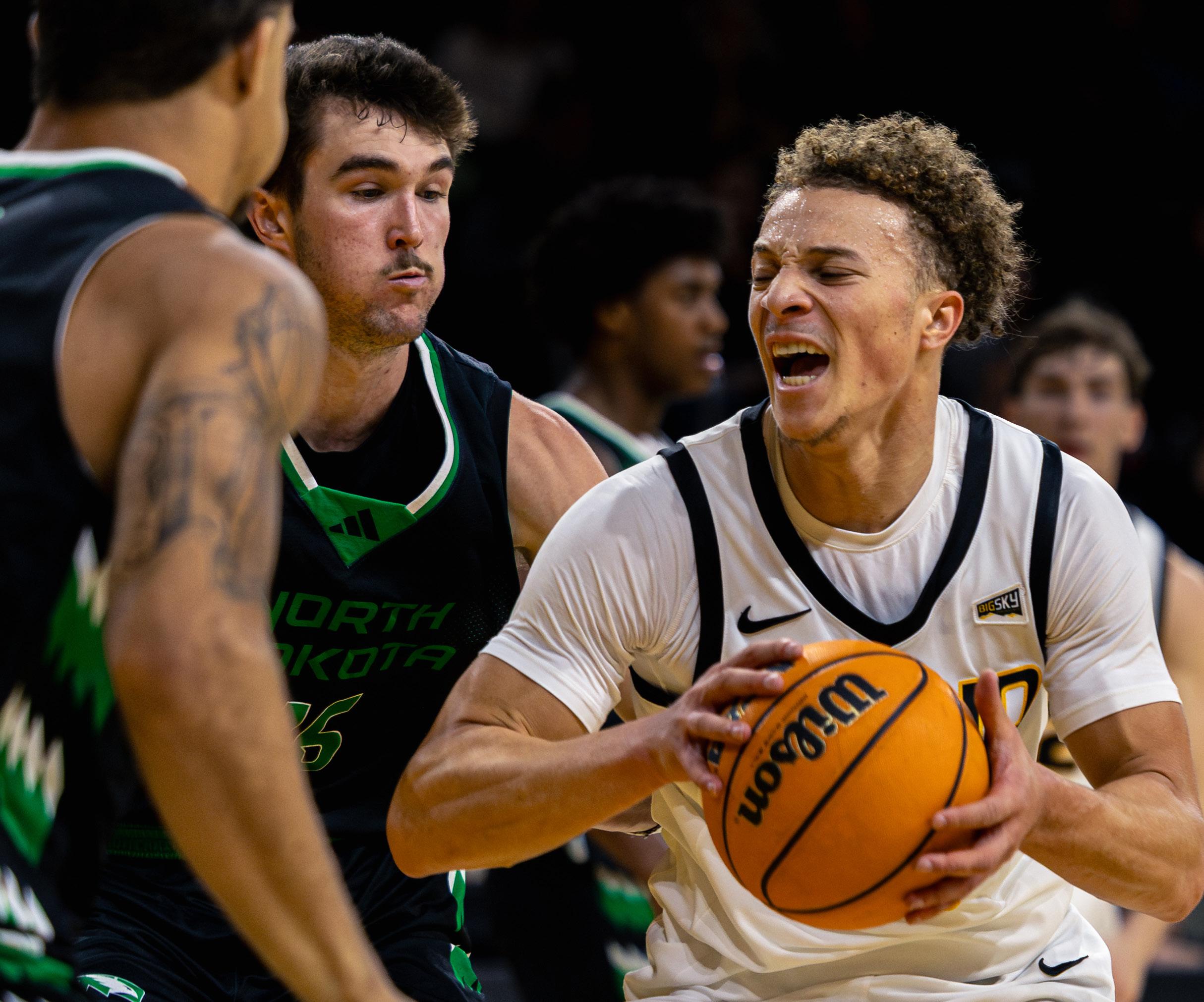
John Keegan | Argonaut Brickner drives through two defenders. Brickner put up 26 points against North Dakota
Isaiah Brickner: The spark plug off the bench
Brickner averages 10 points a game for Idaho
Gage McElroy ARGONAUT
For some athletes, all it takes is one game to show their worth and impress coaches, fans and opponents out on the court. After a devastating 94-69 loss at home against Sam Houston on Nov. 28, the Vandals men’s basketball team had the privilege to fight at home once more on Wednesday, Dec. 3, this time against North Dakota.
Throughout the game, on both sides of the ball, the Vandals dominated. Meanwhile, senior guard Isaiah Brikner played the game of his life.
Brickner, who was a transfer from Marist, was expected to be a bench player for the game, but ended up exploding with a career and team high of 26 points, 23 of those points coming from the second half alone.
Brickner also cashed in on four out of his five three-pointers, recorded three rebounds and scored 70% of his field goals as well. Thanks in part to Brikner’s insane night, the Vandals were able to please their home crowd and defeated the Fighting Hawks 90-58.
Although Brikner had an overall stellar performance against North Dakota, he
didn’t contribute offensively in the first half, scoring only three points. It wasn’t until the second half that Brinker turned on the afterburners and dominated the court, scoring an extra 23 points by the end of the game.
“I feel like I was just trying to take the right shots, and they were just going in, so I kept shooting them,” Brikner said in a post-game interview. “I think the ball just came to me, and it was just going in. I guess it was one of my nights.”
Brikner’s second half performance helped Idaho pull away, ultimately turning what should’ve been a close, competitive matchup, into a North Dakota beating by the Vandals. After graduating high school in San Diego, Brikner decided to take his talents to Marist where he would spend two years with the Red Foxes.
At Marist, he played a total of 60 games, 34 of which he started. Over his two-year career with the Red Foxes, he scored a total 382 points, 226 total rebounds, 151 total assists and 47 steals, averaging 6.25 points per game over the two years. It wasn’t until April 2024 when Brikner transferred to Idaho, and is now currently making an impact for the Vandals’ offense and defense on the court.
“When you have your career high in only 17 and a half minutes, that’s pretty good,” head coach Alex Pribble said, when
commenting on Brikner’s performance.
“He didn’t settle for tough [shots]. But for the most part, what got him going was taking great shots.”
After spending most of last summer injured, Brikner’s comeback has been quite a compelling story.
“He’s playing the best basketball of his career right now. It just took him a little time, because he was hurt the whole time. I’m just really, really proud of him and excited about the rest of the year,” Pribble said.
As for himself, coaches and the fans, Brikner expects to ride the hot hand and continue to dominate the court.
For an already loaded Idaho
when given the chance, has shown he can take over a game and control it the rest of the way.
Idaho looks to close non-conference strong
in all facets. With her elite shooting, playmaking and defensive ability, she has been crucial so far this season.
for us and they bought into their role. I think that’s very rare nowadays.”
The Vandals and Aggies will tip off on Saturday, Dec. 13, at noon. Vandals head to Utah for their final road trip of
With the non-conference slate of the season coming to a close, the Idaho Vandals women’s basketball team looks to finish strong in their final road trip before conference play.
Last night the Vandals fell to the University of Califorina Berkley 68-61. The Vandals boast an impressive 8-3 record, and part of their success has been their explosive offense, which is averaging 85 points per game.
The Vandals’ success on the offensive end has been due to their depth, balance, and willingness to share the basketball.
Idaho has four players averaging double figures, led by junior guard Hope Hassmann, who is averaging 14 points, four rebounds and four assists, and has scored in double figures in all but one game this season.
Hassmann’s counterpart in the backcourt, senior guard Kyra Gardner, has been a huge part of the Vandals’ success
Gardner is averaging 13 points, six rebounds and three steals per game.
With Hassmann and Gardner holding it down on the outside, Idaho’s inside game has been just as elite, featuring a duo that has been difference-makers when on the floor.
Redshirt senior forward Lorena Barbosa, who has appeared in five games this season, is averaging 12 points and five rebounds per game.
Alongside her, redshirt senior forward
Debora Dos Santos has been the most efficient Vandal player this season. She has appeared in eight games, boasting 11 points and seven rebounds per game, including a season-best 22 points and 15 rebounds in the Vandals’ loss to Oral Roberts.
“It speaks volumes to how deep we are,” head coach Arthur Moreira said.
“It’s a luxury that we have this year that I think is going to be very hard to replicate. We just got to a position where people believe in us, and they want to play for our system, they want to play
That depth and resolve will be tested as they close out their three-game road stand with a trip to Logan, Utah to take on the Utah State Aggies.
The Aggies come in at 3-5, averaging 63 points per game while allowing just over 67 points per game. The Aggies are led by junior guard Aaliyah Gayles, who is their only player averaging double figures with 14 points and three rebounds per game.
Idaho took care of the Aggies 71-56 in Moscow last season and looks to keep their momentum and end nonconference play strong before Big Sky competition begins in January.
“The first thing we got to understand is that we’re not going to win a conference championship in December or January or February — it’s going to be in March,” Moreira said. “We can’t lose sight of the goal. We need to get better as a team and have that goal in mind while taking it day by day. Our biggest goal for the next three games is continuing to learn from them. I hope we win every game to set us up for the Big
Sky. But we have to understand that, we need to be playing our best basketball in Boise, not in January.”
Vandal Scoreboard
Jayden Barfuss ARGONAUT
Men’s Basketball
The Vandals fell last night to the Notre Dame Fighting Irish 80-65.They will return home to face Evergreen State on Sunday, Dec. 14, at 2 p.m.
Women’s basketball
The Vandals fell to the University of Califorina Berkley last night 68-61. They will visit Utah State University on Saturday Dec. 13, at noon.
Swimming and Diving
The Vandals Swim and Dive team will compete at the College Swimming & Diving Coaches Association of America championships on Saturday, Dec. 13, in Sarasota, Florida.
squad, opponents have to keep in mind that Brinker,
John Keegan | Argonaut
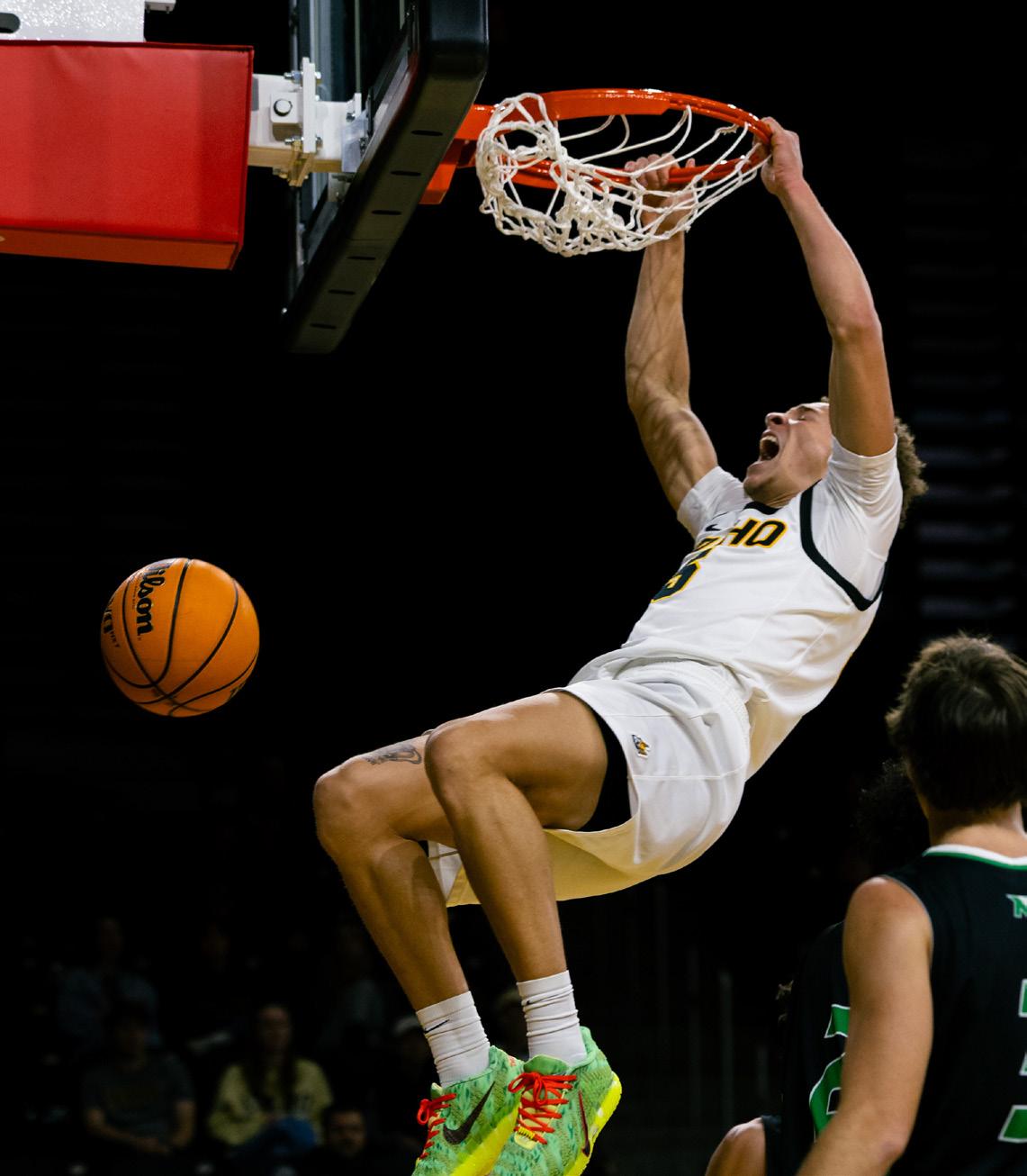
UI guard Isaiah Brickner throws down a thunderous dunk in the Vandals’ 90-58 win over North Dakota
Thomas Ford Jr. era begins with steep roster rebuilding
Liam Bradford ARGONAUT
The 2025 Idaho football season began with an unavoidable reality. The Vandals were no longer the program that had reached the post season in each of the previous three years under head coach Jason Eck. Eck’s departure to New Mexico last winter, along with the transfer exodus that followed him to Albuquerque, left Idaho with a roster that had to be built almost entirely from scratch. The Vandals finished 4-8 under first-year head coach Thomas Ford Jr., winning only two conference games.
Idaho entered the year with a new head coach, a new quarterback, almost an entirely new defense and a locker room filled with players whose college experience ranged from minimal to none. The Vandals returned only a single defensive starter from the 2024 post season team, senior linebacker Isiah King. They were also one of the youngest offensive teams in the conference, relying on underclassmen and in nearly every position group.
The challenge of assembling a competitive roster under such circumstances was no easy feat for Ford. Ford arrived in Moscow with the reputation of a strong recruiter, but even for him, the task was daunting. Ford’s mission was straightforward in concept but was, as he put it, “maybe a little premature.” He needed to build an entirely new playoffcaliber roster in just a few months.
The season offered glimpses of what Idaho might become under Ford, but it also revealed the costliness of the team’s lack of experience. Idaho lost four games by a single possession.
Ford acknowledged that the expectations surrounding the program after three straight post season appearances were not easy to manage, especially with such an inexperienced roster.
“Whenever you take over a program that has very high expectations coming off of a 10 win season, you want to have those same expectations,” Ford said. “We did a great job at least setting up the building blocks for what this thing needs to look like moving forward.”
The season began less than ten miles from campus across the border in Pullman against Washington State. Despite the defensive inexperience, Idaho played one of its best games of the year on that side of the ball, allowing only three rushing yards and controlling the line of scrimmage for most of the evening. The Vandals fell 13-10 after a last-minute field goal, the first of several late heartbreaks.
Ford got his first win as a Division 1 head coach in the team’s home-opener against St. Thomas. Idaho’s defense held strong early but faded late due to fatigue, still managing enough stops to secure the 37-30 win. A week later, Idaho handled Utah Tech in the Fightin’ Taters game with a
20-6 victory. Idaho was now 2-1 and looked poised to grow.
What followed was the harshest stretch of the year. Idaho held a 14-point lead on the road against San Jose State but allowed 420 yards of total offense and lost again on a last second field goal. That game began a four-game skid.
Quarterback Joshua Wood suffered an injury during the next game at Montana, a 41-30 defeat, and Idaho felt that absence deeply over the next two weeks. The Vandals lost 49-33 to Northern Colorado in its first home loss in nearly two years. They then fell 21-14 at Eastern Washington in a game they were expected to win.
Wood’s breakout season was one of the bright spots of this rebuilding period for Idaho. He transferred from Fresno State late in the offseason and quickly rose to the starting role. Before and after the injury, Wood proved himself to be one of the best dual threat quarterbacks in the conference. He finished with 1,898 passing yards, 14 passing touchdowns and only five interceptions. He added 589 rushing yards and seven rushing touchdowns. Despite missing two full games, Wood was the only player in the Big Sky to finish in the top 10 in both passing yards and rushing yards.
Redshirt freshman wide receiver Marquawn McCraney saw Wood’s commitment and competitiveness firsthand and made a point to develop chemistry with him early, especially because they both grew up in the Seattle area.
“We were not too concerned with who was back there because we have faith in our guys,” McCraney said. “We just need to focus on doing our job to the best of our ability so that people can be successful.”
McCraney returned to the team after missing fall camp and the entire summer due to a surgery to repair a torn meniscus. McCraney believes the program left many potential wins on the table and credited the 4-8 record to the team’s struggle to play complementary football.
“If we want to be a great team that is going to win, we have to come up with points when we are in the red zone,” McCraney said. “We have to make sure that we stay ahead of the chains. There are little things that can be cleaned up in those close games where if the ball got flipped the other way it is our game. It is just a matter of correcting those mistakes.”
He added that the offense showed a glimpse of what it could be in the 45-6 win over Portland State, Wood’s first game back from injury.
“Our offense has never been seen at full power,” McCraney said. “What would that look like if we had every
single guy on offense healthy? Portland State was a game when you saw our offense firing on all cylinders.”
Idaho’s best performance of the year came on Halloween night in Flagstaff. The Vandals built a 26-7 lead against a ranked Northern Arizona team and then watched it disappear. The Lumberjacks led 29-26 late in the fourth quarter before Owen Adams drilled a 42-yard field goal as time expired. Idaho fell behind by three in overtime but answered instantly. Elisha Cummings broke free on a 24-yard run on the offense’s first play, and Hayden Kincheloe punched in the game winning score from the one-yard line.
That moment kept Idaho’s post season hopes alive briefly, but a 28-14 loss to UC Davis ended the team’s playoff chances. The following week, Idaho fell 23-20 at Sacramento State in the most controversial finish of the season. A disputed officiating decision aided the Hornets in the closing moments. Ford’s animated response to the call later earned him a sportsmanship fine from the conference.
Idaho closed the year with a rivalry loss at Idaho State, a 37-16 outcome that stung deeply within a program accustomed to dominating that rivalry matchup.
Despite the roller coaster, Idaho ended the year with several standout performances. Senior offensive lineman Nate Azzopardi and senior linebacker Isiah King earned first-team All-Big Sky honors. Freshman cornerback Caleb Ricks was named a Freshman All-American by FCS Football Central. Specialist Brayden Rice earned second-team all-conference honors, and linebackers Dylan Layne and Matyus McClain received honorable mentions. Layne led the team with 88 tackles and combined with King and Cruz Hepburn for 238 total tackles.
The Vandals also produced one of the best rushing defenses in the Big Sky. Their run defense grade from Pro Football Focus finished at 92.9, the highest mark in the
conference. Offensively, Nate Thomas, Elisha Cummings, Art Williams and Rocco Koch combined for 1,290 rushing yards. Five different players recorded at least 19 catches, and four posted at least 278 receiving yards.
Even with the accomplishments, Idaho finished in the bottom tier of the conference statistically in total offense and scoring offense, and near the bottom in yards allowed and touchdowns allowed.
“Having lost so many guys from last year’s team sets you back from an experience standpoint,” Ford said. “We had playoff expectations but not a ton of guys with playoff experience. We need to work on being consistent.”
Ford said the team’s young players made tremendous progress throughout the fall.
“The improvement those younger guys made in the second half of the season, primarily on defense, I thought they made huge strides,” Ford said. “I think we learned a ton and our players that were not in the program before have a much better understanding of what the standard needs to look like going forward.”
Ford dismissed offensive coordinator Matt Linehan, running backs coach Lance Dunbar, and defensive line coach Tevita Finau following the season. Ford emphasized that his decisions were not a reflection of personal dissatisfaction, but a commitment to the championship level standard he wants the program to embody.
The Vandals already hold the top ranked recruiting class in the FCS. Ford believes this incoming group can substantially alter the program’s trajectory.
“I definitely think it has all the building blocks to really change the trajectory,” Ford said. “Every year you have to evaluate what your program needs. Those guys last year did a good job but I want some championship level people.”
The Bradford Beat: Mountain West chaos erupts
The Mountain West tiebreaker was an embarrassment
Liam Bradford ARGONAUT
The final weekend of the regular season for the Mountain West Conference delivered one of the most thrilling games of the year and also laid bare exactly how broken the conference’s tiebreaker system is. What unfolded leaves a bitter taste: an 8-4 team now hosts the championship game, while two 9-3 teams, one of which beat that 8-4 team, watch from their couches.
Heading into the final week of the regular season, the San Diego State Aztecs were sitting comfortably at the top of the Mountain West with a 6-1 conference record. They controlled their own destiny needing one more win beat to host the conference title game and earn an outright regular season conference title.
But then came the fateful showdown with the New Mexico Lobos. New Mexico entered the game 5-2 in conference play. What happened in Albuquerque was college football at its very best. The game was intensely competitive, tied 17-17 entering the fourth quarter. Neither team could mount a meaningful offensive drive, and after three punts each in the fourth, the game drifted into overtime.
On the first play of the second overtime period, former Vandal quarterback Jack Layne threw a 25-yard catch-and-run touchdown to tight end Cade Keith. The Lobos held SDSU out of the end zone on the ensuing possession and sealed a 23-17 victory. With that win, New Mexico claimed
a share of the conference lead at 6-2 and held the tiebreaker over SDSU. Meanwhile, in Logan, Utah, the Boise State Broncos edged out the Utah State Aggies 25-24 that win pushed Boise State into a tie at 6-2. On Saturday, the UNLV Runnin’ Rebels demolished the Nevada Wolfpack 42-17, finishing 10-2 overall, and completing the quartet atop the Mountain West with a 6-2 conference record.
These results were the worst-case scenario for the conference, as the question of who plays in the championship game came down to a computer-metrics-generated decision. As expected, the only 10-win team in the conference, UNLV, earned a spot in the title game.
My assumption was that UNLV’s opponent was going to come down to which factor matters more: head-to-head performance or overall record against fellow tiebreaker teams. Instead, the computer metrics somehow determined not only that the eight-win Broncos would get the nod over SDSU and New Mexico, but that they would host the game.
From my standpoint, this is outrageous, and the broken tiebreaker system needs to be addressed. Because in this case, not all four teams played against each other this season, head-to-head results could not settle the tie. On paper, the system has some logic. It tries to be objective. When head-to-head fails, use data. But the result this year illustrates how the system’s priorities can differ dramatically from what fans and logic see as “deserving.”
Here’s why it feels all wrong. First, computer metrics do not necessarily reward the team that beat the best competition or that delivered in the most meaningful games.
They reward predictive and analytics-based measures. Additionally, given that this is the last season in the Mountain West for Boise State, it leaves New Mexico feeling even more slighted; beyond moral weight, there’s a fairness problem. Selecting a champion based on computer rankings does not honor the on-field outcomes these teams earned.
The problem with the Mountain West’s system is that it treats all ties the same, regardless of how they formed. A two-team tie is simpler. But a four-team tie like this year? It’s rare, but when it happens, the system resorts to metrics. That strikes me as fundamentally wrong.
I think the next time Mountain West convenes its rules committee, they should strongly consider reforming this process. At minimum, I’d propose a mini playoff among tied teams when four or more finish with the same conference record and no headto-head resolution is possible. Yes, it would introduce scheduling complications, but not doing so undermines competitive integrity.
Even a two-round mini playoff or a Kansas City tiebreaker would be far more satisfying than turning the debate over to computer algorithms. Fans and players deserve resolution on the field, not in a spreadsheet.
For the New Mexico Lobos, this moment should have been one of celebration. Under first-year head coach Jason Eck, the program has undergone a transformation. Idaho fans know firsthand what Eck can do for a program, and he has continued the success he had in Moscow into his first season in Albuquerque.
The Lobos posted their first nine-win season since 1997. They had the biggest increase in attendance in the FBS and had a perfect 6-0 record at home—a feat the
program had not achieved since 1938. It came with players who bought into Eck’s vision, including several key contributors who followed him from Idaho.
One of those players, his son Jaxton Eck, was named co-Defensive Player of the Year in the Mountain West, an honor he shares with SDSU’s standout cornerback Chris Johnson.
New Mexico’s growth this season was real. The energy around the program was real. The excitement from fans was real. To watch all of that end with a ranking-blender telling them they don’t quite make the cut feels insulting.
SDSU gets the same fate: a team that had an abrupt turnaround from 2024 to 2025 that missed out on its first championship game appearance in several years. It stings for the Aztecs, given they controlled their own destiny headed into the New Mexico game, and this was their last chance to win another Mountain West championship before departing for the PAC-12. I know there will be defenders of the current system. They will argue that algorithms are impartial, they provide a stable, predictable process, that metrics account for strength of schedule and efficiency and other “advanced” stats that the naked eye might miss. But there is a reason winning on the field still matters to players and fans.
This system puts cold data above human effort and accomplishment. An 8-4 team with a less compelling resume gets to host yet another Mountain West Championship just because a few ranking algorithms favored them. That is wrong. Saturday’s championship will not feel like the culmination of a hard-fought season. It will feel like a byproduct of conference procedure, and that is a travesty.
John Keegan | Argonaut
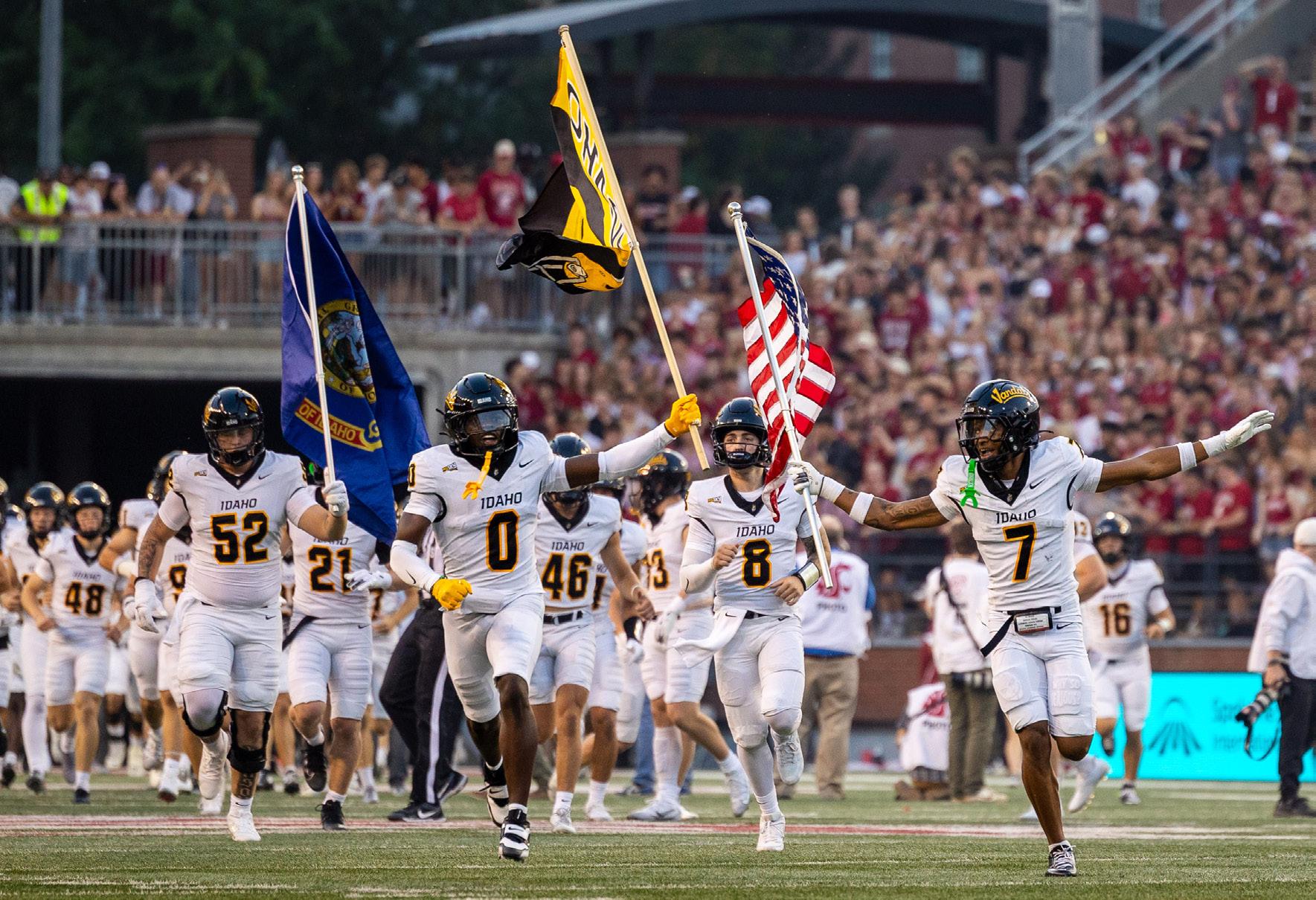
Idaho Vandals football team runs out onto Martin Stadium before its opening game of the 2025 season versus Washington State
Winter break is critical for students
Students need real time to recover, reset and prepare for the spring semester
AJ Pearman
ARGONAUT
College students often hear that winter break is a “nice perk” of academic life, a few weeks to relax before the spring semester begins.
But after months of deadlines, exams, work shifts and campus responsibilities, winter break isn’t a perk at all.
It’s a critical pause that supports wellbeing, academic performance and long-term success.
As universities continue debating academic calendars and trimming days to make room for other scheduling priorities, it’s worth saying clearly students need a long and meaningful winter break.
For many, the fall semester is the most demanding stretch of the academic year.
New freshmen are adjusting to independence for the first time, learning how to balance coursework with social life, jobs and extracurriculars.
Upperclassmen are burdened with regardless of classification, the semester ends with the most intense period of all, finals week.
These pressures stack up quickly and by mid-December, burnout isn’t an abstract idea.
It is visible on campuses everywhere.
According to American College Heath Association, nearly three-quarters of college students report moderate to serious psychological distress during the academic year.
Although stress exists year-round, the fall semester’s nonstop pace leaves little room for recovery.
Students often push themselves harder than they admit, stretching capacity to its limits in an effort to keep GPA, finances and social commitments afloat.
Winter break offers something campus
rarely gives permission to truly stop.
A long break isn’t just restorative; it’s protective.
Sleep schedules gradually return to normal, which matters more than people realize.
Studies from the National Institutes of Health show that consistent, adequate sleep improves memory retention, decision making and emotional regulation.
After finals season, when students often sacrifice sleep just to keep up, this reset is crucial.
The body and mind need time to stabilize before jumping back into another round of coursework.
Equally important is the mental separation the break provides.
College life can feel like a bubble, especially at residential campuses where students live, study and socialize to reconnect with family, enjoy independence without constant responsibilities and remember who they are outside the academic pressure cooker.
That distance helps students return with a healthier mindset, and often with a clearer sense of motivation.
A longer winter break is also essential for students who work.
With rising tuition and housing costs, many rely on holiday shifts to pay for books, rent or groceries.
Retail and service industries often offer peak hours around the holiday, giving students opportunities to make financial progress they simply can’t manage during the semester.
Shortening winter break removes that opportunity and disproportionately affects low-income students who depend on seasonal work.
The benefits don’t end there. Many students use winter break to travel to their homes, sometimes across the country or internationally. Flights are expensive, weather delays are common and family obligations don’t always fit neatly into a two-week window.
Why you should say “happy holidays”
The make-believe war on the Christmas season continues this year
Christopher Sprague ARGONAUT
Saying “happy holidays” has become something of an internet culture war in recent years.
It has transformed from a standard wintertime greeting into a whole argument. However, there are some actual reasons that you should be saying “happy holidays.”
The baseline is that, whether you celebrate them or not, December has many holidays and traditions celebrated by many different people and cultures.
This stems from ancient human traditions marking the winter solstice, which means days start getting longer and the end of the harvest.
With Christmas, Hanukkah, Kwanza, Boxing Day, New Years and Lunar New Year and more, December is full of holidays.
Unless you happen to know exactly what holiday everyone you greet celebrates, saying “happy holidays” includes everyone in the conversation and brings everyone holiday cheer.
When people say “happy holidays,” no one is trying to attack you or your Christmas beliefs.
It is just a neutral, social greeting that can hopefully bring everyone together.
On top of that, there is no “war on Christmas.”
The majority of United States citizens celebrate Christmas either religiously or because that is what they were raised celebrating.
If you walk into a department store, you see Christmas decorations covering many aisles, and maybe one end section dedicated to Hanukkah.
Afterall, one holiday shouldn’t get to own this month packed with so many different celebrations.
American culture is pluralist in nature. With people coming from all over the nation and the world, saying “happy holidays” is just an accurate reflection of the American melting pot.
Hopefully, it can also encourage us to explore other traditions and interact with this amazing melting pot.
Part of going to university is getting exposure to a more diverse and interesting group of people.
Having a more general greeting is part of the unique environment.
You’re not at Christmas mass; your greetings shouldn’t just reflect one religious belief.
Part of the diversity you see in college life is reflected in saying “happy holidays.”
Also, you shouldn’t be berating retail workers who say “happy holidays” this time of year.
They don’t know you or what winter holiday you celebrate, or what religion you believe in.
Saying “happy holidays” is efficient, kind and includes everyone at this time of year.
This greeting also includes Christmas.
Saying “happy holidays” opens the door for us to celebrate this season together.
This amazing time of year is about drinking hot cocoa, having friendly snowball fights with friends and hopefully surviving finals.
The negativity that is associated with arguing about religious beliefs and various holiday traditions shouldn’t be a focal point of the season.
So, happy holidays! Let’s all enjoy this wonderful time together as one group of people, each bringing new beliefs and traditions to the table.
A longer break ensures that students can spend actual quality time with loved ones rather than racing through a rushed holiday visit.
Some critics argue that lengthy winter breaks cause academic “slump,” making it harder for students to re-engage once January arrives. But this argument ignores the reality that rest is part of effective learning.
A short break may keep students superficially connected to course material, but it also keeps them closer to burnout.
A rested student learns faster and performs better than an exhausted one doing mental triage.
The break’s length also helps universities. When students return refreshed, campus communities become more stable and engaged.
Resident advisers face fewer crisis situations. Professors teach students who are more attentive and better prepared.
“Merry
Counseling centers, often overwhelmed in November, experience a brief but important reduction in demand. The benefits ripple in every direction.
As conversations about academic calendars continue across the country, institutions should resist the urge to shorten winter break in favor of squeezing more into the year.
The fall semester is long, intense, and often emotionally draining.
Students deserve more than a moment to breathe; they deserve a real reset.
Winter break may appear on the calendar as empty space, but its impact is anything but empty.
It’s one of the few structured times when students can rest without apology, recover without guilt and prepare themselves for the next challenge.
And in a world where college life demands more than ever that time is not just helpful, it’s essential.
Christmas” is
an appropriate phrase
Christmas is the season of joy, tradition and togetherness for all
AJ Pearman ARGONAUT
There’s a reason the Christmas season has earned the reputation of being “the most wonderful time of the year.” Beyond the holiday jingles, twinkling lights and crowded shopping malls, there’s something undeniably uplifting about the weeks leading up to Dec. 25. Christmas offers a rare sense of collective joy, a moment when communities, families and even strangers seem to operate with a little more kindness and a little more hope.
“Merry Christmas” is a common phrase that is used throughout the holiday season to inspire joy and cheer for others. It promotes well-being, glad tidings and an overall sense of Christmas cheer that can’t be matched.
The phrase truly brings an essence of Christmas in every greeting or goodbye that people say around this time of year.
One of the biggest reasons Christmas stands out is its ability to bring people together. In a time when division often dominates headlines, the holiday season creates an excuse—or maybe a reminder —to reconnect. Whether it’s gathering for a family dinner, attending a local parade or simply exchanging small gifts with coworkers, Christmas encourages us to pause our busy routines and prioritize the people around us. For many, these moments aren’t just festive; they’re grounding.
The traditions also play a major role in why Christmas has such a strong emotional pull. From decorating the tree to baking cookies, these rituals offer a comforting sense of consistency. In a world that feels unpredictable, holiday traditions give us something we can count on. Even people who don’t consider themselves particularly sentimental often find comfort in the
familiar smell of pine, the glow of lights or the sound of a favorite holiday song drifting through the car stereo.
Christmas also has a unique way of inspiring generosity. According to the National Retail Federation, charitable giving typically rises during the holiday season, with many organizations reporting their highest volunteer turnout around the holidays. Whether people are donating to local food drives, buying gifts for families in need or simply tipping service workers a little extra, the spirit of giving becomes more visible and more contagious. It reminds us that small acts of kindness can have a big impact.
Then there’s the magic, yes, magic, that comes with the season. It might sound cliché, but there’s something almost cinematic about walking through a snow-covered street, seeing houses lit up in blue and gold and hearing kids laugh as they build snowmen in their front yards. Even adults get swept up in nostalgia.
Christmas gives people permission to step back into childlike wonder for a few weeks, and honestly, that’s something most of us could use more often. Of course, no holiday is perfect. The season can be stressful, especially for those managing tight budgets, demanding schedules, or complicated family dynamics. But even with the challenges, Christmas seems to create an environment where people actively try to make things better, for themselves and for others.
It’s a time centered on togetherness, warmth and hope, which is more than many other holidays can claim. In the end, Christmas stands out not just because of the gifts or decorations, but because of what it represents: joy, connection and the belief that good things are possible. That’s why, year after year, the season continues to feel like the best time of all, and why saying “merry Christmas” can help inspire that feeling all through December.
Isaac Harrison Argonaut
A student heads through the slushy campus walkways during a cold winter day in 2023
Grad housing rates are too high for
74 percent of a graduate student’s stipend.
A common guideline is that no more than 30 percent of one’s salary should be spent on rent and certainly not 74 percent.
A year ago, the University of Idaho began a $162 million building project aimed at renovating undergraduate housing as well as building new apartments for graduate students and families.
With construction wrapping up, the university has released the rent for graduate student housing units, which are as high as
Options for the new apartments range from studios ($1,339 per month), one bedroom ($1,432 per month) and two bedroom ($1,154 per bed per month) — not including electricity.
These rates are not only out of sync with TA stipends, some of which are as low as $16,295 (for a nine-month academic year contract), but also the broader market rates in Moscow.
A two-bedroom apartment should be an economic option, but instead, it still
costs the majority of most graduate student stipends (note that the cost is per bed, not per apartment).
We feel it is important to bring attention to the disconnect between the university’s proposed housing rates and what the university pays its graduate students.
Housing built for the graduate and professional student body should be designed to be affordable for those students, but the cost of this new university housing does not align with the current university graduate student stipend.
If the university cannot create housing that is affordable on a graduate student stipend, then they should consider updating
those stipends to better reflect the current cost of living in Moscow.
Affordable housing for graduate students or adjusted stipends that account for the high cost of housing would be a strong tool for recruiting and retaining more graduate students, which is key to maintaining the university’s R1 status. We believe UI’s graduate and professional students deserve better.
KT Turner, MFA – Graduate Student, College of Letters, Arts, and Social Sciences
Richie Thaxton – Graduate Student, College of Science
Zachary Foley – Graduate Student, College of Science
Noreen Womack GUEST VOICE
It has been my honor and privilege to practice general pediatrics in Idaho for 25 years. I have worked with families from Boise and Eagle to Nampa and Caldwell. But I feel compelled to speak out today because the world has shifted underneath my colleagues and me and not in a good way. Until this year, I can honestly say:
Never have I ever thought I would worry about taking care of a child with measles, a disease that I have studied but have never seen before now, thanks to the measles, mumps and rubella vaccine. However, because of misinformation spread by people who have not spent their lives taking care of kids, we have seen over 1,500 cases nationally this year, with more than 1 in 10 children needing to be hospitalized. And it’s not just measles. Because of decreased immunization rates, more children have suffered and died from measles, influenza, and pertussis in the United States in the last year than during the past several decades combined.
Never have I ever seen a mother, paralyzed by doubt over the barrage of conflicting, politicized information, cry over whether or not to vaccinate her newborn… not until last month.
Never have I ever thought that something that was proven wrong years ago would be brought up again as “fact” by people in authority. We know the MMR vaccine does not cause autism. Any supposed link has been robustly and repeatedly disproven by large-scale, independent, published studies conducted over many years.
Never have I ever imagined that individuals who misspell the names of the vaccine-preventable diseases, diseases that I have spent my professional life studying and treating, would hold sway over public health decisions.
The American people should be able to trust the government to use science, experience and expertise when it comes to our nation’s health. But today we have a Secretary of Health and Human Services with no medical background who is pushing his own agenda. While I strongly believe that everyone is entitled to an opinion, I submit that Robert F. Kennedy Jr. should not be the person dictating health policy for all Americans.
Vaccines save lives. They have done so for over a century. Do they carry potential adverse side effects and preservatives? Yes, they do; nobody has said otherwise. All medicines, such as intravenous antibiotics and chemotherapy agents, carry risks and also use preservatives.
Should we have a federally-appointed attorney make life-and-death decisions about those as well? We, providers, go through years of medical training so we can spend our days helping families weigh the benefits and risks of all types of decisions, including vaccines. I do not need unfounded accusations in the room between me and my patient while I am practicing medicine.
So, who will protect the children in this year of falsehoods and half-truths? It is not our government, or perhaps not even the 67,000+ pediatricians across the U.S. I believe it will be the parents. Because despite everything that has happened in the last several years, 75 percent of American parents across all political affiliations support vaccines and school entry requirements.
If parents use their parental freedom to ignore the divisive noise and once again trust evidence and their medical providers, we can protect the progress we’ve made against vaccine-preventable diseases.
Next month, during Idaho’s Legislative Session, there will be a bill introduced to ban all immunization requirements. This bill is extremely dangerous and unnecessary, as it is already very easy in our great state for families to opt out of vaccines if they choose.
All this bill will do is send our recordlow vaccination rates even lower, which will, in turn, cause more illness and death. We need to step back from the constant barrage of information and demand medical facts over political fiction. Our children are counting on us.
“Statements made in this opinion piece are supported by pediatricians across the state through the Idaho Chapter of the American Academy of Pediatrics.”
Noreen Womack, MD – Idaho Early Childhood Champion | American Academy of Pediatrics Co-Founder | Idaho Children Are Primary | www.idahochildrenareprimary.org Guardian ad litem | Idaho Fourth Judicial District
Joshua Reisenfeld | Argonaut
The new South Hill Apartments on Sweet Avenue will be completed by the start of the Fall 2026 semester
Students are feeling burnt out, poll shows
Students
College campuses always shift in December. The air gets colder, the libraries get fuller and the conversations between friends start sounding the same: “I’m exhausted,” “I’m so behind,” “I just need a break.”
This year, exhaustion isn’t just anecdotal. A poll I conducted among students shows a striking reality: four out of five students say they are burnt out by the end of the semester and feel more than ready to go home. And those statistics should concern anyone who cares about student wellbeing.
Letter to the Editor
Burnout isn’t a buzzword. It’s a genuine condition marked by exhaustion, emotional strain and a dwindling sense of motivation. When 80% of students report that they feel this way, it signals a systemic issue in how colleges structure academic life. The fall semester in particular is long, demanding and packed with responsibilities.
From August to December, students face midterms, essays, labs, group projects, club commitments, athletics, jobs and, eventually, finals week. They push through it all with minimal
breaks and little time to recover.
The poll results weren’t vague or uncertain. Students expressed clear and consistent explanations for why they feel burnt out. Many said the workload piles up quickly after Thanksgiving, leaving almost no breathing room before exams. Others described the pressure to juggle academics with work, family responsibilities or leadership positions in campus organizations. Some students shared that financial stress adds an additional layer of emotional strain as the semester winds down. Regardless of the source, the overwhelming feeling is the same: they’re tired. And they’re not just tired; they’re ready to go home. The desire to leave campus isn’t about avoiding responsibility; it’s about needing a reset. Home, for many students, is the only place where they can truly unwind without deadlines or academic expectations hovering overhead. It’s a place where they can catch up on sleep, reconnect with family, decompress mentally and emotionally and simply exist without a to-do list. That desire is completely valid, and colleges should recognize the importance of that break instead of treating it as a minor pause in the academic calendar.
The poll highlights something larger: campuses are becoming environments where students feel they must constantly perform. The pressure to maintain high GPAs, build competitive resumes and participate in extracurricular activities often pushes students
beyond their limits. When 80% of students report burnout, it’s no longer an individual issue; it’s a culture problem.
Universities can address this by reconsidering semester lengths, reducing end-of-semester workload spikes, expanding mental health resources and creating more flexible academic policies. Small changes can help, like offering more reading days, reducing the weight of final exams, or allowing greater access to mental health days without complicated procedures.
But one of the most immediate and impactful solutions is simple: protect and prioritize winter break. Students shouldn’t be ashamed for needing time to rest. In fact, the poll proves the opposite; they desperately need it. A break isn’t laziness; it’s recovery. And recovery is essential for learning, performance and overall wellbeing.
As finals week closes in, students aren’t just counting the days until grades are submitted. They’re counting down to something more important: the chance to breathe again. Colleges should listen to what students are telling them loud and clear. Four out of five students say they’re burnt out. They’re ready to go home. And they deserve the chance to recharge, not just for themselves but for the academic success that universities expect from them.
Winter break isn’t a bonus. It’s a lifeline, and students need it now more than ever.
Mentorship is incredibly valuable in prison
I’m
The day I was processed into prison 10 years ago was the lowest point in my life. After setting fire to two houses in a drug-induced psychosis, I had lost everything and fractured all of my relationships. I owed $262,000 in restitution fees. I felt alone, like a waste of life. And I didn’t care if I survived my prison sentence.
Having been through the system before, I already knew what to expect: terrible food, daily power struggles, peer pressure, violence, low-paying jobs, and a chaotic, frenetic, weekslong intake and classification process.
During processing this time around, I regularly watched from my cell as new arrivals filed in behind me, wearing ill-fitting white jumpsuits and carrying their worst mistakes on their shoulders. Many of them overwhelmed staff with urgent needs and questions.
“The nurses don’t have my medication!”
“What’s wrong with the phones?”
“Where are they going to send me?”
“When can my family come visit?”
Staff were impersonal and abrupt in their responses. They had neither the time nor resources to address each query and issue.
Back then, I never imagined that I would help others adjust to prison. But over the decade since I landed here, I became part of my prison system’s welcoming crew. I pull people from their cells for fresh coffee and orientation, where I introduce myself and share ways they can spend their time in prison.
The difference between the level of support people entering Idaho prisons are provided today versus what I received 10 years ago is just one example of how Idaho corrections is trying to change its prison culture.
To power this culture shift, corrections officials are recruiting help from those in custody and on community supervision.
My involvement started in 2024, when I was selected to participate in a 10-week course designed to train individuals in Idaho prisons to become peer mentors. The course
was developed by Michael Copenhaver and Chris Shanahan. Copenhaver is out on parole, and Shanahan is currently incarcerated in a community reentry center. Between them, they have more than 50 years of carceral experiences, making the pair well suited to grow and standardize the program across the state.
A peer mentor is a person who uses their lived experience to support and mentor their peers. Those operating in Idaho prisons commit to abiding by facility rules, decreasing divisions among staff and residents, and practicing inclusion and confidentiality.
More than 1,000 Idaho prisoners, or roughly 12% of the state prison population, are now involved in the initiative, according to Copenhaver. The only requirement to join is a desire for personal growth.
The 2024 course was facilitated by other residents who worked beyond their initial training to become certified instructors. It focused on peer advocacy, self-empowerment, the stages of change and motivational interviewing — a collaborative counseling style that helps people identify needed behavioral
changes and find the internal motivation to make them a reality.
Participants today advance through the program by achieving certain milestones, like completing and facilitating peerled workshops, logging service hours around the facility, and serving in various capacities.
After completing training, I was elected to serve as the proposal writer for my mentor group’s steering committee. The five-person committee performs administrative functions for the group. Some of our duties include managing data, developing curricula and forming the partnerships necessary to achieve our strategic goals.
Recently, corrections accountants challenged us to create revenue streams and become more self-sustainable. So we formed an outreach and fundraising subcommittee and started a proposal to develop a worm farm and bring fertilizer to market.
The peer mentor group at my facility goes by the name Pillars as a reminder to our members that we hold one another up to keep the roof from coming down on us all.
Nearly all of our mentors work full-time jobs in addition to volunteering with the group.
Brian Watford works as a reentry specialist in the education building. There, he connects residents preparing for release with health, employment and housing resources, and assists community organizations who visit our prisons to do the same.
“I make 40 cents an hour, but I’m not really in it for the money,” he said. “I just get a great feeling connecting with the men as they come in, and helping those who need it to navigate prison.”
One of the organizations with a part-time presence in our facility has offered him a job upon release, Watford added.
One of my favorite posts is the processing center for all men entering Idaho prisons, so no one has to experience what I went through 10 years ago.
We welcome newcomers in a multipurpose room attached to a foyer that connects two large housing units. I line up by the door with a rotating team of mentors. A fresh pot of coffee brews on the table beside us as the newest arrivals walk in, each one greeted with hearty handshakes.
For the next 45 minutes, we deliver a PowerPoint presentation with tips for how they can make the most of their stay.
“I don’t know which prison you’re going to,” I say, pointing to a slide showing pictures of mentor teams at other facilities. “But I do know that these men will be waiting to greet you and support you when you get there.”
In that moment, their anxious faces fill with hope and inspiration. It’s that look that tells me why this program is so important.
My hope is to apply the skills that I’m learning with Pillars in a way that allows me to pay off my restitution when I leave prison. Perhaps one day, I will even return through the employee entrance to continue my work.
Patrick Irving, a writer incarcerated in Idaho, is the author of the newsletter First Amend This. He is a contributor to the Prison Journalism Project, and his work has appeared in the New York Times, Idaho Law Review, The Harbinger and SolitaryWatch.org.
Joe Pallen | University of Idaho
A student works on homework in the University of Idaho Library
Joe Pallen | University of Idaho
Studying abroad enforces work-life balance
How different countries value their personal time
Paige Wilton ARGONAUT
A trait many look for in potential employers and academic opportunities is a healthy work-life balance. After a semester spent studying abroad, I’ve grown a greater appreciation for a well-rounded lifestyle after witnessing how different cultures embrace it.
Since early high school, I, like many students, have juggled the responsibilities tied to academics and maintaining a job at the same time.
In today’s economy, students of all ages face immense financial responsibility when left to support themselves. This can lead to a life spent strictly between school and work, and although this lifestyle isn’t a choice for some, it often results in full days, additional commitments and little time to enjoy other parts of life.
As someone who has pursued an education while being employed for many years, studying abroad has provided the chance to experience a true work-life balance–one I wish to replicate in the future.
Over the past semester in the U.K. education system, the differences in how schooling is viewed here compared with the United States has become increasingly clear.
Across Scottish universities, courses often prioritize reading and comprehension over practice and repetition.
What this looks like is a weekly stack
of readings to pair with lectures rather than frequent projects, time spent working on deliverables or written exams. On top of that, students are often limited to taking three courses per semester to prevent burnout.
In my experience, the way education is approached here has resulted in more time outside of the classroom to engage in other activities.
Throughout the semester, I’ve worked remotely, and despite managing multiple tasks, I feel as if I have achieved far more of a work-life balance than ever before in the U.S.
Studying abroad is an experience all in its own, but one of the greatest takeaways I’ve been left with is the value of a worklife balance. Engaging in a new culture has encouraged me to make the most of my months here, but the value that Scotland places in personal time is what has truly made it possible.
While several factors contribute to the productivity-based and work-centric culture the U.S. fosters, it’s countries like Scotland that represent the attainability of balanced lifestyles for everyone. If only those in charge of our capitalist society would acknowledge it.
Ultimately, my semester abroad has left me with many lessons, but one that has impacted how I view academics and employment is the importance of a healthy worklife balance. It’s been amazing to see how other cultures invest their time, promote personal interests and view life through a multitude of lenses.
Paige Wilton Argonaut Driving through grassy mountains in the Scottish Highlands
Paige Wilton Argonaut
Hundreds of locks adorn the well-known ‘News Steps’ overlooking Edinburgh, Scotland
GALLERY: Campus glows with holiday cheer
Ashley Kramer | Argonaut
The Vandal tree-topper shines atop the Christmas tree outside the ISUB during the tree lighting on Dec. 1
Aubrey Sharp | Argonaut
Students gather outside the ISUB after the tree lighting ceremony
Reagan Jones | Argonaut
Santa Claus sits in the ISUB rotunda, where he took photos with students
Ashley Kramer | Argonaut
The Christmas tree outside the ISUB stands among other decorated features
Aubrey Sharp | Argonaut Trees wrapped in Christmas lights glow outside the ISUB
Reagan Jones | Argonaut
A Vandal ornament is hung in the ISUB rotunda Christmas tree