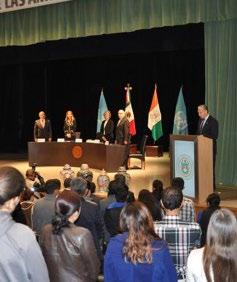
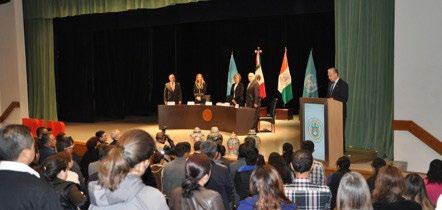
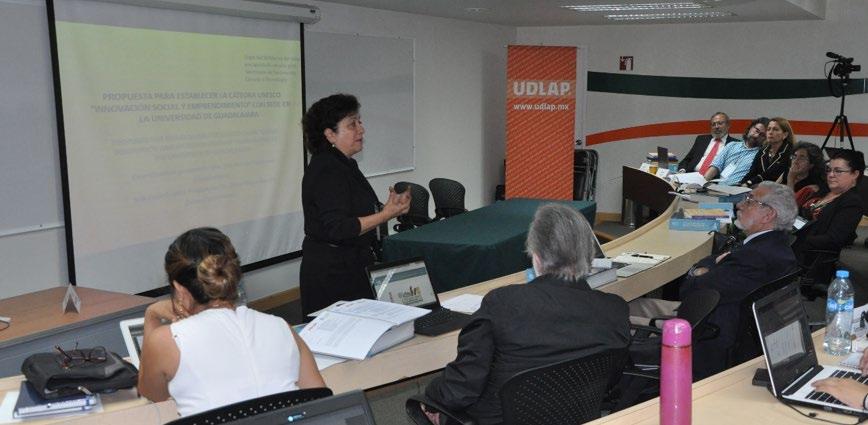
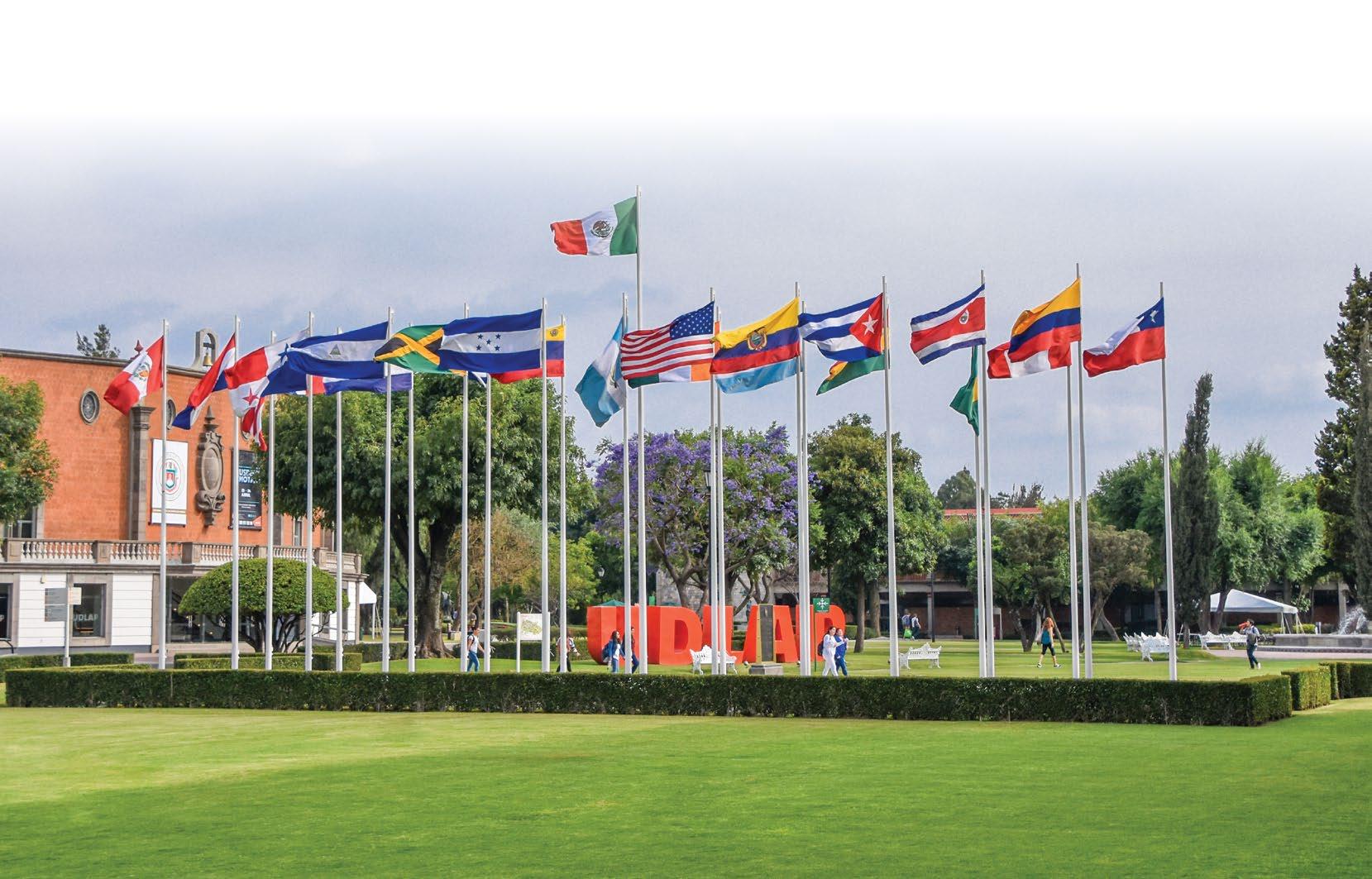
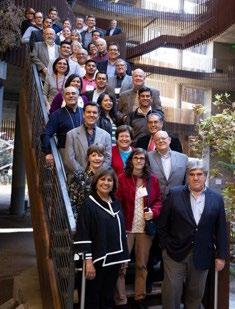
n 2018, the unesco Chair on Hydrometeorological Risks collaborated with the unesco Office in Mexico to organize a meeting of UNESCO Chairs from October 15 to 17 at University of the Americas Puebla (udlap, for its Spanish acronym), Mexico. In the meeting, the Chairs analyzed the works they conducted with regard to the country’s sustainable development goals (SDGs) and offered recommendations that will be sent to those who prepare the National Development Plan.
The meeting was divided into four topic-specific sessions, each corresponding to an essential pillar of sustainable development: human development, economic development and sustainability, environment, and peace and justice. Five SDGs were assigned to each pillar.
Víctor Hugo Alcocer Yamanaka Comisión Nacional del Agua
R. Bandala González Desert Research Institute, EE. UU.
The sessions and their corresponding SDGs are presented below:
Dr. Luis Ernesto Derbez Bautista, President of udlap, was responsible for opening the event. He discussed how education, science, and culture are necessary and important public resources for humanity. He said, “Today, we have 24 Chairs assembled, and we can proudly say that udlap has one. What we are doing here sends the message that if we work together and think about how this combination of education, science, and culture can help the world, we can find a fundamental difference between what happens in the world today and what we want to happen,” equally stressing that “with the development of the Chair on Hydrometeorological Risks and with the Doctorate in Water Sciences, we try to give our small grain of contribution, but without the rest of the Chairs, our country would not be able to continue advancing in what should be a collective approach to development and solutions to the problems faced by society.”
In turn, Ms. Nuria Sanz, unesco director and representative in Mexico, thanked udlap for the opportunities given to hold this meeting because it allows partners aligned with the 2030 Agenda for Sustainable Development as well as unesco’s lines of action to work together. She also explained that “Chairs are an absolutely essential platform because there are no multilateral regulations or documentation guiding aspects today that are related to our lives, habits, and decision-making. Chairs are necessary to strengthen this scientific citizen behavior from the technical point of view.”
Finally, Dr. Polioptro F. Martínez Austria, director of the unesco Chair on Hydrometeorological Risks (based at udlap) and an academic at the Department of Civil and Environmental Engineering of udlap, announced that topics of broad global and regional relevance will be examined at the 2018 meeting of unesco Chairs in Mexico. He said, “Some of the most important challenges in Mexico will be analyzed and examined around the approach that SDGs provide and which represents a globally agreed-upon effort to achieve a more just, equal, and sustainable world. As a result of this meeting, public policy recommendations will be made to different levels of government in our country.”
The 2018 meeting activities of the unesco Chairs in Mexico began with the presentation “Sustainable Development Goals in Mexico,” given by Mexico’s director of unesco, who celebrated the idea that the Chairs would like to expand the discussion started in Guanajuato in 2017 and, as a consequence, continue to reflect on sustainable development in Mexico from their respective areas of expertise, in order to establish a road map to help implement the UN’s 2030 Agenda in Mexico. “Chairs have much to contribute to the achievement of SDGs, generating exceptional transdisciplinary research and action platforms,” said Nuria Sanz.
Subsequently, the Chairs met in the scheduled sessions to analyze the SDGs and drew conclusions that can be found in another article of this newsletter.
Final Document On The National MEETING OF UNESCO CHAIRS
INTRODUCTION
The group of 17 UNESCO Chairs from Mexico, who met on October 15, 16, and 17, 2018, acknowledges the importance of this call to promote knowledge and understanding of the SDGs as well as the opportunity to promote proposals articulated by the Chairs within the framework of the 2030 Agenda. They also thank UDLAP for initiating, organizing, and executing this meeting as well as for the support from the UNESCO Office in Mexico.
During this time, the Chair participants reflected and contributed ideas and common lines of action. In this regard, they found it necessary to make the following general points.
To jump-start sustainable development in the country, framed within the 17 SDGs in the UN’s 2030 Agenda, it is essential to promote a State policy on Higher Education, Science, Technology, and Innovation based on the below discussed aspects:
REPOSITIONING THE ROLE OF HIGHER EDUCATION IN THE NATIONAL AGENDA.
a. Education must be a public facility and its status as a universal human right must be guaranteed, under the principles of social justice and equality.
b. It is essential to educate for the development of competencies for intercultural coexistence, so that we may learn to recognize, accept, coexist, respect, and learn from otherness.
c. We must stop the decrease on per-student expenditure in higher education, which is currently taking place, and substantially increase investments.
d. It is necessary to increase coverage (at least double) and improve the equity and inclusion of vulnerable groups.
e. It is vital to define a policy of retaining, connecting, and repatriating scientists, technologists, and innovators.
f. To form a new socially committed citizenship, we must create spaces for critical and innovative education.
g. Standardization of quality (ISO) must be concluded.
h. It must be recognized that the processes and criteria of
assessment and accreditation are essential to guaranteeing top quality of higher education; therefore, we must do the following:
i. strengthen national quality assessment and accreditation bodies
ii. i ncrease connections with international organizations for assessment and accreditation
iii. verify assessment mechanisms by peers and interdisciplinary teams, avoiding commercial processes and criteria
i. Current educational models have to be transformed to include humanistic, philosophical, and artistic training.
j. Higher educ ation institutions (HEIs) must become spaces of citizenship, where the culture of respect for rights and commitment to complying with duties is fostered.
k. Promote the culture of human rights, transparency, and access to information, as well as inclusive and participatory decision-making, in HEIs.
l. Eradicate any type of discrimination within HEIs.
THE NEED TO REESTABLISH HEIs.
a. HEIs must r epresent development and social transformation.
b. Promote and strengthen the supportive internationalization of higher education.
c. Higher education must be the result of interaction between research and teaching.
d. Promote transdisciplinarity and knowledge dialog.
e. Promote innovation, connections with the productive sector, and support for social and environmental problems.
f. Establish policies for gender equality and equal opportunities for women and men.
g. Integrate the theoretical and practical knowledge to promote sustainable development, including human rights and gender equality, into educational programs at all levels of education, promoting a culture of peace, justice, security and global citizenship and the value of cultural diversity.
h. Modernize management, professionalize, and de-bureaucratize administration in higher education.
i. Strengthen the model of intercultural universities.
j. Support critical pedagogy and flexible curriculum to meet social and environmental needs.
k. Promote the participation of women in the decision-making spaces of HEIs.
l. Contribute to the creation of research centers for strategic issues related to the youth, migration, masculinity, collaborative economies, among others.
RESTRUCTURING THE NATIONAL SCIENTIFIC SYSTEM.
a. The scientific, technological, and innovation system must support social and environmental problems and needs because it is fundamental to jump-starting the country’s sustainable development.
b. Pr omote a culture of research among the Mexican population.
c. Regain the talent of Mexican postgraduates to strengthen the scientific, technological, and innovation system through repatriation, mobility, and connections.
d. Recover and reevaluate traditional knowledge to incorporate it into national science and technology development.
e. Bring the research of HEIs together with primary and secondary education.
f. Update the General Law of Science and Technology to address the challenges posed by the country’s endogenous development.
g. Define strategic lines of research according to social and environmental problems and needs.
h. Promote collaborative and transdisciplinary research at national and international levels.
i. Review the national legal framework with regard to protecting industrial and intellectual property, in order to safeguard and promote strategic areas of national development.
THE MISSION OF UNESCO CHAIRS IN MEXICO
a. The UNESCO Chairs in Mexico are a source of critical thinking for the development of useful scientific, technological, social, cultural, and environmental knowledge.
b. It is essential to promote the Chairs’ potential through their collaboration, exchanging and developing joint strategic and transdisciplinary projects at national and international levels.
c. Participation by young people in Chair activities should be encouraged.
d. It is essential that the Chairs influence the design, implementation, and evaluation of public policies.
e. Recognition and institutional and economic support of the Chairs should be strengthened.
f. Efforts should be made to disseminate the Chairs’ activities and results.
g. The Chairs provide advice on issues crucial to society, the dissemination of knowledge, and the promotion of citizen participation.
As a result, the UNESCO Chairs in Mexico have decided to establish a set of common projects, which will strengthen their connection with each other, so that they are placed at the national level, within the framework of implementing the SDGs from the UN 2030 Agenda at the local level.
The UNESCO Chairs in Mexico will design a communication strategy for the education of citizenship.
A comprehensive knowledge communication strategy will be designed and developed by the UNESCO Chairs, in order to influence the education of citizenship and public policies.
Coordinators: Chair in Communication and Society; Chair in New Information Technologies; Chair in Citizenship, Education, and the Environmental Sustainability of Development.
Organization of topic-specific meetings and joint positions with regard to major challenges Every year, two or three topic-specific meetings will be organized, coordinated by a Chair with interest in the area. The meetings will incorporate subject matter experts, with the goal of obtaining a joint critical position document.
First topic: Adapting to climate change in Mexico. Coordinators: UNESCO Chair on Hydrometeorological Risks; Chair in Citizenship, Education, and the Environmental Sustainability of Development; Chair in Climate Change; and Chair in Water in the Knowledge Society.
Second topic: What and how do we communicate? Coordinator: Chair in Biosphere Reserves and Urban Environment.
Third topic: Development and human rights. Coordinators: Chair in Human Rights; Chair on Developing a Model for the Defense of the Rights in Higher Education; Chair in Migration, Development and Human Rights; and Chair on Hydrometeorological Risks.
Fourth topic: Inequalities. Coordinators: Chair in Intercultural Education and Chair in Gender, Leadership, and Equity.
Fifth topic: Higher education, science, technology, and innovation. Coordinators: Chair in Migration, Development, and Human Rights and Chair in Human Rights.
PROJECT 1 PROJECT 2:
SEVENTY-FIVE YEARS OF BINATIONAL RELATIONS IN WATER:
Retrospect, Resilience, And Governance Of Water Resources
On The Mexico–United States Border
n 2019, two significant milestones will be marked in the relation between Mexico and the United States with regard to water and the environment on the border. First, the 25th anniversary of the North American Free Trade Agreement established on January 1, 1994, and second, the 75th anniversary of the water treaty signed on February 3, 1944. This treaty distributed water resources from the Rio Grande/Bravo and the Colorado River between both countries.
25 YEARS ARE COMPLETED OF THE FREE TREATY COMMERCE OF AMERICA FROM THE NORTH (NAFTA) ESTABLISHED ON 1 OF JANUARY 1994
On the basis of these events, the UDALL Center for Public Policy Studies and the Sonora College (Colegio de Sonora) organized the “Binational Water Relationships at 75 Years” workshop on October 15 and 16 at University of Arizona. The attendees included the commissioners of the International Boundary and Water Commission (IBWC) from Mexico and the United States: Professor Stephen Mumme, Ambassador Alberto Széquely, the Consul of Mexico in Tucson as well as execu-
tives from the University of Arizona, researchers, students, and government and civil society participants from both sides of the border.
Those attending the event enjoyed the participation of Professor Stephen Mumme from University of Colorado in the talk “The Treaty of 1944 and What It Means for Binational Water Resources Today and in the Future,” where the “quasi-constitutional” and still quite flexible nature of the 1944 Water Treaty was established as an instrument in binational water management from Mexico and the United States.
The participants had the privilege of listening to commentary on water diplomacy between the two countries, presented by Alberto Székely, former Mexican ambassador and primary negotiator of the Peace Agreement. Moreover, commissioners Roberto Salmón (CILA-Mexico) and José Núñez (IBWC-US) spoke about the relevance of the commission’s continuation that emerged from the 1944 Treaty. The workshop reviewed the history of binational management between the two countries and the impact it has had and evaluated the present and future collaboration on environmental policy between Mexico and the United States.
UDLAP was represented in panel 7: “A View Toward the Future” (Young Scholars Looking Ahead), where M. I. Paul Hernández Romero, PhD candidate in Water Sciences, presented a line of research and project developed by the university with respect to water management in the Rio Grande basin.
In total, seven discussion panels and idea exchanges on different topics were held, which allowed participants to appreciate the nature of these agreements in strengthening binational relations on water and the environment on the border. In the event’s last session, the group of experts and guests discussed the production of a publication, which will be released next year.
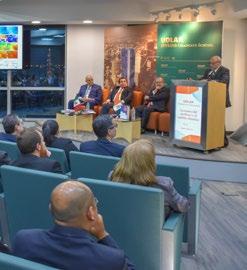
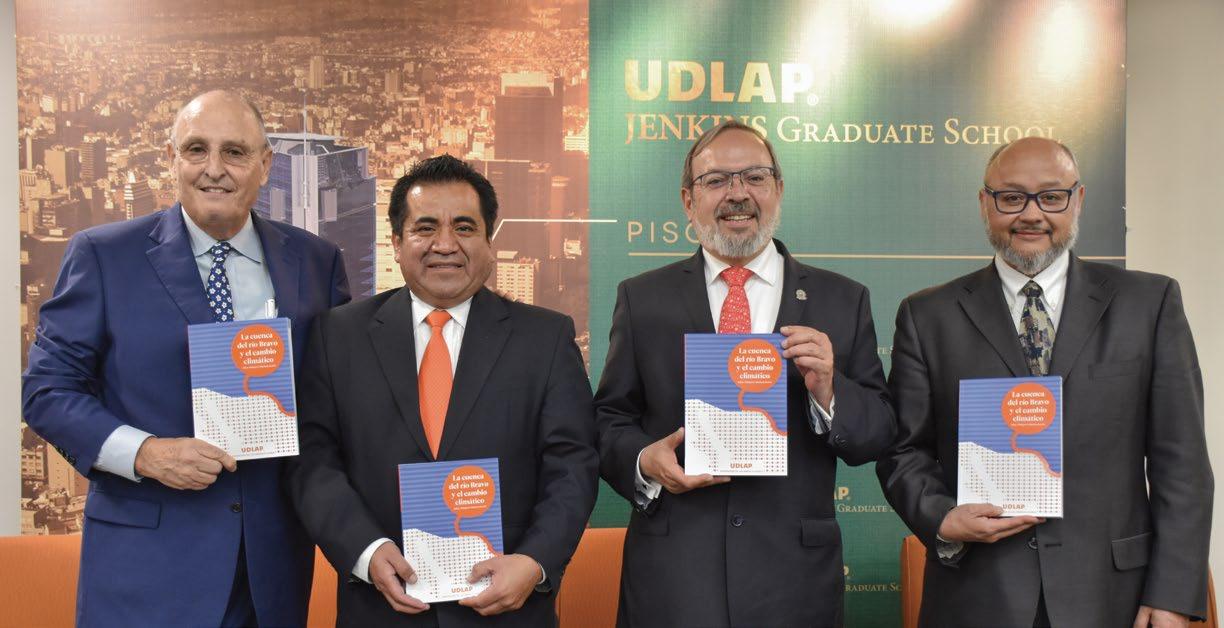
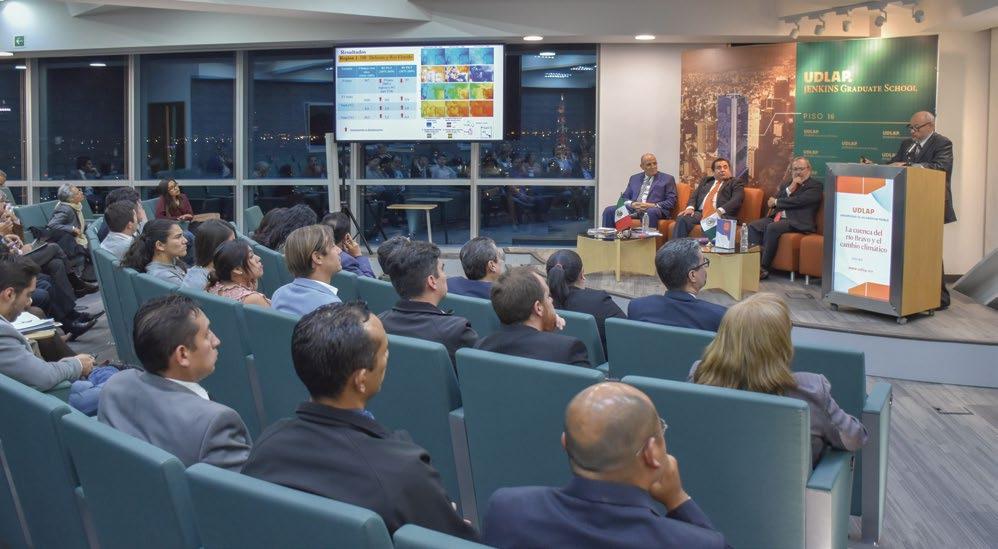
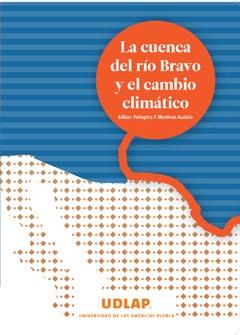
ithin the framework of the UNESCO Chair on Hydrometeorological Risks, the book “The Rio Basin Basin and Climate Change,” edited by Dr. Polioptro F. Martínez Austria, was presented at the UDLAP Jenkins Graduate School.
The Rio Grande basin and climate change brings together studies and perspectives from leading specialists in water management, who hold both theoretical knowledge about and experience of addressing the problems at the basin. The book offers a unifying approach when analyzing the situation from various disciplines, such as economic fields, social fields, hydrological fields, water management, dynamic modeling of systems and geographic information systems, among others.
For the book’s presentation, three of the participating authors were present. Dr. Gonzalo Bravo, Deputy Director of Public Information at the North American Development Bank, first expressed thanks for the invitation to collaborate on this work; “I am highly honored to have been part of this effort that came as a result of a seminar on the integrated management of the Rio Bravo basin and issues on climate change that was held last year at UDLAP,” he said. His chapter talks about social participation in the Rio Bravo basin, in which he describes his experiences of being responsible for community participation on the Rio Bravo basin.
On the other hand, another author, Dr. Carlos Patiño, professor at the Department of Civil and Environmental Engineering at UDLAP, said that this book highlights the concern for water security: “One of the most important issues of global concern for decision-makers is water resources, and in this case, in particular, in a binational basin, which is even more import-
ant due to the diplomatic aspects.” He also stressed that the inclusive view of this book revisits issues that complement the reader to understand this problem, one of which is the part on climate change, because, according to him, “few studies have been carried out to assess water vulnerability against the impact of climate change.”
Continuing with the commentary on the book, Dr. Carlos Díaz, research professor at the Inter-American Institute of Water Technology and Science, during his speech, clarified that the information system that this book generated about the basin is unique. He said, “I think it is a provocative book, very passionate and an example to be replicated in the country’s other basins, such as the Lerma-Chapala-Santiago basin and the southern border basins, since most of the problems facing the country are found between these three basins, and by solving these problems, we will advance at a national level” he said.
Dr. Polioptro Martínez Austria recalled that one of the biggest challenges was to transform research products, normally published in journals, into a book that is accessible to anyone interested in the subject. He said, “Many of these texts are products of research and are innovative and novel results in many disciplines. In this sense, this is a unique book and I am very satisfied. The authors understood the idea of passing on their knowledge so that anyone with a professional education could understand it.”
“It is the work of many people, collected in two years,” said the director of the UNESCO Chair on Hydrometeorological Risks, during the time offered in the University of the Americas Puebla area in Mexico. Likewise, he took the opportunity to thank the undergraduate and doctoral students and each of the more than 22 authors who participated in this work, as well as the organizations involved, such as CONACYT, the Department of Civil and Environmental Engineering, and the Publisher of the University of the Americas Puebla that, according to him, “has the mission and calling to create knowledge.”
Finally, Dr. Polioptro conveyed a sense of urgency that “the Rio Grande basin is one of the most important in Mexico; it is the one that keeps us on the border of nationality and it is in trouble. We have scarce water; it is over-allocated; we are using resources beyond what is reasonable, compromising the environment, but, in addition, there are two future modeling forces that are present in this basin: the first is population growth and urbanization and the other is climate change”.
DR. POLIOPTRO CONVEYED A SENSE OF URGENCY THAT «THE RIO GRANDE BASIN IS ONE OF THE MOST IMPORTANT IN MEXICO; IT IS THE ONE THAT KEEPS US ON THE BORDER OF NATIONALITY AND IT IS IN TROUBLE».
The work is for sale at Profética, the University Store and udlap Store.
IF YOU WANT TO LEARN MORE ABOUT UDLAP PUBLISHING’S PUBLICATIONS
ELECTED AS DISTINGUISHED MEMBER OF THE AMERICAN SOCIETY OF CIVIL ENGINEERS (ASCE)
Dr. José D. Salas is a Member of the UNESCO Chair on Hydrometeorological Risks
The ASCE has inducted Dr. José D. Salas, Professor Emeritus of Civil and Environmental Engineering at Colorado State University (CSU), as a Distinguished Member of the Society. The ASCE website indicates that this is the highest honor conferred by the Society on an ASCE member. There are only 229 Distinguished Members among the current membership of the Society that includes more than 150,000 engineers. According to the ASCE, “A Distinguished Member is a person who has attained notoriety in some branch of engineering or in the arts and sciences related to it, including the fields of engineering education and construction.”
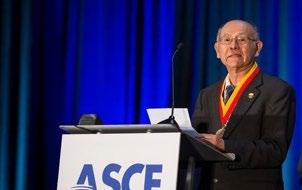
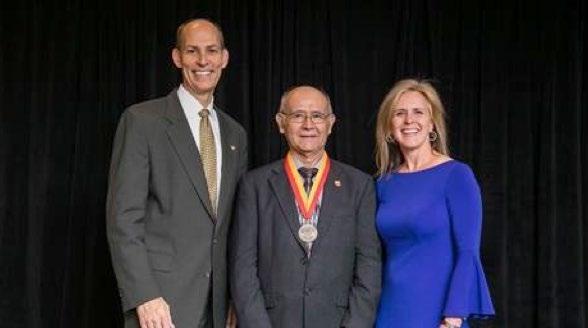
Dr. Salas was officially inducted as a Distinguished Member on October 13, 2018, at the celebratory luncheon held during the ASCE Convention in Denver, Colorado. In this ceremony, Kristina Swallow, president of the ASCE, and Thomas W. Smith III, Executive Director, presented Salas with a lapel pin and an engraved medallion, and then presented a video of Salas’ professional achievements. Dr. Salas thanked Ms. Swallow and the ASCE for receiving the honor and highlighted the great oppor-
tunity and support he had in his university studies at National University of Engineering (UNI) in Lima, Peru, in his graduate studies, and in his faculty membership at CSU. He also recognized the support of his CSU colleagues, his graduate students, collaborators in several other places, and his family.
Professor Emeritus Salas was a member of the CSU faculty for more than 30 years. He was the primary advisor for 37 PhD students and 43 Master’s students. He also served as a member of the External Committee for doctoral students at universities in Canada, Korea, Spain, and Peru. He has been a consultant to national and international organizations, and the author of more than 95 articles of indexed journals. He is the lead author of the book “Applied Modeling of Hydrological Time Series” and author/co-author of 15 book chapters and manuals.
Salas is recognized for his pioneering contributions in the stochastic modeling of hydrological processes, floods and drought analysis, impacts of climate variability and change in
hydrology and water resources, simulating complex river systems such as those of the Colorado River, the Great Lakes, and the Nile River, and risk and uncertainty analysis of non-stationary hydrological extreme events. He has been at the forefront of hydrological research, having contributed to both theoretical and practical aspects of hydrological science and engineering, in particular, in the univariate and multivariate stochastic simulation of precipitation and fluvial flow rates in humid, semi-arid, and arid regions. An important achievement in his career was leading the development of the Stochastic Analysis Modeling and Simulation software, for the Bureau of Reclamation in the United States.
For more than four decades, Salas has been a lead researcher on a variety of basic and applied research projects in water engineering. These projects were funded by national and international organizations, such as the National Science Foundation, the USGS, the USBR, NOAA, and the USDA, which are agencies in the United States, the Agricultural Experiment Station in the State of Colorado, the World Bank, and other more.
After retiring from CSU, Salas, in collaboration with his first PhD student from CSU, Dr. J. Obeysekera (now a senior lecturer at Florida International University), has been researching new methods to evaluate hydraulic structures designed to provide protection from extreme events such as flooding of rivers and
sea coasts, caused by hydro-climatic variations and land use. Salas and Obeysekera published several articles on the subject, and one of them, published in 2014 in the Journal of Hydrological Engineering by ASCE, was awarded as the best article published that year. The same article also won the STAHY 2016 Award from the International Association of Hydrological Sciences (IAHS).
Salas also received the ASCE Hydraulic Engineering Award in 1996 from the ASCE, the Ven Te Chow Hydrology Award in 2010, and the Norman Medal in 2015. He served as the Associate Editor of the Journal of Hydraulic Engineering and Journal of Hydrologic Engineering, both from the ASCE, the Journal of Hydrology (Elsevier), and other journals in Spain and Mexico. His memberships include AGU, IAHR, IAHS, Sigma Xi, CIP, and APIHA. He has worked with various committees and organized special sessions for several conferences for the ASCE/EWRI and AGU. Salas is a Corresponding Member of the Engineering Academy of Mexico and the Engineering Academy of Peru, and a Member of the UNESCO Chair on Hydrometeorological Risks in Mexico. He obtained a degree in Civil Engineering from National University of Engineering of Lima, Peru, and a Master’s and Doctorate from CSU. In 2010, the National Agrarian University, La Molina, Peru, granted him the title of Honorary Professor, and in 2011, his alma mater, UNI, awarded him the title of Doctor Honoris Causa.
Dr. José D. Salas accompanied by Ms. K. Swallow, President (right) and Mr. T. Smith III, Executive Director of ASCE, (left) during the ASCE Convention in Denver, Colorado, October 13, 2018.
EDITORIAL COORDINATIONS
Editor
Polioptro F. Martínez Austria
Style correction
Aldo Chiquini Zamora
Andrea Garza Carbajal
Editorial design
Andrea Monserrat Flores Santaella
The unesco Chair on Hydrometerological Risks Newsletter is a quarterly publication which reports on the activities of the Chair and its members, unesco news related to it, as well as general information on disasters and hydrometeorological risks. It is elaborated by the Universidad de las Américas Puebla. Ex hacienda Sta. Catarina Martir s/n. C. P. 72810, San Andres Cholula, Mexico.