

P.O. Box 156, Two Hills, AB T0B 4K0 www.twohillschronicle.com Proudly Serving the County of Two Hills & Surrounding Areas
within the County of Two Hills November, 2023

P.O. Box 156, Two Hills, AB T0B 4K0 www.twohillschronicle.com Proudly Serving the County of Two Hills & Surrounding Areas
within the County of Two Hills November, 2023
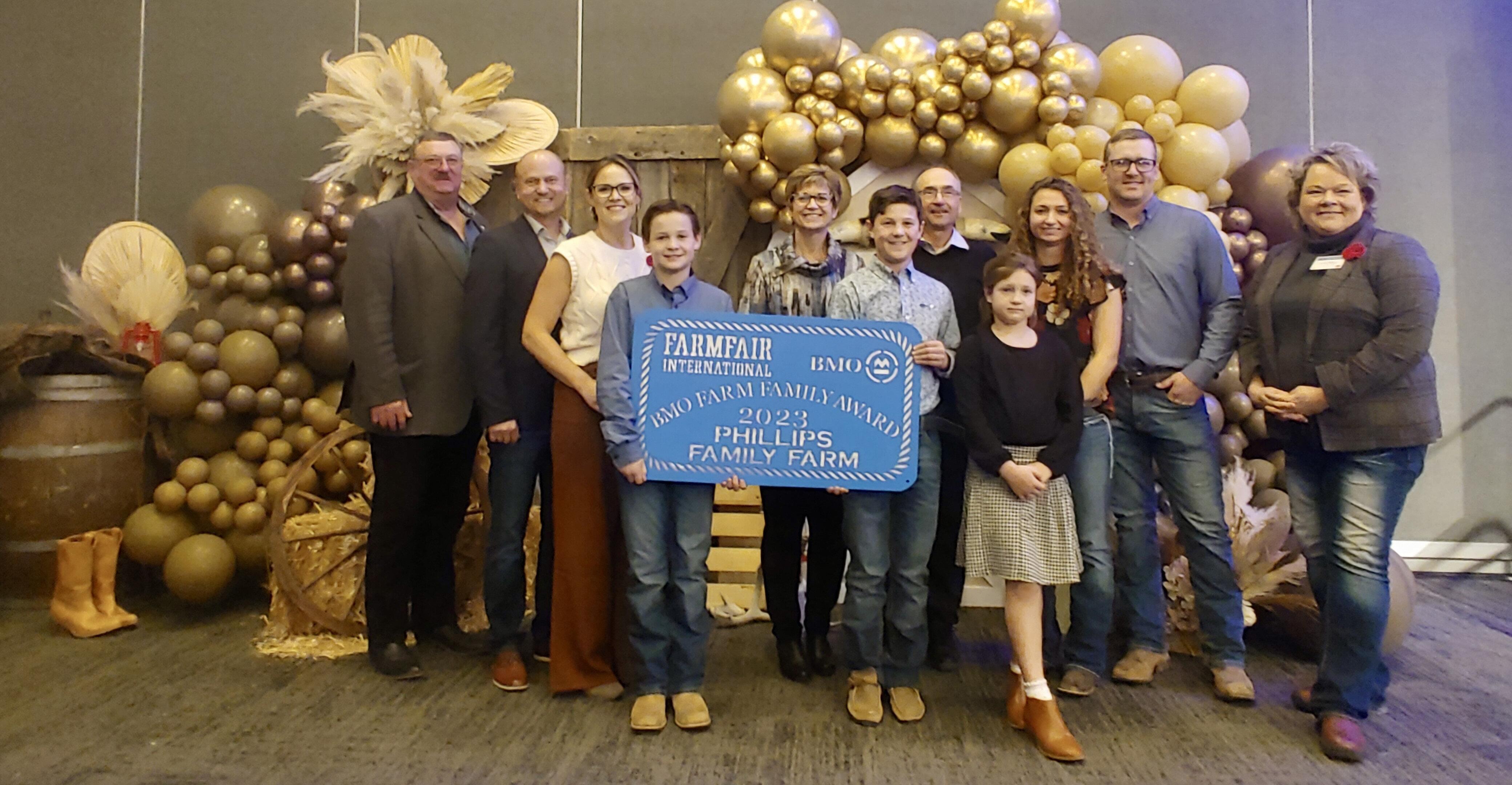
For 50 years, farm families from northern and central Alberta communities have been recognized as the recipients of the BMO Farm Family Award. Award recipients are selected as outstanding families who best represent values of the family farm within their rural community. The award honours both their farm business practices and community involvement. Myrnam Ag Society nominated the Phillips Family. Pictured above is Murray, Kaila, Mason, Carson, Payton, Raymond, Candace and Julie Phillips with Jordan Suvak and County of Two Hills Counc. Elroy Yakemchuk and Fort Saskatchewan
Homeniuk at the presentation at Farmfair International in Edmonton November 10.

By Ruven Rajoo
You can take the person out of politics but you can never take politics out of a person. This expression profiles one of our community’s longest serving town councillors and former mayor Elaine Sorochan.
In a byelection held in the town of Two Hills in early November, Sorochan filled a vacancy on town council following the
resignation of former councillor and CAO Gerrren Saskiw.
Her previous portfolios include the Two Hills Improvement Committee, Eagle Hill Foundation, Library boards and several other organizations. Sorochan also served on the “Women in Politics” committee of the Alberta Urban Municipalities Association.



By Ruven Rajoo
At the organizational meeting of the county of Two Hills held Nov. Division 2 councillor Murray Phillips was elected reeve. Former Reeve Don Gulayec was elected deputy reeve.
First elected as councillor in 2017, Phillips served on various committees including Sports Activity Council, Agricultural Service Board
and several other organizations. The father of three brings a new dimension to municipal politics and is the former deputy reeve.
The Phillips family are wellknown farmers and community leaders in the Beauvallon area. The Phillips family was awarded the “BMO Farm Family Award” Nov. 10. See Face to Face in-depth interview with Reeve Phillips in our next Christmas edition.

Hillside Lodge - Two Hills had a small intimate beautiful Remembrance Day ceremony November 10. Thank you to everyone who attended and took part.
(L-R) Dale Thomspon, Pastor Ted Lantz, Frank Wiebe (resident), Pat Ewanishan and Mayor of Two Hills Leonard Ewanishan.



Earlier this week, Alberta’s government announced the recipients of an additional $16 million in capital maintenance and renewal (CMR) funding to invest in government-owned affordable housing units. I am very pleased to share that Eagle Hill Foundation, located in Two Hills, is one of the recipients, receiving $250,000. I will continue to advocate for housing affordability for everyone in our constituency, and every Albertan.
Our government is also providing $10 million to food banks and community organizations across the province so Albertans can access the food they need. $3.7 million is going to food banks this month (of this funding, $900,000 has already been provided to Family and Community Support Services Association of Alberta to administer food security grants, and to shelters to provide food for those experiencing homelessness). Additionally, a $4.1 million Food Security grant call will open in November. A further $2.2 million will be provided to Food Banks Alberta to develop
a program to support communities during emergency needs and events. For more details on these programs, please visit https://www.alberta.ca/ food-security.
My friend and colleague, Grande Prairie MLA Nolan Dyck has introduced Private Members’ Bill 203, the Foreign Credential Advisory Committee Act, to create a more streamlined and efficient credential advisory system. I know that easier and faster credentials recognition is a priority for many in our community. In my role as Parliamentary Secretary for Settlement Services and Ukrainian Evacuees, I have also had many discussions with newcomers who have shared their inability to find employment suiting their skills and training due to delays in the credentials recognition process. This bill will help streamline this process so new Albertans are able to support themselves and contribute to the overall economy using their skills.
Our government is refocusing the health care system to improve health outcomes for Albertans and empower health care works to deliv-


above are Fort Saskatchewan
Armstrong - Homeniuk and Minister of Seniors, Community and Social Services Jason Nixon with Eagle Hill Foundation board and administration at a recent meeting in Two Hills. (L-R) Mike Tarkowski, EHF CAO and General Manager - Hillside Lodge Krystal Rayner, Chair Elroy Yakemchuk, General Manager Eagle Hill Lodge Annalee Laderoute, Donna Rudolf, Minister Jason Nixon, MLA Jackie Amstrong - Homeniuk, Sebastien Dutrisac and Vice Chair Dianne Saskiw.
er quality care across the province. Engaging with health care workers and listening to the input of patients, families and caregivers remains a top priority for our government. To date, over 8,000 doctors, nurses, health care professionals and Albertans have participated in the initial round of engagement sessions. We have now made available an online survey for all Albertans, and I encourage everyone to provide your
feedback. To take the survey, and for more information, please visit https://www.alberta.ca/shape-theway.
Please contact my constituency office at fortsaskatchewan.vegreville@ assembly.ab.ca if you have any questions or concerns.
Jackie Armstrong-Homeniuk, MLA Fort Saskatchewan-Vegreville

Friday, October 20th


Grade 6
St. Paul Education Regional Division #1 Highest Academic Standing ($100.00)
Sierra Cripps
Grade 7
Highest Academic Standing - Sponsored by Two Hills United Church Women
Aleera Logozar
Honours Certificates
Cleo Denman
Katryna Lutzak
Aleera Logozar
Certificates of Merit
Blake Dolejsi
Molly Fediuk
Grade 8
Highest Academic Standing - Sponsored by Two Hills United Church Women
Hailey Axley
Honours Certificates
Adrianna Agnemark
Samuel Saskiw
Hailey Axley


Certificates of Merit
Xaraya Rajoo
Grade 9
Highest Academic Standing - Sponsored by Two Hills United Church Women
Sarah Olaleye
St. Paul Education Regional Division #1 Highest Academic Standing ($200.00)
Sarah Olaleye
David Yakimowich Memorial Scholarship ($100.00) for Second Place Honours
Jyotsna Bodhicharla
Honours Certificates
Jyotsna Bodhicharla
Emilia Olah
Madison Elkow
Emmanuel Olaleye
Ella Kitz
Sarah Olaleye
Mason Lutzak
Certificates of Merit
Haiden Morrison
Kayden Taschuk
Grade 10
Highest Academic Standing- Sponsored by Two Hills Lions Club
Sara Morey
Hairy Hill Elks Club Cash Award ($100.00) for the Highest Academic Average
Sara Morey
Honours Certificates
Jacklyn Hartle
Paul Saskiw
Raeanna Krahn
Aubrey Sorochan
Ayden Lapaschuk
Daisy Steinbrecker
Miranda Mandryk
Ava Toma
Sara Morey
Lena Unger
Jorja Nikiforuk
Medea Wiebe
Certificates of Merit
Austin Buchanan
Kyra Luzak
Brandon Laschowski






Grade 11
Highest Academic Standing- Sponsored by Two Hills Lions Club
Allana Homeniuk
Honours Certificates
Amy Guenther
Josie Lutzak
Allana Homeniuk
Noemi Olah
Certificates of Merit
Kylin Gratton
Alex Wiebe
Nicholas Lutic
Kyler Zazula
Grade 12
St. Paul Education Regional Division #1 Highest Academic Standing ($300.00)
Anastasia Morey
Highest Academic Standing- Sponsored by Two Hills Lions Club
Anastasia Morey
Honours Certificates
Kaleb Boettcher
Anastasia Morey
Henry Burrows

Special guests: L-R St Paul Education Associate Superintendent
Steve Schaar, County of Two Hills councillor Dianne Saskiw, School Board Trustee Jan Rajoo, Mayor of Two Hills Leonard Ewanishan with Two Hills Principal Colin Kupchenko.

Madison Morrison
Julia Dolejsi
Selena Wiebe
Certificates of Merit
Braden Kereliuk
Karson Rowe
Logan Lang
Special Awards
Governor General of Canada Award
Henry Burrows
Kinette Club of Vegreville Bursary ($500)
Henry Burrows
Leader of Tomorrow Scholarship Award ($1000)
Anastasia Morey
Maria Samoil-Marchak
Memorial Scholarship ($1500)
Anastasia Morey
Ruth Bateyko Memorial Scholarship ($1000)
Selena Wiebe
Two Hills Agricultural Society Scholarship ($1000)
Selena Wiebe
Nadine Stefiuk Athletic Scholarship Award ($100)
Kaleb Boettcher

Lynnale Melenka Memorial Art Scholarship
Grade 4: Ivy Thompson
(award presented previously)
Grade 12: Julia Dolejsi
Dave Hohol Memorial Award
Highest Academic Standing in Social Studies 10-1 ($100.00)
Sara Morey
Highest Academic Standing in Social Studies 20-1 ($200.00)
Allana Homeniuk
Highest Academic Standing in Social Studies 30-1 ($300.00)
Anastasia Morey
Outstanding Junior High Athletes –Sponsored by Two Hills School
Female: Ella Kitz, Shaylean Laschowski
Male: Sebastian Toma
Outstanding High School Female Athlete Award – Sponsored by Two Hills School
Madison Morrison
Outstanding High School Male Athlete Award –Sponsored by Two Hills School
Braden Kereliuk




As part of its strategic plan and evaluation, the Board indicated its desire to hold community consultations. The intent is topromote engagement and gather feedback from parents and community stakeholders on educational issues. This initiativewill be done in consultation with Division leadership. The Board approved a motion to create a community consultationcommittee that will be a committee of the whole.
The Board and teachers have ratified local terms for a new collective agreement.
The Division is in the early stages of creating the 2024-25 learning calendar. Planning will follow a similar process as lastyear and incorporate feedback from staff, parents and other community stakeholders.
We are in the early stages of phase one of SchoolMessenger implementation across the Division. This communication toolwill allow schools to send notifications to families via phone, text and email. Parents have been invited to opt-in or out ofreceiving text messages. Phase two of SchoolMessenger implementation will include activating the attendance reportingfeature, Safe Arrival, and is expected to begin early in

A video will soon be released recognizing our Local Scholarship Recipients for our division-wide scholarship program. Werecognize the hard work and accomplishments of our students and would also like to thank all of our local scholarshipsponsors for supporting our students.
Alberta’s government is seeking input from the public and stakeholders
For more information, contact: Mr. Peter Barron Superintendent of Schools barrpete@sperd.ca
on the Local Authorities Elections Act whichgoverns school trustee and municipal elections. A public survey is open until December 6 and will help inform potentialchanges. Additional information and the link to complete the surveys is available here
The transition to a new insurance provider has been finalized with the new policy year starting November 1. The Division ispleased to report that the premiums have gone down significantly and will result in a posi-
tive budget adjustment of$350,000.
The Province announced additional Learning Disruption grant funding which is intended to provide targeted programmingin literacy and numeracy for the remainder of this school year. The Division will be receiving $64,125.
The Board will review the yearend audit on November 23, 2023. Two public members are still being sought for the auditcommittee.
Myrnam Community Library
Northern Lights Library System (NLLS) has served notice that they will cease operating the municipal library located inNew Myrnam School effective December 22, 2023.
The Board is hopeful that community and municipal stakeholders canfind a solution to keep the program in operation.
Minister of Education Visit
SPERD representatives had an opportunity to meet with Minister Demetrios Nicolaides on October 12.


Hillside Christian Academy came to sing for the residents at Eagle Hill Lodge.
Pictured above in order are Miss Tanya who teaches grade 1, Miss Cristina who teaches grade 2, Miss Mary who teaches grade 4, Miss Judy teaches kindergarden, and Miss Maria who teaches grade 3.
(Photo and information provided by Anna-lee Laderoute, General Manager - Eagle Hill Lodge)

The Hairy Hill Elks held their 75th Anniversary celebration at the Hairy Hill Hall November 18th. Pictured above is Elks members: Standing (L-R) Soren Odegard, Don Lobay, Elmer Clark, Ron Andrashewski, Walter Eliuk, Rick Ruptash, Don de Beaudrap, Ervin Esak, Ruven Rajoo, Ryan Yakemchuk, Ryle Bidulock, Elroy Yakemchuk, Barry Soprovich; Seated (L-R) Orest Wisniewski, Melvin Verenka, Frank Farynowski, Stan Andrashewski, and Willis Soprovich. See next edition of The Chronicle for full details as well as the history of the Hairy Hill Elks.

by Sonny Rajoo
There was a time when I thought that an optimistic Economic Development Officer was one who took lunch to work, after all he or she did not know whether there was a job for them at lunch time. Unfortunately, the same can now be said for Chief Administrative Officers who are at the mercy of councils as is evident in many communities around us.
The Village of Andrew is but one example where they had four CAOs in the space of two years and just last week the Mayor excepted the resignation of the interim CAO who took up the position in Bruderheim. The Town of Two Hills has faired not well either with a hiring and firing of CAOs in the not too distant past.
Many years ago a candidate for mayor in a northern Alberta town told me he was running to fire the existing CAO. I reminded my good friend that he was doing the right thing (running for council) for the wrong reason ie. Running to fire the CAO. Fortunately, that relationship improved so vastly that in the time



at the end of the term for the Mayor in question, the CAO and Mayor became good friends.
A few years ago a new county councillor of the County of Two Hills when asked why he was running for councillor, told me that the pendulum has swung to far the other way and some CAOs thought “they were Lord and master of all they survey”.
Conversely, some elected officials sit there and bark orders like Mussolini on the balcony. The Municipal Government Act has changed and the mindset of some CAOs makes them believe that they are all powerful.
Gone are the days that a county councillor can instruct a grader operator to put more gravel in his division or a town councillor who blows his whistle and expects town staff to run as a puppy at their whim and fancy.
Dear beloved somewhere lies the truth. There should be a distinct difference of the respective roles and the sooner they learn the difference the better it is for all concerned.
One has to only look at many municipalities within a 100 km radius and see how many drastic changes were made that the tremors felt long after these resignation or firings are etched in the memories of many ratepayers.
Chief Administrative Officers are currently walking a tight rope. Will they fall to the left and keep a positive environment for their employees or fall to the right towing the line of councillors even if they are misguided or reach the safety of the other side and take their people with them?
Greetings to all our readers,
November is a very special month. Particularly the 11th. It is our time to take a moment and reflect and pay our respects and offer tribute to those brave men and women who risk their lives for the freedom we enjoy.
Here is a small tribute to our heroes:
To the brave souls who answered the call,
Who stood for courage, risking it all,
In fields afar and seas unknown, Your valor and sacrifice forever shown.
Through trials and battles, you stood strong,
Defending freedom, where you belong,
Your selfless acts, a beacon bright, Guiding nations through darkest night.
In hearts and memories, your story lives,
Each sacrifice, the nation gives Gratitude deep, for every life laid, For liberty's cause, undying aid. With honor and respect, we pay, For those who served, this heartfelt display,
Your courage, sacrifice, and unity, Forever etched in our history.
Thank you for your service and devotion,
For safeguarding freedom, unwavering emotion.
Your legacy, a shining light, In our

thoughts, forever in sight.
The Chronicle team would like to apologize to those who have been trying to contact us via email. Due to the increased risk associated with being online and the rise in cyber crime the Two Hills Regional Chronicle has opted to migrate our servers to a more secure host. We sincerely apologize for any inconvenience this may have caused and assure you the matter will be resolved promptly.
Be sure to get in touch with us to share your Christmas wishes in our next issue of the Two Hills Regional Chronicle.
Just a reminder, this issue of the Chronicle and all previous issues are available to view on our website www.twohillschronicle.com, or on issuu.com.
Until next month, stay safe and stay healthy
Be sure to check out our website at www. twohillschronicle.com to view this issue and all previous issues.
If you have any news items to share with our community or would like to advertise, feel free to contact us.
Like us on Facebook.
Jared - publisher@twohillschronicle.com
Jared (alt) - jareddrajoo@gmail.com
Niri - news@twohillschronicle.com
Sonny - (780) 657-3536
Ravika - sales@twohillschronicle.com


ADMINISTRATIVE REPORTS:
Public Works Report
The Public Works Foreman’s Report was provided to Council in advance for their review.
MOVED by Deputy Mayor M. Tarkowski that the sludge survey be presented to Council at a future meeting.
CARRIED
MOVED by Councillor A. Romaniuk that the Public Works report be acknowledged as presented and incorporated into the minutes.
CARRIED Economic Development Officer Report
The Economic Development Officer’s report was provided to Council in advance for their review.
MOVED by Councillor S. Rajoo that the Economic Development Officer’s report be acknowledged as presented and incorporated into the minutes.
CARRIED
Chief Financial Officer Report
The Chief Financial Officer’s report was provided to Council in advance for their review.
MOVED by Deputy Mayor M. Tarkowski that the Chief Financial Officer’s report be acknowledged as presented and incorporated into the minutes.
CARRIED
Chief Administrative Officer Report
The Chief Administrative Officer’s report was provided to Council in advance for their review.
MOVED by Councillor A. Romaniuk that the Chief Administrative Officer’s report be acknowledged as presented and incorporated into the minutes.
CARRIED
CORRESPONDENCE:
MOVED by Councillor S. Rajoo that the correspondence be acknowledged as presented and filed.
CARRIED
NEW BUSINESS:
NSWA
NSWA Member municipalities have raised concerns about the extent that the Government of Alberta has reduced funding and downloaded costs onto municipal governments. ABmunis has continually raised these concerns with provincial leaders but until this year, the Government of Alberta has shown limited interest in reversing any of those decisions.
MOVED by Deputy Mayor M. Tarkowski to approve contribution of

$867.60 North Saskatchewan Watershed Alliance Per Capita Funding Request for 2024.
CARRIED
SAC Deficit
We recently received the year end statement and invoice from SAC MOVED by Mayor L. L. Ewanishan to have administration draft a letter requesting more information regarding the year end deficit.
CARRIED
BYLAWS & POLICIES:
Community Standards Bylaw
This bylaw has been advertised on the website for public input since the end of May.
MOVED by Mayor L. L. Ewanishan that Bylaw No. 2023 – 1032 be given a second reading this 25th day of September, 2023.
CARRIED
MOVED by Councillor A. Romaniuk that Bylaw No. 2023 – 1032 be given a third and final reading this 25th day of September, 2023.
CARRIED
Economic Development Committee Bylaw
This bylaw has been brought back to council for their review
MOVED by Mayor L. L. Ewanishan to table and have administration
meet with the Deputy Mayor and Councillor Rajoo to review.
CARRIED
COUNCILLOR REPORTS:
MOVED by Councillor A. Romaniuk to accept the councillor reports as presented and filed.
CLOSED SESSION:
CARRIED
MOVED by Mayor L. L. Ewanishan to go into closed session at 8:23PM. CARRIED
MOVED by Mayor L. L. Ewanishan to come out of closed session at 8:46 PM.
CARRIED
MOVED by Mayor L. L. Ewanishan to send notice of option to purchase as discussed in closed session.
CARRIED
MOVED by Deputy Mayor M. Tarkowski to enter into an agreement to sell the land with a caveat that development must take place within 18 months with a condition that if development is not completed within 18 months a petition for extension may be brought forward to Council.
CARRIED
NEXT MEETING:
Regular Council Meeting Monday October 10, 2023 at 7:00 P.M


by Ruven Rajoo
The residents of Village of Andrew are hoping to see stability following the election of two new councillors Johannus VanVyfeyken and Chris Lupul on the village council.
Following a tumultuous two year period, voters headed to the polls to cast their ballots in a bye-
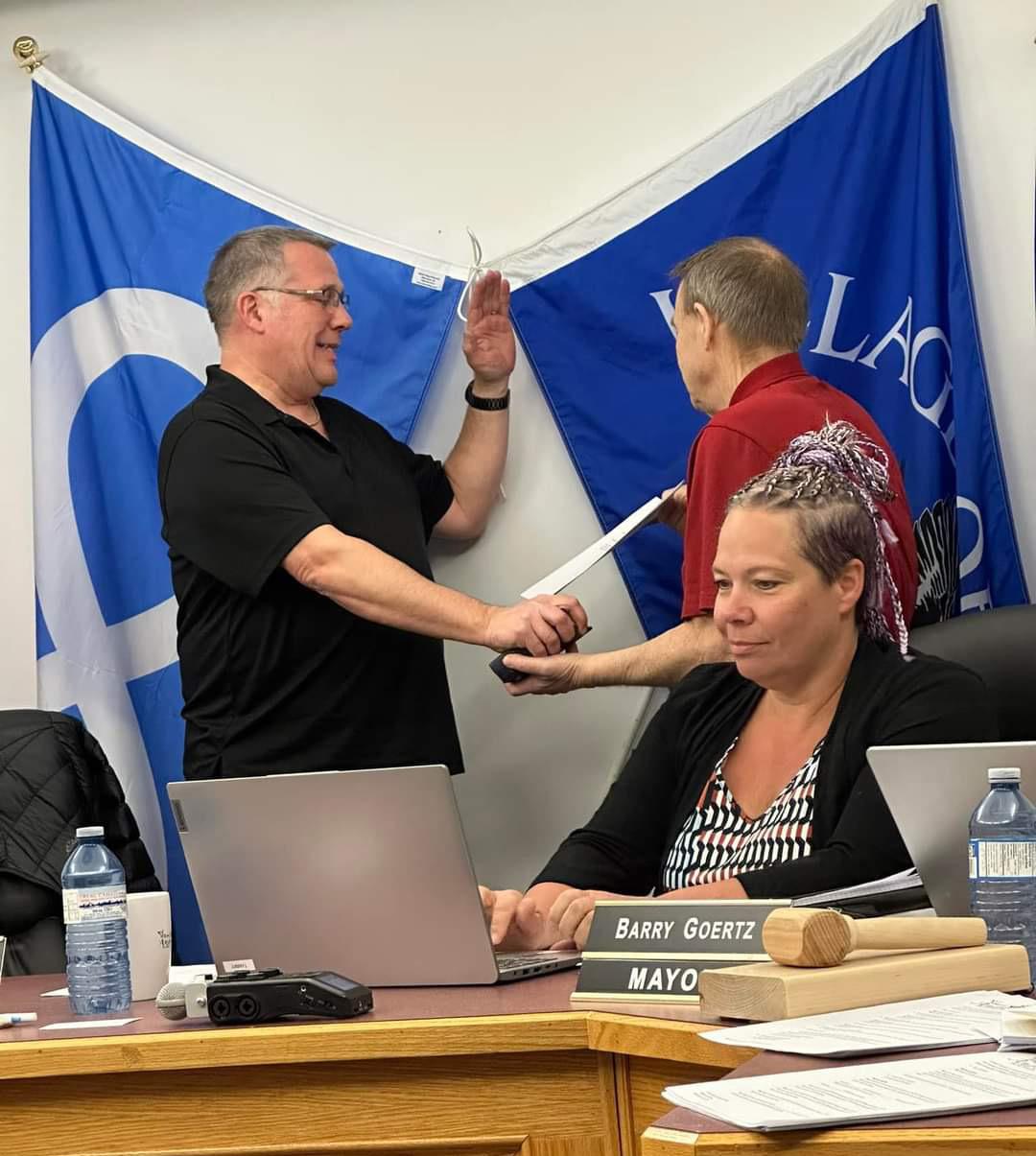
• Chris Lupul – 33 votes
• Sheila Lupul – 26 votes
• Johannus VanVyfeyken – 72 votes










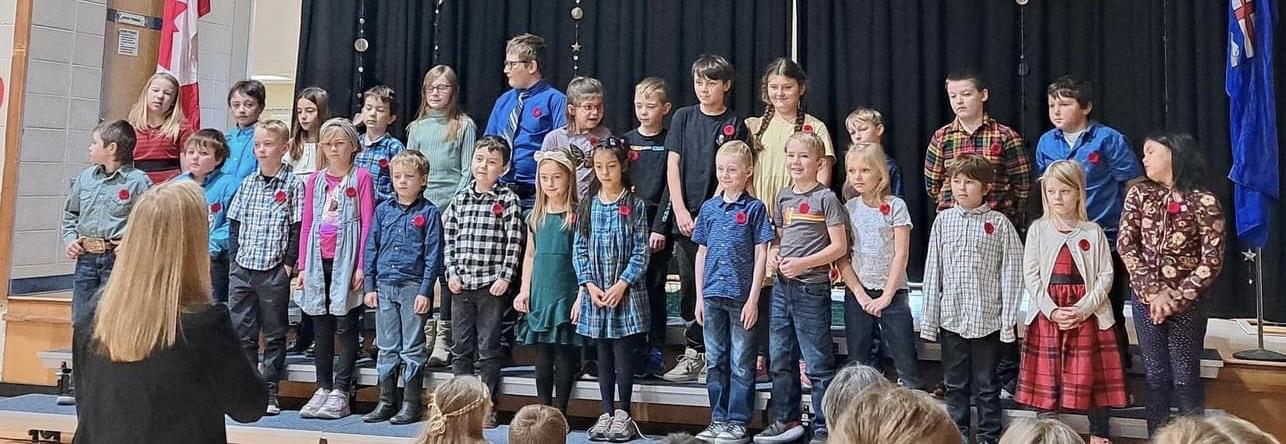
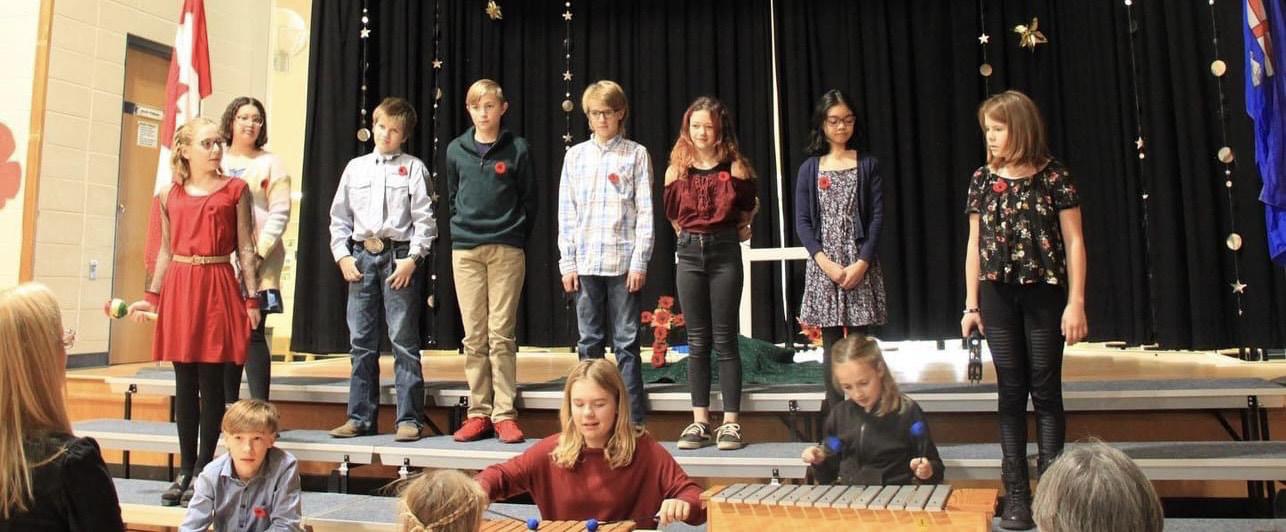
Two Hills School hosted a Remembrance Day Commemorative Ceremony November 8. Grades K-grade 6 sang Remembrance Day songs and then all grades laid the wrealths.
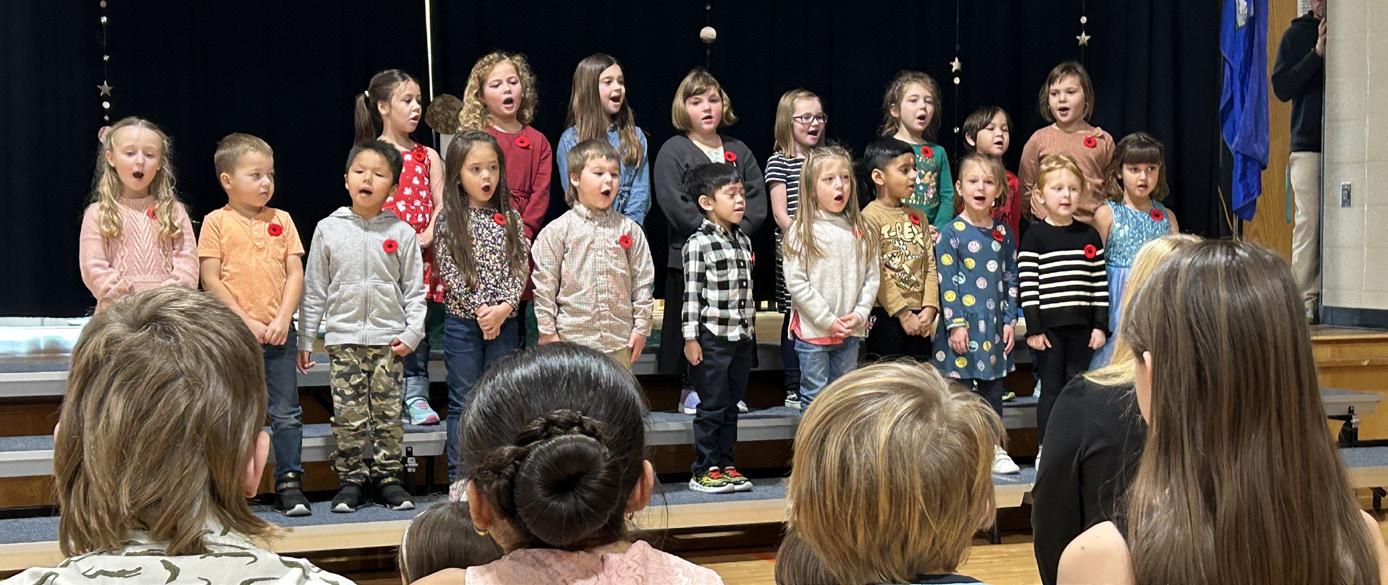
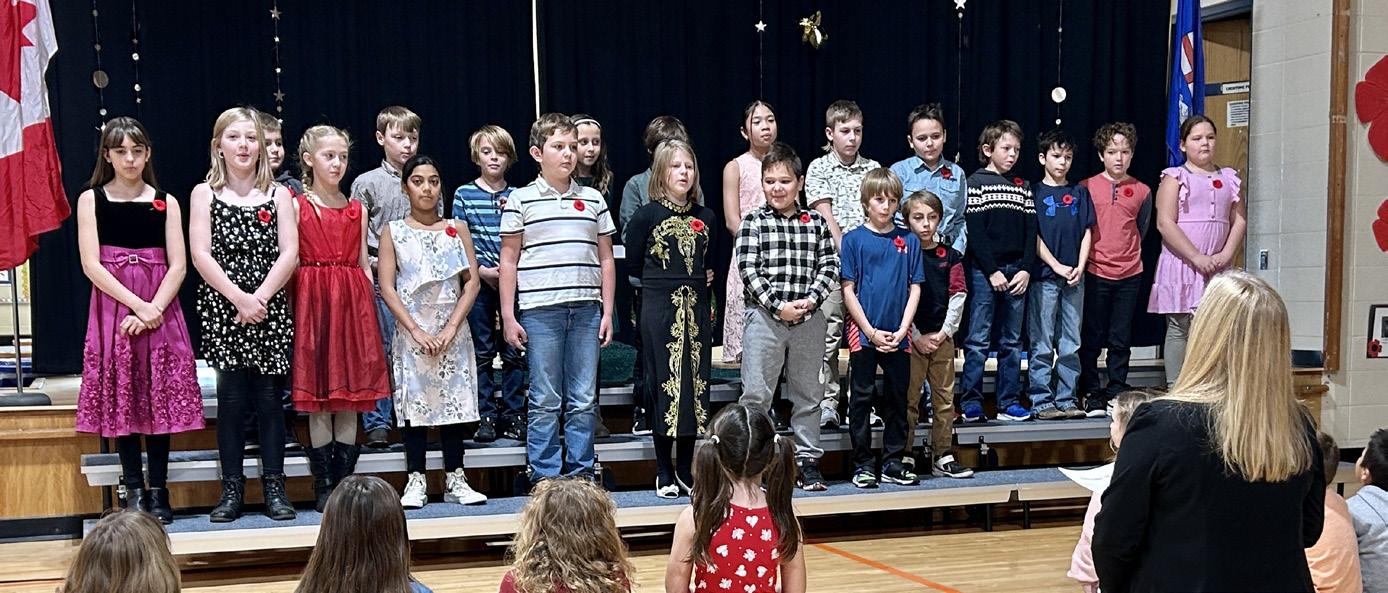







Remembrance Day ceremony for the residents of Willingdon took place at the Willingdon Seniors Centre November 11.
Far Left: George Leonty Left: Fred
Bottom
Bottom

New Myrnam School Remembrance Day Ceremony Held on November 8



Feed barley prices have been slipping lower despite the dry conditions across much of Alberta, B.C. and Saskatchewan.

“Barley is the feed grain of choice for most Alberta cattle feeders,” says Neil Blue, provincial crops market analyst with the Alberta government. “Other feed grains are used, but if available and price competitive, barley is the major ingredient in cattle finishing rations. Of course, other animals also are fed significant volumes of barley.”
Barley prices rose to record highs in June 2022 following the 2021 drought, retreated during the improved growing conditions of 2022, then rose in late 2022 with the early and cold start to last winter. Feed barley prices have been slipping lower despite the dry conditions across much of Alberta, B.C. and Saskatchewan.

“There are a number of factors which have contributed to the price moderation of feed barley,” says Blue. “During recent years when barley was in relatively short supply and prices rose to those record levels, livestock feeders sought lower cost rations. Milling wheat was even selling as feed wheat to meet feed demand. Oats and other feedgrains were also substituted for part of rations. Unit trains of imported U.S. corn became more common in the Lethbridge area as logistic challenges of those imports were overcome. Feeding imported corn has become common when price competitive.”
In 2022, Australia produced a record grain crop. Then, during 2023, China relaxed its restrictive import tariffs against Australian products that began in 2020 during the early Covid period. During the period that Australia was unable to compete with Canada for crop sales to China, Canadian crop exports to China rose, further tightening Canada’s domestic supplies.
However, Blue points out with that Canadian advantage now gone, Canadian barley exports to early November 2023 total just 592,000 tonnes, compared to 816,000 tonnes at this time last year, and 970,000 tonnes in November 2021.
Feeders who realize they are short of forage are trying to secure their winter feed supplies.

“As winter begins, cattle and sheep producers are reassessing their forage needs and sources to ensure that they have adequate feed for the winter-feeding period,” says Neil Blue, provincial crops market analyst with the Alberta government.
Although the early season dry weather helped hay crops to be harvested in good condition, that dry start led to lower than average hay yields. Feeders who realize they are short of forage are trying to secure their winter feed supplies.
“There is some carryover forage supply from the 2022 crop. Depending how that forage has been stored, it still is a feed source with value. It should be purchased and fed with caution, however, because some deterioration has likely occurred.”
“For those who need to buy hay or straw, there are a few sources to consider for prices and contacts,” points out Blue.
In no order of priority, here are some of those potential sources. One source is custom hay cutting and baling operators, who may have acquired standing crops or a crop share as part of their business. Some hay truckers are also hay brokers, who either act as a reseller or as an agent for a hay seller. Another source of hay or pellets are the hay processors. A list of hay processors can be found under “Alfalfa” and “Hay” within the latest publication of the “Alberta Agricultural Processing Industry Directory.
“Positives for the barley price outlook are that 2023 Canadian barley production was limited by a reduced acreage and lack of moisture,” explains Blue. Statistics Canada estimates the 2023 average barley yield at 55 bushels/acre compared to last year’s 70 bushels/acre. Some postharvest yield reports came in better than mid-summer expectations, but total Canadian barley supplies are significantly lower than last crop year.
“The shortage of hay for cattle feeding may lead to more straw-grain rations, with barley, oats and pellets the most likely concentrate source. Barley prices have dropped, becoming more competitive with world prices, increasing the prospects of improved barley exports as the crop year progresses. Also, malting barley demand remains firm.
“Meanwhile, the cost of imported U.S. corn is a major factor for feed barley prices, keeping in mind that some feeders prefer feeding barley, even at a premium price to corn. Traditional advice applies to barley marketing this crop year. Know your product, consider your cash flow needs, follow the market situation, and shop widely for the best, financially secure farm gate price,” says Blue.
Some crop producers silaged some of their annual crops to salvage a crop that was deteriorating from lack of rain. In areas where rainfall was more abundant, there was significant straw produced and baled from this year’s cereal crop harvest. Straw is used as bedding and cows will eat straw, but supplemental concentrate, whether grain, screenings, pellets, or protein meal, will be needed to supplement that straw. Producers will need to consider their ration alternatives to determine the least cost, available feeding combinations.
Farming the Web, a project of the Alberta Forage Industry Network, lists some forage for sale. The Kijiji website, with a search of “hay” or “straw” may also have forage listings. Facebook also has sites for hay.
For a general price reference, Agriculture Financial Services Corporation lists historic Alberta quarterly hay and straw prices along with other commodity prices on its resources page.
“Farmers are resilient, and despite the discouraging weather conditions this past season, will find the means to deal with this year’s shortage of quality, reasonably priced feed,” says Blue.

AI use has accelerated in recent years and significantly transformed numerous industries, including the grocery and food service industries.

“Artificial intelligence (AI) use in the retail and service sectors has created many opportunities as well as challenges,” says Jeewani Fernando, provincial consumer market analyst with the Alberta government. “Retail experts think AI is going to be a huge disruptor in the grocery business. Research indicates most grocery industry executives agree that AI will revolutionize information sharing and interacting with customers.”
Fernando says the grocery industry uses AI in a number of ways, including:
• Pricing and promotion –There are AI-driven applications that use historical data to simulate the future and find the optimal price and product mix to grow retails sales.
• Business and supply chain optimization – AI can help wholesalers and retailers examine demand and supply to arrange deliveries at the best times and keep the right products on shelves.
• Cashier-free payments –With AI in point-of-sale applications, cashierless grocery stores are becoming mainstream.
“AI is also quicky becoming integral to restaurant operations, from streamlining processes to enhancing the customer experience,” adds Fernando. “For example, AI is being used to automate a number of simple and routine tasks in restaurants, which helps cut costs. By embracing AI’s ability to perform these tasks, restaurants can free up employees to do what they do best, which is focusing on guests. And AI-based market-
ing applications can supercharge a restaurant’s efforts to identify new customers and send targeted promotions that translate into business transactions.”
A recent study by Dalhousie University gauged consumer awareness of AI use within the food industry. Among the findings:
• When asked if they were aware of the use of AI in the food industry, 37.9% of Canadians had never heard of it being used.
• When asked if they were worried about AI use in the grocery or food service industries, 26.5% of respondents said they were worried about the potential negative impact on jobs.
• When asked about the use of AI for personalized recommendations for groceries or restaurant menu items, 23.4% of respondents thought it was a good idea.
• The survey revealed Canadian consumers do not want to pay more for food when AI is used.
“Grocers and food service operators are benefiting from using AI-based applications and technologies in their operations, which allow them to deliver more personal, affordable and sustainable experiences for their customers,” says Fernando. “The food industry needs to use AI to meet evolving consumer preferences, behaviours and demands; but it is essential for the food industry to build consumer trust in AI use through ethical practices and transparency.”
Applying manure at the ‘right’ time helps to improve nutrient use efficiency, while reducing nutrient loss and environmental risks.
“Deciding on the ‘right’ time (one of the 4Rs of nutrient stewardship) for application will depend on the situation and will be driven by agronomic, economic, environmental or neighbour considerations,” says Trevor Wallace, nutrient management specialist with the Alberta government.
The ‘right’ or optimal time for application in a field depends on:
• operational factors such as cropping plans, past nutrient applications, manure storage capacity and regulatory requirements
• site-specific factors such as soil conditions and soil nutrient level
• environmental conditions such as the season, weather and runoff risk potential, and
• social factors such as neighbours and local events
“To maximize nutrient use efficiency and reduce the risk of nutrient loss, it is best to apply the nutrient source as close to crop needs as possible. This ensures there is adequate time for nutrient release and plant uptake.”
While spring application may be ideal for annual crops, it is not always achievable. In Alberta, the option for spring application is limited by our short growing season. Applying in the spring adds to an already busy season and can delay seeding if manure application is hampered by road restrictions, wet soils or equipment availability. Thus more often manure is applied later in the year, into the fall, when soils are generally drier and more time is available; but the risk for nutrient loss is greater because crops are not actively taking up nutrients and the absence of ground cover increases the risk of runoff potential.
“When possible, apply manure or compost in the late summer or early fall. This allows manure nutrients to infiltrate the soil and stabilize with the soil. The later the manure is applied, the greater the risk of nutrient loss via snowmelt and spring runoff. The risk of nutrient loss from fall applied manure and compost can be reduced by incorporation or injection as well as ensuring application setbacks are followed.”
Several operational changes can be made to widen the window of opportunity for manure or compost application. Through the adoption of new practices, crops or technologies or by working with neighbours, an operation
may find opportunities to expand inseason manure application windows.
“Post seeding or in-crop application of manure or compost are additional windows for manure application. Research is showing that liquid manure dragline application can be done until a corn crop reaches the V-4 leaf stage without harming the corn crop stand. To find out more about this research, read this article from Ohio State University. Solid/liquid separation technology can be used to separate solids, allowing the liquid portion of the manure to be applied through irrigation systems into growing crops."
Forages or winter cereals can provide additional in-season windows for application as they capture readily available nutrients, reducing the risk of nutrient loss and spreading out the workload.
The least optimal time for manure application is on frozen or snow-covered ground. The risk of nutrient loss is much greater as infiltration is limited and plants are not growing to utilize applied nutrients. This is why new or expanding confined feeding operations and those operations modifying their facilities are required to have a minimum 9 months of manure storage to help eliminate the need for winter spreading. In addition, confined feeding operators must obtain permission from the Natural Resources Conservation Board (NRCB) before applying.
“A full or imminently full manure or compost storage may force an emergency application on frozen or snowcovered ground. If it appears you may have to spread manure on frozen or snow-covered ground, please contact the NRCB field office nearest you to ensure that you are complying with the regulations and minimizing environmental risks and neighbour conflicts. For more information, check out the NRCB’s fact sheet (PDF, 295 KB).”
Understanding the trade-offs associated with decisions about timing of application is key to ensuring producers are getting the most beneficial return from available manure or compost resources, while minimizing potential environmental impacts and neighbour conflicts.
“Remember no matter what time of year, plan to minimize risks and conflicts, notify the appropriate authorities if required to do so, and ensure you follow manure spreading requirements,” says Wallace.
Preparing for winter manure spreading, even if it is not needed, will save time, money and stress if the need arises.

“Extreme weather events, full manure storages, delayed harvest or contractor availability may be some of the most common reasons a farm operator may need to spread manure on frozen and/or snow-covered ground,” says Trevor Wallace, provincial nutrient management specialist with the Alberta government. “However, when the ground is frozen or snow-covered, the risk of losing applied manure and nutrients in runoff is much greater due to limited soil infiltration, reduced vegetative filtering and increased runoff potential. It is important to be aware of the increased risks and to know your options to manage them.”
Adopt strategies to avoid emergency situations and the need to spread manure on frozen or snow-covered ground. Strategies could include regular maintenance and inspection of the equipment and facilities. Consider increasing the frequency of inspections with aging infrastructure. Well-planned inspections identify wear, damage and maintenance issues before there is a problem. Create a checklist and a schedule to find weak points in the system so that they are not overlooked, and keep those records should a Natural Resources Conservation Board (NRCB) inspector ask to see them.
“If your storage facilities cannot hold the manure produced through the winter, perhaps it is time to increase your storage capacity,” points out Wallace.
This can be done by constructing
additional storage facility capacity to provide a total 12 to 18 months manure production, which will:
• allow spreading manure at a better time for crops to uptake those nutrients
• reduce spreading frequency thereby reducing time to deal with logistics
• avoid emergencies and thus reduce stress and improve your mental health, and
• improve neighbour and community relationships
Another way to increase capacity for solid manure is to use short-term or temporary manure storage. Under the Agricultural Operation Practices Act (AOPA), manure can be stored in a short-term manure storage for an accumulated total of 7 months over a 3-year period.
“This limitation reduces the risks from storing manure such as nutrient accumulation, runoff and leaching. Site selection can further reduce these impacts and minimize concerns from neighbours and the community.”
If spreading is the only option, the first step to managing risks related to spreading manure on frozen or snow-covered land is to contact the nearest NRCB inspector to discuss the situation. The NRCB may or may not grant permission depending on the reasons for spreading, type of manure and the site-specific circumstances. The NRCB will:
• meet and work with you to assess the situation
• confirm if the field is frozen or snow-covered, if needed
• help you to decide what steps can be taken to reduce risk, if any, and
• tell you what specific requirements must be met to ensure spreading will not cause a risk to the environment or inappropriate nuisance as per the regulations under the AOPA
How can you tell if the ground is frozen or snow-covered? Alberta developed a Frozen and Snow-Covered Land Technical Guideline that provides the following tests:
• Frozen – the soil is impenetrable as a result of freezing temperatures, or more than one third of the top 15 cm (6 in) contains frozen soil water
• Snow-covered – more than 50% of the field is covered by an average snow depth of more than 5 cm (2 in) from the ground surface
“If you are still unsure, the NRCB inspector can help you determine if the field is frozen or snow-covered and if so, tell you what is required to get permission to spread. Check out their Applying Manure on Frozen or Snow-Covered Land (PDF, 295 KB) fact sheet for more information.”
If the land is not frozen or snowcovered, then the normal requirements for manure handling and spreading are in effect. See Manure Spreading Regulations.
“You can be proactive by developing a winter manure management plan that minimizes the need to apply manure in the winter and reduces the risk of emergency situations,” says Wallace. “Include a schedule for spreading activities in advance and time those activities to avoid winter spreading. A plan that includes preventative maintenance activities and additional storage solutions further
reduces the likelihood of having to spread in the winter.”
Having a well thought out plan is invaluable when faced with an emergency and therefore should identify suitable fields for emergency spreading by:
• collecting and analyzing information about potential manure spreading lands such as soil test records, runoff potential, direction and potential downslope receptors
• assessing those fields for runoff risk
• implementing setbacks from water bodies and wells, as well as nearby residences
• deciding which application methods to use, and
• mitigating factors to reduce risks (for example, working a field in the fall perpendicular to the direction of slope to slow runoff)
“Preparing for winter spreading, even if you end up not needing to, will save you time, money and stress if the need arises, not to mention, if the NRCB is aware of the plan, decisions on spreading can be made faster. If accepted, the NRCB can respond in an informed way to complaints and concerns should they occur. Planning for winter spreading situations shows that you are a responsible operator, helping to support or improve your industry’s positive image and that you care for your neighbours and community.” For more information, on the legislative requirements and avoiding manure application on frozen or snow-covered ground, check out the Nutrient Management Webinar to hear from Trevor Wallace, Alberta Agriculture and Irrigation’s nutrient management specialist and Kevin Seward, NRCB compliance manager. Alternatively call 310-FARM (3276) or email 310farm@gov.ab.ca.






Cash (Note 2)
Taxes and grants in place of taxes
(Note 3)
Trade and other receivables (Note 4)
Receivable from other governments
Land for resale inventory
Debt charges recoverable (Note 5)
Net municipal taxes
User fees and sales of goods Government transfers for operating
Concession and franchise
Local improvements
Local government transfers
Penalties and costs of taxes
Rentals
Investment income
License and permits
Other
YEAR ACCUMULATED SURPLUSEND OF YEAR
Purchase of tangible capital assets
Decrease (increase) in inventory for consumption
Amortization of tangible capital assets
Decrease (increase) in portfolio investments
2,200 $ (664,994)-
(664,994)
(662,794)
(2,367,555)
(3,030,349)
160,125
(784,430)
of long term debt (Note 8) Deposit liabilities (Note 5) Funds held in trust (Note 6) Deferred income (Note 7)
Long term debt (Note 8)
Roads,
Water
Administration
Curling rink operation
Garbage collection
Family
Protective services
Legislative
Sanitary sewer
Arena operations
Community services
Hall operations
Parks and recreation
Library
Storm sewer
Bylaws enforcement
Salaries, wages, and benefits
Materials, goods, supplies and utilities
Contracted and general services
Amortization of tangible capital assets
Transfers to Individuals and organizations
Purchases from other governments
Interest on capital long term debt
Bank charges and short term interest
Provision for allowances Schedule of Consolidated Expenses by
Total Expenditures

Cash and temporary investments (Note 2)
Taxes and grants in place of taxes
receivable (Note 3)
Receivables from other governments
Trade and other receivables
Long-term investments (Note 4)
Debt charges recoverable (Note 5)
NET FINANCIAL ASSETS
REVENUES
Net municipal taxes (Schedule 3)
Sales of goods and services
Government transfers for operating (Schedule 4)
Investment income
Penalties and costs of taxes
Licenses and permits
Accounts payable and accrued liabilities
Employee benefit obligations (Note 6)
Deposit liabilities (Note 7)
Deferred revenue (Note 8)
Due to Two Hills Regional Waste Management Commission (Note 9)
Long term debt (Note 10)
Provision for gravel pit reclamation
Other Legislative
SHORTFALL OF REVENUES OVER EXPENSES BEFORE TRANSFERS FOR CAPITAL
Government transfers for capital (Schedule 5) SHORTFALL OF REVENUES OVER EXPENSES ACCUMULATED SURPLUSBEGINNING OF YEAR ACCUMULATED SURPLUSEND OF YEAR
Administration
Protective services
Roads, streets, walks, lighting
Water supply and distribution
Waste management
Family and community support
Agriculture services
Subdivision land development
Parks and recreation
Library
Gas Utility
1,159,010
(4,677,265)
(3,565,299)
Acquisition of tangible capital assets
Proceeds on disposal of tangible capital assets (Gain) / Loss on disposal of tangible capital assets
SHORTFALL OF REVENUES OVER $ (4,677,265) $ (1,990,600) $ 1,265,500
Amortization of tangible capital assets
Amortization added to tangible capital assets EXPENSES
Use (acquisition) of prepaid expenses
Use (acquisition) of inventory for consumption INCREASE (DECREASE) IN
(1,751,445)
(2,103,586)
(59,894)
2,859,714
1,283,264
Alberta School Foundation Fund Eagle Hill Foundation Designated Industrial Property REQUISITIONS
2,302,536
2,693,208 $ 1,828,345 $ 339,878 $ 47,080 $ 4,616,590 $ 9,525,101 $ 1,717,567 $ 520,776 $ 13,591 $ 2,251,934
BEGINNING OF YEAR
Disposal of tangible capital assets Annual amortization expense CHANGE IN ACCUMULATED SURPLUS
BALANCE: END OF YEAR (Note 13)
(Unaudited)
charges Statement of Operating Revenue And Expenses For The Gas Utility Year Ended December 31, 2022
PURCHASES GROSS
753,378
806,411
Consolidated Schedule of Expenses by Object Year Ended December 31, 2022
Salaries, wages and benefits
Contracted and general services
Purchases from other governments
Materials, goods, and utilities
Provision for allowances
Transfers to other governments
Transfers to local boards and agencies
Bank charges and short-term interest
Amortization of tangible capital assets (Gain) / Loss on sale of tangible capital assets

Hello precious readers,
Can you believe that it is just a little over a month until Christmas!!!! Yippee!!!
I cannot emphasise just how much I have looked forward to Christmas all of my life. The awesome season where one feels like a little kid again….buying gifts, wrapping them up, being secretive regarding the presents and the fun-filled events that you are planning for your friends and family, the meal planning, and just good, old-fashioned family time.
As I sit here, I ponder my Christmas 2023. Since turning 50, earlier this year, my whole perspective has changed regarding Christmas and celebrations in general. Why do I
put myself under so much of pressure for just one day, or a few days, at the most?
Is it all really worth it? Does it really matter that the roast and its accompaniments come out perfect, the desserts and puddings be sublime, or that the day be a picture perfect memory in the making???
A resounding, emphatic YES!!!!!
It does! Every day does!!
I look forward to family time, with bickering, banter, and giggles. I treasure watching my family devour the meals I have prepared with love and adoration for each one of them.
I am mesmerised by their expressions as they open the gifts that I have thoughtfully purchased, and I sigh with immense gratitude and contentment when everyone dozes off with full bellies and a content expression on each of their precious faces.
I live for family, I treasure each one, and I am fully aware of the blessings that I have from Abba Father. Are you???
Until our next issue,
Love ya, Niri