


by Wendy Darda
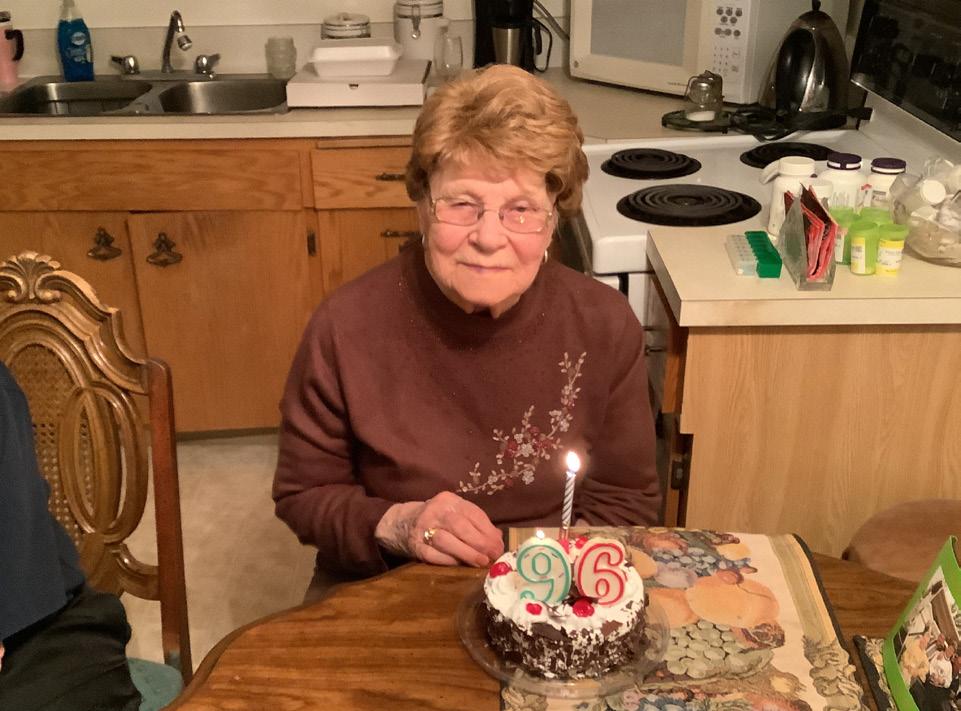
Rose, one of 8 children born to Mary and John Eliuk, was born on February 10, 1925. She is the last surviving member of the Eliuk family. She grew up on the farms between Hairy Hill and Kaleland Ukrainian Orthodox Church. Rose met her future husband George at school (on the ball diamond) and they were married on May 2, 1943 on George’s 21st birthday.
Son Gerald was born on 1946, during these years they farmed next to the Kaleland church. Rose and George moved into the hamlet of Kaleland to help George’s dad run the Kaleland store, pool hall and post office. At the same time George also worked as a mechanic in Two Hills for Metro Iftody’s, Cockshutt dealership.
After a few years there, Rose and George moved to Hairy Hill where they set up Olynyk’s Transport. Rose worked at the Hairy Hill Co-op for many years. Rose and George had 2 more children, Reg in 1952 (deceased 2018) and Wendy in 1954.
In 1971 Rose and George decided to try something different, they purchased Sam’s Drive Inn in Two Hills. Rose and George changed the name to GO’s Drive Inn as it remains today. They operated the Drive Inn until 1978 when their son Gerald and his wife Lorraine (deceased 2012) moved to Two Hills from Lethbridge to help and takeover the business.
During the winter months when the business was closed Rose and George enjoyed travelling to Arizona for some warmth and golf. If you see, or talk to Rose ask her about the “Bird Strike” story during one of her games down south. 2021 will be the 50th anniversary that the Olynyk family owned and have operated GO’s Drive Inn.
After Rose and George retired from working at the Drive Inn, during the summer months they were
very active members of the Two Hills Golf and Country Club. They golfed almost every day. During the winter you could usually find them on a local lake ice fishing. Rose was a master at filleting perch without even the slightest tiny bone present.
When George passed away in August 2016, Rose sold her home and moved into the Eventide homes here in Two Hills where she still resides.
Rose continued to remain active. She golfed on a regular basis and did so until her late 80’s. Rose also enjoyed gardening. She planted, maintained and harvested her own vegetables until a couple of years ago. In the summer Rose still looks after her beautiful, colorful flower pots which she keeps on her patio.
Another one of Rose’s pastimes is bingo. When the bingo halls were open, she was a regular participant at the Two Hills Senior Centre bingos plus the St. Paul bingo hall. She attended with her friends, chauffer Olga Chrapko and friend Margaret Darda. The 3 of them were affectionately known to the other players as the “Golden Girls”. Rose also enjoys visiting a casino when possible. During these cold winter months Rose passes the time by doing jigsaw puzzles and also word search puzzles.
Helping Rose enjoy and celebrate this special 96th year are son Gerald, daughter Wendy and husband Jim Darda and at a distance daughterin-law Cecile, grandsons Randy & wife Kim and Justin & fiancée Nicole.
We are all hoping things get back to normal soon so we can visit and participate in these activities again.
We love you Mom/Baba and wish you many more years of good health and happiness.

by Sonny Rajoo

increases which adversely affect the large population with limited income.
Mike Pawliuk, who served as Town Manager for thirteen years and subsequently served on Town Council for ten years, said that over the last few years, there have been steady and constant increases in various aspects of the towns operations, including steady increases in taxes and the implementation of additional fees for water, franchise fees, etc.
“The fixed cost of living in my home is constantly increasing and places an unfair burden on those of us with a fixed income. The requisitions, increase in utility costs, insurance and the cost of food has resulted in many of us finding it difficult to maintain our homes” said Pawliuk.
“The surcharge on water, recreation taxes, and healthcare is increasing steadily and we’re asking Town Council to carefully consider these expenses when preparing the town’s budget.
“In addition to this the cost of maintenance and labor in our homes has also gone up steadily. I urge council to consider that every increase in our old age pensions are limited to a few dollars per annum and this hardly covers of not only maintaining our residences but our daily living expenses. “Simply living in my home, costs me over $4000 of fixed costs, which does not take into account the cost of groceries, etc. Seniors and low income residents are finding it extremely difficult to continue to live in small towns with ever increasing costs.
“I sincerely hope that the town takes this into consideration when it thinks of imposing additional financial burdens on the population of the Town of Two Hills.
“As a handicapped senior, what extra assistance, for eg. Snow-shovelling, is the town providing seniors for tax dollars?’ concluded Pawliuk.


What is the COVID Mental Health Action Plan?
This is part of Alberta’s Government strategy to support the mental health and wellness of Albertans during and after the COVID-19 pandemic. Through this action plan we have provided 53 million dollars in funding to organizations that support the mental health and addiction recovery of Albertans. These times have been hard on the mental health of all Albertans and our Provincial Government will ensure Albertans have access to the crucial mental health supports they need.
Did any organizations in Fort Saskatchewan-Vegreville receive this funding?
I’m happy to announce that the Two Hills Adult Learning Council has received grant funding of over 88 thousand dollars, as well, the

Town of Vegreville received 82,500 dollars in grant funding. The Adult Learning Council was established in 1973 and it continues to coordinate, encourage, and promote lifelong learning within the Community of Two Hills and the surrounding area. It is great to see such wonderful organizations here in Fort SaskatchewanVegreville who continue to provide crucial supports to Albertans during these difficult times.
How will this program help with Alberta’s Recovery?
It is no secret that many Albertans have struggled with their mental health over the course of the pandemic. In order to recover, we are going to need an all hands-on deck approach, we will need that true Albertan spirit of hard work and resilience. That is why Alberta’s government has continued to support organizations who strengthen the mental health and wellness of Albertans. This ensures Albertans have the supports in place to make it through this pandemic while caring for themselves and their neighbours.

Derwent Transfer Site
Hwy 45
16-54-7-W4
Rge Rd 142
in SW 14-55-14-W4
Transfer Site 543001 Hwy 881
in SW 23-54-9-W4
Willingdon Transfer Site
560074 Rge Rd 152
Two Hills Transfer Site
124024 Twp Rd 543

How is Alberta’s government supporting Agricultural Societies during this pandemic?
Alberta’s government recently announced funding changes and acceleration of the grant process for Agricultural Societies. These societies serve and support our rural communities and are a rich part of this province’s history. Without live events like rodeos or curling bonspiels, it has certainly been a tough year for agricultural societies. To help mitigate that impact, Alberta’s government will ensure that Agricultural Societies continue to receive their regular base grant funding.
What changes were made to the grant funding this year?
Instead of receiving operating funding based on how many events they had planned, Agricultural societies will receive grants based on
their 5-year average. Approved grants are also being expedited this year, and will be processed as early as May 30th. This is 60 days earlier than previous years. The 283 primary Agricultural Societies will receive their base grant up to 17,500 dollars, plus the new five-year average variable operating grant. The seven regional Agricultural Societies will receive their nearly 300-thousand-dollar base grant, plus the new five-year average variable operating grant, which is up to a maximum of 100 thousand dollars.
How will these additional supports help enable Alberta’s Recovery?
It is so important that Albertans will be able to return to live events and other entertainment that has been halted during this pandemic. Our Agricultural Societies will be instrumental in helping Albertans get back to normal once they’re able to host live events, such as rodeos or ball tournaments. Agricultural Societies are the heart and soul of rural communities, and it is vital we are able to preserve this culture and history.


Located in SE 19-54-12-W4
Located in NE 3-56-15-W4 Regional Landfill
550066 Rge Rd 114 Located in NE 5-55-11-W4
by Sonny Rajoo

Thankyou for taking the time to ‘chat’ with us, Councillor Yakemchuk!
Here goes…
Chronicle: Almost every life is affected by the COVID-19 pandemic, and with most Lodge residents vulnerable, how is the Eagle Hill Foundation coping in ensuring the health and safety of its residents?
Yakemchuk: With all three lodges, in this current pandemic, all residents have been tested and are now free. Myrnam Lodge, in particular, had not a single case and the situation in Willingdon has been brought under control thanks to the Management and Staff of the Eagle Hill Foundation and Alberta Health Services.
Chronicle: Some lodges, more than others, have always faced challenges with regards to occupants. How is the occupancy rate currently? Which of the lodges need more residents to make all lodges in the Foundation viable?
Yakemchuk: Hillside Lodge in Two Hills is holding steady, while we are somewhat down with occupancy at the Willingdon Lodge and Myrnam Lodge is still holding its own. We held a meeting yesterday (Tuesday) and discussed incentives and other means by which we can improve the occupancy rate.
Chronicle: What plans do you have to attract more residents to use the facilities of the lodges where residents for the most part seem to be very happy?
Yakemchuk: We have embarked on two major initiatives wherein we offer incentives for residents to attract other residents and including a two hundred dollar discount for the first month’s rent for newcomers to The Lodge. Other incentives will be announced shortly.
Chronicle: Currently lodge residents face restrictions largely governed by Alberta Health Services in an attempt to contain and gradually eliminate COVID-19. How do you determine what restrictions to impose on Lodge residents and for how long?
Yakemchuk: It all depends on the instructions from Alberta Health Services, whose guidelines are strictly followed. Whatever restrictions are in place, or lifted, depends on the Key Scout and the directive of Alberta Health Services which monitor Seniors’ Residences very closely.
Chronicle: Costs all around are
ever increasing, eg. The cost of food has risen 20%, utilities and other incidental costs have also gone up. How does the lodge manage its finances given these unforeseen circumstances and ever increasing challenges?
Yakemchuk: We have received some grant funding to assist with the Covid-19 and, while we have increased the rents slightly, there is a plan to discuss the matter with the Provincial Government and Municipalities with the view to providing the best possible health care, at a cost effective rate.
Chronicle: Given the pandemic, staff challenges are always prevalent. The Eagle Hill Foundation is well known for its good management and relevant staff, but due to circumstances brought about by the pandemic. How is the foundation coping?
Yakemchuk: In Willingdon, we have hired some consultants to assist in this matter, but generally, our Management has done a good job in ensuring that the residents’ needs are met without compromising their health and safety.
Chronicle: The Home Care staff of Alberta Health Services works very well with the staff of Eagle Hill Foundation and, for the most part, there is a seamless service, thereby ensuring that residents receive the best care possible. Is there any room for improvement in this area, thereby guaranteeing residents comfort and safety?
Yakemchuk: We truly appreciate all the hard work done by the Health Care Aides and nurses that visit the Lodge from Alberta Health Services and during this trying time, the Staff of Alberta Health Services have truly risen to the occasion and work well with the Management and Staff of the lodges in Two Hills and Myrnam.
Chronicle: After the Village of Willingdon dissolved, it has become part of the County of Two Hills. Are the residents at Eagle Hill Lodge in Willingdon adequately represented on the Foundation and are their concerns aired and dealt with?
Yakemchuk: Division 4 Councilor, Soren Odegard, represents Willingdon and is a strong voice for the Lodge in Willingdon. Any matters of concern could either be addressed to Lodge Members or taken up with Councillor Ode-
gard, if the occasion arises where there needs to be involvement of the Board. However, the Management of the Lodge in Willingdon is doing an excellent job ensuring that residents are as comfortable as possible in their current environment.
Chronicle: How do you determine the transition of Lodge residents to Long Term Care, and who makes that determination? Are there residents living in the Lodge that really belong to Long Term Care or Long Term Care residents that should really be living in Lodges?
Yakemchuk: The assessment is left to the Home Care Staff who work in conjunction with the Lodge Staff and the transition is largely determined by the Staff of Alberta Health Services, who are in constant contact with the residents.
Chronicle: Given the cultural diversity of residents and their various needs, what is the foundation doing to accommodate all residents while respecting their cultural needs and concerns?
Yakemchuk: We have held a meeting with the Mennonite Community Leaders today (Tuesday) and have

discussed the possibility of designating a certain portion whereby their cultural needs including their dietary requirements and food needs are met and that they live in an amicable surrounding with a complement of staff whereby the Lodge in Willingdon is put to greater use, the occupancy level is increased and becomes more financially viable. We are happy to meet with any group that can assist us in increasing the usage of the Lodge and cater to the needs of various sectors of the community.
Thank you Councillor Yakemchuk. We salute you in your service and dedication to the Two Hills and County communities.
In accordance with the Environmental Protection and Enhancement Act, Future Fuel Ltd. has applied to Alberta Environment and Parks for an amendment to the existing approval for the Hairy Hill bio-refinery and power plant. The plant is located on the East Half of 27-054-14-W4M, about 8 km south of Hairy Hill. The amendment will allow the plant to accept up to 20,000 tonnes per year of organic waste for composting. A directly affected person may provide input into certain regulatory decisions, as allowed by the Environmental Protection and Enhancement Act (section 73). Specifically, any person who is directly affected by this application may submit a written statement of concern within 30 days of the date of this notice to:
Environment and Parks
Regulatory Approvals Center 5th Floor, South Petroleum Plaza 9915 - 108 Street Edmonton, AB T5K 2G8
Fax: (780) 422-0154
E-mail: aep.epeaapplications@gov.ab.ca
The written statement of concern should include the following:
- the application number 009-241490
- describe concerns that are relevant to matters regulated by the Environmental Protection and Enhancement Act
- explain how the filer of the concern will be directly affected by the activities proposed in the application
- provide the legal land location of the land owned or used by the filer where the concerns described are believed to be applicable
- state the distance between the land owned or used by the filer and the site in the application
- contact information including the full name and mailing address of the filer Please provide a telephone number and/or email address for ease of contact. Environment and Parks will review each written statement of concern, seek more information if needed, and notify each filer by letter of the decision to accept or reject their written submission as a valid statement of concern. The Public Notice of this application will also be posted on the Department’s website at https://avw.alberta.ca/PublicNoticesViewer.aspx.
Statements of concern submitted regarding this application are public records which are accessible by the public and the applicant. Failure to file a statement of concern may affect the right to file a Notice of Appeal with the Environmental Appeals Board. Copies of the application and additional information can be obtained from: Future Fuel Ltd.
Attention: Brian Nilsson 100-101 RIEL DR ST ALBERT, AB T8N 3X4 Telephone: 780-4772233 Fax: 780-479-8469 E-mail: anna@dpaconsulting.ca

Alberta, especially rural Alberta, has a habit of revolt. The United Farmers, the Social Credit, the federal Progressive party and the Wildrose have each taken turns at shaking up the political order when the needs of rural Alberta were not being met.
Today we’re seeing yet another revolt.
Late on February 9th, the Regional Municipality of Wood Buffalo voted to not give in. Instead of putting their people at risk, they will maintain 911 dispatch in their community.
High River and numerous other towns and municipalities in Southern Alberta pleaded with the provincial government to rethink a coal policy that would threaten their water supplies and a growing tourist
industry.
In Bonnyville, local municipal leaders from around the region, decided that decisions made in Edmonton, to deal with conditions that apply to Edmonton, would no longer apply to their communities. So, they went out for lunch, another small rebellion that tells a wider tale.
Rarely has the provincial government listened to those messages.
Rural Albertans, and those Albertans living far from the major urban centres, are being ignored by the government that is in place because of rural support. Rural Alberta answered Bill 6 and an unfair carbon tax put in place by the NDP by overwhelming voting against them. But now we find out nothing has changed. The UCP are ignoring the needs of rural Alberta, just like the NDP.
Rural Alberta feeds and powers not only our province, but the world. It deserves the respect and support of the provincial government, not downloading costs, pointless mandates, and attacks. If the Alberta Party stands for only one thing, it is this – empowerment. Empowering our



local leaders to do what they feel is best for their communities. Empowering individual business owners to turn a profit. And empowering individuals to work hard, play hard, and live the best life possible. Often times this means the provincial government needs to simply get out of the way. With this in mind, know that we support you. We support farmers who want to export to the world but find themselves limited by a government obsessed with only one industry, and municipalities who simply want to control how their citizens receive emergency services.
The current government is acting more like Ottawa than any Alberta government should. The Alberta Party knows that key to good conservative government is strong local control and a provincial government that gets out of the way. Conservative government is small government. The UCP have forgotten that, but we, the Alberta Party, have not.
Jacquie Fenske is the Acting Leader of the Alberta Party, and served as a PC MLA and Strathcona County councillor.


On February 6, the Alberta Party announced a major step forward in creating a competitive, unifying party ready and able to fight the 2023 election. A permanent leader will be elected on October 23rd. Strong leadership will provide a voice to the 172,000 people who voted for Alberta Party in the last election. It will allow the Alberta Party’s grassroots members to continue building toward an Alberta defined by sensible policy rather than partisan war.
Conrad Guay, President of the Alberta Party: “I am so incredibly excited to announce the timeline for our leadership race. Greg Clark and Stephen Mandel grew the Alberta Party and set the course for an exceptional political party poised for electoral success. The next leader will be the driving force in moving the Alberta Party into a competitive position for 2023.
Last year saw the Alberta Party increase our fundraising numbers, grow our membership, and add to our staff. This year will see us create a solid foundation for 2023 by electing a new leader and holding a policy conference.”
Further details, including the method of vote, membership rules for candidates and voters, and the admission fee, will be released at a later date; as determined by the independent Leadership Election Committee. For more information, please visit https://www.albertaparty.ca/leadership_2021.
For more information, or to arrange an interview: Mathew Preston - Chief of Staff to the Acting Leader E: mathew.preston@albertaparty.ca P: 780-210-6151


ADMINISTRATIVE REPORTS:
Public Works Report
The Public Works Foreman’s Report was provided to Council in advance for their review.
2021-003 MOVED by Councillor M. Tarkowski that the Public Works report be acknowledged as presented and incorporated into the minutes.
CARRIED
Chief Financial Officer Report
The Chief Financial Officer’s report was provided to Council in advance for their review.
2021-004 MOVED by Councillor S. Rajoo that Deputy Mayor Babiuk head the Canada Day Committee.
CARRIED
2021-005 MOVED by Deputy Mayor W. Babiuk that the Chief Financial Officer’s report be acknowledged as presented and incorporated into the minutes.
CARRIED
Chief Administrative Officer Report
The Chief Administrative Officer’s report was provided to Council in advance for their review.
2021-006 MOVED by Councillor S. Rajoo that the Chief Administrative Officer’s report be acknowledged as presented and incorporated into the minutes.
CARRIED
CORRESPONDENCE:
2021-007 MOVED by Deputy Mayor W. Babiuk that the Correspondence be acknowledged as presented and filed.
CARRIED
NEW BUSINESS:
Lease Agreement for Dental Office
A.K. Ebrahim Professional Dental Corporation seeks to enter into a lease agreement for the Dental office
2021-008 MOVED by Mayor L. L. Ewanishan to approve the new lease agreement with A.K. Ebrahim Professional Dental Corporation.
CARRIED
Debenture for ACE Waterline
A debenture is required for ACE waterline payments
2021-009 MOVED by Councillor E. Sorochan that Borrowing Bylaw ACE Waterline 2021-1004 be given first reading this 19th day of January, 2021.
CARRIED
Arena
With other municipalities shutting down their ice plants as cost saving measures, is this something that Two Hills should be thinking about as well.
COUNCILLOR REPORTS:
2021-010 MOVED by Councillor E. Sorochan to accept and incorporate the Council Reports as presented into the minutes.
CARRIED
2021-004 MOVED by Councillor S. Rajoo that Deputy Mayor Babiuk head the Canada Day Committee.
CARRIED
2021-005 MOVED by Deputy Mayor W. Babiuk that the Chief Financial Officer’s report be acknowledged as presented and incorporated into the minutes.
CARRIED
Chief Administrative Officer Report
The Chief Administrative Officer’s report was provided to Council in advance for their review.
2021-006 MOVED by Councillor S. Rajoo that the Chief Administrative Officer’s report be acknowledged as presented and incorporated into the minutes.
CARRIED
CORRESPONDENCE:
2021-007 MOVED by Deputy Mayor W. Babiuk that the Correspondence be acknowledged as presented and filed.
CARRIED
NEW BUSINESS:
Lease Agreement for Dental Office
A.K. Ebrahim Professional Dental Corporation seeks to enter into a lease agreement for the Dental office
2021-008 MOVED by Mayor L. L. Ewanishan to approve the new lease agreement with A.K. Ebrahim Professional Dental Corporation.
CARRIED
Debenture for ACE Waterline
A debenture is required for ACE waterline payments
2021-009 MOVED by Councillor E. Sorochan that Borrowing Bylaw ACE Waterline 2021-1004 be given first reading this 19th day of January, 2021.
CARRIED


Our trained and professional staff can assist you will all your compilation needs.
Our CPAs are experienced and ready to provide an audit or review.
We can satisfy all your corporate and personal tax needs.
GST
We can prepare and file your GST returns accurately and on time.
If all you need is someone to keep your books organized, we’ll be glad to help.
Need advice on future Tax planning? Our Tax experts can assist!
To be successful in today’s world, businesses require more from their Accounting Professionals than just numbers. They need an Advisor who knows how their business runs. They need a personal touch and someone who can be reached anytime and any place. Ncube & Landry LLP strives to deliver accurate and timely financial information along with excellent customer service. Whether a client needs simple bookkeeping or a full blown audit, the Professionals at Ncube & Landry LLP will treat their clients with care and provide the quality they deserve.

Iwouldlike to take the moment to welcome the Chronicle back into the daily lives of the people of the Minburn, St Paul and Two Hills Counties. It’s great to have a local point of view on the local news around our daily lives. During these pandemic times its nice to see that the world did not stop and news stories, good or bad are still being created.
I have a comment regarding the story named “A Tribute to Our Essential Workers” which ran in your Volume 1 Issue N0.2 January 2021. It was nice to see the Chronicle paying tribute to the workers who are out there facing the pandemic daily but still provide a needed service to the community. However, it seems that the Chronicle missed thanking some businesses that should definitely have been mentioned.
I found it ironic that the Chronicle thanked the banks for being there. While there were periods where their doors were locked and public was not being served. The County office that had the doors locked and you can only get in by appointment. The Town office which also has its doors locked to the public. Meanwhile there are other businesses in town that remained open throughout the pandemic, never closing out the public and will continue to do so going forward because the community needs them.
You did mention the grocery store clerks but nothing about the fact that this business remained open throughout the pandemic and will continue to do so serving the public. What about the other businesses that stayed
and remain open?
What about the UFA Farm and Ranch Store and Bulk Station that remained open throughout the pandemic? They ARE an ESSENTIAL business to the community…ask any farmer who needs feed and supplements for their livestock, building supplies, fuel or other essential items.
What about the local restaurants that stay open for “pick up” orders?
What about the registry office, liquor stores, Mennonite grocery Store, Bumper to Bumper, etc…
What about the tire shop that stayed open to help customers with tire problems? Have a flat tire and tell me that they are non-essential.
Who is the R.C.N.P? Did you mean R.C.M.P…
I understand that the pandemic has changed the way our daily lives run but thanking those for doing their jobs while dealing with the situation that we all face as a community …I don’t get it. Be thankful you have jobs to go to and protect yourself and family the best way you can. Thanking small groups of people who are out there doing their job while ignoring others that are facing the same risks, is inexcusable. I understand the intention of the article but it did leave a bad taste in my mouth. It was a real slap in the face to those businesses you chose to omit.
How did you determine who is essential and who is not? Why not do better research and include everyone who is essential to the community, even if they are outside of your
Minister Anand,
As an elected official, it is my duty to advocate on behalf of my constituents about their concerns. As you may know, I represent the constituency of Fort Saskatchewan-Vegreville, which has a large population of aging Albertans. Many of my constituents are worried about the lack of vaccines being distributed to not only our constituency, but to Alberta as a whole. While I understand that there is a current shortage of the Pfizer-BioNTech and Moderna vaccines, it is undeniable that Canada is falling short of other nations when it comes to vaccinations. As of Feb. 11, 2021, Canada was 38th in the world in COVID-19 vaccinations per 100 people. The provinces have proven they have the ability to administer vaccines in a timely manner, but we need the federal government to do more to procure and deliver us doses.
I am calling on you to fight harder
for Canadians to be able to receive their much-needed vaccines. With mass vaccinations, we will see our economy get back on track, which will facilitate the removal of restrictions on workplaces, allowing businesses to create revenue and jobs. This confidence will also repair the damage to mental health caused by unemployment and limited social contact.
For the greater good of Alberta and Canada, I ask that you to act now and fight for Canadians to get more vaccines doses. Canadians are and always have been leaders. There is no excuse for how poorly their federal government is performing on the vaccine file.
I look forward for a prompt response on this issue.
Sincerely,
Jackie Armstrong-Homeniuk, MLA Fort-Saskatchewan-Vegreville.
little world.
Signed, Anonymous Chronicle:
Dear Anonymous,
Firstly we would like to thank you for taking the time to write in. We greatly appreciate feedback from the community whether positive or negative, in this way we hope to improve to be a local news outlet our readers and community can all be proud of.
We would also like to sincerely apologize to the businesses that we did not feature in our “Tribute to Our Essential Workers” article in our previous issue. We in no way intended to exclude any businesses and firmly believe that all who are working during this trying period are providing essential services.
We kindly invite any businesses who we had neglected to mention to submit photos of their businesses and staff, which we will be more than happy to feature in our upcoming issue. Once again, thank you for your submission. It is greatly appreciated. We also invite members of our community to write in. The Two Hills Regional Chronicle strives to represent everyone in our community and provide reliable, factual and an unbiased approach to reporting news from our region.
Sincerely,
Jared Rajoo

Championing the cause of Rural Alberta in an everchanging world!
by Sonny Rajoo

Those that have followed my journalism career over the years, know full well that I am fully committed to crusading for Rural Alberta, which I feel is being slowly but surely neglected by the Federal and Provincial Governments. There was a time when Northeast Alberta had strong and adequate representation at the Cabinet table through the Premier of the province Ed Stelmach, the Minister of Municipal Affairs, President of the Treasury Board and other key portfolios.
Recently, however, I have some excellent members of the Legislative Assembly who are at all times trying to do their best to showcase Rural Alberta, have their efforts overshadowed by strong voices from the cities of Edmonton, which they believe, understandably take up a lot of the Provincial budget, thereby leaving smaller towns and counties with the balance of the funding which lies at the bottom of the barrel.
One of the great challenges of smaller rural municipalities is their lack of funds to help receive matching grants which often requires the first share of their proportion in the many grants that are available but are impossible to obtain due to the lack of disposable matching funding from cash strapped municipalities.
I am hoping that the Canadian Government realizes that slowly the

gradual erosion of strong rural support is creating hardships and this problem is further accelerated by the low energy prices and of course the ramifications of the Covid-19 situation. I continue to maintain that the agricultural industry, diversification and economy, eg tourism and the forestry industry and other forms of revenue generating activities should go hand in hand with investing in renewable energy while continuing to support the energy sector in general and the Oil Tax in particular.
I long for the days when Rural Alberta has a stronger voice in all levels of government and a stronger presence at the Cabinet table. I feel that both the municipalities of the City of Cole Lake and the Municipal District of Bonnyville have very solid concerns and I’m truly impressed by the letters that they have sent out to municipalities asking for their support.
It is with this combined effort and a united stand that we can go out, and try every disposable means to raise our profiles and ensuring that we are not a forgotten community. Quite often, we feel like we are like children of a lesser god. So my representatives at the Alberta Urban Municipalities Association and the Alberta Rural Municipalities Association, my appeal to you is “Please raise your voices a little louder so that it is not drowned out by the larger municipalities as the situation often tends to be.”
P.O. Box 156, Two Hills, AB T0B 4K0
The Two Hills Regional Chronicle is proud to serve the County of Two Hills and surrounding areas. We also distribute to local outlets at convenient locations as well as the Saddle Lake Cree Nation. (Approx. 2000 copies).
We can also be found online at www.twohillschronicle.com and on Facebook.
by Jared Rajoo
Leading up to this issue, I was excited. It is amazing to have the community write in and let us know how we are doing and whether we are a paper worth reading intently, or just another bunch of pages put together.
I have always valued criticism. As a child, my favorite time of the year was final exams. While many of my friends and fellow students dreaded it, I embraced it. To me it is the only way to determine whether the lessons had been imparted to you or if you were just present in class.
Becoming an adult, your tests are slightly different. Your validation comes from your peers and your superiors. When you are a small business owner and publisher, the measure of your work is determined by your readers.
I remember when I first moved to Two Hills. I had just graduated and returned to Canada after a few months off to visit family in South Africa.
Having no idea what to do or no real direction at that moment I decided to get a job to earn work experience while I figured out the career path I would choose.
My dad, Sonny, who has always been supportive despite my previous lack of direction, let me know that Jim Nahirnak, the owner of the Two Hills IGA at the time, was hiring and they happened to be good friends.
To me now and then - any job is good. When you’re building a jigsaw puzzle, without one single piece it cannot be complete, regardless of where it fit.
Little did I know the lasting impact the years at the Two Hills IGA under the supervision of Jim and his talented and hard working staff.
I remember the first thing I was

taught - there were two rules: 1) The customer is ALWAYS right 2) If the customer happens to be wrong, please see rule one.
I have to admit I chuckled a little when I first read it, but the longer I worked there I began to realize that the phrase was more than just a slogan - it was the way.
Likewise, throughout my varying career, I have tried to maintain that mindset. As Jim used to phrase it - “I’m just the one who signs your cheques - the customers out there are your bosses”
In that vain, I consider our readers my bosses, and encourage you to write in about what you would like us to cover, news that is important or errors we may have made. I implore each and every one regardless of age, gender, political affiliation, religion, race or any other dividing factor to get in touch with us. Share your thoughts with us.
We strive to constantly improve and take part in a community that we have all grown to be a part of and love deeply.
I would also like to thank Mr Jim Nahirnak for being a positive role model in the community and teaching me life lessons that still to this day have made a lasting impression.

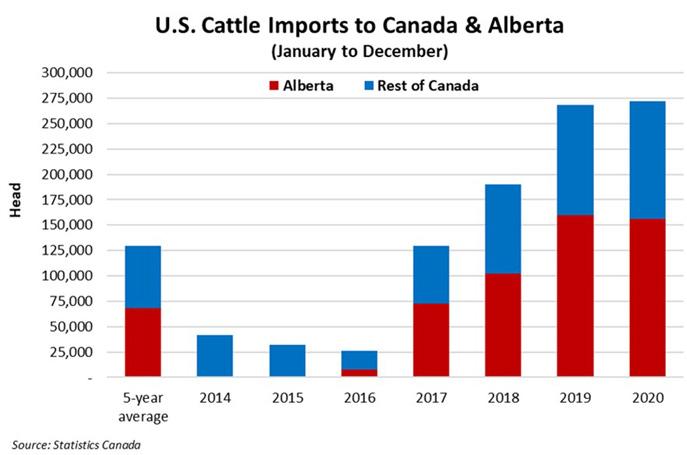
‘Live cattle imports from the US to Canada were up in 2020 which is the fourth year-over-year increase in a row,’ states Jason Wood, livestock market analyst with Alberta Agriculture and Forestry. ‘The numbers for the January to December 2020 period shows just over 272,000 non-purebred cattle were imported to Canada. This is up 1.5 per cent compared to 2019.’
Woods adds that Alberta non-purebred cattle imports were over 156,000 head for the January to December 2020 period - down 2.2 per cent compared to 2019 when just under 160,000 head were imported.
‘In 2020, Alberta saw 57 per cent of the cattle imported to Canada come into the province,’ says Woods. ‘This is above Alberta’s 53 per cent average share over the last five years’.
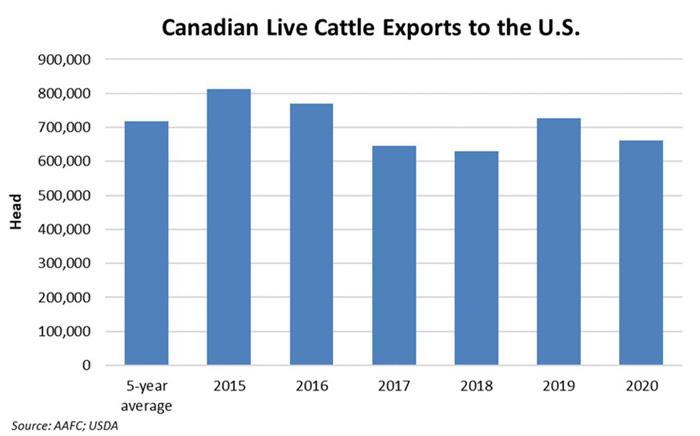
Woods says 2020 Canadian cattle exports were also up 2 per cent for slaughter cattle (steers, heifers and cows) over 2019 and 8 per cent higher than the 5-year average. Feeder cattle exports in 2020 were down 36 per cent year-over-year and 39 per cent lower than the 5-year average.
While imports have trended higher Woods say Canadian exports of live cattle to the U.S. trended downward. ‘We saw a 9 per cent drop from 2019 and 7.6 per cent below the 5-year average.’
Top Left: U.S Cattle Imports to Canada and Alberta
Left: Canadian Live Cattle Exports to the U.S.

Canadians are proud of our publicly funded health care system and believe that everyone deserves access to quality, universal health care. Medicare is part of our national identity. The Canada Health Act ensures all Canadians have access to medically necessary health care services based on need, not their ability or willingness to pay.
During the COVID-19 pandemic, Canadians are worrying about many things, and should not have to worry about how to pay for needed medical care. In the midst of this pandemic, it is clear how vitally important our universal health care is.
Today, the Honourable Patty Hajdu, Minister of Health, tabled the 2019-2020 Canada Health Act Annual Report in Parliament. The re-
port provides Canadians with an update on federal administration of the Act and a clear picture of how public health care insurance plans across the country operate. The report is developed by the federal government in collaboration with provincial and territorial governments, and provides information on the extent to which provincial and territorial health care insurance plans have fulfilled the requirements of the Act.
“Through the COVID-19 pandemic, we’ve seen a strain on healthcare services, highlighting how important our universal public healthcare system is. While the pandemic has changed our ways of life in unprecedented ways, Canadians should never have to face uncertainty about whether they can afford to access care. During these uncertain times, we will continue to uphold the values of equity, fairness and solidarity that underpin the Canada Health Act. This year’s Canada Health Act Annual Report reaffirms our government’s commitment to universal healthcare.” stated The Honourable Patty Hajdu, Minister of Health
The Canada Health Act (CHA) was passed in 1984 with the unanimous support of Parliament. The CHA establishes criteria and conditions related to insured health services and extended health care services that the provinces and territories must fulfill to receive the full federal cash contribution under the Canada Health Transfer (CHT).
The CHT is the largest major transfer to provinces and territories. It provides long-term predictable funding for health care, and supports the principles of the Canada Health Act, which are universality, comprehensiveness, portability, accessibility and public administration.
If a province or territory permits extra-billing or user charges for medically necessary health services, a mandatory dollar-for-dollar deduction must be taken from the jurisdiction’s CHT. The following deductions and reimbursements were made in March 2020:
Newfoundland and Labrador’s CHT was reduced by $70,819 as a result of user charges for insured cataract surgery provided by an enrolled physician at a private clinic. After working with Health Canada to develop, and then successfully carry out, a plan to eliminate these user charges, Newfoundland and Labrador received a reimbursement for deductions taken in both 2019 and 2020, totalling $72,168.
New Brunswick’s CHT payment was reduced by $140,216 in response to the province’s lack of coverage under its health insurance plan for abortion services outside the hospital setting.
British Columbia’s CHT was reduced by $16,753,833 for patient charges at private clinics. Health Canada authorized a partial reimbursement of $16,019,539 to British Columbia in recognition of efforts taken by the province to address and eliminate these charges.
by Jared Rajoo

Minister Justin Trudeau has recently come under fire following his announcement to add assault style rifles to the banned list of firearms permitted in Canada.
As of May 1, 2020 the Government of Canada has prohibited over 1,500 models of assault-style firearms and certain components of some newly prohibited firearms (the upper receivers of M16, AR-10, AR-15, and M4 patterns of firearms). New maximum thresholds for muzzle energy (greater than 10,000 Joules) and bore diameter (20 mm bore or greater) are also in place. Any firearm that exceeds them is now prohibited. A Criminal Code amnesty period is currently in effect to April 30, 2022. The amnesty is designed to protect individuals or businesses who, at the time the prohibition came into force, were in lawful possession of a newly prohibited firearm from criminal liability while they take steps to comply with the law.
Some have considered this an important step to reducing gun violence in Canada, however there are many rural Albertans who feel that although this is well intentioned, it does not address the real issue of gun violence.
Minister of Justice and Solicitor General Kaycee Madu issued the following statement on proposed federal firearms legislation:
“While the new federal firearms legislation may include some useful measures, it appears
once again that Ottawa is more interested in targeting law-abiding Canadians rather than the criminals who recklessly endanger public safety by ignoring all laws.
“We know that the overwhelming majority of guns used in committing crimes in Canada are illegally smuggled over the United States border, and we fully support efforts to crack down on smuggled guns. We wish Ottawa paid more attention to this very real issue, rather than trying to score cheap political wins.”
Through legislation and other actions the Government of Canada aims to:
• Combat intimate partner and gender-based violence, and self-harm involving firearms by creating “red flag” and “yellow flag” laws. These laws would allow people, such as concerned friends or relatives, to apply to the courts for the immediate removal of an individual’s firearms, or to ask a Chief Firearms Officer to suspend and review an individual’s licence to own firearms.
• Fight gun smuggling and trafficking by increasing criminal penalties, and by enhancing the capacity of the Royal Canadian Mounted Police and the Canada
Border Services Agency to combat the illegal importation of firearms.
• Help create safer communities by supporting municipalities that ban handguns through bylaws restricting storage and transportation in their jurisdictions. Individuals who violate these municipal by-laws would be subject to federal penalties, including licence revocation and criminal sanctions.
• Give young people the opportunities and resources they need to avoid criminal behaviour by providing funding to municipalities and Indigenous communities to support youth programs.
• Protect Canadians from gun violence by creating new offences for altering the cartridge magazine component of a firearm and depicting violence in firearms advertising, introducing tighter restrictions on imports of ammunition, and ensuring the prohibition of imports, exports, sales, and transfers of all replica firearms.
• Complete the prohibition of assault-style firearms to ensure these weapons cannot be legally used, transported, sold, transferred, or bequeathed by

individuals in Canada. We also intend to move forward with a buyback program in the coming months to support the safe removal of these firearms from our communities.
Minister Madu has planned to fight back on behalf of Alberta and stands as a strong voice for the province.
“We are also bewildered by the supposed provision for municipal bylaw gun bans. Albertans are smart enough to know that made-inToronto calls for city gun bans are futile, since criminals flagrantly using guns won’t follow such a bylaw anyways. In addition, a patchwork approach of policy varying by invisible municipal boundaries would create obvious confusion in enforcement, and the federal government clearly knows that.
“The Constitution is clear that municipalities fall under the jurisdiction of the provinces. In fact, municipalities in Alberta are a creation of the provincial government. The federal bill has just been introduced, but should it pass, Alberta would vigilantly defend its jurisdiction.
“I’d also note that MLA Michaela Glasgo has introduced private member’s Bill 211, which would limit municipalities’ ability to pass bylaws on these matters. The Government of Alberta will expedite that bill, and remains on track to appoint Alberta’s Chief Firearms Officer.”
(Source: Alberta.ca/Canada.gc.ca)


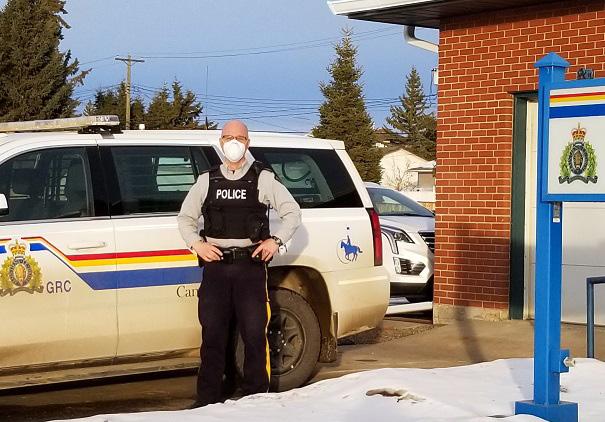
The following information was provided by Sergeant Robert Daisley of the Two Hills RCMP Detachment.
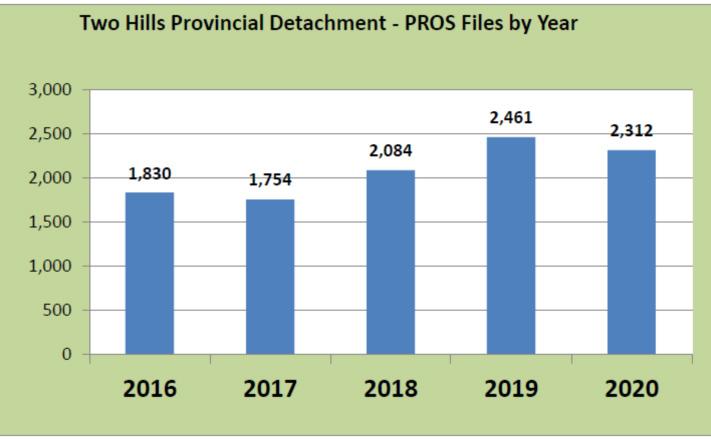
The data shows a decline in the incidents from 2019 to 2020. The complete report is as follows:
Community Policing Information
Objectives:
1. Respond to property crime and reduce its incidence
2. Enhance traffic safety
3. Community Engagement
Initiatives:
1. Review property-crime files to ensure that all measures are being taken investigate.
2. Focussed traffic enforcement.
3. Track search warrants and production orders executed.
4. Hold two town halls.
Community Policing-Related Events
• Until March, Sgt. Daisley continued to play cribbage at the Eagle Lodge in Willingdon.
• Sgt. Daisley (Two Hills) attended Remembrance Day ceremonies in red serge.
• Sgt. Daisley attended the Emergency Preparedness Meetings for the Two Hills area.
• Unfortunately, most community events have been cancelled or severely restricted by the Covid-19 pandemic. All of the members of the detachment are looking forward to the opportunity to attend more events in the community when the pandemic ends!
• We saw about a 6% drop in total the number of files that we handled this year.
• Crime against persons was down 20% from 2016 and 32% from last year!
• Property crime is up 7% since 2016, but down 23% compared to last year.
• Traffic offences are very similar to last year, but about four times as high as 2017. This reflects that the members have been out on the highways and back roads stopping and checking vehicles and making their presence known. I sure appreciate how hard the members are working to be visible in our communities!
• Suspicious person/vehicle files are up again this year, to more than double the average from 2016-2018. This reflects a big increase in members of the community noticing and reporting things that seem unusual.
• Flights from police (criminals in vehicles taking off from the police) have risen from one each in 2016 and 2017 to 14 in 2020.
On March 28, police were called to the Fas Gas in Two Hills where fours males (two youth and two adults) were committing a robbery. Police located the vehicle fleeing and pursued it, catching the four suspects who have all been charged. One of the adults received 330 days in jail and 18 months probation. One of
the youths received 240 days closed custody and 12 months of probation. The charges for the other two remain before the courts.
On April 11, police conducted a proactive check of a known prolific offender. Information gleaned during this check resulted in the execution of a search warrant which resulted in the recovery of two stolen truck, a stolen skidoo, and numerous other items linked to crimes in the area. An adult male remains before the courts on related charges.
On April 24, the same male was driving a truck stolen from Lamont County when he was involved in a confrontation at the gas station in Andrew. He departed the scene at high speed and crashed into a washout in the north end of the county. Police tracked the male and his co-accused to a farm using the Police Dog Service and Air Services (RCMP helicopter). The first male was sentenced to 90 days custody and 12 month probation while the second male’s charges are still before the courts.
Between early April and July 24, a string of arsons resulted in the destruction of property and culminating in the destruction of a historic church. Police continue to investigate these crimes.
On August 31, an ongoing investigation into drug trafficking resulted in a traffic stop near Duvernay. Police seized a large quantity of cocaine and methamphetamine. A subsequent search warrant at a residence in Vegreville recovered more cocaine, methamphetamine, and fentanyl. In addition, police seized nearly $90,000 cash, body armour, and two sawed-off shotguns (one confirmed to be stolen).
On November 11, police received a series of calls about property crimes in the Andrew area. Our investigation revealed connections to nine occurrences from Andrew, Lamont, and St. Paul. Police executed a search warrant which resulted in the recovery of numerous pieces of stolen property, a stolen SUV, and a stolen trailer. One adult female has been charged and investigation continues on this file.
doesn’t happen very often and it has been a welcome opportunity! There has been significant change, too, as the pandemic has dominated our lives. We have changed the way that we do many things, but our commitment to serve our communities is undiminished. We continue to provide the same services, but the pandemic has offered an opportunity to do some things better. For example, we are now taking criminal record check applications by e-mail, saving people one trip to the office. If you live in Two Hills, that isn’t a big deal; if you live in St. Michael, it is!
I would like to acknowledge the continued assistance and support of the Two Hills Victim Services. They go above and beyond to assist not only victims of crime but also victims of other events which are beyond the scope of their mandate and their contribution is greatly appreciated. Mel and her team provide exceptional service to the communities that we serve!
In addition to letting you know what has been going on over the past year, this report marks the start of my consultations for the next fiscal year. Beginning April 1, 2020, the Two Hills Detachment will have a new plan (called the Annual Performance Plan) in place which will guide our policing activities for the next twelve months.
What I need from you: I need your input regarding what you want us to focus on in the upcoming year. Our objectives for this year are listed at the start of this report and these priorities were chosen based on consultations last year. Please discuss as a council and contact me to let me know what you want us to make a priority in the year ahead.
My preferred way of communication would be to be invited to a council meeting (virtually or in person), but if that doesn’t work for you I can be reached by phone or e-mail.
This past year has seen both significant change and increased stability. On the personnel side, we have been fully staffed all year with the same members.
Believe me, this
I can be reached at the Two Hills Detachment (780-657-2820) or by e-mail at Robert.Daisley@rcmpgrc.gc.ca with any questions, concerns, or comments. I look forward to hearing what council wants to see prioritized in the year ahead.
Respectfully,
Sgt. Robert Daisley
Detachment Commander
Two Hills RCMP
The Two Hills Regional Chronicle would like to thank Sgt Daisley for his contribution. We greatly appreciate the dedication and service of the Two Hills RCMP.
by Sonny Rajoo

At the regular County of Two Hills council meeting held on Thursday, the council decided to pull out of the F.C.M. (Federation of Canadian Municipalities). Council was responding to a letter received by the Municipal District of Bonnyville, where the Municipal District expressed its concern that the needs of western Canadians was not adequately met and the previous participation in C.M. conferences did not yield the desired results for Rural Municipalities located in western Canada, and that many municipalities often feel neglected. Due to the importance of this issue to Alberta in particular and western Canada
in general, The Two Hills Regional Chronicle chose to publish this letter in its entirety, so that it receives the full attention of the Federal Government.
In a conversation with Reeve Don Gulayec, an in depth discussion took place and there was not much debate in County Council’s decision to pull out of F.C.M. This letter, from the M.D. of Bonnyville, captures the concerns by municipalities adequately, resulting in County Council throwing their full support behind the Municipal District of Bonnyville. The past few years have presented convincing evidence of the continued lack of advocacy and blatant disregard at the federal level for Western Canada’s needs and one of its highly significant industries that impacts us all: the natural resources industry. Our Council here at the Municipal District of Bonnyville (M.D.) is beyond frustrated with this lack of effective representation that Western Canadian municipalities receive.
Currently, our only voice at the national table is that of the Federation
of Canadian Municipalities (FCM). From their website, FCM states they “ ... advocate for municipalities to be sure their citizens’ needs are reflected in federal policies and programs. Year after year, our work benefits every municipal government and taxpayer in Canada, and our programming delivers tools that help municipalities tackle local challenges.”
Question: Do you feel that FCM advocates for the needs of your municipality or western Canada? Question: Does the annual FCM Conference agenda/tours provide relevant value for your municipality?
Question: Are the needs of western Canada different than those of eastern Canada, and if so, is it time we entertain the idea of a WCM (Western Canadian Municipalities)?
To their credit, FCM did add a Western Economic Solutions Taskforce as one of their 15 program areas. Unfortunately, this initiative - which was created to mitigate the genuine alienation and hostility western Canadian municipalities experienced at the 2019 FCM Annual Conference
held in Quebec City -has not produced any real results.
Our hope is that this letter will spark the much-needed conversation and potential solution to this longstanding issue. We sincerely request that you and your Council take the time to truly reflect on the level of service you are receiving from your current federal advocate. Are they truly the federal voice advocating for your citizens and your municipality?
The M.D. and many other communities across Alberta and western Canada are proud supporters and partners of the oil and gas industry. We wish to be a part of a solution that supports industry competitiveness rather than be forced to absorb Ontario’s and Quebec’s concepts of crippling changes that impact our municipal sustainability.
Thank you in advance for your Council’s reflection on this topic and we look forward to hearing any feedback you may have.
Yours Sincerely, Greg
Sawchuk Reeve,
MD of Bonnyville
by Sonny Rajoo
The City of Cole Lake Council has passed a unanimous motion to voice the city’s concern over the U.S. In an interview with The Two Hills Regional Chronicle, Reeve Don Gulayec expressed similar sentiments and suggested that there could be more support for the Oil Tax by all levels of government, with a special emphasis on greater lobbying by the Federal Government. The slowdown in the Oil Tax has affected many communities in Northeast Alberta, particularly those dependent on employment created in the energy sector. Counties such as Two Hills, have seen a major drop in linear taxes, which has also resulted in several empty houses throughout the region. The County Council of Two Hills has passed a motion in support of the City of Cole Lakes request that a stronger lobbying effort and showing that the county has been badly affected especially when it comes to revenue.
The letter from the City of Cole Lake Reeve: Cold Lake City Council unanimously passed a motion to voice the City’s concerns over the U.S. executive decision to halt work on the Keystone XL pipeline, as well as Canada’s increasingly precarious position in the global market as an oilproducing nation.
“Across Canada, families rightly expect their neighbours, communities, and leaders to stand up for the jobs and industries they rely on to make a living,” Mayor Craig Copeland said. “At various times the auto industry, lumber industry, tourism and agricultural industries have all heard the full chorus of Canadian leadership voice their support. But, when it comes to Alberta’s oil industry and the thousands of jobs it creates, we hear little more than a whimper on the national stage.”
Council agreed that the U.S. decision reversing approvals for the Keystone XL pipeline was met with a lacklustre response from Canadian leadership and media outside of Alberta and Saskatchewan. Copeland further noted that a growing movement to block Enbridge’s Line 5 pipeline in Michigan is largely ignored, despite the dire
economic consequences the move could have, especially for southern Ontario’s refining industry.
“It seems that the self-imposed carbon tax has bought us only higher energy prices and inflation – any notion that the carbon tax has purchased a ‘social licence’ can no longer be taken seriously,” Copeland said. “Canada’s oil industry has consistently proven itself to be the most innovative in the world. It has invested in and developed technology to meet ever-increasing environmental standards, all while delivering a product required for economic growth.”
City Council noted that Alberta’s resources are increasingly being isolated, not only internationally, but within the Canadian federation as well. Council passed a motion to voice the City’s support for Keystone XL on both sides of the border, build support for TC Energy and its infrastructure investment, and call for movement on Canadian pipelines that will support existing domestic refineries in Ontario and Quebec, as well as increase access to Asian markets via Canada’s west coast.
“A country’s energy use and its economy are linked and we are threatening our future by standing by idly as one of our greatest industries suffers wave after wave of attacks,” Copeland said. “Our oil industry should be a source of national pride, a pathway to economic recovery, and a means of funding the diversification of our energy industry. Instead, the hardships our industry is facing are being ignored, the opportunities it offers us are being squandered, and the families who depend on this industry are being left behind.”
The global economic slowdown, compounded by the economic hardship resulting from continued restrictions meant to combat the COVID-19 pandemic, added to City Council’s sense of urgency in supporting pipelines and Canada’s oil industry. Council also stated that the willingness for Canada to accept oil from other countries shows that the need for oil is not being denied, and implies that Canada’s oil industry is being unreasonably ignored.
“We know that the Governments of Alberta and Saskatchewan are doing what they can to support the industry, but the global nature of this issue requires a united, national response,” Copeland said. “Cold Lake may not have a loud voice on this stage, but we have an obligation to use our voice to defend Canadian jobs, and Canada’s oil industry. Canadians should pay heed to what is in fact happening around them. This industry has brought prosperity to Canadian workers from coast to coast, and revenue to governments at all levels for too long to be ignored - especially now, when it needs our help the most. Our fear is that those standing up for our industry will not be heard until the impact of these decisions start to cost jobs in Ontario and Quebec. By then it will be too late.”
Council’s resolution also sought:
1. A letter of support to U.S. politicians who support legislation to reverse the course of President Joe Biden’s unilateral Keystone XL decision;
2. A letter of support to TC Energy supporting keeping the pipeline constructed so far, so that the infrastructure can be kept in place until its need becomes evident to the United States of America as Canada’s oil supply is continuously being replaced by supply from other countries;
3. A letter of recommendation to the Prime Minister of Canada and the Premiers of Alberta, Saskatchewan, Manitoba, and Ontario to move forward on a pipeline that connects with the Canadian leg of Keystone (Portage La Prairie) and to carry forward with an “Ontario east” pipeline that travels exclusively in Canada and transports oil to the key refineries in southern Ontario; and
4. A letter recommending that our Prime Minister and the Premiers of Alberta and Saskatchewan support in principal and financially, the Eagle Spirit Pipeline and to also seek a modification of the tanker ban in support this pipeline, which would allow another conduit for Canadian oil to be shipped overseas.
4712-50th St
Two Hills AB T0B 4K0
County of Two Hills, Town of Two Hills, and Village of Myrnam
In Home Support Program: The Two Hills FCSS is providing temporary support to vulnerable seniors, individuals and families in our community. The service is available to members of the community that do not already have supports in place. If you have family or friends that can provide support, we strongly encourage that they be accessed first.
Volunteers are currently being recruited by the FCSS to provide this service. The criteria for being a volunteer is:
• You have not had social contact with COVID-19
• You have not traveled outside the country since March 12th, 2020
• Have a vehicle, valid driver’s license, and insurance.
• Must not have been in a gathering of 10 or more people in the last week.
• Have or qualify for a clear criminal record check.
The service is available to all residents of the County of Two Hills, Town of Two Hills, and Village of Myrnam who are isolated due to the COVID-19. In order to qualify for service, isolation must be a direct or an indirect result of the COVID-19. Individuals accessing the service must not have any other means of support, either through family members or friends. Examples of the service include transportation of delivery of groceries, prescriptions, and mail pickup. Arrangements must be made with the vendor for payment of purchased goods prior to the volunteer pickup and delivery.
To Volunteer or Receive service please contact the
Two Hills FCSS Office at 780-657-3540 or email procofcss@gmail.com
• Parent Link
• Home Alone
• Youth Center
• Babysitting
• Community Volunteer Income Tax
• Meals on Wheels
• Senior Transportation
4712-50th Street, Box 687
Two Hills, Alberta, T0B 4K0
info@twohillsfcss.com
Tel: 780-657-3540 Fax: 780-657-3540
www.twohillsfcss.com

by Niri Rajoo-Jeevanath
Two Hills Regional Chronicle is featuring a series of articles over the next several issues to showcase our members of the community of Two Hills and County, that are making a difference. ‘Whos’s your mentor?’
We all need a mentor, an influential person, a trusted and experienced advisor and guide, someone who is knowledgeable in the area we need guidance, in our lives. Originating from Greek, it refers to the adviser of the young. As much as this series is dedicated to encouraging and guiding the youth, I believe that it’s never too late for any of us, regardless of our age, to find some area of our life that needs growth, improvement and guidance.
In our previous issue, we featured Collin Kupchenko, the current principal of Two Hills School. It was informative, inspirational and poignant. Thank you, Sir, for affording us your time, wisdom and the opportunity for our readers to get to know you more.
Two Hills Regional Chronicle had the privilege of ‘chatting to Adrienne Owen, the principal of the New Myrnam School. In this issue, she shares with us her mentors and the need for good mentorship.
Here’s what Adrienne Owen had to say:
1. Tell us a little about yourself.
I was born and raised in Vermilion, finished high school in Edmonton, and attended university at the U of A. I have been teaching in SPERD since 2009, and in Myrnam since 2014. I have a 3-year old daughter and a 1-year old son. I love learning new things and meeting new people. I also live for the outdoors and enjoy hiking, camping, cross-country skiing, running, and new adventures. My other interests are gardening, writing, cooking, and staying active.
2. So, who is your mentor?
This is a tough question. I have many mentors who have influenced me in so many ways. I owe a great deal to every one of my family and extended family members, all educators, who helped shape me. If I have to focus on one, right now it would be my uncle, Gary Michaud. He is also a teacher and school administrator in Alberta.

tive years, who believes in you and will try to really understand you and your worldview at that critical point in your life. Those are the years in which habits are formed, attitudes are developed, and values are instilled. We all need an opportunity to make mistakes, and talk them through without judgment so we can learn from them going forward. At the same time, the way those we look up to live their lives can have a pretty significant impact on the choices we make.

4. What were the characteristics that you wanted to find in a mentor?
I gravitate towards people who have a positive - yet realistic - outlook on life, despite having had adverse experiences. I also look to people who can remain calm in difficult situations and who are driven by integrity. I look to those who are committed to doing the right thing, even when it’s hard.
5. What made your mentor stand out above the rest of the people you interacted with?
Gary has always really listened to me and taken me seriously, even when I was young. I think that is so important for all youth - to have an adult who takes you seriously and takes the time to really know you. He has always told me the truth, even when it was hard to hear - and so I trust him. He also gets along with everyone, whether he shares their beliefs or not. That was key for me. I wanted to learn how to use different opinions in a productive way, rather than as a source of conflict.
6. As a female, in a demanding career that is usually male-dominant, what advice would you give the youth regarding mentorship and the character traits to look for?
I think we all find mentors who reflect traits we either share or hope to have in ourselves. So I would say - take the time to really talk to someone. Ask questions. If you have a dilemma or challenge, stop, look and listen to how others handle these situations. Be open to learning. Others have been there before - so you are not alone and you don’t have to figure anything out alone! Surround yourself with people who care enough about you to tell you hard truths, and people who can hear these hard truths themselves. Look for people whose actions are consistent with their words.
7. The youth across the world have had some form of disappointment or disillusionment at some stage of their lives. What advice would you give to men and/or women who are in the mentorship role for these youngsters?
this, too. All of our kids need adults in their lives who really care, deeply, about them as individual people. So I think it is just so important to be ok ourselves, so that we can be prepared to deal with the challenges that will inevitably happen in our lives. If we can find healthy ways to face these, our kids can face them, too.
8. Being in a field of work where you are constantly engaged with the younger generation, would you regard yourself as a mentor or potential mentor?
All educators are mentors, whether we are conscious of this or not. I have much to learn and I need my mentors more than ever now, it seems. But I think we all need to be open to learning from each other.
9. As a principal of a community school, facing these tumultuous times, how would you ensure the best outcomes for the learners and youth in your community?
Unfortunately, I think we are going to continue to see the impacts of this unpredictable and unprecedented time for many years to come. What has helped me personally to stay grounded is to zone in on the interactions I can have with others every day. I can control my daily choices, and these eventually add up to weeks, months and years. So, I think that all any of us can do right now is ensure we are making the best choices we can in each situation, given the information we have at the time. And sometimes we will learn valuable lessons from these choices, and that adds to the information we have for next time. I feel that our students and kids right now benefit from focusing on routine, structure, a sense of empowerment and accountability, and from problemsolving in the presence of a trusted adult. I believe everything is “figure-out-able” and I think we can model this ability to learn, to be flexible, and to be open to change, and that great things can happen when we believe in our kids’ abilities to do them! These are the areas we will continue to focus on as a school.
3. Why did you feel that you needed a mentor?
I believe everyone needs a mentor. It is crucial to have someone, especially in your forma-
Especially right now, our kids are looking for guidance and leadership. They are looking to the adults in their lives, whether we notice them watching us or not. Kids learn what they see. If the adults in their lives can find a way to handle these feelings and challenges, our kids will learn
I am honoured to have been selected for this interview. Thank you.
Thank you, Adrienne Owen, for your time, honesty and service of love to the community of Two Hills and County. Two Hills Regional Chronicle and its readers salute you!

2021-2022 School Calendar: The draft calendar has been circulated through school staff and parent councils. There was some discussion about holding the Christmas break from midweek to midweek, however, this schedule would not allow sufficient instructional time after the break for high school students writing diploma exams. Trustees passed a motion to pass the proposed calendar.
Board Policy 16-Recruitment and Selection of Personnel: Trustees passed a motion approving revisions to Policy 16 as presented by Trustee Cook. All board policies including the revised policies can be viewed on the Division website. Alberta School Council Association Annual General Meeting (AGM): Trustee Cook will attend on behalf of the Board. The Board has approved a motion to sponsor one parent from each active school council to attend the virtual Conference and AGM.
County of St. Paul Library Meeting: The Division will be participating in discussions with the County of St. Paul No. 19 Library Board on February 22, 2021 via Zoom. The purpose of the meeting is to review the Memorandum of Agreement for the operation of the joint public and school libraries operating in Ashmont and Mallaig.
Town of St. Paul - Community Group Support: The Town of St. Paul is developing a policy for community group and sports funding. The Division recently submitted a letter of support for this partnership outlining the benefits to the Town and students.
Superintendent’s Report
● Step 1 of ‘The Path Forward’, which took effect as of February 8, 2021, has introduced some changes to students’ performance and sports activities. As such activities involve the mixing of cohorts there are additional restrictions including the following: a maximum of 10 participants, participants must wear masks except while engaged in physical activity, participants must remain 3 m apart at all times, and coaches are required to wear a mask at all times. School admin teams are gathering data in terms of what they can offer for after school activities.
● Please be aware of additional requirements for isolation with the variant versions of COVID 19. These can be found at https://www.alberta.ca/isolation.aspx#jumplinks-2.
● The Division has completed a formal Hazard Assessment for COVID. This assessment generally reflects the content of the Division Scenario 1 Re-Entry Plan which was released in August.
● Many thanks to the generous donors who sup-
port scholarships in our Division. The Division annually provides about $75, 000 in scholarships to Division students.
● Reminder that Random Acts of Kindness Week is coming up during the week of February 14-20 and Pink Shirt Day is on February 24, 2021.
● The annual board reporting requirements from the Department of Education have changed. The Division will now be required to submit the annual three year plan in May. The annual report will continue to be due in November as it has been in the past.
● Trustees reviewed cheque and financial information. The provincial budget is to be announced February 25, 2021.
● The pandemic has created both additional costs in some areas and cost-savings in other areas. Regardless,the Division budget is on track overall.
● The federal COVID funds have all been spent or budgeted appropriately. The outcome is difficult to forecast as some expenses are contingent on the level of infection resulting in additional isolation and associated sub costs.
Alberta School Boards Association (ASBA): Trustee Rajoo provided an update from the Zone 2 & 3 ASBA meeting on January 29, 2021.
Trustee Attendance Schedule: Trustees reviewed upcoming meetings and commitments.
● Alberta School Bus Contractor’ Association (ASBCA) Concerns: Trustees reviewed a letter from the ASBCA to Minister LaGrange outlining challenges faced by bus contractors in Alberta.
Most significantly, a 200%-358% increase in insurance costs along with new requirements to have cameras and GPS systems on all buses means that Alberta’s school bus contractors are seeing a significant increase to their expenses. These and other issues will be discussed at an upcoming meeting with local bus contractors on March 8. Trustees passed a motion to write letters raising these concerns to the local MLAs and Minister LaGrange.
● Edmonton Public Budget Advocacy: Trustees reviewed a letter from the Edmonton Public School Board to Minister LaGrange requesting that “school divisions be held harmless by the Government of Alberta for any future year’s reduction in funding due to lower than anticipated actual enrolment in the province as a result of COVID-19”. St. Paul Education’s enrollment for the current school year was on par with projections, however, under the new funding model, a future enrollment drop could have an impact on funding.
● ASBA Supplemental Integrated Pension Plan (SIPP): Trustees reviewed a call for interest from ASBA to fill a trustee vacancy on the SIPP Governance Board.
● ASBA Spring General Meeting (SGM) and Fall General Meeting (FGM) timelines: SGM June 6-8, 2021, FGM November 14-16, 2021.
● Town of St. Paul Voter ID Bylaw: Trustees reviewed a Public Notice from the Town of St. Paul following the first reading of a proposed bylaw that establishes the number and types of identification that are required to confirm a person’s eligibility to vote at any Town election or joint election. This would also apply to any shared polls for the school board election.






by Niri Rajoo-Jeevanath
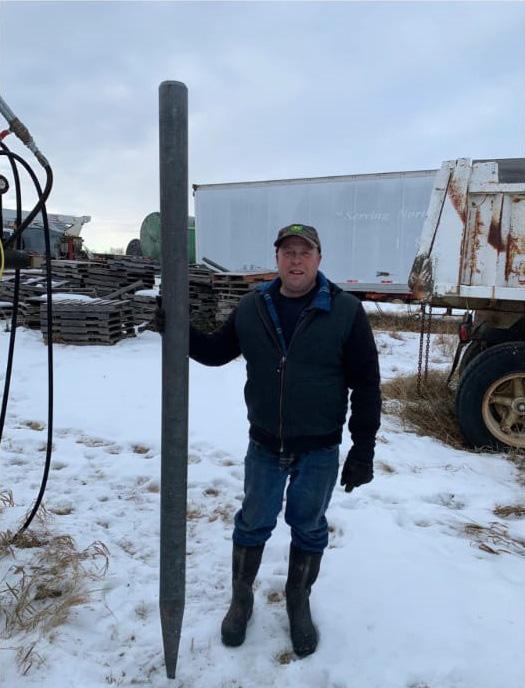
Vermilion farmer, Danny Farkash, is making waves. Using various items that one would only consider as junk and throw out, he has designed and created a machine that not only creates fence posts, but uses discarded grain bags to make them.
Danny Farkash and his wife, Rhonda, are owners of Noralta Farms, in Vemilion, a town 192 kilometres east of Edmonton. Danny has managed to create a unique, environmentally-friendly, recycling machine that takes old grain bags, melts them into liquid plastic, that is thereafter molded into four inches around and seven feet long plastic fence posts. Avid and passionate on his farm, Noralta Farms, has many of his inventions, one of them being a biorefinery that produces electricity from used vegetable oil.
“I design and build stuff and somebody had to do something about this plastic,” said Farkash, to Mary Arthur of The Western Producer. Prairie farmers buy more than 30,000 grain bags each year to use as temporary storage for grain. With limited recycling options, many grain bags end up in landfills. Existing recyclers only want clean agriculture plastic, and agriculture plastic covered with debris is often burned or buried.
During a span of about two and a half years, Danny designed and constructed a recycling machine using an anhydrous ammonia tank, a straw chopper, an old oilfield pipe, parts of a swather and other odds and ends. This machine takes in grain bags and through a process, produces fence posts.
According to an interview with Lorna Hamilton, from the Vermilion Voice, Danny explained the following “Everything is made out of scrap material. We used an old antique
tractor to run the shredder for shredding the grain bags, the incinerator is an old anhydrous ammonia tank and the pipe is old scrap oil pipes, etc.” “So how this works is we have an old antique tractor that we use to run the shredder, this shredder that we built is modified so the grain bags go through it and when they hit it there are blades that chop it all up and blow it up into the bin. When it blows up in the bin all the dirty parts like the dirty dirt and straw and whatever blows out through the top and falls in and then goes inside this extruder. The extruder is one that we designed and built in a telescope and it churns it into this big incinerator and when it goes up into the incinerator it screws it into a pipe that runs completely through the top of the incinerator, so the plastic runs through that pipe. We put scrap wood pallets in and it heats it to 500 degrees and it works like a woodstove, it smolders it, the chimneys are off to the side so it has to burn twice before it comes out and it makes it very efficient. When it (the liquid plastic) comes out the other end it goes into one of the molds which has a small hole at the end and when the liquid plastic comes out the hole we know it is full, then we telescope it out and we put on the next one, it (the mold) goes under the water to cool it off and while one is being loaded another one is being unloaded. This pipe has air pressure on it and it fits on the end of the hose blows it out and catches it and keeps it straight. The cooled plastic posts are extracted,” explained Farkash. He went on to say that they can burn cooking oil, old rubber tires etc to make the 500-degree heat used to melt the shredded grain bags. ”and what’s really cool is it burns so clean that at the end of the day we have no more than a coffee can of ash. This is a one of a kind in the world. The other ones use electricity to make it, they use fossil fuels, they use all kinds of things, they have to use fossil fuels to heat it. To heat up

that plastic to 500 degrees using fossil fuels makes it virtually unavailable like nobody could afford it. You could make posts but they would be too expensive, people couldn’t afford to buy them.”
“The posts we make come out black and they are so hard you can’t break them. We had it in a vice trying to break it and we couldn’t do it, when we did finally break one it is almost like fiberglass, it’s a different kind of plastic.” “It seems harder than a fir wood, we can pound a staple in it and the staple you have to get it straight when it goes in there, but with wood when it gets wet it shrinks and then the staple comes out and so these plastic posts don’t do that because water doesn’t affect it. You can saw this material with a hand saw, you can saw it with a wood saw, you can saw it with a chainsaw everything you would do with a wood one but its plastic, the consumer doesn’t have to change anything, the only difference is these posts will last forever.”
Farkash’s machine recycles various kinds of plastics, these include agricultural plastic that is soiled. He is currently in discussions with local municipalities to take the agriculture plastic sitting at landfills.
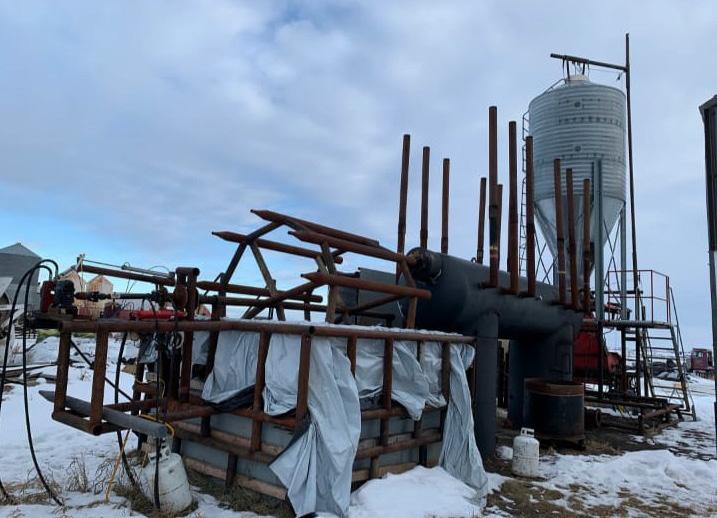
Key to creating inexpensive fence posts was finding an inexpensive heat source to heat the plastic to ultra-high temperatures. Luckily, Farkash had stacks of wooden pallets in his farm yard. Old pallets are used as the fuel source for the fence post machine.
“What we’re doing is taking waste products to refine waste products. All these pallets go to the dump and they just run over them with a cat and bury them,” said Farkash, whose machine works in the favour of the environment and entrepreneurship.
“It’s environmental, it cleans up the planet effectively without government subsidies and we can make a dollar.”

Bylaw No. 02-2021: Council gave third and final reading to Bylaw No. 02-2021 Regional Emergency Management, duly enacting the bylaw. This bylaw is inclusive of amendments made to the Emergency Management Act, with Bill 9 (2020) and Bill 13 (2020).
Private Gravel Sales / Private Gravel Sales – Industry: Effective 2021, all private gravel sale deliveries will be the responsibility of the purchaser. At this time, gravel sales are closed. The commencement of gravel sales will be announced early spring.
Universal Broadband Fund: Council provided both TELUS and Clearwave Broadband Networks Inc. letters of support in their application to the Federal Universal Broadband Fund grant program. The County supports rural broadband initiatives to improve wireless and fiber accessibility.
4H Donation: Council provided a $1000.00 donation to the Two Hills 4H, working in collaboration with the Myrnam Beef and Multi Club and Willingdon Multi Club for annual club activities.
Agri-Plastics: The County has been selected as a potential agri-plastics recycling site for Clean Farms; Council is exploring agri-plastic recycling and collection options at this time.
Next Council Meeting:
Wednesday March 24, 2021 in Council Chambers at 10:00 a.m.





The Local Authorities Election Act specifies that a general municipal election shall be held every 4-years. The next general Municipal Election will be held in the County of Two Hills on October 18, 2021. Nominations for the 2021 Municipal Elections are now open. All nominations must be received at the County of Two Hills Administration Office on or before Nomination Day, Monday September 20, 2021 by 12:00 p.m. (Noon). COVID-19 Restrictions: At this time, appointments are required for any matter relating to the upcoming Municipal Election.


The County of Two Hills encourages developers, builders and contractors to apply now for your 2021 development permits. Development permits allow construction to start anytime within 12-months of the permit issue date. For further information on obtaining development permits please contact: Gary Buchanan, Director of Planning & Development by phone or appointment at 780-657-3358 or by email: gbuchanan@thcounty.ab.ca
Subdivision & Development Appeal Board: Each municipality has a Subdivision and Development Appeal Board (SDAB) that hears appeals from municipal subdivision and development authorities. SDAB decisions shape the community and affect the lives of developers, neighbours, citizens and businesses. It is important that the public have confidence in the quality of these decisions and the decision-making process.
At this time, the County’s SDAB has one vacancy. The position requires provincial training to meet all SDAB requirements. Training to be provided. Should you be interested in becoming an SDAB member, please contact Sally Dary, CAO at 780-657-3358.
Nomination hours:
The Returning Officer or designate will receive nominations of candidates for the local jurisdiction election during the regular business hours of 8:30 a.m. to 4:30 p.m., Monday to Friday from January 4, 2021 to September 17, 2021 and till 12:00 p.m. September 20, 2021.
For more information, please visit www.thcounty.ab.ca or contact: Sally Dary, Returning Officer at 780-657-3358.
Fire Permits are REQUIRED on a YEAR-ROUND BASIS for all types of Open Burning. Fire permits are issued for 10 days at a time. Fire Permits can be obtained from the County Administration Office or electronically. Electronic Fire Permit applications are available at www.thcounty.ab.ca. Electronic permits may be submitted for approval to bstaty@thcounty.ab.ca
The County Administration Office is open 8:30 am to 4:30 pm, Monday to Friday; and, is Closed from 12:00 p.m. to 12:30 p.m. for lunch, and on all Statutory Holidays. Fire Permits are not issued after hours, on weekends or Statutory Holidays. Please plan ahead.
All fire permit holders MUST ensure that all lit fires are completely out and COLD by permit expiry date.

The County of Two Hills would like to invite applications for a seasonal Agricultural Service Board employee. This is a seasonal position and the successful candidate will be working on a variety of programs with the Agricultural Service Board, commencing May 3, 2021.
The successful candidate must:
• Have a valid Alberta Class 5 Operators License;
• Have a valid Pesticide Applicators license or ability to obtain an Authorized Assistant Applicator license;
• Have a general understanding of farming operations and/or farming background;
• Have the ability to operate and maintain equipment;
• Be willing to perform vegetation management controls which may include mowing/spraying/grass seeding/crop survey; and,
• Have strong knowledge and/or background in field crops, diseases and/or other pests.
Rate of Pay: $21.97/hour based on 7.5 Hours/day, 37.5 Hours/ week.
Please submit resumes to:
Elden Kozak
Agricultural Fieldman Box 490, Two Hills, Alberta, T0B 4K0
Phone 780-657-3358, Fax 780-657-3504, Email ekozak@thcounty. ab.ca
Application Closing Date: April 16, 2021.
The Agricultural Service Board thanks all applicants for their interest; however, only those selected for interviews will be contacted.

Derwent & District Agricultural Society

The Cash Raffle (ALGC# 532108) has been extended to May 29, 2021. Tickets are available for $50.00 each. For ticket inquires call 780-977-4717 or visit the Derwent & District Agricultural Society Facebook Page for more information.
If you have community events or information you would like to include in the County Highlights, please contact Kaitlyn Kenney at 780-657-3358 or by email: kkenney@thcounty.ab.ca
The Public Works Department would like to remind residents that the snow plowing of driveways will be available to full-time resident that qualify. Please ensure that you are on the approved snow plow list and that you have a proper County of Two Hills Snow Plow Flag out to have your driveway cleared.
As part of the snow clearing policy: BUS ROUTES WILL BE GIVEN FIRST PRIORITY FOLLOWED BY COUNTY ROADS before driveways are cleared, please be patient as the Snow Clearing Crew will do their best to reach qualifying residents in a timely manner.
Please be advised that due to low snow fall, graders on routes have prioritized de-icing. At this time, driveways shall be plowed by request. Please call 780-657-2499 to submit requests.
If you have any questions or concerns, please contact the Public Works Office at 780-657-2499.

The County of Two Hills Natural Gas Utility advises that effective immediately the due date for your natural gas bill will be changing from the 10th of the month to the 15th.
If you are currently on the Pre-Authorized Withdrawal program, this also means that your payments will be withdrawn on the 15th instead of on the 10th, starting March 15, 2021. For further information call 780-657-2446.
Sign up for e-billing today! You can sign up for e-billing for your utility invoices (water/sewer/garbage), natural gas utility invoices, bulk water invoices and any other County related services. Choosing E-billing does not change how you pay your bill, just how you receive it. If you are interested, please call the Administration Office at 780-657-3358 to join now or email your request to cmcrae@thcounty.ab.ca.
Box 490, 4818-50 Avenue Two Hills, Alberta, T0B 4K0 www.thcounty.ab.ca Visit our Facebook Page!
The Exporting Agriculture and Agri-Food Products to International Markets webinar will cover the programs and services offered by Alberta Agriculture and Forestry’s export development team. This introductory webinar will also include high-level agribusiness opportunities in the U.S., Mexico, and Japan for Alberta exporters.
‘Alberta agriculture and agri-food companies should absolutely be tapping into the supports available to them within our team,’ says Evan Buie, international initiatives officer with Alberta Agriculture and Forestry. ‘This webinar will highlight how Alberta Agriculture and Forestry’s export development team can help you get your company to that next level…international success.’
Additional topics that may be covered include tips and tricks to doing business in the aforementioned export markets, common mistakes and FAQs of new exporters. This webinar is aimed at Alberta agriculture
and agri-food companies new to exporting, new to the export development team, and those interested in learning more about the current export opportunities in U.S., Mexico, and Japan.
Alberta Agriculture and Forestry presenters include:
• Evan Buie, International Initiatives Officer
• Meghan Horosko, Senior Trade Development Officer – United States & Latin America
• Mary Beth Takao, Senior Investment and Trade Officer –Japan Office
Date and Time:
Wednesday, March 3, 2021 3:00 pm to 4:00 pm
For more information or to register, visit alberta.ca.
(Source: Alberta.ca)
A look at the price correlation among oils shows similar pricing trends.
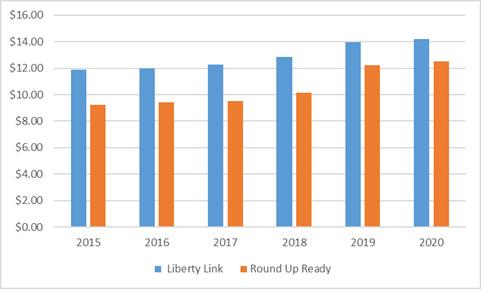
‘Based on the average yearly price, a farmer seeding canola at 5 pounds per acre will incur a per acre seed cost of $63 to $71 depending on herbicide system,’ says Ryan Furtas, market analyst with Alberta Agriculture and Forestry.
‘This makes seed the second highest operating expense after fertilizer, which ranges from $65 to $90 per canola acre seeded, and is well
ahead of chemical at $30 per acre.’
Alberta’s most popular canola brands, Round Up Ready (RR) and Liberty Link (LL), both saw price increases in 2020. Round Up Ready increased by 29 cents per pound and Liberty Link increased by 27 cents per pound.
RR and LL herbicide tolerant systems represent more than 95% of Alberta seeded canola acres.

Price relation among canola, soybean oil, and palm oil
(Source: barchart.com)

Price correlation between soybean oil and WTI crude oil
(Source: barchart.com)
‘Market reports often refer to the influence of other oilseed markets on the current or projected price of canola,’ says Neil Blue, crop market analyst with Alberta Agriculture and Forestry. ‘A closely related oilseed to canola is soybeans. Soybean oil is even more closely related to canola due to canola’s relatively high oil content and canola oil being substitutable for soybean oil in many markets.’
Blue explains that while palm oil is another substitutable oil for canola, canola oil has superior characteristics in most applications and commands a premium price.
‘Palm oil has become the world’s largest produced vegetable oil,’ states Blue. ‘Despite palm oil plants being native to Africa, Indonesia and Malaysia produce about 85 per cent of the world’s palm oil, with
‘Looking at the average growth rate of Alberta canola seed prices, the Liberty Link price increase amounted to 1.96% and Round Up Ready increased by 2.36%,’ says Furtas. ‘Annual price increases for canola seed have been a trend for sometime. However, the 2020 increases were more comparable to 2016 and 2017 versus the larger increases seen in 2018 and 2019.’
contributions to supply also from Thailand, Columbia and Nigeria.’
Blue says world palm oil production in 2020-21 is estimated at 72 million tonnes compared to soybean oil in second place at 60 million tonnes.
Palm oil has increasingly been used as a source of biodiesel over the last ten years,’ says Blue. ‘A significant amount of palm and other plant-based oils are used in biodiesel production, and for that reason, there is a relation of vegetable and canola oil prices to crude oil prices.’
‘These markets are not independent, but very much interrelated and complex, especially when considering all the factors such as politics, weather and currency swings that can affect any one of these commodities at any time,’ concludes Blue.
Furtas adds high yields and relatively strong market prices in recent years have helped support canola’s profitability as a cash crop.
‘If canola prices continue to be strong into the fall of 2021, canola seed prices could be poised for further increases,’ says Furtas.
(Source: Alberta.ca)

Iampleased with the recent announcement from the Alberta government that the Critical Worker’s Benefit has been launched. This recognizes hundred of thousands of critical workers who continue to support and provide services to Albertans during this pandemic. The Critical Worker Benefit is a joint federal-provincial program that will see $465 million go to approximately 380,000 Alberta public and private sector workers in the form of a one-time $1,200 payment.
Workers in health care, social services, and education sectors as well as some parts of the private sector defined as critical services, such as grocery and pharmacy retail, food processing, transportation and private health clinics will receive this one-time payment to recognize their
Shard work and continued dedication to support Albertans throughout the pandemic.
Public sector employees that are eligible will receive the benefit through their employer. Public sector employers do not need to be apply, as they will automatically receive the payment from the Alberta government for distribution.
Under the health-care sector, approximately 161,000 eligible employees will receive this benefit. These include orderlies and patient service associates, respiratory therapists and technologists, nurses (RNs, RPNs, LPNs), food services, housekeeping and maintenance workers and unit clerks.
In the social services sector, approximately 45,000 workers will receive the benefit.
Some of the eligible occupations include community disability service workers and practitioners, personal care aides, child development workers, family and youth counsellors, crisis intervention and shelter workers, home support workers, seniors lodge staff, cleaners,
food preparation and maintenance workers.
Eligible workers in the education sector will be able to receive the benefit. This included teacher assistants, bus drivers, custodians, and cleaning staff, as well as administration support.
Private sector employers will need to apply to receive the funds, and then distribute to eligible workers. Private sector employees include: critical retail workers, such as grocery cashiers, pharmacy assistants and gas station attendants; transportation, such as truck drivers and couriers and private health clinic staff. Applications for the private sector will be open on Feb. 17th, 2021 until March 19th, 2021. The employer will have to apply for the benefit on behalf of their eligible employees. They can do that at this website: alberta.ca/criticalworkerbenefit For more information please visit: https://www.alberta.ca/ critical-worker-benefit.aspx If you have any questions or concerns please contact my constituency office at fortsaskatchewan.vegreville@assembly.ab.ca if you have any questions, concerns or ideas.
Under the new Enhanced COVID-19 Business Benefit, up to $30,000 in support will soon be available to small and medium-sized businesses that have been most affected by the pandemic and ongoing health restrictions. This additional $10,000 payment can be used to offset costs associated with COVID-19, like purchasing personal protective equipment, paying bills or hiring staff.
“Small businesses are the beating heart of Alberta’s economy and Alberta’s government will always be there for them. We’ve heard the calls for more support and today we are providing even more funding for Alberta job creators to help them deal with the devastating impacts of COVID-19. We will continue to be there for Albertans, protecting lives and livelihoods with support measures just like this.” said Jason Kenney, Premier of Alberta.
Businesses that can demonstrate a revenue reduction of 60 per cent or more will be eligible to receive 15 per cent of their monthly revenue, up to a maximum of $10,000.
The Enhanced COVID-19 Business Benefit is intended to provide additional support in cases where federal programs fall short. Businesses are required to report the total amount of provincial and federal support received, to ensure no more than 80 per cent of revenue is covered. Funds can be used to:
• Cover costs of items that help prevent the spread of COVID-19, such as personal protective equipment and cleaning supplies.
• Pay rent, employee wages or replace inventory.
• Help businesses expand their online presence or ecommerce opportunities so that they can continue to serve customers.
The Enhanced COVID-19 Business Benefit provides financial assistance to Alberta businesses, cooperatives and non-profit organizations with fewer than 500 employees. (Source: Alberta.ca)
tarting Feb. 19, Alberta Health Services will offer the vaccine directly to all residents in retirement centres, lodges, supportive living and other congregate living facilities with residents who are aged 75 or older.
Starting Feb. 24, any Albertan living in the community who was born in 1946 or earlier will be eligible to book an appointment for a COVID-19 vaccine. Appointment availability will be based on vaccine supply.
“This is an exciting day for these Albertans, and the thousands of family members and friends who love them. We are starting with those most at risk and moving quickly to provide the protection that they deserve. Alberta’s vaccine distribution system is the finest in Canada, and we will continue immunizing Albertans as quickly and safely as possible.” said Jason Kenney, Premier of Alberta.
Anyone who was born in 1946 or earlier will be able to receive the vaccine, regardless of where they live. Seniors will be able to book their immunization appointment through Alberta Health Services using an online and telephone booking system.
“We are immunizing Albertans who are most at risk of severe out-
comes. By completing Phase 1, we will ensure that the most vulnerable Albertans are fully protected against this virus. We are working hard and moving fast, and will keep expanding our approach as more doses arrive.”says
Tyler Shandro, Minister of Health.
Details on how to book – by phone or online – will be released on Feb. 24, and links will be posted on the COVID-19 vaccine web page. Information about supports for isolated seniors and those with mobility challenges will also be posted.
Independent and community seniors
Anyone who was born in 1946 or earlier will be able to receive the vaccine, regardless of where they live. Seniors will be able to book their immunization appointment through Alberta Health Services using an online and telephone booking system.
Seniors living in congregate settings
Alberta Health Services will be offering the vaccine directly to all residents in retirement centres, lodges, supportive living and other congregate living facilities with residents who are aged 75 or older. Health officials will contact seniors
congregate care facilities to arrange appointments for immunization services.
In sites where eligible seniors interact with residents younger than age 75, health officials will offer the vaccine to everyone living in the facility. Offering COVID-19 vaccine simultaneously to all residents reduces the overall risk of disease transmission, severe illness and death in the most vulnerable.
Seniors aged 75 and older will join the growing list of Albertans who are eligible to receive COVID-19 vaccine, including:
• Health-care workers in COVID-19 units, medical and surgical units, and operating rooms.
• Health-care workers in emergency departments.
• Home care workers.
• Residents and staff of long-term care and designated supportive living facilities.
• Respiratory therapists.
• Paramedics and emergency medical technicians.
• First Nations, Métis and persons 65 years of age and over living in a First Nations community or Metis Settlement.
Completion of second doses in long-term care and designated supportive living facilities
Residents at Alberta Health Services contracted long-term care and designated supportive living facilities in Alberta are now fully immunized against COVID-19.
29,233 residents across the province have now received two doses of vaccine. This represents all eligible residents at these facilities, except those too sick or otherwise unable to receive both doses.
Alberta’s government is responding to the COVID-19 pandemic by protecting lives and livelihoods with precise measures to bend the curve, sustain small businesses and protect Alberta’s health-care system.
“Seniors have provided a lifetime of service to their families, friends and neighbours, and helped build Alberta into the great province it is today – they are the strength of Alberta. This next step in the vaccination plan is a commitment to ensure seniors continue to remain healthy and safe.” said Josephine Pon, Minister of Seniors and Housing Independent and community seniors.
(Source: Alberta.ca)

Vaping can increase your exposure to chemicals that could harm your health (e.g. cause lung damage). Vaping could also expose you to nicotine, which is addictive.
There are also concerns about the appeal of vaping products among youth and their potential to promote tobacco use.
If you are a smoker, vaping is a less harmful option than smoking.
Health risks of vaping with nicotine
Nicotine is not known to cause cancer. It is approved for use in nicotine replacement therapies, such as the patch or nicotine gum. However, there are risks linked to nicotine.
Nicotine is a highly addictive substance. Vaping with nicotine could:
• Cause nicotine addiction among users who would not have started using nicotine otherwise (e.g. smoking)
• Children and youth are especially susceptible to the harmful effects of nicotine, including addiction. They may become dependent on nicotine with lower levels of exposure than adults.
Nicotine:
can affect memory and concentration is known to alter teen brain development
Exposure to nicotine during adolescence may cause reduced impulse control cognitive and behavioural problems
Vaping may predispose youth to addiction to nicotine and possibly other drugs.
Nicotine poisoning
Vaping liquid containing nicotine is poisonous, particularly to young children.
Even in small amounts, vaping liquid containing nicotine can be very harmful if:
• swallowed
• absorbed through the skin
• There have been fatalities as well as non-fatal nicotine poisoning caused by children swallowing vaping liquid.
When buying a container of vaping liquid with nicotine, look for one that has a child-resistant closure and a ‘poison’ hazard symbol. The closure and symbol are required by law. They help protect children in three ways:
The closure makes it harder for a child to gain access to the liquid in the container.
The poison hazard symbol reminds parents and caregivers to keep the product out of sight and reach of children.
Children are taught that the hazard symbol means Danger! Do not touch.
Tips to handle vaping liquids safely Store out of sight and reach of young children and pets.
Store vaping liquid in a cool, dry place where it cannot be confused for food, drinks, or medicine. Close the container securely after each use. Wash your hands immediately after handling vaping liquid.
If someone has swallowed vaping liquids, seek emergency medical attention or call 9-1-1.
Read more about household chemical safely. Health risks of other chemicals in vaping There are health risks linked to other chemicals found in vaping products.
Vaping substances have fewer and different chemicals than in tobacco products.
Vegetable glycerine and propylene glycol are the main liquids in vaping products. These are considered safe for use in many consumer products such as cosmetics and sweeteners. However, the longterm safety of inhaling the substances in vaping products is unknown and continues to be assessed. Chemicals used for flavour in vaping products are used by food manufacturers to add flavour to their products. While safe to eat, these ingredients have not been tested to see if they are safe to breathe in.
There is no burning during vaping but the vaping process needs the liquid to be heated. This can create new chemicals, such as formaldehydes. Some contaminants (e.g. nickel, tin, aluminum) might also get into the vaping products and then into the vapour.
The amount of substances (including nicotine) a person can be exposed to by vaping is affected by the:
• battery power
• type of vaping device
• settings on the device
• combination of internal components
• type of vaping liquid and amount of nicotine
• user behaviour patterns
• user’s experience with vaping
• Using vaping products with higher power and temperature settings can produce more chemicals. Some of these chemicals and contaminants are linked to negative health effects. However, the amount of chemicals and contaminants in vapour is normally at much lower levels than in cigarette smoke.
We are still learning more about how vaping affects health. The long-term health impacts of vaping are unknown. However, there is enough evidence to justify efforts to prevent the use of vaping products by youth and non-smokers.
There is a concern that people who vape might get ‘popcorn lung’ from being exposed to diacetyl. Diacetyl is a flavouring chemical used to give butter-like and other flavours to food products, as well as vaping products. However, there have been no reports of popcorn lung occurring due to vaping.
This disease is named popcorn lung because workers in popcorn plants developed it after inhaling heated flavours such as diacetyl.
Popcorn lung, or popcorn worker’s lung, is: a chronic disease that damages the small airways in the lung the common term for the medical condition known as bronchiolitis obliterans
While once common in vaping products, steps have been taken to reduce its use.
Second-hand vapour is not harmless but it does contain far fewer chemicals than second-hand smoke. Bystanders can be exposed to vapour that is exhaled by users. The health effects from exposure to second-hand vapour are still unknown. However, the risks are expected to be much lower compared to smoke from a tobacco product.
We recommend that users be cautious around nonusers and youth.
There is some evidence that e-cigarette use increases the level of nicotine and other chemicals on indoor surfaces.Footnote1
Vaping devices are regulated under the Canada Consumer Product Safety Act. Although uncommon, another risk to consider involves defective batteries or defective vaping products that have caused fires and explosions.
If you notice a safety problem with a vaping device or vaping liquid, you can report the problem:
to the manufacturer or retailer using our online consumer product safety reporting page
For more information on product safety requirements and how to protect yourself, read about vaping product safety and regulation.
Lithium-ion batteries and vaping devices can pose a hazard if they are not properly:
• used
• stored
• carried
• charged
Tips to prevent injuries from batteries and vaping devices
Do not modify your device.
Buy batteries that are compatible with your device.
Buy batteries from a trusted source.
Do not carry lithium-ion batteries in your pocket or anywhere they can come into contact with loose coins, keys or other metal objects. Lithium-ion batteries can overheat, catch fire or even explode when in contact with metal objects. Incidents have caused serious injuries.
Keep spare batteries in a protective case.
Read the manufacturer’s instructions for storing and recharging your device.
Do not exceed the recommended charging time. Read more about battery safety.
Vaping and pregnancy
While vaping products contain fewer harmful chemicals than cigarettes, they may still contain nicotine. Talk to your health care provider about your options of quitting nicotine during pregnancy.

Ottawa, ON - Canada has the longest coastline in the world leaving us with vast oceanbased resources that can be utilized for economic potential, positioning Canada as a global leader. A Blue Economy Strategy will enable us to protect and revitalize the health of our oceans while taking advantage of emerging economic growth opportunities throughout ocean sectors.
Earlier this month, the Honourable Bernadette Jordan, Minister of Fisheries, Oceans and the Canadian Coast Guard, kicked off the Blue Economy Strategy engagements with a series of roundtables with key ocean sector stakeholders to discuss how we get more Canadians working on and in the water, and benefitting from the ocean. Today, the Minister invited all Canadians to participate in an online engagement portal which will collect the diverse perspectives from coast to coast to coast, helping us shape a federal strategy
that will:
• help Canada build back better by integrating growth with ocean conservation and climate action; create stable jobs and fuel prosperity for coastal regions and communities; encourage greater participation of Indigenous peoples, women, and under-represented groups in the ocean economy; position our ocean sectors to be stronger and able to thrive post-COVID-19; and strengthen Canada’s position as a global leader in the ocean space.
Open until June 15, 2021, this online engagement is an opportunity for Canadians to share their views on the Blue Economy Strategy in areas that interest them. This feedback will inform a strategy that is reflective of the input and needs of the communities that stand to grow and benefit the most from a strong coordinated approach to ocean investment and policy-making.
Ocean-related businesses, Indigenous people, local and provincial governments, economic development organizations, environmental groups and others are invited to visit the blue economy website where they can download the engagement toolkit to host their own blue economy roundtable discussion. The ideas generated can then be submitted to Fisheries and Oceans Canada to inform the development of the strategy.
“A healthy ocean has more to give – it can feed more mouths, employ more people and create more opportunities for the entire country. Canada
needs a Blue Economy Strategy that will harness the power and potential of our oceans to create a future that is more sustainable, more prosperous and more inclusive. The best way to ensure people are at the heart of the plan, is to have Canadians share their ideas so we can work towards this brighter future together.” The Honourable Bernadette Jordan, Minister of Fisheries, Oceans and the Canadian Coast Guard
The World Bank defines the blue economy as the sustainable use of ocean resources for economic growth, improved livelihoods and jobs, and ocean ecosystem health.
Pre-COVID-19, Canada’s ocean-based economy contributed significantly to national Gross Domestic Product (GDP), adding approximately $31.7 billion annually (1.6 per cent of total GDP) and nearly 300,000 jobs across a broad range of sectors.
DFO will continue working with federal partners, including Transport Canada, Innovation, Science and Economic Development Canada, Natural Resources Canada, Crown-Indigenous Relations and Northern Affairs Canada, Infrastructure Canada, Global Affairs Canada, regional development agencies, and others, to advance this wholeof-government federal initiative.

OTTAWA, February 23, 2021 – Correctional Service of Canada (CSC) issued the following statement on its COVID-19 response and the Correctional Investigator’s (OCI) report released today:
“Our COVID-19 approach is based on science and evidence, and has followed public health guidelines and advice every step of the way. We provide our own health care to approximately 12,500 federal inmates. This means we provide essential care for those inmates, including vaccine administration.
Since the start of the pandemic, our number one priority has been the health and safety of our employees, inmates and the public. Every decision we make is based on proven infection prevention and control measures. CSC works very closely with the Public Health Agency of Canada (PHAC) and local public health authorities to respond to every aspect of the pandemic. We have rigorous
protocols in place that include extensive testing, use of PPE and masks, medical isolation, contact tracing and follow-up. We remain diligent in applying our health and safety measures and are continually communicating with staff and inmates on the importance of applying them. These have been unprecedented times – not only for Canadians, but for organizations like CSC who continue to operate 24/7 during the pandemic. Managing the effects of this pandemic, considering that correctional institutions are congregate living environments, has required extraordinary measures. Our employees continue to show strength and dedication to keeping up with these measures and working tirelessly, as a team, to prevent and minimize the spread of this virus. Inmates continue to collaborate with staff in following the measures in place and contribute to the COVID-19 response by producing a significant quantity of masks and gowns.
We recognize that vaccinations are also key to preventing spread of the virus. Consistent with National Advisory Committee on Immunization (NACI) guidelines, CSC has vaccinated approximately 600 older offenders prioritized by age and underlying medical conditions. As further supply of the vaccine becomes available, it will be offered to all federal inmates based on NACI prioritization guidance. We expect to be in a position to roll out Phase 2 of vaccinations in the Spring.
In the meantime, considerable efforts have been made to closely follow, monitor and treat inmates with underlying medical conditions, which put them at greater risk for a more severe outcome if they contract the virus.
CSC is also partnering with experts and academia to share information and data, and learn about COVID-19. We are working with the Canadian Red Cross to ensure the most rigorous infection prevention and control measures at all of our sites and are participating in a number of studies, including a national serology study led by the Government of Canada COVID-19 Immunity Task Force (CITF).
As part of our proactive approach, we regularly review our policies and procedures against public health guidelines including those set out by other countries and jurisdictions. CSC is one of the first jurisdictions to adopt rapid testing to help identify positive cases more quickly, treat inmates sooner and take additional measures to prevent the spread of the virus. We are also one of the first jurisdictions to make our inmate testing data widely available online. We have presented our approach to the World Health Organization (WHO), provincial correctional jurisdictions, and other government departments in an effort to share best practices.
While there is always more work to do, CSC has adapted and learned a great deal about the challenges of preventing and containing the COVID-19 virus over the past 11 months. We will continue to make everyone’s safety our top priority as we work to fulfill our mandate during this challenging time.
Did you know that AUMA has a Women in Municipal Government Hub that includes information and resources to promote and support women running in local elections?
According to the Federation of Canadian Municipalities, in Canada, women occupy only 18% of mayors’ positions, and 28% of councillors’ seats. Women play a vital role in municipal government, and studies have shown that diversity improves an organization’s effectiveness. Local government creates and implements services, policies, and programs that directly shape a community. Having more women on municipal councils means more perspectives will be debated, which can lead to innovative decision-making and the of adoption new and different approaches.
On March 8, in recognition of International Women’s Day, AUMA will host a virtual gathering featuring Kasey Machin, cofounder of Areto Labs and ParityBOT, an initiative and resource that quantifies and counters online abuse of women in politics. A campaign toolkit developed by ParityYEG that can help candidates throughout Alberta will also be profiled. The event will be
moderated by Charlene Smylie, previous small-community mayor and AUMA Board member.
The virtual gathering will be taking place from 12 - 1 p.m. on March 8. Register for the event here. Be on the lookout for other events happening around Alberta supporting women’s participation in local government, such as the virtual session being hosted by the Lethbridge Public Library on February 23: So You Want to Run for Office: Women in Local Government.
AUMA staff are also currently working on updating the content on the Women in Municipal Government Hub and exploring other opportunities to profile municipalities and organizations who are working to increase diversity in local government
We welcome any ideas, stories, or feedback you have to share for how we can better promote and support women in local government. Feedback can be sent to advocacy@ auma.ca.

“Every Feb. 14, communities, families, survivors and loved ones honour and remember the Indigenous women whose lives have been stolen by violence.
“On this day, we also pay tribute to the strength and determination of Indigenous women, Elders, families and community members who have been powerful advocates to end violence against Indigenous women and girls. “Alberta needs to be a safe place for Indigenous women and girls and that means we must listen and act. That is what Alberta’s government is doing.
We’ve established the Alberta Joint Working Group on Missing and Murdered Indigenous Women and Girls (MMIWG) to make recommendations on how to respond to the final report of the National Inquiry into MMIWG.
“Together, we must continue to raise awareness that gender-based violence has no place in our lives or in our province.
“Let us join together to reflect on how we can make sure that Indigenous women, girls and two-spirit people feel safe, secure and respected wherever they may be.”
by Sonny Rajoo

Veteran Town Councilor, Elaine Sorochan, who served as Mayor, Deputy Mayor and Councillor for sixteen years for the Town of Two Hills, is urging more women to participate in Municipal Politics, where she served on various committees during the past several years.
The former educator, volunteer, wife, mother and grandmother has grasped the distinct ability to balance family life and politics, and with long and illustrious career. Sorochan has brought a fresh and new dimension to municipal politics, particularly in her role in various committees which are dedicated to the beautification of town facilities and the town streets in general.
Sorochan’s many years of serving on the Senior Citizens’ Lodge, on the Provincial Women in Politics Committee and on library boards has enabled her to use her vast experience for the betterment of her community. In encouraging more women to enter Alberta politics, Sorochan said that it not only brings a fresh avenue and a diverse portfolio into council deliberations, but also enables those aspects which are sometimes
neglected in favor of other activities, such as infrastructure.
In her career as an educator, Sorochan has ensured that those facilities that serve our youth, are given the full attention of Town Council and has never failed to champion the cause of children and seniors. In addition to taking care of various aspects of ratepayers’ needs, Sorochan served on the Executive of Northern Lights Library Board and has attended many municipal courses so that the experience and education adds to the contribution of her various terms on town Council.

Elaine Sorochan and family enjoying a great family outing skating and playing hockey with her husband Emil, son Curtis and wife Kendra, granddaughter Avery, granddaughter Aubrey Daughter. Christie Roche and husband Shaun , granddaughter Coral and grandson Cohen Son Lance and wife Kerina, granddaughter Jordanna and grandson Bohden.
Sorochan played a monumental role in the establishment of our brand new Recreation Center, Regional Water, The Two Hills Medical Clinic and The Mennonite School. In spite of her commitment to public life, Sorochan never fails to mention her daughter, two sons and her grandchildren. She keenly follows their activities, no matter what time of the year it is.
The various challenges faced by parents, especially during the time of Covid-19, is often diffi-
cult, but this long-serving councilor has continuously been the epitome of service to public life.
“I strongly encourage women to enter the exciting and ever-changing world of politics, so that all aspects of community life are reflected in the decisions faced by Town and County Councils.” Sorochan concluded.

Now more than ever have computers become such an important part of our lives. They can be such a useful and powerful tool in our day to day lives, and yet they can be so scary and hard to grasp.
Computing Essentials will help you get started and comfortable with the basics of computers.
1) The first class will start right from the beginning with computer basics.
2) The second class will focus on files and folders. This is especially helpful in managing your pictures and documents.
3) The third class will help you navigate the internet and your email.
Cost: $35 includes 3 Workbooks
Location: Adult Learning Office

Time: Call 780-208-3754 to set up a time.

The person who learns throughout their life is capable of adapting, and changing. Foundational learning-includes: literacy and numeracy, English as a second language, and basic computer skills to enable individuals to pursue further learning, having a satisfying and meaningful employment, and fully participate in Alberta’s society and economy.



February is Black History Month in Canada. Black History Month is a time to honour and commemorate black Canadians and reflect on the history, achievements and contributions of black people in Canada.
Black history plays an integral role in our heritage in Alberta and in Canada. Despite a history of oppression, enslavement, racism and discrimination, black Canadians have transcended great adversity to achieve many accomplishments. It is these accomplishments that have contributed to the wealth of our province and country. When we reminisce our past, including the many hardships, trials and sufferings of the previous generations, as well as the several successes, victories and triumphs, is important to understanding our rich history and how it has influenced our contemporary culture.
In 1850 the Fugitive Slave Act was passed in the United States as part of the Great Compromise of 1850 between the Union and the Confederate states. The act allowed slave masters to enter free, northern U.S. states and reclaim escaped slaves. This prompted an increased use of the Underground Railroad to get into Canada.
Prior to the American Civil War, around 1860, enslaved Africans used the Underground Railroad-a secret network of routes and safe- houses to escape slavery and reach Canada.
Following the Civil War, black people in the south, experienced renewed racial oppression and were urged to once again leave the south. They called themselves the “Exodusters’. Many of the Exodusters settled in farming communities in Alberta, including in the communities of Keystone (now Breton) and Amber Valley.
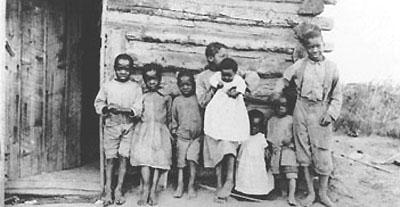
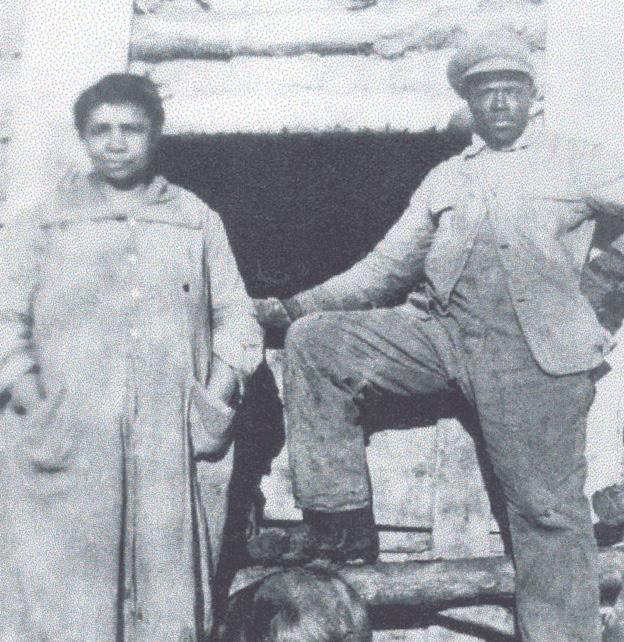



Ispeak of our monthly Chapel Services held at the Extended Care Facility and the Hillside Lodge using the Zoom digital platform. Courtesy of our Two Hills and County FCSS, Smart TVs were purchased for these locations which enables us to conduct virtual Chapel Services while COVID prevents us from coming in-person. Our Services consist of Hymn singing, Scripture readings, Prayers and a biblical message that seeks to draw our attention to our Saviour, the Lord Jesus Christ. Below is the Message that I hope to bring at our next Zoom Chapel Service. It is a message of good news that gives us great hope in this pandemic world in which we live.
Biblical Text: John 13:33-14:6
Today I want to speak about Heaven. I am reminded of a Sunday School teacher who asked her class: “How many of you want to go to heaven?” All the children raised their hands except for one little boy. The teacher asked him, “Jimmy, don’t you want to go to heaven? He said, “No.” And she said, “But Jimmy, why not? And he said, “Because I have to die first.” No one wants to die but the fact is that we all will. The question is, “Do you want to go to heaven when you die?” Heaven is what Jesus is talking about here.
Just a few hours before he was to die on the cross, Jesus told his disciples about heaven. He told them about heaven in order to comfort them. He had told them two hard facts they had to face. First, he was going to leave them and where he was going they could not follow him, now. Second, Peter was going to deny that he ever knew Jesus three times before the rooster crowed the next morning. Jesus knew that he was facing death on the cross as a sacrifice to put away the sins of the world. He knew he was to be buried but rise again after three days, and then return to his Father’s glory in heaven. So he speaks to his disciples about heaven. Jesus tells us two wonderful truths about heaven.
Jesus tells us that Heaven is a real place.
“In my Father’s house are many rooms. . . I am going to prepare a place for you, I will come back and take you to be with me that you also may be with me where I am.” Jesus likens heaven to a large family home in which there are many rooms. The image of a house speaks of something permanent. Heaven is a place where we will live in comfort, safety and peace. It is a place where we are welcomed as God’s children. It is our Father’s house. It is the place where Jesus lives with
As we have come to realize, unforeseen circumstances occur all the time. In a blink of an eye, something can alter your life and the choices you make… Just like how the covid-19 virus struck the world. Nobody knew that it would change the world and our entire way of living in it. It, at first, sounded like a simple flu but before you knew it, it started to claim lives… like the ticking time bomb it is.
We all know how it spreads, we all know the horror it has caused. We all feel the loss and heart ache of losing someone, their precious lives succumbing to an unspeakable and unbearable virus. Millions of individuals have lost so many loved ones to this virus. People have lost their reason to smile, because of losing close, precious loved ones; spouses, uncles, aunts, grandfathers, grandmothers, and especially parents who have lost their own children. That
his Father and with all those who belong to him. Jesus has returned to heaven in order to prepare a place for us in his Father’s home.
David described his life as one of the Lord’s sheep in these words, “Surely goodness and mercy shall follow me all the days of my life and I shall dwell in the house of the Lord forever.” Heaven is dwelling in the house of the Lord forever. The apostle Paul describes death as “being absent from the body but at home with the Lord” Heaven is being home, our real home. Heaven is being with Jesus where he is, beholding his glory forever. Jesus’s words to the thief dying on the cross beside him were, “Today you will be with me in Paradise.” Heaven is being in Paradise with Jesus immediately after death. Heaven is a real place that is able to hold all who want to join Jesus and his Father in their family home. Do you believe in heaven? Do you believe there is room enough in heaven for you? You don’t have to take my word for it. Jesus himself said, “In my Father’s house there are many rooms; if it were not so, I would have told you.” Jesus assures us that heaven is a real place and he is busy now preparing a place for all who belong to him. He will come back to take us to be with him in that place. Since heaven is a real place, how do you get there?
Jesus tells us that He is the Way to Heaven. Peter asked Jesus, “Lord, where are you going?” He did not want Jesus to leave them and he did not know where Jesus was going. Jesus said to his disciples, “And you know the way to the place where I am going,” But Thomas exclaimed, “Lord we don’t know where you are going, so how can we know the way?” Thomas was saying that they had no idea where Jesus was going, and they had no way of knowing the way to where Jesus was going. Where is this place called your Father’s house? How do you get there? What is the way to your Father’s house? How can we know the way? Jesus tells us that He is the way to the Father – “ I am the way and the truth and the life. No one comes to the father except through me” (John 14:6).
Because Jesus is the Truth, he is the true way to the Father. You can depend on Jesus completely for he is reliable and true in all that he says and does. Jesus is the true way to heaven. Put your faith in him and he will take you to be with him in heaven.
Because Jesus is the Life, he is the living way to the Father. Jesus has life that really counts in
the end. Physical life for all of us will come to an end one day and the only life that will count then is the Life that Jesus gives to those who believe in him. Jesus has eternal life and Jesus gives eternal life to everyone who calls upon him for mercy. Jesus is the living way to heaven. So abandon yourself to him and you will enjoy unending life with Christ in heaven.
Because Jesus is the Way, he is the only way to the Father. Some people think there are many ways to God. Some picture God sitting on the top of a mountain and there are many ways up that mountain to God. As long as you are sincere and seek God, you will find him. But what did Jesus say? He said, “No one comes to the Father except through me.” Jesus is the One and Only way to heaven. As the Truth, Jesus is the one true way to the Father’s house. As the Life, Jesus is the one living way to the Father’s house. As the Way, Jesus is the one and only way to the Father’s house. What comes to your mind when you think of heaven? If heaven is a real place, what is it like? If heaven is a real place, how do you get there? Jesus tells us that heaven is a real place where He and his Father live, a place he is preparing for us who love him. Jesus tells us that He is the way to heaven, a way that is based on truth (not fairy tales), a way that is full of life (not death), and a way that will lead us directly to God the Father. One Bible translates Jesus as saying, “There is more than enough room in my Father’s home.” Heaven is a place where more and more and more people can come. There are many rooms. There is room enough for you and for me.
One time my wife and I, along with our family, were flying to my mother-in-law’s home in Barbados. Ellen’s mom had just moved to a smaller place so Ellen asked her, “Mummy, will there be enough room for all of us?” I will never forget her mum’s response. She said, “Where there is love, there is always enough room.” Jesus loves you and wants you to be with him in heaven. Will you accept him as your Lord and Saviour? Will you open your heart to receive Jesus as the Son of God who came into the world to save us from our sins? While Ellen’s grandpa was alive and just before we would be leaving the Island he would always say to us: “I will see you again. Either here, or over there.” Will I see you again, over there? Will you be with Jesus and me in heaven?
Pastor Warren Charlton
Two Hills Fellowship Chapel
thought alone can bring an unwanted dread and terror.
People have lost so much to this virus… jobs, homes, families, bonds, relationships… worst of all love. People who were needed are now gone, people who were just friend are now gone, people who we could just pick up the phone to talk or vent to are now gone. Everyone is mourning some type of a loss.
We are all human and we are all equal; our pain and emotions are what makes us human. We all have lost, but this should be the reason why we forget about the past and live in the now, to help the next person. Too many people are dying and too many people are just not bothered because they are safe and secure. Losing a loved one is hard, but choosing to not help someone in need, is inhumane.
Let this play on your mind for a while...if a financially disadvantaged
person won the lottery and decided to use that money to help people who have similar problems to him/ her, what excuse does the wealthier person have for not reaching out to others? In order to sustain the legacy that our loved ones have left for us, we need to strive to save each other so that their legacy lives on. There’s no point in having a legacy if there is no one to hear about it and experience the benefits of it, right?
This virus is no joke, but by playing our part and obeying laws and restrictions, we can beat this virus. Just look at the recovery rate! We can put an end to this. We just need to start to helping and reassuring one another. Let us build each other up to be a family, not people who are simply acquainted with one another. With unity comes great strength, perseverance and eventually victory. Let’s beat this virus not only for ourselves but to honor the memory of
our loved ones who lost their lives due of it. We should also thank them, because of their desperation and vulnerability, there are now vaccines available. They will always be remembered, physical image is worthless if there is no emotion tied to that. It’s what is in the heart that is most valuable because no one can take that away from you. Our global economy almost went in a big recession, but now as time goes by, you start to slowly see economies rising. This is because all nations and their leaders are working together. Now imagine what a difference it would be if all countries and their people work together on achieving this goal while putting an end to this virus! It’s my personal point of view: We need to stop thinking about ourselves. We are a nation by numbers, not titles!
May God Bless and Be With You All
by Niri Rajoo-Jeevanath

Iwake up to a quiet, sleepy house. There’s a stillness in the already sweltering midsummer’s South African morning. While using the bathroom and preparing my coffee, I mull over the chores for the day. Working from home is amazing, but it can put you in a physical rut… no need to do your hair, put on any make-up or wear anything other than comfortable clothes and slippers. There’s no crazy hustle and bustle or deadline to leave home and deal with rushhour traffic. So I have the gift of dawdling and having sufficient alone-time.
For as long as I can remember, I had some little one that I had to take care of. It was initially my siblings, the neighbors’ children and thereafter, my own little ones. My eldest son, Keanan, now 25 years old and soon to be married was a clingy child. He mimicked pretty much everything I did and followed me around to the extent that I affectionately referred to him as ‘my little shadow’. Aaron, now twelve years old, was born Mr Independent. He is a mini-man in his own right, having a certain way of doing things and can be extremely headstrong when challenged. I can’t really say that he’s taken after his late dad… he had the patience of a saint. Aaron is quite content to sit in his room or play outdoors on his own. He needs minimal supervision and he’s most content being left alone with our dogs.
Three weeks ago, Brennan, my livewire, vibrant, supercheerful and energetic 18-year old, left home to study at a campus about two hours away from home. Let’s just say
that when Brennan is around, there is no silence. From his laughter, to the genre of music that he listens to (never at a moderate volume), there seems to be a constant sound of some sort at all times. Often labeled as Sonny Junior, he has several of my father’s character traits; laughter and cajoling dominate the atmosphere wherever Brennan is.
Empty nest syndrome…a very apt name, seeing that I have always considered myself as a mother hen who is most content when I have all my chicks gathered under my wings. Ruven, Jared, Joy, Tatum, Charlize, Donivan, Leon, Keanan, One’, Kamleshan, Kayleen, Cameron, Brennan, Aaron…. to name a few of my favorite chicks that I had the pleasure of playing Mother Hen to at some phase of my life. These chickies have kept me strong, motivated, grounded, focused, and determined to be my best, to do my best and trust God Almighty, regardless of circumstances. Most of these chicks have left the coop. They have found their own places to roost and some of them have their own broods of little chicks. I may miss them, and long for the days of having them under my wings, but I am immensely proud of them and salute them in finding their own journey and path in this adventure called life. I am their biggest and loudest cheerleader and their number one fan.
So yes, I can be lonely, yes, the house is tidy, yes, I have many hours in the week to myself, yes my chocolates and nibbles don’t disappear (with the phrase “I don’t know” being the response when asked about it)…. but a huge YES to independent, selfsufficient, mature, young men and ladies who have a niche of their own to carve out in this world. I love you, treasure you, admire you and salute you!
May all of us older Mother Hens, sit back, sip our mugs of coffee, watch our favorite program or read our favorite book, nibble on our cookies and savor the silence! Be proud of the chicks that have left the coop for their destinies are awesome and there’s a world that theses chicks need to explore. I salute you, Mother Hens, on a job well done! Your labor of love has not gone unnoticed.
Love always, Niri
Q: What runs, but never walks, often murmurs – never talks, has a bed but never sleeps, has a mouth but never eats?
A river.
Q: If you are running in a race and you pass the person in second place, what place are you in?
Second place.
Q: What gets sharper the more you use it? Your brain.
Q: If I have it, I don’t share it. If I share it, I don’t have it. What is it?
A secret.
Q: What can you catch but not throw?
A cold.
Q: How many months have 28 days?
All 12 months!
Q: They come out at night without being called, and are lost in the day without being stolen. What are they?
Stars.
Q: What is full of holes but can still hold water?
A sponge.
Q: Two in front, two in behind, and one in the middle. How many are there?
Three. ( 1 2 ) 3 1 (2 3) 1 (2) 3
Q: What word is spelled wrong in every dictionary?
The word “wrong!”
Have something to share? Birthday, anniversary, any special event? Let us share your experience. Send us your notices to news@twohillschronicle.com and be sure to check out our website being updated regularly and like us on Facebook.


by Niri Rajoo-Jeevanth
The Village of Myrnam is located approximately 180 KM northeast of Edmonton, Alberta at the intersection of regional Highways 45 and 881. People originally settled in the early 1900′s, followed by a post office being established in 1908 and thereafter a Canadian Pacific Railroad siding and potential town site followed in 1927.
Residents gathered together to find a suitable name for the potential town. Growing louder in frustration, they debated over several possible names for their village. Over the chaos that arose, one resident wishing dissension to cease, cried out ‘Myrnam’, which in Ukrainian means ‘Peace’ to us’. That seemed to settle the issue and the Village was officially incorporated in 1930 as the Village of Myrnam.
Once a home to five-grain elevators along the Canadian Pacific Railroad, Myrnam continues to be a great place to call home. Like many smaller communities in Alberta, Myrnam offers many op-

by Donna Rudolf
Iamportunities for a spectrum of young families and seniors alike. An active, recreational life including golf, curling, snowmobiling and organized sports are complemented by enjoyable activities catering for the older generations..
Myrnam’s residents enjoy many educational opportunities within or in close proximity of the Village. The New Myrnam School, a Kindergarten to Grade 12 facility, continues to be a cornerstone of the community. A medical clinic, a Seniors’ Residence, an Alzheimer’s unit, a gas card lock, restaurants, and a local food and liquor store add to the convenient lifestyle. In addition, the Village has an ATB Bank / Registry Office, a seed cleaning plant, and a fertilizer facility.
Myrnam Dove Park provides an oasis in the middle of the Village where visitors can rest, relax and review the many plaques posted on me-
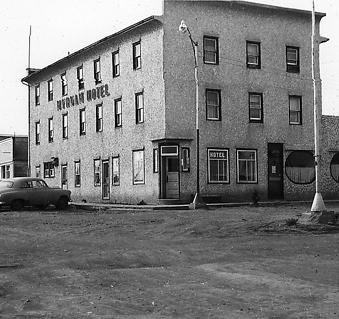
so happy to see the Rajoo family back in the newspaper business. The Chronicle has been sorely missed and “The Return of the Chronicle” is like waiting for a much anticipated sequel. When the first issue hit the local Post Office boxes, we all cheered.
It would seem like nothing is going on what with the COVID restrictions. Not so! Last spring the Fire Department organized a fantastic drive by parade for our Lodge residents and right before Christmas they decorated the fire truck and paraded around the town. That lit up the night and our hearts. We also had a drive by Christmas parade in front of the Lodge. Over thirty vehicles showed up, many of them decorated AND most people were decorated as well! (I’ll leave that to your imagination). We are currently applying for a “Community Spaces” grant sponsored by Co-op to fund a project we are calling “The Dove Connection.” The project consists of a paved pathway connecting the south and north sides of the village, flanked by planters, trees, and rest stops. The Benches are here and the tress are planted. The paving is the major component and, if we get the grant, it will become a reality. The pathway will start in front of the
Lodge and go right to Main Street.
This allows our seniors safe and easy access to the post office, cafe, store, etc. It also accommodates bikes, strollers, etc.
Our wonderful and active Family Resource/FCSS crew have been out and about throughout the county, painting it pink, with the help of lots of children. They have organized several virtual events for the last year. Eagle Hill Foundation has raised the bar in delivering supports and programs for our seniors in the lodges. They now can visit friends and family via Zoom or FaceTime. This equipment, the programs, and support were funded by FCSS and implemented through the staff at the lodges. Our school and Homeschool centre is expanding, as is the enrolment and programming at CTEC.
We have been “relatively” COVID free, and despite restrictions, we are like Jonny Harris’s T.V. show, “Still Standing.” It takes more than a pandemic to stop us! Oh, I got an Email from “The Dove,” who appears to still be in South America with Jim Crow. Dove tells me that homesickness is settling in and now that the Chronicle is back Dove may return. Until then, hang tough, stay safe, and God Bless.
Donna Rudolf
morial monuments located in the park in honour of former residents. The Myrnam Dove and Historical Society continue to enhance the park each year. From time to time, local organizations use the park for outdoor concerts or other activities designed to build relationships in the community. Myrnam proves to be quaint, family-orientated village and its name proves to be the atmosphere surrounding the town.
Left: The Post Office opened on August 1, 1908.
The first postmaster was Paul Melnyk. who held the position from 1908 to 1914.
Middle: Myrnam Hotel in Right: Mrynam Train Station (Photo Source: prairietowns.com)
“We, the G7 Foreign Ministers of Canada, France, Germany, Italy, Japan, the United Kingdom and the United States of America and the High Representative of the European Union firmly condemn violence committed by Myanmar’s security forces against peaceful protests. We offer condolences for the loss of life. The military and the police must exercise utmost restraint and respect human rights and international law. Use of live ammunition against unarmed people is unacceptable. Anyone responding to peaceful protests with violence must be held to account.”
“We condemn the intimidation and oppression of those opposing the coup. We raise our concern at the crackdown on freedom of expression, including through the internet blackout and draconian changes to the law that repress free speech. The systematic targeting of protesters, doctors, civil society and journalists must stop and the state of emergency must be
revoked. We continue to call for full humanitarian access to support the most vulnerable.”
“We remain united in condemning the coup in Myanmar. We call again for the immediate and unconditional release of those detained arbitrarily, including State Counsellor Aung San Suu Kyi and President Win Myint and continue to stand with the people of Myanmar in their quest for democracy and freedom.” Send us your stories and notices. We love to hear from
Minister Mélanie Joly announces $520,000 in support from Canada Economic Development for Quebec Regions to a regional innovation centre in mechatronics and industrial mechanics.
Saint-Georges, Quebec, February 23, 2021 –Canada Economic Development for Quebec Regions (CED)
The vitality and dynamism of communities— founded on strong, resilient, innovative SMEs— ensure sustainable economic growth for all and quality jobs for Canadians. Keen to understand clearly the particular realities of Quebec’s regions and to support the businesses that make them strong, the Government of Canada, listening now more than ever, is investing in projects that will be promising for the economic recovery.
In the Chaudière-Appalaches region, several dynamic businesses are turning to digital technology and, through their innovative ideas, are contributing to the region’s reputation across the country. Tested by the challenges posed by COVID-19, these SMEs are now ready to rebound. And as Quebec’s regional prosperity relies on strong local economic fabric, where businesses are able to innovate and lead promising projects, the Government of Canada is signalling its presence to support them as they pursue their activities and to foster their growth.
College centre for technology transfer (CCTT) receives over $500,000 to foster technological innovation
With this in mind, the Honourable Mélanie Joly, Minister of Economic Development and Official Languages, today announced financial support

totalling $520,000 for MECANIUM. The non-repayable assistance being granted will enable the organization to strengthen its technology transfer capabilities by acquiring digital equipment and advanced software that will be made available to Chaudière-Appalaches manufacturing businesses. These SMEs make use of this CCTT’s services to develop new Industry 4.0-inspired production processes. Through this project, MECANIUM is also aiming to develop its expertise and enhance its reputation in the region as a centre of excellence for applied research, in particular in mechatronics.
The Government of Canada is proud to recognize and support businesses and organizations working in sectors of activity that are a source of pride in their communities. Quebec’s future and economic recovery are founded on the flagship industries of regional economies. They contribute significantly to Quebec’s economic growth and will be key assets to rebuild a stronger, more resilient and more just economy for all.
“The Government of Canada has a mission to accompany the country’s businesses and regions into tomorrow’s economy and to help them seize the business opportunities that will arise. That is why we are providing our support to the specific assets of Quebec’s different regions, such as here in the Chaudière-Appalaches region; they will be essential elements in ensuring an inclusive recovery and in creating good jobs in all of our communities.” said the Honourable Mélanie Joly, Member of Parliament for Ahuntsic-Cartierville, Minister of Economic Development and Official Languages and Minister responsible for CED
The Honourable Mélanie Joly is the minister responsible for the six regional development agencies (RDAs), including CED.
CED is a key federal partner in Quebec’s regional economic development. With its 12 regional business offices, CED accompanies businesses, supporting organizations and all regions across Quebec into tomorrow’s economy.
The contribution given to this organization has been granted under the Regional Economic Growth through Innovation program, which aims to support Quebec SMEs as they develop through innovation, among other things.
Effective December 13th the Village of Myrnam office will remain closed to walk in public traffic. Staff will be available to meet with residents by appointment only. Masks will be mandatory for anyone entering the facility.
Following a meeting to discuss the current state of the Coronavirus in Alberta and review emergency plans, Myrnam council has decided to change Village Office hours to the public until further notice. This will help to halt the potential spread of the virus to local residents and key village staff. It also is in keeping with provincial guidance to municipalities, local schools and organizations. These are difficult times and by working together we can help keep the most vulnerable in our society safe. We appreciate your help and thank you for your understanding.
Monday & Friday – Closed to the public Tuesday, Wednesday, Thursday – 8:30 a.m. to 12:00 noon 1:00 p.m. to 3:30 p.m.
We are still here to answer any questions you may have via telephone (780) 366-3910 or email at admin@myrnam.ca. To help future communication you can also send the Village Office your email details and we can then email utility invoices to you rather than mailing these which saves you an extra trip to the post office.
How to make utility payments
Many residents who are Servus and ATB customers pay bills online or in person when visiting their bank. Others pay via E-transfer to admin@myrnam.ca. Perhaps you might consider this simple payment option. If you need to pay a bill in person, please deposit you payment in the deposit slot in the front door.

Twentyfour years ago, in 1997, I received the tragic news that my father had passed on. My mother had already left this earth eighteen years before that.
And so, on that 31 January 1997 morning, after replacing the phone on its cradle, I held my head in my shaking hands and sobbed for several uninterrupted minutes. The thought that I was an orphan now, drove me to self-pity.
Fortunately, that did not last long. The emptiness I felt was replaced by an ocean of gratitude. I was the most blessed among many –the first-born child of Harry & Kannah Rajoo, both children of indentured labourers whose parents were transplanted from their rural villages in India to the sugar cane fields of South Africa.
Out of those humble beginnings emerged two unique and gifted souls whose investment in my life leaves me breathless to this day.
On 16 December 1976, when I hugged my mother and father at the Durban International Airport, excited about the prospect of emi-
grating to Canada, I wiped the tears from my mother’s eyes, and vowed in my heart never to do anything to disappoint her. She gave me her blessings to start a new life in my own adopted land just as her parents had done at the turn of that century.
February is the month of love – the kind of love often associated with romance. But there is a much deeper love. One forged in the womb of a mother, that then flourished under the watchful eye of anxious parents whose daily prayers never ceased until that final breath.
It is, therefore, fitting that in this month of love, I pay tribute to the first loves of my existence – Harry & Kannah Rajoo.
Our readers have similar notions of parent-child love, similar memories of childhood and similar depths of gratitude. For those of you who still have your parents to warm your souls, let them know those deep-seated heartbeats that will forever beat for those who gave you life.
Happy Valentine’s Day! May this be one like no other before.