Disclaimer: The information provided by Natraja Media in this publication is for general informational purposes only. All information is provided in good faith, however, We make no representation or warranty of any kind, express or implied, regarding the accuracy, adequacy, validity, reliability, availability or completeness of any information.
Ponderings of the Publisher From my Desk
Greetings to our readers,
Fromtimes long ago
most people, at least to some extent, grew most of their requirements. Either by planting and/or tending animals and then trading with our neighbors. We were for the most part, self sufficient.
Fast forward to today, and very few people statistically have a garden beyond aesthetics. Farmers have become an integral part of our society, as without their hard work we would go hungry.
It’s refreshing to see many education centers and schools promoting agricultural sciences
and encouraging people and children to consider farming as a career.
As we progress, and our population continues to grow, so will our requirements for sustainable sustenance. It is of utmost importance not just to show our gratitude to our farmers for carrying this load on their broad shoulders, but also continue to look at ways to improve our knowledge in what it takes to produce the many delicious foods we get to enjoy without planting anything.
Be sure to like our page on Facebook and stay up to date with the latest from Natraja Media. As always we love feedback and love hearing from our readers. Please feel free to connect with us.
Until next time, stay safe and stay healthy.
NATRAJA MEDIA
Natraja Media specializes in digital and print media. Our services include graphic design, social media posts, and much more. Our publications are available to view online at issuu.com. Contact us to request our services or for more information at the email below.
Greetings to our readers,
Often we go to a vendor and complain about the price we pay for produce but how often do we take the time to consider how much time and effort it actually took to reap that item.
To me, a farmer is one of the most admirable human beings.
It’s not just through hard work and knowledge that the farmer yields good crop, farming requires passion, patience, determination and so many more qualities and traits in a person, qualities and traits that we all should aspire to.
I would like to take this
opportunity to salute the agricultural sector for their pivotal and invaluable role in the global economy and for their contributions to the sustenance of innumerable communities.
Wishing all farmer’s, a bountiful harvest.
God Bless. Stay Well & Stay Safe.
Much Love, Ravika
Natasha Tilukdharie Administrator
Ravika Naicker Production
Jared Rajoo Publisher
Water conservation tips for livestock producers
Water conservation can help reduce costs, improve animal health and productivity, and protect the environment for the future.
“Water is a precious resource for livestock producers, especially in times of drought,” says Shawn Elgert, agricultural water engineer with the Alberta government. “Water conservation can help reduce costs, improve animal health and productivity, and protect the environ-
ment for our future.”
Elgert says there are several things producers can do to conserve water for livestock, starting with keeping livestock out of the water sources. Livestock can contaminate water sources with feces, urine and pathogens, which can affect the quality and quan-
tity of water available. Livestock can also damage the banks and vegetation of water sources, leading to erosion and sedimentation. To prevent these problems, fence off water sources and provide off-source watering systems, such as troughs, tanks, or pipelines.
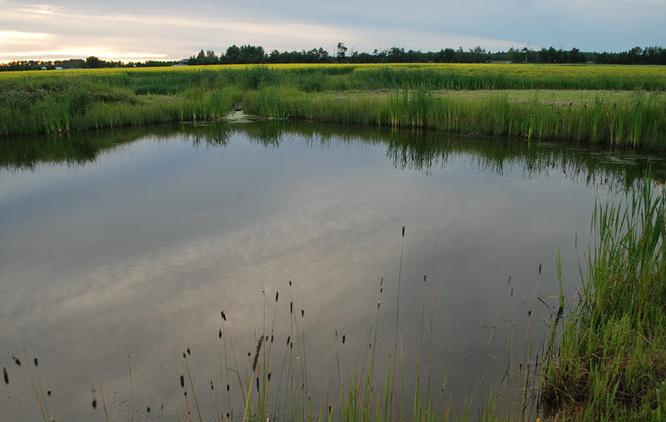
“Drought proof size and protect dugouts to capture and preserve more runoff so it doesn’t just overflow downstream and so you can have water in a time of drought,” says Elgert. “A 2-year drought supply is a good rule of thumb to design for. Dugouts should be sized according to the water demand, the runoff potential and the climate of the area.”
A dugout should be located in an area where it can be filled 8 out of 10 years to be feasible. Dugouts also lose water through evaporation, and sometimes seepage. Covers can be utilized to reduce algal growth and evaporation of the water and, if necessary, liners can be installed to prevent seepage. Monitor your dugout regularly for water quality problems.
“Prevent contamination of water by utilizing best management practices for water sources. Best management practices (BMPs) are methods or techniques that can help protect water quality and quantity.”
Some examples of BMPs for water sources include the following:
• installing buffer strips or riparian zones around water sources to filter runoff and prevent erosion.
• maintaining or restoring wetlands to store and purify water.
• using proper storage and disposal methods for manure, chemicals and other potential pollutants.
• testing water regularly for contaminants (inquire about proper treatment methods when necessary).
Consider rainwater capture to help reduce the demand for groundwater or surface water, and to reduce runoff and erosion. Some producers have large buildings where they can capture a good amount of rainwater.
Monitor for leaky pipelines and repair them
Leaky pipelines are pipelines that have cracks, holes or loose connections, causing water to leak or drip. Leaky pipelines can waste water and money and can also reduce the water pressure and the flow rate. Leaky pipelines can also cause soil erosion and damage, water contamination or flooding.
To conserve water from leaky pipelines:
• monitor the pipelines regularly for signs of leakage, such as wet spots, puddles or mold.
• use a leak detection device, such as a meter, a sounder, or a camera, to locate the source and the extent of the leakage.
• repair the pipelines as soon as possible, using the appropriate tools and materials.
Control flowing wells
Flowing wells are wells that produce water flowing above ground elevation without pumping, due to the natural pressure of the aquifer. Flowing wells can provide a convenient and abundant source of water for livestock, but they can also waste large amounts of water if not controlled. Flowing wells can also affect the availability of water for other users. To conserve water from flowing wells, a sealed well cap and a valve can be installed to control the flow of the well.
“Producers can also consider reusing water for washing not requiring higher quality water,” says Elgert. “Water reuse can help save water, energy and money. Water reuse should follow the appropriate guidelines and regulations to ensure the safety and quality of the water and the environment.
Water conservation tips for livestock producers
Water conservation can help reduce costs, improve animal health and productivity, and protect the environment for the future.
Beware of overfilling tanks and use float valves
Overfilling can waste water and money and can also damage the container and the surrounding area. Overfilling can occur if manually filling a water container, such as a bucket, a barrel or a trough, without paying attention to the water level or the time, or by letting a spring that constantly flows to overflow a tank. To prevent overfilling, use float valves to automatically stop the water flow when the container is full.
Cooler water helps with livestock weight gain
To provide cooler water for livestock, use insulated or shaded water tanks or troughs and underground or buried pipelines to transport water.
“Run livestock cooling equipment in a barn on a cycle instead of full time. Livestock cooling equipment, such as fans, misters or sprinklers, can help livestock reduce heat stress and improve comfort and performance and reduce water consumption. However, livestock cooling equipment can also consume a lot of water and energy and can increase the humidity and the disease risk in the barn. To conserve water and energy from livestock cooling equipment, run the equipment on a cycle instead of full time, such as during the hottest hours of the day, or when the temperature or the humidity exceeds a certain threshold.”
Use proper nozzles for specific cleaning jobs
Nozzles can affect the efficiency and effectiveness of cleaning jobs, such as washing livestock, equipment or facilities. Using proper nozzles for specific cleaning jobs can help conserve water, energy and time, and can also improve the quality and hygiene of the cleaning. For example, using a high-pressure nozzle for washing can reduce the water consumption and the cleaning time, compared to using a low-pressure nozzle. Using a fan-shaped nozzle for rinsing can cover a larger area and remove more dirt, compared to using a jet-shaped nozzle.
Construct and operate spring developments properly
When a spring development is constructed, it should be designed well so it does not damage or deplete the spring. Do not overdevelop or over pump a spring as this can deplete the water in the aquifer. Shut off flow of the spring when not needed with a float valve if possible.
Use snow fencing to trap snow for surface water runoff for dugouts
Snow fencing is a type of fencing that is used to control the movement and the accumulation of snow. Snow fencing can help trap snow in a desired area, by creating a barrier or a windbreak that reduces the wind speed and causes the snow to drift and pile up.
Snow fencing can be used to increase the surface water runoff for dugouts, by trapping snow in the catchment area of the dugouts and allowing the snow to melt and flow into the dugouts. Snow fencing can help increase the water supply and the water quality for livestock, especially in areas with low precipitation or high evaporation.
“Finally, consider utilizing pasture pipelines from unused sources,” says Elgert. “Pasture pipelines are pipelines that deliver water from a source to a distribution point, such as a tank or a trough, in a pasture. Pasture pipelines can help conserve water for cattle ranchers, by utilizing unused or underused water sources, such as wells, springs, dugouts or ponds, which are located away from the pasture.”
Pasture pipelines can also reduce the water losses and the contamination risks from surface water sources, by using underground shallow or buried pipelines that prevent evaporation and keep the water cooler. “Make an effort and consider implementing water conservation in your agricultural operation today,” says Elgert.
Vertical Farming
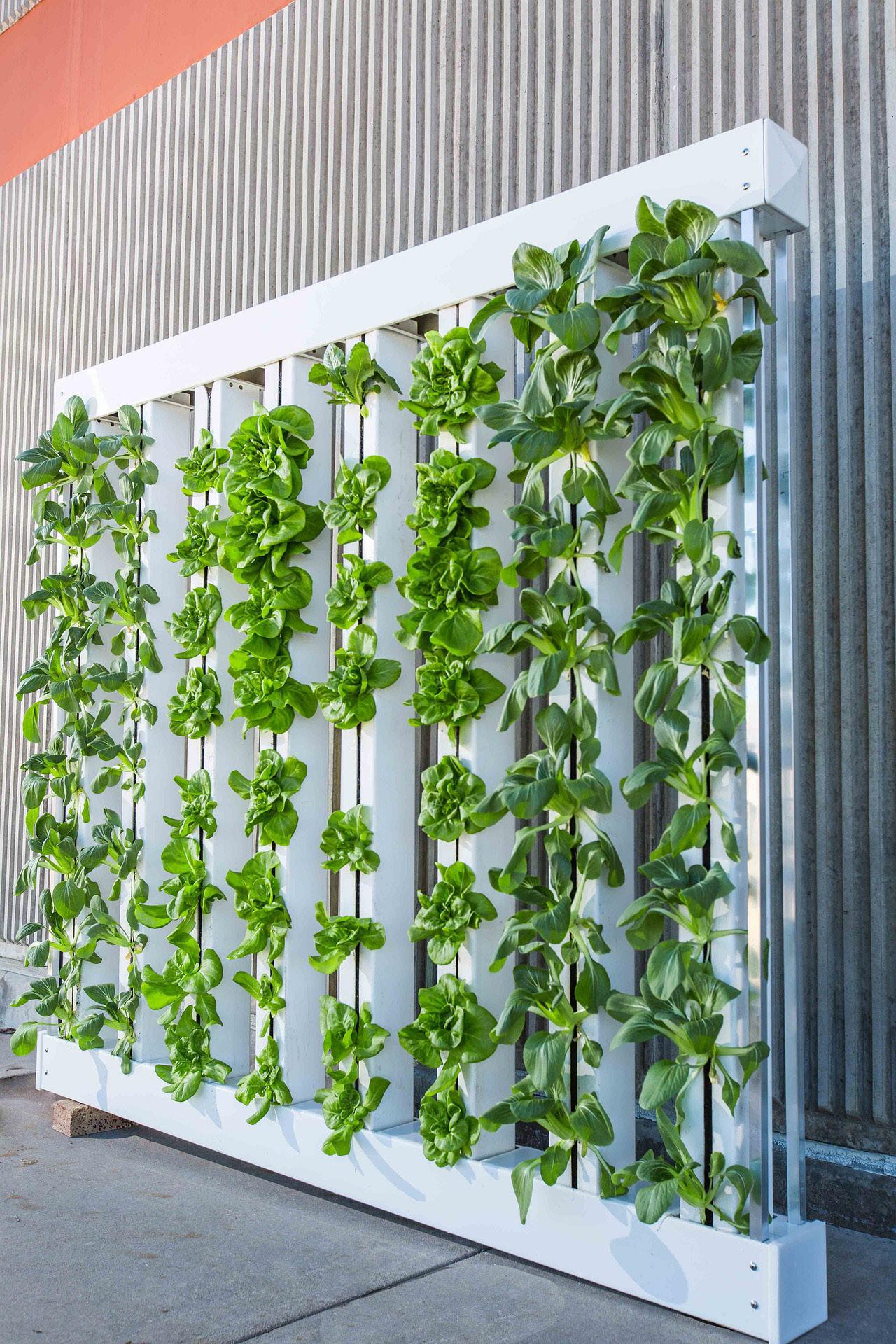
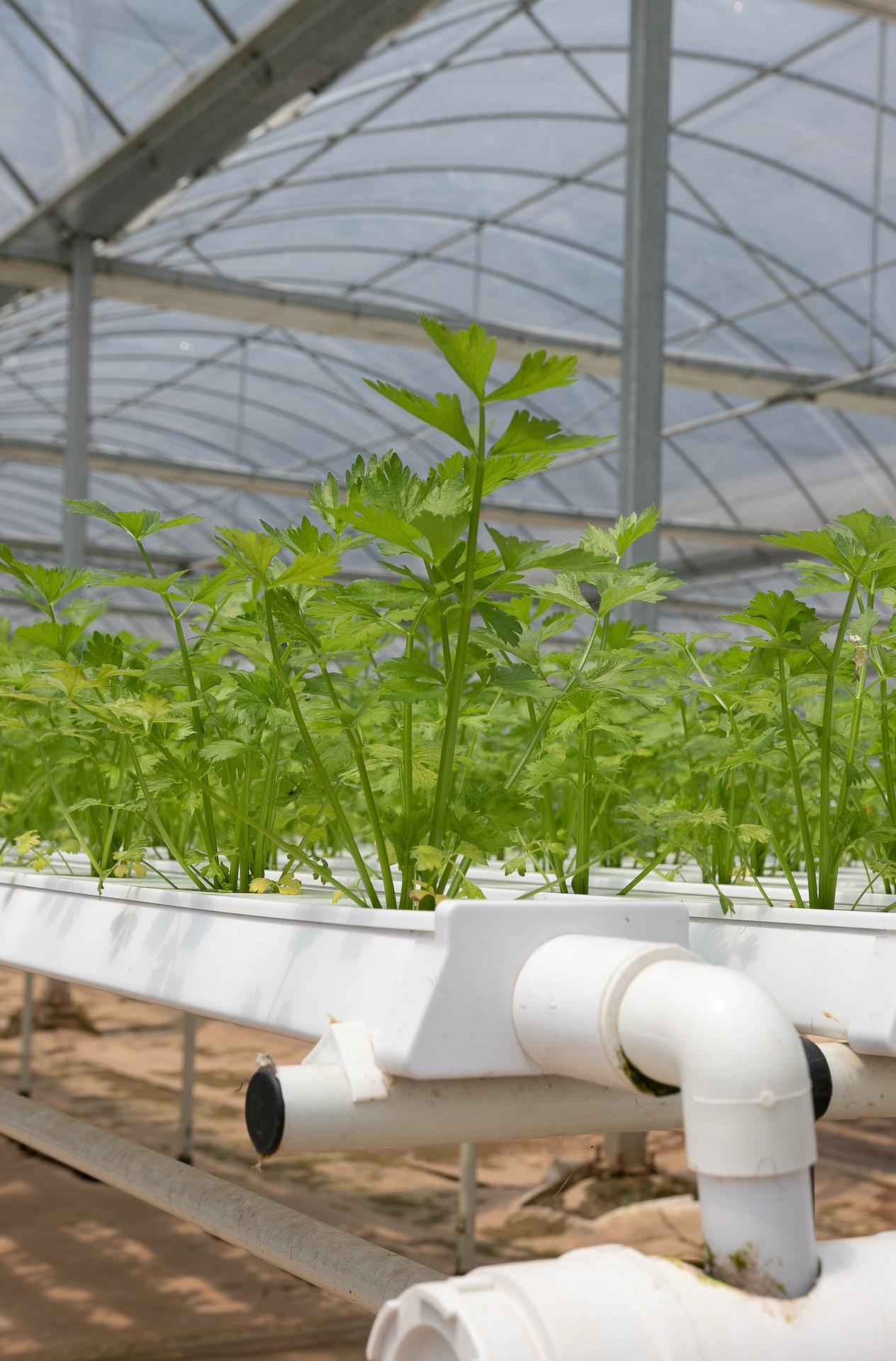
Theconcept of hydroponics, or soilless farming, has ancient roots, with early examples found in the Hanging Gardens of Babylon, one of the Seven Wonders of the Ancient World. However, modern hydroponics as we know it began to take shape in the 19th century. The term “hydroponics” was coined by William Frederick Gericke in the 1930s, and he conducted extensive research on soilless cultivation. The practical use of hydroponics gained momentum in the mid-20th century, especially during the 1940s and 1950s. Since then, ongoing advancements in technology and agricultural science have further refined and expanded the applications of
The concept of vertical farming dates back to the early 20th century, but the term gained prominence in the 21st century. In 1915, Gilbert Ellis Bailey proposed the idea of growing crops in vertically stacked layers to save space. However, it wasn’t until the 21st century that advancements in technology, such as efficient LED lighting and hydroponic systems, made vertical farming more feasible. Dickson Despommier, a professor at Columbia University, popularized the modern vertical farming concept in the mid-2000s, emphasizing its potential to address food security and sustainability challenges in urban areas. Since then, ver-
Soilless Farming
soilless farming.
Soilless farming, also known as hydroponics, involves growing plants without traditional soil. Instead, plants receive essential nutrients through a nutrient-rich water solution. Various hydroponic systems exist, including nutrient film technique, deep water culture, and aeroponics. Benefits of soilless farming include precise control over nutrient levels, efficient water usage, faster plant growth, and the ability to grow crops in areas with poor soil quality. It’s widely used in controlled environments like greenhouses and vertical farms, offering a sustainable and resource-efficient approach to agriculture.
tical farming has evolved with ongoing innovations and is increasingly recognized as a viable solution for the future of agriculture. Vertical farming offers numerous benefits, including increased crop yield per square foot, reduced water usage, year-round production regardless of climate, and a smaller ecological footprint due to minimized transportation needs. Additionally, it promotes urban agriculture, enhancing food security and reducing the environmental impact of traditional farming practices
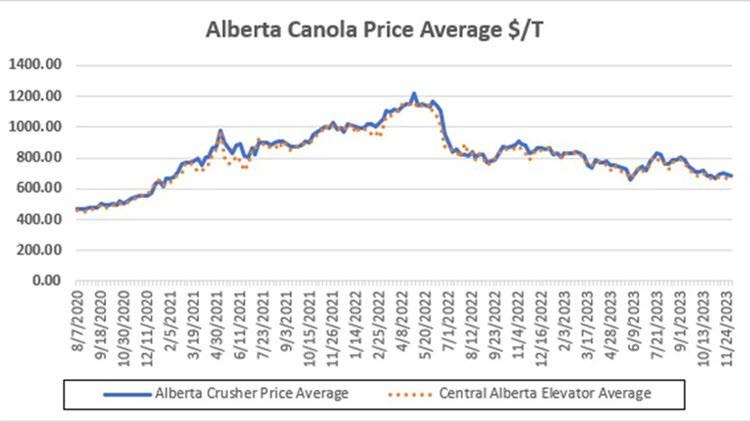
Canola prices struggling
Continued strong crushing demand and improved export demand is needed for Canadian canola prices to sustain improvement.
Following the high prices of the 2021-22 crop year, world oilseed production rebounded. Australia produced a record canola crop last year and was a major competitor on the world market. Brazil produced a record soybean crop earlier this year and is currently projected to produce about the same volume in 2024, despite some adverse weather to date.
“Although a certain level of Canadian canola demand is stable, at high prices the more flexible demand will move to less costly alternative vegetable oil sources,” explains Blue. “A canola negative so far this crop year is lower Canadian canola exports. According to weekly Canadian Grain Commission data, canola exports at the onethird point of this crop year are down from the year ago pace by 620,000 tonnes, or 23%. Fortunately, Canadian crushers have used 300,000
“Canola prices have been struggling this crop year to the frustration of producers who had been expecting a seasonal post-harvest price improvement,” says Neil Blue, provincial crops market analyst with the Alberta government. “There are a number of factors affecting the
canola market.”
Canola prices started to rise following the 2021 drought in Alberta and some other oilseed producing countries. PostCovid economic improvement was also a demand supporting factor.
tonnes more canola than a year ago to date, but total canola usage is still lower.”
Statistics Canada in early December bumped up its estimate of 2023 Canadian canola production by one million tonnes to 18.33 million tonnes.
Although the higher production estimate was expected, confirmation of the higher production with exports lagging last year implies the potential for a sharp rise in canola carryover.
“The major positive for canola prices is con-
tinuing strong crusher demand. Crushing margins remain profitable, implied by the estimated values of canola meal and canola oil relative to canola seed. Both canola product markets are well developed.”
Canola oil demand has been growing with the increasing demand for renewable biodiesel, and Canadian canola oil exports have been increasingly bound for the U.S. However, because a portion of canola’s market via canola oil is tied to biodiesel, it is subject to the price of diesel and
crude oil. Both of those markets have been weakening lately, on ideas that supply will outstrip demand as world economies slow into 2024.
“So, during the winter into next spring, for Canadian canola prices to sustain improvement, continued strong crushing demand and improved export demand is needed. Crop concerns in South America may redevelop and provide at least a temporary price boost. Canola basis level changes provide a good signal of canola market condition,” says Blue.
Looking back on the 2023 cattle market
2023 provided strong cattle prices and opportunities for profit.
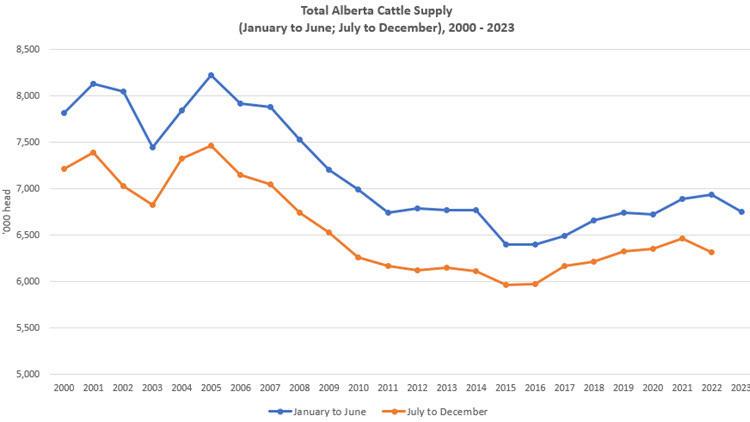
Statistics Canada’s supply and disposition data for total cattle in Alberta reflects the contraction experienced in the first half of 2023. The January to June 2023 cattle supply of 6.757 million head was estimated to be 2.6% lower than that of the same period in 2022. Supply estimates take into account the beginning inventory, calves born, interprovincial imports and international imports. The inventory estimates as of January 2024 are currently being compiled and expected to be released in early February.
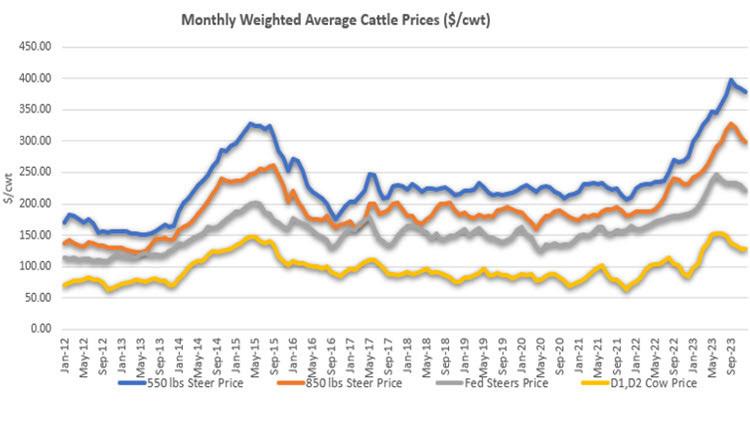
“The past year saw average monthly prices for fed steers in Alberta peak in June at $246.61 per hundredweight,” says Ann Boyda, provincial livestock market analyst with the Alberta government. “Feeder prices were also historically high, peaking in September at $397.90 per hundredweight and
$328.41 per hundredweight for 550-pound and 850-pound steers, respectively. Cow prices were also strong, peaking at $153.64 per hundredweight in July for cows in good condition. Strong prices seem poised to continue into 2024, in part, due to smaller cattle inventories.”
What has attributed to this decline? Many sources point to drought conditions and concerns of feed availability. Higher calf and feeder prices also encouraged greater
placement of cattle into feedlots, removing future inventory.
“2024 may be starting with smaller cattle inventories but high prices
may still provide incentive to rebuild,” points out Boyda. “The cold weather may cause feedlots to hold back cattle which could increase bid prices in the near term.
Current signals suggest that the rebuild may still be a ways off.”
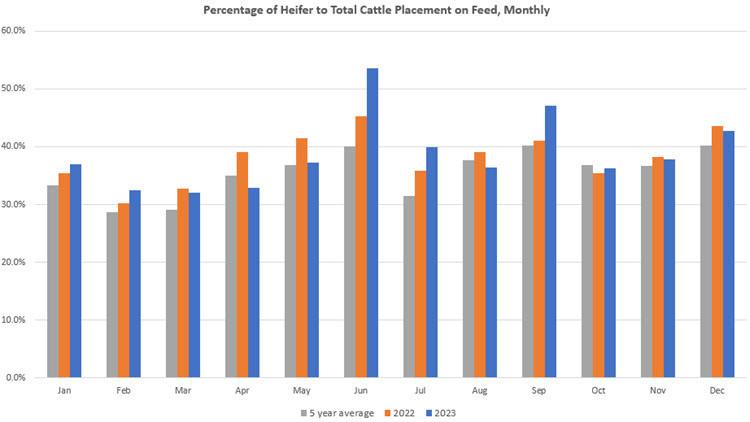
Heifer placements on feed are still commanding a high share of the total cattle placed on feed. June 2023 witnessed a higher proportion of heifers enter feedlots (53.5%), exceeding 2022 proportionate share and that of the 5-year average for June of 40%. Signs of producers retaining more heifers for replacement did not emerge for the remainder of 2023.
Looking back on the 2023 cattle market
Although total cattle slaughter volume of over 2.5 million head in Western Canada decreased by approximately 3.6% in 2023 versus 2022, cow slaughter volume of 379,565 head increased by 7.9% over the same period. Continued high levels of cow slaughter pressure the beef supply going forward.
“In 2023, dry conditions, high costs and interest rates, limited labour and economic uncertainty held back any plans for growth. Restocking drought-reduced cow herds takes time so any expansion will be slow. How long this will take rests with predictions of weather, beef demand
and profitability. So far, beef demand has proven robust even with higher prices relative to other proteins.
“Cow-calf producers have recovered positive margins last year and are hoping to sustain favourable margins into the near future. Even feedlot operators en-
joyed some months of positive margins in 2023, although higher prices paid for feeders last year may result in tighter returns in the first half of 2024. Overall, 2024 has some prospect of being a good year, especially for the cow-calf sector, but weather remains the greatest risk factor,” says Boyda.
Alberta Depreciation costs
It is imperative to closely watch depreciation costs in the upcoming years, especially if commodity prices move lower.
“Agri-businesses utilize depreciable assets, and they acquire new capital assets or replace old ones as their business expands and evolves,” says Azam Nikzad, market analyst/ coordinating researcher with the Alberta government. Canada Revenue Agency defines depreciation as the gradual decline in the value of an asset over time and the method used to allocate the cost of tangible assets throughout their operational lifespan.
Higher depreciation costs imply increased
Many factors contributed to the surge in depreciation costs in the agricultural sector. One factor is the composition of capital shifting towards equipment, machinery and software. This shift implies a correlation between the evolving capital composition and the observed trend in depreciation rates.
“Modernization of agricultural practices coupled with demand for more efficient farming has driven farmers to invest in technologically advanced equipment,” explains Nikzad. “New
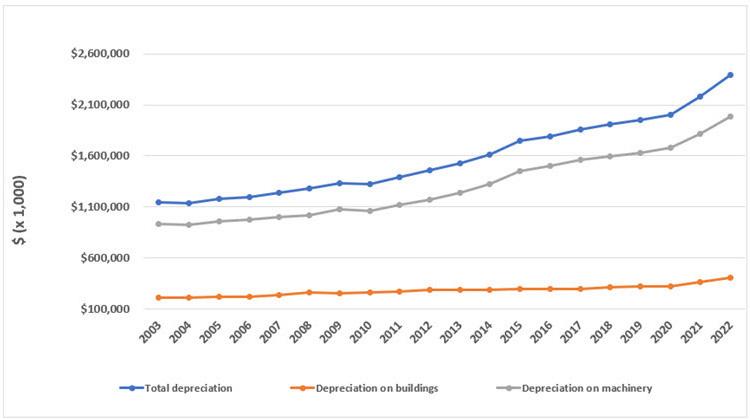
costs for buildings, machinery and equipment, but it also suggests increased investment in these assets. Alberta’s agricultural sector has experienced a continued upward trend in total depreciation expenses, demonstrated by an average annual increase of 5.6% over the past decade. Notably, depreciation on machinery represented 83% of the total depreciation charges in 2022, whereas depreciation on buildings accounted for the remaining 17%.
equipment comes at higher cost, contributing to the upward trend in depreciation charges. Furthermore, inflationary pressures on material and labour costs contribute to increased construction expenses, which increases asset values and leads to higher depreciation on new buildings.”
The introduction of the Accelerated Investment Incentive program in 2018 allowed farmers to claim a higher Capital Cost Allowance (CCA) deduction within the first year of acquiring an
Figure 1. Depreciation expenses
eligible depreciable asset, thereby influencing the trajectory of CCA deductions throughout the asset’s lifespan. The program encouraged businesses to invest in new capital assets, without altering the total deductible amount over the life of an asset.
“There was an uptick in total depreciation charges following the program’s initiation, but the time span also happened to coincide with record high farm cash receipts and farm income in Alberta, especially in 2021 and 2022. This meant
some farmers were probably in the mood to buy regardless. The program likely brought some investment forward.
“In Canada, sales of certain types of farm equipment increased from January to November 2023, compared to the same period in 2022. According to recent data from the Association of Equipment Manufacturers, sales of tractors over 100hp were up 3.5%, while combine sales were up 6.4% and 4-wheeled drive tractor sales were up a whopping 42%.”
Realized Net Income = (Cash Receipts−Operating Expenses) + Income In Kind - Depreciation Charges
“At the macro level, it will be interesting to monitor depreciation charges and its impact on realized net income in the coming years, especially if commodity prices were to move lower. At the farm level, understanding depreciation costs and using Capital Cost Allowance strategically can help manage taxes,” says Nikzad.
How to Invite our Pollen-spreading Friends
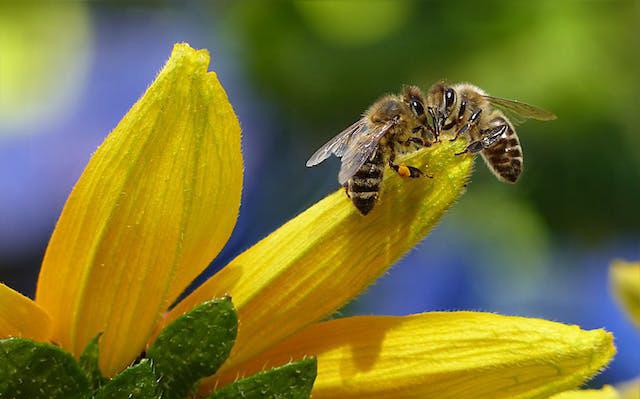
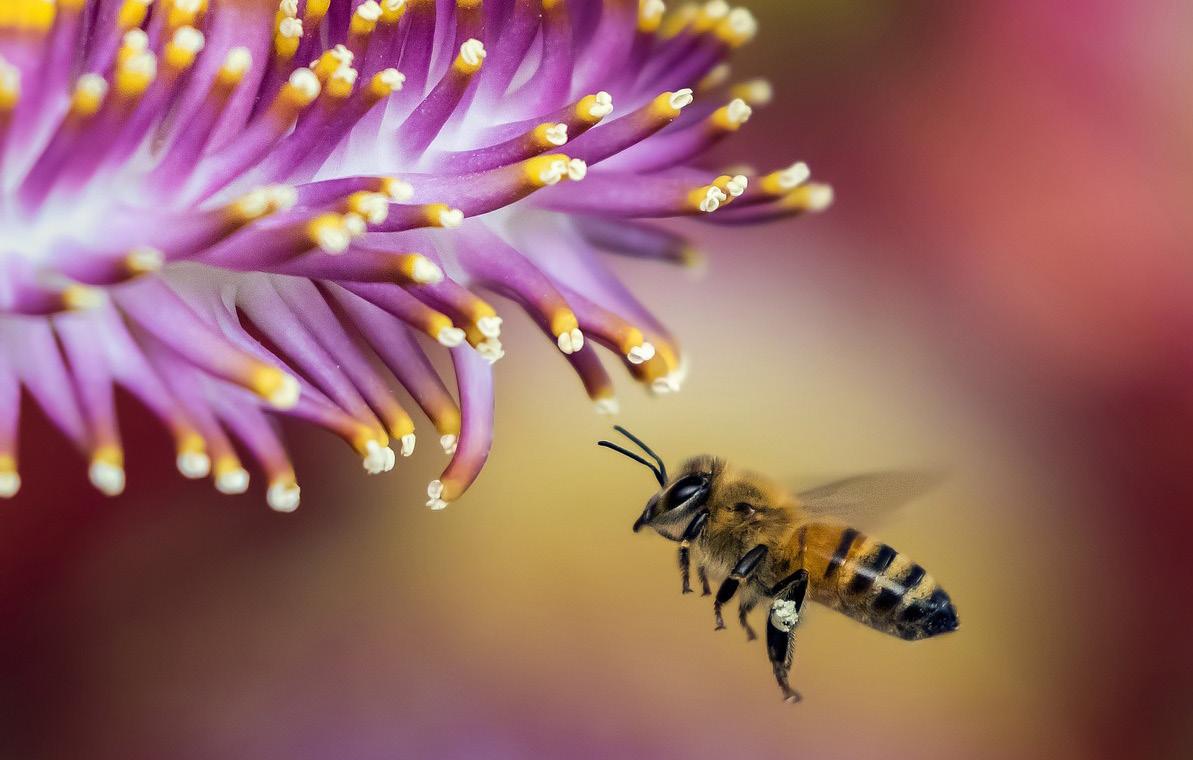
In the past several years there has been a noticible decline in the global bee population. Researchers suspect the reason for the decline is a combination of exposure to parasites and pesticides, climate change, a loss of the natural abundance of flora due to in-
creased land-use, and habitat destruction
Here are some tips to make our gardens more inviting to them:
1. Plant Bee-Friendly Flowers: Choose a variety of flowers that bees love, such as lavender, sunflowers, coneflowers, bee balm, and asters.
2. Provide a Water Source: Place shallow dishes of water in your garden with stones or floating cork pieces for bees to land on while drinking.
3. Avoid Pesticides: Opt for natural pest control methods instead of chemical pesticides, as they can harm bees.
4. Create Habitat: Leave some areas of your garden undisturbed with brush piles, bare soil, or bee houses for nesting sites.
5. Plant Blooming Variety: Aim to have flowers blooming throughout the growing season to provide a consistent food source for bees.
6. Consider Native Plants: Native plants are adapted to the local environment and often attract more native bee species.
7. Limit Lawn Area: Reduce the size of your lawn and plant more flowers and shrubs to create more forage opportunities for bees.
8. Educate Others: Spread awareness about the importance of bees and encourage your neighbors to create bee-friendly habitats too. By following these tips, you can help support bee populations and enjoy a thriving garden!
Some Amazing Facts about Bees
Super Pollinators: Bees are incredibly efficient pollinators, with some species capable of visiting thousands of flowers in a single day.
Dance Language: Honeybees communicate the location of food sources through a complex dance language known as the “waggle dance.”
Teamwork: Honeybees live in highly organized colonies with a strict division of labor, where each bee has a specific role to play in maintaining the hive.
Unique Buzz: Bees’ buzzing sound is created by their wings beating rapidly, typically around 200 beats per second!
Royal Jelly: Worker bees produce royal jelly to feed larvae, but they also use it to turn a regular worker larva into a queen bee by feeding her an exclusive diet of royal jelly. These facts highlight just how remarkable and essential bees are to our environment and ecosystems!
Incredible Navigation: Bees have an extraordinary ability to navigate and find their way back to the hive, even when foraging several kilometers away.
Diverse Species: There are over 20,000 species of bees worldwide, ranging from tiny stingless bees to large bumblebees.
Keystone Species: Bees play a crucial role in ecosystems as pollinators, contributing to the reproduction of many plant species and supporting biodiversity.
Honey Storage: Honeybees collect nectar from flowers and transform it into honey, which they store in honeycomb cells to use as food during winter months.
Mating Flight: Male bees, or drones, gather in areas known as drone congregation areas, where they wait for virgin queen bees to pass by during their mating flights.
Tips for your Home Garden
Here are some helpful tips for your home garden:
1. Plan your garden layout: Decide what plants you want to grow and where you’ll plant them based on factors like sunlight, water, and space requirements.
2. Prepare the soil: Make sure your soil is healthy and well-draining by adding compost or organic matter. Test the soil pH if necessary and adjust it accordingly.
3. Choose the right plants: Select plants that are well-suited to your climate and growing conditions. Consider factors like sunlight, water, and temperature requirements.
4. Water properly: Water your plants deeply and regularly, but be careful not to overwater. Use a watering schedule that takes into account the specific needs of each plant.
5. Mulch: Mulching helps retain moisture, suppress weeds, and regulate soil temperature. Use organic mulch like straw, wood chips, or leaves.
6. Control pests and diseases: Keep an eye out for pests and diseases in your garden and take appropriate measures to control them, such as using natural predators, organic pesticides, or disease-resistant plants.
7. Prune and deadhead: Regular pruning and deadheading help promote healthy growth and flowering in your plants. Remove dead or diseased branches and spent flowers to encourage new growth.
8. Feed your plants: Fertilize your plants regularly with organic fertilizers to provide them with essential nutrients for healthy growth.
9. Harvest regularly: Harvest fruits, vegetables, and herbs when they’re ripe to encourage continued production and prevent overcrowding.
10. Keep learning: Gardening is a continuous learning process, so stay curious and keep experimenting with new plants and techniques to improve your skills and garden success.
Creative Explained
Armen Adamjan has been taking the world by storm with his great gardening and life hacks. If you haven’t viewed any of his videos, check him out on social media at creative explained for great ideas on how to make your garden flourish. Check out the link to his website below:
https://www.creativeexplained.com
Farms
Laura Farms is a great channel and has amassed a large following as they showcase their day to day farm life in Nebraska. You get to learn about all that goes in to the daily operations of a large scale farm. Check her out on social media or click the Youtube link below
https://www.youtube.com/@LauraFarms
Ravz Diary of Deliciousness
BLISSFUL BITES
Cream Cheese Veggie Wraps ( v )
Directions
INGREDIENTS
• 6 tablespoons cream cheese
• 1 teaspoon dried chives
• 1/2 teaspoon dried dill or parsley
• 1/4 teaspoon garlic powder
• 2 8-inch whole-wheat flour tortillas, at room temperature
• 1/2 cup baby spinach or spring mix
• 1 cup shredded or sliced vegetables, such as carrots, bell pepper and/or cucumber (a pinch of salt and a dash of freshly ground black pepper)
Combine cream cheese, chives, dill and garlic powder in a small bowl. Spread evenly on tortilla. Layer spinach or spring mix, then shredded (or sliced) vegetables across the bottom third of the tortilla. Roll closed and cut in half. Or, cut into slices, if desired.
For a protein boost, you can replace the cream cheese with store bought or homemade Hummus.
Mouth-watering Chicken Wraps
INGREDIENTS
• 1 cup cooked grilled chicken breasts, chopped
• 1/8 cup Ranch dressing
• 1/4 cup Mozzarella cheese
• 2 8 ‘’ tortillas
• 1 cup coleslaw
Coleslaw recipe: 1/4 cup shredded or grated carrot, 1/2 cup + 2 tablespoons purple and green cabbage, 1/8 cup dill-minced, 1/8 cup onion thinly sliced (a pinch of salt and a dash of freshly ground black pepper, 1tsp Dijon mustard and 2-3 tbsp mayonnaise.)
For the chicken, you can use rotisserie chicken, leftover chicken, fresh grilled chicken or any type of cooked chicken you have on hand. Add the ranch dressing to the chicken.
Directions
To make the wraps, simply fill an 8” tortilla with cheese, coleslaw, cooked chicken, and more ranch dressing as desired.
Grill on a pan for a few minutes per side to crisp up the tortilla and melt the cheese.
Replace coleslaw with diced or sliced avocado, tomatoes, arugula, bell peppers and cucumber.
H
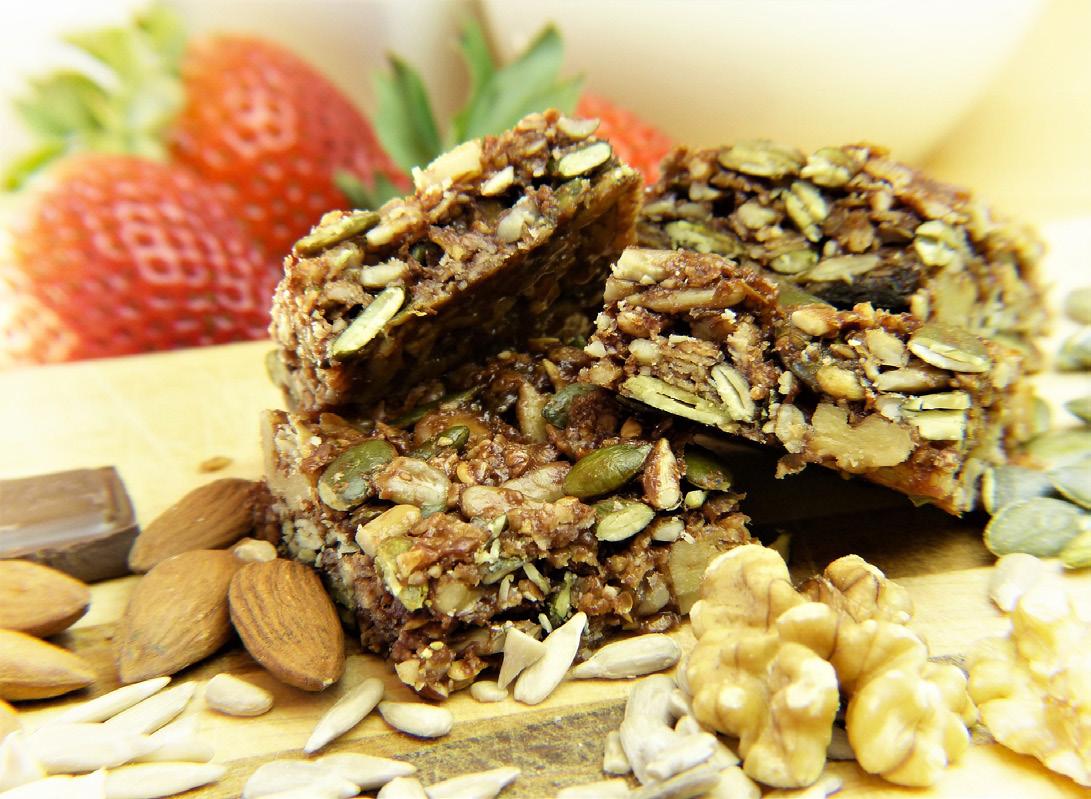
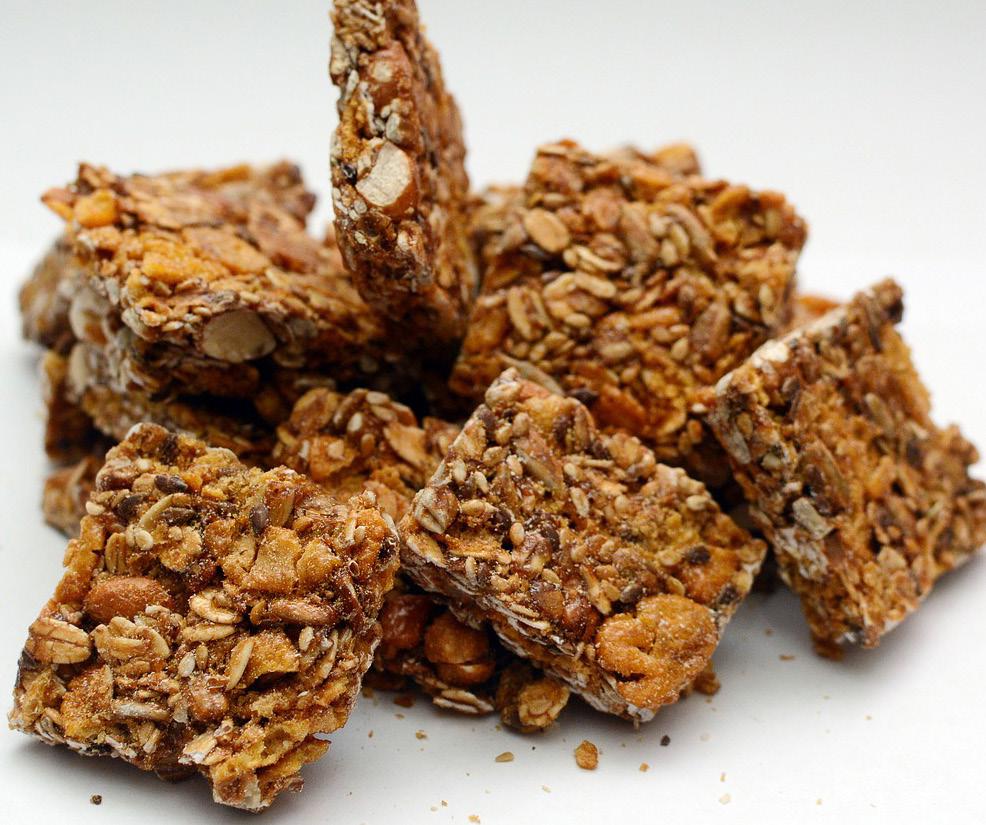
ealthy Homemade Granola Bars
• 2 cups Whole rolled oats
• 3/4 cup roughly chopped mixed nuts like almonds, pecans, peanuts
• 1/4 cup sunflower seeds or additional chopped nuts
• 1/4 cup coconut flakes
• 1/2 cup honey
• 1/3 cup smooth peanut butter
• 2 teaspoons pure vanilla extract
• 1/2 teaspoon ground cinnamon
• 1/4 teaspoon sea salt
• 1/3 cup mini chocolate chips or (roughly chopped) dried fruit or dates or raisins
• Place a rack in the centre of your oven and preheat the oven to 325 degrees F. Line an 8- or 9-inch square baking dish with parchment paper so that two sides of the paper overhang the sides like handles. Coat generously with cooking spray.
• Spread the oats, nuts, sunflower seeds, and coconut flakes on a rimmed, ungreased baking sheet. Toast in the oven until the coconut looks lightly golden and the nuts are toasted and fragrant, about 8 to 10 minutes, stirring once halfway through. Reduce the oven temperature to 300 degrees F.
• Meanwhile, heat the honey and peanut butter together in a medium saucepan over medium heat. Stir until the mixture is smoothly combined. Remove from the heat. Stir in the vanilla, cinnamon, and salt.
• As soon as the oat mixture is finished toasting, carefully transfer it to the pan with the peanut butter. With a heat proof rubber spatula, stir to combine. Let cool for 5 minutes, then add the chocolate chips (if you add the chocolate chips immediately, they will melt).
• Scoop the batter into the prepared pan. With the back of a spatula, press the bars into a single layer (you also can place a sheet of plastic wrap against the surface to deter sticking, then use your fingers; discard the plastic prior to baking).
• Bake the granola bars for 15 to 20 minutes: 20 minutes will yield crunchier bars; at 15 they will be slightly chewier. With the bars still in the pan, press a knife down into the pan to cut into bars (be sure to pick a knife that will not damage your pan—Cut into 2 rows of 5). Do not remove the bars. Let them cool completely in the pan.
• Once the bars have cooled completely, use the parchment to lift them onto a cutting board. Use a sharp knife to cut the bars again in the same place, going over your lines to separate. Remove from pan and serve or store.
Storage Tips
To Store. Store granola bars in an airtight container at room temperature for up to 1 week or keep in the fridge for 2 weeks.
To Freeze. Wrap bars airtight and store them in a ziplock bag in the freezer. Allow to thaw in the refrigerator or at room temperature.
Pure Pleasure Refreshers – Thirst Quenchers For All P lumtastic
P lum P unch
Directions
Ingredients
• 8 firm-ripe red and black plums
• 1 cup granulated sugar
• 6 cups water, divided
• ¼ cup fresh lemon juice (from 2 medium lemons)
• 1 ½ cups sparkling grape juice
Cut 4 plums lengthwise into ½-inch wedges, and chill until ready to serve. Chop remaining 4 plums into small cubes, and place in a medium saucepan. Add sugar and 1 cup of the water. Bring to a simmer over medium. Simmer, stirring occasionally, until plums are tender, about 12 minutes. Pour plum mixture through a fine mesh strainer into a medium bowl. Cover and chill for about 30 minutes.
Combine plum syrup, lemon juice, reserved plum slices, and remaining 5 cups water in a large pitcher; stir to combine. Chill at least 1 hour or up to overnight. Pour chilled punch and fruit into ice-filled glasses, and top each with ¼ cup sparkling grape juice.
N on-A lcoholic M ix B erry S angria
Directions
Ingredients
• 2 cups cranberry juice
• 4 cups ginger ale
• 1 cup fresh plums (pitted and chopped)
• zest of ½ small lime
• ½ small lime (no pith or peel)
• 1 inch ginger, chopped
• Additional
• 2 fresh plums (pitted and cut into wedges)
• 50g Mixed Berries
Blend cranberry juice with fresh pitted and chopped plums, lime zest, lime and ginger. In a large pitcher add ice, mix berries, plum wedges, and pour in punch, ginger ale. Mix and leave to chill in fridge for at least 2-3hrs.
Unscramble the following Words
Find the Hidden Words
Life on a farm is a school of patience; you can’t hurry the crops or make an ox in two days.