Mostly Sunny 66/38
THE TUFTS DAILY
TUFTSDAILY.COM
Wednesday, april 15, 2015
VOLUME LXVIV, NUMBER 52
Where You Read It First Est. 1980
Seniors organize drive to collect feminine hygiene products by Jei-Jei Tan News Editor
Seniors Annie Goodman, Kaley Leshem and Nora Fleming have worked together to organize a feminine hygiene products drive to collect tampons, pads and other menstrual care products for the Somerville Homeless Coalition. The drive, which is sponsored by Kappa Alpha Theta, Alpha Omicron Pi (AOII), Alpha Phi, Chi Omega, Lambda Pi Chi, Vitality, Strong Women Strong Girls and the Women’s Center, will run until April 27 and has collection boxes at campus sorority houses, Hillel, the Mayer Campus Center, the Women’s Center and the Latino Center. Goodman explained that she initially came up with the idea after reading a Huffington Post article about the challenges faced by homeless women who do not have access to menstrual care products and facilities. “I thought it would be easier to expand and add some authority to the project if it were associated with actual groups,” she said. After coming up with the idea, Goodman, a sister of Alpha Phi, said that she first spoke with the Alpha Phi executive board and then reached out
to other sororities on campus as well as other student groups working on women’s and health issues. She noted that the drive responds directly to a need in the local community. “We wanted to maximize our impact in the local community,” Goodman said. “We all recognize that [there are] people in our communities who need help. Homelessness is not an issue that you have to go far to find.” AOII’s Women’s Center Representative Sarah Lubiner, a sophomore, also emphasized the local emphasis of the drive. “I think the drive is an easy yet impactful way organizations on campus can make a direct contribution to the Somerville community,” she told the Daily in an email. “A frequent criticism of Tufts organizations is that they are too insular and don’t make an effort to recognize the needs of the community in which Tufts exists. The feminine hygiene products drive allows organizations on campus that focus on female issues to contribute to a female population that may not have access to these resources.”
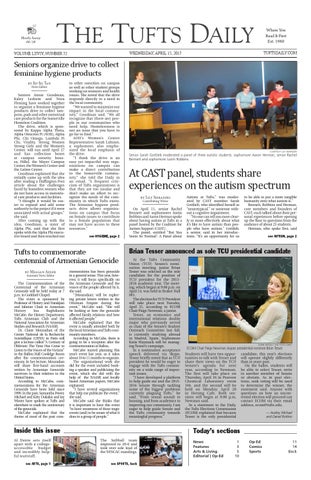
Senior Sarah Gottlieb moderated a panel of three autistic students: sophomore Aaron Herman, senior Rachel Bennett and sophomore Justin Robbins.
see HYGIENE, page 2
see AUTISM, page 2
Tufts to commemorate centennial of Armenian Genocide by Meagan Adler Assistant News Editor
The Commemoration of the Centennial of the Armenian Genocide will be held today at 7 p.m. in Goddard Chapel. The event is sponsored by Professor of History and Darakjian and Jafarian Chair in Armenian History Ina Baghdiantz McCabe, the History Department, Tufts Armenian Club and the National Association for Armenian Studies and Research (NAASR). Dr. Claire Mouradian of the Centre National de la Recherche Scientifique (CRNS) in Paris will give a lecture called “A Century of Oblivion: The Time Has Come to Listen to the Voices of the Victims” in the Ballou Hall Coolidge Room after the commemoration ceremony. In her lecture, Mouradian will share first-hand accounts written by Armenian Genocide survivors to their relatives in the United States. According to McCabe, commemorations for the Armenian Genocide have been held since 1999. In the past, Samantha Power, Michael and Kitty Dukakis and Jay Winter have spoken at Tufts and elsewhere to mark the anniversary of the genocide. McCabe explained that the theme of most of the past com-
memorations has been genocide in a general sense. This year, however, it will focus specifically on the Armenian Genocide and the voices of the people affected by it, she said. “[Mouradian] will be exploring private letters written in the Ottoman Empire during the event,” McCabe said. “She will be looking at how the genocide affected family relations and how it affected people.” McCabe explained that the event is usually attended both by the local Armenian and Tufts community members. According to McCabe, there is going to be a reception after the commemoration in Ballou. McCabe started planning this year’s event last year, as it takes about 10 to 11 months to organize. The organizational work she did for the event included booking a speaker and publicizing the event, which she did with the help of the NAASR and locally based Armenian papers, McCabe explained. “I have several organizations that help me publicize the event,” she said. McCabe said she thinks that it is important to have this event “to have awareness of these tragic events [and] to be aware of what it does to a group of people.”
courtesy lily sieradzki
At CAST panel, students share experiences on the autism spectrum by Lily Sieradzki
Autism at Tufts,” was moderated by CAST member Sarah Gottlieb, who identified herself as “neurotypical,” or someone without a cognitive impairment. “No one can tell you more clearly or more effectively about what it’s like to have autism than people who have autism,” Gottlieb, a senior, said in her introductions. “It’s an opportunity for us
Contributing Writer
On April 11, senior Rachel Bennett and sophomores Justin Robbins and Aaron Herman spoke about having autism at Tufts in a panel hosted by the Coalition for Autism Support (CAST). The panel, entitled “But You Seem So Normal’: A Panel about
to be able to put a more tangible humanity onto what autism is.” Bennett, Robbins and Herman, core members and founders of CAST, each talked about their personal experiences before opening up the floor to questions from the audience of about 25 students. Herman, who spoke first, said
Brian Tesser announced as sole TCU presidential candidate At the Tufts Community Union (TCU) Senate’s nomination meeting, junior Brian Tesser was selected as the sole candidate for the position of TCU president for the 20152016 academic year. The meeting, which began at 9:00 p.m. on April 14, was held in Braker Hall 001. The election for TCU President will take place next Tuesday, April 21, according to ECOM Chair Paige Newman, a junior. Tesser, an economics and international relations double major who previously served as chair of the Senate’s Student Outreach Committee last fall, is currently studying abroad in Madrid, Spain. Sophomore Katie Waymack will be managing Tesser’s campaign. In a nomination acceptance speech delivered via Skype, Tesser briefly noted that as TCU president he would be eager to engage with the Tufts community on a wide range of important issues. “I have developed a platform to help guide me and the 20152016 Senate through tackling some of the biggest problems currently plaguing Tufts,” he said. “From sexual assault to housing, and from academics to improving our community, I am eager to help guide Senate and the Tufts community towards meaningful progress.”
Inside this issue
Evan Sayles / the tufts daily
ECOM Chair Paige Newman skypes presidential nominee Brian Tesser. Students will have two opportunities to talk with Tesser and share their views on the TCU Senate’s agenda for next year, according to Newman. The first will take place on Thursday, April 16 in Pearson Chemical Laboratory room 104, and the second will be held on Monday, April 20 in Hotung Cafe. Both sessions will begin at 9:00 p.m, Newman said. In a statement to the Daily, the Tufts Elections Commission (ECOM) explained that because Tesser is the only presidential
candidate, this year’s elections will operate slightly differently than in years past. On the ballot, students will be able to select Tesser, write in another member of Senate or abstain. As in past elections, rank voting will be used to determine the winner, the statement said. Anyone with questions on how an uncontested election will proceed can contact ECOM via their email address, ecom@tufts.edu. — Audrey Michael and Daniel Bottino
Today’s sections
Al Dente sets itself apart with a collegeaccessible budget and incredibly helpful waitstaff.
The Softball team improved to 20-0 and took over sole lead of the NESCAC standings.
see ARTS, page 5
see SPORTS, back
News 1 Features 3 Arts & Living 5 Editorial | Op-Ed 10
Op-Ed 11 Comics 14 Sports Back
2
The Tufts Daily
Wednesday, April 15, 2015
News
Project Linus holds raffle to raise funds for blanketmaking for children in need by Roy Yang
Assistant News Editor
The Tufts chapter of Project Linus — a national organization that makes and donates blankets for children in intensive care units (ICU), suffering from chronic illness or undergoing general crises — held a spring raffle to raise funds for the organization from April 6-9 in Dewick-MacPhie Dining Center. According to Co-Founder and Co-President of Project Linus at Tufts Corinne Zahlis, the group was able to raise $180 through the raffle. Some of the prizes for the raffle included two tickets to the Somerville Theatre, a gift basket of assorted comics and four tickets to the Museum of Science’s Charles Hayden Planetarium. Zahlis, a senior, said that the raffle is an annual tradition to raise money as a supplement to the organization’s budget provided by the Leonard Carmichael Society (LCS).
“We generally do a raffle every year, because unlike other clubs [in LCS] that center around physical volunteering, we just create products,” she said. “We try to raise other funds in order to buy more fabric and make more blankets. We are not a group that can work with kids in the moment and can’t really sit with kids in the ICU.” Zahlis added that the blankets can serve an important purpose for the children who receive them. “It’s something that provides a little bit of comfort in a somewhat awful situation,” she said. “I received a Project Linus blanket seven years ago and still sleep with it on my bed here every night because, for me, it was really special to be able to take it home. Getting my blanket had an impact on me as an individual, and so I just want to make sure other children in need are given that opportunity to receive a blanket.”
Students share experiences with autism on campus AUTISM
continued from page 1
that the title of the event resonated with him, as he has navigated the boundaries between seeming “normal” and being autistic. “I’m dreaming of a world where I can build meaningful, mutually beneficial relationships with the people around me, while also color-coding maps of the United States for density for fun,” he said. Herman said that improving social skills can be difficult, but that ultimately the process has helped him in forming relationships without conforming. “There’s a certain degree to which neurotypicals have a responsibility to accommodate us,” he said. Bennett said she was diagnosed with Autism Spectrum Disorder (ASD) her sophomore year at Tufts. She spoke to the importance of emotional honesty for everyone, but especially for people with autism who may have more trouble picking up on social cues. “There’s this unspoken rule that seems to exist somewhere that you’re supposed to know how people are feeling without them telling you,” Bennett said. “I don’t know whose idea that was, because it’s a horrible idea.” She said that she faces constant anxiety about whether she had accidentally hurt someone’s feelings without realizing it. Bennett maintained, however, that she tries not to feel guilty for the mistakes she makes because of her autism. Robbins said that he was diagnosed with ASD his junior year of high school, the same year he came out as gay. He remembered that he began to become aware of his social isolation and awkwardness with his friends at school. “I started feeling paranoid — was there something wrong with me that was painfully obvious to everyone other than myself?” he said. He brought up his concerns with his therapist, who entered him into testing for Asperger’s Syndrome. Asperger’s has since been removed from the Fifth Diagnostic and Statistical Manual (DSM-5), the American Psychological Association’s diag-
nostic tool, in favor of the more broadly defined ASD. “To me, my diagnosis was not a tragedy; it was an affirmation of my humanity,” Robbins said. “I could understand and be aware of my weaknesses — I could work on them.” Gottlieb started off the question and answer session by asking whether the panelists preferred person-first or identity-first language. Person-first language refers to the phrasing “a person with autism,” while identity-first language would use “autistic person.” “Yes, autism is a disability, but it’s part of my identity,” Robbins said. “To say ‘person with autism’ makes it sound like autism is a disease or a condition, and that it can be detached from the person.” Herman agreed, preferring identity-first language. “I’m not a person with some autism on the side,” Herman added. He said he would not be offended by person-first language but that the most important thing is for autistic people to be able to determine how they are referred to. Bennett said that she usually says that she is “on the spectrum” when applying for jobs, because she wants to avoid the stigma associated with “autistic.” Gottlieb asked the panelists if they had ever faced ignorance or intolerance when it came to their autism at Tufts. “When I told a professor I had autism, he said, ‘but you seem so normal, I never would have guessed, good job!’” Bennett said. “I was like, ‘do you hear yourself?’” Robbins added that he has experienced peers talking to him in a voice they usually use for “little kids or pets.” Gottlieb then turned the questions over to the audience, and the panelists discussed what they believed was the most common misconception about autism. “The idea that autism is empirically bad — it’s not true,” Robbins said. To wrap up, the panelists shared one thing they hoped the Tufts community would keep in mind. “Autistic students go to Tufts,” Bennett said. “Tufts is a particularly socially awkward campus.”
Co-President of Project Linus at Tufts Stacy Weng agreed, underscoring that the blankets they produce can provide a sense of security. “I think the blankets are very versatile,” Weng, a junior, said. “You can take it with you pretty much anywhere you’re traveling … Also, the blankets are very soft and cuddly, and that’s the comfort we are going for when we make these blankets because we want people to feel secure when they hold that kind of object.” Heather Thompson, who is in charge of fundraising at Project Linus, explained that children staying in an ICU can choose from a variety of blankets with different designs and colors to suit their preferences. She added that the group makes blankets using the cut and tie method with quality fleece. “We like to pick out a variety of fun prints that would fit a variety of children based on their personalities,” Thompson,
a senior, said. “Someone can have little robots on their blankets or, for some, just floral designs or abstract colors.” Zahlis explained that although Project Linus at Tufts is relatively new to campus — it was founded in 2013 — the group has grown steadily in student involvement. She noted that various culture houses and Greek houses on campus have invited Project Linus to make blankets at events. “We are just trying to be more and more apparent on campus,” she said. “So doing the little activities with these groups is fun for getting the word out [about Project Linus] to those communities.” Members of Project Linus meet on Tuesdays in the Crane Room to make blankets, and meetings are open to all members of the Tufts community, according to Thompson. She added that one or two people can easily make a couple of blankets in one session.
For Thompson, the tangible results of their work are some of the most gratifying aspects of being part of the organization. “We can see tangibly what we just gave our time and effort ... to,” she said. “I think it’s a great service opportunity because you can hold in your hands what you’re giving to another person. That’s an instant reward for you, rather than a big picture. It’s very much what one person could do for another person.” Weng agreed, emphasizing the results-based nature of the process. “I feel like with this kind of project, it’s very much tangible, and you know where it’s going and how it’s going to help somebody else,” she said. “It’s also a real stress-reliever when you have a lot of things to do, just to take an hour and clear your mind of everything while still knowing that you’re putting your time to a good cause.”
Student groups raise funds, gather tampon donations for Somerville Homeless Coalition HYGIENE
continued from page 1
Goodman explained that the lack of access to menstrual care poses health risks as well as social and emotional burdens to homeless women. She added that this is exacerbated by the fact that menstruation is stigmatized and not openly discussed. “People just don’t think to donate [feminine hygiene products] because menstruation isn’t something we talk about,” Goodman said. Furthermore, feminine hygiene products are not covered by food stamps, making them even more difficult to obtain, Fleming explained. “These products are not covered by food stamps and cost upwards of $70 a year,” she said. “Sanitary products … are one of the most expensive items and one of the most overlooked.” Leshem added that the Somerville Homeless Coalition was also interested in collecting feminine hygiene products. “We really wanted to make sure that it was something the shelter we were donating to had a demand for,” she said. In addition to collecting products, the drive also includes a GoFundMe fundraiser, according to Leshem. “We wanted to make sure that men … and people of all gender identities didn’t feel left out of the project, so the [fundraiser] was a great way to engage people who might not have tampons lying around but who still really wanted to get involved,” she said. Leshem and Goodman said that fundraiser aims to raise $1,200 — enough to buy around 170-200 boxes of tampons and pads. Another goal of the drive is to raise awareness about the issue and de-stigmatize menstruation at Tufts, Leshem said. “We’ve been posting a lot of articles on our Facebook page,” she said. “We’re just trying to give education and give resources to people who maybe do want to learn more about the issue.” Fleming noted that the reception to the drive has been very positive, especially from women on- and off-campus. “All of the organizations we
Caroline ambros / the tufts daily
Tufts tampon drive collects sanitary products for local homeless women. reached out to have been so excited to get on board and have been really supportive,” she said. “We’ve received a lot of donations, and we’re also past the halfway point of what we’re hoping to receive [for the fundraiser]. However, Fleming underscored the difficulty in spreading the word beyond a female audience. “The monetary donations have been mostly from women,” she said. “It’s definitely important for us to receive support from more people on campus [and] to get all of Tufts involved.”
Leshem emphasized the project as a way to recognize the local community after four years at Tufts. “It just felt like a really nice way to culminate our time at Tufts and show our appreciation for the Somerville/ Medford community … and tap into our different networks,” she added. “It’s amazing as a senior to see how you can really engage different networks of people you’ve met over the past four years … I think the really cool thing about it is that it’s not being run by one club, so it really feels like an inclusive movement.”
Features
3
tuftsdaily.com
Social Tufts Data aims to start dialogue, gather information on campus sexual conduct by Lily Hartzell Contributing Writer
Nationally, one in five women are sexually assaulted while at college. But does a statistic like that hold true here at Tufts? Social Tufts Data ( Tufts STD) was started in October to help address that question. It was started by sexual misconduct prevention specialist Alexandra Donovan, whose job is to talk to different groups on campus about bystander intervention, healthy relationship skills and other topics relevant to campus sex culture, according to Donovan. STD is part of a larger push for a Tufts-specific conversation about sexual culture on campus. This week, Tufts distributed the Tufts Attitudes About Sexual Conduct Survey ( TASCS), which will hopefully help to gather information about students’ opinions on sexual misconduct and assault. “The goal is to use the survey results to identify and resolve concerns about climate, culture and other aspects of campus life that contribute to sexual misconduct; to provide improved resources and support to students; and to enhance our response and prevention efforts around sexual misconduct for the safety of our entire community,” University President Anthony Monaco said in an email to the student body. “This collaborative effort developed questions unique to the Tufts community and adopted questions from other school surveys.” “As I’ve been doing this work I’m using a lot of academic research and other things in the statistics … and the push-back I kept getting was ‘that’s not [Tufts-specific],’” Donovan said. “I thought ok, that’s technically true, so what really are the differences between these types of studies and Tufts? What can I do to get more polls out there to get more information that’s more Tufts-specific?” Tufts STD is primarily organized through its Facebook page. Among its various functions, the program posts articles and surveys about sexual culture and misconduct, and Tufts Health Service Specialists answer anonymous sex-related questions. Donovan and sophomore Alice Wasserman, an intern with Tufts STD, hope to help raise awareness about how sex culture is portrayed and perceived. “We’re hoping that these articles prompt discussion, and [the page is] kind of a forum where students can learn more about sexual culture because it is such an important issue, especially on college campuses,” Wasserman said. “We’re hoping to create our own space where people can not only come up with questions but understand what sexual culture is on campus.” Wasserman hopes that STD’s posts and surveys can help encourage dialogue about sexual assault. “I’ve been really liking it because I feel like sex is a part of everyday life. Sexual assault is [a] part of this campus that’s relatively hidden, and I feel like developing some sort of forum for discussion will help translate into healthy practices and gauge more action and awareness on this issue,” Wasserman said. “And we’re hoping that discussion will translate into action so students know how to intervene and not be afraid to speak up and speak out about these things.” Donovan agreed, and said that she wants Tufts STD’s work to help reduce the stigma associated with certain conversations. “Where can we get data that is going to make people learn, be curious, want to have more conversations about this kind of stuff, all of that,” she said. “We talk about the culture here
shirley wang / The tufts daily
and the more we talk about this, the easier it is to talk about sexual assault and rape and sexual misconduct, all of which are coming on campus but we usually talk about it as ‘over there’ or apart from our social lives, but it lives day-to-day in our social lives.” “The more we can talk about it, the more likely this information will come up as well and the more likely we can do some preventative work about it,” she continued. Most recently, Donovan was inspired to do a survey on emojis by a conversation she had with students about the winking-face emoji. “How do you know what the reaction’s going to be to the [winking] face? It’s a perfect example of healthy communication skills,” Donovan said. “If you know this is going to get a good response, ok, send it. If you don’t know [if ] this is going to get a good response, maybe you want to rethink something.” The survey Tufts STD distributed is also in reaction to a Singles In America survey conducted by a market research company, which reported that people who use more emojis when they text are more likely than non-emoji users to report having sex at least monthly. Students were asked if they agreed with that statement, what their favorite emoji was and how they reacted to the winking face. Tufts STD has received almost 300 responses so far. “That is the goal — to just have a quick, simple survey [that] we want to use to show that data can be interpreted differently, and [that] people at Tufts are maybe not responding the way we expect,” Donovan said. “So just finding different ways to use this ... [will] speak to the population, because emojis you just think of as being fun and cute and sort of a throw away thing, but to understand that someone could find it really threatening to receive something like that.”
Wasserman and Donovan answer students’ anonymously submitted questions about sex and sexuality, including some from the Tufts Confessions Facebook page and Yik Yak via video. The first video, published on April 8, answered the question, “Can I really break his penis?” Donovan is hoping to devote more time to the project in the fall, once a new office has been created for sexual violence prevention and she is no longer splitting her time between Tufts University Health Service and the Office of Equal Opportunity. For now, Tufts STD is still focused on adapting itself to issues in which Tufts students are interested. “A lot of it is very open-ended because we want to see what the campus wants,” Wasserman said. “I think it’s all about putting things about sex and sex culture and relationships and sexual assault out there to get a discussion going because these topics are kind of hard to talk about.” One question that has come up a lot is regarding Tufts STD’s name, according to Donovan. “I think the funniest part is that a lot of students don’t think that I realize [what sexually transmitted disease is] ... stands for, and I’m perfectly aware of that, which is why I usually go with the full name,” Donovan said. “Are you ever going to forget STD? However, I understand we need the explanation to it.” As for whether Tufts fits into the national statistics about sexual assault and culture, there is no conclusive evidence yet, according to Donovan. “I don’t think we’ve gotten that far. Personally, from what I’m hearing, I don’t see a huge divide between statistics and what’s happening at Tufts, but I don’t have any data to back that up. I just have that anecdotal data,” Donovan said. “So I am really curious; I want to know how different it is.”
Miranda Willson | Ecofeminism for All
Redefining environmentalism
I
n my experiences attending a predominantly white university in the Western world, environmentalism is often presented as a western concept. My professors frequently cite Henry David Thoreau as one of the first environmentalists, who lived in a secluded cabin in New England and wrote about nature. They also mention Rachel Carson, who wrote about pesticide use in the early 1960s and its impact on wildlife in the U.S. But mainstream environmentalism, as it is often presented to students at a Western university like Tufts, sometimes ignores the ways that the movement has perpetuated colonialism in the past and still does. One of the largest environmental organizations in the world, the World Wildlife Fund (WWF), began as an imperial endeavor to protect wild spaces in Western countries’ former colonial empires. Colonial officials in the recently postwar and postcolonial world worried that as development became a priority for newly independent states, these states would neglect to care for their wild spaces. Furthermore, though the WWF and similar organizations today are theoretically international, they often draw heavily from Western ideas. Many mainstream environmental organizations are just beginning to acknowledge the importance of environmental justice; the Sierra Club gave their most prestigious award to Robert Bullard last year, marking the organization’s first recognition of environmental justice, and Bullard was the first person of color to receive this award since they started giving it in 1961. Hunting of endangered species and deforestation are often discussed as developingworld environmental problems. But deforestation is prevalent in a variety of countries, including Sweden, Finland and Portugal. Countries with the highest number of species at risk of extinction are Ecuador, Malaysia, Indonesia, Mexico and … the U.S. Too often we forget that the developed countries often contribute to the same problems, and to many additional problems (i.e. climate change), too. Furthermore, when we talk about environmentalism as yet another concept that the developed world must “teach” to the developing world, we ignore the many environmental ideologies and movements that colonialism and neocolonialism has silenced. When European settlers colonized the “New World,” they ignored the ecological concerns that many Native Americans already had built into their lifestyles and belief systems. They sent many species into extinction and polluted bodies of water that Native groups often depended on. It’s important not to lump Native groups together or to exploit the trope of the “Ecological Indian,” but it is undeniable that indigenous peoples as a whole were and still are ahead of Westerners in terms of their understanding of sustainability — in all senses of the word. How can mainstream environmentalists today address this messy, and in many cases, ongoing, history of environmentalism? How can we redefine Western environmentalism? Acknowledging that mainstream, Western environmentalism isn’t the “only” environmentalism is a good first step. We also must honor a broader range of environmental perspectives and voices, recognize the importance of environmental justice and environmental rights for all and criticize the ways in which environmental goals have been used to justify neocolonialism and oppression. Here at Tufts, the administration recently attempted to justify firing janitors by ‘greenwashing’ the issue. Mainstream environmentalists in the U.S. also must not prioritize animal or plant life over human life, nor should they prioritize some people’s rights to a clean and safe environment over others. A lot has changed since Thoreau. Like any other movement, such as the feminist movement, Western environmentalism must learn from and repent for the oppression it has ignored and sometimes helped perpetuate throughout its history.
Miranda Willson is a sophomore majoring in international relations. She can be reached at miranda.willson@tufts.edu.
4
The Tufts Daily
Advertisement
Wednesday, April 15, 2015
Arts & Living
5
tuftsdaily.com
Gallery Review
Emily Gruzdowich | A Caffeinated critic
ArtBridge program brings local artist’s work to Roosters barbershop by Abigail Lord Contributing Writer
The first thing one notices upon walking into Roosters barbershop on 518 Tremont Street is the smell; this place smells like your grandfather. The combination of the green walls, black ceiling, wooden furniture and the overwhelming scent of after-shave all contribute to the atmosphere of an old-school barbershop. Roosters, however, is anything but that. Roosters is part of the larger Regis Franchise, which also encompasses businesses such as Supercuts and Cost Cutters. It was founded in 1999 by Joe Grondin, whose goal was to step back in time and re-establish the traditional men’s grooming center. The About page on the Roosters website states, “as men’s style changed, the unisex craze swept across America and barbershops almost disappeared. Men’s options for getting a haircut changed over time and men started going to salons that were devoid of everything they enjoyed about getting a haircut.” The top 40 playlist playing in the shop deviates uncharacteristically from its general atmosphere. Bruno Mars’ “Uptown Funk” (2015), which is also the theme song for E! News’ show “Fashion Police” (2002 – pres-
via Palladio
ArtBridge has brought artwork by local collage artist Robert Rovenolt to Roosters Men’s Grooming Center, a unique location for an innovative artist. ent), is playing from the speakers in a markedly current-day fashion. The background noise of buzzcuts and Boston accents also add to the soundtrack. A baseball game is playing, although it is unclear who is
watching since customers are in front of the mirror and talking to their barbers about their latest trip to Chinatown or the family dinner see ARTBRIDGE, page 6
Restaurant Review
TV Review
Al Dente serves large portions at good prices
'Outlander' returns with strong acting, compelling storyline
by Jennifer Straitz Assistant Arts Editor
The North End, while a classic location for those looking to attend a street festival or go on a date, can be intimidating with its seemingly endless options for Italian food. From “Panza” to “Mare” to “Tresca,” it’s easy to see how the names of the restaurants in Boston’s famous Italian neighborhood can start to run together for the nonRomance language-speaking patron. Fortunately, Al Dente Ristorante offers a great option for those who want to grab a
more substantial meal before heading over to snag a cannoli from Mike’s or Modern Pastry, both of which are, conveniently and thankfully, located a block away on Hanover Street. Nestled in a series of other alluring restaurants, Al Dente offers a well-priced menu, a relaxed atmosphere and, most notably, incredibly fast service. Slightly before 9:00 p.m on a Saturday night, every table was still occupied, a testament to the popularity of the restaurant. Even though there was no see ALDENTE, page 6
by Merilla Michael Contributing Writer
“Outlander” (2014-present) returned from its winter hiatus better than ever, supported by a talented cast and strong plotlines. The Starz show, now in the second
Outlander Starring Caitriona Balfe, Sam Heughan, Tobias Menzies, Graham McTavish
Airs Saturdays at 9 p.m. on Starz half of its first season, is based on the “Outlander” book series (1991-present) by Diana Gabaldon. The series tells the story of English World War II nurse Claire Randall (played on the show by Caitriona Balfe), who is on see OUTLANDER, page 5
Jasperdo via Flickr Creative Commons
Despite being in the North End, an area of Boston packed with high-quality Italian restaurants, Al Dente Ristorante manages to stand out with its warm atmosphere and great prices.
Ed Miller / Sony Pictures via MCT Direct
Caitriona Balfe stars as Claire Randall, a WWII nurse who is transported back in time to 18th-century Scotland and must fight for her life to return to her love.
Representing nothingness
N
ot only do we seek to order our lives, but also we seek to order our interpretation of art. Living in an age of innovation, we seek immediate gratification through technology. We, the public, are currently enraptured with the marvels of modern technology and modernization. However, while we are products of a modern age, at our cores we seek simplicity. Either in isolation or displayed in unison, the themes of order and disorder are evident in artistic creation. Fixating on the devolution of order into disorder or the inverse, a common theme has emerged in my columns. I seek to make tangible the immaterial socio-political and cultural undercurrents that pulsate through artistic works. Whether chaos is simplified into a sublimely simple form or exacerbated to shock the viewer into realization, artists aim to integrate the poles of creation and destruction into their works. Rather than depicting wholly realistic or classic scenes of order and disorder, modern creations tend to simplify their surroundings into accessible bold colors with strong contours. Instead of minimizing the conflicting axis of creation, this assembly of color and form serves to further emphasize the divide between how the world is (chaotic) and how the world should be (ordered). Parviz Tanavoli streamlines chaos. His work is both innovative and full of Iranian artistic influences, spanning across the mediums of sculpture, painting, printmaking, ceramics, rugs and jewelry. The Davis Museum, located on Wellesley College’s campus, is exhibiting the first comprehensive retrospective on the artist’s work in the U.S., which will be on view until June 7. Entrance to the exhibition, as well as the rest of the museum, is free. Struck particularly by the undulating forms of the monumental sculptures, I gravitated to his works in bronze. A substantial quantity of the exhibition is allocated to Tanavoli’s varied interpretations of the calligraphic symbol heech. Translated from Farsi, it means “nothing” or “nothingness,” but the term heech is elastic; in Tanavoli’s work heech is manifested in diverse shapes, colors and media. Essentially, through creating, Tanavoli gives life to nothingness. Dynamic, Tanavoli’s heech sculptures are flexible in meaning as well as physique. Rejecting the copy-and-paste form of calligraphy that was vogue in the 1960s and ’70s, Tanavoli adopted a singular calligraphic symbol, the heech, manipulating it to form a unique modernist tradition. The exhibition stresses the repetition of the heech in Tanavoli’s work, arranging groups of heech sculptures in accordance to their size and medium. A monumental heech is placed at the exhibition’s entrance with smaller scale heech works flanking both sides. Receding towards the back wall, the heech sculptures –representations of nothingness — combine to form a continuous form, a colossal cascade of metal. Tanavoli’s work is also a reflection of the tumultuous context of its creation. While creating during the Iranian Revolution of 1979, Tanavoli simplified his chaotic surroundings. While not distancing himself from the politics of Iran, Tanavoli continues to incorporate distinctly Persian elements into his work. Rather than representing the brutality of the revolution, Tanavoli’s sculptures beautify the chaos; his work orders the surrounding disorder. These figures are simultaneously realistic and abstract. Order and disorder collide in Tanavoli’s work “Here No One Opens Any Gates” (1970). A reflection of the tumultuous context of Iran, the metallic bronze square reflects and refracts beams of light. Yet light ceases to radiate upon reaching the center diamond. Clusters of padlocks finished with a darker patina protrude from the flat reflective surface, creating a physical barrier. Tanvoli’s work seeks to represent Iran in its totality — opening dialogues on the chaos of suppression and the beauty of uncensored liberty. Emily Gruzdowich is a sophomore majoring in political science. She can be reached at emily.gruzdowich@tufts.edu.
6
The Tufts Daily
Arts & Living
Wednesday, April 15, 2015
Robert Rovenolt’s paintings provide backdrop to barbershop scene ARTBRIDGE
continued from page 5
they attended the previous night. In addition to the TV, art lines the walls but no one seems to be paying it any attention either. After the owner of Roosters in Boston, Tyson White, attended a fundraising event that featured the Boston Center for the Arts’ artistic platforms, he reached out to the BCA to collaborate with its affiliated artists. He was introduced to artist Robert Rovenolt through the ArtBridge program, and eventually an exhibition of Rovenolt’s work was put into place at Roosters. The ArtBridge program works to give artists a platform to exhibit their work at local businesses.
Robert Rovenolt’s work incorporates a mixture of materials such as wood, metal, ceramic, leather and acrylic. In addition to these materials, Rovenolt includes playful collages within the frame. In his artist statement, available online at the BCA’s website, he says of his materials “I usually don’t actively look for these sources but rather let them find me.” His art displayed at Roosters portrays his exploratory method of adding and assembling. The pieces chosen for this shop reflect the purpose of the place — scissors are featured in one piece — but others incorporate the horse from the Mustang car logo and another features ships and sailors. These pieces accentuate the pervasive masculine atmosphere of the shop.
The pieces are also extremely small — hardly noticeable, actually. Instead, the giant mirrors display who the customers are really there to see: themselves. Maybe from the corner of their eye a customer will see the frame that holds Rovenolt’s work and be compelled to walk over and examine it closely after their haircut. However, the customers are really what are on display here. The frame is the mirror that displays their faces, held within the confines of that rectangular-looking glass. It is inevitable that the customers all leave looking similar: with shorter hair. The exploratory and contemplatative art by Rovenolt that is exhibited seems ironic due to the predictability of the haircut produced by the barber. What
are Rovenolt’s complex pieces doing here other than building off of the already apparent masculinity that defines this place? Is it because barbershops are meant to evoke reflection? Even if that is the case, Rovenolt’s thought-provoking pieces inevitably seem to end up being ignored, as customers reflect on themselves rather than looking at the smaller frames on display nearby. Rooster’s Men’s Grooming Center is located at 518 Tremont St #1b, Boston, Mass., 02118. They are open Monday – Thursday from 10:00 a.m. – 7: 30 p.m., Friday from 10:00 a.m. – 6:30 p.m., Saturday from 9:00 a.m. – 5:00 p.m. and Sunday from 10:00 a.m. to 4:00 p.m. They can be reached by phone at (857) 305-3106 and online.
Al Dente offers good Italian fare for diners not looking to break the bank ALDENTE
continued from page 5
line waiting to enter, food service was still very efficient. A large basket of Italian bread, accompanied by a dish of olive oil with seasoning, was delivered moments after patrons were seated at their tables. Though it only took a short time for the waitress to arrive at the table, she was enthusiastically apologetic for the momentary delay. This friendly and quick service remained throughout the meal. In classic Italian style, the portions at Al Dente are huge. Sharing the caprese salad appetizer and carbonara pasta dish provides more than enough food for two people. Kindly, there is no sharing fee associated with splitting an entree. At $9.95 for the appetizer and $15.95 for the pasta, diners don’t have to worry about their wallets or stomachs being empty. While the mozzarella in the caprese salad was slightly dry and more basil instead of onion would have served the dish well, the salad was still quite tasty and served as a light counter to the heavier carbonara. The bacon in the carbonara at times seemed slightly fatty, but was tasty all the same. For those of age, the wine list was also priced accessibly for college budgets, with white wine ranging from $6.50 for a glass of white zinfandel to $9.50 for chardonnay, and $7.00 to $12.00 per glass of red wine.
All food and beverages can be enjoyed in a comfortable atmosphere. Al Dente’s intimate setting and size offer a great location for a relaxed date or a night out with a small group of friends. Whether going with a small or large party, it is highly recommended to make a reservation — especially for popular weekend nights as the weather becomes nicer. If only later dining options are available, there are plenty of small bakeries nearby at which to grab a light snack. Plenty of grassy areas and pleasant streets are nearby to relax in as well. The vast majority of Tufts students will find it easy to take the T to Park Street and walk 15 minutes to the restaurant, or to get off closer to the North End at the Haymarket Green / Orange Line stop. For those who choose to drive, however, validated parking is available within a five-minute walk away at Parcel 7 Garage at the corner of Sudbury and Congress St. The cost of parking there is only $1 for up to two hours and $3 for up to 3 hours. Al Dente offers just one of many wonderful dining options in the North End, yet its convenience, fair pricing and good service set it slightly apart from its competitors. Al Dente is located at 109 Salem Street, Boston, Mass., 02113. It can be reached by phone at (617) 523-0990 or online. It is open Sunday through Thursday 11:30 a.m. to 10:00 p.m. and Friday through Saturday 11:30 a.m. to 11:00 p.m.
Thomas Hawk via Flickr Creative Commons
Al Dente Ristorante serves up large, delicious Italian dishes for reasonable prices.
Romance and suspense hold viewers’ attention in first season of ‘Outlander’
OUTLANDER
continued from page 5
vacation in Scotland with her husband, Frank (Tobias Menzies), shortly after the end of the war. While on this trip, Claire takes a solo visit to a tourist site that is historically known for being associated with witchcraft and magic. She finds herself transported to Scotland in 1743 with no idea how to return home. Tensions between Scotland and England are high at that time in history, so Claire needs to carefully maneuver her relationships with those around her, especially since witchcraft is still punishable by death. In the first half of the series’ premiere season last fall, Claire developed a romance with a Scottish soldier, Jamie Fraser (Sam Heughan), and the first half of season one ended with their marriage. At this point in the story, Claire has somewhat come to terms with the fact that she may never see her husband Frank again, which makes it easier for her to let herself fall in love with Jamie. This love triangle is unique in that there is no interaction between the two men, who are both from different time periods and unaware of the other’s existence. While Claire and Jamie’s love story is playing out, there is another complex sub-plotline: Claire must make sure that no one knows she is from the future, otherwise she will likely be tried and killed as a witch. Despite her numerous attempts to make it back to the same site that transported her back in time, tense relations with the Scottish people who surround her make that journey very difficult. The “Outlander” book series currently comprises eight books, with another currently in the works. The series’ continuation is no surprise — the story is well written, so the directors of the show have a lot to work with. The most compelling relationship on the show is undoubtedly that of Claire and Jamie. Though their characters come from different
centuries, Balfe and Heughan have incredible chemistry. Their marriage was primarily a tool to prevent Claire from being captured and kept as a prisoner. Claire was hesitant because she still felt ties to her husband, but realized the marriage was necessary. There are many slight changes in their relationship as they become more comfortable and intimate with each other. Both Balfe and Heughan are able to portray these changes with ease and artful subtlety.
Balfe, however, is the real star of the show. She plays a determined, sometimes “brash” — by 1700s conventional standards, anyway — female role. It’s refreshing to see a main female character on a successful TV show who isn’t only concerned with the opinions of men and isn’t defined solely by her relationships with them. The remainder of the first season of “Outlander” will most likely focus on Claire and Jamie as they work to ease relations with
those leading the Scottish rebellions, and Jonathan Randall (Tom Pelphrey), an English knight who is attempting to violently suppress the Scottish rebellions. At the beginning of the season, Claire’s first encounter with Randall was a near-rape, and since then, Randall has been obsessed with capturing Claire and killing Jamie. If the drama of this plotline and the previous episodes are any indication, the second half of the first season will be just as enthralling as the first.
Neil Davidson / Sony Pictures via MCT Direct
Scottish soldier Jamie Fraser (Sam Heughan) and British nurse Claire Randall (Caitriona Balfe) bring to life the unique historical and romantic elements of the Starz series “Outlanders.”
Wednesday, April 15, 2015
The Tufts Daily
7
Advertisement
We Need To Hear From You.
Tufts Attitudes about Sexual Conduct Survey
This week all undergraduate, graduate and professional students will receive a link to this important survey via their Tufts email address. It is very important that you complete the survey by May 8, 2015.
This survey was developed by the Presidential Task Force on Sexual Misconduct Prevention and Tufts’ Office of Institutional Research and Evaluation. For more information and FAQs, visit http://oeo.tufts.edu.
8
The Tufts Daily
Wednesday, April 15, 2015
Advertisement
TUFTS UNIVERSITY DEPARTMENT OF DRAMA AND DANCE presents
Richard [[[ Written by William Shakespeare
Adapted and directed by Gibson Cima
April 14–18, 2015 at 8:00 pm Ticket Prices
Tickets & Information 617-627-3493
$10 Tufts ID/Seniors
$15 General Public
dramadance.tufts.edu
$10 on April 14
$1 on April 16
Balch Arena Theater Tufts University
(includes wine and cheese reception after the show)
Wednesday, April 15, 2015
The Tufts Daily
Halls Close @ 12pm on Saturday, 5/9
ALL STUDENTS:
students! for all graduating and remaining students!
Make sure all furniture is accounted for
in your room.
Return your keys to
one of the following locations before you leave campus:
for all non-graduating Halls Close @ 12pm on Monday, 5/18
9
Advertisement
Carmichael Hall Room 158 Hill Hall Lobby Key Box
South Hall Lobby Key Box
TPD, Dowling Garage (24/7) Residential Facilities, 520 Boston Ave (Monday - Friday, 9am - 5pm ONLY)
Defrost and clean out Microfridge and
contact TSR for pick up instructions. Throw away/take home all food. Empty and clean all closets, desks,
drawers, etc. Remove all personal trash and dispose in
the dumpsters outside your building. Sweep and vacuum your room. Remove any tape residue from doors
and walls. Remember to take home your bike! Remove any non-Tufts furniture from
your room/suite before you leave. Complete the Room Condition Card with
your RA, ARD, ORLL or Facilities staff member and sign it before you leave.
The earliest continuing undergraduates can return to campus is Friday, September 4, 2015 at 9:00am
Important Dates Wednesday, 4/29 - Classes End Thursday, 4/30 - Reading Day 5/1 - 5/8 - Final Exams Saturday, 5/9 - Halls close at 12pm for all non-graduating students
Monday, 5/18 - Halls close promptly at
23-Hour
12pm for all graduating and remaining students.
Quiet Hours Begin at 11pm on April 29th Please be respectful of your fellow students as they prepare for finals. Have questions about the above?
Tufts Residential Life and Learning Office
Call us at 617-627-3248 or email at reslife@tufts.edu
10
The Tufts Daily
THE TUFTS DAILY Drew Z. Robertson Editor-in-Chief
Editorial
Jacob Indursky Reena Karasin Managing Editors
Audrey Michael Executive News Editor Daniel Bottino News Editors Jenna Buckle Shana Friedman Nina Goldman Stephanie Haven Patrick McGrath Justin Rheingold Kathleen Schmidt Jei-Jei-Tan Melissa Wang Meagan Adler Assistant News Editors Marianna Anthanassiou Melissa Kain Arin Kerstein Safiya Nanji Sophie Lehrenbaum Aaron Pomerance Emma Steiner Roy Yang Gabriella Zoia Jake Taber Executive Features Editor Lily Sieradzki Features Editors Hannah Fingerhut Jessica Mow Mengqi Sun Nicole Brooks Greta Jochem Arin Kerstein Assistant Features Editors Becca Leibowitz Yuki Zaninovich Nika Korchok Executive Arts Editor Dana Guth Arts Editors Grace Segers Nitesh Gupta Assistant Arts Editors Jessica Mow Anjali Nair Joshua Podolsky Jennifer Straitz Ross Dember Marcus Budline Alex Connors Wil Glavin Sam Gold Steven Hefter Alison Kuah Tyler Maher Alex Schroeder Maclyn Senear Chris Warren Ray Paul Biron Phillip Goldberg Josh Slavin Scott Geldzahler Susan Kaufman Olivia Montgomory Ruchira Parikh Ty Enos Fury Sheron Jennifer Lien Hannah Hoang Katie Matejcak Natasha Khwaja Bailey Werner
Executive Sports Editor Sports Editors
Nicholas Pfosi Evan Sayles Caroline Ambros Sofie Hecht
Executive Photo Editor Assistant Photo Editor Picture Tufts Editor Section Liaison
Wednesday, April 15, 2015
editorial | op-ed
Editorial
University should sponsor discussion on Tsarnaev verdict
A day after the Boston Marathon next Monday, 12 jurors will be asked to decide between a life sentence without parole or the death penalty for Dzhokhar Tsarnaev. Tsarnaev was convicted on 30 separate counts relating to the bombing of the 2013 Boston Marathon, including the death of three people, dozens of injuries, the use of and conspiracy to use a weapon of mass destruction and bombing a public place, among others. Even though Massachusetts abolished the death penalty, Tsarnaev was prosecuted on federal charges — charges which can carry the death penalty under federal law. Jennifer Collier, the sister of police officer Sean Collier, who was murdered in the aftermath of the attack, spoke out against the death penalty on Facebook. Her post, as quoted by the Boston Globe, stated that she “can’t imagine that killing in response to killing would ever bring [her] peace or justice.” Collier’s argument, and the debate over Tsarnaev’s punishment, is one in which many members of the Boston and
Tufts communities may feel they have a personal stake. As the final decisions are made, how we move forward over the next several weeks will determine the question of closure: What would bring closure for those individuals most directly affected? How can we seek it as a community? Is it even possible to attain it? Although other papers, such as the Boston Globe, made unified calls for one side or the other (their April 8 editorial was entitled “Spare Dzhokhar Tsarnaev the death penalty”), there is unsurprisingly a disparity of opinion on our campus. Although Massachusetts may not be a death penalty state, the federal government certainly has no qualms about implementing it, and many students hail from states or countries where the death penalty is common — to say nothing of their various personal feelings. As there is clearly no unified front on this issue within the Daily office or the greater campus, it is not the place of the Tufts Daily to take a stance, as other papers have, about the fate of Tsarnaev. That being said, there certainly needs to be discus-
sion about the decision for the sake of the mental well-being of students here on campus. Tufts University should sponsor a discussion about the trial and its results, and the different ways that people can get closure. What qualifies as closure in the event of a tragedy such as this is different for every individual person. It should be recognized that for some people, closure is as simple as a conviction; for others, closure will come from from the sentencing; and for still others closure will never be fully attainable. Some choose to distance themselves from the case, while others engross themselves in every aspect of the trial, arguing with each point and slowly coping in their own way. However, there has yet to be any discussion of the trial, its verdict and the impact it has on people on our campus. The university did an excellent job handling the resulting issues students may have had a few years ago by offering counseling and guidance. Now, as the trial concludes, support is needed again.
clara belk
Assistant Sports Editors
Executive Op-Ed Editor
Cartoonists Editorialists
Blair Nodelman Executive Jumbo Beat Editor Rachel Sheldon Senior Jumbo Beat Editor Aastha Chadha Jumbo Beat Editors Ethan Chan Jade Chan Kristie Le Tanay Modi Nimarta Narang Grace Segers
PRODUCTION
off the hill | Indiana University
A scar worth keeping
Jewel Marie Castle Production Director
Molly Harrower Hannah Fingerhut Kathy Lu Lily Hartzell Reid Spagna David Westby Jonathan Heutmaker Joe Palandrani Arthur Beckel Aastha Chadha Nina Goldman Serena Kassam Michael Rubinstein Julia Russell Rachel Salzberg Jei-Jei Tan Caroline Watson Yan Zhao Andrew Kager
Executive Layout Editor Layout Editors
The Indiana Daily Student
Executive Copy Editors Copy Editors
Andrew Stephens Creative Director Shirley Wong Graphics Editor Nitesh Gupta Executive Online Editor Max Bernstein Executive Tech Manager Qinyue Yu Caroline Talbert Suhyun Evelyn Kim Vera Masterson
by Natalie Rowthorn
Marketing Director Media Coordinator Social Media Manager Social Media Manager
BUSINESS
Chris Chininis
Executive Business Director Li Liang Receivables Manager Ariel Gizzi Ad Managers Kristie Le Ad Director Joshua Morris Amanda Saban Yiran Xu Daphne Zhao P.O. Box 53018, Medford, MA 02155 617 627 3090 FAX 617 627 3910 daily@tuftsdaily.com
Oftentimes, people ask me about the small mark on the right side of my bottom lip. Sometimes it’s the guy bagging my groceries, other times it’s just a curious friend, harmlessly asking if it’s a scar or just a birthmark. People have asked me this question so frequently that I began making up wild stories about how I got it. I got into a bar fight, if you must know. And yeah, you should see the other guy. Actually, I was dancing on the bar in Kilroy’s and I fell on the bartender, busting my lip open. I left bloodstains all over his shirt. No, they did not kick me out. Just kidding. An IU squirrel suddenly came out of nowhere one day and attacked me. I’d been eating peanuts, and it wanted some. All right, so those were slight fabrications. Though my scar was simply the result of a playground incident in the fourth grade, I have to keep things interesting somehow. Less often, people will also ask me if I’ve ever thought of getting it removed. To which I promptly reply, “Never.”
The Tufts Daily is a nonprofit, independent newspaper, published Monday through Friday during the academic year, and distributed free to the Tufts community. EDITORIAL POLICY Editorials represent the position of The Tufts Daily. Individual editors are not necessarily responsible for, or in agreement with, the policies and editorials of The Tufts Daily. The content of letters, advertisements, signed columns, cartoons and graphics does not necessarily reflect the opinion of The Tufts Daily editorial board.
While getting my makeup done by a makeup artist at MAC with a friend, the woman kept giving me tips on how to best hide my scar with lipstick. I remember her saying a nice light rose will make that mark disappear. No one will ever notice it. If only I cared. It’s pretty noticeable, but most of the time, I just forget it’s even there. In fact, I love my scar. It makes me stand out, even though my red hair probably does that enough already. In a weird way, it gives me a confidence that cannot be mimicked by a cute outfit or killer shoes. It also makes me look tough, which is a quality I usually lack with my petite and often quiet demeanor. It says, “Hey man, don’t mess with me.” Trying to cover up my scar would be a waste of energy. And getting it removed would be a waste of money and time. Even if it were a birthmark, my mentality about it would remain the same. We undervalue our individuality, even if it’s something as small as a birthmark or a scar. In the most recent cycle of“America’s Next Top Model,” contestant Chantelle BrownYoung has vitiligo, a chronic skin disease that causes portions of the skin to lose its pigment.
Chantelle is a beautiful model, yet she would use her condition as a crutch, often complaining that the other contestants distanced themselves from her because of her skin disorder. I found her modeling to be rather mediocre and her personality atrocious. But at the end of the day, she still embraced her skin disorder, which I cannot imagine to be an easy task. And if Tyra Banks “discovers” you and invites you to compete in her show, I’d say you’re pretty special. “I just decided I’m going to tell myself that I am beautiful and this is how I may be for the rest of my life,” Brown-Young told the New York Post. “I need to accept it, embrace it and enjoy it.” After her elimination from the show, she became the face of the Spanish clothing brand Desigual for its fall campaign. She is a self-proclaimed “vitiligo spokesmodel.” Unlike my scar, Brown-Young cannot change or hide her skin disorder. But she does have the potential to change the modeling industry’s definition of beauty. And that is so much bigger. I just hope she never signs a contract with Dove.
LETTERS TO THE EDITOR Letters must be submitted by 2 p.m. and should be handed into the Daily office or sent to letters@tuftsdaily.com. All letters must be word processed and include the writer’s name and telephone number. There is a 450-word limit and letters must be verified. The editors reserve the right to edit letters for clarity, space and length.
ADVERTISING POLICY All advertising copy is subject to the approval of the Editorin-Chief, Executive Board and Executive Business Director. A publication schedule and rate card are available upon request.
Wednesday, April 15, 2015
The Tufts Daily
11
Op-Ed
Caitlin Thompson | Oppressive Regimes
Op-Ed
When social media fails the people
No janitorial staff cuts by Ariel Branz
For all its talk about active citizenship, the Tufts administration doesn’t practice what it preaches. On March 27, Tufts administrators and their contracted janitorial company, DTZ, held a forum with the Tufts Labor Coalition to hear public feedback about the administration’s plan to restructure the janitorial staff. All 150 seats in Braker’s largest lecture hall were full. The simulcast room was full. Students, janitors, parents, professors and local politicians spoke up to protest the administration’s decision to lay off 35 janitors. But the Tufts administration didn’t listen. Tufts has a long history of exploiting its custodial staff, the very people who keep this campus running. In 1994, Tufts began outsourcing its janitorial staff to private companies. This meant that janitors lost benefits provided to other Tufts employees, such as free tuition for their children. In 1997-98, Tufts switched janitorial companies again and cut wages by 25-30 percent. The administration ignored the community outrage. In both 2008 and 2013, Tufts switched companies yet again; following pressure from the Jumbo Janitor Alliance, the university raised wages 25 percent between 2009 and 2015, and increased the percentage of full-time workers. This past fall, janitors began hearing rumors that the administration and DTZ were planning to cut jobs. After a teachin and unsuccessful efforts to communicate with the administration, members of the Tufts Labor Coalition sat in Ballou Hall for over 30 hours to demand that there would be no cuts. To make a long story short, Executive Vice President of Tufts University Patricia Campbell committed to “ensure that DTZ will include job preservation as a top priority as they formulate their reorganization plan for the next five years.” That commitment didn’t last long. The administration released a plan that cuts 35 people, which is nearly one in five of the current janitors. No public plans are in place to guarantee fulltime job transfers between positions at Tufts or to other positions with DTZ. Tufts lied to us. Job preservation was never its priority.
Op-Ed
I
Evan Sayles / The Tufts Daily
Most of these workers are lowincome women of color. This is not just an issue of staffing; it is an issue of institutionalized classism, sexism and racism. It is no coincidence that Tufts is cutting their jobs before tightening the budget in other places on campus. At the forum, Lorena Arita, a janitor, spoke of her family. “As a mother, I have two kids,” she said. “One is 20, and one is 12 … My oldest son is currently studying in college. Listening to the plan that the administration has with DTZ, all my son’s dreams will be cut off.” Full-time janitors earn just over $33,000 a year. Many of them work two or three jobs to feed their families and put their kids through college. Patricia Campbell and University President Monaco don’t have to worry about sending their kids to college; according to tax returns, they earn $518,000 and $816,000 a year, respectively. Cutting the janitors’ jobs will impact their families in ways that administrators will never experience. Tufts needs to balance its budget, but there are ways to do this without targeting its lowest-paid workers. Tufts says it needs to cut one million dollars from its janitorial budget, but was content to pay former president Larry Bacow nearly $1.7 million as a severance package. Patricia Campbell told us at the sit-in that Tufts has big plans for building new
student housing on campus in the coming years. When that happens, they’ll need more janitorial staff. There will be costs to train that staff. Why not keep the janitorial staff now and slowly phase them into cleaning the new buildings as they open? If fewer janitors are really needed, we could even implement a hiring freeze, provide every janitor paid time for training that could qualify them for better jobs, and let natural attrition reduce the janitorial staff on its own. There are fiscally responsible — and morally responsible — ways to avoid destroying people’s livelihoods. I invite students, faculty and community members to join me and the Tufts Labor Coalition in demanding no janitorial staff cuts until DTZ and the union representing the janitors finish the renegotiation of their contract in December 2015. Tufts, it’s time to practice what you preach and model active citizenship. At the forum, the community spoke in overwhelming support that there should be no cuts. Now is the time to listen. Ariel Branz is a senior majoring in international relations. Ariel can be reached at Ariel.Branz@tufts.edu. Tufts Labor Coalition can be reached at tuftslabor@gmail.com.
Israelis, Palestinians and satire by Zach Shapiro Op-Ed Contributor
Last week, I spoke about the elusiveness of nuance and the need to devote ourselves to its pursuit. I would argue that the single conflict where it is most lacking is that of the Israelis and Palestinians. A bit more complexity in both discussing and attempting to address this conflict would do the Middle East a great deal of good. I choose to explore the conflict here, as the drive for more nuanced understanding of it has been crucial to my personal growth. The conflict is covered 24/7, and has been for quite some time. An unfortunate consequence of this is that intricate aspects of it remain unexplored by the likes of CNN, Fox News and MSNBC. Perhaps the most egregiously overlooked subtopic is the plight of Arab Israelis. Otherwise known as ’48 Arabs, these are Palestinians who remained in Israel after the 1948 Arab-Israeli War, thereby becoming Israeli citizens. While it is true that they have de jure equal rights, many ignore the discrimination and hardship this group continues to face nearly 70 years after Israel’s inception.
Fortunately, voices of the community have emerged at the forefront of discourse. Most prominent and impressive of these spokesmen is none other than writer Sayed Kashua. Born in the small Galilean village of Tira, he writes evocatively of his personal struggles with a conflicted identity. He does not hesitate to tackle the dualism of his nationality. On one hand, he is a Palestinian who feels alien to Israeli society. On the other hand, he is rejected by fellow Palestinians for his Israeli citizenship and for his choice to live in the Jewish State. I can only imagine how difficult it is to be personally embroiled in such a conflict. It may be even more difficult to be stranded between two identities. Kashua’s work is not limited to exploring his own difficult past, trying present and uncertain future. In recent years, he has taken on a new challenge of tackling mutual misperception plaguing Arabs and Jews in Israeli society. His main medium to this end is his groundbreaking comedy series, Arab Labor. On the whole, Kashua’s humor is dark. It is at times uncomfortable. But it is unflinching in its willingness and eagerness to address stereotypes, no matter how ugly or horrifying. Hilarity ensues as Kashua’s pro-
tagonist, a bumbling Jerusalem-based journalist, takes on personal, political and cultural challenges. Kashua’s columns, however, are of a more somber nature. During last summer’s Israel-Hamas War, he wrote extensively of the tension he felt with his friends and colleagues as politics brought them at loggerheads. Sadly, the 2014 Gaza War was the final straw for the frustrated columnist. In a morose exchange of letters with renowned Israeli writer Etgar Keret, Kashua expressed his lack of hope. In an emotional column that was published as the summer wound down, he declared that he would be leaving Israel for a position at the University of Illinois-Urbana Champaign. Last I heard, he does not intend to return. It is my sincere hope that the status of Arab-Jewish relations in Israel changes over time, and that he one day feels comfortable taking his family back to Israel. I hope that, as hauntingly well-written as his letters with Keret were, there are no more tragic letters in the future. For now, keep an eye on his work. As major news outlets continue to miss key details on the Israeli-Palestinian conflict, his perspective merits further attention and exploration.
n a technology-based global society, sources for free speech like Facebook and Twitter are indicators of the extent of societal restrictions in oppressive regimes. When social media sites move abroad, they have a new challenge to open platforms for expression and dissent while remaining able to legally operate within the country. But balancing these two responsibilities is difficult when governments are constantly asking social media sites to take down undesirable content. According to Twitter’s most recent report, there was an 84 percent increase in the number of global requests to remove content from the site between July 1, 2014 and Dec. 31, 2014. Additionally, three new countries asked for tweets to be taken down: Kazakhstan, Kenya and Argentina. The worst offender is Turkey, with 477 removal requests to Twitter in this six-month period. Next is Russia with 91 requests, followed by Germany with 43. The United States has submitted 26 government requests and six court orders, but none have been upheld. Overall, 85 accounts and 1,982 tweets worldwide were removed in just this period. Facebook is also blocking content deemed illegal or dangerous by host nations. A shocking 1,893 requests were granted in Turkey between January and June 2014, which is substantial when compared to the 34 successful requests in Germany and nine in Britain. But it is India that takes the cake in the number of Facebook removal requests from January to June 2014 with 4,960. Sometimes, restrictions on expression on social media are for cultural or religious reasons, like Turkey’s court orders to force Facebook to take down pages showing Prophet Mohammed. Similarly, 42 of Germany’s appeals were because of the use of prohibited symbols or discriminatory statements on Twitter. But more often, it is politically driven. Of the 27 removal requests made to Twitter in Brazil in the second half of 2014, 18 were related to the presidential election in October. Such restriction is also political in Russia. Many requests are justified by Federal Law 398-FZ, which allows the government to “restrict access to content that … leads to ‘mass actions.’” Twitter denied Russia’s requests to blatantly censor dissidents, but Facebook blocked the event page for activist Alexei Navalny’s protest on Jan. 15 on the grounds that it was an “unsanctioned mass event.” Why is this censorship so prevalent? Because social media sites like Facebook and Twitter allow it. For both companies, the pull of global business is too strong to overcome whatever moral high ground the companies might seek to take. Facebook and Twitter have the opportunity to expand into untapped markets where the younger generations are moving online. This is the case in Turkey, where Twitter was recently blocked when a picture of the execution of a prominent prosecutor was posted. It has since been reinstalled, but only after the picture was taken down. This proves that the power of the market is too strong to deny requests. Facebook and Twitter’s compliance can be seen as prioritizing business over global rights. Even worse, Facebook and Twitter have been accused of caving to repressive governments. By shutting down unfavorable content and offering users’ account information, social media becomes an agent in global censorship. That being said, in order to remain legal abroad, some suppression is necessary. If Facebook and Twitter do not comply with any government removal requests, they risk being kicked out of the country. The solution is to grant some but not all of the requests, thus enabling the companies to remain a platform for expression and connection. It is a balance. In most cases, content is only removed in its country of origin if such speech is illegal. Thus, Facebook and Twitter, despite censoring some content, remain a source of free speech.
Caitlin Thompson is a sophomore who has not yet declared a major. She can be reached at Caitlin.Thompson@tufts.edu.
Op-ed Policy The Op-Ed section of The Tufts Daily, an open forum for campus editorial commentary, is printed Monday through Thursday. The Daily welcomes submissions from all members of the Tufts community; the opinions expressed in the Op-Ed section do not necessarily represent the opinions of the Daily itself. Opinion articles on campus, national and international issues should be 600 to 1,200 words in length. Op-Ed cartoons are also welcomed for the Campus Canvas feature. All material is subject to editorial discretion and is not guaranteed to appear in the Daily. All material should be submitted to oped@tuftsdaily.com no later than noon on the day prior to the desired day of publication; authors must submit their telephone numbers and day-of availability for editing questions. Submissions may not be published elsewhere prior to their appearance in the Daily, including but not limited to other on- and off-campus newspapers, magazines, blogs and online news websites, as well as Facebook. Republishing of the same piece in a different source is permissible as long as the Daily is credited with originally running the article.
12
The Tufts Daily
Wednesday, April 15, 2015
Advertisement
TUFTS SUMMER SESSION 2015 prepare. eXpaND. Develop.
School of arts and Sciences | School of engineering
Three SeSSioNS: May 20–JuNe 26 | JuNe 30–auguST 7 | May 20–auguST 7
go.tufts.edu/summer
Follow us:
THE OFFICIAL CLASS RING of the Tufts University Alumni Association
10% OFF LAST CHANCE SALE
APRIL 15 - 16 (11 am - 4 pm) @ MAYER CAMPUS CENTER
HIGHEST QUALITY - CUSTOM DESIGNS -
FREE ENGRAVING
ringware.com/tufts | facebook.com/tuftsclassring | info@ringware.com | (800) 643-3776
Summer Online Courses: Take Tufts home with you this summer, or to work, or around the world. Wherever you are, online courses give you more options.
Wednesday, April 15, 2015
The Tufts Daily
Advertisement
13
12
The Tufts Daily
FOR RELEASE APRIL 15, 2015
Crossword
Los Angeles Times Daily Crossword Puzzle
4/15/15
By Ed Sessa
DOWN 1 Tent sites 2 Centipede video game creator 3 Pitcher’s gripping aid 4 Ding-a-ling 5 “Close the window!” 6 Like a boor 7 Crispy fried chicken part 8 Cartoon collectibles 9 “No Spin Zone” newsman 10 Enterprise helmsman, to Kirk 11 “Hey hey hey!” toon 12 Gross subj.? 13 38-Across sore 18 Counting word in a rhyme 22 Well-worn pencils 25 Med. condition with repetitive behavior 27 Conservatory subj. 28 So far 29 Fair-hiring initials 30 Flowery rings 31 Ultimatum ender 32 Long-range nuke 33 Rani’s wrap
Wednesday, April 15, 2015
Wordart
Edited by Rich Norris and Joyce Lewis
ACROSS 1 Request an ID from 5 Classic milk flavoring 10 Degs. for choreographers 14 Yours, to Yves 15 One making a leaf pile 16 Wild speech 17 Key collection of records 19 Command to Fido 20 Trophy 21 Slyly suggest 23 Religious offense 24 Common “terrible twos” responses 26 Quiet time 27 Canadian crooner with four Grammys 32 Came out with 35 Protein-rich beans 36 Sushi fish 37 Scratching post users 38 Peeper 39 “Divergent” heroine __ Prior 40 Uplifting wear 41 Oil magnate Halliburton 43 Feared African fly 45 Telltale white line 48 Home to Sean O’Casey 49 Take to court 50 Buzzy body 53 Aspiring rock star’s submissions 57 Mineral used in water softening 59 Dr. Seuss’ “If __ the Circus” 60 Not even close to an agreement ... or, literally, what 17-, 27- and 45Across have in common 62 Like some beers 63 Visually teasing genre 64 Continuously 65 Creepy look 66 Smallville family 67 Zilch
Comics
Tuesday’s Puzzle Solved yesterday’s Solution
Married to the Sea
©2015 Tribune Content Agency, LLC
34 Deadlock 38 Aboveground trains 39 Golf gadget 41 Exude 42 Go wild 43 Ft. Worth campus 44 Queen of __: noted visitor of King Solomon 46 Copenhagen coins 47 State as fact
4/15/15
50 Cry to a prima donna 51 Dog-__: folded at the corner 52 Spare 53 Pickle herb 54 Albany-to-Buffalo canal 55 Water carrier 56 Spirited style 58 Major tennis event 61 MD and ME, e.g.
THAT SCRAMBLED WORD GAME
by David L. Hoyt and Jeff Knurek
www.marriedtothesea.com
Unscramble these four Jumbles, one letter to each square, to form four ordinary words.
©2015 Tribune Content Agency, LLC All Rights Reserved.
TINNH FLUCPU
TOYNTK
SUDOKU
Check out the new, free JUST JUMBLE app
VEAWE
Level: Turning down Nate Archibald.
Now arrange the circled letters to form the surprise answer, as suggested by the above cartoon.
“
”
Yesterday’s
(Answers tomorrow) Jumbles: CHAOS TOXIC MERELY KERNEL Answer: It was finally payday and the new employee got a — REALITY CHECK
Late Night at the Daily
Yesterday’s Solution
Jewel: “Why would you ever assume somebody is Cambodian?” Jon: “If I met them in Cambodia.”
Please recycle this Daily.
Wednesday, April 15, 2015
The Tufts Daily
15
Sports
Wanted $$SPERM DONORS WANTED$$ Earn up to $1,500/month for less than 5 hours’ time. Help families through California Cryobank’s donor program. Apply online: SPERMBANK.com
classifieds policy All Tufts students must submit classifieds in person, prepaid with check, money order or exact cash only. All classifieds submitted by mail must be accompanied by a check. Classifieds are $20 per week or $4 per day with Tufts ID or $30 per week or $8 per day without. The Tufts Daily is not liable for any damages due to typographical errors or misprintings except the cost of the insertion, which is fully refundable. We reserve the right to refuse to print any classifieds which contain obscenity, are of an overly sexual nature or are used expressly to denigrate a person or group. Questions? Email business@tuftsdaily.com.
Fournier dominates in two weekend starts SOFTBALL
continued from back
It was a total team attack on offense for Tufts, with eight different players registering a hit and six players scoring a run. On Saturday, Tufts squared off against Bowdoin, its toughest opponent in the NESCAC East. The Polar Bears entered the game 18-6 overall and 6-0 in the NESCAC, but weren’t able to add to their win totals against the Jumbos. In the first game of the doubleheader, Fournier enjoyed perhaps her most impressive outing of the season, retiring 21 of the 22 batters she faced over seven innings, allowing just one hit and striking out 20 batters. Fournier’s counterpart, Bowdoin sophomore Emily Griffin, was excellent as well, allowing just one run over seven innings and nearly keeping Tufts in check. But the Jumbos got to Griffin in the fourth, beginning with a leadoff double to right-center by Ruscz. Cooprider followed with a single, and then a groundout by sophomore Summer Horowitz
moved the runners to second and third with one out. First-year Sarah Finnigan got the job done, sending a ground ball to the pitcher that allowed the run to score from third, giving Tufts a 1-0 lead. One run was all Fournier would need, and the Jumbos prevailed by that slim margin. The second game of the doubleheader wasn’t nearly so close, as the Jumbos finished off their sweep of the Polar Bears with a 10-0 rout. Ruscz provided the highlight of the game by breaking a scoreless tie in the fourth with a two-run homer — her fourth long ball of the season. Tufts piled on from there, adding two runs in the fifth inning and six in the sixth inning. With four wins over the weekend, Tufts took over the lead of the NESCAC East from Bowdoin. The Jumbos are 4-0 against conference opponents, with seven conference games yet to be played. For the Jumbos, winning the NESCAC is just a stepping stone in what is shaping up
to be another national championship run. “For our team, we’re constantly working towards our ultimate goal of a national championship, but we take very seriously each individual step and challenge to getting to that goal,” Ruscz said. “A NESCAC championship is that first step towards the national championship once we hit playoffs, so it is very important for our team.“ And now that Spicer Field is finally ready for action, Tufts can settle in and focus on the task at hand. “I think all the scheduling changes have been one of the team’s biggest challenges so far,” Ruscz said. “We haven’t really been able to get into a groove or rhythm yet. We just got out onto our new field this weekend, and it is a pretty big adjustment to go from practicing everything inside to moving out onto the field. The dynamic is completely different for taking ground balls and pop-flies, but now that we have the field, we really have that chance to get into a flow and keep working towards our goals.”
Tufts faces fight for postseason berth
Caroline Geiling / The Tufts Daily
Sophomore midfielder Annie Artz started in games against Hamilton and SUNY Cortland this weekend.
WOMEN’S LACROSSE continued from back
Tufts had no answer for Gentile, Bello or Hayes-Hurley; the three players scored a combined 10 of Cortland’s 14. Ross and DiGate were the only Jumbos to notch more than one goal, but that was more a function of Tufts’ mere 17 shots than anything else. Ross leads the team with 41 goals on the season. Cortland nearly doubled Tufts in shot volume with 32. The Jumbos’ senior goalkeeper Rachel Gallimore turned aside four of the nine shots on goal in the second half, but her valiant efforts were too late. “I think Rachel Gallimore [played well against] Cortland,” Walker said. “She had four ground balls as a goalie, which is just, like, unheard of. She came
in the second half and caused a lot of turnovers and ground balls and just helped us get the ball back on offense, which is what we needed.” The previous day, Tufts fell to Hamilton in Clinton, N.Y. Once again, Bowser was the first on the board for the Jumbos at 27:18, followed by Continentals junior attack Margaret Gabriel three minutes later. The Jumbos allowed a mini-run — going down 6-3 after Gabriel’s second goal at 4:16 — but scored three times in the last 1:45 to tie the game. In the second half, Hamilton rattled off three straight goals, all unassisted. Tufts suffered a drought of scoring until 5:58 remained in the game, when Ross ripped a free position shot past sophomore goalkeeper Hannah Rubin. The Jumbos fell
despite Wiltshire saving an impressive 11 shots. Once again, Tufts was outshot, lost the majority of draw controls and had more turnovers than its opponent — all issues for a team stressing ball control. This was likely the toughest back-toback on the Jumbos’ calendar this season, however, as both games were away against tough opponents. “Obviously it’s tough to have a couple losses right in a row, but we learned a lot of what we need to focus on for the next coming weeks leading into playoffs,” Walker said. “We need to make sure that we get the draws and we need to make sure that we convert and execute and respect possession.” The highly competitive nature of the NESCAC conference is evident in the Jumbos’ statistics on the season. In their eight NESCAC games, the Jumbos have averaged 10.25 goals, whereas their season average climbs to 11.46 when the five non-conference games are included as part of the average. Similarly, goals against jumps from 9.08 overall to 10.12 against NESCAC opponents. “Every game is a battle,” Walker said of NESCAC play. “There is not one game that you can walk into expecting to win. We’ve seen that a lot … there have been a lot of upsets, a lot of comebacks and things like that. It’s really exciting; every game you don’t know what is going to happen and you just have to play your hardest.” This week, Tufts takes on Amherst on Saturday and then Bates on Wednesday. Both games will be played at home. “I think this Saturday’s game is a huge game for us,” Ross said. “We have never beaten Amherst since I’ve been here … and we are just really looking to bounce back from this weekend. It’s a must-win for us to set us up for NESCACs and NCAAs.”
Jumbos win third straight spring meet
MEN’S TRACK AND FIELD continued from back
bumping his national ranking up to No. 16 in the country. On the track, sophomore Luke O’Connor finished second in the 3000meter steeplechase, clocking in at 9:40:03 after only a week of practice on the hurdles. On the field, Tufts also had runner-up finishes from first-year Stefan Duvivier in the high jump (6’ 4”) and senior co-captain Brian Williamson in the hammer throw (144’ 1”). “I felt good about my performance,” O’Connor said. “I really hadn’t been over the barriers until that Tuesday in prac-
tice, and even then I was a little bit shaky over the hurdles. I distinctly remember a couple times in the race I was thinking I’m not going to hit it because if I do, I’m going down hard.” The weather has made this season especially tricky for the Jumbos, and this weekend was no exception. Friday was a cool, hazy evening, perfect for the distance events, but Saturday was once again filled with the very same wind that had been making certain events difficult for the Jumbos all season long. “I think in regards to how bad the weather has been, the guys have been pretty good about not letting it get to
them, both in their own events and as a team,” O’Connor said. “It’s a long day, but everyone’s always cheering each other on in these poor conditions and show[ing] our support.” Next week is the last meet of the regular season, and for many on the team, the last chance to qualify for postseason meets. The Jumbos will split up, with some team members heading to Princeton, N.J. for the Larry Ellis Invitational, and the rest staying in the state to compete at the UMASS Lowell Invitational. Tufts looks to carry on its run of strong performances in anticipation of the postseason and the NESCAC Championships.
Tyler Maher | Beantown Beat
Celtics rise as Bruins fall
B
ack in October, if you had told sports fans to bet on which of Boston’s professional winter sports teams would be in the playoffs come April, I’m pretty sure every single one of them would have picked the Bruins. Incredibly, that is not the case. The Bruins are out, the Celtics are in and we’re days away from the start of playoff basketball. The last time the Celtics made the postseason was two short years ago, but the layoff has felt much longer. Maybe it’s because this year’s club looks completely different from the one that was eliminated in the first round by the New York Knicks. Paul Pierce, Kevin Garnett and Rajon Rondo were Boston’s best players, and Doc Rivers was still at the helm. All of them are gone now, as are most of their teammates. Of the 20 players who suited up for the Celtics that year, only three — Avery Bradley, Brandon Bass and Jared Sullinger — remain. Danny Ainge has treated his roster like a yard sale, unloading nearly everyone of value in the name of rebuilding. Players came and went at such a dizzying pace that even the most devoted fans have found it difficult to keep track of Boston’s everchanging roster. With so many moving parts, it became impossible for Boston to form any sort of chemistry. It takes a while for players to get comfortable in a new city and adapt to new coaches, teammates, fans, media and so on. It’s also hard to concentrate when the threat of being traded looms over your head like a dark storm cloud. It’s no wonder the Celtics were such a mess for all of last year and most of this year. A total of 22 players have logged minutes for Boston this year, which is a lot considering that teams are only allowed to carry a maximum of 13 players on their active rosters. Being a young player in the NBA is hard enough, and even harder still when there’s so much uncertainty about what your role is and who your teammates are. Since trading for Isaiah Thomas on Feb. 19, however, the Celtics have stabilized, allowing coach Brad Stevens to sort out his rotation and give players consistent minutes. There has been noticeable improvement from young players such as Evan Turner, Marcus Smart and Tyler Zeller, who have grown into their roles as the season has progressed. Boston finally gelled as a result, helping the young team become greater than the sum of its parts. It is also impossible to overstate the impact that Thomas has had on his new teammates. He’s been a much-needed source of offense for a team that struggled mightily after Rondo and Jeff Green — its point guard and leading scorer, respectively — were traded away. Thomas has averaged just a shade under 20 points per game despite playing every game off the bench. He’s given Boston a shot in the arm, and it’s no coincidence that the Celtics have done so well since his arrival. Perhaps even more surprising than the Celtics’ quick turnaround is that for the first time in eight years, the Boston Bruins are not playoff-bound. The Bruins came oh-soclose, only to be eliminated on the season’s final day. They fell two points — the equivalent of one win or two overtime losses — shy of making the postseason, completing their choke by losing the last three games of the regular season. Thankfully, there will still be playoff games to watch at the TD Garden this spring, but they will be played on a parquet floor instead of ice. Tyler Maher is a senior majoring in economics and English. He is also a Sports Editor at the Tufts Daily. He can be reached at tyler.maher@ tufts.edu.
Sports
16
tuftsdaily.com
Softball
Jumbos extend season winning streak to 20 games by Alex Connors Sports Editor
The No. 1-ranked Jumbos returned to the field for the first time in 10 days over the weekend to continue their undefeated season. Tufts swept two doubleheaders: first at Bowdoin on Saturday, then at home against Bates on Sunday. The games represented important firsts for Tufts: the Bowdoin series was Tufts’ first NESCAC matchup of the season, while the games against Bates were the team’s first home games of the season at the newly renovated Spicer Field. The games were a breath of fresh air after a dreary stretch of postponed games during which the Jumbos played just once — an April 1 doubleheader at Babson — between March 22 and April 10. “There were a few frustrating weeks where the games kept getting cancelled and rescheduled and everyone really just wanted to start playing and really get into the full swing of the season,” sophomore Cassie Ruscz said. With two wins on Saturday and two more on Sunday, the Jumbos improved their record to 20-0, maintaining their reign as the only unbeaten team in Div. III. Tufts won its twice-rescheduled home opener 8-0 over Bates on Sunday, highlighted by senior tri-captain pitcher
Allyson Fournier’s fourth perfect game of her career. Fournier blanked the Bobcats with 13 strikeouts in front of a crowd of 128 fans, who were treated to Fournier’s 11th-career no-hitter. The game, which lasted just five innings and 57 minutes, was dominated by Tufts on both sides of the ball from start to finish. Fournier retired the first 10 batters she faced by way of the K, allowing her first ball in play in the fourth inning on an unsuccessful bunt attempt. The only other ball put in play against Fournier was another unsuccessful bunt attempt in the fifth inning. She then struck out the last batter in the fifth to secure the perfect game. The win improved Fournier’s season record to 11-0, in addition to her otherworldly 0.11 ERA and 148 strikeouts in 66 innings pitched. Six of the Jumbos’ eight runs in the game came in the fourth inning, all with two outs. The scoring began with an RBI double from senior tri-captain Gracie Marshall. Ruscz followed with a single up the middle, which drove in two more runs and raised her season RBI total to 25. After senior tri-captain Michelle Cooprider singled to keep the inning alive, first-year Raven Fournier broke the game wide open with a three-run homer to left-center.
Nicholas Pfosi / The Tufts Daily
Senior tri-captain Allyson Fournier struck out 20 of the 22 Bowdoin Polar Bears she faced on Saturday, April 11. Tufts completed the doubleheader sweep of Bates with an 8-5, come-from-behind win in the second game. Junior pitcher Erica County went the distance for the Jumbos, hurling a complete game with six strikeouts
and four earned runs. She scattered 12 hits over seven innings and earned the win, raising her season record to 9-0. see SOFTBALL, page 15
Lacrosse
Track and Field
Jumbos fall to top-ranked foes Cortland, Hamilton by Phillip Goldberg Assistant Sports Editor
The No. 12 women’s lacrosse team suffered a setback in its playoff hunt this past weekend, falling to No. 7 Hamilton
WOMEN’S LACROSSE (9-4 Overall, 5-3 NESCAC) at Cortland, N.Y., Sunday Tufts SUNY Cortland
4 8
4 6
— —
8 14
at Cousens Gym, Saturday Annie Levine / The Tufts Daily
Tufts Hamilton
6 6
1 3
— —
7 9
Senior Joe Poupard placed ninth in the 3000-meter steeplechase this past weekend.
Tufts earns another spring victory at Conn. College by Eddie Samuels
Riding the momentum from last week’s dominant performance, the men’s track and field team once again placed first in its meet this weekend at Conn. College’s two-day Silfen Invitational. Tufts won with a score of 188, finishing 57 points ahead of runner-up Worcester State. As the regular season winds down, many team members are still aiming to qualify for postseason meets. “For each event, practice is sort of different,” junior Veer Bhalla said. “We have some guys who’ve been looking to peak at the regular season meets to qualify for postseason meets. This is the last week of the regular season, but we still have people who will be looking for some lastminute qualifications. We’re prepared for anything that gets thrown at us, but I know people are going to be looking to earn a spot in the postseason.” After winning the 1,500 meters last week, junior Mitchell Black was able to finish first in both the 400-meter dash and the 1500-meter run at Conn. College. Black, the national champion in the indoor 800, ran the 400-meter dash in 49.60 and Daily Staff Writer
the 1,500 in 3:56:82. His 1500-meter time places him at No. 14 in the nation. Black was not the only Jumbo to perform well in the 400; he was closely followed by Bhalla (50.46), senior Alex Sheltzer (50.82) and junior Alex Kasemir (50.99) in second, fourth and sixth respectively. For Bhalla, this event was particularly important because it was a crucial step in his recovery process. “I’d been nursing an injury for two weeks so I hadn’t been running much, which is frustrating for me,” Bhalla said. “But the doctor finally said I could run, so I entered the event to see what I could do. I ran the 1,500, and it was sort of brutal, but it was nice to get back out there, and I think I came back strong in the 400.” Also finishing first in his event was firstyear Andrew DiMaiti, who ran the 400meter hurdles in 55.80 seconds. In the 5000-meter run, sophomore Tim Nichols finished in second with a time of 14:45:58, moving up to No. 15 in the national rankings. Also improving on his national ranking was classmate Nick Usoff, who finished as the runner-up in the javelin throw with his 190’ launch, see MEN’S TRACK AND FIELD, page 15
9-7 on Saturday and then to No. 4 SUNY Cortland 14-8 on Sunday. The losses dropped the Jumbos’ record to 3-3 in away games, 5-3 in the NESCAC and 9-4 overall. It also snapped a four-game winning streak. Despite the unsuccessful trip, the Jumbos are sitting in fifth place in the NESCAC, and with wins in their next two games they could still earn home-field advantage for the postseason. “[The losses] might have set us back a little, but they definitely didn’t hurt us,” senior midfielder quad-captain Lindsey Walker said. “At the end of the day, if we take care of business [in] the next two games, we’ll be on track to do what we want to do.” Coach Courtney Farrell, a former assistant coach at SUNY Cortland, named Walker the team’s fourth captain following the game. “We definitely played really hard but we have a lot of things to work on after those two games,” junior attacker and quad-captain Caroline Ross said. “There were a lot of good things that we did, but they didn’t go our way. We converted on attack pretty well. When we had possession we put the ball in the back of the net a lot of times, which is something we’ve been working on.” SUNY Cortland earned its 12th win on the season in the process of handing Tufts its first out-of-conference defeat. Tufts fell into an early hole and, despite a shift in momentum toward the end of the first half, couldn’t escape as
it had against Conn. College the week before. Cortland’s junior midfielder Nicole Bello scored the first of her three goals at 28:36 before junior midfielder Brigid Bowser answered back for Tufts. The Jumbos struggled for the rest of the half. They were outshot 17-6 and lost nine of 12 draw controls. Firstyear goalkeeper Hannah Wiltshire made the only save of the half for either team as the Red Dragons took control. Cortland junior midfielder captain Tara Monaghan scored at 25:09 to start the Cortland run, in which junior midfielder Ashley Gentile followed Monaghan’s goal by shredding the Jumbos for three straight goals. Tufts senior quad-captain attack Kali DiGate scored at 10:08, but by then the score was 5-2. Senior midfielder captain Emma HayesHurley, Bello and Monaghan put up the next three goals for SUNY Cortland to bury Tufts 8-2. “We have to come out stronger in our games,” Ross said. “That’s one of our focuses, starting fast. So that is something we are going to be working on, and just having that mindset to be successful in the first couple of minutes and the whole first half, and then transitioning that into the second half for a whole 60 minutes.” Walker agreed with Ross’ sentiment. “I think the Conn. College game did show us that if we are in that deficit that doesn’t mean we can’t come back … but it’s definitely something that you don’t want to start off with early in a game,” she said. First-year midfielder Jenn Duffy found the back of the net on a free position shot at 3:13, and DiGate scored again with a second left in the half. Ross assisted on DiGate’s goal and the Jumbos went into the half down 8-4. In the second half, the Jumbos played the Red Dragons to a veritable draw, scoring back and forth while keeping the deficit to four points or less for most of the half. However, a series of drawn-out Cortland scoring possessions beginning around the six minute mark prevented a potential Tufts comeback. The final score, 14-8, belied how evenly the teams played each other in the second half. see WOMEN’S LACROSSE, page 15