Tufts Makers expand resources available to students through Maker Network see FEATURES / PAGE 3
Men’s lacrosse stays undefeated in NESCAC but loses first game to Stevenson
Tufts Culinary Society finds their way to students’ hearts see WEEKENDER / PAGE 5
SEE SPORTS / BACK PAGE THE
INDEPENDENT
STUDENT
N E W S PA P E R
OF
TUFTS
UNIVERSITY
E S T. 1 9 8 0
T HE T UFTS DAILY
VOLUME LXXI, NUMBER 43
Tufts receives $10 million grant to study complex cell formation by Joe Walsh
Assistant News Editor
Tufts has been awarded a $10 million grant to create one of the two Allen Discovery Centers in the nation for the study and eventual manipulation of the morphogenetic code. The grant, which will officially begin tomorrow, was given by Microsoft co-founder Paul G. Allen and his recently created foundation Paul G. Allen Frontiers Group for interdisciplinary bioscience research. The new center, which will be led by biology professor Michael Levin, will be based primarily at the Science and Engineering Complex (SEC), according to Levin. Research at the center will examine the morphogenetic code, which determines how cells form into complex tissues and organs, he explained. “The question that we are investigating here is, where is that code written, in what form, and how can we learn how to read and write that code to alter shape?’” he said. According to a Mar. 23 article in Forbes Magazine, the other Allen Discovery Center will be at Stanford University and will study the interaction between bacteria and the immune system. In a press release from the Frontiers Group, University President Anthony Monaco explained that the Tufts Discovery Center has the potential to make significant discoveries in the realms of human and environmental health. “We expect this Center to drive a fundamental change in how we investigate, teach and learn the quantitative biological sciences, and how we extend that knowledge,” Monaco stated. “If we can unravel the mystery of how organisms develop and control their shapes, we may see significant applications to other biological phenomena, including disorders such as cancer and diabetes, and even further to large-scale, complex systems involving high-level controls above the cellular level.” Levin, who is also the director of the Tufts Center for Regenerative and Developmental Biology. Levin said that most of his current team will be involved see DISCOVERY CENTER , page 2
Please recycle this newspaper
Cloudy 69 / 58
/thetuftsdaily
tuftsdaily.com
Thursday, March 31, 2016
MEDFORD/SOMERVILLE, MASS.
President of Armenia speaks to Fletcher students during first working visit to Boston by Emma Steiner and Arin Kerstein News Editor and Executive News Editor
President of Armenia Serzh Sargsyan spoke to a group of 15 Tavitian Scholars from Tufts at the Fletcher School of Law and Diplomacy yesterday morning as a part of his first working visit to Massachusetts. The president’s Boston tour began on Monday and will continue to Washington, D.C. for the Nuclear Security Summit. The students who met with Sargsyan are part of the Tavitian Scholarship Program, a six-month training program for mid-career Armenian professionals, jointly run by the Fletcher School and the Tavitian Foundation. The program intends to educate professional Armenians and encourage economic development, as well as the telecom, software, banking and tourist industries in Armenia. During Sargsyan’s meeting with the scholars, he addressed Armenia’s foreign policy, economic perspectives and strategic goals, according to Tavitian Scholar Yeva Ter-Sahakyan. Following the discussion, Sargsyan held a question and answer session with the group. Ter-Sahakyan explained that Boston has one of the oldest and most active Armenian communities in the country, making the city an important stop on the president’s visit. “His visit to Massachusetts is very significant in terms of acknowledgement of the Armenian diaspora and Armenian organizations in the state, and the work that they are doing for promoting and developing Armenia the country and the nation,” she told the Daily in an email. “Also, Boston is leader in bio and information technologies, which is a rapidly growing field in Armenia. All in all, [the] president’s visit to USA and to Massachusetts is an indicator of [the] countries’ strengthening relations and already established links.” Earlier in the week on Tuesday, Sargsyan led a wreath-laying ceremony at the Armenian Heritage Park on the Rose Kennedy Greenway. The park is dedicated to the memory of the approximately 1.5 million Armenian victims persecuted by the Ottoman Turks during the Armenian Genocide, from 1915-1922, according to a March 30 article in the Boston Globe. Sophomore Nairi Krafian, who attended the public ceremony, said that Sargsyan’s visit in the United States is an exciting moment in Armenian-American relations. “I think it’s a step in the right direction for genocide recognition, seeing as
For breaking news, our content archive and exclusive content, visit tuftsdaily.com @tuftsdaily
tuftsdaily
tuftsdaily
HRANTOS VIA WIKIMEDIA COMMONS
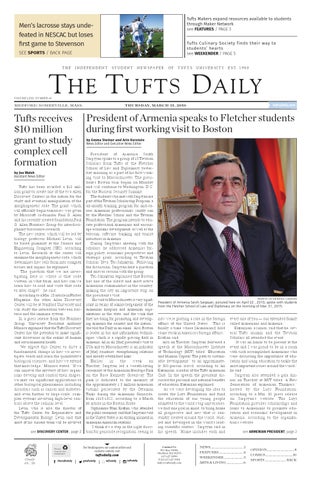
President of Armenia Serzh Sargsyan, pictured here on April 22 , 2010, spoke with students from the Fletcher School of Law and Diplomacy on the morning of Mar. 31, 2015. now we’re playing a role in the foreign affairs of the United States… This is finally a time where [Armenians] hold some stock in America’s foreign affairs,” Krafian said. Also on Tuesday, Sargsyan delivered a speech at the Massachusetts Institute of Technology (MIT) titled “Education and Human Capital: The path to sustainable development,” to an approximately 300-person crowd, according to Ari Kazanjian, a leader of the Tufts Armenian Club. In the speech the president discussed the personal and national benefits of education, Kazanjian explained. “As we were developing the idea to create the Luys Foundation and fund the education of our young people admitted to the world’s top universities, we had one goal in mind: to bring home all progressive and new that is constantly created around the world, studied and developed in the world’s leading scientific centers,” Sargsyan said in his speech. “Home includes each and
Contact Us P.O. Box 53018, Medford, MA 02155 617 627 3090 FAX 617 627 3910 daily@tuftsdaily.com
every one of you — our extended family called Armenians and Armenia.” Kazanjian, a junior, said that he, several Tufts alumni and the Tavitian Scholars all attended the event. “It was an honor to be present at the event and I was proud to be in a room with such accomplished Armenians who were discussing the importance of education and using education to tackle the most important issues around the world,” he said. Sargsyan also attended a gala dinner on Tuesday at MIT titled “A New Generation of Armenian Thinkers,” hosted by the Luys Foundation, according to a Mar. 30 press release on Sargsyan’s website. The Luys Foundation provides scholarships and loans to Armenians to promote education and economic development in Armenia, according to the organization’s website. see ARMENIAN PRESIDENT, page 2
NEWS............................................1 FEATURES.................................4 WEEKENDER..........................5 ARTS & LIVING.......................6
OPINION.....................................8 COMICS.....................................10 SPORTS............................ BACK
2
THE TUFTS DAILY | News | Thursday, March 31, 2016
T HE T UFTS D AILY Sarah Zheng Editor-in-Chief
EDITORIAL Nicholas Golden Mengqi Sun Managing Editors Nicholas Pfosi Associate Editor Arin Kerstein Executive News Editor Isha Fahad News Editors Abby Feldman Melissa Kain Sophie Lehrenbaum Emma Steiner Ariel Barbieri-Aghib Assistant News Editors Kyle Blacklock Gil Jacobson Robert Katz Liam Knox Catherine Perloff Vibhav Prakasam Hannah Uebele John “Joe” Walsh Kendall Todd Executive Features Editor Nicole Brooks Features Editors Nina Joung Jake Taber Diane Alexander Assistant Features Editors Constantinos Angelakis Emily Cheng Emma R. Rosenthal John Gallagher Executive Arts Editor Lancy Downs Arts Editors Justin Krakoff Josh Podolsky Jonah Allon Assistant Arts Editors Cassidy Olsen Eran Sabaner Hannah Hoang Dorie Campbell Emily Karl Erin Sifre Stephen Dennison Abigail Feldman Shannon Geary Allison Merola Cassie Bardos Miranda Chavez Frances DeFreitas Jake Goldberg Emma Henderson Michael Lefkowtiz Anita Ramaswamy Noah Weinflash
Executive Op-Ed Editor Op-Ed Editor Cartoonists
Editorialists
Maclyn Senear Executive Sports Editor Ray-Paul Biron Sports Editors Ross Dember Phillip Goldberg Alex Schroeder Chris Warren Yuan Jun Chee Assistant Sports Editors Maddie Payne Eddie Samuels Noah Smith Sofie Hecht Executive Photo Editor Alex Knapp Caroline Ambros Picture Tufts Editor Ray Bernoff Staff Photographers Laura DeArmas Maria Ferraz Henry Hintermeister Katlyn Kreie Mia Lambert Jiaxun Li Nora Nord Nicholas Pfosi Julia Press Evan Sayles Angelie Xiong
PRODUCTION Julie Doten
Production Director Astrid Weng Executive Layout Editor Jewel Castle Layout Editors Abbie Gantner Leila Li Allie Merola Brianna Mignano Mandip Pokharel Ellie Powers Annabelle Roberts Emily Sharp Andrew Stephens Sebastian Torrente Shirley Wang Petrina Chan Allison Merola Dana Pek Belinda Xian Jack Ronan Dan Strauss Meagan Adler Alison Beach Arthur Beckel Lancy Downs Alison Epstein Andrew Kager Melissa Kain Sarah Kalinowski Reena Karasin Sophie Lehrenbaum Rachel Salzberg Arielle Sigel Caroline Watson Maxwell Bernstein Nitesh Gupta Evan Sayles
Creative Director Executive Graphics Editor Graphics Editors Executive Copy Editors Copy Editors
Executive Tech Manager Online Editor Social Media Editor
BUSINESS Yiran Xu Executive Business Director Qinyue Yu Receivables Manager Evan Sayles Online Advertising Eva Sachar Ad Managers Jay Hayes
tuftsdaily.com
Fletcher students attend events with Armenian president ARMENIAN PRESIDENT
continued from page 1 Yesterday, in addition to visiting Fletcher, Sargsyan was at a public event outside of the Massachusetts State House, to meet with the Governor Charlie Baker and Boston Mayor Martin J. Walsh. The Armenian president also gave another lecture in the afternoon,
this time at the Harvard Kennedy School, titled “Advancing Armenia’s Independent Statehood: Sovereignty, Democracy and Interdependence in the 21st Century.” TerSahakyan noted that the Tavitian Scholars also attended the Harvard lecture. Kazanjian said that the president’s visit has made him proud to be an active mem-
ber of Boston’s Armenian community. “His visit shows his recognition and care for the Armenian diaspora and its continuous, strong connection to the homeland,” he said. “In addition, his visit to Boston is a sign of recognition of Boston as a leader in education and innovation on a global scale.”
Biology professor Michael Levin to lead new Discovery Center
DISCOVERY CENTER
continued from page 1 with the project. Other staff, including an engineer and a facility coordinator, will work with principal investigators at several other universities, he said. Chair of the biology department Sergei Mirkin said that this is the first time that Tufts has worked with the Frontiers Group. According to Levin, the grant is for $10 million over four years with a possibility to extend a further four years. Mirkin said that this funding significantly exceeds most research grants. Broadly speaking, the research will examine how a blastula, a group of embryonic cells, develops into the entire human body, according to Mirkin. He explained that conventional wisdom is that cells develop and decide their fate through chemical signals, but Levin is investigating how cells actually communicate using electrical signaling. “Michael Levin proposed quite a while ago that actually, another huge factor, and maybe the major factor, in determining the cell’s fate during embryonic development is these changes of bioelectricity,” Mirkin said. “That is an unbeaten path.” For that reason, Levin explained, the
fundamental goal of the Discovery Center will be to study how that electrical code is written, how it can be read, and how it can be rewritten. “Most people who work on this topic are pursuing it from the biochemical angle, looking at how chemical signals that are produced by cells give rise to a large-scale patterning,” Levin said. “But our specific focus is on electrical communication among cells, so we look at how it is that cells represent patterns via electrical signals that they exchange with each other.” Levin said that his lab will focus broadly on reading and writing the morphogenetic code for the first four years, and will focus on specific applications if the grant is extended by an additional four years. In particular, the researchers will look specifically at eye development, limb development and connections between electrical signalling and chemical cascades. “We’re looking to develop new technologies to read and re-write patterning information in living tissues,” Levin told the Daily later in an email. Mirkin explained that the research is particularly important because changes in membrane voltage potential may change
how genes are expressed in cells. He said that two particular applications include tissue regeneration and cancer. “The issue there is: what is the membrane voltage potential of cancer cells as compared to non-tumorous healthy cells?” Mirkin said. “And if you change it, can you convert a tumor cell into a normal cell?” Levin said that the grant-making process began when the Allen Frontiers Group invited him to speak, and he was later invited to apply for a grant. “When I gave my opinion about the most interesting new frontier, the dark matter of biology, I actually had no idea that there was a grant to be had out of this,” Levin said. Mirkin added that the Tufts administration has offered important logistical support for the Discovery Center. However, he concluded that the grant ultimately owes to Levin’s unique approach to the question of morphogenesis. “There are very few labs, of which Michael Levin’s lab is a leader, which study how changes in the electric potential change the development,” Mirkin said. “In this regard, it’s still an unorthodox point of view. It’s a prominent point of view, but it’s not by any means a dominant point of view in the field.”
tuftsdaily.com
FEATURES
3 Thursday, March 31, 2016
Kinsey Drake Channeling Ina
Essential cookbooks for the young millennial
B
efore Tasty videos and Insta-recipe posts became mainstream, cookbooks were the fail-safe go-to for learning new recipes. In the Internet age where young adults google everything and eschew physical things, I still think that having a few classic cookbooks is absolutely necessary when you are first learning how to cook. These cookbooks below range from timeless to trendy, but at the end of the day, each and every one of them will teach you to be confident and resourceful in the kitchen.
The Best Recipe, America’s Test Kitchen:
SOFIE HECHT / THE TUFTS DAILY
Examples of objects printed by a 3D printer are displayed in one of the 3D printers in the Tufts Maker Studio on the third floor of the Collaborative Learning and Innovation Complex (CLIC) in the Human Factors Lab on March 30.
Maker Network connects maker organizations on campus, increases accessibility of makerspaces by Nina Joung
Assistant Features Editor
Andy Braren wanted to make building things easier at Tufts. With this goal in mind, in 2013 — during his sophomore year at Tufts — he started Tufts MAKE as a subgroup under the Tufts Human Factors and Ergonomics Society (THFES). Tufts MAKE had a fun first project: an oreo de-creamer. As the team worked on multiple prototypes toward the final product, Braren, now a Tufts graduate student currently studying Human Factors, found that acquiring resources and attracting student interest for the project was fairly difficult. However, Braren came up with an idea to solve the problem: create a network of makers. He worked to connect THFES, the Crafts Center and Crafts House, Tufts Robotics Club, Tufts Entrepreneurs Society and Tufts MAKE to share resources, student support and an appreciation for “learning by making.” This became the Tufts Maker Network. According to Braren, the network was established last semester. After all the organizations met with one another, there was consensus that these various making-related organizations had many opportunities to collaborate, leading to the Maker Network’s kickoff event, Weekend of Making, early this February. According to a Feb. 9 Daily article, the event had a 150-student turnout for a wide range of workshops from pottery throwing to LEGO robotics. He cited the success of the Weekend of Making as an example of the need for the Maker Network, as it allows the participating organizations to share their knowledge and skills with a larger student community, Braren said. “One club could not have pulled that off,” Braren said. “It was the collaboration that really made that possible.” The interdisciplinary nature of the Maker Network is characteristic of mak-
erspaces, according to Brian Gravel, an assistant professor and director of elementary education in the Department of Education. Gravel has been researching makerspaces, which offer opportunities to work on interesting or personally meaningful projects and problems and look at them through an interdisciplinary perspective. “You historically have shops that are organized more by discipline,” Gravel said. “So you have art studios, or you have a woodshop, or you have a metal shop. Makerspaces look at the intersection of lots of different types of technologies, skills and practices. You have artists working alongside engineers. You have human factors majors thinking about the design of products alongside child development majors thinking about how kids can engage differently with technology.” There are multiple spaces on campus that the Maker Network website describes as having “the material and equipment you need to turn your ideas into reality,” many of whom have been either established or renovated within the past five years. The Digital Design Studio was added to Tisch library in 2011 and renovated last year. The Crafts Center was renovated from 2014-2015 and has new technology like 3D printers and soldering supplies. The Bray Lab behind Anderson Hall is undergoing renovation, and the Tufts Venture Lab, Tuft’s first co-working space for student-run startups, is part of the new 574 Boston Ave. Collaborative Learning and Innovation Complex (CLIC), according to the Maker Network website. The Jumbo’s Maker Studio opened on 200 Boston Ave. in June 2014, while most of its electronics and 3D printing equipment have been moved to the new Maker Studio at CLIC, which officially opened with the Weekend of Making, according to Braren. The growth of makerspaces on campus reflects the growth of the maker movement at large. According to Braren,
when technologies like 3D printing, Raspberry Pi and Arduino reached accessible price points, the maker movement took off. Braren said this encouraged maker communities to arise in spaces like libraries and high schools. An example of this is Malden High School. Gravel and his colleagues worked to reinvent the basement of Malden High School into a makerspace, Nedlam’s Workshop, where students can come after school to build, 3D print or solder their own projects. Throughout his time at the school, which has high numbers of Latino and immigrant students, he has seen how makerspaces have the potential to change the face of engineering by diversifying the field. “We know what engineering looks like to some degree,” Gravel said. “It’s often a sort of male-dominated, white, middle-class activity. Well now we’re beginning to recognize that when you put these kids in other types of settings, we can broaden or expand what we think engineering, science and design can look like. We start to find people do really interesting things with really rich knowledge of their communities, and how they can solve problems in their communities. These sites become new places for people to become empowered problem solvers.” Thomas Coons had not been exposed to this kind of student-led environment until he joined Tufts MAKE. A first-year student majoring in mechanical engineering, Coons was introduced to Tufts MAKE during the Weekend of Making. Since then, he has been exposed to the tools and equipment available in the Maker studios and wants to continue working with them in an outside-the-classroom setting. “I went to a public high school that didn’t have an engineering department at all,” Coons said. “I guess the reason see MAKER NETWORK, page 4
America’s Test Kitchen is a company based in Brookline, MA, and they pride themselves on meticulously testing every single recipe to produce the “best recipe.” Their comprehensive cookbook is perfect for people who are nervous about cooking by feel — the ingredient quantities, instructions and cooking times are incredibly precise to alleviate any anxiety when making a recipe. This cookbook will serve you well whether you are 18 or 38.
The Smitten Kitchen Cookbook, Deb Perelman: If you love Deb Perelman’s gorgeous yet simple NYC-based food blog, you will love her even more when you open this cookbook. The full-page, glossy photographs of fresh spring salads and elegant grain dishes will give you tons of dinner party inspiration. You will impress everyone you know and have a delicious meal to boost.
Barefoot Contessa Foolproof, Ina Garten: Fact: Ina Garten can do no wrong, and this cookbook is just another example. Sure, we can all envy her luxurious Hamptons lifestyle and her extensive collection of chambray, but when it comes down to it, Ina’s recipes are sublime without fussy ingredients or complicated instructions. Any mother would be proud to see this on your bookshelf.
How to Cook Everything, Mark Bittman: Mark Bittman is the recipe guru for all the simple recipes that most cookbooks would not grant space. Think pesto pasta, simple pancakes and steamed vegetables. If the kitchen is a foreign domain for you, this cookbook lowers your barrier to entry. Treat it as your Bible, and with its help, you’ll become a more confident cook.
Plenty, Yotam Ottolenghi: Also known as the cookbook to use when you have no idea what to make for the token vegetarian in your friend group. Londonbased Israeli chef Yotam Ottolenghi doesn’t run a vegetarian restaurant, which works to his advantage in “Plenty.” The dishes are full-flavored and hearty, which means that a carnivore would be just as happy as a vegetarian when served braised escarole with gruyère or roasted eggplant with lentils and tahini. Every single recipe is satisfying and well balanced without relying on silly meat substitutes or fake ingredients. Kinsey Drake is a sophomore, and she can be reached at kinsey.drake@tufts.edu.
Thursday, March 31, 2016 | FEATURES | THE TUFTS DAILY
tuftsdaily.com
Recently established Maker Network offers interdisciplinary spaces, opportunities MAKER NETWORK
continued from page 3 why I got involved [with Tufts MAKE] is because I know [Tufts has] a crazy amount of equipment and cool things, and I’m going to have to learn it at one point, and I’d rather not learn them in a class — you probably wouldn’t learn them all in a class. So I figured it’d be kind of cool to make things in a workshop instead of [for] a professor.” The diversity of the student body and the range of perspectives they bring to projects are part of what Coons identified as a benefit to learn in a workshop, rather than in a classroom. “So far only half the people I’ve talked to are engineers…,” Coons said. “At first, I thought they’d all be engineers. It’s nicer that it’s not — you get a lot of different viewpoints. Also, people are there because they want to do it, not because they have to do it for a class.” Braren also attested to the benefits of an interdisciplinary group of makers. “Part of these makerspaces and this maker movement is definitely encouraging students from different disciplines to talk to one another, which isn’t something we do often in college, unfortunately. But [we] do all the time when [we] go to the real world and start working on this and start making things for real,” Braren said. However, Braren also recognized that despite attempts to bring arts and engineering students together through the Maker Network, there is still a visible gap between more art-focused and engineering-focused makerspaces on campus. According to Crafts Center Co-manager Helen Sibila, the Craft
Center’s organizational and technological renovations help create a more accessible and welcoming learning environment for artists and makers. According to a Dec. 4, 2014 Daily article, one of the center’s goals for its renovation was to improve functionality and accessibility. Sibila, a sophomore, says that the newly organized Crafts Center space eliminates the search for supplies, creating a more productive working environment and making the center’s resources easier to navigate for new visitors. “It a lot easier to get things done if things feel easily accessible,” Sibila said. “I think it felt a little socially exclusive because you needed to know where things are.” The Crafts Center is also planning on implementing new technology to make learning new artistic processes an the center easier and safer for its visitors. According to Sibila, the center is currently working on instructional guides to teach new users about the proper use of different tools like paints and the sewing machine. Sibila said she envisions a future Crafts Center having tablets and monitors that show instructional videos, as she hopes that these videos will promote proper and safe use of the center’s more complex machines and encourage more non-arts students to come and learn new skills. “We’re also integrating technology into teaching because what Crafts Center wants to do is [to] make these kinds of materials and art processes and maker processes more accessible to people who don’t know about them,” Sibila said. “So anyone who wants to learn how to use a sewing machine can just come in and
learn, and anyone who wants to know how to make ceramics or use the 3D printer [can learn]. It’s not some sort of exclusive ‘you have to be an engineer or you have to be an artist.’ You can come just come in and learn how to do it.” The Tufts Maker studios are always working towards making the spaces welcoming to everyone in the community who are interested in making. According to Fay Shaw, a postdoctoral fellow at the Center for Engineering Education and Outreach (CEEO) and co-manager of the maker studio at CLIC, the Maker Studio welcomes all Tufts community members through social events like Waffle Nights and workshops that are accessible to people of all experience levels and backgrounds. “[Maker studio] is open to all of Tufts
4
students, staff and faculty,” Shaw said. “This isn’t a place just for engineers. It’s hopefully a place where people can express their creativity.” With the makerspaces reaching out to a wider community of students and the Maker Network positioned to bring the different maker-related organizations together, Braren believes the maker movement at Tufts is stronger than ever. “There’s never been a better time to be interested in making things than today, with all the different groups we have [and] all the different leadership opportunities we have at Tufts,” Braren said. “I’m really glad to see how far we’ve come in just a few short years, really interested in to see how far we can take in in the next few years.”
SOFIE HECHT / THE TUFTS DAILY
Students in an Occupational Therapy Masters class on pediatrics work together to design a low tech assistant device for a case study with Tufts Maker Network member Amy Fleischer, standing, in the Tufts Maker Studio on March 30.
Weekender THURSDAY, MARCH 31, 2016 | ARTS & LIVING | THE TUFTS DAILY
5 tuftsdaily.com
Tufts Culinary Society brings chefs, students to the table to share love of food by Eran Sabaner
Assistant Arts Editor
It was a Monday evening, and roughly 50 students gathered together in Pearson Hall. Despite their busy midterm study schedules, these students were listening to Ross Weinberg, the chef and general manager of the Boston eatery Figs, an Italian restaurant created by legendary restaurateur Todd English that has two locations in Boston. Organized by the Tufts Culinary Society ( TCS), this event was called “Pizza, Pasta and Ross Weinberg” and took place on Mar. 7. Because Weinberg was a charming speaker, sharing the risky career decisions, regrets and dilemmas he encountered, even those who attended the event solely for the free food — pizzas from the restaurant —listened intently to his story. TCS organized a similar event last fall, titled “A Talk with John De Silva.” As the executive chef of Davis wine bar Spoke and one of Zagat’s “30 Under 30” for Boston in 2012, De Silva spoke about his career and how he opened up Spoke, which is featured on Boston Magazine’s “Top 50 Restaurants of 2016” list. According to TCS Vice President Ipek Emekli, being in Boston enables TCS to take advantage of the culinary scene and the restaurants here to bring all kinds of cuisine to its events on campus. “Usually, as the TCS [executive] board, we start our weekly meetings off by discussing the approaching events but end up being distracted by talking about all the great places we have tried over the weekend and making plans about our next bonding, in which we will visit a great restaurant. So we have a huge list of restaurants that we love,” Emekli, a sophomore, said. These places include Toscanini’s for ice cream, Union Square Donuts for desserts, Brasserie Jo for French, Sarma & Istanbullu for Mediterranean and Antico Forno for Italian. Bagelsaurus and Pepe Bocca are also on the list. Chef talks are only a small part of the events and workshops TCS hosts. Each semester, TCS organizes cooking classes in partnership with Tufts Dining
COURTESY SUNNY WANG
Students pass out food during the 4th Annual Cultural Crawl by the Tufts Culinary Society. Services, as well as events such as sushi workshops, tours and themed dinners. Just last month, the society held a tour of the Union Square market and a vegetarian cooking class. TCS organizes a wide array of events, and those events are almost never underattended. Part of TCS’s popularity is due to the power of food across cultures, according to Emekli. “Food is always something that brings people together, so it holds a very important place in many, if not all, cultures,” she said. TCS President Allison Wainer agreed, talking about the role of food in bringing people together from across cultures in her personal experience. “In my own experience, there’s nothing more cultural than food,” Wainer, a senior, told the Daily in an email. “All
(COURTESY KRISTIE LE)
Food at the 4th Annual Culture Crawl by the Tufts Culinary Society on Nov. 13, 2015.
of my family’s traditions center around food, and I think many of my friends have similar experiences with cultural traditions... Time spent around the dinner table allowed me to bond with my host family in Paris and helped me ease my way into French culture for four months. I think the bottom line is that food brings people together and allows them to learn about new cultures.” Emekli said that today’s fast-paced culture affects the way we eat, which is why TCS’s main goal is to “make food something more than late-night pizza takeouts and dining hall meals.” “We are surrounded by 24/7 deliveries, instant lunches, TV dinners, bottomless all-you-can-eat buffets and food that doesn’t seem to expire,” she said. “It almost seems that food has become something insignificant and meaningless — something that we should get done with as soon as possible to go on with the chaos of our daily lives, rather than something that brings joy and pleasure.” TCS is also determined to promote a healthy and balanced diet. This is evident in their five-course menu from the Fall Seasonal Dinner, which featured mixed green salad, sweet and savory tarte tatins, roasted salmon, gold potatoes and classic apple pie. Additionally, TCS strives to promote the diversity of food by organizing “Culture Crawl,” an annual event in which many culture clubs serve food from their cultures. With more than 200 participants, “Culture Crawl” is TCS’s biggest event. “Today, most of us are exposed to the Americanized versions of international food — not that this is wrong, but I can definitely say that eating international food cooked personally by people from that culture is a completely different
experience,” Emekli said. “[This event gives] the opportunity to people from different cultures to serve the food they love and know so well and also for other people to experience this food.” Emekli said this event provides a platform for different cultures to showcase their culture and at the same time, raises awareness of diverse cultures on campus. “[Culture Crawl] brings people together around something that they all love to do, regardless of what cultural background they are from — to eat and enjoy food,” she said. Unlike some events that may require a certain amount of talent or previous experience, or otherwise, a huge time commitment, TCS’s events and workshops are open to everyone, including beginners. “Anyone can participate in TCS’ events, and nearly all of them are free,” Emekli said. “For all of our events, we start from the basics, so no experience is required for any of our lectures or cooking classes. Just participate in anything that you’re interested in, and we’ll be in charge of teaching you everything that you have to know.” At the same time, TCS utilizes social media, particularly Facebook, to promote their activities and events while sharing recipes, food-related videos, reviews and articles. “No one can deny that our generation spends a lot of time checking social media. Thus, anything on social media usually has much more chance of reaching to us and being seen than anything on print, including posters and flyers,” Emekli said. “For this reason, I believe that any club/student organization should increase its social media presence to reach a larger audience and make sure its efforts are being valued.”
6 tuftsdaily.com
Arts & Living
Coming up this week Looking for some post-spring break relaxation? Check out one of these arts events happening on campus this weekend.
the Terrace Room. Admission is free. No tickets required.)
Tufts Korean Student The Institute Presents — Netflix Association Presents — & Kill: A Dateline Special: Korea S/S 2016: Celebrate April Fools’ Day with the Institute’s TV-themed sketch comedy show, “Netflix & Kill.” (Friday at 9:30 p.m. in the Sophia Gordon Multipurpose Room. Admission is free. No tickets required.)
Applejam Productions Present — Midriffs and Alosi Den: Applejam is putting on another Terrace Room concert featuring Boston acts Midriffs and Alosi Den and a to-be-announced Tufts’ band. (Friday at 9 p.m. in
Tufts KSA is presenting their annual culture show, and this year’s theme is Korean fashion. The event will feature Korean food and guest performances from the Berklee College of Music, Knock Out Kings and Wellesley Fan Dance. (Friday at 7:30 p.m. in the Alumnae Lounge. Admission is free. No tickets required.)
Torn Ticket II Presents — Urinetown: The Musical: Torn Ticket II is putting on their spring major production of Urinetown, a musical satire of
Thursday, March 31, 2016
Stina Stannik After Years the legal system, class divide, corporate mismanagement and musical theatre as a whole. (Thursday and Friday at 8 p.m. and Saturday at 7 p.m. in Cohen Auditorium. Admission is free, but tickets are required and are going fast at the Balch Arena Theater Box Office.)
Tufts Amnesty International and Tufts Peace Action Present — Art for Amnesty: Want to make art that benefits human rights? Tufts Amnesty International and Tufts Peace Action are hosting an evening of crafting and letter-writing for human rights campaigns around the world. ( Thursday at 7 p.m. at the Crafts Center. Admission is free. No tickets required.)
Chapter Seven Editor’s note: This column is part of a fictional weekly serial. “So do we think it’s amnesia? And he’s really just a cute little old man now? Or are we leaning towards mastermind with borderline sociopathy — he’s fully aware of his past, and he’s been pretending this whole time? The scary people in suits weren’t really clear on that.” Cecilia felt, all things considered, that she was taking the news that her until-recently-estranged grandfather had once been (and may still be) the head of an international crime syndicate rather well. Perhaps it was the disconnect between the absurdity of that knowledge and everything she had seen from Edgar so far, but she was intrigued rather than frightened. Crimelord Grandpa was currently puttering in the half-dead garden. Cecilia and her mother stood at the kitchen window, watching him wander among the plants; he bent over each one as if talking to them. “Does it matter which it is?” Alicia finally answered her daughter’s question. “Of course it matters — whatever he might have once done, it’s who he is now that … Mom, why do I get the feeling this isn’t news to you?” Alicia had at first laughed when Cecilia began relaying what the national security agents had told her about Edgar but had slowly grown stoic, watching her daughter impassively. “Did you know, before we even came —” “Oh, I’ve known for years.” Alicia made a gesture as if to brush the question away. “It was never relevant.” Cecilia laughed. “Okay, I’m not gonna touch that one. Yet.” Giving her mom a cheeky smile, she said, “I’m going to do a little recon.” “No — Cecilia —” Alicia grabbed for her arm and missed. Edgar didn’t look up as Cecilia came outside. The back of his hair was sticking up like the tufts of grass which poked up between the stones of the back patio, and Cecilia had to smile. She slowed her excited pace and instead approached him carefully, gently. “Hey Grandpa.” He glanced at her without smiling, then went back to tamping down the dirt around a dead fern. “Listen, I’m sorry I reacted so poorly yesterday when you told me you used to be a spy. It just wasn’t what I was expecting.” Edgar gave no sign he was even listening. “I’d love to hear more, if you still want to tell me.” “Do you have someone at home? A boyfriend,or girlfriend, maybe?” Taken aback, and not at all seeing how this fit into anything, Cecilia didn’t even think to bluff. “I have a — something. I met a guy but …” Her grandfather nodded as if that clarified everything. “Come here, I want to show you something.” He waved for her to follow him as he wound his way through the pots. He bent over one, standing with his back to the house, and looked at Cecilia intently. “I found this in your mother’s handbag.” There, at first indiscernible from the dark dirt in which it was nestled, was a gun. Stina Stannik is a senior majoring in Peace and Justice studies. She can be reached at Stina.Stannik@tufts.edu. She is also a Contributing Writer at the Tufts Daily.
Thursday, March 31, 2016 | ADVERTISEMENT | THE TUFTS DAILY
tuftsdaily.com
EXPLORE
the possibilities
at UMass Boston this summer
Registration opens April 4
1/4 AD
1/8 AD 1/2 AD
Learn more at: summer.umb.edu 700+ courses to help you reach higher and look beyond. Accelerate your studies Complete requirements
Mornings, afternoons, evenings and online
Earn biology, history, environmental science and environmental studies credits on beautiful Nantucket Island.
Study abroad, service learning or field study - Gain new perspectives and earn 3 - 6 credits while having an amazing summer. P Applications may still be accepted for some programs! Inquire now. Host destinations include Central America, China, England, France, Greece, Haiti, Italy & South America.
Session I begins: 5/31
Session II begins: 7/18
7
Opinion
8 tuftsdaily.com
EDITORIAL
Campus housing situation is slow-burning crisis In recent months, the administration has taken increased measures through students and faculty to gauge an understanding of desired housing options. The recently formed Residential Strategies Working Group (RSWG) is just one example of how Tufts administrators are working with students to create a realistic plan for housing both on-campus and off-campus. Additionally, the Office of Residential Life and Learning has informed students of its ongoing work with the architecture firm Sasaki Associates to create a campus housing master plan and has welcomed students’ thoughts in open feedback sessions. Though the groups involved in residential renovations have yet to produce a concrete plan for future housing, on-campus housing is at a near capacity and it is obvious that new housing solutions are necessary. Whatever plan these working groups come to, it must be bold. Higher renting costs increases are impacting people across the Boston area, and Medford and Somerville are not exceptions to this trend. From 2011 to 2013 the median cost of rent in Medford increased by nine percent. Increased costs of rent have been devastating to low income households. Approximately 36 percent of
low to middle income Medford households experienced a significant housing cost burden as of May 2015. Tufts students are not helping this situation either. In some cases, Tufts students are able to pay higher rent prices due to parents’ aid or by overcrowding houses with or without landlord knowledge (though there has been a crackdown on landlords knowingly overcrowding houses near campus with a new ordinance out of Somerville). Groups of students who can pay high rent costs contribute to the rising cost of rent; landlords can find students who will be willing to pay prices that members of the local community cannot. This is not to say that Tufts students are not hurt by rising rent costs. For the many upperclassmen who are unwilling or unable to pay rent costs (noting that costs will only increase as time goes on), they turn to on-campus housing options. Based upon this information, it is only logical that Tufts is now working on a plan for an expansion of student housing. Yet there is a double-edged sword to any development to alleviate student rent costs. The “bubble” around campus, the area immediately surrounding campus that experiences higher prices due to its
proximity to the university, will grow as the university expands its student base in order to continue to compete with its peer rivals. This bubble would be the outcome of projects, like that MBTA Green Line Extension, that increase the value of Tufts or augment the demand for housing around Tufts. The on-campus housing expansion plan may also be factored into the hike in tuition fees mostly suffered by students won’t enjoy the long term benefits of the project. As Tufts pursues higher rankings, increased selectivity and increased resources for its students and faculty, its physical expansion will inevitably cause changes in the Somerville and Medford neighborhoods. The negative impacts on the non-Tufts community in the neighborhoods are unavoidable, but they must be mitigated for both the numerous students who feel crushed between high prices and few dorm options and the low-income residents of Medford and Somerville who are being pressured by high income inequality as well as rent costs. The university’s obligation to do so is both to its students and to its community, and any plans that don’t address these concerns should be criticized appropriately.
CARTOON
On-campus housing expansion plans BY STEPHEN DENNISON
The Tufts Daily is a nonprofit, independent newspaper, published Monday through Friday during the academic year, and distributed free to the Tufts community. The content of letters, advertisements, signed columns, cartoons and graphics does not necessarily reflect the opinion of The Tufts Daily editorial board. EDITORIALS Editorials represent the position of The Tufts Daily. Individual editors are not necessarily responsible for, or in agreement with, the policies and editorials of The Tufts Daily. OP-EDS The Op-Ed section of The Tufts Daily, an open forum for campus editorial commentary, is printed Monday through Thursday. The Daily welcomes submissions from all members of the Tufts community; the opinions expressed in the Op-Ed section do not necessarily represent the opinions of the Daily itself. Opinion articles on campus, national and international issues should be 600 to 1,200 words in length and submitted to oped@tuftsdaily.com. The editors reserve the right to edit letters for clarity, space and length. All material is subject to editorial discretion and is not guaranteed to appear in the Daily. Authors must submit their telephone numbers and day-of availability for editing questions. ADVERTISING All advertising copy is subject to the approval of the Editor-in-Chief, Executive Board and Executive Business Director.
Thursday, March 31, 2016
Aren Torikian The Arena
Going for brokered
J
uly in Cleveland usually entails supporting a mediocre Indians team and hoping that a cool band plays at the Rock and Roll Hall of Fame. This summer will be a little more exciting. The Republican National Convention could be the most dramatic weekend in the city since LeBron’s decision to take his talents to South Beach. It’s beginning to look like the only way to prevent a Donald Trump nomination is a brokered convention. To understand how this would work, we need to first look at the bizarre way political parties elect candidates. Much like with the Electoral College (we’ll cover that another day), voters indirectly vote for their desired candidate. The state party sends a coalition of delegates to the national convention, who are supposed to vote for the candidate for whom they are assigned. On the Republican side, some states divide delegates proportionally, some are winner-take-all and some are in-between. For Democrats, it’s proportional throughout. Republican delegates will vote over and over at the convention until a candidate receives 1,237 votes. If there is no majority after the first round of voting, most delegates will be free to vote for candidates other than the one originally assigned by the state. At this point, one would expect to see “brokering” behind the scenes. In theory, this would mean aligning 1,237 votes against Trump and for another candidate. This is why John Kasich is still in the race. It’s mathematically impossible for him to reach the magic number of delegates, but a strong performance could make him a potential option at the convention (which is also in his home state). Ted Cruz has some semblance of a mathematical path, although it will be difficult, as the upcoming slate of primaries are not the types of states he has been winning. The overall idea is to prevent Trump from reaching 1,237 by continuing to divide voters in the proportionally assigning states, and picking off winner-take-all states. If Kasich and Cruz stay in, I have a tough time seeing Trump getting the 498 delegates he needs. Kasich should take enough mainstream Republicans, particularly in the Northeast, while Cruz should do well in winner-take-all primaries such as Nebraska and Montana. We certainly won’t know until the California and New Jersey primaries in June, when 200 delegates are up for grabs. Of course, there’s no reason party officials and delegates would have to crystallize around any of the three candidates available. For instance, John Boehner has already said he would support Speaker Paul Ryan, the vice presidential nominee in 2012. Mitt Romney, the second half of the 2012 ticket, also has to be thinking about making a move. It’s entirely possible that Trump could win the popular vote and fail to win the nomination. It’s also entirely possible the GOP won’t be able to organize delegates effectively to stop Trump. He has brushed aside every candidate the party establishment has backed, from Jeb Bush to Marco Rubio. If he can come out of a brokered convention, it would be his greatest win yet. Aren Torikian is a sophomore who has yet to declare a major. Aren can be reached at Aren.Torikian@tufts.edu.
9
Thursday, March 31, 2016 | Opinion | THE TUFTS DAILY
Opinion OP-ED
The need for Tufts Peace Action by Gary Goldstein A group of students are organizing a Tufts chapter of Massachusetts Peace Action. There is considerable need for such a group on campus. Massachusetts Peace Action is an organization that addresses national and global issues that are most pressing and threatening to peace. It is concerned with the threat of nuclear weapons, as well as climate change, social and economic inequality, the wars in the Middle East and the interconnections among all of these issues. Peace Action has had successes in developing support for diplomacy and peace in many areas by highlighting these concerns to decision makers and the public through meetings, workshops, lobbying, rallies and petitions. All of these issues are in the news, but the implications of enormous nuclear arsenals get the least attention. A one trillion dollar US program, the so-called “modernization” of nuclear weapons program, is underway. There is hardly any mention of nuclear
arms in the primary debates of both parties. However, the arsenals of nuclear weapons in the U.S., Russia, China, France, Britain, Pakistan, India, Israel and N. Korea pose severe risk for the future of humanity. There is growing antagonism among the countries in possession of the weapons. The U.S. and Russian nuclear bombs are ready to be used in minutes — they are on “hair-trigger alert.” Our president has the prerogative to launch a nuclear war anywhere and at any time that he or she decides to respond to or destroy a perceived threat. The time from the launch of nuclear missiles to the time the bombs explode on targeted cities can be as little as 15 or 20 minutes. That is all the time it could take to kill millions of people and make the earth virtually uninhabitable. We are in a time of many possible threats. Nuclear weapons pose an immediate danger. Not long before I wrote this, there had been a massive demonstration by tens of thousands of people in London, U.K., including the head of the Labor party, Jeremy Corbin, urging the govern-
ment not to renew its Trident nuclear submarines. Four U.K. submarines carry up to eight Trident missiles; each can be fitted with a number of warheads. The U.S. has 18 nuclear weapon-carrying submarines which altogether carry over one thousand nuclear bombs. One such submarine has enough nuclear weaponry to destroy most of the large cities in Europe and to cause enormous environmental damage. These submarines are one “leg” of the nuclear “triad,” the other legs being planes and intercontinental ballistic missiles in silos. What would be the consequences of a nuclear attack? The explosion of the order of 100 Hiroshima size A-bombs or a dozen H-bombs could immediately kill as many as 10 million people. It could create enough ash and debris to blanket the atmosphere and cause a catastrophic drop in global temperature — a “nuclear winter” — that would lead to destruction of agricultural crops and mass starvation for those spared the direct effects of blast and radiation. In
short, nuclear war will bring unimaginable destruction to all living things. Why does the U.S. maintain such a dangerous arsenal? Bringing awareness and understanding of this nuclear danger is a major reason for establishing a Massachusetts Peace Action chapter at Tufts — Tufts Peace Action (TPA). I urge students to join this effort. Thursday, March 17 in Metcalf Common Room, TPA presented the cinematic masterpiece directed by Stanley Kubrick, “Dr. Strangelove: or How I Learned to Stop Worrying and Love the Bomb.” In satirical terms, a series of events that could lead to a nuclear holocaust demonstrated the instability of a nuclear balance of power. Dr. Strangelove successfully began a series of TPA sponsored presentations. Other events will be announced. Please consider attending. Gary Goldstein is a professor in the Department of Physics and Astronomy. He can be reached at Gary.Goldstein@tufts.edu.
Take the pledge at ItsOnUs.org
IOU_AdCouncil_Celeb_Consent_BW_11.5x21.indd 1
Save the Date SunDay, May 22, 2016 Visit our website at: commencement.tufts.edu University Commencement Office telephone: 617.627.3636 E-mail: commencement@tufts.edu Don’t forget to stop by the Commencement Fair at the Campus Center on April 6 during Senior Days, to pick up graduation announcements and other commencement-related information.
9/3/15 9:52 PM
U.S.—CUBA RELATIONS: MAKING HISTORY & WHERE DO WE GO FROM HERE? Tim Rieser, Foreign policy aide to Senator Patrick Leahy (D-‐Vt) and Democratic Clerk for the Appropriations Subcommittee on the Department of State and Foreign Operations, talks about the U.S.-‐Cuba negotiations and his behind-‐the-‐scenes role over the past two years to advance change Friday, April 1, 2016 4:30 PM – 6:00 PM Tufts University Olin Center, Room 007 180 Packard Avenue Medford, MA 02155 Reception to follow: Center for the Humanities (CHAT), Fung House 48 Professors Row Medford, MA 02155
10
THE TUFTS DAILY | Comics | Thursday, March 31, 2016
Comics
tuftsdaily.com LATE NIGHT AT THE DAILY Julie: “Started from the bottom AND WE’RE STILL HERE.”
Comics
SUDOKU
JUMBLE
Difficulty Level: The current state of my life rn.
Wednesday’s Solution
NON SEQUITUR BY WILEY MILLER
CROSSWORD
our contact (617) 440-7361 or
bostonburgerco.com
our hours
our location 37 davis square somerville, ma 02144
mon - wed:
11 AM to 10 PM
thurs - sat: 11 AM to 11 PM sun: 12 PM to 8 PM
Thursday, March 31, 2016 | Sports | THE TUFTS DAILY
Sports
Tufts drops to No. 3 in nation after Stevenson loss MEN'S LACROSSE
continued from back saw Uppgren score another diving shot across the front of the goal — one of the impressive scoring styles he’s come to be known for in his career — as well as repeated exploitation of weak Trinity crease defense to give Tufts a definitive lead. Back-to-back goals from Howard-Johnson, both from over 10 yards out, and a final goal from Gillespie, had the Jumbos up 12-7 at the half. The third quarter saw the Bantams threatening to close the gap, scoring three in a row off of consecutive faceoff wins. But consecutive goals from Andreycak, Richman, Gillespie and Clarke opened the gap back up to six. The fourth quarter was tense for both sides, with the Jumbos only scoring one to the Bantams’ five. Trinity had possession with 35 seconds left and threatened to tie up the game. However, strong defense and high pressure helped the Jumbos held onto their lead, and they maintained their perfect record in the conference. Uppgren, who before the season was named Lacrosse Magazine’s Preseason Player of the Year and put on the watch list for the Tewaarton Award — given to the best lacrosse player in the nation — tied for the second-most points and second-most assists in a game in Tufts program history, after racking up four goals and eight assists against Trinity for 12 points. However, in the team’s biggest disappointment of the season so far, Tufts dropped its first
game of 2016 to out-of-conference foe and frequent rival Stevenson on Tuesday, March 22. Though Stevenson came into the matchup ranked No. 20 nationally while Tufts was the top-ranked team in the nation, the game proved challenging from the beginning, with Tufts failing to put decisive distance between themselves and Stevenson. The Jumbos went into halftime leading 7-6, but the third quarter proved to the game-changer. The Mustangs outscored the Jumbos 5-2 and went into the fourth with an 11-9 lead. Although senior attacker Connor Bilby brought the Jumbos within one on a man-up situation with over seven minutes remaining, the final minutes of the game remained goalless as the Mustangs held on for the victory. Stevenson’s strength showed in the numbers, as they dominated in ground balls and shots, and allowed fewer turnovers. “We came out to a good start but they definitely played a very good game and made some adjustments that were effective in terms of how we played,” Bilby said. “I think it came down to us getting our fundamentals which we fell short of in some key situations. Going forward it’s a learning opportunity for us to know where we need to get better and we’ll hopefully be able to turn a corner and get better for that game.” To start off their spring break, the Jumbos hosted the Colby College Mules on Saturday, March 19 in their first home game of the season. At the first whistle, Helfrich immediately gained possession of the ball, allowing his teammate Clarke to find the net after less
than a minute. Despite Colby’s defense consistently putting pressure on the ball-handler in the attack, Tufts managed to open up a two-goal lead by the end of the first quarter through efforts from Howard-Johnson, Gillespie and Bilby, with junior attacker Austin Carbone assisting three of the five first-quarter goals. The Jumbos maintained their two-goal lead going into halftime, but it was the third quarter that saw the attack unleash an onslaught on the Mules defense. Tufts scored seven goals to Colby’s one, with Uppgren netting three, one of which saw him dive around the crease in order to beat Colby goalie Dylan Rothenberg. Sloppy defense left Gillespie wide open for a feed from Andreycak, who joined Bilby and Howard-Johnson on the score sheet to put the Jumbos ahead by eight at 14-6 going into the final 15 minutes. Both teams scored two apiece in the final quarter, with both Tufts goals coming from Andreycak for a final score of 16-8. “The defense has been doing a good job of playing as a team, we’ve been communicating pretty well,” Arend Broekmate, a firstyear, said. “We’ve been doing a good job of putting pressure on people. That’s when we’re playing our best defense — when we’re making people react to what we’re doing.” The Jumbos look to maintain that tight defensive play and stay undefeated in NESCAC play again this weekend when they host the Conn. College Camels on Saturday at Bello Field, with the whistle blowing at 1 p.m.
MEN'S TENNIS
Men’s tennis starts season strong over spring break by Ben Feinberg
Contributing Writer
The men’s tennis team got into form quickly to start its spring campaign, posting a strong 5-2 record during their California trip over spring break. The team beat Vassar College 7-2, Whitman College 5-4, UC Santa Cruz 8-1, Stevens College 8-1 and Colby 7-2. The team only dropped a pair of matches to the University of Chicago and Redlands College by 8-1 and 6-3 margins, respectively. The team opened its spring season against Vassar on Saturday, March 19 at the Claremont-Mudd-Scripps facilities in Claremont, Cal. and came away with its first win in a dual-meet. After losing two out of the three doubles matches, the Jumbos swept all six singles matches to come back, taking five of those six in straight sets. Senior Nick Cary stood out in the season opener, earning the team’s only doubles win along with sophomore Rohan Gupte, and thrashing his Brewer opponent Nick Lee 6-0, 6-1 in the fifth spot. Vassar fell to 5-9 with the loss. Tufts returned to Claremont the next day to play Whitman College, ranked No. 18 going into the match, while Tufts was ranked 22nd. The Jumbos took a critical 2-1 lead in points after the doubles matches and then went 3-3 in singles to hold on for the upset win. Gupte won a crucial match against Whitman’s Phillip Locklear, ranked 34th in the nation for Div. III, earning a 6-2, 7-5 win. Senior tri-captain Rob Jacobson battled through three sets to earn the singles victory that clinched the win, coming out on top 7-6, 1-6, 6-3. “Against Whitman, which was a team ranked higher than us, we were confident we could win, and after a slow start during doubles going 1-2, we were able to bounce back and win four of the singles matches,” Ethan Chen, a first-year, said. “[It was] definitely a great win for us in the beginning of spring break and showed us that we were a tough competitor.”
The third match of the trip was against UC Santa Cruz later that day, but the Tufts squad didn’t seem to show much fatigue. The Jumbos swept the doubles matches and went 5-1 in the singles matches against the Banana Slugs to cruise to an 8-1 victory. UC Santa Cruz was ranked 30th going into the meet and dropped to 3-5 with the loss while Tufts improved to 3-0 after just two days of work. Tufts headed out to Palm Desert, Cal. on Tuesday, March 22 to face Stevens College — which entered the match ranked 25th nationally — and Tufts stayed undefeated, knocking off their third top 30 team of the trip. The Stevens Ducks went 2-1 in doubles play, but then the Jumbos had a strong 5-1 in singles matches to pull off the win. Two Jumbos, Gupte and senior Jay Glickman, improved their records to 4-0 in singles play after the first four matches of the spring. Tufts’ perfect record only lasted so long though, as the team finally suffered its first loss of the trip and the spring season in its fifth match against the University of Chicago on Wednesday. The Jumbos’ only victory against them came in the third doubles match where Glickman and Jacobson won 8-5, but the powerful Maroons ended the Jumbos’ win streak with the 8-1 result. UChicago entered the match ranked fourth in the nation and improved to 12-1 after handing Tufts its first loss. The Maroons featured four nationally ranked players as well as a doubles team ranked third in the nation that beat the overmatched pair of Cary and Gupte. “It was a lot closer than the score says,” Ross Kamin, a first-year, said. “We definitely could have turned around a few of the matches and it would’ve been a whole different turnout. Overall it was good to see that we are right there with some of the top teams in the nation.” Chen agreed with Kamin, explaining that the 8-1 score was not indicative of the actual match level.
“We were very much in the match with a lot of three-setters, and we just came up against a team that is used to winning and being tough, and we were a little worn down and weren’t able to grab some of the really close matches going on,” Chen said. Tufts bounced back last Thursday to earn its final victory of the trip against NESCAC foe Colby in the team’s conference opener. The Jumbos, playing at an exciting Indian Wells venue, took two out of the three doubles matches and claimed victory in five of the six singles matches to earn their first NESCAC win and drop the Mules to 1-7 on the season. With his latest victory, Glickman improved his singles record to 11-2 in meet play on the season. As Colby was the only conference opponent Tufts faced in California over the break, the Jumbos currently sit at 1-0 in the NESCAC. Tufts was unable to cap off its spring break trip with a victory though, suffering its second loss of the season to Redlands College on Saturday. While the Jumbos started strong with a 2-1 lead after the doubles matches, the Bulldogs quickly took over, going 5-1 in singles matches to take a 6-3 win. The Bulldogs headed into the match ranked 15th and improved to 13-3 with the win. Over the seven games, the Jumbos showed their ability to easily handle similarly ranked or lower-ranked opponents, but struggled against highly ranked teams like UChicago and Redlands. “I think we’re satisfied overall with our spring break,” Kamin said. “We came away with some good wins, and we were able to all improve throughout the week, and we have some good momentum bringing us into the regular season.” “I think the team was definitely happy we got off to a strong start to the season, and 5-2 was definitely a step in the right direction,” Chen said. Tufts looks to stay undefeated in NESCAC play with its next match at Amherst this Saturday.
11
Ryan Schneiderman Outside of the Boot
The dreaded international break
A
s students across the nation return to campus this week, so do the best international soccer players to their respective clubs. However, instead of a week enjoying the sun (and maybe a drink or too), players will spend the week with their countrymen on international duty. As a fan of the Premier League, there are no two words I dislike hearing more than “international break.” On a selfish level, the international break is the worst simply because I don’t get my weekly dose of the Premier League. For me, the Premier League is like a drug, and when I go without my fix, I go a little crazy. I swear, I get the jitters. And nothing drives me more crazy than the international friendly. I mean, what’s the point of a friendly anyway? I’d get up at 7:45 on a Saturday morning to watch Stoke play Norwich over watching a friendly. At least in the former I can be sure players will be excited when they score. The only argument I can think of is that it allows teammates who don’t play together frequently to develop chemistry. This makes sense in the context of pre-season, or in a tune up for a major tournament, but once every few months, mid-season? Not so much. The international break also presents an unnecessary injury risk. The Premier League season is already extremely demanding — the last thing players need is more games. Beginning in August and ending in May, there are no true breaks in the season. During the holiday period, most European league players get a chance to recharge their batteries. Teams in La Liga, Serie A and Ligue 1 get a break of about two weeks. The Bundesliga teams get about a month. For the Russian Premier League, it’s three months. In the Premier League however, it’s inexplicably the busiest period of the year. During the Christmas-New Year period, teams can play as many as four games in a week. The nine-month season is a marathon, but sometimes it feels more like a sprint. Because each game is equally decisive in determining who lifts the trophy in May and who gets relegated, there is an intensity to every game. Players are demanded to be physically fit and mentally sharp consistently. This takes a toll across the entirety of a season. For a player to play every game without going down with some sort of injury is rare. So when a player leaves healthy to go on international duty and returns with an injury, to a fan, there is nothing more frustrating. The one thing I do like about international breaks is watching the U.S. men’s national team. But recently, even that has been difficult to watch. After a 2-0 defeat to Guatemala on Friday that had many fans calling for coach Jurgen Klinsmann to be fired, another loss would have been catastrophic to their chances of qualifying. The U.S. responded with a 4-0 win against Guatemala on Tuesday to, in all likelihood, advance to the next round of qualifying, but their play was still far from convincing. All I can say is, thank God the Champions League is back next week. Ryan Schneiderman is a sophomore who has not yet declared a major. He can be reached at ryan.schneiderman@tufts.edu.
12 tuftsdaily.com
Sports
Thursday, March 31, 2016
SWIMMING AND DIVING
Men’s and women’s swimming and diving cap off strong season at NCAA Championships by Soven Bery
Contributing Writer
While spring sports teams opened their seasons, the men’s and women’s swimming and diving teams wrapped up their seasons over the first weekend of spring break at the 2016 NCAA Div. III Championships in Greensboro, N.C., which ran from March 16 to March 19. Senior tri-captain Michael Winget, senior Anthony DeBenedetto, junior diver Matt Rohrer and first-year Kingsley Bowen propelled the men’s team to 12th place at the NCAA championships, the best national finish they’ve posted since finishing 10th in 2006. They were joined by junior Amanda Gottschalk and first-year Colleen Doolan of the women’s team — which sent swimmers to the NCAA championships for the first time since 2013 — and the two earned Tufts 46th place, the team’s best result since finishing 28th in 2012. To even be invited to the NCAAs is a significant achievement in it of itself, and the six Jumbos shined for Tufts on the national stage. For Winget and DeBenedetto, the result was a satisfying ending to their impressive careers. For Rohrer and Gottschalk, it was a continuation of three remarkable seasons and a promising sign, as the two seem poised to captain their respective teams next season. And for first-years Bowen and Doolan, who both showed serious talent in their rookie campaigns, it was a sign of great things to come. “One personal highlight was just entering the pool facility for the first time and realizing the enormity of the situation,” Doolan told the Daly in an email. “We were welcomed warmly by the pool volunteers and everywhere you looked the NCAA logo was present. Besides all of the swimming, that was a really memorable moment for me.”
On Wednesday, March 16, the first day of competition, Rohrer placed seventh in three-meter diving competition. His score of 479.85 was the second-best for him at an NCAA meet and earned him All-American honors as he finished in the top eight. On the women’s side, Gottschalk finished with a 2:08.55 time in the 200 individual medley on Wednesday. She placed 40th out of 53 swimmers in her first taste of NCAA Championship completion. “It was a huge honor to qualify for NCAAs and get the opportunity to compete at such a high level against the best swimmers in all of [Div. III],” Gottschalk said in an email to the Daily. “Going into the meet, I wanted to swim close to or better than the times I swam at NESCACs, and I was pleased to have accomplished that.” On March 17, the meet entered its second day and competition heated up. Both Winget and Bowen finished in the top 10 in the 100-butterfly event and earned honorable mention All-American honors. Bowen was tenth with a 48.86 time and Winget, in his third straight trip to the NCAAs, finished in ninth place with a 48.82 time. DeBenedetto was also in action on Thursday, posting a 50.30 time in the 100-butterfly. Gottschalk’s 4:32.51 time in the 400 individual medley was good for 21st. March 17 also saw the NCAA Championship debut of Doolan, who finished the 100-butterfly in 32nd place with a time of 57.91. Friday, March 18 was a big day for the Jumbos as Winget, Rohrer and Bowen each finished with All-American honors. Winget continued an outstanding meet by placing fourth in the 100-backstroke final and setting a school-record time of 48.76 seconds in the process. Bowen placed eighth in the 100-backstroke with a 49.13 time. Rohrer also
had a brilliant performance as he finished seventh in one-meter diving with a score of 460.90 in the final. On the women’s side, Doolan earned an honorable mention All-American honor and garnered the first points for the Tufts women’s team by placing 12th in the 200 butterfly final with a time of 2:04.11. On March 19, the last day of the meet, Gottschalk also earned an honorable mention All-American honor by placing 12th in the 200 breaststroke final with a time of 2:19.04. Her time landed her a school record in the event, and she broke her personal record by .01 seconds. The women’s team left the NCAAs with 10 points and a 46th place team finish. “As a team, Colleen and I both wanted to qualify to swim in the evening [in the finals] so that we could score points and put Tufts University up on the standings,” Gottschalk said. “I think we are both proud to have earned points and represented Tufts at the national level. With a young team, I am hopeful this will be just the beginning for Tufts women’s swimming and diving at the NCAA championship, and that we will have an even larger Jumbo presence at NCAAs in the years to come.” The men’s team also had an impressive Saturday. Bowen finished the 200-backstroke with a time of 1:47.69, fourth at the meet and tied for the best Tufts finish at NCAAs in the last 30 years. Winget also made it to the 200-backstroke final; his 1:47.98 time earned him seventh place and an additional AllAmerican honor. Winget left the NCAA championships as, quite simply, one of the best swimmers in Tufts NCAA history. He has three All-American finishes and three more honorable mention All-American finishes in his storied career.
“I did very well at the meet,” Winget wrote in an email to the Daily. “This was probably my best NCAAs over my career at Tufts; I had my highest finish ever as well as scoring in more events than I ever had. The team did really well — we got 12th place — for the number of athletes we had at the meet.” Though Winget is graduating this May, Bowen looks primed to step into his shoes and lead Tufts in the backstroke events. In his NCAA championships debut, Bowen finished with an honorable mention AllAmerican and two All-American honors. He is poised to break a handful of Tufts records in the upcoming three years. “The highlights of the meet would be Kingsley, Matt and myself all making it back to finals and achieving All-American status,” Winget said. “Another highlight was the fact that Kingsley and I both made top in both the 100 and 200 backstroke, and the team has not had two individuals in the same final in a very long time.” In the wake of one of the men’s team’s best finishes at NCAAs, the senior tri-captain both praised the team’s overall effort and expressed his optimism for Tufts’ future. “I was really happy to end my career at this meet and I’m excited to see what the team can do next year,” Winget said. The NCAA results cap off one of the most successful seasons in Tufts swimming and diving history, with the men’s team finishing second at the NESCAC championships — tied with the 2010 finish for best in program history — and the women’s team seeing a resurgence after failing to send any swimmers or divers to NCAAs the last two seasons. With most of the talent on both teams not graduating and staying on the roster for next season, the future looks bright for TUSD.
MEN'S LACROSSE
Men’s lacrosse maintains perfect conference record despite disappointing loss to Stevenson by Maddie Payne
Stevenson University, Colby and Trinity, the latter two being significant conference match-ups. On Tuesday night, they competWhile the rest of the student body enjoyed ed in a fourth game against Western New the reprieve of spring break, Tufts played England University (WNE). The games resulted in three wins for Tufts, against Colby, Trinity and WNE, but an unexpected 11-10 loss to No. 20 Stevenson put Tufts at 6-1 overall but still 3-0 in NESCAC play. Playing in Springfield on Tuesday night in their first game after spring break, the Jumbos took on the WNE Golden Bears and, despite not being able to put distance between themselves and the hosts, managed to come out with the win. While senior midfielder and faceoff expert Connor Helfrich — one of EVAN SAYLES / THE TUFTS DAILY Tufts attacker John Uppgren (LA ’16) turns sharply around an opposing the nation’s top faceoff experts across all player in the game against Colby on Saturday, March 19. Assistant Sports Editor
divisions — has to dominated the face-off position for most of this season, he struggled in the circle against WNE senior David Cedrone, who has a career face-off win percentage of .598. Despite Helfrich being drafted by the Denver Outlaws in the Major League Lacrosse Draft back in January, in large part due to his faceoff prowess, he won only seven of 24 face-offs in the game. Junior Tucker Mathers also tried his hand at the face-off position for the Jumbos, winning three of six encounters. WNE’s advantage in the face-off circle complemented their ability to score effectively on the fast break, with their first goal coming only seven seconds into the game. However, the Jumbos played to their ability to run a structured but fast-paced defense. The first quarter ended even at 4-4 with the Jumbos getting scores from senior midfielders Jake Gillespie (whose two goals were both assisted by senior co-captain attacker Ben Andreycak), Garret Clarke and Kyle Howard-Johnson. The second quarter saw the Jumbos extend the score to a lead at 7-5. A decisive difference in the style of play was Tufts’ ability to turn over the ball before the Bears could cross the halfway line. Maintaining possession not only prevented the Bears from having attacking opportunities but also allowed the Jumbos to increase their lead to four goals during the third quarter, jumping out to a 9-5 margin. But
WNE quickly put on the pressure, going on a five-goal run through most of the third quarter to take the lead for the first time since the first minute of the game. The Jumbos trailed only briefly though as senior co-captain attacker John Uppgren, junior midfielder Zach Richman, junior defenseman Tyler Olney and Clarke found the net five consecutive times in total in the late third and early fourth to return the Jumbos to a comfortable 14-10 lead. Although WNE was able to score a further two goals in the final quarter, Tufts held on to take a 15-12 win. Tufts also won a crucial NESCAC game on Saturday at Trinity, a much-needed ego boost after suffering its first loss of the season a few days earlier. The Jumbos came out fired up against the Trinity Bantams, as Uppgren scored an unassisted goal just over one minute in and provided the assists for the next three goals for Gillespie (who netted two) and Richman. The second quarter was higher scoring for both teams, with the Jumbos scoring eight to the Bantams’ five. Unassisted goals from Andreycak and Uppgren (with two) had the Jumbos up 7-4. The two then provided an assist to each other to put the Jumbos up 9-5 midway through the quarter. This scoring run see MEN'S LACROSSE, page 11