Jumbo Votes aims to engage students, streamline voting registration as 2016 elections approach see FEATURES / PAGE 4
Iconic Finnish brand Marimekko looks towards future while mindful of rich legacy
Tufts baseball team extends win streak to nine games before falling on Tuesday see SPORTS / BACK
SEE WEEKENDER / PAGE 7
THE
INDEPENDENT
STUDENT
N E W S PA P E R
OF
TUFTS
UNIVERSITY
E S T. 1 9 8 0
T HE T UFTS DAILY
VOLUME LXXI, NUMBER 54
tuftsdaily.com
Thursday, April 14, 2016
MEDFORD/SOMERVILLE, MASS.
Tisch College receives $15 million gift, renamed to focus on civic life by Daniel Nelson Staff Writer
Tufts announced today that Jonathan (A’ 76) and Lizzie Tisch have donated $15 million to the university’s eponymous Jonathan M. Tisch College of Citizenship and Public Service, which has been renamed the Jonathan M. Tisch College of Civic Life. This name change was made to better reflect Tisch College’s purpose, which is to encourage civic engagement in all parts of life, according to an April 14 press release via Executive Director of Public Relations Kim Thurler. “Lizzie and I believe in the evolution of Tisch College and wanted to help ensure that it has a bright future, offering even more to the students at Tufts for decades to come,” Jonathan Tisch, who is also co-chairman of the Board of Trustees, said in the press release. The Tisch couple’s $15 million gift will help the college in its mission of addressing what Alan D. Solomont, Pierre and Pamela Omidyar dean of Tisch College, called a “broken” democracy. “Tisch College is a vehicle for engaging young people in thinking about what responsibility they’re going to exercise in their lives, in their communities in repairing our democratic and civic institutions,” he said. “Civic life’ suggests that no matter
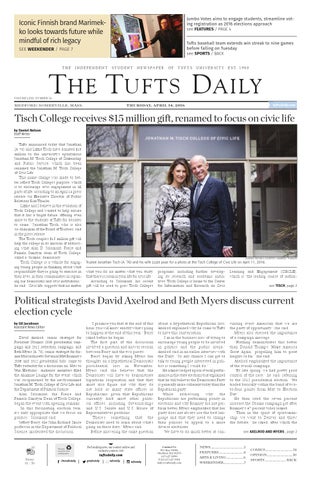
ALONSO NICHOLS COURTESY KIMBERLY THURLER
Trustee Jonathan Tisch (A ’76) and his wife Lizzie pose for a photo at the Tisch College of Civic Life on April 11, 2016. what you do, no matter what you study, that there is room in your life for civic life.” According to Solomont, his recent gift will be used to grow Tisch College’s
programs, including further developing its research and academic initiatives. Tisch College is home to the Center for Information and Research on Civic
Learning and Engagement (CIRCLE), which is “the leading source of authorsee TISCH, page 2
Political strategists David Axelrod and Beth Myers discuss current election cycle by Gil Jacobson
Assistant News Editor
David Axelrod, senior strategist for President Obama’s 2008 presidential campaign and 2012 reelection campaign, and Beth Myers (A ’79), senior strategist for former Massachusetts Governor Mitt Romney’s 2008 and 2012 presidential bids, came to Tufts yesterday for a discussion on “How to Win Elections.” Audience members filled the Alumnae Lounge for the event, which was co-sponsored by the newly-renamed Jonathan M. Tisch College of Civic Life and the Department of Political Science. Alan Solomont, the Pierre and Pamela Omidyar Dean of Tisch College, began the event with opening remarks. “In this fascinating election year, it’s only appropriate that we focus on politics,” Solomont said. Jeffrey Berry, the John Richard Skuse professor in the Department of Political Science, moderated the discussion.
Please recycle this newspaper
Sunny 51 / 36
/thetuftsdaily
“I promise you that at the end of this hour, you will know exactly what’s going to happen at the end of this year,” Berry joked before he began. The first part of the discussion involved a question and answer session between Berry and the two guests. Berry began by asking Myers her thoughts on a hypothetical Democratic presidential loss in November. Myers said she believes that the Democrats will have to demonstrate bipartisan cooperation and that they must also figure out why they do not hold as many state offices as Republicans, given that Republicans currently hold most other political offices, including Governorships and U.S. Senate and U.S. House of Representatives positions. “There’s something that the Democrats need to learn about what’s going on these days,” Myers said. Before answering the same question
For breaking news, our content archive and exclusive content, visit tuftsdaily.com @tuftsdaily
tuftsdaily
tuftsdaily
about a hypothetical Republican loss, Axelrod explained why he came to Tufts to have this conversation. “I’m in the business now of trying to encourage young people to be involved in politics and the public arena,” Axelrod said in an earlier interview with the Daily. “So any chance I can get to talk to young people interested in politics is something I would do.” He acknowledged a poor overall performance in the state elections but explained that he still believes the Democratic Party is generally more coherent today than the Republican party. While addressing why the Republicans are performing poorly in elections and why Romney did not perform better, Myers emphasized that her party does not always use the best language and that they need to change their policies to appeal to a more diverse electorate. “We have to do much better at con-
Contact Us P.O. Box 53018, Medford, MA 02155 617 627 3090 FAX 617 627 3910 daily@tuftsdaily.com
vincing every American that we are the party of opportunity,” she said. Myers also stressed the importance of a campaign message. “Nothing demonstrates this better than Donald Trump’s ‘Make America Great Again,’ propelling him to great heights so far,” she said. Axelrod emphasized the importance of the overall campaign. “By late spring, we had pretty good control of the race,” he said, referring to the 2012 presidential election. “We traded basically within the band of twoto-four points from May to Election Day.” He then cited the seven percent increase the Obama campaign got after Romney’s 47 percent video leaked. “Then in the spirit of sportsmanship, we went to Denver and threw the debate,” he joked, after which the see AXELROD AND MYERS , page 2
NEWS............................................1 FEATURES.................................4 ARTS & LIVING.......................6 WEEKENDER...........................7
COMICS..................................... 14 OPINION...................................10 SPORTS............................ BACK
2
THE TUFTS DAILY | News | Thursday, April 14, 2016
T HE T UFTS D AILY Sarah Zheng Editor-in-Chief
EDITORIAL Nicholas Golden Mengqi Sun Managing Editors Nicholas Pfosi Associate Editor Arin Kerstein Executive News Editor Isha Fahad News Editors Abby Feldman Melissa Kain Sophie Lehrenbaum Emma Steiner Ariel Barbieri-Aghib Assistant News Editors Kyle Blacklock Gil Jacobson Robert Katz Liam Knox Catherine Perloff Vibhav Prakasam Hannah Uebele Joe Walsh Kendall Todd Executive Features Editor Nicole Brooks Features Editors Nina Joung Jake Taber Diane Alexander Assistant Features Editors Constantinos Angelakis Emily Cheng Emma R. Rosenthal John Gallagher Executive Arts Editor Lancy Downs Arts Editors Justin Krakoff Josh Podolsky Jonah Allon Assistant Arts Editors Cassidy Olsen Eran Sabaner Hannah Hoang Dorie Campbell Emily Karl Erin Sifre Stephen Dennison Abigail Feldman Shannon Geary Allison Merola Cassie Bardos Miranda Chavez Frances DeFreitas Jake Goldberg Emma Henderson Michael Lefkowtiz Anita Ramaswamy Noah Weinflash
Executive Op-Ed Editor Op-Ed Editor Cartoonists
Editorialists
Maclyn Senear Executive Sports Editor Ray-Paul Biron Sports Editors Ross Dember Phillip Goldberg Alex Schroeder Chris Warren Yuan Jun Chee Assistant Sports Editors Maddie Payne Eddie Samuels Noah Smith
tuftsdaily.com
Top Republican and Democratic political strategists speak in ‘How to Win Elections’ event AXELROD AND MYERS
continued from page 1 Obama campaign led by three-to-four percent through Election Day. When asked about a possible contested Republican convention, Myers still believes that one of the three remaining Republican candidates will be the party’s nominee. “The reason that people go to Romney and [Speaker of the U.S. House of Representatives Paul] Ryan,” she said, “[is] that you can’t just look at one of our very abled Governors in the middle of July and say ‘Hey, meet Hillary Clinton or Bernie Sanders'” and expect them to be the nominee and run a campaign. Axelrod, on the other hand, noted the irony of how Republican presidential candidate Ted Cruz, someone who originally bashed the Republican establishment, is now the party’s last hope. “I think it’s hilarious what’s going on out there,” Axelrod said. When asked about how Former Secretary of State Hillary Clinton can energize her Democratic presidential campaign, Axelrod cited her language and image. “I do not believe that she will galvanize Democrats around her or her vision,” he said. “[But] I think a lot of Democrats are going to be very excited if Donald Trump is the candidate of the Republican party. Following Berry’s questions, the
JULIA PRESS / THE TUFTS DAILY
Beth Myers (A ’79) and David Axelrod talk about “How to Win Elections” on Wednesday, April 13, 2016. forum was opened up to questions from the audience. Sam Berzok, a senior studying political science, asked about the impacts of data journalism and analytics on campaigns. While Axelrod believes analytics are better than polling despite him relying on polling data, he did mention its negative impact on campaign coverage. “I think it’s kind of a shame because it’s made coverage lazy,” Axelrod said. Myers, while believing analytics are important, said that they do not replace talking to voters.
Waste Less Dinner at Dewick-MacPhie aims to reduce student food waste
Sofie Hecht Executive Photo Editor Alex Knapp Caroline Ambros Picture Tufts Editor Ray Bernoff Staff Photographers Laura DeArmas Maria Ferraz Henry Hintermeister Katlyn Kreie Mia Lambert Jiaxun Li Nora Nord Nicholas Pfosi Julia Press Evan Sayles Angelie Xiong
PRODUCTION Julie Doten
Production Director Astrid Weng Executive Layout Editor Jewel Castle Layout Editors Abbie Gantner Leila Li Allie Merola Brianna Mignano Mandip Pokharel Ellie Powers Annabelle Roberts Emily Sharp Andrew Stephens Sebastian Torrente Shirley Wang Petrina Chan Allison Merola Dana Pek Belinda Xian Jack Ronan Dan Strauss Meagan Adler Alison Beach Arthur Beckel Lancy Downs Alison Epstein Andrew Kager Melissa Kain Sarah Kalinowski Reena Karasin Sophie Lehrenbaum Rachel Salzberg Arielle Sigel Caroline Watson Maxwell Bernstein Nitesh Gupta Evan Sayles
MAX LALANNE / THE TUFTS DAILY
Students man the Waste Table at the Waste Less Dinner at Dewick, organized by Tufts University’s Social Collective and Tufts Dining, on April 13, 2016.
Creative Director Executive Graphics Editor Graphics Editors
by Isha Fahad
Executive Copy Editors
Tufts Dining and Tufts Sustainability Collective (TSC) jointly held a Waste Less Dinner last night at the Dewick-MacPhie Dining Center to promote less wasteful eating patterns within the student body. According to Tufts Dining intern Daniel Mulligan, the purpose of the event was to bring students’ attention to the amount of food waste at Tufts, and to the larger environmental and economic implications of post-consumer food waste. “The event [had] four educational tables, and students [participated] by visiting each of the educational tables with a Waste Less Dinner passport,” Mulligan, a junior, said. “If they receive all four stamps, they [were] entered into a raffle for Jumbo Cash.” According to Nutrition Marketing
Copy Editors
Executive Tech Manager Online Editor Social Media Editor
BUSINESS Yiran Xu Executive Business Director Qinyue Yu Receivables Manager Evan Sayles Online Advertising Eva Sachar Ad Managers Jay Hayes
Solomont then closed the conversation by thanking notable audience members as well as Berry. In an earlier interview with the Daily, Myers emphasized the importance of remaining involved in the political process. “I love talking to young people now, and I think a career in public service and getting involved in politics is one of the most exciting and important things for young people to do because the policies that are made today are going to affect you guys for a lifetime,” she said.
News Editor
Specialist Julie Lampie, 200 of these passports were distributed, and fewer than 30 turned them at the end for the raffle. The four educational stations were operated by Eco-Reps and TSCaffililated volunteers, who handed out the “passports” and disseminated information on repurposed food, water usage for growing crops, waste collection and composting, Lampie said. Mulligan explained that the educational stations each had different themes. One table, for example, highlighted compost as a means of reducing food waste that might be entering the trash, she said. “Tufts already composts all organic waste in the dining halls,” Mulligan said. “Now how can we reduce the 306 tons of food waste Tuft’s produced last year?” Karl Dias, founder of FATBOY Marinade, was at another station to explain how his company uses aesthetically imperfect
tomatoes that would have been left on the vine to produce custom blended marinara sauce for Tufts, according to Lampie. TSC Outreach Director Sophie Lattes explained that, at the end of the event, students were able to go to the “waste station” to scrape their extra food onto a scale so that event organizers could compare the night’s waste to that of an average night. She said she believes the event raised students’ awareness and thought process surrounding food waste. “Students were inquisitive, as not everyone was aware of the dinner agenda,” Lampie said. “Having the food collected and not having students placing their trays on the conveyor as usual made everyone aware to some degree that the dinner was about waste.” According to Lampie, about 40 percent of food in the United States is wasted, including a substantial amount of waste at Tufts. “Through our analysis at Dewick, we estimate that about 1.6 oz. of food are left on [each student’s] plate at the end of the meal period,” Lampie said. Mulligan explained that Tufts Dining has also analyzed leftover foods to determine how best to reduce food waste. “We have also audited waste coming back into the kitchen after meals and found that after breakfast students are leaving completely untouched, uneaten oranges and apples, as well as significant numbers of half-eaten bananas,” Mulligan said. “Because of this, Dining has decided to order smaller bananas for the dining hall and we hope future audits will help highlight other major causes of food waste.” Lampie and her team hope to inform students that it is best to take only the amount of food that they will eat. see WASTE LESS, page 3
Thursday, April 14, 2016 | News | THE TUFTS DAILY
News
3
TSC and Tufts Dining team up to address student food waste through dinner event WASTE LESS
continued from page 2 “Even though all the post-consumer waste is composted, in terms of food waste, that’s the least attractive alternative,” she said. Additionally, the event provided an opportunity to raise awareness about campus initiatives to reduce food waste, such as Tufts Dining’s recent decision to donate excess food to Cambridge-based
food recovery organization Food For Free, which serves low-income families in Boston, according to Lampie. Lattes explained that a representative from Food For Free was present at the event to explain the company’s work and look for volunteers. “Tufts students can sign up for shifts to take uneaten food that will not be preserved in the dining hall, but is still fresh and nutritious food, and divide
it into individual meals that Food for Free picks up,” Mulligan said. Lampie added that she and her team plan sustainability initiatives — often with student groups — throughout the year. This past fall, for example, Tufts Dining co-sponsored the VEG OUT@Dewick event, a meatless initiative, with the Eco-Reps. “Typically, student groups reach out to us, but occasionally, we will approach them with an idea and ask them to work with us,” she said.
Lampie said that Tufts Dining has already decided to repeat this event either next fall, or early second semester. “The Waste Less Dinner was well received by students this evening, and the two students coordinating the dinner with me were delighted and thought the dinner was a success,” she said. “We had good participation at the various stations, but the real take away was seeing the accumulation of food waste from student trays.”
Tisch College renamed to better reflect institution's aims TISCH
continued from page 1 itative research on the civic and political engagement of young Americans,” according to the program’s website. “The research is really an area of huge new interest,” Solomont said. “It’s a real expansion.” He explained that the gift will help Tisch College and CIRCLE expand its research of young voters, a voting bloc he believes could be extremely powerful so long as it engages in its civic duties. “You could change the political landscape dramatically,” he said, referring to eligible voters between the ages of 18 and 29. “But you’re not showing up to vote.” Tisch College’s current research initiatives investigate what drives the
influential youth voting bloc to the polls, and how to better engage young voters in the overall civic system, Solomont said. “What we’re seeing here at Tufts is that young people today want to be engaged,” Jonathan Tisch explained in the press release. “They want to make a difference. Hopefully they will bring the experience and knowledge from Tisch College with them as they work with others to create an even better world.” A portion of the gift will also go towards the Tisch College’s establishing of professorial endowments “in the emerging field of civic studies,” according to the press release. These endowments will help Tisch College, provide opportunities in civic engagement across all seven of schools at Tufts, Solomont said.
The gift will also contribute to the expansion of Tisch College’s student programs, such as providing stipends for summer internship opportunities in Boston and Washington, D.C. and for the 1+4 Bridge Year Service Learning Program. “We believe that higher education has a responsibility to act to help young people become agents for thoughtful advocacy, action and positive change. Jonathan and Lizzie Tisch share this belief,” University President Anthony Monaco said in the press release. “Their generous support … will advance Tufts’ position as an intellectual center for studying civic life.” The question of the administration’s role in promoting active citizenship on campus was brought up during Tufts Community Union (TCU) Senate’s Monday night TCU
Candidates Forum in Hotung Café. “They don’t want active citizenship on our campus because its something that’s problematic to administrators,” first-year Emily Sim, who was recently re-elected to serve on Senate, said. Solomont said that these comments from the student body demonstrate an important investment public life. “I think the fact that people are asking the question, and that they’re engaged in the answer, even if they think that the administration isn’t cultivating it as much in the ways that they would like … is a good sign,” he said. Solomont explained that he hopes that this gift helps give more Tufts students an opportunity to engage with public issues. “We want everybody who gets an education at Tufts to think about how they’re going to contribute to civic life,” he said.
4 tuftsdaily.com
Features
Thursday, April 14, 2016
Drake Jumbo Votes works to reform local voting system, Kinsey Channeling Ina bring elephantine numbers to the polls Nine dishes every by Sophie Lehrenbaum News Editor
In the midst of primary election season, the newly renamed Tisch College of Civic Life (Tisch College), formerly Tisch College of Citizenship and Public Service, and a number of on-campus political groups such as Cooperation and Innovation in Citizenship (CIVIC), Tufts Democrats, Tufts Republicans, Tufts Votes and the Tufts chapter of the American Civil Liberties Union (ACLU) have combined their efforts to develop a project called Jumbo Votes 2016. The primary goals of Jumbo Votes, a university-wide initiative spearheaded by Tisch College in coalition with the Office of the Provost, are to enfranchise Tufts students, facilitate political learning during the election season and work with Tufts’ host communities to improve some of the challenges students face that impede their abilities to exercise their right to vote, according to Jen McAndrew, the communications manager at Tisch College. McAndrew described the sweeping reach of the initiative, detailing that Jumbo Votes 2016 representatives are in every Tufts school and major administrative department and have a strong presence among the student body. She said that to advance their efforts, Tisch College recently hired a voting coordinator, current senior Diane Alexander, to help encourage and reinforce the efforts of student-run voting initiatives leading up to the election, like those of CIVIC. “By working with Votes through Tisch College, CIVIC is trying to help the campus-wide effort to not only make sure that people register, but also that they verify their registration before election day in order to minimize [the number of] students who are caught in the trap of having improper registration,” CIVIC Co-Leader Ben Hoffman said. Hoffman, a senior, pointed to various factors at play on campus that impede student voting. In particular, he mentioned that the transitory nature of student residences is a huge barrier. “Due to the fact that voting is tied to your residence and students tend to change [where they live] every year they are at Tufts, [it’s] very difficult for students to…simply remember what address they are even registered at and … to keep the voting rolls organized and not have people listed who cannot answer municipal censuses, which Tufts students never even receive in their dorms,” Hoffman said. McAndrew echoed many of Hoffman’s sentiments but also listed transportation, identification and knowledge of where to vote as issues that often confront students who are trying to vote for the first time. Moreover, she pointed to confusion centered around whether or not students are registered on the final voter lists. “[This issue typically arises] either because [students who] were removed from the lists are told that they had registered too close to the deadline, which is frankly confusing,” Hoffman said. “Students are not offered a provisional ballot when they are entitled to one, but may not know it, or are refused a provisional ballot altogether.” Hoffman explained that this practice of preventing students from acquiring provisional ballots is flagrantly illegal, although he attributed this challenge primarily to the city of Medford. He further elaborated on the barriers posed by a census-based voting system and how they directly impact students because of changing addresses, as well as on the required survey documents
not reaching students who live in the dormitory buildings, which sometimes results in their automatic removal from voting rolls. Senior Austin Kane, co-leader of CIVIC, said that disconnected information as well as faults on the part of volunteer poll workers have posed hurdles to advancing the student-voting effort. “People at Gantcher, volunteers, were turning Tufts students away before 7 p.m., which is against the law,” Kane said. “This is also a recurring problem for Tufts students voting at Gantcher, as for whatever reason staff there have not been cooperative in the past. Then there’s just a general problem of ignorance about the voting process.” A unique situation arises from Tufts’ geographic location: since the main campus sits between Medford and Somerville, constituents in this area are spread among four separate voting precincts. McAndrews sees this as the perfect situation to catalyze community and university cooperation to help students maintain influence in local policy matters and in particular, the voting process. “This will almost certainly be a longer-term conversation with the host communities, but it is a worthwhile one, in my view.” McAndrew said. “But in the interim, what we must do is ensure that all students know which precinct they reside in, where the polling place is, how to get there and access to help to get there. That is something that we are doing — and must continue to do — working directly with students through this initiative,” Hoffman speculated that these technical barriers might have more sordid roots, positing that the districts were drawn as such to temper the strength of the Tufts vote. “The cynic in me genuinely believes this is to carve up the Tufts vote into small fractions … If all of Tufts were in one precinct it would by and large guarantee Tufts having a large say over certain [political] races that would have the entirety of Tufts within their constituency,” Hoffman said. Hoffman clarified that the redrawing of districts would likely take place at the city or town level and explained that changes would most likely come to fruition as a result of doggedly lobbying politicians at the municipal level. In the meantime, according to Kane, CIVIC has been using other means to generate awareness about the election and facilitate student voting. “The group is very much focused on addressing and mitigating those problems [that keep students from voting].” Kane said.
“For example, prior to Super Tuesday this year, we had a big registration rush for student voters for about a week at locations in Carm, Dewick and the Campus Center and registered several hundred students on top of those we asked who were already registered, here or elsewhere. On the day of, Jumbo Votes ran shuttles from the Campus Center to each of the polling centers. It really was quite successful,” Ostensibly, larger-scale changes like redistricting would be long-term projects to undertake, but in the meantime, Jumbo Votes has looked to other methods that target students more directly to enfranchise students and facilitate voting. “We have convened student meetings on all Tufts campuses…[and] will have funding available for student groups to convene issue forums or other events on campus this fall related to the election [and we]…also have partnered with TurboVote, a non-partisan, non-profit organization to help students register to vote and request absentee ballots,” McAndrew said. She also highlighted Tisch College’s effort to have student groups make voter registration material available at their primary events and key locations on campus, as well as recently publishing a release of relevant voting information, which includes a detailed list of where students’ polling locations are, based on their dorms. For Hoffman, the main takeaway from this primary season is that students should know what their voting rights are and become increasingly aware of these barriers to student voting in order to maneuver them in the effective way. “What we can do is make sure that all students are always registered and verified before elections and empower students to know their right to a provisional ballot no matter what,” Hoffman said. And while McAndrew expressed similar suggestions for traversing the technical impediments to voting, she emphasized the importance of remembering that there is a strong motivational piece to the equation as well. “It’s not just about registering students, reducing barriers with cities and towns and ensuring that students know where, when and how to vote — although all that is critical,” McAndrew said. “It also means encouraging and supporting students in their own efforts to engage with campaigns and to bring issues and conversations on policy and political matters they care about to campus.”
ALEX KNAPP / THE TUFTS DAILY ARCHIVE
Tisch College Associate Director of Student Programs Sherri Sklarwitz (left) and Communications Manager Jennifer McAndrew (right) helped create Jumbo Votes 2016, an umbrella organization on campus to increase voter registration.
college student should know how to make
W
ant to win friends and influence people? Just feed them. Cooking doesn’t have to always be spontaneous, elaborate or stressful, nor does it have to look like a scene out of “Bridget Jones’ Diary.” With standby, reliable recipes in your toolbox, you can be equipped for any type of social gathering or meal. Skip the online articles for 30-somethings that suggest learning how to truss a chicken (Tufts is bougie, but not that bougie) and refer to the master list of recipes for college students: Chocolate chip cookies: A chewy, gooey, from-scratch chocolate chip cookie goes a long way. On top of making your whole dorm smell delicious while baking, I have yet to find someone who will refuse one hot out of the oven. Find your variation or recipe and stick to it — my personal favorite is Ashley Rodriguez’s recipe from the blog “Not Without Salt” that incorporates a few flakes of sea salt to take the cookies over the top. Brownies: If scooping and rolling dough isn’t your thing, make your signature dessert a big pan of brownies. Just like chocolate chip cookies, a big plate of fudgy brownies will earn you big brownie points at your next study group or club meeting. Elevate a basic mix with a few swirls of peanut butter or some chopped up peppermint patties in the batter. Eggs, any way: Omelettes for breakfast, poached eggs for brunch, Spanish tortilla for dinner (okay, okay I’ll give you a break on the last one). Eggs are simple to prepare and delicious to boot. A cute cheese plate: A block of cheese, fruit, jam and crackers can be put together faster than you can say “sophisticated.” Hamburgers on a grill: If you can handle a grill with the best of them, then you’re on your way to become the next barbecue and cookout star. The key is to refrain from frequent flipping to get a nice sear, and to take the burgers off the heat when they feel like the meaty part of your palm when gently pressed. Garlic bread: Buttery, flavorful, hot and sometimes cheesy — what’s not to love? All you need is a loaf of bread, minced garlic, butter and some optional mozzarella cheese. Spread everything on top of the bread and bake until golden brown and bubbling. Eat very quickly until bloated and content. Nachos: The dish that transcends every college social occasion. Take nachos up a notch and use real cheese instead of cheese sauce, and bake the chips and the cheese together to keep everything nice and crispy. Serve on a big tray with all your favorite toppings. Guacamole: With Chipotle charging more for a scoop of guacamole than a gallon of gas and the inadequacy of the guacamole squeeze packs found in the grocery store, what’s a college student to do? Answer: Buy three ripe avocados, lime, cilantro and an onion and make the best guacamole your friends have ever had. Have a friend provide you with a tray of nachos (see #7) and the two of you will be asked back to every Super Bowl party. Pasta: Pasta is a quick, cheap meal that works whether you’re serving yourself or a crew of twenty. Find your favorite sauce and shape (maybe some fusilli with pesto or penne alla vodka?) and make it your dinner party standby. Kinsey Drake is a sophomore majoring in biochemistry and she can be reached at kinsey.drake@tufts.edu.
tuftsdaily.com
Thursday, April 14, 2016 | ADVERTISEMENT | THE TUFTS DAILY
M IRA N AIR Between Two Worlds Wednesday, April 20, 2016 6 - 7:30 pm Cohen Auditorium, Tufts University 40 Talbot Avenue - Medford, MA 02155 Film Screening at the Brattle Theatre on April 19th at 7pm Mira Nair is the Oscar-nominated director of such major feature films as Salaam Bombay! (1988), Mississippi Masala (1991), Monsoon Wedding (2001), The Namesake (2006) and The Reluctant Fundamentalist (2012). Her films, which speak to audiences worldwide, explore social dynamics and interpersonal relations at the intersection of race, gender, diaspora, cultural encounter, and inter-generational conflict. Away from the camera, Nair has established a non-profit institute, Maisha, dedicated to training and supporting screenwriters and directors in East Africa and South Asia.
Funded by the Andrew Mellon Foundation, Tufts Collaborates, the Center for Humanities at Tufts, the Toupin-Bolwell Fund, Consortium of Studies in Race, Colonialism, and Diaspora, CSAIOS, and the Hutchins Center at Harvard
5
6 tuftsdaily.com
ARTS&LIVING CONCERT REVIEW
Rihanna conquers TD Garden with gutsy ‘Anti’ World Tour by Justin Krakoff Arts Editor
When the lights went down this past Sunday at Boston’s TD Garden, no one in the audience was quite prepared for Rihanna — perhaps this decade’s biggest and best hitmaker — to come out singing “Stay” (2013), a rather soft ballad from her previous studio album. In the end, it didn’t matter; the screams that greeted her arrival into the packed arena were amplified by the subdued nature of the track, and when the 28-year-old Barbadian pop icon pulled off the hood obscuring her face, fans could not contain themselves. After more than 10 years into her career, Rihanna has effortlessly maintained her status as one of pop music’s boldest and most innovative purveyors. With songs such as the addictive “Umbrella” (2007), exuberant “We Found Love” (2011)” and majestic “Diamonds” (2012), her back catalogue towers above those of her peers and serves as a potent reminder of the effect she has had on the sound of Noughties pop. However, the release of her latest studio album, “Anti” (2016), was marked by numerous delays and even a botched rollout on Jay Z’s streaming service, Tidal. While these incidents may have threatened to sink any other pop star’s career, Rihanna’s brand appears to remain unaffected. Her eighth studio album’s lead single, “Work,” is currently spending its eighth week at number one, and the tour in support of the said album continues to captivate her fans. Following the rather tame opening numbers of the Anti World Tour, Rihanna continued with an eclectic mix of her signature hits and lesser known album tracks, including “Umbrella” and “Numb” (2012), respectively. Even though her signing was somewhat lacking during certain songs, and she seemed unwilling to commit to finishing entire songs, the pop powerhouse never once failed to keep the audience entertained. About halfway through the show, she even took a moment to apologize for being roughly an hour late, attributing the delay to an accident with a kettle of hot water. During this lovely, unscripted interaction with the audience, Rihanna’s island accent came through, which further served to highlight the Caribbean themes carried throughout the show and remind the audience of her rich heritage. It was at this point that the unapologetic pop star declared that it was
LIAM MENDES VIA WIKIMEDIA COMMONS
Rihanna pictured on April 10, 2012. time to dance, and “everybody better stopping texting their exes or baby mamas.” Featuring fresh takes on arguably some of her best songs, Rihanna ripped through “Take Care” (2011) with a fantastic dance break and an endearing mashup of Calvin Harris, “How Deep Is Your Love” (2015) and her own “We Found Love.” Again, Rihanna took a moment to engage with the audience as she asked everyone if they were having a good time (a no-brainer question, to be fair) and responded, “That’s good. You would let me know if I was f*cking it up.” As the show wound down, she proceeded to thank her fans and crew, leaving one with the sense that her job as an entertainer is about more than just partying. Despite the carelessness she may exhibit in the brand she sells to the masses, there is a warmth to her that most other stars
simply fail to match. This coincided with the most rewarding part of the show as she asked fans to put their phones in the air for a beautiful rendition of “Diamonds” and sing along to last year’s “FourFiveSeconds.” “Love on the Brain,” an album track from “Anti,” featured her best vocals of the night as she perfectly captured the track’s lovelorn nature and hit the song’s rather challenging notes. While some singers prefer to sing their most vocally intensive songs at the beginning of a show, Rihanna’s decision to do the exact opposite is perfectly indicative of the fearlessness she exhibits as a pop star. This moment, like many others in the show, demonstrate why the Anti World Tour is a perfect snapshot of her career. While other stars need garish sets or over the top vocal acrobatics, Rihanna only needs herself to put on a fantastic show.
Want to get campus news the moment it happens? Follow us on Twitter and Facebook! /thetuftsdaily @tuftsdaily
/tuftsdaily /tuftsdaily
Thursday, April 14, 2016
Stina Stannik After Years
Chapter Nine Editor’s note: This column is part of a fictional weekly serial. he car and its passengers bounced so wildly in its speeding progress that Alicia worried that she would accidentally discharge the gun she held pressed against the steering wheel with one hand. Her father had thus far shown no intention of revolting against the abrupt kidnapping — he was more bemused than anything else, actually. The others had assured her that he had no memory of his violent past, but until that could be verified, she was willing to overcompensate where weaponry was concerned. “You — hold up — that was the exit to the city, you’ll have to turn around in a moment,” Edgar called out, twisting in his seat to look over his shoulder. “We’re not going to the city, dad,” Alicia replied calmly. Considering all the obstacles which had already arisen, Alicia was proud of herself for the ease with which she was managing to carry forth the plan. Her father’s transatlantic phone call, speaking wistfully of time lost and bonds to be repaired and death imminent, had provided a perfect opportunity, catalyzing a project long in the works but thought to be impossible to complete. She had encouraged Cecilia to join her for the visit out of an expectation that to do so would be to, in fact, discourage Cecilia from wanting to do exactly that; moreover, it would have looked strange if anyone, looking into the visit, found Edgar’s granddaughter had been neither informed nor invited. The last thing she expected was for Cecilia to agree to come, and that had been the first complication. Nor had she expected Cecilia to actually try to track down information about Edgar’s past. Personally she thought there were less disruptive ways to do that than attempting to hack into the national security service’s records, but everyone had their personal style with these things. The agency’s decision to give Cecilia so much information, while simultaneously withholding as much, was disturbing and hinted at machinations which worried Alicia and her colleagues. “Just up here’s the exit to the casino, was that the one you were looking for?” Edgar was beginning to look panicked. Alicia ignored him. Then the gun, of course. She’d been careless to leave it somewhere Edgar could find it, but she honestly hadn’t expected him to be in the habit of searching people’s bags. It seemed a remnant of his past self, a suggestion that maybe not everything from that era was forgotten. In any event, his discovery of the gun merely jumped the plan forward a few steps. Everything was back in order. Except for Cecilia. She still hadn’t figured out how to deal with her daughter. They veered off the main road onto a dirt street alongside a set of train tracks. Within minutes they reached the end of the tracks, and Alicia parked the car. “Well, dad, I need your help.” She gestured with the gun for him to open the door. The moment of truth – of success or abject failure — was upon them.
T
Stina Stannik is a senior majoring in peace and justice studies. Stina can be reached at Stina.Stannik@tufts.edu.
THURSDAY, APRIL 14, 2015 | ARTS & LIVING | THE TUFTS DAILY
Unikko Newbury by Cassidy Olsen
Assistant Arts Editor
GAIL OSKIN/GETTY IMAGES FOR MARIMEKKO
The atmosphere at the Marimekko Boston Design Week Reception With Petri Juslin at the Marimekko Boston Store on April 6 in Boston, Massachusetts. n Boston’s Newbury Street, the city’s fashion and retail hub, there’s an abundance of little details that catch the eye. Walking along the street in early spring, you might spot shoppers ducking into the high fashion standards like Chanel and Valentino to escape the unseasonable Boston weather and warm their hearts with luxury purchases. Or perhaps you might notice the line forming out the door of Georgetown Cupcakes (sorry, they’re out of the secret flavor) and the friendly faces populating the restaurant patios when it’s finally sunny. Amid all these details, you would be remiss to overlook the colorful display — pink-and-orange florals on black-and-white polka dots — in the window of 140 Newbury, the Boston outpost of the Finnish design house Marimekko. Known for its distinctively bold printed fabrics and simple styles, Marimekko has called Boston home since the store’s opening in August of 2012. This month, in honor of the third annual Boston Design Week, Marimekko Newbury held a reception to celebrate the brand’s decades-long history of print design and to explore the ways current designers balance that heritage with an eye toward the future. The store welcomed Marimekko Artwork Studio Manager Petri Juslin from the company’s studio in Helsinki, Finland to present at the reception on the evening of April 6. Dressed in a charcoal suit and subtly striped button-down, Mr. Juslin appeared businesslike and subdued next to Marimekko’s walls of colorful throw pillows and spools of patterned fabric. In a conversation with the Daily, the studio manager described the origins of the brand’s iconic patterns, used in women’s fashions and home furnishings, which decorate the store. “The Marimekko design philosophy was established in 1951 by Armi Ratia,” he said. “It really was one of the first lifestyle companies. There were no colors or materials in Europe after the war — the idea was to bring colors and joy into people’s everyday lives.” This design philosophy, Juslin believes, has carried through the company’s history and into the present day. “I think that is still the same idea behind [Marimekko]…as well as [the idea of ] encouraging people to express themselves in their homes and their dressing,” he said. Marimekko found huge success internationally in the late 1950s and 1960s, particularly in the United States after Jacqueline Kennedy wore a
number of Marimekko dresses during the 1960 presidential campaign. Two pioneering female designers, Vuokko Nurmesniemi and Maija Isola, were responsible for the creation of two of the brand’s most famous patterns — the striped red and white Jokapoika shirt and the iconic Unikko (poppy) print. Juslin noted that current Marimekko designers look to these classic patterns for inspiration and have found that they regularly cycle back into popularity. Pointing to an oversized black-and-white checked jacket, Juslin said, “I was just going through some old pictures in the archives and noticed that pattern was a very big hit, according to the newspaper clips from the 60s. It was a very successful pattern then, and I have big expectations for it now.”
“Everyone at Marimekko, myself included, is very happy about the results [of the collaboration]” Juslin said. “We think it’s a great opportunity for us to reach some new fans in America.” Later in the evening, when presenting on Marimekko’s prominent current designers, Mr. Juslin joked that despite their massive non-digital archives — more than 2,000 patterns are still on film — the company is still coming up with new designs and working toward the future with innovative design technologies and approaches. “To show everyone [the archives] would be special,” he said. “But we’re more than a gallery.” Juslin’s ties with textile design and the Marimekko brand are strong. He has been with the company since 1986 and has spent 30 years working closely with more than 150 print designers. His start, however, was not in design schooling or formal education. “I didn’t have any degree at that time I began,” he explained. “I was 23, but I had a passion for printed textiles after seeing them all my childhood and teenage years. In those days, in Finland, printed fabrics were everywhere in homes, and I found it an interesting form of art, really, which could be developed into different social layers — especially because it’s quite affordable.” The studio manager elaborated on textile printing as an art form and how it influenced his beginnings at Marimekko. “Screen-printed fabrics are almost like graphic art…I wanted to learn and perhaps test myself to
see [if I could] be in the industry,” he said. “Luckily, I got a job in the Marimekko printing factory, and soon I was working in the artwork studio. By 1989 I was in charge of the whole studio.” In the studio, Juslin’s responsibilities are different from those of employees who are strictly designers or business managers. He is familiar with the technical aspects of both design and production, so he acts as the medium connecting the two vital aspects of Marimekko’s production model. “I’m the main person responsible for adapting the designs into the production, and I’m also helping the designers to understand the possibilities of production and challenging the production to meet the needs of the designers,” Juslin said. “So it’s been quite an interesting spot to be in, to see both sides and try to connect them.” In his presentation, Juslin explored the challenges to production that designers occasionally don’t understand, including color bleeding when using screen-printing and hand printing in designs. Marimekko is working to honor its roots in hand-printing while exploring new approaches to textile designs, he said, including digital and physical modeling with objects like tree branches and torn pieces of paper. Juslin hopes that these designs will find even larger audiences with Marimekko’s new collaboration with Target, which debuts nationwide April 17. To honor the release, New York City’s High Line featured a Marimekko installation from April 8 to 11, with a launch party attended by A-listers such as Rose Byrne and Olivia Wilde. The Target line will feature products ranging in price from $8 for sunscreen to $500 for a printed paddleboard, though most items will be available for under $50. “Everyone at Marimekko, myself included, is very happy about the results [of the collaboration]” Juslin said. “We think it’s a great opportunity for us to reach some new fans in America.” In light of the population of student designers in Boston, Juslin also had a few words of advice for young designers. “Draw a lot, paint a lot, use your hands. You don’t learn it by reading books. You have to draw every day, for hours,” he laughed. “[Pattern design] is a long process to learn. But you must try and learn it.” With new designers, techniques and collaborations on the horizon, Marimekko will continue their tradition of, in the Juslin’s words, bringing color and joy into people’s everyday lives.
8
THE TUFTS DAILY | ADVERTISEMENT | Thursday, April 14, 2016
EXPLORE
flex learning
at UMass Boston this summer
Register Now!
Learn more at: summer.umb.edu 700+ courses that keep pace with your summer
More than 100 online options
Session I begins: 5/31 Session II begins: 7/18
Mornings, afternoons, and evenings
Seven off-site locations from Nantucket to Springfield Hundreds of courses in dozens of subject areas for undergraduates, graduate students and professional development
The Tufts Department of Drama and Dance presents
2016 SPRING DANCE CONCERT Featuring work by graduating Dance Minors
Friday & Saturday, April 15 & 16 @ 7PM Sunday, April 17 @ 5PM Friday, April 29 @ 7PM & 9PM
For more information visit: http://dramadance.tufts.edu/
tuftsdaily.com
tuftsdaily.com
Thursday, April 14, 2016 | ADVERTISEMENT | THE TUFTS DAILY
A new name, a new plan, a new way forward. Our communities face tremendous challenges, and universities have a responsibility to develop the next generation of active citizens who will address them. For 15 years, Tisch College has answered that call, emerging as a leader in education, research, and practices that empower individuals to take action in our world. Today, we do so with a new name that better captures the work that lies ahead:
Jonathan M. Tisch College of Civic Life Why Civic Life? Because the task of creating, sustaining, and improving our communities and democratic institutions is not confined to the classroom or the boardroom; the town hall or the town square; the soapbox or the ballot box. We all are engaged in civic life when we organize and debate, when we serve, and when we advocate and act on the issues that affect us. The more active our civic life, the more just, equitable, and prosperous our world becomes. Our new name better reflects our mission: to prepare students for a lifetime of effective engagement in civic and democratic life. Through groundbreaking research, we study civic life and the institutions that shape it. And we leverage that knowledge to promote practices that support the efforts of individuals and communities who seek the greater good. A new strategic vision guides this vital work, and the present moment urgently demands it. We call on our students, faculty, staff, alumni, and partners, at Tufts and around the world, to help us see it through.
For a more in-depth look at our vision for Tisch College, visit activecitizen.tufts.edu/strategicplan
activecitizen.tufts.edu
9
10 tuftsdaily.com
Opinion EDITORIAL
Candidates for TCU President should keep key issues in mind According to the Tufts Community Union (TCU) Senate constitution, a newly formed body is required to meet within three academic days of electing a new Senate. Following Tuesday’s elections, Senate will gather soon to nominate candidates for TCU President. Whether the next president runs unopposed or in a contested race, they will inherit a campus where the Senate has already made meaningful gains. As a group, the Senate was instrumental in convincing the administration to change Columbus Day to Indigenous Peoples Day, taking a significantly more visible role in its advocacy. Other background policy discussions on minors for French and Spanish and class requirement changes are also in the works. The new president will, however, inherit a weighty agenda for changes in campus life and reforms inside of Senate that students should keep in mind as the campaign begins. Since last year’s changes to club funding for off-campus travel, the Senate has come under scrutiny for how
it funds student organizations. Cultural groups, as well as campus media organizations such as WMFO, have faced difficult rules changes and steep cuts to their budgets, all while questions have been raised about transparency in decision making by the Allocations Board. The next president will have to consider how best to continue to open up the Senate’s processes as the body has done with its weekly videos, and whether the broader allocation of funds is on the right track. The demands of #TheThreePercent also need to continue to be present in our community, as well as the broader questions those demands illustrate about the lack of racial diversity on campus. The next president should keep in mind specific policy items including advocating support for “undocumented, international and first-generation students,” as well as increasingly broader university transparency on student demographics, acceptance and admittance rates. As one student advocated to the Senate last fall, the
university could strongly benefit from a Senate report comparing how Tufts does with outreach to black students as compared to peer schools in New England. Another issue that remains ever-present for Senate to grapple with is that of university housing. The president needs to be aware of the lack of sufficient on campus housing, the safety of all Tufts student residences and the rising costs of often-exploitative off-campus housing situations, and continue to work with other senators and administrators to address housing problems. These issues impact all of us within the Tufts community outside of every Senate meeting, so it is important that every member of the community take careful stock of the platforms and qualities of the candidate or candidates who will be nominated for TCU President. Senate has shown us this year that they can enact tangible, effective changes, and we encourage students to make their voices heard in this year’s presidential election to ensure that they continue to do so.
EDITORIAL CARTOON BY STEPHEN DENNISON
The Tufts Daily is a nonprofit, independent newspaper, published Monday through Friday during the academic year, and distributed free to the Tufts community. The content of letters, advertisements, signed columns, cartoons and graphics does not necessarily reflect the opinion of The Tufts Daily editorial board. EDITORIALS Editorials represent the position of The Tufts Daily. Individual editors are not necessarily responsible for, or in agreement with, the policies and editorials of The Tufts Daily. OP-EDS The Op-Ed section of The Tufts Daily, an open forum for campus editorial commentary, is printed Monday through Thursday. The Daily welcomes submissions from all members of the Tufts community; the opinions expressed in the Op-Ed section do not necessarily represent the opinions of the Daily itself. Opinion articles on campus, national and international issues should be 600 to 1,200 words in length and submitted to oped@tuftsdaily.com. The editors reserve the right to edit letters for clarity, space and length. All material is subject to editorial discretion and is not guaranteed to appear in the Daily. Authors must submit their telephone numbers and day-of availability for editing questions. ADVERTISING All advertising copy is subject to the approval of the Editor-in-Chief, Executive Board and Executive Business Director.
Thursday, April 14, 2016
Aren Torikian The Arena
Cruz missile
C
andidates like Donald Trump are exciting. Trump is guaranteed to bring out thousands to his events and generate copious decibels of noise. He has built a campaign on telling it like it is and refusing to be politically correct. Ted Cruz, on the other hand, is boring. He brings hundreds to his events and utters Ronald Reagan’s name a few times to get the crowd going. His demeanor is confident but not quite as in-your-face as Trump is. But for those afraid of what Trump stands for, Cruz may be the far more dangerous candidate. For one, Cruz is much more reliably conservative. For instance, Trump donated money to the Carter campaign — against Reagan no less. While Cruz has consistently advocated against abortion, Trump was pro-life until the last few years, and has just recently gotten harsher on issues like gun laws and health care. I’m sure he has changed as a person, but Trump seems to be saying exactly what the people want to hear. President Trump would act differently than candidate Trump. As Jimmy Carter put it, Trump is “malleable” while Cruz is not. The biggest difference between the two is that Cruz knows what he’s doing. Take last weekend’s Colorado nominating process, for example. I call it a process because it was not a primary, nor a caucus. At the nominating convention, “voters” decided the 34 delegates who would attend the national convention (the one in Cleveland). Cruz ended up with every single delegate. The Cruz campaign had volunteers on the ground handing out lists of the delegates it wanted. Trump’s organization was not quite as extensive. This is a problem he has had throughout the primary campaign. As a result, Trump’s difficult delegate math got even tougher, and the odds of a contested convention got even bigger. Trump’s problem is one shared by a lot of far-right candidates of his sort. The enthusiasm and energy are easy; the organization is much harder. Furthermore, these sorts of candidates elicit a response from all parts of the political spectrum — Ted Cruz has become the anti-Trump. This is why far-right candidates and parties struggle to make head way, both in the US and in Europe. In France for instance, the National Front (FN) can never quite knock either of the traditionally powerful parties out of office. French elections can go to a runoff between the top two candidates, and if the FN is one of them, the rest of France unites to keep it out of office. While the US is of course different, I think we could see that effect in November if Trump wins. He would elicit the same type of response that the FN does. Moderate independents and even some Republicans would ensure a Democratic victory. But I’m not sure Cruz would elicit this response. Even though he is historically more conservative in his views than Trump, he won’t be perceived as an extremist. And that’s what should make a Cruz candidacy scary for liberals. Aren Torikian is a sophomore who has not yet declared a major. Aren can be reached at Aren.Torikian@tufts.edu.
Thursday, April 14, 2016 | Opinion | THE TUFTS DAILY
Opinion
11
OP-ED
A very different Dowling Hall by Khuyen Bui On April 1, I saw on one of the most beautiful things I’ve seen in Tufts — the transformation of a place often thought of as the epitome of paperwork and bureaucracy into a place for genuine connection and inspiration. When we shared with our friends that the Art in April kickoff event would take place in Dowling, many asked us again “Dowling?” We don’t think of Dowling as a place for that kind of thing, do we? If anything, Dowling is the perfectly ironic place for an exhibition themed “Art as a Therapy” because it may as well be the main reason therapy is needed for students in the first place. It is a physical manifestation of the larger culture in many selective universities: high achieving, ambitious mentality that puts enormous pressure on students to produce and perform. Academic support exists because someone in authority believed a student’s performance wasn’t satisfying enough. Career center is filled with anxious young people coming in to get instructions on how to get ahead of the career game. Worse, bureaucracy does suck the life out of people who are in it. One of my friends shared with me that someone in Dowling had once said to her in resignation “Life is a bureaucracy.” These cynical views are not completely false. But they are not completely true either.
Dowling was different on April 1. Within half a day, the place was transformed. Powerful artwork was up on the corridors. Study abroad and company talk rooms were transformed into a yoga studio and mini theater for video art. The reception area became the gathering for an appreciative audience and a stage for artists’ monologues and lively music later on. As the gorgeous sun came down, music deepened. Talented musicians shared their passion for music with the audience in an intimate space. People sat on chairs, spread on couches or stood behind; all engaged, connected. Many of our eyes were glowing. At one moment in the music, I looked up to the ceiling and noticed how beautiful Dowling Hall was – high glass ceiling, wide open space, great lighting and I thought: This is it. This will be our little contribution to transforming our relationships with Tufts. If we can use this space more regularly to bring together and showcase students who are genuinely passionate about their work — whether it’s art, music or dance or science or languages or any cause, we can create a stronger sense of Tufts community. It will also help change the not-so-great perception of many Tufts students have with “The University Bureaucracy”. Dowling doesn’t have to be thought of as just about paperwork and bureaucracy. After all, it is
considered a center for student services. It could serve students better. We can reimagine and revitalize the space by bringing a different energy to it — an energy of openness, authenticity and genuine connection instead of close-mindedness, formality and superficiality. After the event, the only TUPD officer there told us that it was a “stress-free” event for him, that he enjoyed seeing the artworks and the live music. It was perhaps the best compliment we got yesterday: he had the time to appreciate the arts we brought instead of worrying about nasty things happening! As organizers, we first worried that the space was too small for loud music. It turned out to be the perfect constraint: the small size allowed us to have quality music and intimate audience interaction. We learned from the experience that when we could bring people who shared similar spirit of service, we can trust that good thing would happen, and we want to invite those of us who are passionate about our work to reach out, collaborate and co-create on this beautiful space. Together, we can have a very different Dowling Hall.
Khuyen Bui is a sophomore majoring in Computer Science. He can be reached at Khuyen.Bui@tufts.edu.
Want to get campus news the moment it happens? Follow us on Twitter and Facebook! /thetuftsdaily @tuftsdaily
“CAMBRIDGE CARES ABOUT YOU”
CASH FOR YOUR USED CAR CONGRATULATIONS GRADUATES! WE WISH YOU WELL ON ALL THAT YOU PURSUE! IF YOU NEED TO SELL A USED VEHICLE WE PAY
TOP DOLLAR! CASH ON THE SPOT! CALL DECLAN AT...
617-864-5900 www.CambridgeHonda.com 275 Fresh Pond Pkwy, Cambridge
Only a few days left... Tell the University what you think about housing at Tufts! Include your voice in the housing master planning study.
UNDERGRADUATE HOUSING SURVEY
Check out this fun web-based survey at http://mycampus.sasaki.com/tufts-housing/ and drop icons on where you live and what you like (or not) about your residential housing experience at Tufts - on or off campus where you like to study, where you spend your down time, etc. Where would you prefer to live and why? What do you think about the lottery system? Tell us about it. If you'd like, enter a drawing at the end of the survey to win a new Tablet! Survey closes Saturday, April 16, 2016
12
THE TUFTS DAILY | ADVERTISEMENT | Thursday, April 14, 2016
tuftsdaily.com
tuftsdaily.com
Thursday, April 14, 2016 | ADVERTISEMENT | THE TUFTS DAILY
13
TUFTS SUMMER SESSION 2016 prepare. eXpaND. Develop. school of arts and sciences | school of engineering
Three sessioNs: May 25–July 1 | July 5–augusT 12 | May 25–augusT 12 go.tufts.edu/summer Follow us on facebook:
College & Pre-College Programs Day & Evening Classes Affordable Tuition
Outstanding Tufts Faculty Online Courses
14
THE TUFTS DAILY | Comics | Thursday, April 14, 2016
Comics
tuftsdaily.com LATE NIGHT AT THE DAILY Sarah: “Alex, why are you so amazing?” Alex: “Because I have a car - just like high school dating.”
Comics
SUDOKU
JUMBLE
Difficulty Level: Getting a good night’s sleep.
Wednesday’s Solution
NON SEQUITUR BY WILEY MILLER
CROSSWORD
Thursday, April 14, 2016 | Sports | THE TUFTS DAILY
Sports
Tufts bounces back from tough Saturday with pair of wins against Amherst WOMEN'S CREW
continued from BACK In the final competitions of the race, the third varsity eight boat split its races, falling in the first race to Trinity by just over four seconds and beating Hamilton in the next with a 7:32.9 time over the Continentals’ 7:39.3.
Following the most recent win against the Purple & White, the Jumbos hope to continue on their upward swing in their last home regatta against Middlebury College on April 16. After the home regatta, which will also feature Tufts’ Senior Day, all crews will report to Worcester, Mass. to compete in the Brown and
Baker Cups on Lake Quinsigamond against WPI, William Smith, Skidmore and others. Women’s crew, following one of its most successful seasons in recent years, heads into the final events of the season looking strong and ranked as one of the top teams in Div. III.
SOFTBALL
After troubled start to season, Jumbos get back to impressive form by Isabel Banta
Contributing Writer
The softball team got back to its usual style of play this weekend, sweeping a threegame series at Colby from Friday to Saturday and then returning home to sweep a doubleheader against Bowdoin on Sunday. Playing five games over three days seemed to have little effect on the team’s stamina or on its offensive production as the Jumbos beat the Colby Mules by 6-1, 10-8 and 14-5 margins. In Sunday’s doubleheader, which was rescheduled from the previous weekend, the Jumbo bats stayed hot as they downed the Bowdoin Polar Bears 11-6 in the first game and 11-3 in the second. After a pair of troubling losses to Williams in a March 30 doubleheader, which didn’t affect Tufts’ conference record since Williams plays in the NESCAC West division but still poses a challenge to the team’s hopes of winning the NESCAC title again, Tufts responded with a win over Bowdoin on April 1 and then five more NESCAC East victories this weekend to move to 6-0 in conference play this season. The Jumbos are used to being undefeated in the NESCAC East: after this weekend’s results, they now have 55 consecutive NESCAC East wins dating back to 2011. Although the Williams losses were a blow to the team’s confidence, coach Cheryl Milligan believes they were merely illustrative of poor team play in those games rather than a decrease in the team’s ability over previous years. “If losing to Williams was not shocking to us, neither was sweeping Bowdoin and Colby. We will live and die by our performance every game,” Milligan told the Daily in an e mail. “There is no magic to our winning and therefore, no additional significance to our losing other than that we didn’t play well. We are a tough team to beat when we run our defense, and we make the other team work hard to get us out. We are, like most teams, fairly easy to beat when we don’t play our game. We’ll keep focusing on our offense and getting better on defense, and the rest will take care of itself.” The players, meanwhile, believe the losses to Williams spurred their recent streak of impressive play.
“I think the losses to Williams lit a fire under us because as a team, we do not like losing,” senior co-captain and pitcher Erica County told the Daily in an email. “I think the losses made us realize that we need to bring more intensity to our games, which is what we tried to bring to the Colby series.” In the first game on Friday, both County and Colby’s sophomore starter Julia Saul impressed on the mound and scoring was limited through most of the game. But in the sixth, with the score tied at one-all, the Jumbos lit up Saul for five runs, with seven of the team’s 11 hits coming in the inning. Junior first baseman Cassie Ruscz, a perennial leader for the Jumbos at the plate, picked up two hits and three RBIs in the game. Sophomore catcher Michelle Chisdak had two hits, an RBI and a run, while classmate and left fielder Samantha Siciliano scored a run as well. County hung on to the 6-1 lead in the seventh to secure the win. In the first game on Saturday, the Jumbos were in trouble down 8-5 going into the seventh. But in a dramatic comeback, Tufts’ hitters pulled through for a five-run rally in the top of the seventh, capped off by a twoout, three-run home run from sophomore center fielder Raina Galbiati — the first of her career. The Jumbos got the early lead with two runs in the first and then extended that lead with three more in the third, before first-year starter Amolee Hawkins struggled in the third and gave up seven runs to the Mules’ hitters. Tufts played from behind for most of the game until Galbiati’s heroics in the seventh and then County, in relief of Hawkins, held on in the bottom of the inning for the win. Later on Saturday, the team completed the sweep against Colby, powered by 14 hits and five Colby errors. The score stayed close through the first few innings until the Jumbos pulled away with four runs in the fifth and five in the seventh. County got the start and went the distance in the game, earning her third win in as many games. Sophomore right fielder Raven Fournier homered in both Saturday games, with her solo shot in the third inning of the second game giving her team a lead they would not relinquish. First-year shortstop Christian Cain
SOFIE HECHT / THE TUFTS DAILY
Pitcher Erica County (LA ‘16) pitches in Softball’s 7-5 win against Bowdoin on April 1, 2016.
showed how comfortable she’s gotten in collegiate play, hammering a grand slam in the fifth for her first career homer and scoring three runs in the nightcap. County was impressed by the play of the team’s younger players, citing Cain and Galbiati as players who had impressive weekends. Showing no signs of fatigue as they came home on Sunday to take on the Bowdoin Polar Bears, the Jumbos exploded for double digit run totals in both games of the doubleheader. Like the Colby games, the first game took a while to heat up. The Jumbos got a run in the first inning but neither team scored again until the fourth when Siciliano hit a two-run double. But Bowdoin came back strong with six runs and eight hits in the fifth inning to take a 6-3 lead. Still undeterred as they trailed another NESCAC East team, the Jumbos again put together an impressive late rally with eight runs in the sixth to take the 11-6 lead, which they held to the end. In the final game of the weekend, the Jumbos cruised to another big win on the back of more strong pitching from County and hot Jumbo bats. Tufts led 2-0 early on in their rematch until Bowdoin tied it up in the third inning. But with a two-run home run from Cain in the fourth that headlined a fiverun inning, Tufts began to pull away, following up with a four-run fifth inning that ended the contest with the hosts up 11-3. For her seven hits, eight RBIs and six runs across the five games, which also saw her hit the first two home runs of her career, Cain earned NESCAC Player of the Week honors. She is the second Jumbo to do so in the first four weeks the award has been given out, following Cassie Ruscz, a junior, who earned it in March. “Our comebacks when we got behind in a Colby game and a Bowdoin game really showed our ability to stay tough and deliver under pressure situations,” County said. After scoring 52 runs across the five games this weekend, the team seems to have regained its confidence. But looking forward, the Jumbos still plan to take their season one game at a time. “It’s important that we go into each game moving forward with more intensity than the last,” County told the Daily in an email. “When we are able to keep our energy up as a team that is when we have been more successful. As a result, we need to keep working hard, learning from our mistakes and getting better with each game that we play.” Reflecting on previous games, County said the team needs to continues its intensity. “We played our toughest NESCAC East opponents and played well,” she told the Daily in an e-mail. “They are our biggest games and we came through, showing some toughness and relentlessness in coming from behind as well as in playing five in three days. We will need to keep our intensity and drive up going forward, because no one is going to hand us much as we get into late season.” The team now gears up for a three-game series at home against NESCAC East rival Trinity, with the first game starting at 4 p.m. on Friday and the other two starting at noon on Saturday.
15
Ryan Schneiderman Outside the Boot
A failed prediction and a happy fan — Manchester City advance
L
ast week, I predicted that Paris Saint-Germain (PSG) would advance past Manchester City to secure a spot in the Champions League semi-finals. As a die-hard City fan, it was not difficult to see that the team was in a bad run of form. When Pep Guardiola was announced to replace current manager Manuel Pellegrini, City was sitting in second, three points off the leaders Leicester City. In the nine games following the announcement, City won just four times, against Sunderland, West Brom, Aston Villa and Bournemouth, none of which are opposition of quality — those teams have averaged just 31 points this season. In the same stretch, City lost at home to title challengers Leicester City and Tottenham, as well as local rivals Manchester United. Manchester City has been the playground bully this year. Against smaller sides, they’ve looked confident, but when it comes to the big boys, it’s been a different story. In fact, City has garnered just six points from a possible thirty six against top eight teams this season (their only win came against Southampton in November). With this in mind, and considering a history of underwhelming Champions League performances, I didn’t give City a chance against a PSG side that has been nearly unbeatable this year. Let me tell you, I have never been happier to be wrong. After a back-and-forth game in Paris ended in a draw and two important away goals for Pellegrini’s side (if a match ends in a draw after two-legs, the first tie breaker is away goals), a 1-0 win at home on Tuesday secured City a place in the semi-finals of the Champions League for the first time in the club’s history. Perhaps most impressive was the display from a defense that has looked shaky at best in the absence of captain Vincent Kompany. Despite allowing PSG 64 percent possession, City limited the French champions to just six shots on the night. Fernando and Fernandinho effectively broke up play in the middle of the park often setting up the counter attack. “[Our defense] showed a lot of organization, a lot of pride and a lot of passion,” goalkeeper Joe Hart said after the game. “It was a fantastic game settled by one of our players instead of one of theirs.” That player was Kevin De Bruyne, whose blistering strike in the 76th minute caused the Etihad to erupt with jubilation. Since returning from a two-month injury absence, he has scored two goals in as many Champions League games. His link-up play with David Silva and Sergio Aguero has been seamless and he has provided an incisive option for a previously laboring City attack. Every time he touches the ball, he looks dangerous and could very well be the difference for City going forward. Looking forward to the semi-finals, City could be presented with an awkward opponent. If Bayern Munich advances past Benfica on Wednesday and City draws the Bavarians, Pep Guardiola will face off against his next club. Just thinking about a post-match handshake between Pep and Pellegrini has me cringing. Ryan Schneiderman is a sophomore majoring in Computer Science. He can be reached at ryan.schneiderman@tufts.edu
16 tuftsdaily.com
Sports
Thursday, April 14, 2016
BASEBALL
Tufts extends win streak to nine games before fall to Roger Williams by Eddie Samuels
Assistant Sports Editor
With five games in a four-day span this week, the baseball team extended its winning streak to nine games, following two wins over Brandeis on Saturday as well as wins against Framingham State on Sunday and at Salem State on Monday. However, the streak was finally snapped on Tuesday afternoon by Roger Williams. Undefeated since their spring break trip, the Jumbos kept the game close throughout, with the score tied at four after the fifth inning at Tuesday evening’s game. But the Hawks took advantage of the Jumbos’ relievers and put up four runs across the sixth, seventh and eighth innings, which proved too much for the Jumbos, who suffered their first loss since March 23 by an 8-5 margin. Despite the team’s success over the last three weeks, coach John Casey still feels that the team has a long way to go to achieve their goal of defending their spot atop the NESCAC East Division, in which they have finished first each of the last two years. “We’re just trying to play well,” Casey said. “I don’t think we’ve gotten to that point yet. That’s all that matters to us — the way we play the game — whatever results come out [of that]. It’s been frustrating. We have more talent than we’re showing. Our attitude and effort have been off the charts, [but] the way we’ve been playing the game has been very average.” Tufts faced Salem State Monday, where they captured their ninth consecutive win. The Jumbos scored early as senior centerfielder Cody McCallum singled to lead off the game, which was quickly followed by a triple from junior Oscar Kutch. The Jumbos scored 10 more runs between the fourth and fifth innings, and despite two homers from the Vikings’ senior captain Mike Davis, the Jumbos lead was insurmountable, and they went on to walk away with the win, 11-7.
In one of their closest games of the season, the Jumbos narrowly beat the Framingham State Rams 3-2 in a walk-off win on Sunday. The Rams got ahead early with a two-run first-inning shot from junior DH Ryan Wardwell to take a lead, which they held for most of the game. But the Jumbos’ senior starter Andrew David locked it down and kept the Rams off the board for the rest of the game in an impressive outing. The southpaw retired a streak of 12 batters in a row after the home run before surrendering a double in the fifth and then retired 10 in a row from the fifth inning through the eighth, while allowing just the two hits and striking out 12 Rams in his eight frames. Framingham State’s two-run lead eventually disappeared in the seventh after Kutch doubled in the tying run. With the score tied at two in the bottom of the ninth, McCallum managed to get on base and was advanced by Kutch with a sac bunt. The Rams avoided the Jumbos’ most dangerous middle hitters, intentionally walking senior shortstop Matt Moser and hitting sophomore third baseman Tommy O’Hara with a pitch. With one out and the bases juiced, sophomore first baseman Mike McLaughlin hit a grounder to second and the Rams tried to turn the double play but could not get McLaughlin at first, allowing McCallum to score and giving the Jumbos the walk-off win. Despite turning in one of the best starts of the year for the Jumbos, David got a no-decision, with sophomore Ian Kinney instead getting the win after pitching a 1-2-3 ninth and being the pitcher of record for the walk-off. “We’ve just got to have some consistent at-bats,” Casey said. “There’s just too much discrepancy between different guys. Same thing [with pitching], we’ve had some guys throw very well, and some guys have been disappointing. I think we’ve been pretty good defensively all year, but when we get down into our pitching staff, we’ve had some good appearances and some not-sogood appearances.” In the team’s home opener on Saturday, Tufts faced Brandeis in a doubleheader. In
ZIQING XIONG / THE TUFTS DAILY
Tufts men’s baseball team played against Brandeis at Tufts on April 9, 2016. the first game, junior starting pitcher Tim Superko allowed just two runs and four hits in seven innings. Superko also notched nine strikeouts. The Jumbos broke the game open in the fifth and sixth innings, scoring three and and then six runs respectively, securing the 10-2 win. “My first two starts [this season] were okay,” Superko said. “I think I was making my pitches, but I was a little bit too inconsistent. But in my start against Brandeis, I definitely felt a lot more comfortable. Getting ahead with my fastball let me throw offspeed pitches when I [was] ahead in the count [and] was definitely a big thing for me.” In the second game, the Jumbos jumped out to an early lead, scoring three in the first inning and another two in the fourth, thanks to Moser’s two-run double. But two Jumbos’ errors in the fifth inning allowed the Judges four unearned runs to cut into that lead. The Jumbos still held on through the sixth and seventh, however, to claim the 5-4 victory. Tufts leads the conference and the NESCAC East division in winning percentage but has only played two games
against NESCAC competition so far this season, winning both against Bates on April 2. That means, though, the Jumbos now face a second half schedule filled with NESCAC opponents. “The only thing that matters is conference record,” Casey said. “Overall record is irrelevant; this is essentially a 12-game season. We’ve only played two of the 12 and we’ve got an awfully long way to go.” The Jumbos play some of their most important baseball of the season this weekend with a three-game series against NESCAC Eastern Conference rivals Trinity (4-2 NESCAC, 9-11 overall). “Everyone is excited to get back into our NESCAC schedule,” Superko said. “I think the expectation is to take all three games from Trinity. That’s our plan going into every NESCAC weekend. We definitely have the pitching and the hitting to do it, so it’s just about producing.” The action kicks off at Huskins Field at 3 p.m. on Friday before continuing with a doubleheader starting at noon on Saturday.
WOMEN'S CREW
Despite tough weekend, Jumbos start spring season strong on Malden River by Andre Chuong Contributing Writer
The No. 7 women’s rowing team, after kicking off its spring season with races on April 2 on the Malden River, faced top-ranked crews from Bates College, Wesleyan University and Wellesley College in a home regatta Saturday at the Shoemaker Boathouse. These visiting teams — now ranked in the top three spots, respectively, in this week’s Collegiate Rowing Coaches Association poll — swept the Jumbos in every event. On Sunday, though, Tufts took on Amherst at home, rebounding from tough losses the day before with a decisive sweep of two races. Walking away from a day of losses on Saturday, the women’s rowing team returned to the Malden River to face the Amherst Purple & White team head-to-head with greatly improved results. Tufts regained its composure Sunday, with the first varsity eight clocking in at 7:26.36 to Amherst’s 7:30.17 and the second varsity eight winning their event by a margin of 17 seconds.
In the first contest of the weekend the day before, the first varsity eight entry — comprised of sophomore stroke Emma Conroy, first-year Libby Lichter, senior Leah Fortson, senior tri-captain Rachel Siegler, junior Natalia Kastenberg, senior tri-captain Kate Ainsworth, first-year Dana Brooks, sophomore bow Arielle Mann and sophomore coxswain Annelise Ryan — took on Bates in its preliminary heat. Surging ahead of the Jumbos, the Bates Bobcats had a definitive victory before the halfway 1,000-meter mark, eventually crossing the finish line several boat lengths in front of the first varsity eight. “Bates is consistently fast every year, so we knew going into [our race] that it would be challenging,” Ryan said. “But I think we rowed pretty well and found a good swing and rhythm during our piece.” The crew’s loss in its preliminary heat against Bates pitted them against the other losing crew of the morning, the Wellesley team, in a head-to-head race in the petite final. However, at the 500-meter mark, Wellesley began inching away from the first varsity eight, eventually distancing itself a boat
length from Tufts (7:07.8) halfway through the course and finishing with a time of 6:56.8. The second varsity eight was comprised of first-year stroke Miranda Finestone, sophomore Lienne Ng, firstyear Madeline Orzeske, sophomore Sera Busse, sophomore Haley Short, first-year Tobey Solomon-Auger, sophomore Maude Plucker, sophomore bow Mary Gusentine and senior coxswain Abby Perelman. Unfortunately for the Jumbos, the results from the second varsity eight event echoed that of the first varsity boat — a disappointing defeat to Bates in the preliminary heat, followed by a loss to Wesleyan University (7:20.5) in the petite final by a margin of four seconds. In the third varsity petite final, Tufts fell to Wesleyan again, this time by a difference of over 30 seconds. The Jumbos were also bested by the Wellesley Blue (9:21.3 to 9:45.1) and the Wesleyan Cardinals (8:36.4 to 9:32.9) in the two novice four races. “As a team, we’re learning to make the most of what we have and learn from our mistakes,” Siegler said. “That’s when we’re going to be strongest and see the biggest increase in our results.”
The weekend before, Tufts opened the spring season with a set of mostly positive results in another home regatta. Tufts posted a slew of head-to-head wins against Trinity, Hamilton and Mount Holyoke College, winning one out of two of its first varsity eight races. After battling defending national champion Trinity to the end, narrowing the Trinity Bantams’ lead and coming up just short in the end, Tufts lost by 3.8 seconds in the first varsity eight race. In the second round, though, the Jumbos took down the Hamilton Continentals, who had beaten out Tufts for fifth place at the NCAA championships last spring. Extending the half-length lead they had built over the first half of the race, the Jumbos ended up winning by almost a full boat length at 4.1 seconds. The second varsity eight boat kicked off the season in full stride, picking up two wins against Mount Holyoke and Trinity. They outdid Mount Holyoke by an impressive 18.4-second margin and then beat out Trinity by over six seconds. see WOMEN'S CREW, page 15