Junior strives to make dorm rooms come alive through new Campus Cactus initiative see FEATURES / PAGE 3
TUFTS MEN’S SOCCER
Jumbos hungry for another victorious season
Kanye hands out Moonmen while Beyoncé delivers an out-of-this-world performance at the VMAs see ARTS & LIVING / PAGE 5
SEE SPORTS / BACK PAGE
THE
INDEPENDENT
STUDENT
N E W S PA P E R
OF
TUFTS
UNIVERSITY
E S T. 1 9 8 0
T HE T UFTS DAILY
VOLUME LXXII, NUMBER 2
tuftsdaily.com
Tuesday, September 6, 2016
MEDFORD/SOMERVILLE, MASS.
DTD house leased to Tufts, used for transfer student housing by Joe Walsh News Editor
After sitting vacant for a year in the wake of a May 2015 double stabbing on the premises, Delta Tau Delta (DTD) fraternity’s house at 98 Professors Row has been leased to Tufts for the academic year. The building, which is owned by DTD’s alumni housing corporation, is primarily being used to house transfer students, effectively barring fraternity members from 98 Professors Row for another year. Somerville Mayor Joe Curtatone and the Board of Aldermen first declined to renew DTD’s lodging license due to the open investigation into the May 2015 stabbing incident, according to University President Anthony Monaco. “I support [the city’s] decision,” Monaco said in a May 2016 interview with the Daily. “I’d like to understand what
actually happened in that circumstance [of the stabbing].” City zoning ordinance 2.2.19 dictates that any dwelling that houses more than four unrelated people must be issued a lodging house license, which is typically renewed every year. In the years prior to 2015, DTD’s housing license had been renewed annually during the summer without incident or discussion, according to Somerville Board of Aldermen minutes. According to DTD President Ian BollagMiller, when the city did not renew the house’s license again in 2016, the alumni corporation decided to lease the space to the university for one year. Under the building’s new designation as university housing, the university was granted a lodging license for 21 people to live at 98 Professors Row, according to minutes from an Aug. 25 Somerville Board see DTD HOUSE, page 2
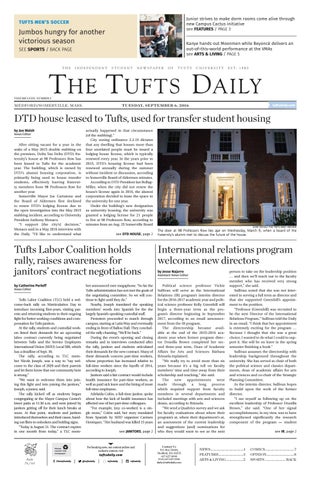
EVAN SAYLES / THE TUFTS DAILY ARCHIVE
The door at 98 Professors Row lies ajar on Wednesday, March 9, when a board of the fraternity’s alumni met to discuss the future of the house.
Tufts Labor Coalition holds rally, raises awareness for janitors’ contract negotiations
International relations program welcomes new directors
by Catherine Perloff
Political science professor Vickie Sullivan will serve as the International Relations (IR) program’s interim director for the 2016-2017 academic year and political science professor Kelly Greenhill will begin a three-year term as the program’s director beginning in September 2017, according to an email announcement from the IR program. The directorship became available at the end of the 2015-2016 academic year when former program director Drusilla Brown completed her second three-year term, Dean of Academic Affairs for Arts and Sciences Bárbara Brizuela explained. “We really try to avoid more than six years because it’s a big toll on faculty members’ time and time away from their scholarship and teaching,” she said. The new appointments were made through a long process which required support from faculty members in several departments and included meetings with arts and sciences deans, according to Brizuela. “We send a Qualtrics survey and we ask for faculty evaluations about where their program’s at, where their department’s at, an assessment of the current leadership and suggestions [and] nominations for who they would want to see as the next
News Editor
Tufts Labor Coalition (TLC) held a welcome-back rally on Matriculation Day to introduce incoming first-years, visiting parents and returning students to their ongoing fight for better working conditions and compensation for Tufts janitors. At the rally, students and custodial workers listed their demands for an upcoming labor contract currently being negotiated between Tufts and the Service Employees International Union (SEIU) Local 509, which has a deadline of Sept. 30. The rally, according to TLC member Nicole Joseph, was a way to “say welcome to the class of 2020 and their parents and let them know that our community here is strong.” “We want to welcome them into joining this fight and into joining the janitors,” Joseph, a junior, said. The rally kicked off as students began congregating at the Mayer Campus Center’s lower patio at 11:30 a.m. and were joined by janitors getting off for their lunch breaks at noon. At that point, students and janitors introduced themselves and their cause, handing out fliers to onlookers and holding signs. “Today is August 31. The contract expires in one month from today,” a TLC mem-
Please recycle this newspaper
Rain 74 / 64
/thetuftsdaily
ber announced over megaphone. “So far the Tufts administration has not met the goals of the negotiating committee. So we will continue to fight until they do.” Nearby, Joseph translated the speaking members’ words into Spanish for the the largely Spanish-speaking custodial staff. Protesters proceeded to march through campus, starting at Latin Way and eventually ending in front of Ballou Hall. They concluded the rally chanting, “We’ll be back.” During the event’s opening and closing remarks and in interviews conducted after the rally, janitors and students articulated their demands for the new contract. Many of these demands concern part-time workers, whose proportion has increased relative to full-time workers since the layoffs of 2014, according to Joseph. Janitors said a fair contract would include health insurance for part-time workers, as well as paid sick leave and the hiring of more full-time employees. Adelaida Colón, a full-time janitor, spoke about how the lack of health insurance has affected one of her part-time colleagues. “For example, [my co-worker] is a single mom,” Colón said, her story translated from Spanish by SEIU organizer Carmen Henriquez. “Her husband was killed 15 years see JANITORS, page 2
For breaking news, our content archive and exclusive content, visit tuftsdaily.com @tuftsdaily
tuftsdaily
tuftsdaily
by Jesse Najarro
Assistant News Editor
Contact Us P.O. Box 53018, Medford, MA 02155 617 627 3090 FAX 617 627 3910 daily@tuftsdaily.com
person to take on the leadership position … and then we’ll reach out to the faculty member who has received very strong support,” she said. Sullivan noted that she was not interested in serving a full term as director and that she supported Greenhill’s appointment to the position. “Professor [Greenhill] was recruited to be the next Director of the International Relations Program,” Sullivan told the Daily in an email. “I think that her appointment is extremely exciting for the program … Because I thought that she was a great choice, I wanted to do what I could to support it. She will be on leave in the spring semester finishing a book.” Sullivan assumes the directorship with leadership background throughout the university. She has served as chair of both the political science and classics departments, dean of academic affairs for arts and sciences and co-chair of the Strategic Planning Committee. As the interim director, Sullivan hopes to build upon the work of the former director. “I see myself as following up on the excellent leadership of Professor Drusilla Brown,” she said. “One of her signal accomplishments, in my view, was to have strengthened significantly the research component of the program — student
NEWS............................................1 FEATURES.................................3 ARTS & LIVING.......................5
see IR, page 2
COMICS....................................... 7 OPINION.....................................8 SPORTS............................ BACK
2
THE TUFTS DAILY | News | Tuesday, September 6, 2016
T HE T UFTS D AILY Arin Kerstein Editor-in-Chief
EDITORIAL Sophie Lehrenbaum Jake Taber Managing Editors Evan Sayles Associate Editor Kathleen Schmidt Executive News Editor Melissa Kain News Editors Robert Katz Liam Knox Gil Jacobson Catherine Perloff Jei-Jei Tan Hannah Uebele Joe Walsh Kyle Blacklock Assistant News Editors Juliana Furgala Jesse Najarro Danny Nelson Miranda Willson Executive Features Editor Constantinos Angelakis Features Editors Nina Joung Becca Leibowitz Justine Chung Assistant Features Editors Siddharth Divakaruni Justin Krakoff Executive Arts Editor John Gallagher Arts Editors Merilla Michael Eran Sabaner Isaac Brown Assistant Arts Editors Jocelyn Contreras Alison Epstein Elliot Storey Emma Henderson Executive Op-Ed Editor Shannon Geary Cartoonists Stephen Dennison Allie Merola Miranda Chavez Editorialists Aneurin Canham-Clyne Frances DeFreitas Eriko Koide Anita Ramaswamy Noah Weinflash Phillip Goldberg Executive Sports Editor Yuan Jun Chee Sports Editors Alison Kuah Maddie Payne Eddie Samuels Maclyn Senear Chris Warren Soven Berry Assistant Sports Editors Noah Smith Max Lalanne Mia Lambert Caroline Ambros Ray Bernoff Maria Eduarda Ferraz Henry Hintermeister Leila Li Julia Press Evan Sayles Angelie Xiong
Executive Photo Editor Photo Administrator Picture Tufts Editor Staff Photographers
PRODUCTION David Westby
Production Director Allie Merola Executive Layout Editors Sebastian Torrente Jewel Castle Layout Editors Abbie Gantner Leila Li Brianna Mignano Mandip Pokharel Emily Sharp Astrid Weng Petrina Chan Creative Director Allie Merola Executive Graphics Editor Perina Chan Graphics Editors Annie Chen Juliana Furgata Dana Pek Ashton Stephens Rena Tang Belinda Xian Zach Hertz Executive Copy Editors Jei-Jei Tan Meagan Adler Copy Editors Alison Beach Arthur Beckel Caroline Bollinger Ben Bornstein Claire Boals Alison Epstein Audrey Falk Maria Eduarda Ferraz Gil Jacobson Melissa Kain Sharon Kelmar Liam Knox Kathleen Martensen Jack Ronan Netai Schwartz Nihaal Shah Arielle Sigel Liora Silkes Dan Strauss Maxwell Bernstein Executive Tech Manager Nitesh Gupta Online Editor Mia Lambert Social Media Editor
BUSINESS Josh Morris Executive Business Director Qinyue Yu Receivables Manager Evan Sayles Online Advertising Jay Hayes Ad Managers Eva Sachar
tuftsdaily.com
Janitors march alongside TLC members in first rally of the academic year JANITORS
continued from page 1 ago. She has two children. There is no way that, working part-time, she can put bread on the table and bring up her two children without health insurance.” According to Joseph, custodial staff also desire a change in scheduling that would move away from weekend shifts that Joseph said take away from workers’ family time and shifts that make the burden on workers too high. Joseph also argued that the 2014 reorganization has caused the custodial team to be understaffed and overworked. “All of the workload that was done by two or three people before, it gets done by one or two,” Colón said. Workers and their supporters hoped the new contract would include protections against future layoffs and reorganizations such as those made in 2014 and the even more drastic cuts levied in 1997 (these reorganizations are detailed in the Daily’s “Tufts Janitors: A History”). Finally, workers said that they wanted administrators to treat them with more respect and as contributing members of the community. “We wanted to be treated as we are: human beings,” Colón said. Keeping with the event’s mission of drawing incoming students to the janitors’ cause, Colón underscored the custodial staff’s reli-
Tufts Labor Coalition members walk in solidarity with custodians in a rally on Aug. 31, the Class of 2020’s Matriculation Day. ance on student support. “We want students to unite themselves in our struggle more than they are already. We have to win this long fight ahead of us, but without your support we can’t,” Colón said to onlookers at the campus center before the group marched. “We rely on your support for a fair and just contract.”
TLC member David Ferrándiz explained that students have a key role in showing support during the negotiation process. “As students, I think it’s our obligation to maintain our support, show our support to our workers, and be here today, tomorrow and beyond in this struggle,” Ferrándiz, a senior, said.
IR program appoints Kelly Greenhill as next director IR
continued from page 1 research, faculty research, and faculty/ student collaborative research.” Sullivan also hopes to initiate her own plans to improve the program. “The staff and I want to strengthen student advising and to build on the program’s connection to the Fletcher School,” she said. Greenhill comes to the position with a long background of foreign policy scholarship, holding pre- or post-doctoral fellowships at Harvard University’s Olin Institute for Strategic Studies and Belfer Center, at Stanford University’s
Center for International Security and Cooperation and at Columbia University’s Saltzman Institute of War and Peace Studies, according to her department biography. Greenhill explained that the director of the IR program plays a key role in creating a coherent program for everyone involved in IR. “The director provides intellectual leadership and serves as a kind of glue that ties the many diverse departments and a wide array of majors together … There are more than one hundred core faculty affiliated with the program and 18 different departments,” Greenhill said.
Sullivan and Greenhill have been working closely together to plan for the program’s future, they said. “We have been spending a good deal of time together talking about the program as it stands and the program going forward,” Greenhill said. Both professors said that they look forward to supporting the IR program and IR majors. “I think that the program provides an excellent education to students and provides them [with] many opportunities for intellectual and professional development,” Sullivan said. “I want to support it any way that I can.”
Fraternity house likely to be returned to brothers next year DTD HOUSE
continued from page 1 of Aldermen meeting. Alderman Dennis Sullivan, who chairs the board’s Licenses and Permits Committee, said the house would be designated as alcohol-free. The university’s choice to use 98 Professors Row as transfer student housing marks the return of a dedicated house for transfer students, a practice that the Office of Residential Life and Learning (ResLife) canceled last year due to a housing shortage. “We wanted to keep the incoming transfer students together as a cohort, and assigned them to 98 Professors Row that also has a few returning upper class students,” ResLife Director Yolanda King told the Daily in an email. Eighteen residents — the majority of whom are transfer students — currently live in the house along with a Graduate Resident Director, King explained. According to the National Center for Education Statistics, Tufts enrolled 76 transfer students last year, so 98 Professors Row houses just a fraction of the transfer student population. In the past, Wilson House had been used to house transfer students. However,
due to a shortage of staffed residence halls last year, ResLife assigned first-years and returning students to Wilson House and scattered transfer students throughout campus. King noted that Wilson House will continue to house some first-years this year, and it will not be designated as the transfer student house. A lease for 98 Professors Row was negotiated between the alumni corporation, the university and the city last spring, according to Bollag-Miller. The lease was negotiated through the city to ensure that city officials would allow the house to be licensed for non-fraternity housing, he added. Alderman Katjana Ballantyne said at the Aug. 25 Aldermen meeting that the current status of 98 Professors Row is likely temporary, and that DTD may be allowed to return to the house next year. “The fraternity will probably look next year to come back to talk to myself and the administration about whether we think they’ve done their due diligence to go back into that building,” Ballantyne said at the meeting. The city’s refusal to renew DTD’s housing license is unrelated to university
punishments for the stabbing incident, according to Bollag-Miller. DTD’s disciplinary probation ended last May, and DTD is no longer under any official university sanctions, he said. “The fraternity is still recognized and in good standing with the university, just currently not housed,” Office of Fraternity and Sorority Life Director Su McGlone wrote in an email to the Daily. While the investigation continues, BollagMiller said that DTD is focused on rebuilding its relationship with the city. He explained that the fraternity has worked with the city for the past year to rethink its role in the community, and while it will not return to its house this year, he is still committed to that goal. He added that DTD is optimistic that it will reoccupy the house next year. “The past year has caused us to be acutely aware of the way that we are perceived by the city of Somerville,” BollagMiller said in a May interview with the Daily. “We’ve been really fortunate to connect with several members of the Somerville city government who have been helping us to figure out the best way in which we can continue to be engaged with the community.”
Tuesday, September 6, 2016
Features
3 tuftsdaily.com
Bringing life into campus housing, one cactus at a time by Miranda Willson
Executive Features Editor
Although junior Avery Spratt started her summer interning with the U.S. Department of Transportation (USDOT), she ended it selling cacti on the lower patio of the Mayer Campus Center over Labor Day weekend. This sale was the first for Campus Cactus, an event company Spratt developed after stumbling upon a new summer job opportunity after walking into a store this June. That store was Loyal Supply Co., located in Somerville’s Union Square, which sells “thoughtfully designed” gifts and goods that are meant to last and improve consumers’ wellbeing, according to the company’s website. When Spratt entered the store, she struck up a conversation with Ryan Habbyshaw, a Cambridge resident who co-runs it with his wife. Spratt said she and Habbyshaw quickly bonded, discussing Spratt’s studies at Tufts and her postgraduate interests. After talking to Habbyshaw at the store, the two met for coffee later in the week. Spratt said he offered her a summer internship at Loyal Supply Co., which she accepted even though it meant giving up her internship with the USDOT. “I would’ve finished [at USDOT] and been happy and created some great connections, but when I met Ryan, that kind of smacked me in the face a little bit,” she said. “I knew it was an important opportunity for me. I had no idea to what degree, but I had a feeling about it.” One day, she and Habbyshaw went to the Boston Flower Exchange to buy plants to sell at the store, and it was there that she developed the idea for an independent project as part of her internship: she would sell cacti to Tufts students as they moved into their dorms.
“I could only imagine how awesome it would be if Tufts said, ‘Here, have a cactus. We hope it makes you feel at home here.’” — Campus Cactus founder Avery Spratt
Habbyshaw, whose professional background is in marketing and design, said he immediately felt excited about Spratt’s idea to sell cacti to college students, starting with those at Tufts. He was particularly impressed by Spratt’s interest in improving student wellness. “We found all these articles together about how plants can improve your life in general … and make rooms more aesthetically pleasing,” he said. “Campus Cactus, in the end, is an effort to bring plants into students’ dorms and make those places a little more fun and enjoyable, because they’re empty when you move into them.” Campus Cactus was partly inspired by Spratt’s own experiences when she was a first-year seeking to make her dorm room feel homier, she said.
MAX LALANNE / THE TUFTS DAILY
Students examine the various cacti being sold by Campus Cactus, an internship project by junior Avery Spratt and Loyal Supply Co., outside the campus center on Sept. 4. “I had spent my freshman and sophomore years walking … super far or taking the T to get plants and spending quite a bit of money on cacti,” she explained. “I knew firsthand the transformative properties of a plant. I thought, as somebody who was very far from home freshman year — I’m from Florida — the one thing that really helped me make my dorm room less of a concrete box and more like a home was cacti.” While Spratt had also tried to decorate her room with other plants, she said cacti were the easiest to maintain. “I’m particularly bad at caring for plants, and cacti were the only kind of plant I could successfully keep alive,” she said. The duo came up with a slogan aligned with the theme of making dorm rooms homier for college students: “Home is where your plants are.” “Plants are not the first thing you think about putting in your apartment or living space, but it helps to make it look like you’ve moved in,” Habbyshaw added. Spratt said that during Campus Cactus’ first sale, hundreds of students came to purchase cacti, each of which sold for $6 to $12. Now that the initial kickoff sale is over, Spratt said she wants to continue working for Campus Cactus in order to build connections among students, the university itself and local businesses and community members. In the future, she envisions existing student organizations, or even Tufts or other universities, sponsoring cactus giveaways for college students. “I remember, [during] freshman year, Tufts handing me things like T-shirts, water bottles and stickers,” she said. “While all that was really exciting, I could only imagine how awesome it would be if Tufts said, ‘Here, have a cactus. We hope it makes you feel at home
here.’ I think that would have been really special to me, and a lot of other people would find that special as well. So that’s the whole goal.” Spratt’s boyfriend, Tufts junior William Mairs, also played a role in the development of Campus Cactus. Mairs said he met Habbyshaw a few weeks before Spratt when he wandered into Loyal Supply Co. and, like Spratt, struck up a conversation with him. Though not an official intern at Loyal Supply Co., Mairs helped with Campus Cactus’ website and was involved with the photo shoot to promote the sale at Tufts this past weekend. “I was there for the initial conversation surrounding how people might be interested in buying cacti on campus or receiving them from the university, and Avery ran with it and turned it into this crazy thing with Ryan,” he said. In addition to benefitting students, Campus Cactus aims to benefit the local economy by connecting students to businesses near Tufts like Loyal Supply Co. and by purchasing the cacti from a greenhouse in the Boston area, according to Habbyshaw. “We wanted to make sure that this was a fairly local initiative,” he said. “Universities are gigantic businesses that exist in these communities, and for them to be able to impact the local economy … is really powerful.” Habbyshaw also hopes to expand the potential of Campus Cactus by partnering with other students next year, either from Tufts or from another college. “What’s cool is that … we now have a way to work with students, which I think is so much fun,” he said. As an engineering psychology and computer science double major with a minor in studio art, Spratt said that both her internship and the Campus Cactus project allowed her to combine all three of her academic foci. Prior
to learning about Loyal Supply Co.’s business model, she did not know if she would be able to find a job after graduation that fully incorporated her wide array of interests. “I’ve always imagined that human-centered design is where all three of those [fields] kind of overlap,” Spratt said. “But I never really knew it was a feasible, possible job until I met [Habbyshaw]. After I met him, I realized that what I’ve been trying to explain to my mom for years actually exists.” Habbyshaw said that this was the first time Loyal Supply Co. took on an intern, a decision primarily influenced by Spratt’s excitement for their work. From the start of the internship, he said he was intentional about giving Spratt guidance and mentorship as well as the creative freedom to essentially start her own initiative within his business. “This was a risk on my end, but I wanted to learn to work with students,” he said. He also expressed pride that Tufts was the first school to work with Loyal Supply Co. “We could have easily gotten an intern from Harvard, but it’s really cool that our business is in Somerville and Tufts resides somewhat in Somerville as well,” he said. He added that the money raised from the sale this past weekend will be split among Loyal Supply Co., Spratt and others involved in making the sale happen, but he emphasized that making a large profit was not the goal. “I feel like you see a business and you think, ‘Oh man, they must be making a lot of money,’ but the reality is that you have to work really hard to make a ton of money,” he said. “So we’ve talked about the money and … how we could split it up, and everyone’s happy about it, but it’s barely enough money to go on a shopping spree at the mall. It’s nothing crazy; it’s more of just a fun experiment.”
4
THE TUFTS DAILY | ADVERTISEMENT | Tuesday, September 6, 2016
tuftsdaily.com
VERSATILE Student Value Checking Receive a $ 25* bonus
when you open and use a Student Value Checking account.
NO MONTHLY FEE** • NO MINIMUM BALANCE • NO FEE FOR INCOMING WIRES
Start here to make it happen:
SANTANDERBANK.COM/STUDENT
Student Value Checking is available to students 16 through 25 years of age (legal guardian co-owner required for those between 16-18 years). Once you reach 26, we may convert your Student Value Checking to another checking product. Proof of enrollment may be required. *Get $25 when you open a new Student Value Checking account with a $10 minimum opening deposit between June 15, 2016 and September 30, 2016 and complete 8 debit card transactions that post to your account within 60 days of account opening. Your new account needs to remain open for 90 days in an eligible product type and payment of the bonus will occur within 30 days thereafter. One bonus per customer. Students who currently have a personal checking account or who have had a personal checking account with Santander Bank in the last year are not eligible for this offer. Cannot combine with other personal checking account cash offers. Offer only available to U.S. residents. Santander team members are not eligible. Bonus is considered interest and will be reported to the IRS on Form 1099-INT. **Other fees may apply, including a Paper Statement fee if you elect to receive paper statements. Refer to your fee schedule for details. Santander Bank N.A. is a Member FDIC and a wholly owned subsidiary of Banco Santander, S.A. © 2016 Santander Bank, N.A. All rights reserved. Santander, Santander Bank and the Flame Logo are trademarks of Banco Santander, S.A. or its subsidiaries in the United States or other countries. MasterCard is a registered trademark of MasterCard International Incorporated. All other trademarks are the property of their respective owners.
Tuesday, September 6, 2016
ARTS&LIVING
5 tuftsdaily.com
VMAs deliver some drama, epic Beyoncé performance by Alison Epstein
Assistant Arts Editor
From Britney Spears and Madonna’s surprise make out to Kanye West crashing Taylor Swift’s Best Female Video acceptance speech to Nicki Minaj’s “Miley, what’s good?,” MTV’s Video Music Awards (VMAs) have always been delightfully unpredictable. While nothing during this year’s show topped these infamous moments in the award show’s history, the 2016 VMAs, which aired on Aug. 28, still managed to deliver its fair share of memorable moments throughout its nearly three-hour broadcast. There is no way to discuss the VMAs without talking about West, who was the host for the evening. MTV gave West four minutes to do whatever he wanted on stage and, somewhat unsurprisingly, he talked for six minutes. During that time, he managed to joke about his 2009 VMAs tantrum, give shout-outs to Ray J, Donald Trump and his ex-girlfriend Amber Rose and reference the ongoing Kimye/Taylor Swift feud. It should be mentioned that Swift supposedly missed the VMAs for jury duty. West also talked about his role models, listing “Truman, Ford, Hughes, Disney, Jobs” and — wait for it — West. He then introduced the new music video for his song “Fade,” which featured Tiana Taylor dancing
provocatively in a gym. Taylor’s flexibility and athleticism were amazing, and she deserves recognition for making it into a West video after first hitting the scene as the birthday girl in one of the crazier episodes of “My Super Sweet 16”″ (2005-2008). Naturally, when talking about West, it’s difficult to avoid mention of his wife, reality show mogul and selfie queen Kim Kardashian West. Before the VMAs, Kardashian West pulled an epic move, tweeting out a poll asking whether she should wear something casual or dressy to the award show; she ultimately showed up in something that easily could have gone either way. Kardashian West knows how to keep those followers happy, as she rocked natural, beachy hair and makeup. The fashion was mostly a miss this year — sorry, Beyoncé fans, those feathers were not working — but Hailee Steinfeld wins best dressed of the night. Her colorful, crocheted mini struck the perfect balance between creative and chic. As far as musical performances go, everything pretty much became irrelevant as soon as Beyoncé hit the stage, but there are a few other performances of the night worth noting. Britney Spears had her first VMAs performance in seven years, and the audience appeared to just be happy to see her make it through the
whole thing. She stunned in a yellow, glitzy bodysuit, her dance moves were on point and she was up on that stage with a bright smile on her face. Nick Jonas also did a nice job with his song “Bacon,” performing it at an actual New York City diner. The video also featured cameos from Ashley Graham and the members of DNCE, the band of Jonas’ big brother Joe Jonas. Alicia Keys did not perform, but she still sang part of a poem to honor the anniversary of Martin Luther King Jr.’s “I Have a Dream” speech. She sang beautifully, but what most people noticed was the fact that she wasn’t wearing makeup, which generated some controversy. The most romantic surprise of the night came from Drake. After not being there to accept his own Moonman award for Best Hip-Hop Video, he arrived on stage to present Rihanna with the Video Vanguard Award. As if buying her a “congratulations” billboard before the show wasn’t enough, Drake publicly expressed his love for Rihanna on stage, saying, “She’s someone I’ve been in love with since I was 22 years old.” Her decision to seemingly reject a kiss from him sparked interest on the internet, although a touching Instagram post and very public smooching at Drake’s Miami concert quickly put that to bed.
Speaking of Bad Girl RiRi, her four separate performances throughout the night featured a medley of her hits and were solid, if not outstanding. Rihanna has mastered the art of performing without looking like she’s even trying, singing only about one out of every three words and letting a backtrack do most of the heavy lifting. Her final performance of the night, which featured a few of her ballads, was beautiful and made it clear that she does have real singing chops, even if she doesn’t always use them. The night’s performances, however, were completely outdone by Beyoncé. The bona fide legend came out and crushed a 15-minute set in which she performed huge chunks of her hit visual album “Lemonade” (2016). The exact opposite of Rihanna’s relaxed style, Beyoncé left nothing on the table during her performance. Case in point, she smashed a camera with a baseball bat. In addition to her explosive performance, Beyoncé won Video of the Year for her song “Formation” (2016). It may have been Rihanna’s Vanguard, but it was Beyoncé’s night. In a nutshell, the VMAs were the typical hot mess they have always been, and the main takeaway of this year is that Beyoncé is still perfect. But who would have it any other way?
ARTIST INTERVIEW
Sculptor Verity Filipow’s work attracts attention on social media by John J. Gallagher Arts Editor
Though Instagram was primarily in the public eye this summer for snake emoji-based celebrity feuds, and Twitter has been best known recently for hosting an unfiltered Donald Trump, both have also become platforms for artists to flaunt their pieces. Bristol-based sculptor Verity Filipow is one of the artists sharing her work with a growing fanbase online. By day, Filipow creates models for the upcoming stop-motion film “Early Man” (2018), the latest picture from celebrated stop-motion animation studio Aardman Animations, also behind the beloved “Wallace and Gromit” (1993-present) series. Outside of work, Filipow shares photos of her sculptures of creatures and characters on Instragram under the handle @creaturecave and on Twitter under the handle @Creature_Cave. Filipow’s work, with surfaces both hewn and smooth and sporting fully-realized texture, detail and beautiful paintwork, is reminiscent of the art from video games such as Telltale Games’ work, Runic Games’ Torchlight series (2009-2012) and Supergiant Games’ Bastion (2011) and Transistor (2014). Indeed, Filipow counts Supergiant’s art director Jen Zee among her influences, saying that Zee is a “huge inspiration.” It was this reverence for Zee’s art that drove Filipow to create a sculpture of one of the characters from Supergiant’s upcoming game Pyre (2017). It is not difficult to see why Filipow would, as an artist, hold Zee’s and Supergiant’s work in high esteem. Supergiant’s first effort, Bastion, won praise for its painterly characters and
COURTESY VERITY FILIPOW
Filipow draws much of the inspiration for her artwork from smooth animation in video games, lending her pieces a mystical air. environments and also for its unusually active narrator, who chronicles the player’s every action in a continuous series of folksy aphorism, delivered in smoky, rumbling tones. Bastion’s iconic cover art depicts its protagonist, The Kid, with his shock of wavy white hair, crouched contemplatively on piece of masonry with a shaggy sod of emerald
green grass under him and an almost comically enormous war hammer resting behind him. Supergiant’s second game, Transistor, also won plaudits for its art direction and, once again, the game enjoyed a well-executed piece of cover art: a gorgeous rendition of the game’s main character done in luscious greens and
oranges. When the Daily caught up with Filipow via Skype, a framed print of this piece was visible in the background; she jokingly pronounced herself “a bit obsessed” with Supergiant’s games. When Supergiant announced their latest game, Pyre (2017), earlier this see SCULPTURE, page 6
6
THE TUFTS DAILY | Arts & Living | Tuesday, September 6, 2016
tuftsdaily.com
TV REVIEW
‘RuPaul’s Drag Race All Stars’ brings together old competitors for new season of competition by Eran Sabaner Arts Editor
“RuPaul’s Drag Race” (2009-present) may not be the highest rated reality competition show on-air, but it sure is the most addictive one. Taking in one episode of the show is enough to make anyone binge-watch the whole series on Hulu while scrolling through AV Club recaps and Reddit threads. The show’s ultimate strength is its contestants: the queens not only have to master their looks but also have to have a certain degree of charisma, uniqueness, nerve and talent. They also need to be versatile in terms of their abilities, as the show is a combination of sewing, acting and singing competitions. Having an All Stars version of “RuPaul’s Drag Race” is a tricky but potentially rewarding idea. The difficulty arises because contestants from previous seasons become known names after appearing on the show, which is truly the Olympics of drag and has immense power over the relatively small drag community. A Google search of the term “drag queen” will mostly turn up past Drag Race contestants like Sharon Needles, Courtney Act and Willam. This means each sea-
soned queen joining All Stars has her own brand and her own loyal fandom. Unlike regular seasons of the show, the producers needed to cut down on the infamous villain edits, as the program’s own reputation is also at stake with the fandoms of each queen. Judging from the second season’s first two episodes, “RuPaul’s Drag Race All Stars” (2012-present) is able to master its potential setbacks and truly deliver. The queens’ entrances to the workroom make it apparent why each of them is back. Phi Phi O’Hara, Roxxxy Andrews and Ginger Minj want to reverse the negative portrayal they received during their respective seasons. Tatianna wants to gain more exposure, as she is the only queen from before season four on the show. Coco Montrese, Alyssa Edwards and Adore Delano want to show to their fans how they have improved over the past few years. Out of the all the queens, Alaska, Detox and Katya are the only ones who seem to be focusing on snatching the actual crown. There is a brilliant talking head interview with Katya in the premiere in which she comments on how, unlike the other queens with redemption goals, she wants to show everyone that she has become a mon-
ster. Katya is neither as talented nor as popular as Alaska, yet her humor, vulnerability and intelligence make her the dark horse of the season. The new format of the elimination process makes up for the lack of drama that results from the missing villain edits. Instead of the bottom two contestants “Lip Syncing For Their Lives,” the top two winners of the maxi challenge have to “Lip Sync For Their Legacy” and a $10,000 cash prize. The drawback? The winner of the lip sync battle needs to eliminate one of the three bottom contestants. The new format not only allows alliances to form between the contestants themselves, but also factors in the popularity of each queen outside the show: the fan base of an eliminated contestant are bound to turn against their favorite queen’s eliminator. Yet that twist is not the biggest turn of events that follow the first two episodes. Fan favorite Adore Delano’s swift decision to leave the show has truly shaken the drag community and created outrage. After receiving harsh criticism for her style of drag by the judges and believing that her kind of drag does not fit the show’s format, Delano decided to quit during episode two, much to RuPaul’s dismay. Delano’s
non-conformist style and the judges’ condescending behavior toward it had led fans of the show to question whether drag is really about cinchers and corsets or something else. The first two episodes bring back two fan-favorite challenges while introducing a new one. The reading mini-challenge and the snatch game this season will probably mark the show’s peak moments, yet the new talent show challenge is equally satisfying. The challenge allows queens to demonstrate skills that they normally wouldn’t be able to show on regular seasons, which enables the viewers to get to know them better. During the talent show, Roxxxy Andrews was able to prove she is more than a pageant queen, while Tatianna became an early favorite with her hilarious spoken word performance. “RuPaul’s Drag Race All Stars” is a game changer for all reality-competition shows, as it is able to provide entertaining and dramatic TV without being insincere. New format changes, smart challenges and a strong cast improve an already working formula. If the show is able to stick to its new approach (O’Hara’s villain-like edit in the second episode is concerning), it will be able to set new boundaries for TV.
Sculptor brings visions to life after work hours SCULPTURE
continued from page 5 year, Filipow was instantly aware. “I’m really into Transistor, I’m really into Bastion, so as soon as they tweeted the trailer for Pyre I immediately watched it and was like ‘Oh my God! These characters look amazing! I have no idea about the story, I have no idea what this is about but this look awesome.’ So I immediately started sculpting,” Filipow said. Filipow began her sculpture with an armature, which she described as “just a skeleton on the inside to help support the sculpture.” Filipow builds these armatures herself out of “bits of brass, or steel, or aluminum or whatever [she] can find” and pointed out that these support structures are “really not that complex” and could often be as simple as “a stick with a ball at the end.” Once the armature is finished, Filipow begins the sculpting process. Working with a wax-based clay called Monster Clay, which does not set, she lays the clay over the armature and shapes the sculpture for “however long – until [she’s] satisfied.” Once the sculpture itself is complete, Filipow creates a mold in “silicon rubber and then [casts] it in resin or some other material” and then, once casting is complete, assembles the sculpture, hides any seams and moves on to painting. Filipow worked on the sculpture during her lunch breaks and in short, half-hour bursts.” In all, the piece took an estimated 100 hours, spread over four months, to complete. As she was working on the piece, Filipow tweeted a work-in-progress picture at Supergiant and then another photo of the finished product. After working out the details of shipping the sculpture to Supergiant, Filipow posted the piece. The finished sculpture
now resides in the display case of the studio’s California offices. Filipow’s completion of a complex and polished piece on her own time was not an isolated incident but rather a manifestation of the intrinsic motivation to improve that continually drives Filipow to create outside of her day job. Filipow emphasized that the key to success in the arts is constant hard work. “I think that people have the perception that it is really easy to get into the arts. It’s really not,” she said. “Working on my own stuff while I’m working a full-time job is no easy task. A lot of my family is like ‘you never go out, why don’t you go out and see the town?’ and I’m like, because I’m always working, I’m always practicing, I’m always trying to strive to be so much better.” In addition to simply improving one’s skills, Filipow also stressed how important it is for creators to cultivate a robust online presence. “I think for anyone, any creative person, you need to have an online presence, whether it’s just a website or whether it’s through social media, especially in this day and age. It’s so important,” she said. When asked if she could see herself working in the games industry in the future, Filipow responded, “Absolutely! I really want to get into digital sculpture … and I’d love to do character models, or environments or anything really.” Filipow is also interested in creating designer toys, remarking that, “If I had my way, I would have my own studio and make my own pieces and sell that stuff online.” Wherever her artwork takes her next, interested readers can find Filipow’s work on Instagram at @creaturecave and follow her on Twitter at @Creature_Cave. Information about commissioning Filipow can be found at verityfilipow.com/contact.
Join us at The Tufts Daily GIM No Prior Experience Necessary!
Tuesday, September 6, 2016 | Comics | THE TUFTS DAILY
tuftsdaily.com
Comics
LATE NIGHT AT THE DAILY Sophie: “We should cook meth and stuff the Beanie Babies with it.”
Comics
SUDOKU DOONESBURY BY G.B. TRUDEAU
NON SEQUITUR BY WILEY MILLER
Difficulty Level: Getting to the right classroom on time for your first class.
CROSSWORD
7
8 tuftsdaily.com
Opinion
Tuesday, September 6, 2016
EDITORIAL
A lesson in handling slavery This past Thursday, Georgetown University made headlines for its decision to “atone” for its past involvement in the slave trade. The university’s president stated that the selling of slaves in 1838 had saved Georgetown from financial crisis. As part of a process to recognize and reconcile with its past, Georgetown instated the Working Group on Slavery, Memory and Reconciliation. The group’s efforts have led to both the establishment of an institute for the study of slavery and a new policy directed toward granting descendants of slaves an advantage in the admissions process. The debate on reparations for slavery is a long-standing and heated one. The first notion of reparations came from General William Tecumseh Sherman, not long after the Civil War, with an attempt to provide freed slaves with 40
acres of land. This measure was quickly quashed, and since then, there has been no other serious or systematic attempt from the government to provide reparations for slavery. Today, it seems reparations for slavery have not occurred simply because it has been so long since slavery’s abolition. It has therefore become difficult for the American public – and the government for that matter – to agree on who is responsible for providing reparations and how these reparations should be distributed. This is where elite universities come in. For many years, institutions of higher education have been significant players in the fight against racism in this country. They have been at the forefront of racial discourse, have implemented affirmative action and have been a platform for students of color to express their racial dis-
contents through movements like Black Lives Matter. Elite universities, however, are also notorious for being built on traditions and imagery rooted in slavery, a trait that has been exposed by students’ requests across several college campuses to change the names of buildings named after slaveowners or notable racists. Among these are the Woodrow Wilson School of Public and International Affairs at Princeton University and the building formerly known as Saunders Hall at The University of North Carolina at Chapel Hill. Furthermore, elite colleges are the institutions where the racial gap is most evident in the United States. In 2015, 40 percent of white people aged 25 to 29 had received a bachelor’s degree while only 20 percent of black people in the same age group had. Universities were
built on slavery, and the repercussions of it are felt widely throughout college campuses. For this reason, universities make strong candidates to deliver some form of reparation for slavery. Georgetown University has taken the first step. Although it is a small step (seeing as the university did not offer financial help or committee inclusion to students descending from slaves), it is progress — progress that should be mimicked and expanded throughout the country, including at Tufts University. Our campus is situated on what used to be a slave plantation, a fact that is not nearly as widely known as it should be. It is time that the university openly acknowledges the role slavery played in its history and join in the fight to mitigate the repercussions as best it can.
CARTOON
BY SHANNON GEARY
The Tufts Daily is a nonprofit, independent newspaper, published Monday through Friday during the academic year, and distributed free to the Tufts community. The content of letters, advertisements, signed columns, cartoons and graphics does not necessarily reflect the opinion of The Tufts Daily editorial board. EDITORIALS Editorials represent the position of The Tufts Daily. Individual editors are not necessarily responsible for, or in agreement with, the policies and editorials of The Tufts Daily. OP-EDS The Op-Ed section of The Tufts Daily, an open forum for campus editorial commentary, is printed Monday through Thursday. The Daily welcomes submissions from all members of the Tufts community; the opinions expressed in the Op-Ed section do not necessarily represent the opinions of the Daily itself. Opinion articles on campus, national and international issues should be 600 to 1,200 words in length and submitted to oped@tuftsdaily. com. The editors reserve the right to edit letters for clarity, space and length. All material is subject to editorial discretion and is not guaranteed to appear in the Daily. Authors must submit their telephone numbers and day-of availability for editing questions. ADVERTISING All advertising copy is subject to the approval of the Editor-in-Chief, Executive Board and Executive Business Director.
Tuesday, September 6, 2016 | Opinion | THE TUFTS DAILY
Opinion
9
OP-ED
A Tufts for all Negotiations for a contract for university custodians are underway between Tufts University’s cleaning contractor Cushman & Wakefield Inc. (C&W ) and 32BJ SEIU — the largest property service union in the country. These are the hardworking men and women who help to make Tufts a top-notch university while supporting their families and local businesses. At a time of increasing economic inequality, continuing to invest in good middle-class jobs will make Tufts University stronger and help the entire Boston region thrive. With total net assets of $2.2 billion, unrestricted operating revenues of $813 million and a growing endowment, Tufts is in a strong position to continue offering hardworking Bostonians access to middle-class jobs that our communities need. In this context, Tufts’ commitment to create much-needed full-time jobs is of vital importance. Far too often, employers deliberately make what could otherwise be decent jobs part-time ones in order to avoid their responsibility of paying health care for their workers. When this happens, workers either lose
income or take on multiple part-time jobs, and spend less time with their families and in their communities. Think of C&W custodian Selida Pol, who currently serves at Tufts University. For years, Selida worked three parttime cleaning jobs to make ends meet. This meant random schedules, lots of lost time commuting from one job to the next and very little sleep in between. This situation took a toll on Selida’s ankles, which had deteriorated over the years. Access to a fulltime job at Tufts with employer-paid healthcare and a predictable schedule changed everything. Now she has more time to take care of her frail health, help her community and build her union. Of course, Selida and her coworkers also aspire to bargaining a fair wage increase, maintaining and promoting affordable family health care and ensuring that Tufts janitors have stronger contractual protections against indiscriminate layoffs. In this strong economic environment, getting to a contract is more than possible. Working together, we can win a strong contract with raises and protected benefits. Unlike machines, computers and
raw materials, janitors are so much more than a line item on an expense ledger. They are real people with real stories. Most are immigrants who work long days and nights to provide for their families. They have come to the United States willing to work hard in order to give their children a better life. They represent what is great about our country — the idea that if you work hard, you will be able to get ahead. But the road to the American Dream is not paved with gold. Greater Boston is a place of wealth and innovation, but also terrible inequality. People in the top five percent make 18 times as much as households in the bottom 20 percent. The income gap continues to grow in Boston, making it the most unequal city in America. And without good paying union jobs, the gap will become a chasm. For far too many workers, it is increasingly difficult to live and work a middle-class job and be able to afford to live here. In wealthy states like Massachusetts, no one should have to work two or three jobs and still not be able to make ends meet. When parents don’t spend quality time with their
children, they leave the corner store to make the meals and the TV becomes the babysitter. As Mayor Walsh said: “We cannot tolerate a city divided by privilege and poverty.” A city where the very rich thrive and the rest of us struggle shouldn’t become a permanent reality. Tufts can be an agent for positive change in our communities. Let’s get to work to make it possible. With more than 155,000 members in 11 states, including 18,000 in Massachusetts, Rhode Island and New Hampshire, SEIU 32BJ is the largest property services union in the country. Roxana Rivera is the vice president of 32BJ SEIU. Editor’s note: If you would like to send your response or make an op-ed contribution to the Opinion section, please email us at tuftsdailyoped@ gmail.com. The Opinion section looks forward to hearing from you.
Roxana Rivera is the Vice President of the property services union 32BJ SEIU. She can be reached at mobilize@seiu32bj.org.
10
THE TUFTS DAILY | ADVERTISEMENT | Tuesday, September 6, 2016
tuftsdaily.com
Tuesday, September 6, 2016 | Sports | THE TUFTS DAILY
S p o rts
11
Jumbos hope offensive improvement leads to NESCAC championship WOMEN'S SOCCER
continued from back Under the leadership of senior co-captains Pius and Robin Estus, the team has its eyes set on the first game of the season on Wednesday, which is against Emerson at 4:30 p.m. at home. “We’re trying to take it one game at a time,” Capone said. “First up is Emerson. We don’t know that much about them because we’ve never played them before. They’re a new opponent for us. We’re expecting them to be a great team and we’re going to go out there and work together as one unit.” The team met on Monday to discuss its goals for the season. “One goal that has been clear-
ly established is that we want to be NESCAC champions,” Capone said. “That’s something our captains have set the tone for from the very beginning. We have the talent; we have the chemistry: I think we can do it.” While the NESCAC championship is an overarching goal for the season, Bowers said that the team is making sure not to get too far ahead of themselves. “We have to take it game by game and win each game that’s ahead of us,” she said. “It’s the beginning of the season, so Emerson on Wednesday is what we’re really focused on right now. If we just stay focused on the little things, the big games will come eventually.”
EVAN SAYLES / THE TUFTS DAILY ARCHIVE
Senior Jess Capone races to the ball before a Lesley player gets possession on Sept. 9, 2015.
First-years to contribute as Jumbos seek return to NCAA championship game MEN'S SOCCER
continued from back “I was just trying control my emotions and go out there and play my game,” Tasker said. “I felt that the best way to do that was to play defense, close and press and do whatever I could control. The soccer would come. We wanted to stay respectful and use the game as an opportunity to have everything that we’ve been working on in preseason come together.” Another first-year contributor on Saturday was outside midfielder Zach Trevorrow, who got ahead of the Bowdoin
defenders several times to provide the cross in for a chance at a goal. Classmate Zach Lane assisted Majumder’s goal, making his debut as well. “I think we showed that we have a good ability to respond – going down one nothing and still fighting to come back,” Halliday said. “That’s going to be really helpful in a NESCAC game because every year you’ll go down and how you respond is a good indicator of how far you’ll be able to make it. Everybody that came in raised the level of the game and that’s another big thing
that hopefully we’ll be able to hold onto and maintain for the season.” The Jumbos’ main problems last season arose from difficulty converting shots to goals. Tufts’ scoring efficiency lagged far behind that of Middlebury, the NESCAC’s top scoring team last season, which scored 46 goals from 296 shots. The Jumbos, meanwhile, only scored 27 goals from 272 shots, slotting them in at just fifth in the conference in scoring. “The reality is that in college, soccer teams are very good at making it hard for you to create goals. You have to find
different ways to score,” Shapiro said. “That’s something that we learned last year defending the championship, seeing so many different formations and styles against us that the guys had to become adaptable. The ability to do it in different ways, on a different day, on different surfaces and in different conditions means we have to be adaptable.” Although the team is still working out some kinks, Tufts is confident ahead of its first game against Endicott today, and then will look to start strong in the NESCAC against Colby on Saturday.
Jumbos confident in preseason, looking to NCAA championship VOLLEYBALL
continued from back Ahrens said. “That’s our energy when we step on the court. Anything you can possibly do to keep the ball up.” In order to prepare the first-years for the rigors of NESCAC competition, Thompson scheduled a scrimmage against Williams this past weekend, and Tufts won the friendly in five sets. Winning a preseason scrimmage is nothing like a real game, but beating the 2013 and 2014 NESCAC cham-
pion, not to mention last year’s runner-up, in any setting is an accomplishment. “Williams is going to be a top team in the region — there’s no question — and I expect us to be a top team in the region, so it was really awesome to have our rookies experience the big block on the other side and the speed of the game, even though it was rough all-around,” Thompson said. “Any time Williams is across the net, you’re getting awesome vibes, and [Williams] coach Kelsey and I know exactly what we are doing when
we put our squads across from each other across the net … because they want to win.” Although Thompson is pleased with the first-years’ success on the court in practice so far and against Williams, she is most impressed with how quickly the rookies developed rapport and chemistry with their older teammates. The team’s closeknit culture and both captains’ efforts to ensure volleyball remains fun aided in the first-years’ transition. “Volleyball is what we fell in love with
when we were younger,” Garrett said. “It’s what we came here to play and obviously we are all into winning but when it comes down to it, that is your first love so you want to have fun doing it.” This year, the team is focusing on ball-control and defense, as Thompson believes that whichever team has the best ball-control inevitably wins. That said, the main strength of this team is up-front blocking, which in turn relieves pressure on the defense in the back.
EVAN SAYLES / THE TUFTS DAILY ARCHIVE
Tufts outside hitter Esme Nulan (LA ‘16), left, and middle hitter senior Elizabeth Ahrens block a Springfield College player on Sept. 9, 2015.
Sports
12 tuftsdaily.com
Tuesday, September 6, 2016
MEN'S SOCCER
Men’s soccer sets sights on second NCAA championship in three years by Maddie Payne Sports Editor
EVAN SAYLES / THE TUFTS DAILY ARCHIVE
Tufts midfielder senior Zach Halliday launches himself off a Bowdoin player for a header in the game against the Bowdoin Polar Bears on Oct. 31, 2015.
This time last year, the Jumbos were coming off the back of their 2014 NCAA Championship win, hoping to defend their crown. Despite early successes against Colby, Conn. College and Trinity in September, the Jumbos suffered backto-back double overtime losses against Amherst and Hamilton in October. Tufts finished third in the NESCAC with a record of 5-2-3 behind Amherst and Middlebury and bowed out of the NESCAC tournament in the quarterfinals after a tough 1-0 loss to Bowdoin. The team extended its season by earning an NCAA bid and won its first-round and second-round games against Salisbury and Montclair St., respectively, by one-goal margins. In the third round at Kenyon, Tufts’ hopes for consecutive title runs were dashed by a Kenyon goal in the final 20 seconds of the game that gave the hosts the 3-2 win and knocked Tufts out of the tournament. “We are returning a bunch of good upperclassmen so we have a good core group,” senior Daniel Sullivan said. “We
have had some issues [converting shots to goals] but I think we have the tools we need to be able to score a lot of goals this season.” With six players having graduated with the Class of 2016, the new senior class will have to step up to fill the spaces they left. Monil Patel (LA ’16) and Connor Schaible (LA ’16) were both starting full backs, so the defense will need to integrate new starters this season. Junior Matt Zinner, who was a starter his first year, will once again fill a starting defensive spot after struggling with a broken foot last season. “He’s got experience and we know he can handle it,” coach Josh Shapiro said. “[Junior] Stephen McMillian is the second starter. He’s played in the role but hasn’t really gotten the chance to shine in the role. One of the strengths of this group is that we’re two-deep everywhere in the back. We feel that we are pretty close to two-starters-strong in each position, which gives us a huge opportunity to manage bad situations and play to our depth.” Senior co-captain Nathan Majumder, who was the NESCAC’s second-highest scorer in 2015 with 11 goals, will resume his position at the front as the team’s go-to finisher. Classmate and fellow co-captain
Women’s soccer adopts new formation for hopeful comeback season Sports Editor
Fresh off of its first losing season since 2012, Tufts’ women’s soccer team is ready to prove it is stronger than last year’s 6-8-2 record shows. The Jumbos hope a switch to a new 3-5-2 system will help facilitate the improvement. “I think we were a good team, except for a couple moments,” sophomore goalkeeper Emily Bowers said. “A few times in games, we had small lapses that would be taken advantage of. It was just minutes here and there throughout the season where we didn’t play our best.” Last year, Bowers allowed just 1.08 goals per game in her rookie season, and will continue to anchor the defense this year. Her consistency is especially important as the Jumbos experiment with their new formation, which leaves them better able to get shots on goal and attack but more susceptible to counterattack from tough NESCAC opponents. With only three full-time defenders, the new formation features five players at midfield. Two of those midfielders are “wingbacks,” responsible for the duties of both full backs and wingers. Their role is to be mobile at all times, moving up and down the field as needed and offering situational numerical advantages and flexibility across the field. The formation recently gained popularity after Juventus and the Dutch national team successfully adopted it. Notably, the U.S. men’s national team employed this positioning in 2015. Nevertheless, the transition to a new formation will take some time to get used to.
see MEN'S SOCCER, page 11
VOLLEYBALL
WOMEN'S SOCCER
by Eddie Samuels
Zach Halliday will run the midfield. A dominating force both on and off the field, Halliday is a vocal leader who, along with Majumder and the other seniors, will look to guide the team to another deep NCAA tournament run. “The seniors are absolutely necessary to any team’s success,” Shapiro said. “Zach Halliday is about as commanding, dominant and confident as a leader can get. He’s an excellent guy for people to relate to and listen to, and he does a lot of things right. Nate Majumder also does everything right. When he talks, people listen. The whole senior class will be contributing on the field and in the locker room.” The team welcomes eight first-years, several of whom have already made powerful impacts on the team during Saturday’s pre-season scrimmage against Bowdoin. Outside midfielder Gavin Tasker, a firstyear, deftly moved the ball down the wings and was responsible for fast transitions from the defensive end up to the attackers, giving Tufts chances to score. Tasker even netted a goal of his own, and the Jumbos eventually won the scrimmage 3-2.
“We’ve been practicing the new formation and all the adjustments that come with it,” senior forward Jess Capone said. “It’s going to be something we have to keep practicing, but it’s looking really good so far. I think our chemistry is really good, both on and off the field. We’re incorporating the new players and having everyone together for this past week [of practice] has been really great.” The formation allows the Jumbos to maintain their defensive strength from last year while also facilitating pushes for a numbers-advantage on the offensive side of the ball, an aspect of their game that the women are looking to improve upon from last year. Offensive production was lacking for the Jumbos last season, as they scored just 14 goals and averaged 0.88 goals per game. Capone was the team’s leading scorer, with three goals over the course of the season, and was one of the players taking the most shots on goal. On the other side of the ball, Bowers says the defense is looking like a force to be reckoned with this year. “I think [the defense is] very strong,” Bowers said. “We have an older group. Alexa [Pius] and Stefanie [Brunswick] are seniors. I have a year under my belt now. It wasn’t a particularly young group last year either, but this year we have more experience playing together.” With a dominant season behind her, Bowers is setting her personal goals high as the last line of defense for the team. “A personal goal is to not let goals in,” Bowers said. “It’s the simplest way to win games. The rest of the team will take care of everything else.” see WOMEN'S SOCCER, page 11
Influx of first-year talent to help volleyball bounce back by Phillip Goldberg
Executive Sports Editor
Despite graduating a core group of seniors in 2016, the Tufts volleyball program still believes in its potential to win a national championship this year thanks to seven first-year players who have quickly acclimated to Div. III and exhibited the focus required to play for a perennial regional contender. “It’s a big group coming in but at the same time, I think that the volleyball IQ is really high across the board, even with the returners, so these freshmen are coming in at a higher baseline than maybe our typical rookie group,” coach Cora Thompson said. In what is looked back upon as a disappointing season, Tufts finished 17-8 overall and 7-3 in conference play. On Nov. 6, Tufts fell 3-1 against Middlebury in the first round of the NESCAC tournament in Brunswick, Maine. After making, and losing, in the NESCAC championship game and the NCAA championship’s second round in 2014, the early end last year felt especially abrupt. Senior co-captain Elizabeth Ahrens said that the team believed they could have given more and that this season, she and the team intend to give their all. “We were inconsistent emotionally and physically,” Thompson said. “Mentally we weren’t as tough as we needed to be. I think we had a lot of great athletic pieces last year and we did a lot of really nice things but I think the general feeling was that we left a lot on the table.” The Jumbos graduated setter Kyra Baum, libero Carolina Berger, outside hitter Maddie Kuppe and right side hitter Esme Nulan in the class of 2016 and all four played integral roles last season. Kuppe led the team with 299 kills, the third
most in the NESCAC. Her 252 digs, the second most for Tufts, highlight her prowess on offense and defense. Kuppe was also deadly on serves, with 42 service aces in 86 sets, or an ace every other set. Baum was second on the team in assists and Berger led the Jumbos in digs. The seven first-year players must now step into the shoes of the graduated seniors, as there are only 16 players on the roster, leaving no room to hide. Thompson thinks that her first-years are more than capable and that their versatility allows her a greater degree of flexibility with matchups than she has had in the past. “We have three incredible setters, which is very very exciting,” Thompson said. “We have four really great middles, and we have three defenders who are all very very capable of getting the job done, and then pin players — they can be outsides or opposites and play in either spot, so even within the course of a rally, we can get an outside hitter who’d switch to stay. We could be running a 5-1 offense; we could run a 6-2. It’s great to have a lot of pieces that we can move.” The returning players are skilled in their own right, as Ahrens was third in the NESCAC in both hitting percentage and blocks per set last season. Junior co-captain Alex Garrett dug out the third most balls after Berger and Kuppe last year and will likely lead the team in that crucial aspect of the game. Sophomore Angela Yu led the Jumbos in assists last season and her classmate MacKenzie Bright averaged the second most kills per set on the team. With such capable players teaching the first-years and taking on larger roles, there is no question that the team exudes confidence this preseason. “In our practices, the ball never drops,” see VOLLEYBALL, page 11