A weekly glimpse into the Israel you won’t read about in the news
By Sivan Rahav Meir
The Message of Ayala Shkuri
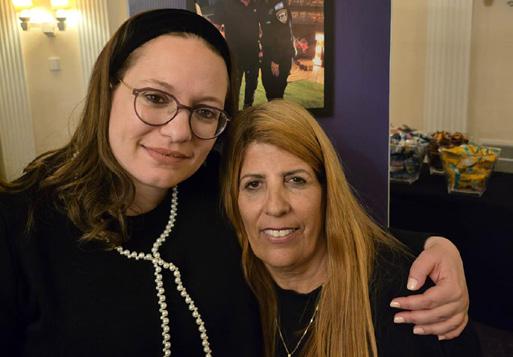
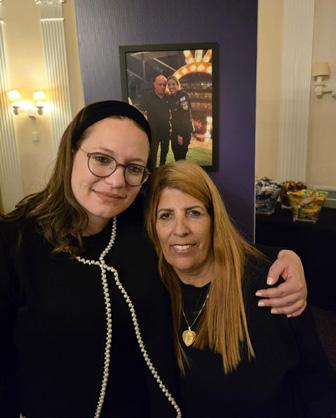
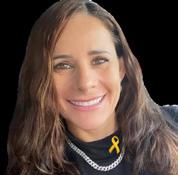
In the photo with me is Ayala Shkuri. Visible in the photo behind us are her daughter, police officer Mor Shkuri, who was murdered at the Sderot police station on October 7th, and Ayala’s husband, policeman Roni Shkuri, who was murdered in a terror attack less than a year later.
Ayala, both a bereaved mother and a widow, was one of the participants in the special trip to the United States organized by Menucha V’Yeshuah and led by Mendy Kenig. Fifty-three bereaved families from Israel received deep warmth, comfort, and tremendous appreciation from the US Jewish community.
On Shabbat, Ayala addressed the audience:
“People ask me how I am. How I’m doing. They ask how I managed to return to living alone in our home in Sderot. And I answer:
‘I’m not alone. I always knew that God was with me. And now I have two representatives of mine with Him: Mor and Roni. Their physical bodies are no longer here, but their souls exist forever. I feel them.’
“I was privileged to live with two people who wanted only to do good. I’m grateful for that privilege, and I also think about how to continue what they embodied. Both were great souls. Mor would recite Mizmor L’Todah every single day, so how can I not say it too? Mor excelled in honoring her parents; I ask young people to carry that forward.
“The night before she was murdered, our Mor encountered a slightly drunk and confused teenage girl who wanted to go to the Nova music festival. Mor stopped her from going and brought her home. That evening she said: ‘I already did my good deed for today.’ That’s just one small example of how caring she was.
“Roni was pure soul. People ask me what I miss most, and I tell them: ‘Honestly, I just want him to
be sitting on the couch again, doing nothing.’
My message to people is this: Appreciate your loved ones while they are with you. Find joy simply in their presence, in the fact of your relationship, in their very existence.
“My answer to this double loss is one thing: do, do, do—and then do some more. Choose life. Hold on to routine. Act. Work. Wake up each morning and take on the day’s tasks.”
I told Ayala that she reminds me of what we read in the parashah of Chayei Sarah. Avraham Avinu concludes his mourning for Sarah, “to eulogize Sarah and to weep for her.” But the very next word in the Torah after his crying is: “vayakam, and he rose.”
To weep and to mourn, and then … to rise.
From Destruction Comes New Life
Lt. Col. Asaf Hamami, who fell in battle on Simchat Torah and whose body was held for over two years in Gaza, was recently brought to burial, finally bringing closure to his family.
Geula Rabi of Kibbutz Kerem Shalom sent me pictures of him visiting the kibbutz. In those terrible days of the “conception,” the misguided belief that Hamas was deterred, the residents of Kerem Shalom lived under the constant threat of sirens, with rocket fire an almost daily occurrence.
Part of their coping mechanism
Sivan with Ayala Shkuri
COMMUNITY NEWS
was through a moving communal ritual they called “planting in place of falling.” Whenever a missile barrage led to a rocket exploding in the kibbutz and creating a crater, they’d invite the community to plant a tree inside that very hole.
If the enemy already dug the pit for us, they explained, why not use it for planting? If there is already a hole in the earth, let something good, green, and fresh grow from it, something that wasn’t here before.
During one such ceremony, Hamami appears emotional, planting a tree together with the children of the kibbutz, and thanking them for inviting him.
“Many holes were dug here,” they told me this week at the kibbutz, which is now absorbing new families. “There are many gaps to fill. So much is missing.”
But the image of Hamami planting a sapling inside the crater gave them hope this week. That, they said, is his legacy: to grow from hardship.
The New Month of Kislev
As we welcome Rosh Chodesh Kislev on Friday, do you remember what we learned in kindergarten about this month and about the upcoming holiday of Chanukah? Everything we learned still holds true today:
• Kislev is a month in which the light defeated the darkness.
• It is a month that commemorates the struggle between the forces of good and evil. The side that ultimately emerges victorious is not the stronger one, but the one that represents the truth. All our enemies will eventually find themselves in the trash can of history.
• Kislev is a month of military
strength as well as spiritual strength.
• Sometimes we need to maintain our courage over an extended period, and it may be difficult to keep up the momentum. Kislev reminds us that we can continually increase our strength. Just like the Chanukah candles, we add another candle each day, and each day has its own light. Similarly, if we manage to carry on our daily routine during these challenging days, each day is its own success.
• Finally, this is a month of miracles, prayers, and salvation. History has shown us that anything can happen, and we may be surprised by something good we never anticipated. A small jar of oil provided enough light for eight days, and in the end, the light was greater than we could have imagined.
Three Important Reminders from Parashat Toldot
1. What is your goal in life, to destroy others or to build yourself? The parashah relates how the Plishtim are constantly blocking Yitzchak’s wells and harassing him. It’s strange, as these are their
own water sources as well. But, as we’ve seen throughout history, our enemies want to harm us so much that they are even willing to harm and destroy themselves.
2. Yitzchak and Rivka pray for twenty years before they are blessed with children. Prayer transforms reality for the better. We must act in this world, but we must also pray. Let us add our prayers today for the safety and welfare of the Jewish people wherever they may be, in Israel and all over the world.
3. Good will triumph. The wonderful promises that Yitzchak hears in this week’s parashah are being fulfilled in our generation, and God willing they will be fully realized very soon: “And I will multiply your offspring like the stars of the sky, and I will give to your offspring all these lands, and all the nations of the earth will be blessed through your offspring.”
Translated by Yehoshua Siskin and Janine Muller Sherr Want to read more by Sivan Rahav Meir? Google The Daily Thought or visit sivanrahavmeir.com
Col. Assaf Hamami
—
The War Without Weapons We won in Gaza. Are we losing our land?
By Chumie Jacobson
The Silent Front
The war as we knew it on the battlefields of Gaza might be over, but there is a war without weapons quietly raging behind our backs on the fields of Israel.
You know that scene at the climax of a movie where the protagonist suddenly starts putting the pieces together? You see images and hear moments from his past swirling around his head as his eyes widen - and he suddenly realizes he’s had it wrong this entire time. I had such a moment only once in my life.
The Awakening
In March of 2024, four months after October 7, as the newly appointed Executive Director of Save-a-Farm, I was on my first work trip to visit the farms of Israel. Over the course of six days I stood on fields at the Gaza Envelope and the West Bank, looked over the fences to Syria and Lebanon, and visited the last farms in central Israel surrounded by Arabs.
I heard gut-wrenching stories from October 7 - and of all the subsequent damage and losses these farmers had endured.
I thought I’d understood what happened: Hamas at-
tacked, farmland was destroyed, hostages were taken, and Israel fought back.
I understood nothing.
The Real Plan
Over the course of that week I began learning more and more about how strategic farmland in Israel truly is. I learned that when a rocket lands “in an open field” and we’re all relieved - that’s someone’s farm.
Then I started hearing snippets - quiet warnings at first: “My neighbor sold his lease to an Arab,” or “Look at the end of my field - see that fence? That’s Gaza. If I’m not here, who do you think will be?” And I was shocked to learn how intentional the agricultural terrorism had been.
One farmer, a commander who had just come home from three months in Gaza, told me he’d captured terrorists there who admitted they’d been directed to specifically kill and capture agricultural workers. Still, I didn’t put the pieces together.
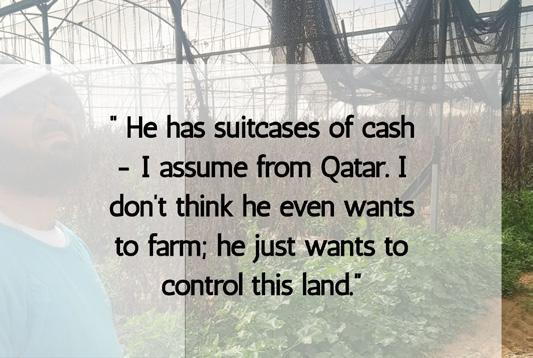
It wasn’t until the last day - mere hours before my flight - when I was speaking to a farmer who had suffered immeasurable losses. He told me, “My neighbor, an Israeli Arab, keeps offering to buy me out. He knows I’m drowning. He has suitcases of cash - I assume from Qatar. I don’t think he even wants to farm; he just wants to control this land. They all do.”
In that moment, with horror I realized: This was their plan.
WHAT’S AT STAKE
• Over 150 farms in Israel are on the brink of collapse.
• Many border farms still operate at less than 25% of pre-war output.
• Thousands of acres risk being leased to our enemies if farmers default.
In slow motion I felt myself zooming out from my own position, seeing myself from a bird’seye view, shivering among those dying crops as the pieces started to shift into place.
The Long Game
We’ve been distracted: the savage massacres, the hostages, the war. While we mourned and fought, they were setting in motion a far longer, quieter campaign with a devastating outcome.
Over the next couple of hours it was like I was living in two realities. In one I was packing up, saying my goodbyes, heading out. In the other, my mind was screaming: Stop underestimating them! They are methodical, determined. They are scheming, strategic - and winning.
Not on the battlefield. There, they were decimated. But they never meant to win that way.
Instead, they put their moves into play long before we ever set boots on the ground in Gazamoves designed to win what they really want: Their aim was always the land itself.
When Hamas sent its fighters into Israel on October 7, it was with orders to target farmers, destroy water lines, shoot livestock - to cripple agriculture. They were playing the long game. And it led
us right here.
A War Without Weapons
“Destroy agriculture, and you don’t just cripple an economy - you take away a nation’s foothold.”
The farms are the first defense on the borders of Israel. When farms fail, our enemies take over that land; our borders become defenseless. Our safe spaces shrink. This was their plan.
Farms can’t function without their workers, without equipment, without infrastructure - or without
the farmers themselves, many of whom have gone out to fight in the reserves. 90% of foreign workers fled. Farmers were working alone, often at 10–20% output. How long could anyone survive - pay leases, water bills, buy supplies - at that level of loss?
So farms fail. Israeli Arabs are legally taking over those leases - waiting in the wings for the moment our farmers can no longer bear the financial burden. This has been brewing insidiously for many years - but now it’s accelerating at
a terrifying pace.
Our enemies knew: destroy agriculture. This set in motion a series of dominoes that is now beginning to topple - a path toward a future where they won’t have to win the war with weapons. They will be able to walk right in.
We’re losing the land we fought so hard and lost so much to protect.
The Clock Is Ticking
Hundreds of farms are already collapsing. The government has yet to step in with any real financial aid. It will take years for them to compensate farmers for what they’ve lost. But we don’t have that kind of timeand our enemies our counting on that.
So while our Jewish boys in IDF uniforms died in the rubble of Khan Yunis and Rafah, and the world cried about the thousands of dead Gazan civilians, those Palestinian “martyrs” went to their deaths knowing that while they distracted everyone with their sacrifice, their people were quietly moving in on the fields being abandoned by Jewsbuilding a way for Israel to be theirs in the future. We cannot let this happen.
Holding the Line
Save-a-Farm was one of the first organizations to step into action after October 7. They’ve been visiting
farmers distributing funds based on most immediate need, but they can’t do it alone.
There are currently about 150 farms in Israel teetering on the edge of collapse, rendering those farmers and their families without livelihood - while their hard-worked land risks falling into enemy hands.
So what can be done?
Educate others. Share this article. Direct people to saveafarmfund.org. Watch the videos, and share them. Not enough people know about this crisis.
Despair is not an option - not when there’s something tangible we can do from right here in South Florida.
Every Step Plants Hope
On January 18, during midwinter break, Save-aFarm is hosting a 5K / 1-Mile Run (or Walk) for Israeland literally every step we take helps rebuild an Israeli farm.
This family-friendly, community-building event will bring together Jewish families from all over South Florida and the Tri-State area to make a real impact for Israel. Join a team of serious runners or come with friends for a casual walk. Whether you’re running, walking, or just showing up for the vibe - every step plants hope, and helps rebuild Israel’s land.
The farmers need to see they’re not forgotten. That there’s a world of people out there counting on them to hold their ground saying, “We’re not giving up on youdon’t give up on the land!”
The Question We’ll Never Forgive Ourselves For
So often over the late two years we’ve asked ourselves: How did October 7 happen - and what could we have done to stop it?
Let’s not find ourselves asking a similar question in a few years. Let’s not, G-d forbid, look around and see that a sizable percentage of Israeli land has been taken over by Arabs - land once held by our own farmers, our defenders.
Because when the next war comes, those same farmlands could become the launching pads for new terror.
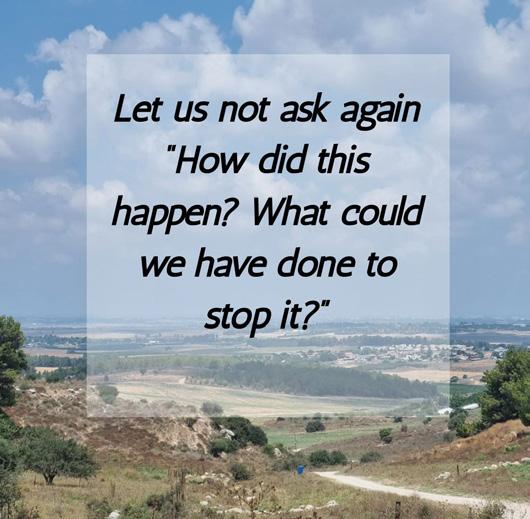
Let us not ask again “How did this happen? What could we have done to stop it?”
Here is what we can do now.
Save a Farm.
Stop our enemies.
Keep the land in our hands.
No F-35 Jet Fighters For Saudi Arabia
NEW YORK – A leading pro-Israel organization has come out strongly against the sale of F-35 stealth fighter jets to Saudi Arabia. It is time for Congress to act to prevent future sales of advanced weapon systems to Middle Eastern authoritarian regimes, according to Americans for a Safe Israel (AFSI).
“Putting F-35s in the hands of Arab dictators is extremely risky. America’s most sophisticated fighter jets should not be sold to authoritarian rulers. Undemocratic regimes are inherently unstable, and that is especially true in the Middle East. What will happen if the dictators of nations such as Saudi Arabia, UAE and Bahrain—coun-
tries that regularly seek American-made weapons—are replaced by forces hostile to America and Israel? Will the new rulers return those F-35s to the United States? Somehow, I doubt it,” stated Moshe Phillips, Chairman of Americans for a Safe Israel.
On June 16, an Israeli Air Force drone destroyed two American-made F-14 fighter jets at an Iranian airbase mere minutes before the U.S.-built planes were about to take flight. The lesson is clear, says AFSI: the American people can never be sure that jet fighters sold to dictators will never be used against the U.S. or its allies.
“It must be remembered that when America sold the jets to Iran
it seemed like a risk-free decision. The U.S. did not sell these fighter jets to the current Islamic Republic of Iran, but to the Imperial State of Iran, which existed before the Islamic extremists took power in Tehran in the 1979 revolution. Now is the time for action on Capitol Hill against the sale of advanced U.S. weapon systems to dictator-led regimes in the Gulf,” stated AFSI’s Moshe Phillips.
About Americans For A Safe Israel: Established in 1970, Americans For A Safe Israel (AFSI) is one of the oldest and most influential pro-Israel organizations in the United States. Its advocacy and educational campaigns serve as a potent counterweight to the rising tide of anti-Israel propaganda. AFSI is not affiliated with any political party in the United States or Israel. AFSI’s website is www.afsi.org.
COMMUNITY NEWS
inSIGHT Through Education Launches “Chesed (Kindness) Social Media Contest” for Palm Beach County Students
PALM BEACH GARDENS, FL –inSIGHT Through Education today announced the launch of the Chesed Social Media Contest, inviting all middle and high school students in Palm Beach County public schools to use their creativity and online influence to stand against antisemitism, bullying, discrimination, or any form of hate.
Inspired by profound acts of kindness (Chesed) that occurred even amidst the immense cruelty of the Holocaust, the contest challenges students to create original social media content that promotes kindness, acceptance, and respect. By amplifying youth voices on platforms like Instagram, Facebook, and TikTok, the contest encourages real change—shaping a culture of empathy both online and in schools.
“The digital space needs an infusion of grace, benevolence, empathy, and compassion,” said Roneet Edrich, Executive Director of inSIGHT Through Education. “This contest empowers the next generation to be the architects of a kinder, more respectful online world. By looking back at lessons of courage during the Holocaust, students can learn how to stand up to hate today and use their online influence to amplify the attributes of grace, benevolence, empathy, and compassion.”
The contest is open to all public middle and high school students in Palm Beach County and students may submit entries individually or as part of a group. The categories for submission include:
Short Form Video:
• Option 1: One video (60–90 seconds long)
• Option 2: Short video series (three 30-second videos)
Videos should be creative, engaging, and able to stand alone as complete stories.
Multi-Slide Instagram-Inspired Post:
A carousel post consisting of 4–10 slides in portrait (4:5 ratio).
Should effectively tell a story or inform on a specific topic through a thoughtful combination of images, graphics, and text.
The contest encourages students to first research and reflect on a true historical account of Chesed from the Holocaust—such as rescuers, hidden children, or small acts of courage—and then translate that lesson into a modern message of kindness, acceptance, and respect relevant to their peers’ lives.
Key Dates:
Entry Deadline: All entries must be submitted electronically by January 12th, 2026 at 11:59 PM EST.
Winners Announced: All winners will be announced on International Holocaust Remembrance Day, January 27th, 2026.
Winning entries will be chosen based on creativity, impact, and engagement in combating antisemitism, bullying, discrimination, or any form of hate with kindness and compassion. Awards and prizes will be granted to top entries
in each division and category.
Student Prizes:
• 1st Place: $1,000 each 4 total winners (2 Middle School, 2 High School)
• 2nd Place: $500 each 4 total winners (2 Middle School, 2 High School)
• 3rd Place: $300 each 4 total winners (2 Middle School, 2 High School)
Prize amounts are the same for individual and group entries; group awards are divided among members.
Teacher Prizes:
Teachers of 1st Place Winners: $500 each 4 total winners (2 Middle School, 2 High School)
Teacher with the Most Student Submissions: $500 2 total winners (1 Middle School, 1 High School) School Award and Prize School with the Most Student Submissions: $500 2 total winners (1 Middle School, 1 High School)
Recognition will be at award events and on inSIGHT’s digital platforms. Further information about the contest can be found here: https://www.insightthrougheducation.org/chesed
About inSIGHT Through Education
inSIGHT Through Education is a nonprofit, nonsectarian organization with a mission to inspire and educate, encouraging kindness, acceptance, and respect for all, using lessons learned from the Holocaust and other genocides, to recognize and oppose antisemitism, hatred, and bigotry. inSIGHT is the backbone of Holocaust Education in Palm Beach County Schools, which is mandated in Florida, along with the study of antisemitism. inSIGHT knows that education is the key to change and is committed to opening the hearts and minds of young people, our future leaders. Learn more at insightthrougheducation.org
Sunday to Thursday: 12pm - 10pm Friday: 11am - 3:30pm OPENING HOURS Scan the code to order!
Operation Inspiration: Cut It Out
By Rabbi Jonathan Gewirtz
Have you ever noticed that some people running companies have trusted staff working for them, while other people seem to be doing everything themselves? You might think one company has better employees and sadly the second employer can’t find good help, but the truth may be a little different.
The problem may be that the person in charge has trouble delegating. Delegating, which means giving specific tasks to specific people who report to you, requires that you trust them to do the job. Even if you’re not a control freak, you might be a perfectionist who doesn’t trust people to do it the way you wanted it done.
The problem with being unable to delegate is twofold. First of all, you end up being so busy you can’t give everything the attention you need to, so you can’t grow your business or focus on the big picture. Second of all, if you don’t trust your staff, or won’t allow them to learn how you like them to do it, they won’t be able to grow into the type of employees you could trust. It’s a vicious cycle.
You’ll never guess where the inspiration for this column and discussion came from. It actually came to me while I was getting a haircut. I have been using the same barber for years and he knows how I like my hair cut. In fact, he probably knows better than I do, because I’ve never cut my own hair. I mean, there was this one time, during COVID, and
I couldn’t get to a barber, but even then, I had my daughter help me. I wouldn’t be able to specify which combs on the trimmer to use, or how to cut around my ears and make it look clean and tidy. Even back in the days when I had more hair and would specify to the barber that I wanted a “3” (I think that’s one of the blade guards on the trimmer), I couldn’t have told him how to cut my hair.
I realized that we totally rely on the barber to make the decisions necessary for us to end up with a nice-looking haircut. He knows what we need better than we ourselves do. All we have to be concerned with is whether we’re happy with the end product. It made me realize that we really are forced to delegate when it comes to the haircut, and that’s a great lesson for other parts of our life.
The truth is, so many things
are not in our control. We can make the perfect presentation, but if the client doesn’t like it, we don’t get the job. We can arrange the perfect garden party, but if it unexpectedly rains, everything gets spoiled.
I remember learning an interesting Gemara about pigeon racers. The question is if they are thieves, because the other racers don’t think they will lose. There was a distinction made between those who thought their birds were the fastest, and those who thought the speed of the birds was determined by the way the owner urged it on with various sounds. The ones who relied on the birds knew they could lose, but the ones who relied only on themselves, didn’t imagine they could lose, and when they do, they are upset and the winner is considered to be stealing from them.
The subtle lesson behind this is that if you depend on yourself, you could end up disappointed. When you realize some things are out of your control, you are able to relax more, and not get as upset when things go wrong. If you trust your workers to do a good job, they usually will, and if they don’t, you can take it in stride. By the same token, if you realize you’re in Hashem’s skilled hands, you likely will be able to handle it when things go wrong because you trust Him.
Like sitting in the chair at the barbershop, you resign yourself to the fact that not only aren’t
you in control, but that the One in charge will make you look your very best. The outcome of every situation will be what Hashem knows it should be, and once you make your best efforts, you leave it up to him. In most cases, your hishtadlus is pretty much like the fellow in the barber chair – you make some basic suggestions, but the final product isn’t up to you.
And you know what? There are times I fall asleep in the barber chair. It’s because I’m relaxed knowing it’s not my problem. Imagine being able to go through life with that sense of calm and serenity! And it’s possible. So the next time you start worrying that someone else won’t be able to do something as well as you, but it takes you away from other important responsibilities, cut it out, relax, and focus on the big picture.
RELAX MORE trav l s
Did you enjoy this column? Feedback is welcome and appreciated. E-mail info@JewishSpeechWriter.com to share your thoughts. You never know when you may be the lamp that enlightens someone else.
The perfect summer recharge is close to home. Spend more time in the pool, at the beach, and sleeping in. Just pack your bag and unwind. Whether you join us for shabbos or during the week, experience a quiet, restful staycation.
Escape from the everyday, without the jetlag.
Beis Medrash • Shul • Shabbos and Yom Tov Amenities
Kaddish for “Uncle Tony”?
The Refuah B’Halacha Center hotline rings all day with every type of medical-halachic shailah you can imagine. Anything can come up in the span of a life cycle, even what to do when that cycle is over. When these questions come in, they aren’t just about halacha — but about the people behind the questions.
That’s exactly what happened one afternoon when a regular-sounding frum yungerman called the hotline. His voice was steady at first, but the rov on call could sense there was something weighing on him.
“Refuah B’Halacha Center, how can we help you?” the rov asked.
The caller cleared his throat. “I have a question about aveilus… Someone very close to our family just passed away.”
The rov responded automatically, “Oy, baruch Dayan ha’emes.”
There was a pause. “Well… not exactly,” the caller said. “It’s complicated.”
A Very Unusual ‘Uncle’
The caller began unraveling the family situation.
“This man who passed away — we always referred to him as our uncle. But halachically… he wasn’t really our uncle. My aunt — she’s not frum — she got married to him years ago after divorcing her first husband. She had a son from that first marriage. That son is my first cousin.”
“So the niftar isn’t Jewish?” the rov asked, trying to make sure he understood correctly.
“No… not Jewish at all. Italian
actually. His name was Tony Mazerono. But he was a good man. A really good man. My cousin’s real father left him when he was young, and Tony raised my cousin like he was his own son. Mamish like a real father. And now Tony passed away suddenly, and my cousin is completely broken. This was the closest thing he had to a father.”
The caller hesitated, searching for the right words. “My cousin isn’t frum. Not even close. But he asked me if there is something he could do to honor Tony’s memory, and I was thinking… maybe I should tell him to say kaddish in shul for a year.”
The caller’s voice softened. “Maybe a year of going to shul… davening… putting on tefillin… maybe it’ll change him. Maybe it’ll bring him closer. Maybe this could be the beginning of something good. But… can a Yid say kaddish for a goy? That’s my question.”
Is There Such a Thing as Kaddish for a Non-Jew?
“Actually,” the rov said, “there is a very similar type of question discussed by some very significant poskim.”
He opened with the ruling of Rav Aharon Walkin zt”l in his Teshuvos sefer Zaken Aharon, Yoreh De’ah chelek 2 siman 87. Rav Walkin addresses the case of a ger tzedek who wanted to say kaddish for his father, who remained a non-Jew.
“Rav Walkin zt”l writes clearly,” the rov explained, “that there is no prohibition whatsoever for a Jew to say kaddish for a non-Jew. Kaddish is, after all, a praise of Hashem —
not a prayer addressed to the deceased. Kaddish is about bringing Kavod Shamayim into the world.”
The rav continued, “Rav Walkin adds only one point: the person should not be the sole individual saying kaddish. He shouldn’t be the only voice of kaddish in the room. But saying kaddish together with others is completely acceptable.”
The caller was listening closely.
The rov then added another powerful source: Rav Ovadia Yosef zt”l, in Teshuvos Yechaveh Daas, chelek 6, siman 60. “Not only does he permits it,” the rov said, “but he brings a strong precedent from the Sefer Chassidim, which states that it is appropriate to daven for the welfare — and even the elevation — of a good non-Jew who acted kindly toward Yidden.”
“That certainly applies to someone like uncle Tony,” the caller said. “He took care of my cousin like a real father.”
“Exactly,” the rov replied. “According to Rav Ovadia zt”l, if a goy performed real chessed and showed love and respect to Jews, it is proper to daven for him. And encouraging your cousin to say kaddish — especially if it will bring him closer to Torah and mitzvos — is certainly not only allowed, but could be a tremendous zechus.”
A Chance for Teshuvah
The rov continued. “This isn’t just about whether saying kaddish is mutar. This is about the bigger picture.” The caller stayed silent, listening. “You have a good point, by tell your cousin to say kaddish,” the rov explained, “he’ll need to
come to shul. A lot. Three times a day. For an entire year, this could open many opportunities for him to grow and learn.”
“That means davening. Putting on tefillin. Hearing divrei Torah. Standing among Yidden who care about him. Feeling a connection to Hashem — maybe for the first time in his life.”
“And who knows?” the rov added slowly. “Sometimes a person walks into shul because of a tragedy… but he stays because he finds his way home. Many baalei teshuvah start from something small, something unexpected. A spark that leads to a flame.”
The caller’s voice cracked. “So you’re saying… I should encourage him?”
“I’m saying,” replied the rov, “that halachically it’s fine, and hashkafically it might be the biggest opportunity he’ll ever have. If this could get your cousin into a shul for a year — davening, learning, being part of a tzibbur — you should definitely encourage it. It could turn around his entire life.”
“And besides,” the rov added, “honoring someone who raised him with love and care — that’s also a form of hakaras hatov, as the above poskim mention when a ger says kaddish for the non-Jewish father.”
A Practical Plan
The caller sounded relieved. “This helps me more than you know.”
The rov offered some practical guidance: Tell your cousin to join a minyan where kaddish is being said anyway. That fulfills Rav Walkin’s requirement of not being the sole person reciting it.
Explain to him that kaddish is a praise of Hashem, not a prayer to the deceased. Many people misunderstand this. Framing it properly can be a powerful teaching moment.
Encourage him gently to use this as a time to grow, not as an obligation or pressure, we don’t want him to come to shul as if he’s just fulfilling some obligation.
Invite him for Shabbos meals, offer to help him with yidishkit, like helping him with his tefillin, and connect him with a rov or chavrusa. A year of kaddish can open doors — but relationships keep them open.
The caller thanked the rov again, his voice noticeably calmer. “You gave me clarity. And honestly… maybe a little hope that my cousin could truly turn around.”
At the Refuah B’Halacha Center, we are here to provide guidance for real-life challenges, big and small.
Whether it’s a question about Shabbos, kashrus, or navigating difficult personal situations, our experienced Rabbunim are ready to listen and advise.
If you ever find yourself wondering about a medical halacha question — big or small, serious or just something that’s been on your mind — remember that you don’t have to figure it out alone. The Refuah B’Halacha Center is here to help, with experienced rabbanim available to guide you through even the most sensitive or confusing situations.
Our Rabbanim;
R’ Yaakov Forchheimer shlit”a
R’ Noach Isaac Oelbuam shlit”a
R Uri Deutch shlit”a
R’ Micha Cohen shlit”a
R’ Moshe Zev Feldman shlit”a
R’ Baruch Hirshfeld shlit”a
R’ Daniel Neustadt shlit”a
R’ Avrohom Yaged shlit”a
We specialize in
Mental health
Shabbos
Treatment issues
Hospital stays
Fertility
Kashrus
We are here Sunday through Friday 8:00 am till 10:00 pm and erev Shabbos 10 minutes before candle lighting.
Refuah B’Halacha Hotline: 732 755 0851 or email us at www.refuahbhalachacenter.org
COMMUNITY
Satmar Rebbe
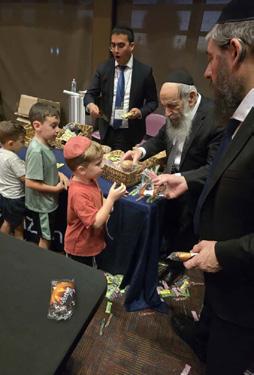
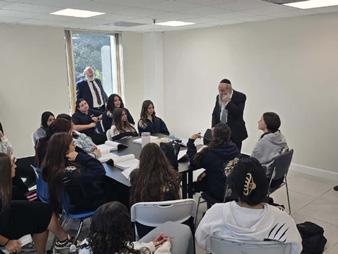
Oorah leaders visit South Florida
At first glance, “legal criminality” seems to be an oxymoron (A term in Greek that means a paradoxical term that contradicts itself).
After all, the law and the justice system are meant to deal with criminals and criminality. What, then, does criminal behavior have to do with the so-called “gatekeepers”
We aim to shed light on a troubling phenomenon: criminal conduct within the legal system itself, which has infiltrated the prosecution and judicial apparatus
Members of the legal and prosecutorial systems have appropriated the title of “gatekeepers” By this, they claim to protect society from lawlessness and criminal behavior. In reality, however, the situation is far more disturbing these very individuals are knowingly breaking the law, threatening the integrity of our society.
Let us begin with the explosive case of the Military Advocate General. Former Major General Yifat Tomer-Yerushalmi, the military’s chief legal advisor and head of the military prosecution, has allegedly acted like a common criminal destroying evidence (her phone was thrown into the sea) and obstructing justice (assigning her deputy to investigate a leak she herself committed)
The Shin Bet transferred incriminating information about her to the Chief of Staff, who then
approached the Attorney General. The Attorney General instructed him not to report the matter to the Minister of Defense
For ten days, Tomer-Yerushalmi was aware of the investigations against her and had ample time to plan her escape from the situation. She received legal counsel from renowned criminal attorney Dori Klagsbald, (under the guise of active reserve duty, though it remains unclear who authorized his enlistment)
Meanwhile, the families of soldiers from Unit 100, who were harmed by her actions, received no such privilege and had to hire lawyers at their own expense.
How is it possible that someone who leaked a manipulated video about Unit 100, causing immense damage to Israel’s image and deep suffering to the families, receives professional guidance on how to continue deceiving the police and judicial system.
Obstruction of justice continued when Tomer-Yerushalmi appointed her deputy, Colonel Gal Asael, to investigate the leak. Months passed, and he failed to identify the source of the leak. (One is allowed to laugh.)
The military prosecution includes the Chief Military Prosecutor, the Head of International Law, the Head of Legal Counsel and Legislation, the Chief Military Defender, and other senior officers. Astonishingly, none of them “knew” about the cover-up. They remained silent and failed to stand up for justice and truth.
I do not believe her suicide at-
tempts were genuine. None succeeded, and she is hospitalized rather than held in a detention facility under 24-hour supervision. I suspect this is a strategy to portray her as mentally unfit, thereby avoiding prosecution under the pretext of “temporary insanity”
Let us move on to the Attorney General
As the supervisor of the Military Advocate General and head of the legal system, Attorney General Gali Baharav-Miara has a long record of questionable conduct.
She has shown contempt for the Supreme Court, requesting 22 postponements for submitting affidavits to the High Court of Justice. She is riddled with conflicts of interest, while barring others from acting under similar claims.
Just a month ago, Baharav-Miara declared to the High
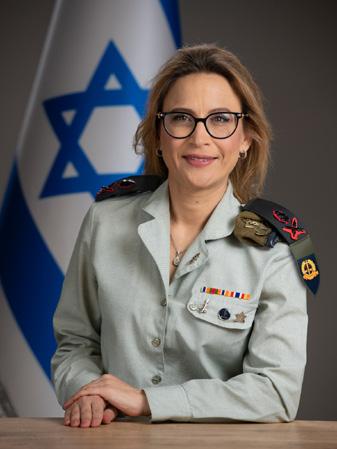
Yifat Tomer-Yerushalmi
Miami's One Stop Chosson Shop
COMMUNITY NEWS
Court that she had examined Tomer-Yerushalmi’s conduct and found no fault. It is important to note that affidavits submitted to the High Court do not allow for cross-examination, unlike other judicial proceedings, meaning one can lie freely
This is the same Baharav-Miara who tried to block the appointment of Major General Zini as head of the Shin Bet. She is well aware of the Pandora’s box of misconduct that may yet emerge regarding her own actions.
It was Zini who reported Tomer-Yerushalmi’s criminal behavior to the Chief of Staff Baharav-Miara’s son was caught on security cameras stealing a sophisticated American vest brought
by an Israeli volunteer for the war effort. He was never prosecuted, thanks to Tomer-Yerushalmi’s intervention on behalf of her friend.
The absurdity deepens when Baharav-Miara insists on overseeing the investigation into Tomer-Yerushalmi herself. She petitioned the High Court to block the appointment of Judge Kula (the Commissioner for Complaints Against Judges), who is widely regarded as impartial and untainted
This is a blatant conflict of interest and a grave injustice. It mocks the very foundations of the legal system!
Where are all the justice and truth protesters who chant “You’re the head -you’re responsible”? Why are they not demanding the
immediate resignation of Baharav-Miara, whose guilt is beyond doubt?
The Attorney General is directly responsible for the actions of the Military Advocate General. She cannot claim ignorance. Her responsibility is clear and unequivocal.
I call for the immediate dismissal of the Attorney General, whose guilt is undeniable. She has betrayed public trust and continues to show contempt for us - the citizens and sovereign.
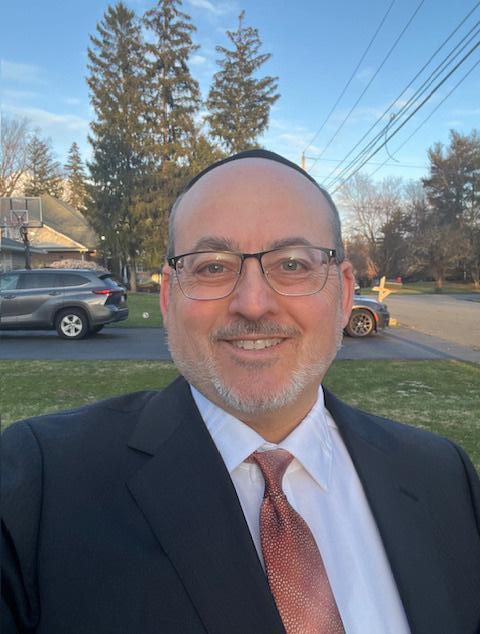
Dr. Yeshayahu (Yishy) Bick yishybick@gmail.com
How Can Parents Select the “Best Fit” Yeshiva Day School for their Children?
By Dr. Chaim Y. Botwinick
As we know, Chinuch (education) is one of the the most cherished and valued priorities for our Jewish community. As such, the type of Chinuch which parents select for their children may in fact be the most critical decision they will make for their children and family.
Since the establishment of the first Jewish day school in 1885 in the United States by Etz Chaim, parents have been on a continued quest for the “best” yeshiva day school education for the children.
With the impressive expansion of the yeshiva day school movement in the United States, we have witnessed a proliferation of student demographic growth, innovative curricula, creative teaching methodologies, increased effective use of new technology and an impressive network of schools with outstanding educational leadership, resources and communal support.
As we know, this remarkable growth and expansion which our
communities have experienced also presents significant challenges and opportunities unsurpassed in history.
Several of these challenges include, but are not limited to school affordability; the training, recruitment and retention of teaching personnel; the engagement of senior day school/yeshiva educational leadership; and responding to the needs of students with exceptionalities including students in need of remediation social/ emotional calibration as well as gifted students.
Selecting the “Right (Best) Fit” Yeshiva Day School
Over the next several weeks, parents will be participating in a wide array of yeshiva day school “Open House” programs.
This annual tradition attracts an increased number of parents every year in order for our schools to provide them (parents) with a more up close perspective regarding a school’s hashkafa, curriculum, educational programs, schedule, facility, teacher profiles, student expectations and other important school characteristics.
At these events, which at times become somewhat competitive in nature (depending upon the community), schools must put their best efforts forward, knowing full well that the process is a competitive one at best.
At the end of the day, it’s about motivating, inspiring and encour-
aging parents to enroll their children in a particular school.
Essentially, it involves the meaningful and effective advertising, promoting and marketing of our schools.
Although this process is a most valuable one, there is only so much information parents can garner during the limited time available to them at an Open House. This reality therefore places the responsibility and burden on the parent to drill-down deeper on their own.
A Deep-Dive into Fact-Finding and Decision-Making Regarding the School’s “Best Fit” for Your Child
It is obvious that not all yeshiva day schools are the most appropriate or best fit for all children. As such, parents must be very careful to engage in due diligence.
In addition, each parent is searching for a specific educational and social environment for the child and no two schools (or students) are exactly alike.
Selecting the “right” school is an extremely difficult and challenging balance. This is especially the case when sending a child to a new school or to the school for the first time.
In light of this reality, it is incumbent upon parents to try to insure that the “school fit” is the best for their child.
By the same token, we know that there are no guarantees, and that a wrong decision or one that is made
COMMUNITY NEWS
in haste can be very costly to the welfare of the child, let alone the decision’s financial implications.
As a past principal, head of school and school consultant, I continuously hear the phrase from parents that “parents know their children the best”.
This perception may be true. But it does not always translate into schooling or the best school fit for the child.
So, in light of these realities, what are some of the avenues and options available to parents who are committed and driven to ensure that their child will grow, develop, and flourish academically, socially and emotionally in a particular school.
Steps to Be Considered
The following is a brief outline of steps that parents may consider.
First and foremost, it is essential to know that the school which your child attends will in part become the institution that molds, shapes and impacts your child’s future as well as his/her intellectual growth and social development. To think otherwise, is foolish and short-sighted.
The second consideration includes exposure to teachers and rabbeim who are assigned to your child’s class, the friends which your child selects, the hashkafa and middot that are promoted (or not) in the school; and the general atmosphere of the school.
Criteria for selection should not always be limited to academics in kodesh or chol but also to the child’s exposure to exemplary character traits and middot tovot. In other words, cultural standards and norms of the school may be just as vital as academics. And
in select cases, depending on the child, even more critical.
Parents must always be proactive.
Several Steps for Parents to Undertake May Include:
1. Obtaining permission from the principal or head of school to sit in a classroom (in session) in order to observe classroom teaching/learning dynamics;
2. Reviewing the results of the school’s standardized test scores;
3. Spending time in the lunchroom to observe how students interact with each other;
4. Listening carefully to the language and words students use in the halls between periods;
5. Observing whether there is talking during tefillah
6. Spending time observing PE and recesses in order to observe how students interact with one another during “down-time”;
7. Obtaining special permission from the principal or head of school to ask a few students questions about how they feel about the school – what they like best and least;
8. Scheduling a time of mutual convenience to chat with Judaic studies rabbeim and general studies teachers;
9. Contacting select like-minded
parents in order to obtain their perceptions about the strengths and weaknesses of the school;
10. Trying to get a general vibe of the school by observing and listening carefully to students who attended or who graduated from the school;
11. If permitted, asking the school administration for a copy of the school’s accreditation report;
12. Observing (as much as one can) if the school has a warm, inviting, caring and nurturing environment;
13. Prioritize what you consider to be the most important or essential characteristics of the school as they relate to the provision of chinuch for your child, and
14. Observe the manner in which students are dressed and are groomed.
Conclusion
At the end of the day, your family’s decision regarding the yeshiva day school “best fit” for your child is a very personal one.
As indicated, your decision will depend on a variety of factors, some of which are exclusively school-related, others will be based upon your child’s personality, cognitive and social disposition. In all probability, it will be based on a combination of the two. It’s important to also note that
even with the best and most comprehensive vetting of a school, parents will never know for sure or be 100% confident that the school is the “best fit” for the child.
As such, there are a variety of circumstances and factors which evolve and change over time, making it impossible to achieve absolute certainty.
At best, the parent needs to prioritize those aspects of the school that represent the three most essential elements for a child’s growth, development and success.
Depending upon maturity level, involve your child in the conversation and decision-making process; seek guidance from friends, colleagues and relatives.
Finally, you may want to compare the process to vetting a company prior to accepting the job offer or assignment. You can only vet
so much. In fact, too much vetting can lead to confusion, fatigue and overload, leading to very costly decision-making and results.
The decision you make for and with your child will be one of the most important decisions in his/ her life.
Remember, as long as you engaged in hishtadlut (due diligence), the rest is in the hands of HaShem.
If you are attempting this important journey, I wish you tremendous hatzlacha as you embark upon one of the most important decisions in your son’s life; namely the identification and selection of a school which represents the “best fit” for your child.
Always please keep in mind that the activities suggested in this article do not need to happen in one day. Take your time, start your re-
New in F lorida!
Get your books personalized with the first instant on-site foil stamping machine in the state
Add your simcha monogram to benchers.
Brand your shul or school books with your logo.
view process early on, but always give yourself a deadline in order to make a final determination or decision. But do not overthink or overanalyze. It will only lead to procrastination, frustration.
And remember, the type of school you select for your child will be foundational to his/her future success.
B’hatzlacha
Dr. Chaim Botwinick is a senior executive coach and an organizational consultant. He served as president and CEO of the central agency for Jewish education in Baltimore and in Miami; in addition to head of school and principal for several Jewish day schools and yeshivot. As an Influencer, he has published and lectured extensively on topics relating to education, leadership, strategic planning and resource development. Dr. Botwinick is co-founder of LEV Consulting Associates and is producer/host of the Chinuch Horizons podcast series. He is author of “Think Excellence” Brown Books 2011
Makes any gift so much more meaningful.
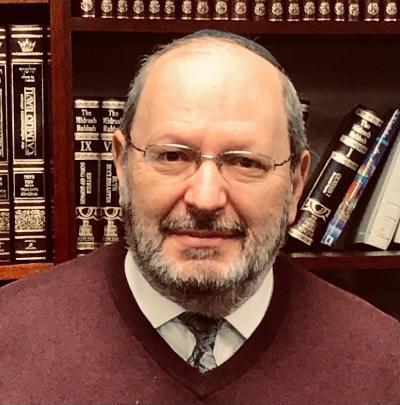
About the Author:
Chabad of Jamaica Converts Island’s Only Kosher Restaurant Into
Chabad Volunteers Deliver Food, Generators, Starlink Phones and Supplies to Jamaica’s Isolated Communities
Montego Bay, Jamaica (11/11/25) — Two weeks after Hurricane Melissa’s historic devastation, nearly 75% of Jamaicans remain without power, running water and with scarce food supplies. Chabad Rabbi Yaakov Raskin is partnering with major relief organizations to tackle the main challenge, which is reaching people “in the last mile.”
“We are connecting aid distribution organizations with the people who need it,” said Rabbi Raskin, who has directed Chabad of Jamaica since 2014. He has converted the Kosher Host Spot – Jamaica’s only kosher restaurant – into a community hub offering free hot meals, Wi-Fi, phone charging, and aid coordination. Through a partnership with World Central Kitchen, they’re providing over 500 hot meals daily to Montego Bay residents and coordinating care for those who need it.
Chabad’s teams of volunteers have also gone out to some of the hardest hit area to deliver aid directly. In the past two weeks, Chabad has reached approximately 1,000 people daily in Whitehouse, Bluefields, and Savanna-la-Mar with warm meals, toiletries, fresh clothes, emergency supplies, water, canned goods, and children’s toys.
“We met a woman in Westmoreland who hadn’t eaten in two days,” said Rabbi Raskin. “In Savanna-la-Mar, we found families with young children living on the
Distribution Hub for Food Aid
streets. These people are isolated from main aid areas and we want to make sure they’re not left behind.”
Critical Supplies and Infrastructure Support
Since Hurricane Melissa subsided, Chabad Jamaica rallied supporters in the US to donate desperately needed aid and get it onto the island. In coordination with Hatzolah Air and Chabad of the Cayman Islands, they chartered three private planes filled with food, emergency supplies, clean clothing, and medicine.
Two additional 40-ft shipping containers are arriving from New Jersey this week, and Chabad has reserved a large warehouse in Montego Bay to store and distribute the aid when it arrives.
Chabad has distributed generators, tarps to cover for blown-off roofs, solar battery packs that can power lights and fans, and cases of water to area where infrastructure was destroyed. They also handed out 20 Starlink satellite internet phones to community leaders and aid workers. Additionally, they’ve hired plumbers to assist several rural families fix broken pipes and install water tanks.
Supporting
the Community
Chabad has also supported the
local Jewish community and Jewish aid workers during this critical time. On Friday, November 7, Chabad hosted an Shabbat meal for approximately 30-40 Israeli medical professionals providing emergency medical care alongside Jamaican staff in hospitals, helping those evacuated from the hardest-hit regions.
During Hurricane Melissa, Rabbi Raskin and his wife Mushkee sheltered with their children in a windowless room as Category 5 winds tore shattered glass windows, and compromised the electric, plumbing and HVAC systems. Despite operating with limited resources, Chabad has sheltered displaced locals, provided phone charging stations to locals, distributed critical food and medical supplies, and coordinate relief flights.
“When my wife and I came to Jamaica in 2014, we took on the responsibility to help every single person on this island,” said Rabbi Raskin. “People in rural communities, families with young children, and the elderly still need help. We’re not going to let them be forgotten.”
How to Help:Donations: Support Chabad’s relief efforts at JewishJamaica.com/Relief
About Chabad of Jamaica: Since 2014, Rabbi Yaakov and Chaya Raskin have operated Chabad of Jamaica in Montego Bay, providing humanitarian assistance, cultural programs, and support services to the island’s residents and hundreds of thousands of annual Jewish visitors. Their mission is to strengthen Jewish awareness and pride regardless of background or affiliation, and to spread acts of goodness and kindness to all humanity. Chabad-Lubavitch is a global Jewish outreach organization with centers in over 100 countries.
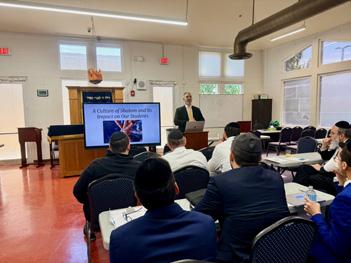
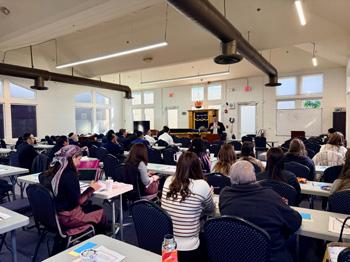
Torah Academy of Boca Raton Holds Inspiring Professional Development Day
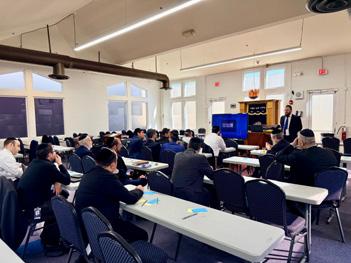
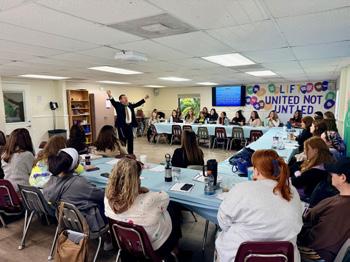
At Torah Academy of Boca Raton, the belief that educators must grow alongside their students is at the heart of its mission. This past Tuesday, the school held a full-day Professional Development event, empowering its dedicated faculty with renewed tools, vision, and purpose in their sacred work of education.
The day focused on reflection, collaboration, and skill-building for the entire staff—Rabbeim, Moros, teachers, and early childhood educators. Sessions were designed to ensure classrooms remain environments of warmth, engagement, and lasting impact.
Rabbi Yosef Bondi opened the day for the Boys Division with a powerful keynote on nurturing the whole child—academically, emotionally, and socially—followed by a hands-on workshop to promote active student participation. Rabbi Eli Zoldan led a collaborative session for Rabbeim focused on cultivating positivity and mutual respect, while Rabbi Yoel Chanales guided a reflective workshop on personal mission statements for growth-minded teaching.
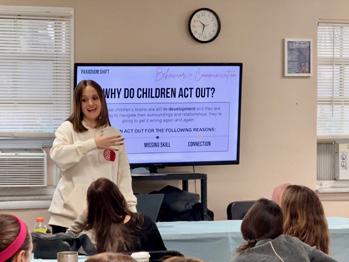
In the Girls Middle School and Elementary Divisions, Dr. Miriam Adahan, noted psychologist and author, shared practical strategies for emotional regulation and self-worth, emphasizing how students bring holiness into the world through kindness and self-disci-
pline. Rabbi Shalom Muskat addressed the importance of moral clarity and integrity in all areas of education.
Early Childhood educators participated in an engaging session with Mrs. Yehudis Smith, who presented “Rethinking Discipline”—a thoughtful approach to managing
classroom behavior through connection, empathy, and long-term development.
The day was an inspiring reminder that at Torah Academy of Boca Raton, professional growth is not just encouraged—it’s essential. Faculty left energized and equipped to bring new insight and enthusiasm into their classrooms, further elevating the educational experience for every child.
Torah Academy of Boca Raton is a Yeshiva with preschool, elementary, and separate boys’ and girls’ middle school divisions, serving approximately 900 students this year. For more information, visit www.torahacademybr.org or call 561-465-2200.
A Day of Healing: TrufaMED Urgent Care Hosts Superstar IV Event for Wounded IDF Heroes
In a heartfelt display of unity and gratitude, TrufaMED Urgent Care in Surfside welcomed a group of wounded Israel Defense Forces (IDF) soldiers for a restorative wellness event in partnership with Restart Global. The afternoon blended community, medicine, and deep appreciation; offering these brave young men and women a moment of comfort and care far from home.
Restart Global: A Lifeline for Wounded Soldiers Since 2014
Founded by wounded IDF veterans who personally walked the long road from trauma to recovery, Restart Global understands better than anyone the challenges of rebuilding life after injury.
Since 2014, the organization has supported hundreds of veterans with mentorship, cutting-edge rehabilitation technologies, emotional support, and hands-on assistance for both soldiers and their families.
In the aftermath of October 7, 2023, their work has become even
more urgent. With over 20,000 wounded, Restart Global’s teams are now present in hospitals, rehabilitation centers, and family homes across Israel, ensuring that no soldier faces recovery alone.
TrufaMED: Where Medicine Meets Compassion
Although known for its state-ofthe-art medical care, imaging, and in-house lab, TrufaMED Urgent Care has quickly become equally recognized for something else: its heart. By blending evidence-based medicine with a serene, spa-like environment, TrufaMED believes that healing should feel calm, supportive, and deeply human.
For this special event, the soldiers—whom had arrived from Israel just the day before—received complimentary Superstar IV Therapy, a medical-grade infusion designed to ease dehydration, fatigue, headaches, muscle and joint pain, and overall weakness. The treatment was especially welcomed after long-distance travel and jet lag.
The Superstar IV includes B-complex vitamins, high-dose Vitamin C, Magnesium, Zinc, Glutathione, Taurine, and supportive medications such as Toradol, Zofran, and Pepcid—a carefully crafted blend meant to replenish strength and energy.
Real Urgent Care, Real Impact
During the event, one of the soldiers arrived with a partially opened wound on her finger that required immediate attention. TrufaMED’s medical team assessed the injury, cleaned the area, and performed a wound closure with sutures—a clear reminder that behind the comfort and hospitality, TrufaMED is a fully equipped urgent care capable of providing real medical treatment when it’s needed most.
For the soldier, it was an unexpected but reassuring moment: compassionate care, delivered expertly and instantly, far away from home.
Each soldier received their treatment in a private, tranquil well-
Yosef a poor man came to the big city of Minsk and went to ask for Tzedaka by Shaya the Gvir When Shaya was told the purpose of his visit he responded "I can see that you are definitely not from our city " " You are right" replied Yosef "In that case I can' t give you charity as it says “aniyei irchah kodmim," Yosef thought a moment and said "Fine, but how did you know living in a city with thousands of Jews that I was not from this city?"
"It was obvious, all the people in my city already know that I don' t give any one charity "
COMMUNITY NEWS
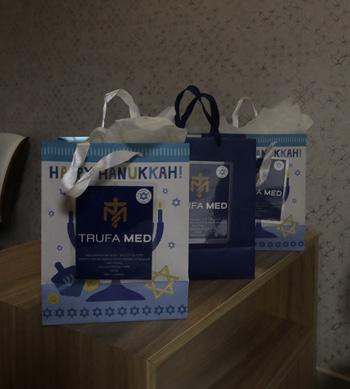
ness suite and was sent off with a thoughtful welcome bag filled with premium chocolates, Israeli and American candies, toiletries, and essentials to make their week-long stay in the U.S. more comfortable. The room was filled with fresh sushi, cupcakes, Israeli music, and warmth from Hebrew speaking staff eager to express their appreciation.
A Powerful Moment of Jewish Solidarity
For everyone present, the event felt like a small reminder that wherever Jews are in the world, we show up for one another.
Many of the soldiers expressed heartfelt gratitude for the comfort and care they received. “Had my vitamin injection at Trufamed
Miami and loved it! Amazing concept super friendly team, quick service, and I left feeling energized and cared for. Highly recommend checking them out!” shared Idan G.
Another soldier, Shahar M., described the experience simply as: A truly special experience, highly recommend coming and trying it. Their words reflected the emotion in the room — a community thousands of miles away, standing proudly with Israel’s wounded heroes.
“We wanted these heroes to feel truly cared for—not just medically, but emotionally and spiritually,” said Dr. Uri Gedalia, Chief Medical Officer at TrufaMED. “They have endured unimaginable trauma while protecting Am Yisrael. Offer-
ing them relief, comfort, and a few hours of peace is the very least we can do.”
Healing, Honor, and Community
The event embodied the timeless Jewish principle of kol Yisrael arevim zeh lazeh—all of Israel is responsible for one another. TrufaMED’s partnership with Restart Global brought that value to life, providing soldiers not only medical care but also genuine warmth, respect, and gratitude.
As these wounded warriors continue their journeys of rehabilitation, TrufaMED Urgent Care remains committed to extending care, kindness, and healing to Israel’s heroes—wherever they may be.
• DINE-IN
• SUSHI PLATTERS
• CATERING SETUP
10% DISCOUNTIF YOU BRING IN THE COMMUNITY VOICE MAGAZINE
• LIVE SUSHI STATION
• DELIVERY & PICKUP
SPACE KIDS ZONE KIDS ZONE RIDDLES ABOUT
I’m a place with no sound, not even a squeak. No air, no noise — just quiet and sleek. What am I?
On this planet, a single day feels super long. It’s longer than its year — now that’s really strong!
Which planet am I?
I sparkle in the sky and there are more of me, Than all the sand on every beach you see!
What am I?
What am I made of? A: Outer space A: Stars
I’m the giant of the planets with moons galore. I have over 95 — and maybe even more! Who am I?
Jupiter
Boot prints on me last millions of years.
No wind, no rain, no weather appears!
Where did astronauts leave prints?
The Moon
I’m tiny as a teaspoon but heavy as can be. A billion tons is what I’d weigh — imagine lifting me!
Neutron-star material
I’m not the closest to the sun, but I’m the hottest place.
Thick clouds trap heat all over my face! Which planet am I?
Venus A: Venus
I’m big and round and made of gas, My density is low — I could float if I had a bath! Which planet am I?
Saturn
Every second I help a new one shine.
Millions are born, but none are mine!
What am I talking about?
Stars being born
KIDS ZONE KIDS ZONE
KNOW THAT...
FACTS ABOUT SPACE DID YOU
1. Space is totally silent because it’s a vacuum — there’s no air for sound to travel through.
2. A day on Venus is longer than a year on Venus because the planet spins extremely slowly but orbits the sun faster.
3. There are more stars in the universe than grains of sand on Earth, according to astronomers’ estimates.
4. A teaspoon of neutron-star material would weigh about a billion tons because neutron stars are unbelievably dense.
5. Venus is the hottest planet, even hotter than Mercury, because its thick atmosphere traps heat like a giant oven.
6. Jupiter has at least 95 confirmed
moons, including some with volcanoes and some that may have hidden oceans.
7. Footprints on the Moon can last millions of years because there’s no wind or rain to erase them.
8. Saturn’s average density is lower than water, which means it would theoretically float — even though it’s made of gas, not a solid object.
9. About 1–3 new stars are born every second in the universe, based on scientific estimates of star-forming regions.
10. A giant cloud in space contains a molecule that smells like rum and tastes like raspberries — scientists detected the chemical called ethyl formate in the Sagittarius B2 cloud.
KIDS ZONE KIDS ZONE
PEACS 2. SNEUV
TURENON
TSRAS
TTEOHST
RPJTIEU
ONOM
DULOC
TANSUR
LXAGYA
Chocolate and Caramel Dipped Apple Pops
By Jamie Geller
Kids will love dipping Apple Pops in pareve salted caramel, chocolate, sprinkles, and nuts.
Ingredients
• ¼ cup firmly packed dark brown sugar
• ¼ cup sugar
• ¼ cup unsweetened almond milk
• 1 tablespoon vegan butter or coconut oil
• 1 teaspoon vanilla extract
• ½ teaspoon coarse sea salt
• 2 cups chopped semisweet or bittersweet chocolate
• 2 tablespoons vegan butter or coconut oil
• 3 apples stems removed
• Pareve Salted Caramel
• Chocolate Coating
• Garnish: sprinkles mini candies, pumpkin seeds, chopped nuts, and chocolate chips
Preparation
SALTED PAREVE CARAMEL:
1. In a saucepan, combine brown sugar, sugar, salt, and almond milk. Simmer over medium heat until sugars dissolve, then increase the heat to mediumhigh.
2. Stirring often, let mixture boil, until it registers between 250°F to 275°F on a candy
thermometer.
3. Remove from heat and stir in vegan butter or coconut oil, vanilla extract, and sea salt. Pour into a heatproof container and set aside.
CHOCOLATE COATING:
4. Place chocolate in a double boiler over medium-low heat, or in a small heatproof bowl fitted over a small saucepan with an inch of water. Choose a shallow bowl, so that water from the pan does not touch the bottom of bowl.
5. Melt chocolate. Stir it occasionally to prevent it from burning.
6. Once chocolate is melted, remove from heat. Add vegan butter or coconut oil and stir into warm chocolate to melt.
APPLE POPS:
7. Slice apples across into ¼-inch
thick slices. Leave out the center section as it contains the core and seeds. You should get about 4 to 5 slices from each apple. Insert a popsicle or lollipop stick into apple slices and set aside.
8. When you are ready to dip and decorate, pat apple slices dry and dip into caramel or chocolate. Drizzle with caramel or chocolate, and decorate with sprinkles, chopped nuts, candies, or pumpkin seeds.
9. Place decorated apple pops on parchment paper lined pan, and place in the refrigerator for 30 to 45 minutes to set chocolate and caramel. Cut apples have a lot of water content and will start to weep quickly, so we recommend eating them as soon as they’re set.
Jamie Geller is the Chief Media and Marketing Officer at Aish. She is also a bestselling cookbook author, celebrity chef, television producer, and businesswoman. She’s the author of eight cookbooks and the founder of Kosher Media Network.
BUSINESS DIRECTORY & CLASSIFIED
Jewish telehealth therapist for anxiety & bitachon
Experienced serving the observant Jewish community. Insurance accepted.
TV wellness expert with new Florida practice. (303) 720-1424 l heather@drheatherhans.com
CUSTOM MADE FOOT ORTHOTICS
Low bulk, dynamic and comfortable. Excellent for balance, sports & pain relief. Adults & Children Rochelle Silberman-Jawitz, Concierge Orthotist (917) 494-1111
SEAMSTRESS
Alterations, Dressmaking, including wedding clothes. Phone: (646) 413-4542
Job Opportunity - Jewelry Office Assistant
We are seeking a motivated and responsible individual to join our online-based diamond jewelry company as a full-time Office Assistant. This is an on-site position (no remote work). The hours are Monday–Thursday, 9:00 AM–5:00 PM, and Friday, 9:00 AM–2:00 PM. You will be responsible for helping to fulfill orders, manage inventory, and maintain office organization. This is a great opportunity to join a growing jewelry company!
If interested, please contact Yossi at 310-200-1192.
BUSINESS DIRECTORY & CLASSIFIED
List your local business, services available, real estate opportunities, Help Wanted, & more!
Basic listing: $10/week -
Name, number and email address
Enhanced listing: $25/weekUp to 25 words (additional words $1/each)
Deadline:
Tuesday at 4pm for next week's issue
Contact: andrea@tsfcommunityvoice.com
|
| barry@navonpro.com
MOVE TO NORTH FLORIDA
Most affordable housing in the entire state Esformes Hebrew Academy of Ormond Beach NOW HIRING
• Elementary teacher • Office manager • School Event Coordinator • Drama & Music, Coach Part-time and full-time positions Quiet suburb School and shul community EsformesHebrewAcademy.org Email resume to chanidaytona@gmail.com
The new ‘Noble Wines’ catalog has arrived, featuring our latest selection of premium wines. Request your free copy by mail. Just text or email your address and we’ll deliver it straight to your door. Text: (845) 716-8306 or email: news@noblewinesinc.com
Making America Affordable Again
By Shmuel Shayowitz
Recently, the Trump administration announced a bold plan to introduce 50-year mortgages. Of course, the announcement instantly grabbed headlines with lots of commentary. On the surface, it sounds very patriotic and practical, and a logical attempt to make housing more “affordable” for Americans struggling with high mortgage payments and high home prices.
To me, it sounded more like a wakeup call than anything else. Stretching a mortgage across half a century doesn’t make housing affordable… it makes debt eternal. It’s the financial equivalent of kicking the can so far down the road that the next generation trips over it. And I believe this move has less to do with homeownership and more to do with politics.
For months, Trump has been publicly pressuring Fed Chair Jerome Powell to lower rates, arguing that consumers are being crushed by unaffordable payments. This 50-year loan is his alternate plan and a way to lower payments without cutting rates. It’s a clever fiscal ‘sleight of hand’ that gives the appearance of affordability while keeping banks stable and markets secure. Unfortunately, extending the loan term doesn’t fix the problem, it just defers it.
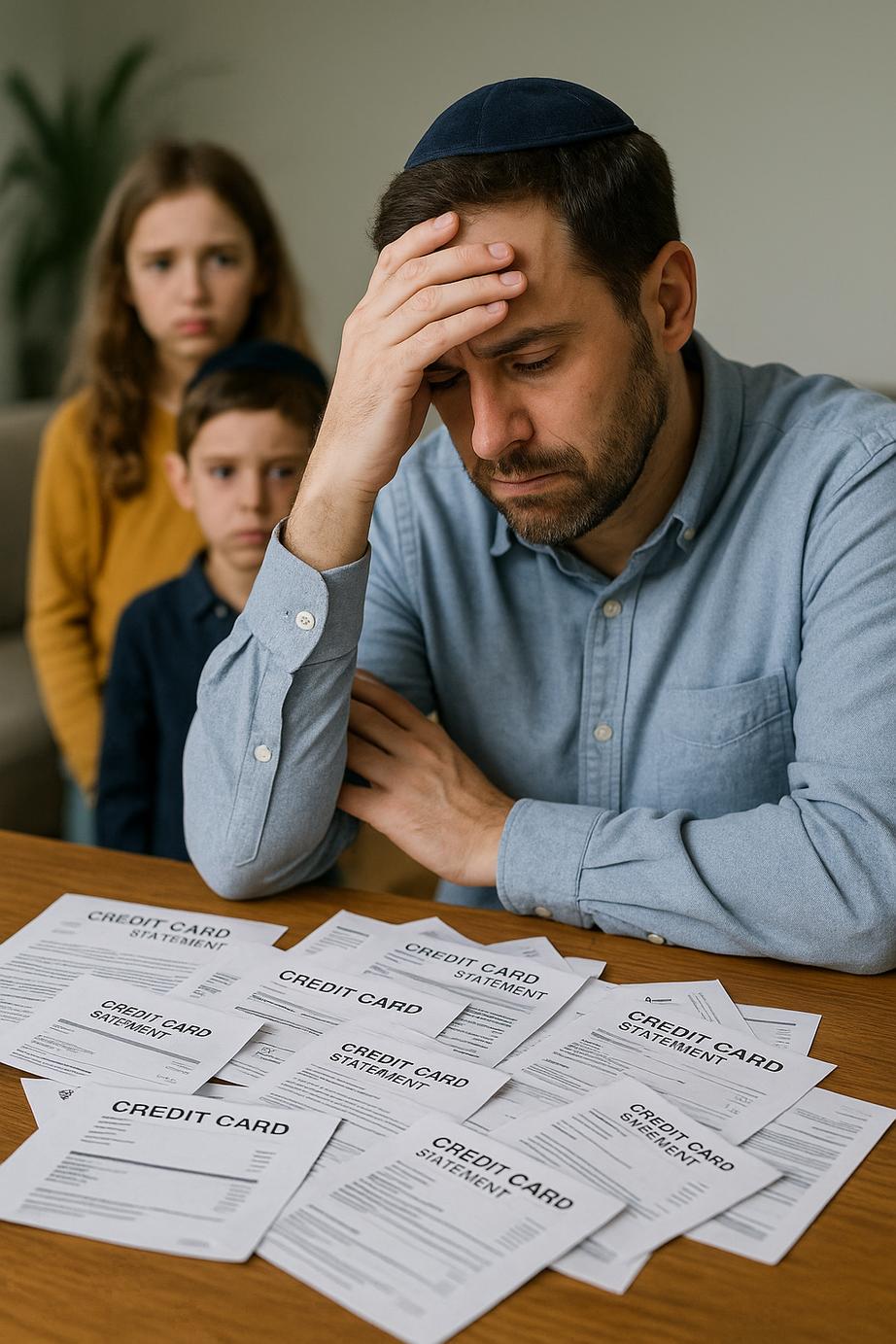
And that, in many ways, mirrors what’s happening to the average American household. The real crisis in America isn’t just housing affordability, it’s general life stability. We keep stretching every-
thing - our debts, our lifestyles, our commitments - to make it all seem manageable. We stretch our credit cards to cover “necessities” that are really wants. We stretch our schedules until we barely have time for ourselves. We stretch our patience, our energy, and our sanity, convincing ourselves that we can juggle it all as long as we don’t have to face any consequences yet.
But affordability isn’t something the government can legislate. It’s something we have to mandate upon ourselves. Lower rates or longer loan terms might tweak a spreadsheet a little, but it won’t bring peace of mind. Real affordability begins with personal accountability. There needs to be an understanding of your numbers, living within your means, and being brutally honest about what matters most. The problem is that we’ve been conditioned to believe that “more” equals “better.” Bigger homes, newer cars, faster phones, fancier vacations. But none of that builds true fulfillment.
I’ve seen clients qualify for homes that they could never truly afford. On paper, the math worked. In real life, it didn’t. And I told them so. A house that is supposed to bring happiness becomes a source of anxiety. The loan meant to make life easier becomes a leash. That’s the danger of chasing “affordability” defined by someone else’s formula. Banks can compute your payment, but they can’t calculate your peace of mind.
If America really wants to be-
come affordable again, it needs to start at their own kitchen tables, not in Washington. It needs to begin with families who sit down and decide that maybe having less can actually mean living more. It starts with people who stop waiting for politicians to lower their payments and start learning how to manage their own paychecks. We need to stop justifying and facilitating financial burdens by creating workarounds. The 50year mortgage option could make certain homes more attainable, but it will not actually reduce the cost of living. The government should not be tasked or required to restore affordability in America. We need to recalculate our own priorities and make life affordable again holistically. And the power to achieve this goal rests solely with those who face their financial circumstances and make appropriate changes. Don’t extend your payments - extend your perspectives.
Shmuel Shayowitz (NMLS#19871) is a highly regarded Real Estate & Finance Executive, Writer, Speaker, Coach, and Advisor. He is President and Chief Lending Officer of Approved Funding, a privately held national mortgage banker and direct lender that has facilitated over $3 billion in mortgage funding. Shmuel has over twenty years of industry experience and holds numerous licenses and accreditations, including certified mortgage underwriter, licensed real estate agent, residential review appraiser, and accredited investor, to name a few. Shmuel has successfully navigated through many changing markets and business landscapes, making his market insights and experience well-coveted within the real estate industry. He can be reached via email at Shmuel@approvedfunding.com.