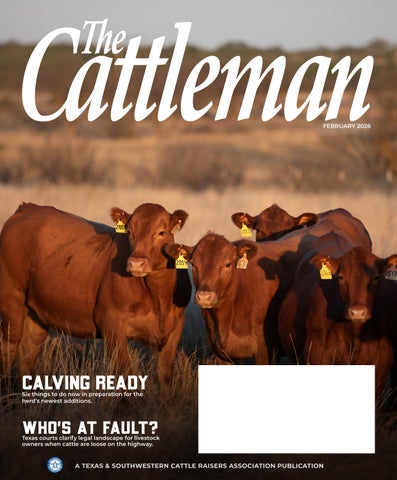
Calving Ready
Six things to do now in preparation for the herd’s newest additions.
Who’s at fault?
Texas courts clarify legal landscape for livestock owners when cattle are loose on the highway.

![]()

Six things to do now in preparation for the herd’s newest additions.
Texas courts clarify legal landscape for livestock owners when cattle are loose on the highway.


Six essential things to do before calving season begins.
By Krissa Welshans

Texas courts clarify legal landscape for livestock owners.
By Jena McRell


What happens if cattle are loose on a highway and someone gets hurt?
It’s a question many livestock owners hope they never have to answer, but one that has taken on new relevance as Texas courts weigh in on fence law and liability. On page 18, we take a closer look at how recent court decisions have clarified long-standing state standards and what those rulings mean for cattle raisers.
Also in this issue of The Cattleman, we focus on practical steps cattle raisers can take to get ready for their herd’s newest additions. Our calving readiness feature outlines six key actions to tackle, from facility checks to herd health considerations, helping set both cows and calves up for a strong start later this spring.
Readers will also find an update on our newly introduced small business and corporate membership categories, designed to strengthen connections between businesses, ranchers and landowners. These memberships create new opportunities for companies to engage with our more than 28,000 members and
support the future of the cattle industry. Learn more about these options on page 32.
We also invite you to take advantage of early-bird registration for the 2026 Cattle Raisers Convention & Expo. Sign up by Feb. 15 for the best prices. We look forward to seeing you March 27-29 in Fort Worth for education, shopping and connection with fellow cattle raisers.
As always, thank you for supporting Texas & Southwestern Cattle Raisers Association. We hope you enjoy our latest issue of The Cattleman T C

Jaclyn Roberts Parrish Executive Director
of Communications, Marketing & Partnerships/Editor-in-Chief, The Cattleman jaclyn@tscra.org • 817-916-1794

February 2026 / / Vol. CXII, No. 9
Published by Texas & Southwestern Cattle Raisers Association
P.O. Box 101988, Fort Worth, Texas 76185
Phone: 817.332.7064 • Fax: 817.394.1864 tscra.org
EDITORIAL
Editor-in-Chief Jaclyn Roberts Parrish
Managing Editor Jena McRell
Associate Editor
Shelby Kirton
Copy Editor Elyssa Foshee Sanders
Proofreader
Cydney Fansher
Graphic Designer Ryan Barten
EXECUTIVE DIRECTORS
Executive Vice President/CEO Jason Skaggs
Communications, Marketing & Partnerships Jaclyn Roberts Parrish
Events, Education & Leadership Development Emily Lochner
Finance & Human Resources Megan Wills
Interim Government Relations Peyton Schumann
Law Enforcement, Brand & Inspection Services Clay McKinney
Membership & Operations Lisa Walker
OFFICE LOCATIONS
Fort Worth 2813 S. Hulen St., Suite 150 Fort Worth, Texas 76109
Austin 919 Congress Ave., Suite 750 Austin, Texas 78701
Subscription Inquiries: tscra@tscra.org or 800-242-7820
Advertising Sales: sales@tscra.org or 817-332-7064

A set of heifers at McCartney Ranch Co., Texas & Southwestern Cattle Raisers Association members near Throckmorton.
Photo by Emily McCartney Eiguren


Six essential things to do before calving season begins.
By Krissa Welshans
Calving season is among the most anticipated times of the year on the ranch. With each new calf, the next generation of the cow herd offers fresh optimism and potential.
Even so, a lack of preparation can create unnecessary hardship for cattle, employees and the operation. A few proactive steps can go a long way toward ensuring calves are set up for success from birth. Two important perspectives, clinical and producerlevel, helped shape the following six essential considerations as calving season approaches.
Dr. Rosslyn Biggs, of Oklahoma State University’s College of Veterinary Medicine, and Jake Cowen, a Texas & Southwestern Cattle Raisers Association director and rancher from Benjamin, share their top recommendations for late-winter and early-spring calving.
First and foremost, Biggs says body condition score as it relates to lategestation female nutrition is crucial, especially since adding pounds during the last trimester can be difficult.
“Cows in poor body condition will have more challenges all the way around, from dystocia to poor quality colostrum to not feeding the calf and taking care of herself,” she says.
Cowen, who runs about 400 cows at Cowen Cattle Company, says they go out of their way to make sure females are in solid body condition before calving by providing mineral, quality pasture and a high-fat cake supplement. First-calf heifers also receive a higher point of nutrition, Cowen says, “because they’re still trying to grow and have that first calf.”
Conversely, Biggs says she puts equal emphasis on overweight females as this can result in dystocia and other problems during calving, particularly for heifers. Keeping the soon-to-be mama cows in ideal condition, targeting a BCS 5-6, is key.
She also notes research that suggests feeding cattle in the evenings during the last 4 to 6 weeks of gestation can equate to more daytime calvings. The Konefal method, developed by Gus Konefal in the 1970s, uses late afternoon or dusk feeding — between 4 p.m. and 6 p.m. — to encourage cows to calve during daylight hours. Studies have shown up to 85% of calves are born between 6 a.m. and 6 p.m. when using this method.
Whatever the feeding scenario, Biggs also emphasizes the importance of access to clean, fresh water. Especially during the lower temperature months, ensuring cattle have a consistent water source nearby is a top priority.
Both Cowen and Biggs also stressed the importance of having a comprehensive herd health program, especially regarding vaccinations. Biggs recommends producers vaccinate females at least one month prior to calving, ideally during the veterinarian’s first pregnancy check or even earlier, before breeding begins.
Cowen says his females always receive a modified live vaccination and annual booster prior to breeding. His operation also prioritizes pre- and post-weaning vaccinations for calves, noting that “on the stocker-backgrounder side, we will pay a premium for cattle that have had pre- and post-weaning shots every single time.”
He says his preferred calf vaccinations include blackleg and modified-live vaccines.
Biggs advises ranchers to review and update breeding and calving records in preparation for calving season. “The more detailed the records, the better,” she says.
Having documented due dates and any additional details about the cow, such as whether she has poor milk production, her temperament, if she’s had dystocia or if she wasn’t maternal, can help producers plan.
Cowen tells ranchers to have realistic expectations and prioritize cows that fit the environment and the operation. He especially emphasizes the importance of solid bull power in an operation’s cow genetics, something to which he attributes their success.
Biggs also recommends developing a treatment plan for all phases of the calving process — from normal deliveries to dystocia, post-calving and calf care — and ensuring all personnel are properly trained on the operation’s management goals and process.
Ideally, cows and heifers should calve in a location where assistance can be provided if needed. Biggs also recommends separating cows and heifers, since heifers are more prone to calving challenges and require closer monitoring. “I cannot help a cow with dystocia if she’s on 500 acres,” she says.
If facilities are inaccessible, a producer should have the ability to load an animal and take them to the veterinary clinic.
At Cowen Cattle Company, where the calving process is largely hands-off due to pasture size, heifers are stationed where they can


access feed and be easily monitored. Following their second calving, cows are sorted into groups by age — 3 to 5 years and 6 to 10 years.
“Our philosophy is, if she can’t have the calf on her own, we don’t need her,” Cowen says.
Weather during late winter and early spring can be harsh, with frigid temperatures and blustery winds. Ranchers should consider providing windbreaks or access to shelter for both the cow and calf to shield them from the elements. Biggs encourages calving outdoors when possible but acknowledges that sometimes shelter is a necessity.
Cowen Cattle Company is located in brush country with natural cover, so they prepare cows for inclement weather by protein-loading them and rolling out hay before leaving them undisturbed during the storm.
In preparation for calving, locate and assess needed equipment including the chute system, gates, calf jack and technology, such as cameras or calving sensors.
“Equipment doesn’t have to be fancy, but it needs to be functional,” Biggs says. Her preference for cattle handling equipment when dealing with dystocia is not a full chute, but rather a head gate with wings that can be moved, so the cow can get up and down. She says this type of set-up is safer for cows and personnel.
It’s also important to make sure the calf jack works.
“There’s nothing worse than getting into a situation and not knowing where the calf jack is,” Biggs says,
adding that having equipment ready in advance and not needing it is much better than struggling to put it together in the middle of the night.
Stocking up on drugs and supplements for different scenarios is another key step ahead of calving season.
Biggs recommends keeping nonsteroidal antiinflammatory drugs, commonly known as NSAIDs, such as meloxicam or flunixin meglumine; along with antibiotics including penicillin or a synthetic penicillin product and oxytetracycline.
Some cow-calf producers also stock oxytocin, dexamethasone and lidocaine for epidural use, along with stress-reducing pheromone products, vitamin B-complex, electrolytes and scour-aid products.
Ranchers may also administer vitamins or injectable mineral supplements to the calf at birth or use oral antibody products designed to provide early protection against E. coli, rotavirus and coronavirus.
For respiratory disease treatment, producers may keep prescription antimicrobials approved for bovine respiratory disease on hand, depending on veterinary guidance and herd protocols.
In addition to medications, producers should also have essential non-medical supplies on hand. These may include the following: halters, calf jacks, chains or ropes, a lubricant, plastic sleeve gloves, buckets, a disinfectant, thermometers, and various sizes of syringes and needles.
For calf care, items like towels; a calf resuscitator; a hair dryer; navel disinfectant; frozen or powdered colostrum; a bottle; an esophageal feeder; a balling gun; a calf sled; and tags, taggers and castrators can help producers be prepared for any scenario.
Biggs also says producers should have a working relationship with their local veterinarian prior to calving season. “The time to develop a relationship is not at 2 a.m. if you have dystocia in a cow,” she says.

In fact, many veterinarians will not accept emergency calls if the producer is not an established client. “Pay a practice to have access to emergency care,” she says. “Pay for the herd consultation. Let them get to know you.”
Additionally, producers, especially those new to calving, need to know when to call for help.
“As a veterinarian, I don’t expect clients to know how to fix every kind of dystocia, but they need to know, at a minimum, what normal looks like and feels like from a presentation standpoint,” she says.
Additionally, she recommends producers consult with their veterinarian to learn how to administer an epidural and understand their veterinarian’s calving preferences.
For example, Biggs recommends producers check the cow if she hasn’t progressed within 30 minutes of her water breaking. For heifers, she recommends waiting an hour. She does not recommend waiting multiple hours before reaching out for assistance.
“I would much rather have a call at 10 a.m. that’s not an emergency and results in good outcomes for the cow and the calf,” she says, “than having the producers wait around hoping it will get better.” T C
While limiting grazing access across your pastures, prickly pear also steals the water, nutrients, and sunlight your forage needs to thrive.
Triumph 22K is the proven standard for long-term prickly pear control. By removing this invasive competitor, Triumph 22K helps your forage reclaim essential resources, increase production, and improve accessibility for your livestock.
Approved for NRCS programs, Triumph 22K is the trusted choice for ranchers who want results that last.


to


Texas courts clarify legal landscape for livestock owners.
By Jena McRell
Traveling on the highway in the dark of night, a driver rubs his eyes as a shadowy figure steps abruptly into view. A large bull stands square in the middle of the road, straddling the center line. With no time to do anything except slam the brakes and pray, the driver lurches the vehicle to a stop just yards before the 1,800-pound animal.
Looking into the headlights, both the bull and driver freeze — and time does, too.
Slowly, the animal crosses the road and enters the ditch. The driver exhales for the first time in what feels like ages, fully realizing how the entire situation could have ended much differently.
With more travelers on rural roadways each year, attorney Jim Bradbury says the risk to livestock and landowners is on the rise, too.
“As we are urbanizing, we have a lot more people traveling and driving at high rates of speed,” he says. “There’s more traffic than

there used to be, and it increases the potential for some type of accident. So, you have to protect yourself.”
A highway collision, no matter the cause, is a nightmare event for any individual or family — and for cases involving livestock, the animal’s owner, as well. Those involved question how such a tragedy could happen and who is at fault.
Within the last five years, the Texas Supreme Court and two appellate cases have clarified liability standards when cattle or other livestock are loose on the highway. Bradbury says the decisions bode well for cattle raisers and landowners.
“A lot of coffee shop talk out there is that, if you have an animal out and somebody hits it, then you are liable,” Bradbury says. “That is not the law. It’s never been the law, and the courts have made that very clear.”

The first consideration in a livestock collision case is whether the accident occurred in a closed range county.
Like many states in the West, Texas is considered open range, unless an exception applies. This dates back to the early days of cattle drives and pioneer towns, when livestock roaming was legal and expected.
By the 1930s and ’40s, many counties and precincts throughout the state voted to move from open range to closed range status, legally requiring livestock owners to prevent animals from running at large. Any property on a state or U.S. highway must build a fence, regardless of whether the county is open or closed range.
“Within those closed range areas, if you have livestock, you have an obligation to fence those animals in, whereas counties that remain open range don’t have that obligation,” says Bradbury, adding that it is important for landowners to understand the local stock laws impacting their property.
In the event of a roadway collision in an open range county, the land or livestock owner is not liable for any damages. In closed range counties, the liability standard depends on where the incident occurred.
“Then you get into more granular elements of legal analysis,” Bradbury says. “Did you permit the animal to be in the roadway? Or did you ‘knowingly’ permit the animal to be in the roadway?”

Accidents on U.S. or state highways fall under the “knowingly permit” standard, which involves knowledge of an issue and a conscious inaction. This goes beyond a one-time animal escape or act of Mother Nature. The plaintiff must prove that the livestock or property owner knew there were issues with the fences or cattle were previously reported out, and nothing was done to resolve the problem.
“In that instance, a court could determine that they knowingly permitted the animals to be in the roadway,” Bradbury says. “Obviously, no one truly permits it because no one wants an animal in the roadway, but those are the legal standards.”
In an opinion released this fall, the Eastland Court of Appeals clarified these liability standards based on previous case law and legal precedent. The case, Mullins v. McWhirter, called into question what it means to knowingly permit animals to roam at large.


“To find a producer responsible for an animal in the road is not impossible,” he explains, “but the courts have delved into fence law and livestock issues and made clear pronouncements for what we consider the standard.”
On July 19, 2020, Rowdy Escobar was traveling by motorcycle on U.S. Highway 84 in Coleman County, on his way home after helping respond to area wildfires. Late in the night, he topped a hill and struck a black cow owned by Charlotte Mullins. Escobar suffered fatal injuries, and his family filed a suit against Mullins.
According to court documents, Mullins leased land west of U.S. Highway 84 and had 47 cows on the property. She was at her residence 200 miles away at the time of the accident. Notably, the lease terms indicated that Mullins was responsible for maintaining fences on the land. She testified that she had been to the property a week before the accident and believed
the fences were suitable for containing cattle.
“The question for the court was, did this livestock owner knowingly permit that animal to be in the roadway?” Bradbury explains.
The trial jury said yes, and the Escobar family was awarded $260,000 in damages.
Central to the plaintiff’s case was testimony from a hired expert who inspected the fences 10 months following the accident. He testified that he found brush and trees growing in the fenceline, and places where the fence was less than the industry-standard 48 inches. He also said it was inevitable that cattle would get out on the highway because of the inadequate fencing.
Further testimony revealed that since Mullins took over the operation in 2017, there had been no reports of cattle getting out. Only a few instances were on record years prior.
On appeal, the Eastland court analyzed the Texas Supreme Court opinion in Pruski v. Garcia and a First Court of Appeals’ decision in Arraby Properties LLC v. Brown. Both cased involved serious accidents where land or livestock owner liability was questioned.
In Pruski, the high court held that to “knowingly permit” must involve awareness and assent, rather than negligence or accidental escape. Arraby applied the same principle and clarified that state law does not require owners to prevent all escapes and knowing an animal might escape is insufficient to establish liability.
Following this case law, the Eastland Court of Appeals reversed judgment in the Mullins case and said it did not find that the evidence supported liability against the livestock owner.
“It is a really good opinion,” Bradbury says. “This is now the third court decision we’ve had in recent times that indicates that this a tough standard. It is a high bar to meet.”

While the appellate court’s decision in Mullins is considered a win for livestock producers, Bradbury says the industry should remain diligent when it comes to maintaining fences, checking animals regularly and communicating with neighbors. He reminds cattle raisers that while the correct law was eventually applied, the trial jury that heard the case felt otherwise. The nuances of agricultural law can be challenging to convey to those outside the industry, Bradbury says.
“We have to be aware in the livestock industry that other people think about these things differently than we do,” he explains. “These are serious situations you should be worrying about.”
The attorney recommends landowners inspect fences at least every six months to document the condition, any needed repairs and whether animals have been out.
“If you’ve got a gap in the fence and cattle are getting out, or a water gap that is not working properly, you need to be really careful and vigilant about that,” Bradbury says.
He advises landowners who lease property to livestock tenants to identify the party responsible for maintaining fences within the written lease agreement.
“That virtually ensures the owner who’s not involved in the cattle operation is not going to be subjected to suit or liability,” he says.

“This is now the third court decision we’ve had in recent times that indicates that this a tough standard. It is a high bar to meet.”
— Jim Bradbury, James D. Bradbury PLLC


Pruski v. Garcia
• A case involving a bull that escaped, wandered onto a state highway and collided with a car.
• Court considered whether the Texas Agriculture Code Section 143.102 prohibition on livestock roaming at large on state highways conflicted with Wilson County stock law.
• Court of appeals applied stock law broadly when Section 143.102 was found not to apply and effectively created a strict liability standard.
• Landowner appealed to Texas Supreme Court.
• The high court sided with the bull owner in its opinion filed Jan. 31, 2020.
Arraby Properties LLC v. Brown
• Paul Brown hit a cow on State Highway 225 in Harris County. Arraby Properties was deeded the land by the Ybarrases, who lived on a six-acre farm and were responsible for maintaining fences.
• Brown sued for negligence and gross negligence for knowingly permitting the cow to run at large on a state highway.
• The trial court held that Arraby Properties was liable.
• The court of appeals reversed, citing that Arraby, which did not own the animal, had no duty to Brown.
• Appellate court also held that state statute does not impose duty to prevent all escapes of fenced animals in its opinion filed Oct. 10, 2023.
Mullins v. McWhirter
• Motorcycle collided with a black cow on a U.S. highway at night and motorcyclist was killed.
• Trial jury found owner of the cow liable.
• Court of appeals reversed, finding the evidence legally insufficient to prove that the cow’s owner knowingly permitted it to traverse or roam at large, unattended, on the highway right-of-way.
• The court also distinguished between the “should have known” negligence standard and “reasonable certainty” standard to determine whether the owner knowingly permitted the cow to run at large.
• Additionally, the appellate court emphasized liability is imposed against livestock owners who knowingly permit their livestock to roam at large as a “matter of course” in its opinion filed Oct. 30, 2025.
Source: Jim Bradbury, James D. Bradbury PLLC

Also offering Black Baldie pairs calving in February 2026, as well as bred Baldie heifers to calve in September 2026.
J.T. Echols, DVM P.O Box 709 · Breckenridge, TX 76424
Cell (254) 559-0156 · Office (254) 559-9421 muleshoeranch@gmail.com
Will Warren (254) 477-3055 • Will Echols (254) 522-1000 Lauren Echols Decker (979) 229-0280
For more than half a century, TCU’s renowned Ranch Management Program has given students an edge in agricultural resource success. This unique nine-month intensive program equips graduates with real-world strategies as producers and land stewards in changing times.
Space is limited. Financial aid and scholarships may be available from the Ranch Management Program and through the TCU Office of Scholarships & Student Financial Aid. ranch.tcu.edu Be an Agricultural Resource Manager for an Evolving Agricultural


Bradbury says it is also important for livestock owners and landowners to carry adequate insurance in the event of an accident involving cattle on a roadway.
Because no two cases are the same, he says practicing regular inspections and keeping consistent documentation can mitigate any potential risks.
“My advice is landowners need to be taking those precautions whether they’re located on a state highway or somewhere else,” Bradbury says. “That is going to be a very hard case for someone to win.” T C

Under Texas state law, a fence must be at least 4 feet high and consist of one of the following:
BARBED WIRE
At least 3 strands on posts no more than 30 feet apart with stays between every 2 posts.
PICKET FENCE
Pickets no more than 6 inches apart.
BOARD FENCE
At least 3 boards no less than 5 inches wide and 1 inch thick.
RAIL FENCE
At least 4 rails.
Source: Texas Agriculture Code 143.028


By Missy Bonds
Few issues bring as much debate and division among cattle raisers as mandatory country of origin labeling, or MCOOL. Conversations date back decades, and just when we thought this issue was behind us, it has resurfaced yet again.
Last October, U.S. Rep. Harriet Hageman, of Wyoming, introduced legislation to reestablish MCOOL after the program’s repeal in 2015. Although there have been periodic revival attempts since then, including the 2019 and 2021 proposals under the American Beef Labeling Act, none has addressed the fundamental flaws that doomed the policy the first time around.
We now face yet another iteration of the failed concept. Country of origin labeling has its place when implemented voluntarily and transparently. But when mandatory, as proposed through MCOOL, it becomes an economic burden and a trade liability.
Throughout the past 50 years, the U.S. beef industry has made significant advances in genetics, management and product consistency, ensuring consumers enjoy a high-quality beef eating experience. As a result, U.S. beef has earned a quality reputation that domestic and global consumers are willing to pay a premium for — even amid higher retail prices.
Policies like MCOOL risk disrupting this balance and could ultimately reduce the premium U.S. cattle ranchers receive for their product. Imports play a limited and specific role within the beef supply chain. Roughly 15% of beef consumed in the U.S. is imported, largely to supplement lean trim for ground beef rather than replace high-value U.S. cuts. Diverting premium U.S. beef into grind to meet consumer demand would undermine producer value.
Voluntary labeling programs, such as GO TEXAN and other third-party initiatives, have long proven to be effective, consumer-friendly alternatives. These programs allow producers to market their product to consumers looking for local or domestic beef, and allow for supply and demand to drive participation and price.
A look back on the six years MCOOL was initially in effect shows that the program cost the beef industry far more than it returned. USDA assigned a research study
through Kansas State University, fulfilling a requirement in the 2014 Farm Bill to quantify the program’s market impacts. The research, which was published in 2015, found MCOOL did little to differentiate 100% U.S.-sourced beef in the retail sector, nor did it provide a net benefit to customers or producers. It is also important to note that MCOOL did not apply to most imported beef because it was used in foodservice, not retail.
At its core, MCOOL is a matter of economics that simply doesn’t work. The law’s added burden on the beef industry would cost billions of dollars annually. Compliance measures would include maintaining records, verified by audit trails, on where cattle are born, raised and harvested.
Cattle prices are already influenced by a wide range of factors including herd size, weights, weather, feed costs and the supply of other proteins. The addition of mandatory regulatory measures will not generate the promised return. In fact, when MCOOL was repealed in 2015, cattle prices had been in decline for more than a year. Prices have trended upward ever since.
Beyond economics, MCOOL also failed the test of international trade law. The World Trade Organization ruled against the U.S. MCOOL program four times, determining that it discriminated against Canadian and Mexican livestock. Had it not been repealed, the U.S. would have faced more than $1 billion in annual retaliatory tariffs from our two largest beef export partners at the time. MCOOL never demonstrated a measurable increase in consumer demand, but those tariffs would have certainly damaged it.
As cattle producers, we should stand firm on what we know: MCOOL would weaken, not strengthen, the U.S. beef industry.
Our focus should remain on what truly drives success — producing the highest quality beef in the world and maintaining open, competitive markets that reward excellence rather than regulation. T C
Missy Bonds, of Bonds Ranch near Saginaw, is chair of Texas & Southwestern Cattle Raisers Association’s marketing and transportation committee.
U.S. Rep. Michael Cloud represents the 27th Congressional District of Texas and was first elected in a 2018 special election.
Cloud defends American values and Constitutional liberties. His time in office has been marked by promoting the booming economy in South Texas, maintaining a strong national defense and ensuring Texas agriculture producers have the necessary resources to carry out operations and put food on the table for Americans.
While serving South Texas, Cloud has supported a narrower definition of Waters of the U.S. and cosponsored the REAL Meats Act to improve consumer transparency, ensuring Americans understand the products they consume and are not misled by manipulative labeling, especially in the case of lab-grown meat.

Additionally, he cosigned a letter to USDA asking for emergency funds to be used to combat New World screwworm and urged the Department of Homeland Security to continue securing the border, keeping NWS out of Texas.
He has served on the House Appropriations Committee and House Committee on Oversight and Government Reform, working on issues related to energy and water development and delivering on government efficiency.
U.S. Rep. Michael Cloud
Cloud and his staff remain committed to engaging with Texas & Southwestern Cattle Raisers Association on issues impacting the state’s beef producers and landowners. As a longtime District 27 resident, Cloud understands the needs and intricacies of his district and continuously works to serve South Texas. T C


Last Stand® is the ultimate Day 1 protocol for beef calves
Help calves maintain normal digestive health and a hardy, functioning immune system.

Mexico agrees to repay water deficit under 1944 Water Treaty.
On Dec. 12, the U.S. and Mexico reached an agreement in which Mexico would meet the current water requirements of American ranchers and farmers by repaying the water deficit in Texas as part of the 1944 Water Treaty. This agreement extends to the current cycle and the previous cycle’s water deficit.
“President Trump continues to put American farmers first and is finally holding our international partners accountable to their obligations and commitments. Once again, America is being treated fairly,” said U.S. Secretary of Agriculture Brooke L. Rollins.
“Farmers across South Texas have been reeling from the uncertainty caused by the lack of water. Now they can expect the resources promised to them, thanks to President Trump’s leadership. I thank Mexico for their willingness to abide by the treaty and return to good standing with their past obligations. Mexico has delivered more water in the last year than in the previous four years combined. Although this is a step in the right direction, President Trump has been very clear: if Mexico continues to violate its commitments, the United States reserves the right and will impose 5% tariffs on Mexican products.”
Under the 1944 Water Treaty, Mexico is obligated to deliver 1.75 million acre-feet over five years to the U.S. from the Rio Grande River. The U.S. in turn delivers 1.5 million acre-feet of water to Mexico from the Colorado River. Mexico’s persistent shortfalls in deliveries have led to severe water shortages for Rio Grande Valley farmers and ranchers, devastating crops, costing jobs and threatening local economies.
In the recent agreement, Mexico pledged to release 202,000 acre-feet of water to the U.S. starting in December 2025. Timely repayment of the outstanding deficit from the previous water cycle is understood by Mexico. At time of press, the U.S. and Mexico are continuing negotiations toward a final plan.
As Mexico ramps up its water delivery, USDA stands ready to work with Congress, interagency partners, ranchers and farmers to ensure Texas producers can plan for the upcoming crop season with confidence. USDA said the agency also stands ready to provide better predictability for producers as they navigate challenges and make decisions during periods of water variability.
Story courtesy of USDA

Brangus were created more than 75 years ago to blend two desirable breeds to create a new one. Unlike breeding value or EPD, Heterosis is not passed from generation to generation in a crossbreeding program without a loss in its level unless a stable breeding program is established (as has been done in Brangus and at OCF).
Heterosis has the greatest effect on traits most affected by environment... adaptability, longevity, fertility, maternal ability, resistance to parasites and diseases. OCF is widely known for their True Brangus and increased Heterosis allowing their genetics to perform better in most environments. Long-time customers and repeat buyers tell the real story at Oak Creek Farms

SALE CONTACTS
Owner: John Kopycinski 979-251-2530
Consultants: Gary Bruns 830-391-0766 • Kent Smith 979-540-8338 Mike Arnold 979-732-7679 * Charlie Tiner 713-252-4662
Auctioneer: Troy Robinett 817-995-7509
In mid-December, Texas & Southwestern Cattle Raisers Association hosted participants from the U.S. Department of State’s International Visitor Leadership Program in Austin. The delegation included animal health officials from Central America and Mexico with extensive experience managing New World screwworm.
Texas & Southwestern Cattle Raisers Association leadership engaged in open, productive discussions with the group, gaining valuable insight into their
coverages through Colonial Life. These benefits can be purchased individually or combined into a custom plan. Available coverage includes:
• Dental and vision — Dental and orthodontic benefits, eye exams and eyewear support.
• Term life and whole life — Flexible life insurance choices to protect families and manage long-term financial responsibilities.
• Short-term disability — Income replacement if unable to work due to illness or accident.
• Accident, critical illness and hospital indemnity — Cash benefits for unexpected events associated with accidents, critical conditions and hospitalizations.
Colonial Life policies are available year-round and are not limited to open enrollment timelines. All active Texas & Southwestern Cattle Raisers Association members are eligible for coverage, and may contact Fidelity Benefits at 833-383-0099 for quotes and enrollment support.

Cattle Raisers Insurance, in partnership with Higginbotham, announced Dec. 8 an expanded suite of benefit options available exclusively to Texas & Southwestern Cattle Raisers Association members. These offerings are provided through Colonial Life, bringing association members more ways to plan for the unexpected and reduce out-of-pocket costs.
Eligible members may elect exclusive dental, vision, life, disability, accident, critical illness and hospital indemnity
Additional support is available through the Cattle Raisers Insurance and Higginbotham Employee Response Center by calling 844-765-4222 or emailing tscra@eb.higginbotham.net.
To learn about additional member benefits or join the association for product eligibility, visit tscra.org/join.
In December, Texas & Southwestern Cattle Raisers Association announced new small business and corporate membership categories designed to strengthen connections between businesses, ranchers and landowners.
The updated memberships provide a direct pathway for companies to increase their visibility among association members, strengthen relationships and support the future of the cattle industry.
Both membership categories provide access to Texas & Southwestern Cattle Raisers Association’s network of more than 28,000 ranchers, landowners and industry stakeholders, and offer tiered benefits tailored to local and national businesses.
Membership benefits include:
• Annual print or digital advertising credit
• Annual event or sponsorship credit
• Listing in Texas & Southwestern Cattle Raisers Association’s business directory
• Use of the association’s business member logo to demonstrate support
• Texas & Southwestern Cattle Raisers Association business member display sign
• Eligibility to serve on association committees
• Access to association industry updates, briefings and communication resources
Small business and corporate members are also eligible to participate in the relaunched TSCRA Partner Program, which allows business members to customize a year-long agreement with deeper discounts across advertising and sponsorship opportunities, cobranded events, increased engagement with Texas & Southwestern Cattle Raisers Association leadership, among other benefits.
Both membership categories are also eligible to participate in the TSCRA Leadership Development Foundation’s Gilly Riojas Memorial Internship Placement Program, connecting businesses with elite students seeking hands-on experience in the beef cattle industry.
To explore business membership categories, benefits or participation opportunities, visit tscra.org/business.
In mid-December, Texas & Southwestern Cattle Raisers Association submitted an amicus brief supporting private property rights to the Texas Third Court of Appeals as they consider the pending case Lindley v. Concho Valley Electric Cooperative Inc.
The appeal follows the decision from the 51st Judicial District Court of Irion County, finding that Concho Valley Electric Cooperative Inc. holds valid easements for existing distribution lines on the Lindley Ranch. The outcome will determine whether the district court’s decision appropriately balances public benefit and landowner rights. Texas & Southwestern Cattle Raisers Association’s amicus brief presents a case for upholding landowner rights and requiring just compensation when agreements are made.
“As Texas landowners, we rely on the certainty of long-held private property rights in Texas,” said Texas & Southwestern Cattle Raisers Association President Carl Ray Polk Jr. “As energy needs grow in Texas, those property rights must be respected and protected.”
Joining other landowner and agriculture groups, Texas & Southwestern Cattle Raisers Association encouraged the court to uphold longstanding principles of private property rights in Texas and reverse the trial court’s decision to rule in favor of Concho Valley Electric Cooperative Inc., referred to as CVEC.
“Texas is the leading voice on a pure approach to property rights. Any effort to undermine landowners for the sake of growth is detrimental to agriculture,” Polk said. “Our members — Texas landowners and agricultural operators — rely on the certainty of the law to protect them, not open the door for entities to take private land.”
CVEC has maintained electric distribution lines on the Lindley Ranch for more than 70 years. CVEC reports that its lines cross over 1,200 acres of the ranch. Historical records from 1949 show early dealings between CVEC and the Lindley family, but it is not clear whether a formal written easement was created at that time. In the decades that followed, CVEC continued operating its lines on the property, and no updated written easements were added to the documentation between the parties.
CVEC later filed a lawsuit seeking to confirm its right to continue using the land for its electric lines. The cooperative pursued several legal theories to establish these rights, including express easement, prescriptive easement and easement by estoppel.
In 2024, the 51st Judicial District Court of Irion County entered their final judgement in the case, granting summary judgment for CVEC. The court found that CVEC holds valid easements for all its existing distribution lines. The ruling did not define the specific scope or exact locations of the easements.
Register for the 2026 Cattle Raisers Convention & Expo by Feb. 15 to save on registration packages and reserve a room from host hotels at a special discounted rate.
Hosted annually by Texas & Southwestern Cattle Raisers Association, Cattle Raisers Convention & Expo is the largest gathering of ranchers, landowners and land stewards in the Southwest. The 2026 convention takes place March 27-29 at the Fort Worth Convention Center.
The event boasts a 180,000-square-foot expo hall with more than 250 exhibitors and educational sessions through the School for Successful Ranching.
Visit cattleraisersconvention.com to learn more.
The Texas & Southwestern Cattle Raisers Association Special Ranger Foundation is currently accepting donations for its silent auction at the upcoming 2026 Cattle Raisers Convention & Expo. Popular donation items include jewelry, hunting experiences, firearms, and farm and ranch equipment.
Proceeds from the silent auction support the vital work of Texas & Southwestern Cattle Raisers Association Special Rangers, who receive no federal, state or local funding for their training or equipment. All donations are tax-deductible.
For more information or to donate an item to the silent auction, please contact Will Baugh at wbaugh@tscra.org or 817-916-1744. T C
Join or renew your membership today.
Member benefits include the support of TSCRA Special Rangers, government relations advocacy, educational programs, networking and social events, member-only discounts, The Cattleman magazine and phone app, and insurance services.

To learn more about membership, scan the code above or visit TSCRA.org.

Companies whose values and mission align with Texas & Southwestern Cattle Raisers Association are invited to join the organization and engage directly with our 28,000+ members. As a TSCRA Business Partner Member, your company will be part of a community that shares a commitment to advancing the cattle industry and its future.


Texas Beef Council announced its board of directors for fiscal year 2026, which began Oct. 1. The 20 directors, nominated by producer organizations or industry segments from across the state, represent the diverse voices of Texas cattlemen and women.
The group convened its first meeting Nov. 20, focusing on strategies to continue building beef demand through innovative programs.
“It’s an honor to serve alongside fellow producers who care deeply about our industry and the Beef Checkoff’s mission,” said Brandalyn Richards, Texas Beef Council’s 2026 chairman. “Our board brings together experience from every corner of Texas, and we’re committed to ensuring beef remains the top protein for families here at home and around the world.”
A complete list of the 2026 Texas Beef Council board of directors follows.
Executive Committee:
Brandalyn Richards, Chairman - Hereford; Texas Cattle Feeders Association
Shannon Treichel, Vice Chairman - Canyon; At-Large
Pat Shields, Immediate Past Chairman - Bryan; At-Large
Kara Dudley - Horseshoe Bay; Texas & Southwestern Cattle Raisers Association
Brian Malaer - Harwood; Independent Cattlemen’s Association
Directors:
Leslie Callahan - Dripping Springs; Livestock Markets
John Connaway - Brookesmith; Texas Farm Bureau
Brandon Cutrer - Wharton; Purebred
Klazina de Boer - Dublin; Dairy
Dane Elliott - Pawnee; Texas Farm Bureau
George Harrison - Bay City; Texas & Southwestern Cattle Raisers Association
Amy Kirkland - Vega; Texas Cattle Feeders Association
Sarah McKenzie - Fort Stockton; Texas Farm Bureau
John Van de Pol - Amherst; Dairy
Kerry Wiggins - Austin; Independent Cattlemen’s Association
First-Term Directors:
David Baumann - Canyon; Texas Cattle Feeders Association
Jan Elliott - Uvalde; Texas CattleWomen
Lauren Lyssy - Stockdale; Purebred
Karrie Menz - Amherst; Dairy
James Uhl - Fort McKavett; Texas & Southwestern Cattle Raisers Association
Red Angus Association of America has refined and expanded the American Red program, strengthening genetic qualifications and extending enrollment access to a broader group of cattle producers. The updated structure ensures the continued delivery of high-quality, heat-adapted cattle that align with modern market demands and diverse production environments.
By pairing the maternal efficiency and carcass performance of Red Angus genetics with the adaptability of Bos indicus-influenced breeds, the American Red program provides a structured, value-added pathway for producers seeking cattle suited for both environmental resilience and marketplace performance.
Qualified cattle must meet the program’s genetic criteria of 25% to 75% Red Angus and 25% to 75% Bos indicus influence, with no more than 25% Brahman; be sired by registered Red Angus or Bos indicus-influenced bulls; and be enrolled through Angus Access or Allied Access.
Integrated with association’s verification programs, the American Red program also aligns with both Angus Access and Allied Access. These USDA-approved, age- and source-verified programs use 840 EID tag technology to provide traceability throughout the supply chain.
Under the updated guidelines, producers who meet the qualifications can enroll steers and heifers to gain access to certification, marketing support and supply-chain visibility through the program.
“By pairing the American Red program with Angus Access and Allied Access, we can better identify and source those cattle, while allowing producers to see the benefits of our verification tag programs,” said Taylor Ohlde, Red Angus Association of America commercial marketing specialist. “It helps us continue to build critical mass and push for stronger market access.”
“We believe this program update will allow continued growth and development of the program, as well as cattle in the warmer regions like Texas and the Southeast, where heat tolerance is a major production factor,” added Kelly Smith, the association’s director of commercial marketing.

Free counseling and stress management support are available to Texas agricultural producers and their families through FarmHope, a collaborative effort of the Texas A&M AgriLife Extension Service and the Texas A&M Health Telehealth Institute.
Farmers and ranchers face some of the highest rates of anxiety, depression, substance use and suicide in the nation. Yet many rural residents struggle to access care due to distance from providers, workforce shortages, limited available services and persistent stigma.
Much of their stress comes from uncertainty about factors out of their control, such as the weather and negative changes in market conditions. And, for families with generational farms and ranches, there is pressure to continue that legacy.
To bridge that gap, Miquela Smith, Tiffany Lashmet and Carly McCord — specialists in disaster assessment, agricultural law and telehealth, respectively — created FarmHope. The initiative merges farm and ranch estate planning education with free, high-quality telehealth counseling delivered by licensed clinicians who understand the stressors of agriculture.
Services are free and available to any ag producer, ag worker or family member living in Texas — no insurance or referrals are required.
“We are not just addressing this because it has been labeled as a crisis in rural America; it’s more than that,” Lashmet said. “We know people who have struggled. We’ve seen the outcomes when people get help — and when they don’t.”
Although Texas is one of the nation’s top agricultural producers, and farming and ranching are notoriously high-stress occupations, the state consistently ranks among the lowest in mental healthcare access.
According to the Rural Health Information Hub, in any given year, one in four adults residing in rural areas faces mental health challenges, often linked to the financial complexity of agriculture, economic pressures and uncertainty, generational and family dynamics, and fear of losing their farm. “So many of the factors affecting their lives and livelihoods are beyond their control,” Lashmet said. “That uncertainty can take a tremendous toll on their mental health.”
FarmHope is available through u.tamu.edu/ tbcservices or by calling the Texas A&M Telehealth Institute at 979-436-0700.
Texas A&M AgriLife Research and the Texas A&M AgriLife Extension Service have signed a memorandum
of understanding with Ranchbot Monitoring Solutions to promote and develop innovative satelliteconnected agricultural monitoring systems.
The collaboration aims to develop technologies that improve water, livestock and land management outcomes for producers in Texas and beyond.
The agreement outlines shared goals of research, teaching and Extension activities that show the benefits of using remote infrastructure monitoring and data-driven insights in modern ranching and agricultural production systems.
“Our collaboration with Ranchbot will bring together research and Extension expertise with technology that may open new doors to enhance ranch management decisions and the efficiency of resource use,” said Clay Mathis, professor and head of the Texas A&M department of animal science.
Collaborators expect initial projects to focus on water data and remote sensing in efforts to enhance ranch management decision-making. The broad agreement paves the way for the organizations to collaborate on specific initiatives under separate agreements in the future.
Ranchbot will make selected monitoring technologies available for AgriLife Research and AgriLife Extension activities, including field demonstrations, outreach and student engagement.
In mid-December, USDA released red meat export data for September 2025, which was delayed due to the government shutdown. As compiled by U.S. Meat Export Federation, the data showed beef exports were the lowest in more than five years, with shipments to China effectively halted and exports to other Asian markets also trending lower year-over-year.
September beef exports were 80,835 metric tons, down 22% from a year ago and the lowest since June 2020. Export value was $660.9 million, also down 22% and the lowest since February 2021. Even when excluding China, beef export volume fell 11% year-overyear, due in part to lower production.
January to September 2025 beef exports totaled 856,023 metric tons, down 11% from a year ago — and down 4% when excluding China. Export value was down 10% to $7.03 billion. Exports trended higher to leading value market Korea and to Central and South America, Hong Kong, the Philippines, the Dominican Republic, the Bahamas and Africa. But these gains were more than offset by the steep decline to China and lower shipments to Japan, Mexico, Canada and Taiwan. T C

Upcoming Ranching 101 webinar will offer practical management strategies.
Join Texas & Southwestern Cattle Raisers Association for the next Ranching 101 at 1 p.m., Tuesday, Feb. 17.
During the hour-long Zoom webinar, participants will learn about essential strategies for maintaining herd health and resources available to ensure the productivity of the cattle operation. Interested members can register by scanning the QR code to the right.
As spring approaches, it is important to have practical strategies in place to keep cattle healthy. During Ranching 101, discover how to optimize nutrition, implement effective vaccination programs and prevent common herd diseases. Participants will also learn actionable tips for protecting the herd, boosting productivity and reducing costly health issues.
Ranching 101 webinars provide participants with practical, sound guidance on the tools and equipment needed to get started in ranching or land ownership. The webinars are available online on the third Tuesday of every month.
Registration is complimentary for any association member. Visit tscra.org to learn more. T C

Ranching 101 is presented by:

Special Replacement Female Sale
Saturday,February28,2026
@10:00a.m.–SanSaba ConsignmentsWelcome!
Spring “Best of the Best” Replacement Female Sale
Saturday,April11,2026
@10:00a.m.–SanSaba
Offeringqualitypair,bredcows,bredheifers,andopen orexposedheifers.Don’tmissyouropportunitytobuysome ofthebestfemalesinthecountry!
The seller and buyer of the top-selling females in each of the classes will receive a trophy. ConsignmentsWelcome!
Special Bull Offering
Inconjunctionwithourregularsale.Bullswillsellat10a.m. Bullswillbefertilitytested,meettrichrequirements,and readytogotowork.
Thursday,February12,2026
@10:00a.m.–SanSaba
FeaturingMartin-BruniBrangus&STSRangerAngusBulls
Thursday,March5,2026
@10:00a.m.–SanSaba
Cattleman’sKind–50BlackSimmental&SimAngusBulls
Thursday,March19,2026
@10:00a.m.–SanSaba
KnoxBrothersBullSale–Hereford&AngusBulls
WEEKLY SALES HELD AT 11:00 a.m.
Monday – Mason Thursday – San Saba
Formoreinfoonabove salesoronlineviewing andbidding,pleasecall orvisitourwebsite.


Bobby Cyrus Jr. was arrested and charged with theft of livestock, a third-degree felony, following a joint investigation involving Texas & Southwestern Cattle Raisers Association Special Rangers, Milam County Sheriff’s Office, Robertson County Sheriff’s Office and the Texas Parks and Wildlife game wardens.
The investigation began when the Robertson County Sheriff’s Office received a report Dec. 3 of stolen yearling cattle from a property located outside the city limits of Calvert. The sheriff’s office reported the theft to Texas & Southwestern Cattle

Raisers Association Special Ranger Chace Fryar and launched the joint investigation.
Fryar notified fellow association special rangers Kenny Murchison and Brent Mast who assisted with the investigation. The special rangers worked alongside sheriff’s deputies and game wardens to identify the suspect and locate the stolen cattle.
On Dec. 7, authorities conducted an operation in Milam County recovering eight head of stolen cattle valued at approximately $20,000. The cattle were returned to their rightful owner.
Cyrus was taken into custody at the location where the cattle were recovered and transported to the Milam County Jail. The investigation remains ongoing.


Texas & Southwestern Cattle Raisers Association Special Rangers thank Robertson County Sheriff’s Office, Milam County Sheriff’s Office and the Texas Parks and Wildlife Department for their assistance throughout the investigation. T C


Ranching 101 webinars give participants practical, sound guidance on the tools and equipment needed to get started in ranching or land ownership.
All sessions are held via Zoom from 1-2 p.m.
Presented by:


• A brown Rocking M barrel saddle with a red padded seat and rawhide-wrapped horn, valued at $900.
The owner discovered the missing saddles Oct. 28. The perpetrator(s) gained access to the saddle room by cutting two locks before stealing the property. Anyone with information on these cases is urged to contact Ward at 806-205-0119.
Angus bull missing in Robertson County.
Four Angus bulls missing in Clay County.
Texas & Southwestern Cattle Raisers Association
Special Ranger Chris Ward reports four black Angus bulls missing from a property south of the intersection of Berry and Oliver Wells Road. There is a three-year-old bull and three four-year-old bulls. All are branded with “ML Connected” high on their left hips and a year brand on their left shoulders. They were last seen Nov. 7.
Saddles stolen in Montague County.
Ward also reports the theft of four saddles from a property near Seldon Loop in Bowie. Stolen saddles are described as:
• A dark brown Circle Y saddle with a padded seat, floral tooling on the skirts and silver plates on the skirt corners and horn cap, valued at $2,500;
• A dark brown roping saddle with a padded seat, maker unknown, valued at $900;
• A brown roping saddle with a padded seat, buck stitching on the skirts, fenders and cantle, maker unknown, valued at $900; and
Texas & Southwestern Cattle Raisers Association Special Ranger Chace Fryar reports a four-year-old black Angus bull missing from a property off Winn Road near Franklin. The bull has a “160” freeze brand on its left hip and “B Arrow” on its right hip. Anyone with information on this case is urged to contact Fryar at 281-734-4078.
Five roping heifers stolen in Colorado County. Texas & Southwestern Cattle Raisers Association Special Ranger Nathan Hale reports five roping calves stolen from a property off Conners Crossing in Columbus. The heifers are described as one red-white mottledfaced; one solid red; one brown brindle; one red brindle; and one black mottled-faced. They weigh approximately 400 pounds each and have a fly tag in their right ears. Sometime between Dec. 1-4, unknown individual(s) cut a gate fence to gain access to the property to steal the heifers. Anyone with information on this case is urged to contact Hale at 979-627-5823. T C
TSCRA offers a cash reward for information leading to the arrest and/or grand jury indictment of individuals for theft of livestock or related property. Anonymity is guaranteed. To provide information, call the Operation Cow Thief tip line at 817-916-1775.


WeedMaster® XHL Herbicide is an innovative premix powered by Dual Salt Technology™ and DGA dicamba to put pasture problems and preplant weed challenges behind you. Control 90+ types of weeds and brush with reduced volatility, low odor, enhanced tank-mix compatibility—and more treated acres with every jug. AND

The evolution of 2,4-D nufarm.com/uscrop/xhl

Three low-risk practices to cut costs without sacrificing tradition.
By Maddy Bezner
Photos courtesy of Noble Research Institute
Rising feed and fertilizer costs are squeezing ranch margins from all sides. But tightening your belt doesn’t have to mean reinventing your operation or abandoning the ranching principles that have worked for generations. Small, strategic shifts that fit within traditional systems can improve forage production, lower input reliance and keep more money in your pocket without risking the whole operation.
Here are three low-risk, toe-in-the-water practices ranchers are using to stretch grazing days, cut costs and stay competitive — without losing the heritage they’re proud of.
1. Adjust grazing rest periods to hold more water in the soil
One of the simplest, lowest-cost changes you can make is recalibrating grazing rest periods — especially during active growing seasons. When pastures are grazed too frequently, root systems shrink, soil dries out faster and forage regrowth slows. By extending rest a bit, you allow plants to deepen their roots, improve water infiltration and boost forage recovery.
How to do it:
• Start by identifying one or two pastures that typically show slower regrowth;
• Extend rest periods by a few days longer than normal — for example, moving from a 25-day rest to a 30- or 35-day rest;
• Monitor regrowth height and recovery rate before bringing cattle back; and
• Adjust timing to match forage growth curve.
For example, a cow-calf rancher in central Oklahoma extended rest periods on one rotation during early summer. By giving the grass five extra recovery days, he noticed taller stand height and better ground cover, allowing him to delay feeding hay by two weeks in late summer. In this instance, those extra grazing days reduced feed costs without changing stocking rate or pasture structure — just timing.
Longer roots improve a plant’s ability to hold water, which in turn produces more forage during dry spells. This increased forage helps reduce feed and fertilizer costs.
2. Try cover crops or small forage diversity trials on marginal acres
You don’t have to convert your whole operation or plant every acre in a complex mix to see benefits. Testing a small forage diversity strip or a simple cover crop on marginal or underperforming areas can increase forage availability, improve soil structure and reduce your reliance on purchased feed. Think of it as a trial, not a commitment.
Easy entry points:
• Overseed rye in a low-producing area of warm season grass
• Plant a cover crop mixture after a wheat crop
• Convert one corner or problem spot into a test plot to compare costs and regrowth
Cost-sharing help is available. Programs like the Environmental Quality Incentives Program from USDA’s Natural Resources Conservation Service, state soil health initiatives and local conservation districts often provide cost-share or seed discounts for trying cover crops or forage tests.
What you gain:
• Extra grazing days in early spring or late fall
• Reduced reliance on purchased feed
• Data you can use to decide whether scaling up makes sense
You’re not abandoning tradition — you’re giving underperforming ground a chance to pull its weight.
3. Improve water distribution with a cross-fence or tank placement change
Sometimes, cattle may overgraze certain areas not because the grass is better but because the water is closer. Poor water distribution can lead to uneven forage use, wasted acres and the need for supplemental hay sooner than expected.
Building a simple cross-fence or relocating a water tank can spread grazing pressure more evenly and increase forage utilization by about 10-20% without increasing acres or inputs.
Low-cost water distribution tweaks:
• Add a temporary polywire cross-fence to rest heavyuse areas
• Move or add a portable stock tank to encourage cattle into lightly grazed sections
• Even shifting an existing tank 200 feet can make a difference in pasture use
Benefits include extending grazing days without changing herd size; reducing stress on overused areas, improving regrowth; and making every acre work harder.


A rancher in Texas installed one temporary cross-fence with step-in posts and moved a portable water tank to the back of the pasture. The shift encouraged cattle to graze previously ignored sections, stretching grazing by an additional 12 days before supplemental feed was needed — minimal cost with measurable payoff.
You don’t have to gamble the ranch to improve profitability. Small, low-risk adjustments in grazing rest, forage diversity and water distribution can add up to significant savings while staying true to your ranching roots.
Try one practice on a limited scale. Track what changes — forage growth, grazing days, hay use or input bills. If it works, expand. If not, no harm done.
Tradition doesn’t have to mean standing still. It can mean getting smarter with what you already have and proving that better is possible. T C

Precision tick location technology boosts effort to protect U.S. beef supply.
By Adam Russell
Texas A&M AgriLife scientists have uncovered new insights into how cattle fever ticks survive and spread across South Texas, revealing hidden refuges that could explain why the pest remains one of the U.S. cattle industry’s greatest threats.
In two recently published studies, the research team integrated cattle movement mapping with advanced computer modeling, creating a first-of-its-kind location intelligence tool.
This new technology guides ongoing cattle fever tick eradication strategies in South Texas. It represents an innovative approach to protecting U.S. cattle from bovine babesiosis, a deadly disease transmitted by the tick. These studies are an important scientific step to protect the nation’s food supply.
Texas A&M AgriLife Research project investigators include associate research scientist Taylor Donaldson and Regents professor Pete Teel in the department of entomology, along with senior research scientist Rose Wang and professor William Grant in the department of ecology and conservation biology.
Funded by USDA’s National Institute of Food and Agriculture, the research was also supported by experts in USDA’s Agricultural Research Service and Texas Animal Health Commission.
“Wildlife pose a special challenge when monitoring and eliminating cattle fever ticks in livestock herds, because they can cross fences and sustain cattle fever tick populations in areas fenced cattle don’t go,” Teel said. “This is the first time we’ve used animal tracking data and modeling to assess eradication efficiency across a broad range of factors.”
Cattle fever ticks spread bovine babesiosis, a deadly disease that once devastated herds across the southern U.S. Started in 1906, the federal Cattle Fever Tick Eradication Program nearly eliminated the pest from the country, but infestations still flare up in South Texas — particularly where wildlife like white-tailed deer and nilgai antelope carry ticks across fences and quarantine zones.
Eradication strategies rely upon acaricide-treated cattle as trap hosts to remove ticks from infested pastures, so the effectiveness of these cattle in covering the entire pasture directly affects eradication success. The new studies, both published in the October 2025 issue of Current Research in Parasitology and Vector Borne Diseases, capture how ticks persist in those environments.
In the first study, researchers tracked cattle with GPS collars on the Laguna Atascosa National Wildlife Refuge to map how they moved across the landscape.
Above: Eradication efforts include treating cattle on rangeland with acaricides to kill cattle fever ticks. Treated cattle with GPS collars help researchers determine areas cattle do not move through that can act as refuges for ticks. Photos by Michael Miller, Texas A&M AgriLife.


“We were able to collect and analyze hourly location data from GPS-collared cattle to measure their habitat use and analyze how grazing behavior and pasture coverage changed with seasonal changes in heat stress,” Teel said. “That gave us insight into behaviors and patterns in what we recognize is the intersection of cattle grazing science and the entomological science of ticks and their hosts.”
In the second study, researchers combined the realworld data into computer models that simulated how ticks survive, are spread by hosts and might be eliminated under different conditions. The research allowed scientists to validate models never before tested against such detailed field-collected information.
The location intelligence approach revealed how climate, habitat and host behavior interactions might shape tick survival and spread. Combined, Teel said the two studies offer insight into hidden pockets of habitat where cattle seldom go but where wildlife can sustain tick populations, and methods to test new tactics to improve grazing coverage.
“We technically call these pockets ‘refugia’ for ticks,” he said. “One of the outcomes of this work is looking at how we can get treated cattle into those areas to support our eradication efforts.”
By linking cattle movement, habitat features and climatic conditions with predictive modeling, researchers are equipping regulatory agencies like Texas Animal
Health Commission and USDA’s Animal and Plant Health Inspection Service with science-based tools to better design ranch-specific eradication plans.
“While the challenges with cattle fever tick remain complex, the mission is simple,” Teel said. “Eradication requires eliminating every tick.”
Beyond cattle and ticks, the research demonstrates the promise of location intelligence — combining GPS tracking, geographic information system, GIS, mapping, drone imagery and other advanced technologies to understand how landscapes influence disease vectors.
Future advances, including miniaturized ear-tag trackers and real-time data sharing, could give agencies and ranchers the ability to monitor treated cattle and adjust strategies as infestations unfold with shifts in climate and wildlife movement.
These two studies highlight Texas A&M AgriLife’s central role in the century-old fight to safeguard the Texas and U.S. cattle industry against emerging threats and other invasive pests, Teel said. By uniting fieldwork, innovative technology and modeling, the research opens doors to more precise surveillance and smarter eradication methods to keep cattle fever ticks — and the diseases they carry — in check.
“Bovine babesiosis would be devastating to cattle ranchers,” Donaldson said. “We eliminate the threat by eliminating the only thing that transmits the disease — the ticks. These studies represent an important next step in that mission as we look to protect the nation’s food supply.” T C


1 Perkins-Oines S, Dias N, Krafsur G, et al. The effect of neonatal vaccination for bovine respiratory disease in the face of a dual challenge with bovine viral diarrhea virus and Mannheimia haemolytica. Vaccine. 2023;41(19):3080–3091. 2 Kolb EA, Buterbaugh RE, Rinehart CL, et al. Protection against bovine respiratory syncytial virus in calves vaccinated with adjuvanted modified-live virus vaccine administered in the face of maternal antibody. Vaccine 2020;38(2):298–308.
On a beef operation, risk is everywhere. And calf health is everything. Invest in your herd’s future by using a calf vaccine as premier as your calves: Pyramid® + Presponse® SQ. It’s proven by recent research to defend against the primary viruses and bacteria that lead to bovine respiratory disease — like BVDV Type 1b, BRSV and Mannheimia haemolytica — even in the face of maternal antibodies.1,2 PYRAMID®,
Eastern redcedars are contributing to the spread of the lone star tick.
By Alisa Gore
An Oklahoma invasive species has become a haven for another problematic pest, which has the potential to create a range of problems for human, wildlife and livestock health, as well as the environment.
Native to the rocky areas of eastern Oklahoma, eastern redcedar has been documented spreading through grasslands across the state, which negatively impacts rangeland quality, livestock productivity and water resources. The trees are estimated to spread by 40 square miles per year in Oklahoma.
Eastern redcedars consume large amounts of water, reducing runoff into streams and reservoirs where it is needed. In addition, once established, they become highly flammable, increasing wildfire risk.
Now the lone star tick, which transmits alpha-gal syndrome — a condition that causes a person to become allergic to red meat — is also spreading across the state into western Oklahoma. According to Scott Loss, Oklahoma State University professor of natural resource ecology and management, and Bruce Noden, professor of entomology, this is no coincidence.
Noden and graduate student Jozlyn Propst found evidence that the expansion of eastern redcedar across the state into the western grasslands is contributing to the spread of ticks by creating a hospitable environment for them to thrive.
“When I first came to Oklahoma in 2014, we conducted surveys, and surprisingly, we found lone star ticks all the way out to the western border of Oklahoma,” Noden said.
Noden began wondering how the lone star tick — which thrives in humidity — survives in the dry, western areas of Oklahoma.
“I was talking to an agricultural producer in western Oklahoma, and I asked him where he would find ticks on his property,” Noden said. “He said, ‘Everybody knows they’re down in the cedars.’ It was common knowledge among cattle producers, but no one had put some science behind it yet.”
Propst said eastern redcedar creates a humidity dome for the lone star tick, making the area under redcedar trees moister than the surrounding environment and allowing ticks to survive until they can attach to wildlife.
Loss said that while they have not yet evaluated how eastern redcedar affects the ability of ticks to find host

blood meals, he is confident that wildlife and livestock play a role, with ticks attaching to animals that frequent areas with cedar trees.
“It could be deer, small mammals, birds or any number of animals that they are finding as resources within eastern redcedar trees,” Loss said. “You go into an arid environment like western Oklahoma in the summertime, and it’s obvious that it feels cooler and more humid during the day under redcedar trees, making it evident that the trees are changing the microclimates and habitats.”
Loss said Landon Neumann, a graduate student studying natural resource ecology and management, recently published a study confirming that the microclimate of the grasslands changes with the invasion of cedar trees.
“There is certainly evidence now that areas with eastern redcedar retain moisture more consistently and return it to the atmosphere as water vapor, which is creating the new microclimates,” Loss said.
Noden, Propst and Loss are also researching the potential for increased tick-borne pathogens due to the expansion of eastern redcedar trees. Loss and Noden said they hope their research can inform property managers and landowners about the risks of not managing eastern redcedar on their property, including the risk of tickborne disease transmission to humans and livestock. T C


Stratford Feedyard
Trevor Christian, Manager Stratford, TX of ce: (806) 396-5501 cell: (806) 390-9035


Cactus Feedyard
Trice Connally, Manager
Cactus, TX
o ce: (806) 966-5151
cell: (361) 571-7177
Ulysses Feedyard
Adam Gerrond, Manager Ulysses, KS
o ce: (620) 356-1750 cell: (806) 390-9034
Frontier Feedyard
Jon Vanwey, Manager
Spearman, TX
o ce: (806) 882-4251
cell: (719) 251-2381


Hale Center Feedyard
Rusty Jackson, Manager
Hale Center, TX
o ce: (806)590-4141 cell: (806) 773-9457
Burlington Feedyard
Logan Hardin, Manager Burlington, CO
o ce: (719)346-8532 cell: (620) 575-6702
Southwest Feedyard
Troy Keller, Manager Hereford, TX
o ce: (806) 364-0693 cell: (806) 679-6330


Adam Gerrond, Manager Ulysses, KS
o ce: (620) 356-2010 cell: (806) 390-9034
Wolf Creek Feedyard
Keith Brinson, Manager Perryton, TX
o ce: (806) 435-5697 cell: (806) 282-7588

Wrangler Feedyard
Randy Shields, Manager Tulia, TX
o ce: (806) 583-2131
cell: (806) 290-0559
Syracuse Feedyard
Phil Moreman, Manager
Syracuse, KS
o ce: (620) 384-7431
cell: (806) 340-4790


By Kent Ferguson
by Charles Ray Newsom , Lady Bird Johnson Wildflower Center
The native White Lace Cactus is found in shallow gravel and rocky soils throughout South and Central Texas. The plant:
• Grows from a round stem into a cylinder that is 4 to 8 inches long and 2.5 inches wide.
• Has a single cylinder or branches that form clusters, and each cylinder will have up to 18 vertical ribs and roughly 30 straw-colored radial spines.
• Produces pink flowers, which are 2.5 inches wide and have up to 50 pink to light purple petals with ragged edges, from May through June.
• Produces egg-shaped or round fruit, known as tunas, that are covered with small spines and soft, wooly hairs.
They remain green until ripe, then split open and allow the seeds to escape.
While the White Lace Cactus has little value to livestock, it makes up for that fact through the beauty of its flowers. White-tailed deer will eat the flowers and tunas. Turkey, quail and various songbirds enjoy the seeds. Turkey and turtles have also been known to eat the tunas.
These distinctive cacti are also frequently collected and used in landscaping. T C
Kent Ferguson, a retired rangeland management specialist from the USDA Natural Resources Conservation Service, provides plant identification photo stories to help ranchers.


Iodine is an important trace mineral involved in energy metabolism and other physiological functions. While more research is needed, available data indicates that the iodine content of forages and feeds is generally well below animal requirements.
A loose mineral supplement containing about 80 parts per million iodine, with a target daily intake of 3 to 4 ounces, is appropriate to meet the iodine requirements of cows.
Please note that feeding excess iodine has not been shown to help foot rot, and consumption of excess iodine can reduce animal performance. T C


Texas Beef Quality Assurance promotes modern best management practices that are proven to help strengthen consumer confidence in beef as a wholesome food product.
Build trust, enhance your reputation and showcase your commitment to excellence by attending a FREE training near you and earning your BQA certification.
Be proud of the beef you produce by learning best practices in beef safety, product quality, environmental stewardship and animal well-being.
The majority of 2025 Texas BQA training participants:
Planned to adopt at least one additional management practice
Rated the program as excellent
Expected financial benefit from

Science-backed initiative supports essential nutrition information.
Every day, Americans rely on nutrient data to shape their understanding of the foods they eat.
Whether consumers are reading a Nutrition Facts label, browsing a recipe online, using a health app or following dietary advice from experts, accurate nutrition information is essential to ensure they have the resources they need to make informed decisions for their health and wellbeing.
When it comes to beef, accurate, up-to-date nutrient composition data that accurately reflects the nation’s beef supply is essential.
That’s why National Cattlemen’s Beef Association, a contractor to the Beef Checkoff, led the Nutrient Data Improvement Project — a multi-year, multi-phase, science-backed initiative in collaboration with USDA and nutrition and meat science academic partners at leading research institutions, including Texas A&M, Texas Tech and Colorado State University.
The goal of the Nutrient Data Improvement Project was to update and expand the nutrient data available for beef cuts to reflect today’s more closely trimmed, diverse options.
The data collected and analyzed included detailed information on beef’s comprehensive nutrient profile such as total protein, individual amino acids, fat and fatty acids and cholesterol, as well as essential vitamins and minerals like iron, zinc, selenium, choline, B vitamins and vitamins A, D, E and K.
Data collection also included beef cut moisture content and cooking-related moisture loss, which were analyzed to calculate USDA cooking yield data to help consumers estimate how much beef to purchase.
Each of these nutrient data components contributes to an accurate picture of beef’s nutrient density, which is foundational for communicating the protein’s nutritional advantages. Without updated and accurate beef nutrient data that is representative of the retail market, the industry’s advancements in nutrition science could be overlooked or even miscommunicated in nutrition labeling, dietary guidance and public health communications.
“Lean meat cuts, such as strip steak, top sirloin and 93% lean ground beef, provide high-quality protein, iron, vitamin B12, zinc and other essential nutrients,” said Michelle Cardel, chief nutrition officer at Weight Watchers. “These foods can play a valuable role in a balanced, health-promoting eating pattern.
“By expanding our ZeroPoint Foods list in December 2024 to include these nutrient-dense options, and by grounding our decisions in the USDA’s latest nutrient data, we’re helping our millions of Weight Watchers members enjoy lean beef without the need to track, weigh or measure — making it easier to choose smart, satisfying protein options with confidence.”
The use of nationally representative, scientifically validated beef nutrient analysis data, through USDA’s

publicly available dataset known as FoodData Central, is far-reaching and serves as an authoritative source of data for:
• Beef Checkoff cross-functional programming;
• USDA and FDA food labeling;
• Clinical nutrition guidance;
• Menu innovation and nutrition information;
• Nutrition and health research;
• Online health and wellness platforms and apps; and
• Nutrition education plans for schools, communities and extension programs.
“Without the beef nutrient data research and analysis, consumers today would have obsolete nutrition information on beef,” said Heather Buckmaster, executive director of the Oklahoma Beef Council. “Consumers love beef for its taste and this work showed they could also love it for the nutrient-rich role it can play in a healthy diet.”
Checkoff dollars are working hard to ensure beef is accurately represented in the national conversation about nutrition. Investments in the Nutrient Data Improvement Project are delivering trusted, sciencebased data that supports beef’s role in a healthy diet. This data is being used by health professionals, retailers, researchers and millions of consumers, helping them choose beef with confidence in its nutritional value. T C


“Lean meat cuts, such as strip steak, top sirloin and 93% lean ground beef, provide high-quality protein, iron, vitamin B12, zinc and other essential nutrients.”
— Michelle Cardel, Weight Watchers

State beef councils help create a new network of beef advocates.

What started as a one-time event to promote beef has blossomed into a popular activity extended by state beef councils across the country.
Girls Who Grill was developed by the National Cattlemen’s Beef Association, a contractor to the Beef Checkoff, to amplify beef’s summer grilling campaign with new audiences. The event invited women with various skill sets and areas of influence to learn more about grilling beef while networking with other women.
The concept has since expanded into a state-national event, executable by state beef councils along with national coordination.
“We wanted to bring lifestyle influencers together to learn about beef and encourage women to get out and grill,” said Erin Kreymborg, National Cattlemen’s Beef Association director of influencer communications. “It turned out to be all that and so much more.”
From travel and fashion to parenting and technology, content creators share recommendations, insights and practical advice across social media platforms. These influencers often lack a direct connection to the cattle industry, making them an important group to educate about beef so they can, in turn, share that knowledge with their followers.
The inaugural Girls Who Grill event was held in 2024 in Texas and brought together lifestyle, fashion and travel influencers to learn about beef’s nutrition and versatility, and experience firsthand how to grill beef like a pro.
BBQ pitmaster Erica Blaire Roby hosted the event at Houston Chef Marcia Smart’s Kitchenette Farm. The second event was hosted last June by cattle producer and recipe creator Kaylee Stevie in Ellensburg, Washington.
“Partnering with the Texas Beef Council and Washington State Beef Commission made these events possible,” Kreymborg said. “They helped us find the right event hosts to create an environment where attendees felt good about cooking beef.”
Attendees at the first two events posted content on social channels that had a reach of nearly 900,000 and generated more than 27,000 engagements. In addition to the positive social media exposure, Girls Who Grill created a new network of beef advocates who continue to share information about beef.
State beef councils quickly recognized the potential impact this event could have in their states. More than 20 state beef councils have expressed interest in hosting Girls Who Grill events in 2026, inviting regional influencers to showcase their local beef community.
“This is a great example of the state-national partnership, and we are excited to help states coordinate events in the future,” Kreymborg said. “The best part is state beef councils can make Girls Who Grill their own to meet the needs of their guests and producers.” T C
Story and photo courtesy of National Cattlemen’s Beef Association


Marty Harris shares his lifelong commitment to ranching and TSCRA.
By Shelby Kirton
Marty Harris says raising cattle and running a ranch is not a responsibility he takes lightly. He understands the urgency of leaving things better than he found them.
“A rancher has three or four times in his lifetime to really make an improvement in his herd,” Harris says, recalling advice his father once shared. “That stuck with me.”
That mindset has guided his more than five decades on the M.A. Tyler Ranch in McMullen County, north of Tilden. The ranch was purchased in 1920 by his grandfather, Marcus Tyler, who laid the foundation for a multigenerational legacy rooted in South Texas.
Harris spent much of his childhood on the ranch with his grandparents and said he always felt drawn to the land. “I loved the ranch, and I kind of always knew I would be down here,” he says.
After earning a bachelor’s degree in history and Spanish from Southwestern University in Georgetown in 1974, Harris decided to return home and learn the ranching business from the ground up.
“When I graduated from college, I asked my dad if he could pay me a little bit to move down to the ranch and learn the ropes,” he says. “And that’s how I ended up, right out of college, becoming a rancher.”
Since then, Harris has lived in the same house, worked on the same land and remained dedicated to the ranch through changing markets, weather cycles and industry challenges. He often quotes his father’s saying that ranch work greets you the moment you wake up. “When you wake up in the morning, work slaps you in the face,” he says. “I wouldn’t have it any other way.”
Through it all, Harris has remained deeply committed not only to his own operation, but also to Texas & Southwestern Cattle Raisers Association. His grandfather established a membership for the M.A. Tyler Ranch in 1936, and Harris has maintained that same membership throughout his career.
He was elected to the association board of directors in 2006. Over the years, he has served on the natural resources and wildlife committee; been involved with Cattle Raisers PAC; and participated in conventions, summer meetings and TSCRA Ranch Gatherings. What Harris values most from his involvement is not titles or accomplishments, but relationships. “Great friendships,” he says. “People I would not have met otherwise. Great cow people.”

Looking ahead, Harris acknowledges many industry challenges, including an aging rancher population, urban sprawl, political pressures and public misunderstanding of agriculture. “But I think we’re a tough breed,” he says. “And we will persevere.”
He says Texas & Southwestern Cattle Raisers Association has played a critical role in that perseverance through advocacy, education and leadership development.
“The TSCRA Leadership Development Foundation program is fantastic,” he says. “Anytime we can give a young, up-and-coming cattleman or cattlewoman a little help or a leg up, that’s a wonderful thing.”
Harris says it is encouraging to see young families and new faces at association events and the annual Cattle Raisers Convention & Expo. It is evidence that the industry’s future is still being written.
He and his wife, Carol, have four children and seven grandchildren. His son-in-law has worked alongside him on the ranch for the past three years, representing the property’s fourth generation of leadership.
At 74, Harris has no plans to slow down. He looks forward to seeing the fifth generation take an interest in ranching. “I don’t intend to retire anytime soon,” he says with a laugh. “Much to the chagrin of my wife.”
The everyday miracles that come with stewarding livestock and the land continue to keep him motivated.
“When you pull a calf in the middle of a winter night, and it’s alive and the mother comes up and claims it,” Harris says, “that’s a pretty rewarding day.” T C


CARL RAY POLK JR.
President P.O. Box 155108 Lufkin, Texas 75915

STEPHEN DIEBEL
First Vice President 3907 Salem Rd. Victoria, Texas 77904

DAN GATTIS
Second Vice President and Secretary/Treasurer 213B W. 8th St. Georgetown, Texas 78626
James L. Powell San Angelo, 1988-1990
Tom Beard Alpine, 1994-1995
C. Coney Burgess Amarillo, 1997-1999
J. Mark McLaughlin San Angelo, 1999-2001
John E. Dudley Comanche, 2001-2003
Joe M. “Jody” Bellah, Throckmorton
Blake Birdwell, Canyon
E. S. F. “Swasey” Brainard II, Pampa
J. K. “Rooter” Brite Jr., Bowie
Donnell Brown, Throckmorton
Campbell Burgess, Amarillo
Deborah Clark, Henrietta
Lynn Cowden, Skellytown
Jake Cowen, Benjamin
J. B. Daniel, Crowell
James Henderson, Memphis
Bob McCan Victoria, 2003-2005
C.R. “Dick” Sherron, MD Beaumont, 2005-2007
Jon Means Van Horn, 2007-2009
G. Dave Scott Richmond, 2009-2011
Joe J. Parker Jr. Byers, 2011-2013
Clayton Henry, Wichita Falls
Brooks Hodges, Guthrie
Joe Leathers, Guthrie
Frank McLelland, Tahoka
Jeff Mitchell, Amarillo
Gage Moorhouse, Benjamin
Diaz W. Murray, Wichita Falls
J. Malcolm Shelton IV, Amarillo
Dale A. Smith, Amarillo
Jim Thompson, Breckenridge
Ross Thompson, Iowa Park
Wesley Welch, Lubbock
Pete Bonds Saginaw, 2013-2016
Richard Thorpe III, MD Winters, 2016-2018
Robert E. McKnight Jr. Fort Davis, 2018-2020
G. Hughes Abell Austin, 2020-2022
Arthur G. Uhl III San Antonio, 2022-2024
Kevin Busher, Winters
Charles M. “Charley” Christensen Jr., San Angelo
C.A. “Chili” Cole IV, San Angelo
Alan F. Curry, San Angelo
James H. Dudley IV, Horseshoe Bay
Amanda Dyer, Fort Davis
Johnny Ferguson, Big Lake
DA Harral, Fort Stockton
Ron Helm, Van Horn
Heath Hemphill, Coleman
Shelby W. Horn, Fredericksburg
Larry R. Horwood, Sterling City
Grant Jones, Rochelle
Mark W. Jones, Brady
W. Clay Jones, Brady
Ty Keeling, Boerne
Lorenzo Lasater, San Angelo
Brian T. McLaughlin, Midland
David L. Neal, San Angelo
Gerald Nobles Jr., Brady
James Oliver, Ozona
Wade Perks, San Angelo
Jessica Tate, Marfa
James Uhl, Fort McKavett
Cody Webb, Barnhart
C. Clark Welder, Fredricksburg
Ray W. Willoughby III, Eldorado
Ford Drummond, Pawhuska, Oklahoma
Edward Bordovsky Jr., Riviera
Austin Brown III, Beeville
W. Christopher Bush, Refugio
James Clement lll, Kingsville
David S. Crow, Corpus Christi
Dustin Dean, Floresville
David DeLaney, Kingsville
Robert “Bobby” Dobson, Birmingham, Alabama
James L. “Jamie” Donnell Jr., Fowlerton
J. David Eppright, Cost
Benjamin Eshleman III, Corpus Christi
Joseph B.C. Fitzsimons, Carrizo Springs
Robert “Robbie” Graff, D’Hanis
Parke Greeson, Goliad
Bret Griffith, Del Rio
Heath Grigg, Kingsville
Marty R. Harris, Tilden
Anson Howard, San Antonio
William Whitby Jones III, Hebbronville
Leslie Kinsel, Cotulla
Claude Koontz, San Antonio
Steven J. Mafrige, Tilden
Richard Marbach, Victoria
Federico “Freddy” Nieto, Raymondville
T. Michael O’Connor, Victoria
Jason Peeler, Floresville
J.R. Ramirez, La Pryor
Michael Sasser, Corpus Christi
Lew Thompson, Pearsall
John E. Zacek, Victoria
Bill Cawley, Crockett
Wayne Cockrell, College Station
Herff Cornelius Jr., Wadsworth
Carlos Detering III, Houston
Gardner H. Dudley, Houston
Lloyd French IV, Houston
Cody Fry, College Station
Kelley Sullivan Georgiades, College Station
George Harrison, Bay City
Robert Hodgen, Houston
Colt Hoffmann, Marlin
Clay Kenley, Crockett
John Malazzo, Caldwell
Clive Runnells III, Austin
John Sumner Runnells III, Bay City
Tony Spears, Rosanky
John “Rocky” Sullivan, Galveston
Claudia Scott Wright, Richmond
April Bonds, Saginaw
Missy Bonds, Saginaw
John L. Cantrell, Cresson
Ian Chapman, Madill, Oklahoma
Hunter Crow, Dallas
James A. Dangelmayr, Muenster
Seth Denbow, Weatherford
Crawford Edwards, Fort Worth
John Greer, Henrietta
Jason Harlow, Dallas
Pete Hudgins, Sherman
Tom Johnson, Wortham
Ken Leiber, Fort Worth
Stefan Marchman, Fort Worth
William H. McCall, Fort Worth
Dan Nance, Haslet
Susan Roach, Fort Worth
Stephen S. “Steve” Sikes, Fort Worth
Bragg Smith III, Dallas


Texas & Southwestern Cattle Raisers Association directors represent six geographical regions across Texas and Oklahoma. Reference the special rangers page for a link to an interactive online map.


William M. “Buck” Arrington, Pampa
Van Baize, Nocona
Bradford S. “Brad” Barnes, Fort Worth
Steve G. Beever, Pearsall
George Beggs IV, Fort Worth
Richard H. Bennett, San Antonio
Emry Birdwell, Henrietta
Mary Lou Bradley-Henderson, Childress
Chip Briscoe, Carrizo Springs
J.D. Cage, Muleshoe
Presnall Cage, Falfurrias
John W. Carpenter III, Dallas
Barrett D. Clark, Breckenridge
Martin W. Clement II, Kingsville
Thurman S. Clements Jr., Victoria
C.A. “Chip” Cole III, San Angelo
James T. Dangelmayr, Muenster
Nixon Dillard, Pleasanton
William C. “Billito” Donnell Jr., Alpine
Markham B. Dossett, Waco
Bob Drake, Davis, Oklahoma
James H. “Jim” Dudley, Comanche
Jay C. Evans, Dripping Springs
Trainor Evans, Mercedes
Leroy Ezer, Anahuac
Jim L. Gates, Pearsall
Richard Gates, Marfa
Mike Gibson, Paducah
Ronald J. “Ron” Gill, Chico
Frank Green, Liberty
W. H. “Billy” Green III, Albany
Milton S. Greeson Jr., Victoria
Thomas J. “Tommy” Haegelin, Concan
Dr. Philip C. Hardee, Beatrice, Alabama
Rafe Hargrove, Rotan
Tom J. Haynie, Navasota
Dr. Joe Pat Hemphill, Coleman
Ken Jordan, San Saba
Don Keeling, Fredericksburg
David W. Killam, Laredo
John Z. Kimberlin Jr., Dallas
Dan W. Kinsel III, Cotulla
Chris Lacy, Fort Davis
Steve C. Lewis, San Antonio
James E. “Jim” Link, Crowley
Coleman H. Locke, Hungerford
Ben Love, Marathon
Katharine Armstrong Love, Austin
Richard M. Lucas Jr., Houston
Robert B. Mansfield, Amarillo
Jon David Mayfield, Dublin
Jim McAdams, Seguin
James A. McAllen, Linn
William “Alan” McNeill, Beaumont
Len P. Mertz, San Angelo
Evalyn Moore, Richmond
Raymond E. Moore IV, Richmond
Bob Moorhouse, Weatherford
Tom Moorhouse, Benjamin
Beth Knolle Naiser, Sandia
Russell Noble, Ardmore, Oklahoma
Les Nunn, Pauls Valley, Oklahoma
Boots O’Neal, Guthrie
James Palmer, Roaring Springs
Rick Peebles, Baytown
Tim Pennell, Westhoff
Tom Perini, Buffalo Gap
Jim Peters, Quemado
Scott Petty Jr., San Antonio
Bill Phinizy, Gail
Frank Price, Sterling City
Gary Price, Blooming Grove
Mary Joe Reynolds-Montgomery, Fort Worth
Tom L. Roach III, Bozeman, Montana
Charles R. “Butch” Robinson, Navasota
Nolan Ryan, Round Rock
M. Stuart Sasser, Corpus Christi
Gordon E. Sauer, Fredericksburg
Wilson Scaling, Henrietta
Chris Scharbauer, Amarillo
Frates Seeligson Jr., San Antonio
Ed Small, Austin
Danny B. Stewart, Sterling City
Gerald Sullivan, Galveston
Stephen T. “Steve” Swenson, Dallas
Rick Tate, Marfa
Cliff Teinert, Albany
Richard Traylor, Batesville
Robert J. Underbrink, Houston
Tom Watson, Muleshoe
Dennis W. Webb, Barnhart
John Welch, Wolfforth
Richard Wortham, Austin
Ken Welch, Baird
Roger F. Welder, Victoria
A.B. Wharton, Vernon
W.C. “Billy” Williams, Mertzon
David W. Winters, Del Rio
Dr. M. R. “Mike” Wirtz, Brenham
Tom Woodward, Decatur
Bart Wulff, Dallas
Curtis A. Younts Jr., Belton


27 Cattle Co.
Luling
3C Ranch
Stephenville
3D Cattle De Leon
Jackson Agler Spurger
Andrews Ranch Ltd. Dallas
Carly Antoine Adair, Oklahoma
Mayce Antoine Adair, Oklahoma
Backhaus Farms Guthrie, Oklahoma
Joshua Baker Gilmer
Baker Brothers Ranches Hempstead
Bar W Cattle Cypress
W. Baty Center
Bohac Hay & Cattle Taylor
Bohemian Grove Grapeland
Boyd Williams Cattle Co. Eddy
Brazos Bottom Ag Richmond
Briar Branch Ranch Fate
Buffalo Gals Holdings LLC Neptune Beach, Florida
C’MON Ranch Inc. Waxahachie
Cardinal Hills Ranch Lovelady
Cattle Done Right McAllen
Chambers Cattle Collinsville
Christensen Law Group PLLC Oklahoma City, Oklahoma
Circle P Ranch Glen Rose
Colley Ranch Caldwell
Trace Conner Burkburnett
Cotton Leathers Gruver
Harriet Craig Henderson
David Simons Farm Winnsboro
Davis Farms Athens
Josh de Bryn Goldsmith
Keeley Dreher Bedias
Eric Dunn Mount Pleasant
Dunn Ranch Petrolia
Donnie Eaton Belton
Favara Cattle Co. Arlington
Finlay Legacy Cattle & Co. LLC San Angelo
Micah Fisher Gunter
Flyin P Cattle Denver City
Fraser Ranch Austin
Larry Fritzler Ardmore, Oklahoma
Diane Fullingim Decatur
Paul Gaida Yorktown
Gibson Ranch Bard, New Mexico
Newt Goad Fort Worth
Jose Gutierrez Weslaco
Halliday Hill Live Oak
Hancock Ranch Franklin
Haystack Ranch Tarzan
HD Livestock LLC Mobeetie
Henderson Ranch McLean
Henley Land & Cattle LLC Tahoka
Matthew Hinojos Lubbock
Holland Farms Cookville
Roger Hood Moore, Oklahoma
Hookin-A Cattle Santa Fe
Josh Hudgins Burnet
J-C Cattle El Dorado, Oklahoma
Jennings Ranch Clyde
Aaron Jezisek Granger
Chad Jordan Mineral Wells
Kleypas Cattle Co. Franklin
Darrell & Jessica Lange Checotah, Oklahoma


Lazy 1 Farms Pittsburg
John Lee
Newellton, Louisiana
Link Cattle Co. Tennessee Colony
Longo Legacy Ranch Wichita Falls
Loyd Ranch Solutions Cleburne
Lunsford Enterprises Dimmitt
M Bar Ranch Dripping Springs
Alissa Mayfield Mart
McDannald Legacy LLC Alpine
Jeff Miller Sulphur Springs
Moody Cattle Co. Omaha
Kamerion Nash Angleton
NCCJ Real Estate Ltd. Lewisville
Octane Land & Cattle Midland
Karlee Parker Bluff Dale
Parker Show Cattle Ardmore, Oklahoma
Berk Parsons Cushing
Persimmon Springs Ranch Archer City
Rafter J Cattle Co. Spurger
Ranchos Garza Penitas
Del Roy & Lynn Reichenau Mason
RG Cattle Co. LLC Calvert
RGB Land & Cattle Pickton
Chad Rieman Maramec, Oklahoma
Rose Cattle/Loopy M Sperry, Oklahoma
Anthony Ruiz Fort Worth
Saenz Ranch Corpus Christi
Travis Sanders Dublin
SCCorp Canyon Lake
Stratton Schertz Lubbock
Michael Schertz Ropesville
Chase Schoeneman Franklin
Seiber Farms Sulphur Springs
Shelby Trailer Service LLC Comanche, Oklahoma
Robert Simpson Laredo
SJ Lass Ranch Lockney
Bailey Smith Shiner
Brittanie Smith Campbell
Stephens Family Partnership Lubbock
Sublime Meadows Ranch Hallettsville
Sunny Acres Cape Coral, Florida
Swingin E Ranch Texas City
SWY Ranch Amarillo
Chad Taylor Fort Worth
Jack Taylor Burleson
Kyle Thrift Canyon
Trinity Farms Herefords Mount Pleasant
Triple D Ranch Hempstead
Donald Uloth Dallas Virbac Cross Plains
Kathy Van Vleet Waco
Mark Weeks Wichita Falls
White Ranch AG LLC Paige
Wild Honey Box Montgomery
Kody & Amber Willard Dalhart
Brian Williams Fort Worth
Brenda Windham Flower Mound
Clay Yorek Navasota


Elkhart Horse Auction
Where: Elkhart
Phone: 903-764-1495
Sale Day: Saturday
Contact: Tiffany Patterson, 903-388-7288
Atascosa Livestock Exchange
Where: Pleasanton
Phone: 830-281-2516
Sale Day: Tuesday
Contact: Brandon Armstrong, 210-259-1780
Four County Auction
Where: Industry Phone: 979-357-2545
Sale Day: Tuesday
Contact: Lisa Sebastian, 979-270-3041
BAILEY
Muleshoe Livestock Auction
Where: Muleshoe
Phone: 806-272-4201
Sale Day: Friday
Contact: Leo Aviles, 956-437-3899
BEE
Beeville Livestock Comm.
Where: Beeville
Phone: 361-358-1727
Sale Day: Friday
Contact: Daniel Keese, 361-449-7942
Clifton Livestock Comm. LLC
Where: Clifton
Phone: 254-675-7717
Sale Day: Wednesday
Contact: Ray Davis, 254-718-5512
Meridian L/S Comm. Co.
Where: Meridian Phone: 254-435-2988
Sale Day: Monday
Contact: Larry Brown, 254-265-1920
BOWIE
J & J Livestock Auction
Where: Texarkana
Phone: 903-832-3576
Sale Day: Saturday
Contact: Cheri Beal, 903-280-4554
BRAZOS
Brazos Valley Livestock Comm.
Where: Bryan
Phone: 979-778-0904
Sale Day: Tuesday
Contact: Nina Nygard, 512-281-6753
Caldwell Livestock Comm.
Where: Caldwell Phone: 979-567-4119
Sale Day: Wednesday
Contact: Mark Nygard, 512-281-6330
Lockhart Auction
Where: Lockhart
Phone: 512-398-3476
Sale Day: Thursday
Contact: Nina Nygard, 512-281-6753
Bruce Overstreet Livestock
Where: Pittsburg
Phone: 903-856-3440
Sale Day: Monday
Contact: Michelle Willeford, 903-767-0670
Tri County Livestock Market
Where: New Summerfield
Phone: 903-322-4940
Sale Day: Saturday
Contact: Jerry Boulware, 936-465-1597
Coleman Livestock Auction
Where: Coleman
Phone: 325-625-4191
Sale Day: Wednesday
Contact: Dave Williams, 325-669-2030
Cattleman’s Columbus Livestock Auction
Where: Columbus
Phone: 979-732-2622
Sale Day: Wednesday
Contact: Wes Martin, 281-782-4412
Comanche Livestock Exchange
Where: Comanche
Phone: 325-356-5231
Sale Day: Saturday
Contact: Michael Davis, 254-879-3121
The New Gainesville Livestock Auction
Where: Gainesville
Phone: 940-665-4367
Sale Day: Friday
Contact: Robin Gibbs, 903-227-0791
Coryell County Comm.
Where: Gatesville Phone: 254-865-9121
Sale Day: Wednesday
Contact: Larry Brown, 254-265-1920
Cattleman’s Livestock Comm.
Where: Dalhart
Phone: 806-249-5505
Sale Day: Thursday
Contact: Clifton Miller, 806-570-7439
Hereford Livestock Auction
Where: Hereford
Phone: 806-240-3082
Sale Day: Tuesday
Contact: Joe Bob Via, 806-452-9280
Cuero Livestock Comm.
Where: Cuero
Phone: 361-275-2329
Sale Day: Friday
Contact: Kaylee Malatek, 979-942-0323
Texas Cattle Exchange
Where: Eastland Phone: 254-629-2288
Sale Day: Tuesday
Contact: Shondra Davis, 325-642-5542
Dublin Livestock Auction
Where: Dublin Phone: 254-445-1734
Sale Day: Friday
Contact: Mike Heck, 806-886-6554
Erath County Dairy Sale
Where: Dublin Phone: 254-968-7253
Sale Day: Friday Contact: Bob McBryde, 940-859-6217
Stephenville Cattle Co.
Where: Stephenville Phone: 254-968-4844
Sale Day: Wednesday Contact: Bob McBryde, 940-859-6217
Flatonia Livestock Comm.
Where: Flatonia Phone: 361-865-3538
Sale Day: Monday
Contact: Vance Weltner, 210-473-9099
Schulenburg Livestock Auction
Where: Schulenburg Phone: 979-743-6566
Sale Day: Saturday Contact: Vance Weltner, 210-473-9099
Floydada Livestock Sales
Where: Floydada Phone: 806-983-2153
Sale Day: Wednesday
Contact: JE Stone, 806-777-4396
Pearsall Livestock Auction
Where: Pearsall
Phone: 830-334-3653
Sale Day: Wednesday
Contact: Clarence Stevens, 210-415-0441
Gillespie Livestock Co.
Where: Fredericksburg Phone: 830-997-4394
Sale Day: Wednesday
Contact: Larry Bowden, 210-846-0380
Gonzales Livestock Market
Where: Gonzales
Phone: 830-672-2845
Sale Day: Saturday
Contact: Doug Brunet, 830-708-6537
Nixon Livestock Comm.
Where: Nixon
Phone: 830-582-1561
Sale Day: Monday
Contact: Landyn Maguglin, 361-492-9484
Longview Livestock
Where: Longview
Phone: 903-235-6385
Sale Day: Thursday
Contact: Paul Pruitt, 903-725-6200
Mid-Tex Livestock Auction
Where: Anderson
Phone: 936-825-3970
Sale Day: Thursday
Contact: Rick Faught, 936-442-1039
Navasota Livestock Auction
Where: Navasota
Phone: 936-825-6545
Sale Day: Saturday
Contact: Rick Faught, 936-442-1039
Seguin Cattle Co.
Where: Seguin
Phone: 830-379-9955
Sale Day: Wednesday
Contact: Elizabeth Cortez, 830-857-1945
Hamilton Livestock Comm.
Where: Hamilton
Phone: 254-386-3185
Sale Day: Tuesday
Contact: Bob McBryde, 940-859-6217
Gore Family Auction Center
Where: Silsbee
Phone: 409-782-0612
Sale Day: Saturday
Contact: Christy McCoy, 409-782-0612
Athens Comm. Co.
Where: Athens
Phone: 903-675-3333
Sale Day: Friday
Contact: Brandy Baughman, 903-440-4382
Edinburg Livestock Auction
Where: Edinburg
Phone: 956-383-5671
Sale Day: Saturday
Contact: Coney Alvarez Jr., 956-437-3899
Hubbard Livestock Market
Where: Hubbard
Phone: 254-576-2584
Sale Day: Monday
Contact: Patrick Romine, 254-723-0950
Sulphur Springs Livestock Comm.
Where: Sulphur Springs
Phone: 903-885-2455
Sale Day: Monday
Contact: Paul Pruitt, 903-725-6200
East Texas Livestock Auction
Where: Crockett
Phone: 936-544-2246
Sale Day: Tuesday
Contact: Cheyenne London, 936-222-3689
Big Spring Livestock Auction
Where: Big Spring
Phone: 432-267-5881
Sale Day: Wednesday
Contact: Bruce Brandenberger, 254-977-5763
Edna Livestock Auction
Where: Edna
Phone: 361-782-7666
Sale Day: Monday
Contact: Galynn Mazoch, 979-578-1823
Kirbyville Auction Barn
Where: Kirbyville
Phone: 409-423-2612
Sale Day: Saturday
Contact: Erica Morgan, 409-509-1946
Gulf Coast Livestock Market
Where: Alice
Phone: 361-664-4395
Sale Day: Tuesday
Contact: Ramiro Garcia, 361-460-0008
Johnson County Cattle Auction
Where: Cleburne
Phone: 817-556-9090
Sale Day: Saturday
Contact: Lee Snyder, 254-707-1682
Karnes City Auction
Where: Karnes City
Phone: 830-780-3382
Sale Day: Wednesday
Contact: Douglas Brunet, 830-708-6537
Karnes County Livestock Exchange
Where: Kenedy
Phone: 830-583-2574
Sale Day: Thursday
Contact: Elizabeth Cortez, 830-857-1945
Cattlemen’s Livestock Comm.
Where: Paris
Phone: 903-784-2238
Sale Day: Saturday
Contact: Lana Caldwell, 903-908-0530
Paris Livestock Auction
Where: Paris
Phone: 903-739-2575
Sale Day: Wednesday
Contact: Robin Gibbs, 903-227-0791
Hallettsville Livestock Comm.
Where: Hallettsville
Phone: 361-798-4336
Sale Day: Tuesday
Contact: Kaylee Malatek, 979-942-0323
Giddings Livestock Comm.
Where: Giddings Phone: 979-542-2274
Sale Day: Monday
Contact: Nina Nygard, 512-281-6753
Lexington Livestock Comm.
Where: Lexington Phone: 979-773-2922
Sale Day: Saturday
Contact: Nina Nygard, 512-281-6753
Buffalo Livestock Comm.
Where: Buffalo Phone: 903-322-4940
Sale Day: Saturday
Contact: Cheyenne London, 936-222-3689
Raywood Livestock Market
Where: Raywood Phone: 936-587-4941
Sale Day: Monday
Contact: Harvey Williamson, 963-334-5325
Groesbeck Auction & Livestock
Where: Groesbeck Phone: 254-729-3277
Sale Day: Thursday
Contact: Mallory Steen, 903-390-0594
Live Oak Livestock Auction
Where: Three Rivers
Phone: 361-786-2553
Sale Day: Monday
Contact: Brandon Armstrong, 210-259-1780
Jordan Cattle Auction
Where: Mason Phone: 325-347-6361
Sale Day: Monday
Contact: Warren Ottmers, 830-669-2262
West Auction
Where: West
Phone: 254-826-3725
Sale Day: Thursday
Contact: Ray Davis, 254-718-5512
Union Comm.
Where: Hondo
Phone: 830-741-8061
Sale Day: Monday
Contact: Clarence Stevens, 210-415-0441
Milam County Livestock Auction
Where: Cameron Phone: 254-697-6697
Sale Day: Friday
Contact: Rick Faught, 936-442-1039
Nacogdoches Livestock Exchange
Where: Nacogdoches
Phone: 936-564-8661
Sale Day: Thursday
Contact: Michael Witcher, 936-556-0992
Corsicana Livestock Market
Where: Corsicana
Phone: 903-872-1631
Sale Day: Tuesday
Contact: Katy Webb, 903-388-4390
Carthage Livestock Auction LLC
Where: Carthage
Phone: 903-693-6361
Sale Day: Tuesday
Contact: Lori Blankenship, 936-234-3441
Livingston Livestock Exchange
Where: Livingston Phone: 936-327-4917
Sale Day: Saturday
Contact: Harvey Williamson, 963-334-5325
Lonestar Stockyards
Where: Amarillo
Phone: 806-677-0777
Sale Day: Tuesday
Contact: Gary McClellan, 806-334-0517
Emory Livestock Auction
Where: Emory
Phone: 903-473-2512
Sale Days: Tuesday & Saturday
Contact: Brandy Baughman, 903-440-4382
Calvert Livestock Co.
Where: Calvert
Phone: 979-364-2829
Sale Day: Friday
Contact: Ray Davis, 254-718-5512
Hunt Livestock Exchange
Where: Henderson
Phone: 903-657-2690
Sale Day: Monday
Contact: Fernando Santiago, 254-285-1724
Jordan Cattle Auction
Where: San Saba
Phone: 325-372-5159
Sale Day: Thursday
Contact: David Munden, 325-456-7253
Center Auction Co.
Where: Center
Phone: 936-598-4395
Sale Day: Wednesday
Contact: Michael Witcher, 936-556-0992
Triple G Livestock Auction LLC
Where: Rio Grande City
Phone: 956-437-1988
Sale Day: Friday
Contact: Coney Alvarez Jr., 956-437-3899
Tulia Livestock Auction
Where: Tulia Phone: 806-995-4184
Sale Day: Thursday
Contact: Tommy Thompson, 806-690-4080
Abilene Auction
Where: Abilene
Phone: 325-673-7865
Sale Day: Tuesday
Contact: Dave Williams, 325-669-2030
Stone Livestock Comm.
Where: Mt. Pleasant
Phone: 903-575-9099
Sale Day: Tuesday
Contact: Paul Pruitt, 903-725-6200
Producers Livestock Auction
Where: San Angelo
Phone: 325-653-3371
Sale Day: Thursday
Contact: Bruce Halfmann, 325-315-5972
Southwest Livestock Exchange
Where: Uvalde
Phone: 830-278-5621
Sale Day: Thursday
Contact: Clarence Stevens, 210-415-0441
Mort Livestock Exchange
Where: Canton Phone: 903-287-6386
Sale Day: Special Sales Only
Contact: Paul Pruitt, 903-725-6200
Brenham Livestock Auction
Where: Brenham
Phone: 979-836-3621
Sale Day: Friday
Contact: Lisa Sebastian, 979-270-3041
El Campo Livestock Exchange LLC
Where: El Campo
Phone: 979-543-2703
Sale Day: Tuesday
Contact: Galynn Mazoch, 979-578-1823
Wharton Livestock Auction
Where: Wharton
Phone: 979-532-3660
Sale Day: Wednesday
Contact: Megan Stavena, 979-320-4228
Wichita Livestock Sales
Where: Wichita Falls Phone: 940-541-2222
Sale Day: Wednesday Contact: R.C. Langford, 832-330-7279
Decatur Livestock Market
Where: Decatur Phone: 940-627-5599
Sale Day: Monday
Contact: Rebecca Benson, 940-389-6382
Winnsboro Livestock Auction
Where: Winnsboro
Phone: 903-365-2201
Sale Day: Friday
Contact: Alan Pruitt, 903-725-6200
Graham Livestock Comm. LLC
Where: Graham Phone: 940-549-0078
Sale Day: Monday
Contact: Ronnie Ober, 817-371-7071


rlhmd@familymedical.us

M . C asey/ Watt J r. 325-66 8-1373 Alb any, Texas 764 30 www.CaseyBeef masters.co m
Carr
Ranch Beefmasters
Beefmaster Cattle Ranches in Webb, Wilson and Kendall counties Mailing Address: P.O. Box 2947 Laredo, Texas 78044 Phone: 361/586-5067


Mike & Carla Bacica 11707 FM 2868 Flint, TX 75762
Mike: 903-520-0390 mbpga@aol.com
“Quality Registered Herefords” Est.1921 – Bulls for sale at all times out of good milking cows
4609 Airport Freeway Fort Worth, Texas 76117 817/831-3161

Wesley Theuret Herefords Horned Bulls and Females 2348 CR 165, Kenedy, TX 78119 theuret@sbcglobal.net 210-315-0103


Foundation Blue Roan Quarter Horses 325-754-5275 www.MesaTRanch.com

Carla: 903-530-8551 wtnca@aol.com Registered Black Herefords bacicafarms.com

Office: 512-446-6200 Cell: 979-218-0065


Texas
325.835.2025 AQHA Ranching Heritage Breeder


MONDAY, FEB. 2
Primary Election Voter Registration Deadline
TUESDAY, FEB. 3THURSDAY, FEB. 5
Cattle Industry Convention & NCBA Trade Show Where: Nashville, Tennessee
THURSDAY, FEB. 5SUNDAY, FEB. 22
San Angelo Stock Show Where: San Angelo
SATURDAY, FEB. 7
Case Ranch: Consigning to South Texas Hereford Assoc. Sale Where: Beeville
THURSDAY, FEB. 12
Jordan Cattle Auction: Special Bull Offering Featuring Martin-Bruni Brangus & STS Ranger Registered Angus Bulls Where: San Saba When: 10 a.m.
THURSDAY, FEB. 12SUNDAY, MARCH 1
San Antonio Stock Show & Rodeo Where: San Antonio
SATURDAY, FEB. 14
Bradley 3 Ranch: The Wide Body Sale Where: Estelline
TUESDAY, FEB. 17
First Day of Primary Election Early Voting
Ranching 101: Herd Health Basics Before Spring Where: Online When: 1 p.m.
WEDNESDAY, FEB. 18
San Antonio All Breeds Sale Where: San Antonio
FRIDAY, FEB. 27
Last Day of Primary Election Early Voting
SATURDAY, FEB. 28
44 Farms: Spring Bull Sale Where: Cameron When: 10 a.m.
Jordan Cattle Auction: Special Replacement Female Sale Where: San Saba When: 10 a.m.
MONDAY, MARCH 2SUNDAY, MARCH 22
Houston Livestock Show & Rodeo Where: Houston
TUESDAY, MARCH 3
Primary Election Day
WEDNESDAY, MARCH 4
Houston Livestock Show
All Breed Bull & Female Sale Where: Houston When: 10 a.m.
THURSDAY, MARCH 5
Jordan Cattle Auction: Cattleman’s Kind Bull Sale Where: San Saba When: 10 a.m.
Mallett Simmentals: 22nd Annual Bull Sale Where: Lampasas
SATURDAY, MARCH 7
Thomas Charolais: Spring Bull Sale Where: Raymondville When: 1 p.m.
South Texas Cattle Marketing: “Cattleman’s Opportunity” Spring Replacement Female Sale Where: Nixon
SUNDAY, MARCH 8FRIDAY, MARCH 20
Oklahoma Youth Expo Where: Oklahoma City, Oklahoma
MONDAY, MARCH 9WEDNESDAY, MARCH 11
R.A. Brown Ranch: Bull, Female & Quarter Horse Sales Where: Throckmorton
TUESDAY, MARCH 10
McKenzie Land & Livestock: 20th Annual Bull Sale Where: Fort Stockton
THURSDAY, MARCH 12
Wichita Falls Luncheon Where: McBride’s Steakhouse, Wichita Falls When: 11:30 a.m.
FRIDAY, MARCH 13SATURDAY, MARCH 28
Rodeo Austin Where: Austin
SATURDAY, MARCH 14
Nipp Charolais: 17th Annual Spring Bull Sale Where: Wilson, Oklahoma When: 1 p.m.
TUESDAY, MARCH 17
Ranching 101: Managing Forages and Pastures for Spring Growth Where: Online When: 1 p.m.
THURSDAY, MARCH 19
Jordan Cattle Auction: Knox Brothers Bull Sale Where: San Saba When: 10 a.m.
GKB Cattle & Barber Ranch: Spring Bull Sale Where: Desdemona When: 12 p.m.
THURSDAY, MARCH 26
Ranching for Profit Workshop Where: Fort Worth When: 12 p.m.
FRIDAY, MARCH 27SUNDAY, MARCH 29
Cattle Raisers Convention & Expo Where: Fort Worth
March 26 | 12-5 p.m. | Fort Worth,TX

In conjuction with:

ARE YOU READY TO TAKE YOUR OPERATION TO THE NEXT LEVEL?
Ranching for Profit is a dynamic, one-day workshop designed to give you valuable tools to increase the financial sustainability of your operation, and give insights into the relationship between ecology and grazing principles. You’ll also explore ecological processes and strategies to boost productivity, reduce workload and increase profitability.


This workshop is available as an ADD-ON to your full Cattle Raisers Convention & Expo registration.
LEARN MORE ABOUT RANCHING FOR PROFIT.
For more information and to register, contact education@tscra.org or 817-916-1748.


The rapid pace of technology and innovation has no doubt reshaped American lives forever. In the mid-20th century, readers of The Cattleman magazine reflected on the versatile power line and coming wave of electricity to even the most remote reaches.
“The magic of electricity, through power lines and radio stations, is being utilized more and more on the modern farm and ranch, and one wonders, after a trip through highly developed farm districts, what new electric conveniences will be at the command of farmers and stockmen in the years to come,” an author wrote.
The article said approximately 300,000 U.S. farms used electricity at the time, boasting of homes and barns illuminated at the flip of a switch.
“Fifty years hence electricity will be more completely harnessed than it is today, but one’s imagination is not equal to the prophecy of marvels that will exist in this electric-powered future.” T C

At Endovac, we take a proactive approach to protecting animal health. By o ering gram-negative cross-protection in a single product–powered by our exclusive immunostimulant, Immune Plus–our vaccine line sets a new standard in disease prevention and immune support. That means better health for animals, and a better bottom line for you.
Learn more about whole herd protection with Endovac-Beef at EndovacAnimalHealth.com.


