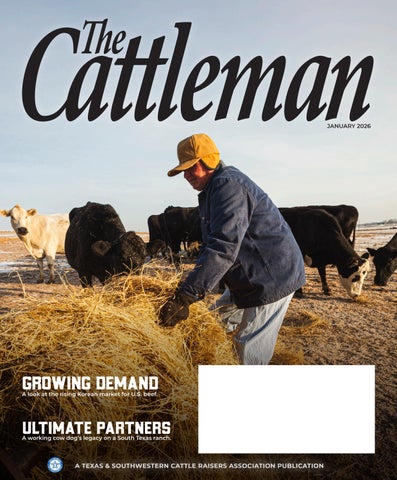
JANUARY 2026
Growing Demand A look at the rising Korean market for U.S. beef.
Ultimate Partners
A working cow dog’s legacy on a South Texas ranch.
A TEXAS & SOUTHWESTERN CATTLE RAISERS ASSOCIATION PUBLICATION
Harlow Cattle Co. Bonded Livestock Dealer MAGA
Trusted Buyer of Feeder Cattle and Calves - Current or Forward Contracting - Feeder Cattle Basis Trades - Natural Premiums Huy Nguyen Dallas, TX Office (972) 672-9040 Blake Birdwell
Plainview, TX
(806) 681-3667
Kyle Parrish
Corsicana, TX
(903) 654-8996
Jason Griffin
Atoka, OK
(580) 271-1333
Blake Rogers
Collins, MS
(601) 315-0962
Cole Johnson
Dallas, TX
(214) 384-2653
Kade Setzer
Hydro, OK
(405) 929-0379
Don McCauley
Seymour, TX
(940) 256-8353
Tony Setzer
Eakly, OK
(580) 774-7403
Wes Miller
Independence, KS (928) 245-6560
Wesley Wood
Stephenville, TX (254) 485-9781
Proud supporter of TCU Ranch Management, TSCRA and TCFA
No bull, just better cattle. SEE FOR YOURSELF
Scan the QR code to learn more about the Cowman’s Choice.
FEATURES 10
20
A World Away
Right-Hand Ringo
TSCRA members travel to South Korea with U.S. Meat Export Federation.
The story of a cow dog that became an irreplaceable ranch hand and partner.
By Jena McRell
By Diane Meyer
DEPARTMENTS in the News
theft & LAW Ranching
30
Bolstering NWS Preparedness
32 36 38
What’s Happening at TSCRA Industry Briefs PLANNING YOUR YEAR
USDA announces opening of sterile fly dispersal facility in Tampico, Mexico.
Ranching 101 to cover herd well-being and productivity.
40
OBITUARIES
42 44
Special Ranger Activity CRIME WATCH
46
Set Up for Success
50
Don’t Let Winter’s Cold Open the Door to BRD
Expert offers advice on improving cattle transportation from start to finish.
Manage bovine respiratory disease this winter with cold stress management and animal husbandry.
Beyond Gates
52
Cover Crop Grazing Guidance
54
Plant of the Month
55
BQA Tip: Feeding for Peak Milk
56
Despite Volatility, Optimism Remains
Texas A&M AgriLife fact sheets help producers balance soil health, forage production and profitability. Angel trumpets (Acleisanthes longiflora)
Highlights from the U.S. Meat Export Federation Strategic Planning Conference.
IN EVERY ISSUE From the Editor
6
Where We Stand
28
Director Spotlight
58
TSCRA Directory
60
Faces of Law Enforcement
64
New Members
66
Auction Markets & Market Inspectors
70
Breeder’s Bulletin Board
74
Upcoming Events
78
Ad Index
80
A Look Back
82
From the Editor
PROGRESS IN MOTION A
s we turn the page to a new year, it is impossible not to feel the momentum in our industry. This month’s issue reflects that sense of forward motion, highlighting the relationships, everyday tools and evolving markets that continue to shape ranching today. Our first feature story takes readers halfway around the world to South Korea, where James and Kara Dudley joined other ranchers to promote U.S. beef in one of our most important international markets. Their journey offers a firsthand look at what makes U.S. beef competitive on the global stage and why our relationships abroad matter just as much as the work we do at home. We also spotlight the essential role of working dogs. Cattle dogs remain some of the most dependable ranch hands, helping maintain efficiency, reduce stress on livestock and improve safety for handlers. This feature shares the story of a remarkable dog and his contributions to daily life on the ranch — proving that great partnerships aren’t always human. You’ll also find a timely and grounded look at cattle markets and the ongoing conversation around beef
6 |
The Cattleman
prices. The Where We Stand column unpacks the full scope of factors influencing the meat case and explains how elevated prices are not evidence of a broken system, proven by the ongoing demand for U.S. beef. As we ring in 2026, we also invite you to register for Cattle Raisers Convention & Expo, held March 27-29 in Fort Worth. It’s the best place to connect with fellow producers, explore new ideas and see what’s next for our industry. Find more information on page 32. Here’s to a strong start to the year ahead! CT
Jaclyn Roberts Parrish Executive Director of Communications, Marketing & Partnerships/Editor-in-Chief, The Cattleman jaclyn@tscra.org • 817-916-1794
tscra.org
January 2026
This life
is not one for pessimists. Every season brings new opportunities — to be more efficient, to expand your operation, to increase your yield. There’s always hope for something more or better. We’re here to help you achieve it with lending and insurance products that help you grow and protect your operation. And as the largest agricultural lending cooperative in Texas, we offer cooperative returns to our members. So you share in our success. Now that’s something to be optimistic about. To learn more, visit CapitalFarmCredit.com.
CapitalFarmCredit.com
877.944.5500 NMLS493828
January 2026 / / Vol. CXII, No. 8 Published by Texas & Southwestern Cattle Raisers Association P.O. Box 101988, Fort Worth, Texas 76185 Phone: 817.332.7064 • Fax: 817.394.1864 tscra.org EDITORIAL Editor-in-Chief
Jaclyn Roberts Parrish
Managing Editor
Jena McRell
Associate Editor
Shelby Kirton
Copy Editor
Elyssa Foshee Sanders
Proofreader
Cydney Fansher
Graphic Designer
Ryan Barten
EXECUTIVE DIRECTORS Executive Vice President/CEO
Jason Skaggs
Communications, Marketing & Partnerships
Jaclyn Roberts Parrish
Events, Education & Leadership Development
Emily Lochner
Finance & Human Resources Interim Government Relations Law Enforcement, Brand & Inspection Services Membership & Operations
Megan Wills Peyton Schumann Clay McKinney Lisa Walker
OFFICE LOCATIONS Fort Worth 2813 S. Hulen St., Suite 150 Fort Worth, Texas 76109
ON THE COVER Caring for the herd, no matter the weather. Photo by Jerod Foster
Austin 919 Congress Ave., Suite 750 Austin, Texas 78701 Subscription Inquiries: tscra@tscra.org or 800-242-7820 Advertising Sales: sales@tscra.org or 817-332-7064
Published on the first day of each month by Texas & Southwestern Cattle Raisers Association Inc., P.O. Box 101988, Fort Worth, Texas 76185. The Cattleman (ISSN 0008-8552, USPS 095000), copyright 2026 by Texas & Southwestern Cattle Raisers Association. Title registered U.S. Patent and Trademark Office. Member Alliance for Audited Media. Subscription $50 per year; foreign $70 per year. Correspondence on all phases of the cattle business is invited. Publisher reserves exclusive rights to accept or reject advertising or editorial material submitted for publication in The Cattleman magazine. Periodicals postage paid at Fort Worth, Texas, and additional mailing offices. POSTMASTER: Send address changes to: The Cattleman, P.O. Box 101988, Fort Worth, Texas 76185, 817-332-7064, FAX 817-394-1864. All members of Texas & Southwestern Cattle Raisers Association receive a monthly copy of The Cattleman as a benefit of their membership.
8 |
The Cattleman
tscra.org
January 2026
HOW TO MAXIMIZE HETEROSIS WITH TRUE BRANGUS AND ANGUS! Brangus were created more than 75 years ago to blend two desirable breeds to create a new one. Unlike breeding value or EPD, Heterosis is not passed from generation to generation in a crossbreeding program without a loss in its level unless a stable breeding program is established (as has been done in Brangus and at OCF). Heterosis has the greatest effect on traits most affected by environment... adaptability, longevity, fertility, maternal ability, resistance to parasites and diseases. OCF is widely known for their True Brangus and increased Heterosis allowing their genetics to perform better in most environments. Long-time customers and repeat buyers tell the real story at Oak Creek Farms.
TRUE BRANGUS AT ITS BEST DATA RESULTS IN!
Hurla Feedyards 63 Oak Creek Farms Steers • 92% Choice • 20% CAB • 3.37 Avg Daily Gain $1.10 Cost of Gain • 63% Carcass Yield • 2.8 Avg Yield Grade • 6.2 Feed Conversion Canadian Feed Yard Harvest Data Oak Creek Farms Steers 87% Choice with 1.5% Prime Heifers were 90% Choice with 5% grading Prime
SALE CONTACTS
Owner: John Kopycinski 979-251-2530 Consultants: Gary Bruns 830-391-0766 • Kent Smith 979-540-8338 Mike Arnold 979-732-7679 * Charlie Tiner 713-252-4662 Auctioneer: Troy Robinett 817-995-7509
Seoul, South Korea’s capital city, is home to more than 50 million people, making it one of the most populated cities in the world.
10 |
The Cattleman
tscra.org
January 2026
A World
away
TSCRA members travel to South Korea with U.S. Meat Export Federation. Story by Jena McRell Photos courtesy of USMEF
L
ooking out their window, James and Kara Dudley watched as a remarkable metropolis blurred past. The couple was riding a bullet train headed south from Seoul, South Korea, one of the world’s largest urban centers. High-rise buildings stacked one after another in every direction, seemingly growing right out of the mountains. “You felt like you were in a completely different world,” Kara says. “It is 180-degrees different from what we live every day.” With multigenerational family ties to ranching in Texas Hill Country, the Dudleys are rooted in wide-open spaces, big skies and the solitude of nature. Last September, they joined about 20 fellow ranchers and farmers for an up-close experience of Korean culture and cuisine as part of U.S. Meat Export Federation’s Heartland Tour.
Kara and James Dudley, of Horseshoe Bay, participated in the U.S. Meat Export Federation’s Heartland Tour in Korea, representing Texas Beef Council and TSCRA, respectively.
January 2026
tscra.org
The Cattleman
| 11
South Korea, geographically the size of Indiana, is home to more than 50 million people, half of whom live in Seoul, the capital city. Korea is also the topvalued export destination for U.S. beef, with 2024 exports reaching $2.2 billion. “Korea is a very interesting market,” James says. “Their consumers have really adopted protein, especially beef protein. While they are buying a lot now, there’s an opportunity for them to purchase more going forward.” The country’s growing interest in U.S. beef comes at a critical time in the global marketplace. At time of press, China remained closed to U.S. beef imports due to tariff and non-tariff barriers impacting U.S. beef plants and cold storage facilities. If shipments cannot move into China, the region’s next-closest market is Korea. And, based on the Dudleys’ experience, the country is happy to pick up the slack. “The consumer is very interested in our product, so that is a huge plus,” James says. “Everybody there is working to get more of our beef, because there’s not an issue on the demand side.” Rising demand for U.S. beef in Korea can be attributed to the country’s shift toward a more protein-based diet. Traditionally, the Korean diet was 60% rice, followed by protein and vegetables. Consumer research has shown that percentage has now flipped to 60% protein and vegetables. James and Kara say the train ride through the densely populated region, with very few acres of open space or farmland, demonstrated how critical trade partnerships are for the Korean food supply. “With the U.S. being at the forefront offering a safe, high-quality beef product, it has been a great way for us to get further into the South Korean diet,” Kara says.
TECHNOLOGY REIGNS To keep pace with demand, South Korea is a sophisticated display of innovation and design. Both James and Kara agree the use of automation, robotics and technology is what stood out to them most from the trip. The group toured key locations, from the Port of Busan and importer Highland Foods to retail and foodservice providers.
Top: Kara Dudley presents a Texas Beef Council and TSCRA sticker to a representative from Highland Foods. Bottom: Short plate and short ribs are the most popular U.S. beef cuts imported into South Korea. Thinly sliced beef incorporates well into the local cuisine.
12 |
The Cattleman
tscra.org
“The constant theme from what we noticed about South Korea is their automation and [how] their technology is so advanced and so much a part of how they get the frozen beef through the food chain,” Kara says. “It was incredible.” Among their tour stops was the e-commerce company Coupang, which operates a large grocery
January 2026
distribution division. Hungry for a steak but short on time? Coupang online orders placed before midnight will arrive on the customer’s doorstep before sunrise. “Some Koreans we spoke with told us, ‘We couldn’t survive without Coupang,’” Kara explains. “Not a lot of people have the time to grab their groceries, so you can dial it up on your phone and it will be there.”
gather around a table and enjoy a meal together was a full-circle moment. “At Texas Beef Council, our main mission is to bring people together over their shared love of beef,” Kara says. “And with this opportunity, we were able to see how that relates to the Koreans, how they’re able to eat U.S. beef, sit down at a table, have a meal and interact.
Home meal replacement kits, which came onto the scene during the COVID-19 pandemic, are also extremely popular. James and Kara watched as they were assembled while touring Fresheasy, one of the country’s largest meal-kit providers. The company partners with retailers and restaurants to create ready-to-cook meals, many featuring premium proteins like U.S. beef.
“The protein that we are raising is bringing these folks together for fun, memorable moments.”
The group also toured Highland Foods, which is often the first stop on beef’s journey from the U.S. to Korean plates. The company imports frozen beef and places it in cold storage until it is time to be processed. Then, the beef is carved and packaged for retail and foodservice locations and companies like Fresheasy.
“What they are getting from the U.S. has such a rigorous inspection process that they trust in that relationship, because USDA has done such a great job making sure the product we’re eating is safe for consumers,” Kara explains. “That is a plus for the U.S. market going into Korea, because they have very strict regulations on what’s coming in.”
James says he will never forget walking into the company’s fully automated, 165-foot-tall deep freeze cooler. They watched boxed beef as it was moved throughout the maze of products. “We went in on the mid-floor. That’s a long way down and still a long way up,” he remembers. “And it’s all constantly moving.”
Another moment of pride came during their tours of retailers Costco and Emart. Lining the meat cases were stacks and stacks of USDA Choice and Prime beef. The Korean market recognizes the U.S. as the gold standard for safety, quality and consistency.
After riding the bullet train from Seoul to the Port of Busan, about a 240-mile trip from the northern region to the south, the group experienced more innovation at work. The almost fully automated port is among the world’s largest. The precise operation connects overseas trade partners with local markets and other countries throughout the region.
A TASTE OF HOME A few flavors popular in Korean cuisine may come as a surprise. On their first night in the country, the group of ranchers and farmers enjoyed barbeque for dinner. The distinctly American — and uniquely Texan — cooking style is trending in South Korea thanks to a growing social media following. Kara says the best hamburger she has ever tasted was from Frank Burger, a Korean fast-casual burger chain. The group toured the company’s production facility, where they grind U.S. beef into individual patties that they flash f reeze, package and send out to restaurants. “The burgers tasted unbelievable,” Kara says. “They were coming right out of the test kitchen, hot and perfect. Getting to eat a product that is literally right off the floor next to you, it is just delicious.” Heartland Tour participants also dined at an American-style steakhouse that served dry-aged steak and other popular U.S. cuts. Kara says the chance to
January 2026
James Dudley, far right, observes the meatcase while visiting Costco in South Korea.
tscra.org
The Cattleman
| 13
Throughout the week-long tour in South Korea, the USMEF Heartland Team experienced all parts of the journey for U.S. beef, from initial import to consumer plates. The country’s use of innovative technology and trust in USDA labeling were highlights for the Dudleys.
The Heartland Tour group also met with the U.S. Embassy in Seoul and learned about the behind-thescenes work required to ensure markets are open and accessible to both countries. “The in-country diplomatic staff is doing an incredible job of making sure that we have access to South Korea’s market,” Kara says. “They trust in the USDA labeling and how critical it is that our beef meets those standards and best practices,” James adds. “They really do pay attention to that.”
LASTING VALUE Spending a week immersed in Korean culture, traveling with fellow U.S. agriculture producers and seeing firsthand the vast number of consumers seeking out U.S. protein is an experience both James and Kara say they will carry with them forever.
14 |
The Cattleman
“It definitely is a sense of pride that you can create something in our small little county that can ultimately get to the other side of the world and feed a family,” Kara says. “Realizing what you are doing is being recognized, appreciated and nourishing folks — that’s just such a badge of honor.” Access to international markets is also a key driver for future success. It promises that every pound is marketed to the best of its potential, especially variety meats or cuts that are not sought after domestically. “We can get better numbers, more money per pound sending the cut to them than trying to consume it here in the U.S.,” James says. “It’s a feeling of job security,” Kara echoes. “We can move that product and know they’re going to consistently want it, and so as we are raising good quality beef, there will be a place for it.”
tscra.org
January 2026
RANCH LIFE AND HOSPITALITY When South Korea’s top meat influencer, Yooxicman, arrived at the Yates Ranch near Cherokee, he was greeted with the kind of hospitality Texas ranchers are known for. For Kara and James Dudley, it was an opportunity to share their story of family tradition, dedication to their cattle and deep-rooted pride in raising quality beef. The visit, coordinated in partnership with the U.S. Meat Export Federation, a contractor to the Beef Checkoff, was designed to do more than showcase Texas ranching — it was a way to connect a global audience with the authenticity behind the beef they enjoy. Food tourism and engaging online content play a significant role in consumer decisions, and influencers are powerful conduits for sharing authentic experiences. In Yooxicman’s case, that looks like sharing videos with his 1.3 million YouTube followers. One of the highlights was a Smoking 101 demonstration led by Texas Beef Council’s Pit Master Jerry McPherson. Yooxicman learned about smoker usage, wood types and seasoning techniques. He even had the chance to start a fire and season brisket and short ribs, getting hands-on with the cornerstones of Texas barbecue. Texas Beef Council Meat Scientist Kaylee Greiner led a discussion on cuts and quality hallmarks of U.S. beef, reinforcing the care and expertise ranchers like the Dudleys bring to the table. For the Dudleys, who have family ties to the land dating back to the 1920s, the visit was an opportunity to highlight the commitment that defines the beef industry. A tour of Yates and F Barra Ranches provided a stunning backdrop for filming and a look at the daily dedication to cattle and land stewardship. “It was an honor to show them what makes Texas such a special place to be in the cattle business,” said Kara Dudley. “The family legacy is such a unique aspect of what we do here. It’s special to share with someone from another culture how it all starts on the ranch.” James emphasized the importance of transparency with consumers, especially those in other countries. “Part of trusting a product is having education and background on where it came from,” he said. “It’s important to show how we do things the right way, and what the cattle mean to us and our livelihood.” The day concluded at Yates Ranch for dinner, where a grilling demonstration showcased Prime cowboy ribeye steaks. This segment explored both gas and small charcoal grilling techniques, further emphasizing the versatility of U.S. beef.
16 |
The Cattleman
tscra.org
January 2026
For Yooxicman, the visit offered a chance to experience Texas firsthand, beyond the western movie stereotypes.
At its core, the visit was a celebration of what makes beef a staple in Texas and around the world.
He also developed a deeper appreciation for Texas-style barbecue, noting the surprisingly simple seasoning and generous portion sizes that still deliver bold, rich flavor. While he said his favorite cut to prepare at home remains the sirloin, he left with a new perspective on the care and authenticity behind every beef meal.
For producers, it’s a powerful reminder that their daily commitment to quality, combined with strategic outreach, truly resonates far beyond their fences. CT Sidebar story and photos courtesy of Texas Beef Council.
Yooxicman, pictured left, South Korea’s top meat influencer, traveled to Texas to visit the Dudleys, pictured center, at the Yates Ranch near Cherokee. He saw how the state is an ideal environment for cattle, with rolling pastures and plenty of space to thrive.
When the seasons shift, so do your herd’s protein needs. SmartLic protein tubs deliver consistent nutrition that drives performance — helping cattle make the most of available forages, maintain condition and power through winter efficiently — giving you peace of mind.
Find your nearest dealer at:
smartlic.com TX2026 Cattleman - December 2025 - Half Page 4 color - tscra.org 8”x4.75” January
The Cattleman
| 17
ALWAYS READ AND FOLLOW PESTICIDE LABEL DIRECTIONS. Invora® herbicide is a RESTRICTED USE PESTICIDE. Prior to spraying, all applicators must complete picolinic acid herbicide training. Environmental Science U.S. LLC, 5000 CentreGreen Way, Suite 400, Cary, NC 27513. For additional product information, call toll-free 1-800-331-2867. www.envu.com. Not all products are registered in all states. Envu, the Envu logo and Invora® are trademarks owned by Environmental Science U.S. LLC or one of its affiliates. ©2026 Environmental Science U.S. LLC.
When you’re ready to stop fighting brush for good, start with Invora ®
If you’ve fought mesquite or huisache, you know how relentless they can be. Deep-rooted, fast-growing and always finding a way back. Invora® herbicide from Envu changes that. With a single, carefully timed application, Invora herbicide delivers long-term control, giving your land the time it needs to restore itself naturally. Native grasses return. Cattle and wildlife regain balance. And ranchers regain something just as valuable — the freedom to focus on the future instead of the fight. It’s a proven path to healthier forage and lasting restoration that’s trusted by the people who live it every day.
“Our length of control that we get with Invora is much longer than what we’ve seen currently on the market with other products.” - Billy Campbell, Range & Pasture Rep Texas, Oklahoma and New Mexico
Invest in your land’s future
The story of a cow dog that became an irreplaceable ranch hand and partner. By Diane Meyer
C
arlos Ochoa wanted a dog. And not just any dog. A working cow dog. When a coworker brought a Border Collie named Slick to help gather cattle on the Two Rivers Ranch in Sabinal, Ochoa saw firsthand how a smart dog could change an entire day’s work. From that moment, he was determined to find one of his own. Scouring Ranch World Ads one Friday in May 2019, Ochoa found an ad for a litter with two puppies left. They were a mixture of Hangin’ Tree Cowdog, Border Collie and Australian Shepherd. Ochoa put in a call with the seller and three days later made the 8-hour round trip to pick up his new pup just outside College Station. He spent much of the drive brainstorming a short, punchy name. Something a working dog could comprehend and respond to fast. He kept landing on Ringo, after the Tombstone character Johnny Ringo. When Ochoa arrived, the current owner beckoned the pup over to him. “Ringo, come here!” the man called. Ochoa couldn’t believe his ears. Turns out, the pup’s father — a Hangin’ Tree-Border Collie mix — was called Doc, short for Doc Holiday, so some of the litter was already named to match the Tombstone theme. “It was meant to be,” Ochoa tells. “So I picked him up and said, ‘Buddy, you’re it.’ And the rest is history. He never left my side after that.”
LAYING THE GROUNDWORK Not an experienced dog trainer at the time, Ochoa studied and watched good dogs and their handlers to get a blueprint for how he should do things. Bonding, he discerned, was crucial for developing mutual respect, confidence and camaraderie between the dog and its handler. In his first year, Ringo went everywhere Ochoa went, riding on the flatbed, checking waters in the buggy, going to the rifle range and spending time around livestock and horses. When it came to teaching commands, Ringo learned the basics from the ground up. First came potty training, how to follow on a lead, and then learning three basic commands: “down,” “uhuh” and “here.” Ochoa explains that the pressure and release method used in horse training works the same with dogs, applying pressure to guide them in the right direction and releasing it when they make the correct move. “Give a dog praise where praise is due,” Ochoa advises, “and correct them when correcting is warranted, and you’ll get along just fine.” He also made sure to let Ringo be a puppy. To Ochoa, that meant letting Ringo make mistakes and memories that would add longevity to his life.
Opposite: Meet Ringo, a Hangin’ Tree Cowdog, Border Collie and Australian Shepherd mix with a knack for work and play. He began as a working dog on the ranch, assisting with cattle and hunting tasks, and has since earned a permanent spot in the hearts of his family. All photos courtesy of Carlos Ochoa.
20 | The Cattleman
tscra.org
January 2026
By the time Ringo had the basics down, he was introduced to cow work. His first real job was as a “drag rider,” keeping to the back of the herd to push cattle forward instead of letting them drift. Teaching that skill required going against a dog’s natural instincts, Ochoa explains. “The whole idea is not to push cattle away from you, it’s to bring them to you,” he says, which meant focusing early training on the heel side rather than the head. Working alongside seasoned dogs helped Ringo understand where to be, and over time, Ochoa could place him in a small bubble at the back of the herd and trust him to hold cattle together, close gaps and move them in the right direction. That instinctive teamwork made gathering more efficient and sometimes quick enough that Ochoa didn’t even need to saddle a horse. He’d take the side-by-side and let Ringo handle the back end. “I compare that to a really good-season day hand,” Ochoa says. “You don’t have to tell them where to get, they just know. Same deal with a good dog.”
WORKING EFFICIENCIES As Ringo progressed in his training, Ochoa was advancing at the ranch as well. He joined Two Rivers Ranch in December 2018 after a brief period at a ranch near his alma mater, Texas A&M University. After a couple years of work, the Sullivan family — owners of the historic ranch that originated on Galveston Island and still operates there today — offered him the opportunity to attend Texas Christian University’s Ranch Management Program, where he earned a graduate certificate in ranch management in 2022. Today, Ochoa serves as operations manager for Two Rivers Ranch, based at the main operation in Sabinal, overseeing both the ranch’s cattle and hunting enterprises in South Texas. The operation includes commercial and registered Beefmaster herds, as well as Brangus and Tigerstripe cattle. In addition to the cow-calf herd, they operate a grow yard for preconditioning stocker cattle, run multiple classes of cattle on introduced Pecos buffelgrass pastures and retain ownership of a portion of the cattle they feed out. The ranch also offers commercial white-tailed deer and dove hunting, along with lease hunting. Ochoa made sure to involve Ringo in all of it. Adept and agile, working dogs have proven to greatly reduce stress in cattle by minimizing the need for flags, hot shots and other loud actions. Ringo had the intelligence, drive and grit Carlos Ochoa, pictured top right, was looking for in a ranch dog. He quickly became a talented and efficient member of the crew, with the instincts of a seasoned day hand.
22 |
The Cattleman
tscra.org
January 2026
Even vaccine efficacy is improved with dogs, Ochoa observes, because cattle move through chutes quietly with minimal stress compared to human intervention. The improved animal husbandry helps their operation uphold Beef Quality Assurance standards for animal handling. In fact, the Beef Quality Assurance Field Guide cites properly trained dogs as “effective and humane tools for cattle handling.” The chain reaction is clear: calmer cattle have better body condition, which in the long run enhances marbling while reducing dark cutters. For Ochoa, there’s also added marketability in selling cattle, especially heifers, that are dog broke. A huge benefit is the increased efficiency of moving cattle. While a poorly trained dog has a reputation for quickly turning a half day’s work into five days, a good dog can replace five cowboys in the saddle, and Ochoa has a story to prove it. As a puppy, Ringo saw everything. From riding along in the side-by-side to watching seasoned cow dogs work, his first year was packed with experiences that shaped the fearless, ready-for-anything dog he’d become.
One of his favorite Ringo memories involved shipping two loads of yearling cattle. It was too muddy to work horseback, so the task fell on Ochoa, the truck driver and Ringo to sort through the pens. While Ochoa manned the flag and kept cattle pushed up, Ringo heeled every head
Consigning 2-year-old bulls and bred registered Hereford heifers at the San Antonio All Breeds Sale Feb. 18 and Houston Livestock Show All Breed Bull & Female Sale March 4. Loyd Whitehead, Owner | Ft. McKavett, Texas | John Tolbert, Manager (325) 396-4911 www.therockingchairranch.com 24 | The Cattleman
tscra.org
January 2026
up a lane and into the truck. His agility allowed him to weave between pens and through railing slots that Ochoa would have had to climb or jump over. Ringo kept going at it for every run to load two trucks. “At the end of it, my boots were wet knees down and I almost couldn’t find Ringo because he was camouflaged head to toe in mud. And he was just there with a big old smile on his face,” Ochoa chuckles.
“To this day, that is one of the quickest times I have ever shipped a load of cattle.” Perhaps even more valuable than a gain in efficiency is the safety a working dog provides. Ochoa was reminded of this one afternoon while tagging newborn calves. One mama cow was especially testy, and as Ochoa tagged her calf, he suddenly heard a loud bark followed by a sharp whine. Before he could react, the cow had lunged
“He’s my best friend; he’s a lifelong partner. If anything ever happened to this dog, it would Devastate me.” — Carlos Ochoa, Two Rivers Ranch Ochoa and Ringo saddle up for the day’s work.
Be an Agricultural Resource Manager for an Evolving Agricultural Industry. For more than half a century, TCU’s renowned Ranch Management Program has given students an edge in agricultural resource success. This unique nine-month intensive program equips graduates with real-world strategies as producers and land stewards in changing times.
APPLY TODAY Space is limited. Financial aid and scholarships may be available from the Ranch Management Program and through the TCU Office of Scholarships & Student Financial Aid. ranch.tcu.edu
LEAD ON. ®
January 2026
tscra.org
The Cattleman | 25
at him, and Ringo had jumped between him and the mama cow, biting and forcing her back. Ringo got rolled and stepped on. As Ochoa checked Ringo for injuries and gave him water, the reality of the moment sank in. “I realized this isn’t a tool anymore,” he reflects. “He’s my best friend; he’s a lifelong partner. If anything ever happened to this dog, it would devastate me.” Then and there, Ochoa decided he was going to enjoy every year he had left with Ringo. “I said, ‘Buddy, you’re retired.’”
RINGO’S LEGACY At 7 years old, Ringo is living the dream. Whether he’s chasing his beloved tennis ball or sprawled out watching TV, Ochoa says this dog has it made. “He is my wife’s and my first child, that’s for sure,” he jokes. While Ringo is missed around the cows, he’s sired lots of puppies and some have taken his place at the ranch. What started as adding more dog power to the ranch quickly turned into a frenzy of people wanting Ringo puppies. “All I can really ask for is that Ringo’s legacy continues through his offspring,” Ochoa says. Ringo has also left his mark on Ochoa. “Dogs can read your emotions, that’s my opinion,” he says, “and learning that not only helped me with my patience, but my attitude and my temper in doing things, because I didn’t want that to be a reflection of my dog and the way he worked.” Ochoa’s wife often remarks that he and Ringo have the same personality. In their years of working side by side, Ringo adopted many of Ochoa’s mannerisms, becoming an uncanny reflection of his owner. Once a tool of the trade, Ringo is now an indispensable member of the family, and Ochoa is deeply proud of his canine mirror image. “An old man once told me that you’ll have one dog and one horse in this life that you’ll never have another one like,” he says. “And I’ve been blessed to truly say that I’ve had that dog in my life.” CT Diane Meyer is the associate director of content for Grant Company based in St. Joseph, Missouri.
26 |
The Cattleman
TRAINING ADVICE & TIPS When considering getting a working dog, Carlos Ochoa shares some simple lessons he learned from seasoned veterans. These are small but important takeaways that he now passes along to others.
1. Keep names short.
Use simple, one- or two-syllable names for working dogs. Longer, complicated names can confuse puppies and make it harder for them to respond. Ochoa chose Ringo for this reason, and his other dogs have short names like Kate or Sage.
2. Bond, bond, bond.
No matter how inconvenient, spend as much time with your puppy as possible during the first year. Ochoa emphasizes that close daily interaction — rather than leaving a dog in a kennel — makes a huge difference in development and responsiveness. “I left a puppy in the kennel for the first six months versus being outside with me, and it was a night-and-day difference as far as their development capacity,” he says.
3. Start slow.
Teach commands one at a time. Begin with basic commands like “down” or “heel”, and only move on once the dog masters each word. Patience and consistency are key. Ochoa compares it to teaching a child to read by first learning the alphabet before forming words and sentences.
4. Care for your dog like any high-dollar tool. Working dogs need exercise, proper nutrition, vaccinations and medical care, just like horses or tractors on the ranch. Ochoa stresses that investing in their health and well-being is critical for longevity and effectiveness. Proper care doesn’t have to be expensive, and many routine tasks can be done at home as he does on the ranch. “These small costs are minutes compared to the savings in time, efficiency and value they bring to the operation.”
tscra.org
January 2026
Your TSCRA Membership Just Got Healthier Individual Health Insurance Open Enrollment is November 1, 2025-January 15, 2026
Cattle Raisers Insurance and Higginbotham offer a single-source solution for ranch, property and liability coverage as well as health benefits for employees and families. Call us for a complimentary benefits review today.
1-800-252-2849 tscra@eb.higginbotham.net
TM
Where We Stand
THE CATTLE MARKET
IS NOT BROKEN By Shelby Horn
R
ecently, higher beef prices at the grocery store have become a hot topic. It’s made local and national news headlines and taken social media by storm. That attention has fueled a narrative that something is “wrong” with the beef supply chain, pulling ranchers, media, elected officials and industry critics into a fast-moving conversation. For ranchers, it is frustrating. People outside our industry don’t always understand the cattle cycle, how prices move or why beef costs more at the grocery store right now. They do not see what ranchers see every day, and they rarely understand how quickly their comments can move markets. Most ranchers understand these cycles. We know tight supplies and higher prices are part of a normal pattern. It is not a sign that the system is broken. Yet, that has not stopped people from looking for ways to fix a problem that does not exist. For example, many of our political friends campaigned and were elected to make America more affordable, and with midterm elections around the corner, they’re understandably looking for ways to move the needle with voters. While we support making America more affordable, increasing beef imports, investigating the packers and hinting at government intervention are not going to lower beef prices for consumers. This isn’t about taking sides between packers, retailers or policymakers. It is about understanding how each part of the chain contributes to the final price and acknowledging the full picture rather than assuming blame lies in one place. To do this, we need to reframe the narrative. There isn’t a problem with beef prices. Consumer beef demand has been nothing short of stellar. Even with higher prices at the grocery store, consumers continue to consistently choose beef as their protein — even at elevated prices. This is a testament to the commitment and investment that ranchers have made in listening to consumers and delivering what they want.
28 | The Cattleman
Ranchers are well aware of the lag between cattle prices and consumer beef prices. Beef doesn’t move from the ranch to the grocery store overnight. It passes through a complex chain that adds labor, transportation, processing, fabrication, cold storage and retail markups to beef products. Contrary to the narrative that today’s beef prices are due to packer manipulation, beef packer margins have been negative all year until recently. Packers certainly have experienced strong margins in some years, especially during the COVID pandemic, but that is not what we are seeing today. Their margins are tight, while retail margins remain strong. That disconnect is unusual and is not receiving much attention. At the same time, packers are not operating at capacity because they don’t have enough cattle, while still contending with the same fixed costs. Low cattle supplies are a result of increased costs and drought, compounded by restricted cattle movement from Mexico because of New World screwworm concerns. Losing processing capacity in this country has suddenly become a reality. Tyson recently announced the closure of a Lexington, Nebraska, packing plant that has been in operation for 30 years, employing 3,200 and processing nearly 5,000 cattle a day. On top of this, Tyson plans to reduce their beef facility in Amarillo to a single, fullcapacity shift. This will result in an approximately 7% reduction in fed processing capacity, and consequently, negatively impact the segments and communities where they operate. While the 80% processing share held by major packers, especially those that are foreign owned, is concerning, the last thing we need is reduced processing capacity. It is crucial we maintain enough packing capacity so when our cowherd numbers recover, we are prepared. Without adequate packing capacity, the size of our industry is not determined by our ability to produce more cattle to meet a growing consumer demand, but by how many hooks are available. We are fortunate that
tscra.org
January 2026
Where We Stand in response to the issues created during the pandemic, several new packing facilities were built. Producers owning these facilities is a positive for the industry, allowing producers to control their destiny. In the past, that has not been possible in a segmented industry. While needed, the recent call from President Donald Trump for the Department of Justice and USDA to reexamine packer practices, possible price manipulation and overall market fairness may not produce the intended results. There are times when price discovery and transparency are real issues, but now is not one of them. To be clear, Texas & Southwestern Cattle Raisers Association supports strong price discovery and meaningful efforts to strengthen transparency and ensure competitive markets for ranchers. But it is important to recognize that lack of transparency is not where today’s price pressures are coming from. Trade is not absent from the conversation regarding prices, either. President Trump has used tariffs and trade pressure as tools on a larger geopolitical stage, and beef has been impacted. Those actions have delivered shortterm benefits for ranchers; however, trade restrictions and retaliatory measures can also create challenges.
Trade is good for business. The U.S. exports highquality, high-value beef cuts, as well as some lower-value beef cuts, and imports lean trim, primarily for ground beef blends desired by U.S. consumers. That exchange strengthens cattle prices here at home and is a win for ranchers who get more money for their cattle. At the end of the day, there are multiple factors impacting the price of beef and there is no shortcut, incentive or policy lever that can fast-track lower consumer prices — nor is one needed. The cattle industry is a commodity business. Markets move in cycles. These high prices won’t last forever. As the herd rebuilds, supplies will increase and prices will naturally moderate. It simply takes time. Forcing retail prices down only delays progress and injects instability into a market that is already working to correct itself. That is where Texas & Southwestern Cattle Raisers Association will stay focused: cutting through the noise, elevating the facts and ensuring the market has the time and clarity it needs to work as intended. CT Shelby Horn is a Texas & Southwestern Cattle Raisers Association director from Fredericksburg.
STANDING WITH US D
r. Lewis R. “Bud” Dinges has served as state veterinarian and Texas Animal Health Commission executive director since October 2023. The commission, established in 1893, is charged with protecting the state’s domestic animals from all contagious or infectious diseases of malignant character. The agency’s headquarters are in Austin, and there are six regional offices located throughout the state. Dinges earned a bachelor’s degree in animal science from Texas A&M University and a doctor of veterinary medicine from Texas A&M University College of Veterinary Medicine.
As the lead agency in Texas for animal disease management, Texas Animal Health Commission is currently addressing one of its most pressing challenges: the resurgence of the New World screwworm. Under Dinges’ leadership, the commission has been a strong advocate for Texas producers, ensuring their concerns are represented as the issue evolves.
Dr. Lewis R. “Bud” Dinges
His professional career began in a mixed animal practice, and throughout the years, Dinges continued to practice in various private and corporate settings across Texas and beyond.
He also served as a clinical assistant professor in the department of large animal medicine and surgery at
January 2026
Texas A&M University, where he oversaw primary care for Texas Department of Criminal Justice animals.
The agency has partnered closely with Texas & Southwestern Cattle Raisers Association to advance producer education efforts and continues to support science-based solutions, including the proven sterile insect technique, to help eradicate the pest.
In addition, the agency has worked collaboratively with the association to modernize the state’s brand registration process, and will develop a centralized database to improve efficiency and accessibility for counties and livestock producers. CT
tscra.org
The Cattleman | 29
In the News
BOLSTERING NWS PREPAREDNESS USDA announces opening of sterile fly dispersal facility in Tampico, Mexico.
O
n Nov. 13, USDA announced the next milestone in the fight against New World screwworm — the opening of a sterile fly dispersal facility in Tampico, Mexico. The Tampico facility will allow USDA to disperse sterile flies aerially across northeastern Mexico, including in Nuevo León.
The two northernmost detections — approximately 70 and 170 miles from the U.S. border, respectively — occurred in Nuevo León, on Sept. 20 and Oct. 5, 2025, in young cattle transported from Chiapas, Mexico. Neither of those cases is still active and there have been no additional detections of NWS flies in Nuevo León.
“The opening of the Tampico sterile fly dispersal facility is another incredibly important tool in our arsenal to stop the spread of screwworm. The facility will ensure flexibility and responsiveness in northern Mexico, giving us a greater ability to drop sterile flies and continue to push the pest south,” said U.S. Secretary of Agriculture Brooke Rollins.
USDA continues to disperse sterile insects in Nuevo León and will now transition from ground release chambers to aerial dispersal in those areas.
There are two methods of dispersing sterile insects: aerial dispersal and ground release chambers. Aerial operations are preferred because they allow for dispersal at a steady rate throughout a large area and because sterile insects may be dispersed in areas that are unreachable from the ground. Ground release chambers are used when there’s a need to quickly deploy sterile insects outside of the dispersal facility range. USDA continues to disperse 100 million sterile flies per week in Mexico, but until now, aerial operations have been limited to southern Mexico, necessitating the use of ground release chambers in more northern areas of the country. Mass production and targeted dispersal of sterile flies remain critical components of an effective response. Although Mexico continues to confirm new cases of NWS, the overwhelming majority of these remain in the far southern part of the country, with no significant northward expansion over the past several months. Should that change, the Tampico facility will allow USDA to immediately tackle any cases that occur elsewhere in Mexico.
USDA produces sterile flies for dispersal at the COPEG facility in Panama. USDA is also investing $21 million to support Mexico’s renovation of an existing fruit fly facility in Metapa, which will double NWS production capacity once complete. With ongoing support from USDA Animal and Plant Health Inspection Service technical experts, Mexico anticipates this sterile fly production to begin in summer 2026. To expand domestic response capacity, USDA has also started construction on a sterile fly dispersal facility at Moore Air Base in Edinburg, which is projected to begin operating in early 2026. The Animal and Plant Health Inspection Service is also expediting design and construction of a sterile fly production facility in Southern Texas, with a targeted capacity of 300 million sterile flies per week. USDA continues to work with Mexico’s agriculture authority, SENASICA, to implement the collaborative NWS Action Plan and guide trapping, surveillance and movement protocols to help stop the northward spread of NWS. CT Story courtesy of USDA.
FOR SALE
LEON RIVER RANCH 326 ACRES± IN BELL CO. • 7 individually fenced pastures • Working pens in place • 32 acre± trophy bass lake • 2 miles± of Leon River Frontage • 10 natural ponds & 3 water wells 8x2.3_Ad_Leon River_Jonathan Wise_11-25.indd 1 30 | The Cattleman
• 1915 adjudicated water rights • Approx. 9,032 sqft± under roof custom home overlooking lake • 50 acre± irrigation pivot in place • Guest house and barndominium
tscra.org
JONATHAN WISE REAL ESTATE SALES AGENT, LAND SPECIALIST c:254.447.7300 o:217.285.9000
11/10/25 4:04 PM
January 2026
In the News HONORS STAFF MILESTONE WHAT’S HAPPENING TSCRA ANNIVERSARIES
AT TSCRA TSCRA HOLDS END-OF-YEAR MEETINGS IN FORT WORTH
Texas & Southwestern Cattle Raisers Association is thankful for an incredible team. In November, the organization recognized and honored staff members who reached milestone anniversaries. Thank you to each of these individuals for their dedication to the industry, and their unwavering commitment to cattle raisers throughout the Southwest. 5 years: Bruce Brandenberger, Robert Fields and Emily Lochner
Texas & Southwestern Cattle Raisers Association held its end-of-year meetings Nov. 18-20 in Fort Worth. Attendees included the Leadership Development Foundation Board, PAC Board of Trustees, Executive Committee and Board of Directors. The association’s board of director meeting was attended by more than 65 members who reviewed official business, including passing the organization’s 2026 budget.
10 years: Brandy Baughman, Larry Hand and Kaylee Malatek 15 years: Cornelio Alvarez Jr. 20 years: Nina Nygard and Brent Mast 30 years: Robin Gibbs
TSCRA staff members are recognized by TSCRA First Vice President Stephen Diebel and Second Vice President Dan Gattis for their years of service. Those pictured, from top left to bottom right, are: Emily Lochner, Robert Fields, Larry Hand and Brent Mast.
REGISTRATION OPEN FOR CATTLE RAISERS CONVENTION & EXPO Fort Worth will host more than 4,000 Texas & Southwestern Cattle Raisers Association members and guests March 27-29 as the 2026 Cattle Raisers Convention & Expo commences downtown. The event is open to all and offers can’t-miss opportunities for landowners, ranchers, farmers and wildlife managers from across the country. Scenes from TSCRA’s end-of-year meetings held Nov. 18-20 in Fort Worth. President Carl Ray Polk Jr., in bottom photo, addresses the crowd of directors.
32 |
The Cattleman
The convention kicks off March 27 with the popular School for Successful Ranching, a unique program
tscra.org
January 2026
In the News offering 30 hours of interactive educational sessions. The two-day expo will also feature one of the cattle industry’s largest trade shows. In more than 180,000 feet of expo space, attendees will be able to experience shopping, entertainment, live cattle demonstrations and more.
she is a member of Tarleton’s Honors College, Pre-Veterinary Medical Association and Tarleton Serves. She has interned for numerous stock shows and Arrow H Farms; assisted at a non-profit animal rescue and wildlife rehabilitation center; and volunteered at Friends of the Animals Veterinary Mollie Cooper Clinic. After graduation, she plans to earn a master’s degree in animal science with a focus on physiology of reproduction.
Headlining the convention will be ESPN Reporter Marty Smith. Raised working cattle and growing crops on his family’s farm in rural Virginia, Smith brings an authentic connection to the agricultural community that shaped him long before he became one of ESPN’s most recognizable voices. Smith will be joined throughout the weekend by a full slate of expert speakers covering topics from market outlooks to new industry innovations. Visit cattleraisersconvention.com to register and take advantage of early-bird pricing.
TSCRA LEADERSHIP DEVELOPMENT FOUNDATION WORKING GRANT PROGRAM EXTENDS APPLICATION PERIOD Texas & Southwestern Cattle Raisers Association Leadership Development Foundation announced an extension of the application period for its Working Grant Program, which opens once annually and will remain open through Jan. 31 to allow additional time for qualified applicants to apply. The program provides financial capital to business owners in Texas and Oklahoma with a demonstrated interest in the beef value chain, including cow-calf operations, stockers, feeders, packing facilities and large animal veterinary clinics. Eligible applicants must operate in an economically depressed or blighted area and face disadvantages that limit access to traditional financing. The program supports the establishment, operation or growth of beef-related enterprises. Details and application materials are available at tscra. org/leadership-development-foundation.
TSCRA WELCOMES SPRING INTERNS Four Gilly Riojas Memorial interns will join the Texas & Southwestern Cattle Raisers Association team Jan. 12 for a spring internship experience. Mollie Cooper, Harley Jarzombek and Kaiton Williams and will be based in the Fort Worth office and work across all departments. Rebecca Templeton will be the policy-focused intern in Austin. Cooper is a senior at Tarleton State University majoring in animal science. She is originally from Mabank in Kaufman County, where she and her family are involved in the cattle industry and 4-H. Growing up, her passion for the cattle industry started with her grandparents’ registered Brahman cow-calf operation. On campus,
January 2026
Jarzombek is a senior at Tarleton State University majoring in agricultural services and development, with a concentration in agriindustries and agencies and a minor in agricultural communications. She grew up in Goliad helping with her family’s cow-calf operation and Harley spent 12 years in 4-H and FFA. While Jarzombek at Tarleton, she has been active in the Agricultural Communicators of Tomorrow, serving as vice president, and was previously a Texas Farm Bureau Collegiate Club member. She has also interned with Wandering Maverick Boutique for the past two years at the FFA state and national conventions. Templeton is a recent graduate of Texas State University, earning a degree in animal science with a pre-veterinary concentration. Originally from northern California, she discovered her passion for the industry after completing an internship with USDA Agricultural Research Service Rebecca at Fort Keogh in Montana, where Templeton she gained hands-on experience in livestock research. In the future, she hopes to conduct beef cattle research and make scientific findings more accessible to producers. She says while interning with Texas & Southwestern Cattle Raisers Association, she looks forward to learning more about agricultural policy and government relations while also building meaningful, long-lasting connections. Williams is a senior agricultural communications student at Tarleton State University. Originally from Midlothian, she says she is excited to explore the association’s work while continuing to build her skills in writing, outreach and bringing fresh ideas to the table. Williams is passionate Kaiton Williams about connecting people with the agriculture community and hopes to bring a fun, creative perspective to every project she works on. She will graduate in May and plans to continue her career in agricultural communications. CT
tscra.org
The Cattleman | 33
Join or renew your membership today. Member benefits include the support of TSCRA Special Rangers, government relations advocacy, educational programs, networking and social events, member-only discounts, The Cattleman magazine and phone app, and insurance services.
To learn more about membership, scan the code above or visit TSCRA.org.
BUSINESS PARTNER MEMBERSHIP
Companies whose values and mission align with Texas & Southwestern Cattle Raisers Association are invited to join the organization and engage directly with our 28,000+ members. As a TSCRA Business Partner Member, your company will be part of a community that shares a commitment to advancing the cattle industry and its future.
BENEFITS INCLUDE
FEATURED PARTNERS
Up to nine memberships
A printed copy of The Cattleman
Exclusive sponsorship opportunities and discounts
Access to the TSCRA Business Partner logo
TSCRA MEMBER-ONLY DISCOUNTS 30% OFF at Cabela's and Bass Pro Shop
20% OFF at Boot Barn (in-store only)
10% OFF CattleMax Software
Ford X-Plan vehicle pricing
15% OFF Ranchbot products John Deere Rewards upgrade 5% OFF all Prime Metal Buildings & Components’ products
FOR MORE INFORMATION OR TO BECOME A TSCRA BUSINESS PARTNER, VISIT TSCRA.ORG/PARTNERS.
In the News
INDUSTRY
BRIEFS G BAR C RANCH RECOGNIZED WITH INAUGURAL NOBLE LAND STEWARDSHIP AWARD Noble Research Institute, a trusted educational resource for farmers and ranchers since 1945, presented the inaugural Noble Land Stewardship Award to G Bar C Ranch and the Ellis family, of Rosston, at its first annual Roots & Revelry event Oct. 22, 2025. The award recognizes farmers, ranchers and landowners who are leading the way in regenerative land management. G Bar C Ranch was selected for its commitment to regenerative management practices that have transformed 3,000 acres into a model of biodiversity and sustainable cattle production. Founded in 1982 when GC Ellis purchased 450 acres to pursue his ranching dream, the operation now runs more than 200 Angus mother cows while serving as caretakers of the land, maintaining natural habitats and clean waterways. Ellis and his daughter, Meredith, who represents the next generation of the ranch, have cataloged more than 660 species of plants, animals, birds, lichens and other ecological communities within their working lands. The ranch has been recognized for its conservation practices by Texas & Southwestern Cattle Raisers Association and received the 2023 National Environmental Stewardship Award from National Cattlemen’s Beef Association. G Bar C Ranch is also a producer site for the Metrics, Management & Monitoring Project, a $19 million five-year study focused on grazing, soil health and farmer and rancher well-being. In accepting the award, Meredith reflected on the legacy her father and Mike Knabe, the ranch manager, have built and the work ahead. “A rancher’s work never truly ends. It just becomes part of the land carried on by the people and pastures that they’ve tended,” she said. “We remain committed to advancing sustainable ranching and ensuring that our land and ranching community thrives for generations to come.”
36 |
Noble Research Institute President and CEO Steve Rhines, center, with Noble Land Stewardship Award honorees from G Bar C Ranch, from left: Meredith Ellis, owner; GC Ellis, owner and founder; GC Ellis, grandson; Mike Knabe, ranch manager; and James Shugart, wildlife ecologist. Photo by Rob Mattson, Noble Research Institute.
and Frio counties. Riggs, of the Black Hill Community in Atascosa County, is a cattle rancher, raising Angus cattle in Atascosa and Bexar counties. He is a member and former director of Independent Cattlemen’s Association of Texas, and a member of Texas & Southwestern Cattle Raisers Association and Texas State Teachers Association.
GREG RUEHLE NAMED EXECUTIVE VICE PRESIDENT OF RED ANGUS ASSOCIATION OF AMERICA The Red Angus Association of America board of directors announced Greg Ruehle as its new executive vice president. Ruehle brings more than 30 years of experience in agriculture and association leadership, coupled with a lifelong dedication to advancing the cattle industry and serving producers. As executive vice president, Ruehle oversees the association’s national staff and programs, guiding strategic initiatives that promote organizational growth, enhance member services and strengthen the Red Angus breed’s position within the beef industry.
RIGGS REAPPOINTED TO EVERGREEN UNDERGROUND WATER CONSERVATION DISTRICT
Ruehle’s background includes executive roles as president and CEO of the Nebraska Cattlemen, American Shorthorn Association, National Sorghum Producers, Independent Professional Seed Association and ServiTech Inc. He began his association career as director of private lands and environmental management for National Cattlemen’s Beef Association in Washington, D.C.
Gov. Greg Abbott reappointed Weldon Riggs to the Evergreen Underground Water Conservation District for a term set to expire Feb. 1, 2029. The district is required to preserve, protect, conserve and recharge the underground water in Wilson, Atascosa, Karnes
Raised on a diversified grain and livestock farm in northwest Iowa, Ruehle holds an associate degree in ranch management from Texas Christian University and a bachelor’s degree in animal science from Oklahoma State University. CT
The Cattleman
tscra.org
January 2026
LONG LIVE THE AMERICAN CATTLEMAN
NEW FOR
2025 Engraved, highly polished, hardened brass receiver
Introducing the American Cattleman Tribute Edition Rifle From the wide-open ranges of the 19th-century Western frontier to the family ranches that have stood steadfast for generations, America’s story has always included the men and women who sweat and toil to raise the cattle that feed our nation. The newfor-2025 American Cattleman Tribute Edition Rifle is our tip of the hat to this enduring way of life. Built on our brass-framed .30-30 lever action platform, this rifle is made for those who put in the long, hard hours from sunup to sundown, and it stands as a testament to the animals and their stewardship at the heart of it all. Featuring genuine American walnut furniture paired with an engraved, highly polished brass receiver, every detail honors the grit and tradition that define the cattleman’s trade. Long live the American Cattleman.
BUY NOW! FREE CATALOG AND DECALS
SCAN or VISIT
HenryUSA.com/cattle
MADE IN AMERICA, OR NOT MADE AT ALL LIFETIME WARRANTY | 100% SATISFACTION GUARANTEE
In the News
PLANNING YOUR YEAR Ranching 101 to cover herd well-being and productivity.
J
oin Texas & Southwestern Cattle Raisers Association for the next Ranching 101 webinar at 1 p.m., Tuesday, Jan. 20. Interested members can register by scanning the QR code below. Start the new year with insights from a veterinary expert who will share essential strategies for maintaining herd health and navigating key challenges facing cattle operations. During the hour-long Zoom webinar, participants will gain valuable information and resources to help support herd well-being and productivity. Whether looking to improve herd immunity, strengthen a preventive care program or stay ahead of emerging health challenges, the session will provide realworld guidance that can be applied immediately.
management. It’s a chance to sharpen herd-health strategies and start the year with confidence.
ABOUT RANCHING 101 Ranching 101 webinars provide participants with practical, sound guidance on the tools and equipment needed to get started in ranching or land ownership. The webinars are available online on the third Tuesday of every month. Registration is complimentary for any association member. Visit tscra.org to learn more. CT
Sign up:
Ranching 101 is presented by:
This webinar is designed to equip producers with clear, reliable information straight from a veterinarian who understands the demands of rural livestock
Jordan Cattle Auction…
Where Cattlemen Come to Buy and Sell! Special Replacement Female Sales
Saturday, January 24, 2026 @ 10:00 a.m. – San Saba Consignments Welcome!
Saturday, February 28, 2026 @ 10:00 a.m. – San Saba Consignments Welcome!
WEEKLY SALES HELD AT 11:00 a.m. Monday – Mason Thursday – San Saba
For more info on above sales or online viewing and bidding, please call or visit our website.
Special Bull Offerings
In conjunction with our regular sale. Bulls will sell at 10 a.m. Bulls will be fertility tested, meet trich requirements, and ready to go to work.
Thursday, January 8, 2026 @ 10:00 a.m. – San Saba Featuring Schaefer Farms Angus Bulls
Thursday, February 12, 2026 @ 10:00 a.m. – San Saba Featuring Martin-Bruni Brangus & STS Ranger Registered Angus Bulls
38 | The Cattleman
tscra.org
January 2026
In the News
OBITUARIES R.A. “ROB” BROWN JR., 89, of Throckmorton, died
Nov. 7. He was the fourth generation raised on the family’s R.A. Brown Ranch, where his love of the land and livestock began. Brown graduated from Throckmorton High School in 1954. At 15, he met the love of his life, Peggy Donnell. The couple pursued their degrees at Texas Tech University and were married in 1957. Brown earned his bachelor’s degree in animal husbandry in 1958. After graduation, they returned to the ranch and raised four children. He contributed to the diverse legacy of R.A. Brown Ranch with a Quarter Horse breeding program; seedstock herds of various cattle breeds; commercial cow-calf herds; as well as stocker, cattle feeding and wheat farming operations. Brown held many leadership roles including American Quarter Horse Association president and director, National Cattlemen’s Beef Association director, and Texas & Southwestern Cattle Raisers Association director. He was inducted into the Livestock Industry Hall of Fame Saddle and Sirloin Club, AQHA Hall of Fame and honored as the nation’s top rancher with the Golden Spur Award. He is survived by his wife of 68 years, Peggy, and their four children: Betsy (Jody) Bellah; Rob A. (Talley) Brown; Marianne (Todd) McCartney; and Donnell (Kelli) Brown. He is also survived by 17 grandchildren, 26 greatgrandchildren, a brother-in-law George Donnell, and many beloved nieces, nephews and friends.
DAN ALLRED GATTIS, 83, of Georgetown, died Oct. 30. Gattis was a fifth-generation Texan who was proud of his deep family roots in the state and in Williamson County. He graduated from Midway High School in Waco, where he met the love of his life, Karen Sue Busby. Together they attended Southwest Texas State University, now Texas State University. He earned a master’s degree in agricultural education and later completed the Wharton Executive MBA Program at the University of Pennsylvania. Gattis began a defining chapter of his career in 1976 with the Houston Livestock Show and Rodeo. In 1984, he became only the third person in the show’s history to serve as general manager. Over 30 years, he oversaw unprecedented growth — cementing the event’s reputation as one of the world’s premier livestock exhibitions and rodeos. A longtime member of Texas & Southwestern Cattle Raisers Association and Beefmaster Breeders United, Gattis was inducted into the Texas Rodeo Cowboy Hall of Fame in 2010. He is survived by his wife, Karen; his son, Dan Moore (Shana) Gattis, Texas & Southwestern Cattle Raisers Association second vice president and secretary/ treasurer; and three grandchildren. CT
40 | The Cattleman
tscra.org
January 2026
FWSSR RODEO ROUNDUP
2026 COMMEMORATIVE PIN
PARTY SATURDAY, JANUARY 17 FROM 4:30 – 6:30 PM
MICHELOB ULTRA ROADHOUSE
AT DICKIES ARENA Come enjoy an open bar and hors d’oeuvres with cattle raisers and pick up your commemorative pin.
TICKETS AVAILABLE AT THE DOOR.
Theft & Law
TSCRA AND ROBERTSON COUNTY SHERIFF’S OFFICE ARREST CATTLE THEFT SUSPECTS
Fayette County Jail and booked on charges of theft of livestock, a second-degree felony.
Texas & Southwestern Cattle Raisers Association Special Rangers Chace Fryar and Kenny Murchison assisted the Robertson County Sheriff’s Office in the recovery of three stolen heifers and the arrest of two suspects following a livestock theft near Franklin.
Texas & Southwestern Cattle Raisers Association Special Rangers thank the Robertson County Sheriff’s Office for assisting in the case, which remains under investigation and will be referred to the Fayette County District Attorney’s Office for prosecution.
On Oct. 27, 2025, Fryar was notified by the Robertson County Sheriff of a case involving missing cattle. The victim reported that two Holsteintype heifers and one Jersey-type heifer went missing the evening before. Special rangers in surrounding counties were alerted and provided photographs of the missing livestock. Texas & Southwestern Cattle Raisers Association Market Inspectors were also notified.
ANDERSON COUNTY MAN INDICTED FOR MULTIPLE COUNTS OF CATTLE THEFT An Anderson County man has been indicted on three counts of cattle theft following an investigation led by Texas & Southwestern Cattle Raisers Association Special Ranger Darrell Bobbitt. Chace Fryar
TSCRA Special Ranger, District 21
Soon after, a market inspector located heifers matching the description at a local sale barn. Murchison responded to the scene, inspected the animals and confirmed their identity based on unique markings. With assistance from the Fayette County Sheriff’s Office, Murchison located two individuals inside the sale ring area who were identified as the people who brought the cattle to be sold. Supporting evidence from Flatonia Livestock confirmed their involvement.
Kenny Murchinson The suspects, identified as Davarian TSCRA Special Ranger, Hurst, 19, of Franklin, and Kevondre District 20 Corona, 21, of Calvert, were taken into custody without incident. Both were transported to the
42 | The Cattleman
On Nov. 8, 2024, Bobbitt initiated an investigation into the theft of cattle in Anderson County. Evidence gathered during the investigation led to a suspect, identified as Jared Cook, of Frankston. During an interview, Cook confessed to stealing cattle from the same victim on three separate occasions. The case was referred to the Anderson County District Attorney’s Office for review and later presented to an Anderson County Grand Jury. The grand jury returned a true bill of indictment for three counts of theft of cattle valued at less than $150,000, a third-degree felony, against Cook.
Darrell Bobbitt
TSCRA Special Ranger, District 14
Cook surrendered himself to the Anderson County Sheriff’s Office Oct. 30, 2025, where he was booked on the charges. Texas & Southwestern Cattle Raisers Association would like to thank the Anderson County Sheriff’s Office and the Anderson County District Attorney’s Office for their assistance with this case. CT
tscra.org
January 2026
Theft & Law
DISTRICT 1 — TEXAS PANHANDLE Calves missing in Carson County.
Texas & Southwestern Cattle Raisers Association Special Ranger Chris Ward reports 35 calves missing from a property off Highway 207 in Borger. The 6-month-old calves are red or black with a “hat” or “rising sun” branded on their left hip and a pink or blue ear tag. They were last seen in June 2025.
Cattle missing in Archer County.
Ward also reports 68 steers missing from a property off Highway 25 west of Windhorst. The steers weigh approximately 600 pounds and have a “bar K bar” branded on their right hip. The cattle were last seen Sept. 29, 2025.
Four head missing in Clay County.
The special ranger reports four head of mixed color calves missing from a property approximately 3 miles southwest of Petrolia on the south side of State Highway 79 in Clay County. The calves are 450 pounds, have a “J bar connected” brand on their left hip and an “underbit 7” ear notch in their left ear. They were last seen by the owner Aug. 2, 2025. Anyone with information on these cases is urged to contact Ward at 806-205-0119.
DISTRICT 7 — NORTHWEST TEXAS Cattle missing in Garza County.
Texas & Southwestern Cattle Raisers Association Special Ranger Michael Looney reports a red cow and two black cows missing from a property off FM 2008 in Garza County. The six-year-old cows have a “Lazy T 5” branded on their left hip. The owner believes that someone loaded the three cows and left the gate open to the pens when they left the scene, allowing all the cattle to get out. The three cows were last seen Sept. 26, 2025. Anyone with information on this case is urged to contact Looney at 806-778-2585.
DISTRICT 9 — CENTRAL TEXAS
Brangus cow missing in Comanche County.
Texas & Southwestern Cattle Raisers Association Special Ranger Zach Havens reports a black Brangus cow
44 | The Cattleman
missing from a property two miles east of FM 1702 near Energy and Pottsville. The 8-year-old cow has a “Circle M” branded on her left hip and a green ear tag in her left ear with No. 32. She was last seen April 1, 2025. Anyone with information on this case is urged to contact Havens at 254-396-1747.
DISTRICT 12 — NORTHEAST TEXAS
Simmental bull missing in Delta County.
Texas & Southwestern Cattle Raisers Association Special Ranger Bo Fox reports a black Simmental bull missing from a pasture off County Road 1220 in Lake Creek. The 5-year-old bull has a “37” freeze branded on his left hip, a yellow tag with No. 37 and 7KLAE tattooed in his ear. Anyone with information on this case is urged to contact Fox at 903-348-9638.
DISTRICT 19 — WEST TEXAS
Angus bull and steer calf missing in Schleicher County.
Texas & Southwestern Cattle Raisers Association Special Ranger H.D. Brittain reports a black Angus bull and black steer calf missing from a property near the intersection of U.S. 190 and FM 2084 in Schleicher County. The bull has “2738” and “walking A” freeze branded on his left hip, and a “flying U” fire branded on his left hip. The calf has ear marks in both ears. They were last seen May 1, 2025. Anyone with information on this case is urged to contact Brittain at 325-340-2268.
DISTRICT 24 — SOUTHEAST TEXAS
Travel trailer stolen in Fort Bend County.
Texas & Southwestern Cattle Raisers Association Special Ranger Nathan Hale reports a white 2022 Vibe bumper-pull travel trailer stolen from a property off Beard Road in Guy. The trailer has a Virginia license plate with No. 213-549TM, and the last four digits of the VIN No. are 1458. Unknown person(s) entered the property between Oct. 5-6, 2025, and cut the trailer tongue lock off the travel trailer.
Can-Am side-by-side stolen in Matagorda County. Hale also reports a black 2022 Can-Am Defender side-by-side stolen from a property off County Road
tscra.org
January 2026
229 in Bay City. The VIN No. is 3JBUBAX45NK000606. On Oct. 7, 2025, between 2 p.m. and 5 p.m., the suspect(s) cut four fences to gain entry to the victim’s property before stealing the side-by-side.
Kubota tractor stolen in Brazoria County.
Hale also reports a Kubota M5091 open-cab tractor with a front-end loader stolen from a property off County Road 48 in Rosharon. The loader has hay spears attached, and a shredder connected to the rear. The theft occurred between 7 a.m. and 1:30 p.m. Oct. 16, 2025.
WHOA.
MORE POUNDS. MORE CALVES. MORE PROFIT. Herefords are known as the efficiency experts for a reason. Herefords boost pregnancy rates by 7% and add $30 per head in feedyard profitability in a crossbreeding system.
Simbrah cow missing in Washington County.
And Hereford genetics bring unrivaled hybrid vigor, longevity and disposition.
Hale also reports a Simbrah cow missing from a property off Palestine Road in Brenham. The cow has a pink ear tag with No. 56 and tattoo No. 773H in her left ear. She was last seen Oct. 30, 2025. Anyone with information on these cases is urged to contact Hale at 979-627-5823.
Come home to Hereford.
DISTRICT 25 — SOUTHEAST TEXAS
Black Angus cow missing in DeWitt and Lavaca counties.
Texas & Southwestern Cattle Raisers Association Special Ranger Robert Fields reports an Angus cow missing from a property at the corner of County Road 329A and Dagg Road in DeWitt and Lavaca counties. The black cow has an “H over bar over M” branded on her left hip and a split left ear. She was last seen in mid-September 2025. Anyone with information on this case is urged to contact Fields at 361207-5207. CT TSCRA offers a cash reward for information leading to the arrest and/ or grand jury indictment of individuals for theft of livestock or related property. Anonymity is guaranteed. To provide information, call the Operation Cow Thief tip line at 817-916-1775.
January 2026
Hereford.org | 816-842-3757
AHA 5.3x9.6 4c-Cattleman.indd 1
tscra.org
11/22/24 8:10 PM
The Cattleman | 45
Ranching
Photo by Katie Barnett
Ranching
SET UP FOR SUCCESS Expert offers advice on improving cattle transportation from start to finish. By Krissa Welshans
T
ransporting cattle is a vital part of the beef industry, often occurring more than any other activity. A successful or unsuccessful transportation process, especially involving young cattle, can impact animals for the rest of their lives.
“Everything that has to stay intact for a trip to be successful,” he said, stressing that you can’t ignore problems and assume they’ll fix themselves.
During a recent TSCRA Talk episode, Ron Gill, Ph.D., professor and livestock specialist for Texas A&M AgriLife Extension, said cattle may be gathered two to three times per year, with some calves loaded and unloaded five to nine times before they even arrive at the feedyard.
To reduce stress from extended gathering and sorting, Gill recommended gathering cattle before the shipment day. “Personally, I don’t want to do anything other than load cattle the day the trucks show up,” he said.
While moving cattle may seem second nature to many, Gill said certain steps can improve the process. “Everybody has a role in making sure cattle are handled correctly,” he said. “It’s going to be stressful; we just have to limit the stress as much as we can.”
Inspect first According to Gill, ensuring facilities and trailers are in proper shape ahead of time can help avoid potential pitfalls. “Make a trip through them to see if you see anything protruding that would cause injury to cattle,” he said.
From the Start
If sorting is required, he aims to do it a week to 10 days in advance, so cattle can go straight on the trailer on shipping day. Though not possible for everyone, Gill said this can put extra money in your pocket by reducing shrink. Other pre-trip preparations to reduce shipping stress include sorting for size uniformity and considering load density, as larger cattle can push smaller ones down and trample them.
Ron Gill, Ph.D.
Additionally, ensure gates work, swing easily and latch properly. Regarding trailers, Gill said people get complacent about inspection. Is the flooring rotting or loose with any wide gaps? Is there anything broken on the latches, doors or gates? Most trailer issues stem from flooring, Gill said, recalling videos of floors collapsing on the freeway, problems that regular maintenance could prevent. Semitrailers can develop aluminum cracks over time, so even if the rig isn’t yours, he said a walkthrough can reveal any issues. He also advised to check the tires, brakes and bearings before every trip. Inspect the hitches and latches, too.
If space is too tight, a cut gate could be left open, or the top or bottom could be left open with no split. However, Gill cautioned this could create other problems, such as load shifting or cattle stacking. He also noted that mixing bulls or combining bulls and cows can cause fighting or riding.
Whether low stress or high stress, interaction with humans for cattle is inherently stressful, Gill emphasized. “The stockmanship skills used in getting cattle on a truck set them up for life,” he said. “We have to make sure that we get those cattle on the trailer as quiet as possible.” Gill said some people try to rush the process, creating more stress on the cattle and making them unsettled during the trip. Constant movement makes hauling less safe. Low stress handling is not difficult, but Gill said it is counterintuitive to what some people know.
Ranching
Shipping day can be stressful for both cattle and ranchers. Having a plan and preparing in advance can make all the difference. Left photo by Katie Barnett. Right photo by Jerod Foster.
For example, many people may stand behind cattle to push them toward the trailer, making the cattle want to go the wrong direction.
he would rather have cattle stay on the trailer and make a long haul with a trusted trucker, then unload and be treated right when they get to the destination.
“If we can work more from the front or closer to that truck and get cattle to start to flow by drawing them out and around us, we can get that flow onto the truck better,” Gill said, adding that this is why bud-box systems or properly designed sweep systems work well.
“That loading and unloading is probably more stressful than just continuing the drive,” he said.
Loading smaller groups and releasing pressure once the cattle are in the trailer makes them less likely to try to exit.
Plan ahead Selecting the driver is probably as important as the vehicle, Gill said. Does the driver understand the process, are they competent, and how do they handle the animals? Finding a reliable hauler takes time, and sometimes a different driver may show up on loading day. When training livestock haulers, Gill said he encourages them to observe and adapt to each operation’s handling style. Once the cattle are loaded, getting them to their destination safely and swiftly is the top priority. A little pre-trip planning can help reduce or eliminate unanticipated challenges. “We need to plan for the worst to happen, and then normally it won’t,” Gill said. “It’s when you don’t make that plan that we tend to get in trouble.” Mapping a route avoiding major interstates may mean a longer trip but could avoid major disruptions. Additionally, if a mechanical issue or some other problem occurs, options for repairs while on major highways are limited. There have also been cases where trailers need to be backed up to another trailer to get cattle off, but law enforcement would not allow it.
Another pre-trip planning factor to consider is what the weather will be along the route and at the destination. Gill recommended planning around weather patterns that may bring excessive heat or cold. One often overlooked part of the transportation process is the facility where the cattle will be unloaded. “I see people pull up to places to unload, and the cattle get out as soon as they let them off the trailer,” Gill said. Before cracking the gates on the trailer, he said to inspect the facility to make sure gates are closed and no fencing is down. How the cattle are received at their destination is just as important as how they are transported there. Gill advised coordinating with the receiving party to give the cattle “the best chance to get off to a new start in a new home.” For more advice on low-stress handling and cattle transportation, Gill recommended podcast listeners visit the National Beef Quality Assurance website for training modules specific to commercial drivers and stock trailers. RanchTV from Texas A&M AgriLife Extension’s YouTube playlists on stockmanship and handling are also beneficial resources. To listen to more of the conversation, download TSCRA Talk on Apple Podcasts, Google Podcasts, Spotify or Stitcher. CT
Competent drivers can solve problems and handle breakdowns. Rather than making frequent stops, Gill said
48 | The Cattleman
tscra.org
Krissa Welshans is a freelance writer based near Wichita Falls.
January 2026
REGISTRATION NOW OPEN
MARCH 27 - 29 | FORT WORTH, TX VISIT CATTLERAISERSCONVENTION.COM TO LEARN MORE.
Ranching
DON’T LET WINTER’S COLD
OPEN THE DOOR TO BRD Manage bovine respiratory disease this winter with cold stress management and animal husbandry.
W
inter weather isn’t just tough on producers — it’s tough on cattle, too.
slows fast-spreading illness and keeps them more comfortable overall.
“There are reasons why we see more BRD challenges in cold and damp conditions,” said Nathan Meyer, DVM, Ph.D., Boehringer Ingelheim. “It really comes down to stress. When animals are stressed, they’re less able to fight off infections as effectively as they would under more ideal conditions.”
Support through nutrition
Bovine respiratory disease, commonly known as BRD, remains the costliest disease impacting U.S. beef cattle. The brisk winter months are the perfect time to reevaluate management practices to improve animal health, comfort and BRD control.
For every degree below an animal’s lower critical temperature — the lowest temperature they can comfortably experience — their energy requirements increase by 1%.
Prioritize husbandry Good animal husbandry is a crucial component of cold stress management. “Muddy, cold and wet conditions can really draw heat out of an animal,” Meyer said. “Not only does mud make it harder for cattle to stay warm, but it also increases their nutrient needs because it takes more energy just to move around, eat and drink.” When cattle are putting a lot of energy toward staying warm, they become more susceptible to disease. Windbreaks, plenty of quality bedding and clean, dry areas can minimize the impact of damp and cold temperatures. Maintaining appropriate stocking density can also reduce the risk of disease spread. BRD is a communicable disease and easily transmitted from animal to animal. Giving animals the room they need
50 | The Cattleman
Providing a balanced diet that meets or exceeds nutritional requirements is critical during extremely cold conditions. Nutritional support keeps animals warm and also supports their overall health and immune function.
Depending on body condition score and winter coat thickness, cattle may have a lower critical temperature of around 18 to 20 degrees Fahrenheit. Providing extra feed and ample bedding during a winter storm or cold snap will help cattle handle the added stress. Access to sufficient quantities of clean water is one critical nutritional component to keep in mind. “Keep an eye on recharge rates, and break ice when necessary,” Meyer said, adding that it is also important to test water periodically to ensure there are no high levels of minerals or harmful bacteria. The importance of monitoring water quantity and quality cannot be underestimated, as deficiencies in either can compromise cattle health.
Detect BRD early Even with the best prevention and husbandry measures in place, BRD can sometimes bypass defenses. When it does, early detection and treatment
tscra.org
January 2026
Ranching USE THE D.A.R.T. ASSESSMENT TO IDENTIFY SICK ANIMALS EARLY
intervention are essential to minimizing long-term lung damage and production setbacks.
D.epression
“I’m a fan of the DART acronym when it comes to identifying early signs of sick cattle,” Meyer said. “Depression, low appetite, abnormal respiration and high body temperature are key indicators caretakers should watch for.”
A sick calf will have droopy ears and hold its head lower than normal. The calf’s movement will be stiff, and you may notice its tail is tucked slightly.
A.ppetite
At feeding time, watch carefully for animals that are slow to come to eat or have a reduced appetite.
R.espiration
Look for abnormal patterns such as exaggerated, deep breathing, flared nostrils and a soft, persistent cough.
t.emperature
The normal temperature for a calf is between 101.5 and 102.5 degrees Fahrenheit. If it has a temperature above 104 degrees, the calf has a fever and should be treated accordingly.
Correctly identifying sick cattle within a group can require a trained and experienced eye. Meyer encouraged managers to provide routine training for employees to help them recognize signs of illness and evaluate whether BRD treatment is needed. “The sooner we can intervene against BRD, the more likely we are to have successful treatment,” Meyer said. He also noted that not all antibiotics are created equal, and that producers should collaborate with their veterinarians to select products tailored to herd needs. Meyer recommended choosing a fast-acting, long-lasting antibiotic with broad pathogen coverage to effectively combat BRD infections. “Working with your veterinarian to establish a health plan is vital,” he said. “They bring valuable insights from working with multiple operations and have access to the latest research to help tailor effective strategies for your herd.” CT Story and photo courtesy of Boehringer Ingelheim.
Registration & Housing
NOW OPEN!
TEXT BEEF TO 877-319-2142
convention.ncba.org
January 2026
tscra.org
The Cattleman
| 51
Ranching
COVER CROP GRAZING GUIDANCE Texas A&M AgriLife fact sheets help producers balance soil health, forage production and profitability. By Kay Ledbetter
P
roducers in the Southern Great Plains looking to boost soil health on their lands while earning added income from livestock grazing can access new guidance from Texas A&M AgriLife experts.
Texas A&M AgriLife Extension Service specialists and Texas A&M AgriLife Research scientists developed four fact sheets that walk ranchers and farmers through the basics of growing cover crops for grazing, from selecting species and assessing biomass to evaluating grazing economics and animal safety risks. “Because of the many questions about grazing cover crops and limitations in semi-arid regions, we created the series of fact sheets to address details that producers should consider,” said Jourdan Bell, Ph.D., AgriLife Extension agronomist and associate professor in the department of soil and crop sciences. The fact sheets represent the work of 14 AgriLife Extension and AgriLife Research experts in the departments of soil and crop sciences; animal science; rangeland, wildlife and fisheries management; and agricultural economics.
Cover crops basics Different cover crop species offer different soil health benefits, and not all are adapted to the Southern Great Plains. In this region, summer cover crops may include blends of sorghum-Sudan grass, millet, cowpeas, okra, sunflowers and other drought-tolerant, warm-season annuals. Monocultures of sorghum-Sudan, millet or cowpeas can also provide producers with beneficial summer and fall forage, depending on the season. While winter cover crops are most commonly used in rotation with low-residue summer crops such as cotton, summer cover crops can offer both grazing opportunities and soil health benefits. Grazing cover crops can boost soil health and provide a valuable forage source, but only if there is enough biomass to support livestock production while still protecting the soil. Producers should ask these three questions before turning out livestock:
• Forage type: Are there any toxicity concerns? • Forage quantity: Is there enough forage to make
• Grazing duration: How can you graze while still protecting soil health?
For instance, hairy vetch is often used in cover crop mixes as a legume with strong root activity; however, it should be avoided if grazing livestock, as hairy vetch toxicosis can be fatal for certain classes of livestock. Additionally, nitrates can accumulate in water-stressed cover crops, such as small grains. Producers should factor in current and previous fertility programs when deciding whether stressed forages are safe to graze. “It is important to consider your cover crop objective before initiating grazing, including how much biomass you need, how much you plan to leave and when to terminate the cover crop,” said Emi Kimura, Ph.D., AgriLife Extension agronomist and associate professor.
Economics and logistics Biomass quantity is a primary factor for determining whether a field is suitable for grazing. In Southern Great Plains grazing systems, there should be at least 90 days of forage available to justify the cost of grazing. For example, if stocker cattle gain 1.5-2 pounds per day, the cost of the gain should be less than the cost of grazing to ensure a net profit. While grazing cover crops can add value by improving soil health, producers also should consider transportation costs, water access, fencing and other livestock needs. “The stocking rate should be based on potential forage intake and total animal weight rather than the number of animals,” Kimura said. “As long as the field is not overstocked, forage production will continue to increase under nonstressed conditions and also benefit soil health.” All four grazing cover crops fact sheets are available online at the Southern Great Plains RegenAg site. The documents are part of a larger USDA National Institute of Food and Agriculture project including researchers and Extension specialists from Oklahoma State University and Texas Tech University. CT
grazing economical?
52 |
The Cattleman
tscra.org
Kay Ledbetter is a communications coordinator for Texas A&M AgriLife.
January 2026
At Cactus Feeders The Cattle Come First, and Our Cattle Feeding Customers are the Core of Our Business - Let’s Partner on the Cattle
It just takes concrete and steel to build a feedyard, but it only works when you have the right people running it.
Get to know the individuals who make Cactus Feeders a success.
Stratford Feedyard Trevor Christian, Manager Stratford, TX office: (806) 396-5501 cell: (806) 390-9035
Adam Gerrond, Manager Ulysses, KS office: (620) 356-2010 cell: (806) 390-9034
Cactus Feedyard
Hale Center Feedyard
Wolf Creek Feedyard
Trice Connally, Manager Cactus, TX office: (806) 966-5151 cell: (361) 571-7177
Rusty Jackson, Manager Hale Center, TX office: (806)590-4141 cell: (806) 773-9457
Keith Brinson, Manager Perryton, TX office: (806) 435-5697 cell: (806) 282-7588
Ulysses Feedyard
Burlington Feedyard
Wrangler Feedyard
Adam Gerrond, Manager Ulysses, KS office: (620) 356-1750 cell: (806) 390-9034
Logan Hardin, Manager Burlington, CO office: (719)346-8532 cell: (620) 575-6702
Randy Shields, Manager Tulia, TX office: (806) 583-2131 cell: (806) 290-0559
Frontier Feedyard
Southwest Feedyard
Jon Vanwey, Manager Spearman, TX office: (806) 882-4251 cell: (719) 251-2381
Troy Keller, Manager Hereford, TX office: (806) 364-0693 cell: (806) 679-6330
Syracuse Feedyard Phil Moreman, Manager Syracuse, KS office: (620) 384-7431 cell: (806) 340-4790
Custom Cattle Feeding Retained Ownership Partner on Cattle Call Any of the General Managers Listed Above or Call The Headquarters in Amarillo (806) 371-4715
Sell Us Cattle
Ranching
WHAT PLANT IS IMPORTANT FOR THE
MONTH OF JANUARY? Angel trumpets (Acleisanthes longiflora) By Kent Ferguson Photo by Betty Alex, Lady Bird Johnson Wildflower Center
A
native, perennial forb, Angel trumpets can be found growing throughout most parts of Texas, Oklahoma and New Mexico. It is a member of the Four-o’-clock family. The sprawling, vine-like plant:
• Grows from a woody root and has brittle, glabrous stems. • Has gray-green leaves that are opposite, unequal in length and deltoid to linear-lanceolate in shape. The leaves, which appear like succulents, are 0.5 inch to 1.5 inches long.
• Has a single, white trumpet flower that grows on a
3- to 6-inch green tube. Flowers are produced from April to October.
• Opens its flowers at night, which is when they are
pollinated by nocturnal flying moths, and closes them at
54 | The Cattleman
tscra.org
sunrise. The flowers that bloomed the night before will bend over and appear as melted candles, while the flowers yet to bloom remain erect as browngreen tubes. High-quality Angel trumpets are desirable forage for white-tailed deer. If this plant shows overgrazing, it is a signal that too many deer are present and need to be managed. It is not sought after by game or songbirds. Angel trumpets are also consumed by domestic livestock and can remain under proper grazing management. CT Kent Ferguson, a retired rangeland management specialist from the USDA Natural Resources Conservation Service, provides plant identification photo stories to help ranchers.
January 2026
Ranching
BQA TIP: FEEDING FOR PEAK MILK A
cow’s milk production has a significant impact on nutrient requirements and, as a result, feeding and supplementation strategies. In beef cows, milk production increases from birth to about 60 days after calving. From 60 days after calving until weaning, milk production continues to decrease with time. Notably, milk production is not influenced by calf size.
Photo by Jerod Foster
Both energy and protein requirements are highest for cows about two months after calving when they are at peak milk production. The highest quality hay or forage available should be provided around this time to help meet nutrient requirements and control weight loss in lactating cows. CT
-G ✓ ✓ ✓ ✓ ✓
January 2026
tscra.org
The Cattleman | 55
Beyond Our Gates
DESPITE VOLATILITY, OPTIMISM REMAINS Highlights from the U.S. Meat Export Federation Strategic Planning Conference.
A
lthough the U.S. red meat industry faces significant obstacles in the international marketplace, demand remains robust in many key destinations where customers crave the quality and consistency of U.S. beef, pork and lamb. This was the prevailing message delivered by U.S. Meat Export Federation President and CEO Dan Halstrom at the USMEF Strategic Planning Conference held Nov. 12-14, 2025, in Indianapolis. Halstrom noted that beef exports have been hit hard by barriers in China, where U.S. beef not only faces retaliatory tariffs, but also unwarranted plant delistings and China’s failure to renew registrations for the vast majority of U.S. beef plants and cold storage facilities. Halstrom emphasized that fully reopening the world’s largest beef import market to U.S. beef will require several actions on China’s part, and the lockout could extend into 2026. “This is obviously a political card that’s being held by the China side,” Halstrom said. “One thing I’m very confident in is that [the Office of the U.S. Trade Representative] is well aware of our position, well aware of what’s involved, and very well-informed. I think they’ll get it worked out eventually, I just can’t tell you when — no one can.” While ongoing negotiations with several trading partners may lead to new opportunities for U.S. red meat, especially in Southeast Asia, Halstrom stressed that protecting and defending existing free trade agreements is an urgent priority. He noted that throughout the past
decade, red meat exports to FTA partner countries have expanded by more than 30%, and exports to these destinations now account for 76% of total shipments. Invoking the Paul Harvey quote, “In times like these, it helps to recall that there have always been times like these,” Halstrom reminded U.S. Meat Export Federation members that the industry has endured tremendous trade setbacks in the past — citing examples such as widespread market closures due to bovine spongiform encephalopathy, and plunging consumer confidence and buying power in the wake of the 2008 financial crisis. “Remember that we overcame all those obstacles,” Halstrom said. “I believe, with the knowledge in this room, and with continued cooperation and collaboration, we can overcome anything.”
Changing landscape Following Halstrom’s remarks, Jan Lambregts, head of RaboResearch global economics and markets, offered a broad overview of the global economic situation and how it has been impacted by various economic policies embraced by the U.S., China, the European Union and Russia. Lambregts delivered insights into recent geopolitical developments and international trade policy through the perspective of a high-stakes poker game. In examining “who holds the cards,” his presentation discussed the macro strategies of the world’s economic and political powers, with a particular emphasis on the complexities of the U.S.-China trade relationship. “I don’t think there will be a comprehensive deal coming soon between China and the United States,” Lambregts said. “What the U.S. is demanding is access to Chinese markets. What China will never give is access to the Chinese market because that’s not how they’ve been winning in trade during the past 30-40 years.” Lambregts said that while the U.S. is currently working to isolate China, both countries are playing for time. China has been cut off from high-end semiconductors, which he called “the lifeline of the 21st century,” and needs time to develop its own semiconductor sector. Similarly, the U.S. needs time to build its rare earths capacity, including development of extraction and processing capabilities.
USMEF President and CEO Dan Halstrom updates federation members on export results and trade obstacles.
56 |
The Cattleman
“In the meantime, the U.S. is basically sending all its allies the same message: What was previously free defense now must be paid for, because we [the U.S.] need to be compensated,” Lambregts said. “And by the way, if you want to trade with China, there are conditions now.”
tscra.org
January 2026
Beyond Our Gates “We have to chip away and tackle some of these technical market access barriers to trade that are really hindering our opportunities,” Remcheck said. “The single greatest barrier we face is the facility-by-facility approval and registration process. That’s sort of an overarching, cross-cutting issue that we see throughout the region, and the primary thing keeping us from reaching our market potential.” Yang agreed protectionism is a serious problem in ASEAN countries and shared an example of how import permit processes can be abused to help protect local producers. Yang also highlighted two aspects that hinder market development efforts in the region: cold chain infrastructure and importers’ limited financial capacity.
Jan Lambregts, head of RaboResearch global economics and markets, delivers the conference keynote address.
Yang also detailed U.S. opportunities and several promotional initiatives contributing to the industry’s market development progress in the ASEAN region.
Emerging opportunities The USMEF Strategic Planning Conference also included a staff panel discussion on opportunities that could emerge as a result of reciprocal trade agreements and frameworks announced by the Trump administration. The session focused on two critical regions — Europe and Southeast Asia, commonly known as ASEAN. U.S. Meat Export Federation Vice President of Economic Analysis Erin Borror moderated the panel, which included Jihae Yang, vice president of Asia Pacific, Courtney Heller, director of export and technical services, and Jim Remcheck, director of export services. Borror kicked off the discussion by sharing U.S. Meat Export Federation estimates of substantial additional export opportunities in the European Union, United Kingdom and several ASEAN countries if trade barriers — tariff and non-tariff — are addressed. From there, Borror and the panelists walked the audience through an array of trade barriers that continue to prevent the red meat industry from reaching its trade potential in specific markets within those regions. “In the EU, we’re still working on all of the trade issues that fall outside of the hormone ban that really shut things down back in 1989,” Heller said. “As we began working with the Trump administration, we detailed all the extra requirements that need removed to ease the process inside the packing plant, through labeling and putting product in containers to ship to the EU. And this is product that is raised specifically for the EU or the UK. It’s highly specialized and costs at least $100 extra per head, or if we’re talking about pork, about $60 more. So it’s very difficult to send it anywhere else and get the same return on that investment.” In the ASEAN region, U.S. beef faces tariff disadvantages because Australia and New Zealand, along with some other suppliers, have free trade agreements throughout the region. The U.S. also faces a host of non-tariff barriers.
January 2026
“You may remember that we had only two people on staff 25 years ago, and now we have 12 people in the region,” Yang said. “That demonstrates how much we are penetrating the market and developing our own programs to address market needs. “Our strategy is supply chain development, not just in the foodservice sector, but also including distributors, retailers and further processors. The demand is there and our staff is there, working to build close working relationships with key trade partners.”
USMCA negotiations The conference also hosted a session focused on the review of the U.S.-Mexico-Canada Agreement and the importance of preserving duty-free access for U.S. beef, pork and lamb entering Mexico and Canada. Kenneth Smith Ramos, a former lead negotiator for the Mexican government who was deeply involved in the negotiation and ratification of USMCA, detailed the mutual benefits USMCA has delivered for the agricultural sectors in both the U.S. and Mexico. The agreement has enhanced food security in both countries and bolstered profitability of many ag sectors through free trade. Smith, who is now a partner in the regulatory and trade consulting firm AGON, outlined the possible outcomes of the USMCA review, ranging from a very limited review to the threat of rupture if the agreement is reopened and the U.S. threatens to withdraw. He anticipates something in between, with portions of USMCA — some of which may be contentious — opened up for renegotiation. “We see a complex USMCA review, but we do not see a scenario where there is an imminent collapse of the agreement,” he explained. “There will be turbulence, but we do not see the plane crashing.” CT
tscra.org
Story and photos courtesy of U.S. Meat Export Federation.
The Cattleman | 57
Director Spotlight
CARRYING THE LEGACY FORWARD TSCRA Director Freddy Nieto builds on four generations of the family ranch. By Shelby Kirton
O
n the HP El Sauz Ranch, a place near Raymondville where heritage runs deep, Federico “Freddy” Nieto starts his day the same way he did as a boy — early, intentional and ready to lead.
serves on the cattle health and well-being committee, where he collaborates with industry leaders and association staff in Fort Worth and Austin. Nieto believes strongly in the committee members who devote countless hours to the industry’s most pressing issues.
His father used to wake him at 5 a.m. to prepare for the school bus, even though it didn’t arrive until two hours later. At the time, he thought his dad was simply being tough. Today, he knows it was a lesson. Ranch life doesn’t wait for daylight. Responsibility begins long before the day gets warm. “That’s something he taught me,” Nieto says. “If you want to lead, you’ve got to show up. And showing up early was big.”
“These guys put in a lot of time and effort,” he says. “They are doing it for the industry and for the good of everybody.”
Freddy Nieto pictured with his wife, Sandra. Courtesy photo.
A fourth-generation family member to work on the historic HP El Sauz Ranch, Nieto carries forward a legacy that began with his great-grandfather, Guadalupe Nieto. Now serving as ranch general manager, he works alongside his father, Lupe, who has been the cattle foreman for 50 years. “My dad’s been cattle ranching out here since he was 18,” he says. “It’s the only job he’s ever had.” Nieto earned his bachelor’s degree in agricultural science with a minor in range and wildlife management from Texas A&M University-Kingsville before returning home to the ranch. His early years as the wildlife manager broadened his understanding of the ranch’s diverse operations and prepared him for leadership. His introduction to Texas & Southwestern Cattle Raisers Association came through longtime mentor and former El Sauz General Manager Jerry Taylor. In 2014, Nieto was invited to join the association’s fever tick subcommittee. What started as a single assignment grew into years of service. He was elected to the board of directors in 2017. He eventually chaired the fever tick subcommittee, and he now serves as vice chair of the cattle parasite subcommittee, which encompasses the fever tick, New World screwworm and other biological threats. He also
58 | The Cattleman
For those interesting in joining Texas & Southwestern Cattle Raisers Association or serving on a committee, he invites them to take the first step.
“Don’t be afraid to get involved,” he says. “If you’re not talking to the right person, they’re going to lead you to the right person.” Back home, Nieto’s days rarely look the same. He may start in the office with a cup of coffee, head out to meet with cowboys, spend half the day horseback, fix a water leak and then return to paperwork by evening. “I can be in khaki pants and a sports coat in the morning and, not long after, be in jeans, dirty, maybe somewhere fixing a water leak,” he says. “When you love what you do, you really don’t pay attention to the clock.” He credits Texas & Southwestern Cattle Raisers Association for shaping his philosophy on leadership. “I thought I had to be everywhere,” he says. “But being around good leaders, especially in TSCRA, taught me the importance of delegation and building good leaders.” On and off the ranch, life revolves around family. Nieto and his wife, Dr. Sandra Nieto, have been married for 21 years. Their youngest daughter, Lily, rodeos and shows livestock, a family endeavor that keeps them traveling together. His older children, Ruth, Dusty and Desiree, are forging their own paths, with Dusty now working alongside him on the ranch. For Nieto, ranching is more of a purpose than a profession — one shaped by faith, family, decades of mentorship and generations before him. CT
tscra.org
January 2026
Corral Design Service Temple Grandin’s Guide to Working With Farm Animals: Safe, Humane Livestock Handling Practices for the Small Farm Available on Amazon and Storey.com
GRANDIN LIVESTOCK SYSTEMS, INC. 2918 Silver Plume Dr., Unit C3• Fort Collins, CO 80526
970-229-0703 • www.grandin.com
Got rough stock? Blake does.
Blake Sharp 3X PBR Stock Contractor of the Year
Advertising in The Cattleman for over 30 years! 903.572.5902 • info@coxconcrete.com Mt. Pleasant, TX • coxconcrete.com
January 2026
Concrete feed and water troughs built to last, just ask Blake!
tscra.org
The Cattleman | 59
TSCRA Directory
BOARD OF DIRECTORS
CARL RAY POLK JR. President P.O. Box 155108 Lufkin, Texas 75915
STEPHEN DIEBEL
First Vice President 3907 Salem Rd. Victoria, Texas 77904
DAN GATTIS
Second Vice President and Secretary/Treasurer 213B W. 8th St. Georgetown, Texas 78626
PAST PRESIDENTS James L. Powell San Angelo, 1988-1990
Bob McCan Victoria, 2003-2005
Pete Bonds Saginaw, 2013-2016
Tom Beard Alpine, 1994-1995
C.R. “Dick” Sherron, MD Beaumont, 2005-2007
Richard Thorpe III, MD Winters, 2016-2018
C. Coney Burgess Amarillo, 1997-1999
Jon Means Van Horn, 2007-2009
Robert E. McKnight Jr. Fort Davis, 2018-2020
J. Mark McLaughlin San Angelo, 1999-2001
G. Dave Scott Richmond, 2009-2011
G. Hughes Abell Austin, 2020-2022
John E. Dudley Comanche, 2001-2003
Joe J. Parker Jr. Byers, 2011-2013
Arthur G. Uhl III San Antonio, 2022-2024
REGION 1
Clayton Henry, Wichita Falls
REGION 2
Brooks Hodges, Guthrie
Kevin Busher, Winters
Blake Birdwell, Canyon
Joe Leathers, Guthrie
E. S. F. “Swasey” Brainard II, Pampa
Frank McLelland, Tahoka
Charles M. “Charley” Christensen Jr., San Angelo
J. K. “Rooter” Brite Jr., Bowie
Jeff Mitchell, Amarillo
C.A. “Chili” Cole IV, San Angelo
Donnell Brown, Throckmorton
Gage Moorhouse, Benjamin
Alan F. Curry, San Angelo
Campbell Burgess, Amarillo
Diaz W. Murray, Wichita Falls
James H. Dudley IV, Horseshoe Bay
Deborah Clark, Henrietta
J. Malcolm Shelton IV, Amarillo
Amanda Dyer, Fort Davis
Lynn Cowden, Skellytown
Dale A. Smith, Amarillo
Johnny Ferguson, Big Lake
Jake Cowen, Benjamin
Jim Thompson, Breckenridge
DA Harral, Fort Stockton
J. B. Daniel, Crowell
Ross Thompson, Iowa Park
Ron Helm, Van Horn
James Henderson, Memphis
Wesley Welch, Lubbock
Heath Hemphill, Coleman
Joe M. “Jody” Bellah, Throckmorton
60 | The Cattleman
tscra.org
January 2026
TSCRA Directory
REGION 6
Shelby W. Horn, Fredericksburg
Richard Marbach, Victoria
Larry R. Horwood, Sterling City
Federico “Freddy” Nieto, Raymondville
April Bonds, Saginaw
Grant Jones, Rochelle
T. Michael O’Connor, Victoria
Missy Bonds, Saginaw
Mark W. Jones, Brady
Jason Peeler, Floresville
John L. Cantrell, Cresson
J.R. Ramirez, La Pryor
Ian Chapman, Madill, Oklahoma
Michael Sasser, Corpus Christi
Hunter Crow, Dallas
Brian T. McLaughlin, Midland
Lew Thompson, Pearsall
James A. Dangelmayr, Muenster
David L. Neal, San Angelo
John E. Zacek, Victoria
Seth Denbow, Weatherford
Gerald Nobles Jr., Brady
REGION 5
W. Clay Jones, Brady Ty Keeling, Boerne Lorenzo Lasater, San Angelo
James Oliver, Ozona Wade Perks, San Angelo Jessica Tate, Marfa James Uhl, Fort McKavett Cody Webb, Barnhart
REGION 3
Cody Fry, College Station
Austin Brown III, Beeville James Clement lll, Kingsville David S. Crow, Corpus Christi
Ken Leiber, Fort Worth Stefan Marchman, Fort Worth William H. McCall, Fort Worth Dan Nance, Haslet
Kelley Sullivan Georgiades, College Station
Susan Roach, Fort Worth Stephen S. “Steve” Sikes, Fort Worth
George Harrison, Bay City
Bragg Smith III, Dallas
Robert Hodgen, Houston Colt Hoffmann, Marlin Clay Kenley, Crockett John Malazzo, Caldwell
Dustin Dean, Floresville
Clive Runnells III, Austin
David DeLaney, Kingsville
John Sumner Runnells III, Bay City
Robert “Bobby” Dobson, Birmingham, Alabama
Tony Spears, Rosanky
James L. “Jamie” Donnell Jr., Fowlerton J. David Eppright, Cost
Tom Johnson, Wortham
Carlos Detering III, Houston
Lloyd French IV, Houston
W. Christopher Bush, Refugio
Pete Hudgins, Sherman
Herff Cornelius Jr., Wadsworth
Ray W. Willoughby III, Eldorado
Edward Bordovsky Jr., Riviera
Jason Harlow, Dallas
Wayne Cockrell, College Station
Gardner H. Dudley, Houston
REGION 4
John Greer, Henrietta
Bill Cawley, Crockett
C. Clark Welder, Fredricksburg
Ford Drummond, Pawhuska, Oklahoma
Crawford Edwards, Fort Worth
John “Rocky” Sullivan, Galveston
2
4
1 3
Claudia Scott Wright, Richmond
Benjamin Eshleman III, Corpus Christi
7
Robert “Robbie” Graff, D’Hanis Parke Greeson, Goliad Bret Griffith, Del Rio
REGION 1
15
REGION 2 REGION 3
Marty R. Harris, Tilden
REGION 4
Anson Howard, San Antonio
REGION 5
18
19
26
25
Steven J. Mafrige, Tilden
January 2026
22
23
24
27
Leslie Kinsel, Cotulla Claude Koontz, San Antonio
14
21
20
28
REGION 6
12 13
10
9
17
Heath Grigg, Kingsville
William Whitby Jones III, Hebbronville
11
8
Joseph B.C. Fitzsimons, Carrizo Springs
Texas & Southwestern Cattle Raisers Association directors represent six geographical regions across Texas and Oklahoma. Reference the special rangers page for a link to an interactive online map.
tscra.org
29 30
The Cattleman | 61
TSCRA Directory
HONORARY DIRECTORS
62 |
William M. “Buck” Arrington, Pampa
Rafe Hargrove, Rotan
Scott Petty Jr., San Antonio
Van Baize, Nocona
Tom J. Haynie, Navasota
Bill Phinizy, Gail
Bradford S. “Brad” Barnes, Fort Worth
Dr. Joe Pat Hemphill, Coleman
Frank Price, Sterling City
Steve G. Beever, Pearsall
Ken Jordan, San Saba
Gary Price, Blooming Grove
George Beggs IV, Fort Worth
Don Keeling, Fredericksburg
Richard H. Bennett, San Antonio
David W. Killam, Laredo
Mary Joe Reynolds-Montgomery, Fort Worth
Emry Birdwell, Henrietta
John Z. Kimberlin Jr., Dallas
Mary Lou Bradley-Henderson, Childress
Dan W. Kinsel III, Cotulla
Chip Briscoe, Carrizo Springs
Chris Lacy, Fort Davis
J.D. Cage, Muleshoe
Steve C. Lewis, San Antonio
Presnall Cage, Falfurrias
James E. “Jim” Link, Crowley
John W. Carpenter III, Dallas
Coleman H. Locke, Hungerford
Barrett D. Clark, Breckenridge
Ben Love, Marathon
Martin W. Clement II, Kingsville
Katharine Armstrong Love, Austin
Thurman S. Clements Jr., Victoria
Richard M. Lucas Jr., Houston
C.A. “Chip” Cole III, San Angelo
Robert B. Mansfield, Amarillo
James T. Dangelmayr, Muenster
Jon David Mayfield, Dublin
Nixon Dillard, Pleasanton
Jim McAdams, Seguin
William C. “Billito” Donnell Jr., Alpine
James A. McAllen, Linn
Markham B. Dossett, Waco
William “Alan” McNeill, Beaumont
Bob Drake, Davis, Oklahoma
Len P. Mertz, San Angelo
Robert J. Underbrink, Houston
James H. “Jim” Dudley, Comanche
Evalyn Moore, Richmond
Tom Watson, Muleshoe
Jay C. Evans, Dripping Springs
Raymond E. Moore IV, Richmond
Dennis W. Webb, Barnhart
Trainor Evans, Mercedes
Bob Moorhouse, Weatherford
John Welch, Wolfforth
Leroy Ezer, Anahuac
Tom Moorhouse, Benjamin
Richard Wortham, Austin
Jim L. Gates, Pearsall
Beth Knolle Naiser, Sandia
Ken Welch, Baird
Richard Gates, Marfa
Russell Noble, Ardmore, Oklahoma
Roger F. Welder, Victoria
Mike Gibson, Paducah
Les Nunn, Pauls Valley, Oklahoma
A.B. Wharton, Vernon
Ronald J. “Ron” Gill, Chico
Boots O’Neal, Guthrie
W.C. “Billy” Williams, Mertzon
Frank Green, Liberty
James Palmer, Roaring Springs
David W. Winters, Del Rio
W. H. “Billy” Green III, Albany
Rick Peebles, Baytown
Dr. M. R. “Mike” Wirtz, Brenham
Milton S. Greeson Jr., Victoria
Tim Pennell, Westhoff
Tom Woodward, Decatur
Thomas J. “Tommy” Haegelin, Concan
Tom Perini, Buffalo Gap
Bart Wulff, Dallas
Dr. Philip C. Hardee, Beatrice, Alabama
Jim Peters, Quemado
Curtis A. Younts Jr., Belton
The Cattleman
tscra.org
Tom L. Roach III, Bozeman, Montana Charles R. “Butch” Robinson, Navasota Nolan Ryan, Round Rock M. Stuart Sasser, Corpus Christi Gordon E. Sauer, Fredericksburg Wilson Scaling, Henrietta Chris Scharbauer, Amarillo Frates Seeligson Jr., San Antonio Ed Small, Austin Danny B. Stewart, Sterling City Gerald Sullivan, Galveston Stephen T. “Steve” Swenson, Dallas Rick Tate, Marfa Cliff Teinert, Albany Richard Traylor, Batesville
January 2026
TSCRA Directory
SPECIAL RANGERS VACANT Clay McKinney
Executive Director, Law Enforcement, Brand and Inspection Services
District 1 Region 1 supervisor Chris Ward
P.O. Box 88 Clarendon, TX 79226 806-205-0119
District 3
District 2 Lynn Mays
P.O. Box 451 Pampa, TX 79065 806-683-8320
District 10 Robert Pemberton
District 4 Gavin Gatrell
District 7 Michael Looney
Contact Bo Fox 903-348-9638
P.O. Box 1617 Pawhuska, OK 74056 918-809-3331
District 11 Randolph McGee
District 12 Region 6 supervisor Bo Fox
District 13 Larry Hand
P.O. Box 248 Abernathy, TX 79311 806-929-8314
VACANT District 8
District 9 Zach Havens
Contact Chris Ward 806-205-0119
5808 CR 247 Hico, TX 76457 254-396-1747
District 14 Darrel Bobbitt
District 15 Marvin Wills
P.O. Box 341 Campbell, TX 75422 903-450-3900
P.O. Box 13 Ector, TX 75439 903-821-7506
P.O. Box 1482 Chandler, TX 75758 903-571-3488
P.O. Box 521 Sulphur Springs, TX 75482 903-348-9638
VACANT P.O. Box 125 Kennard, TX 75847 936-222-2144
117 Oak Ridge Gatesville, TX 76528 254-223-2330
District 21 Chace Fryar
District 22 Region 5 supervisor Brent Mast
655 FM 2821 W Huntsville, TX 77320 281-734-4078
P.O. Box 301 Richards, TX 77873 936-714-6619
District 18
District 17 Tod Reed
P.O. Box 1 Sterling City, TX 76951 432-230-0151
Contact H.D. Brittain 325-340-2268
District 23 Mike Boone
District 24 Nathan Hale
P.O. Box 31 Industry, TX 78944 979-627-5823
4690 Cherry Hill Road Kountze, TX 77625 409-658-5725
District 19 Region 2 supervisor H.D. Brittain
District 20 Kenny Murchison
District 25 Robert Fields
District 26 Todd Jennings
P.O. Box 66 Giddings, TX 78942 512-705-3226
P.O. Box 65 Christoval, TX 76935 325-340-2268
P.O. Box 734 Cuero, TX 77954 361-207-5207
1601 East Main Fredericksburg, TX 78624 830-997-7585
Locate your
VACANT District 27 Contact Joe Aguilar Jr. 956-513-0297
January 2026
District 28 Kevin Marmor 1833 FM 2200 W. Devine, TX 78016 210-215-4168
District 29 Region 4 supervisor Joe Aguilar Jr.
District 30 Steve Martin
P.O. Box 417 Beeville, TX 78104 361-542-0496
P.O. Box 341 Mission, TX 78573 956-513-0297
tscra.org
Special Ranger The Cattleman | 63
Faces of Law Enforcement
FROM THE RANCH
TO RANGER
TSCRA Special Ranger Robert Fields reflects on five years of service. By Jena McRell
L
ooking back, Robert Fields admits he never planned on wearing a badge. His early ambitions centered around ranch management, caring for livestock and stewarding the land. This interest was sparked while growing up in deep South Texas, outside Alice, riding and roping alongside his family members. “Both my grandparents, father, uncles — everybody had a hand in ranching at some point or another in their life,” Fields says. He studied at Texas A&M University-Kingsville, where he earned a bachelor’s degree in range and wildlife management. From there, he managed ranches across several locations in the southwestern portion of the state. Fields says he was living out his dream when life took an unexpected turn. While managing a cow-calf operation near Crystal City, he got a call that would change the trajectory of his career. “One day they said to sell all the cattle immediately, so I knew something was going to happen with the ranch,” he remembers. In that moment, Fields felt a tug to try something new. He was accepted into the Texas Police Academy and decided to try his hand at law enforcement. His first job out of the academy was with the Waller County Sheriff’s Office, just northwest of Houston. He spent time working in the jail, the warrants division and the criminal investigation division. He was promoted to sergeant and lieutenant, and due to his ranching background, personally handled most of the county’s livestock theft cases. During his eight years with the sheriff’s office, Fields often worked alongside Texas & Southwestern Cattle Raisers Association Special Ranger Brent Mast. Their relationship led him to explore a job opening in October 2020. “Growing up, I always knew of TSCRA,” Fields says. “My grandfather was a member and friends with the special ranger out of Kingsville when I was a kid.” It was a full circle moment — from the ranch to law enforcement and a blend of the two — when Fields
64 | The Cattleman
accepted the District 25 special ranger position. His territory in Southeast Texas includes both rural areas and urban hubs like Houston, San Antonio and Corpus Christi. He says this presents unique challenges, including thefts targeting absentee landowners. “We have a very high cow population,” he says. “Some of these counties are among the highest in the state, so there’s a lot of livestock here.” A recent case that Fields says stands out in his memory involves two stolen cow-calf pairs. The woman who owned the cattle had lost her husband, and the family was attending the funeral when the animals went missing. Both pairs were unmarked and unbranded, so Fields says he thought the chances of locating them were slim. Weeks later, with a couple of photos in hand, Fields shared descriptions with a local Texas & Southwestern Cattle Raisers Association market inspector. In their conversation, the inspector had noticed the cattle seemed out of place, so they tracked them back to the buyers who purchased them from the sale barn. “Both pairs ended up going to two different individuals who turned them out in pastures, so we were able to recover them all and return to the owner,” Fields says. It is in those times, when he can restore the rightful property of ranchers and landowners, that Fields knows he landed exactly where he needs to be. “My favorite thing is when you get to help a producer with whatever situation or problem they might have,” Fields says. Being part of the rich tradition and service of the Texas & Southwestern Cattle Raisers Association Special Rangers is not a responsibility he takes lightly. He leans heavily on the regional network of special rangers, which he says is invaluable when it comes to swapping leads and strategies across districts. At heart, Fields says he is still the same South Texas kid: “If somebody needs help penning cows, I’ll saddle up and ride with ’em.” CT
tscra.org
January 2026
Precise Control Yields Performance.
TOP QUALITY BEEF-TYPE AMERICAN BRAHMAN BULLS AVAILABLE AT J.D. HUDGINS RANCH Thick muscled, good bone, with eye appeal and light birth weights. Give us a call for all your Brahman needs. We invite you to drop by the ranch and inspect these bulls at any time.
Get the maximum hybrid vigor With J.D. Hudgins Brahman Bulls
We welcome you ... our gates are always open. FOR MORE INFORMATION
Hungerford, Texas 77448 Office: 979-532-1352 • FAX: 979-532-2825 HelenaAgri.com | Important: Always read and follow label instructions. Some products may not be registered for sale or use in all states and counties. Please check with your Helena representative to ensure registration status. Helena and Grounded are registered trademarks of Helena Holding Company. © 2024 Helena Holding Company. HPG1224S
January 2026
email: manso@jdhudgins.com Visit our website at www.jdhudgins.com
tscra.org
The Cattleman | 65
New Members 12-0 Ranch Collinsville
Tyler Browning Liberty
Cross Ranch College Station
2C Cattle Co. Shallowater
Bruner Ranch Boerne
Crouch Cattle Co. Sulphur Springs
4R Ranch Bronte
Caroline Bucklin Llano
Cumujo Woods Azle
4S Ranch Services Lampasas
Case Bucklin Llano
Jay Davis Coleman
4 Grace Farms LLC Lincoln
Burkaroo Ranch LLC Aspermont
Diamond B Ranch Marietta, Oklahoma
903 Farm & Feed LLC Sulphur Springs
Cole Bynum Fort Worth
Diamond R Ranch San Antonio
A.E. Boyd Sr. Farm & Ranch Stephenville
C&J Livestock Santa Fe
Double Flying C Ranch Fort Worth
Carter Aldridge San Angelo
Blake Carter Fort Worth
Dr. Stewart Ranch Scroggins
Will Aldridge San Angelo
Catarina Carter Stephenville
Kayde Dreher Bedias
Alexander Family Farms LLC Tyler
Caspall Cypress Creek Ranch Powhatan, Arkansas
Dunne Family Millican
Allums Family Ranch Kingwood
Chaplin Cattle Weatherford, Oklahoma
Larry & Jane Ellisor New Waverly
Christina Andognini Haslet
Dalton & Pamela Chester San Antonio
Gage Falkner San Saba
Angry Kitty Ranch Florence
Grady Choplin Weatherford
Riley Falkner San Saba
Caleb Arthur La Grange
Kendal Clarke Weatherford
Fallon Family Sherman
B&B Cattle Skidmore
Cale Cochran Ropesville
Kandra Fullen Cisco
Cheryl Baca Pflugerville
Clara Cochran Ropesville
Chris Gaston Venus
Jaxon Beck Harwood
Travis Coe Fort Worth
Brian Geurin Ardmore, Oklahoma
Behrends Ranches Fredericksburg
Compton Land & Cattle Co. Fort Worth
Lylla Graves Rockwall
Brittan Belicek Edna
Copeland Cattle Brenham
Timothy Grosenbacher Shiner
Ben & Angela Biddy Imperial
Avery Cordes Centerville
H6 Ranch Kopperl
Ty Bierschrale Harper
Connie Coury Springtown
Halepeska Cattle Co. Goliad
Emma Bortoni San Antonio
Keith W. & Dana W. Crandall Bartonville
Harbor Site Consultants Wills Point
Madeline Brogan Dublin
Cranford Family Azle
Elizabeth Harris Lubbock
66 | The Cattleman
tscra.org
January 2026
New Members Hathorne Ranch San Antonio
Hudson Leverett Llano
Paradise Valley Ranch Amarillo
Torie Henderson Blanco
Whitman Leverett Llano
Judy Parton Hico
Heritage Ranch & Cattle Co. Pecan Gap
Lieber Cattle Co. Spring
Adeline Payne Aledo
Sharon Hernandez Boyd
Oran London Friona
Preston Pensini Fairfield
Jacob Hill Canyon
Lowrance Land & Cattle Benbrook
Perry Ranch Navasota
Cooper Horn Lubbock
Kevin Lukasiewicz Fort Worth
Clay Peterson Fort Worth
Haisten Horne Valera
Mallard Waters Ranch Pilot Point
Gayle & JP Pratt Graham
Cody Howle Stephenville
Jared Mason Fort Worth
Pure City Ranch Celina
Hudson FFA Lufkin
Kurtis Mathias Mt. Pleasant
Rancho Viejo 4 Sugar Land
Nathaniel Hulsizer Katy
Mattilyn McIntire Cisco
Zaine Rhodes Lohn
Ricky Jackson Edmond, Oklahoma
McKool Ranch Dallas
Jess Robson Fort Worth
Kairos Farms New Braunfels
Natalie Miller New Blaine, Arkansas
Rocking 3S Cattle Co. Eustace
Karen Immel Ranch Fredericksburg
Sterlin Mitchell Fort Worth
Rocky Creek Ranch Henrietta
John Kay Leonard
Billy Moak Huntsville
Brent Rode Fredericksburg
Kyle Kettner Lubbock
Alazay Moreno Weimar
RP Cattle Franklin
Gunner Kirchhoff Fort Worth
Wes Morris Lubbock
Saylor Land & Cattle Yoakum
Carson Klockgether Windom
Isaac Beau Nicholas Denison
Esther Schneider Fredericksburg
Ben Knight Fort Worth
Drew Nicholas Fort Worth
Schwartz Cattle Paige
KP Cattle Co. Anson
Evani Nino Weimar
William Scott Lubbock
Christian Lattouf Smithville
Open Dime Caldwell
Augustus Sexton Cost
Layton Land & Cattle LTD Corpus Christi
Overton Cattle Palo Pinto
Six Star Horse & Cattle Normangee
Daniel Lee Bogata
Pac4 Ranch McKinney
Wade Skinner Colmesneil
Mason Leifeste Cameron
Paloma Ranch Cattle Co. Hudson Oaks
Slant Bar Land & Cattle Spearman
January 2026
tscra.org
The Cattleman | 67
New Members Colton Smith Fort Worth
Paul Todd Jr. Smithville
Welch Cattle Anson
Matthew Snider Donie
Toledo Summerlin Hues Investment Trust Richards
Vincent Westbrook Fort Worth
Bradon Snider Fort Worth Sooner Scale Oklahoma City, Oklahoma ST Enterprises LLC Mason Stifflemire Cattle Co. Hamilton Stratton Cattle Co. Cuero Sweet Gum Cattle Co. LLC Hempstead Paden Thigpen Fort Worth Tilton Cattle Co. LLC Marble Falls
68 | The Cattleman
TREIA Fulshear Emma Triplett Stephenville Bronwyn Underwood Mason Vernon Farms Kerens Von Schmidt Land & Cattle Livingston Connelly Wade Orlando, Oklahoma Tyler Walton Liberty
tscra.org
White Bison Ranch Athens Bailey Wiggins Winnie Jeff Williams Sherman Gray Willis Mason Lydia Willis Mason The Wright Way Ranch Grand Prairie Patrick Zoch Spurger
January 2026
START YOUR FREE CATTLEMAX TRIAL TODAY! ®
P.J. Fourth Generation Rancher
21 DAY
EE
cattlemax.com • 1-800-641-2343
AL
FR
Here at CattleMax, our customer service team does more than speak your language, they walk in your shoes every single day. That’s because they all work remotely from their own ranches and use CattleMax on their own cattle. So, when you’ve got a question, they’ll have an answer you can understand. Guaranteed.
T EE RI
AL
FR
CattleMax Team Member Since 2015
TR
I
Auction Markets & Market Inspectors ANDERSON
CALDWELL
DEWITT
Where: Elkhart Phone: 903-764-1495 Sale Day: Saturday Contact: Tiffany Patterson, 903-388-7288
Where: Lockhart Phone: 512-398-3476 Sale Day: Thursday Contact: Nina Nygard, 512-281-6753
Where: Cuero Phone: 361-275-2329 Sale Day: Friday Contact: Kaylee Malatek, 979-942-0323
Elkhart Horse Auction
Lockhart Auction
ATASCOSA
CAMP
Where: Pleasanton Phone: 830-281-2516 Sale Day: Tuesday Contact: Brandon Armstrong, 210-259-1780
Where: Pittsburg Phone: 903-856-3440 Sale Day: Monday Contact: Michelle Willeford, 903-767-0670
Atascosa Livestock Exchange
AUSTIN
Four County Auction
Where: Industry Phone: 979-357-2545 Sale Day: Tuesday Contact: Lisa Sebastian, 979-270-3041
BAILEY
Muleshoe Livestock Auction
Where: Muleshoe Phone: 806-272-4201 Sale Day: Friday Contact: Leo Aviles, 956-437-3899
BEE
Beeville Livestock Comm.
Where: Beeville Phone: 361-358-1727 Sale Day: Friday Contact: Daniel Keese, 361-449-7942
BOSQUE
Clifton Livestock Comm. LLC Where: Clifton Phone: 254-675-7717 Sale Day: Wednesday Contact: Ray Davis, 254-718-5512
Meridian L/S Comm. Co.
Where: Meridian Phone: 254-435-2988 Sale Day: Monday Contact: Larry Brown, 254-265-1920
Bruce Overstreet Livestock
CHEROKEE
Tri County Livestock Market
Where: New Summerfield Phone: 903-322-4940 Sale Day: Saturday Contact: Jerry Boulware, 936-465-1597
COLEMAN
Coleman Livestock Auction
EASTLAND
Texas Cattle Exchange Where: Eastland Phone: 254-629-2288 Sale Day: Tuesday Contact: Shondra Davis, 325-642-5542
ERATH
Dublin Livestock Auction Where: Dublin Phone: 254-445-1734 Sale Day: Friday Contact: Mike Heck, 806-886-6554
Erath County Dairy Sale
Where: Coleman Phone: 325-625-4191 Sale Day: Wednesday Contact: Dave Williams, 325-669-2030
Where: Dublin Phone: 254-968-7253 Sale Day: Friday Contact: Bob McBryde, 940-859-6217
COLORADO
Stephenville Cattle Co.
Cattleman’s Columbus Livestock Auction Where: Columbus Phone: 979-732-2622 Sale Day: Wednesday Contact: Wes Martin, 281-782-4412
COMANCHE
Comanche Livestock Exchange
Where: Stephenville Phone: 254-968-4844 Sale Day: Wednesday Contact: Bob McBryde, 940-859-6217
FAYETTE
Flatonia Livestock Comm.
Where: Comanche Phone: 325-356-5231 Sale Day: Saturday Contact: Michael Davis, 254-879-3121
Where: Flatonia Phone: 361-865-3538 Sale Day: Monday Contact: Vance Weltner, 210-473-9099
COOKE
Schulenburg Livestock Auction
The New Gainesville Livestock Auction Where: Gainesville Phone: 940-665-4367 Sale Day: Friday Contact: Robin Gibbs, 903-227-0791
BOWIE
CORYELL
Where: Texarkana Phone: 903-832-3576 Sale Day: Saturday Contact: Cheri Beal, 903-280-4554
Where: Gatesville Phone: 254-865-9121 Sale Day: Wednesday Contact: Larry Brown, 254-265-1920
J & J Livestock Auction
Cuero Livestock Comm.
Coryell County Comm.
Where: Schulenburg Phone: 979-743-6566 Sale Day: Saturday Contact: Vance Weltner, 210-473-9099
FLOYD
Floydada Livestock Sales Where: Floydada Phone: 806-983-2153 Sale Day: Wednesday Contact: JE Stone, 806-777-4396
FRIO
BRAZOS
DALLAM
Where: Bryan Phone: 979-778-0904 Sale Day: Tuesday Contact: Nina Nygard, 512-281-6753
Where: Dalhart Phone: 806-249-5505 Sale Day: Thursday Contact: Clifton Miller, 806-570-7439
Where: Pearsall Phone: 830-334-3653 Sale Day: Wednesday Contact: Clarence Stevens, 210-415-0441
BURLESON
DEAF SMITH
GILLESPIE
Where: Caldwell Phone: 979-567-4119 Sale Day: Wednesday Contact: Mark Nygard, 512-281-6330
Where: Hereford Phone: 806-240-3082 Sale Day: Tuesday Contact: Joe Bob Via, 806-452-9280
Where: Fredericksburg Phone: 830-997-4394 Sale Day: Wednesday Contact: Larry Bowden, 210-846-0380
Brazos Valley Livestock Comm.
Caldwell Livestock Comm.
70 | The Cattleman
Cattleman’s Livestock Comm.
Hereford Livestock Auction
tscra.org
Pearsall Livestock Auction
Gillespie Livestock Co.
January 2026
Auction Markets & Market Inspectors GONZALES
HILL
LAMAR
Where: Gonzales Phone: 830-672-2845 Sale Day: Saturday Contact: Doug Brunet, 830-708-6537
Where: Hubbard Phone: 254-576-2584 Sale Day: Monday Contact: Patrick Romine, 254-723-0950
Where: Paris Phone: 903-784-2238 Sale Day: Saturday Contact: Lana Caldwell, 903-908-0530
Gonzales Livestock Market
Nixon Livestock Comm.
Where: Nixon Phone: 830-582-1561 Sale Day: Monday Contact: Landyn Maguglin, 361-492-9484
GREGG
Longview Livestock
Where: Longview Phone: 903-235-6385 Sale Day: Thursday Contact: Paul Pruitt, 903-725-6200
GRIMES
Mid-Tex Livestock Auction
Where: Anderson Phone: 936-825-3970 Sale Day: Thursday Contact: Rick Faught, 936-442-1039
Navasota Livestock Auction
Where: Navasota Phone: 936-825-6545 Sale Day: Saturday Contact: Rick Faught, 936-442-1039
GUADALUPE
Seguin Cattle Co.
Where: Seguin Phone: 830-379-9955 Sale Day: Wednesday Contact: Elizabeth Cortez, 830-857-1945
HAMILTON
Hamilton Livestock Comm.
Where: Hamilton Phone: 254-386-3185 Sale Day: Tuesday Contact: Bob McBryde, 940-859-6217
HARDIN
Gore Family Auction Center
Where: Silsbee Phone: 409-782-0612 Sale Day: Saturday Contact: Christy McCoy, 409-782-0612
HENDERSON
Athens Comm. Co.
Where: Athens Phone: 903-675-3333 Sale Day: Friday Contact: Brandy Baughman, 903-440-4382
HIDALGO
Edinburg Livestock Auction
Where: Edinburg Phone: 956-383-5671 Sale Day: Saturday Contact: Coney Alvarez Jr., 956-437-3899
January 2026
Hubbard Livestock Market
Cattlemen’s Livestock Comm.
Paris Livestock Auction
HOPKINS
Sulphur Springs Livestock Comm. Where: Sulphur Springs Phone: 903-885-2455 Sale Day: Monday Contact: Paul Pruitt, 903-725-6200
Where: Paris Phone: 903-739-2575 Sale Day: Wednesday Contact: Robin Gibbs, 903-227-0791
LAVACA
Hallettsville Livestock Comm.
HOUSTON
East Texas Livestock Auction
Where: Crockett Phone: 936-544-2246 Sale Day: Tuesday Contact: Cheyenne London, 936-222-3689
Where: Hallettsville Phone: 361-798-4336 Sale Day: Tuesday Contact: Kaylee Malatek, 979-942-0323
LEE
Giddings Livestock Comm.
HOWARD
Big Spring Livestock Auction
Where: Big Spring Phone: 432-267-5881 Sale Day: Wednesday Contact: Bruce Brandenberger, 254-977-5763
JACKSON
Edna Livestock Auction
Where: Edna Phone: 361-782-7666 Sale Day: Monday Contact: Galynn Mazoch, 979-578-1823
JASPER
Kirbyville Auction Barn
Where: Kirbyville Phone: 409-423-2612 Sale Day: Saturday Contact: Erica Morgan, 409-509-1946
JIM WELLS
Gulf Coast Livestock Market
Where: Alice Phone: 361-664-4395 Sale Day: Tuesday Contact: Ramiro Garcia, 361-460-0008
JOHNSON
Johnson County Cattle Auction Where: Cleburne Phone: 817-556-9090 Sale Day: Saturday Contact: Lee Snyder, 254-707-1682
KARNES
Karnes City Auction
Where: Karnes City Phone: 830-780-3382 Sale Day: Wednesday Contact: Douglas Brunet, 830-708-6537
Karnes County Livestock Exchange Where: Kenedy Phone: 830-583-2574 Sale Day: Thursday Contact: Elizabeth Cortez, 830-857-1945
tscra.org
Where: Giddings Phone: 979-542-2274 Sale Day: Monday Contact: Nina Nygard, 512-281-6753
Lexington Livestock Comm.
Where: Lexington Phone: 979-773-2922 Sale Day: Saturday Contact: Nina Nygard, 512-281-6753
LEON
Buffalo Livestock Comm.
Where: Buffalo Phone: 903-322-4940 Sale Day: Saturday Contact: Cheyenne London, 936-222-3689
LIBERTY
Raywood Livestock Market
Where: Raywood Phone: 936-587-4941 Sale Day: Monday Contact: Harvey Williamson, 963-334-5325
LIMESTONE
Groesbeck Auction & Livestock
Where: Groesbeck Phone: 254-729-3277 Sale Day: Thursday Contact: Mallory Steen, 903-390-0594
LIVE OAK
Live Oak Livestock Auction
Where: Three Rivers Phone: 361-786-2553 Sale Day: Monday Contact: Brandon Armstrong, 210-259-1780
MASON
Jordan Cattle Auction
Where: Mason Phone: 325-347-6361 Sale Day: Monday Contact: Warren Ottmers, 830-669-2262
The Cattleman
| 71
Auction Markets & Market Inspectors MCLENNAN
ROBERTSON
UVALDE
Where: West Phone: 254-826-3725 Sale Day: Thursday Contact: Ray Davis, 254-718-5512
Where: Calvert Phone: 979-364-2829 Sale Day: Friday Contact: Ray Davis, 254-718-5512
Where: Uvalde Phone: 830-278-5621 Sale Day: Thursday Contact: Clarence Stevens, 210-415-0441
West Auction
MEDINA
RUSK
Where: Hondo Phone: 830-741-8061 Sale Day: Monday Contact: Clarence Stevens, 210-415-0441
Where: Henderson Phone: 903-657-2690 Sale Day: Monday Contact: Samuel Steadman, 318-617-1141
Union Comm.
MILAM
Milam County Livestock Auction Where: Cameron Phone: 254-697-6697 Sale Day: Friday Contact: Rick Faught, 936-442-1039
NACOGDOCHES
Nacogdoches Livestock Exchange Where: Nacogdoches Phone: 936-564-8661 Sale Day: Thursday Contact: Michael Witcher, 936-556-0992
NAVARRO
Corsicana Livestock Market
Where: Corsicana Phone: 903-872-1631 Sale Day: Tuesday Contact: Katy Webb, 903-388-4390
PANOLA
Carthage Livestock Auction LLC
Where: Carthage Phone: 903-693-6361 Sale Day: Tuesday Contact: Lori Blankenship, 936-234-3441
POLK
Livingston Livestock Exchange
Where: Livingston Phone: 936-327-4917 Sale Day: Saturday Contact: Harvey Williamson, 963-334-5325
POTTER
Lonestar Stockyards
Hunt Livestock Exchange
SAN SABA
Jordan Cattle Auction
Where: San Saba Phone: 325-372-5159 Sale Day: Thursday Contact: David Munden, 325-456-7253
SHELBY
Center Auction Co.
Where: Center Phone: 936-598-4395 Sale Day: Wednesday Contact: Michael Witcher, 936-556-0992
STARR
Triple G Livestock Auction LLC
Where: Rio Grande City Phone: 956-437-1988 Sale Day: Friday Contact: Coney Alvarez Jr., 956-437-3899
Southwest Livestock Exchange
VAN ZANDT
Mort Livestock Exchange
Where: Canton Phone: 903-287-6386 Sale Day: Special Sales Only Contact: Paul Pruitt, 903-725-6200
WASHINGTON
Brenham Livestock Auction
Where: Brenham Phone: 979-836-3621 Sale Day: Friday Contact: Lisa Sebastian, 979-270-3041
WHARTON
El Campo Livestock Exchange LLC Where: El Campo Phone: 979-543-2703 Sale Day: Tuesday Contact: Galynn Mazoch, 979-578-1823
Wharton Livestock Auction
Where: Wharton Phone: 979-532-3660 Sale Day: Wednesday Contact: Megan Stavena, 979-320-4228
WICHITA
SWISHER
Tulia Livestock Auction
Where: Tulia Phone: 806-995-4184 Sale Day: Thursday Contact: Tommy Thompson, 806-690-4080
Wichita Livestock Sales
Where: Wichita Falls Phone: 940-541-2222 Sale Day: Wednesday Contact: R.C. Langford, 832-330-7279
WISE
TAYLOR
Abilene Auction
Decatur Livestock Market
Where: Abilene Phone: 325-673-7865 Sale Day: Tuesday Contact: Dave Williams, 325-669-2030
Where: Decatur Phone: 940-627-5599 Sale Day: Monday Contact: Rebecca Benson, 940-389-6382
TITUS
WOOD
Stone Livestock Comm.
Winnsboro Livestock Auction
Where: Mt. Pleasant Phone: 903-575-9099 Sale Day: Tuesday Contact: Paul Pruitt, 903-725-6200
Where: Winnsboro Phone: 903-365-2201 Sale Day: Friday Contact: Alan Pruitt, 903-725-6200
RAINS
TOM GREEN
YOUNG
Where: Emory Phone: 903-473-2512 Sale Days: Tuesday & Saturday Contact: Brandy Baughman, 903-440-4382
Where: San Angelo Phone: 325-653-3371 Sale Day: Thursday Contact: Bruce Halfmann, 325-315-5972
Where: Graham Phone: 940-549-0078 Sale Day: Monday Contact: Ronnie Ober, 817-371-7071
Where: Amarillo Phone: 806-677-0777 Sale Day: Tuesday Contact: Gary McClellan, 806-334-0517
Emory Livestock Auction
72 |
Calvert Livestock Co.
The Cattleman
Producers Livestock Auction
tscra.org
Graham Livestock Comm. LLC
January 2026
Genetics
Selected for top to bottom uniformity from top producing bloodlines across the U.S.
Build
Deep bodied with structured soundness and adaptable to any environment
Performance
High fertility rates mixed with excellent carcass quality & durability for longevity in breeding programs
Contact: pete@caseranch.com Telephone: 325-650-6209 www.caseranch.com Ranch located between Eldorado and Mertzon TX on FM 915
Consigning cattle to the STHA sales on October 25, 2025 & February 7, 2026 in Beeville, TX
Breeder’s Bulletin Board Home of the Moore Profit Bulls
ANGUS
BRAHMAN
Pollok, Texas Brian Moore • 936-465-2040
www.mooreangus.com
www.olsoncattle.com
CAMERON, TEXAS
Tracy Woods
405.880.3866
PRIVATE TREATY ANGUS BULLS AVAILABLE
Janet, Steve and Carlton Partin 3159 FM 837 • Montalba, Texas 75853 903-549-3000 • partin.partin@aol.com Quality Janet Partin: 903-922-3689 Brahman Carlton Partin: 407-709-0297 Cattle www.heartbarranch.com Since 1936
Jarrod Payne
308.870.6348
STEVE & GINGER OLSON Hereford, TX | (806) 676-3556 Steve@olsoncattle.com
FEMALES ALSO AVAILABLE PRIVATE TREATY
PARTIN & PARTIN HEART BAR RANCH
5th Generation
Call about bulls • Cuero, Texas
102nd
P O Box 27, Campbellton, Texas USA 78008
Sensibly Bred and Raised Brahman Cattle Sugie Sartwelle J. D. Sartwelle III
713.204.4903 or 713.253.4804
Year
Sartwelle Brahman Ranch Ltd
Radale Tiner 979-492-2663 rtiner@angus.org
Registered Brangus & Charolais Bulls
Our
Visitors are always Welcome
POWERED BY ANGUS
R AMRO LLC/ C ATTLE C OMPANY
979-877-4239 361-500-5792
CHAROLAIS
Email: sartwellej@gmail.com
Double Creek Farms Angus Bulls for Sale – At all Times
Matthew Domel Cell: 254-749-3253 Mike & Barbara Domel – Meridian, TX Office: 254-435-2988 • Cell: 254-749-2240 www.mlslivestock.com Bob Funk, owner Kevin Hafner Donnie Robertson Mark Squires Yukon, Oklahoma [405] 350-0044 Angus & Hereford
BEEFMASTER
Ashland, KS 67831 • (620) 635-2156 Mark • Greg • GAR@GardinerAngus.com www.GardinerAngus.com
HOGUE CATTLE COMPANY <—>
Littlerobe
Since 1948
BRANGUS
Bill Carr
EVERY DAY IS SALE DAY AT
Hilltop Ranch Beefmasters
Quality Beefmaster Cattle Ranches in Webb, Wilson and Kendall counties Mailing Address: P.O. Box 2947 Laredo, Texas 78044 Phone: 361/586-5067
Farris Ranching Company “West Texas Tough”
Brangus and Ultrablack Bulls
Danny & MB Farris Tuscola, TX 325.669.5727
Cullin Smith (409)779-9872
Private Treaty Welcome!!
www.thicketycreekfarm.com
JOIN TODAY
angus ranch
TSCRA.ORG
Dale & Brenda Jenkins 806-852-2485, 806-255-8873 www.littlerobeangusranch.com
800-242-7820
74 | The Cattleman
Dennis Charolais Bulls
Watt M. Casey/Watt Jr. 325-668-1373 Albany, Texas 76430 www.CaseyBeefmasters.com
GAR 1.95x1-The Cattleman.indd 1 10/14/25 Registered Black Angus8:16 AM
Robert L. Hogue M.D. • Judy Hogue 6 Spring Hollow, Brownwood, Texas 76801 Ranch: 10108 CR 237 • Phone: 325-643-2225 Cell: 325-647-9168 • Fax: 326-643-6235 Email: rlhmd@familymedical.us
303 County Road 459 • Waelder, TX 78959 www.arrowheadcharolaisranch.com
Casey Beefmasters
WWW.EXPRESSRANCHES.COM 9th Annual Early Bird Sale • 1.26.26 47th Annual Spring Production Sale • 4.4.26 11th Annual Meating Demand Sale • 5.4.26 22nd Annual Fall Production Sale • 9.28.26 24th Annual Profit Proven Com’l Female Sale • 11.23.26
Caleb Boscamp 830-857-5189 Julie Boscamp 830-857-5129 julieboscamp@yahoo.com
40 years of selective breeding/performance testing for… Easy Calving… and… Explosive Growth
Eric and Angie Dennis Saint Jo, TX 940/995-2161 940/841-2792 Cell
Proven to Produce Pounds contact us
Curtiss Nipp 580.513.3555
ROLLING O FARMS QUALITY CHAROLAIS BULLS & HEIFERS
REGISTERED + GENTLE
D.P. OWEN + GROESBECK, TEXAS 254-747-2701
THOMAS CHAROLAIS, INC. P.O. Box 595 • Raymondville, Texas 78580
Mitch Thomas: 956-535-0936 Tonnyre Thomas Joe: 956-535-0942 thomasra@gte.net www.thomascharolais.com
tscra.org
January 2026
Breeder’s Bulletin Board
EQUIPMENT
TEXAS HEREFORD ASSOCIATION
“Registered Herefords Since 1938”
4609 Airport Freeway Fort Worth, Texas 76117 817/831-3161
John 325-642-0745 • Tom 325-642-0748 Comanche, Texas; Ph. 325-356-2284 Email: john@dudleybros.com
NEW & USED FARM EQUIPMENT We can sell your surplus equipment on online auction anywhere in the U.S.
Kaddatz Auctioneering and Farm Equipment Sales Sell your equipment in our next online auction, your location or ours
254-582-3000
Lic #TXS6676 • AR Lic #2283 www.kaddatzequipment.com
Order parts online at Farmstore.online
APPRAISALS
HEREFORD Mike & Carla Bacica 11707 FM 2868 Flint, TX 75762 Mike: 903-520-0390 mbpga@aol.com Registered Black Herefords Carla: 903-530-8551 bacicafarms.com wtnca@aol.com
GKB CATTLE
Wesley Theuret Herefords
GARY BUCHHOLZ 214.537.1285 gary@gkbcattle.com
Horned Bulls and Females 2348 CR 165, Kenedy, TX 78119 theuret@sbcglobal.net 210-315-0103
www.gkbcattle.com
RANCH HEADQUARTERS & SALE FACILITY 7440 TX 16, Desdemona, TX 76445 75 miles west of Fort Worth
HORSE
www.indianmoundranch.com
Gentle Foundation Blue Roan Quarter Horses
J.T. Echols DVM P.O. Box 709 • Breckenridge, TX 76424 Of: (254) 559-9739 • Cell: (254) 559-0156 muleshoeranch@gmail.com
NOACK HEREFORDS 7– “Quality Registered Herefords” Est.1921 – Bulls for sale at all times out of good milking cows
Office: 512-446-6200 Cell: 979-218-0065
325-754-5275
www.MesaTRanch.com Director of Operations Cody Webb
Operations Manager Tony Martinez
Barnhart, Texas
325.835.2025
AQHA Ranching Heritage Breeder
PROFESSIONAL SERVICES 580 FM 1810 Decatur, TX 76234 972-839-6485 Email: doak@doaklambert.com
www.justininsurance.com 800-972-0272
Looking for Angus Genetics, Registered or Commercial, Bulls or Females? Joey and Susan Skrivanek, owners 407 W. Mustang • Caldwell, TX 77836 • Cell 979-224-4698 Office 979-567-3131• J.SKRiVANEKRANCH@outlook.com Nine miles east of Caldwell on Hwy. 21 or 15 miles west of Bryan-College Station on Hwy. 21
FOLLOW US January 2026
Dennis Adams PO Box 1879 Lampasas, TX 76550 (979) 693-1301 Cell: (979) 229-4472 email: outfrontcattle@gmail.com www. outfrontcattle.com
Ranch Property Specialists
DOUBLE DIAMOND HEREFORDS
www.DoubleDiamondHerefords.com
Tom Johnson 440 FM 246 Wortham, Texas 76693 817-291-5121
LIMOUSIN/ JUSTIN Agency LIM-FLEX
Steve Wayne Coates Box 645 Mertzon, TX 76941 325/835-2531
Rusk, Texas 512.970.3588
CATTLE MARKETIN G
INSURANCE
Ranch located six miles north of Big Lake, Texas on Highway 137.
Registered Polled Herefords
JOHNSON
Lee & Jacqui Haygood
923 Hillside Ave. Canadian, TX 79014 806-323-2906 lee@indianmoundranch.com
COATES RANCH COMPANY
McDade, Texas 512.970.1595
MARKET
GIVE US A CALL!
Parker Friedrich 254-413-2420
#CATTLE RAISERS
tscra.org
The Cattleman | 75
Breeder’s Bulletin Board CRAIG BUFORD
REAL ESTATE
Real Estate Broker, Auctioneer
(405) 833-9499
BufordResources.com
United Country: Buford Resources Real Estate & Auction TX13500
World Class Ranches Team Bob & Sandy Bahe
Accredited Land Consultants
Wo r l d C l a s s R a n c h e s . c o m
SIMMENTAL/ SIMBRAH
ZZ
Black or Red Simbrah • SimAngus HT • SimAngus
RED BRANGUS
FILEGONIA CATTLE COMPANY
Joe & Beth Mercer 327 CR 459, Lott, TX 76656 • 956-802-6995 bethmercer1974@gmail.com • www.filegoniacattle.com
RANCH SALES AND APPRAISALS
Foster Bros. Farms
SERVING THE RANCHING INDUSTRY SINCE 1920
TEXAS LONGHORN Stonewall Valley Ranch
Texas Longhorn bulls, cows, heifers, roping steers, trophy steers, semen, skull mounts for sale. Overnight accommodations available on the ranch.
www.stonewallvalleyranch.com
512-970-4676 (HORN) or 512-751-2386 (BEVO)
Lockney, Texas
WAGYU
(806) 983-7225 mbl. / fosterbros@att.net
www.fosterbrosfarms.com
5016 122nd St. Lubbock, Texas 79424 (806) 763-5331 • www.chassmiddleton.com e-mail: sam@csmandson.com
David & DarLee Foster
(806) 652-3824 (806) 983-7221 mbl.
American Red Brangus Association
325-655-3555
San Angelo, Texas
Over 1 million acres sold since 1981
512-858-7285
www.americanredbrangus.org
chipcoleranchbroker.com
c-
SELLING RANCHES in SOUTH TEXAS Dan Kinsel, Ranch Broker Cotulla, Texas 830-317-0115
DanKinselRanches.com
Mallett
(806) 652-2383 (806) 983-7225 mbl.
Simmental & SimAngus 22nd Annual Bull Sale BULL SALE March 5,8,2026 March 2012
SIMMENTALS San PrivateSaba, Treaty Texas Sales Mike Mallett tested. Our cattle are perfomance
10602 North Hwy. 281 • Lampasas, TX 76550 Mike 512-556-8548 and Connie Mallett • 512-556-1021 Home: • Cell: 512-556-1021 Lampasas, Texas • mmcmallett@outlook.com www.mallettsimmentals.com
Grade Prime 614-563-1051
texasflavorlady@gmail.com
Nǘ
Every Time!© NuWAGYU.COM
Walker Cattle Company | Valley View, Texas
Wagyu Cattle
- Seed Stock & Bulls - Semen - Pregnancies - Embryos Profitable • LBW • Docile • Delicious
SANTA GERTRUDIS
Y
Borchers Southern Y Ranches, L.P. LAND BROKERAGE | AUCTIONS | FINANCE MANAGEMENT | APPRAISALS
Jody & Shawnda Foster
Charla Borchers-Leon • Mary Kay Borchers 2401 N. Wheeler St. • Victoria, Texas 77901 • 361-575-1297 Santa Gertrudis • Braford F-1 Purebred • Star 5 • Crossbred Cattle
PLACE YOUR CLASSIFIED AD HERE
Steven Boothe 361-575-1297 O • 361-571-9728 M
TEXAS OFFICE LOCATIONS College Station • Laredo Lubbock • Weatherford 817-840-7878 | info@hallandhall.com VIEW REGIONAL PROPERTY LISTINGS ONLINE AT WWW.HALLANDHALL.COM
Performance Tested Beef Type Santa
Sign up year-round and qualify for 12-time rate on all other print advertising.
Gertrudis
Harris Riverbend Farms
P.O. Box 691 Cleburne, TX 76031
Glen Rose, TX
Home (817) 641-4159
David Harris Office (817) 641-4771
BRIGGS RANCHES P.O. Box 1417 Victoria, Texas 77902 361/573-7141
CONTACT
TSCRA Advertising team to schedule your ad placement today. sales@tscra.org
Traylor Division San Roque Division San Carlos Division Bloomington, TX Catarina, TX Rio Grande City, TX
Joe Jones-Manager • 361/897-1337
76 |
The Cattleman
tscra.org
January 2026
Charolais & BraNGUs BUlls for sale
GEnTLE • RAnCh RAisEd • RAnGE REAdy REGisTEREd • PROvEn BLOOdLinEs RJ Cattle Co/RamRo llC always stRives to siRe quality guaRanteed bulls. all bulls aRe FeRtility tested. we also Raise and oCCasionally sell heiFeRs.
RAMRO LLC / RJ CATTLE CO
713-204-4903 • 713-253-4804
Upcoming Events
MARK YOUR CALENDAR JANUARY
THURSDAY, JAN. 1
Cattle Raisers Convention & Expo Registration Open First Day to Apply for Mail Ballot
SUNDAY, JAN. 4 WEDNESDAY, JAN. 14 Cattlemen’s Congress
Where: Oklahoma City, Oklahoma
THURSDAY, JAN. 8
Wichita Falls Luncheon
Where: McBride’s Steakhouse, Wichita Falls When: 11:30 a.m.
Jordan Cattle Auction: Special Bull Offering Featuring Schaefer Farms Angus Bulls Where: San Saba When: 10 a.m.
FRIDAY, JAN. 9
Cattlemen’s Congress: Commercial Female Sale
Where: Oklahoma City, Oklahoma When: 1 p.m.
FRIDAY, JAN. 9 SATURDAY, JAN. 10
KNID AgriFest Farm Show Where: Enid, Oklahoma
THURSDAY, JAN. 15
Cattle Raisers Insurance Open Enrollment Ends
FRIDAY, JAN. 16 SATURDAY, FEB. 7
Fort Worth Stock Show & Rodeo
SATURDAY, JAN. 17
FWSSR: Rodeo Roundup Party Where: Fort Worth When: 4:30 p.m.
MONDAY, JAN. 19
Van Newkirk Herefords: 52nd Annual Bull Sale Where: Oshkosh, Nebraska When: 12:30 p.m.
SATURDAY, JAN. 24
Jordan Cattle Auction: Special Replacement Female Sale Where: San Saba When: 10 a.m.
MONDAY, JAN. 26
Gardiner Angus Ranch: 9th Annual Early Bird Sale Where: Ashland, Kansas
SATURDAY, JAN. 31
Application Deadline: TSCRA Leadership Development Foundation Working Grant Program Genetic Investment Beefmaster Bull Sale Where: Stalwart Ranch Sale Facility, Crockett When: 11 a.m.
FEBRUARY
Ranching 101: Herd Health Basics Before Spring Where: Online When: 1 p.m.
FRIDAY, FEB. 27
Last Day of Primary Election Early Voting
SATURDAY, FEB. 28
44 Farms: Spring Bull Sale Where: Cameron When: 10 a.m.
Jordan Cattle Auction: Special Replacement Female Sale Where: San Saba When: 10 a.m.
MONDAY, FEB. 2
Primary Election Voter Registration Deadline
TUESDAY, FEB. 3 THURSDAY, FEB. 5
Cattle Industry Convention & NCBA Trade Show Where: Nashville, Tennessee
THURSDAY, FEB. 5 SUNDAY, FEB. 22
San Angelo Stock Show
SATURDAY, FEB. 7
Case Ranch: Consigning to South Texas Hereford Assoc. Sale Where: Beeville
THURSDAY, FEB. 12
Jordan Cattle Auction: Special Bull Offering Featuring Martin-Bruni Brangus & STS Ranger Registered Angus Bulls Where: San Saba When: 10 a.m.
THURSDAY, FEB. 12 SUNDAY, MARCH 1
TUESDAY, JAN. 20
San Antonio Stock Show & Rodeo
Where: Online When: 1 p.m.
Bradley 3 Ranch: The Wide Body Sale
Ranching 101: Planning Your Ranch Year
TUESDAY, FEB. 17
First Day of Primary Election Early Voting
SATURDAY, FEB. 14 Where: Estelline
Photo by Jerod Foster
78 | The Cattleman
tscra.org
January 2026
SM
Ranching 101 webinars give participants practical, sound guidance on the tools and equipment needed to get started in ranching or land ownership. All sessions are held via Zoom from 1-2 p.m.
Presented by:
SCAN TO REGISTER
Ad Index 44 Farms ......................................... 74, Back Cover
A
Accredited Land Brokers ................................. 76 American Angus Assoc. ............................. 74, 81 American Hereford Assoc. .............................. 45 American Red Brangus Assoc. ..................... 76 Arrowhead Ranch ................................................ 74
B
Bacica Farms ........................................................... 75 Bar G Feedyard ...................................................... 55 Beefmaster Breeders United ........................... 3 Boehringer Ingelheim .... Inside Back Cover Borchers Southern Y Ranches LP ............... 76 Bradley 3 Ranch Ltd. ............................................ 15
C
Cactus Feeders ...................................................... 53 Capital Farm Credit ................................................ 7 Case Ranch ............................................................... 73 Casey Beefmasters .............................................. 74 Cattle Raisers Convention & Expo .............. 49 Cattle Raisers Insurance .................................. 27 CattleMax .................................................................. 69 Charles S. Middleton ........................................... 76 Chip Cole & Associates ...................................... 76 Coates Ranch Co. .................................................. 75 Cox Concrete Products ..................................... 59
D
Dan W. Kinsel III ..................................................... 76 Dennis Charolais ................................................... 74 Doak Lambert ........................................................ 75 Double Creek Farms ........................................... 74 Double Diamond Herefords ........................... 75 Double Diamond Ranch ................................... 76 Dudley Bros. ............................................................ 75
E
Envu Range & Pasture ................................. 18, 19 Express Ranches ................................................... 74 Express Scale Services...................................... 40
F
Farris Ranching Co. .............................................. 74 Filegonia Cattle Co. ............................................. 76 Foster Bros. Farms ............................................... 76
80 | The Cattleman
G
Gardiner Angus Ranch ...................................... 74 Genetic Investment Beefmaster Sale ....... 31 GKB Cattle ........................................................ 43, 75 Grandin Livestock Systems Inc. ................... 59
H
Hall & Hall .................................................................. 76 Harlow Cattle Co. .............. Inside Front Cover Harris Riverbend Farms .................................... 76 Helena Agri-Enterprises LLC .......................... 65 Henry Repeating Arms ..................................... 37 Hilltop Ranch Beefmasters ............................ 74 Hogue Cattle Co. ................................................... 74
I
Indian Mound Ranch .......................................... 75
J
Nipp Charolais ........................................................ 74 Noack Herefords ................................................... 75
O
Oak Creek Farms ............................................. 9, 74 Olson Land & Cattle ............................................ 74 Outfront Cattle Service ..................................... 75
P
Parker Friedrich Marketing & Consulting .... 75 Partin & Partin Heart Bar Ranch ................. 74 Peacock Angus Ranch ...................................... 74 Powell Ranch Herefords ................................... 75
R
Ramro LLC/RJ Cattle Co. .......................... 74, 77 Red Angus Assoc. of America ....................... 68 Rocker b Ranch ...................................................... 75 Rocking Chair Ranch .......................................... 24
J.D. Hudgins ............................................................. 65 Johnson Cattle Marketing ............................... 75 Jordan Cattle Auction ........................................ 38 Justin Insurance Agency ................................. 75
Rolling O Farms ..................................................... 74
K
Sartwelle Brahman Ranch .............................. 74
Kaddatz Equipment ............................................ 75
L
Lawrence Family Limousin ............................. 75 Lee, Lee & Puckitt ................................................. 76 Littlerobe Angus Ranch .................................... 74 LRB Ranches ........................................................... 76 Lyssy & Eckel Inc. .................................................. 23
M
Mallett Simmentals ............................................. 76 Martin-Bruni Cattle ............................................. 39 Mesa T Ranch .......................................................... 75 MK Ranch .................................................................. 74 Moore Angus ........................................................... 74 MP Brangus ............................................................. 74 Muleshoe Ranch ................................................... 75
N
National Cattlemen’s Beef Association ... 51 New Generation Supplements ...................... 17
tscra.org
Rusty’s Weigh ......................................................... 59
S
Schneider Brahmans .......................................... 74 Skrivanek Ranches .............................................. 75 Stonewall Valley Ranch ..................................... 76
T
Texas Christian University ............................... 25 Texas Hereford Assoc. ........................................ 75 Thickety Creek Farm ........................................... 74 Thomas Charolais Inc. ........................................ 74 TSCRA Business Partners ................................ 35 TSCRA Education .................................................. 79 TSCRA Events ........................................................... 41 TSCRA Membership ............................................ 34
U
United Country/Buford Resources ............ 76
W
Walker Cattle Co. .................................................. 76 Wesley Theuret Herefords .............................. 75 Whitetail Properties ............................................ 30
January 2026
YOUR PADVANTAGE OWERED BY ANGUS For generations, you have powered your cow herd with:
DIVERSE GENETICS CONSUMER DEMAND MARKET PREMIUMS DATA-DRIVEN INFORMATION SM
BUY THE ADVANTAGE. BUY THE POWER. BUY REGISTERED ANGUS GENETICS. angus.org/angus-advantage
A Look Back
JANUARY 1926 Pictured on the magazine cover a century ago is Carroll McMurtry, son of Mr. and Mrs. C.T. McMurtry, of Clarendon. In the mid-1920s, the Lone Star State’s population was steadily on the rise, as noted in a news article titled Texas is Building Houses. “Growing pains of Houston and Dallas have brought the two Texas cities in wordy conflict,” the author wrote. “The two cities together distributed some $70 million dollars for brick, mortar, concrete, nails, steel and other things that make big and little buildings during 1925 — and both cities have claimed they spent the most.” Meanwhile, the construction boom was also impacting big towns and little towns from the Sabine to the Rio Grande and from the Gulf of Mexico to the Oklahoma Panhandle. CT
82 | The Cattleman
tscra.org
January 2026
PUT GREAT IN, GET GREAT OUT. On a beef operation, risk is everywhere. And calf health is everything. Invest in your herd’s future by using a calf vaccine as premier as your calves: Pyramid® + Presponse® SQ. It’s proven by recent research to defend against the primary viruses and bacteria that lead to bovine respiratory disease — like BVDV Type 1b, BRSV and Mannheimia haemolytica — even in the face of maternal antibodies.1,2
PYRAMIDVaccines.com 1
Perkins-Oines S, Dias N, Krafsur G, et al. The effect of neonatal vaccination for bovine respiratory disease in the face of a dual challenge with bovine viral diarrhea virus and Mannheimia haemolytica. Vaccine. 2023;41(19):3080–3091.
2
Kolb EA, Buterbaugh RE, Rinehart CL, et al. Protection against bovine respiratory syncytial virus in calves vaccinated with adjuvanted modified-live virus vaccine administered in the face of maternal antibody. Vaccine 2020;38(2):298–308. PYRAMID®, the PYRAMID logo® and PRESPONSE® are registered trademarks of Boehringer Ingelheim Animal Health USA Inc. ©2022 Boehringer Ingelheim Animal Health USA Inc., Duluth, GA. All Rights Reserved. US-BOV-0293-2022A-V2
There’s nothing like a 44 Farms
BULL SALE SPRING BULL SALE • FEBRUARY 28, 2026 • 10:00 AM • CAMERON, TEXAS
700 RANCH-RAISED, PERFORMANCE ANGUS BULLS FOR MORE INFORMATION, CONTACT ONE OF OUR TEAM MEMBERS:
Tyler Gray
208.590.6167
Jarrod Payne
308.870.6348
KIEFER PECKHAM 512.705.6633
JEFF CALLAWAY
325.665.2285