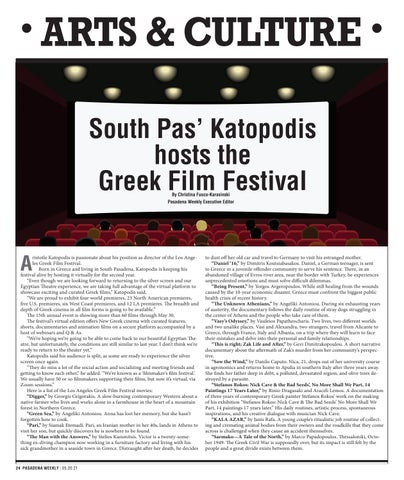
• ARTS & CULTURE • South Pas’ Katopodis hosts the Greek Film Festival A
ristotle Katopodis is passionate about his position as director of the Los Angeles Greek Film Festival. Born in Greece and living in South Pasadena, Katopodis is keeping his festival alive by hosting it virtually for the second year. “Even though we are looking forward to returning to the silver screen and our Egyptian Theatre experience, we are taking full advantage of the virtual platform to showcase exciting and curated Greek films,” Katopodis said. “We are proud to exhibit four world premieres, 23 North American premieres, five U.S. premieres, six West Coast premieres, and 12 LA premieres. The breadth and depth of Greek cinema in all film forms is going to be available.” The 15th annual event is showing more than 60 films through May 30. The festival’s virtual edition offers New Greek cinema with curated features, shorts, documentaries and animation films on a secure platform accompanied by a host of webinars and Q & As. “We’re hoping we’re going to be able to come back to our beautiful Egyptian Theatre, but unfortunately, the conditions are still similar to last year. I don’t think we’re ready to return to the theater yet.” Katopodis said his audience is split, as some are ready to experience the silver screen once again. “They do miss a lot of the social action and socializing and meeting friends and getting to know each other,” he added. “We’re known as a ‘filmmaker’s film festival.’ We usually have 50 or so filmmakers supporting their films, but now it’s virtual, via Zoom sessions.” Here is a list of the Los Angeles Greek Film Festival movies: “Digger,” by Georgis Grigorakis. A slow-burning contemporary Western about a native farmer who lives and works alone in a farmhouse in the heart of a mountain forest in Northern Greece. “Green Sea,” by Angeliki Antoniou. Anna has lost her memory, but she hasn’t forgotten how to cook. “Pari,” by Siamak Etemadi. Pari, an Iranian mother in her 40s, lands in Athens to visit her son, but quickly discovers he is nowhere to be found. “The Man with the Answers,” by Stelios Kammitsis. Victor is a twenty-something ex-diving champion now working in a furniture factory and living with his sick grandmother in a seaside town in Greece. Distraught after her death, he decides
to dust off her old car and travel to Germany to visit his estranged mother. “Daniel ‘16,” by Dimitris Koutsiabasakos. Daniel, a German teenager, is sent to Greece in a juvenile offender community to serve his sentence. There, in an abandoned village of Evros river area, near the border with Turkey, he experiences unprecedented emotions and must solve difficult dilemmas. “Being Present,” by Yorgos Avgeropoulos. While still healing from the wounds caused by the 10-year economic disaster, Greece must confront the biggest public health crisis of recent history. “The Unknown Athenians,” by Angeliki Antoniou. During six exhausting years of austerity, the documentary follows the daily routine of stray dogs struggling in the center of Athens and the people who take care of them. “Vasy’s Odyssey,” by Vasileios Papatheocharis. Two lives, two different worlds and two unalike places. Vasi and Alexandra, two strangers, travel from Alicante to Greece, through France, Italy and Albania, on a trip where they will learn to face their mistakes and delve into their personal and family relationships. “This is right; Zak Life and After,” by Gevi Dimitrakopoulou. A short narrative documentary about the aftermath of Zak’s murder from her community’s perspective. “Sow the Wind,” by Danilo Caputo. Nica, 21, drops out of her university course in agronomics and returns home to Apulia in southern Italy after three years away. She finds her father deep in debt, a polluted, devastated region, and olive trees destroyed by a parasite. “Stefanos Rokos: Nick Cave & the Bad Seeds’, No More Shall We Part, 14 Paintings 17 Years Later,” by Rinio Dragasaki and Araceli Lemos. A documentation of three years of contemporary Greek painter Stefanos Rokos’ work on the making of his exhibition “Stefanos Rokos: Nick Cave & The Bad Seeds’ No More Shall We Part, 14 paintings 17 years later.” His daily routines, artistic process, spontaneous inspirations, and his creative dialogue with musician Nick Cave. “KALA AZAR,” by Janis Rafa. A young couple’s ritualistic job routine of collecting and cremating animal bodies from their owners and the roadkills that they come across is challenged when they cause an accident themselves. “Sarmako—A Tale of the North,” by Marco Papadopoulos. Thessaloniki, October 1949. The Greek Civil War is supposedly over, but its impact is still felt by the people and a great divide exists between them.
24 PASADENA WEEKLY | 05.20.21
PW-05.20.21.indd 24
5/18/21 2:47 PM
Photos courtesy of Los Angeles Greek Film Festival
By Christina Fuoco-Karasinski Pasadena Weekly Executive Editor