MTN, Airtel, ntel, 13 Other Firms Scramble for 9mobile Emma Okonji The scramble to acquire 9mobile, Nigeria’s fourth largest network operator, promises to be very competitive, as 16 firms have submitted expressions
of interest (EoIs) to Barclays to bid for 9mobile, THISDAY has learnt. Companies that have expressed interest in 9mobile, which until recently was Etisalat Nigeria Limited, until a debt default forced its former
owner to relinquish its stake in the firm and exit Nigeria, include Africa’s biggest telecoms operator, MTN; India’s Bharti Airtel, operating as Airtel in Nigeria; and ntel, which in 2015 acquired the assets of the defunct NITEL
and MTel through the federal government’s privatisation programme. Also in the race are Bua Group, the privately held conglomerate promoted by Alhaji Abdulsamad Rabiu; Morning Side Capital Partners,
promoted by the former Managing Director of Diamond Bank Plc, Mr. Alex Otti; and Africell, a subsidiary of the Lebanon-based Lintel Group of Companies, with cellular communications operations in the Democratic Republic of
Congo (DRC), The Gambia, Sierra Leone and Uganda. Other firms that submitted EoIs are Obot Etiebet & Co, belonging to a former petroleum minister, Mr. Don Continued on page 10
DMO Clarifies Position on $5.5bn Proposed External Capital Raising… Page 56 Monday 23 October, 2017 Vol 22. No 8222. Price: N250
www.thisdaylive.com TR
TODAY'S WEATHER
ABUJA 25°C-33°C
MAIDUGURI 31°C-31°C
UT H
& RE A S O
ENUGU 25°C-28°C
N
KANO 27°C-33°C
LAGOS 24C-27°C
PORT HARCOURT 20°C-30°C
Court Order on Forfeiture of Monies Not Linked to BVN Unsettles Banks
Lenders may challenge order as liquidity squeeze looms NIBSS data shows 18m accounts not linked to BVN Policy not backed by law, order is illegal and unconstitutional, say lawyers, experts Obinna Chima There was disquiet in the banking sector at the weekend following a Federal High Court ex parte order in Abuja that all monies in bank accounts owned by corporate organisations, government agencies or individuals that are without
bank verification numbers (BVNs) will be forfeited to the federal government in 14 days from the date the order was given should the owners of the accounts fail to show cause why their monies should not be forfeited. Continued on page 10
FG Considers Review of NNPC Appointments Senate probe on corporation to focus on preferential treatment for Duke Oil Omololu Ogunmade and Damilola Oyedele in Abuja The presidency is currently considering a review of the recent senior executive appointments of the Nigeria National Petroleum Corporation (NNPC) made by its Group Managing Director, Dr. Maikanti Baru, THISDAY
has learnt. The decision to consider a review of the appointments is predicated on the alleged breach of due process in the appointments and contract awards to the tune of $25 billion raised by the Minister of State for Petroleum, Dr. Ibe Continued on page 10
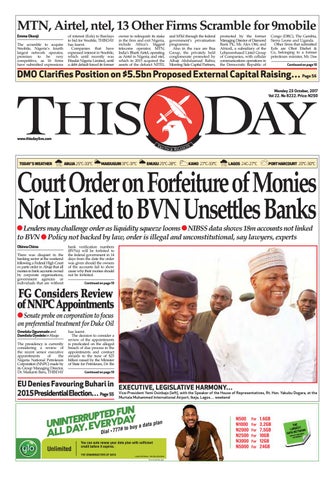
EU Denies Favouring Buhari in EXECUTIVE, LEGISLATIVE HARMONY… Yemi Osinbajo (left), with the Speaker of the House of Representatives, Rt. Hon. Yakubu Dogara, at the 2015 Presidential Election… Page 55 Vice-President Murtala Muhammed International Airport, Ikeja, Lagos… weekend
2
T H I S D AY MONDAY OCTOBER 23, 2017
3
T H I S D AY MONDAY OCTOBER 23, 2017
=HQLWK +HLJKWV 3ORW $MRVH $GHRJXQ 6WUHHW 9LFWRULD ,VODQG /DJRV
67$7(0(17 72 7+( 1,*(5,$1 672&. (;&+$1*( $1' 6+$5(+2/'(56 21 7+( *5283¶6 81$8',7(' ,)56 5(68/76 )25 7+( 7+,5' 48$57(5 (1'(' 6(37(0%(5 *URXS VWDWHPHQWV RI FRPSUHKHQVLYH LQFRPH
*URXS VWDWHPHQWV RI ILQDQFLDO SRVLWLRQ ,Q PLOOLRQV RI 1DLUD
0RQWKV 6HS
0RQWKV 6HS 5HVWDWHG
0RQWKV 'HF
1HW LQWHUHVW LQFRPH ,PSDLUPHQW FKDUJH IRU FUHGLW ORVV
1HW LQWHUHVW LQFRPH DIWHU LPSDLUPHQW FKDUJH IRU FUHGLW ORVVHV &RPPLVVLRQV UHFHLYHG 7UDGLQJ LQFRPH 2WKHU LQFRPH $PRUWLVDWLRQ RI LQWDQJLEOH DVVHWV 'HSUHFLDWLRQ RI SURSHUW\ DQG HTXLSPHQW 3HUVRQQHO H[SHQVHV 2SHUDWLQJ H[SHQVHV
3URILW EHIRUH WD[ ,QFRPH WD[ H[SHQVH
3URILW DIWHU WD[
2WKHU FRPSUHKHQVLYH LQFRPH ,WHPV WKDW ZLOO QHYHU EH UHFODVVLILHG WR SURILW RU ORVV )DLU YDOXH PRYHPHQWV RQ HTXLW\ LQVWUXPHQWV
,WHPV WKDW DUH RU PD\ EH UHFODVVLILHG WR SURILW RU ORVV )RUHLJQ FXUUHQF\ WUDQVODWLRQ GLIIHUHQFHV
6HS
6HS
'HF ,Q PLOOLRQV RI 1DLUD
$VVHWV &DVK DQG EDODQFHV ZLWK FHQWUDO EDQNV 7UHDVXU\ ELOOV $VVHW SOHGJHG DV FROODWHUDO 'XH IURP RWKHU EDQNV 'HULYDWLYH DVVHWV /RDQV DQG DGYDQFHV ,QYHVWPHQW VHFXULWLHV ,QYHVWPHQWV LQ VXEVLGLDULHV 'HIHUUHG WD[ DVVHWV 2WKHU DVVHWV 3URSHUW\ DQG HTXLSPHQW ,QWDQJLEOH DVVHWV
7RWDO DVVHWV
&XVWRPHUV¶ GHSRVLWV 'HULYDWLYH OLDELOLWLHV &XUUHQW LQFRPH WD[ 'HIHUUHG WD[ OLDELOLWLHV 2WKHU OLDELOLWLHV 2Q OHQGLQJ IDFLOLWLHV %RUURZLQJV 'HEW VHFXULWLHV LVVXHG
7RWDO OLDELOLWLHV
*URVV HDUQLQJV
/LDELOLWLHV
&DSLWDO DQG UHVHUYHV
,QWHUHVW DQG VLPLODU LQFRPH ,QWHUHVW DQG VLPLODU H[SHQVH
6KDUH FDSLWDO 6KDUH SUHPLXP 5HWDLQHG HDUQLQJV 2WKHU UHVHUYHV
2WKHU FRPSUHKHQVLYH LQFRPH IRU WKH SHULRG 7RWDO FRPSUHKHQVLYH LQFRPH IRU WKH SHULRG
$WWULEXWDEOH WR HTXLW\ KROGHU RI WKH SDUHQW 1RQ FRQWUROOLQJ LQWHUHVWV
3URILW DWWULEXWDEOH WR (TXLW\ KROGHUV RI WKH SDUHQW
7RWDO VKDUHKROGHUV¶ HTXLW\
1RQ FRQWUROOLQJ LQWHUHVWV
N
N
N
7RWDO OLDELOLWLHV DQG HTXLW\
7RWDO FRPSUHKHQVLYH LQFRPH DWWULEXWDEOH WR (TXLW\ KROGHUV RI WKH SDUHQW 1RQ FRQWUROOLQJ LQWHUHVWV .H\ )LQDQFLDO ,QIRUPDWLRQ (DUQLQJV SHU VKDUH DWWULEXWDEOH WR HTXLW\ KROGHUV RI SDUHQW %DVLF DQG GLOXWHG 7RWDO QRQ SHUIRUPLQJ FUHGLW IDFLOLWLHV 1¶ PLOOLRQV
7RWDO QRQ SHUIRUPLQJ FUHGLW IDFLOLWLHV WR FUHGLW IDFLOLWLHV
7KH %RDUG RI 'LUHFWRUV LV FRQILGHQW WKDW EDUULQJ XQIRUHVHHQ FLUFXPVWDQFHV WKLV WUHQG ZRXOG EH FRQVLGHUDEO\ LPSURYHG XSRQ LQ WKH UHPDLQLQJ SHULRG RI WKH ILQDQFLDO \HDU 'DWHG WKLV WK 'D\ RI 2FWREHU %< 25'(5 2) 7+( %2$5' 0LFKDHO 2VLODPD 2WX (VT &RPSDQ\ 6HFUHWDU\ )5& 08/7,
4
T H I S D AY MONDAY OCTOBER 23, 2017
7KH : $FDGHP\ DQG (QWHUSULVH 'HYHORSPHQW &HQWHU 3UHVHQW
20(135(1(85 $ 2QH 'D\ 2SHQ 6HPLQDU IRU :RPHQ (QWUHSUHQHXUV
6+( :+2 '$5(6 72 68&&((' &RPH OHDUQ DQG Å‚QG RXW VLPSOH VHFUHWV WR SHUIRUPLQJ EH\RQG \RXU H[SHFWDWLRQV LQ EXVLQHVV
6HPLQDU 0RGXOHV 'LJLWDOL]LQJ D 0DUNHWLQJ 3ODQ 0DNLQJ RSHUDWLRQV FKHDSHU IDVWHU DQG EHWWHU ,QWURGXFWLRQ WR 60( 7RRONLW *HWWLQJ WKH EHVW IRU IUHH )LQDQFLDO 5HFRUGV DQG $FFRXQWLQJ 6LPSOLÅ‚HG /RFDWLRQ 7KH 1(&$ (YHQW &HQWUH ,NHMD /DJRV 6WDWH 'DWH 7KXUVGD\ 2FWREHU WK 7LPH DP SP )HH 1 : FRPPXQLW\ PHPEHUV DQG $FFRXQW KROGHUV
1 5HJXODU IHH
$FFRXQW QDPH $FFHVV %DQN : (YHQWV $FFRXQW QXPEHU
9LVLW ZZZ WKHZFRPPXQLW\ FRP WR UHJLVWHU 12:
T H I S D AY MONDAY OCTOBER 23, 2017
5
6
T H I S D AY MONDAY OCTOBER 23, 2017
T H I S D AY MONDAY OCTOBER 23, 2017
( $ )
* + , )
) *
" " ! " # ! $ !
% & !
% & ! "
" # " % " % " ' $ " $ ( ) $ # ' ' $ " $ ( ) $ # $ !
" " $ () $ $ " % &! ' * + ( , ' -. %# "/ 0 1 # $$$%& ' % ( & %
7
8
T H I S D AY MONDAY OCTOBER 23, 2017
T H I S D AY MONDAY OCTOBER 23, 2017
9
MONDAY, OCTOBER 23, 2017 ˾ T H I S D AY
10
PAGE TEN MTN, AIRTEL, NTEL, 13 OTHER FIRMS SCRAMBLE FOR 9MOBILE Etiebet; Blackstone Private Equity; Tel-ology Holdings Limited, a special purpose vehicle led by a former chief executive of MTN Nigeria, Mr. Adian Wood, and Ericsson; De-elim Services Limited; Veittel, a firm owned by the investment arm of the Vietnamese military which has telecoms assets in Africa; ABBro Limited, a Nigerian venture company; Hamilton and George International Limited; and two other firms. Industry sources confirmed to THISDAY that the 16 companies
had complied with the deadline for the submission of EoIs at Barclays' office in Ikoyi, Lagos, and are preparing to access the data room to conduct their due diligence on 9mobile, preparatory for the bid submission stage. Etisalat Nigeria had taken out a $1.2 billion syndicated loan from a group of 13 banks but struggled to make repayments this year due to a currency crisis and recession in Nigeria. The Central Bank of Nigeria (CBN) was forced to intervene to save the company from
collapse and prevent creditors from putting it into receivership, leading to a change in its board and management, as well as the new name 9mobile. The crisis forced the telecoms company’s one-time parent Etisalat to terminate its management agreement with its Nigerian business and surrender its 45 per cent stake to a trustee following the central bank intervention. 9mobile CEO Boye Olusanya has said he is focused on getting the telecoms company back on track to make a profit, while working on
the paperwork to eventually raise new capital, adding the company was open to new investors. The 13 banks have put a freeze on collecting the principal and interest payments on the syndicated loan pending new investors, in order to help the company survive, the sources told Reuters. They have also held back on taking provisions for the syndicated loan and agreed to extend it after the regulatory intervention in July. The sources said the central bank had asked the lenders to take
a five percent provision on the loan as part of their third quarter results due this month. Some lenders, such as Zenith Bank, UBA, and Access Bank have already made 30 per cent provisions to cover direct lending to 9mobile outside the syndicated loan. 9mobile has over 20 million subscribers with a 14 per cent share of the Nigerian market. South Africa’s MTN is the market leader with 47 per cent, Globacom has 20 per cent while Airtel has 19 per cent. The Nigerian lenders with
exposure to the telecoms firm had given Barclays the mandate to handle the sale of 9mobile, after Citigroup and Standard Bank, previously in the running for the role, were dropped. According to Reuters, the lenders decided against Citigroup and Standard Bank due to their previous ties to 9mobile. Standard Bank’s Nigerian subsidiary, Stanbic IBTC Bank is among the group of lenders to 9mobile while Citi has advised the telecoms company in the past, said banking sources.
in line with federal character. “Even if the president had approved them, if they are found not to be in accordance with the extant laws and federal character, this president and even the vice-president will review them and ensure that proper things are done. “You know that on one or two occasions, some decisions had been taken in error in the past and the president did not hesitate to reverse them. If the same thing is established in this situation, it will be reviewed,” he stated. When queried on the absence of governance raised by Kachikwu in the award of contracts, the presidency source doubled down, saying that the allegation was a hoax and maintained that the contracts were not procurement contracts. Focusing solely on the joint
financing loans approved by Osinbajo, he said what was important was the approval of the joint venture financing by the presidency and not necessarily the board, stating that it was the president that had put the board in place and its power could not have exceeded that of the president. “This has been explained over and over that they were not procurement contracts. It was the president who put the board in place. That there is a board in place does not preclude the power of the president,” he stated. Meanwhile, it has come to light that the Senate ad hoc committee charged with probing the award of contracts to the tune of $25 billion by Baru without recourse to the governing board of NNPC would also turn the spotlight on the preferential treatment accorded to Duke Oil in oil lifting
contracts and oil swaps, despite charges that it was incapable of fulfilling the contracts. Duke Oil is a wholly owned subsidiary of NNPC registered in Panama in 1989. It is engaged in direct oil trading activities in the spot market to achieve operating capability, downstream integration and additional profits from oil operations. One of the allegations against the firm is that does not pay taxes in Nigeria. It has also been named in several NNPC deals which are being investigated, including the oil swaps and unaccounted crude oil lifting worth $17 billion. Baru again is being accused of giving preferential treatment to Duke Oil, as have successive heads of the oil corporation. Despite the preferential
to the suit, reported The Cable, an online news site. He said the quest to get revenue for the government should not be to the detriment of the constitutional and fundamental rights of the citizens. “I am very well concerned about how we deploy interim orders for permanent purposes, such as to forfeit valuable assets without any or fair hearing from the person(s) concerned,” the statement read. “I think it is improper to obtain interim orders to freeze the bank accounts of estates that are in dispute between the beneficiaries, of estates of deceased persons that are still being contested, of profits of companies that are still subject to litigation or other disputes, just to mention a few examples of the arbitrariness of these orders. “There is nothing in Section 3 of the Money Laundering (Prohibition) Act 2011 that makes BVN a condition precedent for operating a bank account in Nigeria. Nothing at all. What the law requires is verifiable identity of the customer, such as name, address, photographs, identity cards, etc. “BVN is a policy decision of the Central Bank of Nigeria and a court of law should not base its orders on executive policies that are not backed by law. “I get truly worried with the way we adopt ex parte applications to determine very serious and weighty issues of law. “The other point is the bindingness of an ex parte order upon the whole world and upon millions of bank customers in Nigeria, who are not directly parties to the suit. “How proper is it for a court to seek to determine the rights of parties in their absence, in view of the clear provisions
of Section 36(1) of the 1999 Constitution and Article 7 of the African Charter? “Why this desperation, if one may ask? I support that money suspected to be proceeds of crime should be traced, isolated and forfeited if the owner cannot successfully account for it. “But to proceed to seek to forfeit all monies in all banks meant for all customers in Nigeria on the grounds of absence of BVN is manifestly illegal. “I therefore humbly urge the Honourable Attorney-General of the Federation to review this case with a view to tempering the tenor of these rather outlandish orders. “The quest to scoop revenue for government should not be to the detriment of the constitutional and fundamental rights of the citizens. Which is why I have been praying that these orders are not real, but rather one of the usual social media gimmicks,” he said.
FG CONSIDERS REVIEW OF NNPC APPOINTMENTS Kachikwu against the NNPC boss in his letter to President Muhammadu Buhari on August 30. It has also come to light that the Senate ad hoc committee charged with probing the award of the $25 billion contracts by Baru without recourse to the governing board of the corporation would also focus on the preferential treatment accorded to Duke Oil, a subsidiary of NNPC, in oil lifting contracts and oil swaps, despite the charge that it was incapable of fulfilling the contracts. But whilst NNPC and the presidency have separately responded to the allegation of the $25 billion contract awards in breach of due process, both institutions have remained silent on the appointments of senior executive officers of the corporation, despite the plea by Kachikwu in his letter that the
appointments be suspended. In their defence of the contract awards, the presidency and the corporation had claimed that the contracts had passed through the NNPC Tenders Board and got No Objections from the Bureau of Public Procurement (BPP), following which final approvals were granted by Buhari and Vice-President Yemi Osinbajo, in his capacity as acting president. However, a top presidency official who confided in THISDAY, said the silence from the presidency on the appointments was not an endorsement on the action taken by Baru, adding that if after thorough examination the appointments were indeed found to be in breach of the extant laws or the federal character principle, they will duly be reviewed. According to him, the president and his deputy are advocates and promoters of due process who
would not hesitate to reverse themselves when cases of apparent breaches are established, instead of allowing their egos to get in the way and maintaining indifference to wrongful acts. Buttressing the position, the presidential source said it is on record that the president had previously reversed himself on certain decisions when his attention was drawn to initial errors, adding that he would not fail to do so again. Against this backdrop, he said the current situation would not be the exception, as the president will not hesitate to right the wrongs in the NNPC appointments even if they had his initial blessing. “It is going to be reviewed. Extant laws would be checked to verify if NNPC did not comply with them. The appointments will be checked to see if they are not
Continued on page 54
COURT ORDER ON FORFEITURE OF MONIES NOT LINKED TO BVN UNSETTLES BANKS Justice Nnamdi Dimgba Igwe had granted the order on October 18, 2017, following an application by the Attorney-General of the Federation, Mr. Abubakar Malami (SAN) on behalf of the federal government. But investigations by THISDAY yesterday showed that the banks were contemplating filing a classaction suit to stop the federal government from appropriating funds that do not belong to it. When contacted the Central Bank of Nigeria (CBN) chose to remain mum on the issue, but a director of the bank said he would not blame the banks if they chose to challenge the court order. “If I were a banker, I would go to court to challenge this order. I will not blame them if they did so,” the director who preferred not to be named, said to THISDAY. According to the Nigerian Interbank Settlement System (NIBSS), 52 million bank accounts had been linked to their BVNs as of February this year. The total number of bank accounts in the country was estimated at 70 million in 2016. But speaking in a chat with THISDAY, a bank chief executive, who spoke on the condition of anonymity, questioned the legality of the move by the federal government. According to the CEO, the move would discourage financial inclusion and might affect financial system stability. “What of a situation where somebody has died and the matter is in administration, what do you want the bank to do? To give government the money and face litigation? “What of Nigerians who are abroad and are still struggling to get their BNVs? What if we send the monies to government and we are sued by the customer(s)? “And the 14-day time frame is
very short. Why the rush? Why not give a time frame, maybe till 2018 for people to get their BVNs? These are the type of things that create uncertainty and instability in the market. We are just coming out of a recession and we try to discourage anything that would destabilise the system. “We are trying to drive financial inclusion, but there are many people who are not in the banking system that may not want to open accounts once they hear of such things happening,” he said. In his reaction, the chief executive of Financial Derivatives Company Limited, Mr. Bismarck Rewane also pointed out that if the decision by the court is implemented, it would lead to a liquidity squeeze in the market. But Rewane stated that the court ruling would help sanitise the system. “It does mean that all that money would be transferred to the central bank and that would drain liquidity. Let’s say it is N500 billion in all the banks and the banks are to comply by transferring the monies to the central bank account which is the federal government’s bank. “The immediate impact is that of liquidity squeeze and the second impact is that it would sanitise the system and also improve the culture of honesty and transparency. However, it may encourage the banks to be dishonest in their returns,” he added. But in his assessment of the development, the chief executive of the defunct Progress Bank, Mr. Okechukwu Unegbu argued that the ruling was “basically illegal”. Unegbu wondered under what law the ruling was given. “Was there any federal gazette on that? Who was the case against?” he wondered. He added: “In fact, if that is
done to anybody’s account, the person has the right to go to court. But for me, if it is something the federal government wants to pursue, let them come out with a law. “But I must tell you that we are still feeling the impunity of the military mentality. Remember that in banking, your relationship with the customer is confidential. “However, if the government comes up with a policy to enable it to fight corruption, all of us would support it. But you don’t use draconian laws to enforce such things.” According to Unegbu, the federal government ought to be developing policies that would encourage financial inclusion and not those that discourage it. He added that some of the challenges around the BVN scheme ought to have been corrected before resorting to the courts. “Even the BVN scheme has its problems. If you go to the bank most of the time, before you conclude it, it takes a lot of time. Atimes when you register, the bank will call you back to come and register again. “The environment should be put right first. If the environment is faulty, there is nothing bank customers can do. Besides, this should be extended to the microfinance banks, where most of their customers do not have BVNs yet. “So there are holes in the socalled court order. But any order from a court should be obeyed, but it can still be challenged. “Honestly, I am disturbed because I see it as an order given without considering the challenges in the environment,” he noted In his reaction, a former Managing Director of the defunct Liberty Bank, Chief
Lawson Omokhodion welcomed the court order, arguing that it would help the government in its anti-corruption war. When asked about what would become of the fate of bank customers in the diaspora, Omokhodion said: “People in the diaspora have not gone forever. They come home during Christmas, some come once a year and some come twice a year. “So they have time to link their BVNs to their accounts. Also, the central bank created centres outside the country to enable them to do that.” He added: “But the truth is that there is no person who genuinely worked for his money, who would not be concerned about the safety of his funds. If I have 25,000 pounds in a British bank account and they tell me there are things I need to do to preserve my money, I would run down there immediately. “So why won’t you if you are truly the owner of this account? You would run back to sort things out and return. So for me government is doing the right thing. Government sometimes has been too soft. This country requires tough measures to create order.” However, human rights lawyer, Ebun-Olu Adegboruwa described as illegal, the order granting the forfeiture of funds in accounts without BVNs to the federal government. In a statement, Adegboruwa, citing Section 36(1) of the 1999 Constitution and Article 7 of the African Charter, said it was not proper to determine the rights of parties in their absence. He said the BVN was a policy decision and not “backed by law”. The lawyer also faulted the “bindingness” of the order on millions of bank customers who he said were not directly parties
TOP GAINERS NGN NGN CUTIX 0.23 2.60 INTERBREW 4.49 51.01 CCNN 0.49 10.17 TRANSCORP 0.07 1.47 NEIMETH 0.03 0.65 TOP LOSERS NGN NGN AIICO 0.03 0.54 HONEYWELL 0.10 1.90 NEM 0.07 1.34 UACN 0.84 16.11 CONTINENTAL 0.07 1.35 HPE Nestle Nig Plc ₦ 1,200.27 Volume: 106.546 million shares Value: N1.883 billion Deals: 3,193 As at 20/10/17 See details on Page 33
% 9.7 9.6 5.1 5.0 4.8 % 5.2 5.0 4.9 4.9 4.9
T H I S D AY MONDAY OCTOBER 23, 2017
11
12
T H I S D AY MONDAY OCTOBER 23, 2017
!# "#!$ #$! ! %
/ŶƚƌŽĚƵĐƟŽŶ ƌĞƐƚƌƵĐƚƵƌŝŶŐ ŽĨ ƚŚĞ EŝŐĞƌŝĂŶ &ĞĚĞƌĂƟŽŶ͘ dŚĞ ŵŽƐƚ ƐƚƌŝĚĞŶƚ ǀŽŝĐĞƐ ŚĂǀĞ ďĞĞŶ ĨƌŽŵ ƚŚĞ ^ŽƵƚŚ ĂŶĚ ƚŚĞ EŽƌƚŚĞƌŶ ǀŽŝĐĞ ŚĂƐ ďĞĞŶ ŵŽƌĞ ŵƵƚĞĚ͘ dŚŝƐ ŚĂƐ ĐƌĞĂƚĞĚ ƚŚĞ ĨĂůƐĞ ŝŵƉƌĞƐƐŝŽŶ ƚŚĂƚ ƚŚĞ ^ŽƵƚŚ ŝƐ ĨŽƌ ĂŶĚ ƚŚĞ EŽƌƚŚ ŝƐ ĂŐĂŝŶƐƚ ƌĞƐƚƌƵĐƚƵƌŝŶŐ͘ /Ŷ ϭϵϵϭ͕ Ă ŐƌŽƵƉ ŽĨ ƉŽůŝƟĐŝĂŶƐ͕ ŝŶƚĞůůĞĐƚƵĂůƐ ĂŶĚ ƚĞĐŚŶŽĐƌĂƚƐ ĨƌŽŵ EŽƌƚŚĞƌŶ EŝŐĞƌŝĂ ŚĞůĚ ƐĞǀĞƌĂů ŵĞĞƟŶŐƐ ŝŶ <ĂĚƵŶĂ ĂŶĚ <ĂŶŽ ƚŽ ĚĞƐŝŐŶ ĂŶĚ ƉƌŽƉŽƐĞ Ă ŶĞǁ ĨĞĚĞƌĂů ƐƚƌƵĐƚƵƌĞ ĨŽƌ EŝŐĞƌŝĂ͘ ŵŽŶŐ ŵĞŵďĞƌƐ ŽĨ ƚŚŝƐ ŐƌŽƵƉ ǁĞƌĞ ůŚĂũŝ ^ƵůĞ 'ĂLJĂ͕ Ă ĨŽƌŵĞƌ &ŝƌƐƚ ZĞƉƵďůŝĐ DŝŶŝƐƚĞƌ͕ ůŚĂũŝ dĂŶŬŽ zĂŬĂƐĂŝ͕ ŚŝĞĨ ^ƵŶĚĂLJ ǁŽŶŝLJŝ͕ ƌ͘ ^ƵůĞŝŵĂŶ <ƵŵŽ͕ ƌ͘ /ďƌĂŚŝŵ Ăƫ ŚŵĞĚ͕ ƌ͘ DĂŚŵŽƵĚ dƵŬƵƌ͕ DĂůůĂŵ ^ƵůĞ zĂŚĂLJĂ ,ĂŵŵĂ͕ ůŚĂũŝ ďĚƵůůĂŚŝ DĂŝŬĂŶŽ 'ǁĂƌnjŽ ĂŶĚ ŽƚŚĞƌƐ͘ dŚĞLJ ĐĂŵĞ ƵƉ ǁŝƚŚ ǀĂƌŝŽƵƐ ĐŽŶƐƟƚƵƟŽŶĂů͕ ƉŽůŝƟĐĂů ĂŶĚ ĮƐĐĂů ĂůƚĞƌŶĂƟǀĞƐ ĂŶĚ ŽƉƟŽŶƐ ǁŝƚŚ ǁŚŝĐŚ ƚŽ ŶĞŐŽƟĂƚĞ ǁŝƚŚ ƚŚĞ ƌĞƐƚ ŽĨ EŝŐĞƌŝĂ ƚŽ ƌĞƐƚƌƵĐƚƵƌĞ ƚŚĞ ĨĞĚĞƌĂƟŽŶ͘ dŚĞLJ ŝŶǀŝƚĞĚ ŚŝĞĨ ŶƚŚŽŶLJ ŶĂŚŽƌŽ ƚŽ <ĂŶŽ͕ ŚĞůĚ ĚŝƐĐƵƐƐŝŽŶƐ ǁŝƚŚ Śŝŵ ĂŶĚ ĂŐƌĞĞĚ ƚŽ ƉƵƌƐƵĞ Ă ZĞƐƚƌƵĐƚƵƌŝŶŐ ŐĞŶĚĂ ƚŽŐĞƚŚĞƌ ĂŐĞŶĚĂ ĨŽƌ ƌĞƐƚƌƵĐƚƵƌŝŶŐ ƵŶĚĞƌ ƚŚĞ DŽǀĞŵĞŶƚ ĨŽƌ EĂƟŽŶĂů ZĞĨŽƌŵĂƟŽŶ͘ DĂŶLJ ƉƌŽƚĂŐŽŶŝƐƚƐ ŽŶ ƌĞƐƚƌƵĐƚƵƌŝŶŐ ƚĞŶĚ ƚŽ ĂƌƟĐƵůĂƚĞ ƚŚĞŝƌ ƉŽƐŝƟŽŶƐ ŝŶ Ă ǁĂLJ ƚŚĂƚ ƐƵŐŐĞƐƚƐ EŝŐĞƌŝĂ ŚĂƐ ŶŽƚ ďĞĞŶ ƌĞƐƚƌƵĐƚƵƌŝŶŐ͘ /Ŷ ƌĞĂůŝƚLJ͕ EŝŐĞƌŝĂ ŚĂƐ ďĞĞŶ ƌĞƐƚƌƵĐƚƵƌŝŶŐ ƐŝŶĐĞ ϭϵϭϰ͕ ǁŚĞŶ ƚŚĞ ƌŝƟƐŚ ĂŵĂůŐĂŵĂƚĞĚ ƚŚĞŝƌ ƚŚƌĞĞ ƚĞƌƌŝƚŽƌŝĞƐ ŝŶ ƚŚĞ EŝŐĞƌŝĂ ĂƌĞĂ͕ ƚŚĞ ĐŽůŽŶLJ ŽĨ >ĂŐŽƐ ĂŶĚ ƚŚĞ ƚǁŽ WƌŽƚĞĐƚŽƌĂƚĞƐ ƚŽ ƚŚĞ EŽƌƚŚ ĂŶĚ ^ŽƵƚŚ ŽĨ ƚŚĞ EŝŐĞƌ͘ dŚŝƐ ƐLJŵďŽůŝĐ ĂĐƚ ƌĞƉƌĞƐĞŶƟŶŐ ƚŚĞ ͞ĐƌĞĂƟŽŶ ŽĨ EŝŐĞƌŝĂ͟ ŚĂƐ ďĞĞŶ ǁŝĚĞůLJ ĐĂƐƟŐĂƚĞĚ ĂƐ ĂŶ ĂƌƟĮĐŝĂů ĂĐƚ ĂŶĚ Ă ŵŝƐƚĂŬĞ͘ ^ƵĐŚ ǀŝĞǁƐ ĞƌƌŽŶĞŽƵƐůLJ ďĞůŝĞǀĞ ƚŚĂƚ ƚŚĞƌĞ ĂƌĞ ƐƚĂƚĞƐ ƚŚĂƚ ŚĂǀĞ ďĞĞŶ ͞ŶĂƚƵƌĂůůLJ ĐŽŶƐƟƚƵƚĞĚ͘͟ tĞ ĚŽ ŬŶŽǁ ŚŽǁĞǀĞƌ ƚŚĂƚ ƚŚƌŽƵŐŚŽƵƚ ŚŝƐƚŽƌLJ͕ ƐƚĂƚĞ ĨŽƌŵĂƟŽŶƐ ŚĂǀĞ ŽĐĐƵƌƌĞĚ ŝŶ Ă ŇƵŝĚ ĂŶĚ ĂƌƟĮĐŝĂů ŵĂŶŶĞƌ͘ ^ƚĂƚĞ ĐŽŚĞƐŝŽŶ ŚĂƐ ďĞĞŶ ďƵŝůƚ Ăƚ Ă ůĂƚĞƌ ƐƚĂŐĞ͘ dŚĞ ƉƌŽďůĞŵ ŽĨ EŝŐĞƌŝĂ ŝƐ ŶŽƚ ƚŚĞ ĂŵĂůŐĂŵĂƟŽŶ ŽĨ ϭϵϭϰ͕ ďƵƚ ƚŚĞ ĨĂŝůƵƌĞ ƚŽ ĨŽƌŐĞ Ă ĐŽŚĞƐŝǀĞ ƐƚĂƚĞ ĨƌŽŵ ƚŚĞ ƐĂŝĚ ƚĞƌƌŝƚŽƌŝĞƐ ĂŌĞƌ ŝŶĚĞƉĞŶĚĞŶĐĞ͘ /Ŷ ϭϵϯϴ ƚŚĞ ^ŽƵƚŚ ǁĂƐ ƌĞƐƚƌƵĐƚƵƌĞĚ ŝŶƚŽ ƚǁŽ ƌĞŐŝŽŶƐ͕ ƚŚĞ tĞƐƚ ĂŶĚ ĂƐƚ ǁŚŝůĞ ƚŚĞ EŽƌƚŚ ǁĂƐ ůĞŌ ŝŶƚĂĐƚ Ͳ ŚĞŶĐĞ ƚŚĞ ŽƌŝŐŝŶƐ ŽĨ ƚŚĞ ƚƌŝƉĂƌƟƚĞ ƉŽůŝƟĐĂů ƐLJƐƚĞŵ͘ /Ŷ ƚŚĞ ƌƵŶ ƵƉ ƚŽ ŝŶĚĞƉĞŶĚĞŶĐĞ͕ ƚŚĞ EŝŐĞƌŝĂŶ ƉŽůŝƟĐĂů ĞůŝƚĞ ŚĂĚ ĂŐƌĞĞĚ ƚŽ Ă &ĞĚĞƌĂƟŽŶ ďĂƐĞĚ ŽŶ ƚŚĞ ƚŚƌĞĞ ƟĞƌ ƌĞŐŝŽŶĂů ƐƚƌƵĐƚƵƌĞ >ŽƌĚ >ƵŐĂƌĚ ŚĂĚ ŝŶǀĞŶƚĞĚ͘ dŚĞ ŐƵŝĚŝŶŐ ƉƌŝŶĐŝƉůĞ ŽĨ ƚŚĞ ƚƌŝƉĂƌƟƚĞ &ĞĚĞƌĂƟŽŶ ǁĂƐ ƚŚĂƚ ĞĂĐŚ ZĞŐŝŽŶ ŚĂĚ Ă ͚ŵĂũŽƌŝƚLJ ĞƚŚŶŝĐ ŐƌŽƵƉ͕͛ ǁŚŝĐŚ ǁĂƐ ƚŽ ƉůĂLJ ƚŚĞ ƌŽůĞ ŽĨ ƚŚĞ ůĞĂĚŝŶŐ ĂĐƚŽƌ Ͳ ŝŶ ƚŚĞ EŽƌƚŚ ƚŚĞ ,ĂƵƐĂ͕ ŝŶ ƚŚĞ tĞƐƚ ƚŚĞ zŽƌƵďĂ͕ ĂŶĚ ŝŶ ƚŚĞ ĂƐƚ ƚŚĞ /ŐďŽ͘ /Ŷ ĨĂĐƚ ƚŚĞ ǁŚŽůĞ ƉƌŽĐĞƐƐ ŽĨ ĐŽŶƐƟƚƵƟŽŶ ŵĂŬŝŶŐ ďĞƚǁĞĞŶ ϭϵϰϲ ĂŶĚ ϭϵϱϵ ǁĂƐ ĂŶ ĞůĂďŽƌĂƚĞ ďĂƌŐĂŝŶŝŶŐ ƉĂŶƚŽŵŝŵĞ ƚŽ ĮŶĚ ĞƋƵŝůŝďƌŝƵŵ ďĞƚǁĞĞŶ ƚŚĞ ƚŚƌĞĞ ƌĞŐŝŽŶƐ͘ EŽ ǁŽŶĚĞƌ ƚŚĞ ƉƌŽĐĞƐƐ ƌĞƐƵůƚĞĚ ŝŶ ƚŚĞ ĞŵĞƌŐĞŶĐĞ ŽĨ ƚŚƌĞĞ ŵĂũŽƌ ƉŽůŝƟĐĂů ƉĂƌƟĞƐ ĞĂĐŚ ĂůůŝĞĚ ƚŽ Ă ŵĂũŽƌŝƚLJ ŐƌŽƵƉ͘ dŚĞ ƌĞƐƚƌƵĐƚƵƌŝŶŐ ǁĂƐ ƉƌŽďůĞŵĂƟĐ ďĞĐĂƵƐĞ EŝŐĞƌŝĂ ǁĂƐ ŶĞǀĞƌ ĐŽŵƉŽƐĞĚ ŽĨ ƚŚƌĞĞ ŵĂũŽƌŝƚLJ ŐƌŽƵƉƐ͘ ůƚŚŽƵŐŚ EŝŐĞƌŝĂ ǁĂƐ ƉƌŽĨŽƵŶĚůLJ ŵƵůƟƉŽůĂƌ͕ ƚŚĞ ,ĂƵƐĂͲzŽƌƵďĂʹ /ŐďŽ ƉŽůŝƟĐĂů ĞůŝƚĞƐ ŽƉƚĞĚ ƚŽ ŵĂŝŶƚĂŝŶ ƚŚĞ ĐŽůŽŶŝĂů ƚƌŝƉĂƌƟƚĞ ƐƚƌƵĐƚƵƌĞ͘ dŚĞ ƌĞĨƵƐĂů ŽĨ ƚŚĞ ƌŝƟƐŚ ƚŽ ĐƌĞĂƚĞ ŵŽƌĞ ƌĞŐŝŽŶƐ ŝŶ ϭϵϱϴ ǁŚĞŶ ƚŚĞ tŝůůŝŶŬƐ ŽŵŵŝƐƐŝŽŶ ĂĸƌŵĞĚ ƚŚĂƚ ĨĞĂƌƐ ŽĨ ĚŽŵŝŶĂƟŽŶ ŽĨ ƚŚĞ ͚ŵŝŶŽƌŝƟĞƐ͛ ďLJ ƚŚĞ ͚ŵĂũŽƌŝƟĞƐ͛ ǁĞƌĞ ũƵƐƟĮĞĚ ǁĂƐ Ă ĚŝƐĞŶĨƌĂŶĐŚŝƐĞŵĞŶƚ ŽĨ Ă ƐŝŐŶŝĮĐĂŶƚ ƉĞƌĐĞŶƚĂŐĞ ŽĨ ƚŚĞ ƉŽƉƵůĂƟŽŶ͘ /ƚ ǁĂƐ ƚŚĞ ŵŝůŝƚĂƌLJ ƚŚĂƚ ƐƵďƐĞƋƵĞŶƚůLJ ĐŽŵƉůĞƚĞůLJ ƌĞƐƚƌƵĐƚƵƌĞĚ ƚŚĞ EŝŐĞƌŝĂŶ ^ƚĂƚĞ͘ dŚĞLJ ĚŝƐŵĂŶƚůĞĚ ƚŚĞ ƋƵĂĚƌŝƉĂƌƟƚĞ ƐƚƌƵĐƚƵƌĞ ŝŶ ϭϵϲϳ͕ ũƵƐƚ ďĞĨŽƌĞ ƚŚĞ ĂĚǀĞŶƚ ŽĨ ƚŚĞ Đŝǀŝů ǁĂƌ͕ ǁŚĞŶ ƚŚĞ 'ŽǁŽŶ DŝůŝƚĂƌLJ ĚŵŝŶŝƐƚƌĂƟŽŶ ĐƌĞĂƚĞĚ ϭϮ ƐƚĂƚĞƐ ĨƌŽŵ ƚŚĞ ĨŽƵƌ ĞdžŝƐƟŶŐ ƌĞŐŝŽŶƐ͘ dŚĞ ŵŽǀĞ ĂƉƉĞĂƌĞĚ ƚŽ ŚĂǀĞ ďĞĞŶ Ă ƉŽůŝƟĐĂů ĂĚǀĂŶĐĞ ďĞĐĂƵƐĞ ŝƚ ǁĂƐ ĂĚĚƌĞƐƐŝŶŐ ƚŚĞ ĐŽƌƌĞĐƟŽŶ ŽĨ ƚŚĞ ƐƚƌƵĐƚƵƌĂů ŝŵďĂůĂŶĐĞƐ ĂŶĚ ĞƚŚŶŽͲƌĞŐŝŽŶĂů ŝŶĞƋƵŝƟĞƐ ŽĨ ƚŚĞ ŝŶŚĞƌŝƚĞĚ ĨĞĚĞƌĂů ƐƚƌƵĐƚƵƌĞ͘ /Ŷ ϭϵϳϲ͕ ƚŚĞ DŽŚĂŵŵĞĚͲKďĂƐĂŶũŽ ĚŵŝŶŝƐƚƌĂƟŽŶ ŝŶĐƌĞĂƐĞĚ ƚŚĞ ŶƵŵďĞƌ ŽĨ ƐƚĂƚĞƐ ĨƌŽŵ ϭϮ ƚŽ ϭϵ͖ 'ĞŶĞƌĂů ĂďĂŶŐŝĚĂ ƌĂŝƐĞĚ ƚŚĞ ŶƵŵďĞƌ ŽĨ ƐƚĂƚĞƐ ƚŽ Ϯϭ ŝŶ ϭϵϴϳ ĂŶĚ ƚŽ ϯϬ ŝŶ ϭϵϵϭ ǁŚŝůĞ ƚŚĞ ƌĞŐŝŵĞ ŽĨ 'ĞŶĞƌĂů ďĂĐŚĂ ŝŶĐƌĞĂƐĞĚ ƚŚĞ ŶƵŵďĞƌ ŽĨ ƐƚĂƚĞƐ ŝŶ ƚŚĞ ĐŽƵŶƚƌLJ ƚŽ ϯϲ͘ dŚƌŽƵŐŚŽƵƚ ƚŚĞ ƉĞƌŝŽĚ͕ ƚŚĞ ĐƌĞĂƟŽŶ ŽĨ ŵŽƌĞ ^ƚĂƚĞƐ ǁĂƐ Ă ĚŝƌĞĐƚ ƌĞƐƵůƚ ŽĨ ĐŝǀŝůŝĂŶ ĂŐŝƚĂƟŽŶ͘
ĐŽƵŶƚƌLJ͕ ƚŚĞ ĮƐƐŝƉĂƌŽƵƐ ƐƚĂƚĞ ĐƌĞĂƟŽŶ ƚĞŶĚĞŶĐLJ ďLJ ĐŽŶĐĞŶƚƌĂƟŶŐ ĞŶŽƌŵŽƵƐ ƉŽǁĞƌƐ Ăƚ ƚŚĞ ĐĞŶƚƌĞ ǁĞĂŬĞŶĞĚ Ăůů ƉŽůŝƟĐĂů ŐƌŽƵƉƐ ƚŚĂƚ ĂƌĞ ŶŽƚ ŝŶ ĐŽŶƚƌŽů ŽĨ ƚŚĞ ĐĞŶƚƌĞ͘ dŚĞ ƌĞƐƵůƚ ǁĂƐ ƚŚĂƚ ƌĞƐƚƌƵĐƚƵƌŝŶŐ ůĞĚ ƚŽ ƚŚĞ ĞŵĞƌŐĞŶĐĞ ŽĨ Ă ƋƵĂƐŝͲƵŶŝƚĂƌLJ ^ƚĂƚĞ͘ dŚŝƐ ƚĞŶĚĞŶĐLJ ǁĂƐ ƌĞŝŶĨŽƌĐĞĚ ƚŚƌŽƵŐŚ ƚŚĞ ĚĞĐĞŶƚƌĂůŝƐĂƟŽŶ ƉŽůŝĐLJ ŽĨ ƚŚĞ ĂďĂŶŐŝĚĂ ƌĞŐŝŵĞ ďĞƚǁĞĞŶ ϭϵϴϳ ĂŶĚ ϭϵϵϭ ŝŶĐƌĞĂƐŝŶŐ ƚŚĞ ŶƵŵďĞƌ ŽĨ ůŽĐĂů ŐŽǀĞƌŶŵĞŶƚƐ ĨƌŽŵ ϯϬϭ ƚŽ ϰϰϵ ŝŶ ϭϵϴϵ ĂŶĚ ƚŽ ϱϴϵ ŝŶ ϭϵϵϭ ĂŶĚ ĂŐĂŝŶ ƚŽ ϳϳϰ͘ KƉƟŽŶƐ ĨŽƌ ZĞƐƚƌƵĐƚƵƌŝŶŐ ϭͿ ZĞƚƵƌŶ ƚŽ ƚŚĞ ƚƌŝƉĂƌƟƚĞ ƌĞŐŝŽŶĂůŝƐŵ ŽĨ ƚŚĞ &ŝƌƐƚ ZĞƉƵďůŝĐ͘ dŚŝƐ ŝƐ Ă ŶŽŶͲƐƚĂƌƚĞƌ ĂƐ ƚŚĞ ƌĞŐŝŽŶƐ ǁĞƌĞ ƚŽŽ ůĂƌŐĞ ĂŶĚ ĂďŽǀĞ Ăůů͕ ƚŽŽ ƵŶĞǀĞŶ͘ dŚĞ EŽƌƚŚ ĂůŽŶĞ ǁĂƐ ŵƵĐŚ ůĂƌŐĞƌ ƚŚĂŶ ƚŚĞ ĐŽŵďŝŶĞĚ ƌĞŐŝŽŶƐ ŝŶ ƚŚĞ ^ŽƵƚŚ͘ ϮͿ ŝƐŵĂŶƚůĞ ƚŚĞ ^ƚĂƚĞ ƐƚƌƵĐƚƵƌĞ ĂŶĚ ƌĞĐŽŶƐƟƚƵƚĞ EŝŐĞƌŝĂ͛Ɛ ƉŽůŝƟĐĂů ƐƚƌƵĐƚƵƌĞ ĂůŽŶŐ ƚŚĞ Ɛŝdž njŽŶĂů ƐƚƌƵĐƚƵƌĞ͘ EŝŐĞƌŝĂ ŝƐ Ă ǀĞƌLJ ůĂƌŐĞ ĐŽƵŶƚƌLJ ĂŶĚ ƚŚĞ Ɛŝdž ĨĞĚĞƌĂƟŶŐ ƵŶŝƚƐ ĂƌĞ ƚŽŽ ůĂƌŐĞ ĨŽƌ ĐŝƟnjĞŶƐ ƚŽ ŚĂǀĞ Ă ƐĞŶƐĞ ŽĨ ůŽĐĂů ŝĚĞŶƟƚLJ͘ ^ŽŵĞ ŽĨ ƚŚĞ njŽŶĞƐ ŵŝŐŚƚ ĂůƐŽ ůĂĐŬ ŝŶƚĞƌŶĂů ĐŽŚĞƐŝŽŶ͘ ϯͿ DĂŝŶƚĂŝŶ ƚŚĞ ĐƵƌƌĞŶƚ ϯϲͲ^ƚĂƚĞ ƐƚƌƵĐƚƵƌĞ ďƵƚ ƚĂŬĞ ƐŽŵĞ ƉŽǁĞƌ ĂŶĚ ƌĞƐŽƵƌĐĞƐ ĨƌŽŵ ƚŚĞ &ĞĚĞƌĂů ůĞǀĞů ĂŶĚ ƚƌĂŶƐĨĞƌ ŝƚ ƚŽ ƚŚĞ ^ƚĂƚĞ ůĞǀĞů͘ dŚĞ ƉƌŽďůĞŵ ǁŝƚŚ ƚŚŝƐ ŽƉƟŽŶ ŝƐ ůĂƌŐĞ ĂŶĚ ŝƚ͛Ɛ ĞƐƐĞŶƟĂů ƚŽ ĐƵƌď ŝƚ͘ ϰͿ ZĞƚƵƌŶ ƚŽ ƚŚĞ ϭϵϲϳ ϭϮͲ^ƚĂƚĞ ^ƚƌƵĐƚƵƌĞ ŝƐ ƚŚĞ ďĞƐƚ ŽƉƟŽŶ ŽƉĞŶ ƚŽ EŝŐĞƌŝĂ Ăƚ ƚŚŝƐ ƟŵĞ͘ ZĞĐŽŵŵĞŶĚĂƟŽŶƐ͗ ZĞƚƵƌŶ ƚŽ ƚŚĞ ϭϮͲ^ƚĂƚĞ ^ƚƌƵĐƚƵƌĞ dŽĚĂLJ͕ EŝŐĞƌŝĂ ĐĂŶŶŽƚ ƐƵƐƚĂŝŶ ƚŚĞ ϯϲͲ^ƚĂƚĞ ƐƚƌƵĐƚƵƌĞ ĚƵĞ ƚŽ ƚŚĞŝƌ ŽǀĞƌͲĚĞƉĞŶĚĞŶĐĞ ŽŶ Žŝů ƌĞǀĞŶƵĞƐ ƚŚĂƚ ǁŽƵůĚ ĐŽŶƟŶƵĞ ƚŽ ĚǁŝŶĚůĞ ŝŶ ƚŚĞ ĐŽŵŝŶŐ LJĞĂƌƐ͘ tĞ ƉƌŽƉŽƐĞ Ă ƌĞƚƵƌŶ ƚŽ ƚŚĞ ϭϮͲ^ƚĂƚĞ ^ƚƌƵĐƚƵƌĞ ďĂƐĞĚ ŽŶ ƚŚĞ ĨŽůůŽǁŝŶŐ ĐŽŶƐƟƚƵƟŽŶĂů ƉƌŝŶĐŝƉůĞƐ͗ Ϳ ^ƚĂƚĞƐ ŵƵƐƚ ďĞ ĞĐŽŶŽŵŝĐĂůůLJ ǀŝĂďůĞ ĂŶĚ ĐĂƉĂďůĞ ŽĨ ƌĞůLJŝŶŐ ŽŶ ĮƐĐĂů ƌĞƐŽƵƌĐĞƐ ƚŚĞLJ ŐĞŶĞƌĂƚĞ ƚŚĞŵƐĞůǀĞƐ͖ Ϳ ŶƐƵƌĞ ƚŚĂƚ ^ƚĂƚĞƐ ŽƉĞƌĂƚĞ ŝŶ Ă ĚĞŵŽĐƌĂƟĐ ŵĂŶŶĞƌ ĂŶĚ ĂƌĞ ƌƵŶ ďLJ ŐŽǀĞƌŶŽƌƐ ƚŚĂƚ ĂƌĞ ĂĐĐŽƵŶƚĂďůĞ ƚŽ ƚŚĞ ƉĞŽƉůĞ ĂŶĚ ůĞŐŝƐůĂƚŽƌƐ ƚŚĂƚ ĂƌĞ ŶŽƚ ƐƵďƐĞƌǀŝĞŶƚ ƚŽ ƟŶ ŐŽĚƐ͖ Ϳ 'ŝǀĞ ^ƚĂƚĞƐ ƚŚĞ ĐŽŶƐƟƚƵƟŽŶĂů ĂŶĚ ůĞŐŝƐůĂƟǀĞ ƉŽǁĞƌƐ ƚŽ ĚĞƚĞƌŵŝŶĞ ƚŚĞŝƌ ŝŶƚĞƌŶĂů ƐƚƌƵĐƚƵƌĞƐ ƐƵĐŚ ĂƐ ƚŚĞ ŶƵŵďĞƌ ŽĨ ůŽĐĂů ŐŽǀĞƌŶŵĞŶƚƐ͘ Ϳ ĚĚƌĞƐƐ ƚŚĞ ĨĞĂƌ ŽĨ ĚŽŵŝŶĂƟŽŶ ďLJ Ă ĐŽŵďŝŶĞĚ ŝŵƉůĞŵĞŶƚĂƟŽŶ ŽĨ ƚŚĞ ƉŽǁĞƌ ƌŽƚĂƟŽŶ ĂŶĚ ĨĞĚĞƌĂů ĐŚĂƌĂĐƚĞƌ ƉƌŝŶĐŝƉůĞƐ Ăƚ Ăůů ůĞǀĞůƐ͕ ǁŚŝĐŚ ƌĞĐŽŐŶŝnjĞƐ ĂŶĚ ĐŽŵďŝŶĞƐ ďŽƚŚ ŵĞƌŝƚ ĂŶĚ ƚŚĞ ŶĞĞĚ ĨŽƌ ĨĂŝƌ ƌĞƉƌĞƐĞŶƚĂƟŽŶ ŽĨ ƚŚĞ ďƌŽĂĚ ŝĚĞŶƟƟĞƐ ƚŚĂƚ ŵĂŬĞ ƵƉ ƚŚĞ ĨĞĚĞƌĂƟŽŶ ĂŶĚ ƐƚĂƚĞƐ Ͳ ƐƉĞĐŝĮĐĂůůLJ͕ ŐĞŽŐƌĂƉŚLJ͕ ĞƚŚŶŝĐŝƚLJ ĂŶĚ ƌĞůŝŐŝŽŶ͖ Ϳ ĂůĂŶĐĞ ƚŚĞ ĚĞƐŝƌĞ ĨŽƌ ůŽĐĂů ƌĞƐŽƵƌĐĞ ĐŽŶƚƌŽů ĂŶĚ ƚŚĞ ǀŝĂďŝůŝƚLJ ŽĨ ƚŚĞ ĨĞĚĞƌĂƟŽŶ ĂƐ Ă ǁŚŽůĞ͖ &Ϳ ŶƐƵƌĞ ƚŚĂƚ ^ƚĂƚĞƐ ƐŚĂůů ŚĂǀĞ ĨƵůů ĐŽŶƚƌŽů ŽĨ ƚŚĞŝƌ ƌĞƐŽƵƌĐĞƐ ĂŶĚ ƉĂLJ ĂƉƉƌŽƉƌŝĂƚĞ ƚĂdžĞƐ ƚŽ ƉƌŽƉĞƌůLJ ĨƵŶĚ ƚŚĞ ƌĞƐƉŽŶƐŝďŝůŝƟĞƐ ĂƐƐŝŐŶĞĚ ƚŽ ƚŚĞ &ĞĚĞƌĂů 'ŽǀĞƌŶŵĞŶƚ͖ 'Ϳ KǀĞƌŚĂƵů ƚŚĞ >ĞŐŝƐůĂƟǀĞ >ŝƐƚƐ ĂŶĚ ƌĞĂƐƐŝŐŶ ĂŐƌŝĐƵůƚƵƌĞ͕ ĞĚƵĐĂƟŽŶ ĂŶĚ ŚĞĂůƚŚ ƚŽ ƚŚĞ ZĞƐŝĚƵĂů >ŝƐƚ ŝŶ ǁŚŝĐŚ ^ƚĂƚĞƐ ĂůŽŶĞ ǁŽƵůĚ ŚĂǀĞ ĐŽŵƉĞƚĞŶĐĞ ďƵƚ ƚŚĞ &ĞĚĞƌĂů 'ŽǀĞƌŶŵĞŶƚ ǁŽƵůĚ ƐŚĂƌĞ Ă ƌĞŐƵůĂƚŽƌLJ ƌŽůĞ ǁŝƚŚ ƚŚĞ ^ƚĂƚĞƐ͖ ,Ϳ ZĞĂƐƐŝŐŶ ŵŝŶŝŶŐ ƚŽ ƚŚĞ ĐŽŶĐƵƌƌĞŶƚ ůŝƐƚ ǁŝƚŚ ŽŶͲůĂŶĚ ŵŝŶŝŶŐ ƵŶĚĞƌ ƚŚĞ ĨĞĚĞƌĂƟŶŐ ƵŶŝƚƐ ĂŶĚ ŽīͲůĂŶĚ ŵŝŶŝŶŐ ƵŶĚĞƌ ƚŚĞ ĐŽŶƚƌŽů ŽĨ ƚŚĞ ŐŽǀĞƌŶŵĞŶƚ ŽĨ ƚŚĞ ĨĞĚĞƌĂƟŽŶ͘ /Ϳ ŶƐŚƌŝŶĞ ƚŚĞ &ĞĚĞƌĂů ŚĂƌĂĐƚĞƌ ƉƌŝŶĐŝƉůĞ ĂŶĚ ĞŶƐƵƌĞ ŝƚ ŝƐ ƐƚƌŝĐƚůLJ ĂŶĚ ƵŶŝǀĞƌƐĂůůLJ ŽďƐĞƌǀĞĚ͘
dŚŝƐ ƌĞƐƚƌƵĐƚƵƌŝŶŐ ƚŚƌŽƵŐŚ ƚŚĞ ŵƵůƟƉůŝĐĂƟŽŶ ŽĨ ^ƚĂƚĞƐ ŚĂƐ ĐƌĞĂƚĞĚ ĞdžĐĞƐƐŝǀĞ ĐĞŶƚƌĂůŝƐĂƟŽŶ ŽĨ ƉŽǁĞƌ͘ tĞ ƐŚŽƵůĚ ŶŽƚ ĨŽƌŐĞƚ ƚŚĂƚ ƚŚĞƌĞ ǁĂƐ ĞůŝƚĞ ĐŽŶƐĞŶƐƵƐ ƚŚĂƚ :Ϳ ZĞƉůĂĐĞ ƚŚĞ ďŝĐĂŵĞƌĂů ǁŝƚŚ Ă ƵŶŝĐĂŵĞƌĂů ůĞŐŝƐůĂƚƵƌĞ ƚŚĞ &ŝƌƐƚ ZĞƉƵďůŝĐ ĐŽůůĂƉƐĞĚ ďĞĐĂƵƐĞ ƚŚĞ ƌĞŐŝŽŶƐ ǁĞƌĞ ƚŽŽ ƐƚƌŽŶŐ͘ tĞĂŬĞŶŝŶŐ ƚŚĞŝƌ ƉŽǁĞƌ ďĂƐĞ ǁĂƐ ƚŚĞƌĞĨŽƌĞ ƚŚĞ ůŽŐŝĐĂů ŽďũĞĐƟǀĞ ŽĨ ƌĞƐƚƌƵĐƚƵƌŝŶŐ͘ dŚĞ ƌĞĂů ŝƐƐƵĞ ƚŽĚĂLJ &ƌŝĞŶĚƐ ŽĨ ĞŵŽĐƌĂĐLJ ǁŽƵůĚ ĞŶŐĂŐĞ ŽƚŚĞƌ ĐŝƟnjĞŶƐ ĂŶĚ ŐƌŽƵƉƐ ŝŶ Ă ďŝĚ ƚŽ ĨŽƌŐĞ Ă ŝƐ ƚŚĞ ǁĞĂŬĞŶŝŶŐ ŽĨ ƚŚĞ ^ƚĂƚĞƐ ĂŶĚ ƚŚĞ ĞƌŽƐŝŽŶ ŽĨ Ă ĐŽƵŶƚĞƌ ǁĞŝŐŚƚ ƚŽ ǁŚĂƚ ďĞĐĂŵĞ ŶĂƟŽŶĂů ĐŽŶƐĞŶƐƵƐ ŽŶ ǁŚĂƚ ĂŶĚ ŚŽǁ ƚŽ ƌĞƐƚƌƵĐƚƵƌĞ EŝŐĞƌŝĂ͘ ŬŶŽǁŶ ĂƐ ƚŚĞ ͞&ĞĚĞƌĂů DŝŐŚƚ͘͟ ZĂƚŚĞƌ ƚŚĂŶ ĐŽƌƌĞĐƚ ƚŚĞ ĞƚŚŶŽͲƌĞŐŝŽŶĂů ďĂůĂŶĐĞ ŝŶ ƚŚĞ
& DZ͘ ^ D E ͳ/^/ /, &
& & Z͘ < /Z ͳ h /Z
T H I S D AY MONDAY OCTOBER 23, 2017
13
14
T H I S D AY Ëž Ëœ Í°ÍąËœ Í°ÍŽÍŻÍľ
COMMENT
Editor, Editorial Page PETER ISHAKA Email peter.ishaka@thisdaylive.com
STEMMING THE TIDE OF FINANCIAL FRAUDS Bashir I.Hassan argues that banks need to do more to protect depositors’ money
N
igeria Deposit Insurance Corporation (NDIC) has, in the past few years, featured prominently in the BusinessDay annual award ceremonies in appreciation of its contributions to the growth of the Nigerian economy. This has largely been due to the zeal with which the leadership of the corporation has run, and continues to run its affairs in the last couple of years, which has won it several achievements, awards and recognitions. NDIC prides itself on its core mandate as reflected in its motto: “Protecting your bank deposits.� The organisers of the latest of this event, which took place on October 14, 2017 in Lagos, broadly reviewed the pragmatic and tangible transformations which the Corporation has brought into management and execution of its mandate including mitigation of corruption, insider abuse as well as containing non-performing loans in the nation’s financial system. Specifically they noted that cases of frauds, forgeries and outright theft involving bank staff during the period of assessment significantly declined by 48.12 per cent (from N18.02 billion in 2015 to N8.68 billion) in 2016, while the actual losses to the nation’s banking industry dropped by 24.29 per cent (from N3.17 billion in 2015 to N2.40 billion in 2016). NDIC’s managing director Alhaji Umaru Ibrahim, who personally received the award on behalf of the corporation, attributed the recent success of the regulatory body to its rebranding project in 2013 which entailed the overhaul of its processes, procedures, systems and methods of operation in line with global best practices in deposit insurance. Banking fraud costs the banking industry $67 billion per annum globally as revealed by the Association of Certified Fraud Examiners. For example, in 2014, the US State of Cyber Crime Survey showed a year-on-year increase of 141 per cent in the number of financial institutions reporting losses of between $10 million and $19.9 million. This underlines the determination of NDIC to target regulations that will plug loopholes that usually allow for fraudsters -- particularly insider abusers -- to strike. It is doing so in response to the growing complexity of the systems that banks nowadays depend on to deliver their services. This complexity in bank systems is evident in the growing number of channels through which banks now deliver their services, including websites and online banking platforms, mobile apps and social networks. All these channels represent a new set of opportunities for fraudsters to gain access to the bank’s information system. The oversight functions of NDIC lie at the heart of the effective fraud detention and deterrence. The NDIC carries out its supervisory activities of insured institutions in collaboration with the Central Bank of Nigeria (CBN). In 2009, for example, the NDIC commenced the adoption of Risk-Based Supervisory (RBS) approach. The joint special examination conducted by the NDIC and CBN in 2009 revealed systemic distress in the sector, which necessitated the introduction of various banking
WHILE THE REGULATORY BODIES LIKE THE NDIC ARE BRINGING FORTH POLICIES THAT WILL HELP PROTECT DEPOSITS IN OUR BANK, BANKS NEED TO DO MORE IN UNDERSTANDING THE PATTERN OF INTERNAL FRAUD AND THE MOTIVATION THAT PUSHES STAFF TO COMMIT FRAUD
reforms. Apart from the NDIC’s oversight, the banks need to buckle up on oversight too, especially about internal control mechanisms. Because it is the ability to detect activities that are at variance with internal controls that will raise “red flag� indicating possibility of fraudulent activity occurring. In this age of the IT, NDIC is encouraging banks to strengthen the skills of their internal auditors should possess. The legacy system provides that auditors are drawn from the operational side of the bank operations and may therefore lack detailed knowledge of how the bank’s IT systems work and their potential vulnerabilities. Therefore, it is has become pertinent that banks have specialist IT auditors who can provide essential support for the work of the internal audit team. Such changes will build depositors’ confidence in the banks. Indeed, it is part of the NDIC mandate to guarantee the payment of deposits up to the maximum limit in the act. As recently as 2016, the NDIC provided deposit insurance coverage to 26 DMBs, one non-interest bank, 974 MFBs and 42 PMBs in operation. In 2016, the NDIC continued to play its role as deposit insurer by ensuring the prompt payment of insured sums and dividends to insured/uninsured depositors and other eligible creditors of the closed DMBs, MFBs and PMBs. While the regulatory bodies like the NDIC are bringing forth policies that will help protect deposits in our bank, banks need to do more in understanding the pattern of internal fraud and the motivation that pushes staff to commit fraud. This is essential because fraud experts believe internal fraud is the most common way for banks to suffer loses and can take place at any level of an organisation. It is a well-known fact that staff in positions that give them a high degree of access to IT systems, such as database administrators, pose a greater risk. Banks management will do well to factor criminologist Donald Cressey’s theory on how workplace fraud evolves. His “fraud triangle� consists of three elements: pressure, opportunity and rationalisation. Working on the first two elements is essential in stemming fraud. Pressure on staff to out-perform colleagues or take revenge needs to be discouraged. Giving marketing staff crazy targets is a source of pressure. Element of opportunism comes with poor internal controls or where the individual occupies a position of trust meaning oversight is always key in bank operations. The age-old principle of “four eyes� need to be strengthen, i.e. when someone initiates an operation others persons need to validate it to ensure it is in line with the bank’s internal control. Working in harmony with banks, NDIC is committed to putting in place policies and internal controls that deepen the mechanisms designed to protect deposits. Hassan, a Business and Financial Analyst, wrote from Abuja
A MODEL IN HEALTHCARE FINANCING
The collaborative effort between the federal government and the Sokoto State government is good for all, writes Imam Imam
R
ecently, the Federal Government, through the Federal Ministry of Health, announced a collaborative effort with Sokoto Government that will see to the deployment of overstaffed workers of Usmanu Danfodio University Teaching Hospital (UDUTH) to state-owned hospitals so as to expand access to quality healthcare delivery to generality of the citizenry. UDUTH is a tertiary health facility owned by the federal government and located in Sokoto. Established in 1989, the hospital has more than 100 consultants, 400 resident doctors, 1000 nurses and other health professionals. The combined strength of workers at the teaching hospital is almost double the number obtained in primary and secondary health facilities owned by the state government. So in order to fully utilise the expertise of the workers, the Sokoto State government proposed a working arrangement where the workers would be deployed to state hospitals and primary healthcare centres for a fee, while at the same time, they continue their primary assignment with the teaching hospital. The arrangement is more like a fusion of the two health systems and has 10 thematic areas which include medical services, seminar/clinical presentations, ward rounds and theatre services. Others include residency
training, employment of consultants, outreach services, accident and emergency response, centralised ambulance service and deployment of nurses. The rest are rural posting of resident doctors and consultants, integrated referral system and establishment of stateowned medical school and teaching hospital. Speaking on the significance of the collaboration, UDUTH’s Chief Medical Director (CMD), Dr. Yakubu Ahmed, said the new agreement will see health workers at the Federal Teaching Hospital in Sokoto deployed to any other public hospital. He said the agreement comes amidst concern that health workers are over concentrated at the teaching hospital, the only one of its kind in Sokoto. “If you compare us with the state, we have a large number concentrated staff in the hospital. So in this arrangement, involving six general hospitals— two from each senatorial district —are part of the deployment agreement. Resident doctors at the teaching hospital would be deployed to rural communities in the state, and they would be supervised by consultants from the hospital. At the moment, the teaching hospital sees many referrals because of its huge concentration of experts,� the CMD added. Minister of Health, Professor Isaac Adewole called the agreement a “great feat� and one of the best things to happen to Nigeria’s health system. He said he had tried to achieve the feat when he was Provost,
College of Medicine, University of Ibadan, but the effort was thwarted by “doctors on the state side.� “It is not only peculiar to Sokoto State. I was in Zamfara. At the FMC in Zamfara, there are about 120 doctors, and the whole state has less than 40 doctors, in fact 23 or so at the last count to manage 24 hospitals,� said Adewole. So, it is a matter of one doctor per hospital. And, yet, one hospital has about 120. To me, that is inequality, inequity and must not persist in our country. This is because those who are not benefiting are also Nigerians. It is our duty to address these things and also ensure we offer our people good care. What this agreement will do is to transfer quality services from the teaching hospital to the communities. Highly trained specialists will offer services that support the state and the local governments. And, it is something that other state governors should emulate,� Adewole said. Sokoto Governor, Aminu Waziri Tambuwal and his health commissioner, Dr. Balarabe Shehu Kakale, said so far, there’s scarcity of professionals in the state health sector. They said by bringing the two systems together, the federal government and SOSG will be overcoming a challenge bedevilling their two governments. In Nigeria, we’ve lately heard much about intergovernmental cooperation. Cooperation between federal and state governments, and
among 36 states of the federation, has now taken many forms, ranging from simply reviewing and understanding ordinances to formal arrangements creating new authorities to provide specific services. While many state governments would benefit from a more cooperative spirit, actual cooperative ventures require each unit to carefully weigh the needs of their citizens, the responsibilities they have for operating their territory, and the benefits of the cooperative effort. The arrangement between federal and Sokoto State governments has now created a new vista of opportunity whose ultimate beneficiaries would be members of the public. This effort is a great example of how governments can work together to achieve common goals. Apart from making it easy for people to enjoy quality service from the FG-trained professionals, it allows Sokoto government to enjoy the service at a minimal cost, thereby saving funds and channelling the saved funds to other useful ventures. Abuja and Sokoto have now created a model whose benefit will be felt by millions of citizens. By agreeing to pool resources, the two sides are now set to provide better quality, more effective services than they could by themselves. Other states can cue in for the overall benefit of their citizens, and the nation as a whole. Imam is the spokesman to Governor Tambuwal of Sokoto State
15
T H I S D AY Ëž Ëœ Í°ÍąËœ Í°ÍŽÍŻÍľ
EDITORIAL BORROWING (1): THE FEDERAL GOVERNMENT The growing debts could be ruinously expensive to the nation
A
s Nigeria continues to pile up debts, believing we can borrow our way out of the current mess, the International Monetary Fund (IMF) and other multilateral agencies have also continued to warn of the risk of exposure to these funds that could easily lead to another debt trap. Coming at a period when we have lost the revenue stream to service these debts and still discharge obligations of governance, growth and development, it is even more bewildering that most of these debts being incurred for future generations are expended on projects that bring little or no returns on investment. More disturbing is that the Finance Minister, Mrs. Kemi Adeosun, who only in July said we could not borrow anymore as “ we just have to generate funds domestically to fund our budget,â€? is now singing a new tune, perhaps as a result of desperation. “Nigeria’s debt-to-Gross Domestic Product (GDP) ratio is one of the lowest. We are at 19 per cent, but most advanced countries IT IS EVEN MORE have over 100 per BEWILDERING THAT MOST cent. I am not saying OF THESE DEBTS BEING we need to move to INCURRED FOR FUTURE 100 per cent, but I am saying we need to GENERATIONS ARE EXPENDED ON PROJECTS tolerate a little more THAT BRING LITTLE OR NO debt in the shortRETURNS ON INVESTMENT termâ€?, Adeosun said last week. That does not bode well for the future of our country, especially with the debt portfolio growing at double-digit at a period the GDP being used as justiďŹ cation is growing at single digit. The warning by most analysts is that the country may be heading for another debt trap if restraint is not exercised. And there are already signs of that. According to ofďŹ cial reports, Nigeria’s debt stock is expected to rise by N6.72tn this year from the 2016 ďŹ gure of N12.58tn. The total debt liability will also rise to N19.3tn by the
Letters to the Editor
end of 2017. Two weeks ago, President Muhammadu Buhari wrote to the Senate, seeking approval for the following external borrowings: “Issuance of $2.5bn in International Capital Market through Eurobonds or a combination of Eurobonds and Diaspora bonds for the ďŹ nancing of the Federal Government of Nigeria’s 2017 Appropriation Act and capital expenditure projects in the Act. Issuance of Eurobond in the ICM and/or loans syndication by the banks in the sum of $3bn for reďŹ nancing of maturing domestic debts obligations of the Federal Government of Nigeria, while looking forward to the timely approval of the National Assembly to enable Nigerians to take advantage of these opportunities for funding.â€?
A
T H I S DAY
EDITOR DEPUTY EDITORS ˜ MANAGING DIRECTOR DEPUTY MANAGING DIRECTOR CHAIRMAN EDITORIAL BOARD
EDITOR NATION’S CAPITAL
T H I S DAY N E W S PA P E R S L I M I T E D
EDITOR-IN-CHIEF/CHAIRMAN GROUP EXECUTIVE DIRECTORS ˜ ˜
˜ GROUP FINANCE DIRECTOR DIVISIONAL DIRECTORS ˜ ˜ DEPUTY DIVISIONAL DIRECTOR
SNR. ASSOCIATE DIRECTOR ASSOCIATE DIRECTORS ˜ CONTROLLERS ˜ ˜
GENERAL MANAGER
GROUP HEAD DIRECTOR, PRINTING PRODUCTION TO SEND EMAIL: ďŹ rst name.surname@thisdaylive.com
TO OUR READERS Letters in response to speciďŹ c publications in THISDAY should be brief (150-200 words) and straight to the point. Interested readers may send such letters along with their contact details to opinion@thisdaylive.com. We also welcome comments and opinions on topical local, national and international issues provided they are well-written and should also not be longer than (9501000 words). They should be sent to opinion@thisdaylive.com along with the email address and phone numbers of the writer.
LETTER TO GOVERNOR AMOSUN
O
n a day the Economic and Financial Crimes Commission, (EFCC) openly, loudly and vehemently denied that it was investigating the Ogun State governor, Senator Ibikunle Amosun, THISDAY published a “LETTER TO GOVERNOR AMOSUN,� another fiction, full of tales by moonlight and adumbrations about the person of the governor, his administration and workers in the state. The purported “LETTER� is part of the choreographed campaign of calumny against the governor and his administration in both social and mainstream media. These political profiteers are not satisfied with Amosun’s policy of “Let’s Develop the State� as against their politics of “Let’s Share It,� hence the plot to malign his reputation and “Pull Him Down� at all cost. The political permutation is to slander the governor, discredit him in the eyes of the public so that these purveyors of falsehood can decide the fate of Ogun State in 2019. The opposition’s stratagem is equally driven by envy and laden with malice - the sterling performance of Amosun having left them in the wilderness of amazement. The governor was elected by the overwhelming majority of Ogun residents and has no apology for doing the bidding of the masses rather than succumbing to the dictates of a few elite. The Amosun administration has never defaulted in the payment of salaries of its workforce. Even a couple of delays, occasioned by administrative hiccups, never constituted a denial. It never denied that it owed some cooperative deductions, which it is paying in line with the agreement signed with the workers’ union. Indeed, just recently, it spent virtually the entire Paris Club Refund to clear
s the Senate examines the request, it is important for the lawmakers to remember that in 2005, Nigeria successfully negotiated a complicated debt write-off deal of about $18 billion after a cash payment of approximately $12 billion to free the nation from the Paris Club debts of over $30 billion, most of which were accumulated interests and charges. A chunk of the loans was secured in the 1980s to fund what turned out to be white elephant projects. With about $3 billion dollars spent annually just on debt servicing at the time, the argument to exit the club was plausible. The idea was that the funds that would be saved from annual debt servicing would be channelled to productive sectors of the economy and to tackle some of the critical sectors that encompassed the Millennium Development Goals. But 12 years down the line, we are engrossed in another national debate on the appropriateness of treading the debt path. Against the background of what the Director General of the Debt Management OfďŹ ce (DMO), Mrs Patience Oniha told the Senate last week that our country would take between ďŹ ve to 30 years servicing these new loans, even as ofďŹ cials insisted they would take more, the pertinent question is: Should we allow this administration to mortgage our future?
the backlog of these deductions. In the penultimate Paris Club Refund, the governor added N2.5 billion to the amount it received and expended all on both civil servants and political office holders. But this does not tell the full story. The full story is that the wage bill of workers inherited by Amosun was about N5 billion monthly. Amosun, of his own volition, increased the salaries of workers which raised the wage bill to N9.2 billion monthly. But for the economic recession, which is now largely over, the government never for once faced any challenges on cooperative deductions. It is on record that the Amosun government spent a whopping N25 billion to offset inherited pensions and gratuities of workers three clear years before he became the governor. Therefore, no amount of fiddling with figures by the political traducers can change the narratives. The remunerations of public office holders are guided by law and not by whims and caprices of anyone. The state government signed an agreement with an independent power supplier and the process to electrify all government’s premises will fructify once it is in a position to meet the heavy financial outlay. Senator Ibikunle Amosun is a humble man. But that does not deny the fact that he was a very wealthy man before he joined politics. He had expended fortunes in scholarships and other regular assistance to the poor long before the intention to join politics. Public office only offered him the opportunity to better the lot of the majority; he is committed to this goal. Therefore, the public should be well-guided and not be hoodwinked by detractors whose stock-in-trade is calling a spade a wheelbarrow. Soyombo Opeyemi, Abeokuta
WIKE AS NIGERIA’S POLITICAL CONSCIENCE
A
s I listened to Governor Nyesom Wike’s 57th Independence speech at the Sharks Stadium in Port Harcourt on October 1, I became more convinced that Nigeria needs more men like him. Men who have courage, yet possess the humanity to find solutions to the problems crippling the nation’s progress. It dawned on me that we need more men with the strength of character to say the truth to power, when lesser men are bathing in the stream of sycophancy. It is said that if one is afraid to tell a powerful man the truth, he uses a basket to cover his face before speaking. The case of Wike is different. He tells the truth right away, not caring whose ox is gored. According to him, death is closer to those who are afraid of dying. Therefore, in defence of the people, there is no need to be afraid. He
also says there is no need to be afraid of heaven falling because if heaven falls, it will be easy for everyone to make heaven. This is what the Abia State Governor, Dr Okezie Ikpeazu said about Governor Wike: “I count Governor Wike as a special blessing, not only to our people, but to human kind. I thank God for the kind of courage that he has blessed Wike with. I pray that the blessing of Rivers State will follow Abia “. The relevance of Nyesom Wike’s political, social and economic interventions can be seen from the viewpoint of the unpleasant silence of key figures in the media and civil society over the total dislocation of the foundations of the country. Those who were notorious vuvuzelas in the recent past are now experts in blaming the victims. Simeon Nwakaudu, Port Harcourt
16
T H I S D AY MONDAY OCTOBER 23, 2017
17
T H I S D AY ˾ MONDAY, OCTOMBER 23, 2017
Group Politics Editor Tobi Soniyi Email tobi.soniyi@thisdaylive.com 08033146139 SMS ONLY
POLITICS
M O N D AY D I S C O U R S E
Babel of Voices in APC If recent pronouncements by some leaders of the All Progressives Congress are anything to go by, the ruling party has displayed a proclivity for not speaking with one voice, writes Segun James
F
or obvious reasons, the party is over for the All Progressives Congress, (APC). Before the decision of the Supreme Court which finally put to rest the leadership crisis that threatened to tear the Peoples Democratic Party apart, APC had been enjoying a quiet moment. It even threw jabs at the party that promised to rule Nigeria for 60 years but managed to get sixteen years in office. While the crisis lasted, APC, a party that was unable to (it still can’t) manage its own affairs indulged itself in teaching PDP how to be a good opposition party. Even when it (APC) had failed to learn how to be a governing party. Now PDP is coming together strongly while APC appears to be heading for an implosion. Initially, many of the party’s members, for sentimental reasons kept quiet but complained in private. For one, President Muhammadu Buhari was ill and no one wanted to be accused of putting party’s politics above the president’s health. When the president was not on sick bed, many still kept quiet because they did not want to be seen to be working against the president. But that may be changing. A member of the party in Ogun State, Chief Bode Mustapha once complained that statutory meetings of the party were not being held at both the state and the national level. He said: “It is not only an issue at the national level. As per the constitution of this party, I am a member of the state exco, I am a member of the state caucus, having once been a member of the National Assembly, nobody has ever sent an invitation to me to meet. As far as we are concerned, when a governor calls a meeting that is exco, and that is not the exco, and the same time, at the national level.” Asked who should take the blame for the inactivity in the party, the former member of the House of Representatives was very blunt: “I would say, that the presidency should take that blame as the leadership of the party and at the state levels, the governors should be blamed as the leadership of the party at the state level.” As if it was a move calculated to jolt the president to the reality that all was not well within the party, the recent gathering of the southwest leaders of the APC in Ibadan, the Oyo state capital sent a clear message to the national leadership of the party. That the gathering was an open invitation was not in doubt. The National Working Committee of the party was well aware of the meeting, in fact many members were present. As the meeting was progressing, then it was the turn of the former national chairman of the party Chief Bisi Akande to give his speech that was when all hell was let loose. With his ready smile and affable manner, Chief Akande could be anyone’s favourite uncle. But this is not how the leadership of the APC now views its former leader. He started his speech by declaring that the party’s ticket for the 2019 presidential election remains open to contenders as Buhari was yet to indicate interest in a second term. At the meeting which had governors, ministers and members of the National Assembly in attendance including Governor Rauf Aregbesola of Osun State, Governor Akinwumi Ambode of Lagos State, Governor Abiola Ajimobi of Oyo State, Governor Rotimi Akeredolu of Ondo State, Governor Ibikunle Amosun of Ogun State, Minister of Solid Minerals, Dr Kayode Fayemi and Minister of Communications, Mr Adebayo Shittu, former governor of Ogun State, Aremo Olusegun Osoba; former Governor of Ekiti State, Otunba Niyi Adebayo; former governor of Oyo State,
Akande
Otunba Adebayo Alao-Akala, former governor of Osun State, Prince Olagunsoye Oyinlola; Deputy Speaker, House of Representatives, Mr Lasun Yussuf ; Majority Leader, Femi Gbajabiamila; Senator Sola Adeyeye, APC Deputy National Chairman, Chief Pius Akinyelure, and Prof. Claudius Daramola he said the seat remains vacant to any member of the party. He said: “President Buhari has not told us that. Anybody in our party is free to become the president of Nigeria. If anyone indicates interest and is ready to subject himself to the process through which a candidate is elected, and he is lucky to have the ticket, then, we will have no other thing to do than to present
People have given different interpretations to the statement made by Akande. However, whichever way one looks at it, it has further widened the fault lines within the party
him as our candidate.” The former governor of Osun State also said the party did not support restructuring but devolution of power which the federal government has to consider, adding that “restructuring is not our language. Go and ask the advocates of restructuring and they will be able to define it. Ours is devolution of function from the centre to the peripheral governments like the states and the local governments. “Restructuring is the language of other body, other group of people. So, go and ask those advocating restructuring to define it whether restructuring in education, economy or whatever. That is not in the APC manifesto or constitution.” Most people at that meeting believed that Akande’s declaration has more to it than meet the eyes. To most political observers, the declaration was the hand of Jacob but the voice of Esau. Given his closeness to Asiwaju Bola Tinubu, many went home thinking Akande spoke the mind of the national leader. They may be wrong. The national leader of the party at the meeting in which such a far reaching declaration was made. However, Akande explained that Tinubu was absent at the meeting because he “suddenly took ill.” He said: “Asiwaju Bola Tinubu had prepared for this meeting. He had prepared the helicopter
line he wanted to use. But, he suddenly took ill.” Also corroborating Akande’s position, Tinubu’s media aide, Mr Tunde Rahmam said the “illness was not a serious one so it shouldn’t be given much concern.” Following the Akande declaration, as move to douse the tension created, the chairman of the northwest zone of the party and former Minister of Youth Development, Alhaji Inuwa Abdulkadir, concurred with the former chairman that there would be no automatic ticket for Buhari come 2019. The ex-minister said there would be contest and a level playing ground for all, and that due process would take its course, adding that the party’s rule was that every member would be giving a chance to contest in the primaries. He said, “2017 that we are in now, there is no vacancy. There could be vacancy any moment, anytime either in 2019, 2020. “In 2019 the vacancy that exists is that whether you like Buhari or not, whether he wants to run or not, there will be a contest. “What I mean is that the APC as a party is not a draconian party. We will allow the due process to take its course in terms of whoever wants to contest for the presidency. CONT’D ON NEXT PAGE
18
T H I S D AY ˾ MONDAY, OCTOMBER23, 2017
POLITICS
MONDAY DISCOURSE
BABEL OF VOICES IN APC
Tinubu
“I am not a soothsayer, but I know that the rules and laws of the APC is that every member would be given chance. If you want to run for the presidency, you are welcome. When you say there is a vacancy it means there is nobody there.” People have given different interpretations to the statement made by Akande. However, whichever way one looks at it, it has further widened the fault lines within the party. Others felt that the statement was to remind the president that the south-west’s support for his re-election should not be taken for granted. The president will have to earn it. Before the Akande’s bombshell, the impression was that there was a consensus to support Buhari for 2019 even though as Akande rightly pointed out, the president had not indicated he was going to run. In September, Kaduna State Governor, Nasir El-Rufai, said he was working with fellow governors and ministers to rally support for Buhari if he chose to re-contest for the presidency in 2019. El-Rufai said the party stalwarts operating under the name “Buharists” strongly believed in his ideologies and would rest at nothing in throwing their weight behind him anytime he declared interest to serve another term. He said:“We are Buharists. Our political ideology is to support whatever President Buhari wants to support, and that has not changed. “We have Buharists among the governors and ministers. Our group wants to ensure that he runs in 2019. If he chooses not to run, he will tell us which direction to go.” Majority of the party chieftains, who attended the Ibadan meeting were dismayed that Akande would go completely off the thrust of the meeting and created an avoidable controversy for the party in the region. A governor at the meeting was quoted as saying that party members at the meeting felt “thoroughly embarrassed” by the development, adding that they might come out to set the record straight as far as the essence of the meeting was concerned. The unnamed governor said: “That didn’t come up at our meeting at all. It was just a question asked by a journalist and he answered off-the-curve. Everyone is angry now. The only thing we discussed was what was in the communiqué read by Governor Ajimobi and essentially the meeting was about restructuring. “What we said at the meeting was that the word restructuring is not in our manifesto. What is there is that we would initiate a process that would lead to a bill or an act that will define the governance structure of the country. So, basically, we insisted we never used the word
El Rufai
restructuring. “So, that should be it as far as the meeting was concerned. But he really embarrassed us and we didn’t expect it from him, although it must have been inadvertently, because when he was asked after the interview, he said the question was on the spot and that he just gave an on-the-spot answer. Everybody is really angry now and sadly, he is President Buhari’s number one fan. So, I don’t know where this came from. “He has a lot of respect for Akande and they get along really well. But as it is, we may have to salvage this situation with one of us coming out to address the issue more pointedly. “Akande is one of the most respected and revered leaders in Nigeria today. He has worked hard to earn that uncommon reputation. If you want someone who can bring about a consensus where it seems strife is inevitable, then Baba Akande is your man. He is very honest and remarkably frank. He is also a man of fairness, justice and peace. Most people I know see him as an icon and treat him as one.” But rather than crucify Akande for his boldness to save the party, he should be commended. Had former President Goodluck Jonathan listened to members of his party, he would perhaps had allowed someone from the north to run as president and would have saved himself the humiliating defeat he suffered. When people like El-rufai creates the impression that only Buhari or nobody else, APC will be toeing the same path that led to PDP’s defeat in 2015. Any party that ignores the feelings of its members and the voters generally will eventually have itself to blame. As much as the leadership of the party may wish to despise Akande, APC can not afford to ignore the south-west. The party has already lost the south-east and the south-south. So it needs the south-west. The tremor created by the speech will continue to reverberates within the party. Rather than see Akande as an enemy of the party, the president should accept the fact that he had either deliberately or inadvertently alienated his allies in the south-west and should embark
Any party that ignores the feelings of its members and the voters generally will eventually have itself to blame.
on fence-mending. Just like the allied and supporters of Jonathan in the south-south and south-east edged him on to ignore other regions, a decision that would later come back to hunt him, Buhari’s kinsmen an appointees have started behaving in similar manner. The body language of the leadership of the APC in the south-west shows that the alliance at the centre may be about to collapse. If that happens, the ruling party may splinter into many parts. A rebellion of monumental proportion may be ibrewing even if it has not yet exploded into smithereens. The cookie is about to crumble and the bubble is about to bust. What Baba Akande did not say is simply that the president will have to earn the support of other zones. That the party’s ticket would be automatic. If APC wants to save itself, Akande’s admonition should be heeded. According to Chief Dele Momodu, a close observer of the Yoruba political trend, to Akande, zoning has never worked anyway, as some presidential candidates left their original parties for other parties in defiance of the zoning formula of their own party. “Without mincing words, it is obvious that the Yoruba leadership has decided it would no longer support other tribes, zones or regions to attain to power to the exclusion of their tribe”, he said. According to him, the nation as the situation looks right now would rather work hard, reach out, and join hands with like minds to get power. He said: “Their decision is borne out of the acute frustration and disappointment that makes them feel cheated about the Nigerian configuration which does not throw up the best but regularly favours the dregs of society who have only contributed to drawing Nigeria backward, in most cases. “The campaign has probably started in earnest, culminating in the search for a Yoruba Presidency. Though the Governor of Ekiti State, Dr Peter Ayodele Fayose has controversially but ceremoniously thrown his hat into the ring, it is the fact that the capo di tutti capi, Asiwaju Bola Ahmed Tinubu, may be warming up for his turn to take a major shot at the race of his life that is most significant. “One of the greatest political strategists in Nigeria, Tinubu is tired of being a kingmaker and he would rather be the king. Indeed, that has always been his ambition but this has been largely curtailed by circumstances. “Like many of those who supported Major General Muhammadu Buhari to attain power, after so many attempts, the former Senator and former Governor of Lagos State, feels he’s not
gotten the respect and relevance he deserves for his monumental effort. Accordingly, he seems determined to make a personal push.” He argued that Tinubu might be forced to contest the 2019 Presidential election. “Clearly, such an audacious attempt would be in a party other than APC which going by recent events and noises, is likely to insist on fielding a miraculously rejuvenated President Buhari”, he added. Continuing, he said: “This is obviously Asiwaju’s preferred move, but again the present dynamics and the dark clouds which hover ominously over him may mean that he is better suited to hide behind another person as President. Remember, age and health are going to be strong factors in the coming election and at 65 now, Tinubu is seen as having crossed the threshold. “The second option is to realise his limitations and pressurise APC into submission to the extent that he would have to be appeased and rewarded. BAT’s former protégé and current Vice President, Professor Yemi Osinbajo may be cajoled into stepping down for his political mentor. It is not known if President Buhari would agree to this fiasco, which would mean, not only a Muslim Muslim ticket but also one without the benefit and refreshing vigour of vibrant youth, out of desperation for a second term. “No matter what you think, these are not the easiest of times for APC. It is very clear that there are no easy options ahead with the number of hardened and resolute aspirants on parade, including the flighty former Vice President, Abubakar Atiku who seems on the way out of APC. Some are also suggesting an Atiku/Tinubu ticket but there won’t be much difference between that pair and that of Buhari/ Tinubu on account of age and religion. This is why many feel Tinubu just wants to rattle Buhari to bring him to the negotiating table but I thing he’s very determined about being the president himself after helping a few African Presidents to power. “Sadly, it is not just about elections and ambitions; even the presidential team is rapidly falling apart. Everyone is fighting everybody and it is so disheartening and distressing! What we envisaged to be a change is fast becoming a mirage and turning out to be a riotous calamity!” As the saying goes, when two elephants fight, the grass suffers. But who suffers when many elephants are up in battle with each other? Who will count the cost? This is the mythical situation in the APC right now as the party gets set to implode as the race towards 2019 election gets hotter.
T H I S D AY ˾ MONDAY, OCTOMBER 23 2017
19
PERSPECTIVE
The Battle Ahead for Osun APC Except the All Progressives Congress pays closer attention to the dynamics of politics in Osun State, the party may play into the hands of the opposition, writes Abiodun Komolafe
N
igeria is out of recession! So, let all men of goodwill clink glasses in celebration of the valuable worth of a country that will neither wear out nor rust out! Having said that, to say that all is well with party politics in Nigeria, especially, as 2019 draws nearer, depends on which side the observer is looking at. Like Siamese twins, things are scarily looking up for the ruling party and the opposition is closer to fire than it is to frying pan. The political lion and the economic bear are strategizing; even the wolves and the hyenas of our ethno-religious belongingness are waiting in the wings, desperately hoping to devour whatever remains of the country called Nigeria. It is therefore time Nigeria’s David woke up to the responsibility of killing the uncircumcised Philistines before they kill Nigeria dead. In my considered opinion, such an important task must start from the State of Osun! With only one year to the end of the Rauf Aregbesola-led administration as governor of Osun, it’s expected that the party in government at the national level would have examined all its cards in the overall interest of retaining power in the state. The challenge of power-shift, the sudden death of ‘Serubawon’ and the replacement of Adeleke with Adeleke, among others, have further underscored what needs to be done to rescue its Israel from losing focus of what lies ahead. From the look of things, the configurations are somehow unsynchronized and, if the permutations are not carefully handled, they may lead to conflagrations of unimaginable proportions which one can only pray would not consume the party. For all I care, People’s Democratic Party (PDP) brought us to this sorry pass and it shouldn’t be allowed to take us for collective amnesiacs. Essentially therefore, genuine plans by All Progressives Congress (APC) to remain in Aso Rock in 2019 should start with retaining Osun for the party in 2018. On the road to this all-important victory, there may be some thistles and thorns which must be clinically uprooted before things get out of hand. For the constraint of time and space, I will restrict myself to only a few. First is the issue of salary, pensions and allowances of its workers which must be proactively resolved in order to prevent the ravenous, drained and docile opposition from wickedly feasting on a national miasma to rubbish Aregbesola’s achievements. Apart from the fact that more than 20 other states in the country are also caught in this web, the recentlyheld “peaceful protest” by retired military pensioners in Abuja to, among other things, demand “the payment of balance of gratuities of contributory pensions”; even the recently-held “peaceful protest” by. policemen in Kaduna “over nonpayment of two months’ salaries” are indications that the challenges being faced by Nigeria’s workers are not limited to Osun. Also in this group are Academic Staff Union of Universities (ASUU), National Association of Resident Doctors (NARD) and Non-Academic Staff Union of Universities (NASU). For obvious reasons, our position on issues relating to values is more often than not in contrast to realities. To be fair to hm, Aregbesola saw this coming as far back as 2013 and immediately took measures to confront it through salary apportionment. Through this bold step, workers from Grade Level (GL)
Aregbesola
1 - 7, comprising the largest chunk of the state’s workforce, are being paid their full salaries. Those on GL 8 - 11 (about 21,624 of them): 75%; and those on GL 12 -17: 50%. Similarly, pensioners, on N1, 000 - N20, 000 collect their allowances in full; those on N20, 001 - N80, 000: N75%; and pensioners on N80, 001: 50 %. So far, so fair! The state has been found to be up-to-date in meeting its obligations to its active and passive workers! But, rather than appreciate his prescience, the governor was needlessly vilified and unnecessarily pilloried for the purpose of gaining cheap political mileage. As Nigerians can now see, the road once forthrightly travelled by Osun is what is now giving states like Kogi, Ondo, Bayelsa and others a lot of hassles. Secondly, APC must avoid becoming a victim of its own wrong choice. All over the world, cutting the nose to spite the face as a way of resolving differences has never been found to work wonders.
Essentially therefore, genuine plans by All Progressives Congress (APC) to remain in Aso Rock in 2019 should start with retaining Osun for the party in 2018
Again, this is where those who are insisting that Aregbesola should “play aloof” in the succession battle but are in turn hobnobbing with men of questionable characters who spend more time in the courtrooms, attending to one allegation of impropriety or the other than they do to their constitutionally-assigned responsibilities, also owe Nigerians some explanations! Thirdly, APC leaders and elders must always bear in mind that there is no success without a worthy successor and that the time to prepare for war is during peacetime! So, complacency at a time like this may be dangerous, both for the ruling party and Nigerians. Fourthly, the realness or otherwise of the claim that empowerment has always been a scarce commodity within the progressive camp must be critically looked into in the interest of the party. For instance, a casual survey of radio stations in the Southwest reveals that most of their owners were empowered one way or the other by reactionary and perfunctory leaders. In any case, this shouldn’t be the case, taking into consideration the roles of the media in politics. While mindset determines one’s life settings, the greatest enemy of faith remains doubt. The progressive camp therefore owes it a duty to make Nigeria work so as not to confer any undue advantage on the opposition. At a time like this, regular meetings
and wide consultations aimed at gestating and fertilizing ideas on how to move the party forward cannot be said to be unimportant. Impliedly, if the government has not been blowing its trumpet well enough, it is time the Esther in APC who first saw herself as a mere housewife was woken up by its Mordecai. And this is where the involvement of committed foot soldiers, especially, the youth, comes in. But all about Osun is not a tale of woes. As a matter of fact, the state has gone too far to look back and credit must be given to the forward-looking governor. Within a very short period of seven years, Aregbesola has given a new hope of a state gloriously conquering, not miserably failing! For example, while the state continues to pay sufficient attention to the education of its students, every teacher on its payroll now knows that he or she has the potentials to rise up to the topmost level of his or her career. Through activities of the Osun Broilers Outgrowers Programme Scheme, aka OBOPS, the state has not only “placed Osun second to Oyo State in broiler production in the country”, “about 1,000 farmers and over-3,000 food vendors” have also been gainfully employed. In Osun, cases of Poliomyelitis are now consigned to the past due to the administration’s effective and extensive immunization initiatives. It will also interest readers to know that the state came 9th in the just-concluded National Youth Games with 9 Gold (including 3 Non-Scoring), 5 Silver and 4 Bronze medals, the first of its kind in a long while. In ‘Crying: The Natural and Cultural History of Tears’, Tom Lutz wrote: “Professional mourners have not so much disappeared over the last millennium; they have simply donned robes and stopped crying.” To be fair to posterity, it is because of who we are that we are where we are! For example, even if APC is such “a coat of many clouds” and PDP, “a blind giant groping in the dark”, have we ever tasked those condemning the Muhammadu Buhari-led administration to contemplate Nigeria’s present state had Goodluck Jonathan remained in power beyond 2015? On the other hand, how do we draw a healthy line of distinction between social welfare and ‘stomach infrastructure’ and why should a man with the handkerchief be found in a sweating mode? Again, who is a better politician: one who builds bridges across the Niger through massive investment in his people’s future or one who merely ‘constructs bridges’ across the stomach? Well, Aregbesola’s strides in the midst of the opposition’s brickbats bring to memory the Story of the Twelve Spies. Of the twelve sent out to “explore the Promised Land and give a report to Moses and the people”, only two - Joshua and Caleb - actually came back with a report of hope and possession as contrasted with the frightening arrogation of largeness, fortification and power to the city and its occupants by the other explorers. But then, God’s promise of giving the land to His chosen ones was not unfulfilled. Even at that, my Bible didn’t tell me that the spies’ return to the Wilderness of Paran at the end of their assignment put a lid on the plight of the Israelites on their way to New Jerusalem. May principalities and powers, assigned to rubbish our leaders’ efforts, backfire! – Komolafe wrote in from IjebuIjesa, Osun State
MONDAY, OCTOBER 23, 2017, Ëž T H I S D AY
20
FEATURES
Acting Features Editor Charles Ajunwa Email charles.ajunwa@thisdaylive.com
Securing Nigeria’s Maritime Territory Paul Obi writes on the daunting challenges before the Nigerian Navy in curtailing threats to the country
A Nigerian Navy ship
A
s strategic as the Gulf of Guinea is to the Nigerian economy, insecurity across the water ways, maritime zone and the nation's territorial waters remains a great challenge to Nigeria and its survival. Stretching across the coastal lines in the Niger Delta, Lagos in the West, the bedrock of Nigeria's economy has constantly been under attacks and threats. In many instances, militancy in the Delta has truncated Nigeria's oil production, exposing the country's mono-economy to great shock and even near-collapse. From militancy, oil theft, illegal oil bunkering, restiveness to international piracy, smuggling, illegal import of arms and poor maritime security, problems confronting the country's maritime economy are legion. Though, the task to safeguard Nigeria's territorial waters lies primarily with the Nigerian Navy, increase in maritime crime wave has led to some daunting challenges, that push the Navy sometimes to the edge. Given the growing cases of maritime criminal activities going on, it is obvious, the Navy and other security agencies within the maritime coastline brace up, or Nigerian economy will continue to sneeze and nosedive. The precarious situation and the prevalence of several threats within the coastal line recently prompted the United States (U.S.) Government to warn Nigeria of the impending danger to the nation's economy. According to the U.S., Nigerian economy remains under great threat as long as territorial waters remain insecure and unsafe. United States Naval
Forces Commander in charge of Europe and Africa, Admiral Michelle Howard in her recent visit to Nigeria, cautioned that the high cases of maritime crimes, terrorism
The task to safeguard Nigeria's territorial waters lies primarily with the Nigerian Navy, increase in maritime crime wave has led to some daunting challenges, that push the Navy sometimes to the edge. Given the growing cases of maritime criminal activities going on, it is obvious, the Navy and other security agencies within the maritime coastline brace up, or Nigerian economy will continue to sneeze and nosedive
and militancy portend a great threat to the Nigerian economy. In Howard's view, Nigerian economy is likely to grow five times its current size in the same period making Nigeria a regional engine for growth. She said: "The growth does not come without challenges," stating that, "the maritime environment and threats to stability are crucial. Oil extraction and production accounts for 75 per cent of Nigeria's revenue with the vast majority of oil infrastructure existing off shore or really close inshore. So terrorism, criminal networks, illegal bunkering with damages of oil pipeline directly threatens Nigeria economy. "That is where navies come in. I, as a commander I regard the NN as a key regional partner in securing the Gulf of Guinea and I seek to strengthen our relationship assisting you in providing protection to Nigeria's future for economic security and enhancing regional stability once again," she said. Admittedly, the Chief of Naval Staff (CNS), Vice Admiral Ibok-Ete Ekwe Ibas, gave further insights on the level of criminality that has taken hold of Nigeria's maritime territory.. "The maritime environment has these spate of piracy attacks, robbery, last year especially, also had some elements of resource theft, including illegal fishing in our waters, we saw some elements of human trafficking, arms trafficking as well as drug trafficking, not to mention waste dumping and environmental concerns." Ibas added that "for the threats in the Niger Delta, one thing I want to assure you is that so long as human beings exist,
there will always be conflicts, and once there are conflicts, there would always be ways of resolving those conflicts. For the Nigerian Navy, we will continue to build our capacity and capabilities to enable us contain such threats." On securing Nigeria's maritime territory, the CNS explained that "if Nigeria is the main concern to look at in the sub-region, Nigeria therefore becomes an important country for those who have interest in this region, to come and have conversation to see how they can enhance the maritime law enforcement agencies, in this case, the Nigerian Navy in particular to see how we can make the maritime environment secured and promote trade and prosperity in the region. "The seal do not belong to any particular individual, they are global commons, and transnational crimes that occur, means that from one country to the other, your security can be compromised if the sea space is not properly governed. And I think it stands for Nigeria also, where we have to ensure that the Gulf of Guinea is secured, including the security of neighbouring states are well and properly managed," Ibas maintained. In view of the increase in piracy and theft of natural resources within the maritime economy, the Navy had attempted to shore up its operations in the Niger Delta. This include launching Operation Tsare Teku among others. According to the Navy's Director of Information, Captain Sulieman Dahun, "a total of six NN ships, NNS Okpabana, NNS Unity, NNS Nwamba, NNS Obula and NNS Sagbama have been assigned for
MONDAY, OCTOBER 23, 2017, Ëž T H I S D AY
21
FEATURES
Naval oďŹƒcers after an arrest of criminals
CNS , Ibok-Ete Ekwe Ibas (left) and Admiral M. Howard of the U.S., during the latter's visit to Nigeria
the operation. Some of the objectives of the operation include containing militant
United States Naval Forces Commander in charge of Europe and Africa, Admiral Michelle Howard in her recent visit to Nigeria, cautioned that the high cases of maritime crimes, terrorism and militancy portend a great threat to the Nigerian economy
activities, sustaining maritime interdiction operations and blockade to deter pirates and robbers and militants. "Since the commencement of Operation Tsare Teku, there has been a marked reduction in pirate attacks in Nigerian waters. In the first half of 2016, 53 pirate attacks on shipping were recorded with 36 successful. However, in the corresponding period in 2017, only four successful attacks occurred out of a total of 17 attempted attacks. This is attributed to the effectiveness of this dedicated anti-piracy operation and enhanced patrols at sea by Nigerian Navy ships," the director stated. He further said, “there are still many grey areas in the fight against economic crimes in the maritime economy and territorial waters of the country. Though, there have been collaboration with the Economic and Financial Crimes Commission (EFCC)
The CNS, Vice Admiral Ibok-Ete Ekwe Ibas
in prosecuting criminals in the Gulf of Guinea, the procedures and sustainability have not been holistic. Beyond occasional surveillance and operations, it is doubtful if the Nigerian Navy has made regular and continuous security in the territorial waters of Nigeria and the Gulf of Guinea a permanent venture. More so, the Navy's level of engagement with communities and stakeholders in the Niger Delta cannot be said to be integral, as cases of oil theft would have been reduced to its barest minimum. For when such a collaboration is in place, chances are that the communities would work in harmony with the Navy in securing the nation's maritime economy far better than what is obtainable now. That is a path authorities at the Naval Headquarters should also consider. But with the new drive and resolve to
position the Nigerian Navy as a 21st Century force, more needed to be done in assisting to curtail the pilfering of Nigeria's economic resources. The pursuit of such agenda is only sustainable through adoption of military and civil strategies. One is to adopt military approach to tame criminality in the region; the other is to engage stakeholders as critical component in safeguarding the nation's maritime economy. Even as sustainability of oil as Nigeria's economic mainstay remains shaky, securing the industry and fighting other forms of criminality should be topmost. With poor economic indicators staring the country in the face, Nigeria can least afford a takeover of her maritime territory and the economy by criminals. The onus to prevent such dangerous trends lies squarely with the Nigerian Navy.
22
IMAGES
T H I S D AY ˾ MONDAY˜ Ͱͱ˜ Ͱͮͯ͵
Photo Editor ÌÓÙÎßØ ÔËÖË Email ËÌÓÙÎßØ˛ËÔËÖË̶ÞÒÓÝÎËãÖÓàÏ˛ÍÙ×
L-R: Managing Director, MDS Logistics, Mr Solomon Aigbavboa; Executive Director, Corporate Services, UACN, Mr Joe Dada; GMD/CEO,UACN, Mr Larry Ettah,and GMD/CEO, designate UACN, Mr Abdul Bello, at the closing ceremony of UACN Goodness League free weekend classes held in Lagos...recently
L-R: Managing Director, Plaids Nigeria, Mr. Kwame Wiafe; winner of the grand prize, Mrs. Mulikat Adeniran; and Finance Director, Pladis Nigeria, Mr. Fidelis Umukoro, during the prize presentation at the celebration of 125 years of McVitie’s promo in Lagos… recently
L-R; Snr. Manager, National Lottery Regulatory Commission; Olushola Ogunbode, General Manager, Brand & Communications, MTN Nigeria, Richard Iweanoge, Mega Hunt SUV Winner; Alaba Gbenga Olaniyi and the Chief Financial Officer, Upstream Mobile Services Limited; Michael Hadad during the Mega Hunt car presentation at the MTN head office, Lagos...recently
CEO, Nuts Abouts Cakes,Nike Majekodunmi; Country Manager, OLX, Lola Masha and Founder and Managing Director, Terra Kulture, Bolanle Austeen-Peters;during OLX 5th Anniversary event in Lagos...recently
Group Managing Director, SO&U, Udeme Ufot(left) and CEO of M&C Saatchi Worldwide, Mr Moray Maclennan at the meeting of M&C Saatchi Africa Network in Cape Town, South Africa... recently
L-R: Executive Director Corporate banking Union Bank, Emeka Okonkwo; Chief Executive Officer Union Bank and winner of the ‘Bank CEO of the Year’ Award, Emeka Emuwa; Publisher/ Chief Executive Officer BusinessDay; Frank Aigbogun; and Chief Risk Officer Union Bank, Kandolo Kasongo at the BusinessDay Banking Awards ceremony in Lagos....recently
L-R; Ogun State Commissioner for Environment, Mr Bolaji Oyeleye, Chairman, Manufacturers Association of Nigeria, Ogun State Branch, Mr Wale Adegbite, Commissioner for Commerce and Industry, Otunba Bimbo Ashiru and Special adviser to the Governor on Commerce and Industry, Mrs. Funmi Ajayi, during the 11th quarterly meeting of the association in Okemosan, Abeokuta...recently
T H I S D AY ˾ MONDAY, OCTOBER 23, 2017
23
BUSINESSWORLD NIBOR OVERNIGHT 1-MONTH
R A T E S 15.7500 20.1166
3-MONTH 6-MONTH
A S
21.9968 24.1449
A T
NITTY 1-MONTH 3-MONTH 6-MONTH
Group Business Editor Chika Amanze-Nwachuku
Email chika.amanzenwachukwu@thisdaylive.com 08033294157
J U L Y 18.6377 19.0469 20.4914
6 ,
9-MONTH 12-MONTH
2 0 1 7 21.3478 22.3668
EXCHANGE RATE N306.35/ 1 US DOLLAR* *AS AT LAST FRIDAY
Quick Takes Kwese TV Unveils Subscription Plan
A new and dynamic Pay TV, known as Kwesé TV, has launched its entertainment and sports television network in Nigeria, thereby expanding its presence to 14 African countries, to boost the low penetration of Pay TV in Africa, which currently stood at below 30 per cent. Kwese TV launched its bouquet of sports and entertainment contents with a flexible payment model known as the 3:7:30 Days unique subscription plan, which allows Nigerians the opportunity to subscribe and pay for three days, or seven days or the usual 30 days, depending on the need and financial capability of the subscriber. Aside the flexible subscription, Kwese Pay TV also launched for the first time, free-to-air content on the premium sports, just to sustain the passion of soccer-loving Nigerians. The launch of Kwesé TV brings the very best in premium entertainment, international and African series and movies, award-winning children’s entertainment channels, up to-the-minute news and a diverse mix of exclusive channels for the entire family to enjoy. Announcing the launch of Kwesé Pay TV in Nigeria, it’s General Manager, Elizabeth Amkpa, said: “We are excited to launch our dynamic content business in Nigeria, a market that we know is hungry for a compelling alternative Pay TV network. At Kwesé we pride ourselves in having selected a strong general entertainment and sports programming line-up which we believe will be well received by viewers of all ages, such as kids, young adults, men and women, alike.”
AFRICA PRUDENTIAL STAKEHOLDERS FORUM
L-R: Co-CEO, Planet Capital Limited, Tony Aloyai; MD, Nigerian Association of Security Dealers, Bola Ajomale; Keynote Speaker and Group CEO and Keynote Speaker, United Capital Plc, Mrs Oluwatoyin Sanni; Chairman, Africa Prudential Plc, Chief Eniola Fadayomi; Director, Capital Market, United Capital Plc, Mr. Tunde Obaniyi; and Managing Director, Africa Prudential Plc, Mr. Peter Ashade, at the Stakeholders Forum 2017 organised by Africa Prudential Plc, in Lagos ... recently
Profit Taking by Investors Cuts THISDAY Model Portfolios Gains Goddy Egene THISDAY Model Portfolio (TMP) closed last week at 0.5 per cent lower following profit taking in some of the counters that made up the portfolio. The cumulative gain that had risen to 17.2 per cent as the week ended October 13, fell to 16.7 per cent last week. But in all, the TMP has still delivered positive return within 17 weeks of its introduction. TMP, an initiative of THISDAY Economic and Financial Intelligence Unit (TEFIU), is designed to enable leading stockbrokers and investment houses in the country share their trading skills and methodologies with ordinary investors. The investment houses involved in the project are Afrinvest Limited, FSDH
CAPITAL MARKET Securities Limited, Capital Assets Limited, Meristem Limited and Lead Advisory Limited . TMP consists of five different portfolio types constructed individually in conjunction with five leading stockbroking firms in the country with different investment objectives. Since 17 weeks ago that the TMP was introduced, it has generated a total return of N8.380 million on a combined hypothetical portfolio value of N50 million. The project involved asking each of the partner stock broking houses in the country to construct a portfolio of 10 stocks selected according to their individual best judgement and using their best and well tested stock selection
and investment strategies . They were then asked to each deploy an imaginary fund of N10 million to invest on the ten stocks in whatever proportions they considered best. It has been positive performance for all the portfolios until last week that Portfolio E slipped into the negative territory. Specifically, Portfolio E ended last week with a negative return of 0.4 per cent, indicating that the N10 million deplored by Portfolio E at the beginning of the exercise, has declined to N9,959,341. Apart from Portfolio E that depreciated, Portfolio A also fell last week, bringing its gain to 12.5 per cent compared with 14 per cent as at the week ended October 13.Similarly, Portfolio B recorded a marginal decline
from 20.6 per cent the previous week to 19.8 per cent last week. However, Portfolios C and D maintained upward trajectory. While a Portfolio A rose from 28.6 per cent to 28.9 per cent, Portfolio D grew from 22.2per cent to 22.8 per cent. This implies that the N10 million deployed by Portfolio C has appreciated to N12,893,328 as at the week ended October 20. In the same vein, the N10 million deployed by D has improved to N12,287,483. Meanwhile, nine out of the10 stocks in Portfolio C have delivered positive returns since the start of the TMP exercise. The only negative return is 0.6 per cent. On the other hand, the highest positive return is 58.6 Continued on page 24
Nigeria Open for Business, Afrinvest CEO Tells Investors Obinna Chima Foreign investors have been advised to take advantage of the huge investment opportunities in the Nigerian economy. The Chief Executive Officer, Afrinvest West Limited, Mr. Ike Chioke, made the call at a media briefing in Lagos over the weekend, ahead of the launch of the investment bank’s Banking Sector Report titled: “Nigeria Reopens for Business,” scheduled to hold in London this Friday. The Afrinvest boss pointed out that compared to the economic despondency of 2016 which saw
ECONOMY the economy slip into a recession, business and investment confidence in Nigeria started to garner steam in the first quarter of 2017, as hope brightened that the business cycle had reached a trough and the economy was set to fully reverse course. He noted that the second quarter Gross Domestic Product (GDP) numbers further confirmed that the recovery was on course with the economy exiting a four-quarter long recession with a mild GDP
growth of 0.6 per cent. Chioke pointed out that Nigeria’s erstwhile predominantly positive macro story suffered a setback between 2014 and 2016 as macroeconomic indicators came under pressure and underperformed medium term trends and frontier market peers. This period, according to him, could best be described as the “lean years,” which he pointed out was one of the most challenging for policy makers since the return to democratic rule in 1999. “As with most emerging and frontier market crises, Nigeria’s
economic miseries were at first triggered by a current account imbalance and widening fiscal deficits which were a direct consequence of the fall in global oil prices which began in 2014. “As the tide went out on commodities, Nigeria’s structural vulnerabilities - hitherto ignored by policy makers and global fund managers caught in the euphoria of the “Africa Rising” narrative – became more obvious, with the effect on the business cycle amplified by underwhelming policy responses which sapped Continued on page 24
Glo Launches Voice, Data Package
Globacom has partnered the Lagos State Cooperative Federation (LASCOFED) to connect an initial 5000 workers both in the public and private sectors including the Small and Medium Scale Enterprise(SME) sector through an enhanced communications platform, comprising both voice and data facilities . LASCOFED is a conglomeration of all cooperatives in Lagos State with over 20,000 members. With the Globacom-built communications platform which operates as a Closed User Group (CUG), members will be able to communicate with their colleagues and family members seamlessly and free of charge through voice calls, SMS, bundled data, bundled voice minutes to call outside the group and value added services that will enhance communication amongst co-operators real time. The package known as LASCOFED Connect, according to Globacom, is different from the conventional CUG. While presenting the package to the cooperative society recently at the headquarters of the federation in Lagos, the Acting Head of Public Sector Department of Globacom , Mr. Mansur Opakunle said the project had been painstakingly designed to empower LASCOFED in her cooperative development activities and to cushion the effects of the current economic challenges. According to him, it offers free SIMs to all identified LASCOFED members, free calls within the group, bundle calls to other Glo and non-Glo lines, as well as SMS, free at the payment of unbeatable monthly service rental. Opakunle also disclosed that each member will receive a handsome amount of free data bundle every month.
OLX Celebrates 5yrs in Nigeria
Customers to the leading online classifieds site, OLX.com.ng, were full of praises for OLX as it clicked five years of doing the business of bringing buyers and sellers to a single online platform, to trade on used household items. Most of the customers who commended OLX, said the company built its business around trust and customer satisfaction and was able or maintain its goals in the past five years. “Good business thrives on trust and customer satisfaction and OLX has lived it all these five years and they deserve our highest commendations,” most of the customers said during the gathering of different stakeholders including loyal OLX users and media partners at an exclusive event held at Terra Kulture Arena in Victoria Island, Lagos, to mark the 5th anniversary of OLX in Nigeria. The celebration was held to appreciate all loyal OLX users, partners and staff who shared their OLX winning stories during the celebration.
“There are very big countries in the world you will visit today and say you want to invest. The returns are not as high as you have in Nigeria. We want to invite you and that for me is the message we have here today”
Governor of Central Bank of Nigeria,
Godwin Emefiele
T H I S D AY ˾ MONDAY, OCTOBER 23, 2017
24
BUSINESSWORLD PROFIT TAKING BY INVESTORS CUTS THISDAY MODEL PORTFOLIOS GAINS
per cent, trailed by 48.7 per cent. This was followed by 38 per cent and 33 per cent gains respectively. Others included: 26.7 per cent; 21.1 per cent; 19.3 per cent; 12 per cent; and 8.9 per cent. In the Portfolio B, the stocks with negative performance reduced from two to one with 7.8 per cent. However, the highest price gainer among the stocks in this portfolio improved from 54 two weeks ago to 48.6 per cent. The second highest gainer stock recorded a gain of 41.9 per cent, followed by 33.2 per cent. Others are: 26.7 per cent; 21.1 per cent; 8.9 per cent; 8.3 per cent; 1.8 per cent; and 0.10 per cent. NIGERIA OPEN FOR BUSINESS, AFRINVEST CEO TELLS INVESTORS
investor confidence and led to a currency crisis,” he explained. Against the backdrop of a recovery in the domestic oil sector, reforms in the foreign exchange (FX) market and renewed efforts at tackling deep-seated structural bottlenecks, the Afrinvest team, in the report were more optimistic on near term growth. They projected that growth would accelerate in the third and fourth quarter of 2017, driven by improved oil output and anticipated positive knock-on effects of higher crude exports on non-oil GDP, following a boost in FX liquidity and fiscal spending. “However, a major downside risk is the recently reported incidence of flooding in the Agrarian North Central region which is a strategic agricultural belt. “Although government agencies are still taking stock of the extent of damage to farmlands and infrastructure, we have prudently taken this into consideration in our growth forecast for full year 2017. “Hence, we retain our full year 2017 growth forecast at 1.2 per cent, but raise full year 2018 projection by 10 basis points to 2.6,” the report stated. The firm anticipated that the Multi Year Tariff Order (MYTO) for electricity pricing may also be revisited before the election cycle starts in mid-2018 after which such unpopular policies could be difficult to implement. Thus, it predicted that inflation would remain in double digits in 2018, but trending downwards to between 12 – 13 per cent, range due to the high base effect of food prices.
Group Business Editor
Chika Amanze-Nwachuku AgriBusiness/Industry Editor
Jonathan Eze
Comms/e-Business Editor
Emma Okonji
Capital Market Editor
Goddy Egene
Senior Correspondent
Raheem Akingbolu (Advertising) Correspondents
Chinedu Eze (Aviation) Linda Eroke (Labour) Eromosele Abiodun (Maritime) Ejiofor Alike (Energy) James Emejo (Nation’s Capital) Obinna Chima (Money Mkt) Chineme Okafor (Energy) Reporters
Nume Ekeghe (Money Market) Nosa Alekhuogie (AgriBusiness)
NEWS
Termination of Intels’ Contract: Niger Delta Youths Berate Bala Usman Nume Ekeghe Irked by the recent termination of the rewarding pilotage agreement contract between the Nigerian Ports Authority (NPA) and oil and gas logistics giant, Intels Nigeria Limited, Niger Delta youths, under the aegis of Niger Delta Youths Coalition (NDYC) have urged the federal government to wade into the matter in order to save the jobs of thousands of youths in the area. The youths alleged that given the same circumstance, but in a different location, the Managing Director of NPA, Hadiza Bala Usman would have acted differently. “If Intels were located in Kaduna, providing jobs for more than 10,000 people, will Hadiza Bala Usman kill it the way she is trying to do now?” asked National Coordinator of NDYC, Chizi Amadike. Amadike appealed to President Muhammadu Buhari to urgently intervene in the NPAIntels imbroglio to save the jobs of many Niger Delta indigenes, especially Rivers State youths. “There is no job in Nigeria. Companies in the Niger Delta region are packing up yet the likes of Intels which have remained in the region are being persecuted for no just cause. “We know President Buhari is being misled by the Cabal, so we are now calling on him to intervene to save these jobs. “The persecution of Intels is
not good for Rivers State, Niger Delta and Nigeria. Our leaders should work to promote peace and harmonious co-existence, not discord. He stated that Intels has never had problem with NPA prior to Hadiza Bala Usman’s appointment in 2016. He alleged that the NPA boss started attacking Intels immediately she assumed office.” Meanwhile, the Ijaw Youth Council Worldwide (IYC) has called on NPA to peacefully resolve its differences with Intels. IYC, in a statement by its
spokesman, Daniel Dasimaka, said the decision of the NPA MD to terminate the pilotage agency agreement between NPA and Intels that allowed the oil and gas logistics firm to provide boat monitoring and supervision pilotage services on behalf of NPA for seven years and collect revenue on its behalf would have negative impact on the economy of Onne, Rivers State, the Niger Delta and Nigeria, as it would lead to job losses. Dasimaka said: “We are calling on the management of NPA and the federal govern-
The Canadian High Commission has expressed interest in opening new relationships and business opportunities in Rivers State for Canadian companies and investors. Canadian Deputy High Commissioner to Nigeria, Mr. James Christoff, stated this in Port Harcourt when he paid a visit to the corporate headquarters of indigenous oil company, BelemaOil Producing Limited. Christoff, who said his visit was one of his first assignments in Nigeria, stated that Rivers State was strategic to the economy of Nigeria as the hub of the oil and gas industry in the country. He said some Canadian companies might not know the opportunities for investment in the state, adding that his visit would provide them with requisite information to exploit the opportunities. His words: “Of course there are potential strategic alliances to be formed with Canadian companies and I know that and part of our job is to come here and make sure we meet people like yourself and understand companies like this one and all the others you mentioned who provide services to that industry to see where the strategic alliances rest and that is part of the reason why we are here. “But probably more important as first visit to start building
The House of Representatives, Maritime Workers Union of Nigeria (MWUN), the Maritime Energy Media Practitioners of Nigeria (MEMPON), the National Council of Managing Directors of Licensed Customs Agents (NCMDLCA), the Nigerian Importers Integrity Association (NIIA) and several other stakeholders and interest groups have condemned the cancellation of the Intels contract by NPA citing the negative impact of the action on jobs, foreign direct investment and the economy as a whole.
BRAND INNOVATION CONFERENCE
L-R: Founder/CEO, Dragon Africa, Obi Asika; Chief Marketing Officer, Sterling Bank Plc, Henry Bassey; Managing Partner, Brandzone Consulting LLC /Conference Convener, Mrs. Chizor Malize; Moderator/Founder/Managing Director, Biola Alabi Media, Biola Alabi; Partner/Head, ICT and Entertainment Group, PwC West Africa, Femi Osinubi and President, Ali Baba Hiccupuray3rd, Atunyota Akpobome, at the Brand Innovation Conference 2017 in Lagos…recently
Canada Explores Business Opportunities in Rivers Ernest Chinwo in Port Harcourt
ment to rethink their decision to give Intels Nigeria Limited, three months to round up and hand over the pilotage services to the NPA. As of today, thanks to Intels, the Onne Port is about the only Port in Nigeria outside Lagos that is viable, thus, any attempt to stifle it is considered an attempt to cripple the port at a time we are expecting the federal government, through Ms. Bala Usman’s office, to ensure the viability of seaports in Port Harcourt, Calabar, Burutu, Warri, etc to de-congest the heavily congested Lagos Ports.”
those relationships we talked about earlier, that really are the basis, need to be the basis of partnerships, especially as we speak with Canadian companies who, may be, don’t know the market that well. And this is how we are able to speak with more confidence. We’ve come, we’ve seen, we’ve met, we’ve talked, we know more about what’s happening with your company but also what is more importantly happening in the area.” He commended BelemaOil for its achievements in less than two years of operation, especially in the area of community development. “I just want to congratulate you on two things. One, progress to date as your company moves forward and also the strong emphasis on community engagements that quite clearly is at the heart of much of what you are doing. So I want to commend you on that. It is great to see.” He also expressed satisfaction with the peaceful ambience of the state and promised a mutually beneficial relationship. “And I must say we have been warmly welcomed. We haven’t been here long on the ground but it’s been a tremendous opportunity for me and on behalf of our high commission in Abuja, I just say thank you again and I look forward to coming back and certainly have further discussions with yourself and others in Port Harcourt about those mutually
beneficial opportunities and then we can all take advantage of,” he said. Earlier in his presentation, the Founder/President of BelemaOil Producing Limited, Mr. Jack-Rich Tein, said the vision behind the company is not just to maximise wealth for shareholders, the business managers but to ensure that there are strategic visible footprints in the communities where it operates, “where we consider the communities as strategic partners in creating wealth for all stakeholders”. He said the success of the company has been because it understands the needs of the local communities and addresses them, especially in the areas of potable water, roads and electricity, and employment and training of youth of the area. “Right now today we have over 1,500 locals that are working in our operations. We are also training more. We have given scholarships to the local communities. This year alone, our scholarship, 2017/2018, is over 400. And we also found out that it is important to broaden our corporate social responsibility exploit to the state,” he said. He also said the company opted to send of the youth to Canada on scholarship for training to ensure that they also add value o the society on completion of their training. Tein dismissed reports of insecurity in the state, insisting that the state is safe and conducive for business operations.
NIMC DG Harps on Importance of National Identification Number Emma Okonji The Director-General (DG) of the National Identity Management Commission (NIMC), Aliyu Abubakar Aziz, has again stressed the importance of the National Identification Number (NIN) as a most crucial feature in the lives people, being the unique identifier for all. He therefore strongly advised Nigerians and residents in the country to regard its importance and get registered to obtain their NIN. Aziz, who gave the advice in Abuja at the weekend, said Nigerians should view the NIN the same way Social Security Number is regarded in the United States, the National Insurance Number in the United Kingdom, or AADHAR number in India. “What is common in all the countries I mentioned is just the number. Therefore, you need a unique NIN from cradle to grave,” he said. The NIMC boss advised Nigerians and residents to present themselves to be enrolled for the NIN to avoid the usual rush that may arise with enforcement of the mandatory use of NIN for transactions and access to services as stipulated in NIMC Act of 2007, Section 27. Aziz noted that “by law and along the entire lifecycle of individuals in Nigeria, you need to present your NIN whenever you need to be identified for services such
as passport issuance, banking services, land transactions, insurance services, pension, health insurance, payment of taxes, voter’s registration, consumer credits, and all government services.” In an apparent reaction to questions and enquiries in some quarters where some Nigerians had asked whether the NIN is a temporary feature while the physical electronic Identity Card is yet to be issued, Aziz said: “In all these there’s nothing temporary about the NIN slip issued after registration, because the NIN is your identity and is considered more important than the card.” In an earlier statement issued by the Head, Corporate Communications Unit of NIMC, Mr. Loveday Ogbonna, the NIMC boss explained the current focus of the Commission, which he said, was centered on the number - NIN and not the card. According to him, “We are already in a digital economy driven by unique index numbers and not by physical tokens such as a card, though the law specified we should issue general multipurpose smart cards as the exercise continues.” He also explained that the Commission is mindful of the demands of the general public for the physical card and all hands are on deck to meet this enormous demand that has huge financial implication for the nation.
25
T H I S D AY MONDAY OCTOBER 23, 2017
H The RiverBank School Raising Child Leaders
THE HANDMAIDENS
26
T H I S D AY MONDAY OCTOBER 23, 2017
T H I S D AY ˾ MONDAY, OCTOBER 23, 2017
27
BUSINESSWORLD
MONDAY INTERVIEW
Adeduntan: Banking Penetration, Still Very Low ManagingDirector/ChiefExecutiveOfficerofFirstBankNigeriaLimitedandSubsidiaries, Dr. Adesola Adeduntan, spoke with Chika Amanze-Nwachuku, Obinna Chima and Nume Ekeghe on the sidelines of the World Bank/International Monetary FundAnnual Meetings in Washington D.C about efforts by the bank to ensure that more Nigerians are financially included in the banking system. Excerpts: Congratulations on your award here in Washington D.C. by the Global Finance Magazine. What were the factors that qualified your bank for this global recognition? Thank you for the question. A couple of things that we are doing differently. FirstBank is one of the few banks in the market that is fully entrenched in the economic fabrics of the country. I remember when I met with your team about a year ago, I did mention the fact that one thing about FirstBank is that profitability is important, but economic growth and development is equally important. There was an award also in Lagos by BusinessDay, where we were given the award as ‘The best Bank in SMEs’. As you are aware, if we continue doing the right thing in SMEs segment, that is actually where the growth of the economy is going to come from. If you ask me again what we are doing differently, I would say that we are supporting government’s initiatives in those critical areas that matter most -SMEs, power sector, oil and gas and general development of infrastructure. So, that is one thing FirstBank is doing differently. The other thing we are still doing differently is our programme and our initiatives around financial inclusion. As you aware, the level of penetration of the banking sector is still relatively low compared with other emerging markets and certainly compared with developed markets. A number of our citizens in the country still do not have access to basic banking products. And FirstBank, with 750 branches, we currently own about 20 to 25 per cent of the ATMs deployed in the entire country and the bank is better positioned and we are working very hard to be in a vanguard of getting more people to the formal banking sector. I am not too sure you noticed but about two to three weeks ago, FirstBank celebrated a very important milestone in the history of the bank. We were the first bank to have issued 10 million cards to customers. And that was quite significant. Over and above the sectors I have mentioned, our role in financial inclusion is also an area that has clearly attracted the attention of global partners and everyone is keen to work with us. We would also soon be rolling out our agency banking on a very large scale in the nottoo-distant future. At a time when some banks are closing down branches and scaling down their African operations, Firstbank in the past year has been aggressively driving its expansion into other African countries, what is behind this new drive? We haven’t aggressively expanded our African footprint. What we have been doing since I assumed office about two years ago was actually
FirstBank celebrated a very important milestone in the history of the bank. We were the first bank to have issued 10 million cards to customers. And that was quite significant. Over and above the sectors I have mentioned, our role in financial inclusion is also an area that has clearly attracted the attention of global partners and everyone is keen to work with us. We would also soon be rolling out our agency banking on a very large scale in the not-too-distant future
Adeduntan to make those footprints or subsidiaries more effective and to run them in a more integrated way and manner. The only acquisition that we have done and is actually not a new acquisition. What we did in the last one month was to basically increase our equity holding in FBN Democratic Republic of Congo from 75 per cent to 100 per cent. Which means it is now a wholly owned subsidiary of the institution. For us, our African footprints are quite important to us and we continue to see opportunities in all the locations. Although the size of the opportunity varies from country to country. If you look at a country like Democratic Republic of Congo for example, it is a country of about 80 million people. So that is a huge market. We see a significant opportunity for FirstBank in that market to lead the market and thereby making good returns for our money. So for the priority countries for us, we continue to see opportunity to grow our business, we see opportunity to also serve the citizens of Africa at these locations. But more importantly, we followed our customers. Our major customers are operating in some of those jurisdictions and it is important that we make our services and products available to them irrespective of where they are operating geographically. How profitable are these subsidiaries? Most of them are in very early stages of operations so profitability is currently relatively low. But in the fullness of time, we expect them to be profitable. It is a journey and it is like a marathon. We are in the phase where we are basically putting in technology, training people, implementing your own processes and ensuring that the business ethics and culture and everything is aligned with that of the parent bank. At those initial stages, you are actually investing a lot of resources and time. But in the fullness of time, we would be very profitable. I go back to a country like Congo again, 80 million people, the banking sector is not as sophisticated as that of Nigeria, so there is a tremendous opportunity for us to leapfrog the market. Do you have plans to close down some
of your branches as most banks are focusing on digital banking? For the branches, when you look at the vastness of a country like Nigeria, digital is very important but physical footprints are equally very important. I mentioned something during my introductory remark earlier, when I said we are currently piloting our agency banking in the six geo-political zones of Nigeria. We expect to roll out agency banking across the entire country within the next one year. That for us is expected to be a quantum leap in terms of what we are
For us, our African footprints are quite important to us and we continue to see opportunities in all the locations. Although, the size of the opportunity varies from country to country. If you look at a country like Democratic Republic of Congo for example, it is a country of about 80 million people. So that is a huge market. We see a significant opportunity for FirstBank in that market to lead the market and thereby making good returns for our money. So for the priority countries for us, we continue to see opportunity to grow our business, we see opportunity to also serve the citizens of Africa at these locations
doing. And we believe that would assist us to pull more Nigerians into the formal banking sector. It is only after then that we are satisfied then we can determine whether we have any excess in terms of our brick and mortar. But for now, we are happy to keep all of them to provide services to our customers. In terms of technology, is Firstbank coming out with any new initiative? We are constantly investing in technology. The way we like to describe what we are doing currentlyis that the previous leaders of FirstBank built branches, but we are building technology. Our technology spend and investment in technology over the last two years and over the next two years would be significant, which is why today, we are one of the key leaders in digital banking in the country- USSD banking, mobile banking, internet banking, etc. I mentioned the fact that we celebrate about two weeks ago, the fact that we have successfully issued 10 million cards. All those things were on the back of a very robust technology. So if you don’t invest in technology your ATMs, internet banking and mobile banking platform would be erratic and your customers would be quite displaced. We are making the right investment in all aspects of information communication technology. For us, that is a key area of focus. If you ask me, in terms of brick and mortar, the number of branches we have is very unlikely to grow materially in the coming years. What we would be increasing is our investment in technology that would enable us to serve our customers 24/7 across boundaries and across geographies. Don’t you think that would lead to downsizing of your workforce? Not necessarily. Don’t forget the fact that I had mentioned that a larger percentage of our countrymen still do not have access to banking services. So when you invest in technology, what that does is that it frees people up to go and do other types of banking. So people are going in there to market customers, sell products and everything. So it would not necessarily result in retrenchment. Continued on page 29
T H I S D AY Ëž MON Ëœ Í°ÍąËœ Í°ÍŽÍŻÍľ
28
BUSINESS
Ëš
Uber Announces Kassim as New GM for West Africa Uber has announced the appointment of Lola Kassim as its new General Manager for West Africa. Most recently, Kassim worked as a Management Consultant with McKinsey and Company where she led teams providing strategic business advice and implementing organizational and operational improvements in the energy, public, and financial services sectors in West and Southern Africa. A seasoned professional
with over 10 years of global experience working at senior private sector and government levels in Africa and Canada, Kassim will be responsible for driving Uber ’s overall strategy for West Africa, which includes improving reliability and service levels for uberX and creating additional value adds for driver-partners. “I am immensely pleased to be joining Uber at a pivotal point in the company’s growth and expansion curve.
My vision for West Africa, in particular, is to ensure that we are aligned with Uber’s overall objective of creating sustainable, alternative modes of mobility. In addition to creating value for driverpartners and riders, I will also be focused on ensuring that we continue to engage with our key stakeholders and relevant partners with a view to continued positive impact across West Africa,� Kassim said. Speaking on her appoint-
Internet Solutions Wins IT Infrastructure Service Award Internet Solutions Nigeria Ltd. (ISN), a leading Systems Integrator and Connectivity Provider, has added another award to its collection as it wins the West Africa’s Best IT Infrastructure Service Provider in the Customer Service Category of the 2017 edition of the Nigeria Brand awards. This was announced at the 7th edition of the Diamond award which recently took place at Sheraton Hotel and Towers, Lagos. The annual Nigeria Brand Awards identifies businesses that have performed exceptionally in the area of customer service, and industry practitioners who are outstanding are also recognised during the awards. The Nigeria Brand Awards
has continued to raise the bar of excellence, innovation and professionalism amongst brands in the country. Receiving the Award on behalf of the organisation, the Chief Innovation Officer, Mr. Tosin Odunlami said: “The Company’s focus on meeting customer’s need has remained our priority and we are delighted that it has been recognized and rewarded by the Nigeria Brand Award. Our zeal to continually improve our services is driven by an understanding of our responsibility to improve the quality of life for Nigerians.� “At ISN, the satisfaction of our customers drives our innovative ideas and processes. Our solutions are based on best practices; we are resilient in giving our customers the
best and this has endeared us to them. As an organization, we will continue to develop IT-driven solutions that will improve the technological advancement of the nation,� he added. According to the organisers of the award ceremony, ISN was singled out for the award as a result of its strides and innovations. Internet Solutions Nigeria Limited, established in 1997, is one of the first Internet Service Providers to establish in Nigeria. The company is listed with an ISO9001 Bureau VERITAS certification standard and offers a wide range of products and services that place it as a leading systems integrator and managed services provider.
SEAMFIX Moves to Transform Data Management System Emma Okonji SEAMFIX, Nigeria’s leading provider of identity management solutions, says it is set to transform data capturing and management system in Nigeria, with its new solution called the BioRegistra, an innovative data capture and data management platform. The solution, which was launched in Lagos recently, is a state of the art platform developed for individuals, corporates and government, among others to assist them capture data, store the data, and have access to the data at any time as they may desire. The platform allows a fully automated process that guarantees seamless execution of all KYC business processes, thus enabling faster customer on-boarding and increasing customer satisfaction. Speaking during the launch, its Managing Director, Chimezie Emewulu, said BioRegistra was conceptualized to deal with the challenge of accurate data management. According to him, “Our major challenge in Nigeria is gathering needed data for accurate needs and assessment. With BioRegistra, this challenge is history. The platform can be used to capture all forms of data – animate or
inanimate.� Emewulu stated that BioRegistra comes with several benefits which enhance operational excellence. “BioRegistra offers several benefits to the user. It prevents fraudulent data capture. The Intelligent quarantine engine is designed to detect fraudulent and fictitious records and prevent them from being processed. In terms of security, the captured data is hosted on a world class, secure, reliable and trusted cloud service so you have no reason to worry about information safety,� he explained. The platform also provides data validation and all-time accessibility from any part of the world. He further called on government and companies to start making data driven decisions for improved efficiency. “We want government and companies to start making data-driven decisions and this cannot happen if data is still locked in files and paper archives. Traditionally in Nigeria, we fill paper-based forms in loads of situations when we are applying for different things from our letter of identification at the
local government areas to affidavits at courts to even marriage registry. BioRegistra eliminates this stress because it enables capture of data into a central database with real time analysis. It is better, more efficient and cost effective when decisions are made based on data which is quickly available,� he added. Commenting on the platform, the Executive Director, SEAMFIX, Chibuzor Onwurah, said BioRegistra reflects the spirit of today’s business environment which is anchored data. According to him, “In today’s business climate, insightful data is king. Informed decisions are made based on data. BioRegistra is designed to deliver this insightful data in the hands of discerning individuals, corporate organisations and governments in real time. He added that the unique features of BioRegistra, remained a demonstration of the customer-centric approach adopted by the company to ensure that users derive maximum value from the platform. The launch event was attended by several dignitaries from the private and public sectors.
ment, Uber’s General Manager sub-Saharan Africa, Alon Lits, said: “As a company that is deeply committed to diversity and inclusiveness, we are excited to have Lola join the team of other incredible women at Uber - who are pushing the envelope towards achieving the global vision of creating value for riders and driver-partners alike. In West Africa, Lola will be supported by a highly skilled and enthusiastic team covering Operations,
Marketing, Communications, Legal and Policy. As we often say at Uber, we are #superpumped.� Prior to joining Uber, Kassim spent over 3 years as a Management Consultant at McKinsey and Company. She also worked as a Governance Advisor with the Liberian Presidency through the Africa Governance Initiative, supporting a unit driving delivery of Presidential infrastructure priorities. She began her career with
the Canadian government where she served as Policy Advisor to senior officials and managed units developing policy, strategy, and business cases regarding socio-economic development programming for Canada’s Aboriginal communities and foreign policy. A Nigerian-Canadian, Kassim holds a Bachelor’s degree from Harvard University and an MSc from the London School of Economics, where she was a Chevening Scholar.
Microsoft Approves Signal Alliance as Tier-I Cloud Solution Provider Signal Alliance has been approved by Microsoft Corporations as a Tier-I Cloud Solution Provider (CSP). This will enable the country company provide direct billing, sell combined offers and services, as well as directly provision, manage and support Microsoft cloud offerings. Starting this month, Signal Alliance owns the complete customer lifecycle, allowing it to easily sell Offi f ce 365, Microsoft Azure, Dynamics CRM Online, Enterprise Mobility Suite and Microsoft Intune, helping customers take advantage of cloud services
by owning the entire billing process and directly managing support. Adanma Onuegbu, CEO of Signal Alliance said “we are delighted at attaining Microsoft’s CSP status having met all the enrollment requirements from Microsoft. It is a natural fi fit for us because of the expertise we have developed in our relationships with other leading global technology brands. “Interest in the cloud is growing at a tremendous rate and we have invested heavily in the skills to support this. Joining the Cloud Solution
Provider program and fully supporting and integrating cloud services into our offering allows us to build stronger relationships with our customm ers and provide them with the best cloud solutions to enhance their business,� Signal Alliance said in a statement. The company continues to be at the forefront of the Microsoft cloud evolution. Using best practices, Signal Alliance assists companies in discovering what they have today, model what IT could look like tomorrow, and then help them migrate to the new platform.
T H I S D AY Ëž MON Ëœ Í°ÍąËœ Í°ÍŽÍŻÍľ
29
BUSINESS
ADEDUNTAN: BANKING PENETRATION, STILL VERY LOW
We expect to roll out agency banking across the entire country within the next one year. That for us is expected to be a quantum leap in terms of what we are doing. And we believe that would assist us to pull more Nigerians into the formal banking sector. It is only after then that we are satisďŹ ed then we can determine whether we have any excess in terms of our brick and mortar. But for now, we are happy to keep all of them to provide services to our customers
Can you tell us some initiatives you support in the agricultural sector? Agric is one of the major areas where FirstBank is partnering with government. Earlier this year, we organised an agric expo where all the key players in agric value chain were present. The Minister of Agriculture was also there and he delivered the keynote address. For us, what we have seen, with this current administration is a very focused attention to the development of agriculture and that delights us. Because for us, that is one sector where we believe growth would come from, and that is one sector we believe employment of our countrymen would also come from. We are doing a lot, not only are we financing facilities, we also have capabilities to assist medium scale farmers with what I call
risk architecture that is able to cope, under all scenarios. Now that the numbers show that country is out of recession, what areas do you think the federal government should focus on to stimulate growth? I think the focus is already there. It is just to ensure that we don’t take our eyes off the ball. Like I said, agriculture is very important. What the Office of the Vice President is doing around the Ease of Doing Business in Nigeria is extremely important. People must find it easy to come into our country; they must find it easy to invest in our country and they must find it easy to basically transact business with us. And because capital will always flow to the most competitive environment, is why part of what the Office of the Vice President is doing is to make Nigeria a more competitive destination for capital. And I think that is one of the areas where we have seen progress and it is very important we continue to focus on that growth.
Adeduntan skills enhancement on the business side of farming. It is not just enough to go into agriculture because agriculture today is a big business. I once said at a forum that if we all agree that we are country with a population of somewhere between 180 to 200 million people, the business of feeding 180 million people is a massive business. So we must focus on that because as a nation, unless you have food security, you really do not have country. So agriculture for us is an area where we are collaborating very closely with the federal government. One of the things you inherited as the CEO was high NPLs. To what extent is FirstBank
under your management addressing that? If you look at our results over the last few quarters, you would see that the number is trending downwards. We are releasing our third quarter result any moment from now and you would see that every day, there is an improvement. It is a commitment that we made that the NPLs ratio would come down gradually and would fall within the normal ratio shortly. We are doing recoveries and paying very close attention to what we need to do; but more importantly, ensuring we do not create additional NPLs. So we are basically strengthening the risk architecture and the risk bearing capacity of the bank, to ensure that going into the future, we have the right
What are your projections for the economy? You were at the session with the Governor of the Central Bank, where he was given the Forbes award here in Washington, I think the outlook is positive. And if I link that back to the immediate question, for as long as we keep on doing the right things, some would be painful because some of them are structural and we need to just live with that. I believe generally, the economy can only grow and the more of the right things we are doing, the better for the overall economy. For your customers, what should they be looking out for? A FirstBank that remains extremely reliable, a FirstBank that puts its customers first, ‘You First’ is our mantra; a FirstBank that is repositioned to delight our customers, a FirstBank where customer is king. So that is our expectations and that is what customers should look forward to.
T H I S D AY ˾ MONDAY, OCTOBER 23, 2017
30
BUSINESSWORLD
ANALYSIS
An Honour Well-deserved Chika Amanze-Nwachuku writes that the Forbes’ 2017 Best of Africa Achievement Award bestowed on the Central Bank of Nigeria, Governor, Godwin Ifeanyi Emefiele, is a well-deserved recognition With amazing determination and willpower, Godwin Emefiele defied the harsh criticisms that trailed his tight monetary policy stance as he remained resolute in his pursuit for a growth-friendly interest rate regime that would help lift the economy out of a biting economic recession. Nigeria, which derives about 90 per cent of her export earnings from oil, had been hit by lower oil prices, leading to significant drop in government revenues, weakening the Naira and driving up inflation to an 11-year high. The country eventually slipped into recession in the second quarter of 2016 as the numbers released then by the National Bureau of Statistics (NBS), showed that the economy contracted 2.06% in the first two quarters of 2016 (between April and June, 2016). Faced with the challenges of declining oil prices, which snowballed into a foreign exchange crisis, the CBN took a number of countervailing policy actions, including a tight monetary policy in order to stem the dangerously rising inflation and boost forex inflows into the country. Some economic experts had lauded the CBN’s action as a step in the right direction, insisting that the right thing to do under the circumstances would be to tighten money supply either by increasing the Cash Reserve Requirement (CRR) of banks, mopping up money through increased open market operations, or raising the liquidity ratio of banks. Besides, they noted that if the central bank should succumb to the pressure to reduce interest rates and increase money supply, it would worsen the economic crisis. But those opposed to Emefiele’s tight monetary policy had advocated an expansionary monetary policy, which they argued would engender rapid economic growth. Obviously, these critics lost sight of the fact that an expansionary monetary policy, would make the inflation to skyrocket and worsen the very bad economic situation. Success is determined by hard work and resilience. For Godwin Emefiele, achieving a growth-friendly interest rate regime remained a major priority and this he set out to do in spite of all odds. Emefiele’s monetary policy has without a doubt, helped to return the Nigerian economy on the part of growth as the NBS announced that, in the second quarter of 2017, the nation’s Gross Domestic Product (GDP) grew by 0.55% (year-on-year) in real terms, indicating the emergence of the economy from recession. The rate of headline year-on-year inflation declined to 15.98 per cent in September, from 16.01 per cent posted in August, representing a 0.03 per cent points drop. The September drop was the eighth consecutive decline in the rate of headline year-on-year inflation since January 2017. Therefore it came as no surprise, that Forbes Magazine, in recognition of Emefiele’s immense contributions to stabilising the Nigerian economy, last week in the United States of America, bestowed him with the Forbes’ 2017 ‘Best of Africa Achievement’ award. Foreign Investment Network (FIN), a UK based global consulting company, and sole representative of Forbes in Nigeria had nominated him for the prestigious award, which was conferred on him on the sidelines of the just concluded annual meetings of the World Bank and the International Monetary Fund (IMF). According to the organisers of the award, Emefiele’s enormous contributions to the real sector of the economy and the CBN interventions in the agriculture sector, which have helped to stabilise food prices in the country, were among the considerations for the prestigious award. The CBN, under Emefiele, Forbes noted, has been very transparent in its policies and has helped to stabilise the country’s economy
The nomination team went through a very rigorous selection process and we were at each moment guided by the desire to nominate a person with impeccable records, a personification of hard work, resilience, a person that stirred positive revolution in his career. From our records, today’s awardee- Godwin Emefiele, who is the Governor of Nigeria’s apex bank, has shown strong commitment to economic transformation and fiscal revolution
Emefiele “Emefiele is a humble and courageous patriot who had exhibited dexterity and resilience in managing the economy in the turbulence of recession. We noted in particular Mr. Emefiele’s singular courage, commitment and nationalist passion which led to the conception and implementation of the CBN Anchor Borrowers Programme (ABP) which has in just one full year, added over two million tonnes of rice to the national output and created more than half a million of direct jobs”, the organisation noted. It added: “At a time when other countries, notably Venezuela, Egypt and Angola were reeling under the vagaries of galloping inflation and social strife due to severe exchange rate
At a time when other countries, notably Venezuela, Egypt and Angola were reeling under the vagaries of galloping inflation and social strife due to severe exchange rate depreciations occasioned by global commodity price collapse, Emefiele in a most humble, courageous, yet ingenious manner led the Central Bank of Nigeria to adopt creative and innovative strategies by which Nigeria has avoided currency failure
depreciations occasioned by global commodity price collapse, Emefiele in a most humble, courageous, yet ingenious manner, led the Central Bank of Nigeria to adopt creative and innovative strategies by which Nigeria has avoided currency failure.” While noting Emefiele’s resilience to keep going in spite of challenges and barrage of criticisms, Mrs. Fayomi said that when FIN was asked to nominate an awardee, “we were at a cross road, knowing that many eminent Nigerians were qualified. But we also did not want to lose sight of Forbes standard for the significance of the award.” She added: “The nomination team went through a very rigorous selection process and we were at each moment guided by the desire to nominate a person with impeccable records, a personification of hard work, resilience, a person that stirred positive revolution in his career. From our records, today’s awardee- Godwin Emefiele, who is the Governor of Nigeria’s apex bank, has shown strong commitment to economic transformation and fiscal revolution. In the words of Einstein, “success is not achieved merely by a person of success but a person of value”. Over the years, Forbes has distinguished itself as a global brand, focusing on business, investments, technology, entrepreneurship, leadership, and lifestyle. FIN and Forbes partnership spans decades and the partners have been able to exposed African entrepreneurs to international partners and also attracted volumes of Foreign Direct Investment (FDI) into the continent in synergy with Forbes International. Fayomi said: “This award is very significant because it is being conferred on the person who determines the fiscal policies and financial fortunes of Nigeria, the largest economy in Africa and the seventh most populous nation
in the world.” “The strong signal from this award is that Africa at large and Nigeria in particular is the next destination for the next generation of investors. If you are contemplating making the list of Forbes billionaires, then Nigeria is the place to invest. No investor can ignore the incentives and opportunities created by the present administration in Nigeria on the diversification of the economy, she stressed. In his remarks, the Chief Executive Officer, Forbes Business Solution, Mike Furlong, stated that every year, his organisation honours person that has been outstanding in promoting investments in Africa. He noted that Africa’s richest man, Alhaji Aliko Dangote had won the award in the past and commended Emefiele for this invaluable contributions to the Nigerian economy. Also, the President/CEO, Florizelle Liser, CCA commended Emefiele for the award, saying members of the council were delighted with his efforts at the CBN. “Many members of the CCA represent some of the largest companies and some of the SMEs as well as African companies. We have as many as 19 companies that are members of the CCA and all of our members are really pleased that you have led the effort in economic recovery in Nigeria. We see that things are turning around now and we just want to let you know that those efforts are noted by the business community. “We also are happy to see the work that is being done on the Ease of Doing Business in Nigeria and we believe they are going to pay off. Many of our members welcome it as an opportunity to see how they can trade more with Nigeria and invest more in Nigeria. So, we thank you for your efforts. “We note that you have a number of agricultural related businesses. We noticed that there is large support for agricultural development in Nigeria at this stage. So, we just want you to know that there are companies that are ready to partner and bring new technologies and platforms in Nigeria, to help you meet the goals that you and the president, and others have, to meet your goals for agriculture in the country.” In his remarks after receiving the award, Emefiele urged global investors to take advantage of huge opportunities in the Nigerian economy, saying the environment is good for investment. “There are very big countries in the world you will visit today and say you want to invest. The returns are not as high as you have in Nigeria. We want to invite you. That for me is the message we have here today. Come to Nigeria, Nigerians will receive you.”
T H I S D AY ˾ MONDAY, OCTOBER 23, 2017
31
BUSINESSWORLD
ANALYSIS
Focus on Downstream Sector Challenges With the increasing challenges in the downstream sector of Nigeria’s oil and gas industry, the yearly Oil Trading and Logistics (OTL) Africa Downstream Week has provided a veritable platform for stakeholders to articulate these challenges, writes Ejiofor Alike The downstream sector of Nigeria’s oil and gas industry is bedeviled by plethora of challenges, which have virtually wiped out the margins of the oil marketing and trading companies, as well as other importers of petroleum products. The problems of the sector stemmed largely from the inappropriate pricing of petrol, which arose from the pricing cap imposed by the federal government on imported product. Despite the fluctuations in the international price of crude oil and the high cost of foreign exchange, the federal government has capped the retail price of petrol at N145 per litre. Before the price was increased to N145 in May 2016, the regulation of petrol price had led the federal government to be heavily indebted to the marketers in form of subsidy claims in an effort to ensure that the retail price of petrol was less than the landing cost from the international market. After the most recent reconciliation, the federal government was indebted to Major Oil Marketers Association of Nigeria (MOMAN), Independent Petroleum Marketers Association of Nigeria (IPMAN), Depot and Petroleum Products Marketers Association (DAPPMA) and the Independent Petroleum Products Importers (IPPIs) to the tune of N800 billion. The accumulated subsidy claims and the associated unpaid interest and foreign exchange differentials that had originated before the price adjustment in May 2016 has led to insolvency and rendered the marketers financially handicapped to continue their operations. Though the price adjustment of May 2016 was seen as an incentive for investments, the marketers could not take advantage of this partial liberalisation to make investments as a result of the accumulated debt, which created liquidity challenges in the sector. Due to these liquidity challenges, the marketers are faced with the options of either shutting down their depots or downsizing to remain in business. While many of the oil marketing companies owed salary arrears of up to nine months, some have started retrenchment of workers and are on the verge of shutting down their tank farms. For the banks that funded the importation of the fuel cargoes, their challenge is to see how to avert another round of banking system failure that could be triggered by this huge outstanding non-performing loans owed them by oil marketers who cannot pay because the government is yet to pay their outstanding claims. Many banks are said to be also planning to take over some of the tank farms and companies due to their inability to pay back monies lent to import products. The problems Nigeria’s oil and gas industry are not restricted to the downstream sector alone as the upstream business is also impacted heavily by sundry challenges. However, most of the national and international oil and gas conferences have focused on addressing the challenges in the upstream, which of course, is the cash cow of the oil and industry, thus leaving the downstream operators to their fate. It is against this background that the Oil Trading and Logistics (OTL) Africa has become relevance to provide a platform for the downstream and maritime operators to brainstorm on the challenges afflicting their sectors and make recommendations to the federal government.
OTL Africa The yearly OTL Africa Downstream Week prides itself as the continent’s leading business forum for market insights, emerging opportunities, and products’ showcase. Also called The Africa Downstream Week, it is organised in collaboration with the relevant agencies of the federal government and the industry. Unlike other oil and gas conferences and exhibitions, which are promoted by foreign
A crosssection of participants at OTL Africa Downstream conference interests for commercial gains, the Oil Trading and Logistics Africa (Downstream) is a pan-African initiative with 100 per cent local content and dedicated to promotion of business, policy and stakeholder relationships in downstream petroleum markets across the continent. OTL showcases the industry’s most important offerings, giving companies the opportunity to identify and take advantage of relevant solutions. Participants to this yearly engagement include: lubricant dealers and suppliers, jetty operators, financial institutions, equipment suppliers, tank storage operators, ship and product brokers, providers of haulage/trucking services, ship owners and charterers. Others include: petroleum product marketers, industry associations and groups, government, agencies/ regulators, operators of petrochemical plants and product suppliers, providers of associated industry services, international petroleum products traders/suppliers and all other interests in trade and downstream petroleum business. Within the past few years, the conference has traditionally engaged in agenda setting for policy and industry operations and achieves its goals through strategic government and business liaison, research and advocacy. This year’s event will hold from October 22 to 25 22 at the Oriental Hotel in Lagos Nigeria and over 2500 delegates, speakers, exhibitors and special guests are expected to attend.
Recent efforts by OTL The most recent efforts of OTL Africa to tackle the challenges of the downstream sector were articulated in the communiqué at the end of the 2016 conference. One of the recommendations that had featured consistently in the OTL Africa communiqué was the need for complete deregulation of the downstream sector. Though the federal government has not fully implemented this recommendation, it has taken a major step by removing the subsidy element by increasing the pump price from N86 to N145 per litre in May 2016. In the 2016 OTL Africa, the communiqué also re-echoed the need for the full liberalisation and deregulation of the downstream oil sector, “with removal of all hindrances and
bottle necks is needed for the improvement of private investment and market competitiveness; whilst a mitigating policy that will best serve the public and cushion the effect thereof is put in place.” The conference also recommended the adoption of a policy of low sulphur fuel specifications Afri-4 and 5 to protect the health of our people and the environment. Few weeks after this recommendation, Nigeria, Benin, Togo, Ghana and Cote d’Ivoire on December 1, 2016 agreed to introduce strict standards to ensure cleaner, low sulphur diesel fuels and vehicle emission standards, thus denying Europe the market to export its dirty fuels and aligning with OTL Africa’s position. The Federal Ministry of Environment had initially set July 1, 2017 deadline to begin the enforcement of the ban but the deadline was missed. Ghana is the only regional state that has delivered on the pledge and codified rules preventing the import or transport of high sulphur petrol or diesel. However, after missing the July 1 deadline, Nigeria, the region’s biggest fuel consumer, set up a task force to examine the issue. The task force reportedly aimed to advise the government on a new standard by late September, with new rules possible by December 1, 2017. The participants at the OTL Africa 2016 had also recommended a strong and independent regulator to oversee activities in the subsector, contending that a strong regulator would implement open and transparent rules for the industry. The communiqué, which was signed by the Chairman of OTL Africa Advisory Board, Mr. Reginald Stanley and the Chairman of OTL Africa Downstream, Mr. Emeka Akabuogu also urged governments and private investors to explore and undertake shared infrastructure to ease movement of products particularly trans-regional pipelines and rail connections. The stakeholders also highlighted the need for the federal government to reduce the duty payable on the acquisition of vessels by indigenous operators to make them competitive with their foreign counter-parts. To minimise or eliminate oil theft, the communiqué recommended the implementation of security measures such as the Oil and Gas Protection Squad, together with full deployment of technology and observance of international
monitoring standards. The downstream players also canvassed support for quick passage of the Petroleum Industry Bill (PIB), which should cover full deregulation of the downstream sector. In the maritime sector, the communiqué recommended that the Cabotage Act as well as well as the Local Content Law should be optimised by NIMASA and other regulatory bodies in the downstream sector to ensure more participation of Nigerians. “Payment of charges in foreign currencies by indigenous operators to agencies like NIMASA, NPA, DPR and others should be stopped forthwith and the Naira prioritised as the means of exchange to maximise the value to ship owners and improve competitiveness at the ports,” said the communique. To address the liquidity challenges facing the subsector, the stakeholders stated that financial institutions “should be encouraged to develop special lending arrangements that will allow players in the downstream sector access funds at single digit interest rate to facilitate and sustain growth.” The downstream and maritime operators also requested the government to prioritise enthronement of a stable and predictable foreign exchange policy. They also called on the Central Bank of Nigeria, the Federal Ministry of Finance and Ministry of Petroleum Resources to jointly address this as a matter of urgency to encourage increased local and foreign investment in the downstream, “There is need to urgently review the administration of the current ineffective foreign exchange intervention in the downstream sector in view of the timing gap between the offer of forex and the opening of Letters of Credit, which often erodes the value and usefulness of the offer. There is need for government intervention by way of policy on LPG to facilitate its growth and make it easily available and accessible,” the communiqué added. The federal government has since attempted to address some of these challenges through the CBN intervention and the new National Gas policy. With these far-reaching recommendations, the OTL Africa has consistently placed the challenges of the downstream in national consciousness to draw the attention of the federal government.
T H I S D AY Ëž MONDAY, OCTOBER 23, 2017
32
BUSINESS/MONEYGUIDE
Stanbic IBTC Pensions Boss Counsels Employers on Pension Scheme Ebere Nwoji The Chief Executive Officer of Stanbic IBTC Pension Managers Limited, Eric Fajemisin, has urged employers of labour in Nigeria to demonstrate commitment to the pension system by ensuring that their employees have retirement savings accounts (RSA). Employers were also advised to ensure regular remittances of money deducted from their employees’ salaries. Fajemisinmi, who stated this at employers’ forum organised by the company in Ibadan, Oyo State recently, said that Stanbic IBTC Pension was aware of the fact that employers hold the key to unlocking the sustainability of the pension scheme, therefore, deemed it necessary to engage them on how their role will impact the pension scheme. He said the forum, themed: ‘Partnering to Deliver Excellent Pension Administration Services,’ was part of Stanbic IBTC Pension Managers Limited’s strategic approach to engaging industry stakeholders on ways to strengthen the Nigerian pension industry as well as boost participation in the Contributory Pension Scheme (CPS).
“Similar sessions had held across four cities earlier in the year and the last in the series for 2017 will hold in Lagos later in the year. In all, seven cities, Benin, Port Harcourt, Abuja, Enugu, Ibadan, Kaduna, and Lagos, were picked to benefit from the forum� he stated. He observed that there is a clear need to ensure the rapid growth of the CPS by increasing its uptake by Nigerians. According to him, employers remain critical stakeholders in the successful implementation of the CPS in the country, especially in ensuring enrolment and compliance, adding that without these two elements, the entirety of the pension scheme would lack purpose. Fajemisin, who was represented at the event by Executive Director, Investments, Mr. Oladele Sotubo, stated that the PFA’s engagement with stakeholders was based on a conviction that the country’s fledging pension system holds enough promise and benefits which the people should tap into while still in active service. He said through awareness and engagement, which are the key objectives of the forum, people will be equipped with
the tools and information for a better understanding of retirement planning as well as availed the opportunity to resolve many of the issues around pension management. “Awareness initiatives such as the employers’ forum will help Nigerians become better informed about the benefits of retirement planning, which will subsequently impact positively on the pension scheme,� he added. Also speaking at the event, Head, Business Development, of the company, Mrs. Nike Bajomo, said the PFA, backed by the experience and expertise of Stanbic IBTC Group, a member of the over 154-yearold Standard Bank Group, will not relent in providing excellent services to its RSA holders and Nigerians. She said as the market leader, Stanbic IBTC Pension Managers Limited, has over 1.5 million retirement savings account holders nationwide, with assets under management in excess of N2.19trillion. According to her, the company, pays approximately N2.73billion to over 45,000 retirees monthly and over N279billion has been paid to retirees since the PFA commenced operations in 2006.
Rand Merchant Bank Urges FG to Support Creative Industry The Managing Director, Rand Merchant Bank (RMB), Mr. Michael has stressed the need for the federal government to continue to support the creative industry in its bid to diversify the country’s earnings as well as for job creation. Larbie said this in an address at an exhibition titled: ‘Impression of Reality,’ by one of Nigeria’s leading contemporary artists, Jonathan Mavua Lessor. He noted that most countries around the world grow their economies around arts and culture, adding that the growth of the sector would enable many more Africans to engage effectively and profitably in the broader economy. However, Larbie acknowledge recent efforts by the government in the creative industry. He explained: “At RMB, we believe art, culture and creativity have been the glue that binds together, not only hearts and souls, but entire
societies and nations. And which also lifts the heaviness and lightens the darkness. “That is one of the reasons we do not only invest in and support businesses and the economy; we also invest in and support the arts.� Furthermore, Larbie stated that the bank supports arts because it believes that the creative economy has the potential to generate economic growth, employment and trade, adding that the growth of this sector would enable many more Africans to engage effectively and profitably in the broader economy. “In South Africa, RMB is recognised as driving growth in the creative economy through supporting initiatives for both audience development and artist exposure in many forms of the creative arts, including music, dance, drama and visual arts. To us, that makes good business sense. “In Nigeria, we aim to support artists and organisations to
develop and support a creative mindset for a creative economy. We sponsored a night at the theatre for our clients a few years back and have continued to support the Nigerian creative industry through different initiatives. “Jonathan is a standout example of an artist who is contributing to the measurable impact art has on our economy, society and wellbeing. “He has held several solo exhibitions and numerous group exhibitions; his work is collected in Nigeria, Europe, the US and South Africa; he has made a significant contribution to the recognition of art and creativity in our country. We are proud to be associated with him through this exhibition and hopefully more to come,� he added. The RMB boss expressed delight that his firm could showcase Jonathan’s most recent artwork – which according to him, stood out as a unique insight into the Lagosian environment.
Unity Bank Partners Borno SUBEB As part of efforts to sustain its current focus towards the rehabilitation of the northeastern part of the country, Unity Bank Plc has stepped up its support to Borno State Government with a recent donation of a vehicle to the State Universal Basic Education Board (SUBEB). This, was part of the bank’s corporate social responsibility (CSR) to promote education and ameliorate the effects of insurgency in the state. According to a statement, the vehicle was presented on behalf of Unity Bank by a team led by two its directors: Hajiya Yabawa Lawan Wabi and Mr. Temisan Tuedor, and received by the Governor of
Borno State, Kashim Shettima, who commended the bank for its unflinching support to the people of the state especially during the challenging attacks by insurgents Shettima praised the gestures of Unity Bank acknowledging previous support to the state, especially the donation of relief materials worth millions of naira to the Internally Displaced Persons (IDPs) in September 2016, the N25 million support to the State’s University projects in 2014 and the consistent presence of the Bank in the state even during the peak of the insurgency. He restated his administration’s willingness to consolidate the cordial mutual relationship
existing between the Bank and the state government; noting that Unity Bank has stood firm by Borno state to support its developmental agenda. Presenting the vehicle, a former Minister of State for Finance, Hajiya Yabawa, noted that the bank had observed with satisfaction the current efforts of the state in rebuilding its educational infrastructure and said that the donation was to complement government’s effort in ensuring proper supervision of school activities. She reiterated the bank’s commitment to giving back to the society and called on other corporate bodies to come to the aid of the state in line with Presidential Initiative for the north-east.
MARKET INDICATORS MONEY AND CREDIT STATISTICS
(MILLION NAIRA)
DECEMBER 2016 Broad Money (M2)
23,840,392.42
-- Narrow Money (M1)
11,520,166.67
---- Currency Outside Banks
1,820,415.90
---- Demand Deposits
9,699,750.76
-- Quasi Money
12,320,225.75
Net Foreign Assets (NFA)
9,353,504.03
Net Domestic Assets(NDA)
14,486,888.39
-- Net Domestic Credit (NDC)
26,970,297.97
---- Credit to Government (Net)
4,595,579.89
---- Memo: Credit to Govt. (Net) less FMA
7,436,917.79
---- Memo: Fed. and Mirror Accounts (FMA)
-2,841,337.90
---- Credit to Private Sector (CPS)
22,374,718.08
--Other Assets Net
-12,483,409.58
Reserve Money (Base Money)
5,837,322.41
--Currency in Circulation
2,179,174.28
--Banks Reserves
3,318,344.71 Ëž Ă™Ă&#x;ĂœĂ?Ă? Ě‹
MANAGED FUNDS Month
December 2016
Inter-Bank Call Rate
10.39
Minimum Rediscount Rate (MRR) Monetary Policy Rate (MPR)
14.00
Treasury Bill Rate
13.96
Savings Deposit Rate
4.18
1 Month Deposit Rate
8.53
3 Months Deposit Rate
8.80
6 Months Deposit Rate
10.23
12 Months Deposit Rate
10.76
Prime Lending rate
17.09
Maximum Lending Rate
28.55 Ëž Ă™Ă˜Ă?ĂžĂ‹ĂœĂŁ ÙÖÓĂ?ĂŁ Ă‹ĂžĂ? Ě‹ ͯ͹Ϲ
OPEC DAILY BASKET PRICE AS AT THURSDAY OCTOBER 19, 2017
The price of OPEC basket of fourteen crudes stood at $55.52 a barrel on Thursday, compared with $56.12 the previous day, according to OPEC Secretariat calculations. The OPEC Reference Basket of Crudes (ORB) is made up of the following: Saharan Blend (Algeria), Girassol (Angola), Oriente (Ecuador), ZaďŹ ro (Equatorial Guinea), Rabi Light (Gabon), Iran Heavy (Islamic Republic of Iran), Basra Light (Iraq), Kuwait Export (Kuwait), Es Sider (Libya), Bonny Light (Nigeria), Qatar Marine (Qatar), Arab Light (Saudi Arabia), Murban (UAE) and Merey (Venezuela). SOURCE: OPEC headquarters, Vienna
T H I S D AY ˾ MONDAY, OCTOBER 23, 2017
33
MARKET NEWS
Wema Records 20% Profit Growth, Gets Shareholders’ Nod on Capital Reorganisation Goddy Egene Shareholders of Wema Bank Plc have approved the bank’s Scheme of Capital Reorganisation at an extra-ordinary general meeting (EGM) in Lagos last Friday. With this approval, Wema Bank would give effect to the creation of a Capital Reduction Account (CRA), the transfer
the negative balances in the retained revenue account to CRA to effectively setting-off these balances against the share premium account. The exercise is expected to make shareholders alongside the investment community witness a more efficient balance sheet, improvements in the bank’s performance ratios as the plough back of successive years’ profits
T H E MAIN BOARD Activity Summary on Board DEBT Federal Bond Name 15.54% FGN FEB 2020 16.00% FGN JUN 2019 Federal Totals DEBT Board Totals Bond Activity Totals Daily Summary (Equities) Activity Summary on Board EQTY AGRICULTURE Crop Production OKOMU OIL PALM PLC. PRESCO PLC Crop Production Totals Livestock/Animal Specialties LIVESTOCK FEEDS PLC. Livestock/Animal Specialties Totals AGRICULTURE Totals CONGLOMERATES Diversified Industries A.G. LEVENTIS NIGERIA PLC. JOHN HOLT PLC. S C O A NIG. PLC. TRANSNATIONAL CORPORATION OF NIGERIA PLC U A C N PLC. Diversified Industries Totals CONGLOMERATES Totals CONSTRUCTION/REAL ESTATE Building Construction ARBICO PLC. Building Construction Totals Infrastructure/Heavy Construction JULIUS BERGER NIG. PLC. Infrastructure/Heavy Construction Totals Real Estate Development UACN PROPERTY DEVELOPMENT CO. LIMITED Real Estate Development Totals CONSTRUCTION/REAL ESTATE Totals CONSUMER GOODS Automobiles/Auto Parts DN TYRE & RUBBER PLC Automobiles/Auto Parts Totals Beverages--Brewers/Distillers CHAMPION BREW. PLC. GUINNESS NIG PLC INTERNATIONAL BREWERIES PLC. NIGERIAN BREW. PLC. Beverages--Brewers/Distillers Totals Beverages--Non-Alcoholic 7-UP BOTTLING COMP. PLC. Beverages--Non-Alcoholic Totals Food Products DANGOTE FLOUR MILLS PLC DANGOTE SUGAR REFINERY PLC FLOUR MILLS NIG. PLC. HONEYWELL FLOUR MILL PLC NASCON ALLIED INDUSTRIES PLC Food Products Totals Food Products--Diversified CADBURY NIGERIA PLC. NESTLE NIGERIA PLC. Food Products--Diversified Totals Household Durables VITAFOAM NIG PLC. Household Durables Totals Personal/Household Products P Z CUSSONS NIGERIA PLC. UNILEVER NIGERIA PLC. Personal/Household Products Totals CONSUMER GOODS Totals FINANCIAL SERVICES Banking ACCESS BANK PLC. DIAMOND BANK PLC ECOBANK TRANSNATIONAL INCORPORATED FIDELITY BANK PLC GUARANTY TRUST BANK PLC. JAIZ BANK PLC STERLING BANK PLC. UNITED BANK FOR AFRICA PLC UNION BANK NIG.PLC. UNITY BANK PLC WEMA BANK PLC. Banking Totals Insurance Carriers, Brokers and Services AIICO INSURANCE PLC. CONTINENTAL REINSURANCE PLC CORNERSTONE INSURANCE COMPANY PLC. AXAMANSARD INSURANCE PLC N.E.M INSURANCE CO (NIG) PLC. NIGER INSURANCE CO. PLC. STANDARD TRUST ASSURANCE PLC STANDARD ALLIANCE INSURANCE PLC. UNITY KAPITAL ASSURANCE PLC UNIVERSAL INSURANCE COMPANY PLC WAPIC INSURANCE PLC Insurance Carriers, Brokers and Services Totals Micro-Finance Banks FORTIS MICROFINANCE BANK PLC NPF MICROFINANCE BANK PLC Micro-Finance Banks Totals Mortgage Carriers, Brokers and Services INFINITY TRUST MORTGAGE BANK PLC Mortgage Carriers, Brokers and Services Totals Other Financial Institutions AFRICA PRUDENTIAL REGISTRARS PLC CUSTODIAN AND ALLIED PLC DEAP CAPITAL MANAGEMENT & TRUST PLC FCMB GROUP PLC. STANBIC IBTC HOLDINGS PLC UNITED CAPITAL PLC Other Financial Institutions Totals
DEALS
MARKET PRICE
lead to the continued growth of the Wema brand. In addition, the Bank would also be well positioned to commence payment of dividend payments. Meanwhile, the bank released its nine months results ended September 30, 2017. The financial institution posted 19.7 per cent growth in gross earnings to N45.38 billion from N37.8 billion in
N I G E R I A N QUANTITY TRADED
VALUE TRADED ( N )
No. of Deals 1 1 2 2 2
Current Price 98.7 135
Quantity Traded 105 100 205 205 205
Value Traded 103,815.41 137,197.80 241,013.21 241,013.21 241,013.21
No. of Deals 11 4 15 No. of Deals 5 5 20
Current Price 44.18 46
Quantity Traded 41,208 5,201 46,409 Quantity Traded 153,470 153,470 199,879
Value Traded 1,887,024.20 240,161.40 2,127,185.60 Value Traded 119,266.60 119,266.60 2,246,452.20
Current Price 0.78
No. of Deals 1 1 4 56 48 110 110
Current Price 0.78 0.66 3.77 0.78 15.1
Quantity Traded 100 500 10,000 4,840,952 350,363 5,201,915 5,201,915
Value Traded 78 315 35,900.00 3,807,735.66 5,054,510.34 8,898,539.00 8,898,539.00
No. of Deals 1 1 No. of Deals 5 5 No. of Deals 65 65 71
Current Price 4.79
Quantity Traded 200 200 Quantity Traded 10,272 10,272 Quantity Traded 1,656,711 1,656,711 1,667,183
Value Traded 958 958 Value Traded 375,647.04 375,647.04 Value Traded 3,493,667.49 3,493,667.49 3,870,272.53
No. of Deals 1 1 No. of Deals 3 64 7 208 282 No. of Deals 18 18 No. of Deals 33 22 32 15 11 113 No. of Deals 25 98 123 No. of Deals 14 14 No. of Deals 26 17 43 594
Current Price 0.5
Quantity Traded 100,000 100,000 Quantity Traded 5,160 288,915 51,123 1,386,914 1,732,112 Quantity Traded 6,947 6,947 Quantity Traded 616,050 345,909 84,482 1,028,600 117,500 2,192,541 Quantity Traded 136,880 133,592 270,472 Quantity Traded 140,811 140,811 Quantity Traded 203,505 43,451 246,956 4,689,839
Value Traded 50,000.00 50,000.00 Value Traded 11,558.40 17,613,098.61 801,955.76 156,078,414.27 174,505,027.04 Value Traded 675,390.11 675,390.11 Value Traded 2,410,595.00 2,125,832.90 1,491,827.07 1,128,310.00 833,010.00 7,989,574.97 Value Traded 1,172,206.13 79,110,103.35 80,282,309.48 Value Traded 289,850.97 289,850.97 Value Traded 2,596,373.80 1,424,799.57 4,021,173.37 267,813,325.94
Quantity Traded 11,476,994 1,149,393 58,189 8,142,068 20,039,315 1,081,695 25,994,229 5,772,233 251,225 350 800 73,966,491 Quantity Traded 214,682 503,100 200 3,000 44,144 900 5,100 1,000 401,000 1,000 384 1,174,510 Quantity Traded 1,000 25,100 26,100 Quantity Traded 1,000 1,000 Quantity Traded 450,576 325,400 1,000 3,530,043 12,830 8,474,959 12,794,808
Value Traded 76,018,367.81 990,711.98 560,377.50 6,806,919.19 477,105,071.95 1,417,729.20 18,222,090.30 27,705,413.04 1,185,050.41 276.5 408 610,012,415.88 Value Traded 126,611.20 530,295.00 100 4,770.00 36,196.64 450 2,550.00 500 200,500.00 500 192 902,664.84 Value Traded 2,700.00 27,111.00 29,811.00 Value Traded 1,440.00 1,440.00 Value Traded 1,399,304.19 1,084,759.00 500 4,689,332.14 211,696.60 31,174,405.94 38,559,997.87
No. of Deals 167 26 27 69 219 24 1,530 73 33 1 1 2,170 No. of Deals 9 6 2 2 5 1 2 1 2 1 2 33 No. of Deals 1 2 3 No. of Deals 1 1 No. of Deals 31 16 1 68 6 132 254
Current Price 34.83 Current Price 2.12
Current Price 2.35 60.92 16.15 117.5 Current Price 106.5 Current Price 4.1 6.1 18 1.1 7.03 Current Price 9 600 Current Price 2.08 Current Price 12.16 34
Current Price 6.6 0.86 9.8 0.84 23.8 1.31 0.7 4.8 4.9 0.83 0.5 Current Price 0.59 1.05 0.5 1.59 0.79 0.5 0.5 0.5 0.5 0.5 0.5 Current Price 2.58 1.08 Current Price 1.47 Current Price 3.05 3.32 0.5 1.31 17 3.7
2016. Interest income rose by 16.7 per cent, while non-interest income improved by 35.7 per cent. Profit before tax rose by 20.8 per cent to N1.80 billion from N1.49 billion, while profit after tax grew by 20.4 per cent to N1.53 billion, from N1.27 billion. Commenting on the results, the Managing Director/CEO, Segun Oloketuyi said despite
STO C K
the economic conditions, Wema Bank continues to show signs of resilience, evidenced by its growing brand acceptance and increased customer patronage. “Gross earnings grew by 16.79 per cent from N37.89 billion in Q3’2016 to N45.38 billion as at Q3’2017. This was supported by increased contribution from non-interest income which rose by 35.74 per cent. The
high interest rate environment continued to impact earnings, as interest expense increased year on year. Despite this, the Bank recorded a growth in Profit before Tax (PBT) by 20.81 per cent. We expect that as interest rates trend downwards, our funding cost will decline, leading to improvements in our margins,” he said.
E XC H A N G E
MAIN BOARD FINANCIAL SERVICES Totals HEALTHCARE Healthcare Providers UNION DIAGNOSTIC & CLINICAL SERVICES PLC Healthcare Providers Totals Pharmaceuticals FIDSON HEALTHCARE PLC GLAXO SMITHKLINE CONSUMER NIG. PLC. MAY & BAKER NIGERIA PLC. NEIMETH INTERNATIONAL PHARMACEUTICALS PLC PHARMA-DEKO PLC. Pharmaceuticals Totals HEALTHCARE Totals ICT IT Services TRIPPLE GEE AND COMPANY PLC. IT Services Totals Processing Systems CHAMS PLC Processing Systems Totals ICT Totals INDUSTRIAL GOODS Building Materials ASHAKA CEM PLC BERGER PAINTS PLC CAP PLC CEMENT CO. OF NORTH.NIG. PLC MEYER PLC. LAFARGE AFRICA PLC. Building Materials Totals Electronic and Electrical Products CUTIX PLC. Electronic and Electrical Products Totals Packaging/Containers BETA GLASS PLC. GREIF NIGERIA PLC Packaging/Containers Totals INDUSTRIAL GOODS Totals NATURAL RESOURCES Metals ALUMINIUM EXTRUSION IND. PLC. Metals Totals NATURAL RESOURCES Totals OIL AND GAS Energy Equipment and Services JAPAUL OIL & MARITIME SERVICES PLC Energy Equipment and Services Totals Integrated Oil and Gas Services OANDO PLC Integrated Oil and Gas Services Totals Petroleum and Petroleum Products Distributors CONOIL PLC ETERNA PLC. FORTE OIL PLC. MOBIL OIL NIG PLC. MRS OIL NIGERIA PLC. TOTAL NIGERIA PLC. Petroleum and Petroleum Products Distributors Totals Exploration and Production SEPLAT PETROLEUM DEVELOPMENT COMPANY LTD Exploration and Production Totals OIL AND GAS Totals SERVICES Advertising AFROMEDIA PLC Advertising Totals Courier/Freight/Delivery RED STAR EXPRESS PLC TRANS-NATIONWIDE EXPRESS PLC. Courier/Freight/Delivery Totals Hotels/Lodging TOURIST COMPANY OF NIGERIA PLC. TRANSCORP HOTELS PLC Hotels/Lodging Totals Printing/Publishing LEARN AFRICA PLC STUDIO PRESS (NIG) PLC. Printing/Publishing Totals Transport-Related Services NEWREST ASL NIGERIA PLC NIGERIAN AVIATION HANDLING COMPANY PLC Transport-Related Services Totals Support and Logistics CAVERTON OFFSHORE SUPPORT GRP PLC C & I LEASING PLC. Support and Logistics Totals SERVICES Totals EQTY Board Totals Daily Summary (Equities) Activity Summary on Board ASeM FINANCIAL SERVICES Mortgage Carriers, Brokers and Services OMOLUABI MORTGAGE BANK PLC Mortgage Carriers, Brokers and Services Totals FINANCIAL SERVICES Totals ASeM Board Totals Daily Summary (Equities) Activity Summary on Board PREMIUM FINANCIAL SERVICES Banking ZENITH INTERNATIONAL BANK PLC Banking Totals Other Financial Institutions FBN HOLDINGS PLC Other Financial Institutions Totals FINANCIAL SERVICES Totals INDUSTRIAL GOODS Building Materials DANGOTE CEMENT PLC Building Materials Totals INDUSTRIAL GOODS Totals PREMIUM Board Totals Equity Activity Totals
DEALS
MARKET PRICE
2,461 No. of Deals 1 1 No. of Deals 13 12 4 6 2 37 38
Current Price 0.5
No. of Deals 1 1 No. of Deals 1 1 2
Current Price 1.3
No. of Deals 7 2 7 11 1 20 48 No. of Deals 15 15 No. of Deals 3 1 4 67
Current Price 11.25 6.08 29.6 4.28 0.87 42
Current Price 1.01 14.75 1 0.66 1.95
Current Price 0.5
Current Price 1.45 Current Price 36.45 9.69
QUANTITY TRADED
VALUE TRADED ( N)
87,962,909
649,506,329.59
Quantity Traded 738,000 738,000 Quantity Traded 5,177,490 110,135 5,015 11,000 900 5,304,540 6,042,540
Value Traded 369,000.00 369,000.00 Value Traded 5,178,570.00 1,551,318.88 4,770.10 7,063.20 1,836.00 6,743,558.18 7,112,558.18
Quantity Traded 2,438 2,438 Quantity Traded 100,000 100,000 102,438
Value Traded 3,023.12 3,023.12 Value Traded 50,000.00 50,000.00 53,023.12
Quantity Traded 11,405 2,997 1,215,127 141,429 300 23,390 1,394,648 Quantity Traded 792,168 792,168 Quantity Traded 70,030 100 70,130 2,256,946
Value Traded 130,100.00 17,322.66 35,970,022.30 604,431.24 249 987,177.40 37,709,302.60 Value Traded 1,142,840.30 1,142,840.30 Value Traded 2,552,593.50 1,016.00 2,553,609.50 41,405,752.40
No. of Deals 1 1 1
Current Price 9.75
Quantity Traded 2,000 2,000 2,000
Value Traded 18,540.00 18,540.00 18,540.00
No. of Deals 2 2 No. of Deals 76 76 No. of Deals 16 20 229 20 1 16 302 No. of Deals 2 2 382
Current Price 0.5
Quantity Traded 18,000 18,000 Quantity Traded 1,722,434 1,722,434 Quantity Traded 35,100 284,436 905,220 12,017 100 8,826 1,245,699 Quantity Traded 5,150 5,150 2,991,283
Value Traded 9,000.00 9,000.00 Value Traded 8,234,046.51 8,234,046.51 Value Traded 1,190,988.64 886,497.72 56,399,639.77 3,215,511.70 3,708.00 2,400,901.12 64,097,246.95 Value Traded 2,045,501.50 2,045,501.50 74,385,794.96
No. of Deals 1 1 No. of Deals 2 3 5 No. of Deals 1 3 4 No. of Deals 1 1 2 No. of Deals 7 6 13 No. of Deals 14 1 15 40 3,786
Current Price 0.5
Quantity Traded 55,000 55,000 Quantity Traded 575 29,090 29,665 Quantity Traded 1,000 13,000 14,000 Quantity Traded 500 1,000 1,500 Quantity Traded 101,050 46,801 147,851 Quantity Traded 274,973 1,000 275,973 523,989 111,640,921
Value Traded 27,500.00 27,500.00 Value Traded 2,645.75 26,607.80 29,253.55 Value Traded 3,550.00 61,623.60 65,173.60 Value Traded 355 2,190.00 2,545.00 Value Traded 275,866.50 114,662.45 390,528.95 Value Traded 242,233.86 500 242,733.86 757,734.96 1,056,068,322.88
Current Price 4.71 Current Price 35.49 3.24 62.5 275.99 39.03 270 Current Price 380
Current Price 4.4 0.91 Current Price 3.65 4.98 Current Price 0.68 2.19 Current Price 2.73 2.57 Current Price 0.9 0.5
No. of Deals 1 1 1 1
Current Price 0.9
Quantity Traded 100,000 100,000 100,000 100,000
Value Traded 90,000.00 90,000.00 90,000.00 90,000.00
No. of Deals 279 279 No. of Deals 140 140 419
Current Price 15.01
Quantity Traded 48,467,690 48,467,690 Quantity Traded 1,684,690 1,684,690 50,152,380
Value Traded 727,624,234.12 727,624,234.12 Value Traded 5,345,599.68 5,345,599.68 732,969,833.80
No. of Deals 10 10 10 429 4,216
Current Price 169
Quantity Traded 45,766 45,766 45,766 50,198,146 161,939,067
Value Traded 7,736,239.30 7,736,239.30 7,736,239.30 740,706,073.10 1,796,864,395.98
Current Price 3.2
Ëœ ÍşÍťËœ ͺ͸͚; Ëž T H I S D AY
34
MARKET NEWS
‘Consolidated Hallmark Insurance Rights Issue highly Discounted’ Goddy Egene The Group Managing Director of Consolidated Hallmark Insurance (CHI) Plc  has called on shareholders of the company to take advantage of the ongoing Rights Issue  and continue to enjoy good returns on their investments  in the future. CHI, which got listed on the Nigerian Stock Exchange (NSE) about 10 years ago, is accessing
the market for funds for the first time after listing. CHI is   offering to its existing shareholders 1,000,000,000  ordinary shares of 50 kobo each at 50 kobo per share.   The offer opened last Monday with Planet Capital Limited as the issuing house. Speaking on the benefits of the rights issue and potential of the company, the Managing Director of CHI Plc, Mr. Eddie Efekoha, said the offer is being made at a  high discount  so
A Mutual fund (Unit Trust) is an investment vehicle managed by a SEC (Securities and Exchange Commission) registered Fund Manager. Investors with similar objectives buy units of the Fund so that the Fund Manager can buy securities that willl generate their desired return. An ETF (Exchange Traded Fund) is a type of fund which owns the assets (shares of stock, bonds, oil futures, gold bars, foreign currency, etc.) and divides ownership of those assets into shares. Investors can buy these ‘shares’ on the
as to  compensate the shareholders who have been with them over the years. According to him, the insurance firm has been paying dividend regularly over the years and would continue to reward shareholders.  He said the company has grown its gross premium from N1 billion to N6 billion and has  paid a total of N1.1 billion in dividends. “As part of five year  strategic plan, we
floor of the Nigerian Stock Exchange. A REIT (Real Estate Investment Trust) is an investment vehicle that allows both small and large investors to part-own real estate ventures (eg. Offices, Houses, Hospitals) in proportion to their investments. The assets are divided into shares that are traded on the Nigerian Stock Exchange. GUIDE TO DATA: Date: All fund prices are quoted in Naira as at 19-Oct-2017, unless otherwise stated.
need to raise  capital. The Rights Issue is being done at a very discounted rate. We are offing it at 50 kobo but valuation has put the worth of shares  above that offering price. We are using the offer to say thank you to our existing investors for having remained with for the last 10 years.  we need to say thank you by pricing it at par value,� Efekoha said. He said  the company is raising the funds because  they have seen
opportunities  to expend the money on. “Apart from other areas, the National Insurance Commission(NAICOM) is considering  micro insurance,  we believe as a company that has been given licence to do general business, we have equally applied for a licence to do micro life. So for a start, that will be one of ways to apply this money. We are inching to grow our retail  business. As part of our strategic plan, there
are some businesses that are connected to  what we do. We might talk about the life, there is equally health insurance, we are going into that as well,� the MD said. He expressed high optimism that as the country is    getting out of recession,  more people are  being empowered  and  they would buy more  insurance products  which means more business for operators in the industry.
Offer price: The price at which units of a trust or ETF are bought by investors. Bid Price: The price at which Investors redeem (sell) units of a trust or ETF. Yield/Total Return: Denotes the total return an investor would have earned on his investment. Money Market Funds report Yield while others report Year- to-date Total Return. NAV: Is value per share of the real estate assets held by a REIT on a specific date.
DAILY PRICE LIST FOR MUTUAL FUNDS, REITS and ETFS MUTUAL FUNDS / UNIT TRUSTS AFRINVEST ASSET MANAGEMENT LTD aaml@afrinvest.com Web: www.afrinvest.com; Tel: +234 1 270 1680 Fund Name Bid Price Offer Price Yield / T-Rtn Afrinvest Equity Fund 176.48 177.40 39.05% Nigeria International Debt Fund 233.48 234.53 10.45% ALTERNATIVE CAPITAL PARTNERS LTD info@acapng.com Web: www.acapng.com, Tel: +234 1 291 2406, +234 1 291 2868 Fund Name Bid Price Offer Price Yield / T-Rtn ACAP Canary Growth Fund 0.81 0.82 16.25% ACAP Income Funds 0.61 0.61 74.99% AIICO CAPITAL LTD ammf@aiicocapital.com Web: www.aiicocapital.com, Tel: +234-1-2792974 Fund Name Bid Price Offer Price Yield / T-Rtn AIICO Money Market Fund 100.00 100.00 18.14% ARM INVESTMENT MANAGERS LTD enquiries@arminvestmentcenter.com Web: www.arm.com.ng; Tel: 0700 CALLARM (0700 225 5276) Fund Name Bid Price Offer Price Yield / T-Rtn ARM Aggressive Growth Fund 17.48 18.01 41.58% ARM Discovery Fund 367.62 378.71 28.01% ARM Ethical Fund 25.79 26.56 15.42% ARM Money Market Fund 1.00 1.00 17.77% AXA MANSARD INVESTMENTS LIMITED investmentcare@axamansard.com Web: www.axamansard.com; Tel: +2341-4488482 Fund Name Bid Price Offer Price Yield / T-Rtn AXA Mansard Equity Income Fund 146.23 147.26 39.03% AXA Mansard Money Market Fund 1.00 1.00 17.84% CHAPELHILL DENHAM MANAGEMENT LTD investmentmanagement@chapelhilldenham.com Web: www.chapelhilldenham.com, Tel: +234 461 0691 Fund Name Bid Price Offer Price Yield / T-Rtn Chapelhill Denham Money Market Fund 100.00 100.00 19.04% Paramount Equity Fund 11.57 11.87 23.63% Women's Investment Fund 94.94 97.47 12.28% CORDROS ASSET MANAGEMENT LIMITED assetmgtteam@cordros.com Web: www.cordros.com, Tel: 019036947 Fund Name Bid Price Offer Price Yield / T-Rtn Cordros Money Market Fund 100.00 100.00 18.47% FBN CAPITAL ASSET MANAGEMENT LTD invest@fbnquest.com Web: www.fbnquest.com; Tel: +234-81 0082 0082 Fund Name Bid Price Offer Price Yield / T-Rtn FBN Fixed Income Fund 1,101.55 1,102.64 8.80% FBN Heritage Fund 146.88 148.13 31.75% FBN Money Market Fund 100.00 100.00 17.84% FBN Nigeria Eurobond (USD) Fund - Institutional $111.55 $112.71 8.54% FBN Nigeria Eurobond (USD) Fund - Retail $110.82 $111.97 8.57% FBN Nigeria Smart Beta Equity Fund 155.08 157.34 37.74% FIRST CITY ASSET MANAGEMENT LTD fcamhelpdesk@fcmb.com Web: www.fcamltd.com; Tel: +234 1 462 2596 Fund Name Bid Price Offer Price Yield / T-Rtn Legacy Equity Fund 1.38 1.40 47.87% Legacy Short Maturity (NGN) Fund 2.90 2.90 12.97% FSDH ASSET MANAGEMENT LTD coralfunds@fsdhgroup.com Web: www.fsdhaml.com; Tel: 01-270 4884-5; 01-280 9740-1 Fund Name Bid Price Offer Price Yield / T-Rtn Coral Growth Fund 2,902.27 2,942.51 31.99% Coral Income Fund 2,391.15 2,391.15 14.74% GREENWICH ASSET MANAGEMENT LIMITED assetmanagement@gtlgroup.com Web: www.gtlgroup.com ; Tel: +234 1 4619261-2 Fund Name Bid Price Offer Price Yield / T-Rtn Greenwich Plus Money Market Fund 100.00 100.00 17.82% INVESTMENT ONE FUNDS MANAGEMENT LTD enquiries@investment-one.com Web: www.investment-one.com; Tel: +234 812 992 1045,+234 1 448 8888 Fund Name Bid Price Offer Price Yield / T-Rtn Abacus Money Market Fund 1.00 1.00 17.81% Vantage Balanced Fund 2.06 2.08 22.41% Vantage Guaranteed Income Fund 1.00 1.00 18.58% Kedari Investment Fund (KIF) 111.73 111.73 15.15%
LOTUS CAPITAL LTD ďŹ ncon@lotuscapitallimited.com Web: www.lotuscapitallimited.com; Tel: +234 1-291 4626 / +234 1-291 4624 Fund Name Bid Price Offer Price Yield / T-Rtn Lotus Halal Investment Fund 1.14 1.16 15.54% Lotus Halal Fixed Income Fund 1,025.80 1,025.80 8.98% MERISTEM WEALTH MANAGEMENT LTD info@meristemwealth.com Web: http://www.meristemwealth.com/funds/ ; Tel: +234 1-4488260 Fund Name Bid Price Offer Price Yield / T-Rtn Meristem Equity Market Fund 13.02 13.12 34.68% Meristem Money Market Fund 10.00 10.00 18.82% PAC ASSET MANAGEMENT LTD info@pacassetmanagement.com Web: www.pacassetmanagement.com/mutualfunds; Tel: +234 1 271 8632 Fund Name Bid Price Offer Price Yield / T-Rtn PACAM Balanced Fund 1.20 1.22 20.40% PACAM Fixed Income Fund 10.85 10.89 4.29% PACAM Money Market Fund 10.00 10.00 13.95% SCM CAPITAL LIMITED info@scmcapitalng.com Web: www.scmcapitalng.com; Tel: +234 1-280 2226,+234 1- 280 2227 Fund Name Bid Price Offer Price Yield / T-Rtn SCM Capital Frontier Fund 125.27 127.63 23.69% SFS CAPITAL NIGERIA LTD investments@sfsnigeria.com Web: www.sfsnigeria.com, Tel: +234 (01) 2801400 Fund Name Bid Price Offer Price Yield / T-Rtn SFS Fixed Income Fund 1.39 1.39 11.72% STANBIC IBTC ASSET MANAGEMENT LTD assetmanagement@stanbicibtc.com Web: www.stanbicibtcassetmanagement.com; Tel: +234 1 280 1266; 0700 MUTUALFUNDS Fund Name Bid Price Offer Price Yield / T-Rtn Stanbic IBTC Balanced Fund 2,197.15 2,210.35 20.01% Stanbic IBTC Bond Fund 171.07 171.07 11.11% Stanbic IBTC Ethical Fund 0.98 0.99 27.92% Stanbic IBTC Guaranteed Investment Fund 213.03 213.03 13.99% Stanbic IBTC Iman Fund 171.12 173.33 31.80% Stanbic IBTC Money Market Fund 100.00 100.00 18.23% Stanbic IBTC Nigerian Equity Fund 9,518.57 9,629.96 25.52% Stanbic IBTC Dollar Fund (USD) 1.04 1.04 4.00% UNITED CAPITAL ASSET MANAGEMENT LTD unitedcapitalplcgroup.com Web: www.unitedcapitalplcgroup.com; Tel: +234 803 306 2887 Fund Name Bid Price Offer Price Yield / T-Rtn United Capital Balanced Fund 1.33 1.34 18.58% United Capital Bond Fund 1.46 1.46 19.45% United Capital Equity Fund 0.86 0.88 28.60% United Capital Money Market Fund 1.00 1.00 18.50% ZENITH ASSETS MANAGEMENT LTD info@zenith-funds.com Web: www.zenith-funds.com; Tel: +234 1-2784219 Fund Name Bid Price Offer Price Yield / T-Rtn Zenith Equity Fund 12.55 12.74 29.11% Zenith Ethical Fund 13.20 13.34 20.34% Zenith Income Fund 18.65 18.65 12.75%
REITS NAV Per Share
Yield / T-Rtn
11.41 131.22
1.01% 5.85%
Bid Price
Offer Price
Yield / T-Rtn
10.72 137.20 106.77
10.82 140.17 108.78
24.24% 38.69% 40.90%
Fund Name FSDH UPDC Real Estate Investment Fund SFS Skye Shelter Fund
EXCHANGE TRADED FUNDS Fund Name Lotus Halal Equity Exchange Traded Fund SIAML Pension ETF 40 Stanbic IBTC ETF 30 Fund
VETIVA FUND MANAGERS LTD Web: www.vetiva.com; Tel: +234 1 453 0697 Fund Name Vetiva Banking Exchange Traded Fund Vetiva Consumer Goods Exchange Traded Fund Vetiva GrifďŹ n 30 Exchange Traded Fund Vetiva Industrial Goods Exchange Traded Fund Vetiva S&P Nigeria Sovereign Bond Exchange Traded Fund
funds@vetiva.com Bid Price
Offer Price
Yield / T-Rtn
4.55 8.95 17.13 20.45 139.72
4.59 9.03 17.23 20.65 141.72
64.29% 27.16% 44.71% 28.04% 10.19%
The value of investments and the income from them may fall as well as rise. Past performance is a guide and not an indication of future returns. Fund prices published in this edition are also available on each fund manager’s website and FMAN’s website at www.fman.com.ng. Fund prices are supplied by the operator of the relevant fund and are published for information purposes only.
˾ MONDAY, OCTOBER 23, 2017
35
36
T H I S D AY MONDAY OCTOBER 23, 2017
T H I S D AY MONDAY OCTOBER 23, 2017
37
38
T H I S D AY MONDAY OCTOBER 23, 2017
T H I S D AY MONDAY OCTOBER 23, 2017
39
MONDAY, OCTOBER 23 Ëž T H I S D AY
40
CITYSTRINGS
Acting Features Editor: Charles Ajunwa Email charles.ajunwa@thisdaylive.com
Shelter for the Police
Chiemelie Ezeobi writes that the efforts by the police to provide adequate accommodation for its personnel has come to fruition with the recently completed flats in Badagry, Lagos
The newly inaugurated Muhammadu Buhari Housing Estate Mowo, Badagry, Lagos
H
owever over flogged the cliche 'man is a product of its environment' has become, it has nonetheless proven to be true times without number. For the men of the police force, their sometimes irascible behaviour are often blamed on their environment and living conditions. Whilst the policemen are expected to be out there fulfilling their constitutional responsibilities in either internal security or mediating in civil cases, they often times face the challenge of inadequate office and residential accommodation and some often live under inhumane and pitiable conditions. More sad, is the fact that most of these officers who have served meritoriously before retirement are often left in the lurch once their service years are over. Thus, in a bid to boost the welfare and living conditions of officers of the Nigeria Police Force (NPF), the Inspector General of Police, Ibrahim Idris, recently inaugurated the first tranche of 312 units out of the proposed 1,083 units of two and three-bedroom flats at the Muhammadu Buhari Housing Estate in Mowo area of Badagry, Lagos, built by Reamax Realtors Ltd. Also, given that food and shelter remain tops on man’s hierarchy of needs, this welfare measure is expected not just to boost the
commitment of the officers in securing the nation, but to provide a roof over their heads through affordable accommodation. Planned over 64 hectares of land, upon completion, the estate is billed to have facilities like nursery and primary schools, a mini shopping complex with a banking facility, an event management centre and a petrol station. Already, some of the beneficiaries have received the keys to their flats and at the inauguration, two police officers, DSP Felicia Obembe and Sgt.Blessing Okurube received keys to their flats and thanked the IG on
The welfare of the personnel of the Nigeria Police force especially the rank and ďŹ le is utmost for a more functional proactive and effective police force
behalf of other beneficiaries. According to the Commissioner of Police Cooperative, CP Shola David, the 1,083 units of flats named Muhammadu Buhari Estate at Badagry was in fulfilment of the IG's promise to improve the welfare of Nigeria Police Officers. He said, "Today is a remarkable day in the history of the Nigeria Police under the leadership of the IG as he inaugurates the 1,083 units of flats at Muhammadu Buhari Estate. This is the first phase which has 312 units consisting of three and two bedroom flats and officers of the Nigeria Police have shown interest. "This is in fulfillment of the IG's promise to improve the welfare of Nigeria Police Officers as he has decided to be here to inaugurate the project. We will be calling on the IG for inauguration soon as the same project had been embarked upon in Kaduna, Kano, Zamfara and Sokoto."
Like Badagry, like Idimu A journey of a thousand miles they say begins with a step and the same can be said of the recently inaugurated estate as it started about eight years ago under a previous administration. The first estate named the Goodluck Jonathan Housing Estate in Idimu, a 500 unit of three-bedroom flats constructed
for officers and men of the police force in Lagos, was also targeted at catering to the housing needs of police officers at a subsidised rate and it also served as a morale booster and in essence drove the desired result as regards the officers living up to their responsibilities. As the first time the police would use the initiative to build an estate on buyerowner basis, the project took eight months to complete and it represents another successful Private-Public Partnership in providing housing for policemen. Again, given the deplorable state and conditions of different barracks across the nation, which either needs rehabilitation and constructing of new ones, these additional 312 units constructed in addition to the 500 in Idimu was a step in the right direction. In Idimu, the flats were constructed on owners-occupier programme for officers who will pay through the Police Cooperative Society and each block of flat cost N8 million for interested officers, given that similar projects were ongoing on in Badagry, Abuja, Kano, Kaduna and other parts of the country.
Need for shelter It would simply be stating the obvious to say that the living conditions of the police in the barracks are at best deplorable. Years of
MONDAY, OCTOBER 23 Ëž T H I S D AY
41
CITYSTRINGS
IG Ibrahim Idris (right) inaugurated the Muhammadu Buhari Housing Estate Mowo, Badagry, Lagos
alleged mismanagement and paucity of funds further deteriorated several barracks across the country, therefore throwing personnel of the force sometimes to the elements. Having analysed this situation, the current Inspector General of Police, Idris, recently sent the ball rolling in ensuring that its serving personnel who would one day retire are provided with affordable housing. Idris who also inaugurated the newly constructed Mopol 22 Headquarters building in Ikeja, said he was committed to improvement of the welfare of police officers, adding that one of his pivotal keys borders on welfare of men and personnel. He said, "In my inaugural speech on July 22, 2016, I said the Nigerian Police Force will henceforth be guided by international core values of policing with integrity, ensuring that the rule of law prevails in all our actions and activities. I also assured police personnel of my determination to accelerate all issues as regards the welfare of police men and their families such as promotion, prompt payment of salaries, provision of affordable housing units among others. "These promises I pursued with zeal because of my firm belief that police officers deserve the support in terms of welfare and other logistics given the nature of our job. In view of the above, my administration has sustained major result oriented initiatives aimed at reinvigorating the police welfare system through police cooperative and insurance which involved investments made by police personnel. "The product of this painstaking effort has culminated into these housing units named after the President whose moral support has brought us this far. It is therefore with high sense of fulfilment and honour and gratitude that I inaugurate the Muhammadu Buhari Housing Estate Mowo, Badagry, Lagos State in keeping my promise to my hard working police officers across this country. "If you may recall, similar projects were inaugurated in other parts of the country such as Katsina, Zamfara, Niger and FCT while that of Enugu will kick off soon. The welfare of the personnel of the Nigeria Police Force especially the rank and file
is utmost for a more functional proactive and effective police force. "Consequently, I enjoin you to be at your best applying best practices in our dealings with the civil populace with total loyalty to our dear nation. I also thank the police cooperative society and our partners for making this dream come through."
The Realtor's drive For the brain behind the 500 units constructed in Idimu and the recent 312 units in Badagry, the dream to build affordable accommodation for policemen was not without its share of challenges. According to the CEO Director, Remax Realtors Ltd, Mrs. Adefunke Adesoji, the challenges included additional sand filling to forestall flooding, as well as the rise in dollar which inadvertently affected the cost of building materials. In her speech at the project inuguration she said, "On behalf of the chairman and the board of Remax Realtors Ltd, we are pleased to commend the uncanny leadership qualities of the IGP for making today a reality and finding time out of his busy schedule to inaugurate this project . "We do appreciate your support since
I also assure police personnel of my determination to accelerate all issues as regards the welfare of police men and their families such as promotion, prompt payment of salaries, provision of affordable housing units among others
you came on board, through moral and financial support at the most critical time. We see this not only as support to our organisation but rather your unflinching commitment to the welfare of the men and officers of the force by providing them with decent and affordable accommodation they can all be proud to call their own, now and at retirement, which indeed is one of your goals when you mounted the saddle. "The event of today has been a journey of about eight years when the management of the Nigeria Police Force under IGP Mike Okiro (rtd.) mooted the idea of a House Ownership Scheme for the men and officers of the Police Force. "Since then, Remax Realtors has worked with the Nigeria Police Multipurpose Cooperative Society to provide 500 (three bedroom flats) at Idimu which was inaugurated by former President Goodluck Jonathan –and the estate christened as Goodluck Jonathan Housing Estate. "Today, is another landmark occasion where Remax do have the privilege to be involved with the inauguration of another estate under our current President–General Muhammadu Buhari (rtd). The estate when fully developed would have 1,083 bungalows of both two-bedrooms and three-bedrooms delivered to the Nigeria Police Multipurpose Cooperative Society. "The amenities provided are modern, with water reticulation systems to provide water to the estate, a central sewage processing system and over 14 Kilometres of paved road running through the estate. Other facilities planned are a nursery and primary schools, a mini shopping complex with a banking facility, an event management centre and a petrol station. "The estate is planned over 64 hectares of land to give a befitting layout and ambience for a 21st Century development that would appreciate in value particularly giving the intended commercial significance of Badagry being put in place by Governor Akinwunmi Ambode of Lagos State and eventual completion of the 10-lane expressway under re-construction. "The construction of Muhammadu Buhari
Estate threw up several challenges that led us to the drawing board on many occasions, severally, the most significant of which made us to raise the levels by filling up the land mass with sands, in order to forestall the likely effect of flooding that would likely occur from a raised road level when the expressway is completed. "The project also suffered a major shock, having been caught at construction stage with massive foreign exchange devaluation. For example, the exchange rate at contract signing was N156 to one dollar this rose and invariably hovered at N380/450 to one dollar at different points. This led to higher cost of building materials on both imported and local goods, thereby spiralling costs of construction at an astronomical rate. "I can`t conclude my speech without thanking our financial backers. I would like to thank especially Stanbic IBTC Bank Plc who gave the initial financing of over a billion naira. We do indeed appreciate your commitment and assurance to continue to support this laudable initiative should we get the project to the level where the impact of foreign exchange devaluation can guarantee a project that would adequately cover the cost of funds. We also do thank the Police Mortgage Bank Plc for providing further funds to meet the shortfalls at critical moment for reasons highlighted above. "Our commitment to the IGP and the Police Multipurpose Society Ltd, is that we want our tomorrow to be better than yesterday, that the delivery of other housing units would definitely be an improvement in timing and quality over what we are doing today. We do crave your continued support for a historic moment that all the housing units should be delivered within your tenure as the IGP." With these accommodations, it would be stating the obvious to note that gestures like these, often secure the unalloyed loyalty of officers and men of the Nigeria Police Force in the sustenance and defence of democracy in Nigeria, given that government has already played their part in securing a befitting and affordable shelter for them.
42
T H I S D AY MONDAY OCTOBER 23, 2017
5(78516 21 87,/,=$7,21 2) )81'6 62/' 72 &86720(56 )25 7+( :((. (1'(' )5,'$< WK 2&7
43
T H I S D AY MONDAY OCTOBER 23, 2017
5(78516 21 87,/,=$7,21 2) )81'6 62/' 72 &86720(56 )25 7+( :((. (1'(' )5,'$< WK 2&7
44
T H I S D AY MONDAY OCTOBER 23, 2017
S/N
CUSTOMER NAME
ITEM OF IMPORT
DATE OF FUND UTILIZATION
EXCHANGE RATE
AMOUNT ($)
S/N
CUSTOMER NAME
ITEM OF IMPORT
DATE OF FUND UTILIZATION
EXCHANGE RATE
AMOUNT ($)
45
T H I S D AY MONDAY OCTOBER 23, 2017
RC 103022
46
T H I S D AY MONDAY OCTOBER 23, 2017
T H I S D AY MONDAY OCTOBER 23, 2017
47
48
T H I S D AY MONDAY OCTOBER 23, 2017
T H I S D AY MONDAY OCTOBER 23, 2017
49
50
T H I S D AY MONDAY OCTOBER 23, 2017
0LGGOH 0DQDJHPHQW 3URJUDPPH
/($',1* 7($06 )25 237,0$/ 3(5)250$1&( .BOBHFST IBWF UIF SFTQPOTJCJMJUZ PG CSJOHJOH UIF CFTU PVU PG UIFJS UFBN UIFZ BSF SFRVJSFE UP EFWFMPQ UIFJS UFBNT UP NBYJNJ[F UIFJS TUSFOHUIT BOE FOIBODF QSPEVDUJWJUZ 5IJT QSPHSBNNF JT UIFSFGPSF EFTJHOFE UP IFMQ NBOBHFST JNQSPWF UIFJS MFBEFSTIJQ TUZMF BOE JEFOUJGZ XIBU UIFZ OFFE UP EP UP HFU UIF CFTU QFSGPSNBODF PVU PG UIFJS UFBN
/PWFNCFS UI UI 5JNF BN r QN EBJMZ 7FOVF *OUFSDPOUJOFOUBM )PUFM ,PGP "CBZPNJ 4USFFU 7JDUPSJB *TMBOE -BHPT
'"$6-5*&4 3URIHVVRU 5RGULD /DOLQH 9LVLWLQJ 3URIHVVRU RI +DUYDUG ,QVHDG DQG ,(6( DQG &KDLU RI ,QWUDERQG &DSLWDO $Q DGYLVRU WR WKH 3ULPH 0LQLVWHU RI 1HWKHUODQGV ZKR GHYHORSHG WKH LQWHOOHFWXDO SURSHUW\ WKDW LV XVHG LQ HYHU\ $70 FDUG DQG KDV OHG PDQ\ PXOWLQDWLRQDOV LQ DOPRVW HYHU\ FRQWLQHQW LQ WKH ZRUOG
3URIHVVRU $QGUHZ &KDPEHUV $GYLVRU WR +RXVH RI /RUGV 8N DQG )RUPHU 'HDQ RI &DVV %XVLQHVV 6FKRRO
'LVFRXQW DSSOLHV IRU SD\PHQWV PDGH RQ RU RU EHIRUH WK RI 6HSWHPEHU
5&45*.0/: l*U IBT HJWFO NF B OFX JOTJHIU UP NBOBHJOH NZ CVTJOFTT 5&9&. SFBMMZ HBWF NF UISPVHI UIF FYQFSJFODF PG UIF 1SPGT BO JOTJHIU BCPVU XIBU NBOBHFNFOU JT BMM BCPVU *G 5&9&. DPOUJOVFT UIJT XBZ * XJMM CF BUUFOEJOH UIFJS GVUVSF QSPHSBNNFT #FDBVTF BU UIJT MFWFM XF OFFE UP CF NFOUPSFE BOE DPOUJOVF UP USBJO PVSTFMWFT z 0UVOCB "LJOPMB "EFHPLF "XPNPEV .% PSCJUBM BOE PSBOHFT /JHFSJB -JNJUFE QPSU )BSDPVSU
3BTIFFE SBTIFFE!UFYFN DP VL /POTP OPOTP!UFYFN DP VL "ZPCBNJ BZPCBNJ!UFYFN DP VL %S "MJN "CVCBLSF WJB BMJN!UFYFN DP VL
51
T H I S D AY MONDAY OCTOBER 23, 2017
'"$6-5*&4 3URIHVVRU 5RGULD /DOLQH 9LVLWLQJ 3URIHVVRU RI +DUYDUG ,QVHDG DQG ,(6( DQG &KDLU RI ,QWUDERQG &DSLWDO $Q DGYLVRU WR WKH 3ULPH 0LQLVWHU RI 1HWKHUODQGV ZKR GHYHORSHG WKH LQWHOOHFWXDO SURSHUW\ WKDW LV XVHG LQ HYHU\ $70 FDUG DQG KDV OHG PDQ\ PXOWLQDWLRQDOV LQ DOPRVW HYHU\ FRQWLQHQW LQ WKH ZRUOG
3URIHVVRU $QGUHZ &KDPEHUV $GYLVRU WR +RXVH RI /RUGV 8N DQG )RUPHU 'HDQ RI &DVV %XVLQHVV 6FKRRO
MONDAY, OCTOBER 23, 2017 ˾ T H I S D AY
52
INTERNATIONAL
email:foreigndesk@thisdaylive.com
Spanish Foreign Minister Denies Catalonia ‘Coup’ by Madrid, Italy’s Lombardy and Veneto Vote on Greater Autonomy The Spanish Foreign Minister, Alfonso Dastis, has dismissed insinuations that his government’s bid to reassert control over Catalonia amounts to a “coup”. On Saturday, the speaker of the Catalan parliament, Carme Forcadell, had likened the measures announced by the Spanish government a “de facto coup d’état”. “If anyone has attempted a coup, it is the Catalan regional government,” Mr Dastis told the BBC. Madrid acted after regional leaders refused to halt an independence drive. Meanwhile, two of Italy’s richest northern regions are holding referendums to ask voters if they want more autonomy. Lombardy, which is home to Italy’s financial capital Milan, and the Veneto region around Venice together account for about 30% of national wealth. The governors of both regions
belong to the Northern League, which has long argued that the north is subsidising the country’s poorer south. A “Yes” win is expected in both polls but the results are not binding. The central government in Rome says the polls are unnecessary although they are permitted under the Italian constitution. This contrasts sharply with the crisis in Spain, where the Catalan government, led by President Carles Puigdemont, points to the majority“Yes”vote in a referendum on independence it held on 1 October in the teeth of a Spanish court ban. Of the 43% of Catalans said to have taken part, 90% voted in favour of independence, it said. Unionist parties who won about 40% of the vote at the 2015 Catalan elections boycotted the ballot and many anti-independence supporters stayed away, arguing it was not valid.
On Saturday, Prime Minister Mariano Rajoy announced plans to sack Catalonia’s regional government and curtail some of the freedoms of its parliament. Reports suggest the central authorities will also seek to take control of Catalonia’s local police force and its
public broadcaster, TV3. “If there is a coup d’état, this is one followed by Mr Puigdemont and his government,” Mr Dastis had argued. “What we are doing is following strictly the provision of our constitution,” he said, describing it as a
“carbon copy of the German constitution”. “If you look at the rest of democracies and certainly partners in the European Union, they wouldn’t accept a decision as such to be taken by a part of the country.” He also argued that “many” images of police
violence against protesters on referendum day were fake. The government itself apologised to injured demonstrators days after the vote, as a result of which 1,066 people required medical attention, according to the Catalan health department.
WHO Cancels Robert Mugabe Goodwill Ambassador Role The World Health Organization has revoked the appointment of Zimbabwe’s Robert Mugabe as a goodwill ambassador following a widespread outcry. “I have listened carefully to all who have expressed their concerns,” WHO head Tedros Adhanom Ghebreyesus said in a statement. He had previously praised Zimbabwe for its commitment to public health. But critics pointed out that Zimbabwe’s healthcare system had collapsed under Mr Mugabe’s 30-year rule. Staff often go without pay, medicines are in short supply, and Mr Mugabe, who has outlived the average life expectancy in his country by three decades, travels abroad for medical treatment. Mr Tedros said he had consulted with the Zimbabwean government and decided that rescinding Mr Mugabe’s position was“in the best interests of”the
WHO. He said he remained “firmly committed to working with all countries and their leaders” to build universal health care. Mr Tedros, elected in May under the slogan “let’s prove the impossible is possible” had said he hoped Mr Mugabe would use his goodwill ambassador role to “influence his peers in the region”. But the appointment was met by a wave of surprise and condemnation. The UK government, the Canadian prime minister, the Wellcome Trust, the NCD Alliance, UN Watch, the World Heart Federation, Action Against Smoking and Zimbabwean lawyers and social media users were among those who criticised the decision. The BBC’s Andrew Harding in Johannesburg reports that Mr Mugabe’s supporters are likely to see this episode as Western meddling in Africa.
Israel Facebook: Mistranslated Post Creates Security Alert Israeli police arrested a Palestinian man last week after a Facebook post he made saying “good morning” in Arabic was mistranslated to read “attack them” in Hebrew, local media have reported. Police confirmed that the construction worker was briefly held under suspicion of incitement but was released as soon as the mistake was realised. The post showed a photo of the worker next to a bulldozer in the West Bank. Such vehicles have been used to attack Israelis in the past. There is only one difference in lettering between the colloquial Arabic phrase for“good morning to you all” and “hurt them”, pointed out The Times of Israel. No Arabic-speaking officer
was consulted before the arrest was carried out, say reports, with officers wholly dependent on Facebook’s automatic translation. The post in question has now been deleted. There were red faces at Google last year, when its online translation tool rendered the Russian Federation as “Mordor”. Mordor is the name of a fictional region in JRR Tolkien’s Lord of the Rings books. In addition, “Russians” was translated to “occupiers”. Google said at the time that Translate worked by looking for patterns in hundreds of millions of documents – but translation remained difficult as the meaning of words was tied to the context in which they were used.
Leading presidential candidate in Liberia and football legend, George Weah and The Synagogue Church Of All Nations, SCOAN, led by T.B. Joshua. ...yesterday [Photo credit: Emmanuel TV]
Liberian Election: George Weah Attends T.B. Joshua’s Church The leading presidential candidate in Liberia and football legend, George Weah, yesterday attended a church service in Lagos, Nigeria to “seek God’s face” for his nation. The famous Liberian senator, according to Premium Times, was part of a multi-cultural congregation at The Synagogue Church Of All Nations (SCOAN) led by T.B. Joshua. During his sermon which was broadcast live on popular Christian channel Emmanuel TV, Mr. Joshua warmly welcomed Weah and spoke directly to him. “My brother is here today because he loves his country and wants God’s choice for his country,” Mr. Joshua stated. “He is not here to impose himself. What does God say about
his country, Liberia? What is God’s opinion? That is why he is here.” The cleric went further to reiterate that he was not favouring any particular side of the political spectrum but his own role was to pray for “the will of God” to be done in the nation of Liberia. “We are not herbalists or witchdoctors; we are people of God. God’s choice is our choice. We cannot pray against God’s will,” Joshua stressed, with Weah nodding firmly in agreement. “Without God’s corresponding power, we cannot pray to Him. For every step we take – every movement and action – intimation comes first,” Joshua further expounded. “There must be suggestion from the Spirit to move before we move. If truly I am a man of God,
I must hear from God – move or don’t move.” Joshua noted that Liberia’s incumbent vice president and Weah’s contender in the upcoming presidential run-off, Joseph Boakai, had also contacted him to request a meeting. “God’s opinion is what we should seek in our country – simple! God is the Answer, the Final,” the influential Nigerian pastor added. Also present in the service was Yormie Johnson, a former Liberian warlord and also one of the nation’s prominent presidential candidates. Joshua was instrumental in Johnson’s conversion to Christianity and mediated his reconciliation with the family of the late Liberian President, Samuel Doe. “You cannot twist or bribe
God; He is not a man… The best place to go is to meet people God has given the grace to be a communicator between visible and invisible,” Joshua concluded. “Meet them and let them tell you what is the way out – the next thing to do.” The presidential run-off elections between Weah and Boakai is scheduled to hold on November 7, 2017. Other prominent visitors to The SCOAN in the past have included Tanzania’s President, John Magufuli; the late President of Ghana, John Atta Mills; Zimbabwean Prime Minister Morgan Tsvangarai and Julius Malema, South Africa’s fiery opposition leader.
Egypt, Turkey, Poland, India Delegates for Elan Build Expo Elan Expo has said it is expecting delegates from Egypt, Turkey, Poland and other countries at its forthcoming exhibition to explore and provide sustainable solutions to infrastructural challenges in the built and construction industry. This was disclosed yesterday by the General Manager, ElanExpo International Trade Fairs, Nihat Suer AY. Scheduled for November 2 to 4, 2017, the exhibition is expected to open up investment opportunities in the nation’s built industry as well as other value chain. The Project Coordinator, Nigeria Build Expo, Jude Chime, at a press briefing
to announce the exhibition, explained that the expo, will bring together important building professionals of Nigeria, international manufacturers around the world, services and technologies providers to explore opportunities in one of the fast developing sectors in the country. He added that there has been a rapid growth in the last 20 years in the construction industry and important projects in the country, adding that the build expo was considered to meet the growing demands in the sector. Citing the National Bureau of Statistics (NBS) report, Chime said the annual growth in the
construction sector is 13 per cent, attributable to 2020 and 2043 master plans of the state. “According to these plans, infrastructure investments, renewable energy, housing projects, production facilities, health and education complexes will be finalised until 2043 and these entire projects positively affect national construction sector. “All these developments take the interest of foreign companies to Nigeria. The companies that want to take part in Nigeria market are looking for new partners in the country. BuildExpo gives investors the opportunity to take part in this growing market”, he added.
According to the firm, this year’s expo is hinged on stronger international partnership with delegations from Egypt, Turkey, Poland, India, Italy, Saudi Arabia, United Arab Emirates, China among others. “It will bring together important professionals around the world. This event will give us opportunities to network with foreign investors and explore other areas of investments apart from oil. The workshops have also been certified by professionals. “Sharing knowledge is the key for development. That is why Elan Expo brings all sector together for development with sectoral workshop.
T H I S D AY MONDAY OCTOBER 23, 2017
53
MONDAY, OCTOBER 23, 2017 ˾ T H I S D AY
54
PAGE FIFTY-FOUR
AIG Announces Retired Ghanaian Chief Judge, Georgina Wood as Fellow Africa Initiative for Governance (AIG) at the weekend announced the appointment of the immediate past Chief Justice of Ghana, Justice Georgina Wood (rtd.) as the 2017-2018 AIG Visiting Fellow of Practice at the Blavatnik School of Government, University of Oxford. The AIG Fellowship is awarded each year to an individual from West Africa who has demonstrated evidence of outstanding contributions to the public good, through exemplary leadership in public service. In 2007, Justice Wood became the first woman to occupy the position of Chief Justice of Ghana. After a stellar career in Ghana’s public service and judiciary, Justice Wood retired as chief justice in June 2017. Shortly after, and in the same month, she was sworn into the Council of State of Ghana
– a body established under the country’s constitution to counsel the president in the performance of his functions. She also serves on the boards of international justice and human rights organisations such as the Global Justice Center. “This is a further exciting step in our partnership with Africa Initiative for Governance,” said Professor Ngaire Woods, Dean of the Blavatnik School of Government. “Chief Justice Wood has made an outstanding contribution to the public service in Ghana. We look forward to learning from her during her fellowship at the school.” The AIG Fellowship is part of a five-year partnership established in 2016 between the Blavatnik School and AIG. In addition to making available
Justice Georgina Wood five scholarships every year to talented, young West Africans from all backgrounds, the partnership also enables exceptional senior practitioners from West Africa to come to the school as AIG visiting fellows.
who aspire to do great good in public service,” he added. “I am honoured to serve as the 2017-2018 Africa Initiative for Governance Visiting Fellow of Practice at the Blavatnik School of Government. I look forward with excitement, to utilising this platform to contribute to the deepening of democracy and good governance in Africa. “I believe that a strong public service anchored on leadership with integrity is one of the key drivers of development that can transform the lives of our people positively,” said Justice Wood. During their time at the school, AIG Fellows will have the opportunity to further develop their understanding of specific policy issues and solutions and to reflect on practices in other countries, with a view to returning
to their country and helping to build competency and leadership capacity within the public sector, promoting the virtues of good public service and making the public sector attractive to the brightest minds. AIG Fellows will also serve as mentors to AIG scholars. AIG is a not-for-profit founded to inspire the transformation of Africa’s public sector. AIG works with governments, academic institutions and other partners to improve governance and transform public sector performance. AIG’s pioneering initiative connects proven private sector innovation, leadership and funding to an amenable public sector in a private-public partnership that seeks to attract, inspire and support future leaders of Africa’s public sector.
political leader and mentor) was so huge that he had to invite Atiku and asked him if they were dealing in drugs. Atiku laughed this off and explained the business to him. With this, it was clear that Atiku is not the only owner of NICOTES. In fact, he is not even the majority shareholder since most of his original shares were distributed to the new directors. How anyone would call Atiku a greedy man still beats me. The unprecedented financial strength that Atiku was able to give Yar’Adua was the reason Atiku rose so fast in the former’s political movement – Patriotic Front (PF) and later Peoples Democratic Movement (PDM); such that in four years he had already overtaken people he met in politics. If you recall in 1993, when IBB banned Yar’Adua and some first class politicians from contesting the elections, it was Atiku that Yar’Adua presented for the SDP primaries, before Kingibe chose to ignore the party leaders’ directives and thus divided the votes, which made MKO Abiola, who was also in SDP, but not from PDM to win the primaries. During the Abacha years, Atiku was part of the few rich Nigerians who refused to support Abacha till the very end. He also fought Abacha with his resources. But with all of Volpi’s permutations and plans, Abacha ended up arresting Yar’Adua, chasing Atiku, the young billionaire out of Nigeria, and did the unthinkable by seizing NICOTES. He did not only arrest Yar’Adua, he even arrested former President
Olusegun Obasanjo, a bigger army general. NICOTES stopped making profits and almost died. Abacha was never really about the business. He had more money from the Nigerian government anyway. He only seized it to cripple the politicians and the pro-democracy folks behind the company. In 1998, when Abdulsalami Abubakar became military Head of State, after the death of Abacha, he returned NICOTES back to the original owners and NICOTES was renamed INTELS. It should be noted that INTELS was returned before Atiku became the vice-president. In fact, even before he became the governor-elect for Adamawa State. On the Pilotage Agency Contract, the contract was signed in 2007 during the late President Umaru Yar’Adua’s tenure. There was no way Obasanjo would have signed such contract for Atiku during their turbulent and eventful second term. It is also instructive to know that by 2007, Shehu Yar’Adua’s shares had been transferred to the Yar’Adua family, and the family now had Umaru (Shehu's younger brother) as the scion of the family and president of Nigeria. Signing the 2007 contract may well not be through the efforts of Atiku but that of any of Bayero, Umaru Yar’Adua or even Volpi. Ironically, this contract was there all through the President Goodluck Jonathan years when Atiku faced him in the Peoples Democratic Party’s (PDP) presidential primary and when Atiku and some others
left PDP for the All Progressives Congress (APC). Yet, Jonathan never cancelled it. You may call it stupidity, weakness, statesmanship or whatever, but the truth remains that Jonathan was good enough to separate politics from business. Even though the NPA contract have been cancelled, but I can tell you that the best periods for INTELS were not the NPA contract years. I believe INTELS should find their old rhythm and remember how they used to survive. The President Muhammadu Buhari government may have cancelled their contract, and he probably did it for political reasons, but he did not seize the company and he did not seize their licence from operating as a logistics company. If indeed Buhari is targeting Atiku’s financial base because of 2019, then we need to ask Buhari himself how much he had in 2015 before he was able to win against an incumbent president. Atiku has always contested from the position of strength and money and has failed four times to secure the presidency. Maybe it is now that he would be the underdog that Almighty God will manifest in his life. The long and short of this narrative is that the Buhari camp, just like Lord Voldermort did in The Harry Potter series, has effectively marked Atiku, the Waziri Adamawa as a formidable opponent and a potential next President of the Federal Republic of Nigeria. r "SJZP DBO CF SFBDIFE WJB IJT 'BDFCPPL QBHF
oil swap probe in the House of Representatives, the same Duke Oil through its MD, Mr. Abdulkadir Seidu admitted earning $36.3 million in commissions after it had subcontracted its swap contract to three other companies. Yet it did not pay a dime in Nigeria as tax, despite its physical presence here.” The source said there are pertinent questions which the committee would address in the course of the investigation. “Where did that commission
and others go? If Duke Oil is a subsidiary of the NNPC, does that not translate that it is an agency of the Nigerian government? Are we going to continue this way? “Can the executive just have an agency where it takes money from without appropriation? Unravelling Duke Oil would go a long way in investigating the finances of the NNPC,” the source added. THISDAY had earlier reported that the Senate committee was under pressure from the presidency to give Baru a soft
landing and clear him of the allegations levelled against him in Kachikwu’s letter. It was gathered that committee is mindful of the attention that Kachikwu’s letter has generated and the allegations that it is being lobbied to soft-pedal on the probe. When asked what had become of the mandate to probe the contract awards raised by Kachikwu, he said: “That aspect of the probe will happen. The members are aware that the eyes of Nigerians are on them.”
In 2016, AIG and the Blavatnik School were proud to announce Professor Attahiru Jega, former Executive Chairman of the Independent National Electoral Commission (INEC) as the inaugural AIG Fellow. “The AIG fellowships were instituted to enable fellows expand their knowledge and leadership in the field of public policy and, after the fellowship period at the school, help to drive AIG’s vision for transformational public sector leadership across Africa,” said Aigboje Aig-Imoukhuede, AIG Founder and Chairman. “We are very pleased to have Justice Wood as the AIG Fellow for 2017 to 2018. Her trail-blazing experience is truly inspirational and her wealth of knowledge will be of continued benefit to our continent and to young people
Deconstructing Intels Kayode Ariyo Since the onset of the recent face-off between the federal government and the Integrated Services Limited (Intels) which culminated in the contract termination/cancellation episode, I knew those who follow me on my social media and know the position I have often taken in defence of Atiku Abubakar, former vice-president and part-owner of Intels, will long to hear what I have to say on the developing story. Because of this, and also for posterity’s sake, I will unfold the few truths I know about INTELS – the company, the owners and some of the politics surrounding it, in order to help commentators and followers of the never-ending Nigerian drama to make an informed opinion about the situation. I must also add quickly that the opinions that I will express are from my personal findings through archival investigations and interviews with people who have worked with the company for a couple of years. INTELS, known then as NICOTES (Nigeria Container Services) was founded in the early 1980s by an Italian (from Genoa, Italy), who is now a nationalised Nigerian, Gabrielle Volpi, and Atiku Abubakar. When they started, Atiku was still in the Nigerian Customs Service, so he could not be involved in the day-to-day activities of the company. Both Volpi and Atiku started off INTELS’ operations from a container office at Apapa
PERSPECTIVE Port, Lagos. The company was simply and strictly into providing oil services on a small-scale logistics. As fate would have it, the company grew in bounds and finances, especially because it was structured around oil – the gold of the 80s. It is instructive to add that neither Atiku nor Volpi had an oil block then, now or ever. What they did is to use the technical capacity of Intels to offer their services to those who have oil wells but who do not have the expertise, finances and manpower to drill, transport or even manage it. This is exactly what INTELS is about. In the late 80s (between 1988 and 1989), INTELS, still known as NICOTES had grown so big that Atiku was already tired of being tied down in the Nigerian Customs Service, rather than having the freedom to live like a wealthy man that he was and spend his money the way he wanted. This was why, when in 1989, Gen. Ibrahim Babangida refused to promote Atiku Abubakar to the post of Controller General of Customs (citing the fact that Alhaji Bamanga Tukur could not head the Nigerian Ports Authority (NPA), Murtala Nyako head the navy and Atiku Abubakar head the Customs, as all were from the same Gongola State – now Adamawa and Taraba States. Atiku thus decided to resign rather than waste his time missing out in Customs and also missing
out in expanding his network in Nigeria as a private citizen. Before Atiku left the Customs Service, NICOTES had already become a cash spinning enterprise. It was so big and lucrative that Atiku and Volpi, with an out-ofthis-world confidence, were able to take the risk of obtaining a bank loan in the sum of N400 million to expand the company. This was what prompted Volpi, who had studied the African business environment to suggest that they should invite some big people (in Nigerian parlance) into the business. He said they would need influential Nigerians on the board so that a government ignorant of the business would not just come and seize it, as is usual practice in Africa. Atiku, as his Nigerian partner, was the one who had to look for the big Nigerians to be brought in. The new INTELS (still NICOTES) began after Atiku’s retirement from the Customs Service. This new one had Volpi, Atiku, the late Gen. Shehu Yar’Adua, the Emir of Kano at the time, the late Alhaji Ado Bayero and some other notable Nigerians as directors. A first class army general, a first class traditional ruler, etc, were brought in to secure and solidify the company. Volpi believed it would be very difficult for any government to seize any business that belonged to these types of Nigerians. I must also say it here that the first dividend paid to Shehu Yar’Adua (Atiku’s
FG CONSIDERS REVIEW OF NNPC APPOINTMENTS treatment in contract awards, the company has been discovered to sublet several of its contracts since it cannot fulfill them. The committee headed by Senator Aliyu Wamakko (Sokoto APC), which was set up to probe the allegations thrown by Kachikwu in his letter, the financial situation of NNPC and the operations of Duke Oil, would focus on Duke Oil, said a source on the committee. Specifically, the spotlight will be turned on how Duke Oil continues to do massive business
in the oil sector without meeting the requisite qualifications for contract awards. Speaking with THISDAY yesterday, the source said the probe into Duke Oil would expose the corrupt practices in NNPC and the oil sector as a whole. “The dealings in Duke Oil are known only to the management of the NNPC, not to the National Assembly, not to any other regulatory agency. “The company makes billions, yet it does not pay tax here. We
assumed that would changed when President Buhari came to power, but it has been business as usual,” the source said. Continuing he added: “As Senator Anyanwu (Samuel) pointed out when he moved this motion, Duke Oil is a money spinner for NNPC and by extension, which ever government is in power. “It is the sole importer of diesel for NNPC retail and PPMC, but it executes the contracts through third parties. “Remember that during the
MONDAY, OCTOBER 23, 2017Ëž T H I S D AY
55
NEWS
Ă?ĂĄĂ? ĂŽĂ“ĂžĂ™Ăœ Davidson Iriekpen Ă—Ă‹Ă“Ă– davidson.iriekpen@thisdaylive.com, 08111813081
EU Denies Favouring Buhari in 2015 Presidential Election
Commends Jonathan for sacrificing personal ambition for public interest
Alex Enumah in Abuja The European Union (EU) has denied the perception in some quarters that it favoured a particular candidate above the other in the 2015 presidential election in Nigeria, stressing that the EU was more interested in deepening democracy and the electoral process than who emerged president. Former Chief Observer of the 2015 EU Election Observation Mission (EU EOM) and member of the European Parliament, Santiago Fisas, who made the clarification in Abuja at
the weekend in response to questions from journalists on his assessment of the 2015 polls, also commended former President Goodluck Jonathan for sacrificing his personal ambition for the interest of the people. “The international community was not in favour of any candidate. The election was done in a proper way and I praise former President Goodluck Jonathan for accepting defeat. I think it has proved that he is a man of the state that he put the interest of Nigeria before his own interest. “That is an example in Nigeria
Tier-1 Banks Grow Market Dominance
and for many countries in Africa to follow, he accepted that he lost the election to another party,� he said. Fisas who disclosed that the mission was in Nigeria to assess the current electoral reform process and the extent to which previous EU Election Observation Mission recommendations had been addressed, commended the National Assembly for the progress made so far in the constitutional and electoral law amendments. He however called for expedited action on the amendment process, noting that “for election reforms to be
effective, amendments need to be adopted as soon as possible�. He further added that there was need for the implementation to start well before 2019 general election. Fisas harped on inclusive, transparent and credible elections that will enjoy public and political confidence, which according to him was crucial for Nigeria’s democracy. While the mission commended the Independent National Electoral Commission (INEC) for what it described as its increasing initiatives, including improvement in the continuous voter registration exercise and the merging
of accreditation and voting process for off-cycle elections, it identified areas that had not been addressed, which it said require urgent attention. The areas include provisions empowering INEC to sanction campaign violations, increased transparency in the publication of results, and reinforcement of policies to better integrate women and youths into the political process. “We know to run for elections in Nigeria is quite expensive. We also know that campaigns are costly, so I believe that political parties should help women in campaigning and it is very important to promote
the participation of women in politics from the local level,� he said. “Security is important and the people must be free to go to vote. It is important that Nigeria merges the accreditation and voting during elections, as this is important for the comfort of people,� he added. He also advised political parties to ensure internal democracy by ensuring that their primaries are done in a democratic way, adding: “It is important to know the background of the candidates and be sure they are the right people to run for elections.�
Obinna Chima
each of the bank in their area of specialisation. The gap between the tier 1 “But, a bank fundamentally and the tier 2 banks in terms needs to manage its balance of market share has continued to sheet and if a bank is careless widen, according to findings by in terms of risk assets creation, Afrinvest West Africa Limited. this would have serious This formed part of the consequences,� Chioke said. findings in the Afrinvest 2017 But he noted that the forex Banking Report to be unveiled illiquidity which commenced in London this week. in 2015 and worsened in 2016, The tier 1 banks are Zenith constrained growth across Bank Plc, Guaranty Trust all industries, particularly Bank Plc, Access Bank Plc, manufacturing, had a spill over United Bank for Africa Plc effect on the banking industry. and FirstBank Nigeria Limited. Chioke acknowledged The Chief Executive Officer that some of the bottlenecks of Afrinvest West Africa, Mr. in the economy have been Ike Chioke, while briefing resolved, just as he stated that the journalists in Lagos at the  positive profit momentum the weekend, pointed out which most of the banks have that previously, tier 1 banks registered was expected to give accounted for between 60-65 them some buffer to overcome per cent of market share in the some of the challenges they banking sector.  But he stated faced. that the 14 banks covered in “But they are not totally out the report showed that the gap of the woods yet. We just feel has risen above 70 per cent. that with diligent management “What is happening is that and the fact that the Central tier 1 banks are growing faster. Bank of Nigeria (CBN) has So, the tier 1 banks continued also been supportive, we could to grow, often at the expense also see ourselves trading out of the tier 2 banks. of the situation. “You have also noted from “But the key thing is how some of the reports that came do we bring back growth? out from the Monetary Policy Paradoxically, while last year Committee (MPC), where some we had an illiquidity in the observers said a few of the tier forex market, this year we are 2 banks might be challenged. having an illiquidity position  “While one would say that in the naira market whereby the system is sound, if you there are now dollars in the have more tier 2 banks that market, the exchange rate are challenged going down the has stabilised, but people are same time, it might the impact looking for naira with which of a Systemically Important to purchase dollars. Bank,� Chioke explained. Some of the CBN measures He, however, noted that there like making sure you put your would be specialisation in the cash down before you can buy industry, saying the tier 2 banks the dollars, were designed must develop their area(s) of to prevent speculators from competence to remain relevant coming into the forex market in the industry. to drive the exchange rate “What would happen in the high. It also frustrates normal industry is that there would businesses where for instance, be areas of specialisation. Even if this building were a hotel in Afrinvest, there are certain and you feel like expanding transactions we would rather to the next compound. want a tier-2 bank to execute, Traditionally you will take because we know they are small a bank loan to finance the and specialised in that area, and imported equipment to build you can get decision faster. that extension. But now, the “But there are other banks would not give you transactions which may have the loan until you bring your wider implication for the naira cash. So, it frustrates your country, or global linkages capacity to grow and that is that works better for a tier 1 what we are seeing across many bank. So, you find space for parts of the economy.
BACK HOME
President Muhammadu Buhari, and his wife, Aisha on their arrival fromTurkey at the Nnamdi Azikiwe International Airport in Abuja.... yesterday
Importers Applaud Intels’ Chairman over Move to Resolve Contract Dispute Chika Amanze-Nwachuku The Nigerian Importers Integrity Association (NIIA) has commended the Chairman of Intels Nigeria Limited, Mr. Gabriele Volpi, for taking steps to resolve the dispute between his company and the Nigerian Ports Authority (NPA) over remittances into the Treasury Single Account (TSA). While NPA had insisted that all funds collected on its pilotage agency agreement with Intels be remitted into the TSA account, Intels had argued that such directive was in violation of the contract terms. The stalemate prompted the NPA to terminate the 10-year pilotage agreement contract with Intels. But Intels chairman, who was out of the country when the contract was terminated, upon his return last week waded into the matter with a view to ensuring amicable
settlement of the dispute. Reacting to the Intels boss determination to resolve the matter, NIIA President, Godwin Onyekachi, said Volpi’s intervention “is a mark of good leadership.� He said: “It will save a lot of jobs and restore investors’ confidence in Nigeria. Disputes are bound to arise in commercial transactions of this nature and it is the responsibility of concerned parties to shift grounds so as to arrive at an amicable resolution.� Speaking separately in the same vein, a development economist, Dr. Austin Nweze, and leading financial analyst, Dr. Ken Igboanugo, said the lingering NPA/Intels face-off was a bad signal to Foreign Direct Investment (FDI). Specifically, Nweze said: “The government’s decision will send wrong signal to foreign investors who want to invest or those who would have wanted to do more than
they have done because they know government can wake up one day to terminate the contract without recourse to the law and the contract agreement. “Government is gradually destroying the economy with every of its action. The international community takes note of all contractual actions and the irony is that we travel abroad asking investors to come and invest but what will they invest for when simple agreement cannot be adhered to.� On his part, Igboanugo advised the NPA management to take all necessary steps to resolve the dispute amicably in order to encourage investment in the country. Volpi, who arrived in the country last week, described Intels as a committed development partner to Nigeria. He said: “We intend to comply with the directive of
government and transfer all the revenue to the TSA because we are a law-abiding company.â€? Volpi also allayed fears that the company would pull out of its investment in the Badagry deep seaport project. The Intels Chairman added: “We are committed to cooperating with the government and NPA in the development of Nigeria’s maritime sector and this includes the Badagry deep seaport. “The Badagry deep seaport is a massive undertaking which will cost billions of dollars and will be the biggest in Africa as well as turn Nigeria into a regional hub for ships bringing goods to the continent. “It will also help to move a lot of shipping activities at the Apapa and Tin Can Island ports and help to decongest Apapa, so we are serious about our investments in Nigeria.â€?Â
56
MONDAY, OCTOBER 23, 2017˾ T H I S D AY
NEWSXTRAL
DMO Clarifies Position on $5.5bn Proposed External Capital Raising The Debt Management Office (DMO) has clarified the plans of the federal government to source funds from the international financial markets. In a statement, the DMO stated that the proposed $5.5 billion comprises of two components: $2.5 billion new borrowing and $3 billion for refinancing of existing domestic debt. According to the DMO, the first component of $2.5 billion represents new external borrowing provided for in the 2017 Appropriation Act to part finance the deficit in that budget. The 2017 Appropriation Act provided for new external borrowing of N1.067trillion or $3.5 billion at an exchange rate of USD/ N305. Out of this amount, $300 million has been raised
through a Diaspora Bond that was issued in June 2017 leaving a balance of $3.2 billion out of which $2.5 billion is to be sourced through the international debt capital markets. The $2.5 billion proposed capital raising, will be used to finance critical road and rail projects included in the 2017 Appropriation Act. Some of the projects are: construction of a second runway at the NnamdiAzikwe International Airport; rail projects including Lagos-Kano, Calabar-Lagos, Kano-Kaduna, AjaokutaItakpe-Warri, Kaduna-Idu; and the Bodo-Bonny road with a bridge across the Opobo Channel. These infrastructural facilities would lead to job creation and improve the climate for business thereby contributing to economic
external debt, the tenor will be growth. The DMO also provided extended by at least five years further clarifications on the while the interest cost will be issue of the proposed $3 significantly lower. The savings in debt service billion external borrowing that will be used to refinance from refinancing a portion some existing domestic debt. of the domestic debt with It stated that the federal a $3 billion borrowing government domestic debt is estimated at over N90 stock as at June 30, 2017, billion p.a. Advantages include the at N12.033 trillion was 78 per cent of the total federal reduction in the interest cost of borrowing as external government debt stock. Further, about N3.7 trillion borrowing in US dollars is or 31 per cent of the federal at a much lower interest rate government’s domestic debt than the domestic market was in Nigerian Treasury Bills and in so doing, increase (NTBs) with tenors of less than stability in the debt stock. “By this, we mean one year and at interest cost extending the tenor profile of about 17 per cent p.a. The short term nature of the of the debt stock when longerNTB stock and the high interest dated external debt is used to rate associated with domestic replace short term domestic borrowing, exposed the public debt. This would make the debt debt to refinancing risk and portfolio more stable, thereby reduce refinancing risk. high debt service costs. “Increasing borrowing By converting some portion to
space for the private sector: The pressure in the domestic market created by the large government borrowing will be reduced. This will create more space for borrowing by the private sector which will enable them contribute to the growth of the Nigerian economy. In essence, the issue of the government crowding out the private sector will be effectively addressed as the government shifts its borrowing to external sources. “Increasing Nigeria’s external reserves: external borrowing represent foreign currency into the nation’s external reserve thereby allowing for a stable exchange rate for the naira. “Other considerations: The proposed $2.5 billion new external borrowing to part finance the deficit in the 2017 Appropriation
Act and the refinancing of existing domestic debt through external capital raising of $3 billion, are consistent with Nigeria’s Debt Management strategy, which main objective is to increase external financing with a view to rebalancing the public debt portfolio in favour of long-term external financing in order to reduce the cost of debt and lengthen the maturity profile,” the DMO said. In contracting new external debt, a conscious effort is made to exhaust all opportunities available from the concessional sources such as the World Bank in order to reduce the level of external debt service. Furthermore, all borrowings are approved by the National Assembly and are included in the annual Appropriation Acts and the Medium Term Expenditure Framework (MTEF).
Maina Remains on Our Wanted List, EFCC Insists Paul Obi ÓØ ÌßÔË
Minister of Interior, Gen. Abdularahman Dambazau As controversy continues to (rtd) through his Press trail the recall of the former Secretary, Ehisienmen boss of the Presidential Task Osaigbovo, denied any Force on Pension Reforms, wrong in the recall of Maina Abdulrashed Maina, into the to the civil service. Federal Civil Service, the Speaking with THISDAY, Economic and Financial EFCC Head of Media and Crimes Commission (EFCC) Publicity, Wilson Uwugiaren, yesterday insisted that maintained that Maina “is Maina remain under the still on the commission’s commission’s wanted list. wanted list.” Maina was indicted by Though Uwugiaren would the Senate in 2013, where he not provide more details was booted out of the civil on plans to arrest Maina, service for alleged looting THISDAY learnt plans of billions of pension funds. are already underway to He was later placed on apprehend Maina this week. Interpol watch list by the There might also be EFCC after his escape from conflict of interest as it the country. has been reported that the Surprisingly, Maina has Attorney General of the been recalled and appointed Federation and Minister of as Director of Human Justice, Abubakar Malami Resources in the Federal (SAN), recommended the Ministry of Interior, Abuja. recall of Maina to the In defence of Maina, the federal civil service.
Senate C’ttee Grills Misau Today Damilola Oyedele ÓØ ÌßÔË
had recently accused Idris of running a ‘bribery for promotion and special The Senate Committee posting’ scheme, of on Ethics, Privileges misappropriation of and Public Petitions will budgeted funds, and of today grill Senator Isah pocketing N10 billion Misau over allegations monthly for providing that he deserted the police protection to police force and did not banks, oil companies retire as he claimed. and among others. Misau claimed to have He had also accused resigned from the police the IG of impregnating in 2010 as a Deputy a junior officer and Superintendent of Police. secretly married her, in The committee contravention of Police would also question Service Rules. him on allegations of The federal government, corruption, nepotism through the Office of the and inappropriate acts, Attorney General of the which he levelled against Federation, had however the Inspector General of last week charged the Police (IG), Mr. Ibrahim senator to court for Idris. spreading falsehood Misau (Bauchi APC) against the IG.
DONE DEAL
L-R: President, Nigeria Bar Association (NBA), Abubakar Mahmoud; Senior Special Assistant to the President on Sustainable Development Goals (SDGs), Princess Adejoke Adefulire; Representative Humanitarian Coordinator, Edward Kallon and General Secretary, NBA, Isiaka Olagunju, during the signing ceremony of memorandum of understanding on the attainment of the SDGs in Abuja…..recently
Dangote Cement Controls 65% Market Share Dangote Cement, with plants spread across Africa, has maintained its dominance in the Nigeria domestic cement market accounting for 65 per cent of the Nigerian market volume. Outside of Nigeria, other African plants’ volumes went up by 7.5 per cent to 7.0 mta. The cement company has in the past months expanded its operations across Africa with the coming on stream of the 1.5 mta integrated cement plant in Mfila, Republic of Congo even as an acting chief executive officer has been appointed for the company. According to the unaudited results for the nine months ended September 30, 2017, the plant which began operations last month has almost doubled the size of the cement sector in the country. The Congo plant brings to 10 the number of Dangote Cement plants across
Africa. Analysis of the results indicated that the company recorded strong volumes in Senegal, Ethiopia and Cameroon. In the nine months under review, the 1.5 mta clinker grinding facility in Douala, Cameroon sold approximately 938 kt of cement, indicating an increase of 16.4 percent on the 806 kt sold during the same period in 2016. The company attributes the increase in sales to a number of factors ranging from strong brand recognition, increased point of sales branding, improvements in sales and marketing strategies to higher visibility through trade shows. Dangote Cement Ethiopia increased sales by 16.8 per cent to nearly 1.7 mta in the first nine months of 2017 representing capacity utilisation of approximately 88 per cent.
The cement plant in Pout, Senegal sold 1.0 mta of cement in the period under review, up by 21.7 per cent on the comparable period of 2016. This represents almost 89 per cent capacity utilisation at the factory. Chief Executive Officer, Dangote Cement, Onne van der Weijde, speaking on the results said: “Our Pan-African operations are performing strongly with excellent sales growth in Cameroon, Ethiopia and Senegal. We are consolidating our success across Africa and have just commissioned our 1.5Mta factory in Congo, the tenth country in which we have established operations. “In our key operations in Nigeria we have significantly improved our fuel mix and this has helped increase margins across the group. It is especially good for Nigeria because most
of the coal we are using is mined in our own country.” The board of the cement company also announced changes in the leadership of the company with Mr. Onne Van der Weijde, stepping down as the company’s CEO at the end of 2017 having completed three years in this position, in order to return to his home country, The Netherlands. He will be appointed as a Non-Executive Director of Dangote Cement Plc, with effect from January 1, 2018. The board expressed appreciation to Onne for his contribution during his period as CEO in the last three years, in which he managed an important growth phase in the company’s development. Mr. Joseph Makoju, Honorary Adviser to the Chairman and former MD of WAPCO/Lafarge, will be acting MD/CEO of Dangote Cement Plc.
57
MONDAY, OCTOBER 23, 2017˾ T H I S D AY
NEWSXTRA
Buhari’s Turkish Trip Averts Lingering Diplomatic Row over Extradition Request President returns from Turkey, Osinbajo leaves Nigeria for Indonesia Omololu Ogunmade ÓØ ÌßÔË President Muhammadu Buhari’s visit to Turkey to participate in D-8 Summit in Istanbul has helped to avert the lingering diplomatic row between the two countries. The hitherto disaffection between the two countries was caused by the federal government’s persistent refusal to honour the request by Turkish government for the extradition of over 1,000 Turks living in Nigeria over their alleged membership of Fethullah Movement (FETO). FETO had been declared as a terrorist organisation by the Turkish government. But Buhari’s meeting with his Turkish counterpart, President Tayyip Erdogan, on Thursday, in Ankara, the Turkish capital, THISDAY learnt, averted the lingering tension between the two countries as both leaders explored the opportunity of their meeting to thoroughly examine the matter. Speaking with journalists on the matter at the weekend in Istanbul, at the end of the summit, the Minister of Foreign Affairs, Mr. Geoffrey Onyeama, said Buhari deployed “diplomatic skills” in handling the matter and consequently restored mutual relationship between Nigeria and Turkey. According to him, the president’s skill resulted in amicable resolution of attendant cold war between the two countries, pointing out that Buhari assured Erdogan that the federal government would not allow any group to use Nigeria as a breeding ground for terrorists. He added that the forum enabled
both leaders to decipher the way forward on the matter. He said: “There was the request for the extradition of some of the Turks in Nigeria who have been given asylum to remain in Nigeria and recognised by the United Nations (UN) as political refugees and the Turkish government requested that we extradite some of them. “There was also the request that the schools and hospitals established by Gülen Movement should be closed in Nigeria. They now labelled them Fethtulah (FETO) as a terrorist organisation. “These were all the issues that were lingering and complicating slightly relationship between the two countries. So, what this visit has been able to do, I think is to put all those to rest and facilitate direct engagement and what I will call agreeing for a way forward between the two countries. “Mr. President was very very good in that. He is a very good diplomat. Very very skillful diplomat. He was able to really douse the tension between the two sides while not compromising on principles of Nigeria. “He did it very very well with a lot of diplomatic skills. The result has been that it has improved relationship between the two countries and government. The level of confidence between the two countries has also increased. It is a real diplomatic masterpiece. “The point was made and Mr. President with regard to the Gülen Movement that under no circumstances would Nigeria allow itself to be a base for the destabilisation of Turkey. And Mr. President came
out very strongly in support of the democratic process and institutions of Turkey,condemning the coup attempt in Turkey and reassuring the Turkish government of Nigeria’s total support for the territorial integrity of Turkey, for the democratic governance in Turkey and the security of Turkey. “Likewise, the Turkish government made that reassurance to Nigeria. So, once they got those different issues out of the way, it was much easier and they were more able to focus on what will transform the lives of Nigerians and the Turkish people. “With all the outstanding issues, he was able to really skillfully navigate through but at the same time mending all the ruffled feathers and fences. We were able to void making it what I will call antagonistic. “The part that he really chatted was to look at those areas where we can cooperate and there would be win-win and would diffuse tension. “They looked at economic areas, educational areas, economic development, operational areas and agree to allow the normal legal international processes to run their course with regards to the more sensitive issues,” the minister said. In another interview, Buhari’s spokesman, Mallam Garba Shehu said the thrusts of Buhari’s visit to Turkey were “to focus on issues of
security and anti-terrorism; agricultural cooperation; trade cooperation; education and health; transport and connectivity; energy sector cooperation and increased private sector participation.” He added: “The meetings have also helped to enhance momentum in ties between Nigeria and the rest of the D-8 members and the establishment of a positive working relationship especially between Buhari and Erdogan.” Meanwhile, President Buhari yesterday evening returned toAbuja. The president returned just as Vice President Yemi Osinbajo left the country on a two-day working visit to Jakarta, the Indonesian capital to participate in a conference of the Extractive Industries Transparency Initiative (EITI) Beneficial Ownership Conference today and tomorrow. The president’s return was announced by the presidency on its twitter handle, @NGRPresident, at about 6.40p.m. Thetweetsaid:“President@MBuhari and Mrs@aishabuhari return toAbuja after the working visit to Turkey and D-8 Summit.” However, a statement by the vice-president’s spokesman, Mr. Laolu Akande, said Osinbajo would address the plenary of the conference in Jakarta on a range of issues affecting
Nigeria’s extractive industry and general reforms embarked upon by the Buhari administration in the extractive sector of the economy, among other issues. The statement also said other world leaders and top government dignitaries that will address the conference include: the President of Indonesia, Joko Widodo; Indonesian Minister of National Development Planning, Bambang Brodjonegoro; EITI Chair, Fredrik Reinfeldt; among others. It added that this year’s conference, which will focus on using beneficial ownership information to achieve national priorities for the extractive sector and improve natural resource governance, has as its theme: ‘Opening Up Ownership – Sharing Practice, Building Systems.’ Italsosaidtheconferencetobehosted by the government of Indonesia and other partners, will discuss challenges, provide peer learning and exchange experiences. “According to the organisers, the conferenceiscomingintheaftermathof thePanamapapersscandalthatimplicated somehighlyplacedindividualswithlinks to the extractive sector across the world. TheEITIlastyearagreedtoadoptnew rulesondisclosing beneficial ownership for all extractive companies operating in its 52 member countries.
“Nigeria joined the EITI to promote prudent management of revenues from its abundant natural resources to reduce poverty and ensure sustainable development. The NEITI is the Nigerian national sub-set of the global EITI. “Moreover, the Buhari administration is renowned globally for its position on anti-graft issues, and its campaign against corruption, which is manifest in the reforms initiated across spheres of government business and in key segments of the private sector. “The EITI has held a global conference at least every three years since 2003, bringing together all stakeholders of the EITI. So far, there have been seven conferences till date. “While in Jakarta, the Vice President will also hold bilateral talks with his Indonesian counterpart, Jusuf Kalla. “Osinbajo will be hosted to a state reception by the government of Indonesia. He will also meet with representatives of the Indonesian business community, the Chairman, InternationalBoardofEITI,andAfrican Group ofAmbassadors accredited to Indonesia. “TheVicePresident,whohasleftfor Jakarta,isexpectedbackin Abuja later on Tuesday,” the statement added.
PDP Extols Ekwueme Onyebuchi Ezigbo ÓØ ÌßÔË The Peoples Democratic Party (PDP) has described former Vice President, Alex Ekwueme, as one of the patriotic Nigerians that fought for the enthronement of democratic rule in the country. In a statement issued yesterday to celebrate the 85th birthday of Ekwueme who was the first Chairman of the Board of Trustees of the PDP, the Chairman of the National Caretaker Committee, Senator Ahmed Makarfi, said he is a great asset to the country. The statement signed by its spokesman, Dayo Adeyeye, said having served Nigeria in various capacities, the former vice president has made enormous contributions to the growth and development of the country. PDP said it is noteworthy that Ekwueme, is its founding chairman and the first chairman of its BoT, who mobilised the Group of 34 (G-34) eminent Nigerians that rescued Nigeria and Nigerians from General Sani Abacha’s military permutation of transmuting to a civilian president. “Ekwueme is indeed an asset to this great country, and the PDP in particular; and we will remain grateful to him and other patriotic Nigerians who fought for the enthronement this democratic dispensation
to date. “On behalf of the entire PDP family nationwide, we heartily congratulate the former vice president, the Ide of Oko and Aguta Kingdoms in Anambra State, Alex Ifeanyichukwu Ekwueme on the occasion of his 85th birthday on October 21, 2017. “Ekwueme was the first elected Vice President of Nigeria from 1979 to 1983 before the administration was rudely overthrown by the Military junta led by General Muhammadu Buhari. “Ide as he is fondly called, is a man of many firsts, a distinguished architect with the first indeginous architectural firm in Nigeria who rose to preside over the Institute of Architects, and the Architects Council of Nigeria, a lawyer, sociologists, philosopher, historian, and public servant, trained in the USA and London, respectively. Apart from having served Nigeria in various capacities, his excellency has been making remarkable contributions to the growth of his community’s socio-economic condition especially, in the education of several youths to universities in Nigeria and abroad through sponsorship from his Educational Trust Fund,” it said.
GRAND HOMECOMING
L-R: Speaker, Enugu State House of Assembly, Hon. Edward Ubosi; Senator Fidelis Okoro; Governor Ifeanyi Ugwuanyi; his deputy, Mrs. Cecilia Ezeilo; Senator Chukwuka Utazi; and state Deputy Chairman of the Peoples Democratic Party (PDP), Hon. Innocent Ezeoha, during the grand finale of the party’s campaign for the November 4 local government elections, held at Udenu L.G.A...weekend.
Kogi Govt: Late Director was Last Paid in December, Owed Eight Months Salary Yekini Jimoh ÓØ ÙÕÙÔË The Kogi State Government has said the late director in the state civil service, Mr. Edward Soje, who committed suicide was paid in December last year. According to a statement issued yesterday night by the state Head of Service, Mrs. Deborah Ogunmola, Soje continued to receive his salaries up till December 2016, even when the staff screening and verification exercise was ongoing. “His pay was stopped after proof emerged that he falsified his age records. “Following
engagements with the labour unions which spanned several months, the Kogi State governor magnanimously commuted the disciplinary action against certain categories of offenders by granting them pardon. Soje fell into that category. “Pardoned staff were processed for reinstatement and payment in batches. Soje was in the September 2017 batch and he was aware of this fact. “The Kogi State Teaching Service Commission where he worked had forwarded a template for payment to the government and Soje was aware that he was
listed to receive six months pay, leaving only two months (August and September) outstanding,” she stressed According to her, Soje was not just her staff, he was also married to her sister-in-law. “His death is shocking, both as one related to him in some way and one responsible for him in an official capacity. “I met with him earlier last week and we discussed his situation, including the progress made in resolving his employment issues. “There was no hint of this horrible decision in his demeanour
neither did he appear to me as one who was depressed, let alone contemplating suicide. I am therefore understandably shocked by all of this. “Government condoles with his family, especially his wife and three children. While we will not intrude into their grief over their sad loss, we will stand with them through this,” she said. She noted that Kogi State government was saddened in no small measure by the alleged suicide of Soje, a level 16 officer and director in the state civil service.
58
MONDAY, OCTOBER 23, 2017˾ T H I S D AY
NEWSXTRA
N’Assembly Probes NEMA DG as Osinbajo Orders Negotiation with Striking Workers Augusta Akumka The House of Representatives Committee on Emergency, Preparedness and Disaster Management of the National Assembly has commenced investigation into the allegation of high-handedness, maladministration and corruption against the new Director General of National Emergency Management Agency (NEMA), Mr. Mustapha Maihaja. In an official letter addressed to the management of NEMA as well as staff union by the Clerk of the Committee, Sulyman Mohammed Sarkin-Noma, stated that: “Sequel to the industrial action embarked upon by the staff, the committee resolved to convey a meeting with the DG NEMA, management team and the representative of the workforce on October 23, 2017 at the National Assembly complex.” Meanwhile, the swift intervention of the Vice President, Professor Yemi Osinbajo, last week has curtailed the indefinite strike action embarked upon by the entire workers of the NEMA country-wide and prevented untold hardship to the already deplorable condition of inhabitants of IDP camps across the country. Because of the recalcitrant and unyielding attitude of Maihaji which give image problem to the federal government, the NEMA boss was compelled to negotiate and approve some of the demands of the workers at a meeting
with officials of the Ministry of Labour. A presidency source disclosed: “The Office of the Vice President which was not comfortable with the attitude of the new NEMA DG to the legitimate demands of emergency workers, had ordered Maihaja to enter into negotiations with the Association of Senior Civil Servants of Nigeria (ASCSN) in conjunction with the Minister of Labour and Employment. “This is the first time that staff of NEMA, as an emergency and crisis management outfit would embark on an industrial action since its inception over a decade ago.” Consequent upon the intervention of the presidency towards controlling bad image to the government over the strike, a meeting was held at the behest of the Labour Minister who was represented by the Permanent Secretary, Bolaji Adebiyi. A memorandum of terms of agreement at the end of the meeting was signed and endorsed by NEMA DG himself, Maihaja; Legal Adviser Umar Mohammed, Representative of ASCSN Comrade Isaac Ojemhenke and NEMA Labour Chairman, Comrade Saad Bello. In the memorandum, the parties agreed to set up an implementation committee comprising the union, NEMA management to be chaired by the Director of Finance at the Labour Ministry to facilitate the verification and commencement of staff claims
by October 24, 2017. It was also agreed that NEMA management should work with the union to conclude the process of acquiring the assurance policy for the staff within one week and come up with a compensation package for the families of deceased staff in line with the provisions of the public service rules. On the DG’s refusal to carry out staff training and manpower development, it was again agreed that a
training schedule using the existing template be drawn to accommodate all the staff and training needs of all departments within two weeks and report monitoring and compliance. On the vindictive posting of the Unit Vice Chairman and Treasurer respectively, the DG was ordered to issue recall letters latest by October 20, 2017 unfailingly, adding that no member of the association shall be victimised as a result of the industrial action.
Other issues discussed at the meeting include hazard allowance, separation of women from their families, proper placement and promotion. The new agreement followed the uncooperative attitude and dictatorial tendencies of the new DG NEMA, Maijhaja, on the legitimate entitlements of staff which necessitated the indefinite nationwide strike last week where all NEMA offices across the federation were
shut down before the vice president’s intervention. Some of the placards pasted at the gates of NEMA offices during the strike read ‘Maihaja must go,’ ‘Mustapha we are tired of your nonchalant attitude to our plight, pay our claims or resign, enough is enough,’ ‘Stop Award of contract without due process,’ ‘Maihaja is an electrician, we are humanitarian,’ ‘Maihaja is inexperienced and a disaster,’ among others.
Ohanaeze Youths Back Okorocha on Zuma Statue Christopher Isiguzo ÓØ ØßÑß Amidst barrage of criticisms that trailed last week’s erection of the statue of South African President, Jacob Zuma, in Owerri by Imo State Governor, Rochas Okorocha, the Ohanaeze Youth Council, (OYC) yesterday rose in defence of the embattled governor. In a statement by its National Vice Chairman, Obinna Achuonye, which was made available to journalists in Enugu, the Ohanaeze youth group said the governor deserved to be commended and not condemned. It insisted that Okorocha did what several presidents could not do, let alone a governor. The council said Okorocha should be commended for attracting President Zuma to Imo State to be highly celebrated, noting that such visit would foster bilateral
relations between the state in particular as well as Nigeria and South Africa. “We are thanking the governor for bringing Zuma to Nigeria; he has shown capacity as an Igbo leader. “In future, we expect that he will bring other presidents to Igbo land; in the history of this country, no sitting governor has been able to bring a sitting president; it is a huge plus on his credentials. “We are enjoining other governors to follow his footsteps; they should open up the space for the world;
it is an opportunity for Igbo land and Nigeria at large. “Okorocha is setting the pace for others to follow. We are certain that in the nearest future, this will bring development opportunities to Ndigbo.” OYC stated that it was very glaring that those against Okorocha were doing so as a result of selfish motive and jealousy and not for any good of Nigerians. “If they think what Okorocha did is quite simple, why is it that no governor has done something closer to it? Governor
Okorocha has shown serious leadership capacity in this country. “We laud him and ask that he should not be deterred by criticism. ”The Ohanaeze Youths urge him to see that the expected outcome of Jacob Zuma’s visit are felt in every part of Igbo land. “We learnt of Zuma’s promised partnership to the Rochas Foundation. It is indeed a cheering news and we plead that the foundation should extend its work to all the nook and cranny of Igboland.”
DATE OF FUND PURCHASE
S/N
CUSTOMER
ITEM OF IMPORT
EXCHANGE RATE
USD AMOUNT
1
CORONATION MERCHANT BANK LTD
BLOOMBER SUBSCRIPTION SERVICE
19-Oct-17
330.60
1,792.55
2
CORONATION MERCHANT BANK LTD
BLOOMBER SUBSCRIPTION SERVICE
19-Oct-17
330.60
5,490.00
3
CORONATION MERCHANT BANK LTD
BLOOMBER SUBSCRIPTION SERVICE
19-Oct-17
330.60
12,717.45
4
GMT NIGERIA LTD (INTERNATIONAL BREWERIES PLC.)
MAIZE GRITS WHITE NON GMO FREE BAGS
19-Oct-17
330.60
15,000.00
5
MIKANO INT'L LTD.
98 UNITS OF CKD GENERATOR CONSISTING OF PERKINS ENGINE AND Mecc-Alte/STAMFORD
19-Oct-17
330.60
55,000.00
6
CROWN FLOUR MILLS LIMITED
ANIMAL FEEDS (CONSISTING OF FISH OIL)
19-Oct-17
330.60
10,000.00
7
MIKANO INT'L LTD.
98 UNITS OF CKD GENERATOR CONSISTING OF PERKINS ENGINE AND Mecc-Alte/STAMFORD
19-Oct-17
330.60
21,495.93
8
PROMASIDOR NIGERIA LIMITED
TECHNICAL FEES
19-Oct-17
330.60
64,975.70
9
CORONATION MERCHANT BANK LTD
BLOOMBERG SUBSCRIPTION
19-Oct-17
330.60
15,024.30
10
NATURAL PRIME RESOURCES NIGERIA LIMITED
SODA ASH LIGHT
19-Oct-17
330.60
98,504.07
11
GMT NIGERIA LTD (INTERNATIONAL BREWERIES PLC.)
MAIZE GRITS WHITE NON GMO FREE BAGS
19-Oct-17
330.60
60,000.00
12
GMT NIGERIA LTD (INTERNATIONAL BREWERIES PLC.)
MALT-EUROPE; 2R/6R PALE BLEND BULK
19-Oct-17
330.60
100,000.00 40,000.00
13
CROWN FLOUR MILLS LIMITED
ANIMAL FEEDS (CONSISTING OF FISH OIL)
19-Oct-17
330.60
14
CBN
UNUTILIZED BALANCE
20-Oct-17
306.10
1,417.56
15
CBN
UNUTILIZED BALANCE
20-Oct-17
197.00
228,440.00
16
CBN
UNUTILIZED BALANCE
20-Oct-17
199.00
131,520.00
17
CBN
UNUTILIZED BALANCE
20-Oct-17
197.00
0.52
18
CBN
UNUTILIZED BALANCE
20-Oct-17
321.00
0.01
19
CBN
UNUTILIZED BALANCE
20-Oct-17
197.00
1,754.13
20
CBN
UNUTILIZED BALANCE
20-Oct-17
330.00
4,219.71
S/N
CUSTOMER
DATE OF FUND PURCHASE
EXCHANGE RATE
USD AMOUNT
1
OTHER SOURCES 1
20-Oct-17
306.10
1,417.56
2
OTHER SOURCES 1
20-Oct-17
197.00
228,440.00
3
OTHER SOURCES 1
20-Oct-17
199.00
131,520.00
4
OTHER SOURCES 1
20-Oct-17
197.00
0.52
5
OTHER SOURCES 1
20-Oct-17
321.00
0.01
6
OTHER SOURCES 1
20-Oct-17
197.00
1,754.13
7
OTHER SOURCES 1
20-Oct-17
330.00
4,219.71
8
CBN
19-Oct-17
330.10
100,000.00
9
CBN
19-Oct-17
330.10
400,000.00
1
TOTAL AMOUNT
867,351.93
2
AVERAGE AMOUNT
96,372.44
59
MONDAY, OCTOBER 23, 2017˾ T H I S D AY
NEWSXTRA
Digital Switch Over: NTA Sister Company Dragged Before ICPC over N1.7bn Deal Iyobosa Uwugiaren ÓØ Abuja The controversy surrounding the procurement and installation of over N1.7 billion equipment by the Integration Television Service Limited, a sister company of the Nigeria Television Authority (NTA), has taken a new dimension with an Abuja-based rights lawyer petitioning the Independent, Corrupt Practices and Other Related Offences Commission (ICPC) to conduct thorough investigation into allegations of corruption in the deal. The petition dated October 20, 2017 and signed by Ugochukwu Ezeikel, Principal Partner of E.H.Ugochukwu Chambers, alleged that the use of outdated equipment in the execution of the ongoing Digital Switch Over (DSO) of terrestrial equipment broadcasting by the company amounted to abuse of office. Predicating his petition on the widely-publicised allegations by Mr. Tony Dara, Broadcast Engineer and Consultant to House Ad-Hoc Committee on DSO, the petition, which was also copied to the Senate President, Speaker of House of Representatives and Director General of the Bureau of Public Procurement (BPP), raised issues on whether the Standards Organisation of Nigeria (SON) was informed to confirm the integrity of the equipment or not. The petitioners added that the silence by the National
Broadcasting Commission (NBC), the regulator of the project and the Ministry of Information and Culture, seemed to have given tacit approval to the very damaging effects of the actions of the officials of ITS. “We write as lawyers and activists interested in ensuring that due process in award and execution of contracts are followed and that best equipment is deployed for optimum value for citizens of the federal republic of Nigeria,’’ the petitioner stated. “In the statements of Dara, the broadcast engineer alleged as follows: “That he carried out a discreet investigation and discovered that the equipment being used by Integrated Television Services Limited are equipment that have been discontinued by the original producer shows that the equipment with model number NV8602DE have been discontinued and no longer in use. “We are disturbed that an equipment that gulped a whopping sum of N1,700,000,000 is one that have already been discontinued since 2013 and officials of Integrated Television Service Limited are importing it almost five years after for use in Nigeria. “We are afraid that the clearance was not sought and obtained from SON. We believe that if such clearance was sought, the SON would have noted and directed that the equipment is out-dated, its production
Warri Erupts in Jubilation as Ayiri Emami Emerges Fourth Ologbotsere Sylvester Idowu ÓØ ËÜÜÓ Olu of Warri, Ogiame Ikenwoli, at the weekend conferred on an industrialist and politician, Chief Ayirimi Emami, the Ologbotsere (Prime Minister) of Warri kingdom The conferment made Emami, the fourth Ologbotsere, a position once occupied by late Alfred Rewane, an ally of Chief Obafemi Awolowo. Hundreds of Itsekiri took to the streets after the conferment of the title on Emami to celebrate the proclamation which was seen as well deserved. Chief Emami’s nomination for the prestigious title had generated little resistance when it was first announced by the monarch which forced the postponement of the conferment. But after the family insisted that he was their candidate and having met all the requirements, the monarch had no other choice than to go ahead with the exercise. Two prominent indigenes, Chief Johnson Atserunleghe and Mr. Gabriel Awala, were
also conferred with the titles of Iyatsere of Warri kingdom and Uwangue respectively. An elated Emami said he was overwhelmed by the honour bestowed on him by the monarch and his Itsekiri people He promised to use the position to advance the cause of Itsekiri, Warri kingdom and the South south region as a whole. “I am overwhelmed by this great honour and the show of love by the Itsekiri people. I believe to whom much is given, much is expected. “The reward for work is hard work. I will use this position to advance the cause of the Itsekiri and Warri kingdom,” he promised. The title was first introduced in Benin in 1773 during the reign of Oba Akengbuwa1. Reacting to the conferment of the title, former Governor of Delta State, Dr. Emmanuel Uduaghan, (an Itsekiri man), prayed to God to give the new Ologbotsere the wisdom to handle the responsibilities of his new title.
having been discontinued by the producing company.” Dara, a broadcast engineer, had said the quality of equipment provided by signal distributors is critical to the success of the DSO, wondering why the federal government commenced the implementation of the DSO by deploying equipment that are in obsolescence. According to him, “As a Nigerian and stakeholder of ITS, a public company, I am inclined to speak up for the sake of posterity. If you see something, say something; this is one of the public awareness jingles of the Federal Ministry of
Information and Culture. “It is not my intention to name and shame, but my wish to express missed opportunities: how effective change can occur when public trust and responsibility is applied diligently; how public authority can influence development and process in the society.’’ Dara said he had the privilege of conducting factfinding visits to the ITS DSO sites in Ilorin, Kwara State and Jos, Plateau State and Ilorin-to ascertain the level of standards of ITS to switch on digital signal distribution in Kwara State via Digital
Terrestrial Transmission (DTT) and Jos- to obtain the necessary information and data in order to assess the level of performance and quality of service of the digital switch on in Plateau State. He added that the Jos DSO provided by ITS was christened as the pilot project for the switch on process, saying he was dismayed that for a pilot project of this nature, ITS installed transmitters that have been discontinued by the original equipment manufacturer. “Data available via the manufacturer’s Rohde and
Schwarz website clearly states that these equipment models/ series (NV8602DE) have been discontinued. This fact has also been confirmed by Rohde and Schwarz product specialists,’’ he further stated. “The operational environment of both DTT transmission stations in Jos and Ilorin built by ITS, are in the same vein below par. They are installed in old buildings that are clearly neither fit for purpose nor appropriate for digital broadcasting workflow. A visit to both sites will leave no one in doubt of my conclusion based on professional observations.’’
OVER TO YOU SIR
Chairman, Sokoto Government’s Schools Needs Assessment Committee, Dr. Shadi Sabeh (left), presenting the report of the committee to Governor Aminu Waziri Tambuwal in Sokoto....weekend
SERAP Asks N’ Assembly to Withdraw Directives to Banks to Unfreeze Patience Jonathan’s Accounts Augusta Akumka A civil society organisation, Socio-Economic Rights and Accountability Project (SERAP), has urged the Senate President, Dr. Bukola Saraki and Speaker of the House of Representatives, Hon. Yakubu Dogara to urgently withdraw the directives to some banks to unfreeze former First Lady, Mrs. Patience Jonathan’s accounts.” The organisation said the directives to banks to unfreeze Mrs. Jonathan’s accounts amount to mingling of the executive and judicial powers in the National Assembly. “Checks and balances should ideally help contribute to the rule of law and strengthening our democratic dispensation but if one branch of government grows too strong and overreaching the country might be in trouble,” the group said. In a statement yesterday signed by its Deputy Director, Timothy Adewale, the organisation said: “It’s an affront to our constitutional democracy for the National Assembly to turn itself into
a tool for checkmating the country’s justice system, especially the prosecution of grand corruption. Rather than helping Mrs. Jonathan’s desire to achieve justice for what she may consider to be violations of her human rights, such directives are doing exactly the opposite and politicising the criminal justice process.” The Senate had last week decided that Mrs. Jonathan’s accounts should be unfrozen, saying that some of the accounts including with Stanbic IBTC, First Bank, Union Bank, Diamond Bank, Fidelity Bank, Ecobank and Bank Zenith Bank were frozen based on some administrative lapses. It claimed that the Economic and Financial Crimes Commission (EFCC) used the banks to close the accounts without due process of law. The House of Representatives in September gave a similar directive to the banks to free the former first lady’s blocked accounts. But SERAP said: “Nigerians are concerned about their lawmakers’ thirst for power,
and about the National Assembly aggrandising its legislative powers without sufficient checks and constitutional scrutiny and validity. The National Assembly ought to focus the exercise of its legislative powers solely on making laws for the peace, order and good government of our country, addressing only matters of prime national concern, and when necessary, checking the excesses of the executive branch.” The statement reads in part: “The directives purportedly unfreezing the accounts of Mrs. Jonathan will not give the public the confidence that the National Assembly will change its ways and embrace the rule of law. “The National Assembly should not show itself as incapable and unwilling to address the concerns of Nigerians about its operations and apparent lack of transparency. These kinds of interventions by the National Assembly could portray our lawmakers in the eyes of Nigerians as forgetting what they are in Abuja to do.
“The Senate and House of Representatives should advise Mrs. Jonathan to seek appropriate judicial remedies if she feels the criminal justice mechanisms have violated her human rights. That’s the essence of the rule of law, separation of powers and checks and balances. The supposed directives to banks have unfortunately again put the reputation of the National Assembly at stake. “What Nigerians want and deserve is a balanced sharing of constitutional powers for the sake of the public good, and not ‘Imperial National Assembly’, a National Assembly that sits on its throne in Abuja and treats Nigerians as serfs in their fiefdoms. “If the body that makes law also controls its execution, implementation and interpretation, it can effectively tailor the laws to help itself and its friends and hurt its perceived enemies. It can thwart the virtue of impartial general lawmaking by rendering it a tool for singling out.”
60
T H I S D AY MONDAY OCTOBER 23, 2017
T H I S D AY MONDAY OCTOBER 23, 2017
61
Ëœ ÍşÍťËœ ͺ͸͚Ϳ Ëž T H I S D AY
62
MONDAYSPORTS Messi, Neymar Battle Ronaldo for FIFA Best Player Award
Group Sports Editor Duro Ikhazuagbe Email duro.ikhazuagbe@thisdaylive.com
Duro Ikhazuagbe Portugal and Real Madrid star, Cristiano Ronaldo, will be filled with anxiety this evening as the Best FIFA Football Awards hold at the world famous London Palladium.  Ronaldo who loves winning personal laurels will be hoping to retain his crown as FIFA men’s player of the year. The former Manchester United forward has real challenge coming from the duo of Argentina and Barcelona forward Lionel Messi and Paris St Germain’s Brazilian Neymar The ceremony is the second since the FIFA award once again split from France Football’s Ballon d’Or prize. Ronaldo has scored 44 goals for club and country so far in 2017 and scored twice in the Champions League final in June as Real won the competition for a record-extending 12th time. Messi has hit 50 goals for Barca and Argentina while Neymar, the world’s most expensive player after he left Barcelona for PSG in the summer, has 25 goals to his name for Barca, PSG and Brazil. Other categories to be rewarded include; Women’s Player; Deyna Castellanos, Carli Lloyd and Lieke Martens.  Men’s Coach shortlist include; Massimiliano Allegri, Antonio Conte, and Zinedine Zidane.
Women’s Coach nominees are; Nils Nielsen, Gerard Precheur and Sarina Wiegman Gianluigi Buffon, Keylor Navas, and Manuel Neuer are in the battle for the Goalkeeper award. For the PuskĂĄs award; Deyna Castellanos, Olivier Giroud and Oscarine Masuluke are the top three contenders. The best Fan Award is a straight fight between Borussia Dortmund supporters and Celtic supporters.  FC Copenhagen supporters are the third shortlisted cheer members for the award. According to FIFA statement at the weekend, the host of the evening event is Golden Globe and SAG-winning actor Idris Elba, who has appeared in high-profile films such as The Mountain Between Us, Beasts of No Nation and Thor, not Ronaldo Neymar to mention the critically Messi acclaimed television series Luther. A passionate Arsenal supporter, Elba counts Ian Wright, David Seaman and Vice-captain of the Super Eagles, the kind of opponents we might opponents, the better we will be Russia on the final day of the South Thierry Henry among his Eddie Ogenyi Onazi, has praised be meeting at the World Cup. on the field of play,â€? Onazi added.  American qualification campaign, all-time favourite Gunners. the leadership of the Nigeria When quizzed about the the Super Eagles have reached “Argentina is one of the Joining Elba will be Football Federation (NFF) for powerhouses of world football possibility of facing Lionel Messi, Russia with a match to spare. additional presenter Layla organising a Grade ‘A’ friendly because they possess arguably who is arguable the best player Nigeria played Argentina in four Anna-Lee. The London- for the team against the Argentine the best players on the planet in the world, the former SC Lazio of her previous five FIFA World born Brazilian television national team. currently. Even though they midfielder said it’s always an Cup appearances, starting with a presenter and social media Onazi, who spoke from his struggled to qualify for the World honour to face him, because 1-2 defeat in Boston, USA in the star was chosen by director base in Turkey at the weekend Cup, they will always be a top playing with or against the best African team’s debut in 1994. Danny Boyle to narrate the shortly after his team’s 1-0 away side any day, any time,â€?Onazi of player makes one to improve Argentina won another group Olympic Opening Ceremony loss to Yeni , a game which he said exclusively to AOIFootball.com every time. phase clash 1-0 in Ibaraki, Japan in in London 2012 to a global featured for an hour before “It will be a privilege to play 2002, won a similar encounter by The 2013 AFCON winner audience of one billion. been replaced, said these kind also added that he and his against him again. Every time we the same margin in Johannesburg, of top-notch friendlies will go a teammates must approach the meet him, we learn, so I can’t South Africa eight years later and long way to help the team build game with all seriousness and wait to face him again as one then edged the Eagles 3-2 in Porto well ahead of the World Cup in commitment, regardless of it just of the best in the world,â€? Onazi Alegre, Brazil in 2014. Other famous encounters concluded. being a friendly. Russia next year. The Super Eagles will square between both nations include “Well, we will take all our “I really want to thank the NFF for this first-class friendly they games serious and it does not up against the Albiceleste of two final matches of the Olympic Over N1million was raised have organised; this is to show matter if it is a friendly or not; Argentina at the Krasnodar Men’s Football Tournament – from golfers in addition to the that we are really getting set for we need to approach the game Arena in Russia, four days after Nigeria edging the South America support from TOTAL for donation the World Cup as playing this as if we have already started the their final Group B World Cup nation in 1996 in America and to the weak and vulnerable in the kind of friendly will keep us in World Cup because the earlier qualifier against Algeria in Blida. the Argies winning by the odd While Argentina qualified for goal in China 12 years later. society as part of the Corporate shape and make us understand we begin to know our likely big Social Responsibility of the oil and gas firm. For the 2017 edition, the two beneficiaries were the Pacelli School for the Blind and Partially Sighted People and Cancer Awareness Nigeria. Olive Blooms and Friends of Jesus Orphanages, both located in Lagos benefitted from the 2016 charity golf tournament. Speaking at the closing ceremony TOTAL Upstream Nigeria Managing Director and Chief Executive, Nicolas Terraz said his company was committed to sports development in Nigeria. He added that TOTAL and individual golf players appreciate the intrinsic value of giving to the less privileged. “In the last six years, with the addition of the charity element to our tournament, TOTAL and individual golfers have come to appreciate the intrinsic value of giving to the less privilege while enjoying Oba Adeyeye Ogunwusi, The Ooni of Ife anked by former Super Eagles Head Coach, Chief Adegboye Onigbinde, Peter Rufai, the health and social benefits Ike Shorunmu, Mutiu Adepoju, Waidi Akanni, Garuba Lawal, Taribo West, Dimeji Lawal and Gbenga Okunowo, all former national of the respective sport of golf,â€? team player during a novelty football match organised by House of Oduduwa Foundation in celebration of the 43rd birthday of concludes Terraz. the Ooni Of Ife held at the Obafemi Awolowo University football ďŹ eld in Ile-Ife‌recently
Onazi Applauds NFF over Argentina Friendly
Mustapha Wins 2017 TOTAL Charity Golf Amateur golfer from Abeokuta Golf Club, Olabode Mustapha, garnered 39 points to emerge winner of the Men’s Net category of the 2017 edition of the annual TOTAL Charity Golf Tournament that held at the Ikoyi Golf Club, Lagos at the weekend. Mustapha was rewarded with a choice Callaway golf bag and a trophy for emerging top at the shot-gun format one-day tournament. Jude Okafor and Richard Iweanoge who played 35 and 34 respectively settled for the second and third positions of the Men’s Net and were rewarded with Adidas golf shoes respectively. The Men’s Gross title went to Port Harcourt Golf Club Captain, Peter Eben Spiff, who fired 32 points while Rita Okafor who played 32 won the Lady’s Net prize. In the Total Upstream Nigeria Limited staff category, Obinna Okoli led the field with 36 points while Reuben Eguche (34) and Samuel Nwankwo (32) settled for the second and third positions respectively. While Okoli got a Callaway bag as top prize Eguche and Nwankwo smiled home with Adidas golf shoes.
HONOURING THE OONI WITH THE BEAUTIFUL GAME‌
T H I S D AY ˾ MONDAY, OCTOBER 23, 2017
63
MONDAYSPORTS PREMIERSHIP
Spurs, Arsenal Reduce Merseyside Duo to Toddlers Harry Kane scored twice for Tottenham Hotspur in a 4-1 victory over an abject Liverpool team yesterday that left the Merseyside club’s Premier League title hopes in tatters. Earlier in the day, Everton dropped into the bottom three of the League after Arsenal came from a goal down to earn an emphatic 5-2 victory at Goodison Park. It was the Gunners first away win of the season. In the Spurs win, Kane struck early in each half, book-ending goals from Son Heung-Min and Dele Alli, with Mohamed Salah netting in reply in front of a record Premier League crowd of 80 827 at Wembley that included the great Diego Maradona. Spurs move level on points with second-place Manchester United, five points below leaders Manchester City, while Liverpool’s sorry defensive display left them a yawning 12 points off the pace in eighth place. It was a second galling defeat against a supposed title rival for Liverpool, following their 5-0 capitulation at City in early September, and they have now won just one of their last six league games. They were unrecognisable from the team that had crushed Maribor 7-0 in the Champions League on Tuesday, their travails summed up by a catastrophic defensive display from Dejan Lovren, who was taken off in the 31st minute. Liverpool’s defeat – their first in 10 league games against Spurs – also saw them become only the sixth team to have conceded over 1 000 goals since the Premier League was launched in 1992. With Liverpool out of the League Cup and their hopes of reaching the Champions League last 16 in the balance, it leaves manager Jurgen Klopp facing some uncomfortable questions two years into his Anfield tenure. The story was not even better for the other side of Merseyside
derby as Everton fell flat at home to Arsenal. There was an air of quiet, depressed resignation throughout much of the game from the Everton fans but the now familiar boos rang out at the end and the future of Dutch coach Ronald Koeman looks precarious. “I told the players I believe in them, in their commitment. The decision is not in my hands,” Koeman said after the game. “We are not in a position on the table that is good for Everton, I understand, I have been in football a long time, don’t tell me what can happen, I don’t think it’s too late. am responsible for this team, it’s a big result even against a team like Arsenal, we will see what happens,” he added. It all started so well for the hosts as Wayne Rooney curled a stunning 12th-minute opener into the net to give his side the lead – the strike coming almost 15 years to the day since a 16-year-old Rooney announced himself to the world with a remarkably similar goal against the same opposition. Despite trailing, Arsenal dominated from then on, mustering 17 shots on goal in the first half alone, one of which was Nacho Monreal’s equaliser from close range five minutes before the break. The Spanish fullback drilled the ball home after a Granit Xhaka shot had been parried out by Everton keeper Jordan Pickford. Arsenal continued on the front foot after the interval and took the lead in the 53rd minute via the head of Mesut Ozil – the German flicking in a perfectly weighted cross from the excellent Alexis Sanchez. Everton midfielder Idrissa Gueye was dismissed 15 minutes later after collecting a second yellow card, before a goal from Alexandre Lacazette in the 74th minute and late strikes from Aaron Ramsey and Sanchez, the latter a fine individual effort, either side of an Oumar Niasse consolation.
Al Ahly in CAF Champions League Final Egyptians Al Ahly will play Moroccans Wydad Casablanca in this year’s African Champions League final after thrashing Etoile du Sahel 6-2 yesterday to win 7-4 on aggregate. In an extraordinary semi-final in Alexandria, Al Ahly constantly ripped the Tunisians’ defence apart as they booked their place in the final for a record eleventh time. After Ali Maaloul opened the scoring for the hosts after just two minutes, Walid Azarou took the game away from Etoile with three unanswered goals. An own goal and a fine strike from Rami Rabiaa took Al Ahly to their first final since 2013, with Etoile replying through Rami El Bedwi and Ihab Msakni late on. Four years ago, Al Ahly beat South Africa’s Orlando Pirates in the final as they successfully defended the title they had won twelve months earlier. Sunday’s game was played in front of around 40,000 fans in Alexandria, which boosted Al Ahly since many matches in Egypt are played behind closed doors for
security reasons. Coach Hossam El Badry’s side will meet Wydad in the two-legged final, after the Moroccans beat USM Alger of Algeria 3-1 on Saturday to qualify by the same aggregate scoreline. African champions just once in their history, when beating Sudanese opposition in 1992, Wydad are through to their third final after finishing runners-up to Tunisians Esperance in 2011. Ahly, meanwhile, can now extend their record of eight African crowns to nine should they beat Wydad. Their defeat of Etoile, whose sole African Champions League title remains the 2007 success, maintains their feat of having never gone more than three years this century without reaching the Champions League final. Their previous successes in Africa’s premier club competition came in 1982, 1987, 2001, 2005-2006, 2008 and 2012-2013. The first leg of the final will be played on the weekend of 27-29 October, with the return leg on 3-5 November.
Tottenham players celebrating the 4-1 defeat of Liverpool… yesterday
Aiteo’s New Groundbreaking Adventure in African Football An integrated energy solution provider, Aiteo, has taken on the task of promoting football in Africa with the recent taking over the sponsorship of the annual CAF Awards in addition to the earlier partnership with the Nigeria Football Federation (NFF) valued at N2.5billion. DURO IKHAZUAGBE writes that this, indeed, is a big, commendable adventure On the afternoon of October 15, 2017, six gentlemen, from five African countries were gathered in a room at Apapa, Nigeria. The location was the corporate head office of Nigeria’s Aiteo Group, and they were meeting in a bid to boost football in Africa. At the end of their brief meeting, documents which saw the Aiteo Group become the official sponsor of Africa’s most prestigious sports awards, the Confederation of African football (CAF) Awards, were signed. With the signing of the documents, Aiteo moved from being a major sponsor of football in Nigeria, to become a major sponsor of the sport in Africa. The quality of personnel that CAF deployed to grace the occasion also told a bold story. This was an important meeting that brought football heavy weights from four corners of Africa to Nigeria. In attendance were CAF president Ahmad Ahmad (from Madagascar), vice-presidents Kwesi Nyantakyi (from Ghana) and Omari Selemani (from DR Congo), as well as Emergency Committee members of the federation Amaju Pinnick (from Nigeria) and Suleiman Hassan Waberi (from Djibouti). Indeed, Aiteo’s sponsorship of the CAF Awards is not accidental. It was borne out of a desire to extend the success the company has recorded in Nigeria in the area of promoting football as part of its Corporate Social Responsibility. Its existing partnership with the Nigeria Football Federation (NFF) as well as sponsorship of the Super Eagles, Nigeria’s national men-team has paid off with a successful
qualification for the World Cup. Also, its sponsorship of the Federation Cup which has been renamed the Aiteo Cup has recorded tremendous success with Nigerians commending the breath of fresh air which the company brought to that tournament. In a subtle endorsement of what Aiteo did with the Aiteo Cup, two governors attended the final of the tournament which was played in Lagos. The governor of Lagos, Akinwunmi Ambode as well as his counterpart from Akwa Ibom State, Udom Gabriel Emmanuel were present. The Akwa Ibom State governor travelled 528 km to see the final match of the tournament which was played in Agege area of Lagos. For Aiteo, the rational for sponsoring the continental event is simple. According to the Executive Vice President of the company, Mr. Benedict Peters, “this sponsorship shows that there is a clear momentum behind Aiteo’s involvement in the game…. Our aim is to bolster the profile of African players globally, and encourage budding talents to put in their best.”
This happens to be in line with the vision and spirit of the founding fathers of the CAF Awards. Set up in 1970, it is a yearly event “instituted to honour footballers and personalities who have excelled in various departments of the game as well as those who have made meaningful contribution to its development in the continent.” In line with Mr Peters’ postulation, Aiteo believes that celebrating the continents best will inspire a new generation of worthy ambassadors, that will project the good image of African football within and outside the continent. Aiteo wants to identify and promote the next generation of role models that the next generation of professional African footballers can look up to. In the end, football breeds a win-win relationship. According to Yasmine Cathell, who blogs for the World Bank, “Soccer plays a role in international development by funding global education, effecting positive social change and producing renewable energy. Yes, renewable energy.” Clubs and individuals who have been blessed by the game have given
Aiteo wants to identify and promote the next generation of role models that the next generation of professional African footballers can look up to
back in different ways, investing in education, and other social services. Nigeria’s Nwankwo Kanu and Cote d’Ivoire’s Didier Drogba who have invested in the health sector are just two examples of African stars touching lives of their citizens with what they have gained from football. Before the 2010 World Cup the United Nations, recognising the financial strength that football confers on FIFA, asked the organisation to institute a 0.4 percent educational tax on broadcasting and sponsorship revenues from the 2010 World Cup as well as the five European leagues until 2015. “The impact this kind of funding could have is crucial, especially in a time when traditional sources of funding are stagnating and even declining” according to studies by the Organization for Economic Co-operation and Development (OECD). For Aiteo, the ambition is to raise the bar in terms of performance of African players, but there are also multiple economic benefits for local communities and nations. For its commitment to the game, CAF officials are thankful,” CAF President Ahmad Ahmad, said at the signing ceremony. As promised by Aiteo that the CAF Awards should not just be solely events for presenting trophies, football aficionados are waiting with excitement for the new initiatives Aiteo is bringing to bear on the African football Oscars, starting with the first scheduled to hold next January in Ghana.
Monday October 23, 2017
TR
UT H
& RE A S O
N
Price: N250
MISSILE Adeduntan to IMF “I don’t see any harm in borrowing to fund critical projects that would spur development in an economy. In our case, we have the leadership that would provide the comfort that these loans would be tied to projects that would turn around the economy.” Managing Director and Chief Executive Officer, First Bank, Dr. Adesola Adeduntan dismissing the International Monetary Fund’s warning to Nigeria against further borrowing.
ALEXOTTI OUTSIDE THE BOX
alex.otti@thisdaylive.com
Till Debt Do Us Part
“I sincerely believe that banking establishments are more dangerous than standing armies and that the principle of spending money to be paid by posterity under the name of funding (debt) is but swindling futurity on a large scale” Thomas Jefferson (1743-1826). lose to a year ago, I had drawn attention to the challenges of government’s attempt to borrow about $30billion in the next couple of years ostensibly for infrastructural development across the country. Though my intervention did not go down well with the Debt Management Office (DMO) at that time, I was convinced that the danger in plunging the nation into such a huge debt was clear and real. Close to 12 months after, we are back to the same issue as the debt debate seems not to be receding. Following the conclusion of the World Bank/IMF meetings in Washington, the Minister of Finance, Mrs Kemi Adeosun, at a press conference on Sunday, October 15, 2017 stated that the country will have to borrow more money to deliver on critical, but lacking infrastructure. According to her, “Nigeria’s debt to GDP ratio is one of the lowest. We are at 19%, but most advanced countries have over 100%. I am not saying we need to move to 100%, but I am saying we need to tolerate a little more debt in the short-term to deliver the rails, the roads and power so as to generate economic activities, jobs, revenue, which would be used to pay back the debt”. She also noted that the government adopted an expansionary fiscal policy with an enlarged budget in order to deliver a fundamental structural change to the economy, thereby reducing the country’s exposure to crude oil. She explained that the government was borrowing because mobilizing revenue aggressively was not advisable, nor indeed possible, given the economic challenges recorded in the last two years. With the positive growth witnessed in the last quarter, and subject to continued growth, the government’s revenue strategy would be accelerated. You must please, permit me to quote the Honourable Minister quite extensively, as this is crucial. In her own words, “This is being complemented by a medium-term debt strategy that is focusing more on external borrowings to avoid crowding out the private sector. “This would also reduce the cost of debt servicing and shift the balance of our debt portfolio from short-term to longer-term instruments. This Government will be very prudent around debt. We won’t borrow irresponsibly”. According to her, one of the advantages of foreign borrowing is that the cost is low and therefore is a veritable way to avert job losses. “With Nigeria’s source of revenue dropping by nearly 85 per cent, the country had no option but to borrow. The option before the country was to either cut public services massively, which should have led to massive job losses, or borrow in the short-term, until it begins to generate sufficient revenues”. “We felt that laying-off thousands of persons was not the best way to stimulate growth. Also, when we came into office, about 27 states could not pay salary. If we had allowed that situation to persist, we would have been in depression by now. So, we took the view as a government that the best thing to do was to stimulate growth and spend our way out of trouble, get the state governments to pay salaries, making sure that the federal government pays and invests in capital infrastructure,” Mrs. Adeosun concluded. However, a day later, the Word Bank came out with a starkly different position from that of the Honourable Minister. Gloria Joseph-Raji, Senior Economist at the Word Bank insisted that Nigeria’s cost of borrowing was no longer sustainable. Her argument was that the country did not have the capacity for more loans in the light of
C
Minister of Finance, Kemi Adeosun dwindling revenues. She further explained that in one year, Nigeria’s debt to revenue ratio had increased by an alarming 25%. In 2015, the country’s debt to revenue ratio stood at 35%. This figure jumped to 60% by 2016. The only way this could have happened was that either the debt went up astronomically or that revenue plummeted sharply or both. While agreeing that Nigeria’s debt to GDP ratio was low at less than 20%, she maintained that what was worrying was the sustainability of the debt represented by the debt to revenue ratio. She also pointed out that a chunk of the debt denominated in local currency had put more pressure on sustainability as these debts were contracted at very high interest rates. She supported the view taken by the DMO to rebalance the government debt portfolio in favour of foreign loans. The strategy is to switch the ratio from the then 80% domestic and 20% foreign debt to a more comfortable 60% and 40% domestic to foreign debt components, respectively. Before we delve deeper in this discourse, it will not be out of place to highlight some important statistics. According to the DMO, the Federal Government has total external debt stock of $15.05b and domestic debt of $39.34b. In addition, states have domestic debt of almost $10b. This brings the total debt for both the Federal and State governments to circa $64.2b as at June 2017. At the current CBN official rate of N305 per dollar, the Naira equivalent would be about N19.6t. The external debt stock is broken down as follows: Multilateral Debts, $9.67b (64.29%), Non-Paris Club Bilateral Debts, $2.07b (13.78%) and commercial (Eurobond), $3.3b (21.93%) Considering that we completely exited the Paris and London club of creditors barely 10 years ago with a write off of about $18b after we had paid down $12.4b, we cannot be said to have been of good behaviour in the way we manage our debts. At the time of our celebrated exit in 2006, our outstanding debt reduced from over $30b to about $3b and a little above N1t. So, we are basically on our way back to where we were in 2005. Sadly, in 2005, patriots were worried that there was nothing on ground to justify such large amount of borrowing by successive governments and that the debt service obligations were crippling the economy. It is in this context that the new debate on borrowing should be understood. In the first place, I sympathize with the government as it is faced with a situation that looks like, “damned if you do, damned if you don’t”. Unfortunately, that is the nature of challenges in economics. What is required in the circumstance, is to delicately execute trade offs. If there is any where that trade offs are required, this is it.
Readers would recall that in analyzing the 2017 budget this column had described the budget as being “between the rock and a very hard place” (Outside the Box of May 29, 2017). As highlighted in the column, the budget stands the risk of partial implementation if government was unable to sustainably fund the deficit of N2.35t which represents almost 32% of the budget and constitutes 46% of projected revenues. At the current exchange rate, the deficit works out to about $7.7b. Given that the government has sent a request to the Senate to approve external borrowing of $5.5b, out of which, about $3b would be used to refinance existing maturing domestic debt obligations, the calls for the Senate to withhold consent, even if understandable, is misplaced as the same Senate approved the budget in the first place. There are, however, more serious concerns that border on sustainability. Listening to the argument made by the Honourable Minister, there is no dispute over the fact that she made sense. However, it is important that we move away from the justification of more loans merely on the basis of the Debt to GDP ratio. That argument is unhelpful like we had argued in the write up under reference in May. We had opined thus, “there is this misleading argument made by “experts” about Nigeria’s debt profile. The argument goes this way: “Nigeria has a lot of room to borrow more and more to the extent that our debt to GDP ratio is lower than the average of 42% for developing countries and 56% benchmark for developed countries as per the IMF/World Bank Debt Sustainability Framework”. The problem with this argument is that it does not take into account the revenue earning capacity of the country. It also doesn’t account for the low Tax to GDP ratios of the country. While Nigeria’s Tax to GDP ratio is a meagre 6%, the global average is about 15%, leaving the country with oil as the major financier of the budget. Given the heavy drop in oil prices, the ability of the country to generate revenue is therefore impaired. … The Federal Government is said to have ramped up its debt “at a compounded annual growth rate of 16.2% over the last 5years to about USD42.1b (N13.8t) in 2016. Going by the borrowing plans for 2017, the debt stock could increase by as much as 20% year on year to USD54.4b (N16.6t) with debt to GDP rising to 17% from 15% in 2015. You cannot isolate the issue of debt to GDP ratio from debt service capacity. If at 15% debt to GDP ratio, we are using up to 50% of revenues to service debt, it follows that doubling the debt would still leave us below the debt to GDP ratio threshold while we may use all our revenue to service debt annually. This does not work and is the problem with the argument of the experts”. I guess it was this same position that the World Bank Senior Economist had taken a week ago. It is instructive that some of the estimated numbers I posted have already been exceeded as total debt is now about $64b (N19.6t). The point being made is that debt cannot be repaid by GDP but by revenue. So, while it may be helpful for purposes of analysis, comparing debt to GDP, tend to mask the real danger. A more useful and realistic tool is the debt to revenue numbers. To drive the point closer home, there is a better measure which relates debt service to revenue. In 2015, the debt service to revenue ratio was 33%, by 2016, it had worsened to 59%. This number is sure to get even worse by the end of this year if the government adds close to $8b to the national debt. What this means in simple English language is that while 33% of our revenue went into payment of interest in 2015, we spent close to three fifth of our revenue to pay interest in 2016. Professional lenders would most times only lend when they are convinced of capacity to repay. As we get to the point where we use virtually all
we earn in servicing debts, we will become more and more unattractive to serious and well-meaning lenders. Beyond all these, there are a few other concerns that discerning citizens have. One of them is the use of the funds borrowed. This concern becomes more serious given the intrinsic inefficiency in public sector operations worsened by our penchant for mismanaging resources. Who would believe that with oil prices as high as they had been in the recent past, we could not put appropriate infrastructure in place. On the contrary, we were borrowing to pay salaries. So, government must continue to pay attention to the possibility of the borrowed funds disappearing into private accounts. Citizens are also concerned about the impact of the loan on the domestic economy, quite unlike the government’s theoretically correct argument that the loan would stimulate the economy. We say “theoretically correct” because if the funds are spent on goods and services imported from China, the full impact of the spending would be felt in China and not in Nigeria. The latest suggestion of switching more of our loans from Naira to Dollar, even though sounds logical because of assumed lower interest rate of the Dollar has some hidden danger. With devaluation, the more dollar we are exposed to, the more the Naira we have to cough up to pay back the loan at maturity. Not long ago, exchange rate was at N150 per dollar and now it is at least N305 to the dollar. This means that you require over twice the Naira you required before now to pay back a dollar loan. Besides, dollar loans expose the country to external shocks. For instance, if like it happened recently, the US economy has to borrow dollars, interest rates will immediately go up. All said and done, there is a need for the government to pay attention to a few critical issues. First, given the already high debt service to revenue ratio, there is a limit to how much it can borrow, no matter how bitting the needs are. Secondly, government needs to prioritize in such a manner that its new borrowing should not only be closely tied to need, but should also be tilted towards self-liquidating projects. Borrowing to build hospitals may be necessary, but given our present debt profile, such a project may not self- liquidate in the short to medium term. Thirdly, government would need to do everything to harness private capital as some of the projects with proper conceptualization and incentives may become attractive to the private sector. Fourthly, government should continue to engage the public with a view to improving the revenue profile of the country. The economy needs to run predominantly on taxes and like I had argued before, taxes can only be understood in the context of government’s share of the prosperity of the populace. An economically emasculated and anemic populace cannot pay tax. Fifthly, the drive towards the diversification of the economy should remain on the front burner of government policies. We must engage our universities and research institutes in a very dynamic manner if we must make progress with industrialisation of this economy. That is how it is done elsewhere. We should not be different. Finally, government must be seen to eradicate all the fat around it by reducing waste and reigning in cost. It must continue in the recovery of stolen funds and transparently sell to the private sector, underperforming and inefficient national assets to make money from the sales and turn them around for maximum contribution to the economy. In conclusion, government must apply caution in adding to our national debt. It cannot afford to be cavalier about it. After all, it was the second American President, John Adams (1735-1826), who said “there are two ways to enslave and conquer a country. One is by the sword. The other is by debt”. If this was true in the 1820s, it is even truer today.
Printed and Published in Lagos by Leaders & Company Limited . Lagos: 35 Creek Road, Apapa, Lagos. Abuja: Plot 1, Sector Centre B, Jabi Business District, Solomon Lar Way, Jabi North East, Abuja . All Correspondence to POBox 54749, Ikoyi, Lagos. EMAIL: editor@thisdaylive.com, info@thisdaylive.com. TELEPHONE Lagos: 0802 2924721-2, 08022924485. Abuja: Tel: 08155555292, 08155555929 24/7 ADVERTISING HOT LINES: 0811 181 3086, 0811 181 3087, 0811 181 3088, 0811 181 3089, 0811 181 3090. ENQUIRIES & BOOKING: adsbooking@thisdaylive.com