18
T H I S D AY • MONDAY, OCTOBER 17, 2016
POLITICS
THE MONDAY DISCOURSE THE PERFECT PRESIDENT
that is the case, change the constitution. So once someone is accused, he is arrested and taken to prison. Then, abolish the courts. That is my position. And what goes around comes around. You may be the accuser today; tomorrow it may be your turn to face accusations. Let the law take its course. It is tyrannical, dictatorial and smacks of militarism when you start accusing lawyers, who defend people. “You cannot have democracy without free speech and people having access to courts. You cannot be the accuser, the lawyer and the judge. They say lawyers and judges delay the prosecution of looters, then if they have already been adjudged looters, don’t prosecute them. It is only a court of law that can come to the conclusion that someone has looted the treasury after evidence has been produced. “I believe in anti-corruption. You know, I said earlier that woe betide anybody who has looted the treasury or any person who uses his position to amass wealth. But when you keep on describing Nigeria as a country that is corrupt, investors will stay off. And if you know some judges are corrupt, deal with them, but don’t go to another country to say that the judiciary in your country is corrupt. Nobody will come there because it is about investment and the rule of law. “And when you talk of corruption among lawyers, who are the people? It takes two to tango. Let every politician in Nigeria swear by the god of thunder that he has not tried to induce a judge. Let the president take a cue from the United States President, Barack Obama. George W. Bush squandered American funds on the Gulf War as President of the US because he wanted Saddam Hussein by all means –dead or alive- after the September 11 attack. “The economy of the US was comatose when Obama took over, but did you hear him say any bad thing about Bush? He had his own agenda. He started issuing presidential orders and proclamations and within two or three years, the economy was revived without him condemning anybody. To me, government is a continuum. I’m not in the Peoples Democratic Party or the APC; I don’t even see any difference between the two of them when it is so easy for the PDP people to move to the APC and immediately become progressives. You don’t sell that to me, Mr. President.” Particularly more troubling about the president is his capacity to understanding issues and propounding same in apt context. The word ignorance, ignorant or ignoramus is rife amongst kids of certain age category, growing up. The tendency that every child within that age range picks it up early is likely because they find it quick to use. But there is a reason the word is popular amongst the kids of that category. It is because there is a definition every child can relate to, whatever the quality of education – private or public – the definition is universal, standard and easy to comprehend. What is this definition? Here, very simple: “He who knows not and knows not that he knows not,” is either ignorant, an ignoramus or suffering crass ignorance. For clarity, there is no place for an ignoramus in leadership as it is in most of the hard core callings. But there is always a room for leaders to learn and acquire more knowledge as they advance in their leadership or mentoring, age regardless. Such knowledge acquisition, also, could come in different forms. But at least, the knowledge acquisition enhances their capacity to know something about everything and everything about something. It is all about leadership and its dynamics. This distinction helps to identify quickly between a leader and a “wanna-be”. It distinguishes between a starter and the tested. It helps to sift, without slanting in a particular interest, the chaff from the grain. It helps to unveil leaders, who boast content, substance and knowledge and as well exposes those with sheer flashes and pizzas, gallivanting as if they are the big deal, when truly they are empty. The Buhari presidency is today the big deal – big deal in terms of its leadership perception. He came on board in 2015 after 12 years of failed attempts on the strength of “change mantra”. Those who sold him knew he carried with him a baggage of attitudinal burden that must be shed and fast too. That was the whole essence of the repackaging done to his physical outlook – remember the suit wearing and the different traditional attires
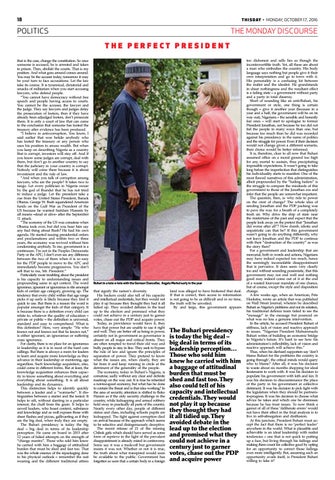
Buhari in a tete-a-tete with the German Chancellor, Angela Merkel early in the year
that signify the nation’s diversity. His backers could also tell of his capacity and intellectual credentials, but they would not play it up because they thought they had it all tidied up. They avoided debates in the lead up to the election and promised what they could not achieve in a century just to garner votes, chase out the PDP and acquire power. Today, as providence would have it, they have that power but are unable to use it right and well. They are better off as being in power, certainly not in government as governance is absent on all major and critical fronts. They are often tempted to travel their old way and bully people to stay in line. They seek to bypass the rule of law and ignore the principles of separation of power. They pretend to know what the issues are, when clearly, they are far from it and keep running in circle at the detriment of the generality of the people. The economy, today in Buhari’s Nigeria, is comatose, sadly without any clear and definite roadmap on the way out. It is true he inherited a not-too-good economy, but what has he done to contain the threat and is that idea working? In the area of security, attention is shifted to Boko Haram as if the only security challenge in the country, while kidnapping and armed robbery hold sway in practically all parts of the country. Nearly every other day, people of different status and class, including schools pupils are kidnapped. The fight against corruption died on arrival because of the approach which seems to be selective and disingenuously deceptive. The recent release of 21 of the missing Chibok girls which should have served as some form of reprieve in the light of the prevalent disappointment is already mired in controversy. Some say it was a trade-off but government insists it was not. Whether or not it is true, the truth about what transpired would soon be available to the public. Government has forgotten so soon that a certain body in a foreign
land was alleged to have brokered that deal. If that is correct, then access to information is not going to be as difficult and in no time, the truth will be unveiled. By and large, this government appears
The Buhari presidency is today the big deal – big deal in terms of its leadership perception… Those who sold him knew he carried with him a baggage of attitudinal burden that must be shed and fast too. They also could tell of his capacity and intellectual credentials. They would not play it up because they thought they had it all tidied up. They avoided debate in the lead up to the election and promised what they could not achieve in a century just to garner votes, chase out the PDP and acquire power
too dishonest and sells lies as though the incontrovertible truth. Yet, all these are about a man who embodies the country. His body language says nothing but people give it their own interpretation and go to town with it. His personality is a confusing lot between the realist and the idealist. He grandstands in sheer nothingness and the resultant effect is a failing state – a government without party and a party in total disarray. Short of sounding like an anti-Buhari, his government or style, one thing is certain though – give it another year (because in a year and a half, the government will be on its way out), Nigerians – the sensible and honestly fair ones – will start to apologise to former President Jonathan, not because he too did not fail the people in many ways than one, but because too much than he did was recorded against his presidency in the name of politics and the struggle for power. Even if their decision would not change given a different scenario, their choice would be better informed. It is, therefore, clear to all now that Buhari assumed office on a moral ground too high for any mortal to sustain, thus precipitating impossible expectations. It wasn’t going to take long before the imperfection that distinguishes his individuality starts to manifest. One of the most flawed narratives of this administration, albeit propounded by the “hailing hailers” is the struggle to compare the misdeeds of this government to those of the Jonathan era and infer that the people are somewhat impatient. The question, then, is: why ride to power on the crest of change? The whole idea of sending Jonathan and the PDP packing was to pave the way for a breath of a completely fresh air. Why drive the ship of state near the misfortune of the past and expect that the people look away on the pretext that “Jonathan did worse after all”? How dumb, idiotic and unpatriotic can that be? If this government wasn’t going to do anything differently, why not leave Jonathan and the PDP to continue with their “destruction of the country” as was the story then? For a government and leadership that are mercurial, both in words and actions, Nigerians may have indeed expected too much, hence the seemingly inconsolable disappointment that is pervasive. It does seem very clearly too and without sounding pessimistic, that this government may not end well and nothing good may indeed come out of it at the end of a wasted four-year mandate of one chance, but of course, except the style and disposition change. A few weeks ago, when an American, Pete Hoekstra, wrote an article that was published on Wall Street Journal, wherein he described Buhari as Nigeria’s problems and not its solution, his traditional defence team failed to see the “message” in the message but pounced on what was no less a genuine intervention. In the article, he accused President Buhari of stiffness, lack of vision and reactive approach to issues. “Nigerian President Muhummadu Buhari writes of building an economic bridge to Nigeria’s future. It’s hard to see how his administration’s inflexibility, lack of vision and reactive approach will achieve this.” Thus, when his die-hard supporters say ‘don’t blame Buhari for the problems the country is going through’, the critical minds would query who to blame? After all, it was his decision to waste about six months shopping for ideal lieutenants to work with. It was his decision to populate his government with kith and kin. It was his decision to discountenance the place of the party in his government at collective detriment. It was his decision to pick fight with the legislature when they should be partnersin-progress. It was his decision to choose what advice he takes and which one he dismisses because he has trust issues. To now think a gamut of all of these ‘deliberate errors’ would not have their effect in the final analysis is to live in self-abnegation and disillusion. At this juncture, President Buhari must accept the fact that there is no ‘perfect leader’ anywhere in the world. What is plausible and achievable is an ideal leadership with realist tendencies – one that is not quick to putting up a face, but living through his failings and making them count for collective good by opting for an opportunity to correct those failings even more intelligently. But, assuming such an opportunity avails itself, is President Buhari willing to take it?