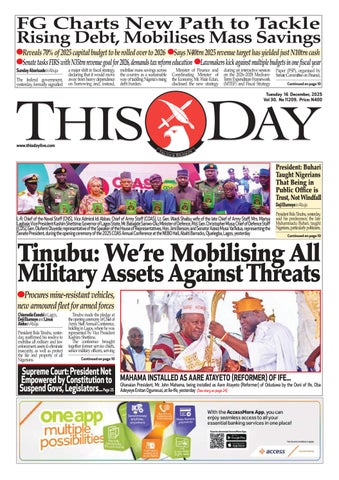
TUESDAY 16TH DECEMBER 2025

Page 1


FG Charts New Path to Tackle Rising Debt, Mobilises Mass Savings

Sunday Aborisade in Abuja

The federal government, yesterday, formally signalled

Reveals 70% of 2025 capital budget to be rolled over to 2026 Says N40trn 2025 revenue target has yielded just N10trn cash Senate tasks FIRS with N35trn revenue goal for 2026, demands tax reform education Lawmakers kick against multiple budgets in one fiscal year a major shift in fiscal strategy, declaring that it would move away from heavy dependence on borrowing and, instead,

mobilise mass savings across the country as a sustainable way of tackling Nigeria’s rising debt burden.

Minister of Finance and Coordinating Minister of the Economy, Mr. Wale Edun, disclosed the new strategy

during an interactive session on the 2026–2028 MediumTerm Expenditure Framework (MTEF) and Fiscal Strategy Continued on page 10

www.thisdaylive.com

L-R: Chief of the Naval Staff (CNS), Vice Admiral Idi Abbas; Chief of Army Staff (COAS), Lt. Gen. Waidi Shaibu; wife of the late Chief of Army Staff, Mrs. Mariya Lagbaja; Vice President Kashim Shettima; Governor of Lagos State, Mr. Babajide Sanwo-Olu; Minister of Defence, Rtd. Gen. Christopher Musa; Chief of Defence Staff (CDS), Gen. Olufemi Oluyede; representative of the Speaker of the House of Representatives, Hon. Jimi Benson; and Senator Azeez Musa Yar’Adua, representing the Senate President, during the opening ceremony of the 2025 COAS Annual Conference at the NEBO Hall, Abalti Barracks, Ojuelegba, Lagos, yesterday

President: Buhari Taught Nigerians That Being in Public Office is Trust, Not Windfall

Deji Elumoye in Abuja

President Bola Tinubu, yesterday, said his predecessor, the late Muhammadu Buhari, taught Nigerians, particularly politicians,

Continued on page 10

Tinubu: We’re Mobilising All Military Assets Against Threats

Procures mine-resistant

vehicles, new armoured fleet for armed forces

Chiemelie Ezeobi in Lagos, Deji Elumoye and Linus Alekein Abuja

President Bola Tinubu, yester- day, reaffirmed his resolve to mobilise all military and law enforcement assets to eliminate insecurity, as well as protect the life and property of all Nigerians.

Tinubu made the pledge at the opening ceremony of Chief of Army Staff Annual Conference, holding in Lagos, where he was represented by Vice President Kashim Shettima. The conference brought together former service chiefs, senior military officers, serving

Continued on page 10

Supreme Court: President Not Empowered by Constitution to Suspend Govs, Legislators... Page 25

MAHAMA INSTALLED AS AARE ATAYETO (REFORMER) OF IFE...

Ghanaian President, Mr. John Mahama, being installed as Aare Atayeto

Ogunwusi, at Ile-Ife, yesterday (See story on page 24)

of Oduduwa by the

Ife,

(Reformer)
Ooni of
Oba Adeyeye Enitan

END OF THE YEAR BUSINESS COCKTAIL 2025...

Q3: NPA Records 1,085% Surge in Export Containers as Cargo Hits

Sunday Ehigiator

Nigerian Ports Authority (NPA) has posted one of its strongest quarterly performances in recent years, recording a massive 1,085 per cent surge in export-laden containers as total cargo throughput rose to 33.52 million metric tonnes in the third quarter (Q3) of 2025.

Operational data released by the authority yesterday showed that cargo handled during the period increased by 16.2 per cent, up from 28.84 million metric tonnes recorded in the corresponding quarter of 2024, reflecting rising trade activity across Nigeria’s ports.

Container operations were a significant contributor to the improved performance.

Total container traffic climbed by 18.9 per cent to 546,931 TEUs (Twenty-foot Equivalent Units) in Q3 2025, compared with 460,038 TEUs in Q3 2024.

Equally, import-laden containers rose by 33.1 per cent to 268,713 TEUs, from

201,839 TEUs a year earlier, while export-laden containers surged to 69,039 TEUs, from just 5,812 TEUs in the same period of 2024.

The sharp rise in export containers also led to a 21.5 per cent reduction in empty container traffic, signalling improved balance between imports and exports and stronger non-oil export activity.

Ship traffic equally recorded notable growth during the quarter, as the number of vessel calls increased by 8.4 per cent to 1,074 ships, from 991 vessels in Q3 2024.

At the same time, the total Gross Registered Tonnage (GRT) jumped by 18 per cent to 42.64 million, compared with 36.13 million recorded a year earlier, indicating that Nigerian ports are increasingly handling larger vessels.

A breakdown of the number of ship calls along the port locations revealed that Tin Can Port topped the chart at 22.7 per cent, followed by

Apapa Port at 22.2 per cent. Onne and Lekki Ports followed with 18.9 per cent and 18.4 per cent respectively, while Calabar Port contributed the least at 2.1 per cent.

THISDAY analysis of ship calls by size of ship revealed

33.5m Tonnes

that Lekki Port received the largest size ships with an average Gross Registered Tonnage (GRT) of 57,244, followed by Onne Port with an average of 51,276 GRT.

Apapa and Tin Can Island Ports received ships of average

GRT of 35,556 and 34,400, while the average size of boats calling at Delta Ports was 18,677 tonnes.

Similarly, a breakdown of cargo throughput by port showed that Lekki Port emerged as the dominant growth driver, accounting

for 46.8 per cent of total cargo handled in Q3 2025. Onne Port contributed 17 per cent, followed by Apapa Port with 15.1 per cent and Tin Can Island Port with 10 per cent, while Calabar Port recorded the lowest share.

FG, Maritime Innovations Hub Unveil Blueprint to Power Nigeria’s $1trn Economy Through Blue Economy

Sunday Aborisade in Abuja

Nigeria’s quest to build a $1 trillion economy received a major private-sector push as the Maritime Innovations Hub (MIH), in partnership with the Ministry of Marine and Blue Economy, unveiled an ambitious framework aimed at unlocking the vast but underutilised potential of the nation’s blue economy.

Speaking at a media parley in Abuja yesterday, ahead of the Blue Economy Invest- ment Summit scheduled

for March 2026, the Chief Executive Officer of MIH, Ronke Kosoko, said Nigeria could no longer afford “talk shops and recycled ideas” if it must close an estimated $750 billion GDP gap within the next decade.

She described the Hub as a private sector–led platform designed to drive innovation, investment mobilisation, governance reforms and human capital development across the entire maritime value chain, stressing that the focus would be on

measurable outcomes rather than rhetoric.

According to her, the mari- time sector, despite Nigeria’s 850-kilometre coastline and expansive exclusive economic zone, currently contributes less than three per cent to GDP, far below its potential.

“Globally, the blue economy is projected to exceed $3 trillion by 2030.

Nigeria has the assets, the location and the market.

What we have lacked is execution,” she said.

Kosoko noted that the

NCAA Unveils Go-Live for Digital Personnel Licencing, Medical Certification System

Says move will strengthen pilot licencing, regulations to tally with National Identity Card, mitigate fraud

Kasim Sumaina in Abuja

The Nigeria Civil Aviation Authority (NCAA) yesterday, made another significant milestone in the growth of Nigeria’s aviation regulatory system by presenting the Go-Live phase of the EMPIC Personnel Licencing (PEL) and Medical Certification(MED) System.

It stated that the digital solu-

tion positions the industry for greater efficiency, transparency and global competitiveness.

The Director General, NCAA, Capt. Chris Najomo, in his address at the EMPIC PEL/ MED Go-Live Stakeholder Engagement with Nigerian Aviation Ecosystem, in Abuja, said the initiative signifies the successful completion of system deployment, configuration, testing, and stakeholder

readiness activities.

He stated that it marks the availability of the EMPIC PEL/ MED platform for controlled use, familiarisation, and final transition activities.

“However, I wish to clearly state that the full operationalisation of EMPIC PEL/MED will take place on the 2nd of April, 2026. This phased approach is deliberate and necessary to ensure

system stability, stakeholder preparedness, data integrity, and regulatory continuity.

“Between now and the formal operationalisation date, the following activities will take place: The Authority will complete final data validation and migration activities, stakeholders will undergo continued onboarding and user support finalisation of the AAMEs onboarding process.

“Parallel run and transition arrangements will be applied where necessary; and operational guidelines and notices will be issued by the Authority upon operationalisation on April 2nd, 2026, EMPIC PEL/ MED will become the official and mandatory platform for all applicable personnel licensing and aviation medical certification transactions, in accordance with NCAA regulations.”

creation of the Ministry of Marine and Blue Economy under President Bola Ahmed Tinubu had created an opportunity to rethink strategy, align public and private sector efforts, and accelerate reforms in ports, shipping, fisheries, tourism, shipbuilding and marine energy.

She disclosed that the forthcoming Blue Economy Investment Summit would convene policymakers, investors, development partners, global maritime leaders, academia and civil society to develop a National Blue Economy Investment Framework, identify bank- able projects and establish a public-private coordination mechanism to ensure followthrough.

Key priorities outlined, according to her, include modernisation of ports infrastructure, reduction of logistics costs, deployment of digital single-window systems, development of local shipbuilding and dry- docking capacity, sustainable fisheries and aquaculture, and expansion of coastal tourism.

L-R: Deputy Head of Mission, Turkiye Embassy, Elif Durdu; Ambassador of Republic of Turkiye to Nigeria, Ambassador Mehmet Poroy; Chairman, Nigeria-Turkiye Business Council, Hon. Dele
Kelvin Oye; and Immediate Past Nigerian Ambassador to Turkiye, Ambassador Ismail Abba Yusuf, during the End of the Year Business Cocktail 2025, held in Abuja, Nigeria, at the weekend

ETHSWITCH DELEGATION’S KNOWLEDGE-EXCHANGE VISIT INTERSWITCH HEAD OFFICE...

L–R: Payment Systems Consultant, EthSwitch, Abraham Kassahun; Chief Information Officer, EthSwitch, Assefa Yeshanew; Chief Executive Officer, EthSwitch, Yilebes Addis; Payment Processing and Switching (Interswitch Purepay), Akeem Lawal; Managing Director, Industry Ecosystems (Interswitch Indeco), Chinyere Don-Okhuofu; and Managing Director, Verve International, Vincent Ogbunude, during the EthSwitch delegation’s knowledge-exchange visit to Interswitch’s Head Office in Lagos, …weekend

Mshelbila Bows Out as NLNG’s

CEO, Falade Takes Over April 2026

The NLNG has held a symbolic send-off ceremony to mark the end of the tenure of its Manag- ing Director and Chief Executive Officer, Dr. Philip Mshelbila, who departs the company after more than four years of transformative leadership.

Following the approval of

the NLNG Board of Directors, Adeleye Falade has been ap- pointed as the new Managing Director/Chief Executive Officer and will assume duties in April 2026.

NLNG disclosed this in a statement issued yesterday, signed by its Manager, Cor- porate Communication and Public Affairs, Anne-Marie

Palmer-Ikuku.

According to the statement, Falade would join the NLNG from Brunei LNG, where he has been serving as the Managing Director/Chief Executive Officer.

Mshelbila leaves the company on 31st December, 2025, to assume the position of Secretary- General of the Gas Exporting Countries Forum (GECF) in

Doha, Qatar, the statement said Mshelbila’s send-off ceremony was held last Friday in Abuja and was graced by NLNG direc- tors, executives from shareholder companies, dignitaries from the public sector and energy industry in Nigeria, members of the company’s management, and representatives of various staff groups.

House Committee Summons Management of Benin, Port Harcourt, Ibadan Discos Over N100bn Payment Default

Downstream committee, NMDPRA deepen collaboration on petroleum sector reforms

Abuja

The House of Representatives Public Accounts Committee (PAC) has summoned the management of Ibadan Electricity Distribution Company (IBEDC), Benin Electricity Distribution Company (BEDC), and Port Harcourt Electricity Distribu- tion Company (PHEDC) over outstanding debts estimated at more than N100 billion owed to the Federation Account.

The committee, chaired by Hon. Bamidele Salam, issued the directive, discovering that the affected Discos had failed to honour several previous invitations.

The resolution followed consideration of an interim report presented by the chairman of the sub-committee, Hon. Mark Chidi Obetta, at a public hearing yesterday, in Abuja.

The committee gave the three electricity distribution companies (Discos) a 72-hour ultimatum to appear before it or face sanctions for legislative contempt.

On August 20, 2025, the com- mittee summoned 11 electricity distribution companies over a cumulative debt of N2.6 trillion owed to the Federation Account.

However, the management of IBEDC, BEDC, and PHEDC have consistently failed to ap- pear before the committee to account for their outstanding liabilities, as detailed in the Auditor-General’s reports for the 2021 and 2022 financial years.

The committee condemned what it described as deliberate acts of legislative contempt by the three Discos and warned that stiff sanctions would be imposed should they fail to appear before the committee on Thursday, December 18, 2025.

Speaking, Salam expressed concern over the long-standing nature of the debts, noting that some of the liabilities have remained unpaid for over a decade.

He stressed the need for urgent and decisive action to recover the funds and ensure they are properly accounted for in the interest of the Nigerian government and the public.

Meanwhile, the House of Representatives Committee on Petroleum Resources (Downstream) has underscored the need for continuous capacity building and closer collabora- tion between lawmakers and regulators.

The Chairman of the Committee, Hon. Ikenga Imo Ugo- chinyere, made the call during an end-of-year capacity-building training workshop organised by the Nigerian Midstream and Downstream Petroleum Regula- tory Authority (NMDPRA) for committee members and support

Reflectingstaff.on the Committee’s activities over the year, Ugo- chinyere said 2025 was marked by sustained engagement with regulatory reforms under the PIA, stakeholder consultations across the fuel supply and distribution chain, and oversight on fuel availability, pricing stability and consumer protection.Ugochinyere said capacity building was no longer optional but a critical necessity in a sec- tor that directly affects every Nigerian through fuel avail- ability, pricing, transportation costs, inflation and household welfare.

“Regulation and legislation are not parallel lines; they are complementary forces.

“When regulators and lawmakers understand each other’s mandates, constraints and expectations, the Nigerian

people ultimately benefit.”

He commended the leadership and management of the NMDPRA for investing in the knowledge and skills of legislators and legislative support staff, noting that such collaboration reflected the spirit of the Petroleum Industry Act (PIA), which has restructured Nigeria’s oil and gas governance framework.

In his remarks, NLNG’s Deputy Managing Director, Olakunle Osobu, described Mshelbila as a man of distinction, an accomplished profes- sional whose expertise spans medicine, environmental health, strategic business leadership, and global gas diplomacy.

Osobu noted that Mshelbila’s focus was clear: driving business sustainability, diversifying opera- tions, and advancing emissions control with safety at the core.

He revealed that the outgo- ing MD stepped in during a period of unprecedented chal- lenges, from the aftermath of COVID-19 and severe flooding that disrupted gas pipelines to vandalism and force majeure declarations by suppliers.

He stated that the global energy turbulence following the Russia–Ukraine war added further strain.

Despite these hurdles, Osobu emphasised that under Mshelbila’s leadership, NLNG pursued its sustainability goals with courage and innovation.

“Understanding that NLNG needed multiple supply sources,

especially with current chal- lenges, Mshelbila championed a bold and strategic pivot to expand NLNG’s feed-gas base beyond the shareholder joint- venture supply chain.

“Under his leadership, NLNG negotiated and signed long-term Gas Supply Agreements (GSAs) with six third-party gas suppliers in August“These2025.GSAs commit to delivering an estimated 1,290 million standard cubic feet per day (mmscf/d) of feed-gas to NLNG, a historic step for the Company, marking a seismic shift”, he said.

Osobu stated that Mshelbila had championed innovation with a forward-looking ap- proach, inspiring NLNG’s workforce to strengthen their commitment to emissions control and environmental stewardship.

He added that Mshelbila redefined NLNG’s business model through its transfor- mation programme, building foundations for future sustainability and value creation.

NCDMB Attributes Nigeria’s 61% Local Content Feat to Media Support

The Nigerian Content De- velopment and Monitoring Board (NCDMB) has said that Nigerian media played a very pivotal role in the country ‘s attainment 61 percent Nigerian Content in the oil and gas industry.

It described the feat recorded in the third quarter of 2025 as a significant milestone, which reflects progress in manufactur- ing, fabrication, engineering, local asset ownership, and local manpower development.

Speaking at a one-day work- shop for media stakeholders in Abuja, the General Manager, Corporate Communications Division of the NCDMB, Dr. Obinna Ezeobi, said there was no doubt that the Act establishing the Content Development Agency was perhaps one of the most transformative legislations ever enacted to promote industrialisation and economic development in the oil and gas sector.

“In 2010, when the law was passed, one of the first things we did was to have a media

stakeholder engagement. And from that time, we kept on engaging the media. And we are proud and bold to say that Media and Communication helped us to promote and project the Nigerian Content Act.

“We can safely say that communication played a lot of roles in how we were able to propagate and accomplish what we achieved today, which is in today’s terms, 61 percent of Nigerian content in the oil and gas industry,” he said.

Peter Uzoho

ONE-DAY INTERACTIVE SESSION ON THE 2026–2028 MEDIUM-TERM EXPENDITURE FRAMEWORK...

L-R: Minister of Finance and Coordinating Minister of the Economy, Mr. Wale Edun; Minister of Budget and National Planning, Senator Abubakar Bagudu; and Minister of State for Finance, Dr. Doris Uzoka-Anite, during a one-day interactive session between the Senate Committee on Finance and stakeholders on the 2026–2028 Medium-Term Expenditure Framework (MTEF) and Federal Strategy Paper (FSP) in Abuja, yesterday

Inflation Sustains Downward Trajectory, Drops to

14.45%

Amid Moderation in Energy, Food Prices

Severe in Rivers, Ogun, Ekiti, others

The Consumer Price Index (CPI), which measures the rate of change in prices of goods and commodities, further dropped to 14.45 per cent in November, compared to 16.05 per cent in the preced- ing month, National Bureau of Statistics (NBS) said yesterday.

Year-on-year, however, headline inflation rate stood at 20.15 per cent, compared to 34.60 per cent in November 2024 (after Accordingrebasing). to the CPI Report for November, which was released by the statistical agency, month-on-month, headline inflation rate rose to 1.22 per cent, compared to 0.93 per cent in October.

Food inflation stood at 11.08 per cent, year-on-year, in November, from 39.93 per cent in November 2024.

NBS attributed the significant decline in annual food inflation to the change in the base year.

However, month-on-month, the food index stood at 1.13

per cent, compared to -0.37 per cent in October.

The increase was attributed to the rate of increase in the average prices of tomatoes, cassava tuber, periwinkle, ground pepper, eggs, crayfish, melon, unshelled, oxtail, onions, among others.

The “All items less farm produces and energy” or core inflation, which excludes the prices of volatile agricultural produce and energy, stood at 18.04 per cent year-on-year in November compared to 28.75 per cent in November 2024.

On a month-on-month basis, the core index stood at 1.28 per cent from 1.42 per cent in October.

According to the NBS, year-on-year, urban inflation reduced to 13.61 per cent, compared to 37.10 per cent in November 2024.

Month-on-month, urban inflation was 0.95 per cent, compared to 1.14 per cent in October.

Similarly, rural inflation stood at 15.15 per cent, year-

on-year, compared to 32.27 per cent in November 2024.

However, month-on-month, the rural index inflation was 1.88 per cent, compared to 0.45 per cent in October.

At the state level, headline inflation, year-on-year was highest in Rivers (17.78 per cent), Ogun (17.65 per cent), and Ekiti (16.77 per cent), while

Plateau (9.13 per cent), Kebbi (10.32 per cent) and Katsina (10.60 per cent) recorded the lowest rise in prices.

Month-on- month, however, the highest increases were recorded in Bayelsa (6.58 per cent), Gombe (5.11 per cent), and Edo (4.45 per cent), while Plateau (-2.54 per cent), Delta (-2.38 per cent), and Kaduna

(-2.24 per cent) recorded a decline.

In November, food inflation on a year-on-year basis was highest in Kogi (17.83 per cent), Ogun (16.52 per cent), and Rivers (16.11 per cent), while Imo (3.52 per cent), Katsina (3.65 per cent), and Akwa Ibom (4.52 per cent) recorded the slowest rise in

food inflation on a year-on-year basis.

On a month-on-month basis, however, food inflation was highest in Yobe (9.52 per cent), Katsina (6.61 per cent), and Ondo (6.04 per cent), while Imo (-6.49 per cent), Nasarawa (-5.48 per cent), and Enugu (-2.54 per cent) recorded a decline in the food index.

FCMB Pensions Pays N200bn to Retirees, Drives Personal Pension Plan as AUM Hits N1.1tn

Managing Director/Chief Executive, First City Monu- ment Bank (FCMB) Pensions Limited, Mr. Christopher Bajowa, yesterday disclosed that the company has so far disbursed over N200 billion to retirees and other beneficiaries’ He also said the company’s Assets Under Management (AUM) had increased to over N1.1 trillion.Speaking

Governors Hail Rising Health Funding, Strong Accountability at PHC Awards

Sunday Ehigiator

Nigeria’s Governors have cited rising investment levels, improved accountability, and measurable health outcomes as evidence that reforms in primary healthcare are beginning to take root across the country.Speaking at the Third Edition of the Primary Health Care (PHC) Leadership Challenge Awards Night in Abuja, at the weekend, Mallam Chairman of the Nigeria

Governors’ Forum (NGF)/ Governor of Kwara State, AbdulRahman AbdulRazaq, who was represented by the Governor of Nassarawa State, Engr. Abdullahi Sule, said states have made significant progress in strengthening primary healthcare systems over the past three years, driven by deliberate leadership and sustained political commitment.

The event, held at the Bola Ahmed Tinubu International Conference Centre, brought

together Vice President Kashim Shettima, State governors, senior health officials and development partners to mark another round of recognition for states that have shown leadership in primary healthcare delivery.

According to the NGF Chairman, health sector funding at the subnational level has grown steadily, with the combined health budgets of the 36 states rising from N831 billion in 2022 to N2.36 trillion in 2025.

at the commencement of a road walk to Wuse Market, Abuja in commemoration of its 20th anniversary celebra- tions, he said the Pension Fund Administrator (PFA) remained a “strong institution, making meaningful impact in the communities we serve”.

He said a decade ago, the company embarked on a vision grounded in passion, innovation, and the belief to make a meaningful difference.

He said, “What started as a small team with big dreams

has grown into a strong, dynamic, and respected force in our industry. We did not arrive here by chance; we arrived here because of you—our staff, both past and present—whose hard work, creativity, and commitment have built the foundation on which we stand today.”

Bajowa told THISDAY, “We have been in operation for well over 20 years now. It is a thing of pride how we have grown and how we have been able to promote pension operations

within the industry.

“As you know, at this time, micro-pension is a key focus area for our regulator and represents a big opportunity to grow inclusion in the pension industry. That is why we have seized this opportunity to commence a roadmap, embark on road walks, and promote the Personal Pension Plan, which we believe represents the next frontier in terms of growth for the pension industry, particularly in terms of inclusion.”

OGFZA MD: Free Trade Zones Attracted $24bn Investments, Backs 10-year Tax Exemption Proposal for Oil & Gas Operators

The Managing Director/ Chief Executive, Oil and Gas Free Zones Authority (OGFZA), Mr. Bamanga Umar Jada, has disclosed that the nation’s Free Trade Zones (FTZs) have attracted over $24 billion in investments, underscoring their strategic importance to the Nigerian economy. This is as OGFZA also backed

current advocacy for a 10-year exemption for operators in oil and gas free zones from the new tax laws

Jada made the call in Onne, Rivers State, during a town hall meeting with the Federal Inland Revenue Service (FIRS) and OGFZA licensees.

He said the proposed 10year extension would provide operators with the necessary “adaptation space” to transition

and comply with evolving tax requirements.

In a statement, he said, “Accordingly, OGFZA supports the call for a 10-year extension of existing tax incentives, coupled with a phased implementation to mitigate potential disruptions.

“Many of our licensees, including prominent foreign investors, formulate strategies spanning 10, 15 or even 25 years, based on prevailing incentives.”

James Emejo in Abuja
PHOTO: JULIUS ATOI.

Oyedele: Nigeria Has Moved from Rapid Economic Decline Towards Stability, Growth, Restoration of Investor Confidence

Says policymakers must convert macroeconomic gains into tangible, micro-level benefits for Nigerians, assures new tax laws to benefit small businesses, ordinary Nigerians Douses fears over MoU with French tax authority Shehu: fiscal reforms have boosted inflows to federation account

James Emejo in Abuja

Chairman, Presidential Fiscal Policy and Tax Reforms Com- mittee, Mr. Taiwo Oyedele, yesterday declared that the country had moved away from rapid economic decline towards stability, growth, and restoration of investor confidence.

Oyedele said the ongoing fiscal and monetary reforms had resulted in stronger co- ordination among key policy actors, adding that within a “relatively short period, we

TINUBU: WE’RE

have begun to make progress”.

Oyedele spoke at the opening of a two-day National Stakeholders’ Discourse on “Enhancing Fiscal Efficiency and Revenue Growth under the Nigeria Tax Act, 2025”, organised by the Revenue Mobilisation Allocation and Fiscal Commission (RMAFC) in Abuja.

He also charged policymak- ers to convert macroeconomic gains into tangible micro-level benefits for citizens, urging them to focus on translating positive macroeconomic

outcomes into meaning- ful improvements at the household level.

He said one major achieve- ment of the reforms was the redesign of the tax system to stop taxing poverty, stating that implementation of the new tax laws next year will reward small businesses and ordinary Nigerians in line with President Bola Tinubu’s directive to de-risk the business environment.

Oyedele also waded into the Memorandum of Understanding (MoU) FIRS recently

signed with the French tax authority, Direction Générale des Finances Publiques (DGFiP), which was solely focused on technical assistance and capacity building, but had since been criticised by opposition political parties, in particular.

He said the agreement was purely on capacity building and nothing to worry about potential data privacy breaches.

Oyedele said, “Of all the countries that we studied, France is the most efficient in collecting taxes in the whole

world. They lead the OECD, if there’s taxes to collect, they know how to collect them.

And this tax harmonisation thing we are trying to do; they did it a long time ago; everything is centrally collected and they are super-efficient.”

He said, “Does it not make sense to learn from them? Who will collect data to another authority? Why would anybody do that?

“Nigeria is signatory to the International Exchange for Information where there are clear protocols for you to

MOBILISING ALL MILITARY ASSETS AGAINST THREATS

share data of just one taxpayer let alone the whole country.

“I really encourage us as a people; there’s nothing wrong with interrogating the government and asking questions but let’s not jump into conclusion in a way that makes reforms harder.”

Continues online

Reaffirming his adminis- tration’s commitment to the welfare, professionalism, and operational effectiveness of the Nigerian Army, Tinubu urged the military to maintain

and retired, heads of security agencies, diplomats, and other distinguished guests to deliberate on strategic, operational, and administrative matters aimed at strengthening the Nigerian Army’s capacity to fulfil its constitutional duties effectively.

its apolitical stance and respect constitutional boundaries.

The president said his ad- ministration was determined to restore Nigeria’s pride of place in Africa and beyond, charging the military to remain steadfast,

PRESIDENT: BUHARI TAUGHT NIGERIANS THAT BEING IN PUBLIC OFFICE IS TRUST, NOT WINDFALL

that public office was a sacred trust, not a personal windfall.

Tinubu paid glowing tribute to the life and legacy of Buhari.

He spoke at the official launch of a 606-page biography, “From Soldier to Statesman: The Legacy of Muhammadu Buhari,” held at State House Conference Centre, Abuja.

The president described Buhari as a leader whose reputation for integrity, discipline and modest living endured long after leaving office.

He stressed that the true measure of Buhari’s leadership was not the offices he occupied or the privileges that came with power, but “what persists when the sirens fall silent”.

He stated that the late former president left behind a legacy defined by honesty, restraint and firm belief that leadership was anchored on service.

Tinubu, who described himself as Buhari’s brother, friend and political partner, recalled the political journey they shared together and the coalition-building efforts that culminated in the historic 2015 election victory, which unseated an incumbent government and reshaped Nigeria’s political landscape.

According to him, the alliance forged during that period has since evolved into the fastestgrowing political party in Africa.

Tinubu stated, “I stand here not just as president, but as a brother, friend, and political partner who shared a journey with President Buhari through challenging times.

“Together, we built a broad coalition, campaigned across the

country, and proved that Nigeria could chart a new course.

“Our movement united diverse interests and achieved a historic victory in 2015 by unseating an incumbent president, thus reshaping Nigeria’s political landscape.

“The coalition we built in 2014 is now the fastest-growing political party in Africa today. Its growth continues.”

The president said the biogra- phy served as an honest account of Buhari’s life and leadership, outlining both achievements and shortcomings.

He urged future leaders to draw lessons from history rather than rely on empty slogans.

Tinub identified humility, security, vision and social jus- tice as the enduring pillars of Buhari’s legacy, stating that the late leader preferred simplicity over extravagance, believed in self-discipline as the foundation of governance, and prioritised national security as the bedrock of prosperity.

Tinubu also highlighted Buhari’s long-term vision for infrastructure development, including roads, railways, bridges and airports, as well as his commitment to targeted social investments aimed at protecting the poor and vulnerable.

He said Buhari’s consistent love for Nigeria and faithfulness to his oath of office earned him respect, even among critics, adding that their political experience jointly reinforced the importance of cooperation across differences in the task of nation-building.

Tinubu enumerated the lasting legacies of his predecessor in the areas of security, building of social infrastructure, and entrenching

social justice, pledging his commitment to building on them.

Tinubu stated, “This book reinforces the public’s memory. It outlines achievements and flaws, as all honest histories should. It should motivate future leaders to learn lessons rather than repeat slogans.

“In that spirit, let us reflect on the enduring pillars of President Buhari’s legacy: First, humil- ity. President Buhari preferred simplicity over ornamentation. He believed that a leader must first discipline himself before he can discipline a system. He lived modestly, and he carried the dignity of that modesty into power.“Second, security. President

Continued on page 26

disciplined, and professional.

He stated, “We are primarily committed to the modernisation of the Armed Forces through improved training, modern equipment, and enhanced operational capacity to confront evolving“Followingthreats.the induction of helicopters into the Nigerian Army Aviation and the training of pilots, we have advanced the procurement of additional mine-resistant ambush-protected vehicles, armoured vehicles, and patrol“Wevehicles. have also refurbished over 100 armoured fighting vehicles, now returned to active service. These efforts reflect our clear commitment to strengthening the Nigerian Army’s operational readiness.”

Tinubu said his administration was deepening partnerships with friendly nations to expand research, innovation, and indig- enous production, while steadily moving Nigeria towards a new era of self-reliance in defence andThesecurity.president applauded the army and the armed forces’ remarkable achievements in

the ongoing fight against terrorism, banditry, and other criminal activities.

He said, “The positive reports emerging from the various theatres of operations are encouraging and stand as testimony to your courage, resilience, and professionalism.

“The gains recorded through joint operations with sister services and other security agencies further underscore the power of unity of purpose in our collective resolve to safeguard the nation.”

Tinubu recognised the suc- cesses recorded by the Nigerian Army in its diverse operations and training activities.

He said the efforts had sharpened the effectiveness of troops and enhanced their capacity to operate in a volatile, uncertain, complex, and ambigu- ous security environments, both locally and globally.

Tinubu told the military, “The nation deeply values your sacrifices and remains grateful to the officers and soldiers who paid the supreme price in defence of our fatherland.

“Their courage is etched

permanently into our national memory. As a government, we are resolved in our responsibility to care for the families of our fallen heroes, ensuring that they are supported and never forgotten.”

Lagos State Governor, Babajide Sanwo-Olu, at the oc-casion, praised the Nigerian Army for its pivotal role in national development. Sanwo-Olu said, “History has consistently shown that security is a fundamental prerequisite for development. There can be no enduring progress without security, and no security without a capable, disciplined, and professional military.”

He added that the army’s restructuring, modernisation, and professional develop- ment reflect-ed an institution deliberately repositioning itself to meet the demands of a modern, constitutionally guided force.

Minister of Defence, General Christopher Musa (Rtd), stated, “While security challenges persist, it is evident that the operational capacity of terror- ist groups, bandits, and other

Continued on page 27

FG CHARTS NEW PATH TO TACKLE RISING DEBT, MOBILISES MASS SAVINGS

at the National Assembly.

Edun said the new direction was imperative in view of persistent revenue shortfalls, mounting fiscal pressures, and the need to strengthen domestic capital formation without further ballooning public debt.

According to him, Nigeria’s total public debt has risen to about N152 trillion, from approximately N70 trillion in 2023, but a substantial part of the increase was not the result of fresh borrowing.

He explained that approximately N30 trillion of the debt stock originated from the formal recognition and regularisation of Ways and Means financing, previously kept outside government

accounts, while nearly N50 trillion resulted from exchange rate adjustments following central bank reforms to clear foreign exchange backlogs and rebuild external reserves.

“Consequently, about N80 trillion of the total debt stock did not represent new borrowing, but rather a process of reclassification, regularisation and adjustment,” Edun said.

The minister stressed that the focus of the MTEF was no longer on expanding borrowing, but on strengthening revenue mobilisation, fiscal discipline and long-term sustainability.

He acknowledged that revenue performance had consistently fallen short of projections, putting severe

pressure on budget implementation.

In 2024, he said, total revenue was estimated at N25.9 trillion, but actual federal government revenue stood at approximately N8.27 trillion.

Similarly, for 2025, projected revenue of about N40 trillion contrasted sharply with actual cash revenue of roughly N10 trillion, leaving a shortfall of about N30 trillion.

He said, “As a result, treasury management measures and borrowing were used to bridge funding gaps.

“This underscores the urgency of a more realistic and robust revenue framework going into 2026.”

Edun disclosed that the government was rolling out

a comprehensive revenue optimisation programme anchored on automation, digitalisation, technology deployment, and process re-engineering.

He said four circulars had already been issued directing revenue and investmentgenerating ministries, departments, and agencies (MDAs) to migrate to a transparent digital platform, halt cash collections and remit revenues directly to the Treasury Single Account without netting off costs.

On budget implementation, the minister said the capital component of the 2024 budget had been extended into 2025,

Taiwo Oyedele

INAUGURAL AFRICAN MARKETPLACE DUBAI 2025 EVENT...

L-R: Project Director, African Marketplace, Ms. Evelyn Paul; Head, SME Africa, Access Bank, Ms. Kafui Bimpe; Founder, African Marketplace, Mrs. Ibukun Awosika; and Head, SME Support, Access Bank Ghana, Ms. Eugenia Oduraa Addo, at the inaugural African Marketplace Dubai 2025 event … recently

Alleging Assault on S’Court’s Judgement, Lagos AG Urges Tinubu Not to Sign Central Gaming Bill Appeals to

The Attorney-General (AG) of Lagos State has raised concerns over what is seen as a potential constitutional breach and assault on judgment of the Supreme

AGF to ensure obedience to orders of court

Court in respect of the Central Gaming Bill, currently passed by the National Assembly.

The Lagos AG in a letter dated December 12, 2025 and addressed to the Attorney-General of the Federation (AGF) and

Minister of Justice, Prince Lateef Fagbemi, SAN, is specifically seeking restraints in the signing of the bill into law by President Bola Tinubu.

According to the Lagos AG, the new bill as passed by the

National Assembly is illegal and unconstitutional, based on the apex court judgment which held that the National Assembly lacked the necessary legal powers to legislate on lotteries, which is a residual matter for the State

At CSEA Dialogue, FG Says Policy on Artificial Intelligence Underway

The federal government said yesterday that a national policy on Artificial Intelligence (AI) was in the offing, to ensure that Nigeria does not ‘play catch-up’ in the future and making sure that the resources and talents in the country are fully harnessed.

Speaking in Abuja at an event tagged: “Reshaping Nigeria’s Potential in Science, Technology and Innovation (STI),” organised by the Centre for the Study of the Economies of Africa (CSEA), the Minister of Science, Technology and In- novation, Dr Kingsley Udeh (SAN), stressed that Nigeria must take the lead in the AI race in Africa.

He noted that the role of AI in the advancement of the modern economy cannot be overstated, pointing out that as the most populous black nation on earth, the ministry will continue to lead and give direction in terms of policy de- velopment and implementation.

“We acknowledge the importance of AI in scientific and technological advancement and for services across the Nigerian economy. And of course, companies in Nigeria, governments are already deploying AI. That we know, at various levels, private levels and institutional levels.

“So, what we’re already doing is to fashion an AI policy that will ensure that we

do not play catch-up. Those that are keen on developing AI products, developing, working on research on AI to advance our capabilities in AI are supported.

“So, it’s not just policy but also strategy. One of the things lacking in the Nigeria STI ecosystem is coordination, it is leadership. And that is what we also provide in ensuring that AI, even robotics and other dimensions of science and technology, advanced technology, future technologies and that we do not do (play) catch-up.

“ Nigerians, both in Nigeria and outside, are all involved in this. I know very young people and I see them playing

2027: LP Vows to Contest All Elective Positions in Ogun

The Labour Party (LP) has said it would contest all the elective positions in Ogun State in the 2027 general election.

National Vice Chairman, South West of the party, Comrade Abayomi Arabambi, stated this while addressing party members and supporters at the swearing-in of new Ogun

State Executive of the party. The event, held at the main hall of the Nigeria Union of Journalists, Iwe Iroyin, Oke- Ilewo, Abeokuta, was attended by party representatives from the 18 local government areas of the state.

Arabambi said the LP would contest the governorship, three senatorial, nine House of Representatives elections

in the state.

He said the party would support the All Progressives Congress (APC) candidate, Bola Tinubu, for the presidential election.

Arabambi said the LP was set to win the governorship of Ogun State in 2027, slammed the incumbent administration of Governor Dapo Abiodun for non-satisfactory performance.

with AI, solving their own problems with AI. So, we do not lack the knowledge, we do not lack that. It’s just to deploy these things properly and boost the deployment and the capability with our support,” Udeh stated.

Describing the science, technology and innovation space as an ecosystem, the minister explained that the federal government was committed to ensuring that the sector meets the demands of the 21st century, with everyone playing their roles.

Houses of Assemblies.

In the letter written on his behalf by Chief Wole Olanipekun, SAN, the Lagos AG reminded Fagbemi, of the need to defend judgments of the apex court, especially in the suit marked: SC.1/2008, between AG of Lagos State and others against the AGF and others.

Recall that the apex court in the unanimous judgment delivered on November 22, 2024, had nullified the National Lottery Act, on the grounds that it falls outside the powers of the National Assembly.

The Lagos AG however stated that the National Assembly on December 2, 2025, passed another legislation on lottery and gaming, termed the Central Gaming Bill.

“We are further informed that the said legislation purports to repeal the National Lottery Act, as if same was an existing law that had not been nullified by the judgment of the Supreme Court. For emphasis and, as rightly acknowledged by your

good self at the commencement of the Supreme Court legal year, the National Lottery Act ceased to be an existing legislation on November 22, 2024, when the Supreme Court delivered its judgment in SC.1/2008 and the National Assembly cannot subsequently purport to repeal what was/is already no longer in existence.

“Our client also informed us that the Central Gaming Bill purports to legislate online gaming and lottery, as well as gaming and lottery across State geographical boundaries. It also suggests that revenues generated will not be paid to the Consolidated Revenue Fund but be distributed by the Federal Government against the constitutional prescription for revenue sharing”, the AG stated.

The AG besides, noted that the apex court in the judgment “flatly rejected” argument of the AGF and National Assembly that lottery and gaming were economic activities carried out online and across State borders.

NIS Reaffirms Commitment to Curb Migrant Smuggling

Michael Olugbode in Abuja

The Nigeria Immigration Service (NIS) has reaffirmed its determination to combat migrant smuggling and protect the rights and safety of migrants.

The commitment was made on Monday as the country joined the global community to commemorate International MigrantsSpeakingDay. at the Anti-Smug- gling of Migrants Day event in Abuja, the Comptroller-General of the Nigeria Immigration Service, Kemi Nandap, described

migrant smuggling as a serious transnational crime that threatens human lives, national security, and border integrity.

The representedComptroller-General, by a Deputy Comptroller General, Ada Umannah, noted that criminal networks involved in migrant smuggling have become increas- ingly sophisticated, exploiting digital platforms, falsifying travel documents, and collaborating across borders to deceive and endanger vulnerable individuals seeking better opportunities abroad.

According to her, Nigeria’s strategic position as a country of origin, transit, and destination for migrants makes it imperative for the Service to continuously adapt its strategies to counter emerging trends in irregular migration.

She disclosed the NIS, with the support of the Ministry of Interior led by Dr. Olubunmi Tunji-Ojo, has strengthened border management through policy reforms, improved intelligence gathering, and the deployment of modern technology.

James Sowole in Abeokuta
Emmanuel Addeh in Abuja
Alex Enumah in Abuja

Acting Group Politics Editor DEJI ELUMOYE

Email: deji.elumoye@thisdaylive.com

08033025611 sms only

As Yilwatda Seeks Stronger Collaboration Between Nigeria and Global Partners...

Wale Igbintade writes that the National Chairman of the all Progressives Congress, Prof Nenwate Yilwatda, is seeking stronger collaboration between Nigeria and its global partners geared towards enhancing national security.

National Chairman of the All Progressives Congress (APC), Prof. Nentawe Yilwatda, has canvassed the the need for Nigeria and its international partners to ensure stronger collaboration to strengthen democratic institutions, enhance national security and stabilise the nation’s economy.

Speaking at an interactive session with senior journalists in Lagos, Yilwatda commended the longstanding support of the international community, noting that Nigeria’s democratic advancement has benefitted significantly from constructive engagement and mutual respect.

He also expressed appreciation to the media for their sustained commitment, stating that their work has contributed to projecting Nigeria positively on the global stage.

His words: “I want to begin by thanking you for your commitment to this country. Democracy is not negotiable, and we are all partners in nurturing and strengthening it. We are all working together to ensure our democracy grows in the way we desire”.

Yilwatda lauded Nigeria’s diplomatic posture in recent months, citing the government’s calm and strategic response to controversial remarks made by former U.S. President Donald Trump.

He said the measured statements issued in defence of Nigeria were grounded in principle and demonstrated how responsible governments should respond to external criticism.

The APC Chairman also spoke extensively on reforms within the nation’s security architecture.

According to him, President Bola Tinubu has acted on several recommendations arising from earlier consultations with the Ministry

of Interior and defence stakeholders. These reforms, he said, include changes in the leadership of security agencies and the issuance of new operational directives to improve efficiency and accountability.

Yilwatda disclosed that police personnel attached to VIPs, including senior political office holders, have been withdrawn as part of efforts to restore professionalism within the force.

Unlike in the past, he said, the withdrawal directive is now being strictly enforced.

“We took practical steps such as withdrawing police personnel from VIPs, including some of us. In the past, directives were issued but not implemented. Now, there is full enforcement”.

He added that soldiers are being redeployed from routine checkpoints into forest areas to directly confront terrorists, thereby enabling the police to assume full responsibility for checkpoint operations.

Yilwatda further noted that Nigeria is deepening its security cooperation with several foreign governments and institutions to enhance military capacity, intelligence gathering and the use of technology in counter-terrorism operations.

He acknowledged the significant financial cost of modern security tools, noting that a single surveillance drone costs about $150,000, excluding manpower, fuel and logistical needs.

Despite the heavy financial burden, Yilwatda said the government continues to prioritise security funding in recognition of the scale of threats confronting the nation.

On the economy, the APC chairman said Nigeria had been on the verge of a Venezuelastyle collapse due to massive monetary financing, pre-sold crude entitlements and advance tax collections by previous administrations. He argued that although the current reforms are difficult, they have stabilised key indicators and pulled the country back from the brink.

Yilwatda cited the recent $5 billion increase in foreign reserves, the first major rise in over six years, as well as GDP growth of about 4%, surpassing projections of below 3%.

He added that Nigeria now has a positive trade balance, with exports exceeding imports.

Yilwatda also highlighted improvements in social protection programmes saying the national social register has been expanded through the use of technology and artificial intelligence (AI), allowing the number of conditional cash transfer beneficiaries to grow from two million in a decade to six million in just 10 months.

NOTE: Interested readers should continue in the online edition on www.thisdaylive.com

Tinubu’s Incursion into the North

President Bola Tinubu’s recent incursion into the North represents a defining moment in contemporary Nigerian politics, signalling a recalibration of leadership, inclusion, and regional influence, writes Afakriya Gadzama

Recently, President Bola Tinubu’s achievements, particularly the most profound inroads he has made in parts of the Northern regions that for decades were held hostage by certain vested interests—have become evident. Many people apparently do not understand the current position of the North, as progress in most areas is largely the result of the early introduction of Western education and the impact of hard work.

In the case of some Northern minorities and Christians during the time of the late Sardauna of Sokoto, he did not discriminate

against any tribe nor promote divisions among them. Unfortunately, this positive approach to governance has been reversed by some currently in leadership positions, despite the fact that they benefited from the exemplary governance of the late Ahmadu Bello, the Sardauna of Sokoto.

There is hardly any family in the North that has not benefited from the late Sardauna’s exemplary and progressive leadership.

This piece is written purposely to draw attention to those who today promote their narrow and selfish in-

terests and orchestrate division in politics in the various tribal groups in the country. As I wrote in a recent article, they are opposed to President Tinubu not because they have any progressive idea to offer and have the interest of the common Nigerians at heart. We want to point out that if anything, some of them are the embodiments of division, selfishness and discrimination.

President Tinubu, within his short stay in power, has done so much for the ordinary Nigerian and the elites. We would not fail to mention that interactions with early missionaries, schools and hospitals are singularly the reasons Northern Christians

have attained enviable advancement in education, health and national service in the country. The achievements, unfortunately, have been reversed by some selfish, selfseeking and clueless individuals who, for example, allowed the takeover of schools and hospitals and never rebuilt them.

-Gadzama, a former Director-General of the Department of State Services, writes from Abuja.

NOTE: Interested readers should continue in the online edition on www.thisdaylive.com

Tinubu
yilwatda
musa

FEaturEs How Maltina is Rewarding Teachers as True Architects of National Transformation

In a country where teachers often labour quietly, shaping young minds with little recognition, the Maltina Teacher of the Year Competition has been as a powerful counter narrative. Through sustained investment, public celebration and tangible rewards, Maltina, through the Nigerian Breweries Felix Ohiwerei Education Trust Fund, has positioned teachers not as background actors, but as central figures in Nigeria’s quest for national transformation. Chiemelie Ezeobi writes

When Serah Yusuf’s name was announced as the 2025 Maltina Teacher of the Year at the grand finale held on November 21, 2025, at Eko Hotels and Suites, Lagos, the applause that followed spoke to more than individual achievement. It underscored a growing national recognition of teachers as the architects behind every enduring society.

Yusuf, a teacher at Wisdom International School of Excellence (WISE), Tudun Wada, Lugbe, FCT Abuja, emerged winner of the 11th edition of the prestigious competition after a rigorous process that attracted over 2,000 entries nationwide, the highest in the programme’s history.

Her reward reflected the scale of Maltina’s commitment to elevating the profession. Yusuf received a ₦10 million cash prize, an all expense paid overseas capacity development training, and a ₦30 million school infrastructure project to be built in her honour by the Nigerian Breweries Felix Ohiwerei Education Trust Fund. In recognising her work, particularly in underserved and slum communities, Maltina sent a clear message that transformative teaching deserves transformative support.

Celebrating Excellence, Inspiring a Generation

The competition did not spotlight only one teacher. Adeola Akinsulure of Omole Senior Grammar School, Ikeja, Lagos State, emerged first runner up and received ₦5 million, while Chibuzor Amarikwa of Deeper Life High School, Kwana Waya Village, Yola, Adamawa State, clinched second runner up with ₦3 million.

Beyond these top honours, 24 teachers who emerged as State Champions across the federation were each awarded ₦1 million, reinforcing the idea that excellence in education exists in every corner of the country and deserves national recognition.

This broad based reward structure, according to organisers, is deliberate. By recognising teachers at state and national levels, the programme creates role models, inspires peers, and raises standards across the profession. It also ensures that the impact of the initiative goes beyond a single night of celebration to influence classrooms and communities nationwide.

Nation Building Beyond CSR

Speaking at the event, Lagos State Governor, Babajide Sanwo Olu, represented by the Commissioner for Commerce, Cooperative, Trade and Investment, Folashade Ambrose Medebem, captured the spirit behind the initiative. He commended the Nigerian Breweries Felix Ohiwerei Education Trust Fund for what he described as a commitment that transcends corporate social responsibility.

“Nigerian Breweries, what you’re doing here today goes beyond corporate social responsibility; it is simply nation building. Tonight, we honour the remarkable men and women whose passion, resilience, and creativity shape destinies and prepare our children not just for exams, but for life,” he said.

Sanwo Olu’s remarks framed the competition as a strategic investment in human capital,

positioning teachers as the foundation upon which economic growth, social cohesion and innovation are built. He congratulated Yusuf on her emergence as winner and urged all recognised teachers to continue serving as ambassadors of excellence for the nation’s youth.

“To every teacher being recognised today, whether you leave with a trophy or not, Lagos State celebrates you, and Nigeria celebrates you. You are the heroes whose work often goes unnoticed, yet whose impact is profound – resounding in every success, every breakthrough, and every community that thrives,” he added.

Public Private Partnership for Educational Renewal

The Minister of state for Education, Prof. Suwaiba Ahmad, echoed this sentiment, describing the Maltina Teacher of the Year as a powerful example of how private sector intervention can complement government efforts in education.

“Today is a powerful reminder that teachers are the true architects of national transformation. Behind every thriving society lies a corps of educators whose daily labor shapes minds, nurtures values, and builds the foundation for future progress,” Ahmad said, while applauding the Nigerian Breweries Felix Ohiwerei Education Trust Fund for its sustained investment in education and the professional dignity of teachers.

Her words reinforced the idea that recognising teachers is not symbolic but strategic. By restoring pride to the

profession and investing in professional development, the initiative contributes directly to national development goals.

Building a Culture of Respect for Teachers

In his welcome address, the Managing Director of Nigerian Breweries Plc, Thibaut Boidin, noted that the competition was designed not only to celebrate winners but to honour the profession that shapes all other professions. Describing teachers as “the steady hands shaping tomorrow,” he highlighted the programme’s growing impact, from improved school facilities to enhanced learning tools and greater professional recognition.

The Corporate Affairs Director of Nigerian Breweries Plc, Uzodinma Odenigbo, further revealed that the 2025 edition recorded over 2,000 entries, a testament to the increasing trust teachers nationwide place in the programme. He commended the judges for their integrity and professionalism and acknowledged the role of partners such as Union Bank, Air Peace, FCMB, and Eko Hotels and Suites, as well as key stakeholders including the Federal Ministry of Education, the Nigeria Union of Teachers, ANCOPSS, and the Teachers Registration Council of Nigeria.

From Recognition to Real Impact

For Yusuf, the recognition is already translating into renewed purpose. In her acceptance remarks, she expressed gratitude for the platform and described the award as a catalyst to expand her work in slum communities.

“I feel very excited after I was declared the winner. Initially, I was shocked because I never thought my effort would be worthy

of this great award. With this exciting news, I am motivated to do more and expand the activities I have done so far in slum communities. I am grateful to Nigerian Breweries Plc for creating this platform to honor and recognise teachers. I dedicate this award to children living within the slum communities,” she said.

Her story mirrors the broader objective of the Maltina Teacher of the Year Competition: turning recognition into real, measurable impact in classrooms and communities.

A Decade of Transforming the Teaching Narrative

Since its introduction in 2015, the Maltina Teacher of the Year Competition has consistently reframed the narrative around teaching in Nigeria. Past winners, including Rose Nkemdilim Obi, Imoh Essien, Felix Ariguzo, Olasunkanmi Opeifa, Ezem Collins, Oluwabunmi Anani, Abanika Taiye, Alaku Ayiwulu, Adeola Adefemi and Esomnofu Ifechukwu, now form a network of education ambassadors whose influence extends beyond their schools.

Backed by the Nigerian Breweries Felix Ohiwerei Education Trust Fund, established in 1994 with a start up capital of ₦100 million, the initiative aligns with broader educational interventions that have seen over 400 classrooms, libraries and sanitary facilities constructed across 74 communities nationwide, alongside scholarship awards.

Rewarding Transformation, Sustaining the Future

In celebrating teachers as true architects of national transformation, Maltina has demonstrated that meaningful rewards, public recognition and sustained investment can restore dignity to the profession and inspire systemic change. As the 2025 edition draws to a close, the message is unmistakable: when teachers are valued, nations are strengthened.

L-R: Managing Director/Chief Executive Officer, Nigerian Breweries Plc, Thibaut Boidin; Minister of state for Education, Professor Suwaiba Said Ahmad; Winner, 2025 Maltina Teacher of the Year, Serah Yusuf; Commissioner for Commerce, Cooperatives, Trade and Investment (CCT&l), Lagos State, Folashade Ambrose-Medebem; Human Resources Director, Nigerian Breweries Plc, Grace Omo-Lamai; and Corporate Affairs Director, Nigerian Breweries Plc, Uzodinma Odenigbo, during the presentation of the N10 million grand prize to the winner at the Grand Finale event held in Lagos on Friday

TUeSday, de C e MB e R 16, 2025

'It's

Zero Tolerance, for Kidnapping in Edo'

Edo State Attorney-General and Commissioner for Justice, Dr Roland Otaru, SAN

LAWYER

'It'sZeroTolerance,for Kidnapping in Edo'

Quotables

‘Our region has consistently advocated for a policing system that is closer to the people, more responsive to local realities, and better equipped to address the rapidly evolving threats that we face. Recent incidents across the country, reinforce this urgency.’ - Prince Dr Adedapo Abiodun, CON, Governor, Ogun State

‘What has happened in this country, is an abject lack of courage. Every President since 1999 till today, has demonstrated an embarrassing lack of courage to deal with an issue that has festered. We are appeasing terrorists, placating them….they are engaging in negotiation. You can’t appease your way out of terrorism.’ - Honourable Solomon Bob, Lawyer; House of Representatives Member representing Abua/Odual and Ahoada East Constituency

Page IV

Page V

Page V

Page V

Edo State Attorney-General and Commissioner for Justice, Dr Roland Otaru, SAN

Maryam Sanda: Presidential Pardon vs Conclusive Justice

BUA Award Night

Before I go into the word for today, I cannot but congratulate Alhaji Abdulsamad Rabiu, CFR, Founder and Executive Chairman of BUA Group, on the 2025 BUA Night of Excellence which took place on Saturday, in which 510 BUA Staff were given Long Service Awards. We are used to attending these type of events, where people are given plaques as mementoes, in appreciation of their service. I have never attended one like BUA’s, where their staff were appreciated in a unique way, in a way that counts and empowers - a total of N30 billion was gifted to BUA Staff, the lowest awardee range being N100 million and the highest, N5 billion. They received their cheques, in our presence. This type of initiative should be emulated by all employers, as it promotes hardwork, commitment, dedication, honesty, accountability, and a sense of belonging. Kudos to you, Alhaji BUA.

Background

Over the weekend, I had a heated debate with one of our Columnists, Mr Stephen Kola-Balogun (My Brief by SKB)(SKB), on the Supreme Court judgement delivered last week, in the appeal, Maryam Sanda v FRN (Sanda case)

You will recall that sometime in October, President Bola Tinubu sought to pardon a number of convicts, including Maryam Sanda, who was convicted by the FCT High Court for murdering her husband, Bilyaminu Bello. Sanda’s conviction was affirmed by the Court of Appeal, and she lodged a further appeal to the Supreme Court. After a huge public outcry and a review by the authorities, Sanda’s pardon was reduced to a commutation of her sentence, from the death penalty to 12 years imprisonment by virtue of a proclamation in a Federal Gazette of October 23, 2025. However, the twist in the case is that, Sanda’s appeal had already been heard by the Supreme Court on October 2, 2025 and reserved for judgement, before the President commuted her sentence. In short, the judicial process was still ongoing.

It isn’t peculiar to Nigeria alone, that in some instances, the prerogative of mercy may be misused by the conferring authority. In USA for instance, it isn’t unusual for the prerogative to be exercised after conviction but before sentencing, and that generally, the public disagrees with some of the choices of the recipients of the clemency. Examples are President Biden who pardoned his son, Hunter, just before he stepped down from office, and President Trump who, as soon as he assumed office, pardoned about 1,600 people who took part in the Capitol Hill disaster of 2020, which resulted in a few deaths.

Appeal of Death Sentence to the Supreme Court

Section 233(2)(d) of the 1999 Constitution of the Federal Republic of Nigeria (as amended)(the Constitution) endows the Supreme Court with jurisdiction to hear appeals from the Court of Appeal in criminal proceedings in which the Defendant has been sentenced to death by the Court of Appeal, or the death sentence is an affirmation of same, from any other court by the Court of Appeal, as in the Sanda case, which was an affirmation of the death sentence handed down by the FCT High Court. The Supreme Court was therefore, merely performing its judicial duty, when it heard the appeal and delivered judgement in Sanda’s case. It would be absurd to expect that the Apex Court wouldn’t perform its constitutional duty, because the President purported to commute Sanda’s sentence while her appeal was pending. With all due respect, it sounds bizarre that anyone would expect the Supreme Court’s decision to be guided by the President! The Nigerian system seems to be different from that of the USA, where it appears acceptable for a Presidential pardon to be able to essentially terminate court proceedings after a conviction, but before sentencing. See Monsuru Solola & Anor v State (2005) LPELR-3101(SC) per Dennis Onyejife Edozie, JSC; Anthony Isibor v The State 2002 N.W.L.R. Part 758 Page 741 at 767 per Akintola Olufemi Ejiwunmi, JSC.

The Argument

SKB is of the view that, in reducing the Appellant’s punishment from the death sentence to 12 years imprisonment, the President simply exercised the power donated to him by Section 175 of the Constitution, and that the Supreme Court shouldn’t have disregarded the sentence reduction, upholding the judgement of the Court of Appeal affirming the judgement of the FCT High Court. This view would be adopting the American style. It is trite law that, for a judgement to be good, it must be based on law and facts, and the law must be properly applied to arrive at the correct conclusion. Certainly, the law and facts will be contained in the record of proceedings before the Apex Court, and the commutation of Sanda’s sentence by the President isn’t/cannot be part of this bundle of records. So, why should the Supreme Court have considered it? The judgement must also, not occasion

onikepo

onIkepo BRaIThwaITe

braithwaite

onikepo.braithwaite@thisdaylive. com onikepob@yahoo.com

The Advocate

“…we are only debating this issue, because Sanda’s death sentence was affirmed by the Supreme Court. Had she been freed, the President’s commutation of her sentence, would automatically have ignored and become irrelevant.…President Tinubu should not have exercised his prerogative of mercy, until the Supreme Court had delivered judgement in the Sanda case…. Monsuru Solola & Anor v State…. the President should do a fresh commutation of Sanda’s sentence, if he so desires, at least, for completeness. Separation of powers, observance of the rule of law, and respect for judicial process, particularly that of the Apex Court, is key in a democratic dispensation”

a miscarriage of justice. The Supreme Court will only depart from the judgement of the Court of Appeal, if some of the elements of a good judgement are missing from it. It is obvious that the Supreme Court didn’t find any fault in the lower courts’ decision in Sanda’s case, and therefore, upheld it. See Mbani v Bosi & Ors (2006) LPELR-1853(SC) per Walter Samuel Nkanu Onnoghen, JSC (later CJN); Ogidi & Ors v Okoli & Ors (2014) LPELR-22925 (CA) on the principle of stare decisis. SKB is also of the opinion that Counsel should have been invited to address the Apex Court, on the issue of a pardon being granted during the pendency of the Supreme Court proceedings, and if this could/should affect the outcome of the case at the Supreme Court. I disagree with SKB on this, as I don’t deem it necessary to make any special invitation to address the Apex Court on an issue that is already settled in law. In Monsuru Solola & Anor v State (Supra) the Supreme Court held thus: "... a person convicted for murder and sentenced to death by a High Court and whose appeal is dismissed by the Court of Appeal, is deemed to have lodged a further appeal to this Court, and until that appeal is finally determined, the Head of State or the Governor of a State cannot, pursuant to Sections 175 or 212 of the 1999 Constitution, as the case may be, exercise his power of prerogative of mercy in favour of that person". I believe that this decision makes it clear, that, unlike USA, President Tinubu should not have exercised his prerogative of mercy until the Supreme

Court had delivered judgement in the Sanda case. SKB on the other hand, argued that the Constitution is supreme and binding (Section 1(1)), and it isn’t a constitutional requirement that judgement be delivered by the Supreme Court, before such prerogative is exercised. That the President’s power in Section 175 of the Constitution is absolute, and the decision of the Supreme Court in Monsuru Solola & Anor v State (Supra), cannot override Section 175 of the Constitution. Also see Anthony Isibor v The State (Supra).

Additionally, SKB argued that since Sanda was the one who lodged the appeal, in light of the purported commutation of her sentence, which he believes the Apex Court should have taken judicial notice of, she could also have been given the option to withdraw her appeal. The response is that, by virtue of Order 13 Rule 12(1) of the Supreme Court Rules 2024, Sanda did have the option to withdraw, but before the hearing of the appeal on October 2, not after; an option which Sanda didn’t take. The truth is that, we are only debating this issue because Sanda’s death sentence was affirmed by the Supreme Court. Had she been freed, the President’s commutation of her sentence, would automatically have been ignored and become irrelevant.

In Awolowo v Shagari & Ors (1979) LPELR-653(SC) per Atanda Fatayi-Williams, JSC (later CJN), the Supreme Court held inter alia that: “if the words of an Act admits two interpretations, and they are not clear; and if one interpretation leads to absurdity and the other does not, the

Court will conclude that the Legislature did not intend to lead to an absurdity, and will adopt the other interpretation”. I submit that it would be absurd to interpret Sections 175 & 212, to mean that the makers of the Constitution meant that the prerogative of mercy could be exercised when the court process is inchoate. The President or Governor seeking to exercise the prerogative of mercy while an appeal is pending and/or before the court process is completed, is tantamount, not only to the Executive interfering in process of the Judiciary, a different arm of government, thereby breaching the principle of separation of powers (see Sections 4-6 of the Constitution), it preempts and disrupts the decision of the Judiciary, which actually has the constitutional mandate to handle the case.

I agree that it is trite that no provision in the Constitution is superior to the other, unless of course, one provision is subject to the other, in which case, the provision that the other provision is subject to, governs whatever is subject to it. See the case of AG Ogun State & Ors v AGF (2002) LPELR-621 (SC) per Sylvester Onu, JSC. SKB’s view is that the President was exercising a right conferred on him by Section 175 Constitution, which is not subject to Section 233 thereof, and that the right thing to do is to amend the Constitution to state unequivocally the decision in Monsuru Solola & Anor v State (Supra), that the prerogative of mercy mustn’t be exercised while the court process is still on/appeal is pending. SKB argued that what the Supreme Court seeks to do with an authority such as Monsuru Solola & Anor v State (Supra), is to amend the Constitution with what was contained in Section 120 of the 1963 Constitution, where it was provided that the exercise of the prerogative of mercy in Section 101 of the 1963 Constitution (pari passu with Section 175 of the 1999 Constitution) was somehow subjected to the decision of Supreme Court, because of the phrase “Without prejudice” inserted at the beginning of Section 120 of the 1963 Constitution.

SKB believes that the said decision in Monsuru Solola & Anor v State (Supra), is a qualification which has been added to Sections 175 & 212 of the Constitution by the Supreme Court, and a constitutional amendment is required so to do. He also rests his argument on the case of Adegbenro v Akintola & Anor [1963] 3 All ER 544 in which the Privy Council reversed the decision of the Federal Supreme Court, and held that by virtue of Section 33(10) of the Western Region Constitution 1960 (WRC), the Governor had the power to remove the Premier without a no-confidence vote on the floor of the House, if it appeared that he no longer commanded the support of the majority of House of Assembly members. The Governor had removed Chief Akintola as Premier, based upon a letter signed by 66 out of 124 House of Assembly members who no longer supported him; it wasn’t done on the floor of the House. SKB argued that the rationale behind the Privy Council’s decision, was that Section 33(10) of the WRC didn’t provide that the removal must be done on the floor of the House, just as Sections 175 & 212 of the Constitution do not provide that the prerogative of mercy must be exercised only after the appeal process has been exhausted. My view on this is that SKB has failed to consider the later decision of the Supreme Court in Awolowo v Shagari & Ors (Supra) cited above, which cannot be brushed aside. Does this mean that every pronouncement of the Supreme Court that affects a law or constitutional provision can only take effect when the law or Constitution is amended accordingly? I think not. Jurisprudence tells us that the pronouncements of the Supreme Court, give life to constitutional provisions.

Though Sections 175 & 212 aren’t subject to Section 233 of the Constitution, I must align myself with the aforementioned decisions in Monsuru Solola & Anor v State (Supra) and Awolowo v Shagari & Ors (Supra), because they make good sense. I cannot imagine that the makers of the Constitution would have inserted three provisions into the Constitution, namely, Sections 175, 212 & 233, that could lead to a constitutional crisis between the Executive and the Judiciary in an instance such as this.

Conclusion

Now that the Supreme Court has handed down its decision, albeit that it appears not to have been unanimous (I have not yet had the benefit of reading the judgement), the President should do a fresh commutation of Sanda’s sentence if he so desires, at least, for completeness. Separation of powers, observance of the rule of law, and respect for judicial process, particularly that of the Apex Court, is key in a democratic dispensation. It is obvious that the Judiciary, from the FCT High Court to the Supreme Court which involves nine Justices in total (with only one dissenting), even considering the factors that may have influenced the President to commute Sanda’s sentence, were of the view that Sanda deserved the maximum punishment for killing her husband.

alhaji abdulsamad Rabiu, cFR, Founder/ executive chairman, BUa Group
Maryam Sanda

Whether Co-Defendant’s Name on the Charge Sheet Can Constitute a Joint Trial

The Respondent was arraigned as the 5th accused person alongside seven other accused persons before the High Court of Yola State (“the trial court”), on a nine-count charge bordering on armed robbery and illegal possession of firearms. The facts of the case as presented by the Appellant (the prosecution at the trial court) is that the Defendants, who were a team of robbers, broke into the apartments of the complainants, demanded money, robbed them of personal belongings such as mobile phones, wristwatches, a sword hammer, among others, and threatened to kill the one-year-old child of one of the complainants, if their demands were not met.

After the robbery, the victims reported the incident to the Police. Subsequently, one of the robbery victims found his mobile phone with one Salihu, who led the Police to the 1st and 2nd accused persons. Furthermore, a wristwatch stolen from one of the victims, was also found in the possession of the 1st accused. The accused persons were later arrested and subsequently arraigned, with the 9th accused person said to be at large. At the end of the trial and adoption of addresses, the trial court found the eight persons who stood trial guilty, convicted them, and sentenced them to death by hanging.

Dissatisfied with the judgement, the Respondent appealed to the Court of Appeal, which court allowed the appeal, holding that the entire trial was a nullity because the trial, being a joint trial, was conducted in the absence of the 9th accused person listed on the charge sheet, who was at large. The court held that the failure of the prosecution to apply timeously to strike out the name of the 9th accused person or to locate him to stand trial, rendered the entire proceedings a nullity. Consequently, the matter was remitted to the Chief Judge of Adamawa State for re-assignment to another Judge, other than the trial court Judge, for a fresh trial, with an order for accelerated hearing.

Dissatisfied with the decision of the lower court, the Appellant appealed to the Supreme Court.

Issues for Determination

Counsel for the Appellant formulated three issues, which he argued for determination of the appeal. The Supreme Court, however, distilled two issues for determination, to wit:

1. Whether ground 1 of the Appellant's grounds of appeal is liable to be struck out, having regard to the nature of this appeal filed before this Court?

2. Whether the lower court was right when it held that, the trial court ought to have stayed proceedings when the court noted that one of the accused persons was absent from court on arraignment of the rest of the co-accused in a joint trial and therefore, the entire proceedings was a nullity?

Arguments

Arguing the first issue, the Respondent submitted that the Appellant improperly drafted an omnibus ground of appeal in the criminal appeal, that is, the judgement was unreasonable, unwarranted, and against the weight of evidence. He submitted that the omnibus ground as couched by the Appellant is suitable only in civil cases, relying on the decision in ADELUSOLA & ORS v AKINDE & ORS (2004) LPELR-120 (SC). Thus, as established in WANKEY v STATE (1998) LPELR-3470 (SC), such ground of appeal couched as being “against the weight of evidence” is improper in a criminal appeal, as the preponderance of evidence is on one side. He, therefore, urged the court to strike out the ground of appeal.

On issue two, the Appellant argued that the issue of trial in absentia raised by the Respondent at the lower court, was misconceived and merely technical. The Appellant submitted that, it never claimed at the lower court that the 9th accused person participated in the armed robbery. It noted that the trial court had already removed the name

In the Supreme Court of Nigeria Holden at abuja On Friday, the 11th day of april, 2025

Before Their Lordships

Helen Moronkeji Ogunwumiju Tijjani abubakar

Habeeb adewale Olumuyiwa abiru Haruna Simon Tsammani Mohammed Baba Idris

Justices, Supreme Court SC/CR/500/2021

Between

THe STaTe

KaBIRu aBduLLaHI

aPPeLLaNT And

ReSPONdeNT

(Lead Judgement delivered by Honourable Mohammed Baba Idris, JSC)

of the 9th accused person from the judgement, making it impossible for his absence to have caused any miscarriage of justice to the remaining accused persons. Counsel submitted further that the lower court erred by refusing to consider issues 2 to 8 raised before it, and dismissing them as merely academic. The Respondent, on his part, argued that from the beginning of the trial to the delivery of judgement, the 9th accused was never mentioned to be present in court. He submitted that the lower court on the authority in DAIRO v UBN PLC (2007) All FWLR (Pt. 392) 1846 at 1881 B–D, after raising the issue suo motu, invited both parties to address the court on the competence of the trial court to try the case while one of the accused person was absent, but still convicted with the others. Counsel urged the Supreme Court to affirm the finding of the lower court, that the trial was a nullity because the 9th accused person, who was neither present nor accounted for, and whose name was not struck out, was nonetheless convicted and sentenced to death in his absence, relying on the decision in DINGI MOHAMMED v STATE (2018) 5 NWLR (Pt. 1613) 540 at 573–574 G–D. Court’s Judgement and Rationale Deciding issue one, the Supreme Court noted

“Thus, the fact that the name of an accused person who is said to be at large remains on the charge sheet throughout the trial, and continues to be thereon until conviction and sentence, does not equate to the said accused person being jointly tried along with the accused persons physically present, and it cannot be a ground for the nullification of the proceedings conducted and judgement delivered by a trial court”

that in civil appeals, the proper omnibus ground is that the judgement is against the weight of evidence, because civil liability is determined on the balance of probabilities. In contrast, in criminal appeals, the correct omnibus ground is that the verdict is unreasonable, unwarranted, or cannot be supported, having regard to the evidence, since criminal guilt must be proved beyond reasonable doubt. The court noted that an omnibus ground in a criminal appeal that alleges the verdict is unreasonable, unwarranted, or cannot be supported having regard to the weight of evidence, invites the court to review the judgement of the trial court according to the civil standard of proof, that is, on a balance of probabilities or the preponderance of evidence. This contravenes Section 135(1) of the Evidence Act, 2011, which mandates that where the commission of a crime is directly in issue, it must be proved beyond reasonable doubt. The Court relied on SULU-GAMBARI v BUKOLA (2004) 1 NWLR (Pt. 853) 122; OKEZIE v QUEEN (2003) 1 SCNLR 24 (63) 1 ALL NLR 1 at 3; ISIEKWE v STATE (1999) 9 NWLR (Pt. 617) 43. Consequently, the Supreme Court held that ground one of the Appellant’s grounds of appeal, which complains about the weight of evidence, is incompetent and was therefore, struck out.

On the second issue, the Supreme Court re-affirmed that where more than one accused person are charged together, it constitutes a joint trial, and the prosecution is bound to establish the guilt of each accused person separately. Evidence must be evaluated individually for each Defendant, and liability depends on the person’s own acts, knowledge, and intention.

The Supreme Court reiterated the principle in STATE v AZEEZ (2008) 14 NWLR (Pt. 1108) 493 (SC), which prescribes a four-step method for evaluating evidence against each accused in a joint trial, namely: (a) the court must

identify the nature and quantum of evidence against each accused person; (b) it must determine whether such evidence, having regard to its source, is legally receivable against each of the accused persons; (c) it must determine whether the evidence so receivable, is credible; and (d) it must determine whether the evidence is sufficient, and of a character that can be relied upon to justify a pronouncement of guilt.

On whether the trial at the lower court was a joint trial in light of the participation of the 9th accused person, as determined by the lower court, the Supreme Court relied on the decision in OKEKE v STATE (2003) 15 NWLR (Pt. 842) 25, where it was held that arraignment is a fundamental step, without which a criminal trial cannot commence. The Court explained that a trial begins only when an accused person is arraigned, because arraignment is the legal act that submits the accused to the jurisdiction of court. Thus, an accused person cannot be said to be jointly tried if he was never present, never arraigned, never informed of the charge, never called upon to plead, and never defended the charge. Based on this principle, Their Lordships held that the 9th accused person, Abdu Ojulu, who was marked “at large” on the charge sheet and expressly recorded as absent at arraignment, was never arraigned and therefore, could not, in law, be considered part of any joint trial. In upturning the conclusion of the lower court that the mere presence of the 9th accused person’s name on the charge sheet invalidated the entire trial of the other eight Defendants, the Supreme Court held that the term “at large” does not mean jointly tried. It simply indicates that, a suspect has not yet been apprehended. Nigerian criminal jurisprudence recognises that an accused may be charged alongside a person who is “at large”, particularly in conspiracy cases. The prosecution is not required to try both simultaneously, and the absence of a person at large does not invalidate proceedings against accused persons who are present - QUEEN v ESEGE (1962) 1 SCNLR 189; OSHO v STATE (2018) 13 NWLR (PT. 1637) 474;YUSUF v FRN (2017) LPELR-43830 (SC). Thus, the fact that the name of an accused person who is said to be at large remains on the charge sheet throughout the trial, and continues to be thereon until conviction and sentence, does not equate to the said accused person being jointly tried along with the accused persons physically present, and it cannot be a ground for the nullification of the proceedings conducted and judgement delivered by a trial court.

Distinguishing the present case from STATE v LAWAL (2013) 7 NWLR (PT. 1354) 565, relied on by the lower court, the Apex Court noted that in the referenced case, the accused person had been arraigned, was present throughout the trial, and was absent only during final addresses. That precedent was therefore irrelevant, as the present case involved an accused person who had never been arraigned at all. Applying the principle that precedents apply only when facts are the same or similar, as held in FAWEHINMI v NBA (NO. 2) (1989) 2 NWLR (PT. 105) 558; MORTUNE v BALONWU (2000) 5 NWLR (PT. 655) 87, the court held that State v Lawal was inapplicable. The Supreme Court held further that although the trial court used broad language such as “all the accused persons,” its sentencing remarks made it clear that only the 1st to 8th Defendant were convicted and sentenced. Since the 9th accused was never arraigned, had no Counsel, had no evidence evaluated against him, had no verdict entered against him, and was not sentenced, no trial occurred in respect of the 9th accused. Accordingly, there was no violation of his right to fair-hearing under Section 36(6)(c) of the Constitution of the Federal Republic of Nigeria, 1999 (as amended).

Flowing from the above, the Supreme Court resolved the issue in favour of the Appellant, and set aside the judgement of the lower court. The court, consequently, remitted the matter to the lower court for determination of the appeal on its merits, and resolve all the issues therein, expeditiously.

Appeal Succeeds in Part.

Representation

M.A. Umar (Senior State Counsel I, Adamawa State) for the Appellant.

Ayobamidele Akande for the Respondent.

Reported by Optimum Publishers Limited, Publishers of the Nigerian Monthly Law Reports (NMLR)(An affiliate of Babalakin & Co.)

Honourable Mohammed Baba Idris, JSC

L-R: Book Reviewer, Prof. Fabian Ajogwu, SAN; Hon. Justice Olabode Rhodes-Vivour.JSC (Rtd); Author of the book, Uche Val. Obi, SAN; Chief Wole Olanipekun, SAN and Group Managing Director, Access Holdings Plc, Innocent Ike

Federal High Court Sets Aside GHL’s Receivership Order, Dismisses AMCON’s Suit

The Federal High Court, Coram Aluko J. on 12th December, 2025, delivered it's ruling on the Notice of Preliminary Objection filed by Mr Nduka Obaigbena, challenging the jurisdiction of the Court to entertain the suit that was filed by AMCON's purported Receiver, Mr Seyi Akinwunmi, seeking to give effect to the the purported

receivership over General Hydrocarbons Limited (GHL) and it's assets.

In delivering it's ruling, the Court agreed with Mr Nduka Obaigbena's objection that the suit was an abuse of court process, because of the prior existence of Suit No. FHC /L/ CS/1903 /2025 - General Hydrocarbons Limited v. AMCON & 3 Ors. The Court also noted that Mr Seyi Akinwunmi and his

PSquare’s $1M Theft Trial: New Revelations About Northside Music Ltd and Family Involvement

The trial of music mogul Jude Okoye and his company, Northside Music Limited, continued on Friday, December 12, 2025, before Justice Rahman Oshodi of the Special Offences Court in Ikeja, Lagos. Okoye is facing a four-count charge of theft filed by the Economic and Financial Crimes Commission (EFCC), with allegations that he diverted over $1 million into Northside Music Limited, a company reportedly operated by him (Okoye) and his wife between 2016 and 2023. The Defendant, however, pleaded not guilty to all the charges.

During cross-examination of Prosecution Witness 1 (PW1), Peter Okoye, the defence Counsel, Clement Onwuenwunor, SAN, confronted the witness with bank statements detailing multiple financial transactions made by Northside Music Limited. These included numerous payments to Peter Okoye

himself, as well as to entities such as Travelling Better and Titilola, PW1’s wife. Some transactions, for instance, involved payments of N2 million on December 23, 2012, and N2 million on January 3, 2023, to Peter Okoye, alongside other payments on various dates between 2023 and 2023.

Peter Okoye, further explained that the statements belonged to their joint business venture, P-Square. “This statement of account belongs to me and my brother. We are P-Square. The company belongs to Peter and Paul. It was registered by him”, PW1 stated, reiterating his earlier report to the EFCC upon discovering the alleged fund diversion. He further elaborated that, upon finding another company Northside Entertainment Ltd siphoning their funds, he had raised the alarm with his brother Paul and subsequently, petitioned the EFCC.

Counsel, commenced this suit in in breach of the clear orders of Hon.

Justice A. Lewis-Allagoa in Suit No. FHC/L/ CS/1903/2025, made on 23rd September, 2025, wherein AMCON and it's agents, privies, nominees, etc, were prohibited from appointing or continuing with the appointment of a Receiver over GHL and it's assets.

The Court agreed that

Mr Oluseyi Akinwunmi, having been appointed by AMCON, was an agent of AMCON, and thereby bound by the orders of Allagoa J. in Suit No. FHC/L/CS/1903/2025 against AMCON.The Court also acknowledged that Mr Seyi Akinwunmi and his Counsel, Mr Bidemi Ademola-Bello, SAN, deliberately suppressed facts in commencing this suit

and securing the interim orders against GHL and its assets. The Court also took the position that, if Mr Seyi Akinwunmi and his Counsel had disclosed the existence of the prior orders of Allagoa J. in Suit No. FHC/L/CS/ 1903/2025, it would not have granted the interim orders of 24th October, 2025.

The court also examined the issue of the subject-

matter and parties in the suit before Allagoa J. and the present suit, and found them to be the same or very similar, and did not see why there was a need to institute a fresh action over the same subject-matter (by the same parties), when there already exists a prior substantive Suit in the same court capable of addressing all the issues between the parties.

Book Launch: Olanipekun, SAN Unveils

Val Obi, SAN’s Book on Tort

A Senior Advocate of Nigeria, Mr Uche Val Obi, SAN, formally launched his latest legal treatise, Contemporary Law of Tort in Nigeria, last Wednesday, at a well-attended event in Lagos. The ceremony, which drew eminent members of the legal profession, was chaired by Chief Wole Olanipekun, CFR, SAN, while the book was reviewed by Professor Fabian Ajogwu, SAN, underscoring the publication’s academic

rigour and practical relevance to Nigerian jurisprudence.

The event, held before a distinguished audience of Judges, senior Lawyers, Academics and law students, was described by many as one of the most significant scholarly gatherings of the year. Attendees praised the book’s depth and timing, noting the growing complexity of civil liabilities and the pressing need for updated legal commentary.

In his opening remarks, Chief Wole Olanipekun, SAN, hailed the publication as “a remarkable contribution to the heart of legal practice”. He added: “Tort law affects the daily lives of ordinary Nigerians, in ways many do not realise. By producing a modern and deeply researched text, Obi has given both the courts and practitioners a valuable compass for navigating today’s challenges”.

During the formal review, Professor Fabian Ajogwu, SAN, commended Obi’s scholarship, describing the book as “a masterful blend of doctrine and practicality”. He noted that the text goes beyond traditional tort concepts, to explore new and emerging problem areas: “This is the kind of work that strengthens jurisprudence. It speaks to the future of litigation in Nigeria”.

NBA Ikeja Holds Public Lecture to Commemorate World Human Rights Day

The Nigerian Bar Association (NBA), Ikeja Branch, on Wednesday marked World Human Rights Day with a wellattended public lecture focused on pressing human rights issues in Nigeria. The lecture, organised by the NBA Ikeja Human Rights Committee, attracted prominent members of the legal profession, civil society advocates, and leading media houses, creating a platform for

open discussions on the state of human rights in the country.

With the theme “Human Rights; Our Everyday Essentials - The Right to Safety and Security”, and the topic being addressing insecurity and mass killings in Nigeria amidst global uncertainties, addressing critical concerns such as the right to free speech, gender equality, the protection of vulnerable groups, and Police brutality.

In his opening remarks, NBA Ikeja Chairman, Mr Adeniyi Quadri, stressed the importance of legal professionals playing a pivotal role in safeguarding human rights, especially in a nation grappling with significant challenges.

The Keynote Speaker for the event, Commodore (Rtd) Kunle Olawunmi delivered a passionate address, highlighting the critical role of the Judiciary in upholding human

rights and security. He emphasised that while progress has been made, “we must not rest on our laurels, as many Nigerians still face severe human rights abuses, grappling with security challenges. Our courts, government, and society must be more proactive in providing safeguarding the lives and properties of Nigerians, as well as defending the fundamental rights of its people”.

Introduction

The debate over shifting the burden of proof in election petitions from petitioners to the Independent National Electoral Commission (INEC), is once again at the heart of national discussion. Some individuals and groups argue that the burden should rest on INEC to prove it organised a fair election, rather than petitioners having to substantiate allegations of electoral malpractice with all relevant documents held by the electoral management body. They cite the tight deadlines for filing petitions and INEC's inflexible stance in releasing essential documents, as reasons for this push. They also argue that INEC is responsible for materials and logistics, and should demonstrate that its actions were legal and reflected the will of the people. Consequently, they believe that shifting the burden of proof is the best way to ensure justice in the election petition process.

Pertinent Questions

Is reversing the burden of proof in election petitions, truly in the interest of justice and democratic integrity? Why should a petitioner make allegations and then wait for others to prove their innocence, rather than providing credible evidence to support their claims? Is it true that the electoral management body withholds critical evidence favourable to the petitioner, to conceal its misconduct in electoral affairs? Must this burden shift in all electoral issues, or only in some cases? How can we achieve a balance in these circumstances?

Burden of Proof

There is, in law, a presumption that the results of any election declared by the Returning Officer are correct and authentic, based on Sections 115, 148(c), and 149(1) (now Sections 155 and 136) of the Evidence Act. This presumption is rebuttable, and the burden falls on the person who denies the correctness and authenticity of the return, to disprove it. When such a denial is based on a complaint that the petitioner received a majority of lawful votes, the rebuttal must be proved on the balance of probabilities. See Omoboriowo v Ajasin (1984) 1 SCNLR 108. In CPC v INEC & Ors (2011) LPELR8257(SC) (pp. 71 paras. A), Musdapher, J.S.C., reaffirmed the same principle and stated that "In the case of Abubakar v Yar’Adua (2008) 19 NWLR (Pt. 1120) 1 at 155, this Court per Niki Tobi, JSC said: "Election results are presumed by law to be correct, until the contrary is proved. It is, however, a rebuttable presumption. In other words, there is a rebuttable presumption that the result of any election declared by a returning officer is correct and authentic, and the burden is on the person who denies the correctness and authenticity of the return to rebut the presumption. See Jalingo v Nyame (1992) 3 NWLR (Pt. 231) 530; and Buhari v Obasanjo (2005) 13 NWLR (Pt. 941) 1. In the case of Buhari v Obasanjo (Supra) at page 222, Ejiwunmi, JSC of blessed memory stated: "...The onus lies on the Appellant, to establish first substantial non-compliance. Secondly, that it did or could have affected the result of the election. It is after the Appellants have established the foregoing, that the onus would shift to the Respondents to establish that the results were not affected. See Ibrahim v Shagari (1983) 2 SCNLR 176".

The Uwais Committee

In 2007, President Umaru Musa Yar’Adua established the Electoral Reform Committee, also known as the Uwais Electoral Committee, with the mandate to analyse the country's electoral challenges and recommend constitutional, legal, and administrative reforms to ensure the conduct of fair elections. Part of the issues considered by the Committee, relates to the role of the Judiciary and election tribunals within the country's electoral framework. The Committee submitted its report to the President, in 2008.

The Uwais Electoral Reform Committee

Burden of Proof in Election Petitions

This article by Festus Okoye examines the feasibility of the suggestion that the electoral act 2022 be amended to shift the burden of proof in election Petitions from the Petitioner to the Independent National electoral Commission (INeC), citing numerous authorities to prove that doing so is tantamount to turning the law on its head and concluding that rather, true reform of the electoral process lies in institutional accountability and a collective commitment to protect the sanctity of the people’s mandate

recommended reforms to improve the speed and credibility of election dispute resolution, including an amendment to the Electoral Act 2006 to shift the burden of proof in election petitions from petitioners to INEC. The Committee argued that INEC, being responsible for conducting elections, should demonstrate that disputed polls were free, fair, and reflective of the people’s will. Meanwhile, petitioners would only need to provide initial evidence of mismanagement to trigger that burden. It also noted that the 1999 Constitution and the 2007 Practice Directions were inadequate for the timely adjudication of election petitions, and called for comprehensive procedural rules to address these issues. Despite the importance of these recommendations, the Government has failed to implement them or provide the necessary legal backing.

Understandably, some may see the challenges and concerns, and why certain advocates support shifting the burden of proof. However, the reality is that the country has made progress in electoral reforms since the Committee's report was published in 2008. While the Uwais Committee raised legitimate concerns, Nigeria's electoral process has since evolved, requiring a reassessment of whether its recommendations still match current realities.

Responsibilities

“Numerous authorities confirm that the burden of proof in an election petition seeking declaratory relief rests on the petitioner, as he is the party most likely to fail if either side presents no evidence…..A candidate should not be allowed to file a weak petition, make broad allegations, and expect the Commission to defend their case. Such actions, could lead to a flood of petitions….”

The issues are straightforward. It is the responsibility of the electoral management body to organise, undertake, and supervise elections. It is the duty of the Police and other security agencies to provide security for electoral materials and personnel, and to ensure a secure environment for credible elections. Political parties are responsible for screening their candidates and presenting qualified ones to the electoral management body. Candidates have a constitutional, legal, and civic duty to submit genuine papers to the electoral commission. They also have a duty to help mobilise voters on election day. This creates a symbiotic relationship. The over 1.5 million NYSC members performing ad hoc duties, have a duty to remain neutral and carry out their tasks to the best of their ability. Professors and Lecturers recruited as collation officers, must collate and declare results in a manner befitting their roles. These are the expectations Nigerians hold. Lawmakers independently determine the criteria, for an aggrieved candidate to have the locus and jurisdiction to challenge an election conducted by the Commission. Firstly, Section 134(1) of the Electoral Act states that an election can be challenged on specific grounds: a person whose election is contested was, at the time of the election, not qualified to stand; the election was invalid due to corrupt practices or non-compliance with the Act; or the majority of lawful votes cast did not duly elect the Respondent.

Section 134(2) also states that, an act or omission that may conflict with an instruction or directive of the Commission or an officer appointed for the election, but which is not against the provisions of the Act, shall not on its own, be grounds to challenge the election. Furthermore, Section 135(1) of the Act states that an election shall not be invalidated due to non-compliance with the provisions of the Act, if the Election Tribunal or Court is satisfied that the election was conducted

substantially in accordance with the principles of the Act, and that the non-compliance did not significantly influence the outcome of the election. Numerous authorities confirm that the burden of proof in an election petition seeking declaratory relief rests on the petitioner, as he is the party most likely to fail if either side presents no evidence. The petitioner’s task is complicated by the presumption of regularity and accuracy, attributed to the election results declared by the electoral authority. In the case of Murtala & Anor v INEC & Ors, (2024) LPELR-79942(SC) UMAR J.S.C., the issue of burden of proof in election petitions was analysed, and it was stated that the burden of proof in such cases lies on the petitioner, as he is the party who would fail without evidence. He argued that the petitioner’s task is hindered by the presumption of regularity and correctness, given to the election results declared by the election umpire. Furthermore, he explained that the evidential burden is not fixed, but shifts once the evidence produced by the petitioner prima facie establishes the facts alleged in the petition. He referenced the cases of Omoboriowo v Ajasin (Supra), Buhari v INEC (2008) LPELR - 814 (SC) @ 48 B - D, and Oyetola v INEC (2023) 11 NWLR (PT. 1894) 125 @ 168 A - D.

The Hon. Justice Abba Aji, in the same matter, emphasised that he who alleges must prove, and this principle also applies to an election petition. She explained that the Appellants, in their petition, sought the Tribunal to render judgement in their favour, requesting the reliefs they claimed, based on the assertion that the facts they presented are accurate. Consequently, they bore the primary legal burden of proving the existence of those facts under Section 131(1) of the Evidence Act 2011, which states that "whoever desires any Court to give judgement as to any legal right or liability dependent on the existence of facts which he asserts, must prove that those facts exist". The evidential burden to disprove the petitioners' case would only shift to the Respondents, if the evidence put forward by the petitioners demonstrated the facts alleged, in accordance with Section 133(1) and (2) of the Evidence Act. Therefore, the Tribunal was

Festus Okoye

Burden of Proof in e lection Petitions

cont'd from page VI

obliged first to determine whether the evidence produced by the petitioners established the existence of the facts alleged, before considering the Respondents’ evidence to assess whether the petitioners’ case could be disproved on the balance of probabilities. Even if the Respondents choose not to lead evidence to challenge or disprove the Appellants’ petition and remain silent, the Appellants still bear the strict duty and obligation to prove their petition against the Respondents.

The burden of proof changes, when a petitioner makes criminal allegations in their petition. In such cases, the petitioner must prove the allegations beyond a reasonable doubt. Tobi, J.S.C., in Abubakar & Ors v Yar'adua & Ors (Supra), noted that it has been established in many cases that the burden of proving a criminal offence in an election petition lies with the petitioner, and the proof must be beyond a reasonable doubt. He cited the case of Chief Nwobodo v Chief Onoh (1984) 1 SCNLR 1. Adekeye, J.S.C., in CPC v INEC & Ors (2011) LPELR-8257(SC) (pp. 51–54, paras. E), clarified misconceptions surrounding the issue of burden of proof. She stated that “the case of the Appellant as petitioner before the lower Court and even in his brief before this Court, demonstrated a clear misconception of the burden of proof required from a petitioner alleging non-compliance with the provisions of Section 139 of the Electoral Act”. According to the Justice, the Appellant’s evidence, both oral and documentary, was aimed at establishing that the burden of proof rested with the 1st Respondent, based on alleged complaints regarding the conduct of the election and the non-production of documents and witnesses. He reaffirmed that allegations of substantial non-compliance with electoral laws are not new, and that the Supreme Court has consistently held that the burden of proving non-compliance which substantially affected the election result lies on the petitioner.

He referred to Akinfosile v Ijose (1960) Vols. 4 & 5 WNLR 60, where the Court held that “a petitioner who alleges in his petition a particular non-compliance avers in his prayer that the non-compliance was substantial, [and] must so satisfy the Court”. In Awolowo v Shagari (1979) All NLR 120 at 161; (1979) 6–9 SC 51, the Supreme Court stated that “the non-observance of these rules or forms, which is to render the election invalid, must be so great as to amount to conducting the election in a manner contrary to the principle of an election by ballot, and must be so substantial as to satisfy the tribunal that it did affect or might have affected the majority of the votes”. In Buhari v Obasanjo (Supra), the Court reaffirmed that “an election shall not be invalidated simply because it was not conducted substantially in accordance with the provisions of the Act; it must be clearly evidenced that the non-substantiality has affected the election's outcome. An election and its victory are comparable to a football match, and the goals scored. The petitioner must not only demonstrate substantial non-compliance but also specify the figures, that is, the votes impacted by the compliance or lack thereof”. Lastly, in Abubakar v Yar’Adua (Supra), the Supreme Court upheld that “the operative words in Section 146(1) are if it appears to the election tribunal or Court that the election was conducted substantially in accordance with the principles of the Act”. Given that the tribunal or Court can only reach a conclusion based on the evidence before it, one of the parties must present that evidence to the contrary; and the party that fails to do so will lose. In my humble view, that party is the petitioner. He is the one asserting that the election was not conducted substantially, according to the principles of the Electoral Act.

Inappropriateness of Shifting the Burden of Proof in Election Petitions

It would be inappropriate to shift the burden of proof, onto the Commission. The Commission employs fewer than 15,000 staff members. During elections, it mobilises over 1,500,000 ad hoc staff, including corps members and students in their penultimate year at Federal tertiary institutions, to 176,846 polling units nationwide. It also deploys Lecturers and Professors as collation officers to 8,809 registration areas, 774 local governments and area councils, as well as the 36 States of the Federation and the Federal Capital Territory, Abuja.

Additionally, election results are announced by the presiding officer at the polling unit; ward collation officers at the registration area or ward collation centre; local government or area council collation officers at the respective collation centres; and the State collation officer at the State collation centre.

The returning officer declares the results and announces the winner at various collation centres: in the registration area or ward collation centre for Councillorship elections in the Federal Capital Territory; at the area council collation centre for chairmanship and vice-chairmanship elections in the Federal Capital Territory; at the State collation centre for State house of assembly elections; at the Federal constituency collation centre for House of Representatives elections; at the senatorial district collation centre for Senate elections; and at the State collation centre for Gubernatorial and Presidential elections, as well as the national collation centre for presidential elections. The Chief Electoral Commissioner, acts as the returning officer for the Presidential election.

Most of these officials are not staff of the Commission; therefore, in any election petition, the Commission must re-mobilise them, take them to the election petition tribunal, and possibly keep them for 180 days until the petition is concluded. These individuals are engaged in their primary roles in various fields, and are also students at different institutions. They include Lecturers and Professors involved in research and teaching, as well as Vice-Chancellors and

“The burden of proof must remain with the petitioners, in election petitions. There is no valid reason to shift this burden….. True electoral reform will not be achieved by merely shifting the burden of proof, but through institutional accountability, civic vigilance, and a collective commitment to protect the sanctity of the people’s mandate”

there had been interference in Owerri, actively supported by the Police, the figures had been inflated by actual forgery of figures by 40,000. To say the least, this was a disgrace on the part of the Police as it was criminal”.

The Commission is not the aggrieved party in an election petition. Free and fair elections are not solely about election day activities, but also include the activities that lead up to the election and those that follow. The aggrieved parties in an election are the candidates, their parties, the voters who turn out to exercise their franchise, and those unable to access polling stations due to unchecked violence by some political actors. Those with standing—namely, the aggrieved candidates and political parties—must gather their facts and evidence before submitting complaints. A candidate should not be allowed to file a weak petition, make broad allegations, and expect the Commission to defend their case. Such actions could lead to a flood of petitions and raise questions about how to prevent the Commission, its staff, and witnesses from accessing the election tribunals. It also indicates that the National Assembly must allocate the same funds used for elections—covering legal fees, accommodation for witnesses, and transportation of materials and personnel from one location to another.

Deputy Vice-Chancellors managing their institutions. It would be excessive to involve them extensively in serving the nation. Currently, the few who are subpoenaed to testify must be excused from their institutions, and are housed and transported by the electoral management body.

Furthermore, how can you shift the burden of proof to the Commission, in an election where the Commission is a victim of unrestrained electoral violence?

Take the case of Ojukwu v Onwudiwe (1984) 1 SCNLR 247, where Aniagolu J.S.C. (dissenting) stated thus: “An election in a constituency in which the Returning Officer was held hostage from Saturday to Sunday the next day, and was not allowed to leave the room in which he was held hostage, even in order to answer nature’s call; an election in which no less a personage than the Speaker of the State House of Assembly could come to the collating centre and advise the Returning Officer to yield to his party’s pressure that the Returning Officer should sign a falsified return or face death; an election in which waves or bands of party supporters roamed the streets intimidating people either to vote for the party or face physical harm; an election in which even the Resident Federal Electoral Commissioner who travelled all the way from his headquarters at Enugu to Onitsha, was unable to announce the result in the Onitsha-North East Constituency, within the constituency, because of general violence and had to bring in the Mobile Police with whose help he was able to extricate himself, his staff, and officers from the thuggery and violence in that constituency.” Under these circumstances, you cannot demand that the Commission prove it held a free and fair election.

Consider the case of Torti v Ukpabi ((1984) I SCNLR, 214), which involved an election in the Umuahia Senatorial District of the former Imo State. In this case, the petitioner argued that he received the majority of lawful votes, and the events during the collation process were unusual. On appeal to the Supreme Court, Eso, J.S.C made the following significant statement: “Now the Police had no business with the election under the Constitution or the Electoral Act. The duty of the Police, was to maintain law and order. According to the evidence led even by the 1st Respondent himself, there was no disorder in the conduct of the election. Yet, the Police, even from their headquarters in Owerri, interfered with the peaceful conduct of the election, collected the Returning officer to Owerri, having stopped him from making the announcement of the results as required by law. By the time

Shifting the burden of proof also means that, the Commission must take responsibility for issues like certificate forgery and the submission of false documents. Political parties are tasked with screening their candidates. It is not the role of the Commission to verify candidates’ credentials with institutions or verification bodies, nor to check the credentials they submit. When the burden of proof shifts to the Commission, it becomes their obligation to prove that the certificates provided by candidates are genuine. This is illogical.

Election Petition Lawyers must be meticulous, when gathering facts and evidence. They need to understand the Commission’s processes and procedures, ensuring their claims are supported by the evidence they plan to present in their petition. You cannot request a certified true copy of the voters’ register for 176,846 polling units when representing a candidate in a Senatorial election. You must apply for the documents that will benefit the petitioner; you cannot simply be fishing for documents. Lawyers must also ensure their clients pay promptly for copying and certification services, as required by law.

Nigerians must insist that the electoral management body perform its duties diligently, and submit the required documents in court. Candidates and political parties, must support the organisation’s work. Political parties and candidates cannot create a toxic environment, and expect the electoral management body to perform miracles. The burden of proof must remain with the petitioners, in election petitions. There is no valid reason to shift this burden. Doing so would only increase the demands on the electoral management body, turning it into an entity responsible for prosecution in electoral matters.

Nigerians fought for democracy and chose a presidential system founded on the rule of law, due process, and a written Constitution that clearly defines the powers and responsibilities of the Legislature, Executive, and Judiciary. The Constitution entrusts INEC with the duty to organise, undertake, and supervise elections. However, we must not overburden the institution or expect it to perform miracles. The real challenge lies not in the burden of proof, but in confronting the entrenched culture of electoral malpractice. Electoral malpractices have persistently been a common feature of Nigeria’s political scene, carried out and maintained by those who see nothing wrong as long as they win. With each election cycle, new strategies are developed to undermine reforms and challenge innovations introduced by the electoral authority. When defeated, candidates often turn to the courts, exploiting procedural technicalities to delay justice until the election cycle concludes.

Ultimately, the burden of sustaining democracy rests on all Nigerians. INEC must uphold its constitutional mandate with integrity and transparency; political actors must demonstrate discipline and respect for the democratic process; and the Judiciary must continue to ensure justice in accordance with constitutional standards. True electoral reform will not be achieved by merely shifting the burden of proof, but through institutional accountability, civic vigilance, and a collective commitment to protect the sanctity of the people’s mandate.

Festus Okoye, Legal Practitioner; former INEC National Commissioner

Festus Okoye

'It's Zero Tolerance, for Kidnapping in Edo'

edo State goes with the sobriquet ‘Heartbeat of the Nation’ for several reasons. Its central location, multiculturalism, rich ancient traditions and many more. But, recent developments in the State haven’t been too pleasant, especially with regard to heightened violent criminal acts, kidnappings, terrorism, human trafficking and other vices. Worrisome as these are, the Edo State Attorney-General and Commissioner for Justice, Dr Roland Otaru, SAN is quite optimistic that these challenges are surmountable. In a chat with Onikepo Braithwaite and Jude Igbanoi last week, he spoke of his plans to strengthen the rule of law in his State, update and codify the laws of edo State, ensure better justice delivery for the edo people, amongst

You were recently appointed as the AttorneyGeneral of Edo State. Kindly, give us a brief overview of the agenda that you have set for yourself and your Ministry, in terms

of improving overall justice delivery in your State.

Upon my appointment as Attorney-General and Commissioner for Justice, my mandate is clear, to strengthen the rule of law, ensure quick justice delivery, protect citizens’ rights, and update our entire justice system to reflect today’s

“….my mandate is clear, to strengthen the rule of law, ensure quick justice delivery, protect citizens’ rights, and update our entire justice system to reflect today’s realities. My focus is justice that ordinary Edo citizens can feel and benefit from, not just justice written in books”

realities. My focus is justice that ordinary Edo citizens can feel and benefit from, not just justice written in books.

We are re-engineering prosecution, enhancing access to legal aid, using both conventional means and technology for case management, protocol, and ensuring that the government exercises power within the bounds of the law and fairness. Justice must not be delayed, denied, or priced beyond the poor.

Have you embarked on law reform, codifying and updating Edo State laws, or has this already been done? In this era of digitisation and Artificial Intelligence, how up to date is the Edo State Ministry of Justice?

The Edo State Law Reform Commission Chairman, Donald Osikhena-Boih, has received the proper mandate to review, update, and codify all existing laws of the State, many of which are outdated or inconsistent with today’s realities. The work is in progress and currently includes: Digital compilation of Edo State laws. They have carried out comparative reviews using models from Lagos, Kano, Enugu and others (already visited). Harmonisation of criminal, civil, revenue and customary law frameworks.

His Excellency, Distinguished Senator Monday Okpebholo is very supportive of this endeavour. I have also started the process of ensuring that the

Edo State Attorney-General and Commissioner for Justice, Dr Roland Otaru, SAN

'It's Zero Tolerance, for Kidnapping in Edo'

library in the Ministry of Justice, is revamped and regenerated. The library in the Ministry of Justice has been comatose. We have also embarked on the need to have Edo State law reports. The work is in this aspect, is in progress.

Removal of obsolete laws and introduction of modern regulations in ICT, digital economy, gender rights, security cooperation and land administration.

This reform will birth a new, modern legal code for Edo State.

What are your views on USA designating Nigeria as a Country of Particular Concern? Do you agree that there are grounds for such a designation? If you do not agree, kindly, share your views, particularly on the issue of Christian genocide

Nigeria values its longstanding relationship with the United States, and appreciates its global advocacy for human rights. However, national assessment must always be based on constitutional facts, not isolated incidents.

Section 38 of the 1999 Constitution of the Federal Republic of Nigeria guarantees freedom of thought, conscience, and religion. President Bola Ahmed Tinubu’s administration has continued to uphold this guarantee by protecting churches, mosques, and traditional places of worship without discrimination.

Criminal attacks, whether against Christians or Muslims, are not religious policies of the Nigerian State, they are acts of terrorism committed by individuals and must be treated as crimes against humanity. What Nigeria requires is partnership to defeat terrorism, not classification that undermines ongoing reforms.

Nigeria’s position is therefore, clear:

• We welcome global collaboration, but, national sovereignty and constitutional progress must be respected.

• Peace grows through mutual support, not negative labelling.

Nigeria should be defined, not by the crimes of a few violent offenders, but by the nation’s commitment to justice, unity, and peaceful coexistence under a responsible government.

Edo State has had its fair share of crimes, particularly as it borders Kogi, Ondo and Delta State. What challenges does this pose to your Ministry, in terms of prosecuting violent crimes?

Edo State has held strategic discussions and intergovernmental meetings with neighbouring States, to address land boundary concerns. Expert survey reports are in progress, and the National Boundary Commission has been involved. Let it be clearly stated: no land belonging to Edo will ever be ceded to anyone. We will resolve disputes peacefully, legally, and with firm protection of our ancestral boundaries.

Nigerians haven’t heard

“Criminal attacks, whether against Christians or Muslims, are not religious policies of the Nigerian State, they are acts of terrorism committed by individuals and must be treated as crimes against humanity”

much about the Vigilante killing of the Uromi 16, Northern Hunters who were on their way from Port Harcourt to Kano for Eid earlier this year. Have the perpetrators been apprehended and charged to court?

Some tragic incidents happened before my tenure, but justice does not expire with political transitions. Investigations have continued, and prosecution is ongoing. We must allow the law to take its full course without bias, or public trial by emotions. The rule of law requires that guilt is proven, not assumed, and that victims receive justice without public sensationalism that may jeopardise the process.

Kidnapping and terrorism appears to be significantly high in Edo State. Areas such as Okpella have become famous for kidnapping. What is your State Government doing to battle this evil? Many traditional rulers have been sacked or suspended by the Governor. Why? Is it because they are not doing enough to help the Government curb the criminality?

Edo State is taking a multilayered security approach, including partnerships with Federal agencies, strengthening community policing, deployment of technology to track criminal networks and funding joint security operations within border communities.

Concerning the suspended

traditional rulers, their cases were not based on vendetta. They were subjects of verified petitions and community complaints. Traditional institutions must not be politicised; they safeguard culture and lives.

The last administration of Governor Obaseki intentionally imposed some traditional rulers, despite the pending of their cases in the law courts. He did this brazenly, to spite the court. A good example here is the revocation of the appointment of Lukeman Odamah who was imposed on Ikpeshi/ Egbigere by Governor Obaseki, despite the case he filed in court since 2012.

The said Lukeman Odamah is now facing criminal charges of armed robbery, terrorism and criminal acts at the Auchi High court. Evidence by witnesses abound, that the said Lukeman Odamah on the 17th day of June, 2025 with his Co-conspirators injected people with raw acid. Can such a person be left as a ruler? The step taken by the Governor of Edo State, is highly commendable.

The suspension was therefore, a disciplinary measure to protect the sanctity of our traditional system, not a political fight. What are your views on State Police? Will it solve the insecurity problem in the country, if each State has more control over its security?

From a legal standpoint, State

Edo State Attorney-General and commissioner for Justice, Dr Roland otaru, SAN

'It's Zero Tolerance, for Kidnapping in Edo'

policing is constitutional when done to strengthen, not replace, Federal security powers. It increases accountability, local intelligence, and faster rescue response. President Bola Ahmed Tinubu has shown support for dialogue on the matter, and Edo State stands ready to work with the Federal Government towards a model that protects citizens.

Over the years, Edo State has been cast in a negative light, as having the highest number of trafficked persons in Nigeria. Many Edo daughters are in Italy, France, Spain and even Libya, engaged in prostitution. What plans, under the new Governor, does the Edo State Government have, to put in place measures to curb this trend and ensure that these girls are brought back home safely? Is there any rehabilitation/educational/skills acquisition programme for them, so that they can be reintegrated into society and earn a decent living?

Human trafficking is a painful stain, on our collective conscience. The Edo State Government is intensifying rescue, repatriation, and reintegration measures with a programme that includes; Rehabilitation centres, psychological support, vocational skills, business grants and legal actions against traffickers, sponsors, and exploiters.

No Edo child should ever be traded for survival. This Government is committed to giving every returnee, a dignified path to success at home.

“Human

The Museum of West African Art (MOWAA) has recently brought positive attention to Edo State. Your Ministry is said to be closely involved in this initiative, though it is said that MOWAA is a private initiative financed predominantly by non-government funds, including foreign resources. Kindly, shed some light on MOWAA. However, there appears to have been an incident that occurred the day foreign private investors were being hosted at the Museum that shed some negative light on Edo State, where the foreigners attending the event had to flee to safety. The optics were bad, and many argued that what

trafficking is a painful stain, on our collective conscience. The Edo State Government is intensifying rescue, repatriation, and reintegration measures with a programme that includes; Rehabilitation centres, psychological support, vocational skills, business grants and legal actions against traffickers, sponsors, and exploiters”

transpired that day doesn’t augur well for FDI in Nigeria. Kindly, comment on this

The Edo State Museum of West African Art (EMOWAA) holds great potential for cultural preservation, tourism, education, and economic development in Edo State. However, the integrity of such a heritage institution must reflect community values, financial transparency, and respect for the historical authority of His Royal Majesty, the Oba of Benin Kingdom.

For this reason, the Edo State Government constituted a Committee, of which I am a member to review issues relating to the project’s cost structure, the change of name, ownership transparency, and alignment with traditional interests. As a member of the Committee, I shall not go into investigative specifics. That would be professionally inappropriate.

Our focus is simple:

• Cultural development must respect the custodians of culture.

• Public projects must be accountable to the people.

EMOWAA will succeed when it reflects both global standards, and the dignity of the Benin heritage. Accountability must go hand-in-hand with progress.

The Legal Practitioners Bill 2025 before the National Assembly provides for a compulsory 2-year pupillage for new wigs after 6 years in the school system, before they will be qualified to practice as Lawyers properly so-called. Do you subscribe to this

provision in the Bill?

The Legal Practitioners Bill, seeks to improve the quality of professional training for Lawyers in Nigeria. Strengthening law school standards, including a possible extension of training duration, supports the Federal Government’s commitment to excellence under President Bola Ahmed Tinubu.

Strong nations are built on strong institutions, and the legal profession is central to justice delivery. If higher training requirements will produce Lawyers who are globally competent, ethically grounded, and professionally responsible, then supporting this Bill is not only necessary, it is patriotic.

Quality justice begins with quality legal education.

Edo is well known for its multiculturalism and is steeped in traditions. How does this impact on justice administration, especially at the level of Customary Law and Courts?

Edo is a cradle of civilisation, where culture is not just history, but law. Our justice system respects diversity: Customary law, when not contrary to equity, good conscience, and the Constitution, remains a valid tool of justice.

We are enriching the courts with cultural jurisprudence that reflects who we are, people of dignity, fairness, and communal responsibility. A society that respects culture strengthens justice, because it protects both identity and rights.

Thank you, Honourable Attorney-General.

Edo State Attorney-General and commissioner for Justice, Dr Roland otaru, SAN

Lagos Gives Final Warning to Estate Developers on Layout Plan

The Lagos State Government has issued a final warning to estate developers operating without approved layout plans.

The Commissioner for Physi-

cal Planning and Urban Development, Dr. Oluyinka Olumide, who led an on-the-spot warning and sensitisation exercise across parts of the Eti-Osa corridor on Tuesday, said the final warning was sequel to the expiration of

the grace period earlier granted to all flagged estates to regularise their planning documents.

The Lagos State Government reaffirmed its commitment to enforcing planning laws to safeguard the environment and ensure orderly development across the state.

Dr. Olumide urged members of the public, especially prospective homebuyers, to always verify the planning status of any estate before committing funds, noting that due diligence remained essential to avoid losses.

He said the state government had repeatedly emphasised the need for all estate promoters to obtain proper approvals before engaging in land subdivision, sales, or construction.

He explained that the affected estates had continued to operate in violation of planning regulations despite

earlier notices, while stressing that the government would no longer tolerate developments that compromise orderly and sustainable urban growth.

The Commissioner reiterated that the final one-week warning issued to the erring estates marked the last opportunity for them to submit their layout plans and obtain necessary approvals.

He stated that, after the deadline, the government would apply appropriate sanctions, ranging from heavy fines to demolition, depending on the magnitude of each infraction.

The enforcement team visited, among others, Whiteoak Estate 2, behind VGC and Elite Garden Estate, developed by Bosmark Haven Properties Limited, also behind VGC, according to a statement by Mukaila Sanusi, Director Public Affairs.

Also, the commissioner raised concerns over a report

by a section of the media (not THISDAY) in which he was wrongly credited with statements suggesting that Lagos State was set for a second private refinery following confirmed talks with new investors.

The Commissioner clarified that he did not make such comments and did not at any time grant an interview or issue a statement relating to refinery development, petroleum investments, or investor negotiations.

Dr. Olumide explained that the statutory mandate of the Ministry of Physical Planning and Urban Development, especially in relation to infrastructure development, was clear and unambiguous as it involved land-use planning and control, including zoning regulations, layout approvals, and the processing of physical planning and development permits for projects, in line

with approved master plans and extant planning laws.

He stressed that while any major infrastructure project, including a refinery, was subject to planning approval and zoning compliance, decisions on investment promotion, project initiation, or sector-specific policy pronouncements fell outside the Ministry’s scope of responsibility.

He described the attribution of statements on refinery investment discussions to him as inaccurate, misleading, and unprofessional, and called on media organisations to uphold accuracy and proper verification when reporting on government activities.

He urged members of the public to disregard the report, noting that all official communications from the Ministry would continue to be issued through recognised and authorised channels.

Okeke Bags International Award for Groundbreaking Works

Fadekemi Ajakaiye

Professor of Climate Change and Environmental Sustainability in Africa Professor Gerald Okeke Ndubuisi has been confered with the prestigious Life Time Achievement in Optimistic Climate Impact Advocacy for his exceptional leadership impacts in Climate Change advocacies and vision for Africa’s future.

The award was conferred on him at the Africa Intercontinental and Global Awards. held at Abuja Transcorp Hilton Hotel on Saturday.

This international award recognises Prof. Okeke groundbreaking work in Climate

Change and Environmental Sustainability which had a significant impact globally.

Prof. Okeke, a holder of three Ph.D certificates has been a forerunner in the field of Climate Change and Environment Sustainability with strings of international awards. He is three-time Professional Leadership Practitioners Institute’s (PLPI) Ambassadors Awardee owning to his various impacts in his calling.

Okeke has been a leading figure in Climate Change and Environmental Sustainability for over a decade publishing numerous papers and collaborating with international

researchers.

With this Life Time Achievement Award,,Prof.Okeke will be entitled to Diplomatic Passport, Honorary Doctorate and Ambassadorial plate Number.

The Africa International and Global Awards is considered one of the most esteemed awards in the field of Climate and Environmental Sustainability that recognizes excellence and innovation worldwide.

Professor Okeke expressed gratitude to his colleagues and family, for their support. “This award is a recognition of hard work and collaboration that has gone into our researches,” he said.

From Ranking to Impact: Kaduna’s Path to 3rd Position in Nigeria’s Subnational Climate Governance Scorecard

Abubakar Buba

Kaduna State’s emergence as third overall in the 2025 Subnational Climate Governance Performance Rating and Ranking represents an important milestone in our climate journey. Led by the Society for Planet and Prosperity (SPP), in partnership with the Department of Climate Change of the Federal Ministry of Environment the ranking exercise recognises a simple but powerful truth: while climate change is global, its impacts — and therefore many of the solutions — are fundamentally subnational.

For Kaduna, the ranking has been more than a recognition exercise. It has functioned as a mirror, a motivator and a management tool, helping us assess where we stood, where gaps existed, and how deliberately we needed to act. In 2024, Kaduna placed 16th nationwide. In 2025, we moved thirteen places upward to third position. This was neither accidental nor symbolic. It was the result of conscious, systematic effort to improve

climate governance across all five dimensions assessed by the ranking.

From the outset, we made a strategic decision to use the ranking framework as a roadmap for reform with our efforts supported by UKFCDO PACE. We focused intentionally on strengthening climate institutional arrangements; improving the status of climate policies, action plans and legal frameworks; increasing budgetary allocations; accelerating project implementation and monitoring; and improving public communication and visibility around climate action.

The results of that effort are clearly reflected in our performance. Kaduna recorded 120 points — the highest scores in Climate Institutional Arrangements, signalling the strength of our coordination structures and governance systems. We scored 50 points for budgetary allocation, placing sixth nationwide, and 50 points for online visibility, tying with the top-performing states in this category.

A defining moment in this journey was the unveiling of Kaduna’s 10-year Climate Change Policy in August 2024 — the first of its kind in Northern Nigeria. The policy commits the state to low-carbon, climate-resilient,

gender- and youth-responsive development pathways. As His Excellency, Governor Uba Sani, noted at the launch, the policy is designed “to reduce emissions, enhance climate resilience, and integrate climate considerations into state planning.”

However, we recognised early that policy alone does not change lives. Implementation does. This understanding — reinforced by the assessment criteria of the ranking — led to the creation of the Kaduna Climate Change Accountability Mechanism, a multi-stakeholder framework anchored in our Open Government Partnership commitments. Through this mechanism, Technical Working Groups have been established across all 23 Local Government Areas, strengthening coordination, citizen participation and data-driven monitoring at both state and local levels.

On the ground, the impact of this governance shift is already evident.

As one of Nigeria’s leading agricultural producers, Kaduna has prioritised climate-smart agriculture and agribusiness as a pathway to resilience and job creation. Through collaboration with the Federal Government and the African Development Bank under the Special AgroIndustrial Processing Zones

(SAPZ) programme, the state is modernising agricultural value chains to boost productivity, increase farmer incomes and generate youth employment. By linking climate resilience with agro-industrial development, Kaduna is reducing rural poverty while lowering vulnerability to climate shocks.

At the community level, we have paired governance reform with direct financial and skills support. In March 2025, Kaduna disbursed USD 25,000 in community revolving funds to ten communities for climate-smart rain-fed agriculture, complemented by green-skills training for women and youth. These interventions are enabling year-round farming, restoring degraded ecosystems and strengthening household incomes in climate-vulnerable areas.

Recognising the growing risks of rainfall variability, we also launched the Dry Season Agricultural Empowerment Programme in February 2025, distributing 10,000 solar-powered irrigation pumps to smallholder farmers, with priority given to women and other vulnerable groups. This intervention is expanding dry-season production, reducing dependence on diesel pumping, and directly improving food security and livelihoods.

Flooding remains a major climate risk in Kaduna, particularly along the River Kaduna corridor. In response, and guided by vulnerability assessments highlighted in our governance reviews, the state commenced a major drainage desilting and widening programme, covering 200,000 metres of drainage infrastructure, alongside dredging key sections of the river system. These actions are already reducing flood risks, protecting homes and safeguarding economic activity in vulnerable urban and peri-urban communities. We have also embedded climate action within local development financing drawing from the template developed by the ranking project team. This represents a deliberate shift from top-down budgeting to community-driven development, allowing local people to identify projects that support climate adaptation, mitigation and resilient infrastructure. Looking ahead to the 2026 fiscal year, Kaduna has proposed Project 255 — a ward-level funding model allocating N100 million to each of the state’s 255 wards.

-Abubakar Buba, Hon. Commissioner for Environment and Natural Resources, Kaduna State

R-L: Prof. Gerald Okeke Ndubuisi, receiving his Life Time Achievement Award’s plaque from the Chief Medical Director of Hassan’s hospital, Dr Shabihul Hassan, during the Africa Intercontinental and Global Awards in Abuja… recently
Sanwo-Olu
Buba

Joda: Nigeria’s MSME Economy at Risk Unless Lenders Become Enablers

The Managing Director of Accion Microfinance Bank, Mr. Taiwo Joda, has warned that Nigeria’s Micro, Small and Medium Scale Enterprise (MSME) sector risks stagnation unless financial institutions urgently evolve from traditional lenders into fullscale enablers of business growth,

Joda sounded the warning during Accion Microfinance Bank’s 2025 Annual Financial Inclusion Seminar, with the theme ‘Unlocking MSME Value Chain to Drive Growth and Prosperity: The Evolving Role of Financial Institutions’, held in Lagos According to Joda, Nigeria can no longer afford a financial system that discourages entrepreneurs before they even begin operations.

He said, “complex

documentation, rigid collateral requirements and slow onboarding processes are shutting millions of MSMEs out of formal finance, despite the sector contributing about 48 per cent of GDP and 84 per cent of national employment.

“Financial institutions must work with regulators to co-design rules that control risk without scaring MSMEs away with paperwork. Simpler documentation, clearer guidelines and digital-first onboarding systems are immediate wins.”

He stressed that unlocking MSME value chains requires deliberate regulatory and institutional reforms, identifying four urgent steps government and regulators must take.

“These include simplifying KnowYour-Customer (KYC) requirements for lowrisk MSMEs, relaxing

collateral rules in favour of cash-flow–based lending, accelerating approvals for digital lending platforms, and enforcing faster, more transparent processes at the Corporate Affairs Commission (CAC) and land registries. These changes would immediately open up credit channels across the entire MSME value chain,” he noted.

Joda also argued that microfinance banks must move beyond the narrow role of credit providers to become ecosystem architects that actively integrate MSMEs into productive value chains.

He explained that institutions like Accion can leverage their existing MSME networks to connect producers, distributors and service providers on shared digital platforms that combine payments, training, market access and partnerships alongside credit.

Union Bank Celebrates Nigerians’ Resilience with Campaign

The popular phrase “Naija No Dey Carry Last” is not a cliché, but a reminder of Nigerians’ resilience in any economic, social, and political environment. Union Bank of Nigeria has once again reaffirmed its commitment to the innovative and resilient Naija Spirit, following the launch of its Endless Possibilities Campaign. This initiative recognises and celebrates the can-do spirit of every Nigerian.

The bank conceived the thematic campaign as a tribute to the unique Nigerian spirit of resilience and aspiration to achieve great things despite numerous hurdles along the way. This speaks to the ‘fighting spirit’ of the everyday Nigerian, who strives for success and growth despite the obstacles thrown in their way.

Throughout its distinguished 108-year history, Union Bank has

been Enabling Success for the previous, current, and future generations through its Simpler, Smarter Banking. The Bank has proudly aligned itself with the Nigerian narrative, one defined by unwavering determination and purposeful ambition, serving all generations. Through its comprehensive range of products, services, and community initiatives, the institution has served as a steadfast financial partner and dependable companion, guiding customers on their financial journeys and supporting them at every stage of life.

Commenting on the aim of the campaign, Chief Brand and Marketing Officer at Union Bank, Olufunmilola Aluko, stated: “Union Bank wants to go beyond surface-level representation and connect with Nigerians on a profoundly human level. We have always

seen ourselves not just as a financial institution, but as a reliable partner on everyday people’s journey. Through this campaign, we aim to celebrate every Nigerian, from the corporate achiever to the artisan, the dreamer, and the doer, showcasing the shared values that unite us, such as resilience, creativity, ambition, and pride. An affirmation of our belief in the Nigerian story and spirit of courage, determination and ability to dream big and achieve huge objectives in the face of multiple challenges. As a Brand that has stood for over 108 years, we will continue to support the evolution and transformation of the Nigerian people, whether through our digital platforms, SME support, youth-focused initiatives or specialised community impact projects that deliver value and enable success for our customers. “

Axion’s Products Will Solve Dampness, Other Defects in Building’

Axion Group has stated that its breakthrough products, Axion Hydroshield Polybond and Axion Totalcrete Cement, have been engineered to deliver 100 percent waterproof and crack-proof protection for walls, floors, and building surfaces, offering a lasting solution to dampness and moisture-related defects.

According to the company, the new Canadian technology products are designed as high-performance screeding materials that

completely block water penetration, eliminate rising damp, algae, and prevent the early deterioration of building finishes.

It stated that builders, contractors, and homeowners who have struggled with persistent damp walls, peeling paint, mould growth, and structural weakening now have an affordable and technologically advanced option.

The company disclosed further that Axion Hydroshield Polybond is formulated to create a seamless waterproof barrier during screeding, ensuring that water cannot seep through

concrete surfaces.

In a statement, the Group Chief Executive of Axion Nigeria, Dr. Oke Eze, revealed that when combined with the multipurpose Totalcrete Cement, the result is a reinforced screed layer that remains dry, strong, and durable, even in moisture-prone areas.

He urged stakeholders across the built environment-architects, engineers, block makers, developers, and homeowners embrace modern, innovative construction technologies that guarantee safer, stronger, and more durable structures.

(Gabon), Iran Heavy (Islamic Republic
Basrah
(Iraq), Kuwait Export (Kuwait), Es Sider (Libya), Bonny Light (Nigeria), Arab Light (Saudi Arabia), Murban (UAE) and Merey (Venezuela).
L-R: Chief Operating Officer, Atlas Core Energy & Logistics, Mr. Adeoye Odedele; Chairman and Sole Administrator, Oyo State Pacesetter Transport, .Dr. Dikko Salami; and Chief Executive Officer, Atlas Core Energy & Logistics, Mr. Emmanuel Owoade, at the MOU signing ceremony between Oyo State Pacesetter Transport, and Atlas Core Energy & Logistics, at Oyo State Pacesetter Transport Head Office in Ibadan...recently.

Stock Market Commence on Positive Note as Investors Trade N13.3bn Shares

The investors on stock market section of the Nigerian Exchange Limited (NGX), yesterday traded 553.2 million shares valued at N13.3 billion in 28,907 transactions as the bourse commended the week on a positive note.

This is compared with 571.7 million shares valued at N29.04

billion recorded across 20,418 dealson the close of transaction last week…

This revealed 54 per cent and three per cent decline in turnover and volume respectively with 42 per cent growth in deals.

At the close of trading activities, FCMB Group recorded the highest volume, with 92.04 million shares traded, while Vitafoam

Nigeria recorded the highest value, at N1.77 billion.

The stock market opened the week slightly positive, extending the gains of the previous week as investors gained N3 billion in value.

Market capitalisation rose by N3 billion or 0.003 per cent, closing at N95.267 trillion from N95.264 trillion on Friday.

Also, the NGX All-Share Index climbed 4.62 basis

points or 0.003 per cent, ending at 149,437.88 basis points up from 149,443.26 basis points the market opened for trading.

This led the year-to-date (YTD) return increase to 45.19 per cent while the market breadth closed positive, recording 28 gainers and 23 losers. On the gainers’ chart, Sovereign Trust Insurance led by 10 per cent, ending the

session at N3.74, Guinness Nigeria followed by 9.96 per cent, settling at N239.50 while Mecure Industries grew by 9.88 per cent, closing at N41.70 per share.

Similarly, AIICO Insurance and First Holding Company increased by 9.86 per cent each, finishing at N3.79 and N34.55 per share.

On the other hand, Prestige Assurance led the

losers’ chart by 10 per cent, settling at N1.53, FTN Cocoa Processors trailed by 8.16 per cent, finishing at N4.50 and Guinea Insurance dipped by 7.69 per cent, closing at N1.08 per share.

Royal Exchange dipped by 7.25 per cent, ending the session at N1.79 while Nigerian Breweries fell by 6.86 per cent, closing at N76.75 per share.

PRICES FOR SECURITIES TRADED AS OF DECEMBER/15/25

A Mutual fund (Unit Trust) is an investment vehicle managed by a SEC (Securities and Exchange Commission) registered Fund Manager. Investors with similar objectives buy units of the Fund so that the Fund Manager can buy securities that willl generate their desired return.

An ETF (Exchange Traded Fund) is a type of fund which owns the assets (shares of stock, bonds, oil futures, gold bars, foreign currency, etc.) and divides ownership of those assets into shares. Investors can buy these ‘shares’ on the

floor of the Nigerian Stock Exchange. A REIT (Real Estate Investment Trust) is an investment vehicle that allows both small and large investors to part-own real estate ventures (eg. Offices, Houses, Hospitals) in proportion to their investments. The assets are divided into shares that are traded on the Nigerian Stock Exchange.

GUIDE TO DATA:

Date: All fund prices are quoted in Naira as at 12 December 2025, unless otherwise stated.

Offer price:

Understanding Ojulari’s Efforts at NNPCL’s Redemption

In a country where people see public office as an invitation to have a bite of the proverbial national cake, it would be forgivable if friends and associates of Engr. Bashir Bayo Ojulari, the Group Chief Executive Officer, GCEO of the Nigerian National Petroleum Company Limited, (NNPC Limited), felt their man had hit it real big when his appointment was made this year by President Bola Ahmed Tinubu. Those who might have had this mindset might also be pardoned going by the thinking of an average Nigerian when it comes to public office. For instance, hardly do people see public office as an invitation to serve and add value. Rather, they see it as an opportunity to enjoy the perks of office, dispense favour, empower rent seekers and raise nepotism into an embarrassing level.

But from all indications, it is very clear that Ojulari might be of a different breed. A breed of excellence and service. Not only is he handling the affairs of the oil and gas behemoth with the dispatch of a military general on a strategic national service, but he has also hit the ground running with massive positive strides in the new NNPC Limited. Indeed, one will not be wrong to say that Ojulari’s appointment at helm of affairs in NNPC Limited is one of the best decisions of President Tinubu. The oil and gas sector is strategic to Nigeria’s progress and growth, and President Tinubu got it right in Ojulari’s appointment.

Those who knew the background of this consummate technocrat would not be surprised by what is happening, albeit positively, in NNPC Limited under his watch. A graduate of Mechanical Engineering from the Ahmadu Bello University, Zaria, his career took off in 1989 when he was employed as field and process engineer at Elf Petroleum. He was to later move to Shell in 1991 as an associate production technologist. A Fellow of Nigerian Society of Engineers, his Shell career took him to outside the country before serving on the company’s integrated studies team at its headquarters in the Netherland between 1994 and 1995.

He became the head of planning, economics and budgeting of Shell and was in that position till 1999 when he moved to the Middle East, precisely Oman, where he was head, production technologists and asset leader. Four years later, He moved to Shell headquarters as a regional planner for sub-Saharan Africa.

In 2015, Ojulari became the Managing Director of Shell Nigeria Exploration and Production Company (SNEPCO) - the Deepwater vehicle of Shell in Nigeria. Within this period, he served as a member of the board of directors of Shell Petroleum Development Company responsible for Onshore and Offshore Petroleum Engineering, Technical Integration of Development, Well and Project Engineering. Perhaps, this was the period when Ojulari’s leadership qualities would become noticeable. While his time lasted in SNEPCO, Nigeria’s first deepwater project, Bonga field, increased its production capacity to about 200,000 barrels per day, and with an increased efficiency he was able to reduce production

cost by 30 per cent.

When he left Shell in 2021, he established BAT Advisory and Energy, a technical consultancy firm. It was a private outfit that focused on upstream and midstream technical advisory services. Three years later, in 2024, he moved to Renaissance African Energy Company as Executive Vice President and Chief Operating Officer. In that capacity, he was one of the leaders of Nigeria first consortium of indigenous energy companies that included ND Western, Aradel Energy, First Exploration and Production, Waltersmith, and Petrolin. It was from there that President Tinubu appointed Ojulari as the GCEO of NNPC Limited on 2nd of April 2025.

With this background, no one should be surprised at what Ojulari is currently doing at NNPC Limited. His experience at the highest level of the oil and gas industry became a veritable tool to help re-engineer the new NNPC Limited. And he started by expanding the production capacity of the oil and gas giant. His first focus was the NNPC Exploration and Production Limited, (NEPL). The company is an NNPC 100% owned exploration and production company which is fully focused on direct exploration and production. Before Ojulari took office, the company was battling to do around 250,000 barrels per day. The former Shell boss was not comfortable with this. He and his team got down to work and production of NEPL increased to an unprecedented 355,000 barrels per day as at December 10, 2025. Surprisingly, this was beyond the 300,000 barrels per which was the 2025 target benchmark.

Perhaps, nothing explains possible expectations of Ojulari’s associates about the excitement over his appointment than the perception that the NNPC of old was a cash cow where everyone just goes to take his or her own share. Perhaps, it might not be wrong if one says the NNPC used to be a microcosm of a larger Nigerian where no one sees any reason to give to but to take from. The incorporation of NNPC Limited in 2021 might have changed the name of the oil and gas giant, but it probably did not change the perception of some Nigerians that the place was a source of undeserved financial gains.

When Ojulari came in, he took that bold step to change that mindset. He has driven massive and drastic changes in the way things are done at NNPC Limited. He instituted changes in the emplacement of commercial contracts; hence contractual obligations are no longer used as a means just to settle some political IOUs. Rather, every decision is seen and taken as business decision in the best interest of NNPC Limited, to drive the commercial progress of the company and Nigeria at large.

It must, however, be noted that this bold move at sanitising the oil and gas giant and halting the financial hemorrhage was not expected to go down well with some vested interests close to the corridors of power. It was, therefore, not surprising that words started making the rounds within the power circles that Ojulari might soon be out of job. This was not only shocking but also an indication that Nigeria might not actually be ready for the needed reforms to ensure that the nation’s oil and gas governance

conforms to global best practices. It is gratifying that those baying for Ojulari’s professional blood seem to have mellowed down but vigilance is still needed. The truth remains that public office needs the likes of Ojulari, if we must make progress as a nation.

Anyone conversant with history of labour unionism in the oil and gas sector in Nigeria would not but applaud the industrial harmony that is presently the case between the Management of the NNPC Limited and relevant labour Unions. From the day he came in, it was revealed that Ojulari was very keen at establishing healthy working relationship between his management team and labour unions. Insiders said that he has not only achieved this, but the labour unions are now working very harmoniously with him, supporting his drive for improved business processes at NNPC Limited.

A clear demonstration of Ojulari’s Midas touch at NNPC Limited was the recent announcement that the company posted a total revenue of N45.1 trillion and profit after tax of, PAT, of N5.4 trillion. It was feat Ojulari said was “a defining milestone in the history of our new company.”

Ojulari added that the “these results are more than numbers; they are a validation of our strategic direction and the dedication of every member of the NNPC team. This performance strengthens our foundation to fuel Nigeria’s economic growth and energy security, and it reaffirms our commitment to delivering sustained value for all our stakeholders.”

There impressive results did not come by happenstance. They were products of meticulous deployment of both material and human resources. These include a massive boost in hydrocarbon output as the target was actually two million barrels of crude oil per day by 2027 and three million barrels per day by 2030. In the area of gas production, the company aims to increase natural gas production to 10 bcf/d by 2027 and 12 bcf/d by 2030.

And talking about gas production and maximising outfit, NNPC Limited is working on key national gas assets like the Ajaokuta–Kaduna–Kano, AKK, pipeline, the Escravos–Lagos Pipeline System, ELPS, and the Obiafu–Obrikom–Oben, OB3, pipeline expansion. Beyond this, there is a planned $60 billion in new investments by 2030 across the entire oil and gas value chain.

Even with these impressive shifts in the outlook of NNPC Limited, the management of NNPC Limited still needs to do more in shaping and changing public perception of the company. The Nigerian public is yet to know and see the new NNPC Limited. The toga of an outfit that was generally perceived by the public as a cesspool of financial indiscipline and operational indiscretions must be completely shrugged off. And the opaque nature of its operations does not help matters too.

The major consolation is that Ojulari is on the right track to change this. The only prayer is: let the system allow him to see this through. And let friends and associates see his job as a national call to service and not an invitation to a lunch table.

•Adebayo, an oil and gas industry analyst, wrote in from Lagos

Ojulari

Sulaiman: Fund V11 ‘ll Diversify Assets, Support Foreign Capital Formation Bu S ine SS Special

The Executive Director, Investments and Strategy, Access ARM Pensions, Abimbola Sulaiman, in this conversation with Nume Ekeghe, discusses the new innovation recently introduced into the pension industry, how her firm is preparing to take advantage of the positive changes among other issues: Excerpts:

The National Pension Commission recently introduced Fund VII, the Foreign Currency Pension Fund. How significant is this development for Nigeria’s pension industry, and what does it mean for Nigerians in the Diaspora?

Fund VII is a groundbreaking innovation for the pension industry, it addresses the growing demand of Nigerians both at home and in Diaspora for a pension savings product in foreign currency. It offers a more secure and highly regulated way to save in foreign currency. This segment of customers either already earn in foreign currency or envisage having foreign currency liabilities in future which they would like to save towards. Furthermore, the product provides enhanced risk management for the contributor by protecting their savings from currency depreciation while preserving value and offering flexible withdrawal terms. Foreign currency retirement savings offer enhanced inflation protection and is protected from maladministration. You will agree with me that the pension industry is one that is highly regulated, and the National Pension Commission (PenCom) has ensured strict compliance to its standards over the last two decades.

For the industry, it deepens asset diversification and supports foreign currency capital formation which can be directed to productive segments of the economy thus strengthening it.

From your perspective, how will Fund VII redefine the relationship between Nigeria’s pension system and Nigerians abroad — particularly those who may have opted out of local retirement planning in the past?

I would not say they opted out of the scheme, rather, the opportunity to save in foreign currency was not made available to them. As I mentioned earlier, there are two categories here, the first category are contributors who have relocated abroad in recent times, and the other being those who were living abroad prior to the pension reform. The first category might have wanted to continue contributing from where they had stopped before relocation. The new foreign currency Fund VII has now opened a pathway for that to happen. It is an opportunity to save in a high regulatory environment with strict oversight compared to other products in the market. It gives them comfort that their funds are safe.

Nigerians naturally are people with strong primordial affiliations to the motherland; hence, even for Nigerians who have not hitherto been in the contributory pension scheme, Fund VII has changed narrative by bridging the gap and allowing contributions in United States Dollar(USD), under strict regulatory oversight and compliance framework, as well as global-standard investment options. It signals that the Nigerian pension system is evolving to meet the realities of the Diaspora workforce.

Do you believe the industry is adequately prepared for the complexities of foreign-currency pensions — such as FX transactions and cross-border engagement? And does Access ARM have the platform and capacity to manage these seamlessly?

Yes, the industry is prepared for this

development, and I believe it is long overdue. PenCom has issued clear guidelines in this regard. As a leading operator in the industry, Access ARM has the professional wherewithal to manage the complexities you highlighted. We have invested in robust technology, compliance and risk management framework and FX transaction capabilities. Our platforms are designed for seamless cross-border engagement, ensuring contributors enjoy convenience and security without worrying about operational complexity. Our customer experience team is well equipped to provide necessary support for all existing and prospective customers.

Some potential contributors have expressed concern about currency exposure and regulatory oversight. How does Fund VII strike the right balance between opportunity and prudence — both for contributors and pension operators?

Fund VII offers flexibility without compromising safety. Contributions are in USD; withdrawals are regulated and PFAs operate under PenCom’s strict oversight. Just like every other fund, the assets are not held directly by the PFA but with Pension Fund Custodians who have the backing of some of Nigeria’s largest Tier-1 banks. The allowable investment outlets are also strictly monitored by the National Pension Commission with all necessary prudential limits. This structure ensures contributors benefit from foreign currency diversification impact while maintaining strong governance and risk controls, better value preservation and confidence that their retirement savings are protected against inflation and currency risk.

In your view, what safeguards or governance measures are most critical to ensuring Fund VII remains both

sustainable and transparent?

PenCom has ensured that the key safeguards include robust KYC (Know Your Customer) and AML (Anti-Money Laundering) compliance, mandatory independent audits, and transparent reporting. These critical measures not only shield contributors from fraud, but also ensure adherence to global best practices thereby preserving public trust in the system. The regulatory oversight by PenCom’s framework also mandates strict adherence to investment guidelines effectively preventing any misuse of funds. A significant layer of protection, mirroring the traditional local currency pension funds, is the separation of roles of the fund administrator and the fund custodian. All these provisions are critical to ensuring the safety and sustainability of the contributory pension scheme.

Access ARM Pensions has earned a reputation for innovation and leadership within the industry. What unique steps have you taken to prepare for Fund VII — from technology integration to investment strategy and customer engagement?

We have invested in robust technology and compliance systems to make foreign currency pension contributions easy and secure. Our platforms are built for smooth cross-border transactions, so contributors don’t have to worry about safety and security. We are proud to be an innovative and technology-led pension provider, which we capitalize upon to deliver convenience and reliability. As we launch this service, you will see how we make it simple for Nigerians abroad to contribute to their pensions from anywhere in the world. Our technology is flexible enough to integrate with other pension partners like Accredited Pension Agents (APA) approved by the commission and

the pension fund custodians.

How does Fund VII fit into your broader strategy of offering more choice and flexibility to contributors, both at home and abroad?

The vision is clear; to give contributors choices that fit their lifestyle and help them stay secure. Fund VII makes this possible by allowing Nigerians whether in Lagos, London, or any part of the globe to save in foreign currency.However, we also want to emphasise that the local currency option remains available and viable to those who prefer that. The local currency personal pension now has two offerings, classified by the underlying investment strategy. There is a growth investment option and a more conservative investment option to cater for contributors’ varying risk appetites. Ultimately, it is all about freedom, convenience, and confidence. Wherever you are, you now have the flexibility to save in a way that works for you and keeps your future safe.

Beyond serving as a USD savings vehicle, what wider benefits do you expect Fund VII to bring — for the Nigerian pension industry, and perhaps even for the country’s foreign exchange market? Fund VII transcends the traditional scope of a pension plan: it is also a strategic move for national economic development. By attracting foreign currency contributions from Nigerians overseas, this will inject crucial foreign exchange(FX) inflows into the pensions sector and the wider economy. Foreign currency remittance into Nigeria has grown over the past decade and now exceeds US$ 25 billion annually, therefore this product is designed not only to increase remittance volumes, but also to channel these large inflows into highly productive economic segments via the domestic capital markets. This will ultimately boost Nigeria’s foreign reserves and supports overall economic stability.

Do you see Fund VII as a potential bridge between domestic capital formation and the global investment community — particularly for Nigerians who wish to remain financially tied to home?

Yes, indeed. Fund VII connects Nigerians abroad to opportunities at home while giving Pension Fund Administrators (PFAs) some scope to invest in the international markets and preserving value for pension fund. This two-way exchange benefits individuals with better returns and helps Nigeria by deepening capital markets and attracting foreign capital to support local economic growth.

The Personal Pension Plan (PPP) seeks to bring informal-sector and selfemployed Nigerians into the pension net. What challenges do you foresee in adoption driving, and how is Access ARM addressing them?

The biggest challenges are low awareness, trust and limited disposable income at the lower economic rung of the populace. For many informal workers, retirement planning is simply not an immediate priority. Furthermore, with Nigeria’s youthful demographic, young people often see retirement as a distant concept.

Sulaiman

BUSINESS WORLD

RATES AS AT DEC E mb ER 15, 2025

Nigeria’s Crude Exports Hit N12.8tn, Oil Trade Drives Q3 External Balance

Nigeria’s crude oil exports climbed to N12.81 trillion in the third quarter of 2025, reaffirming the commodity’s dominance in the country’s external trade and anchoring a strong oil-led performance in imports and exports during the period under review.

According to the latest ‘Foreign Trade in Goods Statistics’ released by the National Bureau of Statistics (NBS), crude oil alone accounted for 56.14 per cent of Nigeria’s total exports in

Q3 2025, underlining the continued centrality of the petroleum sector to foreign exchange earnings.

Although the value of crude oil exports declined slightly by 4.47 per cent year-on-year from N13.41 trillion recorded in Q3 2024, it rose by 7.03 per cent quarter-on-quarter compared with N11.97 trillion in Q2 2025, signalling a rebound in oil export receipts within the year .

Overall, Nigeria’s total merchandise trade stood at N38.94 trillion in Q3 2025, representing an 8.71 per cent increase compared with

the corresponding quarter of 2024 and a 2.36 per cent rise from Q2 2025.

Besides, exports accounted for 58.59 per cent of total trade, valued at N22.81 trillion, while imports made up the remaining 41.41 per cent, valued at N16.12 trillion. This resulted in a positive trade balance of N6.69 trillion, despite a 10.36 per cent decline compared with the preceding quarter.

A breakdown of export data highlighted the overwhelming influence of oil and oil-related commodities. Mineral products, largely driven by

crude oil and petroleum gases, were valued at N20.01 trillion, accounting for 87.71 per cent of total exports in Q3 2025.

In addition to crude oil exports of N12.81 trillion, other oil product exports surged to N7.01 trillion, representing a sharp 51.72 per cent increase compared with N4.62 trillion in Q3 2024, although this was 9.42 per cent lower than the N7.74 trillion recorded in Q2 2025 . Natural gas and other petroleum gases in a gaseous state, alongside refined petroleum products such as kerosene-type

jet fuel, also featured prominently among Nigeria’s leading export commodities. Collectively, oil and oil-related products continued to underpin export growth, offsetting declines in some non-oil segments, particularly agricultural exports.

In regional terms, Europe remained Nigeria’s largest export destination, absorbing N8.71 trillion or 38.16 per cent of total exports, largely driven by crude oil shipments. Asia followed with N6.40 trillion (28.07 per cent), while Africa accounted for N4.90 trillion or 21.49

per cent of total exports, much of which comprised petroleum products supplied to neighbouring countries.

Also, the data showed that India emerged as Nigeria’s single largest export destination in Q3 2025, with goods valued at N2.26 trillion, followed by Spain (N1.83 trillion), France (N1.66 trillion), the Netherlands (N1.54 trillion) and Italy (N1.46 trillion). These five countries collectively accounted for 38.34 per cent of total exports.

NERC: Over 187,000 Electricity Customers Metered in Two Months

Data from the Nigerian Electricity Regulatory Commission (NERC) has indicated that power Distribution Companies (Discos) provided metering devices for 187,765 new customers in the two months covering September and October this year.

Stating this in its latest metering fact sheet for both months, which shows how the power distributors are progressing in closing the country’s metering gap, the NERC report showed that 80,943 customers were metered in September, while 106,822 new meters were provided in October.

Besides, the fact sheet indicated that the national

metering rate has risen from 55.37 per cent to 56.07 per cent, a significant jump during the period under review, even as the number of active electricity customers rose slightly from 12.03 million to 12.07 million.

In the same vein, the total number of metered customers increased from 6.66 million to 6.76

million, with Aba Power boosting its metering rate from 69.49 per cent in September to 78.20 per cent in October.

Also, the report showed that Eko and Ikeja Discos maintained their positions as each sustained its metering rates above 84 per cent, while Abuja Disco recorded consistent meter additions, with 74.82

per cent metering rate.

Overall, total metering rate as of October was 56.07 per cent, with Abuja contributing 19,118 meters; Aba, 18,906; Ikeja, 17,046 and Ibadan Disco, 15,739 as of October this year.

“(There was) strong improvement from Aba (69.49 per cent to 78.20 per cent) and consistent gains from Abuja, Eko,

Ikeja, and Ibadan. Eko and Ikeja remain the top performers with metering rates above 84 per cent.

“Discos with metering rates below 50 per cent, including Enugu, Jos, Kaduna, Kano, and Yola, continue to meter new customers; however, accelerated rollout is still required to close the gap,” NERC stated.

Emmanuel Addeh in Abuja

Foo D Commo DITI e

KPMG Warns Africa’s $1.8bn Gaming Industry Dominated by Foreigners

Global advisory firm, KPMG has warned that Africa’s fast-growing gaming industry valued at about $1.8 billion annually, remains largely controlled by foreign developers, with most revenues flowing offshore despite strong local demands across the continent.

The advisory firm raised the concern in Lagos at an investors’ breakfast forum held alongside MaliyoCon 2025, Nigeria’s first-ever games conference.

Stakeholders at the meeting also highlighted challenges

undermining Africa, and indeed Nigeria from tapping opportunities in the sector.

They noted that Nigeria possess the talent, market size and cultural relevance to become Africa’s next gaming hub, but that capital, structure and longterm commitment remain scarce.

Speaking,Partner/Head, TMT sector, KPMG Africa, Mr. Lawrence Amadi; specifically highlighted the sector’s prospect to local economy, noting that monetising home-developed games could generate at least $300 million annually

Nigeria Fails to Meet OPEC Target Despite 35,000bpd Output Rise

Despite not meeting its Organisation of Petroleum Exporting Countries (OPEC) target of 1.5 million barrels per day in November, Nigeria pumped an additional 35,000bpd crude oil during the month, the cartel’s latest data has shown.

In November the country pumped 1.436 million bpd, a significant rise from 1.401 million bpd in October, the December 2025 OPEC Monthly Oil Market Report (MOMR) indicated.

According to feedback from

OPEC’s direct communication with Nigeria, it was one of the most significant increases in recent months, despite falling short of expectations.

After a surge in output around mid 2025, production has waned in recent months, hitting the fourth consecutive month in November. A document seen by THISDAY recently showed that the Nigerian National Petroleum Company Limited (NNPC) has promised to restore output by mid December.

Overall, OPEC’s crude production growth remained largely insignificant during the month, rising by roughly 40,000 bpd to an estimated 25.17 mbpd in November.

Group Business Editor

Eromosele abiodun

Deputy Business Editor

Chinedu Eze

Comms/e-Business Editor

Emma Okonji

Asst. Editor, Energy

Emmanuel addeh

Asst. Editor, Money Market

Nume Ekeghe

Correspondents

KayodeTokede(CapitalMarkets)

James Emejo (Finance)

Ebere Nwoji (Insurance)

Reporter

Peter Uzoho (Energy)

According to the December MOMR, OPEC’s largest producer, Saudi Arabia, recorded the biggest absolute increase, adding 48,000 bpd to reach 10.05 million bpd, as the Kingdom continued to carry the heaviest share of the group’s voluntary output adjustments.

Besides, Libya’s production rose by 14,000 bpd to 1.365 million bpd, while Kuwait and the UAE reported meagre increases of 10,000 bpd and 8,000 bpd and Venezuela sustained its slow output recovery, adding 10,000 bpd to reach 1.142 million bpd.

for Nigeria.

He said “This discussion is necessary to address critical funding and awareness gap constraining Africa and Nigeria from tapping wealth in the industry. We see the industry’s

The Transmission Company of Nigeria (TCN) has announced the commencement of the rehabilitation of two critical transmission lines within its Port Harcourt region, including the 38.6km Afam Independent

potential, but investment remains minimal, allowing foreign developers and publishers to dominate and extract value. The goal is for Africa to build its own games, generate the revenue and keep that value on the continent.”

On her part, Founder, Kucheza Gaming, Bukola Akingbade reaffirmed the market’s wealth potential, noting however that for established players, hurting challenges beyond funding lies in mentorship and knowledge transfer. She called for stronger external support and experienced hands to build local capacity, crucial to unlocking wider economic opportunities.

Rehabilitation of Afam IPP 132kV Lines

Power Plant (IPP) and the 20.8km Afam IPP–Elelenwo 132kV double-circuit lines.

During a handover ceremony, the contractors were formally mobilised to begin reconductoring works on the facilities, a statement in Abuja by the TCN management said.

General Manager, Transmission Services, Ali

Sharifai, stated that the 12-month project had become imperative due to the ageing state of the infrastructure, which had contributed to reduced wheeling capacity over time.

Highlighting the importance of the rehabilitation, General Manager, Transmission, Port Harcourt Region, Akpa

Emmanuel, explained that both lines were central to evacuating bulk electricity generated from the Afam Power Plants into the national grid. He affirmed that the upgraded lines will significantly enhance the reliability and stability of power supply across the region.

Works HR Director Bows Out after 35 Years in Service

The Ministry of Works has held a special retirement ceremony in honour of its Director of Human Resources Management, Abdullahi Aliyu, who officially retired from the civil service after a career spanning over three decades.

In his valedictory remarks,

Aliyu, reflecting on his journey, recalled joining the civil service in 1990 as a personnel officer, describing his service years as a journey filled with “tears, joy, laughter, and many experiences in between.”

He noted that the civil service had given him opportunities he never

anticipated, including becoming a homeowner in Abuja through government housing reforms, a statement by the Director of Information and Public Relations, Ahmed Mohammed, stated.

Aliyu also expressed appreciation for the quality of friendships and professional relationships he built over

‘FX Pressure Threatens Travel Agents’ Ability

The Managing Director, Finchglow Travels Limited, Ezekiel Ikotu, has hinted that the ability of Nigerian travel agents to compete globally, is been threatened by foreign exchange pressures.

He stated this weekend at the PartnerPlus Connect (PPC) event in Abuja, where industry stakeholders discussed emerging

challenges and opportunities in Nigeria’s travel and tourism sector.

He lamented that travel agents in Nigeria face significant challenges, including staffing shortages, knowledge gaps, particularly in digital know-how, and limited access to funds.

Ikotu, speaking on the sidelines of the event emphasised that many agents lack International

Air Transport Association (IATA) accreditation, which restricts their access to critical industry information.

According to him, “As a consolidator, our goal is to educate our customers, equip them with the right knowledge, and make them global players. “PartnerPlus Connect aims to bridge the knowledge gap and empower travel professionals with timely industry information,

the years, emphasising that true wealth lies not in money but in the people one can rely on in times of need.

Earlier, the Permanent Secretary, Mr. Rafiu Adeladan, commended the retiring director for his service and wished him a fulfilling and prosperous life in retirement.

technology insights, and global best practices.”

Similar speaking, the Manager, B2B at Finchglow Travels Limited, Abiola Bakare, emphasised the need for sustained government engagement to address regulatory inconsistencies and promote local capacity, such as Maintenance, Repair and Overhaul (MRO) facilities, to reduce capital flight.

Indigo Dominates Emerges Model Agency of the Year TCN

Integrated Indigo Limited, one of Nigeria’s leading public relations and strategic communications agencies, delivered an outstanding performance by dominating the 2025 Lagos Public Relations Industry Gala and Awards (LAPRIGA), sweeping an impressive five awards in different categories, including the most coveted Model Agency of the Year.

The other four categories

won by the agency during the awards ceremony held on Friday, December 12, 2025, at the Muson Centre, Lagos include: Insight-Driven Communication, Private Sector Public Relations Campaign of the Year, Crisis and Issue Management, and Sustainability Communications.

Speaking on the achievement, Bolaji Abimbola, Managing Director/Chief Executive Officer of Integrated

Indigo Limited, explained that winning across various categories, including crisis management, sustainability communications, and insightdriven campaigns, highlights the agency’s versatility and deep understanding of evolving client and societal needs.

Abimbola explained that the recognition further strengthens the Agency’s resolve to continue delivering

innovative, responsible, and results-oriented solutions.

“These awards reflect the strength of our thinking, the quality of our execution, and the dedication of our people. At Integrated Indigo, we remain committed to helping brands navigate complexity, manage reputation, and build meaningful connections with stakeholders through strategic, insight-led communication,” he said.

Kasim Sumaina in abuja
Omolabake Fasogbon

Wema Bank’s Enduring Strong Connection Customers

Oluchi Chibuzor writes that for over eight decades, Wema has built systems that protect customer funds, maintain transparency, and support sustainable growth.

Eighty years in banking offers clarity more than nostalgia. It reminds us that institutions endure not because of their age, but because of the people who trust them, challenge them, and grow alongside them. Wema Bank’s story has always been shaped by its customers their ambitions, their challenges, and their milestones. This is not a story of a bank alone; it is a shared journey, written in the lives of those it serves.

From the first savings accounts opened decades ago to today’s instant digital transactions, Wema has grown alongside families, businesses, and communities. It has witnessed generations take their first steps in finance, start businesses, invest in education, and plan for a better future and it has adapted to support them at every turn. Longevity is not measured merely in years; it is measured in the depth of relationships and trust sustained, in the confidence customers feel in entrusting their lives and ambitions to a single institution.

Trust they say is earned, not granted. It is tested in moments of uncertainty when the economy shifts, policies change, or life does not go as planned. For eighty years, customers have continued to choose Wema Bank because it has remained steady during those moments. It has survived recessions, sector reforms, political changes, and the rise of new competitors without losing its commitment to the people who depend on it.

Consider the generations who grew up banking with Wema. Grandparents may recall the first savings accounts opened with handwritten ledgers and careful, personal attention. Parents remember branch visits for loans, investments, or educational planning. Today’s young professionals engage through smartphones and digital platforms, managing salaries, paying bills, and starting businesses online. All these experiences connect through a single thread: trust. Each generation sees Wema as a reliable partner, capable of meeting both their immediate needs and long-term aspirations.

Longevity and Reassurance

For customers, this longevity is reassurance. It signals that the bank they rely on today understands uncertainty because it has navigated it before. Stability is not about standing still; it is about knowing when to hold firm and when to evolve. Wema Bank’s story proves that a bank can grow in step with life’s seasons while keeping its commitments intact.

Innovation is often misunderstood as novelty or trend-chasing. At Wema, innovation has always been purposeful: it exists to meet the real needs of customers.

The launch of ALAT, Africa’s first fully digital bank, was a bold step not for recognition, but because customers were seeking convenience, speed, and accessibility. ALAT was designed to simplify banking, making it intuitive and responsive for everyday needs, while maintaining the trust and security that customers expect from a longstanding institution.

ALAT for Business expanded these principles to small and medium-sized enterprises, giving entrepreneurs tools to manage cash flow, run payroll, and scale operations seamlessly. CoopHub empowered cooperatives with structure, transparency, and access to formal financial systems. ALAT Xplore introduced young Nigerians to financial literacy, helping them understand savings, investments, and responsible financial decision-making at an early age.

These innovations have tangible impacts. A small business owner can now run operations, access loans, and reach customers digitally without stepping into a branch. A young professional can start saving, plan for school fees, and even invest for the first time with confidence. And every customer, regardless of age, experiences banking that is faster, more convenient, and more aligned with modern lifestyles. Wema’s commitment to innovation demonstrates that it is listening, learning, and anticipating customer needs not just reacting to them.

Over eight decades, Wema has built systems that protect customer funds, maintain transparency, and support sustainable growth. Customers benefit directly from this: they can plan their finances, invest, and conduct transactions with the confidence that their bank can withstand economic pressures, regulatory shifts, and market volatility.

Wema Bank’s resilience is evident in its continuity through Nigeria’s evolving economic landscape. During periods of uncertainty, customers could rely on Wema to remain steady. The bank’s ability to combine careful risk management with forwardlooking strategies ensures that it continues to be a partner in both good times and challenging ones.

Wema balances tradition with

innovation, preserving core values while embracing the digital age. Customers experience this duality daily: they trust the bank for its reliability, yet also benefit from the latest in technology-driven solutions. It is a rare combination that strengthens the bond between the bank and those it serves.

Growing With Customers

A bank that exists for eighty years must evolve continuously. Wema has shown that evolution does not mean abandoning heritage; it means understanding customers’ lives and responding with agility. From the first handwritten passbooks to AI-driven mobile platforms, Wema has adapted to meet customers where they are.

Younger customers now expect mobile-first solutions, instant payments, and seamless experiences across digital channels. Salary earners seek tools that automate savings, track spending, and support financial goals. Entrepreneurs require platforms that streamline business operations while offering transparency and compliance. Wema delivers on all these fronts while maintaining the integrity and trust built over generations.

The ability to serve multiple generations simultaneously; from grandparents to grandchildren — is a unique hallmark of Wema’s culture. Older customers see continuity and reassurance; younger ones see possibility and innovation. Both perspectives coexist, creating a shared experience that is rare in banking.

Community Impact and Shared Responsibility

Customers do not engage with banks in isolation. They notice how institutions contribute to society, support communities, and create opportunities beyond banking services. Wema Bank has invested in

education initiatives, youth empowerment programs, financial literacy campaigns, environmental awareness projects, and SME support schemes.

These efforts matter to customers. They show that Wema understands the wider context in which people live and work. Banking is not merely transactional; it is relational, communal, and purposeful. Customers are part of a story that extends beyond their accounts one in which their bank actively contributes to the wellbeing of the society they inhabit.

By combining financial services with social impact, Wema reinforces trust, loyalty, and relevance. Customers are not only served; they are uplifted. This approach strengthens relationships and positions the bank as a partner in life’s broader journey.

Eighty years is a milestone, but for Wema, it is also a foundation for the future. The next chapter is defined by a renewed commitment to customers: to anticipate needs, simplify lives, and create meaningful opportunities.

Digital innovation will continue to expand, ensuring seamless experiences for individuals, businesses, and communities. Customer experience transformation initiatives will enhance convenience, clarity, and responsiveness. Products and services will grow with lifestyles, from personal finance management to SME empowerment and youth-focused platforms.

The focus is clear: customers remain at the center of every decision. Wema understands that its future success is inseparable from the prosperity of those it serves. Eight decades of lessons inform every strategy, ensuring that innovation is purposeful, growth is shared, and trust is preserved.

Meaning of Wema at 80 for Customers

For customers, Wema at 80 is more than a number; it is reassurance, partnership, and empowerment. It is a bank that has learned to adapt without losing its integrity, to innovate without losing focus on human connection, and to grow without leaving anyone behind.

It means banking with an institution that has navigated uncertainty and emerged stronger. That has built tools, platforms, and services that make life easier. That invests in communities and empowers customers to take control of their financial futures.

It means a bank that values its customers’ trust as its most enduring legacy a story of shared growth, resilience, and possibility.

Because in the end, the strongest institutions are not those that last the longest, but those that grow in step with the lives they touch. Wema Bank at 80 is a reminder of this truth: a story of innovation, loyalty, and unwavering focus on the people who make it possible its customers.

And as Wema looks to the next chapter, one thing is certain: this story has always been about customers, and it always will be.

MD/CEO, Wema Bank Plc, Mr Moruf Oseni

www.thisdaylive.com

opinion@thisdaylive.com

DIPLOMATIC EXPLOITS MOHAMMED

DAHIRU contends that Ribadu’s visit to Washington has changed the conversation on security

A renewed scramble for Africa is on, argues VICTOR C. ARIOLE

ABUBAKAR K. YAKUBU argues the need for airlines to shun exploitation of passengers, particularly during festive periods

EXORBITANT AIR TICKET PRICES: TIME TO ACT

Nigeria is a country deeply rooted in tradition, culture, and communal life.

One enduring feature of our national life is the annual movement of people from urban centres back to their ancestral homes and villages during festive periods, particularly Christmas and the New Year. This seasonal migration is more than leisure travel; it is a reaffirmation of identity, kinship, and belonging. For decades, road transportation was the preferred option for the majority of Nigerians undertaking this journey, largely because of its relative affordability and accessibility. Air travel, by contrast, was viewed as a luxury reserved for a few.

However, the realities of present-day Nigeria have dramatically altered this long-standing pattern. Rising insecurity across major highways—manifesting in banditry, kidnapping, armed robbery, and violent attacks—has transformed what should be a joyful homecoming into a perilous undertaking. For many Nigerians, travelling by road during festive periods has become akin to a suicide mission. Families now weigh not just the cost of transport, but the value of human life. Unsurprisingly, those who can afford it increasingly turn to air travel as the safer alternative.

It is within this context that the current crisis of exorbitant air ticket prices must be understood. Nigerian airlines, operating in a market marked by limited capacity and heightened seasonal demand, have taken advantage of this desperate situation to impose outrageous fares on passengers.

Reports of a one-way, one-hour domestic flight costing as much as ₦600,000 have become disturbingly common. This amount, which translates to roughly 400 US dollars, is far beyond the reach of the average Nigerian worker and is grossly disproportionate to local income levels.

What should ordinarily be a routine domestic journey has effectively become the preserve of the very wealthy.

This development has rightly attracted public outrage and widespread condemnation. Nigerians from all walks of life—civil servants, professionals, traders, students, and retirees—have expressed concern that air travel within their own country now costs more than international flights to neighbouring African states or even parts of Europe and the Middle East. The question that naturally arises is whether this situation is inevitable, or whether the government and relevant regulatory institutions have a responsibility to intervene in the public interest.

Following mounting complaints, the Minister of Aviation and Aerospace

Development, Mr. Festus Keyamo, SAN, addressed State House correspondents after a meeting of the Federal Executive Council (FEC), presided over by President Bola Ahmed Tinubu, at the Presidential Vill on Wednesday, December 10. In his remarks, the Minister explained that Nigeria operates a deregulated aviation industry, a policy that dates back to the era of General Ibrahim Badamasi Babangida. According to him, deregulation grants private airlines the freedom to set their own ticket prices, and the government, therefore, lacks the legal power to fix fares for private enterprises.

While this explanation is factually correct, it is incomplete and potentially misleading if taken at face value. Deregulation does not mean absence of regulation. Rather, it implies a shift from rigid, direct government control to a framework of smart, appropriate, and responsive regulation that aligns with the level of competition in the industry. In economic theory, regulation is often reduced as competition increases, on the assumption that competitive forces will protect consumers from exploitation.

However, perfect competition is a theoretical ideal that rarely exists in practice, particularly in capital-intensive industries such as aviation.

The Nigerian aviation sector is characterised by high barriers to entry, limited operators, fragile financial structures, and heavy dependence on imported inputs such as aircraft, spare parts, insurance, and aviation fuel.

In such a market, the risk of collusion— whether explicit or tacit—is significant. Airlines can easily mirror one another’s pricing behaviour, especially during peak periods, thereby neutralising competition and imposing uniformly high fares on consumers. Under these conditions, it would be irresponsible for government to fold its arms and watch Nigerians being exploited under the guise of deregulation.

It is important to clarify institutional roles in addressing this challenge.

While the Ministry of Aviation and Aerospace Development provides policy direction, it is not expected to directly intervene in pricing decisions.

That responsibility lies primarily with the Nigerian Civil Aviation Authority (NCAA), the statutory regulator charged with oversight of civil aviation in Nigeria. The NCAA’s mandate extends beyond safety and licensing to include economic regulation of airlines, airports, and airspace. This economic regulatory function empowers the Authority to address issues such as unfair pricing, consumer protection, and market abuse. Contrary to some misconceptions, economic regulation does not necessarily require the NCAA to fix ticket prices. What it can and should do is establish a framework that prevents excessive pricing and protects consumers from exploitation. One viable policy tool in this regard is the introduction of a price cap for domestic flights, particularly for short-haul routes such as one-hour flights. A price cap refers to a government-imposed maximum price that service providers are legally allowed to charge for a specific good or service. Its purpose is not to stifle business, but to prevent exploitation and excessive charges in markets where competition is weak or distorted.

For a price cap to be effective and credible, it must be based on rigorous analysis. The NCAA should undertake a comprehensive cost study of domestic airline operations, taking into account factors such as fuel costs, aircraft leasing, maintenance, crew, insurance, airport charges, and reasonable profit margins. In addition, a benchmark study of countries with similar socio-economic conditions and aviation environments should be conducted. Transparency is critical in this process, as is extensive stakeholder engagement involving airlines, consumer groups, labour unions, and independent experts.

A brief comparative analysis of airfares in selected African countries is instructive. In Kenya, for example, a one-hour domestic flight between Nairobi and Kisumu typically costs the equivalent of ₦70,000 to ₦120,000, depending on the season and booking time. In Ghana, flights between Accra and Kumasi—lasting less than an hour—often range between ₦80,000 and ₦150,000. In South Africa, a one-hour flight between Johannesburg and Durban may cost between ₦100,000 and ₦180,000 when converted to naira, even in peak periods. In Ethiopia, domestic flights operated by Ethiopian Airlines on similar routes are relatively affordable, often falling within the ₦60,000 to ₦120,000 range.

Dr Yakubu, a Chartered Accountant, writes from Abuja

MOHAMMED

DAHIRU

contends that Ribadu’s visit to Washington has changed the conversation on security

RIBADU'S DIPLOMATIC EXPLOITS

Recently, a global spike in the narrative surrounding Nigeria’s complex security situation took a dangerous label that aroused outrage, concern, and curiosity on the one hand and downplayed the plight of other victims of insecurity on the other. This created a situation that enabled a dangerously divisive rhetoric that further polarised the country’s diverse population rather than appease actual contentions about the matter.

Following US President Donald Trump’s designation of Nigeria as a country of particular concern (CPC) on 31st October 2025 under the International Religious Freedom Act and the subsequent threat to invade the country and rescue its Christian population from “genocide”, it was clear that POTUS was not under first-hand advisement from intelligence and security circles of the both countries concerned, but under the influence of a well-oiled propaganda machinery that only served to further heighten tension and attract global attention on a single side narrative.

This was not just the problem, the major problem of such ill-informed but influential rhetoric is the risk of an escalation that will derank our global standing in the comity of nations and worse still, plunge us into another round of avoidable civil war or democratic disruption amidst growing cases of military coups in the region - thanks to an age where disinformation can easily be deployed as a lethal weapon of war.

The situation created a National Security threat that required more than just diplomatic phone calls, press releases or media briefings to quell in an already toxically polarised media ecosystem and Nigeria’s National Security adviser (NSA), Mallan Nuhu Ribadu more than understood the brief.

This is why the recent official visit of the NSA to Washington, D.C., can best be described as a strategic recalibration of Nigeria’s diplomatic engagement towards erasing the stereotype. Amidst the souring relations and diplomatic tension, Ribadu took the gauntlet and confronted the key US officials advancing the dangerous narrative. But Ribadu is not new to confronting dangers head-on. As a university student, a story was told of how Ribadu confronted and disarmed an armed robber!

Already, the country’s security has, over the years, been overwhelmed by mounting threats such as terrorism, banditry, sabotage, transnational crime, and an increasingly complex geopolitical terrain. In navigating these challenges, successive administrations have sought alliances that go beyond the rhetoric of diplomacy.

Today, the stakes are even far higher than at any point in the Fourth Republic. Nigeria’s internal instability is tied to external networks, foreign technol-

ogies, cross-border intelligence gaps, and resource limitations. Ribadu, like his predecessors, understands this terrain, but unlike many before him, he is stepping into the arena by building diplomatic bridges. It is within this reality that Ribadu’s Washington meetings stand out for its substance.

During his visit, NSA Ribadu met with senior U.S. officials across intelligence, defense, and diplomatic institutions proposing technical, strategic, forward-looking and solutions-driven commitment.

From the U.S. National Security Council to the Departments of State and Defense, Ribadu pushed Nigeria’s case, firmly advocating for advanced intelligence-sharing, expanded counterterrorism cooperation, support for technology-driven surveillance, and enhanced training and joint operations capacities.

For years, Nigeria’s partners offered sympathy while avoiding commitments but this time, the tone shifted substantially. The United States pledged renewed and practical support to help Nigeria tackle insecurity, signalling readiness to deploy resources, expertise, and intelligence assets at a scale unseen since the early days of the Boko Haram war.

But the most consequential outcome of the visit was the formal establishment of the U.S.–Nigeria Security Working Group (US-NSWG), a structured, bilateral mechanism that gives Nigeria direct access to Washington’s counterterrorism and intelligence ecosystem. In other words, Nigeria now has a seat at the table where decisions affecting the Sahel, the Gulf of Guinea, and West African stability are shaped.

Ribadu’s choice by President Bola Tinubu to lead the Federal Government’s team in this all-important US-NSWG lies in both his legacy and his competence.

Ribadu’s career spanning police force, anti-corruption leadership, and now national security coordination positions him as one of the few Nigerian public officials whose credibility resonates both at home and with foreign partners. His professional ethos has long been defined by an unyielding stance against crime networks, financial or otherwise.

Dahiru is the Programme Manager of the Penlight Centre for Investigative Journalism

A renewed scramble for Africa is on, argues VICTOR C. ARIOLE

LIKE RUSSIA, LIKE RWANDA

President Trump seems genuinely interested in brokering peace between Congo DR and Rwanda, as well as Ukraine and Russia; but Kagame and Putin are seeing it the way Hitler took it when negotiating peace with Stalin in WWII. Hitler had plans to exterminate over 36 million people in Poland so as to restore Aryan presence there as well as use it as base to successfully invade and occupy, if not all part of Russia, the whole Russia. Stalin was forced to be supplying daily oil, grain and metals to Germany so as to be spared of invasion. It was known as Molotov – Ribben peace pact of August 1939. Notwithstanding, Hitler still went on to invade Russia in 1941 under “Operation Barbarossi.” It was an operation to destroy what Hitler saw as Jewish Bolshevist regime of Stalin. Since February 2022, Russia seems to be repeating in reverse order the same act – invading Ukraine toward aiming at Poland for Germany stretch, in the name of countering growing NeoNazi tendency for the elimination of Russians in that stretch. Donbas Region in Ukraine was besieged by Russia in what Putin termed military exercise after its 2014 attempt to occupy it eased off. A mineral rich resources area; and an area, according to him, harbouring great number of Russians. Hence, a military exercise to protect the Russians from NeoNazi regime of Zelensky as if Zelensky is not of Jewish origin, victims of Nazi. In eastern part of Congo DR, the same scenario is set. Goma is occupied by forces or invaders loyal to Kagame of Rwanda, somehow called M23. M23 claim they are interested in protecting Tutsi communities in Congo DR as well seeking to carve a nation for them which if care is not taken could run into seizing part of Burundi. Kagame has ruled Rwanda since 1994 as a Tutsi rebel leader, and in 2000 as elected President in the midst of Hutu dominated Rwanda. He has earned the trust of his people and that of Rwandese of Hutu and other tribes beside the Tutsi. Furthermore, European exploiters of mineral resources have found in him a trusted leader to deal with in their quest to keep Congo Democratic Republic in a plunderable state with its rich mineral resources, hence the endless M23 incursions and the rewarding of Kagame as a vassal for over 30 years now. The riches of Rwanda are just the losses of Congo DR. Like Kagame like Putin who has ruled Russian Federation since 1999 as either President or Prime Minister –remaining a strong man in the likes of Stalin and Brezhnev. For sure, his invasion plan has no end till former Soviet Union of Stalin and Brezhnev is restored. Hence, whatever peace pact Putin signs, his eyes are on restoring Soviet Union and it also means inventing his own “Operation Barbarossa” which the European Union knows very well – aka Putin cannot be trusted. How president Trump sides these two leaders, in their quests to claim territories and their plundering

of resources of the invaded countries, is what the rest of the world should be pondering. As a progenitor of Bavaria Region in Germany - though there are insinuations that he preferred identifying as a Swedish in times when Germany was besieged by NATO until of recent he started withdrawing NATO from Germany - he ought to be concerned that Russia is capable of invading Germany in its quest to recover its Soviet Union space by intimidating Germany to stay off. Russia is gathering allies like Hitler gathered in the persons of Francisco Franco of Spain, Benito Mussolini of Italy, and Emperor Hirohito of Japan. Russia’s plausible allies – China, North Korea, and economically India are working hard to make BRICS a reality to create threats for USA and Europe, and President Trump seems unchallenged by such clandestine moves beyond his interest in creating trade barriers for them – the tariff war. He is also friendly with Kagame and Museveni, long ruling Heads of State in Africa and neighbours with Congo DR. Of course, with Museveni stance against homosexuality aligning with President Trump’s stance, former frosted relationship with USA turns nul. And if there is any one Kagame must avoid confronting among his neighbours, it is Museveni, a warrior like him. So, it is as if President Trump finds good allies in the two, and unmindful of other African countries just like it is stated in his revealed foreign policy – aka Security Strategy. According to Sharma Palki, “Russia lauds new USA security strategy”. In it, Africa does not matter. NATO is about to be discarded. Europe, especially European Union, is to be weakened. In twenty years Europe will be irrelevant. According to the document, exploitation of African natural resources including liquefied natural gas will be intensified and it is by working with selected countries in Africa. So, the world in its struggle for a benevolent leader as seen in its 80 years with Russia challenging USA for a bi-polar world, the new order could be that of the order of Russia and its plausible allies; and in Africa it could be that of Rwanda as lead vassal. So, whither African Union and United Nations Organisation in all this?

Ariole is Professor of French and Francophone Studies, University of Lagos

Editor, Editorial Page PETER ISHAKA

Email peter.ishaka@thisdaylive.com

TIME TO EMBRACE THE ADR MECHANISM

With all its drawbacks, ADR is timely, less expensive and efficient

The call that Nigerians should be more disposed to alternative dispute resolution instruments was recently reechoed by stakeholders at a session organised by the Business Recovery and Insolvency Practitioners Association of Nigeria (BRIPAN). “Before applications are made to the courts for endorsement of restructuring tools such as schemes of arrangement, voluntary arrangements or administration, parties guided by insolvency practitioners should explore mediation,” said Justice Onyekachi Otisi of the Court of Appeal who urged Nigerians to embrace the Alternative Dispute Resolution (ADR) mechanism, especially in cases involving insolvency. “This would ease tensions, minimise prolonged litigation, and ensure more efficient outcomes.”

While the Companies and Allied Matters Act (CAMA) 2020 provides a robust legal framework for insolvency, procedural weaknesses continue to slow resolutions, hence the call for ADR. But this is a challenge that goes beyond the issue of CAMA. Indeed, as we have repeatedly argued on this page, it was the fascination by the manner disputes were amicably resolved by African people through mediation and arbitration during the colonial era that made the British authorities to integrate the ADR into their legal system. This is the time for a reconsideration of the idea that served African people well in the past and could be the game-changer in justice administration in the country. While many former Chief Justices of Nigeria and prominent lawyers, including former Vice President Yemi Osinbajo have advocated the need to embrace ADR, the main challenge is to address whatever impediments there may be in its implementation and get Nigerians to buy into it.

Those who rely on ADR to resolve their disagreements are likely to spend less money compared to those who choose the adversarial court system

T H I S D AY

EDITOR SHAKA MOMODU

DEPUTY EDITOR WALE OLALEYE

MANAGING DIRECTOR ENIOLA BELLO

DEPUTY MANAGING DIRECTOR ISRAEL IWEGBU

CHAIRMAN EDITORIAL BOARD OLUSEGUN ADENIYI

EDITOR NATION’S CAPITAL IYOBOSA UWUGIAREN THE OMBUDSMAN KAYODE KOMOLAFE

T

EDITOR-IN-CHIEF/CHAIRMAN NDUKA OBAIGBENA

GROUP EXECUTIVE DIRECTORS ENIOLA BELLO, KAYODE KOMOLAFE, ISRAEL IWEGBU

DIVISIONAL DIRECTORS SHAKA MOMODU, PETER IWEGBU, ANTHONY OGEDENGBE

DEPUTY DIVISIONAL DIRECTOR OJOGUN VICTOR DANBOYI

SNR. ASSOCIATE DIRECTOR ERIC OJEH

The efficacy of the ADR should not come as a surprise to anyone in the country who has had a bitter experience while trying to get the courts to determine their case. In a milieu where a case

ASSOCIATE DIRECTOR PATRICK EIMIUHI

CONTROLLERS ABIMBOLA TAIWO, UCHENNA DIBIAGWU, NDUKA MOSERI

DIRECTOR, PRINTING PRODUCTION CHUKS ONWUDINJO

TO SEND EMAIL: first name.surname@thisdaylive.com

Letters to the Editor

could take up to 30 years to conclude, going through the court system is not only time consuming but also expensive. Besides, corruption within the judicial system has almost rendered useless the basic tenets of rule of law as courts of coordinate jurisdiction render different opinions on similar facts. With that, they make a mockery of the pillar upon which the operational British legal system was built. Those who rely on ADR to resolve their disagreements are likely to spend less money compared to those who choose the adversarial court system. ADR is also convenient to use as it allows parties and their witnesses to take their time. It may dispense with oral hearings and rely only on documents. Apart from being convenient, it is also flexible; much unlike litigation, which is very rigid. Perhaps the most compelling argument for ADR is that it is most suitable for our environment. Being conciliatory in nature, parties are not likely to become enemies after their disagreement has been resolved. When three arbitrators render an opinion on a dispute, their decision is likely to be correct and should ordinarily enjoy more acceptability than the decision of a judge. Again, because ADR takes advantage of modern technology in resolving disputes, it is more precise, efficient, and fast. Today, judges spend long time in determining cases to the detriment of the rule of law in the country. However, despite the foregoing, many people remain sceptical of the efficacy of ADR, hence the preference for taking matters to court. Enforcement is perhaps the biggest challenge. Since it is not yet institutionalised, there is always the possibility that those who get unfavourable verdicts in arbitration could resort to the regular court thus making the entire exercise a waste of time. Yet, all factors considered, we subscribe to the growing position that under our current circumstance, mediation and arbitration may help in the amicable resolution of judicial conflicts in the country.

Letters in response to specific publications in THISDAY should be brief (150-300 words) and straight to the point. Interested readers may send such letters along with their contact details to opinion@thisdaylive.com. We also welcome comments and opinions on topical local, national and international issues provided they are well-written and should also not be longer than (750- 1000 words). They should be sent to opinion@thisdaylive. com along with photograph, email address and phone numbers of the writer.

NIGERIA AND ANTI-CORRUPTION DAY

Last week, International Anti Corruption Day was observed. It has been marked annually on 9, December since the United Nations Convention Against Corruption was adopted on 31 October 2003 to raise public awareness of anti corruption. The day was observed in Nigeria. Although the fight against corruption in Nigeria is as old as the nation itself, corruption still poses critical challenges to the country’s economic and social development. It diverts resources from legitimate causes that benefit society, denies millions their fundamental freedoms and human rights, and perpetuates poverty while hindering economic opportunity.

In its own dark way, corruption appears to be a unifying factor. When corruption occurs, those who loot the public treasury do not discriminate on tribal, ethnic, religious, or political lines. They cooperate and speak the same language. It is only when they are called to justice that they

begin to play the ethnic and religious cards.

For decades, Nigerians have watched those in authority—both at federal and state levels—plunder national resources with reckless confidence. Public fund misappropriation is no longer a shameful act; it has become a familiar story.

Across the corridors of power, public servants at every level have perfected the art of looting the treasury. The irony is painful: these so called leaders often face no real consequences. In fact, it sometimes seems as though looting public funds is not only tolerated but quietly encouraged. It has become so normalized that reports of stolen resources barely raise an eyebrow. A pattern has emerged: get elected or appointed into public office, then steal as much as possible before leaving. It is disgusting.

Billions mysteriously vanish; the methods differ, but the outcome is always the same—the masses suffer while a

privileged few grow obscenely wealthy. Corrupt Nigerian officials do not merely skim off the top; they go for the entire pot. Public funds are treated like personal piggy banks, smashed open whenever they please. Even worse, many escape unpunished.

How many public servants truly face consequences for looting the treasury? How many actually see the inside of a jail cell? Even when caught, they slip through the cracks of a compromised justice system—receiving a slap on the wrist here, a token fine there—and before long they return to the office, sometimes even re elected by the very people they robbed. Because of weak anti corruption institutions, society now views corruption not as a crime but as an opportunity for self enrichment, creating a vicious cycle of impunity and an untouchable elite.

Abba Dukawa, abbahydukawa@gmail.com

CHRISTMAS CAROL AND SERVICE OF NINE LESSONS IN OGUN...

L-R: Former Governor of Ogun State, Chief Olusegun Osoba; former President of Nigeria, Chief Olusegun Obasanjo; Pastor-in-Charge, The Citadel Global Community Church, Pastor Tunde Bakare; Ogun State Governor, Prince Dapo Abiodun; wife of the Governor, Mrs. Bamidele Abiodun; and Deputy Governor of Ogun State, Engr. Noimot Salako-Oyedele, during the Christmas Carol and Service of Nine Lessons held at the Arcade Ground, Governor’s Office, Oke-Mosan, Abeokuta, yesterday

NTBC Chair: Nigeria Must Leverage Demographic Advantage,

Opportunities of AfCFTA to Drive Production, Growth in Africa

Advocates increased partnership between Nigeria, Turkiye

The Chairman of the Nigerian–Türkiye Business Council (NTBC), Mr. Dele Kelvin Oye, has said Nigeria must take urgent and deliberate steps to harness its demographic advantage and the opportunities provided by the African Continental Free Trade Area (AfCFTA) to facilitate production and drive economic growth and development in the country as well as the African continent.

Oye, who is also the Chairman of the Alliance for Economic Research and Ethics LTD/GTE, spoke at a high-level business gathering of diplomats, captains of industry and members of the Nigerian–Türkiye Busi- ness Council, where he also advocated increased and more strategic partnerships between Nigeria and Türkiye.

Oye, the Life Vice-President & 22nd National President,

NACCIMA, said Nigeria’s demography, its youthful population, vast resource base and expanding market position the country to become a major manufacturing and export hub for the continent, if supported by the right mix of policies, investments and international partnerships.

According to him, “It is a distinct honour to stand before you this evening as Chairman of the Nigerian–Türkiye Business Council. Tonight’s gathering is far more than a social occasion; it is a living testament to a partnership that has matured from polite diplomacy into practical, productive cooperation.

“It is a moment to celebrate what we have achieved, to take stock of opportunities before us, and to set a bolder, shared agenda for inclusive and sustainable prosperity.

“Let me first extend a

special welcome to His Excellency Ambassador Mehmet Poroy, the newly appointed Ambassador of the Republic of Türkiye to Nigeria.

“Your Excellency, we are delighted to receive you. Your arrival comes at an auspicious moment—an era of renewed optimism and practical engagement

between our two countries.

“We look forward to partnering closely with you and your team at the Turkiye Embassy to deepen trade, investment and cultural ties.

“I also wish to thank the staff of the Turkiye Embassy for their steadfast support, and to acknowledge our founding partners—the Foreign

Economic Relations Board of Türkiye (DEiK) and the Nige- rian Association of Chambers of Commerce, Industry, Mines and Agriculture (NACCIMA).

“Your institutional leadership and continued commitment have been central to building the NTBC as a durable bridge between our private sectors.”

He continued: “From Vision to Impact The Nigerian–Türkiye Business Council was conceived not by accident but by foresight. Jointly imagined by NACCIMA and DEiK, NTBC was established as a platform to translate bilateral goodwill into trade, invest- ment and shared industrial projects.

Land Encroachment: Gov AbdulRazaq Directs Immediate Fencing of Kwara Poly

Hammed Shittu in Ilorin

Worried by the activities of land encroachers and grabbers at the Kwara State Polytechnic, Ilorin, Governor AbdulRahman AbdulRazaq has approved and directed immediate fencing of the polytechnic with immediate effect.

International Human Rights Day: FG Recommits to Free Expression, Access to Information

Bennett Oghifo

Nigeria, on Wednesday, joined the global community to commemorate the 2025 International Human Rights Day, with the Attorney- General of the Federation and Minister of Justice, Lateef Fagbemi, SAN, stressing that freedom of expression and access to information remain the bedrock of democratic governance. The event, held in Abuja and read on his behalf by a senior official of the Ministry of Justice, brought

together justices of the Court of Appeal, members of the diplomatic corps, civil society actors, and development partners.Fagbemi stated the an- nual commemoration, which marks the 77th anniversary of the adoption of the Universal Declaration of Human Rights, serves as a reminder of the fundamental rights that sustain global democracies.

He paid tribute to advocates who “push against systems, laws and policies to ensure the freedoms we enjoy today,” adding that this

year’s global theme, “Our Everyday Essentials,” had been domesticated to spotlight freedom of expression and access to information.

According to him, the two rights are “practical necessities that empower citizens, strengthen institutions, and uphold the very fabric of democratic governance.”

He observed that UNESCO recognises access to information as a catalyst for informed decision-making, accountability, and progress towards the Sustainable Development Goals.

The approval and directive by the governor became imperative so as to check the activities of land encroachers and grabbers targeting the institution.

The institution had been facing the menace of land grabbers and encroachers with has led to the selling off of the installations land to some members of the public without legal documentations.

The Rector of the Polytech- nic, Dr. Abdul Jimoh, disclosed

this in Ilorin on Monday while speaking at a media parley themed “The new Kwara in Kwara Poly,” jointly organised by the Department of Strategic Communication and Media Studies and Information and Publications Division of the institution.

He said, “Kwara governor, Mallam AbdulRahman AbdulRazaq has approved and directed the immediate fencing of the over 40-year-old school with immediate effect”.

Dr. Jimoh however, added that the governor urged him and the management team to apply caution when carrying out the exercise.

According to him, the governor was concerned about the lives and general security of the students in giving the approval to fence the school. He said: “you all are aware that we are faced with many challenges that include encroachment and land grabbers.

EndSARS: Lai Mohammed Says Troops at Lekki Tollgate Fired Blank Ammunition

Former Minister of Information, Lai Mohammed, has stated that soldiers deployed to the Lekki Tollgate during the October 2020 EndSARS protests were issued blank bullets, insisting no massacre took place at the site.

Speaking Monday on Channels Television’s Sunrise Daily, Mohammed defended the position of the federal government under the administration of former

President Muhammadu Buhari.

“Our position on EndSARS was very clear. At no point did the federal government say there were no casualties during EndSARS; there were casualties,” Mohammed said.

“We reported them, we admitted them. Thirty-seven policemen lost their lives. Six soldiers lost their lives during EndSARS.”

He said while fatalities

were recorded in different parts of the country during the protests, the Lekki Tollgate was not the scene of a massacre, contrary to widespread claims.

“We admitted it. We gave the numbers that lost their lives in Kano, in Abuja, everywhere, but what we said and what we still insist on is that there were no massacres at the Lekki tollgate,” he stated.

OPENING OF 2-DAY GREEN SKILLS AND ENVIRONMENTAL SUSTAINABILITY COHORT...

L-R: Environmental, Social and Governance Consultant, Mr. Shedrach Fowode; Executive Assistant to the Governor on Environmental Protection, Mr. Tolulope Adebowale; General Manager, Lagos State Environmental Protection Agency (LASEPA), Dr. Tunde Ajayi; and Research Associate, LASEPA, Dr. Olubunkola Olisa, at the opening of a two-day Green Skills and Environmental Sustainability Cohort organised by LASEPA for youth engagement in green skills acquisition, in Lagos … recently

Re-engage with Sahel Nations, President Mahama Urges West African Leaders

As Ooni installs Ghanaian President as Aare Atayeto Oodua of the Source

Yinka Kolawole in Osogbo

The President of Ghana, Dr. John Mahama, has called on West African leaders to re-engage with the Sahel countries.

President Mahama made the call while the chieftaincy title of Aare Atayeto Oodua of the Source was conferred on him by the Ooni of Ife, Oba Adeyeye Ogunwusi, on Monday.

According to him, ‘’I believe there should not be chaos because God put us in this region together for a purpose.

“I believe that instead of ostracising them, we must build

a bridge between ECOWAS and our brothers in the Sahel, because our destinies are tied together, and continue to encourage them to come back into the fold.

“As long as I am president,

Closure of Health Institutions: Group Says 10,000 Katsina Students Affected

Demands immediate reopening of affected institutions

A pro-democracy group, Struggle for Good Governance (SGG), has revealed that 10,000 students have been affected by the closure of some private health training institutions in Katsina State.

The SGG Chairman, Habibu Ruma, who disclosed this while briefing some jour- nalists in Katsina, demanded the immediate reopening of the affected health institutions.

Katsina State Government, had in May, 2025, shutdown 22 private health training institutions across the state after screening 31, citing lack of accreditation, poor facilities and failure to meet minimum operational and professional standards as reasons.

But Ruma, during the media chat, said the prolonged shutdown has disrupted health education in the state and placed the academic future of “over

10,000 students in jeopardy.”

He explained that most of the affected students are orphans and vulnerable youths studying on “full scholarships” hence the need for the state government to reconsider its decision.

He stressed the affected private health training institutions were “duly approved and licenced” by relevant government authorities before the commencement of their academic activities.

Ruma urged the Governor Dikko Umaru Radda-led government to reopen all the qualified private health institutions and issue clear and written guidance to those that required corrective measures. He appealed to Radda to ensure transparency, fair and conflict-free evaluation of all institutions and review the rationalization of key public health programmes in the state.

I will continue to bring these two countries together, indeed historically we are the same people, like the Ooni said we have people in Ghana that traced their origin to Ile-Ife.

“As the governor and I acknowledged him, our sub- regions are facing challenges, we all know what is happening in the Sahel states, 3 of our members have decided to break away and form the AES.

“I want to thank President Tinubu for the friendship that we share. I have known him for many years and he had been like an elder brother to me and he has been a source of inspiration. On this occasion I want to thank him and dedicate this chieftaincy to him.”

Speaking while installing the President of the Republic of Ghana, John Mahama as the Aare Atayeto Oodua of the Source, Ooni of Ife, Oba Adeyeye Ogunwusi, described President Mahama, as a symbol of African unity, cultural continuity and economic reform.

The monarch noted that the African continent shares common roots beyond modern political boundaries.

According to the monarch, Mahama’s relationship with Ile-Ife and the palace predates his current recognition, recalling that the Ghanaian leader had maintained close ties with the palace.

Ooni Ogunwusi said that there are no real boundaries between Nigeria and Ghana, and indeed across Africa, stressing the deep cultural and historical connections that bind Africans together.

He described Ile-Ife as Mahama’s home, recalling how the president continued to identify with the city, often expressing a deep interest in the history and heritage of Ife.

“This palace is not new to you. You have been here before, and throughout my journey to becoming the Ooni of Ife, you have been part of that journey. You have grown with us in our midst.

Taiwo Joda: Nigeria’s MSME Economy at Risk Unless Lenders Become Enablers

The Managing Director of Accion Microfinance Bank, Mr. Taiwo Joda, has warned that Nigeria’s Micro, Small and Medium Scale Enterprise (MSME) sector risks stagnation unless financial institutions urgently evolve from traditional lenders into full-scale enablers of business growth, Joda sounded the warning during Accion Microfinance

Bank’s 2025 Annual Financial Inclusion Seminar, held recently with the theme ‘Unlocking MSME Value Chain to Drive Growth and Prosperity: The Evolving Role of Financial Institutions’.

The event brought together financial sector leaders, regulators and private-sector players at a time when inflationary pressures, weakened consumer demand and rising business mortality are squeezing small businesses across the country.

According to Joda, Nigeria can no longer afford a financial system that discourages entrepreneurs before they even begin operations.

He said, “complex documentation, rigid collateral requirements and slow onboarding processes are shutting millions of MSMEs out of formal finance, despite the sector contributing about 48 per cent of GDP and 84 per cent of national employment.

“Financial institutions must

work with regulators to codesign rules that control risk without scaring MSMEs away with paperwork. Simpler documentation, clearer guidelines and digital-first onboarding systems are immediate wins.”

He stressed that unlocking MSME value chains requires deliberate regulatory and institutional reforms, identifying four urgent steps government and regulators must take.

“These include simplifying Know-Your-Customer

(KYC) requirements for low-risk MSMEs, relaxing collateral rules in favour of cash-flow–based lending, accelerating approvals for digital lending platforms, and enforcing faster, more transparent processes at the Corporate Affairs Commission (CAC) and land registries.

“These changes would immediately open up credit channels across the entire MSME value chain,” he noted.

Joda also argued that

microfinance banks must move beyond the narrow role of credit providers to become ecosystem architects that actively integrate MSMEs into productive value chains.

He explained that institutions like Accion can leverage their existing MSME networks to connect producers, distributors and service providers on shared digital platforms that combine payments, training, market access and partnerships alongside credit.

Francis Sardauna in Katsina

MALIYO CON INVESTOR BREAKFAST FORUM...

Supreme Court: President Not Empowered by Constitution to Suspend Governors, Legislators

Says exercise of such powers subject to judicial review to prevent arbitrariness, abuse Strikes out PDP governors’ suit challenging emergency rule in Rivers Verdict an evil wind against democracy, opposition party declares of legislature.

“Outside a validly declared state of emergency, the president possesses no power whatsoever to interfere with state executive or legislative institutions”

Chuks Okocha and Alex Enumah in Abuja

The Supreme Court, yesterday, stated that Section 305 of the Constitution did not confer power on the president to temporarily dissolve executive and legislative institutions of a state during emergencyAlludingrule. to the deliberate silence of the constitution on the spirit of the section 305, the Supreme Court added that the exercise of such powers remained subject to judicial review to prevent arbitrariness and abuse.

The apex court, which delivered judgement in a suit by Peoples Democratic Party (PDP) states against the declaration of a state of emergency in Rivers State by President Bola Tinubu, however, struck out the suit.

Tinubu had in March, citing threat to peace in Rivers State, declared a state of emergency, and, subsequently, suspended Governor Siminalayi Fubara, his deputy, as well as the entire Rivers State House of Assembly members for six months.

Tinubu, in addition, appointed a retired naval chief, Ibok-Ete Ibas, as sole administrator for the state, for the period of the emergency, which lasted six months.

While the emergency was in force, 11 PDP governors had through their states’ Attorneys- General approached the apex court to challenge the powers of the president to suspend elected public office holders, such as the governor of Rivers State and the state lawmakers.

The plaintiffs, in arguing their case, pointed out that they were

not denying the president’s power to proclaim a state of emergency, but were challenging “the extent to which the proclamation can be made to affect the offices of the governor, deputy governor, and the State House of Assembly”.

Justice Mohammed Idris, who delivered the lead judgement and went into the merit of the suit, pointed out, “By virtue of sections 4-7 of the constitution, governmental powers divided among the Executive, Legislature and Judiciary, and distributed across the Federal, State, and Local Government tiers.

“No arm or tier of government is constitutionally superior to another, and none may lawfully usurp the powers expressly vested in another.”

While stating that Section 305 of the Nigerian Constitution was clear in its grant of power to proclaim a state of emergency, Idris remarked that the section was silent on the precise content of the “extraordinary measures” that might follow.

He said, “This silence is intentional. Emergencies are inherently situational, varying in scope, intensity, and threat. The constitution, therefore, entrusts the president with discretion to determine the measures required to restore peace and security, subject always to constitutional limits, proportionality, legislative oversight, and judicial review.”

The majority judgement cited the apex court decisions in the declaration of emergencies in 2004 and 2006 in Plateau and Ekiti states, respectively, and that of 2013 in Borno, Adamawa, and Yobe states, to show that emergency powers were not

governed by a rigid formula.

It added that the constitutionally permissible response depended on the magnitude of the threat, the functionality of state institutions, and the necessity of intervention to restore constitutional order.

Idris added, “Nevertheless, the President’s discretion under Section 305 is not unfettered. Emergency measures must be temporary, corrective, and proportionate. They must be directed towards restoring constitutional governance, not extinguishing it. Any permanent displacement or abrogation of democratically elected institutions would constitute a constitutional aberration.

“Outside a validly declared state of emergency, the president possesses no power whatsoever to interfere with State executive or legislative institutions.

“On the whole, a proclama- tion of a state of emergency is constitutionally valid where it is issued under Section 305 of the 1999 Constitution of the Federal Republic of Nigeria (as amended), approved by not less than two-thirds majority of all the members of each House of the National Assembly in accordance with their Standing Orders, and implemented through measures that are temporary, proportion- ate, and directed at restoring constitutional order.

“The exercise of such powers remains subject to judicial review to prevent arbitrariness or abuse.

“Having clarified these con- stitutional principles, I reiterate that the instant suit failed to disclose any reasonable cause of action capable of invoking the original jurisdiction of this Court under Section 232 of the 1999 Constitution as amended.

“No justiciable dispute between the federation and any or all of

the Plaintiffs’ states has been established.”

The apex court, in the split judgement of six-to-one, held that the court lacked the necessary jurisdiction to entertain the suit brought by the 11 PDP states, which were the plaintiffs in the matter.

According to the majority judgement, the plaintiffs could not establish any cause of action that would warrant the apex court to activate its original jurisdiction to hear the matter.

The apex court held that the court lacked the necessary jurisdiction to entertain the suit and subsequently struck it out.

Idris, who delivered the lead judgement, explained that the plaintiffs failed to show that there existed any actionable dispute between the plaintiffs and the federation to require the court to exercise its original jurisdiction.

According to the judgement, the emergency declaration was not declared in any of the states of the plaintiffs to clothe them with the necessary legal powers to initiate the suit, in the first place.

The apex court, in the majority judgement, having established that the plaintiffs lacked the necessary locus standi to challenge the action of the president in addition to the absence of a cause of action, proceeded to strike out the suit and subsequently dismissed it for want of Meanwhile,jurisdiction. Justice Obande Ogbuinya, in a minority judgement, insisted that the president could not suspend elected public officials under a state of Accordingemergency. to Ogbuinya, although the president could declare a state of emergency, he could not use such power as a tool to suspend elected state officials, including governors, deputy governors, and members

PDP: It’s an Evil Wind Against Democracy Peoples Democratic Party (PDP) described the Supreme Court judgement as an evil wind against democracy and its principles.

PDP said though it had accepted the judgement, it was counterproductive to democracy and its principles.

The party said the judgement of the Supreme Court consciously promoted authoritarianism and entrenched tyranny.

In a statement by its National Publicity Secretary, Comrade Ini Ememobong, PDP said, ‘’While we respect the authority of the apex court and recognise its finality within our jurisdiction, we are, nevertheless, compelled to draw attention to the grave dangers that can emanate from the interpretation of the reasoning in this judgement on the political landscape of our country.

‘’Our concern is anchored on the age-long principle of law that the express mention of one thing excludes others (expressio unius est exclusio alterius), and the clear constitutional position that no person or institution (other than the State House of Assembly or a court of law) is empowered to remove a governor from office, even temporarily, during the subsistence of a constitutional term.

‘’To hold otherwise is to create a pathway by which a President, with the active support of the National Assembly, can compel political alignment or compliance through the instrumentality of emergency powers in ways not envisaged by the constitution.

‘’We submit that the interpretation of this judgement has the potential to reverse the hard-won democratic

gains by unwittingly making state governments completely subservient to the Federal Government, forcing them to seek to ‘connect to the centre’ by joining the ruling party, as we are already witnessing.”

The statement added, “‘More troubling is the fact that the logical extension of this reasoning based on the provision of Section 305(3) (c) ‘extraordinary measures to restore peace and security’ could, in the future, be interpreted to justify the suspension of other constitutional institutions, including the judiciary itself.

‘’We cannot reconcile how in a federation (not a unitary state) an elected President can be empowered to dismantle the democratic structures of a federating unit, sack elected officials and appoint leaders there, without consciously promoting authoritarianism and entrenching tyranny.”

PDP said, ‘’As a political party wholly committed to the protection and consolidation of democracy in Nigeria, we hereby call on the National Assembly to urgently initiate constitutional and legislative safeguards that clearly define and limit the scope of emergency powers of the president, to prevent imminent abuse and preserve Nigeria’s federation.

‘’We also urge Nigerians, civil society organisations, the media, and the international democratic community to remain vigilant in the defence of constitutionalism, federalism, and the sanctity of the electoral mandate.

‘’We remain hopeful that, at the next opportunity, the Supreme Court will have cause to extensively clarify the constitutional boundaries of emergency powers, in the overriding interest of justice, democracy, and the long-term stability of our Republic.”

L-R: Founder, Big Kitten, Mr. Joseph Wilson; Chief Executive Officer, Maliyo Games, Mr. Hugo Obi; Partner/Head, TMT Sector, KPMG Africa, Mr. Lawrence Amadi; and Chief Executive Officer, Sybo, Mr. Mathias Credal Norvig, at the MaliyoCon Investor Breakfast Forum held at the KPMG Office in Lagos … recently

JERSEY PRESENTATION BY NIGERIA’S GREEN FALCONS RUGBY TEAM...

L-R: Chairman, Nigeria Rugby League,Mr. Abiodun Olawale Cole; Half-back, Green Falcons, Adaeze Innocent; Head of Corporate Services, Chappal Energies, Dr. Nonyelum Barrow; Centre, Green Falcons, Loretta Bayere; and Commercial Manager, Chappal Energies, Mr. Victor Ogwuda, during a jersey presentation by Nigeria’s Green Falcons Rugby team to Chappal Energies in Lagos ... recently

El-Rufai: Comments Credited to Me on 2027 Presidency False

Former Governor of Kaduna State, Nasir El-Rufai, has dismissed as false the claim that he stated which region of the country should produce the president in 2027.

A viral report had claimed that the African Democratic Congress (ADC) chieftain stated that it was the turn of the south to produce the president in 2027.

The report also suggested that El-Rufai might be backing the 2023 presidential candi- date of Labour Party, Peter Obi, instead of former Vice President Atiku Abubakar. However, in a statement via his official X handle, yesterday, El-Rufai described the trending report as “untrue”, despite its wide circulation.

He clarified that at no time did he make such remarks in any of his speeches, media

interviews, or on his verified social media platforms.

El-Rufai stated, “My at- tention has been drawn to a trending fake news item alleging that I specified which region of the country should produce the president in 2027.

“This claim is untrue, despite its virality. I did not make such a statement in any of my speeches, interviews or social media posts. I maintain verifiable

social media platforms where I speak my mind and express my personal views directly.

“It is also wrong and improper to attribute to me opinion articles written by other authors, even when I share such articles on my platforms as contributions to the national conversation.

“These clarifications are crucial as we confront both irresponsible politicking and the deliberate misuse of social

PRESIDENT: BUHARI TAUGHT NIGERIANS THAT BEING IN PUBLIC OFFICE IS TRUST, NOT WINDFALL operations.

Buhari recognised that security is the foundation of citizenship and prosperity. He invested in platforms and personnel, improved capacities across our armed services, and pushed for reforms that endured beyond the headlines. He understood that safety requires protecting both the state and its citizens.

“Third, vision. He understood the importance of long-term thinking — constructing bridges, restoring railways, building roads, modernising our airports, and renewing critical infrastructure —while prioritising maintenance and sustainability.

“Fourth, social justice. He believed in targeted social investments to ensure that the state did not ignore the poor and vulnerable. These are the pillars of his legacy. But a legacy is given greater meaning when those who follow choose to continue what has been started. That is my duty.”

Tinubu said, “President Buhari loved this country consistently, morning after morning, decision after decision, staying true to the oath he took. That is why even those who disagreed with him often acknowledged his honesty.

“Our political journey together taught me that cooperation across differences is not weakness; it is wisdom. Nation-building demands that we compete pas-

sionately and govern responsibly.

President Buhari understood that the contest ends when the oath begins. In his memory, let us keep our politics honourable and our governance focused on results.”

Tinubu vowed that his administration would honour and build upon Buhari’s legacy, stressing that remembrance must go beyond rhetoric to the delivery of tangible results with discipline, compassion, and resolve.

He said, “To my dear brother, President Muhammadu Buhari: though you are no longer with us, your impact endures. We will honour and build upon your legacy, not just by invoking your name, but by delivering results with discipline, compassion, and resolve.”

The president commended the author of the book, Dr. Charles Omole, for enriching Nigeria’s collective memory and expressed hope that the biography would inspire young Nigerians as they reflected on leadership and public service.

Earlier, in his welcome address, Katsina State Governor, Dikko Radda, portrayed Buhari as an incorruptible strategist whose leadership was defined by integrity and a deep understanding of national security.

Radda said Buhari’s foresight in security matters and his personal

discipline set him apart as a leader committed to the protection of the state and the welfare of its citizens.

He also lauded the collaboration and camaraderie that existed between the late president and his successor, Tinubu, which culminated in the victory that installed the ruling All Progressives Congress (APC) in 2015.

The governor said there could not have been a better successor to Buhari than Tinubu.

In his personal recollection, detailed in the book, on his relationship with Buhari, former Director-General of Department of State Services (DSS), Alhaji Yusuf Bichi, provided broad information on Buhari’s security philosophy.

Bichi described Buhari as a leader, who prioritised evidence, institutional restraint, and professional autonomy over political considerations.

According to him, Buhari avoided micromanaging the country’s security services, granting commanders what he described as “the freedom of the battlefield,” while demanding accountability and results.

He disclosed that Buhari consistently resisted acting on rumours or political pressure, insisting, instead, on verifiable intelligence before approving arrests, sanctions or disruptive

“Where is your proof?” Bichi recalled Buhari repeatedly asking, stating that the former president believed actions not anchored on evidence would ultimately collapse under legal and public scrutiny.

The former DSS boss said that approach shaped intelligence operations during the late ex-president’s tenure, allowing security professionals to make operational decisions without fear of sudden political reversals, while also holding them responsible for outcomes.

He also recalled how Buhari backed decisive security interventions once operational logic was clearly established, including moments when intelligence chiefs acted swiftly to avert potential threats to the president himself.

In such instances, Buhari, Bichi said, validated initiative taken in good faith and urged security agencies to “sustain the pressure” where public safety was at stake.

Bichi also highlighted Buhari’s personal discipline and frugality. He said the late president was wary of converting state privileges into private comforts and often questioned the source of gifts and expenditures around him.

media for the spread of fake news.

“The wilful attribution to me of claims I did not make

by fake news platforms is no justification for treating such platforms with any seriousness.”

Malami Accuses EFCC Chair of Bias, Seeks His Recusal, Alleges Political Persecution

Chuks Okocha in Abuja

Former Attorney-General of the Federation (AGF) and Minister of Justice, Abubakar Malami, SAN, has called for the immediate withdrawal of Chairman of Economic and Financial Crimes Commission (EFCC), Ola Olukoyede, from an ongoing investigation involving him, citing alleged bias, personal vendetta, and political persecution.

In a statement, yesterday, by his media aide, Muhammad Doka, Malami accused the anti-graft agency of conducting an unlawful and prejudiced investigation on him marked by illegal detention, media harassment, and procedural abuses.

Malami argued that the probe was not motivated by legitimate law enforcement objectives but by “deep-seated historical animosity”, allegedly, linked to his role during his tenure as AGF and his recent defection to African Democratic Congress (ADC). “I have been clearly pre- judged and cannot receive a fair, objective or lawful investigation under the current leadership of the EFCC,” Malami said. He hinged his claims on events during his time in office, when the federal government constituted the Justice Ayo Salami Judicial Commission of Inquiry to investigate allegations of corruption and abuse of office within EFCC.

Osun: ADC Elects ExSpeaker as Guber Candidate

Yinka Kolawole in Osogbo

The African Democratic Congress (ADC) has elected aformer Speaker of the Osun State Assembly, Najeem Salaam, as its candidate for the 2026 Osun governorship election.

Salaam secured the ADC ticket following the party’s primary held at the Ultimate Civic Centre in Osogbo the

state capital.

Addressing party delegates before the exercise, Chairman of the ADC 2026 Primary Elec- tion Committee, Mr Emeka Nwajiuba, noted that Salaam was the sole aspirant for the Governorship office. However, information from the office of the ADC Organising Secretary, indicated that Salaam was the only aspirant vying for the party’s ticket.

Chuks Okocha in Abuja

IGBO LAWYERS DINNER AND AWARDS NIGHT...

Sule Lamido Warns of Possible Alliance If PDP Crisis Persists

Ahmad Sorondinki in Kano Former governor of Jigawa State, Alhaji Sule Lamido, has warned that if the current crisis in Peoples

Democratic Party (PDP) is not resolved, he and his supporters may consider alliance with other political parties.Addressing party leaders

in Kano, yesterday, Lamido said the crisis, which led to the emergence of two factions in PDP, had eroded the membership and support base the party used

TINUBU: WE’RE MOBILISING ALL MILITARY ASSETS AGAINST THREATS

criminal elements has been significantly degraded across multiple

“Thesetheatres. gains reflect the courage of our troops, improved planning and execution, and the growing impact of coordinated operations conducted within a joint and multi-agency frame- work.”

In his welcome address, Chief of Army Staff (COAS), Lieutenant-General Waidi Shuaibu, expressed appreciation to the president for his continued support for the Nigerian Army, particularly in welfare, training, and equipment modernisation.

Shuaibu said the army will remain at the forefront of efforts to combat terrorism, insurgency, banditry, and other criminal activities.

He stated, “While we have recorded notable successes, we recognise that the evolving security environment demands constant adaptation, innovation, and synergy.

“Accordingly, the Nigerian Army is deliberately transform- ing into a more professional, adaptive, and technology-driven force, capable of effectively addressing both conventional and asymmetric threats.”

The highpoint of the opening ceremony included the unveiling of a book on the life and service of the late Chief of Army Staff, Lieutenant-General Taoreed Lagbaja, and the presentation of cheques to five families of deceased soldiers, underscoring the army’s commitment to honouring its personnel.

Meanwhile, Tinubu, last night, met with all the service chiefs at State House, Abuja.

The security meeting, held behind closed-doors, took place amid rising concerns over the country’s internal security situation.

The security chiefs, led by Chief of Defence Staff, General Olufemi Oluyede, arrived at the forecourt early in the evening and were promptly ushered into the first floor office of the president.

The meeting, which began about 6:45pm, was Tinubu’s first meeting with the military high command since the recent changes in the country’s defence leadership.

The engagement followed the swearing-in of Musa as defence minister on December 4, a move that signalled a fresh approach to Nigeria’s security architecture.

While the agenda of the meet- ing was not officially disclosed, it came at a critical time when over 100 students abducted from a Catholic boarding school in Niger State last November were still being held by their captors, sparking nationwide concern and renewed calls for decisive government action.

The meeting also followed Tinubu’s declaration of a national security emergency last month during which he ordered the immediate recruitment of new personnel into the country’s security agencies.

He also directed the withdrawal of police officers attached to VIPs as part of

efforts to strengthen internal security operations.

In addition, the talks held just days after Senate approved Tinubu’s request to deploy Nigerian troops to Benin Republic. The deployment was linked to an attempted coup in the neighbouring country, which raised both national and regional security concerns.

to Heenjoy.maintained that his membership of PDP was still intact, but said he was open to forming alliances with other political parties, depending on the outcome of a crucial meeting scheduled for the end of December, which would determine his next line of action.

Lamido urged PDP leaders to take urgent steps to resolve the current crisis.

He expressed concern over the party’s crisis, lamenting how the governors and the Federal Capital Territory (FCT) Minister,

Nelson Wike, failed to reconcile and resolve the crisis.

Lamido said, “I went around and engaged with major stakeholders on the way forward, to agree and appoint a caretaker chairman for the party before the upcoming general election, as a step towards stabilising the party and navigating through this.

“The resolution of this crisis largely lies in the hands of four people, including Governor Bala Muhammad of Bauchi, Seyi Makinde of Oyo, Ahmadu Fintiri of Adamawa, and

Wike, the FCT minister.”

Lamido stated that the current turmoil in the party was partly driven by efforts to undermine PDP’s influence at the national level, thereby creating unnecessary instability that could cost the party at the election. He urged party supporters to remain patient, assuring that he and other stakeholders are working diligently to forge a stronger coalition that would steer PDP out of its current political turmoil and position it for a more resilient future.

FG CHARTS NEW PATH TO TACKLE RISING DEBT, MOBILISES MASS SAVINGS

with funding fully available for completed projects up to September and the remaining portions planned for rollover into the 2026 budget.

For the 2025 capital budget, he said about 30 per cent was currently funded, while about 70 per cent of projects would be rolled over into 2026, subject to National Assembly approval.

Despite the revenue challenges, Edun said the government had consistently met critical obligations, including salaries, pensions, statutory transfers, and debt servicing.

However, he emphasised that long-term economic growth required more than revenue collection, stating that broad-based mobilisation of domestic savings was crucial in an economy where about 90 per cent of activity was driven by the private sector.

“For a country to sustainably grow its economy, there must be broad-based mobilisation of savings,” he said.

Edun revealed that President Bola Tinubu was considering a public-private partnership initiative aimed at mobilising mass savings beyond the relatively small pool of Nigerians with pension and stockbroking accounts.

The initiative, he said, would encourage tens of millions of Nigerians to save and invest productively, providing domestic capital to support growth and ease pressure on government borrowing.

In his remarks, Chairman of Senate Committee on Finance, Senator Sani Musa, called on the Federal Inland Revenue Service (FIRS) to embark on aggressive nationwide public enlightenment ahead of the new tax reform laws scheduled to take effect from January nextMusayear.warned that poor public understanding could undermine the gains of the far-reaching reforms being finalised by the National Assembly.

He said, “With the kind of reforms that are coming, there will be serious issues if Nigerians are not properly enlightened.”

He urged the FIRS, in collaboration with the Ministry of Finance and other agencies, to intensify public communication.

Musa explained that the reforms were aimed at simplifying compliance, harmonising incentives and closing long-standing revenue leakages, while still supporting investment and exports.

As part of the changes, Musa said only 25 per cent of goods produced in special economic and free trade zones would be allowed into Nigeria’s customs territory duty-free, with the remainder attracting applicable taxes and duties.

The senate also expressed displeasure over the implementation of multiple budgets within a single fiscal year, a practice lawmakers said was unacceptable.

Senators Danjuma Goje, Olalere Oyewumi, Victor Umeh, and others criticised the rollover of budgets, warning that unrealistic projections eroded credibility and weakened fiscal discipline.

“This ugly situation of implementing multiple budgets in one year must end. It is not acceptable,” Goje said.

In response, Musa assured his colleagues that budget normalisation would commence from 2026, adding that the committee would set up a three-man ad hoc panel to liaise with the Ministry of Finance and the Office of the Accountant-General on pay- ments to local contractors for 2024Theprojects.senate also tasked FIRS to raise its 2026 revenue projection from N31 trillion to N35 trillion, as the federal government continued efforts to stabilise public finances under the new fiscal strategy.

Nelson
L-R: Managing Partner, Punuka Attorneys and Solicitors, Mrs. Elizabeth Idigbe; Asagba of Asaba, Obi Professor Epiphany Azinge (SAN), and Dr. Anthony Idigbe (SAN), at the 2025 Annual Dinner and Awards Night of the Association of Igbo Lawyers in Lagos…recently

BOaRd OF TRUsTEEs iNaUGURaTiON…

L-R: National President, Ansar-Ud-Deen Society of Nigeria, Prince Museediq Adeniji Kazeem, SAN, Chairman, Caverton Group Offshore Support Group (COSG), Dr. Aderemi Makanjuola; Chairman, Ansar-Ud-Deen Foundation , Alhaji Akin Kekere-Ekun; President, Crescent Bearers, Mr. Dele Martins, and Alhaji Lanre Gbajabiamila, during the inauguration of the Ansar-Ud-Deen Foundation Board of Trustees held in Lagos...recently

Fear Grips Kano Communities as Bandits Launch Fresh Attacks, Abduct 7

ahmad sorondinki in Kano

Communities in seven local government areas of Kano State, bordering Katsina state, are on edge as bandits and kidnappers carried out fresh attacks in Zurin Mahauta village, Gwarzo local government

area, sparking widespread fear.

The attackers stormed the area in large numbers on motorbikes late Sunday night, firing indiscriminately before abducting seven residents.

Reports on a local radio station indicate the gunmen executed

FG Urged to Back SMEs with Grants, Market Access

Folalumialaraninabuja

The Managing Director of Rural Homes Limited, Sa’adatu MD Aliyu, has urged the federal government to roll out deliberate fiscal and policy measures that will expand access to grants, low-interest credit, and affordable market spaces for Nigeria’s struggling small and medium-sized enterprises (SMEs).

Speaking at the ongoing Karimo District Market Trade Fair in Abuja, organized by Rural Homes Limited in

partnership with Regalia Pop-Up Events, Aliyu said small businesses remain the country’s “true growth drivers” and deserve structured support if Nigeria is to achieve sustainable economic recovery.

“We hope the government will look towards supporting businesses like this, especially through grants that make it easier for small enterprises to afford stalls. Our ninesquare-metre shops go for as low as N300,000-one of the most affordable in Abuja. It’s designed to help small businesses grow,” she said.

MOUA Convocation Stalled Pro-Chancellor, VC Bicker

Boniface Okoro in aba Postponement of the 13 convocation ceremony of the Michael Okpara University of Agriculture, Umudike (MOUAU) in Abia State, has continued to cause ripples as some graduates of the institution have called on the federal government to intervene in the alleged power play between the university’s Prochancellor, Fidelis Edeh, and the Vice Chancellor,

Professor Maduebibisi Iwe, which has stalled their convocation ceremony.The fate of the fresh graduates now hangs in the air following the Pro-Chancellor’s alleged refusal to approve the budget for the convocation ceremony in a bid to settle scores with the vice chancellor. Preparations had reached advanced stage for the ceremony scheduled for December 12, 2025.

the attack boldly, acting quickly before fleeing with their victims to a secret location.

The Village Head of Zurin Mahauta Mai Unguwa, Murtala,

confirmed the incident, describing it as a shocking and disturbing development for the community.

He said that security operatives responded

promptly to distress calls and arrived at the scene in good time, preventing further casualties and escalation of the attack.

Mai Unguwa added that security agencies

have since launched a massive manhunt for the assailants, assuring residents that efforts are ongoing to rescue the abducted victims and restore peace to the area.

Anioma: Idigbe Warns against Divisions among Igbo

sunday Ehigiator

A Senior Advocate of Nigeria, Dr Anthony Idigbe, has called for deep reflection, restraint and sensitivity in the ongoing calls for the creation of Anioma State.

He warned that the process, if poorly handled, could reopen old wounds and create new divisions among Igbo people.

Idigbe stated this while speaking at the 2025 Annual Dinner and Award Night of the Otu Oka Iwu (Association of Igbo Lawyers) in Lagos.

The event, chaired by Abia State Deputy Governor Ikechukwu Emetu, was attended by the Asagba of Asaba, Obi Professor Epiphany Azinge (SAN), and

the President General of Ohanaeze Ndigbo, Senator John AzutaMbata.

Idigbe urged leaders to rise above personal ambitions in addressing what he described as a highly sensitive national and ethnic question.

‘Osun APC Primary Outcome Tells Story of Loyalty, Patience’

yinka Kolawole in Osogbo

The Executive Director, Marine and Operations of Nigeria Ports Authority(NPA), Olalekan Badmus, has said that the outcome of the Osun State All Progressives Congress (APC) governorship

primary tells a story of patience, loyalty and steady service the candidate built in the past years.

The NPA Director who congratulated Asiwaju Munirudeen Bola Oyebamiji (AMBO) on a victory that reflects years of consistency and

commitment to the ideals of a great party, stressed that his period, if elected, would bring total reform in all sectors in the state.

According to him, “This moment also belongs to the APC family. I commend all other aspirants who chose unity over personal ambition.”

Badmus acknowledge the APC Primary Election Committee, co-chaired by Governor Monday Okpebholo of Edo State and Governor Lucky Aiyedatiwa of Ondo State, for conducting a process that strengthened confidence in the party internal democracy.

Stakeholders Sue for Peace in Delta Oil Producing

sylvester idowu in Warri

Stakeholders, academia, investors have stressed the need for a peaceful environment in the oil producing areas to ensure the growth and economic development in the Delta State Oil Producing Areas Development Commission (DESOPADEC) mandate areas.

amongst the various ethnic groups, hosts to the oil and gas sector.

They maintained that a peaceful and conducive environment will attract investors and engender cultural harmony

The stakeholders made their positions known during a peace concert and end of year party organised by the DESOPADEC Indigenous Contractors Forum held in Warri.

Various speakers harped on the need for tolerance, innovation, peaceful coexistence and strategic use of technology for sustainable development in the oil producing communities in the state.

Govt Officials, Foreign Dignitaries, Musicians Headline Ofada Rice Day

Federal and Lagos State Government top officials, dignitaries from the Canadian Deputy High Commission and top Nigerian artistes and comedians graced the seventh edition of the largest indigenous food festival, Ofada Rice Day, themed ‘Eko Dun Joor’.

showcased the richness of Nigerian culture, food, and entertainment, with a convergence of leading brands.

The festival, attended by thousands, including some South-west monarchs,

Lagos State Commissioner for Agriculture, Ms Abisola Olusanya, lauded Ofadaboy for its dedication to promoting Ofada rice and preserving Nigerian food traditions, as well as leading the ‘Detty December’ conversation with a superlative show for seven years.

Makinde: Government Has Engaged Amotekun to Protect Varsity Staff, Students

Unveils Oyo 50th anniversary logo

Kemi OlaitaninIbadan

Governor Seyi Makinde of Oyo State has assured the

people of the commitment of his administration to continue to secure higher institutions in the

state, disclosing that the state government has engaged members of the Western Nigeria Security

FRSC Warns Actors, Content Creators on Dangerous Road Use

yinka Olatunbosun

The Corps Marshal, Federal Road Safety Commission (FRSC), Shehu Muhammed, has expressed deep concern over the growing trend of reckless road use by some celebrities, content creators, and social media influencers who, in the quest for online attention, deliberately flout traffic regulations and endanger lives. His reaction trails a viral

video of popular TikTok streamer Habeeb Hamzat, popularly known as Peller, who was seen engaging in a live video stream while driving. This action, which culminated in an accident, was described by the Corps Marshal as “unlawful and highly dangerous.”

In a statement signed by his assistant, Olusegun Ogungbemide, he noted that live streaming, content creation, recording, or engaging in any activity

that distracts a driver while driving is a direct violation of established road traffic regulations and poses grave danger not only to the driver but to other road users.

Network (WNSN) also known as Amotekun and other security agencies to protect staff and students of Abiola Ajimobi Technical University, Ibadan. Makinde made the declaration at the weekend while speaking at the 2024/2025 convocation ceremonies of the university. The event was attended by the Vice Chancellor of the institution, Prof. Adesola Ajayi, top government

functionaries, principal officers of the institution, among others.

Makinde said the state government understands the peculiarity of the location of the institution and has engaged security agencies to tackle any form of security challenges, stating that the state has established an Amotekun base at the entrance of the institution to forestall any form of security breach in

the institution.

Makinde, who was represented by his Deputy, Barrister Adebayo Lawal, maintained that the university, just like all other institutions, is facing some challenges especially in the areas of funding and infrastructure, noting that other measures being taken to tackle insecurity in the area include the erection of perimeter fencing around the institution.

Charity Group Brings Hope to Abuja IDP Camp

sunday Okobi

Residents of the Durumi Abuja Internally Displaced Persons (IDP) camp yesterday received vital support as an international

Delta Community Seeks Gov’s Intervention to Upgrade Hospital

Omon-Julius Onabu in asaba

The people of the oil producing community of Polobubo (Tsekelewu) in Warri North Local Government Area of Delta State have sent a save our soul( S.O.S). to Governor Sheriff Oborevwori to urgently intervene in the seeming abandonment of the process of upgrading

the Tsekelewu Cottage Hospital to a General Hospital as ordered by him. They noted that recruitment of adequate and qualified workers for the “new hospital”, which was directed by the governor in line with the process of upgrading the facility to a general hospital status, has apparently also been stalled.

The petition asking

Governor Oborevwori to immediately wade into the issue, and made available to THISDAY in Asaba, is titled, “Polobubo (Tsekelewu) Community Jubilates over Tsekelewu Cottage Hospital Rehabilitation and Staff Recruitment Directive by Governor Sheriff Oborevwori - Request for Full Implementation of Promise.”

Police Arrest Nine Suspects for Alleged Robbery in Rivers

Blessing ibunge in Port Harcourt

The Rivers State Police Command has disclosed that its operatives have arrested nine suspects in connection with an alleged robbery incident that occurred at the Dr. Obi Wali Cultural Centre and Tottinno Filling Station in Port Harcourt, the state capital, recently.

The state Police

CJN, Govs

spokesperson, SP Grace Iringe-Koko, who revealed the achievement in a statement made available to journalists yesterday, said the Command arrested five suspects within the Diobu axis of Port Harcourt city. Iringe-Koko also revealed that the Command had arrested four of the suspects who helped in the investigation, linking to the arrest of the current five suspects in the alleged crime.

The police spokesperson stated the names of the suspects to include: “Victor Ukabi (41), a native of Nkpa in Bende Local Government Area of Abia State; Basil Nwagazie (65), who hails from Eziebodo in Owerri West LGA of Imo State, and Nkechinyere Wokem (30), from Ubuohia Mbaise LGA of Imo State, who is a POS operator.”

for Law School Class of 1985 40th Call to Bar Anniversary

Wale igbintade

The Nigerian Law School Class of 1985 will today celebrate 40 years since their Call to Bar with a grand gala at the Lagos Oriental Hotel, honoring distinguished members of the class and the DirectorGeneral of the Nigerian Law School, Professor Isa Hayatu Chiroma, SAN.

The milestone event will be graced by the Chief Justice of Nigeria, Justice Kudirat Kekere-Ekun, GCON, alongside her spouse, Chief Akin KekereEkun. Governors Babajide Sanwo-Olu of Lagos State and Seyi Makinde of Oyo State are also expected to attend as Special Guests of Honour.

International law aca-

demic, Professor Fidelis Odita, KC, SAN, will deliver the keynote address.

In a joint statement, Chief Emeka Ngige, SAN, Chairman of the Class, and Mrs. Folashade Alli, SAN, Co-Chair of the Local Organising Committee, said the 40th anniversary will recognise Professor Chiroma’s contributions to legal education in Nigeria.

charity organisation conducted a major outreach, delivering food supplies, medical services, and educational materials to hundreds of displaced families.

The initiative, organised by the Green Circuit Association International, it was learnt, brought together volunteers, medical personnel, and social workers who

spent the day attending to the needs of vulnerable children, nursing mothers, and elderly residents.

During the visit, the group distributed relief packages containing rice, beans, cooking oil, hygiene kits, and clothing.

A temporary medical station was also set up, offering free consultations to the IDP camp.

Speaking during the

event, the International President of the group and Coordinator of the event, O. N. Iguodala, emphasised the organisation’s commitment to supporting displaced communities.

According to him, “Many families here have lost their homes, livelihoods, and sense of security. Our goal is to remind them that they are not forgotten and to provide the assistance we can.”

REQUEST FOR PROPOSALS

Installa tion of Biometric Access Control, CCTV, and Solar Inver ter for Clinton Health Access Initia tive (CHAI) Nigeria

SPECIFICATIONS AND INSTRUCTIONS TO BIDDERS

The Clinton Health Access Initiative (CHAI) is pleased to invite interested and capable organizations to submit quotation/s for the Ser vice/s they have the capacity to provide There are three different Request for Proposals (RFPs) as follows:

RFP for the Installation of Biometric Access Control

RFP for the Installation of CCTV

RFP for the Installation of Solar Inver ter

Interested organizations should send their quotation electronically to CHAI Nigeria Procurement at latest 17.00 Hours WAT (5:00pm CHAI-Procurement-NG@clintonhealthaccess.org rd WAT), 23 December 2025. The subject line should reect the Bid Reference indicated on the RFP of interest. Please note that CHAI does not pay VAT However, withholding tax at the applicable rate will be deducted in compliance with tax laws

NG@clintonhealthaccess.org with the Bid reference indicated in the RFP of interest latest by th 2.00pm WAT on 19 December 2025.

Should your submission exceed 2Mb and cannot be sent by email, please send an email to request an upload link stating the Bid Reference indicated in the RFP of interest to CHAI-ProcurementNG@clintonhealthaccess.org Requests for upload links m ust be made at the latest by th 2:00pm WAT on 19 December 2025. Submission links other than links provided by CHAI will not be accessed.

Late/incomplete proposals will not be accepted in any circumstances. Proposals received after the due date and to any other email address will not be considered.

Detailed description of the three Request for Proposals can be accessed via these links: S/N Subject of the Request for Proposal (RFP) Link to the RFPs

1. RFP for the Installation of Biometric Access Control https://clintonhealth.box.com/s/4rkwc1gxzztpz2fvsukpm7jcacvysk16

2. RFP for the Installation of CCTV https://clintonhealth.box.com/s/gsjdrdhexd908q52hzpsxp2issg9in

3. RFP for the Solar Inverter https://clintonhealth.box.com/s/wcqvkwa5df4bt7g5v6nk1bxg9b463hpn

DISCLAIMER:

Distribution of this document does not mean there

Pharaohs, Super Eagles in AFCON 2025 Dress Rehearsal in Cairo

Duro Ikhazuagbe

Tonight’s international friendly between Egypt’s Pharaohs and Super Eagles of Nigeria inside the Cairo stadium provides a perfect chance for both managers to test run new talents ahead the 35th Africa Cup of Nations finals kicking off in Morocco on Sunday. The friendly is expected to kick off at 8pm Egypt time (7pm in Nigeria).

For Nigeria, this game earlier scheduled for last Sunday but had to be moved forward by two days because FIFA allowed European clubs to keep African players till December 15, has offered Head Coach, Eric Chelle, the chance to see his five new boys in action before Super Eagles open their campaign against Tanzania on December 23.

Already, the absence of ‘big boys’ like Victor Osimhen and Moses Simon, will enable Chelle to test the likes of goalkeeper Amas Obasogie, defender Ryan Alebiosu, midfielders Usman Muhammed, Tochukwu Nnadi and Ebenezer Akinsanmiro,

and forwards Paul Onuachu and Salim Fago Lawal, if he so desires.

Pharaohs’ Coach Hossam Hassan, himself an AFCON legend, scored seven goals as Egypt won the 1998 edition of the championship in Burkina Faso, finishing as joint top scorer with South Africa’s Benni Mc-

...Ohanaeze President Insists History Backs Eagles for a Medal

Super Eagles will arrive Mo- rocco for the 35th Africa Cup of Nations (AFCON) armed with that golden silver they won at the last edition in Cote d’Ivoire and the leadership of Ohanaeze Ndigbo sees this in positivePresidentlight. - General of Ohanaeze, Senator John Azuta - Mbata, went down memory lane to highlight the performance of the Nigerian senior national team in the AFCON following a grand finale loss.

“Check the records, anytime the Super Eagles won silver, it guaranteed them a medal in their next appearance. Take these examples - Cote d’Ivoire 1984, Maroc 1988, Algeria 1990 and Ghana/Nigeria 2000,”

Azuta - Mbata explained.

“After winning silver in 1984, another silver followed in 1988. Senegal 1992 came with a bronze after silver was obtained at Algeria 1990. The team bagged yet another silver in 2000. Mali 2002, yielded a bronze. This year will not be different, something must follow the silver they won in Cote d’Ivoire last year,” he said.

Asked if the next medal in Morocco will be gold, the Ohanaeze leader harped on probability.

“Gold is not impossible.

However, I have observed that the three times Nigeria won gold, they entered the championships as bronze medalists in their previous appearance.

Carthy, whose team ended up with the silver medals.

Hassan will most probably weave his gameplan for the friendly match and the AFCON tournament itself around Liverpool ace Mohamed Salah, who, despite a hefty trophy shelf, is looking for his first AFCON title. There will also be Manchester City of England’s Omar Mar-

moush, Al Ahly’s Mohamed El-Shenawy, Mohamed Hany, Yasser Ibrahim, Emam Ashour and Mahmoud Trezeguet. The Pharaohs also have the CAF Champions League holders Pyramids’ Mohamed Hamdy and Mostafa Fathi, and UAE-based Ibrahim Adel, as well as Mostafa Mohamed of FC Nantes in France.

Chelle is most likely to set his store by goalkeeper Stanley Nwabali, defenders Bright Osayi- Samuel, Semi Ajayi Calvin Bassey and Zaidu Sanusi, midfielders Wilfred Ndidi, Frank Onyeka and Alex Iwobi, and forwards Samuel Chukwueze, Paul Onuachu and Ademola Lookman.

As of Monday afternoon, 17 of the 28 players in Nigeria’s final

list were in Cairo, with more players expected to arrive before Monday evening’s late training session.

The Super Eagles will depart Cairo for the Moroccan city of Fés aboard a chartered flight on Thursday.

Meanwhile, Nigeria’s cam- paign for a fourth continental crown (following triumphs in 1980, 1994 and 2013), is already themed NAIJA 4 THE WIN, and will roll off the ground on Tuesday, 23rd December with a clash against Tanzania’s Taifa Stars, in a repeat of the opening match of the 1980 finals that Nigeria hosted and won.

The Super Eagles will then clash with 2004 hosts and winners Tunisia on Saturday, 27th December, before their final Group C encounter against Uganda’s Cranes on Tuesday, 30th December. All of Nigeria’s group phase matches hold at the Complexe Sportif de Fés.

Niger Delta Games: Cross River Poised to Raise Future Stars

Chairman of the Cross River State Sports Commission, Mr. Lawrence Itanya, has commended the Niger Delta Development Commission (NDDC) for supporting young sports men and women in the region through the Niger Delta Games.

Itanya applauded the initiative while receiving the representa- tive of Dunamis Icon Limited, the Project Consultants, and expressed the state’s readiness to take advantage of the games to identify and groom young athletes.

“On behalf of His Excellency, Prince Bassey Edet Otu, and the good people of Cross River State, I welcome you to the carnival

GOtv Boxing Night 34: ‘System’ Targets Late Finish Against ‘Saddam’

Imole “System” Oloyede has brushed off Saddam “Baby Boxer” Oladipupo’s boast that their fight will end inside two rounds, ahead of their national lightweight bout at GOtv Boxing Night 34.

While Saddam has predicted an early stoppage, Oloyede says the confidence is misplaced. The boxer nicknamed “System” believes the bout will be decided over time, as pressure

builds and mistakes creep in.

“Everyone can talk about two rounds,” he said. “But this is a national fight. I have prepared for every minute. When the pace settles and the noise fades, that is when the real work begins.”

Oloyede added that he is unfazed by predictions and name-calling, framing the bout as a test of composure.

“I don’t rush fights,” he said.

“I read them. If Saddam wants to come fast, that is his choice. I will be there from the first bell to the last, and he will understand why they call me System.”

Their duel is expected to be one of the night’s most intriguing matchups on a stacked GOtv Boxing Night 34: Jams Festival card that blends elite boxing with live music and on-stage entertainment.

city of Calabar. We deeply appreciate the Niger Delta Development Commission (NDDC) and Dunamis Icon for initiating an innovative platform designed to discover, nurture, and project young sporting talents from the Niger Delta region to the global stage”, Itanya said while receiving Fred Edoreh, the Project Director who represented the Chairman of Dunamis Icon, Sir Itiako Ikpokpo KSM, at the inauguration of the State Liaison Committee on Monday.

Preparations for the games

have evidently heightened as sporting facilities, including the Olympic-standard swimming pool has been renovated.

The Cross River State Liaison Committee will be led by Mr. Itanya, who will oversee the coordination of the state’s preparations and participation ahead of the Edo 2026 Games.

Members of the committee include Hon. Queen Gladys Igut (Commissioner I), Mrs. Rosemary Usang (Director, Sports Com- mission), Mr. Ettah Emmanuel O. (Media Coordinator, and Mr. David Enwa (Assistant Stadium

Manager).

Speaking during the ceremony, Edoreh thanked the Government of Cross River State for the warm reception and support.

He formally inducted mem- bers of the liaison committee and outlined their responsibilities, noting that the committee is to work closely with the Cross River State Sports Commission to coordinate pre-games activities, including grassroots talent discovery, athlete screening, and logistical planning ahead of the Games proper.

Udezue Calls for Unity Amongst Nigerian Basketball Stakeholders

A board member of the Nigeria Basketball Federation (NBBF) and the CEO of AFA Sports, Ugo Udezue, has lamented the chaos surrounding basketball administration in Nigeria, stating that the game will develop greatly in the country if stakeholders unite and conduct themselves professionally, rather than encouraging negativity to gainHepower.shared his mind in Lagos on Monday.

“Let us speak plainly,

because the future of Nigerian basketball demands courage, not comfort. Everywhere basketball has truly flourished, development has been driven by private enterprise — not federations, not politics, and certainly not ego. The NBA is not owned by USA Basketball; the NCAA is not owned by any federation. AAU basketball does not answer to administrators seeking relevance.

“Federations only regulate while private enterprise builds.

This is a global truth we must stop pretending not to understand. What Nigerian basketball is experiencing today is not a healthy debate — it is desperation masquerading as reform,” observed the ex international. The former D’Tigers power forward said that those who truly love the game in Nigeria and are honest about development should join hands to build rather than looking for every opportunity to cause failure in the system.

Super Eagles will take on Egypt’s Pharaohs inside the Cairo International Stadium this evening at 7pm Nigerian time

BACK PAGE CONTINUATION

SUPREME

COURT, RIVERS AND THE STATE OF

in any state of imminent danger or chaos to warrant the suspension of democracy. Many be-lieved that the major problem was politics: made more complex than ordinarily by the political machinations of a former Governor, now Minister, Nyesom Wike and his local allies to overwhelm Governor Sim Fubara and capture Riv-ers State for President Bola Ahmed Tinubu and the ruling party, the APC. It turned out to be a convoluted plot that has now been resolved with Sim Fubara joining the APC and pleading allegiance to President Tinubu and Nyesom Wike personally and to the APC as a party. Ibok Ette Ibas who served as sole administrator for six months has refused to give any account to the Rivers peo-ple as demanded; instead he has been rewarded with an ambassadorial ap-pointment. The majority judgement of the Supreme Court overlooks this signif-icant sub-text to the crisis in Rivers State. The same 1999 Constitution defines how a state Governor or a Deputy can be removed from office (section 188) and how a state House of Assembly can be dissolved (Section 105), not by any other means. Does the President’s discretion override this? It is axiomatic that sections of the law should not be read in isolation but as a whole. In retrospect, Rivers was about the politics of territorialism and the ambitions of the ruling party. The

NEWS

EMERGENCY

lead judgement of the Supreme Court would seem to have endorsed not just the President’s actions, but also the removal of the elected representa-tives of the people by Presidential fiat, and the appointment of a sole adminis-trator who for good measure is even a retired military officer! This, on the grounds that “emergencies are inherently situational, varying in scope, intensity and threat”? What exactly does

that mean?

The timelines in this case also show just how slowly the wheel of justice in Ni-geria grinds, even at the apex court. Their Lordships took so many months, just to talk about lack of jurisdiction and to interpret Section 305! They have not done substantial justice. They have just spoken the law. When they finally spoke, the original plaintiffs had mostly left the PDP. Delta state, the fifth plaintiff, was the first to formally withdraw from the case, the moment Gover-nor Sheriff Oborevwori defected from the PDP to the APC. Before judgment was delivered, other states in the suit like Enugu, Akwa Ibom, Taraba and Osun had also moved from the PDP to the APC. The Osun State Governor defected from the PDP to the Accord Party. Even the affected state, Rivers, is now an APC state. The six-months fatwa on Rivers state had also lapsed. Even if the Supreme Court had ruled in favour of the plaintiffs, the expected gain had been dissipated. Who is left in the PDP barn to claim victory?

What remains is academic: the interpretation of the law. Those who may be suggesting that in exercising his discretion now articulated by the Supreme Court, the President can act like a monarch, a headmaster of the Federation whose discretion is supreme should be reminded

again that the apex court has not said so. This is not India. This is not Pakistan. The President’s action is subject to a check by the National Assembly, with the expectation that Nige-ria’s National Assembly will discharge its responsibilities competently. The only danger is that a Nigerian President can on the basis of this judgement over-stretch his implied discretion, and exercise the flexibility read into Section 305, to the point of autocracy. This is where the problem lies. Our judges must learn to speak with clarity and certainty. It is important that they do not speak with both besides of the mouth. They must not speak in a manner that compels the public to think that they have kolanuts in their mouth. A Supreme Court judgment that lends itself to ambiguous interpretation can only confuse the pub-lic, and look like an attempt at a cover up to serve political interest. This is the more urgent reason why civil society and public interest lawyers should speak up and demand further clarifications from the Supreme Court if need be, hop-ing that our judiciary would learn to act expeditiously, and not intervene when its wisdom has been rendered academic and technical after the fact. Each time that is the case, we would perhaps say in desperation, along with Mr. Bumble in Charles Dickens’ Oliver Twist that “the law is an ass – a (n) idiot…”

Alleged Bandits’ Video: Stakeholders Blame ONSA, Military Rivalry for Misunderstanding

Persons with knowledge of the circumstances leading to the arrest of alleged ‘bandits’ recently, who said they were connected with the Kwara government, yesterday said that the misunderstanding arose as a result of the ‘rivalry’ between the Office of the National Security Adviser (ONSA) and the Nigerian military.

The sources stated that it was the petty rivalry that led the officers who apprehended the youths to rush to the media, instead of thoroughly prob- ing the situation and acting accordingly, instead of filming and leaking the video to the public.

Kwara says bandits not arrested in north-central state, PDP kicks Says

The intervention followed the circulation of a viral video showing soldiers interrogating a group of suspected bandits allegedly found patrolling with AK-47 rifles in a local security patrol vehicle, bearing the inscription of Ifelodun Local Government Area of Kwara State.

In the video, the suspects were seen lying face down with their hands tied, as soldiers questioned them about their activities and the source of the weapons recovered.

But the source stated that the young people were local people hired to supply the ONSA intelligence from local communities, stressing that the so-called bandits were

not even arrested in Kwara, but in Edo State.

“A few years ago, I read a heart-wrenching account of how institutional rivalry between the US Department of State and Department of Defense contributed hugely to the apocalyptic September 9/11 terrorist attack on the United States. This account was contained in “The Looming Tower, Al-Qaeda’s Road to 9/11”, a book that won the 2007 Pulitzer Prize.

“Out of petty rivalry and avoidable problems, the US lost tens of thousands of its citizens to an attack that Lawrence Wright, author of the award-winning book, said could have been averted if the two important agencies had worked seamlessly together in the interest of the country.

“Ordinarily, books such as Lawrence’s are meant to guide world leaders, policymakers, and security commanders. But the irony is that ‘what we learn from history is that too often we do not learn from history.

“This applies to the happen- ings in Nigeria’s security sector, especially what is looking like a rivalry between the Office of the National Security Adviser and the military, especially the Army. Nothing better illustrates this than the recent uproar from the arrest of some individuals in Auchi, Edo State, with a Hillux vehicle belonging to

Ifelodun Local Government Area of Kwara State.

“In the less than two minutes video that trended recently, we saw how soldiers interrogated some men purported to be bandits and how they mentioned specific names of persons whom they claimed gave them weapons from“ThereAbuja.are revelations

that the persons mentioned in this audio such as Tinja and Victor are senior workers in the ONSA. Going by the revelations, no bandit was actually arrested. The persons arrested are most likely vigilantes coordinated by the NSA Office,” the person stated.

This embarrassing situation, the source said, raises a lot of questions, wondering why

it was taking an eternity for either of the agencies to clarify whether those arrested were bandits or vigilantes.

“One, rather than leak the video of individuals who those in the know said are vigilantes working with ONSA, why did the Army not investigate further by contacting the NSA Office? What purpose was the video expected to serve?

Bello Turji: How Bafarawa,

Embarrass the ONSA and, to a large extent, the government?

“ If the two agencies act this way, what is the extent of the damage of this rivalry to national security? What happens to cooperation and coordination of counterterrorism efforts? For how long will the two agencies continue this kind of rivalry and at whose expense?

Yerima Stoked

Insecurity in North-west, Other Parts of the North

architects

A notorious bandits’ leader in the North-west, Bello Turji, has accused two former governors, Attahiru Bafarawa of Sokoto State and Ahmed Yerima of Zamfara State of being respon- sible for insecurity, calling them the “architects” of the banditry that has ravaged the region for years.

In a viral video, Turji said the former governors seized the bulk of grazing reserves traditionally used by Fulani herders, and handed the land to other interests, while the Fulani were left to suffer assaults and attacks by local vigilante groups known as “Yan Banga”.

He said those policies

sparked the cycle of violence that predated the era of another former governor of Zamfara State, Bello Matawalle, the incumbent and Minister of State for Defence.

Turji also confirmed that he took part in a series of peace meetings with the Zamfara State government during Matawalle’s administration, but denied receiving N30 million or any vehicles as part of the outcome of the peace

“Bytalks.Allah, since I was born, I have never possessed even five million naira,” Turji said.

He insisted that the nego- tiations were purely aimed at reducing bloodshed, not personal enrichment.

Turji’s denial followed claims

by a former peace mediator, Musa Kamarawa, who alleged that the Zamfara State government handed cash and vehicles to Turji during meetings at Government House, Gusau.

Turji described Kamarawa’s statements as “false, mischievous testimony” and accused him of betraying the trust built during the talks.

He also warned that his “enmity with Matawalle is much bigger than anything”, citing military attacks on his village that killed dozens of his relatives and the detention of his father without justice.

Despite his claims, Nigerian security agencies continued to list Turji as one of the most danger- ous armed group leaders in the

North west, with the military also declaring him wanted for terror related activities.

Meanwhile, the chairman of Bukkuyum Local Govern- ment Area, Zamfara State, Abubakar Faruk, warned that Gando forest had turned into a bustling camp for armed bandits, who had relocated from neighbouring states.

Speaking to journalists, Faruk said the forest now sheltered groups from Katsina and Birnin Gwari in Kaduna, turning it into a “growing den forHebanditry”. said more than 200 residents, including women and children, had been abducted from Bukkuyum and were believed to be held inside the forest.

Governor Siminalayi Fubara of Rivers State
Onuminya Innocent in Sokoto

PRESENTATION OF BOOK FROM SOLDIER TO STATESMAN...

WITH REUBEN ABATI

abati1990@gmail.com

Supreme Court, Rivers And The State of Emergency

Yesterday, December 15, the Supreme Court of Nigeria struck out the suit filed by 11 Governors of states controlled by the Peoples Democratic Party (PDP) challenging the emergency rule imposed on Rivers State by President Bola Ah-med Tinubu on March 18, 2025. The suit: AG Adamawa & 10 Ors vs. AG Federation and the National Assembly, was dated March 20, 2025, and filed on April 8. In March, President Tinubu relying on Section 305 which affirms the powers of the President to declare a state of emergency, went a step further to suspend all democratic structures in Rivers and then appointed Air Vice Marshall Ibok Ette Ibas (rtd) as sole administrator in that state for six months. The sole administrator’s tenure expired by September 18, and all suspended persons have been reinstated. Almost nine months after, and three clear months after the suspension was lifted, the Supreme Court has now finally delivered judgement in the matter. The Supreme Court heard the parties on 21 October and reserved judgment. More than a month later, their Lordships have now de-livered judgment.

It was a split decision of 6 – 1 with six of the jurists upholding the preliminary objections of the respondents in the matter. Justice Mohammed Idris who de-livered the leading majority judgement dismissed the suit as incompetent on two grounds viz (a) that the plaintiffs – the 11 PDP Governors failed to estab-lish any cause of action, a dispute between them and the Federation, to activate the original jurisdiction of the Supreme Court – more or less as if they were acting as busy bodies and (b) that even if jurisdiction could be established, the suit would still have failed. Jurisdiction is everything in our judicial system. It establishes the legal authority of a court to hear a case, and it can be invoked at any stage in a legal proceeding. It is indeed “the life-blood of adjudica-tion.” The jurisdiction of the Supreme Court – inherent and appellate- is de-fined in Sections 232 and 233 but the

problem with our judiciary is that many of our judges evade a particular matter of concern, on this technical basis, even when it is in public interest to treat every case on its merit on the basis of the facts. It is perhaps for this latter reason that the Supreme Court in this matter acted rightly to respond to the substantive issue raised by the 11 Governors. They had asked the Supreme Court to determine “whether upon a proper construction and interpretation of the provisions of Sections 1(2), 5(2), 176, 180, 188 and 305 of the 1999 Constitution, the President of the Federal Republic of Nigeria can lawfully suspend or in any manner whatsoever interfere with the offices of a governor and the deputy governor of any of the component 36 states of the Federation of Nigeria and replace same with his own unelected nominee as a sole administrator, under the guise of, or pursuant to, a proclamation of a state of emergency in any of the states of the Federation, particularly in any of the states?” They wanted the Supreme Court to declare the suspension of demo-cratic structures in Rivers State, and the appointment of Ibok Ette Ibas thereby “unconstitutional, and unlawful.” The respondents, the AGF and the National Assembly disagreed on

the grounds that the President acted in the best interest of Rivers state and that he only suspended the gladiators in power, he did not remove them. The case was heard and determined by Justices John Inyang Okoro, Chioma Nwosu-Iheme, Haruna Simon Tsanmmani, Obande Festus Ogbuinya, Stephen Jonah Adah, Habeeb Adewale Abiru and Mohammed Ba-ba Idris. Their Lordships held that Section 305 empowers the President to de-clare a state of emergency to prevent a breakdown of law and order or a de-scent into chaos and anarchy in any part of the Federation and that he can adopt extraordinary measures, and that the Constitution entrusts him with dis-cretion in this regard. In reporting the judgement yesterday, most Nigerian media outlets gave the impression that their Lordships had decided that the President can suspend democratic structures and remove elected officials but only for a limited peri-od. If they were to do so, that would have amounted to dressing up the situa-tion in Rivers state with a cloak of legality which would be a very scary devel-opment indeed. But a quick review of the leading judgement, which has been in circulation since yesterday does not indicate anywhere in the rather short judgement, a summary of it really, where their Lordships made any such direct affirmation. To do so would have been a nod to dictatorship. Where the con-fusion arises from may be in the declaration “… that emergency powers are not governed by a rigid formula. The constitutionally permissible response de-pends on the magnitude of the threat, the functionality of state institutions, and the necessity of intervention to restore constitutional order”. Or that the Presi-dent is granted a scope of discretion in the determination of the extraordinary measures on which the law is intentionally silent. Section 305 (3) is very clear about the circumstances under which the President of Nigeria can declare a state of emergency, and certainly there is a reference to “extraordinary measures” to restore peace and security and to avert

danger in Section 305 (3) (c and d) but nowhere does this entire section of the 1999 Constitution confer unfettered powers on the President. “.. The President’s discretion under Sec-tion 305 is not “unfettered”, the judgment said.

The entire spirit of the submission was to explain the law as it is and offer an interpretation of Section 305. It was further determined that “On the whole, a proclamation of a state of emergency is constitutionally valid where it is issued under Section 305 of the1999 Constitution of the Federal Republic of Nigeria (as amended), approved by not less than two-thirds majority of all the members of each House of the National Assembly in accordance with their Standing Orders, and implemented through measures that are temporary, proportionate, and directed at restoring constitutional order. The exercise of such powers re-mains subject to judicial review to prevent arbitrariness or abuse.”

However, there was a voice of dissent –the minority judgement of Justice Obande Ogbuinya. But given the mischievous analysis of the majority judge-ment that we have seen, even before most persons had seen and read it, it is enough to say that a proper reading of the minority view will also be necessary. This may perhaps be another case whereby a dissenting judgement attracts more public interest and discussion. The majority would always have their way, but we have also had situations in the past when dissenting judgements sounded more compelling and realistic as in the case of Sunday Jackson v. The State (per Helen Ogunwumiju, JSC).

It seems to me that the Supreme Court’s decision with regard to the scope and extent of Section 305 with regard to presidential powers is historic, but it could also be controversial in certain respects. There is still, for example, a major contention about the Rivers situation. There was a series of protests in the state by youths, elders and ordinary people that their state was not

Continued on page 31

Chief Justice of Nigeria, Justice Kudirat Kekere-Ekun
L- R: Wife of late former President, Aisha Buhari; President Bola Ahmed Tinubu; Wife of the President, Oluremi Tinubu; Author of the Book, Dr. Charles Omole and Gambia President, Adama Barrow, during the official presentation of the book from Soldier to Statesman “ The Legacy of Muhammadu Buhari” at the presidential Villa Abuja ...yesterday
PHOTO: GODWIN OMOIGUI

Turn static files into dynamic content formats.

Create a flipbook
Issuu converts static files into: digital portfolios, online yearbooks, online catalogs, digital photo albums and more. Sign up and create your flipbook.