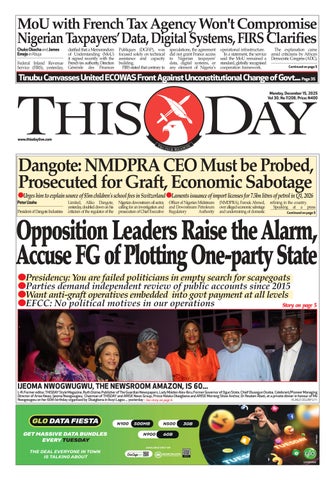
MoU with French Tax Agency Won't Compromise Nigerian Taxpayers’ Data, Digital Systems, FIRS Clarifies
Chuks Okocha and James Emejo in Abuja
Federal Inland Revenue Service (FIRS), yesterday,
clarified that a Memorandum of Understanding (MoU) it signed recently with the French tax authority, Direction Générale des Finances
Publiques (DGFiP), was focused solely on technical assistance and capacity building. FIRS stated that contrary to
speculations, the agreement did not grant France access to Nigerian taxpayers’ data, digital systems, or any element of Nigeria’s
operational infrastructure.
In a statement, the service said the MoU remained a standard, globally recognised cooperation framework.
The explanation came amid criticisms by African Democratic Congress (ADC), Continued on page 5
Dangote: NMDPRA CEO Must be Probed, Prosecuted for Graft, Economic Sabotage
Urges him to explain source of $5m children's school fees in Switzerland Laments issuance of import licenses for 7.5bn litres of petrol in Q1, 2026
Limited, Aliko Dangote, yesterday, doubled down on his criticism of the regulator of the
Nigerian downstream oil sector, calling for an investigation and prosecution of Chief Executive
Officer of Nigerian Midstream and Downstream Petroleum Regulatory Authority (NMDPRA), Farouk Ahmed, over alleged economic sabotage and undermining of domestic refining in the country. Speaking at a press
Opposition Leaders Raise the Alarm, Accuse FG of Plotting One-party State
Presidency: You are failed politicians in empty search for scapegoats
Parties demand independent review of public accounts since 2015 Want anti-graft operatives embedded into govt payment at all levels
Komolafe says corruption danger to Nigeria’s growth, prosperity Adefope-Okojie: NUPRC is gatekeeper
Emmanuel Addeh in Abuja
The Nigerian Upstream Petroleum Regulatory Commission (NUPRC) has restated its commitment to preventing and tackling corruption, promising to deliver an untainted 2025
Emmanuel Addeh in Abuja and Wole Ayodele in Jalingo
Opposition leaders yesterday raised fresh alarm over what they described as a coordinated assault on Nigeria’s multiparty democracy, accusing the President Bola Tinubu administration of using antigraft and security institutions to intimidate political rivals and forcing opposition governors into the ruling All Progressives Congress (APC).
In a strong riposte, the presidency described the opposition political parties as failed politicians, accusing them of singing a familiar tune, hoping their cheerleaders would see their action as a blistering attack from a
conference at the Dangote Petroleum Refinery, Ibeju-Lekki, Lagos State, Dangote accused the leadership of NMDPRA of colluding with international traders and oil importers to frustrate local refining through the continued issuance of import licences for petroleum products.
Dangote also alleged that Ahmed was living beyond his legitimate means, claiming that four of his children attend secondary schools in Switzerland at a cost of $5 million.
He insisted that such expenditure raised serious questions about potential conflicts of interest and the
which raised concerns over the recent digital tax agreement between both countries.
ADC said while it supported efforts to modernise the country’s tax system, the process by which the deal was reached raised serious questions about transparency, national sovereignty, and the protection of Nigerians’ data.
In a statement signed by its National Publicity Secretary, Mallam Bolaji Abdullahi, ADC called for full public disclosure of the details of the agreement or its immediate termination.
Former Vice President Atiku Abubakar had also criticised the MoU, expressing concerns that the agreement can compromise the country's
petroleum licensing round.
The Commission's Chief Executive, Gbenga Komolafe, made the promise at an event held at the NUPRC headquarters in Abuja, in commemoration of the International Anti-Corruption Day, a statement by the NUPRC spokesman, Eniola
seemingly virile opposition group.
A statement by the president's spokesman, Bayo Onanuga, late last night maintained that Nigeria's constitution guarantees freedom of association and affords the people the right to change their political leanings at any time of their choosing.
“None of the people who joined the governing APC was pressured to do so. They all did so of their own free will. They are being motivated by the noticeable gains of President Bola Tinubu's reform programme,” the presidency insisted.
But amid the allegations of pressure on opposition figures, the APC has formally
integrity of regulatory oversight in the downstream petroleum sector.
The Dangote Group chairman assured Nigerians that the pump price of Premium Motor Spirit (PMS) or petrol would fall further, stating that petrol would sell at no more than N740 per litre from Tuesday, beginning in Lagos, because of his refinery’s reduction of gantry price to N699 per litre.
He said MRS filling stations would be the first to reflect the new pricing.
Expressing concern over the state of the downstream sector, Dangote said Nigeria’s continued reliance on fuel imports was harming local
economic sovereignty and expose sensitive national data to foreign control.
Atiku said giving a foreign power, especially one with a history of complex relationships with its former African colonies, access to Nigeria's financial dealings could be a "vicious and ruthless plan to turn Nigeria into France's vassal state".
FIRS, however, pointed out that all existing Nigerian laws on data protection, cybersecurity, and sovereignty remained fully applicable and strictly enforced.
It said Nigeria Revenue Service (NRS), like its predecessor (FIRS), placed the highest premium on national security and maintained rigorous standards for the
of Nigeria's wealth
Akinkuotu, said at the weekend.
At the event which was put together by the AntiCorruption and Transparency Unit (ACTU) of the commission, Komolafe said corruption is not an abstract issue but a danger to Nigeria’s growth and prosperity.
registered Taraba State Governor, Agbu Kefas, ahead of his anticipated defection to the ruling party, a move that further reshapes the political landscape in the North-east.
The registration, carried out by the state leadership of the APC led by its Deputy Chairman, James Ahmadu, took place at the Government House in Jalingo, with the governor issued membership card number 001. The latest defection takes the number of governors leaving their party for the APC in recent times to six.
However, amid the back and forth over imputations that the Economic and Financial Crimes Commission (EFCC) has become a political tool
production and discouraging investment in domestic refining.
He disclosed that import licences covering approximately 7.5 billion litres of PMS had, reportedly, been issued for the first quarter of 2026, despite the availability of significant domestic refining capacity.
According to him, modular refineries are already struggling under the current policy environment and on the brink of extinction, while the persistent issuance of import permits further weakens the sector.
“I am not calling for his removal, but for a proper investigation. He should be required to account for his
protection of all taxpayers’ information.
According to the FIRS statement, similar MoUs are signed by tax administrations around the world to promote collaboration, knowledge exchange, and the adoption of global best practices.
It stated that the DGFiP was among the world’s most advanced tax authorities, with over a century of institutional experience and deep expertise in digital transformation, taxpayer services, governance, and public finance.
The FIRS said, "This partnership simply enables Nigeria to learn from that experience. It is advisory, non-intrusive, and entirely under Nigeria’s control.
"Contrary to
He said that in the oil and gas sector, where the stakes are high and revenues substantial, corruption can have devastating effects on national development.
Komolafe, therefore stressed that the role of the NUPRC in national development could not be overemphasised, noting
in the hands of the current government, the anti-graft agency said yesterday that it remains neutral in its operations, urging politically exposed persons in its net to cooperate fully.
In a joint statement signed by former Vice President Atiku Abubakar, former Senate President David Mark, former presidential candidate of the Labour Party (LP) Peter Obi and other senior figures, the opposition alleged that agencies such as the EFCC were being weaponised to weaken opposition parties ahead of the 2027 general election.
Aside from being the longest serving Senate President in Nigeria, Mark, a retired
actions and demonstrate that he has not compromised his position to the detriment of Nigerians. What is happening amounts to economic sabotage,”
Dangote said.
He alleged that Ahmed paid as much as $5 million in tuition fees for his children’s secondary education in Switzerland, questioning how many Nigerians can afford such costs.
Dangote stated, “The Code of Conduct Bureau (CCB) or any other body deemed appropriate by the government, can investigate the matter. If he denies it, I will not only publish what he paid as tuition in those secondary schools, but I will also take legal steps to
misconceptions, the MoU does not displace local technology providers.
“FIRS and the emerging Nigeria Revenue Service (NRS) continue to work closely with Nigerian innovators, such as NIBSS, Interswitch, PayStack, and Flutterwave.
"The MoU does not include the provision of technical services; it is limited to knowledge sharing, institutional strengthening, workforce development, policy support, and bestpractice guidance."
The service added, "We welcome robust public engagement on tax reforms, but such conversations must reflect the actual content and purpose of the agreement.
that one of the major ways the commission had been able to tackle corruption was by reducing human interference and promoting technology like in the 2024 licensing round.
“The most compelling illustration of this reality was the Nigeria 2024 licensing round. For the first time in
military general and former military governor of Niger State is the current Chairman of the African Democratic Party (ADC), the party eyeing the takeover of government in 2027.
The opposition warned that Nigeria was drifting towards a de facto one-party state through coercion rather than electoral competition.
Beyond immediate incidents, the opposition leaders demanded sweeping reforms, including the depoliticisation of the EFCC, the embedding of anti-graft operatives in government payment processes at all levels, and the creation of an independent review body to examine public accounts from 2015 to 2025, warning
compel the schools to disclose the payments made by Farouk.
“I sent my own children to secondary schools here in Nigeria. How many Nigerians can afford to pay $5 million for secondary school tuition, not university education? In his home state of Sokoto, many parents are struggling to pay as little as N10,000 in school fees.”
Dangote described the downstream petroleum sector as being under severe strain, alleging the presence of entrenched interests that profit from fuel imports at the expense of national development.
He stated, “There are powerful interests in the oil
"Rather than undermining Nigeria’s sovereignty, this MoU strengthens it by helping to build a modern, capable, globally competitive tax administration one firmly in command of its systems, data, and strategic direction.
"FIRS remains committed to transparency, professionalism, and partnerships that advance Nigeria’s long-term economic development."
FIRS said, "While we appreciate the public’s vigilance and patriotic concern, it is, however, important to provide clarity on the misconceptions arising from the event."
Nonetheless, ADC said it had carefully reviewed expert opinions on the recent agreement on digital
Nigeria’s upstream petroleum sector, bid submissions were conducted fully online; commercial bidding was digital and real-time.
that continued selective enforcement of the law posed a grave threat to Nigeria’s democratic stability. Besides, Atiku, Mark and Obi, other signatories to the statement by the opposition included: A former Governor of Edo State and ex-national Chairman of the APC, Chief John Odigie-Oyegun; a chieftain of the Peoples Democratic Party (PDP), Chief Bode George; and former Federal Minister, Lawal Batagarawa.
“We are compelled by duty to nation and conscience to issue this statement to alert our compatriots and the international community to
Continued on page 37
sector. It is troubling that African countries continue to import refined products despite long-standing calls for value addition and domestic refining.
“The volume of imports being allowed into the country is unethical and does a disservice to Nigeria.”
Dangote stressed the need for a clear separation between regulatory oversight and commercial interests, warning that allowing traders to influence regulation would undermine the integrity of the sector.
He said, “The downstream sector must not be destroyed Continued on page 37
tax reform and revenue administration signed by FIRS, on behalf of the Bola Tinubu administration, and the government of France, and was worried about potential untoward implications.
Abdullahi said, ''Quite significantly, we note the overwhelming concern that the agreement potentially endangers Nigeria’s data security and exposes strategic national economic information to foreign exploitation.
“Attempts by the FIRS to explain these concerns away have failed to convince anyone that the agreement was done in the nation’s best interest, especially given the manner in which
Continued on page 36
Komolafe
JONATHAN’S CONDOLENCE VISIT TO BAYELSA GOVERNOR AND DEPUTY’S FAMILY...
Amuka, Osoba, Obaigbena, Ibori, Obi, Adesina,
Others Serenade Ijeoma Nwogwugwu at 60
Chiemelie Ezeobi
Veteran journalist and media executive, Ijeoma Nwogwugwu, was celebrated by leading figures from politics, media, and the corporate world last night at a intimate gathering in Lagos to mark her 60th birthday.
Hosted by Chairman and Publisher of THISDAY and ARISE TV Group, Prince Nduka Obaigbena, the event brought together old colleagues, protégés, friends, and admirers, who paid glowing tributes to Nwogwugwu’s professional excellence, intellectual depth, and lasting impact on Nigeria’s media and policy
landscape.
Obaigbena said, “I employed Ijeoma when she was either 28 or 29 years old. She was working at Merchant Bank of Africa. We groomed her and made her a reporter, then we recommended her to the Bureau of Public Enterprises as an expert. Since then, she has been flying.”
Among the guests at the event were Publisher of Vanguard Newspapers, Pa Sam Amuka; former Ogun State Governor, Aremo Olusegun Osoba; former Delta State Governor, Chief James Ibori; CEO, McFolley Hospitality, Chike Ogeah; and Group Head of Media and External Relations for United
Bank for Africa (UBA), Ramon Olanrewaju Nasir.
There were also former member of the House of Representatives and erstwhile Editor of The Guardian News Express, Nduka Irabor, and his wife, Ebele; Founder of Folio Media Group, Fidelis Anosike; and President of Newspaper Proprietors Association of Nigeria, Mrs. Maiden Ibru.
Others included a presidential hopeful, Peter Obi; Managing Director of New Telegraph, Mr. Ayo Aminu; Lagos State Commissioner for Information, Gbenga Omotosho; Chairman of Globe Motors, Nkiru Anumudu; Ruth and Grace Osime;
former Divisional Director of Corporate Services at THISDAY Newspaper, Gbayode Shomuyiwa; and Executive Director of Zenith Bank, Adobi Nwapa.
Members of the THISDAY family, including THISDAY Editor and his deputy, Shaka Momodu and Olawale Olaleye, respectively, as well as Saturday Editor, Obinna Chima, were also at the venue to honour the quintessential newsroom Amazon.
ARISE TV presenter, Rufai Oseni, described Nwogwugwu as a rare friend and professional influence.
Oseni said, “She is my very good friend, and I don’t say that for a lot of people.
I did radio for 10 years and I wanted to transition, and someone gave me her contact. She had the heart to build something formidable in ARISE. She kept us in line. She has a good heart and is always ready to share with people.”
Aruoture Oddiri, host of The Global Business Report on ARISE TV, who paid tribute to Nwogwugwu’s mentorship, particularly in specialised reporting, said, “It’s been an incredible experience working with her. She is incredibly vast in economics and oil and gas. I see her as my mentor in this industry.”
time as editor at THISDAY, said, “Ijeoma is a sound professional. Even when I was Guardian Chairman of the Editorial Board, when she was an editor at THISDAY, we used to have healthy debates on the back page of the paper. She is a good journalist and editor. She is professionally competent and pays attention to details.”
Ruth Osime, fashion editor and media personality, reflected on their long friendship. “I have known her for 20 years. People talk about how mentally stimulating she is, but they don’t realise how caring she is,” she added.
Rolake Akinlugbe-Filani described Nwogwugwu as a force of nature.
Solid Minerals Revenue Hits N58.6bn, Surges Over
Emmanuel Addeh in
Revenue collections from Nigeria’s solid minerals sector paid into the Federation Account climbed to N58.64 billion in the first 10 months of 2025, already exceeding the entire N38 billion realised in the whole of last year by a wide margin. Data from the Federation Accounts Allocation Committee (FAAC) covering January to October 2025, showed that the Central Bank of Nigeria (CBN) received a cumulative N58,644,396,757.16 from solid minerals revenue.
Compared with the roughly N38 billion recorded for the full 12 months of
54% Above 2024 Collection
2024, the current year-to-date figure represents an increase of about N20.6 billion, or approximately 54 per cent, with two months of the year still outstanding. Although the sector continues to underperform, given its enormous potential, the scale of the improvement places the solid minerals sector among the fastestgrowing non-oil revenue contributors in 2025.
In October, at the 10th edition of Nigeria Mining Week 2025, President Bola Tinubu confirmed that the solid minerals sector generated over N38 billion in revenue in 2024, up from the meagre N6 billion it generated the previous year, 2023.
The President credited the feat to the administration's ‘bold steps’ to reform the solid minerals sector, now led by Dele Alake, making it a new engine of growth through improved policy and oversight.
A month-by-month breakdown of the FAAC figures seen by THISDAY showed that collections have been relatively consistent, with notable spikes at different points in the year.
January opened with N4.18 billion, setting a solid base for the year. February followed closely with N3.78 billion, while March dipped to N2.15 billion, reflecting seasonal and operational fluctuations common in extractive activity.
April marked a significant
jump to N7.88 billion, one of the strongest monthly performances of the year. This momentum softened slightly in May, when collections stood at N9.66 billion, still among the highest monthly inflows recorded so far. June brought in N4.75 billion, while July delivered N5.84 billion, pointing to a stabilisation in mid-year receipts.
Besides, August recorded N6.23 billion, and September followed with N7.32 billion, reinforcing the upward trend heading into the final quarter. October collections stood at N6.86 billion, according to the Ministry of Solid Minerals Development’s schedule of actual revenue paid into the Federation Account.
Former presidential spokesman and columnist, Dr. Reuben Abati, while recalling his professional encounters with Nwogwugwu during her
ICAN to Share 60 Years of Professional Experience with CIFCFIN
Bennett Oghifo
The Institute of Chartered Accountants of Nigeria (ICAN) has said it is ready and willing to share its 60 years of professional experience with the Chartered Institute of Forensics and Certified Fraud Investigators of Nigeria (CIFCFIN).
Speaking recently during CIFCFIN’s courtesy visit to the global headquarters of ICAN in Victoria Island, Lagos, ICAN's President, Dr. Yahaya Nma Haruna, expressed his delight on the visit even as he expressed their initial concern that the Institute may not extend a hand of fellowship to other professionals already on ground. He said ICAN is willing to collaborate and partner with CIFCFIN and deploy its Forensic
Faculty to provide guidance as a recognised leader in forensic accounting and auditing.
The ICAN President advised CIFCFIN to sustain its collaboration with other professional bodies already on ground.
In his address, CIFCFIN’s Founder/Chairman, Governing Council, Dr. Iliyasu Gashinbaki, called for closer collaboration and experience sharing with ICAN.
“I commend ICAN leadership for maintaining and sustaining a high standard in the professional practice of accounting in the last 60 years. We want to collaborate with ICAN and tap from its several years of professional experience to strengthen our engagements,” he stated.
Abuja
L-R: Wife of the late Bayelsa State Deputy Governor, Mrs. Beatrice Ewhrudjakpo; former President Goodluck Jonathan; and Bayelsa State Governor, Senator Douye Diri, during Jonathan’s condolence visit to the Bayelsa Governor and his Deputy’s family over the death of Senator Lawrence Ewhrudjakpo on Friday
9TH INDUCTION AND INVESTITURE OF COMPLIANCE INSTITUTE NIGERIA...
NNPC: Containment Measures Executed at Escravos–Lagos Gas Pipeline after Explosion
Says communities, personnel safe, inspection carried out National oil firm targets 2.06m bpd
Emmanuel Addeh in Abuja and Blessing Ibunge in Port Harcourt
The Nigerian National Petroleum Company Limited (NNPC Ltd) yesterday announced that it had successfully carried out measures to contain the fire which affected a section of the Escravos–Lagos Pipeline System (ELPS) in South-West Warri, Delta State, last week.
Earlier, the national oil company had confirmed an incident involving an explosion reported at about 17:50 hours on December 10, 2025 near Tebijor, Okpele, and Ikpopo communities in Gbaramatu
Kingdom part of the state.
Initial observations, it said, indicated a pressure drop, consistent with a loss of containment on an NNPC Gas Infrastructure Company (NGIC) pipeline.
It stressed that the cause of the explosion was still unknown but would be confirmed after a detailed investigation had been concluded, explaining that the priority at the time was to ensure the safety of nearby communities and the protection of the environment.
“Emergency response procedures have been activated, and we are working closely with relevant authorities and community leaders to ensure
Telecommunication: Mobile Tech, Catalyst for Nation's Economic Devt, Says AMPAT National President
Yinka Kolawole in Osogbo
Mobile technology has been described as a strong catalyst that drives the engine of economic development in the country and today's world.
Speaking at the inauguration ceremony of new executive members of the Association of mobile phone and Allied products traders of Nigeria (AMPAT) Osun State Chapter, the National President, Hon. Musa Mamsa, stressed that mobile phone and allied products sector has become one of the strongest pillars of commerce in modern society.
He posited that from communication to digital trade, from financial inclusion to security, mobile technology drives the engine of development in all ramifications.
He said the association
was founded with a clear national mission which includes protection of members interests of mobile phone and gadgets, promotion of ethical business practices, organizing the industry under a unified and credible structure and to ensure support system and a pathway to progress.
Also speaking at the event, the outgoing Chairman of Osun State Chapter, Elias Adeyinka, said the association has promoted the business of the members, strengthened unity, and ensured lasting peace and cooperation among traders across the state.
He pointed out that the notable achievements of the association include security of members through Swift intervention and support from the state's security agencies, as perpetrators were apprehended accordingly.
oil output in 2026, lauds PINL
a coordinated approach to mitigate impact. NNPC Limited remains committed to the highest safety and environmental standards,” it said in a statement by its spokesman, Andy Odeh.
But giving an update yesterday, the national oil firm pointed out that containment
measures had been successfully executed, ensuring the safety of host communities, personnel, and the environment, while relevant pipeline sections had been safely and securely isolated. Although it did not indicate the cause of the explosion in the statement, the NNPC stated that a preliminary inspection
involving NNPC, the Nigeria Midstream & Downstream Petroleum Regulatory Authority (NMDPRA) technical teams, and maintenance contractors had been conducted.
“NNPC Limited is providing an update on the incident reported on Thursday, 11th December 2025, on a section
of the Escravos–Lagos Pipeline System (ELPS) in South-West Warri, Delta State. Coordinated containment measures have been successfully executed, ensuring the safety of host communities, personnel, and the environment. All relevant pipeline sections have been safely and securely isolated.
BUA Group Rewards 510 Employees with N30bn for Long Service
BUA Group has disbursed a total of N30 billion to 510 employees at its 2025 Night of Excellence and Long Service Awards, one of the most significant employee reward initiatives undertaken by a Nigerian private sector company.
The ceremony recognised long service, loyalty, and exceptional contribution by employees whose commitment spans from five years to over four decades. It reflected a belief that has guided the Group since inception: enduring businesses are built by people.
Speaking at the event, Founder and Executive Chairman of
BUA Group, Abdul Samad Rabiu, described the evening as a moment to acknowledge loyalty, resilience, and shared ownership of the BUA journey.
He recalled that from modest beginnings 36 years ago, BUA has grown into one of Nigeria’s most valuable listed enterprises, with a combined market capitalisation now in the trillions of naira. He noted, however, that the journey was never the achievement of one man, one board, or capital alone.
According to Rabiu, "every factory built, every system strengthened, every challenge overcome, and every milestone
reached carries the imprint of employees who believed in the vision long before the results were visible."
He reaffirmed that BUA has always regarded its workforce as partners in a shared legacy rather than merely staff, adding that loyalty and professionalism are values that must be recognised in tangible ways.
As part of the 2025 awards, N30 billion was disbursed to 510 recipients across multiple long service and excellence categories.
But due to time considerations at the event, only 41 recipients received their awards physically from the Cmchairman. These
represented the highest award categories, ranging from N100 million to N1 billion.
The on stage recipients comprised 16 recipients of N100 million each, nine recipients of N200 million each, seven recipients of N250 million each, three recipients of N500 million each, five recipients of N1 billion each, and one special award recipient whose cash award was not announced at the event. The special award was presented to Kabiru Rabiu in recognition of his exceptional loyalty, leadership, and long standing contribution to the growth and stability of the BUA Group.
Yuletide: Foundation Donates Food to Vulnerable Women in Abuja
As the Yuletide approaches, Walkiya Humanitarian Foundation has stepped in to provide relief for vulnerable residents of the Federal Capital Territory, distributing food items to 500 women in the Jikwoyi area of Karu, Abuja.
The outreach which took place at the weekend formed part of the foundation’s annual humanitarian intervention aimed at
cushioning the effects of rising food costs and helping households struggling to meet basic nutritional needs.
Addressing beneficiaries at the event, the Executive Director of the foundation, Dr. Dominic Egwuda, explained the initiative was designed to reach individuals facing immediate food insecurity, particularly women who often shoulder the responsibility of feeding their families.
He explained the food
distribution exercise is part of the corporate social responsibility of the Walkiya Group of Companies, implemented through the Walkiya Humanitarian Foundation to support vulnerable citizens amid economic hardship.
He said: “This is a part of our social corporate social responsibility of Walkiya Group of Company, which we operate under the umbrella of Walkiya Humanitarian Foundation.”
Egwuda stressed that beneficiaries were carefully selected across religious, ethnic and social lines, with the sole criterion being the inability to afford basic meals, in order to ensure inclusiveness and fairness.
“We needed people who cannot afford their next meal, people we have carefully selected from all cross of lives, Christian, Muslim, different tribes.”
Michael Olugbode in Abuja
L-R: Chairman, Research, Compliance Institute Nigeria (CIN), Mr. Taiwo Sanusi; Chairman, CIN, Mr. Femi Jaiyeola; Director, Evaluation and Compliance, CIN, Dr. Gaba Buno Nduka; Acting Zonal Director, Lagos 2, EFCC, Mr. Ahmed Ghali; President, CIN, Mr. Pattison Boleigha; and Director, Compliance Department, Central Bank of Nigeria (CBN), Mr. Olubumi Ayodele-Oni, at the 9th Induction and Investiture Ceremony of the Compliance Institute Nigeria held in Lagos on Saturday SUNDAY ADIGUN
UBA Strengthens Leadership Team, Names Lamptey, Adewuyi, Okpala as New EDs
Nume Ekeghe
The United Bank for Africa Plc (UBA) has unveiled changes to its Executive Board, reinforcing its succession strategy and commitment to innovation, customer experience, and continental leadership in financial services.
The Board approved the appointment of three new Executive Directors: Mr. Emmanuel Lamptey, Mr. Tosin Adewuyi, and Mr. Chidi Okpala, subject to regulatory approval by the Central Bank of Nigeria (CBN). Together, the incoming executives bring over 70 years of combined experience to Africa’s global bank.
The changes slated to take effect from January 1, 2026, will see the exit of the bank’s Deputy
Managing Director, Mr. Muyiwa Akinyemi, alongside Executive Directors, Mrs. Abiola Bawuah, Mr. Alex Alozie and Mrs. Sola Yomi-Ajayi, all of whom are completing their approved tenures on the board.
Lamptey has been appointed Executive Director, Digital Banking. He brings about 25 years of multinational experience spanning retail and corporate banking, asset management, securities brokerage, pensions, insurance and microfinance, with professional exposure across more than 30 African countries.
Known for his work in digital transformation and customer experience, Lamptey has held several executive and nonexecutive board roles within and outside the financial services
Wema Bank Unveils N120m Grand Prize Pool as 35 Teams Advance to Hackaholics 6.0 Finale
Wema Bank has announced a N120 million prize pool for the Hackaholics 6.0 Grand Finale, following the emergence of 35 teams from regional pitch sessions that recorded 1,460 participants across seven cities in Nigeria.
Announcing the prize structure, MD/CEO Wema Bank, Moruf Oseni, disclosed the N120 million will be awarded across several winning categories at the finale.
The Ideathon prizes include N25 million for first place, N20 million for the first runner-up and N15 million for the second runner-up. In the Hackathon category, the first to fourth-place teams will receive N20 million, N15 million, N10 million and N5 million respectively.
In addition, two womenled innovations, one from
each vertical, will receive N5 million each in recognition of Wema Bank’s commitment to advancing female participation in technology and innovation.
According to Moruf Oseni, “Hackaholics continues to demonstrate the power of young people to shape the future of technology and nation-building.
“We believe strongly in the ideas, resilience, and ingenuity of the Nigerian youth, and our investment in this initiative is a clear testament of our commitment to giving them the resources, mentorship, and platform they need to transform their ideas into real-world solutions.
“As these finalists head to Lagos, we are confident their innovations will create meaningful impact across industries and communities, and we are proud to be a champion for that transformation.”
sector. He is an alumnus of Harvard Business School, a Fellow of the Association of Chartered Certified Accountants (UK), and holds a Bachelor of Commerce degree from the University of Cape Coast, Ghana, the statement said.
Adewuyi, appointed Executive Director, Corporate Banking, has over 25 years of experience across Sub-Saharan Africa, including more than 15 years in senior management roles approved by the FCA
and the CBN in London and Lagos.
His career spans Structured Trade Finance, Corporate and Investment Banking, Debt Capital Markets, Financial Institutions Coverage and Correspondent Banking, where he has led major client relationships across corporate and sovereign segments.
The system noted that he is a Fellow of the Association of Chartered Certified Accountants, holds a degree
in Economics and Accounting from the University of Manchester, is an honorary member of the Chartered Institute of Bankers of Nigeria and an alumnus of The Wharton School.
Besides, Okpala takes up the role of Executive Director, UBA Nigeria. Before his appointment, he was Executive Director for Payments, Group Integration and Strategy at Heirs Holdings, where he led the group’s payments
businesses and oversaw strategic investments in technology and healthcare. With over 20 years of banking experience, Okpala has built deep expertise in payments, financial innovation, corporate strategy and ecosystem development across Africa. He holds a BSc in Finance, an MBA in Banking and Finance, and an MSc in Leadership and Strategy from London Business School, where he is a Sloan Fellow.
TNP: NNPC Targets 2.06m Bpd Oil Production in 2026, Lauds PINL
Blessing Ibunge in Port Harcourt
The Nigerian National Petroleum Company Limited (NNPC Ltd) has set a 2.06 million barrels per day crude oil production target for 2026.
This as the NNPC and other stakeholders have commended Pipeline Infrastructure Nigeria Limited (PINL) for its strengthened relationship with host communities of Trans-Niger Pipelines (TNP) in achieving the recorded success in the increased oil production.
The commendation was made yesterday during the regular stakeholders meeting with host communities of the TNP organised PINL in Port Harcourt.
In his remarks, Mr Akponime Omojevwhe, Head Field Operations, Eastern Corridor, Project Monitoring Office, NNPC, who credited the sustained growth in the oil production to communities and stakeholders' collaboration with PINL, noted that currently the TNP is producing optimally.
He said: "I want to sincerely appreciate all our stakeholders
on this corridor because right now. We can see that the TNP is green and what that means is that the products are flowing uninterrupted.
"Secondly, I want to say that our budget for 2026 is targeted at 2.80mbpd and the budget begins from 1.84mbpd while our targeted projection is 2.06mbpd. So we want to say that even as we draw closer to next year 2026, as we have come together to ensure that the projection is going up, we want to crave your indulgence, please don't relent".
Highlighting the importance
of stakeholders and communities in securing the pipelines, the NNPC official noted that no private security company can achieve success without their collaboration.
"The communities are a vital part of this job. So anytime we find ourselves, we must always appreciate them because the community leaders such as the chiefs, CDCs, youth presidents, women leaders, if they don't carry out our messages to the community people, there will be nothing like green as far as the pipeline is concerned.
NIPR President Calls for Constructive Patriotism, Says Leaders No Longer Trusted by Citizens
Oghenevwede Ohwovoriole in Abuja
President of the Nigerian Institute of Public Relations (NIPR), Dr. Ike Neilaku has called constructive patriotism among the people, saying there is trust deficit by the citizens on the government. He stated this at the NIPR 2025, 4th Quarter Induction in Abuja, weekend where 448 new members of the
institute were inducted.
Neilaku in his speech, said the present situation in the country was because citizens no longer trust government. He charged both the new inductees, fellows and council members to be trust builders "You must be builders of trust. Trust is Nigeria's most vulnerable, yet most fragile currency. We are where we are because we no longer
trust our government.
"We don't trust those who are leading us. Even when they say they are going this direction, and you expect that they will go this direction, you still don't trust them until they prove otherwise. Whereas in other places, you trust them.
"The otherwise is that they will now do something wrong. But in our case, we don't trust them until they
now show us the reason for them to be trusted. So I am speaking to you that you have to be builders of trust.
"Every message you craft, every campaign you manage, every stakeholder you engage must increase trust, not erode trust. You must be interpreters between government and people.
"Public relations is the bridge between leadership and citizens.
Bennett Oghifo
2025 CEBIH ANNUAL CONFERENCE ...
L-R: Head Products, Partnership and Innovation, Afrigopay Financial Services Limited, Munachimso Duru; Country Manager, Visa West Africa, Damola Giwa; CeBIH Advisory Council, Wunmi Ogunbiyi; Divisional Head for Product Management and Solution Delivery, Verve International, Adedamola Adeniran; Executive Director/Chief of Operations, Nigerian Consumer Credit Corporation (CREDICORP), Olanike Kolawole; and Head, Corporate Strategy Department, eTranzact, Ifeanyi Chukuwekem during the CeBIH 2025 Annual Conference held at Eko Hotel Lagos …recently
Without Police Escort...
B6 Armored Cadillac Escalade ESV Sport New BR6 Armored Lexus LX600
GICL: Powering Nigeria's Digital Revolution Through Reliable Connectivity
In response to infrastructure gaps limiting the pace of Nigeria's digital transformation, the Federal Ministry of Communications, Innovation & Digital
Economy launched Project BRIDGE (
ng Resilient Digital Infrastructure for Growth). This initiative aims to deploy at least 90,000 km of fiber, positioning fiber as the foundation for nationwide d
o Information and Communication Technology (ICT). A
Towers in Nigeria, has emerged as a key player in the deployment of a nationwide fiber optic network which supports the Project BRIDGE agenda. H
a transmission and access to fiber connectivity, as well as increased network accessibility for rural communities. With the successful rollout of over 15,000 kilometers of fiber optic cables across all 36 states and the Federal Capital Territory, GICL is helping to bridge the digital divide and propel Nigeria's digital economy
This milestone makes GICL the owner of the largest fiber network footprint in Nigeria, excluding
t h o s e o w n e d b y m o b i l e n e t w o r k o p e r a t o r s (MNOs). And the company has achieved this feat in less than five years, having commenced fiber optic deployment in 2021. By helping establish Nigeria's fiber optic backbone, GICL is enhancing t h e c a p a c i t y a
integration of next-generation technologies.
Driving Digital Inclusion Across Nigeria
GICL's fiber footprint extends beyond urban areas; it also provides services in underserved and unserved rural communities. Through its rural telephony program, GICL has provided access to broadband connectivity and extended 2G, 3G, and 4 G m o b i l e n e t w o r k c o v e r a g e t o o v e r 5 0 0 previously unconnected rural communities across 25 states, with the potential to benefit more than 3.5 million people. The company was recognized for this achievement at the 2024 World Space Business Awards, where GICL won the “Universal Bro adband Award” in partnership with Avanti Communications.
A core aspect of GICL's impact is its contribution to Nigeria's internet backbone. By connecting IXPN (Internet Exchange Point of Nigeria) Points of Presence (POP) in Delta and Enugu, GICL has helped to reduce latency and localize internet content and traffic. This is expected to improve local traffic exchange, increase reliability and connectivity for Internet Service Providers (ISPs), and result in cost reductions for both local ISPs and businesses.
This increased access to connectivity is expected t o e n h a n c e s e r v i c e d e l i v e r y a c r o s s v a r i o u s sectors For example, it has the potential to broaden access to online educational resources a n d p r o v i d e h e a l t h c a r e s e r v i c e s t h r o u g h telemedicine.
In Anambra State, it has provided connectivity to key economic centers such as the Eke Awka Market, Awka Millennium City, and Agulu Lake R e s o r t T h i s c o u l d h e l p a t t r a c t i n v e s t m e n t , promote tourism, and drive innovation and growth for businesses within these communities.
“GICL’s
fiber footprint extends beyond urban areas; it also provides services in underserved and unserved rural communities.”
GICL's commitment to digital transformation is also evident in other projects, such as the Offa ONE Innovation Hub in Kwara State. This hub is connected by 8.76 kilometers of GICL's fiber optic cable and is designed to be a center for technology and entrepreneurship training progr
The provision of a 45 Mbps Internet link and dark fiber connectivity at the hub aims to enable training and ICT support for young people in areas such as software engineering and artificial intelligence.
Supporting Economic Growth
By utilizing IHS Nigeria's towers and connecting them to fiber infrastructure, GICL has been able to facilitate the delivery of digital services to homes, businesses and government institutions across the country The deployment of Fiber-to-the-Tower (FTTT) technology by GICL supports increased transmission capacity, which is essential for the r o
connectivity
Global Independent Connect Limited (GICL)
A Subsidiary of IHS Towers
Government Areas and allocated dark fiber for the state's Smart City Project to link government
This infrastructure further supports the growth of ecompetition. In states like Edo, Borno, and Katsina, GICL's fiber infrastructure is already helping accelerate the digital transformation by connecting government offices, schools, and marketplaces. For example, in Edo State, GICL has connected 18 Local
“With the successful rollout of over 15,000 kilometers of fiber optic cables across all 36 states and the Federal Capital Territory, GICL is
economy.”
commerce activities, digital banking services and other online services that are important for the growth of a digital economy Small and Mediumsized Enterprises (SMEs) can leverage reliable internet services to expand their market's reach
various online payment platforms suited to their requirements.
Building Sustainable Impact
One of the core strengths of GICL is its ability to collaborate with various stakeholders, including MNOs and the federal and state governments, to deploy its fiber infrastructure more efficiently By operating an open-access, shared infrastructure model, GICL also enables multiple, smaller ISPs
infrastructure, thereby optimizing resources and
government.
GICL's work in Borno State includes connecting seven government locations and ministries with a 155 Mbps internet link and Wireless Local Area Network (WLAN) technology supporting improved communication and operational efficiency It has
Ramat Polytechnic, the Pilgrim Welfare Board and the Rural Water Supply & Sanitation Agency GICL has also connected nine government offices and residences in Katsina State to support socioeconomic growth, all through reliable high-speed internet access.
Looking Ahead
GICL's commitment to bridging Nigeria's digital divide is evident in its work across the country, f r o m u
communities. As part of IHS Towers, it is driven by a vision for a smarter, more connected Nigeria, with the goal of becoming the country's backbone for digital possibilities. With an ambition to connect more rural communities and reinforce network
secure, and scalable connectivity It believes there is potential for state governments, municipalities, and educational institutions to unlock
Advancing Digital Connectivity Across Nigeria
Email: deji.elumoye@thisdaylive.com
As Fubara Becomes Rivers’ APC Leader
The political crisis rocking Rivers State may have taken a new twist despite the defections of the State Governor, Siminalayi Fubara and 17 Peoples Democratic Party members of the State House of assembly to the all Progressives Congress. Recent utterances and body language of the lawmakers led by the Speaker, Rt Hon Martin amaewhule, depicted unsettled dispute between the executive and legislative arms of government. Blessing Ibunge writes.
Rivers State for some time has been engulfed in political crisis following misunderstanding between the 27 lawmakers of the State House of Assembly and the Governor, Siminalayi Fubara.
Despite the dramatic defection of the Speaker of the State Assembly, Martins Amaewhule and 16 other members to the All Progressives Congress (APC), and the subsequent defection of the governor to APC, the war drum seems to have continued to beat, this time, the governor fights boldly believing his alleged new found godfather is capable of defending him should there be any untoward move by the lawmakers, who are still strong supporters of the Minister of Federal Capital Territory, Nyesom Wike.
In a dramatic move, 17 lawmakers of the Rivers State House of Assembly, led by the Speaker, Martins Amaewhule publicly announced their exit from the PDP that gave them platform to their present positions to APC. Their demonstration during the process of the defection, held at the temporary sitting venue in Port Harcourt, made the public believe that their battle with the Governor has not ended. Though the Governor had remained mum since the defection of the lawmakers, but later joined APC maybe to sustain his position, like his other colleagues in Bayelsa, Enugu, others have done. Governor Fubara may be the quiet one, but he is strategic enough to finish his tenure, and would not allow another form of suspension even if it will take him the strong decision to dance to the rhythm of music. He has always expressed that he will fulfill the mandate reposed in him by Rivers people, and would do such only as the sitting governor.
Genesis of Rift Between Fubara, Wike, Lawmakers
There is no denying the fact that the Minister of Federal Capital Territory, Nyesom Wike, played a vital role in the emergence of Fubara as governor of Rivers State, but few months after his inauguration, what was supposed to be a father and son relationship became almost like sworn enemy battle, dragging the legislative body into the political war that lasted for over two years. Though some
persons were of the opinion that they have settled their differences, while many, especially those within the state believe that there is still strong secret battles between the lawmakers and the state governor.
Recall that the political battle deepened in October, 2023 after the State Assembly complex was rocked by an explosion.
The attack averted a planned impeachment plot against Governor Fubara. The political war faced a series of legal battles from the State High Court to Appeal Court then the Supreme Court, with four lawmakers of the Assembly supporting the governor while 27 who were loyal to former governor Wike fought tooth and nail to remove Governor Fubara from office.
President Bola Tinubu and political giants in the country, including Rivers statesmen tried to wade into the crisis to no avail, until the President declared emergency rule on March 18, 2025.
President Tinubu who stated that the reason for the State of Emergency in Rivers State was instability in the functioning of the State government, further announced suspension of Governor Fubara, the state deputy governor, Prof Ngozi Odu and the Assembly members led by the Speaker, Hon Amaewhule. Vice Admiral Ibok-Ete Ibas (rtd) was appointed
immediately as Sole Administrator of the State, though the appointment was not pleasing to Rivers people, during the six months of the emergency rule, there was peace in the political space in the State.
During the period of the battle and suspension of democratic government, the State suffered a serious economic setback, infrastructure development was halted. Practically, the state was in a sleeping mood, until recently when power was restored and Governor Fubara returned to office.
Upon the governor’s re-emergence, conditions were made including dropping State Executive Council member appointed during the crisis, though it was not a simple decision, but for peace the governor obeyed the last order. This situation affected his supporters, many had to lie low since after the changes. With this development, it was expected that the needed peace between the executive and legislative arms have been restored, but recent silent happenings have proven that the war may still be on. Minister of FCT on his part is also facing serious war at the national level of the PDP. Recently, Wike was expelled from the party. The national leadership of the party believe that the only way to recover PDP that has almost gone under is by ousting some members who are perceived to be troublemakers. For fear of being expelled also and possibly risk being politically homeless in 2027, the lawmakers quickly defected to APC. It was expected that the 27 lawmakers would have automatically moved to APC, but only 17 of them publicly announced their
What will be the fate of the governor’s detractors, the 17 state lawmakers who rushed to defect to APC on December 5, claiming that their decision was based on crisis rocking the national leadership of their party, the PDP. Will they proceed with their purported impeachment move against the governor now that he is their political leader, or will they humble themselves, remain loyal and work with him?
defection while 10 still remain members of PDP as at the time of filing this report. The four other lawmakers who are committed supporters of Governor Fubara, continued to follow the governor as he moved. The members that defected to APC include: Speaker, Rt. Hon. Martin Amaewhule (Obio/ Akpor 1), Deputy Speaker, Dumle Maol (Gokana), Majority Leader, Major Jack (Akuku-Toru I), Deputy Majority Leader, Linda Somiari-Stewart (Okrika), Chief Whip, Frankline Nwabuchi (Ogba/Egbema/Ndoni I ) and Deputy Whip, Ofiks Kabangs (Andoni). Others are Peter Abbey (Degema), Tonye Adoki (Port Harcourt II) Gerald Oforji (Oyigbo) Arnold Davids (Ogun/Bolo), Enemi George (Asari-Toru II), Tekenari Granville (Asari-Toru I), Christian Nwankwo (Etvhe II), Azeru Opara (Port Harcourt II), Lolo Opuende (Akuku-Toru II), Solomon Wami (Port Harcourt I) and Igwe Obey Aforji (Eleme).
The 10 other members also loyal to Wike who decided to remain in the PDP include Sylvanus Nwankwo (Minority Leader), Barile Nwakoh (Deputy Minority Leader), John Iderima, (Minority Whip) and Justina Emeji (Deputy Minority Whip).
At the last plenary, Speaker Amaewhule explained that all 16 legislative members including him decided to defect to APC because of the crisis rocking the PDP at the national. His words: “Let me say the reason for me leaving PDP is because of the clear division in the party today. The whole world is aware that as of today, even the national headquarters of PDP is not functioning as a result of this division.
“There are two factions in PDP and the constitution is clear that when there is division in any political party, when the party’s divided, members including Assembly members who no longer have hope can leave the party without dire consequences. The foundation of this defection lies in the constitution of the federal republic of Nigeria that allows members to leave the party that elected them becomes clear that there is a division in PDP, and that is the reason for our joining the APC.”
Fubara Amaewhule
www.thisdaylive.com
opinion@thisdaylive.com
SENATE AND THE ‘TAKE A BOW’ CULTURE SONNY IROCHE argues that the Senate has resembledincreasingly a ceremonial appendage of the Executive
See page 21
JUDGING
A BOOK BY ITS COVER
Bello Matawalle is neither a fan of banditry nor a sponsor of same, contends JACK OKUDE
page 21
K BOLANLE ATI-JOHN argues why Nigeria should stop taxing its veterans
THE DEBT WE REFUSE TO PAY
In every nation, there are groups whose contributions are visible and celebrated, and there are those whose sacrifices are carried quietly, etched into their bodies, their nerves, and their memories. Soldiers belong to the latter category. They return from service not with wealth or comfort, but with stories of danger, fragments of trauma, and bodies aged faster than their years. It is the responsibility of a grateful nation to honour such people, not merely with parades and medals, but with systems that ensure dignity long after the uniform is laid down.
Nigeria has not yet learned this lesson. Across the country, retired military officers, men who once commanded battalions, fought insurgencies, and defended fragile communities, are slipping into poverty. Some die waiting for pension adjustments. Others battle chronic illness without support. According to a 2023 investigation by The Sun newspaper, a retired major general receives a pension valued at under $1,000 a month. Lower ranks earn far less. And many thousands of non-commissioned officers fare even worse, leaving service with pensions so limited that they cannot survive without family charity.
The Sun report detailed former senior officers living in severe distress, including a retired general battling illness while exhausting his savings. Other outlets have documented multiple protests by military retirees, some of whom blocked the Ministry of Finance to demand unpaid benefits, arrears, and entitlements stretching back years. These scenes, elderly veterans in faded fatigues holding placards and demanding what they already earned, constitute a national indictment. They expose a deeper failure. Nigeria depends on its military for survival, yet withdraws support the moment service ends.
This is not simply a welfare problem. It is a national security problem. And it demands a fundamental rethinking of how Nigeria treats its veterans, beginning with the tax system.
Nigeria routinely grants generous tax holidays to foreign corporations, technology firms, and investors in special economic zones. It forgoes significant revenue to incentivise sectors that promise growth. Government agencies proudly advertise multi-year corporate tax exemptions to attract manufacturing plants from Asia, agribusiness firms from Europe, and service companies from America.
But the same government taxes its veterans as though they were ordinary economic actors.
Why does a country that offers tax-free
status to companies that have contributed nothing to its survival refuse to extend the same dignity to the men and women who defended it?
Thiscontradictionismorethanrhetorical. It is a puzzle that reveals a misalignment of national values. Nigeria’s soldiers, many of whom fought insurgencies, quelled riots, patrolled dangerous borders, and risked death daily, received modest salaries and austere allowances during their years of service. Their pensions, even at senior levels, are insufficient to match the realities of ageing, illness, and reduced earning capacity. Many leave the armed forces with chronic injuries, PTSD, hearing loss, vision impairment, and metabolic damage accumulated over decades of physical strain.
The tax system should not worsen these burdens. It should correct them.
Many democracies with robust veteran support systems recognise that veterans are a special category of citizens and design tax policy accordingly. In the United States, disability benefits are tax-free and many states exempt military retirees from income tax altogether. Canada treats disability compensation as non-taxable by default. Britain exempts war-related pensions and service-connected payments from income tax. Australia and Israel provide extensive fiscal protections to veterans and widows, recognising that those who bear the nation’s burdens deserve structural, not symbolic, support.
What these nations understand intuitively is what Nigeria has yet to accept.
A stable veteran population is a pillar of national resilience. An impoverished veteran population is a source of quiet instability.
Taxing Nigerian veterans is not just inequitable. It is strategically reckless, especially in a region where civil-military relations carry profound implications for democratic stability.
Critics may argue that Nigeria cannot afford broad tax exemptions in a period of
fiscal pressure. But this argument collapses quickly when examined through basic economic reasoning.
First, Nigeria’s veteran population is small relative to its tax base. The vast majority of veteran-owned businesses are micro or small enterprises whose corporate tax contributions would register as statistical noise. Even full exemption would likely reduce corporate income tax revenue by far less than one-tenth of one percent.
Second, empowered veterans produce measurable economic returns. International studies from the United States Small Business Administration and Canada’s Veterans Affairs show veteranowned enterprises displaying higher survival rates, stronger employment stability, and more disciplined management. These characteristics translate across borders. In Nigeria, they would mean stronger local economies, higher consumption, and more resilient communities.
Third, veteran poverty is profoundly expensive. When retirees cannot afford housing, medication, or treatment, the cost shifts to public hospitals, extended families, state welfare systems, or emergency services. Preventable illnesses escalate. Families fracture. Communities absorb the destabilising effects of hardship. It is cheaper, fiscally, socially, and morally, to exempt veterans from tax than to manage the consequences of their economic decline.
A nation is judged not by the size of its GDP or the strength of its institutions, but by how it treats those who defended it. When retired officers gather at the gates of the Ministry of Finance to demand arrears, the symbolism is devastating. The defenders of the republic must beg for what is owed.
Tax exemption is not a handout. It is a message.
It tells the corporal who fought in Maiduguri, the sergeant who served in Liberia, the warrant officer who patrolled the Niger Delta creeks, and the general who commanded brigades.
Your country sees you. Your sacrifice matters. Your retirement will not be lived in indignity.
Some will argue that if veterans are exempted, then teachers, nurses, or other civil servants should be as well. This is a misunderstanding of the nature of military service. Soldiers alone enter a legal contract obligating them to face mortal danger at the state’s command.
Rear Admiral Ati-John Rtd writes from Lagos
Bello Matawalle is neither a fan of banditry nor a sponsor of same, contends JACK OKUDE
JUDGING A BOOK BY ITS COVER
It’s all too obvious that Bello Matawalle, the Minister of State for Defence, is one of the most misunderstood public officials in the country. He was governor of Zamfara State from 2019 to 2023. Matawalle came under intense media attacks recently and from the same sources that had felt uncomfortable with his political trajectory. And more significantly with his closeness to President Bola Ahmed Tinubu.
This can only point to one undeniable fact. Matawalle is a victim of politics, far from the picture being painted of him. His traducers, obviously high on political sophistry and drunk on a toxic broth of vengeful politics, fail to judge him using empirical, verifiable indices. This is the danger of judging a book by its cover, or reviewing a book without reading it. Either way, the auditors of Matawalle’s political profile and his role in the containment of banditry in the north west, have mis-read the book which Matawalle had become. It’s a book steeped in strategy, loaded with satire and scripted with cryptic lines in some places, making it difficult for persons of low intellect who cannot discern the satirical lines of the author, to understand.
This is what happens when you judge a book by its cover. Just because, you don’t like the cover of a book, you huff and puff that the book lacks substance when in reality, the same book contains nuggets that you need to cure you of your complicated diseases of hatred, virulent revulsion and atavistic aversion. Matawalle’s sin is his adoption of non-kinetic approach in the fight against banditry and terror. The two dark networks afflicting Nigeria at the moment. On account of his deployment of emotional intelligence, psychological operations (PsyOp), de-radicalization and rehabilitation, economic empowerment, among other non-kinetic strategies, he was portrayed as being sympathetic of banditry and the bandits. This, taken textually and in context, is a fallacy; a spin fabricated in the foundry of extreme politics.
But it bears restating that the non-kinetic approach adopted by Matawalle was not entirely his sole idea but that of the northern governors whose states came under the scourge of banditry and terror. During his era as governor, there were pictures and videos showing other governors holding dialogue with leaders of the bandits. Now, you wonder why these critics left the other governors who adopted the same approach and focused on Matawalle. The reason is: Politics!
Matawalle is neither a fan of banditry nor a sponsor of same. Politicians, especially those from his north west geopolitical zone, are the ones promoting this dimwitted narrative just to de-market a man whose rise in the nation’s political horizon, particularly as a champion of north west politics and
a strong determinant in the zone’s power equation, is both sterling and stellar. But they have failed in their ignoble gambit oiled by pecuniary inducements. The recent spiral of events and confessions by some vested interests in north west politics have vindicated Matawalle.
The consistent sermons of the nation’s Intelligence community on the deployment of non-kinetic approach to secure the release of abducted Nigerians in different states further justifies Matawalle’s technique which he deployed as Zamfara governor and which he currently favours as the first phase of negotiation before the deployment of the kinetic approach of guns-a-blazing, bombs and mortars.
But take away politics from the niggling matter of banditry and terror. A stronger global persuasion recommends the use of non-kinetic approach especially in developing countries like Nigeria where poverty, lack of access to education and affordable healthcare make people fall into the hands of terror merchants who bait their recruits with money, food and other social amenities which the country should have provided for them.
Experts have continued to advocate for the use of non-kinetic methodologies in combatting communal conflicts, the type the country is battling with today. They say this approach should involve a huge 75 percent of the strategy while kinetic approach, the use of military might, should be about 25 percent and should be deployed only when non-kinetic approach has failed.
Matawalle adopted this model as governor and it helped to protect the lives of the people rather than the kinetic force which leaves casualties on the side of the bandits and the same people you want to protect. The war against terror and banditry demands such measure because the enemies have integrated themselves among the people whom they use as shield in moments of attack. It is a case of the carrot and the stick favoured by the military.
As governor, Matawalle dangled the carrot and was able to preserve the lives of the citizens. It must be emphasized that banditry in Zamfara predated his arrival at government house.
Okude, a policy analyst, writes from Abuja
SONNY IROCHE argues that the Senate has increasingly resembled a ceremonial appendage of the Executive
SENATE AND THE ‘TAKE A BOW’ CULTURE
In every democracy, there are moments when history pauses, not because of a dramatic rupture, but because institutions quietly surrender their authority. Nigeria may be approaching such a moment. The growing subservience of the National Assembly, symbolised by the nowinfamous “take a bow” culture of the Senate, combined with the accelerating crosscarpeting of governors and politicians into the ruling All Progressives Congress (APC), is creating the unsettling silhouette of a one-party polity. The consequences of this drift are neither abstract nor theoretical. They point unmistakably toward weakened checks and balances, creeping authoritarianism, and the everpresent temptation of constitutional manipulation for tenure elongation.
The Nigerian Senate was designed to be a co-equal arm of government, a deliberative chamber meant to restrain executive excess, protect federalism, and represent the sovereign will of the people. Yet in recent years, its posture has increasingly resembled that of a ceremonial appendage of the Executive.
The phrase “take a bow,” once uttered by Senate leaders to wave through ministerial nominees without scrutiny, and the recent confirmation of President Tinubu’s ambassadorial nominees, has become emblematic of legislative abdication. It is not merely about skipping questions at confirmation hearings; it reflects a deeper erosion of constitutional responsibility. When nominees are spared rigorous examination of competence, conflicts of interest, or policy vision, the Senate effectively renounces its oversight role.
This is not a trivial matter. Democracies do not collapse overnight. They erode gradually, through the normalisation of shortcuts, the silencing of dissent, and the replacement of accountability with blind loyalty. A Senate that no longer interrogates power becomes an accomplice to its excesses.
Parallel to legislative docility is the growing wave of political defections to the ruling APC. Governors elected on opposition platforms, federal and state legislators, and influential political figures have been steadily crossing over, often without ideological justification, crises in their parties, or electoral mandate.
In theory, political realignment is part of democratic life. In practice, when defections occur en masse and almost exclusively toward the party in power, they signal something more troubling: the collapse of competitive politics. Opposition parties are hollowed out not through persuasion or superior ideas, but through inducement, coercion, and the promise of protection from past and impending corruption charges.
This phenomenon creates the illusion of national consensus, when in reality it reflects politicians convergence around power rather than popular consent. The electorate is effectively disenfranchised when the platform on which their representatives were elected is casually
discarded after the polls.
Nigeria has walked this road before. The Vincent Ogbulafor-led Peoples Democratic Party (PDP) once boasted that it would rule for 60 years. That arrogance of permanence bred complacency, corruption, and ultimately, public backlash. The APC itself emerged as a corrective force to that dominance.
Ironically, today’s political trajectory risks reproducing the very pathology the APC once opposed. A dominant party that absorbs opposition figures, neutralises legislative resistance, and controls most state governments begins to resemble a de facto one-party state, even if elections still hold.
History is unkind to such systems. Without robust opposition, policy stagnates. Without fear of electoral loss, leaders lose the incentive to govern well. Without institutional resistance, power inevitably seeks expansion.
It is within this context that the probability of tenure elongation must be understood, not as paranoia, but as a rational concern grounded in African political history.
Nigeria has already experienced an attempted constitutional subversion. Former President Olusegun Obasanjo’s illfated third-term agenda failed not because the Executive lacked ambition, but because institutions, particularly the National Assembly, under the leadership of the courageous Senator Ken Nnamani, which retained enough independence pushed back and resisted it.
Today, the conditions, under the leadership of Senator Godswill Akpabio, are markedly different. A pliant Senate, a weakened opposition, and a political class increasingly dependent on the ruling party for survival collectively lower the barriers to constitutional revision. What once seemed politically impossible becomes merely procedurally inconvenient.
Across Africa, the pattern is familiar. In Uganda, Rwanda, Cameroon, Togo, and elsewhere, constitutional amendments, often framed as “stability,” “continuity,” or “national interest”, have enabled incumbents to extend their rule indefinitely. Each case began not with tanks on the streets, but with legislative compliance and political consensus.
Iroche was a Senior Academic Fellow at the African Studies Center of the University of Oxford (2022-2023) and a public affairs commentator and publisher.
Editor, Editorial Page PETER ISHAKA
Email peter.ishaka@thisdaylive.com
ABATTOIRS AND UNHYGIENIC PRACTICES
Health authorities should do more to ensure public abattoirs are in healthy conditions
The recent closure of the popular abattoir market in the Agege suburb in Lagos State was attributed to unsafe and unhygienic practices by traders.
“People cannot be sleeping in an animal field; it’s not going to work, and let’s try to do something right. When we shut it down, somebody will sit down and think,” the state Commissioner for Environment and Water Resources, Tokunbo Wahab, wrote in the video accompanying the post of his X (formerly Twitter) post. But while the health of citizens should concern every responsible and responsive government, especially when it comes to what they daily consume, many of the states don’t bother about unhygienic practices in their abattoirs.
On several occasions on this page, we have had reasons to express serious concerns that the manner of producing and handling beef in many of the public abattoirs is inimical to the health of the final consumers. And there appears to be no credible step by the authorities to arrest the problem. This may also explain why members of the Nigerian business and political elites, as studies have shown, prefer imported, frozen poultry products, even when no one can also guarantee the safety of these imported products.
motorbikes, motorised tricycles and sometimes on some rickety meat vans, under unsanitary conditions. The beef is simply packed and transported without regard to safety measures. Using wheelbarrows and rickety vehicles speak to the increasing health hazards in consuming the beef prepared in many parts of the country. Besides, most of the abattoirs are in unacceptable condition, with the beef almost always left in open spaces that attract all kinds of contamination.
The manner of producing and handling beef in many of the public abattoirs is inimical to the health of the final consumers
T H I S D AY
EDITOR SHAKA MOMODU
DEPUTY EDITOR WALE OLALEYE
MANAGING DIRECTOR ENIOLA BELLO
DEPUTY MANAGING DIRECTOR ISRAEL IWEGBU
CHAIRMAN EDITORIAL BOARD OLUSEGUN ADENIYI
EDITOR NATION’S CAPITAL IYOBOSA UWUGIAREN
THE OMBUDSMAN KAYODE KOMOLAFE
We must commend Lagos State, which has made remarkable efforts towards ensuring a healthy and hygienic abattoir condition by upgrading some abattoirs over the years to suit their laws. In many other states, such facilities stink with butchers still killing cows and preparing carcasses of their meat on wet, dirty, muddy floor. In many of these abattoirs across Nigeria, the vicinity is littered with heaps of waste materials.
In Nigeria today, almost as a matter of routine, many butchers convey their meat on bicycles,
T H I S D AY N E W
EDITOR-IN-CHIEF/CHAIRMAN NDUKA OBAIGBENA
GROUP EXECUTIVE DIRECTORS ENIOLA BELLO, KAYODE KOMOLAFE, ISRAEL IWEGBU
DIVISIONAL DIRECTORS SHAKA MOMODU, PETER IWEGBU, ANTHONY OGEDENGBE
Besides, after these animals are slaughtered, the fur is burnt off in the open, using firewood and lorry tyres, each producing smoke continuously on a daily basis. These tyres constitute the greater part of the fuel. Apart from the hazard it poses to the health of consumers, the practice also produces lots of smoke that pollutes the environment. In all, the facilities of these abattoirs are not sanitary, mainly due to a lack of certain basic amenities. The case of Agege where butchers were found sleeping in slaughter slabs is a common occurrence across the country.
Against the background that statistics indicate that Nigerians consume over 3500 million kilogrammes of beef a year, health authorities should encourage the establishment of modern abattoirs, through partnerships with the private sector.
Although medical experts differ somewhat as to the exact causes of the cancer scourge in the country, there seems to be some agreement that the habit of the people could be contributory. Increased awareness campaigns, improvements in public health are all likely to lead to a decrease in the incidence of this killer disease. We feel that the public as well as critical stakeholders in the business should be adequately enlightened on how to handle beef. By so doing, we will be able to save our people from cheap deaths.
Letters in response to specific publications in THISDAY should be brief (150-300 words) and straight to the point. Interested readers may send such letters along with their contact details to opinion@thisdaylive.com. We also welcome comments and opinions on topical local, national and international issues provided they are well-written and should also not be longer than (750- 1000 words). They should be sent to opinion@thisdaylive. com along with photograph, email address and phone numbers of the writer.
DANJUMA AT 88: KUDOS TO AN ACCOMPLISHED ENTREPRENEUR
On Tuesday, December 9, 2025, General T Y Danjuma, celebrated his 88 birthday, and I had the privilege of attending the reception ceremonies.
Former President Ibrahim Babangida, GCFR in his publication of birthday message to his boss titled“SALUTE TO MY INESTIMABLE BOSS @ 88” said, “In training, combat and political service, you have remained my boss and my mentor.”
He went further by saying“You were instrumental to my success. At various times, you were both mentor and guide, both at peacetime and in the heat of battle. You were an inspirational and courageous leader and worthy model.”
A lot is known about TYD of his contributions at different stages in our national history, as a commander, a military strategist, an inspirational and courageous leader. I am of the opinion that enough recognition has
not been given to TYD contributions in the private sector in Nigeria.In the private sector, he is by all standards an accomplished entrepreneur and a very successful investment strategist.
As a young officer with Leadway Assurance Company, I had the privilege of meeting this great Nigerian for the first time in 1984 ( about 41 years ago) shortly after his retirement from service at his Jabi Road Kaduna residence. He was on a short visit to Kaduna.
The meeting was one of the most productive and impactful meeting that I ever had to date in my life.He jokingly told me that “Can I imagine a burglary incidence in his house, a former head of the army for that matter?”
I was greatly inspired by our discursions. I learnt the culture of investment in shares from this great Nigerian. He started the culture of investments and particularly of buying shares in the early part of his career. He is prob-
ably one of the most informed investor not only in the military in Nigeria, but in Nigeria as a whole.
My interaction with him on that fatefully day shed more light on his interest and roles for the growth of companies in Nigeria and in particular the Flour Mills Of Nigeria plc (FMN Group) founded by George Coumantaros in 1960.
He eventually escorted me to his car garage, went inside his Mercedes Benz 280 SEL car, gave me the relevant documents and the cash for the comprehensive insurance of his car.
After our meeting, and from the inspiration that I got, I prayed to God almighty to give me the enablement, to also have a relationship with the FMN plc Group.
Oyedele Olawale, Kaduna
RATES AS AT D ECEMBER 12,2025
The Nigerian Treasury Bill (NTB) total subscription increased to N32.66 trillion in 11 months of 2025 amid its risk-free instruments as investors hedge against double-digit inflation rate in the country. According to the Central Bank of Nigeria (CBN)’s ‘Primary Market’ data, the N32.66 trillion NTB total subscription is 5.7 per cent drop when compared to N34.63
trillion total subscription in 11 months of 2024.
NTB is a short-term debt instruments issued by a government at the primary market to raise funds and manage liquidity in the economy. It is considered one of the safest investments because it is backed by the government.
THISDAY analysis of the numbers showed that the CBN offered to raise N10.65 trillion from the NTB market in 11 months of 2025, about 56.6 per cent increase over N6.8 trillion
offered in the corresponding period of 2024.
It eventually settled for N13.07 trillion from investors, which is about a 12.4 per cent hike over N11.63trillion total amount raised in 11 months of 2024.
Amid massive subscription, the spot rates on 364-Day NTB dropped to 16.40 per cent as of the November 2025 auction from 23.50 per cent November 2024.
The stop rate on 182-Day moved from 18.6 per cent November 2024 to 15.50per
cent as of November 2025, while the rate on 91-Day NTB closed November 2025 at 15.00per cent from 18per cent November 2024.
The CBN has been scaling back on elevated discount rates offered on the NTB due to strong demand and the fact that the benchmark interest rate has raced ahead of the country’s headline inflation that has seen decline in recent months.
By tightening its monetary policy through higher interest rates and large NTB auctions, the
CBN aims to curb rising inflation and stabilise the foreign exchange rate, thereby fostering a more balanced economic environment.
This have reflected in the dwindling inflation rate, currently at 16.05 per cent as of October 2025, to mark a decrease from previous months.
Further analysis revealed that investors demand for long maturities NTBs continued to grow as its stop rate reached 20.32 per cent as of Feb 5, 2025, the
highest so far this year.
The variation in stop rates across tenors also offers insight into investor sentiment regarding short-, medium-, and long-term economic outlooks.
While the lower stop rate on the 182-day NTB bill suggests anticipation of stable interest rates, the higher stop rate on the 364-day NTB could imply a cautious stance towards potential future economic volatilities.
FATE Foundation has announced a significant multi-country partnership with the African Institute of Mathematical Sciences (AIMS), supported by Google.org with $4 million in funding.
This funding, aligning with Google.org’s focus on Knowledge, Skills and Learning, will support the launch of the Advanced
The initiative is designed to build a sustainable and scalable ecosystem for advanced AI education across Higher Educational Institutions in four key countries: Nigeria, Ghana, Kenya, and South Africa.
Head of Google.org
EMEA, Liza Ateh in a statement said “At Google, we are committed to building a safe,
inclusive digital future.
This commitment starts with investing in the talent and safety of our next generation of leaders across Africa.
“This funding will empower local nonprofit organizations and academic partners to deliver critical skilling programs. Furthermore, to cultivate a robust AI Talent Pipeline, we are making advanced AI
knowledge accessible at the university level to build the innovators of tomorrow.”
Executive Director of FATE Foundation, Adenike Adeyemi, said; “We are incredibly proud to partner with the African Institute of Management Sciences on the Advanced AI UpSkilling Project, with support from Google.org.
This groundbreaking initiative is a direct
response to the urgent need for deep AI competencies in Africa, empowering tertiary institutions, lecturers, and students in Nigeria, Ghana, Kenya, and South Africa.
^14.55
“This strategic support aligns perfectly with FATE Foundation’s mission to foster innovation and sustainable economic growth across the continent, ensuring Africa is fully equipped to lead in the global technological future.”
Director of the AIMS South Africa, Ulrich Paquet stated: “With the support of Google.org we are thrilled to partner with FATE Foundation on an incredibly important mission: to strengthen the teaching and research of AI in Africa.
Kayode tokede
Kayode tokede
Notore, 7 Other Firms Valued at N329.6bn Delisted
For failing to comply with the post-listing requirements, among other factors, Notore Chemical Industries, MRS Oil Nigeria Plc led six others companies valued at N329.6billion to delist from the Nigerian Exchange Limited (NGX) in the 2025 financial year.
Other notable six companies that delisted in 2025 are: Smart Products Nigeria Plc, Capital Oil Plc, Goldlink Insurance Plc, Medview Airline Plc, Tourist Company of Nigeria Plc, and Union Homes Savings and Loans Plc.
THISDAY checks showed that six companies were
delisted by the management of the Exchange while two voluntarily delisted.
Notore Chemical Industries contributed about N251.9 or 76.42 per cent of the N329.6 billion value of the delisted firms in 2025. Followed by MRS Oil Nigeria and Medview Airline that cost the NGX N51.26 billion and N15.8 billion, respectively takeaway from market capitalization in 2025.
Notore Chemical Industries had applied to the NGX for voluntary delisting of its entire 4,030,165,500 ordinary shares from the daily official list. The company was listed by introduction on the NGX August 2, 2018, voluntary
delisted July 2025 as the company received an offer from Kwararafa Africa Limited, acting along with TY Holdings Limited and Notore Chemical Industries (Mauritius) Limited (together,
the “Core Shareholders”), to acquire all the shares being held by the minority shareholders in Notore.
The delisting, according to the company was aimed at enabling internal restructuring,
debt management, and operational realignment without the obligations of being a publicly listed company
Notore Chemical Industries unaudited interim financial
statements for the 12months period ended December 31, 2024 shows group revenue from contracts with customers decreased to N751.361 million in 2024, from N21.545billion in 2023.
NCC Moves to Address Quality of Service Challenges in Abuja
Emma Okonji
The Nigerian Communications Commission (NCC) has acknowledged the Quality of Service (QoS) challenges being experienced in Abuja, which have impacted the quality of experience of telecommunications subscribers.
The commission in a statement signed by it’s Head of Public Affairs, Mrs. Nnenna Ukoha, said it had taken steps to address the challenges.
According to the statement, “In response, the Commission is collaborating with major stakeholders and licensees to address these challenges,
largely caused by disruption to diesel supply affecting IHS Nigeria Limited, the colocation provider responsible for powering Airtel and MTN base stations in the affected areas.
“The challenges are a result of the activities of the National Oil and Gas Suppliers Association (NOGASA), which
disrupted diesel supplies to sites with the attendant telecommunications services outages in Abuja. The NCC is committed to ensuring seamless communication services for all Nigerians and recognizes the importance of reliable power supply for the provision of optimal telecommunication services.
RIRS, Experts Urge Nigerians to Embrace New Tax Law NGX Admits N15.34bn Chapel Hill Denham Infrastructure Debt Fund
The Rivers State Internal Revenue Service (RIRS) and professionals in financial institutions have urged Nigerians to embrace the new tax regime introduced by the Federal Government, with effect from January 1, 2026.
The call was made at a special public seminar with the theme: “The Nigeria New Tax Law,” organised by the
Rivers State Mega Region Empowerment Group of Mountain of Fire and Miracles Ministries (MFM), held at the South-South Region 1 Headquarters of the church in Port Harcourt, at the weekend.
Speaking on the topic, “Payee and other taxes in Rivers State”, an official of the RIRS, Godgift Ebelogu, said the new tax law is not targeted at increasing citizens’ burden, but is people-friendly, especially for businessmen and women.
Ebelogu advised residents and people doing business in the state, to obtain their Tax Identification Number (TIN) for seamless operation and transaction.
Group Business Editor
Eromosele Abiodun
Deputy Business Editor
Chinedu Eze
Comms/e-Business Editor
Emma Okonji
Asst. Editor, Energy
Emmanuel Addeh
Asst. Editor, Money Market
Nume Ekeghe
Correspondents
KayodeTokede(CapitalMarkets)
James Emejo (Finance)
Ebere Nwoji (Insurance)
Reporter Peter Uzoho (Energy)
He advised Rivers residents and Nigerians in general, to be conscious of the new tax regime that would come into effect on January 1, 2026, saying that tax evaders would be sanctioned.
Also, he disclosed that in Rivers, some of the following taxes would be expected by residents and business owners, property tax, marine tax, Economic Development Levy (by companies), Solid Waste (Sanitation) tax, business premises tax and poll betting tax.
The Nigerian Exchange Limited (NGX) has admitted N15.34 billion Chapel Hill Denham Management Limited’s Series 11 Nigeria Infrastructure Debt Fund on the bourse.
The Fund comprises 140.100 million units of N100.00 each
at N109.50 each under the N200 billion issuance program.
The NGX in its weekly report said, “trading licence holders are hereby notified that additional 140.100 million units of N100 each at N109.50 each of Chapel Hill Denham Management Limited’s Nigerian Infrastructure Debt Fund under the N200 billion
issuance programme were on December 10, 2025 listed on the daily official list of the NGX.
“With this listing of the additional 140.100 million units, the total outstanding units of the Chapel Hill Denham Management Limited’s Nigerian Infrastructure Debt Fund listed
on NGX has now increased from 1.056 billion to 1.196 billion units of N100 each.”
The Nigeria Infrastructure Debt Fund is Nigeria’s largest and Africa’s first-ever listed infrastructure investment trust, providing long-term, Naira-denominated financing for infrastructure projects in Nigeria.
The Nigerian Maritime Administration and Safety Agency (NIMASA) has held a high-level bilateral meeting with the Tanzania Shipping Agencies Cooperation (TASAC) aimed at strengthening regional collaboration and supporting the growth of Africa’s maritime sector.
The meeting which was held on the side lines of the IMO General Assembly, also included the endorsement of a Memorandum of Understanding (MoU) by the Director General of NIMASA, Dr. Dayo Mobereola, and the Alternate Permanent Representative of Tanzania’s Mission to International
Maritime Organisation, Dr. Devotha Edward Mandanda.
The MoU reaffirms the commitment of both nations to advancing maritime surveillance, developing seafarer capacity, strengthening cabotage administration, and expanding the use of digital information systems. It also outlines continuous knowledge sharing initiatives aimed at boosting operational effectiveness. Both sides emphasised that the MoU marks the start of a new phase in regional maritime collaboration. They expressed confidence that the partnership will enhance maritime governance and improve operational capacity.
Presco Strengthens Market Leadership with 10,000-Hectare Acquisition
Presco Plc has announced the strategic acquisition of 10,000 hectares across the Nsadop and Boki plantations in Cross River State. The transaction marks a major milestone in the company’s long-term expansion strategy and further consolidates Presco’s position as the dominant player in Nigeria’s palm oil industry.
The acquisition significantly expands Presco’s production footprint and strengthens the company’s ability to meet the rapidly growing domestic demand for Edible Oil Products. By integrating these estates into the group, Presco will unlock new agronomic potential and secure a broader raw material base to support
higher processing and refining throughput across its value chain.
Managing Director and CEO of Presco Plc, Reji George, commented:
“This acquisition is a decisive execution of the commitments we made to our shareholders.
During the launch of our recent Rights Issue, we
pledged to accelerate our plantation expansion and position Presco for its next phase of growth. Today’s announcement delivers on that promise. Nsadop and Boki are strategically located estates that complement our existing operations and expand the scale required to power our mills and refineries at higher capacity.”
Blessing Ibunge in Port Harcourt
Kayode Tokede
Kayode Tokede
L-R: President, Renewable Energy Association of Nigeria, Mr. Ayo Ademilua; Group Executive, The Alternative Bank, Dr. Jekwu Ozoemene; Commissioner, Lagos State Ministry of Energy and Mineral Resources, Mr. Biodun Ogunleye; Group Executive, Coprporate and Investment Banking, Sterling Bank, Mr. Dele Faseemo; Representative, Minister of Power, Bem Samuel Anyangeuor and Group Head, Renewable Energy & Sustainability Finance, Sterling Bank, Mr. Oluwaseyi Okunnuga at the Renewable Energy Colloquium held in Lagos… recently
Tax Reform and Promise of Economic Renewal
Eromosele Abiodun posits that Nigeria’s new tax reform represents a decisive break from a history of fiscal fragility and policy inertia. By prioritising efficiency, equity and transparency, the reform lays the foundation for a more resilient and inclusive economy
In a chat with newsmen in Lagos last week, the Chairman of the Presidential Fiscal Policy and Tax Reforms Committee, Taiwo Oyedele described the Nigeria Tax Reform Law is the most important economic development in Nigeria since the Pension Reform Act signed into law by the Obasanjo government. According to him, “Eminent Nigerians agree on this. Recently an elder stateman, Stanley Orosanye and a founder of one of the top three banks in Nigeria called me expressing their joy that president Bola Ahmed Tonubu had the political will to push the tax reforms through. This is a game changer for Nigeria!” Oyedele is right! For decades, Nigeria’s fiscal structure has remained a paradox. Africa’s largest economy, endowed with vast human and natural resources, has continued to operate with one of the lowest tax-to-GDP ratios in the world. Successive governments have relied heavily on crude oil revenues, leaving the country vulnerable to global commodity shocks and recurring fiscal crises.
The introduction of Nigeria’s new tax reform framework signals a deliberate shift away from this unsustainable model. Rather than imposing higher tax rates, the reform focuses on efficiency, equity, compliance, and economic stimulation. It seeks to rebuild the tax system as a tool for development, economic stabilisation and institutional trust. More importantly, the new tax reform reflects a growing consensus within policy circles that Nigeria can no longer fund its developmental aspirations through borrowing and volatile oil receipts. A functional, transparent and growth-friendly tax system has become imperative. If effectively implemented, the new tax reform could fundamentally alter the country’s economic trajectory.
Merits of Tax Reforms
At the core of the new tax reform is a pragmatic recognition that Nigeria’s tax challenge is not primarily about rates, but about structure and administration. One of the key merits of the reform is its emphasis on broadening the tax base while reducing the burden on compliant taxpayers. Historically, a narrow segment of salaried workers and registered companies has borne the brunt of taxation, while a large informal economy remained outside the system. The reform addresses this imbalance through simplified registration processes, digital tracking, and improved data integration across government agencies. Another notable strength is the drive towards harmonisation of taxes. The multiplicity of levies imposed by federal, state and local governments has long discouraged investment and fuelled disputes. By clarifying tax jurisdictions and streamlining collections, the
reform reduces uncertainty and improves Nigeria’s attractiveness as an investment destination. Equally significant is the emphasis on automation and transparency. By deploying technology to minimise human interference, the reform curtails leakages and strengthens accountability. This is critical in rebuilding taxpayer confidence and ensuring that revenues collected are efficiently deployed for public good. In essence, the reform repositions taxation not as an adversarial obligation but as a cornerstone of national development.
Input VAT Credit Claims
One of the most impactful components of the reform is the restructuring of Input Value Added Tax (VAT) credit claims, a long-standing concern for businesses operating in Nigeria. Under the previous regime, many firms experienced difficulties in claiming legitimate VAT credits due to unclear guidelines, bureaucratic delays and administrative inefficiencies. This often translated into higher costs, reduced liquidity and, in some cases, outright non-compliance. The new framework introduces clearer rules and technology-driven processes that enable businesses to offset VAT paid on inputs against VAT charged on outputs more efficiently. Automated documentation and verification systems significantly reduce disputes and processing time.
According to Oyedele, businesses will be able to claim about N3.4 trillion in input tax credits under Nigeria’s new tax laws. Input Value Added Tax (VAT) credit refers to the value-added tax paid by a business on goods and services used in its operations. Under the new law, companies can deduct this VAT from the amount they charge customers and remit to government, thereby reducing their overall tax burden and eliminating multiple taxation along the value chain.
Oyedele explained: “The new law from January next year makes you eligible to claim input credit almost like receiving money back into your account. From next year, input VAT on assets, overheads, and services can be claimed.
Input VAT on inventory, which is currently the only allowable claim, will also continue under the new law. Do you know how much this translates to? It is N3.4 trillion based on 2024 VAT collection. This is what government is giving back to businesses next year by way of input credit.” For manufacturers, exporters and service providers, this reform improves cash flow management and lowers the cost of production. It also enhances
competitiveness, as businesses are no longer forced to absorb inefficiencies or pass them on to consumers. More importantly, a transparent VAT credit system reinforces voluntary compliance. When businesses trust the system to treat them fairly, compliance becomes a rational economic choice rather than a coerced obligation.
Gains for Small Businesses
Small and Medium Enterprises (SMEs) occupy a central position in Nigeria’s economy, accounting for the majority of employment and serving as engines of innovation and growth. However, they have historically been the most vulnerable to regulatory and tax-related pressures. Not anymore. The tax reform introduces graduated thresholds and simplified tax regimes that shield small businesses from excessive fiscal burdens. Micro-enterprises are exempted from certain taxes, while small businesses benefit from reduced rates and simplified filing requirements. This approach recognises the reality of Nigeria’s business environment, where many enterprises operate with limited capital and informal structures. By lowering the cost of compliance, the reform encourages businesses to formalise without fear of punitive enforcement. Formalisation comes with tangible benefits. Registered SMEs gain access to credit, government procurement opportunities and structured business support. Over time, this strengthens enterprise resilience and contributes to sustainable job creation. The adoption of digital tax platforms further enhances accessibility, enabling small businesses to file returns and make payments with minimal disruption. Collectively, these measures foster inclusive growth and strengthen the productive base of the economy.
Tax vs Pension Reforms
Nigeria’s tax reform bears strong parallels with the country’s landmark pension reforms, widely regarded as one of the most successful policy interventions in recent decades. Oyedele Concurs. He emphasised that the reforms represent the most impactful legislation since the landmark pension reforms of the early 2000s. Before the pension reform, retirement benefits were plagued by inefficiency, arrears and systemic abuse. The introduction of the contributory pension scheme transformed the system into a transparent, professionally managed
and sustainable framework. Similarly, the tax reform seeks to institutionalise discipline, transparency and accountability in public finance. Both reforms rely on technology, clear rules and independent oversight to build trust and ensure continuity beyond political cycles. Just as pension contributors can track their savings and returns, taxpayers are increasingly able to monitor their obligations and see the impact of public spending. This transparency is crucial in fostering a culture of compliance. Furthermore, both reforms contribute to long-term economic stability. Pension funds have become a major source of domestic capital for infrastructure and capital markets. A robust tax system complements this by providing predictable public revenues and reducing reliance on debt. In this context, tax reform is not merely a revenue tool but an institutional reform with far-reaching macroeconomic implications.
Revenue Boost
The fiscal implications of the new tax reform are substantial. By expanding the tax net, improving compliance and reducing leakages, the federal government stands to significantly increase revenue without imposing additional burdens on productive sectors. Enhanced revenue capacity strengthens the government’s ability to finance infrastructure, social services and economic stabilisation programmes. This is particularly critical at a time when debt servicing costs continue to constrain fiscal space. A more reliable revenue base also reduces Nigeria’s vulnerability to oil price volatility, promoting fiscal sustainability and macroeconomic resilience. Over time, this improves investor confidence and credit ratings. Beyond infrastructure, increased revenues enable the government to expand social investment programmes, address inequality and support vulnerable populations. These outcomes are essential for maintaining social cohesion and political stability.
Break from History
Nigeria’s new tax reform represents a decisive break from a history of fiscal fragility and policy inertia. By prioritising efficiency, equity and transparency, the reform lays the foundation for a more resilient and inclusive economy. Its success, however, will depend on consistent implementation, institutional coordination and sustained political will. Stakeholder engagement, particularly with businesses and subnational governments, will be critical. If these conditions are met, the tax reform could become one of the most consequential economic policies of the decade—much like pension reform before it—positioning Nigeria for sustainable growth and long-term prosperity.
Hackaholics: Ushering in Next Generation of Innovators, Transforming Startup Industry
Wema Bank has proven itself fully committed to the goal of empowering innovators, transform startup industry, writes Oluchi Chibuzor
In the past, technology and innovation seemed more or less a luxury. The Faradays and Graham Bells whose names remain etched in history for their respective innovations, stood out for their ability to think, experiment and create new solutions that would change the world forever. Was no one else innovating? Of course they were. But at such a time, access to technology, data and other resources needed to bring meaningful innovations to life, was not what it is. Hence, innovators were somewhat the top 1 per cent. Today, innovation has transformed.
With the advent of the internet, digital technology and artificial intelligence, many of the challenges that hindered creative thinkers from becoming true innovators have been overcome. A simple google search could provide in-depth insights across almost any field. One could sit at home, on their phone, research and identify an untouched area of life to transform through innovation. Slowly, innovation is moving from being a luxury reserved for the few; it is the future.
While the times have bridged a majority of the gaps that prevented innovation from thriving in the past, there remain some gaps that pose a challenge even till this day. Perhaps the most prevalent of these is access to resources. It is one thing to research and come up with an idea on how to solve a critical problem, and another thing to have access to the resources needed to bring that idea to life. Everything costs money, and even where money can give you access to technology, some equipment and technicalities require expert guidance. So how can we leverage the opportunities available to us in present day while bridging the gaps that pose a threat to the future of innovation? The answer is simple: Empower Innovators. The more intentional the rest of the world is in empowering innovators with the resources they need to make headway, the more innovation will thrive. Interestingly, one institution that has proven itself fully committed to this goal of empowering innovators, is a financial institution: Wema Bank.
Being an 80-year old bank that started its journey in 1945, Wema Bank is one of the few banks in Nigeria today to have experienced the early years of innovation. Innovation brought ATMs, debit cards, and digital technology that significantly decluttered banking halls and automated processes to accelerate productivity. Experiencing firsthand the great opportunities in innovation, Wema Bank, in 2015, took up a mission: Empowering Lives Through Innovation. For the Bank, this clearly wasn’t just a mission on paper. It is a mission the Bank has stayed firmly glued to.
Between 2017 till date, Wema Bank has launched several industry firsts including Africa’s first fully digital bank, ALAT; the ALAT Xplore App, Nigeria’s first licensed banking app for teenagers; CoopHub, a firstof-its-kind digital solution for cooperatives, and even became the first in Nigeria to facilitate Western Union transactions outside of banking halls. But here is where it gets interesting. Wema Bank hasn’t just been innovating; it has also been empowering innovators. The Bank not only powers over 150 Fintechs in the industry today, it has gone a step ahead through Hackaholics to usher in the future of innovation in Africa, one where even an undergraduate can launch a working innovative solution and own a startup.
Wema Bank in 2019, launched Hackaholics with a simple goal; providing a platform
for those with creative ideas and critical thinking skills to transform their ideas into practical solutions. The concept was simple: Pitch your ideas, and Wema Bank not only connects you with experts whose guidance can refine that idea for today’s world, but also provides you with one crucial thing that could take you from student to startup owner; funding.
Since 2019, Hackaholics has grown to become Nigeria’s largest campus-based ideathon/hackathon. Let’s take a closer look into what Wema Bank has done with Hackaholics.
HOW DOES HACKAHOLICS WORK?
The standard principle is this:
1. Tour Universities across Nigeria calling on youth with great ideas.
2. Give these innovators the opportunity to pitch their solution, and provide useful feedback to help them refine it.
3. Narrow down entries to the top finalists.
4. Connect these finalists with top experts for deeper insights and practical guidance.
5. Award the top innovators with funding to develop their solutions and scale.
WHY HACKAHOLICS STANDS OUT
Throughout the journey of Hackaholics, Wema Bank has been intentional in putting measures in place to ensure that Hackaholics makes meaningful impact as innovation continues to thrive.
What makes Hackaholics stand out?
1. Promoting the SDGs: Hackaholics has remained intentional in facilitating the innovation of solutions that solve problems tied to the Sustainable Development Goals [SDGs]. Some editions have introduced verticals like Health, Education, Climate Change, Gender Equality, Finance, CivicTech, Entertainment, and many others. This has led to the creation of numerous solutions that have led breakthroughs in key areas of life.
2. Introducing the “Women-Led” category: In recognition of the gender gap that exists in the technology and innovation space, Hackaholics introduced a “Women-Led” category, to reward innovations created by women, motivating more women to participate.
3. Investing in the future by focusing on Youth:
By making Hackaholics largely campus-based, Wema Bank is not just giving undergraduates a chance to become innovators and tap into the booming startup market. It is building a generation where innovation knows no bounds, problem solving is a norm and technology is leveraged for the benefit of the people. Essentially, Wema Bank is investing in the future, and the returns? A better future for everyone.
4. Inclusion beyond Tech Graduates: By adopting a “team-based” approach, Hackaholics has decentralised innovation, giving young Nigerians from all fields a chance to innovate. Tochukwu Ifeanyi, the winner of the Women-Led category in Hackaholics 4.0, recounted how Hackaholics changed her life, expressing her gratitude that a Business Administration student like her was given a chance to put together her innovative idea and business knowledge, with the expertise of team members in the technology space, to create Outsidee, a platform that has revolutionised the entertainment space. With Tochukwu’s success, more Nigerian youth have come to understand the importance of collaboration and combining strengths to build meaningful solutions.
5. Growing the Startup Industry:
The startup industry is an engine for job creation and economic growth, and the potential is enormous. By empowering innovators from as early as undergraduate years, Hackaholics is helping the youth build streams of income even before they get into the labour market, creating more economically active youth.
6. Building resilient founders: Hackaholics has over the years, forged resilience among Nigerian intending and established founders. Beyond the winners, there exists a pool of innovators with promising solutions who have implemented the feedback gotten in their pitch sessions and refined their pitch to come back stronger. Solutions like University X, Chao, and Eutopia. ai are examples of innovations by founders who have tried Hackaholics more than once. University X and Chao both emerged finalists at Hackaholics 4.0 but didn’t emerge winners. Rather than give up, they both returned to retry;
University X in Hackaholics 5.0. and Chao, in this year’s edition, 6.0. After two learning curves, University X emerged 3rd runner-up on his third try while Chao is one of the top 35 finalists in Hackaholics 6.0. In truth, Hackaholics does mimic reality. Having a great idea is one thing, being able to sell it is what makes the difference and Hackaholics is essentially the perfect environment to not only refine solutions but also pitching skills.
HACKAHOLICS JOURNEY IN NUMBERS
Numbers don’t lie and in the case of Hackaholics, they show the reach and impact of this initiative:
- 12,000 people have applied, showing the growing number of Nigerian youth who have become interested in innovation and problem solving.
- 15 schools visited across the six geopolitical zones, showing how inclusive Hackaholics has been in, ensuring youth across all parts of Nigeria get an opportunity to make their big break.
- Over $300,000 disbursed in funding, showing the vast financial investment made by Wema Bank in the potential of Nigerian youth and innovators.
- N75 million disbursed to women-led teams in 2023 and 2024 alone, demonstrating the Bank’s commitment to promoting women inclusion in tech and innovation spaces.
HACKAHOLICS 6.0.
6 years after its launch, Wema Bank announced the start of Hackaholics 6.0, the sixth edition of Hackaholics. Themed “Beyond Algorithms”, this edition took into cognisance the growing conversations around emerging and trendy technologies, challenging innovators to engineer disruptive solutions beyond algorithms and buzzwords. The edition introduced a two-pronged approach to empowering both the builders of new solutions and the improvers of existing solutions, in a Hackathon-Ideathon double-sided competition that has broadened the scope of innovation. Since its kickoff in March 2025, Hackaholics 6.0 has toured several universities in 8 cities across Nigeria, providing students with access to industry-led masterclasses, hands-on mentorship and structured pitch development sessions which faced the ultimate test; highly competitive presentations before expert judges.
From a pool of 1,460 participants, 35 finalists have emerged, comprising 17 Ideathon teams, 12 Hackathon teams and six women-led teams, each tackling challenges across fraud detection, customer experience, onboarding, acquisition, credit management and other social impact areas. All of this will culminate in the Hackaholics 6.0 two-phase finale where the top 35 will be shortlisted to the Top 10 ahead of the grand finale which holds in Lagos on December 19, 2025.
In the end, what we have is another edition of Hackaholics that has engineered further breakthroughs in the innovation space, promoted the achievement of the SDGs, and put African innovators in the global map as emerging technologies continue to redefine life as we know it.
Transforming Start Ups
Hackaholics is a prime example of an initiative engineered to usher in the next generation of innovators and transform the startup industry for the best.
Access Bank Champions Africa’s Payment Integration, Stresses Importance of PAPSS
Access Bank showcased leadership in advancing cross-border payments at the inaugural PanAfrican Payment and Settlement System (PAPSS) COWRY 2025 Participants Forum, held in Lagos, Nigeria.
The event brought together policymakers, regulators, financial institutions, and payment experts to explore pathways toward “Building an interoperable and sovereign African payment ecosystem for trade and economic growth.”
In alignment with the theme, discussions emphasised the importance of resilient, interoperable, and sovereign African payment infrastructure that empowers businesses, supports SMEs, and strengthens
Polaris
intra-African trade under the AfCFTA.
Designed to facilitate instant, secure, and efficient cross-border transactions in local African currencies, PAPSS reduces dependency on thirdparty currencies, enhances settlement efficiency, and promotes regional economic integration.
Access Bank, through its AccessAfrica initiative, plays a leading role in this evolution. AccessAfrica enables fast, secure, and affordable payments across more than 20 African corridors. During the forum, Access Bank representatives Naco Bolote, Head of International Remittance & Payments for African Subsidiaries and Aminat Olatunji, Unit Head of Remittances
actively contributed to conversations on the emerging settlement landscape and the future of continental financial integration.
“The progress made with PAPPS reinforces Access Bank’s commitment to real-time settlement and financial integration across Africa, and we remain dedicated to collaboration and innovation, ensuring Africans can move money quickly, reliably, and at scale.” said Bolote.
Bolote also highlighted that PAPPS unlocks instant, local-currency settlement, reducing FX reliance and transaction times; combined with AccessAfrica, allows faster, predictable, and costefficient transfers across 20+ African countries; is live in eight Access Bank markets, with further rollouts planned for 2026.
Bank, Evolve Charity Empower 1,000 Students
Polaris Bank, in partnership with Evolve Charity Trust, has successfully concluded its 2025 nationwide distribution of school essentials to 1,000 students across ten public secondary schools in five states, including the Federal Capital Territory (FCT). The initiative is part of the Bank’s sustained Corporate Social Responsibility (CSR) efforts to keep more children, especially the girl child, in school.
This year’s exercise adds to a growing intervention that has supported more than 24,000 students in public schools across 49 locations since 2021.
In delivering the programme, Polaris Bank also stimulated the local economy by sourcing uniforms from local tailors, procuring books from bookshops and purchasing sandals and bags from community traders, thereby supporting small businesses across the beneficiary states.
Polaris Bank’s Managing Director/CEO, Mr. Kayode Lawal, reaffirmed the Bank’s five-year promise to champion the education of Nigeria’s girl child, noting that the materials are symbols of belief in the students’ potential to become scholars, innovators and future leaders.
School administrators across the country expressed gratitude for the timely support, noting that the essentials meet real and urgent needs, ease the burden on families and positively impact academic performance. Many students come from homes where parents cannot afford these items and the gesture has restored pride among beneficiaries.
Expressing gratitude for the timely support, Hajiya Aisha Shehu Yakasai, Principal of Government Girls Secondary School in Kundila, Kano, said the
essentials “meet real and urgent needs” and have eased the burden on families.
Aso, Madam Maji-Abu Omanyo Esther, Principal of Fortune Secondary School, Lokoja, described the gesture as one that “brought joy and will positively impact academic performance.”
Commending the Bank for restoring pride among beneficiaries, Vice Principal at Model Junior Secondary School, Maitama, Abuja, Mrs. Erdoo Lortyom, noted that many students come from homes where parents cannot afford these items while the Principal of Gbaja Girls Junior and Senior Secondary Schools, Surulere, Mrs. Dabiri Nwabuoku Adetoun Iyabo, thanked Polaris Bank for its “consistent yearly gesture,” assuring that the materials will be put to excellent use.
EMT Foundation Empowers 30 Enterpreneurs
About 30 Market women in Ekpan and Jakpa Road in Warri, Delta State, have benefitted from cash gifts of N500,000 each by the Esther Matthew Tonlagha Foundation to support and expand their businesses.
This was part of the activities marking the birthday celebration of the EMT founder, Mrs. Esther Tonlagha. Also, the Foundation extended its humanitarian support to 200 sickle cell warriors, granting each beneficiary the sum of N100,000, amounting to N20 million.
The presentation was held at Central Hospital,
Warri, during a special programme organised to celebrate and encourage children living with sickle cell disorders. Choosing impact over extravagance, Mrs. Tonlagha celebrated her special week in a way that truly resonated with grassroots women — those whose daily resilience fuels the local economy.
In her remarks, she thanked God for life and expressed gratitude for the opportunity to celebrate with the children. She urged the warriors to remain strong in faith and to adhere strictly to medical advice,
noting that proper care is essential to their wellbeing.
One of the beneficiaries, Onochie Dumebi Elvis, expressed appreciation to EMT Foundation for the kind gesture.
He said, “I am one of the students who was empowered for the small scale business program. It’s really impressive and it’s a very huge something. This is not small, and at least for someone who is starting a small scale business, this is a strength and I believe it will boost everything I am going to do in my business.”
(Gabon), Iran Heavy (Islamic Republic
Basrah Medium (Iraq), Kuwait Export (Kuwait), Es Sider (Libya), Bonny Light (Nigeria), Arab Light (Saudi Arabia), Murban (UAE) and Merey (Venezuela).
L-R: WACT-APM Terminals Account Manager for NOOR Global, Faith Daniel; Manager NOOR Global Resources, Pinochette Robinson and WACT-APM Terminals Commercial Manager, Dr. Ismaila Badjie at the award presentation to NOOR Global resources as the Top CFS Customer 2025...recently
Shareholders Seek Effective ISA Implementation for Capital Market Growth
Kayode Tokede
Shareholders under the ageis of Independent Shareholders Association of Nigeria (ISAN) have emphasised the need for efficient and impartial implementation of the Investments and Securities Act (ISA) 2025 to drive sustainable growth in the nation’s capital market.
The president of ISAN,
Moses Igbrude, stated this while speaking at the 2025 conference of the Capital Market Correspondents Association of Nigeria (CAMCAN) held in Lagos.
Igbrude highlighted that for ISA 2025 to achieve its full potential, regulators must not only enforce the law independently but also build the capacity to oversee all its provisions effectively.
According to Igbrude,
the Securities and Exchange Commission (SEC) should exercise a regulatory role with fairness and foresight, allowing market operators the freedom to execute their business activities without interference, while ensuring that compliance and governance standards are maintained at the highest level.
He stressed that regulators must build and sustain the capacity to effectively manage
every aspect of ISA 2025, from emerging digital assets to traditional investment instruments, ensuring that the law is not only enforced in the short term but embedded into long-term strategic planning.
Highlighting the importance of infrastructure, Igbrude pointed out that the development of a fully integrated and synchronized ecosystem is essential to facilitate seamless market
operations.
He envisioned a one-stop platform where all stakeholders, including investors, operators, and regulators, can interact efficiently from the initiation to the conclusion of every transaction.
Such infrastructure, he noted, would eliminate operational bottlenecks, enhance transparency, and create a cohesive environment that fosters innovation, efficiency, and trust across the market.
Igbrude also placed significant emphasis on investor protection, particularly for minority and core shareholders, noting that safeguarding their interests is fundamental to cultivating confidence and participation in the capital market. He advocated for mandatory representation of minority shareholders on corporate boards, ensuring that their voices are heard in key decision-making processes.
FEaturEs Ijeoma Nwogwugwu: An Editor's Editor is 60
Sixty years old yesterday, December 14, a former editor of THISDAY, Ms Ijeoma Nwogwugwu, is worthy of all adoration, writes
Olawale Olaleye
It is not in all cases that the physiognomy of a man cannot be used as a measure of his intelligence.
Perhaps, the six-footer former editor of THISDAY, Ms. Ijeoma Nwogwugwu, is an exception.
Indeed, if the physiognomy of anyone has a direct link to their brilliance and intelligence, Ijeoma needs to grow taller – some more perhaps – to make room for her gift. What's currently in her head is way too much for her already imposing and intimidating height.
A product of self-development, her cosmopolitan outlook, love for reading and ability to connect across disciplines and cultures have enriched her work and life profoundly.
From art to science, technology and medicine, she's a very good fit for any intellectual engagement. Her love for reading provided this advantage. Certainly not a pushover. She always knows something about everything and everything about something.
THISDAY has had and still has many fantastic and brilliant editors, but Ijeoma is a different cast. Her gender is neither a problem nor a disadvantage. It's always been an added value, with commanding respect where men line up the path of honour.
One of the many things that distinguished Ijeoma's editorship was her rare ability to convert the newsroom to classroom as a learning hub, elevating standards and fostering growth. With her, learning and re-learning were not optional. You're compelled to, else you’d appear unfit for the job in her estimation.
Ijeoma was one editor, who would invite you over after thoroughly editing your story, just to explain to you why she had performed a maximal surgery on your report. She'd take you through it all – line by line – including the use of suitable grammar, showing a very good understanding of the English language and its limitation.
"Read. Reading maketh a full man", she'd seldom scream out Francis Bacon's quote in the newsroom, sometimes banging the table in frustration, just so the message could sink better.
She taught everything. From the rudimentary news writing to better news angles, features articles, analyses and even the house style. She's a teacher and editor.
Then Monday editorial meeting was always attended with trepidation by many of her junior colleagues. Each line editor would have hurriedly gone to review his pages for the day, learn his own errors and be ready to explain them.
No one defends errors anyways. But you must be armed with sensible explanation and why you should not be surcharged. She always wanted to see error-free editions of the newspaper each day. It was achievable, but very tough.
Ijeoma encouraged discretion and creativity. She wanted her paper – both in form and content – to reflect the character and exposure of good reporters. She'd encourage you to watch foreign movies (local too), read their newspapers just to learn their style and adapt them locally where necessary, especially in headlines.
Ijeoma, as the editor of THISDAY, didn’t care about your face, or who you knew. She just wanted the work done. She loathed
excuses and could not stand lazy reporters or those who refused to grow and develop themselves.
One other amazing quality of this uncommon editor of editors is her ability to take responsibility as the boss. Ijeoma never threw her staff under the bus. She might have railed at you, and even called you names that she never really took to heart but out of frustration.
Rest assured, she’s not throwing you under the bus. Her reaction and love for exclusive reports, like most great editors, are indescribable. This editor will literally dance at the squealing of a good exclusive report, immediately
making calls to verify and glean more facts to make it juicier.
The reporter, sometimes, could win a lunch date with her. She loved her job, and did it well. She is a hard worker with curious energy. She hardly got tired until the job was done. With Ijeoma, the newsroom was not just a fun place in spite of its inherently “traditional madness”, it constantly came alive.
It is no surprise, therefore, that God has truly blessed her as a result. The many laurels that have accompanied her sojourn in journalism did not stun many either. Her dedication went beyond words. She always put the work
One of the many things that distinguished Ijeoma's editorship was her rare ability to convert the newsroom to classroom as a learning hub, elevating standards and fostering growth. With her, learning and re-learning were not optional. You're compelled to, else you’d appear unfit for the job in her estimation…
At 60, Ijeoma remains a pivotal force in journalism, whose influence extends beyond her immediate environment. No amount of Tributes or accolades can fully compensate for her invaluable contributions to this often thankless but vital profession – journalism
and her team before herself, embodying resilience and unwavering commitment.
Kind, generous, selfless, blunt, unattached, detribalised, sociable, and playful, Ijeoma's willingness to always help out in difficult situations is a case study.
She never wasted time asking needless questions. She detested to see her members of staff in need. Helping others, for this beautiful grandmother, came natural. She's selfless and gave with ease.
Veterans like Ijeoma, who have distinguished themselves on the job are like military generals, who really never retire but are always in the reserve for any eventuality. Ijeoma cannot and must not retire. She still has a lot to give back to journalism and journalists alike by way of imparting knowledge, professionalism and mentorship.
At 60, Ijeoma remains a pivotal force in journalism, whose influence extends beyond her immediate environment. No amount of Tributes or accolades can fully compensate for her invaluable contributions to this often thankless but vital profession – journalism.
It is a job that offers no public holidays and often requiring trading one's official leave, just to keep the news flowing. However, for the sake of her 60th birthday, perhaps this prayer will suffice: May the good Lord continue to honour your knees each time you offer them in prayers.
Happy 60th and many congratulations, the newsroom general!
Nwogwugwu
Lifting the Banner of Peace, Renewed Togetherness at Plateau Christmas Carol and Praise Festival
For three days, the Ten Commandments Prayer Altar in Dwei Du, Jos South, became a convergence point for worship, music and reflection as thousands gathered for the Plateau Unity Christmas Carols and Praise Festival, a celebration that echoed the states longing for peace, reconciliation and renewed togetherness. Chiemelie Ezeobi writes
For three unforgettable days between November 28 and 30, the Ten Commandments Prayer Altar in Dwei Du, Jos South, transformed into a sea of worship as thousands gathered for the Plateau Unity Christmas Carols and Praise Festival, an annual celebration that this year doubled as a powerful symbol of reconciliation, faith and renewed togetherness.
The festival featured some of the nations most acclaimed gospel artistes, including Sinach, Buchi, Uche Etiaba and Femi Coker, alongside an array of emerging performers whose passion drew loud admiration from the mammoth crowd. Choirs such as Kungiyar Nazari from Katsina, Baptist Womens Fellowship, Plateau Unity Choir and the Seventh Day Adventist Church captivated the arena with exceptional renditions, while Apostle Andrew Dangwei, Pastor Chingtok Ishaku and gospel singer and lawyer Ezra Jinang added memorable moments through their ministrations.
Bible readings and congregational hymns formed the core of the worship sessions, drawing guests from far and wide to praise and to listen to words of exhortation from men of God, including Pastor Dr Paul Enenche.
One remarkable highlight was the presence of all former governors of Plateau State. Among them was 90 year old Prof Amb Mary Lar, wife of the late Chief Solomon Lar, the first civilian governor of the state. Still remarkably agile, she
participated in the Bible readings, earning admiration from the audience.
Declaring the festival open, Governor Caleb Mutfwang centred his message on peace and unity as the foundation for Plateaus progress. He urged citizens to focus on shared values rather than differences.
He said: “As always the Lords name deserves to be praised, it deserves to be worshipped, it deserves to be adored. Individually we can worship God in our homes, but God is also delighted when we come together as a people in unity to worship and exalt His name. This has been the vision that gave birth to this gathering.”
The governor expressed gratitude for the turnout despite challenges.
“Indeed, the Lord is good to us, the Lord is so good,” he said.
Welcoming former governors, he paid special tribute to Senator Jonah Jang, whom he described as “the father of Plateau State” and the visioner of the prayer venue. He noted that when the site was conceived, many doubted its relevance, “but today it has become not only a place of prayer, but a point of unity for the people of Plateau State.”
Mutfwang added: “We have set aside denominations and all the things that divide us, and we are gathered tonight under one banner, the banner of Jesus Christ. With unity we will achieve a lot; with unity we will shut the door
against the enemy that troubles us.”
He lamented that Plateau had struggled because of internal divisions.
“We stab one another, we oppose one another,” he said, urging residents to embrace reconciliation. “There is enough for every one of us if only we unite under God.”
The governor prayed that “the spirit of unity” and “the spirit of togetherness” would envelop the state, declaring Plateau “Gods blessing to Nigeria.”
He formally opened the festival, dedicating it “to the glory of God the Father, to the glory of the Lord Jesus Christ and to the glory of the Blessed Trinity, including the Holy Spirit.”
A major moment came when former President Olusegun Obasanjo addressed Nigerias security challenges, warning that the nation faced a deepening crisis.
Obasanjo said: “In this country today, one trouble we have, one problem we have, is insecurity. And it has been with us. It did not begin with this administration. Not even with the administration before it.”
He continued: “The first responsibility of any government is the protection and security of its citizens.”
Criticising attempts to justify killings along ethnic or group lines, he said such explanations were “nonsensical.”
He added:
“If our government cannot do it, we have a right to call on the international community to do for us what our government cannot do. Every Nigerian life that is lost is a shame to Nigeria.”
On the final day, Senior Pastor of Dunamis International Gospel Centre, Dr Paul Enenche, emphasised forgiveness, reconciliation and divine guidance as essential to restoring peace in Plateau State. His sermon, titled “The Gift of Jesus Christ to Humanity,” explored six dimensions of Christs gift to mankind. Using the analogy of a fisherman who bought back his lost boat, Enenche explained redemption and noted that humanity is “owned twice by God, by creation and by redemption.” He prayed for communities affected by repeated attacks including Jos North, Jos South, Barkin Ladi, Mangu, Pankshin, Shendam and Bassa, declaring that insecurity “must come to an end.”
As the festival drew to a close, Governor Mutfwang reiterated that the programme served as a platform for healing after years of ethno religious tension. He reaffirmed his commitment to restoring Plateaus identity as the “Home of Peace and Tourism.”
The three day gathering attracted Christian leaders, traditional rulers, former public office holders and worshippers from across Nigeria, leaving a message that unity, peace and faith remain central to the states journey forward.
Governor Mutfwang with some of the children
Gov. Mutfwang and wife
Happy worshippers
Mutfwang with former governor Jang
FOCUS
2025 IN REVIEW A Year of Purpose, Progress and Possibilities
Nume Ekeghe
More than a decade after its establishment, the Nigeria Sovereign Investment Authority (‘NSIA’ or ‘The Authority’) has continued to evolve from a stabilisation vehicle and long-term savings institution into a national systems builder, that blends financial discipline with a wider ambition to solve structural challenges that limit economic opportunity for millions of Nigerians. Created by an Act of Parliament and mandated to save for future generations, provide fiscal stabilisation support, and invest in critical domestic infrastructure, NSIA has become a central pillar of Nigeria’s development architecture. This mandate has become increasingly realised as NSIA continues to expand its portfolio of impactful projects, deepen partnerships at home and abroad, and strengthen its reputation as one of the world’s most transparent and well-governed sovereign institutions. In 2025, the Authority attained a 100% rating on the Global SWF Governance, Sustainability & Resilience Index and sustained its 9/10 score on the Linaburg-Maduell Transparency Index, reinforcing its position as a benchmark for accountability, responsible investing, and institutional integrity.
Financially, 2025 marked a defining year for the Authority. As a dollar-funded institution established to preserve long-term national wealth, NSIA reports its financial statements in Naira to comply with the provisions of the NSIA Act, while also presenting its results in U.S. dollar terms to provide a clearer view of underlying value during periods of currency volatility. This dual reporting approach is critical for an institution with dollar-denominated capital and globally diversified investments. By June 2025, NSIA surpassed the $3 billion mark in net assets for the first time, supported by government contributions and retained earnings from its business operations. Core Total Comprehensive Income (TCI) grew by 6% year-on-year to N202.10 billion in the first half of 2025. Net assets have also increased from $1 billion at inception to $3.10 billion by June 2025, representing a resilient Compound Annual Growth Rate (CAGR) of 9.9% across multiple economic cycles.
Through a portfolio of transformative initiatives across multiple sectors, the Authority continues to demonstrate its commitment to create shared value for present and future generations of Nigerians. An example is the Impact Innovation Fund established in partnership with the Japan International Cooperation Agency (JICA), which marks a strategic pivot toward scaling Nigeria’s innovation and technology ecosystem. The $28 million Fund, which blends JICA’s concessional financing with NSIA’s capital, will support early-stage startups building technology-driven solutions to social challenges, helping them validate products, expand market reach and scale commercially. Following initial signing ceremonies in April 2025, the Fund has progressed through key legal and operational workstreams. In a country where early-stage financing remains a binding constraint, the Fund represents a structural intervention with the potential to redefine Nigeria’s innovation landscape for the next generation.
The Impact Innovation Fund will further amplify NSIA’s efforts over the past three years to deepen Nigeria’s innovation pipeline, particularly through the NSIA Prize for Innovation (NPI). NPI has expanded in scale and visibility, with the third edition attracting more than 5,000 applications from young entrepreneurs across the country and awarding over $250,000 to support top innovators. The Prize has become a gateway for promising founders to gain technical exposure, international mentorship, and access to early-stage funding. Its impact is now evident not only in the calibre of its winners, many of whom have gone on to raise follow-on capital, but also in the growing confidence it has fostered in Nigeria’s early-stage innovation ecosystem. In the healthcare sector, NSIA expanded its footprint through a partnership with the Federal Ministry of Health (FMoH), which appointed the
Authority’s healthcare subsidiary, MedServe, as Project Manager for upgrading oncology and nuclear medicine facilities across six tertiary hospitals. This builds on NSIA’s proven execution capacity, demonstrated through over five years of successful operations of an advanced oncology centre and two diagnostics centres, as well as the ongoing development of ten additional stateof-the-art centres. Of the six FMoH facilities, MedServe successfully commissioned three upgraded oncology centres in 2025 at the University of Benin Teaching Hospital (UBTH), the University of Nigeria Teaching Hospital (UNTH), and the Federal Teaching Hospital Katsina (FTHK). All three centres have completed physics acceptance testing and full system calibration, with patient treatments already commenced at UNTH and training programmes scheduled to begin at UBTH and FTHK. These centres are expected to serve thousands of patients annually and substantially enhance Nigeria’s capacity to deliver modern, high-quality oncology care and diagnostic services.
Recognising that healthcare transformation requires both cutting-edge infrastructure and skilled human capital, NSIA launched a $2 million oncology training programme in July 2024, aiming to train 500 clinicians nationwide. The programme, delivered in partnership with Varian/Siemens Healthineers, Roche and BIO Ventures for Global Health, follows a structured sixteen-week curriculum at the MedServe LUTH Cancer Centre. To date, over 186 clinicians have undergone intensive training in oncology, radiotherapy, oncology nursing, and pathology, with over 10,000 training hours delivered. By investing simultaneously in people and technology, NSIA is laying the foundation for a sustainable, accessible and resilient ecosystem capable of transforming cancer care across Nigeria.
In the energy sector, NSIA advanced critical platforms to enhance energy access, security, and efficiency across Nigeria.
The Renewable Investment Platform for Limitless Energy (RIPLE) serves as the Authority’s vehicle for accelerating investments across the renewable energy value chain, from diesel decommissioning projects to PV manufacturing and battery storage technologies, reducing reliance on costly and unreliable generation. RIPLE builds on NSIA’s successful delivery of the 10MW Kano Solar project, currently the largest grid-connected solar plant in the country. Complementing this is the Distributed Renewable Energy (DRE) Fund launched in 2025 in partnership with global institutions such as Africa50, the
International Solar Alliance and Sustainable Energy for All. The DRE Fund is designed to unlock private capital for off-grid and mini-grid developers in underserved communities. In addition, NSIA continues to provide early-stage financing to energy transition projects through the Construction Finance Warehouse Facility. Together, these initiatives reflect NSIA’s holistic approach to tackling Nigeria’s longstanding energy deficit, promoting solutions that are cleaner, cheaper, and closer to end users.
In agriculture, NSIA’s management of the Presidential Fertiliser Initiative (PFI) has continued to deliver long-term structural gains. When NSIA assumed this project management role in 2017, only four fertiliser blending plants were operational nationwide. Today, more than 80 blending plants are active, generating over 100,000 jobs and producing about 130 million bags of fertiliser over the life of the programme. This expansion has not only stabilised prices for smallholder farmers but has also revitalised the moribund fertiliser blending industry in Nigeria. In 2025, NSIA collaborated closely with the Ministry of Finance Incorporated (MOFI) on the formal transition of PFI-NPK Ltd as part of broader sector restructuring, ensuring that the programme’s nearly decade-long gains are preserved under a new governance framework.
Housing also featured prominently in NSIA’s 2025 development narrative. Through the Federal Government’s Renewed Hope Cities and Estates Initiative, the Authority supported the development of affordable homes at scale in Kano. As of the third quarter of 2025, the project has reached 75% completion and is 8% ahead of its delivery schedule, a rare achievement in large-scale construction. This complements NSIA’s earlier institutional contributions to the housing ecosystem, including its sponsorship of the Nigeria Mortgage Refinance Company (NMRC) and the Family Homes Fund (FHF), which continue to expand access to affordable mortgages and dignified housing for low- and middleincome families in Nigeria.
Beyond delivering impactful projects and developing critical infrastructure, NSIA continues to establish structures that address value dislocations, build ecosystems, and deepen financial markets. In 2025, NSIA contributed to the N100 billion capitalisation and establishment of the National Credit Guarantee Company (NCGC), alongside the Bank of Industry, Ministry of Finance Incorporated, and the Nigerian Consumer Credit Corporation (CreditCorp). NCGC
provides credit guarantees that reduce lending risk for banks and microfinance institutions, expanding access to finance for millions of households and MSMEs historically excluded from the formal credit system. NSIA has long been at the forefront of developing credit-enhancement platforms that unlock critical financing. In 2017, it co-developed InfraCredit, a local currency guarantor that has mobilised over N300 billion till date from the domestic capital markets for infrastructure projects. More recently, NSIA launched the Green Guarantee Company (GGC), the world’s first climate-focused guarantor, in partnership with the Green Climate Fund, UK’s Foreign Commonwealth and Development Office (FCDO) and Norwegian Investment Fund for Developing Countries (NorFund). With a proven record in establishing innovative risk mitigation mechanisms, NSIA continues to turn financial barriers into opportunities for growth, catalysing capital at scale for strategic initiatives. NSIA also leverages its expertise to shape policy frameworks and create enabling environments for investments. Among its efforts, the Authority played a key role in the development of Nigeria’s National Carbon Market Framework, approved in November 2025, through its participation in the Intergovernmental Committee on Carbon Market Activation. This framework not only positions Nigeria to generate high-integrity carbon credits but also unlocks climate finance at scale and mobilises capital into sustainable investments with strong development outcomes. The Authority continues to strengthen its position as a continental thought leader. In 2025, NSIA successfully hosted the fourth Annual Meeting of the Africa Sovereign Investors Forum (ASIF 2025), bringing together African sovereign wealth funds, institutional investors, development finance institutions and multilateral agencies to shape a unified agenda for Africa’s economic transformation. A major highlight was the launch of the ASIF Investment Platform, a transformative vehicle co-stewarded by NSIA and Morocco’s Ithmar Capital, designed to mobilise African and global capital for investments in infrastructure, renewable energy, agriculture and food security. It signals a new era of African-led investment solutions aimed at boosting job creation, expanding energy access and accelerating sustainable economic growth.
Over the years, NSIA has delivered not only strong financial performance but also meaningful development outcomes, creating over 245,000 jobs. Taken together, these achievements reflect NSIA’s strategic philosophy: national development requires more than capital - it requires systems. Systems that strengthen healthcare delivery, enhance energy access, accelerate innovation, expand affordable housing, empower small businesses and deepen local capital markets. Systems that endure beyond any individual project or investment cycle.
As 2025 draws to a close, the Authority’s work underscores a powerful truth: behind every financial figure lies a human story. A patient receiving life-saving cancer treatment, a clinician gaining specialised training, a young founder building a scalable business, a family moving into a dignified new home, a small enterprise accessing credit for the first time. These stories illuminate the purpose of NSIA’s mandate and reaffirm the role that disciplined, transparent and forward-thinking sovereign institutions play in shaping national prosperity.
NSIA remains confident that full-year 2025 will close on a strong note. Easing recession concerns in the U.S., an improved global trade environment, and expected rate cuts in key markets position the Authority to capture meaningful opportunities in the final quarter of the year. Looking ahead, NSIA enters 2026 from a position of strategic and financial strength - resilient, capable and aligned to Nigeria’s long-term development priorities. As the Authority continues to blend prudence with ambition, innovation with accountability, and systems thinking with national aspiration, it remains steadfast in its mission: to build a more resilient Nigeria and to create lasting prosperity for both present and future generations.
Aminu Umar-Sadiq, MD & CEO, NSIA deluvering his address at the Second Edition of the PFI-NPK Annual Stakeholder Conference in Abuja
A DESERVING HONOUR FOR PUBLIC SERVICE...
Ezekwesili Gets International Anti-corruption Lifetime Achievement Award in Qatar
Okonjo-Iweala, Mo Abudu listed among Forbes’ most powerful women
Emmanuel Addeh
in Abuja
A former Vice President of the World Bank and co-founder of Transparency International (TI), Dr Obiageli Ezekwesili, was yesterday honoured with the international anti-corruption excellence award in the ‘lifetime achievement’ category in Doha, Qatar.
Ezekwesili, globally renowned as a public policy leader and anti-corruption reformer with
decades of experience in institutional transformation across Africa and internationally was a joint recipient the ruler of Qatar, Sheikh Tamim bin Hamad Al Thani.
A statement sent to THISDAY noted that the award recognised Ezekwesili's sustained leadership in transparency reforms, public sector accountability, and valuesdriven governance. It stated that her work spans national reform efforts,
multilateral institutions, and the building of next-generation leadership platforms, including the School of Politics, Policy and Governance (SPPG) and Human Capital Africa.
“The jury of the international anti-corruption excellence award recognised Obiageli ‘Oby’ Ezekwesili as a joint recipient of the Lifetime Achievement Award, in acknowledgment of her exceptional and sustained contribution to the advancement
of transparency, accountability, and institutional integrity in public life.
“Over several decades, Ezekwesili has demonstrated rare moral courage and policy leadership in environments where anti-corruption reform is often met with resistance and personal cost. Her work has combined principled advocacy with practical institution-building, contributing to reforms in public financial
Revitalisation of Public Healthcare: Gates Foundation
Promises Continued Commitment in
The Gates Foundation has expressed its full commitment to the development of Primary Healthcare Centres (PHC) in the country.
The commitment was expressed by The Deputy Director, Health Systems Strengthening at Gates Foundation Nigeria, Dr. Nkata Chuku, during the PHC Leadership Challenge in Abuja, put together by the Nigeria Governors Forum (NGF), Gates Foundation and other development partners.
Chuku said the Foundation
remains fully aligned with the government of Nigeria’s determination to revitalize primary health care.
The National Primary Health Care Development Agency (NPHCDA) and development partners, including UNICEF and the World Health Organisation (WHO) supported the event.
He also noted the 2025 performance landscape emerging from national surveys, high-frequency monitoring, and administrative data shows both progress and gaps in the country’s health systems. According to him, routine immunization continues its
Nigeria
upward trajectory, with national percentage coverage now in the high-60s, and several states crossing 75%, compared to the low-60s in 2022.
He said between July 2024 and October 2025, more than 500,000 previously zero-dose children were reached with vaccines through house-tohouse outreach and targeted immunization activities.
Chuku said this represents about 24% of the estimated 2.1 million zero-dose children nationwide, reflecting significant progress through integrated campaigns including the October 2025 polio–routine
immunization drive.
According to him, there is a notable decline in cVPV2 cases, dropping from triple-digit cases in 2022–2023 to fewer than 50 confirmed cases in the last 12 months and a significant closure of immunity gaps in historically weak LGAs.
About the PHC Challenge, Chuku said: "The PHC Challenge Fund is designed to accelerate precisely this type of progress. The Gates Foundation has invested $27 million, with 70% dedicated to performance awards over the past four years to fund this initiative as proof of concept.
GTCO Unveils Maiden Holiday Edition of Food, Drink Festival to Fuel Enterprise, Celebrate African Creativity
Mary Nnah
Guaranty Trust Holding Company Plc (GTCO Plc) is set to fuel enterprise and celebrate African creativity with the maiden Holiday Edition of its internationally acclaimed GTCO Food & Drink Festival. Speaking with journalists at the weekend, Segun Agbaje, Group Chief
Executive Officer of GTCO Plc, said the event reflects the Group’s commitment to fueling enterprise and celebrating African creativity.
"The GTCO Food & Drink Festival is a powerful platform that aligns with our mission to fuel enterprise, promote African creativity, and connect communities through meaningful lifestyle experiences.
"The Holiday Edition gives us an exciting opportunity to celebrate the festive season while supporting thousands of food entrepreneurs who form the backbone of our economy”, Agbaje said.
The festival, scheduled for December 20-21, 2025, at the GT Centre, Oniru, Lagos, will feature a range of activities designed to
delight visitors of all ages. These include a beautifully curated Christmas Village offering handcrafted gifts, seasonal delicacies, and artisanal products; a Large Children’s Play Zone with games, immersive activities, and holiday experiences; and a vibrant Street Food Hub showcasing signature Nigerian street foods.
management, extractive sector governance, education systems, and global transparency norms,” the statement added.
According to the release, through her service in national government, leadership within multilateral institutions, and the founding of platforms dedicated to developing ethical public leadership, she has consistently advanced the belief that corruption is not inevitable, and that societies prosper when public power is exercised in service of citizens.
The international anticorruption excellence award, organised in support of the UNODC by the Secretariat of the International Anti-Corruption Excellence is chaired by United Nations Special Advocate for the Prevention of Corruption and Chairman of the High-Level Award Committee, Dr Ali Bin Fetais Al Marri.
According to the Director,
Rule of Law and AntiCorruption Centre/Head of Secretariat of the International Anti-Corruption Excellence Award, Dr Yasser Refaie, Ezekwesili’s nomination had undergone an independent and rigorous review by both the Assessment Advisory Board and the High-Level Award Committee, and found to exemplify the values, expertise and integrity that the award represents.
Speaking on the recognition, Ezekwesili noted that the fight against corruption is inherently collective, explaining that it also involves building institutions. She said: “This honour belongs to all citizens and reformers who insist that public power must serve the public good. Anti-corruption work is not about individuals, but about building institutions and norms that outlive any one person.”
Ndume: Why I Took Part in Ambassadorial Screening In spite of Alleged Lopsided
Sunday Aborisade in Abuja
Senator Ali Ndume, yesterday, explained why he participated in the screening of ambassadorial nominees by the Senate Committee on Foreign Affairs despite his earlier criticism of the list as lopsided and in breach of the federal character principle.
Ndume, had on the eve of the screening exercise, publicly urged President Bola Tinubu to withdraw the ambassadorial nominees list submitted to the Senate, citing what he described as glaring imbalance in its composition.
He argued that the list failed to reflect the spread and inclusiveness required by Section 14(3) of the 1999
List
Constitution (as amended), which mandated that appointments into federal institutions must reflect the federal character of Nigeria in order to promote national unity and loyalty.
However, in a statement in Abuja, the Borno South senator said he was persuaded by his colleagues on the Foreign Affairs Committee to take part in the exercise, following assurances that the committee’s concerns would be formally conveyed to the president. According to Ndume, while he maintained his position that the list was lopsided, he considered it more productive to raise his objections from within the process rather than boycott the screening entirely.
Michael Olugbode in Abuja
L-R: Vice Chancellor, Obafemi Awolowo University, Prof. Adebayo Simeon Bamire; and Minister of Interior, Hon. (Dr.) Olubunmi Tunji-Ojo, during the OAU Award of Excellence ceremony in Ile-Ife, Osun State, on Friday, December 12, 2025 OMOTAYO ADENIYI
NCGC AND BOI MOU ON GUARANTEED LOAN FOR WOMEN PRODUCTS...
Enugu Sustains Huge Investments in Education, to Spend N521bn on Sector in 2026
Emmanuel Ugwu-Nwogo in Enugu
After overshooting the United Nations benchmark for national budgetary allocations to education last year, Enugu State is not looking back as it has given the largest singular chunk of the 2026 budget to education sector.
The United Nations, through the United Nations Education, Scientific, and Cultural Organisation(UNESCO) had
in its declaration mandated that 26 percent of the national budget should go to education.
But Enugu State, a subnational government in the Nigeria federation, has gone beyond that, setting aside 32.27 percent of its budget for education. This means that Enugu would spend N521 billion of the 2026 budget outlay of N1.62 trillion, just on education.
The State Commissioner for Budget and Planning,
Mr. Chris-Roberts Ozongwu, made this known while giving the breakdown of the 2026 budget proposal at a press conference held at the Enugu NUJ press centre.
He said the only other sector that comes closest to education in the budgetary allocation is works and infrastructure which got N242 billion or 14.97 percent of the budget.
The lowest allocation of N27.9 million or 0.00 percent went to the House of Assembly
Service Commission.
Big spending on education has become a permanent feature of the fiscal policy of Enugu since the inception of the Governor Peter Mbah administration.
The tradition was laid down in the 2024 budget when 33 percent of the budget was allocated to education. It continued in 2025 as education received 33.2 percent or N320 billion of the total appropriation of
Cardoso, Olukoyede Charge Compliance Officers to Uphold Ethical Standards
Oluchi
The Governor of the Central Bank of Nigeria (CBN), Olayemi Cardoso and Executive Chairman of the Economic and Financial Crimes Commission (EFCC), Olanipekun Olukoyede, have urged newly inducted compliance professionals to uphold ethical standards and ensure institutional integrity.
They also agreed that compliance experts safeguard the integrity of markets, protect consumers, prevent financial crime, enable responsible innovation and amplify Nigeria's global standing.
They stated this at the 9th Induction Ceremony of the Compliance Institute of Nigeria (CIN) held over the weekend in Lagos.
Cardoso said that the induction theme: 'Shaping the Future of Compliance, Innovation and Ethical Leadership' spoke directly to the responsibility that each of the new inductees will carry forward.
"Compliance is no longer a back office function. It is now a strategic capability, the architecture of trust in an era of rapid change. Three forces define this moment, technology and data. So now
Presidency, UNESCO
we are talking about artificial intelligence, machine learning, cloud services, and real-time analytics that are transforming how we detect risk, how we know our customers and how we protect data.
"The second one is on converging regulations.
Financial services, fintech, telecommunications operators, payment services providers, consumer protection, privacy, competition, and cyber roles now overlap. The compliance function must integrate rather than operate in silos.
"So that means you must
be aware of all these rules, all these regulations, ensure that they comply, your organisation complies. Clients, investors, employees and society expect evidence of ethical leadership, inclusion, sustainability and resilience. Not just compliance with the law, but alignment with its spirit.
"You join a profession that safeguards the integrity of markets, protects consumers, prevents financial crime, enables responsible innovation and amplifies Nigeria's global standing. That is no small mandate," the CBN governor stated.
REF, POWA
Launch
Bespoke Urban Agriculture Training in Lagos
Kuni Tyessi in Abuja
The Presidency, through the Office of the Senior Special Assistant to the President on Food Security in collaboration with the UNESCO REF and the Police Officers’ Wives Association (POWA) Lagos State Chapter, has launched a bespoke Urban Agriculture Training Programme in Lagos State.
Senior Special Assistant
to the President on Food Security, Yejide Ogundipe, speaking during the formal inauguration of the initiative, stressed that women farmers must be recognized as vital contributors to Nigeria’s food security.
She noted the initiative is designed to strengthen the Lagos State agricultural food system while empowering women through innovation, sustainability, and financial
inclusion.
The programme, themed “Seed of Empowerment: Growing Women in Lagos,” equips women with tools, knowledge, and opportunities to thrive in urban farming.
According to her, the initiative aligns with the National Agricultural Technology Innovation Policy (NATIP) and connects directly with the N500 billion Offtake Guarantee Fund under the
Produce for Lagos Programme, launched earlier in July 2025.
Participants are guaranteed a steady income every two to three weeks, ensuring that empowerment translates into tangible financial stability for households.
Organizers announced plans to expand the bespoke programme in 2026, targeting at least 120,000 women across all local governments and LCDAs in Lagos State.
N971 billion.
For the 2026 fiscal year, Ozongwu outlined the key projects that would be executed in the education sector, saying that N158 billion would be spent on construction of 16 Smart Senior Secondary Schools across the state.
He stated that 10 technical and vocational education and training schools(TVETS) would be built at a total cost of N68 billion while N30 billion has been earmarked for equipping and furnishing of Technical Colleges.
The Budget and Planning Commissioner also revealed that Enugu would spend N15 billion for upgrading of 106 public Secondary schools to Model Senior
Secondary Schools. Two of such structures would be allocated to each of the 12 Education zones of the state in the first phase of the upgrading programme. He further stated that N10 billion would be spent on equipping/ furnishing of the Smart Schools across the 260 political wards in the state while N30 billion has been earmarked for the school feeding programme in the schools.
"This initiative is designed not only to promote the well-being of our children but also to strengthen their nutritional health, ensuring that every child receives balanced meals that support growth and learning," Ozongwu said.
BPP DG Reaffirms Zero Tolerance for Procurement Fraud
Blessing Ibunge in Port Harcourt
Director General, Bureau of Public Procurement (BPP), Dr Adebowale Adedokun has reaffirmed the federal government's commitment in ensuring transparency across Ministries, Departments and Agencies (MDAs), through the eradication of procurement fraud.
The BPP boss made the assertion while speaking at the closing ceremony and final exams for the 2025 Mandatory Continuous Procurement Capacity Training Programme (MCPCDTP) Batch A, held at the Petroleum Technology Development Fund (PTDF) Centre for Skills Development, Omagwa-Igwuruta Road, Port Harcourt, Rivers State.
Speaking on the federal commitment to ensure professionalism at the MDAs, Adedokun disclosed that new
350 procurement officers were set to participate in another batch of the MCPCDTP fixed for January 2026. The training organised by BPP and PTDF which has already trained 350 that concluded their examinations on Saturday, intend to elevate professionalism and position procurement as a strategic engine of President Bola Tinubu’s Renewed Hope Agenda.
Speaking with journalists at the training facility during the closing ceremony, Adedokun stated that BPP is setting the standard that procurement is not for selfish gain, but for nation-building.
He expressed the belief that participants will return to their locations to deliver best practices standard, showing what they had acquired during the three weeks intensive training by the federal government at the facility in Rivers.
Chibuzor
L-R: Executive Director, National Credit Guarantee Company (NCGC), Prof. Ezekiel Oseni; Member, NCGC, Mrs. Tinuola Aigwedo; Managing Director, NCGC, Mr. Bonaventure Okhaimo; Managing Director/Chief Executive Officer, Bank of Industry (BOI), Dr. Olasupo Olusi; and Company Secretary, BOI, Mrs. Olufunlola Salami, during the NCGC and BOI MOU signing and partnership on guaranteed loans for women products in Abuja, yesterday ENOCK REUBEN
UZODIMMA AS GRAND PATRON...
Tinubu Canvasses United ECOWAS Front Against Unconstitutional Change of Govt
Bloc adopts measures to reduce cost of air travel across region Names Dangote pioneer business council chair
Deji Elumoye in Abuja
President Bola Tinubu has tasked leaders of the Economic Community of West African States (ECOWAS) to take decisive and collective action against any unconstitutional change of government in the region.
Tinubu said the evolving security threats required coordination and a shared sense of responsibility.
Addressing the 68th Ordinary Session of the Authority of Heads of State and Government of ECOWAS, held at State House, Abuja, Tinubu said West Africa’s increasingly porous borders made joint action unavoidable, stressing that no single country, regardless of size or capacity, can achieve lasting stability in isolation.
Chairman of the ECOWAS Authority and President of
Sierra Leone, Julius Maada Bio, announced that from January 1, 2026, ECOWAS would abolish air transport taxes and cut passenger and security charges by 25 per cent. The move was aimed at easing mobility and stimulating trade and tourism within the region.
The summit also marked a renewed push for privatesector-led integration, with President of the ECOWAS
Commission, Dr. Omar Alieu Touray, announcing the launch of the ECOWAS Business Council, and naming Nigerian industrialist, Alhaji Aliko Dangote, as its pioneer chairman.
Tinubu, who was represented by Vice President Kashim Shettima, said West Africa’s security, prosperity and resilience were collective obligations that required consultation, unity of purpose,
Fleeing Bandits’ Drug Supplier ‘Gamboli’ Arrested in Niger
As NDLEA nabs mother, child over 1,187 kilogrammes skunk seizure in Ondo
Michael Olugbode in Abuja
Three weeks after escaping arrest at his home in Anguwan Makera, Kuta, Shiroro Local Government Area of Niger State, a notorious supplier of illicit drugs to bandits operating in the area, 33-yearold Mohammed Sani (alias Gamboli) has been arrested by operatives of the National Drug Law Enforcement Agency (NDLEA) at his hideout.
Spokesman of anti-narcotics
agency, Femi Babafemi, in a press statement on Sunday said the arrest of Gamboli followed credible intelligence about his illicit drug activities.
He said NDLEA operatives had on 20th November 2025 raided his house at Anguwan Makera, Kuta, where they recovered 471.8 kilogrammes of skunk, a strain of cannabis.
Though he escaped arrest during the raid and has since been in hiding, the manhunt for him eventually paid off last Thursday when NDLEA
officers acting on processed intelligence traced and arrested him at one of his drug joints in Anguwan Fadama, Kuta.
Babafemi said intelligence reports had indicated that Gamboli is a major supplier of illicit drugs to bandits operating in Shiroro local government area.
The spokesman said NDLEA officers in Abia last Thursday raided a clandestine codeine syrup-manufacturing factory at Amapu Igbengwo
village, Umuakpara, in Osisioma Local Government Area of the state.
During the operation, operatives recovered a total of 9,015 bottles of codeine syrup weighing 1,152.2 kilogrammes.
In Enugu State, operatives last Thursday arrested Ossai Emeka, 45, along OnitshaEnugu Ezike Road with 7.2 kilogrammes skunk, while Enoje Agada, 40, was nabbed along Enugu-Ezike -Ette Road with 94.6 kilogrammes of same psychoactive substance.
Abia to Revive 5 Moribund Industries, Takes Over Star Paper Mill from AMCON
The Abia State Government has listed five moribund industries it is planning to revive in a major economic move aimed at boosting manufacturing and job creation.
The industries, majority of them located in Aba, the commercial hub of the state, are Star Paper Mill, Textiles Mills, International Equitable Associates, Afro Beverages and Ogwe Golden Chicken.
The Dr. Alex Otti-led administration in Abia, at
inception, initiated moribund industries revival policy aimed at bringing back to life, dead industries scattered across the state, to drive industrial rebirth and revitalize production of goods and services. Already, the state has successfully repossessed the moribund Star Paper Mill, Aba, from Asset Management Corporation of Nigeria (AMCON), signaling commencement of implementation of the moribund industries revival agenda.
and coordinated action among member states.
He stated, “The external threats confronting West Africa today demand nothing less than a united front. Terrorism, violent extremism, unconstitutional changes of government, transnational organised crime, cyber insecurity, climate shocks, food insecurity and irregular migration do not respect borders.
“No single member state, regardless of size, can achieve enduring stability alone. Our security, prosperity and resilience are collective responsibilities. We must sit at the same table, speak with one voice and act with shared resolve.”
Tinubu reiterated Nigeria’s commitment to the ideals of the ECOWAS community, insisting that fraternity rather than force must define the future of the regional bloc.
“This is the abiding conviction of President Bola Tinubu, whose actions have consistently shown that our unity is not transactional but foundational. Nigeria remains steadfast in its fidelity to the ideals of ECOWAS and unwavering in its commitment to collective action in defence of our common future,” he said.
Bio described the summit as a turning point for Africa, warning also that West Africa is facing some of the gravest security, democratic, and economic challenges in its post-independence history.
The ECOWAS authority chairman said, “This session is a defining moment for the future of over 400 million West Africans. No border can insulate us from violence or
fragmentation. Instability in one member-state threatens the entire region.”
He stated that the meeting coincided with the Golden Jubilee of ECOWAS. Bio said terrorism, violent extremism, organised crime, and communal conflicts, particularly in the Sahel, continued to undermine development.
He added that the regional response must be united, uncompromising, and holistic, combining security efforts with good governance, education, job creation and community resilience.
He further disclosed that member-states were advancing plans to operationalise the ECOWAS Standby Force, including the establishment of a 1,650-person counterterrorism brigade by the end of 2026, supported by sustainable funding arrangements.
Condemning recent unconstitutional changes of government in the region, the Sierra Leonean president cited developments in Guinea-Bissau and the attempted coup in Benin, stressing that ECOWAS would not compromise on democratic governance. He lauded the swift mobilisation of troops and air assets, led by Nigeria, as a demonstration of the bloc’s resolve, while reaffirming solidarity with the people of Guinea-Bissau and support for President Patrice Talon and the people of Benin.
On the economic front, Bio highlighted rising living costs, trade disruptions, and shrinking opportunities across the region, describing regional integration as nonnegotiable.
Boniface Okoro in Umuahia
L-R: Governor of Imo State, Senator Hope Uzodimma; Chairman, Forum of Special Advisers and Senior Special Assistants Youths in Nigeria, Hon. Eric Uwakwe; Secretary, Hon. Hauwa Hassan Musa; and Public Relations Officer, Hon. Olamide Lawal, when the group presented a Grand Patron plaque to the Governor during a courtesy visit at the New Exco Chambers, Government House, Owerri … weekend
Osun State Governor, Ademola Adeleke, has boasted that he will defeat the All Progressives Congress (APC) candidate, Bola Oyebamiji, in the August 8 governorship election in the state.
Reacting to a statement credited to his predecessor and incumbent Minister of Blue Economy, Mr Gboyega Oyetola,
at the APC governorship primary last Saturday, Adeleke described the minister's hope for victory as “wishful thinking, illusory grandstanding, and a failure to accept the deep level of unpopularity of the APC among the people of Osun State”.
He declared, “I will beat Oyebamiji by the might of God and the people.”
Describing Oyetola’s
governorship as an anti-people era in Osun history, Adeleke lamented the poor state of affairs when he took over the state in 2022, tagging Oyetola’s government “a dark page in Osun socio-political history, a period neither labour nor any segment of our population wants re-enacted”.
The governor, who boasted of a mass movement behind his re-election bid, mocked
the minister and APC for embarking on anti-democratic activities instead of marketing themselves to the people and potential voters.
He said, “If you are sure you have the votes of the people, why are you deploying anti-democratic means to stop the unstoppable will of our people? It is shameful and reprehensible that those who claim to be popular are dead
Jonathan: Why Ewhrudjakpo Will Be Missed
Diri directs autopsy on cause of death
Former President Goodluck Jonathan said the death of the deputy governor of Bayelsa State, Senator Lawrence Ewhrudjakpo, was a sad moment for all Bayelsans. Jonathan stated this on Saturday during a condolence visit to Governor Douye Diri and the Ewhrudjakpo family at Government House, Yenagoa.
Jonathan recalled how Ewhrudjakpo, who represented the governor at a democracy dialogue by the former president’s foundation in Benin City, the Edo State capital, mobilised the state Assembly
and executive council members for the event.
He stated, "For me, he was somebody my foundation and l will never forget. He represented the governor in all our programmes.
"This year in Accra, Ghana, he did the same. On November 20 this year, he also mobilised assembly members and commissioners to Abuja to celebrate the 10th year of the Goodluck Ebele Jonathan Foundation. Whenever l am having a programme, Bayelsa State is always represented. It
is quite a sad moment for all of us.”
The former president eulogised Ewhrudjakpo, describing him as very humble, saying no one had anything negative to say about him.
Jonathan said, “I was also a deputy governor but he worked harder than me. He appeared not to rest. This is even a lesson for us all to find time to rest. We pray that this state does not experience this ugly incident again. We pray God to cushion the effect of the sad incident on the state, particularly on the
immediate family."
While thanking the former president for being the first to pay the government and the late Ewhrudjakpo family a condolence visit, Diri said he had directed that an autopsy be undertaken to medically determine the cause of his death.
The governor also cautioned those politicising the unfortunate incident, particularly on the social media, admonishing them to refrain from it and rather eulogise the memory of the man who he said served the state with all his heart.
MOU WITH FRENCH TAX AGENCY WON'T COMPROMISE NIGERIAN TAXPAYERS’ DATA, DIGITAL SYSTEMS, FIRS CLARIFIES
it was hurriedly and secretly package.”
ADC said tax matters were about business, not charity, adding, “In entering into this business agreement, the FIRS has told us what Nigeria stands to benefit. However, it has failed to tell us what France stands to benefit from this deal.
“Why did the Federal Government of Nigeria enter into a serious agreement, such as this, which potentially infringes on national security and sovereignty, without public disclosure of its full terms, without open
engagement with the National Assembly, and without any meaningful effort to carry Nigerians along?
“More fundamentally, we cannot ignore the broader political context of this agreement. Across West Africa, France’s role and influence are being openly questioned. Former French colonies are loosening or severing their neo-colonial ties with the country. Yet, under the Bola Tinubu administration, Nigeria appears to have become more Francophone than the French.
“Nigeria’s local content
policy was designed to encourage the development of national human capital and to reduce capital flight by promoting domestic industries, especially in the provision of services.
“With the plethora of competent and globally acclaimed national service providers in this sector, why does President Tinubu prefer to promote his French connection rather than local capacities?"
The spokesman of the coalition party said the tax reforms should provide opportunities to strengthen
national institutions and build local capacity, not to create new dependencies or hand over strategic control of the country’s economic intelligence to external actors.
The statement said ADC “is, therefore, calling for the full publication of this agreement, proper briefing of the National Assembly, and an independent assessment of its implications for data security, cybersecurity, and national sovereignty.
“The details of this closeddoor arrangement must be published for all to see, or be terminated.”
scared to face the people in a free and fair election.”
Speaking yesterday through his spokesperson, Mallam Olawale Rasheed, Adeleke described Oyetola’s claim as "a clear misreading of the political reality in Osun State”.
He stated, The people of the state are fully satisfied with the people-oriented and responsive governance being delivered by the present administration.
"Osun citizens are enjoying a government that prioritises workers’ welfare, infrastructure renewal, healthcare delivery, education, and inclusive development, and therefore have no desire to return to the era of hardship, neglect, and anti-people policies associated with the APC’s 12-year rule in the state.
"You and your proxy, now the APC’s governorship
candidate, were central figures in the mismanagement that plunged Osun State into economic distress, characterised by half salaries, mounting debts, and poor service delivery to the people. Osun will not go back to the dark days.” Adeleke said his administration was currently reversing those damages and restoring dignity to governance in the state, as attested to by several awards and recognitions, including the newest one, the winner of primary health care leadership challenge for South-west.
He asserted that the performance of his administration across all critical sectors had earned him the trust and confidence of the people, who were determined to defend the gains of good governance at the polls.
Obi Condemns Alleged Supplies of Arms, Ammunition by Govt Officials to Bandit
Chuks Okocha in Abuja
Presidential hopeful, Mr. Peter Obi, has condemned allegations of supplies of arms and ammunitions to bandits and kidnappers by government officials, stating that itdemanded nothing less than an immediate, transparent, and independent investigation.
In a statement, yesterday, Obi said, ''This type of news fallout goes to give credence to the much-referenced quotation of late military leader General Sani Abacha that ‘Any insurgency that lasts more than 24 hours, the government is involved’.”
According to Obi, ''Yesterday, a disturbing video emerged from Kwara State in which suspected terrorists arrested by security forces claimed that ammunition and logistics were supplied to them by government officials.
“This allegation, now circulating widely, demands nothing less than an immediate, transparent, and independent investigation.
''Over the years, trillions of naira and billions of dollars have been continuously collected by the government in the name of security. Yet insecurity has only expanded across the country, and in an increasingly brazen manner.
''Former President Olusegun Obasanjo reinforced this point even more directly when he said, ‘Before I left office, Nigeria could identify and locate anyone who committed any crime anywhere in the country.
''Today, with technology such as drones and improved tracking tools, we can easily locate and remove them. But we are not doing that. Why are we negotiating with terrorists?
L-R: Senator representing Anambra Central, Sen. Victor Umeh; Chairman Nigerian Union of Journalists, FCT Council, Grace Ike; Minister of Housing and Urban development Ahmed Dangiwa, Founder, Africa International Housing show, Festus Adebayo and Minister of Urban and Rural Development, Namibia, Sankwasa James Sankwasa, during the Africa Housing Awards 2025 in Abuja at the weekend ENOCK REUBEN
CONTRACT SIGNING CEREMONY...
Sanwo-Olu Cooks at Lagos Food Festival, Says Event Has Empowered Entrepreneurs
Lagos State Governor, Mr Babajide Sanwo-Olu, yesterday, participated in the cooking and tasting of seafood rice with stir-fry spinach at this year’s Lagos Food Festival. Speaking at the event organised by Lagos State Ministry of Agriculture and Food Systems, Sanwo-Olu said the food festival was to make families come together, unwind, and see food from different cultures to tell the
Lagos food story. The 2025 edition of the Lagos Food Festival, themed, “Taste Beyond Borders,” was held at Muri Okunola Park, Victoria Island, where residents of the state were treated to good music as they witnessed and relished different delicacies.
Sanwo-Olu said Lagos State Government, through the relevant ministry, had empowered a lot of
entrepreneurs in the past six years and ensured that Lagosians caught fun as they savoured different foods.
He said, "The Lagos Food Festival is part of the events that have happened in the Ministry of Agriculture and Food Systems. They have done a lot of activation. They have done a whole lot of intervention in the agriculture and food security space.
"They have empowered a lot
of entrepreneurs. They have done so much this year to continue to put innovators in the food business to give them an opportunity to fend and to do well as entrepreneurs. But what you also have here is for families to come out, enjoy and see the exhibition of various food cultures.
"I cooked seafood rice with stir-fried spinach. I tasted my own cooking as well. The food festival is about families
coming out, encouraging people in the catering and food space, and for us to be able to also use food to tell the Lagos story."
The governor also attended an art exhibition, where about 40 artists did paintings on the walls, describing their work as creativity of Lagos.
"We want to encourage everybody in our entire space. We need to be able to lift people up and continue
to encourage different skills and different professions so that Lagos can continue to remain safe and home for all of them," Sanwo-Olu said. Earlier, Commissioner for Agriculture and Food Systems, Ms Abisola Olusanya, said given the multicultural nature of Lagos, the government believed in celebrating everything Lagos – the value, as well as the food chain actors.
OPPOSITION LEADERS RAISE THE ALARM, ACCUSE FG OF PLOTTING ONE-PARTY STATE
the unfortunate and gradual slide of our country into a state where key national institutions - particularly the Economic and Financial Crimes Commission (EFCC); the Nigeria Police; the Independent Corrupt Practices and Other Related Offences Commission (ICPC) are increasingly perceived as tools of political intimidation, selective justice and systematic persecution of opposition leaders.
“Across our nation, there are mounting concerns that state power is being deployed not for prevention of economic crimes, but for persecution of perceived political adversaries, with the ultimate aim of weakening opposition voices and dismantling Nigeria’s
by personal interests. A trader should never be a regulator.
Forty-seven licences have been issued, yet no new refineries are being built because the environment is not conducive.”
He maintained that Nigerians would ultimately benefit from local refining, even as fuel importers incurred losses.
Dangote said he would not relent in ensuring that Nigerians enjoyed the benefits of domestic refining, stating that the company is working
multiparty democracy,” the opposition leaders stated.
More than ever before in Nigeria's democratic experience, the opposition coalition stated that Nigerians have witnessed what many now describe as a covert, undemocratic agenda to ensure that all state governments fall under the control of the president’s party.
The plan, it said, was not being carried through transparent electoral contests, but by secretly intimidating opposition governors via the anti-corruption apparatus until they succumb and defect.
According to the opposition, recent defections of opposition governors into the ruling party have reinforced public
round the clock to ensure that recent reductions in the gantry price are fully reflected at the retail level.
He said from Tuesday, December 16, all MRS filling stations would begin to sell PMS at prices not exceeding N740 per litre, starting in Lagos.
Dangote added that the refinery had reduced its minimum purchase requirement from two million litres to 500,000 litres to enable more marketers, including members
suspicion that political pressure, not ideological or personal persuasion, is driving this realignment.
This pattern, according to the key opposition parties, forms part of a broader project that targets not only elected leaders but also key opposition figures perceived as architects of emerging coalitions ahead of the 2027 general election.
“We must warn that this project, if allowed to continue unchecked, poses a grave danger to Nigeria’s democratic future,” the group maintained.
Warning against the weaponisation of the EFCC, the opposition stated that there is a discernible pattern of persecution of the opposition
of Independent Petroleum Marketers Association of Nigeria (IPMAN), to participate.
“So if you come to the refinery today, you will get PMS at N699 per litre,” he said.
Dangote disclosed that despite frustration and sabotage, his refinery would deploy its Compressed Natural Gas (CNG) trucks in the coming days and was prepared to procure additional units beyond the initial 4,000 if required to sustain affordable pricing
by the anti-graft agency with the sole objective of weakening the same for the benefit of the ruling APC.
The coalition said: “This disturbing pattern mirrors a long-standing sentiment openly expressed years ago by a former National Chairman of the ruling APC, Adams Oshiomhole, who declared when receiving defectors from the PDP: ‘Once you have joined APC, all your sins are forgiven.’
“ Whether intended as political rhetoric or not, this statement has come to symbolise a troubling reality: allegations against members of the ruling party are routinely perceived to be overlooked, while even unsubstantiated
nationwide.
Responding to complaints from oil importers that the recent price reduction would result in losses, Dangote said the refinery was established primarily for the benefit of Nigerians.
“Anyone who chooses to continue importing, despite the availability of locally refined products, should be prepared to face the consequences,” he said.
He also highlighted quality differences, stating that products
accusations against opposition figures are vigorously pursued and subjected to media trial.
“A few recent examples reinforce this perception. Months ago, a minister was implicated in a financial scandal so blatant that only sustained public outrage forced her resignation. Yet, long after stepping down, she has neither been charged nor arraigned by the EFCC and is now actively involved in the President’s re-election campaign.
“Similarly, another minister remained in office despite the university he claimed to have attended publicly denying his academic certificate. He, too, resigned only after intense public pressure. Months later, no charges have been filed.
“Such selective enforcement undermines the legitimacy of anticorruption efforts and erodes public trust. Furthermore, Nigerians are not blind to the sudden empowerment of certain political actors, including individuals appointed to federal executive positions after crossing from the opposition but still claim to be members of opposition party - whose unstated mandate, in the public’s eyes, appears to include the systematic destabilisation of opposition parties through the creation of factions, inducement and the exploitation of judicial processes, allegedly funded by state resources.”
SABOTAGE
supplied through MRS and other off-takers from the refinery were straight-run fuels, unlike blended products imported from overseas markets.
He stated, “Nigerians have a choice to buy better quality fuel at a more affordable price or to buy blended PMS at a higher rate. Importers can continue to lose, so long as Nigerians benefit.”
Dangote said the refinery was driven more by legacy than profit, stating that he
could have invested the $20 billion elsewhere if financial gain were his sole objective. He revealed plans to list the refinery on the Nigerian Exchange to allow Nigerians to own shares in the facility.
“We want every living Nigerian to have the opportunity to benefit, no matter how small their holding. If the market takes 55 per cent and I retain 45 per cent, I am satisfied,” he said.
L-R: Group Head, Marketing and Sales, Metrospeed Property Development Limited, Mr. Emike Ntiokiet; Director, Mrs. Ireti Oyefuga; Chief Executive Officer, Col. Dele Oyefuga (Rtd.); President, NLNG Cooperative, Engr. Taiwo Adekunle; Senior Officer, Real Estate, NLNG Cooperative, Mr. Joshua Amao; and NLNG Cooperative Manager, NLNG Real Estate, Mr. Ikwue Wilson Ejoga, at the contract signing ceremony between both organisations to advance the Metro Smart City project being developed by Metrospeed Property Development Limited in Lagos … recently
L–R: Commissioner, South west, Nigerian Communications Commission (NCC), Senator Ramon Olalekan Mustapha; Commissioner, South east, NCC, Ikechukwu Ugwuegbo; Chairman, NCC, Chief Idris Olorunnimbe; Honourable Minister of Communications, Innovation and Digital Economy, Dr. Bosun Tijani; Commissioner, South south, NCC, Christopher Sandy Okorie; Commissioner, North east, NCC, Hajia Maryam Bayi; and Board Secretary, NCC, Gwa Mohammed, during a courtesy visit by the newly constituted NCC board to the minister in Abuja… recently
CPPE: Absence of Cost Reflective Electricity Tariff Will Entrench Subsidy, Transfer Liabilities to FG's Balance Sheet
Dike Onwuamaeze
With the liabilities of the power sector amounting to N4 trillion, Centre for the Promotion of Private Enterprise (CPPE), says the federal government’s
inability to implement a fully cost-reflective tariff regime for the sector would entrench subsidy and transfer of inefficiencies and revenue shortfalls to government's balance sheet.
CPPE made the declaration yesterday in its policy brief, captioned, "Nigeria Power Sector Reform: Managing Complexity, Liquidity, and Political Economy Constraints."
Chief Executive Officer
of CPPE, Dr. Muda Yusuf, pointed out in the policy brief that Nigeria’s power sector had remained one of the most challenging areas of the country’s economic reform agenda and had continued to
Gov AbdulRazaq: Kwara will Continue to Deepen Quality of Higher Education
Hammed Shittu in Ilorin
Governor AbdulRahman AbdulRazaq of Kwara State at the weekend reaffirmed his administration’s commitment to deepen access to quality higher education in the state.
He however described the current sustained investment in tertiary institutions as a critical pathway to youth empowerment and state development.
Speaking at the 13th Convocation Ceremony of Kwara State University (KWASU) Malete, Alhaji AbdulRazaq urged graduating students to see their degrees as tools for service and innovation, not just personal advancement.
A total of 8,119 students graduated during the session, including 82 First Class degree
holders, alongside Master’s and PhD graduates.
The governor was represented at the ceremony by the Commissioner for Tertiary Education, Hajia Sa’adatu Modibbo Kawu.
Congratulating the graduands, parents and university management, AbdulRazaq said the ceremony was a celebration of resilience and excellence, noting that KWASU has continued to fulfil its mandate of producing responsible citizens and future leaders.
“Our administration has remained committed to repositioning the education sector for greatness. KWASU, in particular, has benefitted immensely from this renewed focus on academic growth and infrastructural expansion,” the governor said.
He cited the establishment of the Osi Campus and the completion of the IleshaBaruba Campus as landmark achievements that have expanded the university’s footprint across the state.
“These projects reflect our clear vision to bring higher education closer to the people, while creating opportunities for research, innovation and community development,” AbdulRazaq added.
According to him, the state government has also invested in modern learning facilities, digital tools and research support systems to prepare students for global competitiveness, while policies aimed at academic stability have helped position Kwara as an emerging education hub.
The governor also
highlighted strategic partnerships between KWASU and initiatives such as the Kwara Innovation Hub and the Sugar Factory Film Studio, saying they were crucial to nurturing talent and enterprise.
“Such partnerships are necessary if we are to create real opportunities for our young people to compete globally,” he said.
Addressing the graduands directly, AbdulRazaq challenged them to rise above mediocrity and focus on solving societal problems.
“Your education is not merely a certificate; it is a responsibility to make meaningful contributions to your communities and to the nation. The world needs solution providers, not spectators,” he said.
face deep structural, financial, and governance challenges, despite multiple reform efforts over the years.
Yusuf said the power sector's challenges were multidimensional and included political economy constraints, tariff distortions, weak investor capacity, transmission bottlenecks, as well as persistent liquidity crisis across the value chain.
He said, "The inability to implement a fully cost-reflective tariff regime, largely due to social and political sensitivities following recent macroeconomic reforms, has entrenched subsidy dependence and widened the sector’s financing gap.
"As a result, government intervention has become unavoidable in the short term to prevent system collapse and sustain electricity supply.
"However, the current trajectory, characterised by rising sector debt currently at about N4 trillion, is fiscally unsustainable without deeper structural corrections, improved transparency, and gradual but credible reform implementation."
Yusuf stated that a major constraint to power sector reform was difficulty in establishing a fully cost-reflective tariff regime.
Akinlugbe-Filani said, “She is a force and an Amazon. I first met her in December 2022 when I started anchoring Business. The first thing I noticed was how determined she was that I succeed in that role.
“You left a lasting impact. She can write on just about anything. There is nothing too complex for her to write about.” She added, “Thank you for your service to the industry. There are women who look up to you in this industry.”
Tope Shonubi of
Sahara Energy recalled Nwogwugwu’s time in public service. “Ijeoma the Great. You worked in government and there was always a threat of someone wanting to pull you down. Ijeoma was in BPE at that time and she would always call me to ask how she could be of help,” he said.
Chairman of Ikeja Electric, Dr. Kola Adesina, described her as a constructive critic whose insight proved invaluable.
Adesina said, “She was our fiercest critic, so we invited
her to our board to share that knowledge and help us tackle those challenges. We have had the pleasure of sharing her knowledge with us. When God said, ‘Let there be light,’ He brought her to us.”
Nkiru Anumudu recounted their long-standing friendship. “I met her in 1977 at FGGC Onitsha, and we have remained friends since then,” she said.
A goodwill message from veteran journalist Kayode Komolafe, read by Ojy Okpe of ARISE TV, praised Nwogwugwu’s consistency
and intellectual courage.
The message read, “Your remarkable achievements over the many years of your career, particularly your consistency over time, have earned my deepest respect.
“I admire your courage of conviction, clarity of purpose, analytical depth and ideological consistency. May your path remain lit on the journey of life. Please enjoy the celebration with my dear friend on the right.”
Mrs. Maiden Ibru wished the celebrant well, while Chief Segun Osoba prayed that “the
He said, "Electricity tariffs remain capped, largely due to concerns over affordability and the social impact of reforms on households and businesses.
"However, without costreflective pricing, the sector will be unable to generate sufficient liquidity to sustain operations or attract new investment.
"The resulting subsidy burden has forced government to repeatedly intervene financially, effectively transferring inefficiencies and revenue shortfalls onto the public balance sheet."
Yusuf said government's intervention to bridge the sector’s financing gap had become inevitable in the short term given the scale and urgency of the crisis at hand.
He also said government's recent actions, including bond issuances to settle outstanding obligations, particularly to gas suppliers and power generating companies (GENCOs), were aimed at preventing a breakdown of the electricity supply system.
CPPE observed that the retention of Transmission Company of Nigeria (TCN) under full government ownership had been associated with operational inefficiencies, inadequate investment, and slow network expansion.
NWOGWUGWU AT 60
next 60 years will even be better than the first 60”.
James Ibori said, “We thank God you achieved this prestigious age of 60. May God continue to bless you.”
Peter Obi described Nwogwugwu as a trusted voice in public discourse.
“Every morning, Ijeoma was someone we used to read to know what’s happening in your sector. Congratulations, Ijeoma, and may God grant you many more healthy and fruitful years,” Obi said.
In her response after she was serenaded to cut her
birthday cake, the celebrant expressed her gratitude to guests who came out to honour her on her day. She said, “I want to tell everyone that there are two people I remain very, very grateful to for everything I have achieved in life. First, we have to thank my God, our God and our Saviour.
“I also thank our Chairman for giving us a platform, for liberty and for love. I am so grateful to everybody who has come here tonight. This has been a memorable evening for me.”
MOORE’S IS A KANGAROO COURT
communities and leaders, as well as traditional rulers in Benue State. They also met with the National Security Adviser Malam Nuhu Ribadu and Attorney General of the Federation Mr. Lateef Fagbemi (SAN).” They apparently did not visit IDP camps in Borno, Yobe and Adamawa states, or spoke to survivors of attacks in Zamfara, Sokoto, Katsina, Kebbi, Kaduna and Niger states, which would have given them a more rounded idea of the scale of the terrorist and banditry problem at hand and its religiously multi-purpose nature. Their visit was Mr. Garuba-style kill two birds with one stone; appear to investigate the situation but merely reinforce a predetermined narrative.
Moore said in his X post that “the delegation travelled across parts of Benue State in armoured vehicles due to security concerns and met Catholic and Protestant leaders, bishops, and community heads to gather what he described as ground truth.” If they had tried to visit some parts of Nigeria, such as Sambisa Forest, Mandara Mountains, Lake Chad islets and the bush redoubts of Bello Turji in northern Zamfara State, they would have needed more than armoured vehicles; Apache helicopters, Abrams tanks and F-16 fighter jets would be more like it.
Mr. Moore told truly heart breaking stories that he heard from victims in Benue State,
of atrocities committed by the attackers. He said while in the Middle Belt state, he met “dozens of Christians who were driven from their homes and subjected to horrific violence and now live in IDP camps.”
According to him, those he spoke with described attacks that left entire families dead and forced survivors to flee their villages.
“They told harrowing stories that will remain with me for the rest of my life.”
Terrible though those stories were, they probably did not tell the whole story of either scale or causation of the terrorist problem. If he had paid even a brief visit to North Eastern IDP camps and spoken to international NGOs there, he would have heard of millions of people displaced in the last 16 years, who suffered equally horrible atrocities in the hands of terrorists, but which they could not easily attribute to an inter-religious genocide campaign. Department of State Security chiefs said in private briefings that the violence in Benue State is attributable to two major factions that emerged out of the late Terwase Akwaza, aka Gana’s violent robbery gang. After soldiers killed him in 2020 AD, his men split into camps and continued their trade. These gangs are locals, and some of their robbery and cattle rustling activities elicit so-called reprisal attacks, which unfortunately affect hapless
innocents. Religion has nothing to do with it; it is many-sided criminality.
Moore said President Donald Trump had tasked him and the Chairman of the House Appropriations Committee, Tom Cole, “to compile a comprehensive report on the situation,” which he expects to brief Trump by the end of this month. The question is, did he compile a comprehensive report of the situation, or a politically one-sided picture of the Nigerian insecurity situation in order to feed a predetermined religious right constituency at home? In my many years as a newspaper reporter and editor, I learnt that one must examine very carefully the stories told by victims of atrocities, especially because they are suffering from trauma. When Boko Haram gunmen assassinated Sheikh Albani in Zaria in 2014, a man who was inside the Sheikh’s vehicle later said twenty assailants opened fire at their car from all directions. Police later confirmed that there were only two gunmen, but you must forgive the man who was inside the car for thinking there were twenty of them.
In 2019 or so when Boko Haram sacked a village in northern Borno State, displaced persons who were walking their way to Maiduguri told reporters that more than 1,000 terrorists attacked them. The army later said it was a small band of about ten.
PARLIAMENTS CAN HELP CREATE INCLUSIVE PROSPERITY IN AFRICA
as well as intellectual property) in perpetuity or at least for the very long term. In reality, land in most African countries is owned by the state, and citizens only have leases on it. This traps the potential for freehold ownership to create wealth by limiting how such property can be transferred freely to generate capital or investment, or both.
Innovation means new scientific and technological inventions, or new methods or ways of doing things, that increases productivity. In most African countries with the exception of South Africa, the levels of funding of innovation through research and development (R &D), both by the government and by businesses and corporations, are extremely low.
Capital as a requirement means that this driver of productivity and investment is essential for the markets to thrive and create wealth for participants in economic transactions. You can’t be a successful capitalist or run a successful capitalist-based economy without capital. Yet we know the huge constraints on access to capital for individuals and businesses, especially those at the bottom of the pyramid. There are several reasons for this reality. They include the cost of capital owing to infrastructure deficits (e.g. the absence of electricity and the consequent embedded costs of generator-based power), as well as anti-inflationary monetary policy.
Africa’s economic model is still largely extractive and rent-seeking:
• 70–90% of export earnings in more than 20 African countries come from primary commodities (oil, minerals, cash crops).
• Manufacturing contributes only 11% of GDP on average (compared to 25% in East Asia in the 1980s when they began their ascent).
• The continent has de-industrialised since the 1980s under structural adjustment programmes that removed tariffs and industrial policy tools without replacing them with anything else.
Meanwhile, the global economy is being reshaped by four irreversible forces:
• The green energy transition (and green minerals) revolution
• The digital and fourth industrial revolution
• The re-shoring and “friend-shoring” of supply chains after COVID and geopolitical tensions
• The rise of economic nationalism everywhere else (U.S. CHIPS Act, EU Green Deal Industrial Plan, India’s PLI scheme, China’s Made in China 2025).
If Africa does not industrialise deliberately and rapidly, we will simply become a source of cheap critical minerals for everyone else’s green and digital transitions — while remaining poor and jobless. Legislatures must therefore ask: Are we making laws for the economy of 1960 or for the economy of 2050?
Economic transformation never happens
in governance vacuums. Strong, accountable institutions are the foundation. Parliaments can and must:
Enact laws abolishing state ownership of land (but without prejudice to the state’s right of “eminent domain” under properly defined circumstances) and allowing citizens own land in freehold.
Create incentives in such legislation to avoid land speculation and encourage sensible conversion of land ownership to generate wealth-creating capital in economic transactions.
Enact laws to promote “pipeline capital” to counteract the cost of capital and access-to-capital challenges. Such pipeline capital can be generated through central banks and lent to microfinance and development banks at single interest rates, with strict caps on lending rates by such institutions subject to regulatory oversight and sanction, and with incentives built in for such lending institutions to participate effectively in such a scheme (but NOT direct lending by central banks to individuals or companies).
Legislate other patient capital: development finance institutions, policy banks, partial credit guarantees, and first-loss equity funds.
Strengthen public financial management laws.
Enact and enforce strong Public Procurement Acts with e-procurement and open contracting.
Establish truly independent Offices of the Auditor-General that report directly to Parliament, not the Executive.
Pass Fiscal Responsibility Acts that cap wasteful borrowing and mandate counter-cyclical sovereign wealth or stabilisation funds (Norway’s SWF has $1 trillion-plus, and Botswana, Chile are other examples).
Congressman Moore said in his Saturday night X post that the framework agreement being worked out with Nigerian security officials would focus on combating extremist groups operating in the North-east, including Boko Haram and ISIS-linked factions. The talks, he said, also covered violence in the Middle Belt region, which he said is “genocide against Christians by the radical Fulani Muslims.” In other words, his visit to Nigeria only reinforced his pre-determined conclusion as espoused by his President Trump. “The report that I will present to @POTUS outlines paths to work with the Nigerian government to end the slaughter of our brothers and sisters in Christ.” Not to help Nigerian authorities to overcome many-sided insecurity in the country, fueled by the flow of weapons from Libyan arsenals that the Western powers created by bombing Muammar Gaddafi’s regime and ignoring the stern warning of the African Union that it would cause insecurity all over the continent. We are back to Square One; this proposed American intervention could worsen, rather than ameliorate our problems because its sole aim is to appease a right-wing domestic constituency. Mr. Moore’s mission to Nigeria was not open-eyed fact-finding. It was what Mr. Garuba once called a Kangaroo court.
Innovation and Digital Economy Laws
• Data protection and data localisation where strategic
• Startup Acts (Tunisia, Senegal, Nigeria have them — others must follow)
• Intellectual Property regimes that balance protection with compulsory licensing for critical medicines and green technologies
Green Industrialisation Framework
• Legislate “just transition” funds financed by carbon border taxes on African raw exports
• Create sovereign green bonds backed by critical mineral revenues
The era of “government must get out of the way” is over. The era of strategic, democratic developmental states has begun.
Africa must reject the false binary of “isolationism vs selling out”. Smart sovereignty means:
• Negotiating trade and investment agreements that preserve policy space (no Investor-State Dispute Settlement clauses that allow corporations to sue governments for passing health or environmental laws).
Reform central banks and financial sector legislation
End the culture of impunity and entrench the rule of law, which attracts serious investors.
Strengthen anti-corruption agencies and shield them from executive capture.
Pass beneficial ownership disclosure laws so we know who really owns what in our extractive sectors.
Demand evidence-based policy.
Create or strengthen Parliamentary Budget Offices and Economic Policy Research Units so legislation is informed by data.
Industrial policy is back globally. Everyone is doing it except most of Africa. Parliaments must create the legal architecture. Concrete legislative actions:
Modern Industrial Development Acts
• Replace outdated investment codes with performance-based incentives (tax holidays only after verifiable local value addition, jobs created, technology transfer)
• Mandate local content thresholds that increase over time (Nigeria’s 2010 Local Content Act in oil & gas is a good start; extend it to mining, manufacturing, digital services)
Special Economic Processing Zones 2.0
• Move from 1970s export-processing zones (cheap labour, zero taxes) to integrated industrial parks with skills academies, R&D incentives, and mandatory linkages to domestic SMEs
Strategic Tariff and Non-Tariff Policy
• Use the flexibility allowed under AfCFTA and WTO to maintain infant-industry protection for 10–15 years
• Pass Anti-Dumping and Countervailing Duties laws that actually work
• Building regional value chains first under the AfCFTA before rushing into unbalanced deals with larger powers.
• Creating African credit-rating agencies and pan-African financial institutions so we are not priced out of capital markets by biased methodologies.
• Developing joint negotiating positions on critical minerals (like OPEC for lithium, cobalt, graphite).
History will not ask whether GDP grew by 4% or 5%. It will ask: When legislators had the power to change the structure of Africa’s economies, did they use it? I recommend five bold actions African parliamentarians can take in the next 24 months:
Pass a new-generation Industrial Development Act in their countries by 2027.
Establish or strengthen an independent Parliamentary Budget Management Office.
Reject any international agreement that erodes policy space for industrialisation.
Mandate that at least 40% of all public procurement goes to domestically produced goods within five years.
Create a Pan-African Legislative Forum of Parliamentary Committees on Economic Transformation that meets annually to compare notes and hold executives accountable.
•Prof. Moghalu is the President of IGET Academy and a former deputy governor of the Central Bank of Nigeria. This piece is adapted from a keynote address to the 3rd General Assembly of the Conference of Speakers and Presidents of African Legislatures (CoSPAL), held in Rabat, Morocco, recently.
Akpabio
CIFFIN COURTESY VISIT TO ICAN IN LAGOS...
L-R:
MAHMUDJEGA
VIEW FROM THE GALLERY
Moore’s is a Kangaroo Court
The story headline itself in Sunday’s edition of ThisDay was somewhat reassuring. It quoted far-right US Congressman Riley Moore as saying his country and Nigeria are close to reaching a strategic security agreement. But that was where the assurance ended. The body of the story, quoting the many statements that Mr. Moore made after a [pre-determined] “fact finding” visit to Nigeria, reminded me of one episode in Nigeria Television Authority’s [NTA] 1980s soap opera Village Headmaster. In that episode of particular concern, the school headmaster Mr. Garuba plotted how to shave the dreadlocks from the head of a pupil. A teacher warned him that the boy’s hairstyle had religious connotations, but Mr. Garuba pressed ahead. Since the school lacked scissors to do the haircut, the headmaster hit on an idea, to ask the child’s parents to donate scissors for a school project. “That way, we
GUEST COLUMNIST
will kill two birds with one stone.” The teacher protested, “But that will amount to deceit Mr. Garuba.” The headmaster however said, “It is not deceit. It is strategy!”
Mr. Garuba was eventually hauled before a Customary Court judge for shaving a child’s head against the religious wish of his parents. The judge found Mr. Garuba guilty, and as the child’s family members were celebrating the court judgement, Mr. Garuba sat morose in one corner and muttered to himself, “This is a kangaroo court!”
Hot on the heels of his assurance that Nigeria and US are about to conclude a security pact, Moore added the line that it is “aimed at addressing terrorism and genocide against Christians by radical Fulani Muslims in the Middle Belt.” In other words, he has already brushed aside all the briefings made
MOGHALU
by Nigerian government officials, security experts and religious leaders, that indeed there is insecurity in Nigeria but that it is not of a religious nature. “Radical Fulani Muslims.” The almost daily school shootings that take place in the US, did Moore ever describe them as genocide by “radical Yankee Protestants” against “Catholics in the American Rust Belt”? Did he call the shooting of Charlie Kirk in Utah a genocide against Yankees by radical Mormons?
According to the report, Moore arrived in Nigeria on Sunday last week at the head of a five-member Congressional delegation on “a fact-finding mission over allegations of Christian genocide.” They visited “internally displaced persons, survivors of terrorist attacks, Christian
Parliaments Can Help Create Inclusive Prosperity in Africa
Africa stands at a historic inflection point. In the next 25 years, another one billion people will be added to our continent’s population, making Africa home to one in four human beings on earth. Yet the structure of most African economies today is almost exactly the same as it was at independence six decades ago: overwhelmingly primary-commodity dependent, minimally industrialised, and dangerously vulnerable. The question before us is no longer whether Africa needs structural economic transformation. The question is whether Africa’s legislatures — the bodies constitutionally mandated to make laws, oversee the executive, and represent the people — will rise to become the strategic architects of that transformation, or remain passive bystanders while global forces determine our future.
Legislative leadership is one of the missing variables in Africa’s economic equation. Parliaments that understand their power and use it boldly
can shift Africa from a continent of raw material exporters to a continent of producers, innovators and global rule-makers. Before I discuss the structural context of Africa’s economies and how we can move forward with reform, it is necessary to address some foundational understandings that we all – and certainly, lawmakers – should have. Without these understandings, legislatures will not be able to make laws that can transform the economies of African countries for the better. These understandings revolve around the philosophical foundations of wealth creation, which should then guide frameworks that are legislated.
Socialism suffered a stroke in 1978, when China began its shift to a market economy. It had a heart attack and died in 1990 as the Cold War ended with the collapse of the Soviet Union . Capitalism in various forms is now the prevailing framework of economic activity worldwide. We take this for granted. But, why is it that capitalism has created national wealth in the western world, and has
done so in Asia, but most Africans remain poor, with 80% of poor people in the world by 2030 projected to be in Africa?. In other words, why has capitalism failed to create broad-based, inclusive wealth across our continent? The answer is that capitalism is a philosophy, and African legislators and policymakers have failed to understand the philosophical foundations of capitalism and how to apply these understandings in law and policy that guides economies in the continent. We are focused on mere activity but not on causative correlations, on form but not on substance. We consider philosophical inquiry as abstract, but do not understand that there is no outcome – positive or negative – without a foundational cause that has roots in some philosophy or the other.
To quote the political economist Adam Smith in his classic work The Wealth of Nations (1776), “By directing [his] industry in such a manner as its produce may be of the greatest value [a man] intends only his own gain, and he is, as
in many other cases, led by the invisible hand to promote an end which was no part of his intention”. Smith was saying that self-interest and guided market forces generate commercial exchanges that create wealth for everyone even though in engaging in such activities in the first place, we seek mainly our individual benefit. Of course, we know that market forces are not always rational and perfect, and that there must also be the “visible guiding hand" of the state through at least some regulation of the marketplace, without taking on the role of the market itself by legislating prices.
The most important foundational requirements for capitalism to create wealth in Africa as it has done in the West and Asia, are three musthaves: property rights, innovation, and capital. Property rights means the need for individuals to own property (land, other physical property,
Registrar/Chief Executive, Institute of Chartered Accountants of Nigeria (ICAN), Dr. Lanre Olasunkanmi; Chairman, Governing Council, Chartered Institute of Forensics and Certified Fraud Investigators of Nigeria (CIFFIN), Dr. Iliyasu Gashinbaki; President and Chairman of Council, Institute of Chartered Accountants of Nigeria (ICAN), Dr. Yahaya Nma Haruna; and Registrar, CIFFIN, Dr. Isa Salifu, during the institute’s courtesy visit to ICAN in Lagos…recently