TheUSDVISTA
Volume 57 Issue 13
Thursday, February 13, 2020
On Newsstands Weekly
◆ The Official Student Newspaper of the University of San Diego since 1968 ◆
Students in isolation
Students from China asked to “self-isolate” upon return to USD
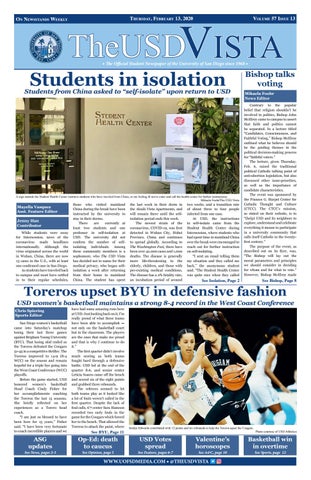
A sign outside the Student Health Center instructs students who have traveled from China, or are feeling ill not to enter and call the health center for further instructions. Mikaela Foehr/The USD Vista
Mayella Vasquez Asst. Feature Editor Jenny Han Contributor While students were away for Intersession, news of the coronavirus made headlines internationally. Although the virus originated across the world in Wuhan, China, there are now 13 cases in the U.S., with at least one confirmed case in San Diego. As students have traveled back to campus and most have settled in to their regular schedules,
those who visited mainland China during the break have been instructed by the university to stay in their dorms. There are currently at least two students and one professor in self-isolation at USD. The university did not confirm the number of selfisolating individuals. Among these community members is a sophomore, who The USD Vista has decided not to name for their medical privacy, who began selfisolation a week after returning from their home in mainland China. The student has spent
the last week in their dorm in the Alcalá Vista Apartments, and will remain there until the selfisolation period ends this week. The newest strain of the coronavirus, COVID-19, was first detected in Wuhan City, Hubei Province, China and continues to spread globally. According to The Washington Post, there have been over 42,000 cases and 1,000 deaths. The disease is generally more life-threatening to the elderly, children, and those with pre-existing medical conditions. The disease has a 2% fatality rate, an incubation period of around
two weeks, and a transition rate of about three to four people infected from one case. At USD, the instructions to self-isolate came from the Student Health Center during Intersession, where students who had spent time in mainland China over the break were encouraged to reach out for further instruction on self-isolating. “I sent an email telling them my situation and they called me back,” the anonymous student said. “The Student Health Center was quite nice when they called
See Isolation, Page 2
Bishop talks voting
Mikaela Foehr News Editor Contrary to the popular belief that religion shouldn’t be involved in politics, Bishop John McElroy came to campus to assert that faith and politics cannot be separated. In a lecture titled “Candidates, Consciousness, and Faithful Voting,” Bishop McElroy outlined what he believes should be the guiding themes in the political decision-making process for “faithful voters.” The lecture, given Thursday, Feb. 6, raised the traditional political Catholic talking point of anti-abortion legislation, but also discussed other issue-priorities, as well as the importance of candidate characteristics. The event was sponsored by the Frances G. Harpst Center for Catholic Thought and Culture (CTCC). The CTCC’s mission, as stated on their website, is to “(help) USD and its neighbors to explore, understand and celebrate everything it means to participate in a university community that calls itself Catholic in the twentyfirst century.” The purpose of the event, as described out on its flyer, was, “The Bishop will lay out the moral parameters and principles we should consider in deciding for whom and for what to vote.” However, Bishop McElroy made
See Bishop, Page 8
Toreros upset BYU in defensive fashion
USD women’s basketball maintains a strong 8-4 record in the West Coast Conference Chris Spiering Sports Editor San Diego women’s basketball came into Saturday’s matchup losing their last three games against Brigham Young University (BYU). That losing skid ended as the Toreros defeated the Cougars 51-45 in a competitive thriller. The Toreros improved to 14-9 (8-4 WCC) on the season and remain hopeful for a triple bye going into the West Coast Conference (WCC) playoffs. Before the game started, USD honored women’s basketball Head Coach Cindy Fisher for her accomplishments coaching the Toreros the last 15 seasons. She briefly reflected on her experiences as a Torero head coach. “I am just so blessed to have been here for 15 years,” Fisher said. “I have been very fortunate to coach incredible players and we
ASG updates
See News, pages 2-3
have had some amazing runs here at USD. Just looking back on it, I’m really proud of what these teams have been able to accomplish — not only on the basketball court but in the classroom. The players are the ones that make me proud and that is why I continue to do it.” The first quarter didn’t involve much scoring as both teams fought hard through a defensive battle. USD led at the end of the quarter 8-6, and senior center Leticia Soares came off the bench and scored six of the eight points and grabbed three rebounds. The referees seemed to let both teams play as it looked like a lot of fouls weren’t called in the first quarter. Despite the lack of foul calls, 6’7 center Sara Hamson recorded two early fouls in the game for the Cougars which forced her to the bench. That allowed the Toreros to attack the paint, where
See BYU, Page 11
Op-Ed: death to caucus See Opinion, page 5
Jordyn Edwards contributed with 12 points and six rebounds to help the Toreros upset the Cougars.
USD Votes spread
See Feature, pages 6-7
Valentine’s horoscopes See A&C, page 10
WWW.UOFSDMEDIA.COM ◆ @THEUSDVISTA
Photo courtesy of USD Athletics
Basketball win in overtime See Sports, page 12
2
The USD Vista
◆
February 13, 2020
NEWS
Caronavirus precautions
Student questions effectiveness of isolation and worries about missed class time
Isolation from Page 1
me. They gave me the information and service patiently.” Pamela Sikes, director of the Student Health Center, outlined the university’s decision to have certain students self-isolate. “These (instructions) are taken from federal and local recommendations,” Sikes said. “As a rapidly evolving situation, the recommendations have been changing as we learn more and will likely continue to change. The initial recommendations pertained to those with travel from Wuhan, and then it expanded to Hubei, and then it expanded to mainland China.” While the student understands the reasoning behind the instructions to self-isolate, and noted that their experience with the Student Health Center went smoothly, they are concerned about keeping up with their classes and about harmful judgment and stereotypes that have been leveled at Chinese people since the beginning of the outbreak. “I understand this policy and the situation, I’m just a little
worried about class material and being seen as a disease by American students,” the student said. Globally, the fear of the coronavirus has spread false stereotypes, especially on social media, about Chinese culture. There have also been some instances of tension toward those
instances are not, have expressed that people have physically recoiled from them. In Seoul, South Korea stores are posting “No Chinese allowed” signs. But while there are sentiments of xenophobia, there have been some attempts to counter these stereotypes. In regard to schoolwork, the
“I understand this policy and the situation. I’m just a little worried about class material and being seen as a disease by American students” - anonymous student of Chinese descent. For example, a viral post on Instagram falsely claims that “bat soup” is a Chinese dish and also makes claims that Chinese customs are at fault for the virus. The platform TikTok has also been used by some users in attempts to express their sentiments of racism through a humorous light. Additionally, on other platforms people who appear to be from East Asia, who in many
student has worked to keep up with their classes online and reached out to professors for guidance. Professors themselves have reported emails from the school that both identify isolated students and ask instructors to work with them to create a reasonable study plan during the 14-day period. Philosophy professor Tanya Hall was one of the professors who has received this email.
“It’s complicated,” Hall said. “I feel as if the self-quarantine is a burden on the students and I just want to help them as much as I can.” Hall also acknowledged that there were gray areas in the policy concerning who should be quarantined. “Let’s say that hypothetically that a student who came from China shook hands with classmates,” Hall said. “Does that mean that the classmates also need to be quarantined too? Where exactly the line is drawn is difficult to say.” The student also expressed concerns regarding the effectiveness of isolation, noting that while they recognized why the isolation was necessary, the implementation of it had flaws. “I had already attended class for a week before this,” they said. “If I had the virus, even if it’s not exposed yet, it was already spread to others.” Additionally, the student is still living with non-isolated students during the 14-day period, adding another level of concern. Sikes clarified that there are
benefits to this isolation, even if it is delayed. However, she noted the difficulty that roommates pose to self-isolation. “Even a delay in self-isolation could have spread prevention benefits,” Sikes said. “We know that those who do become infected with 2019-n-CoV can do so 2-14 days after exposure. Practicing self-isolation with roommates or household members is a bit more challenging.” The student has not experienced any symptoms, and is expected to return to classes after this week. “Although this is a low risk situation to our community, we are taking high precautions,” Sikes said. “We are appreciative of our community members who traveled from China and were so considerate of the health of our community and followed the self-isolation information. More importantly, we are very glad that there are no cases of 2019-n-CoV exposure or cases at USD.” If students experience symptoms of the coronavirus, they are encouraged to call the Student Health Center.
ASG’s start to the semester
Thursday’s senate meeting began with housekeeping procedures and announcements Mikaela Foehr News Editor The first Associated Student Government (ASG) senate meeting of the semester began with procedural updates. These included confirming members who were both filling vacated seats or being appointed to the newly created judicial branch, discussing the publication of the budget, outlining the election process, and explaining expectations for the semester. The fall semester was marked by conflict over the College Readership Program, frustration over lack of senator participation, and calls to be more transparent. This semester, the executive board of ASG is looking to change that. “This semester there is no room for excuses,” said Speaker of the Senate Carolina Morena Armento. “It is no longer acceptable to say you didn’t know, or you didn’t feel comfortable doing that. You have had an entire semester so you are now expected to be knowledgeable in your roles.” Morena Armento also asked the senators to increase participation in committees, noting that there is one Budget Committee seat, the Health and Wellness Committee Chair, and the Academics Committee Chair position open. Sophomore senator Chidi Okaru expressed interest in filling the Budget Committee seat. Following up from last semester, Budget Committee Chair George Saunderson
presented the finalized budget. The spring budget spreadsheet lists the allocations toward each organization and contains visual representations of each organization’s budget in relation to the others. Saunderson also stated that the budget will be made public on ASG’s website, and will be downloadable. Senator Justin Daus asked for an estimate on when the budget would go public. Saunderson did not specify the date the budget would be released, but did say that the budget is ready. “Since the budget is finalized and all its visual aspects are ready, all we have to do is start the web approval process,” Saunderson said. Jesse Magaña, the chair of the Diversity, Inclusion, and Equity Committee is also working on publishing ASG information. Magaña’s committee is in the process of gathering information from the campus climate survey that they sent out last semester. The survey was aimed at discovering the degree to which different groups of students feel included, represented, and supported on campus. Senators began discussing the upcoming elections. The informational meetings on the races and offices will be held from March 9-24, with applications due on March 25. After the application deadline, candidates will have less than a month until the voting period, which will run from April 16-17.
◆
Volume 57 Issue 13
NEWS
The USD Vista
◆
Leadership training halted
3
A video sparks anger toward, and discomfort among, ASG senators and advisors Mikaela Foehr News Editor At a student leadership training event, a video shown during a presentation on communication across differences was taken to be racially insensitive. Student leaders involved in Associated Student Government (ASG) and Torero Program Board (TPB) attended the training, held on Saturday, Feb. 1, which was run by the faculty advisors for both of these organizations. It was during a presentation by Nicholas Twohig, a graduate assistant at USD, entitled “Dialogue Through Differences” that the video was shown. The video was a TEDx Talk titled “Why I, as a black man, attend KKK rallies” given by Daryl Davis. The 18 minute speech consists of Davis explaining why he came to a personal decision to seek out Ku Klux Klan (KKK) members and attempt to understand “how they can hate an entire race that they do not know.” In the video, Davis expresses that his purpose of giving these talks is to explain how “fear of the unknown breeds hate.” The intention behind showing this video was to depict an example of bridging serious racial divides through communication, but that was not the message received in the room. The video does depict (KKK) paraphilia at times, and no trigger warning was given to the students. According to Speaker of the Senate Carolina Morena Armento, a collective decision was made to stop the presentation after some student leaders in the room became visibly uncomfortable and upset. The entire training ended shortly after due to the lingering emotional effects the students had after viewing the video. Morena Armento also specified that Twohig, “was given the opportunity to take responsibility for his actions and lack of triggerwarning use that day, but he declined.” During the senate meeting on Thursday, Feb. 6, the events
of the previous Saturday were prominent in the minds of senators and members of the public. When it came time to discuss the events of the training, sophomore Senator Chidi Okaru read a prepared statement. Okaru was dissatisfied with the handling of the video within
Her statement prompted apologies by members of the senate, such as Elisse Etcheverry, the TPB Chair, who did not speak up against the video as it played. “I speak on behalf of Torero Program Board and I want to make it clear that no one condones what happened,” Etcheverry said.
“For you to be quiet and not say anything in the face of someone else’s adversity, you are just as wrong, and just as bad” - Alanna Bledman the presentation’s context and with the overarching decision to use that particular video. In her statement, she implored the senate, TPB, the university administration, and the broader campus community to take complicated racial instances involving students of color seriously. Okaru particularly emphasized this in the context of black student experiences at USD, who are severely underrepresented on campus and make up only 3% of the student body. “We must be vocal in the face of hate,” Okaru said. “It is the responsibility of ASG and campus administration to stand against hate, whether it is the vandalization of buildings on this campus by white supremacist stickers placed by currently unnamed male individuals, or the act of forcing racist and disrespectful ideology upon students under the guise of training and active listening.” Okaru’s statement also called on TPB to create more events that promote relevant diversity and inclusion, for TPB to also try and reflect campus diversity within their own staff, and for the Department of Public Safety to keep students better informed and updated on raciallycharged events such as the act of intolerance that occurred over Intersession.
“I cannot speak to why no one else spoke in that moment but I do want to say that I am very sorry for not speaking up in that moment.” Etcheverry also pledged to create an emphasis on increasing diversity and inclusion in TPB’s programs and staff this semester. Following the senate discussion, members of the public had a chance to speak. Many followed suit and expressed their anger and disappointment in
“I for one am tired of seeing the same seats empty, the same people with proxies, the same people saying they don’t know how to do their job, the same people silent, and the same people doing nothing” - Jesse Magaña the decision to show the video, the lack of competent discussion around the video, and in the lack of oversight that allowed the video to be shown. Ayo Bandele, a senior student who was not a part of the Saturday training, was concerned that the discussion would center on retroactive feelings, and not on next steps or consequences for the senate, and Twohig. “Who cares what we are feeling right now?” Bandele said.
The USD Vista Kaia Hubbard - Editor in Chief Celina Tebor - Associate Editor Amy Inkrott - Managing Editor Jennifer Mossuto- Copy Editor Alee Pingol - Art Director Mikaela Foehr - News Editor Eric Boose - Opinion Editor
“I want to know what you do when someone does something like this.” Elie Nyembo echoed Bandele’s thoughts, expressing his anger at Twohig’s decision-making process by asking, “Who is going to be leading these cultural competency discussions? Because clearly the person leading these discussions was not culturally competent.” Other members of the public offered the senate their input for how to move forward from this incident. Alanna Bledman recommended that if this situation was too uncomfortable for members of the senate, based on the apparent lack of discussion surrounding this event, then they should step down. “I understand how exhausting this work is, but if you are not willing or capable please give your seat up to someone else who is,” Bledman said. “For you to be quiet and not say anything in the face of someone else’s adversity, you are just as wrong and just as bad.” Some senators, such as Jesse Magaña, the Inclusion, Diversity, and Equity Committee Chair, took up this call as well, reiterating that
Catherine Silvey - Feature Editor Lizzy Jennings - Arts & Culture Editor Chris Spiering - Sports Editor Connor Buckley - Distribution Manager Molly Feeney - Social Media Manager Jake Schmid - Finance Manager Max Rabin - Advertising Manager
this is a difficult job that demands time, effort, and being exposed to difficult situations where you may be criticized for your decisions and actions. “I for one am tired of seeing the same seats empty, the same people with proxies, the same people saying they don’t know how to do their job, the same people silent, and the same people doing nothing,” Magaña said. “If you can’t do it, then give up your seat and allow space for people
Editorial – 619.260.4584 Business – 619.260.4714 www.uofsdmedia.com / @TheUSDVista Gina Lew - Student Media Advisor Marie Minnick - Operations Advisor
who are ready to be committed to the work.” The public also demanded more oversight on presentations like this. Those who spoke requested to know what was being done to hold those responsible for the presentation accountable for emotional stress caused. These complaints were namely directed toward Nicholas Twohig, who gave the presentation, and Assistant Vice President of Student Affairs Cynthia Avery, Ed.D. who approved it. In response to this, and other calls for the senate to be more proactive in their leadership, Fanisee Bias, the Student Organizations Chair, pledged to reach out to Avery, who left the senate meeting early, and confirm that she would be in attendance at the next senate meeting. Bias also encouraged members of the public to come to her if they ever wanted “final business” moved up in the senate’s agenda. Final business is the portion of the senate meeting where members of the public are able, and encouraged, to speak their minds on senate business. Presently, Nicholas Twohig is not working on campus, and his further involvement with ASG is being discussed according to Jen Lee, another ASG advisor. If any students have further questions on this event, the ASG executive team and the ASG advisors maintained that their doors are open to discuss the event and answer any questions that they currently have answers to. The USD Vista reached out to Dr. Avery and asked for clarification on the video’s intended purpose, but she refrained to comment, only confirming that she will make a statement at the next senate meeting. The USD Vista also reached out to Chidi Okaru for further clarification on the events of the student training and had not received a response by the time of publication. The next meeting will be held on Thursday, Feb. 13 in Solomon Hall, beginning at 12:30 p.m.
The USD Vista publication is written and edited by USD students and funded by revenues generated by advertising and a student fee. Advertising material published is for information purposes only and is not to be construed as an expressed or implied endorsement or verification of such commercial venues by the staff or University. The USD Vista office is located on the fourth floor of the Student Life Pavilion in room 403B. All inquiries should be sent to: The USD Vista 5998 Alcala Park San Diego, CA 92110 Opinions expressed in this publication are not necessarily those of The USD Vista staff, the University of San Diego or of its student body. Letters to the Editor can be submitted to The USD Vista office. Letters should be limited to 300 words and must be signed. For identification purposes, USD identification numbers and writer’s year must be included in the letter. The USD Vista reserves the right to edit published letters. Any content sent to the editor will be considered for publication unless otherwise stated.
4
The USD Vista
◆
February 13, 2020
OP I N ION
Death to the Caucus
Audrey Garrett Cartoonist
Baylynne Brunetti Contributor
Race is no joke
Racism is more contagious than the coronavirus Jenny Han Contributor Our generation is no stranger to using humor as a coping mechanism. Memes and humorous comments about the tragedies of 2020 from the possibility of World War 3 to the death of Kobe Bryant pop up spontaneously the moment they happen and it fills our nihilistic hearts with joy. However, some of the content produced in light of the most recent pressing issues, the coronavirus, shifts away from amusing to racist and that is not okay. According to The Wall Street Journal, “health officials believe the outbreak originated in a large animal and seafood market in Wuhan, China.” It’s due to these Asian origins that some inaccurately believe that all Asians must be carrying the disease. I first encountered this maliciousness when one of my friends back from high school vented to me about their frustrations about the racist comments and posts they’ve been seeing in regards to the coronavirus. Curiosity took over me as I searched “coronavirus” in the search bars of both TikTok and Instagram. To put it simply, I was disgusted. A prime example of this racism that I found were the comments on a TikTok featuring
a voice message of a medical staff in China. Overall, the racist comments could be categorized into two categories. The first category featured comments that attempted to be funny but ultimately would come off as insensitive and ignorant — comments like “I just had Chinese food yesterday.” The second kind of comments were blatantly malicious and intentionally cruel, saying things like, “Let natural selection do its thang ... keep the gene pool strong” or “I mean it’s kinda good. It’s overpopulated anyway.” Some of you may be wondering why any of these comments are demeaning and why I personally take offense to them. Before you say anything, I do have a sense of humor and I do appreciate a “it’s Corona time!” TikTok from time to time; I am not arguing against people who joke about the coronavirus itself. But what I do not appreciate is my ethnicity being the target of that coronavirus joke because we are just as susceptible and worried, and if anything more scared, about the whole situation. Every time I sneeze during class, I am terrified of the reactions I might get because they assume I have an illness that I do not have. I am very lucky as of now to say that none of my peers have treated me this way, but the fear is
very much implanted in me. The bottom line is that any illness, including the coronavirus, does not discriminate. An Asian person is just as likely to get sick from a non-Asian person and vice versa. If you are worried about getting the virus, there are several precautions that you can take. According to Centers for Disease Control and Prevention, washing your hands with either soap and water or using an alcohol-based hand sanitizer especially before eating and after going to the bathroom or blowing your nose, coughing, or sneezing are some of the things that you can easily do. Being racist is not one of those options. I hope that everyone affiliated with the University of San Diego cares or at least acknowledges this because I would like to believe that we promote and represent a college that accepts each other for what we are. If you catch someone else, or perhaps yourself, making a joke about Asians in regards to the coronavirus, ask this question: are you really afraid of the virus or are you actually afraid of those who are unlike you? To learn more about the coronavirus and its impact on the USD campus community, read “Students in isolation” on page 1.
A thought that went through many Americans’ minds this past week was, what is a caucus? Followed by, why is Iowa so important? These are both valid questions that even the most politically eloquent people have a difficult time explaining. But, there is a reason only a handful of states and U.S. territories are still holding a caucus instead of a primary: it disenfranchises voters and throws a wrench into our democracy. The caucus system is no longer beneficial and should be thrown out completely. First and foremost, let us sort through what a caucus is. A caucus is a party-organized gathering of members to discuss their presidential preferences, elect local party leadership, and discuss issues that make up the party’s platform. Both parties conduct their caucuses differently, but since we are dealing with a democratic caucus, we will keep the view strictly on how the Democrats’ caucuses work. Democratic caucus-goers gather in groups to pick their preferred candidate. They are then counted up, and it’s determined whether a candidate group is viable or not viable. Depending on the number of county delegates to be elected, the viability threshold is typically 15% of attendees. If a group is not viable, they can choose to recruit people to their group or join another group. A final tally is counted, then delegates are distributed via those tallies. Fundamentally, there are a variety of issues with the concept of having a caucus over a primary. To begin, the caucuses only take place over the course of one evening, at specific times and go on for hours on end. Not everyone has the ability to attend those peculiar hours. People have children, people have jobs and some voters lack adequate access to transportation. The perplexities which could prevent a person from going to a caucus could go on and on. The caucus system is not something that works anymore and the argument that it is a democratic “institution” falls flat. The system prevents high voter turnouts, and peer pressures individuals to vote a specific way due to the viability aspect. Just because an event is
a tradition does not mean that it should continue to exist if it is only undermining our democracy. How many people were not represented because they did not attend the caucus? If you look at the number of registered voters versus the caucuses’ turnout, in Iowa 1.8 million people were not represented in the caucuses. In December, Iowa Secretary of State Paul Pete reported that voters in Iowa “made history,” with more than 2 million residents being registered to vote heading into the general election year. However, only around 172,669 final alignment votes were counted in the caucuses last week. That is an unacceptably large margin to have and a deafening silence of voices that did not get to be heard as the country moves forward with the primaries. Iowa is considered important during the primary season because it is the first insight into who the presidential nominee for each party could be. Iowa prides itself so much on being the first state to supply delegates that they have it written in their Constitution to be the first state to kick off the election season. With this in mind, it makes it even more important that Iowa has a primary in order to ensure that more voices are heard, and that a small number of people are not speaking for the entire state — and ultimately the country. Extremely low voter turnout is not the way to start an election process. These are just statistics from the state of Iowa. We will not see how the rest of the caucuses — Nevada, North Dakota, and Wyoming — turn out until after the primary season, but it is reasonable to assume they will end up with the same high levels of disenfranchisement across the country. A caucus taking place of a primary voting is not beneficial to anyone except the small group of people who are there to potentially skew the results of an entire state. Iowa was important to observe because for the first time, it cast a shadow of doubt on the caucus system. In order to ensure every voice is heard, it is time for Iowa and the fellow caucus-style states to follow suit and implement a primary system. It definitely makes sense for us to abolish this archaic system and make voting more accessible to everyday people.
States (other than Iowa) with caucuses Nevada (Feb. 22) North Dakota (Mar. 10) Wyoming (Apr. 4)
The views expressed in the editorial and op-ed sections are not necessarily those of The USD Vista staff, the University of San Diego, or its student body.
Volume 57 Issue 13
◆
OPINION
◆
The USD Vista
Alcohol policy must catch up
5
USD should follow lead of SDSU, UCSD in implementing school-wide amnesty policy Eric Boose Opinion Editor On Nov. 8, 19-year-old San Diego State University (SDSU) student Dylan Hernandez died as a result of injuries he sustained falling from the top bunk of his bed. According to SDSU campus police, Hernandez had returned to his room with a blood-alcohol content of 0.23 percent — almost three times the legal limit — following a fraternity party the night before. Immediately following Hernandez’s death, SDSU suspended all 14 of the fraternities on its campus, and launched a pair of task forces to “evaluate student activities and safety practices around alcohol and substance misuse,” according to 10News San Diego. On Jan. 25, SDSU acted on the advice of those
reporting Recognized Student Organization(s) for violations of the alcohol or drug policies (of the Student Organization Code of Conduct), which took place during or immediately before the time of the incident.” In essence, members of RSOs, like fraternities or sororities, can (and should) get help for someone in need without worrying about getting in trouble. The University of California, San Diego (UCSD) has a similar policy in place — the Medical Amnesty Program. That leaves the University of San Diego as the only one of the three big San Diego colleges which does not publicly have such a policy. These policies are crucial steps in a positive direction, but they should bring up a greater point: whether universities should prioritize the safety of their students or enforcing their alcohol policies.
“Drinking is so central to students’ expectations of college that they will fight for what they see as a basic right.” -Beth McMurtrie task forces by creating new rules and regulations for fraternities and sororities about recruitment and new-member education, increasing transparency surrounding the judicial status of campus organizations, and most importantly instituting a “Good Samaritan” policy. In a letter to students, SDSU explained, “the Good Samaritan Policy is in place to ease concerns or any reason for hesitation that members of Recognized Student Organizations (RSOs) may have in seeking help for others should an emergency or crisis arise.” The letter goes on to detail how the policy works, stating, “if a Recognized Student Organization seeks appropriate emergency personnel response and reports the incident to the University via the Office of Student Life & Leadership at the time of the incident, the University will not assign formal disciplinary sanctions to the
It would not be unreasonable for university administrators to feel trapped by a dual mandate — upholding drug and alcohol laws and policies while also keeping students safe. Clearly, a Good Samaritan policy largely fails the first half of that mandate, letting violations of the law and/or university policy slide in order to keep students safe. Ultimately, that trade-off is one that universities should be making. Drinking in college is so ingrained in American culture that preventing underage drinking will take far more than just laws and policies. In a 2014 article in The Chronicle of Higher Education, Beth McMurtrie writes that, “Drinking is so central to students’ expectations of college that they will fight for what they see as a basic right. After Syracuse University … tried to limit a large outdoor gathering, outraged students labeled the campus a police state.” Plainly,
if a university could control students’ drinking through some sort of policy, they would have done so by now. At the same time, the amnesty programs at both SDSU and UCSD are nowhere near simply turning a blind eye. Both programs explicitly mention the possibility (and in UCSD’s case, necessity) of documentation and meetings with university staff. With that understanding, the best thing universities can do is institute policies which will help keep students safe. The dangers of drinking in college are well documented. McMurtrie states that over 1,800 college students die from alcoholrelated causes each year, and approximately 600,000 more are injured while drunk. She also notes that every year since around 1994, about 40% of the nation’s college students engaged in binge drinking — one of the most dangerous drinking behaviors. There is no point trying to pretend that no USD students partake in typical collegiate drinking behaviors. While binge drinking and underage drinking may not be as prevalent at USD as at larger schools, it is still a college, and we do have social fraternities and sororities — the organizations which are most historically associated with drinking. Again, USD’s Fraternity and Sorority Life is not as troubled as SDSU’s, but that is not a reason to forego any sort of amnesty policy. Frankly, any university where students have an opportunity to drink in a potentially dangerous manner should have some policy in place to promote students’ safety. Other universities across the country have seen the effectiveness of Good Samaritantype amnesty policies. Cornell University implemented a medical amnesty policy in 2002, a policy used as a case study four years later. That study found that in the years after the amnesty policy was announced, more students called for assistance for alcohol-related emergencies and fewer students said they would not call emergency services for
fear of disciplinary action. The percentage of students who visited Cornell’s health center for a “brief psycho-educational intervention” following an alcohol-related
with that reality, the best thing schools can do is take steps to encourage student safety around alcohol. A Good Samaritan-type amnesty policy is one of the
“The Good Samaritan Policy is in place to ease concerns or any reason for hesitation ... in seeking help for others should an emergency or crisis arise.” -SDSU letter to students emergency jumped from 22% to 52%. Most importantly, Cornell’s success seems to be the general rule, not an exception. At the end of the day, universities will have to confront a frustrating truth: barring a seismic shift in American culture, college students are going to drink in ways that are dangerous and sometimes illegal, regardless of university policies. Faced
most tried and tested methods of doing so. It encourages students to seek medical attention when necessary, while still maintaining some sort of accountability. At San Diego State, it took the death of a student to get a Good Samaritan policy implemented. That cannot be allowed to happen here. USD should be actively designing a similar policy to implement as soon as possible.
The views expressed in the editorial and op-ed sections are not necessarily those of The USD Vista staff, the University of San Diego, or its student body.
6
The USD Vista
◆
February 13, 2020
Photo courtesy of Vivian Mateos
With the California presidential primary less than a month away, USD Votes has jumped into action. Founded in 2014 by University of San Diego political science professor, Casey Dominguez, Ph.D., the club has worked hard for the last six years to increase voter participation at the university. Led by Dominguez and fellow faculty advisors Evan Crawford, Ph.D., and Cory Gooding, Ph.D., the club’s perseverance has paid off, as they have found that the school’s voter turnout has increased by nearly 30% since the club’s inception.
USD V
Photo courtesy of Vivian M
USD Votes focuses primarily on voter registration and making sure students are informed about how and where to vote. The club sets up tables all around campus at which students can register to vote in California and receive information about how to register in other states. USD Votes meets every other Tuesday from 1:30 p.m. to 2:15 p.m. in the Joan B. Kroc School of Peace Studies Map Room, and interested students can visit www.sandiego.edu/vote/ for more information about the club.
MAJOR: POLITICAL
Why is votin “ Voting is one of the most powerful tools we hav adults. We all have opinions about political affairs an governmental decisions, so it makes sense that we have are other countries (or even other times in United Stat of us wouldn’t have had the legal capacity to vote, so I sense of responsibility and privilege
Does the club have any specific goals for the pre and/or the presidential “USD earned a ‘gold seal’ in 2018 from the ALL Challenge that our campus participates in. We reached increased our voter turnout rate from 16% in 2014 to 45 keep this “gold seal” status, we need to hit a voter turno big goal, but it’s one that USD ought to be able to achi campus that prides itself on producing well-informed, p society, we should have a turnout rate of significantly m Votes, we’re optimistic that we can exceed this goal, b the whole camp
Photo courtesy of Vivian Mateos
Volume 57 Issue 13
◆
FEATURE
NAME: VIVIAN MATEOS YEAR: SOPHOMORE MAJOR: POLITICAL SCIENCE
D VOT ES
Mateos
◆
7
The USD Vista
Photo courtesy of Vivian Mateos
Why is voting important to you? “Voting is important to me because it’s the best way to hold our elected officials accountable and ensure that our voices are heard. As young people, it’s easy to feel that we have no political power, but by voting our voice is equally heard.” Do you have a favorite memory of being in this club/registering people to vote? “My favorite memory was definitely National Voter Registration Day because a couple of days before, we found out that our voter turnout had gone up nearly 29% since USD Votes was first founded in 2014. This meant that we went into National Voter Registration Day feeling incredibly motivated and excited.”
NAME: LINNEA LEIDY YEAR: JUNIOR SCIENCE AND HISTORY
ng important to you? ve — especially as young nd we are all affected by our voices heard. There tes history) when many I always feel that added e when I cast my ballot.”
esidential primaries l election in the fall? L IN Campus Democracy d this status because we 5% in 2018. In order to out rate of 65%. This is a ieve. As a changemaker productive members of more than 65%. At USD but we’re going to need pus’ help to achieve it!”
NAME: GARRETT PAULUS YEAR: JUNIOR MAJOR: POLITICAL SCIENCE AND HISTORY Why is voting important to you? “Voting is important to me because it’s my way of having a say in the decisions that are made by the government. I can vote to choose what type of people and policies I think should reflect our diverse culture in the U.S.”
Photo courtesy of Vivian Mateos
What motivated you to join USD Votes? “I was motivated to join USD Votes because I’ve always had a passion for government and politics, and I wanted to find a way where I could be civically engaged with people my age.”
Spread by Alee Pingol/ The USD Vista; Content by Catherine Silvey/ The USD Vista
8
The USD Vista
◆
February 13, 2020
FEATURE AR TS &
Bishop McElroy talks politics
Bishop McElroy visits USD and urges Catholics to vote based on their religious values
Bishop from Page 1
it clear that he did not come to USD to tell people how to vote. “It is not the church’s position to endorse candidates, and I am not here to tell you who to vote for,” Bishop McElroy explained. The bishop spoke for roughly 30 minutes outlining what the Catholic Church believes should be the most important considerations for Catholics when they walk into the voting booth. Contrary to popular opinion, Bishop McElroy did not outline one specific issue as the preeminent issue for voting Catholics, but instead offered ten that he, on behalf of the church, believed should be considered and weighed, according to personal importance. Although, Bishop McElroy did spend a disproportional amount of time discussing the issues of climate change and abortion laws compared to the other eight issues. At times, Bishop McElroy even insinuated that climate change may be a more pressing issue than abortion since “the survival of the planet, which is the prerequisite of all human life, is at risk.”
He added that “faithful voters” should also consider the phenomenon of “the culture of exclusion that has grown so dramatically in our nation these last three years.” As well, he implored voters to consider the “competence and character” of presidential candidates, in such a way that it is equally important to the issue considerations. “Character is an even more essential element in effective faith-filled voting at the present moment, and another reason why faith-filled voting cannot be simply reduced to a series of competing social justice teachings,” McElroy said. USD community members and members of the general public attended the event. Some of the students who attended were encouraged to come through extra credit offerings in their classes, like senior Rielly Diaz. “Two of my classes were offering extra credit for going, but I was also really interested to hear what he had to say,” Diaz said. Diaz said that he had no expectations going into the lecture, but admitted that some of Bishop McElroy’s
claims surprised him. “Where the shock factor came in was when he said that abortion is no more of a priority than climate change,” Diaz said. “I expected him to take a much stronger stance on that.” It became evident that Diaz’s surprise was shared among audience members when the floor opened up for questions. Many of the questions posed by audience members referenced the abortion and climate change policy conflict. Some of these questions were posed (not by anyone affiliated with USD, to the best of The USD Vista’s knowledge) in an accusatory manner, but McElroy remained calm and stuck to his previously voiced stances. One unnamed audience member, seemingly not affiliated with USD, made it clear that she expected a stonger stance on abortion issues by saying, “Your excellency, you mentioned a lot of Catholic social teaching, but you did not mention the 10 Commandments. Abortion is the torture and murder of an innocent human being, and they are now advocating it right up to birth, and beyond.”
Bishop McElroy spoke on a wide range of topics, from climate change to abortion. Mikaela Foehr/The USD Vista
Two USD professors also spoke up during the question portion of the lecture. Associate professor in the political science department, Evan Crawford, Ph.D., and philosophy professor Turner Nebit, Ph.D. Both professors asked questions related to their fields of study, and although the bishop did not answer either of their questions straightforwardly, he was visibly happier to discuss their thoughtprovoking questions compared to the previous accusatory ones. Mary Doak, Ph.D., who also attended the event, offered the lecture as extra credit for her students. Doak, a theology professor, is teaching a Faith and Politics course. “From a faith and politics
perspective I wanted my students to go and see what Bishop McElroy thinks religion has to bring to politics,” Doak said. “It is important and interesting to see how the bishop relays the official teachings of the Catholic Church in an in-depth manner, when most people only hear the political talking points.” The presidential primary elections, which prompted the organization of this lecture, will be held, in the state of California, on March 3. Leading up to the primary day, the oncampus organization USD Votes will be holding events across campus to spread awareness about the election, as well as to help students and faculty alike get registered to vote.
pointloma.edu/12monthMBA
Volume 57 Issue 13
◆
ARTS & CULTURE
◆
The USD Vista
A RT S & C U LT U R E
9
Finding love in the stars
The USD Vista helps you find love this Valentine’s Day with some help from above Lizzy Jennings A&C Editor As Valentine’s Day draws near, love is in the air for the students of USD. But with so many great students on campus, how can you really know who is the one? For a little guidance, we recommend you look to the stars to lead you through the tumultuous sea of love at USD, especially because 2020 is a year of new beginnings and new opportunities. Read our zodiac pairings below for some lighthearted recommendations on all things love and compatibility to get you in the Valentine’s Day spirit, and be sure to let The USD Vista team know if you find love with a compatible sign! Aries & Leo Aries and Leos pair well together in this fiery combination of intense energy. Aries are known for being impulsive and exciting, which means they need a match that can keep up with their intensity. Leos are known for their warmth and their love of attention, and would bask in the all-consuming glow of an Aries. Though the combination of fire and fire can be a bit much at times, ultimately these two signs are able to keep up with and understand each other, fuel the fire if you will, in a way that earth and water signs may not.
Celina Tebor/The USD Vista
Cancer & Virgo The practicality that characterizes Virgos can help stabilize the sensitive Cancers, who are known to be extremely emotional. However, what brings these two signs together is their practical nature and ability to put aside the chaotic tendencies of other signs in favor of stability. Most importantly, both these signs are known to be caring and calm signs, which means a duo that falls under these
stars will be communicative and relatively unproblematic. Sagittarius & Capricorn One of the more unique pairings on this list, combining the practicality of Capricorns with the adventure of Sagittarius proves how opposites really do attract. Drawn to stability and security, Capricorns would be a pillar in the lives of the Sagittarius, who are characterized by their outrageous
storytelling and their love for humor. Though the Capricorns could find the Sagittarius’ way of living unfamiliar, this draw to excitement could be just the push a Capricorn needs to step outside their own comfort zone. Scorpio & Aquarius Notoriously hard to match Scorpios are last on this list of pairings, as it takes someone really special to keep up with the fierce energy of the Scorpios.
Passionate and relentless, these Scorpios seek a match that can keep up with their intensity. An Aquarius would serve the Scorpio well, as they are known for being a sign that has an intrinsic understanding of people. One of the most defining Aquarius tendencies is to always see the big picture, which would fit well with the all-consuming energy of the Scorpio, feeding into their relentless enthusiasm for passion and excitement.
Taurus & Pisces The final sign in the astrological order is Pisces, a sign known for their sensitivity and kindness, making them a kind-hearted match to any of the signs. A practical Taurus would pair well with the Pisces, as they have a knack for romanticism. Though known for being a little introverted, and with Pisces being defined by their sensitivity, pairs from this sign could be hard to spark. However, once they come together, these duos can show how powerful combining quieter signs can be; combining earth and water creates clay, demonstrating how different signs can come together to create something new and useful. Gemini & Libra Both Geminis and Libras are both known to be analytical and witty but also sociable. This means that they have a lot in common which would help them hit it off pretty easily. Both of these signs require time and patience to acquire each other’s trust but once they do, these signs are incredibly loyal and will have each other’s backs until the end. Fun, flirty, and intelligent conversations combined with unwavering loyalty for each other is the perfect recipe for romance. Audrey Garrett/The USD Vista
10
The USD Vista
◆
February 13, 2020
A Bite of San Diego: date night USD seniors Wyatt and Loukas are back with more unique thoughts on SD food
Wyatt Warren Contributor Loukas Diafos Contributor We thought — as I’m sure most of you changemakers do — that once in a lifetime opportunities happen only once. However, for the first time in both of our lives, we were wrong. Loukas and I were lying on the couch, savouring the sultry San Diego winter air. I looked up, knowing something was about to happen. I heard a ring pouring from Loukas’ phone, I picked it up. To my suprise, Lizzy Jennings was on the line begging us to consider creating another masterpiece for The USD Vista’s Valentine’s Day special. We agreed that if we were going back down this road, we were going to have to take our readers on a ride they’d never forget, so before you continue, take a seat, kick back, and get ready because Wyatt and Loukas are back. We’re going about this review a little differently than last time. With Valentine’s Day coming up you’re probably frantically running around trying to find something to do with your partner. Don’t fret, Wyatt and I are going to tell you what to do, depending, of course, on how far you’re willing to go for love. Level 1: Ask yourself, how much do you really love your partner? Did the spark die? Are you tired of the monotonous routine that you find yourself trapped in? That look she gives when you say “Go take a shower, it’s been a week?” We have the perfect Valentine’s Day date spot that’ll have your partners breaking up with you before you can say “check please.” 7-Eleven 6615 Linda Vista Road, San Diego, CA, 92111 If you can get past the begrudging host that’s inevitably at the door, then you’ve essentially got the fast pass on
Warren and Diafos were eager to share their creative perspective on the San Diego food scene with students once again. Lizzy Jennings/The USD Vista
the road to break up with your partner. If you don’t fill up on their large selection of packaged hors d’oeuvres, 7-Eleven has some house-made delicacies to try. Cast your gaze just left of the register to the heat box where the ever-rotating ‘meat’filled, deep-fried, crunchy, droopy, somehow stale-tasting despite being made that month, taquitos. We can almost
guarantee that a couple of those things for a Valentine’s Day dinner will both painlessly end your relationship and result in a painfully long night on the toilet. Ambiance: 2.12 - Food: 1.4 Price: $ - Service: Dynamite Level 2: Life’s good as is. Why try for more? Life’s all about maintaining the norm, don’t surpass the threshold, work the 9-to-5 and go home sad
but fulfilled so that you’re not a complete waste of a human. So that’s what we’re doing for Level 2 — helping you make sure that there won’t be wedding bells chirping in their head, but also not pushing yourselves onto the verge of a disastrous breakup. Filippi’s Pizza Grotto 962 Garnet Ave. San Diego, CA, 92109 With 14 locations across San
Diego, Filippi’s Pizza Grotto is the perfect way to show how average your feelings about your partner are. The food offers enough calories to get you through the night, but it’s bland, just like your relationship. Mario from Yelp said it best when he wrote “spaghetti not that great but chicken fettuccine was good, waitress was not friendly.” You’ll leave satisfied, but not ecstatic. Content, but not overjoyed. Your night will end as it always does; pretending to care about what happened to your partner that day, and letting out a soft, angsty sigh before falling asleep only to wake up and endure another mediocre day. Ambiance: 3.00 - Food: 3.00 - Price: $$ - Service: Average Level 3: This is it; the one that will bring your relationship from the lobby to the penthouse. If you’ve made it this far in the article, you obviously are ready to take your relationship to the next step. We’re not telling you to go out and buy a ring, but this date night idea will definitely bring you to the next level. Get your wallet out and make the reservation, because Ironside Fish and Oyster will be a night you won’t forget. Ironside Fish and Oyster 1654 India St. San Diego, CA 92101 Take a step into the inviting atmosphere of the Ironside Fish and Oyster restaurant. Service is impeccable, food is mouth watering, and the overall dining experience will bring you to the gates of heaven. Your partner will fall head over heels after you take them to this restaurant. The seafood sampler gives you a taste of what the mysterious Pacific has to offer including oysters, prawns, ceviche, and whatever else might tickle your taste buds. The wood-encased interior puts you at sea, all the while being enveloped in the safety of your lover’s arms. Ambiance: 4.48 - Food: 4.87 Price: $$$ - Service: Impeccable
A wide range of options are presented by the pair who wanted to appeal to every USD student, regardless of budget or relationship status. Featured above are the 7-Eleven and Ironside Oyster and Fish date night ideas. Photo courtesy of T.Tseng and Mike Mozart/Flickr
e r
i
Volume 57 Issue 13
◆
SPORTS
◆
11
The USD Vista
SP ORT S
Toreros defeat the Cougars USD women’s basketball moves into second place in the WCC after upsetting BYU
BYU from Page 1
the Toreros scored eight of their 17 first-half points. The Toreros maintained their lead through the second quarter as they led at halftime 17-16 in a low-scoring first half. USD had a lead for over 12 minutes as the Cougars only led for a short two minutes. Soares scored nine points and pulled in seven rebounds and junior guard Myah Pace grabbed five rebounds and drew four fouls. The Toreros shot only 19.4% from the floor in the first half, but went 5-6 from the free-throw line. Both teams turned the ball over nine times in the first half, but USD had the points-offturnovers advantage 10-2. The third quarter started off hot as just 30 seconds in, redshirt-junior guard Jordyn Edwards nailed the Toreros’ first three-point shot of the game. She finished the game with two threes, shooting 2-6. San Diego jumped out to a 28-21 lead with about five minutes to go in the quarter. But after a timeout by the Cougars, BYU went on a 10-0 run of their own and took a 31-28 lead with just under two minutes to go in the third quarter. Guard Paisley Johnson provided a huge spark for the Cougars as she finished the quarter with 15 points and going 5-6 from the free-throw line. BYU led 33-31 at the end of the quarter. Both teams put on a show in the Jenny Craig Pavilion (JCP) as the fourth quarter involved back-and-forth scoring all the way to the finish. The Toreros took the lead back from the Cougars (40-39) with under four minutes to play in the game as
The Toreros entered Saturday’s matchup losing their last three contests against the Cougars. Their last victory came at home in 2018.
the fans started to get loud. The players on the bench established their presence by cheering on the Toreros all night
double-digit scoring. Edwards contributed with 12 points, four assists, and six rebounds. Senior guard Madison Pollock ended
“I am just so blessed to have been here for 15 years. I have been very fortunate to coach incredible players and we have had some amazing runs here at USD.” -Coach Cindy Fisher long, especially late in the game. From that point on, the Toreros had control of the game as they ended the game on an 11-6 run which sealed the victory, 51-45. Three Torero players finished the game in
with 10 points and pulled down seven rebounds. Soares provided a huge lift for the Toreros off the bench as she finished the game with her first double-double on the season, recording 13 points and
10 rebounds. Head Coach Cindy Fisher talked about Soares’ performance in the victory. “When she comes in she makes an impact right away,” Fisher said. “She’s one of the best post players in this conference and she’s always a nice spark for us off the bench. She is very talented.” The Toreros went 15-18 from the charity strike — shooting a spectacular 83.3% as a team. Pace helped contribute going 7-8 from the line and Pollock went a perfect 4-4. San Diego’s defense was also a huge reason for the win. The Toreros held the Cougars to 1-10 from deep and that pleased
USD women’s Head Coach Cindy Fisher was recognized before the game against BYU for her accomplishments these past 15 years coaching the Toreros. Photo courtesy of USD Athletics
Photo courtesy of USD Athletics
Coach Fisher. “I thought our second half defensive pressure was outstanding,” Fisher said. “This is one of the best-scoring teams in the conference and to hold them to 1-10 from the three-point line is absolutely unbelievable. It’s just a credit to our defense, they were locked in, they defended, and they did everything we asked defensively.” Edwards talked about what it meant to beat a tough BYU opponent. “We have been looking forward to this game all week,” Edwards said. “We really wanted this game. We kind of wanted our revenge, we didn’t play our best at their place and so we wanted to get them back at home. It was really nice.” Soares knows how good the Toreros can be after defeating the Cougars. “Like Jordyn said, we didn’t play that well last time,” Soares said. “So we just came here and proved that we are a good team and we came here to win this game.” Edwards and the rest of the Toreros heard the loud cheers from the fans toward the end of the game. “We want to say thank you to everyone who does show up,” Edwards said. “Because it really does help and gives us energy when we are tired. We love to have a crowd and we really appreciate it.” The Toreros’ next home game will be against Pacfic University where they will take on the Tigers on National Women and Girls Sports Day. USD defeated the Tigers 66-64 in their last matchup on Jan. 18. Tip-off is at 6 p.m. in the JCP on Thursday, Feb. 13. Tickets are free for all USD students.
12
The USD Vista
◆
February, 13 2020
USD wins overtime thriller Men’s basketball defeats the Portland Pilots 88-81 in a comeback OT victory
Maria Watters Asst. Sports Editor The USD men’s basketball team ended their four-game losing streak after defeating the Portland Pilots 88-81 in an intense, nail-biting doubleovertime (OT) contest Saturday night at the Jenny Craig Pavilion (JCP). Both the Toreros (8-17, 2-8 WCC) and the Pilots (9-16, 1-9 WCC) entered Saturday’s game hungry for a win. With both teams fighting to earn their first win in weeks, one thing was clear: one team would leave the JCP victorious, and the other’s losing streak would continue. The stakes were high, and with over a thousand fans in attendance, the faceoff between the Toreros and the Pilots was stacking up to be a battle. The gymnasium was buzzing as the Toreros won the jump ball. But after two missed jump shots and a foul by redshirt-senior forward Alex Floresca, the Pilots jumped out to a quick 4-0 lead. USD managed to close the gap to 5-6 by the first media timeout; however, and a momentum shift was in the air. Coming out of the timeout, the Toreros took the lead 11-9 and held it for the rest of the half. After the first twenty minutes of play, USD led UP 30-22 with both teams shooting under 40% with three point percentages under 20%. But despite the low shooting accuracy, the Toreros would enter the second half with an eight-point lead. The Toreros were able to fend off the Pilots for the first five minutes of the second half. But slowly UP was able to close the gap and tied the game at 4141 before retaking the lead. The pressure was on for USD as they were forced to play from behind for the majority
Redshirt-junior guard Braun Hartfield is averaging 22.7 points per game in his last three games.
of the second half. As the clock wound down with the Pilots still maintaining a lead, it seemed as though the Toreros’ losing streak would continue. But USD wasn’t going down without a fight. People had come to witness a battle, and were about to see a war. After the last media timeout, redshirt-sophomore guard Joey Calcaterra tied the score at 61-61 with just under four minutes left to play. Both teams exchanged baskets, with the Pilots able to stay just ahead of the Toreros. As the last minute started counting down, two fouls by the Toreros on junior Tahirou Diabate and redshirt sophomore Takiula Fahrensohn gave UP a three-point lead with just 13 seconds left. The Toreros sprinted down the court with six seconds remaining. Calcaterra, who scored 19 points in just the
second half, launched the ball from center court and nailed a three-point field goal to tie the game at 68. The crowd erupted as every Torero fan jumped to their feet and cheered. The game was going to overtime. Overtime started as the Toreros and Pilots went backand-forth scoring for the first few minutes of OT. Redshirtjunior guard Braun Hartfield gave the Toreros a 73-70 lead after nailing a three-pointer. Although, the Pilots took control back as they scored on consecutive possessions, making the score 74-73. Hartfield sunk a free throw with 32 seconds remaining to send the game into double overtime. Saturday’s contest wouldn’t be decided in the first round of overtime. Neither team was able to silence the other as the score remained tied 74-74 after five
additional minutes of play. But after the second round of overtime, someone would be crowned victor. The Toreros were able to jump to an early lead, outscoring the Pilots 11 to 5, finally closing out the game after just under two and a half hours. USD out-rebounded Portland 21-18 in the second half and OT to help secure the victory. The USD men’s basketball losing streak ended as the Toreros advanced to 9-17 (2-9 WCC) on the season. Junior forward Yauhen (Squirrel) Massalski surpassed his career high in points by scoring 19 to help the Toreros defeat the Pilots. His previous career high was 17. Hartfield finished with a game-high 23 points in 48 minutes. Calcaterra scored all 19 of his points in the second half and overtime, including the game-
Photo courtesy of USD Athletics
tying shot in the final seconds to force OT. Redshirt-first year guard Marion Humphrey had a career-high eight assists and only one turnover. Junior forward James Jean-Marie also contributed with 11 points on 5-9 shooting. USD had nine steals as a team, which is the most since they had 10 against Stanford earlier this season in December. San Diego will go on the road to face Pepperdine University this Thursday, Feb. 13. The next home game for the Toreros is against Brigham Young University (BYU) this Saturday, Feb. 15 and will be streamed on CBS Sports Network. USD defeated BYU 8057 in the WCC tournament last season, but the Cougars defeated the Toreros earlier this season 93-70. Tickets are free for all USD students.