Since its creation, the Madison Journal of Literary Criticism (MJLC) has undergone various changes. From expanding its content beyond mere academic analyses to reshaping its vision and becoming the abolitionist organization it is today, the MJLC has been built and rebuilt from the foundation up. Despite the overhauls and obstacles, the MJLC still lives on today as a result of dozens of individuals’ persistence and enduring commitment to our work.
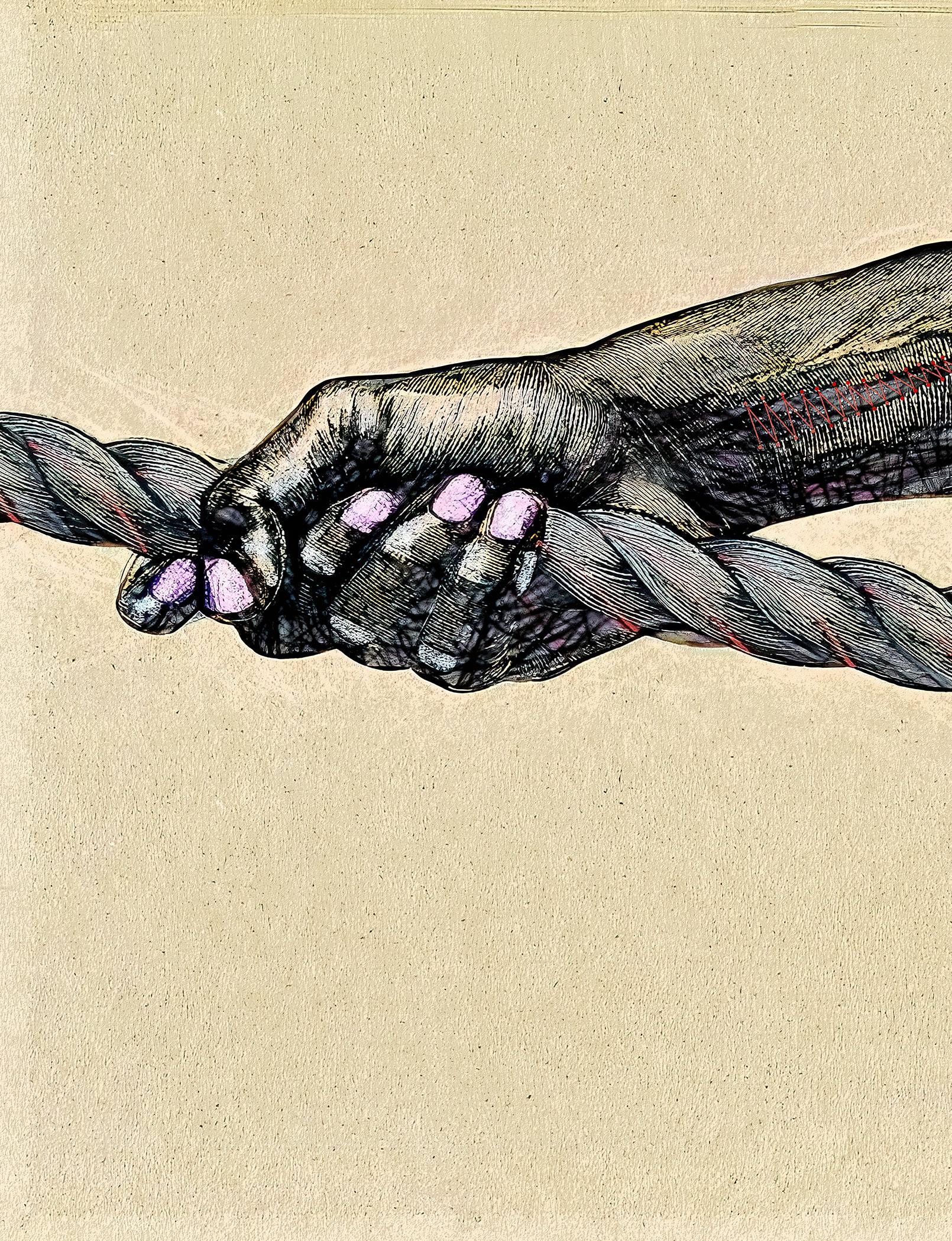
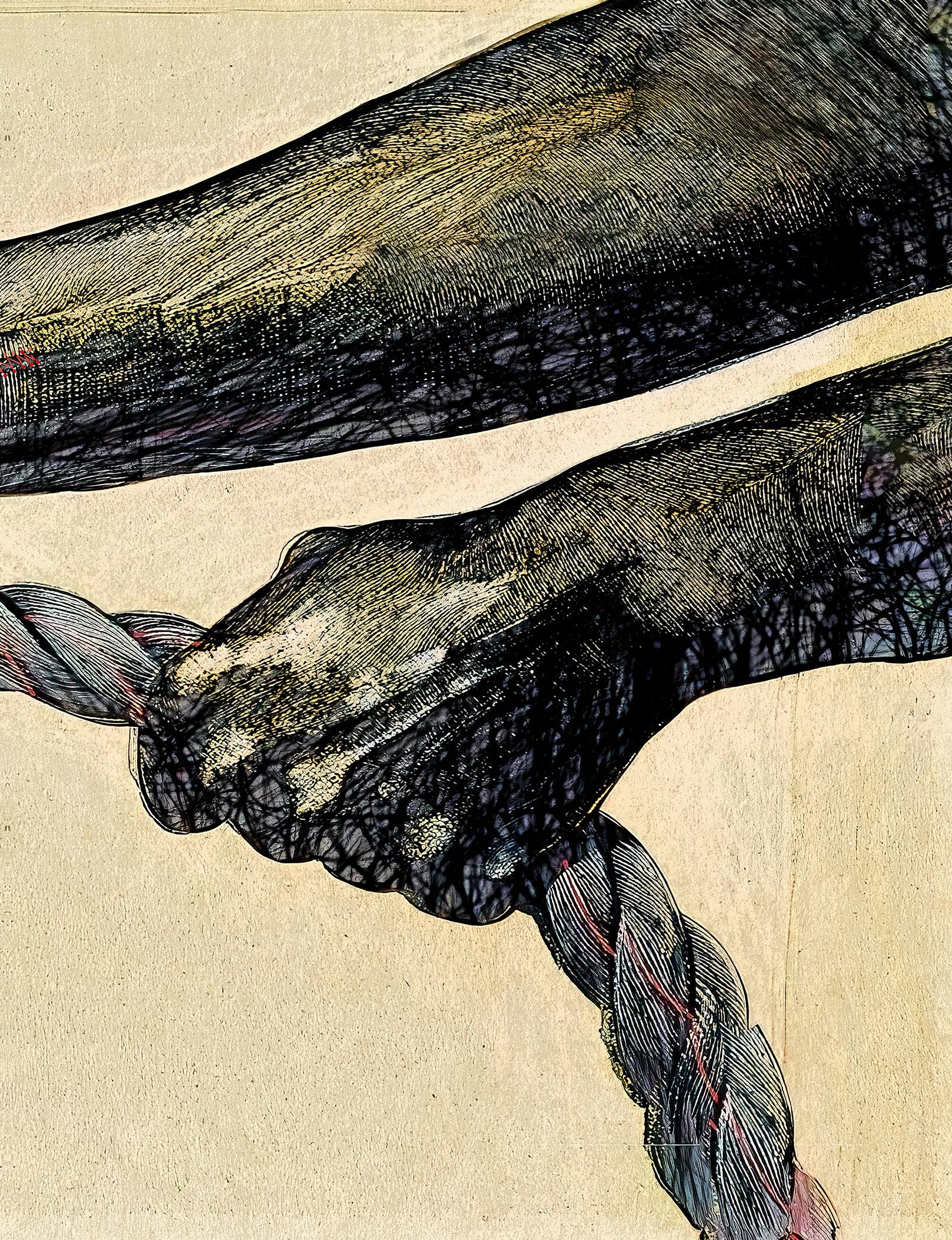
In that vein, the MJLC is proud to present our seventeenth edition, Endurance. The road to create this theme was long and winding, much like the concept of endurance itself. It was an ongoing process spread out over weeks, even months. We toiled over phrasing, definitions, and titles, struggling to find a way to properly encapsulate all our thoughts and feelings regarding our increasingly polarized and brutal world.
Our current moment is exhausting, to say the least. We bear witness to violence against our fellow human beings on a daily basis. We struggle and yearn for connection and community, and yet are isolated in a society that seems to care more about the state of currencies than people. The world may seem to be darkening, but it is vital to recognize that these times are not unheard-of. In fact, they have been overcome before.
History is littered with tales of the very terrors that burden us today: the suppression of expression, limitations of freedom, and exploitations of power and control. This is more than mere patterns repeating themselves; it is evidence of the enduring existence of systems of harm—the very ones that shape the foundation of the carceral state today.
However, endurance is not a one-sided story. For every push there is a pull, a rhythmic tide of resistance that continues to ebb and flow.
For generations, activists have been on the front lines, fighting against the very systems that were made to endanger them. Our abolitionist predecessors created the framework we build upon today in our mission as a magazine and discussion-based study group.
But endurance does not exist in one singular form or idea, it is a philosophy that lives and breathes in both the revolution and the everyday. It is the evolving strategies of resistance and it is the effort to maintain hope in even the bleakest moments. It is both persevering love and unending grief. It is the action of waking up everyday and recommitting yourself to life—every bit of it.
That is the beauty of endurance, it can be found anywhere.
With that, I give you Endurance. I hope you may find inspiration, comfort, and more in these pages, providing the fuel needed to continue to endure.
t h e E D I T O R S
Dear Reader,
Welcome to the Madison Journal of Literary Criticism’s Fall 2025 issue: Endurance. The contents of this magazine display a breadth of thought represented by the work of staff members, contributors, and beyond. In introducing the magazine in a letter, I find myself in the incredibly fortunate position to be able to contextualize the deep significance of this semester’s theme. Our idea of endurance is one that has, in many ways, developed over the course of several themes, in tandem with our study group and broader goals of the magazine.
What is endurance? The concept of endurance underwent many iterations prior to what lies before you. In our design of this semester’s theme, the staff spent considerable time honing our position and wording. We disagreed over simple definitions and struggled to come to a consensus. Many meetings and hours were spent discussing seemingly nothing, with little to no progress. Yet, we pressed on. We found compromises, made progress, and landed on what our theme is now. Unintentionally, we exemplified endurance on the micro-scale. That is, our staff uncovered endurance naturally and implicitly, something necessary for its existence. There is much more to say on the meaning of the theme, and I am confident that our understanding of endurance can still be expanded.
At its very core, the MJLC explores the avenues from which we can express novel thoughts and critique the unjust institutions of our time. We identify partial remedies to injustice: care, consciousness, and revolution, to name a few. Now we turn to question what is behind such remedies, a quiet force nested inside all of us: endurance. Why do we continue on, even in the face of extraordinary adversity? What motivates us to push against our own gravity that pulls us ever downward? To what end are we pursuing justice, abolition, and liberation? In many ways, endurance is the response.
A selection of possible answers will be offered in this issue. Putting the puzzle pieces together involves introspection, historical reflection, and an indexing of where we are now. This issue's group staff piece summarizes some of the historical and current moments which appear to endure. And of course, the array of individual submissions share their own answers, each meticulously crafted with a unique perspective guided by our framing of endurance.
Just as buildings stand strong against a storm’s weathering, and just as mountains reach sky-high despite the constant erosion of time, we will continue, and our mission must endure.
Enjoy Endurance
Jonathan Tostrud Editor-in-Chief
aleh Kaleh K Majeska Kathleen
When I was twenty years old and woefully unemployed, my mother began bringing me to church to help the Ladies Guild bake for the yearly bazaar. I spent my summer learning to roll lavash and braid choreg with Armenian women who jumped at the chance to pass on their mothers’ knowledge. Some of them, raised to believe their only purpose was to settle down with children, told me how lucky I was to go to college. None of them tried to set me up with any eligible Armenian men in the community, for which I’m eternally grateful. The older women regaled me with stories of my family as I took their bread to the kitchen to be baked.
Over a hundred years ago, when my great-grandmother was twenty years old and similarly unemployed, she watched her mother fight for a loaf of bread a Kurdish man had thrown into her caravan of deportees for entertainment, complacantly complicit in the genocide of the Armenian people. Starving people will do anything for food, after all, and it’s easier to not care when the people starving aren’t your own. In her recordings of these experiences years later, she didn’t say whether or not her mother caught the bread. She just said that all she could do was watch and cry.
My great-grandmother was forced from her home on a death march inspired, in part, by the United States’ own genocide against its indigenous people. She lost her husband to Turkish soldiers, her niece to the Euphrates River, and her mother to illness. She managed to reunite with her brother in
Jerusalem thanks to the kindness of strangers, and the two of them made their way to the United States. Her second, and last, husband was a man who wrote her love poetry and was willing to pay her uncle to marry her. He brought her to Detroit, and it was there that she built a new family.
I never got to meet my great-grandmother, but I did know my grandmother. She was one of the people who helped my parents raise me. My Armenian name, Arev, which we share, was given to her by her own grandmother when she was born. It translates to “sun,” and she was as bright and warm as our namesake. She shared my love of animals and told me stories about her beloved childhood dog who walked her to school and waited outside the building for her when she was a child. At a recent dinner with family, my grandmother’s youngest sister told me about my grandmother and great-grandmother going to buffets together and filling their purses with food to take home. I used to spend the night at her house, and she put up with me wanting to watch the same movies over and over again and eating all her soup. She was the kind of person who would offer hugs to my friends even if she didn’t know them, because they were friends with me and that was all that mattered to her.
My grandmother grew up during the Great Depression and World War II. Her brother was a medic during the war, and she rode the bus around Detroit and sold war bonds. By the time she was my age, she attended college. Her mother wanted her to get married and start a family of her own, but her father encouraged her to pursue an education. She became a pharmacist in the 1950s and married the boy next door who used to go to her house and play love songs for her on the piano that she thought were meant for her sisters. He had a heart attack, and she continued working while raising three children on her own. She never remarried.
My mother attended college in her twenties too. My mother’s stories at my age involve dealing with roommates who partied too hard and stealing hard-boiled eggs from the dining hall to feed herself over the weekends, which her meal plan didn’t cover at her school. She would go to the arcade on Sunday mornings to play video games because no one else was there that early. She got a business degree and opened her own travel agency, where she met my father. He claims she was flirting with him, and she claims she was trying to sell him more airline tickets.
I once joked to my mother that my great-grandmother starved so my grandmother could pocket chicken from a buffet-style restaurant, so my mother could steal bagels and hard-boiled eggs, so I could steal cookies from my college dining halls. She said that sounded terrible and made us out to be
thieves, and maybe that’s true. I think I would at least be considered a thief by my college with their strict no-taking-food-from-the-dining-halls rule. I also think that she missed the point a little bit. It’s not about the stealing, it’s about the fact that I had enough food to take snacks without having to think about where my next meal was coming from.
The summer I spent with the Ladies Guild was much different than the summer my great-grandmother experienced when she was twenty. I ran bread into the kitchen and melted butter for hours, but she watched women drown their children in the river so they wouldn’t have to starve anymore. I sat in the comfort of my home working on a novel, whereas her home was ripped away from her. She never got to return to her village or find where her mother was buried, but I have the luxury of going home whenever I want and we go to the cemetery every year to clean the family graves.
On the hundredth anniversary of the Armenian genocide, those who died were canonized as saints by the Armenian church. If it hadn’t been for my great-grandmother’s endurance and the help she received from sympathetic strangers along the way, she would have been one of those saints. My grandmother never would have had the opportunity to attend college in a time when women were expected to stay in the home. My mother never would have traveled the world or opened her own business. I would not be here writing this. My great-grandmother survived a genocide, and now I bake Armenian breads, listening to the music from her village. And when I shove cookies into my bag in the dining hall, I hope that she would have been proud of me.
A Horse Apiece?
Leo Hirschboeck
BY KATRINA KOPPA
The Emergence of the Utopian Imagination in Mohsin Hamid’s Exit West
When we imagine utopia, we likely imagine a world where everyone is free from want; peace and harmony reign over the world; and above all, there is no injustice—or if there is, the injustices are fairly dealt with. A utopian world is something we imagine. However, that does not mean a utopian world is so separate from reality as to not be something worth striving for. Exit West is a work of magical realism in that it depicts mass migration via mysterious doorways that spontaneously appear and allow users to travel to unknown destinations. These magical doorways allow Mohsin Hamid to explore his character’s identities throughout the process of migration and the effects it has on their relationships with each other and the world. Interwoven with reality, the elements of fantasy in Exit West create space for both characters and readers to imagine utopian worlds unburdened by conceptual realities.
This work will look first at the concept and broader implications of imagining utopia, then analyze how Hamid executes this through various fantastical devices and narrative techniques in Exit West. Taken together, Exit West’s fantastic elements invite the reader to imagine utopian futures for themself, thus providing a tool of liberation that has real world significance.
1 Imagining Utopia
In his book Freedom Dreams, professor of history and Africana studies, Robin D. G. Kelley defines utopia as the idea “that we could possibly go somewhere that exists only in our imaginations” (2). As something that does not exist in the real world, utopia is a concept that we are at liberty to imagine for ourselves, with the capacity to guide our present actions. While it is often seen as naive, imaging utopia has real historical implications. For example, in the case of many Black-led and inspired liberation movements throughout U.S. history, Kelley makes the case that
Em Sweeney
their “failure” can be attributed to their sole focus on tearing down the sociopolitical structures that maintain systems of oppression, rather than aiming to to imagine for themselves what a liberated society might look like. A unifying vision for the future is a crucial element to the success of liberatory movements, as it provides a positive utopian vision to actively work toward.
When the structures of oppression are so ingrained in our daily lives, how might we imagine a utopic world without them? As a literary genre, fantasy has been a technique to imagine worlds fundamentally different from our own via full immersion in an alternate reality. As such, we can employ fantasy as an effective tool to free our minds from restrictive oppressive structures, allowing us to better imagine a truly utopian world. Surrealist writer Paul Garon states, “fantasy alone enables us to envision the real possibilities of human existence, no longer tied securely to the historical effluvia passed off
as everyday life; fantasy remains our most pre-emptive critical faculty, for it alone tells us what can be” (Kelley 164). Fantasy captures many subgenres including both surrealism and magical realism, which is the genre of Exit West. Associated with writers like Gabriel García Márquez and Salman Rushdie, magical realism is a style of writing that deftly incorporates fantastical elements into a realistic world. It blurs the line between “real life” and “magic,” thus challenging what we understand to be reality. When the foundations of our perceived reality are challenged, we enter a liminal space that creates the room to imagine alternative utopian realities.
Mohsin Hamid’s literary approach to Exit West illustrates utopian alternatives to our current sociopolitical structures that at-present appear too entrenched to change. He describes his project for Exit West as one where he tries “to imagine a future [he’d] like to live in and then write books and do things that, in [his] own small way, make it more likely that that future will come to exist” (Hamid and Gross 2018). As a novel that embodies Hamid’s hopeful visions for the future, readers can be inspired to take the novel’s utopian impulse and implement it into their own lives. Our current capitalist reality looks to history to enforce the idea that there are no alternative futures that are “not a repetition of the past” (Wegner
54). Because current oppressive structures are predicated on the idea that they are unchangeable, magical realism is a necessary tool to break free from this idea and to envision utopian futures that inspire us to work towards. Throughout Exit West, Hamid uses aspects of magical realism as a tool to disrupt reality and envision utopian futures.
2 Unlocking the Utopian Imagination: Literary Devices
and Techniques
Now that the concept of the utopian imagination has been established, we can use that framework to analyze how utopian potential emerges throughout Exit West. This section addresses three key elements in the novel: the magical doorways and parallel elements, the subversion of generic expectations, and the utopian community of Marin. By disrupting our conceptions of reality, these elements create a space through which the utopian imagination can emerge.
2.1 Doorways and Parallel Elements
Exit West begins in an unnamed country in the Middle East with two characters: Nadia and Saeed. The reader follows these characters as they navigate a budding relationship and a slowly yet escalating political disturbance in the country. The conflict begins with smaller, almost excusable acts of violence that escalate until the city becomes unlivable and the
couple makes the difficult decision to flee. The increasing turmoil is ameliorated by the appearance of doorways that can whisk people to new and unknown destinations, catalyzing waves of migration large enough that it seems “that the whole planet [is] on the move” (Hamid 169). While certainly utopian, the idea of effortless global migration does not come without warranted criticism. Yogita Goyal argues in “‘We Are All Migrants’: The Refugee Novel and the Claims of Universalism” that by universalizing migration, the magical doorways of Exit West wipe out the tragic realities that come with the act of migration by “rendering banal what must remain historical” (241). While the act of migration is simplified, Exit West still closely attends to the way that migrants must reconfigure their identities and places in the world. By troubling the perceived reality, the doorways, along with parallel elements in the novel, create a space that allows the utopian imagination to emerge.
As a narrative device, the doorways universalize migration, but they do not wipe out the difficulties of the migrant experience, nor the identity conflict that occurs as a result of migrating. The doorways transform the experience of migration from a lengthy bureaucratic process to one where anyone with access to a doorway can cross thousands of miles in mere minutes. Tayaba Parveen argues that though the doors make it possible to migrate
without the current-day legal procedures, “the idea of black doors is insufficient to undo the identity crisis of the diaspora community” (Parveen 258). Saeed, in particular, exhibits a diasporic mentality. Despite the increasing political violence that made him fear for his and his loved one’s safety, he thinks fondly of his homeland. Saeed feels alienated in all of the countries he and Nadia flee to. This discomfort causes him to strengthen his connection to his homeland by revitalizing his relationship to religion. Though Saeed fled the conflict in his homeland with relative ease, the subsequent psychological tension that he experiences as a migrant is not trivialized.
Furthermore, if the magical doorways trivialize anything, it is our idea of unchangeable political borders. The doorways challenge the reality often taken for granted (political borders), and subsequently shake the identities constructed around them. Naturally, the characters in Exit West undergo an identity crisis as they are forced to reconfigure their sense of place in a world where borders are suddenly arbitrary. Exit West addresses this directly when the narrator opines, “without borders nations appeared to be becoming somewhat illusory, and people were questioning what role they had to play” (Hamid 158). The migrant’s identity was once formed through the connection to the homeland, clearly defined as
“there,” but when the relationship to space is thrown into question, so is their identity. Saeed and Nadia understood themselves as lovers in their home country, but the psychological tension caused by migrating manifests as an interpersonal conflict. After fleeing their home country through the doorways, Nadia and Saeed experienced such tension when Nadia tried to kiss Saeed but “he turned his face away angrily, and then immediately apologized” (Hamid 107). As a result, Nadia found herself “surprised, because what she thought she had glimpsed in him in that moment was [uncharacteristic] bitterness” (Hamid 107-08). This effect of the doorways reflects interpersonal stresses similar to those that migrants face, maintaining a recognizable quality of the migrant experience while still placing the characters in a position to realize positive, utopian transformation.
Despite strain in the characters’ spatial and interpersonal relationships, the novel resists descending into chaos. Nadia and Saeed become uniquely situated to realize a transformation, rather than a breakdown, of their identities. A borderless world, in which anyone could be seen as a migrant, creates the sense of existing outside of time and space, such as when Nadia “had the bizarre feeling of time bending all around her” (Hamid 157). This “bizarre feeling” may be a recognition that some fundamental aspect of her conceptual reality, political
borders, have been rendered obsolete, necessitating a total reconfiguration of her worldview. As Nadia negotiates her identity in this newly configured world, she is able to flourish because she is unburdened by such restrictive structures and can embrace new ways of being in the world. Nadia explores new ways of being when she joins an elder-led council of Nigerian migrants who illegally occupy the same upper class London neighborhood as her and Saeed. Here, Nadia has an opportunity to question what she previously understood about race, nationality, and language, ultimately coming to a better understanding of where she fits into this community and the wider world.
While the doorways are a feature in catalyzing transformation, there are additional plot elements in Exit West that have a similar role. Both the scenes that detail the imaginative play of children and the use of psychedelic mushrooms disrupt reality and thus create a conceptual gap through which the utopian imagination can emerge. First, through their play, children challenge adult conceptions of reality by mapping fantasy onto the physical space they’re playing in. In their illegally occupied London upper class neighborhood, Nadia and Saeed witness destitute refugee children playing in a grove of trees. The narrator states, “as bloodshed loomed they made of these trees that were perhaps not intended to be climbed the stuff of a thousand fantasies” (Hamid 139).
The refugee children disrupt reality by both existing in a place not intended for them to be and joyfully playing even with the threat of violence on the horizon. Throughout this scene, the adult characters and readers can recognize a cognitive dissonance between their conception of the world and the way the children see it. By creating such a dissonance, this juxtaposition creates a space for the utopian imagination to emerge by considering the world from a child’s mind. By adopting a child’s perspective—where fantasy and reality intertwine— one is better positioned to deconstruct conceptions of reality and imagine fantastical utopian futures to work toward.
Even before they have the capacity to travel via the doorways, Nadia and Saeed utilize psychedelic mushrooms as a mechanism of transformation. Similar to the scene with the children, political violence looms, but in this case, the transformative potential is not realized through juxtaposition, but rather the chemical alteration of the characters’ minds. Saeed describes his transformative realization as a “feeling of awe” and “wonder with which he then regarded his own skin” and the objects in the world around him (Hamid 46). Hamid also details Saeed’s sudden “desire for peace” and sure thought that “conflicts could be healed if others had experiences like this” (47). Prior to taking the
mushrooms, Saeed felt dread as increasing political violence threatened his family’s safety, so the heightened emotions of awe and wonder disturbed his experience of reality. Once again, a space is created when one’s conceptual reality is challenged. For Saeed, what emerges is the utopian conviction that global peace is possible under the right circumstances. Similar to the magical doorways and imaginative capacity of the children, the psychedelic mushrooms serve as a narrative device to enable the utopian imagination by disrupting reality. In so doing, they create space to envision utopian futures unburdened by the oppressive structures passed off as reality.
2.2 Subverting Generic Conventions
Exit West can be classified as a work of magical realism as it blurs the boundary of what is considered “magical” and “reality,” but it also defies generic conventions of fantasy. This section considers how Exit West blurs the boundary of fantasy and technology through its depiction of the doorways and cell phones and the effect this has on the reader’s perception. These elements of Exit West help break down traditional generic rules: playing with our expectations of realism, romance, fantasy, and scifi. Phillip Wegner notes that many critical analyses of Exit West have taken the doorways’ status as fantasy for granted.
He states:
“Hamid never indicates whether these doors are generically science fiction (the products of human agency) or fantasy (wish fulfillments). While they can be understood as allegories of the twin technologies at the basis of globalization—transportation and communication [...]—the allegory is a discontinuous one, played out through these various generic discontinuities as much as through space” (Wegner 45).
This generic discontinuity has a two-fold effect on the reader. First, the reader is no longer tied to traditional expectations of genre, and is therefore at liberty to construct for themself the implications that a fantastical or technological doorway has on the novel. Second, and more pertinently, by subverting the generic expectations of magical realism, Hamid encourages the reader to view technology’s role as one of transformative possibility.
In the reader’s world, cellphones are such a common technology that they are overlooked, but Exit West encourages the reader to reconsider them as something with magical potential. This is particularly evident when Hamid writes,
“In their phones were antennas, and these antennas sniffed out an invisible world, as if by magic, a world that was all around them, and also nowhere, transporting them to places distant and near, and to places that had never been and would never be” (39).
Here, cellphones are described as magical portals that might bring users to places that don’t (yet) exist, echoing Kelley’s definition of utopia as a place “that we could possibly go […] only in our imaginations” (2). The way that cellphones are described in Exit West likely contrasts with a reader’s own experience with the technology, creating a cognitive gap that throws the ubiquitous cellphone in a new light, one that asks us to consider it as something with utopian potential.
While our expectations for the doorways and cellphones might follow a respective fantasy/ sci-fi distinction, Exit West subverts our assumptions about the roles of these elements. The cellphones, though they might provide the illusion of being transported “places distant and near,” cannot effect a spatial change like the doorways do (Hamid 72). The cellphones are rendered fantastical objects that offer only illusions of different realities, running contrary to the expectation of the capacity of technology to affect physical change. The failure of technology to produce such a physical change makes the doorways’ success, directly causing massive waves of migration, more pronounced. The doorways, while generically falling more into the fantastical category than sci-fi, invoke greater change than the cellphones, which take on more of a fantastical role. The breakdown of generic
conventions is essential to Exit West’s utopian project because fantasy performs more of a critical function for unlocking the utopian imagination than technology.
The doorways and cellphones are neither inherently utopian nor dangerous, meaning that these devices might be used in a liberatory fashion as described above, or they might be abused. The ubiquity of the doorways and cellphones would make it easy to live completely in an escapist fantasy without having to confront reality. The cellphone is especially addicting as Saeed “found the antenna too powerful, the magic it summoned too mesmerizing, as though he were eating a banquet of limitless food” (Hamid 40). Throughout the novel, Saeed and Nadia are pulled in by their phones when they feel that facing the reality of their situation is too difficult to bear. Likewise, characters can use the doorways to escape their present situation, but there is no guarantee that the next location will be better. The doorways might assist in bringing characters out of unlivable situations, but the responsibility to transform their lives falls to the individuals. This suggests that while the cellphones and doorways have utopian potential, devices such as these cannot and will not bring about a utopian transformation of our world. Rather, they should be viewed as tools that we must use to envision and build our utopian futures.
2.3 A Radical Utopian Vision: Marin
A final element that aids in the development of the utopian imagination is Hamid’s direct vision of a proto-utopian community. By putting forth a vision of a nascent utopia, the reader is inspired to envision what the future of that community might look like and is encouraged to apply utopian imagining to their own life. Over the course of the novel, Nadia and Saeed live in three different communities, each founded on utopian imagination (as their formation was contingent on the catalytic capacity of the doorways). The most profound vision of a utopian community that Hamid depicts in the novel is the quasi-legal, refugee shanty town of Marin. Tegan Schetrumpf argues that Marin is a collective that defies “the logic of capitalist realism [...] and can be viewed as utopian in their ability to imagine any system of social organization that progresses beyond contemporary lived experiences” (90). Located on the outskirts of San Francisco, Marin is physically and socially positioned outside of the capitalist systems that characterize the West, affording space to its inhabitants to build toward and live in a utopian community. While Marin is the place where Nadia and Saeed come to terms with their deteriorating romantic relationship and separate, thus “enabl[ing] radically new possibilities of love” where Nadia explores her
attraction to women, and Saeed falls in love with a woman from a different religion than him (Wegner 51).
In addition to love, Marin presents an opportunity to explore new forms of art, culture, and government. Though poor, Marin is a flourishing cultural center signaled by the “jazz new age” and Nadia’s comment that “down there is everything in the world anyone would want to eat” (Hamid 234, 224). “Down there,” in Marin, is a cultural melting pot that could only exist outside of the bounds of our present capitalist reality. Additionally, Marin consists of small, collectively owned businesses, such as the food co-op that Nadia works at, and a nascent small-scale government. Hamid goes no further to iron out the creases in Marin’s utopian community, leaving the project unfinished. While potentially frustrating for the reader, it is also liberating because it encourages the reader to take the next step in imagining what that utopian future might look like.
Conclusion: Exit West as Embodying Utopian Imagination
The literary devices and narrative techniques of Exit West explored throughout this paper help the reader understand both the ways our world is structured around oppressive yet impermanent systems, and how acknowledgment of
this very impermanence acts as an important critical tool to imagine utopia. Rather than being idealistic, Hamid cautions us of the possible pitfalls in our utopian visions (such as an overreliance on technology and convenience), and through Marin, depicts utopia as an ongoing process. Through the genre of magical realism, Hamid is successful at illustrating a world that challenges our conceptual realities and prompts us to consider alternative futures, thus unlocking the reader’s utopian imagination. As such, the future in Exit West is uncertain, yet undeniably optimistic. As Paul Garon says, “fantasy remains our most pre-emptive critical faculty, for it alone tells us what can be” (Kelley 164). Elements of fantasy, therefore, are a necessary response to our capitalist reality as tools to imagine a world fundamentally different from our own and aspire toward a better future. By embracing Exit West as a novel that invites us to imagine a different world through its fantastical devices, we as readers, have an indispensable tool of utopian liberation at our fingertips. We only have to imagine the possibilities.
Works Cited:
Goyal. Yogita. “‘We Are All Migrants’: The Refugee Novel and the Claims of Universalism.” Modern Fiction Studies. 2020, 66 (2): 239-259.
Hamid, Mohsin. Exit West. Penguin Random House. 2017.
Hamid, Mohsin and Terry Gross. “From Refugees To Politics, Mohsin Hamid Writes The Change He Wants To See.” NPR, March 9, 2018.
Kelley, Robin. Freedom Dreams: The Black Radical Imagination. Beacon Press. 2002.
Parveen, Tayaba; Hussain, Shabnam. “Exploring Identities: A Diasporic Study of Exit West” in the Pakistan Journal of International Affairs. 2024, 7 (2): 250-262.
Schetrumpf, Tegan and Aleks Wansbrough. “Imagining Utopia through Communities in Mohsin Hamid’s Exit West.” Metacritic Journal for Comparative Studies and Theory 2022, (8.2.): 88-107.
Wegner, Philip. A Story Where Something Turns Out All Right: Remembering Utopia in Mohsin Hamid’s Exit West. South Atlantic Quarterly. 2025, 124 (1): 39–56.
PACKING FOR THE APOCALYPSE
Emilee G.H.
Lately there’s been concern of an apocalypse on the horizon; climate change, the aftermath of a global pandemic, soaring costs of living, and the rise of fascism have all brought the feeling of doom into everyday life. In facing these threats of calamity, I am brought back to a course I took as an undergraduate at UW-Madison entitled “Space & Place: Race and Indigeneity in the Apocalypse,” guided by Jen Rose Smith. Our course explored how this feeling of apocalypse is not new. In fact, many groups have gone through and continue to endure apocalyptic conditions. If we are to believe that the apocalypse is not one singular event, but rather that our world has been occupied with apocalypses throughout
time, we also need to understand what we take through these apocalypses in order to survive and rebuild.
In this course, students were asked to individually create a “bundle” of what they would take to survive an apocalypse, identifying material objects, skills, knowledges, insights, etc…, that they needed “to nurture and fortify [themselves] mentally, emotionally, spiritually, and physically” (Smith 2022, 3). Included here in my bundle are four practices that allow me to collect myself on days I do not feel so well, to reestablish care so I can continue to survive the many apocalypses of our current time. All four practices are derived from readings from Smith’s course.
1. Love & Forgiveness
The first piece out of my apocalyptic bundle was inspired by an event in Louise Erdrich’s Tracks (1988), a novel that follows the lives of four Anishinaabe families in North Dakota during the Allotment Era. The main characters work tirelessly to raise enough money to pay for the fees on their family allotments, but Nanapush (a tribe elder) learns that a federal agent has placed an illegal overdue payment fine on their allotments, leading Margaret (Nanapush’s love interest) to take the money to save her family allotment over Nanapush’s. While the circumstances were no fault of Margaret’s, the decision to choose her own home over another’s was. Yet Nanapush chooses to forgive
When Nanapush forgives Margaret for saving her allotment over his, he shows a deep, profound, and endless love for his land and people that is rooted in the notion that something surviving is better than nothing surviving. Nanapush knows something that I want to know. I too want to feel a love this endless. I want to choose forgiveness when it doesn’t benefit me yet also does not destroy me. Sometimes we need to let go of smaller devastations to make way for brighter futures. And, though it may not feel like it, we often do not face apocalypses alone. We enter apocalypses with family, friends, and strangers who we share similar pasts, presents, and futures with. We are all in apocalypses together and we may find various ways to cope and survive; sometimes this means choosing paths that others do not want to take. When someone you love chooses a path that causes you a small harm, remember it is okay to continue loving them, to forgive them, and to continue enduring the apocalypse together.
It should be noted, however, that forgiveness and love need not be given to those who do not love or would not forgive you. Nanapush forgives Margaret because she has given him a sense of family and home, but there are other characters he does not need to forgive due to the destruction and violence they have caused; sometimes being a bigger person means choosing to not forgive. I have spent the past decade learning to forgive people for their actions that occurred out of circumstance, forgive people that have repented their past actions, and forgive myself. I have also learned to not forgive, to let people go, to not let others hold power over me, to demand accountability; I am so much happier now with boundaries, limits, and capacities to control my feelings about others. As important as it is to have allies in the apocalypse, do not keep allies who seek to harm you or others. Love and forgiveness is vital because it creates a bond of power together, not power over another.
2. Secret Spaces of Refuge
“Still Dreaming Wild Disability
Justice Dreams at the End of the World” by Leah Lakshmi PiepznaSamarasinha (2018) introduced me to a practice I will refer to here as secret spaces of refuge. It is the act of finding a place to stop, breathe, and collect yourself so you have the capacity to actually live through an apocalypse. In wondering where my spaces of refuge were, and I could not keep my mind off a quote from “In Defence of the Wastelands” by Erica Violet Lee (2016):
As a kid, I cherished trips outside the city as I learned about the plants of my home territory. I would hoard braids of sweetgrass and fill envelopes with cedar, keep paper bags overflowing with dried leaves and roots for tea. Some time passed before I learned I didn’t have to be stingy with my sage, because there was a patch growing down the street. Until then, I thought that “medicine plants” must only grow outside of the city.
Lee saw the city she lived in as a wasteland, an area that deprived her of the necessary resources she needed, and the wilderness which has these necessary resources was a space of refuge for her. Then she finds sage down the street, in a place unexpected, in a space she had previously deemed uninhabitable, in the middle of a landscape she felt was a wasteland, and this sage also became a secret space of refuge. To find our secret spaces of refuge, we must first reimagine how we engage with our everyday environment, especially if we view this landscape as a wasteland devoid of hope.
As a teenager, I thought that rural Wisconsin was a lifeless wasteland, but after moving to a more populated setting I began to feel the same way about cities. While Madison has more greenery than most cities, it feels manufactured and manicured compared to the Northwoods that I know—few trees bear fruits, the grasses are short and neat, and if I threw an apple core out of the car window, it probably wouldn’t end up a deer’s delicious snack. Yet Lee made me reconsider the spaces of the city that I enjoy the most, not just the physical spaces, but the spaces in time where I saw joy in an area I had previously seen only a wasteland.
I have so much love for the dandelions and thistles and clover and moss that continue to grow in spite of wastelands of cement and glyphosate. I love the way vegetation looks so vibrant in summer, the way leaves crunch on the pavement in autumn, the way snow-covered trees are sturdy and unbothered in winter, and the way wildflowers grow where they want in the spring. These plants are proof that life finds a way; these plants are proof that life can find refuge in all types of places. If plant life can successfully grow in spite of the unnatural pressures in which it lives, then maybe I too can grow, thrive, and just be as I like.
Maybe finding secret spaces of refuge in the wastelands of the city will let me find the secret spaces of refuge in the wastelands of my own being. The world may seem bleak, but there are spaces filled with life, joy, and solidarity. Take time to learn where your spaces of refuge are, whether they be your favorite tree in your neighborhood or your monthly book club. You will not survive the apocalypse if you do not have a place to stop and breathe. Seek the bountiful life in wastelands, you will find it if you look hard enough.
3. Kinship with Animals
To me, animals feel like an obvious choice to bring to and through the apocalypse. I have always been reliant on pets to ground me to the world. Their love (once gained) is the most unconditional version of love that exists, and for this I have never had a pet that was not likened to family. I feel the same way about wildlife. The older I get, the more I understand why my father would always pull over on the side of the road to watch deer feed in the fields. I love to watch the squirrels from my bedroom window as they chase one another in love. I love the birds that stop at my windowsill to find spiders and insects to feed to their children. I love walking around my neighborhood and sharing a moment with a bunny who is also out on a stroll.
I have a deep love for Alexis Pauline Gumbs’ book Undrowned: Black Feminist Lessons from Marine Mammals (2020) for a multitude of reasons, but first and foremost because she sees the animal kingdom much as I do. There are many important lessons in this book, but to me the lesson that is the root of it all is in the introduction, where she states:
My hope, my grand poetic intervention here is to move from identification, also known as that process through which we say what is what, like which dolphin is that over there and what are its properties, to identification, that process through which we expand our empathy and boundaries of who we are become more fluid, because we identify with the experience of someone different, maybe someone of a whole different so-called species. (Gumbs 2020, 8–9)
Having a kinship with animals is to identify with them, to
Is there an animal that gives off a similar vibe as you? What animal at the zoo enchants you the most? Learning to identify with animals and see them as relatives can make the world feel less lonely and scary, gives you allies and lives to protect in apocalypses, and, overall, connects you to worlds that environmental capitalism has tried to make us forget. Recall that humans are animals too. Our large brains, opposable thumbs, and bipedal movement has allowed us to build, destroy, and rebuild our environments, but the subsequent hierarchies we have created to
4. Gift Economies
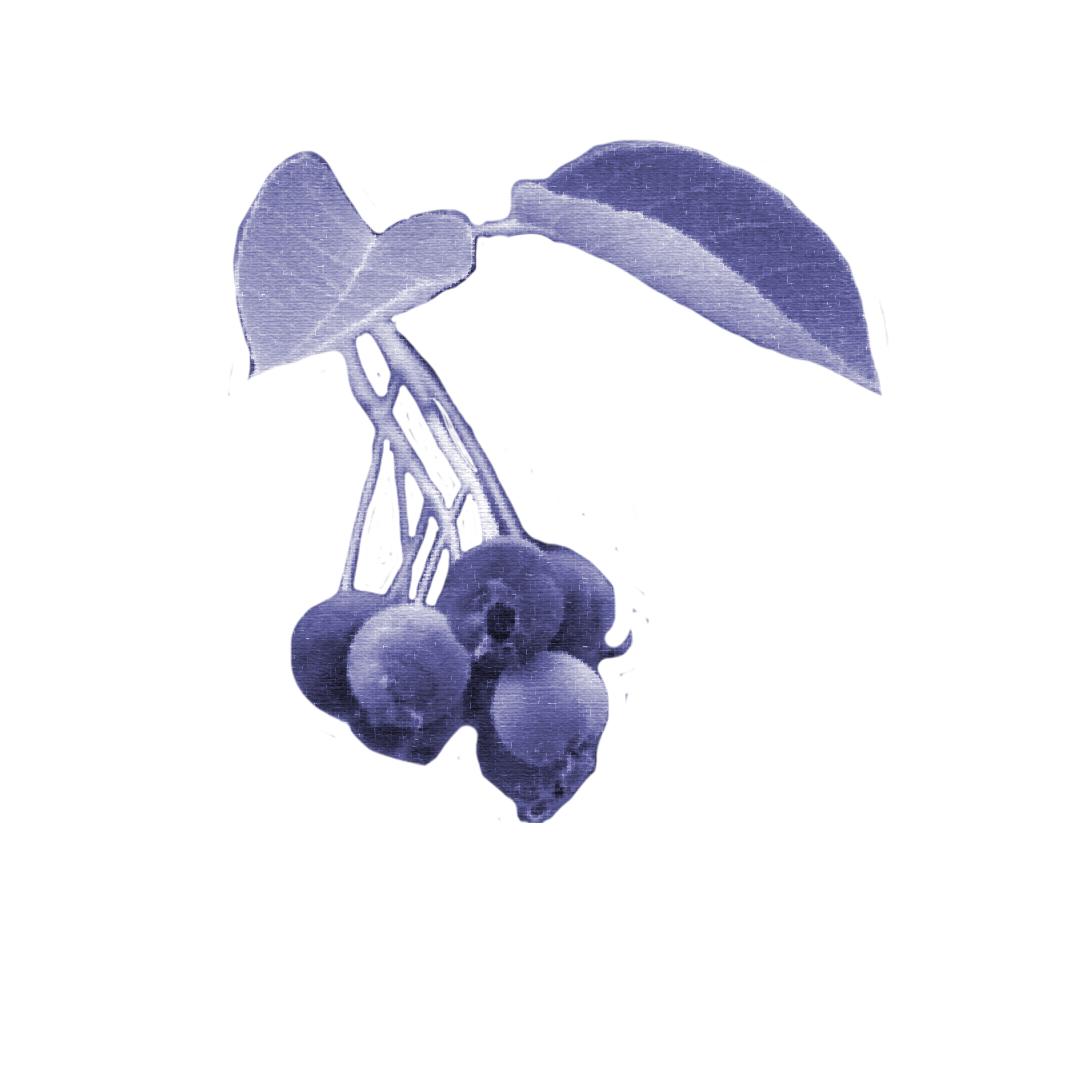
“The Serviceberry” by Robin Wall Kimmerer (2020) reminded me of the gift economies I witnessed in my childhood, a practice that I miss often and dearly. Kimmerer primarily describes the gift economies found in nature, but these gift economies still exist in pockets of capitalist societies, such as when Kimmerer’s neighbor made picking serviceberries on their farm free for patrons. I think about the times in my life where manufactured scarcities of capitalism necessitated gift economies, both when my family was the giver and recipient of gifts.
I think of the legacy of my longdeceased paternal grandmother who was known to force you to take so she could continue to give, even in times that she should have been stingy (a practice my father continues). I think about the love I have for my living maternal grandmother who continues to give so much of herself, even when so much has been taken from her (a practice my mother continues). I think about my love of libraries as one of the last institutions that resist capitalism, and a microcosm of a functional gift economy, as places
Preparing for “The End”
where knowledges are endlessly exchanged for free. In my mind, gift economies are abundance economies, and abundance means more will survive the apocalypse. We must remember that long before modern capitalism, the world ran on gift economies. We do not need cash, we do not need to exploit people or land, we do not need everything to boil down to monetary transactions. We need mutual aid, we need to not expect anything in return. We need to help others because one day we will need help too. Let us foster these gift economies for better futures.
Here I am now, preoccupied by the thoughts of the apocalypses we will continue to endure. Our government continues to hyperfixate on attacking marginalized and vulnerable populations. The prominence of the corporate rich openly aligning their personal and corporate interests with a new regime trickles down to the masses: cutting life-sustaining funding, sudden firings, erasure of oppositional views on their platforms. Misinformed and malignant voices feed the vacuum of health literacy. Meanwhile, most Americans are one hospital visit away from complete economic devastation. Modern photos and headlines remind me far too much of events that took place in Europe nearly a century ago, events that my American public education told me would never happen again. There is so little time to undo, or even just slow down, the effects that capitalism is having on climate change. And to top it all, the American public cannot help but consume the harmful narratives spoonfed by decision makers and talking heads. They contort truths, further sowing division amongst those who share similar material realities and buying (literally) into the myth that not only is it possible to pull yourself up by your bootstraps, but the only way to do so is to first lick the boot of another.
I am one single person, and I have no way to stop it all, but I do have my four practices of wellbeing and of resistance, wrapped together in a bundle at my side. As I walk with these practices kept close to my chest, I ensure my survival for another day. Despite the fears of doom, I know this bundle will help me make it through the apocalypses here and yet to come. And if you too find yourself in need as you walk through your own apocalypses, find these words; I will gladly give you anything I packed.
REFERENCES
Erdrich, Louise. 1988. Tracks. New York, NY: HarperCollins Publishers. Gumbs, Alexis Pauline. 2020. Undrowned: Black Feminist Lessons from Marine Mammals Emergent Strategy Series. Chico, CA: AK Press. Kimmerer, Robin Wall. 2020. “The Serviceberry: An Economy of Abundance.” Emergence Magazine. December 10. https://emergencemagazine.org/ essay/the-serviceberry/.
Lee, Erica Violet. 2016. “In Defence of the Wastelands: A Survival Guide.” GUTS Magazine. November 30. http://gutsmagazine.ca/wastelands/. Piepzna-Samarasinha, Leah Lakshmi. 2018. “Still Dreaming Wild Disability Justice Dreams at the End of the World.” In Care Work: Dreaming Disability Justice. Vancouver: Arsenal Pulp Press. Smith, Jen Rose. 2022. “GEOG 501: Space & Place: Race and Indigeneity in the Apocalypse.” Syllabus, University of Wisconsin - Madison.
Mama I’m an Anarchist (lithograph)
Lydia Crabbe
seventeen and a half minutes into juno
by Priscilla Herrmann
i can feel pain. And it has fingernails.
i want to curl into the fetal position, but i can’t bring myself to share a single thing with a fetus. sharing would erode the wall, the disconnect, between my womb and myself.
my womb builds a home, lining her walls with pillows of blood, preparing to stretch herself as thin as a burnt out mother, the very person she demands i be.
i can feel pain. And it has fingernails.
i swear i feel those tiny, developing claws raking my womb, leaving careless lacerations scattered like shrapnel. my womb, a prison wall those fingernails line with tally marks each day of residence.
a fetus, growing in size like a tick, suckling away at my blood. i did not sanction this theft, these wounds from little nails, a parasite using my vessel as life-support, which i am not permitted to sever.
Dream Eats Memory
Emiland Kray
Stippled fingertips on purple-gloved hands pulled the smooth cold gel from its womb. It was square and thin as an expensive electronic device, but with a limpness that let it hang off the scientist’s hands. Liquid medium slicked off it in strings and rejoined the tank in which the gel was born.
It was like surgery when the scientist laid the fragile gel on a plate, trimmed it to size. In her focus she didn’t breathe but there was the buzzing song of dozens of studious machines. The delicate work done, she hummed a tune she half-remembered and carried the gel away for analysis.
A ticking minute later and she sat crouched before the computer, her spine an arc beneath her lab coat. The room was dark, so fluorescent green pixels glinted off her glasses. What she looked for on the gel was a row of rectangles lined up like teeth; the imager showed her three dark controls and three brilliant samples, revealing to her a newly-discovered gene. Even before the statistics were crunched she knew there was something significant here. She pumped a fist. She’d get a candy bar from the vending machine later.
At the end of the week she’d present the gene she’d discovered at her lab’s meeting, imagining her initialed name on a publication, third author or maybe second. A long while later, the paper was published. The gene ROE7 was born to the world.
ROE7 is tucked in the Y chromosome, so it’s only present in genetic males. It plays a role in the immune system’s detection of foreign cells. It’s a silencer.
In other words, it makes the immune system friendlier to grafted-in tissue.
In other words, it makes a man a great host for a lab-grown organ.
Levi was closing up shop a few minutes early. No manager was there to stop him, and a glance into the dark showed nobody coming to the gas station. Clinically white lights buzzed as they fell on freckled floors. The interior of the gas station was a living cube, an enclosure within the dark and hazy eternity outside.
The mopping was done, and candy-colored packages, no matter the contents, had been pulled to the front of their shelves. Soaked rags released a biting odor as Levi swiped the last surfaces. In silence, turned to not-silence by the clicking of the register and swishing of paper bills, Levi transferred the day’s proceeds to the safe. And it was done.
But it wasn’t, because Levi hadn’t locked up yet. There was a jingle at the front door yet.
Levi let out a long, long breath. Steps started, solid shoes on tile.
“We’re closed,” he called.
The steps didn’t stop.
So Levi left the back office and was again in the illuminated storefront. “I got nothing for you, man.”
It wasn’t a man, and she had a screwdriver. Its shaft glinted cruelly in the bright sharp light.
Everything inside Levi’s body stopped. There was a sinking feeling like staring into dark water and losing sight of the bottom.
His robber looked so regular. No dyed hair, no dark clothes. Young still but too old for this. Yet her face was worn, with desperation in the eyes, as if she were about to beg him for mercy.
“I don’t have much money,” he said and instantly regret. The fan in the back of the store whirred.
“You put somethin’ in that safe, didn’t ya?”
The screwdriver was still out straight, like a horn. Never before had Levi’s skin felt so soft. Blood rushed in his ears, heated his head.
He could turn and take her to the safe, but the lizard brain protested, so it was with his front to her that he stepped backwards to lead her to the prize.
“I’m in college,” is what it felt right to say. “I have a lot left to do. Please don’t…”
Levi crouched despite shivering muscles and got to unlocking the safe. He was almost done when there was some trick of the light or shiver of the woman’s hand, because adrenaline dumped into Levi’s bloodstream. A chemical that freezes the muscles of most, but for Levi it cried fight fight fight
Fight he did, with a hand towards her face that she dodged and caught. He tore it free. The momentum sent her swinging so he shoved her back. She hit her side on the safe: crumpling down, the wind puffing out of her, screwdriver skittering on the ground.
The struggle brought to Levi’s face a panting smile he couldn’t shake. The door slammed shut. He shoved a rack of snack nuts to the ground to block it. Packs went skidding along radii. He pressed and pressed and pressed the power button on his phone so it would alert the authorities. Minutes later the glass glowed with oscillations of red and blue.
Outside the gas station, cones of light attracting moths and February air turning sweat to jewels of ice, Levi watched the cops cuff his attacker and drag her to the back of a Ford. She stumbled on her feet, grimacing at the ground.
The cops explained everything. The words barely registered, drowned beneath siren sounds and cortisol. Legally, Levi was at no fault for Margaret’s injuries. He wouldn’t go to jail. But he played a part in that fight, didn’t he? In the case she needed an organ transplant, he would be legally liable to provide a replacement. To grow a new one beneath his skin.
Bad lives, they said, were still lives. She’d lose hers otherwise.
Levi’s chin nodded and he tried to run the numbers in a foggy brain. The odds he’d need to donate were low, he figured, but nonetheless two weeks later he lay with stomach exposed on the surgeon’s table. Margaret had been born with only one kidney that worked, and the impact had ruined the one remaining. He stared at lights above so bright that they swam in his vision when he blinked.
The procedure was required by law. Nonetheless, Levi had himself half convinced it was a donation.
Levi never thought it would be him on this table. Not like Allen, his brother’s friend from grade school who’d faded naturally from his family’s life until his donation brought him back to mind. It hadn’t been Allen’s fault when his second cousin’s emphysema grew so severe that her lungs couldn’t work without medication, and then even with. But it was his responsibility once he was found as a match. She’d die otherwise.
Levi remembered seeing Allen once as he waited for a bus, leaning on a tree because there was no bench. His third lung, several months in and almost finished developing, swelled as he breathed and surged beneath his t-shirt. To fit within the binds of the rib cage, it must have pushed aside his natal organs with every breath.
The operating room had a sharp scientific stink. The injection site was washed. Plate-grown cells were seeded beneath Levi’s skin, and with the push of a plunger he became one of those men. One of those men whose viscera and lives gave way to the growing bulges inside. One of those men politicians shouted over, the men who courtroom wars were fought about, the men whose bodies were no longer theirs.
Yes, he’d met those men. A man his father’s age who must have been hiding feet of fresh intestine within a bloated abdomen. A man who Levi once sat next to on the bus, feeling a rhythmic prodding at his side, realizing after getting off that that was the pulsing of a second heart.
Levi watched the ceiling and saw the wolfish new graft splitting and doubling and taking root.
She’d die otherwise.
The procedure went without complication, and for the next weeks he rarely remembered it had happened. He paid little mind to the new organ growing inside him, just beneath the ribcage and to the right of the sternum. There might have been a twinge of pain, or of pressure, as the fetal kidney contacted nerves and coaxed existing tissue to displace, to accommodate. He needed another beltloop to fit the bloating beneath his waistband, and when the growth became more pronounced he abandoned belts altogether.
Always when he thought of the kidney he thought of Margaret.
It was in mid-Autumn that Levi pulled his bike from the garage for an outing. He’d go to the woods. Maybe, even, he’d spend the night. He took a tarp wrapped in his backpack so he could sleep beneath the stars, if he wished. His final school year was underway, so this could be one of the last times he’d spend two days so carefree.
By then the kidney was never not there, its presence subtle but omnipresent. As his legs pumped to propel him down paths, it became completely unignorable. A few miles in was all Levi could make before he had to lay his bike beside the trail. He lifted his shirt slightly. The bulge was no longer just a bulge, but curved like the organ beneath, the skin discolored. The kidney had to be just millimeters deep. He touched it gingerly, which shot lines of shock across his abdomen and down to the rightside toes, and he had to vomit.
It would be a lie to say the guilt wasn’t there but Levi knew he could not go on. There was one payphone still left in town, straggling in the campground on the west side that, in many ways, lived in the past. There was no way he could text Allen. He’d probably be okay to make a call on his personal phone, probably. But probably wasn’t safe enough.
One quarter slipped inside and then the other, making a tinny sound on rusted metal. Levi prayed and prayed into the phone on his cheek, and it must have listened because it came alive.
The phone rang. The wind in the trees made a howling sound. The phone rang. It was time for Levi to switch from cotton to woolen socks because the October air nipped toes straight through. The phone rang. He switched his weight from foot to foot, both for the cold and because he feared Allen would not pick up. The phone rang. Pick up pick up pick up. The phone ceased to ring.
Levi’s arm went limp and the phone fell with it. Its chain brushed the long grass that the mowers couldn’t reach. Levi waited a minute, watching a naive formation of birds cut the clear sky. So blue, yet producing such golden light.
He found just enough more change in his back pocket. He tried again and Allen picked up on the third ring.
“Who gave you my number? I’m not buying whatever you’re selling.”
Allen’s voice became hazy and faraway at the end, about to hang up, so Levi interjected.
“Wait! I need help.”
“Don’t we all,” said Allen.
“I’m growing an organ,” Levi responded. He whispered so the empty park wouldn’t hear. There was a moment of silence, but if Allen had been thinking of hanging up again, he surely wouldn’t now.
“And you want it out?”
“Yes.” His voice’s volume dropped even more.
“This is where you want to go.”
Levi listened and the call was over.
Out of downtown and a little farther and the buildings lost their luster. Bright wrappers and stony rubble collected where buildings’ foundations met the street. The place looked just how Levi had imagined, if it wasn’t for his own presence there.
He felt less than human. Or worse, he felt criminal.
He wandered until he found building 201. He found the windows dark, which made him worry, but he supposed the illicit clinic might not have the lights on in the first place. He knocked once. Waited. Looked inside and couldn’t see. Waited. In the distance he thought he heard a bus rumbling by.
And as he stared the door down, counting the lines in the weathered wood, he’d never felt so alone in his life.
“Place’s closed,” said someone behind him.
Levi turned, stomach sinking. Right lower quadrant throbbing, stretching. “What?”
“Got shut down three months ago,” said the guy. He kept on picking up trash with a claw grabber on a black stick.
Levi’s molars clamped on his inside cheek until he tasted rust. When he forced a breath in, out, the intruder shook. He was out of options.
But he wasn’t.
From the ground, Levi selected a smooth green glass bottle.
ROE7, the energetic gene, leapt out of the scientist’s hold and was caught like a frog in the cupped waiting hands of the famous airbrushed people on TV. Propaganda hit the media and the polls filled to bursting with passionate votes. Legislation came next. And in the checkout line at the grocery store, around the table for dinner, on billboards that flanked the highway, the people rejoiced and rejoiced at all the good they’d done. At all the lives they’d saved.
Levi knew the sound of water from anywhere.
In adolescence, he’d go down to the river with his brothers to catch the brown trout. He was the middle boy, but still the most tender, so he looked away as worms were impaled on hooks and couldn’t watch as fish, slick with scales and full of muscle, were drawn from the water. He was the type to sit on the sandbar. To watch the frothing white spill over half-hidden rocks and swallowtail back together. He was the type to listen to it crash, to hear the hushing of the trees above the rowdy shouts of men.
So when he heard the water then, it was what he went to. The river he found was nothing like the one his memory
brought back to him, this river with an undertone of brown and water so much more quickly coursing. A city river. A paper poster that must have once been fixed to brick lay on the bank, glued to the ground with moisture and the remnant of one side’s tape flapping helplessly in the current.
A bridge arced above, its underside beckoning him as a cave does a frightened animal. Free of people and out of sight. The bottle was still in Levi’s hand as he sat underneath.
He wondered why it was that memory that filled his thoughts. Why not something else? Why not the future? He could move north, off to the woods, where endless the rivers would be. Or he could come home, watch the sunset from his childhood room, find the music player he hadn’t touched in years and let the songs run on repeat. But there was no future left that belonged to him alone.
He wondered why there wasn’t a single glimmer of apprehension as he smashed the bottle into the foundation of the bridge, like a fish. In an instant, fractures turned to breaks and the bottle turned to shreds. Chunks of green mixed with the pebbled riverside. He still held the neck in his fist, its end jagged and open like some horrible summer flower, but it wasn’t what he needed, so it fell to the ground.
He sat so the river lapped at his shoes. Levi chose a long thick shard of just the right size and touched the tip to thin taut skin. He grit his teeth. He liberated what he could.
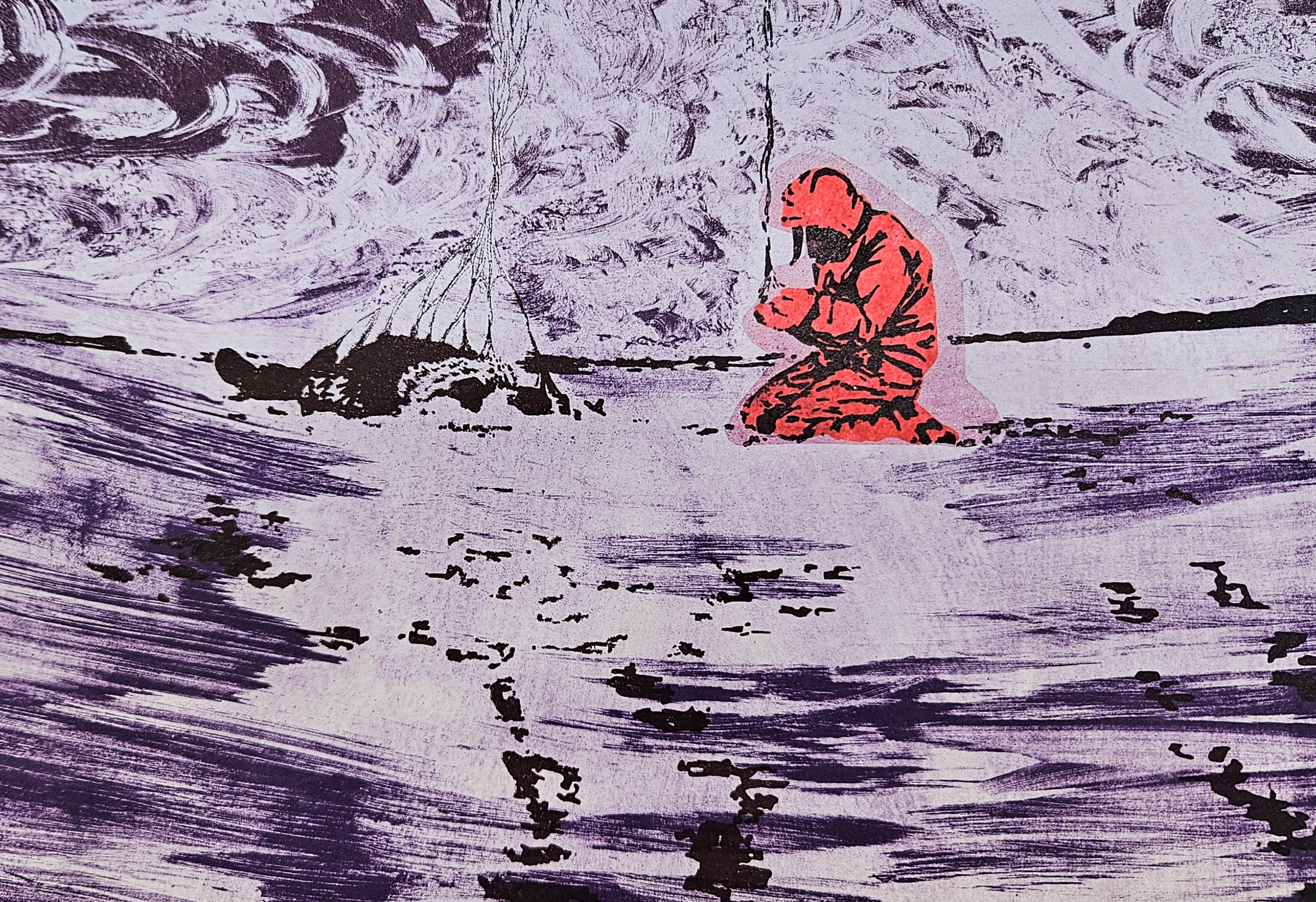
Hallowed be the Ice and Snow (lithograph)
Lydia Crabbe
Betsy Fries
What is the Dirt Telling You?
Miranda Lile
If the bullet in my gun shot a billionaire —
My basil is wilting on the windowsill. I can’t figure out if the problem is too much water or not enough and how much sun it needs. I didn’t kill the spider yesterday, jumping from my arm to the couch, trembling when it saw my bulbous eyes leaning close.
When you feel the war coming, thrumming slowly in your walls, not just thumping somewhere in the distance, insistent, and the talking isn’t helping, only making it worse, when do you pull the trigger?
Do I wear my blue or black skirt today? What about shoes?
floundering with poetic form from my bed seeing a music teacher harmonize with the bomb sirens. the children are still learning, the sounds of their oppressors turned to something like a sunbird’s coo, true. resisting looks like living, the choices made and made again — are these really my choices? should I quit school and save a family instead?
I wonder who the whistleblower is blowing that whistle for? If the neighbors stay behind their doors dalbergia will not carry through stiff imported floors. I hear the whistle on the wind — sweet song of tambretone — but rumbles tempt the looser stone if one puts ear to ground below. And are there not birds who twist and turn already of sound their own?
Song Sparrow
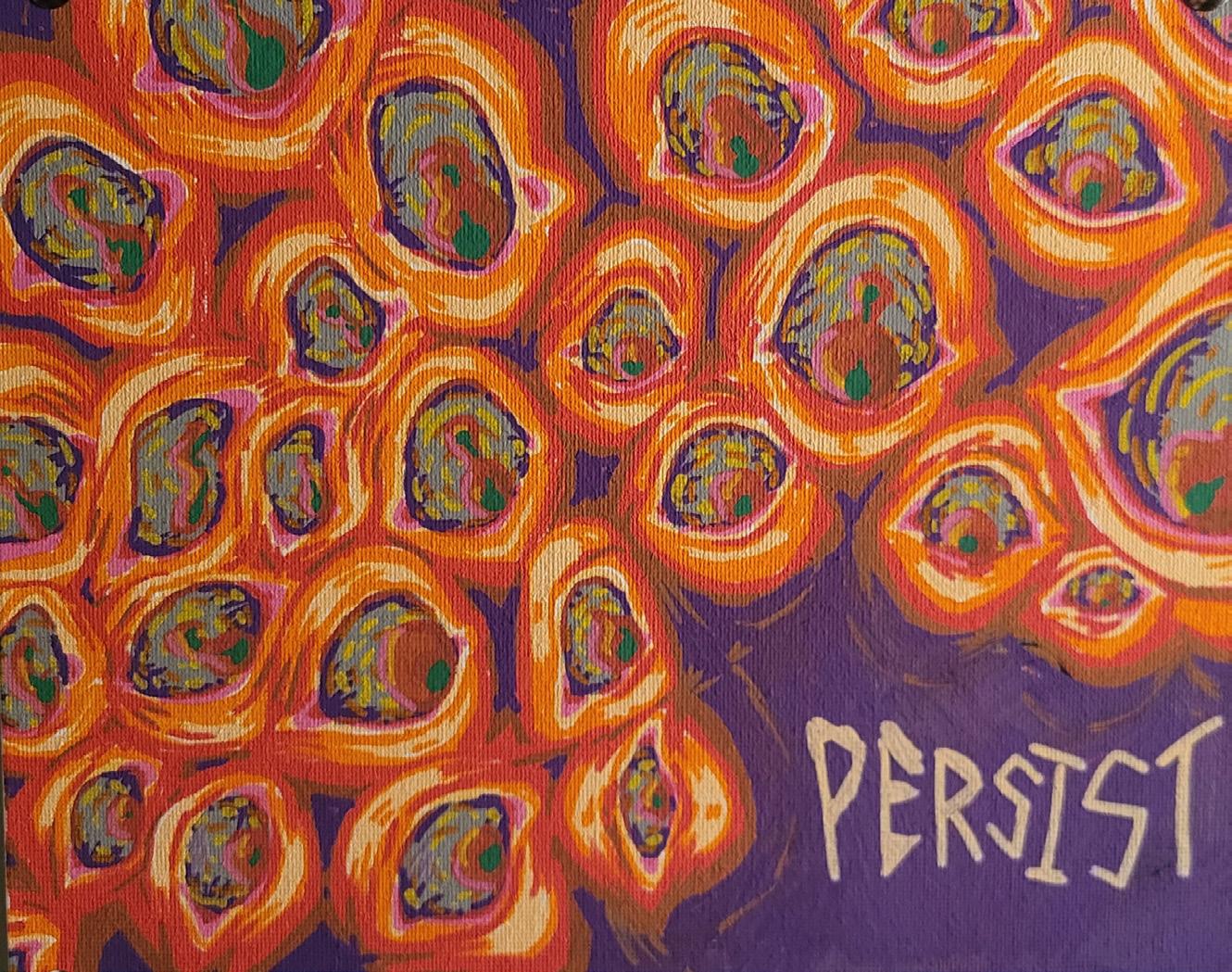
Persist, Blue Noeske
Resistance as a Battleground
Trajan Martin
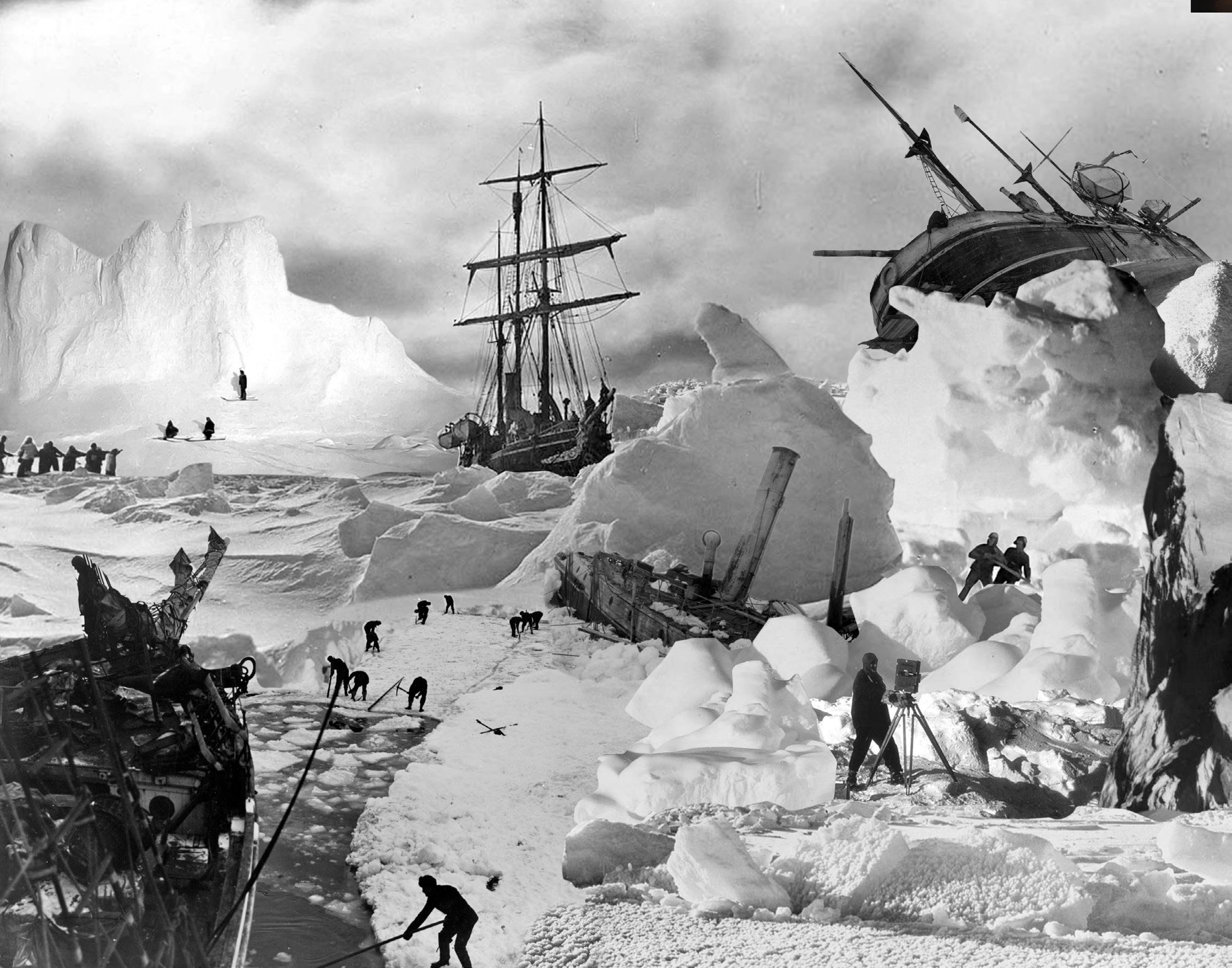
Trapped in the Ice
Jack Stonecipher
MJLC Staff: Time-Tested Strategies of Resistance
As individuals, communities, and global societies, we have faced many forms of pain and hardship as a result of the carceral state’s rule. In an ever-changing world where the only constant seems to be suffering, it’s easy to feel vulnerable and afraid. However, just as oppressive forces have endured throughout the ages, so have dissenting and courageous movements. Though resistance has taken many forms across time, it has always remained a constant companion to injustice. It has manifested as uprisings with more than 10,000 people, like the Battle of Blair Mountain, but also as simple graffiti in a university stairwell. No matter how large or small, effective forms of defiance have persisted alongside tyranny. In this piece, MJLC staff members share a few of the ways we can combat oppression using the wisdom our predecessors imparted on us. Now, more than ever, we must utilize these timeless tools of resistance to lead the next generation of activists in the battle for true abolition—for it is through endurance, we conquer.
-Sir Ernest Shackleton
Shu Lan Schaut - Boycotts
“Money makes the world go ‘round”—this is the unfortunate reality of living under a capitalist system. Foundationally, it is selfish; capitalism teaches us to turn a blind eye to injustice and atrocity, and the system only stirs once its own payoff is put at risk. Therein lies its Achille’s heel, a weakness that can be taken advantage of and cause even the biggest corporate giants to bend the knee.
Boycotting has a long and storied history, tracing back to revolutions, land wars, and strikes. They were a pillar of the Civil Rights Movement, a proponent in the international protest against apartheid, and are a strategic tool against oppressive regimes.
Today, boycotts often occur in consumer markets, focusing on refusing patronage of stores, buying certain brands, etc. All in all, these actions, while still participating within the pervasive capitalist system we were birthed into, have the ability to cause change through collective action. However, the key to success is in sustaining these efforts until real change occurs. Resistance isn’t defined by one action or word; resistance is continuous defiance and dissent.
Quinn Henneger - Violent Community Defense
When a community has been the target of violence, whether it’s a century-long colonialist project or the murder of 16-year-old Matthew Johnson in San Francisco 1966, the people have a right to defend their communities in whatever way they deem necessary. In fact, Johnson’s early passing was one of the catalysts for the founding of the Black Panther Party for Self Defense, one of the most important militant community defense organizations in recent history.
Among a long list of mutual aid projects, the Black Panthers had a Copwatch program that would patrol local police forces with an armed guard. A routine aspect of this Copwatch were observations of police stops, where Panthers would stand guard with visible weapons and provide support to those who have been stopped by police.
However, the Black Panthers are just one example in the long history of community defense initiatives, and they don’t all look the same. Sometimes community defense looks like a labor uprising, as seen by the Battle of Blair Mountain in 1921 where over 10,000 striking coal miners confronted about 3,000 troops. This event acted as the impetus for the labor movement in the United States. Or it can look like
MJLC Staff
Rodney Hinton, a father, who killed a police officer this year after the cop murdered his son, Ryan Hinton. Rodney Hinton’s actions echo a long history of oppressed people refusing to censor themselves when it comes to protecting their community. Hinton’s actions is also a continuation of June Jordan’s famous query: “what you think would happen if / everytime they kill a black boy / then we kill a cop.” The answer, it seems, is white outrage. How many Black lives does it take to justify killing a white pig? Why is “violence not the answer,” only when it’s in the hands of a Black man defending his community? These questions only come up because violent community defense unveils the sheer power that lies within oppressed peoples and their capability to fight for their liberation—and win
Alejandro Hernandez - Education
Institutional academia has long been used as a tool of oppression against marginalized groups which is why re-education and questioning of the status quo has always been a focus in organizing against oppressive regimes. The way the world is presented is not only meant to show you how the world functions, but also how one can interact with everything around them.
In the United States, there are countless restrictions on the material taught and methods of instruction. It is a system based on obedience, grooming children to be docile workers in a 9am–5pm capitalist structure. Even when students are given more liberty to choose their own schedule in secondary education, all of the programs are centered around being able to market yourself as a commodity in hopes of gaining the most amount of money post-graduation.
Because American education’s main purpose is to maintain the status quo, many revolutionary groups have proposed their own case-specific education programs to better support and uplift marginalized groups. One such example is that of the Black Panthers and their liberation schools. This program was not only created to inform more members of the Black community and their children about the pivotal
role Black Americans had in the creation of this country, but also how to come together in community to better serve each other as people against a system that never viewed them as such.
Jonathan Tostrud - Lawsuits—Class Actions and Beyond
Though usually not the first thing to come to mind when imagining radical change, lawsuits have been— and continue to be—essential in shaping political and broad social reform over the last 60 years in the United States. Class actions in American courts have proven to be useful mechanisms of redress to amplify minority voices in the face of pervasive adversity, actively shaping new political and cultural norms. The impacts of class actions are indisputable: from Brown v. Board of Education upending segregation in schools to Floyd v. City of New York challenging the NYPD’s targeting of minorities in stop-and-frisks, it’s apparent that major institutional reform is not only possible, it’s necessary.
Despite being in a time of record low confidence in the high courts of the U.S., there is still meaningful progress being made via the judicial system. For example, Indigenous tribes across the U.S. are currently suing the Environmental Protection Agency for terminating a $3 billion grant that supports historically disadvantaged communities against the shocks of climate change. Additionally, a multitude of suits are being brought against the Trump Administration for issues such as anti-DEI measures, warrantless immigration arrests, and federal grant terminations.
While lawsuits and class-actions are not a quick or simple solution, collectives of wronged individuals can send shockwaves across our institutions by demanding that practices of today become the antiques of tomorrow.
Time-Tested Strategies of Resistance
Omalley Thompson - Sit-ins and Blockades
Sit-ins and blockades are nonviolent forms of civil disobedience that are effective because they are hard to ignore. Sit-ins consist of occupying a specific location and refusing to leave until the protestors’ demands are met. Unfortunately, there is the risk that participants will be detained or face other legal consequences, but even that works to bring more attention to the injustice at hand. Additionally, blockades can be dangerous for protesters because they involve physically blocking an entrance or access to an area, such as a roadway. Protesters refuse to move even when facing aggression from law enforcement and/or vehicles that they are preventing from passing. This is very effective because they directly interrupt normal operations and disrupt routine. A prominent example of successful sitins and blockades occurred during the AIDS crisis. The AIDS Coalition to Unleash Power (ACT UP) was an organization founded in 1987 to protest the government’s strategies towards fighting AIDS. ACT UP frequently utilized sit-ins, most notably the kissin. Kiss-ins are exactly what they sound like: making out to make a change, because there’s nothing more nonviolent than outwardly showing affection towards others! These public displays of affection were used to oppose homophobia, destigmatize LGBTQ+ peoples, and counter the rampant misinformation concerning the transmission of HIV (it was a common misconception that it could be passed through shared saliva). Sit-ins and blockades are time-tested, community based, and often come with a lot of media coverage, thus spreading awareness and expanding the fight towards change.
Max Borgerding - Leaflets and Pamphlets
Despite their propensity for the garbage can and street gutters, pamphlets, leaflets, and flyers act as the undercurrent of social justice movements by informing or motivating the public to participate in forms of protest. Throughout the 17th and 18th centuries, pamphlets contained rhetorical arguments against the Catholic Church and absolute monarchy. Eventually, America picked up the idea and Thomas
Paine’s Common Sense cemented the effectiveness of pamphlets at spurring unrest. Pamphlet persuasion was likewise used by figures like Alice Paul during the Women’s Suffrage Movement, German students against the Nazi Regime in the White Rose Movement, and even by banned authors who used Samizdat, or underground publishing, to fight the oppressive state of the Soviet Union. Not only do pamphlets spread rhetoric, but they also directly incite other forms of protest. For example, the enormous scale of the Montgomery Bus Boycotts relied on the work of Jo Ann Robinson, who disseminated around 50,000 leaflets to organize the action. Despite the large number of flyers distributed in each of these cases, sheer quantity does not underpin the effectiveness of short, written communication. The authors of such literature must find the balance between argumentative quality and succinct prose in order to properly ignite a worthy force against oppression. Incredible finesse and wisdom allow pamphlets, leaflets, and flyers to foment mass movements.
Mar McKenna – Music
Music is a strategy that people use to keep themselves, their communities, and cultures alive when faced with oppression. For example, Inuit peoples of the North American Arctic have kept their culture alive through throat singing. Christian missionaries placed a ban on it, but Inuit communities continued their cultural practice, and by the 1980s, the ban was lifted. Now, Inuit peoples are reviving throat singing through public events and education on the art form and its history. Throat singing tells stories of nature and culture of Inuit groups, and to continue this tradition is to fight against the state that tried to exterminate Inuit peoples. In the United States, enslaved people utilized work songs to help themselves survive and thrive, many of which are still culturally significant, such as “Wade in the Water.” They did not just keep cultures and spirits alive that oppressors tried to destroy, but these songs often contained instructions for escaping enslavement.
MJLC Staff
Music played a major role in the Civil Rights Movement of the 1950s and ‘60s, as well, with songs like “A Change is Gonna Come” by Sam Cooke and “Strange Fruit” by Billie Holiday. Hearing these messages through music motivated action among the masses that helped advance the rights of Black people. These are just a few examples of music being a tool to fight oppression; this tradition has persisted for centuries and is something we can continue today.
Greta Krueger - Mutual Aid
The fascist state speaks to us in terms of both overt and structural violence. It assassinates our civilians, incarcerates our families, starves our hungry, and evicts our vulnerable. When faced with brutally violent structures, it is difficult not to speak its language. The State raises us in violence so we idealize it, but in turning that violence against the State, we only continue the cycle and are no more free. Hopeless complicity is no better: voting for the “less evil” fascist, acting passively within this system, accomplishes nothing. Rather, we must invoke the language of our utopia through our actions—through mutual aid.
Mutual aid networks have a rich history in the United States, particularly in marginalized groups. The New York City Committee of Vigilance not only took up arms against slave patrols, but provided shelter, food, legal resources, and community for freedom seekers. Much of the funding was gathered by Black women, who sold baked goods and handiwork for the cause. Immigrant mutual aid networks (e.g. Sociedades Mutualistas of the southwest USA, Landsmanshaftn of New York City, and the Chinese Consolidated Benevolent Association of San Francisco) arose in the early 1900s in the face of racist violence and policies. More recent examples include the nationwide Black Panther Party, whose 60 “survival programs” addressed the healthcare, food, and education needs of the Black community. During the AIDS epidemic, the Kitchen Soup Brigade provided those afflicted with company and domestic aid.
Throughout U.S. history, these networks have shown us that we can build change from the ground up, even within the violence of the State. Though the fascist State is poised against us, community is a powerful resource to help us overcome.
David Rhee - Video Documenting
One tried-and-tested method of resisting oppression has been the documentation of violent state actions, especially when that documentation is being spread via the Internet or other forms of media. One example of this documentation was during the Civil Rights Movement, where police forces often used lethal means to suppress protestors. Videos and clips of teenagers and young adults being attacked by dogs and baton-wielding riot cops sparked outrage across the globe, prompting American officials to fear diplomatic consequences as a result. Another example would be the heavy documentation of the Vietnam War or the Gaza genocide. An added benefit of documentation is that it allows the oppressed to share the truth of the matter from their perspective. To push their own narrative and give themselves motive and moral high ground, oppressors will often share what they want people to hear, which is coupled with a limitation on speech. By having internal documentation, the oppressed can circumvent this to show what’s really happening. By nature, humans are empathetic to others. To watch the suffering of fellow men and women, to break that dehumanization and lesser-than labels applied to the oppressed, is a powerful tool.
Lillian Miller - Labor Unions and Strikes
While labor strikers in the United States have faced violent suppression from an overwhelming combination of governmental and corporate forces, it’s important to remember that unionizing and negotiating for better working conditions is a viable tool of the working class. One union that has made significant progress in the realm of workers rights is the Knights of Labor, who were formed in 1869 in Philadelphia. The union was open to Black Americans but supported the Chinese Exclusion
Time-Tested Strategies of Resistance
Act of 1882, seeing immigrant workers as a tool that employers could use in order to keep wages down. In this, they held up an unfortunate legacy of many past labor unions: being an unwelcoming place to marginalized folks. Going forward, unions and other reformist movements can become more successful by maintaining a particular focus on mitigating infighting and alienation. The Knights of Labor campaigned for a variety of reforms, some of which they were able to obtain. The demonstrations, strikes, and lobbying efforts of this union contributed significantly to the establishment of the eight-hour workday, which was put in place in 1890. They also lobbied successfully for many regulations that reduced the extreme conditions that were, at the time, normal to child labor. Though they eventually dissolved in the early 1900s, the Knights of Labor were able to contribute significant progress toward workers rights. Their legacy and the long-term nature of these kinds of protests reminds us to endure and not to lose hope. This kind of work does pay off.
Lydia Crabbe - Graffiti
What happens when people are pushed to the margins of society? They spill into the street. What happens when the boundary of art is pushed beyond the frame? It, too, spills into the street. For decades now, graffiti and other forms of street art have navigated institutional barriers to connect marginalized people and countercultural ideas. It is a mode of unlicensed and transgressive communication that uses a visual codex to deliberately resist “the Institution.”
Postering and wheatpasting are obvious examples of how graffiti can organize and advertise underground events and spaces while bypassing official approval processes. But tags, stencils, and spray paint are a little more nuanced. Many write graffiti off as delinquency and misdemeanor, but street art is a deliberate reclamation of public space that calls our society’s structure into question. For example, mural graffiti by local artists often provides beautification, distinctive character and attention to otherwise underserved neighborhoods. Street artworks are evasive messages of hope and discontentment, a mirror reflecting the catching fire around us. But without permission, they are not allowed to stay. “This is private property, your art either belongs to us and our wall, or it does not have a right to exist.”
This is what graffiti defies.
There are many great and notorious street artists such as Banksy or Basquiat with radical yet acclaimed art, but it is not the famous graffiti that is the best. It is the poems or doodles or messages found in unexpected places that truly represent why graffiti is so poignant and thought-provoking. Graffiti art is more than just paint; it is spectacle, performance, and drama. The authorities carry out their role in this play by censoring the underdog, the artists. Our eyes then find the ghostly stains left on the wall and lead us to ask: “was it really that deep? did you have to wash all the art away?”
ACKNOWLE
Behind each and every edition of our magazine lies the time, effort, and commitment of dozens of people. The Madison Journal of Literary Criticism only exists because of the interconnected community that supports our efforts. The list of those we are indebted to is numerous and always increasing. Nevertheless, it is our privilege to be able to give credit where it is aptly due.
To our advisor, Erin Polnaszek Boyd, and the entire University of Wisconsin-Madison English Department: thank you for everything. From assisting us with funding strings to advising our staff and being the administrative body that allows our journal to run, your support has been invaluable and the foundation to our existence as an organization.
To Professor Ingrid Diran: the MJLC, as we know it today, would simply not exist without your assistance. Thank you for your willingness to serve as our soundboard whenever we are stuck—our ideas cannot possibly come into their own without support from you. Whether it’s drawing analogies or challenging our conception of a theme, you have helped us expound points and challenge our own preconceptions.
It would be a failure of epic proportions not to acknowledge the cornerstone of our organization, the MJLC study group. Its members tether our mission of abolition to real world praxis. It is from conversations in our weekly meetings that we find the inspiration that molds our vision for the magazine. Thank you for bearing with us through discourse, discord, and random tangents. It is a joy to be able to spend time with you all every week.
The foundation of our work relies on others’ artistry. As a magazine, we seek to find creative voices from all sorts of backgrounds to create a diverse and one-of-a-kind edition. To our contributors: there is a reason why we chose your work. Concepts like Endurance are multifaceted and complex, but our contributors manage to form brilliant pieces of work from a theme that even we struggle to grasp in its totality. It is an honor that you have chosen to share your work with us—thank you.
And, of course, we would be remiss to not highlight our wonderful staff. As a completely undergraduate student-run publication and organization, the MJLC survives off of the fumes of late night writing sessions, frantic Slack messages, and the occasionally heated icebreaker question. It is through this dedication that our staff gets us from mere plans to print.
This work is predicated on our editing team who are committed to the craft of literary criticism. They devotedly read every word submitted to us and thoroughly revised pieces, working alongside our contributors to polish everything into the form you see here. It is because of their tenacity and fervor for this work that we are able to share such a variety of genres and pieces, further expanding our world of literary criticism. Thank you for your dedication, innovation, and critical eyes that help us forge and refine each edition.
DGEMENTS
The magazine is dependent on the creative energy brought by our graphics and layout team, who regularly manages to thrive despite near impossible deadlines. Our expectations of you are set high and you exceed them every time. Thank you for ensuring that each piece is published to accurately reflect the author’s intentions and artistic efforts. Your talent is unlimited, your diligence is unending, and your ingenuity is immeasurable. Without you all, this magazine would still just be a myriad of PDFs and Google Docs wasting away in the Cloud. It is with your hands that our beautiful final product is crafted.
Additionally, thank you to our ragtag communication team, who painstakingly sends out thousands of emails, creates and plans collaborative events, and finds new ways to share our organization with the world everyday. It is because of the steadfast efforts of these members that we have the ability to publish every semester.
A special thanks goes out to our interim managing editor, Hannah, who stepped into the role with ease and has effortlessly overseen the entire editorial team. Thank you for stepping up and bringing your enthusiasm, commitment, and irreverent slideshow pictures.
We’d also like to extend sincere gratitude to our production director, Max, who has enthusiastically taken on immense responsibility and continues to impress us with every passing week. Thank you for your patience, consideration, and initiative that puts the rest of us to shame.
Quinn, our partner-in-crime, you’ve fearlessly led our study group for the past three semesters, with no signs of slowing down. Thank you for guiding our group and consistently being the voice of education, engaging our minds and encouraging us to expand our horizons. You’ve been an invaluable leader, but even more so, a friend we can always rely on. Thank you for everything—we quite literally could not do any of this without you.
Hannah, Max, Quinn, Alejandro, Meera, Lillian, Mar, Greta, Lydia, David, Sreejita, Omalley, Mihika, Francesca, Rissa, Kiki, and Sofia. Thank you for choosing to be part of this crazy group and for trusting us to lead you all through this chaos. The MJLC’s vision could not be executed without its dedicated producers.
Making a magazine is a marathon, but we are so lucky to be surrounded by a community of friends, advisors, patrons, and so many more people that help us get from start to finish. We couldn’t have done any of this without you all.
Thank you for enduring alongside us.
With love and appreciation, Jonathan & Shu Lan
endurance contributors
LIV ABEGGLEN / LIBERATION / is an undergraduate student at the University of Wisconsin-Madison and studies genetics and English. She writes while the centrifuge is running.
HENRY COLUCCI / NO TITLE / is a student at the University of WisconsinMadison from Milwaukee. A majority of their art is collages of distorted shapes and bodies primarily for personal consumption, however, they still enjoy showing other people. Their art designed for being viewed is mostly propaganda. That is, the pieces are meant to appeal to people’s emotions surrounding exploitation and violence, as a means to promote left-wing extremism, specifically, anarcho-communism. The collage of information is meant to evoke some emotional response, hopefully funneling that emotion into the propagation of mutual aid, violence against the state and capitalism, or both.
LYDIA CRABBE / HALLOWED BE THE ICE AND SNOW / MAMA I’M AN ANARCHIST / is a third-year student at the University of Wisconsin-Madison, originally from the city of Chicago. They enjoy using print media as an art form, which nominally embraces mass production and consumer commodities, to explore the intersection of ecology, identity, and commodification. They aim to create discussion around exploitation and oppression of both people and environment, and the power of beautiful moments to create hope that we may yet escape a grim future.
“Hallowed be the Ice and Snow” is an oilbased lithograph with chine colle. Inspired by winter ice on Lake Mendota, it grapples with the rapid worsening of climate change and the nature of our relationship with nature. The frozen lake and the quiet of snow is a perhaps fleeting refuge and solace as our world physically and ideologically changes for the worse, but it is solace all the same. There is no endurance without hope, and what this piece hopes to convey is that hope can be simple but gentle moments on miraculously thick ice.
“Mama I’m an Anarchist” is part of a larger, multi-media project on direct action and anarcho-praxis using a reoccurring character. The main idea of the project is to merge “traditional” art mediums with street art and guerilla art concepts and practices. It is meant to be an homage to the endurance of unconventional art as a form of resistance to capitalistic, commodifying, and otherwise oppressive society. This particular work is a lithograph with layers built with traditional “street art” materials such as spray paint and paint markers, with visual elements also drawing on historic punk imagery.
BETSY FRIES / OUTPOST /, 21-yearsold, is a photographer from Minneapolis, MN, and a senior at the University of Wisconsin–Madison studying consumer behavior and marketplace studies with certificates in entrepreneurship, photography, and leadership. Her creative work bridges observation and emotion, using photography to explore themes of nostalgia, solitude, and resilience in everyday environments. Fries’ practice is rooted in patience and curiosity, finding beauty in overlooked details and spaces that endure beyond their original purpose. Outside of her academic studies, she runs a photography business, where she documents stories that balance realism and warmth, reflecting her fascination with how people and places quietly persist through time.
EMILEE
G.H. / PACKING FOR THE APOCALPYSE / (she/they) is a secondyear MS Human Ecology student at the University of Wisconsin-Madison. She previously obtained a BA in anthropology and geography from the same institution. As a Queer, neurodivergent, working-class, firstgeneration student, Emilee often feels like an outsider in academic settings. Her experiences have sparked an interest in exploring different ways of knowing, bridging opportunity gaps in education, and confronting censorship in the United States. Emilee utilizes care and optimism as resistance against threats of apocalyptic doom, offering pathways toward survival and transformation.
PRISCILLA HERRMANN
/ SEVENTEEN AND A HALF MINUTES INTO JUNO / is a 22-year-old writer from Lansing, Michigan. She attends Michigan State University as an English major. She is the oldest of three daughters, all with wildly different and strong personalities. As such, Herrmann has always been a feminist, drawing inspiration from her own life experiences and those of her family and friends. With the tumultuous state of the world and the extreme divide in American politics, Herrmann believes that writing plainly about the experiences of those around her can help start to bridge that gap between people.
LEO HIRSCHBOECK / A HORSE
APIECE? / is an art education student at the University of Wisconsin-Madison but is originally from a small town in southeastern Wisconsin. This is a piece they made in their serigraphy (silk screen printing) class. Leo is 20-years-old and has been making art for as long as they can remember. They always dreamed of doing something with art as part of their career which led to their current studies in art education. Their favorite medium now is crayons, just as it was when they were three. Recent recurring motifs in their artwork are fish, horses, stars, shoes, dollhouses, and beetle wings.
“A Horse Apiece?” is a 12.5 inch x 9.5 inch serigraph originally created for a class project. The print consists of only two subjects: the horse and the stars. Both of these have been areas of interest for Hirschboeck in recent works. Growing up as an openly queer person in a traditional farming town, endurance has been a defining and overarching theme in this artist’s life for over a decade. Queer people, like the stars, have always existed and always will.
JIAHUA HUANG / UNTITLED / is an artist from China, currently studying studio art and graphic design at the University of Maryland. Her work explores emotion, adaptation, and memory through expressive color and layered collage. “Untitled,” an acrylic and collage painting, captures a fleeting moment of struggle and motion, reflecting her interest in the tension between chaos and introspection. The layered surface reflects the tension between what is seen and what is hidden, between appearance and truth shaped by public opinion. A figure reaches forward, caught in motion, as if trying to move through the noise of information. The heavy brushwork and fragmented texture suggest both chaos and persistence. Through this piece, Huang examines how individuals navigate shifting realities and collective narratives, revealing the quiet struggle to stay human and aware within a constantly changing world.
endurance contributors
BENJAMIN KABEYA
/ ENDURANCE / uses art to talk about their personal struggle as a human being. Kabeya used HB graphite and charcoal pencils as well as a Monozero eraser to create “Endurance.” This art talks about remaining optimistic in hard life situations as shown through the hard grip and veins on the arms.
KATRINA KOPPA / WHEN THINGS
FEEL SCARY / is an artist and art educator based in Madison, Wisconsin. Lately she has been moving between wood and textile sculpture and ink and watercolor drawings. Her work is centered around storytelling, play, and curiosity, and places her own experiences in an idyllic, whimsical world. Koppa was raised in Viroqua, Wisconsin and received her BFA and certificate in arts and teaching from the University of Wisconsin-Madison in the spring of 2025. This piece was prompted by a challenge to create a “horror comic” and a long walk spent thinking about fear. Koppa is most interested in storytelling, in play, and in the visceral feelings of human connection. She places her own experiences and memories inside an intricately constructed world. “When Things Feel Scary,” is a two page comic that connects the fears of childhood with those of early adulthood and considers ways of enduring the discomfort. The work is pen and ink on paper (two 9 inch x 12 inch pieces).
EMILAND KRAY / DREAM EATS
MEMORY / is an artist, writer, and game designer who creates work to investigate the connective tissue of dreams, memories, nostalgia, and fear, oftentimes using his own nightmares as inspiration. Kray resides in the Southwest and received his MFA from the University of Arizona in 2023. His eclectic approach to storytelling emphasizes collaboration and interactivity, oftentimes transforming his audience from passive viewers into active participants. This drawing, “Dream Eats Memory” is part of a larger body of work exploring working-class endurance and the intersection of poverty and mental health crises, pulling directly from his childhood during the 2007 Great Recession. Kray’s artwork poses questions about the mechanics of how we remember and what we fear—the complexity that exists within those entangled systems.
With book arts, game design, and drawing, he visually introduces instances of slippage in our recollection of the past and the decay of memory towards nostalgia and nightmare. Through his work, Kray gathers and sifts through intangible archives: dreams, night terrors, and memories themselves to find how these elements make statements about the importance of memory but also the futility and impermanence of life. Here, Kray makes visible our growing pains and rejects the notion of a perfect genesis.
SAMANTHA LEZAMA / COMFORT
KILLS /, known artistically as Hustle, is a 21-year-old Mexican-American artist and business management major with a studio art certificate at University of WisconsinMadison. Born and raised in Chicago, she began painting through the program After School Matters, where she found mentorship in community mural work. Now interning at Arts + Literature Laboratory, Hustle blends her business insight with her artistic drive to create oil-based realism and imaginative character work exploring spirituality and social awareness. “Comfort Kills” reflects resilience and curiosity, capturing themes of discomfort, growth, and self-transcendence. Hustle’s art continues to challenge boundaries while celebrating identity and collective connection. Hustle draws inspiration from her Mexican roots, exploring themes of discomfort, transformation, and inner strength. Her paintings, often oil-based, balance emotional vulnerability with visual boldness depicting surreal figures, symbolic objects, and cosmic undertones. Art is an eternal passion; she repurposes her gains for more materials or for her mother’s wellbeing. Hustle quotes, “Your mind is your weapon. Everything is energy, even artwork!” Guided by the Mayan phrase “In Lak’ech Ala K’in”—I am you, and you are me.
MIRANDA LILE / WHAT IS THE DIRT
TELLING YOU? / is a musician and creative from Milwaukee, Wisconsin. After receiving her BA in music from Lawrence University, she’s now working on her MA in information and library sciences. She is incredibly interested in the intersection between the arts and information. Her three-part piece “What is the Dirt Telling You?” uses nature and sound to pick at the tangled web of endurance. Perhaps endurance isn’t in an answer, but in a question?
KATHLEEN MAJESKA / KALEH
KALEH / is a student at Michigan State University pursuing a major in zoology with a concentration in animal behavior and neurobiology as well as a minor in creative writing. She’s from Dearborn, Michigan and is of Armenian and European descent. Her piece “Kaleh Kaleh” takes its name from the Simon Javizian Ardziv Orchestra version of an Armenian song, the title essentially translating to “Walk Walk.” It’s a story about surviving and creating a better world for those who come after you through the comparison of her great-grandmother’s life, her grandmother’s life, her mother’s life, and her own.
TRAJAN MARTIN
/
RESISTANCE AS
A BATTLEGROUND / is an artist, caregiver and corporate American refugee. They have done art in various forms their entire life and have always had a specific interest in social justice. Their hometown is Sebastopol, California. “Resistance as a Battleground” is a mixed media piece with digital color adjustments. It explores the anatomy of struggle, both literal and symbolic, through a stark depiction of two hands locked in a tug-of-war of sorts. The rough techniques used present skin as a site of conflict: a battleground. There is no hero here, no villain—only exertion and endurance. The composition resists resolution. It asks: who pulls, who yields, and what happens when the rope snaps?
endurance contributors
endurance contributors
BLUE NOESKE / PERSIST / is a senior at the University of Wisconsin-Madison majoring in creative writing. “Persist” was made using acrylic markers, meant to represent the weight of resilience. There is no other choice worth considering. Acrylic markers were chosen for the smoothness that they allow, aiding to a choppy and visually straining contrast between the high and low points, with the contrast between the bright yellow of the eyelids and the pale gray of the eyes meant to symbolise a sickness in those voyeuristically pushing the viewer into the idea of perseverance as the only option. Those who watch but do not help. The idea of perseverance is something fought for, held onto despite the odds. How it feels like many people are simply waiting for you to fail or give up, pushing you to persevere even more desperately. Noeske hopes this piece fosters a sense of determination in the viewer, despite looming anxieties of what failure may mean.
KASDEN PHILLIPS / BLUES CLUB / is a BFA candidate studying graphic design at the University of Wisconsin-Madison. They are currently a junior from Orange County, California. Phillips developed this piece specifically to represent a common misconception of what politics really are and what they represent. They believe “Blues Club” resonates with themes of endurance and resistance in terms of emulating the power of people and community.
“Blues Club” is a linocut print celebrating the enduring spirit of Black creativity and community resistance. Using bold, contrasting colors and layered textures, the work honors jazz as both an art form and an act of defiance—born from struggle yet filled with joy. Jazz emerged from marginalized communities that transformed oppression into expression, collaboration, and resilience. This piece connects to the theme by illustrating how art endures in the face of systemic injustice. The musicians’ unity and improvisation symbolize collective strength and liberation, reminding us that creativity itself is a form of survival against forces that seek to silence it.
JACK STONECIPHER / TRAPPED IN THE ICE / is a graduate student at the University of Wisconsin-Madison, originally from Minnesota. “Trapped in the Ice” is a digital collage composed of photos taken during the Endurance Expedition in 1914 and the Belgica expedition in 1897. These expeditions represented incredible human resilience in the face of insurmountable odds.
EM SWEENEY / SPACES IN-BETWEEN /, originally from Cumberland, WI, spent two years studying at Northland College where they were deeply influenced by the community’s commitment to environmental and social justice. In their junior year they transferred to Lawrence University to continue studying English and philosophy. “Spaces In-Between” engages with Mohsin Hamid’s novel Exit West as a narrative that embraces the utopian imagination as it necessarily emerges from political, personal, and interpersonal conflicts. Further, the novel itself is a way for Hamid and his readers to envision positive futures beyond what our capitalist realities offer.
KARRIE WORTNER / STILL, THE PULSE / is a writer, photographer, mother, and wife from the small, historic town of Peshtigo, Wisconsin. As a senior at the University of Wisconsin-Green Bay studying writing and applied arts, she has traded customer service calls for poetic lines and punchy prose. Her work dances through discomfort, whimsy, and emotional depth, always chasing the kind of truth that lingers. A proud Sigma Tau Delta member and active literary contributor, Wortner writes to crack open vulnerability and spotlight voices that deserve the mic. Her stories invite readers into quiet reckonings and bold connections— where language doesn’t just speak, it sings, stings, and stays.
Follow the MJLC on Instagram
Learn more at the MJLC website
Read the MJLC’s founding research
Funded in part by an Associated Students of Madison viewpoint neutral grant. Contact request@ asm.wisc.edu for accomodation information.