College hosts sustainability summit to cap off 'Year of the Environment' celebrations
Event
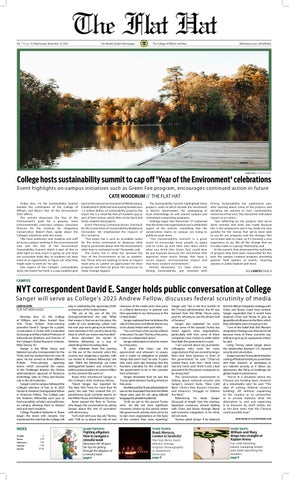
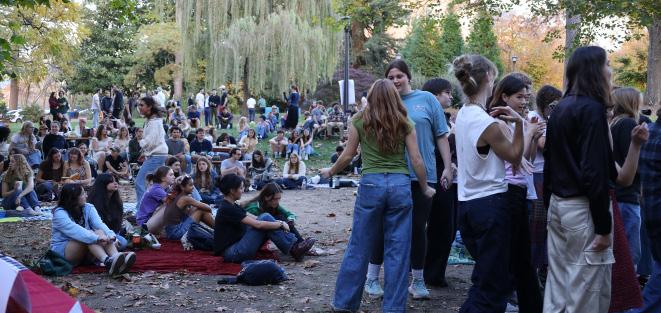
Friday, Nov. 14, the Sustainability Summit marked the culmination of the College of William and Mary’s Year of the Environment 2025 efforts.
The summit showcases the Year of the Environment’s push for a greener, more environmentally conscious campus. Executive Director for the Institute for Integrative Conservation Robert Rose spoke about the College’s intentions with this event.
“We have professors and students and staff all across campus working in this environmental area and the Year of the Environment Sustainability Summit, which is part of that to shed light on how much is going on and what our ecosystem looks like, so students can have more of an opportunity to figure out what they might want to work on,” he said.
One aspect of the College’s sustainability work, the Green Fee Fund, is a way students give
back to the natural environment of Williamsburg.
Established in 2008 and now having funded over 1.5 million dollars of sustainability projects, the Green Fee is a small fee that all students pay as part of their tuition, which then circles back and funds student-led projects.
Event Planning Communications Outreach for the Committee on Sustainability Madeleine Fernandez ’28, emphasized the impacts of this initiative.
“The Green Fee is such an incredible outlet for the entire community to showcase what they're passionate about with the environment, what they're motivated to do,” Fernandez said.
The Green Fee is what has allowed the Year of the Environment to be so studentled. Those who are looking to have an impact need only to submit an application for their proposal and then be given the resources to make change happen.
play in celebrating the upcoming 250th anniversary of the United States.
Monday, Nov. 10, the College of William and Mary hosted New York Times Pulitzer Prize-winning journalist David E. Sanger for a public conversation in Tucker Hall, moderated by George and Mary Hylton Professor of International Relations and Director of the College’s Global Research Institute, Mike Tierney ’87.
Sanger is the White House and National Security Correspondent for the Times and has worked there for over 40 years. He has served on three di erent Pulitzer Prize-winning reporting teams, which uncovered the causes of the Challenger disaster, the Clinton administration’s approval of American technology sales to China and Russia’s role in the 2016 election.
Sanger’s visit to campus followed the College’s selection of him as its 2025 Hunter B. Andrews Distinguished Fellow in American Politics. The College uses the Andrews Fellowship each year to host journalists, scholars and politicians on campus, allowing them to interact with and teach students.
College President Katherine A. Rowe began the event with remarks. She mentioned the role that the College will
“We are at the eve of the U.S. Semiquincentennial,” she said. “What that means is that we are the place, the cradle of civic leadership, where over the next year we’re going to be thinking most intensely in this country about the ideas in which our nation was founded.”
Rowe described the Hunter B. Andrews fellowship as a way of celebrating these founding ideas.
“We celebrate them this evening on the eve of the moment when this country was imagining a republic, with our Hunter B. Andrews fellowship,” she said. “[With the fellowship], we invite distinguished leaders and scholars in politics and journalism to come to re ect on the moment that we’re in.”
Rowe then introduced Sanger as the College’s 2025 Andrews fellow.
“David Sanger has reported for The New York Times for more than 40 years,” she said. “He’s covered ve U.S. presidencies [and] currently reports on the White House and National Security.”
Rowe passed the oor to Tierney, who began the conversation by asking Sanger about the role of journalism with democracy.
“Let’s start with your day job,” Tierney said. “Talk to us about the role of and
The Sustainability Summit highlighted these projects, some of which include the investment in electric lawnmowers, the cataloguing of local entomology on and around campus and centralized composting programs.
Geology major Alex Stevenson ’27 explained that the Green Fee organization was a celebrated aspect of the summit, something that the conservation teams on campus are trying to publicize even more.
“The [Sustainability Summit] is a great event to encourage more people to apply and to come up with their own ideas about what you think [the Green Fee] could best be put towards because the committee that approves them wants things that have a social impact, environmental impact and that have student involvement.”
Harriet Ramasamy ’27, lead intern for Dining Sustainability, got involved with
relevance of the media and a free press in a liberal democracy, in general, and then grounded in our democracy in the United States.”
Sanger explained how he believes the role of a free press and liberal democracy to be closely linked with each other.
“You can’t have a free society without a free press,” he said. “And by a free press, I mean an independent press.”
Sanger elaborated on what he meant by a free press.
“A press that hears out the government and whoever’s in power, and is under no obligation to publish things that aren’t true,” he said. “A press that starts each day knowing that the founders intended for the media and the government to be in this constant form of tension.”
Sanger illustrated how he saw the Trump administration hurting America’s free press.
He referenced the Trump administration’s ban on the Associated Press from the White House press pool for not using editorial language the president preferred.
“Until we got to the second Trump term, we did not have signi cant moments [similar to] this period, where the government actively went out to try to ban news organizations on the basis of the content they were reporting,”
Dining Sustainability her sophomore year after hearing about some of the projects and deciding she wanted to start sustainability initiatives of her own. She shared her individual impact as an intern.
“Just reflecting on the projects that we've done recently and what was made because this is the symposium and it has made me very grateful for the money that we've been able to use for our programs and the changes that we've been able to make, so it's honestly a nice experience to see like all the change that we actually made as a group,” Ramasamy said.
At the summit, they showcased the multitude of projects they have been responsible for this year: the campus compost program, providing greener food options at events, recycling systems in Zable Stadium and more.
Sanger said. “Yet, in the rst months of the [Trump] administration, the AP was banned from the White House press pool for refusing to use the phrase Gulf of America.”
Sanger also explained his worry about some of the lawsuits Trump has levied against news organizations, particularly with how some of these companies have chosen to settle rather than ght the government in court.
“I am worried about my journalistic colleagues who work for news organizations that are owned by larger rms that have business in front of the government,” he said. “[They’ve] settled these suits that I think never had any merit, and I think it sets a bad precedent for the parent companies to be doing that.”
The conversation transitioned to talking about national security and Sanger’s newest book, “New Cold Wars: China's Rise, Russia's Invasion, and America's Struggle to Defend the West.”
Referencing his book, Sanger discussed at length how the previous bipartisan consensus around dealing with China and Russia through liberal and economic integration, in his mind, did not work.
Tierney asked Sanger if he believed
that this liberal integration strategy with China and Russia could have worked.
Sanger responded that it would have required China and Russia to give up geopolitical in uence to the West, which they ultimately were not going to do.
“I am of the belief that [the Western integration] strategy was doomed to fail because none of these countries was willing to give up its superpower status,” he said.
Lastly, Tierney asked Sanger about the relationship between U.S. national security and universities.
Sanger sees the Trump administration cutting o federal funding to universities and their research as damaging to our national security, as it allows our adversaries, like China, to challenge our global research prominence.
“You’re in a situation where the Chinese are funding basic research at a remarkable rate,” he said. “The idea of cutting [federal research funding] off without explaining to the country or to universities or to private industry what the alternative is, and just expecting it to blossom by itself strikes me as the best news that the Chinese could possibly hear.”
CATE WOODRUM // THE FLAT HAT
news insight
Seek out people who disagree with you, seek out people who chal lenge you and who do so from a place of curiosity, from a place of empathy.
̶ Senior Researcher and Advisor at the International Crisis Group Ali Wyne
Wednesday, Nov. 19 to Friday, Nov. 21, the College of William and Maryʼs Board of Visitors will convene for its second meeting of the 2025-26 academic year in Blow Memorial Hall. All of the Boardʼs eight committees are scheduled to meet to follow up on business from September, with some proposing new resolutions. The Board will also hold special meetings led by the Committee on Academic Affairs to discuss plans for the College of Arts and Sciences, the Law School, the Batten School of Coastal and Marine Sciences, the School of Education, the School of Business and the School of Computing, Data Sciences and Physics.
In line with the Collegeʼs goal to grow curriculum offerings related to artificial intelligence, the Board will vote on a resolution to create a new Bachelor of Arts in Applied Artificial Intelligence. The move will expand on the artificial intelligence concentration currently housed in the Department of Data Science.
The session will begin Wednesday afternoon with the Subcommittee on Compensation and the Executive Committee. The Board will later meet for dinner hosted by Rector Charles E. Poston J.D. ʻ74, P ʻ02, ʻ06 at the Raymond A. Mason School of Business.
Thursday morning, the Committee on Academic Affairs will deliver opening remarks before the Collegeʼs major schools meet in succession for the rest of the day as part of the annual omnibus session. The Board will hold a lunch at Oak Hall and conduct a residence tour of the West Woods complex, which opened last October, discussing initial obstacles with the buildings such as fire alarms and the future of the Global Village.
The Flat Hat wishes to correct any fact printed incorrectly. Corrections may be submitted in email to the editor of the section in which the incorrect information was printed. Requests for corrections will be accepted at any time.
ʻSTABILITAS ET FIDESʼ | ESTABLISHED OCT. 3, 1911 Org #101 P.O.
Assistant professor Brianna Nofil explores roots of America’s immigration detention system
When assistant professor of history Brianna Nofil talks about immigration detention in the United States, she begins in the place where she first learned that the carceral landscape extended far beyond the bounds of the criminal legal system: a detention center on the edge of the Florida Everglades, where she grew up.
Growing up in south Florida, Nofil lived near the Krome Detention Center, a facility she describes as “strange, isolated and undefined,” reachable by a single road that cut through the swamps of her hometown. When she was young, she noticed the protests that occasionally erupted there, often led by Haitian community members demanding answers about why Haitian asylum seekers were detained while Cuban migrants received drastically different treatment.
“It was this weird space on the edge of my community that I didn’t fully understand,” Nofil said. “People asked these questions — is it a prison? Is it not a prison? Did people commit a crime, or did they just cross a border? Even people living nearby weren’t sure.”
Years later, trying to make sense of this place that had loomed large but unknowable in her childhood, Nofil enrolled in an immigration history class as an undergraduate. She expected clarity. Instead, she found a field full of unanswered questions and an archival trail of contradictions and erasures that would shape the next 14 years of her scholarly life.
“I became completely obsessed,” she said. “It was opened by Reagan in the ’80s at a moment when so many people were coming from the Caribbean. Once I understood how Krome was part of this broader system — one that tried to deter asylum seekers by making the process miserable — that became the motivating question of my work.”
Today, as a scholar of immigration detention, incarceration and the legal architecture connecting the two, Nofil started teaching courses on the history of policing and carceral institutions at the College of William and Mary in 2020. Her book, “The Migrant’s Jail: An American History of Mass Incarceration,” built from over a decade of research starting with her undergraduate thesis, argues that detention centers like Krome are only one small part of a vast, largely invisible machinery.
When Nofil first set out to research immigration detention as a student, she assumed she would find a network of official detention centers. What she discovered was a system hiding in plain sight.
“I assumed immigration detention happened in places that were called immigration detention sites,” she said. “But the vast majority historically happened in local jails.”
From the late 19th century to today, migrants in detention have been confined not only in federal facilities but in thousands of local jails, places the public rarely associates with immigration enforcement and whose records are often incomplete or destroyed.
“Your local jail does a lot more than people imagine,” Nofil said. “It holds pre-trial detainees, people serving short sentences and people detained by the federal government, including ICE. But that means immigrants can be moved constantly, often without their families even being notified.”
The archival trail is equally unstable. In her
own research process, even when she located documentation, it often disappeared upon request. Records from the Immigration and Naturalization Service, the predecessor to Immigration and Customs Enforcement, frequently exist only in fragments or in odd places.
“The main index to INS records is a card catalog from the 1950s that’s only viewable on Ancestry.com,” she said. “You look up a subject, request the files and then the archivist tells you half of them don’t exist. They’re just ... gone.”
Jail records are often worse. Counties rarely preserve jail logs or correspondence; fires, mishandling and neglect erase what little survives. The effect, Nofil says, is not always obvious suppression, but it is a kind of structural disappearance.
“It’s not always a conspiracy,” she said. “But the result is the same: these histories are incredibly hard to reconstruct.”
Even the records that do survive can be ethically fraught. Nofil has uncovered extensive documentation on the detention of migrant children in the 1980s and 1990s, material she has largely chosen not to publish.
“You have to go through a fairly intensive process to use these records sometimes because there are major concerns about privacy,” she said. “I have records on children’s detention that I mostly didn’t include in the book because I still have big questions about what the responsible way to handle that is. These children could still be in the United States, possibly undocumented. I feel a big responsibility to handle this carefully. Some stories need more time before they can be told safely.”
When teaching these sensitive subjects, Nofil noticed that part of what makes immigration detention so difficult for students to grasp is that the system is newer and legally stranger than many assume.
“People don’t always understand that the entire legal foundation of immigration detention comes from the Chinese exclusion era,” she said.
A pivotal 19th-century U.S. Supreme Court decision in Fong Yue Ting v. United States declared deportation not a punishment, but merely a civil process of returning someone to their country of origin. It was a conclusion steeped in the racism of the era and one that still governs immigration law today.
“That ruling means people in immigration detention don’t have the same due process rights as someone accused of a crime,” Nofil said. “You do not have a right to an attorney, you do not have a right to a trial with a jury and you do not have the right to a trial with a judge as we typically understand it. And yet people are detained for months or years in facilities that look exactly like prisons.”
For No l, history forces students to confront a contradiction that has shaped U.S. policy for more than a century.
“It has always made Americans uneasy, even in the 1890s,” she said. “People asked, ‘Is this really justi able? Is this Christian? Should our community be making money o this?’ Those questions haven’t gone away.”
With so many gaps in the archival record, No l’s work focuses as much on recovering agency as recording su ering. She emphasizes that migrants, as well as local communities, have long resisted the expansion of detention.
MOLLY MARTIN / THE FLAT HAT
MONA GARIMELLA // FLAT HAT MANAGING EDITOR
FLAT HAT NEWS BRIEF
COURTESY IMAGE / BRIANNA NOFIL
Nofil released a book in 2020 entitled “The Migrantʼs Jail: An American History of Mass Incarceration” as a culmination of over a decade of research.
John Quincy Adams Society hosts Ali Wyne for talk on diplomacy with Asia
Speaker discusses U.S.-China relations, potential competition between countries, modern political environment
Wednesday, Nov. 12, the College of William and Mary’s John Quincy Adams Society hosted a talk with Ali Wyne, a political analyst and policy advisor. The talk discussed the state of diplomatic relations between the United States and various Asian countries, and emphasized the importance of diplomacy and prudent decision-making. The lecture focused particularly on China and the potential future of U.S.-China competition.
Wyne currently serves as a senior researcher and advisor at the International Crisis Group, having previously worked in analyst roles at the Eurasia Group and the RAND Corporation. He is also the author of “America’s Great-Power Opportunity: Revitalizing U.S. Foreign Policy to Meet the Challenges of Strategic Competition” and co-author of “Lee Kuan Yew: The Grand Master’s Insights on China, the United States, and the World.”
Wyne believes that competition between the United States and China will not “end” with a definite winner. Rather, in his view, both countries must learn to coexist indefinitely in a less contentious way.
“My basic view of the U.S.-China relationship [is that] America isn’t going anywhere [and] China isn’t going anywhere,” Wyne said. “We’re going to have to find some way of competing and coexisting at the same time.”
He also argued that American policymakers need to have a more measured view of China’s significance to meet this goal. Many people, he believes, fall into extremes of either over or underestimating China.
“If we’re going to compete effectively, if you believe that we are in a long-term competition that won’t have any definitive resolution, we need to make sure that we have a psychological temperament that is commensurate to the stakes in the longevity of that competition,” Wyne said. “China is poised to be an enduring competitor. It’s not two feet tall. It’s not 10 feet tall.”
Furthermore, Wyne notes that an easing of tensions between
CAMPUS
the United States and China is necessary because of the severity of any conflict that would break out between the two nucleararmed superpowers. He emphasized that diplomatic coexistence is essential in ensuring both countries’ security.
“If the United States and China were to go to war, we’re not sure which country would win,” he said. “Whichever country would win would be blunted. Even if the United States were to win — and I think it would be a very pyrrhic victory — the United States would have incurred an enormous amount of damage. Stop saying or stop assuming that war is inevitable, because you lull yourself into a self-fulfilling prophecy that will indeed bring about that outcome.”
Wyne believes that both the United States and China have unique competitive advantages that are likely to remain in place, and that accepting those distinctions is a key step towards helping to stabilize the future of the countries’ relationship.
“We need to find a midway point between saying, ‘We have nothing to learn from China’ and ‘We have to out-China China,’” he said. “We need to be thinking about what our unique competitive strengths are.”
One of America’s greatest strengths, per Wyne, is its historical commitment to diversity and intellectual openness. He draws this idea from Lee Kuan Yew, the first Prime Minister of Singapore.
“As long as the United States maintains its openness, openness to people, openness to ideas, openness to dissent and debate, I think that the United States will do okay,” Wyne said. “One of America’s core advantages — maybe its principal core advantage — is that the United States can draw on the talents of roughly 8 billion people. China can draw on the talents of 1.4 billion people.”
Beyond the context of international relations, Wyne also discussed the importance of discourse, humility and curiosity in one’s personal life and the modern political environment.
“We don’t even know what’s going to happen tomorrow, let alone next month, let alone six months from now, let alone a year from now,” he said. “When I think about how many beliefs
I once had that didn’t stand the test of time, it’s a very, very long list. We need to be very, very humble about the limits of our understanding.”
Lucas Bickham ’29 found Wyne’s focus on social interaction rather than pure policy to be unexpected and refreshing.
“What I expected was a very political focus, and I was surprised to see that he talked a lot about humility and empathy,” Bickham said. “That was definitely one of my biggest takeaways, and I realized that he has a very good point and that empathy plays a very big role in politics.”
Afterwards, Wyne said that the primary takeaway is the very concept of challenging one’s views and consistently exposing oneself to new ideas and people.
“If you convince yourself and/or believe that you are allknowing, you’re going to close yourself off to dissent, you’re going to close yourself off to rebuttals, and you’re going to deny yourself learning opportunities,” he said.
He practices this openness himself by visiting colleges, which he believes allows him to escape the Washington, D.C. “bubble” and face new ideas and questions from students.
“I think it’s important, especially for people in D.C., to get out of D.C,” Wyne said. “Thinking in D.C. can sometimes get stuffy, can sometimes get insular. I find that when I visit colleges and universities, I pick up so many fresh questions, so many fresh insights. I learn so much. There’s a whole wealth of knowledge and perspective to be gleaned and gained and absorbed if you make the effort.”
Wyne acknowledged that challenging oneself intellectually can be difficult, but that if approached empathetically and genuinely, it can be immensely valuable.
“Seek out people who disagree with you, seek out people who challenge you, and who do so from a place of curiosity, from a place of empathy,” Wyne said. “What I find really gratifying about it is that it’s rare in the hyperdigital age, and because it is rare and people are not expecting intellectual empathy, when you extend that olive branch, you can talk with just about anybody.”
Muscarelle Museum hosts Braddock to discuss Nature’s Nation book
Environmental humanities course outlined, speaker reflects on vaunted realism content in newly published work
Thursday, Nov. 6, the Muscarelle Museum of Art held a book talk for Alan C. Braddock, chair of the department of art and art history and Ralph H. Wark Professor of Art History, Environmental Humanities and American Studies at the College of William and Mary. Braddock gave a presentation on “Nature’s Nation,” a book published in 2018, which he produced alongside Karl Kusserow, currently the John Wilmerding Senior Curator of American Art at the Princeton University Art Museum. After his presentation, he conversed with and answered questions from Muscarelle Museum’s Director David Brashear.
Brashear began the book talk by first highlighting other events the museum would be holding, such as the Liquid Commonwealth exhibition.
“I’m really thrilled to be able to announce the opening next Friday of our show ‘Liquid Commonwealth’ that we’ve done in conjunction with the department of art and art history, and the art history component’s curatorial class for this fall. It is a juried exhibition, inviting artists to come and present works for consideration into the exhibition,” Brashear said.
Brashear explained that Braddock’s class reviewed hundreds of project submissions,
selecting 50 for exhibition at the Muscarelle Museum at the College.
“The class, led by Professor Alan Braddock, worked through 777 submissions from artists across the commonwealth, and the result is about 50 works being displayed in galleries 1, 2 and 3 that take a look at the importance of water in the daily life of Virginians,” Brashear said. “And that members’ opening will be next Friday, and then we’ll be opening the exhibition beyond that starting on Saturday.”
After these highlights, Brashear introduced Braddock and his book.
“So it [“Nature’s Nation”] was published in 2018, and ‘Nature’s Nation’ accompanied a traveling exhibition, co-curated by Professor Braddock and Professor Kusserow, winning three major awards by the way,” Brashear said.
Braddock soon took to a podium at the front of the room; his opening remarks included a description of “Nature’s Nation.”
“It’s kind of an academic book, but its ambition is to kind of rewrite American art history from the perspective of ecology and environmental history,” Braddock said. “And so, I fit into this series that the Muscarelle has been doing with some very interesting speakers.”
Braddock appeared to be referencing other environmentally focused events that are part of Muscarelle Explorations, which Brashear also discussed earlier.
Braddock went on to discuss the formation of “Nature’s Nation,” both the book and the exhibit. He included information about his other scholarship on the intersection of art with the environment, such as his book “Thomas Eakins and the Cultures of Modernity.”
“For years, for about a quarter of a century now, I’ve been doing art history, teaching and writing and researching in art history, focusing on relationships between works of art and the environment that began with the book on Thomas Eakins, the great realist painter from Philadelphia, known for his pictures of the people of Philadelphia, as well as the outdoor spaces, the environments of the Philadelphia region,” Braddock said.
“And I pointed out in that book that despite his vaunted realism, he was very careful to avoid some of the uglier truths about Philadelphia, its industrial history, pollution and whatnot. And so that book provided a different perspective on that artist and the meaning of realism.”
Another one of his earlier works, “A Keener Perception,” led to Kusserow contacting Braddock and, eventually, to “Nature’s Nation.”
Both Braddock’s research and the courses he has taught reflect an interdisciplinary outlook on teaching and studying art.
“More recently, I developed a course called ‘The Environmental Humanities: An Introduction,’ which is really reaching across
disciplinary boundaries, and it’s meant to start a conversation with students in literature, in the arts and sciences and social sciences, about ‘How could we think creatively about environmental issues?’” Braddock said.
On “Nature’s Nation,” Braddock noted the project’s large scope, including the various authors and perspectives that contributed to it. He emphasized this here and throughout the event, the role of Indigenous people in environmental art history.
“And as we had more and more conversations with our curatorial colleagues at other institutions, we realized how necessary this was, especially bringing in Indigenous people’s voices in a book about American art and environmental history,” Braddock said. “That was necessary because the environment is an essential component of the cosmology and spirituality of Indigenous people across the continent.”
The book’s purpose focused on reexamining and revising American art history.
“This book is in some ways a more ambitious effort to retell the whole history of American art, going back hundreds of years, and broadening the scope to show how artists have not only depicted the environment at different points in time, but how they have imagined better futures and more sustainable visions for the future,” Braddock said.
Former CNN Moscow Bureau Chief Jill Dougherty speaks on career, new book
Speaker shares thoughts on past reporting ventures, time spent in Russia, impacts of information pipeline jam
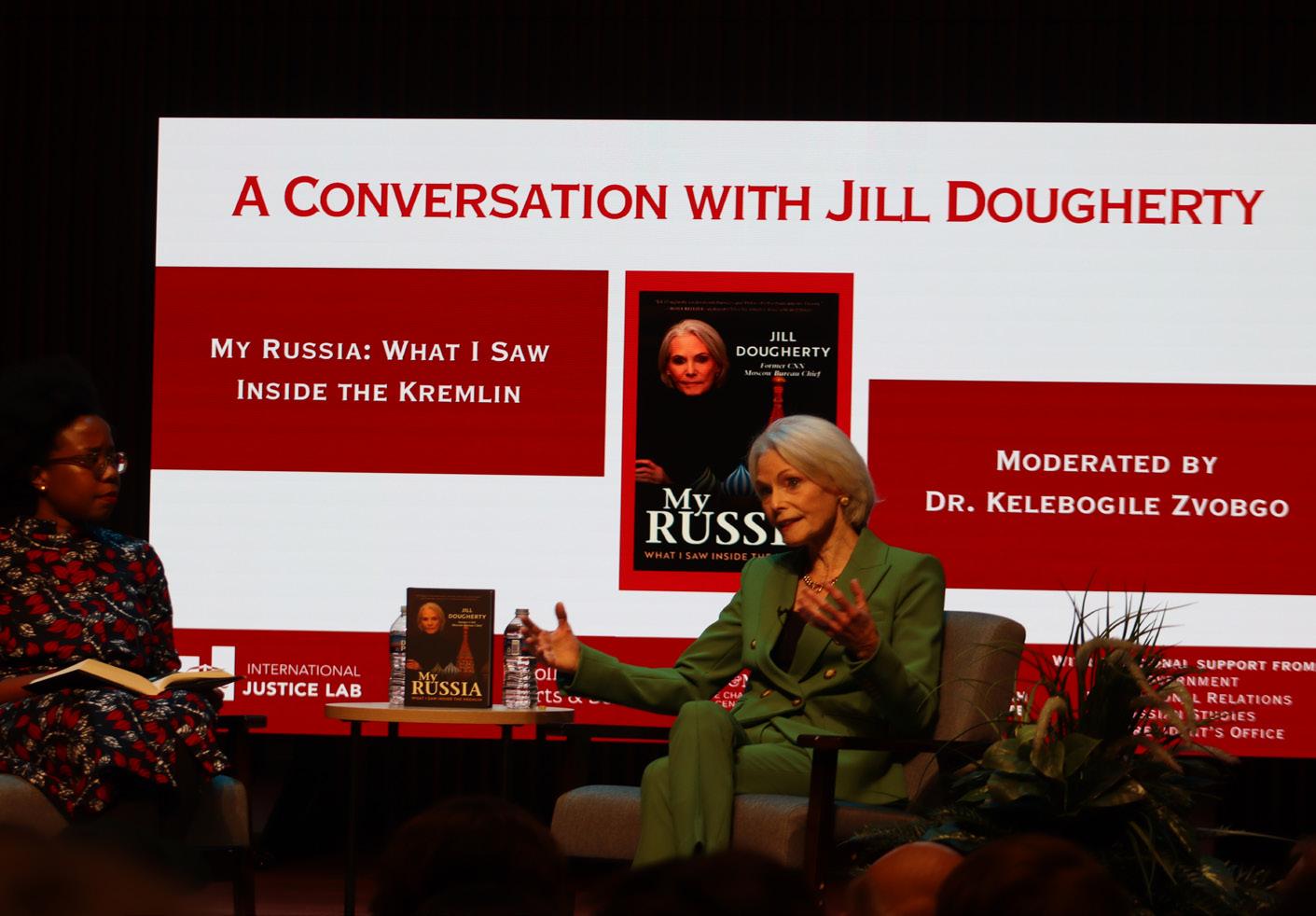
ursday Nov. 13, the College of William and Mary’s International Justice Lab hosted a moderated conversation with former Moscow Bureau Chief for CNN Jill Dougherty. is discussion centered around her career and new book, “My Russia: What I Saw Inside the Kremlin.”
e International Justice Lab is a collaborative e ort between students and faculty to research human rights, international law, social justice and more. e project leader, Mans eld Associate Professor of Government Kelebogile Zvobgo, was the moderator of ursday’s discussion. e event began with a brief
retelling of the events of Dougherty’s book, as well as her background and relationship with Russia.
Zvobgo spoke on how Dougherty’s background gives her a strong understanding of Russia and how its historical memory is pervading current politics. Dougherty herself represents the furthering of discussions surrounding changing world a airs and their impacts. From Russia’s ongoing invasion of Ukraine to the transfer of power to Putin, there have been many signi cant changes and developments with far-reaching consequences.
Dougherty learned this history through living in St. Petersburg as an exchange student at Leningrad State University, then through journalistic pursuits such as Voice of America and CNN. She reported on the presidencies of Gorbachev, Yeltsin and Putin, allowing her to watch Russia’s evolution over the years.
Dougherty came to love Russia. While explaining her time in Russia as a twenty-something American exchange student Dougherty stated that, despite its obvious shortcomings, she found it to be beautiful. She remarked that there was no shortage of art, opera, ballet or concerts to engage with. Yet, at the same
time, her college dorm was bugged. She and her roommate were followed around, listened to, and socially segregated for their American identities.
At the time, the Soviet Union heavily restricted its youth. Travel, literature, newspapers and the internet were all banned. Because of the jammed information pipeline, Dougherty explained that Russians were often kept in the dark.
“ ey didn’t know things about their own culture,” Dougherty said.
Despite this, Dougherty became a Russian language broadcaster and writer for Voice of America radio.
During the discussion, she spoke on how this radio program was always jammed to stop the sound from reaching people, another example of how much of a closed society the Soviet Union was.
Eventually, Dougherty found her way to CNN, where she worked for 30 years.
She held the roles of Moscow bureau chief, White House correspondent, U.S. a airs editor, and more. While working in Russia, Dougherty watched the Soviet Union die, as Boris Yeltsin came into power, and as Putin morphed into the leader he is today.
“Vladimir Putin, there was a lot
of optimism and his ability to be a reformer in that context,” moderator Zvobgo said. Dougherty agrees. When Putin campaigned, he was viewed as someone who said the right things and looked good doing it. Dougherty said that many assumed, because of his family’s tragic experiences with the Nazi blockade in World War II, that he would be a strong protector of Russia and its people. Despite this, we can see that Putin’s Russia is one characterized by war, discrimination, restricted press and human rights violations.
Once in power, Putin began to express his resentment towards the West. He felt that the West tricked Russia into making itself a “secondclass country,” according to Dougherty. Dougherty says that the issues we can see with Russia today, where the government is overly controlling and hungry for war, re ect the mentality of its people. Dougherty explained that, since there was a large failure to integrate Russia into the West, Putin felt he had a chip on his shoulder, resulting in a stark divide between these two parts of the world.
NAMAN MISHRA THE FLAT HAT
SACHI PALLEM THE FLAT HAT
Sydney Rose McCall re ects on Once Upon a Kwanzaa children’s book
Former Lemon Project history apprentice turns to activism, sharing diverse historical perspectives
Thursday, Nov. 13, the College of William and Mary’s Lemon Project hosted historian Sidney Rose McCall M.A. ’23 in conversation with author and scholar Ravynn K. Stringfield M.A. ’18 Ph.D. ’21. As a former Lemon Project history apprentice, McCall got the chance to speak about her first children’s book, “Once Upon a Kwanzaa,” which she co-authored with Nyasha Williams.
The conversation began with an introduction by Associate Director of the Lemon Project Sarah Thomas. Thomas expressed her excitement to welcome both McCall and Stringfield into the space, particularly as they both hold ties to the College through completing a degree or conducting research.
McCall is a historian who studies Black ecologies, slavery and environmental history.
McCall responded to questions about being hosted by the Lemon Project, highlighting her gratitude for the program and her research.
“It was such an honor to come back to the space,” McCall said. “Part of the reason I decided to come to William and Mary in particular was because of the Lemon Project when I was doing my initial research for grad programs.”
The Board of the College established the Lemon Project in 2009 following the recognition of the school’s ties to slavery, exploitation and failure to stand up against segregation during Jim Crow. The project is named after a man, Lemon, whom the College enslaved.
Throughout the conversation, McCall spoke about her experience of writing a children’s book. She struggled to balance the two
CAMPUS
distinct voices of herself and her co-author, Williams. Translating complex themes into terms digestible to children marked another challenge for the pair.
“We don’t talk down to children,” McCall said. “That’s something that served on Sesame Street, and I’ve tried to carry with me throughout my life. It’s not necessarily that Kwanzaa is very complicated; it’s just, how do you even say the word ‘principles’ when most four-year-olds can’t even spell their own names yet.”
Stringfield agreed with McCall about the importance of reading at any age.
“I really love what you said about continuing to encourage people to read,” Stringfield said. “It’s still reading and you can still learn something at any age.”
Beyond her work as a writer and scholar, McCall is an activist. She uses social media to share diverse historical content, which the American school system often fails to cover.
“Part of my responsibility as a historian is, if I have knowledge, to share that knowledge with the public and other scholars,” McCall said. “There are so many people in the public who love history and don’t even know they’re being taught history in ways that are not only harmful but also are very one-dimensional.”
McCall and Williams bonded over social media due to their mutual passion for activism, particularly regarding adoption rights. The pair took Williams’ lived experiences as an adopted child herself and McCall’s knowledge as a historian.
“We just clicked in the best way possible because we had these shared passions, so we came at them from very different places,” McCall said.
Taylor Garrison M.A. ’23, a current Ph.D. student at the College, attended the talk as a member of McCall’s cohort. Getting to see the development of the book firsthand, Garrison felt excited to show her support and remarked on its ability to engage a wide age range of readers
“Reading [the book] helps children and adults to learn the importance of Kwanzaa,” Garrison said.
While this marks her first children’s book, McCall suggested that it is far from the last. She and her co-author are currently exploring the idea of creating separate books for each of the seven themes of Kwanzaa.
Through these next books, McCall wants to center the themes around personhood, which she equates to accountability.
“What personhood allows you to do is recognize that you might not be directly connected to these things, but you have just as much responsibility to ensure these things don’t happen again,” McCall said. “Personhood is about accountability, and personhood is also about teaching children how to speak up and how to lead.”
McCall noted that she finds Kwanzaa popping up in her everyday life, often unexpectedly. Sometimes it means taking time for selfcare, and other times she intentionally incorporates it into her teaching practices or interactions.
“Kwanzaa becomes an everyday affirmation for me, so even if it’s not intentional, I always find myself thinking about [it],” McCall said. McCall closed out the conversation with advice for the audience.
“Just take a little bit of Kwanzaa into your everyday life because it brings a lot of magic, but it also teaches you how to do some good work,” said McCall.
Braddock explores ecology’s role in American Art at Muscarelle Book Talk
Art historian traces the evolution of environment, from the colonial period to modern day
from page 3
He transitioned into an analysis of these themes with “ e Grand Canyon of the Yellowstone,” painted by omas Moran in 1872. Braddock discussed how landscape painting impacted America’s conservation movement.
“And the landscape genre, the artistic vocabulary of landscape painting, the astonishing explosion of colors and majestic vista that you see in this and other works like it in the 19th century, make it clear that landscape painting was central to the evolution of an environmental consciousness — a modern environmental consciousness,” Braddock said.
Braddock shifted towards another factor in the American conservation movement and its art: Indigenous marginalization. He noted the contrast in the depictions of a Native American man and a white man in Moran’s work. While the white man faces the canyon, Braddock explains that, in Moran’s eyes, the Native American man was unable to appreciate the canyon’s beauty, so he faces away from it in the painting.
“But Moran viewed the Native American man as unable to appreciate that [Yellowstone], and therefore turning his back to him,” Braddock said.
e image above, “ e Grand Canyon of the Yellowstone” by omas Moran, is from Wikipedia.
Braddock detailed other depictions of Indigenous peoples, including newspaper reports and Indigenous art such as Jaune Quick-to-See Smith’s “Browning of America.”
“She wrote for the catalogue and wrote for the book [“Nature’s Nation”], and lent works to the exhibition, including this one that shows the United States as a kind of map, with starkly drawn boundaries,” Braddock said. “But the entire map is overridden with indigenous symbols as a way of showing the historic and ongoing presence of indigenous people, crossing the borders, crossing the boundaries, being part of the environment, the American environment.”
Braddock then dug into the main themes of “Nature’s Nation” and explained why they were chosen. e exhibition was organized in three sections: colonization and empire, industrialization and conservation, and ecology and environmentalism,” Braddock said. “And as those section titles suggest, the exhibition project was meant to tell a story of the emergence of what we now think of as modern ecological consciousness, which is not the same
CAMPUS
as the environmental perspective of people in the past, and yet we saw glimmers and inklings of that modern consciousness in historical works of art.”
On colonization and empire, Braddock discussed various philosophical and ethnic perspectives on the environment.
“Many of these early, colonial works of art tried to present nature as a kind of orderly place that could be organized and understood through science and religion,” Braddock said.
He used as an example a piece by SpanishIndigenous artist and missionary Diego de Valadés.
“And learning about Catholicism in Mexican, in Spanish schools, this artist, Diego de Valades, presented in this print at left, a vision of the Great Chain of Being, a kind of European, Christian view of nature as a hierarchical, organized system, with God and the angels at the top, with echelons of beings below — humans, animals, stones, and then Hell at the bottom — a very kind of stark, rigid, systematic way of understanding nature,” Braddock said.
Braddock then explained a transition in thinking in the 19th century, seen in works by John James Audubon.
“And in Audubon’s work, you see this new, kind of more romantic, vision of nature as a dynamic place of violence and change, not order,” Braddock said. “You see close-up views of birds in midair, in ight or at right, the Carolina parakeet, a species now extinct, whose extinction Audubon even foreshadowed with some of his comments about how farmers were shooting them too often and too much. And his work even makes these so-called animals quite alive and dynamic, almost like people with their visceral power and visual energy. One of them even looks out at us as we look at the work of art.”
Braddock also mentioned Maher Curatorial Fellow of American Art at Harvard Art Museums Laura Turner Igoe, who contributed to “Nature’s Nation” by examining the impact of furniture production on Jamaica’s environment, and more generally, the origins of the media artists utilized.
Braddock moved on to industrialization and conservation, a theme that emphasized how industry changed the environment and human lives. He began with a piece from David Gilmour Blythe on the oil industry.
“So he shows us this kind of drifter figure, who’s probably a self-portrait of the artist, holding a jug of liquor and all the possessions
that he has over his shoulder, and a bag of worthless greenbacks, because the inflation that is being caused by the new industry is altering the economic landscape as well as the environmental landscape,” Braddock said. “And he stares at signs advertising new opportunities for petroleum extraction. Meanwhile, the landscape in the background shows oil derricks, and smoke, and environmental devastation.”
Braddock emphasized the rarity of such a depiction as opposed to a more positive one. Braddock also discussed portrayals of cotton farming.
“Winslow Homer’s ‘ e Cotton Pickers’ of 1876 shows two Black American women working in this endless eld of cotton; gorgeously painted picture that evokes impressionism, French impressionism at the time, but recasts it in the American context to tell us not just the story of nature’s beauty, but of the environmental and social realities of modern agriculture, and of the people who were typically laboring under those conditions,” Braddock said.
Braddock ended this section by discussing public parks, in particular Central Park, both in terms of their intentions — such as pluralism and urban nature — with the changes required to build the park.
“And this, too, tells us something about the complexity [of] art and environment, because it’s a very artistic creation, this nature in the city, and it’s an indication of how we need to look at that word ‘nature’ carefully, and understand how sometimes the things that we regard as a pristine nature are actually a constructed nature,” Braddock said.
Braddock then shifted to the last section, ecology and environmentalism. He opened with a discussion of the etymology of “ecology,” then explained how the topic was approached in the exhibition.
“And here, my co-curator [Kusserow] and I wanted to be careful not to just turn art into a kind of political statement, even though there’s plenty of art that’s that way,” Braddock said. “We wanted to maintain attention, or keep our eyes, on the form of art itself, and the way in which artists creatively used beauty and form to make their statements. And so, we’re very interested in works that used traditional media, like painting, but did so in new ways to draw attention to new issues and new concerns.”
His examples included the paintings “Dust Bowl” and “Cruci ed Land” by Alexandre Hogue, both of which centered on the Dust Bowl.
“My mother, who grew up in Iowa, remembered during the 1940s, the late ’30s and ’40s, dust gathering on the windowsill of her small home in northwest Iowa, as an indication of just how pervasive this issue was,” Braddock said. “And Alexandre Hogue was one of a number of artists who used his medium of art — in this case, painting — to grapple with the magnitude of that disaster, and to, in a way, scare us into recognizing that something needed to be done.”
On “Cruci ed Land,” Braddock emphasized the addition of religion to the devastation depicted in Hogue’s painting.
“He merges that vision with a kind of Christian sense of moral outrage by showing a scarecrow in the shape of a cruci x, and the idea being that the land itself has been cruci ed by unwise agriculture, by this disaster,” Braddock said. Braddock also analyzed pieces from Dorothea Lange.
“And here, in this, I think, amazing photograph, Lange reduces the meaning of the Dust Bowl and its effects on the land and the people to the most simple forms you can imagine,” Braddock said. “The furrows of a dead field, reduced to dust, and the empty house, vacated by a farmer who could no longer afford to pay his mortgage, because of these conditions. And here you see, I think, how both of these artists — Hogue and Lange — bring an artist’s eye to kind of reduce a condition — environmental and economic condition — to its essentials.”
Braddock also included Lange’s “Migrant Mother” as an alternate perspective. “If this is what happens to the land at the right, at left is what happens to the people,” Braddock said. Braddock closed o this section with a piece by Georgia O’Kee e made in honor of D.H. Lawrence.
“And while this isn’t a work that screams ecological consciousness, we wanted to include this kind of work because it, in its very disorientation of our perceptions, forces us to see nature in a new way, and to recognize how, in this case, how a tree is maybe close to us, something even connected to us,” Braddock said. “Note how she represents the branches, almost like arteries reaching out from our own body into the sky. O’Kee e was a master of connecting us to nature, and that, too, I think is an environmental story worth telling.”
2025 Year of the Environment concludes with sustainability summit
Speakers celebrate Green Fee fund, supporting student-led environmental projects
from page 1
One of the most monumental celebrations of the Year of The Environment is the establishment of the Batten School of Coastal and Marine Science at the College. Founded in July of 2024, the school is now finding itself central to the Virginia Institute of Marine Science, one of the largest marine science centers in the United States. The Sustainability Summit is the second part of the Year of the Environment’s hosted public outreach events. The first part was the spring Sustainability Symposium from last semester. This second event allowed the team to
zero in on engagement even further than before. Throughout the year, both students and faculty working in practically every capacity of the Year of the Environment have had one overarching goal beyond simply sustainability: connection to the broader community.
Stevenson reflected on the motives of the Year of the Environment and the IIC.
“They want things that have a social impact, that have an environmental impact, and that have student involvement, especially,” they said.
“So if they can show that it’s doing all three of those things and that this money isn’t just going to [be wasted] or
something like that. For example, the compost bins, you know, it’s especially important to show that, but that’s definitely something that’s a really good thing to have.”
The idea of a conservation bubble was discussed widely across the entire event, with volunteers, student interns, faculty and speakers, with the collective resolution that the key to the future of environmentalism is in tapping into the mainstream culture beyond those specifically in conservation fields.
Rose acknowledged the wide scope of the issues they are seeking to tackle, while noting the approachability of their program. “One person can make a difference,
and I think the sustainability summit really does a good job of highlighting the fact,” he said. “They have a vegetarian meal that makes a difference because it’s a low animal protein meal that kind of stuff makes a difference, and so to be able to come here and see what is happening and know the activities that make it a big difference, they kind of add up. So don’t get overwhelmed by environmental issues, just find something to get connected to and go from there.”
The sustainability summit might represent the winding down of the Year of the Environment, but the environmentalists are just getting started. Rose was adamant that the
Year of the Environment shows that one person can make a difference, and that person can be anyone.
“If you want to be part of the solution, there are so many opportunities on campus to get involved,” he said. “Find one of those pathways, or compost club, the sustainability group — there’s a whole bunch of different opportunities that are involved with the institute, and plenty of opportunities to get involved with research. You know, if you’re a data science student, we have ways to get you involved, so no matter what your interests or backgrounds are there is a pathway to work on our environment.”
CAMPUS
CAMPUS
Alum response to ‘Homecoming is kind of weird, right?’
David
Mollie Shiflett’s ’26 staff col -
umn from Oct. 22 (“Homecoming is kind of weird, right?”) got me thinking. I remember Homecoming when I was a student at the College of William and Mary in the late ’80s and early ’90s. It was a little weird. Wistful alumni, clad in various flavors of green and gold, wandered about in their own dimension. Back then, I mostly ignored the influx of elders, secure in the knowledge that, at the time, campus was my home. I got a chuckle reading that, at 56, I’m tugging on the median age at Paul’s Deli from the right side of the bell curve. I used to close down Paul’s regularly as a student, though you won’t find me there past 9 p.m. now. I also smiled at Mollie’s reference to what Boswell Hall used to be. As a government major, I took most of my classes in the unreconstructed version of that building, formerly known as Morton Hall, or Morton “Hell.”
Thirty-three years have passed since I graduated from the College, 31 since finishing graduate school. And Mollie’s column begged a question to which I had no answer when I was a student: Why do we come back?
Life since college has been full of demands associated with making a living, everyday tasks like procuring meals, caring for family members both young and old who depend on you, maintaining homes and automobiles, managing yourself/maintaining your sanity, saving for retirement and avoiding, as best you can, existential dread. I don’t want to scare you — life after college is also full of fulfillment, joy, excitement and accomplishment that
will sustain you. But a life well lived is difficult. Fatigue tends to be cumulative, so the longer you live, the more you end up carrying with you. As the years go by, one’s days in college can feel like a haven, the time before you were thrown into the fire.
Relieving the burden of a working life is a powerful and essential thing to do. Returning to campus is one of the central ways I have found to restore my energy and my sense of who I am. But in 33 years, I’ve only come back to Homecoming once — in 1993, the year after I graduated. I’m an introvert, so being in town with thousands of others crowding hotels, parking lots, walkways, stores and buildings around campus holds no appeal. Instead, I prefer to drop in once or twice a year on a long weekend to be as unobtrusive as possible and to minimize human interaction.
But why is returning to campus powerful for me? I came to the College from Lynchburg, Va.
Attending college here opened my eyes to a world I never knew existed. I made close friends, allowed my mind to expand and wander in search of the person who had heretofore been defined altogether differently and became a confident, independent, optimistic young adult.
The things that I cultivated and practiced here became the pillars of my life after college: critical and analytical thinking, intellectual honesty, curiosity and ethics, the contentment of immersing yourself in reflection and contemplation, open-mindedness, and a commitment to lifelong learning are properties that help me flourish and work
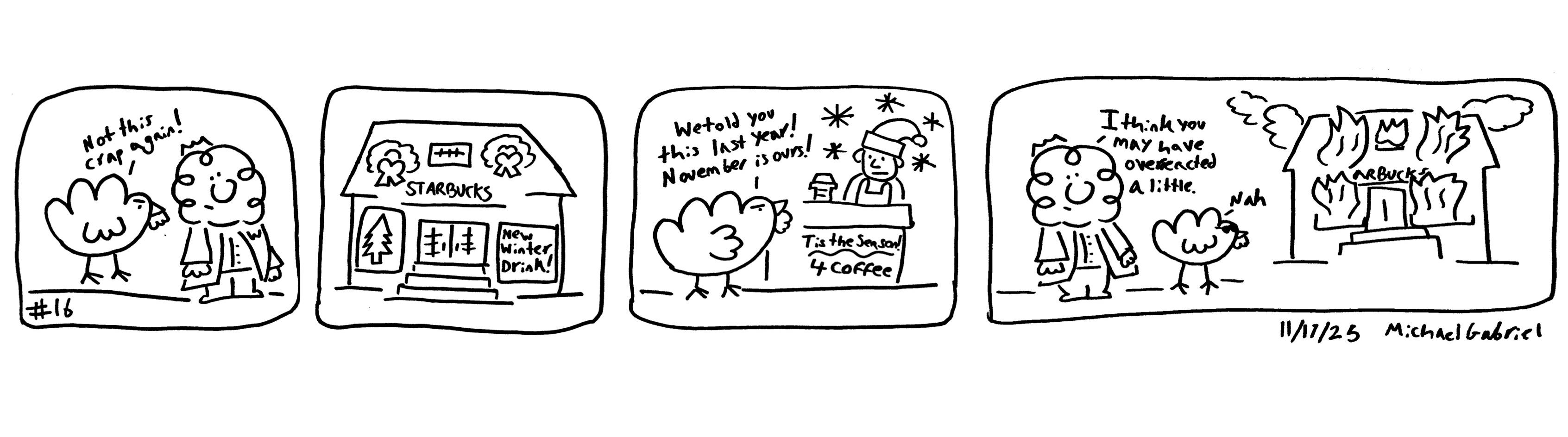
Willy and Mary #16
with others in our increasingly diverse yet seemingly fragmented world. But I get busy, overwhelmed and stressed, and sometimes lose sight of these things among the millions of other thoughts that race through my mind each day. And that’s why coming back here is so essential for me. It reminds me of where I found these things and really learned who I was.
For some alumni, of course, it’s a lot simpler than this. They had a good time here and want to see their friends in situ, so to speak. Nostalgia has applications — some good, some not so good — for people’s psychological health. In cases like mine, it is restorative and a reminder that the person who walked these grounds so many years ago is still alive and kicking. In other cases, nostalgia can present an unhealthy or counterproductive attachment to a past that is no longer. Bruce Springsteen’s “Glory Days” is an effective illustration of this phenomenon. I would be hypocritical if I said I didn’t do a little of this, like listening to a playlist of songs from each of the four years I was here while I walk around the campus and have a couple of beers at Paul’s.
But my experience here, and the way the College served me in my unique circumstance, is something I will always cherish. And it makes me feel like when I come back, I belong.
If you can tolerate a few more words, I will leave you with these nuggets:
I hope you enjoy your time here. If you have a good experience attending the College, remember what made it special and use that as a touchstone throughout your life.
When you go out into the world, pace yourself. It’s a marathon, not a sprint.
If you see an alumna or alumnus wandering campus, gazing off in their own dimension, give ‘em a smile. That might be you in 30 years.
Thank you, Mollie, and all current students, for tolerating us old folks when we come ‘home.’
David Hawkins (B.A. ’92, M.A. ’94) is Chief Education and Policy Officer at the National Association for College Admission Counseling in Arlington, Va. He preferred the Caf to the Marketplace while at the college. (There was no Sadler Center, though he did meet the actual Sam Sadler.) Feel free to connect with him on LinkedIn at https://www.linkedin.com/ in/davidahawkinsedu/, as he’s happy to provide help to students to take their first steps toward gainful employment.
While I do understand that we live in an era in which ‘romanticizing’ romance has become our new normal, I don’t think we should be this desperate. Every conversation I have somehow turns into someone talking about their new talking stage, being left on delivered or just the classic “wait ... I think they’re kind of cute.” Don’t get me wrong — I find this entertaining. Listening to other people’s relationship issues is my favorite pastime. But, at some point, doesn’t the cycle get a little repetitive?
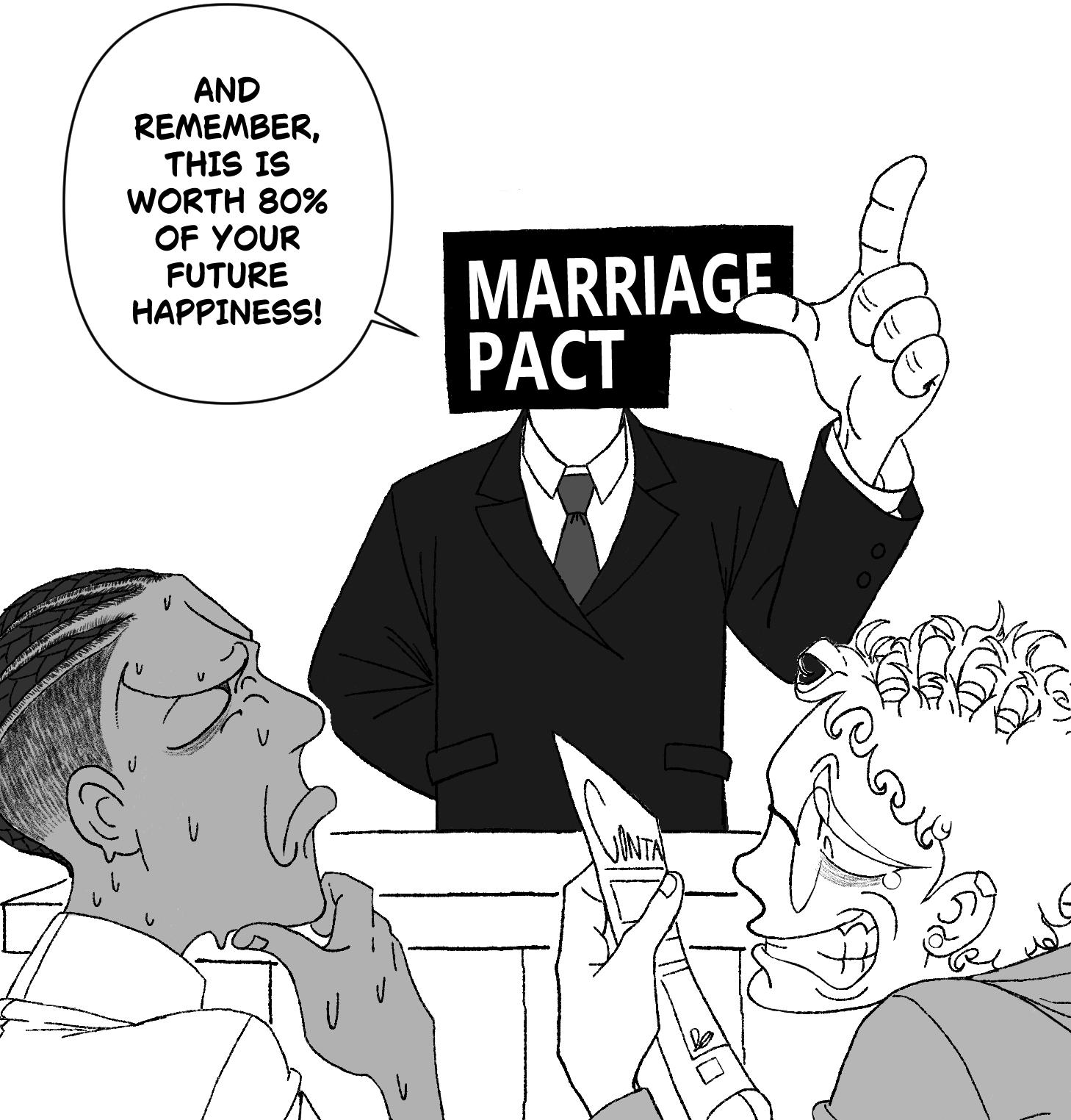
I think this is especially obvious when you look at what I like to call college matchmaking services. If you’ve been anywhere on campus in the last couple of weeks, you’ve definitely heard of the Marriage Pact. If you haven’t — first of all, impressive — and second, here’s the rundown: The Marriage Pact is a matchmaking activity that takes place across many college campuses. Students fill out a compatibility survey, and an algorithm finds them their closest match who could be their “optimal marital backup plan.” The Marriage Pact at the College of William and Mary has since closed, so to the people that are reading this and hoping to fill it out ... sorry. I’m sure you’ll find love somewhere else (or you can also wait till next year).
The Marriage Pact isn’t the only matchmaking service here; there’s also the W&M Manual Matcher, among many others that are probably lurking around campus. Honestly, I think these questionnaires are a little ridiculous. They ask superficial questions that don’t even necessarily align with what someone is actually looking for in a relationship. This is probably hypocritical of me, considering I filled out the Marriage Pact. (If you were my match: what’s up? Sorry I haven’t con-
tacted you — I’m scared.)
Maybe I’m thinking too hard about it since I’m 96.7% sure most people filled it out purely for the plot. Still, the fact that we even have algorithmic matchmakers says a lot about how desperate college students — and society in general — seem to be for relationships.
Social media definitely doesn’t help. It’s flooded with ‘perfect’ couples whose relationships are curated for the consumption of hundreds of thousands of people, and everyone eats it up. If you go to the comment section of any relationship TikTok, you’ll find a comment saying something along the lines of, “May this love find me,” or, “I’m jealous — I hope y’all find out you’re cousins.” We all buy into this so quickly. One cute photo and we’re convinced that these people are in another realm of emotional intimacy we could only have in our dreams.
So when things, such as the Marriage Pact, come around, of course everyone flocks to them. It gives them a shortcut — a way to skip actually trying to meet someone. It’s a way to finally become a part of the romantic narrative that everyone else seems to be a part of, even if the whole thing is based on questions like, “Do you think pineapple belongs on pizza?”
Maybe the issue isn’t that everyone wants a relationship — it’s that everyone feels like they have to be in a relationship. Social media is constantly telling us that love is the end goal, and some people will try to rush it in any way they can.
Love doesn’t have a deadline, so maybe we should all take a breath and let it happen naturally.
KreilysGarcia‘29isaprospective Biologymajor.She’sinvolvedinArchery andBotanyClub.Aroundcampus,you’ll most likely find her on the second floor of Swem.
GRAPHIC BY DAVID OMITOGUN / THE FLAT HAT
THE FLAT HAT
Hawkins
GRAPHIC BY MOLLIE SHIFLETT / THE FLAT HAT
COMIC BY MICHAEL GABRIEL / THE FLAT HAT
Why I’m happy about the Virginia election results
Liam Glavin FLAT HAT NEWS ASSOC
Tuesday, Nov. 4, 2025, was a historic night across the commonwealth of Virginia. Abigail Spanberger won her race and flipped the governorship to become the first ever woman to serve as Virginia’s governor. Ghazala Hashmi won her lieutenant governor’s race to become the first Muslim woman ever elected to statewide office across the country. Furthermore, Jay Jones won his race to become Virginia’s first Black attorney general, despite a text message scandal that roiled his campaign.
Jessica Anderson and Mark Downey also won their local races for the Virginia House of Delegates, defeating Republican incumbents. At a time of unprecedented Republican and far-right attacks against higher education, especially with the Trump administration’s recent compact that imposes demands on universities which must be met for them to receive preferential federal funding, these victories were precisely what we needed to protect the interests of the College of William and Mary and push the commonwealth of Virginia in a more positive direction.
We are a public university. As a result, the Virginia state government plays a pivotal role in shaping our operations. We can most directly see this influence of the state in our board of visitors, of whom the Virginia governor has the power to appoint. For instance, throughout his tenure as governor, Republican Glenn Youngkin has sought to stack the boards of public colleges throughout our commonwealth, including the College, with conservative appointees more favorable toward succumbing to the anti-DEI, anti-free speech and anti-institutional independence demands of the Republican Party, most recently under the Trump administration.
We have already seen the disastrous results of Youngkin’s appointments in schools across Virginia. For instance, the University of Virginia, Virginia Polytechnic Institute and University, James Madison University and Virginia Commonwealth University all voted through their Youngkin-appointed boards to dismantle their universities’ DEI programs after pressure from the Trump administration. At the College, our Youngkin-appointed board opted to pull back from our DEI programs more subtly. We can see this in how the College changed the title of Chief Diversity Officer
to Senior Advisor to the President and renamed the Center for Student Diversity to the Student Center for Inclusive Excellence. Last semester, the board of visitors also passed a resolution affirming a “merit-based” and “values-based” education at the College, signaling a step away from DEI without directly calling for its dismantlement. A Spanberger governorship could lead to the appointment of new university board members who will prioritize protecting and advocating for students, rather than capitulating to the Trump administration.
A Democratic attorney general, such as Jones, is also poised to play a critical role in protecting the interests of Virginia public universities against the Trump administration. Outside of the ability to sue the Trump administration, Jones will have the power to appoint the legal counsel for Virginia public universities, including the College. Hosted in the Office of University Counsel, these appointees assist the College in providing legal counsel to the board of visitors and other executives at the College, administrations, staff and even students. Realistically, in the event of any legal disputes, the Office of University Counsel is the first point of contact we would turn for assistance.
With Jones as the new attorney general, his appointees will no longer be connected to the Republican Party conducting these attacks against higher education. This new counsel can now stand unafraid in defending students and the College against the unprecedented meddling of the Trump administration. Without a Democratic attorney general, it is difficult to imagine the College standing up to the Trump administration because we realistically would not have the backing of a Republican-appointed legal counsel in such a situation. Jones allows us to chart a new path by appointing those who will effectively defend the College and other universities across the commonwealth of Virginia in the legal realm from the fascist and racist attacks of the political right.
Jessica Anderson and Mark Downey winning local Virginia House of Delegates races is also a positive development for the College. We can now have local candidates in the Virginia legislature focused on protecting institutions of higher education, rather than representatives who belong to a party that seeks to strip funding and subvert the institutional independence of these institutions.
Overall, I certainly disagree with some of Spanberger’s more moderate positions, especially her stated refusal to completely overturn the antiunion “right-to-work” laws that exist in Virginia. I am also uncomfortable with how Spanberger has repeatedly bashed progressives throughout her career, most recently with her attacks against Zohran Mamdani in New York City.
I am nonetheless happy with the downballot wins of Democrats and the ascension of Spanberger into the governorship. I believe Spanberger and the downballot Democrats under her wing will lead our commonwealth in a much more positive direction, protecting our state and institutions of higher education from the Trump administration’s unprecedented authoritarian attacks.
I’m gonna cut right to the chase. I’ve been taking everything this week super personally. It’s the 13th Apple, so maybe we’re just cursed from the start. Like, look at this question that someone sent in:
“eva when oh WHEN will you quit with the six seven?! what does it even MEAN?”
I’ll answer your question with a different question. Who do you think you are? You might as well have just insulted my mother. You know what I read when I look at this pathetic question?
“Hi Eva. Why is your mom, Rolla Jaber, such a fool? What kind of name is Rolla? Had your dad been named Marwan Coaster, she would have been named Rolla Coaster. Ever thought of that? Your mom’s a loser and the apple didn’t fall far from the tree. It literally fell vertically and didn’t roll and is just sitting right under the tree rotting right to its core à la Charli XCX.”
Hear me when I say this. Listen real close. If you EVER talk about my mom like that again, imma invite you to the staircase that I film my singing TikToks in at the late hour of 6 or 7 p.m. (it’s daylight savings, so it’ll be dark as can be outside.) Then, I will square up with you. And when I say square up, I mean it in the most literal sense. I will be juggling a bunch of cardboard boxes, throwing those squares up into the air. And you bet your bottom dollar I won’t drop them. Can you juggle? Prolly not. You’re gonna be embarrassed. You’re gonna wish you never uttered my mom’s name out of your pathetic little mouth. [four(ish) hours pass and I come back to this Google Doc]
Sorry. See what I mean? I’ve been taking everything suuuuuper personally. BUT, I learned something recently that
changes the way I look at everything!
Ever since four hours ago when I learned this fact, my world transformed. I will impart this knowledge upon you, so you can learn the one true solution to the question of the week:
“How do I stop taking things so personally?”
As you may have been able to tell, before my massive character arc, I took a lot of general comments to be attacks on my identity, character, family line, etc. But four hours ago I learned that not one, not two, not the two numbers after two, but FIVE planets are in retrograde right now! What does that mean? Apparently, retrograde is when a planet looks like it’s moving backward from Earth’s perspective. When Mercury is in retrograde, you can blame everything that goes wrong on it. So, when Mercury and four other planets are in retrograde, word on the street is you’re allowed to literally forget how to take accountability for any wrongdoing without facing any consequences.
This means that I was only taking things so personally because of the quintuple retrograde happening up there. So is the way for you to stop taking things so personally just to wait for there not to be cosmic chaos? Nononono you fool. Ever heard of a double negative? To right the cosmic balance, we have to put everything else in our life in retrograde. In other words, we have to completely repel everyone and everything until this curse of insecurity is negated. Trust me on this. Here’s how you do it: 1. Put your friends in retrograde. All you have to do is cook a big pot of risotto and then ladle it into all your friends’ shoes while they sleep. Then, when they
Fighting alligators: How to navigate a stressful week
Alexandra Hill FLAT HAT OPINIONS ASSOC
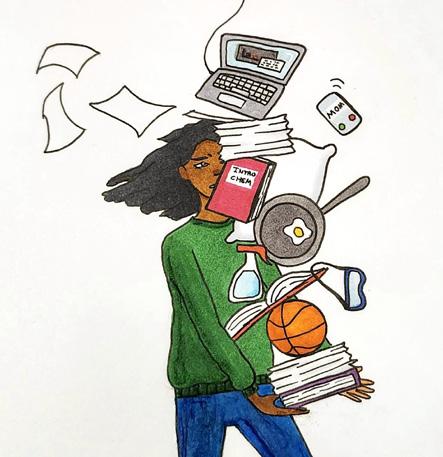
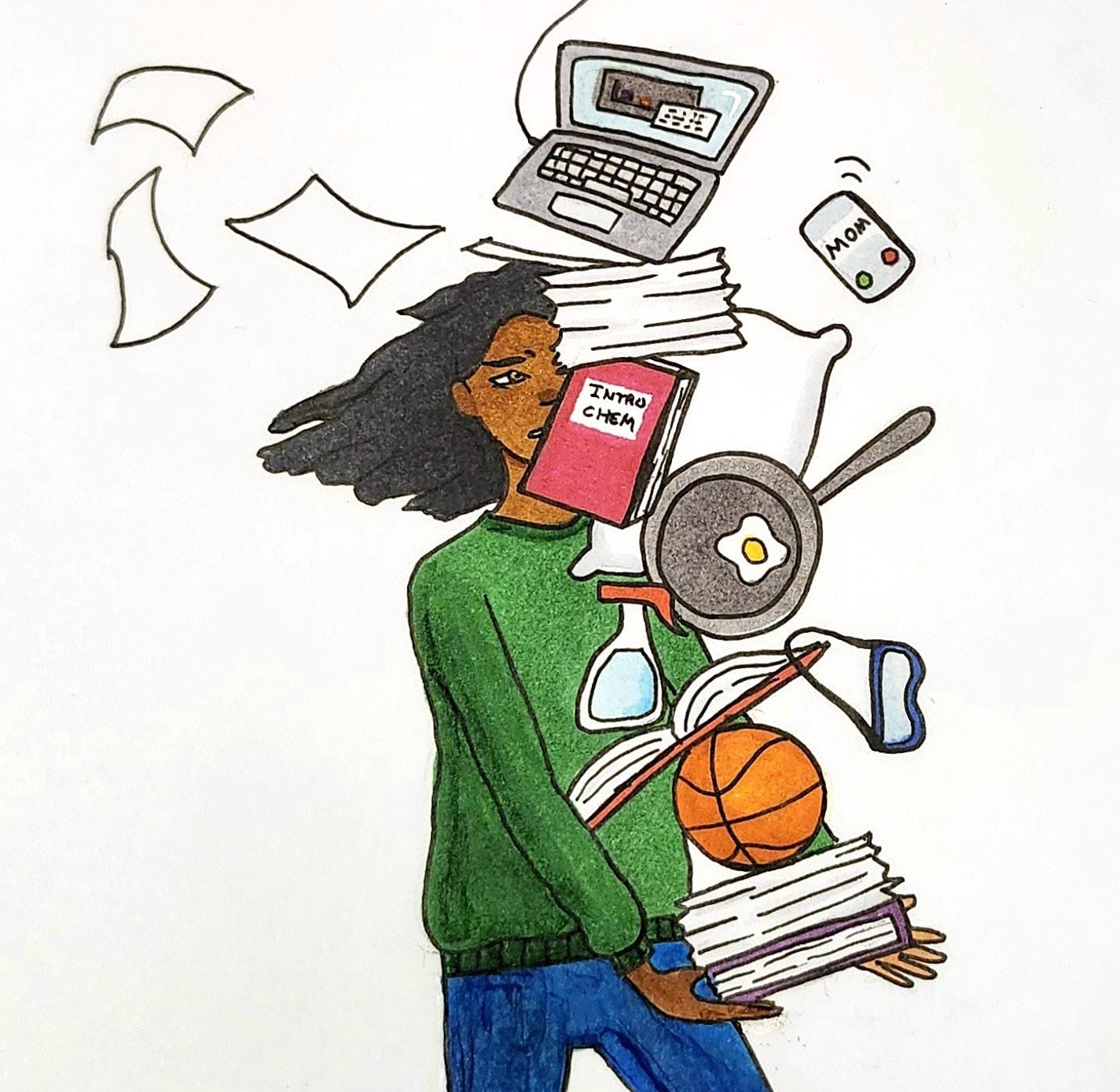
I’m bound to a chair suspended over a pit of alligators. Hungry alligators, I might add. They gnash their teeth and tumble over one another in their attempts to snap me in two. One leaps up and just misses my ankles. I struggle with all my might, but I am unable to free myself. Finally, I slump in defeat, muttering my last words: “Tell the Sadler ice cream machine I love it!”
Yes, this is my certified real life. No, I am not Indiana Jones. Yes, dear reader, this is me describing the experience of looking at my to-do list. Oh, the horror! We’re at about the time of year where the decision between dangling over a hoard of starving alligators and writing that essay for a philosophy class requires some thinking. Sometimes, a week arrives where it feels like we are perpetually stuck at the climax of an adventure movie, and we’re all wondering
when the deus ex machina will arrive (e.g. “Aha! I knew I remembered to apply my alligator repellent today!”)
Well, this is your deus ex machina. I bring you ... “Alex’s Guide to Fighting Alligators!” No? My editors shot that down on the basis of my lack of credibility? Well, what about ... “How to Navigate a Stressful Week”? Much better.
Step One: Count the alligators. Sometimes, when I know I have a lot to do, I basically just cover my eyes and say to my deadlines, “If I can’t see you, you can’t see me!” Cue: scrolling on YouTube Shorts (the shame!), a sudden urge to learn how to do the worm, and the curation (for hours on end) of the perfect study playlist.
This is a surefire way to get eaten by the alligators. Newsflash: they do see you. So, it’s time to know what you’re facing.
This is where I get out a piece of paper. Yes, like an old school, your-grandparentsuse-this-sort-of-thing piece of paper. None of that ChatGPT nonsense. And I write out everything I need to do.
Everything. EVERYTHING — including deadlines. This list sometimes reminds me of those cartoons where a squire unrolls a scroll and it keeps going and going and going ... Good news: This list has an end. There is no such thing as infinite alligators. There’s only like ... six or seven. Okay, maybe more than that.
Step Two: Decide on your non-negotiables.
I’ve seen you nerds studying at 3 a.m., running on three days straight of saltines and Celsius. This is unacceptable behavior! Let us please have some semblance of health and happiness on this campus.
It is true that on your most packed weeks you might not be going to a 5 a.m. pilates class everyday, refreshed by your homemade green smoothie, showing up to your 8 a.m. lecture all like, “What, you guys just woke up?” However, I like to decide on some non-negotiables during even the most stressful weeks — little things that will keep me from feeling like a hungover zombie. They don’t have to take very much time, but they are important.
This might look different for you, but my list is: eight hours of sleep (or else I will become the monster from “Scary Stories to Tell in the Dark,” a PG-13 movie so terrifying I could not finish it), three meals a day with some semblance of fruits and veggies and moving around (even if it’s just a short walk or dance break). I promise myself I will do these things even if I have five unstarted essays due at 11:59 p.m., no extensions. I will choose sleep over turning in an assign-
ment every time.
Your non-negotiables will save you. The alligators are very, very afraid of your non-negotiables.
Step Three: You don’t have enough time! (Or: Kill the alligators.)
On an existential level, we are working on a limited timeline. As it applies to this article, this limited timeline means you might not have time to do everything you need to do.
Yes, twamps, it’s true. Say it with me again: you might not have time to do everything you need to do. And that’s perfectly fine.
Take a look at your Everything List, and with complete and brutal honesty, evaluate each task’s importance and immediacy (I borrow from the Eisenhower Matrix here.) Much of it can be pushed to a less stressful week or eliminated from your plate entirely.
A controversial note: On your busiest weeks, your readings probably become optional. If you have a professor who goes over all the content in the textbook, maybe that’s a metaphorical alligator that you can get rid of. Take a step back in discussions this week, if that’s what the readings are used for in another class. Maybe a skim will suffice. If you need to, you can take time to catch up later on. You know your professors better than I do, so use your twamp-y discretion here.
Look at all the alligators you’ve slayed! Wonderful work. But ... oh dear ... those remaining gators look pretty large and frightening. Good thing Alex has an alligator shrink ray up her sleeve.
Step Four: Shrink those alligators.
Even though your Everything List is more petite than it once was, a couple of those to-dos still look pretty fierce. For example, the task “write that essay” does not sound fun. So, we’re gonna hit it with the shrink ray, so it turns into something
rush into class wearing their risotto shoes without any idea of how the risotto got there or any time to change, it’s time to strike. At a moment of deep silence in between lecture slides, shout “WHO STANKS OF RISOTTO?!” Immediate checkmate. Boom. You’ve embarrassed your friend beyond recovery. They’ll hate you forever and not speak to you again (I know this from personal experience.) Then, repeat once for every friend you have. So you’ll only have to do this like twice.
2. Put your classes in retrograde. Stop going to class. Instead, send six or seven campus squirrels wearing a trench coat and a wig in your place. If your professor is especially observant, they’ll probably notice that you are, for whatever reason, much better looking today. They’ll compliment you on your glow up, to which the head squirrel will screech, snort and bark. This is a best-case-scenario-type situation because you get to put as much distance between you and your classes while still acing college! Good job.
3. Put Thanksgiving in retrograde. Being thankful is for people who are so lame that they can only maintain healthy relationships by treating others with kindness. Only people whose love language is words of affirmation (i.e. losers) like Thanksgiving. We must set the turkeys loose. Pardon them all. Every last one. In their place on the farms we raid, we should put Wawa gobbler sandwiches (hold the turkey, though, or else this whole scheme was for naught.) When the farmers see the vegetarian gobbler sandwiches, they’ll be so distracted chowing down on this new menu item that they’ll forget about Thanksgiving entirely. Get retrograded, dawg. “But Eva,” you say, “wouldn’t these strategies only make things worse?” Dear reader, and I mean this with not even a crumb of respect, zip your mouth shut and melt the key down into a stamp that says “loser” and then press it into an ink pad and stamp that onto your forehead. If you couldn’t tell, I’m trying to put you into retrograde right now. Don’t take it so personally.
along the lines of brainstorm, find sources, outline, revise outline, write thesis, write first page, etc. You can spread these mini tasks out as time allows, giving them intermittent deadlines.
So you’ve created a bunch of mini alligators. Hey, they’re actually kind of cute!
Step Five: Face the alligators.
Depending on your approach to studying/work, this might resemble chatting kindly to each of them and convincing them that you are in fact not food, or it might be all out war. Either way, you are prepared. You can do this!
Remember to take breaks, take care of yourself and rest lots. When I’m especially stressed, I like to be strict about my breaks — I save this time for things that actually boost my mood and energy (aka no YouTube Shorts!) I like a refreshing walk/stretch, a snack, a chat with friends or journaling time to refuel. You can’t face the alligators when your battery is at 0%!
On that note, when I feel like I can’t possibly focus, I accept that. I know simply “pushing through” my lecture slides will not make my mind clearer, nor will it be effective studying. Lack of focus is a clear sign I need a break, so I take one. I come back to my work when I feel I can give it my attention. (Thank you to the incredible friend who helped me realize how important this is — you know who you are!)
Finally, don’t be afraid to use the amazing resources on campus. You might feel you need something as simple as a yoga class at the Wellness Center to destress. Or, you might want to talk through your stress with a therapist at the Counseling Center or on TimelyCare (free resources for students!) The TutorZone and Writing Center can help you with that midterm and paper. Talking to Student Accessibility Services and getting extensions from professors can also be very helpful.
The College of William and Mary is incredibly academically challenging. It’s a place where mile-long to-do lists are not unusual. I’ve noticed that, as a campus, we tend to associate the pressures of school, work and life with an inevitable tradeoff in mental and physical well-being. I hope this article shows you that you can protect your happiness and health even during busy times. You can’t do everything perfectly, so you don’t have to place that expectation on yourself. Bonus: Creating just a little more balance in your life shifts the culture around stress at this institution as a whole. Not only is balance fantastic for you, it inspires others to prioritize their wellness, too! I know you are still on the edge of your seat about my earlier cliffhanger (with the chair and the alligators, remember?) so I’ll finish with that. My chair drops suddenly and sharply several feet. I notice the rope holding me above the scaly predators is fraying rapidly, now only connected by a few strings. As if plucked by a violinist, these strings break, one by one. With a scream — “SADLER ICE CREAMMMMM!” — I plunge into the water, full of crashing alligators. I close my eyes waiting to be eaten.
“Why do you look so afraid?” one of them says. I open a single eye. “Aren’t you going to eat me?”
“Ew, no way,” the alligator replies. “We’re vegetarian.” AlexandraHill’28isaprospectiveEnglishmajorandcreativewriting minor.ShedoesresearchattheIIC ConservationGISlabandisamember ofVox.Whenshe’snotsubmittingher columnslate,youcanfindheryapping, daydreaming,ordancingreallybadly. Contactheratabhill@wm.edu.
STAFF COLUMN
GRAPHIC BY CATHERINE STORKE / THE FLAT HAT
Eva Jaber FLAT HAT OPINIONS ASSOC
GRAPHIC BY MICHAEL GABRIEL / THE FLAT HAT
GRAPHIC BY ISABELLE VOLDEN / THE FLAT HAT
variety
Seven campus bands play for victory in WCWM Battle of the Bands ROCKing ON
ELIZA EYRE // THE FLAT HAT
Saturday, Nov. 8, from 2-6 p.m., WCWM Radio hosted the College of William and Mary’s Battle of the Bands, this year at the Crim Dell Meadow. The event was free and open to the whole Williamsburg community, and the Crim Dell Meadow was full of music enthusiasts. Spectators enjoyed the unseasonably warm November evening, sitting down on picnic blankets and browsing the various vendor tables that skirted the event. Tabling organizations sold everything from thrifted clothes to earrings, knitwear and magazines.
Student bands Vacate the Premises, CHOPT, F2L, Covercharge, Royal Fish, Mugshot and Wham Bam Big Band fought for the title of best band. The bracket-style competition had three different rounds, leading to four bands moving on to audience voting. The top two bands advanced to the final faceoff. The bands performed a mix of covers and original songs.
The judging panel consisted
of students from a variety of different campus organizations, including Fraternity and Sorority Life organizations Kappa Delta and Phi Gamma Delta, Middle Eastern Student Association and Compost Club. They judged the bands on a variety of criteria, including technical proficiency, audience engagement, sound quality and original music.
The judging panel decided the first round, but in the next round, the audience voted through QR codes to decide which bands would face off in the finals. Wham Bam and Covercharge advanced to the finals, in which the sets were extended to 20-minute sets.
Camille Batts ’26, who tabled for Underground Magazine at the event, spoke on the community aspect of the public concert. “I feel like we’re losing community spaces, and so having a place that’s free entry, you can kind of just loiter around, live music all for free,” Batts said. “I feel like it’s really great, especially giving orgs the chance to
sell things and promote their orgs.”
That’s exactly what WCWM Station Manager Catie Swansiger ’26 had in mind for the event.
“It’s really just about community at the end of the day,” Swansiger said. “We want to support organizations who want to advertise themselves, represent themselves. We want to support student vendors, we want to support the Williamsburg community, give them an event they can attend.”
More and more of a crowd formed as the night went on, and the music drew in many passersby.
“Obviously, people have different preferences when it comes to genre, but we are all here at the end of the day because there is a value to live music and the way that it brings people together in a way that just listening on your phone can’t as much,” Swansiger said.
Another important motivation for the event was to bring attention to the WCWM student radio. WCWM Radio is funded by the William and Mary Media Council and is completely student-run.
“Something we’re trying to do this year is just make sure people know about student radio and how important it is, and also, especially because we’re exclusively streaming these days, making sure people know why they should tune in, what they’re supporting, having faces to the name,” Swansiger said.
WCWM was established in 1959, and it broadcasts music 24/7. The organization has its own affiliated music and culture magazine, Vinyl Tap, and also hosts other community events like Rush Radio and WCWM Fest.
The student radio does not just broadcast; it creates a space where like-minded individuals can connect
over music. “ ere’s one of our bands who are pretty exclusively freshmen, and I think this gave them a chance to all bond over a common like of music, and having their friends come, and just one of their rst ways to get involved with an org on campus is really important,” WCWM Junior Station
Manager Emily Garlo ’27 said.
Garloff explained how music has helped her make friends and find community on campus.
“Music is really what I found to be my most central place to find friendship on this campus. Having people start off the year in the fall like that has been a really incredible opportunity,” Garloff said. In the end, Covercharge emerged victorious as the Battle of the Bands champion after a night of music appreciation and community building.
“Events like these really bring a lot of people together, and it’s an
RUBY TRAINOR/ THE FLAT HAT
STOMPING FOR NOSTALGIA
Friday, Nov. 14, Emerald Elite Stomp n’ Shake Cheer hosted their fourth annual showcase. The showcase was held in the Sadler Center’s Commonwealth Auditorium. The event included performances by Emerald Elite and other stomp n’ shake teams from the surrounding area. The other teams included the Lady Broncos, Elite Rams, Atomic Gold and Churchland High School.
Upon arriving in the auditorium, guests listened to a DJ play music. As teams prepared and the audience settled in; the lights dimmed. The crowd quieted down, and then the emcee for the showcase walked onto the stage to get the crowd excited for the upcoming performances.
“Are you ready?” the emcee said.
The crowd answered with roars of applause.
“Are you ready?” she said again. The applause grew louder, and the first group of performers took the stage.
For some of the performers and audience members, the emcee was a familiar face: Amaiya Mauney ’24, the founder of Emerald Elite. Emerald Elite was created after Mauney realized that there were no stomp n’ shake cheer organizations on campus.
“I felt like there was a gap in campus, and, seeing the rise of stomp and shake and watching it grow across the nation,”
Mauney said. “I really wanted to bring a piece of that here, a piece of what I love and a piece of black culture to campus.”
Stomp n’ shake cheerleading has its roots in African American and Historically Black College and University culture. Stomp n’ shake cheer is similar to traditional cheerleading, but it utilizes rhythmic clapping, stomping and dancing. Mauney knew she wanted to create an organization dedicated to stomp n’ shake cheer as a result of her own involvement in cheer throughout high school and the rising popularity of stomp n’ shake cheer.
Manuey explained how, since graduating, she always tries to come back for events and stay involved.
“I’m still connected to some of the girls who are still on the team as well, so, when they ask me to come back for stuff and I’m able, I love to come out and support my girls, my team and see how it’s grown and changed over time,” Mauney said.
The theme of this year’s showcase was “Back in the Day.” The theme was reflected in the performers’ music choices and choreography. Emerald Elite performed two sleepover-inspired numbers.
Emerald Elite opened and closed the showcase, and other teams took the stage for the middle of the show. Emerald Elite’s
coach, Tiara Coles, also joined them onstage and participated in the performance. Coles spoke on how being back on stage invoked a sense of nostalgia for her.
“That experience took me back to my performing days in college, cheering for Virginia Union. I love the stage, I love to perform, and being able to perform with my girls just made it that much more of a full circle moment,” Coles said.
When the performances started, the energy in the room became electric. The booming voices of the cheerleaders announced catchy phrases and involved the audience with call and response. Each performance was different and transported the audience to a different time, offering up nostalgia.
Emerald Elite’s team captain spoke on how the showcase has changed throughout its four years.
“It is slowly and surely catching on and continues to grow,” Aamya Cheeseboro ’26 said.
Along with team performances, the showcase included solos, a sing-along with music from different decades and a battle for which team had the best set of moves in a count of eight beats. During the eight count portion of the showcase, all the teams took the stage, giving the audience a chance to see all of the cheerleaders in community together. Throughout the show, the crowd
was lively and celebrated the cheerleaders.
The teams at the showcase came from a variety of institutions, which meant a lot of coordination for Emerald Elite.
“Putting on this event is both stressful and rewarding, to say the least. We have a great time bringing out local high schools, rec league teams and other colleges,” Coles said. Cheeseboro shared a similar sentiment as Coles, describing the months of planning that went into the showcase.
“Whether it’s booking spaces, ideas for themes and different things like that, it takes a solid team, a solid group of people to make sure that everything and every detail is ironed out,” Cheeseboro said.
Along with performances, there were also vendors outside of the auditorium selling food and drinks.
Among all its features, the most noticeable thing about the showcase was the community.
“We’ve created this network of not only cheerleaders, but cheer sisters that we can talk to and connect with,” Mauney said. “It gives us an opportunity to get off campus and meet some new people, as well as share what we do with the greater communities of campus and Hampton Roads.”
That community was evident through the energy in the room, team chants and group pictures.
RUBY TRAINOR / THE FLAT HAT
Brazil, Morocco, London to Syndicity!
Hip hop dance team delivers energy, original choreography in semesterly showcase
Saturday, Nov. 15, the College of William and Mary’s Syndicate Hip Hop Dance Team brought students and family alike out of Colonial Williamsburg and onto an interactive dance tour throughout many cities in their fall 2025 showcase: “Syndicity!” !e Syndicate Hip Hop Dance Team, a ectionately known as Syndi, is a student-run and student-choreographed dance team meant to o er a collaborative and safe space for dancers to express themselves.
Passionate dancers greeted attendees at the door of the Sadler Center’s Commonwealth Auditorium with physical tickets to Syndicity. !e twohour trip, which started at 7 p.m., was lled with excitement from newbies, laughter from interactive audience skits between dances and love emulating from every audience member, whether they were a proclaimed “Syndicate virgin,” family of Syndicate members or honored Syndicate veterans.
Twenty dance stops perfectly t into the trip to Syndicity. Music ranged from !e Weeknd to Outcast to Doechii to Tate McRae. !e students in Syndicate created all of the dances performed for the showcase. Student choreographers pitch their ideas, and Syndi members sign up to dance based on interest. !e creative liberties of the club allow performers of all di erent backgrounds to learn and grow their choreography skills.
“I really enjoy how much growth I’ve had with Syndicate, and the diversity between choreographers and their dance methods and their style has made me grow so much as a person,” Syndicate co-performance chair Chloe Carpenter ’26 said.
!e showcase opened up with the token
newbie dance. Taking the stage for the rst time, newbies crushed the opening number, sparking up audience energy and getting the room excited for the rest of the show.
First-semester freshmen are always on a journey to nd their place at the College and a sense of belonging. In this quest, Miranda Hunkins ’29 and Brooke Gilbertson ’29 both joined Syndicate this fall.
“I rst did hip hop when I was in second grade,” Hunkins said. “I feel like it’s been really nice to get to know people in other grades, also just to have something built into your schedule in the evening.”
Gilbertson had also danced in the past, and when she arrived on campus, she tried to nd a space to continue that hobby.
“I was trying to nd a lot of dancing here, and I really was missing it. So I went to the audition, and it gave me life,” Gilbertson said.
However, Syndicate is not limited to dancers with previous experience.
“I’ve always like been a Just Dance kid growing up. I come from a huge Hispanic family, so I know the basics of Hispanic dance,” newbie Hailie Portillo ’29 said. “And then, over quarantine, I also got into K-pop dancing. And then from there, it really became not so much a hobby, but something I’m really passionate about.”
At their semesterly tryouts, Syndicate welcomes dancers from every graduating class, regardless of experience.
“We just need to see that, hey, you have some rhythm, you can pick up choreo, boom, you’re done,” Carpenter said.
Along with the freshman newbies, Marielle Agossou ’26 also joined Syndicate this semester.
“As much as I was holding back, I thought now that being a senior, I should really put myself out there,” Agossou said.
After the invigorating newbie dance, a number of beautiful, fun, engaging and skillful performances followed. Performances ranged from as few as three dancers taking the stage to the finale dance, which included all of the members of Syndicate. There was not a single moment that lacked energy.
The two-hour dance program was accompanied by engaging student-run skits, called emcee breaks.
“It’s essentially a little break in between the dances where some of the Syndicate people will come out and do a little skit in between dances to give people time to change,” Portillo said. !e beautiful touch of the emcee breaks is that they always include audience engagement. !e rst skit of the night was a dabbing competition. A subsequent skit was a “Wicked” ri -o competition. Audience members later accompanied a Syndi member’s rapping debut. However, the most interactive activity was the cypher, which was held right after the 15-minute intermission.
A cypher is a dance circle where dancers can show off moves and maybe even compete against other dancers. Syndicate members invited audience members to join the cypher and show off their own skills. The songs playing rotated after about one minute, allowing multiple students to show off their hidden dancing skills.
The audience members who remained in their seats passionately cheered on their friends and family members in the cypher, creating a friendly environment for students to feel comfortable expressing their creativity.
Encouragement and support fueled the crowd the entire night. Regardless of the dance, members or song, there was never a dull moment in the auditorium. Friends and family alike cheered on members with chants for members before they performed, adding to the fun and inviting energy of a Syndicate showcase.
Syndicate Showcase is not limited to the fall semester. Syndicate hosts two showcases throughout the academic year.
Syndicate holds auditions for their team every semester to let any prospective members try out. To quell any fear newbies may have about auditioning, Syndicate o ers workshops prior to auditions to give prospective new members a feel for how dancing with Syndicate is and to feel more prepared for auditions.
!e Syndicate Showcase was a beautiful snapshot of the collaborative and supportive community of the Syndicate Hip Hop Dance Team.
“Being in Syndicate, it’s like you always have someone to fall back on,” Carpenter said.
Whether it was outside the Commonwealth Auditorium — where members were hyping each other up — or on stage — shouting and supporting their team members in the cypher — it is evident that the Syndicate dance team has an infectious energy that can convince anyone to dance. All you need is energy and passion.
L o o k M o r t a l i t y i n t h e E y e TBD Theatre Troupe presents newest show, ‘Horseplay,’ explores cyclical trauma
!ursday, Nov. 6, at 7 p.m., TBD !eatre Troupe performed its rst show of “Horseplay,” the rst of three shows that weekend in Ewell Recital Hall.
You may have seen the daunting yet mysterious posters in the halls of Boswell Hall or Earl Gregg Swem Library: no context, just, “!e horse is coming.” Months before the show, the troupe knew what they were doing: building up suspense while maintaining the element of surprise. What is this horse, and why is it coming here? Where is it going?
Playwright and Director Finley Cochran ’26 attributed this tactic to the play’s publicity designers Caroline Pirsch ’28 and Murphy Scherer ’28.
“We wanted to start advertising the show far earlier than most shows put posters up, so having an evolving, mysterious campaign allowed us to do that,” Cochran said.
A rustic barn immediately set the stage. !e leading actors, Faith Carpenter ’27, playing Philip, and Max Heltzer ’26, playing Carl, kicked o the show with rugged country accents, wearing red bandanas and annels and sitting against barn crates, debating the usefulness of horses — a conversation that becomes a motif throughout the play.
A panicked farmer, played by Lu Caudle ’27, introduces the main con ict, the disruptor of all peace at this barn in Missouri: a horse that looks you in the eye and telepathically tells you the exact date you will die. When shot at close range with a gun, the horse just sighs and kicks its feet — a convincing performance by Jack Baisch ’26, whose upper body was covered with a hyper-realistic papier-mache horse suit, though his legs were comedically exposed.
“I’ve written and directed a lot throughout my career in theatre, but for this one in particular, it was quite the challenge to put the horse on stage in a way that would be semi-believable,” Cochran said. “Honestly, props to our puppet designer Emily Banner for that.”
!e horse soon becomes a national phenomenon. It survives a presidential nuclear strike and is framed by American media as everything from a Chinese espionage ploy to a biblical punishment. Meanwhile, Phil tries to outrun his fear by eeing to an island in the Indian Ocean, raising questions about what he is truly escaping.
As the story of the horse evolves, actors take on multiple roles to represent a variety of reactions and scenarios.
“I had to make sure we were di erentiating the players and all their di erent characters,” Cochran said. “We needed the audience to rmly understand that these were di erent characters, so a lot of care went into the physicality, vocal and
costume work for the characters.”
Audience interaction added to the play’s tension: at one point, after a ritualistic scene in a corporate o ce, the horse looks into the crowd and declares that they will die April 24, 2026.
We then cut back to Phil and Carl, now far away from the barn where it all started, having a philosophical discussion about liking versus caring for something. Are they interchangeable concepts? We may never know, but Carl is sure of one thing: he wants to go back to his old life with Phil.
!e story periodically returns to Phil and Carl as they attempt to process the chaos around them. In one sequence, a lm crew parodies the pair’s barn conversation with exaggerated Hollywood accents, which created an appreciation for the real actors’ dedication to the setting.
“!is was not much of a challenge for me, as I am Southern,” Carpenter said. “I do not have much of an accent myself, but my family does, and I pull from that.”
Not every actor had that advantage, so to help strengthen the context, the troupe used resources from the College of William and Mary.
“We also brought in theatre professor Abbie Cathcart to be our dialect coach,” Cochran said. “It is really important to me that these characters are Southern, it’s really integral to the characters.”
!e scene then jumps to a university setting. !e same philosophical questions about the horse arise, except it’s so incredibly William and Mary. It felt like I was transported back to my dreaded ethics class, especially when one of the students, a science freak, asserts that the horse is invincible, possibly because it is an armadillo hybrid.
His other classmate ridicules him, which may be justi ed because he cracked about ve “your mom” jokes and, instead, she questions why we should disregard God’s role in this. Does science really need to explain the formidable, invincible essence of the horse, and are we actually in some mass psychosis?
I’ve tried to peer into the actors themselves. What does the horse mean? What I got back was ambiguity.
“I’m contractually obligated not to say,” Caudle said.
At this point in the show, the audience receives updates about the horse from fratty podcast cohosts, or “co-horses,” where they ponder if the horse is making its name in Hollywood or possibly replacing the President after his ousting.
In all this chaos, where are Carl and Phil? Still on the beach.
One of the show’s more intimate moments comes when Carl questions whether Phil ed from the horse or from Carl himself. !eir tension cul-
minates in a kiss, quickly complicated when Phil calls their love a sin. Cochran said the moment emerged organically while writing. !eir kiss just sort of happened. From there, the greater signi cance of the show came on its own,” Cochran said.
Act II was much heavier emotionally, as it explored Phil’s deep internal shame and resistance to his love for another man. He is seen decorating his new rustic home while a radio plays a country melody, lace cloth covers the dining table and photo memories are framed on the bookshelf. A voice lingers on the radio, getting louder and louder as seconds go by, saying, “!is is how it has to be.”
Just when we think Phil escaped all his prohibitions, everything comes full circle and visits him one last time. Carl, whom Phil sent letters begging to come back, enters his home. So does the horse, which only Phil can see — it reveals the date of his death to him, then to Carl and Phil’s respective fathers. !e fathers’ visit brought out the true struggle in Phil’s mind. He denies decorating his home after his father criticizes it with homophobic terms, though he eventually kicks him out for insulting Carl. !en, the Hollywood director and actors visit the men one last time, and so does the President, none of them being any help in explaining the horse’s signi cance or Phil’s struggle.
As we reach the end of the second act, an emotional whirlwind sweeps the audience, as a child, claiming to be Carl and Phil’s, reaches out to them, wanting to play. However, there is no happy ending as Phil confesses he has a family of his own in an attempt to shake o his love for Carl (!ough this may have been the case just for the rst three shows.)
“For me, a lot of this story is about cyclical trauma, whether it be self-in icted or in icted by authority gures like parents, the entire show sort of functions like a loop,” Cochran said. “Each plot closes its own loop — the movie crew ends up with the same conclusion they began with, the President assumes o ce again, and the main characters end in the same place that we started, until closing night when we perform a di erent ending — a sort of breaking of the loop when the characters rise above their trauma.” !ough this unresolved love story found its resolution eventually, the story itself is a tale too true for many with the same con ict with “unconventional” love in the South.
“From the moment I read the script for the very rst time, it was the story of these gay men struggling with their identity, struggling against the repression from all these di erent angles, and just the idea that I could get to tell that story and be a part of that story is what really drew me to the show,” Heltzer said. Carpenter added their hopes for the audience’s takeaways from the show.
“I want people to know that it is okay to be yourself, that it is okay to live the life you want,” Carpenter said. “I think theatre should comfort the disturbed and disturb the comfortable. It should make people think, but it should also tell people that they are not alone.”
For a story that started just as a “bit” about the horse to Cochran, it touched many hearts this past weekend. Although the meaning of the horse may remain a secret for eternity, Carl and Phil’s story is a reminder to audiences that life will end inevitably, so we should live in ways that make us happy.
PATRICIJA PUPINE // THE FLAT HAT
PATRICIJA PUPINE / THE FLAT HAT
DEVYANI THAKARE // THE FLAT HAT
sports
William and Mary drops two straight at Kaplan Arena
Ice-cold shooting leaves slumping Green and Gold searching for answers
JACOB TOBMAN AND WESTLEY JACANIN
William and Mary women’s basketball (13, 0-0 CAA) dropped two home games as it fell Wednesday, Nov. 12, to Richmond (3-1, 0-0 A-10), before dropping a tense contest against Old Dominion (3-1,0-0 Sun Belt) Sunday, Nov. 16.
Despite a season-high 24 points from junior guard Cassidy Geddes, the Tribe fell Wednesday evening at Kaplan Arena to local rival Richmond Spiders 84-58.
The Spiders never trailed throughout the night and were led by senior forward Maggie Doogan, who was recently ranked by ESPN as the 25th best women’s player in the country, in addition to being named to the preseason Atlantic 10 all-conference first team. Doogan, who came into the game averaging 25 points per game, matched her season average while also chipping in with 12 rebounds and eight assists.
The opening minutes of the game set the tone for what was to come, with the Spiders scoring their first 14 points at the rim — primarily through Doogan and senior guard Rachel Ullstrom. The Tribe stayed close through the first quarter, but a 27-point second quarter from the visitors opened a 20-point deficit at halftime.
In the first minutes of the second half, the Tribe reduced the deficit to 13, thanks to a personal 9-0 run by Geddes. However, the home team was unable to reduce the deficit further, as Richmond’s stellar ball movement found open shots on the perimeter and around the rim.
While the Kaplan Arena crowd stayed with the Tribe throughout the second half, Richmond extended the lead back to 20 and further as the clock ticked towards zero in the fourth quarter.
The Tribe came into Tuesday night shooting 38.95% from the field and 30.55% from three through its first two games, but were held far below those averages by Richmond, shooting
30.1% from the field and 17.1% from three. The 41 threes attempted by the Tribe were nearly double the number attempted against their previous opponents, Davidson and Barton (20 and 23, respectively), and their 2024-25 season average.
That uncharacteristic number of threes, along with the Tribe’s overall advantage in total shots taken (73 to 58) — more shots than the visiting Spiders — was largely due to a 20-10 offensive rebound advantage. The effort on the glass was a specific point of pride for head coach Erin Dickerson Davis amid the disappointing night. “I don’t think we’ve offensive-rebounded like this in the four seasons that I’ve been here, so I think that was a huge bright spot for us,” she said. Dickerson Davis, however, will be looking for her team to take better advantage of its rebounding, as the Tribe scored 14 second-chance points, compared to Richmond’s 16.
For Geddes, the hustle plays from her, and the team was also bright.
“Sometimes shots aren’t falling, so I think getting steals on defense, diving out of bounds to save possessions, really gets not only me going but our team going,” Geddes said.
Even with the lackluster shooting performance, Dickerson Davis defended her team’s shot selection and remained fully confident that those same shots would fall in the coming games.
“Your highest percentage three-point shot is typically an offensive-rebound kickout for three,” said Dickerson Davis. “I know that this team can make threes, we do it every day in practice.”
Dickerson Davis also left a warning for the Tribe’s upcoming opponents.
“I dare people to continue to let us shoot that many threes,” she said.
When asked postgame, Dickerson Davis elaborated on her plan to approach Doogan coming into the night.
“Once you focus on one player, you just open it up for so many other people … we know if we threw other bodies at Maggie Doogan, she is a good enough passer, and we would give up even more threes,” Davis said.
To make matters worse for the Tribe in their effort to keep the 6-foot-2 Doogan quiet, starting sophomore forwards Marley Long and Natalie Fox dealt with foul trouble all night, each picking up four personal fouls.
Looking ahead to the Tribe’s upcoming games, captain Geddes’ main takeaway was clear.
“We always fight, no matter what. I think this group is going to stay together. We are going to use this to prepare even harder,” Geddes said.
Sunday, Nov. 16, William and Mary women’s basketball played a back-and-forth game against Old Dominion, unfortunately losing 56-53 at
Kaplan Arena in Williamsburg, Va.
The Tribe entered the court looking to redeem itself from a disappointing Nov. 12, loss against Richmond (84-58) and started the game strong. After the Monarchs put up the first three points, the home team rallied, building momentum through steadfast free throws from junior guard Monet Dance, a strong defensive presence, and three straight layups from junior center Jana Sallman, putting the Tribe out front with a 12-9 lead in the first quarter.
The Monarchs were faced with an unflinching defense from the Tribe’s Fox, who finished the day with two blocks. Freshman guard Dynasti Pierce knocked down a three-pointer with eight minutes, 38 seconds remaining in the quarter, furthering the gap to 15-9. As the quarter progressed, both Fox and Sallman’s efforts put forth additional layups for the Tribe. This progress was shortlived as the Monarchs pierced the armor of what appeared to be a coordinated, communicative and unbreakable team. Responding with consistent shooting and taking advantage of William and Mary turnovers and fouls, the Monarchs put themselves in the lead with Old Dominion junior guard Dalanna Carter stealing the ball and bringing the score to 21-27 at the end of the second. The Monarchs outscored the Tribe 18-9 in the quarter.
The third quarter was riddled with excitement as the Tribe regained its momentum, giving ODU a taste of its own medicine by capitalizing on turnovers and successfully executing fast-break strategies. Dance played a major role in the swing, bullying Monarch ballhandlers on defense and getting to the foul line on offense. Geddes hit a 3-pointer, two free throws and a go-ahead layup to make the score 37-35 in favor of the Tribe with 4:55 remaining in the third. In the final 2:30 of the third, the Tribe found rhythm with senior guard Alexa Mikeska sinking both her free throws and junior guard Kyah Smith scoring a layup to bring the score to 43-39 at the end of the third. The Tribe outscored ODU 22-12 in the period.
The fourth quarter was a battle for dominance. The Monarchs brought the score to 43-44 through consistent jumpshots and taking advantage of the Tribe’s defensive gaps. The score line fluctuated between the two teams throughout the final quarter. With 6:51 remaining in the contest, Fox successfully converted an and-one after drawing a foul off a tip-in, giving the Tribe a lead again. The lead was short-lived, however, as ODU brought the score back to a tie at 46-46 following a made jumper from senior guard Simaru Fields. With 5:31 remaining in the game, Sallman checked back into the game and immediately made her presence felt, converting two quick layups to give the Tribe
a 51-48 lead. A three from Monarch graduate student En’Dya Buford tied it back up with 3:42 to play. With the final moments of the game upon the Tribe, Geddes put up another layup, bringing the score to 53-51, but ODU senior guard Simone Cunningham tied it at 53 following two free throws with 2:06 on the clock.
In the waning moments of the game, Monarch senior guard Simaru Fields hit a massive three-pointer with 1:26 left, leaving the Tribe trailing at 53-56. The home team had one final moment to bring the game to overtime, but the Green and Gold fell just short as Geddes missed a 3-point attempt at the buzzer, leaving the Monarchs with a 5653 victory.
Dickerson Davis commented on the final play of the game.
“It did go a little bit slower than we wanted, however, I mean, we got the best look we were going to get at that point in time on a play we have practiced a hundred times, that we have run quite a bit, and so [Geddes] got a good look, and I would go to her again for the same shot next game,” Dickerson Davis said.
Dickerson Davis expressed an opportunistic point of view.
“I do think that playing this game is going to prepare us for Howard (4-1, 0-0 MEAC) and Tennessee State (0-4, 0-0 OVC),” she said.
“The loss, it is what it is, but there were definitely some bright spots and some places we can grow from here,” Dickerson Davis said. The Tribe now sets its sights on the Bison of Howard in a matchup Sunday, Nov. 23, at Burr Arena in Washington, D.C.
TOBMAN
Behind 55 unanswered points, William and Mary football (7-4, 6-2 CAA) recorded its largest victory of the season Saturday, Nov. 15, against Hampton (29, 0-7 CAA), defeating the Pirates 55-14. Saturday’s win at Armstrong Stadium in Hampton, Va., marked the Tribe’s seventh of the season, guaranteeing William and Mary another winning campaign — the fifth consecutive under head coach Mike London.
“When you have those accolades like that, then it’s about the coaches and the players that have been here that have poured into that and the long legacy of players that have been here and done great things at William and Mary,” London said.
While the final score indicates complete Tribe domination, and rightfully so, the first 10 minutes of the game could not have gone any worse for London’s team.
After honoring their seniors, the Pirates marched down the field on their opening drive before freshman running back Gracen Goldsmith capped it off with a three-yard touchdown run. A successful extra point by redshirt sophomore kicker Brett Starling made the score 7-0, Pirates. The Tribe’s effort to quickly answer Hampton’s fast start was halted when junior quarterback Tyler Hughes threw only his second interception of the season, setting up the hosts with solid field position, which they took full advantage of. Goldsmith found the end zone for the second time in the first 14 minutes, punching in a one-yard
run. The 14 points conceded by the Tribe defense marked only the third time this season that the squad allowed multiple scoring drives in the first quarter.
When the Green and Gold needed a spark, it once again turned to the part of the game that has brought it success this season: special teams.
After redshirt freshman running back Jor’dyn Whitelaw returned the Hampton kickoff all the way to midfield, leading rusher graduate student running back Rashad Raymond — the Tribe’s leading rusher on the season — took the ball 50 yards to the end zone on the Tribe’s first play of the drive. Just four plays later, sophomore linebacker Stephon Hicks blocked his Football Championship Subdivision-leading fourth punt of the season and returned it for a touchdown.
“Stephon is very coachable,” London said. “‘Coach, I’ll play wherever you want me to play. Coach, I’ll do whatever you need me to do.’
You know, [special teams coordinator Darryl] Blackstock has done a good job with our special teams units and gameplanning and the strengths that each player has.”
Suddenly, the once-lively Hampton crowd was silent, and it was William and Mary faithful on the opposite sideline, making all the noise inside Armstrong Stadium.
From that moment on, the Tribe grabbed the game by its throat. While the Pirates had racked up 155 total yards in the first quarter, the Tribe defense held them to just 10 in the second quarter. At the same time, Hughes and the William and Mary offense found
William and Mary has one last regular season game before its po
their rhythm, meticulously picking apart a Hampton defense that came into the day ranked 85th out of 126 in the FCS for yards allowed per game. What was once a game up for grabs was no more when halftime hit: 35-14, Tribe.
The second half was more of the same one-way traffic that defined the second quarter. Within the first 10 minutes of the third quarter, the Tribe went past the 50-point mark behind Hughes’s 5th passing touchdown of the afternoon, the first time it had done so all season and only the third time under London. By the time the clock hit zero in Hampton, the Tribe had recorded its second-largest win under London, with the largest one having come against the same opponents last season by a 49-7 margin.
The only bad news for London and his team Saturday came regarding their quest for a return to the FCS
decided.
playoffs, having previously advanced to the quarterfinals in 2022. The Tribe’s three competitors in the CAA — Rhode Island, Villanova and Monmouth — all won Saturday, making the path for an at-large bid to the playoffs more difficult. Opta Analyst’s latest projections left out the Tribe while including the three aforementioned teams. To make matters worse, Rhode Island and Monmouth will be playing Hampton and Albany, respectively, which occupy the bottom two spots of the CAA rankings.
Despite this, any potential road for the Tribe remains the same: beating Richmond (6-5, 3-4 Patriot League) in the Capital Cup next Saturday.
“It’s a privilege to represent a rivalry game,” said London, who won an FCS national championship in 2008 as Richmond’s head coach. “We have two premier academic institutions that also can compete for championships.”
LIZ NOWELL/ THE FLAT HAT
stseason fate is
ETHAN de GUIA/ THE FLAT HAT
The Tribeʼs only win on the season came against D-II Barton
LIZ NOWELL/THE FLAT HAT
Junior quarterback Tyler Hughes threw for 207 yards and five touchdowns in the road win.
sports
‘Tough team to play against’: Tribe flashes potential on national TV
William and Mary falls to No. 13 St. Johnʼs after neck-and-neck
CHARLES VAUGHAN AND BEN McLOUGHLIN FLAT HAT SPORTS EDITORS
When facing seemingly insurmountable adversity, it’s easy to give up, to surrender, to roll over without fighting back.
That’s not what William and Mary men’s basketball (2-2, 0-0 CAA) did Saturday, Nov. 15, at Carnesecca Arena in New York City. A 28.5-point underdog at the time of tipoff, the Tribe landed a series of early blows against No. 13 St. John’s (2-1, 0-0 Big East) during the programs’ first meeting since 2011.
The Red Storm boasted a significant home-court advantage, a multimillion-dollar roster and a Hall of Fame coach in Rick Pitino, but with six minutes, 11 seconds left in the first half, William and Mary boasted momentum after a fast-break dunk from junior forward Kilian Brockhoff tied the game at 26-26.
A catastrophic second period ultimately proved the prognosticators correct, dooming the Tribe to a 93-60 loss. Nevertheless, the victory was not an effortless one for the defending Big East champions. Before a 27-2 St. John’s run that washed the visitors away, the Carnesecca Arena crowd was on its feet only sporadically, more concerned than excited.
“Tough team to play against, by the way,” Pitino said. “[William and Mary] is not an easy team to play against because of their pace.”
Before the game, Pitino told the media he was “frightened” of William and Mary’s high tempo, relentless defensive pressure and three-point shooting ability. It took less than 60 seconds for the legendary coach’s fears to come to fruition — guarded by St. John’s senior forward Zuby Ejiofor, Brockhoff spotted up from beyond the arc for the Tribe’s first bucket of the night.
Less than two minutes later, William and Mary converted a steal into another triple, this time from senior guard Kyle Pulliam. Red Storm defenders were slow to close out on Brockhoff and Pulliam, allowing the Tribe duo clean looks at the basket. To Pitino’s frustration, William and Mary went on to make five of its first eight three-point attempts.
“We constantly talked about not backing up and getting skinny and getting over every screen because [of William and Mary’s] three-point shooting,” Pitino said. “In the first half, we did the opposite.”
Although the undersized Green and Gold struggled to stop the Red Storm from asserting its interior dominance, giving up 24 points in the first half and 54 overall, it stayed afloat by nailing triples and deploying a
full-court press that prevented St. John’s from establishing a consistent rhythm on offense. Before halftime, William and Mary generated five steals to the hosts’ four and scored seven fast-break points.
When dissecting his squad’s strong first-half effort, William and Mary head coach Brian Earl identified the Tribe’s transition performance as a factor that helped it remain competitive.
“We were sharing the ball,” Earl said. “We have guys who make shots, and they’re getting the ball down fast, looking for open guys, a couple cuts here and there, and then we were dictating a little bit of pressure.”
It didn’t hurt that the Red Storm was ice-cold from beyond the arc, making just two of its first 11 three-point attempts and going six-for-28 on the night. With 3:10 remaining in the first half, groans echoed from the stands as St. John’s senior forward Sadiku Ibine Ayo recorded his team’s seventh consecutive threepoint miss. On an ensuing possession, a Pulliam hook shot cut the hosts’ lead to 34-31.
“We felt like we were giving [William and Mary] the three-point line,” St. John’s redshirt junior guard Dylan Darling said, who went zero-for-four from three. “They were kind of hitting tough shots.”
A high-arcing triple from graduate student forward Cade Haskins electrified the Tribe’s bench and quieted the hostile crowd, which stood in discontented silence as it witnessed the Red Storm’s advantage cut to three points. A bucket from St. John’s graduate student forward Bryce Hopkins put the hosts up 39-34 at halftime, but no one in the building was satisfied except those wearing William and Mary jerseys.
Nevertheless, there were concerns for the Tribe at the break. In the first half, William and Mary committed nine turnovers while making only 42.9% of its two-pointers, failing to produce consistent looks from inside the arc. Exacerbating the Green and Gold’s interior issues, senior forward Finn Lally went down with a lower-body injury after recording a block, a steal, an assist and a rebound in just six minutes of playing time. As it emerged from the locker room, St. John’s began to hone in on the visitors’ weaknesses, displaying a renewed energy Earl’s team could not match.
“Clearly, [St. John’s] got a pep talk at halftime,” Earl said.
A back-and-forth contest quickly turned into a farce as William and Mary committed five turnovers in the first four minutes of the second half. After St. John’s recorded six points in quick succession, graduate student forward Jo’el Emanuel threw down a dunk to stop the bleeding, but the Red Storm immediately responded with an 18-0 run that showcased its frontcourt strength. 13 of the hosts’ 16 offensive rebounds came after the break, which Earl attributed only in part to Lally’s absence.
“I think it hurt a little bit, but I don’t know if it’s 30 points worth of impact,” Earl said. “He knows what we’re doing. This is [Lally’s] second year here, and so he can calm some nerves sometimes. So it was unfortunate, but injuries happen. We gotta have guys who can overcome in those moments.”
Despite Earl’s encouragement, William and Mary was sunk by the Red Storm’s onslaught. By the end of the game, St. John’s sophomore guard Ian Jackson and senior forward Dillon Mitchell were throwing down uncontested dunks for the adoring fans. When all was said and done, the hosts outscored the visitors 54-26 in the second half; during the period, the Tribe committed turnovers on nearly 40% of its possessions, made eight of its 18 two-point attempts and lost its touch from beyond the arc.
Although he was satisfied with William and Mary’s early-game effort, Earl identified few positives in the Tribe’s performance after the break.
“We sort of fell apart in the second half,” Earl said. “They overpowered us. I thought we had a pretty good game plan in the first half, made some shots, but we’re just not there yet to sustain it against a team like that with the mistakes we made.”
On the night, junior guard Reese Miller led William and Mary in scoring with 11 points, Pulliam and Emanuel contributed eight points
apiece and senior guard Chase Lowe poured in seven. It was not enough; 24 turnovers ultimately sunk the Tribe in its bid for its first ranked win since 1977.
William and Mary returns to the court Wednesday, Nov. 19, taking on Bowling Green (3-1, 0-0 MAC) at the Stroh Center in Bowling Green, Ohio. According to Earl, the Tribe’s loss to St. John’s alerted it to the facets of its game conference opponents will look to exploit.
“I think a lot of teams are going to try and be physical with us like St. John’s was,” Earl said. “We gotta practice with a little more intention on a lot of little things like turnovers and rebounds. [The Coastal Athletic Association] will have teams that look like [St. John’s] — not necessarily as physically dominant, but close.”
Upperclassmen pace Tribe at NCAA Southeast Regionals
Trapp, Irons shine as William and Mary runs past competition
Friday, Nov. 14, William and Mary men’s and women’s cross country traveled to Panorama Farms in Charlottesville, Va., to compete at the National Collegiate Athletic Association Southeast Regional Championships. The meet featured a packed field, including five teams ranked in the national top 30 on the women’s side (No. 12 North Carolina State, No. 13 North Carolina, No. 16 Virginia, No. 20 South Carolina and No. 29 Duke) and four on the men’s side (No. 4 Virginia, No. 12 Wake Forest, No. 24 Virginia Tech and No. 30 Western Kentucky).
Tribe senior Perry Irons led the women’s team in her last ever cross country meet. Irons finished 38th in the 6k, posting a time of 20:29.30. Also scoring were her teammates: senior Kelly Ann Sutterfield, sophomore Maddie Gypson, freshman Meghan Sullivan and sophomore Chloe Miller. William and Mary finished 18th of 36 teams, placing just behind Coastal Athletic Association champion Elon and in-state rival Richmond. Junior Salma Elbadra of South Carolina claimed the individual title, while NC State secured the team title. South
Carolina and NC State earned automatic bids to the NCAA championships.
Green and Gold junior Hayes Trapp led the men’s team with a dominant performance, finishing 23rd in the 10k with a time of 30:14.9. Trapp also earned all-region honors for his race, making him the first member of the Tribe to do so since 2012. Senior Brendan DiStefano, freshman Eli Philips, sophomore Caleb Wilcox and senior Peyton Golden all scored as well. Ultimately, the Tribe finished 12th of 33 teams, earning its highest finish since 2021. Junior Rocky Hansen of Wake Forest took the individual title, leading Wake Forest to the team championship. Wake Forest and Western Kentucky earned automatic bids to the NCAA championships.
Competing at the NCAA Southeast Championships presented a higher level of competition than the team had faced within the conference and in earlier meets.
“Just a very deep region, much different race than the CAA meet,” Tribe head coach Forest Braden said.
Braden spoke highly of the women’s team performance as a group, as they came into the race after persevering through injuries throughout the season.
“[The women] get out, run together,
run tough, use the downhills, use what the course gives [them],” he said.
For the men, moves and lead changes within the race were a significant factor.
Both Trapp and DiStefano improved their positioning during the race, with Hayes making his move around the 5k, reaching a maximum position of 14th and DiStefano charging into the homestretch with a move around the 7k.
Braden was also pleased with the performance of the freshmen men.
“We had freshmen stepping up, Caleb Wilcox and true freshman Eli Phillips, just been running tough all year,” he said.
The leadership of Trapp was a significant story throughout the season.
“He’s a low stick for us, he’s a front runner. And so when you have that first person scoring very few points, it really helps take the pressure off everybody else,” Braden said.
As the last meet of the season for the team, Braden reflected upon the season and the impact of Irons on the William and Mary distance running program. Despite having never competed in cross country prior to the 2025 season, she quickly emerged as a leader and took on the No. 1 spot for the women.
“The plan was for her [to] go out, put herself in a good position [and] try to get in that top 25 in the race and try to qualify for the national meet. And so she took a chance and went for it and did a really nice job, just a really tough racer,” Braden said. While Irons fell short of NCAA championship qualification, finishing 39th, she put up a strong fight, finishing the race just off her personal best time of 20:01.6. Cross country is a unique sport in that, while the season may have ended, runners still have two more seasons left to compete this year. One of Braden’s key messages to his athletes after the meet revolved around this idea.
“If you did well, if you’re really content and happy with how you did, then just keep working on that. Keep using that as kind of a momentum, a confidence builder,” Braden said.
For athletes who were less content with their performance this season, he encouraged them to have a “short memory” and take advantage of the differences between indoor and outdoor track.
While the 2025-26 indoor track schedule for the Tribe has not been published yet, Braden indicated William and Mary will be back in
action in a couple of weeks.
KATIE KILGALLEN THE FLAT HAT
ETHAN DE GUIA / THE FLAT HAT
Senior guard Kyle Pulliam recorded eight points and two assists against St. Johnʼs.
GRAPHIC BY MICHAEL GABRIEL / THE FLAT HAT
CHARLES VAUGHAN / THE FLAT HAT
The Tribe faced a crowd of 5,260 at St. Johnʼs historic Carnesecca Arena, built in 1961.