The Flat Hat

William and Mary has played a formative role in the life of the republic, and this moment invites us to reflect on that legacy while recommitting ourselv es to the responsibilities that come with it.
̶ Assistant Provost
for Leadership and Academic Engagement
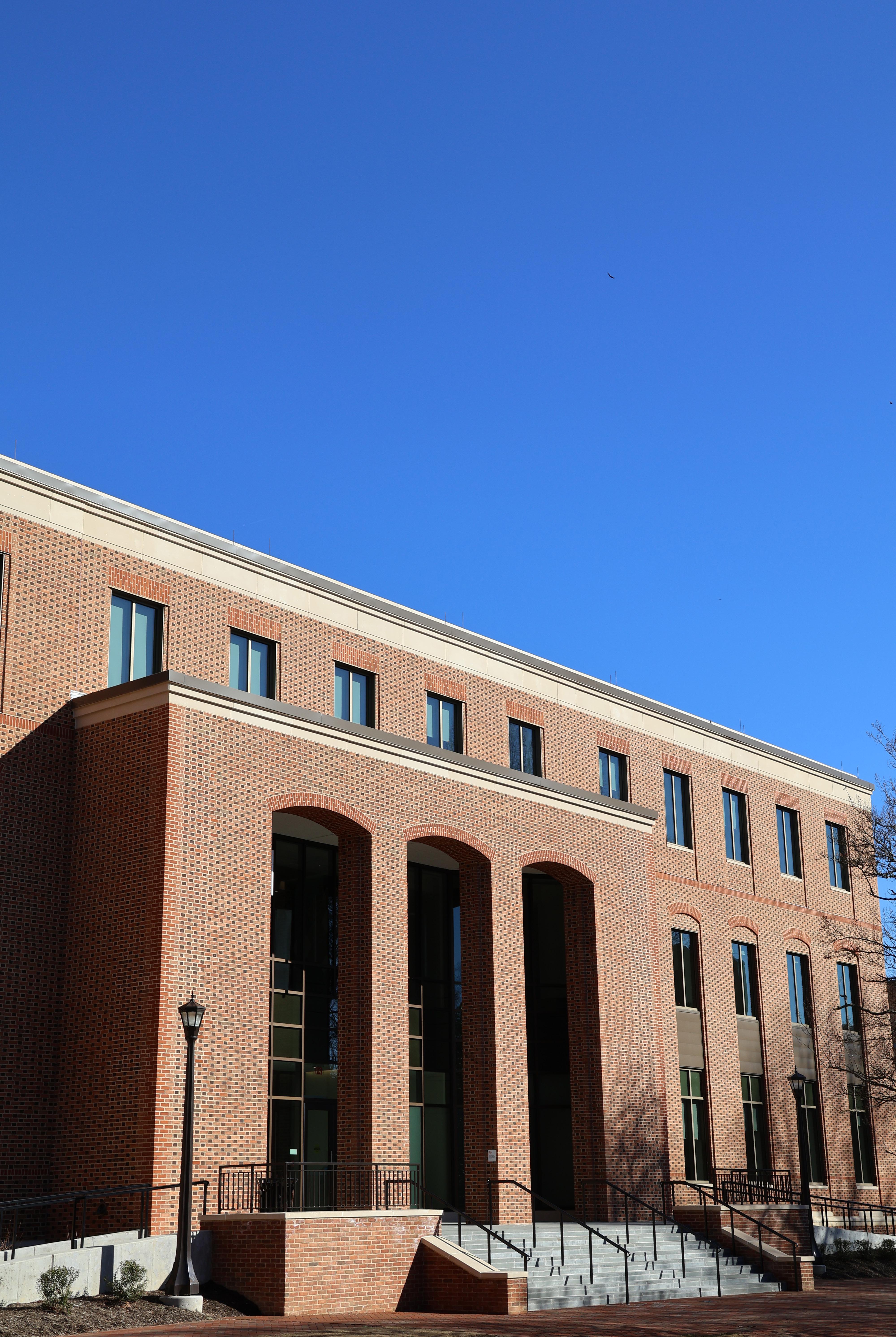
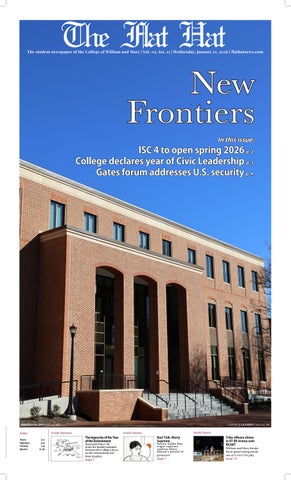
The College of William and Mary is set to open its newest building at the beginning of the spring semester, to be known as Integrated Science Center
4. ISC 4 will house the Collegeʼs new School of Computing, Data Sciences and Physics. ISC 4 will house the Collegeʼs new School of Comwputing, Data Sciences and Physics.
This is the first new school the College has opened in more than 50 years. All computer and data science courses will be moved into the new building, as well as applied science graduate programs. New facilities will include small classrooms, labs, a lecture hall and other faculty and student collaboration spaces. 3-D printers and laser cutting technology will also be accessible in the Makerspace.
With increasing job opportunities in data science, cybersecurity and artificial intelligence, this new school looks to keep the Collegeʼs STEM opportunities up to date with student demand. In the last 10 years, computer science majors at the College has increased by 117%. This new building, spanning 124,000 square feet, will provide a space for students to continue their majors in a collaborative space.
A THOUSAND WORDS T HE F LAT H AT
ʻSTABILITAS ET FIDESʼ | ESTABLISHED OCT. 3, 1911 Org #101 P.O.
8795, Williamsburg, VA 23187
with the
Hughes helps determine snow day cancellations,
Sean
university leadership as chief business officer, previous roles at College
Hughes outlines responsibilites within the College community, family life outside work
SAM BELMAR // FLAT HAT NEWS EDITOR
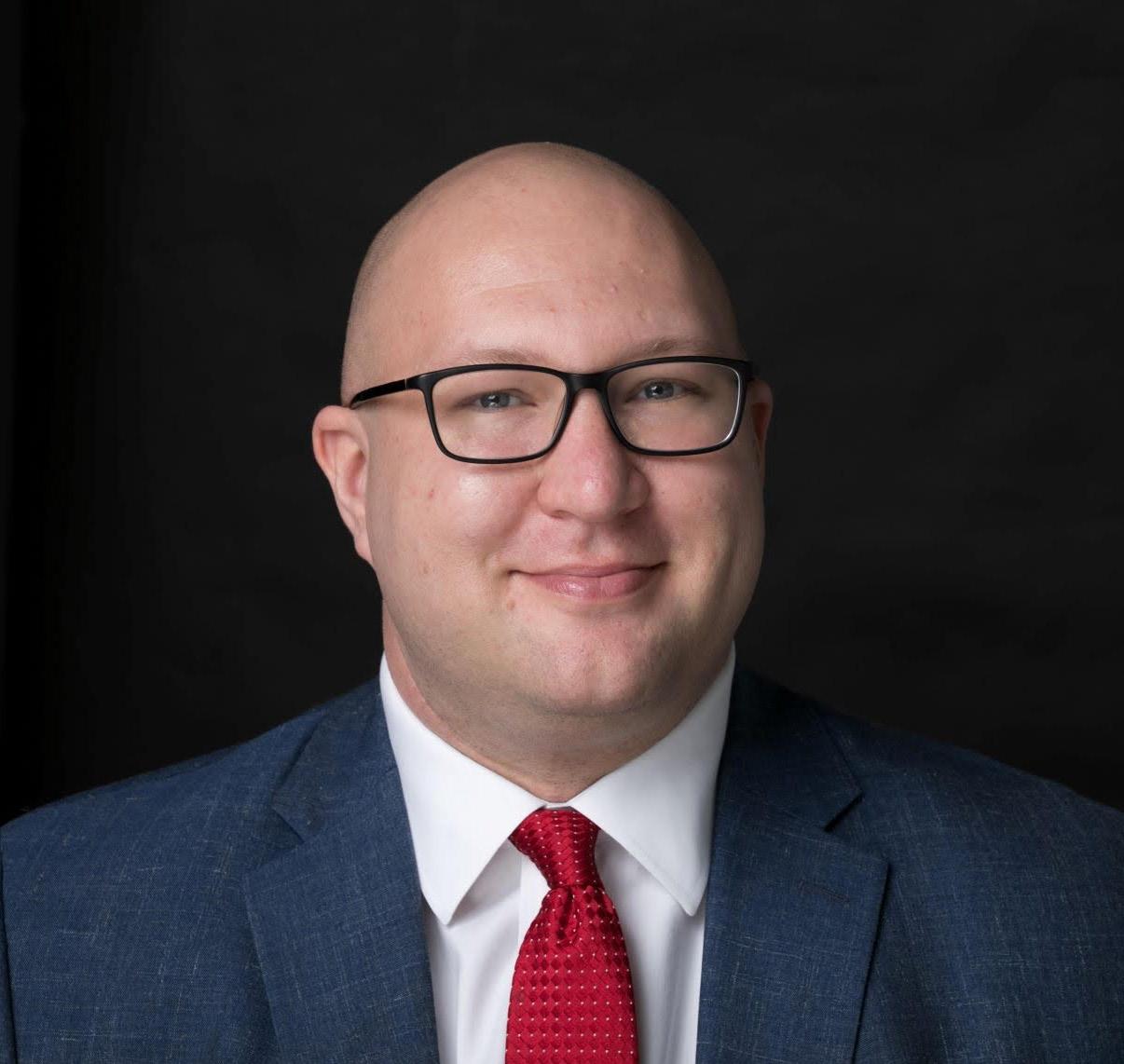
Whenever a snow day graces the College of William and Mary, Chief Business Officer Sean Hughes’ morning routine actually starts the night before.
After clocking out from work at the modest Griggs House on Jamestown Road, Hughes drives home to his family in Williamsburg’s Queens Lake neighborhood. Before going inside to his wife, Jessie, and two sons, Colby and Bennett, Hughes promptly hops on the phone with the rest of the renowned “Group of Four”: Associate Vice President for the Division of Public Safety Cliff Everton, Chief of Police Don Butler and Emergency Manager Justin Weston.
After examining weather forecasts and discussing contingency safety precautions, Hughes contributes to making the final call for the day ahead. While only a small part of his far-reaching responsibilities at the College, Hughes sees the “snow day protocol” as one essential piece of the puzzle he builds every day.
“The way I like to phrase it is that my job is to keep all the balls in the air at all times,” Hughes said.
When Hughes first arrived at the College in 2018, he served as the Chief Executive Officer of the William and Mary Real Estate Foundation before moving to Business Affairs to become its Chief Business Officer in 2022.
Hughes said his role encapsulates far more than the title suggests. While many assume the Chief Business Officer deals mostly with finance, Hughes’ work actually has more to do with campus operations, landscape and construction planning, with Hughes seeing himself more as a Chief Operations Officer.
Hughes also works closely with the College’s board of visitors, where he serves as the lead non-board administrator of the Committee on Administration, Buildings and Grounds. Hughes delivers updates to the board at every meeting on the Campus Comprehensive Plan and other operational focuses. He shared that BOV preparations start well over a month in advance, citing his current work on February’s meeting that coincides with Charter Day.
While getting up to speak in front of board members still brings some nerves to the surface, Hughes feels well-prepared from his time in Charleston, where he was obligated to present to the school board on live television.
“The board meetings don’t freak me out as much as they freak other people out,” Hughes said. “Just because I had six years of being on TV presenting every two weeks, since they televised everything.”
Growing up, Hughes’ father worked in the food manufacturing industry, which meant he always had to relocate every couple of years as his father closed old factories and opened new ones. Hughes checked off more places than most: Chicago, Ill.; California; Pennsylvania; Maryland; North Carolina and Rome, Ga., where he stayed long enough to graduate from The Darlington School in 2002.
While admittedly not as much of a “natural athlete” as his younger brother, Hughes still managed to reach varsity level in four different sports: basketball, lacrosse, football and track.
Even still, Hughes attributes his placement on several Amateur Athletic Union teams and offensive lines to his overwhelming size advantage.
“I had no business being on that [Maryland AAU basketball] team,” Hughes said. “But I was the tall center guy. I never played football until my sophomore year of high school. And I started that year [at left tackle], never having played before, and was on the starting team for a defending Georgia High School championship team, which was very intimidating. I did not know what I was getting into.”
Hughes believes that his “all-over-the-place” upbringing taught him how to interact with strangers, making friends quicker than most people.
“Once I had gotten to college, I really appreciated having moved around,” Hughes said. “One, I could make friends with anybody. Two, it gave me a lot of perspective in meeting people from all over the country while at college, which was really fun. We always had a bunch in common, no matter who they were.”
As an 18-year-old freshman at Clemson University, Hughes didn’t realize right away that he had met the love of his life. The very first girl he met on-campus, now Jessie Hughes, ended up becoming his wife nine years later. He explained that while they were close friends throughout college, they didn’t actually start dating until winter break of their senior year, which Hughes has come to appreciate.
“We could never get it together throughout most of college, which was probably a good thing,” Hughes said. “We both had some growing up to do. I’m glad I was able to do it and make mistakes without somebody I was spending the rest of my life with.”
While Jessie Hughes strongly agrees in retrospect, her “instant crush” on him made the whole situation feel slightly diferent at the time. She described the winter break night of their senior year when they met at a bar near campus. What she saw when she walked inside made her realize Hughes would be her person.
“He was talking to another girl, and I was like, ‘Totally great!’” she said. “She was a mutual friend of ours — I think she was even engaged at the time — and I was instantly green with jealousy. And, as they say, the rest is history.”
Before starting at the College in 2018, Hughes previously worked for six years as Director of Planning and Real Estate of the Charleston County School District in South Carolina. During his tenure in the secondary school world, Hughes dealt with a wide range of students, from extremely wealthy to homeless families. He shared that public service has been a throughline of his work since that period.
“We had schools that were very, very poor, where we had washers and dryers in the classrooms because that was the only place a lot of students got their clothes washed,” Hughes said. “And we had very rich schools as well in Mount Pleasant, where, you know, the parking lot looked like a luxury car dealership every day. And so trying to provide services across that swath was really interesting.”
Six researchers present altruistic synthetic biology uses in aquatic environments at Grand Jamboree
and the judges were really impressed.”
Friday, Oct. 31, 2025, William and Mary’s iGEM research team won a gold medal at the Grand Jamboree in Paris for its novel research in the feld of synthetic biology. International Genetically Engineered Machine Jamboree, the largest synthetic biology competition in the world, is the central cornerstone of a growing new feld in biology.
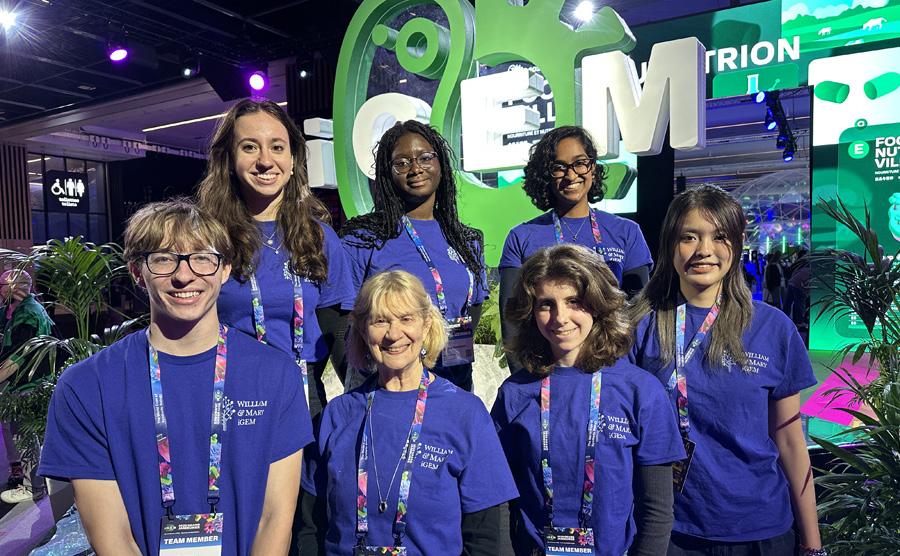
The William and Mary team included Rebecca Zheleznyak ’26, Olabisi Bashorun ’27, Xinyu Hu ’26, Madeline Eibner-Gebhardt ’28, Vandana Kalithkar ’26 and Sean Emmett ’27.
The six-person team, advised by Chancellor Professor of Applied Science Dr. Margaret Saha, competed in the foundational advance category, with their project focusing on the potential altruistic uses for synthetic biology in aquatic environments.
Competing against teams of eight to 50 people from universities such as the University of Heidelberg, Imperial College London and Fudan University, the College’s team frmly held its own.
Project lead Zheleznyak emphasized her team’s hard work.
“I am most proud of how much we did, how much data we collected, how fast our project was, because our team was the smallest it’s ever been,” she said. “I think we were the smallest team in the competition,
The 2025 Project was one fundamentally inspired by the local community. Project Aquarius focused on potential synthetic solutions to aquatic problems, including one extremely prevalent across Virginia: algal blooms.
Eibner-Gebhardt explained the algae problem she has seen in Virginia.
“We have problems with algalms in Matoaka and the other lakes in the Virginia area,” she said. “Water quality issues in Richmond and in the surrounding community as well. So we thought this would be applicable to our community.”
In their study of the applications of synthetic biology in local environments, the team consulted experts from the local and international community, in addition to taking water samples from local sources like Lake Matoaka. These experts ranged from Vice President Keri Green and Committee Member Mary Colligan of the Smith Mountain Lake Association to a local ship owner from the Triangle area. Further, the team consulted international experts on aquatic microbial biology research, including Kenneth and laire Mossman, professor of microbiology Steven Wilhelm and Senior Lecturer of microbiology Gary LeCleir from the University of Tennessee Knoxville.
While the project was inspired by local problems, the applications of the William and Mary Jamboree project have the potential to be groundbreaking in a variety of environments. The research can be applied to lakes experiencing invasive algal blooms, as well as preventing metal corrosion.
Eibner-Gebhardt further expanded on the algae research the team has done during the project and what they have learned.
“These harmful algal blooms are really detrimental,” she said. “You can get this massive proliferation of nutrient runof into a lake environment, for example, you can get this massive proliferation of certain microbial species. And sometimes those are bacteria or cyanobacteria. Certain species of cyanobacteria, for example microcystis of originoso, which I worked with, can produce toxins that kill wildlife. And they also deplete the water of oxygen in sunlight, and that can be a major cause of biodiversity loss.”
The team also experimented with and looked at a wide variety of altruistic applications within the emerging feld of synthetic biology.
Eibner-Gebhardt highlighted the steps that her team used to
perform the research, citing the process that took place within their algae testing.
“For example, we were looking at corrosion, and we saw that there are a couple of papers that are saying that making bioflms grow on steel will prevent corrosion,” she said. “And we saw that phage, or other bacteria, can prevent algal bloom, so we wanted to test that. And we saw that phage can also treat bacterial pipes, so we wanted to look at that. We were looking at a broad range of synthetic bio solutions to issues in aquatic environments.”
She explained how this research can be translated into a tool for groups outside of the College.
“The outcome of our project is how to enhance engineered and designed systems in order to make them more functional in real-world environments,” she said.
And as a part of the competition, the team also addressed the ethical concerns and challenges associated with synthetic solutions.
Hu shared part of the team’s ethical statement, voicing concerns about extending their research into nature.
“We cannot apply them in real environments yet, but there have been past iGEM products that people wanted,” she said. “But then we fgured out, based on our experiments, that what [past iGEM products] they actually made will never work. For instance, there are lab strains that are the screens of bacteria that scientists edited. We fgured out that a lot of these solutions are suitable in a lab, but not in nature. A lot of people are using those previous ideas, and they’re past products.”
More educational materials on iGEM and their research can be found on their website. The team emphasizes that even though the competition is over, the research is only just beginning.
Eibner-Gebhardt refected on the team’s post-season ambitions.
“iGEM doesn’t end after the season is over, and after that, the competition and awards ceremony,” she said. “You can continue with your project and really turn it into something that can be applicable to the felds.”
Zheleznyak is planning to continue her case study on harmful algal blooms in the future as well.
Bashorun encourages others interested on campus to get involved with iGEM as a young researcher.
“It’s really a good opportunity for people who haven’t had experience, or haven’t been in a lab previously,” she said.
Civic Leadership Program students reflect on programʼs goal of providing real-world experience
world experience.
Thursday, Jan. 15, the College of William and Mary named 2026 to be the “Year of Civic Leadership,” inviting guests Gov. Abigail Spanberger and filmmaker Ken Burns to speak at this year’s Charter Day festivities.
Assistant Provost for Leadership and Academic Engagement Roxane O. Adler Hickey, the chair of the university’s Year in Civic Leadership Committee, explained the College’s decision to emphasize public service aligns with the upcoming 250th anniversary of the United States. She noted that the College significantly contributed to the founding of the nation, and this designation hopes to highlight that deep connection.
“The Year of Civic Leadership reflects a university-wide effort to both look back and look forward as the nation approaches its 250th anniversary,” Adler Hickey said. “William and Mary has played a formative role in the life of the republic, and this moment invites us to reflect on that legacy while recommitting ourselves to the responsibilities that come with it. Across the university and among our alumni, there is already an extraordinary amount of civic leadership underway, and this year allows us to elevate, celebrate and learn from that work together.”
Adler Hickey also remarked that this celebration of the semiquincentennial at the College is not merely reflective. Instead, the
Year of Civic Leadership hopes to stress the importance of the development of future leaders at the College.
“As we mark the 250th, we are being intentional about learning together with humility and care, not only celebrating the past, but preparing the next generation of civic leaders,” Adler Hickey said. “By the end of the year, we hope to have fostered a shared understanding of civic leadership rooted in service, integrity, dialogue and sustained commitment to work that endures beyond the moment.”
This focus on cultivating the next generation of civic leaders is demonstrated through current efforts to bring students and the broader community together in the spirit of public service.
“The work already happening across the university is remarkable, and the Year of Civic Leadership creates space to bring those efforts together more intentionally so students and our entire community can see, engage with and learn from that work more fully,” Adler Hickey said.
The College’s emphasis on civic leadership is not new. Each year, the Office of Civic and Community Engagement hosts a cohort of approximately 15 students in its Civic Leadership Program. Throughout the year, participants take part in classes and retreats designed to prepare them for a summer project in an area of community engagement of their choosing.
Halley Stewart ’28, a member of this year’s cohort, described the program’s focus as providing students with meaningful, real-
“Overall, I’d say the program’s main goal would be to provide us with an opportunity for hands-on practice that can amount to positive social change,” Stewart said.
Stewart further reflected on her personal goals for the program and what she hopes to gain from the experience. She said that with the guidance of the Civic Leadership Program, she hopes to become a stronger advocate within her community, and hopes that completing her own project will allow her to see the impact of her values and actions on others.
“By the end of this semester, with the help of this program, I hope to develop a stronger sense of self-assurance regarding being an active contributor, rather than just a member,” Stewart said. “While I’m certainly looking forward to learning from my peers, I’m equally excited to try and find my own grounding. I’d like to leave this knowing how I can learn from the environment I embed myself in, while simultaneously seeing how my particular values and actions can positively impact them. I anticipate that working on a project around a civic issue I’m passionate about will be an eye-opening and rewarding experience moving forward.”
Alonndra Santiago ’28 is another member of this year’s cohort. She recalled that her interest in civic leadership began with her long-standing commitment to promoting inclusion in her community. In high school, Santiago worked with Best Buddies, an organization that aims to support students with disabilities. She further
served as the Director of Community Inclusion for Pi Beta Phi at the College. Santiago remembered feeling excited to have been accepted into the program. When meeting the other members of the cohort for the first time, she remarked that it was interesting to see everyone with such different interests come together with the common goal of becoming better leaders in their communities.
“We had our first meeting last semester, and it was so fun because I got to meet all these people with different backgrounds, which was really cool because not everyone in the program has the same niche or interest,” Santiago said. “Everyone has different interests, but at the same time, it all overlaps, which is really cool.”
To Santiago, the College’s decision to name this year the Year of Civic Leadership only expands upon the leadership-focused work already taking place on campus. She noted that the initiative helps frame civil service as something that extends across the entire College, rather than being limited to formal leadership roles or select groups of students.
“But for it to be like in a broader aspect, I feel like it reaches the entire school instead of just like all these people in this program,” Santiago said. “So, all these different leaders in all these different organizations — and it doesn’t even have to be like a leader of an organization — just you doing something in your day-to-day, like lifting your voice and just doing the things you’re passionate about, because leaders come in all shapes and forms.”
West Woods Dining Hall delayed until after January 2026, Commons Dining Hall stays open
construction completion dates.
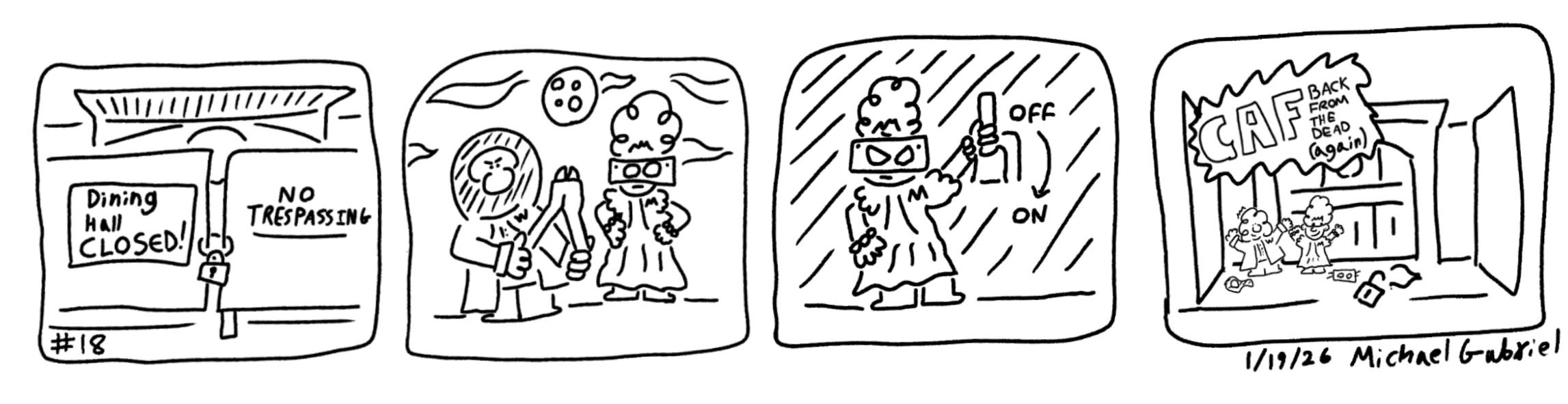
Thursday, Dec. 18, the College of William and Mary announced via a campus-wide email that the West Woods Dining Hall opening would be delayed due to incomplete construction and transition time needed for dining operations. This delay extends a previous timeline adjustment made last summer, when administrators deferred the hall’s original fall 2025 opening to January 2026.
Maple Hall resident Reuben Menk ’28 described frustration with the delay.
“Just with every delay, I was more and more disappointed and frustrated, honestly, because I feel like there’s been a lot of construction going on,” Menk said. “I was really excited for it and disappointed when
it wasn’t open. Every time.”
Menk also wished there was better communication between the College and the students regarding delays.
“When it got closer and closer to the finish date, it just seemed more unreasonable, but they didn’t have many live updates, even if they knew they weren’t going to finish,” Menk said. “I don’t know if that’s just to keep people happy, but it’s just a little frustrating when they don’t update you about that kind of stuff.”
Because some students are transitioning off of meal plans next semester, they may not get to try the new dining hall.
“It doesn’t sound like it’s going to be done until the end of the year,”
Menk said. “That’s going to be pretty sad considering I might be off the meal plan next semester, and I might not get to go there.”
While disappointed with the delay, Timmy Tasler ’26, a French house resident in Pine Hall, is glad the College did not rush the construction.
“I was slightly disappointed when they said that it wasn’t going to be available for the winter and that we were going to continue using Caf, but in some ways, I’m glad they didn’t rush it,” Tasler said.
Tasler explained that they felt Pine Hall had been rushed, which they wanted to avoid with the new dining hall.
“I feel like Pine was rushed a bit,” Tasler said. “For example, when I got to my dorm, there was just nails and drywall on my closet. So I was a little relieved [with the delay]. I was thinking if they tried to rush the opening of the West Woods’ dining situation, that it could be a similar thing where there’s structural issues.” Ben Tescher ’29 reflected on why
he chose to live in Pine Hall.
“I was just trying to guarantee myself some good housing,” said Tescher. “It did have to do with the dining hall too because I realized it would be connected to the hall, so it would have been really convenient.”
He found the College’s communication about the dining hall delay similarly disappointing to that with the Pine Hall delay.
“It was the same thing they did with Pine,” Tescher said. “I wasn’t surprised, but it was kind of disappointing.”
When discussing future campus construction timelines, Tescher was not optimistic.
“I lost all my trust,” Tescher said.
“I’m not listening to any deadline.
I’m not trusting anything pretty much from now on.”
Other students echoed the same sentiments of distrust with future
“Te Pine delay was the frst blow to my trust in the construction,” Tasler said. “I guess this is just insult to injury.”
Tasler expanded to talk about the College’s 10-year plan to improve housing and dining facilities.
“I would definitely say my trust is shot in the construction timeline and generally the 10-year plan,” Tasler said. “Especially just for future messaging between the school and the students. If they give us a deadline for construction, I’m going to maintain a very healthy skepticism.”
Moving forward, Menk hopes that the College updates what they tell students about construction timelines.
“I would like them to be more clear because I’m a little more hesitant on what they say,” Menk said. “I hope that they change their process on how they communicate.”
Gates, Buffett examine U.S. military, declining geopolitical influence, Russian invasion
TESSA
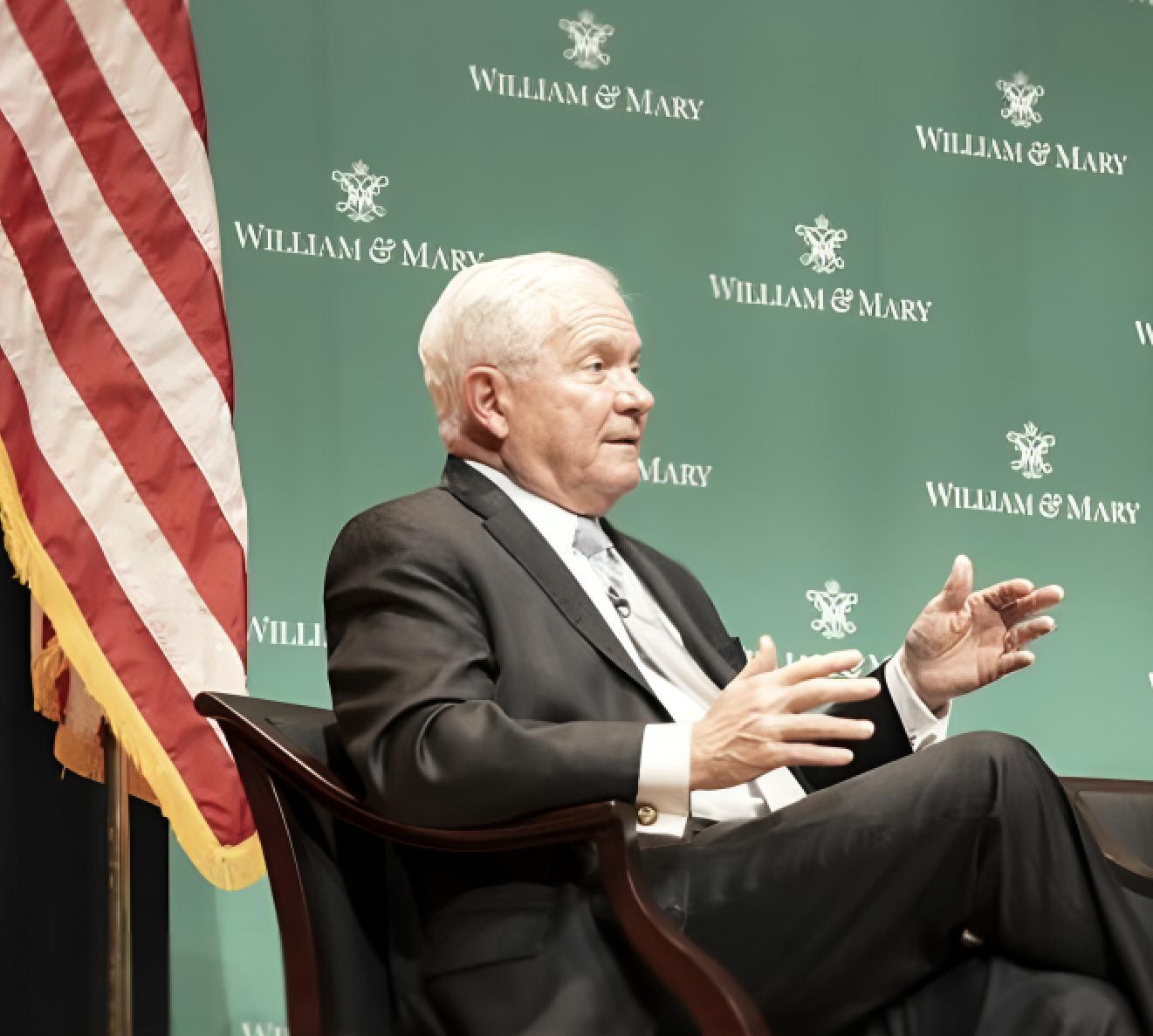
Thursday, Dec. 4, the Global Research Institute hosted the College of William and Mary’s Chancellor Robert M. Gates ’65 L.H.D. ’98 and Howard Buffett in conversation about this year’s Gates Forum topic: Innovative Approaches to Security Assistance.
The Global Research Institute, founded in 2008, works broadly to bring academics, practitioners, staff and students together to research global issues.
George and Mary Hylton Professor of International Relations and GRI Director Michael Tierney ’87 and General Peter Chiarelli opened the talk by explaining the importance of Gates Forums.
“The idea behind the Gates forums is clear: to produce original research and action plans that senior policymakers use to redevelop U.S. foreign policy toolkits for the 21st century,” Tierney said. “Over the past four years, we’ve partnered with the Gates Global Policy Center to tackle key issues in U.S. foreign policy and national security.”
College President Katherine Rowe remarked on the advancing research capabilities of the College as a recently designated R1 institution and the GRI’s part in making that possible.
“Over the last quarter century, the Global Research Institute has generated more than $100 million in external funding in service of high-impact research,” Rowe said. “Thousands of undergraduate students have joined in that work: graduate students, faculty, neighbors, partners around the country and beyond. I want you to know this is the place to come if you want to be applying data and analyzing it in a robust and wellinformed way.”
Rowe then introduced the conversation’s moderator, Thom Shanker, a former editor for The New York Times and current director at Project for Media and National Security, as well as Gates and Buffett.
Soon after Gates graduated from the College, he began a notable career of service and institutional advancement both in and out of the government.
“Chancellor Gates has served under eight U.S. presidents,” Rowe said. “He is the only Secretary of Defense to have served under presidents from different political parties, something that we think is a powerful example of the kind of leadership we care about at William and Mary. We need that bipartisanship every year, every decade. He was awarded the Presidential Medal of Freedom in recognition of his devotion to U.S. service members and commitment to the American people.”
Howard Buffet, an American businessman, philanthropist, conservationist, farmer and son of the prominent investor and philanthropist Warren Buffet, currently heads the Howard G. Buffet Foundation, which stands as one of the largest private
charitable foundations in the United States.
Shanker began the talk with an open-ended question aimed at Gates regarding his time as Secretary of Defense. Gates presented the value in non-military centric forms of power, naming that as the main mode through which the United States won the Cold War.
“The reason, frankly, that we started these forums here at William and Mary was the belief that we have to reform and change all of these non-military instruments; they’ve all outgrown their use-by date,” Gates said. “They need to be changed; they need to be reformed, restructured, repurposed.”
Gates continued by addressing the cost of not cooperating with the private sector.
“By failing to reach outside the government to potential partners, we have denied ourselves in many respects the kind of expertise and commitment and personal passion about these issues,” Gates said. “The only way we can begin to compete with China is to leverage not only the capabilities that we have inside the government but the remarkable capabilities we have outside the government.”
Buffett seconded this opinion.
“Businesses can support what our humanitarian efforts aren’t,” Buffett said. “At the end of the day, I think there’s a lot of opportunity to do that if you’re innovative and creative. You can’t get stuck in a paradigm where it’s just the way everybody does things.”
Both Gates and Buffett continued discussing the economic drivers of the United State’s military and the country’s declining geopolitical power. The war in Ukraine represented a particular focal point through which to explore this declining power, conveyed first by the sequence of photographs taken by Buffett’s team and subsequently by Gates and Buffett’s responses to Shanker’s prompts.
“There’s only one thing happening today that I believe can lead us into World War III, and that’s the Russian invasion of Ukraine,” Buffett said. “For anything to work at the end of the day, Ukraine has to win this war.”
Shanker used this moment to transition into discussing the Superhumans project, which is supported in large part by the Howard G. Buffet Foundation. Superhumans works with those affected by the war in Ukraine to help provide prosthetics, reconstructive surgery, rehabilitation and psychological support services.
Buffett positioned humanitarian work as a crucial component of Ukraine’s survival through increasing morale in such a longstanding conflict.
“There’s a huge psychological and moral standpoint to war, you have to keep your population somehow, number one, surviving, which in a lot of places in Ukraine is a challenge in itself,” Buffett said. “You also have to keep them standing behind the government. You have to have them believe in what
you’re doing. [They] have to believe that the freedom and the democracy that they’re fighting for, that your friends and your relatives are dying for, is worth it.”
Gates supported these remarks, emphasizing the importance of quick decision making in his role as secretary.
“Speed was of the essence, and so I met with that team every two weeks to figure out: what are the bureaucratic obstacles, what’s in the way?” Gates said. “Because while you fool around with bureaucracy, kids are dying.”
When Shanker took time to field questions from the audience, the conversation closed by circling back to publicprivate partnerships with an emphasis on crucial work being done by students.
After the talk, Lucas Fernandez ’28, part of this year’s Global Scholars Program led by the GRI, shared some thoughts on whether he thought universities should play a larger role in hosting conversations about national security challenges.
“Definitely, especially now with the rise of different media platforms and artificial intelligence and emerging technologies,” Fernandez said. “There’s so much more of a chance for misinformation and disinformation, and universities need to play a bigger role in making known to, especially the younger population who was growing up with those media changes and technological changes as well, the true nature of geopolitics and world situations because it can get easily mixed in to the wrong information spaces.”
Hughes
Chief of Staff of Business Affairs Taylor Brings Ph.D. ’23 worked closely with Hughes since first being hired as the Director of Special Projects for Business Affairs in February 2024. However, Brings had already become well-acquainted with Hughes as early as 2018 while she was working in Student Affairs and Hughes was the Chief Executive Officer of the William and Mary Real Estate Foundation.
Brings described an early experience in her career where she and Hughes worked directly together to address a time-sensitive issue. It was during that high-stakes situation that Brings started to admire Hughes’ approach to his work.
“We really had to put our heads together and solve this major problem,” Brings said. “And right away, I just loved the way Sean approached the problem. And the questions he asked were really insightful.”
Fast-forward to 2023, Brings had just finished her Ph.D. in higher education administration at the College and was on the hunt for work. She knew that Hughes was looking for a Director of Special Projects, which entailed a wide range of institutional responsibilities, including access control upgrades and mobile credentials, as well as the Campus Comprehensive Plan.
After Brings met with Hughes, she realized their goals for optimizing the office’s culture were closely aligned. She soon landed the position. Shortly after, Business Affairs lost an HR liaison, complicating matters for an office that had previously lacked administrative staff. Once it became clear Business Affairs needed a Chief of Staff, Hughes pushed for Brings to step into the inaugural role.
“Sean really advocated for me to be his Chief of Staff and went to HR and got the position approved,” Brings said. “It felt like the work I was doing already, and so it’s been a great partnership in that way.”
Brings did not hesitate when describing her experience working with Hughes.
“To be blunt, Sean is the best boss I have ever had, and I’m not someone who says that lightly at all,” Brings said. “He is a really dedicated and thoughtful leader. You can work for a leader who is smart, thoughtful, intentional, who wants to develop you — and Sean is all of those things. But what I love about working with him is there’s no ego in his work. He doesn’t center himself. He centers students, faculty, those who we are serving.”
Brings mentioned that at the most recent BOV meeting in November, Hughes used his platform
as a committee leader to give flowers to his team members who executed the contingency plans for the housing construction delay, which involved over 900 students this fall. Brings said that the gesture was part of Hughes’ larger commitment to making sure his colleagues get proper recognition.
“He finds these moments to elevate and celebrate the people and team around him in a way that I don’t see many leaders throughout my career doing,” Brings said. “I’ve rarely seen a leader who does that so well and so naturally.”
Brings shared that Hughes made a pointed effort to establish a successful working relationship with her from the jump. Being an avid free-time researcher, or as Jessie affectionately calls him, an “internet warrior,” Hughes tapped into the workplace literature to cultivate a handful of selected readings on what a thriving Chief of Staff-Executive relationship could look like. His goal was not to assign more homework but to prompt a flowing discussion about their shared values.
“He and I were really intentional to make sure that we’re in lockstep and fully honest and open with each other all the time,” Brings said.
“I’ve now lent the books to a couple other chiefs of staff because they were like, ‘Oh, we never thought of doing that.’ And so that was kind of a cool moment for me as a younger Chief of Staff on campus, to share something we did that really helped, and now others are modelling that.”
Another dimension of the Business Affairs Office’s dynamic duo is the BOV. Hughes and Brings coordinate back and forth for several weeks in advance of each quarterly meeting, with Hughes typically refining their slideshow featuring updates on the Campus Comprehensive Plan and other central business items, while Brings keeps close tabs on her contacts across campus departments to ensure their concerns are meaningfully addressed.
Brings shared that Hughes recently gave her the green light to start drafting resolutions for the board, which she described as a highly gratifying experience that Hughes’ leadership style and desire to see his team thrive made possible.
“Sean is a really developmental leader,” Brings said. “So I told him, ‘That’s an experience I don’t have — could I try it?’ And he was like, ‘Yeah, go for it.’ So I’ve learned a lot and really enjoyed it. But it’s also weird when you see a resolution you write pass, and now it’s an official document. That’s a really cool feeling.”
Chief of Staff of the President’s Office Carlane Pittman-Hampton Ph.D. ’03 has similarly worked closely with Hughes since 2023, ranging from
the board’s Committee on Administration, Buildings and Grounds to ongoing campus development projects. For Pittman-Hampton, Hughes is someone she constantly has on speed dial to glean insights on wide-reaching matters of the College.
“Sean is my go-to guy, he really is,” she said. Pittman-Hampton touched on Hughes’ character at work, celebrating his willingness to step up to the plate and his consistent presence in crucial moments. She described him as a natural “solution-finder” who intuitively understands both what he can bring to a situation and when to show up.
“He’s always willing to help, and he’s always willing to sit at the table and be thoughtful about things,” Pittman-Hampton said. “So even things that are outside of what he would normally do within Business Affairs, he just has a really good mind for the university. What President Rowe always says about him — which I love — is that he holds the whole of the university. I haven’t seen him have an enemy yet because he gets along with everyone.”
Pittman-Hampton also remarked on Hughes’ reassuring presence in a room.
“He’s a big dude, so I always feel very safe around him from a physical standpoint,” she said. “He’s really just a gentle giant.”
While Hughes certainly takes his job seriously, Associate Vice President for Budget and Financial Planning Mike Maddalena III can attest that Hughes also knows how to have a laugh and “chop it up” over Clemson football. Maddalena and Hughes are both anxiously awaiting the release of Grand Theft Auto VI, whose release date was recently delayed until 2026 — much to their dismay. Hughes had considered taking the entire week off to discover the new Floridathemed terrain, which reminded Maddalena of a recurring inside joke between them.
“One of the things we laugh about is in Florida, they have this thing called the ‘Florida man’ who does weird and stupid stuff,” Maddalena said. “The headline will be like, ‘Florida man captures alligator or brings his pet alligator into a McDonalds.’ So we always laugh about that kind of stuff.”
Maddalena discussed his working relationship with Hughes, which has often revolved around optimizing university operations with limited resources available. Reflecting on his previous position in Business Affairs, Maddalena shared that Hughes always knew how to balance worker autonomy with strategic oversight.
“As long as you take care of business, he’ll let you run and then circle back to make
sure that things are marrying up with what is strategically needed to get the job done,” Maddalena said. “So he’s definitely a great leader from that perspective. You can’t ask for much of a better boss.”
Maddalena also celebrated Hughes’s ability to “keep the morale high” during COVID-19, which brought unprecedented challenges for university operations.
“I think he definitely did a great job of helping the business services and affairs areas navigate that, because that wasn’t an easy time to navigate,” he said. “It tanked out our facilities areas, and he rebounded that in a lot of ways.” When not in his office in the Griggs House along Jamestown Road, or riding around campus to various departments in his trademark golf cart, Hughes said he dedicates himself to being the best father possible.
Jessie described Hughes as a family-centered father who goes out of his way to make sure that his two boys, 10-year-old Colby and 8-year-old Bennett, feel attended to and appreciated in their diverse interests. While Bennett tends more toward creative ventures and Colby is deeply invested in sports, she said that Hughes always finds a way to show up, even when unfamiliar with the activity.
“He’s the freaking best dad ever,” she said. “And I have the best dad ever, so for me to say that Sean is the best dad is a huge, huge compliment. He takes every opportunity to teach the kids something — whether it’s, ‘This is how you make a fire in the fireplace,’ or, ‘This is how you deal with a friend who’s upsetting you.’”
In addition to GTA VI and other computer and PlayStation games, which are often related to building things — Hughes admitted a slight resemblance to his line of work — Hughes enjoys the flexibility his work gives him to invest in his kids’ favorite activities, spend time with Jessie and be active in his neighborhood.
“I truly enjoy my family a lot,” Hughes said. “So just spending time with Jessie and the kids is really, really important to me — doing whatever. Whether that’s driving to Charlottesville to pick apples or just spending time playing out in the yard.”
Reflecting on his personal goals for the next few years, Hughes said he especially hopes to maintain good health. In every area of his life, Hughes most importantly wants to help other people live a little lighter.
“I was working the neighborhood Christmas tree sale [the other day], so there’s components of service there,” Hughes said. “I’m just trying to leave my little corner of the world a little bit better than I found it.”
Susannah
Friday, Nov. 14, the Muscarelle Museum of Art opened “Liquid Commonwealth: The Art and Life of Water in Virginia,” featuring art from more than 50 people across the state. The Muscarelle exhibit is defined as one that “explores the essential importance, richness and beauty of water as a defining element of the Commonwealth.”
I found the exhibit engaging and moving, and I recommend you pay it a visit.
“Liquid Commonwealth” is beautiful, thoughtful and necessary — and it feels like hypocrisy. Not the work of the artists and the student curators. I find it hypocritical, however, for a university that has continued to fund and promote artificial intelligence — a technology that requires a depletion of water to exist — to turn around and pay lip service to sustainability.
Water is important to the Commonwealth. In January 2025, 230,000 people living in Richmond lost access to clean running water during the water crisis. In southwest Virginia, hundreds of homes were destroyed and major lakes polluted during Hurricane Helene in 2024, which was caused by precipitation excess-type weather.
The Chesapeake Bay is a source of thousands of jobs in fishing, tourism and other industries. In 2024, 1.7 million people visited Shenandoah National Park, many of whom visited the numerous waterfalls on the mountains. The James River is a source of recreation and exercise for millions in Virginia, from the junction of the Cowpasture and Jackson in the Appalachian mountains to the bank of the Chesapeake Bay.
The artwork curated in “Liquid Commonwealth” explores the historical impacts of water. “Vernal” by Caroline Minchew depicts a vernal pool in Kimages, Va. where in 1862, during the Civil War, hundreds of Union soldiers died. The photograph won first place, and is a testament to the memory and importance that water holds for local communities.
Artificial intelligence necessitates building data centers to run immense analytics on websites and data. These data centers are large warehouses that can use between 110 million and 1.8 billion gallons of water per year, depending on the size of the center. In comparison, the water usage of a small town with 10,000 to 50,000 people is equivalent to one large data center — of which Virginia hosts 150. Virginia is home to the highest concentration of data centers: almost 600 data centers, 150 of which are large data centers. 13% of the world’s data center capacity, and 25% of the Americas data center capacity is in Northern Virginia. According to a study by UC Riverside and UT Arlington, 80% of the water used at data centers evaporates. That means that 80% of 1.8 billion gallons of water — 1.44 billion gallons of water — will evaporate into the atmosphere per year, depleting local freshwater supplies. That’s just one large data center.
Despite this, the College of William and Mary has chosen to fund several large AI initiatives. In September, the university launched their AI minor. In October, the university launched ChatGPT Edu, a generative AI tool geared for academic institutions. Over the summer, the university launched “16 AI things in 93 days,” a program meant to acclimate students to the usage of AI in academic environments.
In a quote to University Communications, Dean of CDSP Douglas Schmidt ’84, M.A. ’86 said, “We are creating opportunities to apply the technological power of AI to diverse domains, sparking new ideas, challenging assumptions and integrating a wide range of perspectives.” Throughout all of these initiatives, there was no mention of the environmental impact.
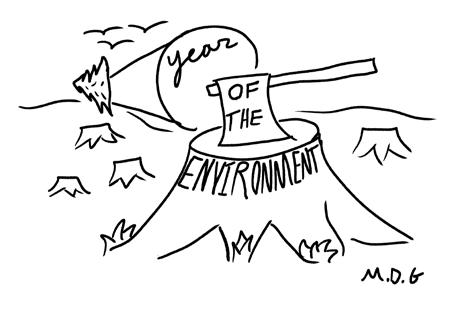
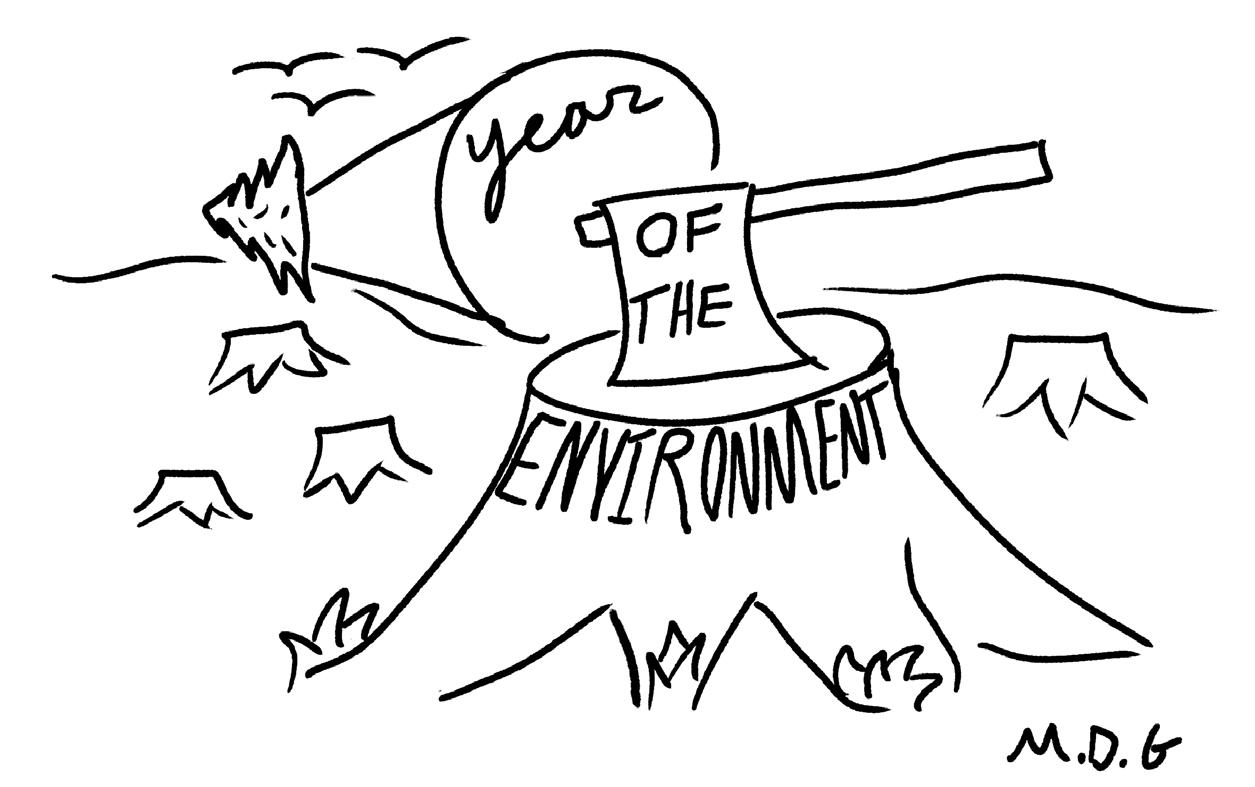
It is for these reasons that I cannot stomach the explicit inaction and implicit apathy of the College in this “Year of the Environment.”
How can we reflect on the ways that water is vital to our state while
Willy and Mary #18
funding and supporting its depletion? How can we continue to fund AI while choosing to ignore the consequences along the way?
I understand that the issues of water usage and AI are deeper than this editorial can speak to, and that broader academia has shifted towards AI usage without many guardrails — a shift that the College has little control over.
I do not want to diminish the real environmental work that has been done this year. 531 geothermal wells are being actively installed to sustainably heat and cool dorms and buildings. Compost and other sustainable lifestyle changes have become easier to implement while at college, thanks to the Student Assembly and Dining Services initiatives. The university launched the Batten School of Coastal and Marine Sciences, allowing more students and faculty to research the ocean’s biodiversity.
These actions are real, and will have significant impacts on our local communities for the better for years to come. But if we do not engage fully with an issue, such as the environmental costs of AI, then how will we ever solve it? If we continue to sugarcoat new dangers and developments, then we will continue the systems that brought our planet to this point.
If we work to protect the environment only when it is easy, simple and non-controversial, we will never be able to change the trajectory our planet is on. The main companies that deplete our water, burn fossil fuels and use our land will never make it simple to alter a culture that prioritizes speed and easy solutions.
I had hoped when the College announced the “Year of the Environment” that they were willing to tackle these difficult questions, willing to grapple with what it means to push sustainability while prioritizing research and academic learning. Instead, the university has decided to keep the systems that incentivize climate change in place and make band-aid fixes to a problem that runs deeper and is more nuanced than at first glance.
We boast of intellectual curiosity, open-mindedness and community, but to embody these traits we must wrestle honestly with complex issues. I invite the university to prove me wrong, by accounting for the environmental toll of each AI initiative they launch. I invite the university to let us live up to our principles.
SusannahPoteet‘28isahistory majorandprospectiveenvironmental studiesminor.Sheenjoyswriting,travelingandwaitingforthefourthMUNA album.Oncampus,sheisalsoinvolved withSomeoneYouKnow,Spotswood SocietyandIntervarsity.Youcancontactheratskpoteet@wm.edu.
To those of us who are applying to jobs or internships — which in this college of overachievers is pretty much all of us — this opinion won’t break any new ground, it’s just what’s been on my mind lately as I scroll through LinkedIn, Indeed and job board after job board. Given my age, I don’t have any concept of any other way people had of applying to jobs; although, my parents tell me that there was a different kind of way. Don’t get me wrong, there’s a very large part of me that is happy that I don’t need to print out resumes and go around handing them out, but a part of me feels like we might have swung too far the other way. I’m sure everyone has seen it on their TikTok pages — or their Instagram Reels, if they’re like me and not very cool — the second their algorithm picks up that they’ve even thought about applying for jobs. It’s the “I applied to 200 jobs, got ghosted by 150, interviewed at 15, got one job offer” kind of videos which make the slightly anxious senior (me, if you couldn’t guess) feel all the same hope for the future as someone watching a train derailment.
I’m not trying to speak from a place of privilege where, because I’m going to college, I expect a job to be handed to me. I don’t mind doing some hard work, but the system that has been created makes what’s supposed to be the next, most natural part of our lives and the start of our careers feel like climbing a mountain. Our parents came out of the generation where the message was “Go to school, work hard and you’ll get a good job.” And that worked for them. Now, even though the overall rate of employment of people with college degrees today is still pretty high, that’s not really what I want to talk about. What I want to talk about is just looking for a job. And in particular, the black hole that is online applications. I don’t know what it says about us as a society that we live in a world where a person can give up the most critical human resource they have — their time — and the statistically most probable outcome for that is to be ignored completely.
I’m sure there was a time when these sites made hiring managers’ jobs easier; it was streamlined, and there weren’t boxes of files, and everything was neater. But a site like LinkedIn only functions optimally when the field of people using the space is smaller. Now everything is completely overloaded. And if a hiring manager has 300 applications to read through, what does that mean? Even more of the hiring process gets automated to keep up, scan-
ners are set to look for certain words and qualifications in resumes, so of course, potential employees find a way to adapt to that, and what are we left with? A process that used to be about a human hiring another human to work in a human job that has become so affected by technology as to be sanitized from anything remotely human that it used to possess.
If you can’t tell, I’m looking for a job right now, and it’s not going super well — although, it’s January, so I have some time — but I think that in general, we live in a world that is being overtaken far too much by technology that is supposed to be making our lives more convenient and is actually just making us move farther apart from each other. I already have an unhealthy codependency on my phone for literally every other aspect of my life: my music, my shows, knowing where I am, how I know things, how I occupy myself when I’m bored (doomscrolling). I think it would benefit us as a society to put a little more human back into some of the parts of our lives that can go on to define our lives like our careers can.
I’m not naive. I know that the way that we’ve automated our society is like letting the genie out of the bottle. Tearing it all down again and starting over would make a ton of things grind to a screeching halt, but I think that it’s worth it, especially for the generation that has to deal with one of the worst post-undergraduate hiring markets in recent memory, for us to reflect on not just the economy that is making our futures more uncertain, but the fact that our society has created a system where even getting started feels more like shouting into the void than doing anything else.
And I don’t think that there’s an answer to it for any of us. Some people are excellent at networking and have things lined up (for them, this article would have been nothing but a waste of their time), but for the rest of us, our only option seems to be to keep shouting, and eventually someone will hear us from the other side of the void. We can definitely all do that, but I think what I’m trying to get to in all of this slightly circular writing that I’ve been doing is we shouldn’t have to. We shouldn’t have to live in a job market where it seems to be about the quantity of applications sent out over the quality of the application, where qualified students have to play long odds because all of the jobs they wanted already have 200 applicants, so they know they’re already behind. When a human being is trying to make a start on a human career, it seems like the bare minimum we should expect in return is some human interaction. I don’t know how we go about getting that, but we shouldn’t have to shout into the void forever.
MollieShiflett’26isadoublemajor inhistoryandlinguistics,notthatshe knowswhattodowiththat.SheiscaptainofWomen’sClubSoccerGoldfor theCollegeofWilliamandMaryandis anavidfanofmostsports—exceptgolf. EmailMollieatmrshiflett@wm.edu.
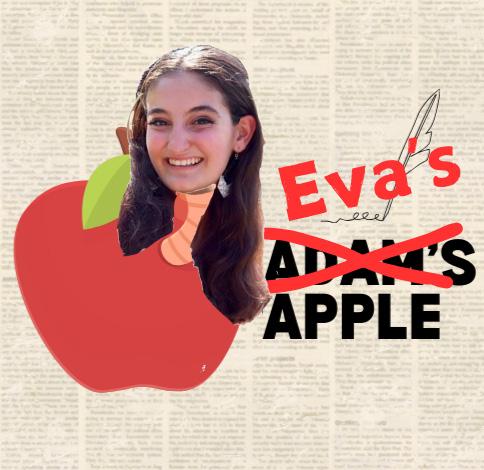
My lovely readers, today we’re celebrating one whole year of Eva’s Apple! How about we start with an anecdote? Over winter break, I was studying abroad in Argentina. I’m not the strongest Spanish speaker, but I could not be more proficient in brainrot. What does this have to do with anything, you ask? Where my language abilities lacked, my vast vocabulary of gibberish references made up for it. During one of our trips, our group spent time with a bunch of younger kiddos, about five to eight years old. In an attempt to bond with them, I engaged in an art that I like to call brainrot diplomacy. When you took Spanish in middle school, your teacher probably told you that you needed to know “puedo ir al baño,” “por favor” or “muchas gracias.” The education system failed you. Whatever happened to “Me encanta ‘Beast Games,’” or “Te gusta six seven?” My new friends
didn’t want to know my favorite color. They wanted to know how many Robux I had. Cultural fluency is the name of the game.
You might remember that, in “Eva’s Apple #11,” I contemplated writing a brainrot edition but was censored by the anticipated stigma of revealing that I have the personality of a nine-year-old boy. I had a whole community of readers rally behind me, though, and they demanded the release of the brainrot edition. There are just about a million scrapped drafts of Apples that will never see the light. This, however, is not one of them, and that’s thanks to the question(s) of the week, which are as follows:
1. “How do I make friends in a new city?”
2. “How can I enjoy six seven as much as you?”
Two questions?!? Chill out, please. I’m not out of practice. I only showed you both questions because they have the same answer. Whether you want to connect with new people in a new place or you just want to train yourself to better appreciate brilliance, brainrot diplomacy is the tool for you. Diplomacy is a broad term that encompasses the “art of dealing with people in a sensitive and effective way,” according to the cherry-picked definition I found online. By that logic, brainrot diplomacy is using cultural references to improve your relationships with others and, ultimately, your
relationship with yourself. Before I went to Argentina, I was spending the holidays with my family in Lebanon. One of my younger cousins has a strong conviction that “six seven” is an insulting and immature phrase, so I didn’t say it for an entire week in the name of respect and cultural humility. I’ve never felt more devoid of whimsy. I cannot imagine the life you must be living without brainrot in it. But don’t worry. I’m here to save you from your fruitless, friendless existence. Here are three ways that you can better appreciate the worldwide cultural phenomenon that is brainrot, while making new friends along the way:
1. Never be comfortable in silence. One time, I read something about how it’s apparently socially and emotionally mature to avoid filling lulls in conversation with meaningless chatter. I vehemently disagree. Silence doesn’t further friendship. Constant noise does. Every second you aren’t speaking or intently listening to someone else speak is nothing more than wasted time. Did someone in your conversation pause to take a breath? Jump in with a lil’ “Ballerina Cappuccina” to fill the time. Will people avoid you? Only the ones who didn’t deserve your friendship in the first place. Practice makes pestilence! Godspeed!
2. Loudly point out any instance that “six seven” crops up in your daily life. Does your professor accidentally
Nora Yoon FLAT HAT OPINIONS EDITOR

I have been told by my editor that savagely criticizing and satirizing articles from the past year that were reviewed and edited by me personally as The Flat Hat’s Opinions editor would somehow be “unprofessional.” Thus, replicating my wonderful article “Review of Flat Hat Opinions camp” is sadly impossible for the time being. Fortunately, as I have seen old friends, watched movies and generally wasted time during my winter break, I have felt something like that sudden, divine light of camp entering into my heart, inspired during the course of these everyday events. Camp, to put it simply, is a sort of ironic enjoyment of something because of its unintentional comedy. I provide a bit of a longer definition in my previous article. However, there’s a bit of a caveat: everyday moments don’t have the same lasting, sustained intent as a work of art, and so can’t fail beautifully in the exact same way. Thus, these small moments themselves cannot be camp. With that in mind, I present three moments of profound stupidity that glanced briefly at being camp from my winter break, interrupting the conventional pace of life with wonderful stupidity. In keeping with YouTube Shorts standards, I will be saving the best for last (and you will not believe it).
3. Coming in at number three is my experience watching “A Minecraft Movie.” Unlike most people, who are responsible enough to finish their work before returning home, I spent my first few days of winter break hard at work finishing a 10-page final paper that I had barely started (and that was already late). After two full days of referencing recent scholarship on the literary analysis of Shakespeare’s early
(and most gruesome) tragedy “Titus Andronicus,” I turned in the paper and plopped down on my couch, resolved to watch something light and fun to help me settle into the stupor of winter break. When HBO Max suggested “A Minecraft Movie,” which I had been too busy to watch in theaters, I figured I might as well, since I’d heard the movie was camp: so bad it was good. But either from burnout or from the utter failure of that movie to be anything other than a repulsive product of the brackish excess capital of the entertainment industry, I stared into the blank screen after the movie, feeling legitimately depressed. I won’t waste any space describing its events. Suffice it to say that after a soul-crushing semester where I had overextended myself again and again, “A Minecraft Movie” proved the mysterious power of art by crushing my soul down even further and sending me into a depressive episode that made me question the value of life itself.
2. After I had recovered from the trauma of the aforementioned “movie” and enjoyed the holidays, I had a funny experience not watching a movie, but watching someone I knew pretty well who I thought was reasonable buy into the “Conformity Gate” conspiracy, arguing with everyone that a secret ninth episode of “Stranger Things” was coming and that it was a brilliant marketing strategy by Netflix to have such a meta, involved finale turn out to be a fake — the kind of writing that made previous seasons of “Stranger Things” so compelling. Even more funny was that this person didn’t even watch season five, saying that “it got too dumb to watch after the last season” and was forming this opini-
on entirely based on the detective work of Instagram Reels creators. The worst part was that, even though I could see how silly this all was, I can’t even distance myself too far from this person, because it was actually me.
1. I’m going to have to be a little vague about this one to protect some people’s feelings. I know two people that are in a relationship (or something like it!) and, hanging out with one, I listened for a while as she complained about how her boyfriend never listened to her concerns or took her seriously enough to talk about what they were, etc., etc. Hanging out with her boyfriend a few days later, I saw a pretty long message from the girl show up on his phone’s home screen, at which he sighed, unlocked his phone, and then opened Clash Royale and queued up for a game.
Especially after a tough semester, I find it easy to get stressed about my past, present and future, preferably all at once. What I love about things that are camp is that they elegantly remove that veneer of dreadful seriousness by making you laugh at how terrible something is. With that in mind, it’s important to let camp into your heart and really see these dumb, beautiful moments that life will unexpectedly present one with, and hold on tight; whether it be feeling disheartened by a fundamentally unserious movie, getting converted into something even dumber than a cult or watching your friend avoid talking to his girlfriend by playing a game made for middle schoolers, these moments might just teach you something essential about the world that will change your life forever. Or they might do nothing, besides get brought up to mock someone with (which happened with all of these) and get you out of a negative spiral by making you laugh again. Hmm. Probably the latter.
NoraYoon’27isachemistry major.Theyenjoywritingpoetry forthecampusliterarymagazine, TheGalleryandreadingwhatever bookshaveagoodvibetothem. Theyalsolikesittingbylarge bodiesofwater,drinkinglotsof coffeeandoverthinkingmovies, songsandthingsingeneral. Contactthematgiyoon@wm.edu.
do the gesture during a lecture? Call them out! Are there six or seven books on one of the syllabi for your spring classes? Paper your dorm’s walls with copies of the syllabus to celebrate (your roommate will love coming back to some fresh decor)! Does your doctor say you have to make an effort to sleep at least six or seven hours every night this semester? Steal their stethoscope off their person and keep it as a token to remember such a cute moment. People will be so grateful for your whimsy!
3. Reframe the way you think about brainrot. Have you ever thought about how the word brainrot is inherently derogatory? Big Pharma wants you to think that stimulating your brain with denotatively empty — but connotatively rich — videos, images and phrases will rot your brain. It has the opposite effect, though. According to my sources, three hours of brainrot a day makes the average brain grow six or seven inches in diameter every year. I fell victim to the top 1%’s conspiracy to make the proletariat avoid brainrot a few months ago when I chose not to release my brainrot edition of Eva’s Apple. But no longer. As promised, I am going to show you the runt of the litter that is my satire advice column drafts. We must learn to reframe our perspective in spite of what society says is right. Through my writing, I hope I open your eyes to the fact that this lexicon is not brainrot and instead brainradiance. And with that, dear sigmas, I
give you the almost question from 12 weeks ago and an excerpt of my almost answer:
“Hi Eva, six or seven?”
In life, sometimes, you don’t have to make a choice. I’ll explain. Recall that Robert Frost poem? Two Ohioan roads diverged in a yellow wood. Sorry YOU could not travel both because you’re so goofy ahh. I, on the other hand, don’t take the road more traveled or less traveled. I take the road no one has been smart enough to even realize they could travel. I put my car in reverse and back up all the way to the Four Seasons Orlando. Once there, I start doing whatever the opposite of looksmaxxing is until I’ve willed myself into looking exactly like you. Once I’ve experienced what it’s like to be chopped, I learn to empathize, and that skill takes me far. In other words, I become emotionally intelligent enough to realize that “six seven” is an and, not or, situation. You asked a stupid question.
Did you enjoy that excerpt? You would’ve never gotten to read it had I not grown to understand brainrot as a way to fuel my generative mind. Be grateful.
That’s it for this week. See you Tralalero Tralalalater.
EvaJaber‘28(she/her)isaprospectiveEnglishorinternationalrelationsmajor.Sheisamemberofthe Cleftomaniacs,anacappellagroup, anESLtutorandhopestoencourage peace-mindedadvocacyoncampus. Contactheratehjaber@wm.edu.
Lana Altunashvili FLAT HAT OPINIONS ASSOC.
This is a hard article to write. There are so many thoughts that are going through my head, so many things I’m realizing as I write this, so many things I want to say the right way. ... But I think, as always, that being sincere is the way to go. Some of you might know me already, but I’m a junior, originally from the country of Georgia and during my sophomore year, I started dating someone — a biology major, which I would highly recommend. But as someone who’s originally from a different country and spent my formative years there, I’m often scared that when he finally visits my hometown, he won’t like it there, or that there are some things he simply could never know or understand about me if he doesn’t come and enjoy the food, the streets, the singing, the traditional dances ... if he doesn’t know the language or the customs. But as I write my third (or maybe fourth) draft of this article, I realize that there could be a person who has all of those things and still can’t understand you as you are. Because truth be told, languages can be learned, superstitions can be understood, traditions can be memorized. What you can’t really acquire though, something much deeper, may be more valuable than cultural context could ever be. Relationships are difficult. Whether you come to that conclusion from romance novels or personal experience, I think it’s true that relationships, whether platonic or not, are hard to maintain and even harder to support. Oftentimes, they force you to face parts of yourself that you didn’t want to see, ones you maybe didn’t even know were there. And if you’re truly trying to make it last, you need to be willing to change. I don’t mean in a toxic way, but the right people make you want to be better for yourself and for them too. Intercultural relationships are even harder. Can you imagine not only dating someone from a different country, but also trying to navigate two or maybe even more

cultures, trying to find a middle ground, trying to “fully” know someone by learning everything about them? It gets tiring really quickly. But what do you do when the two identities, the two countries you’re part of, are inseparable? How do you accept that the one person that should know you best may actually never get to?
But even when these things have been present, it wasn’t ever enough. There have been guys that did know me in the past, had visited the streets I used to call home, had seen the dances and heard the national choirs ... but I don’t think they ever really knew me that well.
I know they say comparing is bad, but I can’t help it. Every prior relationship of mine seemed to misunderstand me somehow, misinterpret my intentions, miscommunicate.
Of course, we’re all older now and much wiser, so some of the past mistakes can be attributed to youthful ignorance. But I can’t help but think that my partner now, not having gone to my hometown, not having been to my childhood home, not having met all of my friends in person, knows me better than anyone who satisfied all of those qualities ever could. There was always a piece that was missing: some willingness to try to understand someone without any explanation.
This is the part of the article when I realize I’ve been mistak-
ing factual knowledge and context for something that I know is already there. This feeling of someone knowing you and loving you wholly, even when they don’t have all of the intricate details laid out in front of them, is more valuable than any historical or linguistic knowledge could ever be. Intercultural relationships are hard. Trust me, I know. But if you’re willing to risk some things and be patient, context will be given in time. The small words you teach them, culture-specific sounds you make or various things you believe in ... these things are picked up in the day-to-day, not in a quick trip across the ocean. They’re in every dinner you have together, every night out, every minute spent together, really. Little by little, you take on each other’s habits, you adopt each other’s cultures. Visiting the places we come from helps and, don’t get me wrong, I still really want it to happen soon. But I think we need to carry with us the knowledge that all versions of us are shown every minute of every day, and are seen and appreciated, especially when the people we choose look beyond the superficial and hold on tight.
LanaAltunashvili’27is aprospectiveinternational relationsmajor.SheisaJames MonroeScholarandamemberofClubTennis.Contact heratlaltunashvili@wm.edu.

“Marty Supreme” is a movie in which nothing matters, but everything matters. Titular character Marty Mauser robs his workplace at gunpoint, steals his lover’s jewelry and gets in a shootout where three people are killed — all to pay for a table tennis tournament.
Lives are ruined, betrayed and lost. And for what? Ping pong?
This is the magic of “Marty Supreme.” Director Josh Safdie and lead actor Timothée Chalamet, along with their cast and crew, elevate a seemingly benign story about table tennis into a gritty crime thriller filled with dark-lit scenes and shaky, claustrophobic camera work that had us on the edge of our seats. It’s easy to forget that Mauser’s exploits are ultimately just games of ping pong and not life-or-death situations (until they eventually are).
Every aspect of the film’s technical craft asserts the
intensity and importance of its events, particularly the score. Constant throbbing and sometimes headacheinducing synthesizers create gut-wrenching tension, instilling in the viewer a sense that something is about to go wrong. Anachronistic ’80s power ballads from Tears for Fears and New Order, among others, add excitement and momentum that transcend the film’s 1950s setting. In the film’s more intimate moments, these electronic grooves give way to lighter, more orchestral sounds that evoke ethereal pleasure and provide much-needed relief between high-octane scenes.
The film’s soundtrack perfectly encapsulates the paradox that is this movie — violent scenes of crime contrasted with moments of tender vulnerability and pure absurdity. It’s impossible to avoid emotional whiplash as you go from watching Mauser violently crash out on the world stage to watching a dozen men lick honey off of their friend’s bare chest.
For many, this unpredictability began with viral marketing stunts leading up to the film’s release. Among the movie’s best-known promotions was an 18-minute skit purporting to be a leaked Zoom call featuring A24’s marketing team and a caricaturized Chalamet presenting his eccentric ideas with ridiculous self-seriousness (much like his character). Celebrities, including Bill Nye and Hailey Bieber, donned “Marty Supreme” jackets, and Chalamet was featured in a rap song promoting the film. The light-hearted wackiness of the film’s advertising led many to believe that “Marty Supreme” would be a fun, comedic romp that would provide easygoing Christmas Day entertainment, a simple “ping pong movie.”
It takes about 10 minutes to realize that these expectations were ill-placed. The film spends very little time on actual table tennis, instead depicting the escalating chaos Mauser wreaks in pursuit of his aspirations. The film makes it overwhelmingly clear that the only thing more potent than Mauser’s confidence in himself is his willingness to sacrifice everything and everyone around him.
But despite the severity of the film and its title character, it’s hard not to root for Mauser. We both know multiple people who hated this movie. Not because of the movie itself, but because of what it represents. Marty Mauser is not a good person; he lies, cheats, steals, manipulates, kills and can just be really, really annoying. But when he lies, we want to believe his lies. When he cheats, we want him to win. And when he tells people that he loves them, supports them and wants the best for them, we want it to be true. Even when we know it’s not.
This is why we think some people dislike “Marty
Supreme.” Because when people sympathize with Mauser, they think it forgives the path of destruction he leaves in his wake. It doesn’t matter if he deserves sympathy — he’s going to get it anyway. By the end of the movie, we know Marty Mauser. We know everything that’s wrong with him (refer to the bucket list of faults above), but we also know everything that’s so right. He’s a proud, idealistic kid with big dreams and the ambition to get him where he wants to go. He is the personification of the American Dream, someone who sees anything less than the utmost success as failure, and who will stop at nothing to achieve his goals.
It’s easy to hate Mauser, not just for the moral crimes he’s committed, but for the fact that it’s hard not to see ourselves in him. Or rather, it’s hard not to see the person we don’t want to be. The person we could so easily become. Everyone wants greatness or success or a legacy. We want to avoid falling into mediocrity. The only question is, how much can we sacrifice for all of that? How much should we? Mauser crosses the line a million times without hesitation. But the rest of us stand at its edge, watching him, judging him, rightfully so, but also seeing him get exactly what he wants in the end.
Because after everything, after we’ve spent two and a half hours watching a man who deserves absolutely nothing beat his greatest rival, reunite with the woman he loves and gaze at his newborn child with tears in his eyes, we resent Marty Mauser. After all he’s done, it seems cosmically unjust that he finds a happy ending.
But it’s impossible to know if the tears in Mauser’s eyes are those of joy or sadness. He has defeated his nemesis but is banned from competing professionally ever again. He reunites with his girlfriend, but he has destroyed the trust of everyone he’s ever known and loved. He sees his child, but there is blood on his hands. The question isn’t whether or not Mauser deserves a happy ending, but whether or not he gets one at all. It would be wholly in character for Mauser to disregard the lives he ruined and see himself as a success the moment he holds his son; it would be just as fitting for him to see a stable life with a family (and no table tennis career) as an abject failure. His character’s rich complexity leaves us wondering whether he landed himself in his greatest dream or his worst nightmare. Will he be like the dog we see in one of the film’s most striking moments, escaping the destruction he creates and running towards freedom in ignorant bliss? Or will he end up like his bright orange Marty Supreme ping pong balls, dumped out of a window onto the street? Therein lies the beauty of “Marty Supreme”: whatever you make of Marty Mauser’s fate, you’re exactly right.

ANNA WOOD / THE FLAT HAT
For nearly five decades, one shop has remained a favorite among students at the College of William and Mary and Williamsburg residents alike. Located on the corner of West Duke of Gloucester Street and South Henry Street, The Cheese Shop has long served as a community staple, offering handmade sandwiches, baked goods and an impressive selection of wines and cheeses. With its delicious menu and time-honored traditions, the shop continues to connect generations of Williamsburg locals.
Eager to understand the hype, my friend and I stopped by for lunch on a chilly Tuesday afternoon. Upon entering, we were immediately greeted by a wide array of food items for sale, ranging from pastas and teas to wines, cheeses and everything in between. The food menu was extensive, featuring a variety of meats and cheeses
from which to choose. I ordered a corned beef sandwich from the seasonal specialty menu, while my friend opted for a classic ham and cheese.
All sandwiches are customizable, allowing customers to select their preferred bread, meat and cheese, and the shop also offers vegetarian and gluten-free options. The vegetarian-friendly menu includes choices such as vegetable and cheese sandwiches, grilled cheese, and peanut butter and jelly or fluff. For those in need of gluten-free options, The Cheese Shop offers Udi’s gluten-free white bread

While waiting for our sandwiches, we browsed the drink section located to the right of the ordering counter. Both fountain
and bottled beverages were available, with an especially wide selection of bottled drinks. Options included sodas in cans and glass bottles, lemonades and teas, among others. My friend was intrigued by Dr. Brown’s Original Cream Soda and decided to give it a try. While the packaging was certainly appealing, the taste itself was nothing above standard.

Soon after, our sandwiches were ready. A staff member handed us a basket containing our wrapped sandwiches, a slip noting our orders and napkins. Before checking out, we couldn’t resist picking up a $1 bag of bread ends. Customers can purchase a bag of bread ends that are perfect for dipping in soup, pairing with cheese or simply snacking on. This affordable option is a great hack for students looking to enjoy high-quality food on a budget. As we ventured to the checkout
counter, we were met with a basket full of homemade baked goods. My friend decided to purchase a slice of cinnamon coffee cake.
The Cheese Shop offers both indoor and outdoor seating; we opted to sit outside to try our food. I ordered the corned beef sandwich with grainy mustard, provolone and sprouts on sourdough bread. The first bite exceeded my expectations. The bread was soft and flavorful, the mustard was textured and pungent, and the ratio of meat to cheese was spot on. My friend, however, was underwhelmed. Her sandwich consisted of ham and cheddar on sourdough, which she described as good but not great — standard. She was, however, very impressed with the cinnamon coffee cake. Intrigued, I stole a bite, and it did not disappoint. Soft, moist and topped with the perfect amount of crumble, this cake is a must-buy for anyone visiting Williamsburg.
Overall, The Cheese Shop lived up to its reputation. With an extensive menu, it is easy to believe that just about anyone could find a delicious meal to fuel a Williamsburg adventure. I certainly plan on returning in the near future to try more of the shop’s offerings. It is an ideal place to purchase ingredients for a charcuterie board, sandwiches for a Colonial Williamsburg picnic or a gift suitable for a variety of ages and occasions.
When I return, I am particularly eager to try the peanut butter and fluff sandwich in addition to the turkey and cheese. Moreover, I have heard consistently positive reviews of the house dressing, which can be added to sandwiches or purchased separately in a jar for home use and is something I plan to try on a future visit.
Te College of William and Mary proudly boasts its standing as the top-ranked public university in study-abroad participation, with programs ofered throughout all seasons. Tis statistic is heavily linked to the College’s COLL 300 requirement, which incentivizes students to learn about global and cross-cultural issues through study-abroad opportunities.
While the words ‘study abroad’ are often associated with a semester or summer of travel, the College does ofer study-abroad programs during winter break as well. Tese two-week-long programs ofer students a quick, fexible opportunity to fulfll their COLL 300 requirement without interfering with summer plans or semester course load. However, much of the study-abroad experience is oriented toward immersing oneself in a diferent culture for an extended period of time. Can these shorter programs still ofer students enough time to reap the full benefts of a study-abroad experience? Additionally, are the costs of these programs worth the short-term trip?
Tis past winter, the Global Education Ofce administered winter programs in locations such as New Zealand, Switzerland, Germany, South Korea, Rwanda, Argentina, Japan, Brazil and the United Kingdom. Te focus of these programs varies greatly, and depending on the program, a student may be able to fulfll certain major requirements beyond just their COLL 300 credit.
For instance, the winter London study-abroad program can help National Institute of American History & Democracy students fulfll their feld school requirement as part of the seven-course NIAHD certifcate program. However, other winter study-abroad programs only ofer credits that specifcally fulfll the COLL 300 requirement.
As part of the winter study-abroad program, students must take a 1-credit prep course during the fall semester after fall break. Over the winter, students will earn 3-4 credits in their abroad course or courses. Depending on individual needs, this can be the perfect setup for a student.
Natalie Burg ’27, a member of the Global Scholars Program, voiced personal concerns about more traditional studyabroad programs.
“I have been hesitant to study for a full semester abroad because I was scared I would miss my friends and professors,” Burg said. She went on to explain how the length of a winter break program was better suited for her.
“I think it was just the right amount of time where I’m able to learn and grow as a person, have such profound experiences that I know will shape me as a person,” Burg said.
Jimmy Kurtz ’26, who recently studied abroad in Osaka, Japan, expressed similar sentiments but confrmed that his recent winter study-abroad experience has changed his views.

“I think that for me, a semester is a really big commitment,” Kurtz said. “Now that I’ve done the two-week winter abroad, it really made me realize how feasible it is to do a summer or semester program.”
Jonah Spotts ’27, a member of the Geneva, Switzerland winter study-abroad trip, reasoned that more traditional study-abroad programs were not an option for him.
“With the way my credits worked out, I couldn’t end up going abroad for a semester,” Spotts said.
Spotts’ situation is reminiscent of many other students. Fall or spring semester study-abroad programs may require students to take a limited number of credits or may specialize in coursework unrelated to a student’s academic needs. Fortunately, there are alternative opportunities for students to earn their COLL 300 credit while taking a traditional campus-based course, if studying abroad is not realistic or feasible for them.
Te winter break study-abroad framework is unique in its ability to ofer students the chance to quickly earn their COLL 300 credit with limited confict with other winter plans. With the month-long winter break, the time frame between Jan. 1 and the start of the spring semester is a valuable opportunity for students to pursue a global academic experience.
Yet, these short-term programs still come with a hefty financial cost. Between New Zealand, Switzerland, Germany, South Korea, Rwanda, Argentina, London, Japan and Brazil, the average cost for a winter study-abroad program is $8,156 — taking into account housing, tuition, airfare and other fees, without considering potential scholarships. Of these listed programs, the Kigali, Rwanda program is the most expensive at an estimated cost of $9,975, and the cheapest is the Heidelberg, Germany program with an estimated cost of $7,080.
Te reason behind the higher cost for the Rwanda program is due to its focus on the 100-day genocide and the arduous process of forgiveness and reconciliation among the Rwandan community. A recent member of the Rwanda program, Emilia Zapata ’26, provided insight into its high cost.
“Although it was a little expensive, it was really nice once we got there because Rwanda is big on transparency and accountability,” Zapata said. “So, they were really transparent about where the money was actually going, and a lot of it was going to survivors to help rebuild their homes.”
Zapata went on to explain the features of the Rwanda program that made it so unique and unforgettable to the students who traveled there.
“People are showing us all these memorials because they don’t want this to repeat ever again,” Zapata said.

Additionally, students noted how their study-abroad experience impacted their professional goals and perspectives on their future career paths.
“I came into William and Mary thinking that I would be a lawyer, but actually I have fallen in love with this feld of shaping the future and seeing what we can do to support other countries and support the United States,” Burg said. “And if anything, it’s given me that confdence that I can participate in the room, I can get myself in the room and I can be a contributing member with all of these very high-level thinkers and policy makers.”
Kurtz added his own perspective shift from studying abroad.
“I think that now, coming from that experience, I will defnitely be more interested in jobs that have a travel component or jobs where I could experience more of the world,” Kurtz said.
Furthermore, the students noted their experiences with cultural immersion in the distinct places that they visited.
“On our very frst day here, many of us actually went out and explored the local markets, explored the local restaurants,” Burg said.
“W&M really wants you to not only feel immersed in the location, but also make sure you have ample time to explore on your own,” Spotts said.
According to students, the short program lengths of winter study abroad did not inhibit their ability to have a worthwhile experience.
“Even though we’re only here for two weeks, a very short period of time, the diference that it makes in your worldview and your perspective is gargantuan,” Spotts said.
Based on his own experience, Kurtz encouraged students to join a study-abroad program.
“To anyone thinking about studying abroad, whether that’s for two weeks, a month, a semester, I think it’s sometimes good in your life to just take a leap of faith and just do something that you’re on the fence about,” Kurtz said.
Zapata added the insights she gained from her studyabroad program.
“I think we all became the best versions of ourselves in knowing that we need to stick up for one another and support one another because you never know what the other person is going through,” Zapata said.
Ultimately, the value of a winter study-abroad experience depends on the needs of the individual student. Are you a rising senior who has not yet fulflled their COLL 300? Are you fascinated by one of the many winter locations advertised by the Global Education Ofce? Do you want to take a leap of faith and explore a completely diferent place in a short span of time? If your answer to any of these questions is yes, then perhaps winter study abroad is the right step for you.


With a seemingly countless number of clubs available at the College of William and Mary, it can feel impossible to settle on a select few to join. That’s where clubs like DisinfoLab come in. By combining politics and technology, balancing qualitative analysis with technical skill and examining general trends or specific current events, DisinfoLab uses a multidisciplinary approach to investigate diverse topics, creating an intellectual community that works hard to spread information and solve problems.
Given such a broad goal, it’s important that the student-run club simplify their identity.
“Research lab-slash-think tank is the official definition,” club member Jared Dewey ’27 said. Beyond that, the club splits themselves into two main teams: a qualitative team that focuses on research, and a quantitative team that works on the technical aspects of each project.
“The technical people scrape data for whatever the qualitative people want,” club member Sam Leong ’27 said. “We just go get them data, and we help them with the research, and we publish op-eds.” These op-eds are published by groups of three or four, with the lab working on around six articles at any given time. They span a wide range of topics that fit members’ interests. Dewey explained the op-ed he contributed to last year.
“My group was focused on this incident in India, where it was a very nasty incident and it sparked a lot of protests for women’s rights,” Dewey said. “So we were analyzing people’s response to that, and we compared it to previous big events that have sparked other protests to see the general changes in people’s attitudes towards rights movements.”
This year, members of the lab are in the brainstorming stages of a different topic.
“We’re talking about something with populism, seeing how the Republicans have used different techniques to win elections and how it has affected the political landscape,” Dewey said.
He expects to use a technique called sentiment analysis, which analyzes large amounts of text to sort the emotion behind it.
“It’s gonna be like, go on to some social media, get a bunch of posts. Figure out, are these people happy? Are these people mad? Are they talking about something relevant, related, something off topic?” Dewey said.
Outside of their op-ed work, DisinfoLab also engages in larger-scale projects that aim to combat mis- and dis-information worldwide.
“Facebook had a really useful collection of fact check information from fact checkers, and that got taken down recently,” Leong said. “And so we kind of have a general goal to re-promote
this availability of data, because it’s available, but it’s scattered across lots of sources between these different fact checkers. And so we are working on a big project to basically make that data available in one central location.”
Fellow quantitative analyst and club member Celia Schaefers ’27 elaborated on this project.
“We’re implementing a large language model, chat bot-type thing, where you can fact check things that you’ve heard, and it’ll check against certified, fact-checked sources,” Schaefers said.
These projects allow club members to dive deep into their passions while working on relevant problems.
“I wanted to do something that would have a real impact,” Schaefers said.
Members of DisinfoLab’s quantitative team are able to turn complex data into important information that they then use to help people. Leong explained the “semantic search” they use to turn articles and their meaning into numbers, or big vectors.
“Working with that data is really exciting to me, because it’s kind of fun to work with a system that is able to index using these kinds of magical numbers that don’t really mean anything to any human, but end up actually getting meaning out,” Leong said.
While working hard on all of their projects, DisinfoLab maintains a unique and tight-knit
community that members enjoy.
“It’s kind of just nice to be in the room and hear people talk about these projects, and all of us being committed to work on the same thing,” Leong said. “The community is very welcoming. You don’t have to know a lot coming in, and if you ever have any questions, someone will always be willing to answer them.”
The environment also offers a more professional setting for those looking for a step up from social gatherings.
“It’s gonna prepare you for the workforce,” Dewey said. “It’s an enjoyable environment, and it’s professional, so it’s kind of like a good stepping stone, halfway.”
Schaefers appreciates the diverse perspectives the group has brought her.
“I think it’s really cool working with people who are interested in policy or in governance, especially being at William and Mary,” Schaefers said. “I’m from Texas and so, moving here, I think I’ve met a lot more people who have family in the government or the military just because of location, and that’s been interesting.”
Interested in joining DisinfoLab? Their application process occurs every fall semester, and new members are always welcome.
“Going into my second year, I know the process and new people are joining, and it’s a nice cycle,” Leong said.
injuries
CHARLES VAUGHAN
EDITOR
At the turn of the year, it was difficult to imagine William and Mary women’s basketball (8-8, 1-4 CAA) losing a single game, let alone multiple.
After starting the season 1-4, the Tribe went on a run reminiscent of the hot streak that carried it to the 2025 Coastal Athletic Association title, rattling off seven consecutive wins while playing almost exclusively on the road. From Nov. 29 to Jan. 2, William and Mary beat four teams by double digits and picked up six victories away from Kaplan Arena, including a triumphant defeat of Atlantic Coast Conference foe Wake Forest (12-8, 2-6 ACC) that marked the program’s first win over a Power Four opponent in ten years.
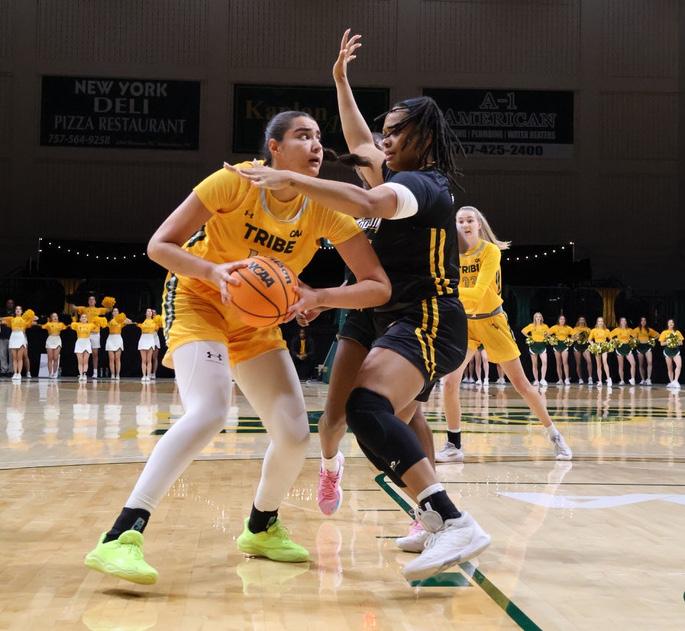
William and Mary’s run of good form continued into its conference opener, during which the Tribe throttled North Carolina Agricultural and Technical (7-9, 2-3 CAA) 60-49. Fast forward two weeks, and the Green and Gold sits at the bottom of the league leaderboard, having fallen against four consecutive CAA opponents. What happened?
“I don’t really have much,” William and Mary head coach Erin Dickerson Davis said Friday, Jan. 16, after the Tribe’s most recent loss, a 59-49 home defeat at the hands of Hampton (89, 2-3 CAA). “We luckily have a bye coming up on Sunday so that we can get healthy first and foremost, but also kind of get back to the drawing boards on what we need to do to get this turned around.”
The Tribe’s losing streak began with three heartbreakers: an overtime collapse against Stony Brook (10-9, 5-1 CAA), a two-point loss to Charleston (14-3, 6-0 CAA), and another two-point loss, this time against Campbell (11-8, 4-2 CAA). However, William and Mary was never wholly outclassed, never out of striking distance down the home stretch — until Friday, that is.
After coming out of the gates hot, claiming a sizable early advantage against a Hampton team that had lost five of its last six, William and Mary gave up a 39-12 run and did not get within 10 points of the Pirates after halftime. During the second and third quarters, the Tribe was outscored by a combined margin of 30-15; in the second half, the Green and Gold connected on just two of its 14 three-point attempts.
“Typically, Hampton starts slow, and they kind of speed up,” Dickerson Davis said. “I think that when we got up, we kind of took our foot off the gas.”
The game’s outcome was not in doubt as the clock ran down on Hampton’s first victory over William and Mary since 2021.
Before the season, Dickerson Davis and junior guard Cassidy Geddes made clear that the primary purpose of William and Mary’s non-conference slate would be to prepare the Tribe’s inexperienced, underclassman-laden roster for the rigors of CAA competition. Aiming to avoid a repeat of the 2024-2025 campaign, during which the Green and Gold stumbled into league play sporting a 3-8 record and reeling from a 50-point loss to Maryland, Dickerson Davis intentionally scheduled slightly weaker opponents with playstyles resembling those of William and Mary’s conference foes.
By all appearances, this strategy paid dividends: the Tribe entered CAA play with a winning record, a strong résumé, and much more confidence than it sported at the beginning of 2025. Why, then, has William and Mary struggled in the early going?
Dickerson Davis’ theory: her squad doesn’t fully grasp the weight of the target on its back.
“What I keep trying to get my team to understand is that we won a championship last year,” Dickerson Davis said. “Like, nobody is looking at us like we’re not a good basketball team. Even with our injuries, and, you know, [senior guard] Alexa [Mikeska] didn’t practice yesterday. Like, we’re banged up. So even with all of that, people are looking at us like we’re a good team. And so we have to be prepared to get everybody’s best, and I think that’s just where we’re struggling right now, is we want to be the underdog, and we’re just not. We’re just not.”
Charleston, Campbell and Stony Brook all dwell in the upper half of the league standings, but Hampton is just 2-3 in CAA play and was picked to finish 11th in the
conference’s preseason media poll. Nevertheless, William and Mary was unable to withstand a motivated Pirates squad, which used 44 combined points from junior guards Kiarra McElrath and Kayla Lezama to knock off the 2025 CAA champions.
The Tribe is also short-handed, with several key pieces battling through injury: junior center Tika Sallman, one of William and Mary’s most efficient offensive players, has not seen the court since Jan. 4, freshman guard Dynasti Pierce hasn’t played since Jan. 9 and Mikeska is banged up. Against Stony Brook, Charleston and Hampton, four Green and Gold starters played 30 or more minutes in marathon efforts. Six off-days lie between William and Mary’s loss to Hampton and its Friday, Jan. 23 trip to Northeastern (6-10, 2-4 CAA), a period of downtime Dickerson Davis says will be crucial in recuperating players.
However, William and Mary won’t make much progress until it eliminates the execution mistakes Dickerson Davis says plague the Tribe. As Hampton started to pull away from the Green and Gold, the Pirates began deploying a zone that the hosts struggled to navigate: in the second half, just 17.2% of William and Mary’s shot attempts came at the rim compared to 51.7% in the first half. According to Dickerson Davis, the Tribe’s failure to generate quality interior looks was mostly self-inflicted.
“I think [Hampton] went zone against us,” Dickerson Davis said. “I don’t think it was a great zone. I think that we started off missing a couple layups that we got. I think that we were trying to get the ball in the net, but we weren’t making the correct pass, even though we practice it every single day.”
Dickerson Davis was also dissatisfied with her squad’s defense of Lezama, who averaged 14.4 points per game coming into the contest and dropped 23 points against the Tribe on 50% three-point shooting.
“At some point, like, we just have to do our jobs,” Dickerson Davis said. “I guess that’s probably my biggest frustration right now, is we talk about executing things in the way that it was coached, and we’re not, right. And so whatever that — I don’t know — that divide is between what we’re trying to get them to do and them actually doing it is, I think, where we need to figure out.”
William and Mary will attempt to recover its injured players, clean up its mistakes and get back in the win column against Northeastern at the Cabot Center in Boston, Mass. The matchup is on the road, perhaps a welcome change for a Tribe team that is 2-5 in home games and 5-3 in away games.
“I’m sorry to all of our Tribe fans that support us every day that we don’t play as well at home,” Dickerson Davis said. “So luckily, we’re on the road. We can get some things rolling, but it’s really going to depend on if we can get healthy.”
Menʼs, womenʼs teams look to build on strong 2024-2025 campaigns
As the winter sports season kicks off, athletes and coaches prepare for successful seasons in their respective sports. William and Mary men’s and women’s gymnastics teams enter the 2026 season with hopes to reach new team and personal bests.
With the 2026 men’s gymnastics season recently underway, the William and Mary men’s gymnastics team is gearing up for a strong season. Following its season debut at the West Point Open, which saw eight athletes reach finals and sophomore Luke Tully win the high bar title, the team will compete at the Navy Open in Annapolis, Maryland Jan. 24.
After qualifying for the NCAA Championship in 2025—the team’s first time qualifying since 2021—the Tribe is looking to build confidence with their freshman members as well as build on last year’s success. Men’s gymnastics was selected to finish third in the Eastern College Athletic Conference rankings prior to the season, and the team is aiming for the NCAA Championships once again.
The Tribe had its first preseason showing back in December at the annual Green and Gold Showcase. Men’s senior team captain Ricky Pizem has confidence about the upcoming season coming out of the preseason and following the Green and Gold meet.
“I thought it was a good start to the season. It’s not necessarily part of our season, but it’s kind of the first real showing,” Pizem said.
Graduate student and team captain Jonathan Irwin expressed excitement for the new members of the team to get their first taste of college gymnastics.
“It’s such a big, big difference from club gymnastics, which is more of an individual sport, to go into college, where it’s very team-oriented,” Irwin said. “Getting out there with the team, competing under the lights with a crowd — it’s always a lot of fun.”
In practice, the team has been working hard to get comfortable with one another and gain confidence in their skills in preparation for competition. With new members each year, every season brings new group dynamics and challenges. Much of the practice before the beginning of the season is aimed at allowing teammates to settle in.
The men’s team places a large emphasis on working together and uplifting one another throughout the entirety of the season. Head coach Mike Powell is ready to see what the new members of the team will be able to contribute in the upcoming season and is counting on upperclassmen to contribute their previous experience.
“There’s things to adapt to that they’re really figuring out, but they’re learning really quickly, and I think we’re going to see some great contributions from that class this year,” Powell said.
In college men’s gymnastics, four men compete in each event to receive a score, and each score counts towards the team’s overall score. This setup creates a relationship between teammates as their performances affect each other during competition, allowing athletes to keep momentum and build off one another.
Looking ahead to the 2026 season, the Tribe has a few goals when it comes to performance. Aside from continuing to build confidence and work together as a team, the Tribe has its sights set on a couple of big competitions in the coming season.
“We have the conference championship in our sights. We think we have the potential to contend for a title. Similarly, at the USA Collegiate Nationals, we’re looking for at least a podium spot. We’re looking to make that return trip to the NCAA Championships as a team,” Powell said.
Alongside the men’s team, the women’s gymnastics team has a similar foundation of teamwork and emphasis on instilling courage within its athletes. In the 2026 season, the team hopes to grow in its
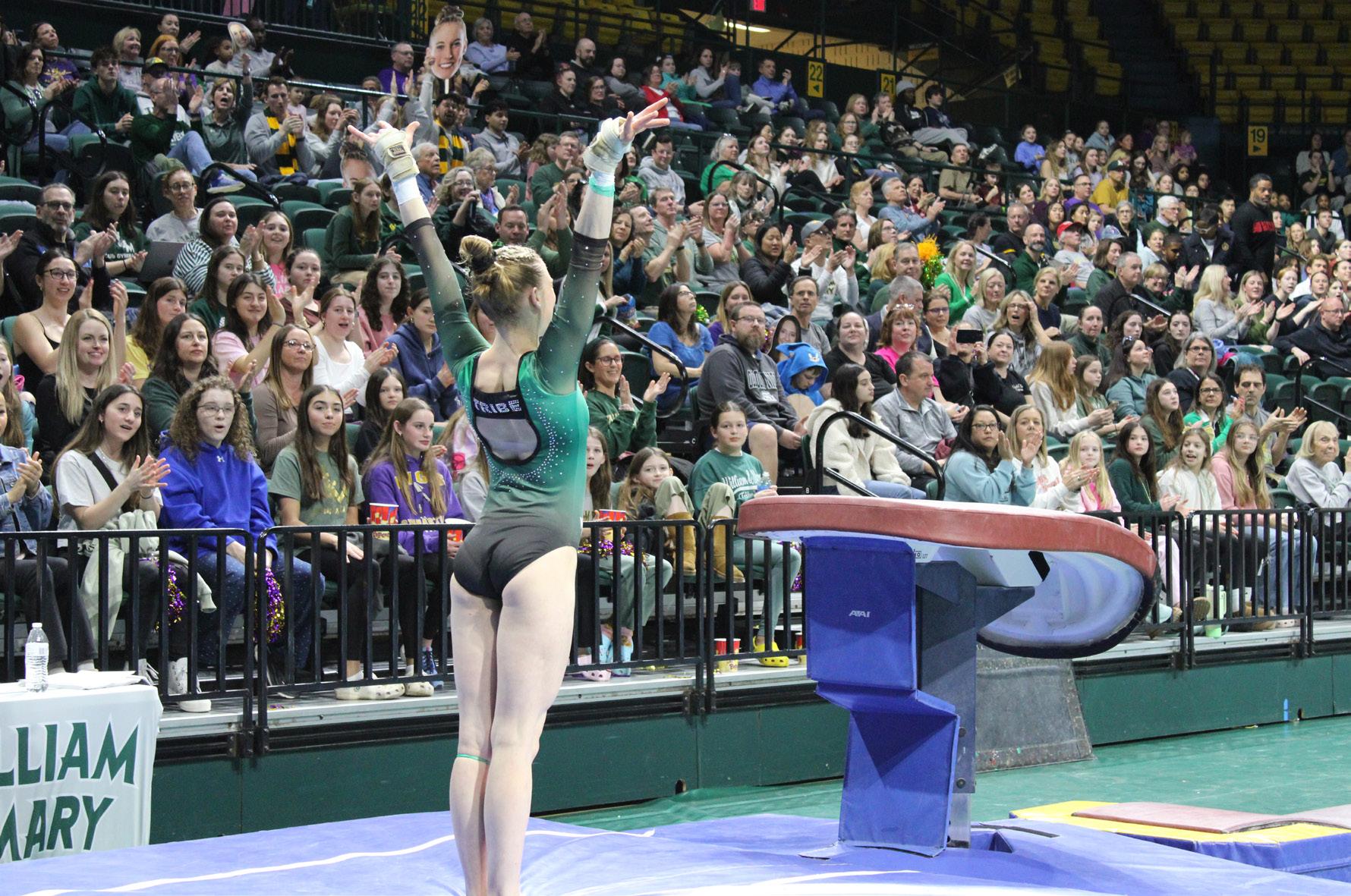
performance and competitive standing within its conference.
Last season, women’s gymnastics earned season-high scores at their first competition and claimed the champion title at the Ursinus Quad Meet. Overall, the team had significant growth throughout the entirety of their 2025 season and hopes to build on its success similarly to the men’s team in 2026.
The team showcased their training in their Green and Gold Competition as a way to kick off their upcoming season.
Coach Kelsey Mann, as well as the athletes, state that the competition fills them with positivity, excitement, and optimism going into this season.
Women’s gymnastics will be celebrating its 50th year as a team this season and host their first competition Jan. 25 in Kaplan Arena against Southern Connecticut State/Fisk. This competition will also be senior night,
where senior athletes will be recognized for their hard work and dedication towards the program.
“Coach Kelsey and Kendall are amazing in both organizing and doing what’s best for both the team and the athletes, and I feel like this is going to be a really great season,” stated team manager Bailey Kim. “I hope members of the W&M community will continue to come and support our team because some really amazing gymnastics is being done.”
All in all, both teams have been working extremely hard to create an inclusive and comfortable environment for everyone in the 2026 season. While both teams have goals and hopes of winning championships, a main priority they focused on was the importance of passing knowledge down from athlete to athlete and keeping the program a fun and safe space for all of the athletes.
William and Mary breaks
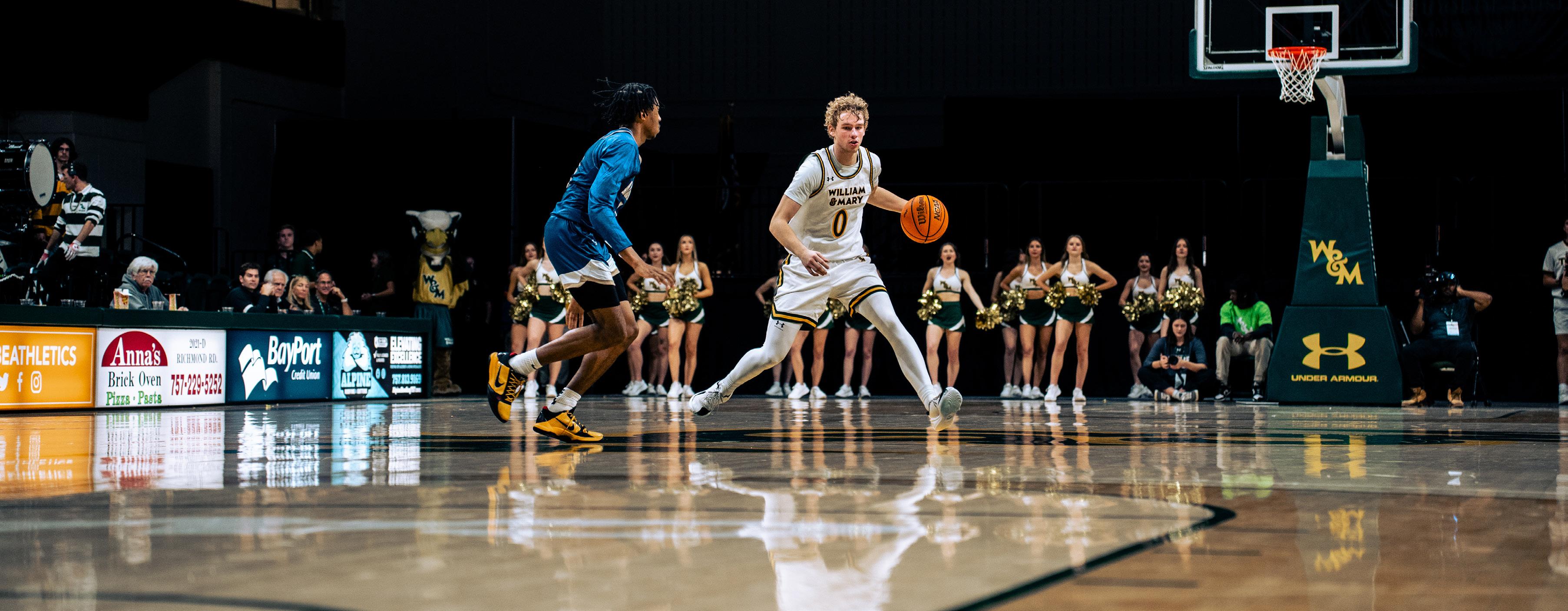
its presence known at the game’s most important moments. A late first-half surge from the Aggies was quickly snuffed out by Earl’s crew, bolstered by the Kaplan faithful.
little too much sometimes. So I think he’s found his niche, which is faster than certain guys who are bigger than him and bigger than guys that might be faster than him.”
After starting Coastal Athletic Association play with a bang, scoring home victories over Stony Brook (11-9, 3-4 CAA) and preseason league favorite Towson (10-9, 2-4 CAA), William and Mary men’s basketball (12-6, 3-3 CAA) fell into a slump, dropping three straight contests for the first time all season.
The Tribe kicked off the new year with an extended road trip that took it from Charleston, S.C., to West Long Branch, N.J., to Philadelphia, Pa. Removed from the friendly confines of Kaplan Arena for the first time since December 6, William and Mary’s shots found rim instead of nylon — the Tribe made a paltry 25.3% of its three-point attempts — and head coach Brian Earl’s squad returned to Williamsburg at 2-3 in conference play, good for seventh place in the CAA. After blazing one of the program’s hottest-ever starts to a campaign, William and Mary needed to replenish its gunpowder.
Thursday, January 15, the Tribe did so in emphatic fashion, setting a season high in points against a Division I opponent during its 97-89 victory over North Carolina Agricultural and Technical (7-9, 0-5 CAA). William and Mary’s performance was not without defensive warts, but the Green and Gold posted a scorching 1.27 points per possession, drained 56.2% of its three-point attempts, and once again looked like a team capable of competing for the CAA crown.
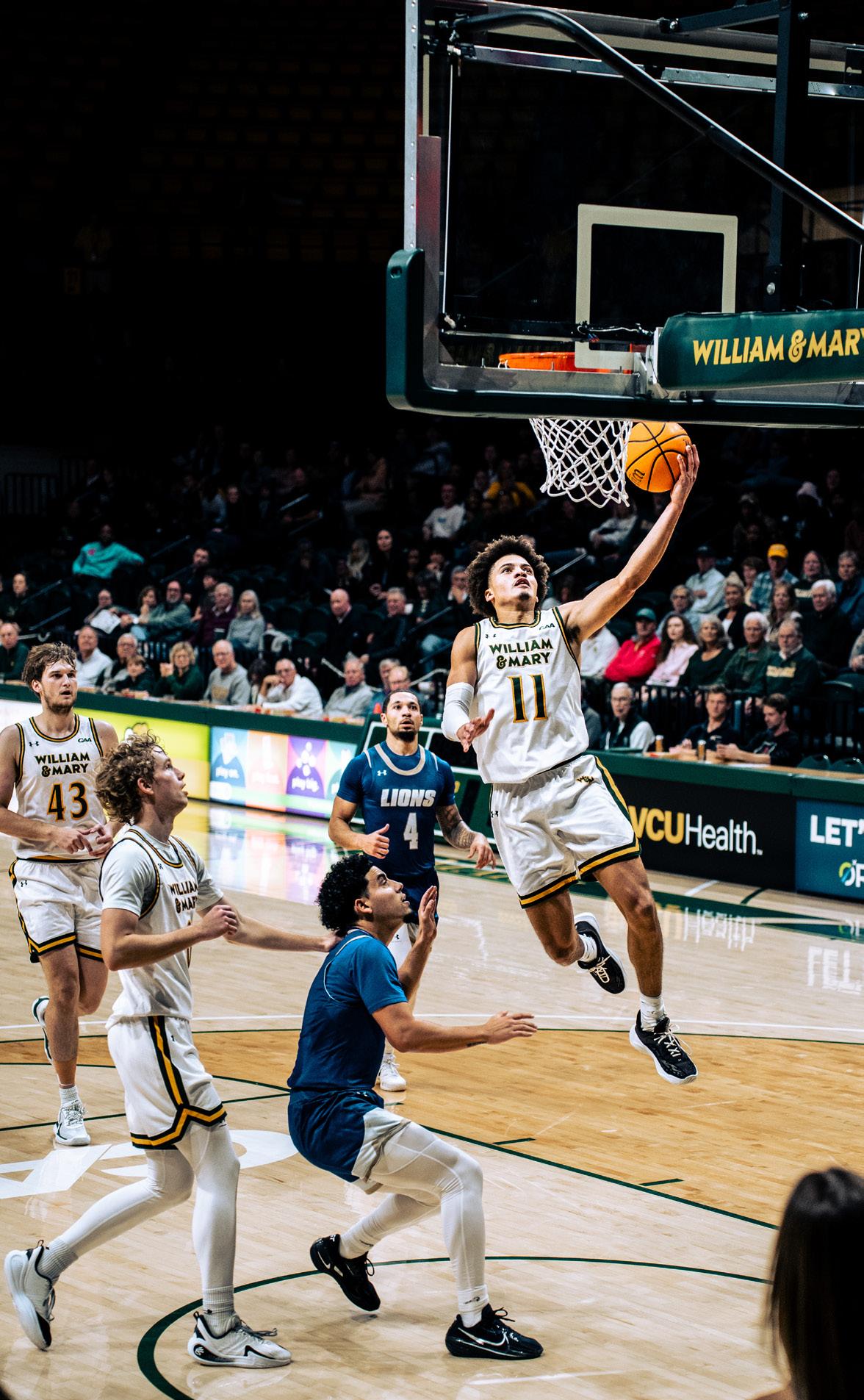
“We had three games in maybe six days last week that were difficult,” Earl said. “I mean, we should have handled it better, but it’s always nice to be at home, and so I thought we took advantage of it, even though we had to take a lot of punches to get there.”
Under Earl, William and Mary has enjoyed one of the most pronounced home-court advantages in the nation, boasting a 19-2 record at Kaplan Arena since the beginning of the 20242025 campaign. In front of an announced audience of 3,241 fans, it was business as usual for the Tribe against NC A&T. Although the bleachers were all but devoid of students, most of whom remained off-campus for winter break, the crowd made
“It was great to get a win, you know,” Earl said. “Just completely a 180 from our past weekend on the road. [NC A&T] really fought hard. They made a lot of shots and really came in and gave us everything we could handle. It was great to be in front of our fans. It was loud when we needed it and, you know, anytime you can get a win, it’s a good day.”
During William and Mary’s three-game losing streak, the Tribe struggled to get off on the right foot, constantly finding itself in early holes. Against Drexel (9-10, 3-3), William and Mary trailed 37-28 at halftime; against Charleston (11-8, 4-2 CAA), it conceded an 18-3 run in the first half; three days later, it gave up a 14-2 first-half run, this time to Monmouth (8-10, 2-3).
Thursday, however, the Tribe had no trouble asserting itself in the opening minutes. Rather than rattling off a single dominant scoring stretch, William and Mary seized an advantage at the 15 minute, 41 second mark and fought off the visitors from there, holding NC A&T at arm’s length for the remainder of the afternoon. Graduate student forward Cade Haskins and senior guards Kyle Pulliam and Chase Lowe set the tone with early layups — on the day, 61.4% of the Tribe’s field goal attempts came at the rim — before graduate student guard Jhei-R Jones catapulted William and Mary into the lead with ten consecutive points.
Jones finished the game with 13 points on 66.7% field goal shooting. Although the majority of his offensive contributions came before the first media timeout, Jones’ quick buckets were crucial for a team that had started slow in each of its previous three contests.
“Jhei-R really sparks us,” Earl said. “You know, he came out with a lot of energy, made two early threes, and that’s been something that’s been bothering us over the last few days. When he took the lid off the basket, it felt pretty good.”
Junior guard Reese Miller, a sparkplug who averages 24.4 minutes per game despite never having appeared in William and Mary’s starting lineup, joined Jones in contributing off the bench, posting a season-high 19 points. The Tribe’s rim-andthree oriented attack, which excels around the bucket but can struggle to convert from behind the perimeter, becomes all the more threatening when its snipers are in rhythm — this season, William and Mary is 9-0 when it shoots 33.3% or better from beyond the arc. Against NC A&T, Jones and Miller helped the Tribe reach that mark, combining for five of their squad’s nine triples.
“You know, it’s not easy coming off the bench and not knowing how many minutes you play,” Earl said. “And those two guys, really, you know, we’re very proud of them because they both could be giving us starter minutes.”
The real star of the show, however, was junior forward Tunde Vahlberg Fasasi, who joined Miller in putting up 19 points. Vahlberg Fasasi’s production does not come as a surprise — he leads William and Mary in scoring this season — but since the beginning of CAA play, the former La Salle transfer has reached another level, averaging 15.5 points, 5.0 rebounds, and 2.8 assists per game. Thursday, Vahlberg Fasasi tacked six rebounds, five assists, and four steals on top of his scoring output.
“He’s really finding his way,” Earl said. “You know, no ego on him, which you love to coach. And so he did a great job [today], and hopefully he’s understanding some of the ways that we need him to thrive here.”
Vahlberg Fasasi dominated the NC A&T defense in nearly every category, going four-for-seven on the interior and fivefor-seven from the charity stripe, nailing two triples, throwing several dimes to cutters, and flushing home multiple putbacks. When the Aggies entered halftime within striking distance after draining a cascade of shots, it was Vahlberg Fasasi who helped put the visitors away for good, connecting on two consecutive layups and extending the Tribe’s lead back to eight points.
It wasn’t just in half court offense where Vahlberg Fasasi found success, however — his four takeaways jumpstarted William and Mary’s potent transition attack. According to Earl, Vahlberg Fasasi’s blend of size and quickness allows him to take advantage of his 6’7” frame while still being able to get out and run in open space.
“You know, he’s sneaky fast,” Earl said. “He makes shots. He works hard at his game. He’s a great kid. He almost defers a
Although NC A&T tried its hardest, with redshirt freshman forward Lewis Walker scoring 33 points on 78.6% shooting, the Aggies never managed to get back in the game after their surge was repelled. That’s not to say the visitors didn’t land some blows. Earl complimented NC A&T’s gameplan and said that William and Mary just barely managed to find the balance between creating turnovers and allowing one-onone buckets.
“We do force a lot of turnovers, and I think [NC A&T] did a good job of understanding that,” Earl said. “So even though we [forced] 18 [turnovers], [NC A&T] did a really good job of scoring one-on-one when they could find those moments. So, we will get the turnovers, but we also pay the price sometimes. So, you got to find the balance in between, and we found just enough of a balance to get this victory.”
Nevertheless, Earl was ultimately satisfied with a win that saw William and Mary shoot well, cut well, get to the rim, and move the ball. In making 33 field goals, the Tribe recorded 28 assists, its highest figure of the year.
Thursday, January 22, William and Mary will take on league-leading UNC Wilmington (17-2, 6-0 CAA) at Kaplan Arena; Saturday, January 24, the Tribe will return home for a contest against Hofstra (13-6, 4-2 CAA). According to Earl, the Tribe will take its six off-days to relax, review tape, and prepare for a stretch that could define its season.
“[We’re going to] recover, make sure we’re taking care of our bodies, make sure we’re figuring out as a group the things we need to do to win every game, and those things are not the same game to game,” Earl said. “So what did happen tonight, we’re going to have to learn from, and then we’re going to have to take it into our next opponent, and those things will be different, and, you know, getting on the same page with what it’ll take to get a victory there is important.”