above, the Design Fundamentals Course is structured to give a system of reasoned conception, capable to facilitate students in developing their capacity to deal with the still unknown realm of their future design. But mainly, with an eye on their entry into the professional degree program, the Foundation studio builds a framework we are sure will be developed in the future discipline each student will choose, and a system that teaches students an “attitude” to acquire “conceptual and constructive” abilities as critical craft, gaining during the process awareness of ethical responsibility of their work.
avoid judging ideas before they are materialized. Students deliver an assignment per week, working with models or drawings as powerful analog instruments both to “make” and “to express” projects. On the Thursday Bridge PinUp Session, Professor Kelley, the TAs, and I facilitate the dialogue to have students inspect students’ developments and questions, not as concepts but as choices, and at any level of the design progress. This is because nothing is made randomly since everything needs to have a reason to be. It is important to raise awareness of students’ trajectories while they move through different Species of Spaces (George Perec), from a page to a landscape, in a continuous operation of adapting and reusing material from the previous project. I like to think of professors and TAs as “agents of an experience” more than teachers since they help students to use crafting time to develop an awareness of the Order of Phases in having ideas, and that “to design” requires operations in time. A kind of self-deductive method will move Pragmatic Poets from the analysis of a Thing generated by chance to a constructive self-criticism of general problems. Little by little. Design does not happen in a minute, or in a week. It might happen at any time, but always after a reasoned conception. So… Work Work Work Work Work Work….
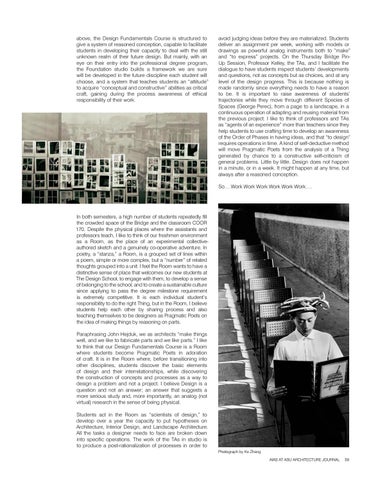
In both semesters, a high number of students repeatedly fill the crowded space of the Bridge and the classroom COOR 170. Despite the physical places where the assistants and professors teach, I like to think of our freshmen environment as a Room, as the place of an experimental collectiveauthored sketch and a genuinely co-operative adventure. In poetry, a “stanza,” a Room, is a grouped set of lines within a poem, simple or more complex, but a “number” of related thoughts grouped into a unit. I feel the Room wants to have a distinctive sense of place that welcomes our new students at The Design School, to engage with them, to develop a sense of belonging to the school, and to create a sustainable culture since applying to pass the degree milestone requirement is extremely competitive. It is each individual student’s responsibility to do the right Thing, but in the Room, I believe students help each other by sharing process and also teaching themselves to be designers as Pragmatic Poets on the idea of making things by reasoning on parts. Paraphrasing John Hejduk, we as architects “make things well, and we like to fabricate parts and we like parts.” I like to think that our Design Fundamentals Course is a Room where students become Pragmatic Poets in adoration of craft. It is in the Room where, before transitioning into other disciplines, students discover the basic elements of design and their interrelationships, while discovering the construction of concepts and processes as a way to design a problem and not a project. I believe Design is a question and not an answer; an answer that suggests a more serious study and, more importantly, an analog (not virtual) research in the sense of being physical. Students act in the Room as “scientists of design,” to develop over a year the capacity to put hypotheses on Architecture, Interior Design, and Landscape Architecture. All the tasks a designer needs to face are broken down into specific operations. The work of the TAs in studio is to produce a post-rationalization of processes in order to Photograph by Ke Zhang AIAS AT ASU ARCHITECTURE JOURNAL
59