ELENA ROCCHI | ESSAY
PRAGMATIC POETS AND CRITICAL CRAFT: “THE MAKING OF A THING” FEATURING THE DESIGN FUNDAMENTALS CLASSES OF FALL 2016 AND SPRING 2017 PHOTOS BY: ELENA ROCCHI
In the book The Craftsman, Richard Sennett describes the “making of a Thing” as constituted by both the Thing itself and its reasoned conception. I have read The Craftsman many times, thinking of how that description of “making” resonates to a similar one given by my first architecture studio professor in the late 80s. At that time, a professor would introduce freshmen students to the “Thing of architecture” by teaching process as a way to reason a concept, and to make clear that, in its beginning, a real building creates its own reality outside the state of built or unbuilt.
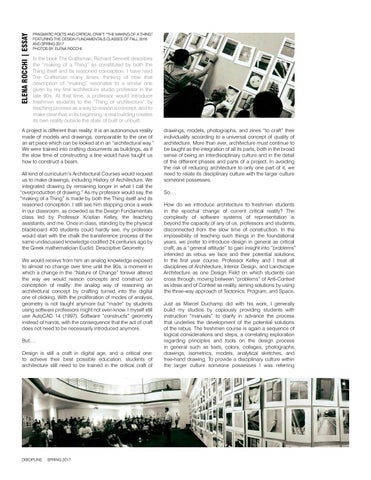
A project is different than reality: it is an autonomous reality made of models and drawings, comparable to the one of an art piece which can be looked at in an “architectural way.” We were trained into crafting documents as buildings, as if the slow time of constructing a line would have taught us how to construct a beam. All kind of curriculum’s Architectural Courses would request us to make drawings, including History of Architecture. We integrated drawing by remaining longer in what I call the “overproduction of drawing.” As my professor would say, the “making of a Thing” is made by both the Thing itself and its reasoned conception. I still see him stepping once a week in our classroom, as crowded as the Design Fundamentals class led by Professor Kristian Kelley, the teaching assistants, and me. Once in class, standing by the physical blackboard 400 students could hardly see, my professor would start with the chalk the transference process of the same undiscussed knowledge codified 24 centuries ago by the Greek mathematician Euclid: Descriptive Geometry. We would receive from him an analog knowledge exposed to almost no change over time until the 90s, a moment in which a change in the “Nature of Change” forever altered the way we would reason concepts and construct our conception of reality: the analog way of reasoning an architectural concept by crafting turned into the digital one of clicking. With the proliferation of modes of analysis, geometry is not taught anymore but “made” by students using software professors might not even know. I myself still use AutoCAD 14 (1997). Software “constructs” geometry instead of hands, with the consequence that the act of craft does not need to be necessarily introduced anymore. But.… Design is still a craft in digital age, and a critical one: to achieve their best possible education, students of architecture still need to be trained in the critical craft of
DISCIPLINE
SPRING 2017
drawings, models, photographs, and zines “to craft” their individuality according to a universal concept of quality of architecture. More than ever, architecture must continue to be taught as the integration of all its parts, both in the broad sense of being an interdisciplinary culture and in the detail of the different phases and parts of a project. In avoiding the risk of reducing architecture to only one part of it, we need to relate its disciplinary culture with the larger culture someone possesses. So.… How do we introduce architecture to freshmen students in the epochal change of current critical reality? The complexity of software systems of representation is beyond the capacity of any of us, professors and students, disconnected from the slow time of construction. In the impossibility of teaching such things in the foundational years, we prefer to introduce design in general as critical craft, as a “general attitude” to gain insight into “problems” intended as rebus we face and their potential solutions. In the first year course, Professor Kelley and I treat all disciplines of Architecture, Interior Design, and Landscape Architecture as one Design Field on which students can cross through, moving between “problems” of Anti-Context as ideas and of Context as reality, aiming solutions by using the three-way approach of Tectonics, Program, and Space. Just as Marcel Duchamp did with his work, I generally build my studios by copiously providing students with instruction “manuals” to clarify in advance the process that underlies the development of the potential solutions of the rebus. The freshmen course is again a sequence of logical considerations and steps, a correlating exploration regarding principles and tools on the design process in general such as texts, colors, collages, photographs, drawings, isometrics, models, analytical sketches, and free-hand drawing. To provide a disciplinary culture within the larger culture someone possesses I was referring