FALL 2025 Vol. 103, No.2
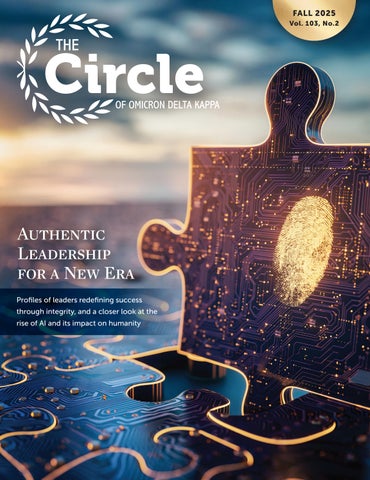
Authentic Leadership for a New Era Profiles of leaders redefining success through integrity, and a closer look at the rise of AI and its impact on humanity
Board Chair’s Letter
Leading with Integrity
Celebrating O∆K Members Who Inspire Through Authentic Leadership Dear Members and Friends of Omicron Delta Kappa, It is both an honor and a joy to serve as Chair of the Board of Trustees for Omicron Delta Kappa. I am deeply grateful to Dr. Michael Benson for his outstanding leadership and vision this past year. His commitment to O∆K’s mission of recognizing and developing leaders of exceptional character continues to inspire us all. This issue of The Circle centers on a theme that feels especially vital in this moment—The Power of Authentic Leadership: Profiles of Leaders Redefining Success Through Integrity. As technology evolves at an astonishing pace and the boundaries between public and private life grow increasingly blurred, our need for leaders who act with clarity, empathy, and integrity has never been greater. Across these pages, you’ll meet O∆K members who are demonstrating that authentic leadership—rooted in self-awareness, humility, and service—remains a timeless force for good. From the stage to the lab, from the newsroom to the halls of government, their stories remind us that leadership is not about titles or applause, but about the choices we make when no one is watching. The article “Navigating the Algorithm” explores the tension between human authenticity and artificial intelligence—an essential topic as we navigate how to balance innovation with integrity. We are reminded that while technology can enhance our efficiency, it must never replace our humanity. Leaders who remain grounded in empathy and ethical purpose will help ensure that AI becomes a tool for understanding, not a substitute for it. Similarly, in "Leading with Authenticity," O∆K members in the communications field reflect on the courage it takes to foster openness, inclusion, and balance in professional spaces. Their reflections echo our Society’s values:
2 | odk.org
leadership that begins with listening, honors diversity of thought, and builds trust through genuine connection. In "Beyond the Title," the stories of Georgia State Representatives Dar’Shun Kendrick and Ruwa Romman, along with Judge Gordon Murray, illustrate what authentic leadership looks like in practice. Whether it’s asking the difficult question, standing firm in one’s convictions, or simply showing up prepared day after day, they model how integrity, consistency, and courage become the habits that shape true excellence. We also celebrate O∆K members like Dr. Craig Bowe and Stephen Kallas, whose paths in science and the arts reveal how authenticity is not confined to one discipline—it is the throughline of meaningful leadership. Each of them leads not from position, but from purpose. As I look ahead, I am filled with optimism for O∆K’s future. We continue to nurture a community where leaders are not only recognized for achievement, but challenged to lead with heart and humility. Authentic leadership—the kind that unites rather than divides, listens before it speaks, and seeks the good of all—is what our campuses, communities, and world need most. Thank you for being part of this enduring mission. I hope this issue of The Circle encourages you to reflect on your own journey as an authentic leader and to inspire others to do the same. Together, we can shape a future defined not by algorithms or accolades, but by integrity, empathy, and the enduring power of human connection. With gratitude and encouragement, Maureen E. Morgan (Marietta College, 1992) Chair, Board of Trustees
Contents Vol. 103, No. 2.
The Circle® is a publication of Omicron Delta Kappa Society and Educational Foundation, Inc., and it has been published since 1923.
How to contact The Circle:
The Circle, Omicron Delta Kappa The Johnson Center for Leadership 224 McLaughlin Street Lexington, VA 24450 (540) 458-5344, odknhdq@odk.org www.odk.org
How to update your name or address:
Please visit the O∆K website, odk.org, click on the members tab and submit your updated form. You can also email odknhdq@odk.org.
02 04 06
Chair's Letter
10
Q&A with Craig Bowe
13
Five Ways
14
Yes, And...
18 22 24 26
Navigating the Algorithm
A message from Maureen Morgan
Finding Humility
Letter from the guest editor
Beyond the Title Redefining Leadership in Government
How to receive The Circle:
When you become a member of O∆K, a digital subscription to The Circle is included in your membership. You can access the digital version online at https://odk.org/news/thecircle/.
Where to send a notice of a death:
Please contact Michelle Dilk, michelle@odk.org, with the news of a recent death of any member of O∆K.
Publisher
Jennifer L. Waller, Ph.D., President and CEO Washington and Lee University, 2024
Creative Director
Amy A. Newman, Director for Communications and Marketing University of Louisville, 2023
Guest Editor
Buck Ryan University of Kentucky, 2011
2025-26 Board Chair Maureen E. Morgan Marietta College, 1992
Omicron Delta Kappa Society, the National Leadership Honor Society,
was founded in Lexington, Virginia, on December 3, 1914. A group of 15 students and faculty members established the Society to recognize and
encourage leadership at the collegiate level. The founders established the
O∆K Idea—the concept that individuals representing all phases of collegiate life should collaborate with faculty and others to support the campus and community. O∆K’s mission is to honor and develop leaders; encourage collaboration among students, faculty, staff, and alumni; and promote
O∆K’s ideals of collaboration, inclusivity, integrity, scholarship, and service on college and university campuses
FALL 2025
throughout North America. The Society’s
Vol. 103, No.2
national headquarters are located in Lexington, Virginia.
On the Cover: Leaders redefining success through integrity, and the rise of AI and its impact on humanity
Authentic Leadership for a New Era
A conversation with Chartered Chemist and Fellow of the Royal Society of Chemistry
How Mentors Model Authentic Leadership
Stephen Kallas on Leadership, Adaptability, and Life Beyond the Stage
Authentic Leadership in an AI-Driven World
Leading with Authenticity
How to Build Meaningful Relationships
Campus News
A round-up of circle activities
Member News
Higher education news and appointments
Profiles of leaders redefining success through integrity, and a closer look at the rise of AI and its impact on humanity
The Circle • Fall 2025 | 3
Letter from the Guest Editor
Finding Humility
a journey in editing, learning, and leadership Humility is an essential trait of the authentic leader. That’s a lesson I learned as guest editor of this issue of The Circle magazine—a truly humbling experience for me. You see, I accepted this wonderful opportunity soon after publishing a textbook on editing, co-authored with a former Chicago Tribune colleague. My work as an editor mostly was done in newsrooms at metro daily newspapers in the U.S. I have also had the privilege of consulting with authentic leaders in newsrooms as far away as Russia, Spain, and Sweden. Now, thanks to O∆K, I faced a new challenge of working remotely and online with an all-volunteer cadre of writers. Putting my textbook into play conjured up a line from Walter Lippmann’s 1922 classic, “Public Opinion.” You know, the one about “a beautiful theory mugged by an angry gang of facts.” Coming to my rescue was Amy Newman (University of Louisville, 2023), O∆K’s director for communications and marketing. Amy is a delight and a great designer with a can-do spirit. Thanks, Amy, you made this experience fun. I couldn’t have done it without you. One chapter in my book is titled “Get Me a Quote!” Editors read copy in hopes of seeing a “money line.” That’s a memorable turn of phrase in a quotation or a “nut graph” that gets to the heart of an article. Amy and I were blessed to work with many talented writers. Here are a few of their money lines:
4 | odk.org
Ann Zuccardy (University of Baltimore, 2023), from her Stephen Kallas (Wagner College, 2016) profile: His work as an actor, singer, tap dancer, and entrepreneur reflects more than versatility; it reveals a philosophy of leadership rooted in adaptability, integrity, and curiosity. G.C. Murray II, Esq. (Florida State University, 2011), from his take on community service: Leadership doesn't wait until your LinkedIn profile is perfect or your name is on a badge. It begins now—in discomfort, in dilemmas, and in decisions that make you ask, "What kind of leader am I becoming?" Neally Lacina (University of Memphis, 2023), from her Communications article: Authenticity isn't a strategy— it's the pillar of true leadership. Thanks to them and to Meya E. Hargett (California State University, Northridge, 1999) for her five-point action plan for academic mentors; to Paul Newman for his excellent article on artificial intelligence, and to Dr. Craig Bowe (Huntingdon College, 1993) for weaving his inspirational life story into a Q&A that provides valuable lessons for those aspiring to authentic leadership. Together these writers, along with our other contributors, have delivered an issue built on O∆K’s pillars. We submit this issue to you with humility. Respectfully,
Buck Ryan University of Kentucky, 2011
Transformational Leadership with You
Starts
Every gift to O∆K helps shape the next generation of student leaders and keeps our lifetime members connected and engaged. Your support can make a lasting impact through the following giving opportunities: l The Annual Fund: Unrestricted donations meet
l Singer Grants: Your gift underwrites the
the organization’s most immediate needs and offer
National Initiation Fee for collegiate members
flexibility to support year-round initiatives such
experiencing financial hardship.
as providing circle resources, sharing member communications (including this magazine), and delivering dynamic leadership programming.
l Leadership Programs: Your philanthropy fuels programs like the National Leadership and Service Awards, and the National Day of
l The Scholarship Fund: Help exceptional
Service, as well as member events, webinars, and
students continue their educations in graduate
conferences, all of which advance our mission,
or professional school.
foster connection, and shape leaders.
l The Key Fund: Provide scholarships and the gift
Your support fuels and powers our mission forward.
of membership to students from underrepresented and historically marginalized groups.
Make a Gift Please consider making a gift today at ODK.org/Donate If you prefer to make a gift over the phone, please call our headquarters at (540) 458-5336.
The Circle • Fall 2025 | 5
Beyond the Title How OΔK Members Are Redefining Leadership in Government By G.C. Murray II, Esq., DPL At a time when faith in institutions is low, O∆K members on campus can find inspiration in leaders who have rejected ego for ethics. These are not politicians chasing power—they’re public servants answering a deeper call.
It Starts in Rooms with Bad Lighting
L
eadership doesn’t always look like a podium and a nameplate. Sometimes, it looks like a conference room that smells like old pizza, with three people arguing about bylaws and one person stuck trying to decide who’s right. Sometimes, it looks like voting between two people you admire... and knowing only one will get to wear the stole at graduation. Sometimes, it’s staying silent in a student senate meeting... and later regretting it. That’s where it starts.
Not when you get sworn into office. Not when your name appears in bold in the alumni magazine. It starts here, where many of us first learned how to lead—on campus. Aristotle said it best: “We are what we repeatedly do. Excellence, then, is not an act, but a habit.” The decisions we make in those ordinary rooms—who to include, when to speak up, and how to move forward when no one agrees—are habits. And eventually, they become us.
Service to Campus and Community
“ we are what we repeatedly do. excellence, then, is not an act, but a habit.”— Aristotle The Decision You Didn’t Want to Make It was late. Tensions were high. Two qualified individuals, both respected, were vying for one final spot. Everyone had their favorite. But only one would be selected. The committee argued. Someone brought up GPA. Someone else whispered about personality. A few people looked ready to flip a coin. But the student leading the discussion didn’t want to pick the easiest answer. She wanted to choose the right one.
She Made Her Choice And She Stood By It Fast forward to the present day, and, sure, the dorms have gotten nicer, the campus quad has Wi-Fi, and the school now boasts record-breaking enrollment. But despite all the upgrades, one thing hasn’t changed: the challenge of authentic action. It still feels risky to be the one who disagrees. To say, “I don’t think that’s right,” when the group wants to move on. To raise your hand when the rest of the room looks down. You’re not imagining it. That pressure is real. Maybe you’ve already experienced it. You’re in a group project where someone takes credit for your work. Do you speak up or let it go? Your student organization is planning an event that’s more popular than meaningful. Do you go along or suggest a different idea? A friend is running for something they might not be ready for. Do you tell the truth or stay quiet and applaud? These moments might not seem like leadership, but they are. They serve as practice for the tougher challenges ahead, with higher stakes and fewer safety nets. Leadership doesn’t wait until your LinkedIn profile is perfect or your name is on a badge. It begins now—in discomfort, in dilemmas, and in decisions that make you ask, “What kind of leader am I becoming?” And that’s precisely how it started for one student who once sat in a room just like yours, facing a decision no one else wanted to make.
Hon. Rep. Dar'shun Kendrick Oglethorpe University, 2002 Title: Georgia State Representative, House District 95 Age: 43 Hometown: Decatur, GA Career highlights: Representative Dar’shun Kendrick was elected in 2010 as one of the youngest members of the Georgia House. She serves District 95 and is Ranking Democrat on the Judiciary Non-Civil Committee. She co-founded two bipartisan caucuses, leads on technology and equity policy, founded Kairos Capital Legal Advisors, and authored two books.
That student was Rep. Dar’shun Kendrick. Today, she’s a Georgia State Representative. But long before earning her title, she was a student leader learning how to stay true to her values while navigating ambiguous situations. Her leadership didn’t come from being the loudest voice. It came from listening carefully, making intentional choices, and standing by her decisions with integrity. The kind of leadership that begins in silence and shines in the spotlight. The Circle • Fall 2025 | 7
The Moment You Could’ve Stayed Quiet
Hon. Rep. Ruwa Romman
The campus was buzzing. A new policy had dropped. People were upset, but quietly. Whispers in group chats. Eye-rolls in the dining hall. Still, no one wanted to make it a big deal.
Title: Georgia State
No One, Except Her She stood up at the meeting and asked the question no one else dared to ask. She didn’t yell or posture; she simply asked why. Then she inquired about what could be done to fix it. The following week, she decided to run, not for the title but because she couldn’t stay silent. She created a student government that opened space for more voices. She worked to earn trust. Not everyone liked her, but no one questioned her bravery. Years later, she ran again. But not on campus. She ran to represent her district, to advocate for policy change at the state level, and to lead with the same clarity that once earned her side-eye in a student meeting.
Oglethorpe University, 2013
Representative, House District 97 Age: 32 Hometown: Cumming, GA Career highlights: Representative Ruwa Romman made history in 2022 as the first Muslim woman and first Palestinian American elected to the Georgia House of
Because it’s difficult to push back against authority, even when it’s polite. It’s hard to challenge a professor’s policy, or raise your hand when an administrator says, “Any questions?” but clearly doesn’t want any. It’s hard to ask why when your group’s constitution has always been written a certain way, or to suggest changing a tradition that no longer works.
Representatives. She co-founded the
Even in the most open environments, you’ll find the same unwritten rule: don’t make waves. But if you want to lead with integrity, you’ll have to break that rule—gently, clearly, and sometimes on your own.
for Governor of Georgia in the 2026 election.
You might not be protesting on the steps of a courthouse. You might just be at a meeting where the student organization’s budget cuts are unfair, and no one else wants to speak up. You might be the only one advocating for accessibility, inclusion, or transparency, and people start treating you like you’re the problem.
But what if you’re not the problemWhat if you’re the precedent That student was Rep. Ruwa Romman. She’s now a Georgia State Representative, the first Muslim woman and the first Palestinian American elected in the state. But before she made history, she made waves—on campus, in meetings that weren’t recorded, and in conversations where staying quiet would’ve been easier. 8 | odk.org
Georgia Volunteer Hub, worked in public sector consulting at Deloitte, and has led statewide efforts on civic engagement, equity, and community advocacy. Now she has officially announced that she is running
He Made The Choice No One Applauds It wasn’t a dramatic moment. No one clapped. No one posted about it. But when one student arrived prepared, once again, something shifted. It happened gradually. First in class, then in his campus organizations. He’d read the materials others skimmed. Asked the questions others avoided. He wasn’t trying to outshine anyone; he was just always ready. He wasn’t loud. He wasn’t flashy. He didn’t run for every position. But when something needed to be done right, his name kept coming up. Reliable. Solid. Accountable. At first, it felt like overkill. Why care so much when no one else seems to? But over time, the habit of showing up prepared, listening before speaking, and following through became something else entirely. It became a standard. His standard.
And years later, that standard would be tested—not on campus, but on the bench. That student was Judge Gordon Murray, known throughout Florida as “The Community Judge.” He didn’t arrive there by chance. He got there through repetition.
Because you don’t rise to your title, you rely on your habits. Judge Murray didn’t wait for the robe to become a leader; he practiced long before the world gave him the bench.
Who You’re Becoming
“Every ruling is a reflection of not just the law,” he says, “but the character with which you interpret it. The public doesn’t just want to know the decision. They want to believe the person making it.”
None of the people in this story were born to lead. They weren’t handed megaphones or résumés with gold stars. They were students—just like you.
His decisions today carry legal weight, but the discipline behind them was built in quiet, everyday moments. A dorm room desk with a textbook open while others were out. A meeting where he stayed late to clean up. An email sent the night before instead of in the morning. Preparation, not just performance, is what set him apart.
They didn’t always know what was right. But they kept choosing to do the next right thing. And over time, those choices became part of who they were.
You might think your quiet work goes unnoticed. That being consistent doesn’t count unless you’re charismatic. But authentic leadership, the kind that lasts, is built in the discipline no one sees. The notes you take when no one’s asking for them. The hours you spend preparing when others are winging it. The way you treat people when you think it doesn’t matter. It all matters.
Remember Aristotle’s line about what makes for excellence. Every campus meeting you attend. Every voice you listen to. Every time you choose preparation over convenience, courage over comfort, you’re cultivating that habit. You don’t need to wait for a title to start leading. You’re already doing it. The question is: What kind of leader are you becoming? Our society needs all the authentic leaders we can grow. ●
Hon. Judge Gordon Charles Murray, Sr. National Circle, 2025 Title: County Court Judge
Age: 65
Hometown: Miami Gardens, FL Career highlights: Judge Murray, known as “The Community Judge,” was appointed to the Miami-Dade County Court in 2017. He has been recognized with Florida’s highest judicial honors, including the Chief Justice Award for Judicial Excellence and the William M. Hoeveler Judicial Professionalism Award.
G.C. Murray II, Esq., DPL, is the CEO and Managing Attorney of Association GC and a certified executive coach who helps high-stakes professionals build with integrity and impact. An award-winning attorney and internationally recognized speaker, he was inducted into O∆K at Florida State University in 2011. Learn more about G.C. at https://www.exec.media/GCMurrayII. The Circle • Fall 2025 | 9
QA &
with Craig Bowe
Dr. Craig Bowe (Huntingdon College, 1993) is internationally recognized for his expertise in environmental and chemical safety and his commitment to advancing access in the sciences. A Chartered Chemist and Fellow of the Royal Society of Chemistry, he has worked across academia and global organizations to promote safer, more sustainable practices. Dr. Bowe currently serves as the Circle Coordinator for the Keiser University Circle of Omicron Delta Kappa. In this Q&A, he shares his insights on leadership, service, and inclusive excellence in science. This interview has been edited for clarity and consistency. How have your experiences as a dual citizen and scientist shaped your leadership style and perspective? Growing up in The Bahamas instilled in me a strong sense of community, integrity, and respect for others— values that continue to guide my leadership. As an educator and public servant, I’ve been privileged to help strengthen my nation by training others in radiation safety, emergency preparedness, and environmental protection. Becoming a U.S. citizen after 28 years deepened my appreciation for perseverance and accountability. My service as a Major in the Texas State 10 | odk.org
Guard reinforced that effective leadership in crisis requires humility, teamwork, and trust. Whether in the classroom or in international service, I strive to lead through example—empowering others to contribute their best toward a common goal with respect, compassion, and shared responsibility. When and where did you become a member of O∆K, and how did it enhance your leadership skills? I was inducted into Omicron Delta Kappa at Huntingdon College in 1993—an honor that remains one of my most meaningful recognitions. Huntingdon’s motto, “Enter to Grow in Wisdom, Apply Wisdom in Service,”
“
becoming a u.s. citizen after 28 years deepened my appreciation for perseverance and accountability. —Craig Bowe, (Huntingdon College, 1993)
continues to guide my life. As a chemistry student, I served as a laboratory assistant, teaching mentor, and Chemistry Club chair, experiences that helped me develop the ability to teach, organize, and inspire others. Coordinating the ChemBowl competition, which engaged high school students from across the Southeast, taught me the value of teamwork and servant leadership. O∆K helped me understand that leadership isn’t about authority—it’s about service, humility, and empowering others to grow. What does integrity look like in fields where public and environmental health are at stake? Integrity in science means maintaining ethical standards even when it’s inconvenient or unpopular. Through my work with the American Chemical Society’s Committee on Chemical Safety and as a country trainer for the International Atomic Energy Agency, I’ve seen how adherence to ethical principles directly protects lives and environments. Upholding safety standards often requires courage and persistence, particularly when resources are limited or pressures mount to cut corners. Integrity builds trust— locally, nationally, and internationally—and ensures that decisions serve the public good rather than personal or institutional interests. In the end, scientific leadership without integrity has no lasting value. How do you stay grounded and lead authentically in high-stakes or specialized environments? In science and leadership, humility and faith are my grounding forces. I strive to listen carefully, admit mistakes, and elevate the ideas of others. During my tenure as Chief Scientist for the Environmental Monitoring and Risk Assessment Division, I led a team responding to a ship carrying compromised acid cargo
near The Bahamas. By collaborating with international stakeholders, we prevented environmental and economic damage—a success achieved through transparency, trust, and teamwork. My faith reminds me that leadership is about service, not status. It brings clarity and steadiness, especially in moments when pressure is greatest. How do you define inclusive leadership, and how do you practice it? Inclusive leadership means ensuring that everyone at the table feels empowered to speak, contribute, and lead. In my classrooms, I create environments that encourage curiosity, self-awareness, and accountability. I focus on helping students see their potential beyond grades or credentials. One of my former students— whom I mentored from high school through medical school—now runs a program supporting students from underrepresented backgrounds. His success The Circle • Fall 2025 | 11
Dr. Craig Bowe (left) with Dr. Jennifer Peluso and O∆K Trustee Emeritus Peter Christiaans during the chartering of the Keiser University Circle.
affirms that true inclusion happens when people are not only invited in but equipped and encouraged to lead. Whether in education or science, inclusivity thrives when leaders listen deeply and celebrate each person’s unique voice. What role does intellectual humility play in authentic leadership? Intellectual humility is essential for growth. In science, we must recognize the limits of our knowledge and remain open to new evidence and perspectives. Arrogance hinders discovery; humility invites collaboration. In academia and research, acknowledging uncertainty fosters trust, teamwork, and continuous learning. Leaders who model intellectual humility create environments where others feel safe to innovate, challenge ideas, and pursue truth with integrity. Can you share a moment where staying true to your values led to a difficult but rewarding decision? As Chief Scientist, I faced pressure from an international company to expedite the removal of radiological materials in violation of established safety agreements. I refused to bypass the required international protocols, choosing instead to negotiate a lawful and ethical solution with multiple stakeholders. While this delayed the project, it strengthened trust and led to improved national guidelines for future cases. The experience 12 | odk.org
reaffirmed that doing what is right—though difficult— always yields more sustainable and honorable outcomes. How do you encourage emerging leaders to measure success beyond titles or accolades? True success isn’t measured by titles—it’s measured by impact. I remind emerging leaders that our greatest achievements often appear in the growth of others, not on our resumes. Teaching and mentoring have shown me that shaping the next generation of scientists and citizens is a legacy far more meaningful than any award. Leadership rooted in service creates ripples of positive change that outlast personal recognition. I encourage young leaders to focus on purpose, gratitude, and the lives they touch along the way. What advice would you give to the next generation of O∆K leaders about leading with authenticity? Lead with integrity, compassion, and courage. In a world that often rewards conformity, authenticity requires strength. Stay true to your values, even when it’s unpopular, and serve others with humility and optimism. Collaboration and respect for differences will expand your perspective and strengthen your leadership. Remember, integrity cannot be bought—it’s lived daily through ethical choices. Be a leader who inspires trust, builds community, and uses knowledge for the common good. Service anchored in love and gratitude is leadership at its finest. ●
Academics and Research
Five Ways Mentors Model Authentic Leadership by Meya E. Hargett
Education professor Meya E. Hargett (California State University, Northridge, 1999) reflects on how authentic leadership in education emerges through integrity, presence, and mentorship grounded in equity.
1 2 3 4 5
Listen with Intention Authentic mentors prioritize presence over performance. Listening is not a passive act; it is a form of leadership that validates voice and builds relational trust.
Affirm Identity and Lived Experience Mentorship grounded in equity affirms each scholar’s identity as an asset. This includes acknowledging race, culture, gender, and community knowledge as central to academic development.
Share Power through Co-Leadership Mentors who model servant leadership invite scholars to co-create learning experiences. Asking questions and giving room for intellectual autonomy communicates trust and high expectations.
Be Transparent about Process and Struggle Authenticity means showing scholars how leadership works behind the scenes—including the uncertainty, revisions, and reflection involved in meaningful change.
Align Values with Behavior Consistency between words and actions builds credibility. Mentors who hold themselves accountable to their stated values demonstrate integrity as a daily leadership practice.
RECOMMENDED READING Brown, B. (2018). Dare to lead: Brave work. Tough conversations. Whole hearts. Random House. Goleman, D. (2013). Social intelligence: The new science of human relationships. Bantam. Northouse, P. G. (2021). Leadership: Theory and practice (9th ed.). Sage Publications. Sinek, S. (2011). Start with why: How great leaders inspire everyone to take action. Portfolio Penguin.
Associate Professor Meya E. Hargett, M.A., is a K-12 education specialist and a doctoral student in Pepperdine University's graduate school program in Leadership in Pre-K to 12 Education. With expertise in behavioral and social sciences, history, and special education, she is committed to fostering academic and personal excellence, particularly in criminal justice, U.S. history, and ethnic (BIPOC) studies. The Circle • Fall 2025 | 13
YES, AND...
Stephen Kallas on Leadership, Adaptability, and Life Beyond the Stage
W
by Ann Zuccardy
hen Stephen Kallas (Wagner College, 2016) was stepping into the spotlight on the first national tour of The SpongeBob Musical, or these days when he is in a regional theatre production, the place to look for him is always the same— behind the scenes but in ways that might surprise you. His work as an actor, singer, tap dancer, and entrepreneur reflects more than versatility; it reveals a philosophy of leadership rooted in adaptability, integrity, and curiosity. These are attributes that reflect his longtime membership in O∆K. Kallas’ commitment to adaptability began long before his acting tours. He graduated from Wagner College in 2017, cum laude, with a B.A. in theater and a double concentration in performance and design technology and management. If he wasn’t on stage, he was backstage—running tech, learning the mechanics of production, and discovering how every role, visible or not, contributes to a show’s success. It was an education that taught him to see theater as a collaborative ecosystem. As a child, Kallas took piano lessons, played trumpet in his middle school band, and spent hours skateboarding and playing volleyball. Though he admits he’s no virtuoso at the piano, he can pick out melodies by ear; it's a valuable skill that hints at his larger instinct to figure things out as he goes. That resourcefulness carried into college, where he recognized that versatility would be key to sustaining a career in theater. He picked up basic guitar skills and studied tap dancing. He even added tumbling to his repertoire in college. “Having that skill in your bag of tricks is a good way to diversify yourself in the acting world,” he says. Photo by Jonah Hale Photography
14 | odk.org
Creative and Performing Arts
Learning to Lead Today, at 30, Kallas isn’t the newcomer on the scene anymore. “I’m no longer the youngest person in a show,” he says, noting that many of his colleagues have Broadway credits and decades of experience. With time, confidence and perspective have honed his talents. Effective leadership, he’s learned, depends on having strong, positive examples to follow. Kallas credits mentors and role models for shaping his approach. He now sees himself in a position to support others the way mentors once supported him. “Might as well pass the knowledge on so others don’t have to struggle,” he says. Grateful for steady work since graduating, he believes giving back is essential, not only to keep the theater industry thriving, but to help society move forward. The COVID-19 pandemic reinforced his convictions. “COVID showed me a level of camaraderie at every level, built out of necessity,” he says. It underscored the importance of valuing every actor and staff member, regardless of their role. Illness forced productions to adapt quickly, and while shows didn’t always shut down, they demanded greater preparation. Before 2020 many understudies rarely had the chance to rehearse on stage or with the full cast. Usually they practiced just by themselves off in a corner or in the back of the theater aisles. The pandemic proved the need for more proactive preparation. Out of that disruption came a deeper sense of solidarity. “After COVID, there was more of a sense of, ‘we’re all in this together,’” Kallas recalls. “We all had each other’s backs.”
When many theaters went dark during COVID, Stephen Kallas didn't retreat; he adapted and discovered that positive leadership thrives on creativity and courage.
Photo by: Ron Heerkens, Jr
An Entrepreneur is Born Over time, Kallas has developed a knack for spotting gaps in things that need doing but no one else is addressing. He keeps a notebook on hand to capture ideas as they come to him, many tied to the everyday challenges of performers. “If I thought of something that would make an actor or dancer’s life easier, chances are other people need it too,” he says. Kallas turned that instinct into a business when he launched SpikemarK Products, LLC (yes, capital SK for his initials, and the K looks like a spikemark for where
set pieces go on stage). The company offers everything from tap-shoe repair kits and replacement parts to practical tools for audition planning, budgeting, scene work, and even résumé design. Through SpikemarK Products, Kallas has successfully created new income streams while helping fellow artists navigate their careers more smoothly. Kallas jokes that most entrepreneurs start out with little more than an idea and a willingness to improvise. The key, he says, is recognizing a need and being willing to solve problems along the way. Not every idea hits, but he sees missteps as part of the process.
The Circle • Fall 2025 | 15
“Often there’s no reason you can’t do something, so find a way to do it somehow,” he explains. It’s a mindset rooted in the “Yes, and …” rule of improv— the practice of building on others’ contributions rather than shutting them down with a “no.” For Kallas, that approach keeps creativity alive and turns possibility into progress. A pragmatist at heart, he knows not every idea can be fully realized, but he believes a “Yes, and …” mindset keeps momentum alive and prevents stagnation. “Sometimes, shifting just one element of a problem and approaching it from a new angle is enough to spark progress,” he says.
Stephen Kallas Wagner College, 2016 Age: 30
Leadership Lessons from O∆K
Hometown:
O∆K membership and his college experience laid the groundwork for Kallas’ success. Despite a demanding schedule as an undergrad that balanced classes, rehearsals, and technical work, he found time to volunteer within his O∆K circle. For him, the organization wasn’t just another activity; it was a chance to strengthen his leadership skills and broaden his perspective beyond the classroom and the stage.
stephenckallas.com
Kallas believes high school is about “trying a million different things,” but college requires an intentional narrowing of focus. That approach helped him identify where his energy and talents could have the greatest impact. “If you can do that positively,” he explains, “it creates positive leadership.” In O∆K, he saw how leadership was about fostering collaboration and modeling possibility for others. Kallas has come to believe that leadership isn’t defined by authority, but by the willingness to work alongside others toward a common goal. “Good 16 | odk.org
Monroe, CT Website:
Photo by Jonah Hale Photography
leaders let others make mistakes but are right there to help guide and support them in finding a solution,” he says. “You don’t know what you don’t know. Mistakes can be messy, but sometimes genius comes from them.” Too often, he adds, people dwell on errors instead of recognizing the value of simply trying. To illustrate that point, he offers a stage analogy: If actors fall and make a scene of it, the stumble becomes the focus. If they recover quickly and carry on, the moment barely registers. “It’s always the manner in which we get back up that creates our happiness,” Kallas says. Whether navigating the uncertainty of COVID shutdowns, mentoring a new cast member, or reminding himself to
laugh through a too-advanced ballet class, Kallas embodies a lesson any of us can take offstage. That is, leadership isn’t about always knowing what to do. It’s about showing up, saying “Yes, and …,” and finding new ways to contribute when your script suddenly changes. ● Ann Zuccardy is a retired technical writer, 2-time TEDx speaker, frequent keynote speaker, and Baltimore-based freelance writer. She holds a B.A. and M.A. in English and is currently working toward her MFA in Creative Writing and Publishing Arts at University of Baltimore. She was inducted into O∆K in December 2023 at University of Baltimore.
Join O∆K Members for Unforgettable Adventures in 2026!
Explore the mysteries of Peru and Machu Picchu.
Step into the heart of America’s Old West.
Delve into the diverse flavors of the Spanish Coast.
& odk.orbridge.com The Circle • Fall 2025 | 17
NAVIGATING THE ALGORITHM
Why Authentic Leadership Matters Now More Than Ever with the Rapidly Expanding Use of AI by Paul Newman
This article explores the many challenges that artificial intelligence presents to society,
T
including what it will mean for authentic leadership in the workplace.
ell me and I’ll forget; show me and I may remember; involve me and I’ll understand.” That ancient bit of wisdom is attributed to Confucian scholar Xunzi. More than 2,000 years later, it rings true in the rapidly evolving world of artificial intelligence (AI), raising important questions about learning and leadership. The Chinese proverb’s core message is that hands-on active participation during the learning process leads to improved communication and understanding. But does the use of AI limit that kind of participation so vital to understanding? And what impact does this have on leadership? “We've already seen too many examples of such tools being misused and the harm that they can cause,”says Dr. Judy Goldsmith, a professor of computer science at the University Dr. Judy Goldsmith of Kentucky and co-author of the 2023 textbook, “Computer and Technology Ethics: Engaging Through Science Fiction.” She warns that “such powerful tools must be used carefully.” One such example of the harm they can cause was found in an MIT study that yielded alarming results. The researchers asked a group of students to write an essay using only their own thoughts, a
18 | odk.org
second group was allowed to use online search engines, and a third group was allowed to use AI. Most of the students who used no tools were able to describe the content of their essays and effectively discuss their work. However, an overwhelming number of students who utilized AI could not recall a single sentence they wrote. AI told them what to write, and they forgot.
AI-induced Cognitive Debt Through electroencephalography (EEG) analysis, the MIT researchers measured the brain activity of the students who used AI to write their essays and those who used no tools, including search engines, to write theirs. The EEG analysis revealed significant differences in the brain’s neural network levels of connectivity. Over four months, according to the study, those who used AI “consistently underperformed at neural, linguistic and behavior levels” compared with those who used no tools. The researchers referred to this phenomenon as “cognitive debt.” Thinking is expensive, but by outsourcing mental tasks in an all-toohuman attempt to conserve effort, we risk the atrophy of memory, creativity, empathy, and understanding. Those factors define each of our individual voices, values, behaviors, and authenticity.
Enter Authentic Leadership “The key is to stay authentic—don’t let technology change your values or the way you show up for others,” says Dr. Hollie Gammel Smith (Stephen F. Austin State University, 2011), executive director of community partnerships in the Arnold Center for Entrepreneurship at Stephen F. Austin State University. “People follow leaders who are real, consistent, and genuine.” She goes on to say that “authenticity grows when leaders truly listen, care, and show empathy—whether that’s in person or online. Technology is just a medium, but it’s the human element that builds trust.” In the MIT study, Dr. Hollie Gammel Smith English teachers who read the essays with no prior knowledge of the source described those originating from the AI group as “soulless.” It’s a word that describes an inability to feel or have deep feelings, and that is antithetical to authentic leadership.
Authenticity grows when leaders truly listen, care, and show empathy—whether that’s in person or online. Technology is just a medium, but it’s the human element that builds trust. —Dr. Hollie Gammel Smith
The study also found that self-reported ownership of the essays was the lowest in the AI group, indicating a lack of pride, and highest in the group that used no tools. Authentic pride in one's work, as opposed to hubristic pride, results in prosocial behaviors such as collaboration, empathy, and self-respect. AI appears to be at odds with fostering the necessary attributes found in authentic leadership. However, when used responsibly and ethically, AI can be an effective tool to free up leaders to focus more on the human element that builds trust and less on technical data-driven tasks, such as strategic decision-making and predicting market trends. “AI can be a game-changer in higher education leadership,” Smith explains, “because it takes some of the heavy lifting off our plates. Automating routine processes and helping with data analysis gives leaders more space to focus on real communication and connection. That said, you still need to understand the information—AI only gives you what you prompt it to, so knowing your ‘why’ and your research questions is key.” Leaders shouldn’t be intimidated by AI, Smith adds, but also shouldn’t blindly trust it. “Think of it like a teammate; you need to know its strengths, but also where you need to step in,” she says. The Circle • Fall 2025 | 19
AI in Higher Education There is little doubt that Pandora’s Box has been opened and it’s here to stay; however, learning how to embrace AI ethically is essential. So, what can institutions of higher learning do to help foster ethical use of AI? “Pretty much anything we’re doing with AI is having that ethics component,” Dr. Brent Harrison, an associate professor at the University of Kentucky, told LEX18 for a recent article following approval of an AI major by the university’s Board of Trustees. The action made news because the board had approved the Commonwealth’s first AI major, which will offer a bachelor of sciDr. Brent Harrison ence degree. The move came on the heels of other colleges and universities that have recently begun offering similar programs. In Kentucky there are still approvals needed from another state agency as well as an accreditation association, but it appears the university is on track to offer AI as a major for the fall of 2026. “AI is the most transformative technology today that has impacted almost every discipline and every sector of our economy,” says Dr. Zongming Fei, the department chair of computer science at the University of Kentucky. “AI will become an indispensable element in our work and daily lives in the future. It is critical for leaders of the future to have a good understanding Dr. Zongming Fei of AI.” Part of that understanding involves an ethics component to ensure fairness, accountability, and privacy. Many existing AI courses taught at the college level incorporate ethics into their course curricula.
Jobs Lost and Gained In the mid-15th century, Johannes Gutenberg invented the printing press, which led to machines replacing humans. At the same time, the technology gave rise to several new trades, such as printing shops and book sellers. Today, AI is once again seen as a technology that can replace humans. It is, in fact, already completing many of the computer coding, information processing, and language-based tasks once performed by humans. Data-driven jobs, such 20 | odk.org
Navigating how to balance Al innovation with integrity and heart by art student Ruby Wang
as customer service representatives, software developers, and writers, are at greater risk due to the abundance of data that AI platforms can pull from. Meanwhile, hands-on jobs in industries such as healthcare and construction are currently less at risk of being replaced due to the need for human touch in those roles. If AI replaces humans as the Gutenberg press did, then there will be an ironic twist: AI can be used to envision new unforeseen professions. The use of AI has been shown to both inhibit and promote creativity. Therefore, vision is needed to be forward-thinking enough to see what new trades the technology might bring. With AI’s explosive growth, it remains to be seen whether the risk of job losses comes at a faster pace than new trades are created. However, there is a growing concern that it’s not just jobs that will be lost. It is vital that, as AI progresses, ethics, authenticity, and passionate concern for humanity be considered. Geoffrey Hinton, a pioneering giant in the world of computer science, is often referred to as the “godfather of AI.” He once addressed this concern, warning that “humanity risks being sidelined and eventually replaced by machines far smarter than ourselves.” Hinton, however, offers a novel solution: AI systems should be designed with “maternal instincts, so they would want to protect humans even as they grow smarter.” He went on to say that “the only good outcome is if they care about humanity the way a mother regards her child.” It is a fitting notion as a real test of authentic leadership comes when people become parents. As AI accelerates from childhood to adulthood, our society will need authentic leadership more than ever. ●
Pride in Our Donors
Thank you for 10 Years of Giving!
$33,186
$177
AVERAGE GIFT CIRCLES THAT MADE GROUP GIFTS
Talladega College, Concordia University Irvine, University of Akron
RAISED FOR LEADERSHIP
191 111 CLUB 68 (GIFTS OF $111 FOR 111 YEARS)
GIFTS
12
CIRCLES WITH THE MOST GIFTS
CUMBERLAND UNIVERSITY
WASHINGTON AND LEE UNIVERSITY
40
NUMBER OF FIRST-TIME DONORS
LEADERSHIP COUNCIL DONORS:
Sally K. Albrecht John J. Curley William L. England
20
John H. Herbst The Johnston Family Foundation William E. Latture
AGE OF YOUNGEST DONOR
99
AGE OF OLDEST DONOR
GIVING $13,297 LEADERBOARD CHAMPION WASHINGTON AND LEE UNIVERSITY
Save the date for the 11th Annual National Day of Giving
MAY 5 th | 2026 The Circle • Fall 2025 | 21
Leading with Authenticity:
How to Build Meaningful Relationships
L
By Neally Lacina
eaders face a steep challenge of making authentic leadership more prevalent in their workplaces to influence behaviors and attitudes. Their goal is to foster peace
in relationships between colleagues, thereby increasing creativity and improving productivity. O∆K member Neally Lacina (University of Memphis, 2023) reflects on
these challenges and shares advice with other leaders. There’s a famous saying, “Choose a job you love, and you will never have to work a day in your life.” Now, let’s be honest, not everyone would agree that they are in love with their jobs! But even if that’s true, there are going to be days you don’t want to be there or times when you have issues working with others. When leaders foster authentic relationships with their employees, they can positively impact the behavior and attitudes of everyone in the organization. In that spirit, here are some questions that people often overlook before starting their jobs or when they are responsible for others as managers.
Balance assertive leadership with authenticity How do authentic leaders avoid being taken advantage of? They begin by demonstrating genuineness, integrity, and competence. They are self-aware and have a clear understanding of their team. Juliette LeRay (Louisiana State University, 2023) was named the 2024 O∆K National Leader of the Year for Communications. She previously served as a communications specialist at LSU and now works as an account executive with Snackbox. She offers some advice. “It is paramount to realize as a leader that you must lead not to gain followers, but to inspire others to become leaders,” LeRay says.
22 | odk.org
Leaders understand that every day is an opportunity to present their worth to the team. To foster a transparent and open relationship in the workplace, confidence is key. Leaders should communicate a clear vision and hold the team accountable for achieving that goal. In addition to their accountability, leaders should be willing to assist with tasks alongside their staff—leading by example. Leaders recognize that outward behaviors typically aren’t the root cause of an issue, but rather a symptom of something deeper going on. Having empathy and being nice doesn’t mean that you must cater to the whims of others. Instead, leaders must understand the benefits of setting clear boundaries.
Maintain your core values as you add diversity Core values are personal morals that guide you when making decisions or resolving conflicts. Fostering a diverse workplace can yield positive results by increasing employee productivity. “It is important to remember to embrace differences,” LeRay says. “This leads to inspirational ideas and allows one to think outside of the box.”
Communications
it is paramount to realize as a leader that you must lead not to gain followers, but to inspire others to become leaders. —Juliette LeRay, (Louisiana State University, 2023) Find balance in your personal and professional life One of the most common struggles is finding a balance between work and personal life. Keep in mind an important question: At what point does integrating your personal and professional life cross a line? Often, we are encouraged to prioritize work early in our careers so that when we are older, we can then make time for other priorities. What if we could do both simultaneously? It’s possible, with a few essential steps.
Juliette LeRay
First, focus on setting clear boundaries, prioritizing tasks, and scheduling regular self-care activities, such as exercise and hobbies. Leaders must model and encourage these behaviors among their team.
Louisiana State University, 2023
“I find balance by not procrastinating and putting my best effort toward meeting client goals and projects ahead of time,” LeRay says.
Former Communications Specialist, LSU College of Human Sciences and Education
Finding balance often requires saying no to something, so understanding one’s priorities is an important step.
Through frequent communication, collaboration with a diverse staff, and encouragement of teamwork, you will help foster a healthier work environment.
To achieve balance, start by creating a weekly schedule. Stop seeing work, personal time, and social time as separate compartments. Rather than competing against each other, they should complement each other.
“Each person brings valuable, varying experiences to the table, which benefits the team and clients as a whole,” LeRay says.
Then, let go of control. Balance is a state of mind, not a productivity hack.
Leaders must not only diversify their workforce but also diversify training. Keep asking, are your staff’s efforts consistent with their core values? Many people may not share the same values, so it's essential to monitor how diversity plays out in the workplace. There needs to be a unifying force—and that’s you, as an authentic leader.
Peace of mind often feels unattainable in the workplace. It may be challenging, but it’s definitely not impossible for an authentic leader to accomplish. You will discover that authentic leadership can bring peace to the workplace for both coworkers and leaders alike. Authenticity isn’t a strategy—it’s the pillar of true leadership.
Neally Lacina (University of Memphis, 2023) graduated in 2024 and now works as an e-commerce copywriter for T.J. Maxx Corporate. Neally enjoys traveling, creating, and spending time with her friends and family. Portrait photography by: Ruby Garza and Georgia Jones Stephens
The Circle • Fall 2025 | 23
CIRCLES IN
ACTION
UNIVERSITY OF MINNESOTA DULUTH
Covered in Love Members of O∆K provided kits and materials for students to make tie-blankets. Participants worked individually or in groups to assemble 33 blankets. Fifteen blankets were donated to Duluth's chapter of Project Linus, a charity that provides handmade blankets to children in need, and the other 18 were donated to the Essentia Cancer Center in Duluth.
ELMHURST UNIVERSITY
What Ethical Leadership Looks Like Al Gini, Professor Emeritus of Business Ethics at Loyola University Chicago's Quinlan School of Business, came to Elmhurst University to discuss key insights of ethical leadership. When key virtues of ethical leadership are missing, Dr. Gini said, then an organization must struggle with “bad leadership.” He advised leaders to always keep in mind the people they are responsible for. Dr. Gini arrived early so he could mingle with students. After he delivered his talk, he stayed so students could take pictures with him. Students developed a flyer for the program, sent announcements to O∆K members and leaders of other campus organizations, arranged the room, and provided food. The O∆K president delivered opening remarks and the vice president delivered concluding remarks. They connected Dr. Gini’s points with OΔK’s pillars of campus life.
24 | odk.org
UNIVERSITY OF ALABAMA AT BIRMINGHAM
Letters of Love Drive The UAB O∆K Circle chose Letters of Love for its service project this year. Their mission is to provide emotional support to children battling serious illnesses (some of whom may never recover) through handmade cards. The UAB Circle had a card making station in a common area where members, as well as non members, could stop by at any time to make a handmade card for a sick child. Encouraging notes and happy drawings were crafted into the cards, and each card was made differently to reflect the diverse population of patients who would receive them. Many students participated and expressed how much it meant that the circle had chosen this organization for its service project. These cards were then mailed off to Letters of Love to be distributed to the sick children.
UNIVERSITY OF MARYLAND, COLLEGE PARK
O∆K Fun at the Fountain at Maryland Day O∆K Fun at the Fountain is a cherished Maryland Day tradition hosted by the Sigma Circle of Omicron Delta Kappa at the University of Maryland. Held at the iconic O∆K Fountain on McKeldin Mall, this event invites visitors of all ages to engage in playful activities that celebrate leadership and community spirit. A highlight of the event is the opportunity to "fish" for foam turtles—miniature versions of Testudo, the university's beloved mascot— using toy nets. This interactive experience offers fun photo opportunities and a chance to cool off, making it a favorite among families and students alike. The 15,000 turtles donated for this event come from the Goldberg Family, who are beloved O∆K members who ensure this event can happen each year. The O∆K Fountain itself, dedicated in April 1997, honors over 4,000 members of the Sigma Circle who have contributed to the university's legacy. Each tier of the fountain represents one of academics and research; service to campus and community; communications; athletics; and creative and performing arts. O∆K Fun at the Fountain invites individuals to partake in this unique blend of tradition, leadership, and community engagement during Maryland Day.
The Circle • Fall 2025 | 25
O∆K MEMBER NEWS
1960s • James “Jim” F. Vickrey
(Auburn University, 1962) published his book, “AWAKENINGS to Racism in Alabama: The Education of a Native Son and the Lessons He and His Peers Learned Resisting Jim Crow.”
1980s
• Cheryl Gunter (University of Texas at Austin, 1981) has
been honored with a 2025 Mortar Board Alumni Achievement Award.
• Lisa Murphey Lundquist
• Nick Maccarone (Florida
• Jon Waggoner (Auburn
of SONNY BOY, earned the Audience Choice Award for Best Feature Narrative at Dances With Films in NYC and Best Feature at the Toronto Art Spirit Awards. The film also screened at the Julien Dubuque International Film Festival and the Gasparilla International Film Festival.
(University of Alabama at Birmingham, 1996) named senior vice provost of Mercer University.
University, 1990) has been
honored with a 2025 Mortar Board Alumni Achievement Award.
2000s
• Michael Benson (Southern Utah University, 2012) named
27th president of West Virginia University.
• Craig Hawley (University
• Adam Brazil (Hampden-
president and COO of Nationwide Financial.
a member of the 2024-25 Academic All-District® Men's Basketball Team as selected by College Sports Communicators (CSC) for NCAA Division III.
of Louisville, 1989) named
• Elizabeth Kiss (Davidson
College, 1982) named the 20th
president of Union College.
1990s
• Kelly Sullivan Holland
(University of Kentucky, 1992) named president-elect of the UK Alumni Association.
• Richard Holley (Towson University, 1994) received the 2025
Towson University Alumni Volunteer of the Year Award and was recognized as an Exemplary Student Supervisor.
• Betsy Holloway
(Vanderbilt University, 1991) received the YHN Media Group 2025 Women of Impact Award.
26 | odk.org
Sydney College, 2024) named
• William “Burr” Datz
(Washington and Lee University, 2000) recognized as a 2025 W&L Distinguished Alumni Award winner.
• Leslie Fugate (Centre
College, 2001) named 2026
Chair of the Kentucky Chamber Foundation.
• L‘Issa Gates (Loyola
University New Orleans, 2019)
named to the 2025 Global Empower Role Model List.
• Brian Krist (Washington College, 2005) was elected
a Regent of the University of the State of New York by concurrent resolution of the New York State Legislature and immediately assumed his at-large seat.
State University, 2025) writer
• Abby L. Martin
(Bridgewater College, 2024) received the Carlyle Whitelow Award from Bridgewater College.
• Andrea M. Peters
(United States Military Academy, 2022) named to Marquis Who’s Who of Humanitarians and Professional Women. She also served as a keynote speaker at Military Mind’s WARMCAMP Conference in Pune, India, and as a Diageo keynote speaker in Edinburgh, Scotland.
• Kimberly Poole
(Clemson University, 2019) named associate vice president and dean of students at Clemson University.
• Ralph Reid (University of South Florida, 2012) will
join University of Virginia’s College at Wise as its vice chancellor for human resources beginning in January.
• John Silvanus Wilson
Jr. (Morehouse College, 2014) appointed executive director of the McGraw Center at the University of Pennsylvania’s Graduate School of Education.
• Felicia C. Smith (University of Kentucky, 2013) named
University of Louisville 2025 College of Education & Human Development Alumni Fellow.
• Kewan Smith (Morningside University, 2001) selected as
Palm Beach Symphony's first Director of Development.
• Anna Teekell
(Rhodes College, 2000) co-edited the recently published book, “Domestic Demons in Irish Fiction.”
• Emma Terry (University of Alabama at Birmingham, 2022)
was crowned Miss Alabama 2025, earning the prestigious title and representing the state in the national Miss America competition.
• Anna Walker (Georgia Southern University, Armstrong Campus, 2007) appointed new
senior vice president for advancement and executive director of the GMC Foundation.
• Rachel Watts Webb
(University of Kentucky, 2004) honored as a University of Kentucky 2025 Distinguished Service award recipient.
• Robin E. Weiss (University of Louisville, 2011) recognized
as a University of Louisville 2025 School of Public Health & Information Sciences Alumni Fellow.
• Samantha Wolf (Oklahoma Baptist University, 2019) recognized as an
Oklahoma NextGen Under 30 award recipient in the law category (2024). Received an Oklahoma Bar License in September 2023 and a Choctaw Nation Bar License in July 2024. Began serving as an adjunct instructor at Carl Albert State College in Fall 2024.
Active
Members
We proudly honor O∆K’s Active Legacy Members, whose lifelong commitment strengthens our Society’s enduring tradition of leadership. Sally K. Albrecht Johann A. Ali Madeline A. Alizadeh Howard B. Allenberg J. P. Anderson Trinette D. Ballard Willie L. Banks Jennifer J. Bench Stephen M. Berman EveMarie N. Bessenbach Dannielle C. Boyer Jacob N. Brickner Jennifer H. Brown Michelle R. Burke Ralph D. Caldroney Chelsea Cherry Jack V. Chesebro Michael N. Christakis Peter A. Christiaans Thomas J. Clark Nicole C. Close Shyla L. Cochran Zafr Eva L. Cowell Gerald H. Cowen Tara M. Czepiel Michele Dames Richard L. Daughtery Kenneth P. Davis Giuseppe M. Di Iorio Wayne E. Dillingham Cory M. Dowell Betsy Dunn-Williams William L. England Joe K. Ennis Gerard Evans Molly F. Evans Nona D. Fisher Thomas H. Fowler Robert T. France Lisa A. Fusillo Miguel A. Galarza John J. Gardiner Gene M. Garner Domenick A. Garzone David K. Glenn Todd L. Goen Jacob W. Good William D. Gooding Travis B. Goodloe Daniel J. Green Merlin T. Grim Johnny A. Guidry Cheryl D. Gunter
Brian L. Hager Sarah A. Hancock J. S. Harrison Steven M. Harvey Robert C. Hastedt Jason F. Hicks Thomas E. Hiebert Luoluo Hong Linda M. Hooks Jeff S. Howard Pierce J. Ippolito Cherry W. Jackson Darrell P. Jameson Timothy L. Jenkins Richard S. Johnson Joshua B. Jordan Christopher T. Keams Heather I. Keister Anne I. Kirpes Terrence M. Kungel Carla A. Lee Joseph F. Lestingi Curtis O. Liles Victoria A. Lilling Patrick A. Looby Laura J. Luke Andrew L. MacQueen Paula M. Marino Jeanine E. Martin Mark A. Medley Eric J. Menhart Lowell A. Mintz Nancy B. Mizelle Guy N. Molinari Joseph P. Moore Maureen E. Morgan Iyabo A. Morrison Todd S. Nicholson Matthew B. Nobles James R. Okonak Robert F. Olin Ramses D. Owens Paulette Palmer Paul A. Pardee Taylor C. Parker B. J. Parson David Patrician Karen P. Peirce Latauni M. Perez-Sims Andrea M. Peters Paula J. Phillips Robert D. Pierce Shawn M. Potter
Marlyn Press Michael D. Prevatt Charles L. Pride Moreen M. Provencher James B. Pyers Susan S. Quinn Thomas R. Quirk Shane W. Rau Timothy A. Reed David Rice Stuart L. Ritter Randy Roberson Christopher J. Rosa Daniel L. Rosenthal Gregg F. Schwitzgebel Da'Shaun L. Scott Gene P. Siegal Gregory R. Singleton Irvin L. Smith Grayson B. Smith Shane M. Smith Kari E. Smith Loretta F. Smith Dorsey Spencer Richard J. Spontak Jeffrey I. Stone Linda J. Stone Walter S. Street Michael S. Stretton Nick L. Strimple Sandra B. Thurmond Tony P. Tsai Stephanie M. Viehman Robin K. Vinson Jeannie J. Wagner Carol D. Walker Jennifer L. Waller Robert E. Weaver Luca Bela G. Webber Elizabeth M. Wenzel Ellwood F. Whitchurch Donald T. Whitley Qiana W. Wiggins Benjamin M. Williams James H. Williams Sarah C. Williamson Katherine D. Wilson Michael J. Wolyniak Keith A. Wysocki Nicholas V. Zambelli Ronald E. Zwierlein
The Circle • Fall 2025 | 27
Johnson Center for Leadership Omicron Delta Kappa National Headquarters 224 McLaughlin Street Lexington, VA 24450-2002
Your Leadership Network for Life Enhance your leadership journey with exclusive scholarships, career resources, valuable discounts, and connections to influential leaders. Stay connected—for life. Renew your Annual Membership to maintain your connection—or
secure your future with a one-time Legacy Membership for lifelong access to OΔK benefits, programs, and recognition.
Log in to your MyODK Profile at my.odk.org to renew your membership today!
Exclusive
Membership
A Limited Opportunity The first 500 Legacy Members will receive a limited-edition commemorative coin and membership card symbolizing their commitment to OΔK's future.