February 2, 2026 - Issue 8

Page 1


News:

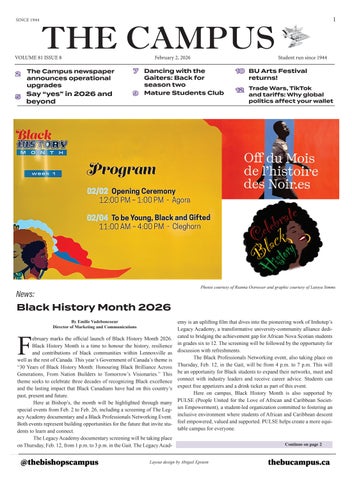
Black History Month 2026

February marks the official launch of Black History Month 2026.

Black History Month is a time to honour the history, resilience and contributions of black communities within Lennoxville as well as the rest of Canada. This year’s Government of Canada’s theme is “30 Years of Black History Month: Honouring Black Brilliance Across Generations, From Nation Builders to Tomorrow’s Visionaries.” This theme seeks to celebrate three decades of recognizing Black excellence and the lasting impact that Black Canadians have had on this country’s past, present and future.

Here at Bishop’s, the month will be highlighted through many special events from Feb. 2 to Feb. 26, including a screening of The Legacy Academy documentary and a Black Professionals Networking Event. Both events represent building opportunities for the future that invite students to learn and connect.

The Legacy Academy documentary screening will be taking place on Thursday, Feb. 12, from 1 p.m. to 3 p.m. in the Gait. The Legacy Acad-

emy is an uplifting film that dives into the pioneering work of Imhotep’s Legacy Academy, a transformative university-community alliance dedicated to bridging the achievement gap for African Nova Scotian students in grades six to 12. The screening will be followed by the opportunity for discussion with refreshments.

The Black Professionals Networking event, also taking place on Thursday, Feb. 12, in the Gait, will be from 4 p.m. to 7 p.m. This will be an opportunity for Black students to expand their networks, meet and connect with industry leaders and receive career advice. Students can expect free appetizers and a drink ticket as part of this event.

Here on campus, Black History Month is also supported by PULSE (People United for the Love of African and Caribbean Societies Empowerment), a student-led organization committed to fostering an inclusive environment where students of African and Caribbean descent feel empowered, valued and supported. PULSE helps create a more equitable campus for everyone.

Continue on page 2

Photos courtesy of Rianna Ostrosser and graphic courtesy of Latoya Simms

Black History Month 2026

Continued from page 1

Black History Month is not just about celebrating the past; it is about honouring the ongoing creativity, leadership and innovation of Black communities today and looking toward the future. Together, these

events and initiatives highlight an ongoing commitment to celebrating Black excellence within the Bishop’s community.

Students are encouraged to take part in Black History Month by attending events, starting

conversations and learning more about the history and contributions of Black communities in Canada. These moments offer opportunities to listen, reflect and engage beyond the classroom.

The Campus newspaper announces operational upgrades

The Campus newspaper plans to expand operations to distribute newspapers in residence buildings. This change could come as soon as this winter semester. In cooperation with Residence Life, Student Safety, Campus Security and the SRC, The Campus has worked to increase student viewership, particularly among those in residence.

The Campus has long been a platform for students to write about what matters to them, to give a microphone to any student who has something they’d like to speak about, promote or report on. However, the campus has been losing its hold on the student body for the past number of years. This is evident in the decline in the number of applicants for open positions and in the dwindling number of eager contributors. This is not due to a lack of care or interest; the current Campus staff and contributor base are loyal, hardworking and, most

EDITOR-IN-CHIEF

Rianna Ostrosser thecampus.editor@gmail.com

SENIOR COPY EDITOR

Olivia Norby thecampus.copyeditor@gmail.com

JUNIOR COPY EDITOR

Eryn Costello

importantly, value what the newspaper produces. The problem mainly lies with the lack of awareness; many students don’t know the paper even exists, let alone the opportunities and salary that come along with being a contributor or staff member.

The Campus newspaper currently distributes approximately 300 copies biweekly across campus to high-traffic areas. These areas include: The Student Union Building, Library, Sportsplex, Dewhurst Dining Hall and several locations in the lecture buildings. Most of these papers are read by staff and students, leaving only a few, and often none, behind. However, these numbers are low compared with previous years, when The Campus had significantly higher engagement within the student community.

This year’s Campus leadership has been dedicated to identifying why students are not reading the paper and how to address the issue. Several solutions were discussed and workshopped, and the most feasible and cost-effective option was selected:

installing newspaper stands at the entrances of residence buildings. This attempt is not only to increase awareness but also improve convenience for the residence students who wish to read an issue. The Campus staff has been in a two-year effort to organize the paper’s financials, which were disrupted and not properly structured following the disruptions of the Covid-19 pandemic. Now, with increased budget and wellmanaged funds, the campus is prepared to grow its viewership by expanding operations.

THE CAMPUS STAFF 2025-2026

LAYOUT EDITOR

Abigail Epstein thecampus.layout@gmail.com

ASSOCIATE EDITOR

PHOTOGRAPHER

NEWS EDITOR

Kai Luginbuhl thecampus.news@gmail.com

OPINIONS EDITOR

Newspaper racks will be installed in each residence building and will be stocked with each new issue. This effort would not be possible without the support of the SRC and Residence Life, who have each dedicated time and effort to help campus leadership implement this solution. With this new effort, the campus staff aims not only to reach more readers but also to attract new staff and contributors who can bring fresh perspectives and drive engagement on campus in the coming years.

thecampus.businesseditor@gmail.com

STAFF WRITERS thecampus.juniorcopyeditor@gmail.com

DIRECTOR OF FINANCE

Frederic Grenon thecampus.business@gmail.com

Emilie Vadeboncoeur

Pranav Buchineni thecampus.photographers@gmail.com

GRAPHICS EDITORS

Gabrielle Lalonde & Latoya Simms

Kai Luginbuhl thecampus.associateeditor@gmail.com graphicseditor.thecampus@gmail.com

DIRECTOR OF MARKETING & COMMUNICATIONS

Anya Mullen

thecampus.opinions@gmail.com

FEATURES EDITOR

Lauren Root

thecampus.features@gmail.com

SPORTS EDITOR

Owen Kitzan

thecampus.sports@gmail.com

ARTS AND CULTURE EDITOR

Jillian French

thecampus.artsculture@gmail.com

Megane Masson & Jon Roach

THIS ISSUE’S CONTRIBUTORS:

Francois Leblanc

Henri Dessureaux

Olivia Renaud

Owen Grand

Piper Howell

Sadie Bull

Sara Scafuro

Jayme Marteniuk @thebishopscampus Instagram

Leighton Geraghty

Sonoma Brawley

Tallula Russell

Graphic courtesy of Latoya Simms
Photo courtesy of Rianna Ostrosser

OUI Experience offers outing to Québec City

The OUI Experience –Bishop’s newest program designed to help students practice the French language outside the classroom through real–world experiences, is offering students the chance to visit Québec City for the day. The day will feature the picturesque Old Québec, the Musée of Civilization and Québec’s iconic Winter Carnival.

The group will be departing from Bishop’s at 8:30 a.m. on Saturday Feb 7. Upon arrival, students walk around Old Québec, a UNESCO World Heritage Site known for its cobblestone streets, fortified walls

and iconic architecture. Québec will make you feel like you’re in Europe, making it a must-see for anyone visiting Québec for the first time.

The next activity will be a visit to the Musée de la civilization, one of Québec’s most engaging museums with many interactive exhibitions that dive into society, identity and culture. One exhibit is called “Nous autres, les autres.” It examines identity and how we perceive others through personal stories and hands-on experiences. The museum visit provides valuable insight for students interested in Québec culture.

The highlight of the day will be visiting the Winter Carnival, the largest winter carnival in the world. It’s known for its ice sculptures,

outdoor activities and the iconic mascot Bonhomme Carnaval. Students will get to also witness the famous Carnival parade.

After a full day of activities, the group will enjoy dinner at a restaurant in the city before getting back on the bus to head back to Lennoxville. The expected return time is 11:00 p.m.

If you’re interested, registration is required via a Google Form that can be found on the OUI Experience page on the Bishop’s website. Space is limited and lunch is not included, so students are encouraged to either bring their own lunch or purchase one during the day. Additionally, a prep activity will need to be completed on the multimedia language lab page prior to the outing.

Open to students of all French levels, this outing is a fun opportunity to build confidence speaking French, connect with other students and experience beautiful Quebec City during its most iconic winter tradition.

From backyard rink to tradition: How students built a 2v2 hockey tournament

What started as a backyard project on Church Street has quickly grown into one of Winterfest’s most anticipated events.

On Friday, Feb. 6 at 1 p.m., students will gather off campus for the Winterfest 2v2 Hockey Tournament, a student-run event featuring hockey, music and an outdoor party. While Winterfest weekend is officially organized by the Student Representative Council at Bishop’s University, this tournament is different; it was created entirely by students, for students. It should be stated that this event is in no way affiliated with Bishop’s University or the SRC. The hockey tournament is entirely funded and run by the students who created it, on private property, with no university oversight.

TLast year, five roommates living together on Church Street decided to take advantage of winter conditions and build a hockey rink in their backyard. As Winterfest approached and excitement grew over the weekend, the group opened the rink to the student body. With little notice, they launched sign-ups for a 2v2 tournament, capped at 16 teams and hoped for the best.

What followed exceeded expectations. Throughout the afternoon, hundreds of students stopped by to play, watch and take in the atmosphere. A DJ kept the energy high, while spectators gathered around the rink, and others joined in games set up nearby. The event quickly turned into a go-to stop for students that afternoon.

Encouraged by the turnout and positive feedback, the group decided the tournament deserved more than a one-year run. Planning for

this year’s event began early, with rink construction starting shortly after Christmas and a clear goal in mind: turning a successful idea into a lasting Winterfest tradition.

This year’s tournament takes inspiration from the NHL’s Four Nations format, reimagined with a Bishop’s twist. The four Divisions are Club Hockey, Lacrosse, Team Toronto and Team Ottawa. Each division has eight players, four teams each, resulting in a full bracket of 16 teams, 32 players facing off to win the tournament on behalf of their division.

Organizers have put equal effort into creating a welcoming space for spectators, with easy viewing areas, DJs, a fire pit and partnerships for giveaways to spectators and players.

At its core, the Winterfest 2v2 Hockey Tournament captures exactly what the weekend is meant

to celebrate: outdoor activity, University winter culture and a student community coming together. Whether students are on a team or simply stop by with friends, the hope is that everyone leaves having shared in the spirit of Winterfest, and maybe the start of a new Bishop’s tradition.

he Campus acknowledges that the land on which we operate is stolen land, the traditional territory of the Abenaki people. We live, learn, work, and play on this land, home to Indigenous peoples still living. Canada was founded through colonization, a system rooted in oppression and the abuse of power over others, continuing to affect First Nations, Inuit, and Métis communities today. As a student newspaper, The Campus has a responsibility to highlight truth. We are committed to prioritizing underrepresented voices in our community and proactively highlighting Indigenous peoples’ histories and ongoing realities, including their resilience and achievements. We recognize our work plays a role in shaping public perceptions, being able to call-out injustice but also call-in action. We emphasize that we must go beyond a land acknowledgement, which is only one step towards reconciliation. It is the stories in our paper – told with respect, accuracy, and integrity – and the respect and humility we show to the land and others that is more important than what is written in a land acknowledgement. Actionable steps to go beyond a land acknowledgement include educating ourselves and others, and supporting Indigenous traditions, movements, and businesses. —The Campus Team

Photo courtesy of Kai Luginbuhl
Photo courtesy of Flickr CC BY-SA 2.0

Catan used to be called the Settlers of Catan: a reflection on the necessity of constant change

The fact that Catan is a popular board game is not new information. It is enjoyed by many, by Bishop’s students and way beyond, globally and among people of all ages. It has been in existence since 1995, but maybe has not been as popular until a little bit more recently. Today, everyone knows and loves Catan, and it is a go-to choice at board game nights.

However, for me personally, and maybe for many, calling it ‘Catan’ is new. Until I started playing the game with my friends at Bishop’s, I didn’t call it ‘Catan.’ In my house, it was colloquially known as ‘Settlers’ because the name of the game, as written on the box, was ‘The Settlers of Catan.’ This box holds my parents’ well-loved copy of the game, which is over 2 decades old. By extension, I have been playing the game from a young age.

When I play it here at Bishop’s with my friends, I can’t help but notice that brand-new versions of the game look very different from the one I grew up with. The rules are the same, but much of the art and even some of the

cards have been altered.

In my parents’ version of the game, the drawings on every hexagon on the board and on the development and resource cards are intricately detailed and quite nice to look at. The same hexagons and cards in a new version of the game look like they were made with a computer instead of with regard for any sort of aesthetic to go with the game. The development cards that are in my parents’ game have beautiful drawings, while I wouldn’t look twice at the design on new development cards. They even changed the names of certain things, like how the now ‘knight’ was previously a ‘soldier.’

To get a little bit environmental as well, the new version of the game has plastic holders for all the resource cards. Call me old-fashioned, but what was wrong with having piles of cards directly on the table and continuing to eliminate the need for mass-produced pieces of plastic?

I’m not saying all the changes in the game are bad. My parents have such an old version of the game that the water is made up of hexagonal pieces like the resource tiles, instead of being puzzle-pieced together like the newer

versions, which is indisputably more practical. But other than holding the board together with the water pieces, I don’t see the need for many of the changes that have been made to the game that I know and love.

Maybe this is all coming from a place of nostalgia for my childhood and playing The Settlers of Catan with my family at the kitchen table, but I think I also have a point that we live in a world where everything seems to be constantly modernizing and upgrading, and sometimes I think it’s nice to keep things the way they are, and not mess with a good thing.

At the same time, the changes made to Catan suggest that constant change is often necessary for something to survive. Just as the game has updated its name, artwork and components to keep up with new generations of players, people are also expected to adapt as the world around them evolves. For university students in particular, change is unavoidable. From new technologies and academic expectations to shifting career paths and uncertain futures, students are constantly being asked to adjust, improve and redefine themselves.

AI is a better friend than foe

For the last few years, AI has taken on a prominent role in society, which has sparked fierce pushback, leading to fear at universities. I remember when ChatGPT became popular and, slowly but surely, more and more people around me began to use it. Now, it feels like there is a massive criticism of AI by university students.

This year, I’ve been able to see firsthand how professors have adjusted to AI’s growing presence, and it’s gone one of two ways: professors adapt their courses to include AI, or condemn the usage of it entirely. Some classes have students now declare when they’ve used AI, and others have changed assignments to be hand-written in class to avoid AI altogether.

What I’ve noticed this semester is the total condemnation of technology. I find this to be an interesting issue, since banning and detecting AI is so difficult. Even googling a simple question now has an AI summary pop up at the top of the page. So, how do you ban something that surrounds you everywhere?

Speaking to people outside of university life and working in the corporate world, they use AI every day. It’s seen as a tool to help you. There are now even external courses offered to teach people how to use AI to their benefit by increasing efficiency and accuracy.

University students fall somewhere in the grey zone of this conflict. Yes, I believe it’s incredibly important to actually use your brain when doing work, to make

sure you’re learning the content of your degree. On the other hand, it’s clear that AI is here to stay, and the disapproval of it won’t do anything; it’s fighting a losing battle. In the workforce during post-grad life, there will be no restrictions on the usage of AI; in fact, you’ll be encouraged to use it.

I recognize this poses an incredibly difficult challenge for professors, and so far, my favourite way professors have responded is by integrating their course with AI and having students declare their usage of it. There are ways to use AI meaningfully while also keeping your writing voice. Personally, I use AI to help generate an idea for a writing prompt I’m stuck on, and use it as a launch pad to then go out and do additional research. I share this to show there are useful ways to use AI without becoming lost within the server and turning into a robot.

Much like sitting down to a newer version of a familiar board game, this constant adaptation can feel both exciting and uncomfortable. While change can lead to growth and new opportunities, it can also come with a sense of loss for what once felt familiar and stable. Holding onto an older version of The Settlers of Catan is comforting in the same way that routines and traditions can be comforting during university life. Perhaps the challenge is not rejecting change entirely, but learning how to embrace progress without losing appreciation for what came before.

Even as its design and branding evolve, Catan continues to be my choice for game nights and will remain a longtime favourite.

I don’t think people should be entirely dependent on AI, and instead use their education and their own thoughts at work. That’s what makes going to school worth it, and helps you prepare for a life in your desired career path.

That being said, I’d like to see more professors attempt to integrate AI into their courses, rather than banning it. AI is now a major part of society and technology, and that means learning how to work with it and not against it.

Anya Mullen, Opinions Editor » thecampus.opinions@gmail.com
Photo courtesy of Anya Mullen
Graphic courtesy of Gabrielle Lalonde

OPINIONS

The cost of being realistic

When kids are asked what they want to be when they grow up, the possibilities are endless: actors, astronauts, politicians and entrepreneurs. No one tells kids to be realistic, and kids aren’t thinking about whether their choice is a safe choice… yet. But somewhere between childhood and adulthood, those dreams become smaller, safer and more realistic.

High school felt like that first step away from those big dreams. You start thinking more about what feels guaranteed and less about that dream you had as a kid. We live in a world where a lot of jobs are being replaced by AI and people are really forced to think strategically about what the future will look like and which job will guarantee a steady income. Big dreams can often be met with ridicule or laughter as if having a dream is irresponsible in today’s economy.

So, I ask: Why did we stop

dreaming big? Fear of failure? Embarrassment? Wanting to be practical? Choosing a stable pathway is an easy choice—not because the work is easy, but because the choice feels safer. There’s comfort in believing that if you do well in school, and do all the “right things,” you can create a stable life.

During a yoga class I recently took, while holding a challenging pose long past comfort, the instructor said, “Change only happens when you start to get comfortable in the uncomfortable.” After the class, the quote stayed with me. I started thinking about how we often confuse comfort with safety. Following a safe path can feel reassuring; it makes sense that people want to have control over their futures. However, when comfort is the main goal, it limits our ability to imagine what our lives could look like. As we age, we become more risk-averse, we downplay our dreams or even add disclaimers like, “It’s not realistic” before anyone else can say it to us first. Over time, dreaming big starts

to feel embarrassing, as if wanting to get more out of life is a flaw rather than a strength.

That being said, choosing a practical path is not wrong. Financial stability does matter, and not everyone can take big risks without consequences. Wanting security does not mean one lacks passion or ambition. The problem arises when stability replaces desire, when people stop asking themselves

Say “yes” in 2026 and beyond

With the opportunity of a whole new year ahead, we often overcomplicate self-improvement by making impossible promises in our New Year’s resolutions. Instead of starting 2026 with a daunting list of challenges to live up to, what if we just tried to say “yes” a little more?

Typical New Year’s resolutions strive to change our lives all at once, often piling into a broad and intimidating list: eat healthier, wake up earlier, work harder, be happier. We tend to fail not because we lack discipline, but because we’re overloading ourselves with new and ambitious changes that can’t be sustained. Saying “yes” is an alternative resolution, shifting the focus from chasing immediate perfection toward gradual openness to opportunity, experience, and connection as they arise.

I tried this “action before

reaction” mindset in 2025 after a year that felt short on colour and flavour, and it left me happier, more confident and adventurous than I had felt in a long time. Some of my favourite moments from the year came from decisions that I didn’t overthink: going to raves with my friends, discovering new foods, booking trips I’d only dreamt about and even getting frat-married in a wedding dress in front of 80 fellow students on Reed Street because it was something to do on a cold Saturday evening. None of these moments were part of any great plan; they happened simply because I said yes when I normally would have said no or stayed comfortably at home.

This isn’t just a tale of my experience, however; these ideas have been emphasized in motivational psychology for decades. Motivational speaker Tony Robbins has long argued that meaningful change stems from action rather than intention. His idea is that momentum

builds confidence, not the other way around. Instead of waiting to feel ready, Robbins suggests that people grow by stepping into experiences first and letting clarity follow. He has often noted that the moments which most enriched his life rarely came from turning opportunities down, but from choosing to engage with them. In this way, immediate action lowers the stakes of selfimprovement, replacing rigid goals with movement and allowing progress to be seen by looking back on experience rather than planning endlessly ahead. Personal growth, then, becomes less about discipline and more about participation.

To be clear, this isn’t a call to live like Jim Carrey in Yes Man, blindly saying yes to everything from Korean language classes to flights bound for Lincoln, Nebraska. Rather, this is a reminder that university is one of the few spaces where saying yes carries relatively low risk and high reward. Here at Bishop’s, we’re very fortunate to have such a tight-

what they really want and not what feels safe. Maybe dreaming big does not have to mean abandoning reality. Maybe our dreams can change to adapt to the world we live in without completely disappearing. Wanting stability and a meaningful life doesn’t have to be opposing goals. Perhaps the real question is not why we stopped dreaming, but rather, is it enough to live a life that is built solely on being reasonable?

knit community with opportunities that are often overlooked. Join the club you’ve been curious about, go watch the fashion show or BU Film Festival, say yes to that karaoke night at the Lion. These experiences can easily be taken for granted, but keep in mind that we’re just here for a good time, not a long time.

“Remember how you entered; be proud of how you leave” is written on the very walls of this campus. Perhaps the simplest way to honour that message is by saying yes to the moments that invite us to grow.

Photo courtesy of Billie Grace Ward via flickr
Graphic courtesy of Latoya Simms

USports #2 ranked Men’s Basketball team returns

The Bishop’s Men’s Basketball team has continued their reign over the RSEQ in 2026 with a record of 4-1 in the new year. Despite a tight loss to Laval to end their exuberant six-game winning streak that began in November, the Gaiters picked up two huge bounce-back victories against l’Université du Québec à Montréal.

On Jan. 17, the Gaiter’s travelled to the island of Laval to face the Laval Rouge et Or for their third regular season meeting. The Rouge et Or were able to take advantage of a slow start offensively from BU to get a 22-14 leg up in the first quarter, Etienne Gagnon’s early ten points keeping the lights on for the Gaiters. Following the slow opening period, the offence was able to find a better rhythm together, but Laval kept the pressure on and improved their lead to 46-37 coming into the break. After a chance to regroup at the half, the Gaiters upped the effort on both ends to win the quarter 26-20 despite continued struggles connecting on three-point attempts. Down only 66-63, the game was in the balance for one final stanza, but the purple and

silver would inevitably fall short 81-79 in a game decided by a couple of bounces.

The Bishop’s coaches ran a short 8-player rotation in the affair, giving four Gaiters over 30 minutes of tough action. Forwards Etienne Gagnon (24 points, 13 rebounds), Yanis Malanda (22 points, 5 rebounds), and Charles Robert (15 points, 6 rebounds) led the scoring and rebounding effort for the team.

In search of more winning, the Gaiters paid their next visit to UQAM on Jan. 24, the strategy was adjusted to lean into the depth of this squad and find the outside stroke that lacked in the second loss of the season. Right out the gate the purple and white were red hot from three-point territory to lead the Citadins 23-22 after ten minutes. The offensive outburst continued in the second quarter to extend the Bishop’s lead to 45-36. It was much of the same in quarter three as the Gaiters buckled down even more on defence to improve to 68-47 before the fourth frame. The last quarter of action saw the Gaiters close out the Citadins to end the contest victoriously, 86-62.

The story of this contest was the

Gaiters’ 13/32 shooting from beyond the arc, 56 rebounds and 24 assists as a unit to remind everyone that this team can beat opponents in many ways. Charles Robert did his best impression of Denver Nuggets center Nikola Jokic, tallying 16 points and ten assists to lead the way offensively.

The men returned home on Jan. 24, to a sea of pink in support of ‘Shoot for the Cure’, a pink-themed USports fundraising partnership with the Canadian Cancer Society to raise money and awareness for breast cancer research. The Gaiters would play the Citadins again, this time in a spirited Mitchell Gymnasium that would certainly sway the outcome. UQAM struck first in the opening quarter with a 20-16 lead, but the pressure of an enthusiastic environment can only be sustained for so long. On the heels of a 10-point quarter from forward Charles Robert, the Gaiters responded to take a 38-35 lead entering the midway point. The second half was a total fire fest from Bishop’s offensively, scoring a whopping 29 points in both the third and fourth frames to UQAM’s 25 points in the half, to emerge victoriously, 96-60. Charles Robert led all scorers with 22 points and

seven rebounds, while six Gaiters recorded 8+ points in the high-scoring outing. The Gaiters remaining regular season home games are on Thursday, Feb. 5, against McGill, before hosting the UQAM Citadins once more on Saturday, Feb. 14, so make sure to get out and cheer for your Gaiters as they push toward playoffs!

Player spotlight: Ericka Gagnon beyond the mask

Bishop’s University is home to nearly 3000 students. Many share similar interests, but there is not one student like the other. Everyone is completely individual. This week I put the spotlight on Ericka Gagnon, the junior netminder on the Gaiters Women’s Hockey Team. Gagnon is used to the spotlight, as the starting goalie of the team she was able to win an RSEQ and USports Championship last season. On the ice she is a warrior, competitor and most of all, a brick wall in between the pipes. In this spotlight, I was able to dive into who Ericka Gagnon really is.

While speaking with Ericka, it was very apparent that hockey is a big part of her life. This led to my first question to her: How has hockey shaped you into the person you are today?

“Hockey has taught me discipline, the importance of hard work, and resilience. It has helped me learn more about who I am as a person and which values I want to focus on in my life. Hockey comes with many

setbacks and a lot of pressure, and it has taught me how to handle those challenges and be my best self when it matters most. Hockey has also helped me greatly with self-confidence. I have learned different ways to be confident without relying on outside attention or validation. Being part of a team has shaped my leadership skills and taught me accountability, knowing that my effort affects not just me, but everyone around me. Hockey has shaped me into who I am today, and I am very grateful for all the opportunities the sport has opened up for me.”

A true leader to her teammates and a player in which they can rely on heavily. She was called upon in every single playoff and national tournament game. Posting a .970 save percentage in must win game two in the series against Concordia followed by a winning .903 save percentage the next day to win the RSEQ. What may give her an advantage over everyone else is her mental game. Being a goalie she requires much more than just being physically present. So how does she mentally prepare to step into the blue paint?

“Being a goalie, mental preparation

is extremely important to me. I believe that at the elite level, what separates good players from the best is the strength of their mental game. My mental preparation begins the week before games. I know I feel most confident when I’ve done everything right in practice and training, so I make sure to give 100% every day leading up to game day. I also make a conscious effort to keep having fun, even when facing the biggest challenges, because that’s when I perform at my best. Journaling two to three times a week helps me organize my thoughts, reflect, and better understand my emotions. I do have a few superstitions, the main ones being listening to Adele before every game and putting my left equipment on before my right. I’m still learning more about the mental side of the game every day, and I always try to grow and improve in that area.”

With the ongoing growth of women’s hockey in North America, possibilities for Gagnon to play professionally are very legitimate. She is one of the best goalies in the RSEQ and in USports as a whole, but the point of this interview was Ericka when she is not wearing the mask. The final question I asked was: Is your dream

to play professional hockey or do you have another dream?

“Playing professional hockey would certainly be amazing and is a goal I keep in the back of my mind. If the opportunity presents itself and it makes sense for me, it’s something I would love to pursue. However, my number one goal has always been to become a doctor. As passionate as I am about hockey, I truly believe that medicine is where I can make the greatest impact, and it would allow me to help people in a meaningful and lasting way. This summer, I made the decision to apply to medical school for next year, which is a step I am very excited and motivated about. It wasn’t an easy decision to make—hockey is extremely important to me, and with the possibility of playing professionally, it was something I had to seriously reflect on. Ultimately, hockey has helped shape who I am, but medicine is where I see myself making a difference beyond the rink.”

Wherever her path leads next, Gagnon’s drive, discipline and leadership ensure that her impact will continue to be felt both on the ice and beyond it.

Photo courtesy of Annie White

Dancing with the Gaiters: Back for season

two

On Jan. 24, the Bishop’s Dance Team hosted their Dancing with the Gaiters fundraiser. Due to the success of the event last year, the Dance Team decided to host their second season featuring a new round of participants.

The event was modeled after the reality competition show, Dancing with the Stars, and paired a club representative (star), with a Dance Team member (pro). Seven clubs participated including Ringette, Cheerleading, Motionball, the Swimming Club, Chaos and Creativity, the Charity Fashion Show, and the Sports Studies Society.

The duos had a week to put together routines and practice before the final presentation at The Gait. There were a variety of styles including Jazz, Contemporary, Ballroom, and Hip Hop. Each pair did a brilliant job at creating engaging and impressive routines that were performed in front of a large audience and

panel of celebrity judges. Composing the judging panel, and grading the competitors on a scale out of 10 was SRC Extra Manager Taylor Morgan, and returning champions Gabe Pelletier, and Taylor Mason.

There were three prizes to be awarded to recognize the talent on the dance floor. The first award was Best Technique, and was presented to Juliette Arsenault and her partner Haislyn Suarez Paez for their Ballroom routine representing the Charity Fashion Show. The Judges Pick Award is for the stand out number of the night, and was given to Nilka Bouchard and her partner Shannon Gaskarth for their Jazz number representing the Cheerleading Club. These two awards came with Redbull prize packs provided through a sponsorship with Laurence Gourgues.

This year, Abigale Hnidy from Ringette and her partner Kate Raycraft took home the coveted Mirrorball trophy. We are excited that this win will support another BU Sports Club, and Ringette will be using the money to help them rent more

ice time at the Plex rink. Dancing with the Gaiters is designed to be a community building initiative that supports the Dance Team, and the participating clubs. Kate reflected on the experience by saying that “Abi and I have been friends for almost two years and so it was so exciting to get to share this experience with her. Especially getting to watch her experience something that is such a big part of my life.”

This fundraiser was created to help the Dance Team travel to a Competition in Brampton Ontario in early March, and the money raised is split 50/50 with the winning star’s club. BU Dance is thrilled with the continued success of this fundraiser, and the chance it provides to connect across campus with a variety of students. Dance team member Shannon Gaskarth remarked “this was my second year participating in this event as a dancer, and I’ve loved it each time. Events like these are what give me the opportunity to meet and collaborate with new people, and you’d be surprised at how much artistic

expression can emerge from these shortterm creative collaborations. Dancing with the gaiters is a beautiful showcase of how dance can really bring people together; And then again, who doesn’t love a little friendly competition?” Another team member, Emmett Tinning noted that “this is a tradition that enhances the spirit of Bishop’s.”

After attending competition, the Dance Team will host their year end showcase in Centennial Theatre Mar. 21. They hope to see you there!

BU Club Hockey stomps Paul Smiths

The BU men’s hockey team recently got the wheels going again, playing their first games of 2026. The team took on Paul Smiths, a small college in upstate New York with only roughly sevenhundred total students. The team invited the Bobcats, their first ever AAU opponent in 2021, down to Lennoxville on Jan. 17 and 18 for an in-conference showdown.

Heading into the weekend matchup, BU found themselves in a great spot with a record of 10-1-0, good for first in the AAU heading into the Christmas break. Adding that on to a spotless record against

the Bobcats over the last five years helped the BU side come out with a confidence and competitive level that Paul Smiths would always have trouble matching.

Game one of the two game series took place on Saturday, Jan. 17 at 7 p.m.

From the moment both teams took to the ice for warm up, you could tell that while normally Bobcats are the hunters, this weekend, they were the Gaiters prey. From the opening puck drop, the team dominated, not allowing a single goal throughout the sixty minute contest. While Antimmes Leudieres backstopped the team to a shutout, on the offensive side the team was no slouch either managing to put six goals past the red hot Paul Smiths goaltender.

With a 6-0 win freshly under their belts, the BU side held their senior game the following afternoon to honour the students graduating from the roster in what would be their final home game of the season.

Captain Joe Aubert, assistant captain Jack McGowan, assistant captain Marc Lagacé and goaltender Jack MacFarland all got presented with a token of appreciation from the team and recognition from their peers pre game who came out to support. MacFarland got the start in net for the team, giving a great performance in net where he only allowed two goals. On the offensive end the team found its groove once again, scoring seven goals on the Bobcats throughout the affair. Jack McGowan

Win streak for women’s basketball

Following a loss to Université de Laval, the Bishop’s Women’s Basketball team turned its head towards a double-header against UQAM. Looking to turn the tides in their first of the two games the team traveled down to Montreal on Jan. 22.

The team came out of the gates on fire, scoring 28 first quarter points while UQAM only managed 12. The second quarter was quieter on both ends as going into half the scoreboard showed 40-19 in favor of the Gaiters, as they limited the Citadins to only seven points in the second quarter. In the third, the team once again dominated on the defensive end allowing only three points. UQAM mounted a late surge in the fourth quarter, outscoring Bishop’s 20-16,

however, it was too little too late. Bishop’s took game one by a score of 66-41, with Eve Atchampone leading the way with 20 points, followed up by Zou Boithias, who scored 14 points with eight rebounds and five assists to go along with it.

Game two between the two teams took place on Jan. 24 in Lennoxville, where the Gaiters held Shoot for the Cure night, a game dedicated to raising awareness for breast cancer research. Throughout the first three quarters, the teams traded blows and the game remained extremely close. UQAM led in the first quarter outscoring Bishop’s 16-15, but Bishop’s battled back to lead 3734 after two quarters and 47-43 after three. In the fourth quarter, the team exploded onto the scene, scoring 20 points while the Citadins could only muster up eight. With that the Gaiters took the game by a score of 71-51 on a night highlighting an important

cause. Mariama Toupey Diallo led the team in scoring with 15 while Eve Atchampone followed closely behind with 14 of her own.

Following the back to back games with UQAM, the team then looked on to their matchup against Concordia on Jan. 29 in the Mitchell Gymnasium. With the team starting to find its rhythm, they steadily built themselves a strong lead throughout the game. At half they led by seven points with a score of 36-29. BU would never give that up again, and took home a third straight win by a score of 74-55. Zou Bothias put up a double-double with 22 points and 10 rebounds, with Eve Atchampone adding on another 18 in the win.

The team’s next game takes place on Feb. 5 against McGill in Mitchell Gymnasium at 6 p.m. Make sure to come out and support your Gaiters!

scored a beautiful goal in his last ever home game in front of members of his family, a memory they will all cherish for a long time to come.

With the team moving up to 12-10 on the season, they have put themselves in prime position when it comes to making and competing in the national tournament held this March in Jacksonville, Florida. They still have one road trip remaining with three games on the slate before then where they will look to solidify their spot as the top dog heading to the tournament. Stay tuned for updates and links for streams to be able to continue cheering them on despite the home schedule being completed for the year!

Photo courtesy of Annie White

Inside the Bishop’s University Pre-Law Society

The Bishop’s University PreLaw Society is starting the semester with fresh energy and an exciting lineup of events for students who are curious about law, justice and critical thinking. Open to students from all programs and years, the society is a welcoming space whether you’re seriously considering law school or just interested in learning more about how the legal system works and how it affects everyday life.

One of the highlights of the semester is our Mock Trial taking place in March. This interactive event gives students the chance to step into a courtroom setting and experience what legal proceedings are really like. Participants can take on roles such as lawyers, witnesses or judges and work through a fictional case alongside other students. The mock trial is a fun and low-pressure way to build confidence, practice public

speaking and develop analytical thinking skills. Even if you’re not ready to participate, observers are encouraged to attend, it’s a great learning experience and always an entertaining event to watch.

Looking ahead, the society is also planning a guest speaker event, with more details to be announced soon. This event will feature a speaker with real experience in the legal field who will share insights about law school, career paths and what working in law is actually like. These events are a great opportunity to ask questions, and hear directly from someone who has been there.

Overall, the Pre-Law Society aims to create a space where students can learn, explore new interests, and try things they might not experience in a classroom.Through a mix of academic events, and social gatherings, the society continues to grow as an inclusive and supportive campus community.

Students interested in getting involved or learning more about

To the incoming
create here!

As a senior student in his last semester, here is my advice:

Use your environment to create something that will outlast your four-year degree.

Last October, I published SaintAkzena I: Pandemonium and SaintAkzena II: The Lampades with KDP. These books are not just the product of my imagination; they are the collective work of many Sherbrooke students (Adriana Olivares, Sandrine Tousignant, Tanya Makhnii, etc.). Many members of the Sherbrooke community have played an influential role in the creation and distribution. The Black Cat bookstore in Lennoxville has copies of these books, available to be purchased.

I’ve been collaborating with Amazon Kindle Publishing, working on my Saint-Akzena book series since the middle of my bachelor’s program. This series is a franchise exploring the human condition, set in a haunted high school. More than 100 copies have already been sold in the

upcoming events are encouraged to follow the Pre-Law Society on Instagram, @ubishopsprelawsociety.

New members are always welcome,

and no prior experience with law is required, just an interest in learning, showing up and being part of the community.

student: Don’t just study here,

region and shipped globally from the student mailing service on campus.

To complement the publication of this series, we created a short movie adaptation, The Stray Letter, which aired last year at BUFF 2025.

Saint-Akzena III: Talion, the next edition in this series, will be released in October 2026.

Working with Project Incubator led to collaborations with graduates like Sandrine Tousignant, and helped foster creativity in a group setting.

Writing these books also led to extra points in topic-related courses, like Gothic Literature, taught by Dr. Shoshannah Bryn Jones Square, who commented: “[I] love the complexity of the story and the many lives you weave together, and I especially love the overarching message about our place in the universe.”

Continuing on the theme of universality, social media is a tool that offers exposure and a voice through visuals. Natalia Drepina, a Russian artist, and Erinthul, a Polish artist, are both on the covers of SaintAkzena I and II, and there are many

illustrations by them within the pages alongside local artists’ photographs. I was able to locate these images thanks to the help of social media. While Sherbrooke may feel isolating, using social media helps connect you with the rest of the world. You can reach out to art galleries, and other internet services via DMs, emails, SMS messages, etc.

From a laptop in Lennoxville and the campus mail office, I had plenty of opportunities to be discovered. I took a copy of each novel, dedicated it, and shipped it to Gaby’s World of Darkness, a public figure with 38,000 followers who was interested in increasing visibility with the series. It was a gamble that paid off since Gaby shared the series! From this, I realize something everyone needs to know: networking is everything.

Entering the doorstep of an institution is one thing; coming out of it with a degree is another thing. But leaving school with only a diploma is missing an opportunity. Bishop’s and other institutions in Sherbrooke are filled with resources waiting to be

used to create something that will last. I am an undergraduate who works part-time in a convenience store: I began a franchise that had started to blossom. This could not have been made alone; many others have their touch on it, both locally and internationally. Bishop’s and its accessibility to its resources (Project Incubator, the mail office, the Drama Department, etc.) made this creative work possible. Do not ask what this university can do for you; instead ask what difference you can make to the people you will meet during this experience.

Graphic courtesy of Latoya Simms
Photo courtesy of Francois Leblanc

Danny Beaton comes to Bishop’s

During the week of Jan. 19, Danny Beaton spoke at a series of guest lectures at Bishop’s University, as a guest of David Webster. I was able to listen to Beaton’s lecture on Jan. 22 in Dr. Webster’s HIS108 (Global History of Indigenous Peoples) class, where he answered many questions from inquisitive students. Beaton and Dr. Webster are good friends and have known each other for over 40 years, and Danny Beaton is a frequent guest speaker in history classes.

Beaton answered students’ questions about accountability and reconciliation. In his explanation, Danny emphasized that “everything we do is connected,” meaning that both Indigenous and non-Indigenous peoples need to work together to heal their relationship and also take care of the world.

Beaton spoke about the need for all types of justice, telling stories about how, in his youth, he would

organize protests for justice with Indigenous and non-Indigenous issues.

A large talking point in this lecture referenced the current social and political issues in the USA, trying to purchase Greenland. He touched upon the vastly different lifestyles that Indigenous and non-Indigenous peoples live when comparing their matriarchal and patriarchal societies. With Indigenous peoples following a matriarchal style, President Trump is far from the Indigenous lifestyle and does not comprehend their way of life. Beaton connects the attempt to purchase Greenland with the colonization that happened in North America with the arrival of European colonialists.

Beaton encourages students to fight for both their rights and their freedom, saying, “We are accountable for our own freedom.” Everything evolves around life and justice itself. No matter what the cause is, justice is a crucial part of freedom. Beaton spoke about the

Mature Students Club

Bishop’s vouches to be “a home away from home” for its student body. While that may generally be true, unfortunately, it does not apply to everyone. The foundations of a “home,” figuratively speaking, consist of a warm and welcoming feeling of belonging. Bishop’s tapestry covers many homes, but it might be hard to find one sometimes, which is when the club fair becomes handy.

Bishop’s community now welcomes the Mature Students’ Club! Led by Brian Fallu, husband and father of two teenagers, the idea came to him from a feeling of uneasiness vis-à-vis the inclusion of mature students into our community. As Brian says, being a mature student is different for everyone, and so is the experience. As a mature student new to Bishop’s, he felt lonely and thought others

might share the feeling, too, as well as having similar backgrounds. The Mature Students’ Club continues to this day, growing larger and larger with 40+ members, and always welcomes more students to find a place where they can belong and feel understood.

Arriving in a new environment is never easy, and even less so when expectations from the past and future interconnect. Blending different generations, as is often the case for Mature students returning to academia, can create some interesting moments, be it confusion or amusement. There are indeed different standards and mentalities throughout generations, but they can come together and create beautiful bonds and unexpected friendships if one is willing to let their guard down.

Unfortunately, there are some hardships for mature students

importance of students being critical of injustice and questioning things around them when they see them. By criticising the government, students take an active role in their lives.

In touch with his spirituality, Beaton spoke at great length about being grateful and giving thanks to the Creator for everything. He calls upon students to live their culture and especially focus on the values of their culture. By loving your culture

and being grateful, everything has more meaning.

Beaton closed his talk with the reminder that “life is a sacred journey, and people have no right to destroy it.” When referencing current social and political justice movements, Beaton reminds students to fight for their freedom using their sacred minds, and while doing so, remember to be positive and grateful, giving thanks always.

wanting to return as a pupil. It is not easy; it demands resilience and grit. School-life balance is extremely different from work-life balance, and one might not find themselves shielded from exhaustion. There are many learning curves to tackle, but in the end, it is more than just worth it. The very concept and definition of education changes drastically as a mature student, and school transcends far beyond mere grades.

Brian states that, “[his] goal is that one day, a mature student club like this won’t need to exist.” Not because he does not want to be involved, but because it showcases the Achilles’ heel that mature students must face to belong within the Bishop’s community. Until that ideal is reached, however, the club stands as both a support system and a statement: mature students deserve visibility and a space of their own. In that sense, the Mature Students’ Club does exactly what

Bishop’s promises, which is to make the campus feel like a home, even for those who may have felt left outside its walls.

Ultimately, the Mature Students’ Club is more than a student initiative; it is a testament to the many paths that lead to belonging. In creating a space where experiences are shared and understood, the club helps Bishop’s feel like a home not just in name, but in practice.

Photo courtesy of David Webster
Photo courtesy of Brian Fallu

ARTS & CULTURE

BU Arts Festival returns!

BUAF is back! The annual BU Arts Festival is running from Feb. 11-14, cramming around a dozen events into just four days. The student-led festival has been running for almost a decade at Bishop’s, created to provide Arts Administration and other humanities students with hands-on experience in managing and marketing art. The festival celebrates a diverse range of art forms, blending traditional art exhibits with events featuring film, culinary arts, fashion and more. “It’s a very interdisciplinary festival,” says Elizabeth Lebonte, who does administration and coordination as part of the BUAF team.

“This year,” Elizabeth adds, “we wanted to meet as many different kinds of art forms as possible while keeping something that students would recognize as an art festival.” A few fan-favourite events are returning from last year—the flea market (rebranded this year to the Star Bazaar) will bring clothes, jewelry, candles and other hand-crafted items (made by Bishop’s students) to the Gait on Wednesday, Feb 11. Thursday, Feb.

Artist Feature:

13, will feature an outdoor movie night in the Quad, screening La La land (2016). Friday will bring an open mic night of poetry and storytelling in the Gait. The festival will finish off with a masquerade ball on Valentine’s Day–Saturday, Feb. 14—at the Lennoxville Golf Club, which offers students an opportunity to dress up for a fun date night out (friends count as dates, too!). “I’m hyped to dress up and make my mask,” says Sandrine Tardiff, who does fundraising for the team. “There’s a mask-making workshop on Wednesday, too… and it’ll be a fun way to end the festival!”

Art exhibits will be up for

interested students throughout the whole week in Molson and the LLC Agora, as well as pop-up events throughout the week (check out @buartsfestival on Instagram for events you can catch in between your classes!)

This year, the theme for the festival is Constellations. Kendra L. Hughes, part of the festival’s marketing team, explains the nature of the theme: “It links the present to history—in the past, people used to use the stars as navigation tools, or to tell stories in mythology. The constellation has many meanings that go beyond what we’re doing here at Bishop’s…it’s

DEVOTION

Using hand papermaking and painting to create a colourful and vibrant paper quilt, I explore themes of grief, yearning and love through quotes and deeply personal symbolism. This piece is inspired by a previous work titled “Teyta’s Quilt,” a pomegranate-based paper quilt created as a tribute to my late grandmother. Using a low-waste approach to my work, I reuse discarded materials as a parallel to how I repurpose my grief into art. My work is inspired by nature, saturated colours and most importantly, the people I love and

have loved. I experience a sense of duty and devotion to papermaking, a craft that has existed for millennia. There is something powerful about breaking down materials to create something new, something beautiful and universal. I seek to share my knowledge of this craft and showcase the boundless possibilities of what can be done with handmade paper. My art’s purpose is to bring comfort to whoever may view my works, to cope with the inevitable, and to express my love to others, as well as my gratitude for being alive.

very symbolic of where artists have been and where they’re going and the various forms that art can take.” The events throughout the week–Star Bazaar, Cosmic Galleries, Celestial Stories–all revolve around this space and star imagery. “Each artist is a star in their own right, and then each star comes together to make a constellation,” Kendra adds. Sandrine sums it up nicely: “We’re all a part of the Bishop’s constellation.”

This year, the team’s goal is to ensure the arts festival is accessible and sustainable. They’re hoping all the events will be free to the Bishop’s, Lennoxville and Sherbrooke community through their crowdfunding work for support. Students from all areas of study are encouraged to attend events, which cover a wide range of interests meant to cast a wide net of engagement. With humanities programs facing widespread cuts across North America, the arts festival at Bishop’s is a rallying cry to celebrate the arts, and to “promote and showcase what we can do at Bishop’s,” according to Sandrine. The team encourages students to show their support for the arts by showing up Feb. 11-14 for some spectacular programming.

Jillian French, Arts & Culture Editor » thecampus.artsculture@gmail.com
Graphic courtesy of Kendra L. Hughes

ARTS & CULTURE

Horoscope:

Venus enter Aries

Prepare yourself for a rocket launch as Venus enters the fiery character of Aries, taking off on Feb. 4.

Aries: Magnetic is your moment, and you may find yourself approached from many sides. Make matches, if you will. All moths to this flame – for networking!

Taurus: Learn something about dormant volcanos, as you make your way up mountains. Your active tends steady, but that won’t hold against magma. Practice bends.

Gemini: Eruptions suit your flighty habitat, giving you options from afar. Remember you can’t be in two places at once. Use gravity decisively to your advantage.

Cancer: Is something stirring a pot, full of carefully laid plans? Take your hand off the flame. When someone surprises you, respond generously. Offer up a taste.

Leo: Since life is a box of chocolates, bake a cake from what you’ve found so far. Host a decoration party. Share in the sweetness of a melting pot.

Virgo: You may be moved by sentimentality, which shakes you like a champagne bottle. No one is holding your neck. There is always time to settle.

Libra: Volatility tends to open spaces for you to run through like a maze. It is a gift to see through open weaves. Play with puzzles; entreat espionage.

Scorpio: Take time to temper your bar, to give a new taste and texture to life. Intensify in espresso cups. Add whipped cream and warm spices.

Sagittarius: In the spirit of wandering, do what makes you dance. Answer calls to adventure that blindfold and spin you. Allow yourself to be led, openly.

Capricorn: Attune to the example of a candle in the wind. To nurture your flame, take rest in the hand of what can move you. Practice balance, to sustain.

Aquarius: Hold lightly to the conviction that everything will work itself out. Close your eyes and send the signal. Embrace impacts with outstretched arms.

Pisces: If you’re feeling overwhelmed, start provoking and see what sticks. Start by distinguishing the slime from the starfish. Chart your findings and share.

For you to take with as many grains of salt as there are stars in the sky.

Poetry:

Life Is

Life is radiant, for the moment

Every song is the right one

Time unspools in my hands in threads longer than the eye can see

I am possessed

I walk steps untold as centuries unfold

The wind is cold, not biting

Life is exuberant

My nose is crying but my eyes are

Blurred by the shining of the light on nature’s glass Curves and signs in languages unknown but always spoken

Carried away by feet of listless wonder

I know the colour of the wind, the sun, the earth

The space behind the sky

Rolled up like a carpet by the cosmos

It is dark

And I return to Mother Darkness’ embrace A child once again, stomping on ice shaped like her face

Life is wonderful

As everything is these days

Comic:

Jillian French, Arts & Culture Editor » thecampus.artsculture@gmail.com
Comic courtesy of Gabrielle Lalonde
Graphic courtesy of Latoya Simms

ECONOMICS & BUSINESS

Trade Wars, TikTok and tariffs: Why global politics affect your wallet

When people hear words like “trade wars,” “tariffs,” or “global supply chains,” most students immediately tune out. It sounds like something for politicians in suits or economists on TV. But whether you’re buying groceries in Lennoxville, ordering clothes online, or scrolling TikTok, global trade is quietly shaping your daily life, and your bank account.

So let’s break it down without the jargon.

What even is global trade?

At its simplest, global trade is just countries buying and selling things from each other. Canada sells natural resources, food and manufactured goods, while importing electronics, clothing, cars and everyday products. Since no country produces everything it needs, trade keeps prices lower and gives consumers more choice.

The problem begins when political tensions interfere with this exchange.

Trade wars (no, not the military kind)

A trade war happens when countries impose tariffs on one another. Tariffs are taxes placed on imported goods. When tariffs increase, companies pay more to bring products into a country,

and those costs rarely stay with the company. They are passed directly to consumers.

For students, this means higher prices for clothing, electronics and even food. Items that once felt affordable slowly become more expensive, stretching already tight budgets. While these increases may seem small at first, they add up quickly over a semester.

Why TikTok keeps coming up in trade conversations

TikTok might feel like pure entertainment, but it is also a major global business caught in political tension. Because the platform is owned by a Chinese company, governments in North America and Europe have raised concerns about data privacy and security. These concerns have led to discussions of restrictions, bans, or forced ownership changes.

For Bishop’s students, this matters more than it seems. Many brands rely on TikTok for marketing, especially to reach younger audiences. Influencer marketing, content creation and social media strategy have become legitimate career paths. When global politics threaten access to these platforms, they directly affect marketing strategies, internship opportunities and job prospects for students entering these fields.

Tariffs and the cost-of-living crisis

Inflation is already hitting students hard. Groceries cost more, rent continues to rise and tuition is not getting any cheaper. Tariffs quietly add to this pressure. When countries place tariffs on food, energy, or manufacturing materials, production and transportation costs rise across the economy.

These increases eventually show up in everyday expenses. Grocery bills climb, eating out becomes less affordable and basic necessities take up a larger portion of monthly spending. Even products not directly affected by tariffs can increase in price due to higher supply chain costs.

“But I don’t study economics, why should I care?”

Because global trade influences more than prices. It affects job availability, hiring decisions and which industries are growing or shrinking. During periods of trade uncertainty, companies may freeze hiring, reduce internships, or delay expansion. For students graduating soon, this can mean a more competitive job market.

Business, marketing and communications students are especially impacted, but no field is immune. Employers operate within a global economy, and understanding that context can help students better navigate their careers.

What this means for Bishop’s students At a small university like Bishop’s, awareness of global trends can be a real advantage. Being able to connect global events to business decisions shows critical thinking and awareness beyond the classroom. Employers value candidates who understand the environment their organization operates in.

The takeaway is simple: global trade is not abstract or distant. It shows up when groceries cost more, when social media platforms face restrictions and when job markets tighten. Trade wars, tariffs and tech politics all shape the world students are graduating into. Global politics are already affecting your wallet, whether you realize it or not.

Bishop’s earns third place at Achieve case conference 2026

Bishop’s University nabbed third place at Achieve 2026, a prestigious conference hosted by Toronto Metropolitan University. The two day event earlier in the semester consisted of networking, workshops and case cutting that focused on the theme of “Uncovering Tax Fraud”.

The competition brought together undergraduate accounting students from universities across Canada to present their recommendations on areas of taxation, auditing, financial planning and consulting to a panel of judges that work locally in the field of accounting. 11 teams were evaluated on their technical accounting knowledge, analytical depth, clarity

of presentation, and ability to respond to judges’ questions.

Representing Bishop’s were eight students from the Williams School of Business, on two teams, one consisting of third year students (Team B) and the other composed of students in their final semester (Team A). These students spent several weeks preparing for the competition under the guidance of coaches Brandon Siu, TJ Smith, and Vicky Rodrigue. On the day of competition, teams were given 60 minutes to identify assessment opportunities, structure ideas, form decisions and craft powerpoints to present to the judges. The competition’s challenging format consists of a 15 minute presentation followed by an extensive question period. Bishop’s team members dissected the case’s potential fraud causes, cost structure,

and risk exposure, delivering a presentation that balanced technical rigor with practical implications for the hypothetical clients. Both teams impressed the judges with their skills, but ultimately it was team B chosen as finalists and who later achieved a podium finish. The team members all attributed the successful outcome to the dedication of coach Brandon Siu who volunteered countless hours and truly went above and beyond.

“The opportunity to participate and strengthen my accounting skills alongside my peers, gave me hands-on experience to confirm that a career in accounting is the right path for me” said third year student Marie-Claude Laliberte, a member of team B. Participation in national competitions also provides students with valuable networking opportunities and

exposure to industry expectations. The third place finish reflects the growing strength of the accounting department for the William’s School of Business. As Bishop’s continues to encourage experiential learning beyond the classroom, achievements like this serve as a testament to the dedication of its students and faculty alike. The university’s strong showing at Toronto Metropolitan University underscores Bishop’s presence on the national accounting stage and sets a promising tone for future competitions.

Photo courtesy of Sadie Bull
Graphic courtesy of Gabrielle Lalonde

Turn static files into dynamic content formats.

Create a flipbook
Issuu converts static files into: digital portfolios, online yearbooks, online catalogs, digital photo albums and more. Sign up and create your flipbook.