SINCE 1944
VOLUME 81 ISSUE 3
2 4
September 29th, 2025
Lennoxville shop owners fear bike path could cost them their businesses Bishop’s communication is forcing students onto social media, and I am mad about it
7 9
Bishop’s women’s rugby takes down cross-town rivals Cameron Hughes: The most entertaining Bishop’s alumnus?
News:
1
Student run since 1944
10 Guest lecturer Michaela Di 12
Cesare talked playwriting in her show “Successions” Introduction to investment vehicles: From the Bishop’s University Investment Club
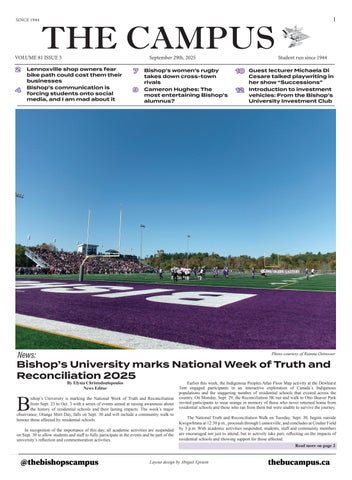
Photo courtesy of Rianna Ostrosser
Bishop’s University marks National Week of Truth and Reconciliation 2025
B
By Elysia Christodoulopoulos News Editor
ishop’s University is marking the National Week of Truth and Reconciliation from Sept. 23 to Oct. 3 with a series of events aimed at raising awareness about the history of residential schools and their lasting impacts. The week’s major observance, Orange Shirt Day, falls on Sept. 30 and will include a community walk to honour those affected by residential schools. In recognition of the importance of this day, all academic activities are suspended on Sept. 30 to allow students and staff to fully participate in the events and be part of the university’s reflection and commemoration activities.
@thebishopscampus
Earlier this week, the Indigenous Peoples Atlas Floor Map activity at the Dewhurst Tent engaged participants in an interactive exploration of Canada’s Indigenous populations and the staggering number of residential schools that existed across the country. On Monday, Sept. 29, the Reconciliation 5K run and walk to Otto Beaver Park invited participants to wear orange in memory of those who never returned home from residential schools and those who ran from them but were unable to survive the journey. The National Truth and Reconciliation Walk on Tuesday, Sept. 30, begins outside Kwigw8mna at 12:30 p.m., proceeds through Lennoxville, and concludes at Coulter Field by 3 p.m. With academic activities suspended, students, staff and community members are encouraged not just to attend, but to actively take part, reflecting on the impacts of residential schools and showing support for those affected. Read more on page 2
Layout design by Abigail Epstein
thebucampus.ca
2
NEWS
THE CAMPUS SEPTEMBER 29, 2025
Elysia Christodoulopoulos, News Editor » thecampus.news@gmail.com
Bishop’s University marks National Week of Truth and Reconciliation 2025
Continued from page 1
The week continues with a screening of the award-winning documentary Sugarcane by Julian Brave NoiseCat and Emily Kassie on Wednesday, Oct. 1, from 5 to 8 p.m. in Bandeen Hall. The screening will be followed by a discussion with the filmmakers about the residential school system and its ongoing ramifications. On Friday, Oct. 3, a Kwigw8mna open house and documentary screening at Centennial Theatre at 2 p.m. will highlight the creation
of the space, including interviews and moments from its construction, sharing the vision behind this important reclamation of the building and the space for Indigenous community use. Through this week of events, Bishop’s University encourages students to pause, reflect, and meaningfully engage with the history and ongoing impacts of residential schools. For more information, see the Indigenous Student Support Center Instagram: @bu_issc Photo courtesy of Elysia Christodoulopoulos
Lennoxville shop owners fear bike path could cost them their businesses By Rianna Ostrosser Editor-In-Chief
S
herbrooke’s plan to build a bike path along Queen Street in Lennoxville has sparked alarm among local shop owners, who say the project could leave them without enough parking to survive. Haley Harrison, owner of Boutique Rustic Roots, said she supports cycling infrastructure but worries about the city’s choice of location. “I’m not anti-bike path in any way, shape or form. Can we just leave the main street alone so that we can keep our businesses happy?” she said. “It’s been my dream my whole life to own a store in Lennoxville, and literally a bike path will take it away.” Boutique Rustic Roots hosts 44 local artisans who rent kiosks and shelves to sell handmade goods. Harrison said many of her customers rely on the few street parking spots available nearby. Even now, those spaces are often occupied all day by employees of other businesses, leaving little room for shoppers. “We have four parking spaces for five businesses. And when employees are parking there, it’s almost impossible for customers to get in,” she explained. Harrison believes the city has underestimated how much Lennoxville’s small businesses depend on convenient parking, particularly during the slow winter months. “January, February, March is so slow [for businesses], it’s
T
ridiculous already. If you take away parking during our busiest months, how are we supposed to survive?” She cited the recent closure of another local shop, which she said was partly due to lack of parking, as an example of what could follow if the bike path goes ahead. Opponents of the project have suggested rerouting the path through Centennial Park, where public washrooms and green space already make it a natural fit for cyclists. “As someene who doesn’t even bike, if I did, I’d much rather go that way than down Queen Street,” Harrison added. Harrison and other business owners say they left recent public consultations feeling unheard. At one meeting, Harrison delivered a two-minute plea to councillors, but received no response.
“There was nothing said. It felt like we weren’t being listened to” She also criticized the timing of the city’s parking survey, which was conducted in December after Bishop’s University students had left for the holidays and at 6:15 p.m., when most businesses were closed. While Harrison acknowledged that students and seniors form the core of her clientele, she argued that removing parking would drive older shoppers away.
Photo courtesy of Elysia Christodoulopoulos
“In February, you can’t expect my 80-year-old mother to park at Maxi, take her walker, and walk through the snow [for] 15 minutes to buy a birthday gift,” she said. A petition opposing the bike path is now being organized by local business
owners. Harrison said she hopes Sherbrooke will reconsider the plan. “It’s not that we’re against bikes. We just need a solution that doesn’t come at the cost of small businesses.”
he Campus acknowledges that the land on which we operate is stolen land, the traditional territory of the Abenaki people. We live, learn, work, and play on this land, home to Indigenous peoples still living. Canada was founded through colonization, a system rooted in oppression and the abuse of power over others, continuing to affect First Nations, Inuit, and Métis communities today. As a student newspaper, The Campus has a responsibility to highlight truth. We are committed to prioritizing underrepresented voices in our community and proactively highlighting Indigenous peoples’ histories and ongoing realities, including their resilience and achievements. We recognize our work plays a role in shaping public perceptions, being able to call-out injustice but also call-in action. We emphasize that we must go beyond a land acknowledgement, which is only one step towards reconciliation. It is the stories in our paper – told with respect, accuracy, and integrity – and the respect and humility we show to the land and others that is more important than what is written in a land acknowledgement. Actionable steps to go beyond a land acknowledgement include educating ourselves and others, and supporting Indigenous traditions, movements, and businesses. —The Campus Team
NEWS
SINCE 1944
3
Elysia Christodoulopoulos, News Editor » thecampus.news@gmail.com
SRC debate highlights candidates as three win seats in Sept. 23 by-election
A
By Josef Spence Contributor
t 6 p.m. on Sept. 18, the candidates for the SRC by-election took the stage at the Gait to discuss their thoughts and vision for the SRC. This SRC Debate Night took place at the midpoint of the campaign period, giving candidates the opportunity to rally support before official voting began. With a modest attendance of students from all backgrounds in the university, the event gave students the opportunity to witness the rhetorical abilities and quick-thinking skills of the candidates as they answered questions. It also allowed candidates to showcase their campaign platforms in an organized, in-person setting, as their supporters watched them in action.
with extra responsibilities. As per the SRC bylaws and policies, all members of the board represent the SRC in equal capacity, and the executive members are themselves Board Directors with extra responsibilities, such as serving as chair of the board. Thus, all candidates for the board are expected to participate in the debate event. There were two segments of the debate: a period in which candidates answered questions they had previously received and had the opportunity to prepare answers for, and a period in which candidates tackled questions posed by students in the crowd. For the first segment, Taylor Morgan, the SRC extra manager and moderator of the debate, directed questions to each candidate. For each question, candidates
Debate nights are a standard part of the SRC election campaign process, though previously only the candidates running for executive positions on the BSR participated in them. However, with the change in structure last year, debates were extended to all of the Board Directors. This change in structure effectively eliminated any difference between the board executive and the rest of the board by making the executive members — that is, the president and the vice-president — board directors
had a minute to give their response with the possibility to comment a second time after all the other candidates had answered, though none of the candidates made use of the rebuttal opportunity.
The questions in this segment were broad, focusing on the candidates’ general ideas but also the practical implementation of those ideas. For example, one concerned the manner in which the candidates planned to live out the SRC mission in their possible directorship, while another asked about potential areas of focus or initiative they might adopt if they won. An intermission placed between the segments allowed the candidates to mingle with the observing students for 15 minutes before beginning the second segment of the debate. It also gave students
the opportunity to submit questions to be asked in the second segment. Electoral officer, Karen Dymond, selected student questions for the second segment. The candidates did not know in advance what these questions would be. In the second segment, candidates could ask to speak to the question; otherwise, the moderator, Morgan, recorded their decision to decline to answer. These questions included issues such as the ability of candidates to manage their time and how they were planning to support the diverse needs of students. The debate proved successful for Emmy Mugisha, Forest Riddington, and Chouette Irebe, as these candidates won election to the SRC on Sept. 23.
Photo courtesy of BUSRC
Bishop’s opens affinity spaces amid debate over EDI in academia By Josef Spence Contributor
A
s the BU administration announces the opening of affinity spaces on campus, there is a growing concern in the academic sphere that the application of equity, diversity and inclusion (EDI) programs has an adverse impact on academia. The rising number of reports, statements and actions from academic institutions tell of a movement that is skeptical, if not fully opposed, to EDI as a set of exceptional principles applied in academic contexts. Meanwhile, new spaces reserved for use by specific groups within the Bishop’s community opened on Sept. 24, telling a different story here at BU. On Sept. 15, 2025, Dr. Steven Pinker, a professor and researcher at Harvard University who many esteem to be one of the most renowned Canadian academics, testified before the Standing Committee on Science and Research of
the House of Commons. He argued that programs allocating funding, academic employment, or educational opportunities to people based on characteristics, like race and sex, “work against the interest of science and the nation” and “undermine public trust in science.” He added that “viewpoint diversity is the kind of diversity that really matters in scientific and intellectual life.” Other recent criticism aimed at universities in Canada aligns with Pinker’s comments. Public policy think tanks like the Aristotle Foundation and the Macdonald-Laurier Institute outlined in reports that selective hiring and grant reward processes, adopted internally by universities and applied by the federal government, have produced less rigorous academics and decreased research excellence in Canada. Such concerns over the impact of prioritizing EDI in academia have even led some academic institutions to drop their EDI programs. Most prominently, the
University of Alberta changed the name and mission of its EDI department in Jan. 2025 to one that prioritized access, community and belonging. In an op-ed published in the Edmonton Journal, the university explained the decision as a way to better foster “curiosity, rigorous inquiry and the search for the truth.”
propriate form linked in the email to obtain key-card permissions on their university identification cards. Bélanger also noted in the email that this is part of the effort by Bishop’s to create an inclusive campus in line with the Scarborough Carter on Anti-Black Racism and Black Inclusion.
Amid this questioning of the application of EDI to academia, Danai Bélanger, BU vice-principal of Student Affairs and Equity, Diversity and Inclusion, announced in an email to students on Sept. 22 that affinity spaces would open on campus on Sept. 24. Bélanger identified three affinity spaces in the email: one for infant care, one reserved for the “Black students, staff, and faculty to connect, share experiences, and build community,” and one to act as “a safe and affirming environment for students, staff and faculty who identify as part of the 2SLGBTQIA+ community.”
In response to a question, she commented that “Bishop’s approaches EDI both structurally and culturally,” and commits to supporting EDI in whatever way possible. Bèlanger added that a focus on EDI helps to make students more comfortable in the community and strengthens academic excellence overall.
Those seeking to gain access to these spaces need to complete the ap-
While some praise Bishop’s for applying EDI principles more strongly, a rising number of voices in academia, including renowned scholars, remain skeptical of the inclusion of EDI principles in academic matters. It is certain that Bishop’s students clearly appreciate these safe spaces.
4
OPINIONS
THE CAMPUS SEPTEMBER 29, 2025
Anya Mullen, Opinions Editor » thecampus.opinions@gmail.com
Bishop’s communication is forcing students onto social media, and I am mad about it By Elysia Christodoulopoulos News Editor
A
s a third-year student, you would expect that I would know the ins and outs of the school. I should know when events are happening, where to go, and how to get involved. The reality? I never know anything that is happening— at least not until after it happens. And it’s not because I’m disengaged—it’s because Bishop’s has tied communication too closely to social media. Yes, I know about “The Dish,” the weekly newsletter that arrives in our inboxes. But let’s be honest: it doesn’t do the job. The information there is flat, minimal, and often lacking the energy that makes people want to engage. Meanwhile, Instagram stories and posts are full of bright graphics, clear dates,
and catchy captions that grab attention. The problem seems to be that if you’re not on Instagram, you’re out of the loop. Trust me, I resisted making a social media account for a long time. Like many students, I worry about screen time and the endless scroll that eats away at anyone’s mental health. But
Graphic courtesy of Gabrielle Lalonde
Spirit through sports By Josef Spence Contributor
Photo courthesy of Pranav Buchineni
A
weekend of purple pride where everyone is adorned in the colours of our school, where the gaiters roar in the stands and on the field and we raise a toast in endless rounds. The weekend of Homecoming is when we really show what it is to be a part of the community of Bishop’s — joined by past generations of gaiters in our celebrations, we all come together in cheering on our sports teams as
one-by-one they take to Coulter and play their fiercest. Whether they win or lose is irrelevant, for this is the weekend where the skills of our school are championed and the spirit of the school surges as though it were a great wind rushing through the school, one that cannot be stopped no matter the force it is up against, and whether well performed or not these skills of our fellow gaiters are glorious in our eyes. Though we have passed that weekend, this gusto of the spirited purple pride need not go into hibernation until that weekend comes again next year.
I found last year that Homecoming was one of the most exciting and fun experiences I have had here at Bishop’s because the whole school is filled with school spirit. Yet that spirit died down significantly after Homecoming, not to the point of disappearing but certainly being much less powerful, more subtle. The games at Homecoming
eventually, the anxiety of not knowing what was happening on campus pushed me to cave in. Now, I have an Instagram account that follows more than 50 Bishop’s-related pages—from student clubs to official departments—all just to stay informed. That’s not staying connected; that’s being cornered. There’s something troubling about a university that effectively requires students to use social media if they want to be involved in campus life. Not everyone wants an Instagram account and quite frankly, Bishop’s communication strategy feels exclusive. It assumes that everyone is equally comfortable navigating digital spaces, and it leaves behind those, like me, who aren’t. Would I recommend that “The Dish” be reimagined? Absolutely. It could easily borrow the strengths of
were packed by students showing their purple pride and not only did game attendance go down afterwards, but the display of our school colours did as well. This is quite sad as BU has a great history of intense and immeasurable purple spirit that unites its community, and its loss between celebrations speaks to a separation of people arising intermittently in the community. But it doesn’t have to be like this! True school spirit, real pride in our school, our community, is steadfast. By this I mean that it is constant: it does not drop away simply because there is no special reason for that pride to be shown. It is always there, both expressly and implicitly. Furthermore, it does not cease simply because the object of its passion has been reduced in splendor; losses and failings in skill do not cause it to be abandoned. This
Travel: everyone seems to be doing it By Anya Mullen Opinions Editor
I
’m sure I’m not the only one who feels like every time they open Instagram, someone new is posting about their trip to Bali, or Greece, or Thailand, or Spain. I’m sitting at my computer doing my homework and then going to my work shift, wondering how everyone has all this money and time to be flying all over the world. As far as I know, many of the people who I see travelling are university students just like me. But the thing I always forget is that Instagram is a highlight reel of people’s lives, and I am no different. When I was lucky enough to travel
for a few months during the gap year I took before starting at Bishop’s, I posted probably close to once a week on Instagram, and I am by no means an influencer. We have grown up in a generation where sharing things on social media is very common and has a big influence on us, whether we would like to admit it or not. Just as we know that we only post our life highlights on Instagram, we must remind ourselves that everyone else is doing the same. People could be posting travel photos from 3 months ago, and I would have no idea that they didn’t just take them yesterday. So, really, it’s not like everyone is travelling all the time, they are just posting about it when they are on the road, and maybe
social media without forcing students to join platforms they might not want to be on. Like adding more air to the presentation with visuals, graphics, and even short video clips to be more engaging. It would also be helpful to include as much information as the BU official page does online. I would be lying if I said this is not just about convenience, because in reality, it is. It is definitely more convenient to find information all in one spot. But it is also about equity. Students who opt out of social media shouldn’t be excluded from campus life. Of course, I acknowledge that, in a digital age, social media can still be a tool for outreach, but there needs to be a better balance. Forcing students onto Instagram may keep likes and followers high, but it leaves too many students behind. We deserve a system where being part of the Bishop’s community doesn’t mean surrendering our digital boundaries—which unfortunately I have.
not so much at other points in their lives. When I’m at school I certainly have less insta-worthy content in my camera roll than if I was on vacation. It’s more like pictures of homework assignments and blurry photos from the Lion at 2am. It’s also worth considering everyone’s different priorities and points of view on life. For me, when I travel, I prefer to have a lot of time, so in my mind a quick trip to Amsterdam or Barcelona for reading week seems like quite a commitment considering the price of flights, but for others, that is a fun and spontaneous opportunity. As someone who commits to a lot of things, I don’t think I would even be free to go to Barcelona for reading week! But some other friends of
pride is not rooted in the appearance of momentary glory of the school or convenience, but in the fundamentals of its community, so no present difficulty can do anything to eliminate it. It is always confident that the community has something especially unique to it. We can find this kind of purple spirit and channel it into our everyday lives so that it lasts throughout the year. When we walk out the door, we can be conscious if we are representing our school colours, even if it is just on campus. When we are making our plans for the week, we can look to see what sports games or art performances are in that week and dedicate time to being there to support our community. Indeed, in trying to practice our purple pride explicitly, eventually we will maintain it implicitly and we can truly say that we bleed purple.
mine intentionally keep those free windows of time wide open so that they can travel, because that is their main priority. I’m trying to rewire my brain to be open to hopping on more flights spontaneously, but it’s hard to let go of thinking about the cost and the risk of what could go wrong. What I really need to start doing is letting go of my fears and stop comparing myself to everyone who I see on social media. Who cares where everyone is going and what they’re doing? What matters are the plans I can make, and where I want to go. Nobody is holding me back but me. It’s not a checklist or a ticking clock. I’ll get everywhere I want to go eventually. Time to start hunting for cheap flights!
SINCE 1944
OPINIONS
5
Anya Mullen, Opinions Editor » thecampus.opinions@gmail.com
Reflections on a liberal arts education
N
By Abigail Epstein Layout Editor
obody knows what my major is. Well, some people do, after asking for clarification. A few people, candidly curious, ask me what on Earth I think I’m doing. What is there to be gained, to measure, from a liberal arts degree? The idea of a liberal arts education is part of a longstanding tradition and ideal of what constitutes a human in the context of a civilization. It is oriented towards the goal of cultivating the knowledge and skills required to be a free person, free in the sense that they possess the tools to engage critically in the civic sphere. The educational model, with a history dating back to the Ancient Greeks, is traditionally formed out of seven subjects: rhetoric, grammar and logic (the trivium); astronomy, arithmetic, geometry and music (the quadrivium). These subjects structure the foundation of the free person in the Western world with subjects spanning an array of disciplines, strongly rooted in the humanities. Upon the late 19th century, ideals of higher education shifted towards a greater emphasis on natural sciences; subsequently, fragmentation and specialization became the norm – majors,
as we know them today. Bishop’s self-identifies as an institution which provides a liberal education, citing the mission statement of its founders in 1843: “to offer the country a sound and liberal education.” Bishop’s maintains this ethos, yet is not immune to the wider trend of our local universe: as the future as we have imagined in is eaten by a stubborn taste for past wins of industrialization; as late-stage capitalism grinds its gears with the last of its extractive capacity; as domination flattens the dimensions of human imagination – the tenants of humanism have been kicked from their central place in our development for the sake of feeding the machine with STEM and vocational training. There is a shallow demand for what the liberal arts can offer. The implication of a liberal arts education and striving towards its goal, is that the curriculum guides its students in the direction of freedom. It’s a tall order. One answer has been the American tradition of a “Great Books” program, a survey of the formative works that have built up Western identity. The liberal arts major at Bishop’s, rather, is characterized by its interdisciplinary approach; there is an incredible breadth requirement that
spans at least nine disciplines, on top of the Liberal Arts Foundation courses which are by nature multidimensional. Moreover, the liberal arts major advertises a tight cohort for intellectual collaboration, as well as trips to metropolitan centres and local exhibits of culture. Disappointment felt by the realization that these are no longer feasible opportunities falls into the larger despondency felt at the apparent trajectory of the world – in my experience, at least. Who is there to blame but the superstructures, and the systems that have promoted domination under the guise of productivity? The devaluation of cultural currency associated with being well-read is partly due to a necessary reassessment of the traditional Western canon’s service to modern norms. It comes as a consequence of diversification and democratization of production and consumption, disseminated today through algorithmic devices. But the current state of affairs comes out of an accelerated history of industrialization and capitalism, and this culture shapes higher education. STEM-related degrees and vocational training have a definitive utility for the sake of productivity, and the functional status quo that a life should be led in service of the useful. This is intensified by the cost of education. How
can an education-for-the-sake-of-itself compare to an education for the purpose of near-assured employment? Oscar Wilde famously said that “all art is quite useless,” which certainly seems to apply to the state of the liberal arts. I believe that this uselessness is at the core of its value – to maintain a spirit of freedom against the institutions that necessitate unfree participation. To keep the horizons wide to welcome the possibility of a difference.
Graphic courthesy of Latoya Simms
It’s not intimacy, you’re just oversharing By Addison Walker Contributor
Graphic courtesy of Gabrielle Lalonde
I
t’s 1 a.m., and instead of sleeping, you’re at a cocktail bar sitting with an old British friend talking about your childhood, exes, and your existential crisis over a mezcal negroni. Somehow, this has become the new definition of intimacy, confessing everything to someone we already know won’t be around for the ending.
Too specific? Yeah, this was how I spent my Thursday night.
if they have a sweet tooth. (Thankfully he did, we had crème brulé.)
Somehow, casual meetups have turned into late-night therapy sessions, and nowadays we seem to measure connection by how many secrets we can tell each other by morning. But are these conversations genuine intimacy or just emotional oversharing dressed up with clever banter and a bar tab?
And it feels good. Those latenight conversations release oxytocin, the same hormone that is released during a hug or a kiss. It fires into your brain like an emotional shot of espresso. No wonder we keep coming back, even when the relationship itself is undefined.
I realized this after meeting with someone I hadn’t seen in a year (the British guy of course). I thought I had tucked him neatly into the “past flings” file of my brain, but within minutes we were back in our old rhythm. Exchanging stories about work, relationships, travel and everything in between. It was comfortable and dare I say, intoxicating. However, by the time I got home, I found myself wondering: were we building intimacy, or just falling back into our old habit of filling the night with confessions because we didn’t know what else to do?
But oversharing is not the same as getting to know someone. Getting to know someone is mutual and gradual, sharing interests, opinions, dreams, while oversharing drops heavy truths too early on. It can turn a night of “fun catching up” into an accidental therapy session.
The line between intimacy and oversharing is thin. Authentic intimacy takes time, it’s earned slowly, like trust. Oversharing, on the other hand, can be impulsive, like listing every dessert on the menu before you even remember
The danger is that vulnerability can trick us into thinking we’re closer than we are. Just because someone lets you cry on their shoulder does not mean they signed up to hold your heart.
The difference is timing, intent, and reciprocity. Intimacy builds connection while oversharing seeks relief. And while intimacy is shared, oversharing can feel one-sided.
Part of this is because our generation is emotionally fluent in a way our parents weren’t, we know our love languages, attachment styles and emotional habits. We care about mental health, and that’s a good thing. But we also seem to be lonelier. Many of us are delaying long-term relationships and committed dating. We let our friends, flings and hookups shoulder the emotional labor. The result? Nights that feel like a mix of therapy, romance and a TED Talk. We leave feeling seen in the moment, but oddly hollow by morning. The answer isn’t to avoid these kinds of talks altogether. Being vulnerable is beautiful, but maybe we should think about what we’re actually hoping to get out of it. Are we trying to figure things out or for someone to hold our feelings for a night so we can feel lighter? After my Thursday night, I felt both anchored and adrift. Maybe these late-night sessions are meant to be checkpoints rather than destinations. They don’t always mean love and intimacy. Sometimes, they just show us where we need to grow.
6
SPORTS
THE CAMPUS SEPTEMBER 29, 2025
Owen Kitzan, Sports Editor » thecampus.sports@gmail.com
Gaiters go Bigg, opponents go home
G
By Jon Roach Staff Writer
ame one, following a week three loss to the Saint Mary’s Huskies, the 1-1 Gaiters found themselves at a critical moment in their season on Sept. 13, here in the swamp against the X-Men of Saint Francis-Xavier University. This first home affair of the season let the Gaiter fans bear witness to the new BU Football threads in a highstakes contest for the Bigg Bowl, an honour the Gaiters looked to hoist for the second straight year. Bishop’s came out hot in the opening quarter, vengeful after their recent loss to the SMU Huskies. The nation’s third-leading pass game connected on a 14-yard pass to Charles-Edouard Bizier for the first touchdown of the contest, capping off an 81-yard drive from the Purple and Silver. The defence began the second quarter with an interception by Kyle Chorney, before the run game followed up with another score, a five-yard rush from Mathieu Bellavance this time, to extend the lead. The X-Men would find their first points on a 36-yard field goal to end the half, Bishop’s leading 15-3. In the second half, X marked spots in the endzone twice more for Quarterback, Justin
Quirion, seeking Bellavance again in the third quarter, and besting the defence for a 45-yard completion to Noah Blais to polish off one of the Gaiters’ best halves of football this season. The defence played a perfect second half, conceding zero points and grabbing their sixth interception in three games, this one in the hands of Philippe Theroux. The offence put together a chain-moving masterclass to the tune of 26 first downs, 411 offensive yards, and four touchdowns on the day. Led by Justin Quirion’s 356 passing yards at 78 per cent completion, finding top targets, Noah Blais three times for 84 yards and a touchdown, CharlesEdouard Bizier five times for 48 yards and a touchdown, Timote Nehma-Lacasse six times for 67 yards and Mathieu Bellavance with a game-high two touchdowns. The Defence had its best performance of the season, allowing a seasonlow three points from the X-Men, forcing three turnovers, and conceding only 78 offensive yards. Alex Macdonald led the effort defensively with five tackles, a sack and a forced fumble, while Kyle Chorney, Felix Massicotte, Howard Jiao and Benjamin Drouin all gathered two and a half tackles.
The Gaiters then took to Wolfville, Nova Scotia, to face the Acadia Axemen on Sept. 20. The first meeting of the year between Bishop’s (2-1) and Acadia University (1-2) presented a chance for the Gaiters to advance their pursuit of first place in the Atlantic University Sport division. Bishop’s came out of the first quarter with an 8-0 lead, following a rouge and a 28-yard housecall from Mouhamdou Dia on his lone catch of the afternoon. After another Bishop’s rouge in the second frame, the Acadia Axemen would taste their first points of the outing with a safety and a 27yard field goal to close out the first 30 minutes of action. The second half opened up slowly, with Xavier Gervais breaking the silence midway through the third quarter with a 23-yard field goal. The offence completed one more scoring drive in the fourth quarter, finding Oliver Burnett through the air for a 15-yard touchdown. The Gaiters’ special teams unit was able to put one more point on the board, forcing a fumble into another rouge in the final minute, nailing the coffin for a final score of 20-5. The solid defensive win improves our record to 3-1, creating
Photo courtesy of Francis Quirion
a three-way tie with SMU and StFX for first place in the AUS, and solidifying our place at seventh on the latest National Ranking. Kicker, Xavier Gervais, had a strong outing, contributing eight points to the contest through extra points, field goals and rouges. The defence put on a scoreless second half for the second straight game, led by Kyle Chorney’s seven tackles, Jemerie Trudel and Yan-Luca Balmer’s five apiece, and two interceptions. The Gaiters have eight interceptions in four games, catching themselves into elite company at second in USports football for such takeaways. Quarterback, Justin Quirion, found targets Oliver Burnett and Mouhamdou Dia for two touchdowns in the contest while racking up 276 passing yards and 40 yards on the ground. The run game also claimed 116 yards in the trenches, completing a total of 392 offensive yards for a decisive outcome.
BU Club Hockey pre season tune-up
T
By Owen Kitzan Sports Editor
he BU Club Hockey team recently played two preseason games against an out-of-league opponent, the ETS Piranhas, to prepare for their upcoming season opener. With the Piranhas being an RSEQ D2 team, it was a good test for the team as well as allowing them to pinpoint areas that may need improvement heading into their double header with Mass Maritime Academy. The team traveled down the morning of Saturday, Sept. 20, to the Montreal area for a game against ETS on the road. The matchup took place in the Verdun Auditorium for a rematch of an exhibition game from the year prior that the Piranahas
Photo courtesy of BU Club Hockey
won in Lennoxville. The team started off the game hot and kept the game close with BU goaltender, Antimmes Leudieres, playing well. A few unfortunate mishaps
a little later into the game would unfortunately prove to be the Gaiters demise as the ETS squad managed to convert on a couple 2-on-1s and take the win with a score of 5-1. The team spent the night in Montreal and went to see the Montreal Canadiens arena the next morning and take a tour of places such as the locker room and suites. Perhaps trying to draw some inspiration from the pros, the team then loaded up and headed back to Lennoxville to take on the Piranhas once again. This time the game took place in the plex at 7 p.m. on Sunday, Sept. 21, with the team drawing a decent crowd. Looking to put some of their thoughts from the day prior the puck dropped to start the game. Jack McFarland started in net for Bishop’s and played a fantastic
outing in his time on the ice. He would shut ETS out after the first period with both teams remaining tied up at zero. In the second, a shot from the point would find its way through a screen for the Piranhas to put them up 1-0. They would score again not long after, before Jack McFarland would be swapped for Nicolas Halle Tanco, with the BU side looking to let all three goalies see some preseason action. The rest of the game did not go how the team wanted, with multiple defensive lapses resulting in a 10-2 loss to ETS. The team looks to turn the tides against Mass Maritime Academy on Oct. 3 at home with time to come soon. Come support the team, or if you can’t make it, check out their instagram page for a link to the stream!
SPORTS
SINCE 1944
7
Owen Kitzan, Sports Editor » thecampus.sports@gmail.com
Behind the scenes: Media crew By Leighton Geraghty Contributor
W
hen people sit at home scrolling through instagram or watching Gaiter athletics live on GaitersTV, they watch the final product of someone’s hard work. Bishop’s has taken its social media game to the next level as they look to compete with other schools in Usports. This evolution has best been seen through the bishopsgaiters Instagram page. What people do not know, however, is how much time, effort and hard work is needed in order to ensure that the page runs smoothly. This past year the school has offered numerous internship opportunities in the world of media. Head intern, Mel Toppa, has full control over
creative content on the page as she is present at every game and works countless hours behind the scenes. Working under Mel are two other interns who are being shown the ropes to take over the account in future years. The team of three take care of everything that viewers will see while looking at promotional videos, in-game highlights and athletes of the week.
“It takes an army to build a village.” The new internships give students an opportunity to follow their dreams and strive to continue to promote their own personal brand as well. Bishop’s have been able to help set up the students with
an opportunity that many other schools do not offer. Both being able to learn from their own peers and having a full range of creativity grants the students an unforgettable opportunity. People may wonder why social media is so important nowadays and how it impacts sports. Quite simply social media is the way everyone receives their information. Game times, days, scores, highlights and more are all seen on different social media platforms. In a world where laziness has started taking over, people no longer want to read a full blog on the game, therefore, Social Media Directors have to appeal to the viewers wants and needs. Short, catchy posts will have viewers coming back for more. As well, the better the page, the more fans will be prone to wanting to see
more content and possibly come to the games in general. While sitting down with Mel, she made it clear how much the internship has helped her prepare for the working world. She stated that, “Running and managing the page has been a really validating experience. It’s given me handson insight into managing a team and seeing our ideas come to life, and it’s definitely shown me how these leadership skills are going to translate into the working world.” These skills that she has adopted will help her personal growth in the world of sports. Ultimately, behind every sports team, game and practice is a hard working social media team putting everything together to keep the fans engaged and happy.
Bishop’s women’s rugby takes down crosstown rivals
T
four and sealing the game. When the final whistle blew, Bishop’s had held off Sherbrooke’s late push, earning a 24–20 victory. It was a hard-fought win that highlighted both their offensive power and defensive resilience. Scrum-half, Sofia Galletti (#9), reflected afterward: “The energy of the girls on and off the field that day was something special, the team needed that win.”
By Olivia Norby Senior Copy Editor
he Bishop’s Gaiters women’s rugby team pulled off a big win on Sunday, Sept. 14, defeating the Université de Sherbrooke Vert et Or 24–20 in a tough matchup. The rivalry game started with Bishop’s striking first. Winger, Elly Jean (#14), intercepted a pass just inside Sherbrooke’s half and outran defenders for a 60-meter try, putting the Gaiters on the board early. A conversion from Stella Tutino (#15) capped off an impressive opening frame. In the forwards, prop, Maude Duval (#3), anchored the scrum and provided a strong offensive presence, while flanker, Tessa Brosseau (#7), stood out defensively, relentlessly chasing down every kickoff and shutting down Sherbrooke’s advances. That energy carried over as co-captain Sadie Bull (#10) added a second-half try of her own,
Photo courtesy of Maude Charlebois
showing both speed and composure under pressure. Center, Allison Skeggs (#13), also powered her way through the defense to score, giving Bishop’s strong momentum.
gap. With just minutes remaining, Sherbrooke pulled ahead, and it looked as though the momentum had fully shifted.
But the Gaiters refused to fold. Sherbrooke responded with In the final minute of play, Bull intensity in the second half, pushing struck again, breaking through the Bishop’s onto the back foot. The defense for a clutch try that put Vert et Or capitalized on Gaiters’ Bishop’s back in front. Camryn penalties and broke through the Mayhew (#21) then slotted the defensive line, steadily closing the conversion, stretching the lead to
The standout of the day was cocaptain Bull, whose leadership and two tries, including the decisive score in the dying moments, earned her Gaiter of the Week honours. She shared the spotlight with men’s rugby player Kai Williams, who was recognized on the men’s side. The win was more than just another result in the standings. It was proof of the team’s ability to handle pressure, adjust when challenged, and come together when it mattered most. Beating Sherbrooke on their home field was a big moment for the Gaiters, and it sets the tone for the rest of their season.
8
FEATURES
THE CAMPUS SEPTEMBER 29, 2025
Lauren Root, Features Editor » thecampus.features@gmail.com
Hidden healthy gems and Les Hôtes Épinettes
A
By Kyra Taylor Contributor
common struggle students face when living alone for the first time is grocery shopping, specifically for vegetables or really anything green. It can be so boring, expensive and hard to know the best types of vegetables to buy. At home, vegetables always seem to just appear in the fridge, and since living alone, it’s been hard to know what to buy and when. There are always recipes that I see with vegetables in them, but often when I go to the grocery store, the veggies look picked over or not ripe enough to eat yet. What I’ve found is the best way to get the highest quality of veggies is to look local, something Les Hôtes Épinettes brings to campus weekly.
One of the best things about Bishop’s and what comes up repeatedly is how rural our community is, and how we benefit from our surroundings. While Bishop’s has its own campus farm, the Sustainable Development Office has also made an effort to expose students to locally run farms and small businesses that provide students with healthy and fresh food. Running every Thursday now until Oct. 31 from 11:30 a.m. to 1:30 p.m., freshly grown produce will be sold at a kiosk by a local farm called Les Hôtes Épinettes. This farm is located less than 25km away from Bishop’s and offers a solution to the concern of produce quality at grocery stores. For those who are avid vegetable eaters (especially if you’re a vegetarian), Les Hôtes Épinettes offers baskets of organic and freshly grown produce that are delivered weekly. This family farm began delivering its first baskets back in
Photo courtesy of Les Hôtes Épinettes
2017, and it has become increasingly popular over the years. The farm produces over fifty types of vegetables, herbs and even offers eggs that are available for purchase. Some of their vegetables include (but are not limited to): carrots, beetroots, English cucumbers, pumpkins, onions, green onions, cherry tomatoes and more. Les Hôtes Épinettes adopted a Community Supported Agriculture (CSA) model, which is based upon a farm-citizen partnership that helps to connect locals and improve the local economy. A helpful part of this model is that it ensures that prices stay affordable, which is something that students typically place a huge emphasis on. Buying your produce at the kiosk allows you to know your food and where it came from, while supporting the local community. If you’re interested in purchasing a membership to receive weekly baskets, whether it be for the entire year or just the fall season, make sure to visit their website: http://www. leshotesepinettes.ca/bishops.html
https://www.stromspa.com/en/partners-wellness-students/?utm_campaign=Corpo&utm_medium=Journaux%20numeriques&utm_source=Universite%20Bishop%27s%20The%20Campus%20Newspaper
THE CAMPUS STAFF 2025-2026 EDITOR-IN-CHIEF
LAYOUT EDITOR
NEWS EDITOR
ECONOMICS AND BUSINESS EDITOR
thecampus.editor@gmail.com
thecampus.layout@gmail.com
thecampus.news@gmail.com
thecampus.businesseditor@gmail.com
STAFF WRITERS
Rianna Ostrosser
Abigail Epstein
Elysia Christodoulopoulos
SENIOR COPY EDITOR
ASSOCIATE EDITOR
OPINIONS EDITOR
thecampus.copyeditor@gmail.com
thecampus.associateeditor@gmail.com
thecampus.opinions@gmail.com
Olivia Norby
Kai Luginbuhl
Anya Mullen
Jayme Marteniuk
Perle Badohu Priso & Jon Roach
JUNIOR COPY EDITOR
PHOTOGRAPHER
FEATURES EDITOR
THIS ISSUE’S CONTRIBUTORS:
thecampus.juniorcopyeditor@gmail.com
thecampus.photographer@gmail.com
thecampus.features@gmail.com
Addison Walker Ann Oxford Jack Best Jean-Dominic Bedos
Eryn Costello
Pranav Buchineni
Lauren Root
DIRECTOR OF FINANCE
GRAPHICS EDITORS
SPORTS EDITOR
thecampus.business@gmail.com
graphicseditor.thecampus@gmail.com
thecampus.sports@gmail.com
Frederic Grenon
Gabrielle Lalonde & Latoya Simms
Owen Kitzan
DIRECTOR OF MARKETING & COMMUNICATIONS
ARTS AND CULTURE EDITOR
@thebishopscampus Instagram
thecampus.artsculture@gmail.com
Emilie Vadeboncoeur
Jillian French
Jean-Simon Rhéaume Josef Spence Kyra Taylor Leighton Geraghty Owen Grand
FEATURES
SINCE 1944
9
Lauren Root, Features Editor » thecampus.features@gmail.com
Cameron Hughes: The most entertaining Bishop’s alumnus?
E
By Lauren Root Features Editor
to go down their own path. A common theme throughout his book is the idea of confidence and how it shapes your life. As Cameron states, it’s important to have confidence when you need to stand up in front of a crowd of 70,000 people to hype them up (while sober).
veryone who’s attended Bishop’s, whether as a student or as a friend, would agree that Homecoming is one of the best weekends in the school year. Every year in September, Bishop’s welcomes home its alumni with many festivities to unite graduating classes of all years. In the spirit of welcoming home alumni this weekend, I had the opportunity to sit down with Cameron Hughes (class of ‘96) to discuss his time at Bishop’s. Cameron, originally from Ottawa, had no idea about Bishop’s growing up. In 1988, one of Cameron’s friends invited him up to visit Bishop’s, which would turn into a trip that changed the course of his life. Once on campus, Cameron attended a party held at a student house, which has now become Kwigw8mna. After seeing the atmosphere and community, Cameron knew that Bishop’s is where he wanted to study. While at Bishop’s, Cameron started out as an economics major, then transitioned to political science before finally landing in sociology. Throughout his time on campus, Cameron managed to become somewhat of an infamous figure.
Toward the end of our interview, I asked Cameron about the impact of Bishop’s on his life, and what life is like as an alumnus. Cameron credits Bishop’s for helping him find his dream career, stating: “[Bishop’s] is a great staging ground for people’s curiosity and interest,” and believes that once you discover that interest, you should feel the confidence to chase your dreams and take a risk.
Photo courtesy of Cameron Hughes
Cameron was elected to the SRC as the first-year Student Rep in his first year. In his second year, he was the SRC Director of Events and finally in his third year, he was SRC President. It was during these formative years that Cameron discovered another passion – entertaining crowds. While at football games, Cameron would wear a melon on his head (and became known as Melon Head) and would be the person to hype up our crowd. He became so well-known that he was able to start selling Melon Head t-shirts. Cameron loved the role of exciting crowds so much that he turned it into a career. Known as the “King of Cheer”, Cameron gets hired by
professional sports teams to hype up crowds in big games. He’s attended sports events around the world and some teams that have hired him are in the NHL, NBA and NFL. Cameron also leads company-sponsored talks, where he speaks about inspiration and leadership. To share his extraordinary story and experiences, Cameron wrote a book titled “King of Cheer: Stories of Showing up, Getting up and Never Giving Up from the World’s Most Electrifying Crowd Ignitor.” In his book, Cameron touches upon his story with nuggets of inspiration and life experiences tailored to make readers think differently and to inspire them
Now living in British Columbia, Cameron has found a small (but mighty) community of fellow Bishop’s alumni to stay in contact with. In fact, many of the alumni he has become friends with did not graduate in his class, showing how friends from Bishop’s can be made long after leaving our school. Cameron has come back in the past to lead talks on campus and for 10 years, he was the O-Week guest speaker. But for now, Cameron returns to campus as a super-fan, ready to watch the Gaiters roar just as he did back in the ‘90s
Coulter Field: The man behind the turf
T
By Jean-Simon Rhéaume Contributor
his past weekend’s annual Homecoming celebration is one of the most anticipated events of the year. A trademark feature of homecoming is the sheer amount of games that happen on campus in one weekend, and this year was no different. It featured multiple games from nearly all of our in-season athletic programs, the majority of which were played on Coulter Field.
Every athlete will agree that there is no better feeling than playing on home turf in front of a
Photo from Bishop’s Wall of Distinction
crowd, especially when the field is so special. It’s no secret that Coulter Field is one of (if not the best) facilities in the RSEQ. From the highquality surface to the spectacular views of the surrounding hills and forest, it paints the perfect backdrop for a great game. While Coulter Field may be a relatively new addition to campus, its name and inspiration come from a tradition that many other buildings follow: being named after someone important to the history of Bishop’s. To dig into Coulter Field’s history, it’s important to note the football history behind it. The Bishop’s football program was initially established in 1884 and as everyone knows, to have a football team, you need a football field. So, a stadium was built and it took the name “Bishop’s Football Stadium.” The stadium kept this name for more than a century, up until it was eventually renamed in 1991, to honour Bruce Coulter, a former football head coach.
Bruce Coulter, born in 1927, played 10 seasons for the Montreal Alouettes as a defensive back. While playing, Bruce even won the Grey Cup in 1949, which is an accomplishment not many can boast. Bruce held the role as head coach of the Bishop’s football team from 1962 to 1990. While at Bishop’s, he was more than a football coach; he also served as the Athletic Director and Dean of Students. Many of his former players and students claim that he played an active role in their lives and left a lasting impact on them. Many students even kept in touch with Bruce long past their time at Bishop’s. As amazing as his legacy is at Bishop’s, it was equally important to have the facility be the highest quality possible, to honour Bruce. That being said, the stadium was a work in progress for many years and continues to receive modifications to keep it up to date and to ensure it stays at top quality. The seating area, as we know it, was constructed during the 1980s and the first turf was put
into place in 2008. In 2021, though, the original turf had reached its full extent and needed to be replaced, which continues to be used to this day. While the stadium’s original intention was to be used for football, it has turned into much more than that. Nowadays, soccer, lacrosse and rugby also use the pitch daily, helping to contribute to the greatness of the Gaiter athletic program. While the seating capacity of Coulter Field sits at 2200, during big games (such as the 2024 Utech Bowl), the seating expands to a significantly higher number. The sheer number of people who come to watch our Gaiters can also be attributed to Bruce, as it was his football program that really helped to put our school on the map as a great athletic program. Looking into its history, it’s safe to say that Coulter Field is much more than just our training and game field; it’s a major part of Bishop’s athletic history.
10
ARTS & CULTURE
THE CAMPUS SEPTEMBER 29, 2025
Jillian French, Arts & Culture Editor » thecampus.artsculture@gmail.com
Guest lecturer Michaela Di Cesare talked playwriting in her show “Successions”
O
By Jillian French Arts & Culture Editor
n Sept. 25, 2025, Bishop’s welcomed playwright Michaela Di Cesare to Guest Lecture on her play “Successions.” In the lobby of Centennial Theatre, Di Cesare performed selected scenes from the play in front of an audience of Bishop’s students, many of whom are enrolled in the Feminist Literary Theory and English-Canadian Literature courses offered this semester by Dr. Linda Morra, who organized the event. Di Cesare also took audience questions between readings, yielding insights about character motivation and her own personal journey as a playwright.
Michaela’s playwriting accolades are extensive: she wrote and performed her debut one-woman show “8 Ways my Mother was Conceived” in multiple Canadian cities. Through Centaur Theatre Company, she wrote and performed “In Search of Mrs. Pirandello” in 2016, and later “Successions” in 2017 and 2018, for which she was awarded the Montreal English Theatre Award for Outstanding New Text in 2018.
Other works include “FOMO (Fear of Missing Out)” in 2019, “Extra/ Beautiful/U” in 2023 and “Mickey and Joe” (her personal favourite) in 2025. Set in Montreal, “Successions” is a dramedy that follows two Italian Canadian brothers who must decide whether to keep their family home after the death of their parents. As the brothers and their partners work through the house, the play unearths themes of cultural identity versus assimilation, inherited familial trauma and struggles of feminism within relationships. The play hits close to home for Di Cesare, a Montrealbased artist, who drew creative inspiration from her own experiences. Di Cesare spoke a lot about entwining “pain with joy” in “Successions” — “it’s my M.O for playwriting!” In scenes of conflict, she said there was something special about “. . . feeding uncomfortable truths. . . I’m speaking to the community I grew up in.” She recalled pushing back when the theatre wanted to market the
play as a farce: “I’m very comfortable with comedy and tragedy existing sideby-side,” she said. “It’s something I like to do, to have people laugh the whole play, then sob at the end.” When asked about her journey to achieving her success as a playwright, Di Cesare offered insights to aspiring playwrights in the crowd. As a double major in theatre and creative writing at Concordia, she noted that her “journey as a playwright started in [her] journey as an actor. . . [she] had a dissatisfaction with the roles that were being offered.” Her debut in playwriting came in the form of a one-woman show that she wrote and performed herself. “It was all about writing work for myself to perform”. Later, she started to move into commissioned work, but “Successions” was still the first ever show she wrote where she did not perform a role, which she said was a major adjustment. Speaking honestly about the difficulties of finding work as an anglo-playwright in Quebec, she shared some practical advice for finding funding, but noted that the most
important thing was to “invite, invite, invite” artists to your own shows. After the lecture, Di Cesare sat down to sign copies of the play and chatted with students, mingling in the foyer with snacks and conversation. As Di Cesare’s work continues to reach new audiences, her lecture was inspiring to up-andcoming playwrights and actors in the theatre community here at Bishop’s.
Graphic courtesy of Gabrielle Lalonde
Art Hives fall launch – The beginning of an exciting new season By Ann Oxford Contributor
O
n Thursday, Sept. 18, the Forman Community ArtLab buzzed with activity as it hosted its first Art Hive of the season. Students, staff and members of the community gathered around tables to enjoy a cup of tea, create art and chat over lunches brought from home. Just a stone’s throw away, Esther Wiseman, Foreman Art Gallery’s Cultural Mediator and Education Intern, was promoting the ArtLab at the farmer’s market in the quad. “It surprised me how many people didn’t know about the ArtLab, even people who have been here for a few years,” she said. At the farmer’s market, Esther drummed up interest in the ArtLab’s activities, receiving a pageful of signups to the email list and directing people to the Art Hive happening just around the bend. In a Team’s message to
me later that week, she speculated on why the ArtLab’s activities have struggled with visibility in the past: “[Art Hives] may seem intimidating for people that aren’t necessarily artists in their dayto-day. But we cannot emphasize enough how judgement-free the hives are. We just want more people to create for the sake of creating!” The following Saturday, Sept. 20, folks gathered in the ArtLab again for a festive fall Art Hive. This event featured snacks and tea, as well as art-making in a variety of mediums. It was a very peaceful and welcoming environment, where everyone was fully engaged, working on their various projects. These projects included drawing, collages, sculpting with clay, painting rocks and sewing. The low-pressure environment of Art Hives focuses more on creating than the final product you are left with. This removes the
Photos courtesy of Ann Oxford
expectation of making something highly skilled or impressive, and instead allows you to simply enjoy time making art with others. As one of the few third spaces on campus, the Art Hives have so much to offer to students and staff alike. Whether you need a place to just exist and belong with no expectations, want to work on a new creative project or want to see how artmaking can bring diverse people together – drop by the Art Hives, you may be pleasantly surprised.
The fall semester Art Hives are scheduled for every Thursday at 11 a.m.-1 p.m., and one Saturday a month from 1-4 p.m. (mark your calendars for Oct. 18, Nov. 15 and Dec. 13!). All are welcome, so invite your friends, family and neighbours, whether they are Bishop’s students, staff or simply members of the larger community. Art materials are provided for free, there’s always tea and coffee available, and you can even bring your lunch and heat it in the ArtLab’s microwave. Happy creating!
ARTS & CULTURE
SINCE 1944
11
Jillian French, Arts & Culture Editor » thecampus.artsculture@gmail.com
Horoscope: First Quarter Moon in Capricorn; Mercury in Scorpio
Bishop’s Party House Crossword By Rianna Ostrosser Editor-In-Chief
By Abigail Epstein Layout Editor
A
Oct. 6.
moment for manifestation is underway as the Libra Sun welcomes transitions of the moon, while Mercury’s move to Scorpio alters communicative intent come
Aries: When your instinct is sparked, let your intuition guide you. Practice trust to ground your spontaneity. Know what you want before running across coals. Taurus: The logic of the universe speaks through you and you may believe there is nothing you owe apology to. Even so, refrain from bulldozing. Protect your hindsight. Gemini: If you’ve been having organizational troubles, try accepting new waves of order without transforming your whole self. Sit with it a sec’, before making definitive judgments.
8. Closed-down house with a spooky nickname
DOWN
ACROSS
Capricorn: Before your next project, visualize its shape. You can put wheels on your building blocks, if you’re feeling adventurous. Remember the bones are always there.
6. Known for blasting music off its balcony during Reed parties
1. Dragon
Sagittarius: Approach changing branches with a sense of abundance. If all must fall, take the lead in celebrating what’s now beautiful. The world’s a circle; all will come again. You’re suited to the helm.
9. Connolly’s pink, purple, and white toy-themed landmark
5. Known for its Winterfest onesie parties
2. Cottage
Scorpio: Maps may resonate more if you redesign the borders – do this instead of looking away, if tempted. Try cataloging the world in a kaleidoscope.
7. Trek up the College Street hill leads you to a house with a tropical name
2. Rugby-rooted party spot with a cozy name
5. Animal
Libra: If you know what you want, go get it. Who would say no to you on your birthday, afterall? Bat your eyelashes at someone who can share their subscription accounts.
4. BU Snow house behind Winterfest’s annual rail jam party
1. Reed Street house known for pitching in with post-party cleanups
3. Cool Ranch 4. 10man 7. Jungle 9. Dollhouse
Virgo: First Quarter Moon in Capricorn forms something of an anchor, as you launch passionately into rituals of exploration. It’s safe to take chances on yourself. All will land into place.
3. Party spot by the skate park with a Dorito on the door
DOWN
6. Future
Leo: TLC is the turn of the time for you. If you’re struggling to express yourself, journal on the back of a napkin. Establish routines of emotional self-care.
ACROSS
8. Haunted
Cancer: Your interiority may gain a sense of stability that’s foreign to your ordinary. Get a feel for the flow of your innermost, as it pronounces itself in poetry. Let it all out, in all its novel forms.
Aquarius: Try on an orientation towards the future, as you encounter artefacts from your past. Use shoe boxes rather than plastic bags, for keeping things for later. Pisces: If you’ve been wishing, allow plans to form, in the way they arrive at you naturally. Like dandelion seeds in the wind, that which is destined will take root. Exhale. Embrace. For you to take with as many grains of salt as there are stars in the sky. Comic courtesy of Latoya Simms
12
ECONOMICS & BUSINESS
THE CAMPUS SEPTEMBER 29, 2025
Jayme Marteniuk, Economics & Business Editor » thecampus.businesseditor@gmail.com
Hard hats and homework: A Bishop’s student builds his future By Jean-Dominic Bedos Contributor
W
hile most students at Bishop’s University spend their evenings buried in textbooks, one student is equally at home balancing blueprints and construction schedules. At just 22, Chris Barkhouse is running his own construction company, overseeing contracts worth hundreds of thousands of dollars—all while studying for a B.B.A. in Management and keeping a full course load.
His journey began not on a job site but in the kitchen of Chez Moi Chez Toi, a restaurant in Bodville, Quebec. It was there that his boss, Nick, became both a mentor and a role model. “Nick really showed me what hard work looks like,” he recalled. “He gave me the confidence to start something of my own.” At the same time, side projects at the restaurant, helping his father with manual labour and stints cleaning trucks at an excavation company planted the seeds of a career in construction. With a friend and business partner, Charles, he took the leap. Their first projects were modest—painting fences and refinishing decks. But a breakthrough came quickly with a
six-figure house repainting contract. “That’s when I realized this wasn’t just a side hustle, it could be a real business,” he said. From there, he reinvested every dollar back into tools, equipment and eventually a shop in Cowansville, Quebec. Today, the business is incorporated and thriving. In its first year, revenues topped six figures; in its second, the company has already surpassed that, averaging five figures a month. Notable contracts include a mobile lounge project for Chrono Aviation and large residential jobs. He currently has two ongoing projects, and at peak summer demand, he managed four projects at once. Balancing this entrepreneurial life with academics hasn’t been easy. A selfdescribed average student, he arranges all his classes into two days a week to free time for business. “I pack all my classes into Tuesdays and Thursdays; it’s not easy, but it gives me the time I need to be on site and keep the company running.” He explained, “My hours per day can range from two to 12; I haven’t had a day off in six weeks.” Dyslexia has made his studies more challenging, but he focuses on persistence. “Showing
up and participating is half the battle.”
The challenges of entrepreneurship have been real. “Getting those first contracts was the hardest part. At first, people don’t take you seriously because you’re young,” he said. He also admitted to early missteps, such as partnering with the wrong people. Still, each mistake became a very valuable lesson. He said the most important skill for construction is problem-solving: “You have to look at a problem, diagnose it, and piece it out step by step.” Looking ahead, he plans to scale. After graduation, he wants to steer the company toward larger developments, employ more people, and grow revenues to $3 million to $5 million within five years. “Right now, we handle projects; after graduation, I want to scale the business, move into developments, and build a bigger team,” he said. For him, entrepreneurship is driven by lifestyle and family—building stability for the future. His advice to fellow students is simple: be patient, work hard and focus on quality. “Be prepared to work without immediate pay,” he said. “Quality and persistence matter more than anything.”
For this young entrepreneur, the lesson is clear: with mentorship, resilience and relentless effort, it’s possible to build a business—and a future—while still in the classroom.
Photo courtesy of Jean-Dominic Bedos
Introduction to investment vehicles: From the Bishop’s University Investment Club By Kai Luginbuhl, Owen Grand and Jack Best Associate Editor and Contributors
I
n this article, we explore the fundamentals of three popular investment tools: exchange-traded funds, bonds and active management, with the goal of providing a high-level introductory description of each tool. Exchange-traded funds Exchange-traded funds (ETFs) are one kind of financial investment tool. Created in 1990, they are an exchange-tradable product that pools an underlying number of securities and sells part ownership of that pool to an investor. They operate much like an individual stock. These securities can be bonds, stocks, gold, debt, futures, commodities and cryptocurrencies. ETFs can be specific to a type of asset class, industry or economy. This tool can offer investors opportunities for trading flexibility, portfolio diversification and risk management. ETFs usually offer significantly lower fees than actively managed funds, a cost-efficient option for investors with smaller amounts of capital. There are drawbacks to ETFs, namely giving up specific choices of stock possession and tax exposure. There are mainly two types of ETFs. First, there are
passive ETFs whose aim is to replicate the performance of a broader index, such as the S&P 500, while actively managed ETFs have a portfolio manager who actively decides what securities to add to the ETF asset pool.
which is a percentage of the bond’s face value or principal. Before buying a bond, it’s important to consider the term length or maturity period, which can range from a few months to several decades, and the rate of interest. In the case of your friend’s
BU Invests is committed to promoting financial literacy among the students of Bishop’s University by providing fact-based and unbiased information on financial tools and markets.
Bonds Like ETFs, a bond is a form of investment. A bond represents money that an investor has loaned to a business. Imagine you have a friend who wants to start a carwash business for Bishop’s students but needs money to buy supplies. Instead of going to the bank for a loan, your friend asks you and others to invest in their business. Let’s say you loan $100 (the principal) to your friend, and they promise to pay you a little money every month (the interest), plus they promise to pay back the $100 when their business grows (the term). When a company raises money by issuing bonds, it promises to pay interest periodically (annually or at some other interval), also known as a coupon,
car wash business, you might agree to terms where they will pay back your initial investment in six months at a set rate of interest. When the term is finished, the bond matures, and the company is expected to pay back the money they borrowed from you when you bought the bond, plus interest, thus closing the loan. Active management Active management is an investment tool that involves giving funds directly to a fund manager or management company, which they then invest at their discretion or following a set plan. Fund managers’ portfolios should be tailored to their clients’ risk tolerance and asset preferences. Actively managed funds aim to provide higher returns while also mitigating risk
Photo courtesy of BU Investment Club by relying on their professional expertise and level of supervision. However, by no means are managed funds always successful or the right choice for an investor. Expertise can come at a significant cost in management fees drawn from investment returns or capital. Many high-earning individuals make investments through active management; they are essentially paying a professional to make and summarize investment decisions based on an understanding of the investor’s risk tolerance. Disclaimer: BU Invests members are not certified or authorized to provide investment advice or financial commentary. This article is for educational purposes only. Readers should conduct their own research and seek professional advice before making investment decisions.