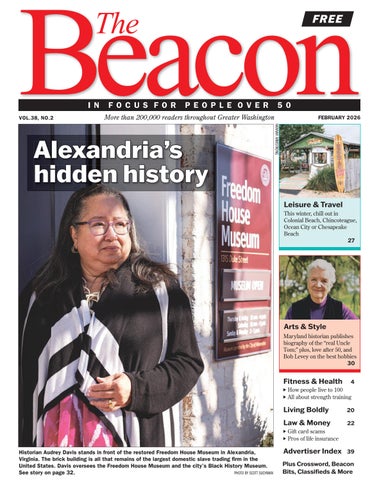
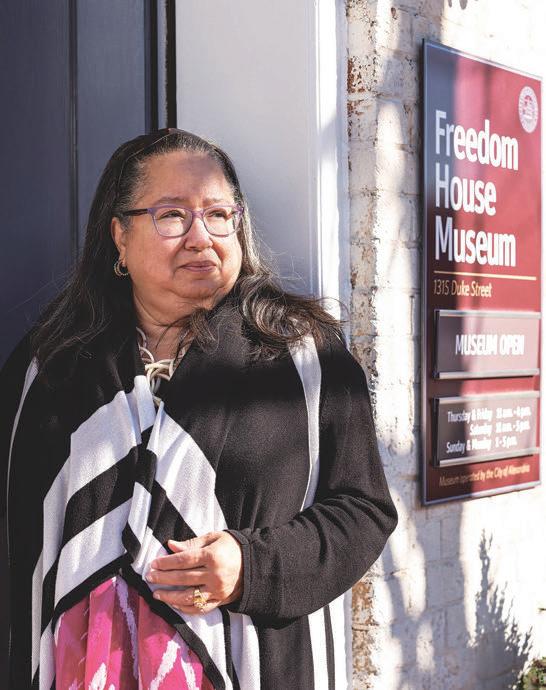
Historian Audrey Davis stands in front of the restored Freedom House Museum in Alexandria, Virginia. The brick building is all that remains of the largest domestic slave trading firm in the United States. Davis oversees the Freedom House Museum and the city’s Black History Museum. See story on page 32. PHOTO
How I learned to be brave
My November column, “How We Learn to Be Afraid,” garnered more responses from readers than anything I have written in years. So I thought I would press my luck and write this companion piece about bravery. Appropriately, it also happens to be the column in which I announce my retirement from the Beacon
Yes, 36 years after my wife, Judy, and I began publishing this monthly newspaper — originally called Senior Beacon of Greater Washington — I am hanging up that hat and donning my “pianist and composer” cap for what I intend to be my encore career.
FROM THE PUBLISHER
While many people clearly thought I was nuts, several fellow associates stopped by my office and told me how much they wished they had the guts to walk away like that. Over the years, I’ve been asked where I got the chutzpah to abandon a good thing and head into uncharted waters. I think a few defining experiences early in my life helped me learn to follow my inner voice — even (or especially) when it diverged from “common wisdom.”
By Stuart P. Rosenthal
Regular readers will know that I have taken several short sabbaticals in recent years to test-drive a career in music. Since those have been among the most pleasant times I have ever spent, I am happily giving it a go long-term.
I enter this new phase of my life with the same sense of excitement — plus a soupçon of fear — that I felt when I started the Beacon decades ago. At the time, I left a large law firm where I was a senior associate.
Scene one: In a gradeschool math class, the teacher put a problem on the board and asked two students, including me, to solve it. We came up with different answers. After each of us explained our reasoning, the teacher asked the class to vote on which answer was correct.
The first vote was split. The teacher asked for another vote; this time only one or two students voted with me. She asked yet again. With my heart pounding, I continued to insist that my answer was correct. This time, I stood alone.
The teacher then announced — rather dramatically — that only I had gotten the
correct answer, and she praised me for sticking to my guns even when everyone else disagreed.
Scene two: When I was in college, I became interested in the stock market but had little money to invest. My father offered to match whatever I put into a single stock so I could get my feet wet.
I regularly flew Braniff Airlines to and from school and had read that the company was in bankruptcy. The stock had cratered but was still trading as Braniff attempted to reorganize under Chapter 11. I suggested to my father that it was a good airline and that the stock was a bargain. He expressed doubt but supported me.
By the time I graduated, our investment had more than doubled. While at least part good luck, this experience also suggested I could trust my intuition.
I’m not saying those experiences led me to start the Beacon. I left law and started a newspaper for older adults because my heart — and my wife — told me I would wake up with more energy if I did work that better used my talents, allowed me to be my own boss, and helped as many people as possible along the way.
— most of them for 15, 20, and even more than 25 years. Throughout that time, they have devoted themselves heart and soul to making the Beacon what it has become, which is to say an institution beyond my wildest dreams. (By the way, Judy will continue working with the Beacon for a while longer. She’s younger than I!)
I will also miss engaging with our dedicated readers and longtime advertisers throughout the year at our Expos, on county and nonprofit boards, and at networking and social events.
Even as I say farewell to my role at the Beacon, I hope to continue connecting with you through music. In addition to composing original songs and posting them on my website (please visit stuartsmelodies.com), I plan to perform them along with classical and contemporary favorites at small gatherings throughout the DMV. Activity coordinators, take note: I’m available for bookings!
If you’d like to help give my new career a boost, I invite you to visit my channel on YouTube (search “Stuart’s Melodies”), listen to a piece or two, and hit “subscribe.” There’s no charge — it simply means you’ll be notified when I post something new.
Beacon
The Beacon is a monthly newspaper dedicated to inform, serve and enter tain the citizens of the Greater Washington D.C. area, and is privately owned. Other editions serve Greater Baltimore and Howard County, Maryland.
Subscriptions are available via first-class mail ($50) or third-class mail ($20), prepaid with order. D.C. and Maryland residents: add 6% for sales tax. Send subscription order to the office listed below.
Publication of advertising contained herein does not necessarily constitute endorsement. Signed columns represent the opinions of the writers, and not necessarily the opinion of the publisher.
Gordon Hasenei, Publisher, CEO
SteveGurney, Associate Publisher
MargaretFoster, Editor
KyleGregory, Art Director
RogerKing, Vice President of Operations
Advertising Representatives: Jill Joseph, Steve Levin, M.K. Phillips, Alan Spiegel
But any new beginning takes courage. And I think those earlier moments in my life that gave me some practice acting courageously have helped me to approach later challenges in life — whether starting a business or retiring from one — and see them as opportunities.
I will deeply miss working every day with the phenomenal Beacon team, who have been like an extension of my family
Of course, I also hope you will continue to read the Beacon, patronize its advertisers, and recommend it to your friends. I would love to hear from you. You can respond to this column at info@thebeaconnewspapers.com or write to me personally at stuart@stuartsmelodies.com.
It’s been an amazing and rewarding 36 years. Thank you all!
Letters to the editor
Readers are encouraged to share their opinions on any matter addressed in the Beacon as well as on political and social issues of the day. Mail your Letter to the Editor to The Beacon, P.O. Box 2227, Silver Spring, MD 20915, or email to info@thebeaconnewspapers.com. Please include your name, address and telephone number for verification.
Dear Editor:
Love the informative articles in the Beacon! However, sometimes useful information is missing from the so-called informative articles.
Case in point: the article in the December 2025 Law & Money section titled “Why index funds and ETFs are good for retirees.” Surprisingly, the article contained not one explanation of what an index fund or ETF actually is!
You know what’s genuinely good for retirees? Providing us with necessary basic information so we can then assess and evaluate new information in an effective and capable manner.
Jennifer Gittins-Harfst Annandale, VA
Dear Editor:
As a new retiree — two months and counting — I couldn’t agree more with Richard Himmer on the need to redefine
retirement (“Ditch traditional retirement expectations,” January 2026).
After a 40-year career in publishing, I woke up the next morning lamenting the loss of the structure and purpose that work had provided.
Like many others I fell victim to the “traditional mindset” that Himmer argues needs changing: I was too fixated on saving money instead of paying attention to what replaces work.
I have since slowly started to fill the void, beginning with taking an exercise class and starting a French conversational group. I am also looking into doing more volunteering and writing.
Himmer’s article is a must-read for anyone aiming to reimagine what a meaningful retirement looks like.
Joe Lustig Bethesda, MD
Fitness & Health
PARKINSON’S SYMPTOMS
Restless sleep and loss of smell can be early sigs of Parkinson’s disease
STRONGER LONGER
Lifting weights, squatting and rowing are great ways to keep bones strong
HAPPY HABITS
Gratitude, friends, nature and volunteer work can give you a sunny outlook
CANNABIS USE DISORDER
Pot is more powerful than it once was, and more people are getting hooked
Make the most of a doctor’s appointment
By Lauran Neergaard
You finally got a doctor’s appointment. Getting the most out of that visit requires some advance preparation. Even the professionals plan ahead.
“It is really hard — even for me, as a doctor, going to see my own family doctor — to remember the things that I wanted to bring up,” said Dr. Sarah Nosal, president of the American Academy of Family Physicians.
“The worst is when you’ve had that moment with your doctor” only to recall another problem after walking out, she said. “You’ve lost that time.”
Her top tip: Bring a list of symptoms and questions to show the doctor at the start of the visit. The first item should be your top concern, but seeing the full list helps your doctor prioritize what’s most medically urgent.
“I’m actually going to be able to see, is there a red flag?” explained Nosal, who has some additional advice about prepping for a typical primary care visit.
Some illnesses require specialists like a cardiologist or rheumatologist. But regardless of your age or how healthy you are, research has long shown that a relationship with a primary care provider is important.
Your primary care doctor monitors your overall health. It might be a family physi-
cian like Nosal, who cares for all ages, or an internist. Some patients choose gynecologists or geriatricians, while others may have a team that includes nurse practitioners or physician assistants.
Primary care is more than preventive checkups to help avoid illness, such as vaccinations, cancer screenings or health advice. It also includes detecting and treating common problems like high blood pressure, and helping to find and coordinate specialty care.
“That ongoing relationship also helps me know your ‘normal,’” Nosal explained. “If something’s different or changes or you feel off, when you tell me that information and I also have known you over time, we can really figure out together what’s going on.”
Family medical history is critical — and needs regular updating. Know what diseases your close relatives have had and how they fared. For example, if Type 2 diabetes runs in the family, or Grandma had a stroke, or someone had cancer at a young age, that information could help tailor your preventive care, Nosal said.
Fill out paperwork beforehand
Filling out paperwork from home makes it easier to check medicine bottles for the name and dose. Include both prescription and over-the-counter medicines, pills or creams — and don’t forget vitamins
and supplements.
Why are the latter important? Some can interact with prescription medicines. For instance, Nosal cited some patients whose longtime treatments quit working after they started taking turmeric, a spice also sold as a supplement.
Also before your visit, check if the doctor received records of recent lab tests, hospitalizations or visits to other health providers, since electronic medical records aren’t always automatically shared.
Keep a running list of questions
Some symptoms are bad enough to prompt an urgent visit. But if you’ve got a checkup coming, whether it’s routine or to follow up on health problems, start a list of questions in advance.
Notice a pain when you move a certain way? Chatting with a friend who just got a colonoscopy and wonder if you’re due? Put those on your list right away, before you forget — and be specific in describing symptoms.
Nosal keeps a running list on her phone and, ahead of visits with her own doctor, sends it as a heads-up through her patient portal. Patients also can include their list on visit check-in forms.
The idea is to address the most urgent questions first, rather than patients run-
ning out of time before raising a key concern. Nosal said questions about mental or sexual health and wellness especially tend to come up at the last minute.
Whatever the medium, “please bring that list,” she said. “That’s the most critical of all pieces.”
Ask again or bring a friend
People may know to ask questions about treatments, such as how well they work and what side effects to expect. But it’s also important to understand why a doctor makes a particular diagnosis or, conversely, isn’t as worried about a symptom as you might be.
Don’t hesitate to say, “Explain to me what else could be going on,” Nosal advised. “What would be the next step? How would you evaluate that for me, to know if it’s this or that?”
Most health advocacy groups also advise bringing along a friend or relative, especially if you have serious or multiple health problems. They can help ask questions and take notes. Or ask if you can record the appointment on your phone.
“Whether you are 20 or you are 85, you will not remember everything from your medical visit,” Nosal said.
For his new book, Healthy to 100 , longevity researcher Ken Stern wanted to answer a question that nagged him: Why do so many people in some European and Asian countries live long, healthy lives, and how can Americans be like them?
So, for six months in 2024, he traveled to five of the most successful aging nations — Italy, Japan, Singapore, South Korea and Spain — to find out why their average life expectancies were often six years longer than ours and to interview residents in their 70s, 80s, 90s and 100s.
Stern, founder of The Longevity Project research initiative and host of the Stanford Center on Longevity’s Century Lives podcast, discovered a surprising common thread: It wasn’t about how the older
residents took care of their health, ate, exercised or managed their finances. It was about their strong social connections.
Other longevity researchers have also seen a link between social connection and extended, healthy lives.
In Healthy to 100 , Stern writes that Brigham Young University professor Julianne Holt-Lunstad reviewed 148 global studies and found social connection increased the likelihood of surviving in any given year by more than 50%.
“When people ask me how they can be socially connected, they’re generally thinking about how to be the life of the party. That’s not what it’s really about,” said Stern. “It’s about putting people next to people in a purposeful way.”
Stern offers four ways to foster social connections, based on what he learned:
Keep working
Japan offers a great model, Stern said. “Japan is famous for its stressful work culture, but its work economy for people in the second half of life is rather different,” he said. “It’s built around part-time work and being with other people.”
Japan gives employers financial incentives to support older workers and has the highest percentage of people over 65 who work — roughly 25%. The country’s Silver Jinzai jobs program has found part-time jobs for nearly 700,000 residents over 60.
One poll found that 80% of older Japanese workers said they’re employed because it’s good for their health and for social connection, Stern said.
Stern suggests older Americans look for jobs at the 3,000 companies and organizations that have taken the AARP Employer Pledge,
committing to age-inclusive workforces. He’s also a fan of encore careers, where people over 60 work to find meaning and purpose.
Get out and about
Some social connections exist with family, friends and work colleagues. But, Stern said, they can also come through daily interactions with “consequential strangers” — like people you chat with on a bus.
Intergenerational housing and activities boost social connections, too. In Singapore, 90% of homes are owned by the government, which offers a tax incentive for people living within a kilometer of other generations.
“Singapore works obsessively to keep generations together in housing,” Stern said.
Try these winter vegetables this season
By Laura Fisher
Colorful, nutritious winter vegetables — crops that thrive in the cooler months or are harvested in the fall and maintain their flavor and health benefits throughout the winter — play an important role in the eating-seasonally movement.
This lifestyle trend, which promotes packing your plate with food grown naturally at that time of year in your region, is enjoying a resurgence of late.
And it’s no wonder, as seasonal produce is known to be especially nutrient-dense, extra flavorful, cost-efficient and environmentally friendly. While they vary according to where you live (California, we are all jealous of your year-round bounty), there are plenty of fresh winter veggies available across the country during chilly months. Here are a few favorite winter vegetables to encourage you to eat seasonally all year round.
1. Winter squash: Winter squash includes varieties of hard-skinned squash — such as acorn, butternut, kabocha and delicata — that are harvested in the fall, and can be stored and eaten all through the cooler months.
Winter squashes are incredibly versatile, whether you choose to blend, roast or bake them. Try out all the different types, as each squash is uniquely flavorful.
2. Potatoes: As if we needed more reasons to love potatoes, everyone’s favorite tubers are a great choice for eating seasonally in winter. Potatoes are readily available year-round due to how well they keep when stored properly. Typically, spuds are harvested in late fall, but depending on your climate, they may be fresh even in the middle of winter.
3. Brassicas: The brassica family in-
cludes some of the most nutritious and versatile produce out there, including broccoli, cauliflower, cabbage, Brussels sprouts and the lesser-known kohlrabi. Brassicas shine when roasted to caramelization in the oven, thrown into stir-fries or sliced thinly in salads.
4. Hearty greens: Cooking greens like escarole, endive, kale (which is technically a brassica) and radicchio (which is purple, not green) are at their best when grown at cooler temperatures — crisp, sweet and not too bitter. Try them sautéed, braised or as part of a hearty winter vegetarian meal mixed with grains, pesto and a nutty crunch.
5. Parsnips: A cool-season root vegetable that is largely underappreciated, the parsnip has been described as “a carrot on steroids.” Its unique, strong-yet-sweet taste doesn’t fully develop until its roots are exposed to near-freezing temperatures for two to four weeks. Peaking in fall and early winter, it makes the perfect ingredient for hearty cold-weather soups and stews.
Cooking parsnips is similar to working with carrots and potatoes, as they can be boiled and mashed, roasted and even sautéed.
6. Leeks: Leeks bring aromatic flavor and silkiness to your favorite winter comfort foods. A milder-flavored member of the onion family, this underrated yet versatile vegetable tastes best after a frost and is often available locally throughout the winter months.
Real Simple magazine provides smart, realistic solutions to everyday challenges. Online at www.realsimple.com.
For free materials about area housing communities, just complete and clip this coupon and mail, or take a picture and email, to the Beacon.
Housing Communities
District of Columbia
o Asbury Dwellings (See ad on page 6)
o Chevy Chase House (See ad on page 17)
o Edgewood Commons (See ad on page 16)
o Inspīr Embassy Row (See ad on page 13)
Maryland
o Brooke Grove (See ad on page 40)
o Carnegie at Washingtonian Center (See ad on page 3)
o Charles E. Smith Life Communities (See ad on page 19)
o ChurchillSeniorLiving (See ad on page 16)
o Discovery Village Chevy Chase (See ad on page 11)
o Grandview,The/Erickson (See ad on page 7)
o Homecrest House (See ad on page 18)
o Park View Bladensburg (See ad on page 9)
o Park View Columbia (See ad on page 9)
o Park View Emerson (See ad on page 9)
o Park View Laurel (See ad on page 9)
o Riderwood/Erickson (See ad on page 7)
o Seaton Silver Spring (See ad on page 15)
Virginia
o Ashby Ponds/Erickson (See ad on page 7)
o Culpepper Garden (See ad on page 14)
o Greenspring/Erickson (See ad on page 7)
o Tribute at the Glen (See ad on page 17)
o WoodleighChase/Erickson (See ad on page 7)
Clinical Studies
o Smell Test Study (See ad on page 6)
Check the boxes you’re interested in and return this form to: The Beacon, P.O. Box 2227, Silver Spring, MD 20915 or take a picture and email to housing@thebeaconnewspapers.com.
What are the early signs of Parkinson’s?
By Jim Miller
Dear
Savvy Senior,
What are the early signs of Parkinson’s disease? My husband was recently diagnosed after noticing a slight thumb tremor, but we’re wondering if we missed any other early warning signs.
—Curious Wife
Dear Curious,
Recognizing the early signs of Parkinson’s disease is challenging because the symptoms are often subtle and/or similar to those in other health conditions, which means they can easily be overlooked, dismissed or misdiagnosed.
Parkinson’s disease, which afflicts around 1 million Americans, is a degenerative disorder that occurs when the brain’s dopamine-producing neurons die or become impaired. This happens in the part of the brain that controls movement, which
Aging overseas
From page 4
can cause tremors, stiffness and difficulty with walking, balance and coordination.
The symptoms usually begin gradually and get worse over time, and the progression of symptoms is often different from one person to another. Some people with Parkinson’s become severely disabled, while others may experience only minor motor disruptions.
While the cause of Parkinson’s disease is unknown, scientists believe genetics and environmental factors (exposure to certain toxins) play a key role.
Most people with Parkinson’s first develop the disease around age 60 or older, and men are more likely to develop it than are women.
Early warning signs
Parkinson’s disease is difficult to diagnose because there’s no definitive test to confirm it. Doctors, usually neurologists, will do an examination and evaluate a com-
To avoid being isolated in the U.S., Stern said, you might consider moving into multigenerational housing. He also recommends looking for a place where you’ll participate in activities with other residents, such as an active-aging retirement community.
During his travels, Stern noticed that Spain and Italy are bonding younger and older community members by making senior centers intergenerational.
To find similar programs, he said, consult the Generations United advocacy group/Ohio State University list of U.S. places pairing younger and older people.
bination of warning signs, but symptoms can vary greatly by patient, which often leads to confusion and misdiagnosis.
That said, here are some of the key signs and symptoms everyone should be aware of:
Restless sleeping : Talking in your sleep, sleepwalking and/or acting out your dreams by kicking or jerking. This is a REM sleep behavior disorder and one of the strongest and earliest pre-diagnostic symptoms of Parkinson’s disease.
Loss of smell: Inability to smell certain foods very well like bananas, dill pickles or licorice. This early symptom occurs in around 70 to 90% of Parkinson’s patients.
Constipation: Problems with digestion and bowel movements are a big issue for people with Parkinson’s, and an early sign that can occur up to 20 years before this disease is diagnosed.
Changes in handwriting : Writing
Take advantage of lifelong learning
Educational classes were abundant in the countries Stern visited.
In South Korea, for instance, virtually every municipality has a lifelong learning institute. Italy is home to the University of the Third Age, whose 6,000 mostly-retired members have taken more than 160 courses. Singapore’s National Silver Academy offers a variety of courses for older citizens.
“Learning is not something we stop doing at 18 or 21,” Stern said. “It’s something we need to do over the course of our lives.”
He recommends looking for local college discounts for older learners. Many states provide essentially free tuition to people over 60, he noted. Some public universities waive tuition and most fees, too. Online classes are an option.
may become harder to do, and your handwriting may appear much smaller than it has in the past.
Soft voice: According to the Parkinson’s Foundation, 89% of people with Parkinson’s will have speech and voice disorders, which often shows up first in volume of the voice, meaning that you may speak more softly.
Tremors: Slight shaking or tremor in your finger, thumb, hand or chin. The tremor usually happens at rest, and when you move the extremity, it may disappear.
This is the most common and recognizable outward sign of Parkinson’s disease, but by the time tremors start, the brain has already lost more than half of its dopamineproducing cells.
Slow movements: Over time, Parkinson’s disease can slow movements, making
See PARKINSON’S , page 8
Volunteer regularly
Stern’s book cites studies showing that volunteering can improve older adults’ physical and mental health. Volunteering may slow the aging process.
He saw elder volunteers all over Italy; older people typically staff senior services there. “Italy really invests in volunteerism,” Stern said.
The more time you spend volunteering, the larger the health returns, Stern said. All in all, Stern said, rethinking social connections comes with reconceiving what the second half of life can be.
“People have exercise plans and nutrition plans,” he noted. “They need to start having social connection plans.”
Ongoing smell loss may be one of the most important signals of brain health as we age.
A new study from The Michael J. Fox Foundation for Parkinson’s Research is exploring this link. We’re calling on everyone with and without Parkinson’s to request a simple scratch-and-sniff test and contribute to important research.
Request your test at or scan the QR code.
Request your test at 877-525-PPMI (7764) mysmelltest.org/beacon or scan the QR code.
Strength training is crucial as women age
By Laura Ungar
When Sarah Baldassaro turned 50, she took stock of her health and began working with a fitness coach on strength training, a type of exercise that’s crucial for women in midlife.
“Now I would say I’m stronger overall than I ever have been at any age,” said Baldassaro, 52, of Alexandria, Virginia. “My fitness level is much more like when I was in my early 30s.”
Medical experts say strength training keeps bones and muscles healthy after menopause, when estrogen loss speeds up a reduction in bone density and contributes to the gradual loss of muscle mass.
This type of exercise — which involves working against resistance — also helps women maintain a healthy weight.
“People underestimate how powerful it is,” said Dr. Christina DeAngelis, an OBGYN at Penn State Health.
Parkinson’s
From page 6
simple tasks difficult and time-consuming. Your steps may become shorter when you walk. It may be difficult to get out of a chair. You may drag your feet as you try to walk.
But what should your workout look like and how do you get started?
What is strength training?
Physical therapist Hilary Granat said bone and muscle health are intertwined: When muscle pulls on bone during resistance training, it stimulates bone-building cells.
Resistance can come from dumbbells, free weights or machines such as rowers.
One example of a strength training exercise is the chest press, which involves lying back on a bench or the ground, pressing weights up from chest level and then lowering them.
It’s important to work “close to muscle failure,” said Granat, who owns Core Total Wellness in Washington, D.C. “You really have to push yourself.”
That means lifting weights that are heavy enough to be challenging and
Masked face: The muscles in the face experience the same gradual stiffening as in the rest of the body, which results in lack of smiling and facial expressions.
Impaired posture and balance: Stooping, leaning or slouching when you stand, and/or balance problems can all be an early sign of Parkinson’s.
doing somewhere between six and 30 repetitions.
You’ll know you’re working hard enough if you start slowing down in tempo or speed or can’t do another repetition in good form, she said. A good rule of thumb for an exercise like a bicep curl is to lift weights somewhere between 5 and 20 pounds, with novices starting at the lower end.
Baldassaro has worked her way up to 20 pounds for some exercises, incorporating techniques she learned from Granat.
She said her coach has helped her expand her workouts beyond mostly cardiovascular exercise.
While she still does aerobic exercises, “the strength training has really been the difference maker for me,” she said.
No weights? No problem
Building up bones and muscles doesn’t necessarily require equipment. You can
Having these symptoms doesn’t necessarily mean that a person has Parkinson’s disease. But if you are experiencing any of them, and you’re over age 60, you should consider talking with your doctor, who may order a DaT scan or Syn-One (Skin Biopsy) Test to help diagnose it.
Early detection leads to earlier treat-
also do pushups, squats, lunges, sit-ups, crunches or planks. Another good exercise is squatting down with your back against a wall.
Even the simple act of getting into and out of a chair can be helpful, DeAngelis said. “You have to engage your core going from sitting to standing,” she said. “That also allows you to work on your coordination and balance.”
There’s also what Granat calls “impact training” — exercises like walking, hiking, running, jumping, skipping and climbing stairs. On the high-impact end of the spectrum is a “rebound jump,” which involves jumping up and down from a step 10 to 30 times.
“We’re not talking about jumping hard and fast and a lot,” she said, adding that three times a week is enough.
ment, which can improve a person’s overall quality of life.
For more information, visit the Parkinson’s Foundation at Parkinson.org or the Michael J. Fox Foundation at michaeljfox.org.
Send your questions or comments to questions@savvysenior.org, or to Savvy Senior, P.O. Box 5443, Norman, OK 73070.
Choose the healthiest grocery store bread
By Mackenzie Burgess
Bread gets a bad rap, but really, it just comes down to choosing the right kind. When you know what to look for (and what to avoid), bread can be a nourishing and fiber-filled addition to your diet.
Still, you might be wondering how to make sense of labels and claims like “whole grain,” “multigrain,” “wheat” and “sprouted.”
To clear up the confusion, we asked registered dietitians for their top tips on how to choose the healthiest grocery-store bread. Whether you’re shopping to make breakfast toast or a lunchtime sandwich, here are four things to seek out.
Whole grains as the first ingredient
When shopping for your next loaf, don’t just rely on the front-of-package marketing terms. Be sure to flip over to the ingredient list on the back. Lisa Andrews, M.Ed., RD, LD, recommends looking for the word “whole” in front of the first ingredient.
“Look for ‘100% whole wheat’ or ‘100% whole grain’ — not just ‘wheat bread’ or ‘multigrain,’ which are often made with refined flour,” she said.
“Whole” means the bread contains all parts of the grain — the bran, germ and endosperm — which provide fiber, B vitamins and other important nutrients that are often lost in the processing of refined flours.
Aim for three or more grams of fiber
When choosing a bread, Ana Pruteanu, RD, recommends looking for one with at least 3 grams of dietary fiber per slice.
Fiber has many important roles in the body — it helps with satiety, supports digestion, helps regulate blood sugar and can lower cholesterol.
Mandy Enright, RD, highlights a quick, practical trick: “Give the loaf a gentle squeeze. A high-fiber, hearty bread should feel dense.”
Avoid added sugar
Sliced bread often has some sneaky added sugar. Most dietitians recommend choosing a bread with zero grams of added sugar.
Strength training
From page 8
Don’t forget about balance
Experts say middle-aged women should also perform balance exercises, which play a crucial role in preventing falls that can break or fracture bones.
These include tai chi, yoga or even standing on one leg while brushing your teeth for around 30 seconds.
All of these exercises are great for younger people too, experts say, especially since bone mass peaks at 25 to 30 years old and slowly begins to lessen around age 40.
After seeing how strength training has improved her life, Baldassaro advises others: “Don’t wait. Get started.” —AP
Try to stay away from breads with corn syrup or artificial additives and look for those with fruit juices as a natural sweetener.
That said, if you genuinely enjoy the taste of a slightly sweeter bread, one slice with a small amount of added sugar likely isn’t a big deal, especially when the rest of your diet is balanced.
Sprouted-grain bread
If you’re looking to boost your nutrition even further, sprouted-grain breads can be a solid step up. They’re made from whole grains that have begun to sprout. The sprouting process activates enzymes that break down starches and proteins, often making the bread easier to digest.
“Sprouted-grain breads can provide more protein and allow for better absorption of vitamins and minerals. They also often contain legumes, which add plant-based
protein and fiber,” Madeleine Putzi, MS, RDN, CLC, added.
If you want to give this type of bread a try, keep an eye out for “sprouted” on the front of the package. Check your grocer’s freezer for these loaves.
Park View at Bladensburg: 301-699-9785 • 55 & Better
Park View at Laurel: 301-490-1526
Park View at Laurel II: 301-490-9730
What are the risks and signs of stroke?
By Prashant Natteru, M.D.
Dear Mayo Clinic: A friend from my book club recently had a stroke. I learned that women have a higher risk of strokes. What are the risk factors, and are there signs to watch for that indicate someone is having a stroke?
A: A stroke can happen at any time and to anyone. You might be talking to your loved one and notice they’re suddenly slurring their words. Or, while grocery shopping, you realize you can’t move your hand to pick up a jar from the shelf. You can go from feeling as usual to feeling sick within a matter of seconds to minutes.
Here are five things to know about stroke.
1. Strokes affect the oxygen and nutrients supplied to your brain.
Strokes occur when nutrients and
oxygen are not delivered to the brain through blood vessels, leading to the death of brain cells.
This lack of delivery can be caused by a clot in a blood vessel obstructing the blood flow to the brain, known as an ischemic stroke, or when a blood vessel ruptures and prevents blood flow to the brain, known as a hemorrhagic stroke.
Sometimes, the obstruction to the blood flow and the resulting symptoms are caused by a temporary clot and are transient, resulting in a transient ischemic attack, or TIA, often called a ministroke.
2. Strokes can happen to anyone.
Strokes can happen to anyone regardless of age, gender or race. Certain risk factors can put you at a higher risk of stroke.
Risk factors are divided into two
categories:
Risk factors are divided into two categories: controllable, meaning things you can control or improve; and uncontrollable, or things that are not within your control.
Common controllable risk factors include:
• Atrial fibrillation, which increases stroke risk by five times
• Diabetes
• Excessive alcohol intake — an average of more than one drink per day for women or more than two drinks a day for men
• High blood pressure
• High cholesterol
• Obesity
• Obstructive sleep apnea
• Physical inactivity
• Smoking or vaping
Uncontrollable risk factors include gender, heredity, race and increasing age.
3. Be prepared to spot the signs of a stroke.
Learn to recognize the signs of stroke quickly.
The American Stroke Association lists these symptoms to help you know when to seek medical care:
F = Face drooping: Ask the person to smile and see if the smile is uneven.
A = Arm weakness: Ask the person to raise both arms and see if one arm drifts
down.
S = Speech difficulty: Ask the person to speak and notice if the speech is slurred.
T = Time to call 911: Stroke is an emergency. Call 911 at once. Note the time when any of the symptoms first appear.
Other stroke symptoms to watch for include:
• Numbness of the face, arm or leg, especially on one side of the body
• Sudden confusion, trouble speaking or difficulty understanding speech
• Sudden-onset, severe headache with no known cause
• Sudden vision issues, such as trouble seeing in one or both eyes
• Trouble walking, loss of balance, dizziness or coordination
If you or someone you are with have any stroke-like symptoms, seek immediate medical care.
4. A stroke is a medical emergency. Every second counts when someone is experiencing a stroke. Once a stroke starts, the brain loses around 1.9 million neurons each minute. For every hour without treatment, the brain loses as many neurons as it typically does in nearly 3.6
Best
•
•
•
How to boost happiness and accept aging
By Howard LeWine, M.D.
Q: While I know that feeling happy is better for a person’s health, what can you do if you are not naturally a happy person?
A: A sunny outlook is linked to lower blood pressure, a healthier response to stress and a better functioning immune system; and it can motivate people to be more active.
Research suggests that genetics determines about half of a person’s general disposition. Some people are just naturally happy.
However, for the rest, happiness is under their control, according to Dr. Robert Waldinger, director of the longestrunning study on happiness: the Harvard Study on Adult Development.
“Even if you don’t consider yourself a
Stroke
From page 10
years of regular aging.
While waiting for paramedics, do these things if possible:
If the person is conscious, lay them down on their side with their head slightly raised and supported to prevent falls.
Loosen any restrictive clothing that could cause breathing difficulties.
If weakness is obvious in any limb, support it and avoid pulling on it when moving the person.
If the person is unconscious, check their breathing and pulse, and put them on their side.
If they do not have a pulse or are not breathing, start CPR straight away.
5. Women have an increased risk of stroke.
According to the American Stroke Association, stroke is the third most common cause of death in women. Over 90,000 women die from a stroke in the U.S. each year. Every 1 in 5 women will have a stroke, and about 55,000 more women than men have a stroke each year, with Black women having the highest prevalence of stroke.
The risk of stroke increases in women who smoke, have atrial fibrillation or migraines with aura, take birth control pills, use hormonal replacement therapy, are pregnant or have preeclampsia.
Talk to your healthcare team about your stroke risk and ways to lower your risk.
— Prashant Natteru, M.B.B.S., M.D., Neurology, Mayo Clinic Health System, La Crosse, Wisconsin.
Mayo Clinic Q & A is an educational resource and doesn’t replace regular medical care. This Mayo Clinic Q&A represents inquiries this healthcare expert has received from patients. For more information, visit mayoclinic.org.
happy person, there’s a good chance you have some power to change it. What’s important is to practice regular acts of happiness, activities linked with improving mood and optimism.”
Here are some examples you can try: Stay connected. There’s a strong link between happiness and close relationships with family and friends. “Personal connection creates emotional stimulation, which is an automatic mood booster, while isolation is a mood buster,” says Waldinger. Make efforts to expand your social circle. Volunteer. Studies have shown that volunteering provides a sense of purpose, which can improve your mood. The effect is especially strong in older adults. Find volunteer opportunities in your area that match your interests through the VolunteerMatch network.
Find your inner child. Revisit the ac-
tivities that gave you joy as a child or young adult. What made you happy then? Pick up the hobbies, games, sports or other interests from your youth.
Invest in experiences. It doesn’t need to be a big-ticket adventure. For instance, opt for dinner at an ethnic restaurant, a matinee at the theater or a visit to an art exhibit. The investment can have lasting impact, too, as the experiences create pleasant memories that you can reflect on when you need a mood boost.
See green. Numerous studies have found that happiness correlates with time spent in urban green spaces like parks, gardens and riversides. Any kind of interaction with the outdoors can have the same effect, such as hiking a trail, walking the beach or exploring nearby woods.
Break up your routines. People feel happier when they have variety in their
daily routines. Even small changes can have a significant impact.
Embrace gratitude. Look around and feel grateful for what you have instead of reaching for something new, hoping it will make you happier. Practicing gratitude for as little as 10 to 15 minutes a day can enhance emotional wellness.
Smile more. Research has found that smiling can improve your mood, just as scowling can make you feel angrier and frowning can make you feel sad.
Q: I am having a hard time accepting a decline in my exercise capacity. What can I do to regain my enthusiasm to get to the gym?
A: There comes a time when all of us can no longer run as fast or far as before, hike trails with ease or play sports at the same
Begin a new chapter in a place that feels like home. At Discovery Village Chevy Chase, residents experience the freedom of maintenance-free living, and are able to focus on what brings them joy. With a variety of social gatherings, engaging activities, and enriching programs, each day fosters connections and memorable experiences. From housekeeping and chef-prepared meals to personal support, everything is thoughtfully managed for comfort and peace of mind. Discover what this new beginning can bring at Discovery Village Chevy Chase, Active Independent Living and Assisted Living, where comfort and connection await!
As marijuana becomes legal, addiction grows
By Laura Ungar
Dr. Smita Das often hears the same myth: You can’t get hooked on pot.
And the misconception has become more widespread as a growing number of states legalize marijuana. Around half now allow recreational use for adults and 40 states allow medical use.
But “cannabis is definitely something that someone can develop an addiction to,” said Das, an addiction psychiatrist at Stanford University.
It’s called cannabis use disorder, and it’s on the rise, affecting about 3 in 10 people who use pot, according to the U.S. Centers for Disease Control and Prevention.
Today’s pot is not the same as that of the
Aging
From page 11
skill level or intensity. We will also have less endurance and need more time to recover.
Whether due to aging, injury or health issues, when the body can no longer perform like it once did, people can experience bouts of grief as they try to confront this new reality. A tangible loss like physical decline can make you feel discombobulated about who you are now and what the fu-
past. In the 1960s, most pot that people smoked contained less than 5% THC, the ingredient that causes a high.
Today, the THC potency in cannabis flower and concentrates sold in dispensaries can reach 40% or more, according to the National Institute on Drug Abuse.
Here’s how to know whether you or a loved one are addicted to marijuana — and what kinds of treatment exist.
How to identify signs
If pot interferes with your daily life, health or relationships, those are red flags.
“The more that somebody uses and the higher potency that somebody uses, the higher the risk,” Das said.
ture holds. This constant ruminating can lead to prolonged bouts of sadness and isolation that, if not dealt with, can progress to depression.
By acknowledging diminishing strength and stamina, you can then focus on adaptations that can be healing and healthy. Here are some strategies that can help.
Change your mindset. Make peace with the fact that you have aged. Sure, it’s painful and frustrating to deal with an aging body, but focus on accepting physical changes as a new chapter in your life, not the end of the story.
Cannabis use disorder is diagnosed the same way as any other substance use disorder — by looking at whether someone meets certain criteria laid out in the latest version of the Diagnostic and Statistical Manual of Mental Disorders, the main guide for mental health providers.
These include needing more of the drug to get the same effect, having withdrawal symptoms and spending a lot of time trying to get or use it.
“When we break it down into these criteria that have to do with the impacts of their use, it’s a lot more relatable,” Das said.
Different levels of addiction
If you meet just two of the criteria for
Focus on now. Instead of dwelling on what you can’t do, focus on what you can. You can still accomplish a lot working with what you have.
Adjust your goals. There are many things that you can continue doing with some planning and modification. I regularly ride a stationary bike several times per week. Over the past year, my average watts for a one-hour ride have declined by 15%. While I don’t like it, I have reset my goal to achieve this new lower level of intensity on my rides.
Talk about it. Start by reaching out
cannabis use disorder in the last year, doctors say you have a mild form of the condition. If you meet six or more, you have a more severe form.
According to the latest version of the National Survey on Drug Use and Health, 7% of all people 12 or older had cannabis use disorder in 2024, but most had a mild form. About 1 in 5 had a severe form.
People can be dependent on and addicted to substances. Dependence is physical, while addiction involves behavior changes.
Marijuana doesn’t affect everyone the same way, though. The same amount can have “major impacts” on one person’s daily
Your health, your goals, your team. We help seniors stay safe and independent, all while receiving medical and social support services at our wellness center. We partner with you for care that’s as personal as it is complete.
Contact us to learn if you or a loved one qualifies. Call 240-690-3434 or visit thpace-moco.org.
Know the basic warning signs of sepsis
By Melissa Myers, M.D.
Dear Mayo Clinic: My 86-year-old father was recently hospitalized with a severe infection. We were told he’s at an increased risk for sepsis because of his age and medical history. What are the signs of sepsis to watch for now that he’s returned home?
A: Nearly 270,000 people in the U.S. die annually because of sepsis — more than the number of people who die from prostate cancer, breast cancer and AIDS combined. Yet more than 40% of adults are unfamiliar with the danger of sepsis.
Sepsis occurs from an infection and can quickly become life-threatening. When your body has an infection, the natural response is for the immune system to fight the infection. If the body creates too much of a response to the infection, inflammation can develop, triggering sepsis.
Any type of infection anywhere in the body can lead to sepsis. Infections that
lead to sepsis most commonly occur in these parts of the body:
• Bladder and urinary tract
• Gallbladder and biliary tract, which includes organs and ducts that make and store bile
• Lungs
• Skin
• Soft tissues like fat or muscles
There is a myth that only people who have been hospitalized are at risk of developing sepsis. In fact, 87% of cases originate outside of the hospital setting.
Another myth is that sepsis is rare and only affects people with preexisting conditions. Anyone can develop sepsis, but those at higher risk are:
• Adults 65 or older.
• Children under 12 months.
• People with weakened immune systems.
• People with chronic medical conditions, such as diabetes, lung disease, can-
tioning and life day-to-day?”
Where people can get help
cer and kidney disease.
• People who have had a recent hospitalization.
• People who previously have had sepsis.
Symptoms to watch for
Symptoms of early sepsis can appear similar to other conditions, and survival depends on pinpointing the source of infection. Blood and urine tests and imaging scans may help identify the type and location of infection.
People at risk of sepsis or who previously have had sepsis should be proactive in talking with their healthcare team about the possibility of sepsis when they are feeling ill.
The acronym TIME is a helpful tool for recognizing and remembering the signs and symptoms of sepsis:
T: Temperature — higher or lower than usual
I: Infection — signs and symptoms of an infection
She assures them that there are effective treatments for the disorder.
M: Mental decline — sleepy, difficult to rouse, confused
E: Extremely ill — severe pain, discomfort, shortness of breath
Suspected sepsis should be handled as an emergency by calling 911 and going to a hospital, like you would do with a suspected heart attack or stroke. Urgent response and rapid, aggressive treatment increase the rate of survival.
Treating sepsis as early as possible is crucial to prevent it from worsening. Determining where the infection is and eliminating it is vital to keeping sepsis from progressing to severe sepsis or septic shock. Even with treatment, sepsis can progress to severe sepsis or septic shock, causing organ damage.
Close monitoring and treatment for sepsis occur in the hospital setting, typically with a combination of antibiotics, intravenous fluids
life but have no impact on another person’s, Das said.
“It really comes down to: How much is that substance impacting someone’s func-
Many marijuana users first come to Das for help coping with something else, like alcohol use disorder. Later, she said, they’ll mention a struggle with cannabis.
One is called motivational interviewing, a goal-oriented counseling style that helps people find internal motivation to change their behavior.
Another is cognitive behavioral therapy, or CBT, a form of talk therapy that helps people to challenge negative thought patterns and reduce unhelpful behaviors.
Twelve-step programs like Marijuana Anonymous (marijuana-anonymous.org) can also be helpful, Das said.
Being able to lean on a community of people who aren’t using pot is an important part of recovery.
Dave Bushnell, a retired digital executive creative director, started a Reddit
group 14 years ago for people who, like him, had developed an addiction or dependency to cannabis and wanted help recovering. Its discussion forum has 350,000 members and continues to grow.
Bushnell, 60, said peer support is essential to recovery and some people feel more comfortable chatting online than in person. “This is potheads taking care of potheads,” he said.
Doctors urge people who need help to get it, whether it’s with a professional or in a peer group.
As with alcohol, “just because something’s legal doesn’t mean that it’s safe,” Das said.
Associated Press reporter Leah Willingham in Boston contributed to this story.
When a leg cramp is more than a cramp
I live in Denver Broncos territory here in Colorado, and recently, I was watching a documentary about John Elway when something he shared stopped me cold.
Elway talked about the loss of his twin sister to lung cancer at the age of 42. She had never smoked, and, according to public interviews, she dealt with unexplained leg cramps early on.
time, cramps are ordinary, fixable and nothing to fear.
That detail didn’t sound like a typical lung cancer symptom, and it made me curious. I wanted to understand if there was a connection. As it turns out, there can be.
DEAR PHARMACIST
By Suzy Cohen
Her passing was officially attributed to lung cancer, and that’s where I’ll leave her personal story, with compassion and respect.
Leg cramps are usually harmless. Dehydration or low magnesium are common causes. People stretch, apply heat, drink electrolytes, take a supplement, and go on with their day.
But occasionally, a persistent cramp is more than tight muscle fibers. Sometimes it’s the first domino in a longer chain of events.
Conditions like lung, pancreatic, kidney or ovarian cancer — and sometimes blood cancers like multiple myeloma — can create body-wide changes long before anyone notices classic warning signs. It isn’t common, but it’s possible, and that’s why being tuned in to your body matters.
Symptom of serious health issues
One connection involves blood clotting. Cancer can increase the risk of developing deep vein thrombosis.
A cramp that is actually a clot might feel like a charley horse that won’t let go, a heaviness in the calf, or a dull ache with warmth or swelling. In some patients, that type of leg pain shows up before the cancer is diagnosed.
Electrolyte imbalances are another possibility. Cancer anywhere in the body can influence minerals like potassium, calcium and magnesium. When those shift, muscles can misfire and cramp.
Additionally, reduced oxygen delivery or pressure on nearby nerves may contribute to persistent cramping, sometimes long before a cough ever appears.
Medications can confuse symptoms. What seems like “just a cramp” is sometimes side effects in disguise.
Diuretics for blood pressure can drain electrolytes. Statins may contribute indirectly through CoQ10 depletion. Steroids can shift minerals. Some antidepressants and other common drugs can alter the body’s balance as well. (You can look up your own medications at my website, drugmuggers.com, if you’re curious.)
None of this means a leg cramp is cancer. It almost always isn’t. Most of the
Listen to your body
But if a cramp keeps returning on the same side, comes with swelling or warmth, shortness of breath, weight loss or fatigue, or simply feels different than the everyday soreness of life, please ask a doctor to evaluate it. Simple information can change a disease’s trajectory. That documentary made me wonder how many people are rubbing a calf at night, unaware of what their body is trying to say. If this column prompts even one doctor’s visit that
I N NTRODUCING
Should you take a microbiome test?
By Devi Shastri
At-home gut microbiome tests are trending, selling insights to the curious, empowerment to the chronically ill and a claimed path to longevity to the wellnessconscious.
Private companies are offering tests, costing $100 to $500 or more, that promise a bacterial inventory of your intestines.
But can microbiome tests actually provide actionable health information?
As more patients arrive at doctor appointments with results in hand, frustrated gastroenterologists want people to know the tests have limits.
What’s a gut microbiome?
Inside our intestines, entire ecosystems
Nature’s
of bacteria help us digest our food, absorb key vitamins, combat inflammation and much more. Research shows a healthy gut microbiome may play a role in preventing things like liver disease and diabetes and could even influence mental health.
The gut microbiome is incredibly complex, and our understanding of it “is in its infancy,” said Dr. Mark Benson, a gastroenterologist for the University of Wisconsin-Madison’s health system.
“But there’s growing evidence that there are changes in the gut microbiome that are associated with different diseases,” he said.
There’s a key catch, though: In many cases, it’s unclear if the gut microbiome change is the cause — or an effect — of
the disease.
On top of that, each person’s gut microbiome is unique, like a fingerprint. It can even vary within one person’s body.
“Most of the variability between people, we don’t understand,” said Dr. Eamonn Quigley, the chief of gastroenterology and hepatology at Houston Methodist Hospital, who has spent 30 years researching the gut microbiome and disorders of gutbrain interactions, like irritable bowel syndrome.
How do microbiome tests work?
In most cases, a microbiome test involves taking a stool sample, usually using a swab or a wipe for collection. The samples are mailed to a lab for analysis.
Sepsis signs
From page 14
and other medications, including vasopressors, corticosteroids or pain relievers. Supportive therapy, such as oxygen, kidney dialysis or mechanical ventilation and surgery may be needed to drain or remove the infection.
Many people who recover from sepsis return to the same level of activity they had before their bout with sepsis. Some people, especially those with weakened immune systems or chronic illnesses, may experience long-term effects.
Risk factors
Talk with your primary care clinician to determine if you’re at increased risk of developing sepsis. Take these steps to reduce your risk:
Prevent infections. If you have chronic conditions, follow your healthcare
The companies then provide a report of how the person’s mix of gut microbes compares with a supposed ideal, or outlines where things are imbalanced.
These direct-to-consumer tests are not federally regulated, so it’s nearly impossible to say how reliable they are. Different companies can set different standards and methods for their tests.
What can doctors do with the test results?
Physicians sometimes order stool tests, but they typically are looking for specific problems: infections, cancer or inflammation from foodborne illnesses or antibiotics. When patients come in with their own
team’s directions to manage the conditions. Get recommended vaccines. Practice good hygiene. Wash your hands regularly with soap and water or an alcohol-based hand sanitizer. Clean and cover cuts until they’re entirely healed. Know the signs and symptoms. Temperature, infection, mental decline and an extremely ill feeling — TIME — are reasons to suspect sepsis and get help fast.
Melissa Myers, M.D., Intensive Care, Mayo Clinic Health System, La Crosse, Wisconsin
Mayo Clinic Q & A is an educational resource and doesn’t replace regular medical care. This Mayo Clinic Q&A represents inquiries this healthcare expert has received from patients. For more information, visit mayoclinic.org.
results from an over-the-counter test, doctors have little advice to give.
Quigley and Benson have had patients bring them the results of microbiome tests. But antibiotics and diet are really the only proven tools doctors have to change the gut microbiome.
Occasionally, the tests show a measure of inflammation in the gut or pancreatic function that can be useful to doctors, Quigley said. But beyond that, “for most people, they’re actually wasting their money,” he said.
The list of gut bugs and purported imbalances don’t align with any medically backed treatments, the doctors said.
“The technology is jumping ahead of the clinical application,” Quigley said. “Just because you can measure something doesn’t mean to say it’s worthwhile.”
Some results come with a pitch
The companies offering tests say they
Leg cramps
From page 15
might have been put off, it matters.
You can read the full article, plus access 1,000+ health topics and tips, at suzycohen.com.
are not treating any specific conditions. But many of them — some 45%, according to a March 2024 article in Science Policy Forum — also sell supplements that they recommend to customers alongside their results.
Because the FDA doesn’t regulate probiotics and other supplements, no one knows which ones work — or if they even contain what they claim. Research on the potential for probiotics to treat several chronic health conditions, like atopic dermatitis, high cholesterol and irritable bowel syndrome, have yielded mixed results or limited impact.
How to improve your gut health
The gastroenterologists who spoke to The Associated Press agreed that there is no harm in taking one of these tests if you’re curious about your gut or want to contribute to a company’s research.
But you can improve your gut health without the tests, the doctors said.
“I would not significantly change therapy or take a bunch of expensive supple-
This information is opinion only. It is not intended to treat, cure or diagnose your condition. Consult with your doctor before using any new drug or supplement.
Suzy Cohen is a registered pharmacist and author of The 24-Hour Pharmacist and Real Solutions from Head to Toe
ments based on these results,” Benson said.
Instead, eat lots of plant-based fiber and protein. Avoid ultra-processed foods. Im-
BEACON BITS
Ongoing
prove your sleep. Move your body. See a doctor for serious gut symptoms, such as bloody stool, ongoing constipation and diarrhea or severe pain. —AP
WOMEN’S SOFTBALL LEAGUE
The Golden Girls of Northern Virginia, a softball league for women over 40, is looking for players. All skill levels are welcome. The Golden Girls play most Wednesday evenings and Saturday mornings from May through Oct. in Vienna. For more information, visit goldengirls.org.
PARENT LOSS WORKSHOP
Feb. 21
If you’re grieving the loss of a parent, Haven of Northern Virginia offers a workshop that can help. This free event takes place on Sat., Feb. 21 from 10 a.m. to 2:30 p.m. at 4606 Ravensworth Rd., Annandale, VA. For more information and to register, call (703) 941-7000 or email havenofnova@verizon.net.
ENJOY A FREE MEAL WITH TOUR TODAY!
Enjoy this satisfying soup on a chilly day
By Diane Rossen Worthington
When it’s cold outside, this soup satisfies my wish for comfort in a bowl. Easy to put together, the bright-orange blend has lots of interesting flavor notes.
Roasting the squash brings out its inherent sweetness by lightly caramelizing it. (Once you roast squash you may never cook it any other way.) Use a sheet pan that has been lined with parchment paper for easy cleanup.
Fresh thyme leaves add an herbal flavor layer, and the chipotle sour cream provides a creamy, spicy note without a lot of extra fat.
Many soups call for cream in the base; this rendition gets its creamy texture from blending the vegetables and stock so you can enjoy it guilt-free.
Tips: Look for a ripe butternut squash. and carefully peel it with either a sharp knife or a serrated peeler. Scoop out the seeds, and cut it into small pieces.
The crispy onion rings can be found in the canned vegetable department of your grocery store.
If you are strapped for time, pick up a 2pound package of peeled and cut-up squash.
If you don’t have crispy onions, garnish with chopped parsley, chives or thyme.
Roasted Butternut Squash Soup with Chipotle Cream and Crispy Onions
Serves 4 to 6
Ingredients
2 pounds peeled butternut squash, cut into 1-inch pieces
1 medium leek, light green and white part only, cleaned and sliced into thin rings
1 teaspoon finely chopped fresh thyme
Salt and pepper
2 tablespoons olive oil
5 cups vegetable or chicken stock
For the chipotle sour cream:
½ cup sour cream
1 to 2 teaspoons chipotle Tabasco sauce, or to taste
2 teaspoons lime juice
Salt
To serve:
Canned crispy onions
Directions
1. Preheat the oven to 425° F.
2. In a large bowl, combine squash, leek, thyme, salt, pepper and olive oil; toss to coat. Spoon mixture onto a parchment lined sheet pan, spreading the vegetables out to a single layer. Roast vegetables 35 to 40 minutes, moving them around with a spatula once, until lightly caramelized. Watch carefully to avoid burning the squash.
3. Remove baking sheet from oven and place the vegetables in a blender with a cup of chicken stock. Puree. Add remaining chicken stock and process the soup until smooth. Or transfer to a saucepan and add the stock slowly while using an immersion blender to puree the soup. Taste for seasoning. Place in saucepan until serving. (If doing ahead, place in bowl, cover and refrigerate.)
4. In a small bowl, mix together sour cream with Tabasco sauce, lime juice and salt. Taste for seasoning. Refrigerate until using.
5. When ready to serve, heat soup on medium to just simmering then ladle into small bowls. Swirl a spoonful of chipotle
sour cream into each bowl and sprinkle with crispy onions. Serve immediately. Advance preparation: This soup may be prepared up to two days ahead through Step 4, covered and refrigerated. Reheat gently.
It also freezes well. Adjust the seasonings when you reheat the frozen soup.
Diane Rossen Worthington is an authority on new American cooking. She is the author of 18 cookbooks, including Seriously Simple Parties, and a James Beard Award-winning radio show host. You can contact her at seriouslysimple.com.
Spice up butternut squash soup with a sour cream topping and crispy onions.
PHOTO BY TRIBUNE
Add more plant-based foods to your diet
By Howard LeWine, M.D.
Q: I have always relied on meat and dairy as staples in my diet. I would like to move to a more plantbased diet. What are some tips to get me started?
A: Transitioning to a plant-based diet can be a gradual process, starting with small changes like incorporating more vegetables and plant proteins into your meals while slowly reducing animal products.
The key to eating a balanced, healthy plant-based diet is to include a variety of plant-based foods at each meal. Choose from these key plant-based food groups at each meal, no matter your eating style.
Plant proteins. From pulses (beans, lentils, peas) to soy foods (edamame, tempeh, tofu, soy milk) to seitan (made from wheat gluten, a protein) to nuts and seeds, plant protein food groups offer important nutrients beyond protein. These plant protein food sources also contain stores of fiber, healthy fats, vitamins, minerals and phytochemicals. Aim for a good source of protein at each meal and snack.
Whole grains. Plump, crunchy grains of barley, farro, Kamut and wild rice are examples of whole grains, which include the germ (the embryo for the plant), endosperm (the food store for the embryo) and outer layer of bran.
These fiber-rich grains have a lower glycemic index than refined grains; thus, they have a gentler impact on blood glucose levels and increase satiety (that sense of fullness). In addition, these healthy grains are rich in essential vitamins, minerals and phytochemicals. A good starting goal is three servings per day.
Vegetables. A rainbow of vegetables — leafy greens, carrots, tomatoes, cucumbers, summer squash, asparagus — offer rich rewards of vitamins, minerals and fiber, and high levels of phytochemicals, all for a very low calorie and low carbohydrate load. These foods should be the foundation of a healthy plant-based diet. Try to consume two to three cups per day.
Fruits. Colorful, naturally sweet fruits, including peaches, pears, berries, melons, mangos, grapes and cherries, are also high in phytochemical levels, as well as vitamins, minerals and fiber — all for a moderate level of calories.
Naturally occurring sugars found in fruits are not linked with the negative health outcomes you find with diets high in added sugars. Try to fit in one and a half to two cups per day.
Plant fats. Unsaturated plant fats, including monounsaturated fats (in olives, olive oil, avocados, nuts and seeds) and polyunsaturated fats (in vegetable oils,
nuts and seeds) are linked with heart health.
Include one or more daily servings of whole plants rich in healthy fats, such as olives, avocados, nuts and seeds, as well as a moderate amount of healthy oils like olive oil in cooking.
Alexandria’s annual George Washington Parade celebrates America’s Founding Father. It takes place on Sat., Feb. 14 from 2 to 4 p.m. and follows a route along St. Asaph and Pitt Streets. For more information, including parking, maps, route and the list of participating organizations, visit washingtonbirthday.com or email gwbirthdayevents@gmail.com.
Feb. 26+
MEMORY CAFÉ
Visit the Memory Café at Arlington Central Library for a comfortable, supportive environment where people with dementia and their family caregivers can socialize and enjoy meaningful dementia-friendly activities together. Meetings take place every other Thursday from 1:30 to 3 p.m. in the Bluemont Room, 1015 N. Quincy St., Arlington, VA. Space is limited. Register at bit.ly/MemoryCafeArlingtonCentral. For more information, contact Lib-CentralOperations@arlingtonva.us.
Feb. 27
FEB. 27 VEGETABLE GARDENING FOR BEGINNERS
Join this free webinar with a master gardener on Fri., Feb. 27 from 10 to 11:30 a.m. to learn how to grow your own vegetables. Topics include everything a beginner gardener needs to learn, from planning a garden to harvesting. Register at bit.ly/vegetablegardenforbeginners. For more information, call (703) 228-6414.
Dear Seniors,
DIRECTORS MESSAGE
By Charon P.W. Hines
love, community, and togetherness.
As we move through February, I want to take a moment to reflect on the power of community, history, and shared values that guide our work every day at the Department of Aging and Community Living (DACL).
This month, we proudly celebrate Black History Month , a time to honor the generations of African American leaders, advocates, and pioneers who paved the way for progress and possibility. Many of the seniors we serve in the District lived through pivotal moments that shaped our city and our nation. Their resilience and wisdom continue to inspire our work, and it is a privilege to uplift their stories while ensuring they are seen, heard, and supported.
February is also American Heart Month, a reminder of the importance of heart health and overall wellness. Heart disease remains a leading health concern for older adults, and we encourage all District residents to take small but meaningful steps toward healthy living, whether through staying active, eating nutritious foods, managing stress, or keeping up with regular checkups. Through our programs and partnerships, DACL remains committed to promoting healthy aging and connecting seniors to resources that help them thrive. For more information on heart health, please visit dchealth.dc.gov, give us a call at 202-724-5626, or visit your nearest senior wellness center.
Speaking of the heart, I am delighted to invite you to DACL’s third annual Red, White, and You Celebration, our signature Valentine’s Day event that celebrates
Join us for food, fun, dancing, and laughter on Wednesday, February 11, 2026, at 11:00 a.m. This year’s celebration will be held at Our Lady of Perpetual Help –Panorama Room, 1600 Morris Road SE, Washington, DC 20020
To RSVP, please visit www.tinyurl.com/DACLRWY2026
Looking ahead, we are excited for the opportunity to share our impact and partnership with DC seniors during DACL’s FY2026
Performance Oversight Hearing with the DC Council. This hearing allows us to highlight the incredible work accomplished together over the past year and provides District seniors an opportunity to share their experiences as well. We invite you to join us on Thursday, February 19, 2026, at 9:30 a.m. to testify before the Committee on Executive Administration and Labor at the John A. Wilson Building, 1350 Pennsylvania Avenue NW. For questions about how to testify, please contact dacl.communications@dc.gov
As we move forward, we remain focused on upcoming events, initiatives, and opportunities to strengthen our services and expand our impact across all eight wards. Together, we will continue building a city where aging is not just about living longer, but living boldly with dignity, purpose, and joy.
Thank you for being a part of our community. Stay safe and warm, and we look forward to seeing you on the dance floor at Red, White, and You!
In Service, Charon P.W. Hines Director, Department of Aging and Community Living
Ms. Senior DC Application Now Open
The Ms. Senior DC Pageant is held annually to select the District woman age 60 or older who will represent the District of Columbia at the Ms. Senior America Pageant. Contestants compete for the title in four categories and are judged on their elegance, poise, and style during their interview, philosophy of life and evening gown presentations. The winner will serve as Ms. District of Columbia, Senior America throughout the year and represent the District in the Ms. Senior America National Pageant.
DCAL’s Third Annual Red, White, And You
Celebrate love, friendship, and community at DACL’S third annual Valentine’s Day event designed especially for District seniors. Enjoy delicious food, lively music, dancing, and plenty of laughter as we come together for a joyful afternoon of connection and fun. To RSVP, please visit: www.tinyurl.com/DACLRWY2026
Boldly is
by the Information Office of the DC Department of Aging and Community Living for DC senior residents. Advertising contained in the Beacon is not endorsed by the DC Department of Aging and Community Living or by the publisher.
Director
Charon P.W. Hines
Editor Amanda Washington
Photographer Estefani Legge
Money Law &
Don’t accidentally disinherit your grandchildren. See story on page 25.
Don’t fall for these IRS and charity scams
By Roxanne Bland
Scammers have become more sophisticated, especially those that use artificial intelligence (AI)-generated fake websites, emails and texts that are convincing to the undiscerning — and sometimes even the discerning — eye.
The IRS is warning that email addresses might be spoofed, communications might contain realistic-looking case numbers, and caller-ID masking on phone calls can fool many.
Even worse? Phone scams are sometimes carried out using “deepfake” AI voice software, where the generated voice sounds like a real person.
To help protect yourself, watch out for three of the most common IRS scams.
Gift card scams
Requests for gift cards are a common tactic. Gift card scams might involve a fraudster contacting a taxpayer via email, text or via social media, posing as an IRS official.
The scammer might:
• Demand immediate payment to resolve a fake tax liability
• Call or leave a voicemail informing the victim they’re linked to criminal activity
• Harass a taxpayer into paying a fictitious tax or penalty under threat of arrest or deportation
Victims are told to purchase gift cards to satisfy the amounts supposedly “owed.”
The scammer then instructs the taxpayer to provide the gift card number and PIN.
To protect yourself, remember the IRS will never demand immediate payment of taxes by gift card. The federal tax agency will mail an official letter, including a statement of tax liability, to those who owe taxes.
Fake charity scams
When it comes to charities, scammers pretend to be or to represent legitimate nonprofits such as the Red Cross or Salvation Army, pressuring would-be donors to give quickly.
If the donor gives, the money never reaches the charity; it goes into the scammer’s pocket.
To avoid being taken advantage of, always:
• Ask the fundraiser for the charity’s exact name, website and mailing address to independently confirm the information. Then use the IRS’ Tax-Exempt Organization Search tool (TEOS) to verify if an organization is a legitimate tax-exempt charity.
• Resist being pressured. There’s no need to rush. Legitimate charities are happy to get a donation at any time.
• Never give more information than what is needed. Treat your personal information like cash, and hold it close.
• Never donate to a charity that requests charitable donations via gift card, peer-to-peer apps, cryptocurrency or wire transfer. If payment is requested in any form other than check or credit card, it’s a scam.
Phishing and smishing scams
With the use of generative AI, fake emails, texts and websites seem more credible than ever before.
As Kiplinger has reported, in a “phishing” scam, fraudsters send an email to trick people into revealing sensitive or personal information.
“Smishing” serves the same purpose, except the scammer sends the message via text.
Scammers impersonate tax authorities to steal personal and financial data.
Sometimes they demand money, but not always.
Don’t click on links or attachments. That can compromise your computer or
phone by installing malware that searches for personal and financial data on your computer’s hard drive.
If you’re unsure, call the phone number posted on the IRS website to verify.
How to report scams
Unfortunately, scammers are a scourge we must live with. The best defense we have is to stay vigilant by keeping up our electronic security protocols, staying informed about events that might affect us, and reporting any scam we encounter to the IRS.
To report IRS impersonation scam calls, call (800) 366-4484 or forward the email directly to the IRS at phishing@irs.gov. For text messages, forward the suspicious message to 7726 (SPAM) to alert your carrier, then forward the sender’s number and message content to phishing@irs.gov with the subject line “Text.”
If it’s a social media scam, send the full website address of the phony profile to the IRS by emailing phishing@irs.gov with the subject line “Social media.”
Unfortunately, the SECURE Act of 2019 made it more difficult for the beneficiaries of IRAs and other retirement accounts to postpone distributions from these inherited accounts. No longer can most non-spouse heirs “stretch” these accounts out over their lifetimes and thereby preserve favorable tax deferral options. Instead, as a result of the new law, if you inherit an IRA from someone who is not your spouse, you generally must withdraw the assets in the account within 10 years.
options more attractive for estate planning.
Ed Slott, a recognized retirement and IRA expert, argues that life insurance “is not only the single biggest benefit in the tax code, but is also the most cost-effective way to protect a large IRA” for beneficiaries.
THE SAVINGS GAME
By Elliot Raphaelson
The 10-year rule applies to both traditional IRAs and Roth IRAs, and for most beneficiaries the law change has limited the possibilities of tax-deferred growth.
As a result, regulations associated with the SECURE Act have made life insurance
According to Slott, the SECURE Act makes life insurance a much better estate planning vehicle than an IRA. Those with high-value IRAs who wish to preserve wealth for their heirs should consider drawing down IRA funds at the lowest possible tax cost and moving funds earmarked for beneficiaries to life insurance.
The result will be larger inheritances, more control and less tax. After all, there is no income tax to beneficiaries from proceeds from life insurance. That means fewer required minimum distributions (RMDs)
and a reduction in stretch IRA problems.
Life insurance can simulate the stretch IRA without the tax implications. In addition, life insurance is a better planning option for second marriages, and solves potential qualified terminable interest property (QTIP) issues.
Advantages of life insurance
Life insurance, Slott argues, can double as a tax-free retirement account. It can create additional tax-advantaged funds when other retirement plans are maxed out.
The cash value of life insurance can be used in lieu of taxable retirement funds to lower taxes in retirement, resulting in a tax-free income stream in retirement. Distribution will not create stealth taxes. There is also less investment risk and tax risk associated with life insurance.
Insurance proceeds are tax-free; taxfree cash is always the best source of money, and also solves many non-tax prob-
lems. A non-spouse beneficiary of a traditional IRA will be subject to income taxes on withdrawal from traditional retirement accounts; recipients of life insurance proceeds are tax-free.
Long-term care riders can be used, which would reduce benefits for beneficiaries but would protect your beneficiaries from expensive nursing home costs.
If a surviving spouse is due to inherit a traditional IRA, the availability of tax-free insurance proceeds would allow him or her to fund conversion to a Roth IRA.
A few drawbacks
Not everyone is insurable; you must medically qualify for coverage. There is no tax deduction when you purchase. It is not flexible in the early years after purchase. Life insurance is associated with long-term planning; funds are not liquid in
How to spend your money without guilt
By Donna Fuscaldo
Want to spend a little extra money in retirement without the guilt? There are some strategies you can use.
Think of them as “permission to spend” rules. They can allow you to splurge a little without throwing your retirement savings plan off track or causing you sleepless nights worrying about outliving your money.
After all, we’ve been conditioned to save as much as possible, so spending in retirement beyond whatever withdrawal rate we committed to, even if we can afford to, can be downright scary.
“I’ve talked to people who have a lot of money who are living on $4,000 a month,” even though they can afford to take trips and upgrade their homes, said Nancy Gates, lead educator and financial coach at Boldin.
They don’t spend money due to fear and guilt, she said. Permission to spend rules can “motivate people a little,” Gates said. If you have a retirement withdrawal plan in place but can afford to spend a little more, and are afraid to, follow these two rules for a little guilt-free spending.
The 0.01% rule
Popularized by finance blogger, author and Ritholtz Wealth Management COO Nick Maggiulli, the 0.01% rule is designed to eliminate stress about any purchases that are 0.01% or less of your net worth.
Let’s say you are worth $1 million; you can make purchases of $100 or less worryfree, according to the rule. That doesn’t mean you can make 10 purchases of $100 per day. It means you have an $100 extra per day to spend. You can use it daily, weekly, monthly or annually.
The rule is based on the assumption that your assets will return around 4% a year, and that’s 0.01% per day. If you spend that portion of your net worth, it won’t take away from your savings.
“You can spend up to 0.01% of your net worth each day without significantly impacting your long-term wealth,” said Mindy Yu, senior director of investing at Betterment at Work.
“In retirement, the rule can be applied based on the assumption that you can conservatively generate an average annual return of 4%, enough to offset this level of spending over time.”
This rule provides retirees with a quick gut check for day-to-day spending decisions. Thinking about a golfing outing, but don’t think you should spend the extra $500? If your net worth is $1 million and you haven’t spent your extra 0.01% for five days, you can do it worry-free.
“Frameworks like ‘the 0.01% rule’ are helpful in the sense that they offer a simple way to think about daily spending without fear of overspending,” Lu said. “While there’s plenty of guidance on how to save for retirement, there’s far less clarity on how to spend down those savings in a sustainable way.”
Spend the gains rule
Another approach to guilt-free spending in retirement is the “spend the gains” rule. With this strategy, if your retirement investment portfolio performs better than its projected returns for the year, you can spend that money guilt-free, Gates said. If your portfolio doesn’t outperform, you can’t take anything extra.
“Let’s say your plan built in 6% gains each
year, and you get an 8% gain in one year. With this rule, you spend that,” she said. “You are rewarded in strong markets, and it’s not permanently impacting your withdrawals.”
Basing it on portfolio growth is another way to approach the spend the gains rule. If you are projecting a portfolio balance of $1 million at the end of the year and it’s $1.5 million instead, you would be able to skim off the top with this rule.
“The portfolio becomes fun money. It’s permission to spend,” said Gates. “If the money runs out, you can’t go on vacation, but you can still pay the bills.”
Have a long-term plan
Should you splurge on that trip? Should you make that home improvement?
Should you buy that boat?
With these rules, you’ll know it’s okay to spend without jeopardizing your long-term retirement strategy. But they shouldn’t be your main plan.
“Retirees can use ‘the 0.01% rule’ as a quick gut check for day-to-day spending decisions. However, it shouldn’t be the sole factor in determining a sustainable long-term budget in retirement,” Lu said.
“Other considerations like investment performance, income sources, market volatility and inflation can all impact how much a retiree can reasonably withdraw over time.”
The death of a spouse is traumatic. Rather than having time to grieve, the surviving spouse has to make decisions and handle a daunting number of legal procedures and forms when all they really want to do is take the time to process their loss. Adding to the unpleasantness, they often quickly discover the financial implications. In what’s known as the widow’s penalty, losing a spouse can frequently pose a triple threat to the survivor’s financial situation.
Social Security payments
The most obvious change, for retired
couples who collect Social Security, is that the survivor now only collects one check per month, whereas the couple had been collecting two.
The surviving spouse will get the higher of the couple’s individual benefits, but it’s still likely to be a significant loss of income.
Similarly, if one person has a pension and they pass away, that income will either stop entirely or will be reduced as the pension converts to a survivor’s benefit pension.
Medicare premiums
At certain income levels, the death of a spouse can even impact the cost of Medicare. Medicare Part B and D premi-
ums are calculated based on modified adjusted gross income. These premiums could cost more even if the surviving spouse’s income drops by nearly half.
Taxes
Far less obvious, but arguably more damaging, is that the widow or widower will no longer be able to file a joint tax return.
There’s a grace period of one year after their spouse’s death, or two years if the couple has qualifying children, during which the survivor can continue filing jointly. After that period ends, they must file a single tax return.
That means their tax brackets can shift, often considerably. For example, in tax year 2025, a retired married couple filing jointly will hit the 22% marginal tax rate with an annual income of $97,000. But if one spouse dies, the single-filer survivor will hit the 22% bracket at $48,500.
As icing on the cake, the standard deduction for taxpayers who switch from joint to single filing is cut in half.
Clearly, the widow’s penalty adds a great deal of financial misery on top of an already painful life event. However, there are ways to lessen its impact.
Frequently, when I take on married couples as clients, I notice aspects of their financial plans that seem solid until you factor in the widow’s penalty, at which point the plan becomes a tax trap that will spring when one spouse passes away.
Too many taxable withdrawals can cost you
Retirement income can be divided into two main types: taxable and non-taxable.
Taxable income includes streams such as required minimum distributions from a 401(k) or IRA, while non-taxable income streams come from vehicles such as Roth 401(k)s and IRAs, indexed universal life policy death benefits and, for qualified medical expenses, withdrawals from health savings accounts.
By structuring retirement income to re-
duce the reliance on taxable sources, you can partially circumvent the widow’s penalty.
Needless taxation
Often, when one spouse dies, the survivor decides to downsize and sells the home they shared. Many know that when someone inherits a home, it steps up in basis.
For capital gains purposes, the home is considered to have been purchased at its value at the time it was inherited rather than when it was actually bought.
A surprising number of clients come to me unaware that when a spouse dies, a step-up in basis also applies. In community property states, the home is eligible for a 100% step-up in basis; in non-community property, the step-up is 50%.
Either way, that represents a significant capital gains savings potential.
Structuring Social Security
If one spouse was earning significantly more than the other, and that spouse delays taking Social Security benefits until age 70, their widow can keep the higher Social Security benefit when they die, and that benefit will be boosted by 8% for each year they delay between ages 67 and 70.
With careful planning, couples can enter retirement secure in the knowledge that, whichever spouse passes away first, the survivor’s exposure to the widow’s penalty will be minimized.
This planning is complicated, with many nuances to be aware of. It’s important to work with a trusted financial adviser who can help guide you to the right plan for you and your unique situation.
Ashley Terrell is an investment adviser representative at Burns Estate Planning & Wealth Advisors in West Palm Beach, Florida. This article was written by her and presents her views, not those of the Kiplinger editorial staff.
When setting up a retirement account, most of us fill out the beneficiary paperwork by naming our spouse or children.
Estate planning attorneys are familiar with the routine: The client names their spouse as the primary beneficiary and their children as contingent beneficiaries — focusing solely on the fact that they want their accounts to avoid probate.
But what happens if one of those adult children dies prematurely? In far too many cases, the grandchildren are unintentionally excluded, even when the intent was to provide for them.
The boilerplate forms provided by financial institutions generally do not handle multigenerational planning well and rarely accommodate the special considerations that arise in second marriages, special-needs situations, minor beneficiaries or those with serious drug or alcohol problems.
However, naming a trust — not individual children — as the contingent beneficiary of IRAs and 401(k)s can help avoid these issues.
The risks
It is common practice to name a spouse as the primary beneficiary of a retirement account and the children as contingent beneficiaries.
However, if a child dies before the account owner, many beneficiary forms default to a “per capita” distribution. This means that the deceased child’s share is not passed down to their children (i.e., the account owner’s grandchildren).
Instead, it is divided equally among the surviving children. This runs contrary to the wishes of most clients, who expect that a predeceased child’s share would be passed down to their children “per stirpes.”
Here’s a clear illustration: Let’s imagine your father has recently passed away, leaving your mother to inherit his $1 million IRA. She names her two children as equal primary beneficiaries.
Tragically, her eldest son passes away before she does. When Mom eventually dies, her IRA is distributed entirely to her surviving child. Her two grandchildren — the children of her deceased son — receive nothing. Now, the surviving child is left to decide whether to gift a portion to their nieces or nephews. If they do, complex tax issues arise. The surviving child would be responsible for paying the income taxes on the IRA distribution, likely at the highest tax rate possible.
Trust as the beneficiary
Naming a trust as the beneficiary (after the spouse) of a retirement account can address many of the problems described above.
To qualify as a “designated beneficiary” under IRC Section 401(a)(9), the trust must be a valid see-through trust. This means the trust must:
• Be valid under state law
• Be irrevocable or become irrevocable upon death
• Have beneficiaries identifiable in the trust document
A copy of the trust, or a list of beneficiaries, must also be provided to the plan administrator by October 31 of the year following the participant’s death.
Here are some practical tips for implementing a trust-based beneficiary designation:
• Always name the spouse first when appropriate. A spousal rollover offers the most favorable tax treatment.
• Use the full legal name of the trust.
This includes the date as the contingent beneficiary. For example, “The Simasko Family Trust dated January 1, 2020.”
• Avoid generic language like “my living trust” or “the trust I created.”
• Indicate per stirpes or per capita treat-
ment inside the trust, not on the designation form.
• Review and update both the trust and beneficiary designations regularly, especially after births, deaths or divorces.
Risk vs. control
While naming individual children as retirement account beneficiaries is simple and tax-efficient, it carries risks.
Trusts allow attorneys to create a tailored, multigenerational plan that aligns with a client’s real intent. They protect assets, ensure consistent treatment and provide flexibility that forms alone cannot.
In the end, a properly structured trust designation is not only a legal tool but a vehicle of control, continuity and peace of mind.
the short-term. And of course, policy premiums must be continually paid to keep the policy in effect.
Bottom line: From an estate planning viewpoint, life insurance options offer significant advantages for many people. It can provide larger inheritances, more control and less taxes for beneficiaries. In addition, it is much more likely that future regulations will provide more advantages for life insurance options than for retirement account options. Congress seems to be anxious to pass legislation that will result in higher taxes from beneficiaries of retirement accounts and within shorter time frames.
Elliot Raphaelson welcomes your questions and comments at raphelliot@gmail.com.
M ontgomer y Co several remar k a and interpret th experience, par ofslaver y theU
ount y is home to able sites that preser he Afr ican American ticular ly the histor y UndergroundR ailroad
ve d
lif lif ’ of sla , the Under ound R , and the enduring quest for freedom and equalit y.
The Button Farm Living History Center in Germantown is Maryland’s s only living history center dedicated to the Underground Railroad. Now part of Seneca Creek State Park, the Button Farm recreates 19th-century plantation fee, offering interactive experiences where guests can participate in daily farm activities, learn trades and cultivate crops. Through these handson opportunities, the center brings to fe e the era when enslaved labor shaped the landscape, using the story of slavery and the Underground Railroad to spark conversations about social justice and human potential.
I n Sandy Spr ing, Woodlawn M anor Cultur al Par k features the historic Woodla wn Manor and the Under ground R ailroad Exper ienc e Tr ail. T his trail tr ac es rout es believed t o ha ve been used by freedom seekers. T he Under ground R ailroad, a clandestine net wor k of people and
plac es, helped ensla ved individuals escape t o freedom in the Nor th, C anada and beyond. W hile there is no documen t ed evidenc e tha t Woodla wnM anor ’so wnersor
wn M s o wners or buildings were direc tly involved, the par k’s educational prog r ams illumina t e the broader c on tex t of this mo vemen t , emphasizing its dangers and its sig nificanc e in both na tional and local hist or y.
edonthef
ole in shaping public opinion bef
The Josiah Henson Museum and Park, locat foormer plantation where Reverend Josiah Henson was enslaved, is dedicated to sharing Henson’s s life and legacy. Henson, born into slavery in Maryland in 1789, overcame immense adversity and eventually escaped to Canada with his family. There, he became a prominent abolitionist, author and conductor on the Underground Railroad, helping 118 people reach freedom. His autobiography inspired Harriet Beecher Stowe’ssinfluential novel, Uncle Toom’s Caabin, which played a pivotal r foore the Civil War. The museum’s s exhibits and programs explore Henson’s s achievements, the history of slavery in Maryland, and the ongoing figh foor racial equality.
Oak ley C abin, Far m, offers an A fr ican A mer ic built on land o R ichardBrooke
onc e par t of the Oak nother windo w in to can her itage. Or ig ina o wned by Colonel e aR evolutionar y
War hero k no w
Q uaker, Oak le c en t er of a roa
A fr ican A mer ic well in t o the 2 cabin, no w a li preser ves the of its for mer re influenc e shap c ommunities
cabin’s archit e c entur y t ools a insigh t in t o th who lived ther
Toogether, thes of M on t gomer
sla T ” d Br
andth y erv
heyin , a R wn as “ the Fighting ey C abin became the adside c ommunit y of cans from emancipa tion 20th c entur y. T he iving hist or y museum, culture and tr aditions esiden ts, whose ped the sur rounding Visit ors can e xplore the ec ture and view 19thand ar tifacts, gaining e daily lives of those r e.
A mer ican hist o resilienc e, crea of those who e , and th t o reflec t on th tow ard justic e preser ving the M on t gomer y C lessons of the future gener a t
se sit es for m a tapestr y r y Coun ty’s A frican or y. T hey honor the a tivit y and c ourage endured and resisted hey in he ongoing jour ney e and equalit y. B y ese st or ies and spac es, Coun t y ensures that the past c on tinue to inspire tions.
www.montgomerycountymd.gov/senio
eallwhovisit vit
Leisure & Travel Leisure &
In winter, the beach is a peaceful retreat
By Glenda C. Booth
Winter at 40-ish degrees had arrived, and I inched toward the ocean through two traffic jams to escape Washington, D.C. Clutching the steering wheel on the Chesapeake Bay Bridge, I plowed on through the Maryland countryside in a steady, dreary rain.
At my Ocean City hotel check-in, the clerk chirped, “You have a great view of the ocean, and your room is all warmed up.”
This was a perfect welcome for my winter beach vacation at this popular playground.
Ocean City, Maryland
I was at the shore to savor the winter season, a time when all the rabble-rousing college kids are gone, amusement parks are closed and most of the piercing, tattoo and souvenir shops are boarded up.
The rhythm of the waves always soothes the soul. In the off-season, though, the beach is clean and practically deserted except for gulls and shorebirds. The rising sun over the Atlantic is mesmerizing.
With my binoculars, I studied more than 50 gulls flocked together on the sand and counted 25 oystercatchers — eye-catching, 16-inch-long, black-and-white shorebirds with red-yellow eyes and red-orange bills.
The beach in winter is a perfect retreat for slowing down, decompressing and rejuvenating. My ocean-view room on the seventh floor became my cocoon.
If you want to venture out, there’s plenty to
do in Ocean City in the winter. Room rates are discounted, more oceanside rooms are available, and restaurants are slow-paced. Parking is easy, and there are no lines.
On a therapeutic stroll along the threemile boardwalk, I nabbed a few gifts at bargain rates at some open shops.
I chomped down a 16-ounce cup of fresh-cut Thrasher’s french fries in the sun, accompanied by opportunistic gulls awaiting a dropped morsel. I hung out at local eateries that stay open all winter and mingled with locals, who confided they were glad summer was over.
Indoor amusements
A must-see stop is the Life-Saving Station Museum, built in 1891, pre-Coast Guard, which was home to men who patrolled the beach until 1915. From there, they monitored the ocean for shipwrecks and ships in trouble. If the incidents were 30 yards out, they took a surfboat out, shot out a line with a breeches buoy and pulled the men in distress into the boat.
The museum displays an older iron “lifecar” that rescuers used to cram in four or five men. George Hitchens, a Smith Island keeper, once said, “I’ve helped save many a sailor from a watery grave.”
On the lighter side, the museum has an exhibit on the evolution of bathing suits, live Chesapeake Bay fish and sand samples from around the globe.
At the Museum of Ocean City, located
vin a former bank building, I learned about hotels and amusements of old and the really old: a mastodon tooth, indigenous peoples’ grinding stones, projectile points and tomahawk heads.
About eight minutes out of town, I explored the largely undisturbed Assateague Island National Seashore, best known for its 80 or so free-roaming horses. This barrier island, “an island on the move,” is a refuge of pounding waves, shifting sands, maritime forests, saltwater wetlands and mudflats. I caught a glimpse of the ponies and a few birds and noticed egret, raccoon and fiddler crab tracks.
Colonial Beach, Virginia
My next stop was Colonial Beach, a small, laid-back town of 4,000 people 70 miles south of Washington, D.C.
Called the “playground on the Potomac” in the late 1800s steamboat era, the waterfront town was popular with Washingtonians who sailed down and frolicked in wool bathing suits. I didn’t try that.
Here, the waves don’t roar because it’s on the Potomac River, which is three miles wide at this point. Still, I enjoyed the beautiful sunrises, the boardwalk, the soaring bald eagles and the cormorants, flying with wings askew.
Alexandria resident Katya Wanzer likes how “friendly everyone is in Colonial Beach,” she said. It has a “good mix of peo-
ple, including military, retirees, gay-friendly [people] and small-business owners.”
Most restaurants and shops are open in winter. I warmed up with locals at a chili cookoff at Colonial Beach Brewing. Later, I bought shell art at the CB Creative Art Center and indulged in bingo and karaoke at local pubs.
Always up for a museum, I checked out the Colonial Beach Historical Society and Museum, housed in an 1885 building. Exhibits tell the area’s story with artifacts like a Pissaseck tribe’s stone tools, oyster shells, pottery, mortars and projectile points dating from 500 B.C. to 1,000 A.D.
Displays of Colonial Beach’s pre-bigbox-store life reminded me of my smalltown childhood: items from a former Amoco Station, the Gem five-and-dime and Cooper’s Department Store, whose motto was “We Sell Everything.”
Some of the old medicine bottles and remedies like toothache drops recalled my grandmother’s doctor’s home visits and his compassionate care.
I was entranced by the trains at CB Train Junction, a museum-shop where owner Mike Byle tutored me on model trains. He started in 1957 with his first model train set; today, his trains buzz around on ping-pong tables topped with miniature villages.
Next I wandered through the Riverboat
The Ocean City Life-Saving Station Museum, housed in the former coastal rescue headquarters that was once slated for demolition, tells the history of the U.S. LifeSaving Service.
The Rod ‘N’ Reel Resort in Chesapeake Beach, Maryland, hosts concerts in warmer months. See story on page 28. A touch of Art Deco in Colonial Beach,
Why Chesapeake Beach is my go-to escape
By Cherrie Woods
Sometimes you just need a getaway that doesn’t require a plane ticket, a strategy or more than a small suitcase. For me, that place is Chesapeake Beach, Maryland — a town where I can breathe, write and remember what peace feels like.
I discovered Chesapeake Beach about four years ago, when a friend invited me down for the day. As we drove south from Baltimore, the scenery turned greener, and my stress dissolved.
After our late lunch overlooking the Bay at the Rod ‘N’ Reel Resort, we took a leisurely walk on the nearby beachfront boardwalk. In this beautiful, serene setting with no crowds, relaxation enveloped me.
What I especially appreciated was that this escape wasn’t too far from my home in Baltimore. Plus, it’s accessible by train and rideshare, so you don’t have to drive there. Thanks to this ease and affordability, I get away to Chesapeake Beach two to three times a year.
At the place where I love staying, the Rod ‘N’ Reel Resort, I always choose a room with a view of the Bay. The resort has an excellent selection of restaurants: CBQ, specializing in mouthwatering barbecue; the modern 1936 Bar & Grill, with incredible views of the Bay and the soon-to-open renovated dining room.
For the smell of sea air, I enjoy walking on the grounds to check out the gazebo, moored boats and walkways that extend over the water. Nearby is The Dock outdoor bar and a bandshell with live concerts (only open in warmer months).
Beach in winter
From page 27
on the Potomac, a casino and restaurant, and watched patrons take their chances on
Rod ‘N’ Reel Resort also houses a charter fishing boutique where you can book boats and buy all types of marine equipment. And for those who enjoy gambling, there are two floors of video pull tab machines.
Within walking distance of the resort is a grocery store, pharmacy, pizza place and Chinese restaurant. Not far are additional restaurants, including Abner’s Crab House, Traders Seafood Steak & Ale, and Baia Coastal Italian Kitchen & Wine Bar.
Also nearby is the boardwalk, mostly designed for residents but with public access. Nothing compares to walking on an uncrowded beachfront with clean sand and the sound of the waves.
Railway Museum
After several trips to Chesapeake Beach, I made time to visit the Railway Museum. As a former museum employee who loves all things history and culture, I enjoyed the small museum, open from April to October.
How fortunate that on my first visit, a silver-haired volunteer on duty turned out to be a fellow poet. As we chatted, he shared some of the history of Chesapeake Beach.
The town was chartered by the Chesapeake Beach Railway Company in the 1890s to become a resort town.
The resort, opened in 1900, was a lavish destination that featured a 1,600-foot overthe-water boardwalk with amusements like a carousel and roller coaster, hotels, including the luxurious Belvedere, a casino and a racetrack.
Chesapeake Beach was popular with Washington, D.C., residents who visited via
simulcast horse races, Keno and lotteries. While its entrance is in Virginia, part of the building extends over the water into Maryland.
Dining options in Colonial Beach range
Peace of Mind is Priceless
When you pre-plan your funeral, you give both yourself and your family a great gix. Your service will be exactly as you wish, and your family won’t be burdened with arrangements. Pre-planning also fixes the cost at today’s prices. Plus: We offer a price-match guarantee!
a dedicated train as well as Southern Marylanders and Baltimoreans, who came by steamboats.
A combination of factors, including a fire at the Belvedere, the railway’s closure (due to the rise of the automobile) and the economic depression in the mid-1930s, led to the resort’s shutdown.
The volunteer also told me that the town’s segregation laws were enforced until the 1960s. As a Black woman, that was particularly sobering. On that visit, I wrote a poem that was published last year in The Pen Woman called “A Change Has Come.”
The poem ends, “Now I can walk on the boardwalk / Dine at the restaurant / And
from homestyle Southern to Italian and, of course, fresh seafood from the Chesapeake Bay, only 35 nautical miles away. Locals brag that there’s only one chain restaurant, a McDonalds.
or Chris at (410) 747-4770
marvel at the tides / Grateful for the changes they bring.”
For me, Chesapeake Beach is where nature, history and creativity come together in a way that nourishes me. Knowing its history gives my visits a deeper resonance.
If you go
For those like me who may not like to drive, take a MARC or Metro train to New Carrollton station. From there, an Uber or Lyft can take you to the Rod ‘N’ Reel Resort in 30 to 40 minutes for under $50. Offseason rates at the resort start at $96 per night.
The beach in winter can be nippy outside, but there are plenty of ways to warm up and indulge in the serenity.
For more information, visit ococean.com and visitcolonialbeachva.com.
Once a resort town, Chesapeake Beach, located less than 30 miles from D.C., can be a relaxing retreat in any season.
I’m a Seniors Real Estate Specialist® who is steeped in knowledge and experience. My unique marketing and master negotiating skills are For your free copy of my “R Guide,” “Market Ready Guid “Senior Living Community D download them from the “R
wrapped up in kindness, h protective care. I guide yo sell for top dollar while sup with the very best resource When it’s time to Rightsize I am the Realtor® you wan
Arts & Style
In sixth book, author uncovers real Uncle Tom
By Hannah Collins
At 80 years old, Germantown author Susan Cooke Soderberg has published the latest in a line of six history books.
In My Name Is Not Tom: The Life of the Reverend Josiah Henson , published last year by Georgetown University Press, Soderberg highlights Josiah Henson, who supposedly inspired the Uncle Tom character in Uncle Tom’s Cabin
“History has always been a passion of mine; finding the facts,” Soderberg said in an interview with the Beacon. “I’m a seeker of truth.”
From idea to book
The book was 20 years in the making. In 2006, Soderberg was working as a public historian for Montgomery County Parks when a property on Old Georgetown Road in North Bethesda known as “Uncle Tom’s Cabin” came up for sale.
“I was given the task to conduct research to make sure that this was indeed where Josiah Henson lived,” she said.
After the history checked out, the county purchased the house, and it opened it to the public. But Soderberg wanted to know more.
“I was disappointed that all I could find in the short time I was allowed were his autobiographies and biographies that were entirely based on the autobiographies, with no research into his life beyond those meager resources,” she said.
So, at a friend’s suggestion, she decided to dig in and write Henson’s biography. After her retirement in 2009, she began working on the book.
During her research, Soderberg and her husband, Bill, traveled to several of the places Henson lived and visited, gathering information from archives, libraries and museums.
In the process, she was able to fill out the story of a man and the world he lived in.
“We tend to think along linear lines when we look at history,” Soderberg said. “African American history and the history of slavery and white history…it’s all our history. We share this history.”
The historical Uncle Tom
Harriet Beecher Stowe originally published Uncle Tom’s Cabin in 1852. The only book to sell more copies than Uncle Tom’s Cabin in the entire 19th century was the Bible.
Stowe, an abolitionist, was looking for inspiration from someone with enough Christian piety to become a self-sacrificial martyr. She came across the 1849 autobiography of a man named Josiah Henson.
A devout Christian, Henson had developed a talent for preaching and orating, and Stowe decided he fit the bill. Since then, Henson has been associated with the subservient character of Uncle Tom.
Long before he was labeled “the real Uncle Tom,” Henson was born into slavery in Charles County, Maryland. He was maimed at a young age by his owner’s neighbor and as a result was unable to raise his hands above his shoulders for the rest of his life.
Henson achieved a degree of fame years before Uncle Tom’s Cabin was published. He became an abolitionist and Underground Railroad conductor and encountered many important people, including Frederick Douglass. On his book tour, he even met Queen Victoria.
Unlike his fictional counterpart, who was whipped to death, Henson had a hap-
pier ending: He purchased his own freedom in 1829, at the age of 33. He then escaped to Canada with his wife and four children, who were still enslaved, in 1830. Later, Henson became frustrated with being introduced or referred to as “Uncle
Alexandria’s Freedom House Museum was restored last year. See cover story on page 32.
Historian Susan Cooke Soderberg, pictured at Heritage Days at Button Farm Living History Center last year, has more than 40 years of experience as a public historian. Her most recent book, My Name Is Not Tom, will be published as an audiobook later this year.
PHOTO COURTESY OF SUSAN COOKE SODERBERG
FEBRUARY
Y EVENTS
Noseda conducts Shostakovich’s Eighth
Abduraimov plaayys Tchaikovsky
Be moved by two works of contrasts, drama, and defiance: Tchaikovsky’s enormously popular Piano Concerto No. 1 and Shostakovich’s Symphony No. 8— an unflinching response to war wrapped in moments of reflection and strength.
Gianandrea Noseda , conductor
Behzod Abduraimov , piano
Feb. 5–7 | Concert Hall
No. 1 and
landmark album OK Computer. Please note: Radiohead does not perform at this concert. Feb10&11|ConcertHall
W Woorld Premiere American Promise
W Wee’r e celebrating the spirit and sounds of America, including the world premiere of a special NSO
gp p commission by Kar e n LeFr ak! In comme moration of the 250th anniversary of the signing of the D eclar ation of Independe nce, conductor Enrico Lopez-Yañez leads the NSO in a blend of ne w compositions and timeless or chestr al works e mbodying the optimism, dive rsity, and e volving ide ntity of our nation’s musical voice.
Feb. 13 & 14 | Concert Hall
W Woorld Premiere American Mosaic
Thomas Wilkins leads a true celebration of Ame rican music! Expe rie nce the charm of Aaron Copland’s iconic ballet odeo: F R Foour D ance Episodes , follo wed b y his Clarinet Conce rto featuring NSO P rincipal Clarinet Lin Ma
To close, the NSO pr ese nts the world pr e mie r e of Pete r Bo ye r and Jose ph Sohm’s Ame rican M osaic , an NSO co-commission featuring stunning image ry, narr ation,andexcitingne wAme ricanor chestr al
narration, and exciting new American orchestral music to celebrate the land, people, and spirit of the es for its 250th birthda United Stat ay y
Feb. 19, 21 & 22 | Concert Hall
W Woorld Premiere
Shaham & Shaham plaay y Reena Esmail
Robertson conducts Sibelius’Fifth
Sibelius Fifth
Visionary maestro David Robertson conducts a program of movement and transformation. Nielsen’s Helios Overture follows the path of the sun across the sky, while the world premiere of Reena Esmail’s Double Concerto puts star siblings Gil and Orli Shaham center stage. To close, Sibelius’ Symphony No. 5 dances with themes shaped by landscape and time, with its famous finale inspired by the sight of a
Thomas Wilkins
Orli Shaham
Lin Ma
obertson
Gil Shaham
David R
ahms X Radiohead Br Brahms X Radiohead
Visionary composer Steve Hackman conducts his epic original fusion of Brahms’ Symphony
Radiohead’s
How Alexandria preserves Black history
By Glenda C. Booth
Two hundred years ago, Alexandria, Virginia, was a hotbed for human trafficking. In fact, one of America’s largest slave trading companies operated on Duke Street, seizing and selling people from 1828 until 1861.
Now that brick building has been restored as the Freedom House Museum, thanks in part to historian Audrey Davis, who oversees the city’s preservation and interpretation of what’s now a National Historic Landmark.
“African American history is not a minor part of our history. It is American history,” Davis said in an interview with the Beacon.
“So much was built on the backs of enslaved men and women, including food and architecture, things we take for granted — the contributions of African Americans.”
Since 1993, Davis has worked to highlight the contributions of African Americans in Alexandria, which has one of the most robust museum systems in the state. She’s the longtime director of the Alexandria Black History Museum and, in 2023, was appointed to a newly created position: director of the Office of Historic Alexandria’s African American History Division.
“Audrey is the dean of Alexandria Black History,” former Mayor Justin Wilson said when he announced that Davis would lead the new division. “Elevating her role reflects the reality of how Alexandria has broadened the history we interpret.”
Smithsonian’s youngest intern
Davis got interested in history early in life. Her grandfather, Arthur P. Davis, gave her an autobiography of Frederick Douglass, signed by Douglass himself. Grandfather Davis, an English professor at Howard University, co-authored an anthology of writing by Black authors in 1941, long before African American literature classes were common.
He introduced Davis to the works of historian Henry Louis Gates Jr., novelist Toni Morrison, poet Phillis Wheatley and musician Fats Waller, who was his neighbor in New York in the 1920s.
When she was just 13 years old, Davis was the youngest intern at Washington, D.C.’s
Biography
From page 30
Tom.” In fact, the title of Soderberg’s book, My Name Is Not Tom, is taken from a speech Henson gave while on a book tour in Scotland.
A historian’s story
Soderberg fell in love with history while growing up in Colonial Williamsburg, Virginia. She received her bachelor’s degree in art history from the College of William and Mary and a master’s degree in American Studies from George Washington University.
When Soderberg’s two daughters were
Smithsonian Museum of Natural History.
“My mother, a teacher, got me out of the house,” Davis said. She interned at the Smithsonian for several summers, securing a paid internship at a time when most interns worked for free.
A career as a curator
After Davis graduated from the University of Virginia with a degree in art history, she got her start with Historic Alexandria as a part-time curator.
Davis soon made a name for herself. Twenty years ago, she teamed up with two Alexandria women who wanted to create a memorial for the Freedmen’s Cemetery. Located next to the I-95/495 Beltway, the site was formerly a Mobil gas station built on the graves of at least 1,711 African Americans.
Today, thanks to Davis’ efforts, a parklike memorial on the site includes a Mario Chiodo sculpture titled “The Path of Thorns and Roses” and plaques noting the names of people buried there. In 2008, the city gave her a special merit award for helping design that memorial.
The following year, the Commission on Women awarded her the Salute to Women Vola Lawson Award for improving opportunities for Alexandria’s women and girls.
That award meant a lot to Davis, who started working for the city when Lawson was city manager.
“I admired her strength and the way she ran Alexandria,” Davis said. “It was an honor to receive this award for my work with women and girls, as it is crucial that women have role models in positions of power. I hope one day I can be the inspiration for someone in the museum or preservation field.”
She’s gained statewide recognition for her work: Two Virginia governors appointed Davis to the Virginia Foundation for the Humanities.
Davis is so passionate about historic preservation that she has served as volunteer president of the Alexandria Historical Society and in leadership roles of other groups, like the Virginia Association of Museums.
She spent nights and weekends, along
Girl Scouts, they wanted to receive their Local Lore badges, but it was difficult to find information on local history in the area. Soderberg decided to record the history herself by writing a weekly history column for the Gazette newspaper. Since then, she has published multiple books and scholarly articles. Her book Lest We Forget: A Guide to Civil War Monuments in Maryland was developed from her master’s thesis and led her to serve on the Governor’s Commission on Maryland Military Monuments. She also published books about the B&O Railroad, Civil War correspondents, and the history of Germantown, Maryland, where she lives.
Soderberg also worked as a profession-
with four other authors, writing a book.
African Americans of Alexandria, Virginia: Beacons of Light in the Twentieth Century, which chronicles the lives of 63 Black Alexandrians between 1920 and 1965, was the fourth-largest seller for History Press in 2013.
America’s slave trade
One of Davis’ current priorities is the Freedom House Museum, a former slave trade complex of a three-story building and 14-foot, walled holding pens for companies that trafficked thousands of men, women and children until the Civil War began.
The most notorious company, Franklin and Armfield, broughtAfrican Americans from Virginia plantations and shipped them to New Orleans, Louisiana, and Natchez, Mississippi, to be sold there. Its agents both captured runaways and purchased enslaved people to sell.
Last November, the city completed the restoration of the remaining building’s exterior, returning it to its mid-19th-century look, with dark brown walls and green shutters. It’s open to the public from Thursday through Sunday.
Davis is doing research to develop interpretative programs to tell the site’s full story, combing through manifests, other documents and reports from abolitionists who visited in 1830.
Some documents describe walking slaves to the Potomac River to be shipped away, crowded into a ship’s holds; others mention marching groups of people south, chained in coffles.
“More people need to know the history of the domestic slave trade, which was America’s internal slave trade,” said Davis.
“Most people think about the transatlantic slave trade when they think about slavery and not this period in America’s history,” she said. “With the Freedom House Museum, we have the chance to share insights on slavery and its aftermath in America and how it impacts our lives today.”
In telling the city’s stories in museums, exhibits and programs, Davis does not shy away from the city’s ugly chapters, like its
al historian. In her job as public historian with the Montgomery County Park and Planning Commission, which she held from 1999 until 2008, she created exhibits for a historic slave cabin and a farmstead. She also helped create the Underground Railroad Experience Trail in Sandy Spring.
Next book in the works
Looking forward, Soderberg plans to write more books, including a biography of Jane Claudia Saunders Johnson, who founded a women’s hospital in Baltimore after the Civil War.
In the meantime, her hope for My Name Is Not Tom is that it will help readers better understand slavery in America
two known lynchings. In 1897 and 1899 two young men were denied a fair trial and murdered by mobs in Alexandria.
Today the city’s Community Remembrance Project, inspired by the Equal Justice Initiative and the work of Bryan Stevenson, hosts an annual walk to the city’s lynching sites. The city also offers two $3,000 scholarships named after its lynching victims.
From library to museum
For the past 10 years, Davis has been the director of the Alexandria Black History Museum, housed in the former Robert H.Robinson Library.
“Audrey Davis has been the face of the Alexandria Black History Museum for most of her career,” said Gretchen Bulova, director of Historic Alexandria. “She has drawn increased visibility to the importance of engaging descendant groups and interpreting Alexandria’s full history.”
The Robinson Library was the city’s perfunctory response to a sit-in led in 1939 by Samuel Tucker. After the “public” library refused to give library cards to five Black residents, Tucker organized a peaceful protest, one of the nation’s first civil rights sit-ins. The city acquiesced and built a one-room library for its Black citizens a year later. Davis manages the museum’s collection of books, videos and other artifacts, including the Moss H. Kendrix collection. Kendrix, known as “The Father of Black P.R.,” founded a public relations firm in 1948.
“I have always found Moss Kendrix a fascinating man. He thrived on little sleep…and was always coming up with new ideas for ads, radio shows and ways to improve the image and lives of Black Americans,” Davis said.
Kendrix broke down stereotypes, reframing the Black image for clients like Coca-Cola and Carnation.
The collection, Davis said, is relevant beyond Virginia. The museum she oversees, she said, “gives us insight into what was happening in America from the 1940s to the 1970s.”
For more information, visit alexandriava.gov/BlackHistory.
and its repercussions.
In the book, Soderberg pays special attention to how Henson was mistreated throughout his life — by his owners, by his editors and publishers, and even by Stowe. Writing the book, she said, was a way to try to right the wrongs of the past.
“I don’t have much money to give for reparations,” Soderberg said. “This is my contribution.”
The Josiah Henson House, located on the grounds of the former plantation in North Bethesda where he was enslaved, is open to the public on Fridays, Saturdays and Sundays. For more information, email HensonPrograms@montgomeryparks.org or call (301)765-8790.
Where to meet available men near you
Q: For those of us women who would prefer to meet people in real life, where do men of a certain age go?
I’m very active and go to lots of things with friends, but we never meet single men. There’s a Meetup group in my city that has happy hours for singles 50-plus. They’re really fun — but 80% women.
—Margaret, Texas
A: Available older men, where are you? So many inquiring minds — not just Margaret’s — really want to know.
By
“My girlfriends and I go to the theater or to a baseball game or to some sort of art event,” Michele, who lives in Washington, D.C., told me in the 2020 episode of “Dating While Gray,” my podcast. “There will be five or six of us attractive, intelligent, sophisticated, ‘got-it-going-on’ kind of people, and we will say, ‘Where are our guy counterparts? Where are they?’”
More recently, Anastasia in Maryland asked, “Why don’t men join the kind of exercise activities where women are? I know a lot of great women in my Pilates and pool aerobics classes, and it seems like it would be a positive way to meet.”
OK, women, I promise you: Available
older men exist in the wild. But it might not be so obvious because they’re far outnumbered by available older women. In the older dating pool, there are 5 million more single women 50 to 74 then men in that age range. As we grow even older, the ratio becomes even more lopsided.
Like you, Margaret, my photographer friend Jen found Meetup.com groups and other organized activities to be overwhelmingly female. She participated anyway and eventually met her now-husband in a cycling group. They were friends for a while before their relationship turned into something more — which brings me to my longgame lecture.
Participating in activities we enjoy will at least lead to meeting like-spirited people and, hopefully, friends. If romance develops, all the better.
Monica and Don, for example, were both married when they met briefly at work. A few years later, they ran into each other at a yoga studio/gym. Over a five-year period, they became friends. After the yoga studio closed, they lost touch. Two years after that, nowdivorced Monica discovered through a Facebook post that Don’s wife had died. She wait-
ed a month and then reached out to say if he needed a friend, she was there. Slowly and steadily, new love blossomed.
Back to Meetup.com, which is also an app: A few years after I interviewed Michele, she reached out to tell me about a group in the D.C. area formed by one of her male high school friends. It’s called 51+ Fit, Active, and Social, and it compiles activities for the more than 2,700 members: hiking, biking, kayaking, dancing and attending museum and theater events.
Anastasia told me that while she walks and hikes, arthritis prevents her from playing pickleball — and that’s too bad. Personal experience tells me a lot of older available men are on the courts.
That includes my friend John in Virginia. He squeezes in play time when he’s not at the paint or hardware store to pick up supplies for home-renovation projects. John also attends his university’s alumni club events and tells me his single male friends do, too.
Here are some other places you just might find older available men:
“When the weather is amenable, I hang
out in parks, [one of] which abuts a senior center that shows free movies on Monday and Friday afternoons. I also attend many, many NYC cultural events, many of them free.” —Barry in NYC
“Before I met my new partner, I went to hear live music. My wonderful wife died over 15 years ago. I was already involved in the indie music scene because I’ve hosted house concerts since 2004. So after she died, I went to hear music several times a week just to get out of the house. There were often a lot of single people. I got a handful of dates that way, and even dated someone for about eight months. Going to local music venues can be a great way to meet people, especially smaller venues like music cafés or smaller clubs as well as house concerts, all places where people hang out and talk before and after.” —Ryan, Maryland
Laura Stassi is host of the podcast “Dating While Gray: The Grown-Up’s Guide to Love, Sex, and Relationships” and author of Romance Redux: Finding Love in Your Later Years . Send your questions to Laura at newloveafter50@gmail.com.
Please tell our advertisers, “I saw you in the Beacon!”
Laura Stassi
os t R Stuar
Before you retire, find a hobby. But what?
My friend Harvey has a new spouse — and a big problem.
He’s 62. He remarried less than a year ago. He can retire in three years. He can hardly wait.
But not so fast. New Wife has seen enough of Old Harvey to have laid down a heavy condition.
She says she won’t let him retire until he has three hobbies.
He currently has none. What to do?
that he could retire whenever he liked. It was his life. She didn’t get a vote. So, OK, the new couple is trying to work it out. But Harvey has kept his nose to the career grindstone for so many years that he isn’t familiar with any hobbies. He asked for my help.
I started off by being a wise guy (can’t help it; it’s in my DNA). I asked if Harvey could afford my hourly rate.
HOW I SEE IT
By Bob Levey
At a recent dinner, Harvey and I chewed on this one for some 30 minutes. We chewed so hard that we forgot to chew the chicken.
We ended up speed-eating our now-cold entrée — and making a list that might serve other men who are tiptoeing up to retirement and are facing spousal conditions.
First things first: Harvey listens to and respects his wife. He says he would never refuse to acquire three hobbies. But which?
Second things second: He has learned how to fight, he says. During his first marriage, which ended in divorce, he would have gotten all huffy and told then-spouse
He answered in kind: My fee was a piece of rapidly cooling chicken.
Then we got down to business. Why did his wife insist on three hobbies? Clearly, she was afraid that he’d mope around the house as a new retiree, junking on tapioca pudding and daytime TV.
Harvey said he’d never be that guy. He’d probably re-read some classic histories, he said. Or do putter-putter chores every day. Or play with the dog. However, he said, “I don’t think that’s what my wife has in mind.”
Then what does she have in mind? She hasn’t said. But she has noted that she’s a big fan of that old (and worn out) joke: She married him for better or worse, but not for lunch.
So we made a list.
Criterion One: The hobbies have to get Harvey out of the house. That means college classes, square dancing clubs, roadside clean-up crews, things like that.
Criterion Two: The hobbies have to be free, or close. That means no sudden, undiscussed purchases of $100,000 antique cars, and no wildly expensive trips to
FROM PAGE 36
ANSWERS TO SCRABBLE
the far corners of the globe.
Criterion Three: The hobbies have to be regular. No first aid training sessions where you show up only when you feel like it. They have to be scheduled and consistent.
Criterion Four: They have to stick to the
Jumbles: SOUPY MOOSE FICKLE BOTHER Answer:
Scrabble answers on p. 35
Crossword Puzzle
Across
1. Suffers water damage
5. Obsessively follow cyber-trails
10. Extra sleeping spot in an Airbnb
14. Complain about a bad fishing hole
15. Small Toyota from the ‘90s
16. Going into game-seven
17. Oxygen producer
18. Some songs on SeriusXM’s Met Opera
Radio channel
19. Use closed-captions
20. O, E, and Y
23. Toda : Madrid :: ___ : Madridn’t
24. Centerpiece of a witch’s kitchen
25. The Northern Pygmy, Western Screech, and 12 other species
32. Santa ___ winds
35. When a.m. becomes p.m.
36. Go off like a car alarm
37. King David’s musical instrument
39. Make zzz’s
42. It was blocked from number one by Da Ya Think I’m Sexy? in 1979
43. Best Picture of 2024
45. Cheeseheads and the Dawg Pound
47. Present from van Gogh
48. Assignment for the worst offenders
52. Crunch, naval officer of breakfast
53. “The trouble with a kitten is that eventually it becomes ___” (Ogden Nash)
56. What comedians get for killing
63. Island birthplace of US citizen Nicole Kidman
64. Goes on a rampage
65. Top-quality
66. Fall victim to Knight Rider’s Oil Slick button
67. He sang “Everybody Wash” on the first episode of Sesame Street
68. Get ___ the ground floor
69. Use a Remmington Quiet-Riter
70. Bob, who formed The Silver Bullet Band
71. Being nothing more than
By Stephen Sherr
Down
1. Canadian sketch comedy show that also appeared on NBC
2. Hammerin’ Hank
3. ___ spine (became more assertive)
4. USA Swimming sponsor, since 1985
5. Relaxation destinations
6. Source of poi
7. “I highly doubt that”
8. Take a ___ faith (be bold and confident)
9. Neighbor of Serbia
10. In a peaceful manner
11. “I have finished my message”
12. Achievement
13. Word on Buzz Lightyear’s foot
21. Croquet or badminton venue
22. Raise or raze, but not rays
26. The shortest part of UCLA
27. Rob Reiner, to Carl
28. Binary switch type
29. Three-card monte, or Connect Four
30. Killer whale
31. Easy to get to by foot
32. Whale hater
33. Prefix meaning “one-billionth”
34. Pretty maids all in ___
38. Prevent from happening
40. “Go team, go!”
41. Dir. the Cowboys fly to play the Commanders
44. “What a shame”
46. Smelting waste
49. Future fungi
50. At the top of one’s game
51. Jewish toast
54. Do penance
55. Just Denny Doherty in The Mamas & the Papas
56. Table-assigner
57. Like Pinot Noir, but not Pinot Grigio
58. Lion tamer’s prop
59. ___ time, no see
60. It’s like kissing your sister
61. Junkie
62. French name meaning “born again”
Bob Levey
From page 35
ribs intellectually. No endless puzzle solving. They can be sentimental and retro, like cataloging old rock and roll records or collecting old movies. But they can’t be just drudge work.
Criterion Five (the most maritally radioactive of the bunch): They have to be for Harvey alone. His wife is a lot younger and still holds a full-time job, so she can’t join him at couples cooking class. If Harv is going to concoct omelets, he has to don the white chef’s hat by himself.
And yet, we hadn’t confronted the biggest hurdle. Why hobbies at all? Why not transition from one career into another? And why do the new landing pads have to be fun-with-a-capital-F?
Harvey has solved problems throughout adulthood, as an executive. Can’t he join nonprofit boards? Start his own consulting firm? Volunteer at a community organization?
If he did this, said Bob the Counselor, he’d be helping others, and also ticking the boxes that his wife insists that he tick. He’d be engaged. He’d be doing good. He’d have a reason to kick off the covers every morning.
Harvey winced. He wriggled. He said, “Gee, great ideas, but how would I begin?”
“By beginning,” I said. “You don’t need a license to be a good person. You already are one.”
Just then, the waiter cleared away the chicken and brought dessert — some three-layer monstrosity that screamed “Three Extra Pounds!”
Harvey declined. “I’m already a good person,” he said.
We clinked glasses. He was off and running.
Bob Levey is a national award-winning columnist.
Letters to the editor
From page 2
Dear Editor:
I enjoyed “A nice pat on the back” in the January 2026 issue — good to see the publisher giving out the kudos to those who contribute to the Beacon I often find myself cutting out Beacon articles for my various information folders I
ONE BIG HAPPY By Rick Detorie
keep at home, like health advice, retirement, investment and money advice and travel. I do this to reference the articles later for myself and friends. I always enjoy the cartoons at the back of the newspaper!
Congrats on all the awards won at the North American Mature Publishers Association! I’m virtually patting you all on the back.
Craig Griffin Herndon, Virginia
PEPCO OFFERS BILL ASSISTANCE
If you are a Pepco customer in the DMV area, these resources are available: payment arrangements of up to 12 months for eligible residential customers with past-due balances (after making a down payment, pay the rest in installments); budget billing, which provides a predictable monthly payment based on electricity usage from the last year; and high usage alerts and energymanagement tips, which help customers manage their overall energy use. For additional help, visit pepco.com/BillSupport or call (202) 833-7500.
Solas Nua’s 20th annual festival showcases the best new Irish cinema, including North American premieres, debut features, Irish-language titles, VIP guests, talent appearances, Q&As and gala events. It takes place from Thu., Feb. 26 through Sun. March 1 at the American Film Institute’s Silver Theatre and Cultural Center, 8633 Colesville Rd., Silver Spring, MD. For the full schedule of events and to purchase passes, visit solasnua.org/ciff.
OPEN MIC AT THE WRITER’S CENTER
All writers are welcome to share five minutes of their latest work at the Writer’s Center Open Mic on Wed., March 11 from 7 to 9 p.m. Sign-up starts at 6:45 p.m. and is limited to 20 readers, so arrive early if you plan to read. Prose, poetry and spoken word are all welcome. The Writer’s Center is located at 4508 Walsh St., Bethesda, MD. For more information, call (301) 654-8664.
FREE SELF-PACED TECH COURSES
The National Council on Aging and AT&T offer free online selfpaced courses on technology for older adults. These modules cover the basics of today’s quickly evolving technology, from navigating a website to keeping online accounts and passwords secure. For more information and a list of offerings, visit ncoa.org/page/connected-learning.
CAPITAL IRISH FILM FESTIVAL
BEACON BITS
CLASSIFIEDS
The Beacon prints classified advertising under the following headings: Business & Employment Opportunities; Caregivers; Computer Services; Entertainment; For Sale; For Sale/Rent: Real Estate; Free; Health; Home/ Handyman Services; Miscellaneous; Obituaries; Personals; Personal Services; Vacation Opportunities; and Wanted. For submission guidelines and deadlines, see the box on page 39.
CAVEAT EMPTOR!
The Beacon does not knowingly accept obscene, offensive, harmful, or fraudulent advertising. However, we do not investigate any advertisers or their products and cannot accept responsibility for the integrity of either. Respondents to classified advertising should always use caution and their best judgment.
EMPLOYMENT & REAL ESTATE ADS:
We will not knowingly or intentionally accept advertising in violation of federal, state, and local laws prohibiting discrimination based on race, color, national origin, sex, familial status or handicap in connection with employment or the sale or rental of real estate.
A CARE AGENCY - Been in business for more than 10 years. Experienced nurses, CNAs, GNAs. Any hours you need. Flat rate for live-in. Duties include cooking, housekeeping, bathing, errands, etc. Tel: 667-231-8235.
A HOME HEALTHCARE - Experienced nurses, CNA, GNA are available 24/7. Cooking, companionship, personal care, housekeeping, driving. Full/Part-time or live-in care. 15 years’ experience. 240-533-6599.
A CAREGIVER. Experienced CNA. More than 10 years’ experience. Companionship, personal care, cooking, housekeeping, errands, etc. Available 24/7. Full time, part time or living care. Call: 240-665-2213.
MOBILE HAIR & NAIL SERVICES - WE COME TO YOU. Professional Licensed Hair Stylist. Women and Men’s Services - All Hair Types. Cuts, Styles, Roller Sets, Color, Perms, Men’s Cuts & Facial Grooming, Manicures & more. Call 301-338-8251.
COMPUTERS, TELEVISIONS, CELL PHONE Help For Seniors. We offer patient and thorough help for seniors with all matter of technology. We come to your home. We service MD, VA and DC. Call Senior Tech Pro at 301337-0028. Available 24/7 Ask for Philip.
VALENTINE’S DAY BALLROOM DANCE. Saturday, February 14, 2026, 8 pm - 11 pm. Featuring Blue Moon Big Band, a 20-piece orchestra playing dance favorites. Refreshments, DJ fills between breaks, nonstop dancing! $30 at the door. Hollywood Ballroom Dance Center, Silver Spring. Visit www.hollywoodBallroom.com for details.
CEMETERY PLOTS Fort Lincoln Cemetery. Brentwood, MD. 4 plots Section K-B Lot 30 Sites 1-4. Single depth. Monument privilege. Number of plots and PRICE NEGOTIABLE. Contact Steve Frank. stevefrank22@verizon.net. 301-807-5645. NEW WINDOWS FROM WINDOW NATION. Special money saving offer zero down, zero payments, zero interest for TWO years AND buy 2 windows and get 2 FREE! Offer is valid for select models. Labor not included. Other restrictions apply. Call Window Nation today! 855-909-2278.
NOW LEASING — Affordable 1-Bedroom Senior Apartment (62+) in Washington, DC. Friendship Area | Immediate Move-In Available. Discover comfortable, affordable living at our 62+ senior apartment community in the heart of Washington, DC’s Friendship neighborhood. 1-Bedroom Apartment Home. Starting at $1,384/month (50% AMI). Washer & Dryer in Unit. Residents Pay Electric & Water. Amenities Include: Fitness Center, Yoga Studio, Onsite Hair Salon, Hobby Room, And more! Income Requirements: Minimum Income: $38,161, Maximum Income: $54,150 (per 50% AMI guidelines). Affordable senior living in a vibrant, amenity-rich community! Contact us for open house dates and times. Call Today: 301-4534655.
DISCOVER NORTH STAR NAVIGATORS: Your Trusted Partner in Elder Support Services. At North Star Navigators, we are dedicated to making a positive impact in the lives of our aging population. We understand the challenges that come with aging and are driven by a personal quest to enhance the well-being of seniors. Our telehealth services include: - Comprehensive Assessments & Recommendations - Golden Years Planning - Healthy Ship (Membership). Get Ready to Set Sail with North Star Navigators! Where YOU remain the Captain, and our Stars guide the way. Visit NorthStarNavigators.net or call 833-735-1983 for more information. Your Trusted Team: Anchored in Compassion, Driven by Passion.
VOTED ONE OF THE TOP 10 GYMS IN MARYLAND. Because we get results and take great care of our clients. Call Anthony at 410739-3318 to set up a free fitness evaluation. We look forward to setting up a personalized workout plan just for you.
IT’S NEVER TOO LATE TO CHANGE YOUR MIND. At Mindcraft Hypnotherapy you can create the changes you want to live a life you love. Phobias - Grief - Habits - Pain - Limiting beliefs. Silver Spring, MD 20902. 240-4262401 mindcrafthypnotherapy.com
PORTABLE OXYGEN CONCENTRATOR
May Be Covered by Medicare! Reclaim independence and mobility with the compact design and long-lasting battery of Inogen One. Free information kit! Call 855-851-0949.
DENTAL INSURANCE from Physicians Mutual Insurance Company. Coverage for 400 plus procedures. Real dental insurance - NOT just a discount plan. Do not wait! Call now! Get your FREE Dental Information Kit with all the details! 1-844-366-1003 www.dental50plus.com/320 #6258
MOBILEHELP, America’s Premier Mobile Medical Alert System. Whether You’re Home or Away. For Safety and Peace of Mind. No Long Term Contracts! Free Brochure! Call Today! 1240-650-9189.
SLOWING DOWN AFTER 44 YEARS OF CONTRACTING. Small to medium jobs mainly residential but will do some commercial work. Will work all over the DC area. $45.00 from arrival on job. Andy Gigliotti 703-906-5429.
NO MORE CLEANING OUT GUTTERS. Guaranteed! LeafFilter is the most advanced gutter protection for your home, backed by a noclog guarantee and lifetime transferable warranty. Call today 1-855-977-6078 to schedule a FREE inspection and no obligation estimate. Plus get 20% off! Seniors and military save an additional 10%. Restrictions apply, see representative for warranty and offer details.
THE BATHROOM OF YOUR DREAMS in as little as 1 day. Limited Time Offer - $1000 off or No Payments and No Interest for 18 months for customers who qualify. BCI Bath & Shower. Many options available. Quality materials & professional installation. Senior & Military Discounts Available. Call Today! 1-855-653-0087.
DON’T LET THE STAIRS LIMIT YOUR MOBILITY! Discover the ideal solution for anyone who struggles on the stairs, is concerned about a fall or wants to regain access to their entire home. Call AmeriGlide today! 1-866-365-5170.
ESTATE PLANNING - FREE CONSULTATION! Understand your options and achieve your goals! Get recommendations for fully customized legal documents —- choose estate managers, beneficiaries to inherit assets and guardians for minor children; avoid probate, family disputes and guardianships; protect assets and preserve public benefits with trusts; make provisions for pets and charities; understand estate tax and inheritance tax implications. Proposal includes asset protection and tax evaluation. Trustee & Beneficiary Representation | Probate | Trust Litigation. Justin M. Ginsburg, Esq., LL.M. | Elville and AssociatesRockville/Columbia/Annapolis | justin@elvilleassociates.com | (443) 393-7696 | Maryland/DC/US Tax Court. Interpreters available.
PARTICIPANTS NEEDED! Join our hearing research study to find ways of improving listening in noisy situations. Who: Native English speakers between 60-85 years old with normal hearing. What: You will listen to speech while we monitor your brain activity and complete training sessions at home. Where: University of Maryland, College Park (training will take place at your home). How long: ~3 hours/week for 6-7 weeks. Please contact Charlie Fisher at hearing@umd.edu or (301) 615-3867.
CONSUMER CELLULAR - the same reliable, nationwide coverage as the largest carriers. No long-term contract, no hidden fees and activation is free. All plans feature unlimited talk and text, starting at just $20/month. For more information, call 1-833-742-1303.
BECOME A PUBLISHED AUTHOR. We want to Read Your Book! Dorrance PublishingTrusted by Authors Since 1920. Book manuscript submissions currently being reviewed. Comprehensive Services: Consultation, Production, Promotion and Distribution. Call for Your Free Author’s Guide 1-833-992-0110 or visit dorranceinfo.com/beacon
Feb. 14
TAX PREPARATION. Licensed CPA 35+ years, reasonable rates; will travel within 20 miles. Located in Gaithersburg MD near Rte 270/370. DIANE CHRISTEN CPA; dianechristen@aol.com; 240-355-1135 cell.
UP TO $15,000.00 OF GUARANTEED LIFE INSURANCE! No medical exam or health questions. Cash to help pay funeral and other final expenses. Call Physicians Life Insurance Company - 866-212-1092 or visit www.Life55plus.info/beacon
SETTLING AN ESTATE? Downsizing Specialists, LLC can help with the overwhelm. Our proven process helps you thoughtfully decide what to keep, gift, sell, donate, or discard with compassion and clarity at every step. Services include estate liquidation, downsizing, estate sales, storage unit cleanouts, junk removal. We buy estates, vehicles, & houses. Free estimates. Local. Family Owned. Licensed. Insured. Better Business Bureau A+ Certified Call/Text Philip 301-2193600 DownsizingSpecialists.com
DIRECTV - All your entertainment. Nothing on your roof! Sign up for Directv and get your first three months of Max, Paramount+, Showtime, Starz, MGM+ and Cinemax included. Choice package $84.99/mo. Some restrictions apply. Call DIRECTV 1-888-572-4953.
COINS, STAMPS, PAPER MONEY, & AUTOGRAPHS WANTED. Paying top prices. Free estimates — Will travel. No collection too large or too small. 50 years of experience. Licensed. Member of major associations. Call Dirk at 301-704-5453 or email dirkkitchin@earthlink.net.
BOOKSHELVES OVERFLOWING? Boxes of books? Stacks of CDs? We’ll haul them off — FREE pickup, same day service available. Easy declutter, no stress. Call 703-980-7421 or mdbookpickup@gmail.com.
PAYING TOP CASH FOR ANTIQUES AND COLLECTIBLES. Housecalls made with prompt, courteous service seven days a week and 25 years of experience! Buying toys, trains, militaria, glassware, advertising merchandise, paper items and much more! Contact Mason or Megan at: 443-306-8816.
WANTED: OLDER VIOLINS, GUITARS, BANJOS, MANDOLINS, UKULELES. Musician/collector will pay cash for older acoustic string instruments. Jack (240) 731-5353, leave message & phone number.
CASH FOR ESTATES; moving, downsizing, single item, or whole estate. I buy a wide range of items. Gary Roman, TheAtticLLC.com. 301520-0755.
CASH FOR RECORDS, CDS AND DVDS. Best price guaranteed. Free appraisals. All types of music {33, 45, 78 & CDs.} Also buying turntables and stereo equipment. Will make house calls with CURBSIDE PICKUPS. Call or text Steve at 301-646-5403.
ALWAYS BUYING SILVER, gold-filled & gold jewelry, Old Silverware & holloware marked “Sterling,” old fountain pens, old tobacco pipes, dental gold, the old stuff... What do you have? Call or text Alex at 571-426-5363. DMW area I’ll pick up!
I BUY GUNS: Military/Civilian & MILITARY MEMORABILIA. I am a licensed Firearms Dealer and can legally purchase from you. I also buy medals, uniforms & insignia. Tim Frank 301-201-0241. historian1975@gmail.com. www.midatlanticmilitaryantiques.com
CASH FOR JEWELRY: Buying jewelry, diamonds, gold, platinum, silver, watches, coins, flatware, etc. Ask for Tom. Call anytime, 301654-8678 (Reg. 883).
LADY LOVES PRETTY AND INTERESTING THINGS: art, bric-a-brac, dishes, figurines, jewelry, pottery and silver. One item or entire estate. Personal favorites include Herend, Royal Copenhagen, Scandinavian pottery and glass and vintage Christmas and Halloween. Call Susan (301) 785-1129. MD PML 2753.
WILL BUY MILITARY, WWII, WWI, Civil War memorabilia items. Uniforms, weapons, helmets, photos, war souvenirs, medals, photos or any other items associated with U.S., German, Japanese or other military history. Call Dave (240-464-0958) or email (david.obal63@gmail.com).
Join this free celebration of Frederick Douglass’ birthday hosted by the National Park Service. Jubilee Voices of the Washington Revels provide the music, and the winners of the annual Douglass Oratorical Contest perform. The audience can participate in “Black History Jeopardy.” Visit the Capital Turnaround, 700 M St. SE (entrance on 7th St.), Washington, DC, on Sat. Feb. 14 from 1 to 2:30 p.m. No reservation or registration required. For more information, visit bit.ly/FrederickDouglassBirthdayCelebration.
HISTORY DAY VOLUNTEERS NEEDED
Mar. 7
Community members who enjoy history are invited to volunteer as judges for students’ projects at the National History Day District Competition on Sat., Mar. 7 from 8 a.m. to 2 p.m. at Sligo Middle School, 2424 Dennis Ave., Silver Spring, MD. For more information and to sign up, visit bit.ly/NHDMCPS2026.
FREDERICK DOUGLASS CELEBRATION
BEACON BITS
FREE ADMISSION TO MOUNT VERNON
Enjoy free admission to George Washington’s Mount Vernon on Presidents’ Day. Mansion tours are timed, and tickets will be distributed on a first-come, first-served basis. Arrive early to receive the earliest tour times. The hours are 9 a.m. to 4 p.m. on Mon., Feb. 16. Mount Vernon is located at 3200 Mount Vernon Memorial Hwy., Mount Vernon, VA. For more information and a complete schedule of events, visit bit.ly/FreeMountVernon.
FREE TAX PREP SERVICES
Ongoing
Free AARP Tax Aide is available from Feb. 1 through April 15 at public libraries throughout Washington, DC. For a list of participating libraries, their addresses and phone numbers to make an appointment, visit dclibrary.org/using-the-library/tax-preparation. Before you call, have your 2025 tax documents, photo ID, Social Security card and health insurance information on hand. For more information, call (202) 642-9037 or email dctaxaide.help@gmail.com
HOW TO PLACE A CLASSIFIED AD
All classified ads must be submitted and paid for online, via our website, www.thebeaconnewspapers.com/classifieds
Deadlines and Payments: To appear in the next issue, your ad text and payment must be entered by the 5th of the preceding month (for Baltimore and Howard County editions); by the 20th (for Washington edition).
Cost will be based on the number of characters and spaces in your ad:
• $25 for 1-250 • $35 for 251-500. • $50 for 501-750 (maximum length). The website will calculate this amount for you.
Note: Maryland contractors must provide a valid MHIC number.
• Each real estate listing qualifies as one ad. • All ads are subject to publisher’s discretion. Payment will be refunded if unacceptable for any reason.
To place your classified ad, visit www.thebeaconnewspapers.com/classifieds
Clinical Health Studies
Housing
Legal Services
Medical/Health/
Funeral
Cremation
U
O UP UPCOMIN
ed All progra located at 1 ho s so ar t ms As experts in se seminars and c ams w ill be held in-per 18131 Slade School Roa at Br o h la r t G c o e ph enior care, Brooke Grove sses t hat promot hy y on in the Gathering Roo ad on the Sandy Spring,
o ke Gr ov e i h e pu l en e en S v ov ement V e Retir Viillage is p ysical, spirit ual and ment
om at Brooke Grovve e R Maryland, campus of B etirement sin ll-b G e g ff r ov leased to offer tal w ll-being.
habilit ation and Nur Brooke Grovve e Retiremen ll age il g Center, nt Villa ge.
LIVING WELL S “ P S: OD NIGHT’S
GO ARKINSON’ SLEEP ISSUES
AY
10:30-11:45 A.M.
Presented by Nicholas Sc MONDAYY, , FEBR 10:3011:45AM t gis W T HO
SEMINAR: AP , MD, DF hor S IN O GET A S REST” c r, FAPA A RUARY 16 M a Re ter as indic e lo Offer ANCED MIND t ed in par HEAL A LTTHY LIVING “BALANCED BOD BAL
We e will look at the biological and fuunctional under pinnings of sleep dist urbance as it relates to P rkinson’s Disease as well as what t reatment s and feestyle changes can help.
FREE To o register, v isit: bit lyy/S WeellBG
LTTHY LIVING SEMINAR: “HEARTY FL AVVORS LTTHY FO UNDATTIONS!”
Presented by Chef Derric reegg g and Regist reedDietician, Grace Gehlhausen
TUESDAYY, , FEBRUARY 17
10:30-11:45 A.M.
Brooke Grove e Retir Viillage is pleased to announce an upcoming Culinar y Explorations Cooking Demonstration. This interactive session will hi h hlighht culinar y techniques paired with expert nut rition guidance to promot njjoyable, health-foocused cooking. All participant s are nv vited to obser ve, learn, and engage with i i f il
nership with March 2 through April 10 MONDAYYS & FRID 1-1:45PM t T ed be w or contac Toon @ A g UpliftY Y CLASS: DY, , D”
11:45 P.M.
This class, geared to ol beneficial to ALL, int ro effective techniques to balance and agilit y whi of simple strength t rain movement. Each class with breathing and gro which, paired with clas to reduce your risk of f feeeling strong, energize foor entir x--week
lder adult s and oduces simple and grea ly y improve your ile sneaking in a bit ning and energizing will begin and end ounding techniques s exercises, can help faalls and leavve you ed and balanced.
tl
ion nership w t ed in par VED ONES GIVER SUPP Offer OR L f f CARE O FO DEMENTIA ith Me foor Successfuul A ging & Ellis Ho SECOND & FOURTH EACHMONTH•1-2 rg w ith questions . LIVING WITH A ORT GROUP dStar Health’s Center ouse H FRIDAY Y OF 2PM
EACH MONTH 12 P.M.
session.
To o register, v isit: bit lyy/BodyBalanceBG
LIVING WELL SE “KEEPING SENIO
reesented by Bill Peyser and County Department of Polic
THURSDAYY, , MARC
10:30-11:45 A.M.
MINAR: ORS SAFE” the Montgoomer y ce H 19
In this interactive discu over v ew w of how scams in-depth guidance to h fraudbefooreitistoola
he y and nu ulinar .l T our c ty prepare a warm soup and discuss its
FREE. To o register, v bit lyy/HealthFoodB m and se ional benefit r ut of ition pr feessionals as asonal vegetable s nutrits.
visit: BG .l . T if
fraud be e it is too la the manipulation techn use and discuss some o scams, phishing campa text messages, and show ident fy y the red flags.
ussion, get an s are per petrated and help spot and stop ate We e w foocus on niques scammers of the most prevalent aigns and fraudulent w you how to
FREE To o register, visit bit lyy/ScamFreeMeBG
Sponsored by the Alzheimer’s A ssociation, this group is desi fo faamily, friends and others engaged in the care and s feety of someone touched by dementia. In this s fe e and confident nv v ironment, you can deve foormal and mut ly y supportive social relationships, gain understanding, share caregiving tips and discover other he fu foor attion.
ma ul inf lpf uall lop inf ial en af af or f gned f
FREE To o register, v isit: bit lyy/ GAAlzSupport
EXER CISE FOR PARKINSON’S
Offered in partnership with the Parkinson’s Foound ation, NCA
MONDAYYS & WEDNESDAYYS 12 NOON-1 P.M.
T his cla s foor t hose w it h Park inson’s or ot her neurodegenerat ive dise a se s aims to improve post ure, balance and circ ulat ion while also increa sing strengt h, muscle cont rol and mobilit y.
FREE To o register, v isit: bit lyy/ RVVPar xeercise
18100 Slade School Road Sandy Spring, MD 20860 301-388-7209 w..bgf.org