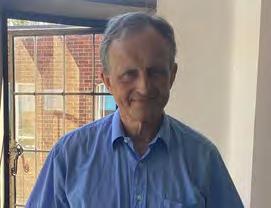
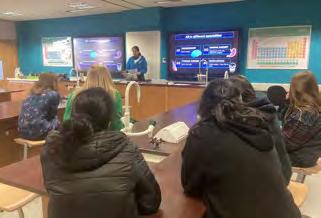
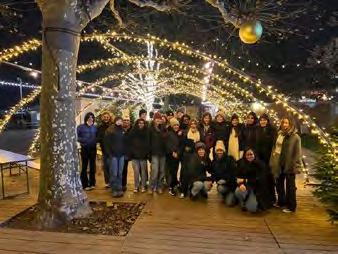
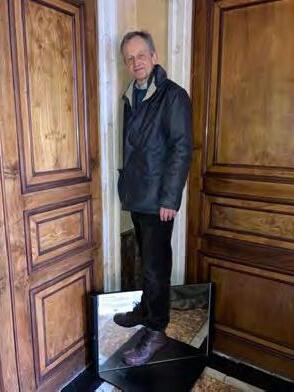
We decided to interview one of the most experienced teachers at the Abbey, Mr Hills from the physics department. We will now give an insight into his experience at the Abbey as we know many former and current students may be curious about his life.
How long have you worked in this school, Mr Hills?
It must be the year 2000. Yes, 23 years now.
What made you stay at the Abbey for so long and how was your experience prior in your teaching career?
Before I came to the Abbey, I worked at only boys’ schools. So, the Abbey was my first experience teaching girls. I guess I enjoyed the calmer atmosphere in contrast to the prior schools I worked at.
How did science at the Abbey change over time?
We gathered funds and built extra labs especially in the Physics department. We used to have only two physics labs! One of the old biology teachers believed STEM should be a priority at the Abbey, so we decided to build two more physics labs.
What was your favourite memory over the years?
It has to be the CERN trips that we go on once every two years. One year we actually were able to go underground and see the actual particle accelerator. I will always remember that, perhaps it is my favourite memory.
When you were in school, what made you decide you wanted to study physics? What A-levels did you take?
physics. In my second year I decided to pursue a physics degree instead.
Did you ever want to be an astronaut?
I don’t think I did. As I said I was always more interested in the theoretical side of physics.
What is your favourite and least favourite topic to teach?
My favourite topics are quantum physics and waves. I know it’s not everyone’s favourite but I enjoy exploring concepts of physics beyond memorising and applying equations. My least favourite, on the other hand, has to be electricity. I don’t enjoy resistors calculations as much as other parts of physics.
What is your favourite physics equation?
My favourite is probably P=IV due to the way my students often try to remember it, “piv”!
What books would you recommend for aspiring physicist?
How long have you worked at the Abbey?
This is my fourth year at the Abbey. I started in 2019, and then Covid and all the chaos! School closed in March and after that, Boris said that people were allowed two jobs (because he was worried about the fruit picking at the time) so I went back to the lab in Basingstoke over Easter and stayed all the way through to the end of August, before school started again in September. I was testing samples for antibodies against Covid; at the time, there was a big question about whether the NHS staff had antibodies, so all staff were tested and I was seeing everyone who was positive.
What were your best and most challenging experiences in that job?
The most challenging part was the pressure; I was extremely busy and working nights, as well as being on call and working weekends. The best part was probably diagnosing all sorts of diseases; meningitis in particular. This was the most important thing I used to diagnose on call - babies that came in showing signs of meningitis. It was down to me to find out whether it was or wasn’t. That was the most rewarding part of the job, I think.
Are there any elements of the lab that you miss other than the patient diagnosis?
What inspired you to take on that kind of work?
I knew I wanted to do lab work, something practical, not sitting in an office. So I looked around and found you could do Medlab Sciences (it’s called Biomedical Sciences now). I just looked up hospital labs where there were vacancies and I had the choice between histology (which I realise now would have been very boring) or medical microbiology which is fascinating and so I chose to specialise in microbiology.
When did you decide to move to the education sector?
What is your favourite experiment?
I love the transition metals because you get all those lovely colours, it’s really pretty seeing all of the colours change. I like the thermit with the iron oxide and the aluminium, mostly because of the explosion. It’s very satisfying when it works! Another one I enjoy is one you don’t actually see, but whilst setting up the assessed practical for the percentage of copper in brass, I have to place the brass rivets into concentrated nitric acid and you get a beautiful green solution with a horrid brown gas given off; that’s always fun to see. Anything with colour is pretty isn’t it? And the dramatic explosions, they’re always good, without blowing the school up or setting the fire alarm off…
If you could give your younger self one piece of advice what would it be?
Not be scared of change. I did the same job for such a long time, at the time I thought I can’t do anything else, I’m so specialised, but it all works out in the end. Don’t be scared of change, just go for it, it’ll work out. You stay in one job for 30 years and you think, how do I even go for an interview? But here I am, and it’s great, so don’t be scared of change, do lots of different things and make sure you enjoy them.
I always like to recommend Stephen Hawking books. Always read your textbook too! The textbook is a wonderful resource.
We would like to once again thank Mr Hills for volunteering to contribute into the science magazine.
I always enjoyed maths and I saw physics as a subject in which I could apply my maths skills. I took maths, further maths and physics at A-level and initially chose to study maths at university. However, when I was at university, I realised that the side of maths I enjoyed the most was practically
I was a state registered Biomedical Scientist specialising in Medical Microbiology; that means I was working in Pathology labs in hospitals. I worked in Basingstoke, the RBH and Stoke Manderville. It was all focused on infection: septicemia, meningitis, urine infections. The samples came in, we would plate them up on agar, see what pathogens grew and test them against various antibiotics. The Doctors and GP’s would then get a report telling them what antibiotics they could and could not use to treat the infection.
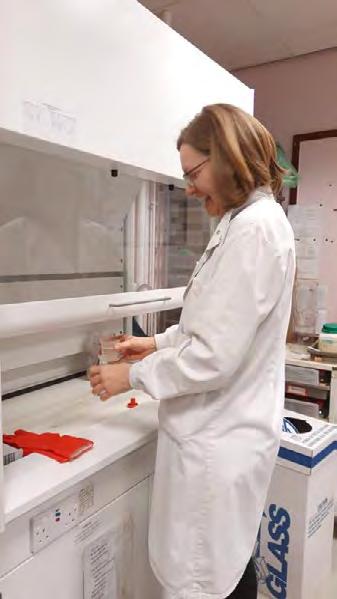
I do miss it, in the sense that, in the hospital lab there’s a lot of banter (like I have with Mr Lovibond) whereas here I’m mostly in the prep room on my own. So it’s nice to mix with all of you and do the odd experiment and help on trips. That’s the major difference, really, I’m on my own a lot of the time which I haven’t really done before. In the hospital there’s a huge team. It’s different. I never thought I’d be doing chemistry in this setting. Although biology is my background, and I really loved microbiology, it’s fun doing bucket chemistry, seeing the practicals work and all the explosions go bang! And there’s no stress, being in the hospital was very stressful. It’s good fun down here in Chemistry.
You know how we have inspections at school? Well, we had lots of inspections in labs! That was getting really tight; you had to have paperwork for this, paperwork for that, couldn’t do anything without filling in a form in triplicate. I thought, this isn’t about the patient anymore, they’re more interested in control - quality control, quality assurance. And I thought, I can’t be bothered with that side of it, it was the patient side I liked, doing the diagnosis. And it was getting a bit crazy, I was so tired working nights and weekends, so I thought what else could I do? What can you do? I was so specialised. All I’d ever done was microbiology and who in the outside world knows anything about that? And a friend just said, have you thought about a school? So then I had a look, this job was going so I applied. But I switched to Chemistry and all my microbiology colleagues were terrified. They said you shouldn’t do chemistry, but here I am, and I love it.
Do you wish to work in the biology department?
No, actually I don’t. I’m quite happy in the Chemistry department. It’s great!
So far what’s your most memorable moment at the school?
I reckon setting up the (damn) covid screening labs in the Richards Hall! We were doing lots of screening of staff to start with and then had to screen all students before they could return to school. Having to set all that up and keep it on track was definitely an unexpected task, but of course it was all stuff I’d done before, so it was easy for me to do, but still a pretty big thing in this setting.
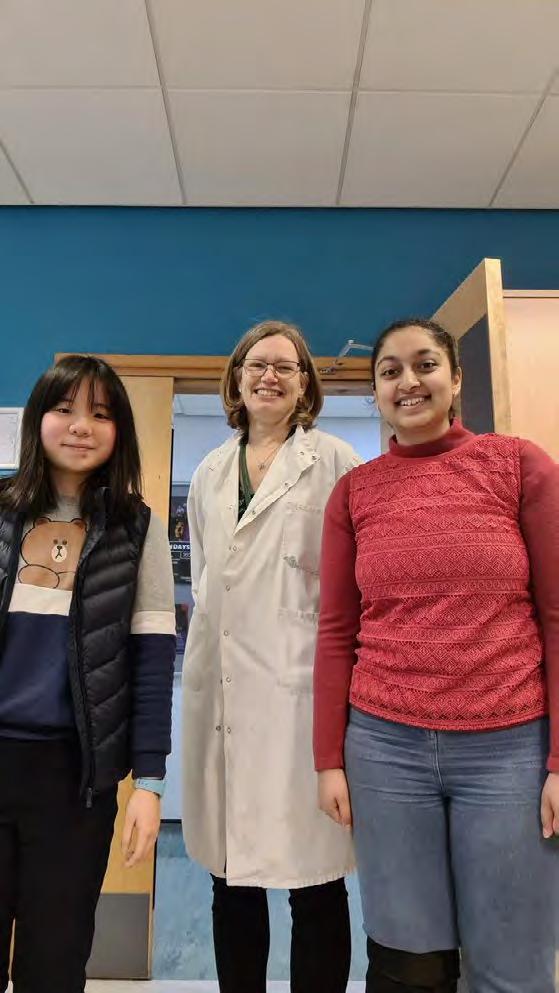
Chloe and Reeti, Upper VI
Aggie, Upper VI
Robotics in Surgery
Reeti, Upper VI
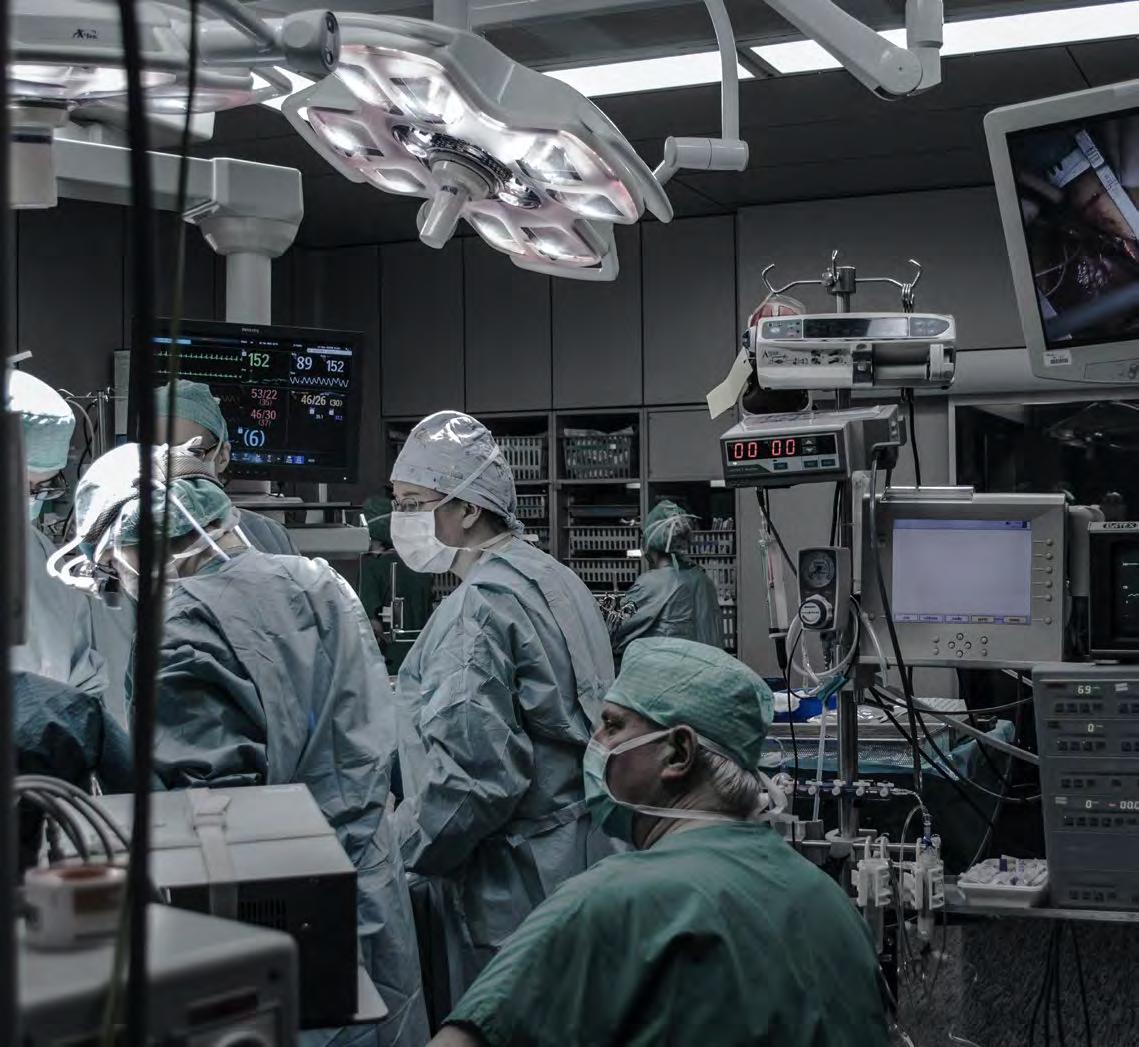
Contrary to popular belief, robotic surgery is not performed by artificial intelligence. Instead, this form of surgery also known as robot-assisted surgery requires a surgeon to control the robotic surgical systems: mechanised ‘arms’ for holding instruments, a dual-camera system, a magnified screen, and a console the surgeon uses to control each movement of the robot. Unlike open surgeries, this form of surgery provides a shorter recovery time, minimal scarring and a reduced risk of infection.
A surgeon’s first step is to make minute incisions at the surgical site and insert miniaturised instruments and a camera. Compared to conventional endoscopic views, this three-dimensional camera provides high-definition and greater depth perception. Next, the surgeon’s hand movements are transmitted to the robotic instruments via the console to perform each part of the procedure with precision. Robotic-assisted surgery does not act independently of humans, but as remote extensions that are in the surgeon’s complete control. However, one concern about robotic surgery is the expensive nature of the robots themselves. Even though purchase and maintenance costs of the robots are significant, the gains from the high use of the robots, shortened length of patient-stay and improved clinical outcomes do seem to outweigh the monetary price. Applications of robotic surgery are extensive: cardiothoracic (heart and lungs), orthopaedic (bones and muscles), urology and gynaecology (urinary tract and reproductive organs).
In cardiothoracic surgery robots offer enhanced manoeuvrability and 3D vision which are crucial for surgery in the mediastinum (the space in your chest that holds your heart). In fact, some of the first surgeries using a robot were cardiac surgeries such as cardiac revascularisation (which involves restoring blood flow to parts of your heart) and mitral (bicuspid) valve repair which repairs one of the valves that is responsible for preventing blood from flowing the wrong way in your heart.
Advancements are also being made in robotic lobectomy for lung cancer to remove the diseased portion of the lung.
There are various robotic systems for orthopaedic surgeries too. They allow for increased accuracy and decreased trauma to the surrounding muscles. For example, a common application is robotic-arm-assisted total knee arthroplasty (resurfacing a knee damaged by arthritis).
Anatomically restrained spaces such as the pelvic space are especially suited for robotic surgery. Some of the most common procedures using robot assistance are radical prostatectomies and partial nephrectomies (removal of part of the kidney, usually due to a tumour). Another emerging application of robotic surgery in this field is for cervical and ovarian surgery.
An event that inspired me to write this article was this year’s Jo Trott memorial lecture by Mr Philip Charlesworth who works as a Consultant Urological Surgeon at Royal Berkshire Hospital. I was intrigued after learning about his journey that led him from A levels to robotic pelvic surgery and wanted to understand more about robots in the field and their applications.
Something that Mr Charlesworth mentioned that particularly stood out to me was how he used his learning from reflecting on experiences of more challenging surgeries to improve the level of care he provided to the next patient. This philosophy is something
What’s on at The AbbeyScience Shorts
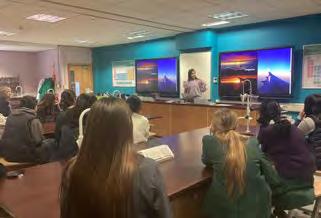
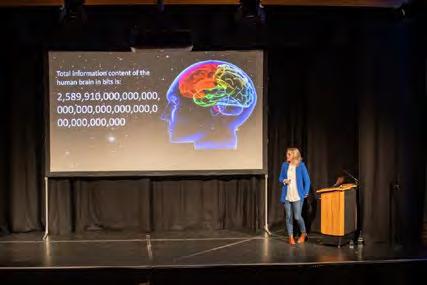
During British Science Week we were treated to a series of Science Shorts; each day we were offered a fabulous science talk on a topic selected by the presenter.
Jigya (LVI) started the week off with her talk on The Science of Sunsets. On Tuesday, Reeti (LVI) taught us about the potential use of Augmented Reality in Medicine. On Wednesday we had Mr Lovibond talking to us about his favourite topic; Hydrogen – The Fuel of the Future. Thursday took us on a trip to Enceladus with Devanshi (LVI) and Shreya (LVI) to investigate the potential for Life outside of Earth. On Friday Ira (LVI) and Emily (LVI) explained the science behind nuclear fusion and the immense potential it has in terms of generating energy.
In short, a week of brilliant talks. Thanks to all the presenters and to the audience for great questions.
that I hope to remember throughout my endeavours. Mr Charlesworth also mentioned that even though it seems daunting, robotic surgery could one day become based on artificial intelligence in the future as technology evolves. Seeing the numerous applications and benefits that this technology is providing for us in the present, I can only be hopeful that robotics in surgery in the future will only bring more success and save countless lives.
Abbey Alumna in STEM
Emily Armstrong - 2011 Leaver
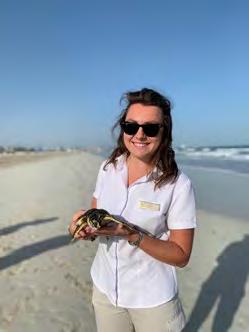
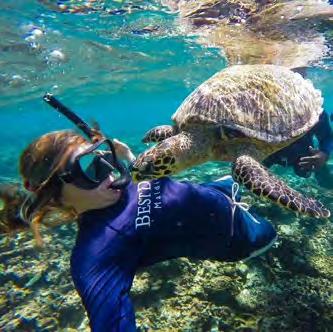
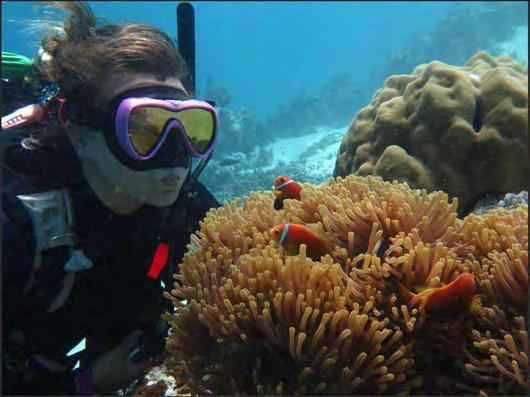
I left The Abbey in 2011 after studying the IB at Sixth Form - I always enjoyed so many subjects, the IB was a great choice for me. Miss Duggan, my Biology teacher, was primarily the reason I chose to pursue a career in science after school; I remember her returning from a conservation trip and telling us all about it - that inspired me to get involved in conservation and the environment. I studied Biology for my Undergraduate Degree at the University of Exeter, and spent my summers volunteering on a turtle conservation project in Northern Cyprus. I then continued at Exeter for my Masters in Marine Biology. During my thesis research, I was lucky enough to travel to Australia to study coral reef fish on the Great Barrier Reef, and I also got to meet David Attenborough! Since my graduation, I have worked on marine conservation projects in Bali, The Maldives, and am now based in Abu Dhabi, UAE - my current work involves conservation of turtle nesting habitats, Hawksbill turtle rehabilitation, and managing environmental programs to make local tourism more sustainable. My top tips for a career in marine science would be to gain as much experience as you can - look around for volunteering opportunities, get a feel for the different sectors (research, conservation, policy, communication), and don’t be afraid to reach out to professionals and put yourself forward. Also remember there are many different ways to land a role in the environmental sector, so stay open to various avenues as you never know where an opportunity could lead!
Rosie Earl - 2017 Leaver
I left the Abbey in 2017 to study engineering at the University of Cambridge, after completing my A-levels in maths, further maths, physics, and chemistry. One of the engineeringrelated highlights for me at school was helping to run the physics club in sixth form and thinking of new experiments the UIIIs could do each week. It was really fun to be involved with, and rewarding to see their enthusiasm for STEM experiments and learning more about how things work.
After graduating in 2021, I started work as a mechanical engineer at a technical consultancy in Cambridge where I’ve been for just over a year.
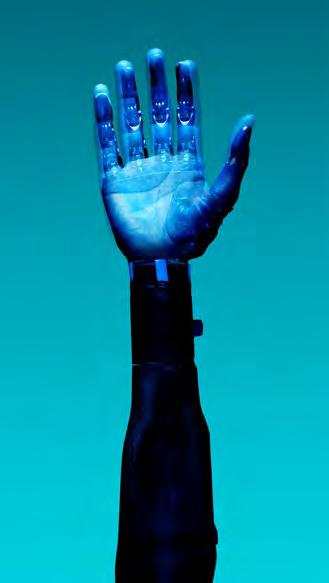
I wasn’t too sure of what I wanted to do after school during LV and UV, but knew I enjoyed designing products, understanding how things work, and learning how physics and maths relate to the world around us. When I was considering different options for University, I attended a careers talk hosted by the physics department from a student studying medical engineering. She’d been designing different inhalers and a prosthetic hand as part of her course, and showed us some really interesting pictures of her designs. I’d never heard of medical engineering before, and her talk inspired me to research and consider it further. Six years later, I’m now really enjoying working on multiple medical engineering projects, from drug delivery devices to healthcare products that consumers can buy in stores.
My advice for anyone considering an engineering degree or career would be to look into attending short residential courses for different engineering areas (such as Smallpeice or Headstart courses) and to research some of the lesser-known fields that engineers can work in - it’s not all about designing fast cars!
Ellie Cherrill - 2018 Leaver
I studied at the Abbey Junior School from Year 4 to Year 6 and then the Abbey Senior School from Year 10 to Year 13. During my time at the Abbey, I loved maths and sciences. I found solving a problem immensely satisfying, especially through applying different techniques. Outside of the classroom, I loved playing netball, so much so that I still play with my work colleagues today.
At A-Level, I studied Maths, Further Maths, Economics and Computer Science. Reflecting now, this choice was a great balance of theoretical and practical, small picture and big picture. During Sixth Form, I dithered between studying Maths or studying Computer Science at university. In the end, I decided the applied nature of Computer Science suited me more, and the job opportunities following a Computer Science degree were growing and growing.
I achieved a First-Class Honours degree in Computing BEng at Imperial College London in 2020. My three years at Imperial were incredible. The studies were rigorous, intense and broad; ranging from Computer Architecture to Logic Theory, Robotics to Machine Learning. The demanding nature of the degree established strong foundations of knowledge in me and prepared me incredibly for working in industry. Outside of lectures, I played for the Imperial Netball team, immersed myself in London-living and made lifelong friends.
Between my second and third year of university, I worked for American Express as part of their Undergraduate Summer Internship Programme. This was my first taste of working as a Software Engineer in industry and I couldn’t get enough. I learned front-end development for the first time, started to understand how the corporate world works and saw how software engineering can solve real world problems. Finally, it clicked that what I truly love about software engineering is, with hard work, curiosity and not being afraid of getting things wrong, you can build anything.
After graduating from Imperial, I returned to American Express as a part of their Technology Graduate Programme. I really enjoyed working there but after soaking up all the knowledge I could, I craved a new challenge. Last year, I joined JP Morgan Chase as a Software Engineer working on the Chase UK app. This is such a fun and rewarding experience, being a part of building a digital bank from the ground up. If you are interested in studying Computing or becoming a software engineer, my advice would be to get involved with technology however you can, be curious, find problems and then try to find the solutions, not just one but many, and then think about how to evaluate which solution is best and why.
Computing is a field with endless opportunities and we build better with a diverse set of software engineers, so it’s time to get involved!
Professor Karen Heywood - 1980 Leaver
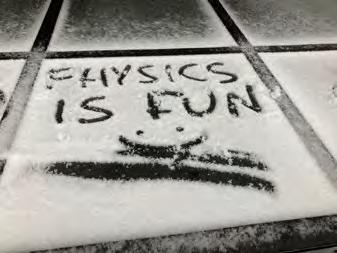
I was at the Abbey from 1973 to 1980. I particularly enjoyed physics – in the early years we had this inspirational teacher called Mrs Harrison who made the lessons exciting. I remember that at the beginning of each class she used to chant “What is physics?” and we had to chant back “Physics is fun!”. She was the reason that I became interested in physics. She left when I entered 6th form, and A level physics was a grind to be honest. My other A levels were maths and further maths – there were only two of us doing further maths.
I went to Bristol to do a degree in physics (I was rejected from Oxford and Cambridge), though the focus there was on solid state physics which I found quite dull. If I had my time again, I’d choose a campus university as I think I would have preferred the sense of belonging. After that I knew I wanted to find things out, do research, in something that was tangible and made a difference. After thinking about meteorology, I happened upon oceanography, and was instantly enthused as I’d always loved the sea. I went to Southampton to do a PhD in the physics of the ocean, then to Bangor as a postdoctoral researcher, and then to the University of East Anglia (UEA) in Norwich as a lecturer – and I’ve been at UEA ever since!
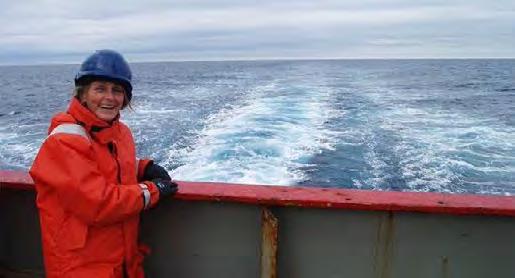
Most of my time is spent on research to better understand the ocean’s role in climate. Science nowadays is all about teamwork, so I’m always having discussions with my PhD students and postdoctoral researchers, looking at plots with them, or planning our next field campaign. I am interested in the polar oceans, and have worked extensively around Antarctica. I feel incredibly fortunate to have a job I love, that takes me on research voyages to areas of the ocean around the Antarctic continent that have never been studied before, with stunning scenery and amazing wildlife. Currently I’m enthusiastic about making observations in the ocean using UEA’s fleet of ocean gliders, robotic autonomous underwater vehicles that send us data over several months. We pilot the gliders from anywhere, and it feels pretty cool to be sitting at home checking up on our gliders just calling in from the Antarctic.
When I was at the Abbey, I would never have dreamt that I’d be an oceanographer, a university professor at UEA, let alone being made a Fellow of the Royal Society or receiving an OBE last year! I’ve been so lucky in my own career, but my advice to you is to seize opportunities, keep an open mind about what you might do, and believe in your own abilities. As Mrs Harrison always said, physics really can be fun.
Artificial Photosynthesis
Silvie, Lower V
Could it be the future of renewable energy resources?
What?
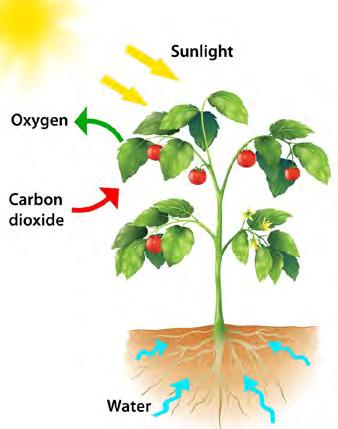
Artificial photosynthesis is essentially the biomimicking of the natural process of photosynthesis or, in less formal words, humans copying the natural process of photosynthesis in a chemical process. Natural photosynthesis is a process which takes place within plants to convert water and carbon dioxide into carbohydrates and oxygen, using light energy from the sun.
Artificial photosynthesis has the potential to be useful to society because when altered slightly to our benefit, humans are able to convert carbon dioxide and water directly into energy-dense fuels, such as methane or ethanol using solar-powered cells.
This method of gaining fuel is reached through a catalyst which effectively converts carbon dioxide and water into methane. This catalyst can be powered both by sunlight and an electric current.
How?
As mentioned, to achieve the production of methane via artificial photosynthesis,
a catalyst device is required. This catalyst is solar-powered and made up of a silicon base-layer, similar to those already in solar panels, and topped with nanowires made of gallium (a semiconductor). The nanowires are miniscule - each 300 nanometers tall (0.0003 millimetres) and 30 nanometers wide. This catalyst provides a large surface area for reactions to take place.
This catalyst is solar-powered but it can also be powered by an electrical current; this means that the methane production can be boosted if an electrical current is added. The device can be run on solar-power alone. However, running it on electricity alone means that it could also work in the dark.
When practised, the artificial photosynthesis panel would need to be connected to a concentrated carbondioxide source. A good option for this is industrial smokestacks which makes this source of energy especially green.
Why?
In November 2022, an article was published which claims that a team, led by Professor Wenbin Lin, at the University of Chicago successfully managed to re-engineer the natural process of photosynthesis so that rather than the product being carbohydrate fuels - like in plants - the chemical process produces more concentrated fuels, methane and ethanol.
This has potential to be useful to humans because of the estimated 2060 fossil fuel elimination. Living without fuel is
out of the question for modern society because they are ubiquitous in everyone’s lives, so the ultimate elimination of fossil fuels is likely to have a dramatic effect. The upcoming elimination of fossil fuels and the high demand for energy has encouraged scientists to research how humans can continue to supply the heavy demand even with the hindrance of the fossil fuel dilemma.
University Purdue has also done a sufficient amount of research and has released an article titled, Soaking up the sun: Artificial photosynthesis promises a clean, sustainable source of energy. Could artificial photosynthesis really be a clean, sustainable source of energy? When plants photosynthesise, what is really happening is that they are converting carbon dioxide and water to glucose energy and oxygen using energy (from the sun). This means that if humans manage to alter the natural process and produce methane and ethanol on large scales modern society could be one step closer to ending the energy crisis and access an abundant supply of energy.
Of course, as of now, this is mostly theoretical although some universities have managed to prove its viability. Humans need to answer the bigger question: ‘Is the creation of enough fuel to supply everyone even possible?’
According to the 2021 article from University of Purdue, enough energy hits the earth every hour - in the form of sunlight - to meet all of human civilization’s demand for a year. This means that if humans are able to harness the sun’s energy into converting carbon dioxide and water into fuels and oxygen it could be revolutionary.
A concern that surrounds this newfound energy resource is what to do at night? The clever thing about this method of gaining energy is that the catalyst used to convert the carbon dioxide and water can be powered by both electric current alone and solar energy alone. This means that if there is no sunlight to provide solar energy we can still power the catalyst using an electric current.
Better than fossil fuels?
In terms of the fossil fuels dilemmas, aside from the fact they will inevitably run out, they also release greenhouse gases into the atmosphere. Now, this is an issue because the greenhouse gases (which include: carbon dioxide as carbon, methane, nitrogen trifluoride, nitrous oxide and sulphur hexafluoride) which are released when fossil fuels are burnt have a negative effect on our planet. The greenhouse effect is a natural process that happens, the gases trap heat in the atmosphere and keep the Earth at a good temperature (15°C/ 59 °F) however recently - in the last century or so - humans have increased the levels of greenhouse gases mainly through the burning of fossil fuels and have consequently increased
the Earth’s average temperature.
However, even if humans are able to produce energy-dense fuels such as methane and ethanol, will it really benefit humans? Yes, it could possibly have an endless supply of fuel to be burned to heat water to turn turbines and create an energy current but the burning of both methane and ethanol produce H2O and CO2 which effectively make them harmful to our planet. Artificial photosynthesis may end the current energy crisis but will it be helping our current global warming crisis?
That leads to two questions: does using methane or ethanol from artificial photosynthesis benefit the environment and is the carbon used up in the photosynthesis enough to balance the carbon produced in the combustion of methane or ethanol?
However, answering these questions is a very difficult task as it is not straightforward to measure how many moles of carbon are being used and how much is being produced.
According to an article published by the University of Michigan, they have managed to harness relatively large electrical currents with the catalyst device which should be able to mass produce. The catalyst device is also designed to be especially good at channelling electricity towards methane, with around half of the available electrons going towards methane production rather than byproducts. This means that the carbon levels being produced should not be as damaging as initially thought.
Conclusion
Overall, artificial photosynthesis could be the future of energy resources if humans are able to mass produce the catalyst device and keep finding concentrated carbon sources. This is likely to be useful because of the estimated 2060 fossil fuel elimination and for its green methane production.
What’s on at The Abbey
CERN TRIP
12/12/22
Yesterday morning the abbey physicists, on time as ever, arrived at school bright and early, excited and ready to fly to Geneva to visit Cern! Our day was off to prompt start as we drove to Heathrow, boarding our flight soon after and waving goodbye to England. On arrival our first task was navigating the metro but after various minor conundrums, a couple of mis-directions and a short walk through bustling evening streets, we made our way safe and sound to Geneva Youth hostel! Having settled into our rooms and enjoyed a delicious dinner we set off once again on a power march to the Christmas market, led by our chief navigator, Mr Gilbertson. As physicists are not only smart but renowned for their excellent sporting abilities, we made it swiftly around the beautiful lake and to the huge Ferris wheel which marked the opening of the Christmas market. The Christmas lights and fire pits lit the way as we wandered around the different stalls admiring the various trinkets and sweet treats. Finally, at the sole decision of our navigator, we took a long and somewhat scenic route back through the Genevan night, arriving gratefully back at the hostel and settling into our warm beds.
13/12/22
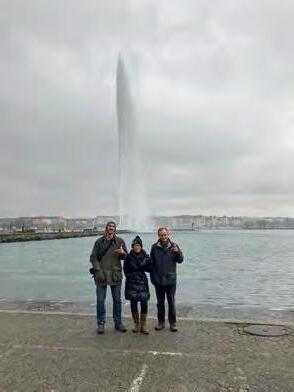
After a few hours of sleep, a bleary eyed breakfast and a lot of coffee, the physics team were raring to go, hopping onto a boat to the old town after a short walk through the snow. Toured through the town by our local expert Mr Hills, we came under sudden ambush from some well targeted snowballs. However, following an icy retaliation, the aggressor was
quickly taken down with a snowball to the head. Next came another opportunity to showcase our peak fitness levels, when having entered the ancient (and very beautiful) cathedral, we made the climb up the many stairs to the top of the cathedral towers. Despite getting lost once or twice, the trek soon became worth it with views at the top of the tower looking far out over the town. After our mini exertion we went off for a sit down and some lunch, intrepidly exploring the many shops and doing a bit of retail therapy. Next came a boat ride, tram and brisk walk to the
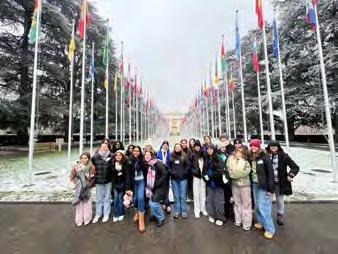
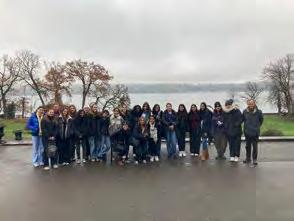
Red Cross museum on the other side of the town, where, through a series of very poignant displays, we learned about the vast number of lives affected by conflict and the vital action being taken by the Red Cross to unite individuals divided by adversity. This was a very humbling experience, prompting us all to take a moment to appreciate our families back at home. After that we whipped down the road, for a guided tour around some of the UN buildings - of course capturing a picture outside the iconic flags first. On our rounds we were given insights into the varying architectural influences of each of the impressive conference rooms, hearing about the history of the UN and its impacts and even getting to listen into a
meeting about biological weapons! After concluding a thoroughly enjoyable tour and several mildly heated conversations about current affairs, we hopped back on the tram and headed back to the hostel! 14/12/22
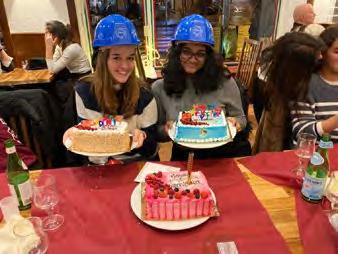
The third and most exciting day had finally arrived! Energy levels were not only high on account of LHC anticipation but also owing to the two birthdays in our midst (a very happy 17th to Sophie and Ira)! Our morning kicked off with a very interactive
talk on data science and the use of binary code from two Cern scientists, pitched at a perfect level to help those not so adept at technology to understand the important uses of data collection and leave those more advanced with some intriguing takeaways - some of the team were even involved in some histogram building. After that it was time for an early lunch, which as ever, posed the joy of attempted communication in French, a task which can only be described as subjectively successful. Then following some time at the gift shop we were jetted off to the main CERN facilities. Our first stop was the data collection site, where we learnt about and were able to see the huge data storage facilities used for the vast
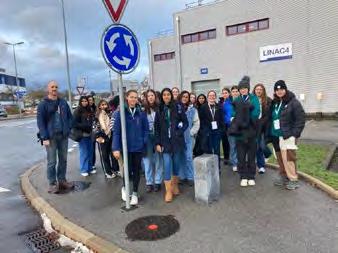
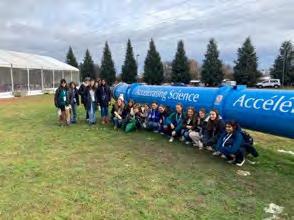
amount of information produced. As we marvelled at the progression of technology over the decades, our guide was keen to inform all of our questions about the power usage and maintenance among many things as well as giving as detailed insight into the goings on at CERN and its purpose as a facility. Next, we split into groups to go and see one of the smaller particle accelerators! Donned with radiation monitors we were able to see the very magnets used to bend the paths of the protons and learnt in detail about the different stages of particle acceleration. There was masses to take in and the overall sentiment of the day remained that of awe. We then made one final trip back to the CERN exhibition, which related the goal of the institute to replicate the conditions of the big bag through an immersive floor-to-ceiling display - a spectacular end to the day. However the excitement was not over as we headed out to dinner at an Italian
restaurant to celebrate the birthday girls. The tables and the atmosphere was especially lively on account of the match which added to the evening’s enjoyment. The delicious foods and huge portions were topped off by three beautiful birthday cakes and a rowdy rendition of happy birthday, accompanied by some CERN themed presents! Finally we returned back to the hostel, where some haphazard last minute packing was occurring for our departure the next day.
15/12/22
Our departure day dawned to a slow start as we heard our flight had been
TOP OF THE BENCH –Royal Society of Chemistry
cancelled! However with the nifty work of Mr Hills we were soon booked on the next flight home. In light of this we had a slow meander around the science museum seeing all kinds of historical scientific equipment and their backgrounds. This was followed by a quick fondue lunch of traditional Swiss origin and a rapid train back to the airport. After the quickest and possibly most scanty security check imaginable, we were through to our gate and after some delays onto the plane back home! All in all, a fabulous trip - thank you especially to Mr Hills, Mrs Robinson and Mr Gilbertson for taking such good care of us all!
Helena, Upper VI
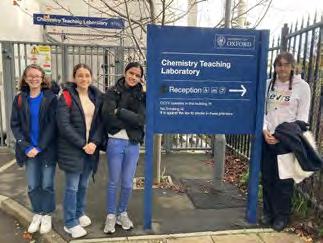
On November the 23rd, I and three other Abbey students had the incredible experience of participating in the Royal Society of Chemistry’s “Top of the Bench” challenge. The competition took place in one of Oxford University’s chemistry labs: an impressive, brightly-lit room full of modern equipment and with one wall lined entirely by fume cupboards. The challenge consisted of a few experiments which we had to complete in our school groups, introducing us to new equipment whilst drawing on prior knowledge. To start with, we used thin-layer chromatography to identify an unknown sample. The results of the chromatogram could only be viewed under UV light, which called for a special piece of machinery! We matched up the sample with the chemical eugenol, and calculated the sample’s concentration using further chromatograms.
The second task involved using a piece of software to measure the light absorption of different concentrations of a substance X. I plotted a graph with the results, and we read off the graph to find the concentration of a sample of X (after first finding its light absorption by using the software).
To finish off, we received a virtual talk from Professor Tom Welton about his journey to being a Professor of Sustainable Chemistry at Imperial College London, focusing in particular on the extraction of cellulose and its many potential uses, especially in green energy.
We did not come in the top three schools, but the experience of working in a professional lab with new equipment was invaluable and highly enjoyable. (Maria, Upper V) It was really cool to be able to do experiments in the Oxford University teaching labs and use equipment that I had never used before like the fume cupboards and the UV light machine. I got to go there as a team of four to do a challenge that involved several stages. One of them was chromatography, which I had just learnt about a few weeks ago!
The talk by Professor Tom Welton at the end of the day was also very interesting as he told us a true story about how a mistake by a PhD student led them to a new discovery! Even though we didn’t win the challenge, it was a very inspiring and fun day. (Matilda, Lower V)
Attending the Top of the Bench Chemistry Competition at Oxford University was a tremendous experience which has undoubtedly improved my chemistry skills and boosted my self-confidence. The chance to be able to compete against other students created a terrific atmosphere; as well as completing tasks which required us to work with pieces of apparatus and techniques which were wholly new to us, such as ultraviolet, wave absorbance and new software, we were also enlightened with a talk by the 2020-22 President of the Royal Society of Chemistry and Professor of Sustainable Chemistry at Imperial College London, Tom Welton. His talk brought to our attention that although everything may not work out the way we had hoped in the first instance, things will always work for the better in the end! (Silvie, Lower V)
The Case of the (Not) Exploding Universe
Matilda, Lower IV
All of the observable universe, except energy, is made out of matter. This matter is, in turn, made up of particles, which have a mass and a charge. For instance, electrons have a negative charge, protons have a positive charge, and neutrons have a neutral charge. There are also many other types of particles, which each have their own charges, whether negative, positive or neutral.
So far, this is all fine, except for the fact that matter isn’t the only thing that exists, or should exist, in the universe. There is also something called antimatter. This antimatter, as well as having a name straight out of an unoriginal science fiction book, is exactly like matter, except it has opposite charges. A positron (antielectron), for example, has a positive charge, and an antiproton has a negative charge. These antiparticles can, like their counterparts, get together and form antiatoms. And when antimatter meets matter, the offending antiparticles and particles have the tendency to explode, wiping out both parties.
In other words, antimatter + matter = energy. This also means that energy can split into equal parts matter and antimatter. So why does this matter? (Sorry, I had to.) Well, the universe started with the Big Bang, which held massive amounts of energy. This energy should have split into matter and antimatter, which would not bode well for the continued existence of anything. If there were really equal parts of both at the start of things, they would have very efficiently and powerfully annihilated each other.
Yet, clearly, this didn’t happen. One solution for this problem is that some antimatter and matter managed to avoid each other, and co-existed perfectly happily in opposite ends of the universe. However, if any matter, carried by things like solar winds, ever touched any antimatter, it would show up to us with a burst of gamma radiation (pretty much hyper x-rays). It is highly improbable that this wouldn’t have happened yet in the observable
universe. So, people have theorised that the answer is something else entirely.
Some scientists believe that, at the start of the universe, there were three billion and one particles for every three billion antiparticles. In that case, everything would have been obliterated except for the one particle, repeated over and over again. These remaining particles, even though they were a tiny fraction of what was made by the Big Bang, would have gone on to start creation. However, nobody actually knows why the asymmetry between matter and antimatter that made this possible would exist, so they came up with another theory, to do with neutrinos.
Neutrinos are amazing. They are a byproduct of nuclear fusion in the core of stars, and every second, around 100 trillion of them pass through you, straight from the sun. You don’t notice them because, out of the four fundamental forces, neutrinos only adhere to the weak nuclear force and gravity. The weak nuclear force is, well, weak, and they have incredibly little mass, so they can mostly skirt around particles. The thing that makes them relevant to this is that they have a curious habit of changing ‘flavours’.
A neutrino has three flavours - muon, electron, and tau - which they can shift between. This is caused by a quantum mixture, or superposition, of three different masses, which evolves over time. Since neutrinos and antineutrinos can only annihilate each other if they are the same flavour, scientists are currently trying to discover whether
the evolution of the superposition for neutrinos happens at the same rate as for antineutrinos. If it doesn’t, they wouldn’t have been able to destroy each other. This could explain why the universe exists.
The first and foremost experiment trying to prove this is DUNE, which stands for Deep Underground Neutrino Experiment. It will consist of two neutrino detectors, placed 1,300 kilometres apart. A beam of neutrinos will be fired from Fermilab, in Illinois, which will then be received by the Sanford Underground Research Facility, in South Dakota. As the neutrinos travel underground to get from these two locations, they will morph into one of their three types, which will allow scientists to test this theory. DUNE is due to start collecting data somewhere around 2026. Then, we will finally be able to see if we know the answer to one of the biggest questions in the universe: why haven’t we exploded?
What’s on at The Abbey
Professor Danielle George and a Career in Engineering
On the 9th of February 2023 the IET in partnership with the Abbey School hosted an event with the aim of inspiring students to learn more about the many possibilities a job in engineering can offer.
The speaker of the night was the past IET Presidents Professor Danielle George who is a professor in Radio Frequency Engineering and is the Associate Vice president in the University of Manchester. She was the President of the IET from 2020 to 2021. Danielle was also appointed MBE in the 2016 Queen’s honour list for services to engineering through public engagement. She was able to give an inspiring speech that talked through her projects and inspirations through her years of being an engineer.
The vote of thanks was given by the Head Girls of the Abbey school who thanked Professor George for sharing her experiences and joining them that evening.
The students who were there to experience the event were then instructed to go to different breakout rooms that held some voluntary speakers who were also professional engineers. The students were able to interact and ask questions to the engineers who answered them willingly and brilliantly. The evening ended with refreshments in the Hardcastle Hall and a further opportunity for people to interact with the speaker and the many other engineers who had been invited.
It was a spectacular event that held a lovely atmosphere and the IET Berkshire committee were extremely pleased with the outcome of a very successful event. I hope that this event will be able to help inspire many students and I am looking forward to other events like this in the future.
Gene Therapy
Knot Theory
I wanted to introduce you to a bit of knot theory and how it can be applied to various aspects of science, mainly fluid mechanics.
Knots and linked loops exist in turbulent fluids of all kinds. This is because, as the fluid rotates, streamlines that outline the vortices are dragged around and behave like knots. In 1969, these intriguing connections between knots and fluids were discovered by the pattern between an invariant called the linking number (which describes how knots and unknots can be linked together with a constant) and a quantity called helicity (which shows how the fluid twists).
For those who are interested in knowing more about the actual connection: helicity of the vector field may be recovered as the limit of appropriately weighted averages of linking numbers of knots.
It is possible to apply knot theory to cases from earth’s magnetic core, to turbulent fluids like water, modelling DNA or quantum knots.
There are also many questions that need to be answered in the field. The most pressing one may be thinking about what happens when knotted or linked vortices in the viscous fluid cross and separate in a process called reconnection. Some researchers hypothesise that link or knot helicity is converted into “twist helicity,” or faster swirling of the vortices, keeping the total helicity constant. as we get
to understand more about helicity conservation we will achieve a better understanding of fluids and therefore will be able to produce more accurate models.
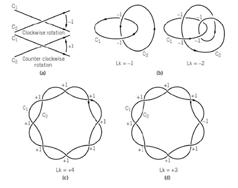
Let us now look at how the linking number is calculated. The linking number is an invariant, meaning that even if the planar isotopy is changed the linking isotopy stays the same. Therefore, no matter how I adapt this knot it will have the same linking number.
The picture above demonstrates how numbers are assigned at each individual crossing. If the top strand has to be rotated counter clockwise to be placed on top of the bottom strand the linking number is +1. This idea also applies with clockwise rotation, this time the linking number being assigned as -1.
If you’re interested in learning more about the topic I would recommend “the knot book” (nice pun) by Adams. In this elementary textbook, you will learn about how knots can be tabulated using different notations as well as applications of knot theory in other fields.
Alisa, Upper VI
According to Google, gene therapy is “ the introduction of normal genes into cells in place of missing or defective ones in order to correct genetic disorders“. Although this is the general idea of gene therapy, I think that this revolutionary field of science is much more. Over the last 5 years in this field, scientists have made more discoveries than in the last 50, and there is always something new waiting to be discovered.
In 2020 scientists Jennifer Doudna and Emmanuelle Charpentier made a ground-breaking discovery in this field- CRISPR. This state-of-the-art technology allows scientists to practically manipulate the basic building blocks of life. CRISPR is at the forefront of this rapidly moving field and has left the world with an amazing new tool in its hands. The potential of this is truly unfathomable, and many scientists have been pushing the boundaries of science as we know it with CRISPR. Before we delve deeper into what has been happening, it’s crucial to understand just what CRISPR is, and what it does.
As with most great science breakthroughs CRISPR came around by accident . The two scientists were at first researching bacterial immune systems when they noticed the CAS-9 protein which protects bacteria from infection by plasmids and DNA viruses. As a defence mechanism, when bacteria are infected with a virus they capture small pieces of the virus DNA and insert this into their own DNA in a particular pattern to create segments which are known as CRISPR arrays. CRISPR enables the bacteria to remember this virus and similar ones. If the virus strikes again, the bacteria produce RNA segments from the previously created
CRISPR array which recognise and clamp onto specific regions of the virus DNA. This is when the CAS-9 protein comes into use to snip the virus DNA which in turn stops the virus infection.
The CRISPR CAS-9 mechanism has been adapted for genome editing.
The prevention and treatment of human diseases is a major area of focus for genome editing. Genome editing is currently used in research to study diseases in cells and animal models. Researchers are currently figuring out whether this method is safe and effective to use in humans. The use
of CRISPR is being investigated as a method of treatment in a wide range of illnesses e.g. cystic fibrosis, haemophilia, and sickle cell disease. Additionally, it shows potential in the treatment of more complicated illnesses such as cancer, mental disorders, and HIV.
Whilst on the whole these tools could bring a great amount of good, they also hold the possibility to be abused and when human genomes are being edited, ethical questions arise. The main ethical dilemma is concerning the editing of germline cells - cells which give rise to gametes (sperm and egg
cells). Currently, the majority of genome editing modifications are only made to somatic cells (these are cells that aren’t egg or sperm cells) and when these cells are altered the differences aren’t passed down from generation to generation. On the other hand, when germline cells are altered these alterations could be passed onto future generations, potentially having catastrophic effects on the human gene pool. Genome editing of germ cells and embryos raises a number of ethical issues such as whether it would be acceptable to use this method to improve human traits and create ‘designer babies’ and abusing the medical purpose.
In 2020 however, a Chinese doctor performed an experiment on unborn twin girls using CRISPR to prevent them getting HIV from their HIV positive parents. This matter raised huge concerns in the scientific community that embryo and germline cell editing has been banned in many countries including the US, UK, and most of the western world.
In conclusion, whilst genome editing could have an amazing impact on our human species, do we really want to be messing with nature and tampering with the building blocks of life?
Kimuthu, UpperV
Grace W, Lower V
Kitchen Chemistry
Chloe, Upper VI
Food Science - From rapid Chocolate Mug Cakes to slow-grow Rock Candy
Exploring the science behind some simple recipes will help you see food and cooking processes in a whole new light. Here are two yummy recipes you could try at home followed by the Science bit!
Wait…how does this work?
Just a few ingredients and a mere 2 minutes in the microwave! Be careful it’s hot to handle!
The carbon dioxide gas within the batter moves upwards, creating lift and forms the architecture your cake needs.
Time: 2 minutes of prep, then only 2 mins (what a quick fix!!)
Source: Microwave Mug Cake | BBC Good Food
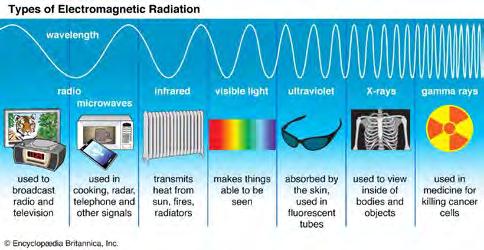
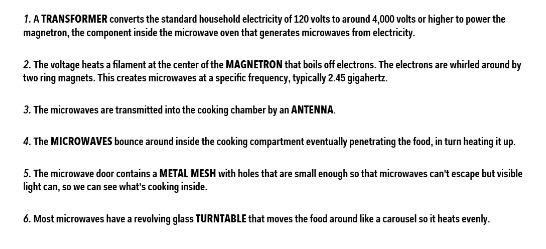
To start with, we have the microwave. Usually behind a small panel of high-grade plastic on the right side of our magic-humming box friend, you’ll find a component called a magnetron. Believe it or not, this humble but genius device is actually the basis of how microwaves work. It uses electricity from an outlet to generate microwaves and radio waves (RF) (yes, the electromagnetic spectrum is joining the party), where they are channelled into the microwave ready to penetrate any food inside.
These waves excite the water molecules in the food heating it up, and if you might have noticed, there’s a turntable in the microwave that continuously rotates the dish, evenly distributing the wave energy throughout our food. Here is the microwave-food story!
But how does the liquid, gooey chocolate mixture transform into such deliciousness by simply going for a ride in the box? Your ingredients, those common baking items, play a huge part in making this successful.
First up, we have flour and water being the main body of our cake. As we mix these two ingredients together, some of the proteins in the flour form a rubbery to feel, elastic network of proteins called gluten, which coagulates into a strong structure using heat from our box friend.
Next, 2 more key ingredients come into play. BOTH baking soda (aka sodium bicarbonate, an alkali), and an acid (usually cream of tartar / tartaric acid), react together producing bubbles of carbon dioxide gas which cause our lovely cake batter to rise.
Meanwhile, hopefully you have not forgotten the presence of our always amazing buddy, eggs (only the yolks in this case) in our batter, where they act as emulsifiers, allowing fats and liquids to combine. If your cake is too dry, you can try adding egg whites as well. Just be aware that proteins within the white can denature, or lose their structure, which may affect the texture of the cake.
Now you know where all that chocolatey lusciousness came from!
Everyone can be a scientist, as long as you stay curious!
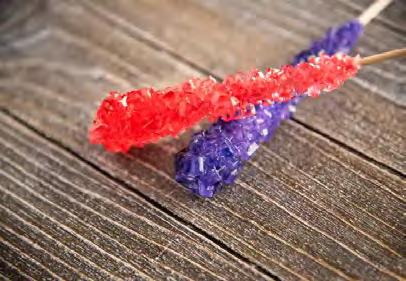
The key to this recipe as an experiment shall now be revealed…the factor that determines 90% of the success of your rock candy is…saturated solution!
As your science teachers might have told you, a solvent’s ability to dissolve a solute changes with temperature. In this case with water and sugar, to be precise, at room temperature, water is only capable of dissolving around 67 percent of the sugar you pour into it. That specific saturation point at that particular temperature relates to supersaturation.
Huh, what is supersaturation?
In simple terms, it means when the concentration is less than 67 percent, any solute (i.e. sugar) you add to the solution will dissolve trying to reach a kind of equilibrium, while room-temperature solvent (i.e. water) with a solute concentration any higher than that makes a “saturated solution”. To make rock candy this way, however, simply “saturated” will not be sufficient, we’ll need a SUPERSATURATED solution for enough sugar to crystallise. So in order to achieve this, we must use a large amount of sugar and we have to boil the water first.
What happens next?
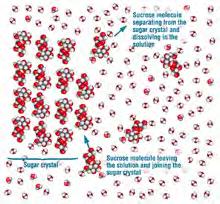
When the water is boiling, the sugar concentration stands at 75 percent (what? 75% only for 2.5 cups of sugar? Do not underestimate water’s ability to dissolve sugar) and it remains the same when the solution cools to room temperature. At that point, sugar molecules in the solution will try to reach equilibrium by lowering the concentration to 67 percent. They do this by going back to their original state - crystallising!
In their solid form, the sugar molecules have less energy as they are constrained in their lattice, which allows them to stay on the chopstick. The sugar on your chopsticks makes it easier for crystals to grow around them, but as you’ll notice, they’ll also form on the walls of the mason jar and even on the very surface of the solution.
Finally, after about 2 weeks’ worth of crystallising (huge moment coming up), when the sugar concentration has reached 67%, crystals will stop growing and your rock candy will be as big as it can be, perfect time to collect your hard work!
Let’s stretch our thinking…how does sugar actually dissolve in water??
No, this is not magic, let’s hear what science has to say, they seem to have an explanation
Let’s explore some of the science behind growing your own rock candy!
Unfortunately, yes, growing rock candy takes quite some time. You’ll start to see some crystals by day two, but they don’t reach their peak growth until after 1-2 weeks. Crystals take a while!
Time: 30-40 minutes of prep, then up to 1-2 weeks of waiting.
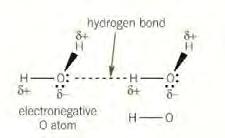
for that…Water molecules, with the molecular formula H2O, are made up of two hydrogen atoms bonded to one oxygen atom.
Introducing polarity with the help of electronegativity…
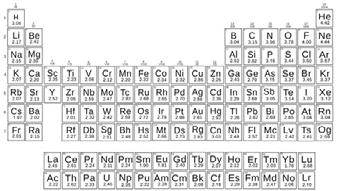
Electronegativity is the ability of an atom to attract the bonding electrons in a covalent bond. We use the Pauling’s scale to find out the electronegativity of each element.
As you can see from the numbers, there is an electronegativity difference between oxygen and hydrogen, and that creates a dipole, causing the area near the oxygen to be slightly negative and the area near the hydrogen to be slightly positive. When a molecule has an area of positive and negative charge like this, it is called a polar molecule.
Introducing hydrogen bonds…
As you may probably have noticed as well, oxygen is also one of the most highly electronegative elements in the periodic table. Therefore, a special type of permanent dipole interaction, called the hydrogen bond, can be formed between polar water molecules.
This type of permanent dipole interaction can be found between any molecules containing a highly electronegative element such as F, O or N with a lone pair of electrons and a hydrogen atom attached directly to an atom of F, O or N. Hydrogen bonds are the strongest among all the intermolecular forces existing.
Sugar is sucrose…
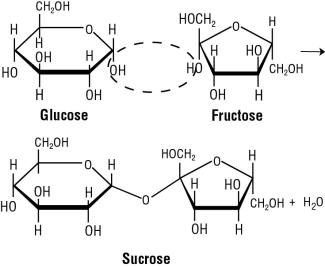
Sucrose, which is commonly known as sugar, has a molecular formula C12H22O11. It is the product of the condensation reaction of two monosaccharides, glucose and fructose.
As shown above, like water, a sucrose molecule also has O-H bonds, which means that it is also polar and can form hydrogen bonds with its own molecules AS WELL AS with WATER MOLECULES.
Now, the “magic” happens…
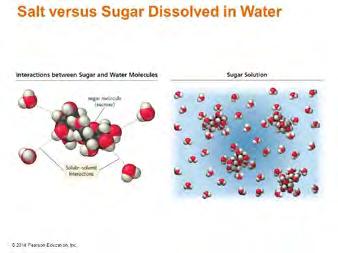
Dissolving a solid in a liquid depends on the interactions and attractions between the molecules of the liquid (solvent) and the particles of the solid (solute). It happens when the attraction between the particles of the solvent and solute are strong enough to overcome the attraction of the particles of the solute for one another.
When water dissolves sugar, the water molecules attract the sucrose molecules and pull them away from each other. The attractions between water molecules and sucrose molecules are so strong that they overcome the attraction the sucrose molecules have for each other and so they separate from one another. As the sucrose dissolves, the molecules become completely surrounded by water molecules and move throughout the water.
We hope you have learned something new today!
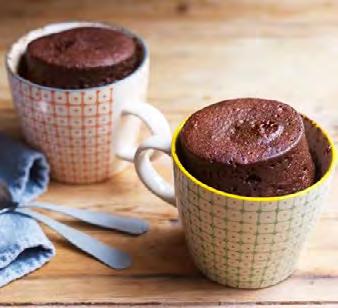
Chocolate Mug Cake:
Source: Homemade Rock Candy Recipe | The Spruce Eats
Connections Competition
Earlier this month we celebrated British Science week. This year the theme was Connections and so we invited you to write about how Science connects to something else in your life. The standard was really high across the board and I loved reading all of your entries, thanks so much to all who entered. The winners are Jo, Upper IV, for writing about the connections between Physics and Sailing, and Nikki, Lower VI, for writing about the connections between the human body and the tree.
winner
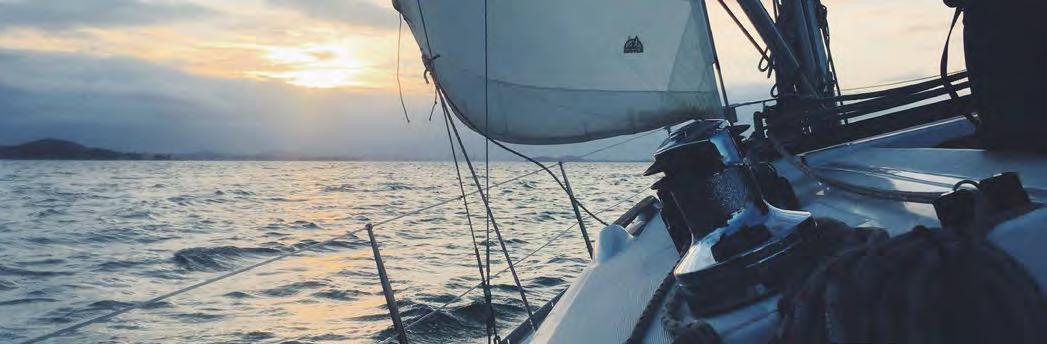
Sailing and Physics - Jo, Lower V
My favourite sport and general favourite thing in the world (except science of course) is sailing and this is how it links to physics
The sails use their shape to create lift and movement. The keel/ daggerboard helps make the boat go forwards and upwind instead of just sipping sideways and down winds. And the shape of the hull helps the sails work and if there is a chine in the water it can also act like mini daggerboards stopping you from drifting downwind. The sails, the hull, and the foils all try to work together helping the boat move forwards.
How the two sails work together is also very important. The front sail (jib) catches the wind and helps accelerate it onto the mainsail as much as it can, which makes it much more effective. If the gap between the sails is really small, not all of the air can get through smoothly, this causes turbulence and stalls the sails (not fast). However if the gap is too large then all the speed gained is lost as all the flow just leaves out the back of the sail and isn’t used to help the mainsail work hard, this is called spilling air. When racing the crews (who sit at the front of the boat), need to find the right spot to pull the jib in to maximise the gains from this. Usually in my boat this is best when sailing in winds where we want to get the most out of our sails they are quite filled and baggy in the middles to try and get as much acceleration out of what little wind we have so the jib is often eased so that when the main is baggy it doesn’t close the gap between the two sails too much. However in very heavy winds we often have the sails pulled as flat and blade like as they can be so that we still get some forward motion
out of the boat but so that the sails cause least interruption in the wind’s path to make sure we do not get knocked over.
Sails are basically floppy upright aeroplane wings. When the wind is curved by the sail it has to accelerate to get round that corner, this produces a lower pressure and that creates the pressure on the sail.
On big boats like keelboats and yachts the keel is used as a weight keeping the boat as flat as possible and to help the boat move forwards. On keel boats the keels have a large weight on the bottom of the keel, this is called a bulb and when the boat heels over it naturally tries to bring the boat back upright. This allows these boats to sail with less people to lean the boat back over and ensure that the boat always comes back upright (making it much safer)
When the wind catches on the sail
Sailing isn’t all physics of moving boats forwards though, there is a lot of physics, chemistry, psychology and biology in Sailing through the building process, the materials and sails design, racing tactics, how racers think, and the human side, keeping fit, eating right, drinking enough and exercise. Sailing is as much about the people as it is about the boat itself. After all, boats don’t sail themselves (yet).
winner The Tree and the Body -
Nikki, Upper VI
‘Feeling at one with nature’ is a sentiment that many of us are encouraged to feel when we are stressed or want to seek relief, but this common quote may hold more truth than we think.
Picture the lungs. The trunk: the trachea. The branches: the bronchioles. The millions of alveoli dividing again and again, reaching out to occupy the lungs as a tree’s leaves stretch out to grasp the sunlight. The harmonious rhythm embedded as you inhale and exhale, as the leaves inhale and exhale. The main blood vessels connecting the lungs to the heart: the pulmonary vein and artery, supplying a constant flow of blood, for it to be regenerated with oxygen. The similar roots of the tree, digging into the core of the soil, sucking up water and minerals which are transported through a complex yet glorious system of connections. The intricate, concentric rings of the tree trunks mimic the unique fingerprints of a person. The lines thicken, darkening through change, the grooves depending through age. The lungs of the earth, we call them.
A naked tree. Stripped of its leaves, standing bare, alone without the ability to respire. Its intertwined branches, complex like the neural network of the brain. The brain: composed of an elaborate network of neurons. When material is revisited frequently, the connections between these neurons strengthen, improving response. Prolonged use of the neurons develops into neural arborization; the genes for that particular neuron are expressed more, leading to more connections between neurons. When humans disregard the necessity of a topic, neural pruning occurs. Neurons which are no longer used are broken down, disrupting the synaptic connectivities, reducing transmission of electrical impulses. Thus, the functioning of necessary networks can be more efficient. The naked tree. In cooler months, the tree loses its leaves, disrupting connections with the surrounding world. There is no more requirement to keep the leaves if they rely on light to function. It carefully conserves the energy and nutrients it has accumulated, just in time for those connections to be built again. The brain and the tree both have the ability to revive their connections within reason - Which parts are necessary and when?
highly commended
Music and Science - Harshini, Lower V
Classics and Science - Maria, Lower V
From brains to lungs, there are many ways in which The Tree and The Body are intertwined. Our relation with nature allows us to find connections with science, deeping our knowledge about both areas. What other connections does the body hold with nature?
The interconnectivity of an unfair world - Savia, Upper VI
The politicisation of science - Shreya, Upper VI
How does playing the guitar link to science - Joshika, Upper V
Science and Music - Luna, Lower IV
Science Recommends
Here are a series of books, shows, podcasts that the Science Department are enjoying. Don’t forget to check out how you can make a difference to Science now, by taking part in Citizen Science projects – there are so many to choose from.
Become a Walrus Detective https://www.wwf.org.uk/learn/walrus-from-space
Help find Jaguars in the Jungles of Panama or sign up to other similar projects on Zooniverse https://www.zooniverse.org/
Reading
Listen to Life Scientific on the BBC; Professor Jim Al-Khalili talks to leading scientists about their life and work, finding out what inspires them and asking what their discoveries might do for us in the future. https://www.bbc.co.uk/sounds/brand/b015sqc7
Listen to Drs Chris and Xand van Tulleken explore if people can change and how they do it. How much of our personality is genetic destiny and how much are we shaped by the world around us? https://www.bbc.co.uk/sounds/brand/m0017tcz
Listen to the brilliant Professor Andrea Sella as he celebrates various elements and their impact on our lives. https://www.bbc.co.uk/sounds/brand/b08p6q4r
Watch The Secret Genius of Modern Life; in this episode the brilliant Prof Hannah Fry looks at the algorithms behind the allimportant food delivery apps on your phone and the history behind the development and tech involved (including a throwback to teletext!)
Watch The Ri explain how the contact explosive Nitrogen triiodide works in this 5 minute video https://www.youtube.com/watch?v=DFfRqoIdArM
The Ri have loads of other awesome videos for you to check out too, and their channel is available here https://www.youtube.com/@TheRoyalInstitution/videos
Explore The Science Museum’s website. They are many interesting things online to help you plan your next visit. You may find their story of the evolution of humanoid robots of interest https://www.sciencemuseum.org.uk/objects-and-stories/robots