Do you have to be kind to be successful in the workplace?
Juliette and Annabelle, Lower V (Year 10)

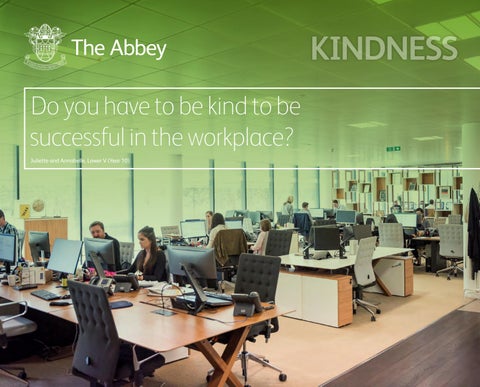
Do you have to be kind to be successful in the workplace?
Juliette and Annabelle, Lower V (Year 10)

Do you have to be kind to be successful in the workplace?
Juliette and Annabelle, Lower V (Year 10)

Kindness has sometimes been considered a weakness in the working world. The key to climbing the corporate ladder is portrayed as having a strong work ethic and emphasis on number-oriented goals, even at the expense of an enjoyable work environment and wellbeing.
However, in the workplace, a culture of kindness is proven to increase sales, boost creativity and collaboration, and motivate workers. A recent study showed that people treated with kindness at work repaid it by being more generous to co-workers compared to a control group. This in turn encouraged emotional wellbeing and productivity, by increasing energy levels and positive perspectives.
This suggests a culture of kindness is beneficial on an employee level; but what about on a leadership level? For decades, business owners and entrepreneurs have taken personality tests to help determine whether they have the right qualities to climb the corporate ladder and succeed. The Myers-Briggs personality test examines a combination of four categories that make up 16 possible personality types. Of all these possible combinations, ENTJ is the most likely personality type of a CEO. They are known as ‘commanders’, and are highly driven, rational, outgoing and charming. They are motivated and find the greatest happiness in their achievements.
This is not entirely surprising: CEOs are helped by these characteristics to come up with bold ideas, and to put them into play. If you look at top CEOs such as Mark Zuckerberg (of Facebook) and Elon Musk (of Tesla), they both are said to have an extremely strong work ethic, even to the point of obsession. However, the most effective characteristics for a CEO may be flexibility, creativity and communication: and yet people without the brutality of a stereotypical CEO may not be willing to do what it takes to get to the top.
What is clear is that it is beneficial, if not essential, that leaders can create an environment of kindness within companies and organisations so that the workplace is productive and collaborative.
“Kindness is beneficial for all and is mandatory for those who are seeking true success, no matter the goal.”
Adrienne Bankert

www.theabbey.co.uk