
THE INDEPENDENT NEWSPAPER SERVING NOTRE DAME, SAINT MARY’S AND HOLY CROSS
MONDAY, OCTOBER 13, 2025 | VOL. LX, NO. 21

MONDAY, OCTOBER 13, 2025 | VOL. LX, NO. 21
By Chris Dailey Sports Writer
Notre Dame kept its College Football Playoff hopes alive on Saturday as they beat NC State 36-7. After a slow first half marked by questionable play-calling, the Irish turned it around in the second with hard-nosed defense and an effective passing game. Freshman quarterback CJ Carr exploded for 342 yards, while the defense notched a season-high four sacks and three interceptions. With the victory, the Irish improve to 4-2.
The Irish’s defense started the game off hot. Sophomore defensive lineman Boubacar Traore swarmed NC State’s shifty sophomore quarterback CJ Bailey for an early sack. Traore’s big play forced a Wolfpack three-and-out and set the tone for the Irish’s first offensive possession of the game.
Thanks to a lively pass rush, Notre Dame’s offense got the ball back just over a minute later. On the second play of the drive, senior wide receiver Will Pauling came up big once again for Notre Dame, hauling in a 42-yard reception. Notre Dame continued to move the ball with ease, feeding the ball to both junior running back Jeremiyah Love and the receivers as they marched towards the end zone.
To the surprise of many,
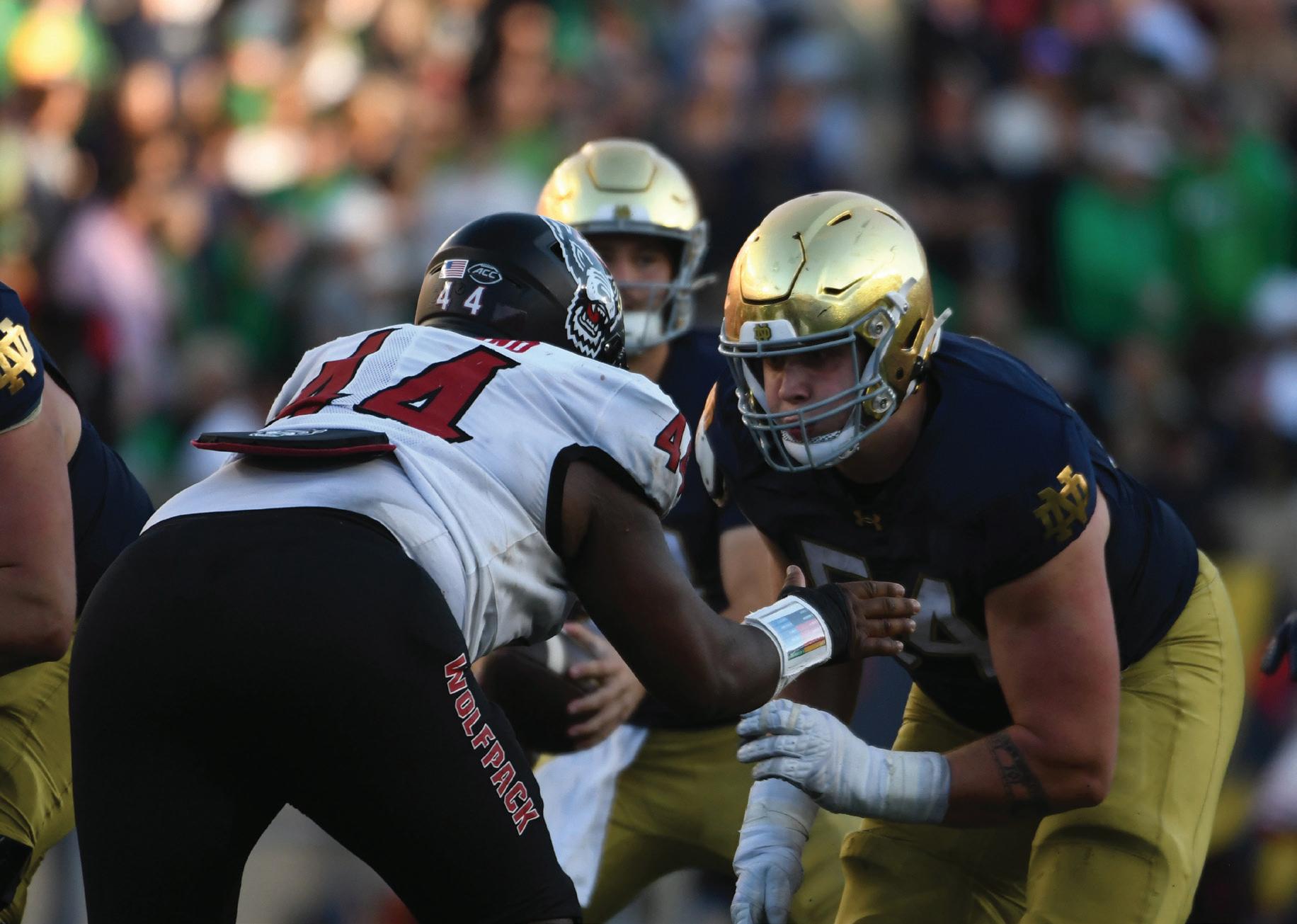
Notre Dame opted to pass on a 4th-and-1. The decision backfired. Carr rolled out of the pocket and was forced out of bounds by the NC State defense for a 10 yard loss. That play deflated the Irish’s offense through the rest of the first half.
NC State’s offense, meanwhile, showed signs of life.
Redshirt sophomore running back Hollywood Smothers
made a few key plays after the Wolfpack got the ball back. A gutsy fourth down conversion later, Bailey found sophomore wideout Terrell Anderson for a 45-yard grab. Anderson darted by freshman cornerback Dallas Golden, leaving himself wide open on the right sideline.
The sudden touchdown drew silence from the home fans and an eruption from the
By Mara Hall News Writer
On home gameday, legacy tailgates take over the Legends of Notre Dame parking lot. These tailgates consist of generations of alumni, many of whom have been tailgating here for over a decade.
Crowley Family Tailgate
John Crowley ‘92 is a key figure of the Crowley family tailgate. He is a former law school graduate and a university trustee who delivered the commencement address to the class of 2020.
The Crowley family tailgate, marked today by their signature green tents, has been running since 2015, when Megan Crowley,
NEWS | PAGE 3
Lecture on hope
Former chairman of the Joint Chiefs of Staff Martin Dempsey lectures on hope in leadership.
John Crowley’s daughter, was a freshman.
“Over the years we have had hundreds and hundreds of different family, friends, classmates, colleagues and random strangers join us for our tailgate, which is great,” John Crowley said.
He notes that the logistics of the gameday experience have improved over the years, but the spirit remains unchanged.
In discussing the broader changes that the University has gone through, Crowley noted the more competitive admissions that Notre Dame has seen recently.
“We all kid around, my classmates and I, that there is absolutely no way we would ever be
OPINION | PAGE 5
Troops in Chicago
Columnist Greyson Beckham shares his view on the nation’s shifting reputation.
admitted today. The kids are so smart, so driven, so talented and again they just all live the same spirit of Notre Dame and commitment to faith, to service and to something bigger than themselves,” Crowley said.
John Romano ‘14 is a friend of the Crowley family, a proud former resident of Dillon Hall and was the football leprechaun in 2013.
Romano said that he comes from a line of around 20 cousins, aunts and uncles who came to Notre Dame before him, but that in addition to that, he was inspired to come to Notre Dame for see “Tailgate” page 2
SCENE | PAGE 7
‘RED CUP’
A one-act play based on Notre Dame students’ testimonials about drinking on campus.
eerily similar 4th-down situation from the first quarter, Freeman decided to go for it.
The Irish faithful experienced deja vu as Carr rolled out to the right with pressure in his face. With nowhere to go, Carr heaved the ball into the end zone and was intercepted by redshirt freshman Asaad Brown Jr.
Although a flag was initially thrown on the play for pass interference on Carr’s intended target of senior wide receiver Malachi Fields, the referees conversed and instead elected to pick up their flag.
small sea of red in the south section upper bowl at Notre Dame Stadium. However, the applause was short lived, as the score was NC State’s only one of the day.
The Irish’s half was characterized by tipped passes on third down and questionable calls from both the play-callers and referees, especially on the Irish’s 4th-and-3 with under two minutes left. In an
Boos echoed around the stadium after the decision. They were perhaps even louder when junior cornerback Christian Gray’s apparent interception was ruled incomplete on NC State’s next possession. The Irish fans’ displeasure quickly turned to jubilation on Notre Dame’s final drive, in which they quickly drove 40 yards downfield in 20 seconds to set up a field goal for senior kicker Noah Brunette. His low-kick just managed to sneak over the uprights, giving Notre Dame a 10-7 lead after one half.
At halftime, Freeman’s message in the locker room was clear.
“My message was stop beating Notre Dame. That was the
see “NC State” page 8
On Friday evening, Saint Mary’s students were alerted to an exposure incident that occurred on the Avenue via an email from director of campus safety Phil Bambenek.
The email shared information on an ongoing investigation in which an anonymous student reported an indecent exposure incident that occurred while she was working on a project Wednesday afternoon.
In the email, Bambenek wrote, “The survivor of the incident reported that she was working on a project on the grass when a male hispanic 50
SPORTS | PAGE 10
Women’s volleyball
Texas transfer Helmers, freshman Kordas break out as Irish run win streak to three.
years of age approached her on a bicycle and initiated a conversation. At some point, she turned away and when she again looked at him, he had exposed himself.”
Bambenek added that the identified suspect is not a member of the tri-campus community.
Bambenek asked that those with questions or concerns regarding the incident contact Saint Mary’s Campus Safety. He also asked that anyone with information reach out to Campus Safety or the St. Joseph County Police Department.
This is the second incident reported at the College this year, following a sexual assault students were notified to on Oct. 5.
SPORTS | PAGE 12
Women’s soccer
The Fighting Irish likely bound for No. 1 after shutting out SMV on Senior Day.

ndsmcobserver.com
“TO UNCOVER THE TRUTH AND REPORT IT ACCURATELY”
900 Hesburgh Library, Notre Dame, IN 46556
Editor-in-Chief
Liam Kelly
Managing Editor Gray Nocjar
Asst. Managing Editor: Aynslee Dellacca
Asst. Managing Editor: Grace Tadajweski
Asst. Managing Editor: Henry Jagodzinski
Notre Dame News Editor: Sophie Hanawalt
SMC News Editor: Berhan Hagezom
Opinion Editor: Redmond Bernhold
Sports Editor: Noah Cahill
Scene Editor: Peter Mikulski
Photo Editor: Mariella Taddonio
Graphics Editor: Isabelle Rutland
Social Media Editor: Duncan Stangel
Ad Design Manager: Isabelle Rutland
Business Manager: Zack Pohlman
Systems Administrator: Jack MapelLentz
Advertising advertising@ndsmcobserver.com
Editor-in-Chief lkelly8@nd.edu
Managing Editor gnocjar@nd.edu
Assistant Managing Editors adellacca01@saintmarys.edu, gtadajwe@nd.edu, hjagodzi@nd.edu
Business Manager zpohlma2@nd.edu
Notre Dame News Desk shanawal@nd.edu
Saint Mary’s News Desk bhagezom01@saintmarys.edu
Opinion Desk rbernho2@nd.edu
Sports Desk
ncahill2@nd.edu
Scene Desk pmikulsk@nd.edu
Photo Desk mtaddonio01@saintmarys.edu
Systems & Web Administrators
webmaster@ndsmcobserver.com
Policies
The Observer is the independent, daily newspaper published in print and online by the students of the University of Notre Dame du Lac, Saint Mary’s College and Holy Cross College. Editorial content, including advertisements, is not governed by policies of the administration of any institution. The Observer reserves the right to refuse advertisements based on content.
The news is reported as accurately and objectively as possible. Unsigned editorials represent the opinion of the majority of the Editor-in-Chief, Managing Editor, Assistant Managing Editors and department editors. Commentaries, letters and columns present the views of the authors and not necessarily those of The Observer. Opinion space is available to all readers. The free expression of all opinions through letters is encouraged. Letters to the Editor must be signed and must include contact information.
Questions regarding Observer policies should be directed to Editor-in-Chief Liam Kelly.
Post Office Information The Observer (USPS 599 2-4000) is published Monday through Friday except during exam and vacation periods. A subscription to The Observer is $130 for one
Continued from page 1
the culture.
He mentioned that the first Notre Dame game he attended was in 1995. He also shared that he has been coming to the Crowley family tailgate for the last 10 years, noting that the game-day experience has gotten significantly busier with increasing fun activities.
Seven Families Notre Dame Tailgate
Ed Delahanty ‘63 is a founding member of the Seven Families Notre Dame tailgate. Delahanty noted that this tailgate started with only two families and expanded from there, with the current seven families doing it together for the last six to seven years.
“Well, this used to be a little tailgate out of the trunk of somebody’s car, that is the way it started. Now we have got a full-time staff that sets up our tents,” Delahanty said.
He also explained that every family has a flag that hangs above their tailgate with the graduating years from those family members.
Velasquez Family Tailgate
Art Velasquez ‘87 noted that his family has a long running history with the University after his ancestors came to the United States as migrant workers around 1920.
“My grandfather went to a different grammar school every year and his version of eighth grade was the last year they had a grade school on Notre Dame’s campus. It was called Minim. When he was here, it made such an effect on him that he said that if he had a son he was going to go to Notre Dame … In 1956 my dad got to campus at Notre Dame and the dream came true,” Velasquez said.
He mentioned that when his father became a member of the board of trustees of the University, they were able to enhance the tailgating experience.
“When my dad became a trustee and he started getting what we call the ‘rock-star parking and ticket privileges,’ we were able to really step up our tailgate that we do every game,” Velasquez said.
Arthur Velasquez, father of Art Velasquez, said, “We had seven graduates. In two years, we will have 100 years of experience with the University.”
The tagline of the Velasquez family tailgate is “Since Forever” pointing to their long-running connection to
Notre Dame. Arthur Velasquez stated that when it was time for college, Notre Dame was the only place he knew. Growing up, his father would bring him to one football game per year, with his first game being a matchup between Notre Dame and the University of Oklahoma about 70 years ago.
He described that, in the early days, the area around the stadium turned into mud when it rained.
Class of 1968 Tailgate
Tom Weyer and Tom Gibbs ‘68 have been running their tailgate since 1966. They met right before starting their freshman year and have been friends since. They reminisced about how they used to have class on Saturdays and would be sitting in class watching people walk to the stadium, envious because they had to be in class prior to the game.
Weyer has a granddaughter who attended Notre Dame and Gibbs has a son and a daughter who attended as well. Gibbs’ son, Bill Gibbs ‘97, played football for the Fighting Irish.
Weyer and Gibbs said that a lot has changed on campus, noting that there are probably twice as many buildings now.
The Notre Dame Fieldhouse, the building that they had pep rallies in, would rock and tremble when they had 3,000
to 4,000 people in it on Friday nights before the game.
McMahon Tailgate
Dan McMahon was a member of the class of 1986 and graduated law school in 1989.
He said that his first Notre Dame game was actually an away game in Chicago against Northwestern University in 1974. His first home game was directly following the national championship of 1973 when they played against Purdue University in 1974.
His tailgate has been running since 1982 when he was a freshman in college. He took on leading it with some friends in 1989 when they graduated.
McMahon, a former resident of Dillon Hall, noted that a lot has changed over the years.
“It is much more organized than it was before. It was very haphazard. Back in the day, this was all an open field, Supreme Field, and you could park wherever you wanted. There were no rules,” he said.
“There could be an RV next to a Fiat car. The dorms would come out and they would stake their ground. There was a baseball field on Green Field at the time that Dillon Hall always got because they had the backstop behind it.”
Contact Mara Hall at mhall27@nd.edu
By Eileen Doyle News Writer
Notre Dame’s Speech and Debate Team gives students the opportunity to compete in collegiate debate formats and offers students the chance to develop critical thinking, public speaking and leadership skills.
The team participates in two primary styles of debate: International Public Debate Association and British Parliamentary. These formats involve structured rounds of timed speeches and rebuttals, with topics ranging from international relations to domestic policy.
Debate topics are also given at varying times, some being announced weeks in advance, others being released 25 minutes before a round begins.
Huggins
Sports
Tyler Reidy
Scene
Peter Mikulski
Opinion
Declan Burke
The Observer regards itself as a professional publication and strives for the highest standards of journalism at all times. We do, however, recognize that we will make mistakes. If we have made a mistake, please contact us at editor@ ndsmcobserver.com so we can correct our error.
According to junior Sam Marchand, president of the team, this helps team members work faster on their feet.
“You have to organize logic immediately, in a way that’s not rehearsed, to portray your intellect,” he said.
The team holds practice on Tuesdays and Thursdays, with general meetings on Mondays.
Junior Z Zavala, current vice president and acting
president while Marchand is abroad, organizes practices and ensures members are prepared for competitions.
“I host the meetings, coordinate with the coach and make sure every individual who wants to compete gets signed off,” Zavala explained. “We do practice debates, strategy reviews and help people understand the structure of arguments.”
New members also receive extra support through beginner-focused sessions and mentorship pairings.
“We keep things slow for those who are new,” Zavala added. “We do icebreakers every week so everyone can get to know each other. It’s much less intimidating when you know the other person is also struggling with a midterm in chemistry.”
George LaMaster, program director of the Notre Dame Scholars’ Program, serves as the team’s advisor. He has been involved in speech and debate since the 1980s and is now teaching a class on speech and debate to help coach students on the subject. In his position, LaMaster handles logistics such as tournament registration and judge coordination.
“My hope is that this will grow into a vital University program,” he said. “Once upon a time, Notre Dame had one of the best programs in the country.”
LaMaster shared stories of the team’s legacy, including a tradition of public debates with the Navy debate team before football games. He also has national championship debate trophies from the ‘50s and ‘60s in his office.
“There’s a long and rich tradition here,” he said. “We’re trying to bring it back.”
Members can walk away from debate with more than just wins, however. Marchand shared that students can also learn well-rounded information and create conversation maps.
“Debaters can develop encyclopedic knowledge of current affairs,” Marchand said. “They can map out any conversation and spin logic to make their position predominant.”
LaMaster emphasized the deeper benefits on a personal level, saying, “They develop confidence, which is key to any professional field.”
A common cause of pride among those who run the organization is the idea of teammembers developing competence and quick-thinking skills that they could use anywhere.
“It’s amazing to see how they grow. I love not only seeing them gain confidence, but also seeing what they achieve,” Zavala said. “The light in their eyes when they find out they made it to semis,
it’s incredible.”
The team’s hard work paid off at their first tournament of the season on Sept. 28. Competing against a field of 19 universities, the team earned second place overall. Sophomore Jack Johnson was named tournament champion in Varsity Debate while freshman Joanna Luan secured second place in Novice Debate within the IPDA.
The team welcomes students from all backgrounds and experience levels, including those from Holy Cross College and Saint Mary’s College. LaMaster also noted how diverse the team community is, showing the importance of a group that is not only intellectually strong, but also one that has a range of opinions.
For students unsure about joining, Marchand encouraged them to give it a try.
“There’s no other activity that shows off the power of your mind like debate,” Marchand said.
Zavala added that the skills gained from speech and debate will help students in their personal development.
“Even going to one practice, you’ll feel yourself progressing. You can only gain benefits from joining,” Zavala said.
Contact Eileen Doyle at edoyle22@nd.edu
By Matthew Morin News Writer
On Friday evening, retired general Martin Dempsey, who served as the 18th chairman of the Joint Chiefs of Staff, visited the University of Notre Dame for a lecture with University President Fr. Robert Dowd titled “Hope, Global Stability and the Role of the United States.”
Dempsey served in the military for 41 years, was the 37th chief of staff of the Army and led the Central Command. He has been awarded the Defense Distinguished Service Medal, the Legion of Merit and an honorary degree from Notre Dame in 2016. He currently teaches at Duke University, while serving as chairman of USA Basketball.
Dowd referred to Dempsey as “a man of character, a true servant leader and he values family very deeply.”
During his time at Notre Dame, Dempsey visited a class taught by University President Emeritus Fr. John Jenkins. He discussed how he felt that it is “young men and women who really set this place apart.”
The theme of the lecture was “cultivating hope,” inspired by the late Pope Francis’ Jubilee Year of Hope. Dempsey shared that while a military leader may seem to be an odd selection to discuss hope, he believes that, “There is a very definite relationship between hope and trust and in the military and I think in most walks of life, the success of leadership is in building trust among those entrusted to our care.”
Dempsey shared how both hope and trust are intertwined, as members of the military must trust their leaders in order to be able to follow orders, as well as to trust their fellow citizens so that their service is valued by them.
He referenced William Butler Yeats’ poem, which reads, “Tread carefully for I lay my dreams beneath your feet. Tread carefully, for you risk treading on my dreams.” While he said this may be a stretch to tie to leadership, he believes that it is the responsibility of a leader to think about those they are leading and to tread carefully over the dreams and ideas of all of those under them.
Asked by Dowd about a moment of grace that occurred in

his career, Dempsey discussed an event that occurred when he was first appointed as a second lieutenant in 1975. At the time, he was stationed on the border of West Germany and Czechoslovakia, where his platoon’s job was to patrol 100 kilometers of the Czechoslovakian border. There, he met a nun, Sister Mary Cecilia Maczko of Wisconsin, who came to the gate of the base with a request to pray with the soldiers. When Dempsey said she shouldn’t meet with some of the “bad guys” in his platoon, Maczko prayed with them anyway and told him not to give up on his soldiers.
Dempsey mentioned this as one of his greater lessons in leadership than anything he learned at West Point. He emphasized, “Don’t give up on people. Someone will give up on you, but don’t you give up on them.”
That evening, he recounted that he decided to play basketball with those men and was able to help several of them to recover and become better soldiers. 20 years later, as he was giving up command of his regiment at Fort Carson, he met one of these soldiers again, who had since been promoted to the rank of master sergeant. Regarding this moment, he said, “If you cultivate hope, people will respond.”
Dempsey also discussed modern geopolitics and his opinions on the current state of world affairs.
“The importance of United
States engagement globally is far more important than it was even when I was chair.” He discussed the three nuclear powers: the United States, Russia and China, and how each of these powers functions differently.
The United States functions as a power with alliances such as NATO, Russia chooses to expand its sphere of influence by creating new trading partners close to it and China chooses to expand its influence based on its supply chain. He stated, “It’s about the pragmatics of how each of the three countries deals with its national security.”
In regard to global diplomacy and the role of the United States, Dempsey said that there are many instruments of national power, and the military is only one part in the vast machine of governance.
He shared, “It could be Ebola in West Africa or could be ISIS in Syria, we need to think about all the instruments of ours before we just start saying, ‘How many bombs can we drop in a 24-hour period?’”
Dempsey also discussed power imbalances, which he says exist positively through the international community. While he agrees that some things must be in moderation, his opinion of international relations is that those with power must not be reckless, that they must be both ambitious and humble.
“The more power you have, the more the responsibility to use
it responsibly and in a way that can be imitated and that is seen as exemplary and productive and cultivates hope,” he said.
On political polarization, he explained the need to keep the military out of politics. He tied this idea back to hope and trust, where he believes in a military committed to not only making soldiers who are developed physically, but also developed emotionally and intellectually.
To him, the military is not to be seen as an organization that is “democratic, republican, red state, blue state. They look at us as representing America until we prove otherwise.”
By the military embracing a political ideology, he said that the American people would lose trust in the military and argued the politicization of certain members of the military has led to a widespread mistrust of generals and admirals.
In talking about his time in the Obama administration, he said the former president would say that the meetings were “too cordial.” When people came to meet the president, he would need inputs from his advisors to help him consider different solutions and ideas.
Dempsey discussed how one morning, after praying on how to console the members of a platoon in which one of the soldiers died, he found the words, “make it matter.”
In Jenkins’ morning class, he reiterated the same sentiment on using remembrance toward action.
“You’ve all got somebody who got you here and you owe them a sense of appreciation and you need to make what you do in your life matter for the sacrifices they made,” he said.
When asked by a student in the audience about how to serve the goal of peace, he responded that while one can’t develop character today, the first job of people is to develop their skills as well as to “work just as hard on your character.”
On a similar note, he said that being a good leader begins by being a good follower, where you can put yourself into the leader’s shoes, help them out and find your own moral courage.
When he first began as chairman of the Joint Chiefs of Staff, he recounted that Colin Powell, former United States secretary of state, told him, “Every morning when you wake, don’t be afraid to be fired today ... If you worry too much about your job, you’re not going to be giving the kind of advice you need to give.”
Leaving with one final piece of advice, which he told Marcus Freeman, the Fighting Irish football coach that morning, he said, “Trust your instinct.”
“Make the sacrifice matter in the way you live your life, not just in combat, but in the way you live your life,” he said.
Contact Matthew Morin at mmorin2@nd.edu
By Julia Connolly News Writer
On Thursday evening from 7 to 11 p.m., Cavanaugh Hall hosted its first-ever Cavchella in a tent on North Quad. The event featured student musical performances and DJs who played atop a stage within the tent.
Students paid $10 for admission tickets and then received yellow wristbands. Students were also able to buy pancakes and purple Cavchella t-shirts for $15. The event’s proceeds supported Margaret’s House, a nonprofit day center for women and children in South Bend.
“Our rector makes pancakes
for us every Monday, and we used to do these chaotic brownies, filled with chocolate chips, Oreos or chocolate chip cookies. So we’re combining those two things, doing pancakes with a lot of stuff in it,” hall vice president sophomore Carys Anderson said.
The show kicked off with a performance by senior Libby
Garnett and sophomore Maura McMahon, who played a set of pop songs acoustically. The crowd eagerly requested Charlie XCX’s “party 4 u,” which Garnett joked would be a more “emo” version with the guitar, as the song’s lyrics are more negative than the music implies.
At 8 p.m., the Occasional
College Students (OCS) performed, featuring lead singer junior Cecilia Savard, a resident of Cavanaugh Hall. The band covered songs such as Olivia Rodrigo’s “good 4 u”, “This Love” by Maroon 5 and “Valerie” by Mark Ronson and Amy Winehouse. The band’s see “Cavanaugh” page 4
By Mayte D. Mendez News Writer
For many, when they consider Indiana pests, they first think of mosquitoes. But according to local researchers, the bigger and more persistent threat may now come from a smaller, nearly invisible creature: the tick.
“Ticks are highly adaptable creatures and generally very tolerant to the cold,” Lee Haines, associate research professor in Notre Dame’s department of biological science, wrote in an email.
Haines noted the larger presence of ticks in the county is due to climate factors and increasing animal presence.
“With warmer winters, they are not dying off. Add in the fact we have lots of deer in St. Joe County — meaning the larger ticks have easy access to fine dining,” she wrote.
“Another factor contributing to increasing tick numbers is the population explosion of mice! Mice have more litters when summers are longer and winters are less harsh, making it easier for young ticks to feed on blood. Together, all these factors mean the blacklegged ticks that spread Lyme disease thrive.”
Brett Davis, the former St. Joseph County Department of Health’s vector coordinator, has been studying ticks and their effect on local residents and visitors since 2017. Although he no longer works with the St. Joseph County Department of Health, Davis shared that he believes that local residents and visitors are at an enhanced risk for tickborne illness and accordingly has continued to monitor how the environment affects tick populations.
Davis discussed his early research into the presence and effect of ticks in the county.
“I began looking at ticks and their effect on the residents and visitors of St. Joseph County in 2017,” Davis wrote. “The St. Joseph River corridor is an ideal conduit for ticks and their hosts to come south unimpeded. St. Joe County residents also have lots of
Continued from page 3
drummer announced that some of his friends had come from St. Louis just to see the show and urged the crowd to give them a big round of applause.
Block 250, led by sophomore Kathryn Fine, took the stage at 8:30 p.m. They played a variety of songs, including “Brazil” by Declan McKenna.
As the night went on, the crowd continued to grow larger. DJs came on the scene at
opportunities to interact with these environments, whether it’s by visiting recreation areas or even having backyards that double as nice tick habitats.”
Haines, who arrived in the United States in 2023 during what she described as “the July 12th tornado at O’Hare,” added that her interest in local tick populations was sparked by personal experience.
“Since I arrived in the USA, I have heard whispers of high tick populations here and an alarming number of colleagues with Lyme disease,” she wrote. “When I found a tick embedded in my belly in November 2024, I decided I needed to focus some of my attention, as a vector biologist, on ticks.”
One method used by researchers and students to study tick populations is the “tick drag.” The name, according to both Haines and Davis, is literal.
“The very complex and scientific process of pulling a piece of cloth by a string behind you as you walk is actually very useful in identifying where the ticks actually are, and what kind of ticks are in an area,” Davis wrote via email. “You stop after a couple of yards and inspect the drag cloth to find ticks, some of which are smaller than a poppy seed, and then collect them to catalog them. The presence of different life stages can also forecast what future tick populations could look like.”
Haines wrote that Brett was being sarcastic regarding the complexity of the process, where people also typically wear white clothes to further identify any ticks while doing the grab.
One of the more unusual tick-related health concerns emerging nationwide is Alpha-gal syndrome, an allergic reaction to red meat products caused by certain tick bites.
“Because Alpha-Gal is an anaphylactic reaction and not a formal disease, we don’t have the empirical epidemiological data to say exactly how many cases there are in the area,” Davis wrote. “Luckily,
9:15p.m., where the concert became more rave like.
Cavchella evolved from Cavanaugh’s previous signature event, Cavaret. The event featured a variety show of different Notre Dame bands, singing groups and dance troupes with a dinner to follow.
According to Cavanaugh Hall’s president, junior Emma Latchford, last year’s show was “rained out and because of that, we didn’t really have a huge turnout.”
Latchford mentioned that while brainstorming for the
the primary vector, the Lone Star Tick, does not seem to have established a population in St. Joseph County yet, so theoretically, cases are still on the lower side.”
Haines cautioned that data on Alpha-gal syndrome is limited, as it’s not yet considered a reportable illness in the United States.
“Bottom line: we don’t know and without municipal insect and tick surveillance programs, it is impossible to know when the Lone Star Tick will establish populations in the county,” she wrote via email. “It is not if, but when.”
She added that while most local cases are believed to have been contracted elsewhere, there is growing evidence that bites from other tick species could trigger Alpha-gal.
“A woman in Maine who was bitten by the black-legged deer tick alone was diagnosed to have AGS,” Haines wrote.
Both researchers emphasized that misinformation about ticks and their removal can make things worse.
“There are all sorts of home remedies and nonstandard ways that people swear by as means of getting ticks off of them — a lit match, nail polish, olive oil, etc.,” Davis wrote. “They aren’t actually that effective and could make the situation worse. Simple tweezers close to the skin, pulling straight up, is the best way to remove a tick.”
Haines agreed and expanded on proper removal methods.
“Your skin will look like it is being pulled up as well — do not worry, that is just the tick holding on for dear life to not lose its chance of getting a good meal. Keep pulling straight up,” she wrote. “And when you have it separated from your skin, keep it — pop it into a ziplock bag and toss it in the freezer. Should you fall ill, your doctor will want to see what species it was and to test it for any diseases it may be carrying.”
Notre Dame researchers are continuing to expand their work on tick surveillance and prevention.
event, the planning team wanted one that would be fun and engaging for residents to attend.
“Our exec team was thinking of revamping the event to be more fun, and we came up with Cavchella … We thought this type of event would be more fitting to students and Cav girls,” Latchford said.
They also wanted to create an event that was similar to what college students typically do and enjoy. Latchford noted how music is a huge thing among the student demographic.
“My survey on AGS in St. Joe County was a joint venture between Notre Dame and the Health Department,” Davis wrote. “One of the research projects is surveying the local population and analyzing what type of human behavioral risk factors may be contributing to tick-borne disease.”
In addition, Haines shared that multiple campus labs are exploring new dimensions of tick biology.
“In the lab of Dr. Álvaro Acosta-Serrano, we are studying where in the tick lurks the source of the alpha-gal sugar — saliva, gut, microbiota — and in what forms the sugar exists,” she wrote. “This is a project our new Ph.D. student, Jalynn Murry, started this summer.”
Haines also collaborates with Shahir Rizk, associate professor of biochemistry at Indiana University South Bend, on developing a diagnostic tool to detect whether a tick carries bacteria that could cause illness in humans.
Emeritus professor and director of the Notre Dame Museum of Biodiversity, Ron Hellenthal, teaches the course “Arthropods and Human Disease,” where students get to perform tick drags on campus.
The warming climate is also playing a key role in why ticks are spreading and surviving farther north.
“The prolonged warm weather means that people are out enjoying the environment more, which means that there is simply more exposure,” Davis wrote. “Warmer winters also make it easier for new types of ticks to migrate to our area and establish themselves.”
Haines added in the email, “The temperature must drop to 10°F for a good week to kill the ticks hiding in the leaf litter. As mentioned before, longer breeding seasons, more mice, and more deer add to this cycle.”
Both experts agreed that prevention is the best defense.
“Students should wear insect repellent that has either
“We were just trying to come up with something that fit what college kids like to do and they like to listen to music. They like to listen to their friends play in bands. House music is really popular right now, so we were like, ‘Let’s get some DJs, let’s do a rave,’” she said.
Latchford and the Cavanaugh team took inspiration from Greek life at other universities.
“I’ve seen sororities doing rave-themed events for their work week and stuff like that. So we just felt like it was a big,
30% DEET, IR3535, 20% Picaridin, or 30% Oil of Lemon Eucalyptus when spending time outdoors, and treating their clothes with permethrin is a great idea too,” Davis wrote via email. “If out walking or hiking, wear long sleeves and pants, stay on the trails, and after you return, check yourself for ticks.”
Haines recommended to check yourself for ticks near long grasses or in the woods when you lie down or walk in it.
She wrote, “Pull the ticks off you in the correct manner and store them in the freezer—or arrange to give them to me. I will gladly take them off your hands to add to my collection!”
New research and collaborations continue to emerge. Haines added that Samuel Rund, assistant research professor, has been brainstorming with Margaret McGuinness, assistant professor of aerospace and mechanical engineering, to find ways in directing tick patrols.
Both researchers also warned that ticks are not the only vector-borne threat in the region.
“West Nile Virus is endemic in our area, and cases seem to be on the rise,” Davis wrote. “We are also one of a select few counties in Indiana where there is a threat of Eastern Equine Encephalitis. Both of these are mosquito-borne diseases and can be avoided by wearing insect repellent, wearing long sleeves, and minimizing time spent in mosquito habitats between dawn and dusk.”
Still, Haines urged students not to fear the insect world entirely.
“Most insects are not harmful at all, and there are some pretty spectacular species on campus, including the Monarch butterfly in the summer,” she wrote. “Marie Curie said, ‘Nothing in life is to be feared, it is only to be understood.’ Now is the time to understand more, so that we may fear less.”
Contact Mayte D. Mendez at mmendez4@nd.edu
popular thing amongst kids our age. And so that’s kind of where we came up with the idea,” Latchford said.
To promote the new event, Cavanaugh hosted “CAVaroke” on Oct. 3 on North Quad, where students could stop by and purchase tickets for Cavchella. The hall also ran a bake sale on Oct. 6, put up informational flyers in both dining halls and sold t-shirts in North Dining Hall during lunch hours.
Contact Julia Connolly at jconnol5@nd.edu
By Grayson Beckham Columnist, “Citizen Gray”
Last month, I found myself enjoying a pleasant meal in Stratford, Ontario — a city of approximately 30,000 residents, most famous for its annual performing arts festival (which also explained the presence of the 50 or more Notre Dame undergraduates spending the weekend in the city). After finishing dinner with a group of fellow Domers, the server — perceiving our inherent Americanism (is it that obvious?) — asked where we were from. “Kentucky,” replied two of us. “Los Angeles,” said another. The fourth answer — Chicago — aroused great excitement in our Canuck server. “Chicago!” he said. “That’s where the troops are now!”
I suppose it should come as no great surprise that the United States presently enjoys a precarious international reputation. It also should be no surprise that our neighbors to the north feel a sense of resentment toward us.
Media outlets across both the United States and Canada, for example, observed earlier this year a trend of Canadian sports fans booing “The StarSpangled Banner” at hockey and soccer games.
Booing the national anthem is small potatoes compared to the needless antagonizing inflicted upon Canada by the United States. From the sitting U.S. president repeatedly referring to Canada as the “51st state” to the sweeping tariffs applied to one of the strongest trade partnerships in the world, a once beautiful international friendship continues to deteriorate.
Do I fault my server for his ironic excitement at learning
that he was waiting on a resident of Chicago? Not at all. It seems like a cruel joke that the U.S. government would wage war on one of its greatest cities.
But that’s exactly what is happening.
President Trump has placed a focus on reshaping the military in the past few months, including an executive order to rename the Department of Defense to the Department of War. Why exactly the self-purported “Peace President” has decided to signal his support of celebrating “War” is a question for another day, yet his post regarding the department and Chicago demands further consideration.
In his meeting with America’s generals, Trump called for America’s cities to be a training ground for the military. After describing Chicago as a “war zone,” the president then deployed the National Guard to the city despite the protests of the city’s mayor and the governor of Illinois.
The feud between Illinois Gov. J.B. Pritzker and the president now occupies the national stage. Pritzker has taken to a media blitz, claiming that the president is the one who turned Chicago into a “war zone.” In response to the governor’s actions in “failing to protect ICE” operations in the city, Trump asserted that Pritzker “should be in jail.” Pritzker then mocked the president in a recent appearance on Jimmy Kimmel’s show, reporting “live from war-torn Chicago.” There’s an uncomfortable tension developing during this administration where political threats and political theatre blend together. It becomes harder and harder to tell what’s really

threatening vs. what’s just another “threat to democracy” platitude. When considering whether to take Trump’s open hostility to governors seriously, however, it’s crucial to remember the effects his actions have on the nation’s confidence in our institutions.
The president has made it an apparent policy of his second administration to antagonize the American people, their elected officials and their institutions. Whether it’s deploying the National Guard illegally (as multiple federal courts have ruled) or cutting research funding from the crown jewels of the American university system, President Trump’s irreverence toward his nation’s institutions creates tangible and intangible damage.
The Canadian server’s perception of the current situation in America perfectly encapsulates our nation’s international
reputation. Forbes recently reported that Canadian tourism to the United States has been on a precipitous decline. Boycotts of American products are now common in Canada, with American spirits imports dropping by 85% since tariffs have been enacted. Anecdotally, I can verify that Canadian nationals are aware and puzzled by our president’s decisions to pursue aggression toward the American people as much as they are puzzled by the president’s aggression toward their own nation. How ludicrous must it look to outsiders that our president is actively calling for state officials to be jailed while he simultaneously deploys the military to their state’s cities?
The most frustrating part of Trump’s war on America’s reputation is that it lacks any discernible purpose. What is the ultimate goal of these actions? What grand plan is the
president promoting? What problems are being fixed?
Our relationships with other countries and faith in our own institutions remain paramount in preserving the monopoly on soft global power that the United States has enjoyed for nearly 40 years. Those relationships are slipping and have been slipping for quite some time.
That’s a trend that should be noticed and not taken lightly. While Canadians enjoy their peaceful dinners, their neighbors to the south may look out the window and “see the troops marching.” Today it’s Chicago. Tomorrow it’s your hometown.
The views expressed in this column are those of the author and not necessarily those of The Observer.
Write to Grayson Beckham at gbeckham@nd.edu
By Sienna Stephens
Columnist, “Not Your Average Post”
College, a place meant for growth and self-discovery, has now become a scene where genuine connections are replaced by transactional intimacy. What was once viewed as a place for building authentic relationships with different people has turned into a culture that rewards emotional detachment. Students are influenced by the mindset that casual hookups are normal, acknowledging the idea that it allows for opportunities of exploration, independence and empowerment. Yet this culture only can leave people lonelier and more detached from forming genuine relationships. This is due to the rise of “hookup culture” which has
made a home within college and university campuses. Hookup culture on college campuses often promotes emotional detachment as a symbol of maturity and confidence. Students are encouraged to act carefree, treating intimacy as a casual, transactional act rather than building a meaningful connection with another person. Due to the rise of this culture, the idea of catching feelings and wanting an authentic relationship with someone is mocked. Sayings like, “don’t get attached” or “it’s just a hookup” are common within the culture, teaching younger generations to suppress feelings of vulnerability, an essential trait for genuine connections. Over time, this normalization of emotional detachment makes it difficult for students
to form deeper relationships with other people. In truth, many students enter college hopeful about love but quickly adapt to an environment where emotional distance feels safer than getting too close to someone. This shift doesn’t only affect romantic relationships, but also bleeds into personal friendships and self-perception, leading to a generation that struggles to open themselves up in fear of trusting others. While hookup culture is often framed to be “freedom,” it’s frequently driven by peer pressure and the fear of missing out. Students may feel pressured to participate in the culture because “everyone is doing it” and “it’s normalized.” Frat or house parties, dorm life and campus gossip create a social environment
where casual hookups are not only common but expected from one another.
Those who choose not to participate in the culture are at risk of being labeled as boring, inexperienced or overly focused on the emotional aspect. This creates a cycle where students engage in hookups even if they feel uncomfortable or indifferent simply to fit in with the crowd or avoid judgment. Rather than genuine desire for relationships, many students can be motivated by social validation.
Behind the curtains of hookup culture there lies a deeper emotional toll. Many college students can often experience feelings of emptiness, confusion and selfdoubt after these casual experiences. The lack of emotional attachment can lead to
internal conflict because our mind craves connection while we are taught to avoid it. This normalized detachment can cause anxiety, depression and low self-esteem that can mess with an individual’s mental health. Some students begin associating the act of intimacy with temporary pleasure and validation rather than genuine affection, creating a cycle of seeking external approval from others. Studies show that repeated casual intimacy without emotional connection can desensitize people to intimacy, making it harder to build long-term relationships. Over time, this emotional numbness can become a part of who you are and how you deal with everyday social interactions. see “Hookup” on page 6
Continued from page 5
Dating apps like Tinder, Bumble and Grindr also play a part in hookup culture, which can turn intimacy into a game of swipes and matches, reducing people to profiles and pictures rather than who they are as a person. Technology has made it easier than ever to find casual encounters, but it has also made relationships feel transactional. While many college students spend time on these apps, it does not necessarily mean they desire connection, but are instead seeking validation or distraction. This digital everyday convenience increases access to a web of people but decreases the push for genuine connection with them. Technology amplifies the detachment already present in campus culture, influencing it through a phone screen rather than in-person. At its core, college hookup
culture has bled into the ability to build relationships, ones of emotional complexity and depth. Many students graduate without experiencing what it means to have a truly genuine connection. Vulnerability, patience, emotional connection and communication are the foundations of lasting relationships that are not overshadowed by the constant presence of immediacy or detachment. This loss extends beyond romantic terms. When people are accustomed to hiding their emotions, it affects how they can relate to friends, family and even themselves. The more someone avoids emotional risk, the harder it becomes to know the feeling of genuine closeness to a person. College is a journey, one that leads you down many different options of paths to take, yet along the way you see and are taught that emotional connection is a weakness instead of a strength.
College hookup culture promises validation, empowerment,

freedom and independence but beneath the surface there can lie emptiness and isolation. In trading emotional depth for temporary satisfaction, many students
are losing the ability to connect authentically, whether in terms of romantic or platonic relationships.
The views expressed in this
column are those of the author and not necessarily those of The Observer.
Write to Sienna Stephens at sstephens01@saintmarys.edu
By Ivy Clark Columnist,
Education of an Idealist”
“The
On my first official day off in India, I visited a leprosy colony. I know when I say “leprosy,” it likely evokes images of a biblical-era disease — something gruesome, something deadly. The stigma surrounding leprosy, or Hansen’s disease, is overwhelming, when in reality, it is a completely treatable and curable illness. Although India’s leprosy rates have been rapidly declining in recent years, it still accounts for a large majority of the global burden. Its prevalence among the impoverished and unhoused populations still warrants the existence of leprosy communities and colonies, although their need is readily diminishing. Soon, with enough luck and proper public health measures, leprosy should truly become a disease of the past.
So when I was offered a trip to visit one of the last remaining Missionaries of Charity leprosy colonies during my summer fellowship in Kolkata, of course I said “yes.” The Brothers of Charity, a branch of contemplative MC brothers, ran a colony in Titagarh which was an hourlong train ride from my hostel. After navigating several buses and an incredibly crowded train station, I was on my way, accompanied by several other volunteers. Being able to see the urban sprawl of Kolkata give way to verdant forest from my seat on the open-air train was remarkable, and the air already felt fresher. Soon enough, the train pulled into a platform nestled in between two clusters of villages, where I hopped off directly onto the tracks. The leprosy colony campus stretched along the edge of the tracks, a remarkably bright blue set of buildings that seemed to almost blend into the
sky. The door at the front was constitutively open, and a brother stood at the door, awaiting our arrival.
Brother Raphael was to be our tour guide for the day. He asked us to sign into the guest book, reminded us to spray an extra round of insect deterrent and immediately began the tour of the facility. He first led us into a dimly lit corridor, where dust
the Missionaries of Charity sisters. Brother Raphael walked us through the looms, and women stopped their work to pause and say “namaskar,” greeting us with folded hands. As I began returning the gesture, I noticed that some of their namaskars were incomplete; most, if not all, of the women were missing digits and fingers.
The debilitating characteristic
alert wasn’t there, so she had no way of knowing she was injured.
This disability, along with the devastating stigma surrounding Hansen’s disease, renders most patients virtually unemployable in regular society, further propagating a cycle of inequity and stigma. That was one of the main missions of the Titagarh colony: providing a supportive community and a source of income for
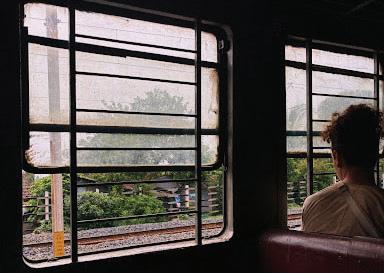
particles highlighted the streams of light coming through the windows. As I crossed the threshold, I was immediately met with what sounded like a resounding heartbeat echoing against the walls. As my eyes adjusted to the light, I realized I had entered a room full of massive analog looms. Two rows lined the walls, one woman sitting at each loom, all deftly passing their shafts and heddles between hands without conscious thought. I recognized the woven cloth each was producing — it was the trademark white sari with blue stripe that distinguished
of Hansen’s disease is not necessarily the sequelae of the infection itself, but rather how the lack of sensation changes how a patient treats the affected region. While nerve damage occurs due to the disease, most of the actual damage comes from self-inflicted injuries. When an individual has no sensory perception of their fingers, they don’t feel any pain, which then leads them to neglect protecting their appendages. For example, one woman we encountered in the colony had walked with a shard of glass lodged in her foot for weeks without knowing — her pain and
patients. Most of the residents of the colony had already recovered from Hansen’s there were only a handful of patients in the medical ward receiving active treatment. Most of the colony was focused on fostering a normal life.
As our tour continued, we wove through gardens, stables and a fishery. Two highly skilled Hansen’s survivors had established themselves as the residential cobbler and prosthetics designer, creating functional footwear and orthosis devices for the rest of the members of the community. Brother Raphael
beamed and shook their hands as he walked in. Their workrooms highlighted pictures of previous “happy customers,” framed snapshots of active rehabilitation.
The rest of the campus was spacious, bright and colorful. Beds of tropical flowers and mango trees lined gravel pathways that linked the buildings on the compound. As we walked, we were greeted with massive smiles and waves or namaskars; everyone seemed cheerful and independent, which was a striking contrast to my previous experiences at the Missionaries of Charity homes. By establishing some sense of autonomy within the community, the residents had not only regained their health, but also their dignity. Joy seemed to emanate from every space, especially the small classroom where children of residents were educated during the workday.
In the wake of abandonment due to the intense stigmatization of what society generally understands as leprosy, the Titagarh colony offers a beacon of hope. It creates a space where patients and residents can be accepted for who they truly are after a life of rejection. They recover their sense of dignity and self-worth and make an active contribution to their community. In a summer that centered around living and working in the face of suffering, Titagarh offered a reminder of what true accompaniment should look like, and just how successful that accompaniment may be.
The views expressed in this column are those of the author and not necessarily those of The Observer.
Write to Ivy Clark at iclark@nd.edu
By Aly Rothfus Scene Writer
When deciding on a Moreau cocurricular at 9:30 p.m. on a Friday night while sipping on Shirley Temples from the comfort of my dorm room, my friend and I came across “RED CUP.” We thought it sounded interesting. As the hardcore partiers we are, we believed that “RED CUP” could help fix our bad party habits.
Coming into it, I was expecting some comedy. As a veteran of a very small high school theater program, I loved portraying funny characters. However, this performance was very heavy: It shared real Notre Dame students’ testimonials from papers written in the class “Drunk on Film.” These papers were adapted into this oneact play, where current students presented the stories.
When I walked into the theater at the DeBartolo Performing Arts Center, I could hear a playlist of party music (quite on theme). The show started off with the cast playing beer pong while a lyric video for “Last Friday Night (T.G.I.F.)” by Katy Perry was projected on the screen. My friends and I were confused as to whether we were supposed to sing along or not.
As the music died down, the first character, “Lucky,” played by senior Lucy Bullock, stood up to give her story with the rest of the cast seated in the background. She shared that drinking is how she connected with people. She created an alter ego, “Lucky,” who was her drunk persona. We found out through the monologue that “Lucky” took over this girl’s whole identity.

We then heard from the “Reluctant Drinker,” played by senior Mason Kacmar. He shared the story of how when he arrived on campus, he was thrown into his dorm’s drinking culture. After being pressured into playing his dorm’s iconic drinking game, he downed several beers and got drunk for the first time. He found this fun and started to make drinking a habit.
The next character, “In Your Blood,” played by junior Thomas Solano, shared that he grew up in a family of drinkers. In college, he believed that as long as he was able to perform well in school, drinking was fine, living the “work hard, play hard” cliche. This led him into a cycle of drinking that he could not quit.
We then met “The Performer,” played by senior Brigid O’Driscoll. She opened up about binge drinking and joining an AA group as an underage person because of her unhealthy drinking habits. Throughout her college experience, she felt pressure to present herself as straight. Alcohol helped her keep the appearance of being heterosexual. As she stopped drinking, she was able to explore her sexuality.
After “The Performer,” the audience was introduced to “The Caregiver,” played by junior Aine Starshak. After not making many friends her freshman year, as a sophomore she befriended a freshman named Kelly. As Kelly got more integrated into the community, she started to invite “The Caregiver”
to parties. “The Caregiver,” as the name suggests, had to take care of Kelly whenever she got drunk. This included protecting her from men who could take advantage of her. “The Caregiver” also opened up about having a boyfriend who raped her while under the influence of alcohol.
The last character to approach the audience was “Do Not Disturb,” played by sophomore Lauren Little. She shared her experience of getting peer pressured into drinking by her friend. As a Gateway student — we love the representation — she felt like she had to party in order to fit in. She even got dropped from the group she was going to live with senior year because of her refusal to drink. She presented the question: “Why am I a non-drinker?”
She said that for her, it is because she wants autonomy and the ability to make decisions for herself.
“Champagne Problems” by Taylor Swift then started to play, and the cast left their seats and started talking to each other about drinking in moderation.
After the show, there was a Q&A. The audience was mostly freshmen who were there to fulfill a Moreau co-curricular requirement. Most of the students agreed that there is a drinking culture present at this university, and that it can be hard to avoid.
The show was not what my friends and I expected. The acting was good, but it was also mostly monologues, which give me scary speech and debate flashbacks, if I am being honest. Clips involving alcohol from movies and television such as “The Kissing Booth” and “Stranger Things” were projected in between the monologues. It was interesting to see drinking portrayed in the media, but only half the time did they connect these clips to the characters’ experiences.
“RED CUP” made me think about the reasons for drinking and made me aware of the link between alcohol and sexual assault. Hearing testimonials from past Notre Dame students was compelling and was definitely a sobering event.
You might be wondering, were my friend and I convinced to quit our party-animal tendencies? After watching this, we might cut back on the late-night Huddle snacks and the excessive rebellious stepping on the God Quad grass.
Contact Aly Rothfus at arothfus@nd.edu
I didn’t know vampires were this freaky
By Matthew Rah Scene Writer
The first time I saw Robert Eggers’ 2024 remake of vampire classic “Nosferatu,” I called it “the freakiest film I will watch all year,” a bold claim for just past midnight on New Year’s Day, but thus far an accurate one. The adaptation is not just a supernatural thriller but, from the opening scene, a blatantly psychosexual one. With the Halloween season fast approaching and “Nosferatu” playing at the on-campus Browning Cinema in the DeBartolo Performing Arts Center, I decided to give it a rewatch and hopefully make some sense out of Eggers’ directorial vision. The verdict: There’s just as much sex as the first time. But what could Robert Eggers possibly mean by it?
It’s important to keep in mind that sex is, and always has been, fundamental to the vampire genre. In “How to Read Literature Like a Professor,” (a book I haven’t thought of since my AP Literature days), Thomas Foster puts it succinctly: “A nasty old man … violates young women, leaves his mark on them, steals their innocence … and leaves
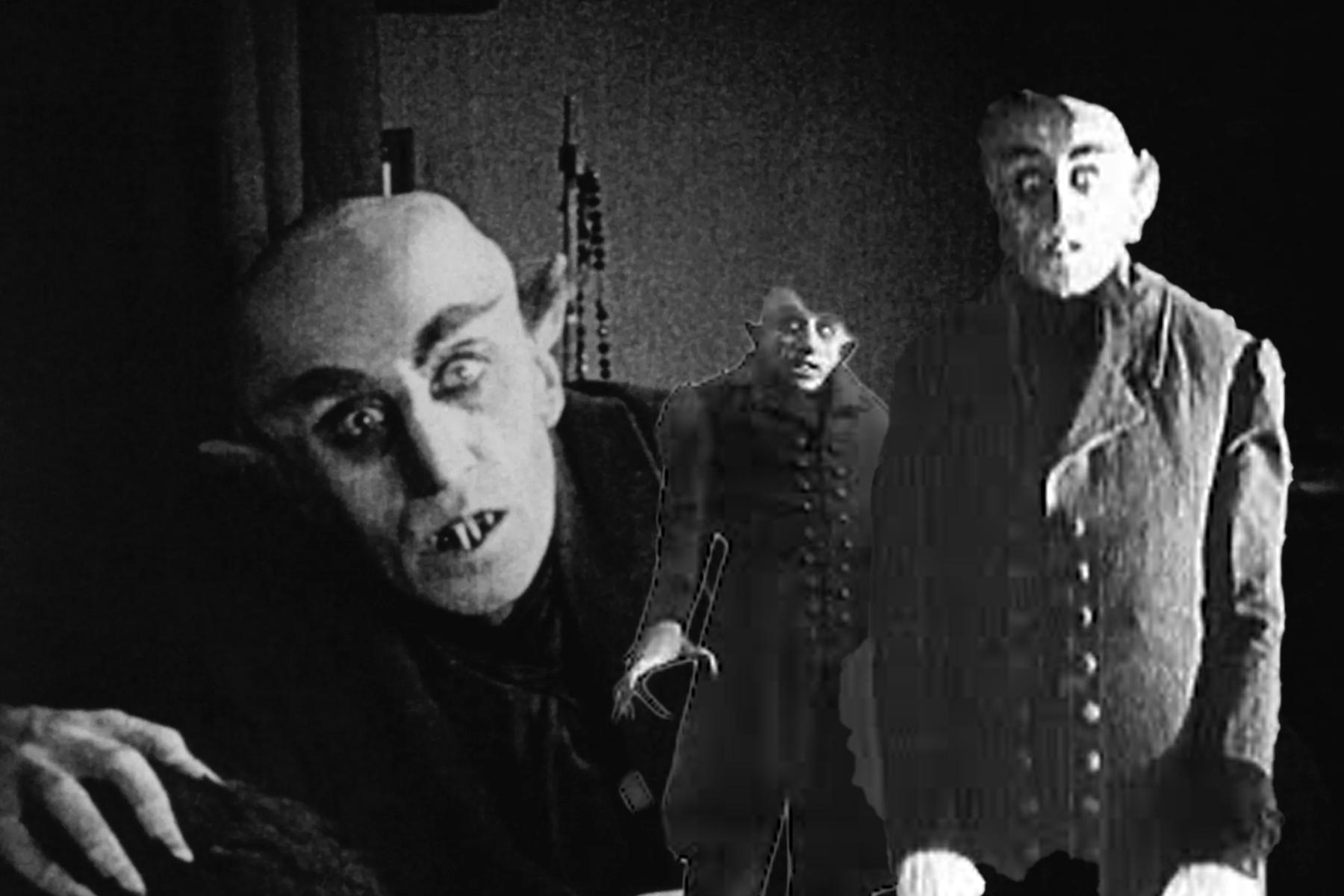
them helpless followers in his sin.” Such has been the vampire formula since “Dracula,” so “Nosferatu’s” exploration of sexual themes is far from groundbreaking. What is unique to Eggers’ adaptation, though, is the vampire himself. Count Orlok — the Nosferatu himself, portrayed magnificently
by Bill Skarsgård — is more of a force of nature than a traditional Transylvanian bloodsucker. Orlok personifies animal instinct: The desires of the flesh, chief among which is sex. His consuming of a victim’s blood represents these desires destroying their humanity. Protagonist Thomas Hutter,
for example, longs for wealth. Soon after he annuls his marriage in exchange for gold, Orlok drinks Hutter’s blood in an unmistakably erotic fashion, alluding to Hutter’s greed clouding his better judgement.
Lily-Rose Depp’s standout and almost perpetually sexual
performance as Ellen, then, is the ultimate example of this struggle between human and savage. While awake, she yearns for her husband; while asleep, her concupiscent desires call for the vampire. Throughout the film, the lilac — a symbol of both love and death traditionally worn in mourning — remains a constant symbol of Ellen’s internal conflict. Orlok personifies this conflict and the damage he causes is reminiscent of the inner damage Ellen sustains in her struggle.
There are certainly moments where the metaphor falls apart. At times, the film’s sexual content provides more in the way of shock value than meaningful symbolism, and, while I appreciate Eggers’ dedication to slowly building tension, there are certainly scenes that drag on a bit too long. Overall, though, the blatantly sexual nature of this modern “Nosferatu” transforms it into a thrilling exploration of obsession, desire and inner turmoil that stands uniquely powerful, even in a sea of numerous vampire stories that precede it.
Contact Matthew Rah at mrah@nd.edu
Continued from page 1
message. You look at the touchdown drive in the first half, and bad technique, we give up an explosive play and they convert on two or three third-downs and that’s the result,” Freeman said at his post-game press conference.
He continued to share what he asks from his players, “Your mindset has to just be, I don’t care what happened last play, I don’t care what happened — I’ve got to win this play. I’ve been trained to win this play, and I’ve got to go out there and do it, and then you’ve got to move on to the next one, and that’s going to hopefully help you get the results you want.”
Freeman’s message was wellreceived. Notre Dame proceeded to outscore NC State 26-0 in the second half.
Both teams started the half with three-and-outs. The Irish offense then rediscovered their rhythm, thanks largely to senior quarterback Tyler Buchner. Buchner, whose botched point-after-touchdown hold against Texas A&M contributed to Notre Dame’s gut-wrenching loss, played the lead role in a fake punt midway through the second
drive of the half. With senior punter James Rendell lined up to punt, the Irish rapidly changed their formation and put Buchner under center. Buchner received the snap, went up the gut and gained a pivotal first down.
When asked about the play-call, Freeman said, “We’re trying to always steal a possession, extend drives, and I thought we needed it at that moment because we went three-and-out the first drive of the second half, got a false start on that drive by Ashton, and I’m like, we need something, we need a plug and it was 4th-and-2 and I’m like, go run it.”
Freeman’s bet paid off, providing Notre Dame with the boost of energy they needed to produce offensively. The “Buchner-drive” ended up tallying 11 total plays for 90 yards and ending in an 18-yard receiving touchdown on a clever route through the middle of the end zone by sophomore wide receiver KK Smith. Smith had a career day, scoring his first career touchdown and gaining more receiving yards in one game than his entire career thus far.
NC State tried some trickery on their next drive, but the Irish defense displayed some hunger. Sophomore linebacker Kyngstonn Viliamu-Asa made a nice read on the trick-play
to stop Bailey, and senior defensive lineman Junior Tuihalamaka made his presence known throughout. Along with senior safety Jalen Stroman, junior defensive lineman Elijah Hughes and Traore, they had a monster day for Notre Dame. The contingent combined for two quarterback hurries and four sacks. The steady pressure allowed the Irish to also record three interceptions. As a collective, defense coordinator Chris Ash’s unit has come a long way from recording only one sack combined in the first two games of the season.
“Yeah, I think what I talked about after that week, maybe it was Purdue, is that there was two options … Chris Ash can blame the players and the staff, and in return the staff could blame him and the players can blame him, or you guys come together, you double down, you fix it, you have uncomfortable conversations and you really work tirelessly to get this thing to a better level, and that’s what they did,” Freeman said.
After Notre Dame’s defensive stand, the offense kept things humming. From their own 20-yard line, Love burst for 24 yards and Carr connected with Smith for a 31-yard gain to reach NC State’s 25.
Carr spoke about Smith’s emergence against the Wolfpack, saying,
“That was awesome, just to see KK get the tap. We’ve always known he’s got a unique wiggle to him, and it was just the consistency of doing it in practice, catching the ball and running the right route every time. He’s just done that for the last few months, and has been really consistent. You guys saw it out there. It wasn’t only the touchdown, he had a few out routes, a great catch.”
The drive was capped off by another strong first-down run from Love, setting up a Pauling touchdown. Pauling beat his man off a nice cut towards the middle before reeling in Carr’s dime. The touchdown is Pauling’s third consecutive game with a score. His 105 yard performance is his single-game best in a Notre Dame uniform.
The Irish put a stamp on the game early in the fourth quarter. Facing fourth-and-11 trailing by two scores, NC State went for it less than a minute into the quarter. Pressure forced Bailey to make an uncomfortable pass, which was intercepted and returned 44 yards by sophomore safety Adon Shuler, setting Notre Dame up at the NC State 17.
The Irish settled for another Brunette field goal, extending the lead to 27-7. On Notre Dame’s next drive, launched by a Viliamu-Asu interception, Price fumbled only
two yards away from a touchdown. Luckily for Notre Dame, NC State’s play in response resulted in a safety as Bailey awkwardly fumbled the ball and accidentally downed it in the end zone.
Freeman’s team left their final mark on the game by driving 82 yards downfield en route to a Love touchdown. The score was set up by an impressive 36-yard reception from senior tight end Eli Raridon on an inch-perfect cross-field pass by Carr.
Raridon, who led all players with 109 receiving yards, sang Carr’s praises after the game, saying “I’ve never seen a quarterback see the field like he does.”
Sophomore cornerback Karson Hobbs effectively ended the game, recording an interception with just over a minute left.
Overall, Notre Dame outgained the Wolfpack 485 yards to 233. Carr’s efficiency in the air, coupled with the all-around effort defensively, inspired Notre Dame to their fourth win in a row. The Irish now turn their attention to the battle for the Shillelagh as they host USC next Saturday with kick off set for 7:30 p.m.
Contact Chris Dailey at cdailey2@nd.edu
By Henry Lytle Associate Sports Editor
The AP Poll has seemingly attempted to be predictive throughout the course of the season instead of simply analyzing the resumes of teams. This system of evaluating programs not for their on-field production, but for the expectation of their future in a way to “justify” your rankings later on is disappointing to see for any college football fan. Notre Dame has been a beneficiary team of this system, but that does not make it right or accurate.
After the 36-7 home victory against NC State on Saturday, the Irish moved to No. 13, theoretically two spots out of the College Football Playoff. If you had told a fan after the Texas A&M and Miami losses that by Week Seven, you would nearly be in the playoffs, they would have called you crazy. So what changed?
Notre Dame’s victory showcased an improved defense, a balanced offensive attack, special teams trickery and an ability to win turnovers. However, simply because the Irish have won four games in a row does not warrant jumping to No. 13. I know Irish fans are excited to already be on the verge of the playoffs, but without a ranked win this season ahead of USC, I don’t see how the AP Poll evaluation of the Irish is accurate.
Let’s examine the Irish games so far this season. They opened the season on the road against No. 10 Miami at the time and lost 27-24. Miami has since
vaulted up to No. 2 as it has dismantled ranked Florida State and South Florida while also defeating Florida since besting the Irish in Week One. After a bye week, the Irish took on Texas A&M in the home opener and lost a heartbreaking 41-40 game as A&M scored in the final seconds. The game would have been sent to overtime if not for senior quarterback Tyler Buchner muffing the go-ahead extra point attempt that would have given the Irish a 41-34 lead. So, in terms of losses, the Irish have lost to two top-five teams by a combined four points, but what value do heartbreaking close losses hold?
In the last three weeks, we have seen a perennial contender in Penn State implode after a nail-biter double-overtime loss to Oregon in the Whiteout game. After losing last week to winless UCLA, the Nittany Lions fell completely out of the rankings as a two-loss team. Texas also fell out of the rankings after losing to Florida on the road from being in the top 10, as the Longhorns picked up their second loss. I know how you lose and who it comes against matters, but to see the Irish vault six spots to No. 16 a week ago in front of undefeated and one-loss teams that have considerably stronger wins was puzzling.
The Irish have compiled victories of 56-30 against Purdue, 56-13 against Arkansas, 28-7 against Boise State and 36-7 against NC State. Covering the Vegas point spread in all four wins shows a considerable improvement defensively, holding opponents under two
touchdowns three times after the Purdue game. Despite this improvement, none of these opponents have sniffed the rankings. Ahead of a season-defining game against No. 20 USC, the Irish should be the underdog to “prove” why they deserve to be in the Playoff instead of being expected to beat a 5-1 team that just obliterated ranked Michigan.
Odds, point spreads and favorability are certainly taken into preseason rankings as a benchmark for a skeleton of a top 25. Seven weeks into the season, this method of prediction is still being used, leaving questions about the validity of the AP Poll’s methods. 6-0 BYU, with wins over four power conference teams, is ranked two spots below the Irish. Oklahoma is even ranked one spot below the Irish. The Sooners were No. 6 last week after losing a rivalry game to Texas with a banged-up quarterback, and they were expected to lose by all odds-making platforms. Vanderbilt dismantled ranked South Carolina on the road and lost to Alabama, as did Missouri 27-24, and both are also slotted below the Irish. Even the Irish’s rival USC is ranked below them after handling ranked Michigan at home in dominating fashion, with their only loss coming on the road with a last-second field goal to Illinois. Texas is back in the ranking at No. 21 after beating
Oklahoma. In terms of resumes, Texas now has a victory against a top-10 team and losses on the road to No. 1 Ohio State and Florida in what is widely considered one of the toughest road atmospheres in college football; both of these losses were only by a touchdown. If you take any of these resumes without the logo and preseason expectations, I think most people would have a hard time arguing Notre Dame deserved to be ranked ahead of many one-loss teams.
I am not arguing that all of these teams are better teams than the Irish, but we have to consider the on-field production. A ranked road win should be more important to your ranking than a close, ranked loss.
One of the biggest reasons for the Irish’s ranking is the system of power ratings. Notre Dame is currently ranked No. 4 in the country by both Sports Illustrated and ESPN, behind Ohio State, Indiana and Alabama in power ratings. This metric most clearly depicts which teams would be favored on a neutral field, showing the revered prowess of Notre Dame’s players, coaching staff and culture despite being a two-loss team. The power rankings are important for sports gambling and media coverage behind the scenes of the national rankings. It does not seem fair to think they should be heavily considered in
Week Seven of college football rankings. Why do the AP Poll rankings matter? The AP Poll controls the rankings until the College Football Playoff ranking that selects the 12 teams for the Playoff first appears after the first weekend in November. The rankings heavily impact which schools will be chosen for College GameDay, how the media covers games in their entirety, fan attendance and how programs are perceived. For example, if USC were ranked higher for the Holy War rivalry, the Irish could have been given College GameDay. This biased ranking system most prominently impacts schools without rich college football history or high recruiting rankings that deserve to be judged more fairly.
If the Irish theoretically win out over the course of the season, I am in no way arguing that they should not make the Playoff or at least be fairly considered or scrutinized alongside the rest of the two-loss teams. To say, however, that the Irish right now have a borderline playoff resume is quite frankly puzzling. While Notre Dame is once again a beneficiary of the AP Poll ranking, it does not make the AP Poll objectively accurate or, most importantly, fair.
Contact Henry Lytle at hlytle@nd.edu
What would your walkout song be?
Jitendran senior Sigfried Hall

Coleen Mahieu
senior Pasquerilla West Hall
“Devil

Daniel Payne junior Carroll Hall
“Kickstart My Heart by Mötley Crüe.”

CROSSWORD | WILL SHORTZ

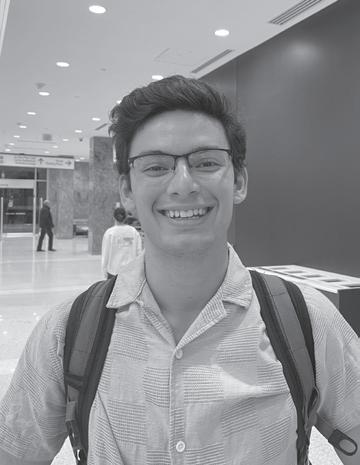
Jack Kwiatt freshman Baumer Hall
“Lose Yourself by Eminem.”
Joseph Draganowski junior Morrisey Manor
“Chariots of Fire by Vangelis.”
Have an idea for a poll? Email dstangel@nd.edu
What is the best time of day?
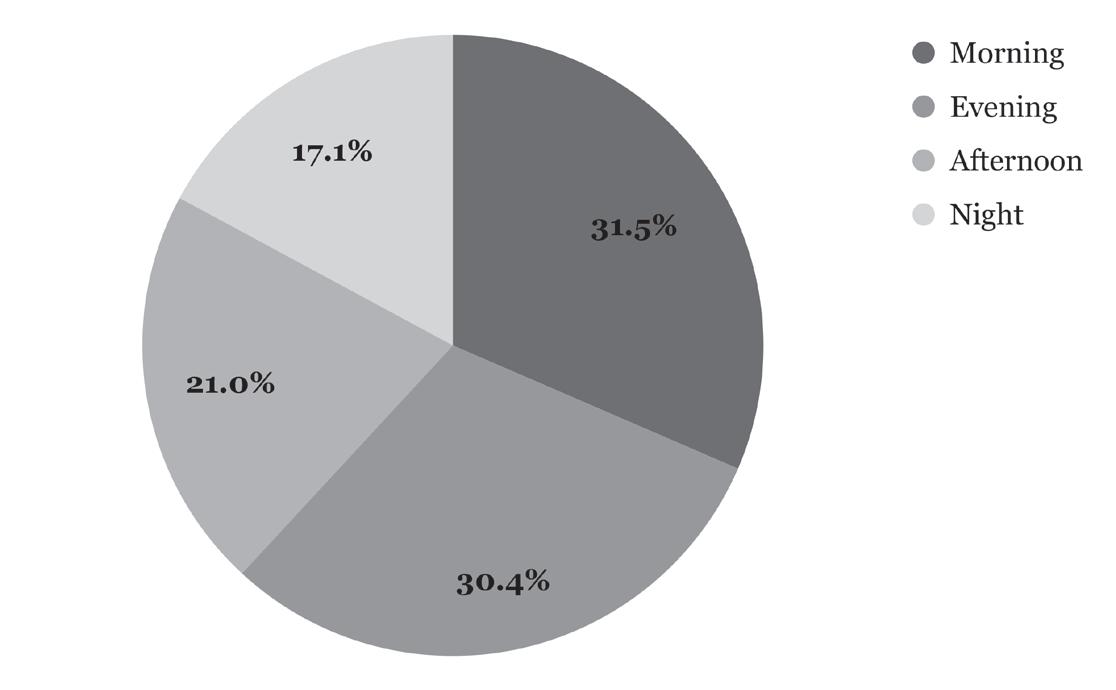
A recent survey conducted by The Observer asked students when they believed was the best time of day. A number of students are early risers, with 31.5% of respondents claiming morning is the best time of day. 30.4% of students said evening is the best time of day, closely rivaling those who favor morning. Some students said afternoon was the best time of day, making up 21% of the vote. Only 17% of students reported night is the best time of day, making up the smallest share of voters. Regardless of time, though, students can always be seen awake and busy on campus.
Want your event included here? Email news@ndsmcobserver.com
Monday
“An Evening with Michael Martone” Reading and Q&A with award winning Indiana author. Le Mans Hall 6 p.m.
Tuesday
“The Future of International Aid: Reforming a System” Lecture by CEO of the International Rescue Committee. Hesburgh Center for International Studies 4 - 5 p.m.
Wednesday
A Conversation with Caroline Campell
Discussion with the director of the National Gallery of Ireland. Raclin Murphy Museum of Art 5:30 p.m. - 6:30 p.m.
Thursday
Notre Dame men’s hockey vs. St. Lawrence
The Irish face the Saints in their first home game of the year. Compton Family Ice Arena 7 p.m.
Friday
Cultivating Hope with Cardinal McElroy Lecture by Cardinal McElroy on politics and social divides. 215-216 McKenna Hall 4 - 5 p.m.
By Henry Lytle Associate Sports Editor
The Irish emerged victorious following the Boise State performance with another strong defensive showing against the NC State Wolfpack. Here’s how they were able to win:
Notre Dame stops NC State’s offense
Chris Ash’s defense began the contest on a strong note in the opening drive of the game forcing a quick three-and-out. Pressure was the ticket in this game and it began with sophomore defensive lineman Boubacar Traore’s sack on second down. The play put NC State way behind the chains and forced a punt after an unsuccessful third down run play.
The Irish quickly turned defense into offense, beginning the drive at the NC State 48 yard line. It only took six plays to take the ball the distance. Senior wide receiver Will Pauling, who was filling in for Jaden Greathouse, caught two passes for 51 yards to help set up the Irish with a first and goal. The Irish punched in the touchdown on a two-yard scamper between tackles by junior running back Jeremiyah Love. The
Irish led 7-0 with 12:53 in the first quarter.
On the next offensive drive, the Irish drove down from their 31 to the NC State 17. On fourth down, redshirt freshman quarterback CJ Carr rolled out to his right looking for a short yardage play in the red zone and cluelessly ran out of bounds. This was the first of three 4th-down attempts that was stifled by the NC State defense and gave the ball back to the Wolfpack.
Notre Dame takes the lead late in the second quarter NC State began their next drive with backup quarterback Will Wilson converting a critical 4thand-1, picking up two yards with a quarterback power run play for the first down. CJ Bailey followed the conversion by unloading a deep shot to Terrell Anderson who was well in front of freshman cornerback Dallas Golden. Anderson strolled into the end zone to even the game at seven with 13:48 in the second quarter. With two minutes left in the second quarter, the Irish had another 4th-down opportunity from the NC State 8-yard line. This time Mike Denbrock called a play action look for Carr and he was flushed again to the right of the pocket with
pressure. Forced to take a shot on fourth down, he threw the ball away into the endzone and it was picked off by freshman cornerback Asaad Brown, giving NC State 1:51 to take the lead before halftime.
The Irish picked up another critical sack with the Wolfpack driving. This time, senior Jalen Stroman got back to Bailey on an eight-yard sack on 3rd-and-7. This gave the Irish the ball back after a punt, and gave them 23 seconds to get into field goal range with one timeout. Carr threw a 23-yard strike over the middle to junior tight end Eli Raridon to get the ball past midfield. On the next play he lofted a ball perfectly over Raridon’s shoulder again for 30 yards to get the Irish comfortably within field goal range. Senior kicker Noah Burnette sank the 48-yard field goal as time expired to take a 10-7 lead heading into half time.
Irish special teams trick NC State
Marty Biagi dialed up another flawless special teams fake on the second Irish drive of the half on 4thand-2 from their own 38. Motioning senior punter James Rendell out wide, senior quarterback Tyler Buchner shifted under center and ran the ball three yards for the first
down. Carr cashed in the ticket as he delivered a 3rd-down strike to a wide open sophomore wide receiver KK Smith in the end zone. The Irish extended the lead 17-7 with 6:58 left in the 3rd quarter.
The third-quarter damage was not yet done as Pauling’s big day continued. He hauled in his second touchdown reception of the season on a 12-yard touchdown throw from Carr. This moved the score 24-7 in favor of the Irish as the defense continued shutting down the NC State offense.
Irish hold the Wolfpack in fourth quarter
NC State took the final two minutes of the third quarter with a six play drive that bled into the fourth. The consecutive first downs and growing momentum ended after CJ Bailey’s desperation 4th-and-11 pass was intercepted by sophomore safety Adon Shuler. The Irish got the ball back with 14:17 in the fourth quarter and were able to punch in a field goal.
Sophomore linebacker Kyngstonn Viliamu-Asa followed up Shuler’s effort with another interception. In fact, every NC State fourth quarter drive ended in a takeaway for the Irish defense, with the defense
forcing three interceptions and a safety. The safety came after a fumble on the goal line by junior running back Jadarian Price at the one yard line. On the first NC State snap of the next drive, Bailey fumbled the ball and recovered it while the ball was in the end zone and his knee was down, signifying a safety.
The Irish followed up the safety with more points on the board and a smooth 10-play 82-yard drive that gave Love his second rushing touchdown of the day and 86 yards on the ground.
The Irish defense put the cherry on top of this masterful performance against the 4-2 Wolfpack. Sophomore cornerback Karson Hobbs intercepted a pressured throw from Bailey on fourth down to seal the game. Outgaining NC State in every metric, the Irish won 36-7 in another defensive shutdown forcing three interceptions, four sacks and 51 yards rushing.
Heading into the contest against USC the Irish need to make another step towards defensive improvement, which Chris Ash has showed so far. The Irish will take on USC at home on Oct. 18 at 7:30 p.m.
Contact Henry Lytle at hlytle@nd.edu
By Payton Dymek Sports Writer
Over the weekend, Notre Dame volleyball defeated both Virginia and Virginia Tech at Purcell Pavilion.
The Irish got off to a fast start in Friday’s 3-0 sweep of the Cavaliers, with sophomore outside hitter Morgan Gaerte earning her 200th kill of the season on the first point, which also kick-started a 7-4 run featuring other kills from junior outside hitter Sydney Helmers and freshman opposite hitter Mae Kordas. The set went by fairly quickly for Notre Dame as it won 25-19 and hit .324 while keeping the Cavaliers to a low .067.
The second set took more effort from the Irish as they traded possession with Virginia quite often, and when Notre Dame was down 16-14, it was able to go on a 6-1 run led by a kill from senior setter Harmony Sample. The set ended on an ace made by senior outside hitter Lucy Trump and pushed the Irish to a 2-0 lead against the Cavaliers. The third set was quick for the Irish — and record-breaking as they went on very long runs and were able to close the set 25-17.
By the end of the night, Helmers broke her career high of 17 kills, seven of which came from the first set alone and set the tone for the rest of the match. Kordas reset her career high for kills with 10 and was the most effective hitter with a .556, and Gaerte became 13th in the NCAA in kills per set after hitting
10 against Virginia. Sample had 15 assists, while freshman setter Maya Baker had 17.
Coming off the win against Virginia, the Irish were ecstatic to get back on the court, especially after a successful Saturday in the cathedral of college football. However, unlike their game against Virginia, it was significantly slower than expected. Three points into the game, there was an early challenge from Notre Dame about an aggressive attack off a scrappy retrieval, but the referees kept their call, forcing the Irish to lose one of their challenges. Despite the harsh call, there was a moment between head coach Salima Rockwell and her team where anyone watching could tell how much she cared for her girls on the court, fighting as hard as she could for them and trusting them completely to put a challenge on the line. Despite the challenge not going the way Notre Dame wanted it to, sophomore middle Grace Langer stole the point back from Virginia Tech with a massive kill.
The first set was a roller coaster of skills with early unforced errors from the Hokies, such as net violations and missed serves, plus they couldn’t find great passing momentum as they were aced back-to-back by Helmers. Virginia Tech, despite starting off its defense slower than it wanted to, was able to find holes in the Notre Dame block and use those to its advantage, all while finding opportunities to shut Gaerte down at the net, during which sophomore middle Isabella Mishler and
freshman outside Adeline Hundl became key. Gaerte was able to overcome the pressure and even hit around a towering three-person block and earned three aces, putting the Hokies in their head as the Irish pushed the score to 149. Throughout the entirety of the game, Virginia Tech struggled to stay in system with its passes, thus making it difficult to get a solid swing on the ball and earn points to side-out. Sophomore middle blocker Anna Bjork stayed consistent and big at the net for the Irish the entire game, even earning the final block of the set.
To start the second set, Gaerte had an early kill, followed by an early pancake from freshman Maya Evens to shift toward a more positive momentum despite a slower start than expected. The Hokies continued their defensive pressure, especially against Gaerte, consistently putting up a three-woman block. Despite how difficult it is for their outside hitter to come all the way across the net and set up a stable block, graduate outside hitter Ainsley Ranstead became a crucial player in this. Virginia Tech remained equally aggressive in the back row, diving and flying for every ball, largely due to its libero change where its had freshman Ivy Cooper switch into the jersey after the first set, when there was some switching between graduate student Erica Fava and sophomore Ece Yildiz. On the other side of the court, the Irish struggled getting the first ball touch, putting the setters in tough
conditions where they had to attempt to dump the ball instead of setting one of the hitters. What put Notre Dame behind in the second set was that Gaerte struggled to make serves, which was what had helped them in the previous set earn the lead. Despite both teams having 21 points against one another, there were impeccable defensive maneuvers from the Irish, with Evens literally diving into the cheerleaders. An aggressive swing that went long gave the Hokies the set, making it 1-1.
Notre Dame saw a fast 6-1 start in set three, started by an ace from Gaerte, a big swing from Kordas and a sixth point coming from a block from Helmers combined with a staredown across the net at the end. The Hokies’ Mishler continued to make a name for herself as she took a swing off her head from Gaerte when she had gone up to block, but quickly turned around to her teammates, setting her a fast three-ball and getting the kill for Virginia Tech. Mishler was also the player who, whenever the pass was perfect, the setter would find, displaying her consistency and reliability as a player. The Hokies also made a significant defensive adjustment, deciding to put up a three-woman block against Helmers, which became crucial for them in shutting down the Irish offense. The set was tied 22-22 with Helmers pushing it to 24 with two kills along with tons of defensive effort from the Irish, with them diving almost into the press bench and eventually ending the set in a block. This pushed the
match to 2-1 in favor of the Irish. Notre Dame started off the fourth set very strong with a huge block from Kordas, a block by Langer to shut down Mishler and an aggressive defense. However, the Hokies did a great job of finding holes in Notre Dame’s back row and converting their hits there. The Irish were extremely aggressive, but to what extent did that hurt them? They forced lots of swings out of bounds because they were trying to hit hard and fast, not necessarily focused on where it would land. Despite the attacking errors, big points for Notre Dame came from kills. One in particular came from Helmers, and afterwards she and Rockwell shared a moment where they pointed at each other, congratulating one for getting the kill and the other for telling her where to hit. The Irish celebrated the 21st point with a kill from Kordas and the 22nd by a blocked overpass from Gaerte’s serve by Helmers, while Mishler had a kill to stop the run. This stop made Notre Dame get in its head with many aggressive swings heading straight out. Kordas was given another chance, and she earned the 23rd point. Aggressive net efforts earned the 24th and another kill from Kordas finished the game for the Irish.
Now 7-7 overall and 4-2 in ACC play, Notre Dame returns home on Friday for their “Irish Wear Green” game against Pittsburgh at 6:30 p.m.
Contact Payton Dymek at pdymek@nd.edu
By Nikki Stachurski Sports Writer
This weekend, Notre Dame hockey traveled to Arizona State University to compete in the Icebreaker Tournament and kickstart its season. The Irish fell short in both games of their tournament, losing 5-3 to No. 15 Arizona State on Friday and 7-2 to No. 8 Quinnipiac on Saturday. Arizona State ended up competing against the University of Alaska-Fairbanks for the championship game on Saturday, claiming the title as the hosting team.
In the ASU game, the Sun Devils scored first, with a goal in the first period by junior forward Kyle Smolen, who landed the puck in the bottom left part of the net. The first period frustrated the Irish, and freshman forward Will Belle was forced to leave the game after receiving a major penalty for elbowing. The second Sun Devils goal was scored by sophomore forward Noah Powell, who retrieved the puck after Irish graduate forward Sutter Muzzatti’s stick
broke, taking advantage of the unfortunate situation.
Just 53 seconds into the second period, freshman forward Carmelo Crandell scored a breakaway goal between the legs of sophomore Irish goaltender Nicholas Kempf, putting the Sun Devils up 3-0 against the Irish. The Irish got on the board less than a minute later, with junior defenseman Henry Nelson scoring a sniper of a shot just past the blue line, with an assist by freshman forward Pano Fimis. Nelson’s goal fired up the Irish, and junior defenseman Paul Fischer scored a power-play goal from distance at 12:32, with assists by junior forward Evan Werner and junior forward Cole Knuble to bring the game within one. Freshman forward Ben Kevan scored not once but twice in the second period for the Sun Devils, though, landing his first goal top-shelf at 13:32 and his second on a breakaway just over the pad of Kempf.
Despite the five goals scored in the second period, the Irish held off the Sun Devils all
through the third. Junior forward Carter Slaggert was posted on the right side of the net and landed a slap shot in the top left corner. The Irish pulled Kempf from the net with 55 seconds left, yet were unable to score on their last-ditch effort with the extra attacker.
Although falling two goals short, the Irish team played a strong game. They scored well from distance and had more blocks than Arizona State, the Irish with 16 and the Sun Devils with 10. Most notably, Notre Dame outshot Arizona State 5038, which showed Notre Dame’s offensive ability to create scoring opportunities all game.
In its second game of the tournament, Notre Dame faced No. 8 Quinnipiac as both teams were competing for third place in the tournament. The Bobcats lost 2-1 to Alaska-Fairbanks on Friday in a slow-paced game. The Bobcats put up an offensive performance on Saturday, scoring the first three goals. Freshman forward Antonin Verreault scored a powerplay goal at 6:44 in the first
period, and junior forward Mason Marcellus scored eight minutes later.
During the second period, Quinnipiac freshman forward Markus Vidicek scored unassisted 9:33 in. After a harsh push on offense, Notre Dame’s Muzzatti picked up a rebound and scooped the puck into the bottom right of the net for the first Irish goal of the game.
Muzzatti was assisted by junior forward Brennan Ali and Fischer. Five minutes later, Bobcat sophomore forward Chris Pelosi scored once again, keeping Quinnipiac at a threegoal advantage.
Early in the third period, Quinnipiac scored two goals, the first 2:17 in by freshman forward Ethan Wyttenbach and the second 4:41 in by sophomore forward Aaron Schwartz. After a lot of back-and-forth offensive possessions, Muzzatti scored through traffic on a deflection to the top left corner. The goal, with assists by senior defensemen Michael Mastrodomenico and Axel Kumlin, ended up being the second and final Irish
goal of the game after official review. In the last seven seconds of the game, Verreault scored Quinnipiac’s seventh and final goal with an assist by Wyttenbach.
The Irish were disappointed in the loss to Quinnipiac, but they played a gritty game against a tough opponent. Goaltender Kempf for the Irish had more saves than Bobcat junior goaltender Matej Marinov, with 31 for Kempf and 23 for Marinov.
The Irish have their home opener this Thursday, Oct. 16, against St. Lawrence at Compton Family Ice Arena at 7 p.m. The Irish will play St. Lawrence again on Friday, Oct. 17, at the same time. Although the Icebreaker tournament was not the outcome the Irish expected, they began their season against two ranked teams in preparation for the rest of the season and will be back and ready to prove themselves this week.
Contact Nikki Stachurski at mstachu2@nd.edu
By Niamh Power Smyth Sports Writer
On Friday, the Irish refused to give up in Charlottesville. In one of its most resilient performances of the season, the Notre Dame men’s soccer team battled back from an early deficit to draw 1-1 with No. 8 Virginia on Friday night at Klöckner Stadium. Junior forward Jack Flanagan provided the dramatic equalizer in the 86th minute, firing home his first goal of the season to secure a crucial road point in ACC play.
The result moves Notre Dame to 7-2-4 overall and 2-1-2 in the ACC, extending its unbeaten run to four matches following home wins over Hope and Green Bay and a draw with Virginia Tech. The trip to Charlottesville marked the Irish’s first match away from South Bend in nearly a month, ending a sevengame homestand that began after their Sept. 12 victory at Pittsburgh.
The match had all the hallmarks of an ACC heavyweight clash — physical, tactical and defined by small margins. Virginia’s pressure and possession tested Notre Dame, but the Irish defense held firm. The draw marked a steadying performance for an Irish backline that had been searching for consistency in recent weeks. After conceding nine goals across its previous five matches, Notre Dame limited the Cavaliers to just one despite Virginia’s 14 shots and 57% of possession.
A steady presence all season, sophomore goalkeeper Blake Kelly anchored the Irish defense with
confidence in Charlottesville. The ACC’s saves leader added three more stops to his total, allowing just one goal in another composed performance between the posts.
Notre Dame’s determination finally broke through in the closing minutes. Virginia opened the match on the front foot, firing off the first four shots, including a dangerous cross that junior forward AJ Smith headed just over the bar from close range. The Cavaliers eventually broke the deadlock in the 20th minute. Graduate defenseman Jesus De Vicente delivered a lofted free kick toward freshman Nick Simmonds in the center circle, who controlled it cleanly before finding sophomore defender Alex Parvu on the right wing. Parvu slid to send a low cross toward Smith, and the junior forward smashed his finish into the roof of the net to give Virginia a 1-0 advantage.
The Irish earned five corners and several free kicks but couldn’t capitalize on any set pieces or convert them into any real chances. Their best opportunity of the first half came in the 41st minute, when senior midfielder Sebastian Green whipped a dangerous ball into the box for freshman forward Ren Sylvester, whose effort slipped narrowly wide of the left post. After the break, Notre Dame began to grow into the match. The Irish doubled their shot total from two to four in the second half while limiting Virginia to just five after allowing nine before halftime. All three of Blake Kelly’s saves came in that improved second period as the Irish began to find their rhythm.
The contest was physical from start to finish, with the Irish whistled for 18 fouls and shown one yellow card, while Virginia committed 12 fouls. Senior midfielder KK Baffour picked up the lone yellow card for Notre Dame in the 65th minute. But the senior would later play the hero’s role — with less than five minutes remaining, he created space on the left wing and sent a driven cross into Flanagan, who redirected the ball into the back of the net, scoring on the half-volley to rescue the draw for the Irish.
Flanagan delivered the longawaited response to AJ Smith’s early goal, scoring his first of the season at the perfect time. Fittingly, the stalemate came on a night defined by the juniors — Smith for Virginia and Flanagan for Notre Dame. Friday’s draw served as another example of Notre Dame’s growing resilience in tightly contested matches.
Notre Dame head coach Chad Riley reflected on that toughness afterward, saying, “Virginia is clearly a good team, and they were better in the first half. I thought our team
came out well in the second half and did a great job pushing to get the equalizer. I love that we never stopped and kept going. We have to keep being a team that goes until the final whistle.”
The Irish will look to carry that momentum back home next week for their regular-season home finale at Alumni Stadium against No. 10 NC State on Friday, Oct. 17 at 7:30 p.m.
Contact Niamh Power Smyth at nsmyth2@nd.edu

By Ben Hicks Associate Sports Editor
The second-ranked Notre Dame women’s soccer team wrapped up the home portion of its 2025 schedule on Sunday afternoon, defeating SMU 3-0 on Senior Day at Alumni Stadium. The Irish used goals from sophomore forward Annabelle Chukwu, sophomore defender Abby Mills and junior midfielder Morgan Roy to move to 12-0-1 on the year and remain atop the ACC table.
Eighth-year head coach Nate Norman and the program honored six seniors prior to kickoff, recognizing the impact each has made on and off the field throughout their time in South Bend. The class of defenders Carolyn Calzada and Leah Klenke and
midfielders Hannah Lemieux, Laney Matriano, Berkley Mensik and Kiki Turner were met with raucous applause by the Irish faithful.
The Irish followed up their huge 4-2 win over No. 5 Florida State on Thursday by jumping all over SMU from the opening whistle. Notre Dame found the back of the net in the sixth minute, with Chukwu converting a perfectly placed corner kick feed from Roy for her 10th goal of the campaign. It also extended Notre Dame’s impressive 54-game unbeaten streak when scoring first.
The Irish would double their advantage just before halftime, as, in the 41st minute, Mills used her head to connect on another corner kick opportunity. Mills’ second goal of the season was assisted
by sophomore midfielder Grace Restovich, who leads the team in that category with eight.
Restovich earned that eighth assist in the 81st minute of the match, as her perfectly placed through ball flicked onto the feet of Roy, who blasted it past SMU junior goalkeeper Aubrey Brown for her second goal of the year. Notre Dame dominated in possession and scoring chances from start to finish and nearly found a fourth goal with just six seconds remaining, but junior forward Paige Buchner’s score was taken away due to an offside ruling.
The dominant victory moves Notre Dame’s winning streak to 11 and extends its solo lead atop the ACC table to a nearly insurmountable eight points. After entering the week ranked first in the
TopDrawerSoccer poll, the Irish should also move to the pole position in the United Soccer Coaches weekly rankings after previous No. 1 Virginia suffered a draw and a loss over the previous seven days. Additionally, the NCAA Women’s Soccer Selection Committee revealed its current top 16 teams in the country this weekend, with the Irish ranked first.
On the individual level, sophomore Izzy Engle’s 13 goals rank best in the ACC and are third-most nationally. The Edina, Minnesota, native also comfortably leads the league with 31 points, as her goalscoring prowess is complemented by five assists.
SMU, now squarely on the postseason bubble with an 8-52 record, will return home to Dallas for its final home game of
the season on Friday. After that showdown with the reigning national champion North Carolina Tar Heels, the Mustangs will face two road battles against No. 3 Stanford and Louisville.
Notre Dame will now have 11 days off before returning to the pitch. Norman’s group will conclude the regular season with three consecutive road tests, traveling to Virginia Tech, No. 13 Wake Forest and Pittsburgh, all within the span of a week. The first of those contests will be on Thursday, Oct. 23, in Blacksburg against the last-place Hokies. The match is set for an 8 p.m. first touch with a national broadcast provided by ACC Network.
Contact Ben Hicks at bhicks2@nd.edu
By Chris Dailey Sports Writer
Sophomore safety and team captain Adon Shuler had himself a day against NC State. The fast and physical safety was a thorn in the Wolfpack’s side, playing an integral role in holding the dangerous offense to a mere seven points. Shuler made three total tackles and recorded an early fourth-quarter interception that put an end to any hopes NC State had of coming back.
Shuler’s consistently fierce play resembles something along the lines of the Tasmanian devil, yet his philosophy on the game is much more stoic.
“You just always have to be calm, cool and collected,” Shuler said in his postgame press conference.
Shuler practices what he preaches. As one of the most experienced players on the Irish defense, his steady level of play has raised the level of the unit around him. He ranks second on the team with 29 tackles.
His exemplary play and calm authority were on full display against NC State. With the Wolfpack trailing by 17 points early in the fourth quarter, a touchdown drive would have at least provided them a marginal chance for a comeback. Sophomore quarterback CJ Bailey stepped up into his pocket on fourth down and fired a pass over the middle. Unfortunately for Bailey and the Wolfpack, Adon Shuler found himself in the right place at the right time, as he always does.
Shuler was also well-aware of the field in front of him. An allaround athlete, Shuler showed off his wheels, darting for a 44yard return before being taken down within enemy territory.
Immediately after being tackled, Shuler was once again
aware of the field in front of him.
Rather than run for yards this time, Shuler and his teammates ran to the end zone for a photo. Posted up alongside five Irish teammates, Shuler and company quickly posed before heading back to the sideline.
“You can see we’re out there having fun. It’s fun when you’re out there doing your job and the coaches trust you to make plays,” Shuler said.
As fun as it is to make big plays, Shuler acknowledges that team glory comes before all else. After the defensive unit’s disappointing games against Texas A&M and Purdue — in which it let up a combined 71 points
Shuler was at the forefront of fixing the issues. For him, it all started with finding a cohesiveness amongst the group.
“It was a lot of not togetherness, and it wasn’t the Notre Dame standard that we were used to. That’s what we had to get back to, and that was kind of the message. We have to get back to playing our style of football and take it to whoever we’re playing and make sure they know they’re playing Notre Dame that week,” Shuler said.
That sense of unity Shuler was longing to see out of Notre Dame’s defense has been actualized in the past two weeks. Notre Dame has only allowed two touchdowns in its last eight quarters of football, and the defense that was regarded as the “weak link” earlier in the season is now supporting the offense when it starts slow.
In the first half, Notre Dame couldn’t find much of a rhythm offensively. Apart from a flashy first drive, two failed fourthdown conversions mixed in with overall lack of energy defined a sluggish offensive half. Defensively, however, Notre Dame was locking down the
Wolfpack.
Elite coverage in the backfield, courtesy of Shuler and company, paved the way for the defensive line to pressure Bailey. It ended up notching three sacks, upholding the standard of excellence Shuler called for out of the group earlier in the season.
For Shuler, the defense’s progression in recent weeks is all a part of the process.
“It’s football. It’s the process that you go with. The first day of camp isn’t going to be the best day, and just like the last day wasn’t the best day. But, everyday, you’re going to go in there and grind with your brothers,
and you know they got your back,” Shuler said.
After the game, Shuler received a team-high 87.2 defensive player rating per Pro Football Focus.
The metric head coach Marcus Freeman is most proud of, however, isn’t a numerical rating.
“Our leadership on our players, our captains like Adon … have done an unbelievable job continuing to make sure our guys are practicing the right way, but their mindsets are right. This is our defense. This is ours, and that’s the buy-in that I think you’re seeing the reflection of,” Freeman said.
Calm off the field and chaotic
on it, Shuler embodies everything Freeman is striving for Notre Dame’s defense to look like. His leadership has fueled a defensive renaissance that’s propelling the Irish up the AP Poll. With each passing week, as the defense continues to improve, Notre Dame’s dream of a College Football Playoff berth feels increasingly within reach.
But to get there, Shuler knows it’s all about focus.
“One play, one life. That’s been the mindset from the beginning of the season.”
Contact Chris Dailey at cdailey2@nd.edu
