
THE INDEPENDENT NEWSPAPER SERVING NOTRE DAME, SAINT MARY’S AND HOLY CROSS
MONDAY, DECEMBER 8, 2025 | VOL. LX, NO. 37

MONDAY, DECEMBER 8, 2025 | VOL. LX, NO. 37
There were two spots left, yet three very similar teams had strong arguments for those spots. The College Football Playoff committee had an incredibly tough choice to make, knowing that whatever decision it made was going to produce controversy.
In its final decision, the committee ultimately decided to rank Alabama at No. 9, Miami at No. 10 and Notre Dame at No. 11, therefore making the Irish the first team out of the College Football Playoff. There are certainly ways to justify these rankings, but there are also certain questions that remain unanswered.
Both Miami and Notre Dame had 10-2 records, but Miami got the nod over Notre Dame because of the result of their head-to-head matchup in Week 1. Miami suffered losses to two unranked ACC opponents in SMU and Louisville, and Notre Dame was its only ranked win of the year. On the other side, the Irish suffered losses to two playoff teams in
JONATHAN CARR | The Observer
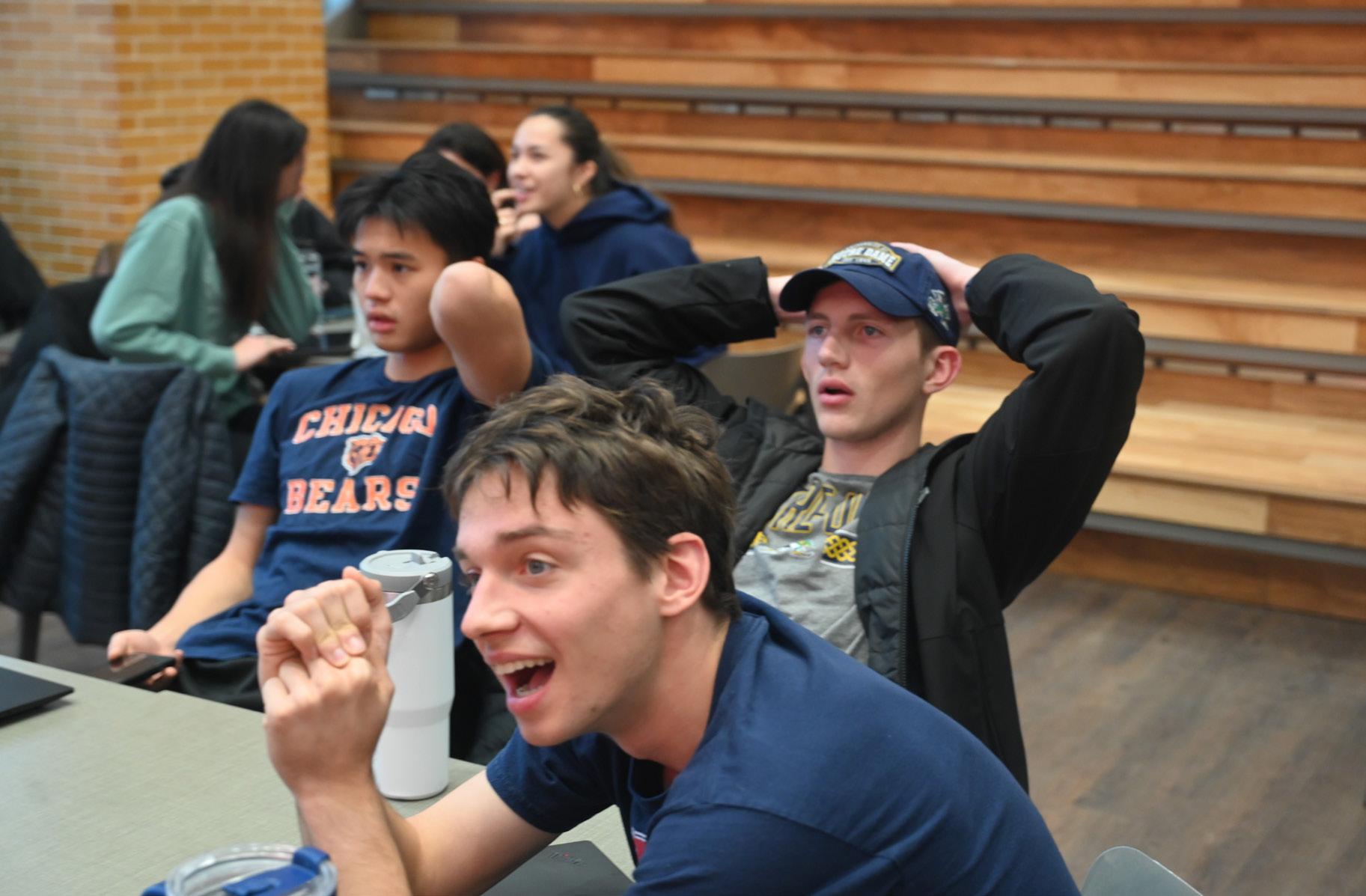
Notre Dame students gathered in Duncan Student Center react with disbelief after the Irish’s drop to No.11 in the CFP rankings. Head coach Marcus Freeman announced the Irish would decline any bowl invitations.
Miami and No. 7 Texas A&M in their first two games of the season, but they won their final 10 matchups by an average of 29.7 points per game while also beating a ranked team in
USC. Both teams had incredibly valid arguments, but when they were ranked next to each other in the final rankings, the committee decided to pick Miami.
By Sophie Hanawalt Notre Dame News Editor
Since September, a task force within the Data, AI, and Computing Initiative has been exploring the best means of incorporating AI into Notre Dame’s curriculum.
The initiative is led by
professor of computer science and engineering and founding director of the Lucy Family Institute for Data and Society Nitesh Chawla.
It seeks to advance the University’s research in all subject areas and assist educators in finding better ways to incorporate AI into their
curriculum. It may also add new courses and degrees to the University’s repertoire.
The initiative is part of the 2033 Strategic Framework, which organizes efforts to further various University goals over the next decade.
see “Curriculum” on page 2
By Berhan Hagezom
Saint Mary’s News Editor
No. 9 Alabama finished the season at 10-3, being the first three-loss, non-conference champion to make the 12team playoff. While it does have three losses, it is hard
to dispute the claim that Alabama had a more impressive resume than both Notre Dame and Miami. Of the Crimson Tide’s 13 games, five were against teams that finished the year in the top 25. They went 3-2 in those games, beating Vanderbilt, Missouri and Georgia in the regular season, but ultimately falling to two playoff teams in Oklahoma and Georgia in the SEC Championship yesterday.
The main argument made for Alabama and Miami making it over Notre Dame is that Alabama had a more impressive resume than Notre Dame, and Miami had the head-tohead advantage over the Irish. On the surface, that seems justified, but the process that the committee took to get there is a bit questionable.
The confusion in these rankings rests in the inconsistency in the evaluation of the teams that lost their conference championship games. For example, Ohio State dropped from No. 1 to No. 2, the team
see “Playoff” on page 11
The Observer Editorial Board
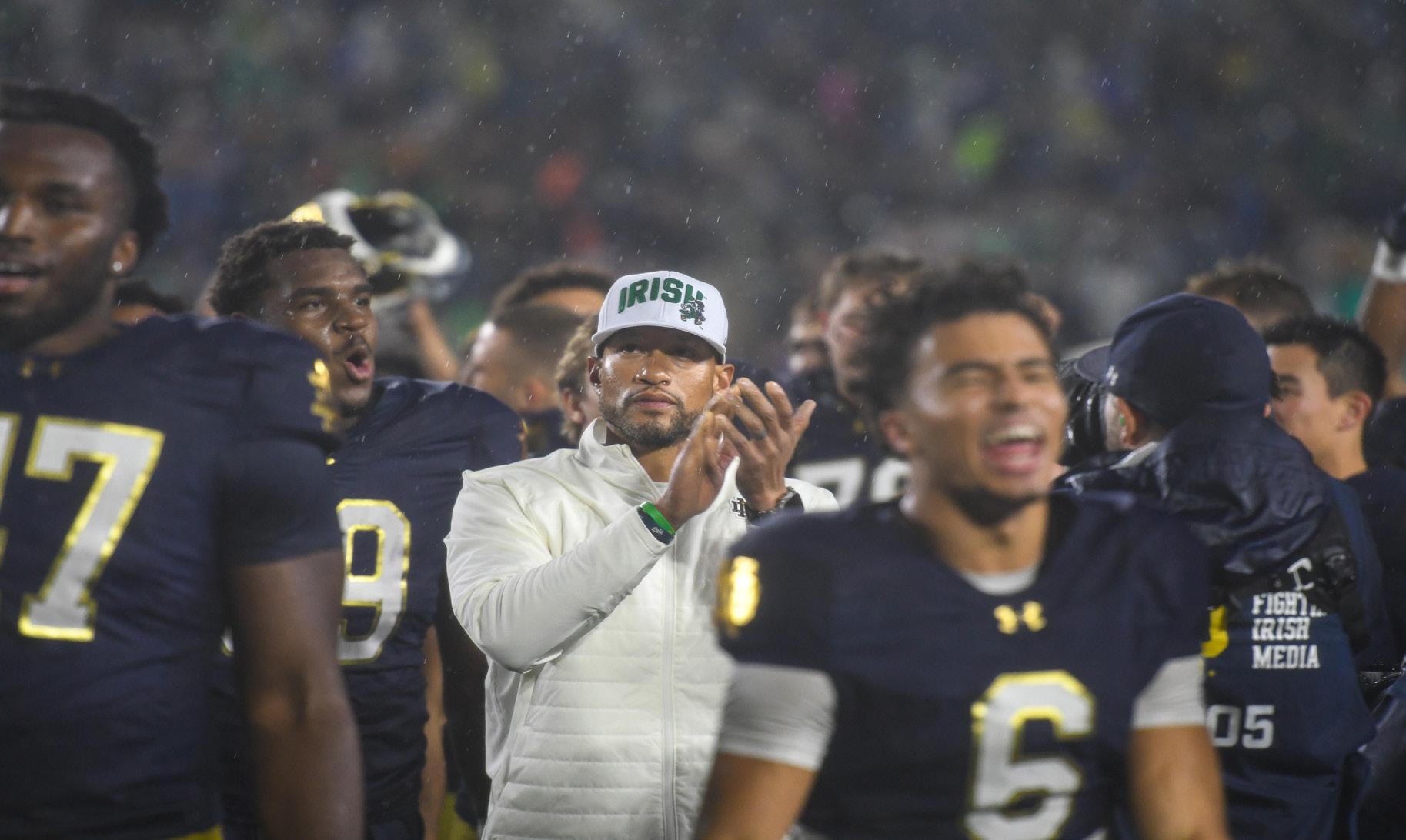
At noon Sunday, 12 teams were selected to compete in the 2025 College Football Playoff — Notre Dame was not one of them. As ESPN talking-heads, the ACC and college football pundits around the country lauded the committee’s decision to leave the Irish out, a decades-old feeling reemerged in the hearts of Irish faithful: It’s us against the world.
In an email to students Friday, provost and vice president of academic affairs Megan Zwart announced the launch of the new Prikkel Advising, Career and Experience Center that will include the combination of academic advising and the Career Crossings Office. The center will be an addition to the northwest wing of Le Mans Hall, which also houses the office of academic advising.
NEWS | PAGE 4
Howard Hall
Residents reflect on the hall’s past while preparing to move into a new dorm next year.
OPINION | PAGE 5
Intoxicated raccoon
Columnist Grayson Beckham argues why people should read more politics consistently.
The funding for the new center was provided by Patrick and Jennifer Prikkel. Jennifer Prikkel received an
see “Center” on page 2
SCENE | PAGE 7
‘Gremlins’ Christmas is all about light triumphing over darkness and death, and so is “Gremlins.”
Amid the injustice of the decision, the same tired calls have reappeared for Notre Dame to join a conference. All this would have been avoided, many said, if Notre Dame had played for a conference championship game.
Joining a conference would be a colossal mistake for Notre Dame. Despite the
SPORTS | PAGE 8
Love 4 Heisman?
Chris Dailey explores whether Jeremiyah Love can still capture college football’s greatest honor.
committee’s incompetence this year, the new playoff format favors the team remaining on its own. Notre Dame is now eligible for a bye in the top four spots, unlike last year. And starting in 2026, Notre Dame is guaranteed an automatic playoff berth if it finishes in the CFP top 12 — regardless of the outcome of the other college championship games. This is a format that no longer explicitly disadvantages the Irish for maintaining their independence. More fundamentally, however, the conferences are emblematic of the same rot at the core of college football that is keeping Notre Dame out of the playoffs this year. The conferences are little more than conglomerates. They take money and TV
see “Conference” on page 5
SPORTS | PAGE 12
Don’t blame Miami
Associate sports editor Ben Hicks explains why Alabama’s inclusion should bother ND.

ndsmcobserver.com
“TO UNCOVER THE TRUTH AND REPORT IT ACCURATELY”
900 Hesburgh Library, Notre Dame, IN 46556
Editor-in-Chief
Liam Kelly
Managing Editor Gray Nocjar
Asst. Managing Editor: Aynslee Dellacca
Asst. Managing Editor: Grace Tadajweski
Asst. Managing Editor: Henry Jagodzinski
Notre Dame News Editor: Sophie Hanawalt
SMC News Editor: Berhan Hagezom
Opinion Editor: Redmond Bernhold
Sports Editor: Noah Cahill
Scene Editor: Peter Mikulski
Photo Editor: Mariella Taddonio
Graphics Editor: Isabelle Rutland
Social Media Editor: Duncan Stangel
Ad Design Manager: Isabelle Rutland
Business Manager: Zack Pohlman
Systems Administrator: Jack MapelLentz
Advertising advertising@ndsmcobserver.com
Editor-in-Chief lkelly8@nd.edu
Managing Editor gnocjar@nd.edu
Assistant Managing Editors adellacca01@saintmarys.edu, gtadajwe@nd.edu, hjagodzi@nd.edu
Business Manager zpohlma2@nd.edu
Notre Dame News Desk shanawal@nd.edu
Saint Mary’s News Desk bhagezom01@saintmarys.edu
Opinion Desk rbernho2@nd.edu
Sports Desk
ncahill2@nd.edu
Scene Desk pmikulsk@nd.edu
Photo Desk mtaddonio01@saintmarys.edu
Systems & Web Administrators webmaster@ndsmcobserver.com
Policies The Observer is the independent, daily newspaper published in print and online by the students of the University of Notre Dame du Lac, Saint Mary’s College and Holy Cross College. Editorial content, including advertisements, is not governed by policies of the administration of any institution. The Observer reserves the right to refuse advertisements based on content.
The news is reported as accurately and objectively as possible. Unsigned editorials represent the opinion of the majority of the Editor-in-Chief, Managing Editor, Assistant Managing Editors and department editors. Commentaries, letters and columns present the views of the authors and not necessarily those of The Observer. Opinion space is available to all readers. The free expression of all opinions through letters is encouraged. Letters to the Editor must be signed and must include contact information.
Questions regarding Observer policies should be directed to Editor-in-Chief Liam Kelly.
Post Office Information The Observer (USPS 599 2-4000) is published Monday through Friday
Continued from page 1
The task force, in partnership with Notre Dame Learning, is compiling their findings in a report that will be submitted to the University in the spring semester. The report will consider potential courses, programs and degrees that the addition of AI could create.
In an interview with The Observer, Chawla explained the initiative aims to address the reality that data, AI and computing affect nearly all academic programs at the University.
The task force’s website maintains that “It will not consider any existing programs or curricula, only new offerings.”
Heading the task force are co-chair professors Patrick Flynn and Michael Hildreth. Flynn is the undergraduate lead, while Hildreth will lead the graduate aspects of the task force. Flynn denied a request for comment.
The task force is split into two focuses: the graduate and undergraduate curriculum.
The undergraduate component of the task force will seek to support professors as they navigate how data, AI and computing will
Continued from page 1
honorary degree during the College’s 2013 commencement ceremony. Since 2004, the Prikkel family have made multiple donations to the College, including for the establishment of Spes Unica Hall and expanded renovations to the Science Hall, the “largest private gift in the history of the College.”
Construction on the new center began in October, but the College remained quiet about the purpose of the project until Friday.
Two businesses are currently involved in the building and design of the project: Kleckner Interior Systems Inc., a northwest Indiana contractor that specializes in institutional construction and remodeling, and Design Collaborative, an interior design firm that offers engineering services.
impact their courses as well as explore the inclusion of a data, AI and computing requirement into the University’s core curriculum.
For professors, this means they will know longer need to fight what Chawla calls the inevitability of students using AI for their coursework. Instead, AI will be incorporated into their courses, with the goal of preserving the core principles of the class.
Chawla envisions a course that would teach students the fundamentals of AI, and the risks and responsibilities that come with using it as they apply it in the workforce. He noted even just a Google search brings students face-to-face with AI.
The task force will recommend one of two options: implementing the requirement at the University level, or kicking the responsibility down to colleges and schools, who could shape the requirement to suit their individual needs.
Chawla classifies the University’s approach to AI as unique. While other universities have introduced AI majors, Notre Dame must consider more pedagogical questions about what AI represents inside any course.
The task force plans to host a series of town halls to address the issue — open to faculty, undergraduate advisors
further guidance on their time after graduation.
“As part of that Avenue Experience, the PACE Center will really be the physical embodiment of that promise on campus,” Zwart said. “It’ll be a one stop place where students can go to help discern their strengths and think about what they want, what their passions are in their academic studies and then how they’re going to prepare for a life after Saint Mary’s.”
Stacie Jeffirs, the director of Career Crossings, described the importance of the two offices’ proximity and how the transition process benefits students.
“Hopefully the goal here with all of this is to make the advising process for students more seamless, because we know there are a lot of connections between academic advising and career advising,” she said. “Career advising with students is intimately connected to academics here at Saint Mary’s.”
Sports
Ben Hicks
Scene
Peter Mikulski
Opinion
Ruddy Bernhold
Editors
Henry Jagodzinski
Gray Nocjar
Corrections
The Observer regards itself as a professional publication and strives for the highest standards of journalism at all times. We do, however, recognize that we will make mistakes. If we have made a mistake, please contact us at editor@ ndsmcobserver.com so we can correct our error.
Zwart shared the purpose of the new center is for both offices to expand their collaboration with one other through integrated programming and information. It will allow students to find different services pertaining to their academic and professional career in a centralized area.
She said the development would enhance The Avenue Experience, a model for students to discern their career path through resource assistance from career services and alumni connections. It will also allow them to obtain
and students. A town hall for faculty convenes Monday in the Carey Auditorium of Hesburgh Library, and one for students the next day.
In preparation for the town hall, students were asked to fill out a pre-event google form with their initial thoughts on the following questions:
1) What new elective or interdisciplinary courses could be developed to enable all undergraduate students, regardless of major, to learn about data, AI, and computational sciences, especially in the context of professional work demands and expectations?
2) What new degrees, majors, or minors might be created to address the topics of data, AI, and computation? Should existing ones be organized or restructured?
3) Should data and/or AI and/or computing literacy be a required or core curricular component for all undergraduates, and what would courses in this component look like?
Chawla hopes the gatherings will provide insights into how students are currently using AI, as well as from faculty on how their curricula could be adjusted to account for AI’s presence. She said faculty and their departments will ultimately make those calls.
In an email obtained by The Observer on Oct. 13, students in the Program of Liberal
Studies were asked by professor Robert Goulding, a member of the task force, to provide feedback on the possibility of including an AI course to the core curriculum.
“If there were a new Core category on DAC, it would allow humanistic and social science perspectives,” Goudling wrote. “There would also be classes offered out of Engineering that were more technical.”
The email included broad ideas for classes that embody the requirement, including “Computing and Critical Theory,” “AI and the Labor Market” and “History of AI.”
Chawla asked the task force to finish the bulk of the work by the end of the semester. He believes undergraduates and professors alike are owed fast action to ensure they are equipped to navigate how AI is changing education and many aspects of life after graduation.
After the report is completed, Chawla will review the task force’s findings before speaking with the University’s deans to explore their integration into their courses. He hopes the committee’s suggestions will begin to be implemented for the next academic year.
Contact Sophie Hanawalt at shanawal@nd.edu

additions. “We really want to keep Reignbeaux as a space for students, and so we didn’t want the impact on that to reduce student access.”
Jeffirs said the transition will neither limit nor dramatically alter office services but instead provide various possibilities to enhance students’ career brands. It includes a LinkedIn photo booth, interview rooms and a coffee bar.
Physical changes are coming to the combined center as well, including an added entrance on the northwest side and alterations to the Reignbeaux Lounge.
“It will be this beautiful space that is used by the career development and academic advising folks during the day, but it’s also available for students to use and study and meet,” Jeffirs said of the
The construction entails some inconveniences — the academic advising office and registrar have been temporarily moved to the rear section of the Le Mans wing.
In addition to the PACE Center, the College is hiring a new dean of career integration to build on the collaboration between the joint offices. They will assist in creating high-impact experiences for students to gain future employment and internship opportunities.
“That person will help us work with external potential employers to build internship opportunities. They’ll help connect the current career services team with the academic advising team and they’ll be a great partner with the dean
of student academic services to make sure that student experience feels really integrated in that way,” Jeffirs said.
A ribbon cutting ceremony will be held in January to mark the completion of the new center for students, faculty and community members.
“We’re very hopeful that all of the things we’re doing, building The Avenue Experience, building the PACE Center, making sure that we’re speaking to the needs that students come to us with right now, making sure that we emphasize access and belonging, so every student gets an excellent education once they’re here,” Zwart said. “These are all things that we know are going to drive a lot of growth and a lot of possibility.”
Contact Berhan Hagezom at bhagezom01@saintmarys.edu
By David Murphy News Writer
Notre Dame recently announced a partnership with the University of California, Riverside and Harvard University to study civic education in the United States. The research group will receive $600,000 in grant funding and will measure the effectiveness of civics education curricula used nationwide.
According to professor of American democracy David Campbell, the origins of the project align with another civics program, Educating for American Democracy. The goal of this initiative was to design a guide for civic education in K-12 schools, providing teachers with resources to use in the classroom. However, programs such as Educating for American Democracy lack a definitive way of measuring what young people are learning — a vital metric for evaluating the effectiveness of civic initiatives.
“This is where we come in,” Campbell said. “Our project will bring together a large number of scholars to figure out ways that we can measure what young people are learning beyond just top-of-thehead factual questions.”
He shared ways that students will be able to benefit from this type of education and enhance their critical thinking skills.
“Do they know how to make sense of information online? Do they have the skills that are necessary to be civically engaged? Not just the knowledge, but the skills. We want to develop yardsticks — ways that we can actually measure what young people are or are not learning,” he stated.
Campbell, who also serves as director of the Notre Dame Democracy Initiative, works on a research team led by Joseph Kahne, the director of the Civic Engagement Research Group at the UC Riverside School of Education. Their work is a joint effort alongside David Kidd, the chief assessment scientist for Harvard’s Democratic Knowledge Project.
“The three of us who are involved come from different disciplines. I’m a political scientist, Joe Kahn at UC Riverside, he is an education scholar … and then David Kidd at Harvard is a psychologist,” Campbell said. “I think it will be one of the selling points of this project … that it wasn’t only political scientists or only sociologists or only psychologists — it was a group of people working together. Even as scholars, we have to learn to compromise with one another [as] each discipline comes at a
question in a slightly different way.”
Civics receives significant attention from politicians on both sides of the aisle. Its importance is generally considered a non-partisan issue, yet, civics is often shunned in favor of other school subjects such as math and reading. This is, according to Campbell, the reason the literature on implementing civic education is limited in comparison to the other topics.
“When you get down to what gets funded and … where the priority is placed — Civics is often shunted aside,” Campbell said. “It’s hard to convince policymakers that [civics] should be a priority and because it has not received as much attention, everyone just sort of assumes this is something schools should be doing without actually evaluating it.”
According to Campbell, the best way to educate students
and grapple with challenging topics is not passive forms of learning like lectures, but discussions with others and an open forum for dialogue.
The perspectives of Notre Dame students reflect this consensus. Senior Spencer Foote expressed that civic education in the United States requires a renewed focus. Foote emphasized that while an essential component of civics is an understanding of U.S. government and institutions, civics also means exploring current issues and providing space for debate and constructive dialogue.
“I think it’s important that we start having people get used to disagreeing with each other because we live in a polarized society and quite frankly, we don’t learn how to hash things out in high school,” he said.
“We just learn to agree with whatever the teacher says in order to get an A, go to college

and get a job.”
Foote also supported adding a civics class as a university requirement, describing it as a “no-brainer” given the school’s already-extensive core curriculum. Sophomore Felix Ruda agreed that Notre Dame has a responsibility to civic education but emphasized the importance of teaching the foundations of civics at the K-12 level.
“I think it’s definitely the University’s responsibility, particularly since Notre Dame is a private institution that can take more liberty in terms of educating students,” Ruda said. “I would say it’s the responsibility of K-12 education to lay the foundation for understanding government and civic society.“
Sophomore Enoch Griffith said his “formal civic education” at the K-12 level was limited. However, he noted that as a political science major, his experience with civics at Notre Dame was much more positive, citing his participation in courses and student groups on campus.
“My engagement with civics at Notre Dame has been much more robust and meaningful,” he said. “I’ve had a great experience with civics through my participation in student groups like ND Votes and via my political science curriculum.”
Reflecting on his work in the field and this research project, Campbell expressed his belief that the skills a proper civic education provides are essential to a democratic society. He emphasized that as an established and respected university, institutions like Notre Dame have an obligation to promote a renewed understanding of civics in America.
“An effective civic education ensures that a young person has the knowledge, the skills and the disposition to be an engaged, informed and tolerant citizen and how exactly we measure whether or not they have the right knowledge, whether they have the right skills, the right dispositions, that’s what this project is all about,” Campbell said.
He shared that as a university, the institution has a unique position to set the standard in the higher education space and look at expanding the civics curriculum.
“I think we are very fortunate at Notre Dame. We’re a financially healthy university, we have a very loyal alumni base [and] we have a national reputation. All of those things help us provide a platform so that higher education, broadly defined, can maybe rethink its civic commitments,” Campbell said.
Contact David Murphy at dmurphy23@nd.edu
By Sophie Hanawalt Notre Dame News Editor
Since arriving on Notre Dame’s campus, sophomore Peyton Honchar can’t think of many times she has felt homesick. The overwhelming nature of the transition to college was immediately mitigated when she moved into her new home, Howard Hall.
“From the first day of Welcome Weekend, I was just surprised at how much these people who I didn’t know and who didn’t really know me already cared about me,” Honchar said.
Residents of Howard discussed their memories of the hall and their hopes and concerns for the community’s future with The Observer as the Ducks prepare to move into Therese Mary Grojean Hall next year following Howard’s retirement from residential life.
To Honchar, the hall’s secretary, what sets Howard apart is how many of the girls are “bought in” to the dorm’s community. In Howard, she said, “It’s cool to care. I remember being a freshman and seeing all these sophomores and juniors bought into Howard. Seeing these people that you look up to being bought into the dorm, that makes you want to buy into it too.”
Howard residents’ commitment to their community is also what Howard’s rector attributed the dorm’s close-knit nature to.
“Since my first day as a Rector, I understood that Howard residents completely BUY IN to the community! What has made our culture unique is the standard our students set for one another. Students show up and attend one another’s events, performances, and games,” rector Anna Kenny wrote in a statement.
The strength of Howard’s community was so noticeable to senior fellow and former hall president Olivia Murrin that she decided to transfer into the dorm after spending her freshman year next door in Badin Hall.
“I know people that have moved from bigger, better dorms to Howard, because Howard’s community is entrenched in everything
that we do. Everyone’s very close,” junior Hannah Hartnett, wellness and Howard Halliday commissioner, said.
Howard’s current president, junior Athena Westland, said the strength of the community was what inspired her to run for president.
“I was just really passionate about continuing the great community that I got to benefit from my freshman and sophomore year for the future residents, giving back to the community that had shaped my Notre Dame experience,” Westland shared.
To Westland and the other residents The Observer spoke with, the largest contributing factor to the dorm’s community besides the willingness of residents to go all-in on Howard has been the dorm’s size. With a capacity of 148, the hall is one of Notre Dame’s smallest.
Westland, who noted that the dorm’s small size enabled her to get to know everyone even before stepping into her role as president, added that the less favorable aspects of the dorm’s physical state further brought residents together.
Because only the hall’s common spaces are air conditioned, Westland explained that for the first few weeks of school, residents spend their time together in Howard’s family room, dubbed “the pond.”
Also quick to mention the pond, Hartnett said, “Everyone hangs out there. If you’re ever feeling down or isolated, people just sit in the pond and will talk to you. They’ll be watching a show, and you can watch with them. We do puzzles. There’s always events going on. There’s always people willing to chat.”
Kenny acknowledged the impact of the dorm’s size on its community, writing, “Having a small community is a factor that has helped shape our culture. Students know most, if not everyone, in the building. It makes a difference when you recognize a face and know a name from someone who lives on a different floor than you.”
Hartnett added that the community was similarly strengthened by the fact that Howard only
has one kitchen and that the small size enabled resident assistants to get to know the girls both in and outside of their sections well.
To Murrin, even the layout of the hall itself has contributed to the strength of Howard’s community. She has noticed that the dorm’s long hallways presented many opportunities to say hello to other residents as they passed by.
“I think my favorite moments come down to times in Howard itself. I have many memories of walking around in the halls of Howard late at night, and running into other ducks and we all just end up sitting down in the hallway. As time went on, more and more people would walk by and join us, and we would just talk (probably way too late) into the night,” junior Grace Mazurek, fall vice president, wrote in a statement.
After Howard residents were gathered in their chapel on Nov. 20 to hear the news of the move from their rector alongside director of residential life Nathan Elliot and associate vice president of Residential Life Karen Kennedy, Hartnett said she cried for days.
In addition to mourning the building she’d come to call home, Hartnett, who will live off campus next year, said, “I was upset at the nature of where we were going. Howard is not the best building in terms of quality, so I will be happy for those who move into Grojean in terms of quality of dorm. If Grojean were smaller and new, it’d be perfect, but I think the community just logistically cannot stay the same in Grojean, which is really upsetting. With the move, Howard can’t exist.”
She expressed concern that the office of residential life had prioritized making dorms larger and nicer rather than preserving community. Despite what she observed as community, especially residence hall communities, being the most important thing to Notre Dame students.
Grojean will house 275 students, making it the hall with the greatest capacity at the University.
“A lot of the newer dorms are big and nice and accommodate more people, because they want to have
more students, which I understand, but I feel like you’re going to lose that community. I’m very, very sad to see it go, very sad that the Ducks might no longer be a thing,” Hartnett said.
Hartnett added that some of Howard’s signature events will be difficult to replicate in the new building given its size. Each fall, Howard has a family reunion, renting out a cabin on Lake Michigan, which won’t be possible given the size of the new dorm.
Honchar, however, was confident that the community would be preserved despite the move. She said the first thing she thinks of when she hears the word Howard is the people, not the building, and those people will still be there in Grojean, where they will expand to add more girls to their family.
She feels that sometimes the dorm’s smaller size limited participation in events, and hopes that the larger community will allow Grojean to have new events which will reach more people in the campus community.
Honchar also feels honored that her sophomore class will get to set the tone of the community in Grojean.
“The ball is in our court for building the culture in Grojean,” she said. “As long as we have this bought in mentality and we are actively making decisions and actively reaching out to people once we double in size, I think that’s key. The culture that we build in Grojean is going to stem from us, and if we just let it pass us by, then I think that’s a real missed opportunity, because I am of the belief that there’s a really good shot that we can replicate what we have in Howard.”
Freshman resident Delaney Park was similarly optimistic about the move. While she said the increase in size would mean there would be a decrease in close bonds between everyone in the hall, she noted it can sometimes be hard to find a niche within a smaller dorm and hopes that more residents will mean more people will be able to find their own space and friends within the dorm. For Park, a global affairs major, this
means looking forward to the possibility of living with more humanities majors.
Murrin additionally noted that since the current Howard residents will be combining with freshman and transfer students moving into the new dorm rather than merging with another existing dorm, there is a better chance that the Howard community will live on.
“There are big dorms on campus that have great communities, so we can be looking at what they do to build community,” Westland said. She added that future generations of hall leadership will have to find ways to encourage the students to still get to know each other and place a heavier emphasis on section culture.
“Howard residents have the energy and are ready to take our small hall culture over to the Grojean. The residents are locked in on doing everything they can to make Grojean a place where all are known, loved, and served. We will strive to be a community where the names and faces of residents on each floor are familiar and be a place that feels like home for every person,” Kenny wrote.
No information is available yet as to who will serve as rector of Grojean Hall.
Echoing Kenny’s confidence in Howard residents’ ability to navigate the changes, Mazurek wrote, “Values of community, inclusivity, trust, and respect are things that have been ingrained in us so deeply, and I know that we will continue to hold closely to these values as we take on the challenge of moving into a new dorm.”
She explained that in the spring, there will be multiple conversations with dorm leadership and residents regarding which traditions will be kept, what new traditions will be possible and how to transfer the community into a larger dorm, enabling them to be ready to “hit the ground running” in Grojean come fall.
Contact Sophie Hanawalt at shanawal@nd.edu
The University released its consolidated financial report for the period between June 30, 2024 and the same date this year. It will be the last report to escape the effect of the new 4% endowment tax rate, which goes into effect for the 2026 tax year.
Endowment assets rose from $23 billion to $25.8 billion according to the report. The 12% increase surpasses the 20-year average of 10.2%.
The University remains heavily subsidized by endowment payouts which were $611 million, up from $566 million,
representing 33% of the $1.85 billion earned from operating revenues. The 2025 investment return totaled $2.69 billion, of which $37.6 million would be paid in taxes at the old rate, compared to $107 million at the current rate which applies from 2026 onward.
Net revenue from tuition decreased from $375 million to $371 million. The change is driven by a 2.6% increase in tuition fees, which in turn is offset by a 6.6% increase in scholarships and fellowships. These alterations align with the goals set out by University
President Fr. Robert Dowd in his inaugural address last year, when he emphasized the need for Notre Dame to be “both accessible and affordable.”
Athletic contract-based revenue increased 25%, from $150 million to $186 million, compared to a 5% change in prior years. The increase stems from the football team’s second-place finish in last year’s College Football Playoff. The $28 million in excess revenue compared to the previous year’s trend is significantly larger than the salary of head football coach Marcus
Freeman, who as of the most recent publicly available tax filing was $7.4 million. Combined with a $20 million playoff payout, the $48 million of additional profit during the 2024-2025 season means the University could pay his salary with just 15% of the total.
Freeman signed a contract extension last December which likely stipulated a salary increase, though public figures on the exact amount are unavailable.
Last June, the executive officers of the University released a statement announcing a
2.5% budget cut and a pause on new construction. Since the financial report ended on June 30, the effects of the decision have no bearing on this year’s report.
New construction had already been halted over the fiscal year, long before the official announcement and the end of the reporting period. After a four-year trend of increases to the total capital committed for current and future construction projects — an increase from $80 million in 2021 to $334 million last year — there was a decrease of 4% this year.
Continued from page 1
rights away from individual teams, supplant regional rivalries with unreasonable long-distance schedules and vie endlessly for control over the playoffs.
This most recent intrusion into the heart of the college football tradition is especially egregious. The national championship should go to the best team in college football. For that to occur, the best teams must compete for the title. As long as conference winners retain automatic bids, this mission cannot fully be realized.
Even if the Irish did join a conference, where would they go? Joining the ACC, which has actively campaigned against a Notre Dame playoff berth for the past two months and did not even send its conference champion to the playoffs, would be nonsensical. Nevermind the fact that joining the ACC would entail a media partnership with ESPN, which profits from the farcical CFP rankings show and has spent the past two weeks perpetually arguing that Notre Dame should not
be in the playoffs.
The committee’s ultimate decision was reasonable in some aspects, but entirely illogical in others, especially after Notre Dame was listed No. 10 in the penultimate ranking and every conference championship game over the weekend benefited the Irish. Notre Dame’s competitors for the final two spots, Miami and
Alabama, did nothing to improve their records. The Hurricanes sat idle as No. 17 Virginia, and unranked Duke collided in the ACC championship game, while the Crimson Tide lost in convincing fashion to Georgia, a team Alabama had touted as its best win of the regular season.
A Boise State victory and a BYU loss in their respective
conference championships buoyed the Irish as well, leading to the AllState Playoff predictor tabbing Notre Dame with a 95% chance to make the field. In fact, bettors gave the Irish the fifth-best odds of winning their first national championship since 1988.
The reaction to this unjust exclusion of Notre Dame should not be for the
University to panic and give away the very thing that defines its identity and gives it control over our own destiny. Rather, Notre Dame should double down on its independence. The Irish were right not to play in a bowl game and legitimize the committee’s decision. And given the ACC’s smear campaign against Notre Dame, the team which drives revenue for the conference and gives it relevancy, athletic director Pete Bavacqua should consider abandoning the partnership agreement with the ACC and finding new partners.
If this weekend’s results teach us one thing, it is that it will always be Notre Dame against everybody else. The Irish should embrace this independent identity, refusing to legitimize a shameful ranking by playing in a bowl game and ending its partnership with a conference that disrespects them. What’s wrong with the conference system is what’s wrong with all of college football. Notre Dame should fight it, not give in to it. With this mindset, the Irish can maintain their dominant role for years to come and storm back next season with a vengeance.
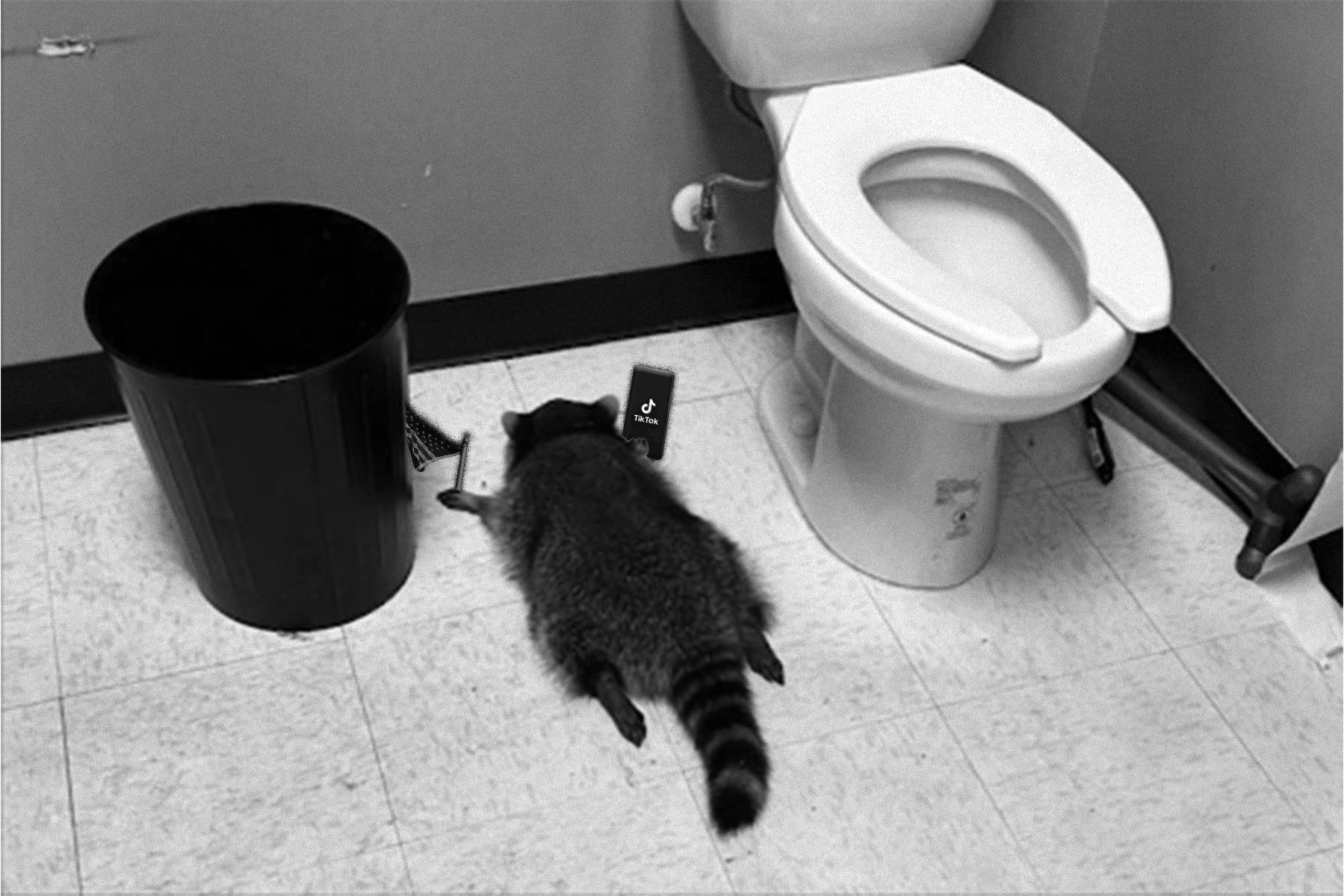
Last weekend, employees at a Virginia liquor store discovered destruction and desolation to an extent rarely seen. Bottles broken, spirits spilled, hooch in havoc. After extremely sophisticated forensic analysis, employees determined the culprit to be an extraordinarily intoxicated raccoon. Many people sent me articles from a variety of learned publications covering the raccoon’s rum rampage, showing photos from the unfortunate scene. From The Washington Post to rural regional TV channels, people couldn’t get enough of the plastered trash panda.
In fact, last week’s raccoon alcohol thievery wasn’t the first example of an intoxicated raccoon to capture the nation’s attention this year. Or the second. In September, a Kentucky nurse rescued a raccoon “reeking of booze.” In May, Ohio police discovered a raccoon in custody of a methamphetamine pipe. Clearly there’s no shortage of raccoons behaving poorly, no shortage of journalists eager to report their misdeeds and no shortage of people consuming their accounts.
While considering that the scale of America’s substance abuse crisis is so dire that even raccoons are affected, I turned my attention to Wednesday’s edition of The Observer. There I read Naasei Lynn’s piece, “Objectively subjective,” which references a Jonah Tran column which I personally wrestled with in September. Lynn agrees with Tran’s sentiment that The Observer’s opinion pages have been oversaturated
with political commentaries on the Trump administration. Among The Observer’s columnists, there is an intriguing tension developing between people who want to write political columns and those who are frustrated with their ubiquity. So where does the raccoon come in?
While the drunken raccoon achieved near-universal coverage, stories discussing several controversial scandals from the White House are largely reserved to the opinion pages of legacy newspapers and learned periodicals. For instance, the current administration is pursuing potentially illegal strikes on alleged Venezuelan drug boats, including intentionally killing defenseless survivors in the water. I’m not claiming that the media is not covering the controversy with
the boat strikes, nor am I claiming that people aren’t talking about it. Yet, there remains a marked difference between the attention captured by the furry booze bandit and a potential war crime committed by the United States. So why is that?
In 2023, the Pew Research Center conducted a poll that found 65% of Americans often feel exhausted when talking about politics, with 55% saying they feel angry. I would have to imagine that if the poll were conducted today, the results would be higher. Americans are fatigued with politics, and it’s clear that they are discontented with the current state of the rhetoric. When stories like the drunken raccoon come around, people are drawn to its hilarity and innocence (although the raccoon is obviously not innocent).
It’s a form of escapism; focus turns away from real pressing issues to a funny but ultimately meaningless instance of a marauding mammal.
However, the liquor store raccoon can teach us a profound lesson about America. Unity is much closer than one may initially think; we are more alike than we realize. We can come together and enjoy a silly story about a mischievous raccoon. How hilarious is a rogue alcoholic trash panda?
We must recognize that we all love the raccoon. So why can’t we all love America too.
I don’t pretend to believe that America is anywhere near achieving consensus, but I deeply believe that most Americans are fundamentally in agreement that our republic is worth fighting for. While some want to criticize their political enemies’
“SEDITIOUS BEHAVIOR, punishable by DEATH” as the current president is wont to do, Americans should remember that their friend, family member, or neighbor of a different party is ultimately on the same team.
With this in mind, continuing political dialogue remains of paramount importance, even in a collegiate student newspaper. It’s easy to become jaded by the current state of political discourse, yet as patriotic Americans, we must continue to exercise our right (and obligation) to make our voices heard. Not only must our campus institutions remain devoted to protecting freedom of speech, we (as individuals) must make frequent use of that right.
On Sept. 17, 1787, founding father Benjamin Franklin was asked what form of government had been devised for the United States at the Constitutional Convention. His immortal reply was, “A republic, if you can keep it.”
We’ll only keep our republic if we keep talking about politics, rather than ignoring it because it’s uncomfortable. So yes, keep fighting in front of the mashed potatoes. Keep writing political columns in The Observer. We can talk about drunk raccoons all we want, but we better make sure to cover the important stuff too.
And we’re nowhere near a shortage.
The views expressed in this column are those of the author and not necessarily those of The Observer.
Contact Grayson Beckham at gbeckham@nd.edu
Food for thought: The culture and tradition of the University of Notre Dame eerily parallels the propaganda of the Soviet Union. One would think that these two entities would be worlds apart, but let’s face it, they both know how to persuade. I don’t mean to suggest that our beloved university mirrors the authoritarian Soviet Union in any other way, just through the medium of how persuasion and a clear narrative can stick and form generational thought. It is the power of persuasion and the mechanics of influence that shape what those in the Soviet Union believed for generations, and what we, as members of the Notre Dame community, ultimately believe in as well.
The Soviet Union and Notre Dame both prominently utilize slogans, mottos and inspirational sayings. The Soviets romanticized the idea of the “Motherland” and used a “strength in unity” motto to formulate a sense of community with shared values. These mottos were intended to inspire each person to act as a “good soviet citizen” who understood that working was not just for
themselves, but for the collective. Notre Dame is also seen pushing forward slogans, many of which are known across campus. You have “play like a champion today,” “we are ND” and, of course, “God, Country, Notre Dame.” These slogans are known for a reason, and as a community, I believe each individual knows them by heart and lives by them. Having slogans such as these helps individuals carry their Notre Dame identity, and when stating these slogans, each individual feels as though they belong within the community, just as the soviet citizens felt a strong sense of connection and belonging to their own community.
At Notre Dame, students embody the spirit of each college as they “grow the good in business”, “seek knowledge, share discoveries, make a difference” in the scientific world, “study everything, do anything” through the field of liberal arts, work “toward a flourishing human community” in global affairs, generate “a new traditional architecture as a force for good” and strive toward “engineering a better world for all.” As students
participate in the University’s culture, they are committed to personifying these incarnations during and after their studies at Notre Dame, as a community. These mottos represent not only an individual aspiration, but also the ambitions of the colleges as a community — the Notre Dame community.
To add to the slogans of shared values, the Soviet Union did not shy away from using films, songs and pieces of literature to propagate values and ideology to its citizens. For instance, there are films such as “Chapaev,” directed by the Vasilyev Brothers, that portray the battle between the Red Army and the White Army. This film, although focusing on the titular character, Chapayev, symbolizes the unity of an army toward a goal, and not a single person’s ambitions. As a collective unit, Chapayev and his men are stronger and ready for battle. This is the same for novels, as seen in Fyodor Gladkov’s “Cement,” which represented the collaboration of members of the community working together to reconstruct a cement factory — a parallel to the reconstruction of the Soviet nation.
These propaganda media push toward the collective mindset, persuading the citizens to be like the characters in the films and novels, contributing to the collective goal and becoming solidified members of the community.
In the novel, “Sofia Petrovna,” by Lydia Chukovskaya, the titular protagonist liked a song titled “When my country calls, I’ll be a hero,” demonstrating the ideology of community and commitment to the country. This is a parallel to Notre Dame’s iconic songs that truly make you feel as though you are a part of the Notre Dame community, especially in the stands of the football stadium. For one, the “Notre Dame Victory March” is one song every student, alumnus, fan and member of the Notre Dame community knows well. This fight song is played at times when many Notre Dame members are gathered together, such as during football games. It is during these times that other iconic Notre Dame songs are played, such as “Here Come the Irish” and the “Victory Clog.”
However, the most noteworthy song would be the University’s
alma mater, “Notre Dame, Our Mother.” Like many alma maters, this song is a statement for those associated with the University. Knowing this song and being able to sing along makes you feel even more connected to the University than normal, at least in my own experience.
So when you walk across the campus pavements, think about how citizens in the Soviet Union were subjected to believing one narrative due to the propaganda that constantly surrounded them, and how Notre Dame parallels this sentiment, creating a familial, collegiate environment where Notre Dame community members feel welcomed. Yes, the fundamentals are entirely different; the Soviet Union was an authoritarian government that manipulated their citizens into believing one ideology. Notre Dame, on the other hand, is a loving collegiate entity that, through similar media outlets, has shared their mottos and values to be extended into generations to come.
Lacey Young Senior class of 2026 Dec. 3
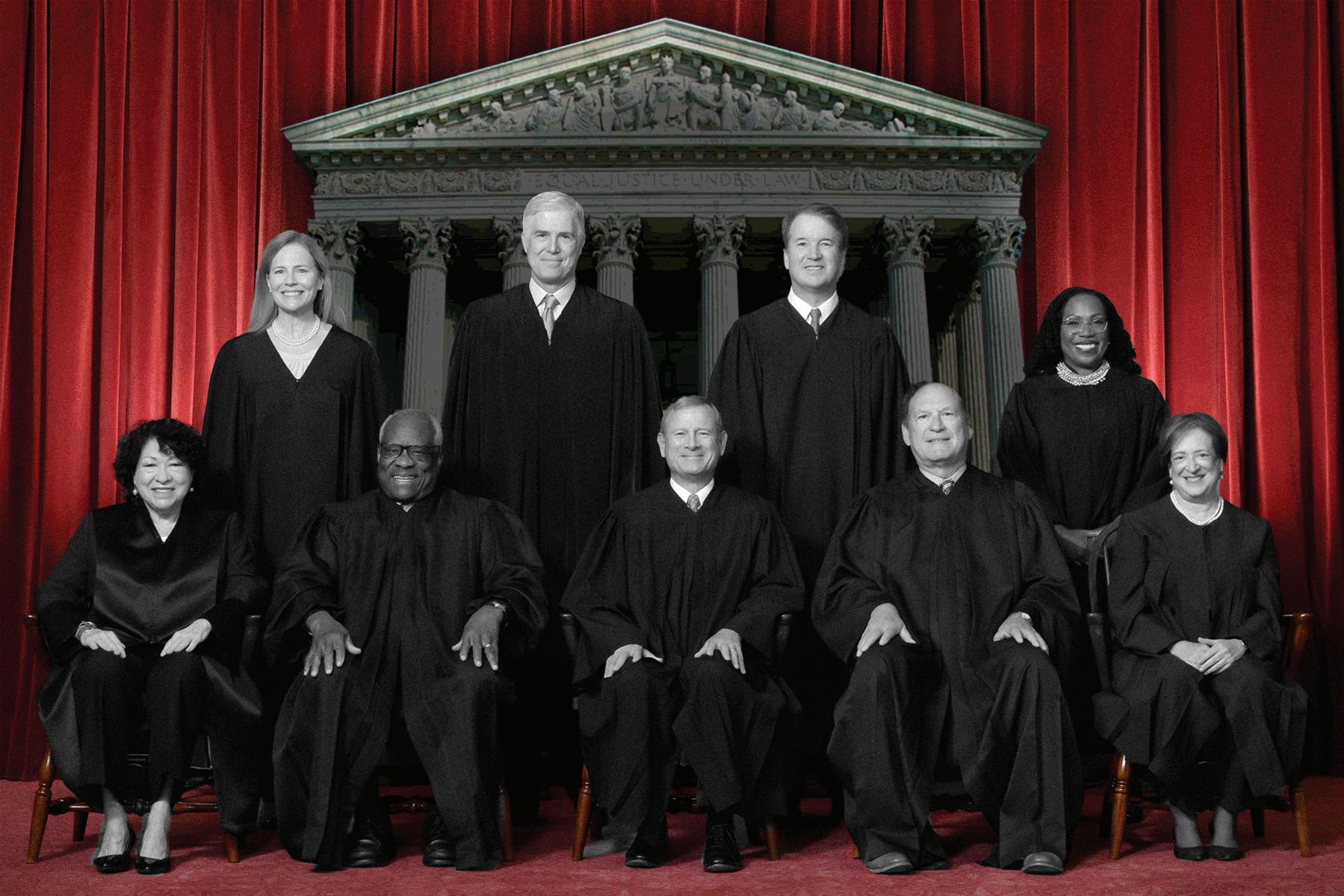
The Supreme Court has nine justices, but its decisions impact the entire nation. In recent times, there have been a plethora of controversial and social policy-shaping decisions — the overturning of Roe v. Wade and the striking down of affirmative action among them. Do these positions reflect a changing society? Or simply a change in who is in power?
The purpose of the Supreme Court is to interpret the Constitution and its amendments, serve as a check on the power of the other branches and protect the rights of individuals and states. Yet in recent times, the judicial branch seems to me increasingly partisan. To be clear, just by the appointment process of justices, the Supreme Court will never truly be rid of partisan influence. If you are nominated by a member of a party, it is usually because your beliefs broadly align with that party’s. However, that is not to say that the justices are tied to party lines or anything of the sort. In the words of Amy Coney Barrett, “I’m nobody’s justice.” Her stance is the one that all justices should have; she shows a commitment to the Constitution above all else. Even if you don’t agree with her decisions
and interpretations, that is an admirable stance. But every part of the Supreme Court — from the nomination to the relationships between judges and the federal government — has become politicized.
Let’s go back to 2016. ThenPresident Obama tried to nominate Merrick Garland to the Supreme Court. The Senate refused the nomination. The reasoning — Obama wanted to replace Justice Antonin Scalia (an ultra-conservative) with a more centrist justice. If the Senate approved, the court would no longer have been skewed to the conservative side. However, this was not the official reason
Republicans refused to even hear the nomination. It was toward the end of Obama’s term — and legitimacy — and it was argued that the next president should choose the next Supreme Court justice.
In theory, that decision holds weight. The appointment of a Supreme Court justice has an effect for decades, and their decisions could have an impact for several lifetimes. If someone’s term is ending, there is an argument that they shouldn’t be able to dictate that. At least, that is what many Republicans articulated.
The issue was, in 2016 — the start of this awfully polarized
political era we are in the midst of — a precedent was set. I liked to think of the Supreme Court as “above party politics,” but over the last decade that has been compromised. In 2020, the death of the late Justice Ruth Bader Ginsburg saw a Supreme Court vacancy rise at the end of President Trump’s first term. Republicans did not remain consistent to the principle they applied to Obama, illustrating that the refusal to hear Garland’s nomination was actually just for partisan advantage. If we want laws truly considered and analyzed on how they affect everyone, then we
need a range of viewpoints that reflect everyone. There is no simple answer to most modern-day constitutional questions, but having justices with varied philosophies is important for richer debate. Think of all the times you’ve had an opinion in any discussion-based class, then think of all the times you heard opinions you’d never even considered before. Maybe it changed your mind or perhaps it made you more certain in your own beliefs. Hearing different opinions either makes you change your argument or strengthens it. But, if you are always around people where your opinion is held by the majority, your ability to see issues from other perspectives weakens.
Balance is essential for debate, and debate is essential in protecting the law. So, any extreme in the Supreme Court is negative. Case decisions must be a product of balance. If the citizens of a country are expected to tolerate, respect and consider other people’s perspectives, it is only right that all of our institutions are expected to do the same.
The views expressed in this column are those of the author and not necessarily those of The Observer.
Contact Amaris O’Connor at aoconn27@nd.edu
By Harry Penne Scene Copy Editor
It’s that time again when television networks air festive favorites, and “A Christmas Story” is perpetually playing. But what about non-traditional holiday films that break conventional seasonal molds? This season, I’ll examine what I argue is a holiday classic: “Gremlins,” written by Chris Columbus (“Home Alone”), produced by Steven Spielberg and directed by Joe Dante.
“Gremlins” is somewhat controversial in its holiday status, but its Christmas movie label has become more accepted fairly recently. It premiered in the summer of 1984 on the same weekend as “Ghostbusters” and was successful, but had it been released over the holidays, I think its legacy would be different, with original audiences making winter, not summertime, associations.
When looking solely at its horror movie plot, it’s understandable how, at first, “Gremlins” doesn’t scream “Christmas movie.” Despite the contrasts, horror and Christmas aren’t strangers. There’s the famous Germanic legend of Krampus, St. Nicholas’ traveling demonic companion, who, instead of rewarding good children, punishes the naughty, taking them to hell. Jolly, right? Fundamentally, the cautionary Krampus tale inspires good behavior in children using punishment, not reward, as motivation. Consider Charles Dickens’ classic “A Christmas Carol.” Ebenezer Scrooge is so wayward that ghostly visitors must frighten him into kindness. One of its greatest images is Scrooge kneeling before his own grave in the presence of the reaperlike Ghost of Christmas Yet to

Come. This macabre graveyard scene is immediately understood as a Christmas visual despite lacking traditional holiday iconography. Why? It represents Scrooge’s metanoia and rebirth from damnation to light. And isn’t that the whole Christian message of Christmas? That salvation is attainable because of Christ’s incarnation?
While “Gremlins” doesn’t have theological undertones like “A Christmas Carol” or Krampus’ good behavior incentivization, its horror scenes reinforce some Christmas themes. The film shows the battle between light and dark: the cute Mogwai Gizmo versus the evil gremlins. As with most holiday films, goodness wins. What’s Christmas all about? Light triumphing over darkness and death.
Christmas isn’t purely cosmetic in “Gremlins”; it’s substantive. Plot wise, it provides reasons for Billy (Zach Galligan) to receive
the Mogwai — a holiday gift from his father — as well as why families are home and kids off from school during the gremlins’ attacks. Dante also utilizes Christmas to make social commentary about consumerism.
Aesthetically, the film is very festive. The opening credits alone set the holiday tone: Darlene Love’s “Christmas (Baby Please Come Home)” plays over a snowy, picturesque town square decked out for the holidays — if the set looks familiar, it’s on Universal’s backlot and was Hill Valley in “Back to the Future.” Across the picture, Christmas decorations adorn the set and are cleverly utilized in the gremlins’ antics.
Christmas music plays throughout the film. In the infamous microwave scene, Johnny Mathis’ “Do You Hear What I Hear?” plays during the gremlins’ destructive acts. Additionally, composer Jerry Goldsmith (“Rudy”) incorporates several
Christmas hymns into the score, such as a melancholic “Silent Night” accompanying Billy and Kate (Phoebe Cates) surveying gremlin attack damage.
“Gremlins” is a black comedy, and Dante intended for its horror scenes to comedically juxtapose the warm aesthetic of holiday music and colorful lights. Not all holiday films are upbeat for their entire duration. In “Gremlins,” the characters acknowledge this while watching “It’s a Wonderful Life,” commenting: “It’s a sad movie.”
Originally, Dante envisioned “Gremlins” as purely horror with minimal humor, but was urged to significantly lighten the tone.
Notably, the film breaks the sacred rule of holiday films by revealing the truth about Santa Claus. Kate monologues about why she doesn’t celebrate Christmas, explaining how, one year, her father, attempting
to surprise her by dressing as Santa and coming down the chimney, broke his neck and got stuck: “That’s how I found out there is no Santa Claus.” This bleak monologue is tonally dissonant to the rest of the film and received pushback, but Dante was adamant about its inclusion as a remnant of an original, darker script. Like Dickens’ “The Haunted Man,” it’s a reminder that many suffer and struggle during the holidays. Due to the monologue’s reputation, Dante self-parodied it in “Gremlins II” with a more comedic angle when Kate begins: “Don’t mention Lincoln! Something terrible happened to me once on Lincoln’s birthday.”
“Gremlins,” like many of Dickens’ holiday works, critiques Christmas consumerism and greed. The deplorable Mrs. Deagle (Polly Holliday) — Wicked Witch of the West meets Scrooge — is miserly, cruel to the vulnerable and hates Christmas. Unlike Scrooge, she isn’t given a second chance, getting her moral comeuppance when Christmas caroling gremlins launch her out a window. This supports Dante’s efforts to subvert Christmas tropes; Deagle’s “Scrooge repentance” is expected but doesn’t happen. When Gizmo first duplicates, Billy’s dad, upon seeing the many resultant Mogwai, comments that it could be a desirable pet. However, when the replicated Mogwai become gremlins due to Billy’s carelessness, things get deadly.
I hope “Gremlins” makes your holiday movie marathon. Just don’t feed your Mogwai Christmas cookies after midnight!
Contact Harry Penne at hpenne@nd.edu
By Marguerite C. J. Marley Scene Writer
I was really looking forward to “Wicked: For Good” in a movie landscape that seems to hover between big yet disappointing blockbusters and independent masterpieces. The first “Wicked’” was able to straddle that line of being a blockbuster and being critically successful, and I was longing for something like that to usher in the 2026 awards season. But unfortunately, “Wicked: For Good” struggles with pacing and coherence, making it hard to stay engaged despite some good moments, which affects how viewers might perceive its overall quality.
The filmmakers faced a tough challenge adapting the second act of “Wicked”, which is generally considered weaker due to fewer songs and more references to the
“Wizard of Oz”, but they missed chances to deepen the story, leaving some elements underdeveloped and unengaging.
Boq and Fiyero mostly vanish from the story. Unlike the stage show, which offers a Doylistic explanation — one that accounts for real-life limitations rather than trying to explain something away through the narrative — for the actors having to get into complex makeup, the film does not explain their absence, which disrupts the narrative flow and confuses viewers.
One thing they had the opportunity to do was expand the role of the cowardly lion (as with the CGI it would be easier to portray him on screen than on stage) but instead we still barely get him in it; we instead get bogged down in unnecessary detours.
Still, Jon M. Chu flexes his filmmaking instincts: Adding
Glinda to the song “Wonderful” was a good change that avoided the same traps that “Sentimental Man” falls into in the first movie.
The film’s visuals lack the vibrancy of the first installment, with duller color grading and cheap-looking animals that make Oz seem lifeless and underfunded. I also don’t think it was necessary to digitally de-age Jeff Goldblum to play the young wizard, when it looks horrible, and there’s only one singular shot.
The 1939 “Wizard of Oz” film provided a more realistic-looking scarecrow than Jon M. Chu did in 2025, with many people pointing out that Jonathan Bailey looks more like Ryan Reynolds in the Scarecrow makeup than himself.
Out of the two songs added to the film, only one is worth the time it takes to watch. “No place like home” grinds the movie to a halt right as it’s getting started.
“Girl in the Bubble” on the other hand, does provide some much needed depth to Glinda as we follow her journey from student to mascot of the Wizard, to disillusioned with the whole system.
Though Cynthia Erivo and Ariana Grande both deliver strong performances, the dullness of the supporting cast overshadows their good work. Michelle Yeoh seems to have phoned it in, playing the complicated Madame Morrible in the dullest way possible, barely reacting to her costars.
Chu also appears to have finally run into the issue of casting weak singers in roles that require a lot of singing (something I pointed out in my review of the first film), and listening to Yeoh and Goldblum be autotuned to high hell and still not able to hit the notes required of them is incredibly grating.
Bailey is also severely underused: What he is given is a dull
Fiyero that is reduced to a Ken doll that passes between the two leads like a very boring sexy lamp. Giving credit where credit is due, Ethan Slater does flex his range as Boq/the Tin Man. Though again, he’s not given a lot to work with. However, his rage might be more from his fallout with Ariana Grande after their breakup than anything else.
The tragedy of “Wicked” is not lost under all these problems. Erivo and Grande both deliver memorable performances that tug at the audience’s hearts. Ultimately, all its good moments do not provide enough steam to get “Wicked: For Good” up and running again, and though it does contain heart and courage, there’s not enough brains to bring it back home.
Contact Marguerite Marley at mmarley01@saintmarys.edu
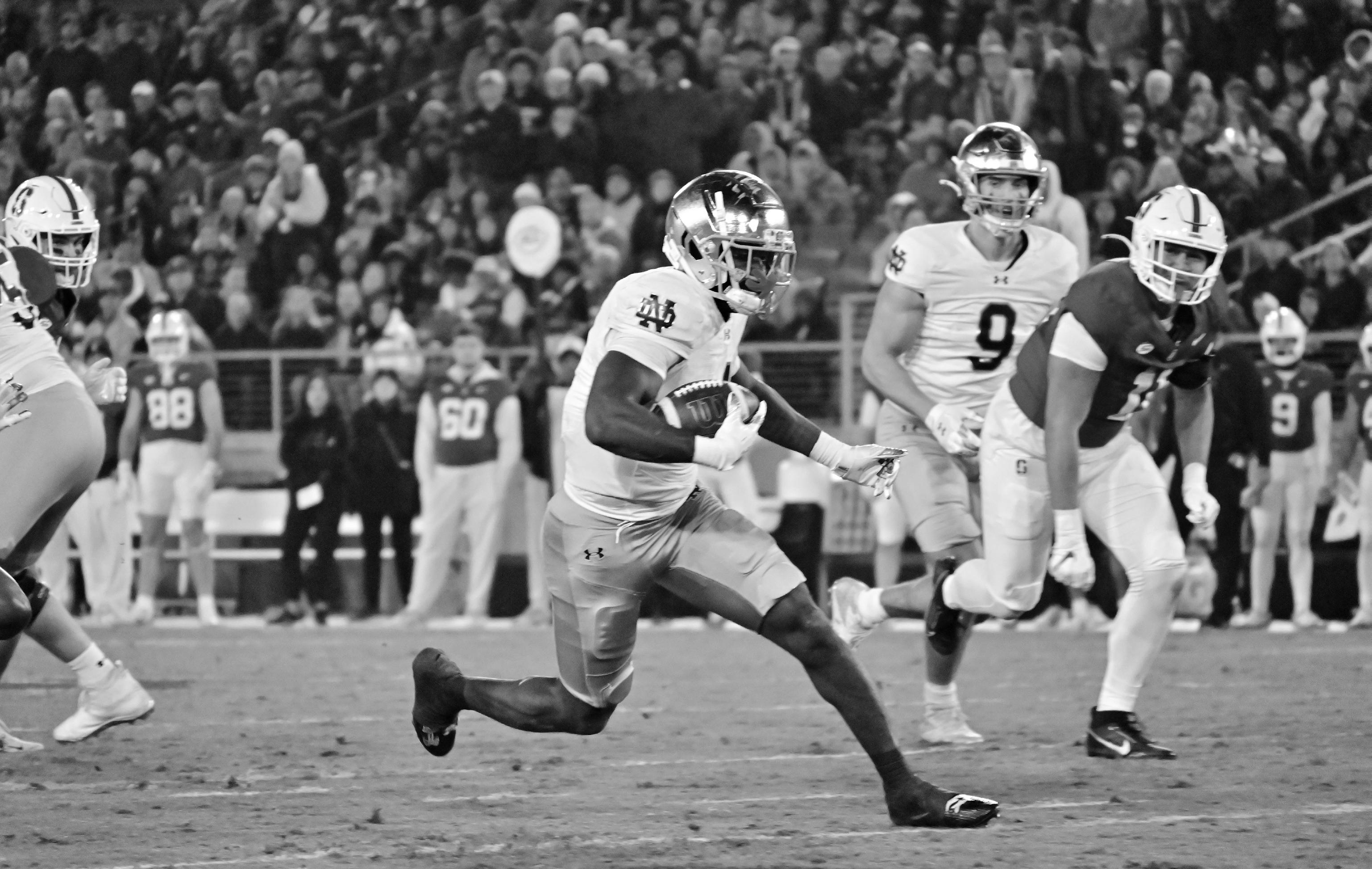
Junior running back Jeremiyah Love breaks free in the open field during Notre Dame’s 49-20 win at Stanford on Nov. 29, 2025. The St. Louis native, a likely Heisman Trophy finalist and NFL first round draft choice, finished the season with 1,652 yards from scrimmage, including 1,372 on the ground, as well as a Notre Dame single-season record 21 touchdowns.
By Chris Dailey Sports Writer
On Monday night, the Heisman Trophy committee will release its finalists for the 2025 award. With four players typically making the trek to New York City, this year will likely see Indiana’s Fernando Mendoza, Vanderbilt’s Diego Pavia, Ohio State’s Julian Sayin and Notre Dame’s Jeremiyah Love take center stage in the Big Apple. With Notre Dame’s season officially over, the goal for many Irish fans hoping to salvage a disappointing finish is to see Love hoist the Heisman Trophy. While the majority of bookmakers have him nestled behind Mendoza and Pavia, the two gunslingers are by no means untouchable. And if Sunday’s College Football Playoff selection show taught the country anything, it’s that anything can happen in college football. This includes a Jeremiyah Love Heisman.
So the question now becomes: how can Love win the Heisman? If Love is to do the unthinkable and become the first Irishman to win the award since Tim Brown in 1987, Notre Dame must do a successful job at making an effective case to voters.
The best way to do just that is break Love’s Heisman argument into two sections: Love vs. other running backs and Love vs. the Heisman competition.
Love vs. other running backs
Love finished the season with 1,372 yards, a mark that places him fourth in the nation. At first glance, his production in this department may not appear Heisman-worthy, however, several larger factors must be considered when comparing Love to the running backs ahead of him.
The nation’s leading rusher, Cam Cook, has accumulated 1,659 yards in his record-breaking season for Jacksonville State. However, he’s done this on 295 attempts. Love, on the other hand, has achieved his yardage total on 96 fewer carries. If Love had 295 carries while maintaining his 6.9 yards per attempt, he would hypothetically amass 2,034 yards.
Just shy of Cook’s tally is Missouri’s Ahmad Hardy. The shifty back who had the Tigers lurking around College Football Playoff conversations for much of the season picked up 1,560 yards on the ground. Like Cook, Hardy is averaging fewer yards per carry than Love.
Cook and Hardy also have 16 touchdowns each, all of which come on the ground. Meanwhile, Love has 18 rushing touchdowns and 3 through the air. His 21 total broke NFL Hall of Famer Jerome Bettis’ single-season touchdown record at Notre Dame. With these metrics in mind, Love is head and shoulders above every running back in the nation. What he has been able to
accomplish while splitting touches with fellow future NFL back Jadarian Price is unreal. This leads naturally into the bigger conversation of how Love stacks up against the nation’s fellow heavy-hitters.
Love vs. Heisman candidates
Love’s two main competitors for the Heisman will be Mendoza and Pavia. After Sayin and the Buckeyes lost in the Big Ten Championship Game to Mendoza’s Hoosiers, his Heisman hopes were effectively silenced.
What Mendoza has been able to accomplish at Indiana is unheard of. He led the perennial Big Ten bottom feeder to the No. 1 seed in the College Football Playoff. Mendoza has a quick release, controls the line of scrimmage and doesn’t make many mistakes.
Mendoza has thrown for 2,980 yards, 33 touchdowns and six interceptions. On Saturday night, he likely cemented his Heisman case by leading Indiana to a 13-10 Big Ten Championship win over Ohio State. However, there is one blemish in his resume.
Mendoza has only one game of 300+ yards passing. In comparison, recent Heisman winning quarterbacks Jayden Daniels, Caleb Williams and Bryce Young all had at least seven games of 300+ yards in the air in their Heisman campaigns. Mendoza’s only 300+ yard game came against a Michigan State team that
eventually fired its head coach.
Trailing Mendoza in the odds is Vanderbilt’s beloved star, Diego Pavia. The Commodores’ main man has had a terrific year, accounting for 36 touchdowns, 3,192 passing yards and 907 rushing yards adjusted for sacks. All of those respective stats are greater than Mendoza’s numbers.
Like Mendoza, Pavia has been at the forefront of his program’s meteoric rise. Vanderbilt finished the season 10-2 with wins over the likes of LSU, Tennessee and Missouri.
Mendoza and Pavia have unquestionably done enough to convince Heisman voters that they deserve to hoist the prestigious trophy. But they are by no means untouchable. If Love is to win the Heisman, it will come down to a debate that exists beyond statistics.
Heisman moments
Every Heisman winner has their “Heisman Moment.” In 2012, it was Johnny Manziel’s miraculous performance against Alabama. For Bryce Young in 2021, it was his four-overtime performance in Auburn. This year, Love is seemingly leading the way in Heisman-moment worthy plays.
From his 56-yard, video gameesque touchdown run against Pitt to his improbable score from way downtown against Navy, Love has become a human highlight reel.
Nearly every game this season, he’s delivered a play worthy of SportsCenter’s Top 10.
Mendoza’s Heisman moment came last night against Indiana. The Hoosiers faced a third-and-six inside their own 30 with less than three minutes left when Mendoza saved the day. His perfectly placed ball toward the opposite side of the field found Charlie Becker, sealing the deal for Indiana’s victory.
Manziel had his fair share to say of college football fans around the country claiming that was a Heisman moment, tweeting, “We got basic fade routes being called Heisman moments now… I’ve really seen it all.”
Manziel, who would know a thing or two about Heisman moments, is not sure that one pass from Mendoza deserves the label of a Heisman moment. As for Pavia, his performance against LSU was extraordinary. But then again, the Tigers finished 7-5 and Brian Kelly was fired.
In this category, Love clearly separates himself from the competition. Undoubtedly the most electric player in the country, he now awaits recognition from Heisman voters. After the Irish were left out of the playoffs, a Jeremiyah Love Heisman would give Notre Dame fans something to rally behind amid a tumultuous end to the year.
Contact Chris Dailey at cdailey2@nd.edu
What currently living famous person do you wish could live forever?
Matthew Spellman sophomore Dunne Hall
“Drake Maye.”
Jude Nofal sophomore Lewis Hall
“Fairuz.”
Zenidene El Farissi junior Sorin Hall
“Achraf Hakimi.”
CROSSWORD | WILL SHORTZ
Luke Banks freshman Baumer Hall
“LeBron James.”
John Paskowski freshman Dillon Hall
“Jeremiyah Love.”
Have an idea for a poll? Email dstangel@nd.edu
What round will Notre Dame make it to in the playoffs?
First Round Quarterfinals Semifinals National Championship
Want your event included here? Email news@ndsmcobserver.com
Monday
Vespers with ND Children’s Choir Chanted pslams, sung prayers, and Magnificat. Church of Our Lady of Loretto at Saint Mary’s College 4:30 - 5 p.m.
Tuesday
Performance: “Beyond This Point” Percussion performance by Chicago-based musicians DeBartolo Performing Arts Center 7 - 8:30 p.m.
Wednesday
Halftime A Cappella Timeless End-of-semester showcase Washington Hall 7:30 - 9:30 p.m.
Thursday
Lovestruck: An Undertones Concert All-male group performs winter concert Washington Hall 7:30 - 9:30 p.m.
Friday
Film: ‘Sudan, Remember Us’ Young Sudanese generation fights for freedom DeBartolo Performing Arts Center 7 - 8:20 p.m.
By Observer Sports Staff Football Beat
The early signing period, which opened on Wednesday, cemented one of the greatest Notre Dame recruiting classes in the Internet era of rankings. All 27 committed recruits signed to round out the No. 4 class in the nation, according to 247Sports. The group included four five-stars and 19 four-stars, with 14 players inside the top 250. Twelve different states were represented in the class, a reflection of Notre Dame’s nationwide recruiting push under head coach Marcus Freeman.
“I just thought we were very intentional about who we targeted,” Freeman said. “We were on the right guys. Nobody decommitted. They bought into what this place has to offer, and I’m excited for what their future holds.”
In his first three cycles, Freeman brought in some of the best classes in decades, rivaled only by Brian Kelly’s 2013 class. 2025 was a step back from that early momentum, with the class falling outside of the top 10 nationally. However, after a National Championship run and a concerted effort to expand geographically, Freeman and his staff have responded with their best class yet.
“I think we’ve always said that you come here and aspire to win national championships,” Freeman said. “These young people are seeing it and believe that they can reach that type of individual goal and team goal in the current landscape of college football.”
Instilling that belief in every single recruit has proven to be Freeman’s superpower. The buy-in he’s gotten from every player has proven fundamental to the success and resilience of his teams. It helped the Irish reach the title game last season. It helped them ride a 10-game win streak after a 0-2 start to 2025, despite not being selected to compete for a national championship.
Regardless of this Sunday’s disappointing result, the future is bright in South Bend. Here are three of the most promising players on both sides of the ball from Notre Dame’s 2026 class.
Ian Premer, tight end
Hailing from Great Bend, Kan., Ian Premer is 6-foot-5 and 220 pounds, slotting in as the No. 1 tight end recruit in the country. With his massive frame and impressive high school resume, which includes the 2025 Kansas Gatorade Player of the Year, Premer looks to be battletested and comprehensively prepared for the next level. During his senior season, he accumulated over 1,300 scrimmage yards, both on the ground and in the air, and he added 68 tackles and six interceptions on defense.
Besides just his prowess as a two-way football player, Premer impressed as an all-around, versatile athlete in high school, earning
a Kansas State offer for basketball and recording a .476 batting average his sophomore baseball season.
The five-star tight end is built to slot into a multitude of personnel situations, doubling as an elite receiving option and a skilled blocker. Scouts have praised his high football IQ and extreme competitiveness, traits that will fit right into the Fighting Irish locker room. With senior tight end Eli Raridon set to graduate this year, Premer should quickly slot into Notre Dame’s explosive passing attack.
Ben Nichols, interior offensive lineman/offensive tackle
Ben Nichols is a fundamental part of Notre Dame’s 2026 recruiting class on offense. The four-star lineman was ranked as the No. 6 interior offensive lineman in the country and the No. 2 overall recruit in Michigan. He is also a 2025 Under Armour All-American, one of the highest honors in the country for a high school football recruit.
The 6-foot-6, 335-pound mauler held offers from Alabama, Ohio State, Iowa, Tennessee and a host of others, but ultimately chose the Irish. To him, his relationship with the coaches at Notre Dame played a significant role in his decision.
One of Nichols’s greatest strengths coming to Notre Dame is his versatility. Being as big as he is, he opens the possibility of playing any position on the offensive line. In high school, he spent time at center, guard and tackle. For his stature, he may find himself playing tackle for the Irish, but could certainly be an asset at his native guard as well.
Jonaz Walton, running back Jonaz Walton, out of Carrollton, Ga., is one of Notre Dame’s most impressive signings of this 2026 recruiting class. Walton is a stout, quick runner
with remarkable vision, which is why he has slotted in as the No. 11 running back in the country this recruiting cycle. Coming in at 5-foot-9 and 205 pounds, Walton is reminiscent of past Notre Dame star and successful Los Angeles Rams running back Kyren Williams. His size is relatively average for a running back, but he is a strong, upright runner who has posted anywhere from 7.4 to 8.8 yards per carry throughout his high school career.
Just like much of this star-studded recruiting class, Walton impressed as a multi-sport athlete in high school, posting a 10.60 100m time and an impressive 47-9.5 in the shot put for Carrollton Central High School’s track and field team. Notre Dame has been churning out elite, NFL-caliber running backs every year in recent memory, headlined by this season’s two-headed monster of Jeremiyah Love and Jadarian Price. Walton figures to continue that trend, toting a college and possibly NFL-ready skill set that will fit right into Notre Dame’s high-powered rushing offense. With the impending return of sophomore running back Aneyas Williams, it remains to be seen when Walton will factor into the rotation, but when he does he is poised to make a significant impact.
Rodney Dunham, edge rusher
Rodney Dunham is, without a doubt, the highlight of Notre Dame’s 2026 recruiting class as a whole. The five-star edge rusher was the highest-ranked recruit of Notre Dame’s 2026 class. Not only is he a five-star, but he is also ranked as the No. 8 overall recruit, No. 2 edge rusher and No. 2 overall recruit in North Carolina. Another interesting tidbit is that Dunham is an incredible athlete as a whole; the multi-sport athlete is also a highly
touted baseball recruit, pitching upwards of 90 miles per hour and being ranked as a top 300 overall recruit by Perfect Game. As for his skill on the gridiron, Dunham’s 6-foot-4, 227-pound frame is one of his greatest assets at his position. He expects to fill out to 240 pounds by the time he steps into his first game for the Irish, but his size already provides him with outstanding length for an edge rusher. He also utilizes his great bend and explosiveness off the line of scrimmage, which makes him a nightmare for opposing quarterbacks. Although he runs out of a base 4-3 defense now, he expects to be utilized both as a stand-up or down lineman off the edge at Notre Dame and be a weapon on defense regardless.
Joey O’Brien, safety
Joey O’Brien, a safety out of La Salle College High School in Glenside, Pa., is one of the faces of Notre Dame’s star-studded 2026 recruiting class. The consensus five-star and No. 2 safety in the country is Notre Dame’s thirdranked recruit in this class, and his vast skillset tells that same story. The 6-foot-3, 185-pound defensive back was selected to the MaxPreps Junior All-American team in 2024, in a season where he shined as a two-way player, accumulating a single-season school-record 1,029 receiving yards while still shining on defense, totaling 36 tackles, 13 pass breakups and an interception. Keeping with the theme of versatility, O’Brien was a quality basketball player in high school, receiving All-Catholic second team honors as a junior. Along with impressive athleticism, O’Brien shines through his incredible field awareness and discipline in shading passing windows. He lacks some of the foot speed necessary to man-to-man shadow an opponent’s star wideout,
but his incredible hand positioning and ball skills make him a strong coverage safety who can generate turnovers. O’Brien had recruiting interest both as a defensive back and a wide receiver, making him one of the more unique and versatile prospects in this class. With much of the safety room, including redshirt sophomore Adon Shuler, returning next year, it may take some time for O’Brien to slot in, but when he does, he is sure to make a massive impact.
Khary Adams, cornerback
Khary Adams brings another exciting prospect to Notre Dame’s secondary. He is the highest-rated corner in its 2026 class and second-highest-ranked defensive back behind only safety Joey O’Brien. Adams is a four-star rated corner that is ranked as the No. 49 recruit nationally, No. 4 recruit in Maryland and No. 5 cornerback in the class of 2026. Adams has a solid build for a cornerback at 6-foot-2, 175 pounds, and also held offers from Michigan, Penn State, Arizona and South Carolina before choosing the Irish.
More than anything, Adams is known as a freak athlete both on and off the football field. He runs some blazing track times, including a 21.50-second 200-meter dash and a 10.74-second 100-meter dash. He also got time as both a receiver and kick returner in high school, but primarily excelled as a zone coverage corner. However, he is still seen as an eraser in man coverage that will fit right into the Notre Dame scheme of primarily man. Going forward, Adams could step in as a day-one contributor for the Irish defense and holds all of the tools to eventually excel even beyond his time at Notre Dame.
All rankings according to 247Sports.

Continued from page 1 jumping it being its victorious opponent, Indiana. This decision seems to be more so rewarding Indiana for its victory, not punishing Ohio State for its loss. Additionally, Alabama lost the SEC Championship in a game where it looked incredibly uncompetitive, yet it did not drop at all in the rankings. However, the same could not be said for BYU as it lost the Big 12 Championship game
and was punished for it, dropping one spot in the final rankings. BYU dropping from No. 11 to No. 12 ultimately pitted Notre Dame and Miami against each other for that No. 10 spot, and the committee decided to give the spot to Miami because of the result of their Week 1 matchup.
It’s hard to punish teams for losing a conference championship game, a game that other teams didn’t have to play. Knocking Alabama out of the playoffs for that reason seems unfair, but that protection
Alabama received did not apply to BYU. The question remains: Why were Ohio State and Alabama protected, but not BYU?
Another question fans are wondering is how much of a factor did Duke’s win over Virginia play in these rankings. Had Virginia won, it would surely have been a top-five-ranked conference champion being ranked at No. 17 heading into the matchup, higher than both Tulane and James Madison, the fourth and fifth-highestranked conference champions.
However, Duke, which finished the year 8-5, upset Virginia, making it so the ACC champion would not likely receive a bid to the College Football Playoff. It is a fair question to ask if the committee was comfortable with a playoff bracket that included no ACC teams, and how much of a role that played in the decision to include Miami.
It’s also hard not to wonder why this decision comparing Notre Dame and Miami wasn’t made in the rankings last Tuesday. Both Notre Dame and Miami were idle
during conference championship week, and it’s hard to see how BYU’s loss in the Big 12 title game changed things that much for Notre Dame. As tough of a pill as it is to swallow for Fighting Irish fans, there is nothing that can be done. The committee has made its decision. However, the inconsistency in these decisions is certainly frustrating for college football fans, as it is not very clear what factors the committee considers most important when deciding these questions.
By Ryan Murphy Sports Writer
Christmas break cannot come soon enough for the Notre Dame hockey team.
After the Irish gained a glimmer of momentum with a win last week, it was snuffed out at home by the No. 2 Wisconsin Badgers this weekend. With 7-4 and 9-2 losses at Compton Family Ice Arena on Friday and Saturday, Notre Dame will head
unexpected. There’s no doubt that, in many respects, the Irish have taken steps forward this season.They’ve almost always been sent reeling backward shortly thereafter.
But by the time Badger senior forward Simon Tassy scored Wisconsin’s 16th and final goal of the series on Saturday night, it became a question of whether the Irish have lost their footing this season entirely.
It did not start as badly as it
But the manner in which Wisconsin pulled themselves back into the series was a harbinger of things to come. Badger junior forward Quinn Finley snuck in behind the Notre Dame defense and beat Irish sophomore starter Nicholas Kempf on the breakaway 31 seconds into the frame. Then, a little over three minutes later, senior forward Christian Fitzgerald scored again on the breakaway. It was 2-2.
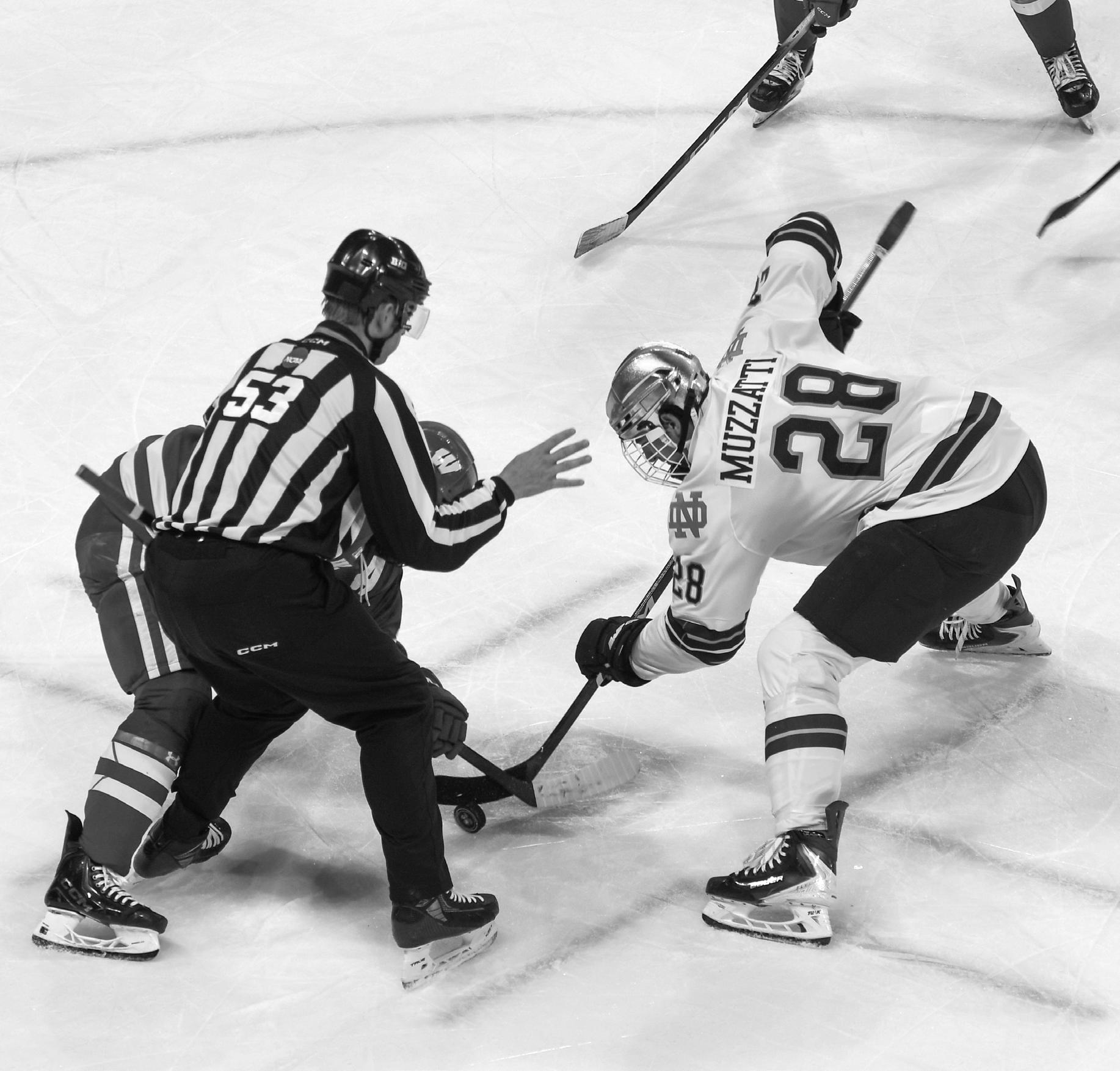
to its three-week holiday break losers of eight of its last nine.
“We just stub our toe,” firstyear head coach Brock Sheahan said after Friday’s loss. “[It’s] what we do. Until that changes, it’s going to be frustrating.”
Indeed, at this juncture, frustration must be at an alltime high for Notre Dame. Stubbing your toe implies taking a step forward, then recoiling backward from something
finished. The Irish jumped out to a 2-0 lead in Friday’s first game. 3:11 into the first period, junior forward Evan Werner beat Wisconsin starting sophomore netminder Eli Pulver. A goal by junior defenseman Paul Fischer with 31 seconds left in the period chased a rattled Pulver from the game. He was replaced by freshman Daniel Hauser. The Irish were in the driver’s seat.
“I coached Quinn Finley in the USHL. He’s an elite hockey player. That’s in the scout video. He takes off,” an agitated Sheahan said Friday. “I coached him. He’s going to take off. When 19’s on the ice, be alert to 19. And you just watch him skate by you for a breakaway? So that’s a question I don’t have an answer to.”
Never mind that the Irish retook the lead a little over a
minute later on a power-play goal by freshman forward Pano Fimis. Friday night’s game was tied three times. Notre Dame led twice. Yet a win still slipped through its hands. Junior defenseman Joe Palodichuk scored twice in the last half of the second period, giving Wisconsin a 4-3 lead at the second intermission. Then, after Werner tied the game early in the third, Notre Dame allowed Badger sophomore Ryan Botterill to put his team ahead 5-4. A turnover by senior defenseman Michael Mastrodomenico led to a shot that Kempf should have trapped in his glove, but it fell out right to Botterill.
“Under no pressure, giving the other team the puck and they have a three-on-one at your net, they’re probably going to score,” Sheahan said.
Two Wisconsin empty-net goals put the game away.
“The great thing is, we have an opportunity to do this better tomorrow,” Sheahan said Friday. “We’ll really see where our character is at. I expect us to be better than we were tonight.”
It became clear quickly that the Irish were not better on Saturday. They started the night by allowing their second fourgoal period of the series. Finley scored 3:37 into the game, off the glove of Kempf and in.
Freshman Grady Deering finished a rebound to put the Badgers up 2-0 less than two minutes later. Then the Irish conceded two goals in two minutes again, after a missed slashing call allowed Badger senior defenseman Ben Dexheimer to walk in and score before freshman Blake Montgomery followed up 55 seconds later.
The game wasn’t 12 minutes old and the Badgers led by four. The rest of the game felt like a formality.
Through the opening six games in Big Ten play, Notre Dame did not win because they couldn’t score. They’ve forced the issue in the four games since, conference and nonconference, but utterly collapsed within their own end. The defensive pairing changes made by Sheahan in the wake of Friday’s loss did not help.
The mistakes the Irish have been making that forced Sheahan to make those changes in the first place were compounded on Saturday. They conceded goals at horrible times, allowing the Badgers to score in quick succession, shortly after the Irish had scored or in the first or last three minutes of a period, killing momentum. They tried ill-advised zone clearances through the middle of the rink, attempted to skate through a maze of Badgers when a simple pass would do and went through three goaltenders over the course of Saturday night. While Kempf has not been the only problem, his glove hand side is clearly giving him some trouble, and that shone through in the first period.
A team that probably has not deserved to lose as much as they have this season very much deserved to on Saturday night. After the four-goal first period, Notre Dame played Wisconsin to a level 1-1 second. Then Notre Dame conceded their third four-goal period of the series in the final frame.
The game devolved into borderline fisticuffs with 1:59 to play, with tackling, swipes thrown, taunting across the benches and helmets and sticks littering the ice in a 9-2 contest. Not many of the 5,046 sellout crowd remained in their seats to see it.
So ended Notre Dame’s worst home loss since Dec. 2, 2011 — a 9-2 loss to Northeastern in Compton Family Ice Arena’s opening season. The 16 goals against is the most in one weekend in the arena’s 14-year history by a wide margin.
One bad night sometimes is exactly that — one bad night. Having taken steps forward and with nothing to show for them, Notre Dame ended 2025 in a fit of frustration. At least when play resumes on Jan. 2, the low point of its season will be three weeks in the rearview mirror.
“I believe that we’re close,” Sheahan said Friday. “But at the same time, we’re very, very far away.”
Contact Ryan Murphy at rmurph22@nd.edu
By Ben Hicks Associate Sports Editor
Despair. Disappointment. Disbelief. Those were among the words ESPN’s Jen Lada used to describe the emotions inside Notre Dame’s football facility as the Irish hopelessly saw their national championship dreams slip away on TV. Not on the field, but behind closed doors, with no real rationale or consistency to support the arbitrary decision-making of the 12-member College Football Playoff committee.
Notre Dame, winners of ten straight by at least double digits, had its fate sealed as a giant “U,” the same logo which had sat behind them for the previous five weeks, dashed across the screen for the final spot in the 12-team field. Of course, the Miami Hurricanes did beat Notre Dame 27-24 back on Aug. 31, and for that reason, the final decision was probably correct. But the manner in which the rankings shifted between Nov. 4 and yesterday are both illogical and nonsensical.
The anxiety that forebode Sunday’s disappointment
began on Tuesday evening, when Alabama, after barely surviving 5-7 Auburn, somehow leapfrogged then-No. 9 Notre Dame. We’ll get back to Alabama, but for now let’s address the flaws in this current system.
Foremost, holding a weekly rankings show is both untruthful and unhelpful. Like most of college football, and intercollegiate athletics as a whole, it exists solely for money (in this case benefitting ESPN). In no other selection-based postseason are weekly updates distributed. The Tuesday evening episodes have also placed the committee in tough spots of levying retributive reactions, upholding certain precedents and formulating conclusions without all available data points.
For example, if the weekly updates were accurate, Miami shouldn’t jump Notre Dame in the final poll after both teams sat idle. Nothing between those two teams changed since the last edition of the rankings, yet their positions flipped. Additionally, each public decision sets precedence for the next, making 2024
SMU’s case study an advantage for Alabama’s candidacy, despite the Mustangs having no bearing on the current landscape of college football.
Furthermore, the impact of politicking and media support shouldn’t be ignored either. It’s no secret that both SEC commissioner Greg Sankey and Miami head coach Mario Cristobal embarked on shameless speaking tours this week to boast about their respective sides. While Sankey and nearly every ESPN personality pushed for the inclusion of seven SEC teams, and the ACC Network broadcast re-runs of the Notre Dame-Miami game for 48 consecutive hours, Irish athletics director Pete Bevacqua and head coach Marcus Freeman sat mostly quietly, respecting the unfolding process.
This isn’t to assert that Notre Dame possesses the moral high ground in this situation. ESPN supported SEC and ACC teams all weekend, while FOX backed BYU and NBC propped up Notre Dame. The point here is that media contracts shouldn’t obstruct fair, unbiased analysis. Yet it has.
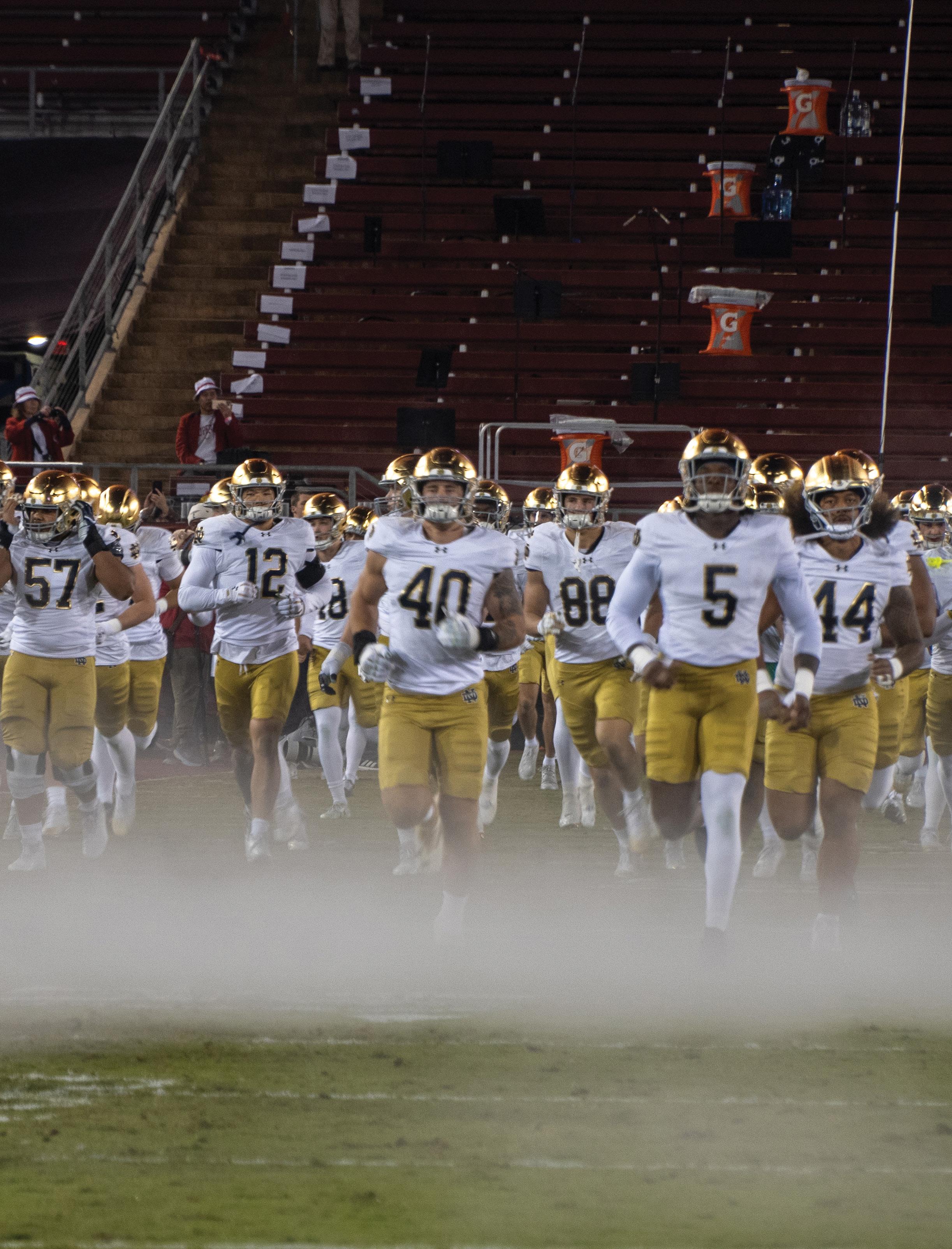
College football and its postseason should be equitable, yet the committee has fallen victim to a hybrid beauty contest and political debate peddled by the media rights holders. Alright, back to Alabama. While many across the Irish nation still sit in shock about the direction of the hurricane, the succeeding high tide is far more unsettling. Since 2023 (the year before the current system was adopted), every conference championship game loser has been penalized with a drop of at least one spot in the rankings. That includes this year’s Ohio State, who lost by three, Virginia, who fell in overtime, and BYU, who committee chair Hunter Yurachek declared was overmatched and demolished in the Big 12 final. Yet Alabama, who was physically handled for 60 minutes by the Georgia Bulldogs, to the tune of -3 rushing yards and just seven points, stayed put at No. 9.
Yurachek, also the athletics director at fellow SEC school Arkansas, claimed Alabama’s strength of schedule and body of work over the first twelve games warranted that the Tide not be punished for its performance in an “additional data point.” Yet, BYU, in a nearly identical situation, was punished, which, in Yurachek’s words, allowed for the direct head-to-head comparison of Notre Dame and Miami.
As for the strength of schedule argument, Ole Miss was ranked ahead of Texas A&M despite an inferior strength of schedule, and James Madison edged Duke for the final automatic bid, despite enduring one of the nation’s easiest schedules to the result of zero Power 4 wins. There is one clear explanation for this, clearly visible to all outside Title Town and Bristol, Conn.: There are different standards for different teams. And the SEC always receives the benefit of the doubt.
Looking back at Tuesday’s original shift between the Tide and the Irish, there is dissonance in Yurachek’s reasoning there as well. Alabama was commended for its second half fight and fourth-down courage on the road in a rivalry against a terrible Auburn team. Notre Dame, which also won on the road in a rivalry game against an equally terrible Stanford side, did not receive those same compliments.
The Irish, who won by 29 as opposed to seven, were not credited for beating a rival that was 4-1 on its home turf, nor were they praised for a bold fake punt inside their own 20-yard line. For what it’s worth, nowhere in the committee’s selection criteria are rivalry outcomes or perceived fourth-down courage listed.
To continue, Yurachek mentioned that he implored his fellow committee members to watch the tape of Notre Dame
and Miami from way back in August. I’m guessing they ran out of time to watch the tape of 5-7 Florida State’s convincing 14-point win over the Crimson Tide from a day prior. While Alabama certainly holds one of the most impressive wins, Georgia thoroughly neutralized that result on Saturday in Atlanta, with the Tide still holding the worst loss of any selected team.
It should be noted that Yurachek had an impossible, and even thankless task. No matter the conclusion his group arrived at today, furious discussion would have arisen. I just find his stated reasoning to be inconsistent and unjustifiable.
Finally, Notre Dame supporters and college football fans alike need to resist blaming Tulane and James Madison for this predicament. Those teams aren’t to blame for the calamitous system set in place. They simply took care of business, won their conference championships and took advantage of the disastrous Atlantic Coast Conference (whose third-place team will participate, but I digress). It would be an over reaction to deem the work and competition of 68 Group of Five teams unnecessary and inconsequential all because the ACC has weird tie-breaking procedures. While the Green Wave and Dukes will almost certainly be crushed at Mississippi and Oregon, respectively, they have earned their positions under the Playoff’s current setup.
With all that being said, I firmly believe that expansion to 16, 24 or even 64 will not solve this problem. These debates will persist wherever the cutline lies. Outside of undefeated Florida State in 2023, every omitted team in the history of the College Football Playoff could have done more. Notre Dame could have beaten Miami or Texas A&M. They did not. And while that doesn’t make their omission any less controversial, or any less erroneous, the Irish were 10-2, not 12-0.
Notre Dame can now respond in a several ways. After all, the Irish have already opted to not participate in a bowl game this postseason. After a month-long television and social media smear campaign imposed by the ACC against the Irish, Notre Dame may opt to reevaluate its long-standing scheduling agreement with the league. If strength of schedule is almighty as professed by Yurachek, maybe the Irish are forced to rethink their independence, or at least their scheduling philosophy. Or maybe, they just hope for better luck, and improved judgment.
In the meantime, add ‘93 to the sign.
Contact Ben Hicks at bhicks2@nd.edu