
THE INDEPENDENT NEWSPAPER SERVING NOTRE DAME, SAINT MARY’S AND HOLY CROSS
WEDNESDAY, SEPTEMBER 24, 2025 | VOL. LX, NO. 13
WEDNESDAY, SEPTEMBER 24, 2025 | VOL. LX, NO. 13
By Megan Cornell and Sophie Hanawalt Associate News Editor and Notre Dame News Editor
University leaders, business executives, academics, journalists and other prominent individuals have gathered on campus this week for the Notre Dame Summit on AI, Faith and Human Flourishing, hosted by the University’s Institute for Ethics and the Common Good and the Notre Dame Ethics Initiative.
The summit plans to discuss the role ethics can play in society’s adaptation to the rise of generative AI, with a particular emphasis on Catholic virtue. From Monday through Thursday, attendees will reexamine the role of Catholic voices in navigating the ways generative AI is transforming human life through a series of lectures and discussion sessions.
The University also officially presented DELTA, a new framework for navigating responsible AI use, at the summit. The acronym stands for dignity, embodiment, love, transcendence and agency. The framework is designed to be a faith-informed resource for institutions grappling with ethical questions surrounding the opportunities and challenges presented by AI.
Beyond an opening

Professor and director of the Institute for Ethics and the Common Good and the Ethics Initiative Meghan Sullivan presents her keynote address at the Notre Dame Summit on AI, Faith and Human Flourishing.
Mass at the Basilica of the Sacred Heart with Cardinal Christophe Pierre, which took place Monday at 5:15 p.m., the summit has thus far included a keynote address detailing the new DELTA framework by professor Meghan Sullivan.
The conference featured a Tuesday afternoon lecture on AI and the dignity of work by Molly Kinder, a senior fellow at the Brookings Institution, as well as a Wednesday
morning session, “The Human Vocation in an Era of AI,” led by Mike Sacasas, the executive director of the Christian Study Center in Gainesville, Florida.
To initiate the summit, Pierre presided over a Mass in the Basilica on Monday evening. Pierre, who received an honorary degree from the University of Notre Dame in
By Matthew Morin News Writer
Few saints, now including Carlo Acutis, have lived to see the 21st century. The most recent addition, Acutis was canonized on Sept. 7, just 19 years after his death.
Born in May 1991, Acutis grew up in northern Italy, where he was raised in a relatively secular household. Best known for creating a list of confirmed Eucharistic miracles and Marian apparitions, which he published on a self-designed website, Acutis also spent much of his time in Eucharistic adoration
NEWS | PAGE 3
Ukrainian rock star
Slava Vakarchuk spoke on music, civic activism and Ukraine’s fight against Russia.
and prayer, as noted by Notre Dame’s Church Life Journal.
Although Acutis is often associated with his website,
Tim O’Malley, a Notre Dame professor at the McGrath Institute for Church Life, emphasized that Acutis was “only mildly dedicated to technology.”
“After all, he used the Internet to write about Eucharistic miracles and Marian apparitions. None of this made him a saint, but his love of the Mass, the natural world (he was very concerned about the ecological crisis), and the poor of Milan,” O’Malley wrote in a statement
OPINION | PAGE 5
Debate
Notre Dame graduate responds to college republicans column on debte with far left.
to The Observer. “In the end, tech was an instrument for St. Carlo, one that he used in the most ascetic of ways.”
Kathleen Sprows Cummings, a professor of American studies and history at Notre Dame, noted that Acutis’ use of technology gives her hope about its power for good.
“To have an example in Saint Carlo of someone who used the latest technology to evangelize is really an inspiration and also a sign of hope that there’s not only something redeemable about new
see “Acutis” page 3
SCENE | PAGE 7
Jeanne Dielman
Acclaimed French film captures the quiet horror of mundane life.
2024, is the apostolic nuncio to the United States, meaning he serves as the Vatican’s ambassador.
In his homily, Pierre discussed the intersection of AI and Catholic social teaching, especially as it relates to the dignity of work, human dignity and care for God’s creation. “Prudence insists that AI must not be used in ways that undermine human dignity or fragment communities,” he said.
Relating to the dignity of work, he warned that “technology must not enslave but serve,” adding that “AI might reduce employment, but for the Church, work is more than income.” According to Pierre, work “engages both our hands and hearts in shaping the world.”
Pierre further noted that reliance on AI might exacerbate existing inequalities. “AI has the potential to deepen the gap between those who benefit and those who are left behind. These are questions not only of efficiency but also of fairness, questions of justice,” he said. Given these concerns, Pierre believes that as a leading Catholic university, Notre Dame has a unique duty to “shape a global Catholic voice on the ethics of artificial intelligence.”
He concluded his homily by urging attendees to use human innovation in ways that glorify the Lord and approach AI with wisdom. “Let us not approach AI with fear. Let us approach it with wisdom. The wisdom that comes from God,” Pierre said.
Keynote address
In her keynote address, Sullivan, the founding
By Megan Cornell Associate News Editor
Two weeks ago, multiple gunshots were fired at Eddy Street Commons during the Notre Dame v. Texas A&M game, damaging two apartments and five vehicles. Last weekend, shots were fired near the same area early Sunday morning, this time damaging a window at the Embassy Suites hotel.
According to a press release issued by the South Bend Police Department (SBPD), the Violent Crimes Unit is investigating both incidents. No arrests have been made in
SPORTS | PAGE 8
Women’s soccer
The 2nd-ranked Irish welcome defending national champion North Carolina on Wednesday.
either case.
In a video posted to the SBPD’s facebook page, police chief Scott Ruszkowski condemned the violence. “Being decent human beings, having some decorum, having respect for other people, is the bottom line. That is the easiest solution to any of this. To go down [to Eddy Street] and display firearms, or yell obscenities or profanities at someone you don’t like, that just makes no sense to me.” Ruszkowski said.
The close proximity of these events have raised concerns about safety near Notre Dame’s
SPORTS | PAGE 12
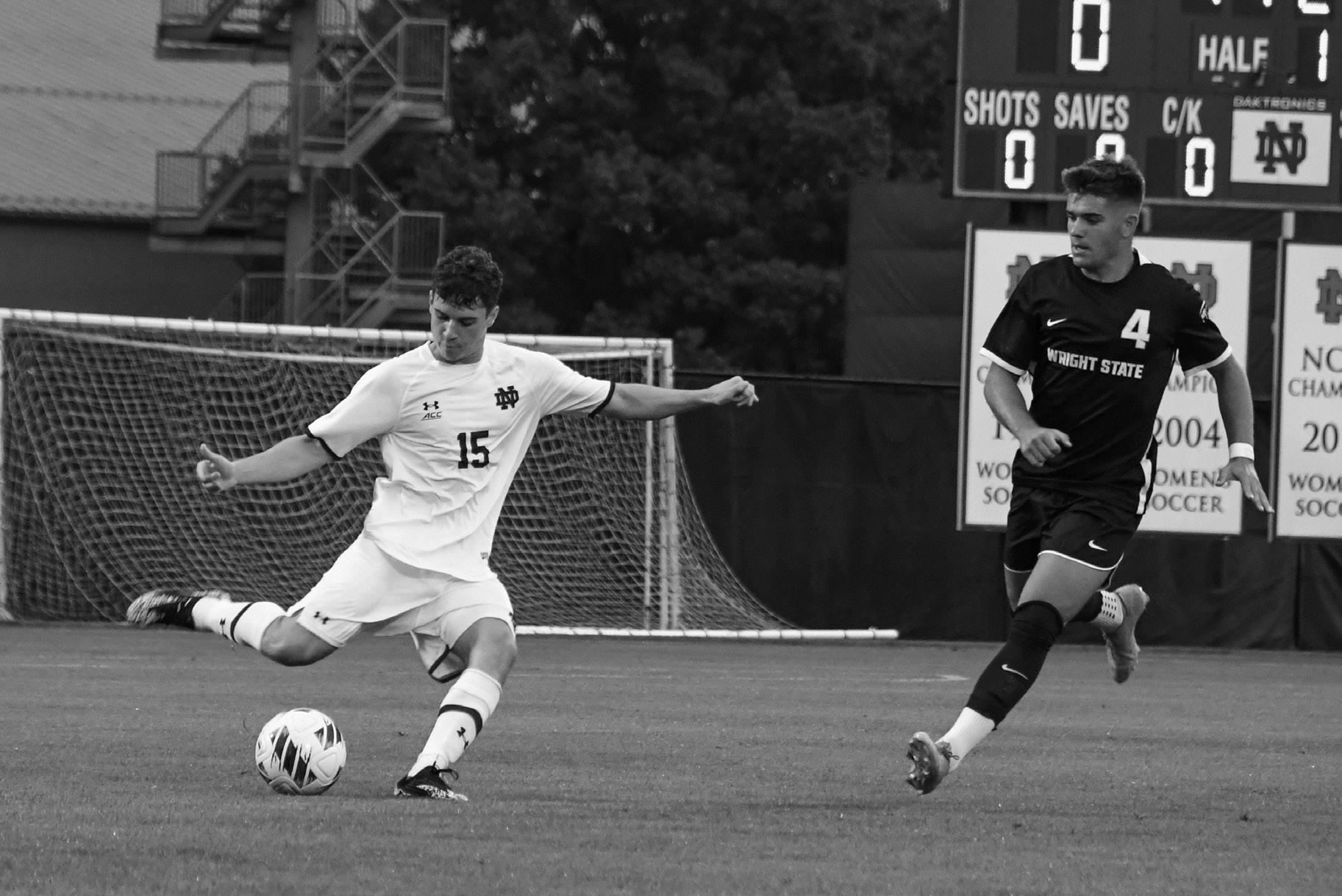
Men’s soccer No. 21 Notre Dame beat Wright State to extend their winning streak.

ndsmcobserver.com
“TO UNCOVER THE TRUTH AND REPORT IT ACCURATELY”
900 Hesburgh Library, Notre Dame, IN 46556
Editor-in-Chief
Liam Kelly
Managing Editor Gray Nocjar
Asst. Managing Editor: Aynslee Dellacca
Asst. Managing Editor: Grace Tadajweski
Asst. Managing Editor: Henry Jagodzinski
Notre Dame News Editor: Sophie Hanawalt
SMC News Editor: Berhan Hagezom
Opinion Editor: Redmond Bernhold
Sports Editor: Noah Cahill
Scene Editor: Peter Mikulski
Photo Editor: Mariella Taddonio
Graphics Editor: Isabelle Rutland
Social Media Editor: Duncan Stangel
Ad Design Manager: Isabelle Rutland
Business Manager: Zack Pohlman
Systems Administrator: Jack MapelLentz
Advertising advertising@ndsmcobserver.com
Editor-in-Chief lkelly8@nd.edu
Managing Editor gnocjar@nd.edu
Assistant Managing Editors adellacca01@saintmarys.edu, gtadajwe@nd.edu, hjagodzi@nd.edu
Business Manager zpohlma2@nd.edu
Notre Dame News Desk shanawal@nd.edu
Saint Mary’s News Desk bhagezom01@saintmarys.edu
Opinion Desk rbernho2@nd.edu
Sports Desk
ncahill2@nd.edu
Scene Desk pmikulsk@nd.edu
Photo Desk mtaddonio01@saintmarys.edu
Systems & Web Administrators webmaster@ndsmcobserver.com
Policies
The Observer is the independent, daily newspaper published in print and online by the students of the University of Notre Dame du Lac, Saint Mary’s College and Holy Cross College. Editorial content, including advertisements, is not governed by policies of the administration of any institution. The Observer reserves the right to refuse advertisements based on content.
The news is reported as accurately and objectively as possible. Unsigned editorials represent the opinion of the majority of the Editor-in-Chief, Managing Editor, Assistant Managing Editors and department editors. Commentaries, letters and columns present the views of the authors and not necessarily those of The Observer. Opinion space is available to all readers. The free expression of all opinions through letters is encouraged. Letters to the Editor must be signed and must include contact information.
Questions regarding Observer policies should be directed to Editor-in-Chief Liam Kelly.
Post Office Information The Observer (USPS 599 2-4000) is published Monday through Friday
Continued from page 1
director of the Institute for Ethics and the Common Good and director of the Ethics Initiative, formally introduced the DELTA framework. A Wilsey Family College professor of philosophy at the University, Sullivan has also been recognized for her leadership in the development of “God and the Good Life,” Notre Dame’s signature philosophy course.
Sullivan was introduced to the audience by University President Emeritus Fr. John Jenkins. Both ethics initiatives that Sullivan leads are housed within the Jenkins Center for Virtue Ethics, established by the University’s board of trustees in 2024 in his honor. Jenkins spoke on the institute and initiative’s commitment to virtue ethics, noting that they “advance moral understanding and develop compelling responses to the most pressing ethical issues of our era.”
In her opening remarks, Sullivan said, “We are here to contemplate what it would mean for there to be a growth in conscience and in ethics proportionate to the astounding growth in digital technology that we are currently witnessing.”
She spoke about how, throughout examples of large social transformations in history, a strong Christian voice was present to introduce Christian ethics and values into the conversation. To this end,
Sullivan cited the example of Hanson Baldwin, a military editor for the New York Times, who utilized Christian scripture in his article about the introduction of nuclear weapons in August 1945 to discern the humanity of the situation.
Sullivan then moved to discuss the 1960s, noting that while Christian denominations were “deeply involved in the Civil Rights Movement” and had “a seat at the table” during other moments of the 20th century, there is still a space left for Christians to fill in the current moment with generative AI.
Sullivan described the 21st-century transformation toward a digital economy, stating that Christians were largely absent from the conversation, even as all the world’s knowledge became available in the palm of one’s hand. She noted two reasons for this: “a disaffiliation from Christian institutions” and the rapid transition into the digital age.
“It happened just as quickly as the transition to an atomic world 80 years ago,” Sullivan said. “But it happened in such a widespread and profuse and ubiquitous way that really nobody was taking enough time to stop and ask what kind of significant ethical questions that this transformation was raising.”
This week’s conference aims to bring Catholics back into the conversation as society’s attention turns to AI. “One thing that we believe at Notre Dame is that it would be a catastrophe if Christians were not present for the next phase of the discussion and that visual transformation that we’re currently witnessing,” she
said.
“These models are ubiquitous in our day-to-day lives. There are profound questions about what it means to lead a good human life and what it means to serve the common good, which Christians have fantastic insight into, and which will play a role in the bigger pluralistic debate that we are going to have about the world that we’re going to build with this technology,” Sullivan said.
She labeled people turning to chatbots for everything from therapy to spiritual advice as a pressing concern that she believes a Christian ethical framework holds answers to. Sullivan also pointed to other notable concerns, including the “obviously profound existential questions about how we are going to use this technology to transform our economic institutions, our workplaces, our educational institutions.”
Sullivan later added that the lack of human needs being met by schools, churches and other institutions is a significant reason why people are turning to generative AI. She emphasized the urgency in addressing these questions, citing the large investment society has made in generative AI.
Last summer, Sullivan and her colleagues began discussing how they could create a space for these ethical discussions around AI and understand the landscape in which Christian voices and perspectives might fit. With the help of a grant from the Lilly Endowment, she and the institute conducted 137 one-hour interviews with technologists, ethicists and faith leaders from different Christian
denominations, journalists and policymakers to ask them what the Christian community could offer to the discussion about AI ethics taking place, as well as what they think it would take to get their voices into the conversation.
Sullivan noted that a key takeaway from the conversations was the Christian community largely agrees with secular voices about creating an “ethical floor,” citing agreement that “we should be building AI that recognizes our right to privacy, we should build AI that’s safe, that’s explainable, that’s responsible to users in key ways that’s fair.” She elaborated that this floor is where virtue ethics enters the conversation, providing a vision of human flourishing. According to Sullivan, Christians bring a unique perspective to this conversation, with their understanding of human flourishing and the common good.
In this introduction to the DELTA framework, Sullivan also spoke on the value of dignity in the conversation about AI. As society strives to optimize productivity, which is becoming increasingly easy with AI, Sullivan emphasized the importance of valuing people not just for their productivity but for who they are as a whole person.
In terms of embodiment, Sullivan discussed how humanity is relational and vulnerable, again highlighting the sacredness of human life. She noted that medical advancements must be met with bioethical questions about where healing and enhancement differ, and
By Eileen Doyle News Writer
On Sept. 16, the LaFortune Student Center introduced FujiSan, a sushi and bubble tea counter, which now stands among Taco Bell, Starbucks, Street Fare and the Huddle Mart.
FujiSan occupies the space formerly held by Flip Kitchen, which had, since the 2022-2023 school year, served salads, rice bowls, smoothies and açaí bowls.
Corrections
The Observer regards itself as a professional publication and strives for the highest standards of journalism at all times. We do, however, recognize that we will make mistakes. If we have made a mistake, please contact us at editor@ ndsmcobserver.com so we can correct our error.
FujiSan’s menu features a variety of freshly prepared rolls, such as California, spicy tuna, shrimp tempura and rainbow, plus vegetarian options like the “Very Veggie” and Buddha rolls. Sides like pork bao, chicken gyoza and seaweed salad are also featured alongside a range of boba teas and poke bowls.
Student opinion on FujiSan and its replacement of Flip

EILEEN DOYLE | The Observer
FujiSan replaced Flip Kitchen in LaFortune Student Center this fall. The restaurant serves Asian-inspired cuisine, such as sushi and boba. see “AI” page 4
Kitchen has been mixed so far. For some sophomores, such as Caroline Parillo, FujiSan fills a gap in campus dining options and provides a quicker food option.
“We didn’t have sushi anywhere, but this spot fulfills that need. A lot of the Flip Kitchen food was stuff you could get at the dining hall,” Parillo said.
Upperclassmen seem to be more skeptical. Senior Alejandra Ricardo, who has
not yet been to FujiSan, expressed her regret that Flip Kitchen is gone. “Flip Kitchen was the more affordable and healthy option on campus, compared to places like Chick-fil-A or Hagerty Cafe,” Ricardo said. However, she was interested in trying FujiSan, saying she “heard good things about both the sushi and the boba.”
Another senior, Isabella Rishmawi Hawit, tried
FujiSan’s crunchy California roll and decided the portions were fair, but said she would have been more likely to buy Flip Kitchen’s pita breads than the sushi.
“I love the idea of a poke bowl, but I don’t like seafood. If they had more options with chicken or steak or even vegetarian options, that might make me buy more,” Hawit said.
Junior Rita Barhouche voiced reservations about FujiSan’s limited menu, which doesn’t include many options beyond sushi rolls and poke bowls. “[Sushi] is not something I crave throughout the day, so I don’t have any incentive to go and order food from there,” she said. “It is more targeted towards the people who really love sushi, but they don’t really have other things for people who don’t love sushi, whereas Flip Kitchen did.”
Contact Eileen Doyle at edoyle22@nd.edu
By Mayte D. Mendez News Writer
Slava Vakarchuk, a Ukrainian rock musician and frontman of the band Okean Elzy, spoke on Monday evening about the role of music, civic activism and resilience in Ukraine’s ongoing fight against Russian invasion. This event, held in Jenkins Nanovic Halls, was hosted by the Nanovic Institute for European Studies and coordinated through the Ukrainian Studies Hub.
Professor Clemens Sedmak, director of the Nanovic Institute, welcomed the audience and emphasized Notre Dame’s continued relationship with Ukraine. “The University of Notre Dame has shown special solidarity with Ukraine ever since the full-scale invasion on
Feb. 24, 2022,” Sedmak said. “We are especially honored to have our founding benefactor, Robert Nanovic, present in the audience tonight.” He also pointed to Notre Dame’s partnerships with the Ukrainian Catholic University, its participation in the global coalition of Ukrainian studies and University leaders visiting Ukraine as examples of this ongoing support.
Vakarchuk, who holds a doctorate in theoretical physics, has spent the last three years balancing his career as a musician with his service in Ukraine’s armed forces. In the earliest days of the war, he signed a contract with the military and began performing for soldiers and civilians near the front lines. Since then, he has given “more than
300 small concerts in villages, shelters and military bases across Ukraine.”
“When I go to the front line, I don’t know who needs these meetings more — me or the soldiers,” Vakarchuk said. “Sometimes it feels like psychotherapy. Even half an hour of music can bring people back to life, if only for a moment.”
The event was moderated by Rory Finnin, a professor of Ukrainian Studies at the University of Cambridge and a visiting scholar at Notre Dame. Finnin said Vakarchuk’s impact reaches beyond his music. “Slava brings the gift of the Ukrainian language to so many places around the world,” Finnin said. “He is not only a musician, but also a civic leader who has made extraordinary contributions
to Ukraine’s democratic struggle.”
Vakarchuk described the emotional experience of performing for soldiers immediately after battle, recalling one instance when he sang for a platoon that had just lost two comrades. “At first, they were broken, they couldn’t even look at me,” he said. “But after 20 minutes, their eyes changed. We sang together, and I saw them smile. It wasn’t that they forgot what happened, but they felt alive again.”
Beyond music, Vakarchuk has been heavily involved in humanitarian work. Through his foundation and concert fundraising, he has helped raise more than $4 million toward supporting the Ukrainian efforts.
“Volunteers are a crucial part
of every resistance. Millions of Ukrainians joined small and large organizations to support the front,” he said, stressing the importance of Ukraine’s volunteer movement. “Le Monde” reports that these volunteers handle everything from delivering supplies to coordinating logistics near combat zones, demonstrating the role of civil society in sustaining Ukraine’s defense.
Vakarchuk concluded his lecture by performing a song for the audience and affirming his commitment to continue performing for soldiers and supporting Ukraine’s defense. “I promise I will be with them as long as it takes and as much as necessary,” he said.
Contact Mayte D. Mendez at mmendez4@nd.edu
By Maria Alice Souza Maia News Writer
Tuesday afternoon, Maria Victoria Murillo, a professor of political science and international affairs at Columbia University, presented on her upcoming book in the Hesburgh Center. Her work addresses questions as to why many Latin Americans are increasingly disillusioned with democracy, despite social progress. It is co-edited with Gabriel Kessler, an Argentinian sociologist and professor.
In her book, Murillo explores the paradox of widespread political discontent amid improvements in poverty reduction, education and expanded rights. She discussed this paradox in her lecture, explaining that rising expectations and broken promises have generated social frustration and political reactions.
Continued from page 1
technology but something potentially transformative,” she said.
In 2006, Acutis was diagnosed with terminal leukemia. He spent nearly a week in the hospital before he died on Oct. 12, 2006.
Acutis was initially buried in his family cemetery in Ternengo before being reinterred in Assisi, the National Catholic Register shared. In 2018, Pope Francis declared Acutis to be venerable, and after his first miracle was confirmed by the church, he was declared blessed in 2020. In 2024, Francis recognized his
Murillo, who holds a PhD from Harvard University, explained the two ways this can be manifested.
“One expression that we call vertical discontent, that is more systemic, people are unhappy with all political elites, this is shown in electoral representation, in elections,” Murillo said.
Murillo claimed that Guatemala’s 2019 presidential election is evidence of this vertical discontent, where the two most-voted candidates received 25% of the vote, and the eventual winner in the second round of the election, 14% of the vote. She suggested the election shows that people are not happy with any of their options.
Murillo also described horizontal discontent, which is “when the people dislike the government, but also dislike the coalition that supports the government.” She added that in most Latin American countries, polarization occurs around
second miracle, with a canonization date set for April 2025, during the Jubilee Year. The death of Francis, just days before the scheduled canonization, ultimately set back the event.
Pope Leo XIV presided over the canonization ceremony on Sunday, Sept. 7, where he confirmed the sainthood of both Acutis and Pier Giorgio Frassati.
Cummings believes Acutis’ relatable hobbies make holiness seem more accessible.
“I think when it comes to imitation sometimes the word saint in Catholic circles conjures someone who’s just incredibly holy and someone who’s far above us, someone who we can’t aspire to [be]. When you have someone like
singular focal points rather than political parties.
Murillo further described protests as a way that Latin Americans have expressed their discontent.
“People have a clear way of organizing their discontent. And in terms of protest, although I have to say we saw less protest, but we do see protest here,” she said.
This evidence of discontent sparks questions about the origins of dissatisfaction, which Murillo attributes to economic and political instability.
Murillo noted that throughout the 1980s and 1990s, the region suffered, and during the 2000s, the commodity boom, especially in South America, had a dramatic effect in terms of growth, decline of poverty and inequality. After 2014, there was not a crisis, but rather a slowdown in growth, therefore, changing the expectations of people.
Carlo who is so relatable, who was a gamer saint, who was a 15-year-old, who lived a life of faith, then suddenly, holiness seems a little bit more attainable for the rest of us.”
Acutis’ short path to sainthood is rare. The Pew Research Center found that the average timeline for someone to achieve sainthood is roughly 181 years.
O’Malley does not believe that other saints will be canonized as quickly as Acutis.
“I do not think that it will have an effect upon future canonizations. The normal way that a saint is canonized is devotion and time. For every St. Carlo, there is a St. Hildegard of Bingen, who was canonized out of popular acclaim: 500 years after her
“[The slowdown] generates this sense of relative deprivation, that even though things were not necessarily going into a crisis, you see that the trajectory was not there anymore. And that increasing over time brought people to blame the government, because we know Latin Americans tend to blame and reward the government for socioeconomic conditions, and that generates this longitudinal effect on political discomfort. They start to be much less tolerant of crime and corruption, and that’s what we associate with protests, with an incumbent vote, with increasing electoral volatility,” Murillo said.
Murillo thinks there will be an evolution, and while she cannot map what is happening in the current moment, she has made predictions about the future, which she will share in her book.
In the conclusion of her lecture, Murillo acknowledged the impact
death, there was still devotion. This, to me, should be the normal way that saints are canonized,” he wrote.
Notre Dame theology professor John Cavadini similarly shared in a written statement to The Observer that Acutis’ quick path to sainthood makes him more relatable.
“Maybe it’s a good reminder that everyone is called to sanctity. We can sometimes think of the saints as distant from us especially if they lived long ago, but someone whose lifetime is so close to our own kind of makes the point that we can’t say it was easier back then to be a saint but times have changed ... holiness is the same challenge it always was and it is
of social media and access to information to contribute to political discontent around the world. She shared that the chapters in her book highlight the impact of medium-term social gains associated with democratization and a continuous process produced by weak state capacity, such as public insecurity, which maps to within-country variation on political discontent and even political participation.
“The framework for understanding political discontent based on the historical experience of Latin America focused on feelings of relative deprivation as the positive trajectory of the boom decelerates even before the pandemic ... It’s not a reaction to a crisis but a continuous process and hasn’t yet produced a stable political equilibrium,” she said.
Contact Maria Alice Souza Maia at msouzama@nd.edu
within the reach of anyone who cares about it,” Cavadini wrote. “It may make people more alert to the holiness that is around them in the persons of very ordinary people, or seemingly very ordinary people, who quietly live lives of charity and devotion.”
O’Malley echoed this idea, writing that he “always likes to remind people that sainthood is not something for the old alone. The seven-yearold is called to sanctity.”
O’Malley hopes that Acutis will serve as an example for “young people to dedicate their lives to something more than the pursuit of fame, fortune and prestige.”
Contact Matthew Morin at mmorin2@nd.edu
By Lucy Loes News Writer
This past Friday, the Institute for Social Concerns welcomed Pulitzer Prize-winner Viet Thanh Nguyen, a professor of English and American Studies and Ethnicity at the University of Southern California, to campus to discuss his new book, “To Save and to Destroy: Writing as an Other.”
The lecture was the institute’s first MVP Friday of the season. As a part of this series, the institute invites speakers with writing and leadership experience to expand on the series’ acronym: meaning, values and purpose.
During the lecture, Nguyen immediately delved into the duality of what it means to grow up as an “other” in a country defined by a majority group. He remarked that the first time he came face to face with this discrepancy was when he watched the American-made Vietnam War film, “Apocalypse Now.”
“As I watched ‘Apocalypse Now,’ I identified with American soldiers up until the moment where they massacred Vietnamese civilians. And at that point, I was split
Continued from page 1
campus, especially for students who live on Eddy Street.
Coco Rudge, a sophomore who has an apartment in the area, expressed concerns about her safety given the recent incidents. “The recent events on Eddy Street make me concerned for students’ safety. I will definitely have to be more vigilant late at night or when walking alone,” Rudge wrote in a statement to the Observer.
Chiara Bilant is a junior who witnessed a disturbance on Eddy Street a few weeks ago, separate from the two shootings. “My roommate and I were walking back from a friend’s place on Eddy Street … we were at Blaze Pizza and when we
Continued from page 2
that “part of our commitment to embodiment is the idea that what makes human lives meaningful is that they’re lived out in physical space. Physical presence, human presence, is something that is deeply valuable and meaningful for our lives.”
According to Sullivan, technology has had a profoundly negative impact on this deeply valuable human
in two. Was I the American doing the killing, or was I the Vietnamese being killed?” Nguyen said.
In 1975, Nguyen came to the United States as a refugee, an experience he reflected on in his lecture, drawing upon his perspective as an eyewitness to his parents’ suffering. He explained how this suffering was the norm for Vietnamese refugees, perpetuated by their place in the American system. Quoting his book, “The Sympathizer,” Nguyen outlined immigrants’ systemic otherness in America.
“‘[They] were hobbled by their structural function in the American Dream, which was to be so unhappy as to make other Americans grateful for their happiness.’ I don’t think anything’s changed since I wrote those lines,” Nguyen said. “We’re still at a time when people who are not refugees and not immigrants might be kind of happy to not be refugees or immigrants in our political and cultural climate today.”
Nguyen shared that the reason he became a writer, contrary to a stereotypical ‘model minority’ occupation, was because he realized the
came outside we saw everyone running. We saw a tussle going on and heard a sound like a firework almost,” Bilant said.
After the incident, Bilant was weary of visiting the area.
“[Witnessing the incident] did make me more uncomfortable or wary ... it’s shocking I guess.
At a place as safe as Notre Dame, you wouldn’t expect anything like that to happen,” Bilant said.
To ensure their safety, Notre Dame Police Department (NDPD) police chief Keri Kei Shibata recommends students learn about proper safety precautions and visitors opt-in to ND Alert. “We encourage people to be alert and aware of what is going on around them and to report any problems, disturbances, suspicious behavior, or other concerns immediately
connection, with a particular effect on young people.
“For those of us who work in education, we have a generation of young people who we know now are going to come of age in the shadow of these chatbots and who are going to learn how to form relationships and how to develop authentic human connections with this technology in their midst,” she said.
On transcendence, Sullivan said, “One of the things that we have to navigate as this technology becomes
experiences and culture of Asian Americans were almost completely absent in mainstream media. Nguyen argued that this lack of representation isn’t only unjust but also dangerous, as stories shape the narrative of public perception, and in turn, people’s realworld interactions.
“Narrative scarcity is when … almost none of the stories are about you, [so] those stories bear the burden of representation, and therefore you can never say it’s just a story, because, you know, it’s not just a story, it’s life and death. And if you have ever said … it’s just a story, it means you live in narrative plenitude, where almost all the stories are about you. When almost all the stories are about you, you can just walk away,” Nguyen said.
For Nguyen, such stories are vital, not just for representation, but for recognizing the way in which minorities are systematically marginalized in America. Drawing upon James Baldwin and Martin Luther King Jr. to support his argument, Nguyen pointed out how very few members of the audience had even heard about their works on the Vietnam War. In these works, Baldwin
so we can address them before they become bigger,” Shibata wrote in a statement to The Observer. “It is also important that people follow the instructions of the event, parking, and security staff.”
NDPD did not issue an ND alert during the two disturbances, nor did they provide students with information about the events.
“A statement would be nice, just so people would know what’s going on and there’s no uncertainty … if they neutralize the threat that’s great, if not, that’s also important to know. Honesty would be great,” Bilant said.
NDPD shared that they regularly take precautions during events such as home football games or high-profile lectures.
“Notre Dame Police and
extraordinarily powerful is this thinking that everything good will be made better by software and our social intelligence,” describing the Christian belief that there is objective truth and beauty naturally occurring in the world. The framework emphasizes that not everything must be optimized.
The framework’s emphasis on agency addresses the questions of moral responsibility and decision-making guardrails for generative AI, taking into consideration the
and King drew parallels between the treatment of Black people and the Vietnamese as both contributions were quietly overlooked by the public, Nguyen noted. Nguyen called attention to these largely forgotten works.
“I believe this is a country of both beauty and brutality. You can’t have one without the other. We’ve not had one without the other,” he said. “There is the beauty of democracy and liberty, equality and rights and so on that we all know, but that beauty was made possible by the brutality of genocide, enslavement, colonization and perpetual war.”
Nguyen next emphasized the importance of acknowledging the nuance and inconsistencies within American history, noting that, while difficult, it remains crucial for Americans to confront this uncomfortable past given its historical and modern-day consequences.
“That’s a challenge we confront as Americans, being able to fully recognize the complexities and the contradictions of our history, because they haven’t gone away,” Nguyen said. “What we’re witnessing today is a repetition of a contradiction that has been
security staff often have specialized training and expertise depending on the situation. Aside from that, some of the other things we consider are: the layout/design of the space; the use of technology such as magnetometers (metal detectors) and CCTV; K9 sweeps before and during the event; ticketing, credentialing and other access control; and clear and no bag policies,” Shibata wrote.
cyclical throughout American history, American culture and American politics, and in many ways … it’s discouraging to think that they’ve happened before. But I think it’s also encouraging to know that if we understand that this contradiction has existed, we know how to fight back, because previous generations, previous communities, have always fought back.”
Azareen Van der Vliet Oloomi, a creative writing professor at Notre Dame and author of “Call Me Zebra,” highlighted the power of Nguyen’s work in shining light on histories that continue to resonate in society today.
“Nguyen is one of our great writers, because alongside his clarity, sonority and defiance, he is also an exquisite listener to the layers of silence that bloom in the face of annihilating histories,” Oloomi said. “He carries these ghosts of the past with tenderness and respect and speaks out when he sees other so-called minorities, being turned into the ghosts of our present.”
Contact Lucy Loes at lloes@nd.edu
Both NDPD and SBPD are deploying additional police forces during football games, and SBPD shared in the press release that 13 unrelated arrests were made on or near Eddy St. commons this weekend as a result of increased police presence. Separate from the aforementioned incidents, officers confiscated four firearms in the area.
pursuit of the good. Sullivan discussed agency in terms of higher education, noting that both students and educators face questions as to whether they should use generative AI and how to navigate its use.
“We are very committed at Notre Dame to the idea that we want this brainwork to be inspired by and grounded in our Christian faith commitment. These teachings and this work could be a benefit to the world,” she said. “We try to navigate that tension right now, trying to think about
“South Bend Police had an increased presence in Eddy Street Commons and surrounding areas before, during and after yesterday’s football game. This was in response to last weekend’s disturbances and gunfire in the same area,” SBPD’s press release read.
Eddy Street is not technically part of NDPD’s jurisdiction, which is “generally within the boundaries of Angela Boulevard, Indiana 933, Twyckenham Drive and University property immediately north of Douglas Road (including the Landings, Kindercare, and Warren golf course),” Shibata wrote.
Contact Megan Cornell at mcornell@nd.edu
what it means to be grounded in your faith but serving the whole world.”
Sullivan concluded by reaffirming Notre Dame’s commitment to answering these difficult questions and doing so in a timely manner, given the rapidly evolving nature of modern AI technology.
Contact Megan Cornell at mcornell@nd.edu and Sophie Hanawalt at shanawal@nd.edu
I was disappointed to read Shri Thakur’s piece in last week’s The Observer calling for an end to free speech in favor of deplatforming Americans with far-left views. Commitment to free speech gives us a binary choice: Either we protect free speech for all, or we pick and choose what speech is acceptable and thereby abandon it, as Mr. Thakur suggests. In the wake of the tragic and senseless murder of Charlie Kirk in front of his young family and the world, choosing to now suppress free speech is a disgrace to his memory.
I was a student at Notre Dame during the peak of the speechas-violence protests that plagued campuses like Cal-Berkeley and Northwestern during the late 2010s. The heckler’s veto never reached our campus, but there was no doubt that conservative perspectives were unwelcome at educational institutions across the country. Activists like Mr. Kirk challenged this hostility head-on by touring campuses and debating students. It was a bold, radical attempt at breaking the progressive hegemony. Now in the wake of his death, some conservatives are betraying the example that Mr. Kirk set. One of Mr. Kirk’s core beliefs was that free speech is essential to the American experiment. Abandoning free speech in the wake of Mr. Kirk’s death implies that Mr. Kirk’s own belief was mistaken. This is an insult to his memory.
Mr. Thakur
wargues that by recommitting to free speech, the “inevitable conclusion” is to allow the far left to murder conservative voices. But killing someone is illegal. Threatening to kill someone is illegal. Mr. Kirk’s killer will meet justice, as will anyone who follows his example. The safety of conservative voices does not require the abandonment of civil liberties; it requires the enforcement of existing law.
The deplatforming that Mr. Thakur desires is pure political nihilism. Conservatives fought similar efforts for decades before Trump came to power for a second time this past January. When Obama’s IRS sought to strip Tea Party organizations of tax-exempt status, and Biden’s FCC pressured social media companies to tamp down on dissent, conservatives rightly called foul. These actions were wrong per se, not merely because they were levied against conservatives.
Mr. Thakur writes that “true free speech requires accountability.” This is doublespeak trying to justify the violation of a principle in the name of its preservation. If the actions of previous Democrat administrations against conservatives were bad then, they are bad now.
Mr. Thakur believes that Mr. Kirk’s assassination is an exceptional moment demanding a strong response. In Mr. Thakur’s framework, who decides when an ideology is sufficiently violent to
justify suppression? The only “inevitable conclusion” of all this is that the definition of “radical” will expand to include all dissenters. And if a single violent act justifies such a crackdown, then Mr. Thakur should remember the recent assassinations of Melissa and Mark Hortman, the riots on Jan. 6 and the Charlottesville protests in 2017. When we take action against a political opponent, we must ask: The next time this opponent is in power, how will I react if they try the same thing? It is a sort of Golden Rule for governments grounded in Enlightenment thought. A clear conscience demands that we adhere to political and procedural norms and maintain a fair playing field. Republicans now have the political power to crush liberal voices around the country. But doing so would directly violate the principles of free speech they have spent decades protecting. Our principles only exist if we remain committed to them when it is least convenient. So, what matters more? Adhering to the principle of free speech and honoring the late Mr. Kirk? Or using this as an opportunity to “get back” at the far left, take v engeance on our “enemies” and cross our fingers that they take a kinder approach the next time they win an election?
Mr. Thakur has chosen the latter. His distortion of Cold War paranoia forces us to recall a stain on American history. To be very clear: Cold War McCarthyism

involved the routine violation of Americans’ civil liberties, the illegal wiretapping of civil rights leaders and communist witch trials before Congress all in the name of ideological purity. Suggesting a return to these excesses is unseemly and historically illiterate. Finally, a note on “them.” Mr. Thakur talks a lot about “them.” Who are “they?”
They are our neighbors. I mean this in a Christian sense, but I also mean this in a literal sense. Mr. Thakur is talking about the people in your dorm, the people you sit next to in the dining hall. When we talk about shutting down speech and getting people fired, we are talking about our classmates.
There is no “they.” It’s just us, just “we.” We are all victims of Charlie Kirk’s murder. We are all responsible for it. We are all monetized and misled by
social media. We are all capable of reaching out and building community in the section, the dorm, the campus, the country. Christ’s love is radical and deeply challenging. It requires us to love our persecutors. It demands that we love the person who kills our leaders. It needs us to listen to each other, to embrace debate and to request that our rival prove us wrong. We do not abandon Christ’s love when a political opponent rejects it entirely. America is on the brink. Mr. Thakur thinks the solution is a few inches closer to the edge. Reject the temptation, take a step back. Do no evil that good may come.
Thomas S. Murphy Class of 2021 Virginia School of Law 2027
I remember a time when reading the Opinion, formerly called Viewpoint, articles were a highlight of my day. Always sitting in a finance class, I would crack open the Viewpoint section to read interesting reflections, from practical relationship advice to inspiring, relatable stories about one’s mental health struggles. They were invariably engaging, always had a strong sense of personality and character. It was, in fact, reading these Viewpoint articles that encouraged me to apply to be a regular columnist, which I have been doing for over three years. These opinion articles used to be the crownjewel of The Observer. Times have changed. The people and maybe even the writers want boring articles. And it would be grossly irresponsible for me to maintain my authorial integrity, so I must give the people what they want. Perhaps, by
producing a how-to manual of writing a boring Opinion article, I might inspire the next generation of writers to do likewise. And so, I proceed shamelessly.
1. Write about politics. This is proven to be the most effective way of losing the attention of your audience. Given that your audience has been bombarded with news about military conflicts, political assassinations and all sorts of calamity, it would be wise to throw your unsolicited two cents in. Given your 20ish years on this earth, 18 and a half of which you have been self-aware for, you are well equipped to offer solutions to problems over which people have been debating, arguing and even killing over for hundreds of years. Think of writing these sorts of articles as a way of using your Notre Dame education to better offend your Uncle Joe or Aunt Sue at Thanksgiving Dinner.
2. Use buzzwords. I suggest the following: public discourse, threat to democracy, problematic, racism, fascism, XYZ-ism,
right to free speech, marketplace of ideas, unacceptable, polarization, bipartisanship, championing and American people. Here’s a quote from ChatGPT, a virtuoso of this language: “Public discourse in the United States has grown increasingly problematic, as accusations of racism, fascism, and other XYZ-isms collide with the right to free speech and the supposed marketplace of ideas, leaving citizens divided over what is acceptable, deepening polarization, undermining bipartisanship and raising questions about whether championing the voices of the American people ultimately strengthens or poses a threat to democracy.”
3. Never be funny. The lack of humor, or any personal quality, for that matter, is a hallmark of a boring article. I strongly advise against using humor because Notre Dame students do not receive humor well. You might say something that is not in keeping with the Catholic character of the University. I advise that you, instead, write
as if you were responding to a Canvas discussion post where you 1) need to hit the minimum character limit, 2) didn’t actually do the assigned reading necessary to answer the question and 3) virtue-signal your ability to use ChatGPT to respond to prompts. Or, you may consider that you are writing as if responding to a classmate in a seminar where you start with the phrase “I totally agree with XYZ” or “To build off what XYZ said.” Remember participation points are on the line.
4. Use statistics and cite your sources. Confirmation bias is your friend. I advise that you use the strategy of overloading the tabs on your reader’s browser with disparate links to Buzzfeed articles or esoteric studies. The goal is to show the reader that you did your homework, and they obviously did not. Therefore, you are correct.
5. Say things so radically offensive or scandalous that your future employer’s HR representative will find your article as the first thing that pops up when you search up
your name on the internet. It is great for your personal and professional branding if your digital footprint is as big as possible. Alternatively, and perhaps this is more relevant, when you are sitting before a Senate confir mation hearing in Washington, D.C., the Senators and their staff will be more easily able to dig up dirt on you. These are, mind you, all suggestions to improve the quality of your Opinion articles. If at any point during this article you felt that I was attacking you or your character, I strongly encourage you to write an Opinion article to attack me and my character. Moreover, if you made it to the end of this article, perhaps I should’ve taken my advice more seriously. You’re welcome.
The views expressed in this column are those of the author and not necessarily those of The Observer.
Contact Jonah Tran at jtran5@nd.edu
Freedom of speech is the cornerstone of American democracy. It sparks debate that informs the people and fuels the free exchange of ideas. It holds our leaders accountable, guarding against tyranny. Above all else, it ensures that every voice is given the chance to be heard. It provides every citizen — regardless of their ideology — a seat at the table of democracy. History shows that when authoritarians try to take the reins of power, they begin by stifling the voice of the opposition. In the United States today, we are witnessing that very historical pattern unfold.
Just as Socrates served as a “gadfly” in Plato’s “Apology,” dissenting voices today act as a check on power and compel members of a democracy to examine their beliefs and morality. Socrates’ dissent strengthened the city of Athens by challenging complacency and pushing Athenians toward greater virtue. Dissent is a force for good, yet in our modern democracy, comedians and talk-show hosts are being
silenced for voicing dissenting views. After Stephen Colbert criticized the settlement made between President Trump and CBS’s parent company Paramount Global, CBS announced that after its next season “The Late Show With Stephen Colbert” would come to an end. Just this past week, another talkshow host was on the chopping block. Following Jimmy Kimmel’s speculation on the political leanings of the suspected shooter in Charlie Kirk’s killing, FCC Chairman Brendan Carr demanded that Kimmel be suspended in a blatant disregard of Kimmel’s First Amendment rights. ABC quickly folded and suspended Jimmy Kimmel’s show indefinitely. As a talk-show host, Kimmel was hired to provide commentary on current events. He was merely performing his role when he faced criticism and was penalized for his remarks. Words matter, and when leaders exploit their power to threaten opposing ideologies, free speech is not only challenged, it is endangered.
President Donald Trump celebrated Colbert’s cancellation on Truth Social, and even alluded to Kimmel being next. Furthermore, Trump continues to attack the free press, targeting two other talk-show hosts by stating “That leaves Jimmy and Seth, two total losers, on Fake News NBC. Their ratings are also horrible. Do it NBC!!!” As Colbert’s show cancellation, Kimmel’s suspension and Trump’s social media condemnations reveal, statements made by the current administration vowing to silence the opposition are not just threats — they are a promise. ABC may have reversed course by reinstating Kimmel’s show, but Kimmel’s initial suspension reveals just how directly this administration threatens free speech. Leading cultural figures are being punished for speaking their minds, demonstrating that the U.S. government has a new policy: censorship. The administration has not stopped at attacking the free press. Currently, presidential aides are drafting an executive order to punish
left-leaning organizations for promoting ideologies that Trump disagrees with. The administration has already punished university leaders, government employees, law firms, federal prosecutors and talk show hosts for espousing views inconsistent with Trump’s agenda. If none of these organizations are safe, then what is preventing the current administration from coming after average Americans? Even former Fox News host and conservative podcaster Tucker Carlson agrees that the administration’s crackdown on free speech has gone too far. He stated if this continues, “There is never a more justified moment for civil disobedience than that — ever, and there never will be.” Additionally, Republican Senator Ted Cruz compared the FCC chairman to a mafia boss, arguing that his demands for ABC are “dangerous as hell.”
If even known allies of this administration feel that they have to speak out, then one of America’s most cherished
values, the freedom of speech, is under direct threat.
Our nation is at a tipping point, and we have a choice. We can ignore the flashing warning signs and let our most vital freedoms disappear before our eyes, or we can recommit to the principle that is the lifeblood of our democracy: free speech. Just as history has shown that we must remain vigilant during times of authoritarianism, history has also shown that significant and positive change can happen when we are united. Together, we have already made an impact. A bipartisan group of individuals came together in defense of free speech after Kimmel’s cancellation, and ABC listened. We the people have power and together we can defend the right of every American to speak and protect the freedoms that make us the United States.
Alex Funk co-political director of the Notre Dame College Democrats Class of 2028
By Richard Taylor Columnist, “Just Glad To Be Here”
We have had two straight home games. Which means most of us have woken up with the Sunday scaries two weeks in a row. But fear, dread, anxiety and hard, tedious work were never meant for Sunday, the Lord’s Day. Sunday is rather a day for joy, merriment, worship and rest. Sunday scaries need to become for us Sunday merries. While it is true that “the sabbath was made for man, not man for the sabbath” (Mark 2:27), the obligation to rest on Sunday is not a dead letter of Judaism. The “Catechism of the Catholic Church” states, “On Sundays and other holy days of obligation, the faithful are to refrain from engaging in work or activities that hinder the worship owed to God, the joy proper to the Lord’s Day, the performance of the works of mercy, and the appropriate relaxation of mind and body,” (CCC 2185). The concept of an obligation to rest and be merry is a funny one. We normally think of obligations as external impositions that restrict our freedom, but God’s laws are rather expressions of invisible patterns by which we realize our freedom. Hence, the revelation of God’s law should be a source of joy: “Lord … lead me in the path of
your commandments, for that is my delight,” (Psalm 119:35). It is good for us to set aside a day for prayer and rest. It is not good for us to work hard all week, play hard Friday and Saturday and start working hard again on Sunday.
The pattern of worship, rest and merriment on Sunday has been woven into our hearts through Creation and the Resurrection. The moral pattern is within us whether we like it or not (And we should like it!). We can either heed it and flourish, or deny it and wilt; but we cannot pretend it does not exist, live however we like and be unaffected. The days of the week might seem arbitrary, but they are not. There is a built-in sacredness to Sunday, which we either respect or fail to respect. The day itself comes as a great gift; all we have to do is receive it graciously, and yet we are often so obstinate and anxious that we turn away with tunnel vision on ourselves, our work, our plans, our success. Each Sunday, God offers us the great gift of Sunday merries, but we turn Him down and prefer our Sunday scaries.
Last Sunday’s Gospel featured the saying, “You cannot serve God and mammon,” (Luke 16:13). Notre Dame is a place of both-and: both academics and football, both work and play, both reason
and faith, both mind and heart, both success and service. Fr. Dowd said in his inauguration address, “In a polarized world drawn to the confines of Either-Or thinking, our Catholic mission calls us to embrace Both-And.” On Sunday, for many of us, this both-and becomes both going to Mass and spending the rest of the day swamped in work. That is not how we should be spending our Sundays. Sometimes, our Catholic mission demands from us a choice. For “no servant can serve two masters,” (Luke 16:13). When we squeeze in Mass amidst the Sunday scaries of piles of work, whom or what are we serving — God? Or mammon (success)?
I am not saying we cannot be both Catholic and successful (Otherwise, why are we at Notre Dame?), but one part of our identity must come first. How we spend our Sunday is a test of our priorities. When Sunday is not only not a day set aside for rest, but a day positively set aside for work, I think we are failing that test. When the library is never more crowded than on a Sunday afternoon, I think we are failing that test.
“I wish I could rest and be merry on Sunday,” you might be thinking, “but I just have too much work!” I get it. Things need to get done. But how much work we do

on Friday and Saturday influences how much work we will have on Sunday. Should we not shape our Friday and Saturday around Sunday, the Lord’s Day? And if we cannot rest on Sunday even when doing chunks of work on Friday and Saturday, then maybe we are trying to do too much. Notre Dame does not exactly carve out Sunday rest and merriment for us. Clubs do not hesitate to have meetings on Sunday, and professors sometimes hold discussion sessions on Sunday. Setting aside Sundays is not an effort we students should have to undertake ourselves. The “Catechism of the Catholic Church” again states: “Sanctifying Sundays and holy days requires a common effort. Every Christian should avoid making unnecessary
demands on others that would hinder them from observing the Lord’s Day,” (CCC 2187). Each Sunday, God offers us the great gift of Sunday merries. May we accept that great gift and ask God to calm our Sunday scaries. May our Sundays be occupied with joy in the Resurrection, rather than with anxiety over an upcoming test. For the real test will be not so much how hard we have worked but how graciously we have received God’s gifts. So, each Sunday, may we be prayerful, merry and grateful — may we be just glad to be here.
The views expressed in this column are those of the author and not necessarily those of The Observer.
Contact Richard Taylor at rtaylo23@nd.edu
By Mason McCart Scene Writer
“Jeanne Dielman, 23 quai du Commerce, 1080 Bruxelles” is a film whose title is nearly as long as the work itself. As I was sitting down in the Browning Cinema for a casual viewing of the film, I was made aware that the film’s runtime sat at a staggering 3 hours and 19 minutes. Almost dropping my Diet Coke out of shock, I took a second to evaluate my situation. This film ranked number one on “Sight and Sound”’s Best Films of All Time list and has been extensively praised. In the end, I came to the conclusion that if a film so long were to receive such high acclaim, it must be worth it.
Though I was not expecting an action thriller, I did not realize that virtually every second of the runtime was dedicated to the titular character, Jeanne Dielman, completing house chores and tasks around town. This film ensures that you feel every second of the 199 minutes it plays; you even watch characters eat entire meals in silence without any dialogue or cuts. Why would anyone want to

experience this, you may ask? I thought the same thing myself until the very end, when I was able to piece it all together. The mundaneness of our main character’s life is something that we are supposed to suffer through alongside her. By highlighting the negligible living conditions of housewives in the 1970s, this
film seeks to provide a voice to the women who did not receive enough appreciation for their work and dedication.
The main focus of this film centers on the idea of routines and balance. Because Jeanne is a woman who spends nearly the entirety of her day at home, she maintains a picture-perfect routine of polishing her
son’s shoes before he goes to school, preparing meals and watching the neighbor’s baby. But who is helping take care of Jeanne? Who is there to appreciate the meticulous care she puts into her home? The answer to this question is nobody. As Jeanne becomes more aware of her loneliness and her routine breaks down, we feel
sorrow for her situation as we understand how vital this routine is to her life. Through understanding the psychological repercussions of this thanklessness and isolation, director Chantal Akerman creates a haunting piece of media that is not easily digestible.
Though I was immensely bored throughout the entire film and found my mind wandering at times, I realized that this was the point. This film is not meant to be something easily glossed through. As we students go about our daily lives filled with classes, studying, meetings and social events, we cannot help but compare our situation to Jeanne’s and feel a little better about ourselves. My takeaway from this piece is that there is always more life to live, and it falls upon the individual to accept or ignore this. I do not know if I will watch this film again, but I certainly learned a lot from it. Today, I ask you to challenge yourself and watch this movie so that you may reflect on how you approach life. You might hate it, but you won’t regret it.
Contact Mason McCart at mmccart@nd.edu
By Natalie Swiderski Scene Writer
Stop the melodramatic, sadsynth indie pop presses, everyone! Lorde is finally back. After a four-year absence, the 28-yearold genre-bending phenom released her fourth studio album in June, an 11-track work entitled “Virgin.” Though brief at 34 minutes, “Virgin” establishes itself strongly in its limited time as a reclaiming of identity, rejecting the traditional notions of femininity, bodily autonomy and, as the title suggests, sexuality. While her previous albums embraced vibrant themes of adolescence and naiveté, Lorde matures with “Virgin,” marking the album as an exploration into a newly claimed womanhood, although I’d be remiss to neglect that she’s about seven years too late to the admittance of this maturity. Nevertheless, this album is a delightfully messy but compact collection of synth-heavy reflections, but a few tracks stand out from the rest.
“What Was That” Initially released as a single, in the fourth track of ‘Virgin,’ Lorde asks the quintessential and oftpondered question following the demise of a relationship: What was that? The track is a powerfully melancholy anthem of the aftermath of heartbreak and the painful memories that follow. Although this is perhaps the most exhausted of the songs in regard to lyricism and content

— a “Swiftian breakup song” as I like to call it — it still stands as deep and contemplative with electrifying backing instrumentals through hints of keyboard and bass guitar.
“Favourite Daughter”
Masquerading as an upbeat hitsingle through fast-tempo synth and staccato drums, this track serves as a deeply vulnerable message to Lorde’s fans. The message? Even amongst her seemingly endless accolades and groundbreaking success, Lorde still craves your validation. In hushed but panicked vocals and heartfelt,
emotional lyrics, the singer conveys her deep and desperate desire to remain relevant amongst a sea of female artists. It is not enough for Lorde to merely exist — she must be the “favourite” and will do anything to achieve it. This track is charmingly tragic and masterfully produced, and it’s sure to bring her the relevance she so desires.
“If She Could See Me Now” Despite her desperate vulnerability in the aforementioned tracks, Lorde establishes that she remains a robust and formidable woman, not broken but
strengthened by the trauma of her past. With an angry tone of voice and heavy instrumentals, Lorde narrates her journey to selfimprovement, noting that, in spite of the pain, she wouldn’t change a single moment of her failures and fractured relationships. A stark contrast from the previous songs in “Virgin,” Lorde flawlessly pivots from vulnerability and turns purely to rage and retribution, allowing the album to function as something more than a mere story of a breakup.
“David” Much of the album is of a
breakup, but not in the colloquial sense. Lorde is certainly reflective and melancholic in “David,” — my personal favorite — but the track serves largely as her grand proclamation of her new and strictly self-owned identity. Alluding to Michaelangelo’s statue of David, Lorde indicates that her ex formed her into a person that she did not like or recognize, and she will never let that happen again. She repeats a powerful and evocative mantra in this track, “I don’t belong to anyone,” among an epilepsy-inducing crescendo of electronic synths, a perfectly fitting close to an album intent on the reframing and reclaiming of one’s self. “David” serves as both a reveal of a new persona and the dissociation of this persona from the scrutiny of the public eye. Despite my evident enjoyment of Lorde’s “Virgin,” my dual position as fan and music critic remain at odds. Although 34 minutes does not seem nearly enough to satisfy the hungry, sad-girl music enthusiast in me after nearly four years of silence, the album works. It is neat, yet heavy and tragic, without venturing into the selfindulgence of the 60-plus minute runtimes that many artists delve into these days — sorry, Ethel Cain. In “Virgin,” Lorde masterfully proves that it’s not too late to reinvent yourself, and I can’t wait to hear what this new era brings for her.
Contact Natalie Swiderski at nswider2@nd.edu
By Carson Didden Sports Writer
Tomorrow night at 6 p.m.
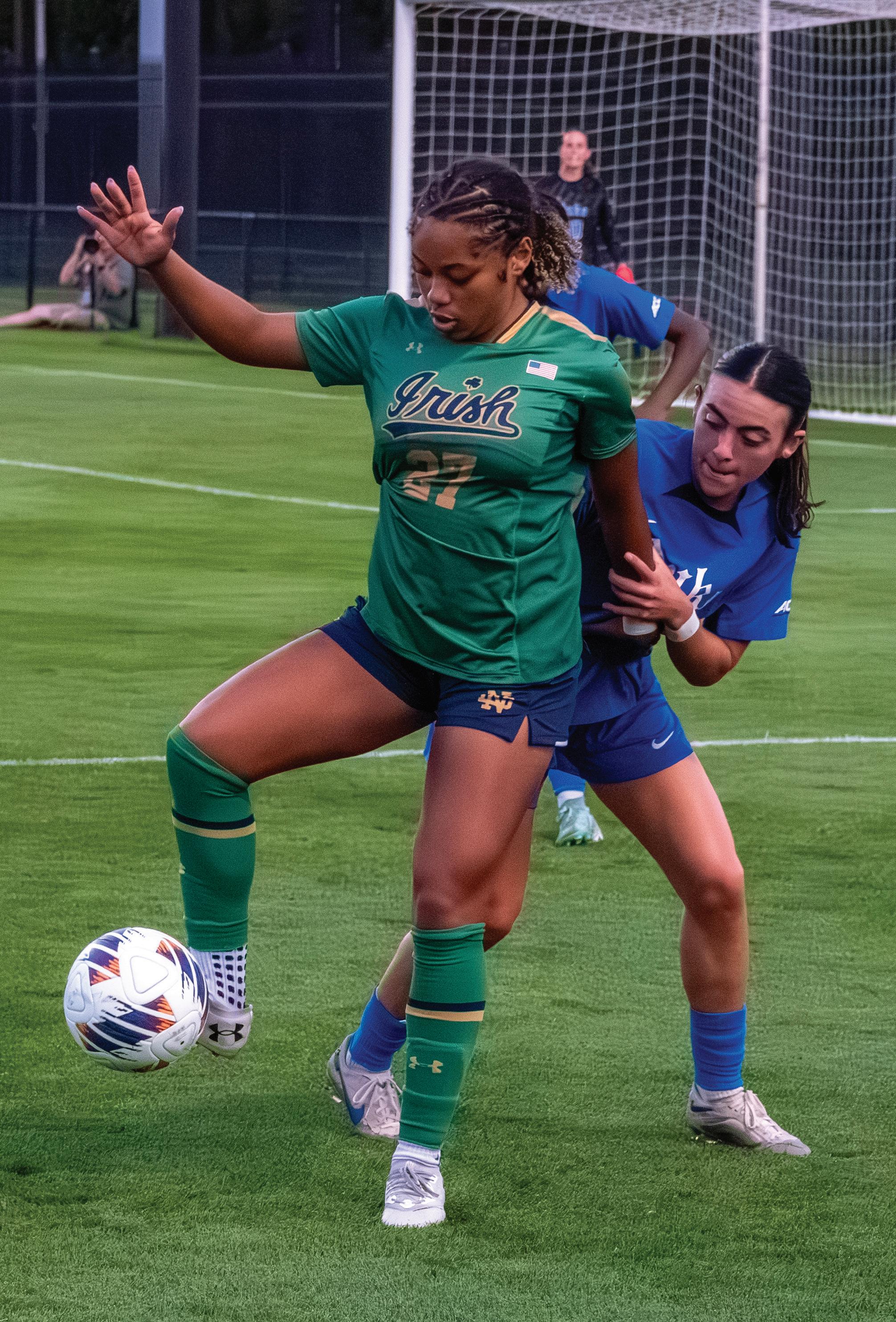
the Notre Dame women’s soccer team will take the pitch for what is sure to be an intense matchup. The Irish have dominated their ACC play so far, winning their first two games in the conference slate against NC State and Duke. They look to continue that streak at home on Wednesday night against the defending national champions, the University of North Carolina (UNC) Tar Heels.
The Tar Heels are currently ranked as the No. 22 team in the country. Their overall record is 7-3 and they are 1-1 in conference play. They went on a six-game winning streak, walking away with three points from every match for nearly a month before falling 1-0 in a close match against Florida State University (FSU) last Wednesday. The go-ahead goal from FSU came almost an hour into the contest and the devastating loss has no doubt left the Tar Heels even hungrier for a ranked win. UNC has played four games against opponents currently ranked in the United Soccer Coaches Top 25 poll and only pulled out one win in those contests. Their offense has scored 26 goals so far this season for an average of 2.6 goals per game. Junior Olivia Thomas is their top goalscorer, finding the back of the net eight times. In her sophomore season she earned the honor of 2024 NCAA College Cup Most Outstanding Offensive Player and was also named to the 2024 NCAA College Cup AllTournament Team.
The Fighting Irish have proven that they can compete with any opponent that comes their way and have earned the No. 1 spot in TopDrawerSoccer’s rankings and No. 2 by the United Soccer Coaches this week. Their record sits at an impressive 7-0-1. With 27 goals in this 2025 season, 26 have been assisted, showcasing undeniable team chemistry and unbelievable vision through the field. Their 3.38 goals per game certainly puts opposing defenses on notice. The Irish come into this week on a sixgame winning stretch, looking to carry the momentum.
Top goalscorers, sophomore forwards Izzy Engle and Annabelle Chukwu, have been automatic this season, collecting eight and seven goals, respectively. Unafraid to get physical in front of the goal, they are a challenge every defense will have to bring their best against. Cementing herself as a skilled passer,
sophomore midfielder Grace Restovich is leading the team with five assists. And rounding out the phenomenal play from the sophomore class is goalkeeper Sonoma Kasica. Facing 28 shots on goal, she has made 21 saves and even
posted four shutouts in a row against Cincinnati, Michigan, Oakland and Michigan State.
The energy at Alumni Stadium has been electric as the Irish have yet to drop any points at home. As fans continue to pack the stands in
support of a top Irish team and in celebration of the Cheer Her Name campaign honoring 50 years of women’s varsity athletics, it will be difficult for the Tar Heels to drown out the noise of the home crowd’s support. Overall, the match will be a gritty one with the Irish fighting to keep their top spot and the Tar Heels searching for redemption after their loss.
Contact Carson Didden at cdidden@nd.edu
What is your favorite kind of pasta?
Liliana Taskey freshman Lewis Hall
“Fettucine alfredo.”
Erin Conway freshman Lewis Hall
“Vodka pasta with chicken.”
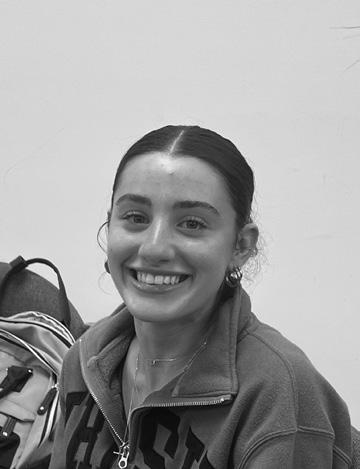
Lucine Jochaniewicz freshman Lewis Hall
“Rigatoni vodka pasta.”
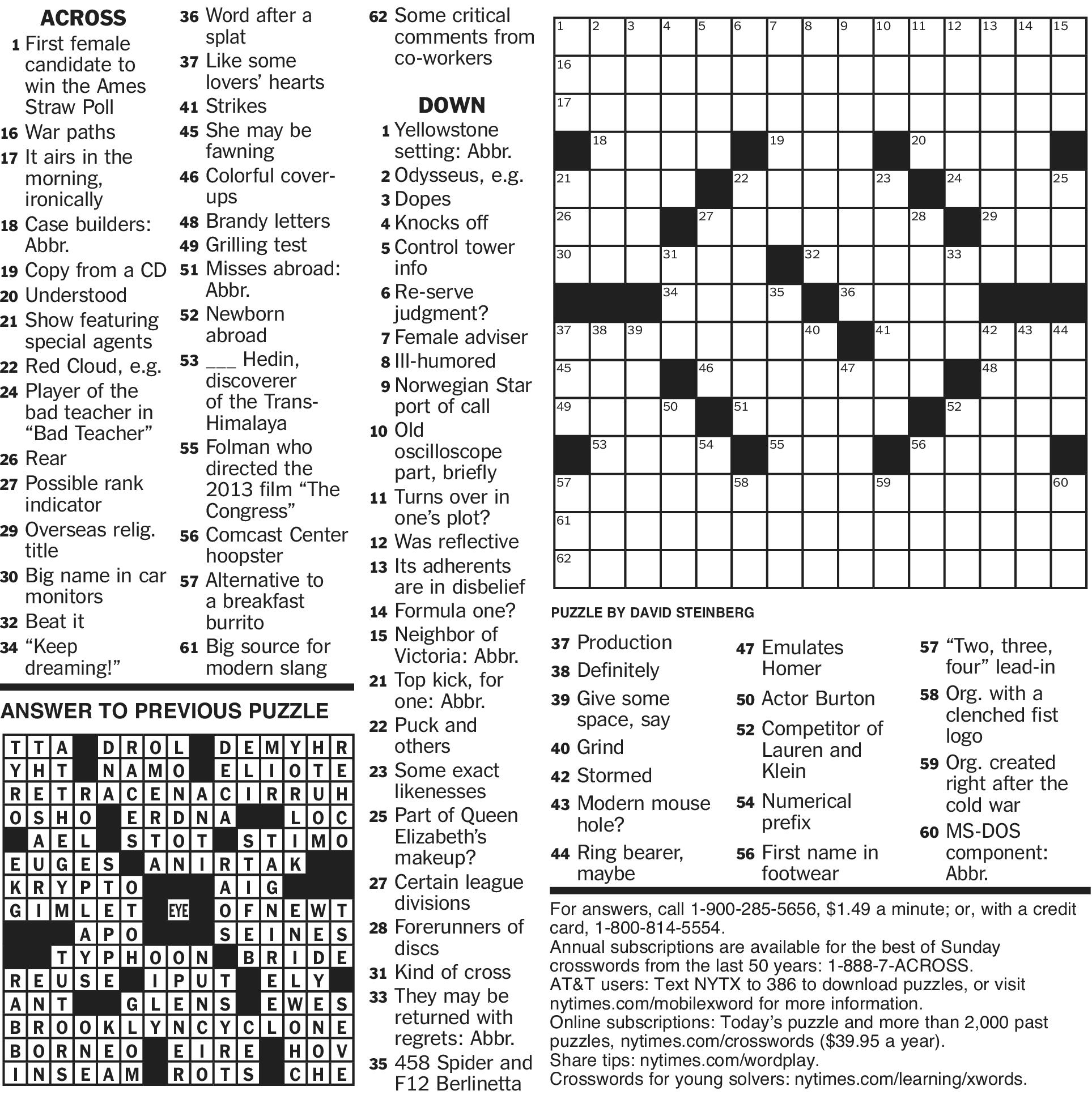
CROSSWORD | WILL SHORTZ
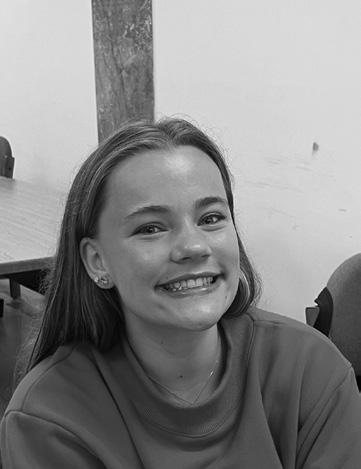
Elle Dahle freshman Lewis Hall
“Macaroni.”
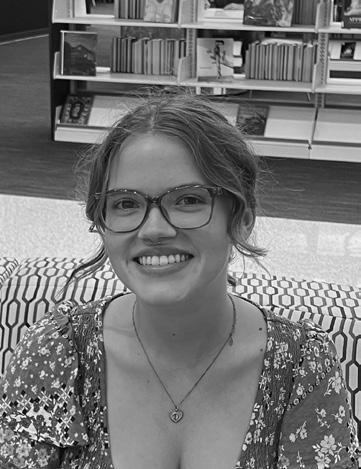
Sarah Costa sophomore Welsh Family Hall
“Penne.”
Have an idea for a poll? Email dstangel@nd.edu
What is your favorite social media?
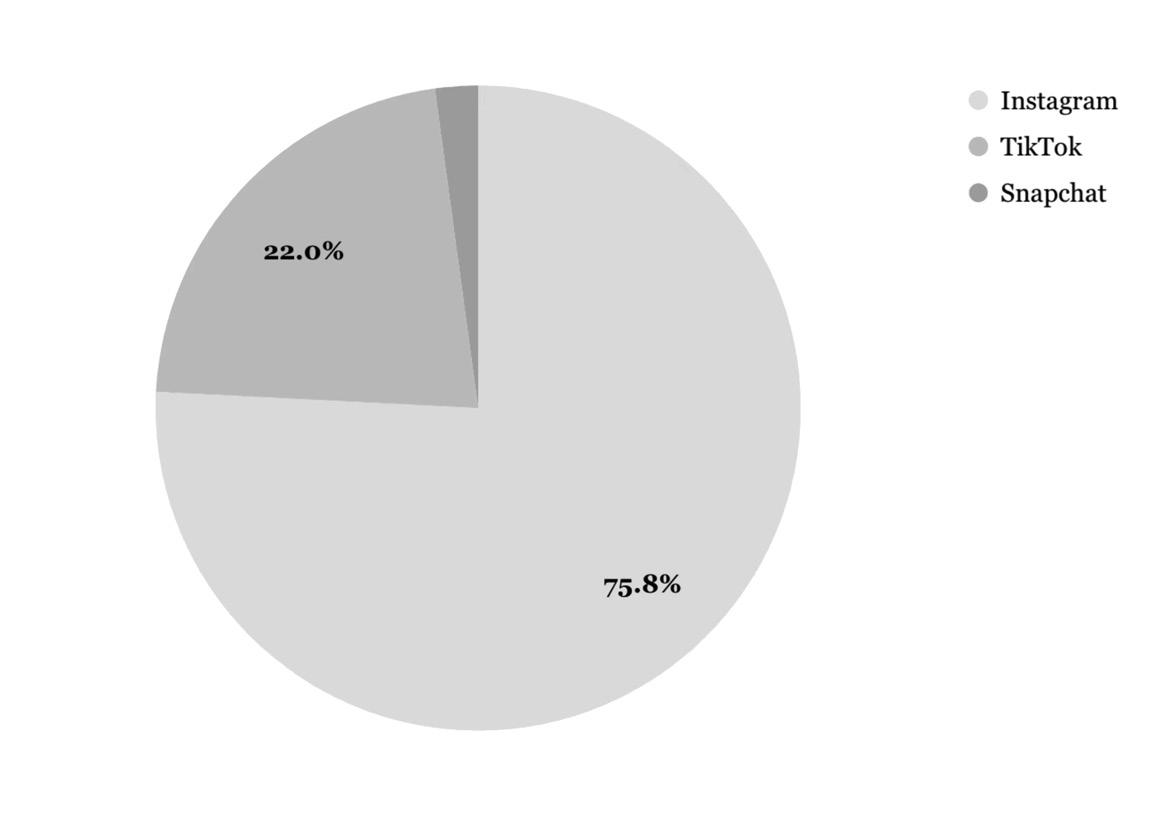
A recent poll conducted by The Observer via Instagram recieved 186 respondents and asked students what was their favorite social media app. With 141 votes, 76%, the majority of respondents said Instagram was their favorite social media app. The next largest group at 41 votes, 22%, said TikTok. The smallest group, at only 4 votes, 2%, said Snapchat. Instagram appears to be the favorite app amongst the student body, while Snapchat is the least popular.
Want your event included here? Email news@ndsmcobserver.com
Wednesday
Notre Dame women’s soccer vs. North Carolina
The Fighting Irish battle the Tar Heels. Alumni Stadium 6 p.m.
Thursday
An evening with Carl Zimmer Science journalist and author discusses misinformation. 105 Jordan Hall of Science 4:30 - 5:30 p.m.
Friday
Notre Dame women’s volleyball vs. Syracuse
The Fighting Irish face the Orange. Purcell Pavillion, Joyce Center 6:30 p.m.
Saturday
Ekaphrasis writing with poet Brenda Cárdenas Learn how to write based on visual art inspiration. Raclin Murphy Museum of Art 1 p.m. - 4 p.m.
Sunday
Ancient Chinese ceramic lecture and hands-on workshop Hear from the director of the Imperial Kiln Museum. 1030 Jenkins Nanovic Halls 11:45 a.m. - 3 p.m.
By Payton Dymek Sports Writer
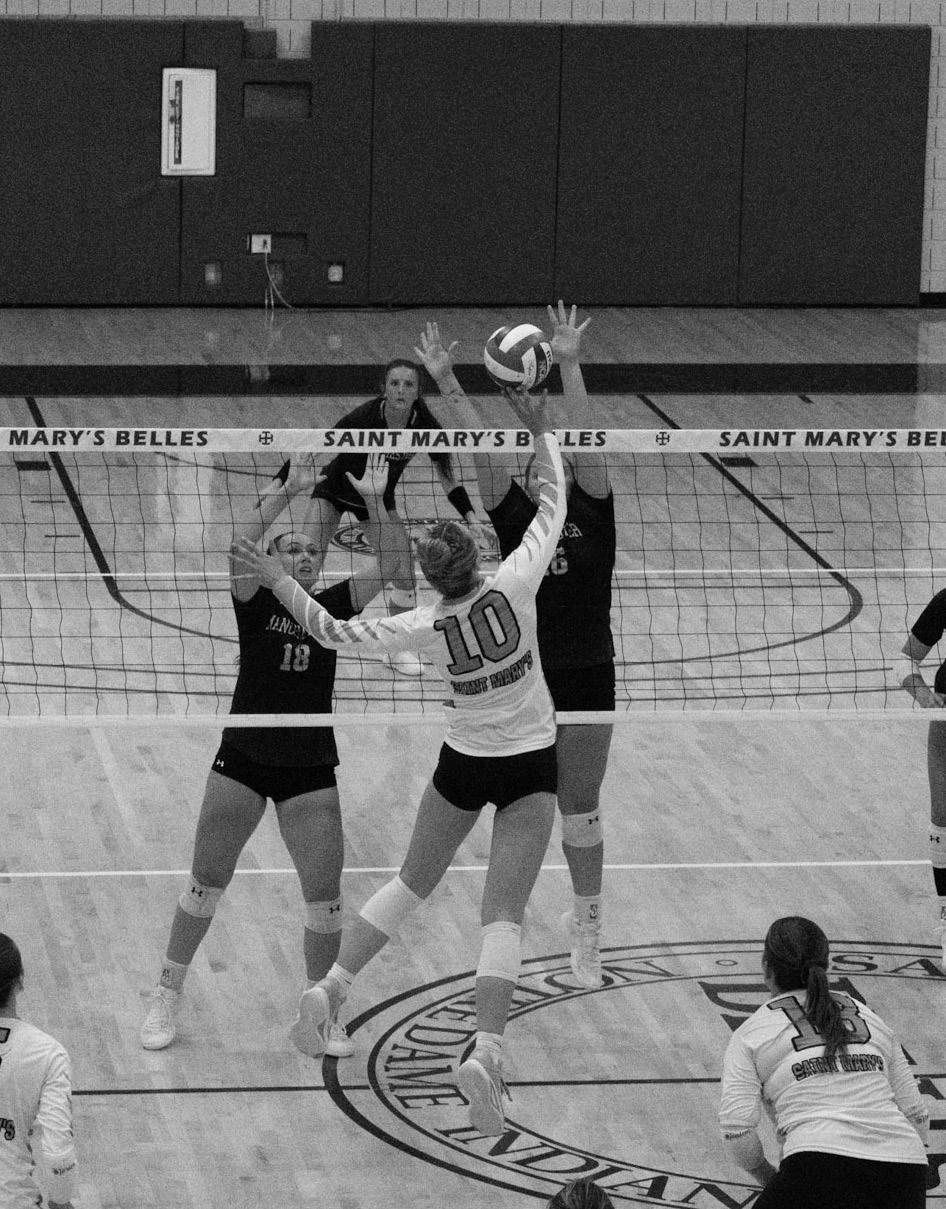
This past weekend, Saint Mary’s played three matches against tough competition and was able to walk away with three wins, moving the Belles to 11-0 on the season and continuing their perfect start. The Belles defeated Dominican and Beloit with 3-0 wins, but had a close game against Grinnell where they snuck away with a 3-2 win. Across the weekend, sophomore outside hitter Kalli Lewkowski led her team in kills with 28, sophomore setter Giuliana Graczyk led the Belles with 55 assists and 31 digs and freshman outside hitter and defensive specialist Shannon Rudge led with 11 aces. Another big contributor for the Belles this past weekend was junior middle hitter Caroline Carens, who was an explosive player able to control the net, showing her significant impact even without needing to rack up the most kills on the team. Carens scored a total of 37 points on offense for her team, and Rudge was able to score 38 points for her team with her combined efforts on offense and defense. The match against Beloit was also special as head coach Denise Van de Walle allowed some of the newer players to get court time. Sophomore defensive specialist Katerina Rigan saw the court again for the first time since their match against Benedictine on Sept. 3. Freshman defensive specialist Lexi Szymanski also earned some playing time and made the most of it, earning seven digs. Additionally, freshman setter Maddie Taitano got court
time again for the first time since the Sept. 12 match against Manchester, garnering one kill and two digs for the Belles.
Despite a long weekend of play, Saint Mary’s was extremely successful and is looking to carry that success into their game at home on Sept. 24 against Olivet. The Belles are a team with very high volleyball IQ, which is an explanation for how they’ve been so successful this season. The players understand what shots to make that can put the other team out of system, the setters do an impeccable job running an unpredictable offense that is a challenge for many teams to read and they are able to keep their passes in-system to ensure they are able to use all their options for any play. Despite their high IQ, Saint Mary’s has struggled slightly with closing out inferior opponents in straight sets. The Belles are currently 10-1 in the first set, yet consistently struggle to close the subsequent sets, causing many matches to go at least four sets. A big reason for this comes from playing tighter once they gain an early lead, allowing opponents to grab the momentum and ultimately win a set.
Olivet College is 4-9 on the year so far but, despite their losing record, rosters pivotal players that have put up big numbers for the team.
Freshman outside hitter Payton Smith leads her team with 139 kills on the season and has scored a total of 149 points so far. Junior middle hitter Julia Hall has 91 kills and has scored 123 points on the season. The team overall has a total of 790 digs
on the year, averaging about 16.81 per set, and a total of 68 blocks with an average of 1.45 per set. With Olivet’s slightly stronger statistics,
the Belles will have to use their momentum from the weekend for their intense matchup. First serve is at 7 p.m.
Contact Payton Dymek at pdymek01@saintmarys.edu
By Harrison Brown Sports Writer
On Monday, Saint Mary’s golf traveled to Grand Rapids, Michigan, to compete in the first Michigan Intercollegiate Athletic Association (MIAA) Jamboree. The event is the first of four conference jamborees throughout the year. For the conference, the champion is determined by total scores through the four jamborees and two rounds in the MIAA Championship in April. Last year, the Belles took home the MIAA Championship and advanced to the NCAA Division III Championships. They will be looking to continue last year’s success after finishing
fourth in Monday’s contest.
Sophomore Melanie Maier led the Belles, carding a 77 in the event. Her performance was enough for her to finish tied for fifth on the individual leaderboard. Shooting a 38 through the first nine would tie a team low through nine, and she would follow that with a 39 on the back nine. Maier began her career averaging a team-best score of 76.6 in her freshman year. She has carried this momentum into her second year, serving as the top performer for the Belles in each of their three events so far.
Freshman Katharine Swain and junior Colleen Hand tied for the team’s next-best score, each shooting an 82. Freshman
Kate Plessinger competed in the event as an individual and also carded an 82. The three golfers would all tie for 17th. Saint Mary’s found notable success in its freshmen. Swain competed in her third collegiate event at the Jamboree and tied her career best round. Furthermore, Plessinger had a top 20 finish in her first collegiate event.
Birdies on the fifth hole propelled seniors Amanda Melling and Breana Harrington to scores of 83 and tied for 21st individual finishes. Melling’s two birdies tied her with Maier for the most on the day. Every golfer for the Belles placed within the top half of the individual leaderboards and
scored under the event average of 84.31. Ultimately, the Belles would conclude the event +36, which slotted them fourth out of the nine teams competing. Kalamazoo had the best team performance in the event and thus now sit atop the MIAA standings. They were led by sophomore Jacey Merkle, who finished just two over par with a score of 74. Freshman Gabrielle Sluss had another top ten finish for the Hornets, carding a 79. Kalamazoo finished with a score of 315, which was the second-lowest score in the program’s history. Additionally, Merkle’s score was also the second-best in school history. The Jamboree was the second consecutive first-place finish for
Kalamazoo this season. They also took the top spot earlier in the Kyle Campbell Invitational, an event where Saint Mary’s finished second.
The Belles will next travel to Big Rapids, Michigan, to compete in the Bulldog Fall Classic hosted by Ferris State. Shortly after, they will resume conference play with the second MIAA Jamboree on Sept. 30. Saint Mary’s currently sits nine strokes behind first place in the MIAA standings but will have the opportunity to close that gap over the next three Jamborees.
Contact Harrison Brown at hbrown23@nd.edu
By Sam Harshman Sports Writer
This past Friday, as football fans made their way to South Bend, Notre Dame’s cross country team hosted the National Catholic Invitational at Burke Golf Course. In its 46th year, the meet featured a variety of other Catholic universities, including Loyola (Ill.), Lewis, DePaul, Detroit Mercy, Canisius, St. Francis (Ill.), Bellarmine, Mount Mercy, Mercyhurst, St. Francis (Ind.), Thomas More and the Notre Dame Running Club.
In just the team’s second meet of the season, the first since Aug. 29, the men’s and women’s teams topped the field with scores of 20 and 15, respectively. In the men’s race, Loyola (Ill.) finished second with a team score of 55, and Lewis finished third with a team score of 110. In the women’s race, Lewis finished second with a team score of 69, and DePaul rounded out the podium with a team score of 79.
The first man to cross the finish line in the men’s 8k was Notre Dame junior Daelen Ackley, who finished in a time of 23:48.4. Ackley barely beat out his teammate, freshman Cameron Todd, who finished just a tenth of a second behind Ackley with a time of 23:48.5. This time marked a personal best for Todd, destroying his previous best of 24:05.0, which he ran at last year’s meet. Coming in behind Todd was another pair of Irish runners, as junior Izaiah Steury finished with a time of 24:07.1, and junior Sam Rich followed in fourth in 24:08.5. Rounding out the top five was Notre Dame freshman Benji Anderson, who ran unattached, finishing in 24:12.0. Similar domination was seen on the women’s side, with Irish runners sweeping the top five in the 5k. Sophomore Arianne Olson topped the podium with a time of 16:35.8, which just nearly beat out her teammate, sophomore Mary Bonner Dalton, finishing in 16:36.1. Third place belonged to freshman Amaya Aramini
with a time of 16:39.7. The top three finishers all set personal records in the 5k, with Aramini shaving over 90 seconds off her former best time of 18:13.0. Junior Gretchen Farley finished fourth in 16:47.1. Senior Sophie Novak rounded out the top five for
the Irish women with a time of 16:48.7.
In the most recent U.S. Track & Field and Cross Country Coaches Association rankings, the Irish men came in at No. 8 in the nation and No. 2 in the Great Lakes Region. The women find themselves at
No. 11 nationally and No. 1 in the Great Lakes Region. The team is back in action on Oct. 3 as they host the Joe Piane Notre Dame Invitational.
Contact Sam Harshman at sharshma@nd.edu

Doctor of Nursing Practice
Geriatric Neuropsychiatry Certificate
Master of Science in Nursing
Master of Social Work
Master of Science in Speech-Language Pathology
Master of Data Science (3+1 and 4+1)

With a variety of options to choose from, you’ll have plenty of opportunities to explore campus and discover why graduate programs at Saint Mary’s College are right for you.
You’ll have the opportunity to hear from members of the Office of Graduate Admission and Student Financial Services, take a tour of campus, and see academic centers and labs. Lunch will be hosted by current graduate students, and your day will end with a visit to your specific graduate studies department where you’ll meet faculty and staff.
Friday, September 26
Friday, October 10
Friday, November 7
In these program-specific virtual sessions, faculty from your department of interest will provide a short presentation followed by a Q & A session. A member of the Graduate Admission team will also be there to answer any admission or financial aid questions.
Visit the Register Today QR code for information regarding session dates and times.
If you can’t attend any of these visit days, we invite you to request a virtual or on campus visit.
All prospective graduate students who attend an on-campus visit (regular daily visit with our team or an event) will earn a one-time $1,000 award added to their graduate financial aid package if they enroll.
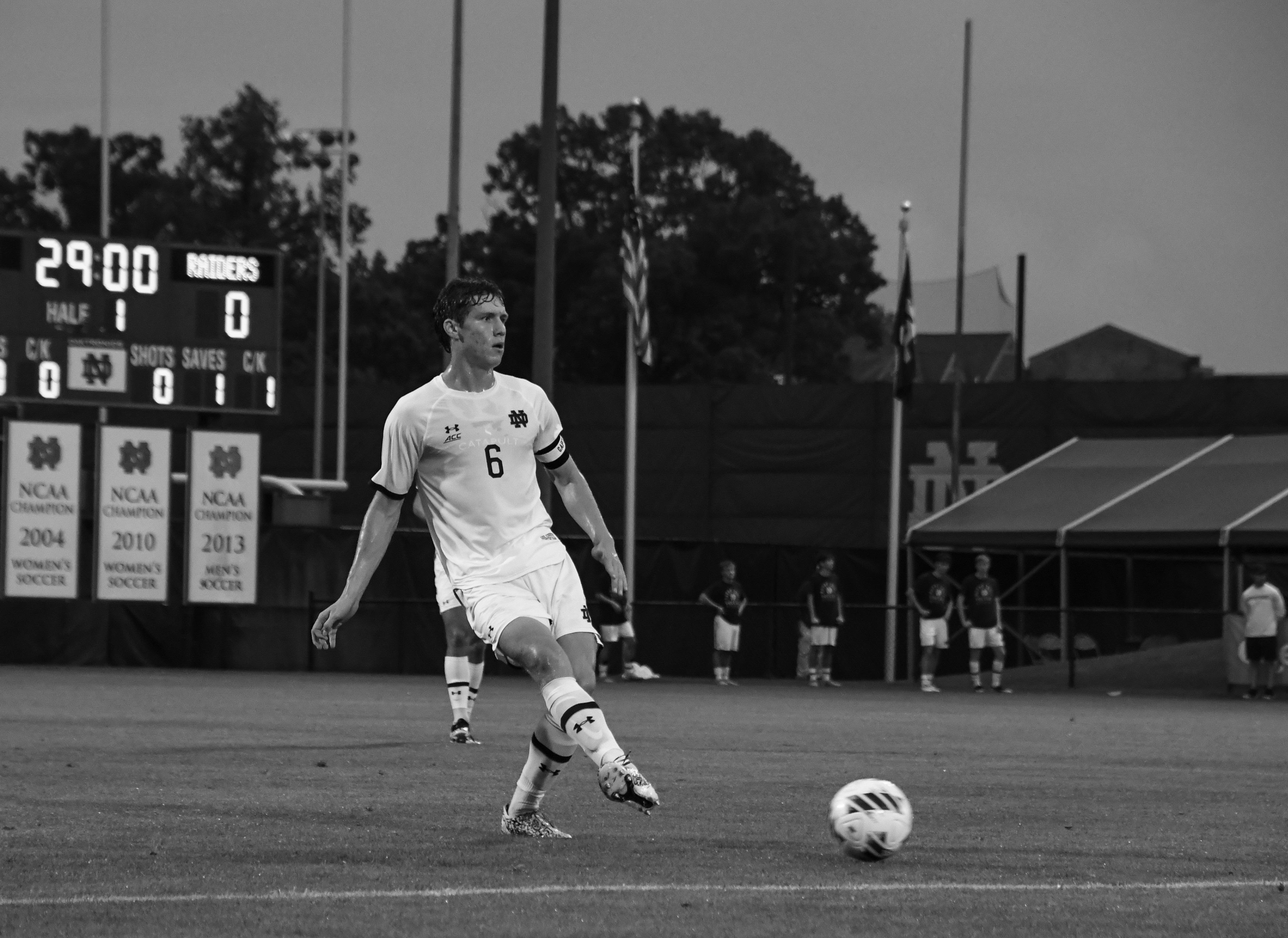
By Nikki Stachurski Sports Writer
Notre Dame men’s soccer continued their seven-game homestand with a non-conference matchup against Wright State Tuesday night, defeating the Raiders 3-2 behind a firsthalf hat trick by senior defender Mitch Ferguson. The Raiders attempted to rally by scoring two goals late into the second, making for a high-intensity end to the game.
Tuesday’s match was the first time Notre Dame played Wright State in South Bend since 2019, when the Irish fell short 3-2. This hungry Notre Dame team had no intention of repeating the past, and came into the first period with high expectations.
After last week’s upset against Louisville, the Irish have shaken the Atlantic Coast Conference (ACC). The 3-0 shutout over the Cardinals moved Notre Dame to No. 21 in the country, dropping Louisville to an unranked position. The goals scored by senior forward Wyatt Borso, junior midfielder Nolan Spicer and freshman forward Ren Sylvester went unanswered by the Cardinals, proving Notre
Dame’s offense is one to keep an eye out for this season. The win was massive for the Irish, shaking off their early season nerves and gaining the confidence necessary for the rest of the season.
The Irish wasted no time scoring, with a free kick scored by Ferguson in the 8th-minute, his second goal of the season.
The Irish captain beat Raiders freshman goalkeeper Nadav Youdkevich on the right side, finding the bottom right corner of the net.
Ferguson’s goal was so nice, he had to do it twice. At the 28th-minute mark, Ferguson scored following a phenomenal save from Youdkevich. The Raiders goalkeeper could not quite reset fast enough, and freshman defender Alex Rosin and freshman forward Luke Burton assisted Ferguson’s second goal of the night, again from a set piece on a corner kick.
On Notre Dame’s fourth corner kick of the half, graduate defender Diego Ochoa and Spicer generated a scoring opportunity for Ferguson, who capitalized on their efforts and scored his third goal of the night at the
32nd-minute. Three goals in the first half gave Ferguson his first ever hat trick, and the only hat trick for a Notre Dame defender so far this season.
Youdkevich had four saves in the first half and was making smart decisions in net, but he was less successful in deflecting at the touchline, which made up two of the three Irish goals. Youdkevich showed a great eye for blocking shots at distance and on the left side, but he needed his defenders to break up passes to disrupt the Irish playmaking.
The Raiders came out energetic into the second half, undeterred by the score. They stayed levelheaded on the pitch, reducing mistakes and unnecessary fouls on defense.
Both teams were quiet, regularly alternating possession with little action on offense for either side for the first 20 minutes of the second half.
Wright State’s momentum changed at the 70th-minute, when freshman forward Sammy Jadid entered the game as a substitute for senior midfielder Jack Jenkins. Jadid scored his first goal of the season in dramatic fashion, dribbling past
the Notre Dame defense and beating sophomore goalkeeper Blake Kelly on the left side to put Wright State on the board.
The Jadid goal fired up this Wright State team looking for their first win of the season, and junior midfielder Edwin Espinal-Elvir scored in the 89th-minute after a missed header off the post. The Raiders were not giving up, and finally landed a shot deep into the right corner after working Kelly all around the net.
The Irish held on to their lead late into the second half, squeaking by with a win on the scoresheet. The Notre Dame defense was diligent and physical tonight, with defensive players working hard to produce offensive results and limiting Wright State to only 11 total shots. The Irish had 10 fouls, which is a number they want to reduce in the games going forward.
When asked about his team’s performance tonight, especially in the second half, Notre Dame head coach Chad Riley said, “We’ll look back on those things and grow, but I think winning soccer games is tough, and Division I soccer is tough, so we’ll always take
the positive.” Although the Irish did not want to give up two goals to Wright State, the Raiders were hungry and displayed perseverance until the end and continued their pursuit of their first victory.
Despite the minor positives and negatives for their play tonight, it was a phenomenal game for Mitch Ferguson. After the game, Ferguson accepted congratulations but had nothing but praise for his teammates and coaching staff. “The coaches do a fantastic job setting us up to be successful in those areas,” he said. “And, I mean, just props to them and props for our team, just on staying focused in those times and executing.”
Notre Dame has game four of their seven-game homestand this Saturday against unranked SMU at 7 p.m. in Alumni Stadium. Although not the toughest opponent Notre Dame will face this season, they must continue prioritizing cohesive defense and communication on offense to maintain their dominance.
Contact Nikki Stachurski at mstachu2@nd.edu