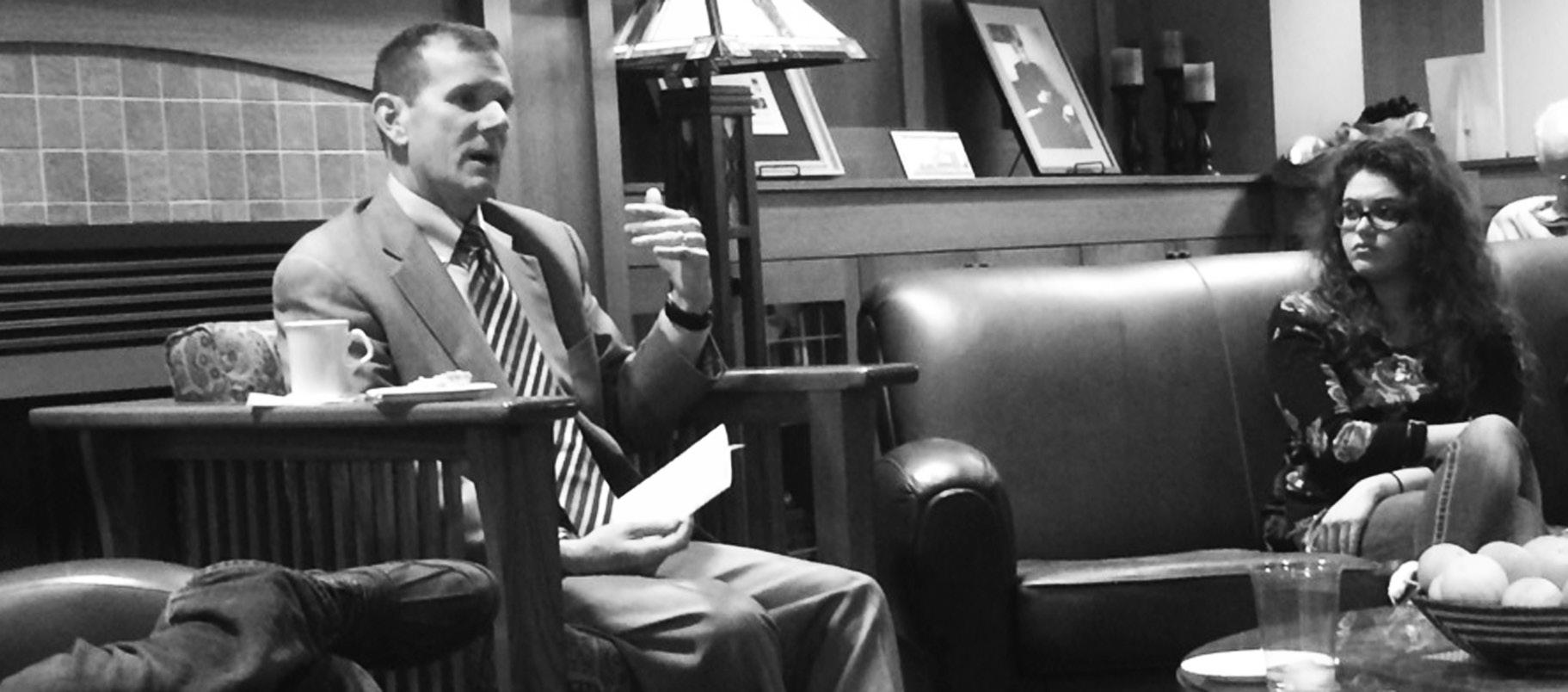
Notre Dame alumnus critiques recent bills in the Indiana state senate regarding labor practices
By RACHEL O’GRADY news writer
For believers in the power and need for collective bargaining, i ndiana s tate s en. John b roden says now is an incredibly frustrating and troubling time.
“ i n the last five to six years, a lot of our labor laws have fallen to the wayside. i f you believe that labor organizations have the right to collective bargaining, i ndiana has certainly taken a number of steps back,” b roden said.
Tuesday night, the h iggins l abor s tudies p rogram
Friends and a lumni n etwork sponsored a discussion with b roden, who graduated from the u niversity in 1987, in which he focused on fighting for laborers rights in the i ndiana s tate s enate.
“ i ’ve loved working in the g eneral a ssembly, but it’s definitely gotten more challenging. i ’m a d emocrat, and we’ve always been the minority but we’re even more severely the minority now,” b roden said. “ i ndiana has traditionally sort of been a swing state, it’s not
see senaTor PaGe 3
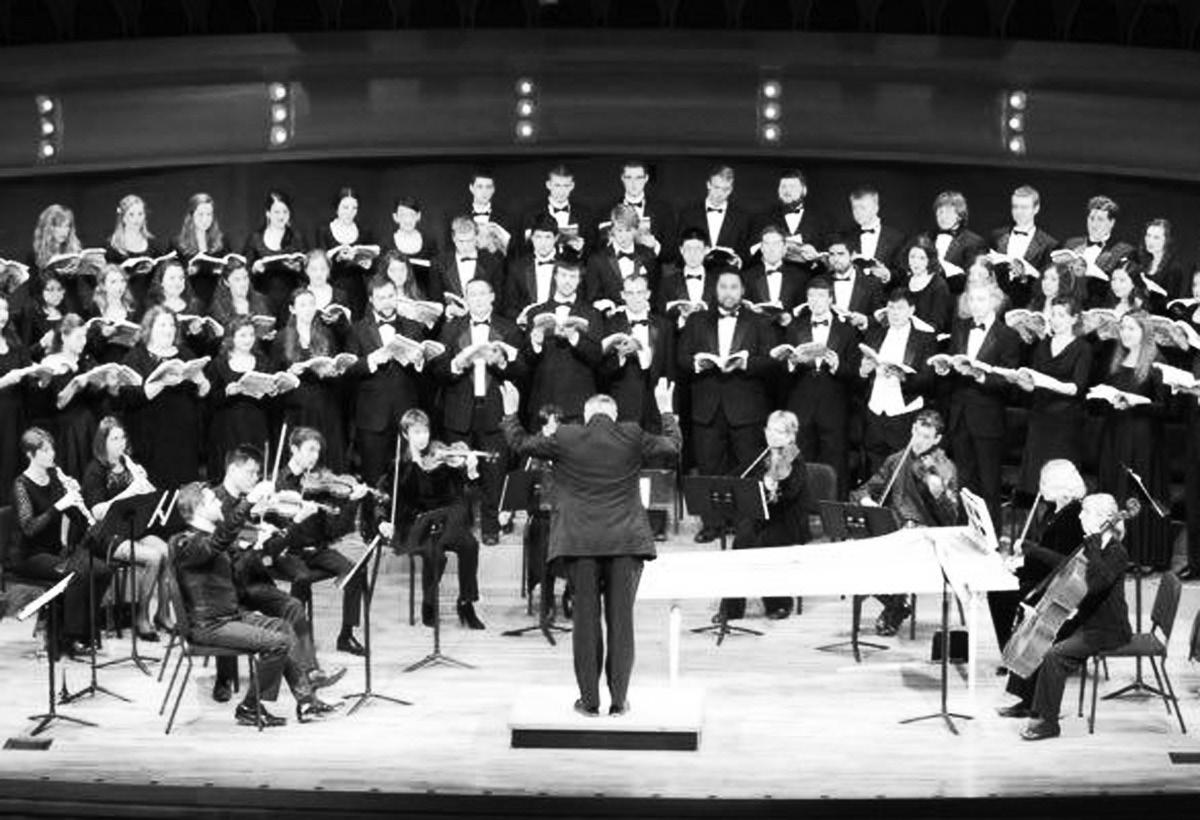
Chorale to perform ‘Messiah’
By CATHERINE OWERS
a ssociate news e ditor
The n otre d ame c horale’s annual performance of h andel’s “ m essiah” will take place at l eighton h all in the d e b artolo p erforming a rts c enter on Friday and s aturday evenings at 8 p.m.
Tickets are $3 for students, $2 if they are bought from c horale members.
“ o ne of the reasons i decided to try out for c horale is because i saw we were singing h andel’s ‘ m essiah.’ a nd i just love the ‘ h allelujah c horus,’ and i ’ve really fallen
in love with all of ‘ m essiah,’” senior and chorale president e rin b ishop said.
“ m essiah” is an oratorio that contains three movements, b ishop said. The c horale will be singing most of the first two movements, for a performance that will be around two and a half hours.
“ i t depends on how many solos we do,” she said. “ w e don’t do the entire piece, we kind of pick and choose.”
This year’s performance is unique in that the c horale
saint mary’s club advocates for girls’ education
By KATHRYN MARSHALL
a ssociate s aint mary’s e ditor
during its first year on campus, the college’s chapter she’s the First, which supports women’s education in low-income countries, has 80 members and is still attracting interest, senior club member christine germann said.
“college chapters of she’s the First are vocal advocates for girls’ education who educate their peers through
documentary screenings, panel discussions and innovative campus events that raise awareness about the cause,” germann said. “They raise funds through creative and unique events to support girls in developing nations and make sure they receive opportunities for empowerment.”
The club’s first meeting was with a peace corps representative about joining together with “let girls learn,” an initiative that combines efforts by
the w hite house, usaid and peace corps to promote female education across the globe, she said.
germann said the club plays an important role on saint mary’s campus because it reminds people that education for girls is important, no matter the circumstances or location in the world.
“one factor that inhibits girls from completing a secondary
Knott Hall, service group host blanket-making event
By ANDREA VALE n ews w riter
Knott h all, along with c ircle K, will hold their annual a idan p roject s unday, and event that invites students to help make blankets for cancer patients because, according to the c ollege of s cience event description, “ c ancer is cold.”
s ophomore n athan Kriha, the Knott h all service commissioner, said the a idan
p roject started in 2006 when a member of Knott h all discovered he had cancer.
“The a idan p roject is basically an opportunity that we do every year with c ircle K,” Kriha said. “ years ago there was a student named a idan [Fitzgerald] who had cancer and he recovered, but something he really wanted was to have a service event for those who are in the hospital dealing with cancer.
“ s o ever since then there’s been the a idan p roject, which is an opportunity to make blankets in s outh d ining h all for kids who are in the hospital with cancer,” Kriha said. “ i t’s a really nice thing.”
Junior p atrick s heehan, Knott h all co-president, said various members of the dorm have contributed to the work necessary to
see blanKeTs PaGe 3
see club PaGe 4
RACHEL O’GRADY | The Observer
State senator and Notre Dame alumnus John Broden discusses the variety of issues the Indiana legislature faces regarding minimum wage, right to work status and other labor policies.
Photo Courtesy of Mimi Michuda
The Notre Dame Chorale performs Handel’s “Messiah” last year at the DeBartolo Performing Arts Center.
Policies The observer is the independent, daily newspaper published in print and online by the students of the university of notre dame du lac and saint mary’s college. editorial content, including advertisements, is not governed by
The
Today’s Staff
and
Question of the Day:
What is your favorite Christmas song?
Alex Tatarian freshman breen-phillips hall
“‘a ll i want for c hristmas is you’ by Justin beiber.”
Julia Szromba sophomore breen-phillips hall
“‘have yourself a merry l ittle c hristmas’ by m ichael buble.”
Sophie Brahos sophomore breen-phillips hall
“‘8 days of c hristmas’ by destiny’s c hild.”
t he next f ive D ays:
Thursday
Silent Auction LaFortune Student Center
6 p.m.-9 p.m. Fundraiser for Hannah’s House.
Father Ted Talk Reckers
8:30 p.m.-9:30 p.m. Lecture by Ed Hums on a life of faith.
Friday
Laudato Lunch Geddes Hall
12:30 p.m.-1:30 p.m.
Discussion about Notre Dame at Paris Climate Conference.
Hockey vs. Massachusetts Compton Ice Arena
7:35 p.m.-9:35 p.m. ND takes on Minutemen.
Chris Bowers freshman Zahm house
“santa c laus is coming to Town.”
Harry Federspiel freshman Zahm house
“rockin’ a round the c hristmas Tree.”
Emily Salerno freshman Farley hall
“carol of the bells.”
Corrections
The
Saturday
Shakespeare Festival DeBartolo Performing Arts Center
10 a.m.-6 p.m. Auditions for “Pericles” and “The Tempest.”
“Anchored in Hope” Keenan Hall
7 p.m.-8:30 p.m. The Voices of Faith Gospel Choir Concert.
Sunday
Violin Performance
Snite Museum of Art
2 p.m.-3 p.m.
Faculty member Tricia Park and guest Taylor Morris will perform.
Créche Pilgrimage Eck Visitors Center
2:30 p.m.-4 p.m.
Visit nativity exhibits around campus.
Monday
Advent Vespers
Regina Chapel
6:45 p.m.-7:15 p.m.
Join the community in prayer during the Christmas season.
Piano Masterclass
Snite Museum of Art
3:30 p.m.-5 p.m.
Learn from pianist Svetlana Belsky.
Group examines core curriculum
By MEGAN VALLEY news wrtier
student senators discussed the recently released core curriculum review draft report and listened to a presentation on library renovation updates at their weekly meeting wednesday night.
monday, undergraduate students received an email with information about the proposed changes to the core curriculum, including a link to the review committee’s report. senators discussed their concerns about the changes, especially regarding the proposed policies for receiving advanced placement (ap) credit, transparency and how the new requirements limit options for sTem (science, technology, engineering and math) students.
Judicial council president Zach waterson said the proposed requirements would make things harder on science and engineering students, who already have heavy, largely predetermined course loads.
“one of the interesting things they’ve done in the draft is they’ve actually reduced the amount of courses required you have to take by one,” he said. “They’ve done that by taking away one of the math
or science requirements and there’s now no way to test out of a writing course. so that’s kind of a double whammy for science and engineering students who won’t already be taking writing classes for their major, but will have plenty of math and science courses. These requirements are actually more restrictive.”
pasquerilla west hall senator a riana Zlioba said ap credit allowed students more room to explore and the new guidelines could be too ambiguous for students to plan what they want to do.
“if you’re able to get those entry level classes out of the way, you’re able to explore as many things as possible,” she said. “The one thing i really hope, if they decide to limit ap credit, is that they are really transparent about what you’re able to test out of and what you’re not able to.
From personal experience, i was told i would be able to test out of certain things and when i got here that wasn’t the case.”
marisa Thompson, president of club coordination council (ccc), said she understood the intent of the suggested changes as a shift in focus from taking core courses to “get them out of the way” to embracing them as part of a holistic education.
“one of the reasons they’re thinking
of removing that [ap credit] is that they want people to take those classes or core requirements in a university setting,” she said. “i think they want to limit the amount of credit you can get that way so you are building the liberal arts education for every student who enters the door.” in addition to the discussion of the proposed changes, members of the hesburgh library renovation steering committee gave a presentation to update student senators about construction progress. university librarians Jessica Kayongo and diane walker, as well as senior John wetzel, described the renovations that been completed on the first and second floors. They also showed artist renderings of what the current renovations of the tenth floor and future renovations of the first floor entrance, including the addition of a scholar’s lounge.
Kayongo said “phase 1,” which included the gallery entrance and the tenth floor should be completed very soon.
“The first and second floors on the south end should be done in march,” she said. “The tenth floor may be done even sooner than that.”
Contact Megan Valley at mvalley@nd.edu
student senate
monolithically r epublican. b ut right now, at the state legislative level, it is.
Though 32 members of the i ndiana g eneral a ssembly were r epublicans when b roaden was sworn in, there are currently 40 r epublicans, making up a more significant majority.
“The 32 members that are r epublicans were much
this were non-union contractors, who did very little public work, and then there were very right wing people that were just ideologically opposed to this,” he said. “... and that’s what was so frustrating about this, because we then ended up repealing the common construction wage.”
join unions. “ i ndiana is now what they call a r ight to work state. For a while, we avoided kind of taking up this fight, but you know you look around and there were a lot of members who wanted that. r ecently, though, we’ve lost some members who were against r ight to work, so they were able to get that bill passed,” b roden said.
blankets
con T inued F rom page 1
prepare for the event.
“ we organized an event … the week before [Thanksgiving] … where we actually took all of the rolls
e ast w ing of s outh d ining h all, from 9 a.m. to 3 p.m. d uring that time, all students are invited to come and help make blankets for local cancer patients.
“It’s extremely frustrating if you believe in labor rights, because things like minimum wage right now are being challenged and that’s something that we’re really fighting for but you know, we just can’t get it passed.”
more moderate strain when i was sworn in than the 40 members that are there now. n ow, you know, we’re seeing more and more conservative members beating those more moderate members in elections, and we’re losing that middle, more moderate group,” he said.
b roden said his most difficult fight came over the common construction wage, which the r epublicans wanted to repeal.
“ i t appeared that logic was thrown out the window. The only people who were for
b roden talked about his growing frustration with the r epublican majority in the g eneral a ssembly, particularly in regards to workers rights.
“ r unning against teachers unions became very popular for r epublicans. They were calling them out for protecting bad teachers, and then those bills passed, and then you know, r ight to work was next to go,” he said.
r egarding i ndiana’s recent status a r ight to work state, b roden said he was discontent with the way that legislation had been passed. i n r ight to work states, labor unions are allowed, but workers in unionized professions cannot be forced to
paid a dverT isemen T
l ooking to the future, b roden said he is working on policies regarding the minimum wage in i ndiana.
“ i t’s extremely frustrating if you believe in labor rights, because things like minimum wage right now are being challenged and that’s something that we’re really fighting for but you know, we just can’t get it passed,” he said.
b roden said his passion for politics and labor rights came primarily from his time at n otre d ame.
“ i really enjoyed my curriculum at n otre d ame, it confirmed everything i thought about politics, which i was interested from the very early days,” he said. “Two of my favorite courses were in labor studies, and there’s labor and labor history but then more importantly there’s labor economics, which sparked an interest in me that remains today.”
Contact Rachel O’Grady at rogrady@nd.edu
“There will be stations for people to come in. All the blankets are already cut, actually, we did that ahead of time, so its jsut going to be actually making them into blankets.”
Patrick Sheehan co-president Knott Hall
of fleece and cut them into blanket size,” s heehan said.
“ we cut them and put them into bags and got all of that ready to get carried over [to s outh d ining h all]. a nother thing we do is make baby blankets too, so we cut some smaller pieces too.”
Kriha said that along with members of Knott h all, members of the campus service organization c ircle K have also helped prepare for the a idan p roject event.
“ b uying felt was a big thing too, finding places to buy it, and that was actually all c ircle K,” Kriha said. “[ c ircle K] is a club that focuses on service in the area, so for instance … at the beginning of n ovember, they went out into s outh b end and raked leaves for people who can’t actually rake themselves.
“They’re very oriented in service, so if anyone wants a good opportunity to be involved in the community with service then c ircle K is a good club for that.”
This year’s a idan p roject will take place s unday in the
“There will be stations for people to come in,” s heehan said, “a ll the blankets are already cut, actually, we did that ahead of time, so it’s just going to be actually making them into blankets. you just knot the ends of them and make them look good on the corners.”
Kriha said the goal of the event is not only the quantity of blankets made, but to engage the student community.
“The goal is just to get through all of the stuff we have and not have extras,” Kriha said. “ we just want to see a variety of kids from campus come … because last year it was pretty much only Knott and c ircle K, there weren’t a ton of outsiders, so this year we’ve tried to make it a little bit more known to
“We just want to see a variety of kids from campus to come ... because last year it was pretty much only Knott and Circle K, there weren’t a ton of outsiders, so this year we’ve tried to make it a little bit more known to the campus.”
Nathan Kriha service comissioner Knott Hall
the campus.
“ s o hopefully, our goal is just to have as many people come as possible,” he said. “ e veryone’s welcome.”
Contact Andrea Vale at avale@nd.edu
John Broden Indiana state senator
will be accompanied by a b aroque orchestra, b ishop said. The orchestra is comprised of n otre d ame students and other musicians.
“a lot of the people play with us for ‘ m essiah‘ every year,” she said. “The string instruments have a different feel. w e still sing with a harpsichord, but it’s really cool because it’s more historically accurate.”
d irector a lexander b lachly said in an email the b aroque instruments have a several advantages as accompaniment for works like “ m essiah.”
“ m ost notably, they make the phrases easier to play and easier to shape. m odern strings don’t let in enough lightness and air, and as a result the phrases tend to sound heavy and labored, even when played softly,” he said. “ c ertain effects, like sudden strong notes, also project better with b aroque instruments. The older instruments are not as loud as modern ones, and this has one advantage and one disadvantage: the advantage is that the sound is gentler, more voice-like.”
The downside is that the b aroque instruments do not project as easily in a large hall, b lachly said, “and the players therefore have to take that into account and play with a little more projection than would be necessary on modern instruments.”
“ p erhaps the greatest advantage is that the b aroque instruments are pitched a half-step lower than modern instruments, with the result that the highest notes for the sopranos are easier to sing,” he said.
‘ m essiah’ is intended to retell the history of early c hristianity, b lachly said, from the prophecies of Jesus’ birth, through the host of angels singing of his glory to the shepherds, then his p assion and suffering, and finally, the arrival of c hristianity, with the anticipation of the d ay of Judgment.
“The c horale sings virtually all of part one, the prophecies and birth, most of part two, Jesus’ p assion, and several numbers from part three, which looks forward to a future day in heaven when the souls will be united with c hrist,” he said. “The c horale ends its performance with the final number of part two, the ‘ h allelujah’ chorus, which, with its trumpets, foretells
the d ay of Judgment.”
b ishop said the piece is performed a lot at e aster time, as well, because parts of the second and third movements deal with the death of Jesus.
“ o ne of my favorite songs is a passage from the b ible that is commonly read at c hristmas time, where angel comes down from heaven and there’s the shepherds watching over the flock and she announces the birth of Jesus,” b ishop said. “ s o there are a lot of those classic c hristmas messages in it.”
The c horale has been rehearsing for the performances since n ovember, she said.
“ b ecause we sing it every year, we normally learn it pretty fast,” she said. “The old members help carry the new members. … and it generally requires some outside time, especially for the new people.”
b ishop said c horale has a large number of new members this year.
“ i t was really exciting to see them on m onday for the first time, get to hear us perform our choruses with the orchestra, and seeing it all start to come together,” she said. “This is my favorite thing we perform. i love it, i smile through the whole thing. i ’m not normally a huge classical music person, but h andel’s ‘ m essiah’ is something else.”
b ishop said it has been “extra special” to sing ‘ m essiah’ for the last time, especially as president of a group she loves.
“ i ’ll probably tear up during my last ‘ h allelujah’ chorus,” b ishop said. “ i t’s a special group, full of my best friends. ... w e’re a really different group of people that are all brought together by our love of music, and i think that brings a lot of unique aspects to our group. … i t’s one of those places where i always feel so comfortable, and welcomed and loved.”
i n addition to performing h andel’s “ m essiah,” the official concert choir of the u niversity has fall and spring concerts, b ishop said. o n the last week of winter break, c horale will tour the m idwest.
“ w e’ll sing the ‘ h allelujah’ chorus at all our stops. i wish we got to sing more, but it’s not quite the same with just the piano. i t’s when you add in the orchestra is when it really becomes something else.”
Contact Catherine Owers at cowers@nd.edu
education is plain and simple, funding,” she said. “ s he’s the First attempts to alleviate this financial barrier and provides a way for us, here in the u nited s tates, to play a part in the solution.”
The club gives students an opportunity to address the issue, club vice president
about the importance of education for girls, g ermann said.
“The very opportunities that education provides lead to global socioeconomic benefits,” g ermann said. “ i n this club, work is done to be a part of the solution to a problem girls face all over the world, the lack of access to quality education.”
o n Thursday, “ s he’s the First” is collaborating with the c ollege’s department
“The very opportunities that education provides lead to global socioeconomic benefits. In this club, work is done to be a part of the solution to a problem girls face all over the world, the
lack of access to quality education.”
Christine Germann member of She’s
the First
junior e lizabeth m urray said.
“The club is important at s aint m ary’s to help us to understand how fortunate we are to receive an amazing education, but also to put our leadership skills to practice and empower girls internationally through education as well,” m urray said.
m embers of the s aint m ary’s chapter inform the community and collaborate with other organizations and departments on campus to spread the message
of justice education to show the documentary “To e ducate a g irl” and raise money for the s he’s the First organization through cupcake sales. “To e ducate a g irl” was produced by the u nited n ations, and is a credible, accessible resource to share the message, g ermann said. s he said money raised during the event will be sent to “ s he’s the First” and then redirected to the chapter’s sponsored scholar.
“ s upported by the ungei [ u nited n ations g irls
paid a dverT isemen T
e ducation i nitiative] this film promotes equity in education and global gender justice,” she said. “ i t provides three narratives that bring the issue home in a personal way. s ometimes it is very hard to imagine, living here, in the u nited s tates, that we have so many privileges that others do not, such as basic education rights.”
m urray said she hopes attendees leave the event with a greater understanding of the value of women’s education.
“ w e would like them to recognize their own education as a blessing, but also help us in the attempt to bring this same education to others,” she said.
a long with a sense of purpose, the film will help people understand why it is important to care about girl’s education and the barriers they face, g ermann said.
“ u ltimately, i hope attendees are reminded of what a blessing it is to be educated and, in turn, will help to impart that blessing on others who only want the same opportunity,” she said.
The documentary showing is free, and will take place on Thursday at 7:30 p.m. in the vander vennett Theatre.
Contact Kathryn Marshall at kmarsh02@saintmarys.edu
By MATTHEW MUNHALL
s cene writer
Joni mitchell’s “river” isn’t a christmas song per se, but it’s a song i inevitably find myself listening to constantly come december. “river” originally appeared on mitchell’s 1971 album “blue,” her masterful meditation on heartbreak. “The ‘blue’ album, there’s hardly a dishonest note in the vocals,” mitchell told cameron crowe in a 1979 interview for rolling stone. “i felt like i had absolutely no secrets from the world and i couldn’t pretend in my life to be strong. or to be happy.”
“river” is one of the album’s loneliest moments, with mitchell using christmas as a backdrop against which to paint a narrative of loss and longing. christmas is approaching—“They’re cutting down trees / They’re putting up reindeer / and singing songs of joy and peace,” she sings—but the song’s narrator is not in the holiday spirit at all, still reeling from a painful breakup. The climate of southern california, where it “stays pretty green” even in december, is also not particularly conducive to holiday spirit. “i
wish i had a river i could skate away on,” she laments. The music is equally melancholic, recasting the “Jingle bells” as a plaintive minor-key piano melody.
w hat i find so powerful about “river” is how expertly mitchell juxtaposes depression with the expectation of cheer around christmastime. it’s a song that acknowledges it is perfectly normal to be sad around the holidays, even when you’re constantly bombarded by festive images everywhere you go. “laughing and crying, you know it’s the same release,” mitchell sings on “people’s parties,” off 1974’s “court and spark,” and “river” allows for a similar cathartic release. most of my other favorite christmas songs have melancholic strains. perhaps the closest analogue to the sentiment of “river” is bing crosby’s classic “w hite christmas,” the best-selling single in the history of recorded music. like mitchell’s song, “w hite christmas” is all about longing: “i’m dreaming of a white christmas / Just like the ones i used to know,” crosby wistfully sings. on one level, it’s also about someone in a warm climate pining for a picturesque snow-covered christmas tableau.
The arizona biltmore, the iconic art deco resort in phoenix, ariz. that was a frequent retreat for hollywood stars, claims that irving berlin composed the song lounging by the resort’s cantina pool in January 1939. as a phoenix native myself, its origin story is part of why the song resonates so deeply with me.
yet, the sadness of “w hite christmas” seems to run deeper than mere climaterelated reasons. berlin himself, even as a russian Jewish immigrant, had reason to find the holiday sad: his 3-week-old son died on christmas day in 1928, and every year after he and his wife would visit his son’s grave. This nostalgia for better, happier times runs through “w hite christmas,” even as it ends in a more hopeful place than “river”—“may all your christmases be white,” crosby sings in its final line. my favorite modern christmas song, “christmas (baby please come home),” performed by the incomparable darlene love, is equally plaintive at its core. as in “river,” its narrator finds herself lonely and alienated from the yuletide cheer surrounding them. “They’re singing, ‘deck The halls’
/ but it’s not like christmas at all,” love cries out on the chorus. it’s incredibly affecting because of her soulful vocal performance, which wrings every ounce of emotion from the song, which was penned by phil spector, Jeff barry and ellie greenwich.
yet, love is able to find hope in a song about feeling isolated and alone during the holidays. as she explained in a new york Times interview last year, “w hen i’m singing it, i’m telling everybody to come home to their loved ones. i’m inviting families to get back together again.”
w hat i love about “river,” “w hite christmas” and “christmas (baby please come home)” is that they all recognize how melancholic the holidays can be for so many people. These songs acknowledge how easy it is to feel sad, even in the face of the unrelenting cheer of the christmas season; perhaps more importantly, when i’m feeling particularly wistful each december, these songs remind me just how common that feeling is.
Contact Matthew Munhall at mmunhall@nd.edu
By ERIN McAULIFFE
s enior s cene writer
cue flute music and pan to the women and women First storefront.
*action*
“we have a new batch of books. we should go through and make sure it’s what we want in the store.”
“okay, great.”
*pulls out “hunger makes me a modern girl” by carrie brownstein*
“This has quotes by miranda July and Kim gordon on the back cover!”
“oh grea—wait, that’s a best-seller. do we want that in here?”
“no, we only want bottom-selling authors.”
Toni and candice, the feminist bookstore owners created by carrie brownstein and Fred armisen on “portlandia,” are the ultimate critics. as supreme tastemakers, or taste deprecators, they work to (sometimes) sell tangible goods and extend the purchasing process as far as it can go, perhaps best represented in Toni’s statement to a customer upon his wish to purchase a novel: “we can order that for you. it will be ready for pickup in one year — it has to be written.”
although the women and women First characters are caricatures and they host (decidedly non-sexy) car washes to make rent, the in-store curation and recommendation model is one brownstein herself reminisces about in her new memoir and discussed during her book tour stop at the rough Trade record store in london on november 11.
brownstein’s point aligned with the vinyls on rotation, cd players spinning the store’s monthly “best of” selections and lists of employee recommendations.
“seeking was tactile … record stores were
a place to cohere,” brownstein reminisced amidst posters advertising in-store events, making the statement seem less wistful and more concrete amongst today’s vinyl revival. she mentioned her appreciation for word-of-mouth buzz, which was crucial to her band sleater-Kinney’s success.
although sleater-Kinney is largely successful, if more so critically than commercially, i wrongly assumed that this enabled a life of luxury. in an especially striking scene, sleater-Kinney is named the best band in america by Time magazine as they continue to tour in an old van.
“best band in america and my back is about to go out again because i’m carrying a sixty-pound amp into a practice space the size of a pantry in which Janet’s aged marmalade cat had sprayed multiple times,” brownstein writes. “it smells like piss and dryer sheets. This is us having ‘made it!’ we never stopped working. most bands don’t.”
The idea of recognition as a source of validation, or even acceptance through recognition, is explored throughout the book. brownstein reflects on her failed “brat pack” pen-pal attempts and her success in writing soap opera stars.
“The venture soon became less about competing with my peers and more about my own sense of invisibility and need for validation,” she writes.
brownstein would open up in emotional recounts of her mother’s illness or bullies at school — tales she candidly shared in her letters to daytime stars. it is this hunger for validation, for listeners, that drives the book forward. however, the hunger doesn’t veer towards desperation, as brownstein eventually came to her own through performance. as a girl who wore cream-colored elasticized waist shorts to a young woman in a backwards J crew cap at a band audition, she was always striving towards staged
success. “i had very little desire to be present, only to be presentational or to pretend,” she writes.
“To court fame, money and press felt dirty, sweaty,” brownstein writes. “it implied you wanted to be accepted and loved by the mainstream, the same people who had rejected, taunted, and diminished you in high school. Jocks. cheerleaders. preppies. yuppies.”
w hile not regularly courted by the mainstream media at their onset, they did receive attention from eugene-based zines. cultural zines acted as yesterday’s equivalent to the online regulatory pc police, calling out artists who misconstrued base values and applauding the alternative or politically-inclined. brownstein admittedly was turned off from music journalism after spin magazine outed her to her family.
women and women First is not how brownstein wanted her music critiqued: sound first, female-based critique second. as part of the iconic and momentous olympia, wash.-based “riot grrrl” movement, sleater-Kinney took on the genderpushing and glorifying rock scene. even the word “grrrl” takes on a gritty, interpretative persona, by leaving out the definitive “i” and stretching out its rough syllabic power. brownstein wanted her music to be read as and listened to simply as music, not girl music. The same mentality plays into feminist critiques that blow over the actual contents and quality of the music to focus on muck-raking or cultural comparisons. in the days of “femvertising” and the double feminist stigma, brownstein’s cautions around the marketed girl power of acts like the spice girls ring true.
it’s fitting that in one women and women First skit, brownstein’s character states that she has been writing throughout all her past lives: a statement that could provide the
solution as to how one person can achieve such enticing creative work in such an array of fields. brownstein’s writing accessibly arcs through insecurities, family problems and the progression of olympia rock in an understated, relatable way.
she perfectly summed up her humble approach during the discussion at rough Trade: “my inarticulate self has light shone on it by other people’s writing, other people’s lyrics.”
brownstein’s internalization of other bands, experiences and situations as a selfproclaimed “observer” is integral to her writing on “portlandia” and the reflections in her memoir on olympia and the riot grrrl movement. at the rough Trade discussion, brownstein mentioned her role as an observer and articulator of the ineffable. “modern girl” serves as her own memoir, separate from the sleater-Kinney collective. This structuring leaves corin Tucker’s life, beyond her relationship with brownstein, largely unraked. Janet weiss remains a mystery past descriptions of her drumming. The book left me satisfied, but not uncomfortably stuffed with opinions and forced take-aways. brownstein’s minimalistic structure and personal elaborations left me at that wonderfully elusive point where you could comfortably indulge in dessert or leave the restaurant satiated. in my case, a thorough listen and further ingestion of sleater-Kinney’s semi-sweet record “no cities To love” was the perfect finish.
p s a brownstein is currently bingewatching “master of none,” aziz anzari’s brilliant new netflix series which scene fully endorses. you should follow her lead in doing the same.
The price of a Prince of Peace
a message from the past
Miko Malabute s cene e ditor
i n a s cene story wednesday, i touched on the warmth of nostalgia — in that particular case, the warmth of nostalgia from the perfect holiday drink.
h owever, in writing up that article i fell deep into the rabbit hole of seemingly every other bit and piece of nostalgia that i could bring to the forefront of my memory and relive on my computer screen. i found myself watching old wwe videos (although, at that time they were still known as “ ww F”), listening to b link-182’s “ e nema of the s tate” and probably most interestingly, reading an article that revisited one of the most time-consuming applications of our teenage years: aol i nstant m essenger.
“aim ,” as it was popularly referred to, was arguably one of the greatest ways to communicate without actually communicating presmartphone era, similar to how text messaging has been used for the past decade or so now. a nd similar to the flip phones and slider cell phones of our pubescent years, a part of me almost wishes that aim was still alive and well amongst my generation.
The experience of aim was like none other at the time. you would be signed in on the family computer pretty much all day, and you would set your status to “away” during school hours to let your aim buddies (yes, before Facebook friends and Twitter followers, there were aim buddies) know that you, just like them, were away from the computer screen.
h owever, everyone who was anyone knew not to simply write an away message like, “ i am currently away.” n o, if you were a proper angsty teen, you had to have the perfect song lyrics in there that captured your wise, emotionally intelligent soul. a s soon as you came home, you would plop down in front of that computer and do a quick scan of your buddies list to see who was “available.” a quick double-click and you instantly brought up a line of communication with someone you saw quite literally just a few hours ago. c onversations usually were very shallow — after all, you did just see them a few hours ago — but for some reason, you and your friends just had to know what each of you were up to that evening.
b ut that wasn’t even the best part. n o, the best was the cringeworthy screen names that, if you pressed your current self now, you could probably remember — right down to the downright weird use of letters and numbers in “b4ll1nforev4.” e very person’s screen name had a story, albeit not the most meaningful of stories, but a story nonetheless. s ure, in the real world we were just normal boys and girls at school; online, however, we were the budding athlete, the dancer, the crazy skater or (my personal favorite) the guy who swore he was a rap superstar at the age of 13. a nd no one really judged you for it (back then, at least), because everyone’s name was equally awkward and comedic.
n ot to sound too much like the old man yelling at kids to get off my lawn, but i do feel sorry a bit for the kids growing up today, because they will never get to live through an experience quite like aim b ut that’s enough of that, i ’ll set my status to “away” now.
i t’s a strange time for c hristmas. o f course, it’s happened every d ecember for a while now, but looking around at our country and our world, it’s a strange time for “the most wonderful time o f the year.” we’ve gotten our fill of Thanksgiving delights, but somehow we’re more ravenous than ever, with s ecret s antas and stockings and c hristmas lists and coupons calling us into malls or online to stock up for the season — all the demands of a good old a merican y uletide.
b ut there’s more than the usual carnage: violence exploding across east and west, peppering our homeland with gunshots and our own campuses with hate speech on whiteboards and y ik yak. p olitical disagreements degenerating into darkly amusing chaos. i deologies clawing at each other’s throats. p rejudice and privilege brooding dark and unexamined, fear and anger crippling even the most generous and good-hearted.
i t’s a strange time for c hristmas, but perhaps the best possible time for it.
The intense commerciality of c hristmas has certainly — and understandably — given it a bit of a bad rap among c hristians and members of other faiths alike. a holiday that touts “joy” and “peace on e arth” while simultaneously encouraging greed to the point of senselessness (remember the w al- m art employee who was trampled to death by rabid b lack Friday shoppers in 2008) is hypocritical, shallow and grossly degraded at best.
b ut whether or not you’re a c hristian, there’s something attractive about giving and receiving, putting up lights and decorations, singing songs that all your neighbors know, making your favorite meals and spending special time with family and friends. a nd there’s something beautiful about the point of c hristmas that everyone can share. w hether it’s s cripture for you or just a story, the simple message of c hristmas is desperately, hauntingly lovely. i t’s about hope. h ope, and the coming of the p rince of p eace.
The world sorely needs a p rince of p eace. you can argue that we’ve always needed one, but right now, well, we actually want one. w e want someone who’s going to stop the gun violence. s omeone who will end sexual assault on campus. s omeone who will take care of the refugees.
s omeone who will keep so many people from hurting so badly.
we need as many p rinces of p eace as we can count. s o who’s going to show up? w ho’s going to come into the world this winter and say, “ yes, i ’m with you”?
w ho else but us?
i t takes a lot of courage to be born. i t’s a passive thing. i t happens to you. you must let yourself be changed. i t takes trust and hope and refusing to fight (something babies are naturally good at). i t is so hard to even think in those terms when we have so much to be afraid of across oceans or across the street. b ut if what we want is peace, we must – like any c hristmas present – pay a price. a nd the price is our own fear.
m aybe this c hristmas we can reconnect with our desire for peace. i t’s a good thing to want. n ot just for c hristians or a mericans or holidaylovers, but for everyone. g etting in touch with what we want shows us who we are, and who we must become (there’s some logic behind the c hristmas list after all). a nd if we look at what we want for ourselves, our families and our futures, we’ll find some fruit there. w e’ll see what we need to do. we’ll discover how, in our individual ways, to be the p rince of p eace.
i f we want to feel safer in our neighborhoods, let’s look out for our neighbors. i f we want an end to the refugee crisis, let’s be generous with our money and our advocacy to provide the hope we crave to the people who need it most. i f we want a c hristmas without greed and consumerism, let’s focus our time and energy on sustaining our relationships, our planet and the poor in our communities.
i f we want something, let’s write it on our c hristmas lists and be willing to pay for it by letting go of what makes us fear each other, mistrust each other and misunderstand each other. i t will feel a bit like “dying to self.” b ut it’s really about being born. a nd that’s what c hristmas is about. For everyone.
c hoose peace and hope this holiday. c hoose to be born.
m erry c hristmas.
Jennifer Vosters is a senior living in Le Mans Hall. She is an English major with minors in theatre and Italian. She can be reached at jvoste01@saintmarys.edu
The views expressed in this column are those of the author and not necessarily those of The Observer.
“Every tax, however, is to the person who pays it a badge, not of slavery but of liberty.”
— Adam Smith Economist and philosopher
Jennifer Vosters bellev iew
Quote of the day
on the days of the isis attacks in paris, beirut and baghdad, i was in new york, safe from all the bombings and shootings. in the dark subway station in new york city, time went back to sept. 11, 2001.
my mom woke me up from sleep. on the evening news, i saw a plane crashing into an extremely tall building. orange flames and dark grey smoke filled the television screen.
“This pilot literally cannot drive…” i muttered sleepily.
“no, dan. i think he can.”
i turned around and looked at my mom. she was pale. Ten seconds of silence.
“mom — the pilot — did he die?”
“i think so.”
“so he drove the plane into that building…to die?”
i could not understand the pilot. To me, there were so many beautiful things about life, and chief among them were the soy-stewed perch cooked by my grandma, the 8 a.m. Tai chi performance of my grandpa and the moments when i could finally see my parents everyday after school. i had very little idea about what death was, but i was of the firmest conviction that nobody would want to die, at least not me.
“w hy did he choose to die?”
“because dan, this is a terrorist attack.”
That was the first time i heard the word. i was six.
Fourteen years later, there are 4,000 active and 10,144 total nuclear warheads, 10 international and civil wars and more than 70 additional terrorist attacks in the world. From a student in a local chinese high school to a member of the national political science honor society in the u s., i have come to believe that the proliferation of nuclear weapons has made the security dilemma more acute than ever; that the world today is overwhelmed by an international environment of offense dominance and nationalism, and that the number of civilian casualties of modern wars has quadrupled since 2000. sometimes, it seems like we are making the same choice of the pilot who hit the Twin Towers 14 years ago. The reality gave me a fear, which at times even shakes my conviction that life is truly worth living for everybody. however, that fear never stayed in my heart; it does not deserve that precious space. w hat truly has stayed are the beautiful stories of normal people around me, stories that remind me how lovely life is. They made me firmly believe that though god may not have given us the ability to avoid being hurt, he definitely has given us the power to heal. i would like to dedicate the last “story Time” of this semester to two stories that do not
letter to the edItor
The
if someone put a microphone in your hand, what would you tell the 2016 presidential candidates? we, the ndvotes ‘16 Task Force, asked a group of students this question two weeks ago. now, we put the question to you. students told us notre dame’s campus is uninvolved and unaware when it comes to political issues. young people appear disillusioned with the political process, with their elected officials and with the candidates who are promising change in 2016. They questioned where that apathy comes from. do young voters think their votes don’t matter? if so, why doesn’t that trouble us? w here is the movement for political change among youth in a merica?
maybe, as some students suggested, it is because a mericans have become complacent. They take their right to vote for granted, never having had to fight for it. There are difficulties in voting, particularly for college students who do not live at home. often their first chance to vote comes while they are at school and they must request an absentee ballot. There is a lack of
dare to live
belong to me. They have both empowered me in the most beautiful way. during my sophomore year, i started listening to a story every day. on a sunny saturday morning, i came across a story that belongs to one of my friends’ grandparents. it took place inside a dark tunnel on the battlefield of the v ietnam war fifty years ago. it was lonely in the tunnel, cold and dark. he was lying on his stomach, shot in the leg, surrounded by empty bullet shells. For more than three hours, he was floating in and out of consciousness, sweating and shaking uncontrollably. waking up with an excruciating pain, he saw a shadow, long and thin, appear at the end of the tunnel. a young woman appeared. she was carrying only a box of medical gauze. it was nurse from the v ietnamese army, an enemy. out of instinct, he crawled toward his machine gun, loaded with hateful bullets. still trying to adjust to the darkness inside the tunnel, she did not notice that there was an a merican soldier lying on the ground. she walked closer and closer to him. suddenly, a shriek of pain hit him. he screeched. she turned around and spotted him pointing at her with the gun. covering her mouth with both hands, she fell to the ground in horror. They stared at each other for five seconds, and she started sobbing. he had not heard people crying for months. The sound of her helpless weeping, the sight of tears rolling off her long lashes and pale face and the smell of sorrow shattered something hard in his heart. suddenly, he felt the strong urge to hold her, to hold her tightly. The gun slipped out of his hand. For three days, they were the only two human beings in that tunnel, and they fell in love with each other, inevitably. “The moment when i dropped my gun and reached out for her lips,” my friend’s grandpa still says to people from time to time, “is the first moment in that entire war that i felt truly and fully alive. it is the best choice i have ever made.” They married after the war ended and have been living happily for fifty years, as two normal, but extraordinary, human beings.
“my grandpa always says that maybe the easiest way to resolve conflicts is to let two human beings simply be with each other,” my friend concluded the story.
That was not the last time i encountered stories about war. a week after the news of the isis attack in paris, my dad sent me the link to the Japanese movie “The eternal Zero.” it tells the story of Kyuzo miyabe, a Japanese fighter pilot during world war ii in Japan during wwii, dying gloriously in battle was the dream of every solider. it was an honor to be a Kamikaze pilot, a fighter pilot who carries out suicidal attacks. Kamikaze planes were filled with fuel only enough for a single trip to the bombing target, not a round-trip back to the military base. in other words, once a Kamikaze pilot started his mission, death was the only possible
outcome. miyabe tried very hard to avoid being enlisted as a Kamikaze pilot. he would rather accept beatings by outraged senior officer than to retract his opinion that to survive is worthwhile. during the entire war, despite his exceptional skills as a fighter pilot, miyabe was considered a coward, because he “loves nothing more than his own life.” he was called a chicken, because he was “never brave enough to sacrifice his life.” he endured all of those insults every single day, just so that he could survive.
a fter watching the movie, i could not stop myself from thinking about miyabe’s decision. his determination to live touched my heart deeply. “w hat gives him such enormous motivation to survive?” i asked my dad. a s soon as i spilled out the question, i realized how stupid it was. “w hat do you think?” my dad asked back. i whispered the answer, to my dad and to myself: “i guess because he is a human being, and he chose to act like one, even during the war.”
miyabe’s story showed me that no matter if it is for one’s country or for one’s family, for the people one loves or the goals one still wants to achieve, the firm determination to live comes no easier than facing death without fear. it requires enormous courage to live, especially in a time of war. “i hope the isis terrorists can be as courageous as miyabe. i hope they will never choose to sacrifice the lives of themselves and of others for anything,” my dad said. “i hope they can dare to live.” it may seem extremely naïve, even stupid, to have “story Time” when hundreds of lives are lost, but stories of human beings, like the two above, never cease to reassure us that there are bright spots even in the darkest times. Jacqueline novogratz, the recipient of the notre dame award for international human development and solidarity in 2013, once said: “perhaps the most radical thing to do in this cynical world is to create hope.” i sincerely wish that my column “story Time” could be that naïve, radical and persistent source of hope, and that through the stories we share with one another, all of us could dare to cherish the value and appreciate the beauty of life.
Author’s Note: A huge thank you to all my friends who generously share their stories with me and allow me to enter your lives. You all have transformed my world and made it much more beautiful than I could ever imagine.
Dan (April) Feng is a junior Political Science and Economics double major. She is from Beijing, China and lives in Lyons Hall. April welcomes all comments (or complaints) and can be reached at dfeng@nd.edu
The views expressed in this column are those of the author and not necessarily those of The Observer.
education about the “how” and “why” of voting, and an even greater lack of education about current events and issues that are at stake in elections. w hen young people do tune into news about election issues, they easily become discouraged by the overwhelming presence of “big money,” which seems to deprive them of any real say in the matter.
but other students reminded us of reasons to be optimistic. millennials are more active in other forms of civic duty than previous generations have been. we engage in the political lives of our homes, schools and workplaces. we challenge ideas through demonstrations and social media movements. The question then becomes: how do we extend that passion to voting? To effecting change in local, state and national government? There is no doubt that young voters of this campus, this country and this generation have things to say. perhaps they need a reminder that they truly do have a voice in government.
ndvotes ‘16 intends to make the voice of young people at notre dame heard in the 2016 elections by writing an
open letter to the presidential candidates. we will tell our prospective representatives what issues we want to hear about over the coming year and what kind of discourse we expect from them. Through this open letter, we will speak to the next president of the united states. some students have already shared with us issues that matter to them in the 2016 presidential election. These issues include foreign policy, health care, money in politics, the environment and climate change, tax reform, veteran affairs, wealth inequality, wall street regulations, racial issues, police brutality and immigration. w hat matters to you?
Sarah Tomas Morgan sophomore ndvotes ‘16 co-chair
Prathm Juneja freshman ndvotes ‘16 co-chair
April Feng story Time
Just add water | eric carlson & John roddy
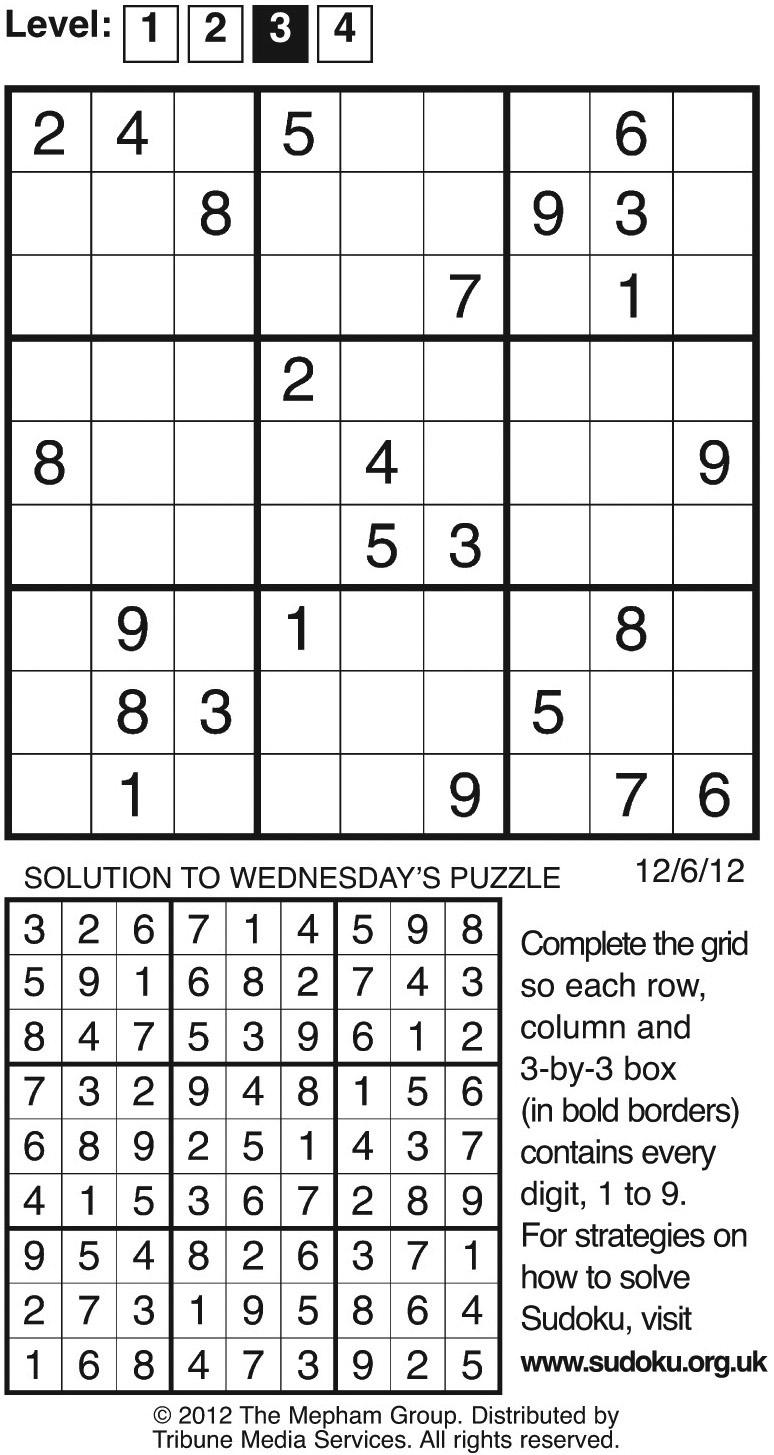
sudoku | The mepham group
Happy Birthday: don’t let emotional matters interfere with what needs to be done. being proactive and productive should be your main concern in order to avoid setbacks. protect your reputation and status by maintaining your integrity and sticking to the truth. it won’t benefit you to ignore situations, so deal with problems first and then keep moving. love and peace will bring positive changes. your numbers are 9, 16, 20, 23, 31, 39, 45.
ARIES (March 21-April 19): do your best to relate to others regardless of whether it involves business, romance or pleasure. your steadfast approach to getting things done will enhance your reputation and impress your colleagues. love is in the air.
TAURUS (April 20-May 20): stop second-guessing what you want to do and just make it happen. don’t rely on others to make choices for you. you stand a better chance of getting what you want when you take charge. networking will pay off.
GEMINI (May 21-June 20): you’ll have trouble seeing situations clearly. before you take a stance or say something you will regret, focus inward and work on doing things that will make you smarter, wiser and more appealing. success lies within.
CANCER (June 21-July 22): check into events going on in your community, or make plans to get together with creative people who will spark your imagination and inspire you. don’t let personal situations lead to an unnecessary battle with someone you love.
LEO (July 23-Aug. 22): don’t let the changes going on around you at work or at home get you down. embrace whatever is new and different and you will find a way to make things work in your favor. socializing will lead to interesting offers.
VIRGO (Aug. 23-Sept. 22): practicality and reason will be required when dealing with someone who is demanding or withholding information you need in order to make a good decision. Time is on your side, so don’t feel pressured to make a move before you are ready.
LIBRA (Sept. 23-Oct. 22): you can do anything you put your mind to, so stop waiting for others to make the first move. open up conversations and bring about changes that will improve your relationships with others. make personal improvements.
SCORPIO (Oct. 23-Nov. 21): stay out of the limelight until you are certain that what you have to offer is flawless. work toward bringing about unique changes that will improve your situation. professional gains can be made. believe in your abilities.
SAGITTARIUS (Nov. 22-Dec. 21): listen and learn. now is not the time to share your thoughts or vision. Find out where everyone else stands and you will be able to tweak your own ideas to ensure you reach the success you are aiming for.
CAPRICORN (Dec. 22-Jan. 19): don’t try to bring about change. work with what you have instead of trying to pile too much on your plate. an investment, settlement or negotiation will turn in your favor if you let things unfold naturally.
AQUARIUS (Jan. 20-Feb. 18): a child or loved one will inspire you to take on something you have wanted to do for a long time. change is heading your way, and the chance to utilize all your talents will put you in the spotlight. love is in the stars.
PISCES (Feb. 19-March 20): be cautious when dealing with friends, colleagues or partners. someone will not be honest about his or her feelings, qualifications or motives. Travel and communication will present delays. mishaps will occur if you are emotionally manipulative.
Birthday Baby: you are a perfectionist. you are unique, generous and dramatic.
and JeFF
K a rea
To receive The observer in your home, complete the form below. make checks payable to and mail to: The observer p o box 779 notre dame, in 46556 enclosed is $130 for one academic year enclosed is $75 for one semester
Jumble | david hoyT
KnureK
flInG by sPrInG | riley mccurrie
Bowl games are overrated
Michael Ivey sports writer
This college football season will end with a record 41 bowl games, including the games that make up the c ollege Football p layoff.
That means at least two and as many as five teams with below-.500 records will play in bowl games this season.
To become eligible to play in a bowl game is a relatively simple process, finish the regular season with at least a .500 record.
b ut due to the abnormally high number of bowl teams needed to fill in the bowls — no pun intended — the ncaa has adopted an interesting way of determining which 5-7 teams will get to go bowling. The ncaa announced that the 5-7 teams who have the highest a cademic p rogress r ate ( apr ) will be the ones receiving bowl invitations. The current teams with losing records that have the best apr are n ebraska, m issouri, Kanas s tate, m innesota, s an Jose s tate, i llinois and r ice. m issouri, however, has said it will decline any bowl invitation they get. i t wants to focus their time on finding a new head coach after longtime coach g ary p inkel stepped down after a tumultuous season on and off the field.
The ncaa shouldn’t spend it’s time determining which 5-7 team should receive a bowl invitation. i nstead they need to ask themselves this: d id we go way too far with the number of bowl games there are?
The answer to that question is, “ yes.”
Forty-one bowl games is an unbelievably high amount of games. i love watching bowl games as much as the next guy, but this is ridiculous. The product on the field and on T v becomes staler if you keep trotting out a number of bowl teams that feature mac teams against teams from either the m ountain west or c onference usa w hat’s the point of even playing a game between two 6-6 teams from mid-major conferences? i t’s
not entertaining. b ut we continue to see a rise in the number of those type of bowl games every year.
p laying in a bowl game should be a privilege for a college football team, not a right. p laying in a bowl game should be an accomplishment for a team. i t shouldn’t be a handout. i t should mean something.
The rising number of bowl games every year is starting to make bowl games lose their prestige. w here’s the excitement in playing in a game like the b itcoin b owl or the m obile b owl or the i c an’t b elieve i t’s n ot b utter b owl? e specially if a below-.500 team is playing in it.
The reason why the ncaa keeps adding bowl games is simple: money. b ut some of these games look like they are losing money instead of gaining money. a t last year’s abysmal h eart of d allas b owl between i llinois and l ouisiana Tech, the announced attendance was 31,297 for a c otton b owl stadium that can seat 92,100 people. That’s not a good look for the games. i t’s even worse when the game is played in a n F l stadium like Ford Field in d etroit. The crowd at the l ittle c aesars b owl last year looked like it had about 800 people in attendance.
a nother reason for the rising number of games is the ncaa thinks people will watch no matter what. a nd to an extent, they’re right. a good number of people do watch those types of games, whether they are people who bet on the over/under of the scores or the fans of the teams themselves. They’re starting to seem like a madefor-T v event.
b ut that’s one of the things i have a problem with. b owl games shouldn’t be a madefor-T v event just for people to bet on. They should be the culmination of a long, hardfought season for two football teams and their seniors.
Contact Michael Ivey at mivey@hcc-nd.edu
The views expressed in this Sports Authority are those of the author and not necessarily those of The Observer.
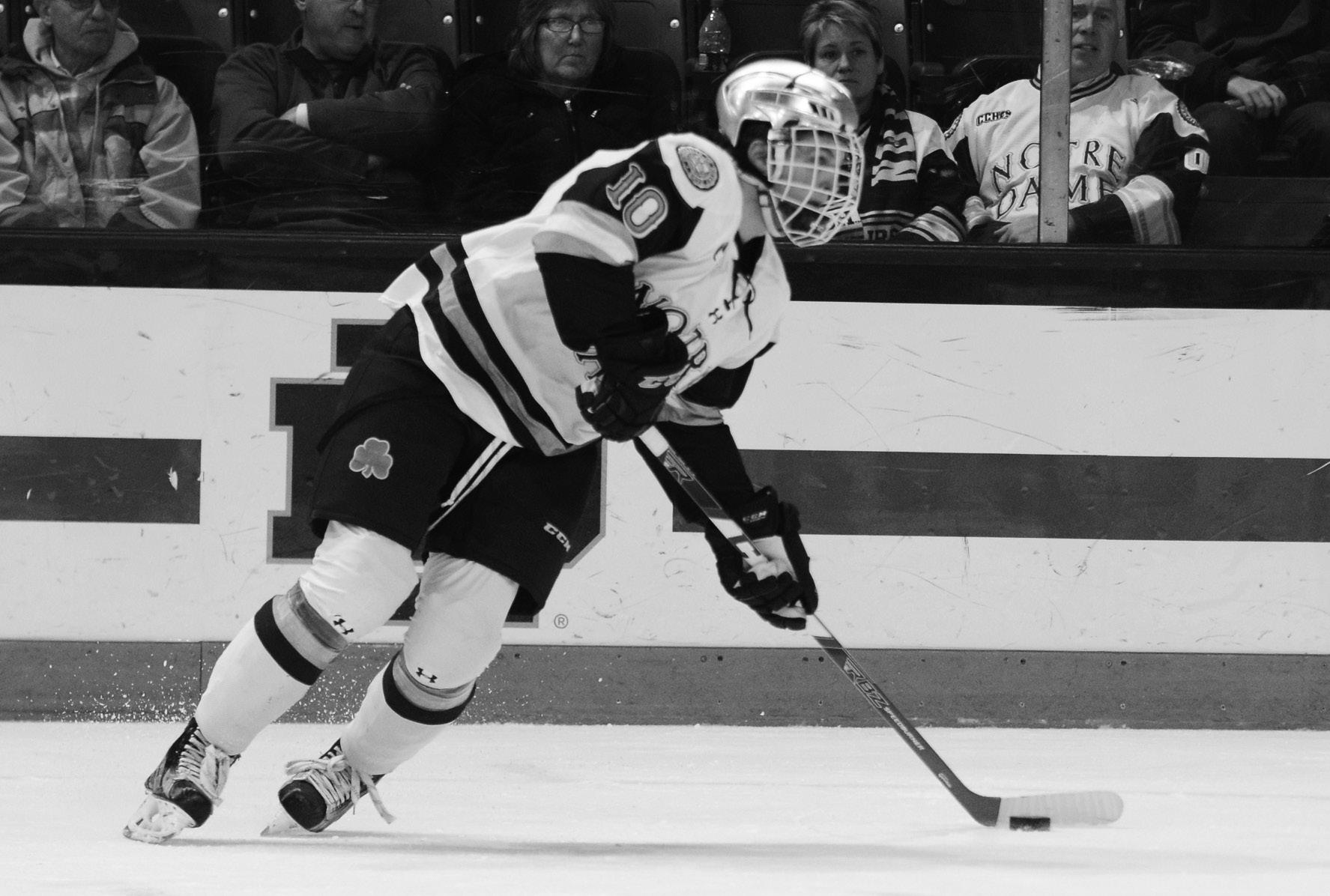
Compton Family Ice Arena. Notre Dame took 15 penalties in two games last weekend.
hockey
zone, taking an offensive zone penalty. a ny penalty that puts us down two men on the penalty kill, a penalty on the power play and then bench penalties for whatever reason – emotional penalties, too many men on the ice, things like that.”
w hen discussing how he deals with individual players who commit such penalties, Jackson said that each penalty should be evaluated individually.
“i like to review the penalty,” Jackson said. “The fact that it’s a game misconduct and not a game disqualification means it was not as severe because they’d miss the game regardless. i told our guys, i wouldn’t one of them
being hit in the head or from behind. s o that’s the way we have to approach it.
“i f it’s an accidental high hit, [senior defenseman] a ndy r yan’s one penalty was an accidental high hit. h is second one probably could’ve been dealt with. The one on [freshman left wing] d ylan m almquist and then on [sophomore center] Jake e vans, those are the decisions you have to make at the last second when the guy’s in a prone position, whether he’s got his back turned to you or his head’s down and you hit him high. Those are ones that can be averted in my opinion, and those are the ones we have to try to eliminate.”
s ophomore left wing a nders bjork echoed the sentiments of his coach, and said eliminating penalty minutes must come without sacrificing
aggressive hockey. “ you don’t want to think about taking penalties too much,” bjork said. “b ut i think we don’t want to eliminate any of our physicality or aggressiveness. s o i think we just want to try to be smart and move our foot instead of hooking, things like that. i f we just play the right way, our penalties will decrease, and i think that will happen if we just stay focused, which we’ve been working on a lot.” bjork and the i rish will get a chance to cut down on the penalties that have been hurting them recently when they welcome the m inutemen (6-5-4, 2-2-4) to c ompton Family ice a rena for a pair of weekend games, starting on Friday.
Contact Hunter McDaniel at hmcdani1@nd.edu
dunham rallies bulldogs past bearcats
cincinnaT i — Kellen dunham scored 24 points while leading a second-half comeback, and roosevelt Jones hit a bank shot with a tenth of a second left, rallying butler to a 78-76 victory over no. 17 cincinnati on wednesday night.
The bulldogs (5-1) trailed for most of the second half — down by as many as eight points — before dunham hit consecutive 3s that set up a back-and-forth ending. h is two free throws with 17.2 seconds left made it 76-73.
cincinnati (7-1) had a chance when octavius e llis made a three-point play with 4.7 seconds left, but Jones drove through a crowd for the winning basket. he finished with 10 points as the bulldogs won
the first game between the schools since the 1997 ncaa tournament.
e llis had 16 points for cincinnati, which blocked a season-high 10 shots and held a lead for most of the second half with its defense.
The bulldogs opened with an 11-3 run for their biggest lead. Freshman Jacob evans iii came off the bench and hit a pair of 3s that got the bearcats going, and cincinnati led by as many as six points before taking a 33-28 lead into halftime.
The bearcats’ defense had an effect, blocking eight shots and holding the bulldogs — one of the nation’s top offensive teams — to 33 percent shooting from the field in the opening half. The bearcats rank fourth nationally in defense, holding four of their first eight opponents to 50 points or less.
cincinnati got the ball inside to start the second half and converted three three-point plays while pulling ahead 50-42. Troy caupain had a 3-pointer and a three-point play during the spurt.
Forward a ndrew c hrabascz picked up his fourth foul with 13 minutes left, sending butler’s third-leading scorer to the bench for several minutes. he fouled out with 6:51 to go, having scored 11 points. dunham led butler’s comeback. h is layup off a spin move cut it to 53-51 midway through the half, but evans hit another 3-pointer that blunted the rally. The bulldogs got the lead for the first time in the second half when dunham hit backto-back 3s for a 67-66 advantage with 4:44 left. There were six lead changes and two ties down the stretch.
CAITLYN JORDAN | The Observer
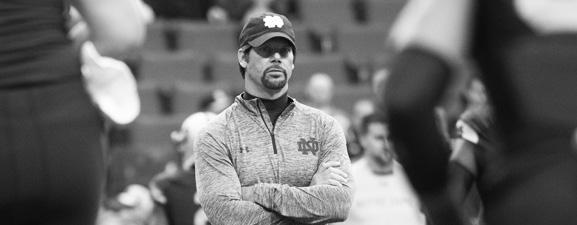
Irish sophomore left wing Anders Bjork carries the puck during Notre Dame’s 3-2 win over Northeastern on Nov. 12 at
ncaa men’s basketball | buTler 78, cincinnaTi 76
Associated Press
lead for notre dame at 72-70.
“i was kind of open, and i knew that we needed to shoot it and at least try to get a rebound if it didn’t go it, and i thought i had a decent look, and luckily, it went in,” cable said of the late-game 3.
“i think maddie’s playing with a ton of confidence right now,” junior guard lindsay allen said. “her 3-point shot is working really well for her. she’s always played really, really hard for us, and so i think we’re really confident whenever maddie’s in the game, and she can give us any spark that we kinda need in the moment.”
before cable made the 3-pointer, ohio state (4-3) had just gained a 70-69 lead off a free throw from sophomore guard Kelsey mitchell. mitchell, who led the country in scoring last season at 24.9 points per game, paced all players with 27 points, despite not making her first field goal until the beginning of the second quarter.
however, she came on strong after that as the buckeyes took advantage of poor notre dame play
m bball
horrible job in transition defense. we probably were lucky we were down eight [at the end of the first half]. but second half, we played zone, we stopped the transition, we played great out of our zone, and then our offensive efficiency was fabulous for us.”
illinois forced the irish to commit six turnovers early in the first half and limited them to just six assists in the first 20 minutes. late in the first half, the illini went on a 14-3 run as the irish struggled from the field, hitting on just two of their final 11 field goal attempts to end the half.
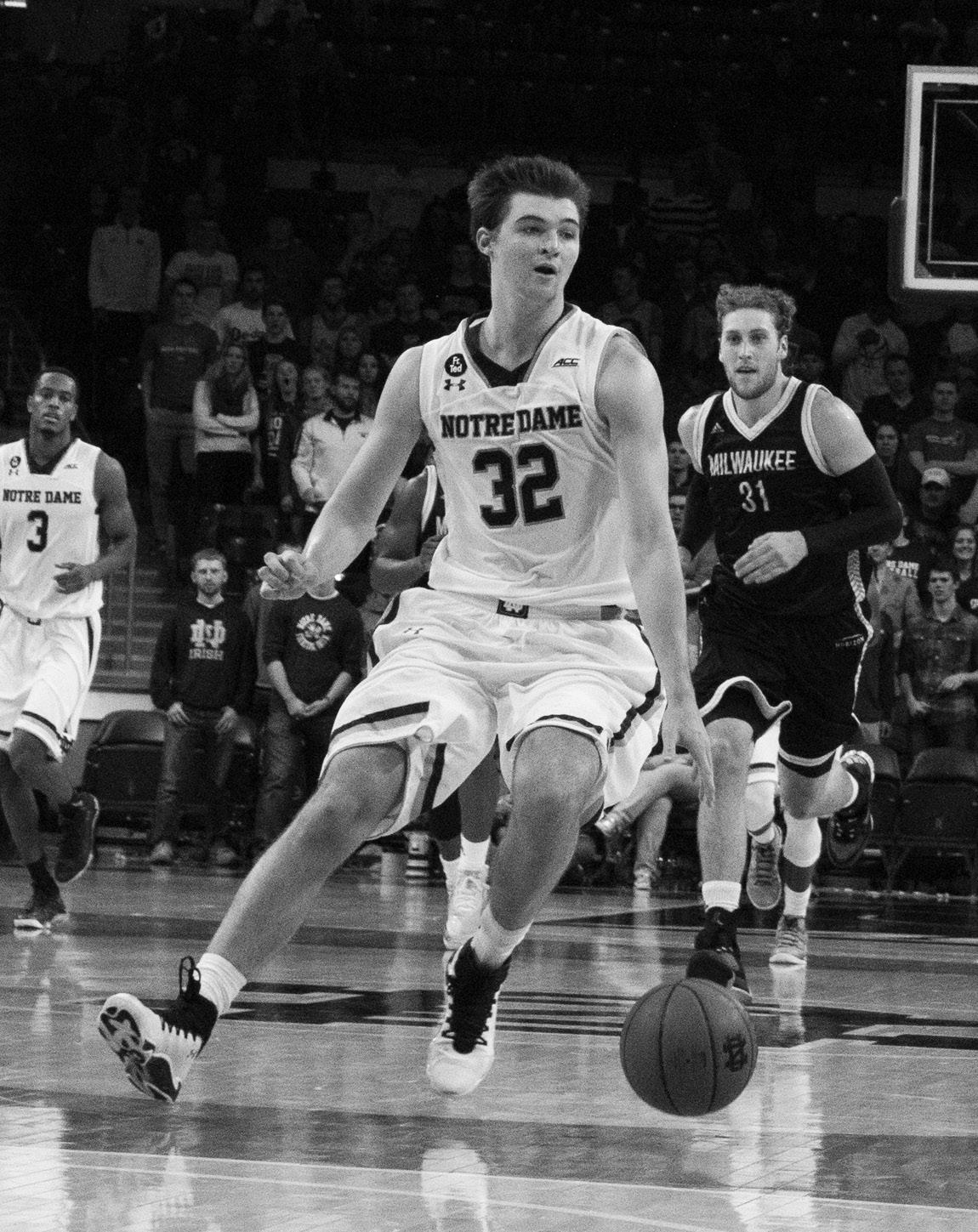
senior guard Khalid lewis, junior guard malcolm hill and junior guard Kendrick nunn all scored seven points to lead the illini to a 41-33 lead at the end of the first half. in the second half, the script was flipped as notre dame limited illinois to just 35.1 percent shooting from the field. brey attributed the improvement in the second half to the switch to a two-three zone.
“i think playing zone defense helps us on offense,” brey said. “They missed some shots; we were able to get some transition and some easy buckets. i thought demetrius Jackson got comfortable. There was a lot on him. he was recruited by this place, and i thought the first half he played a little nervous and a little fast. i thought he really bounced back and set the tone for us in the second half.”
after scoring just four points in the first half, Jackson was perfect from the field in the second half, converting on all five of his attempts, including two from behind the arc. vasturia, on the other hand, consistently provided the irish with offense, scoring 11 points in the first half and adding another 10 in the second. senior forward Zach auguste contributed 16
in the second half, when it made just 10 of its 35 attempts from the field (28.6 percent).
“i thought we shot ourselves in the foot a little more in the second half,” irish head coach muffet mcgraw said. “i thought we just made some errors that we don’t usually make, turning the ball over, and just allowed a lot of 3s, but overall, i thought we got our composure when we needed to.”
The irish led by as much as seven in the second half but saw ohio state cut into that before taking the lead with 2:11 left on mitchell’s free throw and then tying it back up at 72 on a layup by senior guard ameryst alston with 37 seconds on the clock.
irish sophomore forward
Kathryn westbeld was fouled on notre dame’s next possession and made the second of her two free throws to reclaim the irish lead at 73-72. cable grabbed the rebound off a missed jumper from mitchell, was fouled by the buckeyes to stop the clock with seven seconds left and converted on both her freethrow attempts to make the final score 75-72.
with Turner and reimer sidelined, mcgraw played a
points along with a game-high 14 rebounds, which gave him his fifth double-double of the season.
“i think Zach was great,” brey said. “i think everyone calmed down in the second half, but you know, when you look at both vasturia and Jackson, when your two guards are playing like that, you have a chance to beat anybody in the country. [sophomore guard] matt Farrell gave us great minutes off the bench. [Junior forward austin] Torres stole us some minutes. i thought [sophomore forward bonzie colson] reacted and rebounded well out of the zone well. Zach’s demeanor, his passes out of the post and his decisions to make power moves were fabulous.” despite being outscored by the illini 32-13 in bench points, brey praised sophomore guard matt Farrell’s ability to give the offense a change of pace whenever he takes the court. in 23 minutes, Farrell scored 10 points, six of which came from the free-throw line at the end of the game.
“i think for matt Farrell, he’s been showing signs of really being able to help us, and tonight he played fearlessly,” brey said. “he gave us another ball handler that could just take it off the dribble. he made a couple of plays, even in the first half when we were dying for a bucket, he just drove the ball. we know he can shoot it. he made big free throws at the end. i thought he was better defensively, and that’s an area we talked about him improving.”
Through the first 9:45 of the second half, the illini struggled mightily to find the bottom of the net, converting just two of their first 16 shots. notre dame took advantage of illinois’ offensive woes to take the lead, eventually stretching it to an 80-66 advantage with 32 seconds left.
The illini stormed back in the final half-minute of the game and went on a 13-4 run to close the game. hill scored 10 of illinois’ final
four-guard, one-forward lineup for just about every bit of the 40 minutes in wednesday’s dogfight, and westbeld was on the court for 35 of those minutes, collecting 14 points and six rebounds.
despite the shortage of post players, the irish outrebounded the buckeyes, 45-34, though 19 of those 45 came on the offensive glass and several of the 19 during their second-half struggles. notre dame also struggled in containing 6-foot-2 junior forward shayla cooper, who had picked up a double-double by halftime and totaled 18 points and 15 rebounds in her 36 minutes on the floor.
“she was a warrior on the glass, and we needed it because they’re a great rebounding team,” buckeyes head coach Kevin mcguff said. “but overall, i thought this was probably her best game.”
Junior lindsay allen added 20 points, five assists and six rebounds for the irish. The point guard contributed on defense as well, taking charges on backto-back possessions with notre dame ahead by just one point in the fourth quarter, taking away layups that would have given ohio state the lead.
13 to drop the deficit to five points, but there wasn’t enough time for illinois to rally back in the game as notre dame fended off the late comeback attempt to walk away with the win.
The irish will return to purcell pavilion next Tuesday to host stony brook at 9 p.m.
Contact Manny De Jesus at mdejesus@nd.edu
The win, part of the annual big Ten-acc challenge, gave the irish their 14th consecutive victory over current big Ten teams and their 21st consecutive victory in games decided by single digits or overtime.
it also pitted mcgraw against mcguff, who coached as an assistant under mcgraw at notre dame from 1996 to 2002. additionally, irish associate coach niele ivey began her own coaching career as an intern under mcguff at Xavier from 2005 to 2007.
“i hate it,” mcgraw said of facing mcguff, who is also married
to letitia bowen, one of mcgraw’s former players and coaches at notre dame. “i really hate it because we spent so much time together here; we have such a history, with the whole family, with letitia, with the team and our staff.
“once the game starts, we completely forget, and we’re competing. i don’t think either one of us thinks anything — looking down the sideline, it just doesn’t enter my mind. but before the game was hard, and after the game is hard.”
Contact Mary Green at mgreen8@nd.edu
c arson
con T inued F rom page 12
defense: a potential top-10 pick in Jaylon smith, surrounded by a wealth of experienced talent. The idea was simple: led by smith and senior defensive lineman sheldon day, we would finally see notre dame run vangorder’s defense to perfection.
on opening night at notre dame stadium, it looked like it could be the case, when the irish trounced Texas 38-3, racking up four sacks en route to a dominant performance. but just like the previous year, it was a false dawn for vangorder’s defense.
a week later, a virginia team — one that got its head coach fired after a 4-8 finish — moved the ball all over the notre dame defense in a game that the irish probably should have lost.
a nd in notre dame’s two losses this year, the defense consistently put the offense in tough situations. within the blink of an eye at clemson, the irish were down 14-0, and saturday, we saw what may have been the worst performance of the year from vangorder’s unit in the biggest game of the season.
despite containing stanford’s heisman Trophy candidate, sophomore running back christian mccaffrey, the irish defense still struggled massively on the west coast. The defense got out of the gates slowly and couldn’t get off the field saturday, as stanford went 8-for12 on third downs, including a perfect 5-for-5 performance to start the game.
w hile mccaffrey didn’t do too much to hurt notre dame, it was devon cajuste who proved to be the problem. The irish secondary routinely lost the senior receiver, including on the defining moment of its season, a 27-yard completion between stanford senior quarterback Kevin hogan and cajuste on the final drive, when the cardinal picked up the
chunk of yards required to set up the game-winning field goal. it was a perfect microcosm of notre dame’s season on defense, one filled with so much potential and occasional execution but never finding that four quarters of consistency irish head coach brian Kelly so often spoke of wanting from the defense.
a fter Texas, we never really saw vangorder’s defense play his scheme well — the irish finished outside the top 70 nationally in sacks, with just 23 on the season — and never saw it play any scheme particularly well. a nd if vangorder couldn’t get it to work with this unit, what are we supposed to expect out of it next year?
graduate student linebacker Joe schmidt, senior safety elijah shumate, senior defensive lineman romeo okwara and day are all out of eligibility. if smith and russell declare for april’s nFl draft, like most of us think they will, notre dame’s defense will return just five starters from this year’s team when it opens its season in austin, Texas, in september.
That doesn’t even count graduate student cornerback matthias Farley, whose loss will also likely be felt in a big way. vangorder couldn’t get his scheme to work particularly well with an incredibly experienced crew this year — to expect anything different next year would be irresponsible.
i don’t want to explicitly call for vangorder’s head. a fter all, watching him on the sidelines is a particularly enjoyable part of watching irish football. but notre dame came up short of fulfilling its goal this year — and Kelly would be wise to at least evaluate vangorder’s merits prior to 2016.
Contact Alex Carson at acarson1@nd.edu
The views expressed in this column are those of the author and not necessarily those of The Observer.
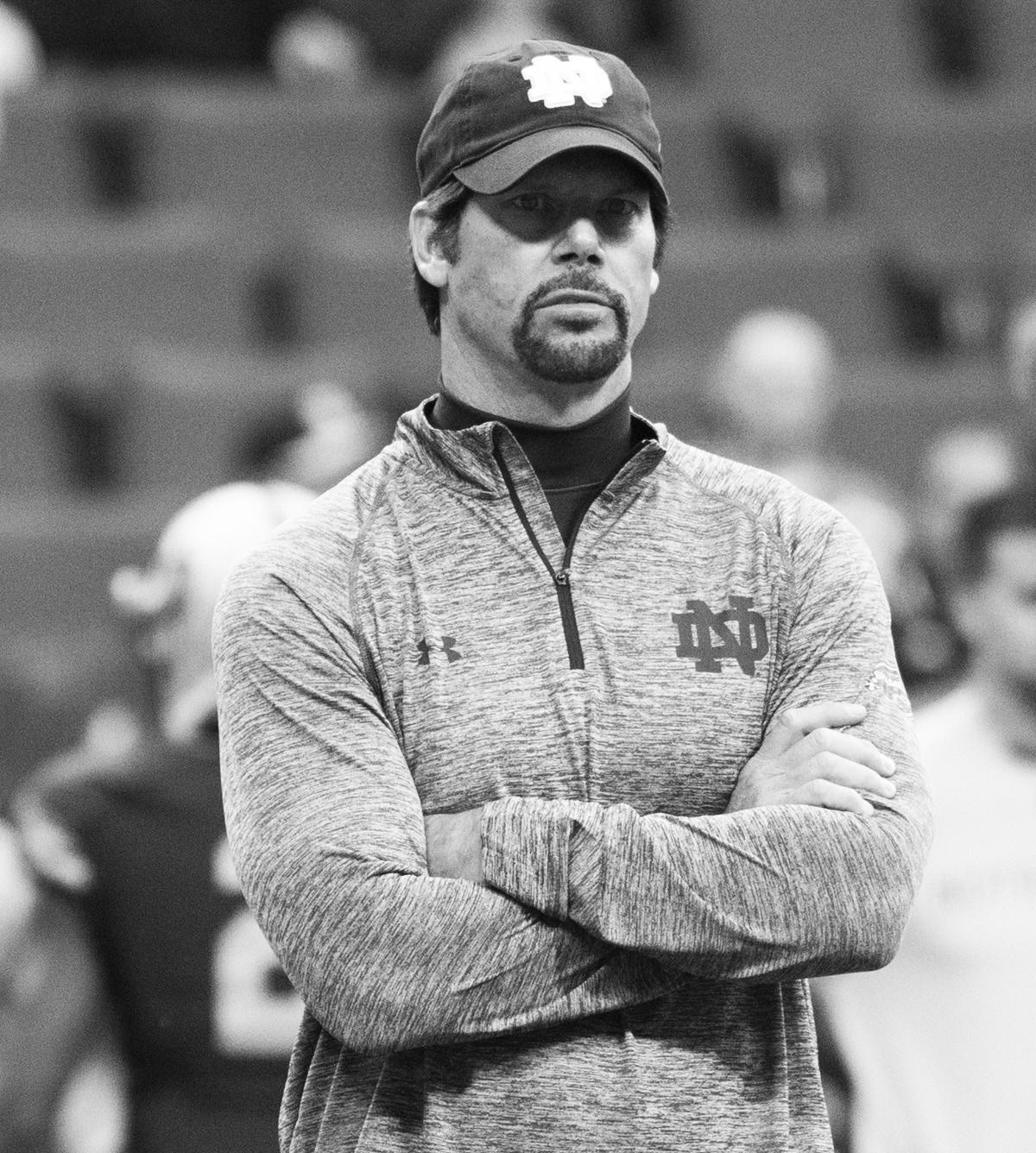
MICHAEL YU | The Observer
Irish defensive coordinator Brian VanGorder looks on before Notre Dame’s 30-14 win over Purdue on Sept. 13, 2014 in Indianapolis.
Cable, Allen lead Notre Dame in top-10 win
By MARY GREEN a ssistant managing e ditor
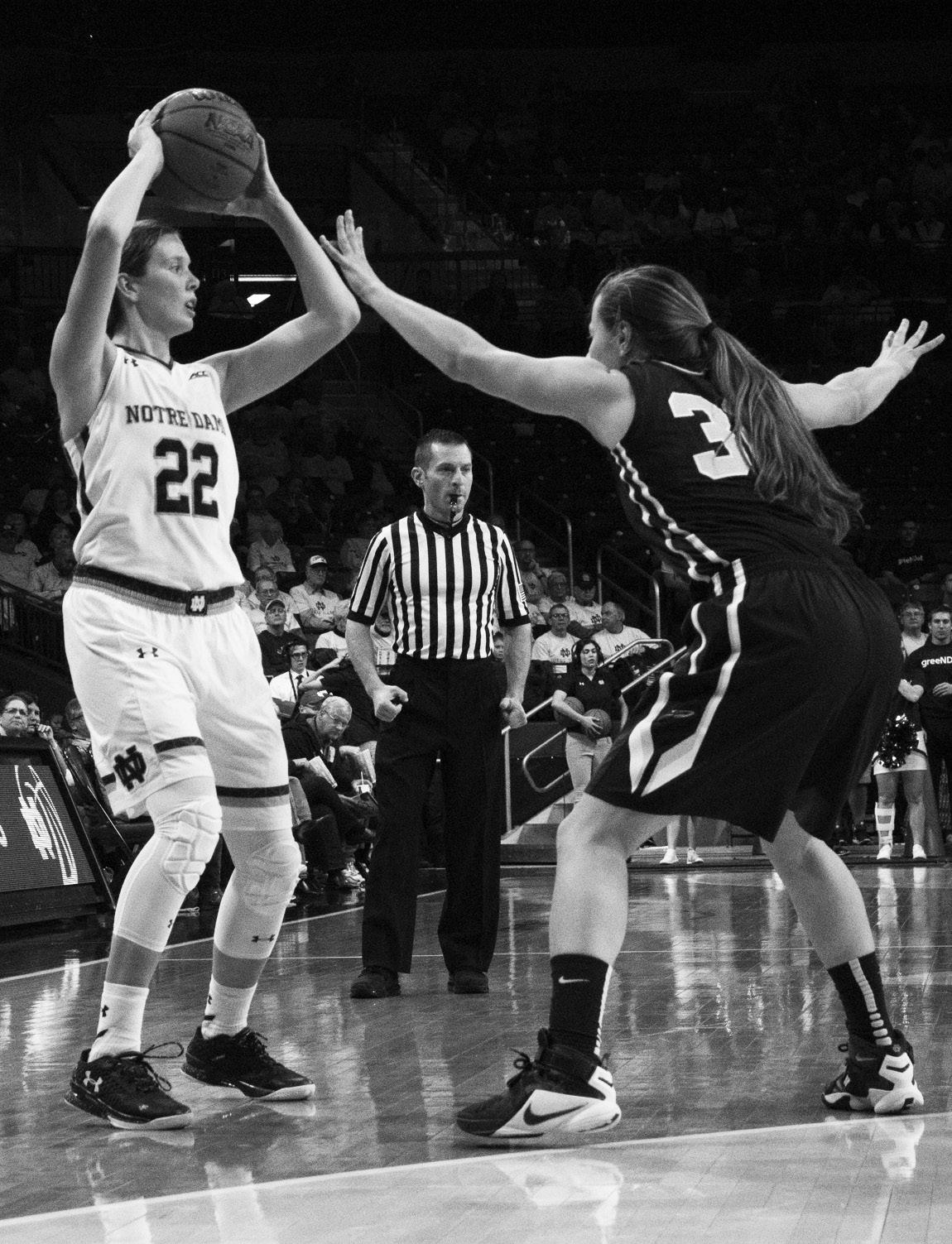
For their second game in a row, the no. 3 irish were tasked with putting away an opponent in a down-to-the-wire game. This time, it came against no. 10 ohio state on wednesday, with notre dame just barely pulling out the 75-72 victory at purcell pavilion. however, the challenge was greater wednesday than it was during last saturday’s overtime win against no. 24 ucla because the irish (7-0) were without their two leading post players, junior Taya reimer and sophomore brianna Turner, who are nursing achilles and shoulder injuries, respectively.
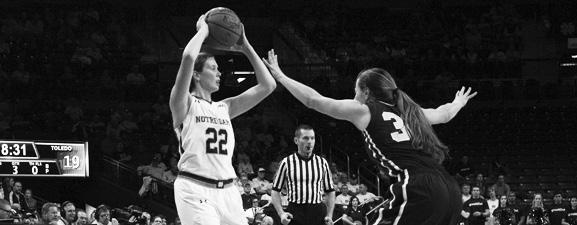
graduate student guard madison cable stepped in to lead the way by picking up her second double-double in an irish uniform with a career-high 25 points and 11 rebounds. Fifteen of those points came on 5-of-9 shooting from behind the arc, including a 3-pointer she hit with 56 seconds left in the game to retake a late
i rish stress limiting penalties
By HUNTER McDANIEL sports writer
a s the no. 20 i rish prepare for a weekend series with conference opponent massachusetts, notre dame head coach Jeff Jackson has focused on limiting the amount of penalties his team takes, especially as penalties have led to more opponent goals in recent games.
“my biggest thing right now is that we have to play with more discipline,” Jackson said. “There’s gonna be penalties in games regardless. you’re gonna take penalties for physical errors. you’re gonna take penalties that may be marginal calls. you’re gonna take penalties in different ways, but the ones you have to eliminate are the ones you have control over. a s a coach, hindsight is 20/20. we’ve never had an issue with major penalties, but now we’ve had four. a nd we have to eliminate them. you have to call out guys to tell them the next time they’re going to have to miss a game. so it’s gotten to that
point.”
at the end of the second period in the 4-1 loss to harvard on Friday, the c rimson took advantage of a 5-on-3 power play by scoring 5-on-3 and 5-on-4 goals less than a minute apart to turn a tie game into a two-goal lead heading into the third period. i n the third period, harvard scored on another power play to cement their three-goal victory over the i rish (6-4-4, 3-1-2 hockey e ast). notre dame took nine penalties, all two-minute minors, in the loss to harvard.
Then in its 3-1 victory over western m ichigan on saturday, notre dame again had to kill a number of penalties, committing 23 minutes worth, and gave up its only goal on a broncos power play near the end of the second period.
“it’s not just major penalties though, it’s some of the other penalties as well,” Jackson said.
“we’ve considered bad penalties anything in the offensive
Kelly should mull defensive changes
if you had to use one word to describe no. 8 notre dame’s defense coming into this year, it had to be “experienced,” right?
w hen the irish walked off the team bus in culver, indiana, for training camp in august, they returned 10 starters from last year’s team. only senior cornerback Keivarae russell, who was a two-year starter before missing last season due to suspension, hadn’t started for notre dame in 2014.
a nd with an inexperienced quarterback, who was supposed to be junior malik Zaire, the defense should have been an area of strength for notre dame this season, a pillar to lean on with one of the most talented groups in the country.
but that never panned out.
w hen former defensive coordinator bob diaco left to take the head coaching job at connecticut two years ago, irish head coach brian Kelly tagged brian vangorder to be
his replacement. unlike diaco’s “bend, don’t break” system that worked so well in 2012, and earned him the uconn job, vangorder came in with a different attitude: be aggressive. a nd at the start of his tenure, it seemed like vangorder had things figured out. in the first five games of 2014, his defense gave up just 12 points per game and routinely pressured opposing quarterbacks, including the four sacks racked up by the irish against stanford in a key 17-14 win.
Then everything changed. north carolina threw 43 points onto the notre dame stadium scoreboard the next week, everyone got hurt, and suddenly the irish defense that looked so good in september looked so bad in november. but this year, there was hope. everyone but cornerback cody r iggs was back — and even after senior defensive lineman Jarron Jones went down, vangorder had everything he could have asked for in a
ND overcomes halftime deficit to snag victory
By MANNY DE JESUS sports writer
a fter a 12-year hiatus since the teams’ last meeting, notre dame gave its conference win in the big Ten-acc challenge after defeating illinois, 84-79, at the state Farm center in champaign, illinois, on wednesday.
The irish (5-2) spoiled the Fighting illini’s (3-5) celebration of the newly refurbished state Farm center as junior guard demetrius Jackson and junior forward steve vasturia each scored 21 points to lead notre dame to a strong second half. a fter shooting just 46.4 percent from the field in the first half, the irish caught fire in the second half, converting on 57.1 percent of their field goal attempts.
“i thought we played a little fast in our first road atmosphere,” irish head coach mike brey said. “it was loud, it was electric, and they played great. They played to their crowd. we didn’t do a very good job defensively; we did a
KAT ROBINSON | The Observer
Irish graduate student guard Madison Cable searches for a teammate during Notre Dame’s 74-39 win over Toledo on Nov. 18.