
1925-2025
A CENTENNIAL SALUTE
1925-2025
A CENTENNIAL SALUTE
Centennial Celebration Book
1925 – 2025
400 Patetown Road, Goldsboro, NC 27530
919-734-8400
www.taloving.com
Sam Hunter, Chairman
Steve Bryan, Vice Chairman
Ty Edmondson, CEO
David Philyaw, President, Building Group
Charlie Fuller, President, Civil Infrastructure
Jason Hill, President, Conveyance Systems
David Philyaw and Paul Hunter, Centennial Book Committee
Book Design/Production: Sue Pace, Chapel Hill, N.C.
Maps & Projects Lists Production: Cat Bruvtan, Marketing Manager, T.A. Loving Co.
Photography / Acknowledgements
The majority of photographs and archival materials in this book have been cultivated over many years by the T.A. Loving staff. Additional sources include the Dawes Collection at Fort Liberty in Fayetteville, which provided many of the images in Chapter 5 on the company’s construction of what was originally known as Fort Bragg; David Cecelski and the Library of Congress for photos of Fort Bragg migrant workers on pages 94-95; and the libraries at area universities, including East Carolina, N.C. State and the University of North Carolina at Chapel Hill for photos of company projects on their respective campuses.
Many thanks to T.A Loving staff members Jenni Auxier and Michele Carter for their assistance proof-reading and organizing company photo assets.
This centennial book is dedicated to the thousands of men and women who have proudly donned the T.A. Loving hat and spread across the Carolinas and beyond to construct an impressive resume of bridges, buildings and civil facilities.

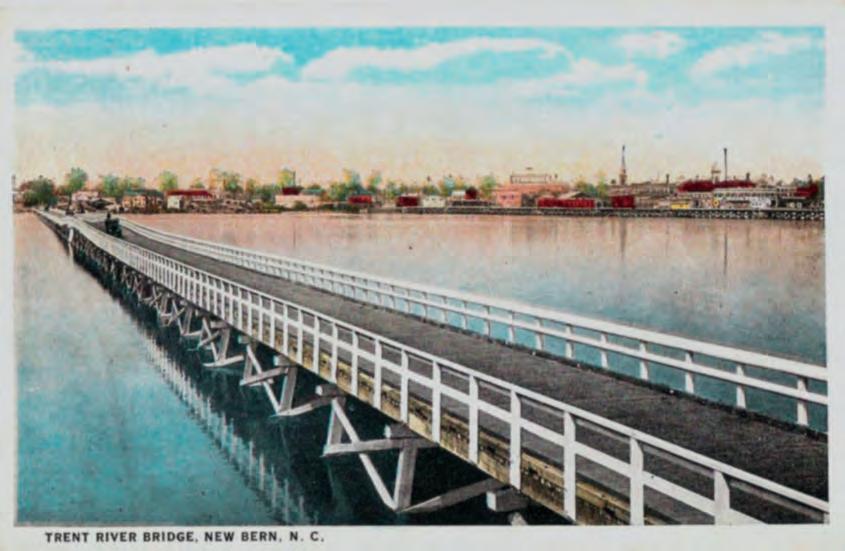
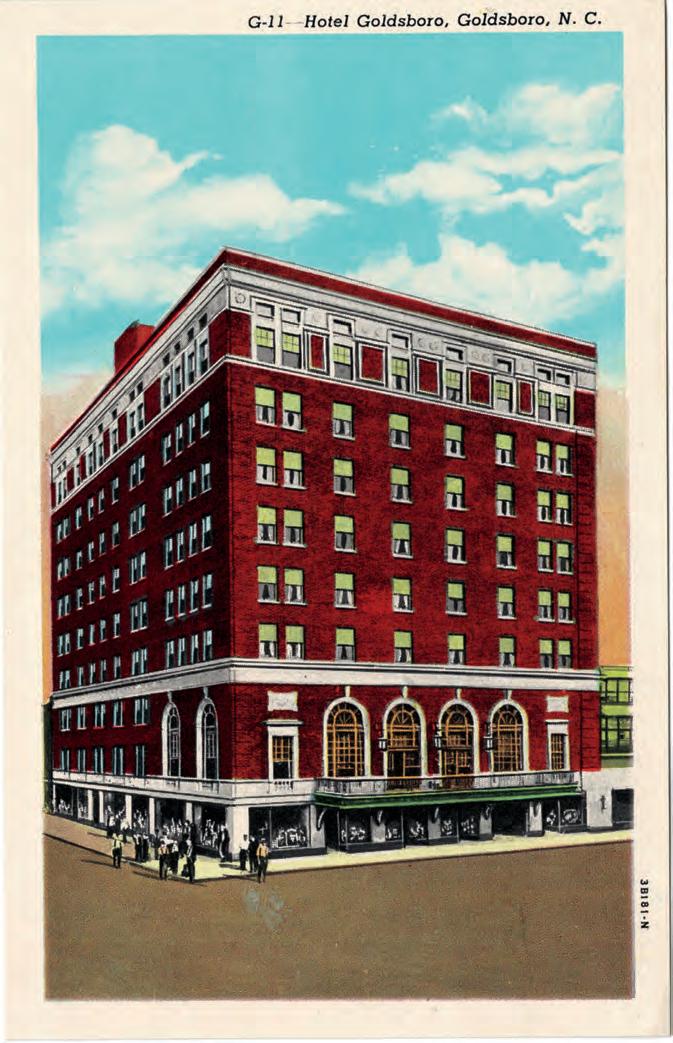
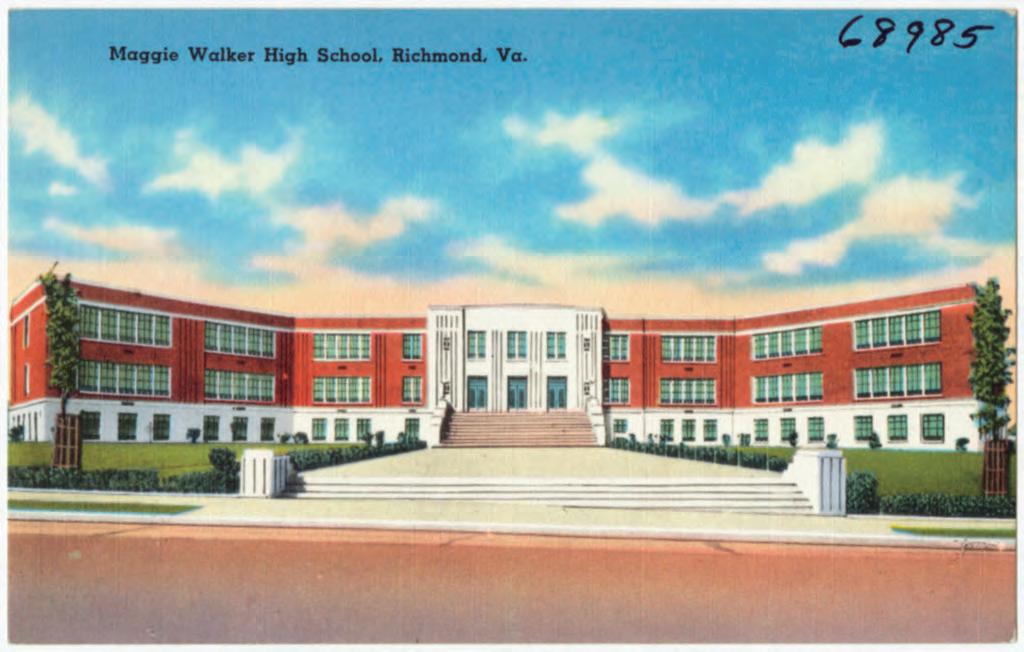
“Remember to celebrate the milestones as you prepare for the road ahead.”
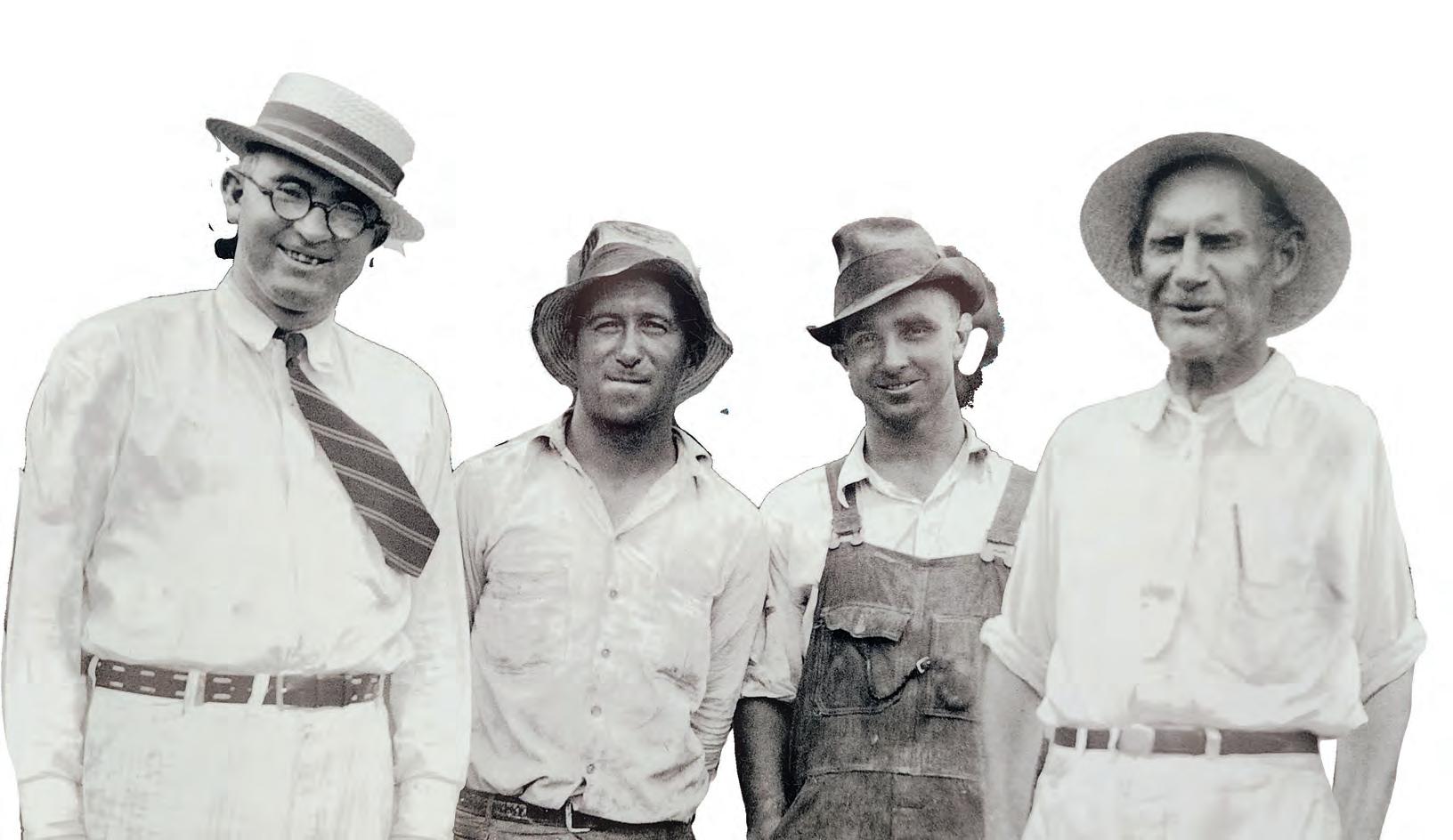
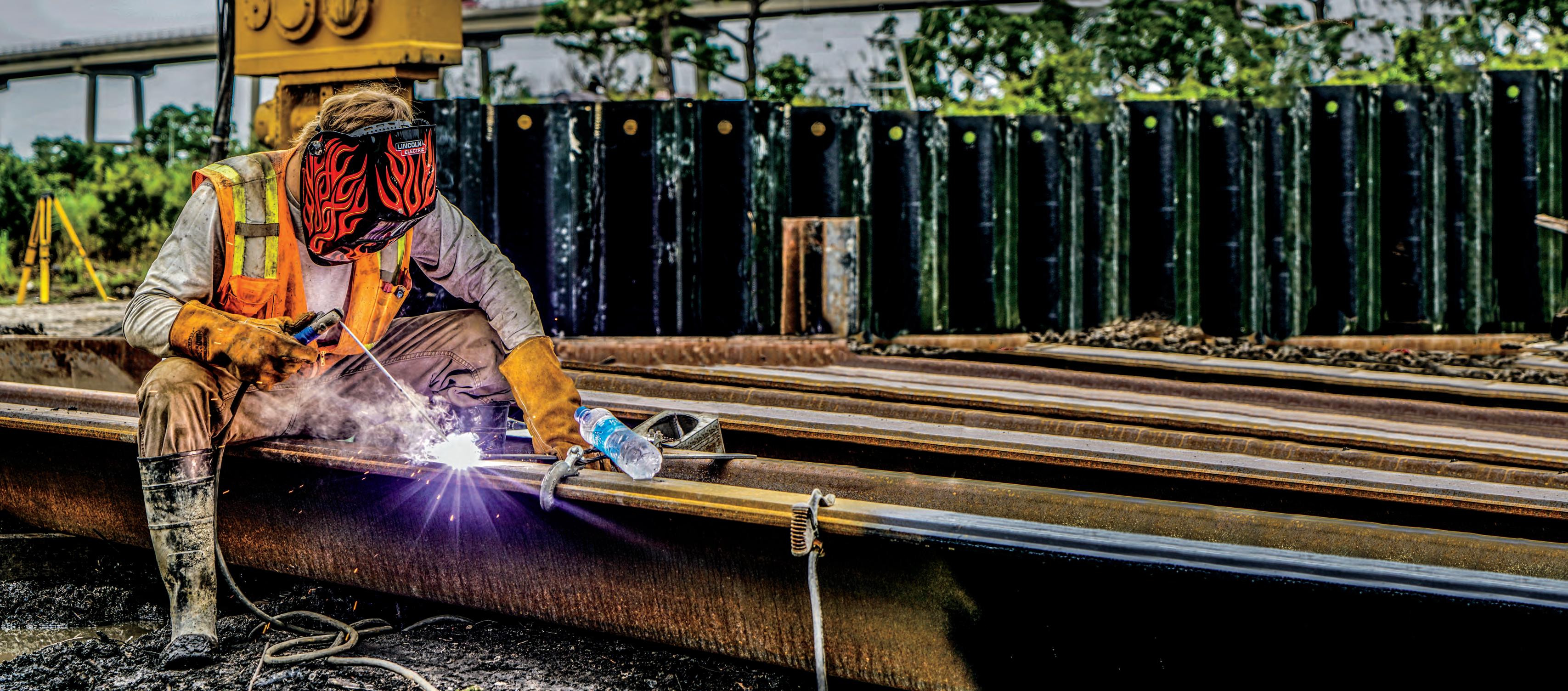
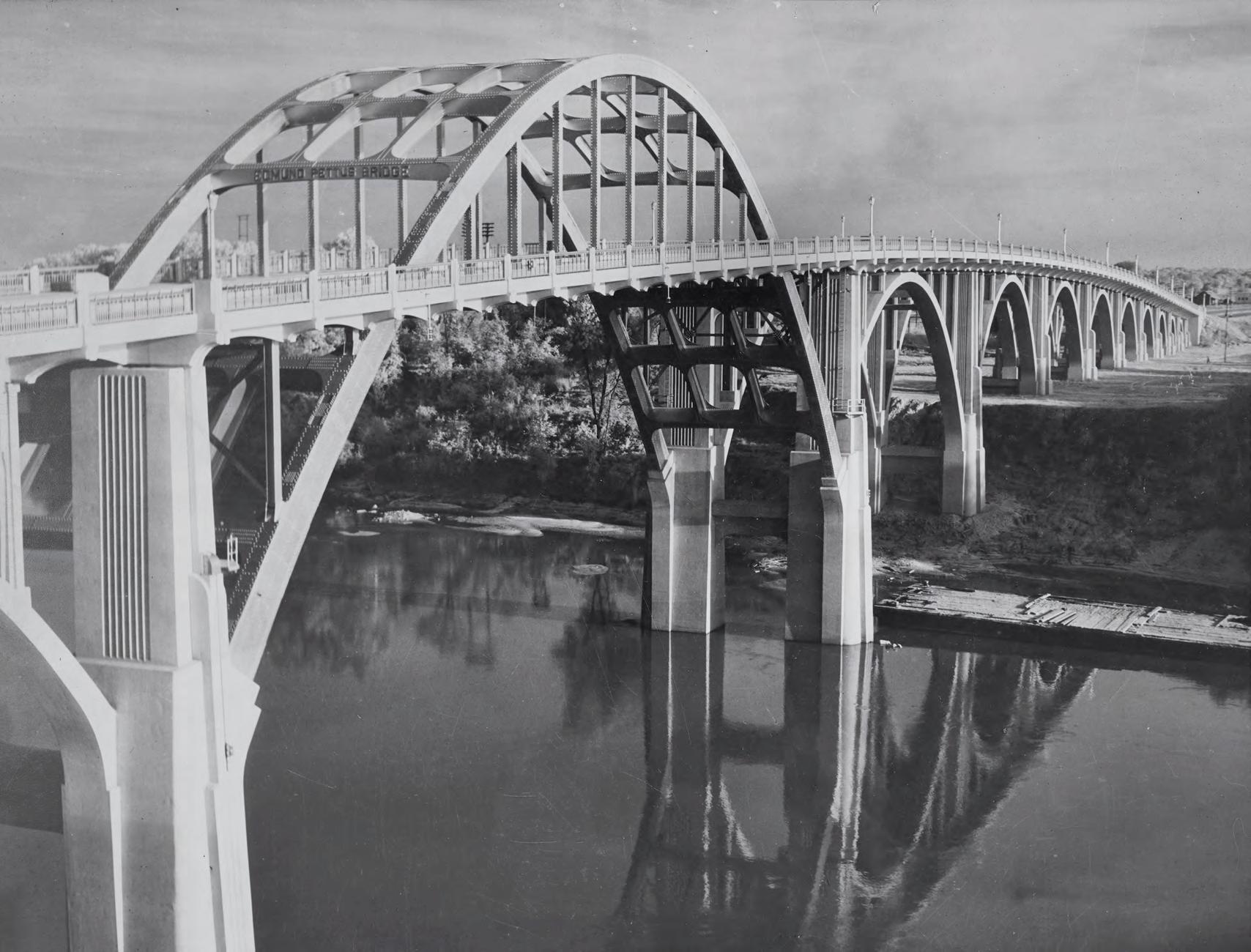
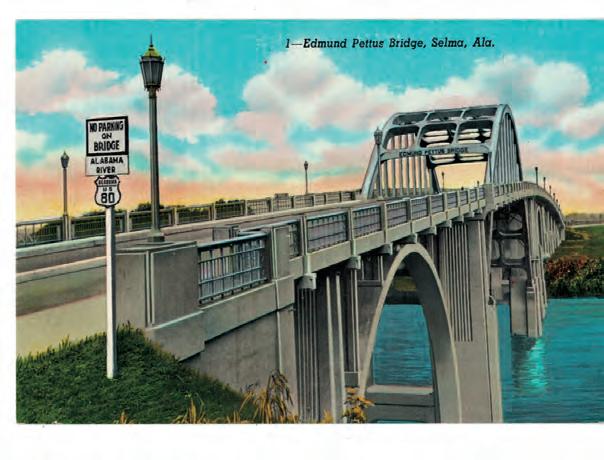
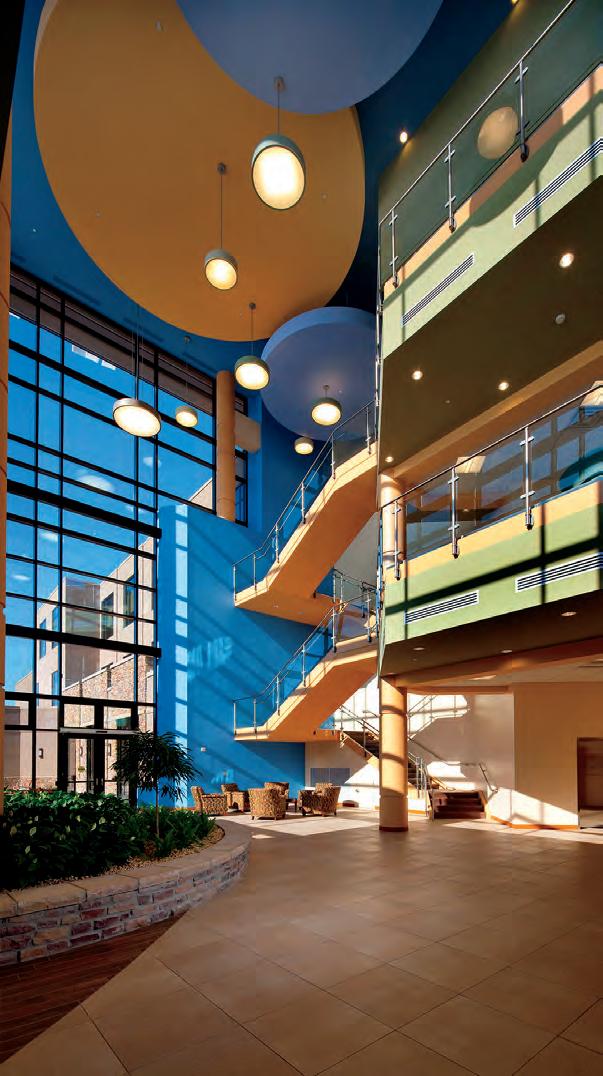
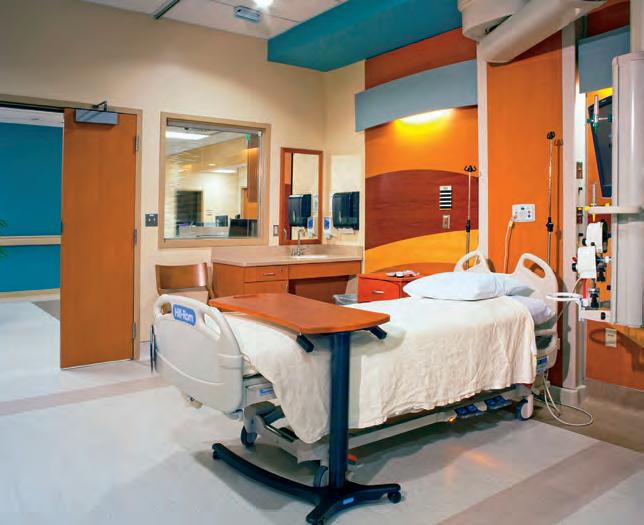
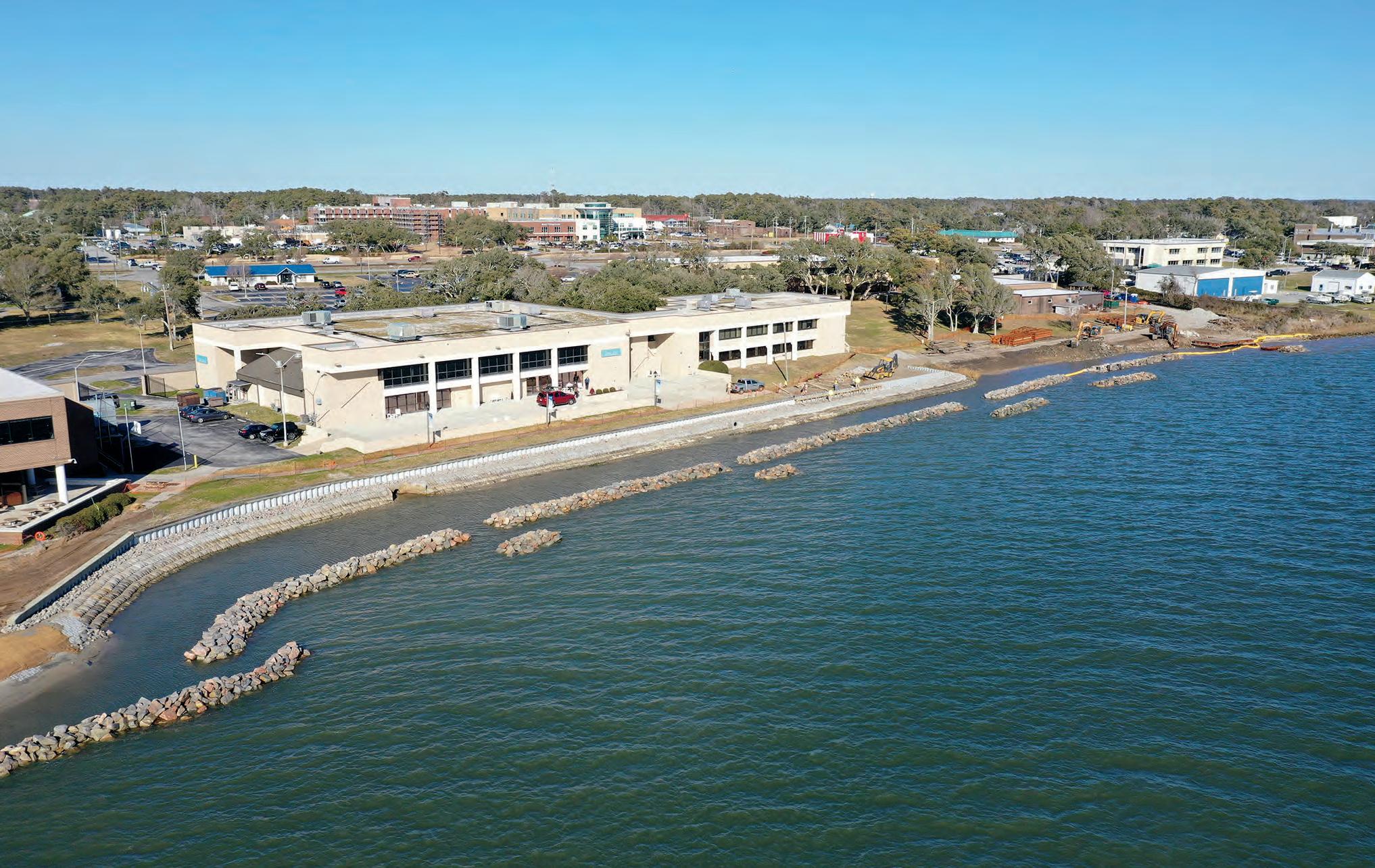
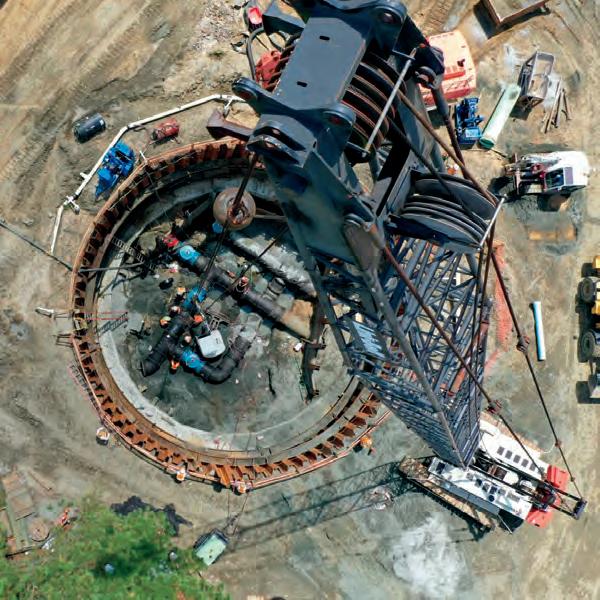
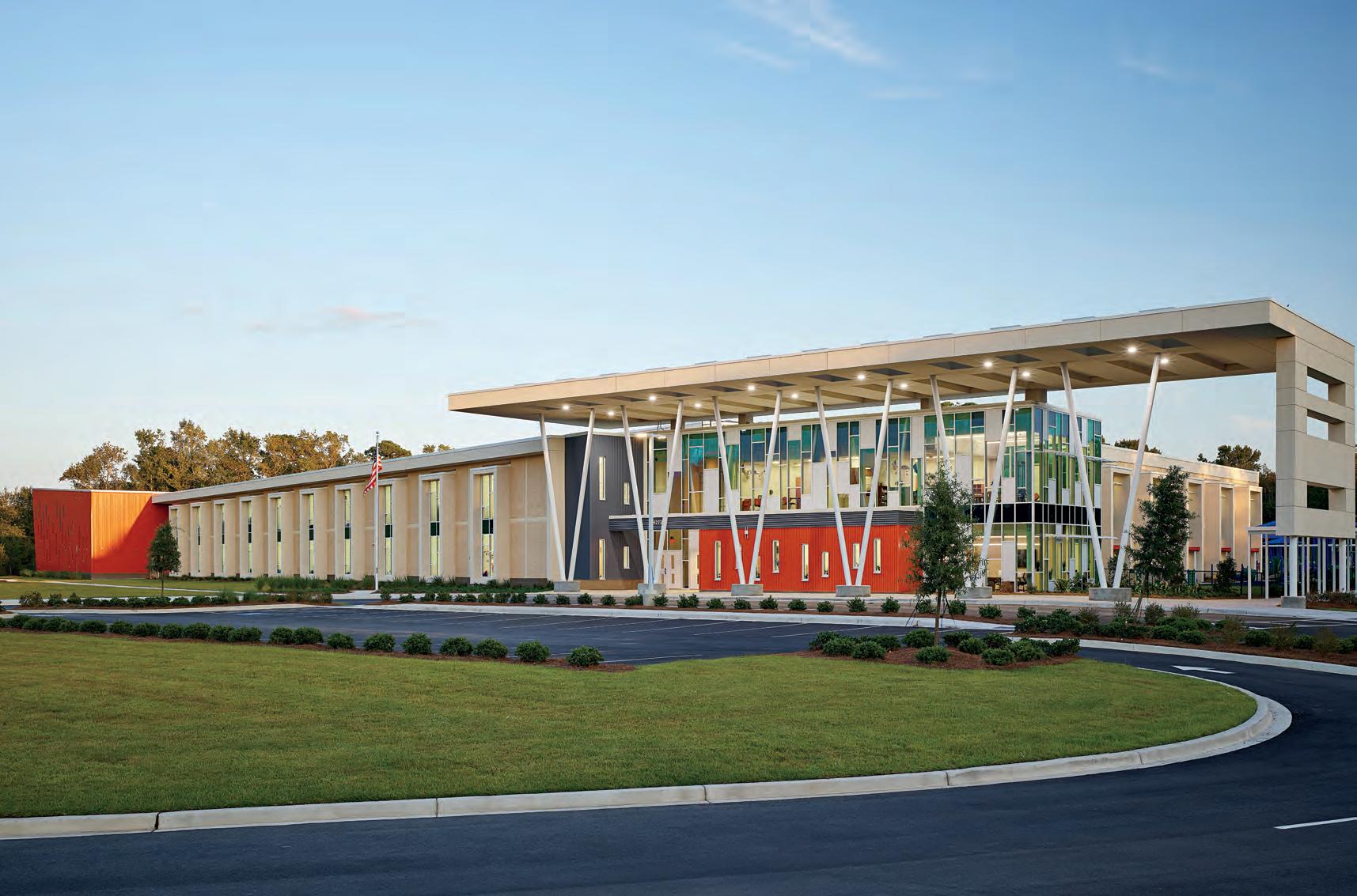
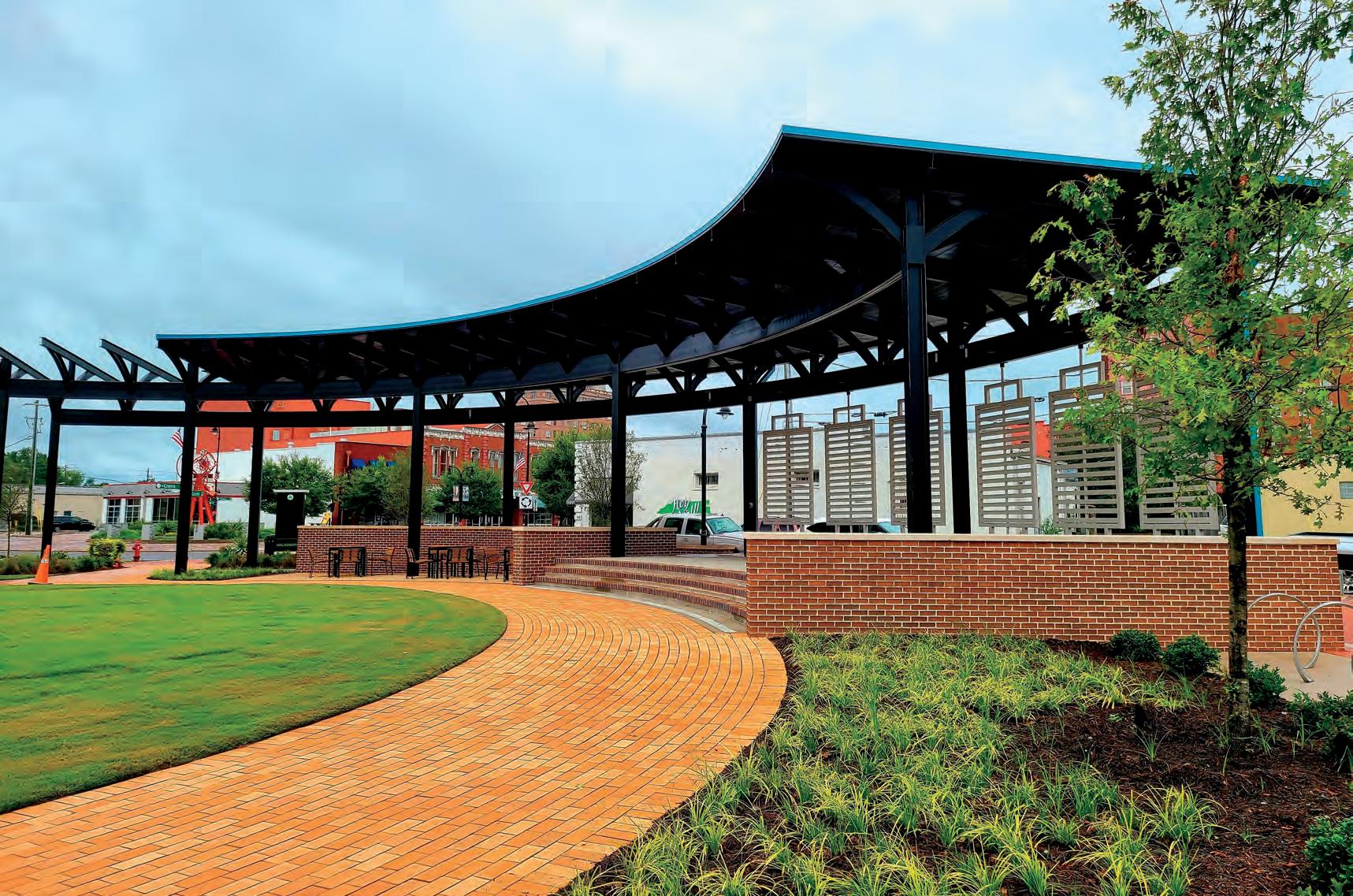
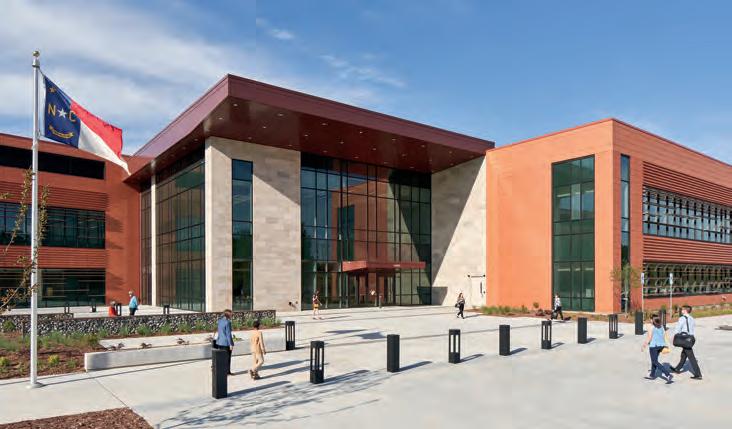
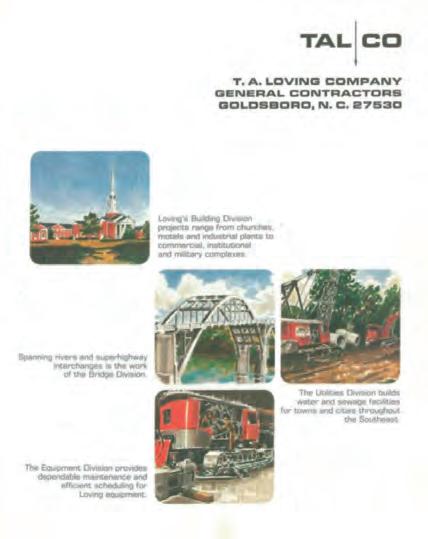
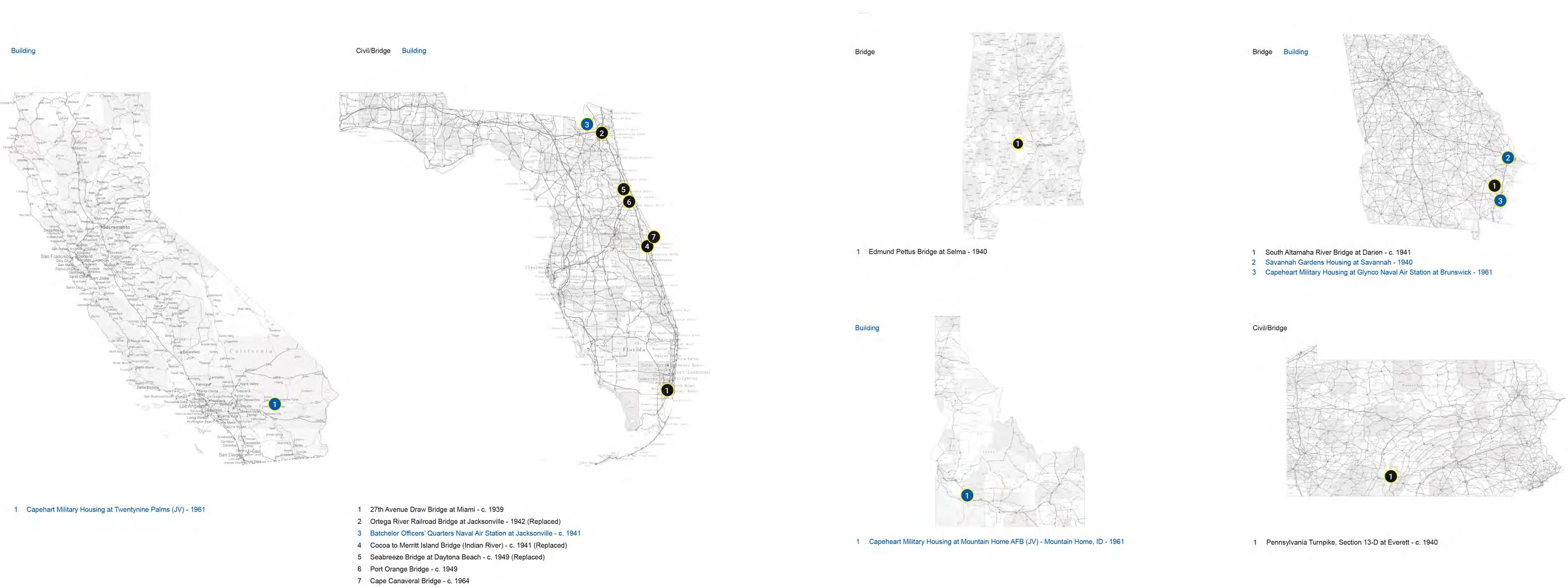
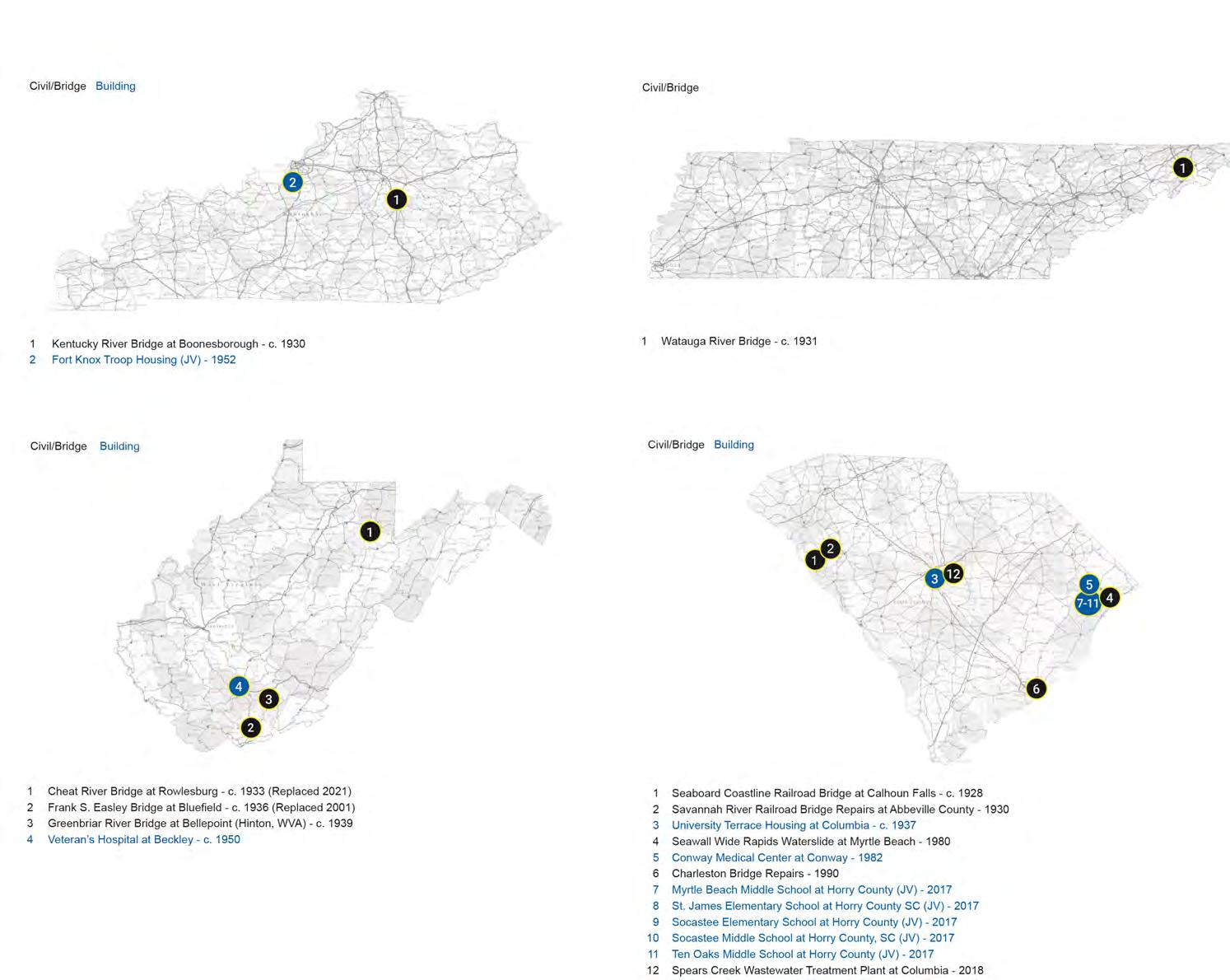
On these and the succeeding twelve pages are a vast array of the types of quality work T.A. Loving Company has produced since 1925.
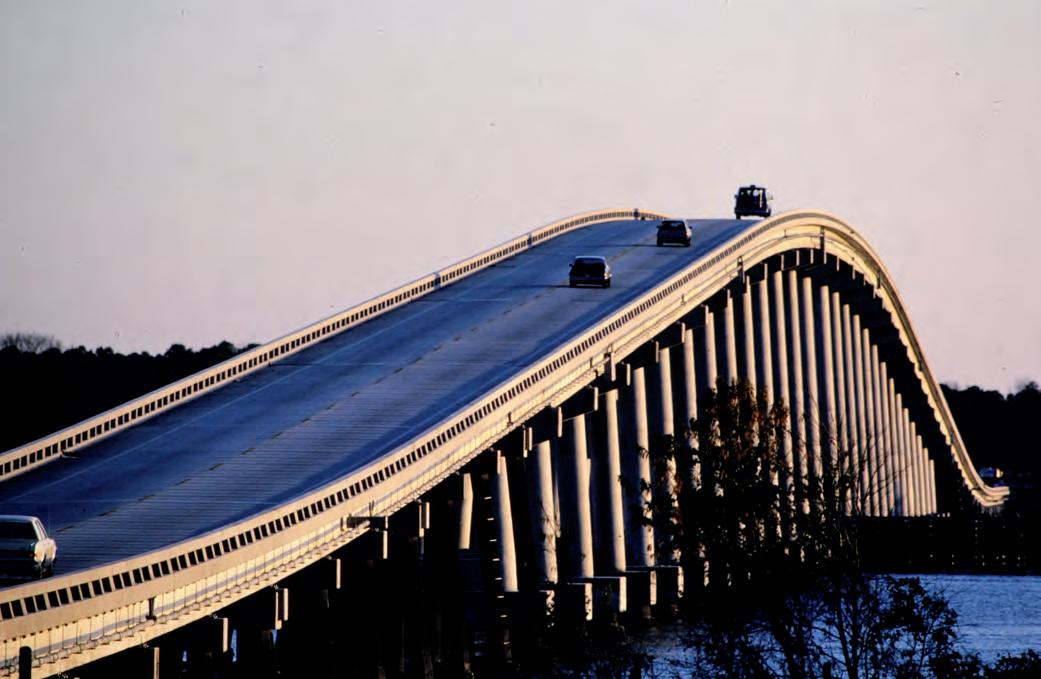
Bridges have spanned the many inlets of the Outer Banks and Intracoastal Waterway of North Carolina and crossed a river outside Selma, Alabama, a significant junction in the Civil Rights Movement.
and they will come.
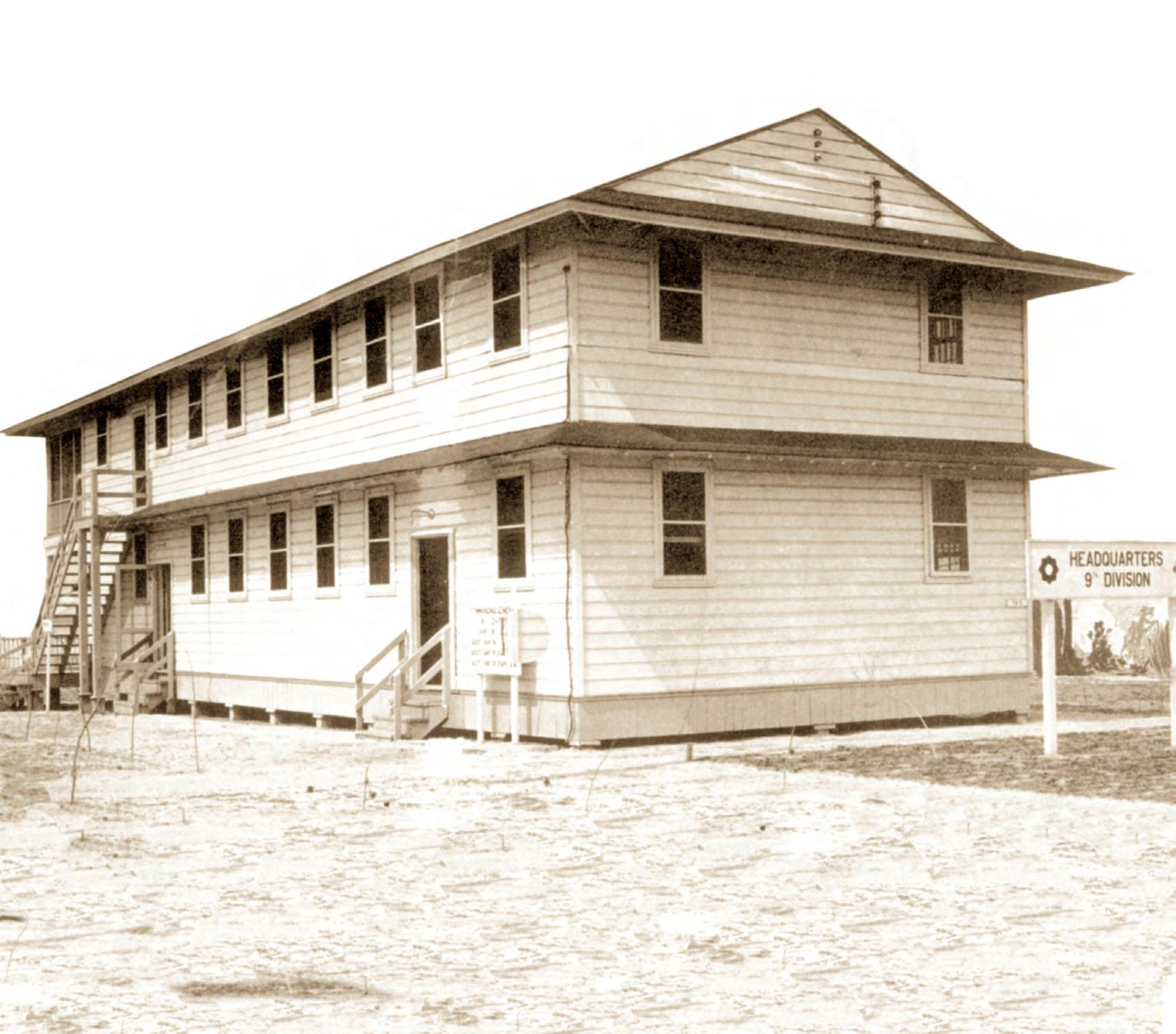
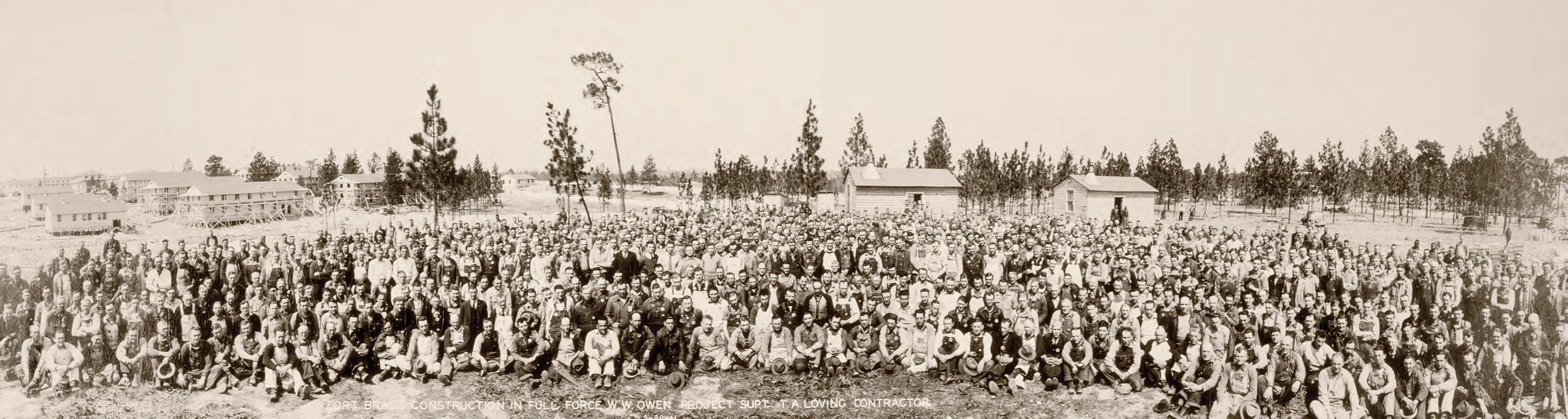
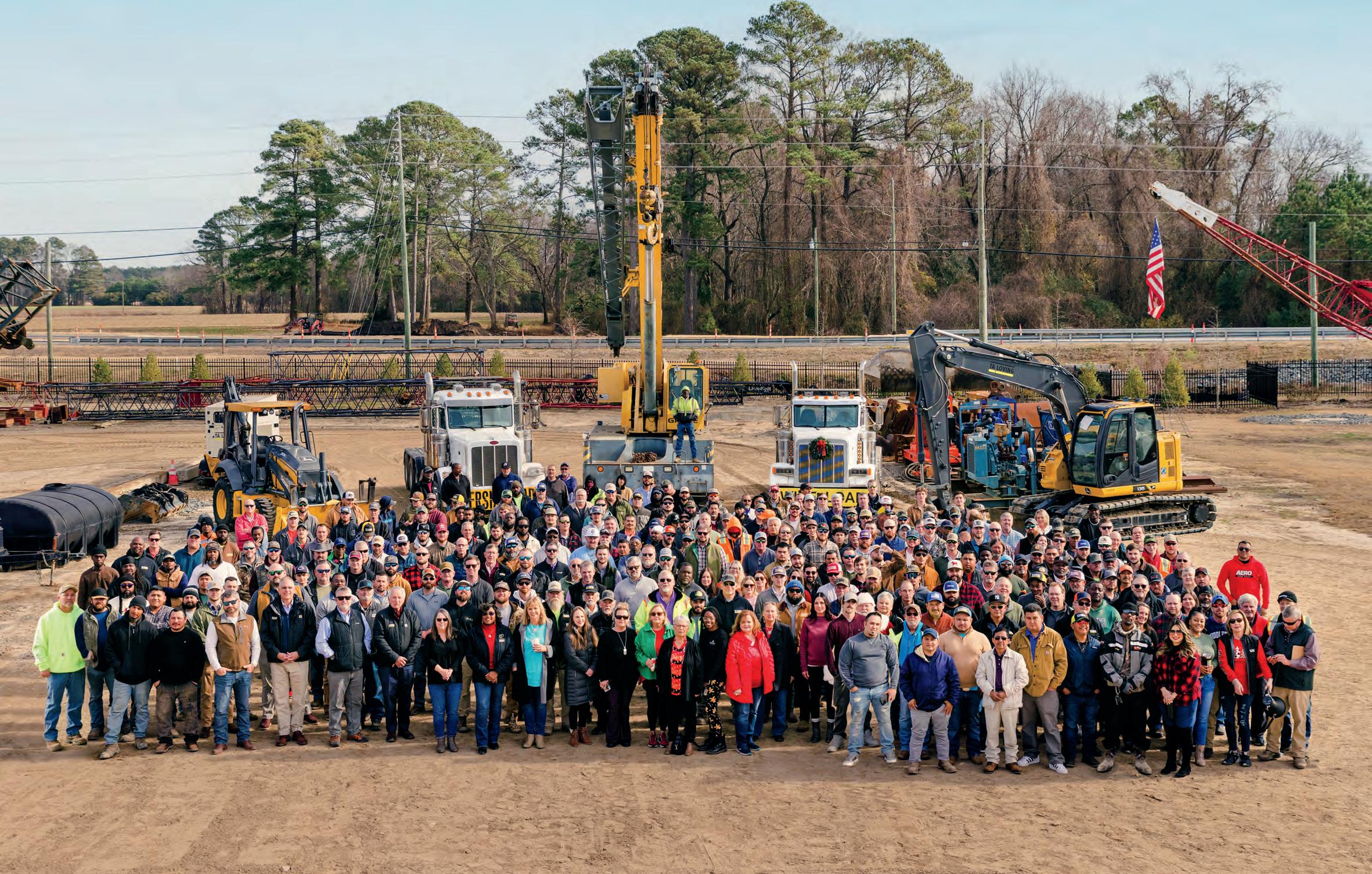
T.A. Loving Company had as many as 25,000 workers on the payroll in 1940 as it built Fort Bragg at breakneck speed as the United States prepared to enter World War II
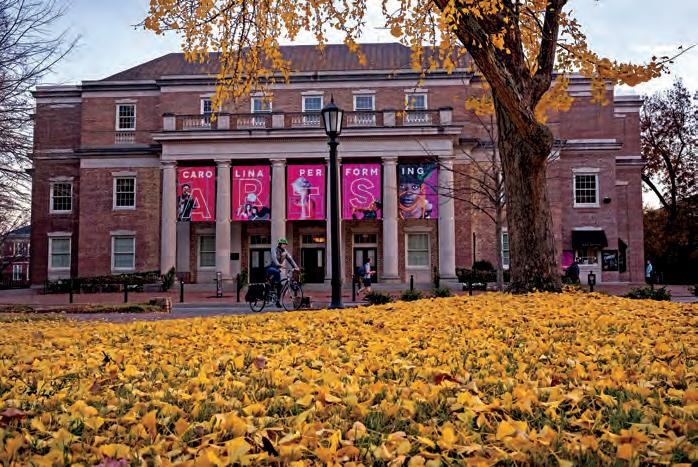
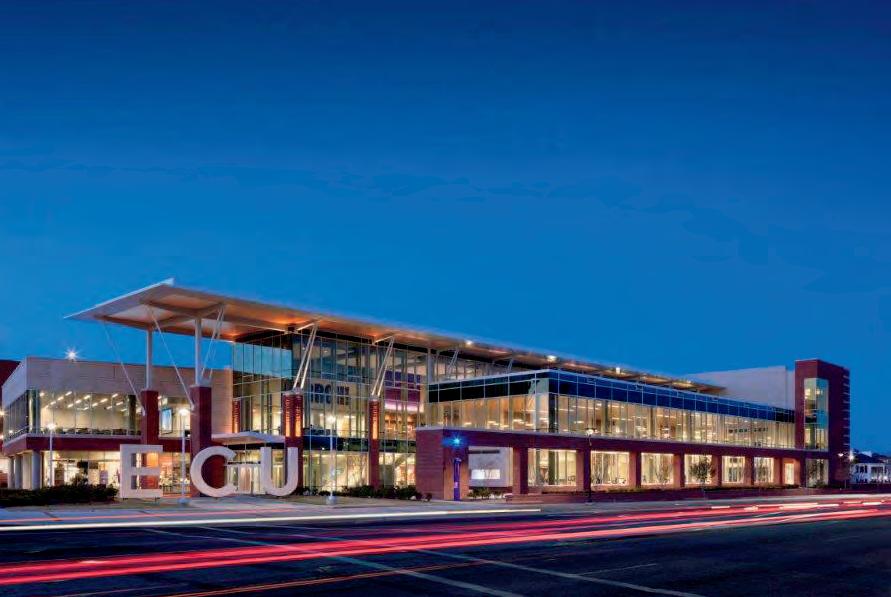
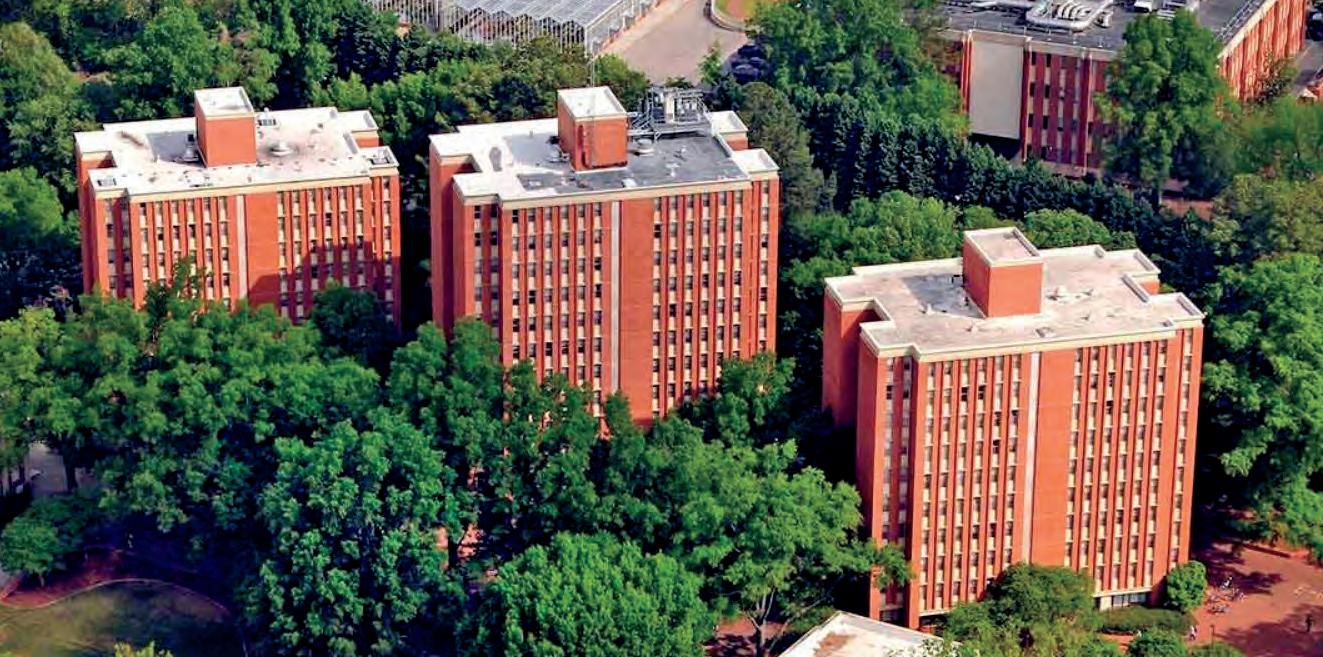
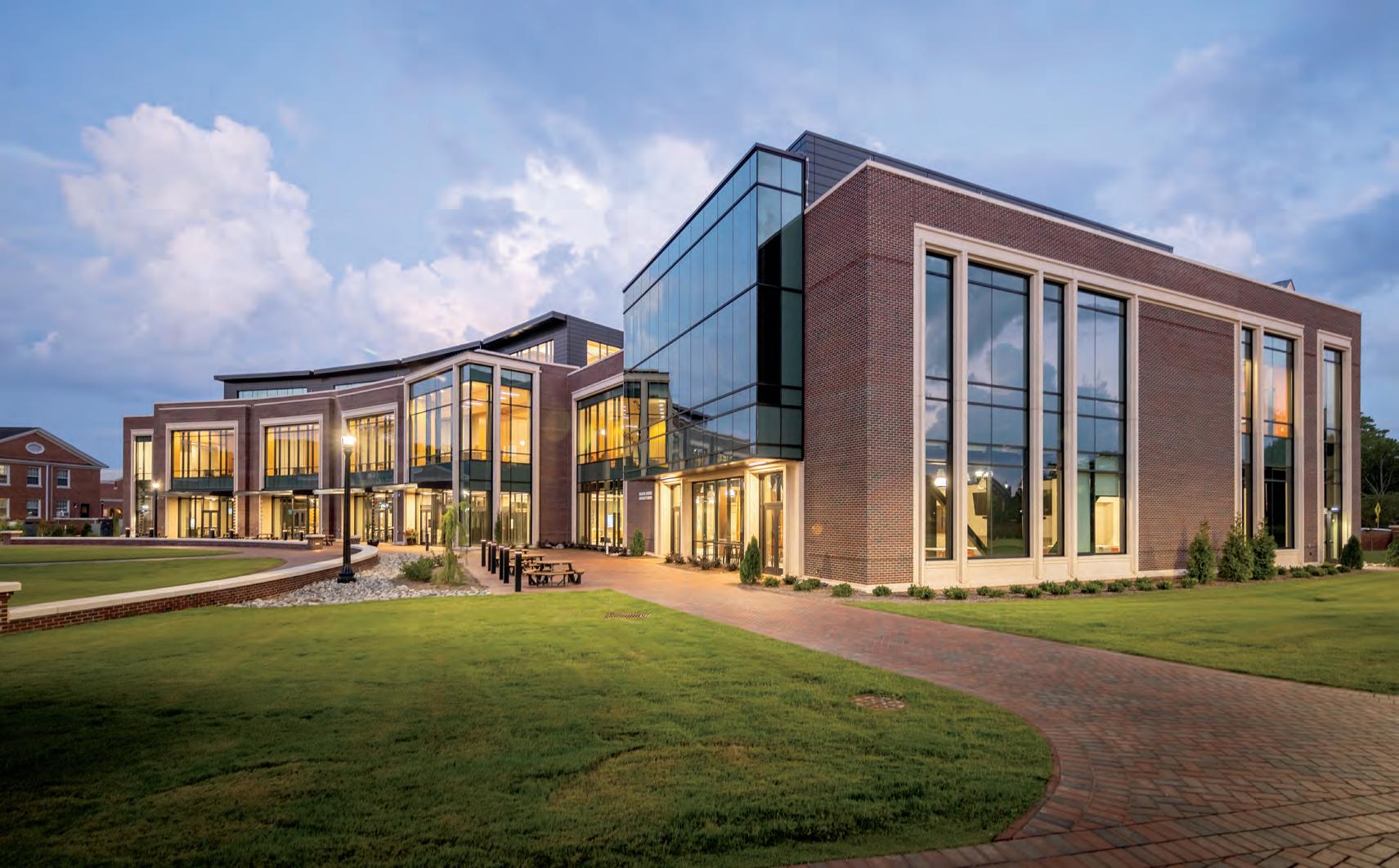
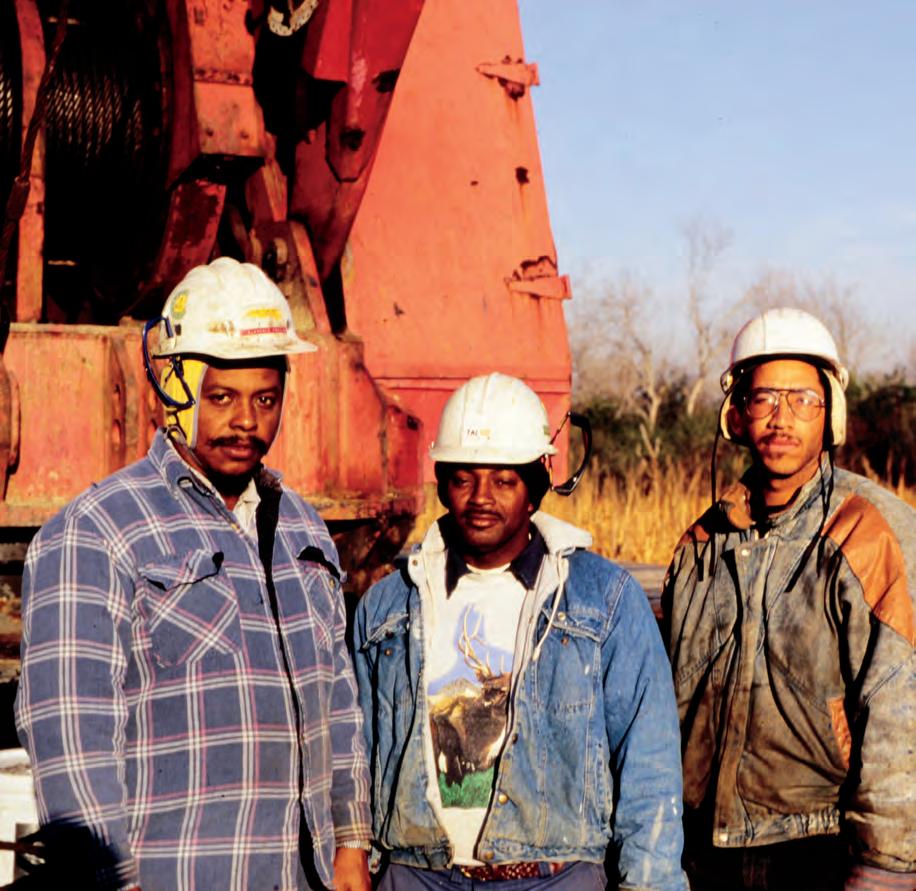
The company’s work graces most college campuses across Piedmont and Eastern North Carolina, including (L-R) approximately twenty projects at Campbell University, the Student Center at East Carolina, the Tri Towers dormitory complex at N.C. State and a total renovation of Memorial Hall at UNC.
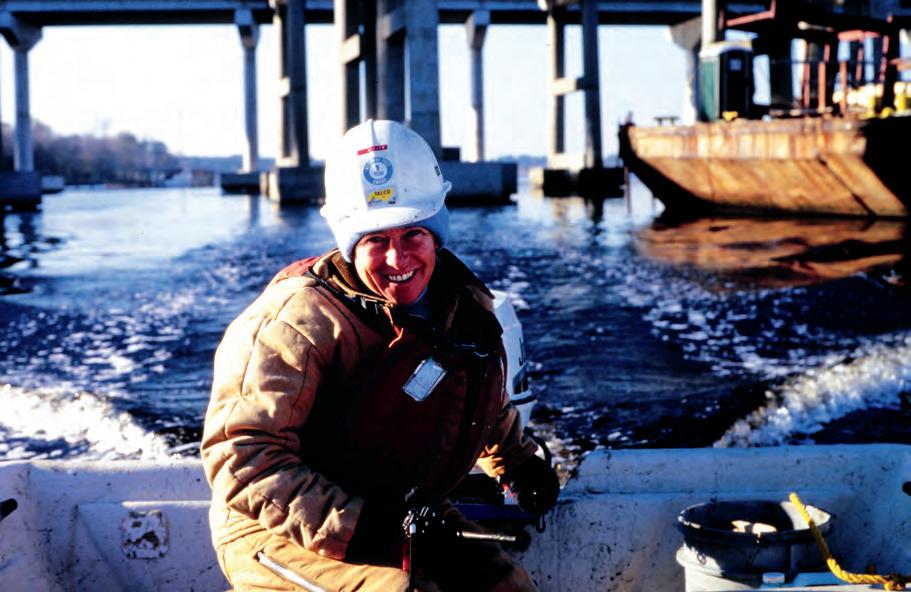
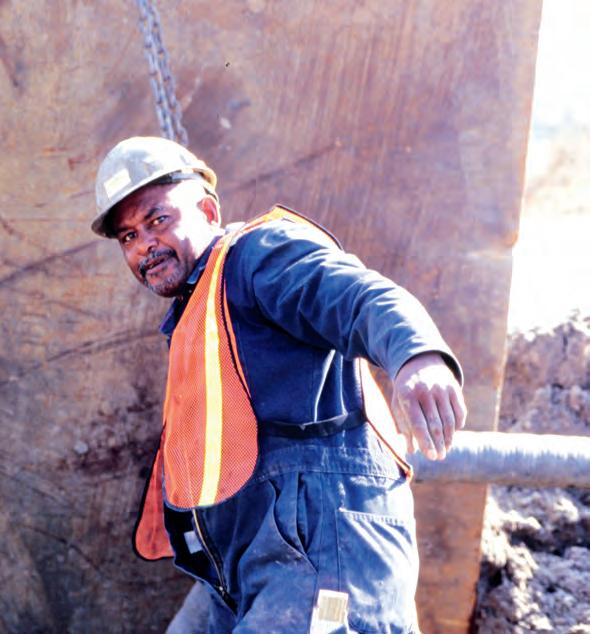
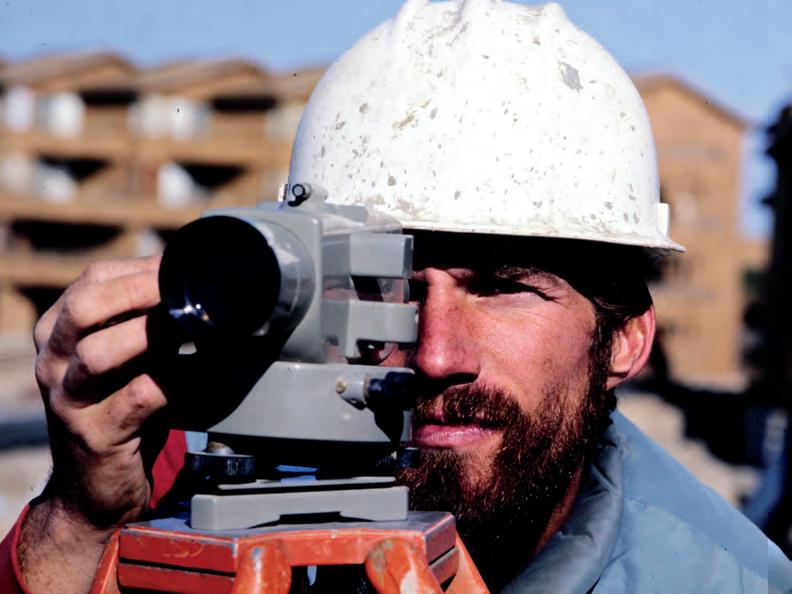
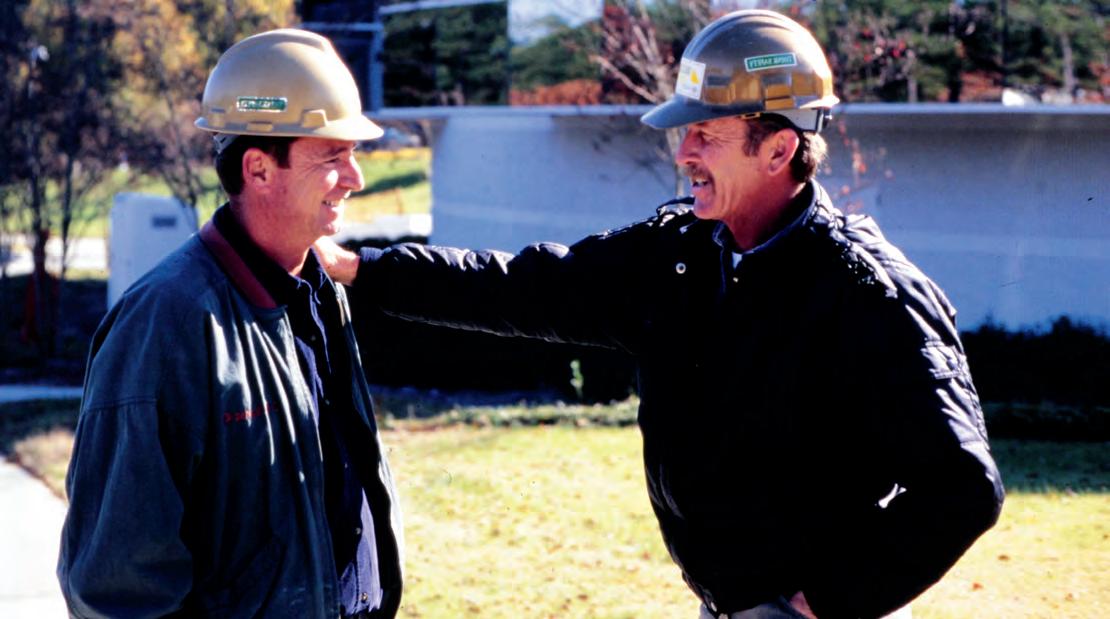

By Sam Hunter, Chairman
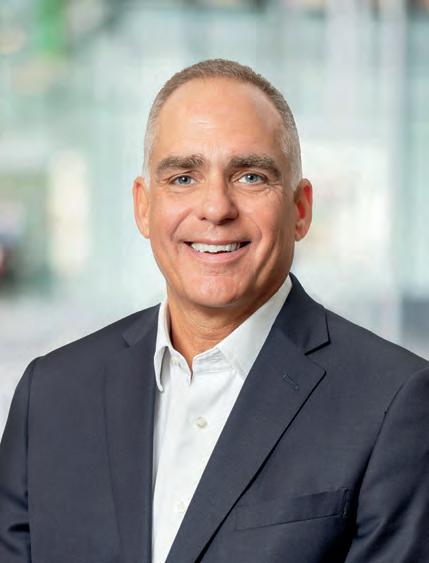
This volume is an attempt to acknowledge 100 years of T.A. Loving Company’s construction history and accomplishments. It is dedicated to the many employees and their families whose commitment has made our success possible.
As we have neared our centennial year, have reflected on my career and what drew me into construction in the first place. In hindsight, realize it was out of necessity. My father died when I was three, and being the only son in a farming family, I learned early to work hard, to help maintain horse-drawn farming equipment and to fix what broke. also learned that teamwork with other farmers was the only way to succeed.
Listening to my invalid Grandfather Hunter talk about his own bridge-building career and getting to know my future father-in-law, John Loving, bridge-builder extraordinaire, led me to choose engineering, not agriculture, as my major at Virginia Tech. My mother remarried and sold our farm, opening the door to a possible future in construction.
After college and marriage to my high school sweetheart Ann, attended graduate school and then served in the Navy Civil Engineer Corps in Norfolk and with the Seabees in Vietnam. Upon discharge from the Navy in 1971, I joined the Bridge Division of T.A. Loving, and my first project was to build a bridge over the Tar River in Greenville, N.C. Since that first assignment, my passion for construction and my pride in T.A. Loving Company’s accomplishments has only grown. As T.A. Loving turns 100, look back with pride at my own fifty-four years of employment here and at the leadership opportunities afforded me through those many years.
From 1925 to today, construction has moved from mules and steam engines to GPS guided equipment, from overalls and fedora hats to SMART protective apparel, from party-line phones requiring a switchboard operator to instant cell and satellite connections, from paper spread sheets to personal tablets, from hand-nailed structures with hand-mixed concrete to 3D printed and prefabricated buildings.
But time and modernization has not changed the culture of the company. T.A. Loving Co. remains faithful to its founder’s vision to provide meaningful and rewarding careers to generations of families. Commitment to excellence in construction has fostered such pride in our workforce that “Loving Life” is now our hashtag, joining the long time T.A. Loving plumb bob insignia. can retire with a grateful heart, knowing T.A. Loving’s future is in very capable hands.
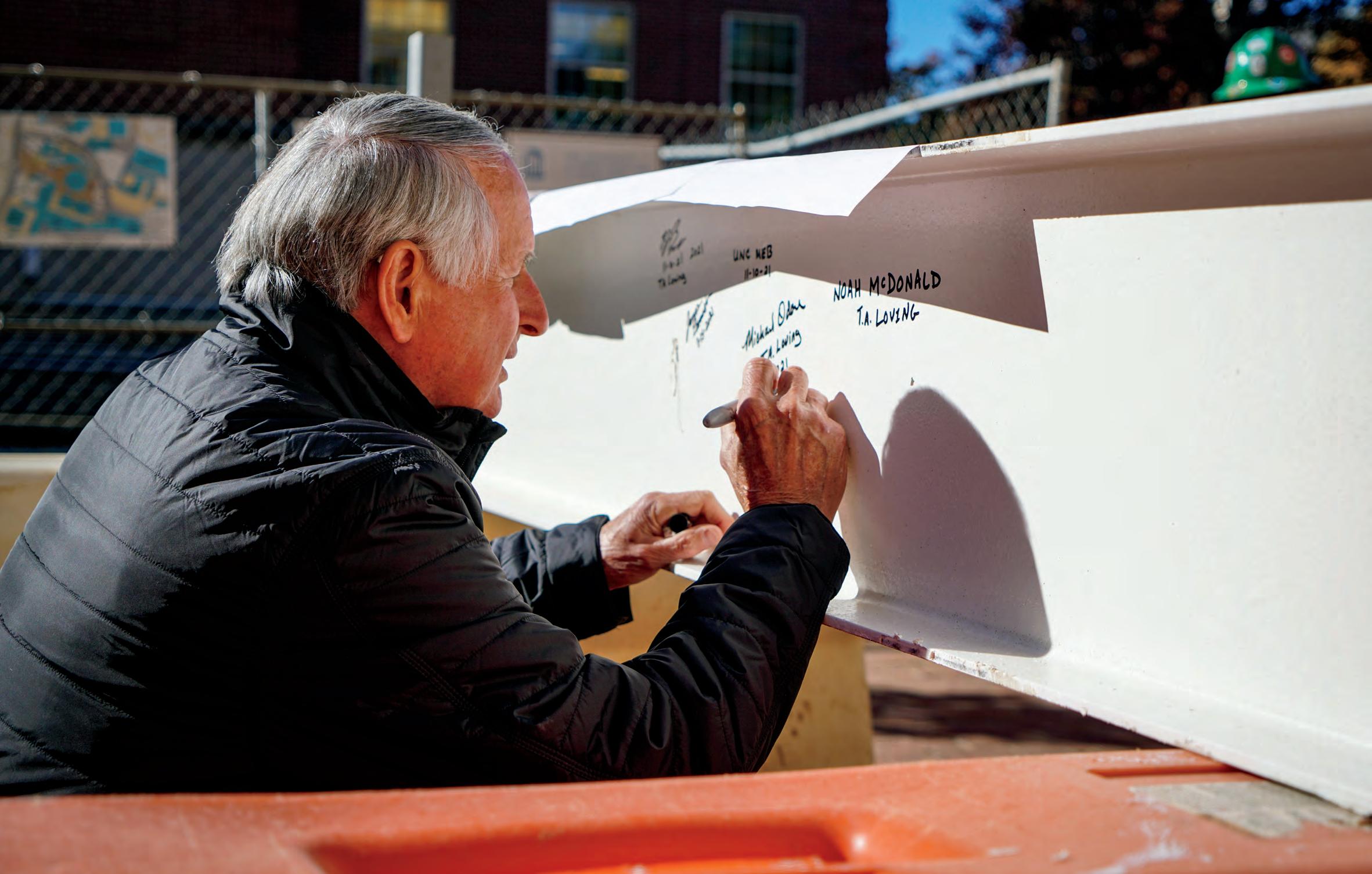
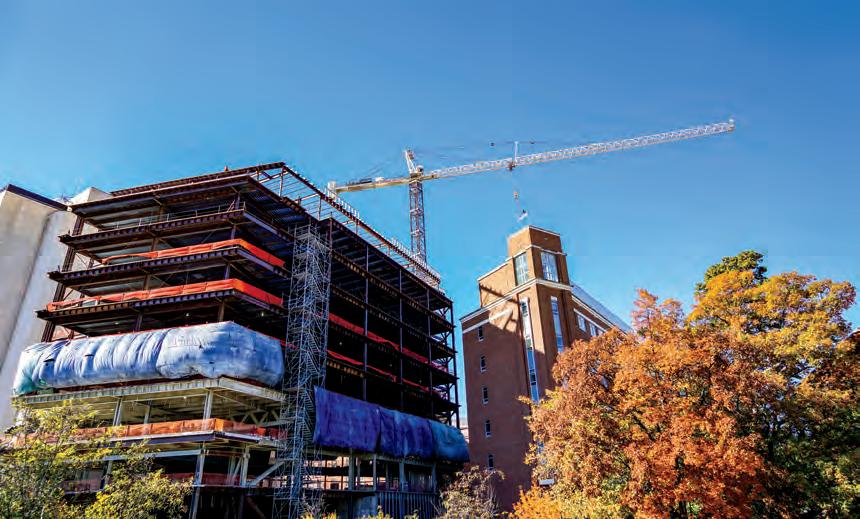
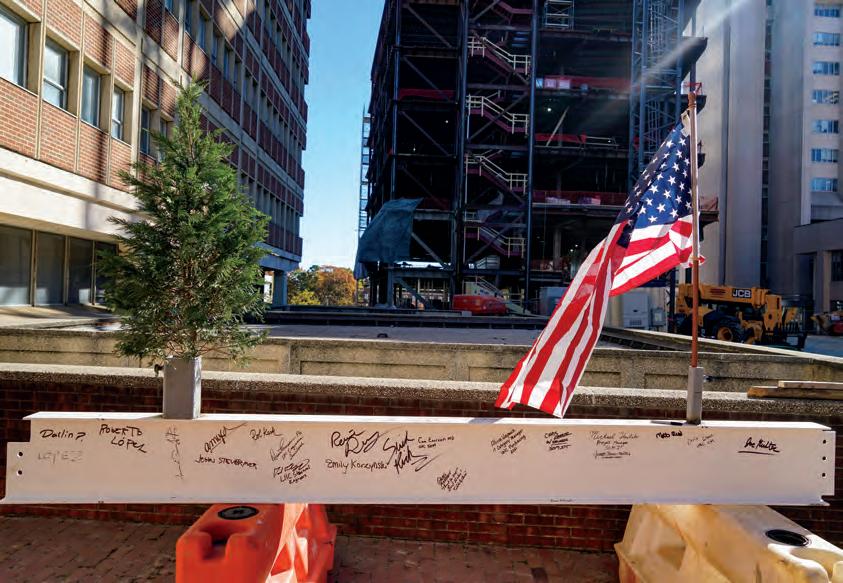
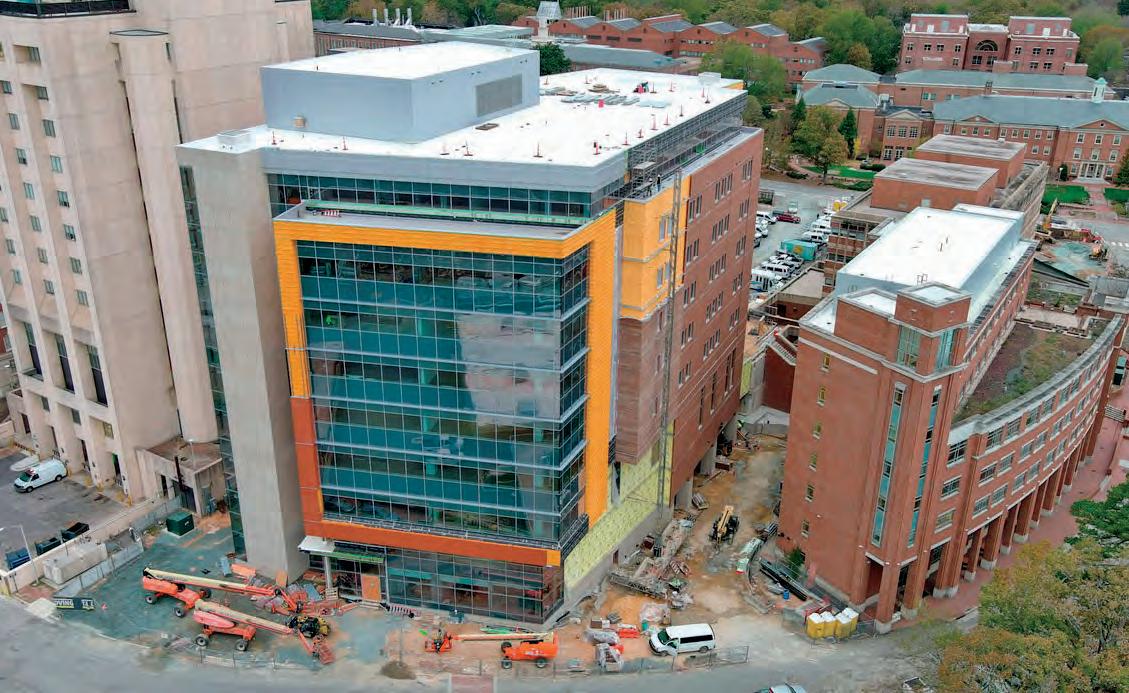
Company Chairman Sam Hunter applies his signature to a beam during construction of the Roper Hall on the UNC campus in 2022.
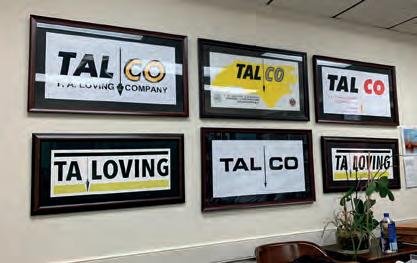
A wall in Ty Edmondson’s office is neatly adorned with six framed company logos dating back many decades. In two of them, the company name is presented as T.A. Loving, after the young man from Virginia who founded the company in 1925. In four of them, the feature lettering is some version of TALCO, an acronym the company used as its identifying mark for much of the late 1900s.
The thread running through each is the plumb bob—a weighted head narrowing to a point hanging from a piece of string. Historians believe the first plumb bob was likely used in Egyptian times and think the device played a major role in constructing the Pyramids, not to mention other uses in sailing and surveying the skies. They were also used by the ancient Greeks and Romans and remain the most effective and accurate tools for determining a vertical in construction.
“There’s a lot of symbolism with the plumb bob—straight and true and that’s how you build things,” says Edmondson, the company CEO. “Maybe it’s a little less that way now with all the technology. We have some younger guys come through here, point at it and say, ‘What’s that?’ I think it’s a great logo for our company.”
Adds Ann Loving Hunter, niece of the founder and wife of long-time company executive Sam Hunter: “The plumb bob says this company is going to do the job right. They’re not going to do it sloppily. You can trust them to do it the way it should be.”
It’s been that wa y for one century
building program. He established a sole proprietorship in his own name in 1925, and from this Goldsboro headquarters, the company has left its imprint across the southeast and beyond.
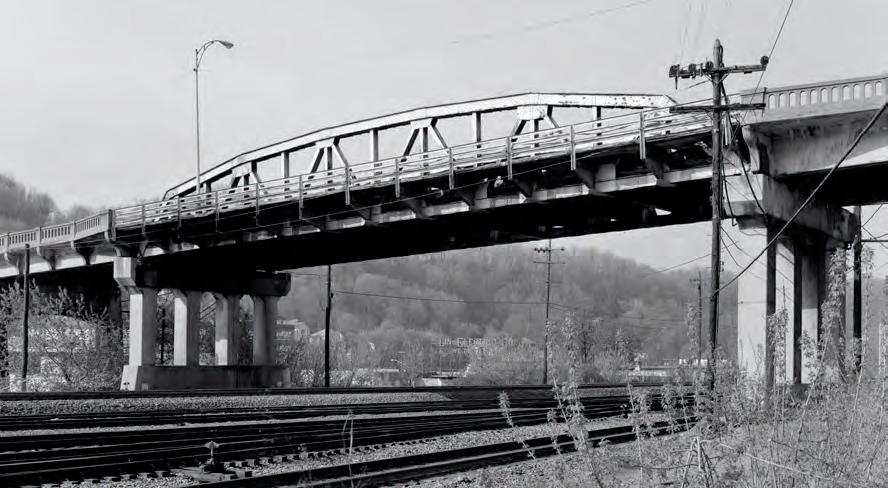
now with T.A. Loving Company. No one knows exactly how or why a young man ventured from the hills of Virginia south to Goldsboro in the mid-1920s, but it’s likely that T.A. Loving took his interest and acumen for construction to a town located at a key railroad juncture and assumed there might be work and opportunity. One of his first assignments was to help build a railroad overpass near Fremont for the state of North Carolina’s road
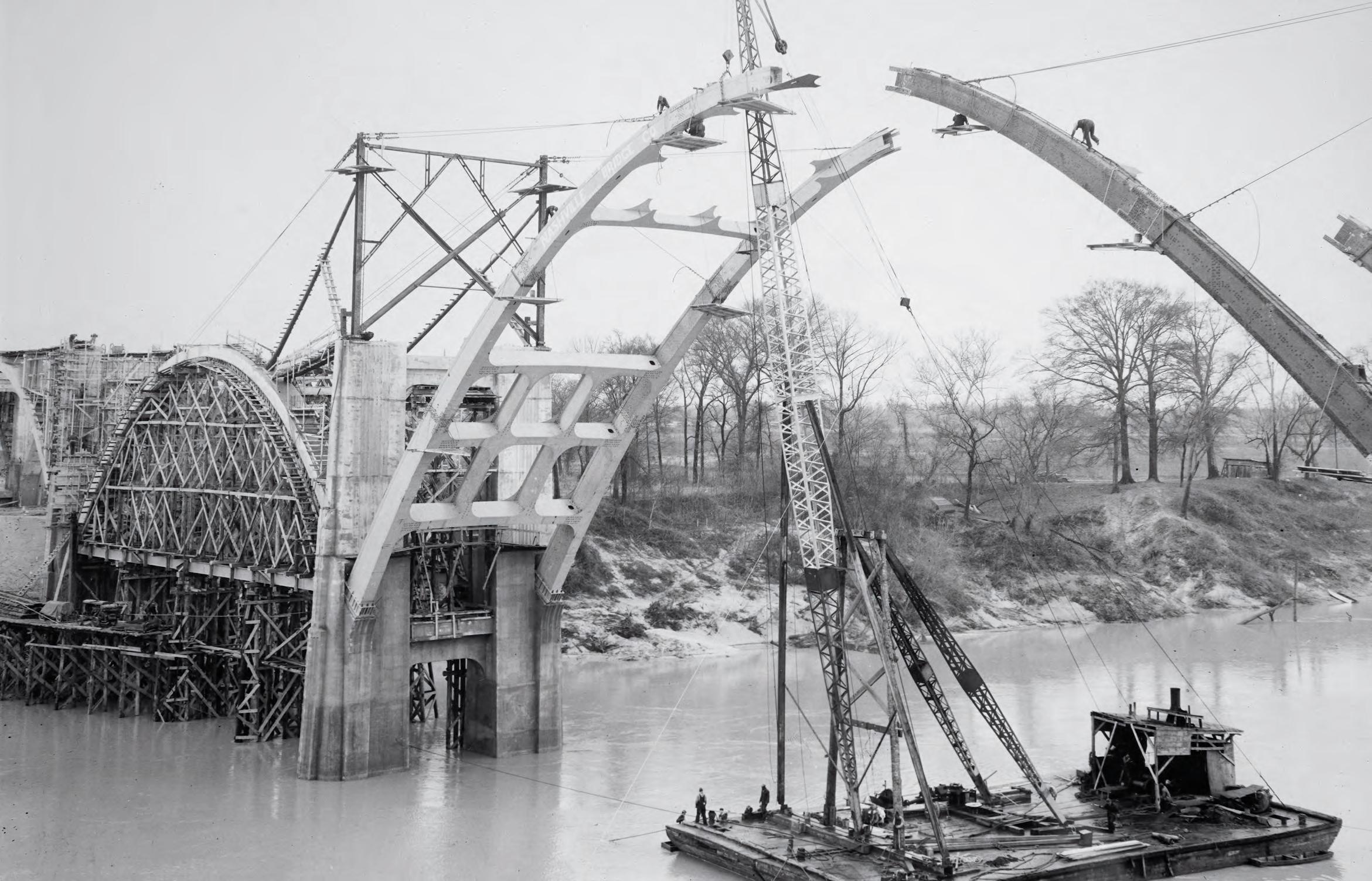
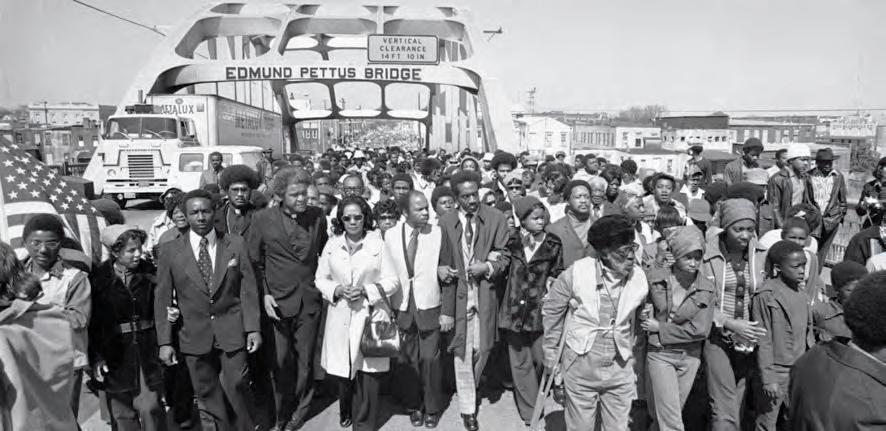
T.A. Loving Company built Fort Bragg at warp speed for the U.S. government in the early 1940s as America was bracing to enter World War II, having more than 25,000 employees on the payroll at one time and opening a new building every thirty-two minutes during the height of construction. It built the Edmund Pettus Bridge in Selma, Alabama, in 1940, a steel-througharch structure later named a National Historic Landmark as it was the site of a bloody conflict in 1965 when police attacked Civil Rights Movement demonstrators.
I t has erected multiple buildings at North Carolina State University in Raleigh, appropriately enough given the institution’s curriculum orientation toward engineering and architecture and the many company officials proudly hanging their N.C. State diplomas on their office walls. It built a classroom building at the University of North Carolina School of Medicine in Chapel Hill in 1970, then
returned half a century later, tore it down and in 2023 completed a new Medical Education Building on the same footprint— with the demolition actually costing more than the original construction.
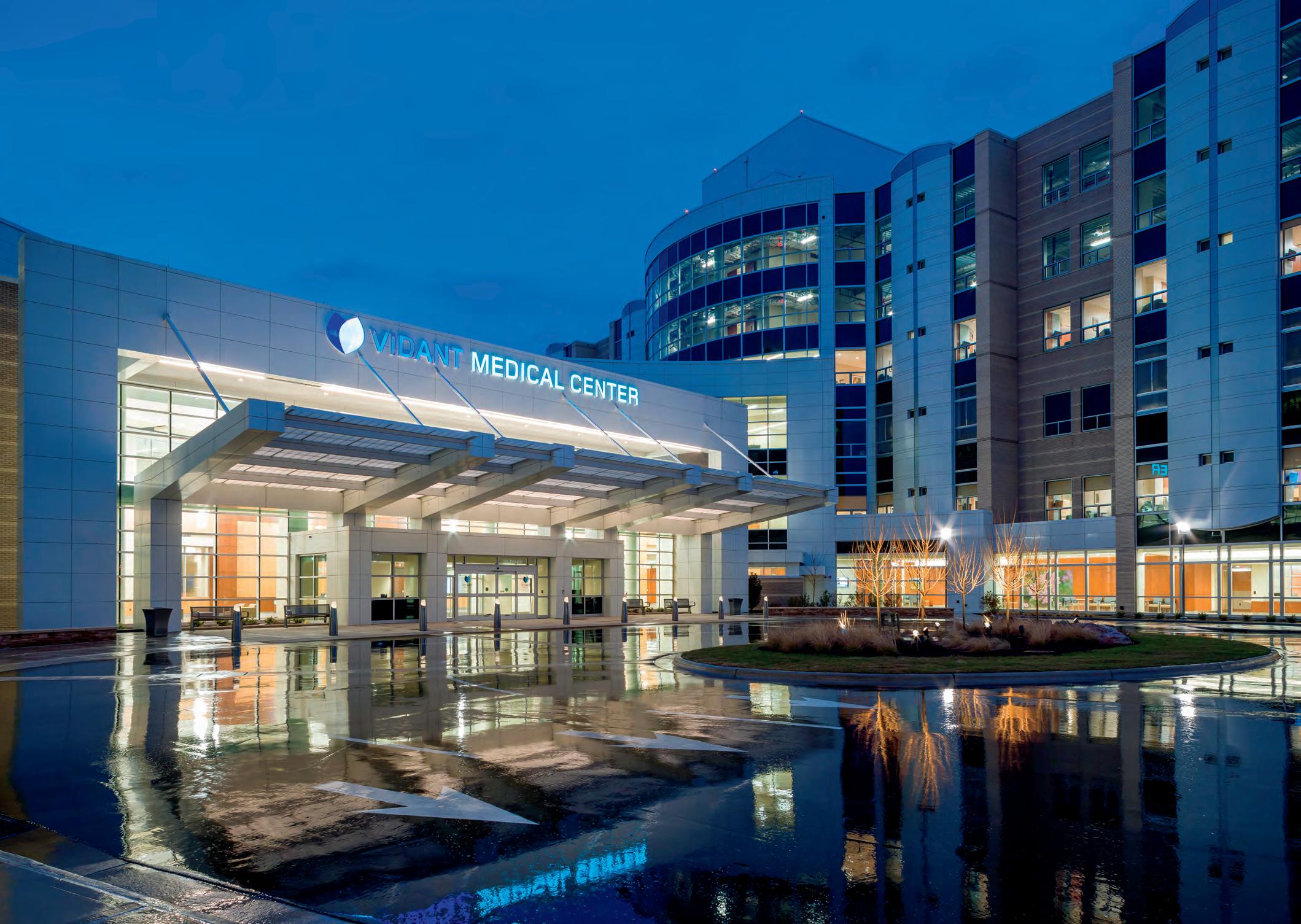
It has left its thumbprint in health care across the Carolinas, building a surgical center for Wayne UNC Health Care just a mile and a half as the crow flies from its company headquarters in Goldsboro.
Brett Bond, a healthcare senior project manager and a T.A. Loving employee since his summer internships starting in 2006, supervised that surgical center in Goldsboro from 2015-16. In 2021, he watched his one-year-old son treated in that very facility for an ear infection.
“We came in through the door and into the lobby we’d built, into the triage room we’d built, into the E.R. we’d built and then back up the post-op room we’d built,” Bond says. “I saw every bit of it come together. It gave you quite a sense of pride to see the work you’d done be put to good use—and in my case, see your own son treated in that hospital.”
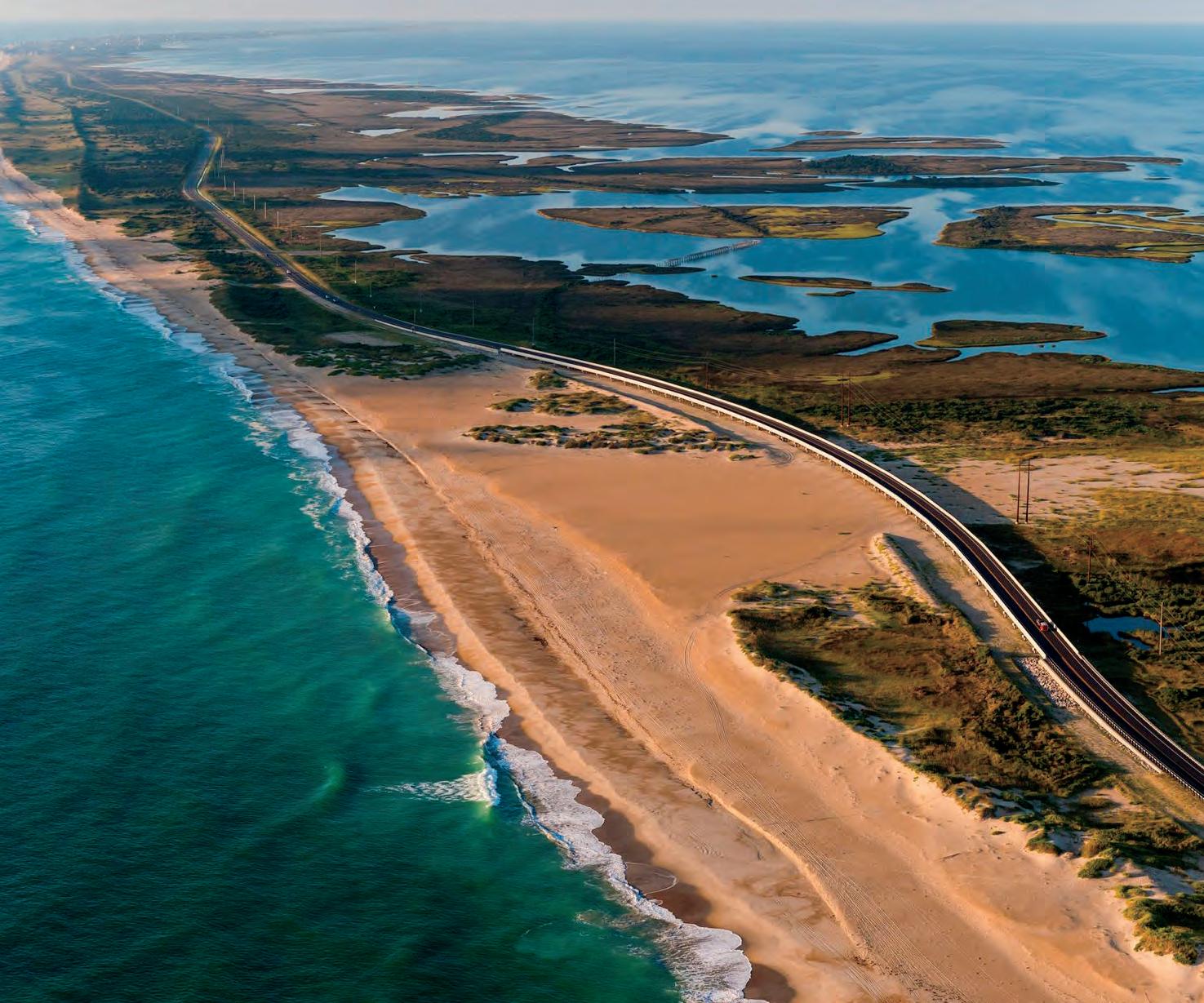
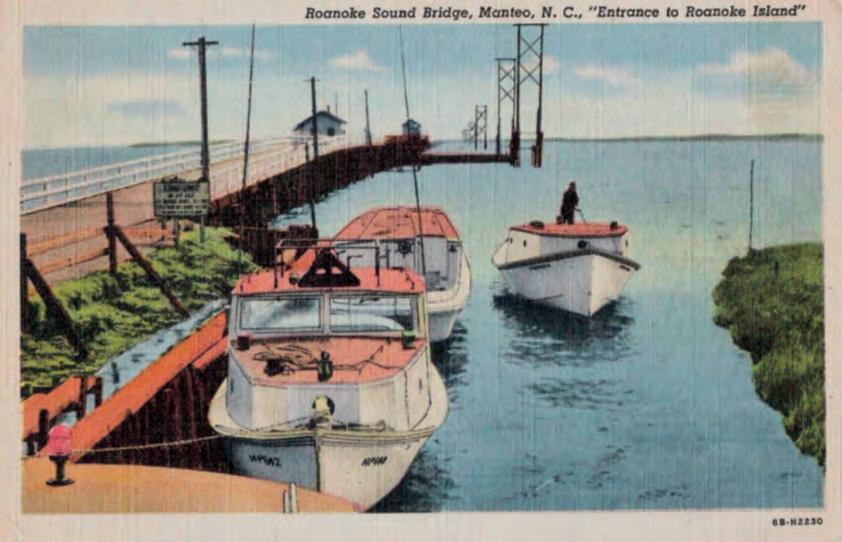
It has built bridges spanning the inlets, sounds and rivers of the Outer Banks and
the coastal areas of North Carolina from Manteo down to Morehead City.
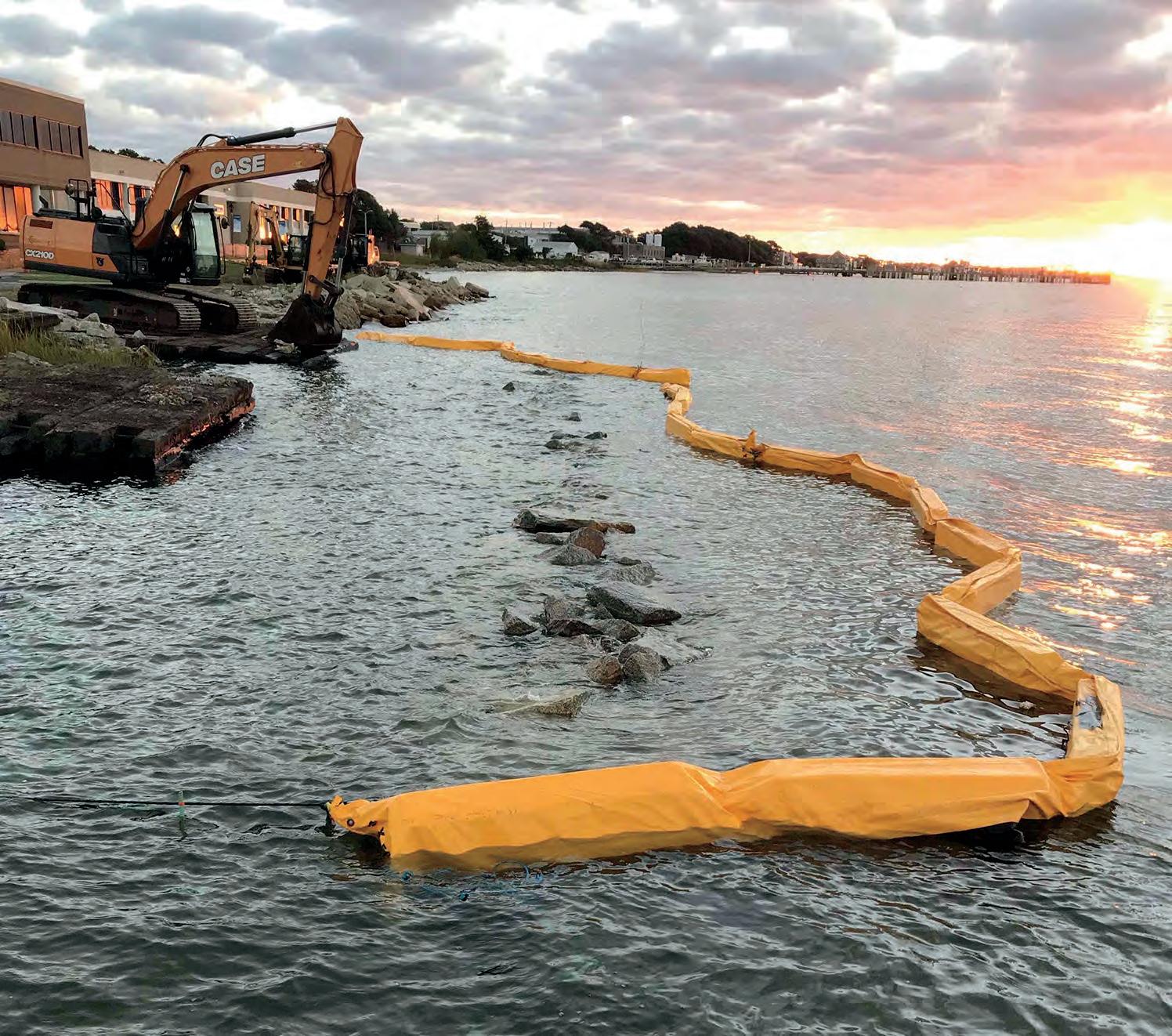
It has worked with hundreds of towns and municipalities on water distribution and sewage treatment facilities, from a wastewater treatment facility in Brunswick County to utility repairs and rehabilitation at Camp Lejeune.
It has enhanced urban landscapes from Raleigh to the coast, appropriately enough given that Raymond Bryan Sr., the company president from 1947-69, was at the forefront of developing Raleigh’s Cameron Village, one of the nation’s first open-air shopping centers. What goes around comes around frequently in the company’s considerable vault of work. In 1960 it completed a sixstory building for Wachovia Bank and Trust Building on Front Street in Wilmington, one magazine story rhapsodizing over the $1 million price tag and a cutting-edge exterior surface treatment of sparkling quartz. That building was razed in 2008 and the lot sits vacant, just one block from T.A. Loving’s 2022 project of supervising a $3.5 million streetscaping overhaul. And at any juncture and any given moment in North Carolina and beyond,
you might very well see a T.A. Loving banner hanging on a ground-level fence or hoisted from a crane high above the hard hats and heavy machinery.
“One of the nice things about being in construction, and it doesn’t matter whether you’re in management or a laborer, is you can be driving around with a friend or family member and cross a bridge or pass by a building and say, ‘I helped build that.
I worked on that,’” says Sam Hunter, who joined T.A. Loving in 1971 and worked his way up to president and CEO in 1988. “You can see what you’ve done, and that is very satisfying and rewarding.”
Stephen Salter, who joined T.A. Loving in November 1993 and is the general superintendent/assistant vice president of the Bridge Group, remembers a meeting with an engineer at the N.C. Department of Transportation regional headquarters in Edenton and noticing a battery of television monitors showing traffic cameras at bridges in that area of northeast North Carolina. Salter counted six bridges or work sites built by T.A. Loving shown on the eight TV monitors.
“I cross bridges everywhere I go and
I say, ‘Well, I worked on this one and I worked on that one,’” Salter says. “When you’re driving eastern North Carolina, you won’t go many roads where you won’t have driven over a bridge that we’ve built. You head to the coast, you’re going to cross a T.A. Loving bridge.”
And there are the jobs you don’t see. It’s
one thing to build five K-12 schools around Myrtle Beach with dozens of cutting-edge energy conservation features as the company did in the early 2000s and yet another to lay nearly 45,000 feet of sewer, water and storm drain lines under the streets of Carolina Beach as it did in 2019.
“ Everyone associates T.A. Loving Company with our Building Division because it’s so visual, but if we don’t do the water and sewer, this world comes to a crashing halt,” says Paul Hunter, senior vice president and son of Ann and Sam Hunter. “Dad has said as long as I can remember the need for water and sewer will always be there. But that part of our work is buried. You never know it’s there.”
“My wife and I’d go by a wastewater treatment plant on the road driving somewhere and she’d say, ‘What’s that
smell?’” says Jerry Smith, who joined the company in 1967 and was senior vice president of the Utilities Group upon his retirement in 2015. “I’d say, ‘That’s the smell of money!’ That’s been an important area of work for this company for many, many years.”
Along the wa y, the company has collected various awards, including the 2004 “Best General Contractor” by the construction trade association, Carolinas Associated General Contractors. “T.A. Loving makes you want to perform well for them,” noted one subcontractor in supporting Loving’s nomination that year. The company “has literally built itself into a small piece of American history,” noted a story in an N.C. State University publication about Raymond Bryan Sr. The Country Club of North Carolina in Pinehurst in the early 1960s was the first of a coming genre of golf course communities by offering a golf course, residences and a variety of recreational amenities within a gated community, and its founding members were among the movers and shakers in the North Carolina business community. That they would hire
T.A. Loving Company to handle the roads and sewer construction was a feather in the company’s hat. Company President Raymond Bryan Jr. joined the club and built a home along the sixteenth hole of the Dogwood Course that remains in the family today.
“They have an excellent reputation for this type of work, gained over a long period of years, and we know they will do the job as well or better than anyone else we could get,” James Poyner, a Raleigh attorney and founding partner of the club, said in a letter to the investor group in December 1962. “They are large enough to do the job quickly and are giving us a completion date of June 1.”
Engineering News-Record magazine in 1983 listed the company among the top 400 construction companies in the United States, and T.A. Loving appeared regularly beginning in the 1980s when Arthur Andersen & Co. and Business North Carolina magazine began publishing a list called The North Carolina 100 comprised of the state’s largest companies. T.A. Loving was included in the under $50 million sales category in 1986 and was still there in 2021 in
the $100 to $199 million sales category.
The Department of the Army Corps of Engineers presented the company with an Outstanding Service Evaluation in 1991 in a trestle replacement project on the Military Ocean Terminal at Sunny Point in Brunswick County.
“The efforts of your personnel resulted
in overcoming the challenges presented to us during Operation Desert Shield and Operation Desert Storm,” the contracting officer said in a letter to Sam Hunter.
“This company is very respected within the industry,” says Bob Ferguson, a senior vice president and decades-long veteran in the construction business. “T.A. Loving
does what it says it’s going to do. There’s not a lot of fanfare, not a lot of flash. We just keep doing what we’ve done for a century. That’s an honorable thing, and this is an honorable company.”
“If any of us are pitching a job, we don’t have to explain who T.A. Loving is,” adds Ty Edmondson. “They know who T.A. Loving is.”
Noah McDonald joined the company in 2007 and worked his way up to senior project manager and assistant vice-president.
“Sometimes I’ll tell someone I work in construction and they ask, ‘Who do you work for?’ I’ll say T.A. Loving, and people’s eyes get big and they say, ‘Wow, that’s a very respectable company, they’ve been around a long time,’” McDonald says. “The name certainly carries a lot of weight—certainly in North Carolina but beyond as well.”
Tony Robinson, a general superintendent in the Civil Infrastructure Plant Group, remembers going into a hardware store in Havelock one time and needing some supplies. T.A. Loving didn’t have an account there and he asked the store manager if he could set one up.
“The guy said not to worry about it,” Robinson says. “He knew T.A. Loving paid their creditors and said anything they had, I could take. That’s testimony to taking care of business and paying our bills. We don’t always make money on a job, but we try to give owners a good project.
“A hundred years is something to be proud of. You see a lot of construction companies not make it. You see some big
names out there that just faded out and went away.”
David Philyaw, who joined the company in 2004 and was Building Group president in 2023, was speaking to a group of East Carolina University students one time and was asked how big was the company and where does it work?
“Let me answer this way,” Philyaw said.
“There is a ninety-nine-percent chance you’ve either been in a building that we’ve built or been across a bridge that we built or drank water that came out of a pipe that we put in the ground. And not many companies can say that.”
the decade leading up to October 1929. The evolutionary arc of T.A. Loving Company mirrors that of many businesses and institutions in American history—it leaps out of the heady economic times of those rip-roaring 1920s; stumbles during The Great Depression but is nimble and resourceful enough to stay afloat while many of its competitors go under; gains its ballast and foothold during the postwar era of the late 1940s; and burnishes its core niches and explores new opportunities as they evolve over the ebbs and flows of the next half century into today.
They weren’t called “The Roaring Twenties” for nothing.
Many Americans used and owned automobiles, radios and telephones for the first time. North Carolinians prospered from the development of tobacco, textile and furniture operations. The first motion pictures were produced. Charles Lindberg crossed the Atlantic Ocean in an airplane. The stock market quadrupled in value over
“You’ve got to like construction and you’ve got to like to build things,” says Bob Ferguson, who grew up on a farm outside Concord. “You’ve got to like seeing people’s dreams become reality. And if those three things are part of your core values, if that’s a part of your nature, then T.A. Loving has been and remains today a great place to be.”
Ty Edmondson loves his work and the variety offered in working for a multifaceted construction firm because every day is different.
“It’s not like you show up at a factory
and we’re stamping out widgets today just like you did yesterday,” he says. “The thing about our business is we tend to go into the ground with a lot of our work, so there are all kinds of unknowns. You don’t know what to expect when you dig twenty feet for a sewer line or forty feet for a pump station. There are so many unknowns. What the soil conditions are and how wet it’s going to be are questions you have to answer every day.”
Times have certainly changed from the free-wheeling early days when there was little government regulation over construction safety. Paul Hunter remembers his baptism into the business in the early 1990s, working summers in college on a bridge project in Eastern North Carolina. Each morning he’d climb into a “man basket,” which allows workers to access areas they can’t get to from the ground or a ladder and are elevated and managed from a crane. One of the crane operators was named Lee Black; he was skilled at maneuvering the crane and had a playful sense of humor as well.
“Every morning he’d fly me up to the bridge cap and I’d do whatever work I had up there,” says Hunter, who worked as a foreman for seven years, then assistant
superintendent, superintendent, project manager and an estimator. “Then he would fly me up to the top of the boom and cut me free, basically letting me freefall two hundred feet all the way down to the water. Right when I was getting set to hit the water, he’d put the brakes on. I can tell you he did put my feet in the water many times over two summers.”
Hunter smiles and shakes his head.
“You’d probably go to jail if you got caught doing that now.”
Indeed, the safety element of the construction industry has evolved enormously over the last century. At one point on big jobs it was common practice for a contractor to include in its bid for the project the costs associated with a worker fatality.
“A hundred years ago, safety was not the first thing on everybody’s mind,” says David Philyaw. “It was about production and getting things done. Casualties were accepted to some degree. That doesn’t make it right, but that’s the way it was. It was dangerous work, and someone might get hurt or killed.”
The Occupational Safety and Health Administration Act of 1970 provided
employees and their representatives the right to file a complaint and request an OSHA inspection of their workplace if they believed there was a serious hazard or their employer was not following OSHA standards.
“At T.A. Loving, we implemented a safety policy before OSHA became the law,” Philyaw adds. “We were ahead of the curve.”
The p hysical challenge is part of the job as well. After all, you’re outside pushing, pulling, lifting and digging in every condition imaginable. Stephen Salter grew up in Sunbury, a small town in Gates County near the coast, and was an avid outdoorsman. The prospect of working around water was appealing when he joined T.A. Loving in November 1993, and his first day on the job was working at the Wright Memorial Bridge in Currituck County.
“I like to froze to death,” he says. “I grew up in the country and did a lot of hunting and a lot of fishing, and I always thought I was prepared for the weather. I remember being out there early in the morning and already being cold and I thought to myself, ‘This will never happen again. I’ll be prepared.’
T. A. LOVING COMPANY • 100 YEARS
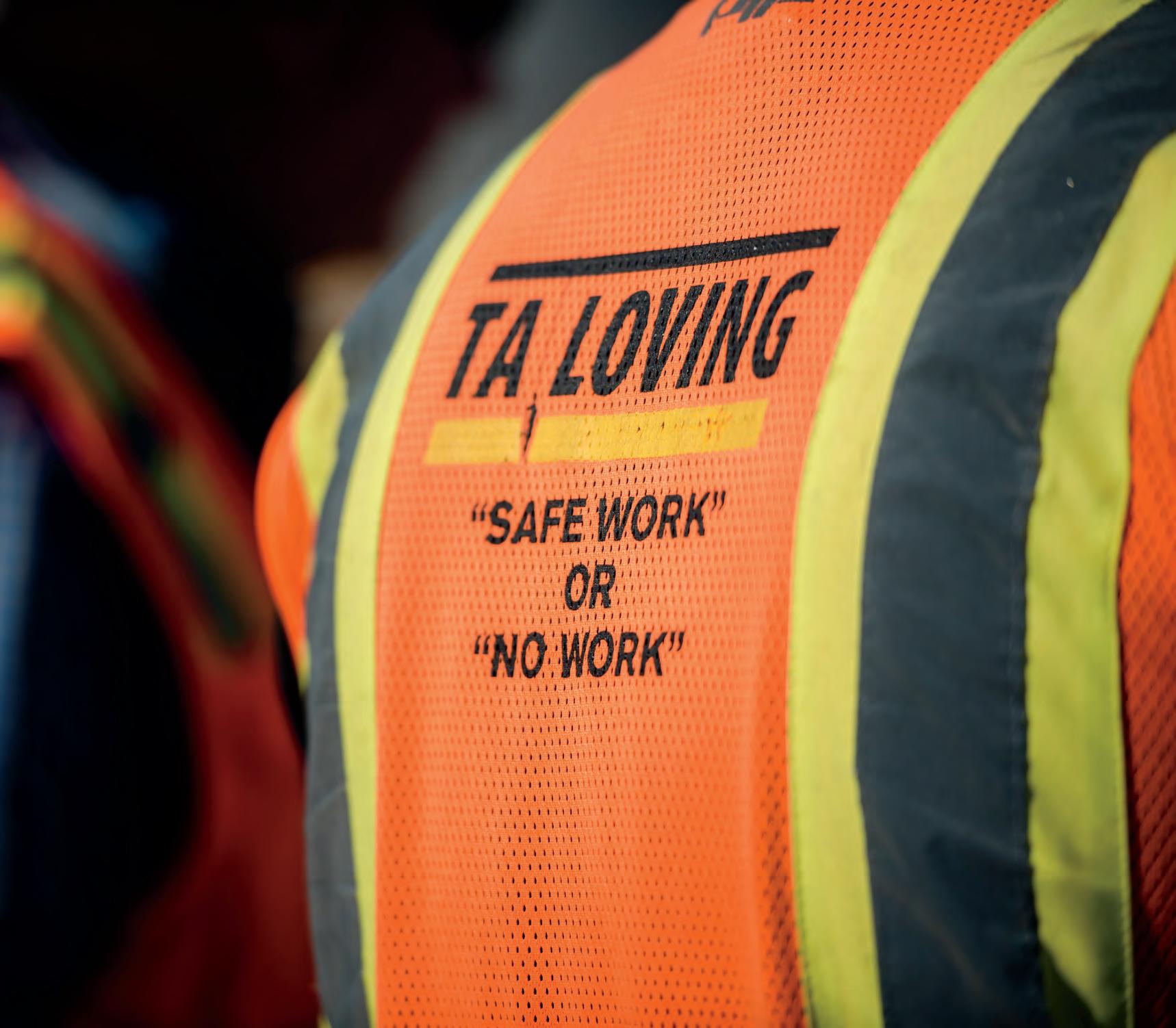
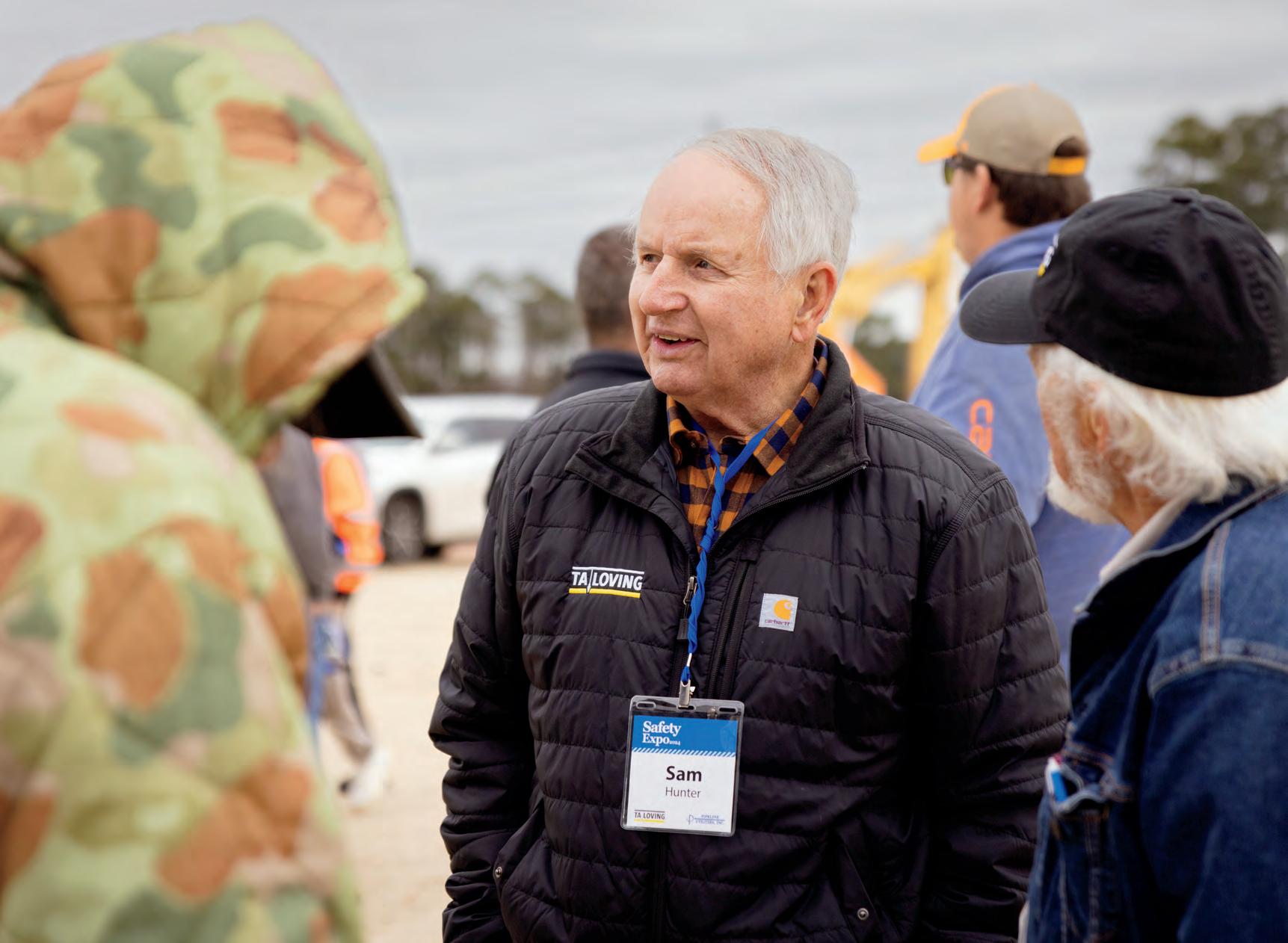
work or no
is the
“The weather’s the hard part, dealing with the heat, dealing with the cold. It’s July and it’s a hundred degrees and ninetyfive percent humidity, that’s tough. Same thing in the winter. It’s February and the wind’s blowing twenty-five miles an hour and raining every thirty minutes. That’s a tough environment to be in. I remember one time having to break ice to get to a tugboat. But every job has its hardships. You just figure it out and work through it.”
Tony, Edgar and Timmy Humphrey have worked collectively nearly 155 years for T.A. Loving Company, and the brothers have seen it and done it all. They have dodged alligators while replacing sewer lines in Wilmington. They have dug a tunnel by hand-shovel under a railroad track near Echo Farms outside Wilmington. They have crawled through a tunnel in Kinston and scraped out dirt two feet beyond a boring pipe, thrown the dirt on a wagon, wheeled it out by rope and repeated the process over and over.
“It’s hard to find people who really want to work hard now,” Edgar says. “They want the job but really don’t want to get out and sweat. Any construction work is
physical work. It can be hard, but it’s how you make it.”
Another of Paul Hunter’s early assignments as a part-time summer employee was in 1992 working in Wilson on the NovoPharm Pharmaceutical plant on top of a black rubber membrane roof of a 250,000 square-foot building.
“That broke me quickly working on a roof,” he says. “I worked the whole summer on that roof, and two days before I left, they cut the air conditioning system on. It was like forty degrees cooler instantly with the draft coming through the intake penthouses.”
Technology has certainly evolved over a century. The company employed so many men building Fort Bragg in Fayetteville leading into World War II that banks couldn’t handle the payroll transactions and job administrators had to work with cases full of cash—necessitating aroundthe-clock security. Company archives include reams of yellowed paper with handwritten job estimates that in later years were produced on manual typewriters, then electric machines and later computers.
Jerry Smith proudly points to where he
used to have thick calluses on two fingers of his right hand.
“They use computers toda y, but we wrote our estimates and bids out longhand,” he says. “We submitted our bids manually. I enjoyed the excitement of putting something together—getting a set of plans and a spec book, reading it and going out and looking at the job, coming back and putting a bid together, hearing your name called at the bid opening, then doing the job and seeing it turn out well. There was excitement in preparing a bid, submitting it and waiting for the bid opening. You’d go there not knowing if you got it. There might be ten other people bidding on it. It was exciting to put two weeks of work in and then win the bid.
“Today it’s different because everything is done electronically. It’s high-tech to bid for a job. Most places won’t accept paperwork. You’ve got to email it to them or send it to them electronically.”
Ferguson observes the contrast in “older people in the business, me being one of them” to the newer generation contractor, engineer and architect. “We could take a blueprint and see the building
evolve mentally,” Ferguson says. “We could see pictures in our head. We could close our eyes and actually see what it was supposed to look like. Over time, I would be interviewing people to work for me and they didn’t seem to be able to do that.”
The advent in the early 2000s of BIM (Building Information Modeling) has changed the industry everywhere. BIM is a term that has become ubiquitous in the design and construction fields as it integrates multi-disciplinary data to create detailed digital representations that are managed in an open cloud platform for real-time collaboration.
“Today people can cut slices through the building, they can cut them in half, they can look at 3D pictures of it, they can roll it and turn it and look at it from the foundations in the ground to up on the roof to where the equipment is placed,” Ferguson says. “It has just been a fascinating evolution to watch.”
Jason Arnold, senior vice president for field operations, views it as a compliment that Procore, a Carpinteria, Californiabased software company, has used input from T.A. Loving officials in developing
its industry standard platform that allows construction executives to manage every aspect of a job from one application.
“We’ve got a ten-year relationship with them and they consult with us on best practices,” Arnold says. “They use our guys in the field to help develop software for the global construction industry. That speaks volumes to have a partner like that who recognizes our company as a formidable contractor.”
keeps them moving and keeps them paid.”
“One time, jobs were slack, so they had us cleaning up the office yard until something else came along,” adds Timmy Humphrey. “They try to keep you on and not lay people off.”
Jerry Smith remembers the company Christmas dinner in 2021, looking around the room and marveling at all the years and decades represented at the gathering.
Certainly the singular thread that has run through T.A. Loving Company from its inception is a culture of nurturing employees, giving them structure and opportunity and developing a close-knit, family atmosphere.
“Taking care of your people has been the biggest asset,” Stephen Salter says. “You know your check is coming. T.A. Loving has done a good job over the years keeping people working. A lot of companies will lay someone off when a job is finished, and it might be a while until the next one. T.A. Loving finds things for people to do and
“I was with the company forty-eight years, and there were people there who’d been there fifty or more,” Smith says. “The company wouldn’t have lasted so long if not for the people. I feel lucky being one of them, and that’s why I keep coming back here.”
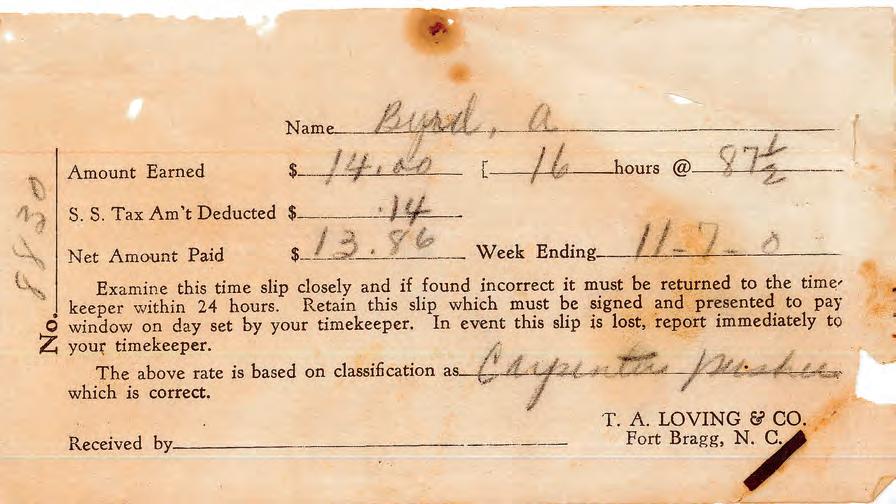
Noah McDonald has a grandmother whose second husband was the son of a T.A. Loving employee dating back to the Fort Bragg project days in the early 1940s. His mother and aunt were going through some old boxes of memorabilia handed down through the family and found four old pay stubs made out to Arthur Byrd.
One stub showed Byrd earning $32.29 gross for 31.5 hours at $1.0205 per hour.
With thirty-two cents deducted for Social Security, he took home $31.97 for his work
“I feel like I ha ve relationships with people at T.A. Loving. That is different from an employee-employer arrangement All the really big companies have employeeemployer arrangements It’s not that way at T.A. Loving.”
That attitude manifests itself in everyday personnel decisions. Paul Hunter in early 2022 discussed a worker he’d hired the previous week.
as a “carpenter’s pusher.”
“I couldn’t believe that,” McDonald says. “Here I’m a T.A. Loving employee today and in our family are these pay stubs from the 1940s. That’s a pretty neat piece of history.”
Ferguson retired from the construction industry in 2016 but came back in 2019 and joined T.A. Loving. After a career spent with a handful of firms with national and even international reach, it would take a special opportunity to lure him back.
“T.A Loving is really in the people business, and if you take care of your people, your people will take care of you,” he says.
“And that’s what is attractive about T.A. Loving. We call it the construction business, but we’re really in the people business. It’s about growing and developing and nurturing people. And if growing and developing and nurturing people is rewarding to you personally and you like to build things, it’s one of the best places there is to be. And that’s really what it’s all about.
“I truly believe that guy can be a good laborer if that’s what he wants to do, but I also believe he has the chance to run the company one day,” Hunter says. “Nobody is holding anybody back around here, and I want to see people grow and be successful. It’s important to provide an environment for people to grow.”
Jason Arnold remembers from his job interview in 2006 that “culture is a big deal” with the company and in his early forties in 2022 had enough experience and clout he viewed his job partly as a mentor to younger employees coming along.
“Everyone is focused on grooming the next generation of builders,” Arnold says. “We’ve got a lot of really sharp, young talent and I just want to make sure that we
let them know that they can be plugged in wherever they want to be plugged in and I’m a conduit to help them.”
“By and large, my time and Ty’s time is spent making sure our people are in good shape and enjoying what they are doing,” David Philyaw says. “We help them resolve problems when they need it, but mostly our job is to empower everyone to make good decisions and run a project like it’s your business.”
Adds Edmondson, “We want every person here to be the best they can be. If you are a laborer and that’s what you aspire to, we want you to be the best laborer in the company. If you want to move up through the ranks, that opportunity is there. We have a strong entrepreneurial culture here. If you want to pursue a particular type of job or a particular type of market, if you come up with a plan that makes sense, we’ll support you. That’s powerful in an organization where people have that freedom.”
Madison Bryan Everett, daughter of company Vice Chairman Steve Bryan, joined the company in 2017 and directs the Bryan Foundation’s community outreach efforts. She remembers doing her homework as a
schoolgirl at the front reception station.
“I alwa ys felt comfortable hanging around the office,” she says. “People tell me all the time, ‘I remember when you were little and came around the office.’ I guess I’m all grown up now. But the family feeling is still strong. You see fathers and sons and grandsons having worked here. I love that aspect of T.A. Loving.”
established niches and the ability to pivot into an array of jobs, large and small. And it has an abiding culture of being a good place to work.
So you’ve made it safely to the milestone of one hundred years. One century. What’s next?
That’s a question that looms in the minds of company executives on a daily basis.
“I’ve had people ask me, ‘Well, what is the company going to do?’” David Philyaw says. “Are they going to get to a hundred and that will be enough? Absolutely not. Nobody believes that’s enough. I want T.A. Loving to be here another 100 years, and I know Sam and Ty and Steve and everybody wants the same thing.”
Many factors bode well for the company’s future. It’s positioned in a state with a healthy economic climate. It has well-
“Your history is a guide,” Edmondson says. “Our history is very rich. It shows you how you got this far. But you can’t get complacent. We want to maintain that opportunity for everyone to be able to excel. This company is a shining star, a North Star, if you will. It takes effort and work and continual improvement to maintain that culture. It’s more than a revenue goal. We want to be a good place for good people to work.”
Being nimble helps. T.A. Loving has the personnel to handle many projects inhouse but can easily draw from a network of subcontractors depending on the job.
Paul Hunter notes the Civil Infrastructure Group has the expertise and manpower to “self-perform” any project.
“We’re proud of that,” he says. “If our subcontractors were to fail or something was to go wrong, we’ve got guys who can step in and do just about anything.”
Philyaw adds: “We are self-performing, so we have our own labor and equipment. We’re
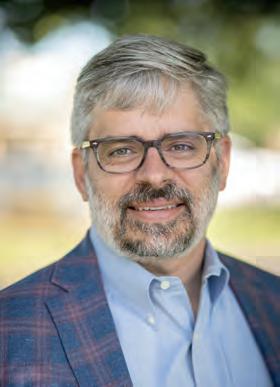


unicorns that way. Most of the companies we compete against don’t do any self-performing work. Very few companies can mobilize the kind of equipment like we can.”
Hunter notes that thousands of towns laid their first water and sewer systems in the first half of the twentieth century and many will be circling back for help.
“That’s hundred-year-old stuff and it’s not going to last much longer,” he says.
“That applies across the country. I think that’s a great opportunity. We’ve done a lot of storm repair over the years, particularly from all the hurricanes of the 1990s and
early 2000s. We know what it’s like when you don’t have water.”
T.A. Loving in 2022 maintained three offices—its headquarters in Goldsboro and satellite offices in Raleigh and Wilmington.
And there is a lot to monitor as the economic development dominoes were falling at a rapid and eye-popping pace across the Piedmont area and Eastern North Carolina in 2021 and into 2022.
Fujifilm/Diosynth Biotechnologies announced in March 2021 it would invest $2 billion and create 725 jobs with a cell culture manufacturing facility in Holly Springs.
Apple announced in August 2021 it would spend $552 million to establish a campus in Research Triangle Park and create at least three thousand jobs.
Toyota Motors in December revealed plans for a $1.29 billion automotive battery manufacturing plant in the town of Liberty as part of its Greensboro-Randoph “mega site.”
Boom Supersonic released its vision in January 2022 to build supersonic airliners at a plant it would build at Piedmont Triad International Airport outside of Greensboro as part of a $500 million investment.
A nd Amgen, one of the world’s leading biotechnology companies, broke ground in March 2022 on a $550 million manufacturing facility in Holly Springs.
“Think of it—Apple is coming to the Research Triangle. That’s a tremendous win,” Ferguson says. “North Carolina has the labor. We have the transportation. And we have a wonderful climate. We have four seasons, and none of them are harsh. North Carolina is a great place to live. T.A. Loving Company is well-positioned to take advantage of it.”
Ferguson sits in his Raleigh office in
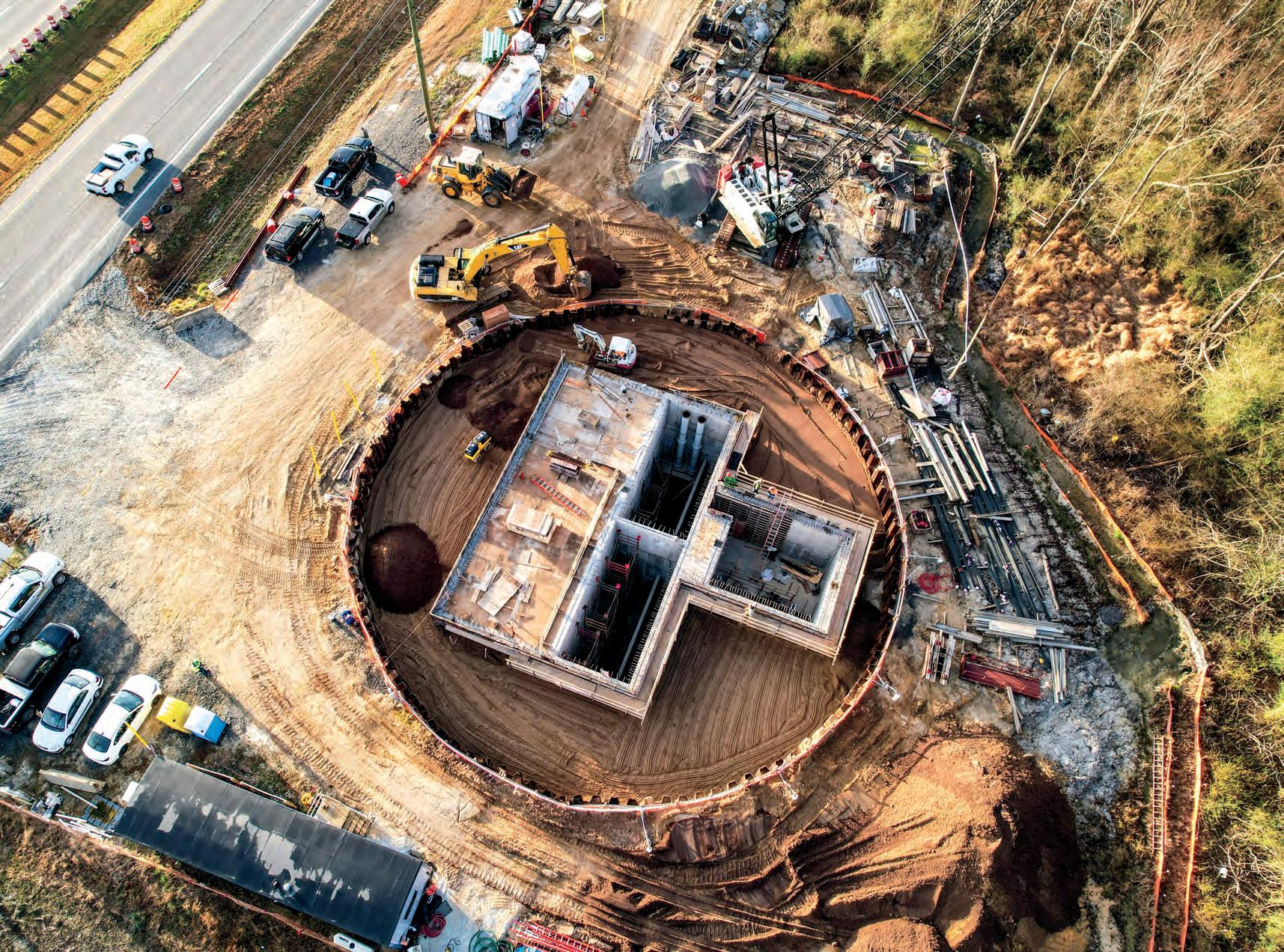
March 2022, knowing in several years he’ll help appoint someone to take that spot.
“ The people are the most important thing because the clients buy the people,” he says. “Your clients buy the people because the people provide the service. And so I think the organic growth comes from them finding those people. The internal makeup of the person who sits in this chair is important—a T.A. Loving kind of person.”
With $200 million in revenues in the fiscal year 2022, T.A. Loving Company has the girth to accommodate a large range of jobs. But it’s not so big that it has to worry about managing more people and infrastructure than it can handle by going around the world competing for work. Philyaw sometimes refers to T.A. Loving as being a “boutique company.”
“That rings true,” Jason Arnold says. “We can go build a small job for Chatham County and it means something for both parties, or we can put the next hundred million dollar student center on a college campus and that
stands up on a national level.”
Ferguson adds: “This company is in a nice place where they are. They are a lot bigger than the smaller band of contractors and they are a lot smaller than the guys that are doing the five hundred million and the billion dollar jobs. They fall in this middle band, and there’s a good bit of room in that middle band.”
T.A. Loving Company, its leaders and employees will continue into their second century building bridges, repairing water mains at 2 a.m. and melding the latest construction management technology with age-old techniques, a plumb bob at the ready. “It’s a great day to be in construction,” says Ty Edmondson.
“A lot of times people lose sight of the work we do and how critical it is and the opportunities there,” Ty Edmondson says.
“That phrase is an optimistic way to look at what we do and the many challenges we have every year.”
It was appropriate that in July 2023,
ninety-eight years after the company’s launch, that brothers T.A. and John Loving would be inducted as Legacy Members into the Carolinas Associated General Contractors Hall of Fame during ceremonies at the Grove Park Inn in Asheville. They joined fellow company officials Raymond Bryan Sr. and Sam Hunter, who had been inducted earlier (Hunter in 2017 and Bryan in 2020).
“ I wish my father and uncle T.A. could have known that their work would be so respected and acknowledged by this remarkable gathering,” Ann Hunter said in accepting the awards. “They would be so proud to know that T.A. Loving Company for almost a century has provided employment for so many generations of families, where brothers, fathers, sons and daughters have found meaningful, rewarding careers. A sense of family persists even today.”
Added Paul Hunter: “They left a lasting mark across our great state as well as this country.”
The town of Culpeper, Virginia, was chartered in 1759 and named for Lord Thomas Culpeper, the Colonial governor from the 1680s, and described in an early document as occupying “a high and pleasant situation” amidst rolling hills and rivers to the northern and southern boundaries, roughly equidistant from Richmond to the south and Washington to the northeast. A young George Washington was commissioned as county surveyor and laid out a twenty-seven acre courthouse village complex with a jail, stocks, gallows and accessory buildings.
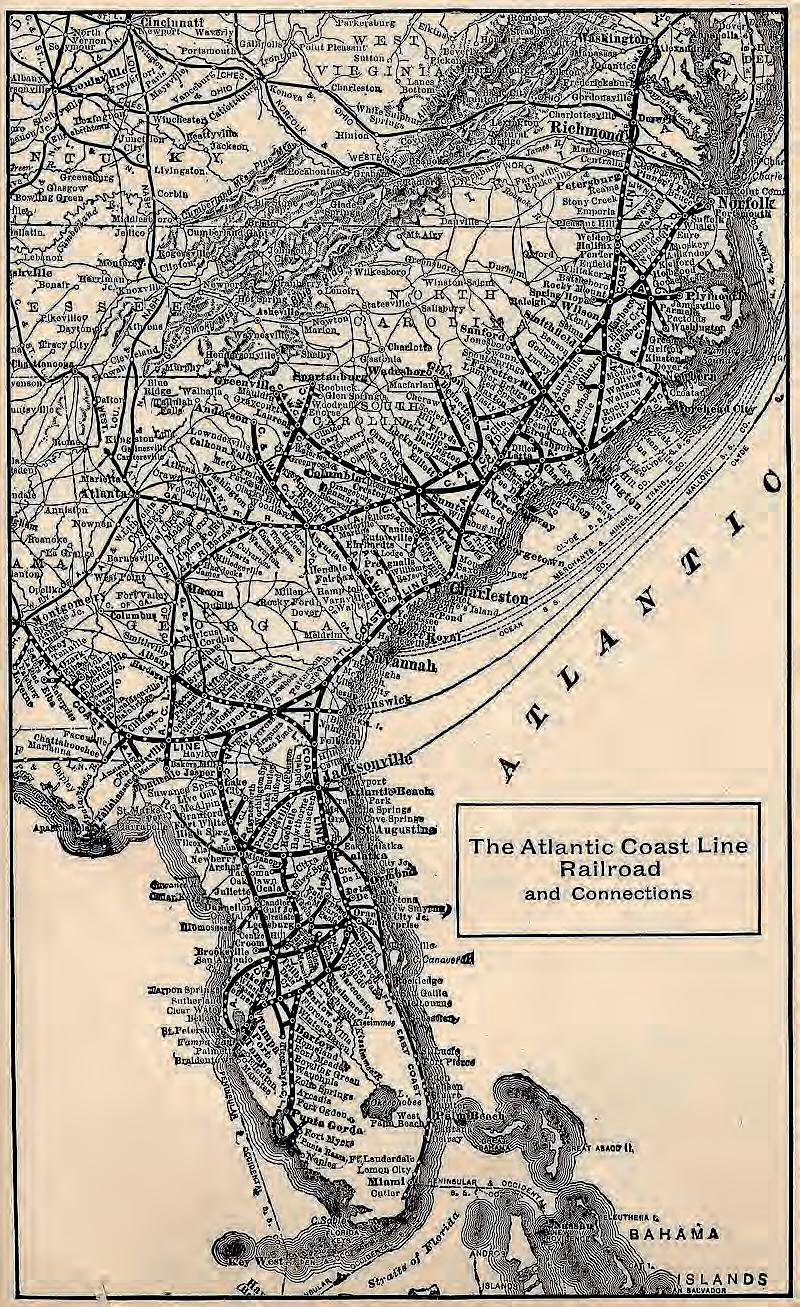
The town was a hot spot during both the American Revolution and the Civil War.
A group of residents organized themselves into the Culpeper Minutemen Battalion and rallied under a flag depicting a snake with thirteen rattles and the motto “Liberty or Death—Don’t Tread on Me.” Nearly a century later, the town’s strategic railroad location made it a significant supply station for Confederate and Union troops, and there were more than one hundred battles and skirmishes in the area.
Thomas Loving came to Virginia from England in 1635 with a party of sixty immigrants, and eventually some of his descendants settled in Culpeper, among them the family of Joseph Baker Loving and his wife, Lula Shadrach Loving. Joseph graduated from Richmond College and was an itinerant teacher and traveled on horseback around the Virginia countryside to visit one-room schoolhouses, and Lula was a music and piano teacher. They had six children, with Taylor Abbitt the second oldest being born in 1899 and John Shadrach the next to youngest following in 1907.
The thread that connects the Loving brothers to Goldsboro and T.A. Loving
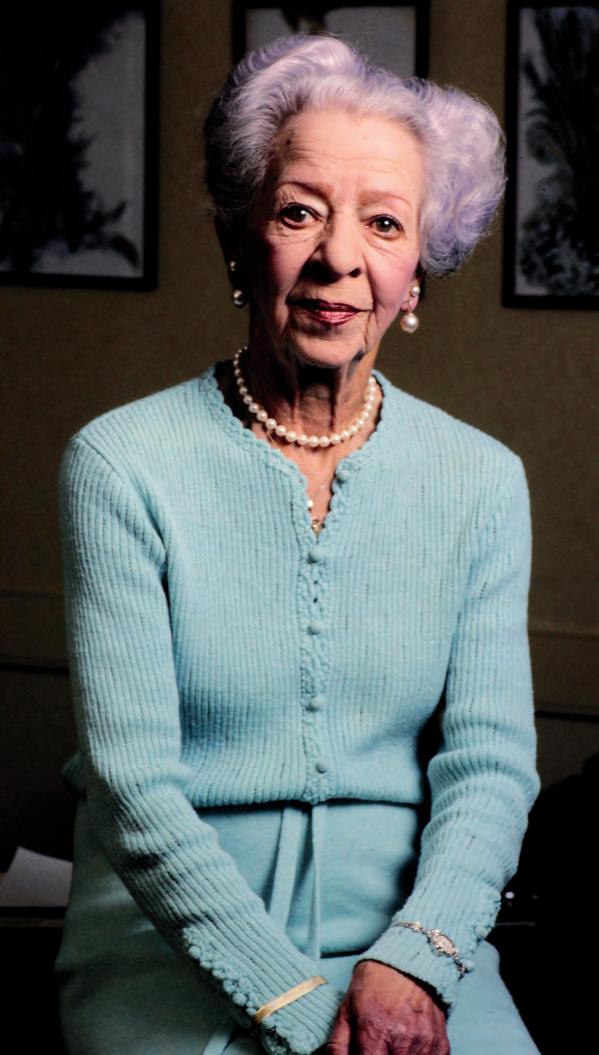
Company a century later is Ann Loving Hunter, the daughter of John and the wife of Sam Hunter, a career-long T.A. Loving employee who was named president and CEO in 1990. “My grandfather being a school teacher, education was certainly emphasized in the home,” she says. “I know that T.A. did go to the University of Virginia for a short time and had mediocre grades and did not finish, he did not graduate. But T.A. just had this capacity to get organized, to get people to work and get things to happen and make things work out. He was a natural businessman.
“Now, my Daddy was very smart. He excelled in math and physics, and Latin, of all things. Daddy was next to the youngest, and both parents died while he was in high school. There was no money for him to go to college. So he never had the opportunity to further his education.”
But this team of brothers—T.A. with the ability “to get things done” and John with an innate feel for math and science—would combine over the years to build one of the South’s foremost construction firms.
In later years, a newspaper noted T.A.’s early experiences around Culpeper building
a barn and bridges, and Ann remembers him building a house for his sister. The 1910 census listed T.A. as a “laborer” on his family’s farm, and at nineteen he listed “farming” as his occupation on his World War I draft registration card.
“Taylor, when a boy in his early teens, built a barn on his father’s farm and as a young man was employed by the county of Culpeper to build bridges over some of the many open streams which cross the county roads,” the newspaper noted.
T.A. worked his way south from Culpeper by building houses and barns, and he was twenty-six when he ventured to Goldsboro and went to work with a local contractor who was constructing bridges, apparently his first assignment to work on a bridge across the railroad tracks between Pikeville and Fremont.
The town that would become Goldsboro was originally called Goldsborough and named after Major Matthew T. Goldsborough, an assistant chief engineer for the Wilmington and Weldon Railroad that was completed in the early 1840s. Goldsboro was incorporated in 1847, and the town grew around the intersection of the railroad and
New Bern Road. There was opportunity for an enterprising young construction worker, and Loving took his initial venture into the town and established his own company in 1925 as a sole proprietorship. He hired his nineteen-year-old brother as his chief associate.
The infant compan y’s niche was underlined in June 1926 when it won a bid for a bridge in Rockingham County.
The North Carolina Highway Commission entertained bids on fifteen projects, most of them road work, with the biggest job going to Nello Teer Company of Durham for $125,000 for fourteen miles of highway between Windsor and the Chowan Bridge in Bertie County. There was one bridge project, and T.A. Loving got the job—$36,000 for what was projected to be a ninety-five day project.
“From his first bridge job, he went on to another, then another,” said an early 1940s early newspaper story. “Assistants were added, an office opened and in the course of a few years the business was booming.”
Another early job came in April 1928 when the company secured a contract to repair a bridge for the Seaboard Air Line
Railroad across the Savannah River just west of Calhoun Falls, South Carolina. The bridge was the first permanent railroad crossing of the Savannah River north of Augusta and played a critical role in the shipment of granite from the newly founded granite industry in the town of Elberton, Georgia, just to the west. The Seaboard railroad was originally built in 1890 and modified in 1909. T.A. Loving Company’s work included adding one concrete pier, raising two granite piers to the 1909 track level and setting a pair of eighty-nine foot plate girders.
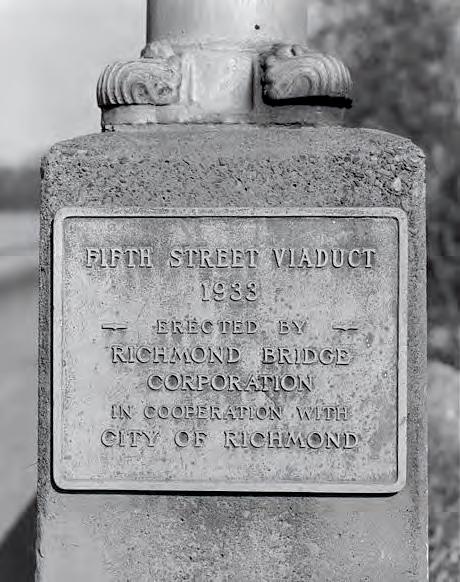
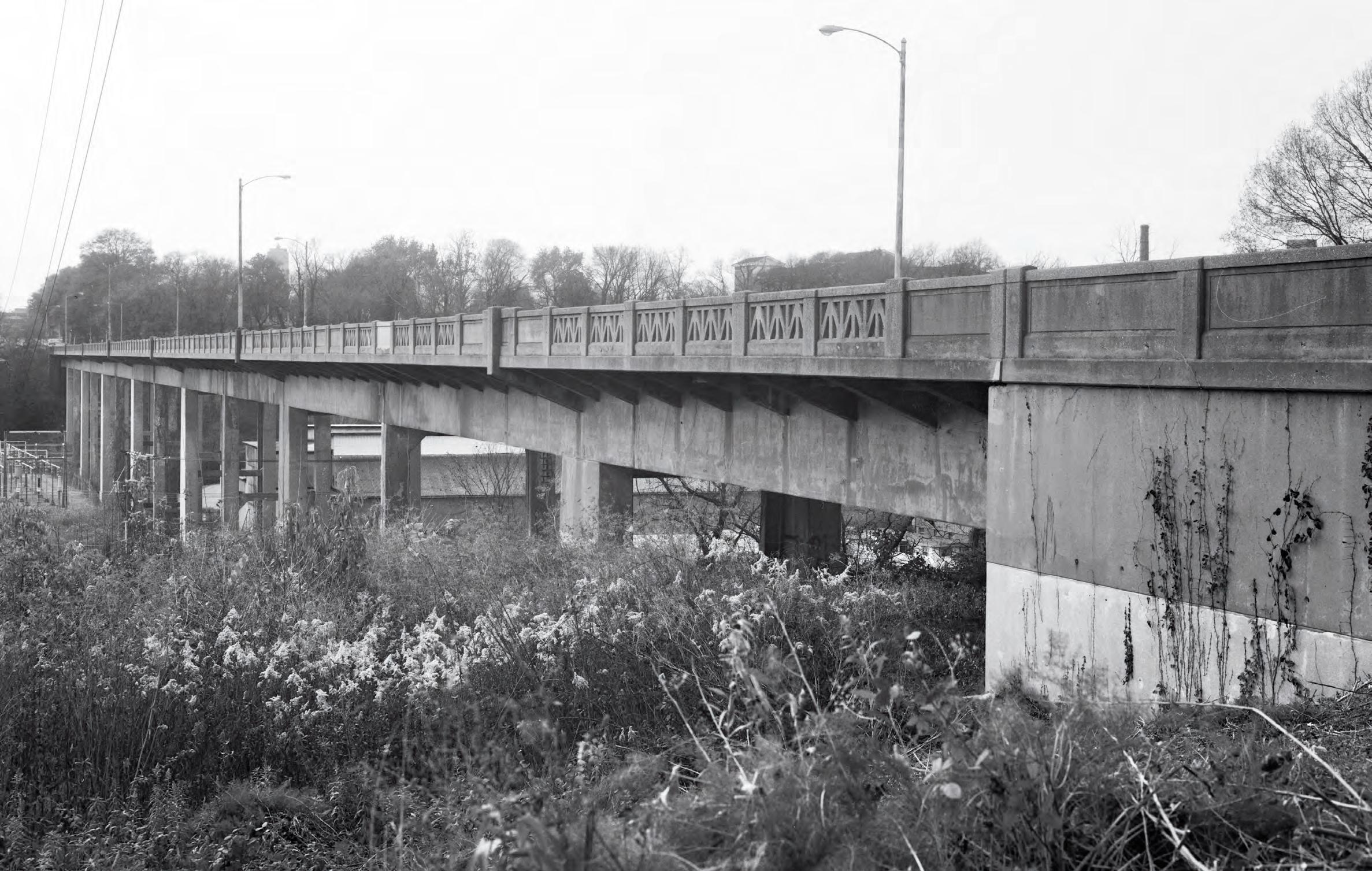
The company was retained by the Richmond Bridge Corporation in February 1933 for a modern iteration of an 1890 viaduct structure known as the Fifth Street Viaduct in Richmond. The bridge consisted of seven double-span rigid frames and crossed a stream known as Bacon’s Quarter Branch and connected downtown Richmond to some burgeoning residential areas. Work began in mid-May with more than one hundred skilled and unskilled workers and was completed in December. The job site was the scene of some late-night hijinks in June when a car laden with jugs of
whiskey was attempting to elude the police force. The driver, his lights extinguished, didn’t realize that the original bridge was no longer operable, attempted to drive over it and just missed plunging 150 feet to a certain death; he was saved by the fact that his axles dragged on wooden cross beams before he could tumble over.
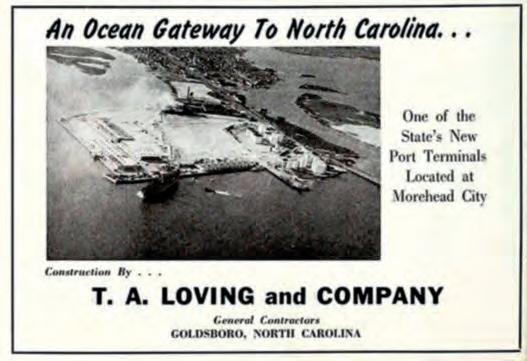
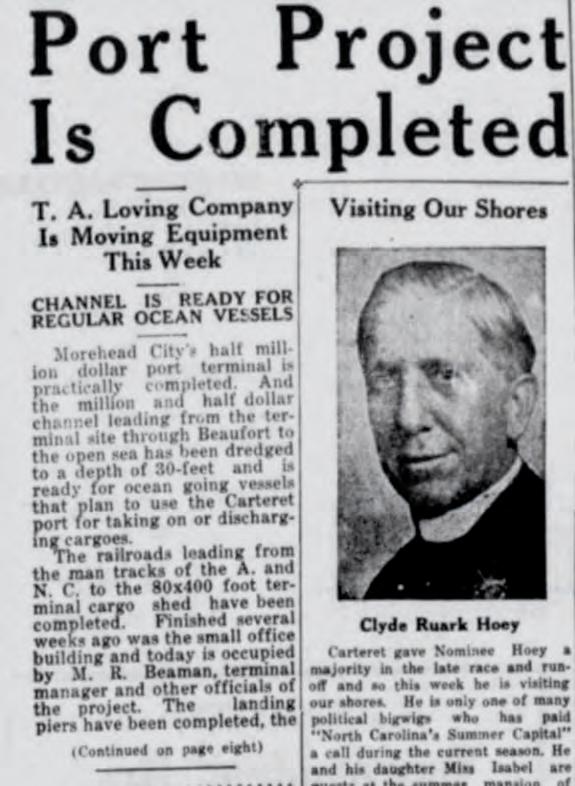
The company benefited from the Works Progress Administration during the depths of The Depression in the 1930s. The State magazine noted in October 1935 that WPA allotments for North Carolina had reached $2 million and would provide work for some 50,000 individuals. One of those was for construction of port terminals in Morehead City. T.A. Loving’s bid of $375,000 secured the job. “The new port will bring additional prosperity to North Carolina,” the magazine noted.
An article in a Culpeper newspaper in January 1935 was headlined, “Local Boy Makes Good,” and goes on to detail new construction at William & Mary College in Williamsburg and that the job, which included administration and faculty offices and classrooms, was being managed by Loving’s company.
“The fact that a Culpeper boy is handling this important construction work is a source of interest to his many friends in this town,” the story said.
T.A. and John married sisters, T.A. wedding Allene Crews and John taking Frances Crews as his bride. T.A. had just built a nice house for him and Allene in Goldsboro when she died of cancer in 1933 at the age of twenty-six.
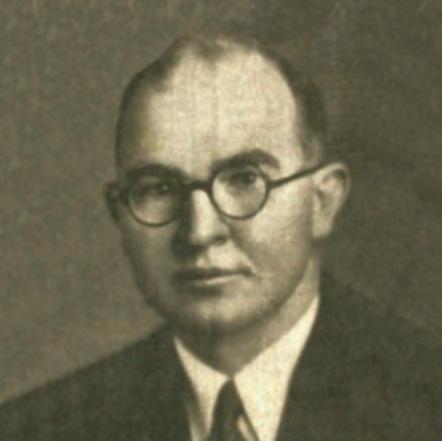
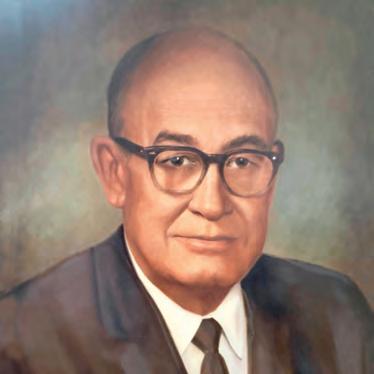
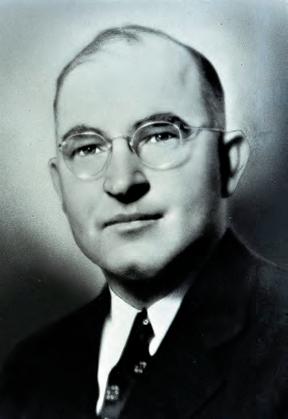
“I remember T.A. being big and tall,” Ann says. “He was bald with little round glasses. He was very outgoing, he had a booming voice and he laughed a lot. He always had on a white shirt.
“Daddy always looked rumpled because he was working all the time. His hat was always bent, and he had on overalls and he just looked like he came off the job site. He always looked like he needed a haircut. But as he grew older, he became very precise about looking nice. He was probably sixtyfive when he organized a high school class reunion, and they took a group photo. He was the best-dressed and the most handsome one in the picture. He was healthy because he was physically active in the construction business all his life.
“He never aspired to work from an office. He wanted to be out on the job, where his crane operators, pile drivers, tugboat operators and laborers were among his treasured friends.”
The y oung company had to survive The Great Depression, and simply doing so beckoned well for the niche it had created and the company’s leadership. Ann remembers her father telling the story of going to West Virginia to build a bridge in the early 1930s and making a $3,000 profit.
“That money kept the company going,” she says. “As Daddy told it, they were about to go bust.”
It took guile and sweat and persuasion to survive those times. The company was building a culvert in the mountains west of Asheville during the early 1930s.
“They were out in the country with no hotel, no restaurants or boarding houses,” remembers Giles Trimble, a longtime employee who was John Loving’s righthand man and senior vice president and Bridge Division manager. “They found a country home—some called it a ‘poor house’—nearby with available rooms. T.A. talked the management into allowing his
people to live there as room-and-boarders.”
Halfway through the project, a salesman from Virginia Steel arrived to collect payment for a long-overdue bill for a shipment of steel. Loving told him all payments from the state so far had been used for salaries and other materials and that he had no money. He had to press the salesman to convince his boss to send yet another railcar of steel to allow them to finish the job. The bill was eventually paid in full.
“The salesman later said that the hardest day in his life was going into the president’s office of Virginia Steel and requesting permission to ship the final railcar of steel,” Trimble said.
Other companies weren’t so fortunate, and the demise of one building contractor in Goldsboro would prove fortuitous for T.A. Loving Company. William P. Rose was an architect and contractor, erecting numerous courthouses, hospitals and schools across Central and Eastern North Carolina in the early 1900s. But in 1930 and ‘31, he suffered substantial losses, and the town took a hit with the closing of Peoples Bank of Goldsboro, of which he was a director.
Raymond A. Bryan was born in Newton
Grove in 1899 and studied engineering at N.C. State University for two years in the late 1910s before entering the workforce with W.P. Rose Construction. He was thirtytwo years old in 1931 when Rose’s company went into receivership and Bryan lost his job. Bryan and Loving lived across from one another on Pine Street in Goldsboro, so it’s likely that them being neighbors prompted Loving to suggest that Bryan come to work for him.
“I was seven or eight years old in the late thirties when T.A. Loving’s house was being built,” Raymond Bryan Jr. remembered years later. “I ran a little drink stand and had a captive audience right across the street selling drinks to all the workmen.” Bryan was an ideal fit for Lo ving’s business and within four years worked his way up to being named general manager of the building division.
While T .A. lived and worked in Goldsboro, he maintained his Virginia roots by owning and operating a cattle farm in Swoope, Virginia, about thirty-five miles west of Charlottesville. John liked what he saw in T.A.’s farm and bought a farm himself in Fishersville, about ten
miles toward Charlottesville from Swoope.
John and Frances got married in 1942, and in March 1944 the couple gave birth to Ann, the first of three children. John’s allegiance to his life in Virginia would
become established early.
“Daddy was happy farming, raising cattle, riding horses, planting, harvesting, keeping bees, and for a time, he gave up working for T.A.,” Ann says. “He did one bridge project in New York for another company. He stayed at home with my mom and me. But then T.A. talked him into coming back to build bridges.”
John traveled around the South—to Selma, Alabama, to build the Edmund Pettus Bridge and to Daytona, Florida, to supervise the Seabreeze Bridge and Port Orange Bridge.
“Until I started the first grade, we were all over the place,” Ann says. “It was fun to me. I liked moving around and I liked riding the train to Florida. It was great. But then my sister came and I think Mama was pregnant with her third child, and they decided they were going to settle down back in Virginia. We went back to the farmhouse and that was home from then on.”
From 1925 to 1932, the compan y focused on bridge, highway and heavy construction. In 1932, it expanded into monumental, industrial, educational and housing construction of all types, according
to an early brochure, with operations in the Carolinas, West Virginia, Virginia, Alabama, Georgia and Florida. An early newspaper advertisement said, “For the big jobs, T.A. Loving and Company often get the bid.”
Charles Banks McNairy Jr. was another W.P. Rose Construction Co. employee who lost his job in 1931 and came to work for T.A. Loving. McNairy graduated from Kinston High, went on to the University of North Carolina and proved his mettle in the 1930s so much with Loving that he was tabbed in 1940 to be the wartime project manager for huge multi-million dollar military installations at Fort Bragg and Cherry Point.
His son, C. Banks McNairy III, joined the company in early 1948 and worked on jobs across the spectrum over forty-five years, eventually making vice president.
The business structure changed in 1937 as the company survived the bleak economic times and started to grow. It changed from a sole proprietorship into a corporation on Nov. 12, 1937, with T.A. Loving the president (owning 2,247 of 2,500 shares of stock), Bryan secretary/treasurer (183 shares) and McNairy vice president/assistant
secretary (seventy shares). John Loving was elected as a director and vice president on Nov. 24, effective the first day of 1938, and received seventy shares of stock as well. But he remained in Fishersville and set up an office for his headquarters.
“At one point, T.A. talked to Daddy about running the company,” Ann says.
“Daddy told him no, that he didn’t want to move to Goldsboro. He wanted to live in Virginia and wanted to keep building bridges. He considered Virginia home and quite honestly he was somewhere building a bridge all the time. He would just come to Goldsboro for stockholder meetings or company meetings.”
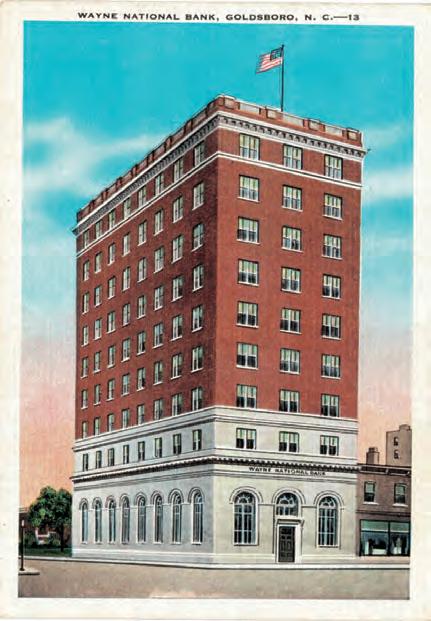
From 1931 to 1981, the company was headquartered in the Wayne National Bank Building, a nine-story structure that opened in 1924 at the corner of Walnut and James Streets in Goldsboro (it was later owned by Wachovia Bank). Hazel Allred Harmon followed Raymond Bryan from working for W.P. Rose Construction to T.A. Loving in 1931 and worked for the company for more than half a century.
“When we started out, there were three offices,” Hazel said in a 1983 interview. “Mr.
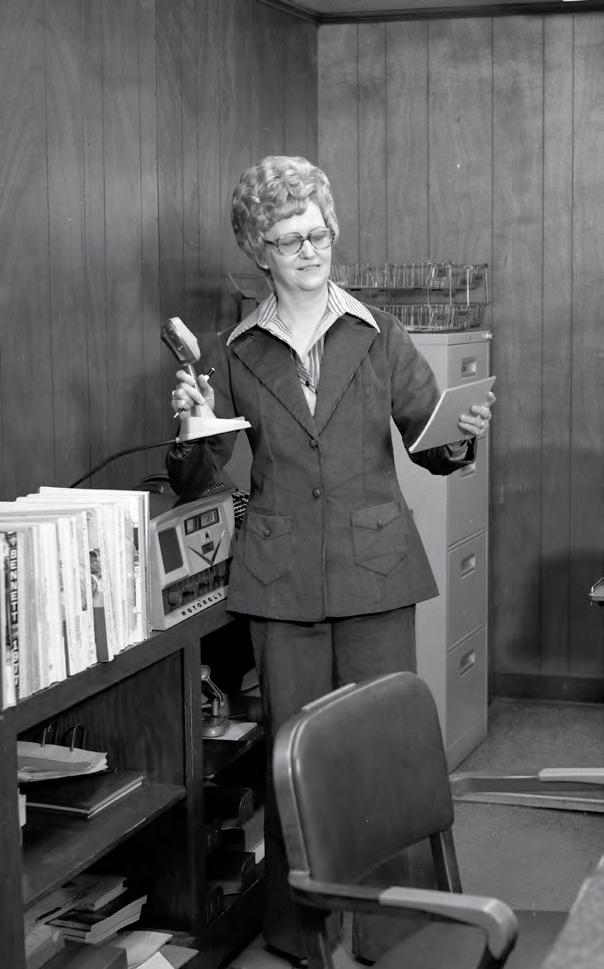
Bryan and Mr. Loving shared an office, two estimators shared another office, and I was the secretary/receptionist/bookkeeper with my office in between.”
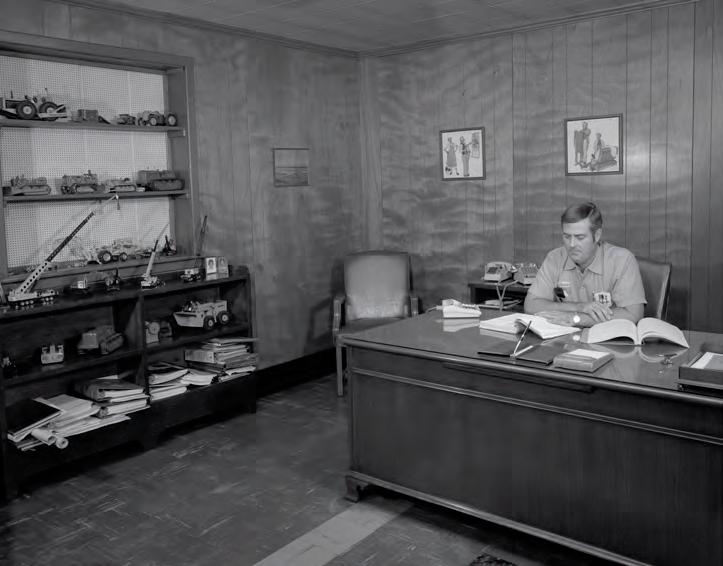
By the mid-1950s, the company was occupying more than one half of the seventh floor, and it grew over time to take over the entire seventh floor and eventually moved onto the eighth floor as well. When the company went from typing payroll checks and processing handwritten payroll cards into the computer age, an elevator was constructed to get a National Cash Register Company mainframe computer up to the seventh floor. The company remained downtown until moving into its own headquarters on Patetown Road in April 1982.
T.A. Loving Company first had a physical presence in Raleigh in the 1960s on Wolfpack Lane just northeast of downtown when it acquired a paving contactor named F.D. Cline Company. It maintained that office until the 1980s, when it sold the property. The company also maintained a satellite office on Airport Boulevard in Research Triangle Park in the early 2000s, primarily to service some major projects at the University of North Carolina in Chapel Hill.
The company’s business in the Triangle region continued to expand as the 2000s evolved, and in April 2019 the company opened an office on Glenwood Avenue in Raleigh. The new operation would serve as a hub for the company’s expanding portfolio of work throughout the Raleigh, Durham and Chapel Hill business, education and health care communities.
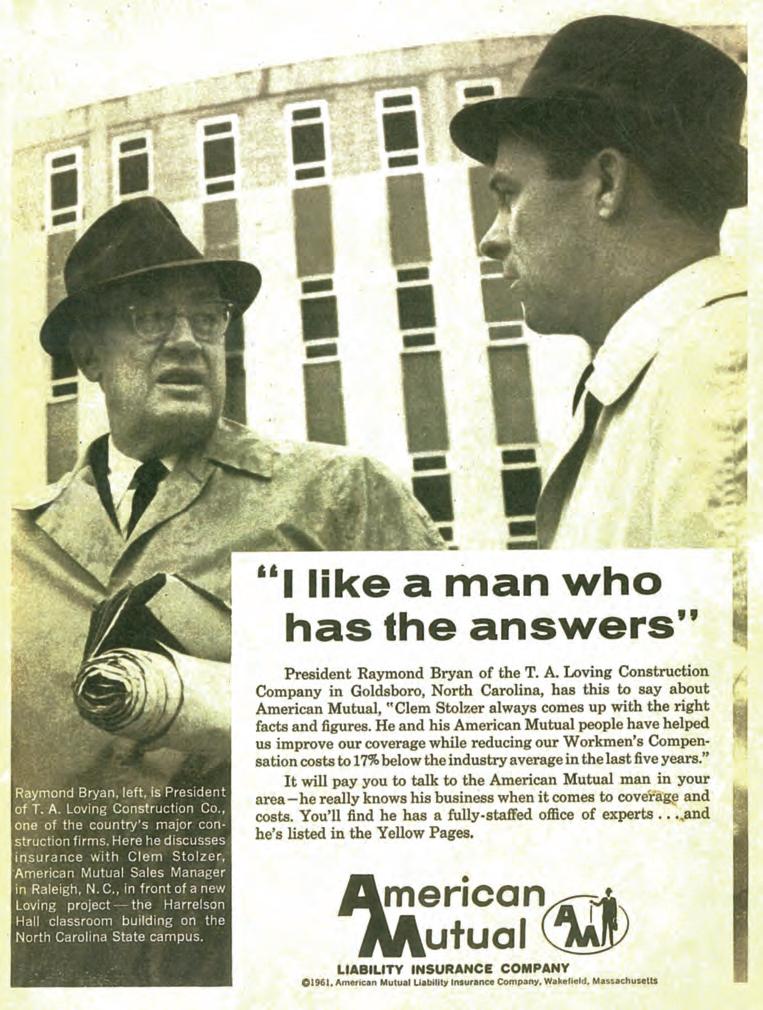
“Our ties to the Triangle have been strong for our entire company history spanning more than ninety years,” CEO Sam Hunter said upon the Raleigh office opening. “We take pride in producing quality construction projects that have become some of the area’s most recognizable landmarks—from the 1962 construction of Harrelson Hall at N.C. State to the Fayetteville Street renovation to the recently completed indoor football practice facility and soccer/lacrosse stadium at UNC. Our partnerships here are important to our business, and the new office allows us to better serve the daily needs of the Triangle market.”
There were more than 25,000 people on the payroll at one time during the early 1940s when the company was hired to build what was basically an entire city
for the United States military— barracks, roads, theaters, fire stations, hospitals and bridges at Fort Bragg in Fayetteville at a cost of $38 million. Other work included $585,772 on Albemarle Sound Bridge at Plymouth and $818,000 Garden Homes Estate in Savannah. The company also completed a $1.9 million defense housing project in Wilmington and $767,500 for administration buildings and barracks at naval air station in Jacksonville, Florida.
“Work was the great hobby of this builder, yet he carried his sense of humor and his pleasant personality into his most strenuous efforts,” the book North Carolina Roads and Their Builders noted of T.A. “Cross words had no part in his organization.”
Arthur Allred was typical of the kind of loyalty and longevity the company engendered. He started with T.A. Loving Company in 1932 driving a dump truck and mostly hauling gravel from sand pits near Fort Bragg. He made thirty-five cents a day. He served in the Army during World War II and then returned to Goldsboro and would work fifty-two years total for the company.
Not only was he a good employee, but he served the purpose of having the same blood
second wife, was elected to the board. The Building, Utility and Equipment Divisions were run out of Goldsboro, the Paving Division in Raleigh (it was sold in 1968) and Bridge Division in Fishersville.
Arthur Allred, W.E. Smith Jr., George Goodwin and Giles Trimble were among employees joining the company in the mid1900s and having served the company their entire careers.
type as T.A., who for much of his adult life suffered from an autoimmune disorder.
“My blood matched perfectly with his,”
Allred said. “We didn’t even have to put the blood in a bottle, we’d just go direct because our blood matched so perfectly. After the war, T.A. was in Miami and needed a transfusion.
Raymond said for me and my wife to get on the train and go down there. We drove his car back so he could ride the train.”
John was called “Captain John” by his workers and likewise had a devoted following.
“He was the nicest man you would ever meet
in a lifetime,” said Pete Jarrell, a long-time company employee. “He was a prince. He looked after his jobs. He went to his jobs. He saw what his men were doing.”
T.A. suffered from pernicious anemia and died at the young age of forty-seven in 1947, succumbing at University Hospital in Charlottesville following “several years of declining health,” according to a news report. When Loving died, Bryan was elected president in September 1947, John Loving was appointed vice president and McNairy secretary/treasurer. Ruth Loving, T.A.’s
John Loving continued building bridges across the Carolinas, Virginia and beyond until settling into retirement in the 1980s. He and Frances continued to live in Fishersville, and one of his favorite projects in retirement was supervising the construction of an educational building at Tinkling Spring Presbyterian Church. Loving had served as an elder at the church, and when his wife died, he paid for a new pipe organ for the church sanctuary in her memory. Loving died in 1993 at the age of eighty-six.
“Every Sunday growing up we’d go to church,” Ann Hunter says. “Then we’d go out to lunch. It was his way of thanking Mama for all her hard work. Then he’d go pack his suitcase and head back out to build a bridge.”
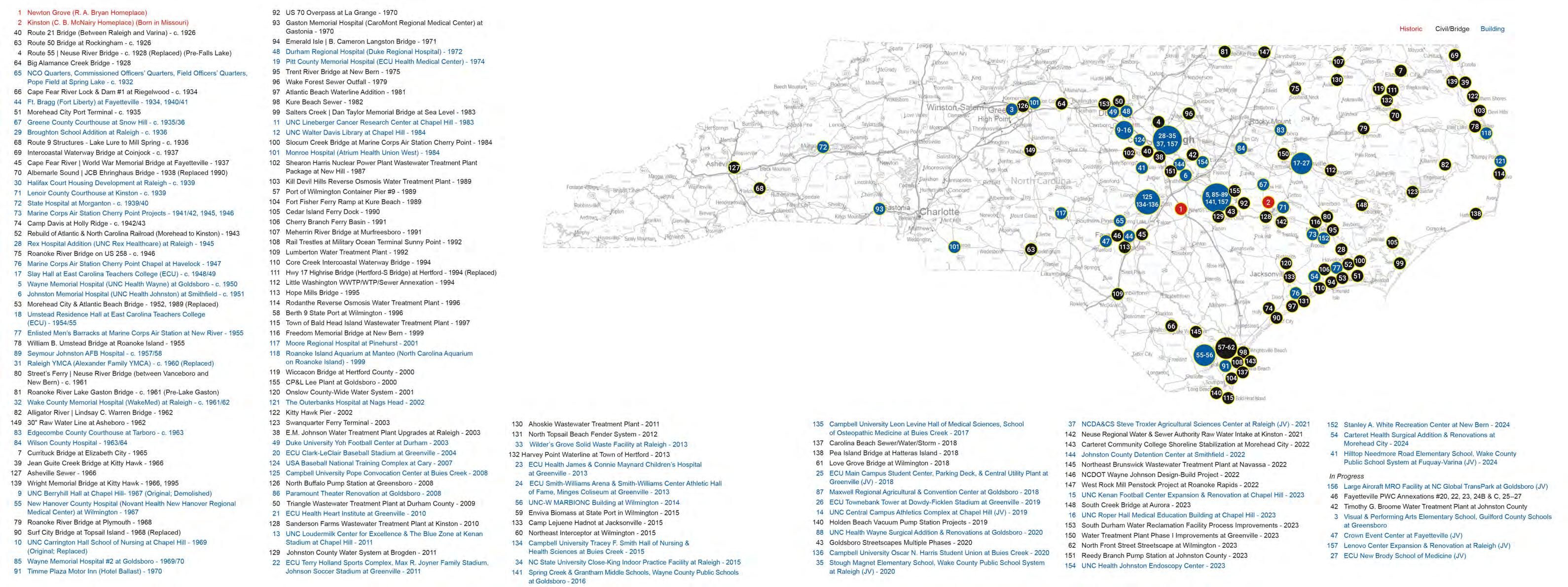
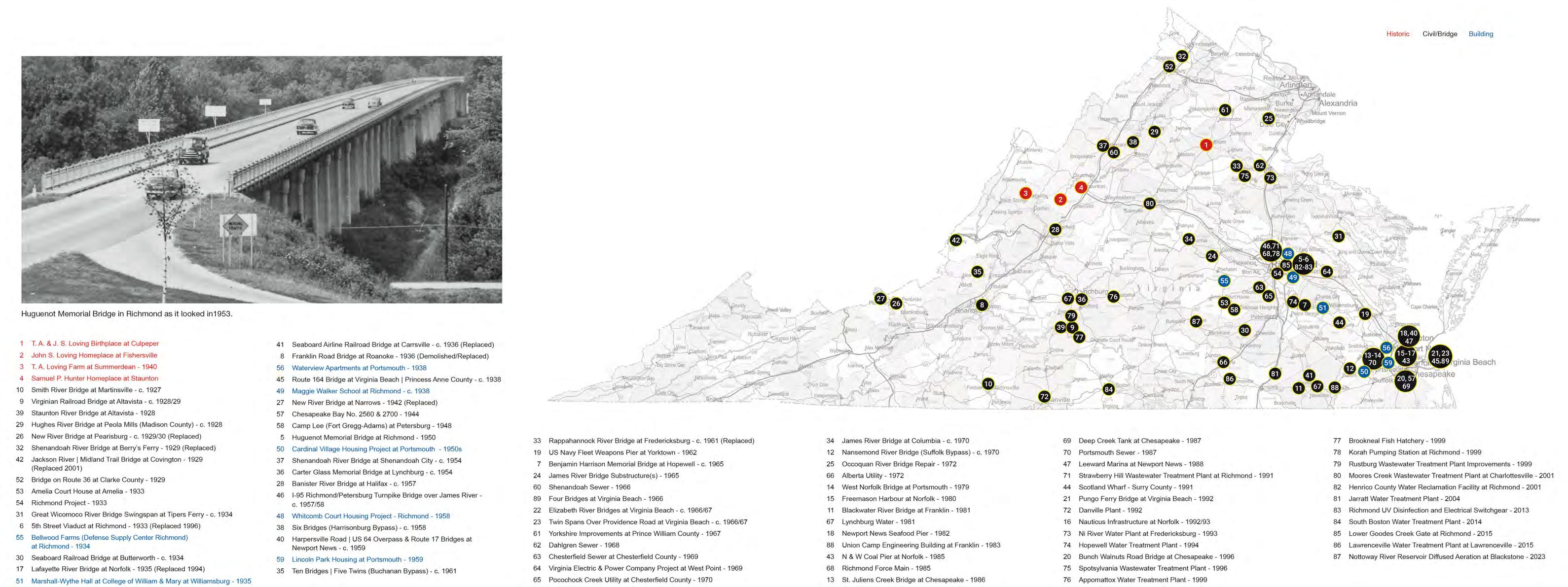
T. A. LOVING COMPANY • 100 YEARS
T. A. LOVING COMPANY • 100 YEARS
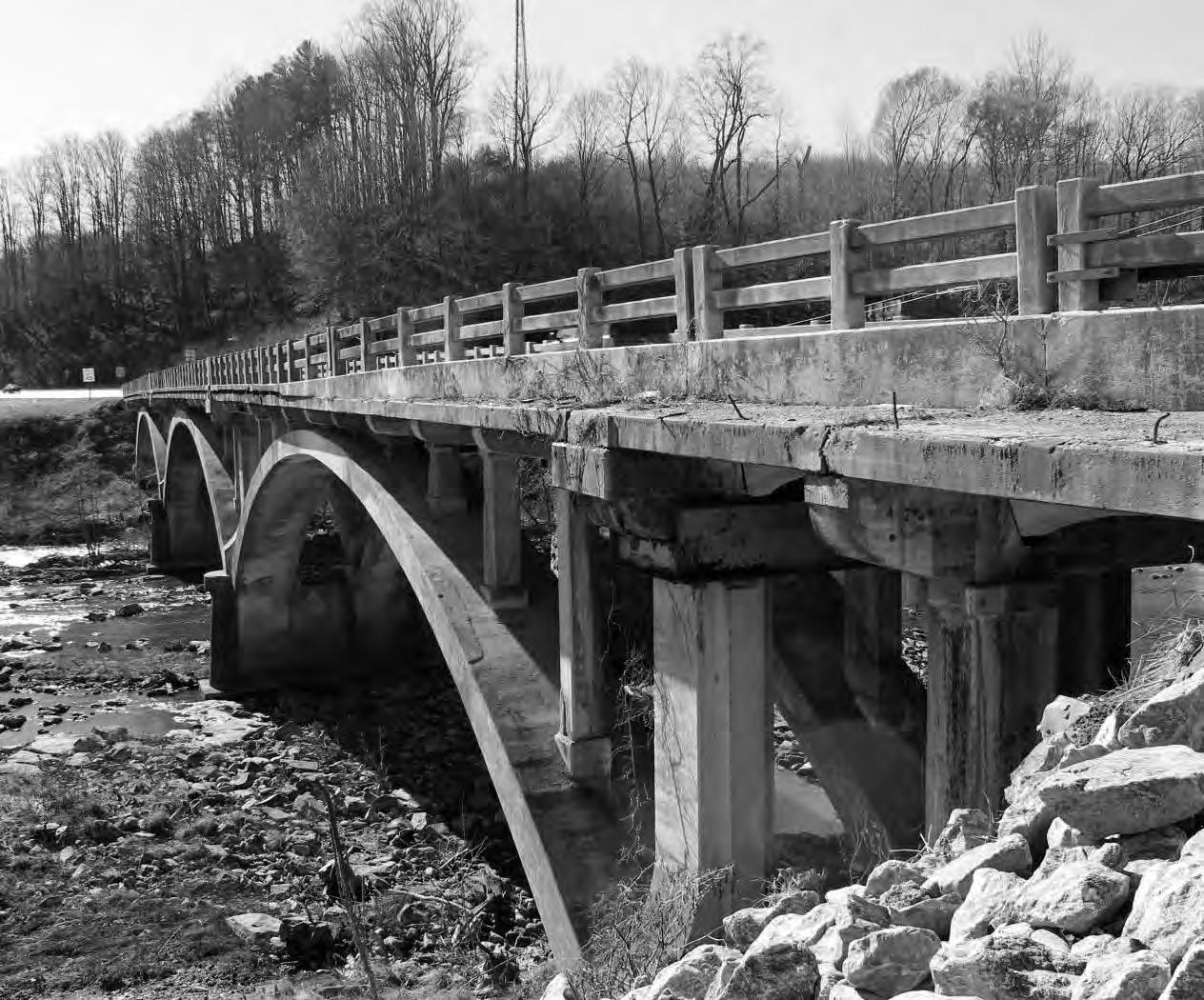
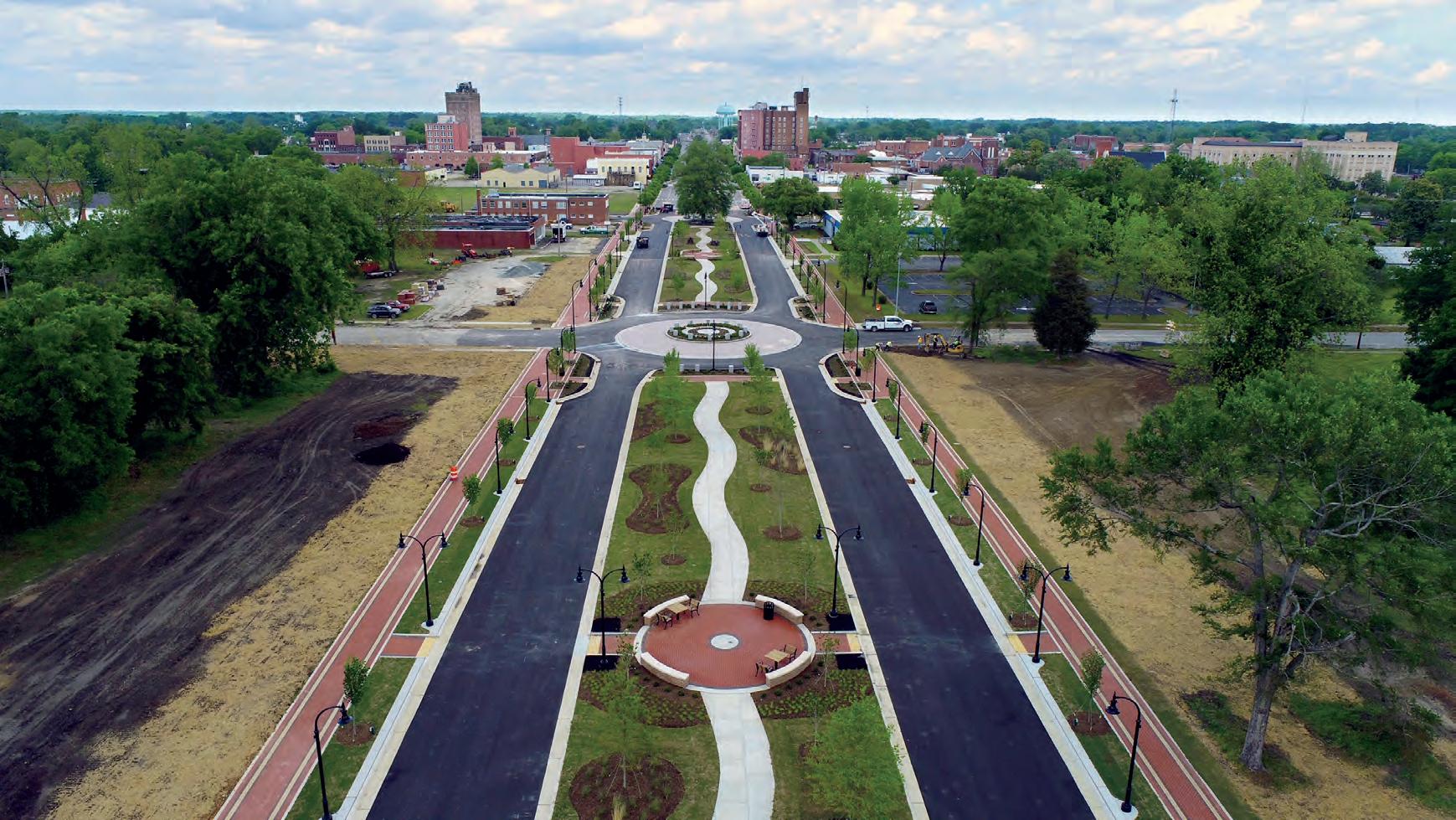
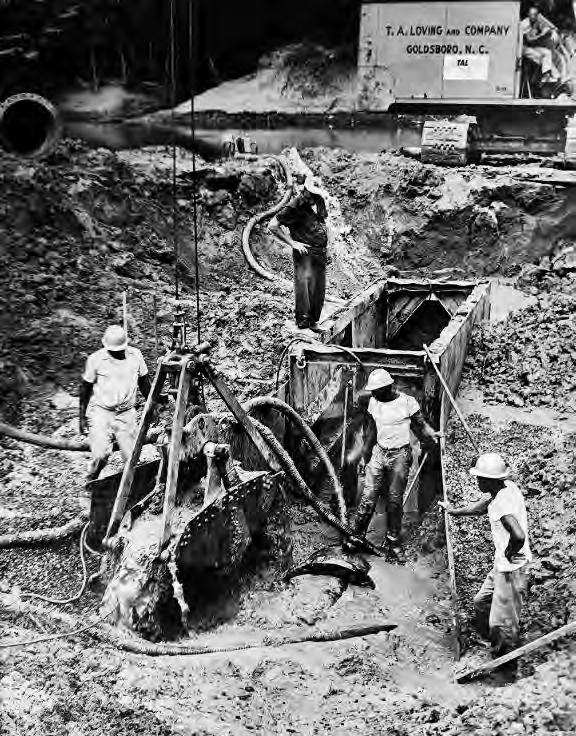
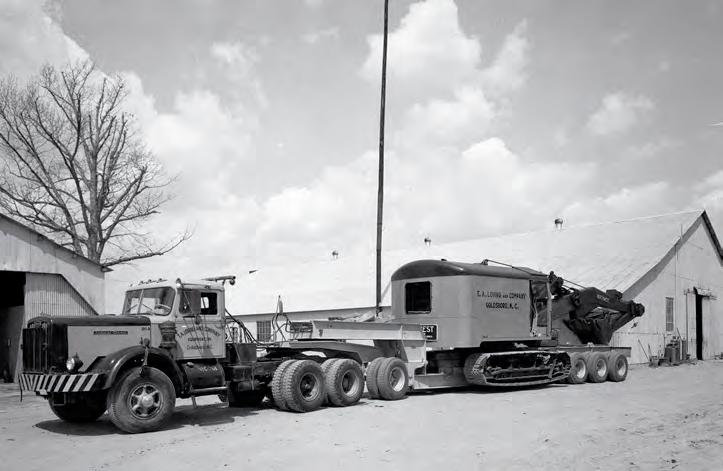
The T.A. Loving Company name was adorned on equipment that traveled the state and the southeast. At left, workers in the mid-1900s are working on a wastewater treatment plant at the Neuse River Crossing near Goldsboro. The company’s more recent efforts to serve its hometown (opposite) are shown with an aerial view of the Center Street Improvement project in 2015.
Steve Bryan was about seven years old when he and his brother Ray “Buddy” Bryan III were playing in an upstairs bedroom in the family’s vacation house on Evans Street in Morehead City, just a block from Bogue Sound and a mile away from Atlantic Beach. They had fun watching from the window as tugboats flowed up and down the Intercoastal Waterway and passed through the drawbridge, and they’d use the crank mechanism on the window to mimic the opening and closing of the drawbridge.
One day they asked their grandfather, Raymond Bryan Sr., if they could walk down and get a closer look. Raymond was president of T.A Loving Company, which built the bridge in 1953 to replace the original bridge that opened in 1928.
“We walked down and my granddad introduced himself to the D.O.T. bridge guy and told him he worked for T.A. Loving, and he built that bridge,” Steve says. “‘These boys would like to hang out and watch you open the bridge,’ he said. So we went up those steps on that drawbridge and the man hit some buttons and the sirens went off and the gates went down. It was the coolest thing ever. I remember it like it was yesterday.”
The Bryan family heritage is full of stories like that, with four generations on the company payroll from Ray Sr. joining T.A. Loving in 1931 through today, with Steve in 2023 serving as vice chairman and his daughter Madison Bryan Everett joining the company in 2017 and working in several areas, most recently in corporate outreach and as Bryan Foundation associate.
“It’s hard to believe we’ve been around for a century,” Steve says. “I’ve heard the restaurant and construction businesses have
the highest failure rates. You see restaurants come and go. And if you’ve got a pick-up truck and a tool box, you can call yourself a contractor.”
“What has stood out to me is the overall sense of humbleness and generosity from my great grandfather, grandfather and father,” Madison adds. “I think that’s really special. What’s important to me is continuing that service to the community and the region that the Bryan family and T.A. Loving Company are known for.”
The Bryan family story begins in Newton Grove, a small town twenty miles southwest of Goldsboro originally chartered in 1879. James William and Irene Bryan both were school teachers and ran a farm, and their seven children born in the late 1800s were imbued with several core qualities that would serve them well.
“The children grew up with the advantage of having intellectual parents in a setting that demanded hard work tilling the soil before the advent of mechanization,” the Goldsboro News-Argus said upon the passing of Raymond Sr. in November 1982.
Raymond Sr. was born in 1899 and attended N.C. State University for two years
before going to work for W.P. Rose Company in Goldsboro in 1924. He lost his job during the early days of The Great Depression but quickly latched on with T.A. Loving, beginning as an estimator and in 1935 being named general manager of the Building Division with a salary of $250 a month, plus one-third of the profits from the division.
Though he lived in Goldsboro and worked out of the T.A. Loving headquarters, his reach extended to Raleigh in one direction and to the coast of North Carolina in the other.
James “Willie” York grew up as the son of a building contractor in Raleigh in the early 1900s and was building houses prior to World War II, but when the war began, the government restricted building materials for nonessential purposes and York closed his business. Bryan hired him to work for T.A. Loving, and in January 1942, Bryan sent York to Jacksonville to work as an expeditor on the expansion of the Marine Air Base at Cherry Point. Two years later, York supervised the construction of hundreds of small homes for servicemen in Jacksonville and in the process met Ed Richards of American Housing Company
and his architect, a transplanted Norwegian named Leif Valand. They were on the cutting edge of the prefabricated home building business, and York bought building kits from Richards and did extensive work in Morehead City.
After the war, York returned to Raleigh and resumed his home building business with Bryan as his partner, and they embarked on a project that would have a far-reaching impact on the evolution of the city. Bryan and York envisioned a mixed-use community modeled after Kansas City’s Country Club Plaza on 158 acres of former plantation land west of downtown. Valand provided the architectural plans in an “open-air shopping mall” concept that included sixtyfive retail stores, 112 offices, 466 apartment units and a hundred single-family homes. It was called Cameron Village and opened in 1949. It was Raleigh’s first master-planned community employing vertical integration where design, construction and property management were handled by an integrated vortex of ownership and management. Cameron Village Inc. was owned fortyfive percent by York, forty-five percent by Bryan and ten percent by James Poyner, a


The plumb bob has been a part of T.A. Loving Company’s corporate logo from the start. But what has changed over the years is the usage of “T.A. Loving” and “TALCO.”
For at least the first half century of its existence, company collateral, signage and advertising used the name of the man who founded the company in 1925, Taylor Abbitt Loving. But a company brochure from the 1980s had begun referring to the company as TALCO, and a booklet published in 2000 to commemorate its seventy-fifth anniversary featured a logo with the plumb bob graphic separating TAL in boldface and CO in a lighter face.
The company in 2002 decided to move away from TALCO and revamped its logo.
“In the quest to maximize name recognition, we decided that the use of the name ‘Loving’ was going to be more beneficial in helping the marketplace recognize and remember T.A. Loving Company when they saw our logo,” company marketing executive Mark Moeller said in a corporate newsletter story. “Unfortunately, the use of TALCO as our logo did not accomplish that and may have even created some confusion.”
The company’s current logo with the plumb bob separating TA and Loving was introduced in the summer of 2016. It was time for a fresh look and to differentiate the company from several other similar looking marks in the construction industry.
Raleigh attorney and York’s brother-in-law.
After York and his wife divorced in 1960, Cameron Village was sold to Connecticut General Life Insurance and subsequently leased back to York. One of the buildings in Cameron Village was named for Bryan, and Bryan Street is an appendage of Wade Avenue “inside the beltline” not far away.
Bryan’s association with Valand extended to T.A. Loving Company supervising Valanddesigned office buildings in Raleigh for Cameron-Brown Company and First Union Bank on Six Forks Road; the Central YMCA on Hillsborough Street; the W.T. Grant Department Store in Goldsboro; and Holly Hill Mall in Burlington.
Bryan’s summer home in Morehead City and connections with the “Crystal Coast” area that includes the elongated strip of beaches from Atlantic Beach west to Emerald Isle positioned him to be among the founders of a new club in Atlantic Beach called the Coral Bay Club. It opened in June 1958 and was built by T.A. Loving Company, and the ranch-style clubhouse was designed by Valand. The board of directors read like a Who’s Who of business and social circles in the central and eastern
parts of North Carolina, including Mrs. Eddie Cameron of Durham, James Poyner of Raleigh, J.S. Ficklen Jr. of Greenville, Robert M. Hanes of Winston-Salem and Willie York of Raleigh.
“The Coral Bay Club spells easy, but luxurious summertime living,” said a passage in Our State magazine. “Guests who have been everywhere say quite frankly there is no place like it on the coast. There is an air of a big family house party—daytime, night time.”
The club remains a vibrant and viable operation today situated 1.5 miles from the Atlantic Beach Bridge toward Pine Knoll Shores. Steve Bryan has been using the club all of his life.
“It’s been a part of our family in the summer for as long as I can remember,” he says. “It was a place for dining and dancing. They had bands every Saturday back in the old days. I remember Les Brown and his Band of Renown was a regular. The club is doing well. I hear they have a waiting list now.”
Beyond running T.A. Loving Company, Raymond Bryan’s reach for doing good extended across the state of North Carolina.
He sat on the boards of Wachovia Bank, Carolina Power & Light Co., Atlantic and East Carolina Railway and Durham Life Insurance. He was an investor also in the North Hills Shopping Center in Raleigh and Cameron-Brown Company, a leading mortgage and financial services firm. Bryan contributed time and resources to numerous charitable and church endeavors and in 1975 received the N.C. Citizens Association Distinguished Citizen Award.
The Goldsboro News-Argus upon his death in November 1982 said, “He was a remarkable member of one of North Carolina’s most remarkable families.”
“He was a man of uncommon goodness,” said E. Leon Smith, pastor of First Baptist Church of Goldsboro in delivering the eulogy. “He was a builder of buildings and bridges, but more importantly, he was a builder of people. He gave freely of his time and resources for the lifting of the quality of human life and for the common good. In his quiet and unassuming manner laced with wisdom, he helped to guide his church, institutions of learning and numerous benevolent charities through this state.”
One contractor at his funeral observed,
Those that loved Ray knew him as a man of passion, music and fun, a lover of practical jokes and an admirer of all things beautiful.
“In a field that is as competitive as the contracting business, I know of no other person who was so universally admired.”
Bryan’s last notable achievement was leading his siblings into underwriting the $250,000 cost of a new library for their hometown of Newton Grove. The 2,900-square foot library was dedicated and opened in December 1982, just a month after Bryan’s passing. Wilmington-based architect Leslie N. Boney Jr., a long-time associate and services vendor of Bryan and T.A. Loving Company, delivered the dedication address and noted that his firm had designed the Walter Davis Library at the University of North Carolina that was under construction and being contracted by T.A. Loving and, at 436,000 square feet over eight stories, was considered one of the
largest university libraries in the nation.
“Mr. Bryan wrote to me and said that I had designed the largest library in the world, now would I design the smallest in the world?” said Boney, who then reflected over his years of working for Raymond Bryan and the influence Bryan’s parents had educating youngsters in Sampson County.
“Their work lives on in those who cannot be named or numbered,” Boney said. “I recognize that few, if any, families in Eastern North Carolina have had the influence and made the impact that Mr. and Mrs. Bryan and their children have.”
Where Raymond was low-key and softspoken, Ray Jr. was more outgoing. Ray Jr. was born in 1931 and was an only child. He grew up in Goldsboro, earned an Eagle Scout badge and played football for
Goldsboro High. He attended N.C. State and studied construction, graduating in 1953, and spent summers in college working for T.A. Loving in Daytona Beach on the Seabreeze and Port Orange Bridges. He served two years in the U.S. Army in Korea, then married Jo Ann Collier in 1955 and went to work for T.A. Loving. He became president in 1969 and managed the company for nineteen years, assuming the office of chairman in February 1988 with Sam Hunter taking over as president. He worked for years as an estimator then as project manager on various jobs on the N.C. State campus. His key lieutenants included Giles Trimble with the Bridge Division, Bob Loving running the Utility Division and D.C. Rouse in charge of the Building Division. The company also had a Paving Division that it sold to REA Construction in 1968.
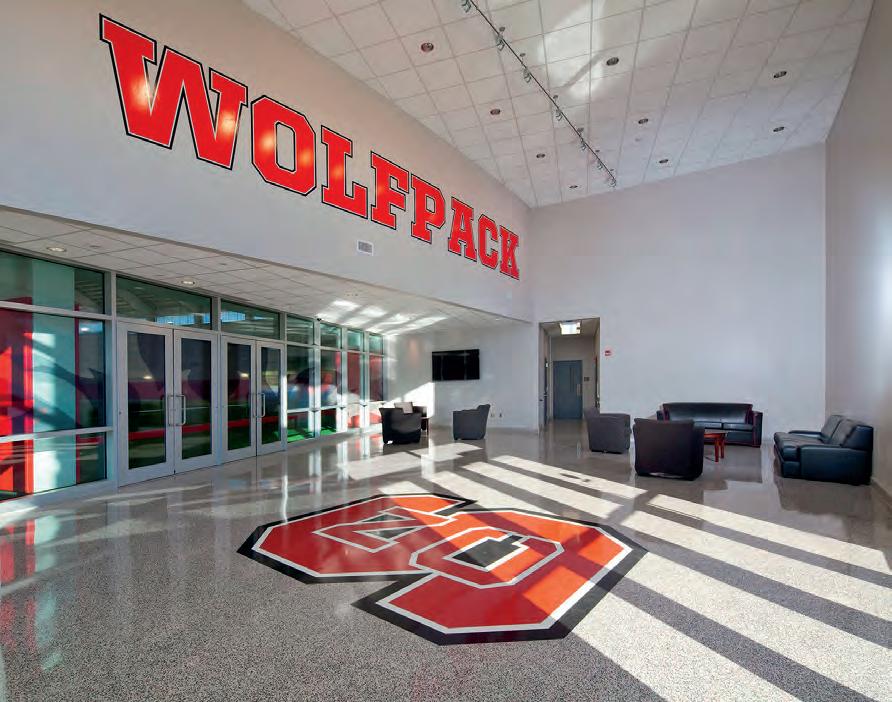
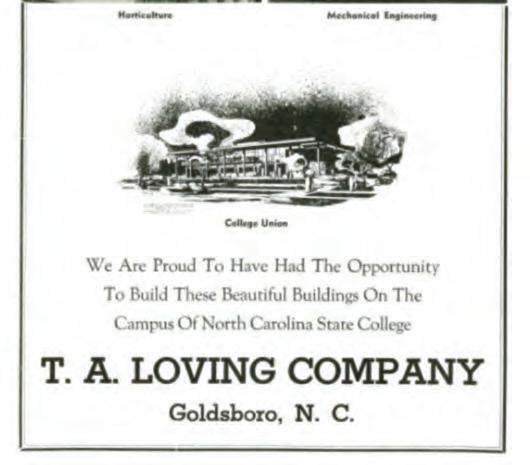
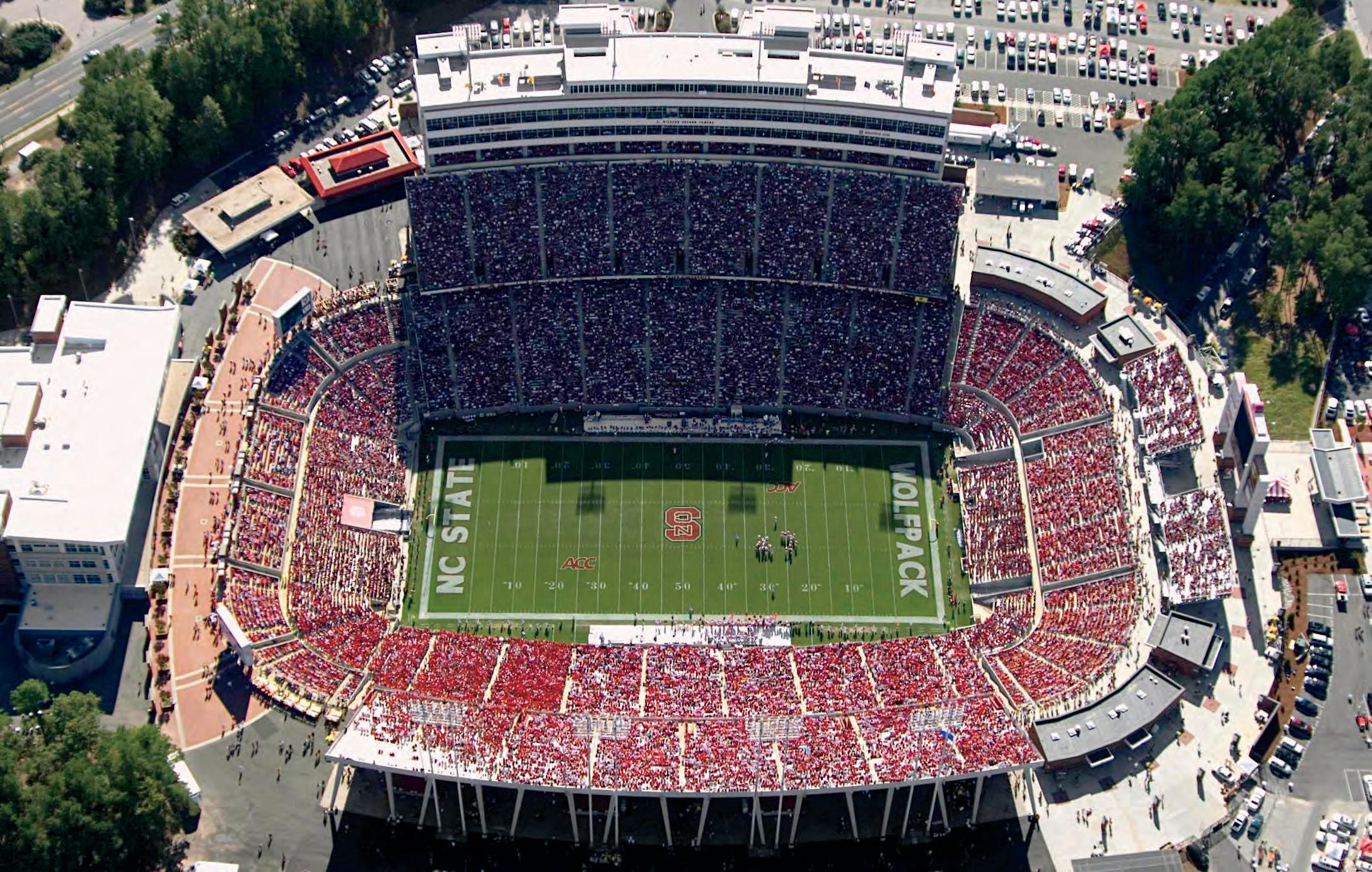
Like his father, Ray Jr. was a master at tending to business, various philanthropic endeavors and supporting the educational and athletic communities at N.C. State (T.A. Loving Co. built the Wendell Murphy Football Center and the Carter-Finley Stadium expansion in the early 2000s as well
as the Park Alumni Center on the Centennial Campus). Bryan also carved time out for a wide variety of recreational interests; was a good golfer and a member of the Country Club of North Carolina in Pinehurst, an avid outdoorsman, a talented photographer and also loved to play the drums.
“Those that loved Ray knew him as a man of passion, music and fun, a lover of practical jokes and an admirer of all things beautiful,” read the eulogy following his death in March 2016. “Ray enjoyed getting along with people from all walks of life as he marched to the beat of his own drums.”
“My grandfather was modest, and while very successful in many ventures, it never changed him at all,” Steve Bryan says. “He treated everyone the same. When he spoke, people listened as he had something to say. My father was an only child, and while he was like his father in most ways, he was somewhat more outgoing.”
Steve graduated from N.C. State in 1982 with a degree in engineering and went to work for the company, but he didn’t want to come straight back to Goldsboro and asked to be sent elsewhere. He worked on the Union Memorial Hospital project in Monroe, then
moved back to Raleigh and commuted to Chapel Hill every day to work on a job at UNC Hospital complex. He worked four ten-hour shifts Monday through Thursday, then came to Goldsboro to help his father with the family’s other interests.
Like many others before and after him in the T.A. Loving family, the thrill of watching a project evolve from blueprint to ribbon-cutting captured Steve Bryan from the beginning.
“You start out with nothing, and it progresses, and the average person walking down the street doesn’t have a clue how that building is standing up, but the worker does,” he says. “He sees the footings, the steel, and the concrete. He sees the whole thing, and he can walk by and tell his grandkids and say, ‘Hey, see that building right there? I had something to do with it.’”
The first bridges known to mankind were likely no more than tree trunks or flat stone slabs laid over river banks. The principle of arched construction, in which shaped stones are fitted together and held up by the pressure of the blocks upon one another, was a huge development, and Roman engineers in the first century BCE were spanning rivers and gorges with arched structures..
Materials beyond stone and wood were introduced to bridge building in the 17th and 18th centuries when steam power evolved and new bridges made of iron were introduced. The 19th century saw the construction of more bridges than in previous centuries put together due to the rapid spread of railways and the need to build bridges to pass over or under obstacles. In time, steel and reinforced concrete made it quicker and cheaper to build longer and stronger bridges.
The geography of the state of North Carolina would lend itself particularly well as fertile ground for an entrepreneur in the bridge construction business like Taylor Abbitt Loving.
The Coastal Plain encompasses the two largest landlocked sounds in the United States—the Albemarle Sound and Pamlico Sound—and major rivers flowing from inland to the coast include the Albemarle, Pamlico, Neuse, New and Cape Fear. Hundreds of appendages to these major rivers with names including the words “swamp” and “branch” and “canal” and “creek” attest to the many challenges facing travelers getting from one side to another. And then there’s the matter of some three hundred miles of barrier
islands stretching from Corolla at the north to Ocean Isle at the south; accessing those lands require a ferry or bridge.
Bridge building in North Carolina in the early 1900s was certainly a good place to be.
“It was a difficult and bold undertaking with the machinery and engineering methods available in those days, but the skill with which it was wrought has met the test of time and has carried burdens of traffic such as few men in those days could ever imagine would pass that way,” read a 1963 We The People of North Carolina magazine article about one of T.A. Loving Company’s early bridge projects, a span over the Roanoke River in the town of Weldon.
There were also opportunities outside the state. One of T.A. Loving’s most notable endeavors was the construction of the Edmund Pettus Bridge in Selma, Alabama. The bridge was 1,248 feet long and crossed the Alabama River just south of town. A 240-foot steel arch in the middle of the bridge provided the support. The bridge was named for Pettus, a former Confederate general and Democratic U.S. Senator, and replaced an old “horse and buggy” truss bridge built in 1884. It was thought when
it opened to be the “finest bridge between Savannah and San Diego,” according to one newspaper missive, and T.A.’s brother, John, was in charge of the project with key supervisors John Wall and Alfred Womble.
The work started in 1938, and the bridge was dedicated on May 24, 1940.
“It was quite a project to have been built back in the ‘40s by a little contractor in Goldsboro,” says Sam Hunter, son-in-law of John Loving.
“ Its grandeur will stand as an outstanding emblem of foresight and the progressive spirit of the people of the state and county,” Judge Watkins Vaughan said at the dedication.
Little did Vaughan know what kind of “progressive spirit” would come to bear on this particular bridge a quarter of a century after it opened.
On March 7, 1965, some six hundred black citizens frustrated they had been denied the right to vote—this a century after the end of the Civil War and a time when the racial legacies of slavery and Reconstruction lingered throughout the South—gathered peacefully in downtown Selma with a plan to walk fifty-four miles
to the Alabama state capitol of Montgomery and stage a demonstration. The marchers were attacked by state troopers and county sheriff deputies wielding billy clubs and tear gas as they crossed the bridge, and the day became known as “Bloody Sunday.”
Seventeen people were hospitalized, including John Lewis, a twenty-five-year old activist who organized the march and would later represent Georgia in the U.S. House of Representatives for more than three decades.
Another marcher was a thirty-eight-year-old singer named Harry Belafonte.
The devastation was captured by film crews and the footage was flown to New York. At 9:30 p.m., ABC newscaster Frank Reynolds interrupted regularly scheduled programming, and some fifty million viewers nationwide were appalled by the actions of the raging state troopers. Outrage swept the country.
Two weeks later, The Rev. Martin Luther King went to Selma and, under protection of a federal court ruling, led 4,000 people across the bridge and on a five-day march to Montgomery. The attack and march inspired passage of the Voting Rights Act, which barred obstacles such as literacy tests that
were set up by segregationists to keep blacks from registering to vote. The Pettus Bridge is said by many to be the most significant site in the civil rights movement. It was cited as a National Historic Landmark in 2013 and sits at the beginning of the Selma to Montgomery National Historic Trail.
The bridge was featured in the Oscarnominated film Selma and was the focal point of President Barack Obama’s visit to commemorate the fiftieth anniversary of the incident in 2015.
“The freedom we won here in Selma and on the road to Montgomery was purchased with the precious blood of many,” King’s widow, Coretta Scott King, said in 2005.
“That job has always been, for me, an important part of our company’s history,” Hunter says. “It’s fifty-four miles from Selma to Montgomery. That run-in could have happened anywhere, but it happened on that bridge. There are people in our company today who had grandfathers who worked on that job.”
By the time the Pettus Bridge opened, America was set to be flung head-first into World War II, and most of T.A. Loving Company’s resources were focused on
building massive military operations at Fort Bragg in Fayetteville and Camp Lejeune in Jacksonville. But as soon as the war ended, the company was set to explore its core niche of building bridges. That would continue for half a century.
John Loving’s early projects pre-World War II included a timber bridge on Route 70 east of Beaufort; the North Carolina Port Authority docks at Morehead City; Smith’s Creek Bridge in Wilmington; three Florida projects in Jacksonville, Cape Canaveral and Miami; culverts near Asheville; and the Fifth Street Viaduct in Richmond. Giles Trimble was hired by John in 1948 and was a supervisor and worked on projects in Florida, North Carolina and Virginia. The company benefitted in some respects from The Great Depression through the projects generated by the Works Progress Administration, an ambitious employment and infrastructure program created by President Franklin D. Roosevelt in 1935. The Virginia Railway and the City of Roanoke received federal funds to build bridges that would cross railroad tracks and remove dangerous at-grade crossings, and one such project was the Franklin Road
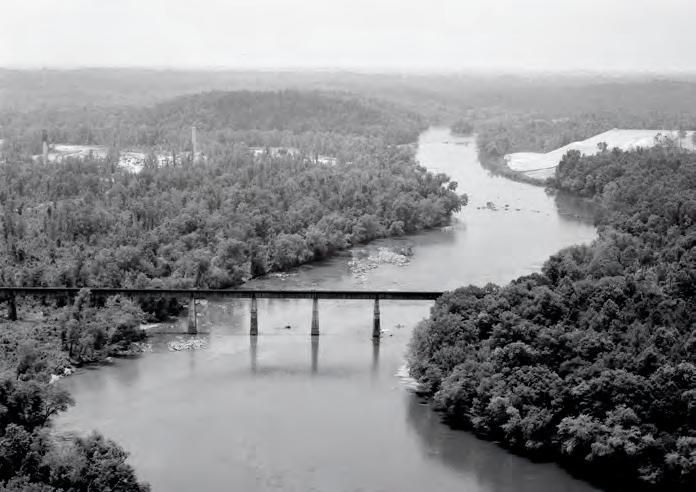
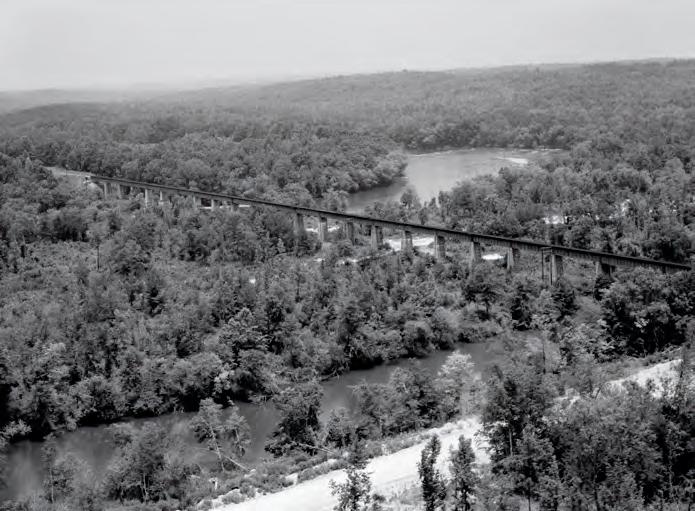

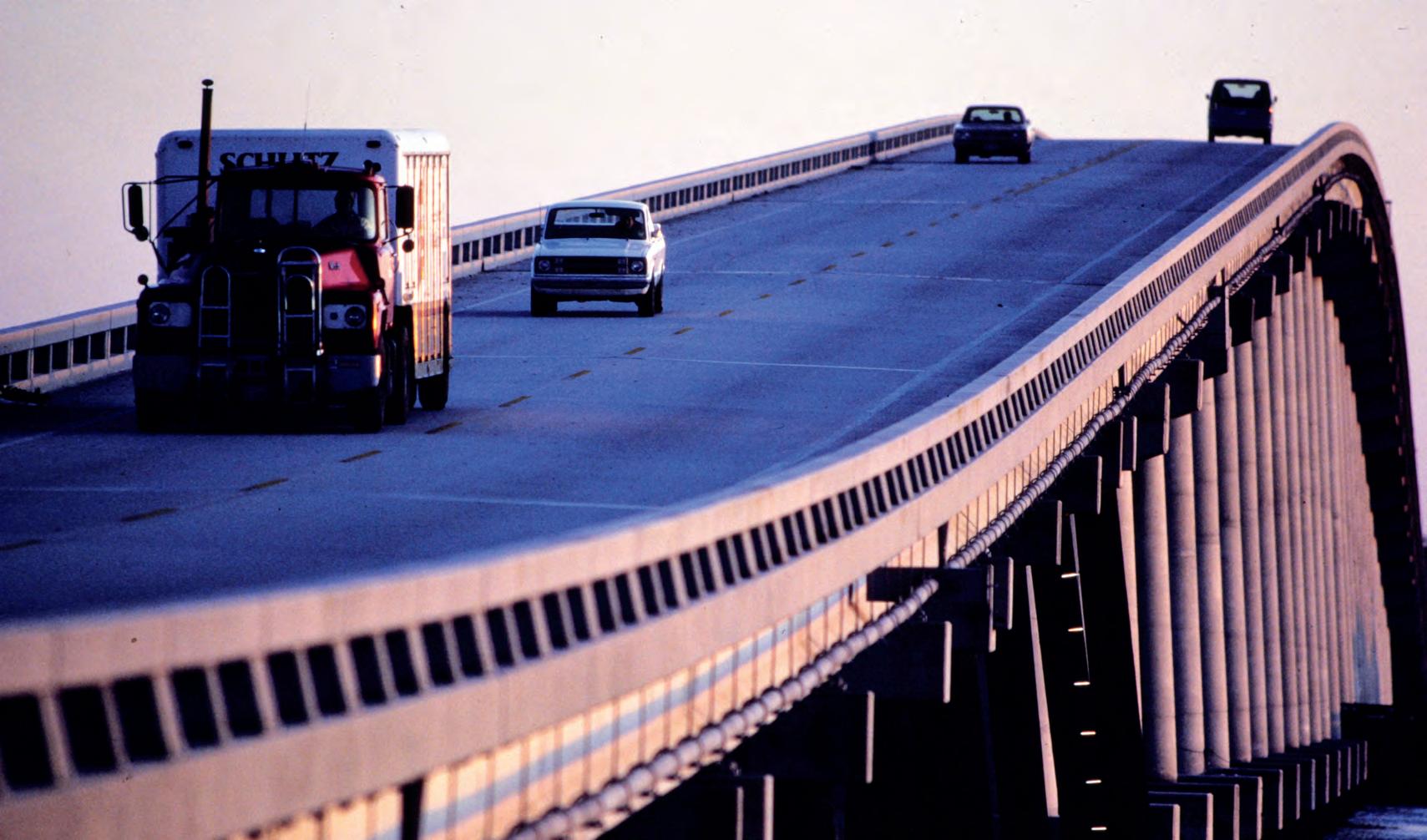
Bridge in Roanoke in 1936. That same year the company went to West Virginia to replace an aging bridge located along U.S. Route 52 in Bluefield. The vehicular and pedestrian path stretched nearly 800 feet and “emphasized reduced material requirements and increased load-handling capacities,” according to the Historical American Engineering Record.
Certainly one of the first major jobs the company handled as it established its core business was the Albemarle Sound Bridge. It was built from January 1937 through August 1938 with a contract price of $1.1 million. At three-and-a-half miles long, it was the largest single project ever attempted by the North Carolina State Highway and Public Works Commission. It was dedicated on August 25, 1938. “It gives Tyrrell, Dare, Washington and Hyde counties a great savings of mileage in traveling to northern points,” noted a story in The State magazine.
“It is expected that the structure will play an important part in the development of the lower Albemarle section.” It would give an outlet to Edenton, Elizabeth City and Norfolk and points north to some 35,000 people living on the south side of the Sound.
Before, they had to use a toll ferry or drive seventy more miles through Williamston and Windsor. The longest pile was 108 feet and was shipped from the west coast specifically for the project. The bridge was named in 1957 for the late J.C.B. Ehringhaus, who was governor when the project was initiated.
A handwritten list of early jobs in company archives includes references to a bridge over the Croatan Sound on U.S. Hwy. 64 between Manns Harbor and Manteo, running September 1954 to February 1957 and paying $2.5 million, and the Currituck Sound Bridge from Currituck to Dare, 2.8 miles long running July 1964 to January 1967.
Sam Hunter reels off a list of projects: half of a five-mile bridge across the Albemarle Sound in 1930 or ‘40s; two bridges across Bogue Sound, the Atlantic Beach Bridge in 1953 and Emerald Isle Bridge in 1969, both about one mile each; two parallel bridges across the Currituck Sound, three miles long with one in 1963 and the second in 1993; and the Alligator River three-mile bridge in 1965. Major bridges in Virginia included three over the James River in Richmond; projects in Norfolk over the Western Branch, Elizabeth and Lafayette Rivers; and over the
Pungo River in Virginia Beach.
“The Alligator River Bridge was an amazing project,” says Paul Hunter. “It was a huge feat to undertake in the early 1960s. It was almost three miles of concrete that created a link for most of North Carolina to the Outer Banks.”
Giles Trimble compiled a scrapbook upon his retirement of the bridges he helped build from 1948 to 1985. Among the most significant were building the Naval Weapons Pier in the York River near Newport News, with the Navy wanting 150foot piles under the dock, and building the substructure and roadway approaches for the Benjamin Harrison Memorial Bridge just east of Hopewell beginning in 1963, it being the second major structure across the navigable waters of the James River; Stephen Salter started with T.A. Loving Company on a part-time basis in 1993, was added as a salaried employee in May 1994 and worked his way up; he was an assistant vice president in 2022.
“What got me interested in the company initially was the water work,” he says. “We did a lot of work on the water. We had barges and tugboats, and being an outdoor
person, that was always kind of cool to deal with. So at that point you get used to building bridges and that’s what you know so that’s what you keep doing.”
Wilson Twilford started with T.A. Loving Company in 1961 and worked his way up to vice president/Bridge Division manager. He remembered in a 2000 interview that the company might have upwards of seventy-five men on a job working a nine-hour day. On the Alligator Bridge project, for example, workers had to report earlier than 7 a.m. in order to board tugboats that would take them to the various work locations. Twilford worked with Giles Trimble, a long-time job superintendent and Bridge Division manager, on many jobs and remembered the challenge of keeping up with all the workers. One morning, three men showed up early looking for work. Trimble immediately hired them and sent them into the job office to process the paperwork. The last one emerged too late to catch the last tugboat. Trimble didn’t remember he’d just hired the man and said, “Where have you been? You’re late and you’re fired.”
“Mr. Trimble was tough but fair,” Twilford said. “There were people standing
in line at the office door every morning looking for a job. Employees had to be on their Ps and Qs. You laid out a day, you best have a good excuse or note from your doctor because he would warn you the next day. If it happened again, you were fired.
You worked or else.”
The Bogue Sound Bridge opened in 1971 and was named for B. Cameron Langston, a Lenoir County farmer and longtime member of the state highway commission. The high point of the structure is sixty-seven
feet above water, and the bridge runs just under a mile in length and cost just under $3 million.
“In its own way the bridge is a thing of beauty—a vision of symmetry and grace, rising gradually from the wooded waterside to soar for a while and finally settle back to earth,” said The State magazine in July 1971.
No doubt such passages could be crafted on much of T.A. Loving Company’s bridge work over a century.
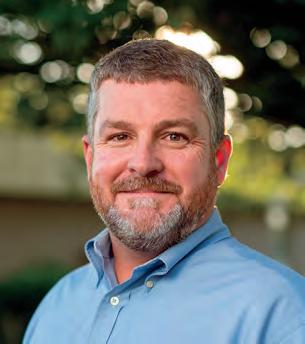
The Alligator River Bridge was an amazing project. It was a huge feat to undertake in the early 1960s. It was almost three miles of concrete that created a link for most of North Carolina to the Outer Banks.
Paul Hunter
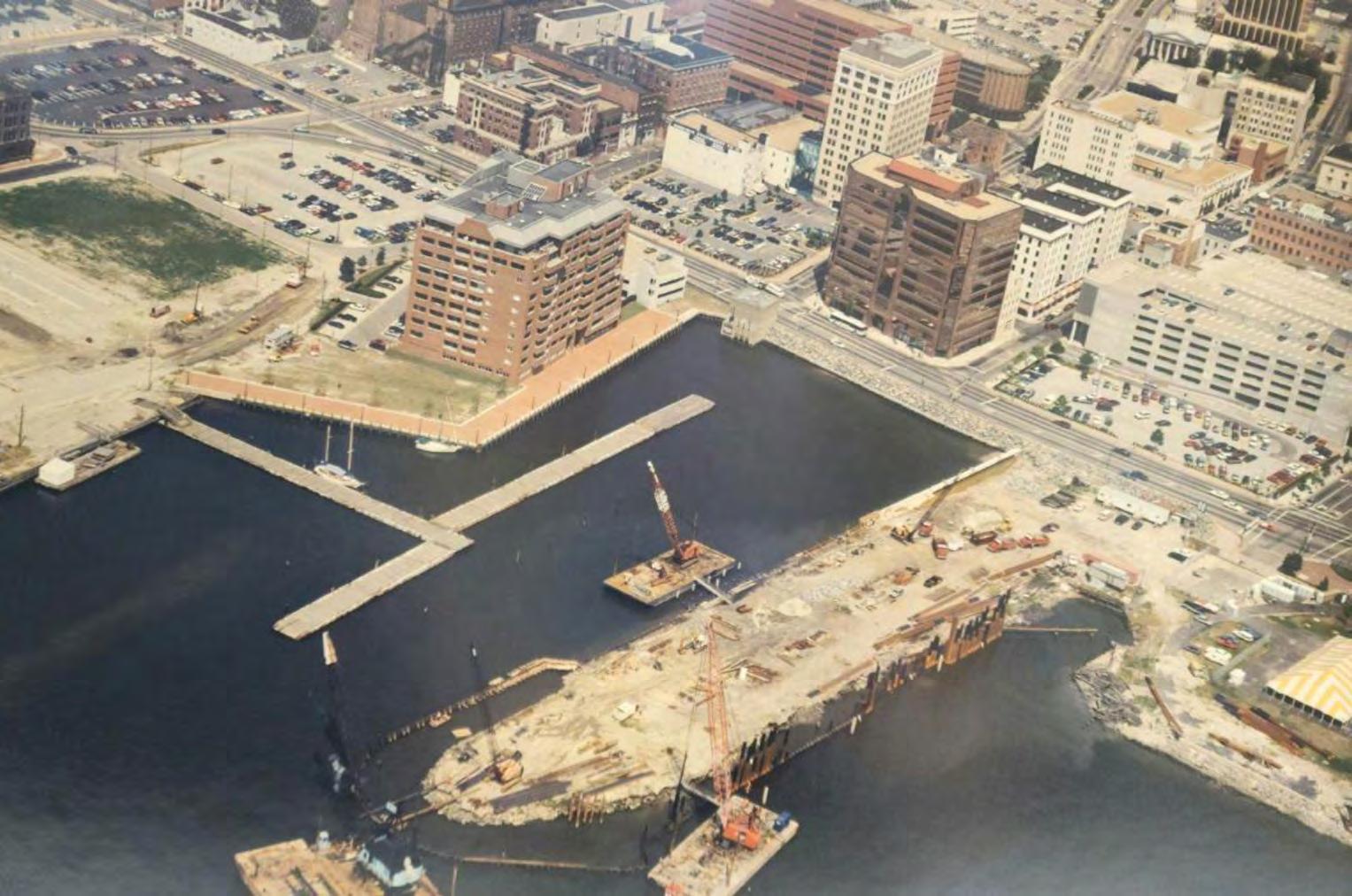
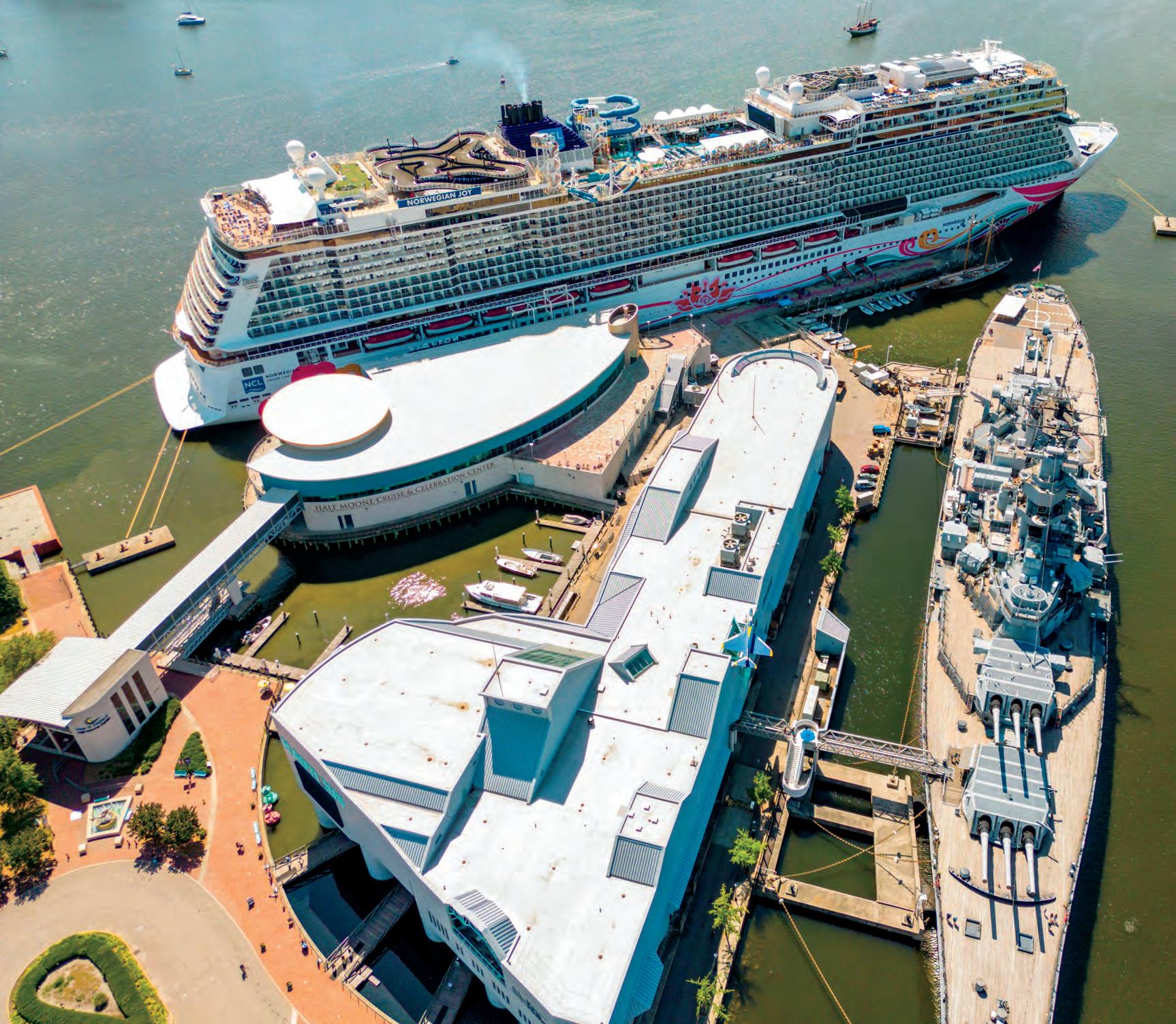
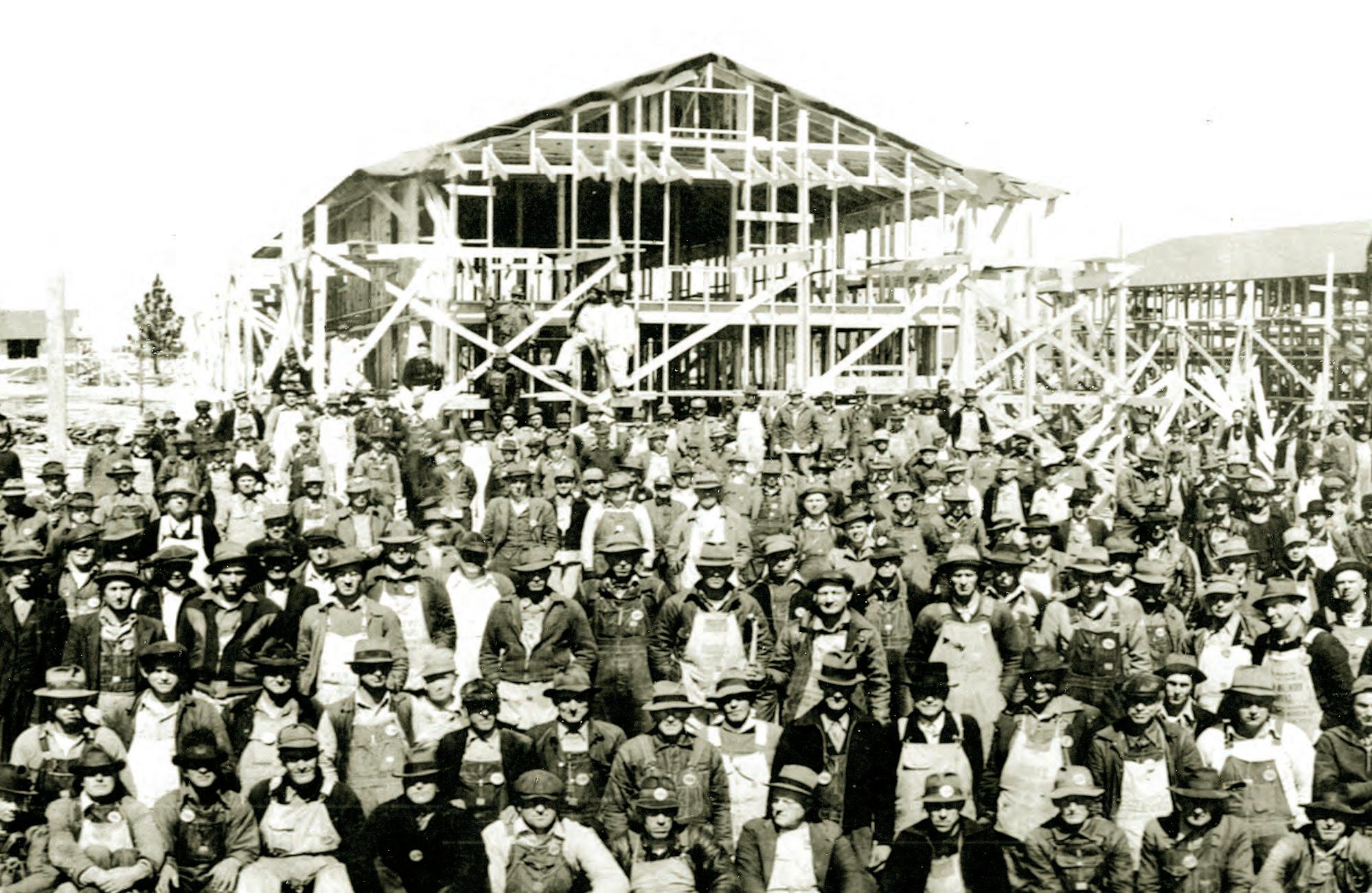
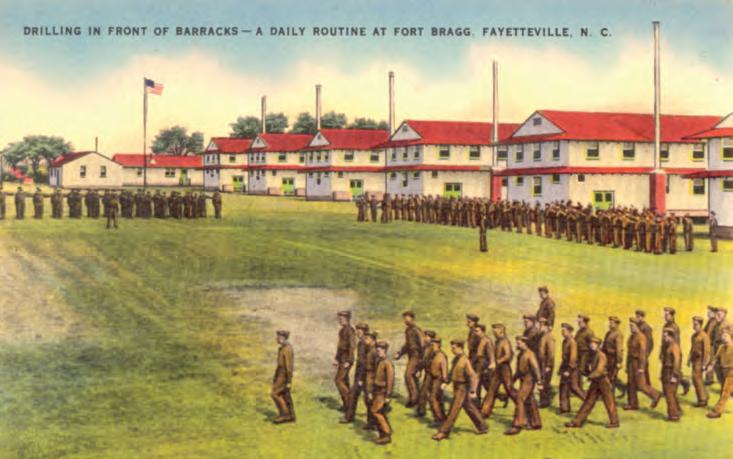
Imagine the challenge in 1940, before Interstate highways and easy road travel, before computerized planning, estimating and payroll applications and when communications were limited to telephones and telegraph.
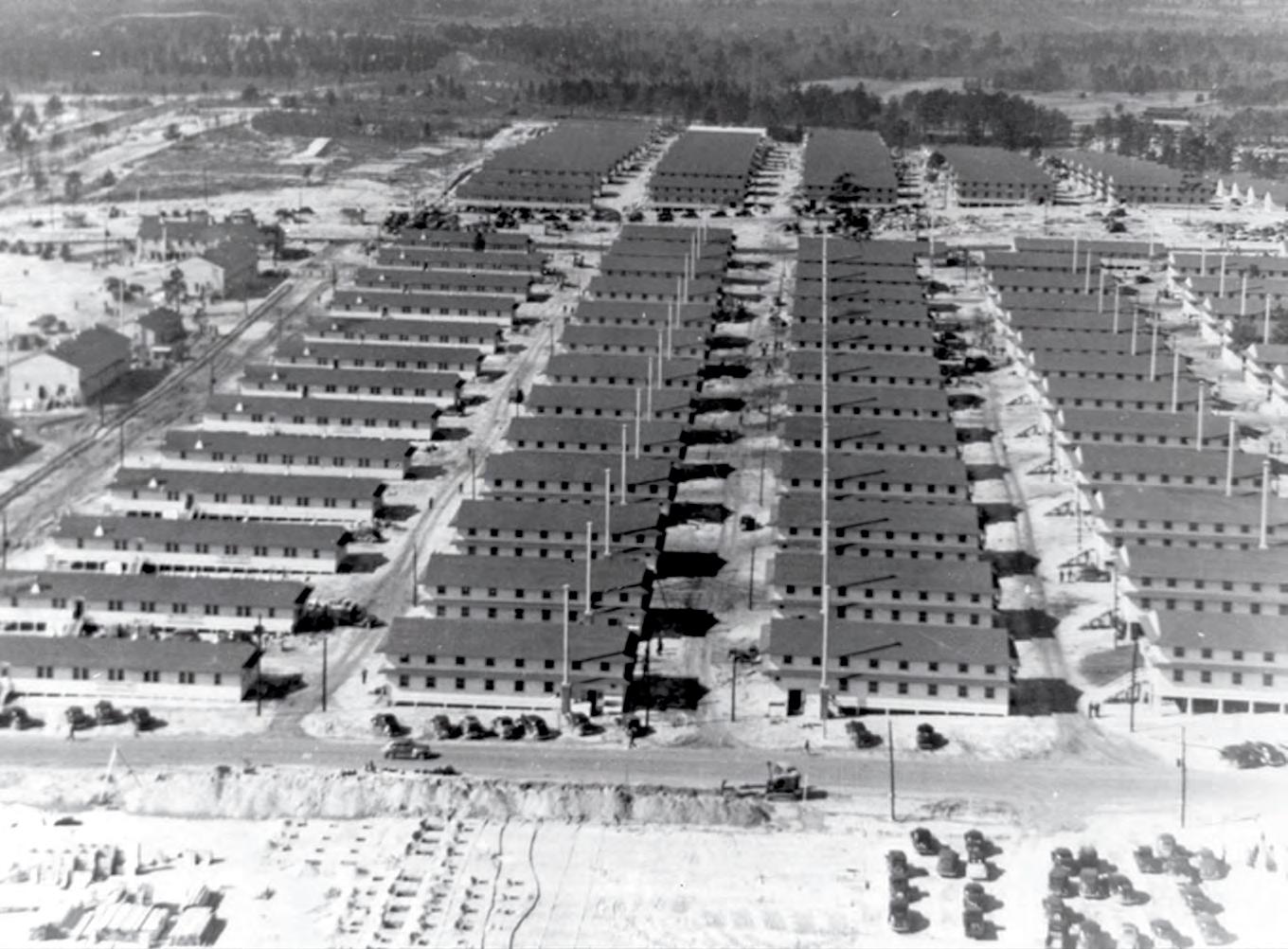
Your company is told by the Pentagon with the specter of war in the air to build 2,462 buildings in 180 days, including sixtythree dormitories with heat, electricity and plumbing as well as a 2,680-bed hospital. You would have to account for underground water and sewer pipes, power and telephone lines, parking lots, streets and access roads.
That was the reality for T.A. Loving Company and its mandate in the summer of 1940 to expand at warp speed a United States military outpost at Fort Bragg on the northwest outskirts of Fayetteville, some fifty miles from company headquarters in Goldsboro.
“You marvel at how a company figured out how to have 25,000 people on the payroll in a matter of weeks and put a $30 million project in place in nine months in the middle of nowhere,” company co-President David Philyaw says. “And they didn’t do it one time and get lucky. They kept doing it. That had never been done before and won’t be done again. You couldn’t hire 25,000 today if you wanted to.”
Apparently the connection from Washington to Goldsboro and this prime piece of business passed through Kenneth
Royall, a Goldsboro native, T.A. Loving Company attorney and Secretary of the Army. Royall was a UNC graduate who studied law at Harvard, served in World War I and rose to the ranks of colonel in the Army. The company also had some history at Fort Bragg. A notice in The State magazine in 1934 said T.A. Loving had been awarded a $163,520 contract for construction of “various buildings” at Fort Bragg. The story handed down through company lore through the family of Raymond Bryan Sr., the company president at the time, was that Bryan received a phone call on a Friday from an official at the Pentagon. Bryan was told to be in Washington for a meeting at 10 a.m. on Monday. Bryan replied that he had a busy calendar and there was no way on such short notice he could make the meeting.
“Mr. Bryan, there’s a war going on, and you will be in Washington on Monday morning,” came the reply.
“My granddad and T.A. Loving drove up there for that meeting,” says Stephen Bryan.
“They were told, ‘We’re going to build Fort Bragg, and we want you to build it.’ The war was coming. I think Mr. Royall may
have just said, ‘Look, I know these guys and they can do the work.’ It was fast-track and cost-plus. They needed someone to do it and do it quickly. That job put us on the map, basically.”
And thus the first domino fell on what would certainly be the most massive job in T.A. Loving Company history.
Fort Bragg was named for Confederate General Braxton Bragg and christened originally as Camp Bragg in September 1918 as one of three facilities in North Carolina to train troops for combat in World War I. It was renamed Fort Bragg three years later when it was established as a permanent military base, one of its features being that it was the only military reservation in the United States with enough room to test the newest long-range artillery weapons. Its environmental diversity—with access to deep sand, heavy mud, swamps, streams and forests—made it ideal for testing field artillery. An adjacent air field was constructed and used by aircraft and balloons and named for First Lieutenant Harley Pope, an airman who was killed when flying nearby. The facility is comprised of 122,000 acres and contained units of almost every Barracks popped up at warp speed at Fort Bragg. “They were cutting the wood on the site, and immediately turning the trees into boards,” Paul Hunter says. “You hear stories about the troops going into their new barracks and sap falling on them from the wood.”
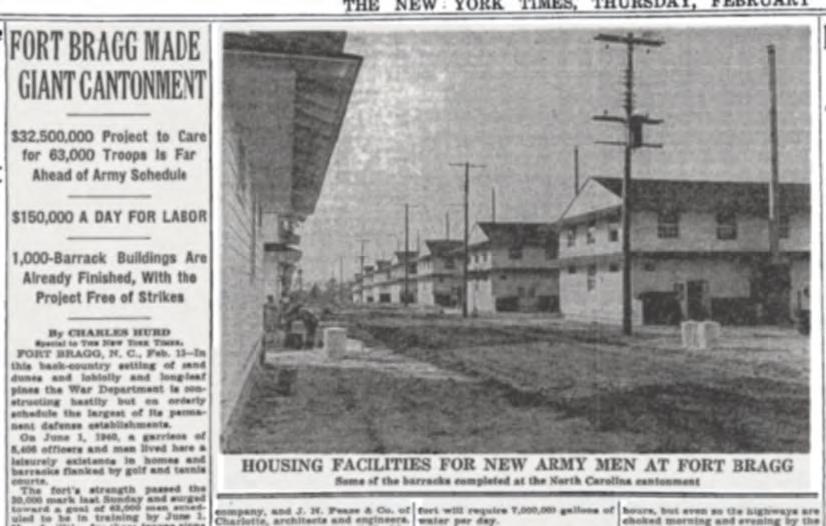
ground-pounding infantry units, including the 9th Infantry, 2nd Armored and 100th Infantry Divisions.
T he expansion work was heavily publicized, with The News & Observer of Raleigh, The New York Times and LIFE
magazine among the publications sending writers and photographers to record how the military was spending $32.5 million.
“In this backcountry setting of sand dunes and loblolly and long-leaf pines, the War Department is constructing hastily but on an orderly schedule the largest of its permanent defense establishments,” The New York Times reported.
branch in the service.
Fort Bragg had 376 assorted buildings and 5,406 officers and men when the first shovel of the new building program was turned on Sept. 20, 1940. Those men lived a “leisurely existence in homes and barracks flanked by golf and tennis courts,” according to one newspaper report. Fayetteville itself had a population of 17,000.
Nine months later, with the program
essentially complete, there were 3,135 buildings with 67,000 officers and men.
The population would peak at 160,000 in 1945 at the end of the war. A large number of infantry troops trained at Fort Bragg, most notably all five airborne divisions (11th, 13th, 17th, 82nd and 101st), and other parachute deployed units, including the allblack 555th Parachute Infantry Brigade. Fort Bragg also trained and deployed many
J.N. Pease & Company of Charlotte was the architect and engineering firm, and together Pease and Loving imported more than 500 office workers just to manage it all.
Pease’s surveyors ventured into the forests and drove down stakes. Then trees were cut down, leaving a three-foot stump, and bulldozers followed to root and butt the stumps out of the ground. Next came the grading machines to mark the streets, and the lumber trucks followed. Workers were using the newly popularized Henry Ford assembly line method and were able to
work at amazing speeds. A News & Observer report in February 1941 said it was taking an average of thirty-two minutes to build one dormitory.
“They were cutting the wood on site, and immediately turning the trees into boards,” Paul Hunter says. “You hear stories about the troops going into their new barracks and sap falling on them from the wood.”
The enormity of the job propelled T.A. Loving Company in the early 1940s into being one of the state’s largest employers with up to 23,000 up to 25,000 workers at one time and a daily payroll of $150,000.
Steve Bryan remembers his father-inlaw, who lived in Clinton, telling him about farmers abandoning their fields because they could make a higher wage working at Fort Bragg.
“Farmers were coming from literally everywhere,” Bryan says.
Steve’s father, Raymond Bryan Jr., remembered hearing from his father about the pressure the War Department put on the architects and builders to stay on schedule.
“The government would threaten that if we didn’t get more men on the job and work around the clock, they would take the
job away from us and give it to someone else,” Bryan Jr. said. “We were trying to hire everybody, every farmer that we could find, to work as carpenters over there. They worked around the clock.”
“We started Fort Bragg with a verbal contract, we worked twenty-four hours a day and six or seven days a week,” remembered Arthur Allred, an assistant to Bryan Sr. and a fifty-four year company employee.
“It got so big there that the banks couldn’t handle that much cash, so we had to pay the employees every day.”
Soon after the company was headlong into Fort Bragg (which was renamed Fort Liberty in June 2023), it got another military opportunity along the North Carolina coast.
But the headaches of managing so much cash at Fort Bragg forced Bryan into a key negotiating stance. “Either we pay the employees by check, or we don’t take the job,” Arthur Allred remembered Bryan telling the War Department.
With those details worked out, T.A. Loving Company started in early August 1941 building Cherry Point Marine Base on the south side of the Neuse River near Havelock, about halfway between New Bern and
Morehead City. The frame administration building was erected in nine days, and work was stepped up to twenty-four hours a day following the Japanese bombing of Pearl Harbor on Dec. 7, 1941. C.B. McNairy was the project manager, and the value of the original contract was $15 million. The project was heralded by the War Department as “the largest Marine Corps air station in the world.” Many of the details of the massive project were kept under wraps for military security, but according to statistics released in November 1944 by the Navy and Marine Corps, the final value of construction was approximately $82 million (or around $1.6 billion in 2022 dollars). The original site was around eight thousand acres, and five thousand of them had to be cleared and grubbed. Some ten million cubic yards of earth were excavated and five million feet of timber cut at a sawmill erected on the base. The base became a self-contained city with 1,800 buildings erected. Telephone and telegraph lines were extended quickly and a new spur track of the Atlantic and North Carolina Railroad was built from Havelock, a mile and a half away. Temporary electricity was
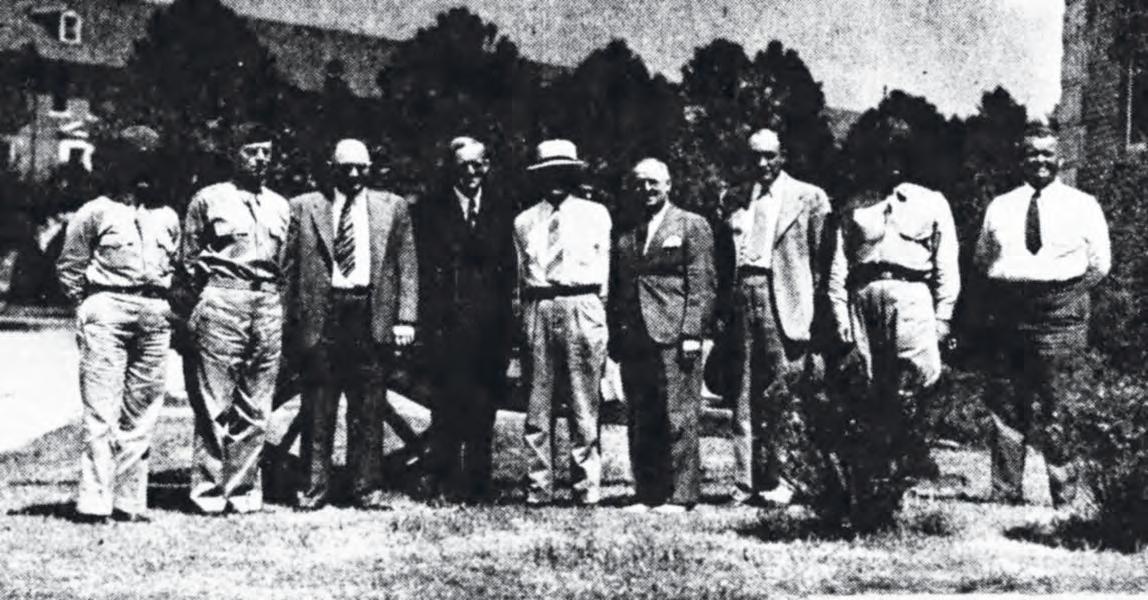
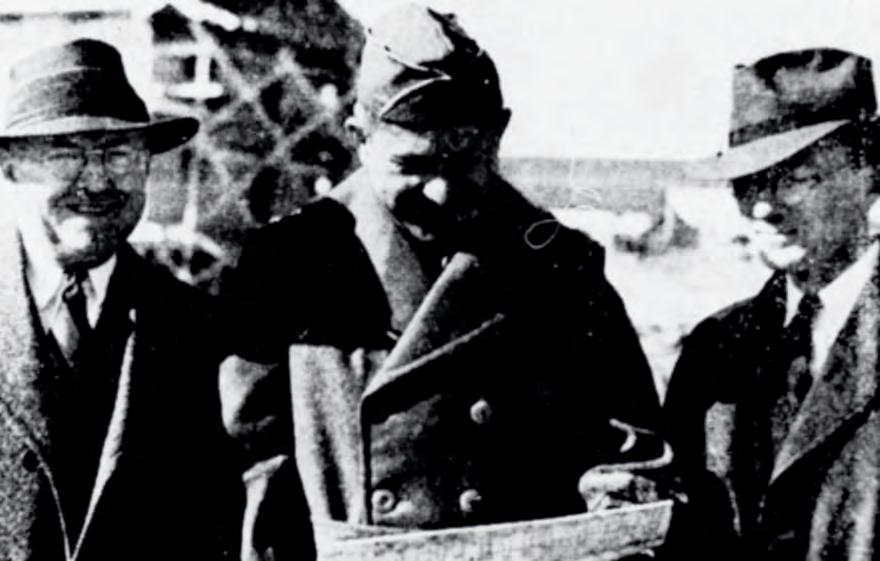
procured from Carteret County, and many miles of ditches were blasted to drive out malaria-causing mosquitoes.
“Gone are the thousands of scrubby pine trees and millions of pesky mosquitoes to such a marked extent that the fishing and crabbing visitors of a year ago could not recognize the same place,” a newspaper story said. “Buildings, runways, roads and railroads have sprung up as if by magic.”
“During the summer of 1941 the site now occupied by the mammoth Marine Air Station at Cherry Point proper was just a vast stretch of swamplands,” wrote Gertrude Carraway in a 1946 booklet published about the development of Cherry Point. “Under the magic of expert craftsmanship, it was rapidly developed into a modern air base which served the nation well in time of war and will continue to serve its country in time of peace.”
The commissions at Fort Bragg and Cherry Point provided T.A. Loving Company an enviable foothold in the military
Military and construction executives on-site at Fort Bragg in 1940. In photo above are (L-R) Col. C.B. Elliott, Col. J.R. Starkey, T.A. Loving, W.G. Norteman, C.B. McNairy, J.N. Pease, Raymond Bryan Sr., Lt. Col. Simpson and chief engineer J.S. Utter. Below are J.N. Pease, General Devers and C.B. McNairy.
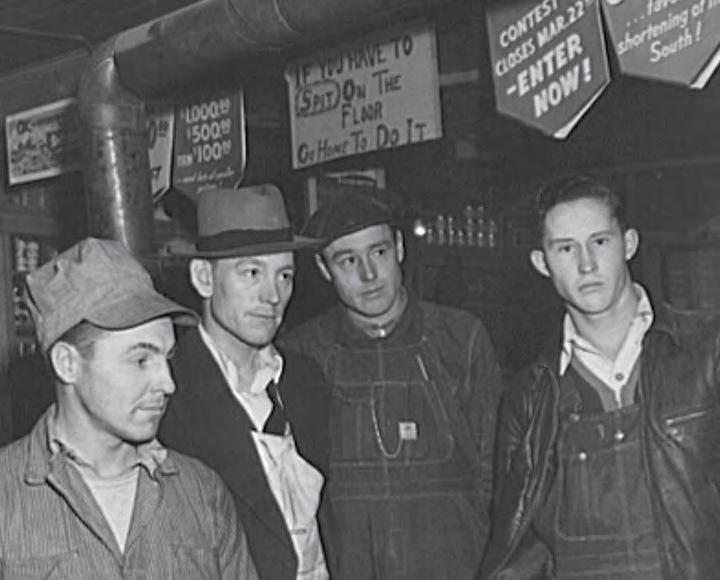
These four workers were among up to 25,000 on the company payroll with a daily wage output of $150,000 during the height of Fort Bragg construction.
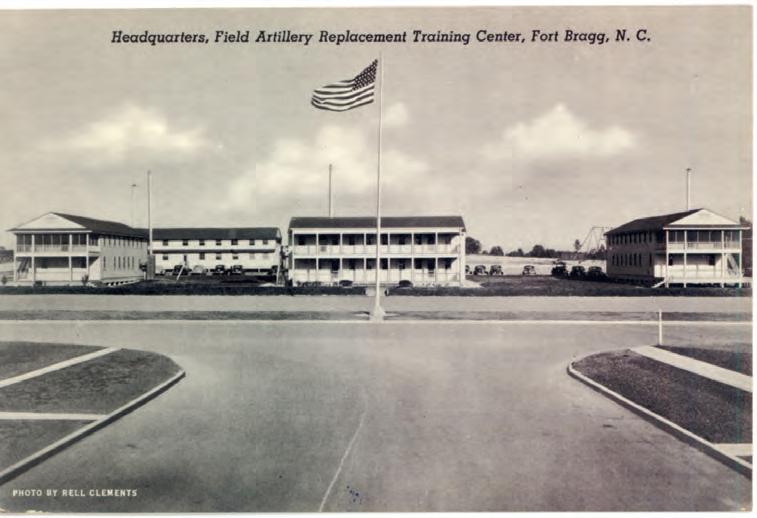
construction arena.
The company combined in 1951 in a joint venture with Southeastern Construction of Charlotte and Doyle & Russell of Richmond to win a contract for troop housing and other structures at Fort Knox, Kentucky, just southwest of Louisville. The triumvirate submitted a bid and then telegrammed the Army Corps of Engineers in Louisville that it would cut its number by $135,000 just prior to the bid opening, and it won the job
over five competitors with a number of $22.7 million. Plans for the work weighed seventyfive pounds, and the project included thirtyfour barracks for 225 men each and assorted other buildings including warehouses, a fire station and three regimental headquarters.
These new barracks in Kentucky were a step above the World War II barracks
scattered about the country that had been quickly built with wood and with a ten-year life expectancy. The new buildings would be
good for at least twenty-five years and were three-story structures with reinforced concrete frames and exterior curtain walls of concrete block, painted with waterproof paint.
“They are a far cry from the two-story, wooden, mobilization-type barracks that housed World War II’s Army millions in training camps,” noted the Louisville Courier-Journal. “A lot of ex-G.I.s won’t believe their eyes when they see what’s going up at Fort Knox.”
• 2,462 buildings in 180 days.
• 25,000 workers on payroll at one time.
• Daily payroll $150,000.
• Total cost $32.5 million.
• Buildings completed at rate of one every 32 minutes of work day week.
• On September 20, 1940, Bragg had 376 assorted buildings and 5,400 officers and men. One year later, there were 3,135 buildings with 67,000 officers and men.
• To that date it was the largest individual operation ever taken on by the U.S. War Department.
• Work required 250 trucks and a fleet of road graders and rollers.
• Project included building a water storage tank of concrete able to hold one million gallons of water.
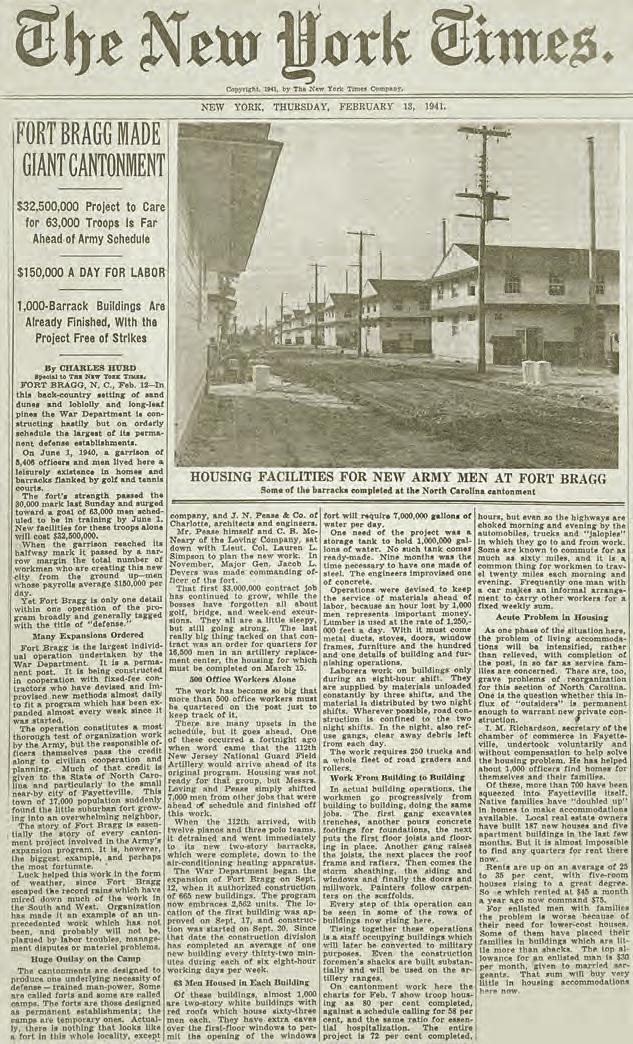
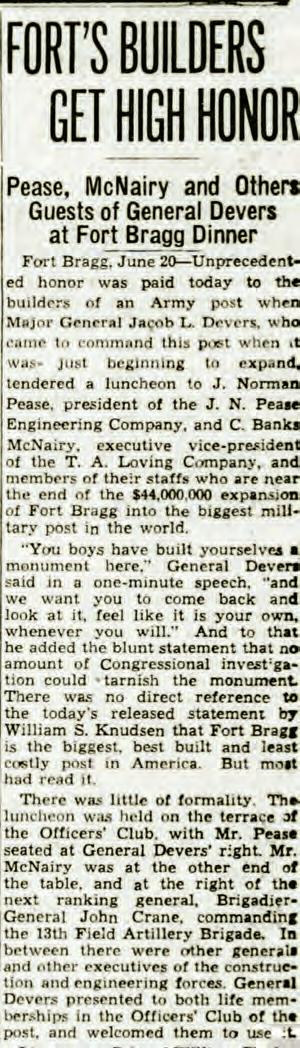

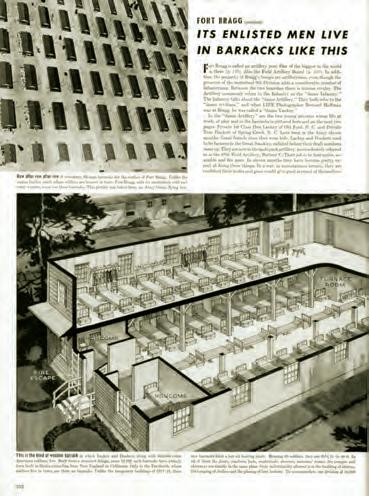
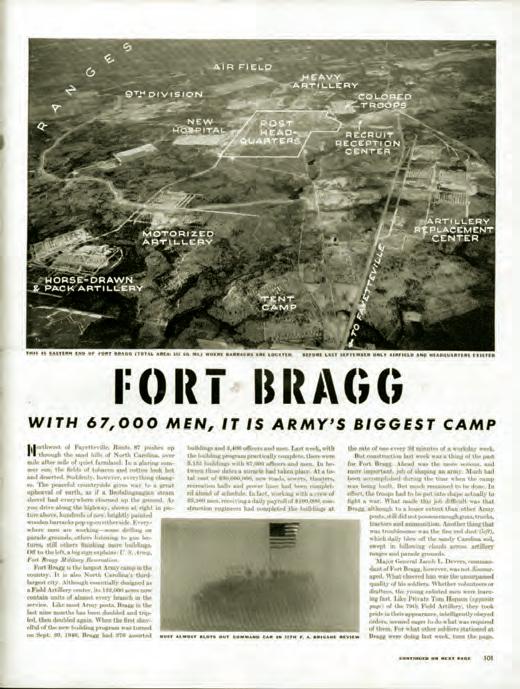
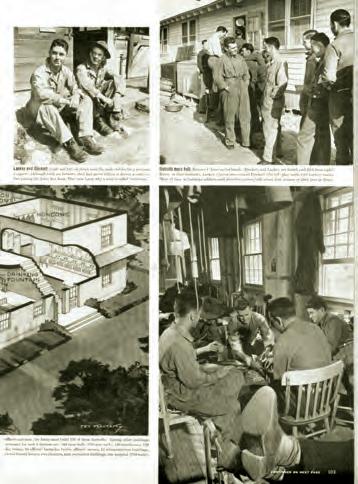
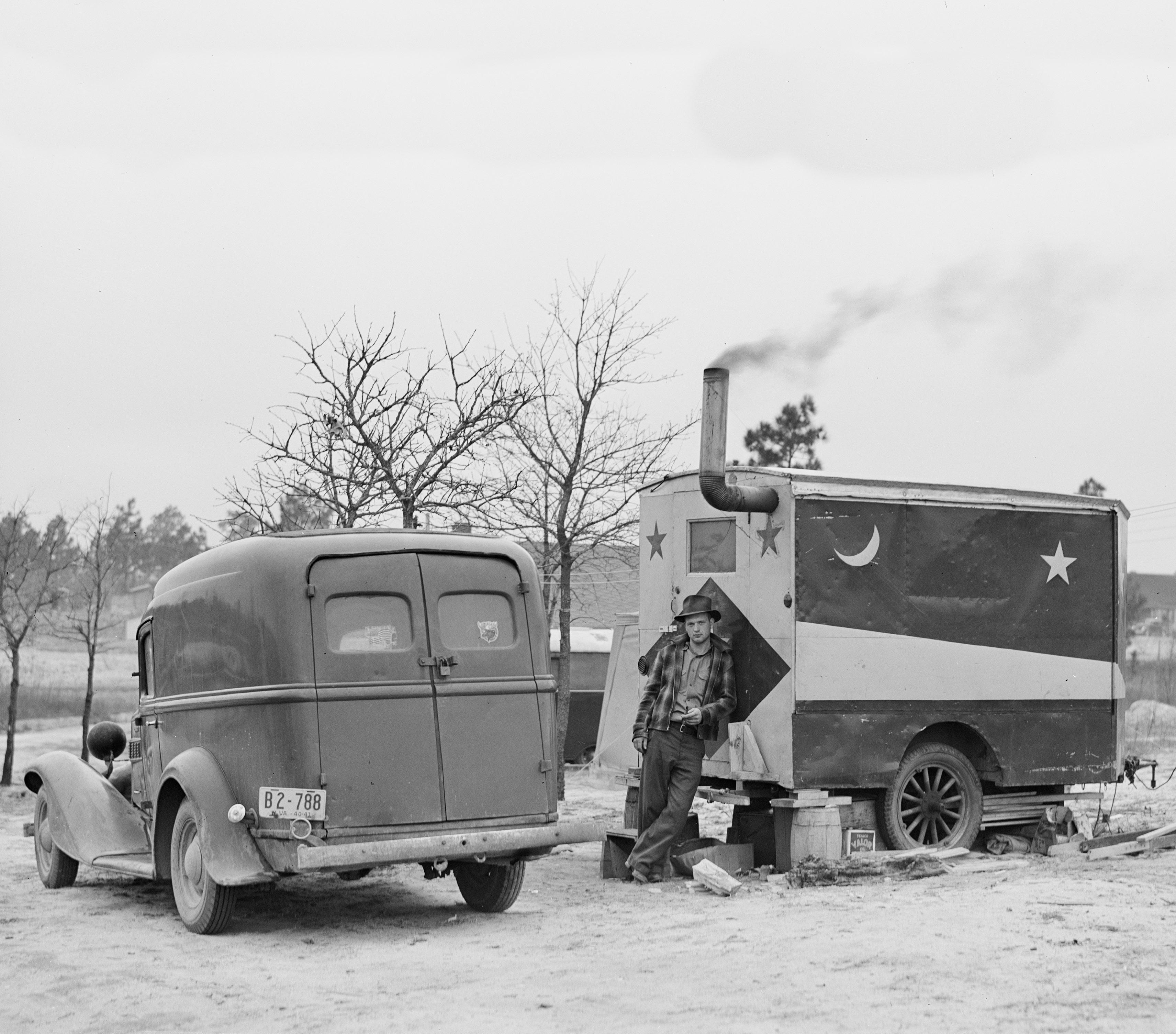
The United States was mired in the depths of The Great Depression. War was waging across Europe and threatening to bring the United States into the conflict.
The federal government in the late 1930s began to acquire hundreds of thousands of acres of land in order to build new military installations and to expand existing bases.
Soon the War Department was investing untold millions in the construction of military bases, shipyards, airfields, ammunition depots and defense plants.
The largest of these enterprises was at Fort Bragg in Fayetteville, where T.A. Loving Company was the general contractor for a massive expansion of the Army base.
The photos on these pages of the migrant workers who flocked to Fort Bragg were taken in 1940 and ’41 by a documentary photographer named Jack Delano. He worked for the Farm Security Administration, one of the New Deal programs that the administration of President Franklin D. Roosevelt created to address rural poverty. The images today are housed in the Library of Congress.
Living quarters were cobbled from the rear end of pick-ups trucks, tobacco barns,
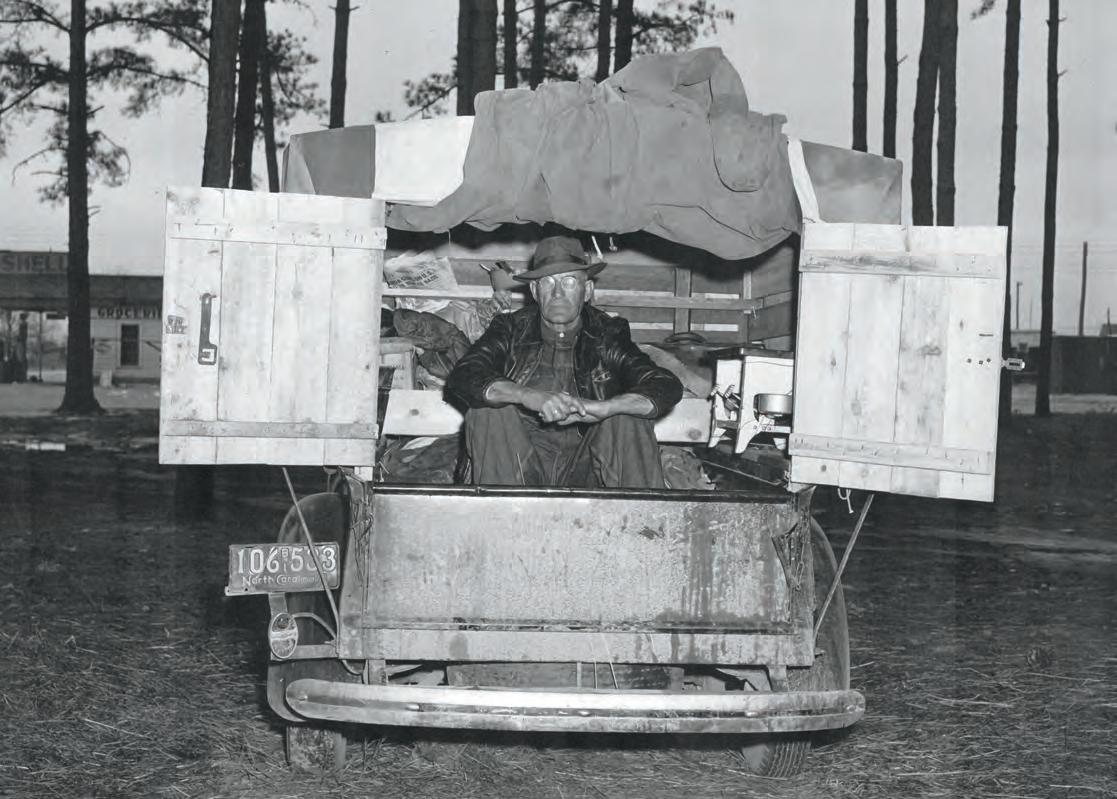
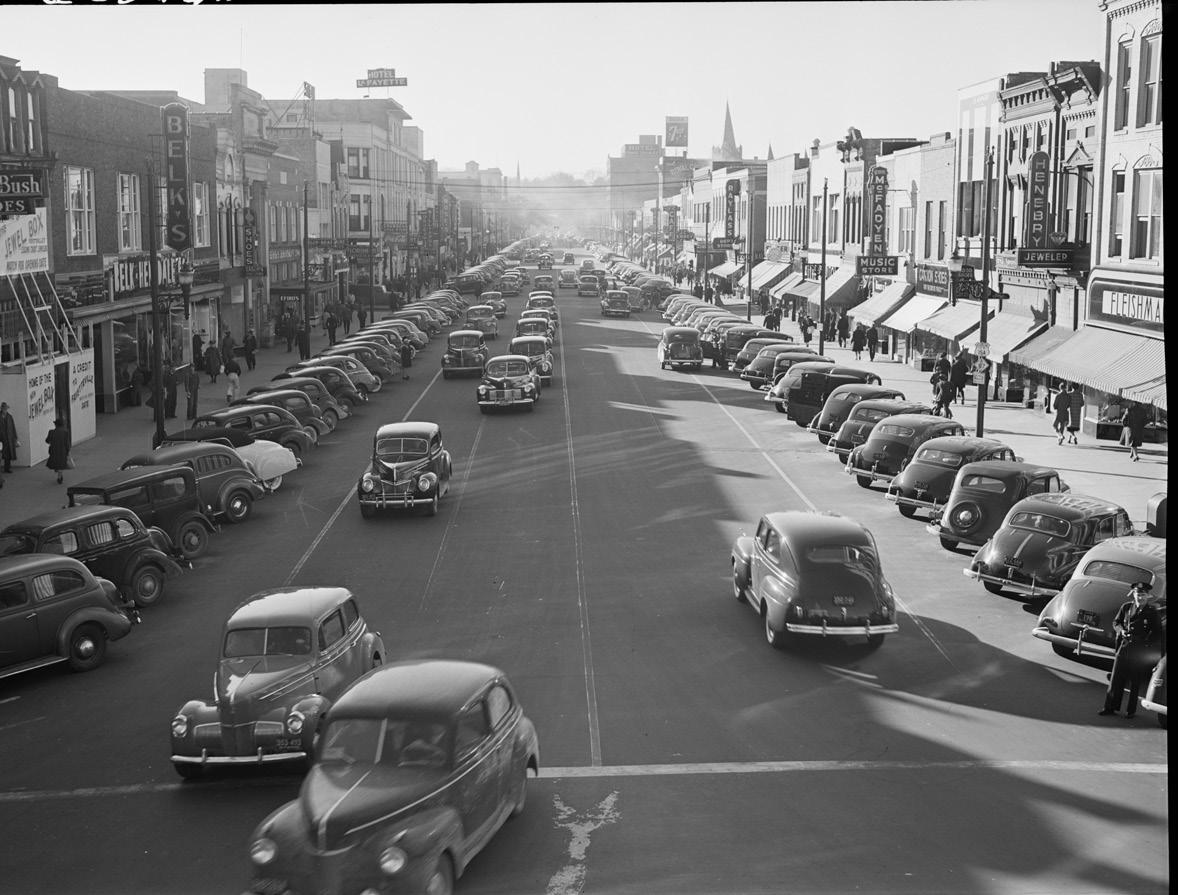
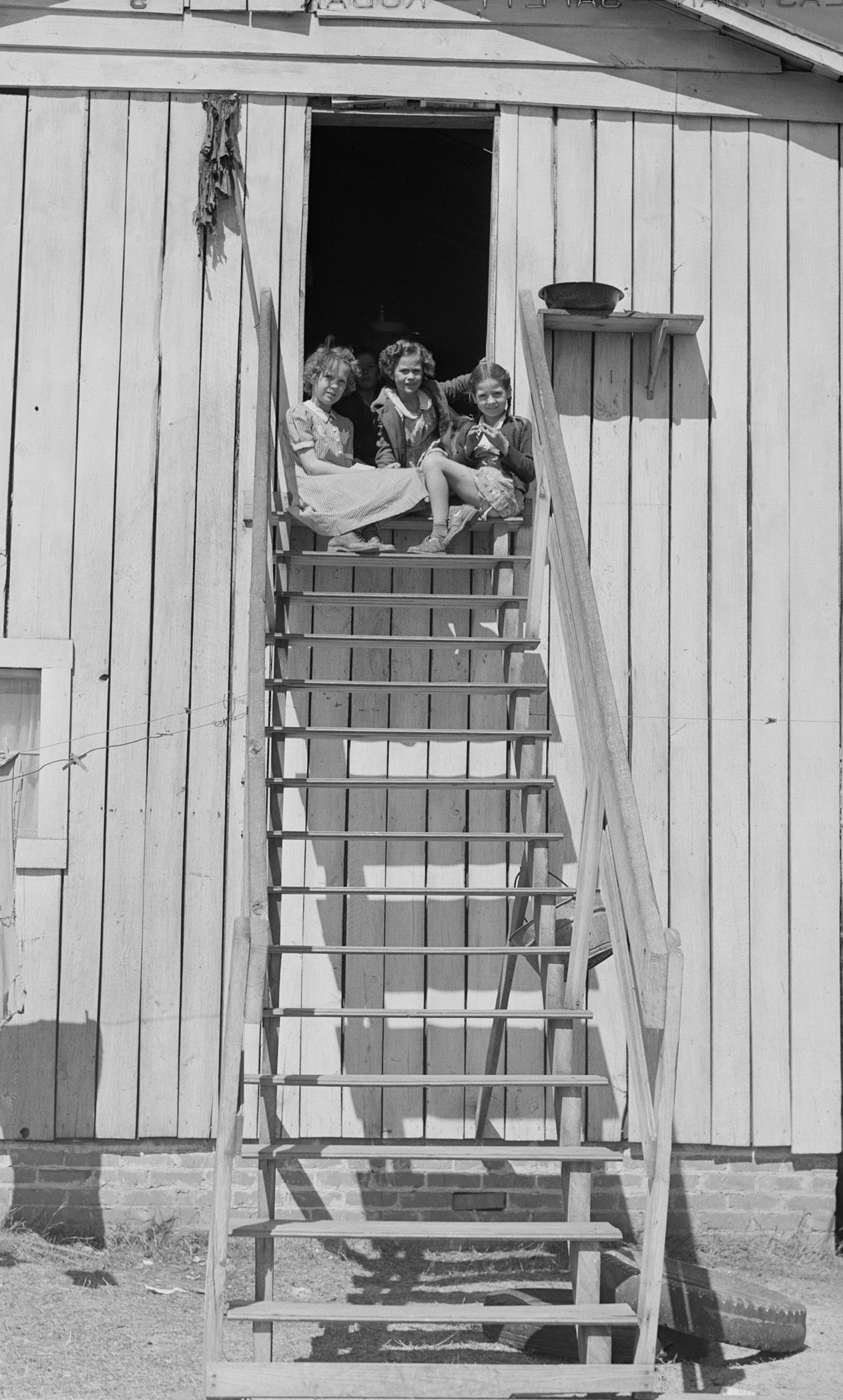
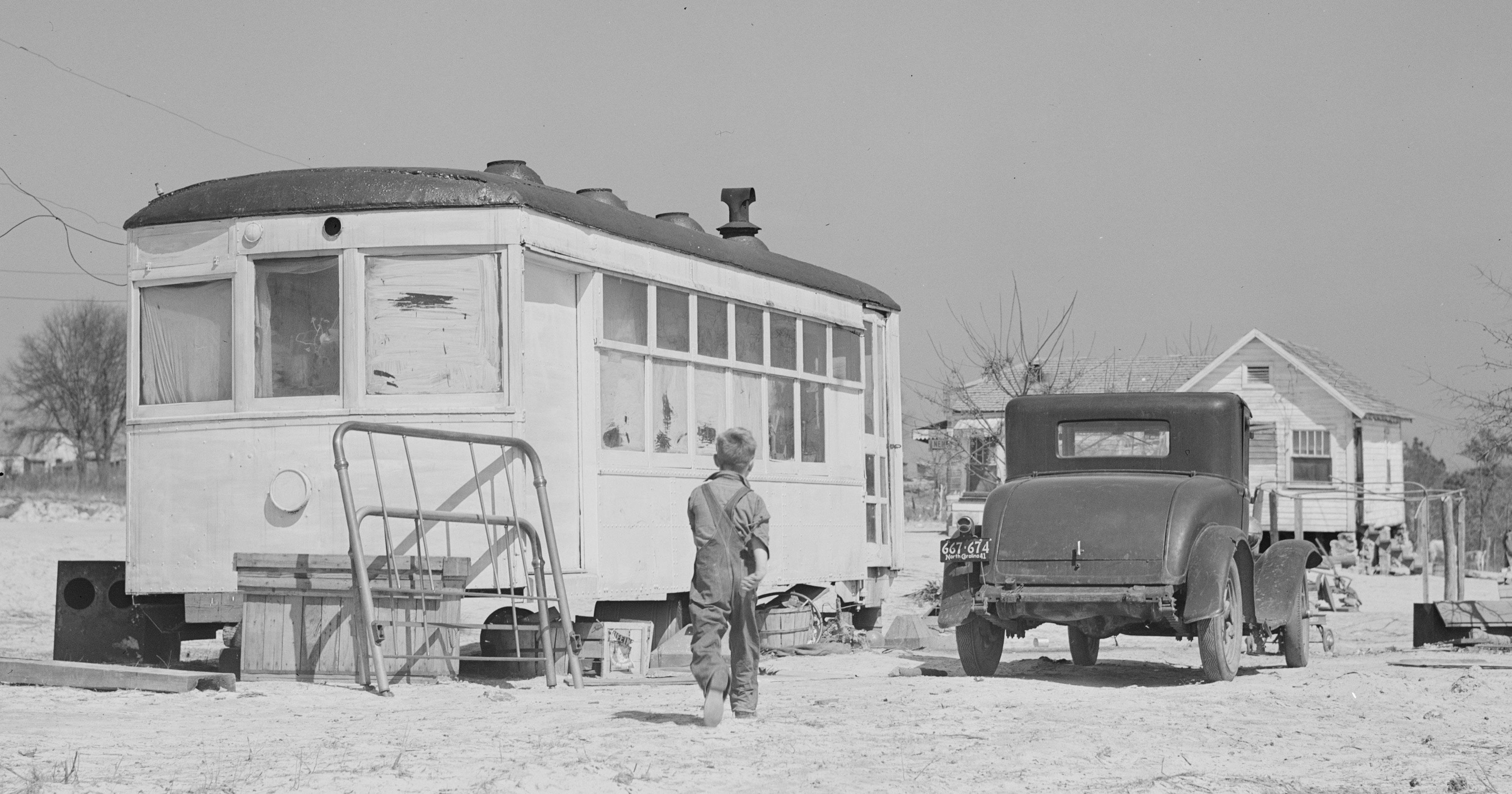
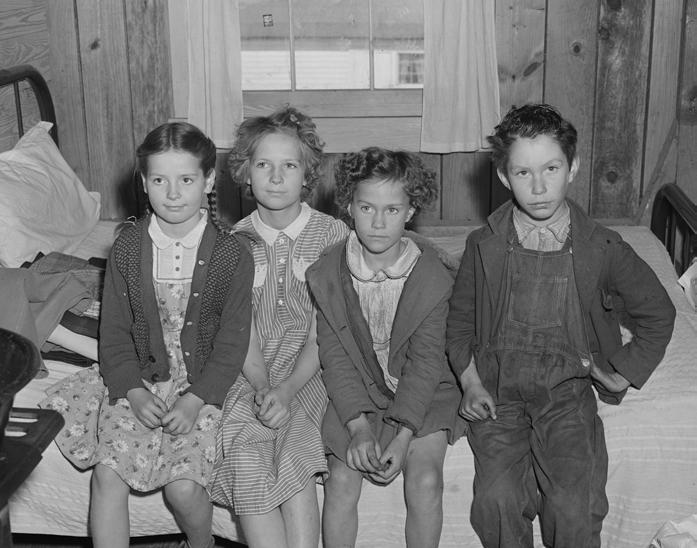
circus trailers, tents and old street cars. While the men worked, the women tended to the children and fetched water and coal. They gathered in the evenings for community suppers.
“When I was younger, I interviewed many men who did construction work at Fort Bragg and other military construction projects in eastern North Carolina during or just before the Second World War,” author David Cecelski wrote in a 2021 blog post. “Their message to me was clear: at that time, any job was a godsend. Anything that made it possible to keep their children from going hungry was a blessing. Any sacrifice that could make for a better future was worth making.”

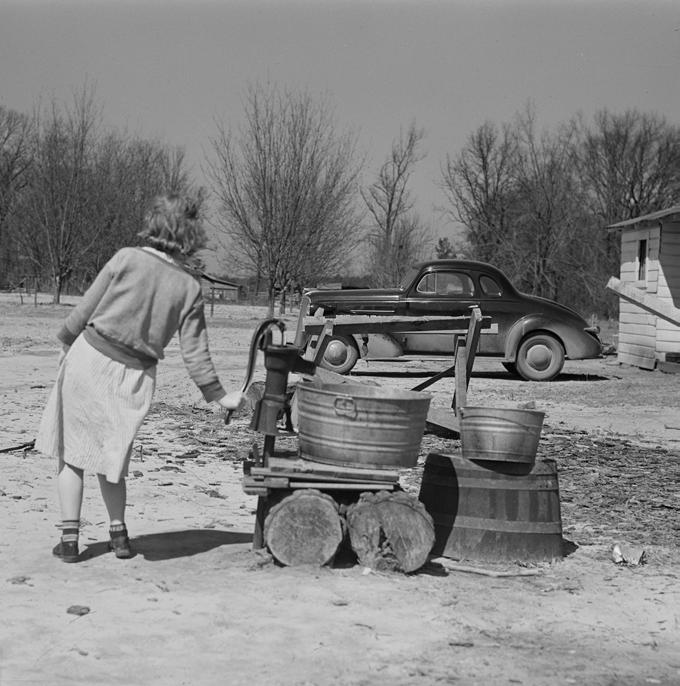
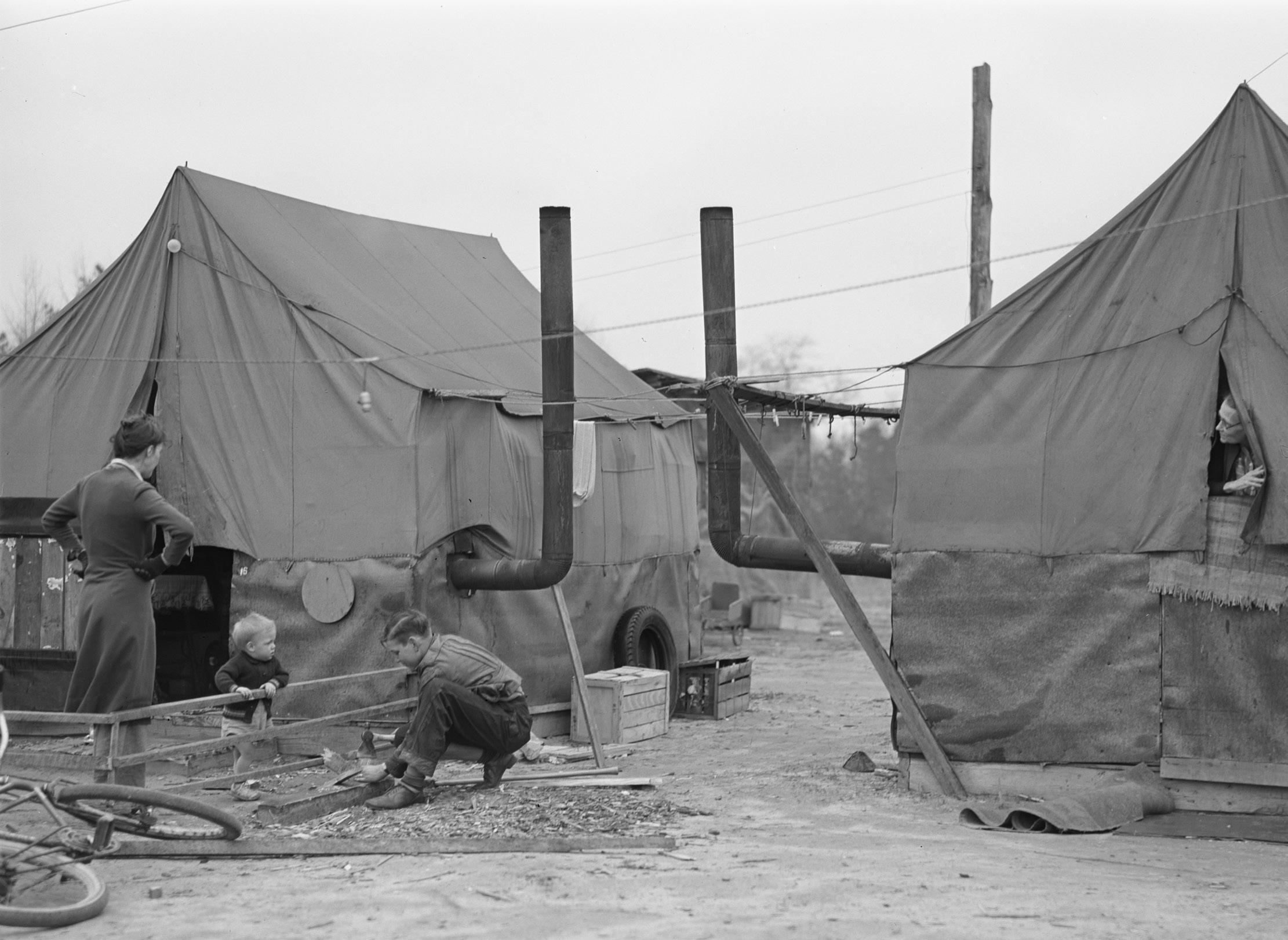
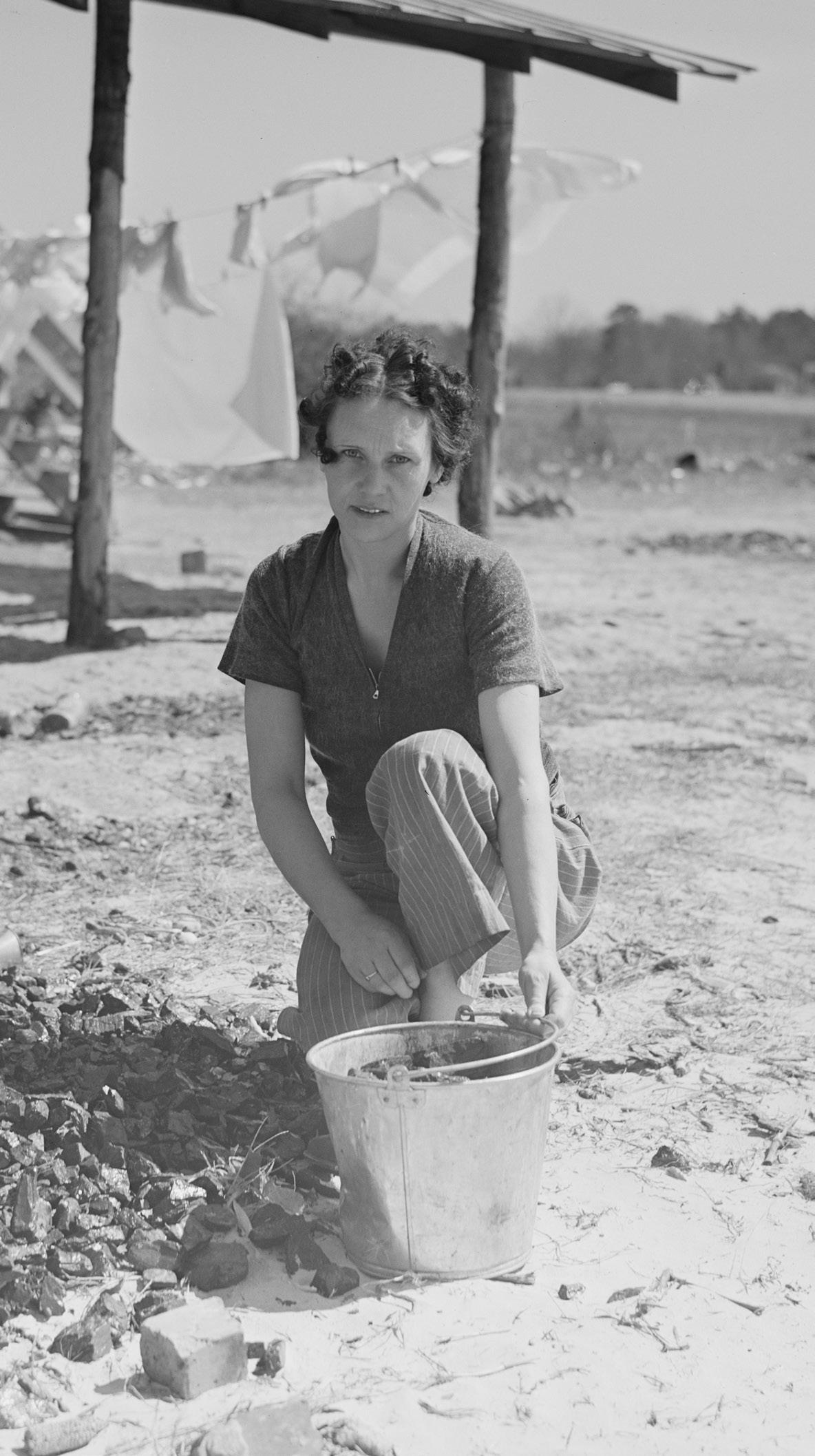
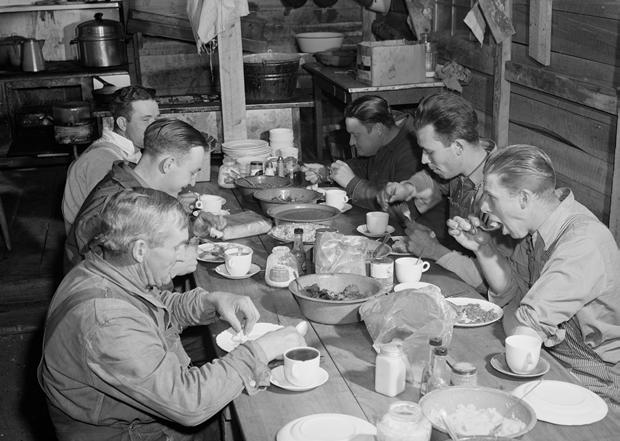
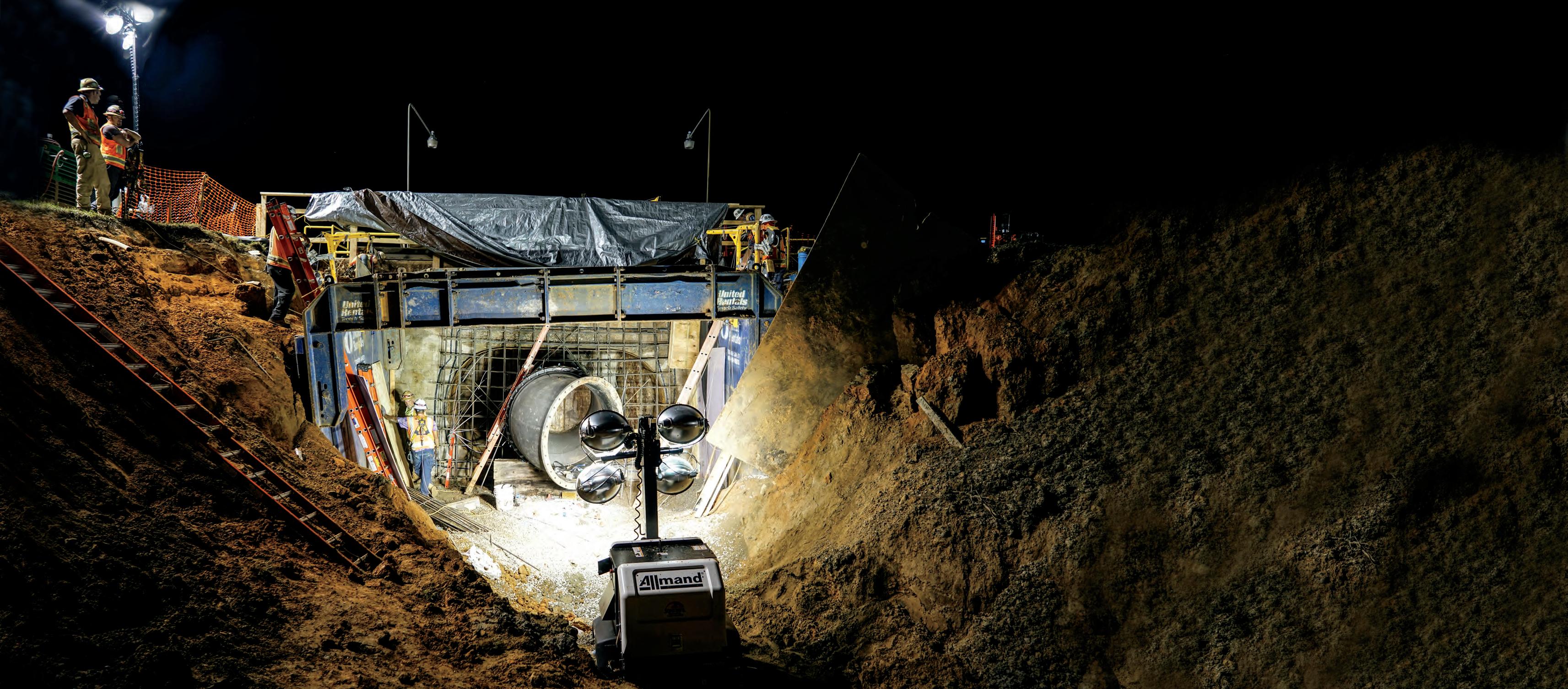
“The hardest work would have less competition on it. So that’s what we looked for. We have always taken on challenging work and not run-of-the-mill kind of jobs that somebody else might be doing.”
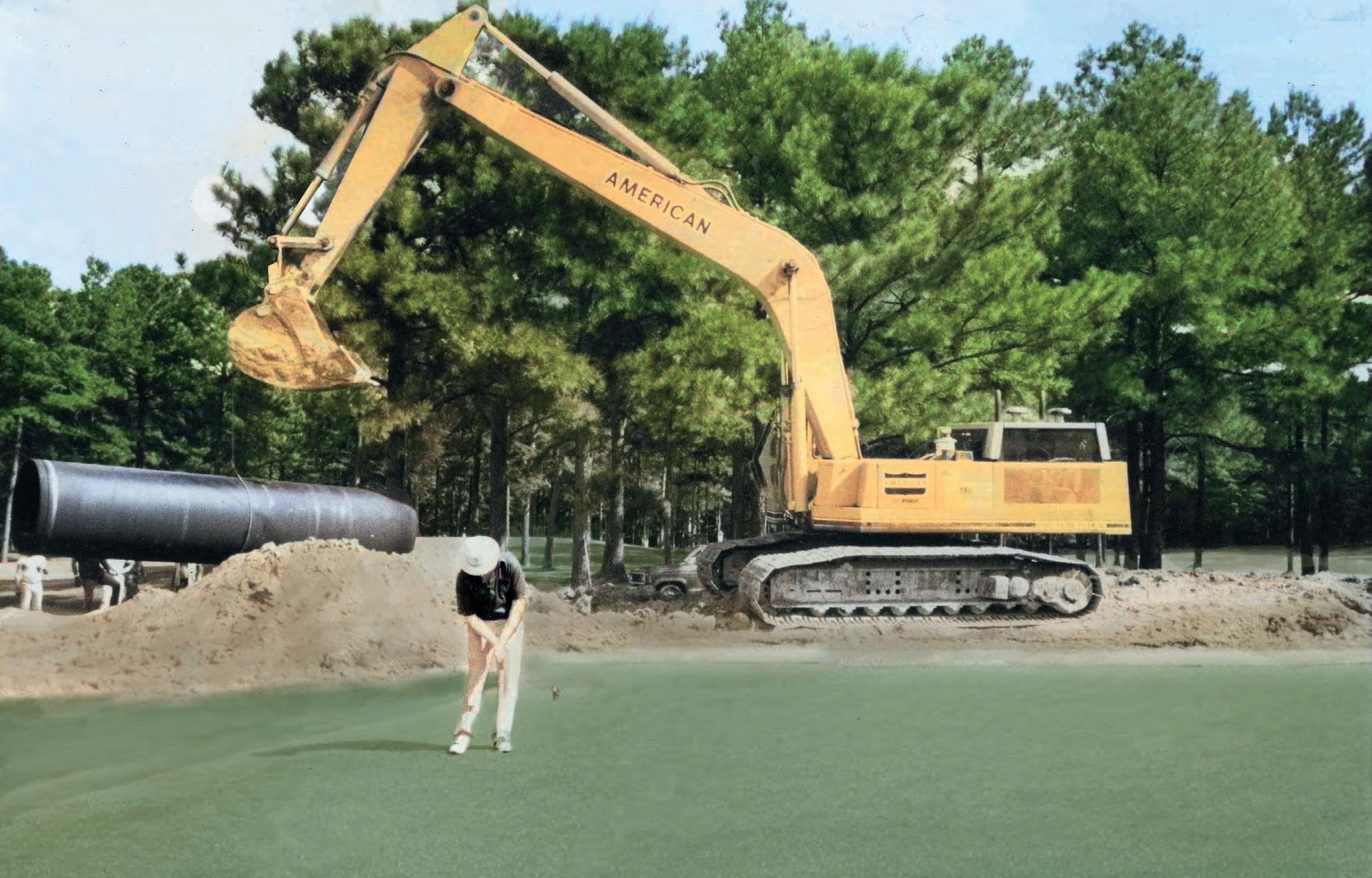
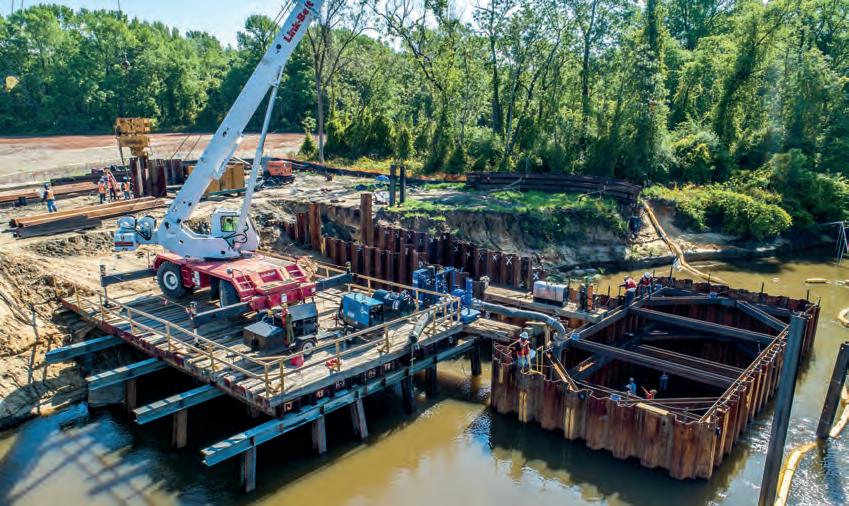
It doesn’t lend itself to elaborate architectural drawings and dazzling photographs. But without horizontal construction and the building and maintenance of utilities, America screeches to a standstill.
T.A. Loving Company has been in the thick of horizontal construction since the company’s beginnings in the 1920s when it was building bridges, this broad category of work referring to jobs that are wide, rather than tall. It is sometimes called “civil construction.” Roads, bridges, sewage systems, water treatment facilities, fiber optics, electric lines and transmission facilities fall into this genre.
Frequently this work is funded by the government, as many horizontal structures focus on infrastructure and transit used by the population as a whole. A civil engineer usually designs the project rather than an architect who designs a building, and these jobs lend more importance to structural strength and functionality over aesthetics.
It was known for many years in T.A. Loving Company as the “Utility Division” and has been designated as the “Civil Infrastructure Group” in recent times.
“This group has been very successful for a long time,” company Chairman Sam Hunter said in July 2023. “And we’re doing very well right now. Presently the difficulty is to not take on more than we can handle. Since the company was started, it’s been built on relationships and reputation. That’s
what T.A. Loving has been all about, and the Civil Infrastructure Group has been busy and productive over many years.”
“The commercial building division was always the bigger part of the company and the more visible side of the company,” says Jerry Smith, who ran the Utilities Division from 1987 through his retirement in 2015.
“You finish a six-story building, and it’s there and you can see it. You lay sewer lines and water lines and after the grass grows, you don’t know that anything is down there.”
Da vid Philyaw, president of the Building Group, cites one of the company’s most celebrated jobs—building Fort Bragg in Fayetteville at the outset of World War II. It was a key part of the United States preparing to enter the war and drew extensive publicity, with The New York Times highlighting the work on its front page.
“But we also built the largest water treatment plant there at the same time,” he says. “That part of it didn’t generate the buzz as much as the buildings where the troops lived, worked and trained.”
Equipment and technology have evolved over the years as has the size of crews needed to do the work. Years ago, it took more than
a dozen men on a crew to handle utility work. It could be half that number today.
“You’d have a foreman on a crew,” Smith says. “You’d have two operators one for the backhoe or crane and one for the loader. You’d have two pipe layers and then you’d have two laborers. If you were working on a road, you’d have two flagmen. Every crew had a flatbed truck and had a pickup truck, so you also had two truck drivers.”
“We used to have 14 or 15 people on a crew, and now it would be four or five people because of the equipment,” says Hunter.
In the early days of the company, there were three divisions (later renamed “groups,” as they exist today)—Building, Bridge and Paving. The company got into the paving business in the 1950s when it bought a Raleigh-based paving contactor named F.D. Cline Company. Later in the 1960s, the Utility Division was splintered out of the Paving Division and was headquartered in the Goldsboro home office. Bob Loving, a nephew of T.A. and John Loving, was the first executive to run the Utilities Division. He was a graduate of Virginia Tech but died at a relatively young age in the 1970s.
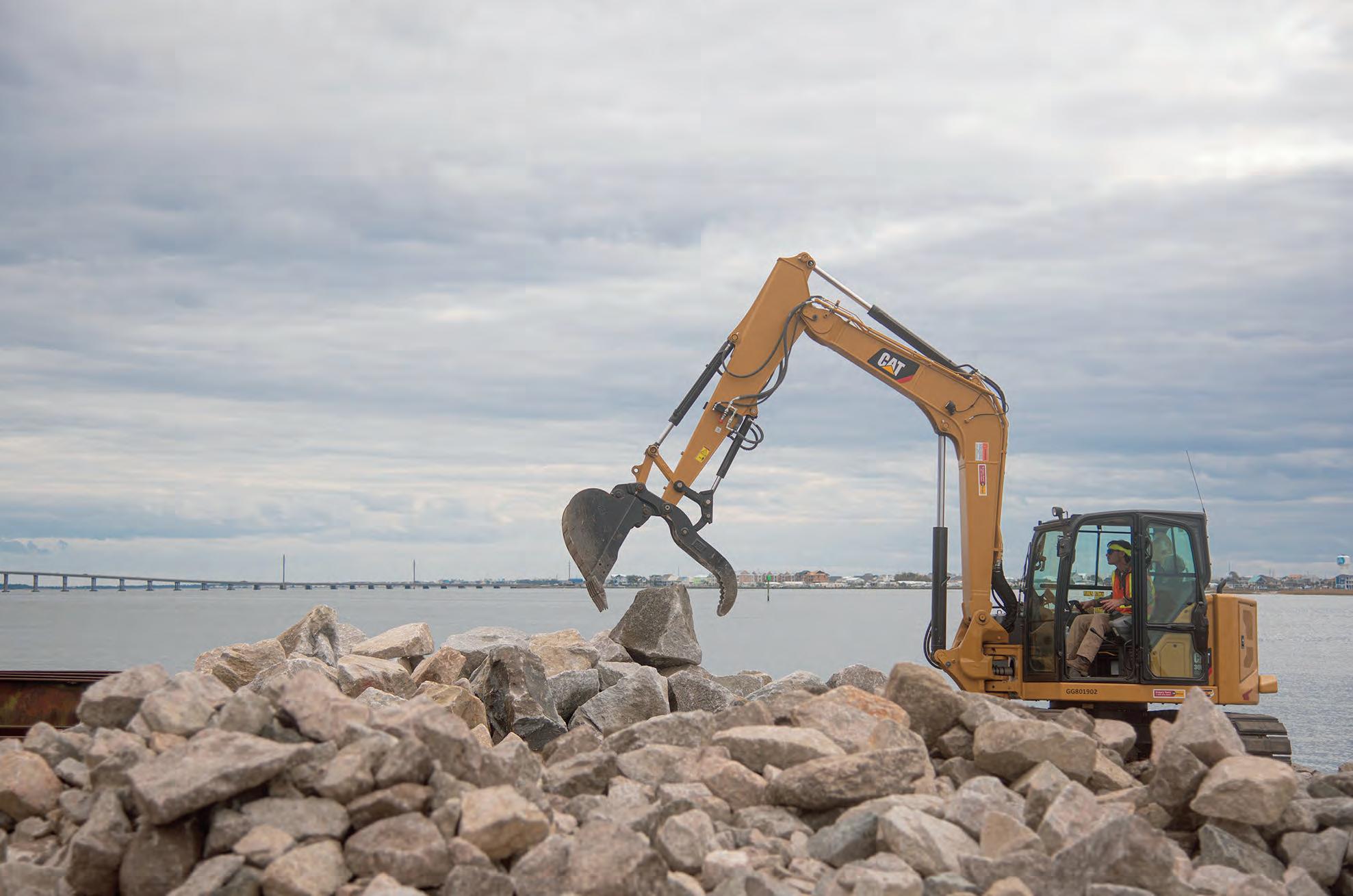
Under his leadership, the division grew quickly and was operating in two states on major projects.
One of the Utilities Division’s earliest jobs came in the late 1960s when it ventured into Western North Carolina to join Lambeth Construction in a joint venture to construct an “outfall line” along the French Broad River, an outfall being a pipeline stretching cross-country and connecting to a treatment plant.
It handled big projects in Virginia as well.
One job was building a thirty-six inch concrete outfall line around Chesterfield Reservoir south of Richmond in the late 1960s. Workers used a small barge in the water to get material to the site.
“The reservoir had ridges of rock, and a different contractor built the tunnels going through these ridges, but we had to lay the pipe in between the tunnels,” Smith says. “It was about four or five or six tunnels around it. We laid the pipe between the tunnels. The only way to get some of the stuff to us was on the barge.
“The price tag was less than a half a million dollars. Today it would be about
$50 million.”
“We are from an area that doesn’t have any rock and all of a sudden we’re out in Asheville and we’re in Chesterfield, Virginia, working in rock,” Hunter says.
“It was challenging. And we were working away from our base. But the company was growing and the work was located outside of Eastern North Carolina. So that’s where we went.”
The company built the Strawberry Hill Pump Station to service Henrico County, northwest of Richmond in the mid-1980s.
Being forty feet below ground level, it took some creative thinking. The company built what is known as a cofferdam—about 110 feet across and circular in shape, using the pressure on the arches for stability just as a wheel does. It was the company’s first venture into a large concrete structure sewer job.
“We did a circular cofferdam with steel sheet piling and poured concrete walers inside the sheeting to support the sheeting, and that hole was really something to look at,” Smith says. “That was probably the biggest structure work we did at that time.”
The company did significant work in
and around Raleigh as the city grew over the second half of the 20th century and built facilities to move drinking water as well as waste water.
One major job came in the 1980s when it laid some five miles of fifty-four inch ductile iron pipe from the E.M. Johnson Water Treatment Plant off Falls of the Neuse Road northeast of downtown back into the city. It was the largest of its kind in the state at the time, and the company had the pipe delivered to Raleigh from Birmingham, Alabama, by train instead of truck in order to save on costs (a truck could carry only two pieces of pipe at a time). The job necessitated bringing big pieces of equipment through North Ridge Country Club’s golf course, and the News & Observer published a photo of a golfer putting on a green with an excavator looming in the background.
The company also laid miles of fiftyfour inch concrete pipe along Walnut Creek in Raleigh to move sewage from the expanding neighborhoods toward the Neuse River east of town and toward the wastewater treatment plants southeast of the city.
“Those fifty-fours have been replaced by
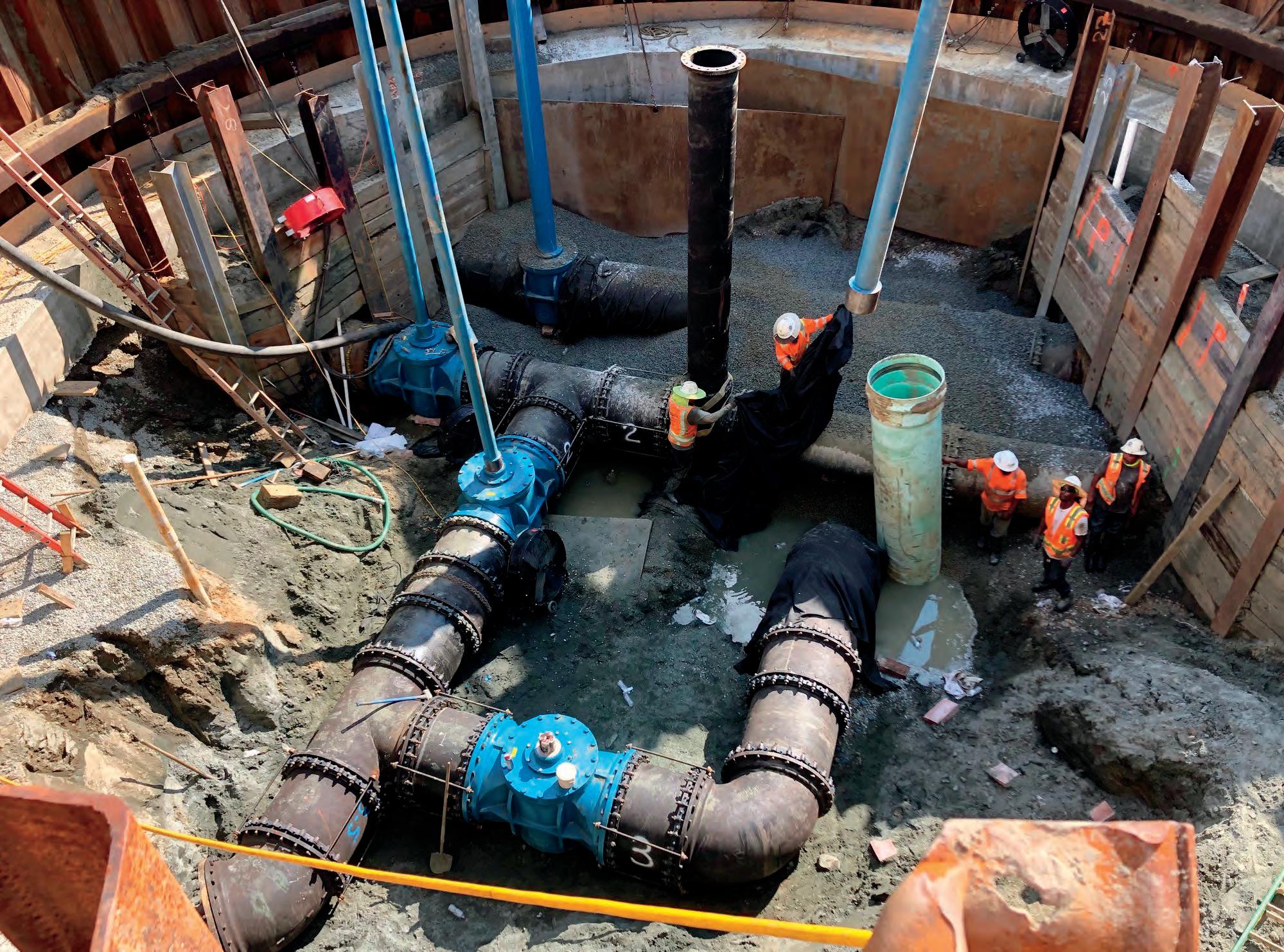
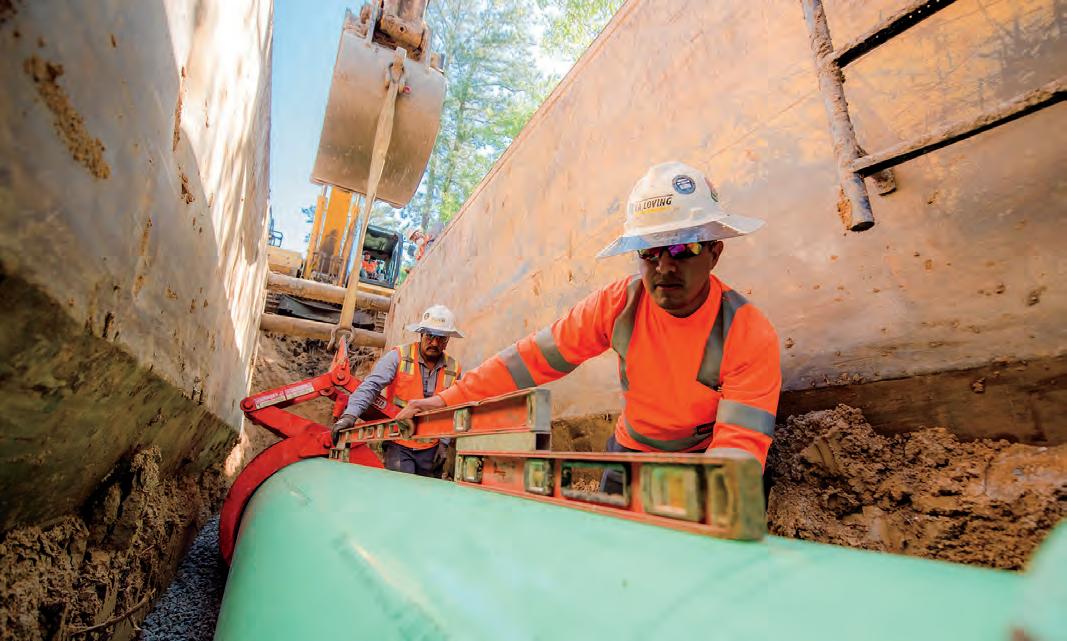
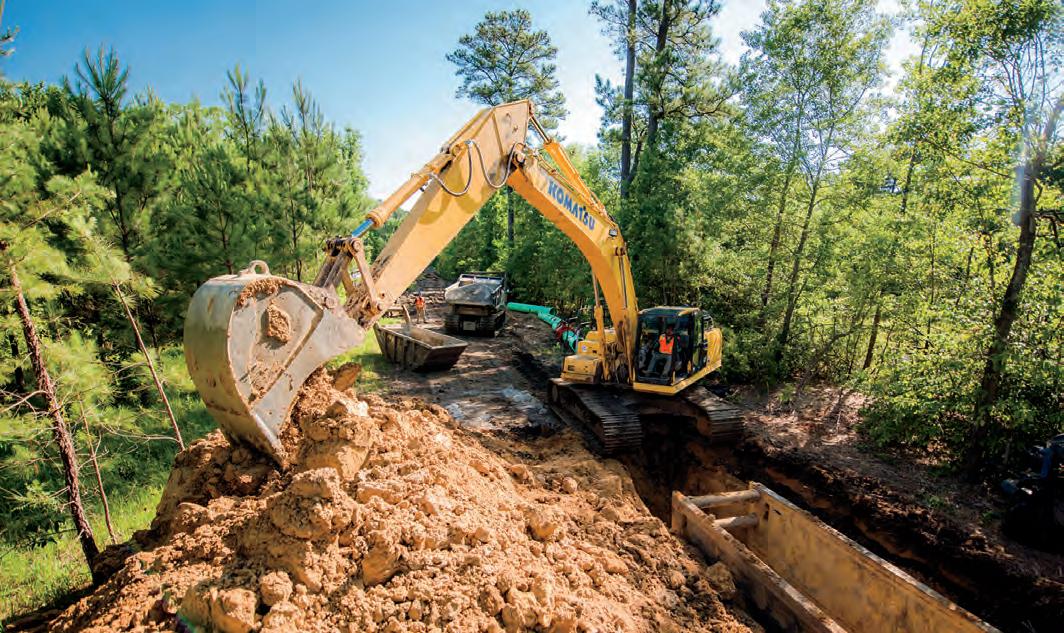
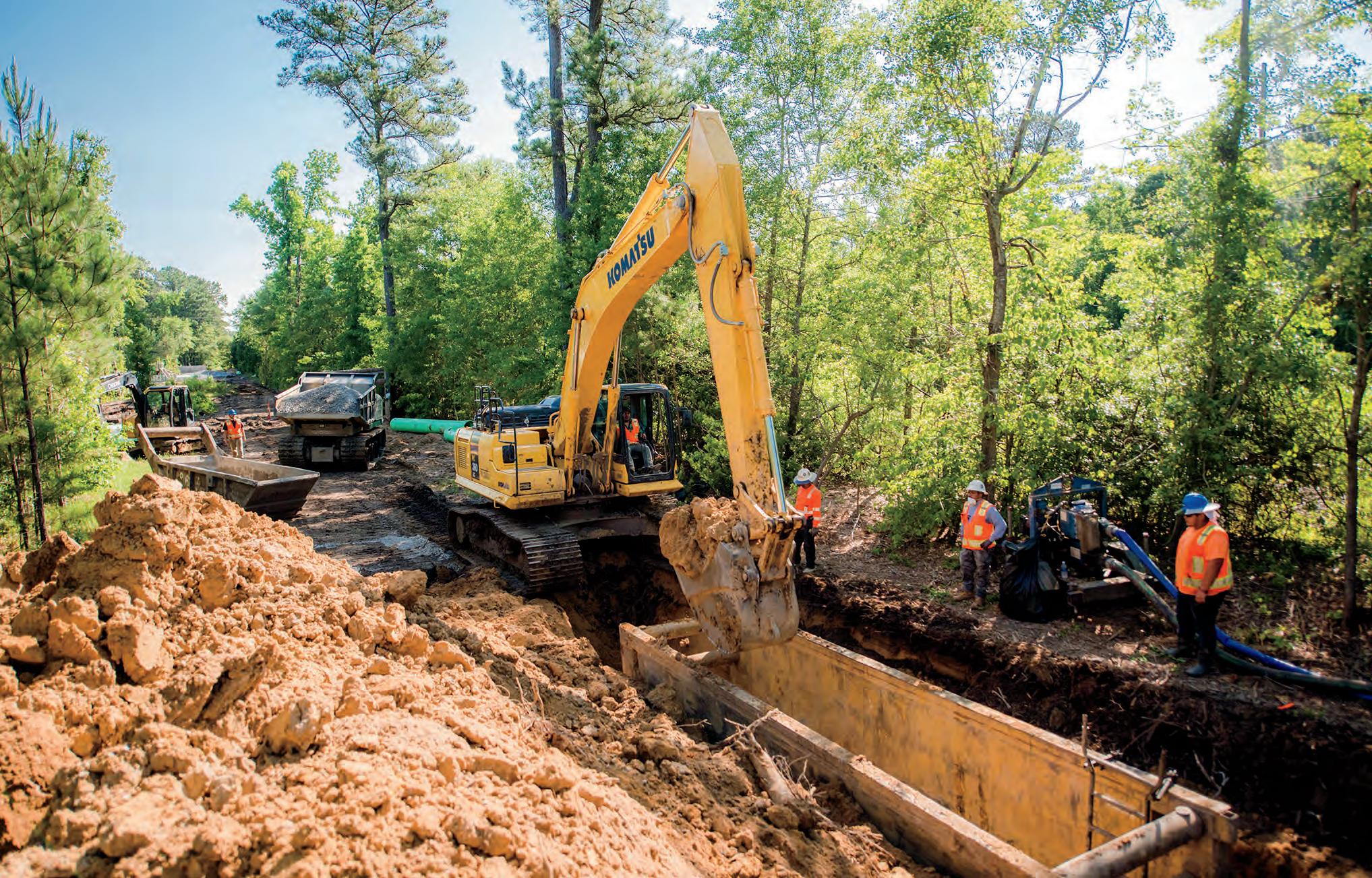
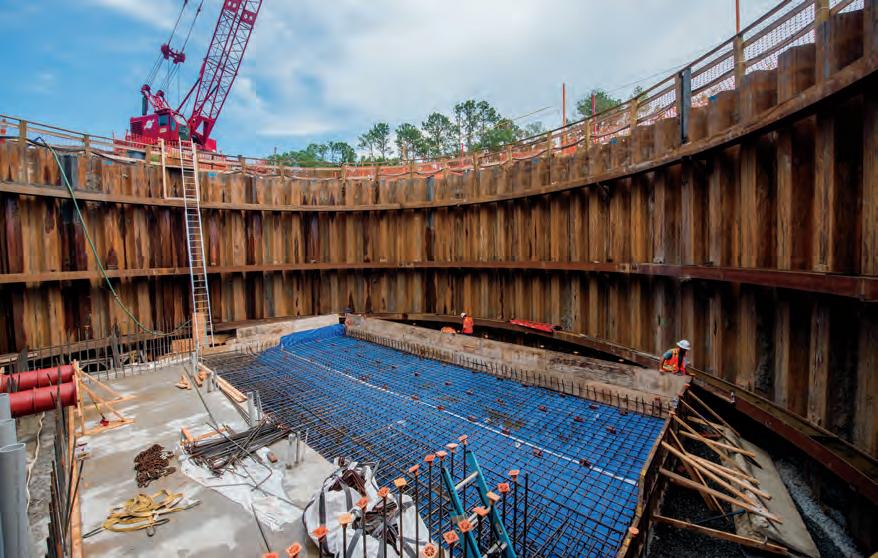
seventy-twos,” says Paul Hunter. “That just tells you how much Raleigh has grown.”
In recent times, the company has completed the East Neuse Regional Pump Station and Force Main a $50 million job that took three years to complete. It built a new sixty-five-foot deep pump station to replace an aging facility and laid seventy-two and ninety-inch pipes.
“The old station had grown obsolete because of capacity,” Sam Hunter says.
“Fifty-four inch lines had turned into seventy-two and they turned into ninety— all to carry the volume generated by more people, more homes and more businesses.”
The company completed a seventy-two inch outfall in Greensboro in the 1980s, with Sam Hunter remembering it being the first time the company used a large hydraulic excavator (weighing over 150,000 pounds).
“Up until that time we used cranes with
backhoe attachments that were powered with cables, and you can imagine how slow that was,” he says. “About that time we were transitioning from all pipe line projects and we were getting into pump stations. Those require concrete work, which was associated with our bridge work because we know how to do concrete work. These pump stations required excavation, pouring concrete and then putting in piping and pumps.”
The company ventured into the private sector in the 1980s to install a sewer system for Anheuser-Busch in Robersonville, North Carolina, for its Eagle Snacks unit. There it manufactured bite-size pretzels, potato chips, peanuts and cheese snacks that were distributed to bars and airlines.
“We did a good job there and caught the eye of Augie Busch (August A. Busch III, the company president from 19732002),” says David Pittman, a longtime Civil Infrastructure Division vice president. “We met the schedules and did the quality work they were looking for. They liked us so we went down to Florida and did a job there for the brewery in Jacksonville.”
At that facility, Anheuser-Busch wanted to move recycled wastewater five miles
west for irrigation to a sod farm it owned and operated.
“It went from the beer that they were making at the brewery and was pumped through these pipelines out to the sod fields. It was twenty-four inch HDPE (high-density polyethylene), and that was a big HDPE job at the time,” Pittman says.
One notable project involved laying a twenty-four inch water pipe across a mile of open water in the Roanoke Sound. It took creativity from the T.A. Loving team to devise a means and method to execute the work.
“We designed a platform hung on the side of a barge that sloped into the water at an angle, and part of that platform was above water so we could put several joints of pipe together,” Hunter says. “When we moved the barge ahead, the pipe slid down that platform into the ditch. The ditch had been dug by an excavator on a different barge. A crane on a third barge was backfilling the trench, and all of this was done underwater with a clam bucket.”

Unfortunately as the job went along, the crane operator unknowingly at some time dropped his bucket on the pipe, causing a small hole.
“When it was finished and they were trying to test it, it was leaking like a sieve,” Smith says. “It took a long time to find the leak and fix it.”
T.A. Loving Company continued its commitment to growing its Civil Infrastructure business with the acquisition on January 1, 2023, of Pipeline Utilities Inc., a Raleigh-based firm with four decades of experience and fifty-six employees. The acquisition brought expertise in sectors previously uncharted by T.A. Loving as well as a strong presence in the municipal markets around Raleigh. Pipeline Utilities is led by Mason Kenyon, a familiar face from the mid-2000s T.A. Loving team.
A common thread running through nearly all of these jobs is that they are
challenging assignments.
“The hardest work would have less competition on it,” Smith says. “So that’s what we looked for. We have always taken on challenging work and not runof-the-mill kind of jobs that somebody else might be doing.”
“I can remember the Utilities Division doing only about $5 million a year. Now they’re doing $180 million,” Hunter adds. “We’ve looked for difficult work. You can be very successful or you can lose, too. We would usually take three steps forward and maybe two backwards. Laying big diameter pipe and outfall work in a swamp is not easy. That’s what our company has always been about. We’ve been able to have people who know how to do the difficult jobs.”
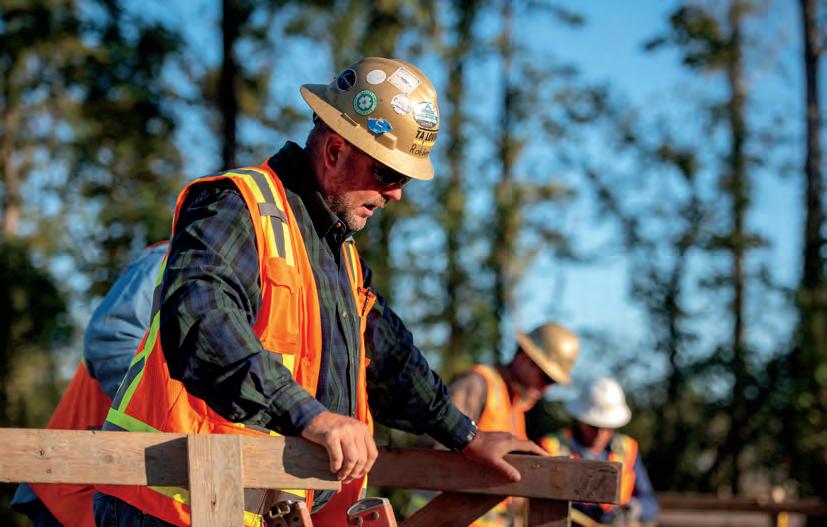
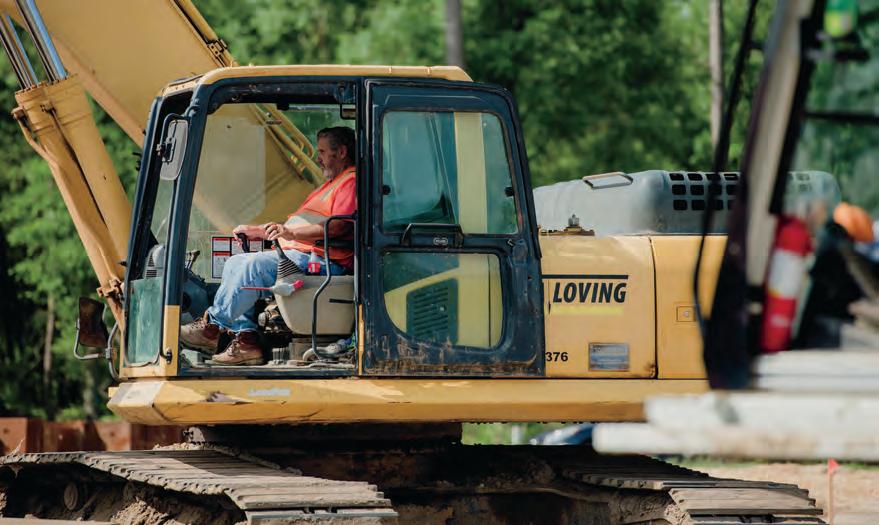
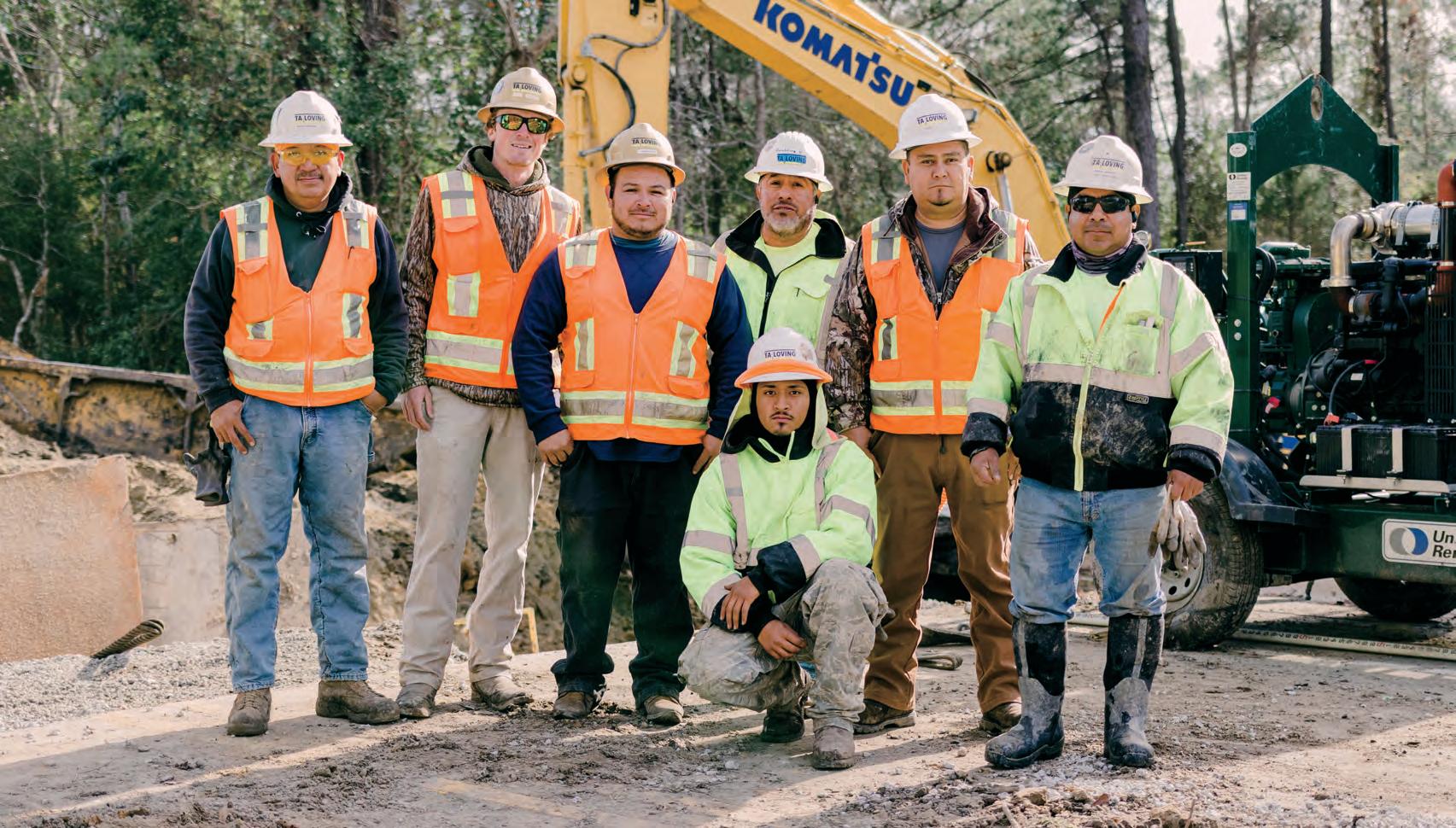
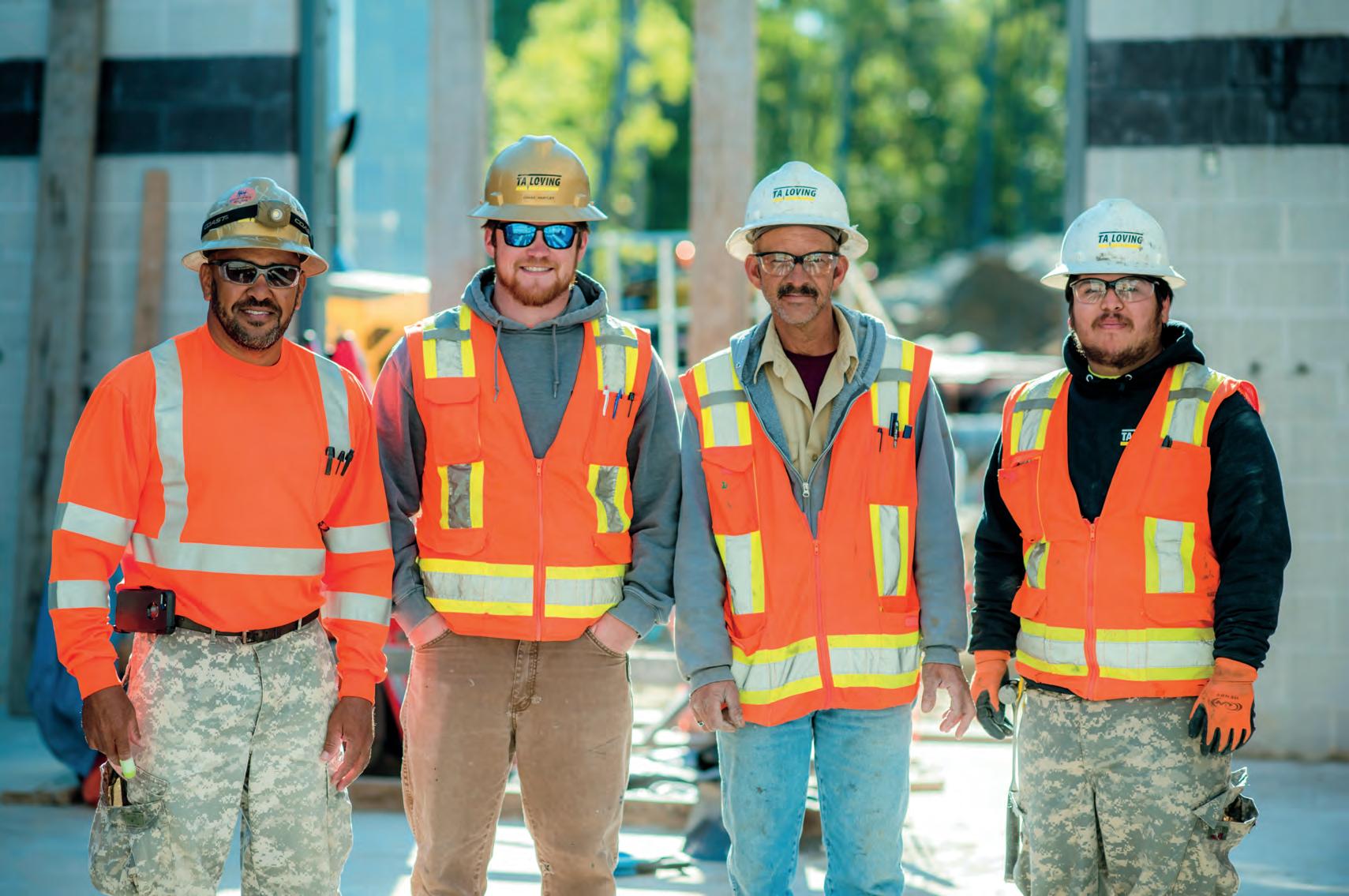

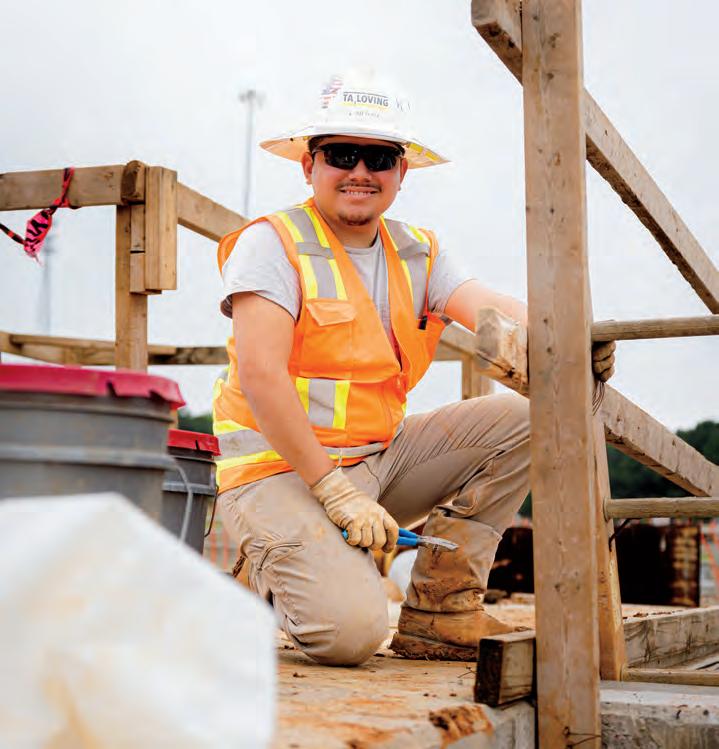
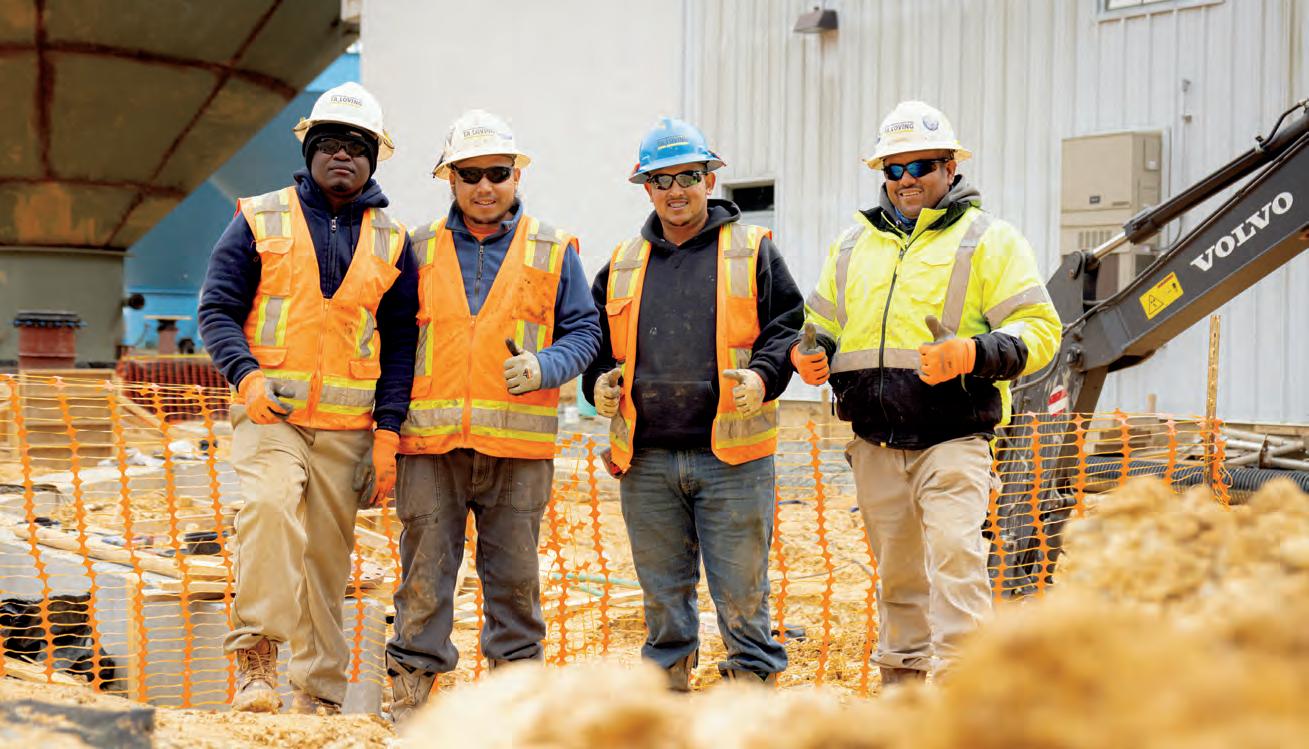
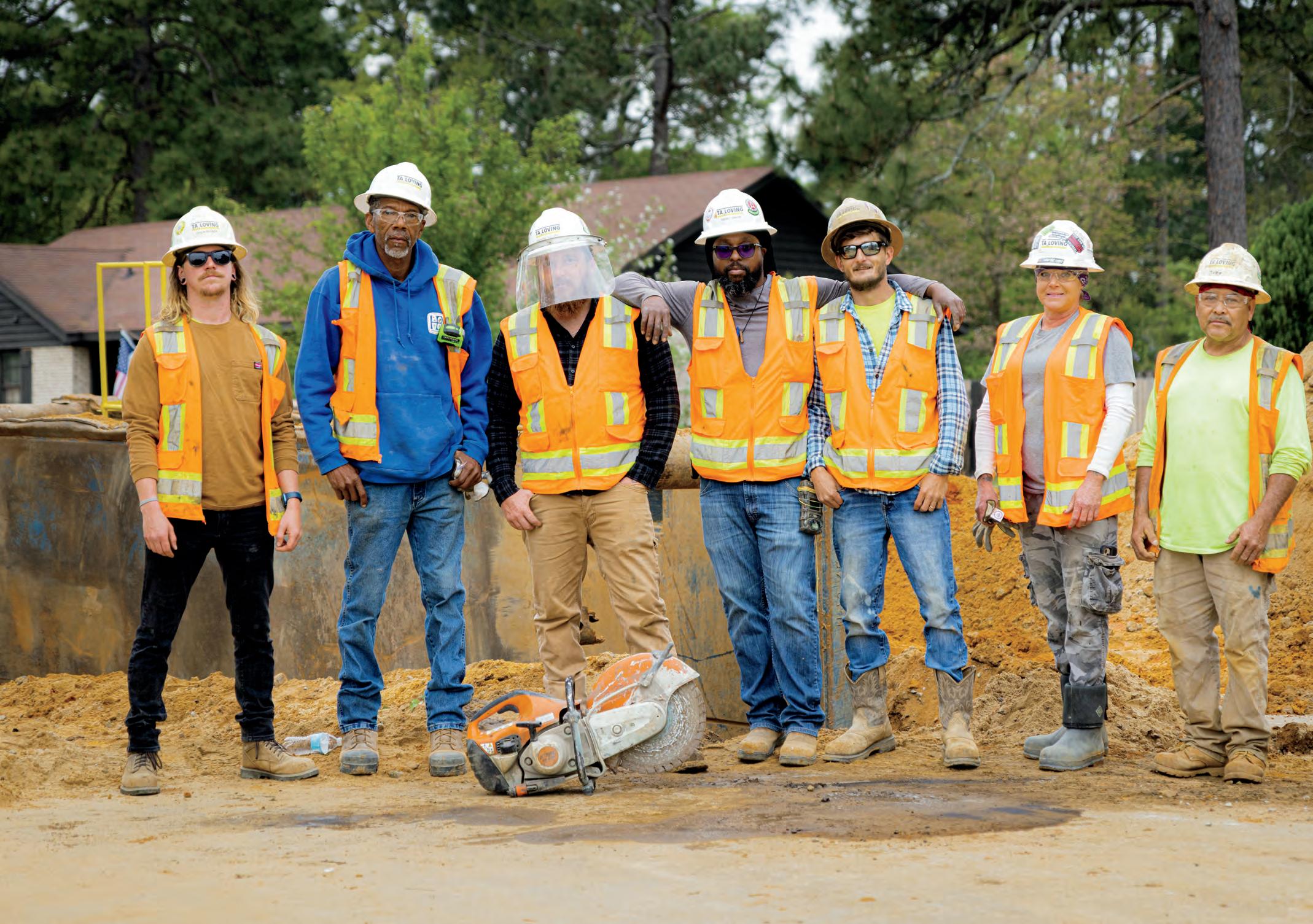
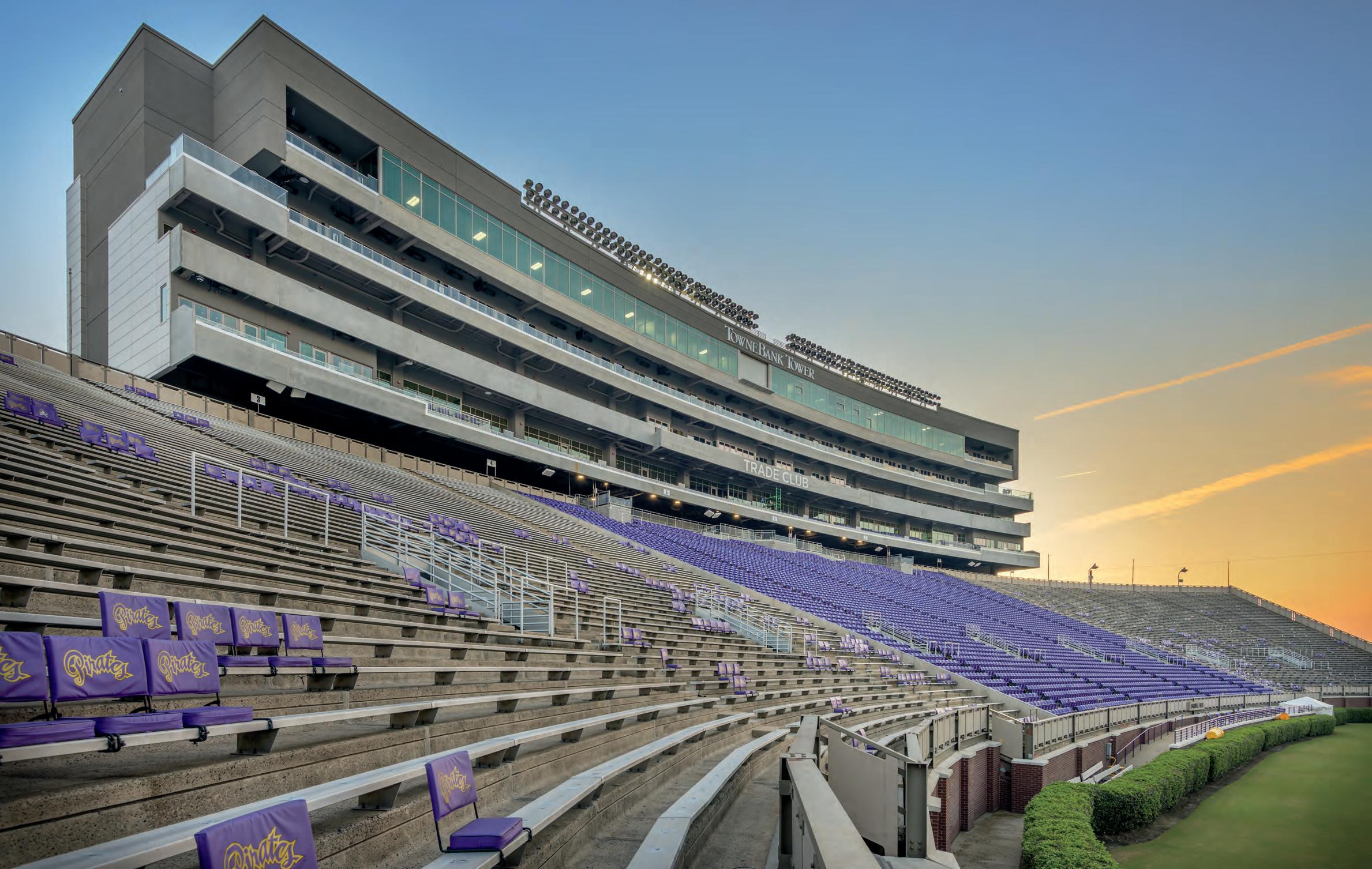
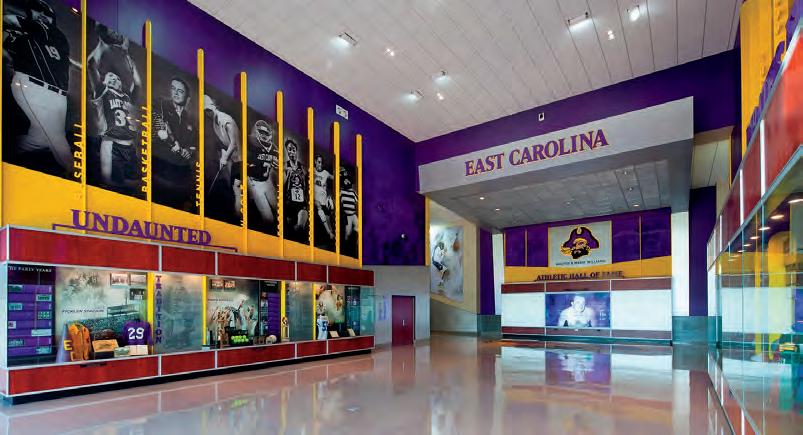
Venturing onto a college campus to construct a classroom, library, dormitory, auditorium or athletic venue has its challenges. Parking is always an issue. Foot traffic around a job site can be restrictive during peak class times. And you never know what kind of mischief an over-served nineteen-year-old can present.
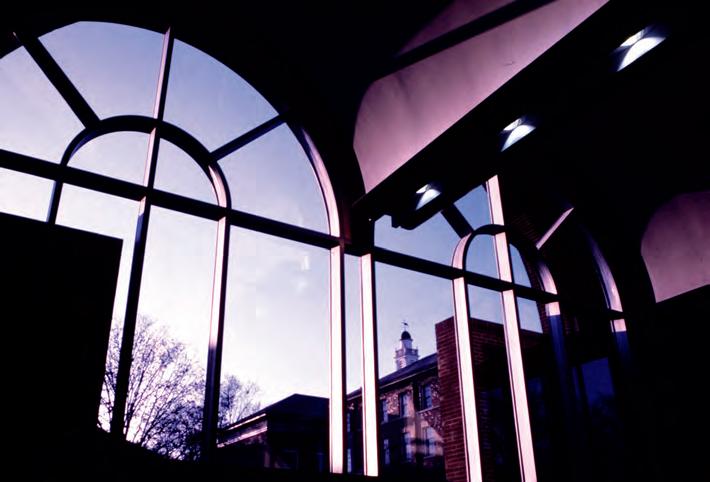
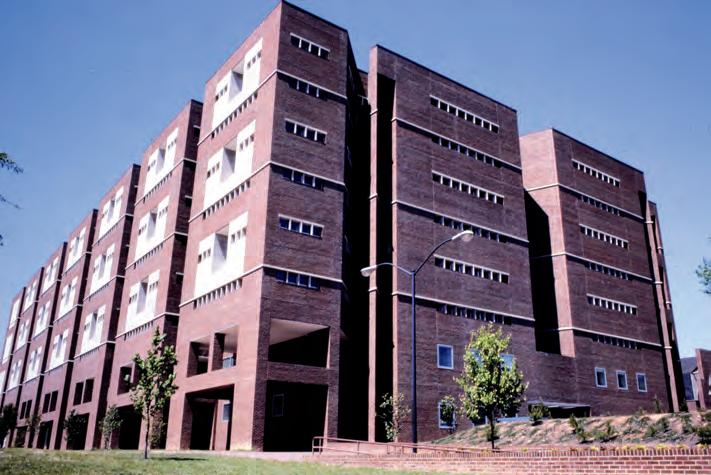
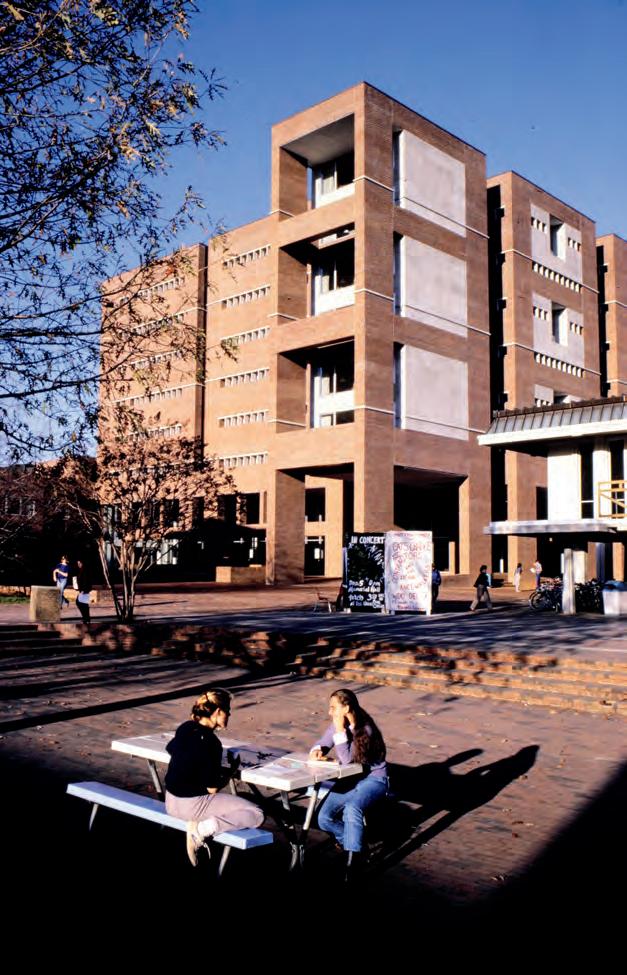
T.A. Loving Company was building the Walter Royal Davis Library at the University of North Carolina in Chapel Hill in the early 1980s. The first night the main tower crane was set up, there was a party nearby at the Graham Student Union. Four guys jumped the construction fence—”Naturally, they were drunk,” project assistant superintendent Dean Moser says— and decided to climb to the top of the crane.
“All four made it about halfway up,” Moser says. “The last guy sobered up a bit and froze on the ladder. The other three could not figure out how to climb around him and get down. They started yelling. Finally, they got the fire department and police and got them all down.
“The kid had a death grip on the ladder. One of the firemen had to knock him out and carry him down.”
A couple of y ears later, the Tar Heel basketball team won the NCAA championship in New Orleans.
Superintendent Bobby Richter remained on the job site late the night of March 29, 1982, to make sure no revelers made their way into the confines of the jobsite.
“We had just set Indiana limestone
on what would become a large reference reading room,” Richter says, “and as soon as the game was over you heard the great buzzing across the entire campus. All the students ran down to Franklin Street. I was there just to make sure none of their spray paint got on my building. Thankfully there were no problems.”
Other than that, it was just another routine job in the T.A. Loving portfolio: laying 1.6 million bricks, importing two hundred pieces of limestone and creating nearly half a million square feet of usable space on eight floors, thought at the time to be the largest library by square footage in American academia. The job cost upwards of $25 million and was designed to hold 1.8 million volumes, plus a large microform and government documents collection.
“Most buildings are designed for one hundred pounds per square foot,” Richter says. “This was designed for probably three hundred pounds a square foot. For many years it was the single largest building that the State of North Carolina owned—450,000 square feet of building and had close to 30,000 cubic yards of concrete in it.”
“It was a fun project,” adds Moser, who
worked on the job through its entirity from 1979 through its opening in February 1984. “It was right in the middle of campus. You had all the restrictions you would normally have, plus we had everybody and their brother looking at you—students, faculty, passers-by.”
T.A. Loving’s Goldsboro headquarters puts it in close proximity to three major universities that in 2023 had a combined enrollment of nearly 100,000 students. East Carolina University is just over thirty miles to the east in Greenville, N.C. State University is fifty miles away in Raleigh and UNC is seventy miles away in Chapel Hill. The company has contracted approximately twenty projects at Campbell University in Buies Creek and has also done work at Duke, UNC-Wilmington, N.C. Wesleyan, Appalachian State and William & Mary. Building Division President David Philyaw is an ECU graduate, and his first assignment in 2004 after working his way up to project manager with T.A. Loving was with a new baseball stadium at East Carolina. Lewis Field at ClarkLeClair Stadium was to replace the existing facility, Harrington Field, and had to be
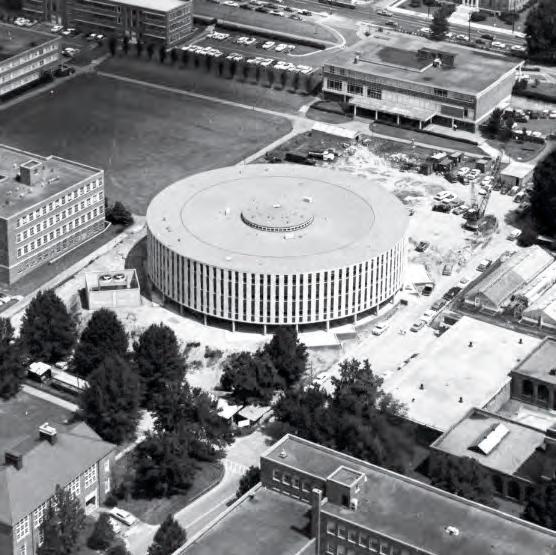
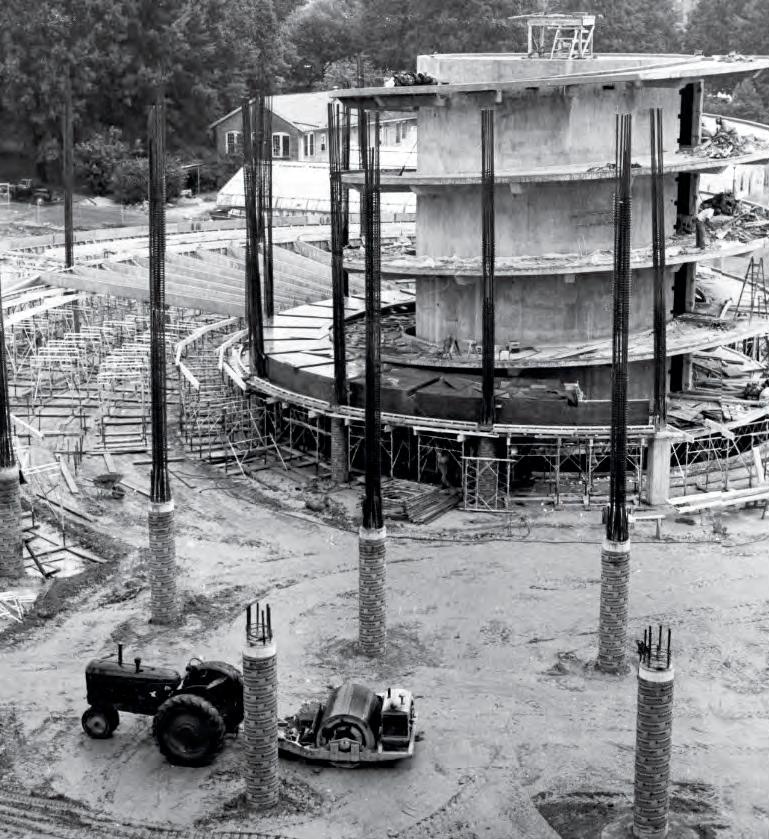
completed in ten months—from the end of the 2004 baseball season in May through the beginning of the 2005 season in March.
“It was one of those jobs with a tight deadline and we can’t fail, there’s a baseball schedule in place,” he says. “The job went well from a completion and an owner’s perspective. We didn’t make a lot of money from it, but what we did get out of that was a relationship we’ve had for two decades, and we’ve been building there ever since.
“I saw first-hand with that job what Sam Hunter has talked about so many times. If people don’t like you, they’re not going to work with you. What sets you apart in this business so often is the relationships. You’ve got to have some friends. If you don’t have friends in this business, it’s a tough business to be in.”
The Bryan family has certainly had many friends at N.C. State, where three generations of Bryan men and T.A. Loving Company executives attended. Raymond Bryan Sr. studied in Raleigh for two years in the late 1910s before starting his construction career, and Ray Jr. is a 1953 graduate and Steve followed with his degree in 1982. A 2007 publication from
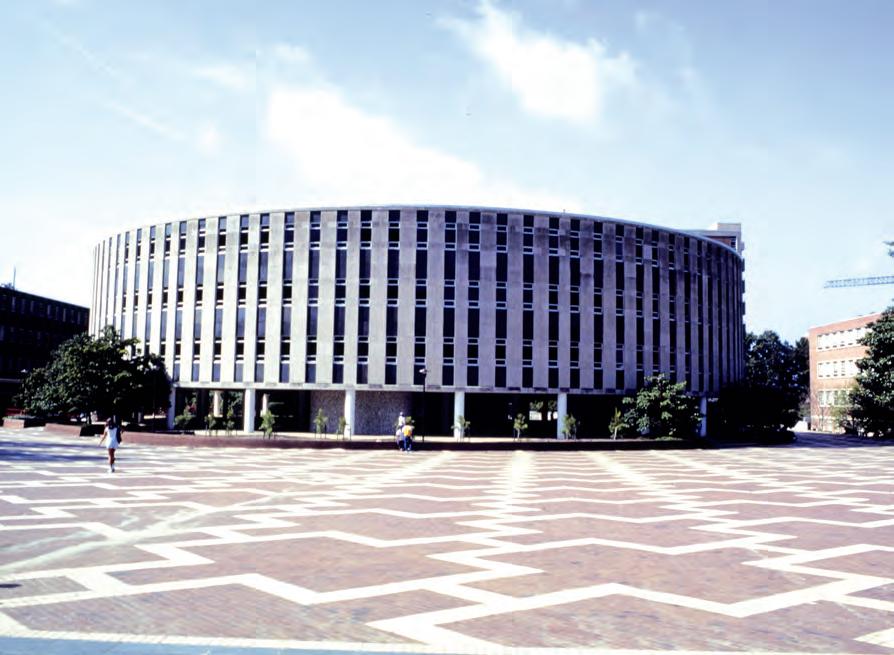
the Civil, Construction and Environmental Engineering Department at N.C. State highlighted the work T.A. Loving Company had done on campus and cited, in addition to the Bryans’ connections, that Chief Financial Officer Al Grisette (1972) and Senior VP Michael Richter (1982) and Ty Edmondson (1989) were also State graduates.
T.A. Loving built the original College Union Building at State, which opened in 1954 and soon followed with work on Cox Hall (a six-story structure housing labs, lecture rooms and computer facilities that opened in 1960). In the mid-1960s, it embarked on an ambitious project to expand the university’s on-campus housing inventory, with Bowen, Carroll and Metcalf
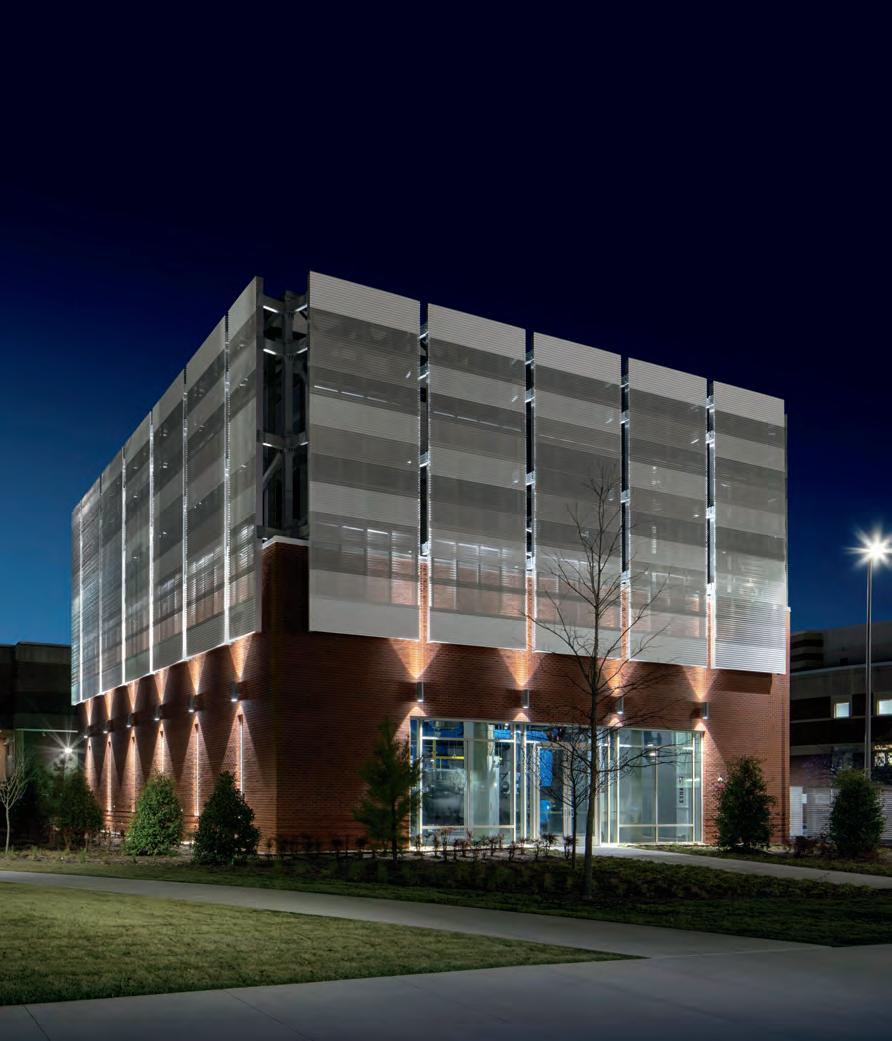
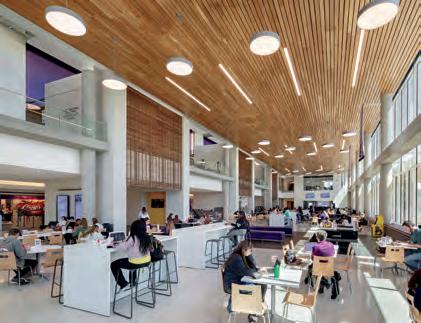
dormitories set side-by-side in central campus. They were referred to as the “tri-towers.”
Many years later, T.A. Loving Company was the general contractor for the Park Alumni Center. That building opened in the spring of 2006 and encompasses 59,000 square feet on a prime Centennial Campus location. It features Italian marble flooring, double-curving staircases and a grand reception room with a stunning view of the lake near the Lonnie Poole Golf Course. The company has also been active in the Wolfpack athletics domain, most recently building the football team’s Close-
King Indoor Practice Facility (completed in 2015). Before that, the company was the general contractor for the Wendell Murphy Football Center, which opened in 2003 and included 5,800 new permanent seats in Carter-Finley Stadium and three outdoor practice fields in addition to the Murphy Center itself, which operates as the home for coaches’ offices, locker rooms, training and meal facilities for the Wolfpack team.
Certainly one of the most interesting projects at N.C. State was building Harrelson Hall in the early 1960s. Steve Bryan is quick with an answer when the subject of the circular-shaped classroom building with open space on the ground floor is broached.
“Somebody will say, ‘Did y’all design that?’ I say, ‘No we built it, we didn’t design it,’” he says with a smile.
That’s because the design and functionality of the building became controversial over the half century of the building’s existence (it was razed in 2016).
A story in Our State magazine in 1959 provided some background into the concept for the building and said that limited availability of land on central campus between Hillsborough Street
and the railroad tracks running east-west played into the planning from Raleigh architects Holloway-Reeves. They designed the four-story building with a diameter of only 206 feet. Windowless, circularshaped classrooms seating up to two hundred students were set in the center of the building, with faculty offices on the perimeter. But the building was ridiculed as a “flying saucer on stilts,” and students in some classroom seats had to crane their necks to see equations written around curving blackboards. Restroom stalls were shaped like pie slices, and students took to skateboarding and rollerblading on a circular pedestrian ramp running from floor to floor inside the building.
“Harrelson’s designers believ ed architecture played a vital role in shaping and improving human life, giving it zest and originality,” noted an article in a 2016 issue of N.C. State Magazine “For all their mistakes, those minds earn posthumous marks for effort.”
T.A. Loving Company first ventured onto the East Carolina campus in the late 1940s and into the 1950s with the construction of two residence halls located just off 10th
Street, south of the central campus Mall.
The North Carolina General Assembly appropriated nearly half a million dollars in 1947 for a men’s dormitory to house 216 students. It opened in 1949 and was named for Ronald J. Slay, a recently deceased professor and college dean. Then in 195355, the company built the William B. Umstead Residence Hall, a 48,512 square foot, three-story men’s dormitory just south of Slay named for the incumbent governor of the state. It housed 310 males at the outset but was converted to a women’s dormitory in 1960. The company was also the general contractor in the late 1970s for ECU Nursing Tower, a $3 million-plus project.
By the late 1900s, the company had a solid reputation on the Greenville campus and was retained in 1999 to complete the Student Recreation Center after the original contractor was fired. At the same time, it took over the Joyner Library expansion and renovation after yet another contractor was dismissed.
Following that job, the company was well-positioned in 2004 to handle the Clark-LeClair Stadium job for the baseball program, and the dominoes have been
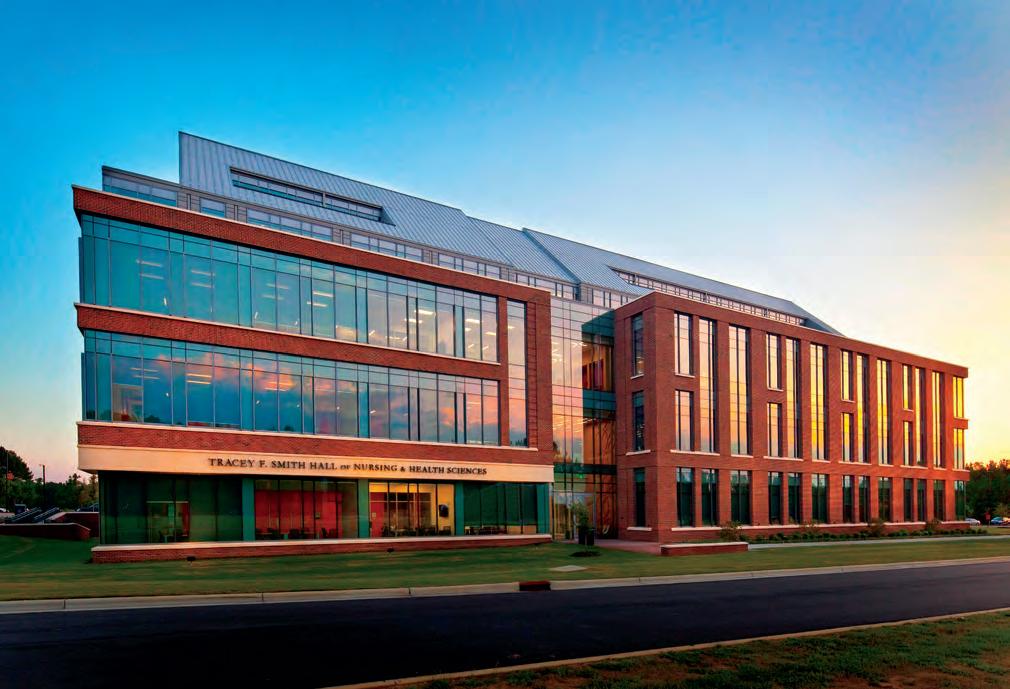
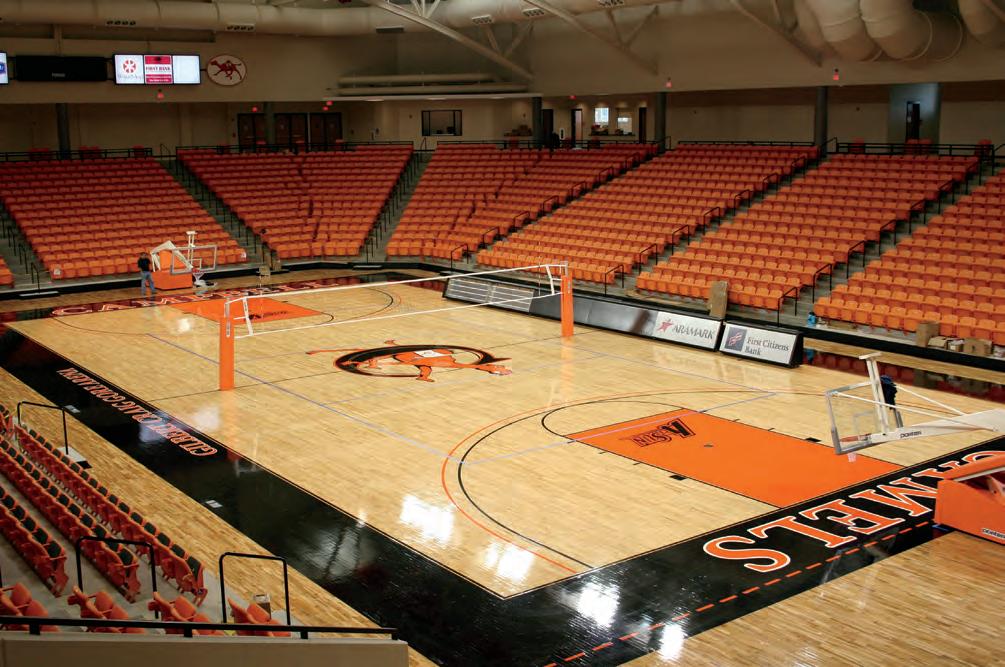
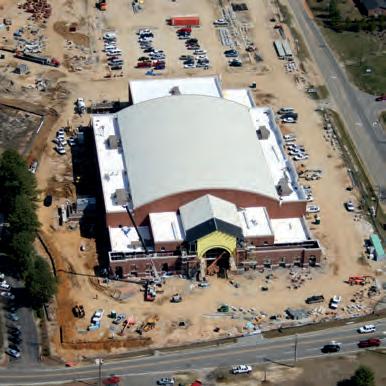
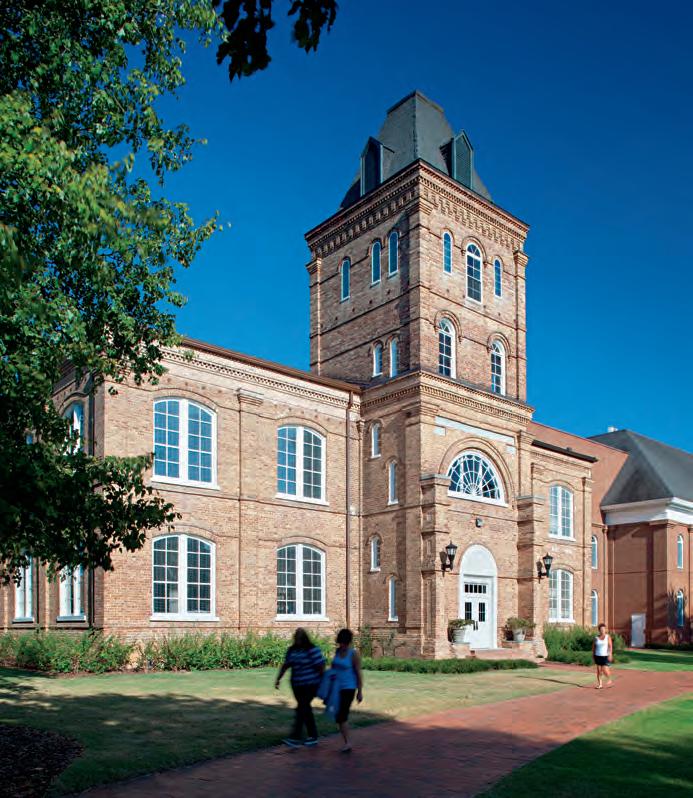
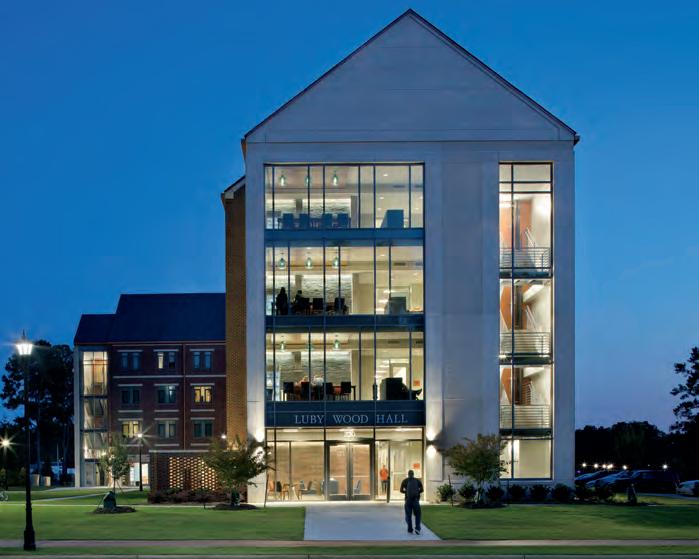
falling with regularity ever since, with much of the work on athletic facilities.
In 2010, the company completed The Boneyard at Dowdy-Ficklen Stadium, which included demolition of the existing scoreboard and end zone hardscapes, as well as the additions of seven thousand seats, men’s and women’s restroom facilities, a commercial kitchen, concession stands, souvenir stand and a new video board.
In the summer of 2011, the company completed a $24 million Olympic Sports Complex for softball, soccer and track on a site at the corner of Charles Boulevard and U.S. Hwy. 64 adjacent to the football and baseball stadiums.
T.A. Loving had a major hand in the $60 million Southside Renovation Project at Dowdy-Ficklen Stadium that began in 2016, most significantly being the general contractor for the five-story TowneBank Tower. The tower replaced the old press box facility that opened in 1977 and features
four levels of premium seating, a new press operations area and multipurpose space that is also used for banquets and meetings.
The project also included 22,000 square feet of renovations in the Ward Sports Medicine Building and the construction of the Walter and Marie Williams Hitting Facility adjacent to Clark-LeClair Stadium.
Outside of athletics, the headline project for T.A. Loving at East Carolina was the Main Campus Student Center that spans 220,000 square feet and opened in January 2019 at a cost of $122 million, replacing the outdated 1974 Mendenhall Student Center. The company worked with Barnhill Construction from Rocky Mount in a joint venture on the sparkling facility that features eight dining and retail venues; multiple lounges, study rooms, and a gaming center; multipurpose conference space; a 250-seat black box theater; a 14,000-square-foot ballroom that is divisible into three rooms; and a fivelevel, 724-space parking deck. Natural light fills the internal spaces and reduces energy consumption from interior lights. Smartglass windows respond via sensors to the level of sun exposure and adjust tint and
shading to control temperature and the amount of light coming into the building.
“Student centers only have one job: to be everything for everyone,” said Dean Smith, director of Student Centers at ECU. “I think we accomplished that.”
The job was honored with a “Building North Carolina Award” by Business North Carolina magazine, which annually recognizes some of the state's most impressive commercial projects for design, innovation and impact on their communities.
“We had fifty-two different contractors that we were under contract with,” says Jason Arnold, the superintendent on the job. “It was over a million man-hours put in. We had to do a safety orientation for every employee that came on the job and we gave them a little sticker that goes on their hard hat. It’s got a number so you can kind of keep up with who’s who and who’s what. I think we had over two thousand people come through the training and work on the job.”
T.A. Loving has had a notable presence as well on the campus of Campbell University in Buies Creek, with a convocation center and law school among the major projects.
The centerpiece job was the 106,000
square foot John W. Pope Jr. Convocation Center that opened in October 2008. The building features the Gilbert Craig Gore Arena, offering 3,782 seats for athletic events with additional seats available for concerts, graduation ceremonies and other events. The structure also houses the R.P. Holding Sr. Student Fitness Center, administrative offices, dressing and strength-training facilities for the men’s and women’s basketball teams.
The company in the 1990s built the Norman A. Wiggins School of Law and renovated an adjacent building that traces its roots to the early part of the 1900s. Kivett Hall opened in 1903 and was named for Zachary Kivett, a self-taught architect and structural engineer who funded the first phase of the project by asking students, teachers and others in the community to pitch in at least $5 each. Over the years it served various functions at Campbell, including being headquarters for the English and law departments. Today it houses the English department and administrative offices.
Bobby Richter was superintendent on that job and noted a number of interesting
features in restoring an old building rather than building from scratch.
“Kivett had load-bearing masonry walls,” he says. “The walls carried the weight of the floors. They were two feet thick and there was no foundation. There was a foundation of twelve to eighteen inches of fieldstone and the brick and mortar laid on it. The mortar I’m sure was handmade. They probably used oyster shells. The mortar was pretty soft—you could actually drive a sixteen-penny nail in it. So the building is a little bit flexible. But it was interesting working on that old building.”
The most recent job was the Luby Wood Hall, a 63,809 square foot, four-story residence hall that was finished in 2016.
The company built a new press box and home side seating at Barker-Lane Stadium at Campbell during the summer of 2013. It got the green light in May and had to deliver the facility by the first home game on Sept. 7. The job involved building an eighty-foot tall structure with two levels, including adding a deep pile foundation, bathrooms at the ground level, an elevator and over 3,000 additional seats to the existing stadium.
“It was an all-hands-on-deck approach from the owner, design team members, subcontractors, and county entities to make it happen,” says Noah McDonald, assistant project manager on that job. “We worked seven days a week, from the early morning to late at night. Everyone involved understood the goal and was committed to completing the project before the first game’s kickoff. We completed the project and received a building occupancy certificate twenty-four hours before the kickoff for a total of ninety days of construction duration. We had a lot of naysayers who did not believe we could complete the project on time, but we proved them wrong.”
Following that landmark job building the Walter Davis Library on the UNC campus in Chapel Hill in the early 1980s, T.A. Loving returned a quarter century later with a major presence in athletic venues for various Tar Heel teams—one from 2010-11 at Kenan Stadium and another from 201619 impacting football, soccer and lacrosse. Working in tight quarters and having to coordinate workers and materials during the college football season of 2010, Loving built the new Loudermilk Center for Excellence
on the east of Kenan Stadium. Workers demolished the original Kenan Field House and constructed the new 190,000 square foot Loudermilk Center, which included a premium seating section called The Blue Zone and added 2,980 seats to the stadium’s capacity. While viewed by many as merely a seating addition to Kenan Stadium, the job was so much more as it provided academic study, tutoring and meeting space for all Tar Heel athletes as well as a multiple sport strength and conditioning facility, and team headquarters facilities for the men’s lacrosse squad. The space also tied the north and south concourses together, which resulted in a 360-degree concourse around Kenan.
T.A. Loving returned to Chapel Hill in 2016 for three years to orchestrate a multifaceted project called the Central Campus Athletics Facility.
Indoor practice facilities for college football teams had become standard fare as the 21st century evolved, and T.A. Loving built one at N.C. State that opened in 2015. UNC was slower to evolve as, at the time, football, soccer, lacrosse, field hockey and track and field all competed
and were headquartered in a tightly-knit group of venues in the middle of campus— with little room to expand. The university and its fund-raising arm, The Rams Club, announced in 2016 a plan to move track and field to a new venue off-campus and locate a new field hockey stadium on an intramural field.
That opened up room for a football practice complex that included the indoor facility with a 120-yard field and two outdoor fields, one natural grass and one synthetic turf. The football team was expected to practice in Kenan Stadium only for the 2017 football season, but various delays pushed the completion of the indoor building until late in 2018. The site of the old Navy Field had been something of a junkyard repository back in the early 1900s when South Campus was actually a forest. Among the artifacts found beneath the ground were an abandoned automobile and contaminated diesel deposits that took time to remove. Workers also found chilledwater lines and steam lines that had to be rerouted, stormwater pipes that had to be rerouted but also remain operable through the project and even some domestic
water pipes that were in such bad shape they had to be replaced. All that and some unexpected rock that had to be blasted out.
Adjacent to the north side of the indoor football facility is a completely redesigned field and stands for soccer and lacrosse. Dorrance Field is named for Anson Dorrance, the long-time Tar Heel women’s soccer coach, and was dedicated in September 2019. The field is part of the UNC Soccer & Lacrosse Stadium. The facility boasts a natural grass playing field, attached facility with offices, meeting areas, locker rooms, a Hall of Honor, 4,200 individual chair back seats, concessions, restrooms and a new LED scoreboard.
T.A. Loving was just years away from celebrating its centennial when it completed three projects on the UNC campus in Chapel Hill. One of them was a perfect example of the what-goes-around, comesaround principle.
Berryhill Hall was constructed by T.A. Loving and opened in 1970 as the new Medical Education Building at the UNC School of Medicine. The building was designed to accommodate a class cohort of one hundred, and large, windowless
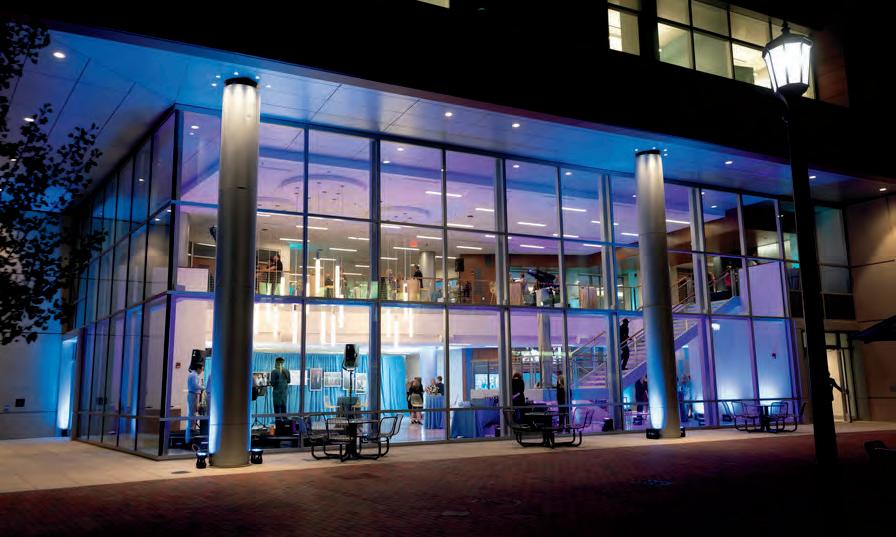
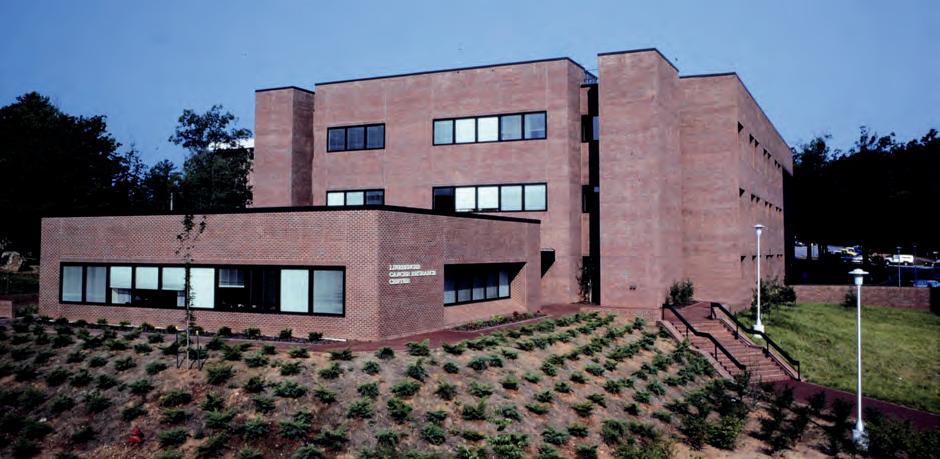
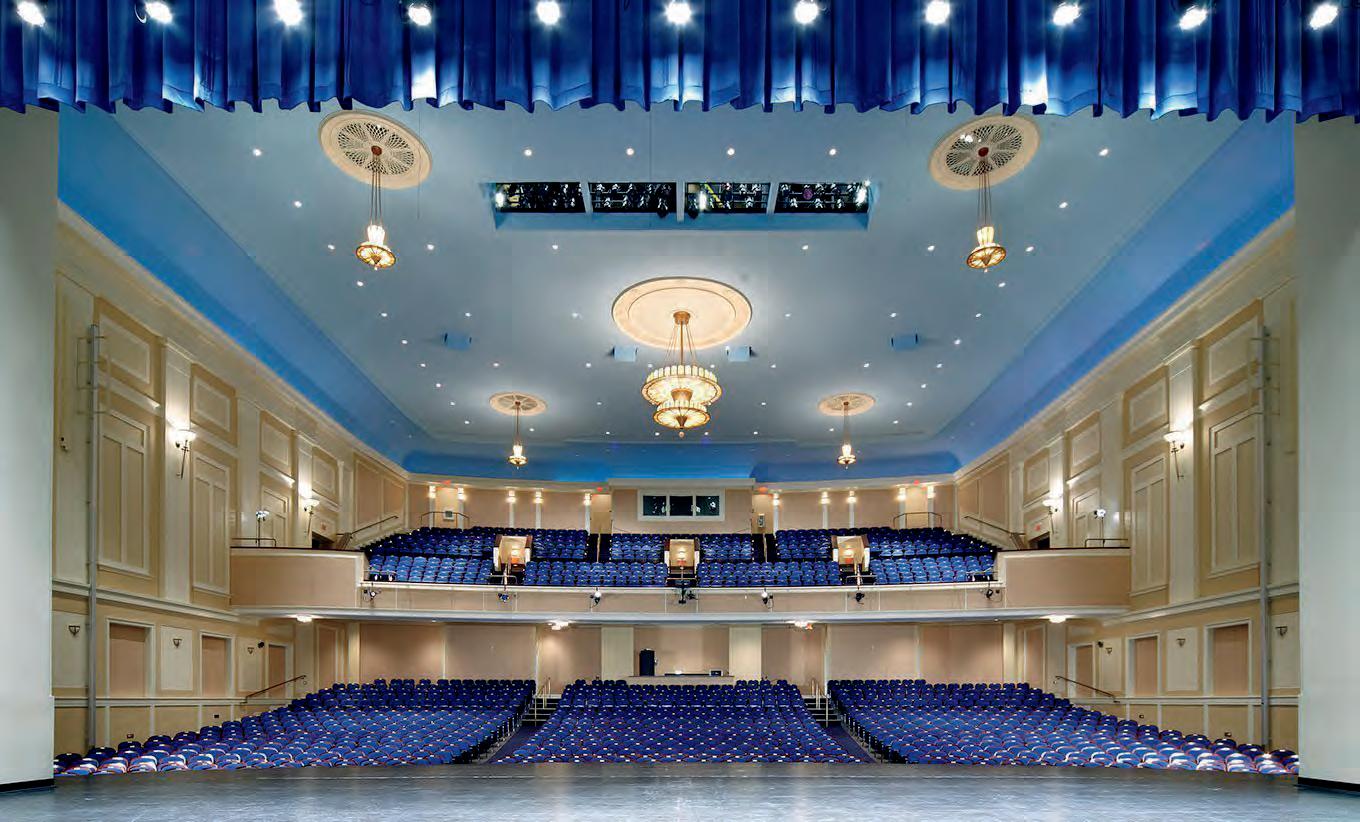
lecture halls were well-suited to the classic academic lectures of the time.
“The camaraderie that existed at that time, from both faculty members and students, was special,” recalled Joe Jenkins, a 1974 School of Medicine graduate and urologist who worked in private practice in Washington, North Carolina. “We were the biggest class of students the School of Medicine had seen. It had just grown from sixty students per class to one hundred, and yet it was a close-knit community.”
Forty years later, the class size had increased to 180 and in 2016 the UNC Board of Governors approved the expansion of incoming classes to 230 students. Berryhill was sorely outdated, not only in size but in structure, as modern curriculums and teaching protocols mandated more student interaction in smaller groups. Large, fixedseating lecture halls were difficult to adapt to. That led UNC School of Medicine and UNC Health Care administration
to announce in October 2018 plans for a new Medical Education Building. The eight-floor structure would be built on the demolished Berryhill Hall footprint and include a four hundred-seat Active Learning Theater, two floors dedicated to clinical skills and simulated learning, and flexible labs, classroom, study and collaboration spaces.
It was only fitting that T.A. Loving Company bid on the job and win the contract for the building that would be named Roper Hall. Construction began in early 2020 and was completed in 2023. But before the new structure could go up, project manager Noah McDonald and his battalion of up to eighty workers on any given day had to demolish the very building that T.A. Loving Company built half a century earlier.
“Well, it was a well-built building from the start,” McDonald says. “It was a huge, concrete structure. It was built like a bomb shelter. So it took a while to tear it down.”
T.A. Loving workers have learned from earlier jobs on the Chapel Hill campus that, when you burrow beneath the soil, there’s no telling what you might find. On the new Medical Education Building, they found
all manner of utility connections and also had to be sensitive to vibrations that could affect telescopic equipment in a building next door.
“There are a maze of utilities everywhere you have to work around,” McDonald says. “That’s one of the challenges. It’s a very congested site. When we started digging, we found some foundations we didn’t know were there.”
Roper Hall is 176,000 square feet placed on an extremely tight footprint—there are only twenty-two feet to the north to Carrington Hall and twenty-six on the other side to the Brickhouse-Bullitt Building. Roper Hall includes six simulation labs to create hospital room environments and twenty-four clinical exam rooms. The plans for the seventh floor when the job was bid were considered “a shell space” with a future use to be determined, but the UNC made a determination in late 2022 that it would finish the seventh floor similar to the eighth floor with space for faculty and staff offices. T.A. Loving’s contract to finish that space was extended to an overall finish of May 2023.
“This project is much more than
the construction of a building,” says Cam Enarson, vice dean for strategic initiatives UNC School of Medicine. “It will be transformative in providing a space where our students can learn in new and innovative ways. It will also promote student and faculty well-being and will serve as a crossroads for medical student education in an intraprofessional setting.”
Just three hundred yards to the east, Loving teamed with Frank L. Blum Construction on a joint venture for a parking deck and generator plant for UNC Hospitals. The 450-space, multilevel facility addressed parking needs on the university’s south campus and hospital complex and included extensive renovation work on roads in the surrounding area. The generator plant project consisted of the construction of a new 15,000-square foot facility to house eight generators to produce twenty-four megawatts of emergency power.
While T.A. Loving was working on the Roper Hall project from its headquarters compound built on the outskirts of the Bell Tower Parking Lot in the middle of campus, it began in March 2022 work on a
new addition to the Kenan Football Center on the west side of the Kenan Stadium in March 2022. The additional 21,400 square feet to the building that opened in 1997 included indoor and outdoor space for new training and treatment facilities and a players’ lounge overhaul. The training and sports medicine room at 7,100 square feet is triple the size of the original training room built in 1997. The area includes an X-ray room and a state-of-the-art hydrotherapy room with hot and cold water plunge pools and an underwater treadmill.
That job provided McDonald with an interesting perspective on both continuity and change in the construction industry as well as the evolution of his own career.
McDonald had been a project engineer in 2010 when T.A. Loving was general contractor for The Blue Zone stadium addition and the UNC Athletic Department multi-purpose facility on the opposite side of the stadium. Many of the key UNC Athletic Department and Rams Club officials were the same, affording a level of comfort.
“Both jobs posed similar logistical challenges because we had to build in tight surroundings,” McDonald said in 2022.
“Today’s climate is different than ten years ago. We had some supply chain issues, longer lead times, skilled labor shortages, and inflation to worry about now.”
Tight spaces, for sure. UNC football coach Mack Brown was conducting a press conference from the first floor of the Kenan Football Center in mid-November 2022 when noise from the construction site just outside the building interrupted his thoughts. He paused for a moment while one of his associates went outside and asked if the crew could hold off on the heavy machinery for a few minutes.
“The construction workers will say, ‘Yeah, you’re on us about getting this thing done on time,’” Brown said. “Now I’m giving them an excuse. ‘We’re late because you stopped us.’”
The building was actually delivered on time in the spring of 2023, just as so many other campus projects have been for T.A. Loving over many decades.
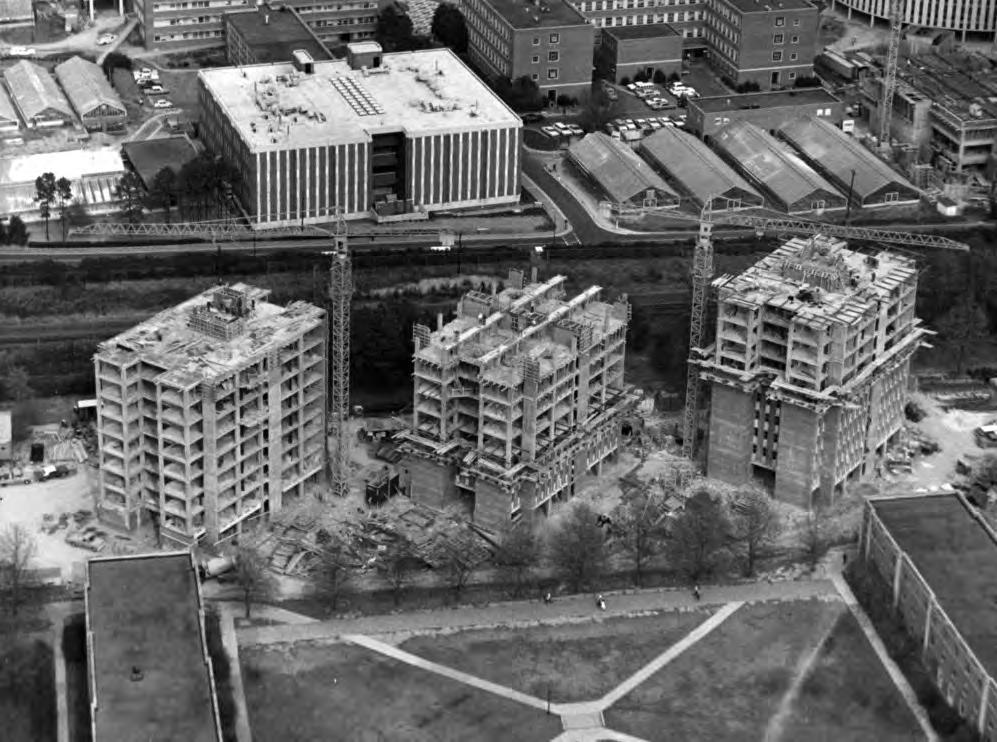
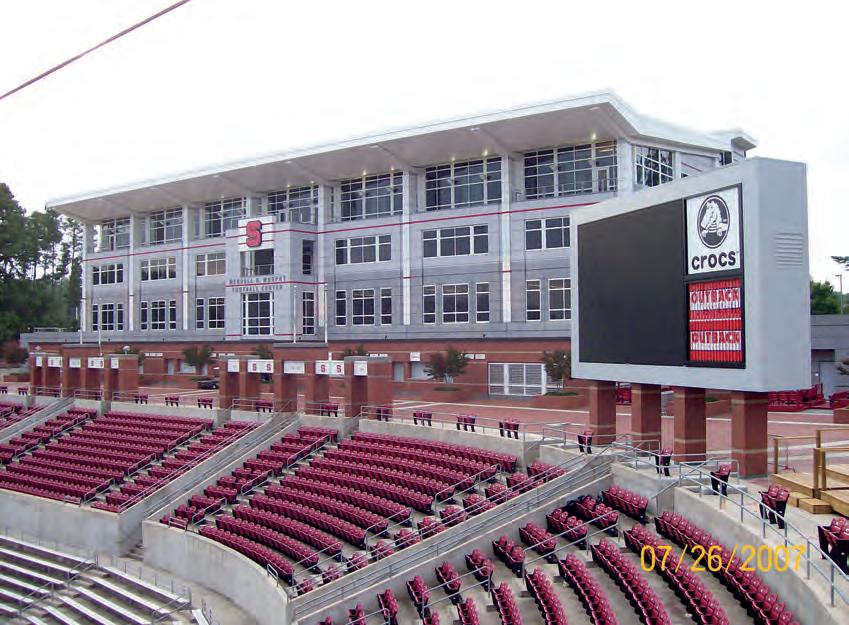
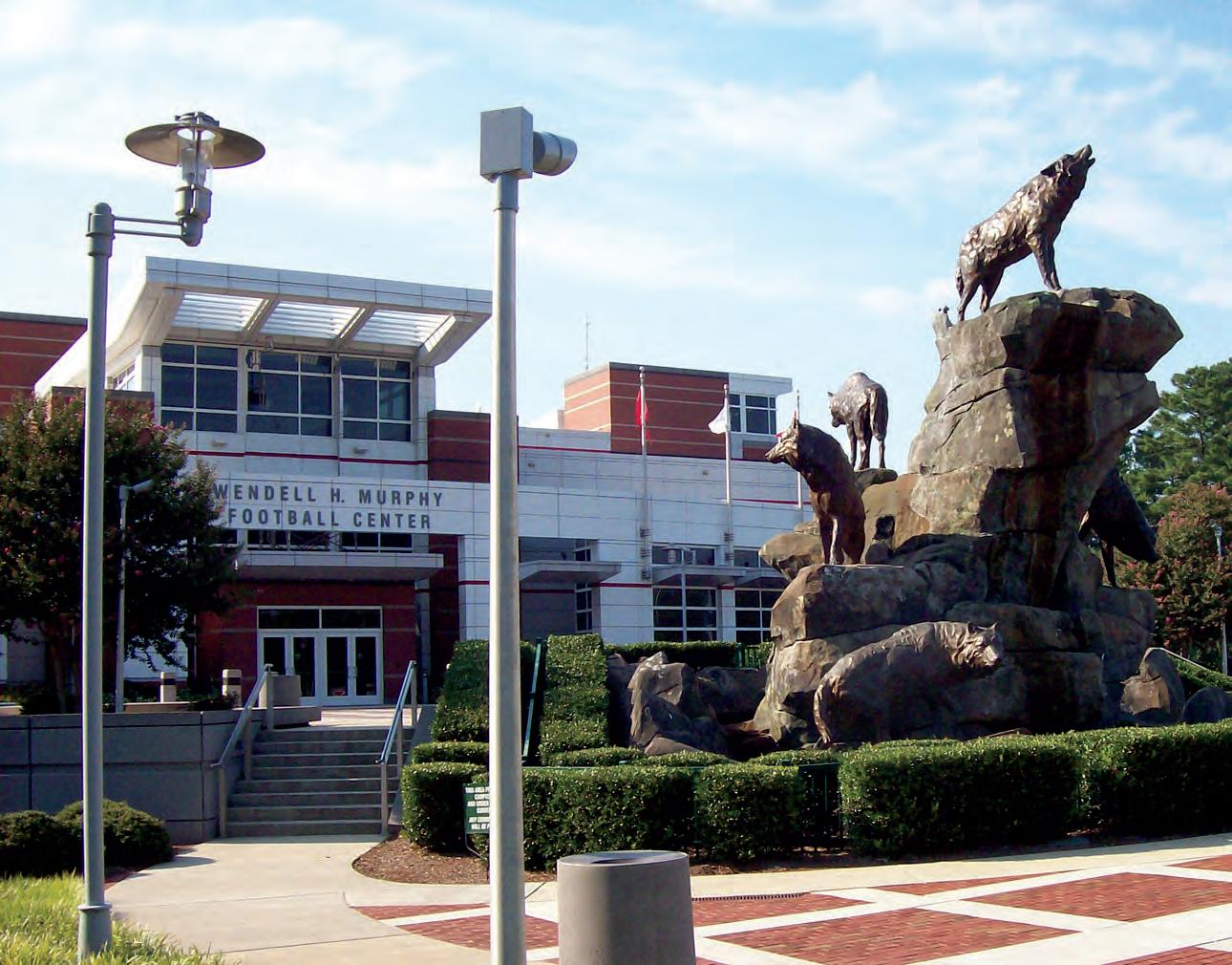
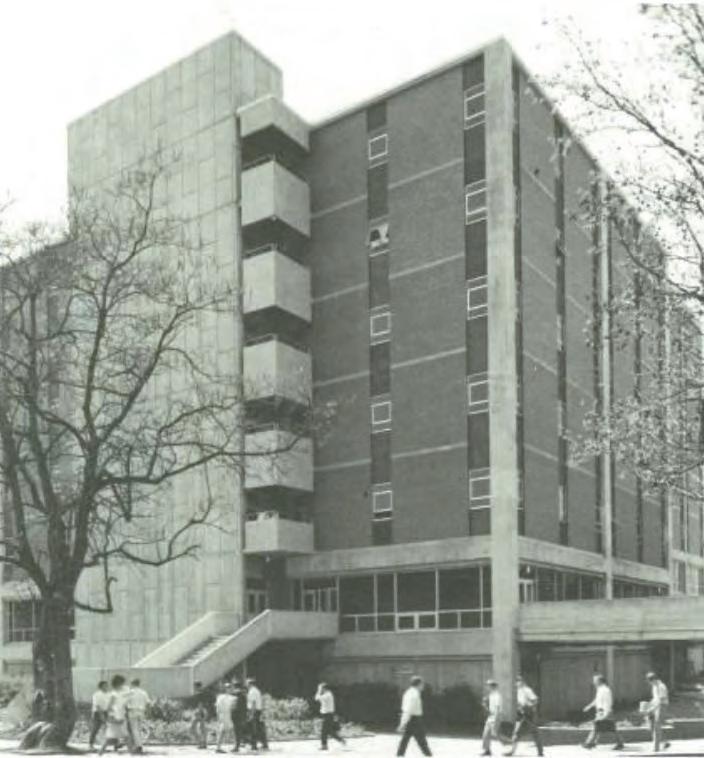
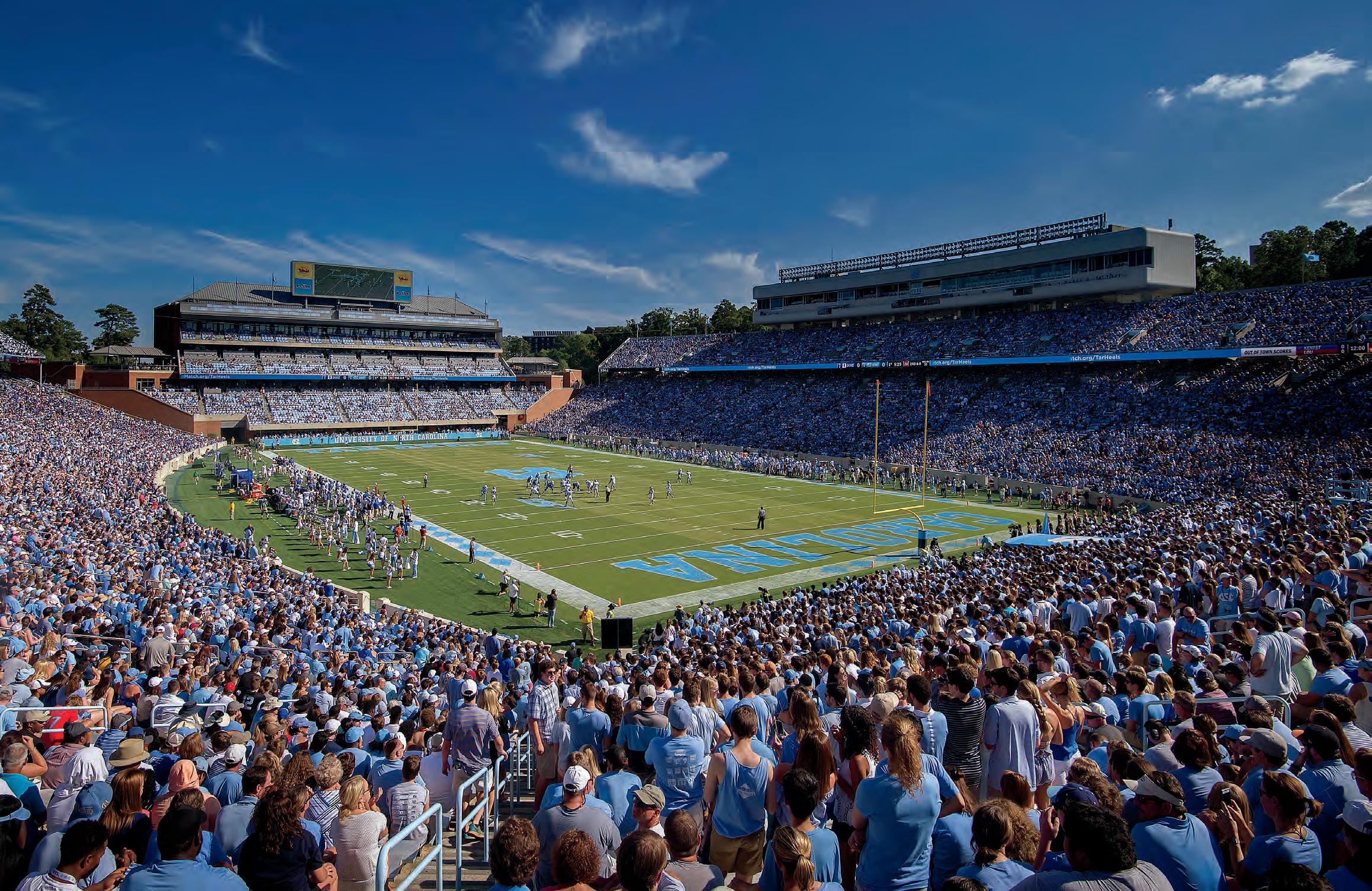
Editor’s Note: The following appeared in the September 2010 issue of “Tar Heel Monthly” and provides a behind-the-scenes look at a typical T.A. Loving Company project.
On the fourth floor of the building in the west end zone of Kenan Stadium is one war room. An elongated conference table sits in a chamber just outside head coach Butch Davis’s office, one side made of glass looking onto the playing field and the other three sides covered by white boards with calendars, recruiting information and the requisite Xs-and-Os of the sport of football. Davis and his staff meet here almost every morning at 7 a.m.
Two hundred yards to the east is another war room, this one cobbled into the corner of a twenty-four by sixty-four foot modular structure erected literally a whisker away from the parking deck of the Rams Head Plaza. Its walls, too, are lined with white boards covered with important information. Black vertical lines delineate four inches of width for every day of the coming four months; within that space are colored sticky notes designating which subcontractors and which functions will occur on that day: pour footings, embed steel, excavate four-line wall footings and install water piping to new hydrant were among the entries the week of the Tar Heels’ Sept. 18 home opener against Georgia Tech.
At the same time every morning that Davis and his coaches are parsing the day’s operation of the football team, T.A. Loving Company executive Bob Ferguson is convening a meeting of more than a dozen representatives of the various construction companies and subcontractors working to build the new east end zone structure in Kenan Stadium. Those who can’t attend in person are piped in via cell phones and speaker phones.
“We can see three to four months in advance on our story board,” says Ferguson, a vice president and top man on T.A. Loving’s on-site team. “Scheduling is important on any major
project, but it’s even more crucial on this one. We’re working in a very confined space in a short time window. Every minute and every hour counts.”
“Our challenge is to shoehorn more than two years’ worth of work into about twelve or thirteen months,” adds David Philyaw, an assistant vice president for T.A. Loving (who would later become president of the Building Division). “We’ve done projects at East Carolina, N.C. State, various jobs with [architect] Glenn Corley. But we’ve done nothing quite the size in such a short amount of time.”
The construction of the Blue Zone premium seating and student-athlete academic center began last spring with preliminary site work and ratcheted up in earnest in mid-June as wrecking crews demolished the original 1927 Kenan Field House. By mid-August, two tower cranes measuring 214 and 193 feet high had been erected and pilings began rising from the ground. Spectators at the Georgia Tech game in late September saw the concrete floor on the second level had been poured, and by mid-October the third level was added.
“I think fans will be amazed at how much progress they’ll see from game to game,” says Ferguson. “The key for us is to get the structure up and dried in as quickly as possible so we can start on the finishes and take the time to do them right.”
The project has a number of challenges. The construction operation is confined in a small space and access is limited to the tunnel in the Rams Head Deck and a new road cut through the UNC Hospitals complex, north of Morrison Dormitory and into the stadium on the southeast side. There is no parking unless workers want to pay $1.50 an hour to park in the adjacent deck, so most laborers are shuttled on and off-campus.
“We tell all our subs that everything delivered here is ‘JIT’—just in time,” Ferguson says. “The truck rolls in, it’s off-loaded, the load’s put into the building and the truck leaves. There’s no storage space.”
Loving used the area on the west side of the footprint, ground that eventually will be covered by new seating, to create a “Visitors Village” to accommodate game-day needs for visiting teams, coaches and game officials. Four twelve by thirty-two foot modular units were placed together to form the players’ dressing room; the units meet standards set by the NCAA for accommodating visiting teams and comprise, in fact, a nicer area than some permanent facilities the Tar Heels encounter on the road. Additional units were brought in to serve as a training room, coaches’ dressing room and officials’ dressing room; wood decking was built between and around the buildings to facilitate easier access and movement.
“At the end of the season, we’ll lift them out by crane or drive them out the tunnel of the parking deck,” says Ferguson. “Then we’ll get started on the seating area.”
Kenan Stadium has long been known for its cozy setting within a forest of pines in the middle of the UNC campus. Campus administrators, architects and construction officials have put considerable thought and effort into preserving as much of the natural environment as possible.
“We have taken every precaution and all the extra care possible to remove as few a number of trees as possible,” says Ferguson. “We understand how important that is in Kenan Stadium. Anywhere a tree could be saved, it’s been saved.”
“At some construction sites, the approach is, ‘Let’s just take trees down,’” adds Ken Gerrard, T.A. Loving’s head of business development at the time. “Not here. People have no idea how much thought and care was given to the trees.”
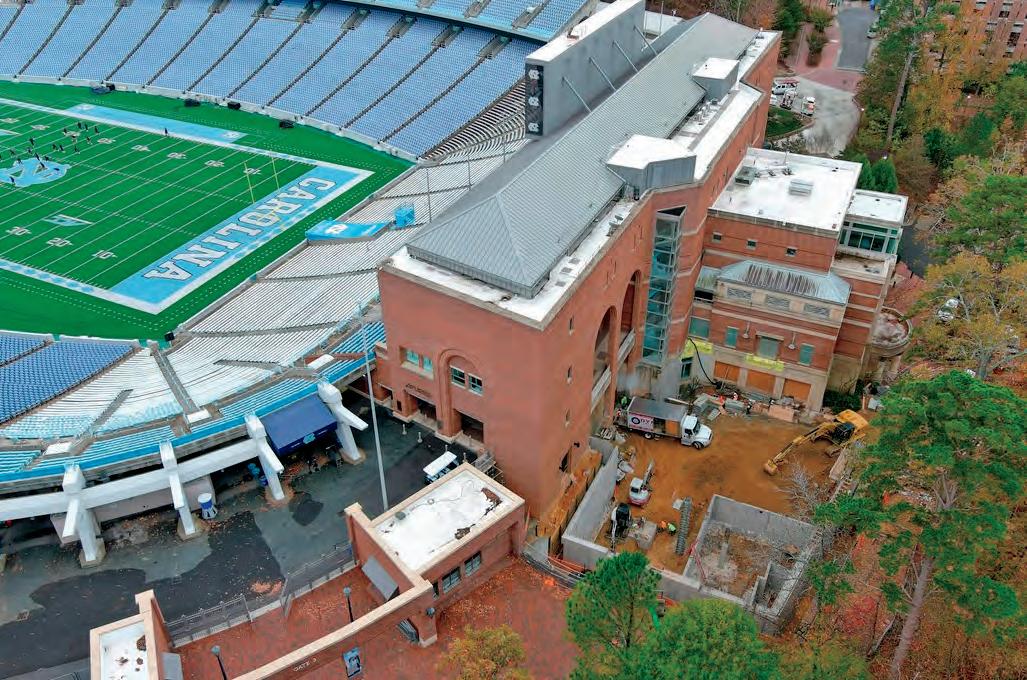










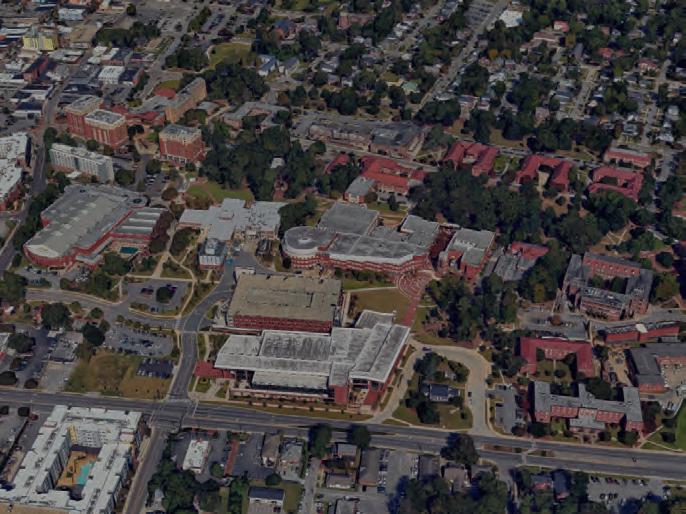


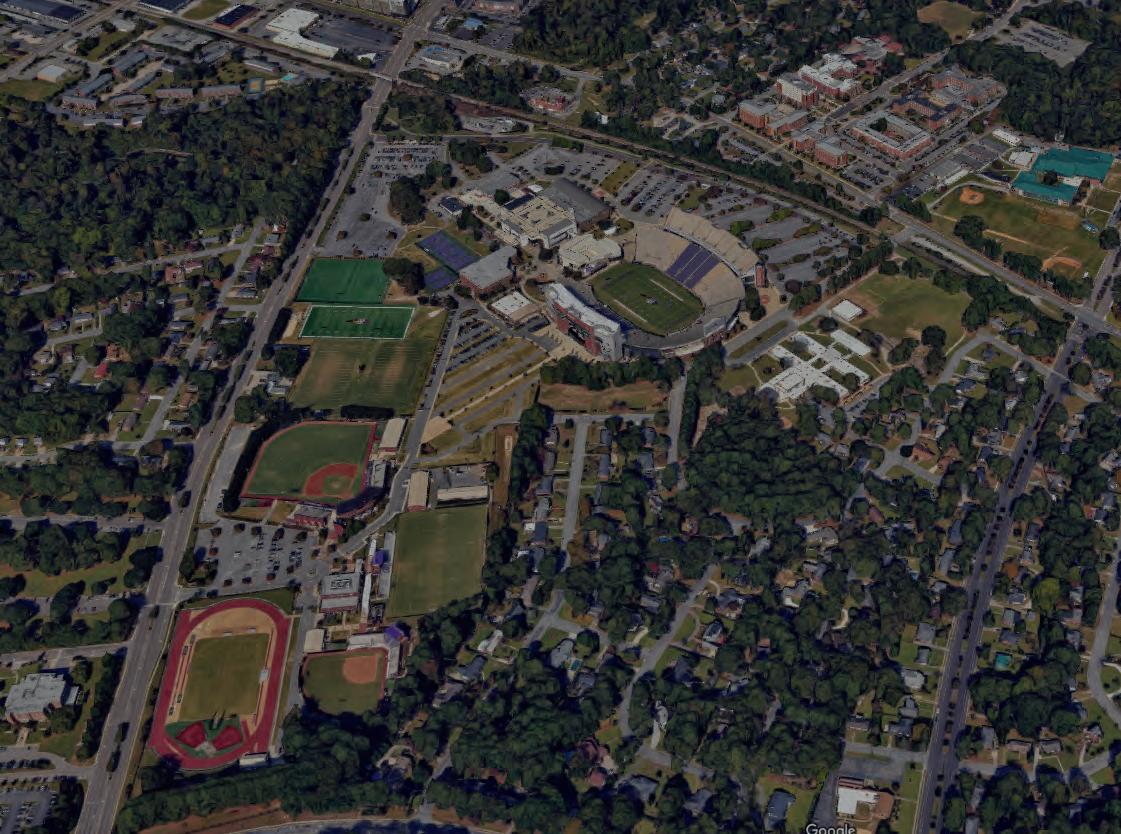

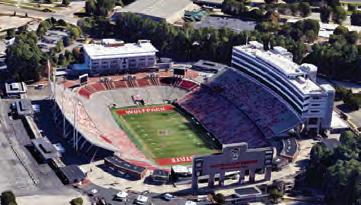




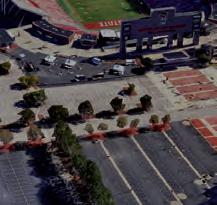



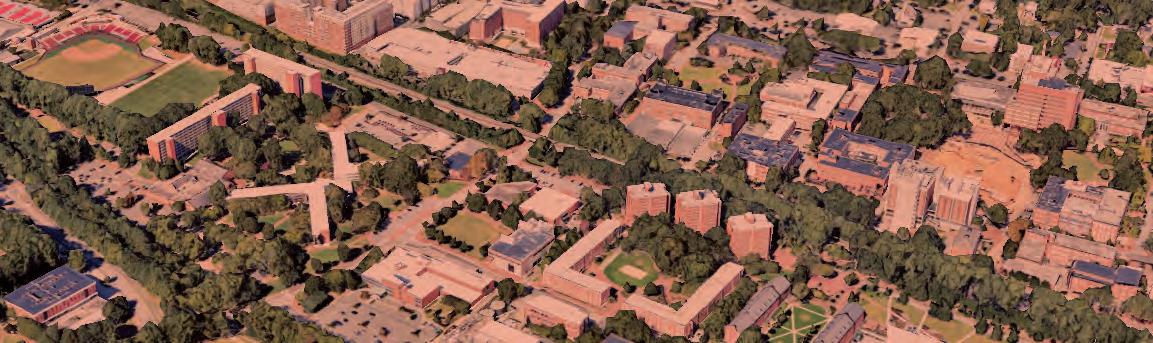

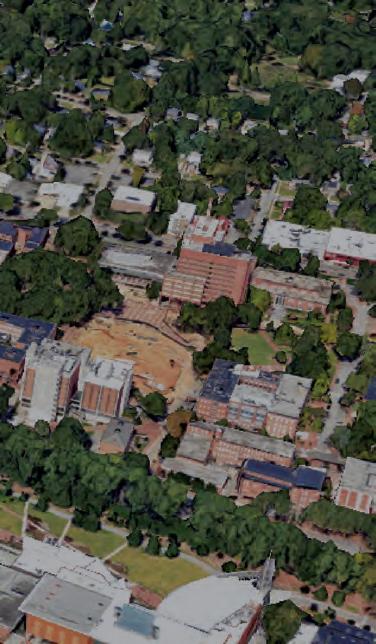
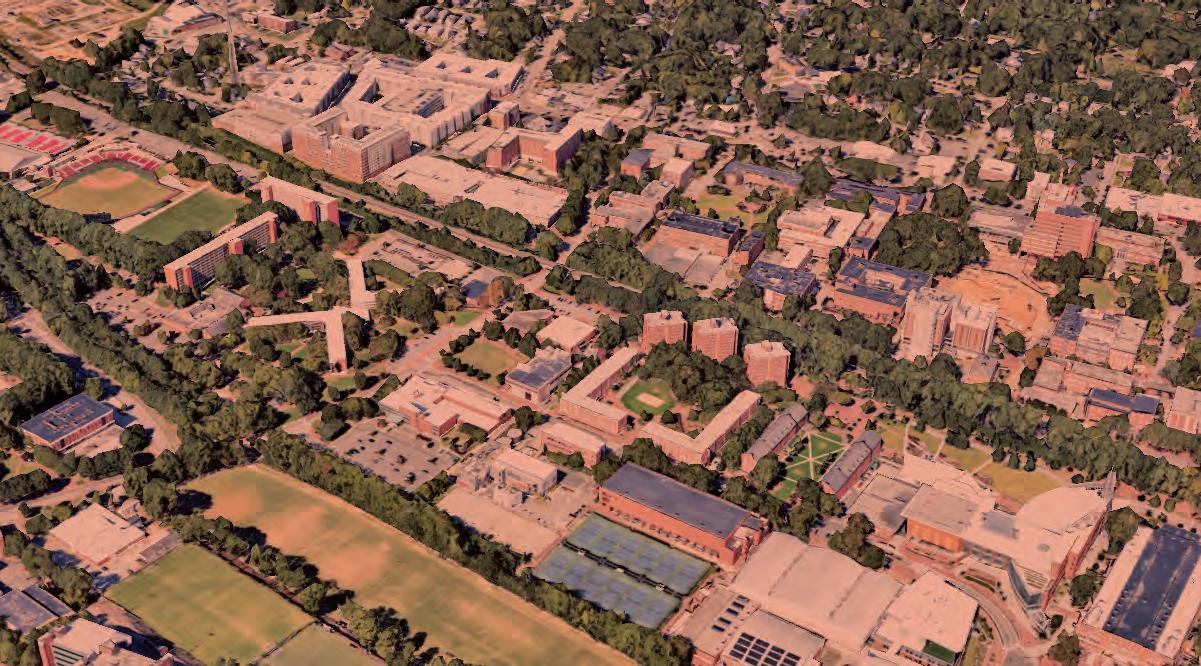

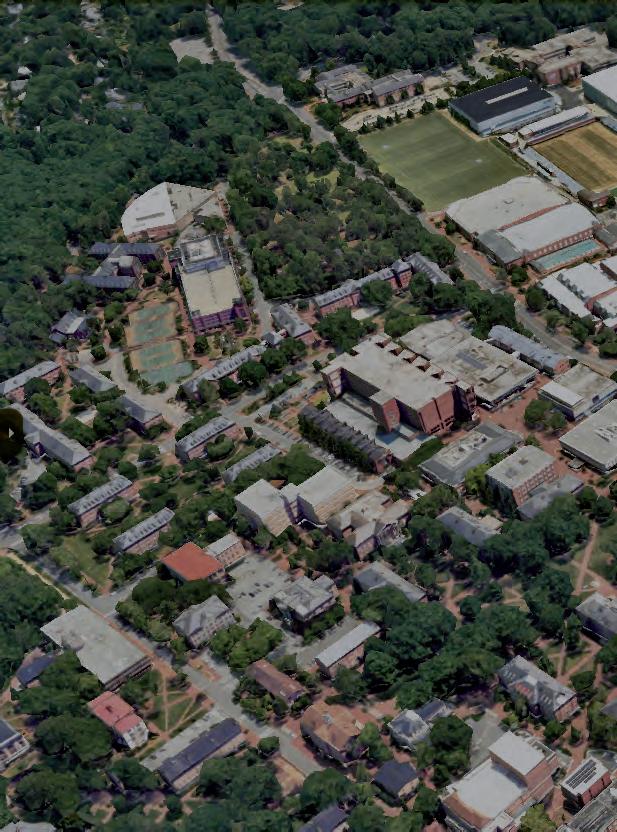


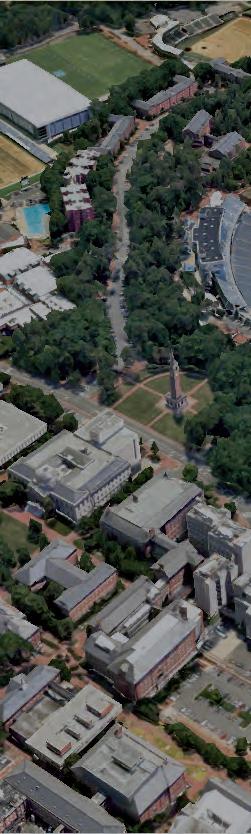

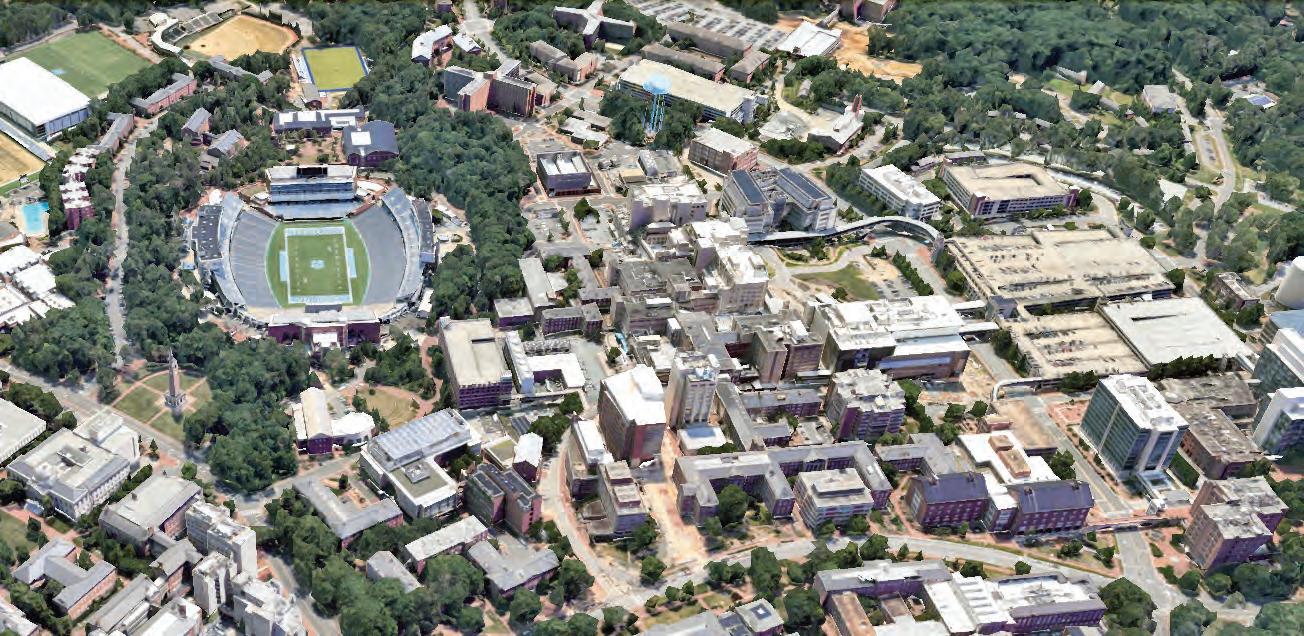
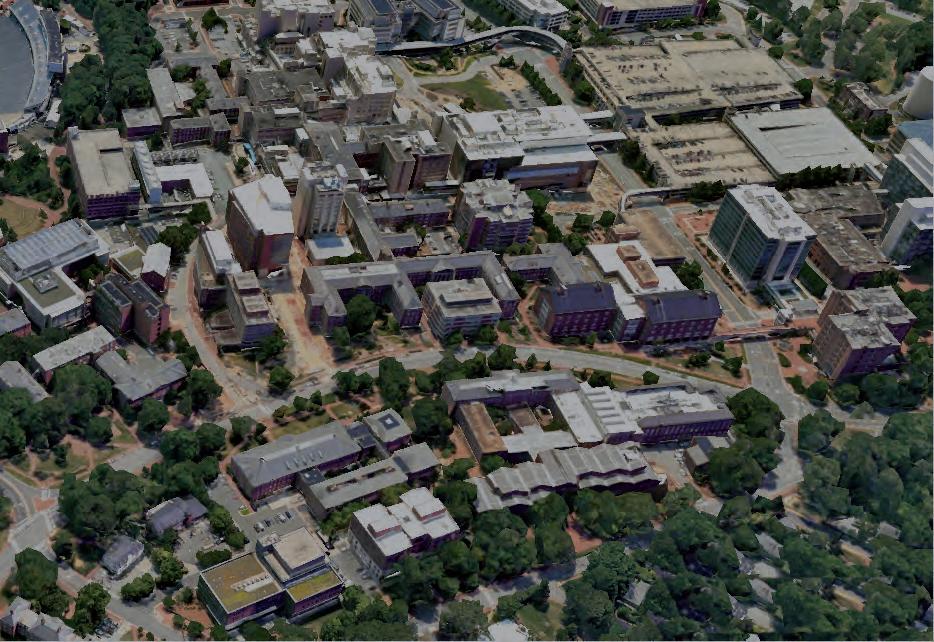
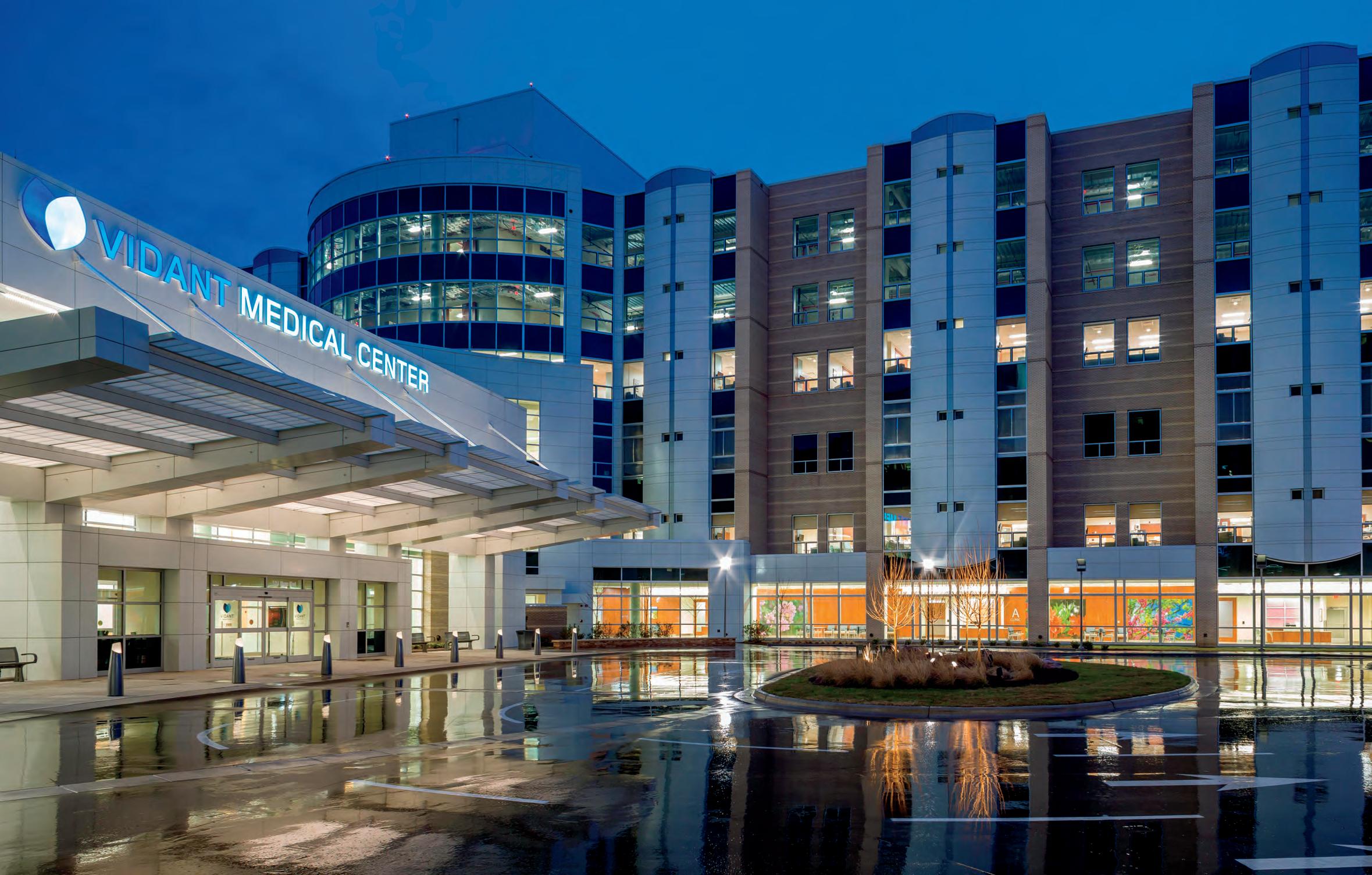
Cecil Baker was a superintendent for T.A. Loving Company on the Lineberger Cancer Center project on the University of North Carolina campus that opened in 1984. The job, which encompassed a $9.4 million price tag for a 70,000 square-foot facility, took special meaning because Baker’s father had died of lung cancer several years earlier and his daughter was a staff member in obstetrics and gynecology at the UNC School of Medicine.
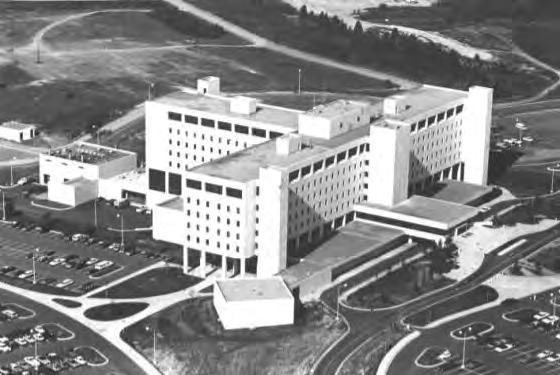
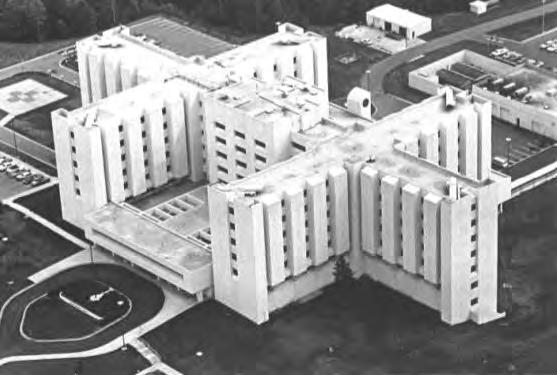
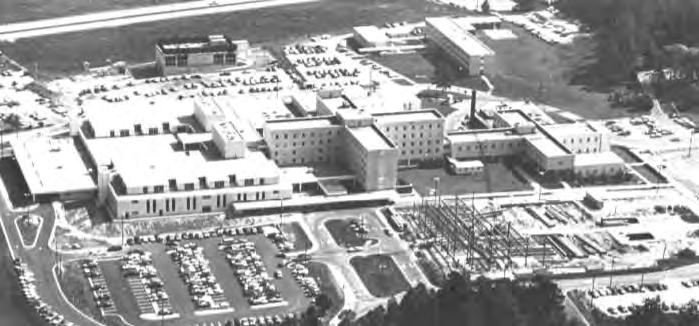
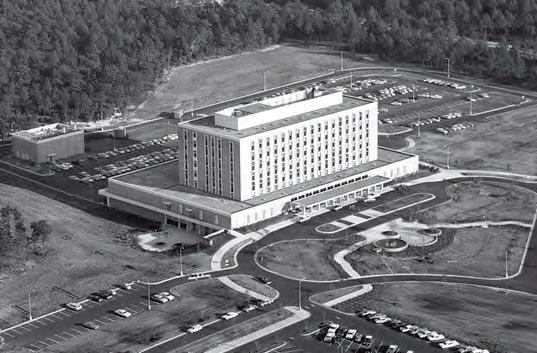
“I don’t know if this building will be the one where some cure will be discovered, but I’m sure the people of Chapel Hill will do their utmost in trying,” Baker said.
Hospitals built by T.A. Loving Company have made great advances not only into medical science but civil rights as well.
T.A. Loving was the general contractor for the building of New Hanover Memorial Hospital, which opened in 1967 and today is known as New Hanover Regional Medical Center. On June 14, 1967, the hospital opened and the first seven patients were prematurely born infants who arrived in a caravan of ambulances traveling in a route prescribed by law enforcement agencies. They would be the first African Americans served in a facility that replaced segregated hospitals.
“During a turbulent period of civil rights in this nation’s history, their arrival marked the merger, in a small city in the Deep South, of a black and white hospital— without protest, riot or bloodshed,” reads a historical passage on the hospital website.
“For the first time, the county’s hospital treated everyone, regardless of race, creed, national origin or ability to pay.”
T.A. Loving employees have embraced those kinds of opportunities throughout the company’s history, helping to build medical facilities of all sizes and scopes.
Jason Arnold’s first assignment when he joined the company in 2006 was as a superintendent on a renovation job at Wilson Medical Center. At that point, his experience in the construction business had been on retail, pharmaceutical and processing plants.
“We did seven or eight thousand square feet of renovation in the heart of operating rooms, so it was not a cupcake project,” he says. “It was highly involved in infection control and interim life safety and all kinds of issues. I really got my teeth sunk into something completely different. It wasn’t like what I had been doing before.”
Bobby Richter notes one particular vagary of building hospitals is in that science and procedures evolve so quickly, sometimes the initial use of a new wing or room of a medical facility on the early blueprint changes in midstream.
“You could start building in an area that was designed for one particular procedure,” he says. “By the time you got to that point a year later, that procedure was no longer the preferred procedure. There was another way to do what this room was originally designed for, so it changed.”
Indeed, there have been a myriad of challenges and opportunities along the way in the healthcare construction field.
Vidant Medical Center in Greenville has seen a T.A. Loving presence for more than a decade on major projects.
I don’t know if this building will be the one where some cure will be discovered, but I’m sure the people of Chapel Hill will do their utmost in trying.
The company was the construction manager in a joint venture on the Vidant Health Heart Institute that was completed in 2008. The job featured a 375,000 square-foot, six-story facility with minor renovations to the existing hospital and included radiology rooms, cath labs, a cardiac observation unit, an ambulatory surgery unit, cafeteria, six operating rooms and 168 patient beds. Five years later, the company completed work on the Vidant Health James and Connie Maynard Children’s Hospital. That project included 77,000 square feet of new construction and approximately 15,000 square feet of renovations, with the two main floors consisting of patient rooms, radiology labs, offices and conference rooms. The third floor consisted of mechanical and electrical space and the remaining floors are penthouses.
And in 2017, T.A. Loving completed Vidant Cancer Care at Eddie and Jo Allison Smith Tower, a 400,000 square-foot, sixstory, ninety-six bed tower with a price tag of $128 million. That facility was the first and most comprehensive cancer treatment center east of Interstate 95, a point that company CEO Sam Hunter noted at a
topping-out ceremony in February 2016.
“Families in Eastern North Carolina will now be able to receive first-rate care in their own backyards,” Hunter said. “They will no longer be required to drive hours from home. This is such an important project for this area of our state.”
T.A. Loving worked in a joint venture with Rodgers Builders of Charlotte on the job. More than two hundred phasing plans were carefully calculated, coordinated and executed to integrate the new cancer care center into the existing Vidant campus footprint and systems. The center was built over and around an existing underground material transport and piping tunnel measuring forty feet wide. Deep foundations, concrete foundations and structural steel installations were completed one side at a time, and then equipment was demobilized and moved to the other side. Upon successful completion, the new building tied into the existing tunnel in what is now the basement.
The facility also tied into the existing, fully active operating rooms. Without disrupting patients and surgeries, T.A. Loving and Rodgers successfully coordinated efforts to control noise, vibrations and
airborne particles.
The company also handled two big jobs in close proximity to its headquarters in Goldsboro with the Wayne UNC Health Care Emergency Department in 2012 and the Wayne UNC Health Surgery Center completed in 2016. The Emergency Department included a 32,400 squarefoot expansion and a 20,000 square foot renovation of the existing facility. The Surgery Center encompassed more than 100,000 square feet of additions and renovations and required precise phasing to minimize the impact of construction on daily operations at the hospital.
Among other major projects on the T.A Loving healthcare resume have been these:
• School of Osteopathic Medicine and the Leon Levine Hall of Medical Sciences at Campbell University in 2013. The 98,000 square-foot, four-story building includes simulation laboratories, mock clinical exam rooms, an anatomy laboratory, classrooms and faculty/administration offices.
• UNC Health Johnston in Clayton, completed over two phases in 2014. The outpatient facility spanned 57,000 square feet and included two operating rooms,
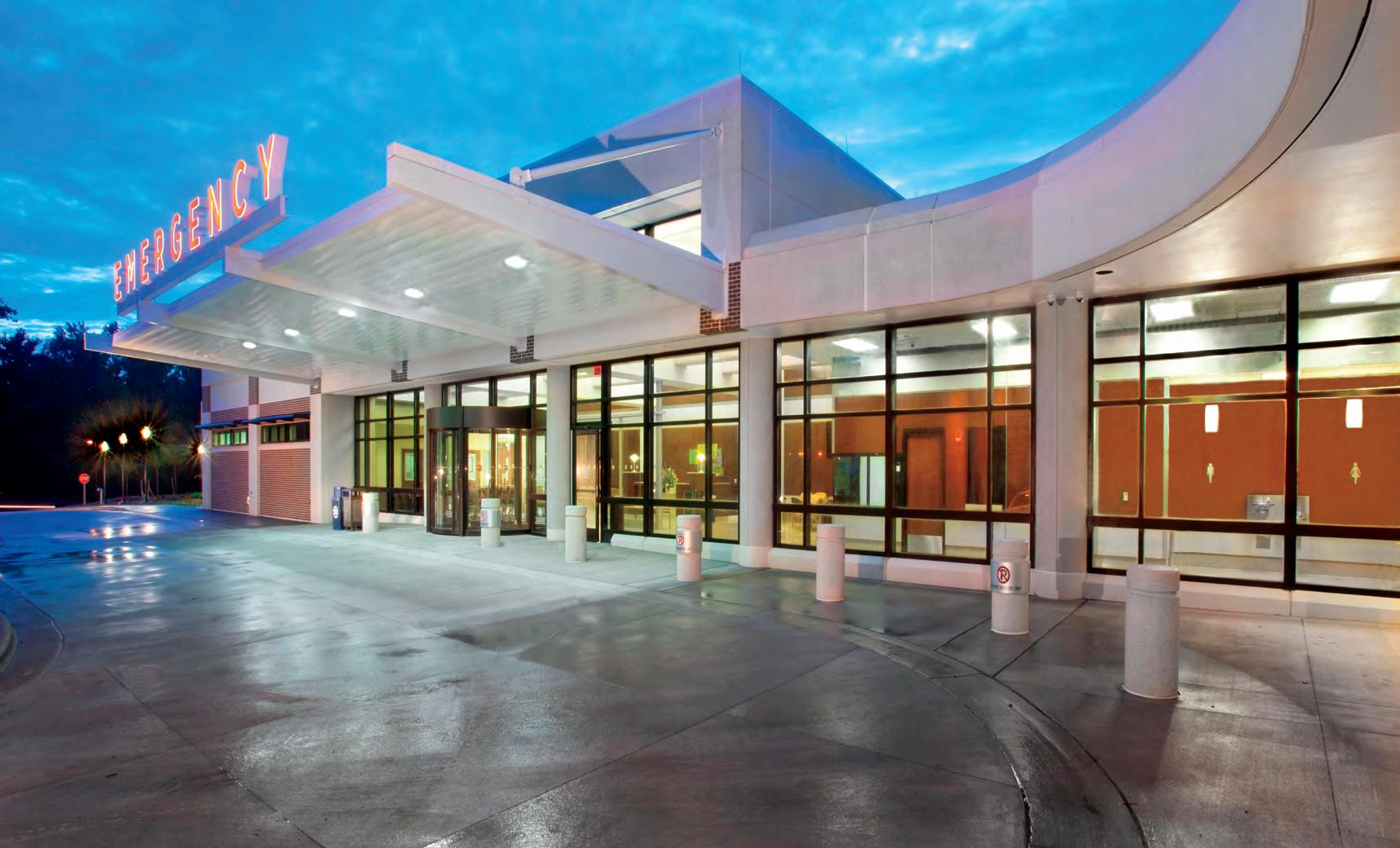
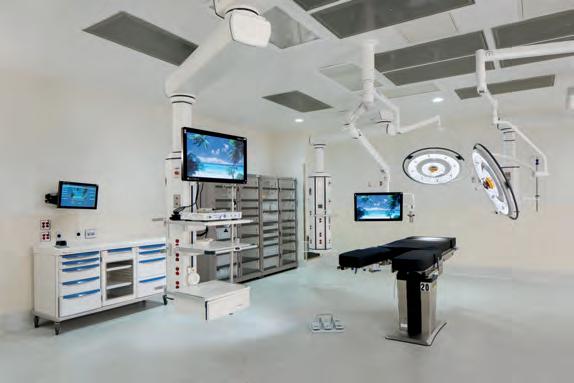
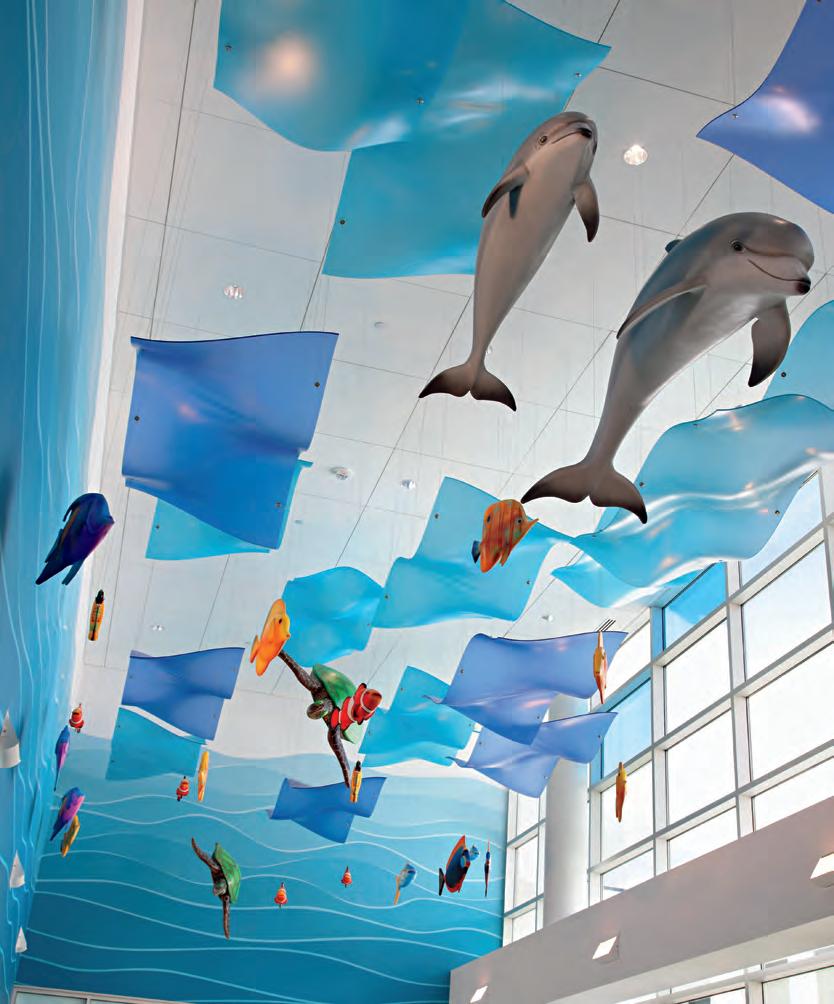
outpatient surgery, trauma rooms, emergency department and a post-anesthesia care unit.
The medical office building and bed tower was a three-story, 58,000 square-foot facility with office and administrative space.
• UN C Health Johnston Endoscopy Center, a two-story, 26,000 square foot medical office building, ambulatory surgery center and primary care physicians office.
• The WakeMed Garner Healthplex in 2014 in Garner, a 50,000 square foot facility with a twelve-bed emergency department, lab services, imaging services and physician offices.
• Vidant Beaufort Hospital, a 9,000 square-foot emergency department expansion in downtown Washington. The $17 million project broke ground in July 2017 and was completed in 2018. It included a new patient entrance facing Highland Drive and featured a new resuscitation suite, sixteen patient rooms, including one designed specifically for trauma care, another for decontamination and others for behavioral health and a variety of other specialty services.
The emergency department work was another example of T.A. Loving helping
shape the future of healthcare. Doctors from the Department of Emergency Medicine at East Carolina University over the previous four years had treated more than 100,000 people at Vidant Beaufort, so the expansion was a result of prevailing trends.
“Having emergency departments at the ready with trained specialists in emergency medicine is a pretty new development,” said Dr. Ted Delbridge, chairman and professor in the Department of Emergency Medicine at East Carolina University. . “This project is a big deal for our region and the more than 25,000 people we serve each year. We’re proud of our partnership with Vidant Health, what we’ve accomplished together and what we hope to accomplish in this new facility.”
• The Outer Banks Hospital in Nags Head. When it opened in March 2002 as a joint venture between ECU Health and Chesapeake Regional Healthcare, the nearest hospital and maternity ward were located in Elizabeth City, sixty miles away along roads that could be horribly clogged by traffic during the summer. It is a relatively small hospital with eighteen acute care medical-surgical beds, two labor and delivery beds, three operating rooms and
a twenty-four hour emergency department.
Though small in size, the facility has proven adaptable to handle the needs of its 40,000 year-round population and its summer swell of some 250,000.
• Onslow Memorial Hospital Radiation
Oncology Unit in Jacksonville, which opened in 2010. Onslow Memorial Hospital, originally founded in 1944, stands as a 162-bed acute care, community hospital. Hospital administrators determined in the early 2000s that more than five hundred Onslow County residents were diagnosed with cancer each year, with half of them prescribed radiation therapy. The new facility allowed them to find local treatment and not have to drive to Wilmington or Greenville.
• The company has ventured further west into the state to build Durham Regional Hospital in the early 1970s (it’s now known as Duke Regional); Moses
Cone Women’s Hospital in Greensboro; High Point Hospital in 1988 (now part of Atrium Health/Wake Forest Baptist); Gaston Memorial in Gastonia in the 1970s (now part of CaroMont); Monroe Hospital in 1986 (now part of Atrium Health), and Veterans Hospital in Beckley, West Virginia.
It’s all quite a legacy in the healthcare side of T.A. Loving Company.
“Hospitals and healthcare are an important part of this company’s story,” says Brett Bond, assistant vice president, Healthcare Project manager. “Healthcare construction has its own challenges. On most projects, you’re not going to be building a brand new facility. You’re building within an existing hospital or adding on. The actual health care and treatment of patients doesn’t stop. It adds to logistics and challenges you don’t face in other types of work. You realize you’re literally dealing with life and death.”
You realize you are literally dealing with life and death. Brett Bond
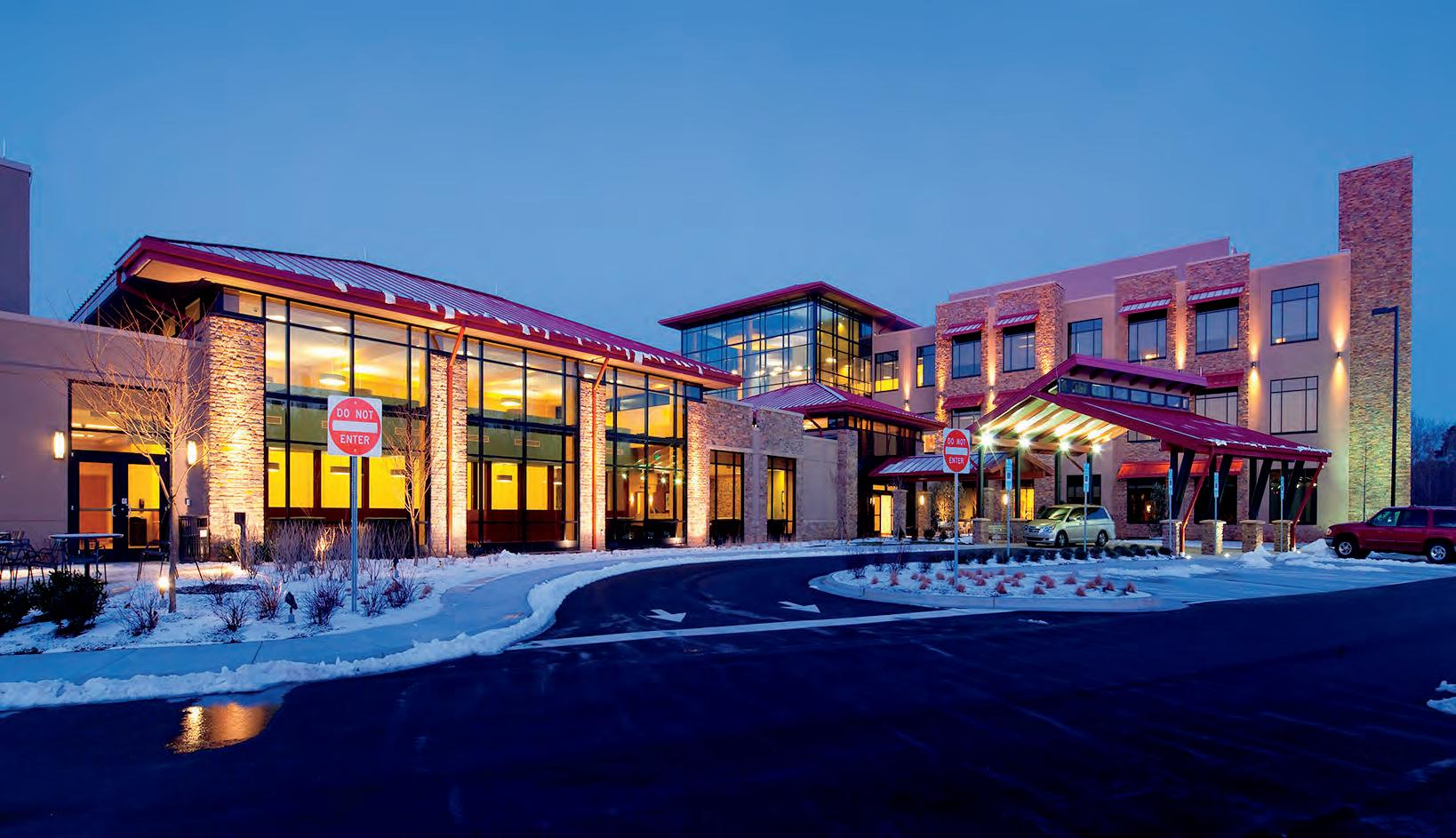
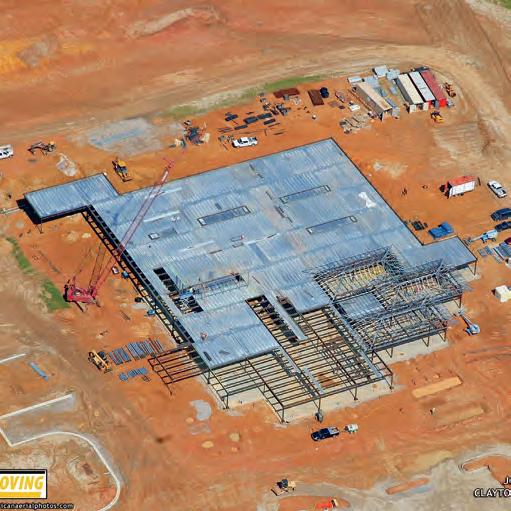
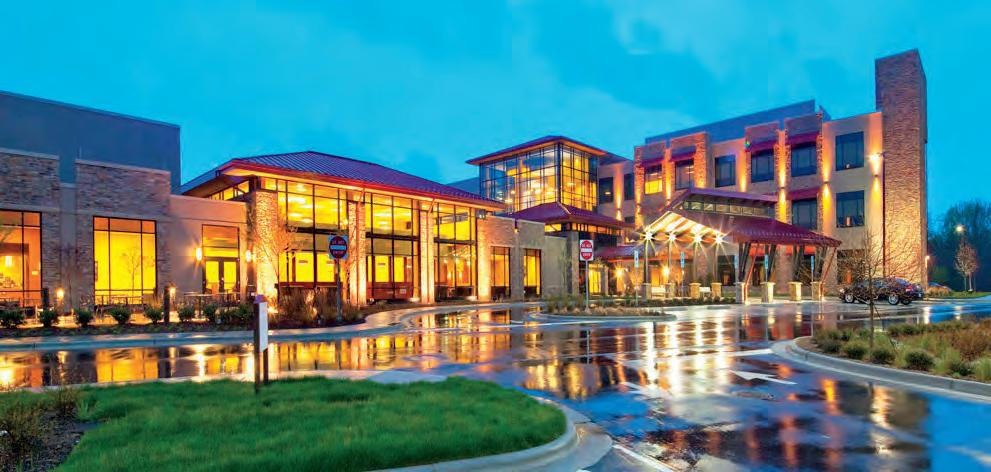
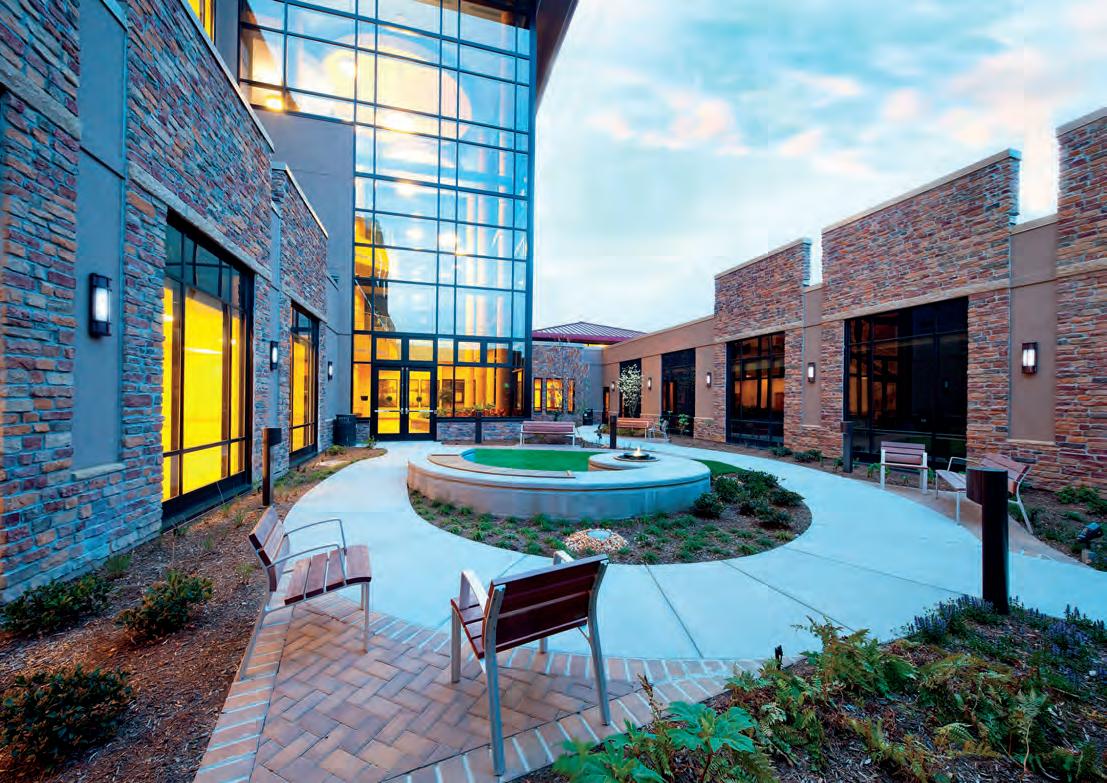
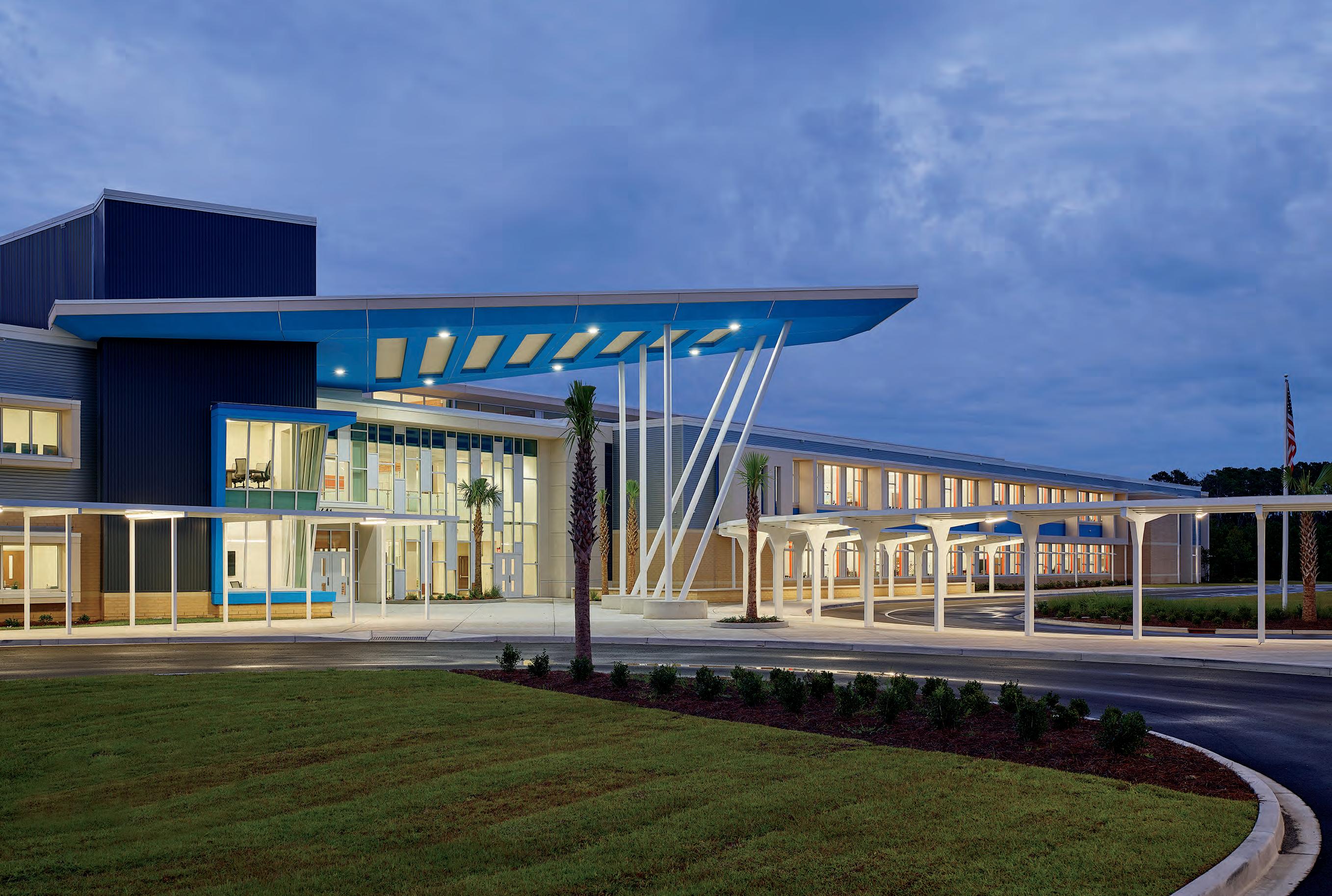
A.
It was a remarkable display of logistics, planning and project management—T.A. Loving Company building five secondary and middle schools simultaneously for Horry County Schools in Myrtle Beach from 2016-18. On any given day during those two years, as many as 1,200 workers would be spread across five job sites.
Toward the northern part of the Grand Strand, as the sixty-mile stretch of South Carolina from the North Carolina state line down to Pawley’s Island is known, is Ten Oaks Middle School. It’s four miles from the Atlantic Ocean and just west of the Carolinas Bay Parkway that serves as a north-south bypass for Myrtle Beach.
Toward the center of Myrtle Beach proper is Myrtle Beach Middle, just two blocks west of the ocean and in the heart of the central business community.
Socastee Elementary and Socastee Middle Schools are positioned about five miles to the west, between Route 17 and the Waccamaw National Wildlife Refuge.
And travel two miles further south and you’ll find St. James Intermediate School.
T A. Loving, in a joint venture with Metcon Inc. from Pembroke, utilized the design-build delivery method to deliver five energy-positive facilities at a cost of $210 million. Each school has a thermally active building system, geothermal heat pumps, solar photovoltaic technology, LED lighting, enhanced building automation and superior indoor air quality and energy efficient materials. The schools include administration offices, classrooms, cafeterias, assembly spaces, library and outdoor spaces. Most notably the five schools produce more energy than they consume.
Bobby Richter was the general superintendent for T.A. Loving and was headquartered out of an apartment at Barefoot Landing for two years.
“That job was a savior for me, it got me out of the office and back to doing what I really like— building and coordinating and making a team and getting along with people,” he says.
“It was a fascinating project. You would sequence your subs in the form of a train on an oval track. You start concrete footings at this corner. When he got so far down, the brick mason would come in. Then there was some structural steel in the cores, and he would come in. Then the brick mason would start. Then you’d have the hollow core panel man. So you developed a sequence to where they are digging and pouring around the oval. It was a bunch of dogs chasing each other’s tails on a train track. And of course any disruption with any one of those contractors just messed up the whole sequence.”
The buildings were sited for maximum solar input. Trees and shrubs were placed strategically to shade the buildings in summer and let warming light come through in the winter. All five of the schools were built with a Thermally Active Building System that stores latent heating or cooling in its concrete construction (opposed to traditional steel-framed structures).
All five schools have won awards, including being named Best of the Best of Engineering News-Record for K-12 schools in the Southeast.
“It was an interesting project,” remembers Mark Beach, a project manager on the job. “We were dealing with a lot of new technology. The State of South Carolina thought for sure we weren’t going to get the schools open the school year that we were obligated to get them open. They thought it was going to run late. But we had every one of them open when they were supposed to be.”
St. James Intermediate School was one of five secondary and middle schools built simultaneously for Horry County Schools in Myrtle Beach from 2016-18.
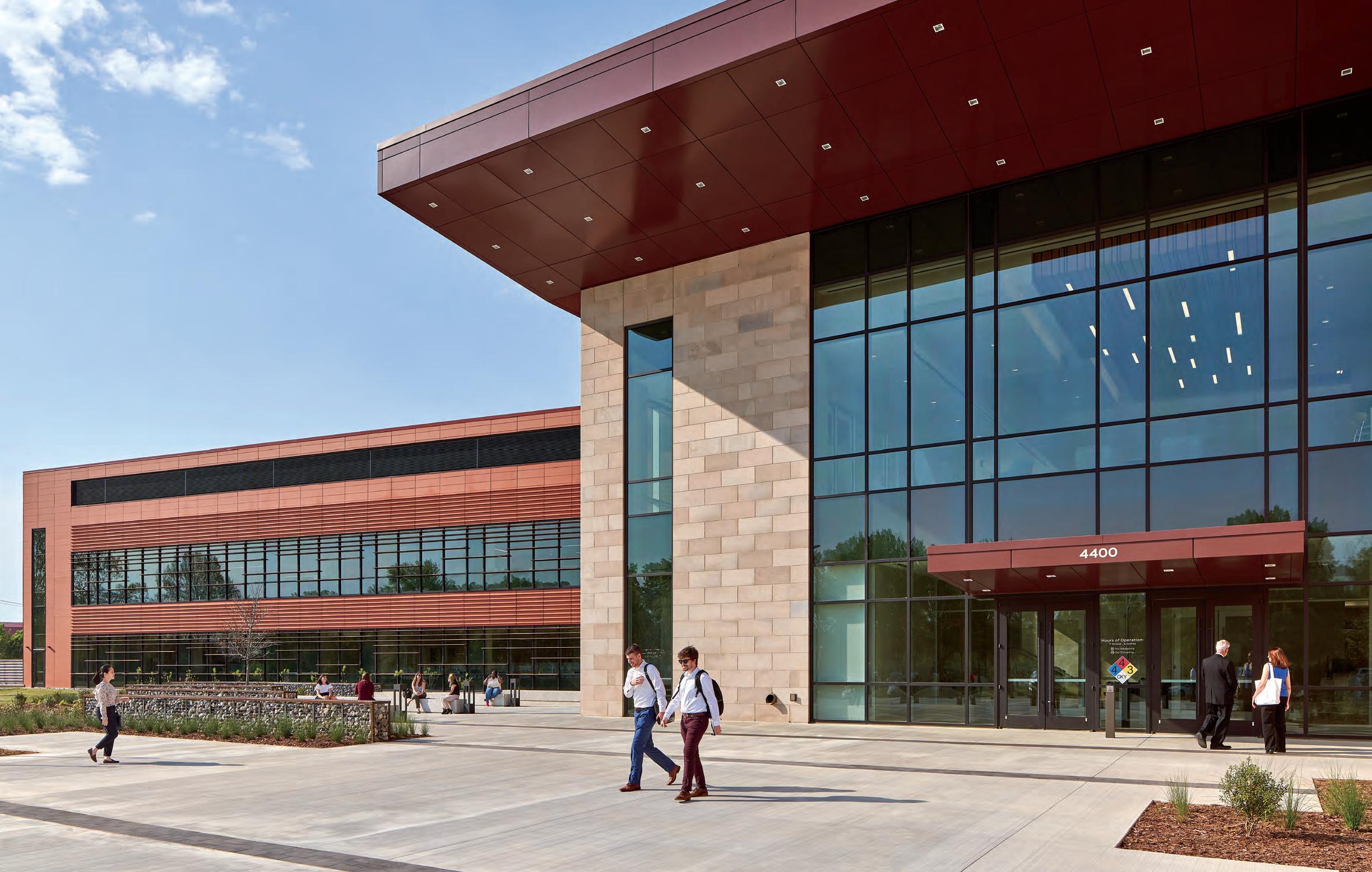
The thriving economy of the 1920s and expansion of the transportation network across the United States that gave T.A. Loving the impetus to launch a construction business (those highways and railroads require bridges, right?) led to the proliferation of elegant hotels in most mid-size and larger towns in North Carolina. Many of them were nine stories tall and designed in the Beaux Arts style with brick siding and classical cast stone detailing.
The Troxler Agricultural Sciences Building in Raleigh opened in 2021 and is welcoming and beautiful, while providing the complex labs scientists need to keep agriculture, one of the backbones of North Carolina’s economy, innovative and growing.
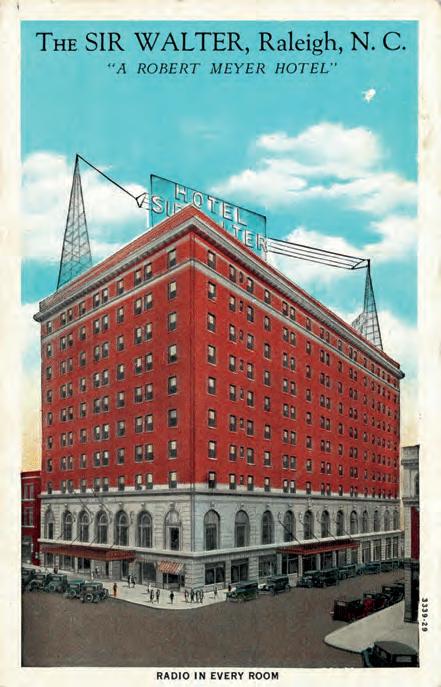
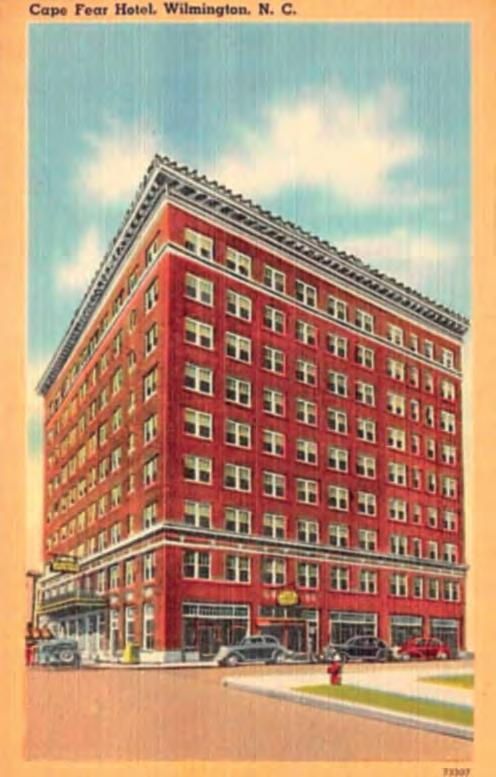
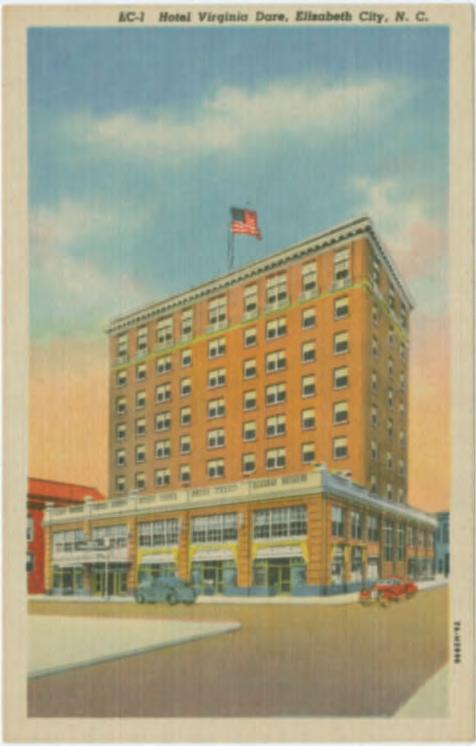
The Sir Walter Hotel opened in 1923 on Fayetteville Street, the main thoroughfare through downtown Raleigh, just three blocks south of the State Capitol. It became a bastion of state government and politics as legislators, lobbyists, newspapermen,
town’s tallest building.
Those hotels in Raleigh, Elizabeth City and Goldsboro were all designed by W.L. Stoddart, a prolific New York architect who was active in North Carolina as its cities blossomed, each one generating demand for quality hotels to attract business travelers and symbolize urban vitality. He also designed the O. Henry in Greensboro and Battery Park in Asheville. G. Lloyd Preacher was the architect of the Hotel Cape Fear.
The primary mode of transportation was the train, and the Atlantic Coast Line Railroad was formed in 1900 and served the Southeast United States from Washington south to Tampa and Fort Myers, Florida. It operated nearly five thousand miles of railroad by 1925.
financially viable. The Hotel Goldsboro never made money, but it was a community institution built mostly by subscription from individual business people. I don’t think they had any idea that they were going to make money, but it was going to be part of the vitality of the community.”
The one-tw o punch of The Great Depression in the 1930s and the advent of motor lodges and suburban shopping centers in the mid-1900s put the crunch on downtowns in general and these grand, city-center hotels in particular.
not interested in pursuing that as a board,” Weil says. “But I liked the idea and said to the board, ‘Would you mind if I looked into this as a personal investment?’ They were delighted because they had a closed hotel and were trying to figure out what to do with it.”
It took three years and exhaustive wrangling with government red tape, but finally in the mid-1970s, Weil got approval from the Department of Housing and Urban Development to move forward. His next hurdle was the down payment.
Second Street near the waterfront. The
The Hotel Cape F ear opened in Wilmington in 1924, its 150 rooms located at the corner of Chestnut and North
Hotel Goldsboro followed in 1926 at the corner of Walnut and Center Streets in the heart of downtown, and the Virginia Dare Hotel opened one year later on Main Street in Elizabeth City, then as now it being the
“Communities located along the northsouth railroad, cities like Goldsboro, Wilmington, Wilson and Rocky Mount built hotels largely out of ego, wanting to show the strength and vitality of the communities that they were in,” says David Weil, a lifelong Goldsboro resident and owner of Weil Enterprises Inc., a prominent developer. “They were rarely
Weil was on the board of directors of the Hotel Goldsboro in the early 1970s that also included Raymond Bryan Sr., the president of T.A. Loving Company. They were perplexed by what to do with their money-losing hotel until an idea presented by a man from Winston-Salem provided a spark. Bill Benton, son of Winston-Salem Mayor M.C. “Red” Benton, told the board he knew of two federal programs that could be coupled together—one a loan program and the other a rent-subsidy program—and could be used to convert the hotel into housing for the elderly.
“The p rivate developer was required to put up ten percent of the total cost of the acquisition and construction,” Weil says. “I was in my thirties and that was a considerable amount of money. I raised every dollar I possibly could. I had a bid from T.A. Loving. I called and set up an appointment to visit with Mr. Bryan. He had been a good friend of my father’s. He was a seasoned businessman, and I was just a young kid. At that time, T.A. Loving was on the seventh floor of the Wachovia Building, so I went to his office.”
Weil told Bryan the company’s bid was $50,000 too high and that he had raised jurists, businessmen and visiting officials stayed there or met in its expansive lobby, dining room and ground floor speakeasy.
“The board discussed the idea but was
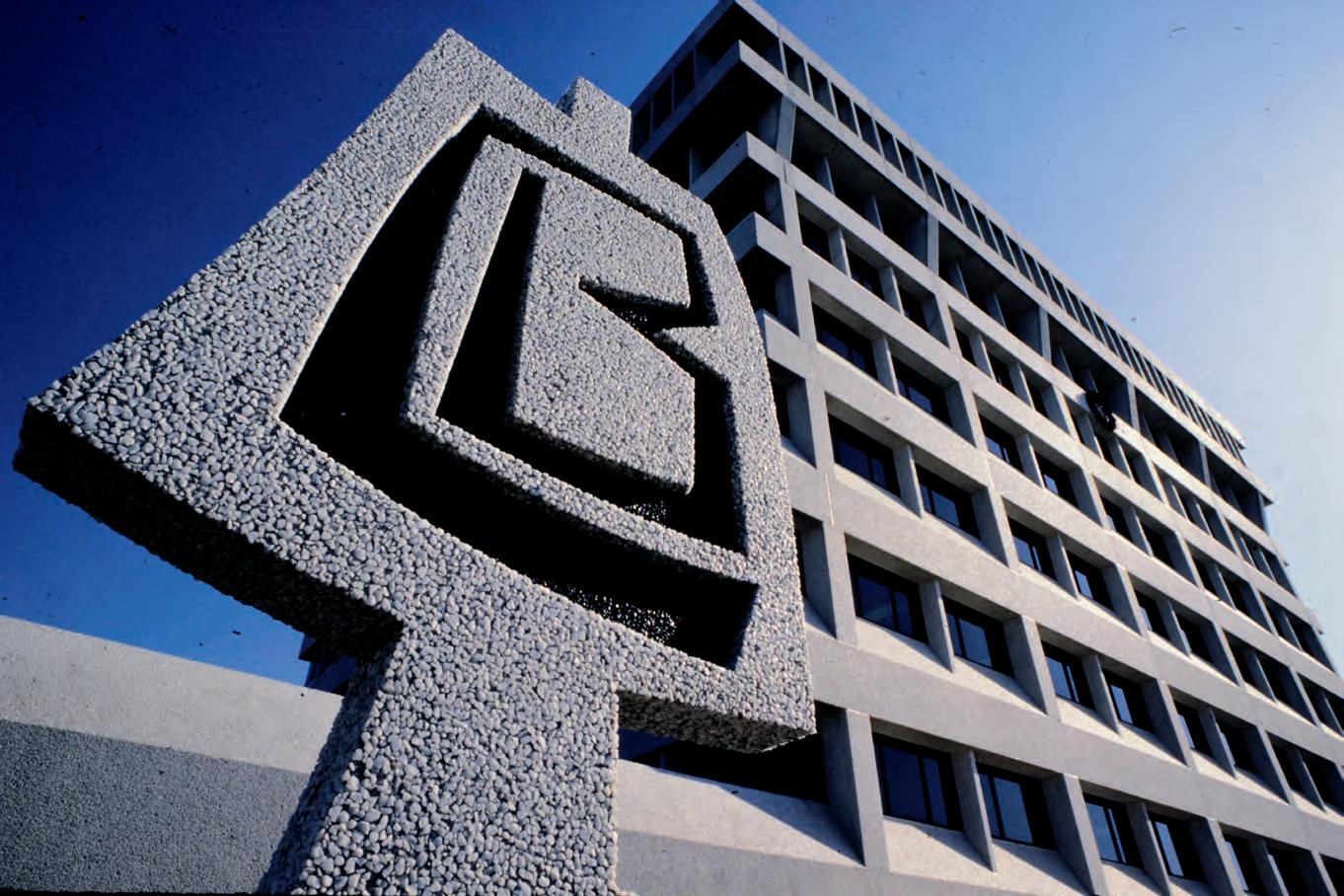
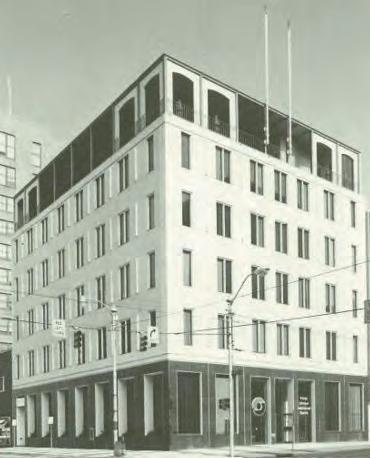
all the money he possibly could. Bryan called in his estimator and they discussed the figures.
“Mr. Bryan took out a fountain pen, drew a line through the number and wrote another number beside it,” Weil said in late 2022. “He initialed it and handed it back to me. He reduced the price by $50,000, making it possible for me to move ahead with the project. Of course, T.A. Loving handled the job. We opened in 1977. It’s been successful and we’ve operated it ever since—that’s forty-five years now.”
The Hotel Goldsboro project ga ve
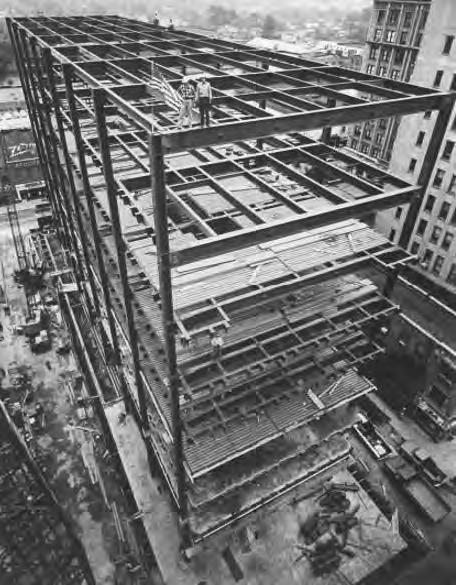
Weil the structure and confidence to move forward with similar projects with the Sir Walter and Cape Fear properties.
And of course he retained T.A. Loving to handle the construction work. Another development team approached him to learn of the mechanism he’d used and took that same process to Elizabeth City to convert the Virginia Dare Hotel; T.A. Loving was hired to handle that construction project as well.
“That was four old hotels we converted to apartments,” says Bobby Richter, a longtime T.A. Loving employee who worked
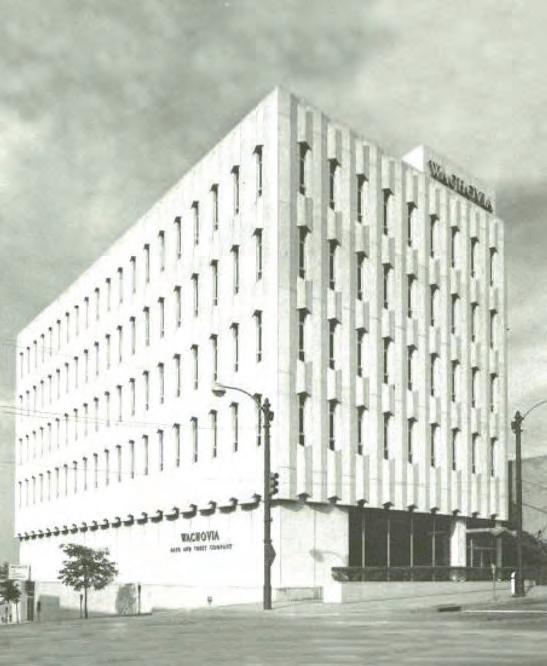
his way up to vice president. “Those jobs were interesting to work on, they provided some challenges you don’t get from new construction. These buildings had the old metal stairs on the outside as a fire escape. At Sir Walter, we had to go up to the tenth floor and cut a hole in the floor all the way down to the street level to build a fire-rated stairwell.”
Weil recalls the heating and cooling systems providing the biggest challenge.
“Those buildings were all constructed before air conditioning and back when heating worked off a boiler,” he says.
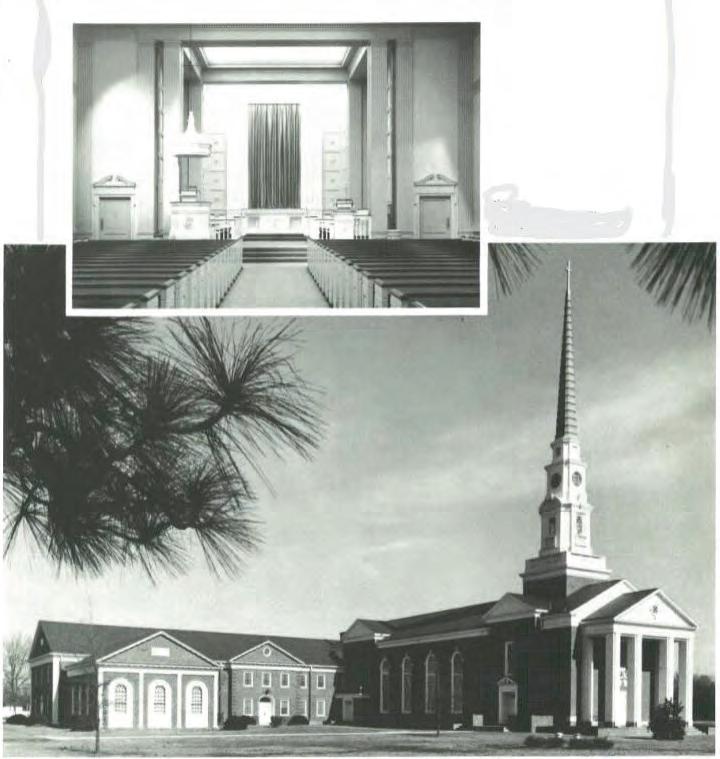
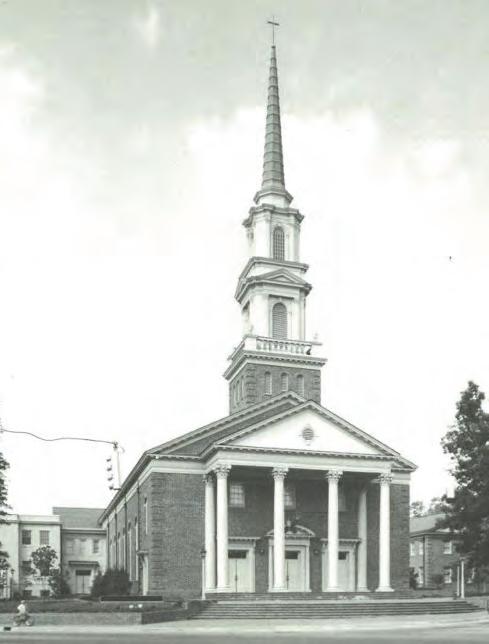
“They had to find a way to integrate air conditioning and modern heating. One thing that made the Sir Walter project a little easier was that it was from the same architect as the Hotel Goldsboro. The upper floors were essentially the same.
Wilmington was a different architect, so they had to reinvent the approach to that one.”
Weil would turn once again to T.A. Loving in 2005 for a project important to the Weil family and David in particular.
His ancestors in 1892 erected a building on Center Street in Goldsboro that was originally an armory, then a synagogue and converted in the 1920s into a cinema called the Paramount Theatre. After the facility fell out of favor as did most downtown
cinemas across America in the 1970s, the City of Goldsboro bought it in 1993 and converted it into a performing arts center. Weil was thirteen years old when he saw the musicals South Pacific and Guys & Dolls on a trip to New York City and developed a lifelong love of the arts, so he was devastated when the Paramount was razed by a fire in February 2005.
Weil launched a community fund-raising drive to pay for the resurrection of the Paramount, and T.A. Loving cut its price to help make the project feasible. Structural problems forced the company to tear down the entire building, including the facade that the city hoped to save. It was rebuilt and opened in February 2008. It has seating for 500 people and a stage big enough to hold the North Carolina Symphony.
“Attention to detail—that’s what stands out in all my dealings with T.A. Loving,” Weil says. “There is nobody in that organization that I ever met that wasn’t inspired with that idea of close attention to detail. In those big hotels, the supervisors never gave up throughout the day checking on what was going on—are the finishes on the floors smooth, are the walls well-
painted? And that in the construction business is really the answer to getting a good project. It will be no better than the oversight that it gets.”
Another historic theater in an Eastern North Carolina town recently benefited from T.A. Loving’s diverse skills and that attention to detail.
T he Turnage Theatre in Washington opened in 1913 and is a North Carolina designated historic site and a contributing structure to the Historic District of Washington. The facility comprises 32,000 square feet, including a vintage vaudeville theater. The original truss on the roof was made of heavy timber and as it entered its second century was in need of significant repairs or, ideally, total replacement.
T.A. Loving staff erected a huge crane, removed the original roof and dropped in a completely new steel structure. The work was completed in October 2020 at a cost of $1.3 million.
T.A. Loving has returned to Goldsboro, Raleigh and Wilmington and ventured to other cities and towns in recent years to build on its portfolio of urban construction.
The company was hired by the City of
Raleigh in 2005 to handle what was pegged as the “Fayetteville Street Renaissance.” Fayetteville Street is a north-south artery in downtown Raleigh that connects the State Capitol to the central business district. Dating back to the city’s first plan in 1792, Fayetteville Street played a crucial role in the city’s growth and economic prosperity. It was closed in 1977 to vehicular traffic to create a pedestrian mall, a popular urban trend at the time, but it resulted in a deserted corridor after hours, barren storefronts and late-night crime. City fathers decided in 2003 to reverse course, and after two years of planning, T.A. Loving broke ground in 2005 to return Fayetteville Street to vehicular traffic as a way to help jumpstart economic development and revitalize the area. The project cost the city $9.3 million and took sixteen months to complete. Mark Beac h joined T.A. Loving in 2004 and was project manager on the Fayetteville Street Mall job. A major part of the work was rebuilding many systems underground—water, sewer and electric— and performing considerable work at night in order to not affect regular business hours. Fences were an important element
in directing and managing foot traffic. Cross-streets like Morgan, Hargett, Martin and Davie needed to remain open.
“One of our goals was to do the work and not have any business have to shut down,” he says. “Nobody lost a day of being open. We kept every business open during the day. Some might have shut down for other reasons, but no one lost an hour because of the construction. We as a company were proud of that.”
Concurrently the company renovated the North Carolina Justice Building that runs the length of Morgan Street between Fayetteville and Wilmington Streets. The building opened in 1940 with a granite facade made of rock quarried in Mount Airy and mirrored design features of the State Capitol, just across the street. The Supreme Court presides in a third-floor, walnutpaneled courtroom; the court moved out for two years from 2005-07 for T.A. Loving to come in and rebuild all five floors.
“We replaced all the windows, and the fifth floor was nothing but pigeons,” Beach says. “We had to clean all that up and that floor ended up becoming the library. We cleaned all of the paneling in the courtroom
and refinished it. We also took all of the overhead light fixtures down and sent them off to be cleaned and refurbished. We put in heat and air, where previously the entire building had window A/C units. We also installed all new windows in the building. That was a really nice job.”
B each was project manager on a job similar to the Fayetteville Street project a decade later in Goldsboro. Just as Fayetteville Street dates to the beginnings in Raleigh, so too does Center Street in Goldsboro.
Goldsboro was incorporated in 1847 and sprung up around the three railroads that operated in the town along lines that ran north-south (the present Center Street) and east-west. By the mid-1920s, however, citizens were tired of the noise, smell and traffic of the trains running up and down Center Street.
By 1905, city fathers had petitioned the North Carolina Railroad Commission for approval of a rail station on the west end of Walnut Street. “By the constant moving of trains, business on this street is greatly retarded and the risk to life is appalling,” read a letter signed by several dozen residents. It took years of negotiating
and a lot of courtroom wrangling, but finally in October 1925, the city struck a deal with the Atlantic Coast Line to remove its track from Center Street. Soon the other rail lines followed suit and the city moved forward with its long-held goal of paving Center Street with ample room for parking for the latest mode of transportation—the automobile.
T.A. Loving played integral roles in upfitting the Center Street pedestrian and traffic venues in the heart of Goldsboro.
The HUB and Center Street Streetscape was executed in three phases, with T.A. Loving handling Phases II and III.
The first phase executed between 201415 included removing existing utilities, sidewalks and overhead power lines and traffic signals in a three-block area. Overhead electrical utilities were relocated underground; new curb, gutter and pavers were installed along with new pavement. Three roundabouts were installed to reduce traffic signals, and the Walnut Street roundabout includes a stunning granite fountain.
The next phase, completed in 2020, featured the creation of the HUB, a multi-modal transportation center that is
also a multi-function public space. Part of the North Carolina Mountain-to-Sea Trail, it invites citizens to travel by bus, bicycle or on foot. The park features a new performing arts amphitheater with open spaces for lawn seating, a fire pit, interweaving curved walkways and visitor amenities such a temperature controlled restroom access.
“We did the same thing we’d done in Raleigh,” Beach says. “We kept the businesses open and put a new street down. The difference was that this was never a plaza like Raleigh. We changed the parking layout, the medians and the sidewalks.”
T.A. Loving has had a substantial thumbprint in the city of Wilmington as well. The city in the late 1960s was experiencing the “suburb flight” that was affecting downtowns nationwide. The Atlantic Coast Line Railroad had moved out and much of the commerce had moved to the suburbs. A developer hired T.A. Loving to build what became the Timme Plaza Motor Inn, a large hotel with the Cape Fear River to the west and Water Street to the east. The hotel opened in 1970 and was quickly acquired by
Hilton and turned into the Hilton Wilmington Riverside.
“They came into downtown at a point that we were really reeling from economic times,” said Ed Wolverton with Wilmington Downtown Inc. “Getting a major investment to come in and be part of downtown and have the hotel industry represented in that way was really important to us.”
Sotheby Hotels completed a $10 million renovation in late 2017 of the hotel that is now called Hotel Ballast.
Just over a hundred yards to the east,
T.A. Loving has done major streetscaping projects on four blocks of Front Street, which is essentially the downtown’s “Main Street.” It completed work in 2010 on the two blocks from Market Street north to Chestnut Street that was a combination of water and sewer underground utility replacements and a complete streetscape demolition and replacement from building to building.
It finished a second phase in 2023 that encompassed about nine hundred feet of linear streetscaping improvements, including replacement/upgrade of water, sewer, stormwater utilities, asphalt
pavement, concrete and granite curbing, concrete sidewalks, landscaping and irrigation and site furnishings.
“ It’s an entire streetscape project where essentially everything is brand new right out to new asphalt, new striping and the whole works,” says Jason Hill, vice president of Civil Infrastructure Conveyance Systems who works out of Wilmington. “The challenges to these jobs are juggling so many moving parts—not just the work itself but the businesses, the pedestrians and traffic.
“The trick is just because we’re tearing out the sidewalk does not mean that we can shut down a business or a restaurant. So we’ve got ramps that we install to maintain access to buildings at all times so that the businesses are affected as little as possible.” You never know what you might find digging up old stuff. Workers on the first phase remember finding an old boat buried beneath Front Street, and Hill says workers on the recent project found in tearing up an existing water line an old valve and pipe that was stamped and dated from 1910. It was cleaned up and moved to the Cape Fear Museum.
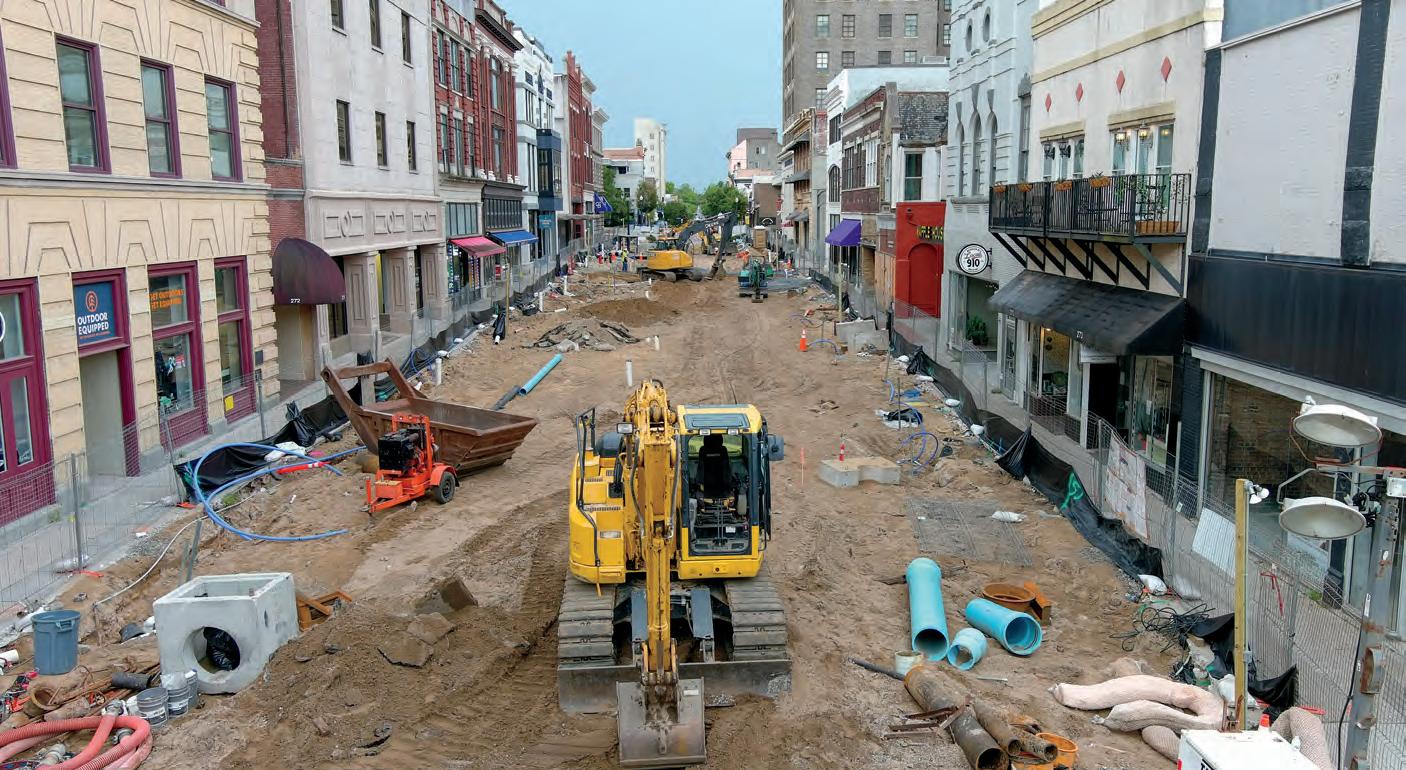
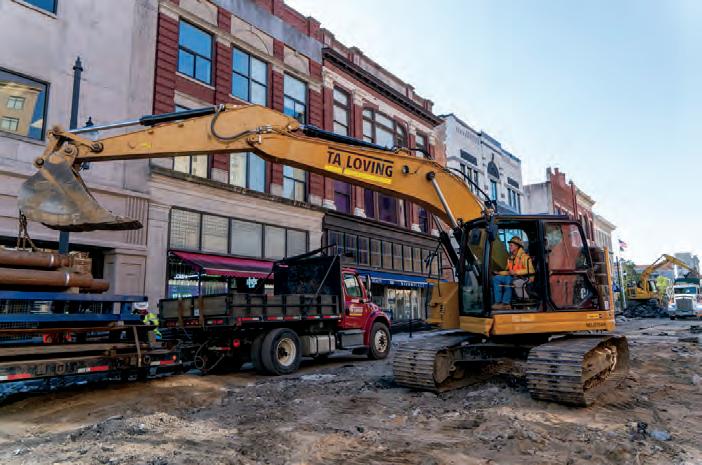
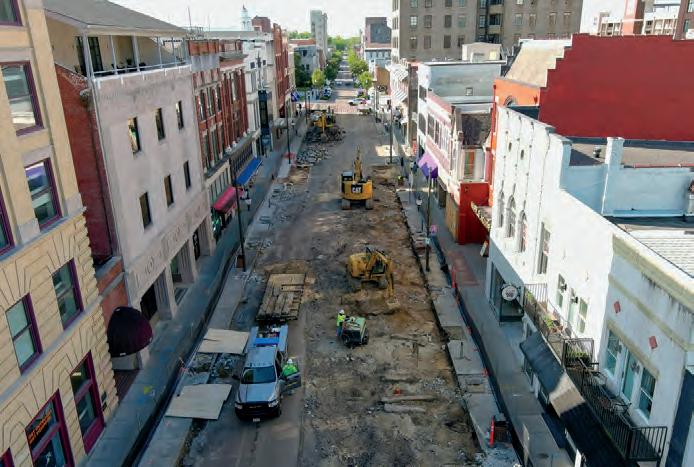
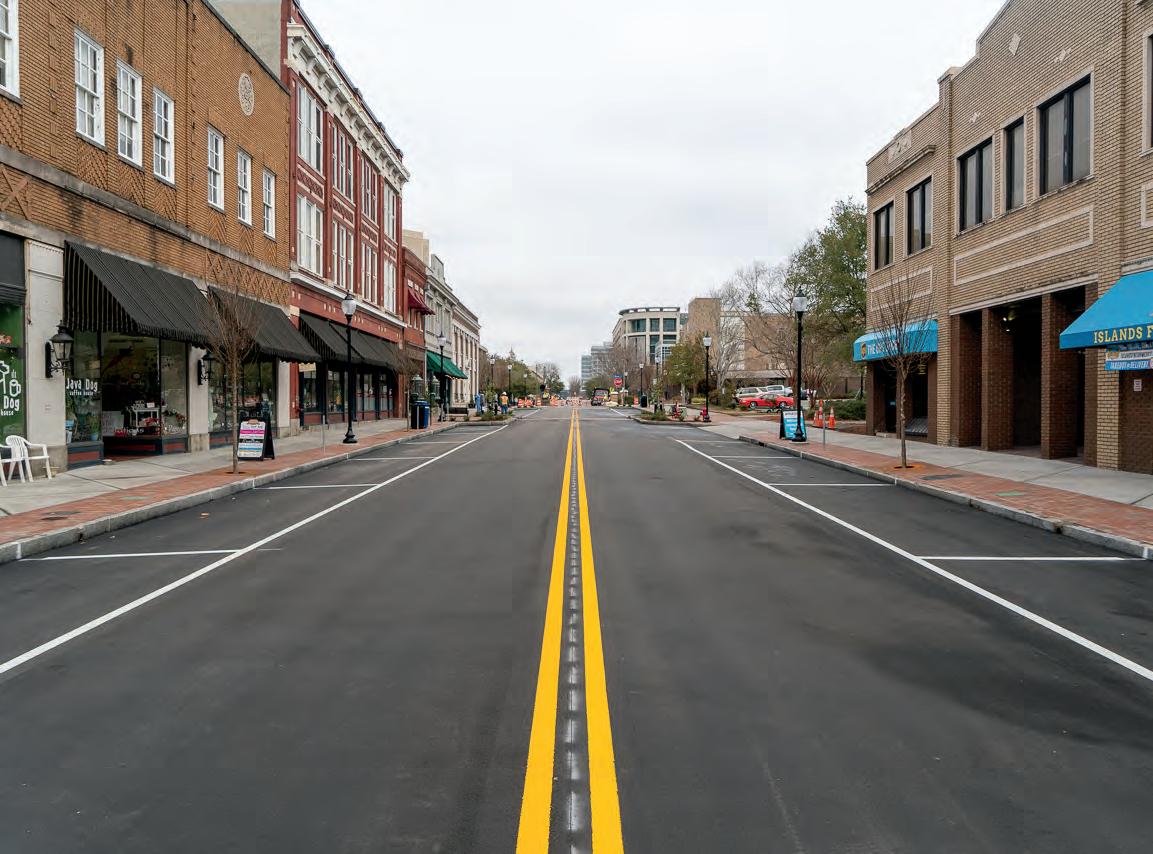
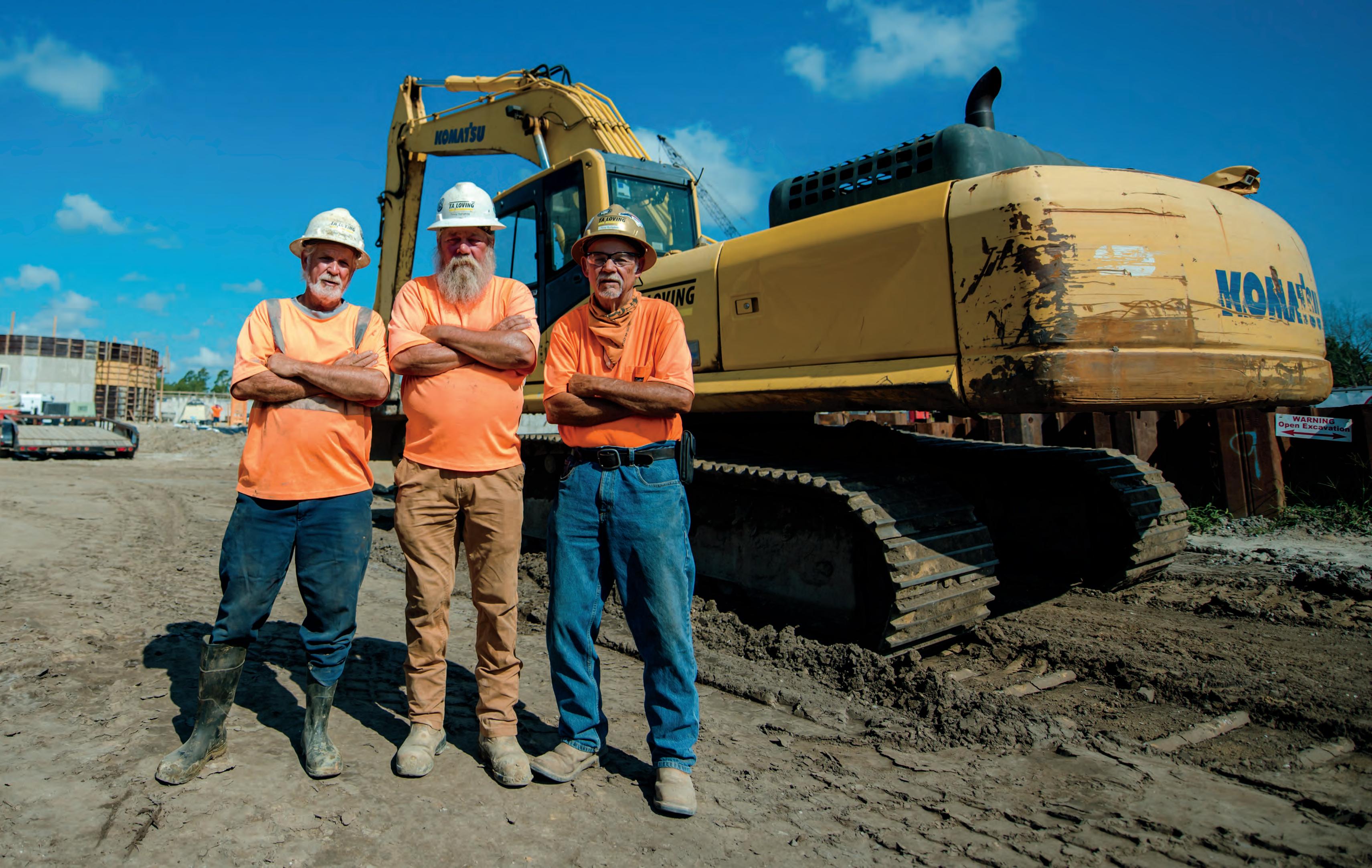
It’s always been about family and friends at T.A. Loving. The company has evolved and thrived on establishing and nurturing relationships throughout its varied clientele worlds and by providing a stable work environment for thousands of employees—many of them multiple generations of the same families.
It’s appropriate that brothers T.A. and John Loving were instrumental in creating and growing the company in the early days, and four generations of the Bryan family have led and molded the company with Raymond Sr. joining the company in 1931 and great granddaughter Madison Bryan Everette running the company’s corporate outreach program as the company celebrates its one hundredth birthday.
“I have so much admiration for the families of the employees of T.A. Loving because I know a lot of people have to leave their families,” says Ann Hunter, daughter of John Loving and wife of longtime company executive Sam Hunter.
“They have to put work first sometimes, and I think it takes a lot to be a great employee and be away from home and still be a loving father and a loving spouse.”
The company’s family-oriented culture is embodied in the Humphrey brothers—with Tony, Edgar and Timmy having more than 150 years combined service as the company hits its centennial.
Tony was seventy-two years old in early 2023, with Edgar two years younger and Timmy nine years behind. The brothers
have worked together as a crew for most of their careers and have done a little of everything—driving trucks, operating backhoes and laying pipe and concrete.
Another brother, Ronnie, started his career at T.A. Loving before leaving to launch his own masonry company.
“It’s something different every day, no two jobs are the same,” says Edgar. “I’ve enjoyed the work. It’s hard work, but I’ve enjoyed the people and the places I’ve been. If you do the work and show up every day, the higher-ups will take care of you.”
Paul Hunter says the Humphrey brothers are “the heart of T.A. Loving Company. They’ve been here forever. They are go-getters and do quality work. They’ve worked together their entire careers. You send them somewhere, and the job is done right. You know that. They can still do the hard work, maybe just not quite as fast as when they were younger.”
Dewey Humphrey, father of the three brothers, fought with the Army in the Invasion of Normandy in World War II and returned to Jacksonville after the war; he went to work for T.A. Loving and over
forty years worked as a machine operator, then a foreman and superintendent, and Dewey’s brothers Woodrow and David also spent much of their careers with the company. There have been many job crews populated with multiple Humphreys.
“We’ve worked on a job in Wilmington where we replaced old pipes that my Daddy laid,” says Tony, who had fifty-five years on the payroll dating back to summer jobs when he was a teenager. “One time we were laying a pipeline under the sound from Nags Head to Manteo. We had three barges. I was on the first barge, we were doing the digging. Edgar, my dad and my uncle were on the next one, putting the pipe together. Then there was another guy on the third barge with a clam bucket and crane, doing the backfilling.”
The Humphreys have witnessed it all when it comes to the history of T.A. Loving and the construction industry overall, from the days when pay grades started at just $1.25 an hour and the newly passed OSHA Act of 1970 was reshaping safety culture on construction sites throughout the nation. They can dig up all sorts of historical artifacts and stories
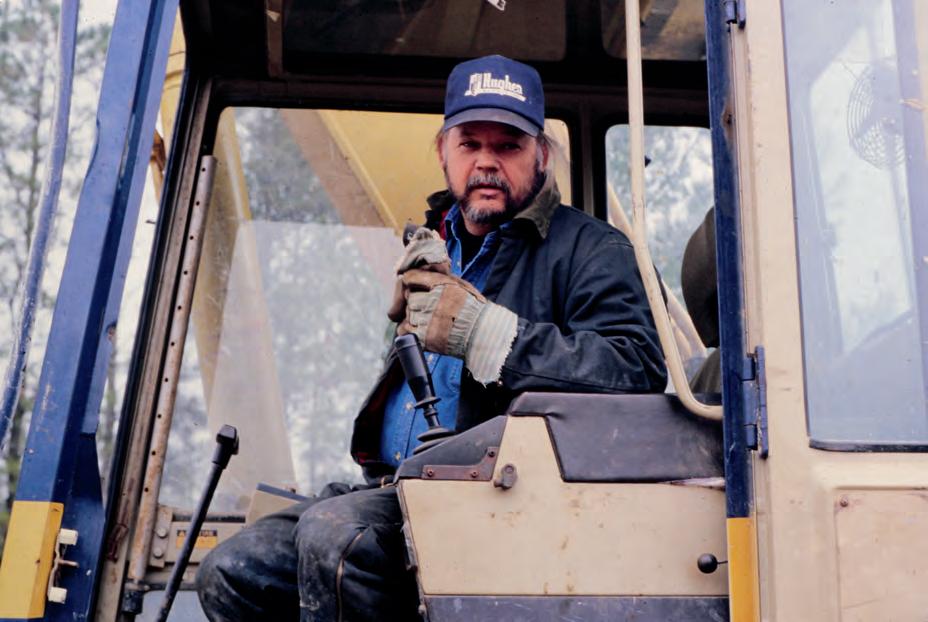
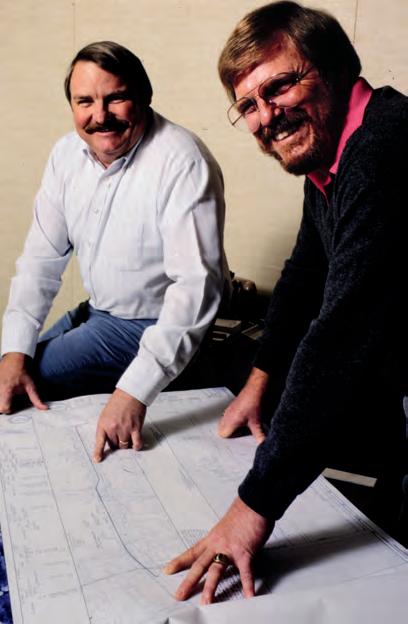
from their decades with T.A. Loving, from difficult jobs to the challenges of working with pay phones, CB radios and pagers to communicate on-site.
As natives of Jacksonville, the brothers have spent much of their time working between Camp Lejeune and Wilmington.
Tony says he remembers when the Porter’s Neck area was a ghost town with
no restaurants or stores— just a two-lane road called Highway 17. He and his crew installed a twenty-five-foot deep manhole at the intersection of Market Street and Porters Neck Road. They also installed the original pipe infrastructure for the Landfall and Echo Farms communities.
Tony remembers one of his most interesting and challenging projects was
installing a one-mile raw water line under Roanoke Sound from Nags Head to Manteo on Roanoke Island. His crew worked on barges to install the pipeline. He also remembers working on a large diameter pipeline project in New Bern. During a time when there were no directional boring machines, Tony and his crew worked inside of the pipe by hand
digging the front face of the pipe to push the pipe through.
“We take pride in the jobs we do,” Tony says. “If you don’t do it right, they won’t bring you back. Lots of times, the same people who hired you the first time will hire you again. But not if you do a sloppy job. I’ve always said, ‘Do the work like you own the company yourself.’”
The Robinson and Denning names are also rich vestiges of T.A. Loving history.
Donald Robinson was a divisional manager on the utility side for many years, retiring in 2008.
Kenny was a project manager and his father was a crane operator. Kenny’s son is Tony, the general superintendent for the Civil Infrastructure Group who started at T.A. Loving in June 1983.
“There’s been a Robinson here since 1940,” Tony says. “I’ve been a part of T.A. Loving since I was eight or nine years old. The Equipment Division used to be open on Saturdays, and I’d come with my dad when he came to get his oil changed. I loved seeing the bee hives that Jack Ledford kept.”
The appeal to Tony was that his dad
often worked around water.
“I’ve been in love with fishing since I was a boy,” he says. “Anytime Daddy had a job around water, I was ready to go. He’d drop me off and go on to work.”
“The people make it special here,” Robinson says. “The jobs all kind of run together, but it’s the people and the relationships that are the biggest part of being here. We all dream about retiring one day, but I’ll miss the relationships. I won’t miss the work and the aggravations, but I’ll definitely miss the guys, that’s for sure.”
As an avid fisherman, one of the more interesting projects to Robinson was working on the design and construction of the Vic Thomas Fish Hatchery in Brookneal, Virginia. It sits on fifty-five acres along the banks for the Staunton River, some fifty miles east of Roanoke.
“That kind of job was a far cry from waste-water treatment plants,” he says.
“There were some similarities, though— you were treating water, but for fish. We put up curtains to help make the fish think the seasons were changing and spawn.”
There have been multiple generations of Dennings working at T.A. Loving with two separate family branches with no known connection.
Bradley Denning was the first, beginning around World War II and working his entire career of some four decades with the company. He had two sons worked for the company as well as having a grandson on the payroll at some time.
Albert and Donald Denning were Bradley’s two sons and both worked multiple decades at T.A. Loving. Albert’s son Joey started at T.A. Loving after graduating high school 1981 as a form carpenter, was promoted to foreman in 1988 and has been a field superintendent since 1994. Donald’s son Tim had a stint in the safety department.
Dewey Denning, from a separate branch of Dennings, worked for more than three decades with the company and his son Leo started in 1978 and was still on staff in 2023; Leo worked at different times with Albert and Donald Denning.
“We tried to figure out if we were related but didn’t find anything,” Leo
says. “There are a lot of Dennings in Wayne County. If you really dug into the roots, you’d probably find a connection somewhere.”
Leo’s brother L.J., son Chad and nephew Chris have also worked for T.A. Loving. Chris was the youngest of the Dennings still on the payroll in 2023.
“It’s been a good company to work for,” Leo says. “They take care of you. I enjoy being with the guys, doing basic construction work.”
Richter is another important name in the annals of T.A. Loving Company.
Martin Richter began working for T.A. Loving in 1940 in Fort Story, Virginia, then after World War II moved to Goldsboro. His last project was being superintendent for the start of Wayne Memorial Hospital.
“The machine shop was open on Saturday mornings, and most of the men worked five and a half day weeks,” remembers his son, Bobby. “I loved to play with marbles, so the ball-bearings held a particular fascination. Those were big days for me in the late fifties. Those Saturdays were the only times I got a Pepsi
The people make it special here.
or a Coke. We never had them at home.
For eleven cents you could buy a pack of Lance peanuts and a drink.”
Three of Martin’s four sons worked at T.A. Loving—Jimmy, Mike and Bobby.
And the third generation is represented by Joe Richter, the son of Butch, who was Martin’s fourth son but never worked at T.A. Loving.
Martin had suffered from rheumatic fever as a boy and that left him with a faulty heart valve as an adult. He had open heart surgery at Duke Medical Center in 1965, and Raymond Bryan Jr., the company president at the time, paid the hospital bill.
“Daddy was one of the first people to have open-heart surgery in the United States,” says Bobby, who was one of six children. “The bill was $16,000. For a superintendent, that was one and a half year’s salary. That was a lot of money. He died two years later in 1967. I went to
Tony Robinson
work here the next year and I was paid $1.65 an hour.
“I’ve never forgotten what Mr. Bryan did for our family. They are good to their people here. They have good benefits and they care about people.”
Steve Bond has been a senior superintendent since 1990 and his son Brett took an interest in the company as a boy. Brett did summer internships for the company while working on his degree in construction management at East Carolina University. He graduated in 2010 and has been with the company ever since and now is a project manager and assistant vice president.
“I could tell from a young age this was a good place to work,” Steve says. “From the top down, it’s been a family owned and family-led business. You can find multiple family members in jobs as superintendents, foremen, laborers. It’s pretty neat.”

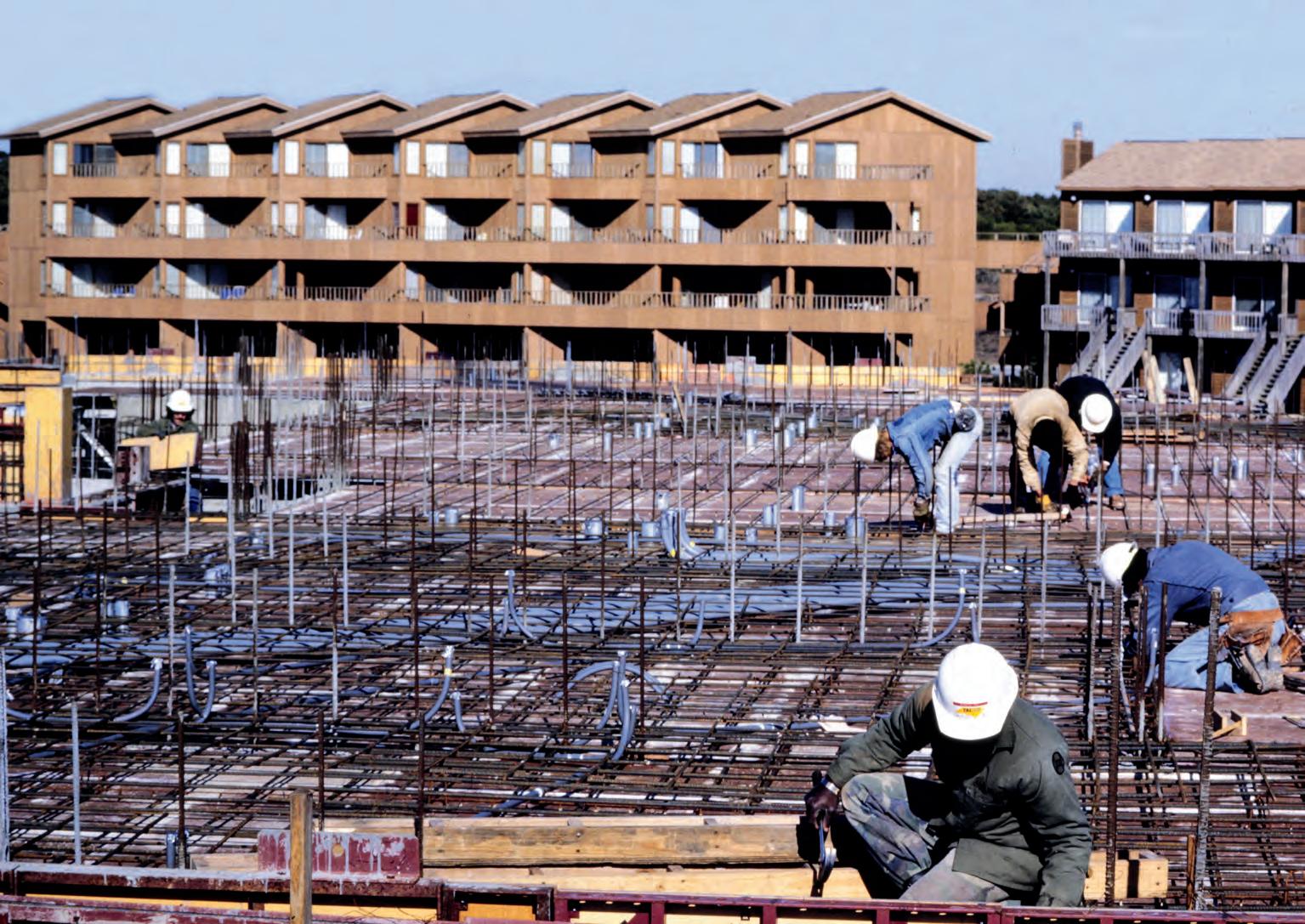
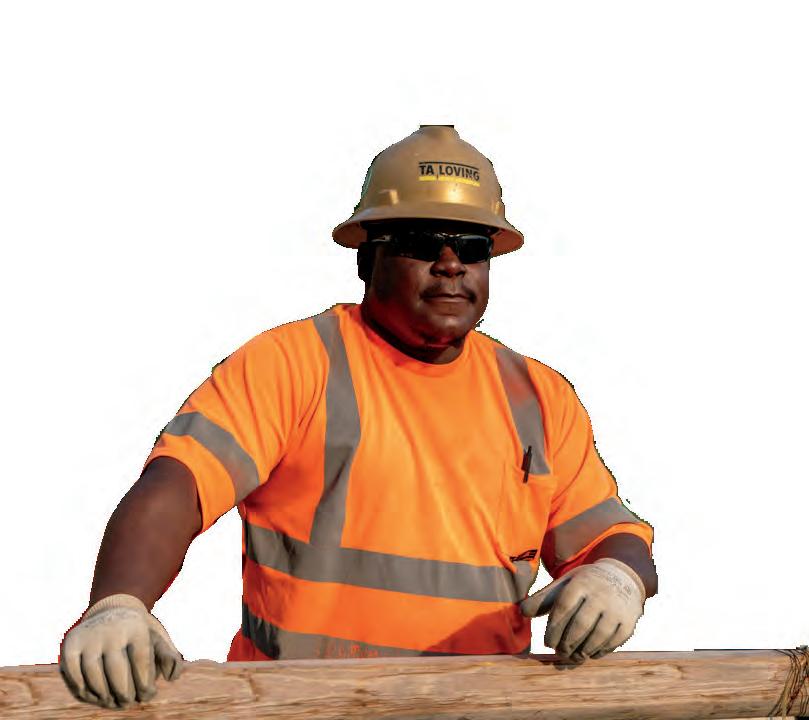
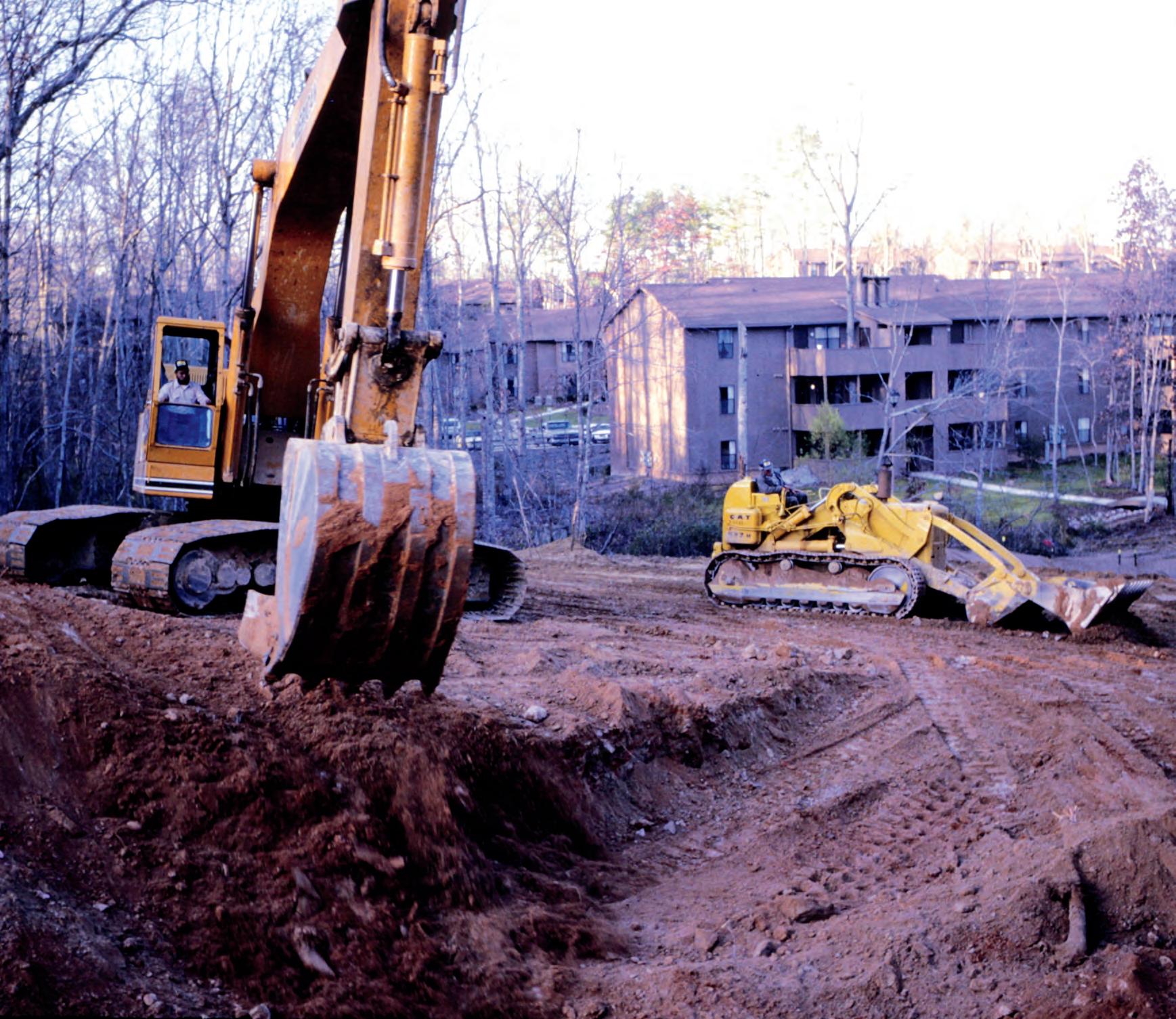
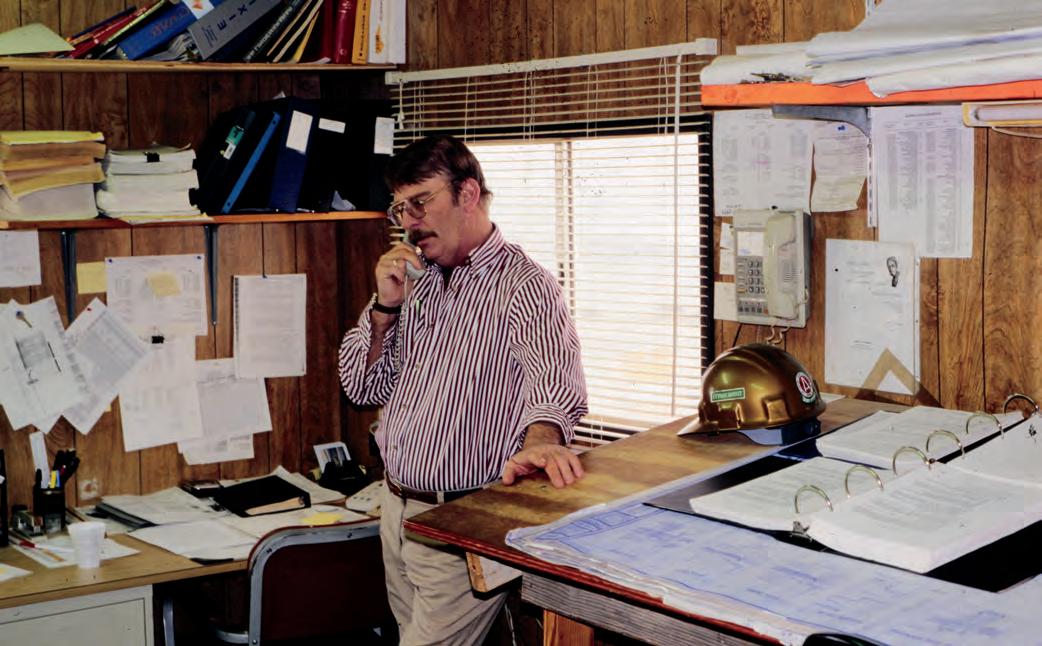
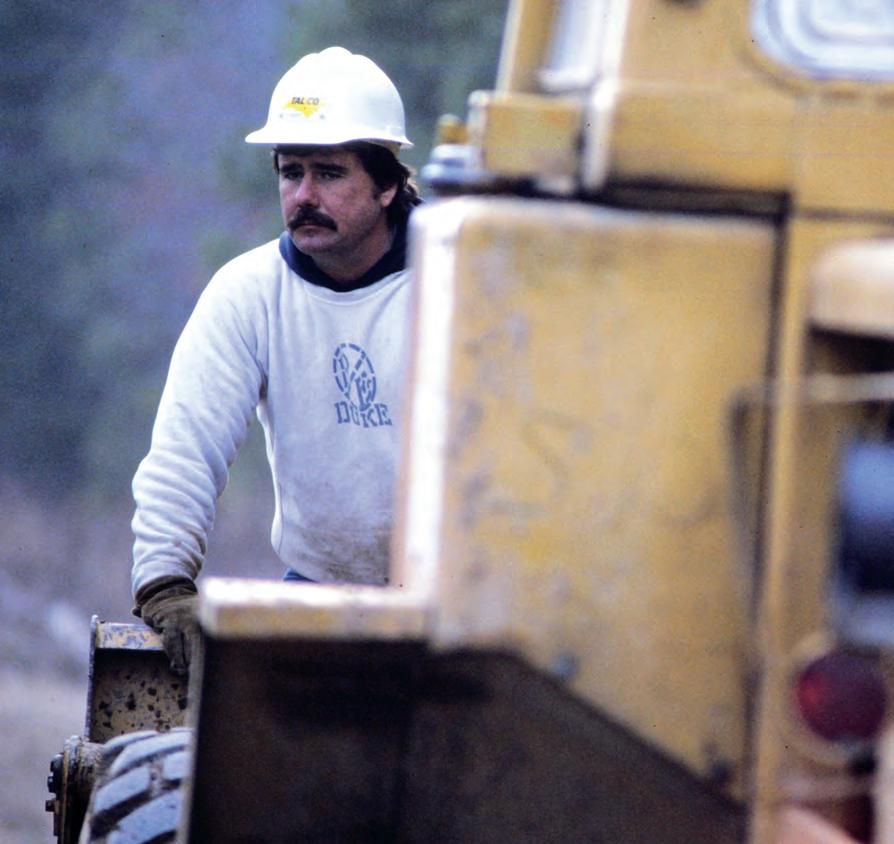
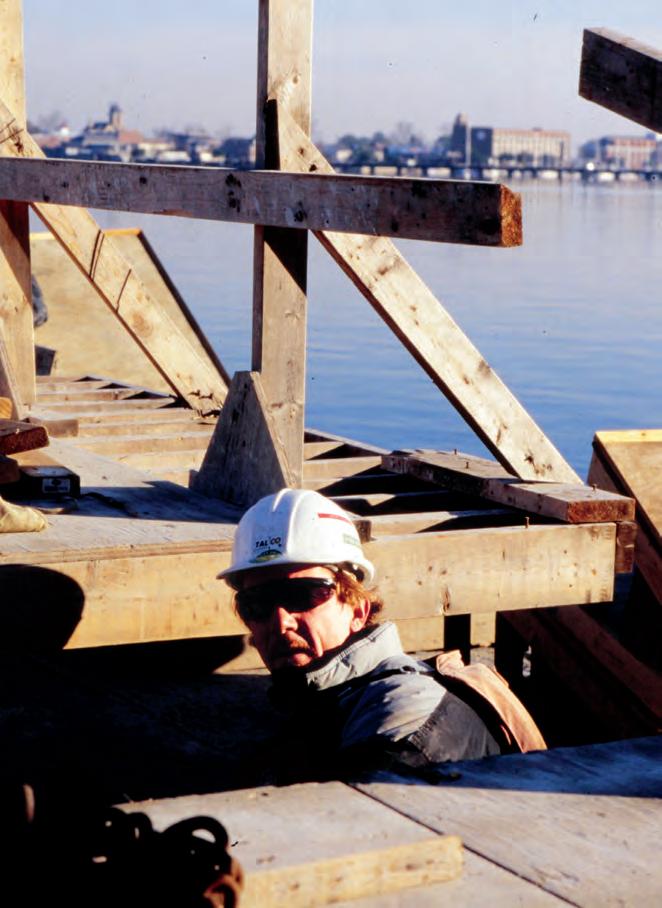
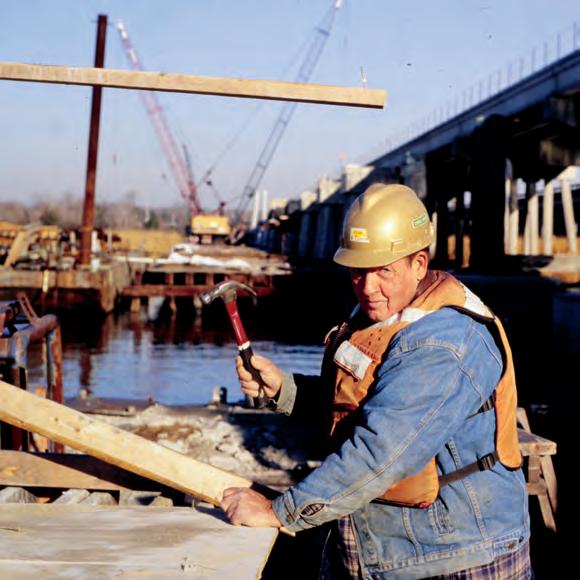
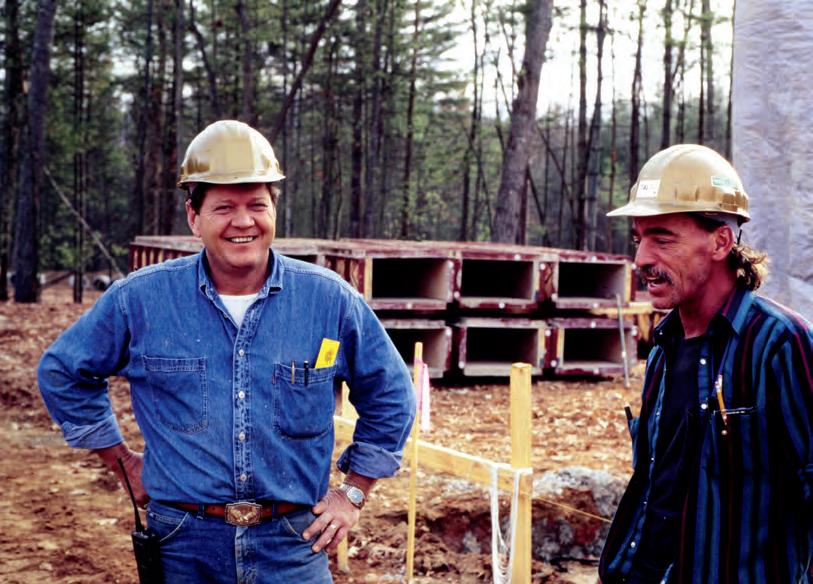
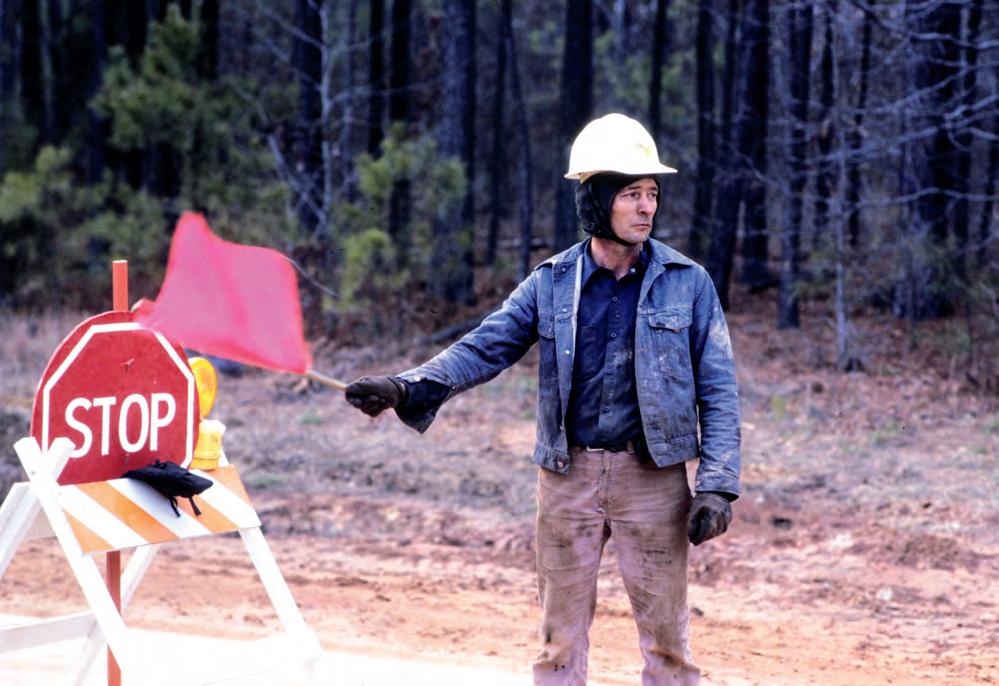
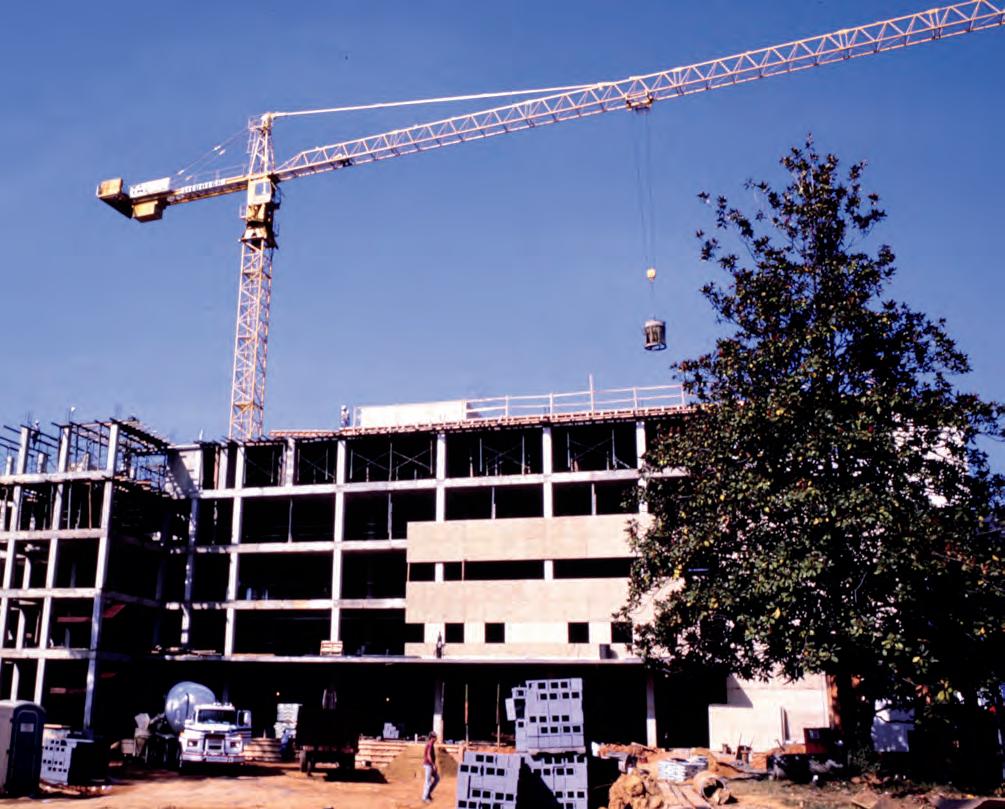
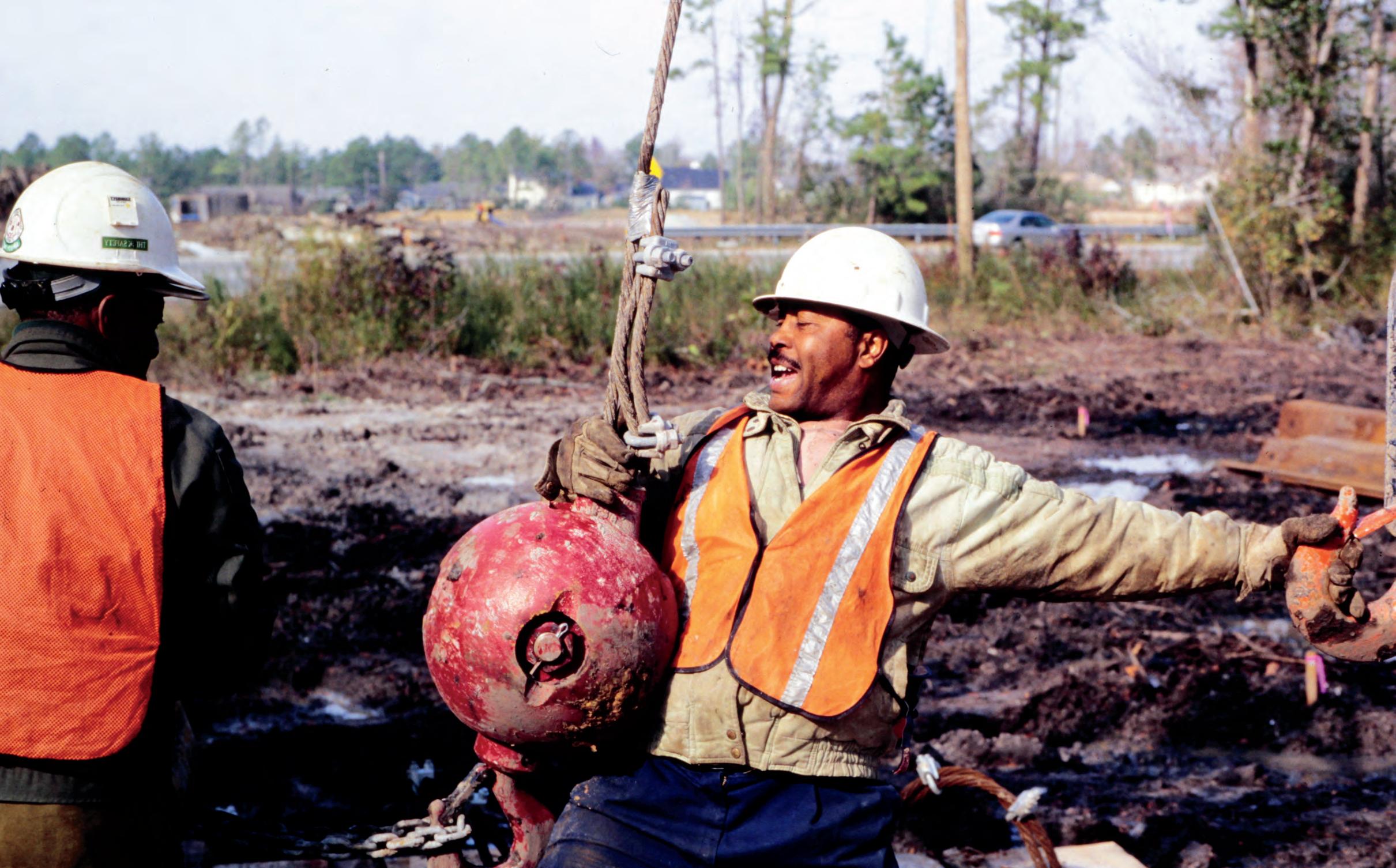
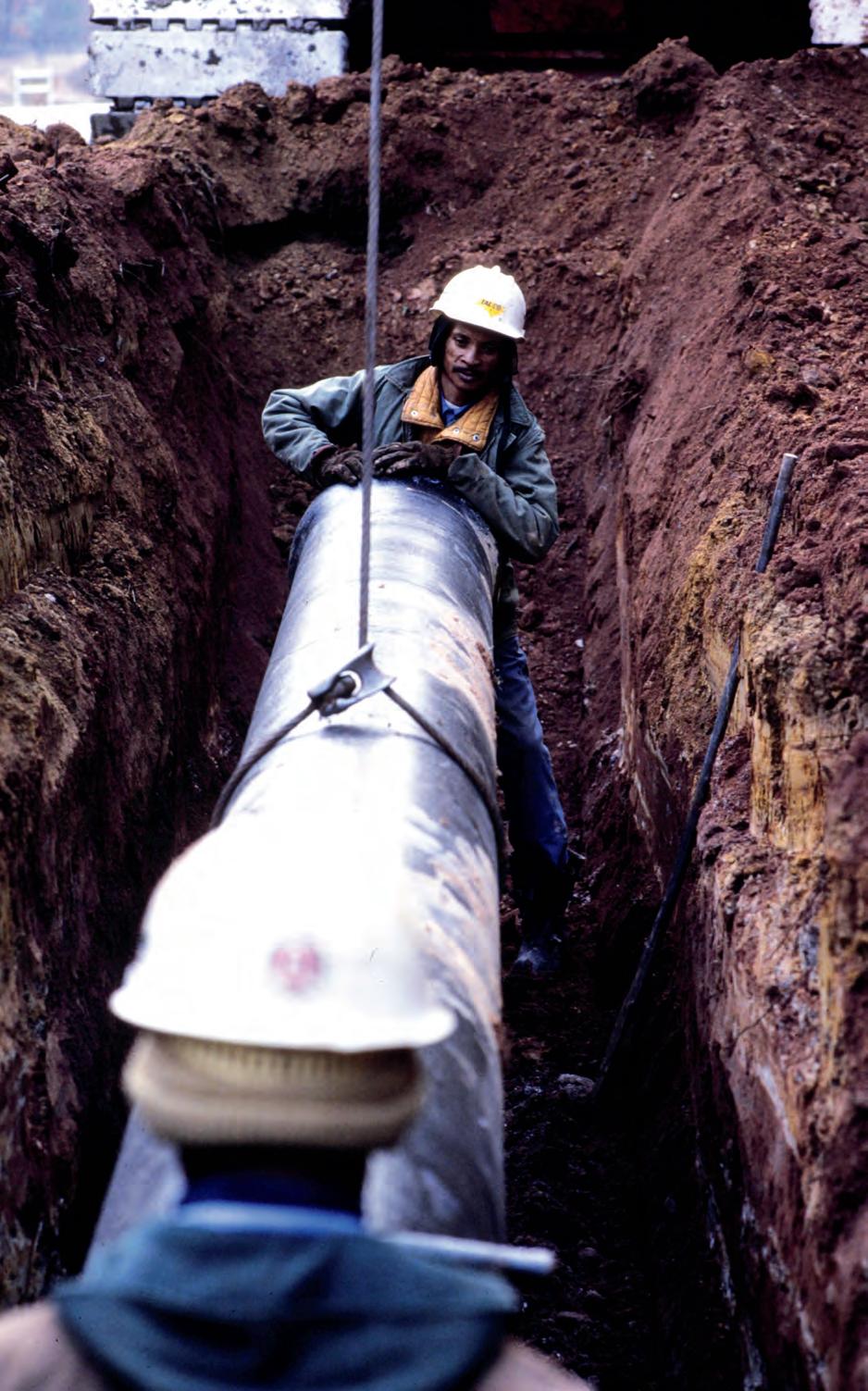
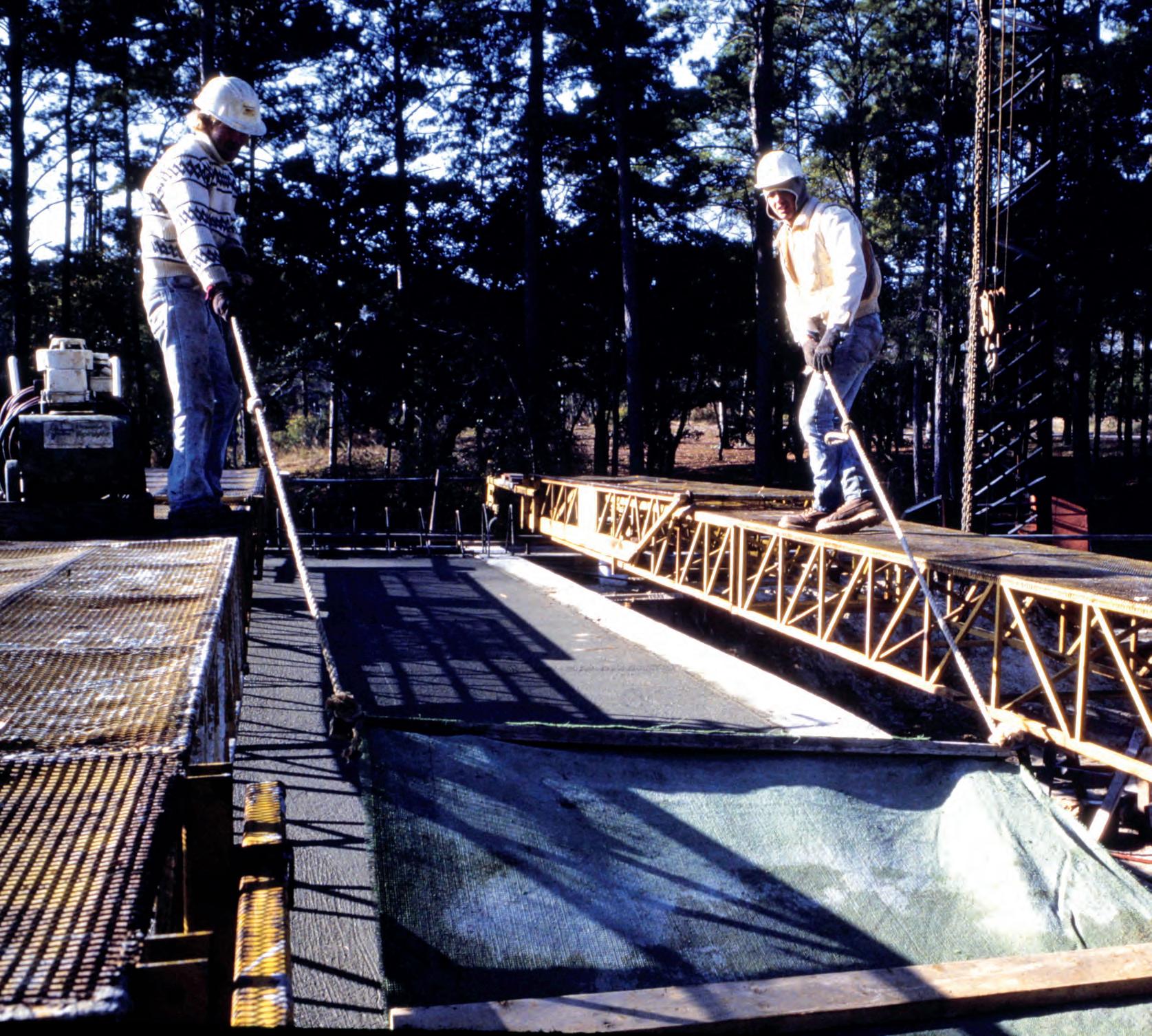
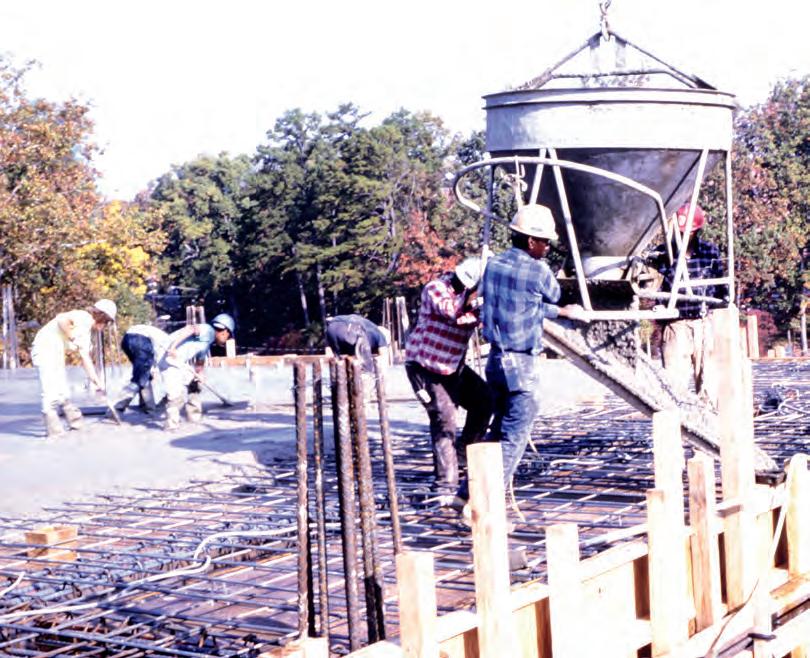
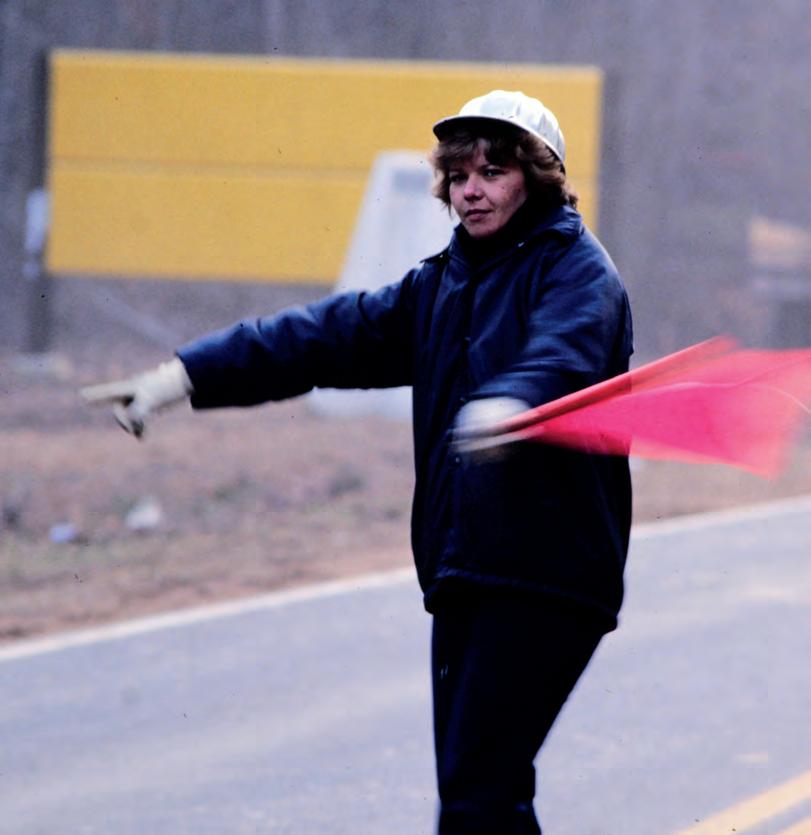
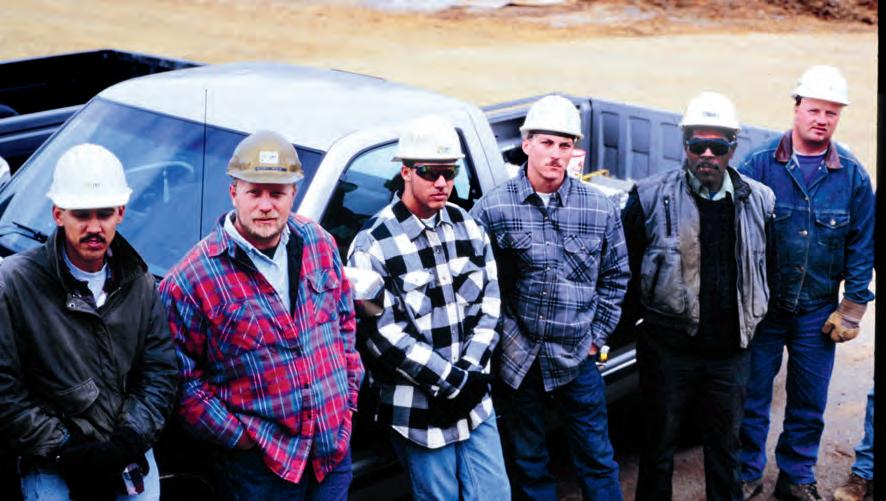
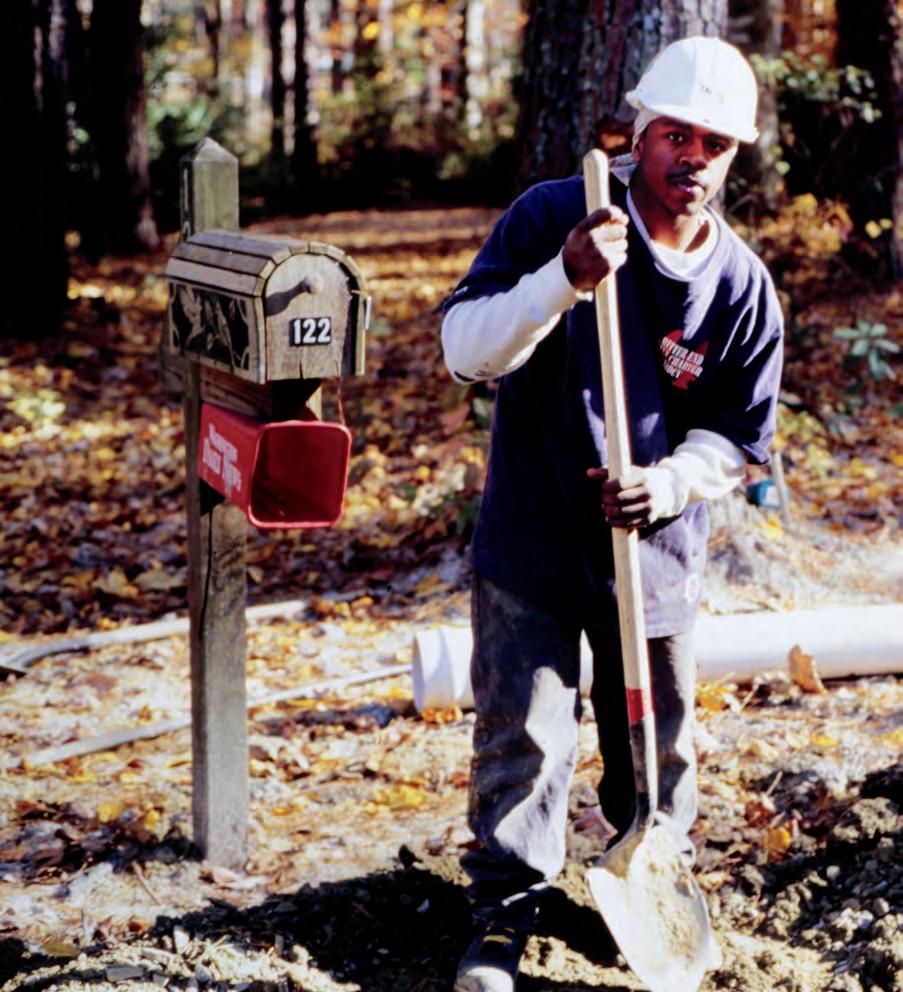
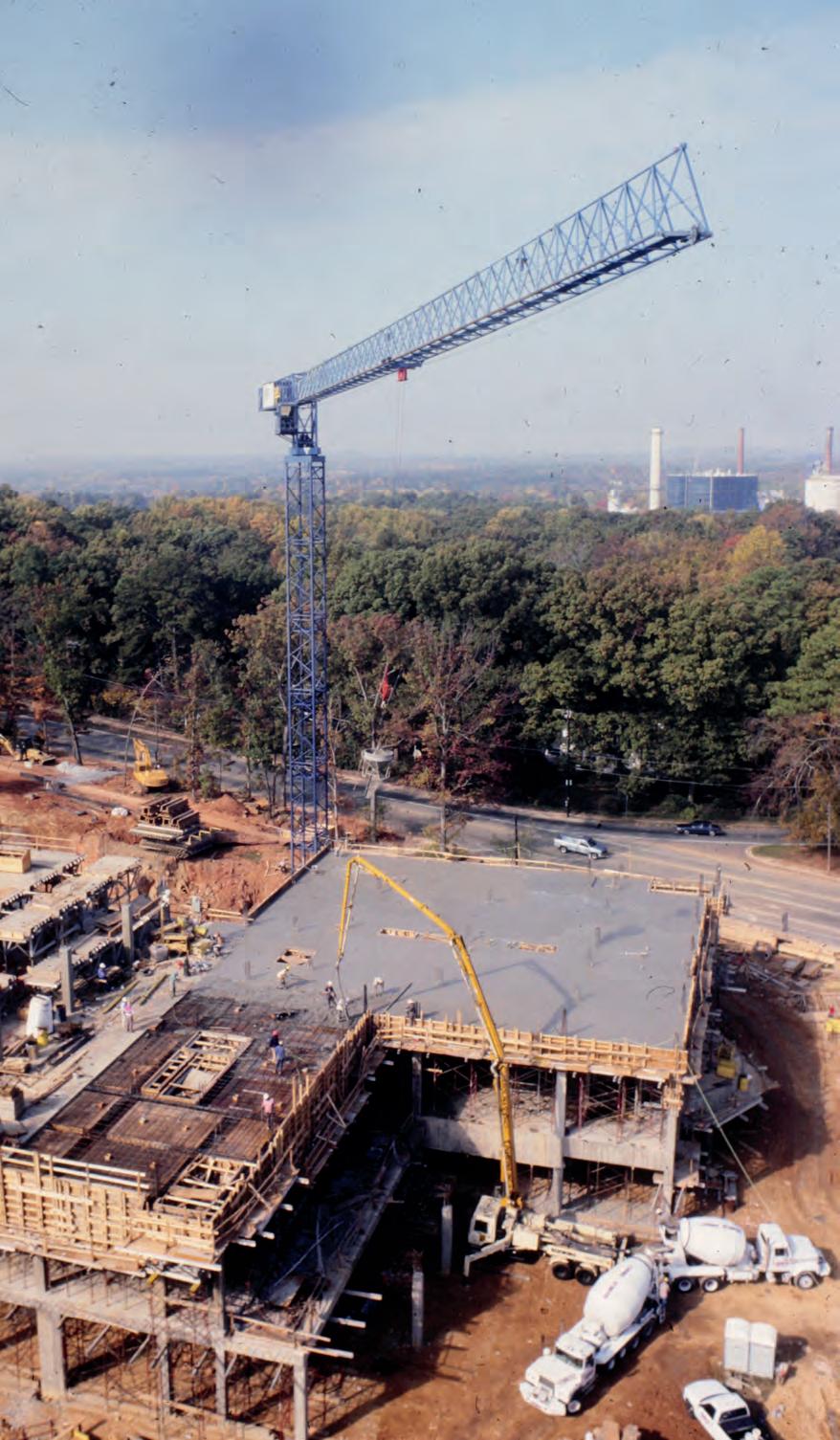
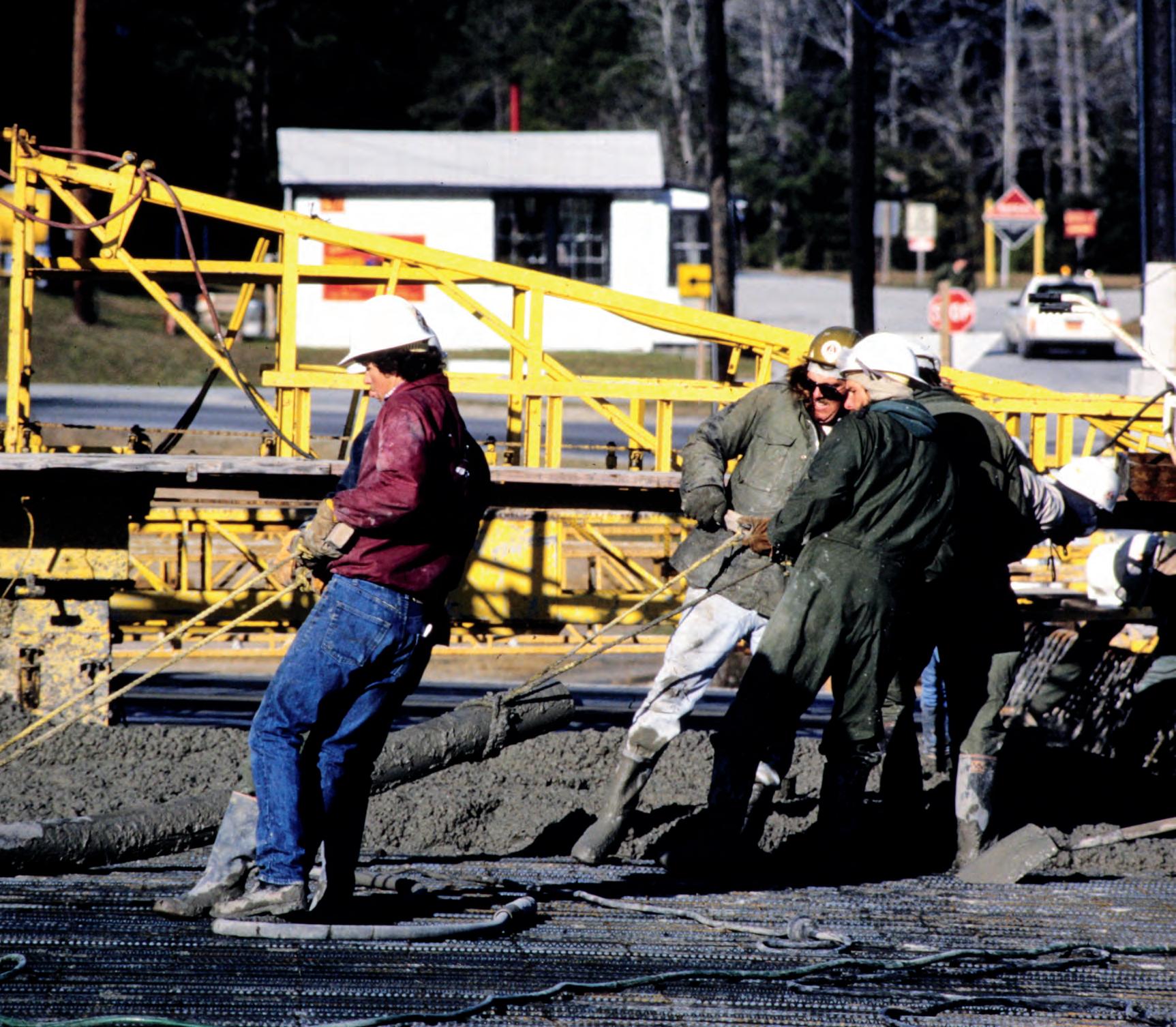
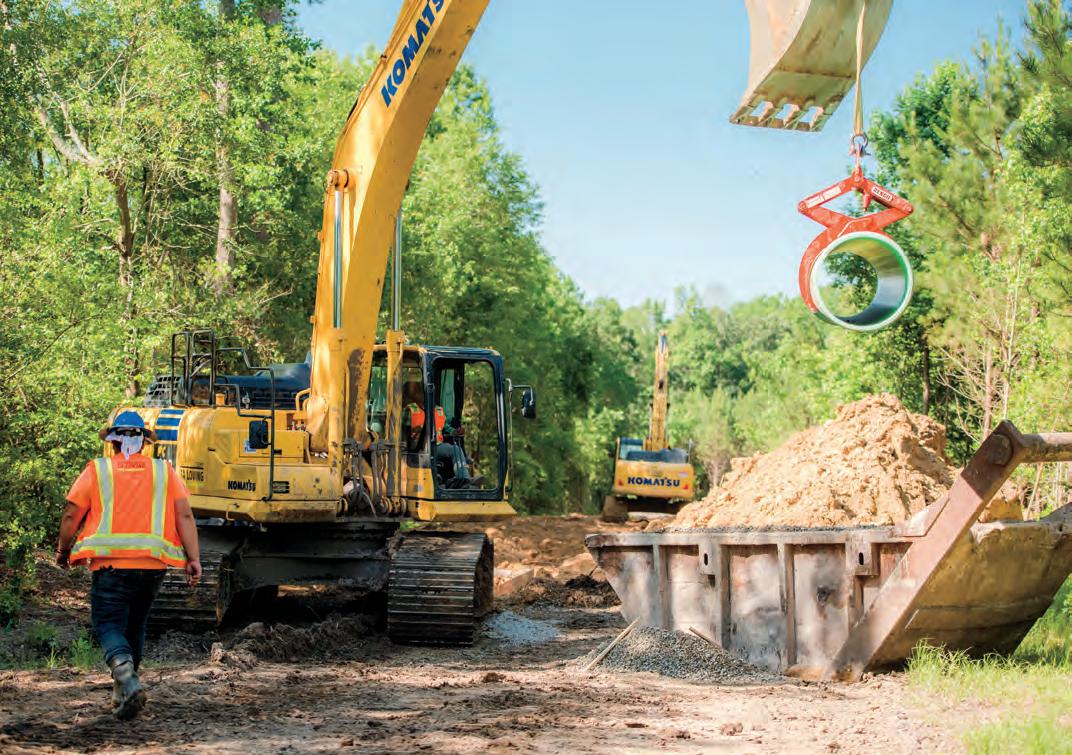
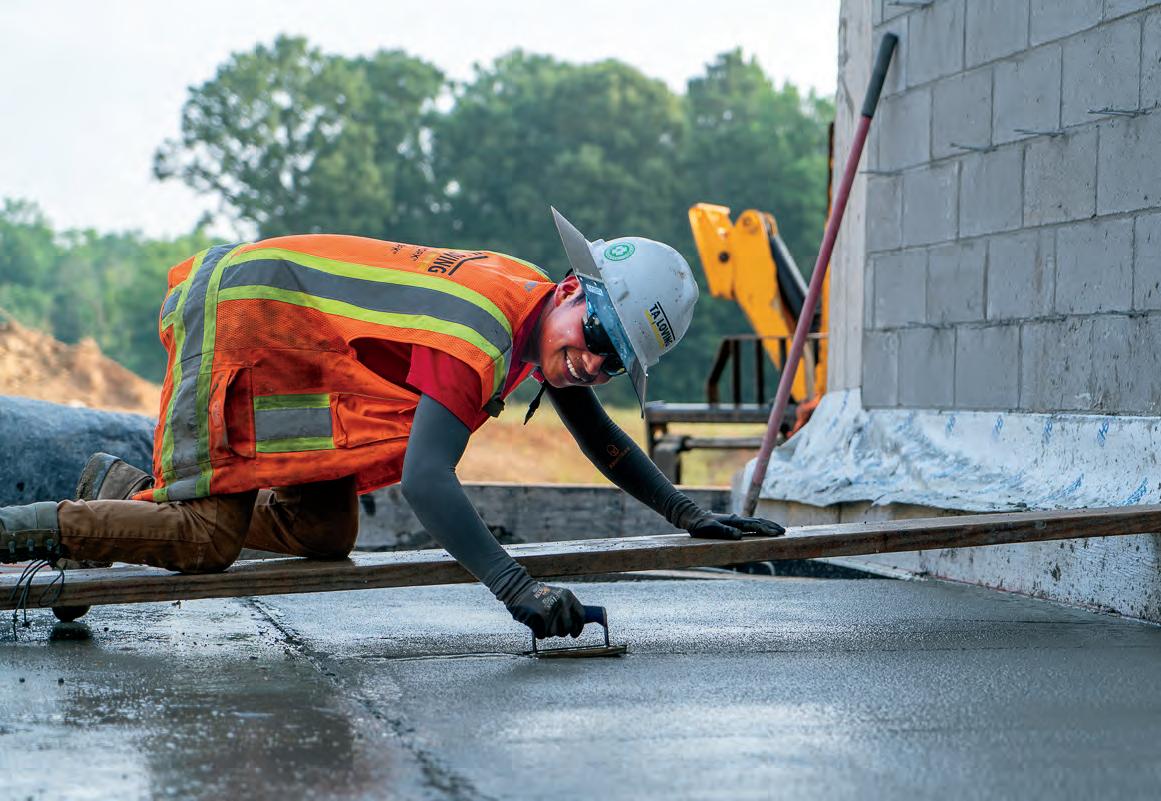
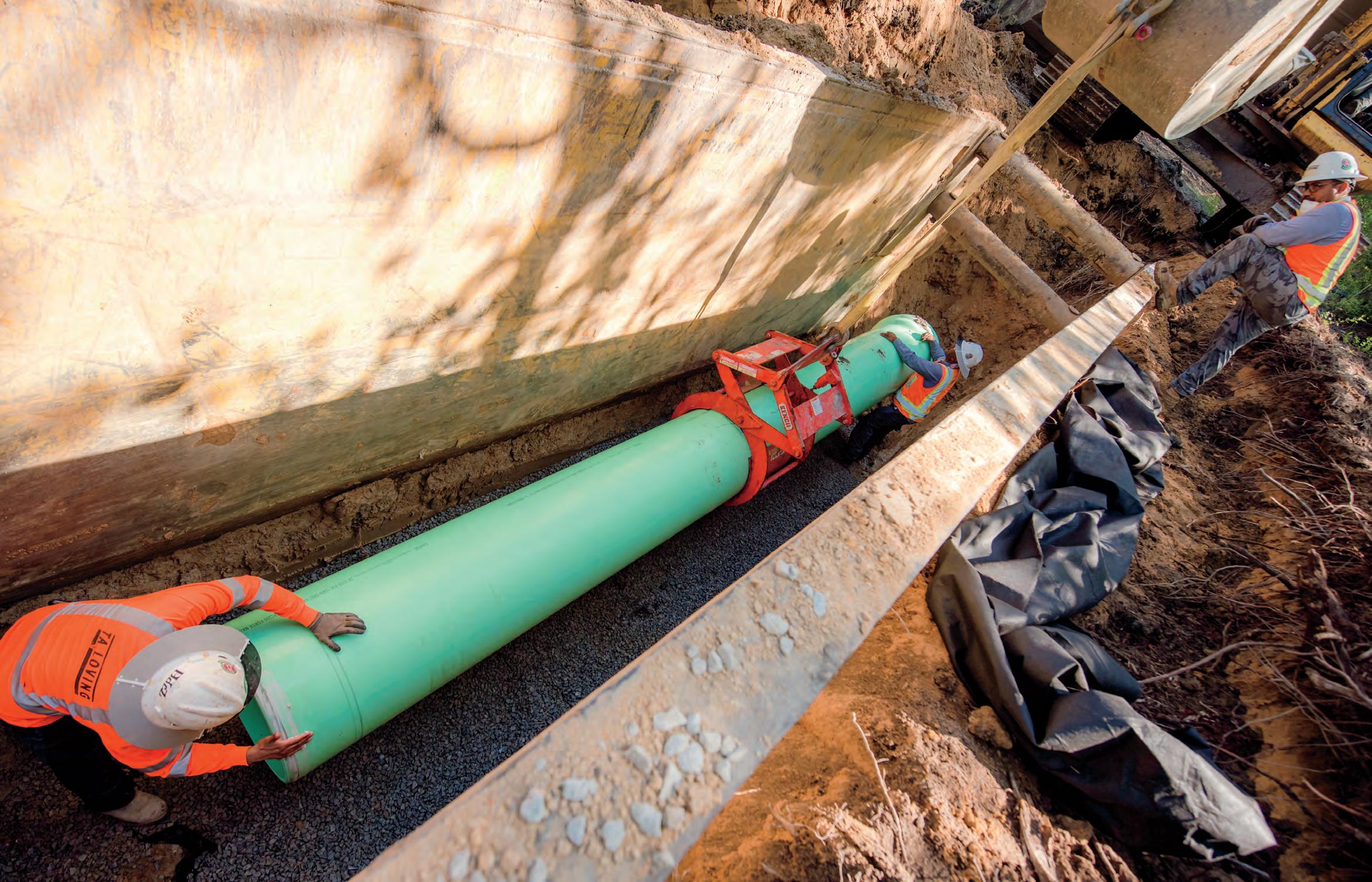
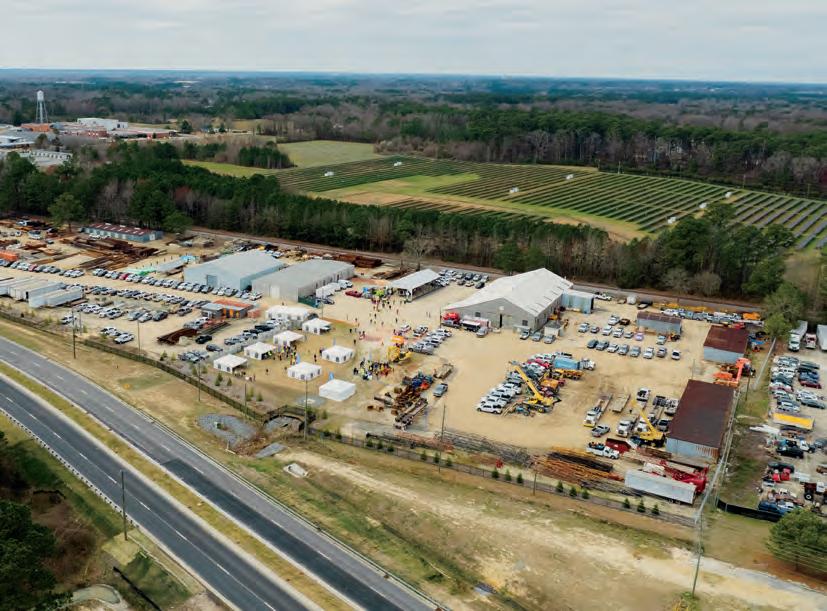
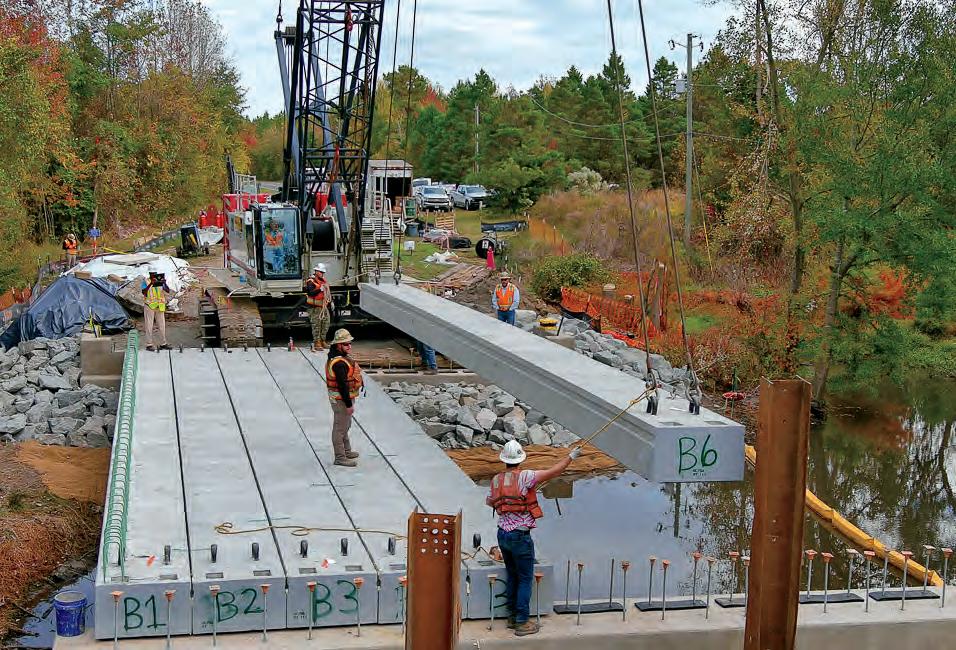
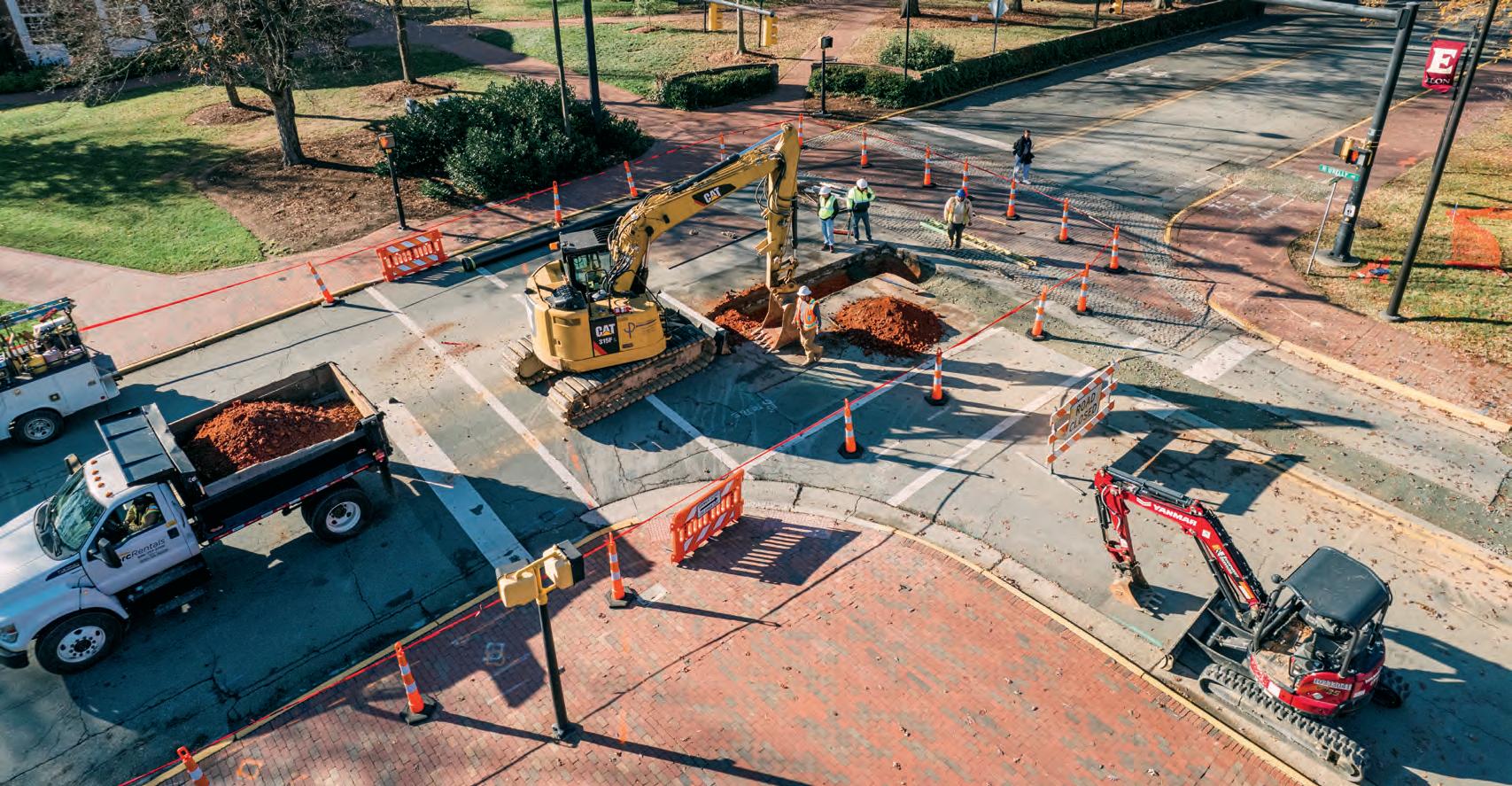
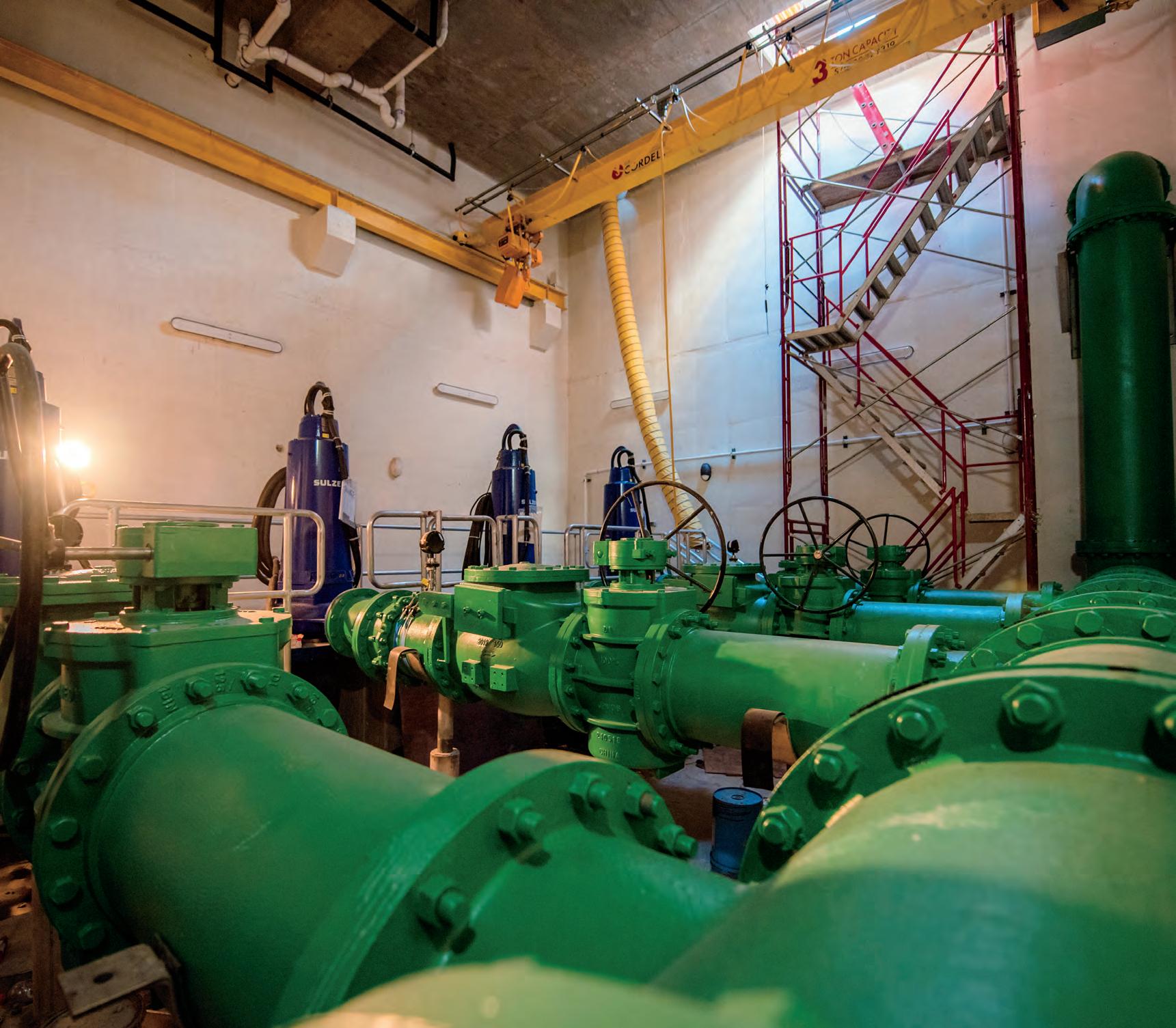
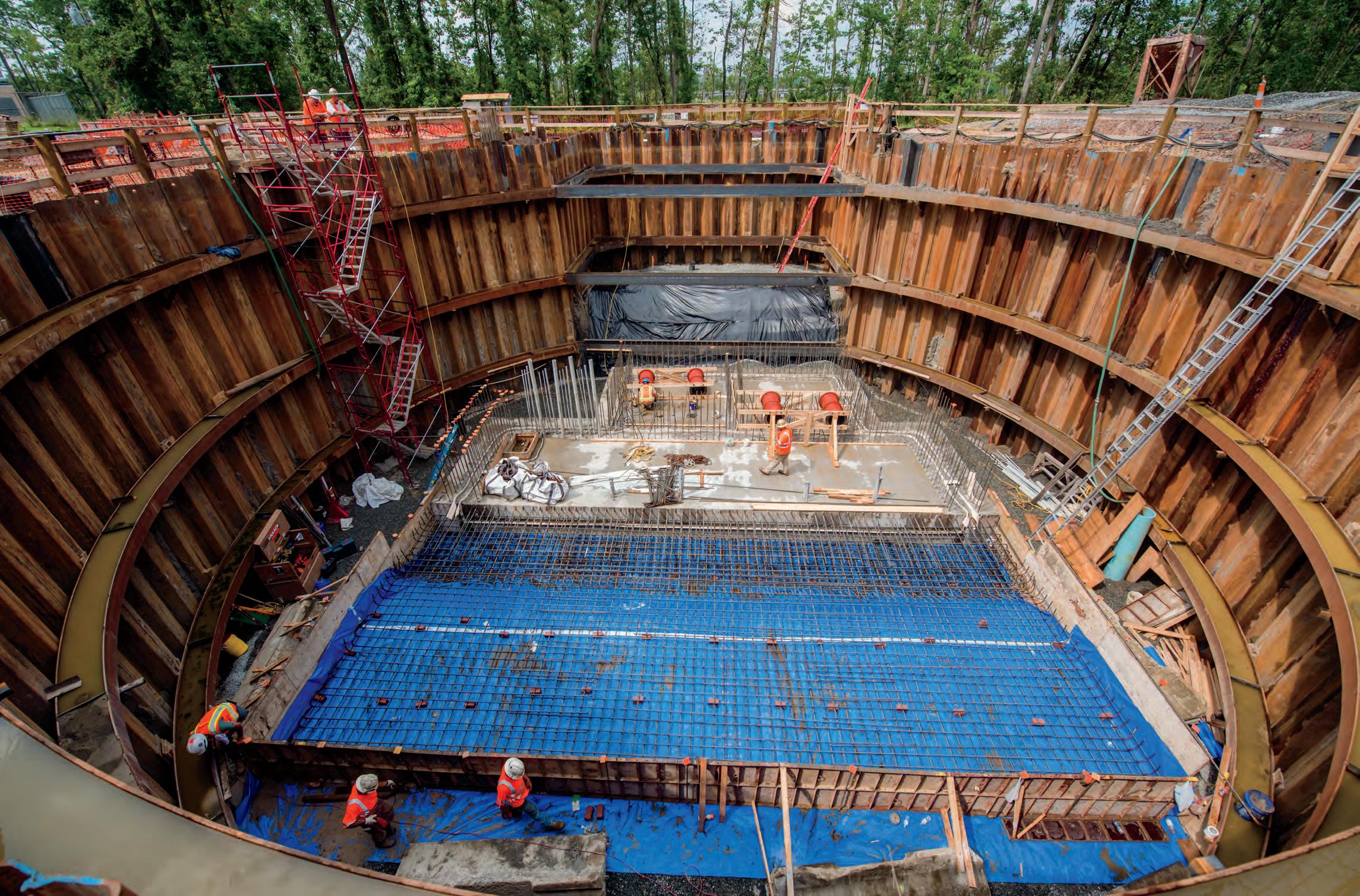
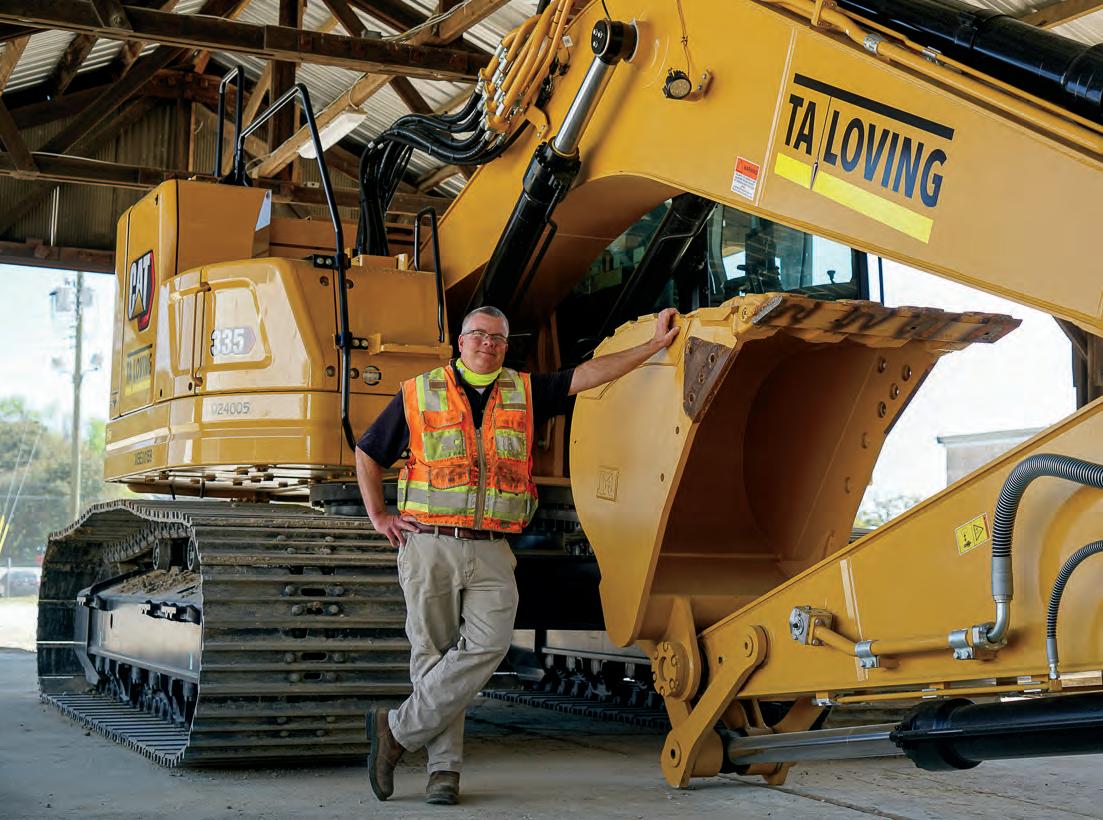
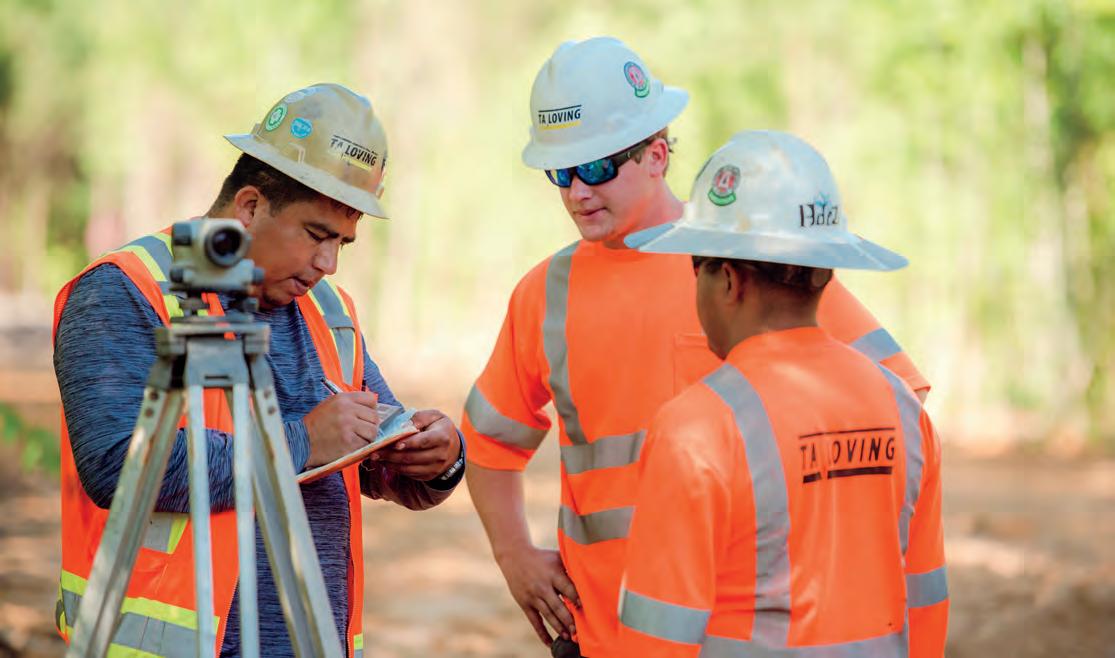
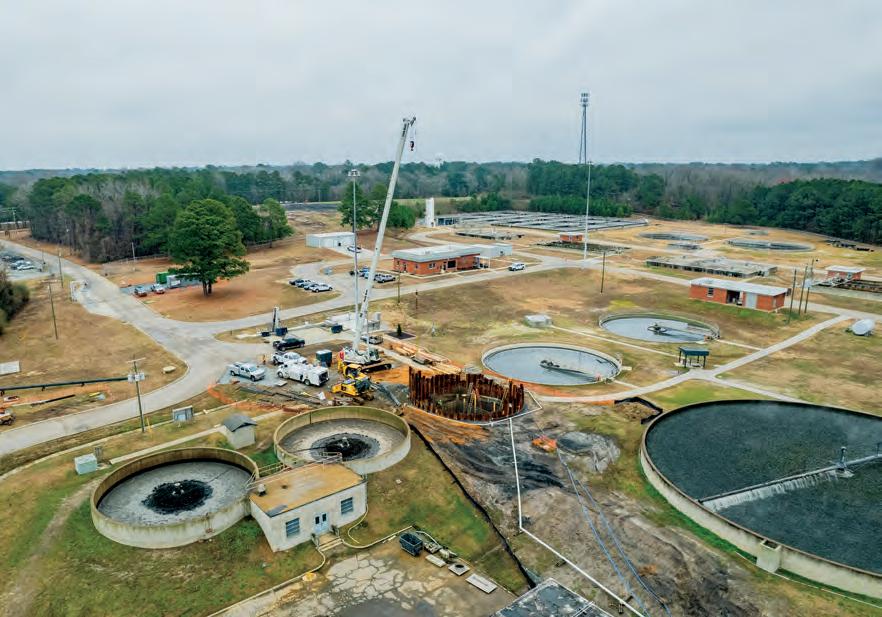
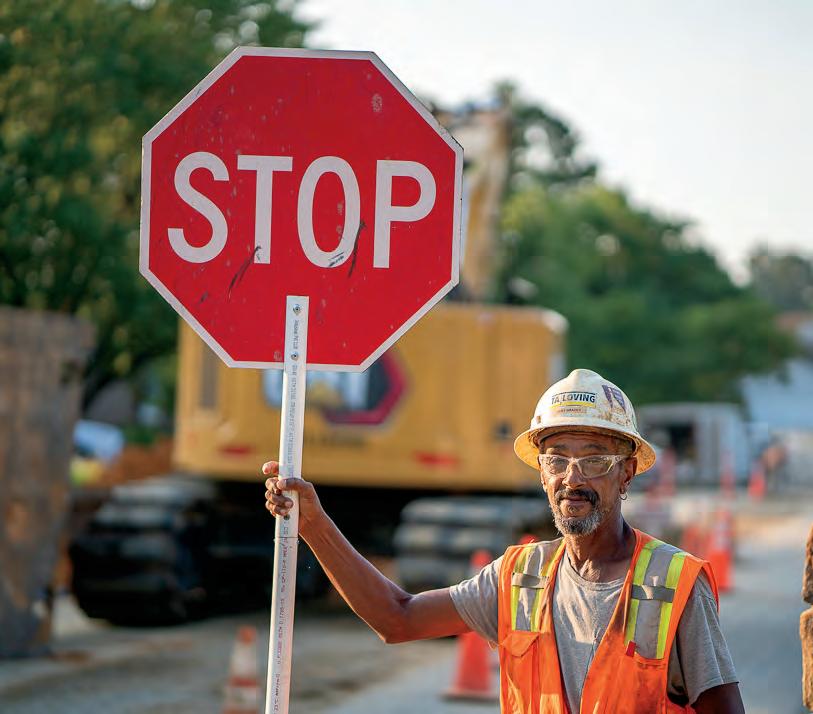
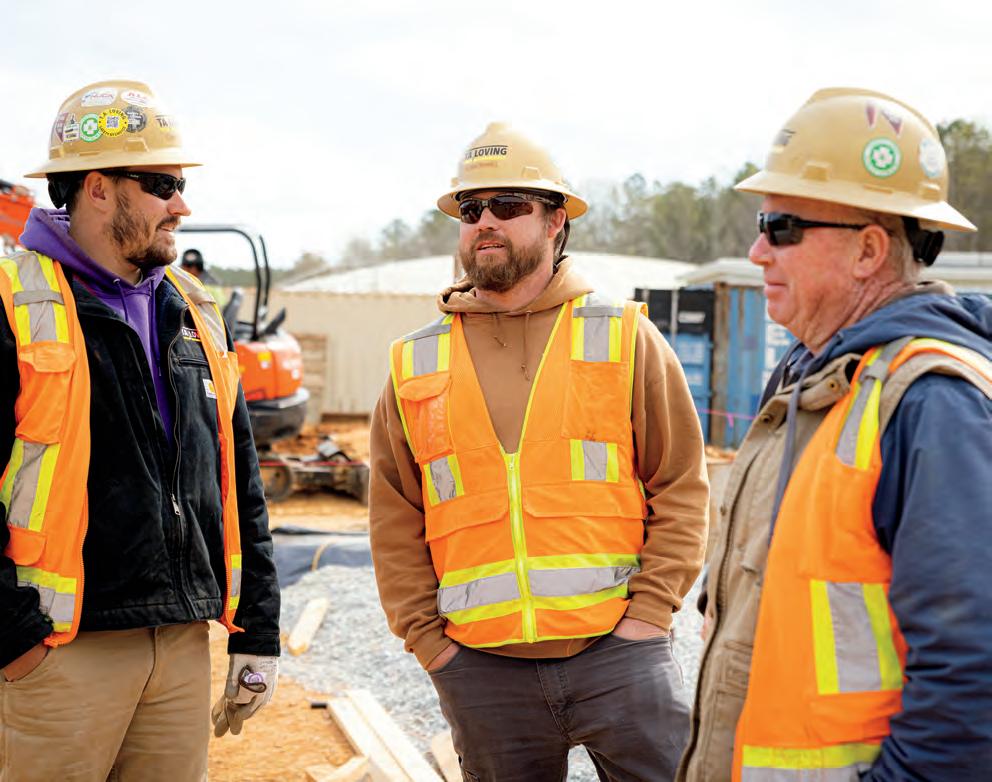
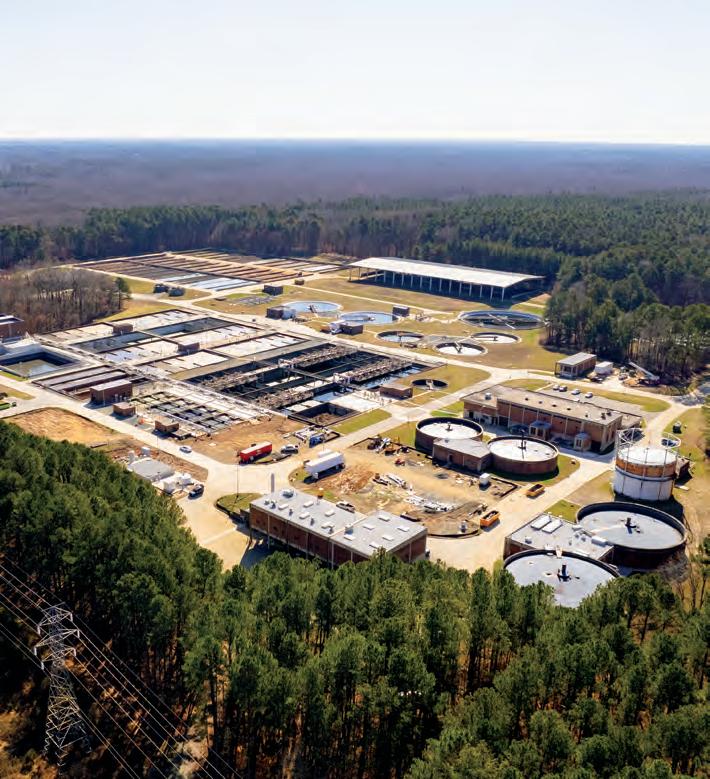
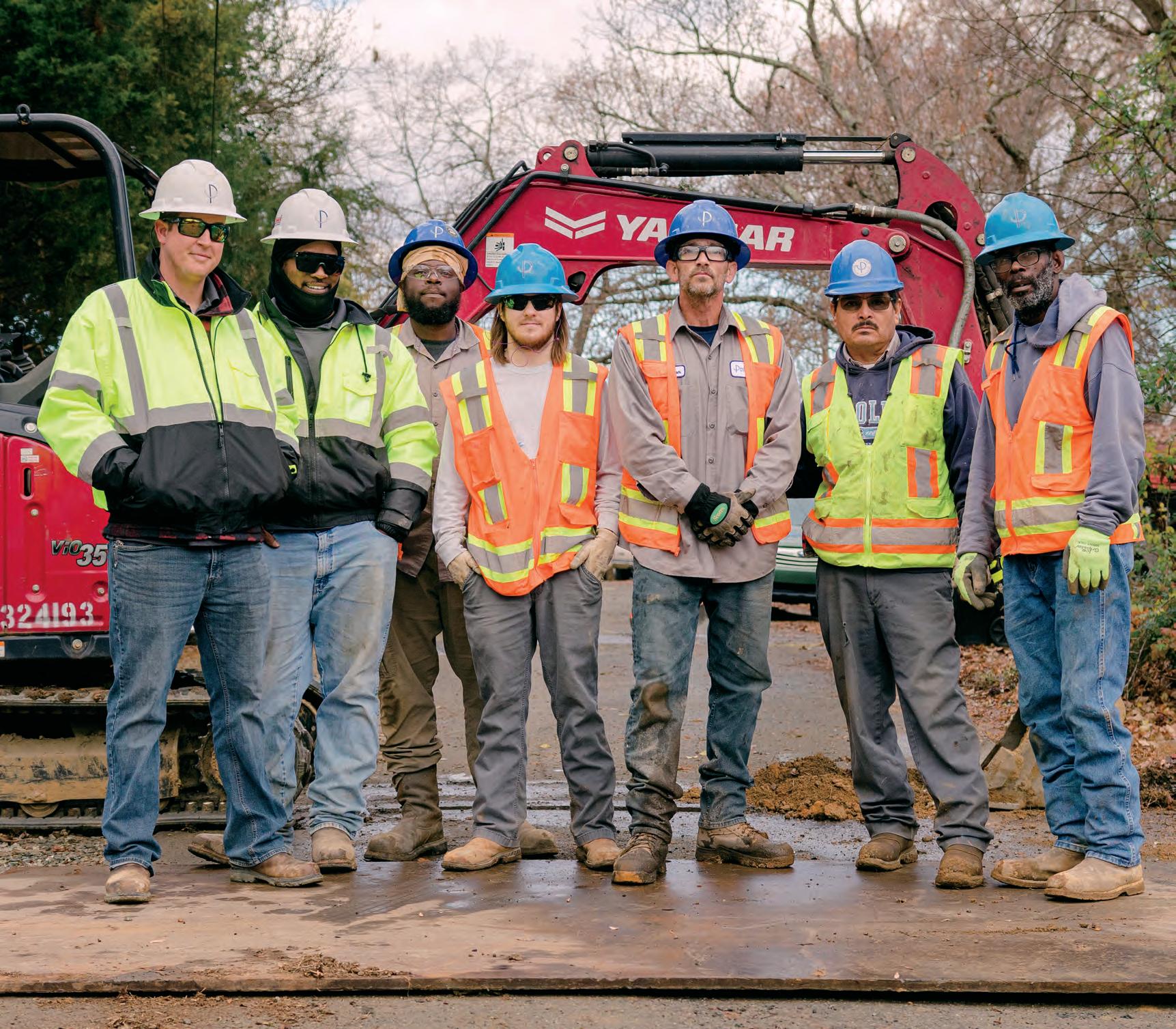
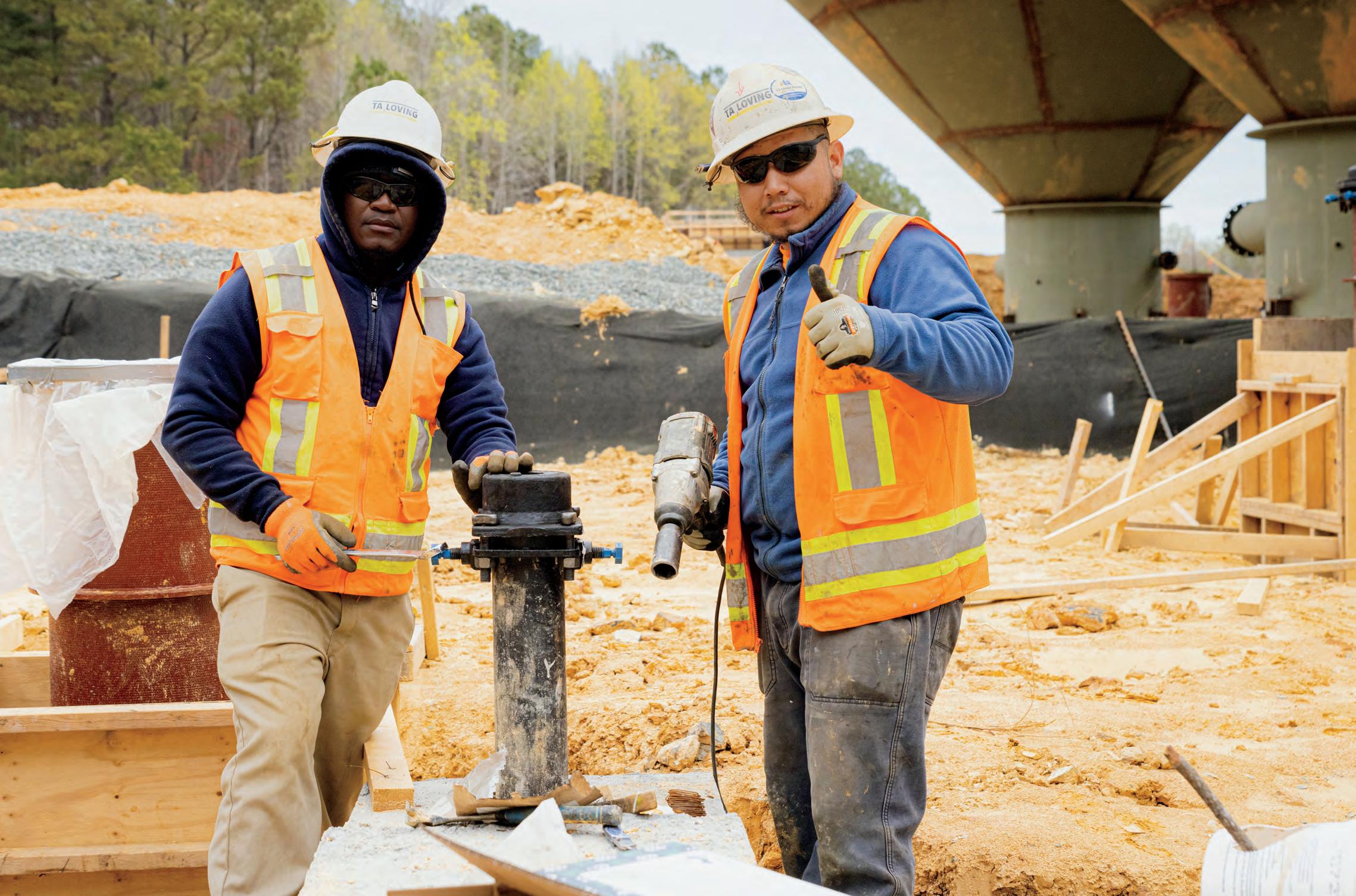
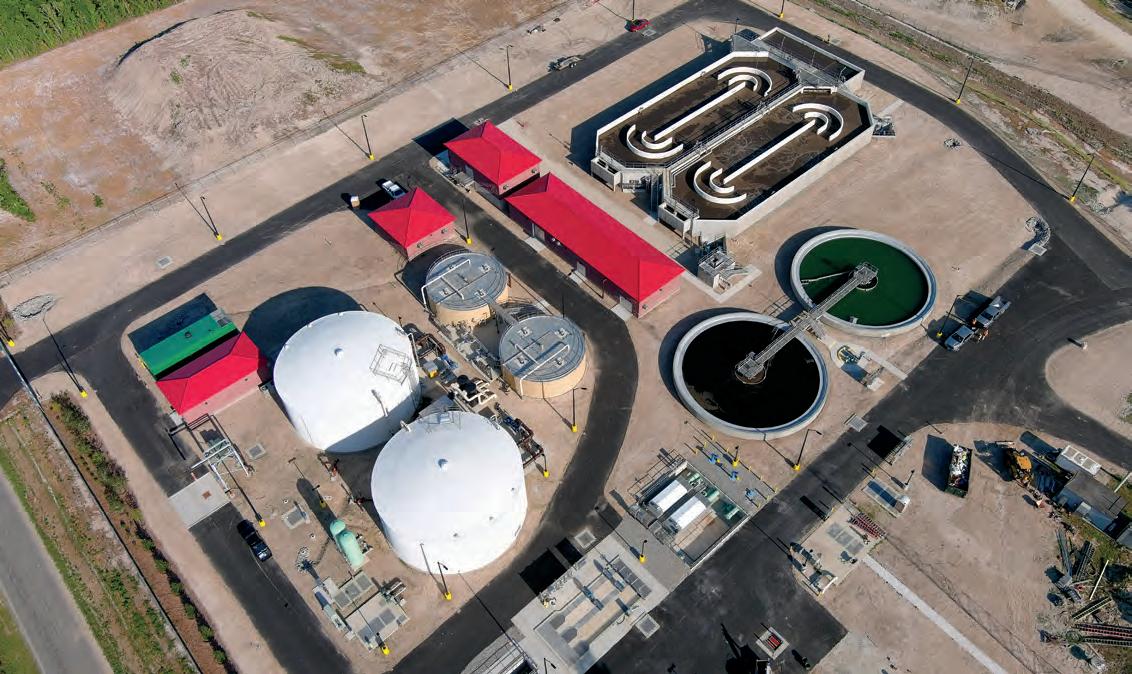
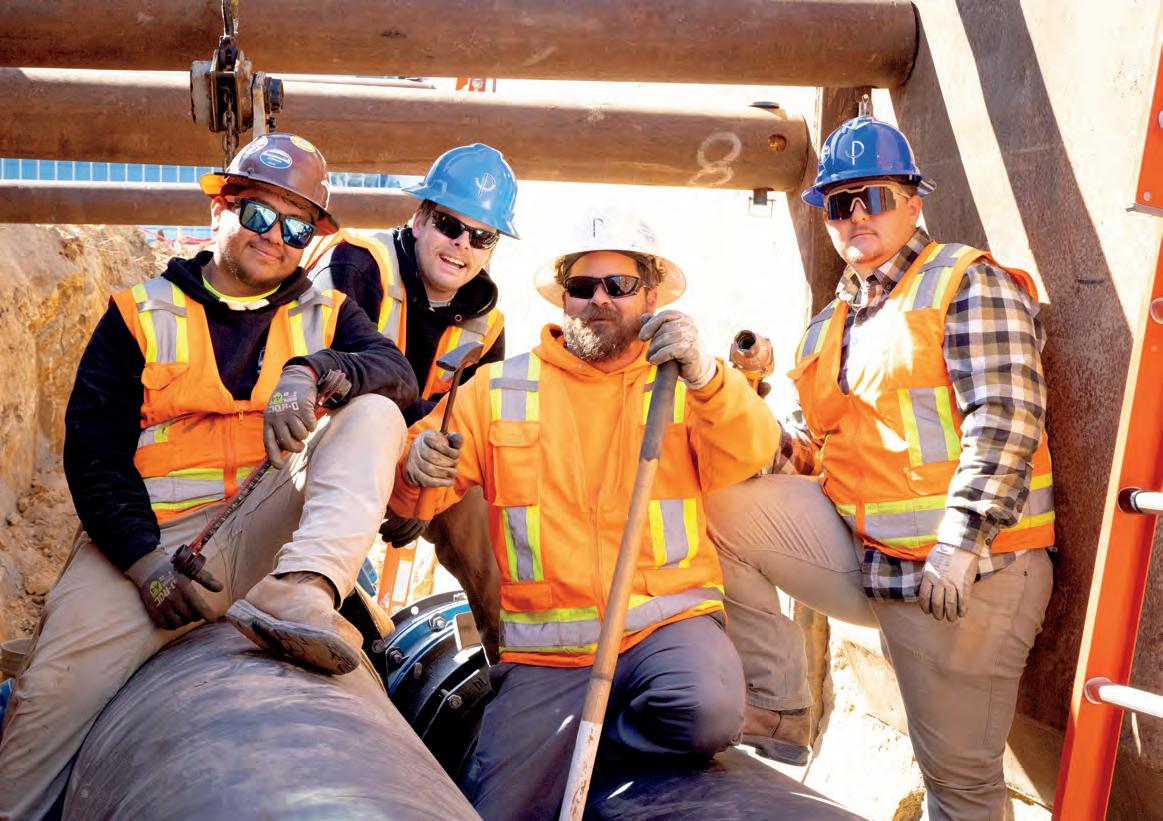
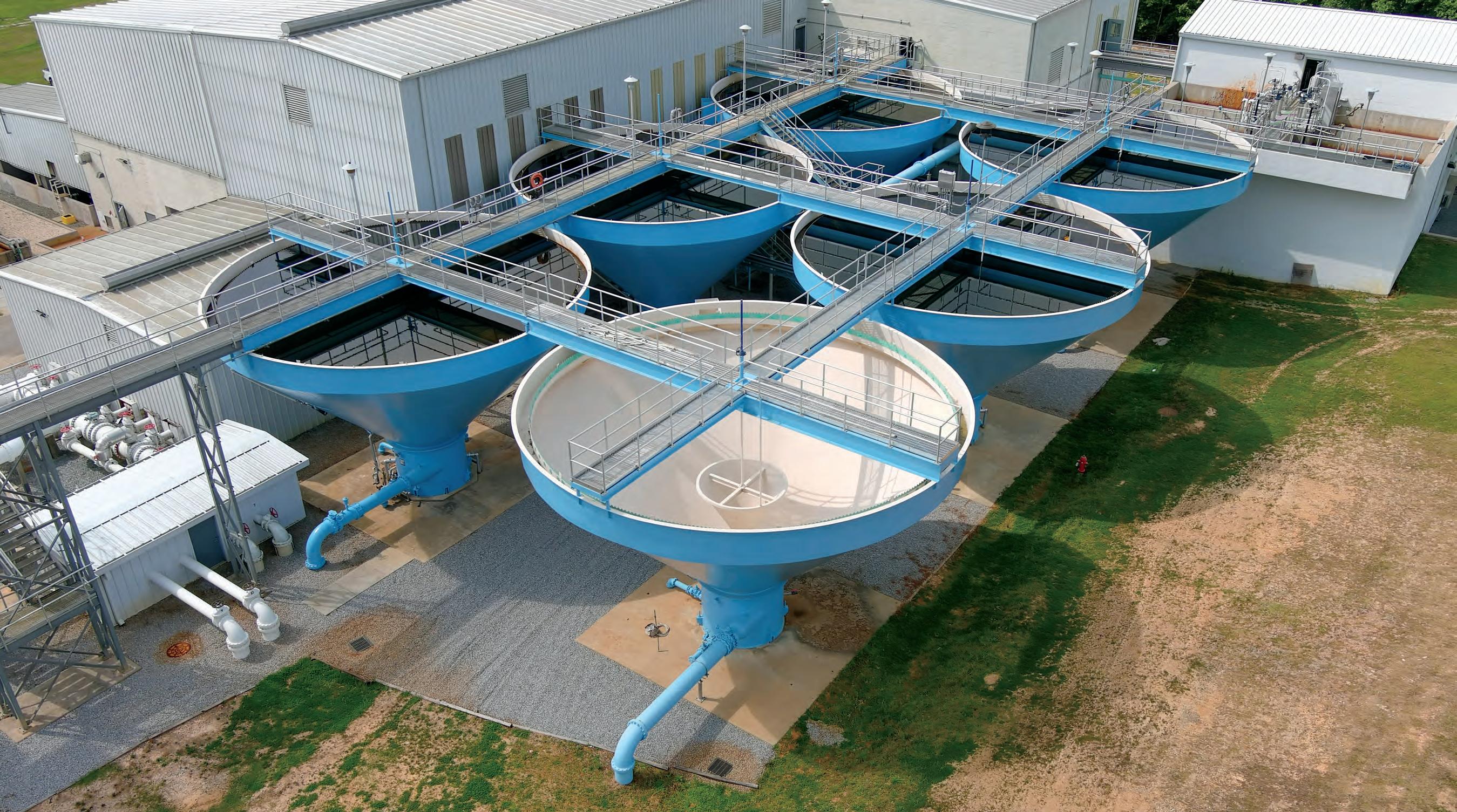
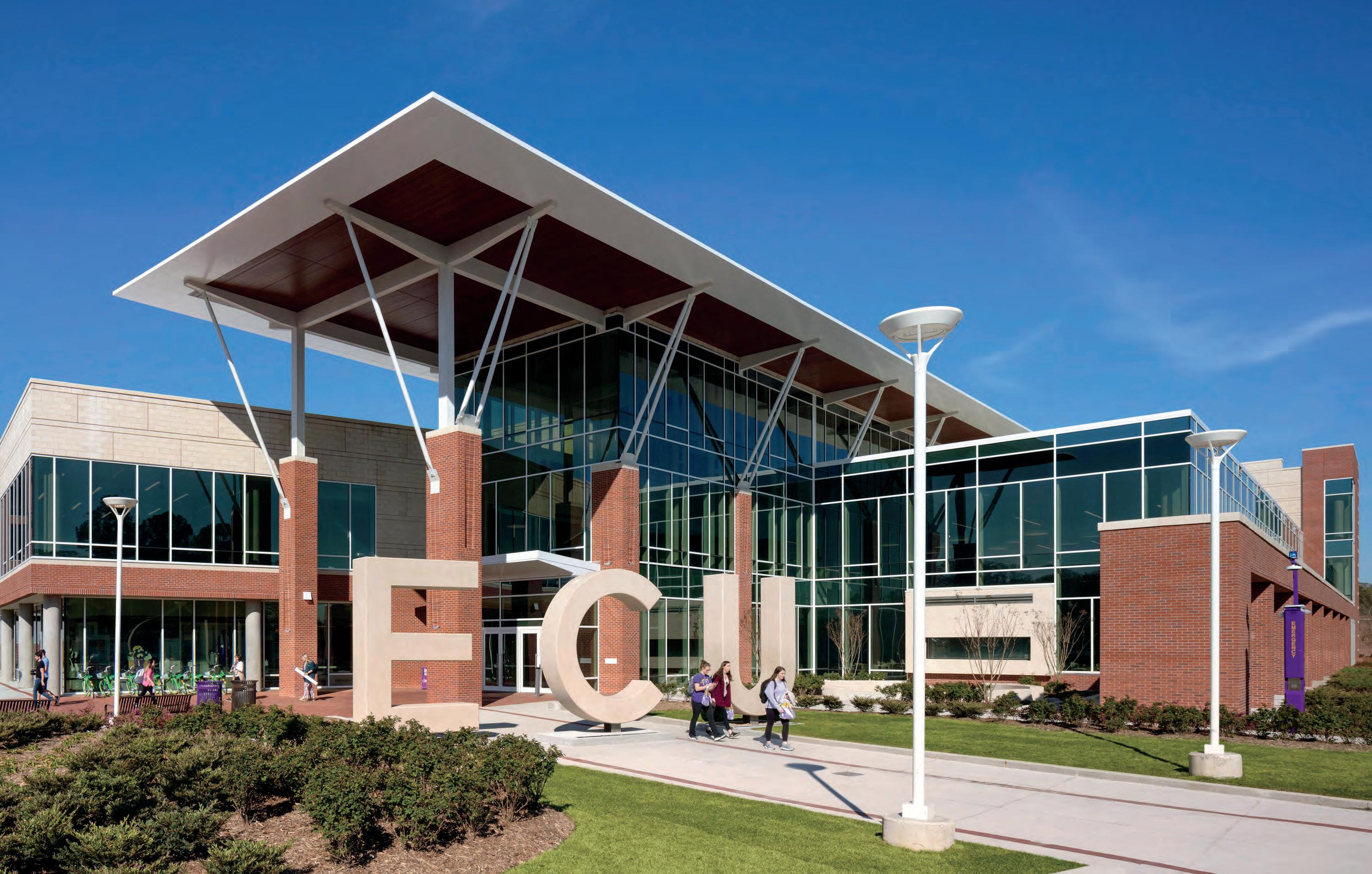
“Man plans. God laughs.” Old Yiddish Saying
T he data points going into a major commercial construction project can run to infinity. There is weather, material availability and delivery, labor scheduling and cost overruns. A drawing that looks great on the CAD software sometimes doesn’t work so well in the field. Stuff breaks and leaks. And there is always simple human error.
Those letters look nice out front of the ECU Student Center—but it took some creativity and ingenuity to mount them perfectly under a tight timetable.
Which is why superintendents, foremen and construction workers at T.A. Loving are, at their core, great problem solvers. There is always something to fix in the heat of battle with a deadline looming.
Take the Main Campus Student Center at East Carolina University that T.A. Loving built from 2017-19. It was a perfect example of, “First one thing, then another.”
The company was about ninety days from completing the building in the summer of 2018.
“We were really down to the wire and we’re walking through life safety inspections and maybe sixty-five or seventy days from turnover,” says then job superintendent Jason Arnold. “We’re doing system checks and punch lists. The building is really starting to shape up. The lipstick is really going on and it’s starting to look good.”
The State Fire Marshall arrived for an inspection and saw there were no mullions in between the glass panels of the windows along the hallways throughout a three-story building. There was a small gap between the window panels, and construction workers had not yet caulked them because they wanted to wait until the building was
finished and there would be less dirt and dust affecting the operation. The inspector stuck his fingers between the glass panels and determined it was a bad hinge point.
“This isn’t safe. You can’t go forward like this,” he said.
“We did some digging and, lo and behold, the glass that was installed did not meet the national glazing criteria for construction for this specific application,” Arnold says. “So we immediately went into Defcon 5. It affected sixty offices, so it was hundreds of pieces of glass. It wasn’t just a few, it was hundreds of pieces and it was really going to put a huge dent on them being able to accept the building for use. Their grandiose ribbon cutting for all these thousands of students to use their new student center wasn’t going to happen.”
Through strong relationships Arnold had developed with the structural engineer and the glazing contractor over the years, they brainstormed potential fixes and came up with a plan to solve the problem and deliver the building on time.
“We worked with the vendors and manufacturers and realized with the system we had in place, we could change pieces
and parts and now install half-inch pieces of glass instead of quarter-inch thick pieces of glass,” Arnold says. “The intent of the design was what they wanted, but it wasn’t going to be a hazard for anybody.”
Closer to the grand opening in January 2019, construction crews began the task of mounting three precast concrete “ECU” letters in front of the building that weighed between 12,000 and 18,000 pounds each. The engineers specified two posts to mount the “E” and one each for the “C” and “U.” Because the “E” had two mounts, the weight of the letter was balanced on two points and it went up fine. Because the “U” was perfectly balanced left-right, the one centermount worked fine as well.
But the “C” was a problem. There was more weight on the left side of the letter, and the single center mount wasn’t strong enough for the letter to balance. As workers set the letter and started letting off tension, it began to rotate.
“I called the same engineer that just worked on the glass problem and we came up with a fix,” Arnold says. “He ran some numbers and gave me a materials list. We drove across town, got the materials from
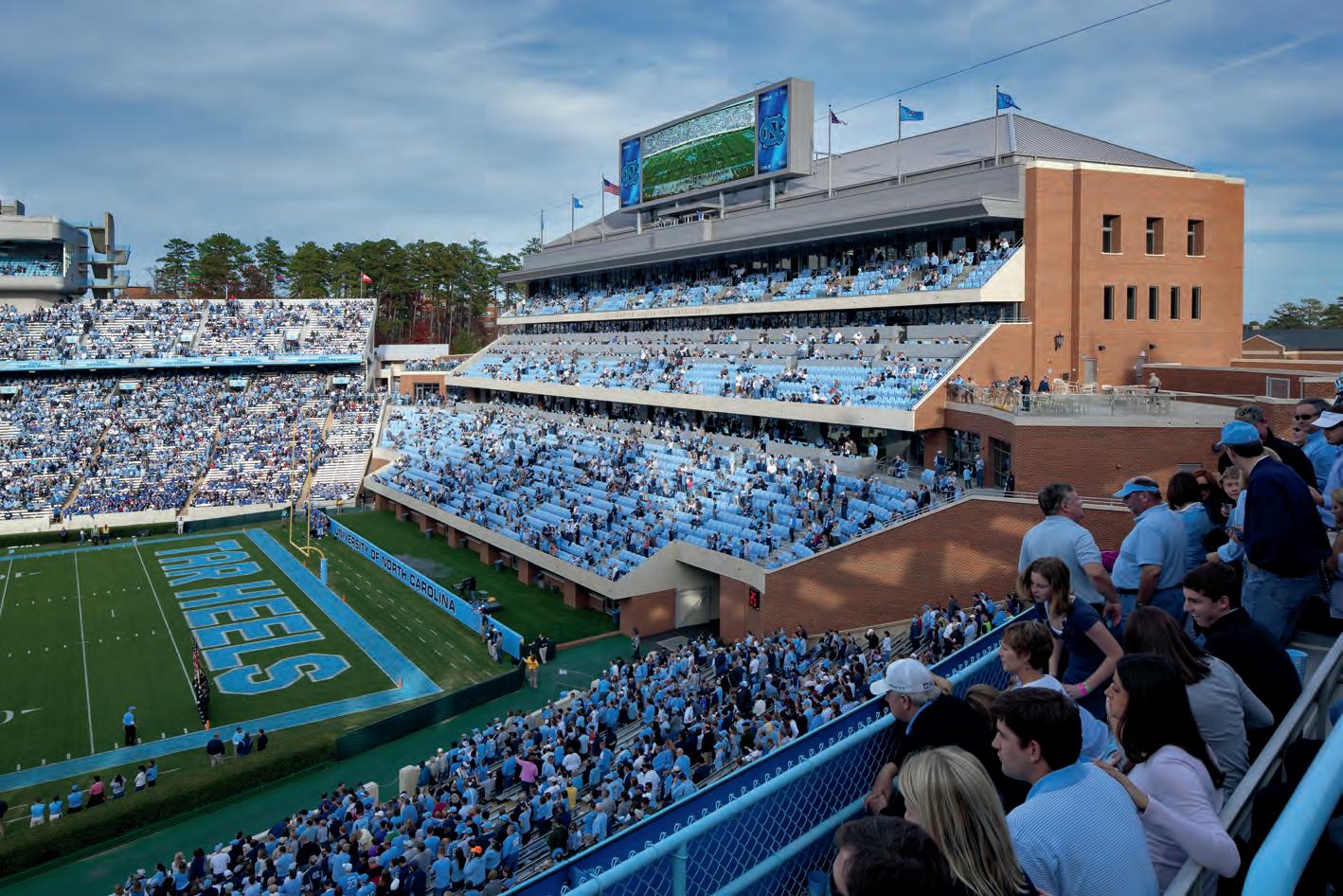
vendors we have great relationships with.
We held the letter up with a crane, picked it back up, laid it back down, did our fix and welded our braces on. It worked. All three letters were now perfectly balanced.”
On top of those two issues, Hurricane Florence came through in September 2018 and over one million gallons of water had to be pumped from the construction site. At the time, workers were installing the foundations, and the basement and parking deck were twenty-seven feet below grade.
“In essence, we had to pump out a
lake before we could get back to work,”
Arnold says. “Then in October, Hurricane Matthew came through with another round of severe flooding and complications. Ultimately, we lost about six weeks in our production schedule.”
Brett Bond got quite an indoctrination into the construction business in 2010.
He had just graduated from East Carolina University and was the night-shift supervisor on The Blue Zone at Kenan Stadium in Chapel Hill. Crews were working round the clock in a compressed time frame to deliver
the new seating and athletics administration building at the east end of the stadium.
There were two tower cranes on the job, both reaching as high as ten stories on the building site for the six-story structure. One night a major concrete pour was planned, but the day shift left without moving several large ride-on troweling machines for concrete finishing from one side of the site to the other, where they would be needed once the concrete was poured. Bond had never worked a crane before, but he climbed ten stories of ladders into the bucket while the operator of the second crane gave him instructions and guidance by radio.
In essence, we had to pump out a lake before we could get back to work. Then in October, Hurricane Matthew came through with another round of severe flooding and complications. Ultimately we lost about six weeks in our production schedule.
“I asked the guy on the southside crane if he’d come down, go up in the north crane and move the troweling machines,” Bond says. “I didn’t understand that once those guys went up, they didn’t move until their shift was over, ten hours later. He said when he comes down, he’s going home. But he walked me through on the radio how to crank it up, drive it, pick up the machines and transfer them. We were able to keep the pour going and I learned to drive a tower crane. Technically, I probably wasn’t supposed to be in that crane, but we had to
figure it out on the fly.”
T.A. Loving had a hard deadline for the beginning of the football season in the summer of 2010 when it was renovating parts of Dowdy-Ficklen Stadium at East Carolina University. The job included adding seven thousand bleacher seats that would include the ECU student section, and the bleachers and hardware were ordered from a company in Texas. As the summer wore on and it was time for the product to reach the job site, company officials kept getting the run-around from the supplier. It turns out the supplier was on the verge of bankruptcy, and the company and its management officials were in the thick of a nasty family feud that included a divorce and one company spinning out from an existing operation.
David Philyaw was the project manager, and it became obvious one day in July that he wasn’t going to solve the problem over the telephone. He bought a plane ticket, flew to Dallas, rented a car and drove an hour west to the bleacher manufacturer.
“I surprised them and walked right in on their family feud,” he says. “I met the salesman and worked out a deal for him to
sell me the brackets and hardware before the bankruptcy court locked the gates. The bleachers were actually manufactured at another company, so I drove there, set up an account and agreed to pay cash on delivery.”
The product did arrive on time. But the fact that the installer showed up for work in shorts and flip-flops did not bode well for the installation (company officials drove him to Wal-Mart to buy boots before commencing the labor). The new seats were installed by the Sept. 5 season opener against Tulsa, but the horror story continued as the game unfolded and the students realized some of the bleachers were loose.
“The bolts were too short or not tight enough or some combination of both,”
Philyaw says. “With seven thousand seats, that was about twenty or thirty thousand bolts drilled into a concrete structure. We got a call before halftime saying there was a problem with the bleachers. About twenty of us went in and removed about a dozen rows of the bleachers apart as the game was going on. For the rest of the season, they just sat on concrete risers. With a better design in hand, we fixed the problem during the offseason.”
And there have been miscellaneous little snafus that the company has had to overcome.
O nce a barge broke loose during a storm when the company was building the Currituck Sound Bridge. It floated down the sound and hit land in the backyard of a Department of Transportation employee.
“I t destroyed his bulkhead,” Paul Hunter says. “He called and said come get your damn barge out of my backyard.”
The Triangle area was hit with a drought in the summer of 1977, and it particularly impacted the water supply at the University of North Carolina and the Town of Chapel Hill. T.A. Loving took on the emergency assignment of building a sixteen-inch water line so the Town of Hillsborough could sell water to Chapel Hill. The pipeline ran along Hwy. 86 north of Chapel Hill and at one point skirted past a Chevrolet dealership. Workers needed to blast some dynamite and didn’t have enough material to cover the blast, with debris flying in all directions.
“We wound up buying a few cars,” Jerry Smith says. “That blast sent rocks and debris a hundred yards or more.”
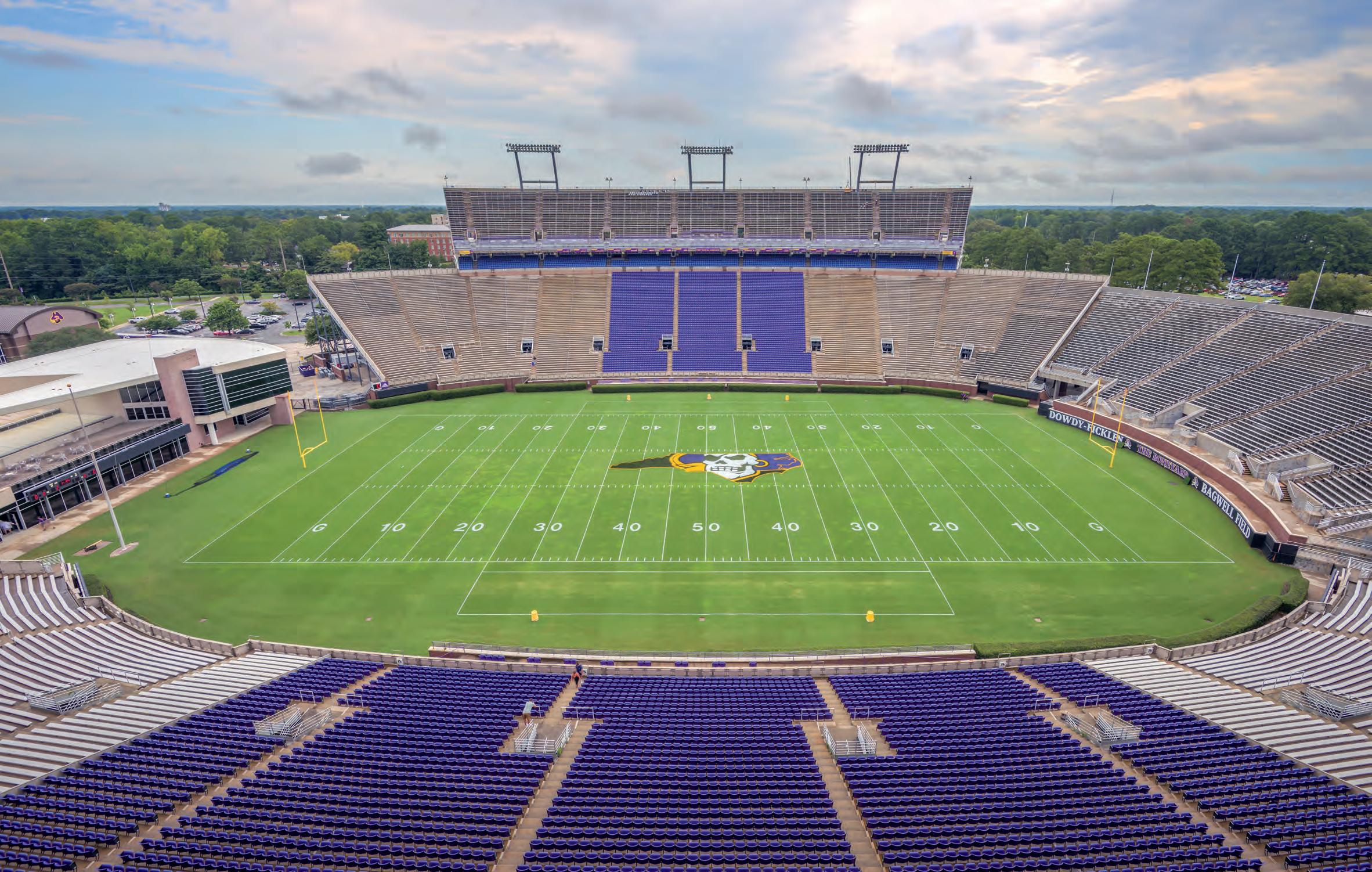
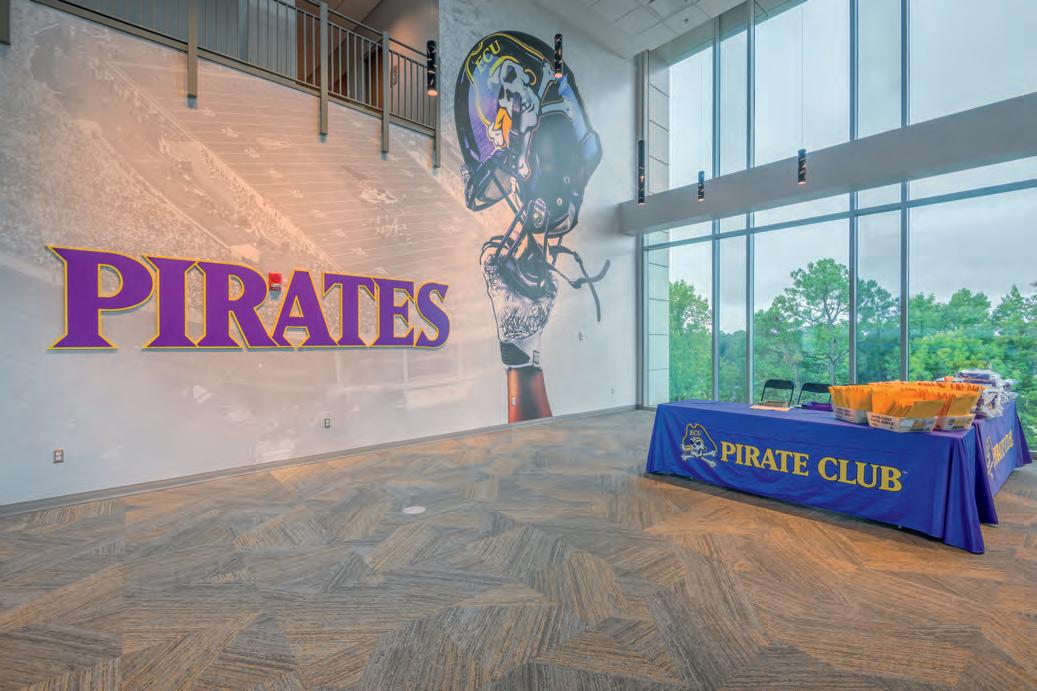
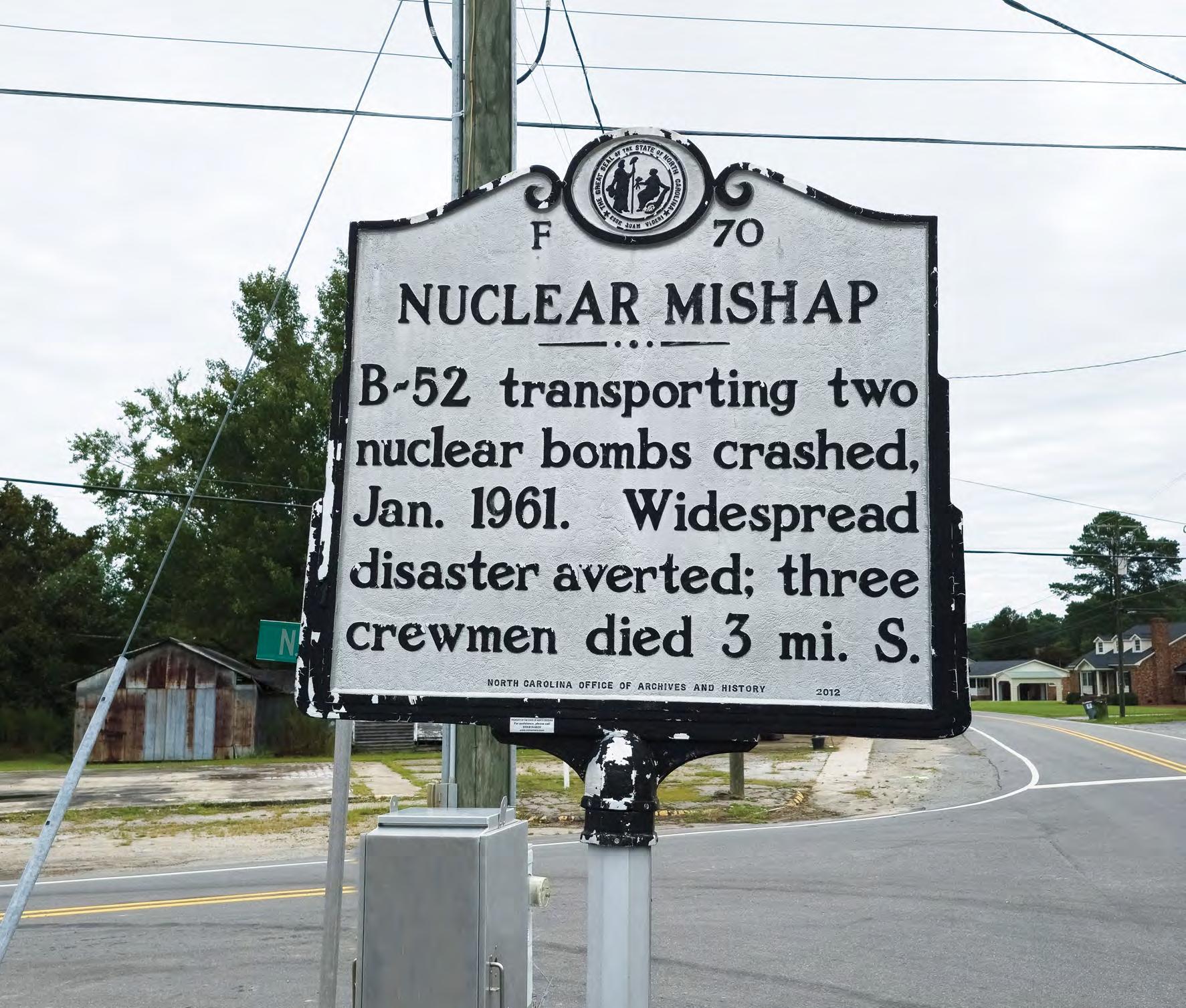
Certainly one of the most unique (and scary) challenges T.A. Loving Company has ever faced was when it was recruited on an emergency basis to assist the Air Force look for remnants of a nuclear bomb that fell near Goldsboro in 1961.
Given Eastern North Carolina being an axis of military bases from Fayetteville to Goldsboro to Havelock, it was not uncommon for nuclear bombs to be flown back and forth across the state during the mid-1900s era of tensions between the United States and the Soviet Union.
“At the height of the Cold War, U.S. policy was to keep armed nuclear aircraft in the air at all times in the event of a conflict,” according to the N.C. Department of Natural and Cultural Resources.
In January 1961, a Boeing B-52 Stratofortress based at Seymour Johnson Air Force Base in Goldsboro was carrying two 3.8 megaton bombs when it suffered a fuel leak in its right wing and attempted to make a return landing to the base. Pilots lost control of the plane before it could safely land; of a crew of eight, five survived after ejecting from the plane before it hit ground in tobacco and cotton farmland about twelve miles north of Goldsboro.
The two bombs were ejected, ostensibly to land safely with pre-attached parachutes guiding them to a soft landing. One of the bombs landed without mishap.
On the second one, the parachute did not function properly and the bomb touched down in a muddy field at around 700 miles an hour. If detonated, the weapon would have had an impact 250 times greater than the atomic bomb dropped on Hiroshima sixteen years earlier.
The Air Force needed help digging the wreckage out of the muddy field and pulling water out of the ground to facilitate the process. It called upon T.A. Loving Company.
“We were the only major construction company within a short distance that could jump right on it,” says Jerry Smith, who joined the company in 1967 and heard stories over the years about the job. “We had the equipment and the people right there. We had cranes, drag lines, clam shells and all the dewatering equipment that was needed.
“The water table was so high we had to dewater it before we could dig a hole. We dug a hole twenty feet deep and recovered some of the bomb. They wanted to go another twenty feet, so we had to widen the hole and set up a new dewatering system.”
A detonating crew led by Lt. Jack ReVelle was able to recover most of the wreckage—without radioactive mishap.
“You have to understand,” ReVelle said, “had one or both of the weapons detonated, you would’ve created a ‘Bay of North Carolina,’ completely changing the configuration of the East Coast of the United States.”
The State of North Carolina in July 2012 erected an historical road marker in the town of Eureka, three miles north of the crash site under the title “Nuclear Mishap.”
A sign designating the approximate site of the January 1961 nuclear mishap stands today just outside of Goldsboro.
There’s no TA Loving without our customers. So we decided to ask them to reflect on doing business with us. On the next few pages you’ll find their words about the work we’ve done and how we’ve built a foundation of customer loyalty.
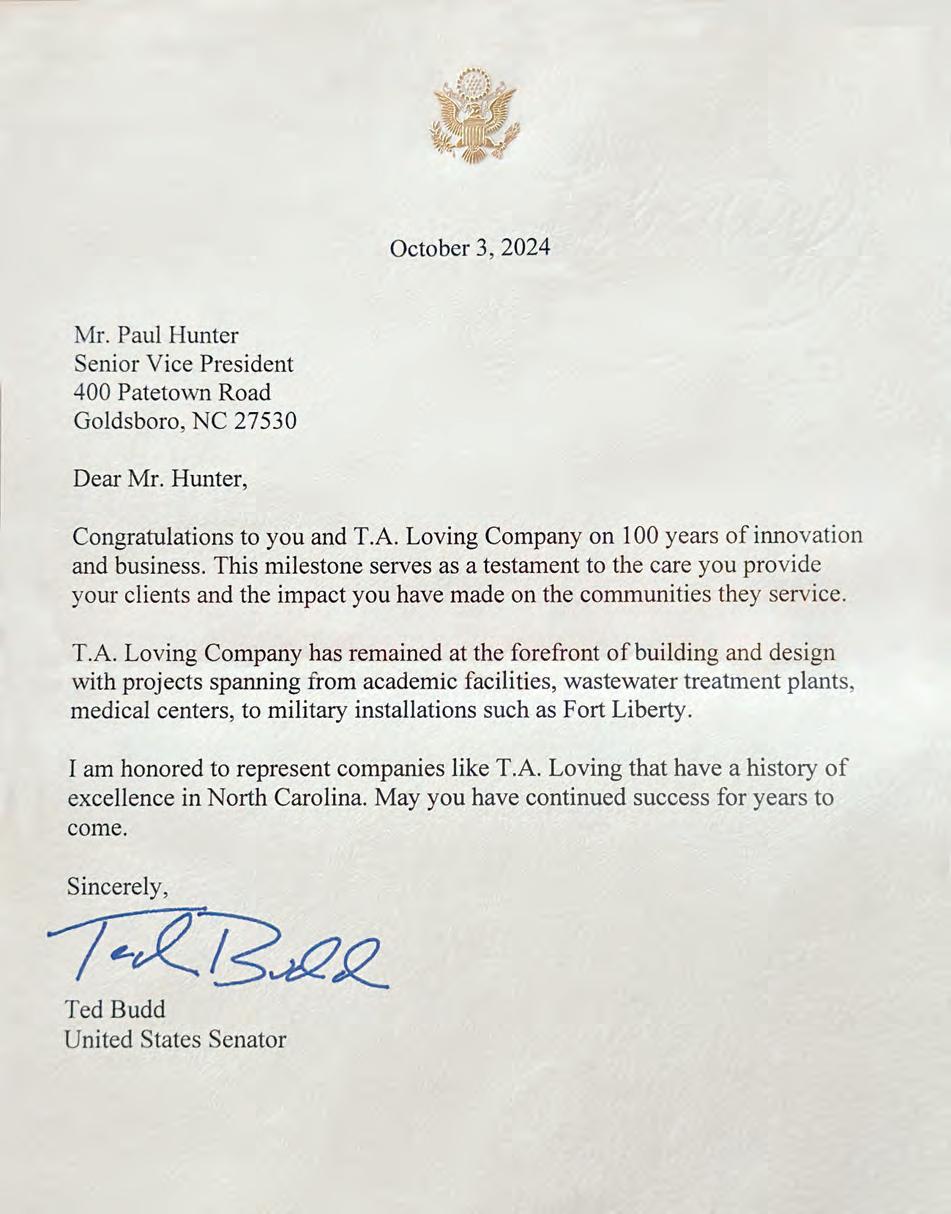
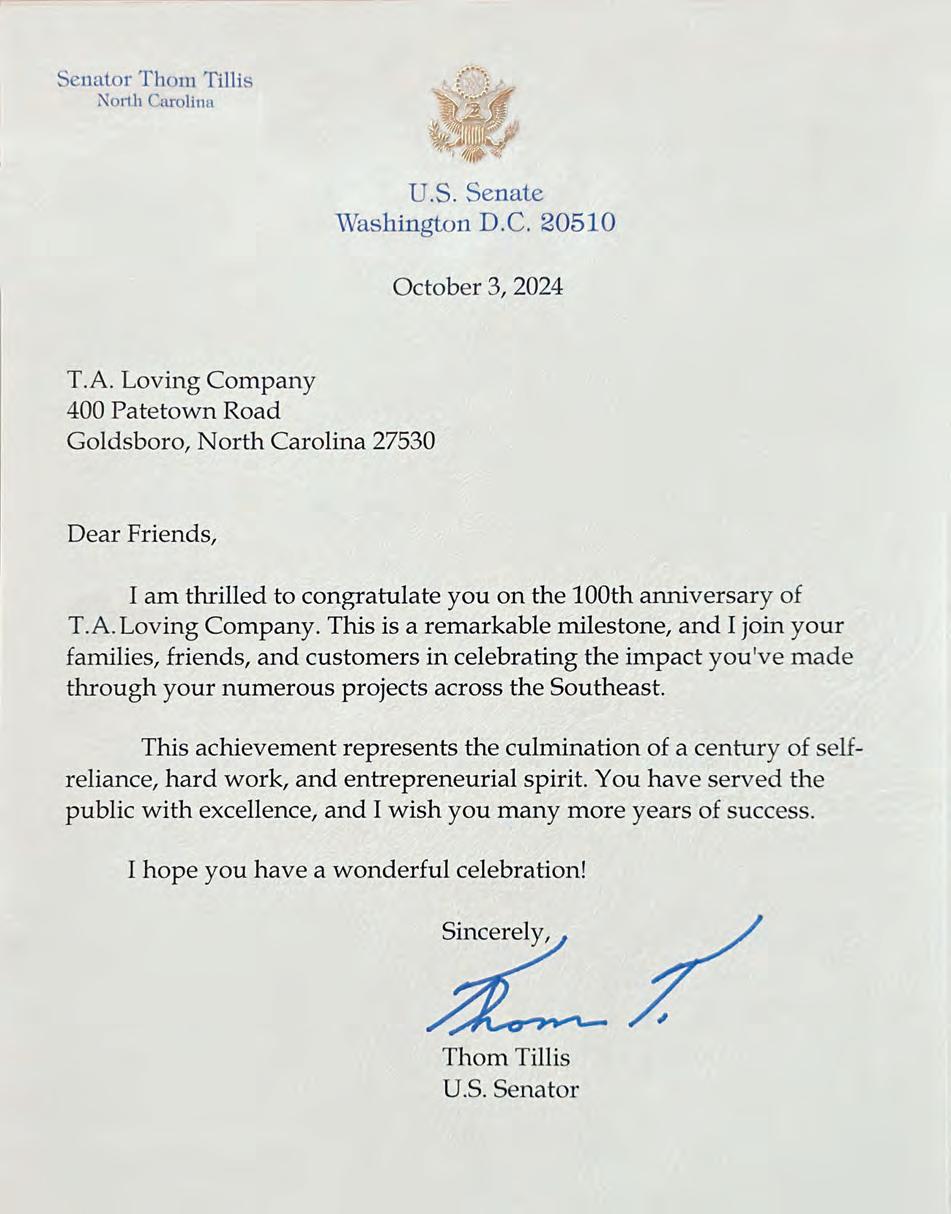

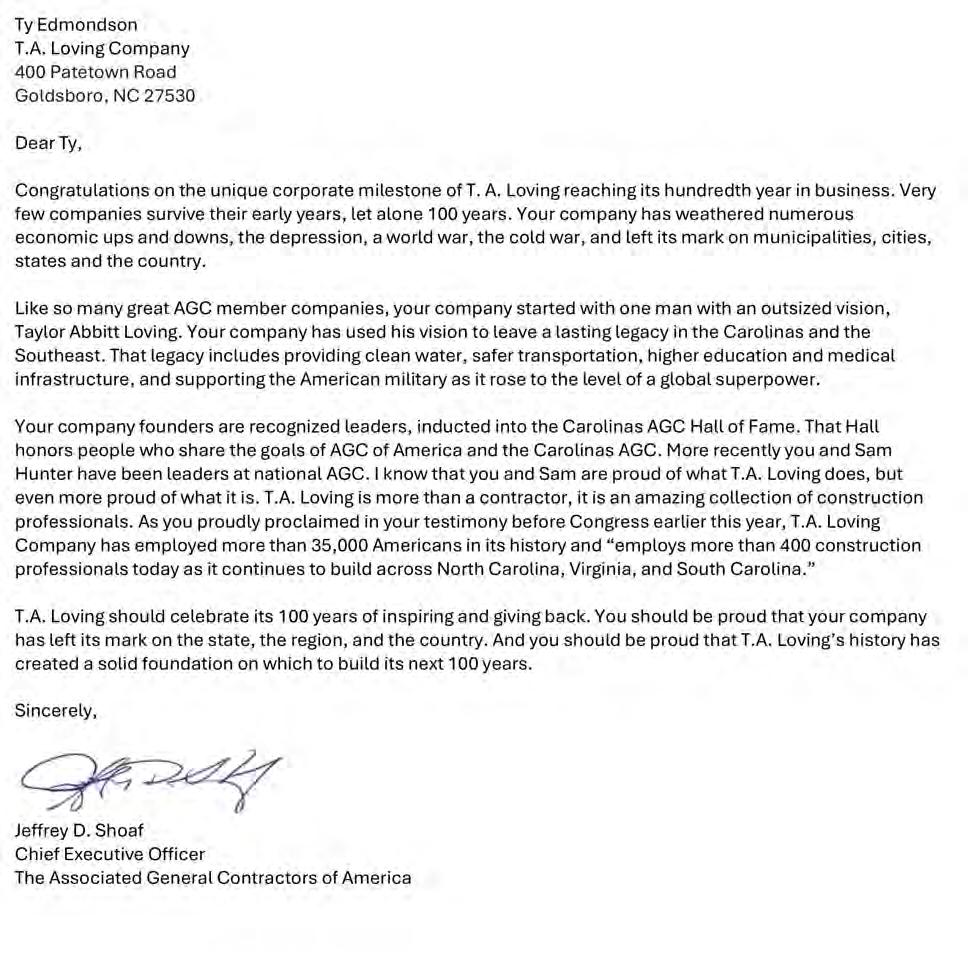
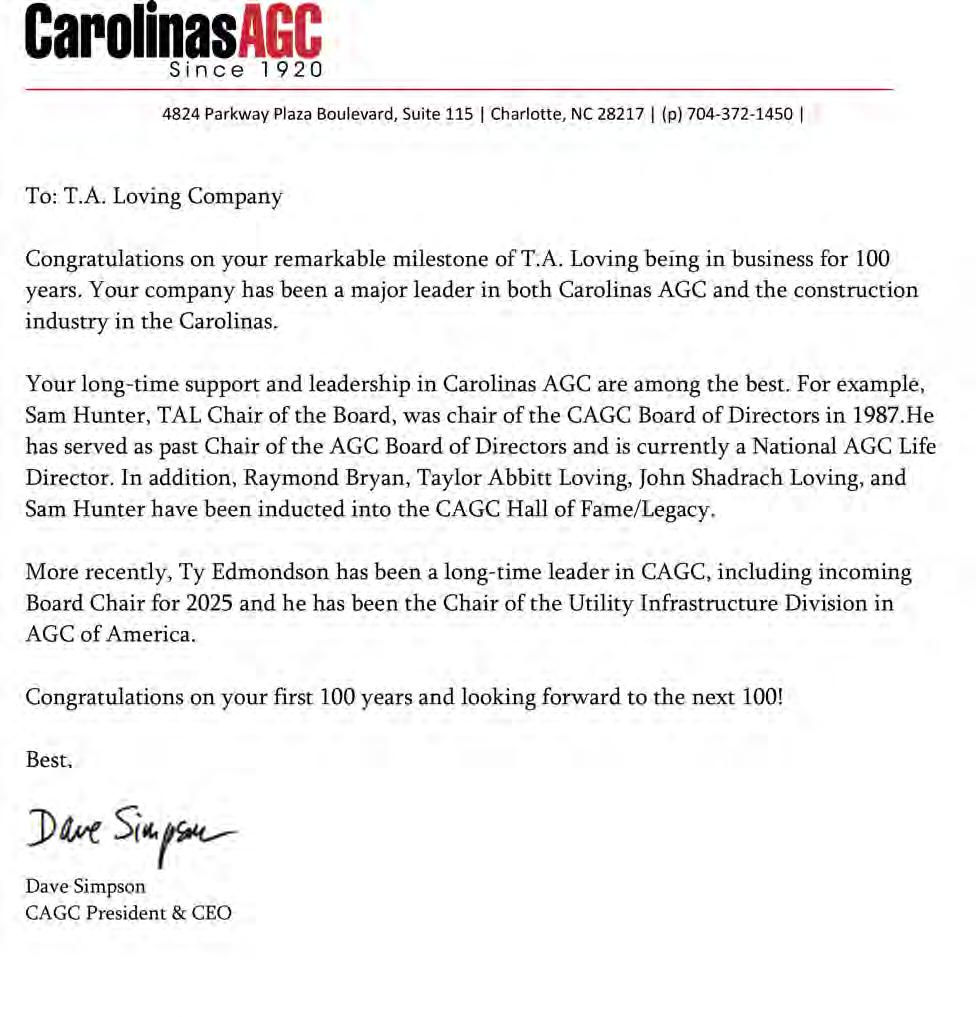

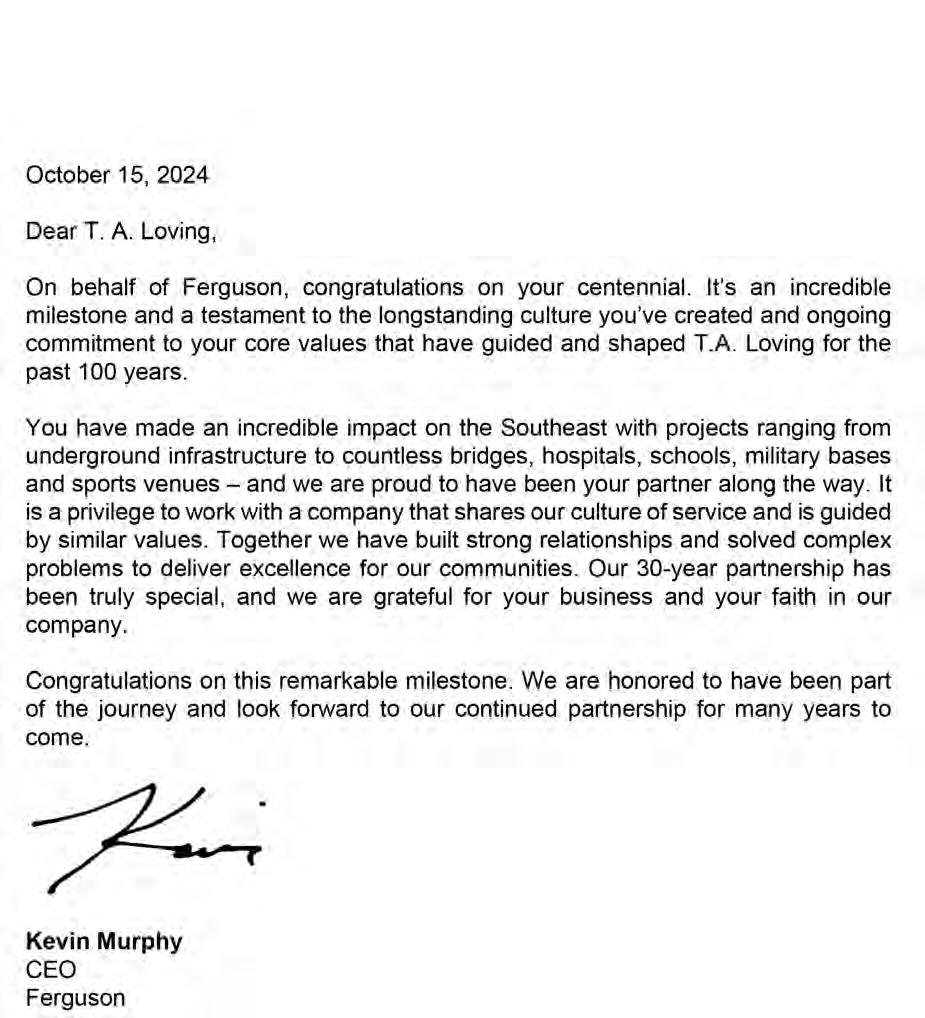

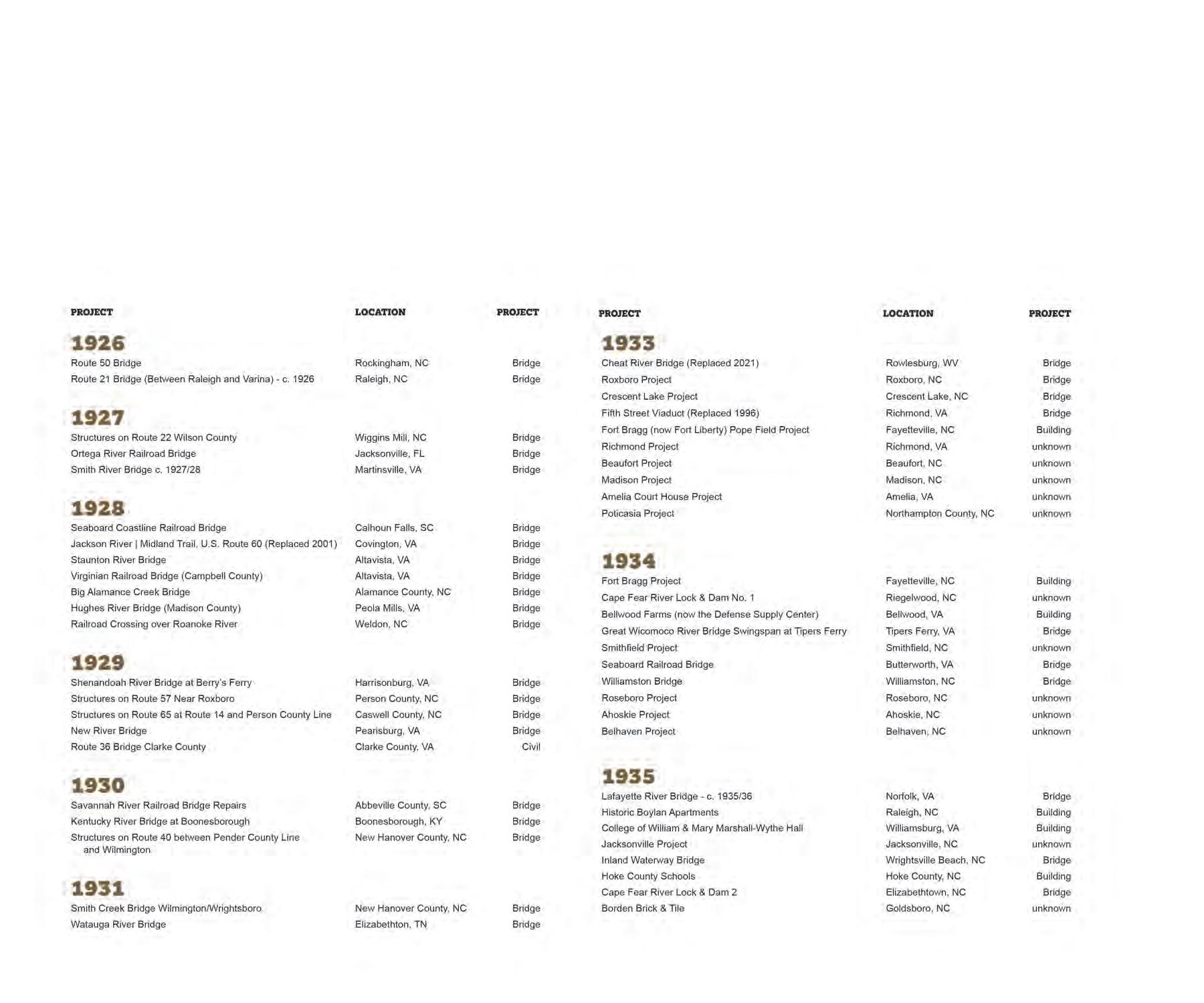
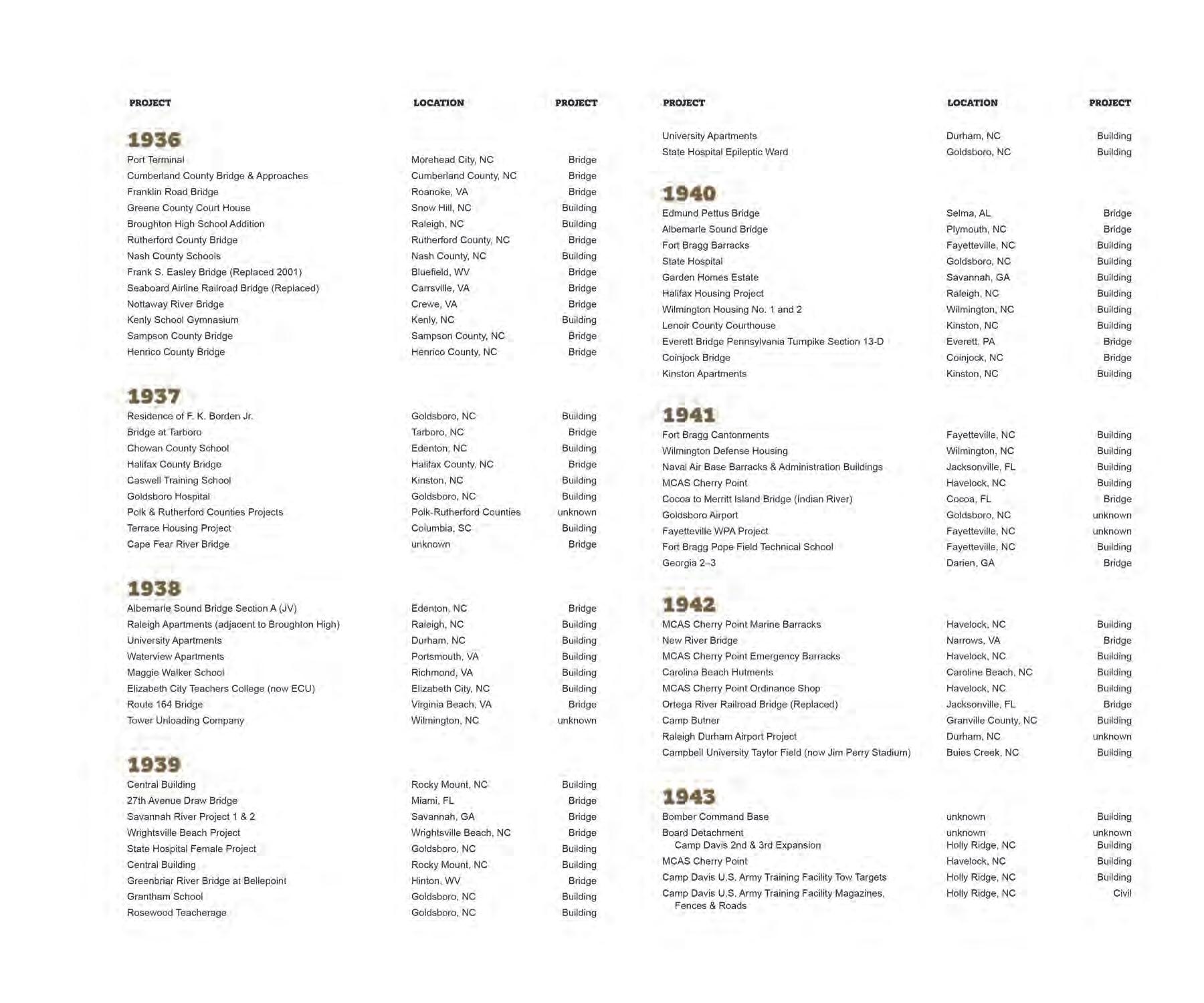
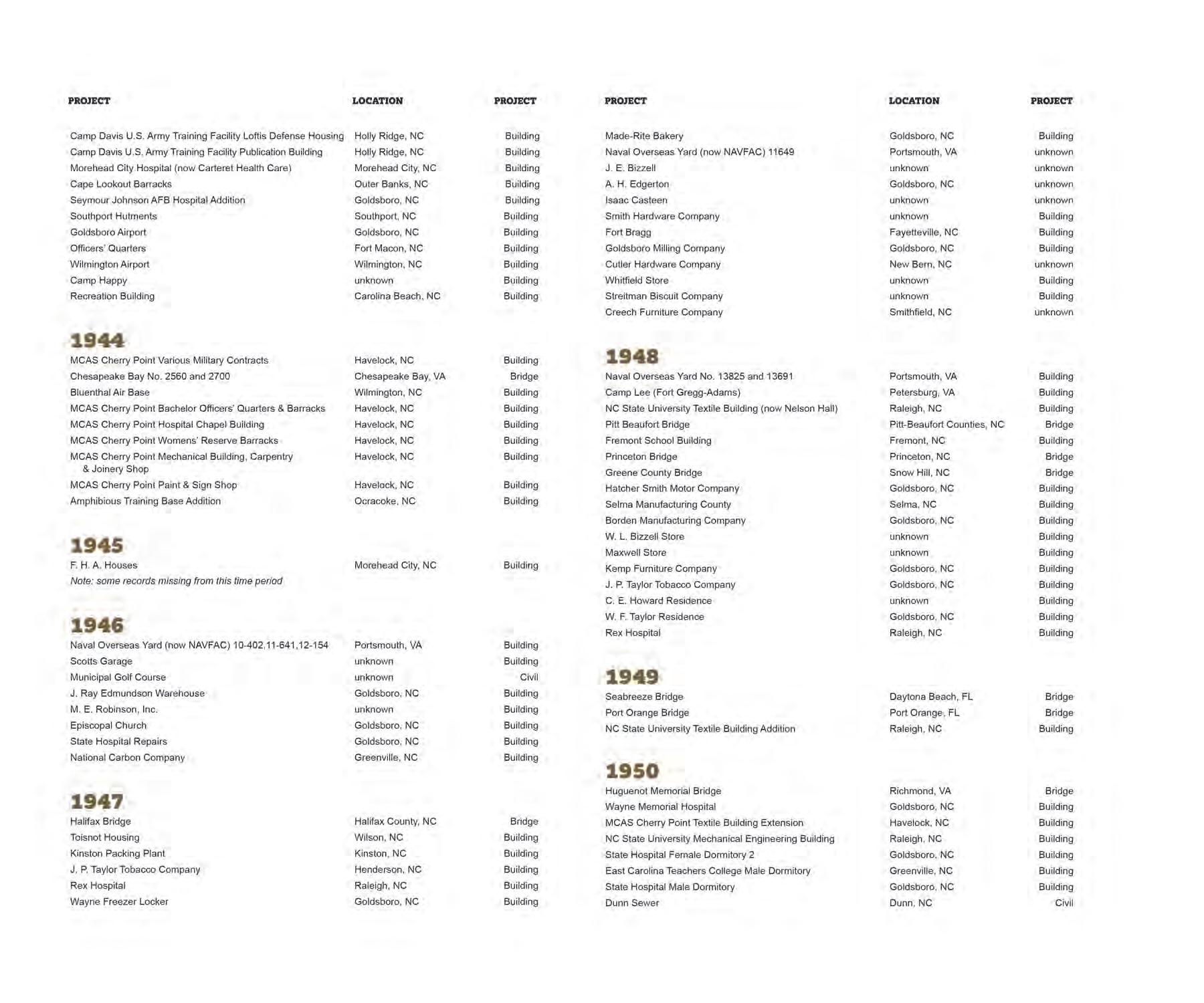
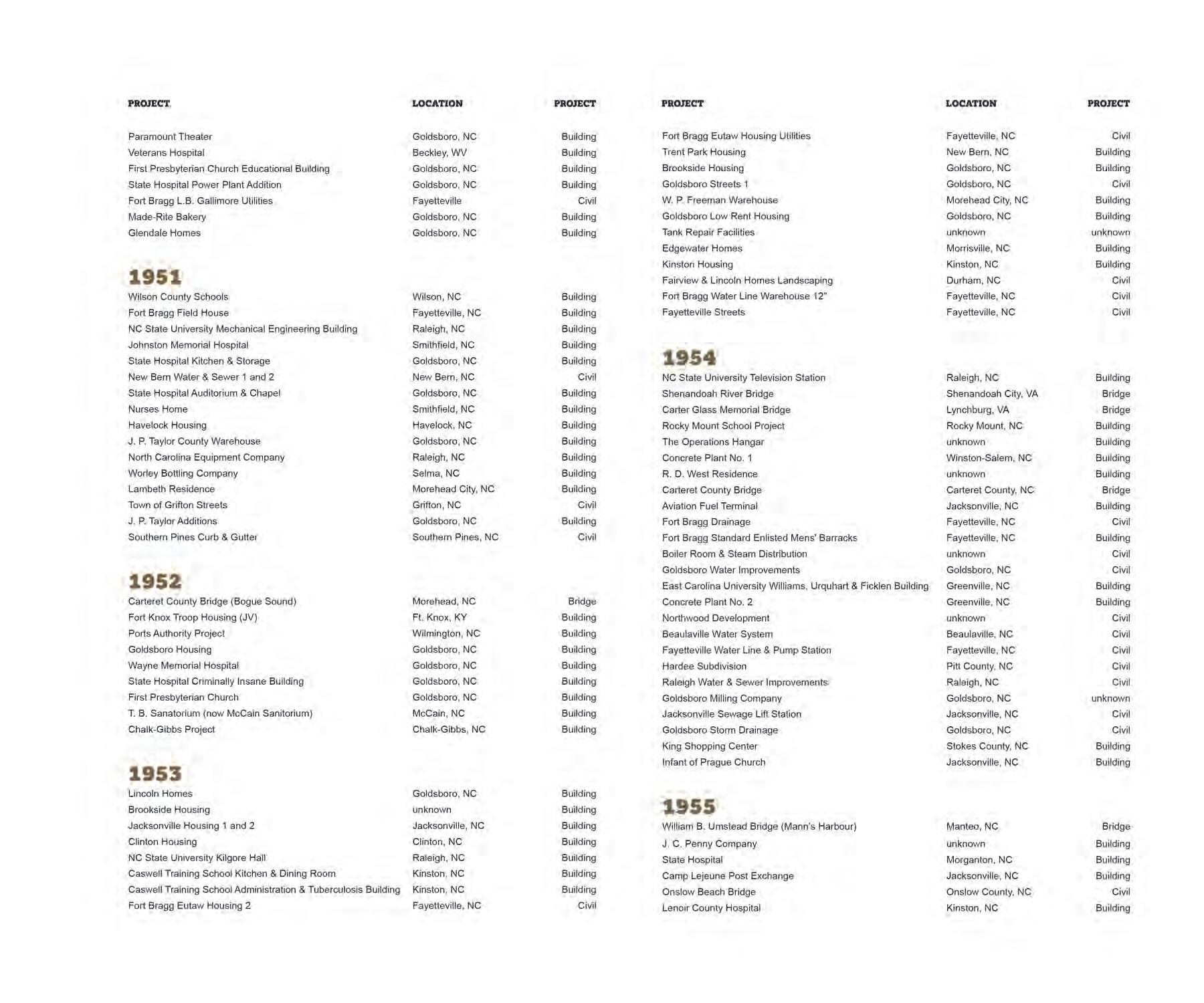
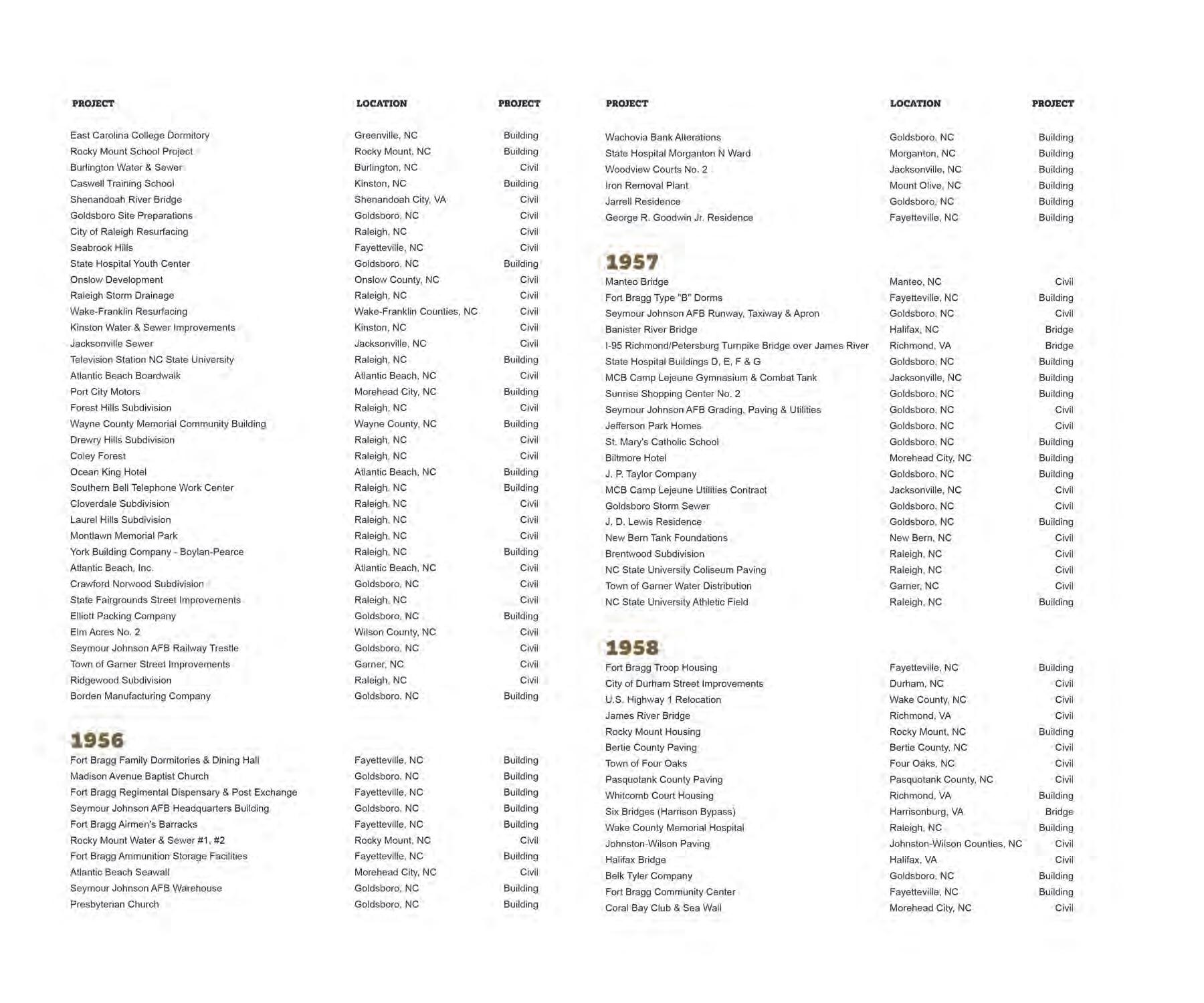
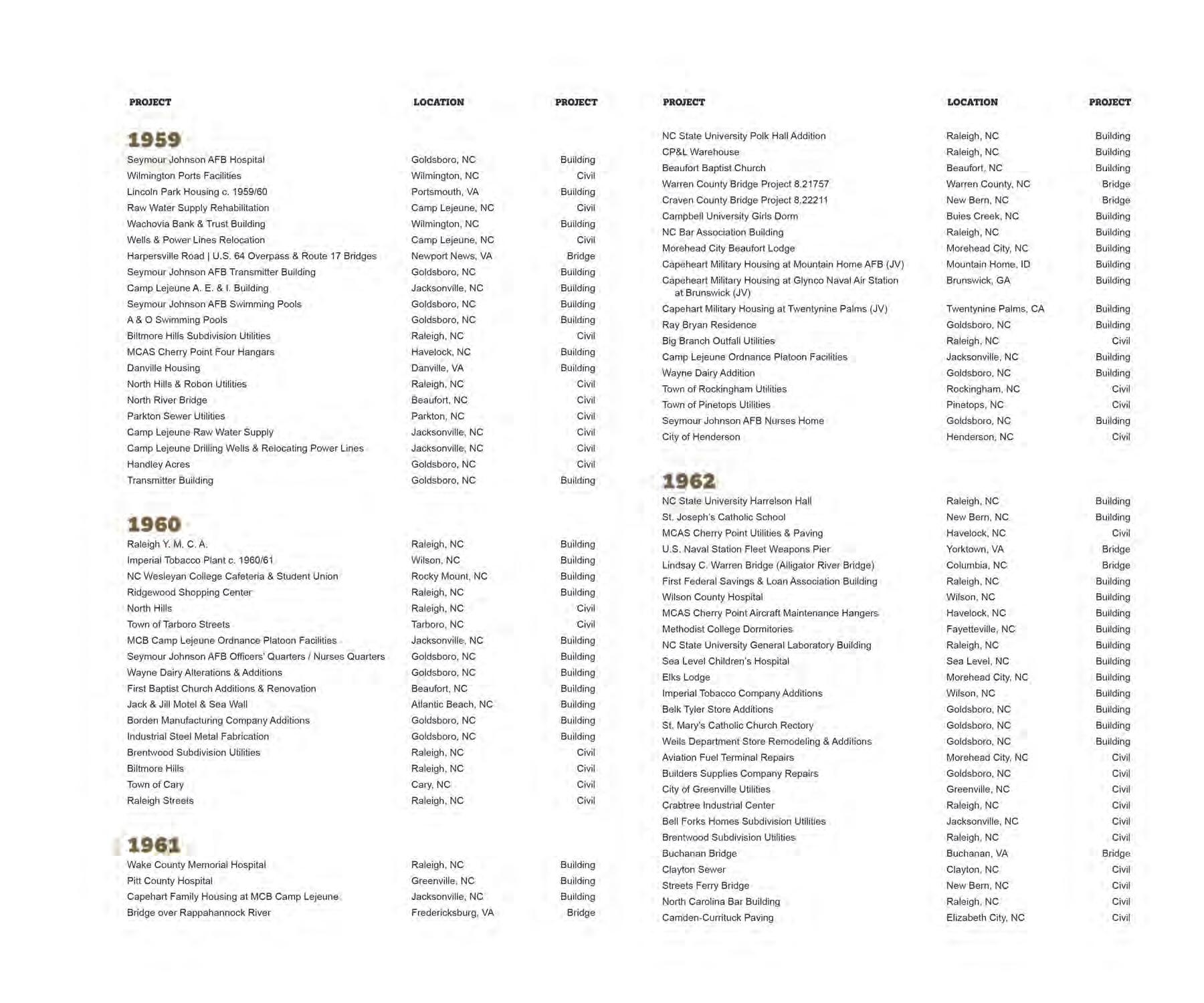
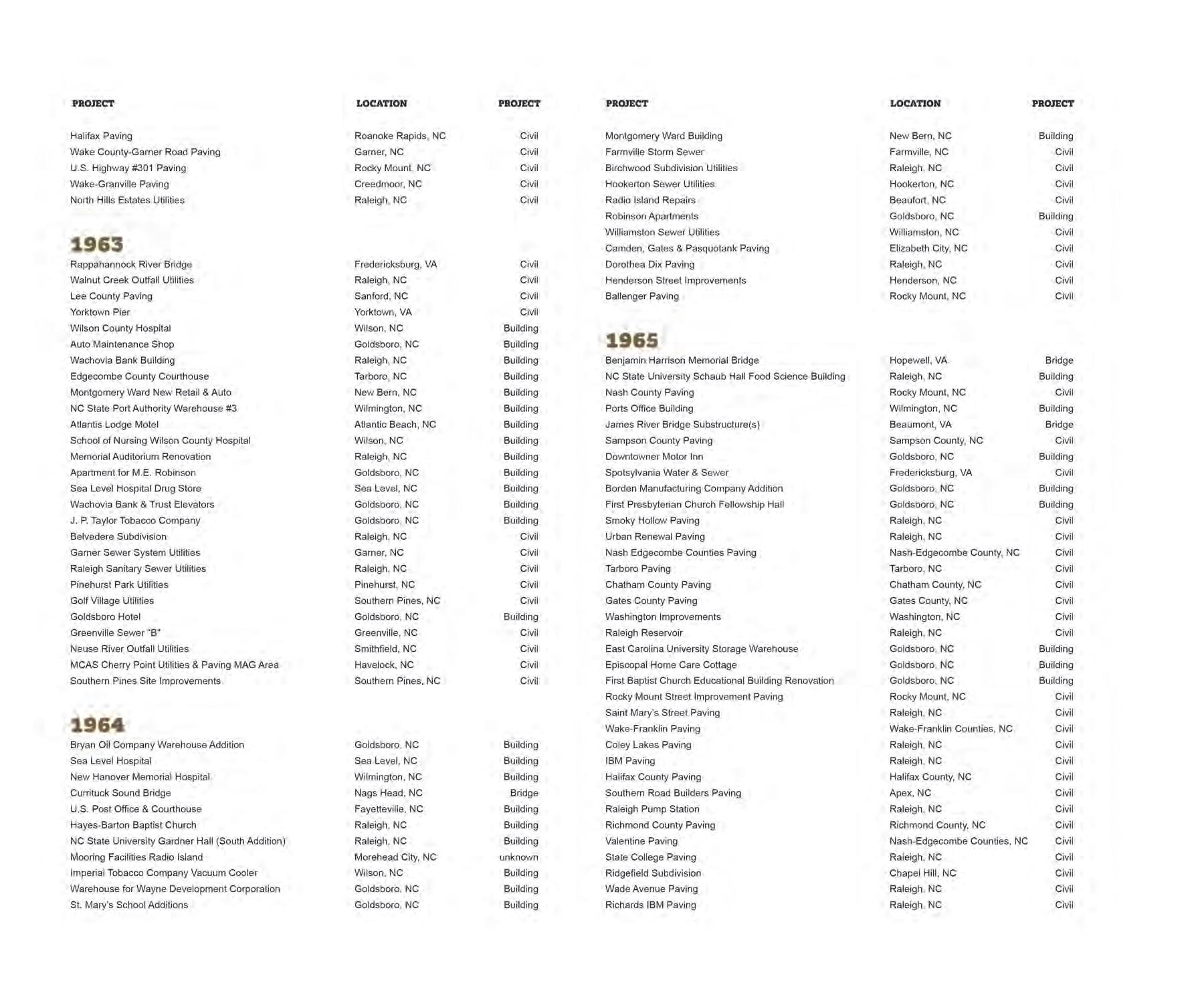
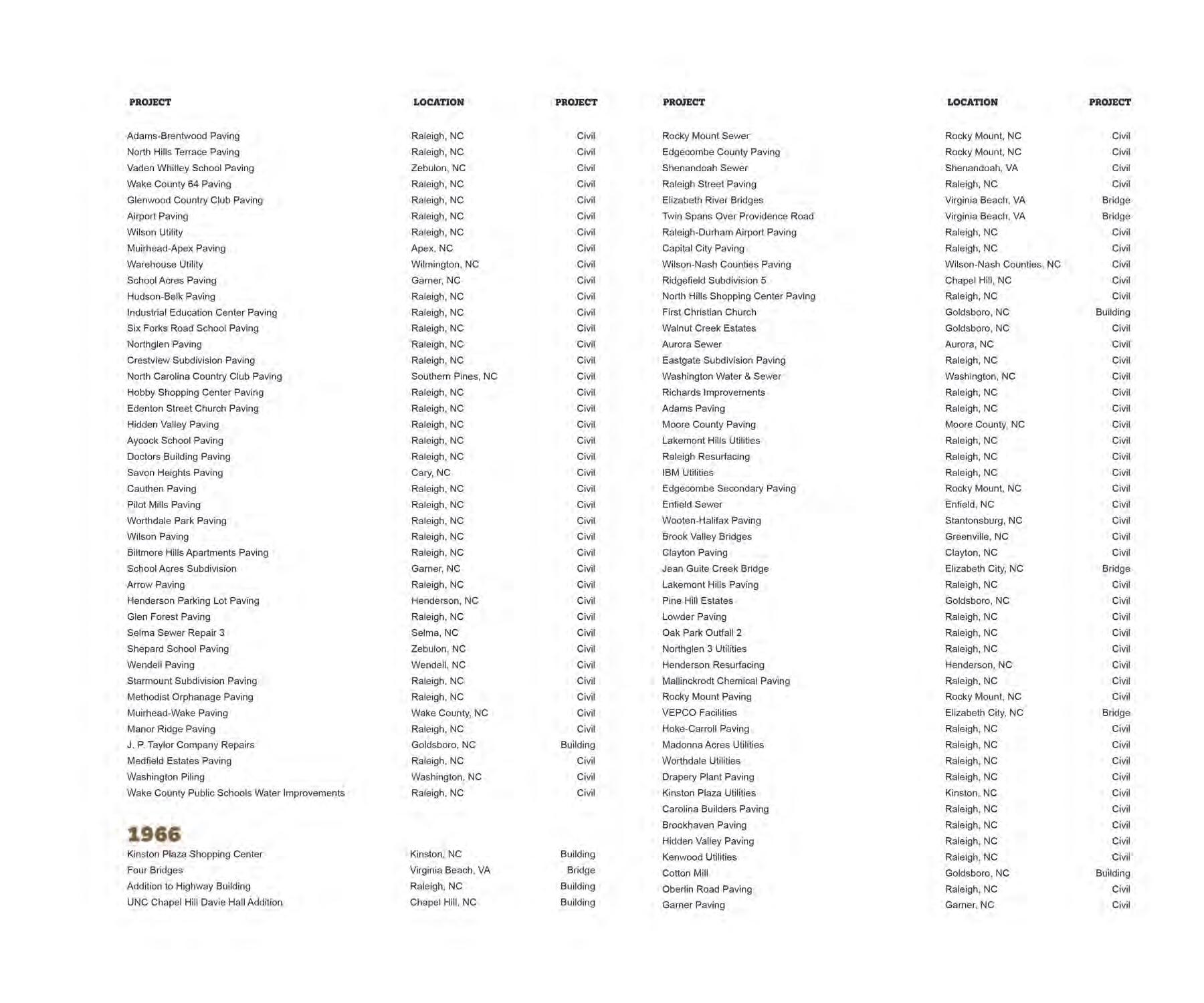
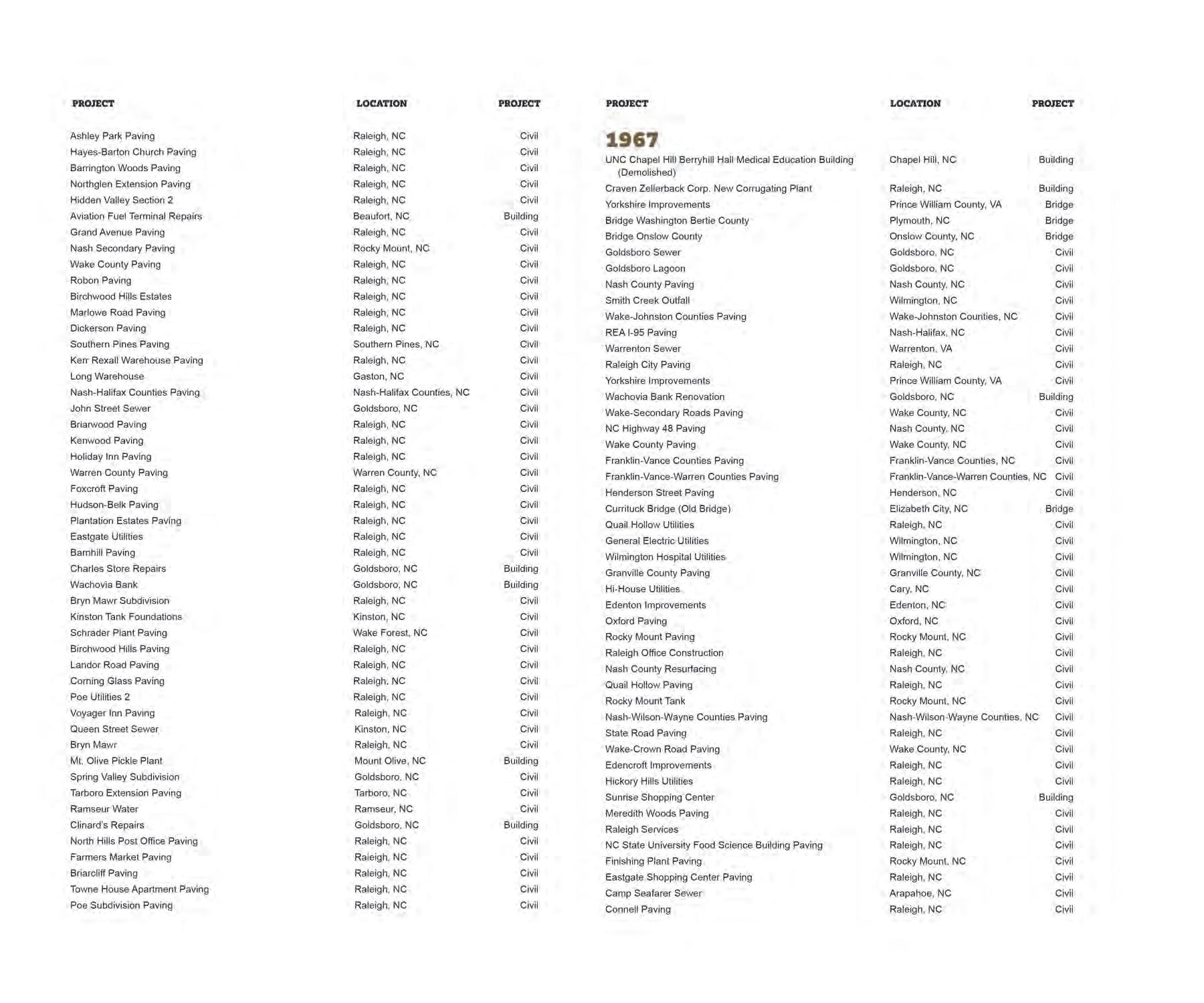
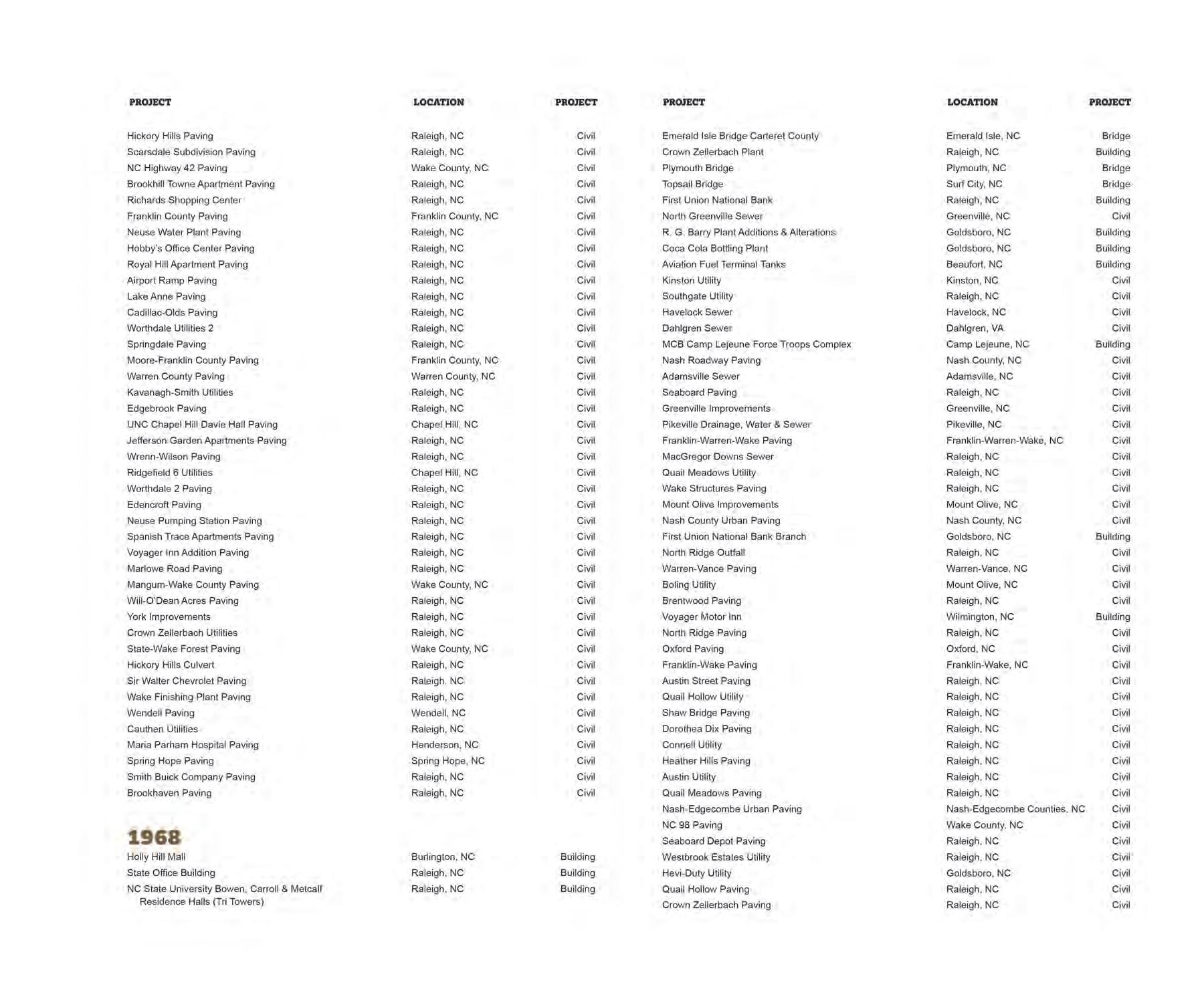
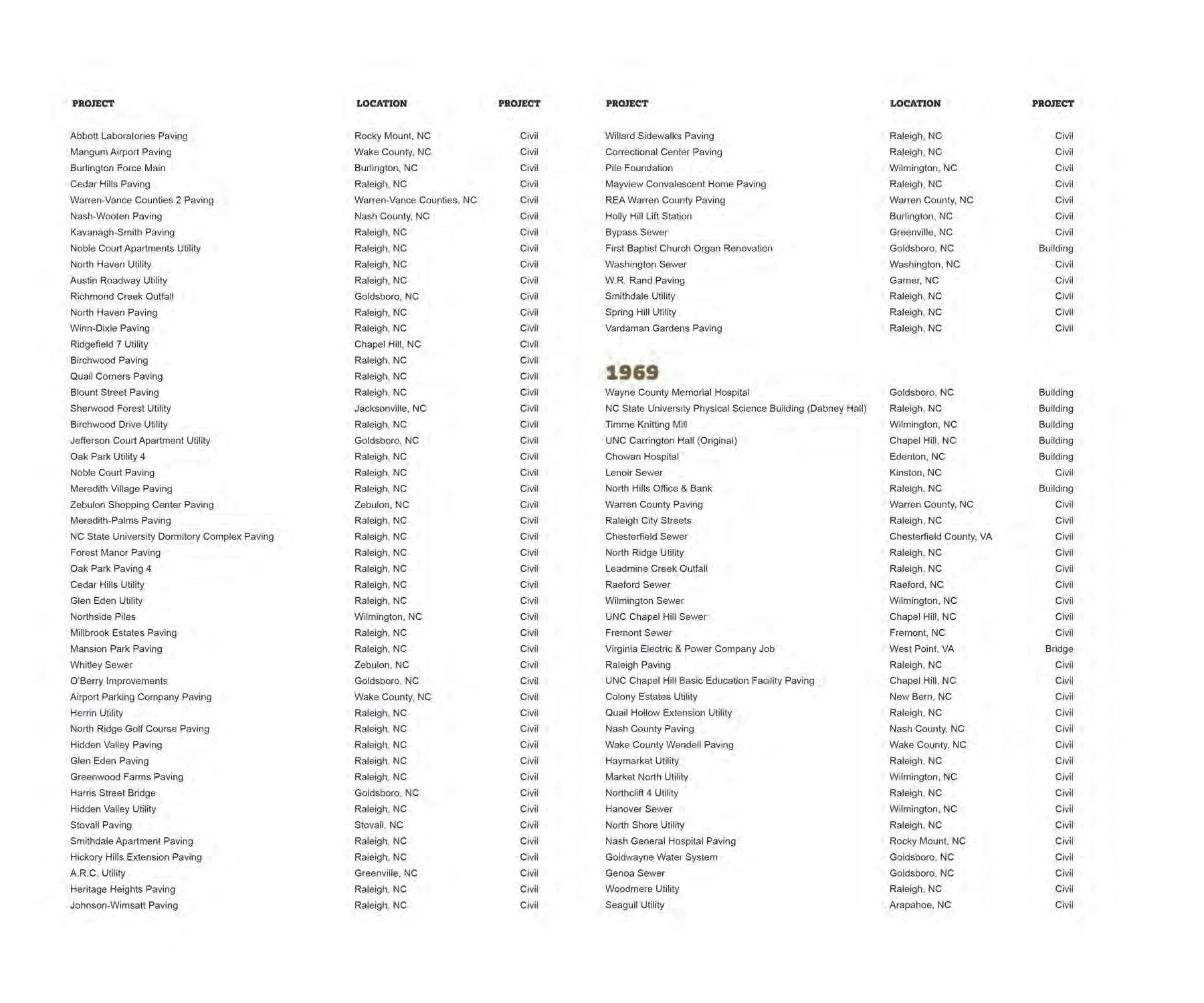
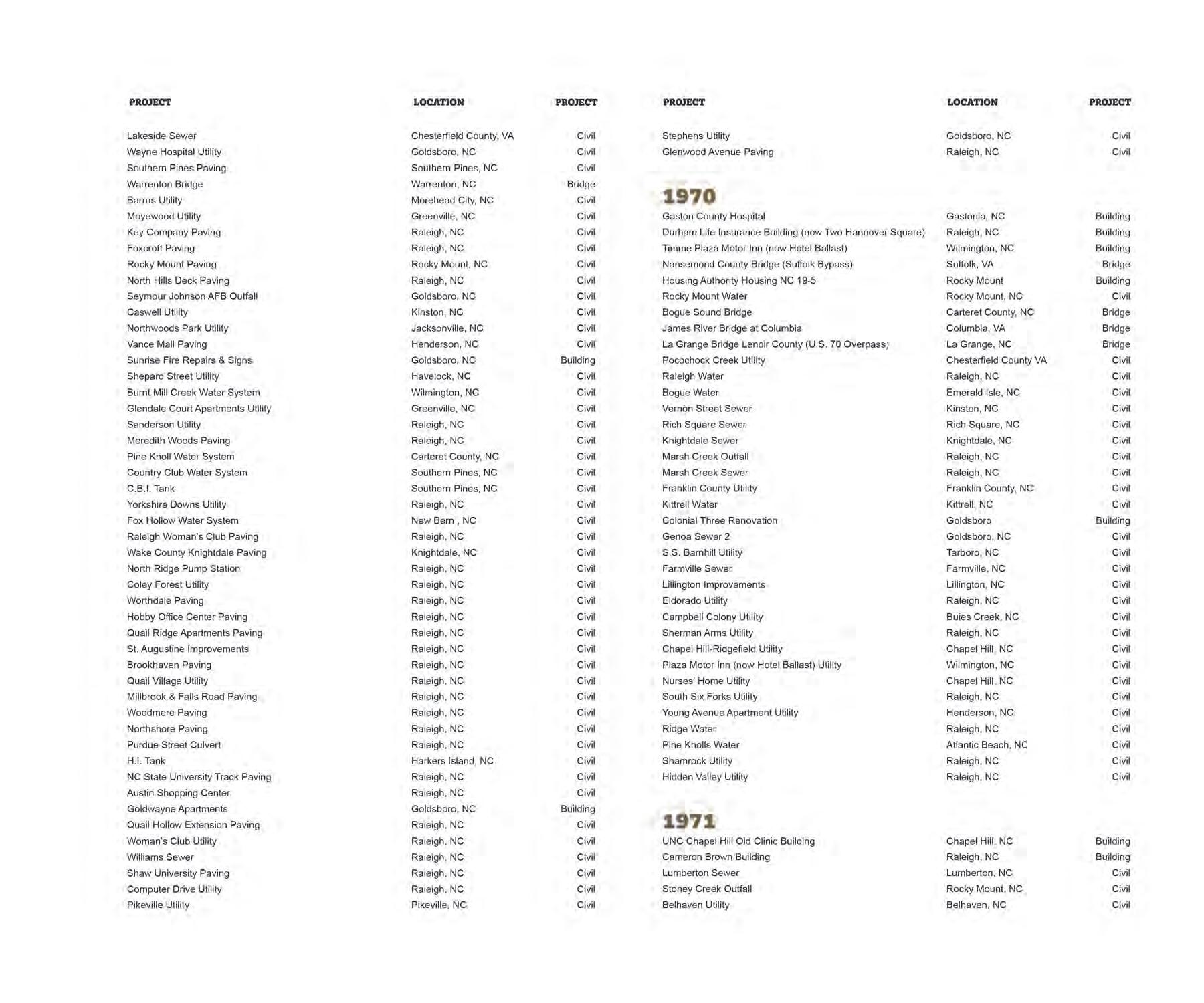
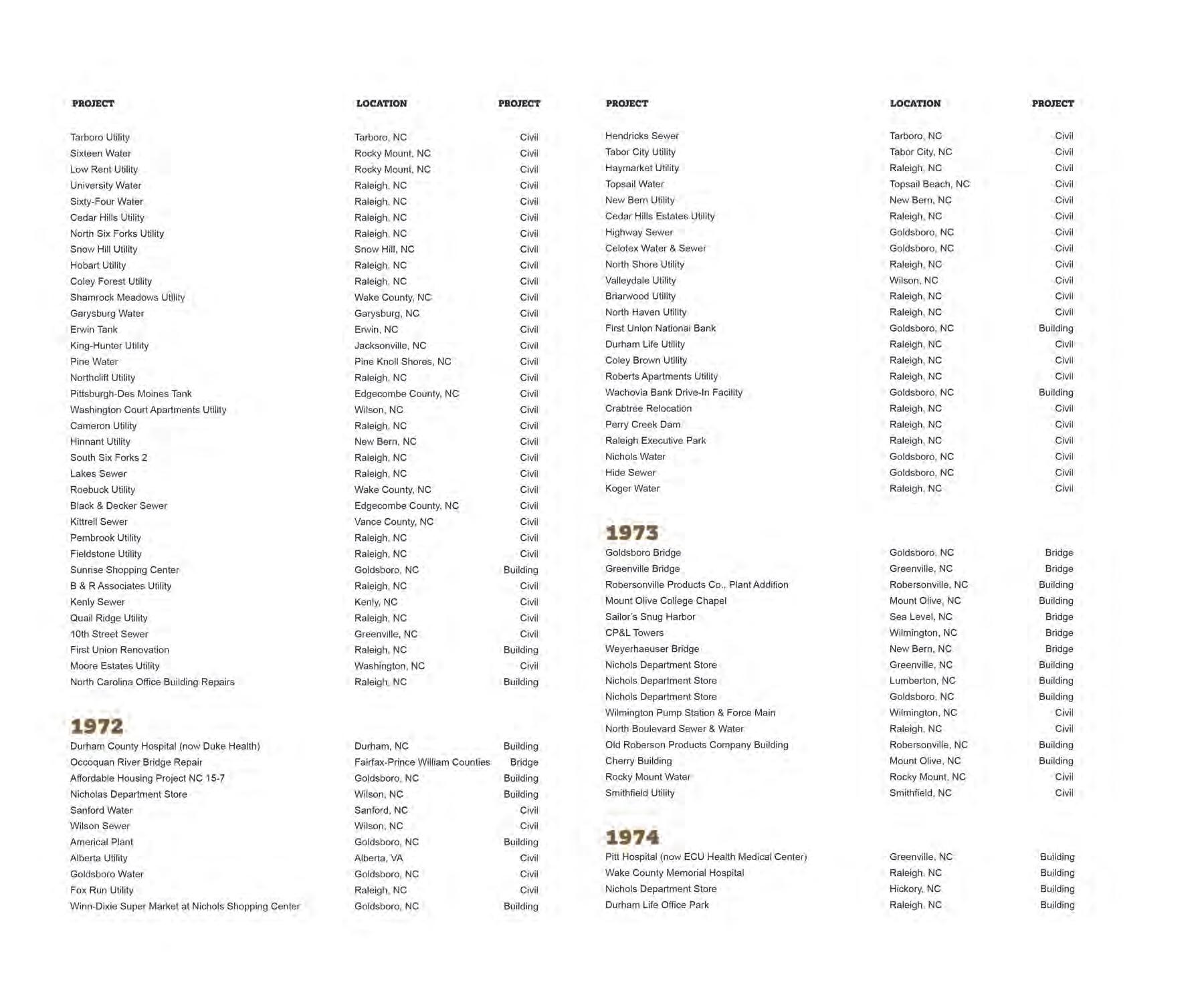
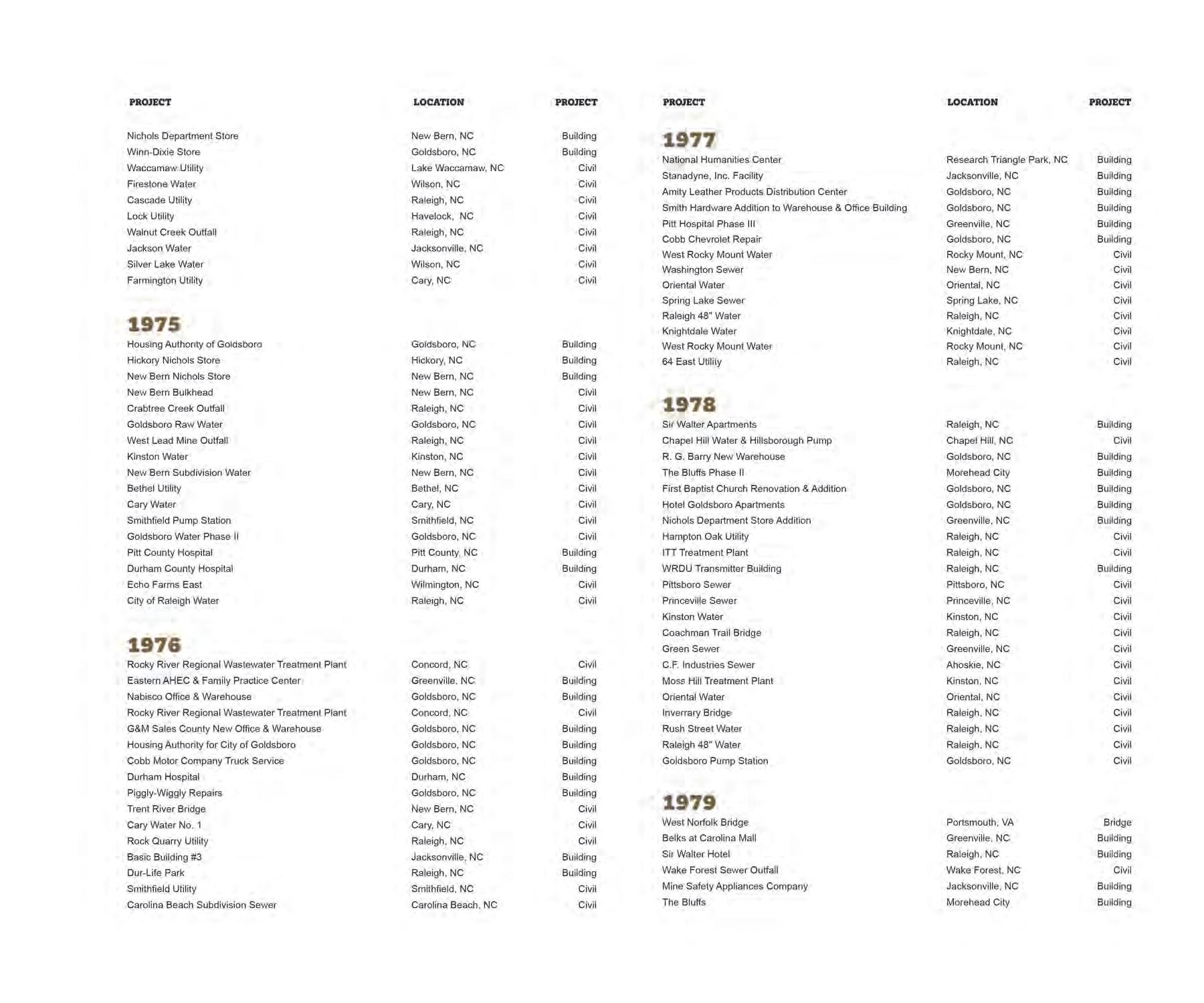
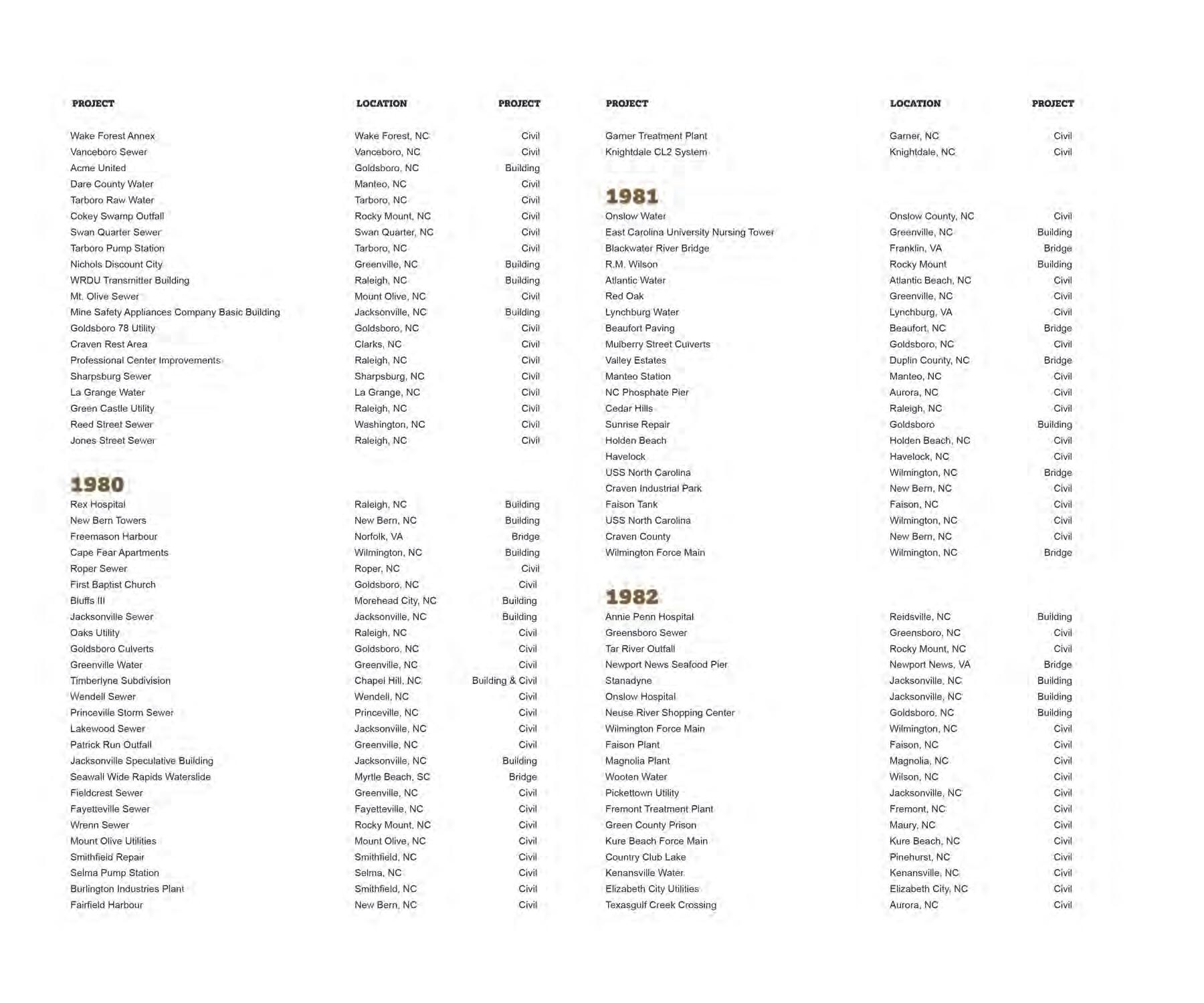
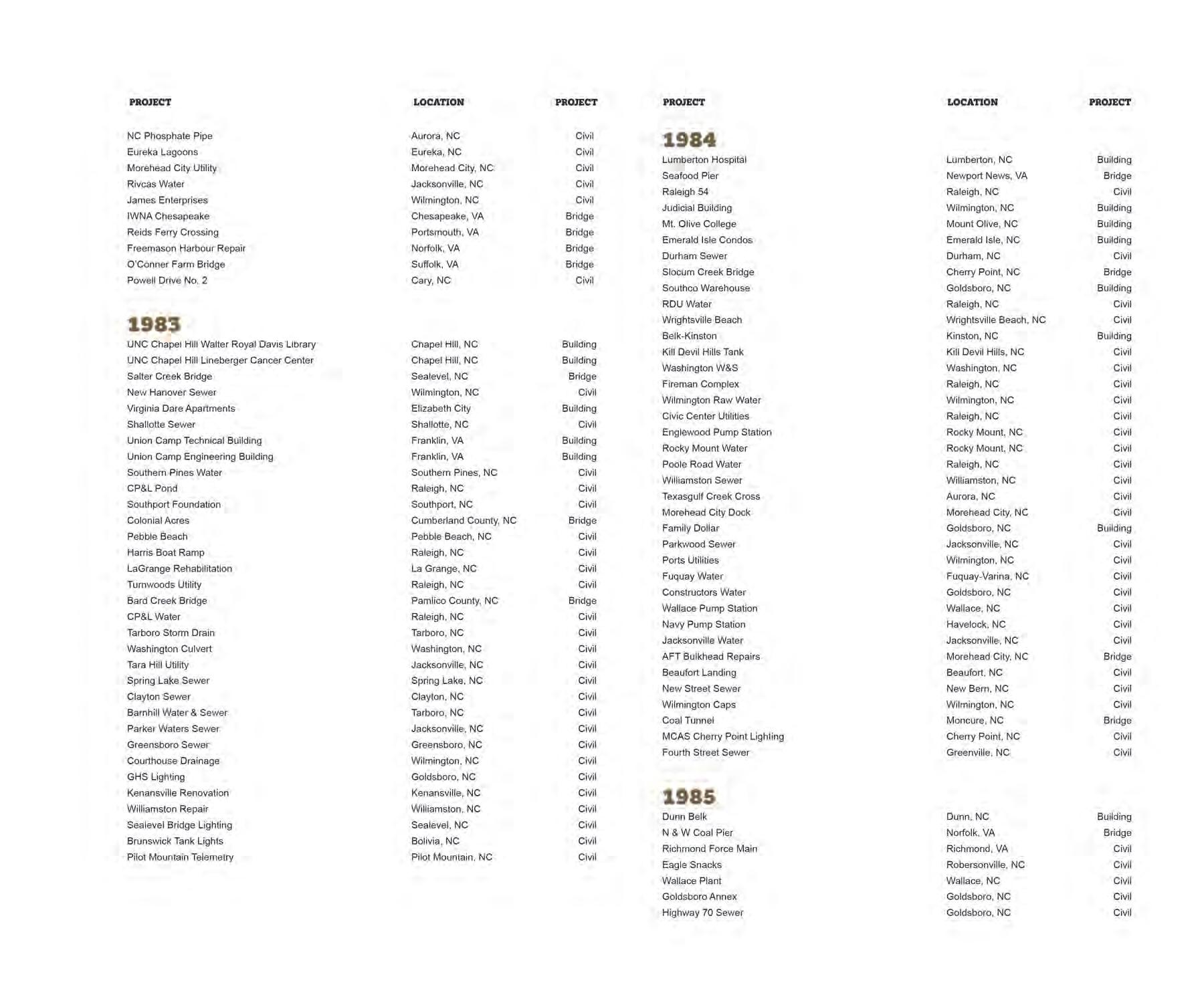
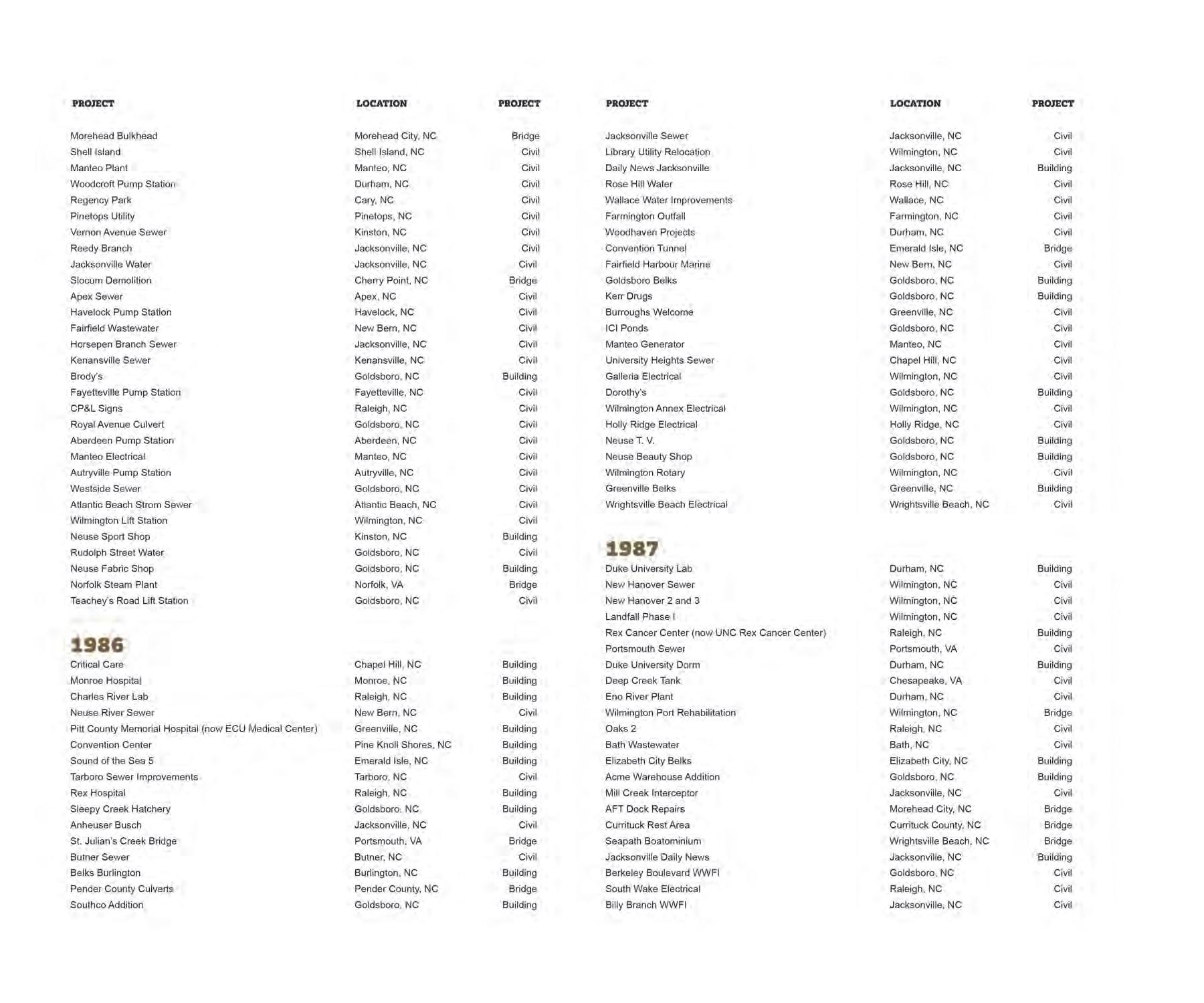
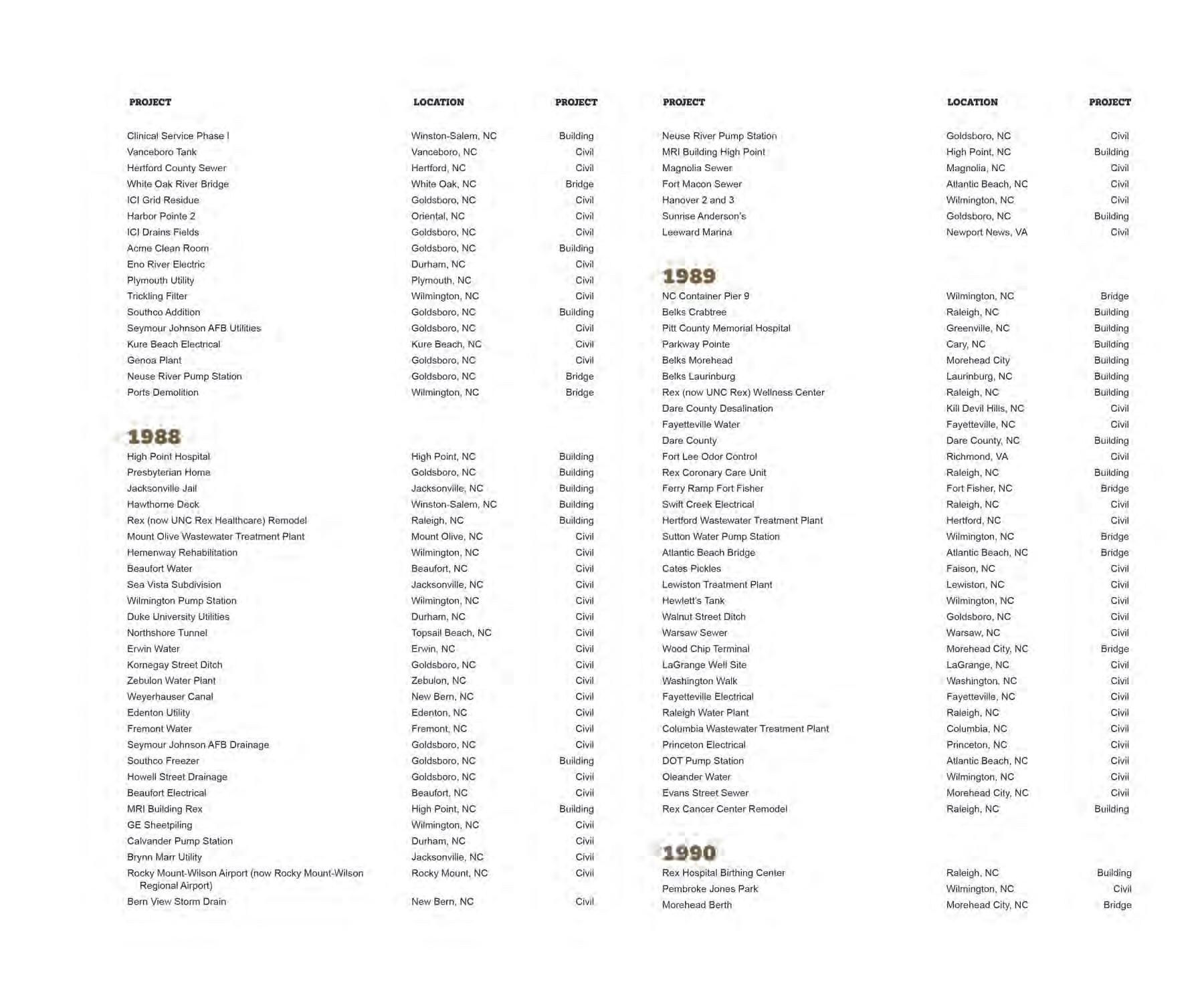
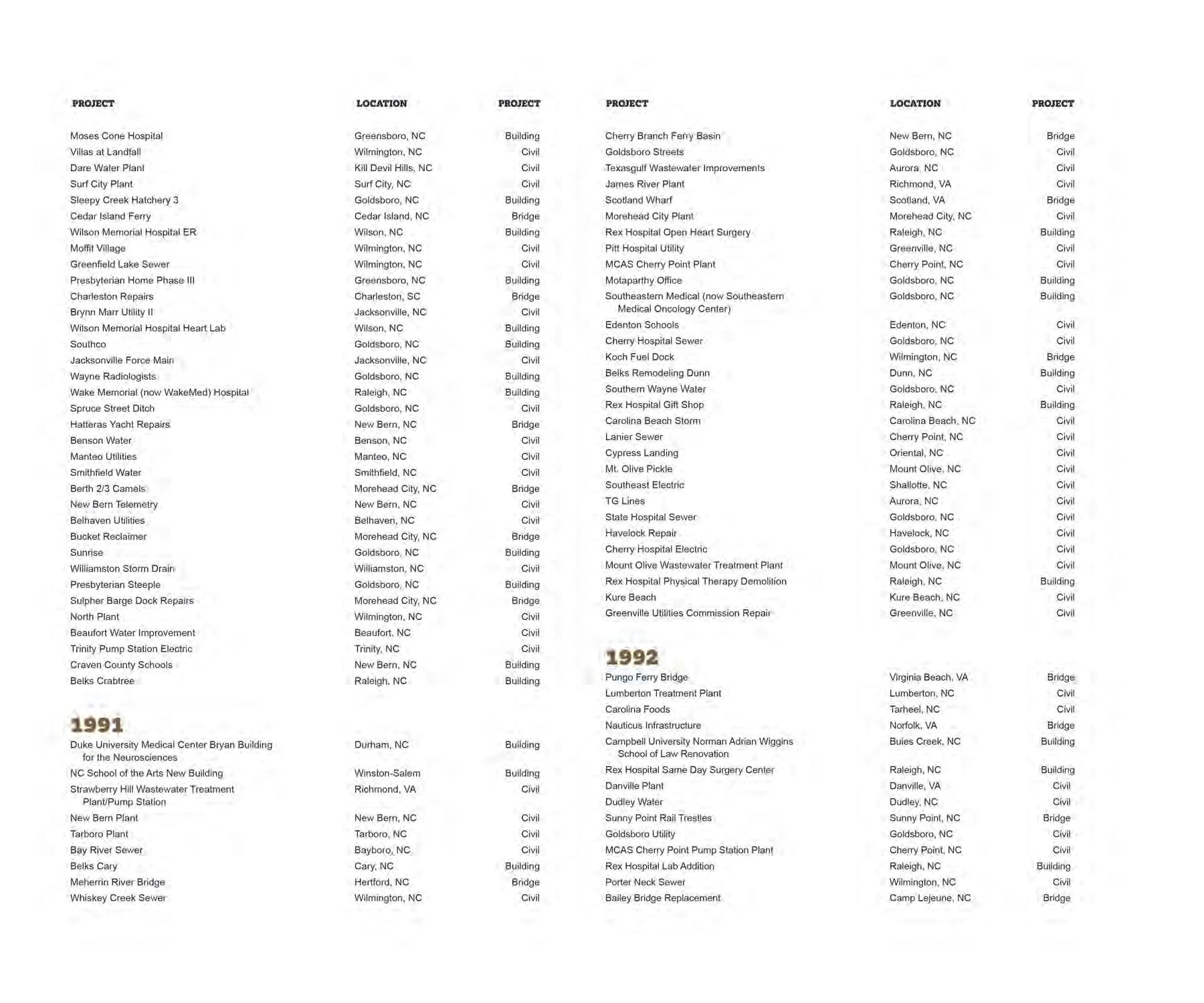
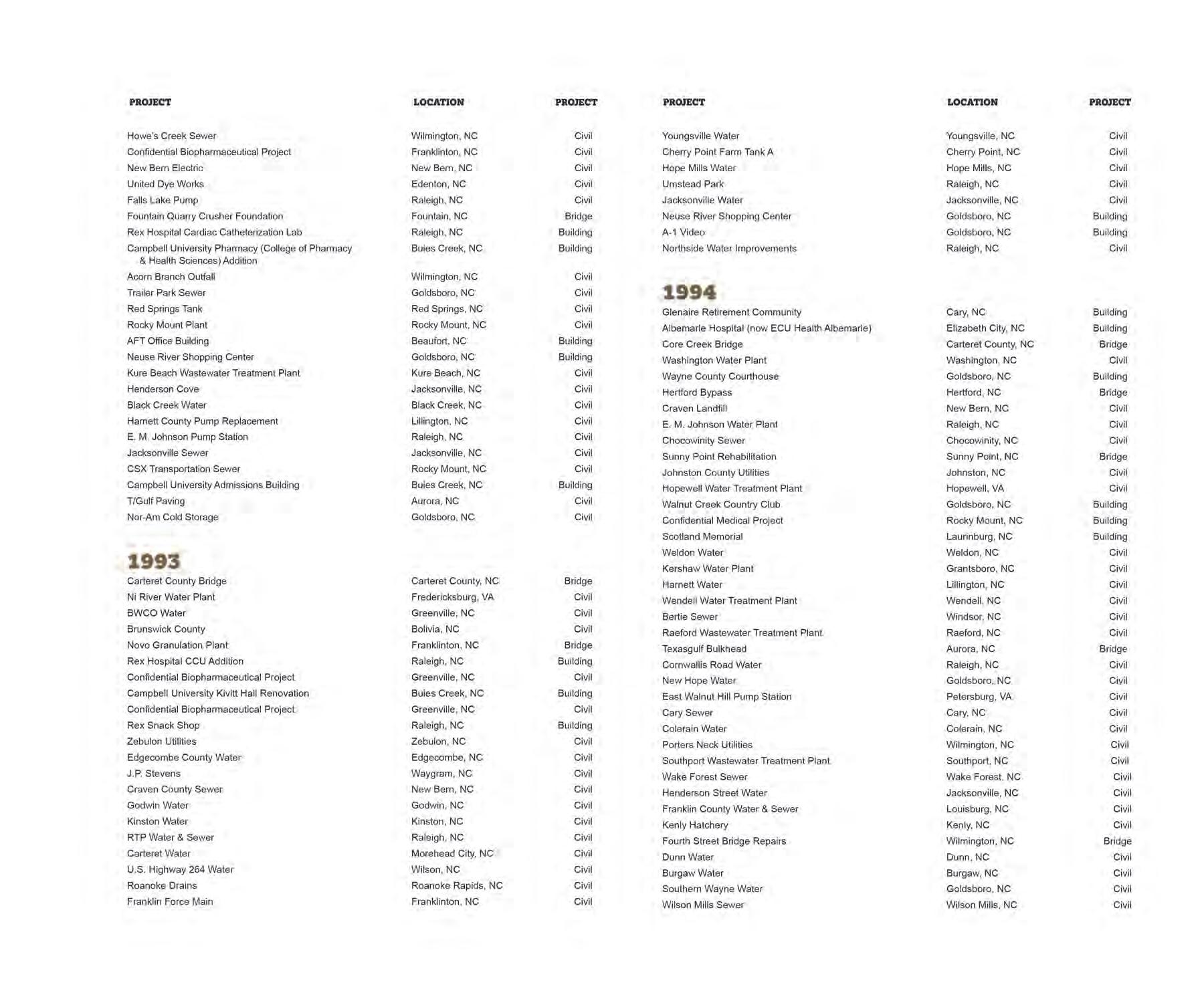
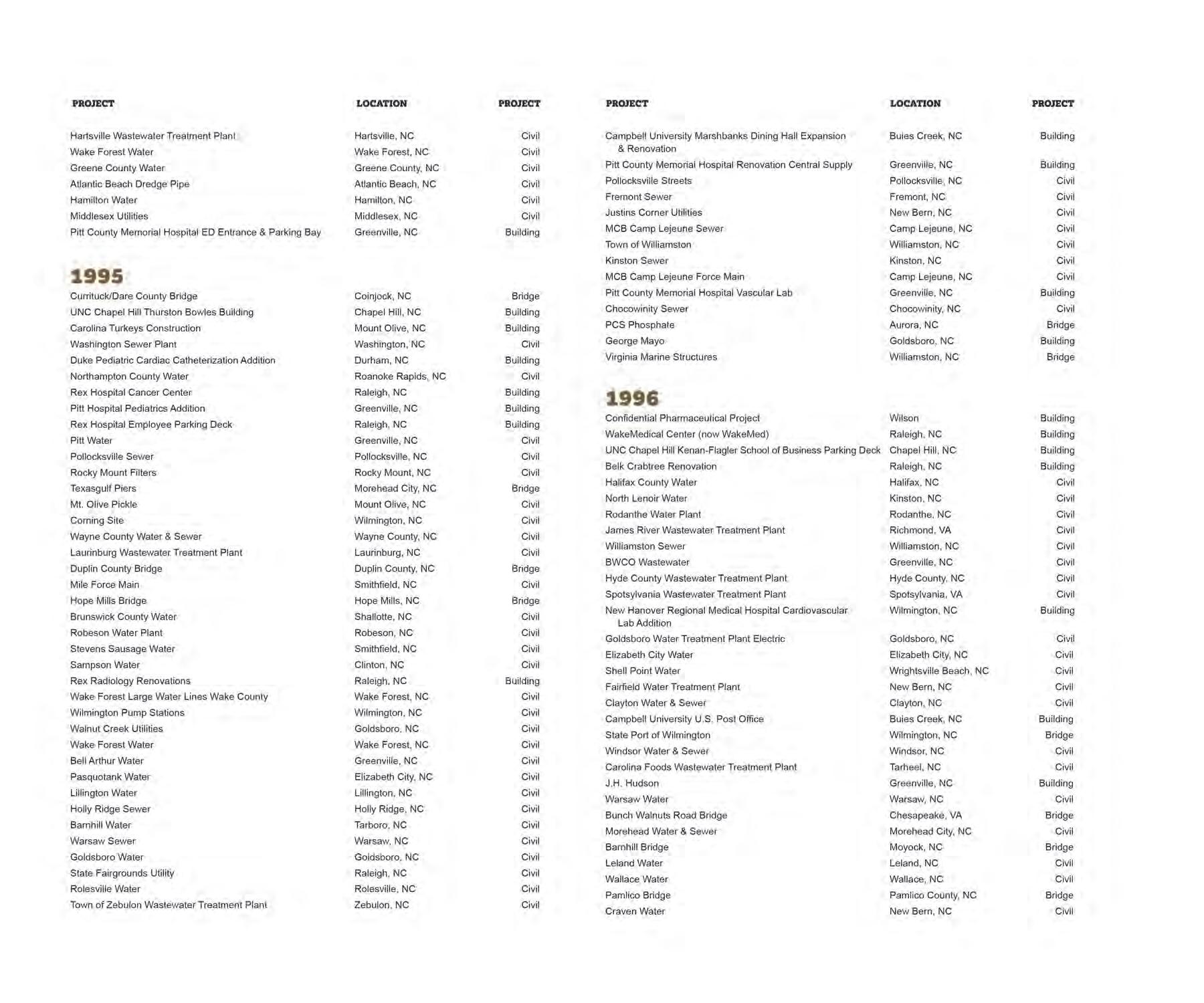
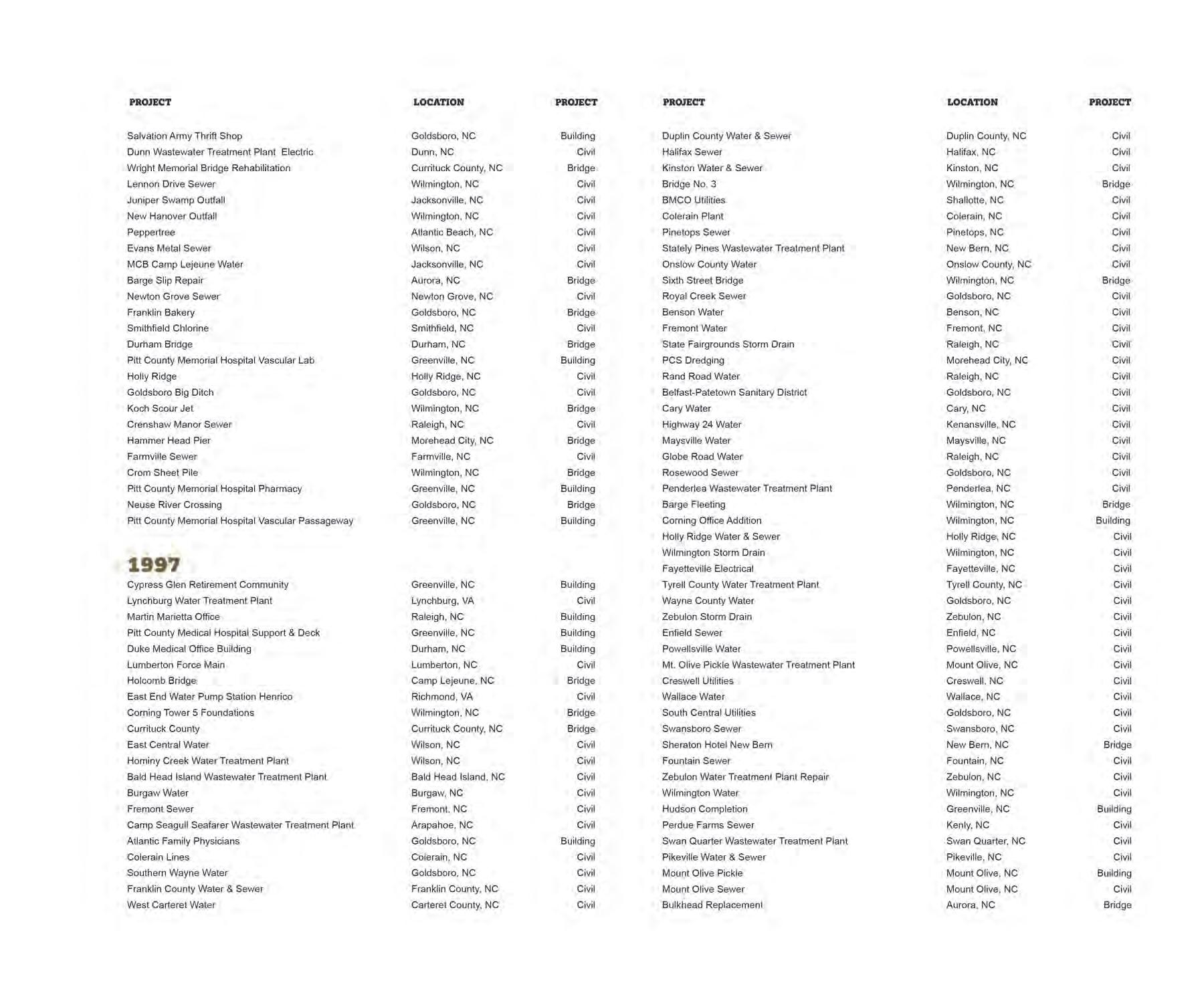
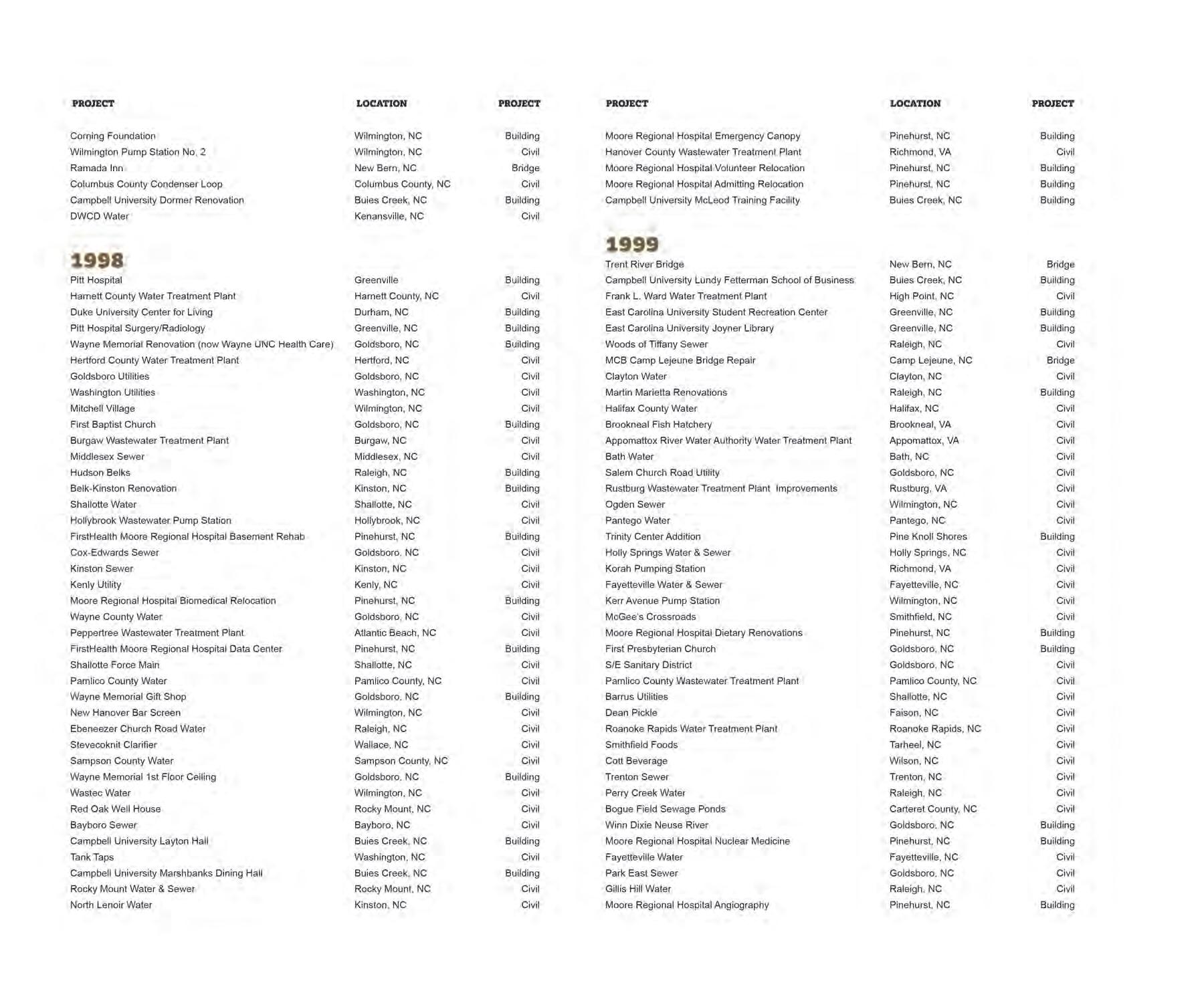
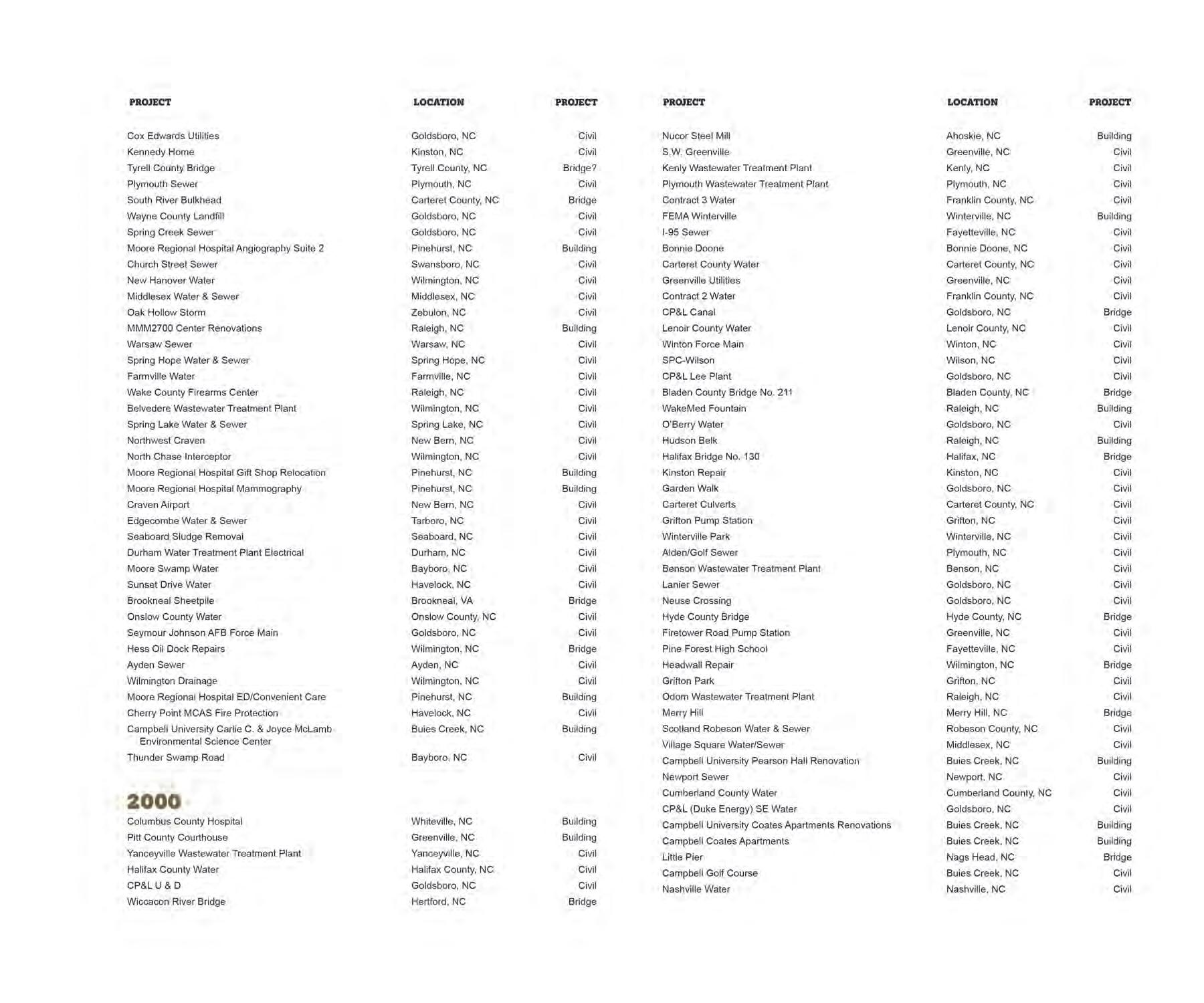
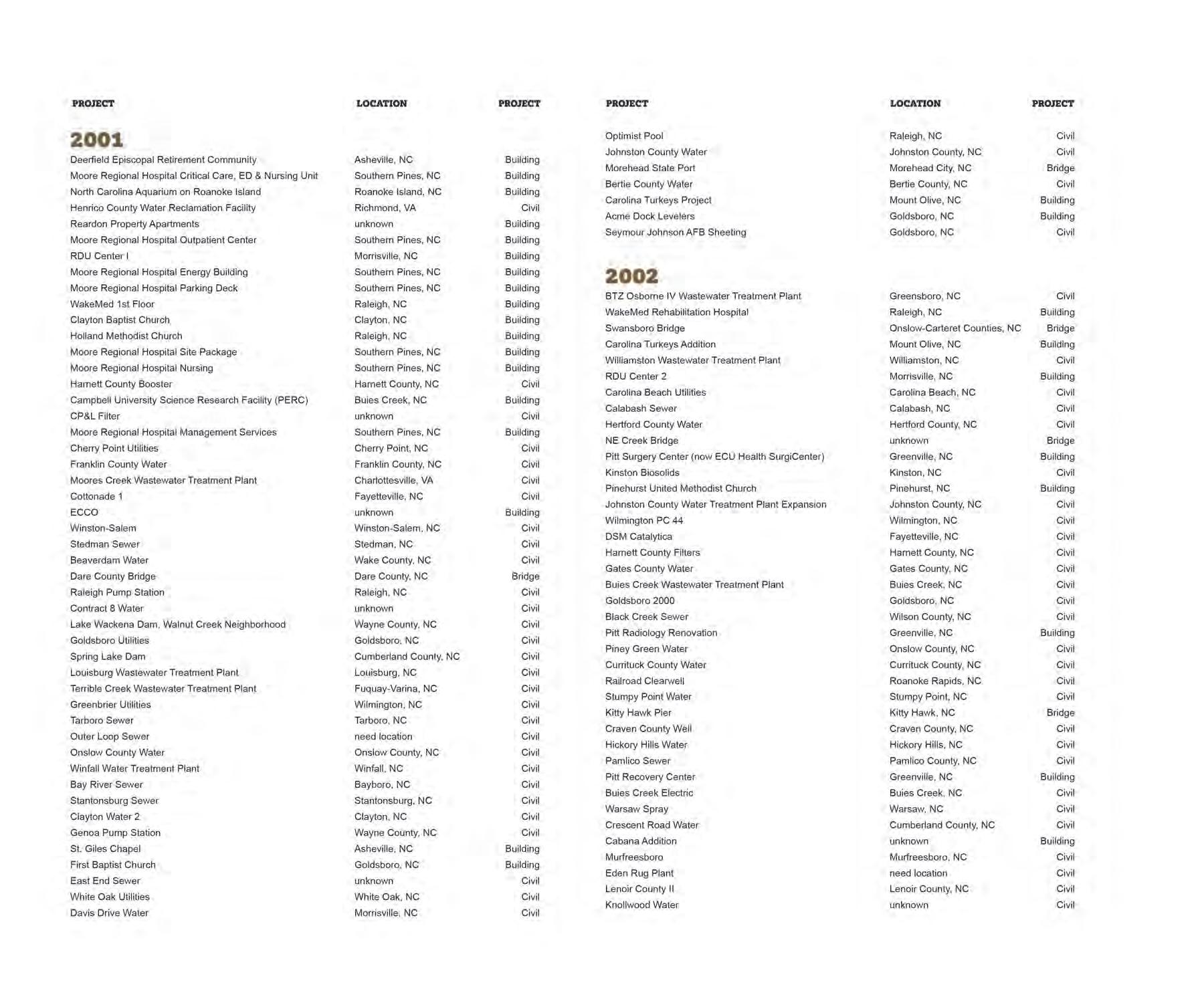
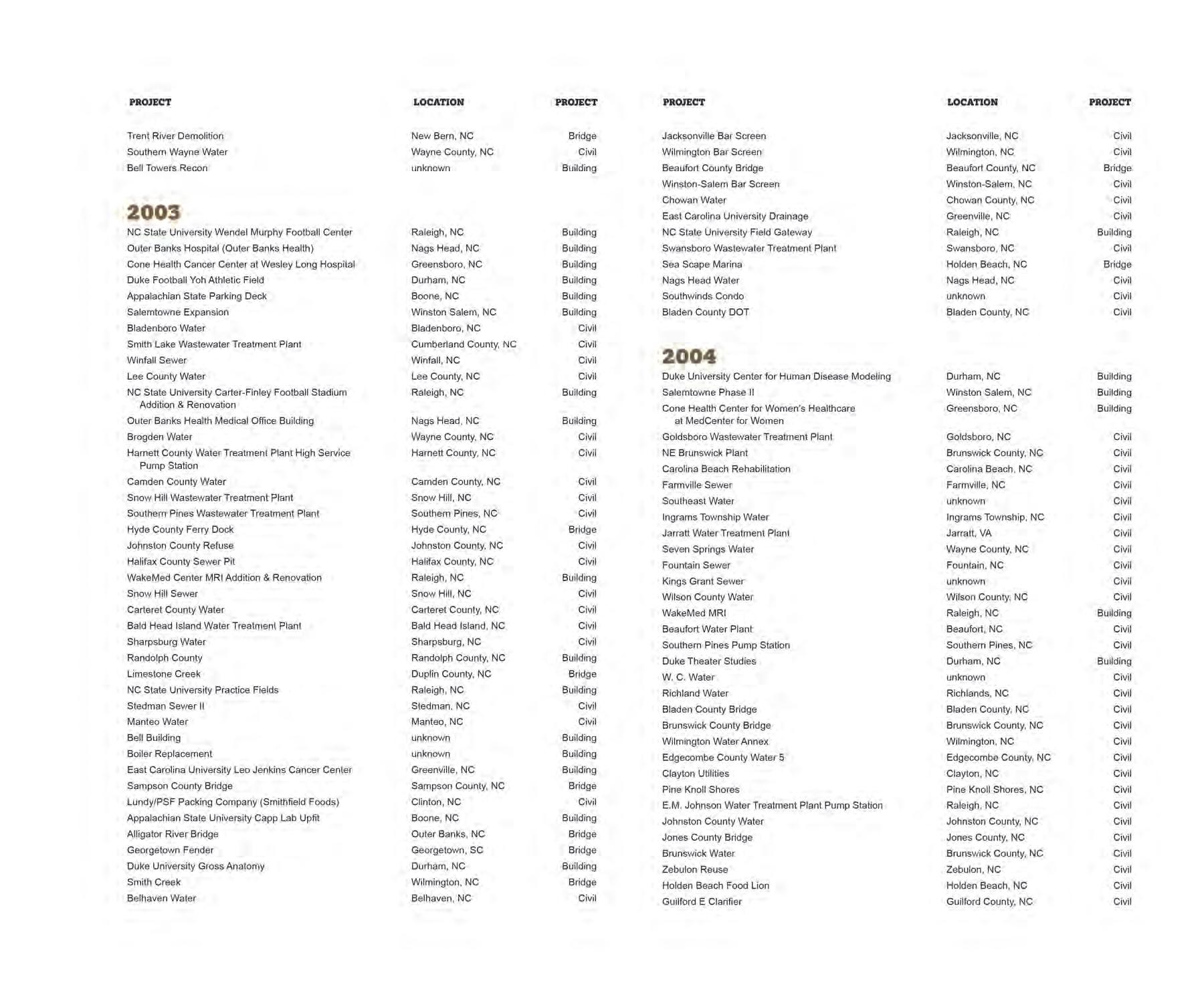
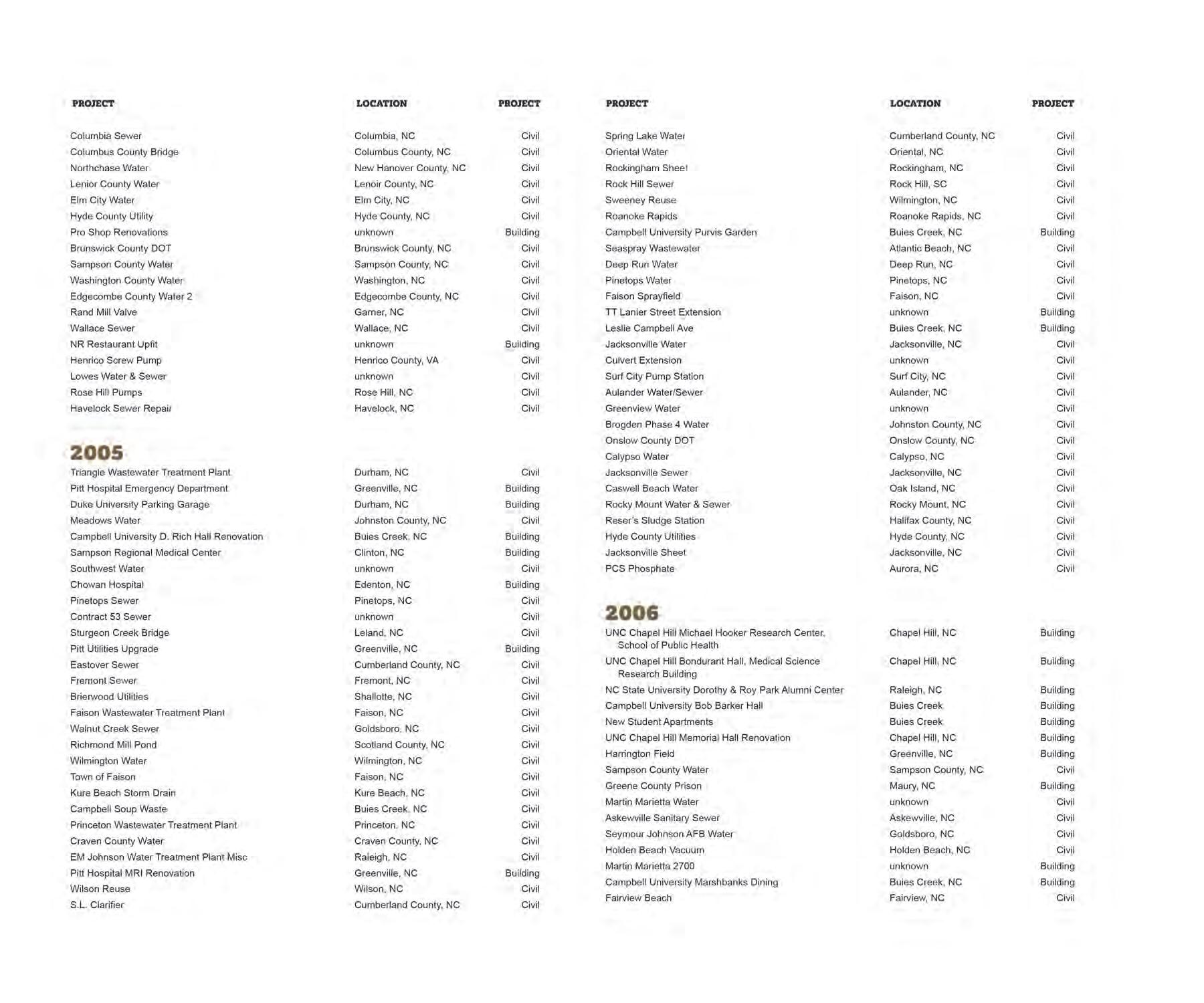
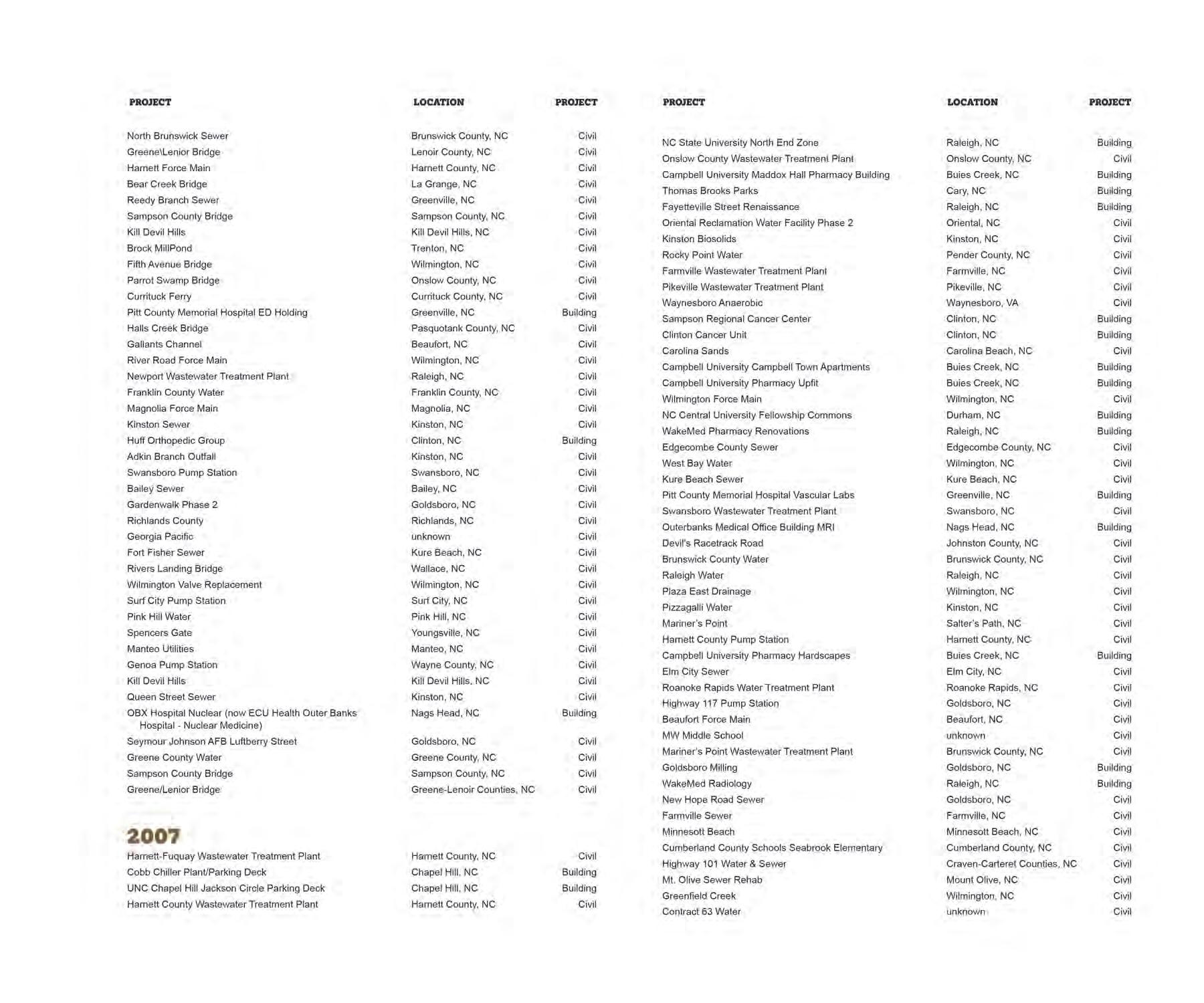
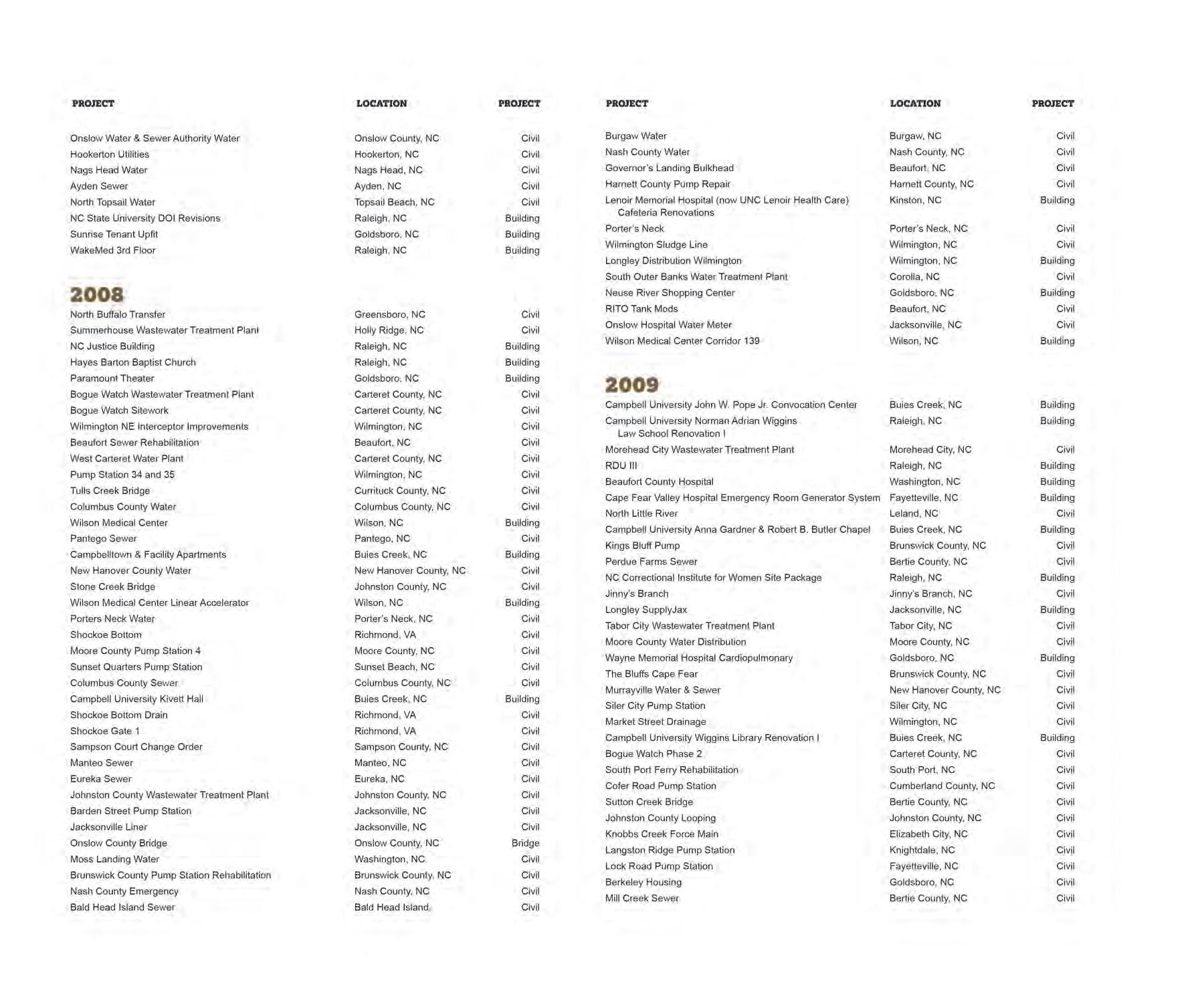
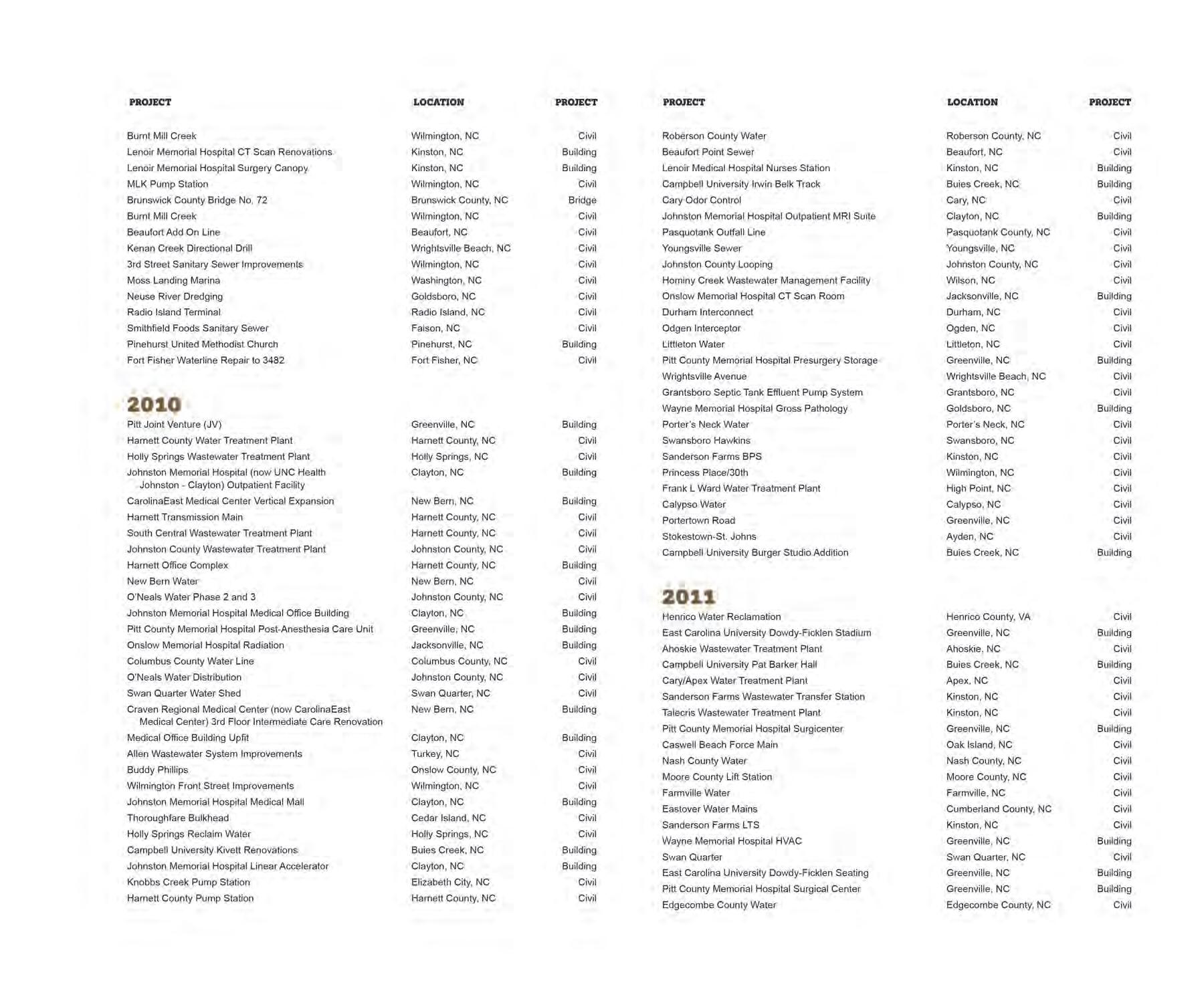
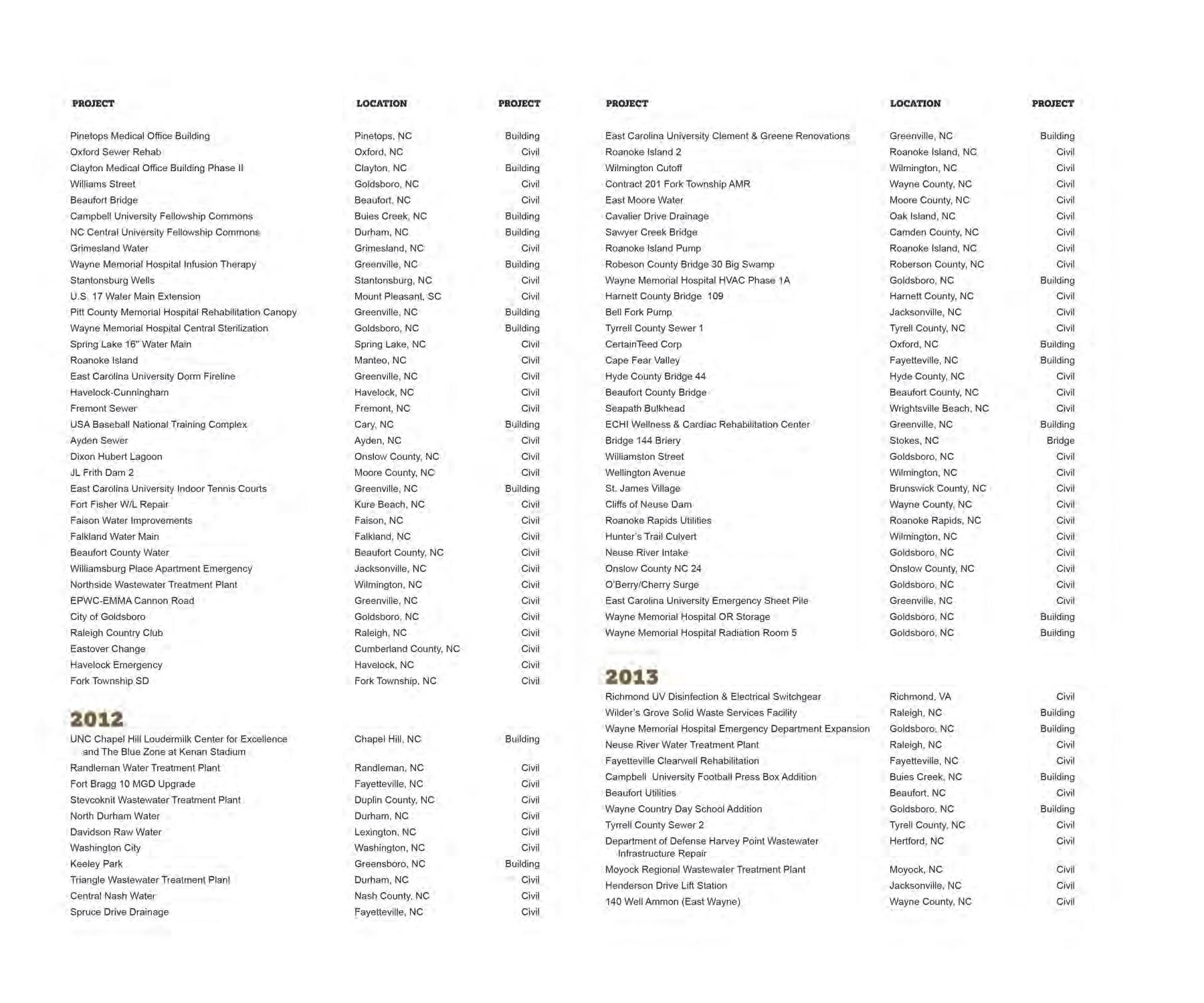
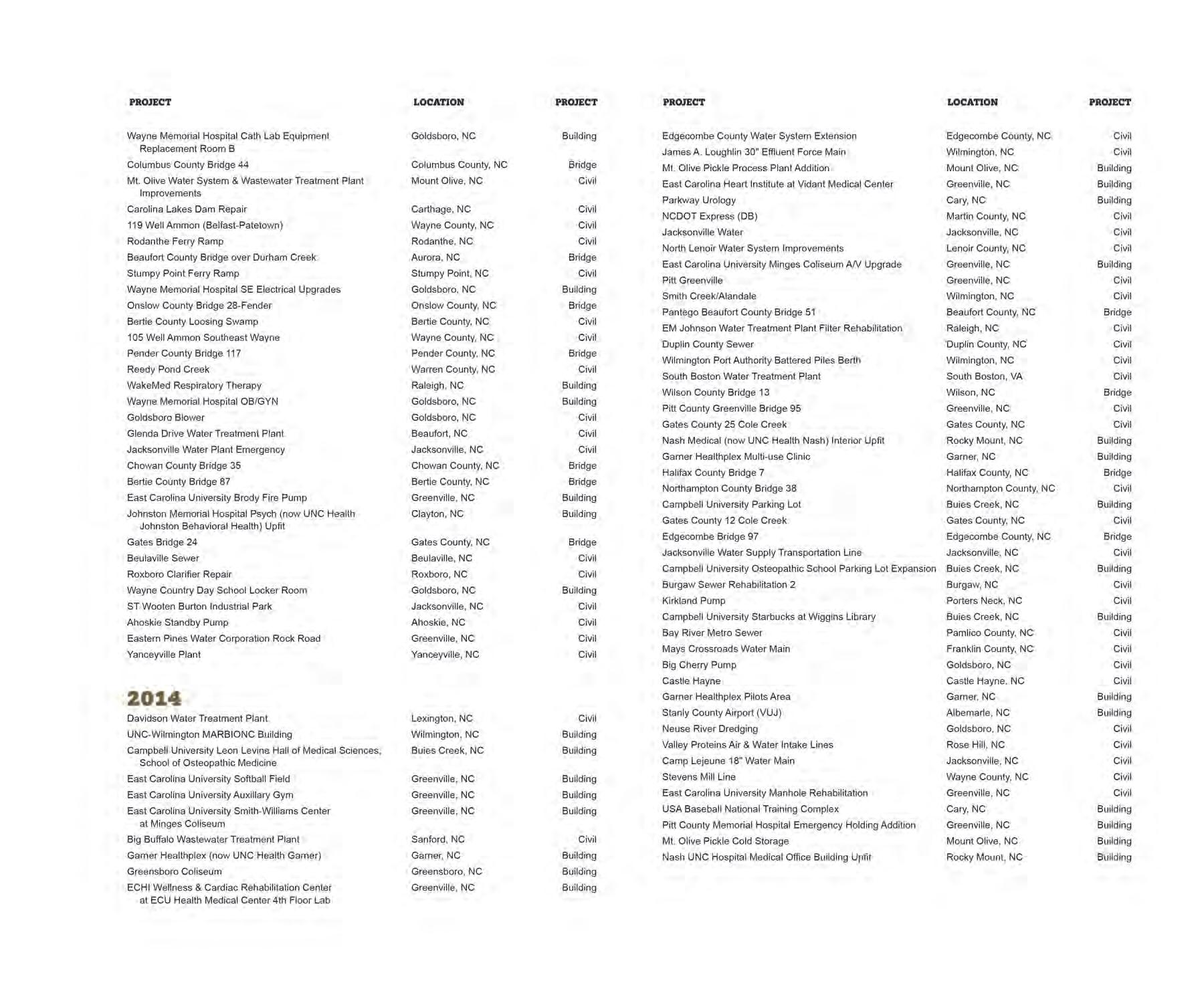
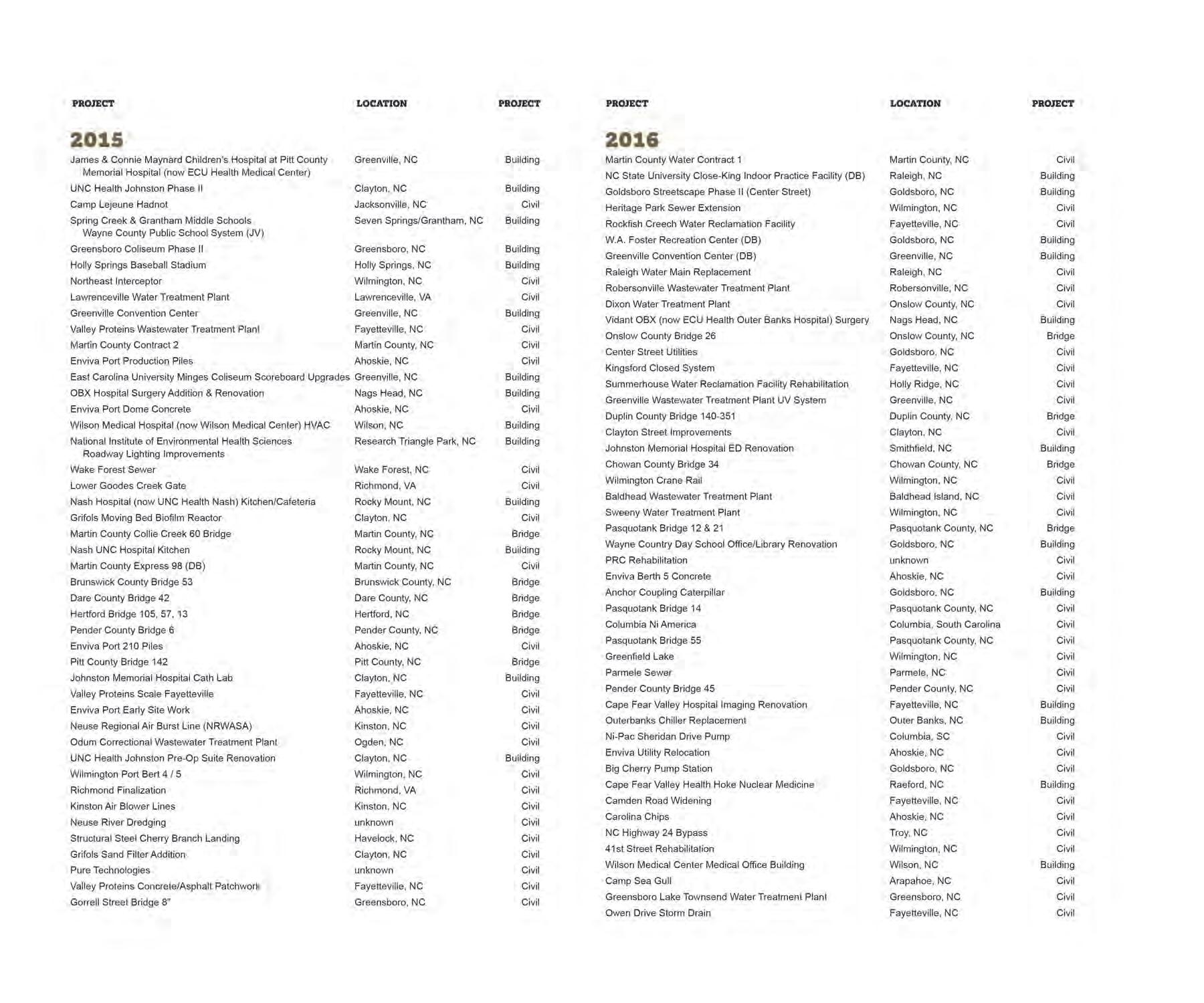
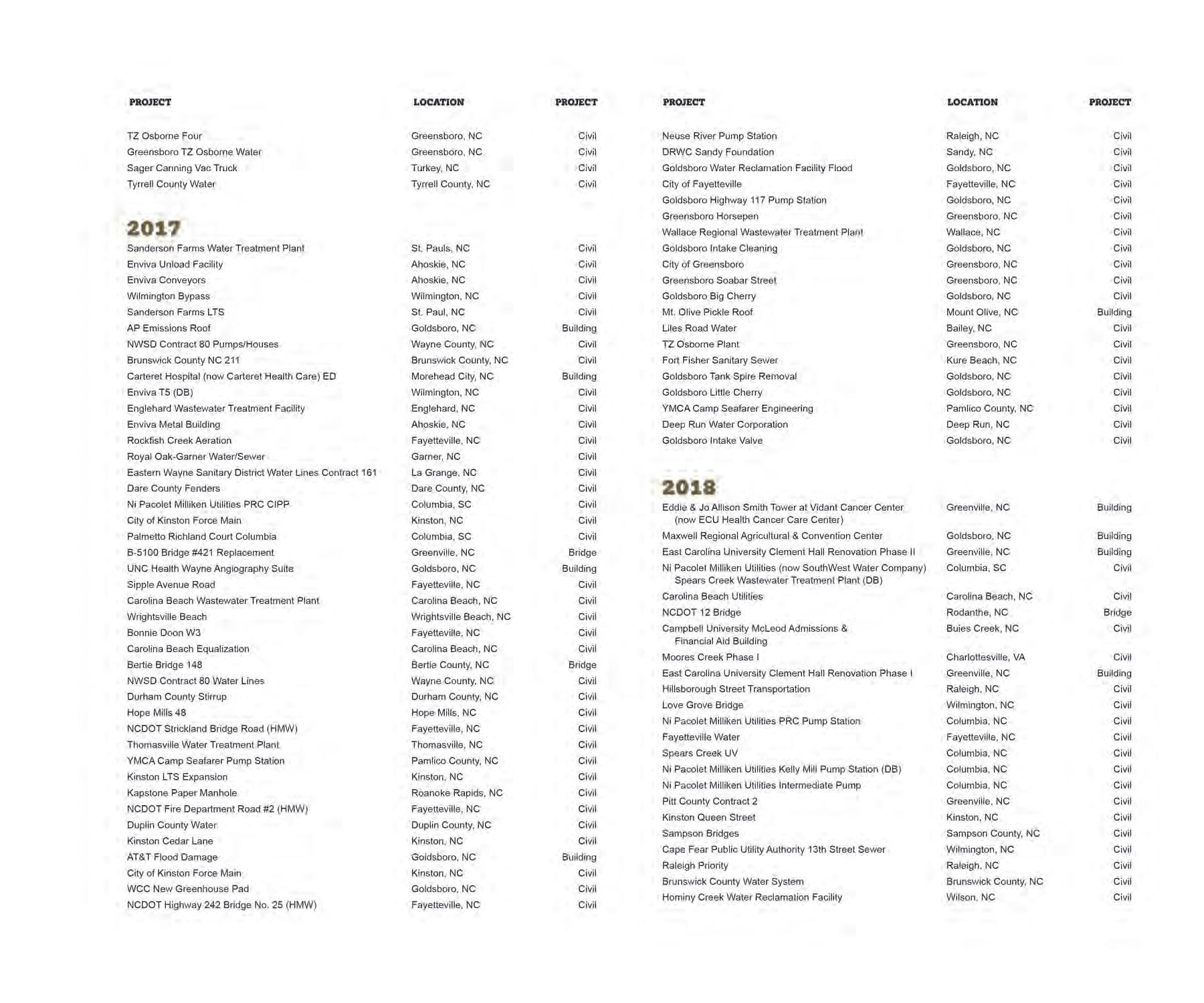
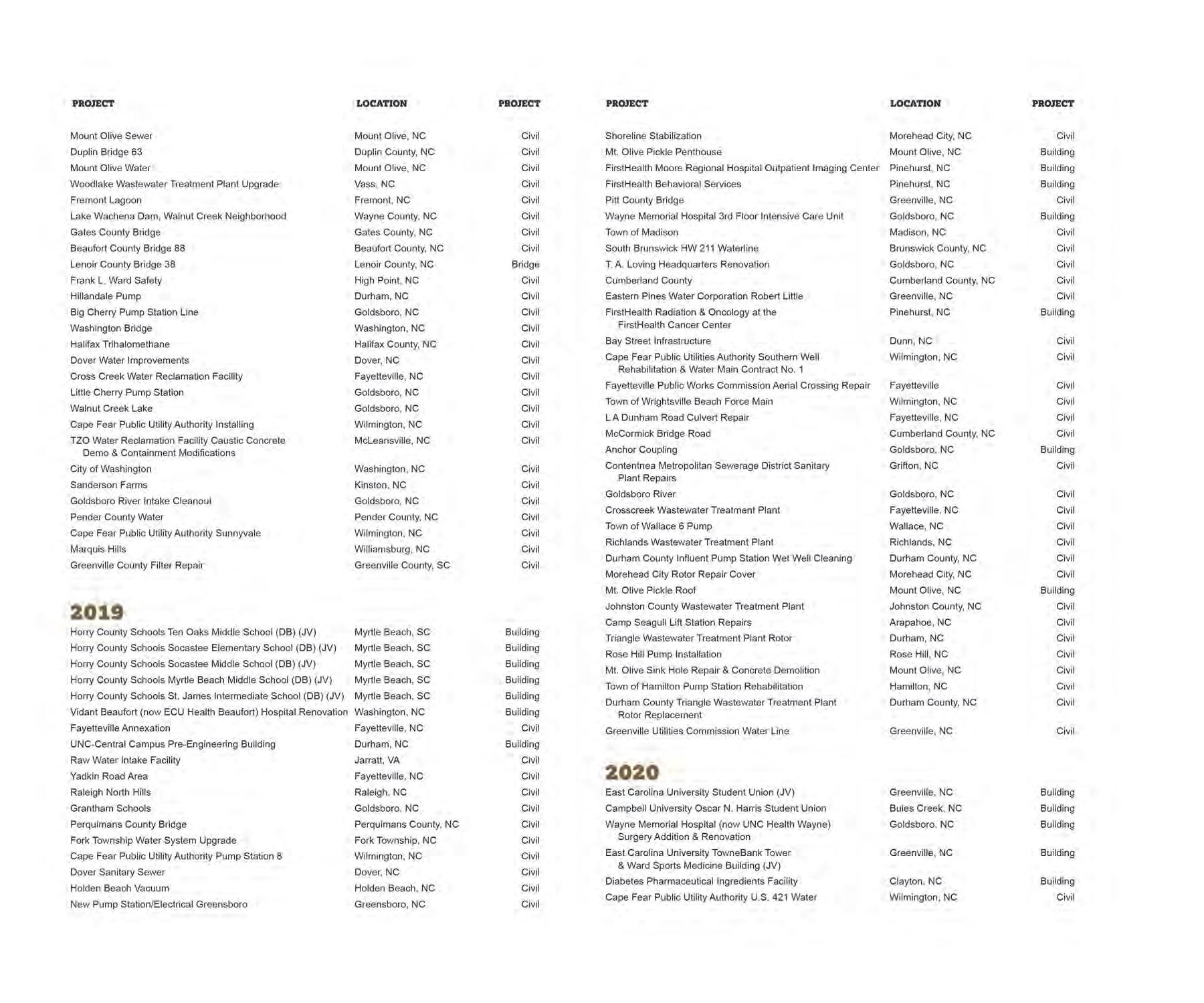
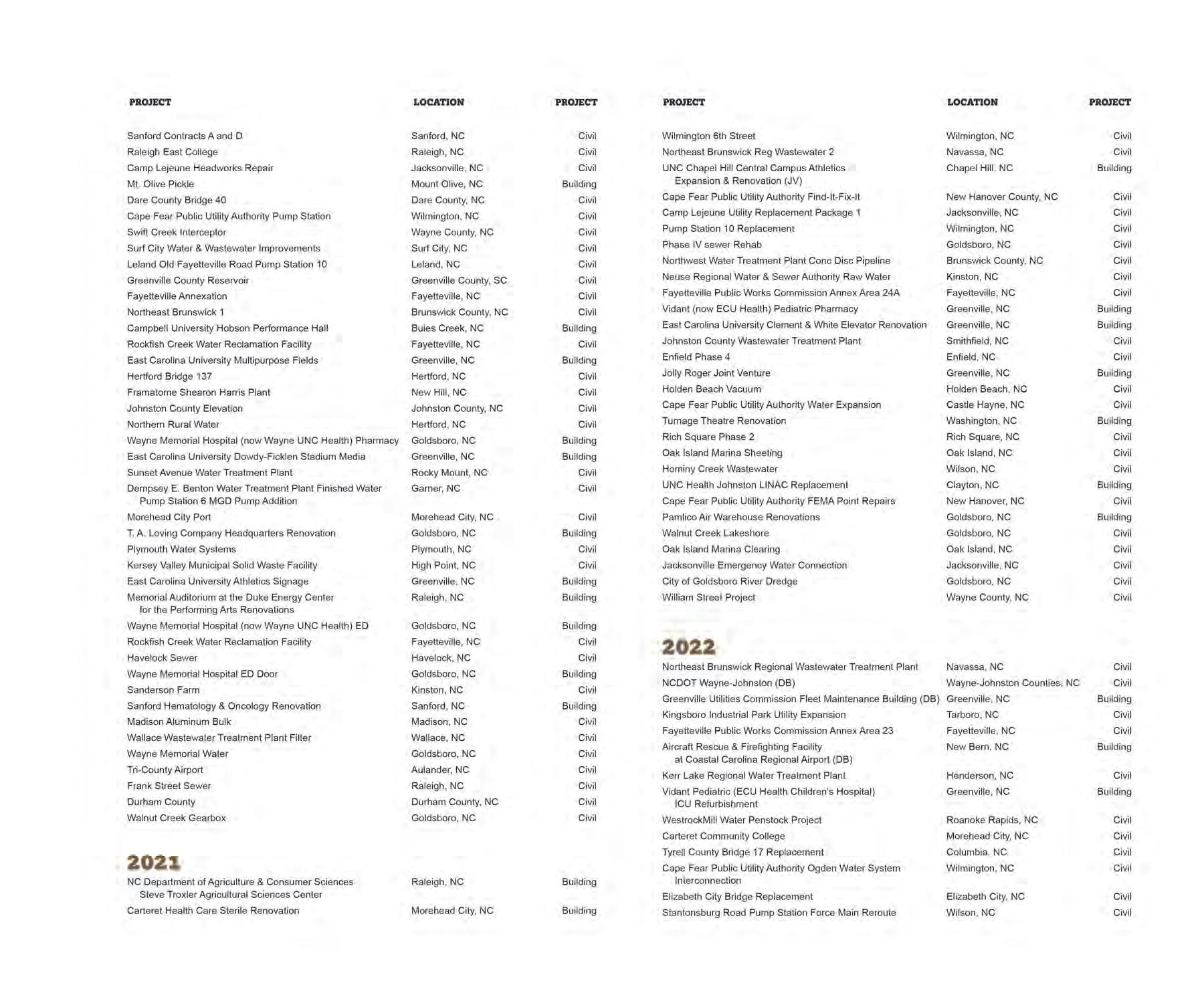
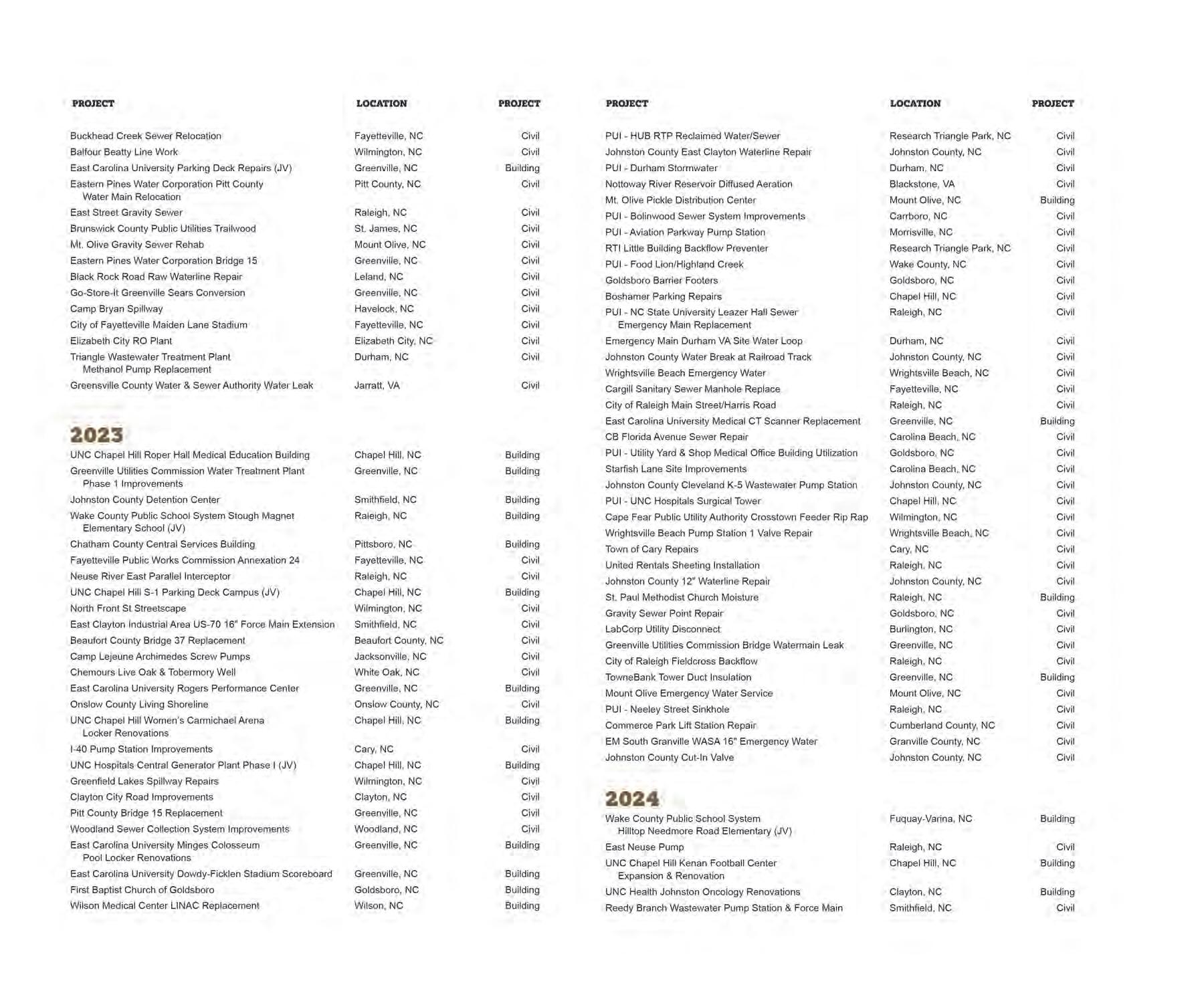
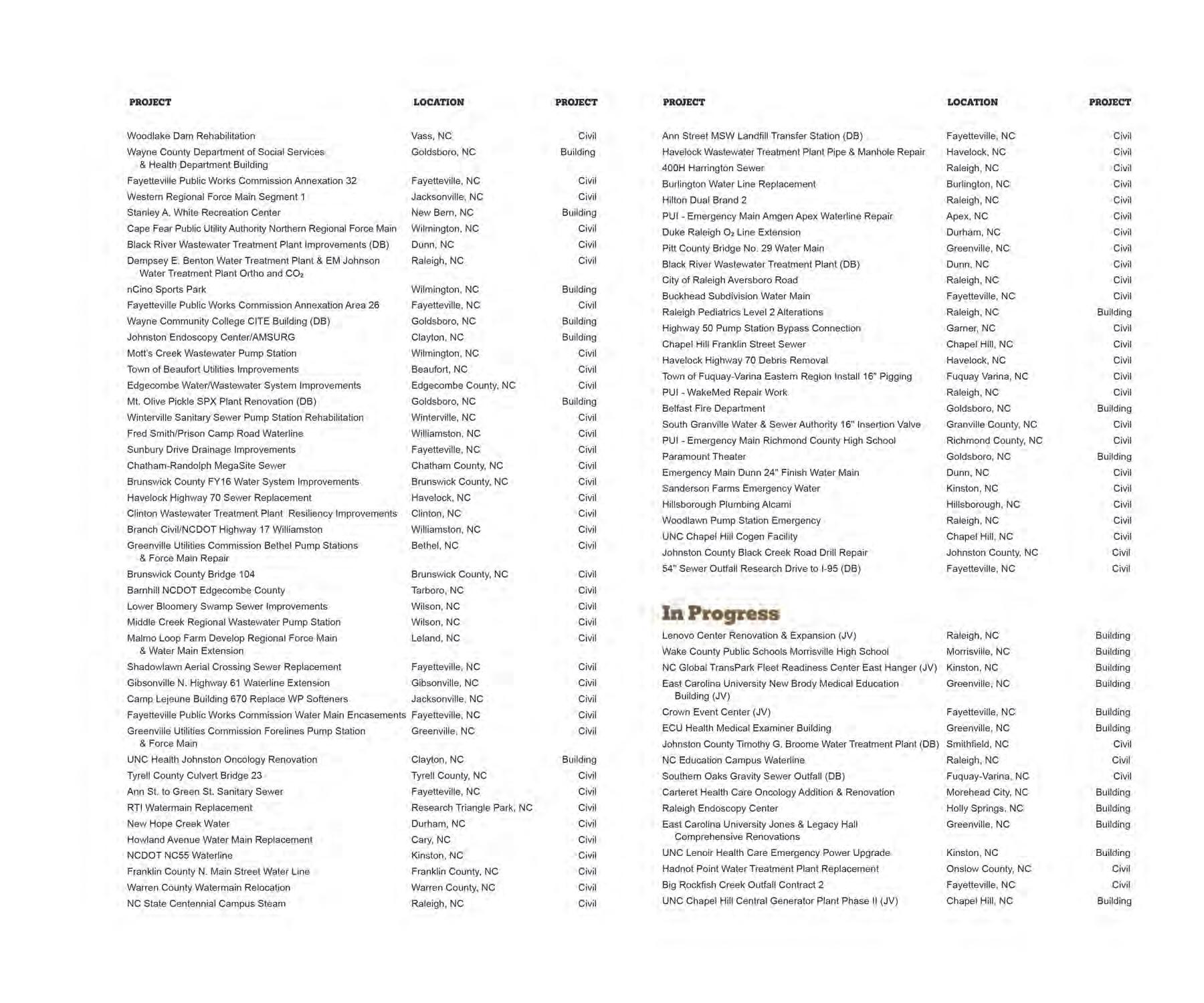
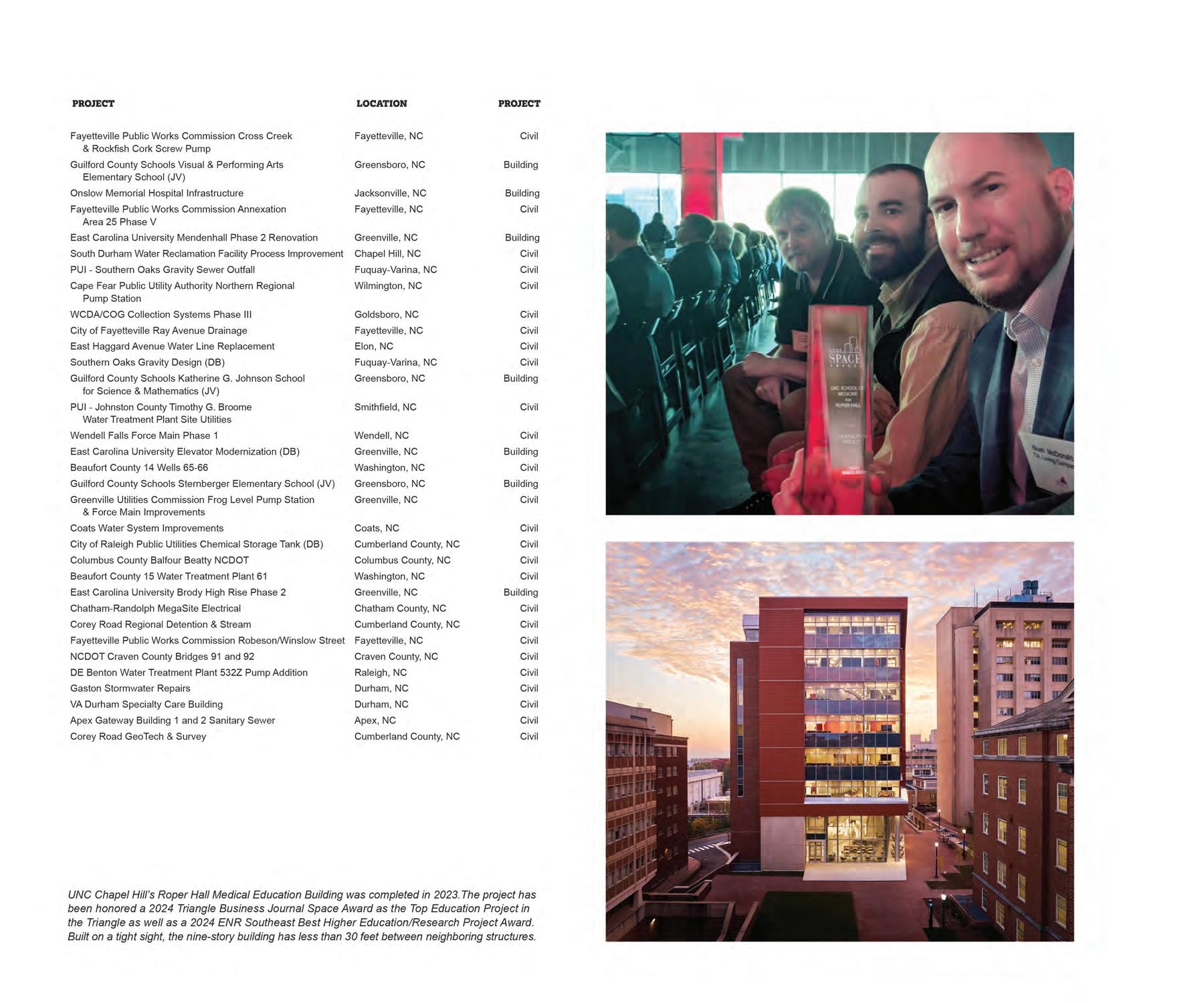


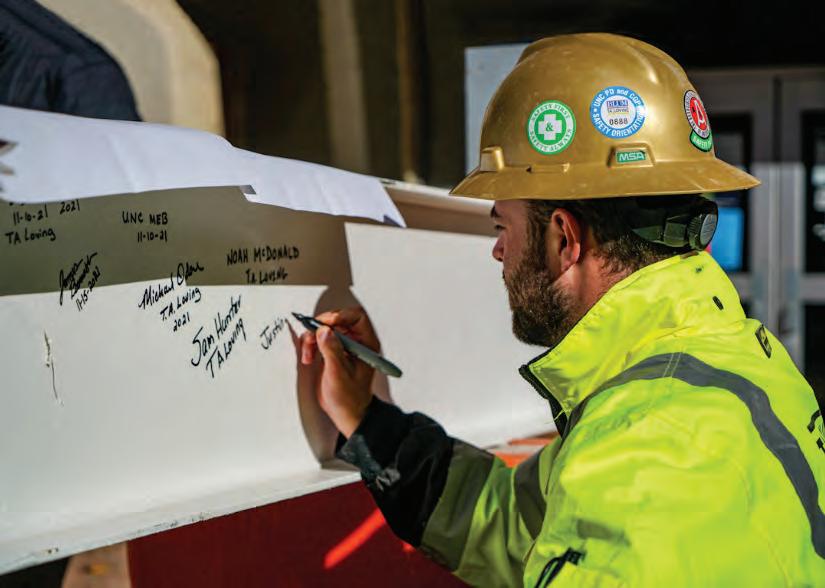
Justin Spears signs the final beam at the "Topping Out" ceremony for Roper Hall on the University of North Carolina Chapel Hill in 2022. The ritual is a long-abided tradition in the construction industry when the last beam is placed atop a structure and is thought to bring the building good luck. And with that, we "top out" this book chronicling the first century of T.A. Loving Company ... with wishes for many great years to come.