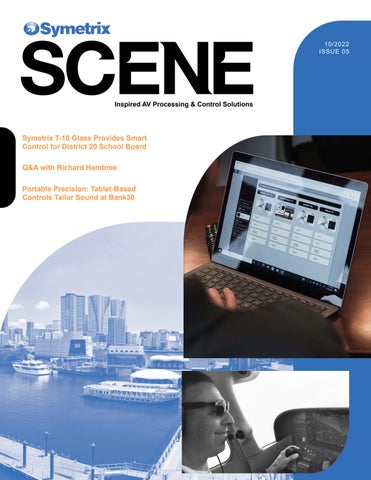

10/2022 ISSUE 05 Inspired AV Processing & Control Solutions Symetrix T-10 Glass Provides Smart Control for District 20 School Board Portable Precision: Tablet-Based Controls Tailor Sound at Bank30 Q&A with Richard Hembree
Are you a fan of Symetrix products with a project that would make for an interesting case study? Do you have an idea for an article or industry related news story? We look forward to working with you on an article or news story in our magazine.

Email Vin Keane vkeane@symetrix.co to learn more.
Share and subscribe for future issues.

Director of Sales & Marketing Ty Hawley Creative Director Unmi Yank Editor Rachelle Graham Vin Keane Graphic Designer Unmi Yank Contributing Authors Mark Graham James Ling Michael Fay Rachelle Graham Audio Brains Contributing Photographers Lambda Audio Brains Symetrix Letter from the CEO: Crafting Excellence Case Study: Portable Precision— Tablet-Based Controls Tailor Sound at Bank30 Case Study: Symetrix T-10 Glass Provides Smart Control for District 20 School Board 03 05 09 15 17 19 Expanded Conferencing Control With Intelligent Modules from Symetrix Q&A with Richard Hembree HR News: What’s So Special About SymFamily? 11 AV Insight: Going Way Beyond by Michael Fay (Abridged) © 2022 Symetrix Inc. All rights reserved

THE
03 SYMETRIX SCENE > OCTOBER 2022
LETTER FROM
CEO
We live in a boom town. There is so much work for contractors in the Seattle area that they are “cherry pickers,” often not interested in a project unless there are at least five digits on the checks you’ll be writing. So, over the years, my son Jake and I have become skilled at fixing, remodeling, and building just about everything—furnaces, fences, electrical, plumbing, roofing—or most anything else found in a house and small farm.
The upside to these projects is that I get to buy tools. And I love tools. I have, and cherish, very specific memories of my first experiences using certain “professional tools.” The Hilti hammer drill, my Stihl chainsaw, a Fluke multimeter, Snap-on ratchet, Delta table saw, Bosch jigsaw, Milwaukee sawzall, Kubota tractor, Bostitch finish nailer… I feel emotionally connected to each of them. Oh, the joys of doing good work enabled by the tangible quality of a professional instrument with excellent form and dependable function.
Here at Symetrix, we create professional AV tools that deliver the same spine-tingling joy that I get when using a well-designed professional tool for home improvement.
The concepts of craft and excellence in design and function are frequent topics of discussion here in the halls of Symetrix HQ. What does it mean for Symetrix products and solutions to be exceptional in design and construction? How will we give our consultants and integrators tools that help them provide extraordinary designs, bullet-proof installations, and superior AV experiences? What attributes must Symetrix products embody to deliver high levels of satisfaction and inspire our customers to say “Symetrix gets me!”
Here are a few points of discussion that are shaping Symetrix’s development of new technologies and products.
“Deliver exceptional performance and quality.”
We only create products and solutions we are proud of. Product performance is benchmarked against other best-in-class products, usually on a sub-system level. For example, studio preamplifiers are the benchmark for Symetrix’s award-winning audio signal path. Areas such as graphic user interface, industrial design, and processor architecture are benchmarked against products and industries both inside and outside of professional audio.
“Take a long and wide view of the field.”
We pay attention to trends and the achievements of others, and imbed these insights into impactful product attributes. We don’t make changes for the sake of change. Instead, we apply our experience to select the best materials and transform them into crafted excellence.
“Agonize over every detail.”
To us, every detail matters, mechanical, electrical, hardware, software, training, packaging. Everything.

“Develop products and solutions for those who value quality and excellence.”
Our goal is not to design things that appeal to everyone. Instead, we pledge to create products that will inspire fans and unify a community of AV professionals who themselves are in pursuit of excellence in their work.
“Put ourselves in their shoes.”
If we do it right, AV professionals will want to have their personal brand associated with Symetrix products. They should feel pride in their relationship with us and be inspired to create amazing systems.
I’m at a point in my life where I want to work with a team in passionate pursuit of excellence and craft. Mediocrity is not satisfying. Rachelle and I are growing Symetrix to be the crafted excellence tool provider for AV professionals, who are also in pursuit of their best work. We are committed to building a team of highly skilled and passionate people and to investing the time and effort required to bring products and solutions of crafted excellence to market.
If every system you design or deploy has your name on it, if every system is a living business card fueling your future business, then we are crafting Symetrix solutions for you.
Graham Symetrix Owner & CEO
Mark
SYMETRIX SCENE > OCTOBER 2022 04
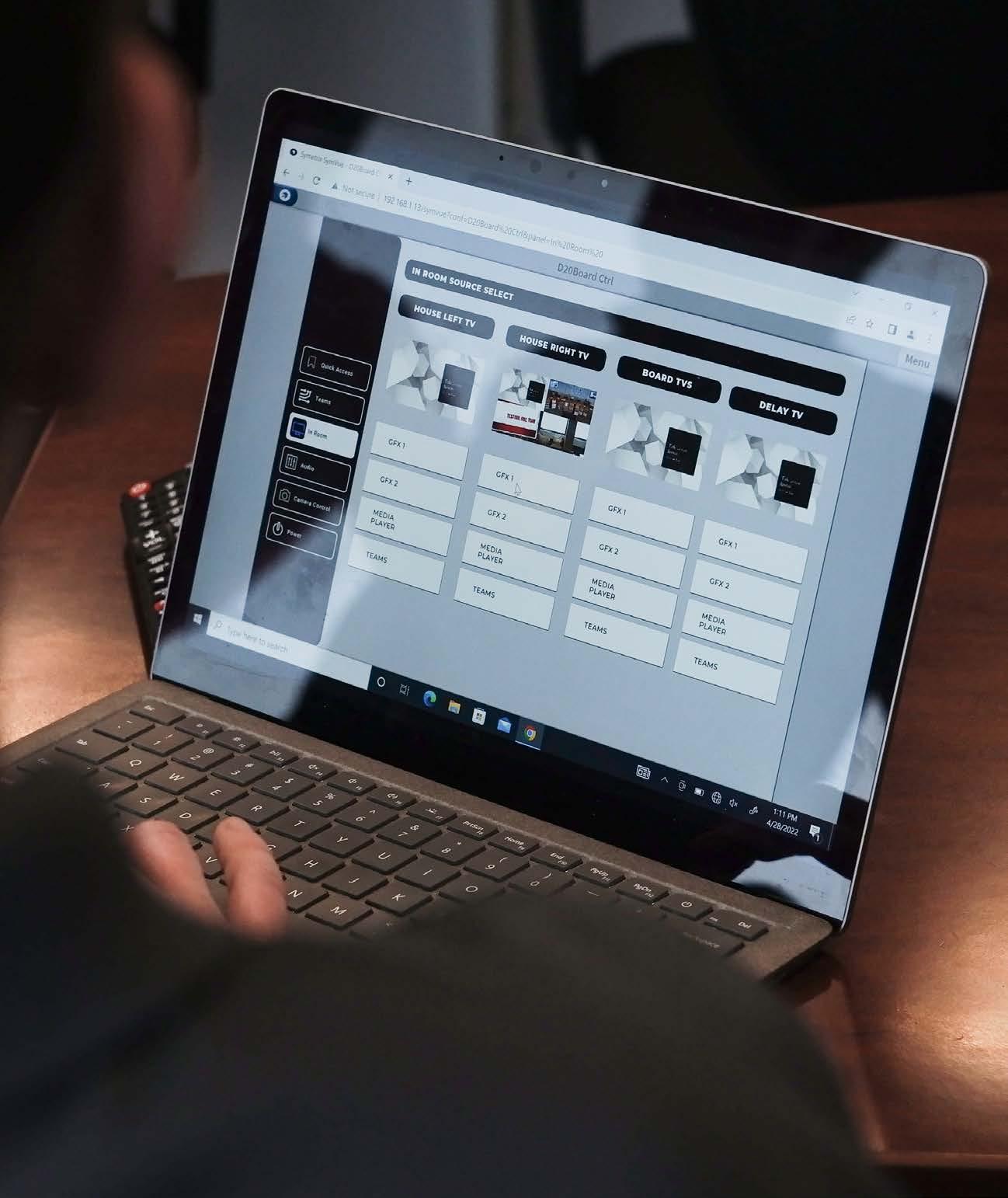
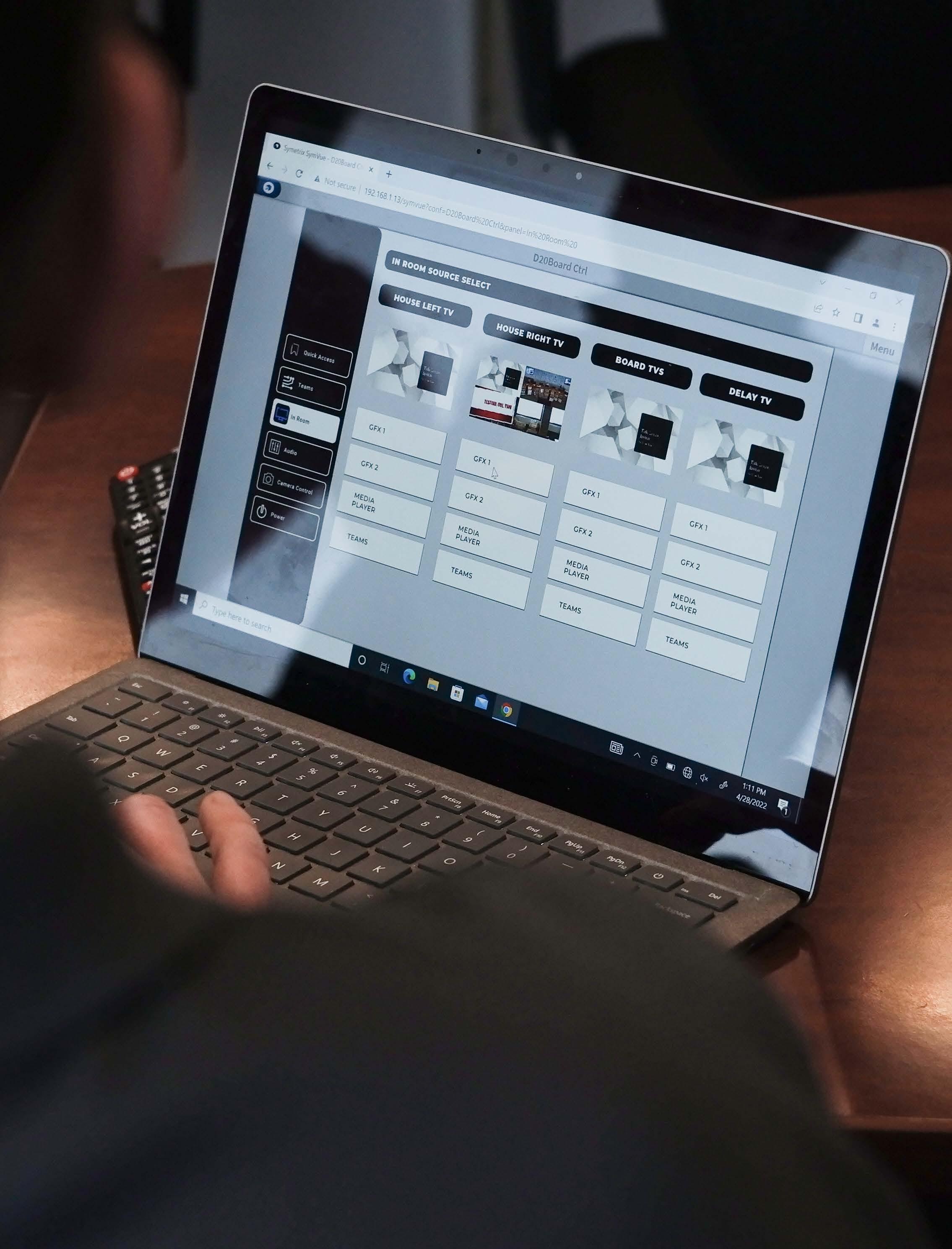
Symetrix SymVue Screen for system control.
05 SYMETRIX SCENE > OCTOBER 2022
Symetrix T-10 Glass Provides Smart Control for District 20 School Board
by James Ling
The rise of the hybrid meeting has seen new technology demands placed on every type of organization. The necessity of remote meetings created by pandemic lockdowns has turned into an expectation as more people embrace the flexibility of being able to join a meeting from anywhere. For some, the technology required to deliver this kind of meeting has created its own challenges, but for organizations like the District 20 School Board in Colorado Springs, Colorado, the right equipment has helped to enhance the experience.
The school board moved to remote meetings via Microsoft Teams during the pandemic which allowed their community to still engage with the process. However, this experience revealed that their in-room systems were not up to the task.
“They came to us to solve their problems with feedback issues, control issues, and stream failures,” said Ryan Durbin, Owner and Integration and Sales Specialist at Lambda Audio Visual. “The place we began was the control system. We knew exactly what equipment we wanted to use.”
The first choice for Ryan and the Lambda Audio Visual team was Symetrix. “We love Symetrix control systems because they provide an ease of use and flexibility of design that is unmatched,” he said.
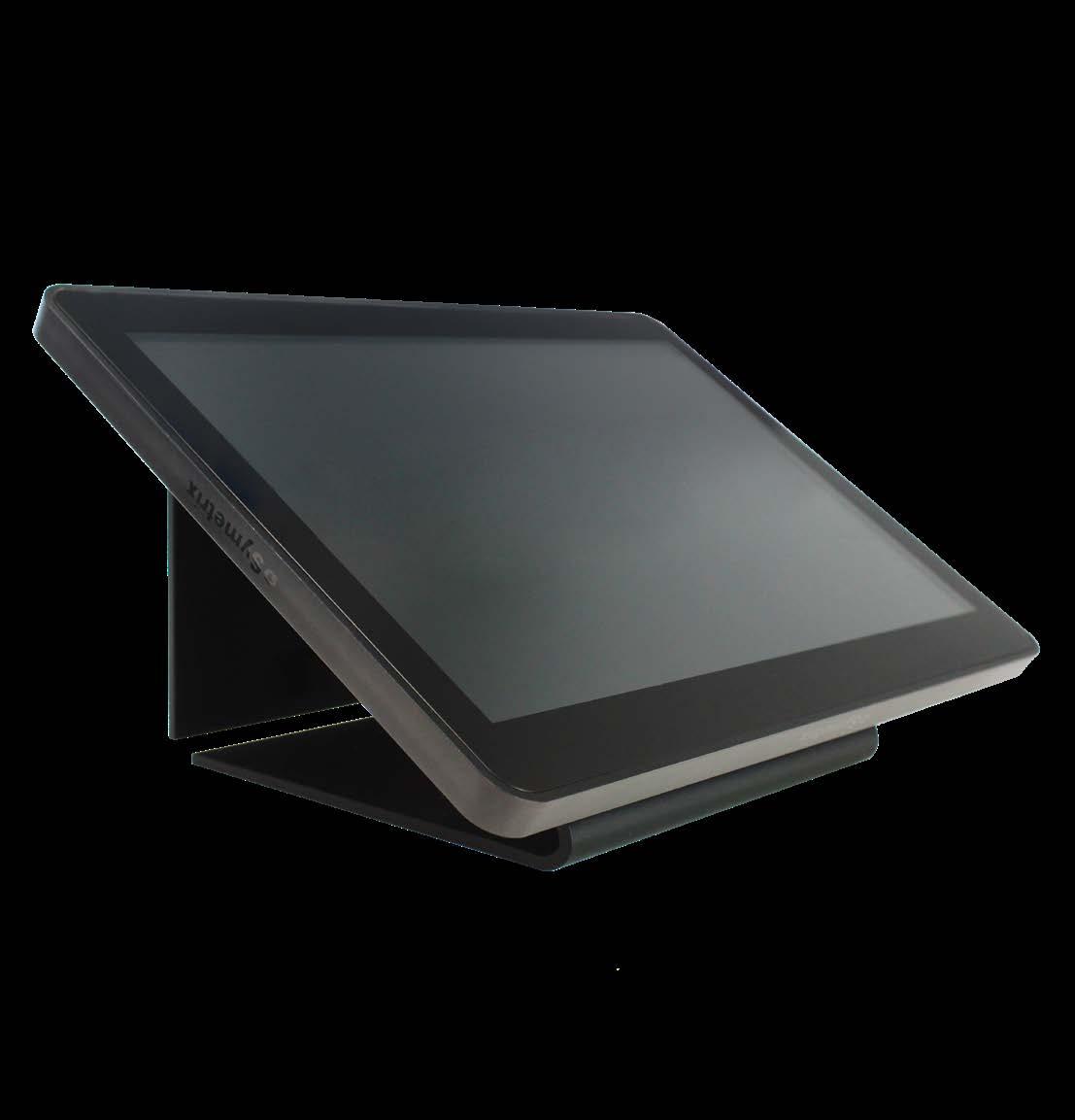
Symetrix T-10 Glass.
“The school board room had a fairly large number of inputs
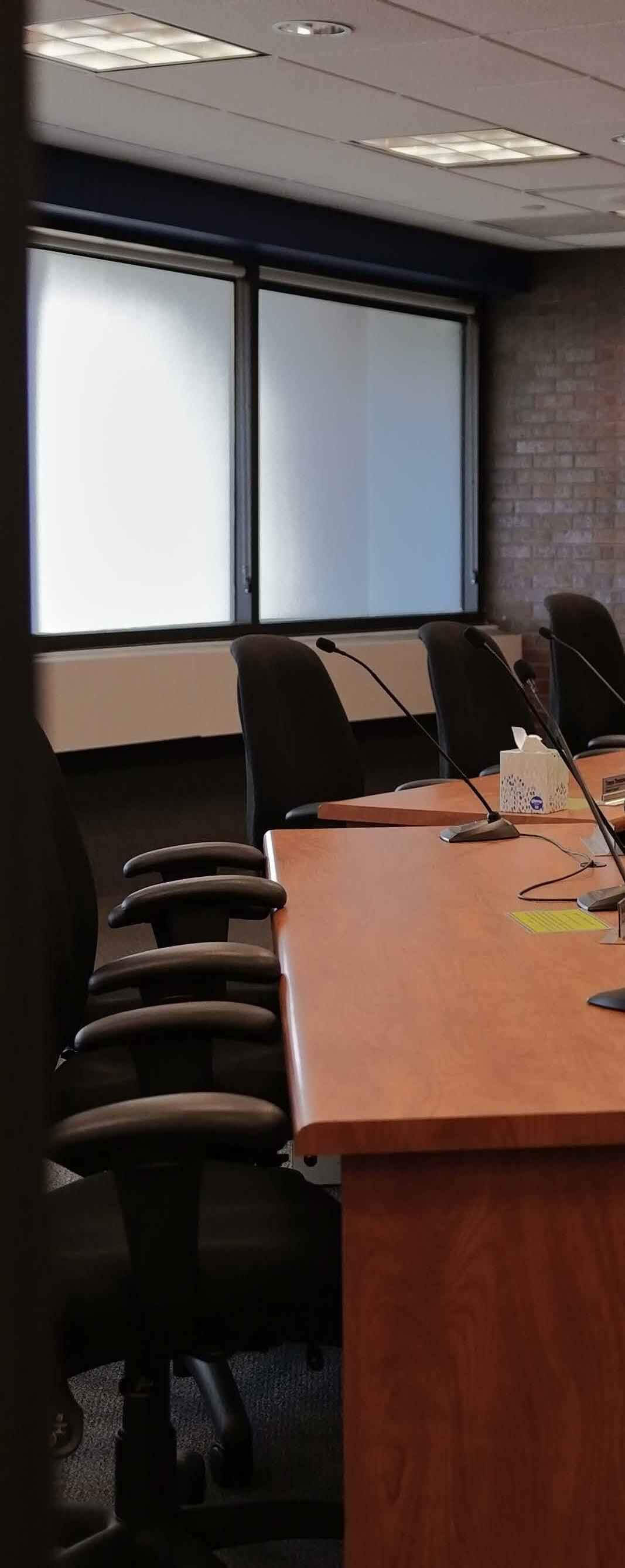
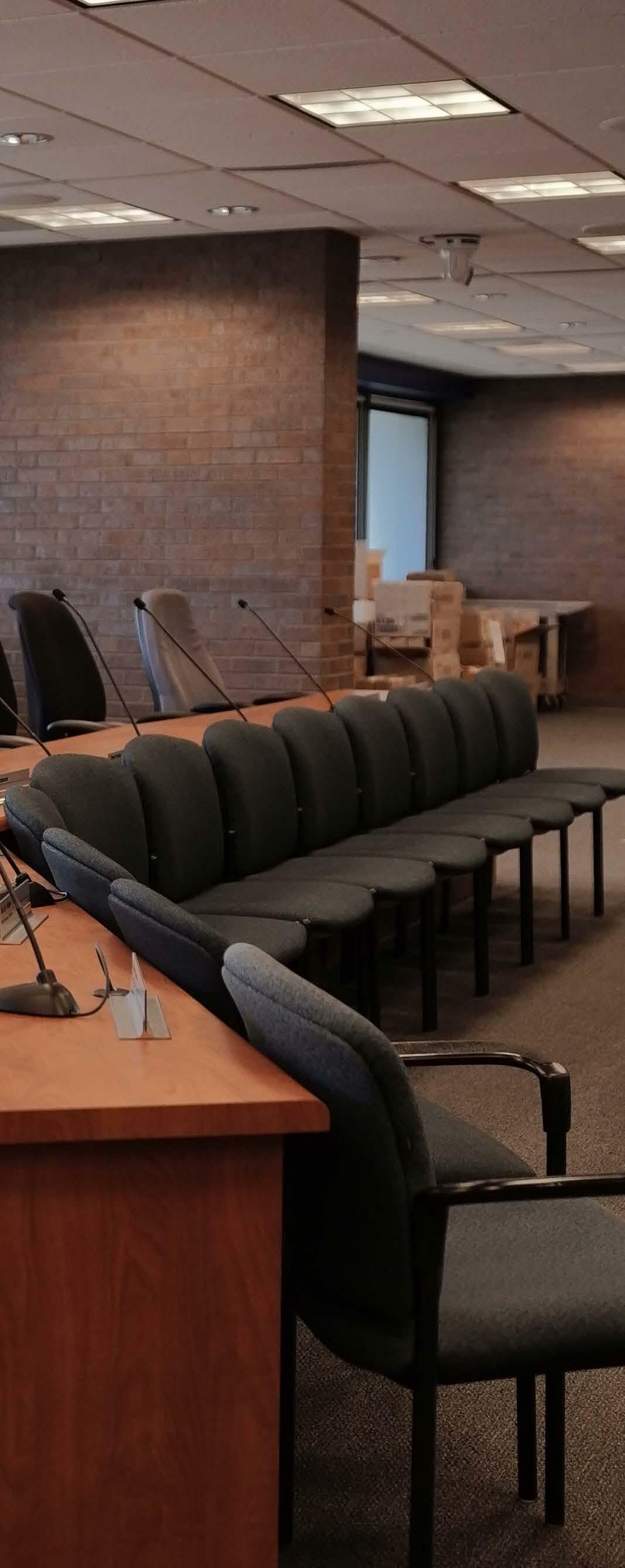
eight cabinet members, a lecture mic for community members, and eight wireless mics,” Ryan said. “This is a lot of audio for a small space especially when they wanted local reinforcement over ceiling speakers and to be able to tie in to a live event feed for public streaming, and add remote callers. Symetrix allowed us to take a modular approach and break the audio into three major areas: the board desk, the District 20 cabinet member desk, and the rack/wireless area.”
A further challenge arose as the result of global supply issues for Dante chipsets. “Originally we had looked at using one Symetrix processor and two Dante expanders wired remotely but with Dante chip shortages this quickly became an issue,” he said. “Symetrix, though, had our back and released non-Dante versions of their processors quickly allowing us to tweak the design and use analog connections instead.”
With new products to select from, Lambda Audio Visual decided the best solution for this project was a Symetrix Radius 12x8 fixed I/O, open-architecture digital signal processor with dual AEC coprocessor and a four channel analog input expander. This was combined with a Symetrix Prism 12x12 DSP with 12 analog inputs and outputs and a Prism 8x8 DSP with eight analog inputs and outputs. Finally, a T-10 Glass touchscreen with table mount provided intuitive front-end control.
CASE STUDY
SYMETRIX SCENE > OCTOBER 2022 06 (continued on next page)
(continued from page 6)
“The two Prism DSP units are mounted one at each desk as auto mixers and EQ, sending their mixdown to the Radius DSP unit, bringing together the two remote units as well as local audio I/O to Teams and wireless mic I/O,” Ryan said. “Automixers are amazing and the Symetrix modules did not disappoint in their ability to control gain structure for a large amount of open mics with virtually no adjustments, and even detect and remove feedback from within the room.”
Lambda Audio Visual decided to combine the Symetrix audio solution with a video-over-IP system from Visionary Solutions. “Symetrix and Visionary communicate using a built-in API, which let us control all of the video options in a user-friendly interface,” he noted. “This allowed us to have everything controllable from one place and even include on-screen previews of what is being sent to each of the two TVs on the walls for main audience viewing or Microsoft Teams.”
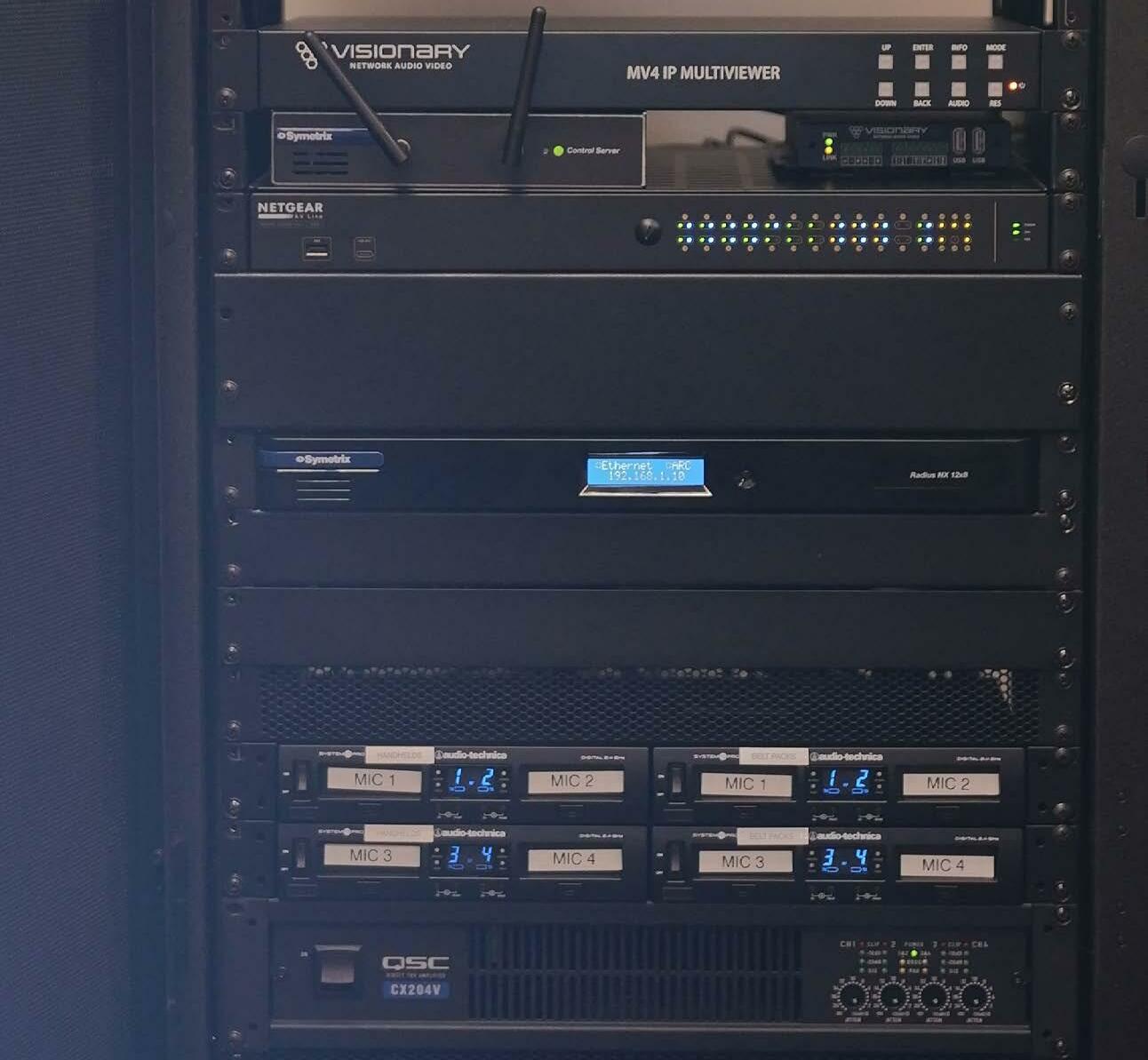
To design the user interface, Lambda Audio Visual’s Trevor Fisk, Shop Manager and Install Lead, and Matt Waresak, Install Tech and Control Systems Engineer, turned to Symetrix’s Composer™ 8.3 software. “I approached designing the initial sketch up of the D20 with the mindset of operating it myself,” recalled Trevor. “I have done a fair bit of running multiple systems as a single operator, so I wanted to make it super simple and intuitive, but also to have control over the whole system. The entire control system is no more than two button presses away, with most of it being one button away. Also, I really like the ability to run the majority of a show from one control screen, so we built that functionality into this system as well. I built out what I thought would be the

07 SYMETRIX SCENE > OCTOBER 2022
“
Ryan Durbin Owner and Integration and Sales Specialist at Lambda Audio Visual
We love Symetrix control systems because they provide and ease of use and flexibility of design that is unmatched.”
Rack with Symetrix Radius
NX
‘dream system’ and then Matt was able to take that vision and build out what the system was able to accomplish and make it look and feel great!”
“Control systems user interfaces can often feel archaic and a far cry from the streamlined interfaces and apps most consumers are familiar with,” Matt said. “We wanted to move away from that older style and provide a control interface that felt clean and intuitive to operate while not sacrificing any capabilities. Symetrix’s Composer software enabled us to fulfill those goals and gave us the tools and infrastructure on which to build our design interface. Most of the layout and menu formatting stayed relatively unchanged from the initial wireframes created by Trevor, with just a few adjustments in the design. The main menu shifted from along the bottom to the side to give it slightly more prominence in the design and aid in navigation. We structured the menu in a top to bottom format, with the most frequently used sections at the top and cascading downward. We then moved on to more in-depth mockups from the rough wireframes, giving us a solid starting point to work with as we built and integrated our design elements with the controls in Composer. As the interface developed, we made additional minor changes to ensure the placement of the controls not only made logical sense but functioned smoothly in practicality.”
This user-friendly interface is accessed via the T-10 Glass touchscreen with its 10.1-inch, 1920x1200 display. Thanks to its functionality, this recently-released touchscreen became the obvious choice for Lambda Audio Visual. “The T-10 Glass was able to offer us the large display the school board required for meeting control,” Ryan said. “It is also easy to use and offers high reliability compared to a computer.”
With the solution installed and in regular use, Ryan has been impressed by the outcome. “We love the final result as it’s easy to use and works time after time with no issues,” he reflected. “The client loves the reliability and flexibility of the system and comments regularly on the clarity of the audio and automixer. It’s a system that should last for years to come.”
External links:
SYMETRIX SCENE > OCTOBER 2022 08
Lambda Audio Visual website
District 20 Schools website
District 20 School Board room.
Expanded Conferencing Control With Intelligent Modules from Symetrix
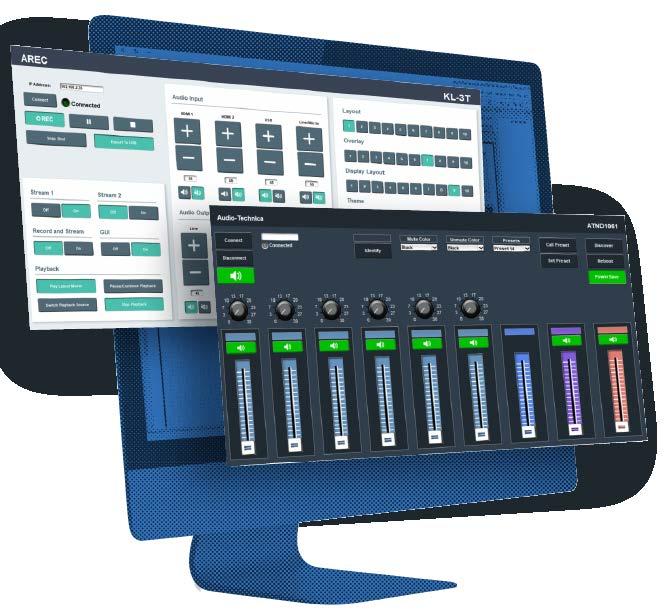
Conferencing Intelligent Modules

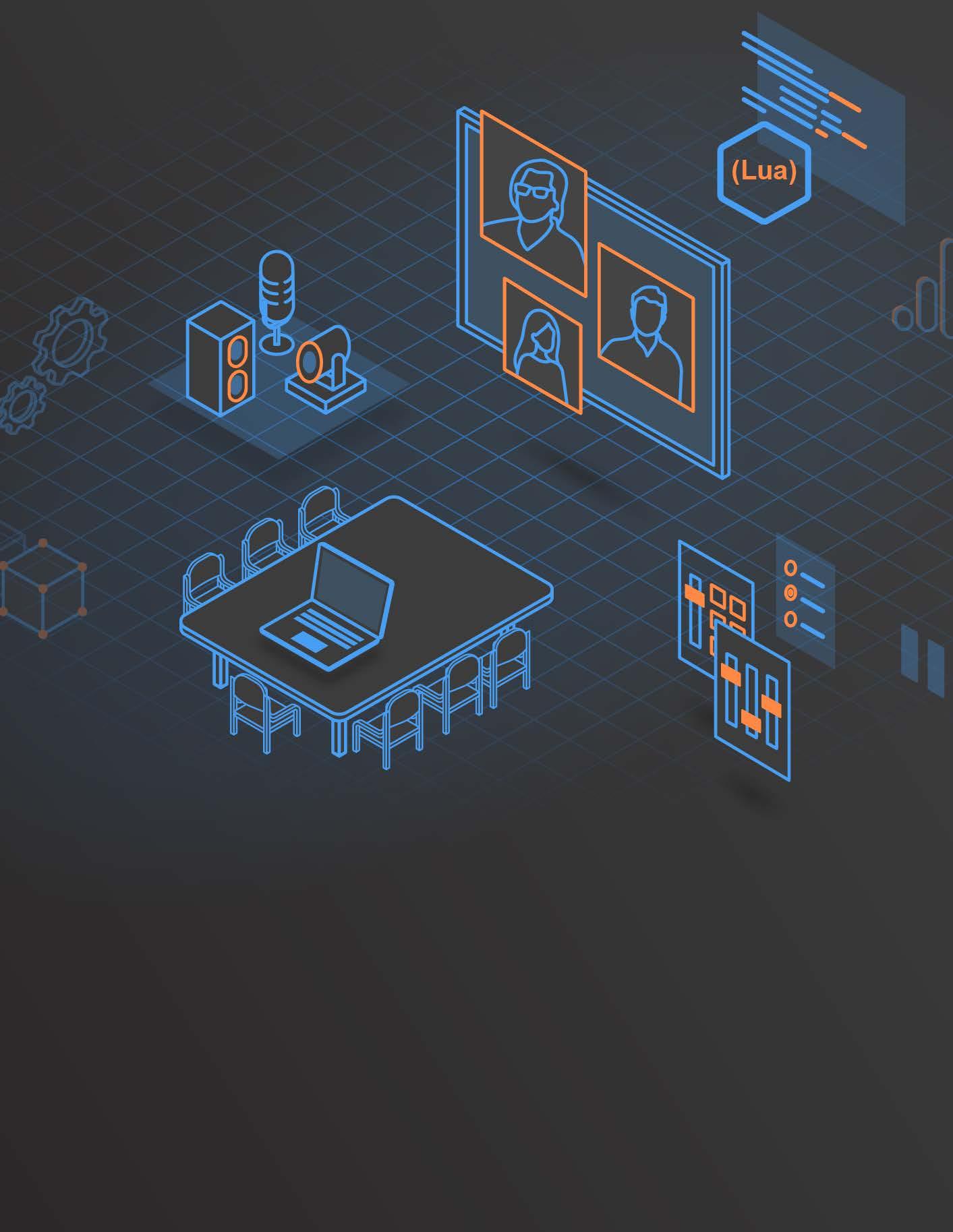
Symetrix Intelligent Modules expand the capabilities of a Composer™ site file with customizable control of third-party devices and powerful manipulation of control data within a design. We’re working with leading component manufacturers to build a collection of easy-to-use Intelligent Modules that will throw some mustard on your average conference room with mods for cameras, mics, video switchers, media device stations, and more.
Symetrix Control Library
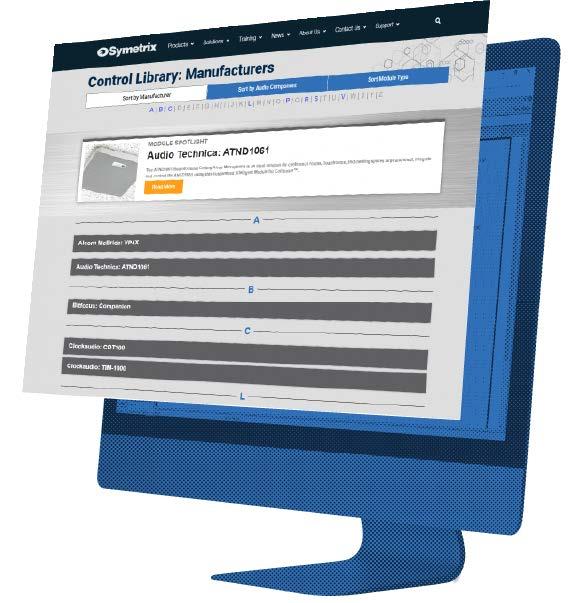
Access to Symetrix control modules is even easier now with our dedicated online Control Library. This free resource on our website allows you to browse plugins by related manufacturer, component type, and module technology. Download and install with a few clicks and deliver custom experiences for your clients.
Browse and download free modules from the Symetrix Control Library.
09 SYMETRIX SCENE > OCTOBER 2022
Join our Field Application Engineers for a ‘What does this button do?’ Conference about Conferencing event. They’ll discuss what is needed to design a conference room and how our conferencing mods can help you overcome some of the most common challenges. In real-time they will configure the mods in a site file and show off the functionality from an end-user perspective. Join us and answer the big question “What does that button do?” Participants will receive an awesome ‘Engineered in Seattle’ Symetrix T-shirt!
Join Quinn & Stu for Our ‘Conference About Conferencing’ Event SYMETRIX SCENE > OCTOBER 2022 10 November
10 9 AM - 10 AM PST Sign up today!
Complex Automixing Using a Virtual Digital Mixing Console (Abridged)
by Michael Fay
The following are highlights from an article by Michael Fay. Please visit www.gracenoteds.com for the complete text.
With a quality DSP engine and some good old-fashioned RPI (real person intelligence), we can create a complex microphone mixer that pushes way beyond the traditional boundaries of automixing. Traditionally, automixers, be they NOM (number of open mics) or GS (gain-sharing) topologies, are meant for voice reinforcement, excluding musical instruments. This article introduces automixing concepts that provide recall, management, and control of both voice and musical instruments, while documenting the idea of using a DSP engine to custombuild virtual digital mixing consoles, with or without a graphic user interface.
Needs Analysis
I hope most readers understand that automixers don’t actually “mix” input signals such as musical instruments and vocals. At best, they “manage” the overall output gain of the various microphone signals that are being controlled. Generally speaking, automixers are the wrong tool to use if you have to deliver a live, dynamic, musical production. The digital signal processing (DSP) software described herein comes as close as currently possible to blending the features and convenience of an automixer, with the tools available from a physical, digital mixing console.
Houses of worship, corporate, government, institutional, and educational customers all have a need to consistently present goodquality audio. But all too often, these organizations haven’t the talent and/ or budget to employ a staff audio person. A janitor or unpaid volunteer is usually tapped to turn the sound system on and off, and maybe set up a few mics. At best, they’re working with an old-school, analog, 8-16 channel automixer that employs either NOM or GS algorithms to help manage input levels and gain-beforefeedback. Or worse, an old TOA-style mixer amp, using little blue dots to indicate the appropriate volume setting on each channel. Back in the late 1990s, digital signal processors were coming to market at a fairly manageable price point. This is where this story really begins.
What would you do?
Last century, circa 1998, I was hired to provide audio and acoustic design work for a new Catholic Church sanctuary in Garden Grove, CA (Figure 1). During our first planning meeting the priest and choir director said they have seven choirs. They wanted a large mixing console so each choir could have a dedicated number of input channels to use. Say what? My mind was pinballing. After digesting their request for a minute, I told them the idea would never work well in the analog world, and digital consoles were still way too expensive
for their budget. They needed something in the neighborhood of 48 inputs to accommodate all their various “choirs.” As I quickly explained, it wouldn’t take more than a few weeks before all the dedicated fader strip settings would become a chaotic mess.
It occurred to me that I could build a virtual digital mixer (VDM) and give them a custom, graphic user interface (GUI) touch screen. The process included mic selection and placement training; floor box channel assignments; optimization of preamp, EQ, and dynamics settings; and aux buss assignments and routing. At the end of each rehearsal/sound check the mixes were saved as a preset, with the name of the choir prominently displayed as a dedicated touch screen button on the Home page. Fader levels and aux sends for monitors could be manually adjusted as needed, but the presets always returned to the parameters of the baseline mix. All system-level gain structure, routing, EQ, crossovers, dynamics, and master output levels were set during the initial system commissioning. These were locked down and unavailable on the GUI.
This approach is obviously timeconsuming, but ended up working so well that over the years I proposed and sold virtual digital mixing systems to several house of worship, corporate and educational facilities. Shown below are several of the GUIs and schematics I developed over the years.
What’s Under the Hood?
The VDM examples shown throughout have many things in common that aren’t obvious when looking at the main GUI screen. In addition to all the necessary output routing and loudspeaker processing, each input has been carefully “dialed in” to capture and save its appropriate settings for the following:
11 SYMETRIX SCENE > OCTOBER 2022 AV INSIGHT
A. Gain structure.
B. Multi-band parametric EQ.
C. Compression.
D. Where appropriate, gain-shared automixing with priority and side-chain-filtering.
E. Aux sends for recording and fold-back monitoring.
Other features common to most systems:
A. A nominal -5 dB fader reference, based on mic selection and optimal preamp trim.
B. Real time fader level readout on each input channel.
C. A functional label for each channel.
D. Signal and clip meters for each input.
E. Output meters for main mix, recording busses, and monitors.
F. Input channel “solo” buttons that feed the enclosed booth monitors.
G. Control room monitor volume control, mute, and meter.
H. While these DSP engines are always powered on, some systems have other equipment that is powered on and off through a sequential power distro. A status light is incorporated to indicate that everything is powered up.
Depending on the customer’s needs, the discrete input channel EQ buttons open a fully-functional parametric EQ. For some systems, each channel has two, multi-band parametric EQs. The first in the signal path is optimized during the rehearsal/sound check process and saved in the various presets. The second EQ is provided to customers who occasionally have a trained operator. Again, depending on the needs of the customer, the discrete input channel Mon buttons open a 2- to 8-channel (pre- or postfader) bank of aux sends.
Selecting the Right DSP Engine for the Job
Should you decide that building a VDM is something you want to try, or hire out, here is a short checklist of things to consider when selecting a DSP engine:
A. Sampling rate – 48 kHz is plenty.
B. Processor speed – Something in the neighborhood of 300 MHz or greater.
C. Raw processing capacity – 300 MIPS and 1.2 GFLOPS, or greater.
D. Architecture – Open, as opposed to fixed.
E. Audio I/O formats – Analog, AES, Dante, USB, and/or other digital formats as required.
F. Non-audio I/O options –DC Control logic, RS-232, RS-485, and Ethernet as needed.
G. Fully customizable controls and meters, which allow for optimized layout, visibility, usability, color choices, font types and sizes, and user engagement.
H. Graphic options – It’s important that the GUI graphics are scalable to most modern video display resolutions and aspect ratios. Also, for full-featured, desktop VDMs, you’ll want to use a monitor that is no less than 17”. 24” to 27” seems to be ideal for most applications.
I. Mouse and keyboard vs. touch screen – This is purely a customer/ application-driven choice. Both will work. Some use a touch screen with a mouse and keyboard.
More often than not, I specify and use Symetrix processors because I’m familiar and comfortable with their hardware and software. Designing a really nice DVM is not easy. When given the option, I’d rather use my time working on the initial design than learning how to manage and manipulate a new software platform.
(continued on next page)
SYMETRIX SCENE > OCTOBER 2022 12
Figure 1 – St. Callistus Catholic Church. Pew seating for 950, and 1,200 SRO. This is the site of my first VDM.
Final Thoughts
While the projects described only show samples of what can be done with Symetrix and Media Matrix processors and software, companies such as QSC, Lectrosonics, Biamp, and others offer customizable GUI options that can be configured to perform similar functions.
Experienced designers can customize and deliver an audio system interface that includes as much or as little as needed. For sophisticated systems like those outlined, the things that make the difference between success and disappointment are a willingness to carefully select the right equipment; having the skills and time to build and fine-tune the appropriate mixes and presets; and providing high-
quality training and support to the end user. If your VDM designer is brilliant, and has all the latest training certs available, but has little or no experience mixing live sound – or access to someone who does – this approach will not work very well. If this VDM approach seems like something that would fit your needs, talk to your local systems integrator and find out if they have done this before. Ask to see examples, and talk to the end users of those systems. You don’t want to start a project like this without having confidence that the end result will meet everyone’s needs and expectations.
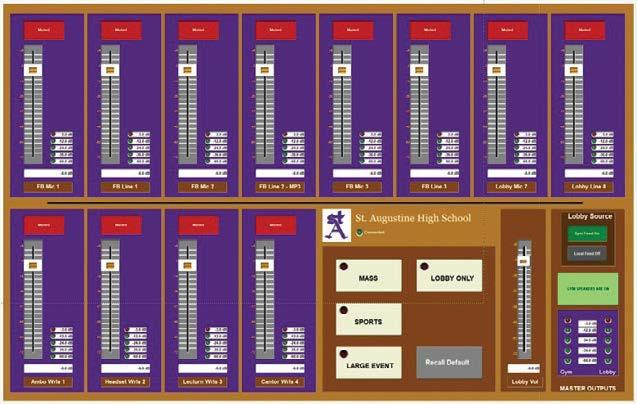
St. Augustine High School Gym, 12 input GUI: Built for Operation on a Wireless Tablet Using Symetrix DSP and Composer™ Software, circa 2017
• Multipurpose venue, with morning mass, basketball and volleyball games, graduation ceremonies, community events, fund-raising events, etc.
• System operated from either GUI, and/or a Dante-based Yamaha TF3 mixing console and stage box.
• Allows for staging and operational control positioned along the front of any of the four major interior walls.
• Staging and operational flexibility accomplished using Dante snakes between a Yamaha TF3 mix console, Symetrix DSP, and Tio1608-D stage box.
• The wireless tablet has the Symetrix SymVue application installed, and connected via a dedicated, secured, WiFi channel.
Temple Solel Synagogue: Built on Peavey Media Matrix NION, circa 2005
• A multi-room venue with air-wall dividers between the main sanctuary and three additional halls.
• A fully-enclosed sound room with no operable window located on the second floor, overlooking the house-left side of the sanctuary.
• Presets (including room combining) can be accessed for each of four rooms requiring audio control by double-clicking any of the four colored blocks.
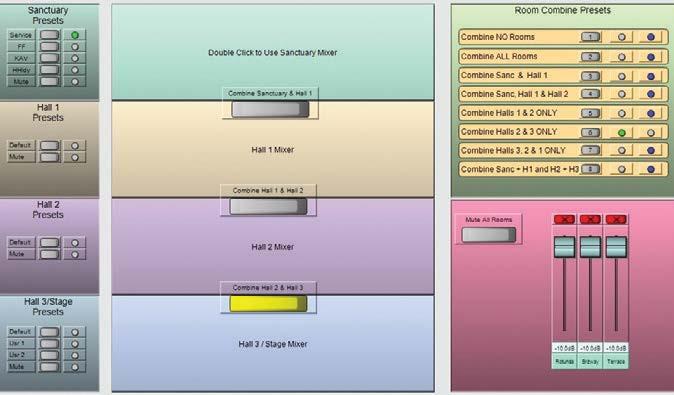
• Volunteers operators had enough experience to recall the various presets and make real-time adjustments to pre-amp trims, fader levels, channel EQ, and monitor and recording mix busses.
• A small 10-input GS automixer was used for the key rabbi, cantor, reader, and bema mics which are left on at all times and used during most services.
• All channels have high-pass filter, parametric EQ, aux sends, and dynamics stored in the various presets. None of the operator’s real-time adjustments could be stored.
13 SYMETRIX SCENE > OCTOBER 2022
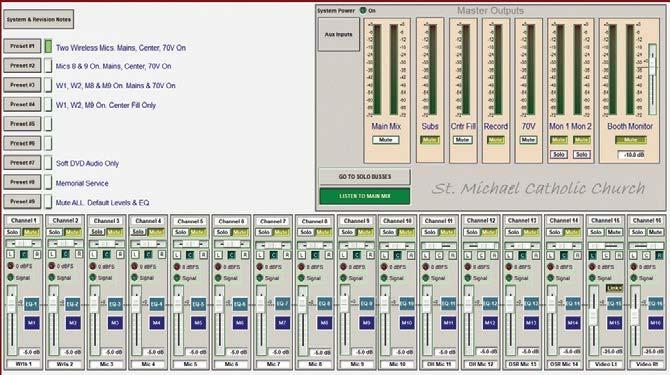
• A large multi-purpose room with recessed stage and fully-enclosed sound room.
• To support a variety of events and activities several preset scenarios were provided.
• Notice the pan control on each channel strip. The loudspeaker system was a quasi LCR configuration. The main mix is stereo, but for very small events, a single center channel loudspeaker is installed above the stage.
• Each channel could be “soloed” on booth monitors without interrupting the house mix.
• System did not have a GUI. Hands-free operation of 20 inputs.
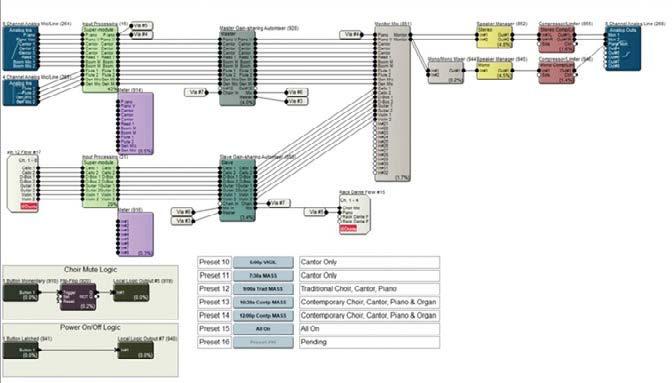
• All mic inputs run through the sophisticated GS automixer modules (Master and Slave).
• Two Symetrix Radius 12x8 DSPs, and a xIn-12 were required.
• Preset recalls managed through Symetrix ARC wall panels located in the choir section of the sanctuary seating, and in the church vestry.
• System managed two priest wireless lavalier systems, the altar, ambo, choir, acoustic piano, acoustic guitars, electric bass, flutes, clarinet, violins, cantors, as well as aux sends for two floor monitor channels.
• The system is dialed in to a degree that all mics can be active and stable, without feedback issues. However, to maintain optimal control each preset muted all mics that are typically unused for a given service.
• Users select appropriate preset based on a standard naming convention, typically the day and time of the services being offered (ie, “8am Sunday”).
• Limited-range (+/- 3 dB) volume control for the priest’s wireless mics, and the ambo mic, provided via an ARC panel.
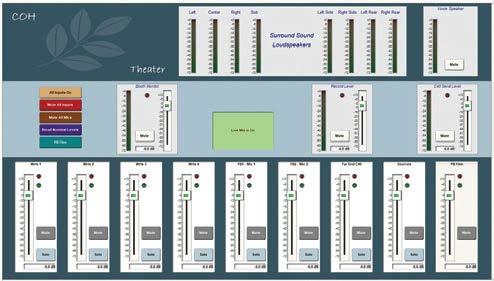
• Unique theatre for video conference, lecture, and training room, as well as a full-scale cinema, with 5.1 surround sound.
• One enclosed booth serving the theatre, and a second large auditorium, was designed for simultaneous use.
• Loudspeaker and headphone monitoring busses provided for each system so two operators could work together without distraction.
• Fader 9 on the far right is a sub-group master fader that controls all six channels of the 5.1 surround source material.
Michael Fay is owner/principal at GraceNote Design Studio, an audio, video and acoustic design consultancy.
Read the full version
 St. Michael’s Catholic Church 16 input GUI: Built with Symetrix DSP and SymNet Designer, circa 2011
Nutrilite Products Theater: Built on Symetrix Radius Processors and Composer, circa 2015
San Rafael Catholic Church 30 Input Processing Schematic: Built with Symetrix Composer.
St. Michael’s Catholic Church 16 input GUI: Built with Symetrix DSP and SymNet Designer, circa 2011
Nutrilite Products Theater: Built on Symetrix Radius Processors and Composer, circa 2015
San Rafael Catholic Church 30 Input Processing Schematic: Built with Symetrix Composer.
SYMETRIX SCENE > OCTOBER 2022 14
by Rachelle Graham
There’s something about Fall that feels significant. Cooler temperatures, changing colors, falling leaves, pumpkin patches and family gatherings. Perhaps it’s the opportunity to slow down and take a moment to be thankful for the abundance in our lives, whatever that is for each of us. Maybe it’s having good work, working with great people, and having fun while doing it. Maybe it’s the meaning and purpose behind the work we do. Whatever it is you’re grateful for, Fall offers up ripe opportunity to express it.
In this season of thankfulness, we’re especially grateful for the SymFamily. SymFamily is the term we use to describe ourselves here at Symetrix. Honestly, it feels really good to be part of this family. We’ve been incredibly blessed over the last couple of years, with so many disruptions and challenges in the world, to be able to work together in our offices near Seattle where we can connect with one another daily. Chatting over that morning cup of coffee, working together on shared goals and supporting each other through the ups and downs of life.

I’ve heard people say that a business shouldn’t aspire to be like family (or couldn’t be like family). I guess it depends on the culture of the organization and what its ultimate goals are. If your vision is to deliver great products, develop people and be a force for good in the world, then operating
HR NEWS
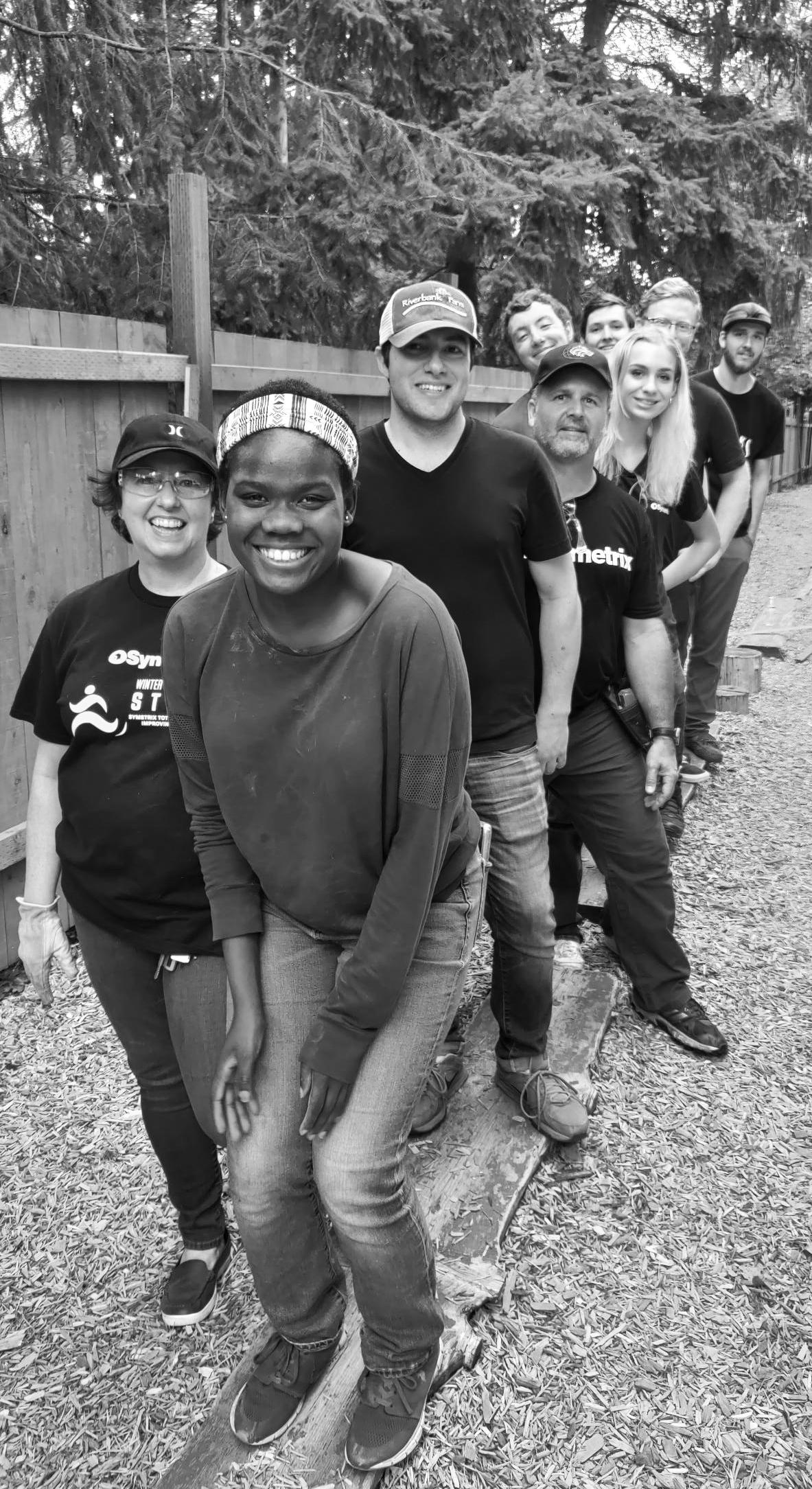
SymFamily volunteers help build a fence for a local homeless shelter’s playground.
I came across this quote the other day from Kenneth Krantz, a financial advisor with Grezlik, Krantz and Associates that says it really well.
“I look at family as those who care about you the most and want to see you grow and flourish. Helpfulness, respect, health, integrity and cooperation are my core values; my family understands my values and I understand their values. Through understanding of each other’s values, we arrive at a mutual respect and support. People with open hearts and a willingness to accept you for the human that you are. Even when things go wrong and crisis faces you, you can always depend on family. Family brings you back to your values and helps you make good decisions.”
Who doesn’t want some of that in their life? We all want to grow and flourish. Shouldn’t the organization support and encourage that, too? By operating with shared values and
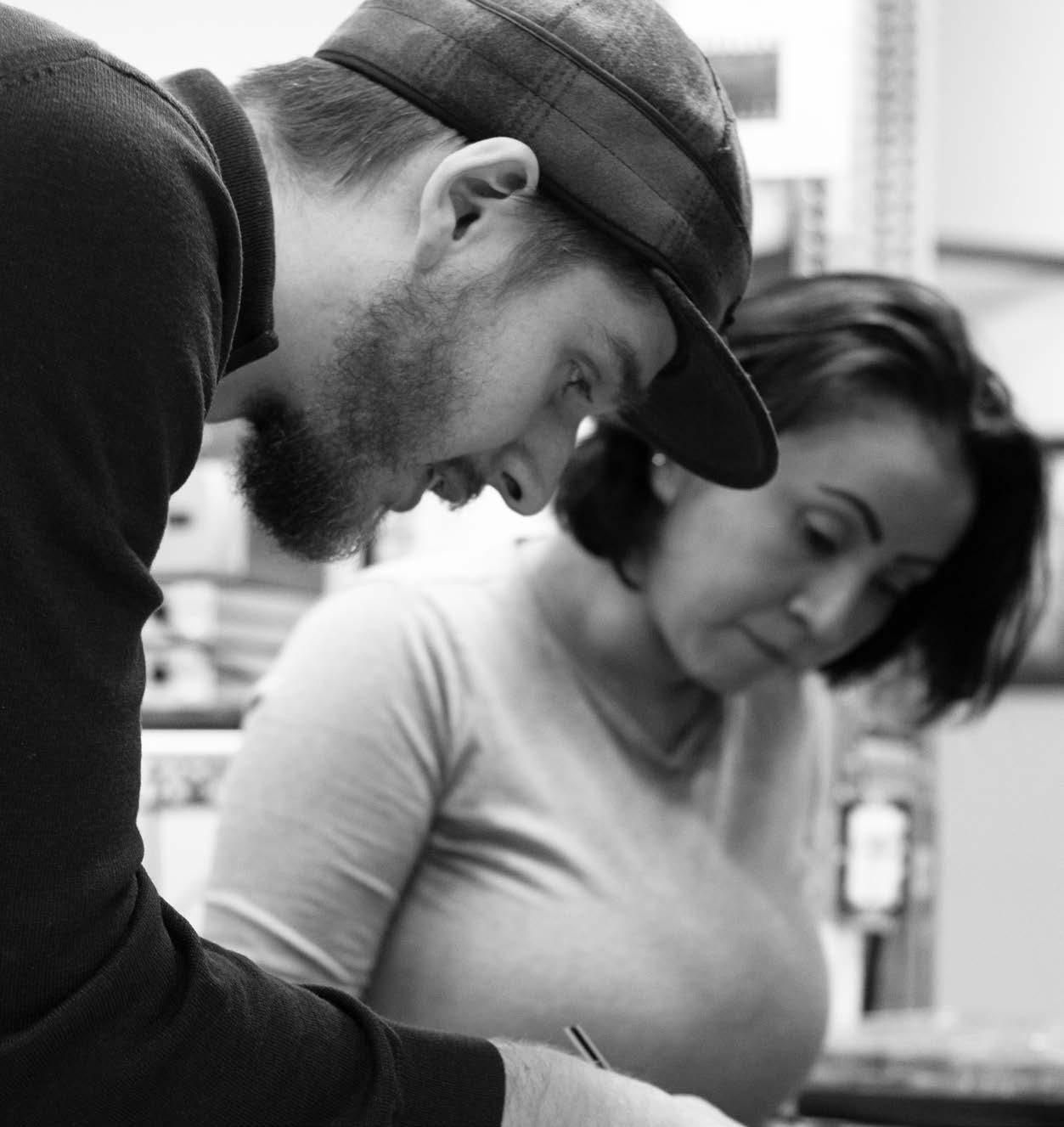

 SymFamily team members from engineering and production teams working together.
SymFamily booth warriors heading home after InfoComm 2022 in Las Vegas.
by Ty
SymFamily team members from engineering and production teams working together.
SymFamily booth warriors heading home after InfoComm 2022 in Las Vegas.
by Ty

Q&A
&
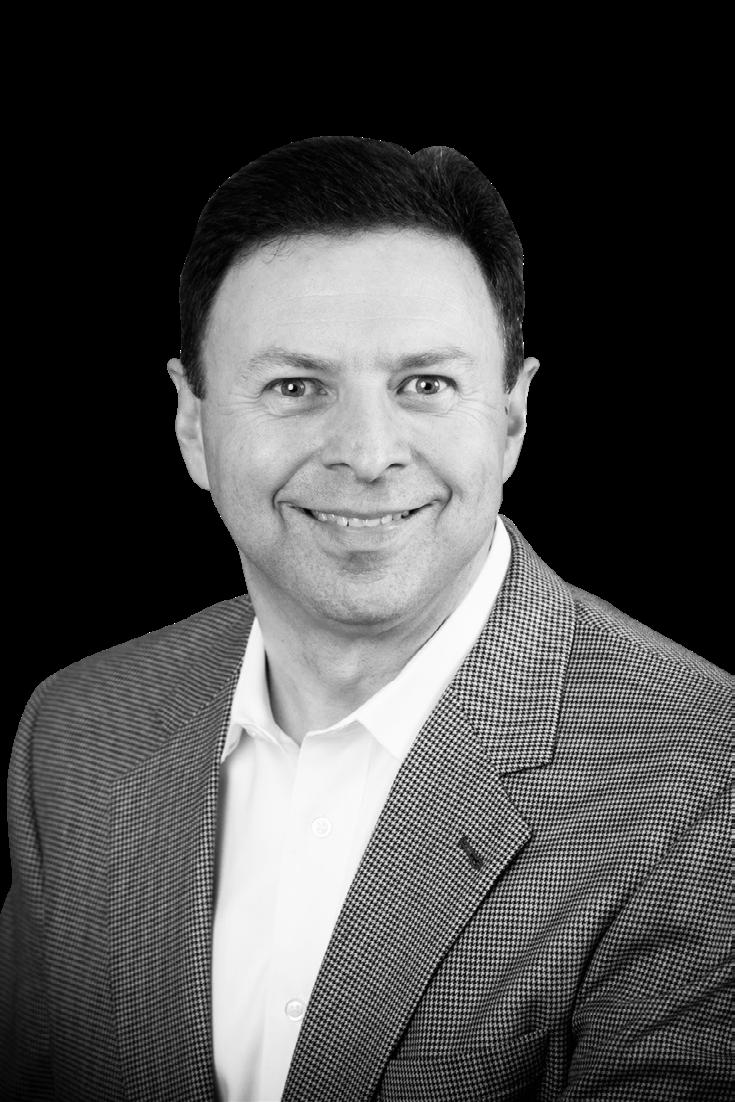
Hawley Senior Territory Manager Griffith Sales Associates Atlanta, GA
How many years have you been in the industry?
I did a little tech as a youth but had my first real “baptism by fire” 32 years ago in 1990. I was a volunteer assisting with a weekly concert series. The third week, we had an up-and-coming national act booked and the sound guy got stuck in traffic on the other side of Atlanta. I will spare the details as it was not pretty… but it was the start. Fast forward five years to one Wednesday evening after church. I mentioned to the staff tech guy, “I should be working in this industry.” A phone call was made, and on Friday, I was. Pretty soon I found myself traveling around the country as an “expert” with Maranatha Music and Integrity Media, teaching classes on audio and running sound for the biggest names in the worship community at the time. Truth be told, I was blessed with a really good mentor and was wise enough to be a good parrot. 1999 saw the launch of my own integration firm and I continued to do freelance production work. In the fall of 2003, God opened the door to join the team at Griffith Sales Associates as a manufacturer’s representative.
How do you support the Pro-AV industry and what do your customers love about you?

A manufacturer’s rep firm is hired to sell stuff. No sales = no food. But I am energized most when an integrator calls and says, “I have this customer who wants to…” Then my logistics brain kicks into gear pulling together pieces and parts to get to the desired goal. I also enjoy system commissioning and teaching. This is where all of the theory meets reality and I get the chance to pass on to others what has been poured into me.
The second part of this question is hard to answer. It feels like I should reply with, “Let me tell you about my humility.” But if forced to answer, I hear folks appreciate that I work hard to know the products we represent, how they work, and how to integrate them into a project.
What is the funniest moment you’ve experienced working in Pro-AV?
“It’s not morning!!!!!” It was not funny at the time but we laugh now. Setting up a full AVL rig solo at an out-of-town convention center. Friday afternoon traffic. The guest artist was grumbling that the only keyboard we could come up with for his last-second request wasn’t good enough. The house piano was way out of tune. Stressed to the max. Went out back to just punch something—anything. Only thing available, a concrete picnic table. UGGGG!!!!! (My now wife and her friends were seriously praying for me at that moment!) Then came the answer to their prayers. Over in the venue’s petting zoo was a rooster crowing at the top of his lungs. And some little boy shouting right back in return, “It’s not morning! It’s not morning!” God provided! Stress broken. I laughed out loud. We had a great weekend of worship and ministry.
What other hobbies do you have outside of Pro-AV?
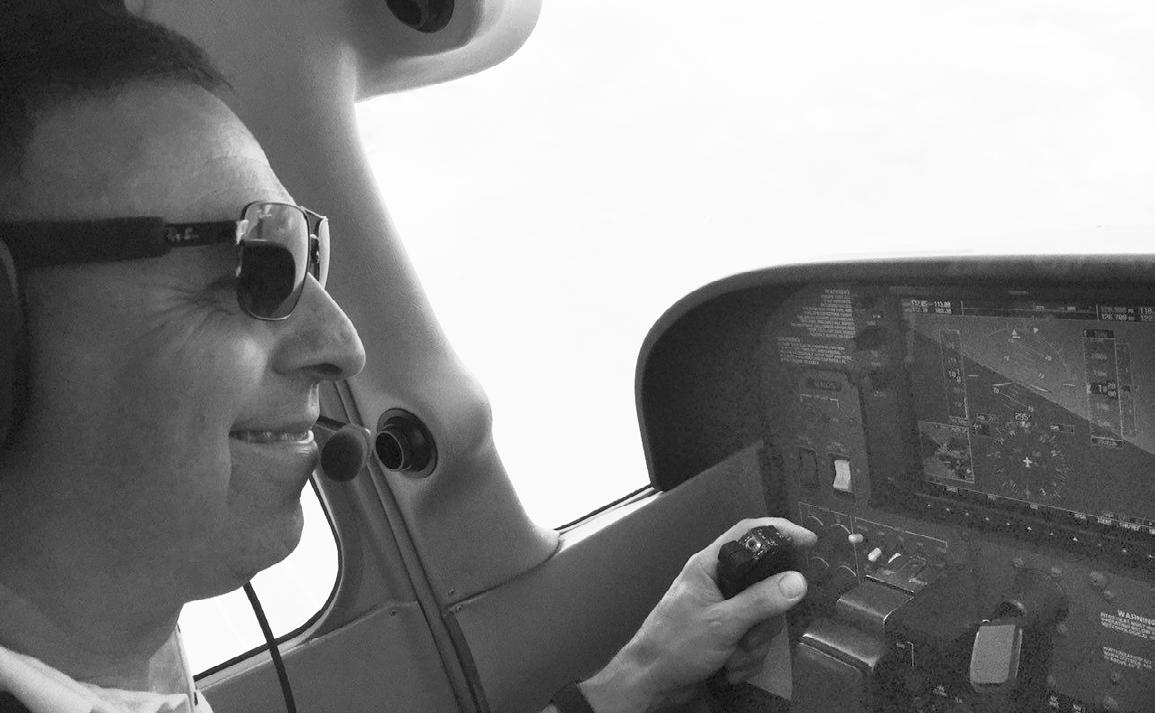
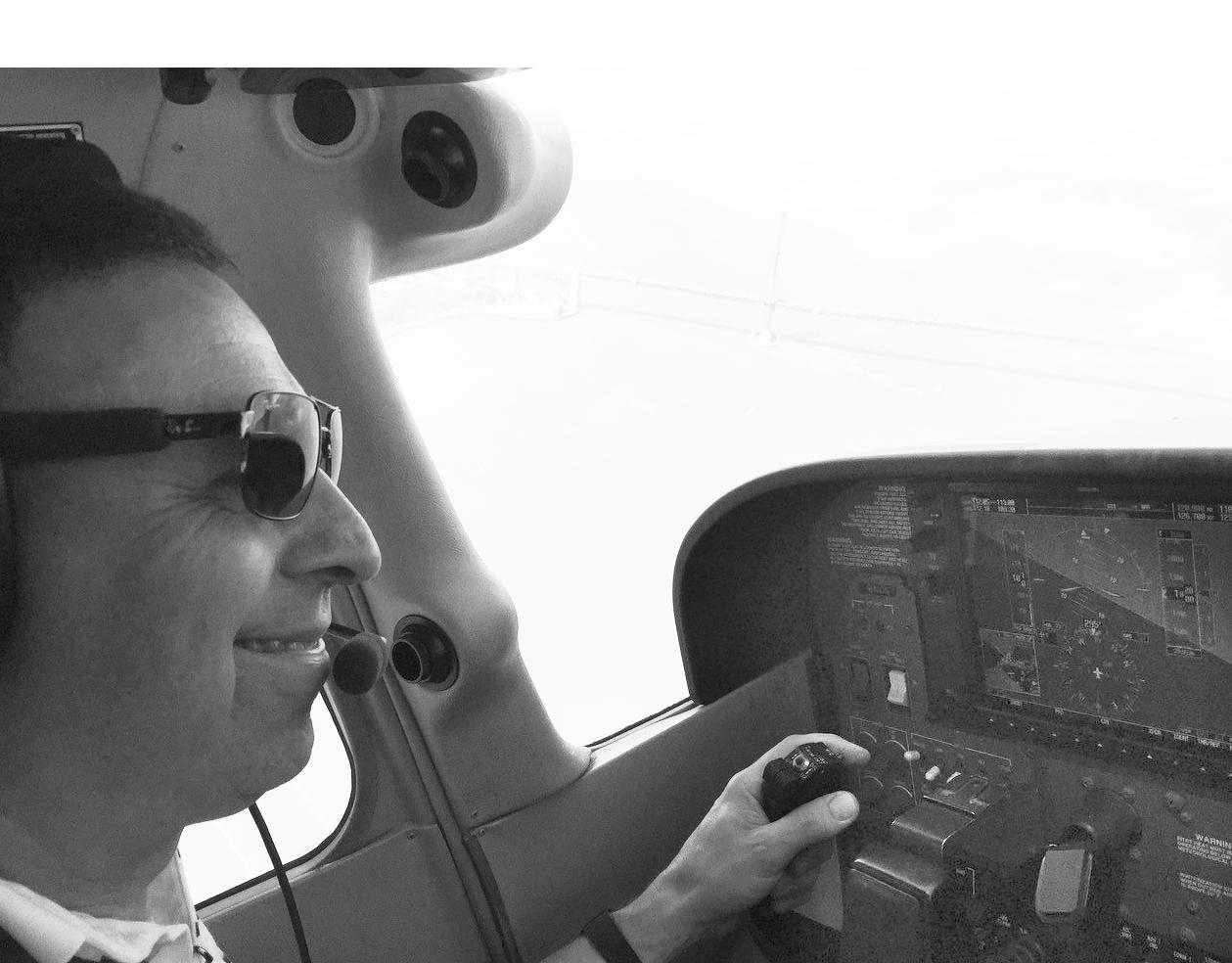
Aviation. In 2010 my wife gave me an introductory flight lesson as a birthday present. I was hooked on flying airplanes. It is super challenging and super fun at the same time.
Camping. My son and I are involved with a Trail Life USA scout troop which gets us out in God’s creation. Church. Our family is so blessed to be a part of a great congregation.
Family. I love spending time with my wife and kids. You didn’t ask, but I cannot miss the opportunity to express my appreciation of the Symetrix Family. (SymFam is a real thing.) Our kids asked again the other day when we can go back to Seattle. The highlight… Sunday dinner after church.
What is the nerdiest thing you love about Pro-AV?
Wave physics—it shows up everywhere. How does a digitally steerable line array loudspeaker work? How come you can’t fix a time/phase issue with an equalizer? How is a microphone made directional? Where do I place my audio test rig microphone and what data on my screen is valid? Why is the sky blue? (Literally!) It is all wave physics.
How do you feel about Unicorns?
They remind me of my daughter and her love for horses—which means I gotta go and get back to selling stuff.
SYMETRIX SCENE > OCTOBER 2022 18
Portable Precision
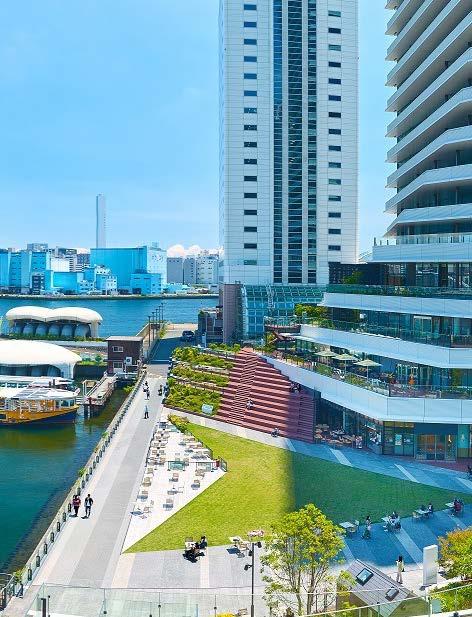
“BANK30” overlooks Tokyo bay and hosts a wide variety of sophisticated events.
 This case study has been adapted from a translation of an interview published by Audio Brains.
Tablet-Based Controls Tailor Sound at Bank30
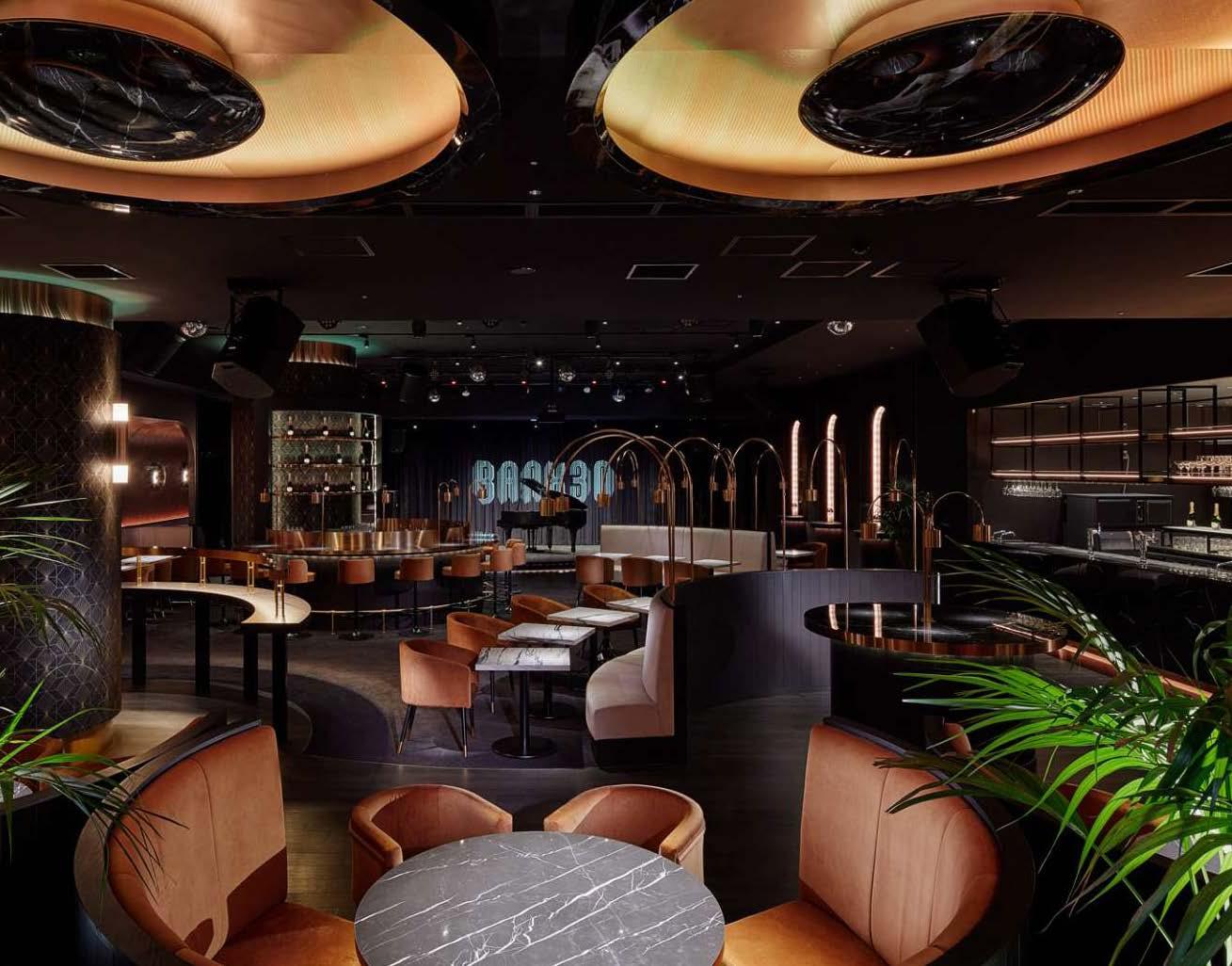
In December 2020, a unique entertainment hot spot opened on Tokyo Bay in Tokyo, Japan. BANK30 is an urban luxury lounge offering high-quality cuisine, sophisticated performances, and an ocean view second to none. The venue hosts a variety of groups for a wide range of events and needed a high-performance audio-video system to deliver premium guest experiences. Depending on the schedule, guests can enjoy high-quality dining and drinks, performing arts groups, or music with a live DJ. The waterfront location skillfully combines natural elements and textures with contemporary urban charms.
BANK30 was born from a desire to evolve the nightclub vision and create a luxury space offering different atmospheres and amenities depending on the event. “The leadership team is always thinking about the broad framework of entertainment, so the range of events we produce is quite wide,” enthuses Mr. Kawai, CEO of BANK30.
This visionary entertainment venue has four different areas. CLUB BANK30 is stylish space reminiscent of a modern luxury theater. It includes a stage, a large main floor, and a VIP area. Guests enjoy music by DJs, dance performances, and video creations. The space is also utilized for corporate presentations. BAYSIDE TERRACE is a dining space with ocean views from a terrace and glass walls. MAGNOLIA LOUNGE can be used as an exhibition gallery or as a private space with its curtains closed and JADE offers a private lounge or dining room with a full AV system, DJ equipment, karaoke system, and access to dedicated terrace seating.
(continued on next page)
SYMETRIX SCENE > OCTOBER 2022 20
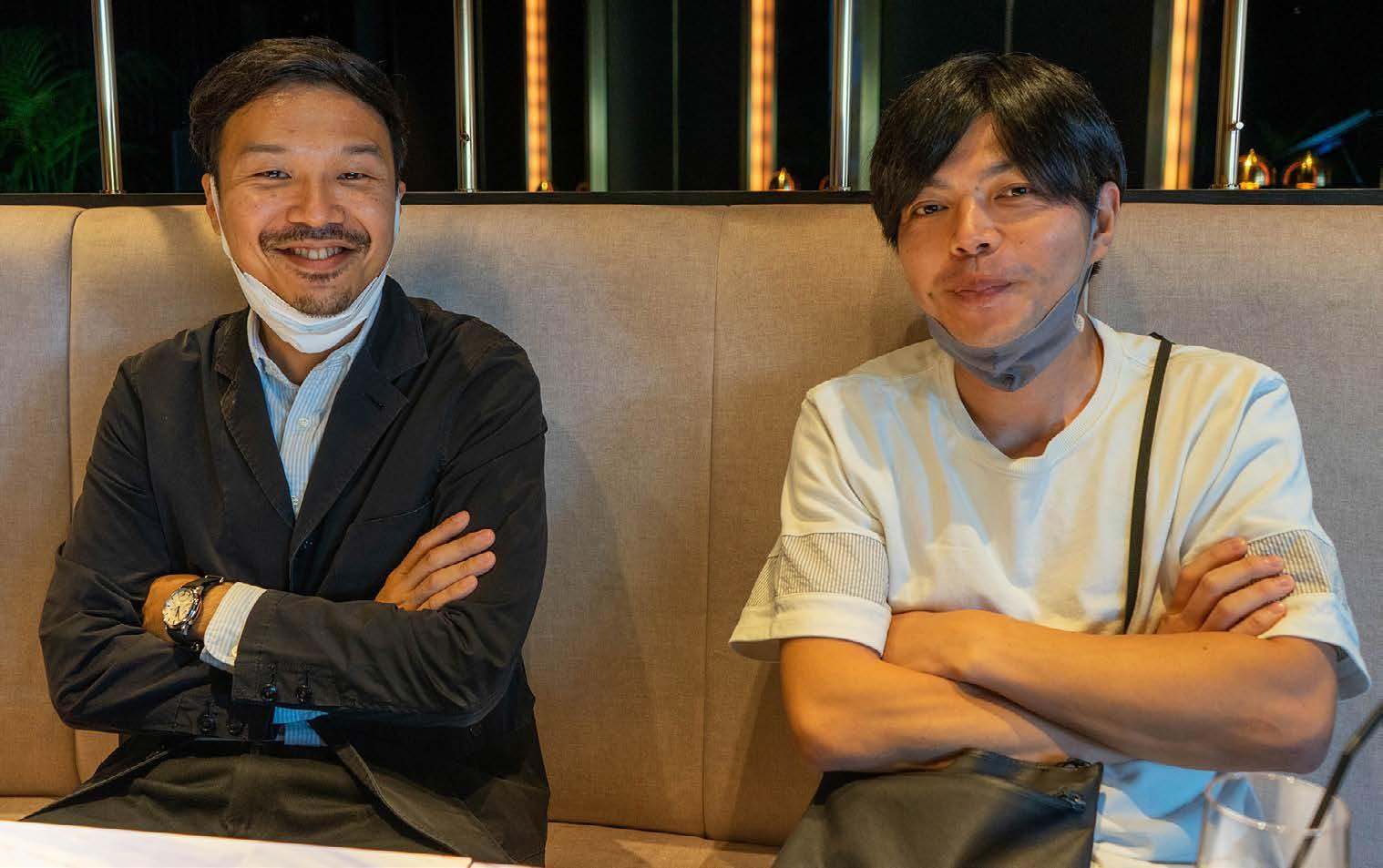
The team from Audio Brains included Mr. Yamada (left). Mr. Hirata, of CAEL WORKS INC. designed the system to be controllable from a mobile tablet, allowing on-the-spot control.
The AV system at “BANK30” is controllable with a tablet interface. With the push of a button, presets and scenes can be switched, even by staff with minimal AV training.
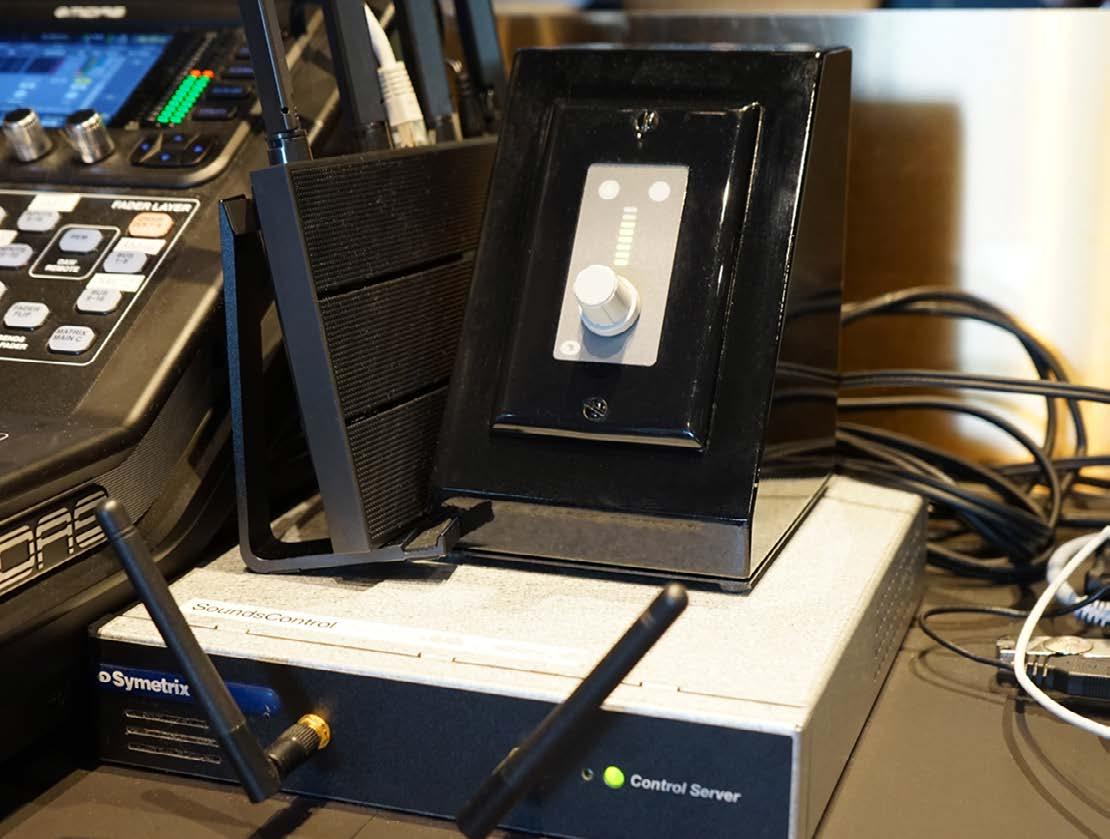
A Symetrix ARC K1e analog volume controller has been installed in a custom stand where a wall installation was not an option. (continued from page 20)
“Due to the large scale of the project and the number of speakers distributed throughout the venue, AV-over-IP was the only choice,” said system designer Mr. Hirata, of CAEL WORKS INC. The choice of DSP then became very important. He consulted with Audio Brains and they agreed on Symetrix as the best option. Other components included a Luminex GigaCore 12 switch used for networking and a selection of Powersoft power amplifiers connected using Dante. While the COVID-19 pandemic led to budget reductions in other places, the value of Symetrix and Powersoft to the project were deemed irreplaceable. “Ultimately the system was made possible because of these two,” Hirata said.
The centerpiece of the signal path is a Symetrix Radius NX 4x4 paired with a touchscreen controller. The Radius NX and Symetrix Control Sever allowed for the necessary complexity, but makes it easy to use for both AV professionals and non-technical staff to operate with custom control screens.
“From the beginning, one of the goals for BANK30 was that the AV system be easy to operate even for staff without much AV experience,” said Kawai. An iPad-based control screen has been designed and is easy to operate even for staff who are not familiar with complex AV systems.
“The facility layout is represented graphically on the touch panel and Audio Brains configured the interface to change
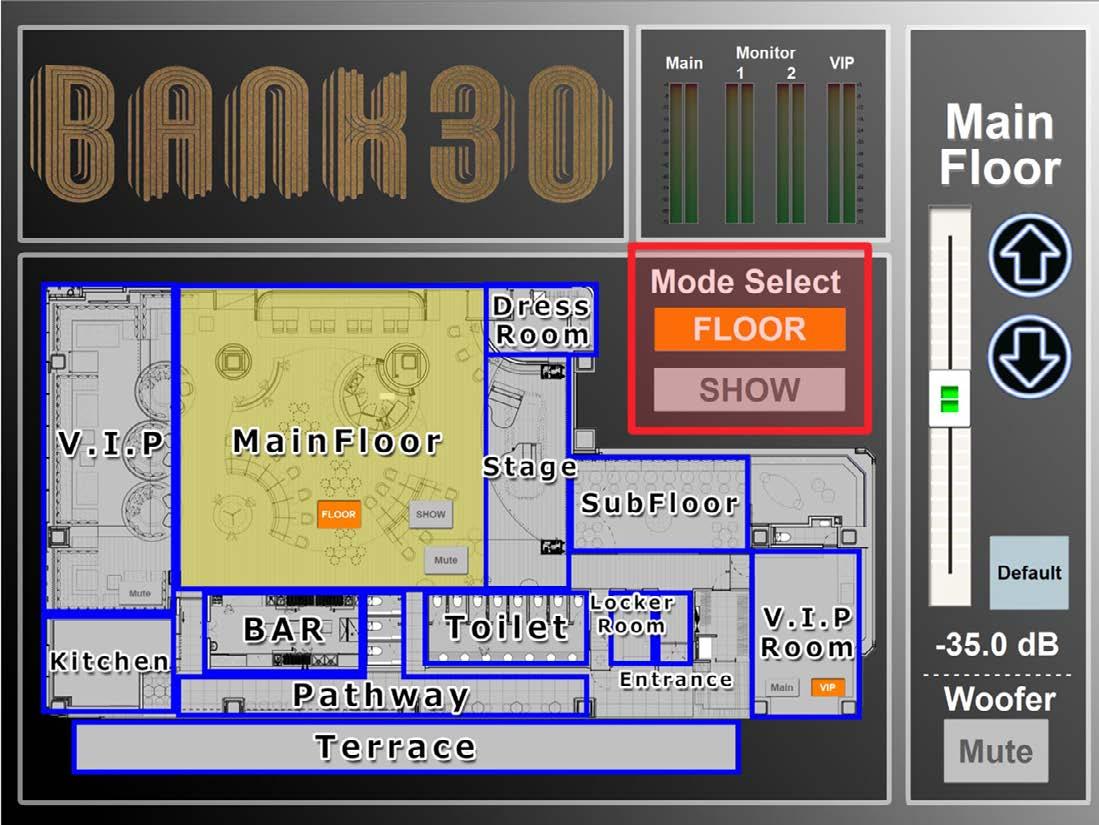
the volume of each area just by touching it and adjusting the fader,” said Hirata. Another button can switch between “BGM mode” and “SHOW mode” for on-stage events. In BGM mode, sound is delivered by floor speakers and tuned for the various areas. In SHOW mode, a delay is applied to the speaker suspended at the back. Because guests can feel the direction of the sound, the eyes of the audience members naturally turn to the stage.
“To change the volume for a specific part of a venue, you usually would have to check it with two people or adjust it back and forth on the floor. At BANK30 you simply take the iPad to the spot, listen, and make the right adjustment once,” explained Hirata.
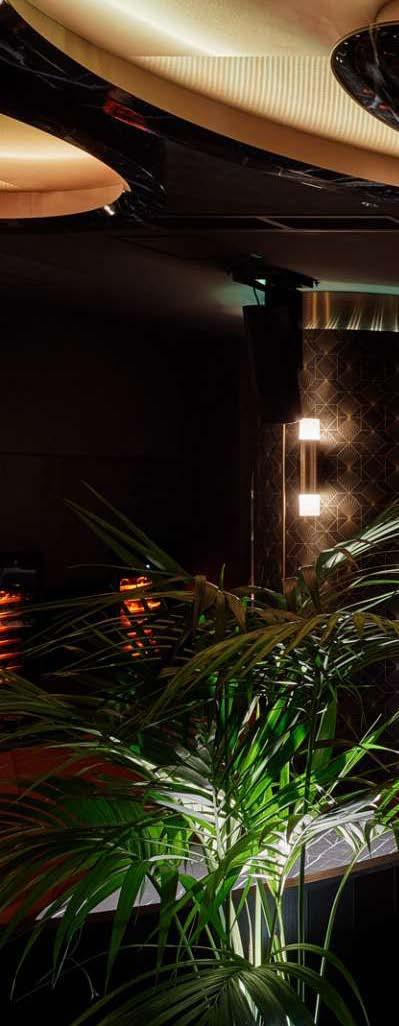
In the JADE VIP area, guests can listen to the main house mix or choose a unique source just for themselves. “Additional DSP programming allows for seamless transitions. For example, the system will exquisitely fade back and forth between background music and karaoke tracks. This was carefully adjusted by the technical staff of Audio Brains to ensure that the timing was just right,” said Hirata.
This level of control also allows for real-time system optimization when there are multiple events in the same day. Friday is a fusion of restaurant business and events, said Kawai and he carries
21 SYMETRIX SCENE > OCTOBER 2022
the iPad with him a lot. It is important to set the volume for a pleasant experience, but there is a big difference between raising it blatantly and raising it while watching the customers.
Mr. Kawai said that as a result some customers who come just to dine are eventually lifted up by the sound and light, and dance their way home. Audio Brains’ expertise enable this level of customer service and real-time response. Operationalizing that kind of control sophistication is amazing, said Hirata. It’s quite an accomplishment to be able to tailor the experience with that kind of care, he said. These refined adjustments would be difficult if the control was restricted to one location said Kawai. The seats along the wall are laid out so guests can enjoy eating and talking, and the center is designed for dancing. Customizing the sound for individual groups really elevates the guest experience.
Mr. Kawai credits Mr. Hirata for thinking to even put speakers in the kitchen so the staff can enjoy the music.
He said that if the staff is enjoy their work, this feeling will be communicated to the guests. While the volume of all areas can be adjusted individually on the iPad, Symetrix ARC K1e analog volume controllers of Symetrix are installed in the dressing room and the kitchen so they can be freely operated independent of the main house mix.
BANK30 has created a special place on the waterfront that combines the latest installed AV technology with luxury finishes to deliver the best entertainment, provide amazing customer service, and raise the bar for the local nightlife scene. Mr. Hirata summed up the challenges and rewards of a project of this magnitude: Facilities are living things.
The venue layout of Tokyo’s BANK 30 is configurable with movable furniture, increasing the importance of a responsive AV system.
SYMETRIX SCENE > OCTOBER 2022 22
External links: Audio Brains website BANK30 website
Engineered in Seattle

www.symetrix.co

Follow us for updates, news and more.