

![]()


Forgiveness is a wonderful thing Especially between pig and person.
Melanie was back trying to wag that cute curl out of her tail, and snuffling and slobbering, and grunting and “groinking” in her lovely talkative way
So, I was sure Melanie had shaken off her PSS – her Porcine Stress Syndrome – after that harrowing moment last month when ‘The Hat’ mutilated her with an obscene number 8 wire nose ring. She neither asked for it, nor wanted it, nor wore it well. Swine of a man.
Now she flops on her back, and I give that silky, soft, warm belly an industrial-strength scratching. And she squeals with ecstasy when I slap her butt and thighs.
I became pig whisperer – make sure no one was within earshot and small-talk Melanie. Platitudes like ‘Howz tings girl?’, ‘Pigs rock’ and ‘You adorable pink thing ’. Melanie didn’t understand, but I know she got a sense of it – the tone and the body language.
Then a city boy got thinking – townies have pet cats and dogs, hamsters and rabbits And I’m blessed to have an unshakeable bond with a pig – a beautiful, intelligent, affectionate pig I’d pick h her over a dog because she was smarter than any dog And if I caught anyone fawning over a dog, I would “Pffft” them to show
my disapproval. “Get yourself a pig,” I would think to myself
I did wonder if Melanie might miss me when I went back to the ‘burbs. Of course, she would –because without me, she became just another pig in the pigpen of life. It would mess with her inner wellbeing.
And it would be another three months before I saw her again, when The Hat resumed my “country-fication” – converting me into someone he wouldn’t mind being seen with at the saleyards and dog dosing strip
“Did Melanie miss me?” I asked when I arrived ‘The Hat’ just snorted He didn’t like or understand anthropomorphism – giving animals human characteristics To him, Melanie was just a stock unit No soul that man
My question went unanswered until next morning when I went to nick some pig treats from the walk-in chiller – everything’s bigger on the farm
You can even walk into the fridge Some apples, bananas and carrots for my reunion with Melanie at the pig pen
“It’s not a bloody pen, it’s a pigsty,” reminded The Hat Small city things got under that country skin
Then shock, dread, and despair There she was – I hope and prayed it wasn ’ t, but knew it was Melanie had d been, i in country speak, processed
Another harsh rural


Daniel Bradbury runs a 600-cow dairy farm in e Awamutu and has been using the smaXtec system for two years The bolus sits in the cow’s reticulum and delivers precise insights from inside the animal without being affected by weather, mud, or external factors like traditional sensors It measures internal body temperature with unmatched accuracy (±0 01°C), tracks water intake and drinking cycles, monitors rumination based
on reticulum contractions, and captures overall activity
This reliable, real-time data means Daniel can spot potential health issues long before anything is visible Alerts come straight through to his phone or computer, giving him the chance to step in early and keep his cows on track
Since introducing smaXtec, Daniel has seen major improvements in his transition cow management “The ability to track rumination post calving and receive temperature alerts for early signs of milk fever has been invaluable,” he explains With smaXtec, he can
now intervene before cows even go down. The calving alert has also proven its worth Thanks to the system, Daniel was able to save both a cow and her calf: “One of the standout features is the calving alert, which was also a great help when one of our cows calved a month early at grazing,” he says During the dry cow period, smaXtec has helped Daniel manage his herd even more effectively As he puts it: “Using the data over the dry cow period meant that we could better manage our feeding to really set the cows up for calving and for the season. Overall, the smaXtec bolus has been a game-changer for our
farm, offering peace of mind and enabling more proactive, efficient care.”
Keen to learn more?
Head to our website at www smaxtec com/en/new-zealand/ for more info, or get in touch with Nick Heffer, Sales Manager for the Upper North Island You can reach him at nick.heffer@smaxtec com or give him a call on 021 741 022 he’s always happy to have a chat


Fruit and vegetable growers in the Bay of Plenty holding pre-Resource Management Act water-take consents with the regional council have less than a year to renew them.
About 350 consents, including 240 relating to horticulture in the region, will expire on October 1, 2026. Bay of Plenty Regional Council (BOPRC) regulatory services general manager Reuben Fraser says to continue taking more water than what is provided for under BOPRC’s ‘permitted activity’ rules, consentholders need to apply for a replacement consent before this date. To ensure these consent-holders can continue operating under their existing consent until a decision is made, replacement applications must be submitted by April 1.
Reuben says BOPRC is working to automate and streamline the replacement process, where possible “By batching applications and co-ordinating consultation with tangata whenua, the process will be made more efficient and cost-effective ” Consentholders will be contacted directly once these processes have been implemented.
Reuben says ‘permitted activity’ rules vary depending on the water source, whether surface water (streams and rivers), groundwater or geothermal.
The take and use of groundwater with a temperature of less than 30C, where the quantity of water taken does not exceed 35cu m per day per property, is a permitted activity This allows minor takes of groundwater for any purposes “that are unlikely to have adverse effects on the environment, and to prevent a proliferation of small takes on a single property that may have significant cumulative effects on a groundwater system ”
Reuben says the Resource Management Act allows the taking of water for the supply of people’s reasonable domestic needs and needs of their animals. “A greater volume is permitted for groundwater takes than for surface water takes to encourage people to use groundwater and reduce abstraction pressure on surface water bodies (particularly small streams).”
For surface water (streams and rivers), the plan provides for up to 15cu m per day per property, and a maximum rate of 2.5 litres per second or 10% of the
fi five-yyear low flow, w whichever is lower
Reuben says consent-holders are advised to check whether they need infrastructure upgrades, such as installation or verification of a water meter, setting up telemetry, or adding backflow prevention devices if fertigation is used. “With high demand expected, early upgrades will help avoid delays with applications. With more than 350 consents expiring at the same time, demand for technicians and equipment will be high. Upgrading equipment early gives you time to gather the required information and avoid delays. Accurate water use records will also be critical to demonstrate efficiency and support applications.”
Reuben recommends recording water use regularly and using Blue Tick-accredited contractors for meter verification. Consent-holders are also advised to track their water use “Accurate water use records help establish that the volume you ’ re applying for is efficient for activities on your site(s), something that must be demonstrated through the consenting process. ”
Before applying for a replacement consent, Reuben says those affected need to consider whether their actual water use is reflective of current consent conditions. “Are there any efficiency measures that you could implement to reduce the rate of take and/or volume required for the activities at your site, such as water storage on-site?”
Following the Government’s announcement to suspend all council plan changes until new RMA (1991) replacement legislation and a review of the National Policy Statement for Freshwater Management


2020 are complete, BOPRC has paused work on region-wide freshwater and geothermal plan changes. However, the Draft Tauranga Geothermal System Management Plan (TGSMP) continues to be developed.
Reuben says geothermal water-takes have specific rules due to the unique nature of the resource, with most requiring a resource consent.
There are 172 consented geothermal takes in the Tauranga geothermal system – 73 for irrigation and/or frost protection and 98 for pool and/or space heating – with 33 up for renewal, including seven for horticulture.
Fraser says current levels of use are considered “sustainable system-wide” and should not induce excessive levels
of cooling. Most consents are for relatively small volumes, with about 25% of the geothermal water used for “non-geothermal” uses such as irrigation and/or frost protection for commercial horticultural crops.
Earlier this year, BOPRC consulted on the TGSMP Its Strategy and Policy Committee said further work was needed to clarify operational matters such as preferred options for management of discharges, metering requirements for geothermal takes, and efficiency measures Additional technical and engagement work (including working with iwi) was required by council staff before an updated draft system management plan went back to the committee for adoption Steve Edwards


Experience the most natural-feeling water with less chemicals and no harsh odours
Save money by making your spa water last up to 4x longer


Communication and common sense are keys to meeting health and safety requirements in the rural sector, says WorkSafe NZ.
The Health and Safety at Work Act 2015 applies to all workplaces in New Zealand, including farms and orchards. To meet the legal requirements, WorkSafe New Zealand says all businesses must have a health and safety management system.

Spokesperson Andrew Powell says common hazards include farm vehicles, machinery and farm equipment, pesticides and agricultural chemicals, electricity and power lines, and handling large animals This also covers orchards and packhouses, with their associated vehicles and machinery such as forklifts and conveyors Andrew says the health and safety management system doesn’t have to be complex, but simply aimed at identifying existing and potential
hazards on a farm or orchard and putting controls in place to manage the risks these cause “The employer or person in control of the workplace must ensure people doing the work know about the hazards of the work and what they need to do


they’re the ones who have the boots on the ground and are doing the work Farms change from day-to-day and so do the risks,” says Andrew
“Everyone on-farm should know about the risks, how they can change with the time of day, the season of the year, or a person ’ s emotional or physical state ”


to stay safe ” This includes all staff, contractors and viisiitors. “ “Managiing riisk k is not reallly abbout d documents and manuals. It’s about thinking and talking about risks and most importantly, doing what needs to be done to stay healthy and safe every day,” Andrew says. “You probably already have the expertise on your farm to develop a strong health and safety system for you and your workers. But, it is important to remember that building and maintaining a health and safety system requires everyone getting in behind it, including the boss and the workers.”
Andrew says landowners or supervisors should have health and safety rules and procedures (which can be recorded) for “risky farm tasks” such as what vehicle to use for which task, having regular check-ins when working in remote areas of the farm and when to wear a helmet. “During an employee’s induction and when assigning tasks, tell employees about these, give them oper training and check they understand.Check egularly to make sure everyone ’ s sticking to them and for feedback from your workers. They might have eat ideas for how to improve your health and safety,


Employers must train or supervise employees so they can d do t theiir work k saffelly, says A Anddrew
“Young workers, new employees, people doing new or different work and people returning to work after a long time away have a higher risk of being injured.”
Andrew says the more people involved in managing risk, the more likely the risk will be managed. “More people making a farm healthy and safe will mean fewer people will get injured or sick. It’s also important to review accidents and near-miss incidents. Learning from these could help to stop or reduce the chances of the same or similar incidents happening again ”
Andrew says developing farm rules is a good opportunity involve workers “These are some basic rules that you set for yourself and your workers about the way you want things to happen and the behaviours you all expect of each other”
Rules could include: Watch out for each other –speak up if you think something is dangerous No untrained people to drive farm vehicles Farm speed limit is 30kph – no exceptions No vehicles in ‘ no-go ’ zones – develop a farm hazard map that shows these zones Always wear helmets on two-wheeler bikes and quad bikes
Andrew says all machinery, vehicles and equipment need maintenance, so they remain safe for use “Mobile and fixed plant pose some of the greatest hazards on the farm “Ensure you ’ re doing maintenance regularly, rather than only addressing issues when they arise and consider daily checks –such as checking for bird’s nesting in tractors, tyre pressures and a visual inspection ”
Powell says the Health and Safety at Work Act 2015 is about managing work in a healthy and safe way and keeping employees and others safe “Health and safety doesn’t need to be complicated – you can make it simple and practical to meet the needs of your business Think about risk before doing tasks Health and safety doesn’t just happen It takes a conscious decision to make sure all the pieces are in place to prevent people from being hurt or becoming ill in our rural sector ”
Information to help farmers manage health and safety, including the ‘Keep safe, keep farming’ toolkit, is at: www.worksafe.govt.nz Steve Edwards

The seeds have been sown for a vegetable product group collaboration project
Vegetables NZ, Process Vegetables NZ, Potatoes NZ, Onions NZ and TomatoesNZ are all participating in an initiative to review the current structure of the industry
Project manager James Kuperus told Coast & Country News that six roadshows have been held around the country for growers, “sounding out ” if there is an appetite for any changes in the sector The roadshows revealed that more time and greater detail of the project are needed to inform growers, says James. “Generally, it’s not necessarily a topic that members are fully across at present. But, by and large, they support a review”
James says the different varieties of vegetables covered in the project and the sector groups ’ respective needs vary The collaboration project is overseen by a governance group including board members from the five product groups participating.
The governance group, which prepared a business case on the project, will consider feedback from growers and the product group boards
James says the project may be “parked” for a few months during the traditionally busy summer season in the vegetable industry and the Christmas/New Year break. “Or possibly there could be some low hanging fruit to get on with initially”
Governance group chair Owen Symmans says the review was initiated by group members and the boards, who have queried the status quo and whether the sector is setup appropriately for the future. The belief was that by pooling resources, reducing duplication and having a mightier voice together – a range of benefits could accrue to all vegetable growers in New Zealand, he says
“There is no one critical problem or issue, but rather a package of problems and opportunities that, when bundled together, presents a compelling case to
consider change and the future sustainability of the industry-good structure.
“Greater collaboration across the vegetable industry will result in greater efficiency, which will mean we can achieve more with each levy dollar for every vegetable grower The current model has served us well for the past 20 or so years, but what we need to do now is challenge ourselves and work through the issues and obstacles to ensure a new collaborative model is able to support vegetable growers ’ needs for the next 20-plus years. Boards have also been clear that they want to maintain what is currently working well, while strengthening expertise in emerging areas of priority for the sector ”
The draft business case, or proposal, asked product group boards and members to consider a merged “pan-vegetable entity” with the working title VegeCo In the NZ food and fibre sector there are 150-plus “industry-good” organisations, representing their members and advocating for their respective positions on a myriad of issues. “This segmented structure has historically benefited the primary sector as it has resulted in clear focus on specific priorities. “Over time, priorities have changed with the inclusion of more multi-crop issues such as biosecurity, energy efficiency, environmental research and ‘the right to farm’. “Given the noise and size of some of the other players in the primary sector, the vegetable sector


as a subset is not always getting the desired cut through in Wellington on vegetable sector priorities, putting at risk grower profitability and ‘the right to farm’.” The business case says the primary objective of the project is how to best leverage the use of cumulative levy investment.
At present, growers pay levies to their respective product group and to Horticulture New Zealand (HortNZ).
The business case says this project is not looking at reducing levies, replacing HortNZ or trying to force any decisions on product groups.
“There remains strong support for the vegetable industry-good organisations, however there are growing calls to consider what a future enduring model might look like to support industry growth and deal with emerging issues.”
The business case says some factors which have led to evaluating the
industry-good structure are the continued increase in operational costs, changing priorities towards more multi crop initiatives and increased government “interference” in farming “What is clear from discussions with the various product group boards is the consideration around an alternative structure is not being brought about due to staff underperformance, but rather because of a structure which is making it difficult for staff to deliver what is expected of them.”
Fifteen staff are employed across the five vegetable product groups, reporting to 35 directors.
James says the five product group boards endorsed the business case going to members for consideration.
“This does not mean they have made a decision on whether to support a single industry-good structure; rather they are wanting members’ feedback before making that decision.”


A Te Aroha sculptor has taken on board the “trash to treasure ” philosophy in a highly creative way
For the past 15 years, Adrian Worsley has turned recycled material – a lot from farms – into unique works of art.
Prominent examples include Matamata’s signature racehorse, one of Morrinsville’s ‘Herd of Cows’, street art in Te Aroha, and pieces at Paeroa College and Matamata Primary School.
Adrian’s latest work is a largerthan-life cow for a Waikato farmer
The 825kg Friesian, heading from his Rewi St gallery to its future home this month, is 2.5m high and 3.5m from nose to tail.
Like all of Adrian’s unique creations, the cow has been a labour of love
Eighteen months ago, he received a “wish list” from the farmer client for Friesian cow with a friendly face and good udder
twisted and shaped the assorted pieces of metal, welded together from the hooves up “I polish and grind it as I go, ” he says
When finished, Adrian sprinkled the sculpture with water for five days until the non-stainless parts began to rust, creating the required black and white colouration
This is further highlighted by masking the white sections and adding black dye to the balance
The final act saw the piece lacquered by a Te Aroha contractor
Adrian says the sculpture is completely hollow, with a its shell 6mm and more thick
As with the Matamata racehorse, he has erred on the side of greater size rather than more normal dimensions for the cow “The client didn’t specify dimensions, but I always like to go big if possible,” says Adrian “They just look more eye-catching ” Because of the time and effort involved, he does become attached to such large-scale projects “It is hard to let go, ” he admits
A b f Ad d
young age This extended to making trolleys and motorbikes
“I always just loved making stuff,” says Adrian Rather surprisingly, he didn’t take metalwork or woodwork at college, but did attain an A-plus in art
He left secondary school at 15 and worked on a dairy farm near Te Aroha At 18 he joined a trailer builder in the town, becoming a fitter/welder
Adrian then had a stint with a specialist stainless steel company in Te Aroha, and along the way taught himself woodwork and metalwork, including furniture-making and kitchen fitouts This saw him go out on his own as a cabinetmaker
His first job was a rustic fitout of Ironique Café in Te Aroha
“There was nothing like that around,” says Adrian “The business went ballistic ” He operated workshops in Te Aroha and Queenstown, but “pulled back” to concentrate on his signature sculptures.

A motorcycle for an exhibition in first piece “There motorbike part in t was all bits off ndards, milking vels.”
ece sits among erful collection of artwork in
tidier version of rd from the old comedy series oves including tures which

people can instantly recognise, from hot water cylinders to frying pans and golf clubs
Despite the deliberately dishevelled appearance, material stored for future projects is well-categorised in Adrian’s workshop “I know where to lay my hands on something when it is needed ” The need arises when he is commissioned by a client to produce a piece Adrian says this mostly comes from
word-of-mouth. He also hosts group tours of his gallery by arrangement. By the end of the year Adrian will have completed a bike-stand, including a large bull’s head, as a memorial to a Te Aroha pedigree stud farmer
This will be included in his already impressive collection of pieces along Te Aroha’s main street.
Adrian has also put together a steampunk-themed sculpture – an octopus in the shape of a penny farthing bicycle – for the Hauraki Rail Trail in Thames. Steve Edwards


Forwardthinkingisinfourth-generation WaikatosheepfarmerAlastairReeves’ DNA
HisfatherJohnworkedonselective breedingofsheepfourdecadesagoto makethemresistanttothefungaldisease thathadclaimedthelifeofaprizedram “WehadnamedhimKingDickandeven tookaphotoofhimandputitonthe wall,buthediedoffacialeczema,”recalls Alastair “Itwasadevastatingeventthat ledtoourfamily’slongassociationwith AgResearch Myfatherwithotherbreeders andscientistsatRuakurastarteddoing somegeneticworktofindeczematolerant Romneysheep”
Now,thesheeponthe605-hectare WaimaiRomneyatTeAkau,westof Ngāruawāhiahavetherightcombinationof healthandproductiontraits
“TodayKiwisheepfarmerscanbuy eczematolerantsheep,”saysAlastair “Whenitcomestomybusiness,I’ma geneticistandIwanttoproducegenetics thatmakefarmersmoney Waimai Romney’sNewZealandMaternalWorth (rambreedingvalue)hasincreased over33%overthelastfouryears,while alsoimprovinghealthtraits,eczema
toleranceandwormresistanceaswellas reducingmethane”
Since2021,WaimaiRomneyhasreduced itsmethaneby3 2%initsflockandthelast year,87%ofitsramshadlowmethane
“Selectingformethanehasn’tcomeat theexpenseofanything,”explainsAlastair “Bothourdiseasetraitsandourproduction traitshavegoneupoverthesameperiod We’veloweredourmethanebutimproved theprofitabilityofourgenetics”
AlastairandAnnhavehadalongworking partnershipwithASB’steamofagribusiness bankingandsustainabilityspecialists whoareinvestedinthesuccessofNew Zealand’sfoodandfibresector
“OurrelationshipwithASBhasbeen reallygreat,”saysAlastair “Wewereanew businesswhenwestartedwiththem,then weconsolidatedandnowthatwe’rea maturebusiness,we’relookingatthings likesuccession”
WhileWaimaiRomneyiswherehe andhiswifeAnnraisedtheirthreechildren, it’snotassumedthatthey’llonedaytake thereins
“WhenIthinkaboutsuccession,Idon’t justthinkaboutmyfamily,Ialsothink


aboutbringingyoungpeopleintothe businessandintotheindustry We’repart ofaprogrammewherewebringinschool leaversonatwo-yearapprenticeshipand givethemtheskillstogetjobswithinthe sheepandbeefanddeerindustry”
ASBsupportsNewZealandfarmers tooptimisetheirlandeconomicallyand environmentally,whilefutureproofingtheir businessesforfuturegenerations
“I’vebeenhelpingAlastairandAnnwith theirbusinessbyconnectingthemtothe rightpeopleandspendingtimegettingto knowtheirbusinesssowecanofferthem therightproductsthatsuittheirfarm,”says ASBseniorruralmanager,JacobBrough “Whatinspiresmeaboutthisfarmisthat AlastairandAnnhavecreatedafarming modelthat’sbothfinanciallyprofitableand environmentallysustainable”
“Themostimportantthingaboutthe environmentisacknowledgingthatyou havearesponsibilityandthenseeinghow youcanmitigateanyissues,”saysAlastair ASBrecentlylaunched‘EveryHectare Matters’:aninnovativenewprogramme tohelpfarmersoptimisetheirlandand buildbusinessresilience Landownersare pairedwithindependentagri-consultants todevelopdiversificationscenarios andsupportimplementation ASBwill provideupto$5millioninlendingforfive years,plusareimbursementofupto$25k fortheconsultants’fees,tobringtheirnew businessmodeltolife
“We’reallonthisjourneyofconstant improvementandthat’swhatweshouldall befocussedon,”saysAlastair “Don’tworry toomuchaboutwhereyouaretoday,just workoutwhereyouwanttobetomorrow”


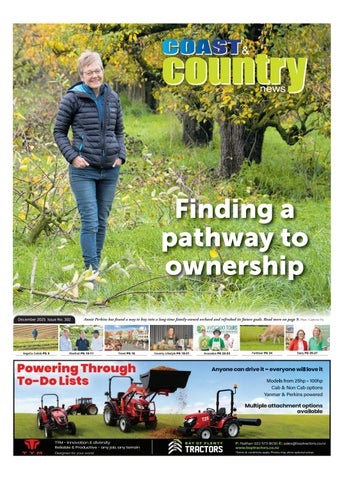
A century olld Waikkato family orchard business is finding fresh energy to sustain a local treasure.
The McMiken family have been orcharding in the Waikato since 1914 initially establishing Sunnyside Orchard at Silverdale Rd, Hamilton, on land given to William Jeffrey McMiken (Jeff) by his father John McMiken who believed it had potential for pip and stone fruit
As Hamilton and the University of Waikato grew around them, the family established Newstead Orchard and Sunnyside Orchard became the University of Waikato campus The family’s third generation of orchardists downscaled production and focused on supplying local seasonal gate sales
At the end of the 2023-2024 fruit season Jeff McMiken’s granddaughter Jean decided to retire from managing the orchard shop Her brother and head orchardist, John Woolford, was also keen for more time away from the orchard work
The future looked uncertain for Newstead Orchard, the last remaining small commercial orchard in the area
Annie Perkins was brought up on a dairy farm in West Virginia, USA With both agricultural and environmental management degrees, her career has supported sustainable agriculture and conservation including roles in soil conservation, catchment management, agricultural and environmental research She came to New Zealand in 1992 to work on agricultural extension programmes at AgResearch in Hamilton, communicating the latest research out to farmers
Since 2002 h her f focus h has been as a professional facilitator, supporting many sustainable land management projects and developing a specialty supporting farmers learning directly from each other
“I’ve been a food grower my whole life, first on the family farm and then I have dug up the backyard everywhere I have lived ever since My husband, Dave Campbell, and I incorporated food gardens into the landscaping of all three urban properties that we have ecorenovated together,” says Annie

Annie Perkins became friends with John Woolford nearly two decades ago They are now testing the parameters of growing stone and pip fruit organically and sustainably at Newstead Orchard
“Apples are one of the most heavily sprayed crops around Insect pests such as leaf roller caterpillars and codling moths or fungal diseases such as black spot attach to the fruit making some unsellable ”
Annie says she’s developed a

full responsibility for fruit sales and establishing the market garden
“We hope we ’ ve found a model that allows elite soils close to a city to stay in production, keeping community access to local fruit, and allowing family growers to retire while retaining family land
“We based the concept on what both parties were comfortable with commitment and risk-wise. We reviewed after the first season and increased my commitment for the second season ”
Annie says it’s a real privilege to learn alongside those who’ve cared for that land for decades and she respects that things are the way they are for good reason

farm shop and moving deep into the regenerative agriculture space
healthhy respect f for h how d diffifficullt organic gardening and farming is
“It’s all about the soil and keeping it healthy and farmers may consult with experts on their journey, but firsthand experience and talking to other growers are often the best sources of learning
“John has been using integrated pest management for many years, dropping the heavy insecticides decades ago As beneficial insect numbers increased, we now only monitor and target spray for the two fruit pests that damage the fruit and have no natural predator in NZ Keeping bees safe is a priority”
Growing rows of different species in different areas of the 5ha in production lessens the spread if a particular species gets hit by disease or pests Any diseased trees are burned and the ash used in their own compost Having fruit succession during a long period of time also reduces risk
John has been reducing inputs for many years, finding the fine line where profit is affected. “We mow around the trees and make our own compost from waste streams already available on the orchard. We’re trialling organic growing methods in the area where I have a market garden. We use diverse cover crops on the vegetable gardens to grow soil and bring good diversity to the orchard ”
When Annie learned that Jean was retiring but John was open to the orchard continuing, they came up with an agreement where Jean and John remained in their homes on the orchard retaining land ownership and the rural lifestyle
Annie has bought into the orchard business and is progressively taking over orchard operations, learning alongside John and taking
For now, she is tapping into new markets, diversifying the range of local d il bl f h h d
She would like to see a clear way for New Zealand’s horticultural farmers to enter the industry without needing to h l d


Kiwifruit and avocado growers using bees for pollination
should be on the lookout for a predatory insect pest
Yellow-legged hornets, which feed on bees, were detected recently on properties in Auckland.
Kiwifruit Vine Health (KVH) in support of Biosecurity New Zealand (Biosecurity NZ) is urging kiwifruit growers to check beehives in their orchards and report sightings immediately
“This hornet is not a pest of kiwifruit but does seriously threaten honeybees which could impact our access to pollination services,” says KVH chief executive Leanne Stewart She says KVH is monitoring


the investigation and supporting Biosecurity NZ’s activities – especially around monitoring for suspected nests
Leanne says with warmer weather ahead, the risk of new nests forming increases, making early detection critical to protect crops and ecosystems
The pollination schedule usually sees beekeepers drop off hives at kiwifruit orchards in late-October
In a previous interview, Matamata beekeeper Matt Crawford – who has kiwifruit clients in the Bay of Plenty – told Coast & Country News that hives are usually left at orchards for a few weeks before collection
With 8-10 hives per canopy hectare, his honey bees serve both Gold and Green kiwifruit varieties “Kiwifruit is particularly reliant on insect pollinators as its male and female flowers are located on separate plants ”

The yellow-legged hornet (far left f ) has been found in New Zealand. Other species already here are, from left f , German wasp (Vespula germanica), Asian paper wasp (Polistes chinensis) and Australian paper wasp (Polistes humilis). Photo / Biosecurity New Zealand
It’s a similar story for avocado growers. New Zealand Avocado CEO Brad Siebert says growers and the public in the Auckland region are being alerted to the hornet issue “This presents a risk to pollination services in the avocado industry
“We encourage all growers to remain vigilant; look out for hornets or nests and report any sightings.”


Brad says avocados are “pollination reliant”, through spring. While natural pollination does occur –through wind and other insects – he says avocado growers routinely bring in hives because the introduction of honey bees to orchards greatly increases the potential for a better crop
Brad says NZ Avocado has engaged with other sectors and Biosecurity NZ to support the development of a “wellmanaged response ” to the hornet issue.
More than half on New Zealand’s commercial avocado growers are in the Bay of Plenty, with the balance in Northland and a small percentage in the Auckland region.
be indirect impacts through reduced numbers of pollinating insects
“Yellow-legged hornets pose a biosecurity risk because of their potential impact on honeybee and wild bee populations
By mid-November, when Coast & Country News went to print, Biosecurity NZ had reported 10 queen hornets, two workers, and seven nests had been successfully located and removed from the Glenfield and Birkdale areas in Auckland

Biosecurity NZ Commissioner North Mike Inglis says yellow-legged hornets build large nests up to 80cm tall, often high in trees or under eaves. However, early embryo nests created by queen hornets at the beginning of the spring season can be as small as a tennis ball and may appear within a couple of days.
“Do not disturb any suspected nest, ” says Mike “Take a photo and report it to Biosecurity NZ.” The yellow-legged hornet has distinctive dark legs with bright yellow tips. In contrast, common wasp species in NZ typically have uniformly yellow or yellow-striped legs. The yellow-legged hornet is also much larger than honeybees and common wasp species seen here.
While the hornets are unlikely to directly target kiwifruit or avocado crops, Mike says there may
“We’re laser-focused on our work to eradicate this hornet, guided by international best practice and expert advice,” says Mike While his team believed it’s unlikely that yellow-legged hornets are present outside of Auckland, he says: “Biosecurity NZ is closely monitoring the situation and is encouraging people to remain vigilant and report any suspected hornet or nest sightings”
To support surveillance, Biosecurity NZ had by midNovember laid more than 180 traps near detection sites; established a Technical Advisory Group (TAG) of independent scientific experts to guide ongoing work; and is working with industry groups to plan joint summer response activities based on TAG advice
Additional actions getting under way last month included: Extending trapping out to 5km, with a combination of carbohydrate and protein traps, with further extension as needed; introducing advanced tracking technology from the Netherlands to trace hornets back to their nests; hosting a specialist from the UK’s hornet response team to train staff and advise on programme delivery; and increasing staff on the ground to accelerate detection and removal
“The best surveillance tool we have right now is for people to report any sightings of suspected hornets or hornet nests online or through our pest and disease hotline ”
Reports can be made through report mpi govt nz or by calling Biosecurity NZ’s exotic pest


An Indian trade delegation had a first-hand look at the Bay of Plenty kiwifruit industry while talking free trade with their Kiwi counterparts in early November
India’s Commerce and Industry Minister
Piyush Goyal made his first official visit to New Zealand for Free Trade Agreement (FTA) negotiations with his NZ counterpart Todd McClay from November 5-8
As part of his delegation’s tour, he visited a Te Puke kiwifruit orchard with McClay
During the visit, both ministers interacted with Kiwi-Indian growers, exploring the orchard’s cultivation practices, sustainability initiatives and strategies to enhance productivity and fruit quality
...continued
and disease hotline on 0800 809 966
Mike says Biosecurity NZ is unsure how the hornets arrived in New Zealand “However, the species is a known hitchhiker pest It originates from Southeast Asia but is also present in Europe and has been detected in the United States
“Many countries throughout Europe and Asia have yellow-legged hornet and manage it “However, we don’t want it here and that is why we ’ re tracking it down ” Mike says the success of Biosecurity NZ’s response
If you suspect a yellow-legged hornet or nest:
Goyal wrote on social media that he had an engaging discussion with the orchard owner on its variety, quality, cultivation practices, and sustainability efforts
The visiting Minister says he also gained valuable insights into efforts to enhance productivity and quality
Under NZ’s current trade agreement with India, NZ kiwifruit marketer Zespri faces a 33% tariff on its exports to India.
McClay says India has the fastest-growing economy in the G20, and it is projected to become the world’s third-largest economy in coming years “India’s rise represents one of the most significant economic opportunities of our time,” he says
This was the fifth round of FTA talks between the two governments and the largest ever trade delegation from India to visit NZ, says McClay
“We lookforwardto working towards the early conclusion ofa balanced, comprehensive andmutually beneficialagreement”
With a delegation of 43 people including business representatives and media, the McClay says he reviewed progress made in FTA negotiations, which focused on market access of goods, services, economic and technical cooperation, and investment opportunities
Goyal posted on social media: “We look forward to working towards the early conclusion of a balanced, comprehensive and mutually beneficial agreement, in line with the growing strategic and economic convergence between India and New Zealand”.
As well as talks with McClay, the visit included a series of high-level business meetings and engagements with the NZ Indian community
In Rotorua, the Indian minister addressed a CEO roundtable attended by Rotorua Mayor Tania Tapsell and Tourism Minister Louise Upston, highlighting India’s attractiveness as a global investment destination.
Prime Minister Christopher Luxon joined the visiting delegation in Auckland, lauding the Indian community as a “living bridge” between the two nations.
“Hosting Minister Goyal provided an opportunity to showcase both the quality of NZ’s export offerings and the successful business partnerships already flourishing between our two countries,” McClay says.
An FTA would accelerate the development of new partnerships and bring benefit to both countries McClay says discussions with the
is heavily reliant on the ongoing support of the public and key stakeholders
“We are working closely and engaging regularly with the bee industry, horticulture and arable sector partners, regional councils and DOC on our response efforts
“We have had a fantastic response from the public and more than 2900 notifications to date That’s the best surveillance we can ask for to supplement the efforts of all our staff involved in this response ”
• Do not disturb the nest.
• Take a photo.
• Report to Biosecurity NZ
Indian minister were constructive “and we made good progress in a number of areas ”
“We focused on our shared ambition to secure a balanced, comprehensive, and ambitious FTA that grows our trade relationship and delivers real benefits for both countries ”
McClay said developing the relationship with India had been a priority for the Government and had seen an “unprecedented level of engagement ” during the past two years.
Goyal’s visit follows Indian President Droupadi Murmu’s visit to NZ last year and NZ Prime Minster Christopher Luxon’s trade mission to India this year alongside the largest business delegation ever; and two successful visits to India by Foreign Minister Winston Peters and five visits by McClay since the election At publication time of this edition, McClay was set to travel to India later in November to continue the discussions “Both sides are committed to moving at pace, without compromising on a high-quality outcome, ” he says
Once concluded, McClay says the FTA had the potential to unlock access to the dynamic and rapidly growing Indian economy, providing more choice for NZ exporters at a time of great uncertainty in the global trading environment.
“Hosting Minister Goyal provided an opportunity to showcase both the quality of NZ’s export offerings and the successful business partnerships already flourishing between our two countries ”


As offshore competition continues to put pressure on New Zealand manufacturers, one Waikato-based business is marking 40 years of local production and preparing for the next wave of demand in food manufacturing and horticulture.
Hamilton-founded Industrial Tube is now one of two remaining precision steel tube manufacturers in New Zealand
The company employs 55 staff at its Kahikatea Drive site, with a further five nationally, and supplies engineered tube and components to manufacturers across the food, beverage, dairy, horticulture, transport and construction sectors.
Chief executive Grant Waring says the company ’ s longevity comes down to reliability and local responsiveness “We’re a partner to the manufacturers who depend on us They value reliability, consistency and service Being able to pick up the phone and speak to someone here in New Zealand matters ”
Waikato-built, supply NZ
General manager Werner Petrick says certainty of standards is a growing priority for customers operating in export-facing sectors
“Steel tube can be imported, but what our customers value is a precision product with exacting specifications, production responsiveness and confidence in standards.”
Across four decades the business has

expanded from producing a single product to manufacturing tube in eight steel types, used across applications from furniture and automotive components to orchard infrastructure and food-grade stainless tube for dairy and processing environments.
Where possible, the company sources steel coils from BlueScope NZ, meaning many of its products are 100% NZ-made.
In 2022 the company achieved Gold Certification from the NZ Sustainable Steel Council, recognising responsible and sustainable manufacturing practices.
Industrial Tube also maintains a longstanding link to the Waikato community via Green Charitable Trust, which distributes profits to local causes and regional initiatives.
To meet shifting production needs, the company invested in advanced cutting, laser and finishing technology, enabling it to
deliver fully engineered tube components ready for integration into customers ’ manufacturing lines.
“Imports are a reality of the global landscape, which demands partnering with customers and offering innovative, customised solutions,” Werner says.
Industrial Tube sees its strongest growth pipeline in the primary and export sectors.
“There will be significant opportunities in the horticulture and agriculture space driven by new growing and farming methods –enhancing efficiencies, serving increased global demand and mitigating climate impacts,” Werner says.
Cost pressure and offshoring remain ongoing challenges, Grant says, but local
supply is increasingly valued. “…NZ customers still strongly support NZ-made and value the reliability and responsiveness of having local suppliers ready” Werner says the next decade is about ensuring NZ retains the local manufacturing capacity required to support its export sectors. “If NZ wants secure supply and world-class food and export systems, it needs local manufacturing We intend to be at the heart of that.”


The third quarter of Year-ToDate new tractor deliveries are ahead of last year by 9%, according to the Tractor and Machinery Association of NZ (TAMA).
TAMA reports that September YTD tractor deliveries of 2153 units continue to reflect the tentative and embryonic signs of growth
“The September YTD result represents a 9% lift on last year and is indicative of overall primary sector grower and contractors increased confidence,” says TAMA
“This is being driven largely by the continued strong performance of dairy with another high payout and the continued strengthening of beef and lamb pricing ”
The total number of new tractor deliveries for September 2025 of 367 units represents a strong 18 4% lift on the same month last year, says TAMA
“This is all good news for TAMA member dealers and wholesalers In the latest TAMA dealer sentiment survey a whopping 75% of dealer respondents were projecting a significant lift in new tractor sales over the next six months
“It definitely feels like the Government’s Investment Boost Tax Incentive scheme launched in July is kicking in Dealers are also projecting sales increases in new hay and harvesting tools


which are again well ahead of previous periods, and this is all very encouraging on the back of the projected new tractor sales, says TAMA
The key tractor category driving performance across both islands is the 150-200hp, which at the end of the September quarter was ahead of last year by 34.4%.
“It’s an encouraging performance It is worth noting however that there is still a degree of caution despite the forwardlooking optimism that is building as many farmers, particularly in the South are still playing catch up after two-three years of low farm gate pricing This is seeing spending being focused on maintenance type projects,” says TAMA “There is, however, no denying that the overall outlook looks to be positive As we come through spring, good grass growth supporting the strong dairy, beef and lamb prices, is driving economic recovery and boosting overall farmer confidence This confidence is producing solid forward tractor and machinery orders, which is welcome news for TAMA members across the country ”
TAMA is the industry representative for New Zealand’s commercial tractor and machinery industry, including importers, manufacturers and retailers It obtains retail delivery statistics for about 97% of the tractor market and about 80% of the machinery sector from its co-operating members For more information, visit: https://tama org nz Jaiden Drought


From swampy paddocks to vintage powerhouses, Geoff Pulham’s life has been one long tractor trek
Born into the rumble of drystock farming, Geoff didn’t just inherit the land – he inherited a love for the machines that made it work. Whether wrangling swampy terrain with crawlers or restoring a beast of a tractor once used to build hydro dams, Geoff’s journey has been anything but idle. Now semi-retired in Pokuru, he’s swapped livestock for horsepower, and his shed for a shrine to vintage engineering.
Over the years Geoff and his wife Sheila have developed a farm in Rangiriri and owned drystock farms near Kawhia and Honikiwi.
Although the couple semi-retired to 1.6ha in Pokuru in 2008, Geoff joined the Otorohanga Vintage Machinery Club, and does part-time contracting work.
“I’ve always loved tractors and the associated machinery and have owned quite a few different types over the years. My farms weren ’ t the easiest, especially a swampy one which needed crawlers and tractors, ” says Geoff He wanted something a little different to have as a collector’s piece. In 2010 he found a 1972 County 1164 on TradeMe. Previously it had been used in Invercargill by the Ministry of Works to build the hydro dams and roading.
“It was in used condition but still usable. It needed a good tidy up and I had the time and the inclination.”
Geoff can turn his hand to both the mechanical and the fabricating/engineering side of restoration but calls in local specialists for certain areas.


He says the Otorohanga Vintage Machinery Club members have a vast amount of knowledge collectively and they always know someone who has the part you need. Tractor wreckers also have parts available, but many parts can still be fabricated. Getting parts wasn ’ t a problem
The County 1164 was the result of a unique


pairing of the County name, engineering and design using the gearbox and transmission from the Ford 5000 and the engine from the Ford 8000.
The 1164 has a six-cylinder, 6580cc, 116hp engine and eight forward gears and two reverse It was one of the first tractors to have a closed cab, which suits Geoff for tractor trekking. It was one of the first four-wheel drive tractors available and has equal sized tyres at the front and rear Geoff’s one also has dual rear wheels
The tyre arrangement offered better traction


to the higher horsepower tractors of that era. Geoff has to store his County with one of the rear outer wheels removed so it fits in the shed.
“These early four-wheel drive tractors had rear and front axles connected with universal joints and prop shafts, making them full-time four-wheel drive. When the diff lock is applied, all four wheels brake.”
Ford began to produce four-wheel drive tractors, competing with County for that market space.
County tractors first went into production in 1948, with the popular and distinctive four equal wheeled units being manufactured later in 1961. These models were based on a Fordson Supermajor but badged the Super Four
The four equal sized wheels


that many of the County tractors featured were designed to give outstanding traction for cultivation work, compared to the conventional tractors
This design, however, had its drawbacks as the four equal sized wheels meant that they lacked the ability to turn in a relatively small headland, making manoeuvrability, particularly on cultivation work, an issue
Over time the market for smaller front wheel drives started to gain market share, although they were often still used in forestry and industrial type operations.
Now seen as vintage tractors, County tractors are very popular as collectable units and often have a high value today
-Additional information from pocketfarming co uk Catherine Fry


It’s hard to pigeonhole the Baltic States into a distinctive east or west European feel, and that’s what makes it rather fascinating Estonia, Latvia and Lithuania sit between Scandinavia and Russia, each having its own connections with the neighbours, plus distinctive individualities
My knowledge of this area was scant prior to a recent visit, with Kiwi experience usually based on a cruise ship stop at the Estonian capital Tallin Due to the Russia/Ukraine conflict, cruises are not running on the traditional Russia/Scandinavia routes
including the Baltic States
Air travel is also limited to Russia from Europe I had an interesting conversation with a couple from Finland in Tallin (two hours by ferry), the husband originally from India and his wife from Russia
For her to get to see relatives in St Petersburg required a flight via nonEuropean Union Turkey (Istanbul) from Helsinki
My travel was a lot simpler, flying directly from Frankfurt, Germany, to Tallin (two hours)
July was mid-summer, but the day-time temperature remained a pleasant mid-20s throughout my twoweek stay


Also rather pleasant was a marked drop in prices for food and drink compared to other parts of Europe. Think NZ$15-$20 for dinner and NZ$5 for a beer This did require a bit of shopping around however Double the price if you want to drink or dine around the central square in the Baltic capitals. It was best to get a couple of streets away, which you will probably find more locals doing.


While all tastes are catered for, traditional Baltic dinners are traditional meat and vegetables. Wild game is popular I even saw beaver on the menu in Lithuania I didn’t go near it, but have read since that limited hunting is allowed and the beaver population is flourishing there Cold beetroot soup is another traditional dish
My hotel in the Old Town of Tallin was a good illustration of the history of the region, including rule by the former Soviet Union after German occupation during World War II Built in the 1950s, the hotel was closed to civilians for several years and served military purposes as the headquarters of Soviet naval officers. The building underwent a complete renovation and opened as a 67-room hotel in 2001.
The Baltic States gained independence from Soviet rule in 1991.
Central Tallin is a mix of old and new, from cobblestone streets to upmarket shopping precincts
My private tour guide suggested a trip to the waterfront which we made in illuminating – for me anyway – fashion.
Instead of a half-hour walk, we took a five-minute drive (NZ$2/ km) with a car rental service via an app that sees you locate a vehicle on the go and drop off at a designated parking spot when you are done, There’s no rental

office or even returning to where you picked it up required.
Waterfront apartments are “the place” to live or holiday in Tallin, while those fancying something even more salubrious can rent a luxury igloo at NZ$350 per night.
A one-hour flight took me to Vinius, the capital of Lithuania.
The Old Town is dominated by a magnificent cathedral, with my nearby hotel along a modern shopping street.
In another nod to the past, the former Soviet KGB headquarters –including a haunting prison – is now the Museum of Occupations and Freedom Fights
During my stay in Vilnius I also visited the nearby 15th Century Trakei Castle, built on an island in Lake Galve, which was due to host a few more Kiwis competing in the Under-19 World Rowing Championships in August.
countryside, I chose to take the train from Vinius, about four hours, which itself proved to be an adventure.
I had read that this was a relatively new route that began with two carriages (seemingly to gauge public interest) in a oncea-day service last year
I was very glad that I had prepurchased the ticket before my departure from NZ, because the now three-carriage service was completely sold out.


The train trip took me across green and pleasant land, nlike NZ, h a variety of ropping and livestock In Riga I stayed in a modern hotel along a cobblestone street in the Old Town, ich again ed truly spectacular buildings including the Dome Cathedral, House of the Blackheads and St Peter’s Church The nearby National Opera House is also quite stunning
Film locations
Both the castle and Vilnius Old Town – UNESCO World Heritage sites – have been used as feature film locations on a number of occasions.
Next stop was the Latvian capital Riga. To see more of the


As a solo traveller, the Baltic States felt safe. I was only ever bothered by people asking for cigarettes or change when I enjoyed a drink outside a bar
A polite “ no ” sent them on their way
*This trip was self-funded by the writer Steve Edwards f


As summer approaches, so does a silent threat to livestockfacial eczema
h d rel ing
But, thanks to a clever solution manufactured by Hamilton-based Agritrade, farmers have a powerful tool in their arsenal - the Time Capsule
Annika Ferris, a technical expert in animal health with the company, says the Time Capsule is a slow-release zinc bolus that helps protect sheep and cattle from the damaging effects of facial eczema.
“The Time Capsule delivers a steady dose of zinc oxide directly into the animal’s rumen, ” she says.
“This helps protect the liver from toxins that cause facial eczema, without the need for daily

drenching or relying on animals to drink treated water ”
Annika says each bolus provides up to six weeks of protection for sheep and four weeks for cattle
“It’s tailored to different weight ranges, ensuring animals get the right dose,” she says
“Farmers appreciate that it’s safe, leaves no residue, and doesn’t require a withholding period for milk or meat, ” Annika says.
Facial eczema, a disease caused by toxic spores that thrive in warm, humid pasture conditions, poses a serious risk to animal welfare and farm productivity
Ferris says the Time Capsule offers a practical, low-maintenance solution
“It’s about prevention,” she says
Legislation to protect productive farmland by limiting farm-to-forest conversions is in place, Agriculture and Forestry Minister Todd McClay says The Climate Change Response (Emissions Trading Scheme - Forestry Conversion) Amendment Act came into effect October 31, 2025, and forest owners will have noticed these changes in the Emissions Trading Scheme (ETS) system by mid-November
The legislation restricts exotic forests from entering the ETS on Land Use Capability (LUC) class 1-6 land – New Zealand’s most productive soils – with certain exceptions, including for Māoriowned land and erosion-prone areas
Farmers will retain flexibility to plant
some land should they choose says Todd Transitional exemptions from the restrictions are available for those who can demonstrate a clear interest in the land and a qualifying forestry investment made between January 1, 2021, and December 4, 2024.
“Farming and forestry are both important to our regional economies and communities and this Government is supporting both sectors to create jobs and grow exports, ” Todd says.
The Ministry for Primary Industries (MPI) has worked to keep the sector well informed, including running webinars to explain the new restrictions updating its website to include the changes and guidance documents.


“Once symptoms appear, it’s often too late ”
Annika says the Time Capsule gives farmers peace of mind during the high-risk season. ” Autumn is the traditional “hot spot ” for facial eczema, but she recommends farmers undertake regular spore counts
“Rain after a dry spell is the perfect storm for it,” says Annika “You


can use the Time Capsule proactively or reactively, but prevention is reeally the key”
She says “protectivve levels” are reached 4 48 hours after the capssule is administered
The Time Capsule leaves no residue and there is no withholding period for milk or meat, says A Annika For more informaation, see Agritrade’s advert on this page


Gill Mannington came from the United Kingdom to New Zealand in 2012 for a farm working holiday
The sheep and beef farmer certainly wasn ’ t originally planning on living in Aotearoa full-time. After becoming heavily involved with dairy farming, Reporoa Young Farmers, several different
farm job opportunities and meeting her now husband Pete Mannington, she’s still here 13 years later
“I met Pete in 2015 when I was working in Reporoa I continued working in short-term farm jobs in Rerewhakaaitu, Galatea, and as a dairy assistant for Tulip Rose Farms.
“Pete and I then worked full-time on his parent ’ s dairy farm and Pete also contract fenced We started sharemilking on that farm with 100 cows, ” says Gill
The couple then moved to a different set
up on 90 hectares in Galatea, increasing their herd to 250 After five years they took on another sharemilking role on the adjoining 129 hectares with 300 cows
The Mannington’s herds are mainly Kiwicross with some Friesians and Jerseys to raise the overall milk fat/protein content
Full-time on-farm
The farms are owned by the same person but are run as two separate herds using two cow sheds. Gill, Pete, a manager and a farm assistant all work full-time on the two farms, interchanging as necessary

Mannington with some of her ingredients for her herbal balms.

roducts


products from nature


Due to working so closely with the land, Gill has always been interested in the medicinal uses of plants and flowers
She’s interested in herbalism and read lots of books before making up blends for different ailments using
“What began as a small curiosity about natural remedies has grown into a true passion Using herbs and natural ingredients, often grown or gathered locally, I handcrafted balms designed to soothe, heal, and restore. ”
Moving around from farm to farm as she and Pete work their way up to farm ownership means Gill doesn’t have her own herb garden established but she does grow calendula (Calendula officinalis) wherever she goes Calendula is known
NZ Adventures has confirmed it will release dates for its late 2026/2027 season in February 2026, with five iconic South Island tours on offer


The line-up includes the five-day West Coast Explorer, High Country Heritage Tour – which is available as a six or seven day tour – the six-day Trax of Gold, the six-day Big Sky tour, and the five-day 46 South. Two tours are already scheduled for November 2026, say owner-operators Robbie and Connie Crickett.
“The West Coast Explorer will run from November 14-18, beginning with a tour briefing in Hanmer on the evening of November 13.
“Guests will overnight in Murchison, Westport, and Reefton, concluding after breakfast in Reefton.”
The Cricketts say the High Country Heritage Tour kicks off with a briefing in Blenheim on November 24 The sixday journey begins on November 25, travelling through Molesworth Station t to Hanmer Springs
“Subsequent overnight stops include Methven, Fairlie, Omarama, Cromwell, and the historic Cardrona Hotel, wrappinng up after breakfast on December 1.”
NZ Adventures also notes that there are still four spots available on the High Country Heritage Tour scheduled for February 5-10, 2026.
For adventure seekers looking to explorre New Zealand’s rugged beauty and rich heritage, these tours offer a unique and immersive experience.
For more information, see NZ Adventures’ advert on this page.


for its anti-inflammatory and antifungal properties and is good for skin issues
“We’re fortunate that the farm we are on now has great soil and we have a plentiful supply of plantain (Plantago lanceolata) and yarrow (Achillea millefolium) ”
While yarrow is often regarded as a weed, it was used medicinally as far back as ancient times to stem bleeding and heal wounds. It is claimed to have numerous other medicinal advantages such as antiseptic, antimicrobial, anti-inflammatory, antispasmodic, diuretic and astringent properties
Plantain is an effective cellular regenerator and is good for healing wounds. Plantain poultices, tinctures, creams and oils can be made for home use “I’m very lucky that the bush on our winter grazing block has kawakawa (Piper excelsum) a well-known plant used in traditional Māori medicine.”
Gill introduced tallow to her ingredients i in July 2025 and orders in this pure, natural product that has already been rendered Due
to its compatibility with the skin’s natural oils, applied topically it moisturises, soothes and improves the skin’s health
It’s no surprise that most of the products Gill makes are centred around the needs of farming life. Gill, Pete, Pete’s three sons, the staff and extended family and friends all benefit from her hobby “We keep Farm Balm close by for those cold winters when we get cracked hands and I’ve several different flavoured lip balms, which work wonders in the cold/hot months
“In summer we use my insect repellent spray which contains high grade essential oils – lavender, peppermint, rose, citronella and lemongrass which mosquitoes especially don’t like If we do get bitten, I’ve got an itchy balm to soothe the spot ”
Gill has made up some bath salts using Epsom salts, which is rich in magnesium, and Himalayan salt, with essential oils She says its perfect for a good muscle soak after working hard on the farm


“I would love to learn more and develop


New Zealand Young Farmers (NZYF) has launched a new initiative designed to make it easier for employers to support their young team members by covering their NZYF membership.
For nearly a century, NZ Young Farmers has been connecting, supporting, and empowering young people in rural communities, helping them develop leadership skills, strengthen community ties, and grow their careers in the food and fibre sector
NZ Young Farmers CEO Cheyne Gillooly says the new Employer Supporter offering allows businesses to invest directly in their staff’s personal and


professional growth by covering the annual $100 NZYF membership fee, which is reduced to $80 per person for 10-plus employees
“Supporting the future of our sector starts with supporting the people who make it possible, our young people,” says Cheyne.
“By offering to cover their membership, employers are showing genuine care for their team ’ s wellbeing and development It’s a simple but powerful way to help them feel valued, connected, and inspired to stay and grow within your business and the wider rural community”
Through NZYF’s 60-plus clubs across the country, members gain access to a national peer network, leadership and skills development opportunities, and wellbeing support
Clubs host regular events, workshops, and competitions


NZYF’s 60-plus clubs offer members access to a national peer network, leadership and skills development opportunities, and wellbeing support.
such as the iconic FMG Young Farmer of the Year, helping members build confidence, resilience, and pride in New Zealand’s food and fibre sector
Cheyne says employers who invest in their staff’s NZ Young Farmers membership are also investing in a more motivated and engaged workforce.
“It’s about creating workplaces that people want to be part of,
where they feel supported not just in their jobs but in their broader personal and professional growth ” For employers, it’s an easy way to retain staff, boost morale, and strengthen connection to NZ’s rural future, Cheyne says To learn more or register as an NZYF Employer Supporter, visit www youngfarmers co nz/ employer-support or email: membership@youngfarmers co nz

On December 5, the United Nations Food and Agriculture Organization (FAO) marks World Soil Day, this year themed ‘Healthy Soils for Healthy Cities’.
The campaign urges people to rethink how they treat the ground beneath their feet, with the slogan: ‘Don’t treat your soils like dirt’
Soil degradation is a growing global concern, driven by over-cultivation, salinity, nutrient depletion, and excessive chemical use – particularly nitrogen fertilisers Healthy soils play a vital role in filtering water, storing carbon, regulating temperature, and supporting biodiversity Remarkably, a single spoonful of healthy soil contains more organisms than there are humans on Earth.
Robin Boom, a Hamilton and Taumarunui based agronomist and soil consultant, has witnessed firsthand
intensive vegetable cropping.
“I have had several clients in the South Auckland area who have leased out land to market gardeners for intensive vegetable growing, but when the land has been returned the soil structure is completely destroyed, and even decades later the soil remains compacted and biologically dead compared to other parts of their properties which were never cropped
“Even decades later, the soil remains compacted and biologically dead,” he says, noting that restoring organic matter is a slow process
Robin advocates for rotational grazing with cloverbased pastures and minimal nitrogen use as a way to accelerate soil recovery
Robin warns that livestock are also affected by unbalanced fertiliser regimes, which often ignore 10 of the essential nutrients “Healthy soils are the foundation of healthy communities,” he says For more information, see Agronomics Advisory’s


Last edition I mentioned that I’m regularly contacted by people with severe osteoarthritis.
This is commonly farmers who’ve become restricted by knee osteoarthritis. The pain and discomfort result in significant loss of mobility with joint replacement the only option Reduced mobility can also cause a downward spiral of reduced exercise, weight gain and general lack of fitness.
Severe osteoarthritis needs intensive nutritional therapy If medications and circumstances allow, I usually start people on a 12-week intensive programme involving three supplements. These combined give initial doses of chondroitin 1600mg, 100% water soluble (pepper-free) curcumin 1200mg, eicosapentaenoic acid from fish oils 1000mg and glucosamine 1600mg. While chondroitin is the most important, adding a 100% water soluble curcumin (from turmeric) extract is very helpful due to its potent antiinflammatory capacity For those living with severe osteoarthritis, regular supplementation with curcumin
For swimming pool owners, maintaining the right water level is more than just a chore – it’s essential to protecting equipment, conserving water, and ensuring a safe, enjoyable swim
Enter the Top-Up Turtle, a clever automatic pool top-up valve that’s transforming pool care with simplicity and reliability
Designed to eliminate the hassle of manual water checks and hose-dragging, the Top-Up Turtle uses a float valve mechanism to detect when water levels drop due to evaporation or splash-out It then automatically refills the pool to the ideal level and shuts off precisely, preventing overflows and wasted water
Installation is refreshingly simple – no plumbing or tools required Just connect a standard garden

hose, place the unit poolside, and let it do the rest Its durable, UV-resistant shell and high-pressure tolerance (up to 150 PSI) make it suitable for all pool types and climates
Beyond convenience, the Top-Up Turtle protects your investment Low water levels can cause pump burnout and liner damage, but this device ensures your pool stays safely filled It even adds a charming cascading water effect while topping up, enhancing your pool’s ambiance
Eco-conscious, time-saving, and built to last, the Top-Up Turtle is more than a gadget – it’s peace of mind for pool owners With this “set-andforget” solution, your pool is always ready for a refreshing swim
For more information, see Top-Up Turtle’s advertisement on this page


has been associated with reduced joint pain, improved function, and less morning stiffness. Additionally, curcumin’s antioxidative action may offer further protection by combating oxidative stress, a factor believed to accelerate joint deterioration in osteoarthritis. Most curcumin extracts need black pepper extract to be absorbed. This is because curcumin is insoluble in water Unfortunately, pepper extract can over time cause digestive upsets such reflux I previously used such an extract
and had many having to cease curcumin despite being helpful. A few years ago, I became aware of a new generation curcumin complex that is 100% water soluble. This means it is gentle on the stomach and absorbed better than standard curcumin because it doesn’t need pepper extract to be soluble.
I have many clients with severe osteoarthritis who are now more comfortable. While the arthritis remains, reducing inflammation and improving joint repair processes can make a real difference.
John Arts (Adv.Dip.Nut.Med) is a nutritional medicine practitioner and founder of Abundant Health Ltd. For questions or advice, contact John on 0800 423559 or email: john@abundant.co.nz Join his newsletter at: www.abundant.co.nz.


Spring and the joys it brings always make it an exciting time of year for all
For avocado growers, trees that were pruned during the winter months are setting up well with plenty of spring flush and regrowth. Fresh flush is coming through along with lots of avocado flowers. Growers also get to see their most important and hardest working employee
– the honey bee – hard at work Having good quality bees on orchard is essential for crop success
It was heart-warming this
spring to finally have some weather that was on the favourable side for growers Good spells of fine weather with warmer temperatures in the evening helped create some positive pollination conditions.
Fruit set
As I write this column in mid-November, early signs of fruit set looks very encouraging But, as always, we wait until after Christmas before we start banking fruit set
The DMS avocado export season has well and truly hit the halfway mark At the time of writing, we are 60% of the way

• Exceptional Packing Facilities
• Complete Orchard Management
• AvoGreen Service
Contact:
HamishMcKain - General Manager/Avocado Grower Services 027 220 2005 hamish mckain@dms4kiwi co nz
WillieHerder - Avocado Grower Serv ces 027 667 3849 • willie.herder@dms4kiwi co nz
IvonaKopecka - Avocado Grower Services 027 266 4901 ivona kopecka@dms4kiwi co nz
through the export season plan
As we get deeper into the season it is fantastic to still see good volumes of high quality avocados coming through the packhouse On average, fruit is up 20% on Class One pack-outs compared to this time last year
Credit goes to growers
This is something that we – as a packer and as an industry – have not seen for a number of years. Huge credit goes to the growers who, during challenging times, have persevered with AvoGreen and their spray programmes to grow good quality fruit. It excites and
motivates me to see top quality fruit coming from the orchard into the packhouse. What also excites me is Christmas for so many reasons. DMS will continue to pick and pack avocados throughout the festive season to ensure our marketers do not miss out on any opportunities and our customers do not miss out on their avocados.
Next-day ham off the bone with avocado on toast and a bit of cracked pepper is an all-time favourite for me.
Merry Christmas to all. Take care, be merry, and enjoy an extra slice or two of avocado this Christmas
.


Early signs of fruit set looks very encouraging but the verdict will be made after Christmas. Photo / Supplied


WarrennSargent - AvoGreen Manager 027 900 0292 warrenn sargent@dms4kiwi co nz
MattRoyackers - Avocado Grower Serv ces 027 200 0788 • matt royackers@dms4kiwi co nz
Toni Morrison - Avocado Grower Serv ces 027 265 4469 toni morrison@dms4kiwi co nz Proudly supporting local growers and their community.


Kiwi exporters of avocados, kiwifruit, berries – plus beef, prepared meats and offal –last month saw the United States remove the additional reciprocal tariffs on the New Zealand products.
Minister for Trade and Investment; and Agriculture, Todd McClay, has cautiously welcomed the move, saying these products represent about 25% of New Zeland’s exports to the United States, worth about NZ$2.21 billion annually
“The US remains an important trade partner for New Zealand and the decision to lift these tariffs is a step in the right direction and will be welcomed by exporters who have faced months of uncertainty and higher costs, ”
Todd says The additional tariffs were first introduced in April at 10%, and increased to 15% in August based on New Zealand running a modest trade surplus with the US.
“Returning to the pre-reciprocal
tariff access we had before April provides some much-needed stability for our farmers and processors. We estimate this is a saving of around $330 million in additional tariff duty
“However, this is only a partial rollback. Tariffs remain in place on other important New Zealand products, and the broader reciprocal tariff framework continues to create cost and uncertainty for our exporters, ” says Todd.
He says New Zealand has a balanced and complementary trade relationship with the United States “US goods imported by New Zealand only face on average a 0 3% tariff rate with very few restrictions I have spoken directly with my US trade counterpart USTR Jamieson Greer a number of times over the last few months and will continue to make the case that New Zealand’s trading relationship with the US is balanced and that the additional reciprocal tariffs on other New Zealand exports should also be removed.”


As music-lovers, tourists and visitors descend on 2026’s Katikati Avo Fest on January 10, many attendees will be part of the local avocado industry celebrating what their own produce offers the district.
The festival at the Uretara Domain from noon to 6pm – offering big tunes, fresh flavours and summer fun – is a fundraiser at heart to support local causes via the Katikati Fun Fest Charitable Trust
However, it’s also a chance to attract people to the district while shining a light on locally-produced avocados and celebrate those who keep the industry growing Katch Katikati general manager Jacqui Knight said the team behind the festival had rebranded it for 2026 to Katikati Avo Fest, dropping the ‘food and wine’ component of the name for a few reasons
people who make it possible
“As a long-standing partner to growers across the Bay of Plenty, DMS recognises the importance of supporting events that showcase the sector ’ s success, innovation, and community spirit
“Katikati Avo Fest provides a valuable platform to highlight the quality of locally-grown avocados, promote best practice, and engage directly with growers, industry partners, and the public,” says Hamish

“Our sponsorship reflects DMS’ commitment to fostering strong relationships, and contributing to the region’s economic and horticultural growth. By supporting the festival, DMS Progrowers reinforces its dedication to helping growers succeed, celebrating the industry’s achievements, and investing in the future of avocado production in Katikati and beyond.”
“One, it’s known as the Avo Fest anyway Two, we want to focus more on the main stage entertainment and the kitchen tent, ” said Knight, who said last year ’ s festival was a sell-out at the maximum 4400 capacity, and the 60-odd vendors.
The main act for 2026 is Canadian-born Kiwi-based country singer-songwriter Tami Neilson –among those enjoying the entertainment will be avocado growers, packhouse staff and industry workers.
“A selection of pre and post-harvest operators from our district support the festival – either as Platinum, Gold or Silver sponsors, ” says Jacqui “And they do bring clients along – so definitely there are avocado growers and orchardists at the festival, enjoying all of what it has to offer”
Jacqui says DMS Progrowers sponsor the festival’s main stage, where the live entertainment performs.
Hamish McKain of DMS Progrowers says the business is proud to sponsor the main stage of 2026’s Katikati Avo Fest, calling it a celebration of the region’s thriving avocado industry and the

Meanwhile, Seeka sponsor the festival’s hugely-popular kitchen marquee where a celebrity chef hosts cooking demonstrations to festivalgoers throughout the day
“The celebrity chef – this coming festival it’s Chelsea Winter – is given the brief of creating dishes that each have an avocado component to them ” Winter said she’s “excited to bring her passion for seasonal produce to Katikati, sharing avocado-inspired recipes and fresh ideas with the local community”
Across the afternoon festival-goers can expect a line-up of flavour-packed dishes, including: flatbreads with avo and whipped feta; Vietnamese-style poached chicken and avocado salad; hot smoked salmon and avocado cups; and decadent orange-choc mousse
Jacqui says Gold sponsors NetPro Industries and Tanner Spraying Ltd will have corporate marquees on-site at the festival “and invite growers, clients, and industry personnel”
Silver sponsor NZ Avocado has a reserved space to bring along industry representatives
“I think this shows that our local avocado-growing industry is supporting


the festival concept and the wider community, and that they see benefit of doing so, ” says Jacqui Avos to take home
DMS Progrowers also sponsor about 4000 fresh avocados in bins, which sit near the entrance points to the festival for anyone to pop a couple in their bag to take home.
“When I was talking to a sponsor recently they said, for them the festival was about promoting avocados, and getting people to eat avocados,” says Jacqui “So the more avocado look, feel and support we have the better the festival is – and hopefully it will get festival-goers to think: ‘Oh, I’ll go and buy some ’ ”
Jacqui says organisers also encourage attendees to “make it an avo weekend’ in Katikati – by staying and playing in the district for the whole weekend of the festival
Last year tour business Avocado Tours – which takes guest through

their orchard on Walkers Rd East – has a festival stand “This year they’ve opted to run avocado tours for the weekend instead,” says Jacqui. The Katikati Funfest
Charitable Trust chair Trevor Burgess says since the first festival took shape in 2003 thousands of volunteer hours, tireless community spirit, and a passion for giving back, have shaped the event into more than just a festival. “Each year, it’s a chance to celebrate our region, share good kai and music, and support local causes – all while shining a light on Katikati’s worldfamous avocados.” Tickets are for sale at: KatikatiAvoFest.co.nz.


In the farming world, planning ahead is essential.
If you ’ re aiming to boost summer pasture quality, re-grass paddocks in the autumn, or produce some autumnsaved pasture before the cold weather sets in, then now is the time to prepare For dairy farmers, boosting pasture growth now with an application of nitrogen (N) can help to meet summer feed demands Response from any N applied will be good because soil moisture levels are still fine, and temperatures are warm, but not too hot


nutrients are gradually released from m the granule through the coating and d only when there is sufficient moistuure in the soil
So, in the summer when it’s dry, the e nutrients remain in the granule Wheen it does rain, the nutrients are released annd available to plants exactly when they need them Perfect for boosting pasture groowth now but also for supporting growth o over the next few months
Because they are more efficient, PCUs like Fertco’s N-durance, a blend of PCCU and N-inhibited urea, can be applied in smaller quantities than urea

However, while an application of urea will produce an immediate growth response, the nutrients are highly soluble and prone to loss in pasture that is irrigated or subjected to heavy rain which can still occur in December Any nutrients that plants don’t immediately use are likely to be lost to the environment That’s not very efficient
A better choice is a polymer-coated urea (PCU) PCUs are granules of urea that are coated with a protective substance, the best coatings being
Since the nutrients stay around for longer, a single application now will last all summer That’s one less thing to worry about during the holiday season
Re-grassing in the autumn
Autumn is the perfect time to establish new perennial pasture because temperatures are milder, the soil is still warm, and moisture levels are usually higher again after some autumn rain But select the paddocks you aim to re-grass now and soil test them
but also tell you which of the major nutrients like phosphorus, potassium, and sulphur will be needed to get new seedlings off to a strong start Soils lacking fertility allow unproductive pasture plants (a k a weeds) like brown top, Californian thistles, and meadow grass to out-compete newly-sown grass It also helps to chew the chosen paddocks out before sowing to keep any existing weeds small
to losses like the phosphates in Super are The nutrients are released slowly, and plants can access them as they grow Slower nutrient-release results in better efficiency, and less fertiliser needed to produce the same growth It also means that dicalcic phosphates are seed-safe, so seeds and fertiliser can be applied together


For sheep and beef farmers, now is a good time to start thinking about autumn fertiliser Whether maintaining or increasing soil fertility, phosphates are typically a ‘must-have’ for hill country farms But the quantity needed will depend on which type of phosphate is chosen
Superphosphate has been the default option for the majority for many years. But a better alternative is a dicalcic phosphate. Dicalcic phosphate is not soluble like Super Because the nutrients must be broken down by soil bacteria to make them plant-available, they’re not prone


An additional advantage is the liming affect that dicalcic phosphate fertilisers have For example, Fertco’s KingPhos and SeaPhos are two dicalcic phosphates with pH values of 6 5-6 7 (pH 7 0 is neutral) In some cases, that means separate dressings of lime can be reduced or may even be unnecessary
In planning for the autumn, sheep and beef farmers might also consider applying a small amount of PCU with their fertiliser to produce some autumn-saved pasture before conditions get too cold
Planning ahead allows time to consider trying something different. If you haven’t used PCU or dicalcic phosphate before, now is the time to investigate including them in your fertiliser management programme


When presenting submissions to council during District Plan changes, I’m often asked: “Why do people want to subdivide?”
There’s no single answer, but in essence: subdivision creates options Generally, the more titles you hold, the more flexibility you have Importantly, subdividing does not always mean land is physically fragmented Until land is sold to non-neighbouring owners, a subdivision is simply lines on paper
Many rural landowners already hold multiple titles, created across decades for various reasons Large blocks were historically split into smaller parcels to support different land uses Neighbours have adjusted boundaries, rules have changed, and over time this has created the mosaic of titles we see today – bought, sold, and combined in all sorts of ways

Subdivision can also support succession planning A retiring farmer may wish to retain a block for personal security This could be an existing title, or subject to the rules a newly-created smaller lot Likewise, a family member working on the farm or buying in may require their own title to secure mortgage finance for a home


or create a form of financial security, effectively, “ money in the bank” Today, only a handful of councils still support this approach, and generally only on lower-productivity soils
Some district councils have, at times, allowed subdivision into ‘lifestyle blocks’ Different councils justified these in different ways, but the idea was broadly to provide smaller rural properties suited to intensive production or country living
Many landowners seized the opportunity to add value to their land
Other councils, such as Waikato, Auckland, Hauraki (in the former Franklin areas), and Western Bay of plenty, actively encourage the amalgamation of older small titles, allowing the resulting subdivision rights to be transferred or sold to others
A livestock trader who failed to declare the movement of 513 cattle under the National Animal Identification and Tracing (NAIT) Act, has been fined $10,000.
Under the Act, all cattle or deer must be fitted with a NAIT tag and registered in the NAIT system by the time the animal is 180 days old, or before the animal is moved off farm, says the Ministry for Primary Industries (MPI)
Dallas Garry Gerken, 31, was sentenced in the Ashburton District Court on November 10, 2025, on two charges he pleaded guilty to under the NAIT Act, following a successful prosecution by MPI.
The animals were moved to different North Island farms from Canterbury without their movements being recorded into the NAIT system
“This was hundreds of animals, and it only takes one animal to potentially cause a biosecurity problem, as we have learned from our experience with Mycoplasma bovis,” says MPI manager animal welfare and NAIT compliance south, Peter Hyde
“The NAIT tag and registration system is only as effective as the information that’s entered If you are unsure about what you need to do, reach out to our partners at OSPRI
Ultimately, those who plan ahead create more choices for themselves and their families They take advantage of current rules because they understand that policy inevitably tightens, costs rise and opportunities diminish While some properties, particularly those bordering rural-residential areas or city edges, may still have unique prospects, most rural land will face increasing constraints
If you’d like to understand how the evolving planning environment may affect your property, feel free to give me a call and discuss your situation
There is plenty of information, advice and support available,” says Peter
An audit of the animal movement history found that between December 2023 and May 2024, 121 cattle were moved to three North Island registered NAIT locations without that movement being recorded
Additionally, 392 other cattle were moved to 10 North Island registered NAIT locations without that
movement being registered
“MPI takes non-compliance with NAIT seriously The scheme provides a critical tool in the fight against biosecurity incursions Put simply, when people in charge of animals disregard their NAIT obligations they put the whole agricultural sector at risk,” says Peter
More information on NAIT and expectations of people in charge of animals is at: www ospri co nz/ about-us
For further information, call MPI on 0800 008 333 or email: info@mpi.govt.nz


Fonterra is increasing its support for young people entering the dairy industry with a new two-year programme delivered in partnership with Growing Future Farmers (GFF), a national charitable trust providing a hybrid farmer-led vocational training model Co-designed by the co-operative, the programme will begin with a pilot in Waikato and the Bay of Plenty, starting in early-2026. Students will gain practical on-farm
experience provided by Fonterra farmer trainers and achieve an NZQA qualification.
Farm Source group director Anne Douglas says Fonterra is building on a sector-wide effort to support young people entering the dairy industry
“We’re excited to partner with Growing Future Farmers to introduce a new generation to the diverse opportunities that exist within the co-op and dairy industry”
The programme is designed to evolve over time to ensure it continues to set students, the co-op and the industry up for long-term success, says Anne.


“The mentorship provided by Fonterra farmers will be hugely valuable in helping students build confidence, skills and a strong support network This wrap-around support for young people entering the industry is central to creating a strong and sustainable Co-operative for future generations ”
The pilot programme will reflect what has been learned through GFF’s existing programme aimed at getting young people into the sheep and beef sector
Growing Future Farmers CEO Wendy Paul, who worked for Fonterra for more than 18 years, says the partnership is a full circle moment.
“Having spent many years with the co-op, this partnership is close to my heart. During my time at Fonterra, I saw first-hand the passion of the co-op ’ s farmer shareholders and the challenges they face in finding and developing great people.”
The GFF model combines practical experience with academic learning and strong pastoral support to set young people up for success in the primary sector, says Wendy
“One of my goals in moving from Fonterra to GFF was to see this model extended into dairy,
because there’s a clear need. Succession planning and how we resource both intergenerational and corporate farms in the future is top of mind for many.
“We’re truly excited and grateful for this partnership and what it means for the next generation coming into the industry”
Fonterra farmer and GFF trustee Jo Johnstone says her experience as a farmer trainer in the sheep and beef programme has been incredibly rewarding
Keep sector strong
“By investing in the next generation, we ’ re growing resilient, community-minded, environmentally aware young people who will keep our rural communities thriving and our primary sector strong.
“Graduates will not only be productive employees but the future farm owners, managers, sharemilkers, contract milkers and industry leaders who will strengthen the long-term sustainability of the co-op ” Fonterra farmers in the Waikato or BOP and young people aged 16-20 can express their interest in joining the programme by visiting: www growingfuturefarmers.co.nz/growing-futurefarmers-fonterra-dairy-pilot-programme


• NZ designed systems tailored to suit your water issue
• Latest in electronic technology, wireless alert systems
• Servicing the Waikato, Bay of Plenty, Taranaki & Gisborne


s s e ould claim
As some would claim, summer pasture performance is not just down to when and how much it rains
Grasses go to seed over summer; it’s simply their reproductive time which is determined by soil temperature and sunlight hours
No amount of topping or close grazing will change that process, and the addition of synthetic nitrogen makes little if any difference to total feed grown. The first key to unlocking and influencing summer pasture performance is the ability to grow clover
The condition that favours clover is higher plant available calcium levels as clover contains around three times the calcium of grasses
A mature clover plant often contains around 2% calcium while grasses seldom contain more than 0 7%
That’s important because rapidly growing animals require extra calcium for bone growth
Experienced lamb fattening operators know that clover dense pastures provide superior animal growth rates
Strong clover
Soil temperatures above 20°C are ideal for strong clover performance provided extra calcium is made available

hottest time of the day


High quality ag lime can lift availability quite quickly given enough moisture
Functional Fertiliser provides CalciZest, a product containing high quality lime mixed with soft carbons inoculated with a wide range of soil friendly fungi and bacteria which ensures even more rapid plant uptake
Clover is more digestible than grasses between now and autumn which means animals can eat more kilograms of dry matter in their naturally allotted grazing time
The upside is higher milk production and an increase in weight for fully fed animals As clover nearly always contains more soluble sugars as measured by brix, grazing is even with uniform regrowth
There’s a school of thought that calcium is also important for body temperature regulation, resulting in animals requiring less shade during the
The dung of animals grazing clover rich pasture is pastier and breaks down rapidly providing essential nutrient for rapidly growing plants
Clover being a legume fixes nitrogen from the atmosphere and the air we breathe contains 78% There is no shortage; it’s the ability to make it available for plant growth that is unique to legumes, a process yet to be replicated
Prior to the use of synthetic nitrogen there is data from MAF research units showing pastures growing sustainably more than 18 tonnes of dry matter annually, and yet production from top quality permanent pastures seldom exceeds 13 tonne today
Work undertaken at Ruakura Research Station showed a marked decline in the amount of nitrogen fixed by clover when synthetic N was applied
Fixing nitrogen naturally is highly efficient and research in the Bay of Plenty shows minimal leaching losses of nitrogen to ground water where nitrogen is provided solely by clover over the growing season
To provide further support and historical context for the pursuit of legume abundance, the term “in clover” is synonymous with comfortable, moneyed, and prosperous
When Cole Townsend took over management of Tatua’s whey farm – while already operating two other dairy units –he brought with him Probiotic Revolution’s supplementation programme for springers and the milking herd
The decision was based on the proven results he’d seen since 2018 on his other farms
The impact was clear In October, Cole’s herd is in the three lowest Somatic Cell Counts (SCC) among Tatua’s 101 suppliers, recording just 39,780 The same 240-cow Jersey herd had averaged 70,060 during October the previous year.
“At drying-off, we used the same level of selective dry cow therapy and Teatseal, although we might have culled four extra cows with high cell counts So the major difference this season really comes down to the probiotics we ’ ve been using,” says Cole.
Matt Collier from Probiotic Revolution explains that strong probiotic supplementation before and after calving reduces sub-clinical ketosis – an underlying factor in multiple health challenges including calving mastitis It also supports quicker cycling post-calving due to better digestion and improved feed intake
This season, Cole implemented three key changes on the whey farm: introducing probiotics, switching to Sollus minerals, and adopting Halter technology All have contributed to the improved outcomes “Milk Fever, which is usually a major issue on this farm, is down

75% We only had five cases and one death The interval from calving to first heat is just 24 days With Jersey cows eating 18kg of grass plus 4kg of in-shed feed, I’m thrilled with the current production of 2 1kg MS per cow – up 10% on last season ” Cole is confident that more farmers would see similar benefits by adopting potent probiotics pre- and post-calving The results on this whey farm make a compelling case For more information, see Probiotic Revolution’s advert on this page
A further and oft debated key to summer growth is grazing intervals After many years of praactical experience, we addvocate a genuine 30-day grazing interval during suummer
This means a sinngle grazing each monnth prior to the arrival of auutumn rain, typically arriiving in the first week in March
For more informmation call Peter on 027 495 0041


Karapiro third generation farmer
Grant Dixon has more than three decades of farming in management roles under his belt.
Grant and his wife Sue run a mixed farm of 217 hectares across three blocks with deer for velvet and venison, sheep and lambs, finishing beef, finishing lambs, dairy grazing, maize cropping and supplying their own butchery in Auckland. Grant is the chair of Northern North Island Arable Research Group
As with every farmer, the couple’s success depends on the weather doing the required thing at the required time. Out of curiosity, they collect data for rainfall, temperature and soil temperature.
“Spring 2025 has definitely been wetter than expectation, which results in our dairy farmers capitalising on the volume of spring grass but also needing says Grant.
He agrees that compared to years this spring was wet – but back further into the 2000s, this kind of rainfall has occurred before
“I think we have to look back over longer periods of time to see what’s happened before. If you talk to the older generations, they’ve actual memories of summer starting much sooner and they’ve noticed a shift to later summers. “When I was primary school in the late-1970s, even I remember the droughts
from November through to May I lived on a farm, and the droughts were quite brutal.”
Grant is aware many contractors are about three weeks behind in 2025 as “it’s been difficult to get three consecutive rain-free days”.
“Our rainfall data over 15 years doesn’t show trends indicating a persistent upward or downward trend. We’ve looked at our graphs for January to December and also July to June over the 15 years to see if anything stands out.
“A pattern we ’ ve noticed is that the rainfall data does appear to be consistent in threeyear blocks. One three-year block could be consistent in rainfall amount, then the next three-year block may be consistent within itself but is lower or higher than the previous three year block.”

Sue collects and collates the data She says while they notice the three-year blocks, each three-year block is or whether there’s a pattern ear from only 15 years of What is clear when you years of the same month on a graph is that from time there are noticeable spikes of extreme weather which could be droughts cyclones or intense rain.
A good example is our January data where one year 247ml rain fell in January, but the average January rainfall over the whole 15 years of Januarys was only 90ml with least being 10ml.”
Grant accepts that official climate change data is


showing upward trends but argues that we have been here before just not in our times. “Paleontological evidence shows huge dinosaurs and huge trees living in warm, tropical climates with plenty of methane and carbon dioxide emissions happening that were nothing to do with human activity
“Then we had the Ice Age, which was a prolonged period of global cooling These events took place over millions of years We only have a few hundred years of human data which is a blink of an eye in a much bigger, slower picture ”
From years of experience, Grant has found the sweet spot for growing maize on his farm. The Tirau ash soil is forgiving with high organic matter content. “I spray off, spike, rototill and plant 15 5ha at the rate of one hour 20 minutes per hectare I find this the most economical cost per hectare and time spent and it’s minimal tilling Last year my yield was 27 tDM/ha ” I work from crop removal data and soil tests to work out what inputs I need.”
Following small-scale trials in 2024, Grant this year will add sugar in the form of molasses to his maize ground pre-plant, alongside his


The Dixon property’s annual rainfall in ml from January to December showing some clear three-year patterns up to 2024.

usual soil testing and input regimes. “Some American research said that the most consistent results from trials were when sugar was used. A crude analysis of last year ’ s trial definitely showed something was happening.”
It makes sense to Grant that the soil microbiology and fungi all require energy to thrive, and if you feed them, the soil improves and the crop is healthier, but it takes time
“According to plant breeders, the Waikato should be producing 30 to 35t/ha of maize whereas the average is only producing 20 to 21 t/ha.”
Grant intends to use molasses for a few years to get a feel for it himself before getting scientists involved to see if there’s a scientific improvement in his maize and soil.
Catherine Fry


