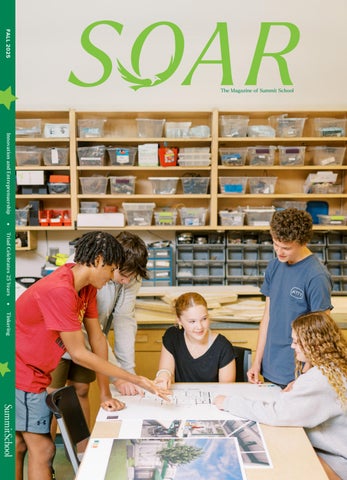
SOAR, Winter 2025

Page 1


The Magazine of Summit School

Dear Summit Community,

The confidence to be curious doesn’t appear by accident. At Summit, it is developed every day in every child—patiently and purposefully—and it is built on a foundation of competence. When students master essential skills, experience joy in the journey, and see that their voices matter, the results are extraordinary: Students pursue what is unknown, create what is unique, and contribute with impact.

This issue of Soar traces that arc—from competence to creation to contribution—across every division and generation of our community:

• In Innovation & Entrepreneurship class, upper school students apply curiosity to entrepreneurship, creating viable businesses (everything from the Twin City Bike Collective–a separate 501(c) (3) to a Salt & Soak enterprise), and discovering that every idea worth pursuing carries both risk and reward.

• In the Triad division, teachers and students prove that mastery of literacy builds confidence, and that confidence gives voice to every learner.

• In the Tinkering Studio, Second and Third graders engage in early engineering, where through hands-on/minds-on learning, they discover that “failure isn’t final”—it’s the beginning of deeper understanding.

• In the soon-to-open SEED Center, our unique program interconnecting science, engineering, entrepreneurship, and design will be amplified, flourishing in a space as visionary and robust as the program that unfolds both within and around it—a place designed to make curiosity visible and collaboration inevitable.

• Through the Douglas Award for Faculty Excellence, we honor a teacher whose craft creates a classroom “where young minds flourish, where hearts are opened and the imagination soars… [and] where curiosity is cherished, voices are taken seriously, and children experience the joy of being truly seen.”

• In an executive functioning curriculum that spans Sixth through Ninth Grade, students’ skills are developed in planning and organization, time management, task initiation, self-monitoring, and study strategies.

• And in our alumni, we see an enduring pattern: curiosity inspires creativity, and imagination inspires achievement.

These stories reflect a simple truth: learning flourishes when it leads outward—when what begins in wonder within us takes shape in the world around us.

Because of your support, Summit remains a place where competence builds confidence, confidence bolsters curiosity, and curiosity fuels learning.

Onward and upward,

Innovation & Entrepreneurship in Action

In Summit’s Innovation & Entrepreneurship (I&E) class, students don’t just talk about starting a business—they build one from the ground up. They imagine, prototype, brand, market, and sell their own products, learning firsthand that entrepreneurship is about risk, resilience, adaptation—and making a difference in the world around them.

“When we talk about entrepreneurship at Summit, the thing behind the thing is empathy,” Head of School Michael Ebeling explains. “Yes, students may design something remarkable or launch a service that takes off, but underneath that is a deeper practice: learning to notice needs in the world and responding with curiosity, creativity, care—and then taking action.”

Unlike a childhood lemonade stand, where ingredients and customers are a given, I&E pushes students to grapple with the real-world complexities of entrepreneurship—cost, labor, and profitability. They learn that good ideas alone aren’t enough; success requires adaptability, perseverance, and a willingness to refine or even abandon an idea that doesn’t work. Discovering that a product isn’t viable can be just as valuable as achieving a sellout success.

“We cover everything—ideation, prototyping, naming, logo design, pricing, packaging, marketing, tracking sales, figuring out your profit,” said Chris Culp ’82, Summit’s director of technology and an I&E teacher. “One of the most important things students learn is how to scale. If they want to take it to the next level, they’ve got to learn that skill.”

A Program Sparked by Students

The I&E program began with a student’s vision. In Ninth Grade, Noah Tyo ’20 wanted to start his own business, and Summit responded by designing a course to support him and future entrepreneurs.

“Our first year was basically Noah turning our service learning project—bike collection, repair, and redistribution—into a 501(c)(3),” said Jeff Turner, director of co-curricular programs and a founder of I&E. “He named it, created logos, branding, filed the incorporation papers. He had help, of course, but this was his project for that year, and it grew into the next year.”

From that idea grew the Twin City Bike Collective, a volunteer- and student-run nonprofit that has now collected, refurbished, and donated nearly 1,600 bicycles. Noah returned often after graduation to help, and his work left an indelible mark on Summit.

Enrollment followed the I&E program’s momentum: from one student in its first year, to seven the next, and nearly 40 within five years.

Notice, Respond, Take Action

By year two, students weren’t just making products— they were selling them. A sales kiosk and online store introduced digital commerce, while in-person markets became a seasonal highlight. Originally tied to the holidays, markets now take place three times a year, giving students invaluable customer-facing experience.

“The kids are at their table, showing off their goods, answering questions, making sales (if all goes well),” Culp said. “And more importantly, they’re getting instant feedback.” Sometimes that feedback is silence—a product that doesn’t sell. Students then must ask: Was the price wrong? Is the packaging weak? Was the merchandising off?”

Turner added, “This class “is designed to include helpful feedback. Success in I&E looks different from success in social studies or math. We can get away with more constructive criticism—like suggesting, ‘If you tweak this, you might sell more.’”

Student ideas have been as diverse as their personalities. Many sell things they’d personally enjoy— cookies, ice cream, or handcrafted goods. However, one of the most memorable projects was Salt & Soak, a luxury personal product line launched by ninth grade laccrosse player, Dax Sanders.

“Dax is a student athlete you wouldn’t think would sell bath salts flecked with bits of flower petals. But he knocked it out of the park,” Turner said. “He recognized that there’s big money to be made in this category.”

Culp agreed: “It was fun to see a teenager who’s really into sports step out of his comfort zone.”

Where Else But Summit?

Summit’s progressive philosophy makes it a natural incubator for student enterprise. “When do you ever hear of another school letting Eighth and Ninth Graders do what we’re doing?” Culp said. “We take kids seriously, and that idea is woven throughout the progressive education philosophy Summit leans toward.”

That entrepreneurial spirit is visible all over campus. Student-run ventures include:

• Honey harvested from Summit’s beehives

• Hot sauce created from campus-grown peppers, complete with student-designed names and logos

• Dried pepper seasoning, an innovative byproduct of the hot sauce process

• Freeze-dried fruit, produced weekly with the help of a dryer that saves food from waste

• Woodworking projects, from charcuterie boards to furniture, crafted from trees felled on campus

Summit also leverages its community ties. “WinstonSalem is very entrepreneurial,” Turner said, noting local icons like RJR, Hanes, and Krispy Kreme. Wake Forest University’s Dan Cohen, Director of Entrepreneurship, serves as a program advisor, and Summit students have taken enrichment trips to Wake’s Innovation Quarter, a hub born from donated RJR buildings.

Planting SEEDs

The program’s future will find a new home in Summit’s SEED Center (science, engineering, entrepreneurship, and design), which will open before the 2026 school year. Twice the size of the old science building, the new space is designed to foster what Head of School Michael Ebeling calls “creative collisions.”

“Our former science building was dedicated to older students,” Turner explained. “This building will be much more adaptable, and it includes a dedicated space for younger kids, which will be a first. The whole campus will make use of this building.”

Designed in partnership with Charlotte-based Little Diversified Architectural Consulting, the SEED Center will itself be a teaching tool. Outdoor classrooms with raised garden beds, a freestanding greenhouse, and abundant glass for visibility will invite curiosity across disciplines and grade levels. A central gathering space called The Hive will host rotating displays and events, inspired by Summit’s observation beehive.

“There’s a cool parallel there,” Turner said. “The same thing will happen with students observing what’s happening throughout The Hive.”

Culp emphasized that the building reflects Summit’s philosophy: “We’re not designing a building and then creating a curriculum around it. We’re doing the opposite. The design amplifies the curriculum we already have.”

A Lasting Impact

From a single student’s vision to a thriving program, I&E has become a hallmark of Summit’s identity. Students leave not just with sales under their belt but with lessons in creativity, problem-solving, and resilience. And perhaps most importantly, they leave knowing their ideas matter.

The Power of Partnership: Triad Celebrates 25 Years

Founded in 2000 and merging with Summit School in 2012, Triad Academy extended its legacy of excellence in dyslexia education while giving Summit the unique ability to serve a broader range of learners—an integration that continues to benefit the entire community. Today, Summit’s Triad division serves 88 students in Grades 1 through 8 and is fully woven into the life and culture of the school as an integrated academic division.

“Summit’s Triad division offers students with dyslexia the best of both worlds,” says Carrie Malloy, Triad Academy’s founder and current Orton-Gillingham Fellow of Record. “They receive gold-standard Orton-Gillingham (OG) instruction across all academic subjects while fully participating in Summit’s co-curricular life—art, music, design and technology, athletics, and more.”

Triad Academy is one of only 19 programs nationwide accredited by the OrtonGillingham Academy (OGA) as both an instructional and training program at the Associate Level. This distinction allows Summit to attract and retain highly trained faculty while deepening the school’s ability to support students with literacy needs.

“While this accreditation requires a significant investment in professional development, the long-term growth and success of our students make it well worth it,” says Head of School Michael Ebeling.

Summit employs 34 faculty members in the Triad division —29 full-time and five part-time. All teachers of OG classes are credentialed or actively pursuing Associate Level credentials. Currently, 55% of faculty hold OGA credentials, including ten at the Associate Level, five at the Certified Level, two Fellows in Training (FIT), and two Fellows. A rigorous mentoring and training structure supports each teacher’s growth and ensures our practices remain aligned with the latest research.

Recent curricular updates include enhanced phoneme blending drills, word work review, and the use of the Simultaneous Oral Spelling (SOS) technique. Instruction in non-phonetic words has also been strengthened by guidance from renowned literacy researchers, Linnea Ehri and Katie Pace Miles.

Triad’s flexible learning models ensure students receive the support they need while remaining connected to the larger Summit community. Starting in Kindergarten, students with significant literacy challenges receive small-group OG instruction four days a week. Many of these students move into a blended first grade model, where they are placed in homerooms with traditional learners. They receive targeted OG-based instruction for language tutorial, Multisensory Math, and language arts, while joining their peers for social studies, science, and co-curriculars.

“This blended model allows us to assess whether a student will need full OG immersion in Second Grade or if first grade support is enough for a successful transition,” says Lisa Buschek, CS/OGA, Director of Triad.

Students in Grades 2–5 typically participate in a full-day immersion program, with all academic subjects taught by Triad faculty. Second and Third Graders attend co-curriculars with their grade-level peers; older students

are in classrooms adjacent to traditional learners, encouraging daily social interaction while maintaining access to OG instruction. By Eighth Grade, many students transition fully to traditional classrooms. Others may continue with targeted language tutorial or language arts support. Math placement in Grades 6–8 is ability-based to ensure an appropriate level of challenge for all.

“Having learning support teams across divisions means students receive consistent, well-coordinated academic support throughout their time at Summit,” says Parker Kelly Tegeler ’02, OGA/FIT and Math Curriculum Coordinator. “We collaborate regularly with teachers in other divisions to ensure smooth transitions in and out of Triad.”

This collaboration extends into curriculum development as well. In 2023, Malloy and Tegeler trained all faculty in the Lower School at the OG Classroom Educator level, supporting the school’s adoption of the UFLI literacy framework. Tegeler and Ashley Newcomb Birkins ’00, A/OGA, have also led Multisensory Math training for faculty. While Summit uses the REVEAL Math curriculum, lesson plans across the school incorporate multisensory strategies that benefit both advanced learners and those who need additional support.

Triad’s reach extends beyond classrooms. Throughout the year, faculty lead parent education sessions on topics such as psycho-educational evaluations, Orton-Gillingham 101, and Multisensory Math. Since 2000, Triad has trained 53 of its own faculty members and supported professional development for teachers across academic divisions and in the greater Winston-Salem community.

Ultimately, Triad’s impact is best seen in the confidence and resilience of its students. One alum—now a college junior majoring in sports marketing—recently reflected, “When things get tough at school, I think back to my days in Triad. I remember that I have the tools to face challenges and figure out how to move forward.”

Tinkering: Where Curiosity Leads the Way

In the Tinkering Studio, failure is just an opportunity in disguise.

Sparnicht. “That’s rare, and it can be disappointing. But there are lessons inherent in that. More often than not, they do persevere through those struggles. Their contraption works, and they walk out of here on cloud nine.”

For more than a decade, Summit’s Second and Third Graders have been discovering that one person’s trash can truly become another’s treasure. Each week, students sift through cardboard, plastic lids, buttons, beads, fabric samples, ribbons, rope, magnets, and other donated odds and ends. With imagination and basic tools, they transform these discarded materials into something new—creations that are both whimsical and purposeful.

The process is joyful, but it’s also deeply educational. “These children are learning problem solving, design, physics, and mechanics,” said Tinkering teacher Beth Spieler. “Tinkering empowers children. It develops their curiosity and challenges them to think about possibilities. It’s their earliest exposure to engineering.”

Jennifer Sparnicht, Summit’s Visual Arts teacher for First though Fifth Grades and a driving force in shaping the program, added: “The inspiration for Tinkering was to give children a chance to create without being wrong, to take risks with their own ideas, build simple technology from found objects, and let their imaginations run wild. This isn’t art class, and it’s not woodworking; this is an idea class.”

Parents often share how much their children love tinkering. Some even set up tinkering areas at home. To students, the studio may feel like playtime, but trial, error, and perseverance make it a space for learning skills that last a lifetime.

Learning Through Struggles

Projects don’t always go as planned. “Occasionally, things go so off-base that a kid will scrap their project,” said

Freedom to Explore

Tinkering is part of the studio program rotation, with students attending five 40-minute sessions spread over two weeks. The rhythm is deliberate.

On the first day, Spieler often shows a short video “to get their brains churning” before letting students loose in the treasure stash. By the last class, she said, “they just come and get right to work.”

“I tell students that my job is to give them the skills, and that how they apply that specific skill is up to them,” Spieler explained. “Occasionally, there’s a project that includes certain criteria, but otherwise there’s a lot of flexibility.”

Safety First

The studio is stocked with real tools—scissors, drills, hammers, glue guns—that demand respect. Safety is woven into every lesson. “I teach them on day one that, in order to use certain tools, you need to have a glove on your non-cutting hand.” The glue gun is often both a fascination and a fear. “Lots of children see it and say, ‘I don’t want to use that; it might burn me,’” Spieler said. “And I’ll say, ‘Yes, it might. And that hurts. But look what you can do with it. Let’s talk about how to use it safely. They learn to consider risks and rewards. Most of them conquer their fear and are ecstatic with the results.”

And there are always alternatives. If a student doesn’t want to use a particular tool, workarounds exist. For example, a drill can be replaced by a hole puncher. In addition, courtesy and caution are non-negotiable. As Spieler tells

them: “If you’re not a courteous and cautious builder, your neighbor’s not going to want to stand next to you to build.”

Something for Everyone

One of Tinkering’s greatest strengths is inclusivity. “There are kids who may be struggling in a regular curriculum class—it could be something as simple as needing new glasses or something more complex,” said Sparnicht. “But Tinkering is a time when kids who are struggling and kids who are excelling have a chance to learn together, collaborate, and build on their ideas. There’s something magical about that.”

The studio is also a great equalizer because aesthetics don’t matter. “The crucial question is: Does it work?” said Spieler. “It doesn’t have to have sparkles and embellishments, although it can. Some kids completely bling out their contraptions.”

And sometimes, even a so-called failure is the start of something better. As Spieler explained, “If students aren’t satisfied with what they’ve made, they can keep tinkering until they are, or realize this thing isn’t going to work as intended, so you need to consider if there could be another purpose for it. In Tinkering class, failure isn’t final. Failure is opportunity.”

The Douglas Award

Recipient of the 2025 Marian Millaway Douglas ’69 Award for Faculty Excellence is Jodi Turner

Passion. Steadfast dedication. Unshakable integrity. Unforgettable joy and an enduring impact. This year’s recipient of the Marian Millaway Douglas ’69 Award for Faculty Excellence embodies all of these qualities— and more.

At the heart of this teacher’s work is an unwavering belief in the potential of every young child. She sees each one not as a puzzle to solve, but as a person to know. She honors their individuality—their quirks, their questions, their rhythms—and creates spaces where those traits are celebrated. In her classroom, curiosity is cherished, voices are taken seriously, and children experience the deep joy of being truly seen. With gentleness, with clarity, and with grace, she teaches them not only how to learn, but how to belong.

This teacher has lived out her belief that the early years of education are sacred. To witness her at work is to see a gifted professional in her element—each detail of her classroom carefully chosen, every word of encouragement purposefully placed, each learning experience designed with the whole child in mind. Her classroom is a place where young minds flourish, where hearts are opened and the imagination soars.

She is a master of her craft. Someone who takes the time, before the school year begins, to carefully plan out the arc of that year’s experience. She has poured herself into studying best practices, attending programs like Harvard’s Project Zero to deepen her own learning, and then quietly weaving those ideas into the fabric of Summit’s culture. Long before “maker spaces” became a thing, she created one in her own classroom—not to follow a trend, but because it would generate a space for children to flourish.

Her commitment to sustainability is not just spoken, it is lived. Through initiatives like school-wide recycling programs and simple, thoughtful classroom practices— cloth napkins, reusable materials, intentional choices— she teaches children to be stewards of nature.

Children feel safe with her. Seen. Known. Loved. She believes that four-year-olds are capable of great depth, great curiosity, and great joy. And she meets them there. Her classroom is alive with language, art, music, and awe. Her students emerge from her care with a stronger sense of self, an appreciation of learning, and that their voices matter.

“ Let’s all “reach and rise” to congratulate this year’s recipient of the Marian Millaway Douglas ’69 Award for Faculty Excellence: Jodi Turner.”

Her colleagues describe her as a critical friend, a steady hand, and a trusted sounding board. She offers encouragement without hesitation and speaks with clarity and principle when it matters most. She leads with what is best for children.

Parents adore her. Colleagues admire her. And her students? They never forget her. They return, year after year, with drawings, letters, hugs, and memories. She is a lifelong learner. A quiet force for good. A model of what it means to teach with intention and love.

“ Teaching Spanish at Summit School has been so rewarding. I love sharing the language and culture while watching students grow, celebrate their progress, and inspire me with their curiosity and energy. ”

Delores Flores de Valgaz

Upper School Spanish teacher

Be sure to follow us on @summitschoolws /company/summit-school @summitschool

years of service

Della Childers

Andrea Clauset

Sharon Copper

Celebrating 10 or more years of employment at Summit

Jess Alfaro

Kianna Beachum

Judy Breakstone

Lisa Buschek

Cara Byrum

Brad Calhoun

Emily Craig

Chris Culp ’82

Kathy Culp

Jen Currin

Xiaolin Dai

Sarah Dalrymple

Paul Dresel

Sarah Dunn

Liz Ebeling

Michael Ebeling

Lisa Emmerich

Andy Fansler

Jason Felten

Jeannie Felten

Delores Flores de Valgaz

Donza Friende

Julie Giljames

Jennifer Gottlieb

Henry Heidtmann

Julie Heidtmann

Catherine Helm

Christy Hemby

Misty Hyman

Chris Jenkins

Doug Johnson

Kristen Keene

Cindy Kluttz

Joy Kontos

Mary Katherine Lautemann

Amy Lawrence

Lesley Leonard

Carrie Malloy

Betsy McNeer

“ The people who make up the Summit community are what makes this such an amazing place to work. My students and colleagues have been there for the great times and the tough times in my life, and I am very appreciative of their support. I can’t imagine a better place to be! ”

Elizabeth Rief

Upper School Latin teacher

Ryan Mihalko

Heather Moir

Colby Morris Murphy ’88

Dominique Patrick

Josh Perry ’94

T.J. Petronzio

Anne Spencer Pope ’91

Karen Pranikoff

Wendy Rice

Elizabeth Rief

Glenda Shelton

Jennifer Sparnicht

Carter Sturkie

Parker Kelly Tegeler ’02

Mary Craig Wilson Tennille ’94

Ginger Thomas

Rhonda Timberlake

Jeff Turner

Ashley Moser Veneziano ’87

Richard Walburn

Elizabeth Kerr Wild ’84

Jennifer Blackmer Williams ’88

Kelly Young Williams ’98

Heather Younts

State of the School

Summit School opened the 2025-26 school year on August 20, with 555 total students: 93 in Early Childhood (Eaglets, Junior Kindergarten, and Kindergarten), 185 in Lower School (grades one through five), 195 in Upper School (grades six through nine), and 82 students in the Triad division. Students who are children of alumni comprise 21% of the student body, specifically 117 students. In addition, 16% of the student population identifies as a student of color.

Regarding this year’s new student make-up, Summit welcomed 83 new students on opening day: 43 in Early Childhood, 19 in Lower School, 10 in Upper School, and 11 in the Triad division. Twenty-one new students are children of Summit alumni, and 18% of the new students are students of color. This year’s new students hail from 16 distinct zip codes, showcasing the geographical diversity of the new student class.

Early Childhood continues to be the primary entry point for new families to the school. This year, over half of the new students who joined the Summit community enrolled in Early Childhood. Ninth Grade is robust with 32 students enrolled in this capstone year.

Summit awarded 119 Financial Aid awards to assist 21.5% of the student body, helping make Summit financially attainable for 85 families. The total aid given for the 202526 school year was $1.77 million, which is 10.9% of gross tuition revenue.

Looking forward, the Admission Office has received 24 applications for the 2026-27 school year, 89% of which are for the Early Childhood division. Interest in early childhood education continues to be strong, demonstrating the value the Winston-Salem community places on the full Summit experience. Encourage your friends and family to apply by the first-round consideration deadline of January 31.

Our communications work continues to center on elevating and sharing the Summit story. Every element of the brand purpose model is reflected in how we communicate— internally and externally—so that our messaging remains consistent and true to who we are. By highlighting Summit’s core beliefs and the distinctive benefits of a Summit education, we strengthen understanding of what sets our school apart.

With the launch of the public phase of the Seeding Possibilities Campaign, sharing information about the campaign’s priorities and progress has been

crucial. Highlights of campaign donors, events, and the construction process have appeared in all communication areas. As the campaign moves forward, we will continue to direct attention to this historic effort.

On social media, Summit’s channels continue to be powerful storytelling tools. Coordinated messaging across platforms has expanded our reach and increased engagement. LinkedIn, in particular, has become an effective way to share Summit’s story with a broader audience, especially to prospective employees. New this fall, our I&E students will utilize Instagram to learn about social media marketing and expand their Market Ventures’ reach further. Be sure to check out their account @ideashopws

@summitschool /company/summit-school

@summitschoolws

Jeff Turner Co-Curricular Programs

Summit Summer 2025

Our 37th summer program broke many records set the previous year:

Highest number of participants - 853 (841 in 2024)

The highest number of registrations - 2,430 (2,201 in 2024)

The highest number of leaders and helpers - 170 (147 in 2024)

We loved having our Summit students and meeting children from 43 ZIP codes and 81 schools. We couldn’t do it without the office, cleaning, and FLIK teams! In a summer full of teacher location moves and a major building project, the maintenance staff were ever-ready to pitch in to help as usual.

Based on 115 parent survey responses, our program has a high degree of satisfaction. Many parents “Strongly Agree” that it’s a top-notch program and that their child had a great time. Comments often describe the experience as “awesome” and “well-run,” with parents highlighting the “difference in quality” compared to other programs. As one parent put it, their child “loves absolutely everything about his camp time at Summit Summer,” calling it “one of the most high-quality experiences we have had the great privilege of engaging in.”

Summit Afterschool Program

The Summit Afterschool Program provides a safe and caring environment that flows from the academic day. Its dedicated staff inspires and engages the whole child, meets the needs of parents, and reflects Summit’s values.

Wendy Rice is in her seventh year as program director. She leads a team of nine teachers who cover Beforeschool and Afterschool. The group includes six returning leaders and three new employees: Summit Spanish teacher Merali Morales, Landon Peeler, and Bamborough Kelly. Wendy has coordinated professional development opportunities with Summit Lower School Counselor, Jenn Currin, and Head of School Michael Ebeling.

Afternoon Academy

In its 17th year, the Summit Afternoon Academy offers weekly after-school enrichment for 3-year-olds to 5th grade students. The Fall 2024 and Spring 2025 classes received over 340 registrations in various topics, including archery, fly tying, pottery, drama, beekeeping, piano, metal detecting, and soccer. New classes included: Structures,

led by local architect Steve Hastings and Yoga and Mindful Movement, led by Afterschool teacher Michele Viola. A record thirty-one students signed up for the Lollipop Guild Academy class, where they learned to perform as Munchkins in the upper school musical production of The Wizard of Oz, led by two Summit faculty: Theater Arts teacher, Kianna Beachum, and Chorus teacher, Haley Chapman.

Idea Shop

The current 8th and 9th grade studio class, Innovation and Entrepreneurship (I&E), has 38 students enrolled this year. Participation has doubled since 2022-2023, when 19 students were enrolled. The class begins the year with Summit Ventures. These are group projects based on products that the teachers have designed over the years, including honey, hot sauce, freeze-dried fruit, freezedried candy, and fire pit wood bundles. The new students research, rebrand, and market their versions of these standard products.

We anticipate that many new Student Ventures will be added to the array of businesses designed by students in the past. In the 2024-2025 school year, we were impressed with a record number of 30 businesses, including Chillin’ with the Chicas customized ice cream, Scented Soaps, Carlyle Coasters, Summit Snapshots, Sunshine Nomad supporting Mammdu Trust in Namibia, and Cookie Jar hand-decorated cookies. All students participated in a Shark Tank-style pitch competition culminating in a grand final at the Wake Forest University Center for Entrepreneurship with Dan Cohen, the John C. Whitaker, Jr. Executive Director of the Center for Entrepreneurship, and Greg Pool, Associate Professor of Practice. The I&E class also opened two new sales options. The Idea Shop kiosk is a shopping spot located near the Main Office that allows all visitors to purchase student products. They also experimented with e-commerce by creating a website to market and merchandise their businesses.

As part of the Idea Shop, Third Graders attend “business school,” learning about concepts such as supply and demand, goods and services, scarcity, economic imagination, and profit/overhead cost. After developing business ideas, writing a business plan, and creating an “elevator pitch,” students secure funding from Summit, establish their own businesses, and sell their products or services at a Business Fair and Expo, with proceeds donated to charity. Students donated to Samaritan Ministries, Crossnore, and The Humane Society this past year.

Cindy Kluttz Development

The Summit School community steps up for Every Eagle, Every Day, to support our essential fundraising efforts, thanks to the generosity and philanthropy of parents, past parents, alumni, faculty, staff, grandparents, and other friends of the school.

Total giving for the year exceeded $4.1 million, thanks largely to the Seeding Possibilities Campaign that has infused our campus with energy and excitement. With a total goal of $17 million, the Campaign supports the construction of the SEED Center (Science, Engineering, Entrepreneurship, and Design), as well as other strategic priorities, including the Financial Aid Endowment and Center for Excellence and Innovation in Teaching and Learning (CEI) Endowment.

Unrestricted annual giving totaled more than $1,018,000 last fiscal year. The Summit Fund campaign exceeded its $600,000 goal, ultimately providing $622,000 for the school’s operational budget. These essential dollars make up the difference between tuition and the actual cost of educating each student. Summit also received over $41,000 in donor-designated gifts earmarked for financial aid, professional development, athletics, playground enhancements, and other initiatives.

Summit’s biennial Gala, Cultivate our Campus in Bloom, took place on April 26, 2025. A robust group of volunteers transformed the Athletic Center into a delightful spring setting, welcoming nearly 400 people for an evening to remember. Thanks to all of our sponsors, patrons, attendees, and winning bidders, we exceeded our $350,000 fundraising goal. It was wonderful to gather as a community to celebrate Summit’s legacy and bright future.

Summit’s endowment remains robust at $19.5 million, which generated more than $850,000 for the annual operating budget. Of this, 50% was directed toward faculty support and professional development. A gift of $50,000 or more can establish a permanent, named endowment; two new funds were created last year.

Summit’s planned giving society, Patrons for Tomorrow, recognizes those who have made provisions for a planned gift to Summit. This year, several new donors included Summit as a charitable recipient of their bequests. We are grateful for their thoughtful planning, which will leave a legacy for future students for generations to come.

We are immensely grateful to all of our families and friends for the multitude of ways they supported Summit School this past year. Summit School’s enduring success is a testament to Louise Futrell and her vision of building a school where “everybody can be a somebody.”

Carter Sturkie Finance & Operations

Summit School continues demonstrating strong fiscal stewardship, navigating a dynamic economic environment with resilience and a steadfast commitment to our mission. Our financial health enables us to prioritize strategic investments that directly benefit our students and faculty, ensuring a vibrant and healthy learning environment for years to come.

Recognizing that our teachers are the cornerstone of student success, we have strategically allocated resources to support their professional growth and well-being. For the 2024-25 fiscal year, approximately $11.0 million of our budgeted expenses are dedicated to salaries and benefits, underscoring our belief that competitive compensation is essential to attracting and retaining top-tier educators. Our overall operating revenue for 2024-25 was $20.8 million, supporting a robust educational program for 559 students.

2024-25 Financial Highlights

The endowment experienced favorable market returns, increasing in value by almost $1.7 million; it is now valued at over $19 million and contributes over $850,000 annually towards Summit’s operating budget

The school invested more than $2.8 million in capital improvements, including significant progress on SEED Center construction.

Long-term debt stood at $7.3 million with ongoing annual debt service of approximately $1.0 million.

Michael Ebeling Ebeling Center for Excellence & Innovation

The single biggest variable in student success is the quality of the classroom teacher. Thus, the mission of Summit’s Center for Excellence and Innovation (CEI) is to support teachers’ professional growth in ways that directly impact the depth, breadth, and quality of student learning. The initiatives outlined below span our divisions, reflecting our commitment to continuous growth and improvement. They underscore our commitment to fostering a learning community that continually grows and adapts to the everchanging landscape of education. We believe that by investing in the development of our educators, we enrich the educational experience for our students. The robust and strategic professional development opportunities pursued by our faculty this past year, as well as those slated for this year, include the following:

Training all faculty and staff in the Workplace Big 5, a framework that promotes excellence by equipping personnel to strategically leverage not only their strengths, but those of colleagues.

Participating in the University of Pennsylvania Graduate School of Education program in Inquiry in the Social Studies Classroom.

Further developing faculty skills in effectively using Gemini and Notebook LM software via Google Education Suite.

Kicking off the annual Associate Level Orton-Gillingham training with a week-long session in June, involving faculty from both the Triad and Early Childhood Divisions.

Attending the National Science Teachers Association (NSTA) annual conference.

Building on last summer’s work with four teachers attending the Mind Brain Education Academy at the Center for Transformative Teaching and Learning (CTTL).

Upper school social studies faculty receiving training in The Writing Revolution (TWR) and collaborating with Language Arts teachers to further integrate writing across the curriculum.

Further developing a unique executive functioning curriculum that spans Sixth through Ninth Grade to support student skills in planning and organization, time management, task initiation, self-monitoring, and study strategies.

Attending the National Association of Teachers of Math (NCTM) Conference.

Conducting RULER training, a social-emotional learning program from the Yale Center for Emotional Intelligence, designed to equip our educators with tools to recognize, understand, and manage emotions in support of wellbeing and school culture.

Attending the National Association for Gifted Children (NAGC) annual conference.

Following two years of research, training lower and upper school teachers in the use of state-of-the-art interactive touch screen panels that offer unique, powerful, intuitive, and interactive teaching and learning.

Faculty leaders attending multiple North Carolina Association of Independent Schools Conferences, including gatherings on: Neurodiversity and Artificial Intelligence in Education.

Attending the National Association of Teachers of Math (NCTM) Conference

John Carty Athletics

Summit Athletics opened the 2025-26 school year with a total of 154 students participating on 11 fall sports teams, highlighted by three volleyball teams and two boys soccer teams. Our coaching staff currently has 11 faculty and staff members leading our programs and teams.

Our coaches focus on skill development, individual and team growth, confidence, leadership, and having fun. Throughout the season, coaches will lean into their core values to assist our students’ growth and development.

Last year, 66% of our 9th Graders participated in three sports. Our athletic program had 52% of our students playing three sports and 82% who played two or more sports. Our largest teams were Lifetime Sports, Boys’ Lacrosse, Football, and Track and Field. We also had 28 students participate in our winter Strength and Conditioning program.

Chris Culp ’82 Technology

At Summit School, our IT Staff is dedicated to delivering cutting-edge technology solutions that empower our students with advanced learning opportunities, equip our faculty with innovative teaching tools, and ensure seamless access to information and communication for our families. Our priorities include enhancing network infrastructure, optimizing user experience, safeguarding student and employee data, providing reliable access to digital resources, and integrating technology across all campus programs. We are committed to enabling the use of technology in every aspect of campus life, from academics to extracurricular activities.

Some additional updates in the past year are:

Replace DVR video camera systems with Verkada cameras in Upper School Building, 4-5 Building, Dining Hall

Remove as much IT equipment as possible from the Lewis Science Center before demolition to be used elsewhere in the school, donated, or recycled

Upgrading network wiring in Upper School Building to get the building up to current standards, and removed abandoned voice/data wiring from ceilings and recycled all materials

Upgraded all Wifi 5 access points in Upper School Building, Futrell Building, and 4-5 Building

Focus on using Gemini and Notebook LM software via Google Education Suite for faculty and select student groups

Upgraded First through Third Grade classrooms and Auxiliary rooms from Smartboards to 16 new Viewsonic 75” Viewboards

Refresh student Chromebooks, recycling broken or obsolete devices

Continue to work on the network strategic campus plan related to fiber network backbone upgrades

Data Infrastructure Strategic Plan Phase One: connects each building with a 10 Gigabit Fiber service connection and supporting network hardware to support future high-speed throughputs

HVAC control upgrades in Upper School Building to manage new system

Upgraded internet connection plan in the works to be completed in Spring 2026 to move to a 5 Gigabit Fiber service connection

Upper School Digital Media Design room upgrade

Upgraded sound board in the Theatre Control Booth

Summit School began the 2025-26 school year with a total of 169 faculty and staff, including 10 new educators. Our faculty is 86% female and 14% male employees, with 9% of teachers being faculty of color. Notably, 57% of our faculty hold advanced degrees, demonstrating a high level of expertise.

To attract, hire, develop, and retain high-caliber and mission-aligned educators, Summit is committed to its strategic initiative of becoming an Employer of Choice in the Triad Area. This effort is built around The Summit Educator Advantage (SEA), a comprehensive value proposition that addresses the multifaceted needs of educators. The SEA is founded on five core components: Culture, Environment, Professional Development, Benefits, and Compensation. This framework is vital for communicating our shared commitment to a thriving relationship with our educators, ensuring Summit remains competitive in the talent market. The single biggest variable in student success is the quality of the educator. SEA represents Summit’s deep and enduring commitment to these exceptional professionals.

Starting with our summer read, Permission to Feel, this year’s professional development focuses on two key initiatives: the RULER framework and the Workplace Big 5. The RULER framework teaches the emotional intelligence skills of Recognizing, Understanding, Labeling, Expressing, and Regulating emotions, which foster positive interactions and well-being among children, among adults, and between children and adults. The Workplace Big 5 training builds professional awareness by providing a clear framework for understanding how individual personality traits contribute to workplace performance and team dynamics. This self-awareness equips faculty and staff to strategically leverage strengths and adapt their work styles to enhance collaboration, improve communication, and understand diverse working styles to support more cohesive teams as they navigate their own professional growth journey toward excellence.

Investing in these initiatives inspires excellence in teaching, cultivating a community of learning and growth. This commitment to our faculty and staff’s well-being and development strengthens our culture, ensuring Summit educators equip each student for the rich journey of lifelong learning.

This year, we welcomed 82 students, including seven new families from the community and 11 families from Lower School. Seventeen students moved out of our division to other divisions of Summit. Four new faculty members who bring a breadth and depth of experience, enthusiasm, and fresh perspectives joined the division.

In our continued effort to foster a sense of belonging among students, parents, faculty, and staff, we are excited to begin the implementation of our new social-emotional learning curriculum RULER, an evidence-based approach to social and emotional learning (SEL) developed at the Yale Center for Emotional Intelligence. This year, we will focus on training all faculty and staff so that they begin to model RULER for students. We continue to implement the Olweus Bullying Prevention Program (OBPP) to help us deepen our understanding of bullying and to learn additional strategies to address and prevent it.

Using the Reveal math curriculum school-wide has continued to increase teacher collaboration across all three divisions at Summit. In the Triad division this year, as teachers continue to use the Multisensory math lesson plan using Reveal curriculum resources, they plan to include more intentional focus on the development and progression of math fluency skills.

Replacing the ERB with Measures of Academic Progress (MAP), an adaptive test, administered three times during the year to students in First through Ninth Grade, provides an additional measure to monitor academic growth and help inform teacher instruction.

Professional development is always a priority as one of 18 schools accredited as an instructional and training program by the Orton-Gillingham Academy. Over half of our faculty is credentialed through the OG Academy, and seven more are working towards certification. This summer, we kicked off the annual Associate Level Orton-Gillingham training with a week-long session in June with seven new trainees. Trainees this year included teachers in the Triad and Early Childhood divisions and two community members who will be tutoring on campus.

Commensurate with our mission to provide ongoing support for our students, our OG in the Summer (OGS) Camp served as an easy entry point for new students and an opportunity for current students to maintain their skills. The camp hosted 38 students, 14 of whom were from the wider community.

We look forward to again offering parent learning opportunities throughout the year, which will include

a dyslexia simulation and a variety of topics related to dyslexia and our approach to teaching. All parent sessions are open to Summit families and the greater Winston-Salem community.

In our ongoing effort to create a sense of belonging for all students and to support the integration of students in the Triad division, we had a school-wide New Parent Orientation in which all three divisions welcomed families and discussed common values, philosophies, and principles. Sharing our same culture and curriculum helps families better understand that Summit is a unified community, meeting all children where they are.

Misty Hyman Upper School

We were thrilled to welcome 211 students to our Upper School in August, including 32 students in our class of 2026. These student leaders have already demonstrated exceptional leadership by creating a welcoming environment for our younger students, taking charge of weekly assemblies, and spearheading school-wide service projects. Our commitment to academic excellence is reflected in the 100% pass rate on the AP World History exam for ninth grade students over the past three consecutive years.

Our curriculum continues to evolve to meet the diverse needs of our students, with reinforced core programs like Reveal Math and the 4QM Framework in Social Studies. This summer, our Social Studies teachers received training in The Writing Revolution (TWR) and are now collaborating with Language Arts teachers to integrate writing across the curriculum. TWR is a structured approach that builds from sentence-level skills to complete essays, embedding writing in every subject to deepen comprehension, critical thinking, and communication. This method provides students with clear tools to organize their ideas, strengthen reading skills, and express themselves effectively across all areas of learning.

Teachers have refined and further developed our innovative signature experiences, including the Sixth Grade’s entomophagy unit, Seventh Grade’s hurricane houses project, Eighth Grade’s STEM design project, and Ninth Grade’s capstone research and speech project. Additionally, we are currently developing an executive functioning curriculum that spans Sixth through Ninth Grade to support skill development for our students in planning and organization, time

management, task initiation, self-monitoring, and study strategies. We will continue administering the MAP assessment for the second year in order to gain an understanding of how we can use the data to refine our curriculum and instruction.

Beyond academic excellence, we are committed to helping our students develop a strong sense of empathy and community service. Our students have engaged in meaningful volunteer work, with Sixth Graders assisting at SECU House, mixed-grade groups contributing to the Ronald McDonald House, and Eighth Graders supporting Brenner’s Children’s Hospital and the Second Harvest Food Bank. This dedication to service also inspired the annual ninth grade philanthropy project, culminating in a grant awarded to Westlawn School through The Lovett Foundation in May 2025. Additionally, students in Grades Five through Nine raised over $4,000 for Charity: Water during a fun run. This initiative was sparked by our Ninth Graders, who learned about global water scarcity, motivating our students to take action and raise awareness for the 703 million people worldwide who lack access to clean drinking water.

This year, we are excited to launch several initiatives that strengthen both our staff community and student experience. Faculty and staff will participate in the WorkPlace Big 5 Profile™, a personality assessment that fosters self-awareness, collaboration, and belonging. We are also beginning RULER training, a social-emotional learning program from the Yale Center for Emotional Intelligence that equips our community with tools to recognize, understand, and manage emotions in support of well-being and school culture. In addition, we are continuing the Olweus Bullying Prevention Program (OBPP). This research-based, school-wide initiative promotes safety and positive peer relationships through clear expectations and consistent responses to bullying.

We are confident that these initiatives will further enrich our students’ educational experience at Summit, and we look forward to a year filled with growth, achievement, and new opportunities.

Tom Gething Early Childhood & Lower School

As always, the second half of the 2024-25 school year was action-packed. The Spring Sing remains the most highly attended community event, with so many parents and grandparents joining our students in celebrating the joy of collective performance. The signature events in all grade levels were again a highlight. This year, we combined two significant third grade activities into one day, with the book launch for our third annual creation of Super Summit Stories (available on Amazon!) and the annual Entrepreneur Fair. Second grade’s Our Earth signature event continues to thrive, and this year we were blessed with perfect weather as parents joined for the lunch and afternoon activities. These events, plus those across other grade levels, are part of the continued commitment to help children see the outsized value in their learning and opportunities to take joy in the learning process.

Over the summer months, we took advantage of the coming facility development to move Triad’s fourth and fifth grade classrooms into proximity with their partners in Lower School. This exciting development is designed to help us foster an even deeper sense of community across school divisions while also opening up the potential for new and interesting forms of collaboration.

2025-26 will undoubtedly be another busy school year. At the time of writing, we have 60 new students and 42 new families joining us, together with one new teacher and five new assistant teachers.

Summit has never rested on its laurels, and 2025-26 will be no exception. A number of initiatives are now at the point of consolidation. The development of our revised social studies curriculum is now in its third year, while the further development of our reading programs continues apace. During 2024-25, we introduced a second standardized assessment system, MAP Growth, with the intention of better understanding the attainment of our students and where we can improve our programs. With MAP Growth and MClass now established, we are able to make informed instructional choices for all our students. It was a steep learning curve for all involved, and as always with any initiative, the second year of implementation is where meaningful progress is possible.

Professional development remains crucial to our character and growth as a school. Again this summer, four colleagues attended St Andrew’s Episcopal School’s Mind Brain Education Academy, building on our work in 2024. Other colleagues attended a number of professional development courses during the summer, and we are all committed to the introduction of the RULER Emotional Intelligence program through Yale, which will really take off in 2026.

Seeding Possibilites Comprehensive Campaign

Summit School’s Seeding Possibilities Comprehensive Campaign continues to be a tremendous success. We are thrilled with the progress we’ve made so far, energized by the exciting steps ahead – and we want you to be a part of it!

This capital campaign is a comprehensive initiative, transforming the future of learning at Summit by funding the:

SEED Center (Science, Engineering, Entrepreneurship, and Design), a cutting-edge hub for interdisciplinary education Center for Excellence and Innovation (CEI) Endowment, empowering faculty and staff

Financial Aid Endowment, expanding access to the Summit experience Summit Fund and strategic priorities, ensuring ongoing excellence

Construction is well underway, and we will continue sharing updates as the SEED Center takes shape. This state-of-the-art facility will allow students and faculty to innovate and collaborate across divisions and grade levels.

We are deeply grateful for the generosity of our families, friends, alumni, and supporters. This fall, we invite the entire Summit community to join us in advancing the Seeding Possibilities Campaign while continuing annual contributions to The Summit Fund. Together, these initiatives ensure the success of our students, faculty, and staff. We hope you’ll be part of the possibilities that make Summit remarkable.

115,804

sq. ft., the size of the construction site 32

Dump truck loads of debris hauled to landfill from Science Center

Dear Summit Alum Community

As it has been for over 90 years, the alum community is energetic, thriving, and dynamic. Here are some recent highlights:

In May, 38 graduates joined the alum family and I had the privilege of speaking to them at the annual graduation breakfast hosted by the Office of Alumni Engagement (photos on page 29).

Several regional reunions were held in the spring (photos on page 28).

Celebrating the Class of 2022! Faculty and staff gathered at the annual Senior Send Off to wish the high school seniors well as they begin their next chapter (photos on page 25).

The classes of 1965, 1975, 1985, 1995, 2005, and 2015 attended class reunions on campus in September (photos on pages 30-31).

Congratulations to Jennifer Adams ’86 and Barbour Strickland ’67, the recipients of the inaugural Alum of the Year award. The honor is presented annually to an alum who has either demonstrated extraordinary service to their field, humanity, or society, or made significant contributions to Summit.

The Alumni Council continues to provide Summit with leadership and support for all alumni activities. If you have an idea or question, please contact me at racheljoyce@gmail.com.

Rachel Neely Johnson ’99

Alumni Council President 2025-2026

It is so rewarding to serve as the Summit liaison for alum engagement and to witness firsthand the excitement of connecting alums to the campus. I extend a heartfelt thanks to the Alumni Council which provides leadership for many of our activities.

Whether you attended Summit in the 1930s, the 1970s or in the more recent decades, you are warmly invited to visit the campus. If you are interested in a quick (or long) tour, having lunch in our Dining Hall, attending a sporting event, observing expert educators or engaging with students, please reach out. There are also opportunities to connect with Summit via virtual formats, don’t allow distance to separate you from the campus.

If you would like to learn more about opportunities for alums or want to get involved, please contact me at alums@summitmail.org.

Senior Sendoff

Celebrating our high school seniors

1. Mac Murphy ’22, Jager Bellissimo ’22, Ben Shultz ’22, William Tuohy ’22, and Wyatt Pearce ’22

2. Olivia Stubbs ’22, Adelaide Merrick ’22, and Sophie Petrozio ’22

3. Nelson Storch ’22, Hines Batten ’22, and Curt Batten 4. Matt Petronzio, Misty Hyman, Stacy Petronzio, Wesley Davis ’87, and Mary Craig Wilson Tennille ’94 5. Sara Bailey ’22, Rebekah Self ’22, and Caroline Hollan ’22

Alums share insights into their success

Oliver Bennett ’20 is a third year architecture student at Northeastern University. Bennett also works in the commercial real estate development sector, supporting Computer-Aided Design (CAD). After Summit, he attended Bishop McGuinness Catholic High School and Northeastern University.

Describe a favorite Summit teacher, curriculum event/ project or special memory that resonates with you: My Chinese Language teacher, Mrs. Dai, introduced me to an entirely new culture, ensuring our worldview was not limited to just Winston-Salem. From tea ceremonies,

sharing mooncakes for the mid autumn festival, or leading a trip to China, she exposed us to new ideas and experiences. A favorite memory is having our final test at May Way Dumplings in Reynolda Village. For the test, we ordered our meal in Mandarin Chinese; as I continue to travel, I find the best way to immerse myself in a new culture is through its food.

If a student wants to enter your field or area of study, how do they ‘get there’?

If you have any interest in architecture and design, the best thing you can do is look at the world around you and figure out ‘what it means to you.’ The strongest skill you can have in the field of design is a sense of identity. Document everything: pictures, words, and sketches. The number of times I have referred to notes from months or years ago to inform a new idea has surprised me. For the school path, you don’t need a formal background in art or design to get into architecture school. Taking summer college architecture courses at a university during high school really helped inform my decision on deciding my major and gave me portfolio work to use in my application. At its core, architecture is about people and connecting with friends and teachers about our shared interests has been a huge help for me in creating opportunities to further my education and career. Think big, foster the relationships that mean the most to you, and be open to new experiences.

What advice would you give to Summit students or to your younger self?

I would tell my younger self to make the most of the time you have. Explore new ideas, ask your parents to help you build that project, and it’s okay if you fail. You might think you are too cool or mature to participate in silly things with classmates (maybe because your older brother would say so) but I wish I had played more and developed those relationships while I could. Join a team, start a club, you’re only as strong as the people around you. I wish I wasn’t as afraid to fail when I was younger because that’s how you learn. It’s okay if you don’t have a ‘thing’ or a talent that you haven’t discovered yet, even if other people you know have discovered one. In college, I really found what drives me. You can be okay at a lot of things as long as you never stop trying. Your mind is your biggest enemy and when you realize that, it’s much easier. As long as you stay true to yourself and your principles, you’re succeeding.

Summit really helped me to develop my sense of self and I am grateful for that; don’t take your time there for granted as you will look back on it fondly.

Oliver Bennett ’20

Blair Roemer

Hedley ’08

Blair Roemer Hedley ’08 is the founder of Beldrie which creates stylish, high-performance golf, tennis, and pickleball apparel for women. Hedley has a background in business after years as a management consultant at KPMG and a program manager at Meta. After Summit, she attended R.J. Reynolds High School and the University of Georgia.

Describe a favorite Summit teacher, curriculum event/ project or special memory that resonates with you: Being part of the Summit gymnastics team—especially with

the Carltons as our coaches—was such a unique experience for a school and really deepened my love of sport.

If a student wants to enter your field or area of study, how do they ‘get there’?

Be curious and resourceful. Start by learning everything you can about the industry: read, listen, and talk to people doing the work. Get hands-on experience early, even if it’s small-scale, and don’t be afraid to start something of your own. Building relationships is key, most opportunities come through connections. Be adaptable because the path will rarely be a straight line. And don’t give up!

What advice would you give to Summit students or to your younger self?

Don’t be afraid to try things you’re not instantly good at. Some of the best parts of life come from saying yes, even when it’s scary or new.

Shop Beldrie by scanning the QR code or by visiting beldrie.com .

Heather Flow ’98 is an Art Advisor and the Founder of Flow Advisory, where she partners with private collectors to build and sustain contemporary art collections. She is also a member of the Association of Professional Art Advisors. Based in New York, NY, Flow lives and works in the city. After her time at Summit, she attended R.J. Reynolds High School before continuing on to the University of Virginia.

Describe a favorite Summit teacher, curriculum event/project or special memory that resonates with you:

Our fifth grade teacher, Mr. Neil Wilcox, showed images of artwork on the overhead projector and the class would write about the artwork. That exercise from my Summit days essentially mirrors my current profession!

If a student wants to enter your field or area of study, how do they ‘get there’?

Learn how to observe, analyze, interpret artwork— through looking, looking, and looking again.

What advice would you give to Summit students or to your younger self?

Nurture your curiosity and develop a wide-eyed openness to the possibilities that lie ahead.

Visit Flow Advisory by scanning the QR code or by visiting flowadvisory.com

1. Yasmin Horner ’16, Bo Dalrymple ’18, Safia Mohamoud ’96, Grif Johnson ’65, Jonathan Spencer ’95, Peter Hawley ’65, and Fairley Spillman ’74
2. Sarah Kaplan Grantham ’04, Charlie Elberson ’73, Chic Huber ’73, Ann Mills Lassiter Freund ’04, Sarah Sloan Watts ’76, Rick Hutchins ’76, and Elizabeth Foushee Cunningham ’76
3. Libby Fulton ’12, Mary Pleasants Bossong ’83, Dalt Holmes ’74, Jennie Malcom Pazienza ’69, and Penn Shore ’74
Washington, DC
Charlotte, NC
Raleigh, NC

Welcome New Alums Summit class of 2025

1. Legacy families—alum parents and grandparents with their children, front row: Isabella Calhoun ’25, Louise Johnson ’25, Finn Veneziano ’25, Emma Sayers ’25, Ben Staton ’25, Maggie Campbell ’25, Julian Davis ’25, Mary Olivia Moser ’25, Mills Douglas ’25, Harper Hoffman ’25, Will Lovett ’25, back row: Anna Mackie Calhoun ’92, Elizabeth Pollard Welch ’93, Jane Welch ’25, Nell Pollard Johnson ’96, Ashley Moser Veneziano ’87, Bryan Sayers ’86, Forrest Stephens Lucas ’95, Chip Campbell ’93, Ann Brown Crowder Campbell ’93, Wesley Davis ’87, John Kenneth Moser ’89, Aly Kleinmaier Moser ’92, Marian Millaway Douglas ’69, Sandlin Douglas ’94, Jordan Capps ’90, and Peter Lovett ’85 2. Celebrating our recent graduates—who are now alums 3. Rachel Neely Johnson ’99 spoke to the 2025 alums at the annual graduation breakfast

Founders Celebration

Celebrating Summit’s birthday with multiple events over multiple days

September 16-26, 2025

1. Class of 2015-celebrates a 10th class reunion 2. Class of 1975-celebrates a 50th class reunion 3. Ginger Whisnant, John Seymour, Mike McCall ’75, and Betsy McCall 4. Sandra Adams, Former Head of School and Jennifer Adams ’86 5. Rachel Neely Johnson ’99, Alumni Council Chair and Sarah Dalrymple, Director of Alumni Engagement 6. Class of 1985-celebrates a 40th class reunion 7. Jane Dudley Portman ’75, Kate Miller ’75, and Alice Cleland 8. Class of 2005-celebrates a 30th class reunion 9. Class of 1995-celebrates a 60th class reunion

Class Notes

1974 Karan Martinat Witt

After her evacuation from western NC last fall, Karan Martinat Witt wrote a poem about her experience and submitted it to the Key West Arts & Historical Society’s annual Tennessee Williams Poetry and Short Story Contest; she received Honorable Mention in the Poetry Contest for her piece Tennessee in the Dark.

Tennessee in the Dark

I waited till the last day to throw away the meat, down the twisted, altered mountain, where the gorge splayed in defeat.

The bears had climbed up higher, to the caves a week ago.

They had known the storm was coming to the river down below.

And when the rain gorged river, fed with every mountain stream, became a raging torrent…trees snapped, stones screamed…Helene.

I felt a pivot in the earth, a rumbling in the soil.

The land beside me slid away, the hillside turned to roil.

And in the week that followed…came a silence so serene so strange amidst the chaos, so odd amidst this scene.

And in the middle of black nights, I gazed up to the sky.

A blaze of brilliant galaxies had the colored lights on high. I read the plays of Tennessee by flashlight in the dark, and waited for the world to show and make some sort of mark.

The turkey, fox, and bobcat to the mountain top had fled, a lone owl in a twisted tree wept “flowers for the dead.”

The day evacuation came, I threw away the meat from my lone deserted cabin…so the coyotes could eat.

Laura Mueller Woods has a passion for telling stories with photographs that translates into her teaching. Woods was a staff photographer and photo editor for The Charlotte Observer for more than 20 years before becoming Davidson Day School’s photography teacher and photographer; she also has a portrait photography business. Woods teaches ninth- through 12th-graders. Her students have had their photography featured at an exhibition at the Mint Museum of Art in Charlotte. Woods believes teaching young people photography is important for many reasons, which include building community and teaching empathy, creative thinking, and media literacy, as well as strengthening their powers of observation.

1977 1985

Scott Miller was disappointed to miss the class reunion in September. Miller works for Connection, Inc and lives in Beaverton, OR.

1986

Matt Spear has a joy driven mantra and has shifted to a “deliberately not busy” flow. He is in his 4th year coaching middle school cross country, basketball, and soccer at Davidson Day. Spear is also a Life Coach for individuals and groups in and out of sports with a focus on wellbeing, mental health, peak performance, and stress reduction. During the past two years, he mentored over 20 NASCAR drivers. Spear aims to read 50 books this year.

1995

Last spring Jay Callahan became the first coach ever inducted into the Salem College Sports Hall of Fame after being their soccer coach for twelve years. Callahan serves as the Executive Director of the Down Syndrome Association and coaches men’s and women’s varsity soccer at Mount Tabor High School.

2000

Molly Mae Potter has joined the board of the First Air Force One Project. Potter says, “I’m honored to be part of restoring President Eisenhower’s aircraft from nearextinction to airworthy glory.”

2011

In the spring, Lydie Neill was promoted to vice president at Breakwater Strategy. She also serves as Chief of Staff to the company CEO and president.

2012

Julia Coggins graduated from SUNY at Buffalo with a Master’s degree in Business Analytics.

2011

Last spring, Graham Troxell received his white coat from UNC Adams School of Dentistry. While finishing his degree, Troxell lives and works in Chapel Hill.

myself. As an educator, I was inspired to find creative ways to share the English language and American culture, and it was incredibly rewarding to see my students engage with these concepts. Equally fulfilling was the exchange of knowledge in the other direction; I gained so much insight into Taiwanese culture from my students and colleagues, whether learning about local traditions or picking up new Mandarin and Taiwanese phrases.” In January, she will begin her career journey as a Marketing Global Graduate Management Trainee at British American Tobacco.

2019

Lucas Manning received the “Best in Show” award at the annual Wofford College “Hot Now” student art exhibition for his baseball cleat design project, the “Veloxis Pro 1.” Manning said, “this endeavor allowed me to merge my passion for baseball with my interest in design, embodying an interdisciplinary approach that arises from my experiences as a student-athlete.”

2022

Tejus Ranadive attends Hobart and William Smith Colleges where he signed to play tennis.

2023

Congratulations to Sky Segal who was named a National Merit Semi-Finalist.

2015 2017

2024

Sepand Salem lives in Dubai and works at a firm that specializes in commodity trading.

Hannah Davies graduated with degrees in history and global commerce from Denison University. After graduation, she taught English in Taiwan with the U.S. Student Fulbright Program. Hannah said, “my time as a Fulbright English Teaching Assistant (ETA) was nothing short of transformative. Every day offered new opportunities for learning—for both my students and

Ames Bettis received his Eagle Scout award last spring. His project was updating a space at Big Brothers Big Sisters creating a place for children and their mentors to interact.

Lila Kelly, a junior at Forsyth Country Day School (FCDS), was named an All-State Athlete last winter. Kelly plays basketball both at FCDS and for the Winston-Salem Stealers in the AAU program.

Have news to share? summitschool.com/alumupdates

Congratulations to the recipients of the 2025 Alum of the Year award

Contribution to the community

Contribution to Summit School

Barbour Strickland ’67 has been a driving force in strengthening the school’s alumni engagement program. As an inaugural member of the Alumni Council, he not only chaired the group but also helped create one of the most successful reunions in school history—his class’s 50th. He has since continued to support alumni connections by organizing and attending reunions across the state. True to form, he is already laying the groundwork for his class’s 60th celebration.

Barbour’s dedication extends beyond alumni work. A passionate supporter of the arts, he has funded the school’s annual Arts Week curriculum and partnered with the development office to curate, frame, and display a collection of artwork by the late Anne Kesler Shields ’47.

Jennifer Adams ’86 has made a lasting impact on childcare in North Carolina by founding two childcare facilities that provide essential services for families and children. Her commitment to creating high-quality programs is rooted in her own experiences at Summit and her training as a school psychologist, as well as the inspiration she drew from Summit’s exceptional teachers in the 1970s and 1980s.

The success of her work is reflected in The Little School, where the true achievements are seen not only in the children who thrive there but also in the program’s longevity and sustained excellence.

Nominations are now being accepted to recognize Summit’s Alum of the Year award which will be announced during Founders Week, September 2026. We will recognize an alum who has positively impacted the Summit community and an alum who has impacted their community with extraordinary service to their field, humanity, or society.

Deadline to submit: July 1, 2026

Self-nominations are accepted.

Scan the QR code to submit your application.

Please contact Sarah Dalrymple, Director of Alumni Engagement, for more information at sarahd@summitmail.org.

Connections and Celebrations

Faculty and staff love to connect with alums—both on and off campus!

1. Mary Lyle Townsend Spry ’08 2. Elizabeth Meinberg Roberson ’11 3. Class of 1994 on First Day of Class: Elizabeth Blanco Marley ’94, Sandlin Douglas ’94, Elizabeth Broyhill ’94, Mary Craig Wilson Tennille ’94, and Josh Perry ’94 4. Bill Toole ’74, John Seymour, Ginger Whisnant, David Michal ’70, Dalt Ruffin ’73, Penn Shore ’74, DeDe McKinnon, Alex McKinnon ’78, Jim Ruffin ’77, Marti Myers ’70, and Jim Toole ’78 5. Stella McAuley McDaniel ’14 6. Victoria Brawley ’64 and Mary Bacon Johnson Williams ’64 7. Jeff Turner, Director of Co-Curricular Programs, Liam O’Neill ’22, and Andrew O’Neill ’25 8. Sarah Dalrymple and Jackson Brown ’18 9. Mac Murphy ’22, Charlie Owens ’22, Benton Sullivan ’22, William Tuohy ’22, Ben Schultz ’22, Volii Brown, Digital Media teacher, Lilly Zaks ’22, Ann Cooper Cannon ’22, Caroline Lovett ’22, Poppy Veneziano ’22, and Virginia Lewis ’22 10. Sandra Adams, Head of School (1990-2008) and Hunter Peterson ’87 11. Julie Giljames, Lower School Librarian, Joyner Horn ’11, and Glenda Shelton, Lower School Music

We want to hear from you, and so do your classmates!

Send updates and high-resolution photographs about employment, weddings, births, high school and college graduations, honors and activities, and new contact information to alums@summmitmail.org or by scanning the QR code:

The Power of Annual Giving

To learn more about The Summit Fund and to make your gift, visit summitschool.com/give or scan this QR code.

Every year, hundreds of donors make gifts to The Summit Fund, the annual fundraising campaign that supports the school’s operating needs. These gifts—whether they are $20, $100, $500, or higher—reflect a deep belief in the power of a Summit education.

John Hollan ’90 has been making an annual gift to Summit School for 28 years in a row and shared the following about why making this annual donation is important to him:

“While at Summit, I developed a love of learning and have so many memories of friends made and great teachers who inspired me. Summit gave me a great foundation for my education and for life. It really was such a special place, and I feel lucky to have attended from 4K all the way through 9th grade!

“Summit is a wonderful and rare place; to have the effect that it did on me and so many others, giving back seems like a great way to say thank you and to make sure the families currently at Summit have every opportunity possible. It all adds up and there is a real impact.

“I had so many great teachers during the 11 years I was at Summit! Rather than call one out, I just need to say that they were all memorable and important to me. They all inspired me, challenged me, and gave me skills I needed. I was a bit on the quiet and shy side, and all my teachers drew me out and empowered me to participate. I could name a few, but they were all such an important part of Summit and my time there. I think that is really what sets Summit apart for me.

“Among many in my family who attended over the years (and are there now as part of the next generation), I shared time at Summit with my brother and almost all of my cousins. We all grew up together, and so attending the same school, even if in different grades, was a big part of that time we shared together. We can still bond over our time there, and we still share lots of common friends that we all grew up with.

“Truly I had no idea how important my time at Summit would be. As a kid, I didn’t have much to compare the experience to. Raising my own kids now (one in K and one in 9th!), I compare their experiences to what I had at Summit. The education, the extracurriculars, the engagement—all of it. Summit provided so much, and I appreciate that even more as a parent.”

John Hollan ’90

Consecutive years of giving: 28

Planned giving is a powerful way to make a lasting impact beyond your lifetime. By including a charitable gift in your estate plans, you help ensure the long-term sustainability and growth of Summit School. Whether through a bequest, trust, or other planned gift, your generosity today can shape the future for many students to come.

To learn more about our Patrons For Tomorrow Society or if Summit School is already in your estate plans, please contact Margaret Turner ’93, Campaign Director at margaret.turner@summitmail.org Get a

summitschool.com

Young Alum Events

Young Alum Happy Hour Classes of 2014-2019

Wednesday, November 26

Young Alum Lunch Classes of 2020-2025

Saturday, December 20

Turn static files into dynamic content formats.
Create a flipbook
Issuu converts static files into: digital portfolios, online yearbooks, online catalogs, digital photo albums and more. Sign up and create your flipbook.