concrete INSIDE: Ultra-High-Performance Concrete 26 Renovating a Century-old Gallery 31 University Club of Boston Trusses 36 Structural 3D Printing 42 STRUCTURE APRIL 2024 NCSEA | CASE | SEI


YOUR NMB Splice Sleeve System RebarSplicing MechanicalCouplers CAST-IN-PLACERebarSplicing MechanicalCouplers


CIRCULATION
EDITORIAL BOARD
Chair John A. Dal Pino, S.E. Claremont Engineers Inc., Oakland, CA chair@STRUCTUREmag.org
Marshall Carman, P.E., S.E. Schaefer, Cincinnati, Ohio
Erin Conaway, P.E. AISC, Littleton, CO
Linda M. Kaplan, P.E. Pennoni, Pittsburgh, PA
Nicholas Lang, P.E.
Vice President Engineering & Advocacy, Masonry
Concrete Masonry and Hardscapes Association (CMHA)
Jessica Mandrick, P.E., S.E., LEED AP Gilsanz Murray Steficek, LLP, New York, NY
Jason McCool, P.E.
Robbins Engineering Consultants, Little Rock, AR
Brian W. Miller
Cast Connex Corporation, Davis, CA
Evans Mountzouris, P.E. Retired, Milford, CT
Kenneth Ogorzalek, P.E., S.E.
KPFF Consulting Engineers, San Francisco, CA (WI)
John “Buddy” Showalter, P.E. International Code Council, Washington, DC
Eytan Solomon, P.E., LEED AP Silman, New York, NY
Jeannette M. Torrents, P.E., S.E., LEED AP JVA, Inc., Boulder, CO
EDITORIAL STAFF
Executive Editor Alfred Spada aspada@ncsea.com
Managing Editor Shannon Wetzel swetzel@structuremag.org
Production production@structuremag.org
MARKETING & ADVERTISING SALES
Director for Sales, Marketing & Business Development
Monica Shripka
Tel: 773-974-6561 monica.shripka@STRUCTUREmag.org
3 APRIL 2024 ADVERTISER index Please support these advertisers American Concrete Institute 40 Computers & Structures, Inc. Back Cover Concrete Reinforcing Steel Institute 3 DEWALT-Stanley Black & Decker 41 Enercalc 8 Hohmann & Barnard, Inc. 21 JLG Industries 6 MAPEI 4 Nucor 13 Simpson Strong-Tie 25 RISA 15 Simpson Strong-Tie 25 Splice Sleeve Inside Front Cover PS= Ø. 7 Williams Form Engineering Inside Back Cover
®
STRUCTURE
subscriptions@structuremag.org
STRUCTURE ® magazine (ISSN 1536 4283) is published monthly by The National Council of Structural Engineers Associations (a nonprofit Association), 20 N. Wacker Drive, Suite 750, Chicago, IL 60606 312.649.4600. Periodical postage paid at Chicago, Il, and at additional mailing offices. STRUCTURE magazine, Volume 31, Number 1, © 2024 by The National Council of Structural Engineers Associations, all rights reserved. Subscription services, back issues and subscription information tel: 312-649-4600 or write to STRUCTURE magazine Circulation, 20 N. Wacker Drive, Suite 750, Chicago, IL 60606.The publication is distributed to members of The National Council of Structural Engineers Associations through a resolution to its bylaws, and to members of CASE and SEI paid by each organization as nominal price subscription for its members as a benefit of their membership. Yearly Subscription in USA $75; $40 For Students; Canada $90; $60 for Canadian Students; Foreign $135, $90 for foreign students. Editorial Office: Send editorial mail to: STRUCTURE magazine, Attn: Editorial, 20 N. Wacker Drive, Suite 750, Chicago, IL 60606. POSTMASTER: Send Address changes to STRUCTURE magazine, 20 N. Wacker Drive, Suite 750, Chicago, IL 60606. STRUCTURE is a registered trademark of the National Council of Structural Engineers Associations (NCSEA). Articles may not be reproduced in whole or in part without the written permission of the publisher. Digital Issue Available Only at STRUCTUREmag.org April 2024 ADVERTISEMENT–For Advertiser Information, visit STRUCTUREmag.org

MAPEI STRENGTHENS.

MAPEI PROTECTS.
MAPEI RESTORES.


• Concrete Repair Mortars
• Corrosion Protection
• Construction Grouts
• Waterproofing
• Sealants and Joint Fillers
• Coatings and Sealers
• Epoxy Adhesives
• Cementitious Flooring Systems
• Cure and Seals
• Densifiers
• Structural Strengthening Products
• Precast
• Epoxy Adhesives

Your single-source provider for construction projects, restoration, strengthening and corrosion protection
MAPEI offers a full range of products for concrete restoration, waterproofing and structural strengthening. Globally, MAPEI’s system solutions have been utilized for such structures as bridges, dams, tunnels, highways, parking garages, stadiums and high-rises.
Visit www.mapei.com/us for details on all MAPEI products.


GAME CHANGER
The
office building.

EXPANDED VIEW: RENOVATING A CENTURY-OLD ART GALLERY
Structural modifications to a building with draped-mesh cinder slab floors and cast-iron columns enabled the addition of a new skylight, stair, and steel roof dunnage platforms. 31
DIVERGENT ARCHITECTURE: 3D PRINTING COSMIC PAVILION
42
The unique structural system blends shell and wall design.

UNIVERSITY CLUB OF BOSTON REFLECTIONS ON DEFLECTIONS!
46
CREATING A FOUNDATION FOR AI IN THE STRUCTURAL ENGINEERING PROFESSION
By Brian Petruzzi, PE; Emily Guglielmo, SE, PE; and Christopher Cerino, PE
The NCSEA Foundation selected AI as the topic for its inaugural Innovation in Structural Engineering (ISE) Grant.

50
OREGON STATE CAPITOL
The complex design and implications of creating a new concourse level below the historic Oregon State Capitol building and preparing the structure for base isolation.
APRIL 2024 5
APRIL 2024
FEATURES Contents
By Fatemeh Shirmohammadi, Ph.D, PE, SE; H. Aydin Pekoz, Ph.D, PE; and Kevin Poulin, Ph.D, PE
Angela Joshi, EIT; Craig Barnes, PE, SE; Timothy
and Jibreel Mustafa
of
who
36
By
Cella-Mowatt, PE;
EIT This report is a "leave behind" for the next generation
engineers
may
By Monica Schultes, PE
South
26 Cover Feature
commercial use of ultra-high-performance concrete debuts in a Sioux Falls,
Dakota,
By Grace Melcher
By Damian Andreani, PE; Stefanie Chamorro, PE; and Mike DeRubeis, PE, SE



YOUR WORK STANDS THE TEST OF TIME. YOUR EQUIPMENT SHOULD TOO.


No matter how hard the job gets, JLG® is built to help you stand tough through it all. High-capacity telehandlers are engineered to weather the worst while delivering state-of-the-art tech including Smart Load technology that keeps focus up and downtime down. Never settle. Leave your mark.


LEAVEYOURMARKWITHJLG.COM


APRIL 2024 7 Publication of any article, image, or advertisement in STRUCTURE® magazine does not constitute endorsement by NCSEA, CASE, SEI, the Publisher, or the Editorial Board. Authors, contributors, and advertisers retain sole responsibility for the content of their submissions. STRUCTURE magazine is not a peer-reviewed publication. Readers are encouraged to do their due diligence through personal research on topics. COLUMNS and DEPARTMENTS In Every Issue 3 Advertiser Index 58 NCSEA News 60 CASE in Point 62 SEI Update 66 Resource Guide – Concrete 17 22 10 64 Historic Structures 19th Century Mississippi River Bridges— Eads Bridge at St. Louis, 1874 By Dr. Frank Griggs, Dist. M. ASCE 54 Code Updates 2024 IBC Significant Structural Changes By John “Buddy” Showalter, PE, and Sandra Hyde, PE 22 Structural Analysis Defining the Role of the Structural Engineer in Developing Fire-adaptive Communities By Erica Fischer and Negar Elhami Khorasani 20 Codes and Standards FAQ on SEI Standards By Jennifer Goupil, PE 17 Structural Connections From Idea to Industry By Patrick McManus, PE, SE, Ph.D 10 Structural Influencers Nic Goldsmith 9 Editorial The Way It Is—Engineers Must Engage When Disputes Arise By Roger Guilian,
ADVERTISEMENT–For Advertiser Information, visit STRUCTUREmag.org
JD


The Way It Is—Engineers Must Engage When Disputes Arise
By Roger Guilian, JD, CRIS
When I was asked to contribute to the April 2024 issue of STRUCTURE Magazine, I thought, “Well, there is any number of directions one could go with this.” Honestly, I struggled with an appreciable amount of writer’s block as I worked to determine what angle to take for this editorial.
As I sat down to write on this, I considered a piece about risk management best practices for the young structural engineer whose inbox starts filling up with emails about low cylinder breaks or 28-day breaks not meeting specifications.
Perhaps an article about the importance of documenting the project file when the general contractor engages a second or third batch plant in an attempt to stay on schedule and, unlike the initial mixes that arrived on-site that were subjected to inspections, concrete coming from the new mix suppliers isn’t of sufficient quality.
Or how about the handling and testing of cylinders and the disconnect that sometimes exists between the designer and the testing firm?
Is it always the concrete’s fault or was the testing not what it should have been? There may have been low cylinder breaks, but were the cylinders left outside in 28° temperatures? What is the effect, if any, on samples that are set outside the fence on a Friday afternoon in August, in Mississippi, in direct sunlight, and not picked up until Monday to be tested?
credentials as J.D. and not P.E., and despite the fact that the only “cosine” I know is when someone else agrees to be responsible for a loan (okay, different spelling), I have walked across cantilevered concrete forms the length of a new bridge project to observe a pre-pour rodbusting inspection, have boated under aged structures to learn how inspectors search for spalling and other structural defects, and had to learn about pre-cast I-beams, shear force, bearing pad friction, and moment demands in one of the most heart-wrenching cases I ever had.
No, I am not an engineer, but I have been around the industry long enough and have seen enough claims and disputes related to any number of engineering disciplines to recognize that parties to a construction law-

excel at blurring lines. When the lawsuits fly, everyone on the project will be accused of being responsible for something that doesn’t fall squarely within their scope of work, and the blame-shifting olympics will commence. Of all the parties to construction litigation, it has been my observation that engineers tend to place more faith than others in the steadfastness of the lines separating their professional responsibilities and scopes of service from the various project participants. This comes not from hubris but from what I believe is the engineer’s inherent sense of fairness; of right-and-wrong; of the plainly calculable and demonstrable; and from the engineer’s often misplaced faith that others associated with the dispute—the lawyers, the court, the other parties—will apply the same sense of fairness and recognition of the patently obvious.
In construction disputes, the way it ought to be is that parties should only be held accountable for items and responsibilities that fall squarely within their scope of work. The way it is, however, is that lines will be blurred when lawsuits roll in.
Maybe a list of top ten risk exposures confronted by structural engineers? Ever since David Letterman, people have loved top ten lists. I could even count them down from third-party car wrecks to unacceptable floor vibrations to severe conflicts with other design elements like MEP, structural, or façade that can lead to significant change orders. Maybe get a bald, quirky, bespectacled keyboardist to help me out. We’ll call him Paul.
Now, to be sure, I am not an engineer, much less a structural engineer. In fact, there is a trail of withered math teachers in my wake who would go straight to the authorities were they to learn that I was even tangentially associated with the engineering industry (see, Mrs. Anderson, you were right: I did end up using “tangent” after high school!). Despite my
suit—especially engineers—tend to believe that the bright lines between their respective scopes and responsibilities will remain stark and in-place throughout the litigation and that everyone will honor and agree to what their respective roles were. More times than not, this turns out to be a terribly costly tendency. Resisting this tendency and moving beyond principle is often the better course of valor.
In the fatalistic words of the scar-faced Sgt. Bob Barnes in Oliver Stone’s masterpiece “Platoon,” brilliantly portrayed by Tom Berenger, “There’s the way it oughta be, and there’s the way it is.”
In construction disputes, the way it ought to be is that parties should only be held accountable for items and responsibilities that fall squarely within their scope of work. The way it is, however, is that lines will be blurred when lawsuits roll in. Unlike engineers, lawyers
So, when the slow march of problems is observed on a project, what is an engineer to do? One of the most critical things to do is to avoid the tendency to think, “This is a construction problem; it has nothing to do with the design.” Lines aren’t that bright in construction or in litigation. At the end of the day, someone’s lawyer is going to try to make everyone at least partially responsible for some aspect of what went wrong. Engineers should insert themselves into the issue, get engaged, and do everything they can to keep the train on the tracks.
And, of course, engineers should engage their risk management partners—insurance brokers and carriers, attorneys, and executives—sooner rather than later in order to evaluate the problem and devise the most productive solution.
One concrete thing about construction is that there will be problems. Whether those problems turn into lawsuits often depends on how project partners address them. ■
STRUCTURE magazine APRIL 2024 9
EDITORIAL
Roger Guilian, JD, CRIS, is a Senior Vice President with Greyling Insurance Brokerage. He is heavily involved with the American Council of Engineering Companies (ACEC) on the state and national level and is Co-Program Manager of the ACEC Business Insurance Trust.
structural INFLUENCERS Nic Goldsmith

Nic Goldsmith, FAIA, is the founding director of FTL Design and Engineering Studio, now the Lightweight Structures Group of Silman, a TYLin Company. He was the former Chairman of the Lightweight Structures Association of the Americas and has been featured in many publications including an Architectural Monograph titled, "FTL: SOFTNESS, MOVEMENT" and his recent book, "MASS to MEMBRANE."
STRUCTURE: How did you originally get into focusing on “lightweight structures?” Was there a chance pivotal moment, or had it been something you wanted to pursue?
Goldsmith: As a child of the 1960s, going to Woodstock, living through the landing on the Moon and all that, I was interested in alternative architecture just like I was interested in alternative lifestyles and alternative pretty much everything. And you know, I was looking at alternative architecture and seeing the work of Archigram, the work of Pier Luigi Nervi, Felix Candela, and Frei Otto. I was also reading books about Native Americans, where the square is seen just as a symbol of death: everything in their culture needs to be in a circle with a minimal impact on the land as we don’t own it; we just use it.
I started doing structures in college at Cornell for the Arts Quad with a couple of classmates. We designed festival structures that we would build ourselves after hours, joining seams together with details purchased from the local hardware store. I was amazed how easy it was; we were just kids learning architecture, and there was a lot we could do with minimal resources. We even did a concert structure for Deep Purple in Schoellkopf Field, Cornell’s football field.
Remember, in those days there weren't computers to do analysis, so we had to do form finding and analysis by physical modeling. When I was working for Frei Otto in Europe,
early in my career, we had to create patterns quickly by hand so we would basically allow the fabricator to sew all the panel pieces together while we just patterned the edges in a physical model to create an efficient warped shape. By starting with the fabric, creating curved elements like humps, then patterning the edge based on the model, soon enough a structural shape emerged and patterns could proceed.
STRUCTURE: As you are describing, you studied architecture and you are licensed as an architect. Do you consider yourself an architect or an engineer, or some percentage of each?
Goldsmith: Yeah, that's a good question. Sometimes I think of myself as an artist, acting as an engineer, trained as an architect. I think there's a structural poetry in this lightweight technology which pulls all these qualities together. I’m a great admirer of the French, but when Louis XIV created the L'École Royale des Ponts et Chaussées—i.e. the engineering school, so they could build the roads for the military and then also created L’École des Beaux-Arts for sculpture, painting and architecture as another separate school, he inadvertently created a problem. It's one of the reasons why on many campuses in America, the engineering school is not directly tied into the architecture school. And I find that a real mistake as it’s one practice, and they didn't realize what they were doing. It is weird that we just continued this tradition from the 17th century on, but that’s where we are today: one practice but two professions.
And so on the design side in America, engineers often wait for the architect to say this is what it is and let's figure it out. OK: how big are the W sections going to be, and what type of bolts, and what is the foundation, and so forth. But I think engineers can actually have a larger role to say: Is this really what we want the design to do? How can we optimize it? How can we look early on at a project and—this is what I talk about a lot—the difference between form finding versus shape making. I think form finding is a more ethical approach to building today, especially with such limited resources. Yes, you can do 50-foot cantilevers; engineers can do anything, right? But do you really need it? There’s a lot of extra material captured in there in order to make that cantilever work
and we call it out.
STRUCTURE: Like Bob Silman would often say: “Yes, we CAN build it, but OUGHT we build it?”
Goldsmith: Exactly. Bob was really good that way. He understood structures and had a disarming way to enroll the architect to think about these ideas.
STRUCTURE: What overall project would you say you're most proud of having worked on?
Goldsmith: It’s of course hard to pick one because they’re all so different, with such different programs and different budgets. But one of the projects that I'm most proud of was in 1992 we designed a folding Opera House that could be transported on seven semi-trailer trucks. It was the Carlos Moseley Pavilion for the Metropolitan Opera and the New York Philharmonic. It provided for 20 concerts a year, in all the New York City parks, and it set up in three and a half hours, so that each day it could be used in a different park.
We actually ended up pouring the concrete foundations inside the trailers to get the maximum weight without special permits, and we worked backwards from that to develop the size of the fabric and everything else. It was a very interesting process. One funny thing was when we went to the building department, they said, “Look, we're not going to review this, because it's not a building.” The Metropolitan Opera said, “Well we have to get somebody to say they approve us doing this; we don't care who it is, but it has to be somebody with authority.” So, we finally got the Department of Cranes and Derricks to give us an annual renewable permit as a stiff legged (Chicago) derrick. It is basically three trusses that self-connect, using hydraulics and they subsequently lift up the fabric, which is the membrane roof that covers the performance area. It’s interesting when you no longer fit into standard check boxes.
STRUCTURE: I imagine that happens a lot with your work. So, where do you find inspiration for your design? From architecture, from nature, from somewhere else?
Goldsmith: Certainly, from nature. You know, every time I watch an Andy Goldsworthy movie, showing how you
STRUCTURE magazine 10

tie things of nature together, I'm always impressed, understanding natural forces and how nature works and transmits loads, is always fascinating.
I worked once with an artist, Aleksandra Kasuba, who’s passed away now, but she was really one of the first artists who did stretch fabric structures in the ‘60s. She always said she had no engineering sense at all and no architecture background, that she was just a pure artist. But she looked at tension as if it was a liquid on the surface. She designed these structures, and they were always efficient with an unconscious structural logic, looking at it as if the surface itself was just this liquid. So how do you attach the liquid, how you bring it down, and so forth. It was really an interesting, a completely different approach than what I had training with Frei
Otto, Peter Rice, and Ted Happold.
Just like one of the things we love about Antoni Gaudi is, as well as his buildings are pretty incredible visually, the design process is amazing. He would make these physical models with element nets and sacks of flour tied to them, and hang the whole thing in suspension. But then you take a photograph and flip it upside down and voila, it’s a model for the catenoid building where everything is in pure compression. That's great process, simultaneously intuitive, visual, and analytical.
The engineering profession today has every year more and more powerful tools; we need to take enough time to look at what we are designing and engineering so we can achieve structural poetry. Arthur Mellen Wellington is famous for saying that "an engineer can do for a dollar what any fool can do for two."


I think lightness in construction can help in this endeavor as it’s cost effective, but as important is to be aware of your building’s legacy and how it contributes to a more sustainable world. ■

APRIL 2024 11
The SkySong shade structure at Arizona State University is a well-known landmark in Scottsdale.
Aleksandra Kasuba, who designed The 20th Century Environment (above) and Spectrum: Afterthought below, drew inspiration from the tension of liquid on a surface.
The Carlos Mosely Pavilion for the Metropolitan Opera and the New York Philharmonic is one of Nic Goldsmith's favorite achievements.


REIMAGINE … SUSTAINABILITY EFFICIENCY DESIGN MATERIAL STRENGTH


ASTM A913
HIGH-STRENGTH STRUCTURAL STEEL


Design with Aeos™ high-strength ASTM A913 structural steel. A high strength-to-weight ratio means fewer tons and a lower carbon footprint for your project. Aeos is also the lowest embodied carbon steel of its kind, made with more than 95% recycled content using a circular steelmaking process with electric arc furnace (EAF) technology.

DISCOVER THE AEOS™ ADVANTAGE
nucor.com/aeos
structural CONNECTIONS
historic STRUCTURES From Idea to Industry
An illustration of the process required to conceptualize, develop, and qualify an alternative seismic forceresisting system.
By Patrick McManus, PE, SE, Ph.D
Developing an idea into a viable product or system can take many paths and is an arduous process that may require years of innovation, research and testing, qualification, and product development. Such was the case for a new steel braced-frame system that was released last year by Simpson Strong-Tie called the Yield-Link brace connection (YLBC).
Utilizing replaceable fuses as the primary connector between wide flange braces and gusset plates, the system is a complement to the Yield-Link moment connection (YLMC), which is prequalified by the American Institute of Steel Construction (AISC) per Chapter 12 of ANSI/AISC 358s2-20, “Prequalified Connections for Special and Intermediate Steel Moment Frames for Seismic Applications, including Supplements No. 1 and No. 2.” Both solutions isolate structural damage from a significant seismic event to bolted, easily replaceable components, while the remainder of the structure remains essentially elastic.
Constant across all approaches to developing a new system is a need for time and resources. The path of least personal risk to an inventor is to obtain funding from an outside source, such as a grant, investors, or an employer. Regardless of the type of investor, obtaining funding almost always requires a proposal that thoroughly outlines the product development plan, all associated costs, and the expected return on investment for the investor, even if the return is a benefit to the industry rather than monetary. In the case of a grant, particularly in the structural industry, the proposal is likely subject to a lengthy selection process in competition with many other proposals from experienced researchers. In the case of other investor sources, the process may be more fluid and expeditious but typically with the tradeoff of higher expectations for a return on the investment. In each of these scenarios the development process is influenced by the desires of the entity funding the project.
The YLBC originated with a concept to isolate axial brace deformations to a relatively compact component that would connect a brace member to the gusset plate of a brace connection. Bolted components of a size and weight that can be handled by one or two workers allow for easy replacement and repair of the lateral force-resisting system. Enhanced reparability was not an attribute of braced-frame systems prevalent in the building industry. The idea depended on arriving at component material and geometry that could provide needed strength and stiffness and also accommodate sufficient deformation without premature failure under low-cycle fatigue. Even if developing such a component was successful, there was no direct code path yet established to qualify a braced-frame system. Substantial analysis and testing efforts would be necessary at the local level to begin answering the questions of viability, with even greater efforts required at the global level to ultimately achieve some form of qualification and acceptance.
If the inventors, Patrick McManus and Jack Petersen, both of Martin/Martin Consulting Engineers, and Jay Puckett, then with the University of Wyoming, were to control the destiny of the concept, some level of risk acceptance was required. With starry eyes, the inventors chose to move forward, though it is questionable if they

would have arrived at the same decision with full knowledge of the effort ultimately required. The decision was not made lightly as each inventor continued to work full time at their respective jobs. This warranted disclosure to their various employers and agreements as to how the inventors could proceed while maintaining employment.
Once the decision was made to invest in furthering the concept, protecting the intellectual property was paramount to provide any means to be compensated for the effort, whether this meant the potential for a profit or simply a reduction in the costs. Protection of intellectual property is a delicate dance between being the first to file and having performed enough research to ensure what is being patented is representative of what is ultimately being brought to market. Filing a provisional patent application sets the date the concept is first introduced to the patent office and creates precedent over similar concepts that others may subsequently file. However, filing of the provisional patent application also starts the clock ticking on the 12-month duration to file the non-provisional patent application, which is the detailed document that ultimately becomes the patent, assuming the claims
APRIL 2024 17
Inventors Patrick McManus (far left), Jack Petersen (middle left) and Jay Puckett (far right) along with R&D Engineer Mary Nunneley (middle right) shared their innovation at the North American Steel Construction Conference
made have not been found to already be in the public domain or present in another patent application with an earlier priority date.
Twelve months may seem like a long time, but it goes by quickly when testing, analysis, production methods, and market research activities are all necessary to vet a concept. As it happens, the inventors were acquainted with Robert Bowman, a structural engineer who switched careers and became a patent attorney. Bowman was engaged to assist in the patent prosecution process.


of uncertainty are assumed in adjusting the acceptable collapse margin ratio.
Before returning to Martin/Martin as a consulting engineer, McManus worked for steel fabricator Puma Steel. Puma was invaluable in the development of the YLBC technology. Test frames previously fabricated for McManus’s PhD research under Puckett were repurposed for component tests and full-scale braced-frame tests of the initial YLBC configurations at Puma’s fabrication facility.
The effort to arrive at a component with adequate performance was considerable. ANSI/AISC 341, "Seismic Provisions for Structural Steel Buildings," provide specific connection and system performance requirements for steel intermediate moment frames and special moment frames, as well as a code path to qualify new moment connection concepts (proprietary or otherwise) within ANSI/AISC 358 through submission to AISC's Connection Prequalification Review Panel. However, no corollary performance criteria exist for generically defined braced-frame systems, nor does there exist an associated prequalification path for braced-frame systems. Because no other system existed with a similar ductile yielding mechanism, the only potential path to acceptance was to follow the methodology of the Federal Emergency Management Association's FEMA P695, "Quantification of Building Seismic Performance Factors."
The FEMA P695 methodology requires experimental testing to establish load deformation characteristics and failure mechanisms for a given system. These characteristics are then used to design building frame archetypes that address a broad spectrum of frame configurations and critical design parameters. A powerful attribute of the methodology is the ability to adjust the acceptable collapse margin ratio based on the robustness and thoroughness of the analysis, testing and design provisions used for the assessment. A peer review panel is required to be a part of the evaluation, one duty of which is to verify appropriate levels
The fundamental proportioning of the yielding elements for strength were based on relatively simple mechanics that could be calculated by hand. Finite element analysis verified the strength predictions and provided predictions for elastic and inelastic stiffness. These parameters could be used in building frame models for response history analysis. However, the component maximum deformation capacity under low cycle fatigue, simulated by a cyclic loading regime, was needed to define the failure characteristics of the ductile yielding mechanism within the models to properly simulate collapse. This limit is difficult to determine directly by finite element analysis without some experimental testing to calibrate fracture models.
Once finite element analysis had been taken as far as possible without fracture modeling, experimental component testing of various geometries was performed. The elastic and inelastic behaviors matched very closely; however, the experimental testing demonstrated substantially reduced maximum deformation capacity under a cyclic regimen as compared to monotonic loading. Although this was expected, the degree to which cyclic deformation capacity was reduced resulted in reconsideration of the component geometry, alternate cutting methods and even alternate materials. Ultimately, it was the concept of placing multiple components of similar geometry in series to spread deformations evenly across the components (accordion-like behavior) combined with nontraditional cutting methods that won the day. With the prospect of a successful component, a strong peer review panel was engaged before moving into full-scale testing, development of design provisions and nonlinear analysis of archetype designs. Farzad Naeim, Michael Engelhardt, and Rafael Sabelli were each highly renowned for their contributions to performance-based design and steel analysis and design for seismic applications. The peer review panel members were compensated as suggested by FEMA P695 and graciously remained involved through the full process providing invaluable insight and examination of the system.

Experimental testing often comes with surprises, particularly exposure of unanticipated behavior and failure mechanisms—the very reason it is required to justify using new
STRUCTURE magazine 18
The Yield-Link brace connection connects concentric wide flange brace members to gusset plates.
As shown in this exploded view of the Yield-Link brace connection, the stacking of variable layers of specially engineered fuse components provide discrete levels of connection strength and stiffness
Full-scale braced frame testing, set up at the Simpson StrongTie Tyrell Gilb Research Laboratory, used Yield-Link brace connections at each end of the single-diagonal brace.
products and systems. Full-scale testing of YLBC proved to be no exception. Surprises were encountered that mandated additional testing to bring the system to resolution. Most notably, because the fuse components were used to connect the brace members to the gusset plates and behaved inelastically at large deformations, global out-of-plane instabilities of the gusset plate were prevalent at large deformations in early tests. Again, the inventors had to find a way to overcome the challenge or face the prospect of abandoning the endeavor altogether. Slotted plates attached to the beam flanges were introduced to stabilize the gusset plates. The solution was effective, and full-scale testing proceeded successfully.

The FEMA P695 process culminated with letters from the peer review panel members acknowledging their review of, and agreement with, the testing and analysis reports, design provisions, and material specifications for the YLBC system. Using the system on individual projects would then require acceptance of the peer-reviewed product information by the engineer of record and authority having jurisdiction under alternative systems' provisions in the applicable building code. While building codes, such as the International Building Code (IBC), generally provide a path for alternative systems, the language is often generic to all building disciplines (not just structural components). As such, the requirements tend to lack specificity to any one system while still being appropriately stringent in the interest of life safety. This important requirement can make the introduction of any innovative product challenging, let alone something so comprehensive as a full lateral system.
As it happens, the American Institute of Steel Construction's (AISC) Task Committee on Seismic Design was contemplating an improved path for alternate systems in AISC 341 as a means to better promote innovation. Several individuals on this committee were also involved in committee work for the American Society of Civil Engineer's "Minimum Design Loads for Buildings and Other Structures" (ASCE 7). They recognized the issue was not material-specific and should be taken up at the ASCE 7 level. The culmination of this effort was enhanced provisions for alternative seismic systems in ASCE 7-16, including commentary that specifically cited the use of the FEMA P695 and P-795 methodologies as the intended mechanisms to qualify alternate seismic systems.
To close the code loop for simplified acceptance by engineers and the

authorities having jurisdiction, Jim Harris, founder of J.R. Harris and Company, had been collaborating with the International Code Council (ICC) to develop AC494 – Acceptance Criteria for Qualification of Building Seismic Performance of Alternative Seismic Force-resisting Systems outlining parameters to use the FEMA P695 and P-795 methodologies to meet the requirements of ASCE 7, including the use of a qualified peer review panel. This process provided the YLBC inventors a mechanism to develop an annex to AC494 specific to braced-frame systems with fuse connections and use the work performed to obtain an Evaluation Service Report (ESR-4342).
YLBC was developed by intentionally addressing the concerns of each stakeholder; owner, engineer of record, building official, fabricator and erector. After qualifying a seismic system with an approved ICC ESR, the inventors recognized the effort to evaluate and put in place manufacturing methods, distribution, collaboration with software vendors, engineering support, and market awareness was potentially even greater than what had already been undertaken. They determined the best path forward would be to place the product in the hands of an entity with expertise and infrastructure already in place to serve these needs. Simpson Strong-Tie had already developed a replaceable fuse for seismic moment-frame systems and was seeking a similar solution for braced frames. With its recent advances in the structural steel industry, the company recognized YLBC as a perfect fit to enhance its suite of solutions.
Upon acquiring the YLBC technology, Simpson Strong-Tie began a research and product development effort using its in-house analysis and testing capabilities to double the capacity of the original fuse components. This endeavor culminated in a robust full-scale frame testing program rivaling that of any other seismic system.
Bringing the YLBC from concept to industry was a long and challenging journey. The endeavor was also highly rewarding to all those involved, and the invention will benefit many projects in the years to come. ■
Patrick McManus, PE, SE, Ph.D, Novel Structures, has more than 20 years of experience working as a consulting engineer and as a fabricator’s specialty engineer focusing on analysis and design of steel structures, particularly in seismic applications. He serves as a member of the American Institute of Steel Construction’s committees on Seismic Design, Connections and the Connection Prequalification Review Panel.
(patrick.s.mcmanus@novelstructures.com)
Jack Petersen, PE, SE, and Jay Puckett, PE, Ph.D of Novel Structures; Tim Ellis, Mary Nunneley, PE, and Priscilla Yata of Simpson Strong-Tie also contributed to this article.
APRIL 2024 19
This example Hysteresis Plot shows results from full-scale cyclic testing of a braced frame using the latest connection concept.
The timeline of development activities and key milestones for the system spanned across several years.
CODES andSTANDARDS
FAQ on SEI Standards
Questions you always wanted to ask.
By Jennifer Goupil, PE
This quarterly article addresses some of the questions received about structural standards developed by the Structural Engineering Institute (SEI) of the American Society of Civil Engineers (ASCE). Questions from engineers, building officials, and other design professionals are often considered to develop future editions.
These topics were discussed on the ASCE Peer-to-Peer Standards Exchange Forum. ASCE/SEI members can ask and answer questions in the forum. Visit https:// collaborate.asce.org/standardsexchange/home to learn more and read about other topics.

ASCE 7-22, Table 12.2-1 Confusion
Please provide a clarification on the differences between special reinforced concrete shear walls and reinforced concrete ductile coupled walls, as outlined in ASCE 7-22 Table 12.2-1. While I understand that ductile coupled walls are comprised of ductile shear walls and ductile coupling beams, I would appreciate a more comprehensive understanding of how these differ from special reinforced concrete shear walls.
Additionally, I noticed that ASCE 7-22 Table 12.2-1 allows for ordinary reinforced concrete shear walls for SDC-C or lower. If an ordinary shear wall is joined by an ordinary coupling beam, should detailing requirements of ordinary moment frames be followed?
The new ductile coupled wall system introduced in ASCE 7-22 uses detailing similar to the special reinforced concrete wall system, but also is required to have coupling beams, meeting specific dimensioning and detailing requirements contained in the American Concrete Institute’s ACI 318 Building Code Requirements for Structural Concrete and ASCE 7-22 Chapter 14. The primary difference between the systems is that inelastic (nonlinear) behavior in special reinforced concrete shear walls structures is intended to consist of flexural yielding (plastic hinging) at the base of the wall. Because almost all the nonlinearity behavior occurs in the hinge region at the wall's base, the amount of energy dissipation that this system can develop is limited. In the reinforced concrete ductile coupled system, additional hinges will develop in the coupling beams, as well as the hinge at the base of the wall. This provides greater ability to dissipate
energy and allows assignment of higher R values in Table 12.2-1. The ACI 318 detailing requirements are intended to assure a sufficient number and size of coupling beams to develop the required energy dissipation.
Coupling beams in ordinary reinforced concrete shear wall structures should be detailed as ordinary moment frames; ACI 314 Guide to Simplified Design for Reinforced Concrete Buildings contains the specific requirements.
Why Are Snow Loads Increasing?
We are trying to help owners understand the new changes in ASCE 7-22. Based on my understanding of the ASCE 7-22 Chapter 7, we are seeing a significant increase in the loading when considering the balanced snow condition with rainon-snow surcharge. For instance, in my jurisdiction, this has increased nearly 8 pounds per square foot (psf) for a roof (3 psf for rain-on-snow + 5 psf for flat roof snow) from ASCE 7-16. I know this increase is accounting for new data and studies but am I missing something. Or, is it really increasing this much on average?
The 5 to 8 psf change in rain-on-snow is because of the change in the load combination factor in ASCE 7-22, Chapter 2. The adoption of reliability-targeted design ground snow loads in ASCE 7-22 represents a significant change from ASCE 7-16 and prior editions, which previously used ground snow loads with a 50-year mean recurrence interval (MRI). Due to climatic differences, reliability-targeted loads are adopted to address the nonuniform reliability of roofs designed according to the 50-year snow load in different parts of the country. With the change to reliability-targeted values, the load combination factor on snow loads has also been revised from 1.6 to 1.0 to appropriately represent the reliability basis of the values. You are not missing anything. This change in approach will result in more stringent snow design criteria in some locations and less stringent criteria in others, depending on the local climate. However, this change is similar to changes made in the wind and seismic chapters in past years—aligning the approach for snow loads with the rest of the standard.
How Do I Find the Tornado Wind Speeds From the ASCE Hazard Tool?
In reviewing the changes in ASCE 7-22 for the new tornado provisions in Chapter 32, I noticed that standard maps are provided for Risk Category III buildings (1,700-year MRI) and Risk Category IV buildings (3,000-year MRI). However, I noticed when using the ASCE 7 Hazard Tool, the chart produced is for MRI years of 1,700, 10,000, 100,000, and up.
STRUCTURE magazine 20
ASCE/SEI 7: Minimum Design Loads and Associated Criteria for Buildings and Other Structures
1. Why is the 3,000-year MRI, which is required for Risk Category IV buildings, not displayed since that would be one of the data points needed?
2. How would you compute the 3,000 MRI using the 1,700 and 10,000 values? Would this be a straight linear interpolation? I could not find how to do this in the commentary.
As part of the input to the Hazard tool, you must provide the Risk Category. If you select Risk Category III, the tool will report tornado wind speeds for the 1,700-year and the 10,000, 100,000 MRIs as you note. If you select Risk Category IV in the input, you will get a report of the 3,000-year MRI, as well as the higher MRI wind speeds. You cannot directly interpolate the data to obtain the desired values.
Where Is the Windborne Debris Region?
ASCE 7-22, Section 26.12.3.1 WindBorne Debris Regions states, “Glazed openings shall be protected in accordance with Section 26.12.3.2 in the following locations:
1. Within 1 mi (1.6 km) of the mean high-water line where an Exposure D condition exists upwind of the waterline and the basic wind speed is equal to or greater than 130 mi/h (58 m/s), or
2. In areas where the basic wind speed is equal to or greater than 140 mi/h (63 m/s).”
Is this only applicable for coastal communities?
The intent of the ASCE 7 provisions is that wind-borne debris regions are in hurricane-prone regions both along the coasts and for areas surrounding large bodies of water that have the required upwind fetch. This can be for inland lakes, mouths of large rivers, or port areas. The definition does not limit the regions to the ocean coastlines. This article’s information is provided for general informational purposes only and is not intended in any fashion to be a substitute for professional consultation. Information provided does not constitute a formal interpretation of the standard. Under no circumstances does ASCE/SEI, its affiliates, officers, directors, employees, or volunteers warrant the completeness, accuracy, or relevancy of any information or advice provided herein or its usefulness for any particular purpose. ASCE/SEI, its affiliates, officers, directors, employees, and volunteers expressly disclaim any and
all responsibility for any liability, loss, or damage that you may cause or incur in reliance on any information or advice provided herein.
If you have a question you want to be considered in a future issue, please send it to sei@asce.org with FAQ in the subject line. Visit asce.org/sei to learn more about ASCE/SEI Standards. ■
Jennifer Goupil, PE, F.SEI, F.ASCE, is the Managing Director of the Structural Engineering Institute and the Chief Resilience Officer for the American Society of Civil Engineers.

APRIL 2024 21
ADVERTISEMENT–For Advertiser Information, visit STRUCTUREmag.org
structural ANALYSIS
Defining the Role of the Structural Engineer in Developing Fire-adaptive Communities
Reducing the susceptibility of structures and critical infrastructure to wildfire damage requires multi-sector and multi-pronged solutions.
By Erica Fischer and Negar Elhami Khorasani
The wildland-urban interface (WUI) is where structures or other human development interfaces or intermixes with wildland vegetation. Today, many WUI communities are being threatened by fire or consumed by it. To understand how this predicament came to be with respect to wildfire impacts on communities, the policies and mitigation practices of the past must be understood. At the beginning of the 20th century, the U.S. enacted policies that stipulated fires should be put out immediately within the wildland to protect timber crops. These policies were in reaction to the Big Blowup of 1910, which consisted of over 1,700 fires across Idaho, Montana, and Washington, burning more than three million acres of federal and private land and killing at least 85 people. These fires were estimated to have destroyed about 7.5 billion board feet of timber.
However, scientists concluded in the middle of the 20th century that fires were actually beneficial to our landscape and that putting out all fires was detrimental to many plants and animals. It took the U.S. until the end of the 20th century to roll back these policies. Meanwhile, communities were growing and developing within high-risk and fire-prone regions. Today, fires are still suppressed, especially if they threaten people and communities. However, the expansion of communities into the wildland, together with the effects of climate change, has led to destructive wildfires in recent years.
climate, the current approach to managing the fire hazard is neither sufficient nor sustainable. The result is what we see today: fires are increasing in intensity and frequency.
Structural engineers can contribute to developing methods and solutions for fire resistance design and construction of critical facilities, reducing the recovery time after a wildfire event, quantifying wildfire risk for communities, and adaptation and mitigation to create resilience against extreme wildfire events.
When fire intrudes within a community, and homes ignite, they will release substantially more energy than vegetation and will burn for much longer than vegetation. The danger of this is that in many of the recent major fires we have witnessed (e.g., 2018 Camp Fire, 2021 Marshall Fire, and 2023 Maui Fire), high winds occurred simultaneously with the fire. Therefore, embers or firebrands generated by the burning vegetation and structures can travel several miles (in the 2021 Bootleg Fire in Oregon, embers traveled 5 miles), igniting other parts of the community. During a wildfire, structures are not only an asset to protect but also the fuel for the fire within the community. Structures can intensify the fire demand itself substantially. Destructive fires lead to significant losses, damaging homes and critical infrastructure such as hospitals, schools, water networks, transportation networks, etc. As structural engineers, we understand the resulting societal and economic impacts of damage to such infrastructure systems, given the existing research and established practices for other hazards.
Therefore, a future solution must be a multi-prong approach that engages civil engineers such that land management agencies are not the
To combat this threat to communities, the U.S. Forest Service and other land management agencies have been working to manage fires within the wildlands. The U.S. Department of Agriculture and Interior developed the National Fire Plan after the devastating destruction of communities due to wildfires in 2000. In 2001, a 10-year Comprehensive Strategy Plan was developed to reduce wildfire risks to communities and the environment. This effort led to the Healthy Forests Restoration Act of 2003, which developed a framework for Community Wildfire Protection Plans. In May 2016, the White House issued an executive order (EO 13728) for enhanced wildfire risk mitigation in the WUI. Despite all existing efforts, due to the proximity of communities to these wildlands and the changing

STRUCTURE magazine 22
Figure 1. Timeline of wildfire suppression policies within the 20th century.
only ones tasked with reducing risk. To reduce the risk of home loss, local communities and homeowners must work together with land management agencies (Figure 2). While land management agencies (e.g., U.S. Forest Service, Bureau of Land Management) can reduce the probability of home exposure to wildfires through wildland vegetation management, civil engineers, particularly structural engineers, can have an impact through home hardening and creating defensible space to reduce the susceptibility of homes and critical infrastructure to wildfire damage.
State-of-the-Practice for Wildfire Mitigation Within Communities

The state-of-the-practice for wildfire mitigation within communities aims at slowing fire spread by reducing fuels or preventing home ignition. These mitigation practices are based on the methods of fire spread within communities. Fire can spread by three mechanisms: (1) direct flame contact, (2) radiative heat transfer, and (3) embers or firebrands. Fire spread from direct flame contact within a community can occur when vegetation or combustible material touching a house ignites. For example, a bush or bark mulch next to the house ignites, causing the house to ignite. Radiative heat transfer can cause fire to spread in a community when a structure (e.g., another home, a shed) close to the home is burning but not touching the home. The fire can spread from the ignited structure to the home in question through radiative heat transfer. The last method of fire spread within a community is the most common, which is through embers or firebrands. These are ignited pieces of combustible material (vegetation or pieces of a structure) that travel through the air due to wind. Embers can accumulate on porches, decks, roofs, and gutters, igniting the house; enter through vents of the house and ignite the house from the inside; land in bark mulch or vegetation touching the house and cause home ignition through direct flame contact.
Firewise USA developed methods of mitigation based on decades of research on fire spread within communities and based on post-fire investigations. The mitigation approach is based on different zones surrounding the house and is divided into vegetation management or

defensible space and home hardening (Figure 3). The goal of defensible space is to reduce the combustible material surrounding the house such that if embers do land on the property, there is not enough fuel on the property to develop a fire that will spread to the house itself and ignite the home. The other goal of defensible space is to provide space for firefighters to perform defensible actions on the house. Civil engineers and structural engineers specifically can engage with Firewise USA through the second part of the mitigation strategy of home hardening. Home hardening addresses the siding and roofing materials, types of windows, and detailing of the house, such as vent coverings, soffit details, roofing details (e.g., eaves), etc. Post-fire investigations have shown that implementation of these strategies on properties can reduce the probability of home destruction during a wildfire.
Regions of the country that adopted the Firewise planning program or were within 30 miles of a Firewise community have been shown to experience fewer burned structures than regions that did not adopt the Firewise program. Syphard et al. concluded that the most effective methods of mitigation were to reduce woody cover by up to 40% in the immediate region adjacent to a home and ensure vegetation does not overhang or touch the home.
Many of the above-mentioned details were adopted within the 2021 International Wildland Urban Interface Code (IWUIC), which in turn was adopted in the 2022 California Building Code (CBC). The IWUIC is the nationwide code of reference for wildfire-resistant design provisions. The use of code is intended for both public and private sectors. The IWUIC provides the minimum requirements for access to the site, water supply for the use of fire protection services, and architectural features considering the construction materials and details, such as roofing, eaves, gutters, underfloor enclosures, appendages and projections, exterior glazing, openings, and requirements for defensible space. Guidelines for the preparation of a fire protection plan, when required by the code official, are also provided. Considerations of location, topography, flammable vegetation, climatic conditions, and fire history are recommended aspects to be included in the site-specific risk assessment and the fire protection plan. California adopted these provisions into the 2008 version of the CBC within Chapter 7A. Investigations after the 2018 Camp Fire showed that about 80% of homes built before 2008 were destroyed within the Camp Fire; however, about 40% of homes built after 2008 were destroyed (Figure 4).
The Colorado WUI Hazard Assessment Methodology and the Wildfire Hazard Assessment Guide for Florida Homeowners are other examples of existing guidance in the US. Other documents, such as
APRIL 2024 23
Figure 3. Firewise USA developed a mitigation approach based on defensible space zones (NFPA, 2022)
Figure 2. Reducing wildfire risk to home loss is a shared responsibility. (Adapted from Calkin et al., 2014)
those by the National Fire Protection Association (e.g., NFPA 1141 and NFPA 1142), are also available. A study by Intini et al. completed a review of guidelines on the design and construction of the built environment against WUI fire hazards in North America, Europe, and Oceanic countries. Based on the review, provisions, and recommendations from the U.S., Australia, as well as IWUIC, include the most detailed information related to building construction in WUI.
Developing Fire-adaptive Communities
Disaster resilience of WUI communities depends on spatial dependencies and unique community characteristics, such as biophysical drivers of wildfire hazard and spatial relationships between structures and vegetation, as well as among structures themselves. A structure’s physical exposure to a hazard depends upon its environmental setting, community design, and location, quantifying the likelihood of a wildfire intrusion into the community and the transmission through the community in vegetation or from structure-to-structure ignition. The data from Paradise shown in Figure 4 demonstrates the need for widespread mitigation. Because of the way fire spreads through a community, effective wildfire mitigation cannot be implemented on a property-by-property scale. Rather, mitigation on neighboring properties will influence the amount of vulnerability on an individual property and vice versa. When there is a large-scale lack of mitigation within a community, the risk for the community increases. Also, the distance between structures, the width of streets, and the incorporation of fire breaks influence the probability of fire spread.
Wildfires have a widespread impact on communities in similar ways to other hazards. The 2018 Camp Fire destroyed two schools and damaged multiple other school buildings. The fire also destroyed the emergency room facility and many other resources at the Adventist Health Hospital in Paradise. Damage to homes and depressurization of the water system due to large firefighting efforts caused widespread damage to the water distribution systems of the impacted regions after the 2017 Tubbs Fire, 2018 Camp Fire, 2020 Labor Day Fires in Oregon, 2021 Marshall Fire, and most recently in the 2023 Maui Fire. This damage left communities without access to potable water for up to a year in Santa Rosa and Paradise and for several months in other regions.
Typical vulnerable components of a building to wildfire include roofing, dormers, gutters, eaves, vents, sidings, windows, glazing, decks, patios, fences, and mulch and debris. Tests of specific building components (e.g., roof shingles) to study their response to radiation, flame contact, and firebrands have also been completed. Roofing types are fire-rated based on standard tests; a Class A roofing assembly is recommended for construction in WUI areas. Double-pane windows are less prone to breaking when exposed to extreme heat. Openings in vents can provide a path for firebrands to enter the structure and cause ignition; thus, all vents should be screened with 1/8-inch metal screening. Keeping gutters clean is important as debris within gutters can lead to ignition and the spread of fire to the rest of the structure. Using non-combustible or ignition-resistant material for the exterior walls of a structure reduces the likelihood of ignition by direct flame contact or radiation. Decks, wooden fences, and detached structures can also ignite firebrands or direct flame contact and spread the fire to the next structure. It is recommended to use ignition-resistant material for decks and attached fences.
To develop fire-adaptive communities, comprehensive community resilience plans must be developed. Structural engineers are uniquely qualified to be a partner, alongside experts in sustainable forest management, in developing these plans due to their involvement and leadership in comprehensive resilience plans such as the SPUR Resilience Plan, Resilient Washington State, and Oregon Resilience Plan. Structural engineers

can contribute to developing methods and solutions for fire resistance design and construction of critical facilities, reducing the recovery time after a wildfire event, quantifying wildfire risk for communities, and adaptation and mitigation to create resilience against extreme wildfire events. Structural engineers also have a key role in improving building codes and regulations as well as education and outreach to create fireadaptive communities.
ASCE Fire Protection Committee
The ASCE/SEI Fire Protection Committee has formed a working group with the goal of engaging in research and educational programs on the design of civil infrastructure for wildfires within communities. To make progress towards this goal, the committee hosted a panel at the 2023 Structures Congress that engaged wildfire scientists and structural engineers in a meaningful conversation about wildfires and their impacts on structures. In addition, the committee met in New Orleans to connect ASCE/SEI member experts on this topic with individuals from the US Forest Service, the Insurance Institute for Business & Home Safety (IBHS), utility companies, and academia. During this discussion, the working group was officially formed. Throughout the next year, the working group will develop a white paper that lists sources and reports on WUI fires that are already published and identify gaps in knowledge. Through this process, the working group will examine the potential for collaboration with other professional organizations such as the International Association of Fire Safety Science (IAFSS), the Society of Fire Protection Engineers (SFPE), and the National Fire Protection Association (NFPA). Lastly, the working group aims to continue to write articles, such as this one, to help educate structural engineers about wildfires and wildfire impacts on communities with the goal of engaging more structural engineers in the conversation about fire-adaptive communities. ■
Full references are included in the online version of the article at STRUCTUREmag.org .
Erica Fischer is an Associate Professor at the Oregon State University in the School of Civil and Construction Engineering. Dr. Fischer’s research interests revolve around the resilience and robustness of structural systems affected by natural and man-made hazards such as building fire, wildfires, and earthquakes. (erica.fischer@oregonstate.edu)
Negar Elhami-Khorasani is an Associate Professor at the University at Buffalo. Dr. ElhamiKhorasani’s main area of research is investigating the performance of built environment under extreme loading and multi-hazard scenarios, especially structure fires, wildfires, and fires following earthquakes. (negarkho@buffalo.edu).
STRUCTURE magazine 24
Figure 4. Data from Paradise, California, after the 2018 Camp Fire shows about 80% of homes built before 2008 were destroyed within the Camp Fire while about 40% of homes built after 2008 were destroyed.


Specify more applications with one connector.

Now you can specify a single connector as a tension tie or holdown.
New from Simpson Strong-Tie, the code-listed LTTP2 light tension tie securely attaches wood joists, studs, or posts to concrete or masonry walls and foundations. With allowable loads 25% higher than previous models, it enables greater design flexibility. This versatile connector has two distinct nailing patterns for horizontal installation as a tension tie with I-joist purlins or 2x solid sawn purlins, plus an extruded anchor bolt hole that accommodates multiple bolt diameters. The LTTP2 also is suitable for vertical installation as a holdown, and can be fastened with nails or Strong-Drive® SD Connector screws. Select the LTTP2 and Simpson Strong-Tie ® fasteners for your next project. To learn more, visit go.strongtie.com/lttp2 or call (800) 999-5099.
Residential Solutions | Products, Software and Service for Smarter Building
© 2024 Simpson Strong-Tie Company Inc. M-C-LTTP22-S
Game Changer

The Steel District office development in Sioux Falls, South Dakota, is the first to demonstrate the structural use of ultra-high-performance concrete (UHPC) in a commercial construction application in North America. Gage Brothers was instrumental in converting the design of a nine-story mixed-use building to a total–precast concrete structure. By using 69-foot-long UHPC beams, interior columns were eliminated, allowing open sightlines, more rentable space, and the ability for adaptive reuse in the future.
UHPC has been around for more than 30 years, but the prohibitive cost of proprietary blends kept it from widespread adoption. With the completion of research and development sponsored by PCI, this material, with its extremely high tensile strength and durability, as well as compressive strengths over 17,000 psi, is finally being used on a wider scale.
This virtually impervious product with enhanced mechanical
The commercial use of ultra-highperformance concrete debuts in a Sioux Falls, South Dakota, office building.
By Monica Schultes, PE
properties as compared to traditional concrete mixes lends itself to elegant, slender, and durable structures. Concrete is known to be weak in tension, but with adjustments to the ingredients, it can be transformed into UHPC with its unique combination of sophisticated microstructure, steel fibers, and cementitious materials to resist applied forces without the need for most of the steel reinforcing bars. Now that the first steps have been taken to make it easier to produce and more cost-effective, designers are creating new components and framing systems that capitalize on those properties.
“This is a game changer, not only for precast concrete but for the built environment,” said Brian Miller, director of precast, manufactured, and decorative concrete at GCP Applied Technologies, which provided the admixtures and consulted on the mixture proportions for the project.
Unlike self-consolidating concrete, which was introduced in the 1980s and enabled manufacturers to produce precast concrete more
STRUCTURE magazine 26
efficiently, this technology can transfer value directly to the owner. “UHPC allows the industry to design structures differently to save money through innovative approaches that can offset any increase in material first cost,” Miller said.
Mixed Use
The site of a former steel mill in the north end of downtown Sioux Falls, the Steel District is planned as a live, work, play mixed-use development that will feature office, retail, restaurant, condominium, hotel, and convention space. The first phase was recently completed and includes an office building, hotel, and parking structure. The 175,000-square-foot office building features expansive windows throughout, bringing in natural light and providing views of downtown and the Big Sioux River. The building contains amenities
The office building is positioned to accommodate any layout and, in the future, potentially apartment conversion or other types of adaptive reuse with the open floor plan allowing a cleaner retrofit. Photo: Lloyd Companies
for employees who enjoy a healthy lifestyle, including access to a gym and proximity to walking trails and parks. Three restaurants occupy the entire first floor, a combination of shared amenities and a connection to a skywalk occupy the second floor, while floors 3 through 9 are office space.
The proportions of the Steel District building complement the neighborhood in a fresh and modern way. The area is recognized as a historic district, and a traditional brick and masonry building was initially considered to complement the surroundings. “Precast concrete was easier to install and requires less maintenance over the life of the building,” said Keith Thompson, principal at Koch Hazard Architects. Precast concrete insulated panels with embedded thin brick façade in a rich dark brown color were selected to complement the riverfront district. While office construction is a risky venture in some parts of the country, with pressure from remote work and high vacancies in older properties, the Steel District Class A space
APRIL 2024 27
has the location and the amenities to be well-positioned. The office building is the first of its kind to use UHPC for complete design customization.
Span Lengths
The genesis of the project started with Gage Brothers, who brought the UHPC concept to the developer. “We have done hundreds of projects with the Lloyd Companies, so when supply chain delays hit a few years ago, they had concerns about the price and availability of steel,” said Joe Bunkers, president of Gage Brothers. Precast concrete
panels had already been selected for the façade. “We posed, ‘what if we could provide an all–precast solution?’ They liked the idea that it would remove the volatility of materials and improve the flexibility of the interior.”
Gage Brothers worked with eConstruct.USA LLC to compare the precast concrete system with the original steel design. Their rendering showed a typical framing system of an intermediate floor where the steel beam spans 36 feet and sits on a steel column in the middle of the floor. The precast UHPC concept doubled that span and eliminated the column lines along with their associated foundations. The original design also included bracing components that kept the steel building from swaying. Maher Tadros, principal at eConstruct, described the

The Steel District office development in Sioux Falls, S.D., is the first to demonstrate the structural use of ultra-high-performance concrete (UHPC) in a commercial construction application in North America. Photo:
Koch Hazard Architects
transformation: “We have a much cleaner framing system; you can see the difference afforded by a single 69-foot UHPC beam span (72 feet out to out).”
Gage Brothers was determined to overcome any initial hurdles to prove to themselves and the world that this project was viable. “We hadn’t poured that many yards of UHPC, so we had to work out some of the bugs and learn the best way to handle, mix, and place this material,” Bunkers recalled.
Bunkers credited his team for quickly scaling the learning curve.
Armed with PCI’s Guidelines for the Use of Ultra-High-Performance Concrete (UHPC) in Precast and Prestressed Concrete (TR-9-22), but with no best practices to rely on, “we had to work our way through the
engineering and production the old-fashioned way—we earned it.”
Braced with that knowledge, they plan to move forward with the production system that best supports UHPC. “We intend to promote it, create demand, and have UHPC become a part of our business,” Bunkers said. “Once we are set up more efficiently, UHPC beam production should be less labor intensive.”
Precast Concrete System
After converting the original steel design, Thompson recalled that “making changes that late in the game is never easy, but we understood the system and the benefits, and we were able to pivot to the total, precast concrete system.”

The project team was deliberate in their use of UHPC only where needed to make the system work. “We aren’t trying to replace what precast concrete can already do, just supplement it where possible,” Tadros said. “There is no need to use UHPC everywhere.” The industry already produces hollow-core slabs cost-effectively, so the strategic use of UHPC beams to support the floor was the best solution.
The UHPC components for the Steel District office building are 69-foot box beams like those found in bridge design. The difference is that a conventional beam weighs 44 tons, compared with 19 tons for a UHPC beam. The precast concrete box has voids inside filled with foam, and openings in the sides to lighten the weight, reduce


APRIL 2024 29
Rendering demonstrates the wide, open spaces the precast ultra-high-performance concrete system provides, achieved by removing the interior columns and intermediate steel bracing. Image: eConstruct
To maximize ceiling heights without increasing the floor-to-floor height, the structural ultrahigh-performance concrete beams were designed with openings for heating, ventilation, and air conditioning. Photo: eConstruct
The large employee breakroom spans the entire length of one side of the building overlooking the river. Open areas like this were made possible by ultra-high-performance concrete. Credit: Lloyd Companies


the amount of concrete, and allow ductwork, piping, and conduit to pass through.
UHPC requires much less steel reinforcing thanks to its unique properties. This eliminates time spent ensuring that reinforcement is designed and detailed properly and placed within clear cover requirements. “UHPC allowed us to span 69 feet across the building and remove all interior columns and run hollow-core from beam to beam,” said Collin Moriarty, precast partner at eConstruct. “We were able to run HVAC [heating, ventilation, and air conditioning] through the box system so that the bottom of the beam is true bottom of ceiling. You don’t need to run utilities below, so ultimately it provides better clear height than other systems that require additional height for utilities.”
The voided section was a challenge, Moriarty said, and on the next project they might look at other cross-sections that are easier to produce. An equivalent I-beam would have made production easier, though less appealing than the box shape. “It is a balancing act—there is no one size fits all,” he said.
Limited by the maximum number of strands in the existing casting bed, and by the depth of the original steel design of 36 in., the unique shape met those conditions. “This material is unique in that unlike traditional concrete; it doesn’t require additional rebar around openings to limit cracking,” Moriarty said.
According to Thompson, one of the ways they had to pivot on this project was in the coordination of the mechanicals. In short order, the team agreed on the size and spacing of the punch-outs and how to incorporate a large easement. The easement was essentially a tunnel through the building. Large L-shaped transfer beams using conventional concrete support the UHPC beams in that area. The UHPC beams were required to be hung from transfer beams to enable this 50 × 72-foot clear space.
While UHPC is underpinning the structure of this project, conventional precast concrete is the real workhorse. Out of almost 3,000 pieces of precast concrete assembled for this structure, 86 are UHPC beams, and the rest are traditional precast concrete. The insulated cladding walls reduce HVAC heating and cooling loads, and the inherent fire resistance of precast concrete eliminates the need for additional fireproofing. Other benefits include improved sound transmission floor to floor. And with fewer walled-in offices, the floorspace requires less drywall, reducing overall construction cost and time.
Facilitating Adaptive Reuse
Improved use of space, functionality, and flexibility are the hallmarks of today’s office layout. Given the flexible layout of the total precast structure, smaller firms, or businesses with hybrid work schedules, can
manipulate the interiors to suit their needs. Movable walls and room dividers can create smaller meeting areas. Some tenants may require only a small footprint, while others may want to have a large open floor plan.
The Steel District office building was 80% leased as of this writing, with the Lloyd Companies occupying two floors. The build-out customized each floor to suit the needs of the tenant. One lessee used the column-free space to include a large break room for employees to enjoy the views and encourage creative interactions. Other, larger tenants added interior stairs for flexibility in their multi-floor space, which would not have been practical with a steel structure.
While most of the building’s tenants require traditional conference space and enclosed offices, in 10 years the next iteration could be entirely different. The office building is positioned to accommodate many layouts and, in the future, potentially apartment conversion or other types of adaptive reuse, with the open floor plan allowing a cleaner retrofit. “You can easily bring it down to the shell and not have to design around columns, which provides a clean slate,” Thompson said. “That is an asset for the owner and the long-term viability of this project. Future conversion and utilization of the space will not be a concern as the years go by.”
While not every office layout takes advantage of the beauty of the precast UHPC system, the developer understands that in the future they will have maximum flexibility to use it however they want. Instead of being torn down, this structure will be viable for decades, potentially bringing financial benefits to the owner with higher rents and highquality tenants.
Future of UHPC
While it is easier to start with precast concrete design from the beginning, some see a bigger advantage in using the value-engineering process to convert projects, whether steel framing or other materials, and demonstrate the comparison. In either case, UHPC is emerging as a premier material for precast concrete construction. UHPC has the potential to revolutionize the precast concrete industry.
With creative designs and new guidelines, UHPC can be cost-competitive on a first-cost basis and can provide significant value on a life-cycle cost basis. By taking advantage of its key properties, long-span precast concrete components will transform the industry, with their more efficient use of materials and enhanced long-term performance. ■
STRUCTURE magazine 30
PE, is President of MM
Consulting and has been active in the precast concrete industry since the 1990s.
Monica Schultes,
Schultes
The column-free space in a restaurant demonstrates the enhanced design flexibility that has a huge impact on the guest experience, employee efficiency, and compliance with the Americans with Disabilities Act. As the restaurant grows or changes hands, modifications are easy to make, proving that ultra-high-performance concrete is good for business. Images: eConstruct
Expanded View: Renovating a Century-old Art Gallery
Structural modifications to a building with draped-mesh cinder slab floors and cast-iron columns enabled the addition of a new skylight, stair, and steel roof dunnage platforms.
By Fatemeh Shirmohammadi, Ph.D., P.E., S.E., H. Aydin Pekoz, Ph.D., P.E., and Kevin Poulin, Ph.D., P.E.
Located in Midtown Manhattan, an art gallery holds a prime position in showcasing modern and contemporary art. (The name and the address of the gallery are confidential per the gallery owner’s request.) The two-story building was constructed in the 1930s with an approximate building area of 28,000 square feet. The superstructure consists of concrete floors supported by concrete-encased steel beams and cast-iron columns. The perimeter walls are brick masonry construction. A neighboring gallery within the same building left their space, and as a result, the gallery decided to renovate the building to expand into that space. In February 2022, Ryall Sheridan Carroll Architects and Simpson Gumpertz & Heger Associates Inc., P.C. (SGH) began work on the project. Based on a set of existing renovation drawings, the building seemed to have been renovated once during its service life in 2012. This renovation consisted of a new skylight, a new stair, and two steel roof dunnage platforms that were added at the west side of the building.
Investigation Phase
Without the benefit of design drawings for the original construction, SGH conducted an extensive investigation in the areas affected by the proposed scope of work, in which the team documented the structural elements of the existing building, including foundation details, beam and girder sizes, slab composition,

column dimensions, and structural connections (Figure 1). In total, the contractor opened 17 exploratory probes and excavated two test pits. SGH limited the number of probes and test pits by using comparative-loading analysis as much as possible. The ground floor is a 5-inches-thick concrete slab-on-grade with 4x4 welded wire reinforcement (WWR) as the main reinforcement. SGH observed a layer of waterproofing membrane on a 5-inch-thick layer of crushed stone below the slab-on-grade (Figure 2). The superstructure floors include draped mesh cinder concrete slabs with two layers of cinder fill. The second-floor slab has a total thickness of 13-1/2 inches with a composition of 8-inch cinder concrete slab, 3-1/2-inch cinder fill, and 2-inch cement topping (Figure 3). The roof slab has a total thickness of 6-3/8 inches with a composition of 4-inch cinder concrete slab and 2-3/8 inch cement topping. The cinder concrete slabs are supported by steel beams and girders encased in cinder concrete. The floor framing is supported on 8-inch diameter cast-iron columns with ¾-inch or 1-inch wall thicknesses within the interior of the building. Along the perimeter of the building, the floor framing is pocketed into the masonry brick walls.
Test pits revealed that a typical cast-iron column has a 4-inch thick and 2-foot, 8-inch by 2-foot, 8-inch steel base plate with eight 1 7/8-inch thick vertical stiffeners. The base plates are supported by an approximately 4-foot deep concrete pilaster on a 5-foot by 5-foot isolated footing (Figure 4).
APRIL 2024 31
Figure 1. This view of an existing beam and girder shows their connection to an existing cast-iron column from an exploratory probe.
Design Phase
The proposed structural renovations throughout the building included the expansion of open gallery space on the ground floor, a new skylight at the roof level, a new platform at the roof level to showcase artwork, and a new dunnage at the roof level to support upgraded mechanical equipment.
Expansion of the Open Gallery Space
Expanding the open gallery space on the ground floor required the removal of one existing cast-iron column and the installation of a new steel column. SGH proposed that the contractor install temporary shoring, remove the cast-iron column, install a new steel column on a new spread footing at a new location, and reframe the structural bay. For this approach, however, the span between the new steel column and an existing cast-iron column in the next grid became 10 feet longer, and the unfactored gravity loading on the next grid’s existing column increased by 26% compared to its as-built condition. This load increase was much larger than the 5% gravity-load threshold of the prescriptive compliance method (5% rule) of the International Existing Building Code (IEBC). Thus, the capacity of this existing cast-iron column needed to be analyzed. Several methods were evaluated for this task.


In the 1938 New York City Building Code (1938 NYCBC), the following formula is provided to calculate the allowable working compressive stress in cast-iron columns:
where L and r are column length and radius of gyration, respectively. This formula is the lowest-value straight-line formula used in New York City and represents a 20% reduction from the historic formula that was in use from 1899 to 1916. Typically, straight-line formulas are not satisfactory in predicting the performance of columns, especially when their behavior is buckling-dominated. Considering the results of experimental studies on the behavior of full-size castiron columns by Paulson et al. (1996), the 1938 NYCBC formula is shown to overestimate the capacity of short columns ( L/r <40 ) and underestimate the capacity of taller columns ( L/r >40 ft.). In addition, this formula is only applicable to columns with an L/r ratio less than 70.
Another method that is available is the column formula originally proposed by Paulson et al. (1996), which was later re-evaluated by Paulson (2013). The original Paulson et al. (1996) formula was developed through statistical analysis of test data obtained during the 1880s and 1890s on full-size cast-iron columns. In their study, Paulson et al. defined the nominal capacity of the column ( P n) as the resultant of the column cross-section area ( A g) multiplied by the critical stress ( P n = F cr × A g).
They calculated critical stress ( F cr) based on the column’s slenderness ratio as follows:
Using a load and resistance factor design (LRFD) approach, the column axial strength check is simply calculated as:
P u ≤ P n x U Eq. 3
Where P u , P n, and ϕ are the LRFD factored column axial force demand, the nominal capacity of the column calculated as described above, and the resistance factor, respectively. In order to approximate the resistance factor, Paulson et al. (1996) performed a reliability analysis of an allowable stress design (ASD) procedure of the 1993 BOCA Code and calculated a reliability factor. As a result, a resistance factor, ϕ=0.65 was recommended for the LRFD approach having the same reliability.
Using the ASD approach, the column axial strength check is simply calculated as follows:
/ PP an # X
Where P a is the column axial force demand, and Ω is the factor of safety, which is calculated as Ω=1.5/ϕ per AISC 360. Considering ϕ=0.65, the factor of safety Ω is calculated to be 2.3.
Calculations of the existing column capacity using the method established by Paulson et al. (1996) showed that the column would be overstressed by 9% under the new loads. Therefore, the existing column needed to be strengthened or replaced. SGH evaluated various strengthening strategies for the existing column, including steel jacketing, fiber-reinforced polymer (FRP) wraps, and reinforced concrete jacketing. None of these strategies proved to be structurally or economically feasible or architecturally preferable, as explained below:
In theory, a new steel jacket can be welded or bolted to the existing cast-iron column. The welding option was not considered because of difficulties in welding cast iron and the potential for
STRUCTURE magazine 32
Figure 2. The existing slab-on-grade and subgrade had a layer of water proofing membrane.
Figure 3. The composition of the second-floor cinder concrete slab was an 8-inch cinder concrete slab, 3-1/2inch cinder fill, and 2-inch cement topping.
, F r L psifor r L 9 000 40 70 a # 1 =Eq. 1
, . / F psifor r L Lr psifor r L 17 000 108 198 3 10 108 cr 2 6 # 2 # = ^h Z [ \ ] ] ] ] ] ] ] ] Eq.
2
Eq. 4
cracking the column during welding. Bolting the steel jacket to the existing cast-iron column was not cost-effective.
In addition, transferring the new loads into the new steel jacket portion would have required further investigations and potentially non-feasible detailing. Therefore, this option was not implemented.
The American Concrete Institute (ACI) Committee 440, Report on FiberReinforced Polymer (FRP) Reinforcement on Concrete Structures, imposes strengthening limits for structural concrete strengthened using FRP to guard against failure of the strengthened elements, should the FRP reinforcement become ineffective because of fire, substrate degradation, vandalism, or impact damage. Due to the lack of specific standards for cast-iron columns with FRP strengthening, SGH decided to implement ACI 440 in our evaluations as a guide.


The imposed limitations require that the member to be strengthened should have a minimum strength (φRn) to resist new sustained loads without any contribution from the FRP wrap. The sustained load is defined as 110% of the new dead load and 75% of the new live load. ACI 440 recommends a reduction from the conventional factor of 1.2 to 1.1 for the dead load in the load combination to take advantage of the relatively accurate determination of existing dead loads. The live load factor of 0.75 is used to ensure that the considered live load factor exceeds the American Society of Civil Engineers Minimum Design Loads and Buildings and Other Structures (ASCE 7) statistical mean of yearly maximum live load factor of 0.5. ACI 440 also recommends that if the design live load acting on the strengthened member has a high likelihood of being present for a sustained period, the live load factor should be increased to 1.0.


Using estimates of cast-iron column capacity using Paulson et al. (1996) and the above principles of ACI 440, the cast-iron
column could not be strengthened using FRP wraps to resist the new demands.
Creating a reinforced concrete cage around the existing column resulted in a column dimension that was too large for the open space
APRIL 2024 33
Figure 5. The foundation strengthening detail at location of new column is shown.
Figure 6. (left) New column and base plate on top of strengthened existing foundation is depicted. (right) A new base plate is installed.
Figure 4. (left) Test pits revealed that a typical cast-iron column has a 4-inch thick and 2-foot, 8-inch by 2-foot, 8-inch steel base plate with eight 1 7/8-inch thick vertical stiffeners. (right) A close-up view of the cast-iron base plate is shown.


requirements of the gallery and, thus, was not feasible to implement. Eventually, replacing the column was the most feasible structural solution. Based on the geotechnical requirements from the project geotechnical engineer, the footing needed to be enlarged to keep the soil bearing pressures due to the new loads within the allowable limits.
SGH designed a new tube column supported on the existing pilaster and the footing, which were strengthened by adding reinforced concrete rings around their perimeters. The new rings were doweled into the existing pilaster and the footing. SGH designed a 2-1/2 inch-thick base plate with eight ¾-inch-thick vertical stiffeners to create a direct load path and transfer the loads from the new column to the enlarged portion of the pilaster. The new base plate was anchored using mechanical anchors and cast-in-place anchors into the existing pilaster and into the enlarged portion of the pilaster, respectively (Figure 5 and Figure 6).
Structural Modifications on the Roof
The main goal was to design the dunnage and the exhibition platform to avoid any strengthening work to the original structure. SGH coordinated the location and the layout of the new dunnage with the mechanical engineering consultant so the new loads imposed on the existing structural framing do not violate the 5% rule. Regarding the exhibition platform, SGH evaluated various factors to comply with this rule: the extent of the platform, the location of support posts with respect to the existing roof framing, the height of perimeter screen walls, the live load rating of the platform, and the type of structural framing. As a result, the plan area of the exhibition platform was reduced, and the screen walls were slightly lowered from the prior design.
In addition, the live load of the platform was reduced to 50 psf using the NYCBC Section 1004 occupant load criteria. The platform was designed to have plywood sheathing supported on 2-inch x 8-inch wood joists at 16 inches in center spanning between steel girders that connect to new steel posts (Figure 7). This minimized the loads imposed on the existing structure, and the requirements of the 5% rule were met.
SGH followed the requirements of the 1968 NYCBC (the latest version of the code that specified requirements for draped-mesh cinder concrete slabs) to create the new skylight opening in the existing cinder concrete slab (Figure 8). According to this code, a single opening larger than 18 inches on a side and multiple openings aggregating more than 18 inches (in any 10-foot width or span of the slab) must be framed. The proposed skylight opening exceeded the opening size threshold of the 1968 NYCBC. Thus, SGH designed new steel beams to frame the opening.
In cinder concrete slab construction, a typical interior span has approximately 40% more capacity than an equally reinforced end span when the reinforcing mesh is continuous over supporting steel beams. SGH analyzed the cinder concrete slab in bays adjacent to the skylight opening, considering mesh discontinuity at those bays.
SGH used the empirical equations of the 1968 NYCBC to calculate the capacity of the slab, considering the main reinforcement crosssectional area, the clear distance between steel beam flanges, the type of concrete (stone or cinder), and the reinforcement attachment at supports (continuous or anchored/hooked).
The analysis results show that the existing slab on the adjacent bays would be overstressed by 23% after creating the skylight opening and thus needed to be strengthened. To strengthen the slab at
STRUCTURE magazine 34
Figure 7. The exhibition platform had plywood sheathing supported on 2-inch x 8-inch wood joists at 16 inches in center spanning between steel girders that connect to steel posts.
adjacent bays, SGH designed flat channels below the existing slab spanning between existing steel beams.
Construction Phase
SGH delegated the design of the steel connections to the fabricator’s engineer. In accordance with the American Institute of Steel Construction Code of Standard Practice for Steel Buildings and Bridges (AISC 303), SGH, as the project’s Engineer of Record, is still responsible for the adequacy of the primary structural system, including connections. Per the requirements in the project specifications, the fabricator’s engineer submitted signed and sealed calculations for SGH to review. The connection calculations were performed using a software called IDEA StatiCa, which is widely used in Europe. The software uses component-based finite element modeling (CBFEM) to design the connections. The software output includes graphs showing stress and strain distributions for various parts of connections and demand-capacity ratios for each part of the connections.
AISC Specification for Structural Steel Buildings (AISC 360) allows the option of using finite element analysis for designing steel components of the structure. As part of the review of connection calculations, SGH validated the results of the software by analyzing several connections with high levels of loadings using the design requirements of AISC 360. The differences between the demand capacity ratios of the connections reported by the software and SGH calculations were negligible.
Timeline

to accelerate the investigation, design, and construction schedules to avoid downtime for the gallery’s public service. SGH provided the engineering solutions in approximately three months for the investigation and design. The construction lasted about five months, with quick turnaround times for the review of submittals and Requests for Information (RFIs). During these phases, the gallery remained open to the public with only partial shutdowns.
Conclusion
The gallery expanded into the neighboring gallery and renovated its space to host events, exhibitions, and art fairs. The gallery fully reopened in October 2022. The project team designed and executed modifications to improve the experience for visitors and to allow them to enjoy the works of art better. The expanded open space on the ground floor provides a wide-open atmosphere without obstructions (Figure 9). The platform at the roof creates an inviting space to showcase artwork with an expansive view of the blue sky above. ■
Fatemeh Shirmohammadi, Ph.D., S.E., P.E., is a Senior Consulting Engineer in the Structural Engineering Group of Simpson Gumpertz & Heger Inc. (SGH). Fatemeh has more than nine years of experience in designing new structures and evaluating and designing repairs for distress related to concrete, steel, masonry, and wood structures.
H. Aydin Pekoz, Ph.D., P.E., is a Senior Project Manager in the Structural Engineering Group of SGH. Aydin has more than 15 years of experience in the structural analysis and design of new structures.
The gallery’s main requirement at the inception of the project was
Kevin C. Poulin, Ph.D., P.E., is a Principal in the New York office of SGH, with over 30 years of experience as a structural designer, including renovation of existing buildings, design of new buildings, structural peer reviews, condition assessments, and feasibility studies.

APRIL 2024 35
Figure 9. Expanded open space on the first floor gave the gallery more square footage.
Figure 8. New skylight opening and new flat channels below the existing slab in the adjacent bay were designed following the requirements of the 1968 New York City building code.
University Club of Boston Reflections on Deflections!
By Angela Joshi, EIT, Craig Barnes, PE, SE, Timothy Cella-Mowatt, PE, and Jibreel Mustafa EIT

Our report analyzes the trusses and the design of the 1925 construction and current conditions. The report concludes that the 8-foot-deep trusses are structurally adequate to support the proposed loads, but what is the limit?
This report is a "leave behind" for the next generation of engineers who may be tasked with adding more load to the roof of the UClub. It provides a detailed analysis of the truss and its limitations, and it is hoped that this information will be helpful for the next proposed renovation designers.
many transitional buildings being built at that time, as a connecting link between the eight-story 40 Trinity Place Conference Center and Hotel building and the 14-story YWCA building, the three of which were one of the first commercial developments in Boston’s Back Bay. Since 1925, the Trinity Place building was rebuilt as a 40-story residential and commercial tower replacing the Conference Center and Hotel. The UClub facility is a four story steel frame and masonry building. It is topped at the roof level with six steel trusses, spanning approximately 72 feet supporting a reinforced concrete ribbed deck.
STRUCTURE magazine 36
Figure 1. SKS 2 Truss Elevation.
It is believed that the current UClub served as a recreation function for the hotel in the past. The steel elements of the trusses are encased with concrete, presumably placed for fireproofing. Although one would expect that trusses with similar 72-foot spans, spacing and loading would be the same, we found in the field that all the trusses varied in their makeup and even in their parallelism. The front portion of the building roof is comprised of a reinforced concrete ribbed deck supported by steel beams encased in concrete. Refer to the SKS 1, Roof Plan Schematic and SKS 2, Truss Elevation for orientation.
The architectural design provided for the replacement of a hanging utility personnel walkway with an observation bridge utilizing glass railings located on the fourth floor (aka mezzanine) to provide a unique view of the recreation courts below. With uninterrupted sightlines being the main goal of the design, the placement of vertical Hollow Structural Steel (HSS) hangers from the trusses and the spans of horizontal members were optimized for viewing purposes. The new catwalk, observation bridge, and food preparation kitchen are connected to Truss 1, Truss 2, Truss 4, and Truss 5 using hangers. The bridge also serves as access to a UClub fit-out center in the newly constructed 40 Trinity Place building.
Evaluation of the Roof System's Capacity to Support Additional Loads
In 2020, SOCOTEC, formerly CBI Consulting LLC, was assigned to evaluate and analyze the existing roof system and determine whether the truss components and concrete rib portions are structurally adequate to support the additional dead and live loads from a proposed rooftop terrace-pergola, 32,000 lbs. of mechanical equipment, the suspended catwalk, observation bridge, food preparation platform, and railing system being constructed at the mezzanine (aka 4th floor) level. From historical research, a study undertaken in 2011 concluded that the existing roof could support one additional floor level.
Determination of Loading
A 2011 analysis determined that structural system additional loading could sustain an additional live load of 100 psf in addition to dead loads, if properly suspended and positioned to the existing deck level framing members. It was decided to confine the proposed use program for the roof to one of a social gathering terrace function for a quarter of the roof surface adjacent


APRIL 2024 37
Table 1. Deflection Chart Based on Monitoring System for Truss 5
to Stuart Street and the balance of the roof to the support of mechanical equipment and the support of the expansive catwalk/observation gallery. The mechanical consultant provided the equipment loads, and SOCOTEC engineers, working with the architect, developed hanger loads from the expanded pedestrian and service areas to be hung from the trusses. There is a paucity of design data for snow loads for adjacencies with relatively short north-south fetch distances and high-rise site conditions like the YWCA and 40 Trinity Place buildings. Given the UClub’s structural performance to endure without distress, the historic east coast blizzard of 1978 when Boston received up to 30-inches of snow in one storm, and the 110-inch snow accumulation in the Boston winter season of 2015/2016, it was concluded the snow on the UClub roof from the adjacent abutting structures simply equates to the code-prescribed ground snow load. In the easterly direction, wind drifting snow against a newly constructed Stair #2 penthouse extension above the UClub roof was considered in the design.
Deflection Monitoring System
Out of an abundance of caution and curiosity, the authors recommended installing a deflection monitoring system along the length of the two most heavily loaded trusses, Truss 1 and Truss 5. This was done after discovering each truss is unique, dead and live loads can only be approximated with so much accuracy, and other impacts, including temperature changes, can affect the truss performance. Additionally, real-world deflections would serve as an invaluable cross-check of the calculated deflections (both by hand and with various analysis software).
Deflection charts obtained from the monitoring system for Truss 5 are attached below, with milestone dates and deflections highlighted. When reviewing the data in Table 1, note that:
• Green highlight indicates the date when the observation bridge was installed.
• Orange highlight indicates the date when the catwalk was installed.
• Blue highlight indicates the date when the steel work was completed at the catwalk and deck level.
• Red highlight indicates the date when concrete was placed at the observation deck and catwalk.
Analysis
We needed to compare its performance to our idealized engineering models. It is generally accepted that nearly all structural connections have some amount of fixity, but the extent of fixity provided by an archaic riveted gusset connection is unknown. It is also unknown whether the original truss designers counted on this fixity. Since the original designers left no reports, drawings, or memoirs, our modern team of engineers had to rely on the existing structure to answer these questions. To this end, we conducted various exploratory probes throughout the early and mid-phases of the project's design. These probes revealed that the internal truss connections varied but generally consisted of large steel gusset plates and multi-riveted connections to the diagonal, vertical, and horizontal members.
Vierendeel Truss Action vs. Common Triangulated Truss
A Vierendeel truss is a type of truss made up of rigid rectangular frames with no diagonal members. In contrast, other common trusses

are typically triangulated frames. Since a true Vierendeel truss does not utilize diagonal members to transfer forces, the UClub does not have a true Vierendeel truss configuration and instead uses modified Warren pin joints which have vertical and diagonal elements that are the only contributors to engage in stress transfer through moment (rigid frame) joints. An interesting analogy that structural engineers can appreciate is that top and bottom chords act as full span beams and the vertical and diagonal members functioning as horizontal shear (VQ/It) transfer members. (That equation is a bit of gallows humor that only a structural engineer can appreciate, as the “Q” is an item most students have spent considerable time with). “Q” is defined as the first moment of the steel area between the location where the shear stress is being calculated and the location where the shear stress is zero about the neutral axis.) In contrast to Vierendeel trusses, common triangulated trusses transfer loads as axial forces through diagonal as well vertical elements using tension and compression (PL/AE) (another bit of gallows humor for the structural engineer).
The As-Built Specifics
The truss consists mostly of double-angle diagonal and vertical members and double-angle top and bottom chords. Approximately two-thirds of the top chord length of Truss 6 consists of layered

STRUCTURE magazine 38
Figure 2. SKS 3 Riveted Connection 1—diagonal members to top chord.
SKS 4. Tekla TEDDS Truss 5 results when the panel points are fixed—Vierendeel truss.

plates, riveted together and changing in length as one might expect to find in a turn-of-the-century long span beam. Little by little, the exposing of various locations, in various trusses revealed an illogical (haphazard) process, the reason for which was (is) left to one’s imagination. There are no as-built records.
The diagonal members were connected to the top and bottom chords using steel gusset plates. Rivets were used to make the connections. Refer to SKS 3 for an appreciation of a typical top chord/diagonals’ connection. The truss is configured as a Warren Truss as it consists of diagonal/vertical members.
All members are encased in approximately 12-inch to 18-inch thick concrete. The hefty concrete encasement was an interesting sight to see for the younger engineers, as it is seemingly counterintuitive to add so much dead weight to a long-span truss. It was concluded that the concrete encasement is merely fireproofing, however the thought lingers that encasement might also (although unreinforced) function as tension / compression bending member reinforcement.
Free-Body Diagrams for Use by Engineering Methods
Nevertheless, the truss can also be analyzed as a modified Vierendeel truss since it has large gusset plates and riveted connections at the panel points. Those connections provide fixity at the diagonal members. Referring to SKS 4 and 5 as examples, various approaches (degrees of fixity) were used to analyze one of the trusses: pinned joints for the Warren truss model and fixed joints for the Vierendeel truss model.
1. The trusses were evaluated using TEDDS Structural Analysis software using the Vierendeel truss model approach, which assumes fixity at the panel points. The truss was assumed to have vertical members only, keeping the same properties. The top and bottom chords of the truss were assumed to be a continuous beam, and the vertical (web) members were assumed to transfer the VQ/It horizontal shear stress. The digital truss did not respond well, as the deflection computed was significantly higher than what is evident in the real world (aka UClub). Note that various conditions were ignored/simplified in the analysis to provide for a clean model for engineering analysis. For example, the American Institute of Steel Construction’s (AISC) criteria for slenderness, width/thickness (w/t) ratios, etc., was not considered in the TEDDS model, nor was the improvement in those characteristics imparted by the
concrete confinement.
2. For comparison, the trusses were again evaluated using the TEDDS software using a modified Vierendeel approach which also assumes fixity at the panel points. In this model, the trusses were assumed to have vertical and diagonal members, as in the actual truss. The top and bottom chords of the beam were assumed to be continuous members, and the vertical and diagonal members were assumed to transfer the bending stress. This would be similar to the case if we treated the truss as a deep beam with similar properties. See SKS 4.
3. For another comparison, the trusses were evaluated using TEDDS software as Warren Truss, assuming the panel points are pinned From the deflection analysis, it could be noted that there was no significant change in the deflection, whether the diagonals were pinned or fixed. This might be due to the rotational stiffness of the chord member being significantly higher than the web members. See SKS 5. In a university setting, this would be an interesting research topic to delve into as to how and why slender members do not attract moment even though they are constructed with fixed connections.
4. For a fourth comparison, the truss was assumed to be a deep beam (say a W-section), and the deflection was calculated as such.
5. For a fifth comparison, the truss was assumed to be a composite deep beam with concrete encasement at the top flange. The transformed section properties of steel with the concrete encasement were determined, and the new section of the steel beam was used to determine the deflection of the beam (truss). Refer to SKS 6. For completeness and precedence, recalling the collapse of the Hartford Coliseum in 1978 when one of the elements of the investigation was the “pressure cooker” effect on that structure resulting from a change of the building environment (aka heating/cooling/moisture) of the internal atmosphere, we used the thermal cycle that the mechanical systems of the UClub create for comparison with the sensor grades and found no troubling relationship. This was certainly not a scientific study but one more effort to “close the loop.”
To replicate such a study for the UClub, the authors discussed the internal condition of the building regarding heating, cooling, and moisture, with the UClub maintenance engineer to form an understanding of how the roof would move or “breathe” as the internal environment changed. Based on this conversation, it was determined that influences of internal breathing would not be applied as the maintenance engineer consistently maintains an ambient temperature of 72 degrees Fahrenheit and does not adjust the humidity (a little warm for playing sports but great for observing sports activities from an observation deck).
Conclusions and Results
The deflection of the truss with pinned diagonals and fixed diagonals

APRIL 2024 39
SKS 5. Tekla TEDDS Truss 5 results when the panel points are pinned—actual UClub truss.
SKS 6. Top steel cord with concrete 1.

appeared to have the same amount of deflection. This deflection is higher than the deflection calculated for any other simulation representing the 8-foot-deep truss. The deflection that was determined assuming the truss to be a deep beam with a composite section, appeared to be the smallest. The sketch that shows the comparison between the deflections for various cross sections is shown in SKS 7. Considering that no firsthand knowledge was available of how the trusses were fabricated and erected, the authors had to make assumptions as to the site constraints,
transportation conditions in the city of Boston in 1925, fabrication and erection techniques, and the erection equipment and tools that were available for a project of this magnitude. From that, it was surmised that the longest structural members available for shipment would have been no longer than 30 to 35 feet and that the individual truss elements were assembled by workers standing on a shoring system that provided a platform for landing steel pieces to be connected onsite using the hot rivet process by other workman standing on the same platform, and manhandling individual steel pieces raised to the working level using winches and cranes.
Using laser levels, we were able to determine that the trusses were, for all practical purposes, built dead level. Observing the form lines in the concrete and the concrete surfaces of the trusses has confirmed that standard wood construction was used to create forms to contain the concrete applied for fireproofing purposes. It is just a guess, but because of the levelness, the builders of 1925 using this technique realized that the fireproofing was not only serving the fire protection purpose but that the concrete was imparting significant stiffness to the overall truss. Taking that speculation further, this contributed to the development of a fiber wrap alternative for strengthening the two compression diagonals by turning them into concrete columns. Computer analysis of the trusses indicated that the steel elements, for the most part, had the requisite load capacity and that, more than likely, the original builders were not utilizing the concrete for strength purposes. Early on, using this information directed our attention to understanding how the connections functioned [steel connected with rivets], and removing concrete at these connections to evaluate capacity and supplement rivet capacities with welding, when necessary.
Given that the trusses were not all parallel and that misalignments were inconsistent, it was unsurprising that the south end of Truss #1 had a

STRUCTURE magazine 40
Advertiser Information, visit STRUCTUREmag.org
SKS 7. Truss 5—deflection summary.
ADVERTISEMENT–For
fabricated cantilever bracket extension as part of the top chord utilizing plates and angles that were supported on a fabricated header connected between two columns. For the duration of the project, the contractor called this end of the truss a “Wonky Pork Chop.” At all other bearing locations, the truss reaction load was delivered from the truss to large, rolled steel columns [pile section size] riveted to plates and, in turn, riveted to the columns. Although the roof members are not directly supporting drywall or plaster ceilings, Table 1604.3 from the 2015 International Building Code (IBC) is an exemplar for deflection criteria more familiar to the casual reader. The calculated and observed deflection was viewed for comparison with these suggested limits. See SKS 6 for deflection calculations. While structural stiffness and strength are not necessarily sympathetic, viewing both with visual and computational means provides a level of comfort that the final product satisfies reasonable safety for the intended use. If, in the future, there develops a need to modify the existing structure and/ or to change the imposed loading, one should proceed with caution as the UClub roof structure is a complicated beast.
The actual grades recorded by Feldman Associates, a digital deflection monitoring firm, contain unusual “blips” and gaps. While they can't all be explained, the authors have assessed there is no cause for alarm. Gaps with no record probably resulted from disruption from disturbances during the construction of surrounding elements or workers traversing the bottom cord.
To make the study as accurate as practical, a steel piece was removed from Truss #1 that was serving a nonstructural purpose and was connected to the truss with rivets so that a coupon test could be conducted to determine the strength of the typical truss angle and the shear capacity of the field-driven rivets. The rivets tested to 17 kips per square inch in the elastic range and steel to the American Society for Testing and Materials

(ASTM) A36, Standard Specification for Carbon Structural Steel criteria.
The inclusion of deflection results from a simulated standard beam consisting of top and bottom flanges that represent imaginary beams with an 8-foot depth, a uniform top and bottom flange cross section and an imaginary 3/8-inch-thick web. Considering how the truss was erected and how the concrete ribbed structural surface embedded the top chord, a top chord transformed section was created for comparison with other truss and beam deflections. ■
Note: Included in this article is a sample of the digital grades recorded for Truss 5. For a full report of both trusses and a description of site conditions and photographs that show construction interruptions that have created gaps in the recording process, interested parties should contact Angela Joshi at angela.joshi@socotec.us

APRIL 2024 41
ADVERTISEMENT–For Advertiser Information, visit STRUCTUREmag.org
Angela Joshi, B.E., M.S., EIT; Craig Barnes, B.S., M.S., MBA, PE, SE; Timothy CellaMowatt, B.S., PE, LEED AP; Jibreel Mustafa B.S., EIT, are structural engineers in the Boston office of SOCOTEC US.

The unique structural system blends shell and wall design.
By Grace Melcher
Frequently in the construction industry, speed, affordability, and scalability come at the cost of beauty and functionality. In March 2023, construction technology company ICON partnered with the Long Center for the Performing Arts, Bjarke Ingels Group (BIG), and Liz Lambert to construct the Cosmic Pavilion in Austin, Texas, the first ever 3D-printed performance stage.
One of the major benefits of 3D-printing technology is speed. Traditional construction methods often involve time-consuming design and sourcing, but with 3D-printing technology, the construction process can be accelerated. This not only saves time but also can control costs associated with labor and materials. Additionally, the reduction in material waste is a significant advantage in an industry that is increasingly focused on sustainability.
Customizability is another major benefit of 3D-printing technology. The ability to create complex and intricate designs opens up worlds of possibilities for architects and designers. Structures can be tailored to meet specific requirements and aesthetic preferences, allowing for greater creativity and flexibility in the construction process without altering the cost.
One implementation of construction 3D printing is utilizing a vertically integrated approach. ICON utilizes this approach and combines robotics (both design and manufacturing), software, material science, and architecture to provide a seamless workflow and precise structural execution.
ICON’s material deposition robot, called The Vulcan, was utilized to print the Cosmic Pavilion. This 15-foot x 46-foot x 130-foot

robot operates in the cartesian plane and travels on Vulcan Y-rails, allowing for pre cise material deposition. The proprietary material used in the printing process is called Lavacrete. Lavacrete is a 2-3.5ksi cementitious grout material that is a specific combination of fine aggregate and cement. This material is delivered from Magma, which is the Lavacrete handling and batching system, equipped with a mixer and pump delivery mechanism.
Cosmic Pavilion Design
Designed in partnership with BIG, the Cosmic Pavilion draws inspiration from the architectural design themes planned within an upcoming expansion of the El Cosmico development in Marfa, Texas. The Pavilion is an undulating curved surface that acts as a
STRUCTURE magazine 42
divergent architecture: 3D Printing ICON's Cosmic Pavilion
landmark, performance stage, and gathering space for culture and community in Austin.
One of the most striking aspects of the Cosmic Pavilion is its freeform geometry. The structure features multiple layers of circles, and leaning, out-of-plane walls, creating a visually captivating design that would be challenging and expensive to achieve using traditional construction methods. Laminar deposition of material naturally creates striations in the print, which gives the structure a unique, rammed-earth aesthetic.
Printing was the primary function that enabled the architectural expression of the Cosmic Pavilion. From the first layer to the last, the print only took two weeks, while the design and engineering for permitting required three months to prepare. In addition, reliance on digital and automated construction methods guided creative engineering

APRIL 2024 43
Figure 2. The Vulcan construction system used to build The Cosmic Pavilion uses a proprietary material that is deposited layer by layer.
solutions. The digital twin, or print path, used to direct Vulcan where to deposit material enabled geometrically precise rebar fabrication. It also enabled easy transition to other analytical tools that further assisted the structural design. The printing method took advantage of the ability to cantilever beadto-bead in real time, which bypassed the use of formwork, thus reducing costs, time, and eliminating waste.
Challenges
There were several challenges in printing the undulating, lofted geometry of the pavilion. The real-time challenge of cantilevering bead-to-bead required a collection of approaches to overcome.
One of the primary challenges of cementitious extrusion is this limitation of the cantilever angle. Unlike small-scale polymer additive manufacturing, cementitious extrusion lacks tension capacity across extruded bonds. This limitation becomes a significant hurdle when attempting to realize lofted designs without additional support systems such as formwork.
To understand the solution space for the pavilion, existing literature on classic masonry solutions was used. The internal angle of friction and cohesion of the material is what primarily determines the maximum cantilevering angle in any 3D-printed cementitious object. Typically, a common angle limitation is around 25 degrees from vertical. Exceeding this angle can lead to elastic buckling, plastic collapse, and structural instability. In order to achieve the pavilion design without expensive and time-consuming formwork, a highly specific solution was formulated to mitigate common cantilevering failure modes.
Mortars' yield stress is nonzero even in fresh and green states. Lavacrete in the fresh state has enough yield strength to support itself and resist plastic collapse in the vertical condition. However, the cantilever condition induces more stress on the material than the standard vertical condition. To overcome this for the pavilion, rheological properties and an operations strategy that relied on precise and coordinated timing was executed. This allowed the material to gain more yield strength, and thus the Lavacrete’s internal angle of friction was decreased prior to deposition. Manipulating these material properties allowed the maximum cantilever angle to be improved and prevented failure by plastic collapse. Additionally, a reinforcement strategy using steel wire was employed. The tension on the bead-to-bead interface and the global out-of-plane shear induced by cantilevering created a higher risk of elastic buckling. Wire
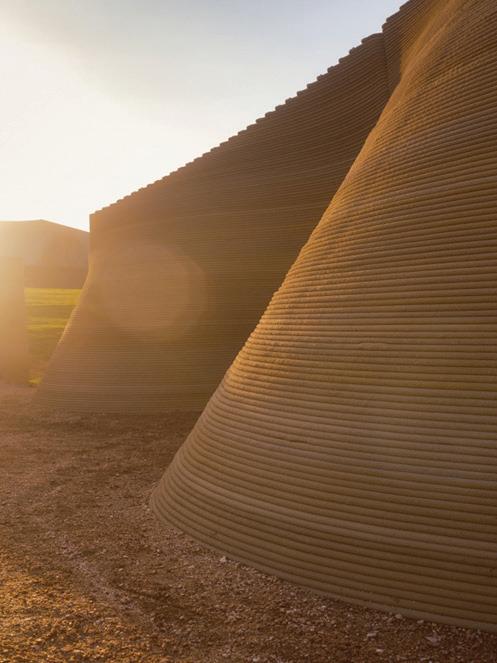


reinforcement (9 gauge) was placed between beads in the longitudinal direction every other layer in areas where the structure exceeded the 25-degree from vertical failure limit. This reinforced the shear during the green phase of the material and supported the structure during the curing process. By increasing the
individual beads' shear strength, ICON was able to achieve a cantilever angle of 35 degrees from vertical, without altering the bead shape. Another aspect that played a crucial role in overcoming the instability challenge was the build rate. Build rate is a significant factor in any 3D-printing project, especially when dealing with cantilevered
STRUCTURE magazine 44
Figure 3. The Cosmic Pavilion’s freeform geometry would have been expensive using traditional construction methods.
Figure 4. Construction printing of an unsupported cantilever was a primary challenge of the project.


designs. The length of the print path on a construction scale can be long, and this fact makes it easier to outrun the relationship between the additional layers' self-weight and the material's yield strength development.
Structure
The structural design of the Cosmic Pavilion combines elements of shell, wall, and beam design principles. The Cosmic Pavilion's structure dynamically evolves both horizontally and vertically, ensuring high quality aesthetics and functionality. Key elements of the structural design include tilted cores, a stepped bond beam, and a robust reinforcement design.
The primary structural system is composed of cores connected to an upper stepped bond beam, and a lower planar bond beam. These vertical cores were created by voids included with the print path inside the hollow wall. After printing, vertical rebar was placed in these cores; the structural engineer then checked them for quality control. Finally, they were filled with Lavacrete using the Vulcan printer. These cores follow the profile of the pavilion, which undulates between -35 and 35 degrees from vertical. This caused the cores to be tilted in some areas.
Because the topline of the geometry comes down at the wing tips to embrace the earth, the upper bond beam is stepped in sections to brace this topline. The reinforcement consists of large rebars in the cores and upper and

lower bond beams, with smaller rebars placed longitudinally between the beads during the printing process. The aforementioned digital twin enabled exact rebar shapes to be prefabricated and bent to match the printed geometry. In addition to the repeated rebar reinforcement, a reinforcement tie point is at the connection of the stage backdrop and the wing walls. This rebar tie ensured stability and structural continuity between the three walls. The pavilion also includes a halo ring around the top of the geometry to light and shade the stage for performances.
To validate the integrity of the pavilion, as with most primarily concrete based structures, a quality control and engineering validation plan was executed throughout the print. Material cylinders were taken and tested periodically to ensure that the structure reached the required compressive strength. A Finite Element Analysis (FEA) was also conducted on the pavilion design. This computational technique served multiple purposes, including:
• Validation of Structural Mechanics: FEA was used to ensure that the structure met necessary safety standards.
• Connection Point Investigation: A specific focus of the FEA model was an investigation of the connection point. This critical juncture required careful analysis to ensure it could withstand loads effectively.
• Construction Sequencing Analysis: FEA played a crucial role in analyzing
the construction sequencing of the pavilion. This ensured that stability was maintained during the construction process, minimizing the risk of structural issues during assembly. FEA was conducted using both shell and solid elements, allowing for a comprehensive evaluation of the pavilion's structural system. By comparing various approaches, a resilient structural design that could withstand the dynamic forces at play was created.
Conclusion
The 3D-printed pavilion stands as a symbol of the boundless possibilities that 3D printing technology offers the world of construction and architecture. It defies traditional constraints, marries aesthetics with functionality, and showcases the immense potential of advanced robotic construction practices.
The Cosmic Pavilion challenges the structural industry to push boundaries, embrace advanced methodologies, and reimagine what's possible. It is a symbol of human ingenuity and the promise of an extraordinary construction future. ■
Grace Melcher is the Arches, Domes, and Vaults program manager for ICON, which develops advanced construction technologies that advance humanity. Grace achieved her B.S. and M.Eng. degrees at MIT and specializes in shell structures.
(gmelcher@iconbuild.com)
APRIL 2024 45
Figure 5 (bottom left). X-ray view depicts The Cosmic Pavilion structural system. Figure 6. (top left) Diagram of the stage backdrop vs. wing walls, and (above) the stage halo.
CREATING A FOUNDATION FOR AI IN THE STRUCTURAL ENGINEERING PROFESSION
The NCSEA Foundation selected Artificial Intelligence as the topic for its inaugural Innovation in Structural Engineering (ISE) Grant.
By Brian Petruzzi, PE, Emily Guglielmo, SE, PE, Christopher Cerino, PE
Artificial Intelligence (AI) has the potential to revolutionize the structural engineering profession. However, several obstacles must be addressed before AI can be fully integrated into practice. These challenges include a lack of vision or roadmap for AI's impact on the industry; slow adoption of new technology; concerns about accuracy, risk, data privacy, and ethics; and the need for education and innovation. The National Council of Structural Engineers Associations (NCSEA) Foundation launched an Innovation in Structural Engineering (ISE) grant to lead the profession in embracing AI to revolutionize and empower structural engineers to be leaders in responsibly shaping the future of the built environment.
What Is Artificial Intelligence?
The concept of artificial intelligence was first described in 1955 by computer scientist John McCarthy as the theory and development of computer systems able to perform tasks that normally require human intelligence, such as visual perception, speech recognition, decision-making, and translation between languages. In the 1980s, AI began growing into a field of study that combined computer science and robust data sets to enable problem solving. AI took off in the 2010s with the development of highly efficient computer graphic card processors and access to large data sets. However, it wasn’t until the release of ChatGPT 3.5 in 2023 that AI was accessible, user-friendly, accurate, and efficient. As Stephanie Slocum wrote in her January STRUCTURE magazine article, “ChatGPT in Structural Engineering,” “ChatGPT is the fastest-adopted tool in the Internet age,” passing over 100 million users in just two months. Its impact on the field of AI has been profound, and it continues to inspire innovation and to drive advancements, including in the structural engineering profession.
as paper and film—not memories.
While AI is already being used in many structural engineering applications, there is no vision or roadmap that articulates the potential disruptions, impacts, and opportunities that AI will have on the profession. Consequently, very few structural engineering firms understand or embrace the AI movement. According to Goldman Sachs, architecture and engineering is in the top three industries with the greatest potential for transformation. This is due to AI, given the potential monetary gain and relative ease of training AI models given the codified nature of the profession. How will structural engineers continue to provide value to building owners after AI is widely adopted in the industry? Does our profession’s product change with this new technology? Developing a vision for our industry is difficult when we don’t fully understand the technology but is necessary to define our future.
To address these challenges, the NCSEA Foundation has selected AI as the topic for its inaugural Innovation in Structural Engineering (ISE) Grant. The 2023-2024 ISE grant program aims to:
Provide Education: Provide structural engineers with information on the latest developments in AI as it relates to the profession and outline future areas of study surrounding this topic.
[Embrace] AI to revolutionize and empower structural engineers to be leaders in responsibly shaping the future of the built environment.

Foster Innovation: Encourage structural engineers to explore, develop, and implement innovative AI solutions that enhance the efficiency, accuracy, and longevity of structural engineering practices
Promote Collaboration: Foster collaboration between structural engineers, AI experts, and other industry partners by encouraging the exchange of ideas and expertise to drive progress in the field.
Address Industry Challenges: Address key challenges faced by the structural engineering industry through the application of AI technologies, including ethical and legal areas.
Challenges Facing the Structural Engineering Profession
At a recent conference focused on the future of corporate real estate, Kay Sargent, Senior Principal at HOK, likened the current real estate environment as our industry's Kodak moment. While we all know the story of Kodak being the first to invent digital photography, she emphasized Kodak's challenges in monetizing the new technology. It wasn’t in their business plan, as they incorrectly identified their product
Roadmap Development
To kick-off roadmapping efforts, members of the NCSEA Foundation Board of Directors, the AI Grant Team, and AI Advisory Board traveled to San Francisco in February for a two-day roadmapping session facilitated by .orgSource, an organization dedicated to supporting growth and innovation for industry associations and nonprofit organizations. The team spent this time thinking big and challenging the status quo. While discussions took place on current trends, challenges, and opportunities, much of the time was spent focusing on a desired future state of the profession and how advancements in technology will help us achieve
this vision. What are some innovative AI applications that could revolutionize structural engineering in the next decade? What opportunities are there for AI to expand services structural engineers provide, ultimately providing greater value to their clients?
The AI roadmap for the structural engineering profession will be communicated out to the broader structural engineering community through future STRUCTURE magazine articles, webinars, socialmedia posts, and extensive content at the NCSEA Summit in Las Vegas in November. We hope the AI roadmap will define future short-term and long-term areas of study, topics for direct consumption, and education in future funded programs or initiatives. What are the main barriers to the wider adoption of AI in structural engineering, and how can these be addressed? How can we foster a culture of innovation and continual learning in the field to keep pace with AI advancements? And most importantly, what roles do structural engineering organizations and firms play in promoting AI integration in the field? These are the big questions the AI Grant Team is working to answer.

David vs. Goliath
When discussing the risk, impact, and opportunities associated with AI, it’s often perceived that larger firms with more resources are better positioned than small to mid-sized firms. This perception has been created by larger firms being on the bleeding edge of developing AI tools
AI Grant Team
The NCSEA Foundation solicited applications to form an AI Grant Team to execute the 2023-2024 ISE Grant. The AI Grant Team will work together for one year (calendar year 2024) to accomplish the project goals and deliverables. This first includes developing an AI roadmap for the structural engineering profession. This roadmap will empower structural engineers to navigate the impacts and opportunities that AI will have on the profession.
over the past 10-20 years. Subsequent presentations, magazine articles, and social-media posts reinforce this narrative; however it’s only half of the story. It’s important to think about the opportunities with AI in two categories: (1) AI tool development and (2) AI tool consumption. AI tool development refers to the creation of new AI technologies and applications. This process can involve a significant investment in research and development, as well as access to resources such as data, personnel, and infrastructure. AI tool development for the structural engineering profession includes initiatives such as creating machine learning algorithms to better solve structural engineering problems, training algorithms on large datasets in order to enable them to make predictions or take actions based on new inputs, and integrating appropriate algorithms and models into existing third party tools (Revit, ETABS, etc). Most structural engineers and structural engineering
Project Manager: John-Michael Wong, KPFF, Structural Engineers Association of California
Aditya Kaushik, Walter P. Moore, Structural Engineers Association of Colorado
Dave Martin, Degenkolb, Structural Engineers Association of California
Ayush Singhania, Simpson Gumpertz & Heger, Structural Engineers Association of California
Andrew Sundal, HGA, Minnesota Structural Engineers Association
Emre Toprak, Arup, Structural Engineers Association of Metropolitan Washington
Sheng Zheng, VERTEX, Structural Engineers Association of Colorado
STRUCTURE magazine 48
The share of industry employment exposed to automation by AI in the U.S. Data courtesy Goldman Sachs, 2023.

firms will not be involved in developing these tools, but will need to understand how AI tools will impact their business and to decide how to consume them.
AI tool consumption refers to the use of existing AI technologies and applications within an organization. This may involve integrating AI tools into existing workflows or processes or using AI-powered services provided by third parties. AI tool consumption can provide organizations with a range of benefits, including increased efficiency, improved accuracy, and enhanced productivity. Effectively implementing and using AI tools does not require extensive resources, making small firms better positioned to adopt AI tools than large firms in many ways.
Agility: Small firms are often more agile and able to quickly adapt to new technologies and implement them into their workflows.
Flexibility: Small firms may be more flexible in terms of the types of projects they take on and the resources they devote to them. This can allow them to experiment with new AI technologies and applications without having to make a significant investment upfront.
Lower Overhead Costs: Small firms typically have lower overhead costs than large firms, which can make it easier for them to invest in new technologies such as AI.
Ability to Specialize: Small firms may be able to specialize in specific areas of AI, which can give them a competitive advantage over larger
AI Advisory Board
The topic of AI in structural engineering is vast and rapidly evolving. The NCSEA Foundation did not want to award a 12-month grant and develop material that was already available within the industry or would be outdated at the conclusion of the grant program. For this reason, an AI Advisory Board was composed of industry
KP Reddy, Founder & CEO, Shadow Ventures
firms that may need to implement AI into workflows that support a more diverse set of services.
While large firms have more resources, the larger scale of operations and wider range of processes and workflows makes it significantly more challenging to implement change. As one large firm executive admitted, they have more tools available than they have deployed because they haven’t figured out how to successfully deploy the tools at scale. It’s not a technical problem—it’s a cultural problem. Changing the culture of a large, successful, engineering firm is not easy.
Conclusion
It is critical that our profession considers what products and services we provide as we absorb these new technologies into the profession. While they clearly can provide efficiency, accuracy, and productivity for our firms, how can they also help us add value, strengthen our relationships, and spend more time with our clients? How can we make room for these technologies in our business plans and operating models? We suspect it will be a smaller firm that is able to answer these questions and truly disrupt the industry. However, NCSEA hopes our inaugural ISE grant will support all firms—big and small—as they start on their journey. ■
Brian Petruzzi, PE, is current Treasurer of the NCSEA Board of Directors, and a Director on the NCSEA Foundation Board of Directors.
Emily Guglielmo, SE, PE, is a Principal at Martin / Martin, Past-President of the NCSEA Board of Directors, and the current President of the NCSEA Foundation Board of Directors.
Christopher Cerino, PE, is Vice President and Technical Director of Structural Engineering, Urbanism + Planning at STV, current Vice President of the NCSEA Board of Directors, and a Director on the NCSEA Foundation Board of Directors.
professionals who are thought leaders in the field of AI. The AI Advisory Board’s purpose is to provide knowledge and experience to steer the AI Grant Team as they execute its objective to develop an AI roadmap, implementation plan, and associated deliverables. The AI Advisory Board will meet with the AI Grant Team quarterly.
Robert Otani, Senior Principal & Chief Technology Officer, Thornton Tomasetti
Zak Kostura, Associate Principal, Advanced Digital Engineering, Arup
Kimon Onuma, Founder & President, Onuma, Inc.
Roark Redwood, Sr. Vice President of Technical and Government Solutions, National Institute of Building Sciences
KiSeok Jeon, VP of Digital Advisory, STV
Farahnaz Soleimani, Assistant Professor, Oregon State University
APRIL 2024 49
The AI Advisory Board and AI Grant Team met in San Francisco in February to kick off roadmapping efforts.
Seismic Rehab of the Oregon State Capitol
The complex design and implications of creating a new concourse level below the historic Oregon State Capitol building and preparing the structure for base isolation.
By Damian Andreani, PE, Stefanie Chamorro, PE, and Mike DeRubeis, PE, SE

Ato seismically retrofit and renovate multiple structures utilizing ASCE 41 (see the March 2024 issue). The importance of preserving the historical Capitol increased after losing the original and second state Capitol buildings to fires. While the original design of the 1938 capitol was fire resistant, structural damage incurred during the 1993 Scotts Mills earthquake prompted the Oregon Legislature to enhance the seismic resiliency of the entire Capitol complex.
strengthen the existing concrete shear walls and confine the columns. Taking advantage of the seismic upgrades, the 2009 Master Plan proposed
STRUCTURE magazine 50
s introduced in Part 1 of this three-part series, the Oregon State Capitol Renovation project goal is
The seismic improvement comprised of two main strategies. The original 1938 building and the 1977 Connector Building with infill courtyards were designed to be base-isolated structures, while the 1977 legislative wings would remain fixed-base structures (Figure 1). The 1977 legislative wing buildings’ original lateral system consisted of reinforced concrete shear walls with insufficient strength and columns with insufficient ductility. The retrofit approach included fiber-reinforced polymer (FRP) systems to


several program changes to improve the operational efficiency of the Legislature. The most significant program change requested was for larger hearing rooms while keeping most of the current programing as-is. Adding square footage to the Capitol complex was required to fulfill this desire. Since base-isolating the structure required completely transferring load off the original foundation onto the isolation system, this was a perfect time to modify the basement floor level to create the additional program spaces needed at the Capitol.
This article describes the designs and implications of creating a new basement story and preparing the structure for base isolation.
1938 Base Isolation Seismic Upgrade
The seismically isolated portion of the project consists of the existing 1938 building, the existing 1977 Connector structure, and the new one-story Courtyard Infill structures that occur from the concourse level to Level 1 (Figure 1). The four structures will be tied together into one structure supported on triple friction pendulum seismic isolators on top of a mat foundation base and will be surrounded by a 2-foot minimum seismic joint that allows the entire complex to move independently in any direction from the surrounding earth during a seismic event.
One of the main architectural goals of the renovation is to create more functional program areas, such as large hearing rooms, at the concourse (basement) level. To provide the larger column-free spaces, existing column loads need to be transferred using post-tensioned (PT) concrete transfer beams at Level 1. Additionally, new concourse level framing and a new foundation underneath the existing Capitol building is required to create the new plane of isolation and support the building (Figure 2). Given the desire to increase the height of the basement, the need to install isolators, a new framing level above the isolators, and the required transfer beams, significant excavation beneath the building is required. However, the depth of excavation encroaches on the water table on site. To minimize hydrostatic pressure design requirements and reduce the need for watertight detailing of the foundation, a permanent dewatering system is being installed, further increasing the excavation depth.
The structural and architectural project goals generated the need to excavate 20+ feet beneath the Capitol building. Each of the primary design elements, as well as the construction sequence, had its own unique challenges which will be discussed in the following sections.
Transfer Beams
Due to the short column grid spacing at the existing basement level, there was a desire from the architect to reduce the number of columns in the new concourse level to allow for more open interior spaces. This is accomplished with a series of north-south transfer beams just
below the existing first floor framing that support the four rows of interior columns above and reduce to just two interior columns below. The transfer beams are post-tensioned concrete beams that occur at each north-south column line to the east and west of the rotunda area, span the full north-south dimension of the building, and are supported on new concrete pilasters at both the north and south beam ends as shown in Figure 3. The transfer beams are made of 8 ksi self-consolidating concrete (SCC) that was pumped from the bottom of beam formwork due to the low clearance to the top side of the forms for placement. Steel transfer beams were investigated, but the size and lengths required posed constructability issues. The PT transfer beams have the additional advantage of 'self-jacking' the structure during the load transfer to minimize deflections for the existing concrete structure.
The PT transfer system is also designed and used as part of the temporary shoring system to allow the deep excavation below the historic building to occur. Using permanent structure in the temporary condition is an efficient use of structural elements, which doubled as a project cost savings. Using the PT transfer in the temporary construction configuration created a large platform that the temporary shoring towers can use to jack load into the shoring tower system, thus providing the first transfer of load off the original existing foundations and onto the temporary shoring system. The locations of the towers were coordinated with the PT transfer system to minimize the effects that PT tendon drapes and induced moments have on the temporary condition while maintaining the design for final conditions as seen in Figure 4.
The construction and load transfer sequence required the PT transfer beams to be built around and encompass the existing columns. PT threaded rods were installed at the existing columns and PT transfer beams to facilitate load transfer from the existing columns into the PT transfer beams.
Excavation and Shoring of the Building
The excavation extents accommodate depth to provide the new transfer girders below Level 1, increased head-height in the new concourse level, new framing supporting the concourse level, a subgrade level crawlspace, which houses the isolators and their support plinths, the new mat foundation, and compacted gravel and the dewatering system (Figure 5).
The extensive excavation below the existing foundation level created a need for temporary gravity and lateral shoring of the 1938 building throughout construction. Temporary lateral bracing criteria were provided in the structural notes and specifications to ensure the temporarily shored building condition performed the same or better than the existing building’s lateral performance. The temporary shoring system designed by the contractor is primarily micropile towers with lateral bracing (Figure 6). Special care was taken to decouple the micropiles from the mat by cleaning and
APRIL 2024 51
Figure 1 (above). This Capitol Complex Plan shows the interconnected building segments. Figure 2 (right). A section through the 1977 Connector and 1938 Capitol buildings highlights the seismic retrofit elements.

wrapping each micropile with a bond breaker before placement of the foundation concrete to ensure that the complete building load will transfer to the isolator system.
Retaining Walls and Building Separation
One of the challenges of adding a subgrade level and increasing the height of the basement level is the need to retain the surrounding soils while also accommodating 2 feet of building seismic movement for isolation. In this project, the retaining strategies varied to address each unique condition around the 1938 original building. The east and west of the building are flanked by the previously constructed underground utility vaults (Figure 1). These vaults were built lower than the original 1938 building foundation and therefore had their own secant pile retaining structures. During excavation, the backs of these piles were exposed leaving behind walls not retaining soil on either side of them. Along the south, the excavation undermines the 1977 building wings and connector foundations by several feet. Due to limited access for piling machinery, the contractor designed temporary micropiles/shotcrete retaining walls over which a permanent propped cantilevered retaining wall was designed by the structural team.
Along the north, although there was no building adjacent to the structure, the design called for two additional types of retaining walls. Early in design, the north side of the building was identified as the optimal location to place two access ramps into the newly excavated basement. At these access ramps the design team provided

a cantilevered concrete retaining wall design using the building mat foundation as the footing. Where there were no access ramps, the contractor designed permanent micropile and temporary lagging retaining walls on which the design team provided a permanent shotcrete lagging system (Figure 7).
The perimeter retaining structures were placed 2 feet away from any part of the isolated building to allow for differential movement between the ground and the building during a seismic event. This created a “moat” around the entire building. Where the moat will be accessible to the public and/or weather, the design team is providing moat covers. The moat covers are designed to hinge, slide, compress, or otherwise move out of the way when differential movement is experienced. The covers were heavily coordinated between the structural engineers, architects, landscape architects, and cover manufacturer. Some of the most complex areas to coordinate were those that needed to move in multiple directions such as corners and changes in elevation. Extensive coordination was critical to ensure that no force could be transferred between the ground and the building, which would change the lateral response of the building. Additionally, once installed, visitors to the Capitol should not be able to tell that they are crossing a moat as the building is re-assembled to maintain its historic nature.
Mat Foundation
A pile cap foundation system using the same micropiles that shore the building was explored during the initial phases of the project. However, due to numerous challenges with this method, a mat foundation below the 1938 building's existing footprint was chosen as the best solution for supporting the Capitol and its new isolation system.

One of the benefits of using a mat foundation is providing a continuous, stiff base below the building, which reduces differential settlement and distributes bearing pressure across the building footprint. This is

STRUCTURE magazine 52
Figure 3. As shown in this elevation of PT transfer system, the transfer beams are supported on new concrete pilasters at both the north and south beam ends.
Figure 4. PT transfer beams and shoring towers after load transfer are shown. Stubs of demolished existing concrete columns are visible on the underside of the PT transfer beams.
Figure 5. The original and base-isolated sections through the Capitol are compared, which describes the depth of excavation.

especially important because the magnitude of loads vary throughout the building footprint, such as at the Rotunda, which has a significantly higher weight in a concentrated area. Allowable bearing pressures are 5 kips per square foot (ksf) for gravity loads and 10 ksf for total load, including seismic cases. The mat foundation was modeled using finite element software to understand the distribution of pressures and potential expected settlement. A consistent modulus of subgrade reaction was used across the entire mat. The maximum settlement expected of the foundation is less than a ½ inch. Unlike typical construction projects where loads to the soil slowly build up as construction progresses, the settlement of the mat will occur nearly immediately when the weight of the Capitol is transferred from the shoring towers to the foundation.
The isolators are supported by 3-foot tall, square concrete plinths atop the mat foundation (Figure 8). At the beginning of the design, it was crucial to understand how loads are imparted from the isolators to the mat and how best to model them. The primary building model of the Capitol outputs axial and shear reactions at each isolator location. However, the axial reactions can occur up to 2 feet in any direction from the center of the plinth due to isolator movement, resulting in many possibilities of axial and moment demands on the mat (Figure 8). The shear reaction from the building imparted at the top of the plinth produces an additive moment on the mat foundation.
Once the demands were understood, the load cases were input into the foundation model. Modeling these components simplified the analysis and provided enveloped flexural and shear demands across the mat. Typical top and bottom mat reinforcing consisted of #8 @8” on-center (o.c.) and #8 @6” o.c., respectively. Additional #9 reinforcement was specified in areas of higher flexural demand. The design also implemented two different thicknesses of the mat foundation; some areas of 40-inch thickness and others of 52 inch. Rebar congestion in the mat foundation was a concern during design. The thickness of the mat was strategically chosen to limit additional vertical shear reinforcement to only those locations with highly loaded isolators . Most of the mat’s area was designed to resist shear demands with only its own concrete strength. Specific attention was given to the effects of the temporary shoring micropiles on the mat foundation detailing. A bond breaker is specified between the micropiles and the new foundation to ensure complete load transfer of the building loads occurs onto the mat and no load remains on the piles since the plan is to demolish them after load transfer. Additionally, the micropiles affect both the shear and flexural strength of the mat by interrupting reinforcement and reducing the area of shear failure planes. The shoring towers are concentrated around each isolator pedestal. Loss of shear strength of the mat foundation was considered, assuming that micropiles would be located at the perimeter and potentially within the punching shear failure plane of the isolator support plinths. Where piles interrupt typical mat reinforcement, additional reinforcement will be added to either side of the micropile in a new layer of reinforcement to recuperate the lost flexural capacity.
The thickness of the mat and size of concrete pour areas triggered initial concerns about how elevated concrete

temperature due to heat of hydration during curing may affect the quality and strength of the mat foundation. Mass concrete requirements set by ACI (American Concrete Institute) limit the maximum surface temperature of the concrete and the differential temperature between the surface and core of the pour. During construction, the contractor may use curing blankets to reduce temperature differentials of the concrete. Additionally, to reduce the heat of hydration for the mat foundation, the design team provided criteria for a concrete mix design to reduce cement content by partially replacing it with cementitious substitutes, which a) lowers the strength of the concrete and b) slows the development of the concrete strength and stiffness. Therefore, the design team allowed the contractor to design a concrete mix that would achieve the minimum design compressive strength in 56 days instead of the standard 28-day. This increases the waiting period before the mat foundation can be loaded, but is accommodated by the construction schedule and sequence. The contractor is continually monitoring the mat temperatures during curing using surface and embedded temperature sensors and thus far, these mass concrete mitigation strategies are successful and both the surface and differential temperature limitations have been met.

Construction is ongoing at the Oregon State Capitol and continues into 2025. This article is the second of three articles presented in STRUCTURE magazine that showcases the new retrofit of the Oregon State Capitol buildings. The final article in this series will focus on the details of the seismic base-isolated retrofit design and construction. ■
APRIL 2024 53
Andreani, PE (damian@catenaengineers.com) is an engineer with catena consulting engineers in Portland, Oregon. Stefanie Chamorro, PE (stefanie@catenaengineers.com) is an engineer with catena consulting engineers in Portland, Oregon. Mike DeRubeis, PE, SE (mike.derubeis@forell.com) is a senior engineer with Forell Elsesser Engineers in San Francisco.
Damian
Figure 7. Shoring and retaining wall techniques used around the perimeter of the 1938 Capitol.
Figure 6. Shoring towers support the 1938 Capitol building and ongoing excavation.
Figure 8. Isolator plinth and loads to the mat foundation.
2024 IBC Significant Structural Changes
Loads (IBC Chapter 16)—Part 6
By John “Buddy” Showalter, PE, and Sandra Hyde PE
This multi-part series discusses significant structural changes to the 2024 International Building Code (IBC) by the International Code Council (ICC). This article includes an overview of changes to IBC Chapter 16 for environmental loads including snow, rain, wind, tornado, and earthquake. Only a portion of the chapter’s total number of code changes is discussed in this article. More information on the code changes can be found in the 2024 Significant Changes to the International Building Code available from ICC (Figure 1).
ASCE 7-22 and Hazard Tool
ASCE/SEI 7-22 Minimum Design Loads and Associated Criteria for Buildings and Other Structures includes a significant number of revisions for nearly all environmental loads. Changes throughout the 2024 IBC, most significantly in IBC Chapter 16, match changes to ASCE 7. To easily determine new environmental loads based on location and risk category, use the ASCE Hazard Tool (asce7hazardtool. online) – a free resource.
Snow Loads
New ground snow load (GSL) maps based on ASCE 7-22 are included in the IBC and are now based on the risk category of the building (Figure 2).
1608.2 Ground snow loads. The ground snow loads to be used in determining the design snow loads for roofs shall be determined in accordance with the reliability-targeted (strength-based) ground snow load values in Chapter 7 of ASCE 7 or Figures 1608.2(1) and through 1608.2(24) for the contiguous United States and Table 1608.2 for Alaska. Site-specific case studies shall be determined in accordance with Chapter 7 of ASCE 7 and shall be approved by the building official made in areas designated “CS” in Figures 1608.2(1) and 1608.2(2). Ground snow loads


for sites at elevations above the limits indicated in Figures 1608.2(1) and 1608.2(2) and for all sites within the CS areas shall be approved. Ground snow load determination for such sites shall be based on an extreme value statistical analysis of data available in the vicinity of the site using a value with a 2-percent annual probability of being exceeded (50-year mean recurrence interval). Snow loads are zero for Hawaii, except in mountainous regions as approved by the building official. (Additional related technical and editorial changes throughout the IBC are not shown for brevity) Change Significance: ASCE 7-22 includes updated national GSL datasets in electronic and map form. The new snow loads are based on 25 years of additional snow load data and updated procedures for estimating snow loads, as well as using strength design-based values. Additionally, this approach incorporates advanced spatial mapping that has reduced the number and size of case study regions in mountainous areas significantly and eliminates discontinuities in design values across state boundaries.
Given that GSL values have been provided as allowable stress loads up to this point, many provisions within the IBC and the IRC rely on allowable stress design (ASD) values. Therefore, a new Section 1608.2.1 is added to provide a conversion from the strength-based values now provided in the IBC reliability-targeted GSL maps to an equivalent ASD value. Note that the ASCE Hazard Tool also provides ASD ground snow loads.
Wind Loads
Wind speed maps and associated provisions are updated to the newly referenced ASCE 7-22 load standard.
SECTION 202 DEFINITIONS
BASIC WIND SPEED, V. Basic design wind speeds. The wind speed used for design, as determined in Chapter 16.
WINDBORNE DEBRIS REGION. Areas within hurricane-prone regions located:
(1.) Within 1 mile (1.61 km) of the mean high-water line where an Exposure D condition exists upwind at the waterline and the
STRUCTURE magazine 54
code
UPDATES
Figure 1. More information on the code changes can be found in the 2024 Significant Changes to the IBC available from the International Code Council.
2404-C-Code Updates-Showalter.indd 54 3/20/2024 12:44:13 PM
Figure 2. Ground snow loads (psf) for Risk Category III buildings.

basic design wind speed, V, is 130 mph (58 m/s) or greater; or (2.) In areas where the basic design wind speed, V, is 140 mph (63 m/s) or greater. For Risk Category II buildings and structures and Risk Category III buildings and structures, except health care facilities, the windborne debris region shall be based on Figure 1609.3.(1) 1609.3.(2) . For Risk Category III health care facilities, and Risk Category IV buildings and structures and Risk Category III health care facilities, the windborne debris region shall be based on Figure 1609.3(2) 1609.3(3) and Figure 1609.3(4), respectively
WIND DESIGN GEODATABASE. The ASCE database (version 2022-1.0) of geocoded wind speed design data. The ASCE Wind Design Geodatabase of geocoded wind speed design data is available at https://asce7hazardtool.online/.
1609.3 Basic design wind speed. The basic design wind speed, V, in mph, for the determination of the wind loads shall be determined by Figures 1609.3(1) through 1609.3(12) 1609.3(4). The basic design wind speed, V, for use in the design of Risk Category I II buildings and structures shall be obtained from Figures 1609.3(1), 1609.3(5) and 1609.3(6). The basic design wind speed, V, for use in the design of Risk Category II III buildings and structures shall be obtained from Figures 1609.3(2), 1609.3(7) and 1609.3(8). The basic design wind speed, V, for use in the design of Risk Category III IV buildings and structures shall be obtained from Figures 1609.3(3), 1609.3(9) and 1609.3(10). The basic design wind speed, V, for use in the design of Risk Category IV I buildings and structures shall be obtained from Figures 1609.3(4), 1609.3(11) and 1609.3(12). Basic wind speeds for Hawaii, the US Virgin Islands, and Puerto Rico shall be determined by using the ASCE Wind Design Geodatabase.
The ASCE Wind Design Geodatabase is available at https:// asce7hazardtool.online, or an approved equivalent.
The basic design wind speed, V, for the special wind regions indicated near mountainous terrain and near gorges shall be in accordance with local jurisdiction requirements. The basic design wind speeds, V, determined by the local jurisdiction shall be in accordance with Chapter 26 of ASCE 7. In nonhurricane-prone regions, when the basic design wind speed, V, is estimated from regional climatic data, the basic wind speed, V, shall be determined in accordance with Chapter 26 of ASCE 7. Additional related technical and editorial changes throughout the IBC are not shown for brevity.
Change Significance: These changes to IBC wind load
provisions include technical updates as well as editorial corrections and reorganization. Technical updates to the wind speed maps within ASCE 7-22 include new hurricane coastline wind speed contours from the Carolinas through Texas, as well as new Special Wind Regions in Southern California and Northern Colorado (Figure 3). All updates are based on recent wind studies conducted in those areas.
Along with the continental United States, the wind speeds for the U.S. Virgin Islands and Puerto Rico were also updated based on recent wind studies of these islands. The resulting wind speeds account for the steep terrain of these islands and create a very dense contour map that is not easily read in the IBC. Therefore, wind speeds for the U.S. Virgin Islands, Puerto Rico, and Hawaii are only included in the ASCE Wind Design Geodatabase and are no longer represented by maps in ASCE 7-22. These maps have also been removed from the IBC and replaced with a pointer to the ASCE Wind Design Geodatabase. Wind speeds in the updated Special Wind Regions also are available for designers and code officials in the ASCE Hazard Tool.
Tornado Loads
Design provisions for tornado loads are now required for Risk Category III and IV buildings in defined areas. See Figure 4 for the average annual frequency of tornadoes per state; most tornadoes occur in central and southeastern states.
1609.5 Tornado Loads. The design and construction of Risk Category III and IV buildings and other structures located in the tornado-prone region as shown in Figure 1609.5 shall be in accordance with Chapter 32 of ASCE 7, except as modified by this code.
Additional related technical and editorial changes throughout the IBC are not shown for brevity.

Change Significance: Tornado hazards have not previously been required in the design of conventional buildings, even though tornadoes and tornadic storms cause more fatalities and more catastrophe-insured losses than hurricanes and earthquakes combined. This gap is addressed for the first time in ASCE/SEI 7‐22 which now includes requirements for tornado loads. ASCE 7-22 requirements for tornado loads apply to Risk Category III and IV buildings only sited in the tornado-prone region, which is roughly defined in IBC Figure 1609.5 as the area of the U.S. east of the Continental Divide.
APRIL 2024 55
Figure 3. Comparison of ASCE 7-22 to ASCE 7-16 basic wind speeds for Risk Category II. (Courtesy Applied Research Associates)
2404-C-Code Updates-Showalter.indd 55 3/20/2024 12:44:14 PM
Figure 4. Average annual number of tornadoes per state (National Weather Service Storm Prediction Center 2022).
Tornado loads specified in the new Chapter 32 of ASCE 7 provide reasonable consistency with the reliability delivered by wind criteria in ASCE 7 Chapters 26 and 27 for the Main Wind Force Resisting System (MWFRS). The same mean recurrence intervals (MRI) are used for tornado wind speeds as the basic wind speeds in Chapter 26 for Risk Category (RC) III and IV facilities (MRI = 1,700 and 3,000 years, respectively). At return periods of 300 and 700 years (used for wind speeds with RC I and II structures), tornado wind speeds are generally so low that tornado loads will not control over ASCE 7 Chapter 26 wind loads. Therefore, design for tornadoes is not mandated for RC I and II buildings.
ASCE 7-22 tornado design speeds for RC III and IV structures range from 60 to 138 mph depending on geographic location and effective plan area (which is a function of the building or multiple buildings’ footprint size and shape). This generally corresponds to wind speeds for Enhanced Fujita (EF) Scale EF0-EF2 tornadoes, which are the most common. From 1995 to 2016, over 89% of all reported tornadoes were EF0-EF1, and 97% were EF0-EF2.
Buildings and other structures classified as Risk Category III or IV and located in the tornado-prone region, including the MWFRS and all components and cladding (C&C), are to be designed and constructed to resist the greater of the tornado loads or the straight-line wind loads determined per ASCE 7-22. This means a check of both tornado and wind loads is required. However, if the tornado wind speed is less than 60 mph, design for tornado loads is not required. Also, if the tornado wind speed is less than a certain percentage of the straight-line wind speed as a function of exposure, design for tornado loads is also not required.
The intent of ASCE 7 and the IBC is to increase wind speeds in locations where the increase is reasonable and can be applied to most buildings that are in RC III and IV. This change doesn’t require buildings to add a storm shelter, rather the MWFRS and C&C are designed to resist both straight-line winds and EF2 tornadoes. In any given area, the wind speeds of the straight-line wind may control the wind design or the EF2 tornado could control the wind design based on the worst-case combinations of geographic location, exposure, effective plan area, mean roof height, enclosure classification, building shape, and other parameters.
To make it clear that the ASCE 7 tornado provisions are not intended to protect from the most violent tornadoes, a “User Note” on the first page of the ASCE 7 Tornado Load chapter advises readers in part as follows:
“…A building or other structure designed for tornado loads determined exclusively in accordance with Chapter 32 cannot be designated as a storm shelter without meeting additional critical requirements provided in the applicable building code and ICC 500, the ICC/NSSA Standard for Design and Construction of Storm Shelters…”
Tornado hazard criteria for ICC 500 and FEMA P-361 Safe Rooms for Tornadoes and HurricanesGuidance for Community and Residential Safe Rooms are much more stringent than ASCE 7, reflecting the purpose to provide “near-absolute life-safety protection” as described by FEMA P-361. For example, the tornado shelter design wind speed in the central U.S. is 250 mph. This compares to ASCE 7 tornado
wind speeds of approximately 80-125 mph for Risk Category III and 95-140 mph for Risk Category IV.
Rain Loads
The design storm return period for determination of the hydraulic head is now to be based on risk category. Other ponding provisions are updated to be consistent with ASCE 7-22.
1603.1.9 Roof rain load data. Design rainfall Rain intensity, i (in/hr) (cm/hr), and roof drain, scupper and overflow locations shall be shown regardless of whether rain loads govern the design. 1608.3 Ponding instability. Susceptible bays of roofs shall be evaluated for ponding Ponding instability on roofs shall be evaluated in accordance with Chapters 7 and 8 of ASCE 7.
1611.1 Design rain loads. Each portion of a roof shall be designed to sustain the load of rainwater as per the requirements of Chapter 8 of ASCE 7. Rain loads shall be based on the summation of the static head, d s , hydraulic head, dh, and ponding head, d p, using Equation 16-19. The hydraulic head shall be based on hydraulic test data or hydraulic calculations assuming a flow rate corresponding to a rainfall intensity equal to or greater than the 15-minute duration storm with return period given in Table 1611.1. Rainfall intensity shall be determined in inches per hour for 15-minute duration storms for Risk Category given in Table 1611.1. The design rainfall shall be based on the 100-year 15-minute duration event, or on other rainfall rates determined from approved local weather data. Alternatively, a design rainfall of twice the 100year hourly rainfall rate indicated in Figures 1611.1(1) through 1611.1(5) shall be permitted. The ponding head shall be based on structural analysis as the depth of water due to deflections of the roof subjected to unfactored rain load and unfactored dead load.
R = 5.2 (ds + dh + dp)
where:
(Equation 16-19)
dh = hydraulic head equal to the depth of water on the undeflected roof above the inlet of the secondary drainage system for structural loading (SDSL) required to achieve the design flow in inches (mm) Additional depth of water on the undeflected roof above the inlet of secondary drainage system at its design flow (in other words, the hydraulic head), in inches (mm).
d p = ponding head equal to the depth of water due to deflections of the roof subjected to unfactored rain load and unfactored dead load, in inches (mm)
d s = static head equal to the depth of water on the undeflected roof up to the inlet of the secondary drainage system for structural loading (SDSL) in inches (mm) Depth of water on the undeflected roof up to the inlet of secondary drainage system when the primary drainage system is blocked (in other words, the static head), in inches (mm).

R = Rain load on the undeflected roof, in pounds per square foot (kN/m2). Where the phrase “undeflected roof” is used, deflections from loads (including dead loads) shall not be considered when determining the amount of rain on the roof.
STRUCTURE magazine 56
2404-C-Code Updates-Showalter.indd 56 3/20/2024 12:44:14 PM
Figure 5. Secondary drainage design assumptions.
SDSL is the roof drainage system through which water is drained from the roof when the drainage systems listed in ASCE 7 Section 8.2 (a) through (d) are blocked or not working.
IBC Table 1611.1 Design [Rain] Storm Return Period by Risk Category Risk Category Design Storm Return Period


1611.2 Ponding instability. Susceptible bays of roofs shall be evaluated for ponding Ponding instability on roofs shall be evaluated in accordance with Chapters 7 and 8 of ASCE 7.
Change Significance: The primary change to IBC Section 1611.1 is the addition of the ponding head (d p) directly into the rain load calculation (Figure 5). In ASCE 7-16 and earlier editions, there was a requirement to perform a ponding analysis, yet limited guidance was provided on how to perform that analysis. The term “secondary drainage system for structural loading (SDSL)” is consistent with ASCE 7-22. Activation of the SDSL is intended to serve as a warning that the primary drainage system is blocked. Per ASCE 7, the elevation of the SDSL must be at least 2 inches above that of the primary drainage system so that the SDSL is not frequently activated, which would decrease the urgency of the warning and also make the SDSL more susceptible to blockage.
IBC Figures 1611.1(1) through 1611.1(5) were removed because they were 100-year “hourly” rainfall maps, which did not provide rainfall intensities for the required 15-minute duration storms. Furthermore, rainfall rates must now be determined based on the building’s Risk Category. New Table 1611.1 defines the design storm return period by Risk Category consistent with the determination of rainfall intensity per ASCE 7-22. Note that return periods are now 200 years and 500 years for Risk Category III and IV structures, respectively. The ASCE Hazard Tool provides both 15-minute and 60-minute rainfall intensities. Sections 1608.3 and 1611.2 refer to the defined term “Susceptible Bay” for ponding instability evaluation. ASCE 7-22 has dropped this term but still takes ponding into account for snow and rain loads.
Earthquake Loads
IBC Section 1613 includes requirements for determining a building’s seismic design category (SDC). The balance of the earthquake design requirements is contained in ASCE 7. These changes bring the 2024 IBC up to date with new provisions of ASCE 7-22 and determining the SDC is simplified.
1613.2 Determination of seismic design category Seismic ground motion values. Structures shall be assigned to a seismic design category based on one of the following methods unless the authority having jurisdiction or geotechnical data determines that Site Class DE, E or F soils are present at the site:
1. Based on the structure risk category using Figures 1613.2(1) through 1613.2(7).
2. Determined in accordance with ASCE 7. Where Site Class DE, E or F soils are present, the seismic design category shall be determined in accordance with ASCE 7. Seismic ground motion values shall be determined in accordance with this section.
Sections 1613.2.1 through 1613.2.5.1 have been deleted without substitution and are not shown for brevity. New Figures 1613.2(1) through 1613.2(7) replace existing Figures 1613.2(1) through 1613.2(10). Additional related technical and editorial changes throughout the IBC are not shown for brevity.
Change Significance: These changes simplify IBC Section 1613 by providing SDC maps that users can reference to quickly determine a project’s SDC based on default site conditions (Figure 6). These maps replace current ground motion response acceleration maps in the IBC and have been derived based on new multi-period response spectra procedures of ASCE 7-22.
The SDC maps are one of two methods provided in the IBC to determine SDC. Users are still allowed to determine the SDC following ASCE 7 provisions, where more refined information such as site-specific soils data can be considered.
These new maps will allow building officials, non-structural engineers, component manufacturers, and others to quickly identify a conservative SDC based on location alone. The ASCE Hazard Tool can be used to determine seismic design parameters, including SDC, based on location, soil class, and risk category.
Areas with SDC D for buildings in all Risk Categories based on the new maps include:
• Most of the state of Nevada except for the northeastern portions.
• Areas within an approximate 150-mile radius from New Madrid, Missouri (except for higher SDCs along the New Madrid fault line).
• Areas within an approximate 75-mile radius of Charleston, South Carolina.
Conclusion
Structural engineers should be aware of significant structural changes in the 2024 IBC Chapter 16 for environmental loads. Updates provide consistency between the IBC and ASCE 7-22. Most loads are now based on the risk category of the structure and use strength design values. Changes to snow and rain load provisions reflect this risk-based approach to design. New provisions for tornado loads apply to Risk Category III and IV structures. Updates to wind and seismic provisions harmonize with ASCE 7. The ASCE Hazard Tool (asce7hazardtool. online) is a free resource for determining environmental loads based on location and risk category. ■
APRIL 2024 57 John “Buddy” Showalter, PE, M. ASCE, M. NCSEA (bshowalter@iccsafe.org) is a Senior Staff Engineer and Sandra Hyde, PE, M. ASCE, M. NCSEA (shyde@iccsafe.org) is Managing Director of ICC’s Consulting Group.
I & II 100 Years III 200 Years IV 500 Years
2404-C-Code Updates-Showalter.indd 57 3/20/2024 12:44:14 PM
Figure 6. Seismic design categories for default site conditions for the conterminous United States.
NCSEA News
NCSEA Launches New Website to Empower Structural Engineers
NCSEA has unveiled its revamped website, NCSEA. com, aiming to improve accessibility and engagement within the structural engineering community.
The launch of ncsea.com underscores the association’s commitment to leveraging digital platforms to enhance the structural engineering profession. By providing a centralized hub for information and collaboration, NCSEA aims to empower structural engineers to excel in their careers and contribute to the advancement of the profession.
Created with the user experience in mind, the redesigned website features a sleek interface and user-friendly navigation. Visitors have easy access to a wealth of resources, including dedicated sections on professional development opportunities, annual events, and advocacy initiatives championed by NCSEA. This website launch coincides with NCSEA upgrading its database web-based customer center to provide an upgraded customer experience across all digital platforms. For more information and to explore the new website, visit ncsea.com.


Submit a Video! Enter to Win a Trip to the 2024 Summit
Do you love videos? Now is your chance to star in your own video and tell the world about the captivating fusion of art and science in your favorite structural engineering project.
NCSEA is introducing the video series, You See. We SEE., as the newest outreach of its We See Above and Beyond Campaign to raise awareness about the structural engineering profession’s vital contributions to society. We invited three structural engineers to share anecdotes about their favorite projects, illustrating the disparity between what the average person perceives and what the Structural Engineer truly SEEs.
We now invite YOU to craft similar, self-produced videos showcasing your favorite projects. If you submit a video, you will be entered into a drawing to win one of three $500 gift cards or the grand prize—$500 plus
a 2024 NCSEA Structural Engineering Summit registration, including a travel voucher and three hotel nights. We will also be sharing the submitted videos on our website and well as all of our social media channels. Visit weseeaboveandbeyond.com/youseewesee for full details on submitting your video!
As part of NCSEA’s ongoing branding initiative to champion the field of Structural Engineering, the We See Above and Beyond campaign, raises awareness about the profession’s vital contributions to society. This new video contest tells the story of what is essential but not obvious to delve deeper into the art and science that goes into built structures and to get people excited about structural engineering!
Entries are due April 26 at midnight (CST). Don’t delay!
Code Advisory Committee Seeks Input for the ICC Code
The NCSEA Code Advisory Committee invites members’ active participation in shaping the upcoming changes to the International Building Code (IBC) and International Existing Building Code (IEBC) for the 2024-26 ICC Code Development Cycle. Share your insights and suggestions, be they fully developed code change
proposals, general ideas, or specific hot spots and problem areas. Watch the recent webinar, Breaking the Code—Your Invitation to Participate in the ICC Code Change Process, at www.ncsea.com/ code-development-process, then submit your ideas for potential IBC/IEBC code changes.
STRUCTURE magazine 58
News from the National Council of Structural Engineers Associations

Bring Home Some NCSEA Hardware
NCSEA’s Structural Engineering Excellence (SEE) Awards highlight structural engineering ingenuity throughout the world and incredible achievements in the profession. Projects are judged on innovative design, engineering achievement and creativity. NCSEA encourages both structural engineers and structural engineering firms to submit their projects, providing an opportunity to showcase their successes and accomplishments.
Awards are presented in the following categories:
• New Buildings < $30 Million
• New Buildings $30 Million to $80 Million
• New Buildings $80 Million to $200 Million
• New Buildings Over $200 Million
• New Bridges or Transportation Structures
• Forensic/Renovation/Retrofit/Rehabilitation Structures < $20 Million
• Forensic/Renovation/Retrofit/Rehabilitation Structures > $20 Million
• Other Structures
Entries are due on Monday, June 17. The winners will be honored at NCSEA’s Structural Engineering Summit Nov. 5-8 in Las Vegas, in STRUCTURE magazine, in a professionally produced video on
NCSEA Webinars
April
May
May
June
July 11

the NCSEA website, and in a special webinar series the following spring/summer. For more information or to enter, visit www. weseeaboveandbeyond.com.

59 APRIL 2024
25 Wind Loads on Irregular Buildings
14 Cantilever Column Systems
21 Champlain Towers South—WJE Collapse Investigation
13 Other Structures: KF Aerospace Spiral Stair
New Bridges or Transportation Structures: Sixth Street Viaduct Replacement Project
Purchase an NCSEA webinar subscription and get access to all the educational content you’ll ever need! Subscribers receive access to a full year’s worth of live NCSEA education webinars (25+) and a recorded library of past webinars (170+) – all developed by leading experts; available whenever, wherever you need them! Recommendations for Performing Structural Engineering Quality Assurance Reviews Visit www.ncsea.com/education for the latest news on upcoming webinars and other virtual events.

CASE in Point Tools To Help Your Business Grow...
CASE has committees that work together to produce specific resources available to members, from contract documents to whitepapers, to help your business succeed.
If you are a member of CASE, all CASE publications are free to you. NCSEA and SEI members receive a discount on publications. Use discount code - NCSEASEI2022 when you check out.
Check out some of the new CASE Publications developed by the Guidelines Committee…
Guideline 976-D: Commentary on 2020 Code of Standard Practice (COSP) for Steel Joists and Joist Girders
The Steel Joist Institute (SJI) Code of Standard Practice (Code or COSP) for steel joists and Joist Girders establishes trade practices for the steel joist and Joist Girder industry. The practices presented in the COSP are “in accordance with good engineering practice, tend to ensure safety in steel joist and Joist Girder construction, and are standard within the industry” (Section 1.1). Unlike the AISC Code of Standard Practice, the SJI COSP is not a comprehensive summary of acceptable practices for all involved parties, including the fabricators, erectors, structural engineers, owners and general contractors or construction managers. Rather the SJI COSP is focused primarily on the characteristics and properties of joists and Joist Girders themselves and the structural engineer’s responsibilities in properly specifying them for the purposes of design, bidding and installation.

The specification of joists and Joist Girders can provide an economical structural solution, but there are very specific requirements that must be understood by all parties. The 2020 SJI COSP provides a practical approach to specifying joists, to introduce design terms for use by the structural engineer, and to identify and clarify topics that may have been subject to varying interpretation in the past. This commentary provides observations and analysis of specific aspects of the COSP that have a direct impact on the structural engineer’s practice of specifying steel joists. A familiarity and understanding of the entire SJI COSP is necessary to ensure the proper design and documentation of steel joists and Joist Girders. However, the following discussion highlights sections of particular interest to the specifying structural engineer.
CASE White Paper
Beyond the Code: Shrinkage Cracking
CASE recognizes that the International Building Code or other governing codes do not address all aspects of structural engineering and design. Often, the most common issues where the owners, or the contractor or the design team are not aligned deal with what is not clearly addressed by the various codes or design guidelines. This is the second in a series of “Beyond the Code” white papers that will attempt to collate design considerations that need to be discussed with the owners at the beginning of a project to establish a clear Basis-of-Design for the project. By proactively bringing up the design consideration in front of the owners, the Structural Engineer can set up realistic expectations and discuss the cost impact of alternative designs.

This white paper in the “Beyond the Code” series discusses shrinkage cracking in concrete with an explanation of why it occurs, common locations they occur, and strategies to mitigate them becoming a risk in your project.
You can purchase these and other Risk Management Tools at https://www.acec.org/member-center/get-involved/coalitions/case/resources/
Is there something missing for your business practice? CASE is committed to publishing the right tools for you. Have an idea? We’d love to hear from you!
STRUCTURE magazine 60
News of the Coalition of American Structural Engineers
Upcoming Events
Joint Town Hall Event with CASE, NCSEA, and SEI
Now available for download
In February, leadership from CASE, NCSEA, and SEI hosted a virtual joint town hall event to discuss how the three organizations are progressing to fulfill the Vision for the Future of Structural Engineering (adopted April 2019), highlighting initiatives to advance the profession and enhance member engagement.
The town hall is an opportunity to catch up on things you might have missed and gain insight into what the three organizations are doing moving forward.
This complimentary event was recorded and is free to download to all CASE members.
https://program.acec.org/joint-town-hall-event-case-ncsea-and-sei

2024 Annual Convention & Legislative Summit
May 13-16, Washington, D.C.
Join Us in Washington, D.C. ACEC’s 2024 Annual Convention & Legislative Summit will take place May 13–16 in Washington, DC, downtown at the Grand Hyatt, steps from Capitol Hill.
Join your peers for this three-day event and leave armed with the political intelligence and added insight you need to make informed decisions about your strategic priorities in a changing economy.
Visit https://www.acec.org/education-events/events/annual-convention/ for more information.


Now more than ever we need to support the upcoming generation of the workforce.
to the CASE Scholarship today!
61
Follow ACEC Coalitions on LinkedIn: www.linkedin.com/in/acec-coalitions
Give
APRIL 2024

SEI Update
2024 SEI Board of Governors Election–Call for Nominations for At-Large Candidates
Since the 2023 SEI Reorganization and Bylaws change, the SEI Board of Governors is in transition over the next few years to a smaller, more strategic Board. Per the SEI Bylaws, this year from July 1-31, SEI is running an election for one at-large member and SEI PresidentElect, terms effective October 1.
An at-large candidate must be an SEI member in good standing (dues current) for a period of at least one year by July 1.
Nomination for At-Large Candidates:
Submit to the Chair of the Nominations and Elections Committee c/o sei@asce.org no later than April 15:
• Letter of intent to serve
• Brief professional bio NTE 200 words
• Current high-res color professional headshot
• Current resume or CV.
Candidates for President-elect have served a minimum of four years as an SEI Board member or may be current board members serving in their fourth year. Candidates are engineers legally licensed by at least one (1) state or territory of the United States or in a foreign country with licensing procedures similar to those in the United States and be a structural engineer.
The SEI Nominations and Elections Committee, led by the SEI Past-President, makes the final selection for who is on the ballot, and at least two candidates are anticipated for each position.
All voting members of SEI in good standing as of April 1 (SEI members with dues fully paid, above the grade of student), with a valid e-mail address on file, will receive the election ballot and instructions for secure online voting through ASCE Collaborate no later than July 1.
Learn more about the SEI Reorganization and Nomination/Election details at www.asce.org/SEI.
Celebrating 150 Volumes of ASCE Journals
Access papers selected by journal editors—free to registered library users at https://ascelibrary.org/celebrating150.
View the 2024 Joint Town Hall
Hear from CASE, NCSEA, and SEI on Licensure, DEI, and Sustainability & Resilience at www.youtube.com/@structuralengineeringinsti8674/featured.

STRUCTURE 62
News of the Structural Engineering Institute of ASCE
Congratulations to:
SEI Member Recipients of 2024 ASCE OPAL Leadership Awards
• Bilal M. Ayyub, Ph.D., P.E., Dist.M.ASCE, Hon.M.ASME, F.SNAME, F.SRA, F.SEI, S.M.IEEE
• James R. Harris, Ph.D., P.E., NAE, F.SEI, Dist.M.ASCE
• Cary Kopczynski, P.E., S.E., FACI, FPTI, M.ASCE
ASCE Charles Pankow Award for Innovation
• Performance-based wind design.
Read more at www.asce.org.
SEI and ASCE Structural Award Recipients
SEI and ASCE honor those who have made significant contributions to the structural engineering profession through publishing outstanding papers, dedication to technical excellence, and by providing exemplary service and leadership. The following were recognized at SEICon24 in San Antonio.
Learn more and nominate for next awards at www.asce.org/SEIAwards


SEI Graduate Student Chapter of the Year Award
SEI Graduate Student Chapter at the University of Illinois Urbana Champaign
Chapter of the Year Award
SEI Maryland Chapter
Engineers Joint Contract Documents Committee Discount
Save
63 APRIL 2024
Aditya Jhunjhunwala, S.M.ASCE
Amit Kanvinde, PhD., M.ASCE
Raymond C. Reese Research Prize
Andrew S. Whittaker, Ph.D., P.E., S.E., F.SEI, F.ASCE
2023 Nathan M. Newmark Medal
Gregory J. Hancock, Ph.D., P.E., D.Eng., M.SSRC
Shortridge Hardesty Award
Taye Ojo, Ph.D., P.E., S.E., M.ASCE
T.Y. Lin Award
Carin Roberts-Wollmann, Ph.D.
T.Y. Lin Award
Kok-Kwang Phoon, Ph.D., P.E., F. ASCE
Alfredo Ang Award on Risk Analysis and Management of Civil Infrastructure
J. Kelly Bledsoe, P.E., M.ASCE
Gene Wilhoite Innovations in Transmission Line Engineering Award
Andrea Reynolds, P.E., S.E., M.ASCE
W. Gene Corley Award
Robert Connor, M.ASCE
Walter P. Moore, Jr. Award
SEI
Dennis L. Tewksbury Award
Donald R. Scott, P.E., S.E., F.SEI, F.ASCE
10% on EJCDC Contract Documents. Offer expires April 30, 2024. Enter promo code EJCDC24 at checkout. Reduce conflicts and avoid litigation—The Engineers Joint Contract Documents Committee (EJCDC) develops and updates fair and balanced contract documents that represent the latest and best thinking in contractual relations among all parties involved in engineering design and construction projects. Visit https://www.asce.org/publications-and-news/contract-documents.
SEI President’s Award
Michael Gryniuk, P.E., M.ASCE
historic STRUCTURES
19th Century Mississippi River Bridges
Eads Bridge at St. Louis, 1874
By Dr. Frank Griggs, Dist. M. ASCE
Proposals to span the Mississippi River by a bridge were submitted by Charles Ellet, Jr. in 1840 for a 1,200-foot suspension bridge and by John A. Roebling in 1868 for another suspension Bridge. A local engineer by the name of Truman Homer proposed a tubular bridge similar to Stephenson’s Menai Straits Bridge in 1865 with three 500-foot spans. With the opening of several bridges upstream on the Mississippi, the City of St. Louis feared losing its claim as the gateway to the west and started to plan its own bridge. This would require a charter from both Missouri and Illinois as well as the federal government. On February 5, 1864, St. Louis received its charter from Missouri which stated in Section 6:
6. The said bridge shall be constructed of stone, iron and wood, but mainly of iron and stone. The company shall have power to determine and may determine and decide, by a vote of the majority in interest of the stockholders, what kind of a bridge shall be built, whether suspension, tubular, draw or otherwise, but whatever kind it may be it shall be so constructed as not to obstruct or impede the navigation of the river. If a draw bridge shall be decided upon it shall be built of sufficient capacity for a common wagon way and a foot passenger way, and may also be built of sufficient capacity for a railroad track or tracks for the passage of trains of freight and passengers, with spans not less than two hundred feet in length over the water, and shall have at least one draw, with two openings not less than one hundred feet in width each for the passage of steamboats or other vessels.
On February 20, 1865 this section was amended to read,
Sec. 6. The said bridge shall be built of such materials and upon such plan as the board of directors shall decide to be most suitable for the uses required of it, and it shall be of sufficient capacity to accommodate all the different kinds of travel, both common road and railroad travel, as well as foot passengers, that may require to cross upon it, and it shall be sufficiently high to admit of steamboats and all other river crafts passing under it at all ordinary stages of the river, when the chimneys, pipes and other projections are lowered down. The spans of the bridge between the piers and abutments shall be sufficiently wide to admit of all river crafts being easily navigated through them. The piers shall be so constructed as to obstruct the free flow of the current as little as possible.
On February 16, 1865, St. Louis received its charter from the State of Illinois, a portion of which stated:
AN ACT to empower the persons mentioned in an Act of incorporation, passed by the General Assembly of the State of Missouri, entitled "An Act to incorporate the. Saint Louis and Illinois Bridge Company," approved February 5th, 1864, to form a corporation

and build a Bridge across the Mississippi River at Saint Louis.
SECTION 1. Be it enacted by the People of the State of Illinois represented in the General Assembly, That the persons named in the act of incorporation granted by the General Assembly of the State of Missouri, entitled "An Act to incorporate the Saint Louis and Illinois Bridge Company," approved February 5th, 1864, shall have the right to organize and form a corporation in accordance with the said act, to construct, maintain and use a bridge for railroad and other purposes over that portion of the Mississippi river at the city of Saint Louis, within the jurisdiction of the State of Illinois, subject to the conditions, terms and modifications herein set forth:
Provided, That said bridge shall not be located more than one hundred feet north or south of the dike or causeway upon which the ordinary travel is now conducted, and which connects Bloody Island opposite the city of St. Louis, aforesaid, with the main Illinois shore.
The Saint Louis and Illinois Bridge Company then went to Congress for approval. On July 26, 1866, Congress passed an act on bridges over the Mississippi River, stating with reference to the St. Louis Bridge:
Sec. 11. And be it further enacted, That the “ Saint Louis and Illinois Bridge Company,” a corporation organized under an act of the general assembly of the State of Missouri, approved February fifth, eighteen hundred and sixty-four, and an act amendatory of the same, approved February twentieth, eighteen hundred and sixty-five, and also confirmed in its corporate powers under an act of the legislature of the State of Illinois, approved eighteen hundred and sixty-four, or any other bridge company organized under the laws of Missouri and Illinois, be, and the same is hereby,
STRUCTURE magazine 64
The arches of the Eads Bridge were erected by cantilever methods.
empowered to erect, maintain, and operate a bridge across the Mississippi River, between the city of Saint Louis, in the State of Missouri, and the city of East Saint Louis, in the State of Illinois, subject to all the conditions contained in said act of incorporation and amendments thereto, and not inconsistent with the following terms and provisions contained in this act.
They were also required to adhere to Section 2 of that act that stated for unbroken and continuous spans:
it shall not be of less elevation in any case than fifty feet above extreme high water mark, as understood at the point of location, to the bottom chord of the bridge, nor shall the spans of said bridge be less than two hundred and fifty feet in length, and the piers of said bridge shall be parallel with the current of the river, and the main span shall be over the main channel of the river and not less than three hundred feet in length…
With these approvals in hand, St. Louis looked ready to prepare plans for the construction of the bridge. The city faced a setback, however, when a former ally and supporter of the bridge, Lucius Boomer (builder of the Rock Island Bridge), formed the Illinois and St. Louis Bridge company and obtained a charter from the state of Illinois that was silent with respect to spans, clearances, etc. since these had been set by the federal government on July 26, 1866. It did say, however, “The said corporation shall have the exclusive right for twenty five years of constructing a bridge opposite to the said city of St. Louis (in the county of St. Clair), over so much of said river as is within the jurisdiction of this State, and shall also have the right to protect the banks of the same so far as may be necessary to keep the channel within the opening of the bridge, and for that purpose may take and acquire lands and materials in the manner aforesaid. Provided, If the bridge herein authorized is not commenced in two years, and completed in five years, this act shall be null and void.” Boomer’s company was recognized as a private corporation for bridge building by Missouri in accordance with Chapter 69 on February 20, 1867.
On March 23, 1867, James B. Eads was selected as Chief Engineer. Eads has a long string of successes, but he had never designed or built a bridge, especially a double deck bridge to carry rail and road traffic similar to the Government (Arsenal) Bridge (STRUCTURE December 2023). He recruited Henry Flad, Charles Pfeifer, and W. Milnor Roberts as his assistants, and they made new surveys and borings. By July 15, Eads had some preliminary plans to show the directors. They included three long arch spans and foundations going down to bed rock. A local newspaper wrote of the plans, “What a triumph for St. Louis, the noblest river, the most glorious bridge, and the finest engineer in the world.”
While the design was progressing, Boomer was promoting a design of a three span Post Truss with two spans of 368 feet and one of 264 feet. He called together an elite group of engineers to compare his design with that of Eads. As would be expected, the engineers in a long report recommended Boomer’s plan.
Eads responded “If there were no engineering precedent for 500-feet spans, can it be possible that our knowledge of the science of engineering is so limited as not to teach us whether such plans are safe and practicable? Must we admit that because a thing never has been done, it never can be, when our knowledge and judgment assure us that it is entirely practicable?”
It was agreed that in order to remove this competition between the two plans a panel be formed to review them. It was clear, however, that the St. Louis & Illinois Bridge Company plan by Eads would win out and have them effectively purchase the rights of the Illinois & St.

Louis Company for $150,000. In March 1868, the two companies agreed to a consolidation and accepted the Eads plans of the St. Louis & Illinois Bridge Company. On July 20, 1868, the Federal Government confirmed the consolidation and added the clause, “provided further that in construction said bridge there shall be one span of at least 500 feet between the piers.”
Jacob Hays Linville of the Keystone Bridge Company was called in as a consulting engineer to review Eads’ plans on the suggestion of Thomas Scott of the Pennsylvania Railroad. Linville didn’t think much of the plans and wrote, “I cannot consent to imperil my reputation by appearing to encourage or approve of its adoption. I deem it entirely unsafe and impracticable, as well as in fault in the qualities of durability.”
He then submitted his own set of plans for the bridges consisting of three trusses with curved top chords including the 500-foot central span. He even suggested an erection method by which the trusses would be fabricated off site, floated into place and lifted up by hydraulic jacks like Stephenson had done on his Menai Straits bridge, and placed on the piers. The Board, after reviewing Linville’s comments and plans, eliminated the position of Consulting Engineer. The three main innovative features of the plan were to use steel in his arch segments, to erect the arch segments by cantilever methods, and to sink the foundations by means of pneumatic caissons.
While the bridge was under construction, the War Department formed a panel of engineers to address the concerns of the steamboat companies. At the time, A. A. Humphreys, an arch enemy of Eads, was the Chief of Engineers. He appointed five officers to look into the following concerns,
(1) The height under the lower arch is so small that a large proportion of the boats which will have occasion to pass under it must lower their smoke-stacks at all, or nearly all, stages of the river, while many of the larger boats will not be able to pass under it during the higher stages, even with their smoke-stacks down.
(2) The small height afforded is only available for a portion of the whole span, owing to the arch-form of the lower part of the superstructure. Moreover, the difficulty of passing under the exact center of the arch will be very great, especially in foggy or windy weather, and any considerable deviation to either side may bring the boat's upper works in contact with the Bridge.
(3) These difficulties would probably deter most boats from ever passing the Bridge, thereby preventing the ready transfer of freight from one boat to another, or its delivery and shipment at different parts of the city, without resorting to costly transfers by drays or barges. This, it is claimed, would practically cut the Mississippi River in two at this place.
They confirmed these concerns and concluded:
APRIL 2024 65
St. Louis chartered the construction of the Eads Bridge to counteract the opening of several bridges upstream on the Mississippi. The city did not want to lose its claim as the gateway to the west.
Under these circumstances, the board do not feel justified in recommending any change which would involve a complete remodelling of this magnificent structure, now so nearly completed. At the same time, as already stated, they deem it absolutely necessary that some provision should be made for allowing large boats to pass the bridge with safety whenever they find it necessary to do so.
They would therefore recommend, as the most feasible modification, a plan which has been already tried and found efficient at the railroad bridge over the Ohio River at Louisville, Ky.
Let a canal, or rather an open cut, be formed behind the East Abutment of the Bridge, giving at the abutment a clear width of water-way of 120 feet. The shore-side of this cut should be laid out on an easy curve, joining the general shore-line about five hundred feet above the Bridge and about three hundred feet below it. The river side may be entirely open, but the shore side should be revetted vertically with stone or crib-work to a height of about five feet above extreme high-water. This wall should be provided with ringbolts and posts, to enable boats to work through the cut with lines.
Let this opening be spanned by a drawbridge giving a clear span of 120 feet in width.
By this plan, boats as large as any now built would be able to get through the Bridge, in any weather and at any stage of water, and only at the cost of some little delay.
The modification proposed by the board will not require the present work of constructing the Bridge to be interrupted, and the only action which seems necessary is to submit this matter to Congress
ASDIP Structural Software
Phone: 407-284-9202

Email: support@asdipsoft.com
Web: www.asdipsoft.com
Product: ASDIP Concrete
Description: Advanced software for the design of multi-span continues beams, biaxial slender columns, concrete/masonry bearing walls, shear walls, one-way slabs and wall opening design, per the latest design codes. ASDIP CONCRETE easily integrates with ETABS and other software to effortlessly maximize your designs with a few clicks.
Technidea Corporation
Phone: 760-480-4740
at its next session, with the recommendation that action be taken to enforce the modification, and at the same time to determine by whom it shall be carried out.
Eads had a long response countering all their arguments and conclusions and went to see his friend President Ulysses S. Grant, who supported him. However, Congress did not take up the issue at its next session. This was another example of inconsistent governmental control and guidance of the design and construction of bridges across the Mississippi and other major rivers of the U.S.
Linville, who had reported unfavorably on the design by Eads, and the Keystone Bridge Company were chosen to build the superstructure. The problems Eads and his team had in sinking his caissons and obtaining the quality of steel he specified are described in C. M. Woodward’s, 1881 book, “A History of the St. Louis Bridge Containing a Full Account of Every Step in its Construction and Erection and Including the Theory of the Ribbed Arch and the Tests of Materials” and STRUCTURE Magazine, December 18, 2017.
After a period of construction starting in late 1867, the bridge opened on July 4, 1874. This was twice as long as Eads had estimated and at a cost of $6,536,729—twice what he had estimated. It was a financial disaster and the Bridge Company went into bankruptcy less than a year after it opened. However, the bridge still carries rail and motor vehicle traffic over the Mississippi. Using arches was a different solution than any previous or later bridges to cross the river, and as such was a dead end, but it did begin the use of steel as a material for bridge construction. It remains an icon of late 19th century bridge building. ■
Dr. Frank Griggs, Dist.M. ASCE, specializes in the restoration of historic bridges, having restored many 19th Century cast and wrought iron bridges. He is now an Independent Consulting Engineer (fgriggsjr@verizon.net).
Email: info@technideacorp.com
Web: www.ziplevel.com
Product: ZIPLEVEL EZDepth for Excavators
Description: ZIPLEVEL EZDepth is an inexpensive alternative to costly cab-based digital depth instruments at 1/10 conventional costs. Now you can enjoy the cost and labor savings, work quality and safety benefits of instant, Easy Depth readings from the cab without a laser and rodman. For more information, visit www.ziplevel.com/ ezdepth.
ENERCALC, LLC
Phone: 800-424-2252
Email: info@enercalc.com

Web: https://enercalc.com
Product: ENERCALC SEL/ENERCALC 3D
Description: ENERCALC handles 90% of the structural engineering analysis work you do. It quickly completes calculations for the design of footings, columns, beams, pedestals, shear walls, plus detailed concrete earth retention designs. Powerful new quad meshing system simplifies complex mesh building tasks. Our clear, concise reports are ideal for client/agency reviews.
CONCRETE guide
RISA Tech, Inc.
Phone:949-951-5815
Email: info@risa.com
Web: risa.com
Product: ADAPT-Builder
Description: ADAPT-Builder is powerful and easy-to-use 3D finite element software for multistory reinforced concrete and post-tensioned buildings and structures. Builder delivers comprehensive workflows for complete analysis and design. Combine gravity, lateral and post-tensioning actions for efficient, complete, and accurate design. Integrate with various BIM software for seamless project deliverables.
Product: RISAFloor ES
Description: RISA offers everything you need for concrete design. For concrete floors, including beams and two way slabs, nothing beats RISAFloor ES for ease of use and versatility. The design of columns and shear walls with RISA-3D offers total flexibility. Integration between RISA-3D and RISAFloor ES provides a complete building design.
STRUCTURE magazine 66
Monthly 2024 Resource Guide forms are available on our website. Not listed? STRUCTUREmag.org