3 Hour CE Class
“Converting your Real Estate VISION or Aspiration into a REALITY”


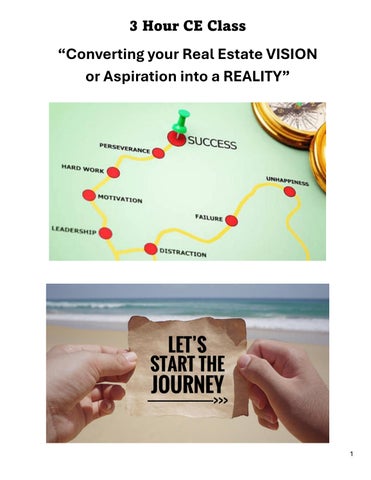
“Converting your Real Estate VISION or Aspiration into a REALITY”
“Converting your Real Estate VISION (Aspiration) into a REALITY”
Review Stephen Covey’s 8 Habits of Highly Effective People – 2 Pages
Conduct Realtor Growth Exercise (Specialty Property Focus) – 2 Pages
Review Reasons/Benefits of becoming a SME
Steps for converting your RE Career VISION into a REALITY – 4 Pages
8 Primary GOAL AREAS for Maintaining HARMONY
***The 1 – 3 – 5 Goal Setting Method – Ultra Simple***
Individual SMART Goals Checklist
My Comprehensive VALUE PROPOSITION
Defining & Differentiating Vision, Mission, and Values Statements
Creating a VISION Statement – Step by Step
Creating a VALUES Statement – Step by Step
Creating a MISSION Statement – Step by Step
Creating your ELEVATOR PITCH – Step by Step
Elements of dramatic Personal & Professional CHANGE – 3 Pages
Creating your Business & Personal VISION BOARD
Think & Grow Rich Challenge – For Income Growth
Real Estate Agent’s Guide to a SWOT Analysis
Blank SWOT Analysis Worksheet
Business Planning Worksheet & Checklist
Excel – Business Growth Around “The Big Three”
Excel – “Dial in your Income Plan” – Ultra Simple Business Plan
Here’s a short, practical summary of Stephen Covey’s 8 Habits of Highly Effective People (including the later-added 8th habit):
Habit 1:
Take responsibility for your actions. Focus on what you can control instead of reacting to things you cannot.
Habit 2:
Define your vision & goals before you start. Make choices based on where you want to end up.
Habit 3:
Prioritize tasks that matter most (important, not just urgent). Manage your time and energy around what aligns with your values and goals.
Habit 4:
Seek mutual benefit in all relationships. Effective leaders find solutions where everyone gains, rather than competing.
Here’s a short, practical summary of Stephen Covey’s 8 Habits of Highly Effective People (including the later-added 8th habit):
Habit 5:
Practice empathetic listening. Understand others’ perspectives before sharing your own. Builds trust and influence.
Habit 6:
Value differences and collaborate creatively. Teamwork can produce results greater than individuals working alone.
Habit 7:
Continuously renew yourself in four areas: physical, mental, emotional/social, and spiritual. A balanced lifestyle sustains long-term effectiveness.
Habit 8: ____________________________________________________________
(Added later by Covey.) Discover your unique strengths and purpose, then help others do the same. It’s about leadership, legacy, and contribution.
“Know Who You Are – And Who You Aspire to Become”
Instructions for Realtors:
1. Take 15–20 minutes to complete this worksheet honestly.
2. Begin with where you are today. Then, in the second column, write who/what you aspire to become in the next 1–3 years.
3. Be specific this is your roadmap for intentional growth.
Generalist Approach
Locational Niches or Specialties (My Territory)
SSSS Niches (Solutions, Services, Skillsets, Strategies)
Prospecting Niches (How I get clients)
Property Niches (Luxury, Land, Commercial, Farms, Equine, etc.)
Property Marketing Niches (Listing Advertising & Promotion)
Personal/Team Branding Niches
Other Specialties or Leverage (Teams, Tools, Systems, etc.)
Answer the following:
1. Which categories above feel strongest in my business today?
2. Which categories represent my biggest growth opportunities?
3. What ONE niche or specialty, if mastered, would most transform my business?
4. What are first steps will I take in the next 30 days to move toward my future vision?
• Pair up with another Realtor. Share one strength you have today and one aspiration you want to achieve.
• Ask your partner to share theirs.
• Exchange one idea or resource to support each other.
1. Stand Out in a Crowded Market
• Most agents position themselves as generalists. By being known as the go-to expert in a niche, you differentiate yourself and attract clients who value specialized knowledge.
2. Win Trust Faster
• Clients hire confidence. When you demonstrate deep expertise whether in luxury homes, land, investment properties, or a specific location buyers and sellers are more likely to choose you over a competitor.
3. Attract More Referrals
• Other agents, brokers, and even past clients refer business to specialists because they want their clients in good hands. Being an SME creates a steady stream of inbound leads.
4. Command Higher Commissions
• Experts are perceived as more valuable and harder to replace. Clients are willing to pay premium fees when they see you as an authority rather than “just another agent.”
5. Close Deals More Efficiently
• Subject matter knowledge helps you anticipate challenges, solve problems quickly, and streamline transactions. Less time wasted = higher productivity and profitability.
6. Build a Stronger Brand & Reputation
• SMEs naturally become thought leaders speaking at events, being quoted in media, publishing articles/videos. This positions you as a trusted authority and strengthens your long-term career brand.
7. Future-Proof Your Career
• As the market shifts (technology, AI, consumer expectations), agents who bring specialized insight will remain relevant. Generalists risk being replaced, but SMEs create lasting value.
Summary:
Becoming a Subject Matter Expert makes you more referable, more profitable, and more respected. It’s the fastest way to build both your income and your influence in real estate.
Introductory Concepts:
Task #1 -
Task #2 -
Task #3 -
Task #4 -
Task #5 -
Task #6 -
Task #7 -
Task #8 -
Task #9 -
Task #10 -
Task #11 -
Task #12 -
Task #13 -
Task #14 -
Task #15 -
Task #16 -
Task #17 -
Task #18 -
Task #19 -
Task #20 -
Task #21 -
Task #22 -
Task #23 -
Task #24 -
Task #25 -
Task #26 -
1) Career and Professional Development: Goals in this area focus on advancing one's career, improving job performance, acquiring new skills or certifications, and achieving professional milestones.
o Goal:________________________________
2) Health and Wellness: Goals related to health and wellness include maintaining physical fitness, improving nutrition, managing stress, getting adequate sleep, and prioritizing mental and emotional well-being.
o Goal:________________________________
3) Spirituality and Connection with God: Goals in this area center around deepening one's spiritual connection, cultivating a sense of purpose and meaning, and aligning actions with spiritual values and beliefs. This can include practices such as meditation, prayer, mindfulness, and participation in religious or spiritual communities.
o Goal:________________________________
4) Relationships and Social Connections: Goals related to relationships and social connections involve building and nurturing meaningful relationships with family, friends, colleagues, and community members. This can include improving communication skills, spending quality time with loved ones, and expanding social networks.
o Goal:________________________________
5) Personal Growth and Development: This area encompasses goals aimed at self improvement, personal growth, and lifelong learning. Goals may include developing new hobbies or interests, enhancing emotional intelligence, or pursuing personal passions.
o Goal:__________________________
6) Financial Stability and Wealth Building: Goals in this area revolve around managing finances, achieving financial security, and building wealth for the future. This can include saving for retirement, paying off debt, investing wisely, and increasing income.
o Goal:___
7) Leisure and Recreation: Goals related to leisure and recreation involve pursuing activities that bring joy, relaxation, and fulfillment outside of work and other responsibilities. This can include travel, hobbies, sports, arts, and other forms of recreation that provide enjoyment and relaxation.
o Goal:_______________________________________________________________________
8) Community and Social Impact: Goals in this area focus on making a positive difference in the community and society at large. This may involve volunteering, supporting charitable causes, advocating for social justice, or engaging in environmental sustainability efforts.
o Goal:_______________________________________________________________________
Setting goals in each of these areas helps individuals lead a well-rounded and fulfilling life, ensuring that attention is given to various aspects of personal and professional development, health and wellness, relationships, and leisure. It's important to customize goals to align with individual values, priorities, and aspirations.
Specific: Goals should be clear, specific, and well-defined and should answer:
What do you want to accomplish? THE GOAL!
Why is it important?
Who is involved?
Where will it happen? What are the requirements and constraints?
Measurable: Goals should be quantifiable and include specific criteria for measuring progress and success. They should answer the question: How will you measure progress and know if you've achieved your goal?
Achievable: Goals should be realistic and attainable, considering available resources, skills, and constraints. They should stretch you slightly but still be achievable with effort and commitment.
Relevant: Goals should be relevant and aligned with your overall objectives and priorities. They should directly contribute to your personal or organizational mission and vision.
Time-bound: Goals should have a defined timeline or deadline for completion. They should answer the question:
When will you accomplish the goal? Setting a deadline creates a sense of urgency and helps maintain focus and motivation.
Evaluate: Goals should be regularly evaluated and adjusted as needed based on progress, changing circumstances, or new information. Evaluation allows for course correction and ensures that goals remain relevant and achievable.
Review: Goals should be periodically reviewed to track progress, assess performance, and identify areas for improvement. Regular review helps ensure that goals are on track and aligned with overall objectives.
SMARTER goals provide a structured framework for setting and achieving goals effectively, helping individuals and organizations clarify their objectives, stay focused, and measure progress
Unique Selling Proposition, Competitive Advantage, or Competitive Edge Every Company or Service/Product offering needs at least 1 or 2. What makes my offering SPECIAL and UNIQUE?
This could be for a Company, a Service, a Business, etc.
Prioritize/Rank by most demanded or IMPCTFUL in creating Success. This MUST be completely reconciled before engaging in Selling or Marketing!
The difference between a vision statement and a mission statement lies in their focus and purpose:
1. Vision Statement:
• Focus: Future-oriented.
• Purpose: Describes the long-term aspirations and ultimate goal of an organization.
• Content: Typically expresses the desired state or outcome the organization hopes to achieve in the future. It often answers the question, "Where do we want to go?"
• Example: "To be the global leader in sustainable energy solutions."
2. Mission Statement:
• Focus: Present-oriented.
• Purpose: Defines the core purpose, values, and activities of an organization.
• Content: Provides a statement of the organization's reason for existence, its primary objectives, and the principles guiding its actions. It often answers the question, "What do we do and why do we do it?"
• Example: "To provide high-quality, affordable healthcare services to underserved communities."
3. Values Statement (or Core Values):
• Focus: Principle-oriented.
• Purpose: Articulates the fundamental beliefs and guiding principles that shape the organization's culture and behavior.
• Content: Describes the core values that guide decision-making, actions, and interactions within the organization. It defines what the organization stands for and how it conducts itself.
• Example: "Integrity, Respect, Collaboration, Innovation."
In summary,
• a Vision Statement paints a picture of the desired future state,
• a Mission Statement outlines the fundamental purpose and activities of the organization in the present.
• a Values Statement articulates the fundamental principles guiding the organization's behavior and culture.
• Together, these statements provide clarity and direction for the organization's stakeholders.
Creating a Vision Statement involves outlining your aspirations and long-term goals for your organization or project. Here's a step-by-step guide to help you craft a compelling vision statement:
1) Understand the Purpose: Before you begin drafting your vision statement, ensure you understand its purpose. Avision statement should articulate the future direction and ultimate goal of your organization or project.
2) Gather Input: Involve key stakeholders such as employees, customers, and partners in the process. Their perspectives can provide valuable insights and ensure buy-in.
3) Define Your Values: Identify the core values that guide your organization's decisions and actions. Your vision statement should align with these values.
4) Envision the Future: Imagine and describe what success looks like for your organization or project in the long term. Consider factors such as growth, impact, innovation, and societal contribution.
5) Be Specific: Your vision statement should be clear and specific, outlining the desired outcome or achievement.Avoid vague or generic language that could apply to any organization.
6) Keep it Concise:Avision statement should be succinct and memorable Aim for a sentence or two that captures the essence of your aspirations
7) Inspire and Motivate: Your vision statement should inspire and motivate stakeholders, including employees, customers, investors, and partners. It should convey a sense of purpose and excitement about the future.
8) Review and Revise: Once you've drafted your vision statement, review it carefully to ensure it accurately reflects your aspirations and values. Seek feedback from stakeholders and be willing to revise as needed.
9) Communicate Widely: Once finalized, communicate your vision statement widely within your organization and beyond. It should serve as a guiding beacon for decision-making and goal-setting.
10) Live Your Vision: Finally, ensure that your organization's actions and initiatives align with your vision statement. It should not just be a piece of rhetoric but a guiding principle that shapes your organization's culture and direction.
Remember that crafting a vision statement is an iterative process, and it may take time to develop one that truly captures your aspirations and inspires others. Be patient and willing to refine your vision statement as your organization evolves.
Example: "Our vision is to be the most trusted and sought-after real estate agency in our community, known for our unwavering commitment to integrity, exceptional service, and delivering outstanding results for our clients. We strive to exceed expectations, empower homeownership dreams, and build lasting relationships based on trust, professionalism, and transparency. Through innovation, expertise, and personalized guidance, we aim to redefine the real estate experience and be the go-to choice for anyone seeking expert guidance in buying, selling, or investing in properties."
Creating a business mission statement involves defining the purpose, values, and objectives of your organization. Here's a step-by-step guide to help you craft an effective mission statement:
1) Understand Your Business: Start by gaining a clear understanding of your business, including its products or services, target market, industry, and competitive landscape.
2) Identify Your Core Values: Reflect on the fundamental beliefs and principles that guide your business. Consider what is most important to your organization in terms of ethics, integrity, customer service, innovation, or other key values.
3) Define Your Purpose: Determine the reason for your business's existence. Ask yourself why your organization does what it does and what unique value it brings to its customers, employees, and society as a whole.
4) Consider Stakeholder Perspectives: Take into account the perspectives and needs of your various stakeholders, including customers, employees, investors, partners, and the community. Your mission statement should resonate with and address the interests of these groups.
5) Keep it Concise and Clear:Aim for brevity and clarity in your mission statement. Ideally, it should be succinct enough to be easily remembered and communicated, yet comprehensive enough to capture the essence of your business's purpose and values.
6) Be Specific and Unique: Make sure your mission statement is specific to your business and distinguishes you from competitors.Avoid generic or clichéd language that could apply to any company.
7) Focus on Impact: Highlight the positive impact your business aims to have on its stakeholders and the broader community. Emphasize how your products or services meet customer needs, solve problems, or improve lives.
8) Draft and Refine: Begin drafting your mission statement, focusing on capturing the essence of your business's purpose, values, and objectives. Take the time to revise and refine your statement until it accurately reflects your organization's identity and aspirations.
9) Seek Feedback: Share your draft mission statement with key stakeholders, such as employees, customers, and business partners, and solicit their feedback. Consider their input and perspectives as you further refine your statement.
10) Finalize and Communicate: Once you've refined your mission statement, finalize it and communicate it widely within your organization and to external stakeholders. Your mission statement should serve as a guiding principle for decision-making and goal-setting across the organization.
Remember that your mission statement is a living document that may evolve over time as your business grows and circumstances change. Regularly review and update your mission statement to ensure it remains relevant and aligned with your business's objectives and values.
"Our mission is to provide exceptional real estate services that exceed our clients' expectations and empower them to achieve their property goals. We are committed to integrity, professionalism, and personalized attention, ensuring a seamless and rewarding experience for buyers, sellers, and investors alike. Through our expertise and dedication, we aim to build lasting relationships and become the trusted advisors in the real estate industry."
"Our/My mission is to be the premier commercial real estate partner, delivering innovative solutions and exceptional service to our clients in every transaction. We are dedicated to understanding our clients' unique needs, providing expert guidance, and maximizing value in every commercial property endeavor. Through our expertise, integrity, and relentless pursuit of excellence, we aim to exceed expectations and build enduring relationships that drive success for our clients and our firm."
"Our/My mission is to curate extraordinary experiences in luxury real estate, seamlessly blending sophistication, innovation, and personalized service for discerning clientele. We are committed to exceeding the expectations of our clients by leveraging our expertise, global network, and meticulous attention to detail to deliver unparalleled results. With a dedication to luxury, integrity, and discretion, we aspire to be the premier choice for those seeking exceptional properties and unparalleled service in the luxury real estate market."
OUR MISSION Our mission is to change the financial trajectory of our agents’ and brokers’ careers and sometimes their lives. By upending the traditional brokerage model, we created cost-efficiencies to return more dollars to those who work with us and their families, clients and communities.
MISSION STATEMENT United Country Real Estate is committed to providing the most effective, unique and comprehensive marketing program for individuals interested in selling or owning Specialty or Lifestyle real estate
Here's a step-by-step guide to help you create an effective values statement:
1) Gather Input: Start by involving key stakeholders, including employees, leaders, and perhaps even customers or clients, in the process. Their perspectives and insights can help ensure that the values statement reflects the collective ethos of the organization.
2) Reflect on Core Beliefs: Reflect on the fundamental principles and beliefs that are important to your organization. Consider aspects such as integrity, transparency, innovation, teamwork, customer focus, social responsibility, diversity, and continuous improvement.
3) Identify Positive Examples: Think about times when your organization has demonstrated its values in action. Consider successful projects, instances of exceptional customer service, or moments when employees went above and beyond. These examples can help clarify and reinforce your organization's values.
4) Clarify Behaviors: For each value you identify, clarify the specific behaviors and actions that demonstrate that value in practice. Concrete examples can help employees understand how to embody the values in their day-to-day work.
5) Prioritize Values: If you have identified multiple values, prioritize them based on their importance to the organization's culture and success. Focus on the values that are most central to achieving your organization's mission and vision.
6) Craft Statements: For each value, craft a concise statement that captures its essence. Use clear and straightforward language that is easy to understand and remember. Each statement should convey the meaning and significance of the value to the organization.
7) Ensure Alignment: Ensure that the values statements align with your organization's mission, vision, and goals. They should support and reinforce the overarching purpose and direction of the organization.
8) Review and Revise: Once you have drafted the values statements, review them carefully to ensure they accurately reflect the organization's beliefs and principles. Seek feedback from stakeholders and be open to revising the statements as needed.
9) Communicate Widely: Communicate the values statements widely within the organization. Incorporate them into employee handbooks, orientation materials, training programs, and internal communications. Reinforce the importance of the values in shaping the organization's culture and guiding behavior.
10) Live the Values: Finally, ensure that the organization's actions and decisions align with its values. Leaders should lead by example and demonstrate the values in their own behavior.
Remember that creating a values statement is an ongoing process. Periodically review and revisit the values to ensure they remain relevant and meaningful to the organization's evolving needs and aspirations.
A vision board is a visual representation of your goals, dreams, and desired outcomes. It’s a collection of images, words, and symbols that reflect what you want to achieve in both your business and personal life.
It’s not just “arts and crafts” – it’s a tool to help you clarify, focus, and stay motivated on what matters most.
• Clarity: Helps you define what success looks like for you.
• Focus: Keeps your goals front and center in your daily life.
• Motivation: Inspires you to take consistent action.
• Alignment: Reminds you to make choices that move you closer to your desired outcomes.
• Visualization: Science shows your brain responds strongly to visual cues, making your goals feel real and achievable.
• Law of Attraction: You attract what you consistently think about.
• Reticular Activating System (RAS): Your brain notices opportunities connected to what you focus on.
• Visualization Practice: High performers (athletes, leaders, entrepreneurs) use mental imagery to increase confidence and performance.
• Consistency: Seeing your goals daily keeps you aligned with them.
• Be Specific: The clearer your goals, the more powerful your board.
• Emotion Matters: Choose images and words that inspire strong positive feelings.
• Balance: Include both business/professional AND personal/life goals.
• Action Steps: A vision board works best when paired with intentional daily action.
• Review Often: Look at it every day. Update it as your goals evolve.
Step 1: Clarify Your Vision - Write down your goals for each category. Be specific.
Business/Professional Goals:
•
• • • Personal/Life Goals:
•
• •
• Step 2: Define Why They Matter
Why are these goals important to you? What will achieving them mean for your life, your business, and the people around you?
•
•
•
•
Step 3: Translate Goals into Images & Words
For each goal, brainstorm visuals, quotes, affirmations, or symbols that represent it.
• Example: “Financial Freedom” → Picture of a debt-free statement, vacation photo, or words like Abundance, Security, Freedom.
Business Goal Visuals/Words:
• • Personal Goal Visuals/Words:
•
•
•
Step 4: Gather Your Materials
o Poster board, corkboard, or digital board (Pinterest, Canva, Trello, etc.)
o Magazines, printed images, inspiring quotes
o Scissors, glue, markers, or design tools (if digital)
Step 5: Create Your Vision Board
o Arrange images and words by category (business vs. personal) or mix them together.
o Place the most important goals at the center.
o Add positive affirmations.
o Make it visually inspiring and personal.
Step 6: Activate Your Vision Board
o Place it somewhere you’ll see daily (office, bedroom, phone background).
o Spend 2–5 minutes visualizing each goal as if it’s already achieved.
o Take at least one action daily that moves you closer to something on your board.
I have listed my top 3–5 goals in both business and personal life.
I understand why these goals are important to me.
I’ve chosen powerful images and words to represent them.
I created a vision board that excites me.
I review and visualize with it daily.
I take consistent action toward what I’ve pictured.
Read chapters 1 & 2 of ‘Think and Grow Rich’ by Napoleon Hill. In the chapter on Desire, Hill gives us a process for Manifesting Wealth - 6 practical steps:
The following worksheet was copied from chapter 2 of ‘Think and Grow Rich’ ebook, pages 65-66. Write down the answers to the following 6 steps on this worksheet… AND in your notes, notebook or on your Vision or Goals board at home:
1.) Desired amount of money: $_____________.
2.) What do you intend to Give (invest or sacrifice) in return for the money you desire?
•
•
•
•
3.) When do you intend to possess the money you desire? __ / __ / ____.
4.) Detail your PLAN for carrying out your desire, put this plan into action.
➢ What commitments, Strategies, and/or Actions will assure your success?
➢ I’s ok if you create a separate Business Plan, highlight the key points here.
•
5.) Write a CLEAR, CONCISE Statement of the amount of money you intend to acquire, name the time for its acquisition, state what you intend to give in return for the money and describe clearly the plan through which you intend to accumulate it.
6.) VITAL: READ YOUR WRITTEN STATEMENT ALOUD, TWICE DAILY:
• BEFORE BED
• AND ONCE YOU WAKE UP!
A SWOT Analysis is a tool to evaluate your business by identifying your Strengths, Weaknesses, Opportunities, and Threats. It helps you understand where you are today and how to grow strategically.
Strengths (What sets you apart?)
• What skills, specialties, or personality traits make me effective?
• What do clients consistently praise me for?
• What do I do better than most agents?
• Write Your Strengths:
Weaknesses (Where do I struggle?)
• What tasks drain my energy or take too long?
• What resources, tools, or skills am I lacking?
• Where have I lost business in the past?
• Write Your Weaknesses:
Opportunities (Where can I grow?)
• Are there underserved niches (luxury, land, relocation, first-time buyers)?
• Are there market trends I can capitalize on?
• What partnerships, tools, or training can help me expand?
• Write Your Opportunities:
⛈ Threats (What challenges could impact me?)
• Are there too many agents competing in my area?
• Are tech platforms reducing my role in the transaction?
• Are there shifts in interest rates, inventory, or regulations that affect me?
• Write Your Threats:
1. Leverage your Strengths → Double down on what makes you unique.
2. Minimize Weaknesses → Delegate, automate, or train where you need support.
3. Seize Opportunities → Focus on 1–2 growth areas with highest ROI.
4. Prepare for Threats → Build systems or strategies to reduce risks.
Takeaway: A SWOT analysis helps you design your business with intention. Use it annually or whenever your market shifts to stay ahead.