THE BELFIELD BANTER
- PUMPKIN SPICE EDITION -
NOVEMBER 21ST | BANTER PUBLICATIONS | ISSUE III
By Finley Cottler ‘26
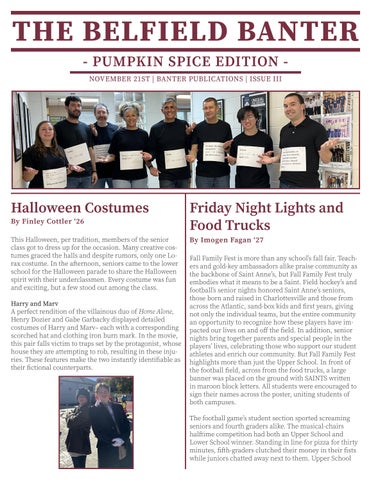
This Halloween, per tradition, members of the senior class got to dress up for the occasion. Many creative costumes graced the halls and despite rumors, only one Lorax costume. In the afternoon, seniors came to the lower school for the Halloween parade to share the Halloween spirit with their underclassmen. Every costume was fun and exciting, but a few stood out among the class.
Harry and Marv
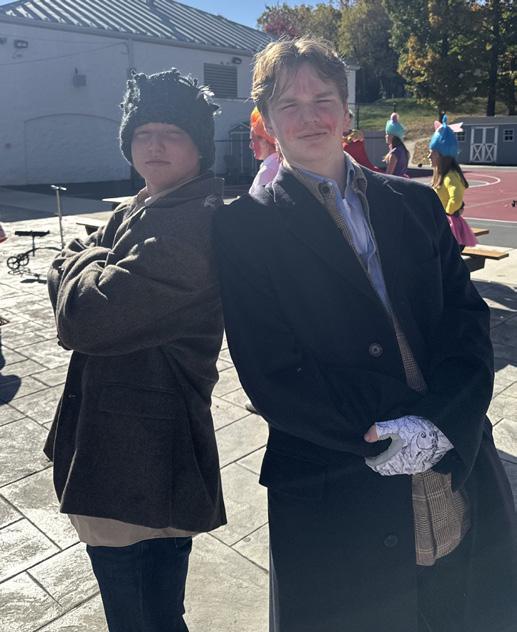
A perfect rendition of the villainous duo of Home Alone, Henry Dozier and Gabe Garbacky displayed detailed costumes of Harry and Marv– each with a corresponding scorched hat and clothing iron burn mark. In the movie, this pair falls victim to traps set by the protagonist, whose house they are attempting to rob, resulting in these injuries. These features make the two instantly identifiable as their fictional counterparts.
By Imogen Fagan
Fall Family Fest is more than any school’s fall fair. Teachers and gold-key ambassadors alike praise community as the backbone of Saint Anne’s, but Fall Family Fest truly embodies what it means to be a Saint. Field hockey’s and football’s senior nights honored Saint Anne’s seniors, those born and raised in Charlottesville and those from across the Atlantic, sand-box kids and first years, giving not only the individual teams, but the entire community an opportunity to recognize how these players have impacted our lives on and off the field. In addition, senior nights bring together parents and special people in the players’ lives, celebrating those who support our student athletes and enrich our community. But Fall Family Fest highlights more than just the Upper School. In front of the football field, across from the food trucks, a large banner was placed on the ground with SAINTS written in maroon block letters. All students were encouraged to sign their names across the poster, uniting students of both campuses.
The football game’s student section sported screaming seniors and fourth graders alike. The musical-chairs halftime competition had both an Upper School and Lower School winner. Standing in line for pizza for thirty minutes, fifth-graders clutched their money in their fists while juniors chatted away next to them. Upper School
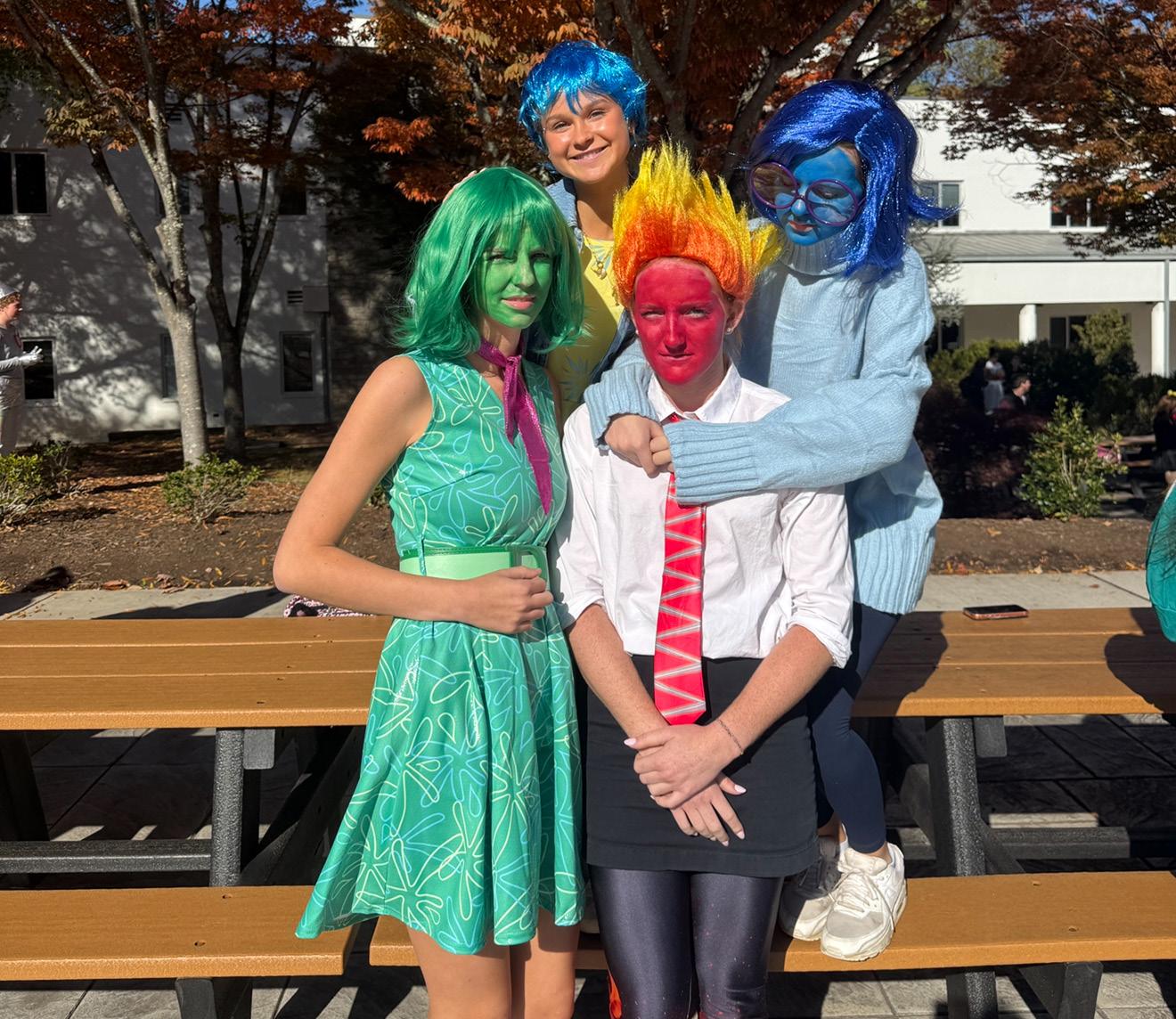
This group of four boasted their commitment to their costumes with full face paint to represent the emotions from Disney’s Inside Out. With wigs to match the zany hairstyles of the animated characters, they accurately portrayed the emotions. The fiery wig of Anger was particularly impressive.
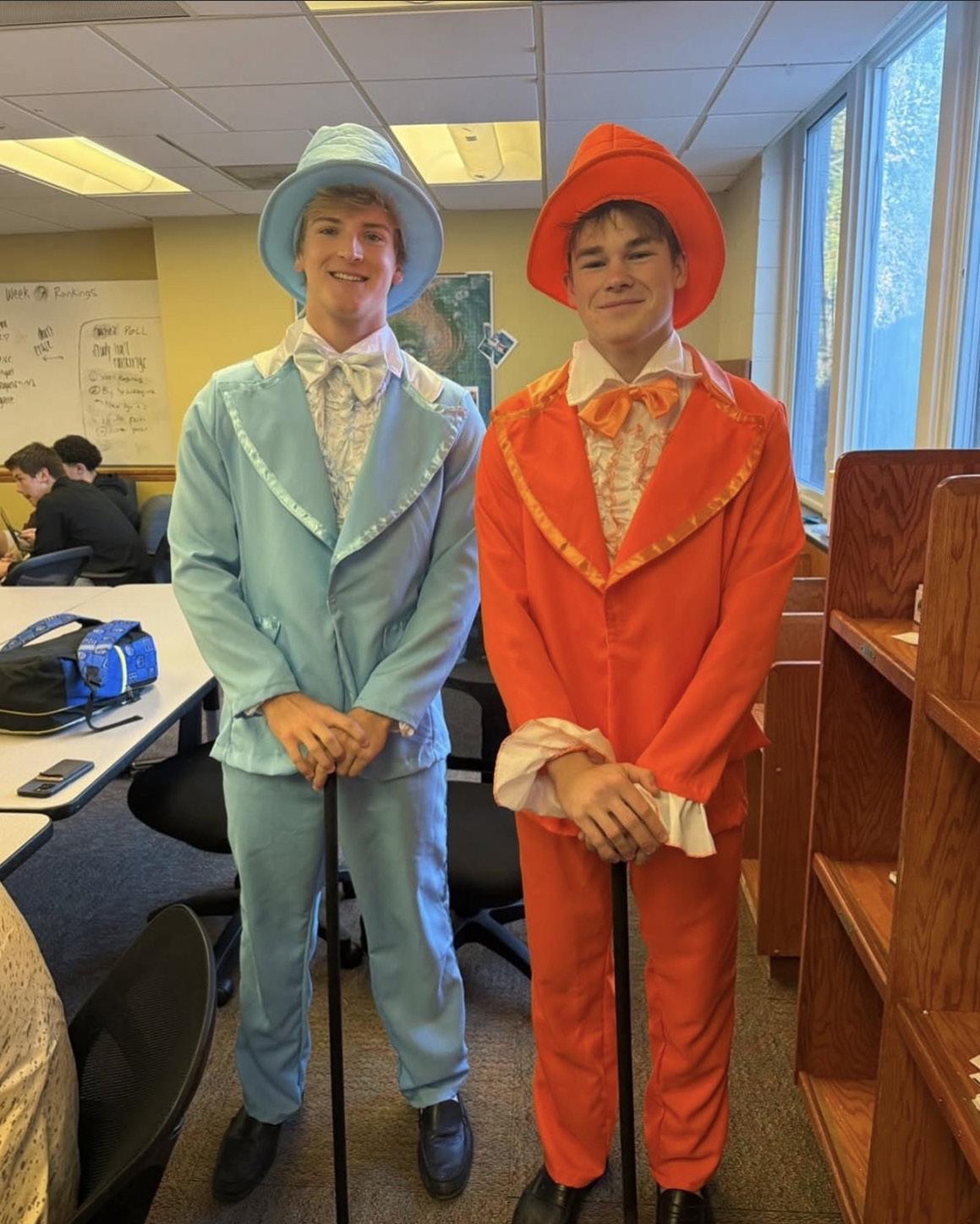
Cortlandt and Brendan came dressed as the protagonists of the movie Dumb and Dumber: Lloyd and Harry. Dawning the famous bright orange and pastel blue suits, matching tophats, and to complete the costume two canes, they were easily recognizable as the duo.
students earned their service to the school hours by running henna, face paint, glitter tattooing, and game stations, frequented by eight year-olds asking for 6-7 painted on their hands and five year-olds requesting flowers. Fall Family Fest is more than any singular sports game, community service opportunity, or chance to hang out with friends, it is a night that celebrates what it means to be a Saint. Fall Family Fest unifies the Saint Anne’s community unlike any other event throughout the year: with fun, food trucks, and football.
By Ari Kastello ‘26
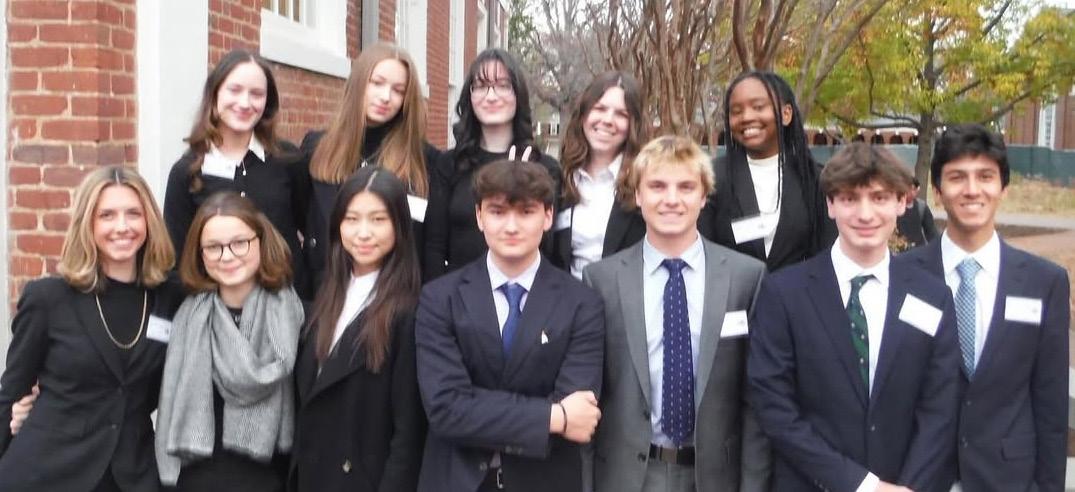
This week, the St. Anne’s Model UN Club took home second place at VAMUN, UVA’s annual Model UN conference. Model UN is a debate competition where students from all over the world represent countries in a political debate. Over the weekend, each of the committees met several times as students discussed topics ranging from international piracy to global food insecurity and found solutions. At the end of the conference, each committee gave awards to the top five best delegates in the group, and then to the best schools overall. VAMUN is the most difficult conference our club goes to every year, but the club did very well, with multiple individual awards and second place in the small school group. This was the first time that St. Anne’s won a school award at VAMUN. Additional congrats to individual winners: Grace Browne, Nori Carter, Liam Gunderson, Natalie Jingo, and Sebastian Laza.
Model UN is a great way to travel, meet new people, and talk about interesting things. The club meets every Wednesday at lunch in SCAS 111, so come if you’re interested. Model UN is a great experience, and everyone should come and try it. If you have any questions or are interested in joining, reach out to Mr. Shoup.
By Anisha Frelich ‘26
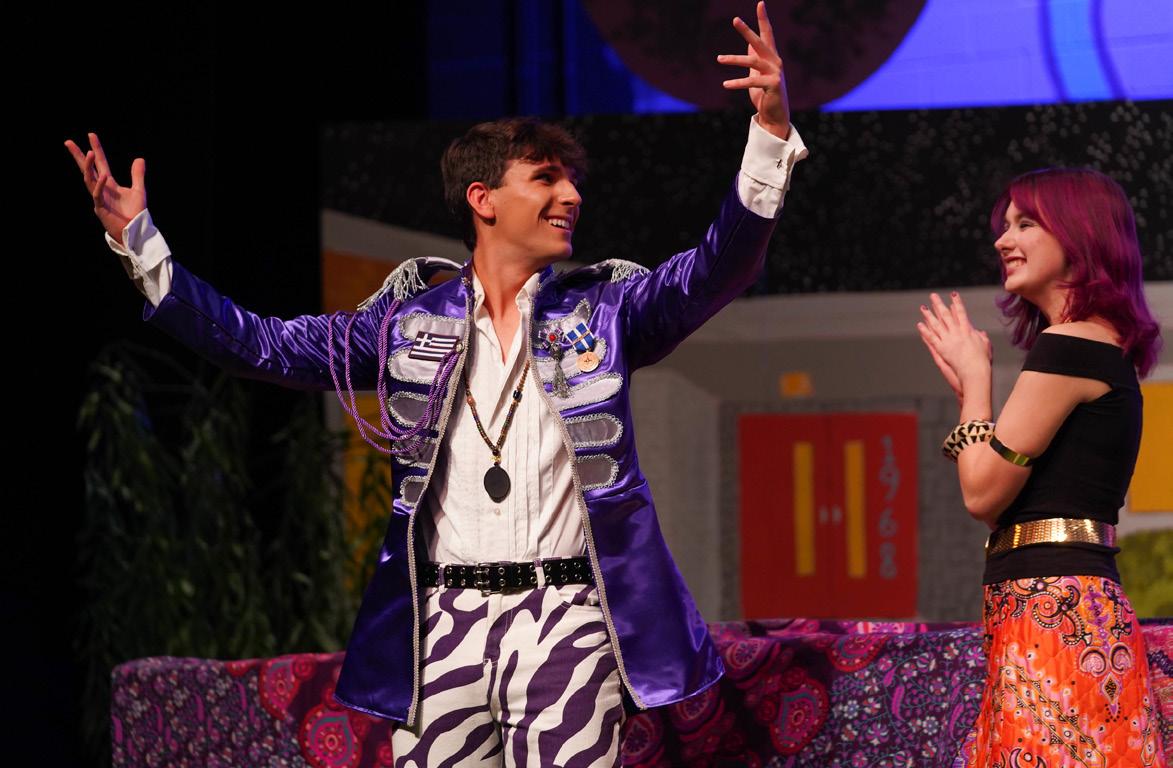
Putting on any Shakespeare play is an incredible feat, however A Midsummer Night’s Dream, with its complicated storyline on top of Shakespearian language, is a particularly difficult task. Saints Stage met the challenge head on and produced one incredible production. Each element, from acting to lighting, was rehearsed to perfection and added so much to the story. I was especially impressed by the acting. I had the opportunity to see the cast in rehearsals, and even a week ahead of opening night each member knew their lines and delivered them confidently. Besides the memorization of incredibly complicated language, everyone brought so much humor to the show as well. I couldn’t stop laughing and I’ve heard the same from countless other people. The “60s hippie” presentation made it all that much more entertaining. I also appreciated the 60s songs the cast sung as an added feature of the show. The actors also brought a certain clarity to it, and I had no trouble understanding the plot, which was much appreciated. Fan favorite moments to highlight included June and Jackson’s fight/waltz, and most scenes with Pyramus and Thisbe (Imogen and Stefan). All in all, I was impressed by the professional level of presentation and the mastery of Shakespeare. It was a fantastic show and if I could see it again, I would!
By Clemente Norambuena ’26
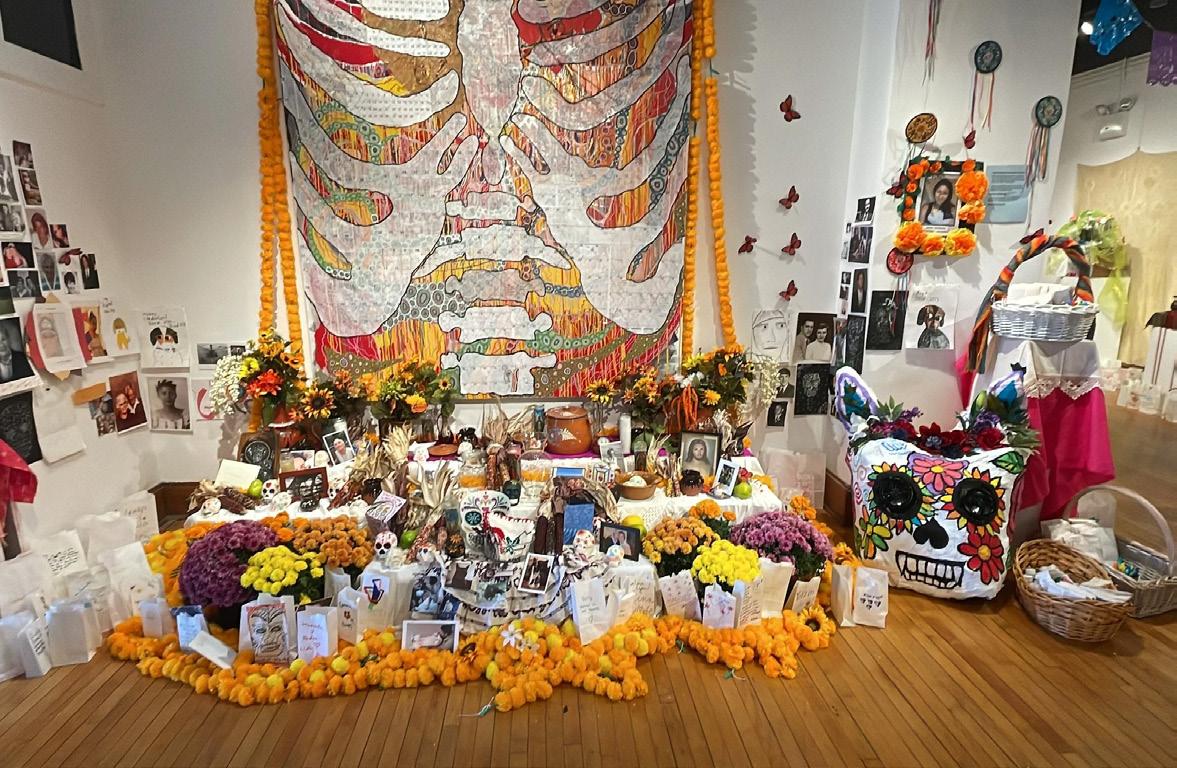
Life, family, and celebration. Day of the Dead is a cultural tradition that remembers those who have passed away into the afterlife and is a day of thanks for those close to us. The Day of the Dead celebration we now know originates from Aztec traditions of honoring the dead, combined with Spanish Catholicism in Central America. Traditions of the indigenous peoples would become integrated and mixed into All Saints Day and All Souls’ Day, celebrated on the first and second of November. November 1st is reserved for deceased children, and the 2nd for adults. A staple of this celebration is the altar with ofrendas, or offerings. Images of those remembered are placed on the altar and along with tokens such as personal items, food, and religious icons like the Virgin of Guadalupe. The beauty of this event is in the closeness of family and friends, where orange and yellow cempasuchil flowers and copal incense are used to guide and bring spirits back home to awaiting family, where food, music, and history can be found.
Today, Day of the Dead is celebrated across the world. The Chicano Movement during the 1960s and 70s in the U.S. helped facilitate the greater celebration and acknowledgment of these traditions emerging in our pop culture, seen in Pixar’s Coco, and here in our community of Charlottesville at venues like the McGuffey Art Center.
By Grace Browne ‘28
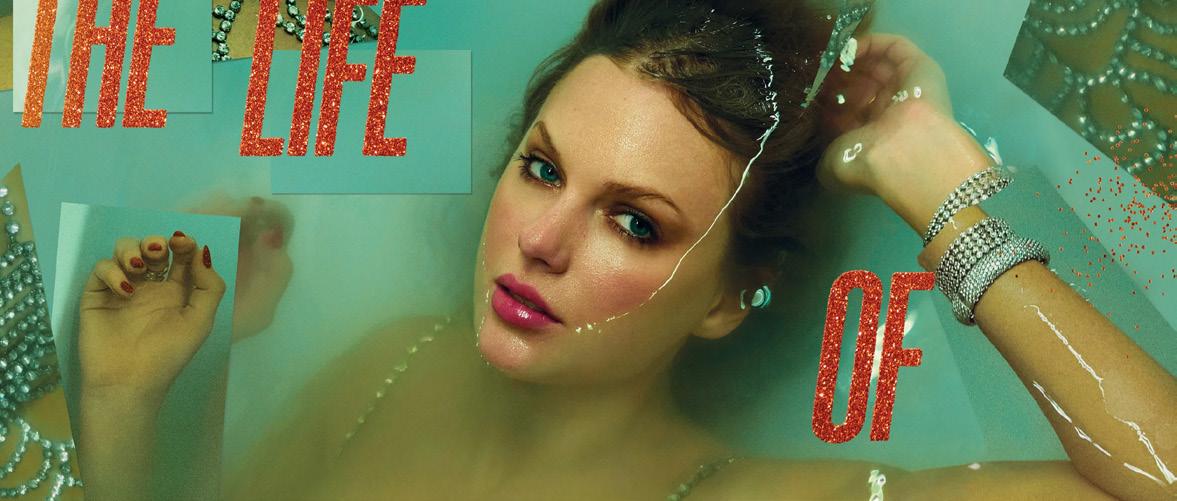
A dramatic shift from the intense and brooding tone of The Tortured Poets Department, Taylor Swift’s The Life of a Showgirl fully embraces the happiness and stability that appear to define her life today. Announced on August 12th during her fiancé’s podcast, the album immediately captured attention, not just for the music itself, but for Taylor’s personal joy surrounding its release. In fact, the same day the announcement was filmed, Travis Kelce proposed to her, marking a symbolic end to the era of heartbreak and melancholy that shaped much of her recent work. The engagement, accompanied by Taylor’s gleeful posts showing off her ring and celebrating her relationship, mirrors the emotional tone of the album.
The 12 new tracks on the album are fun, catchy, and energetic, but still substantive and full of heart. The playful melodies are accompanied by reflections on confidence, femininity, and self-acceptance. While the pop focus may have reduced the poetic nature that her previous albums, such as folklore or evermore, were defined by, this shift is not inherently negative. Rather, it represents artistic evolution. She now has a willingness to explore joy with the same passion previously dedicated to pain.
Musically, the album is characterized by upbeat tempos, shimmering synths, and radiant vocals that seem to glow with genuine happiness. Overall, The Life of a Showgirl feels like a dedication to confidence, love, and unapologetic happiness. Through this vibrant album, Taylor Swift redefines her brand, one that now celebrates both deep introspection and the beauty of life’s brighter moments.
By Jack Kelly ‘27
For more than two decades, families and friends spent their weekends sauntering and laughing through tall cornstalks and indulging in traditional savory sweets in pumpkin patches. From school field trips and social hangouts to dates or engagements, the Liberty Mills corn maze served as a staple of the Autumn experience for many. Only 45 minutes away from St. Anne’s-Belfield, Liberty Mills boasts the third largest corn maze in the United States and offers a variety of mazes for all types of visitors. But just two days before Halloween, the maze’s biggest day of the year, Liberty Mills’ owners made the tough decision to permanently close down the maze for the foreseeable future. Despite the wide smiles on little children and the majority of favorable experiences with parents, the increasing amount of sour comments and hateful interactions towards the corn maze’s owners stole the fun that supported the maze’s survival. Founders Kent and Evie Woods expressed their constant difficulty running the farm with minimal handpicked employees. The joy they felt from visitors typically fueled their perseverance to continually reopen the beloved corn maze every September, but this year, after being called “racist” by upset guests and drunk teenagers who were damaging the corn in the maze, the Woods family were heartbroken to announce on CBS News that their loss of sleep and continuous stress “was not worth continuing operations” The future of Liberty Mills is unknown, as the owners consider selling the farm to new owners or closing down forever, but what’s certain is that as the leaves start turning orange in future years, the earthy smell of corn stalks accompanied by the presence of its gracious owners will be profoundly missed.

By Liam Gunderson ‘28
Political activist Charlie Kirk was assassinated on September 10 while debating students in Utah under a tent that read, “Prove me wrong.” He was 31 years old and is survived by his wife and children. Kirk was known for his podcast, his visits to college campuses where he engaged students in debates, and Turning Point USA, which he founded. Most of his opinions aligned with Christian conservative ideology, causing contention among our country’s predominantly liberal student population. His willingness to speak about his own beliefs, in the face of such strong opposition, encouraged a surge in the conservative movement among young adults.
Kirk had a strong stance on many political topics, including his pro-life values, criticism of DEI programs and affirmative action, and support of traditional gender roles. Above all, Kirk promoted Americans’ constitutional right to express their opinions and stand up for their beliefs.
Debate is an essential practice in preserving our democracy. In response to Kirk’s death, Barack Obama said that our democracy relies on our ability to “disagree and sometimes have really contentious debates, without resort to violence”. When what motivated his college campus debates, Kirk responded, “When people stop talking, that’s when you get violence, that’s when civil war happens, because you start to think the other side is so evil [that] they lose their humanity.”
Charlie Kirk’s assassination is a continuation of increasing political violence in the United States, stemming from our country’s growing political divide. The phrase ‘politically divided’ is often misconstrued as failing to find commonalities or disagreeing too frequently. Contrarily, the divide comes from not disagreeing enough. Yuval Levin, a New York Times contributor and author, writes, “We spend most of our time cocooned away with people we agree with, talking about those terrible people on the other side, but rarely actually talk to those people.” A recent FIRE study captures the implications of this reality within our country’s youth. Revealing that one in three students believe violence is acceptable to si-
lence a speaker. This disturbing statistic is a result of a lack of constructive disagreement, stemming from two factors: self-reinforcing social media and the evasion of controversy in our schools. Both emanate from our tendency to exclusively surround ourselves with people and ideas we agree with.
The algorithms of social media platforms used by American youth feed users loops of content that they already identify with in some way, reinforcing their political views rather than exposing them to new ones. Social media allows users to intensify their contempt of opposing beliefs, fostering division rather than disagreement. Largely an exception, Charlie Kirk encouraged those with differing opinions to publicly contest him, rather than preaching to an audience that exclusively shares the same views.
School administrations often choose not to acknowledge controversial political matters, fearing heated disagreement that could upset some students or tarnish the school’s public image. However, we have seen that direct disagreement or controversy is actually beneficial to our students. The alternative, fruitless discussion among politically like-minded peers, results in a fear of, or unpreparedness for, articulating beliefs to people with opposing views. Kirk recognized the danger of averting controversy and became famous for traveling to college campuses and doing what many schools refused to do, sparking political discussions between students of differing beliefs, aware that controversy would ensue. Charlie Kirk recognized the importance of America’s youth and sought to encourage the implementation of the first amendment, a priority that warrants emphasis across the political spectrum. His death is a tragedy for all of us, regardless of whether or not you agree with his opinions. The assassination is more than a sign of unrest in our country; it is a threat to our freedom of speech and democracy.

By Ari Kastello ‘26
The College Board recently announced it was suspending the Landscape Program, a tool used to promote outreach to students of underserved backgrounds. This decision comes after increasing pressure from the Trump Administration to end the practice of Diversity, Equity, and Inclusion (DEI). The end of this program has resulted in increased scrutiny for an organization that has already faced negative coverage for its business practices.
The College Board is considered a legally nonprofit organization, meaning that its goal is to serve the public interest. However, news sources, including Forbes, reported that the company charges “exorbitant fees for test takers” ($99 for an AP test and $64 for an SAT), which in 2017 resulted in a surplus of $140 million. Once a student pays the fee and takes the test, they still need to pay to use it. The College Board charges $12 to send a score to a college, and an additional $25 to apply for financial aid using the CSS Profile. That last part is particularly controversial, as some argue that it creates a barrier for those who need access to the aid most. This controversy stems from the College Board directly profiting from test-taking by selling data, including a student’s name and scores, for 50¢ per person, resulting in what the New York Attorney General’s Office describes as “significant revenue”. The College Board defended its student search service in a statement saying the service has a “proven, positive effect on college-going.” The College Board later settled a lawsuit with the State of New York for violations of data privacy laws. In addition to controversy around fees and data privacy, the College Board has been accused of acting as a monopoly to maintain its dominance.
In the past, the ACT was the dominant admissions test in the Midwest and South; however, through the College Board’s extensive lobbying efforts, many states have switched to the SAT in recent years, including 8 that now only offer the SAT in public schools. A lawsuit alleged that the organization colluded with 40 major universities to lower the finan-
By Liam Gunderson ‘28
Real estate, private equity, and private debt are a few examples of alternative assets, investments that have traditionally been accessible only to institutions or the ultra-wealthy. Alternative investments often yield higher returns than bonds or stocks. Affluent establishments, such as pension funds and university endowments, allocate more than 50% of their portfolios to alternative investments on average. In contrast, the everyday investor holds <5% of their wealth in these assets due to high minimum investment requirements, illiquidity, and legislative restrictions.
Funds that offer exposure to alternative assets often employ buy-in minimums in the millions of dollars in order to sell to as few investors as possible, avoiding the systemic challenges required when dealing with a multitude of shareholders. Additionally, unlike stocks or cash, alternative investments are highly illiquid, requiring long lock-up periods that most small investors can’t afford. Finally, the government has established barriers to discourage or even prohibit everyday investors from buying into alternative assets. Seasoned investors and institutions have the resources to compensate for these barriers, but regulators fear that everyday investors could be taken advantage of.
Attempts to democratize alternative investments have been largely ineffective. However, progress is anticipated with the development of tokenization, the process of assigning ownership of an asset using a token on the blockchain, the same technology that cryptocurrencies rely on. The World Economic Forum describes tokenization as “a new model of digital asset ownership that enhances transparency, efficiency, and accessibility,” three of the greatest obstacles facing small investors in traditional alternative markets. The technology automatically records all of its transactions to a public ledger, making it difficult for funds to conceal their owners or investors. Although not a perfect solution, the blockchain could raise the standard of transparency for alternative asset funds, calming worries about underinformed investors.
cial aid decisions of those with divorced parents, through penalizing students for the assets of their non-custodial parents, making it harder for those students to afford their education.
Because the College Board has such a dominant position in the testing market, critics allege that the organization can dictate prices, which often can harm low-income students. In the eyes of its critics, the College Board has stopped acting in the best interest of the public and instead operates like a corporation, putting pressure on a market that has no other options, while maintaining a surplus. It is important to examine the role the College Board plays in the process of college admissions and how it can be improved.


Tokenization also increases efficiency when trading alternative assets, allowing them to be broken up almost indefinitely and bought or sold in pieces. The smaller fractions are more liquid than the larger shares. This summer, an income-generating apartment in Dubai worth half a million dollars was sold via tokens in just under two minutes. The minimum investment price was only $500. By automating fractional transactions, tokenization increases liquidity and effectiveness.
Previously, the extra overhead costs affixed to a multitude of small investors outweighed the benefits of the additional pool of capital (roughly 39% of the world’s wealth). With tokenization, those costs are all but eliminated, benefiting small investors. Some tokenized funds have already significantly lowered their minimum investment requirements. In 2024, Hamilton Lane, an alternative investment management firm, tokenized a portion of one of their private equity funds and lowered the minimum investment from $5,000,000 to $20,000.
Economically, the democratization of alternative assets could have several important effects. At the detriment of investors who already hold alternative assets, there would be a general decrease in the average returns of the investments. However, the returns would still be greater than those of traditional investments, thereby increasing returns for lower and middle-income investors. It could help close the gap between the upper-income and lower-income investors by offering easier exposure to the same assets that compose large portions of institutional and ultra-wealthy portfolios.
By Caroline Reilly ‘26
Today, it is not uncommon to see zombies in film and television, with recent media such as Danny Boyle’s Twenty-Eight Years Later and The Last of Us. The Zombie movie is now regarded as an entire subgenre within horror cinema that continues to change and evolve. But when did these ghouls first gnaw their way onto screen, and what established the key characteristics present in the genre? In the wake of Halloween, Film Club hosted a screening of the original zombie movie: George A. Romero’s The Night of the Living Dead. With $100,000 to his name and a crew of unknowns, Romero set off to create his first feature film. With a shoestring budget, he had to get creative; using abandoned buildings as film sets, ham as guts and flesh, and chocolate syrup as blood. The film follows a ragtag group of individuals as they attempt to barricade themselves within a Pennsylvania farmhouse to keep safe from the horde of flesh-eating corpses ravaging the Northeast and their struggles as they attempt to fight off the living dead.
The film itself deals with many social and cultural aspects of the 1960s, with nods to the civil rights movement as well as the spiraling paranormal theories at the time. The cause of the undead outbreak is briefly explained as a side effect of radiation from a spacecraft. This offers a glimpse into the era of the space race, supernatural conspiracies, and chaos that was taking shape within the United States.
The film is now recognized as a cult classic and credited with laying the foundation for the Zombie movie archetype. The Night of the Living Dead not only established the behavior of zombies but also the apocalyptic environment and a shift in the horror genre. Before The Night of the Living Dead, much of the horror movie genre consisted of monsters like those of Dracula, Frankenstein, or psychological horror like Alfred Hitchcock’s Psycho or Roman Polanski’s Repulsion. But what truly separates it from other films was the invention of zombies as flesh-eating monsters, an allegory for society consuming itself, as well as the apocalyptic environment. The Night of the Living Dead remains a hugely impactful movie, in regard to its indie production, historical and cultural importance, as well as its innovations within the horror film genre.
Thank you to everyone who attended the screening, and to our faculty sponsor, Mr Mattise!
By Stefan Laza ‘29
María Corina Machado is this year’s Nobel Peace Prize Winner. Machado is a politician as well as activist from Venezuela. Machado leads the opposition party of Venezuela and started her political career by starting a vote-monitoring organization named Súmate. She helped lead protests against Maduro’s regime in 2014, and after she was barred from running in the election her replacement candidate won in a landslide. Despite this, and the mounting pressure against the Maduro regime, the government run National Election Council declared Maduro the victor. Shortly after this Machado went into hiding fearing for her life.
The Norwegian Nobel Committee awarded the Peace Prize to Machado for her “tireless work promoting democratic rights for the people of Venezuela and for her struggle to achieve a just and peaceful transition from dictatorship to democracy.” Time Magazine also listed her as one of the world’s 100 most influential people.
Machado lived in Caracas for her childhood growing up in a conservative, catholic household. Rebellion also runs in the family for Machado as her great-great-grandfather died a martyr in the 1929 failed uprising against dictator Juan Vicente Gómez. She graduated college and moved to Valencia, but she soon returned to Caracas to start her political career, leaving her company to prevent its politicization.
To some, the awarding of the Nobel Peace Prize to Machado created controversy. Some people believe she is too “pro-west”, because she worked with the United States in the past, even meeting with George H.W. Bush. Another piece of criticism against her is her continued advocacy for sanctions to be levied against the current Maduro government as well as foreign intervention from the United States.
In Venezuela she stands for the opposition to oppression and the idea that in the face of oppression there are people who stand strong against it. Machado should inspire people to greater action and should be recognized as she continues to stand for the democratic rights of her people.

By Grace Browne ‘28
In early August, President Trump signed a memorandum requiring universities that receive federal financial assistance to disclose the admissions statistics on their applicants, admittees, and enrolled students. After the Students for Fair Admissions, Inc. (SFFA) v. President & Fellows of Harvard College Supreme Court case in 2023, it was ruled unconstitutional to use race as a factor in college admissions. However, schools were still able to consider race if shared by the applicant in their admissions essay as something that shaped their life. The Trump Administration believes that this allowance is being abused by universities as a “hidden racial prox[y]” to diversify their student body, and is potentially violating the civil rights of more qualified students. The directive will require schools to report detailed data on students’ race, gender, standardized test scores, and GPAs to ensure applicants are not being discriminated against based on their immutable characteristics.
Advocates of the new policy believe that the American people deserve to know that our higher education system is fair, and there is no better way to ensure that than by increasing transparency. However, critics of the new policy question the intent of collecting this data. They believe it will be used as an excuse to pull more funding from universities, and worry about the logistics of successfully gathering such data. With applications including many qualitative factors, like essays and extracurricular activities, the data may be difficult to evaluate in a meaningful way. Additionally, most elite colleges admit several other groups at a higher rate than the rest of the applicant pool. Athletes, students with a specialized skill, children of faculty, legacies, and students from very wealthy families are given special consideration at many universities. Data on these groups should be made available to the public in the same way that the White House is demanding we see the data on how race and gender influence the admissions process. Like race and gender, legacy status or relation to a wealthy donor are qualities with which you are born. To demand the data on the latter two but not the former is hypocritical.
By Jome Liu ‘27
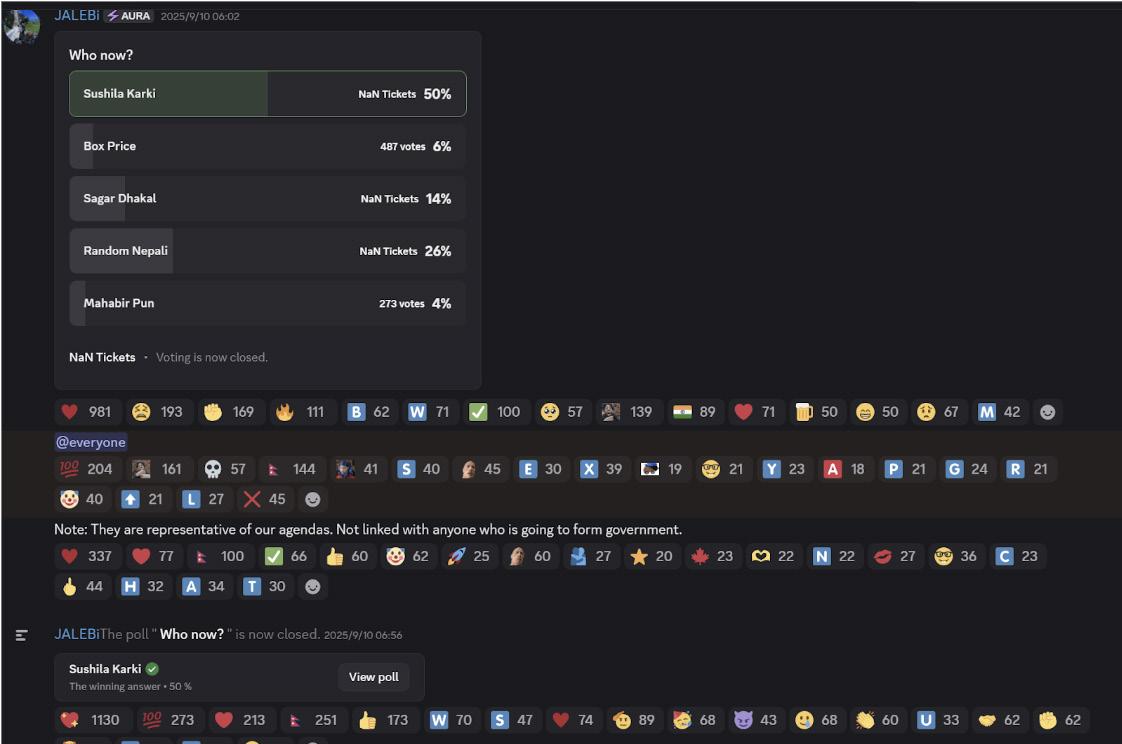
In a country where politics is at an impasse and young people’s trust in traditional elites has collapsed, an unprecedented political experiment is unfolding. In September 2025, Gen Z in Nepal successfully elected the country’s interim prime minister, 73-year-old former Chief Justice Sushila Karki, through the voice chat platform, Discord. The politicians are widely regarded as corrupt, and the youth unemployment rate in the country has skyrocketed to 20%, which has made the government deeply unpopular. In early September this year, the government blocked access to several social media platforms, including Facebook and Instagram, under the pretext of cracking down on misinformation. This ban, viewed as an attack on free speech, led to large-scale protests. The government responded violently, but failed to stop the protests, leading to the resignation of Prime Minister Oli.
After the resignation, a Discord server for the protest group “Hami Nepal” became a temporary “digital parliament.” Here, over 10,000 Nepalese citizens used Discord to vote on a new Prime Minister. Former Chief Justice Sushila Karki, a judge known for her independence and stance against corruption, won the vote and was appointed interim Prime Minister until general elections can be held in March 2026. The results were accepted by the president and military, and Karki was officially sworn in on September 12. This incident quickly sparked debates worldwide. Supporters praised it as a “milestone of digital democracy,” but critics pointed out that the number of participants was a fraction of the national population, that the voting process lacks identity verification, and the risk of foreign interference.
By allowing admissions offices to keep their decision making processes in the dark, we are left to wonder why some lucky few are admitted and other seemingly qualified applicants are rejected. As stated in Trump’s order, American citizens should be able to trust that we are training the most “capable future doctors, engineers, scientists, and other critical workers vital to the next generations of American prosperity.” Diversity in views, backgrounds, and perspectives is vastly important in academic settings, but this goal should not come at the expense of skill, hard-work, and merit. The American people deserve to know that our higher education system is fair, and there is no better way to ensure that than by increasing transparency. As former U.S. Supreme Court Justice Louis Branddeis said: “Sunlight is said to be the best of disinfectants.”

By Sarah Sanders ’26
When I was younger, I used to play travel soccer, and when I hear “Royals” I am immediately transported to riding in the backseat of my mom’s SUV with my friends. Now, with the awakening of my senior year, “Ribs” has most definitely found a place on my bittersweet Spotify playlist.
Lorde was born Ella Marija Lani Yelich-O’Conner in 1996 and grew up in Auckland, New Zealand, raised by a Croatian poet mother who influenced her in many ways. At just twelve years old Lorde was signed by Universal Music Group.
Pure Heroine was Lorde’s debut album. It is complete bliss, but a reality wakeup to us seniors. It is sleepiness in the backseat of a cab driving between NYC and Brooklyn, watching the city lights against the passing cars. It is boredom in a city full of people: post-modern yet apocalyptic.
“Tennis Court” is about Lorde’s daily life in Auckland. She also states it speaks to her experience of beginning in the music industry, especially at such a young age. (Recent claims that it referenced the French Revolution have been debunked—good try, Reddit!) The song begins with Lorde’s piercing, isolated vocals. Her voice is avant-garde: slow, distant, bored, and recognizable. The poetic abilities of Lorde are indescribable, though they aren’t often given the credit they deserve. For example: “I’ll see the veins of my city like they do in space” and “Never not chasin’ the million things I want.” Isolating these lines perfectly displays her lyrical ability.
I would not end this review without mentioning the infamous “Ribs.” The song is a five-star in my book. I do not care what age I am, I will not press the skip on such a beautiful creation. It is scary growing up, and Lorde showcases this perfectly. The song is the in-between of being a kid and an adult. When we are little, we are usually so quick to want to skip forward to the high school years. But, when that time comes, sadly, it’s the opposite. Lorde testifies to the vulnerability that comes with maturity in “Ribs.” In this awkward stage between high school and college, we begin to focus on our paths and dreams rather than the present moment in front of us.
Lorde writes that she was influenced by many artists, for example, the “glam-rock” abilities of Bowie and the moody melodies of Portishead and Grimes. My advice for all is to appreciate where you are right now, and to try not to look into future events as much as you would usually. Try to be exactly still in the now.

“I and Love and You”
The Avett Brothers
“Emerald Eyes”
Fleetwood Mac
“Better Together”
Jack Johnson
“Notion”
The Rare Occasions
“A Well Respected Man”
The Kinks
“Do You Believe in Magic?”
The Lovin’ Spoonful
“Spooky
Dusty Springfield
“Insomniac”
Memo Boy & Chakra Efendi
“Brothers in Arms”
Dire Straits
“About You”
The 1975
“Back to the Old House”
The Smiths
“Halloween”
Noah Kahan
“Dizzy On the Comedown”
Turnover
“400 Lux”
Lorde
“The Subway”
Chapell Roan
“Lover Girl”
Laufey

Anna Karenina
Leo Tolstoy
Severance
Ling Ma
The Metamorphosis
Franz Kafka
Bunny
Mona Awad
To Kill a Mockingbird
Harper Lee
The Secret History
Donna Tartt
The Poppy War
R.F. Kuang
The Prince
Editor-in-Chief
Kate Cheng ‘26
Senior Editor
Sebastian Laza ‘26
Formatting Head
Carter Kelly ‘26
Staff
Henry Dozier ‘26
Lovissa Price ‘26
Ari Kastello ‘26
Clemente Norambuena ‘26
Caroline Reilly ‘26
Sarah Sanders ‘26
Anastasiia Pestova ‘27
Quinn Humphreys ‘27
Imogen Fagan ‘27
Grace Browne ‘28
Liam Gundersen ‘28
Stefan Laza ‘29
Liam Gulotta ‘29
Formatting Team
Nori Zhang ‘27
Hi everyone,
I hope you’ve all had a great Mod 2. Thank you for reading this edition of the Belfield Banter, and shout out to all the staff and writers for putting their time into making this edition great. As always, it’s never too late to join Banter, so if you’re interested in writing or formatting, please don’t hesitate to reach out!
Over the break, take time to think about what you’re grateful for: friends, food, family, and the great community we’re in. Looking forward to seeing everyone when we come back for the holiday stretch! Have a great Thanksgiving Break!
Kate Cheng (Editor-in-Chief)