On New Year's Day, Seattle hosted their first Winter Classic. This longstanding tradition is an annual open-air hockey game, this year featuring Seattle Kraken and Vegas Golden Knights, the reigning hockey champions. Before the big game at T-Mobile Field, the Kraken welcomed the community to the Enterprise NHL Fan Village: a free event that featured family-friendly hockey interactives, giveaways, food, and a special appearance by the oldest and most revered trophy in sports- the Stanley Cup!
Kraken host Winter Classic
By Spencer Pauley The Center Square
Sound Transit will conduct a pricey study on a new location in Seattle’s South Lake Union as part of its Ballard Link Extension project.
The approved study will revise the agency’s 2024 budget to tack on approximately $851,000 to study the Ballard Link Extension project. It will study an alternative location combining the Denny Westlake Shifted West station with a potential South Lake Union station at approximately 5th Avenue and Harrison Street.
The Ballard extension will run from downtown Seattle to the Ballard District with nine stations in total. It will also include a rail-only tunnel from the ChinatownInternational District to South Lake Union and Seattle Center/Uptown.
Sound Transit plans to eventually connect the Ballard extension with the Tacoma Dome Link Extension.
The current cost estimate for the Ballard Link Extension project in the 2023 Fall Financial Plan is $11.2 billion. The preferred alternatives for the agency’s West Seattle and Ballard Link extensions are anticipated to exceed the assumptions in the financial plan by $510 million, as noted in a previous board motion in July 2023.
“This is such a critical piece of our entire alignment and with the noted impacts to economy and folks that are in the area, they wanted us to make sure that we look at it very closely and think about what is going to be best for the entire system,” Sound Transit Board VIce Chair Kent Keel said at Dec 15 board meeting.
The agency previously identified the preferred alternative for the Ballard Link Extension in March and modified the preferred station location for the Denny Station in July.
Queen Anne & Magnolia Worship Services
Sunday Worship at 10am Live Streamed on our Facebook page and YouTube. Simply look for Magnolia Lutheran Church.
Twelfth Church of Christ, Scientist
In Person and Online Church Services
All are welcome & warmly invited to join these healing services
For best audio results, please join by clicking on the link from your computer or smartphone and choose “Call Over Internet”
All Zoom Services Meeting ID: 418 806 2637 https://us02web.zoom.us/j/4188062637
Sunday Services 11:00am – 12noon Pacific
Wednesday Testimonies 7:30pm – 8:30pm Pacific
Christian Science Quarterly Bible Lessons
Our weekly Bible Lesson Sermon may be found here: https://quarterly.christianscience.com/
For additional assistance, please contact us at seattle12cs@gmail.com or 206.283.2300 ChristianScienceTwelfthSeattle.com
For a Healthier You CHIROPRACTORS
DENTISTS
Queen Anne Dental Group
Dr. Frank J. Calvo & Family
Cosmetic, Implant, & General Dentistry
400 Boston St. 206-284-7812 www.QADG.net
QUEEN ANNE HELPLINE
Every
Helpline
If you are a low-income senior (55+) living in zip-codes 98109, 98119, or
98199 and would like to have one of our Thanksgiving bags delivered to you, call our Resource Center at 206-2821540.
To donate or to help volunteer, go to https://www.queenannehelpline.org/ thanksgiving.html
TECHNOLOGY HELP
Young
Whippersnapper
Judgment-free
tutoring and support. Set up your new device, and learn how to use your tech on your terms. Call 206-561-6356 or email info@ youngwhippersnapper.tech to learn more.
Chiropractic AND Massage Therapy
Darrell Gibson, D.C. • Sarah Gibson, D.C. Graeme Gibson, D.C.
David E. Goodall III, LMT
Sarah Rose Nottingham, LMT Lauren E. Traynor, LMT
SERVING THE FAMILIES OF QUEEN ANN E SINCE 1991 1905 Queen Anne Ave N • 206.282.8275 www.QueenAnneChiro.com
Horticultural sunshine for the dark months
Years ago, I wanted a palette of plants with white variegated foliage or white blooms to spot around my garden, to give it light in the dark of January. The gardener I was talking to said, “Right idea, but it will be even brighter and lighter if you go with yellow. White is cold. Yellow is warm, the color of sunshine.” He was right. It’s a lesson I never forgot, the wisdom of which has only been reinforced every January, thereafter, when I found a yellow leaf or flower or even branch to add to my winter garden.
Unlike Spring, Summer and even Autumn, offerings for Winter yellows are slim. But they are out there and, in three cases, fairly big and spectacular, all happily at home in our climate and soil. The flowering tree Cornelian Cherry (Cornus mas) tops the list. Masses of small sulphurcolored blossoms cover the defoliated branches of this 15 to 20 foot tree. Edible scarlet fruits follow the flowers and the flaking, mottled tan and gray bark provides winter interest.
Chinese Witch Hazel (Hamamelis mollis and the hybrid H. x intermedia) covers its angular, zigzagging branches with bright yellow tassels. This garden scale tree commonly reaches a height of 10 to 15 feet. The bloom period is unusually long and the flowers have a spicy scent. Plant it where you can see it, looking through a window or where you’ll pass it regularly, enjoying the sight
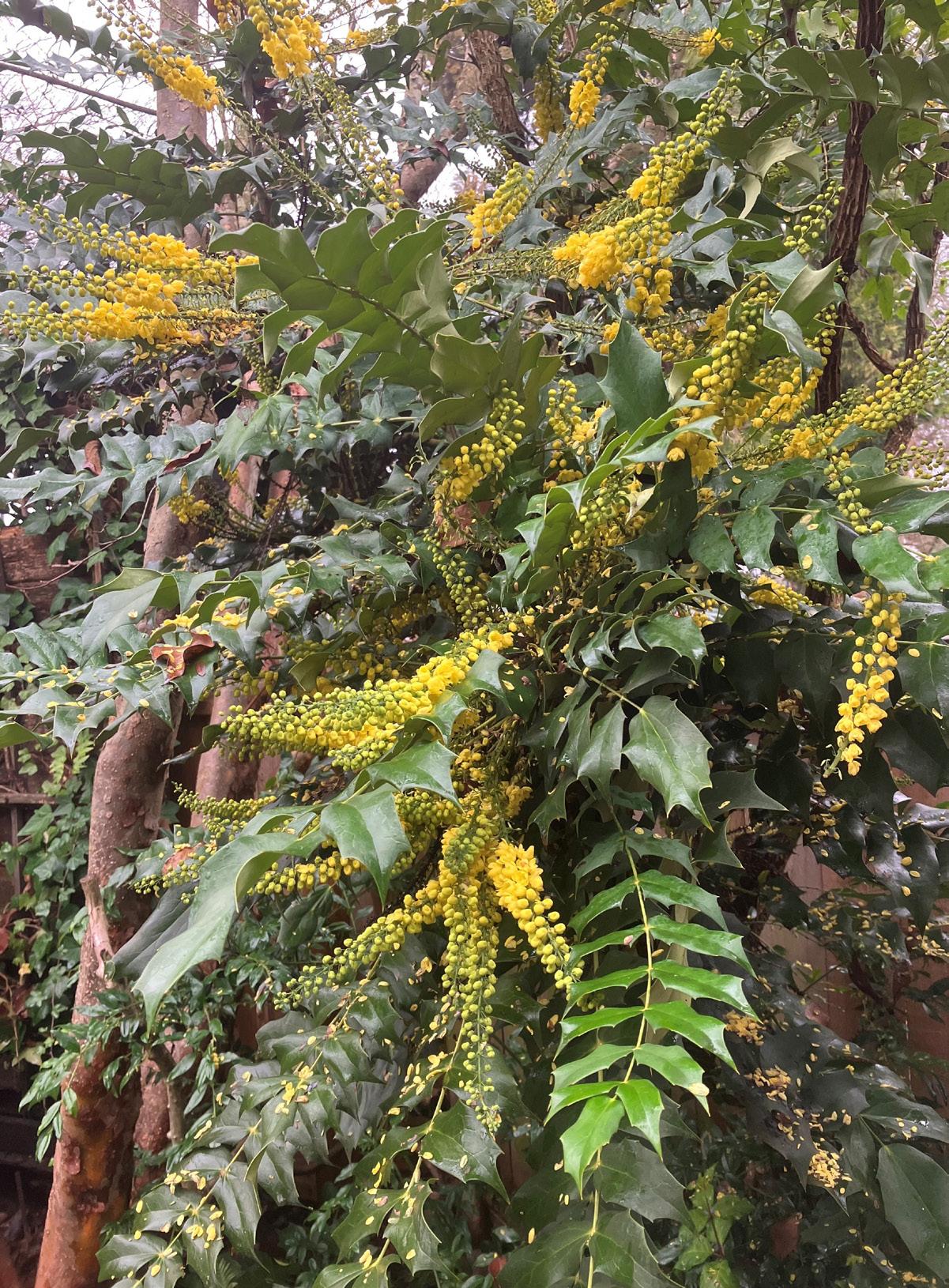
of the flowers and catching their fragrance. There are several January blooming Mahonias, primarily the hybrids between M. bealei and M. lomarifolia. Mahonia x media ‘Charity’ is the the most robust, famous and widely available. But there’s a bit of Northwest pride to be enjoyed in knowing and growing its precursor, Mahonia ‘Arthur Menzies’. A natural hybrid, it was discovered in the Washington Park Arboretum and introduced to world horticulture in 1967. This sturdy shrub, which can be trained as a tree can reach 8 to 10 feet, sometimes more. The big, yellow bursts of stemmed flower clusters are attractive
to our over-wintering hummingbirds. When the flowers fade, they become clusters of metallic blue berries that stand tall well into Spring, a great food source for robins.
In any search for horticultural sunshine, yellow and golden conifers are, perhaps, most abundant and easiest to find. Most make great background plantings, others, especially the ones with irregular shapes, perform beautifully in pots, some crawl over the ground or spill through rock gardens. The genuses of pine, spruce, fir, juniper, and false cypress all have multiple offspring in shades of yellow, in sizes and growth patterns from dwarfs to timber trees.
Once purchased, enjoy one in a handsome outdoor container for a few years, then plant it out in the garden. I’ve had my eye on a brilliant gold Lodgepole Pine (Pinus contort ‘Chief Joseph’). It’s a stunner. When introduce a few years back, plants in 5-gallon cans were selling for $225. Due to popularity and ease of propagation, prices dropped substantially. Put this Northwest native where it gets as much sunlight as possible, lighting up the garden in all seasons. Three more plants with the power to channel sunlight in winter, merit mention. The bare branches of Yellowtwig Dogwood (Cornus stolonoifera ‘Flaviramea’) shoot
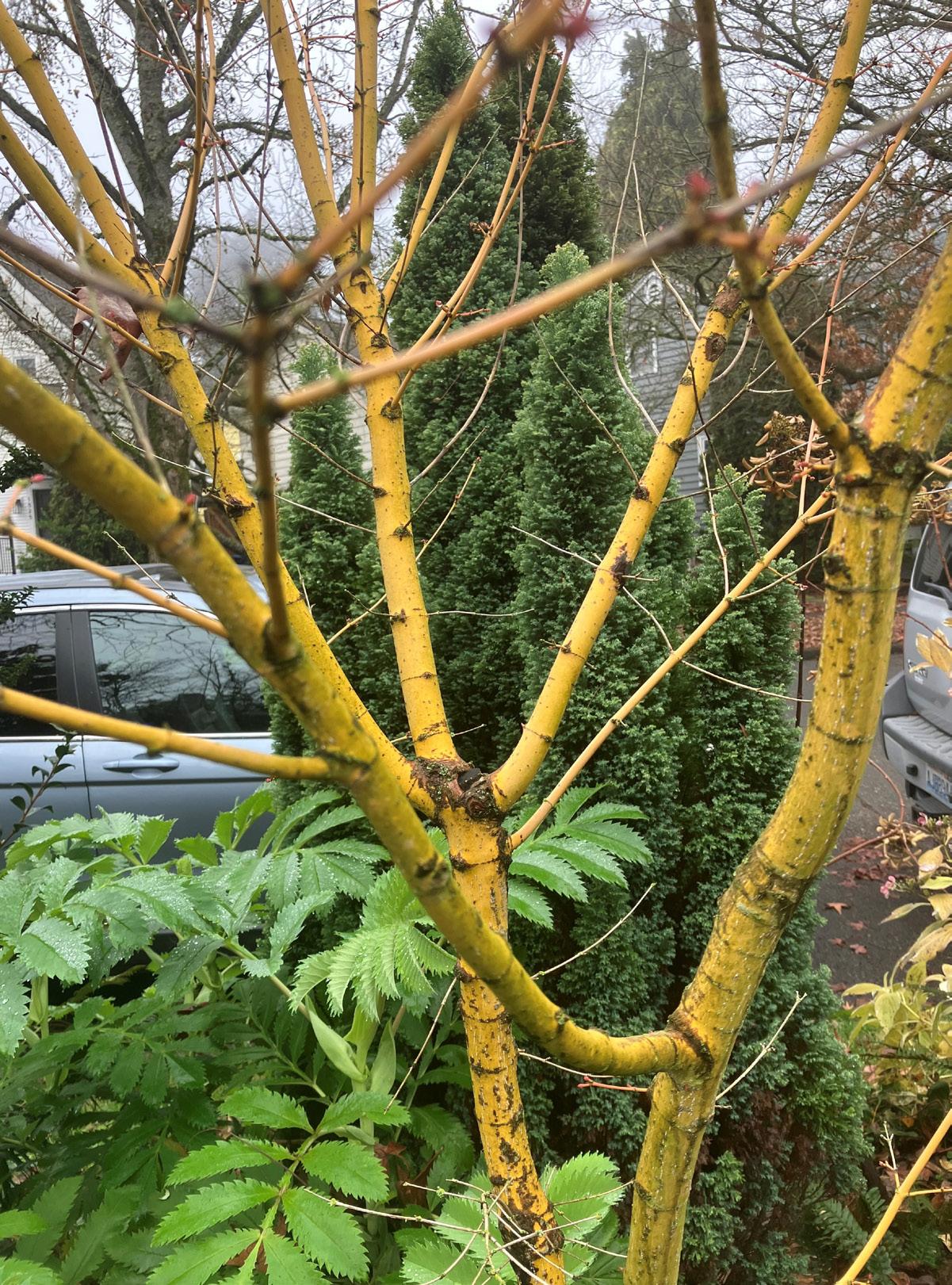
through the winter garden like streaks of lightning. Coupled with dark evergreens, broad leafed and coniferous, they are striking. The same is true of the yellow barked Japanese Maple (Acer palmatum ‘Bihou’). Finally, we are beginning to see yellow flowered hellebores on the market. Clustered at the edge of a border, along a walkway, or in a pot, were you easily see them, their cheerful blossoms are an eye-catching harbinger of Spring.
Light up your garden this month. Buy now. Plant now. Enjoy now. Yellow leaves, needles, branches, and blossom all ameliorate winter gloom. They’re the color of sunshine!
Mary Henry
Acer palmatum ‘Bihou’
Mary Henry Mahonia 'Arthur Menzies
Steve Lorton Tree Talk
No January meeting for Queen Anne Community council
Staff Report
The Queen Anne Community Council will not be holding a public meeting in January but will be meeting as a group to plan and strategize for the coming year. The next public meeting will be on Wednesday, Feb. 7, at 7 p.m. You can sign up for the meeting at https://signup.com/go/ XWzpevS. In addition, the following committees will be meeting in January:
• Land Use Review Committee: Jan. 15 at 7:30 p.m.
• Parks Committee: Jan. 9 at 7:30 p.m.
• Transportation Committee: Jan. 5, 5:15-6 p.m. at Queen Anne Library
• Public Safety Committee: will not be meeting until February
To sign up for Committee meetings, reach out to queenannecc@gmail.com and we will add you to the mailing list to receive the signup link. If you have issues or concerns you want to bring to the attention of the Council, email us at queenannecc@gmail.com
TRANSIT from Page 1Æ
Sound Transit originally planned to finalize its Ballard Link Extension project by the end of the year, but instead is continuing the Draft Environmental Impact Statement process. In July the Sound Transit board of directors modified the preferred location for the Denny Station near South Lake Union for the Ballard Link Extension.
The extensions were initially on the same environmental review timeline. However, given additional environmental review needed for project refinements resulting from the Sound Transit Board action in March, environmental review for the two extensions will now proceed on different timelines.
Pierce County Executive and Sound Transit Board Vice Chair Bruce Dammeier signaled his support for the study, but noted that he and some other board members are going to follow the project’s budget closely.
“There may be a point downstream where I’m asking my good colleagues in the Seattle – King County area to find a way to stay within the budget,” Dammeier said.
The Sound Transit Board of Directors unanimously approved the study on Dec. 15. The study will begin in January 2024. Public feedback will be documented and made available for board consideration in May 2024.
Every season is taco season
by Lynda Balslev Special to the Dispatch
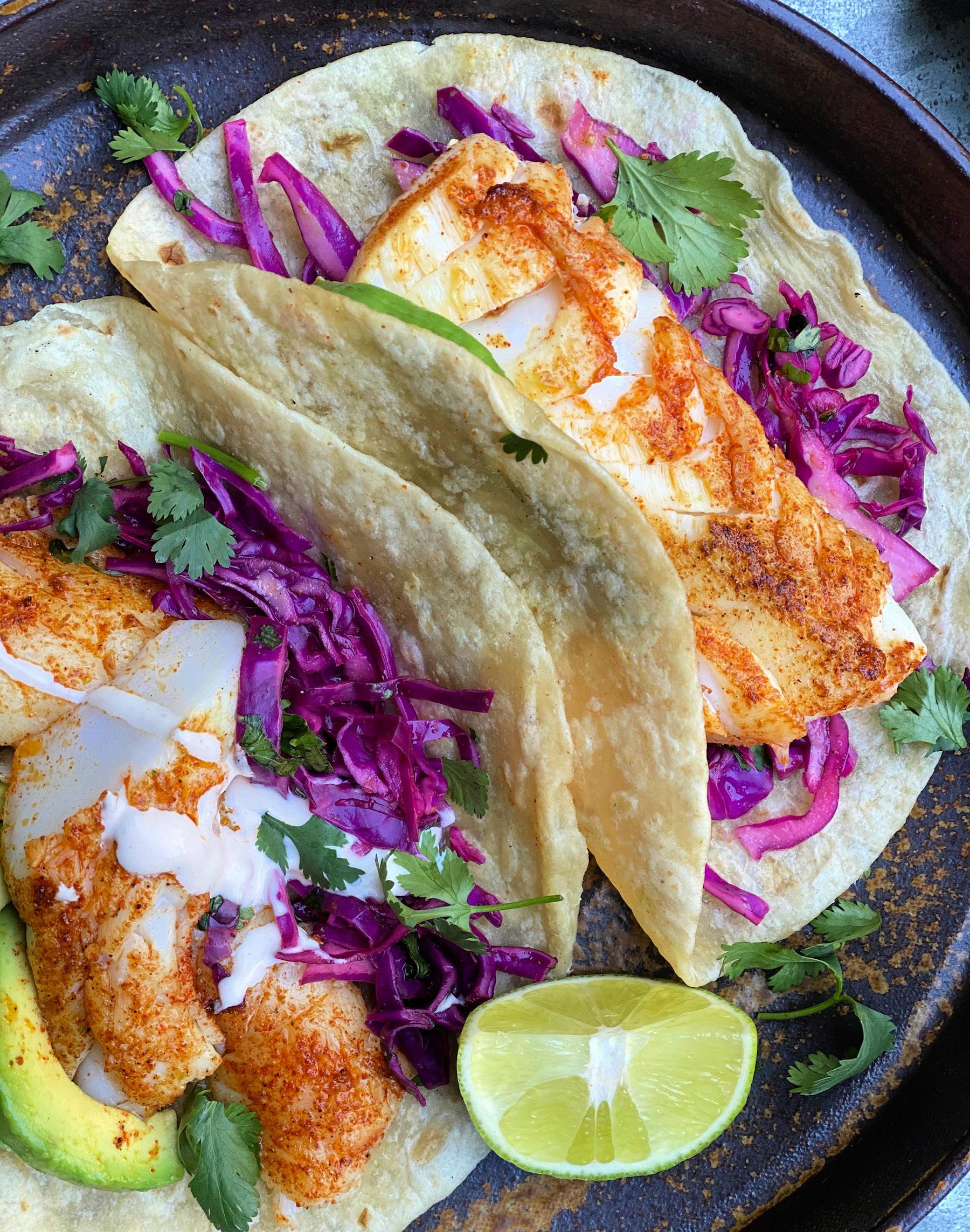
In the middle of winter — also known as the dark and cold lull between holiday festivities and the hopeful warming signs of spring — the days are often spent seeking indoor diversions, while our imaginations lead us to warm and sunny destinations. Look no further than the kitchen for immediate real-life respite. It may be yucky outside, but we can bring fun and lightness to our dinner with a heap of fresh and messy food, where all the attention is focused on the kitchen table — essentially, the center of our winter universe. It's time to make tacos. These fish tacos give a green light to eating with our hands. They are bright and healthy, inviting everyone to dig in and assemble their own food. They are wonderfully flexible, too, combining yearround ingredients with a smattering of easy toppings and drizzles that can be prepared in advance, along with an optional salsa fresca that can either be homemade or store-bought. Choose lean, mild-flavored white-fish fillets that are firm and flaky when cooked, such as halibut. Mahimahi, snapper, lingcod, sea bass and grouper are good alternative choices.
FISH TACOS
Active time: 40 minutes
Total time: 40 minutes, plus standing time
Yield: Makes 8 tacos
SLAW:
1/2 small head red cabbage, shredded
1/4 cup chopped fresh cilantro leaves
2 thin scallions, thinly sliced
2 tablespoons fresh lime juice
1 tablespoon extra-virgin olive oil
1 teaspoon honey
1/2 teaspoon ground cumin
1/2 teaspoon kosher salt
1/4 teaspoon freshly ground black pepper
CREMA:
1 cup whole-milk Greek yogurt
2 tablespoons fresh lime juice
1 small garlic clove, pushed through a press
1/2 teaspoon honey
1/2 teaspoon Sriracha
Pinch of kosher salt
SALSA FRESCA (OPTIONAL):
8 ounces grape tomatoes or Roma tomatoes, finely chopped
1 jalapeno pepper, seeded, finely chopped
1/2 small red onion, finely chopped
1/4 cup chopped fresh cilantro
1 garlic clove, minced or pushed through a press
2 tablespoons fresh lime juice
1/4 teaspoon kosher salt
1/4 teaspoon freshly ground black pepper
Pinch of sugar, optional
Tacos:
1 teaspoon ground cumin
1 teaspoon sweet paprika
1 teaspoon kosher salt
1/4 teaspoon freshly ground black pepper
1/4 teaspoon cayenne pepper
1 1/2 pounds center-cut halibut fillets, cut in 1-inch strips
Extra-virgin olive oil
8 (8-inch) flour or corn tortillas, warmed or toasted
Avocado slices, cilantro sprigs and lime wedges for serving
Make the slaw: Combine the cabbage, cilantro and scallions in a bowl. Whisk the lime juice, oil, honey, cumin, salt and black pepper in a small bowl. Pour over the cabbage and stir to coat. Taste for seasoning. Refrigerate for at least 30
minutes to allow the flavors to develop.
Make the crema: Combine the crema ingredients in a small bowl and stir to blend. Refrigerate until use.
Make the salsa (if using): Combine the salsa ingredients in a bowl. Stir to combine, then taste for seasoning. Let stand for 30 minutes to allow the flavors to develop or refrigerate until use.
Prepare the tacos: Combine the cumin, paprika, salt, black pepper and cayenne in a small bowl. Place the fish on a large plate and lightly coat on all sides with oil. Sprinkle the spices over the fish, gently turning to coat.
Heat 1 to 2 tablespoons oil in a large skillet over medium heat. Arrange the fish in the skillet, without overcrowding and in batches as necessary. Cook until opaque through the center, 4 to 5 minutes, turning once with a spatula. Transfer to a platter.
To assemble, place 2 to 3 strips of fish on a warm tortilla. Top with some of the slaw and drizzle with the crema. Serve with avocado, additional cilantro, lime wedges and salsa fresca (if using).
Lynda Balslev is an award-winning writer, cookbook author, and recipe developer based in northern California. Visit TasteFood at TasteFoodblog.com.
Photo by Lynda Balslev
Your best life: Tiny workouts that work
Daily life seems to be getting busier and more crowded, yet as individuals we are less active than we’ve ever been. And to relax at night, many of us sit down for an hour or two and binge our latest entertainment fix. We know movement is necessary for health from blood flow to cognition, yet there is always another email to read, or a new episode to catch up on. So naturally we all want to know: what is the minimum effective dose of exercise that will get us the results we want while fitting into our day? Enter the microworkout.
by exercise physiologist Chris Jordan and originally printed in the American College of Sports Medicine’s Health and Fitness journal. If you missed the original article, there are apps and YouTube sequences replicating it readily available. The Times has also added a spin-off: the “Advanced Seven-Minute Workout.” Its strength lies in choosing exercises working large muscle groups for high-impact results in the time it takes to make your morning coffee.
Your best life: Stress-less Travel
What makes travel exciting – novelty of new settings and conditions – is also what makes it exhausting. The decision fatigue alone would do it. Compared to the routine of your regular life, it’s like an obstacle course for your brain, with seemingly endless choices to make, and small challenges to navigate. That’s to say nothing of the physical stress of travel, especially if flying across time zones.
Whether you are taking a weekend hop or a several-week adventure, the same principals will get you through with more “Ahhh” and less Charlie-Brown “Auggh!”
There are several iterations of the micro-workout, but they all promise big results in bite-sized time. The secret? High-intensity Interval Training (HIIT). This kind of training is said burn calories not only during the exercise, but for up to 24 hours afterward, in something called the EPOC effect (Excess postexercise oxygen consumption). A study at McMaster University in Ontario, Canada said a few minutes of HIIT produced molecular changes in muscle equivalent to those seen in hours of running or cycling.
But there are requirements to trigger that result. First, the intensity needs to be hard. Not the “can carry on a conversation” level of light jogging. Think more the heart-in-your-throat, being-chased-by-a-bear level of intensity. You should be nearly at your maximum capacity. The other requirement of HIIT is also its saving grace: structured rest periods. Always consider your fitness before trying something this challenging, either with a stress test, consulting a trainer, or by working up slowly.
THE ORIGINAL: FOUR MINUTES X FOUR ROUNDS
HIIT hit the mainstream thanks to Dr. Izumi Tabata. Tabata workouts are not for everyone. Originally created in the early-90s as efficient training for Olympic speed skaters, they follow a cycle of 20 seconds full-tilt/10 seconds rest for four minutes. Four rounds with a minute’s rest between each round totals 20 minutes. High knees, jumping jacks, a stationary bike are all great candidates for a Tabata workout. Precision timing is key, however – a treadmill or other machines that “ramps up” after stopping will not do the trick. If you want to try it, start with a single round and work up from there.
SEVEN MINUTES
A more accessible version of HIIT is the New York Times’ popular SevenMinute Workout that debuted seven years ago. The program was designed
Consisting of 12 bodyweight movements, mainly compound calisthenics like pushups and squats, you run through each for thirty seconds with 10 second rests in between, but then it’s done. It alternates upper and lower muscle groups. There is one aerobic higher-impact move – a jumping jack – but you can modify the impact by stepping rather than jumping. However, it’s meant to be done at an intensity level of 8 on a scale of 1-10, so it should be challenging.
ONE-MINUTE
Remember McMaster University? In 2017 McMaster kinesiologist Martin Gibala delivered the shortest workout of all: three rounds of 20 seconds of “all-out” pedaling on stationary bike –followed by two minutes at a leisurely pace between rounds. Participants in his 2014 trial performed three sessions a week and reaped strong results in cardio, strength and health markers like blood pressure.
In an interview, Gibala told the New York Times this protocol can be adapted to any level of fitness and used anywhere. He said you don’t need to play chicken with your vO2 max. You simply need to push beyond your comfort zone, whether walking or kickboxing. To learn more, explore his book “The One-Minute Workout,” written with Christopher Shulgan.
Lastly, because even an hour of exercise a day can’t really counteract eight or 10 hours of sitting, consider incorporating “movement snacks” into your day. I first heard about this idea from Katy Bowman (author “Move Your DNA”), who advocates for finding ways to improve functional movement in your daily life. This could be taking the stairs instead of the escalator, parking a block away, or taking breaks every hour or so from your desk to stretch, or do some squats or twists.
As they say, the best exercise program is the one you will stick with – and what could be easier to fit in to your schedule than these adaptable micro-workouts?
Take a minute to notice your travel preferences, which may change over time. Are you a micro-planner who likes to nail down every detail, or do you prefer Fate to steer your plans? Considering simple things like these – and if with others, talking about them prior to landing at your destination can strongly contribute to positive experiences.
Planning, or having a travel agent or guide do it for you can be a major stress reliever of itself, if that fits your mindset. Walking for miles in the rain one night after 11:00 p.m. in Florence in the rain knocking on pensiones’ doors because my boyfriend and I had no reservation comes to mind. Now even for the most free-spirited, I’d recommend securing reservations for the first and last nights at minimum. Do you like to travel free as a bird or would you like the security of a guide with local connections who has paved the way with reservations and arrangements (and carries your bag in a bus)?
It's also important to know your comfort level. While once I tolerated sleeping on tree roots while camping, today I’m firmly in the glamping category. Reading reviews can tell you a lot about the comfort level of an accommodation. Do you need a private bathroom? Full breakfast, or will a toasted bagel do?
Because sleep is a high priority for me, I look for quieter hotel rooms, and always bring an eye mask and earplugs to block out unwanted stimuli. Understand where you are willing to splurge – for experiences, convenience, or novelty. If you hate driving in cities, plan to take public transport or hire cars when you can.
If you are an introvert traveling with people, you’ll all benefit from carving some solo time for yourself. If your days are packed with planned activities, this may be booking a private room, getting up early before the group. When flexibility allows, my favorite tension-easer is to agree on a few group activities, like a dinner with a view or a worldclass art museum, and let the rest be up to each individual. Balance is important, of course – if you create a schedule with no gaps, it also leaves no room for error, or delays, or spontaneity.
For extroverts, it may be hard to let go of the idea that everyone needs to do everything but letting organic groups form – or not – creates more varied experiences customized to the needs of the particular travelers in your mix. Maybe these two will go for a hike, these three to the farmers’ market, and you’ll sit at a café and watch the world go by.
Some of my most enjoyable times on “big” trips were sitting in parks, on beaches, and in cafes – just relaxing and soaking up the energy of the place, as opposed to trying to collect as many museums as you can in a day.
Doing some research can help smooth out potential kinks, like what documents you need, which major attractions need prior booking, and COVID testing (less a thing, but still a concern for some). Nowadays its more the norm for attractions to have timed entry visits, so it’s best to plan ahead.
If we had looked closer at a Los Angeles rental listing, we would have realized it was a studio with no privacy for my husband and I or our teenage son.
On the flipside, spending time in online forums before a trip to Greece last summer helped my sister pick out a backpack,
Erica Browne Grivas Your Best Life
Erica Browne Grivas Your Best Life
WA state laws in 2024: minimum wage, firearm sales, employee cannabis use and more
By Randy Bracht
The Center Square
More than two dozen new laws take effect Jan. 1 in Washington, including an increase in the state’s minimum wage, a 10-day waiting period and safety training requirement for firearm purchases, and rules regarding employment of persons using cannabis or marijuana outside the workplace.
The new statutes are among scores of bills approved by state legislators earlier this year and signed into law by Gov. Jay Inslee. Most of the measures have already been enacted this year and less than a handful are on hold until 2025.
Here’s a summary of those on tap for 2024:
MINIMUM WAGE: As of Jan. 1, Washington state will have the nation’s highest minimum wage when the current rate of $15.74 jumps by 3.4% to $16.28 per hour. That’s more than double the federal minimum wage of $7.25, which has remained unchanged since July 2009.
The state’s new rate will be even higher in the cities of Seattle ($18.69) and SeaTac ($19.06), according to the Washington Department of Labor & Industries. Most agriculture and non-ag jobs qualify for minimum wage. A lower rate is allowed for working minors ages 14-15, who must receive at least 85% of minimum wage, and certain on-the-job, student, disabled, and apprentice workers.
Annual adjustments are based on the federal Bureau of Labor Statistics' consumer price index for urban wage earners and clerical workers as a result of Initiative 1433 approved by Washington voters in 2016.
FIREARM PURCHASE WAITING
PERIOD: With the Legislature’s passage of House Bill 1143, licensed dealers may not transfer any firearm until completion of federal and state background checks of the purchaser’s eligibility to possess a
GRIVAS from Page 7Æ
a neck-cooling device, and navigate reservations for the sites like the Coliseum et.al. whose hours became erratic due to scorching temperatures.
FLIGHT TIPS
All of the same goes for planning the traveling portion of your trip – scope out the easiest way to the airport, or the best route for your road trip. Learn little tricks like Seattle-Tacoma International Airport’s Spot Saver (https://www.portseattle.org/ SEAspotsaver) which lets you book a 15-minute window in a specific TSA line up to five days before your departure. There will still be a line, but of twenty versus 200 fellow travelers. (Hot tip: book in advance – spots are limited and are likely to be booked if you wait until you are on the way to the airport.) Buy yourself some extra peace of mind by booking a morning flight which are less likely to get delayed or canceled.
firearm and a waiting period of 10 business days from when the dealer requested the background check.
The gun buyer or recipient must also provide proof of completing a recognized firearms safety training program within the last five years. The program must include safety training for semiautomatic rifles and instruction on state laws regarding use of deadly force for self-defense and techniques on avoiding criminal attacks and management of violent confrontations. Law enforcement officers and trained military personnel may be exempted.
EMPLOYER CANNABIS TESTING:
Under federal and state laws, cannabis remains a controlled substance subject to criminal penalties even though Washington has allowed medicinal use for qualifying patients since 1998 and legal recreational use by adults since 2012.
Those contradictions are also compounded by state and federal laws which allow employers, contractors, and grant recipients in Washington to establish drug-free workplace policies, including drug and alcohol testing.
With Senate Bill 5123, employers are now prohibited from discriminating against a prospective employee based on that person’s use of cannabis off the job and away from the workplace. Nor can employers require drug screening tests which identify “nonpsychoactive cannabis metabolites” in a person.
However, the new legislation does not prohibit an employer from: making hiring decisions based on drug screening for substances other than cannabis or marijuana; requiring testing of an employee following an accident on suspicion of being under the influence of alcohol, controlled substances, or medications; the right to maintain a workplace free of drugs and alcohol, or any other obligation required by federal law or regulation.
The Light Rail only costs about $5 and runs regularly. If you have time, and don’t have too much luggage, it’s a lot cheaper than an Uber and less hassle than driving yourself and paying for parking or begging a friend.
Pack as lightly as you can, wear comfy clothes, slip-on shoes, and bring noise canceling headphones. I like to bring an empty water bottle, fill it pre-flight while buying a salad or the healthiest food I can find. I carry various powdered teas, flavored vitamin supplements, and snacks like dark chocolate, nuts, fruit or vegetable chips baked with coconut oil, and sometimes oranges, clementines or grapes.
Lastly, once you’ve made your plans, try to let go of the perfect picture in your mind of your trip. That goes for everything, from your experiences to the people you meet – including your friends and family. Let it all be, and you’ll find it’s easier to adapt to hiccups in the plan, and as a side benefit, savor the most enjoyment you can.