Serving Queen Anne & Magnolia Since 1919 www.QueenAnneNews.com
NOVEMBER 26, 2025
VOL. 106, NO. 48
S
ome stories begin with a bold leap, and Lisa Cole’s started the day she boarded a plane for Seattle - a city she had never seen but somehow knew would change her life. Fresh out of Montana State University, she arrived in the Northwest cold, lonely, and utterly certain she was exactly where she needed to be. It was a conviction inherited from her parents, who always encouraged her to explore the world and trust her instincts. That instinct—to wander with curiosity and create intentionally wherever she landed—has guided Cole through every chapter of her winding, joyfully creative career. While working as a secretary at a law firm, she took a second job at a neighborhood kitchen store. When the owner moved on, Cole was unexpectedly offered the chance to reimagine the business as her own. She launched Culinary Concepts, designing cooking class programs that tapped into the city’s rising
culinary scene. She recruited chefs from iconic Seattle restaurants— including Jerry Traunfeld of The Herbfarm, Tom Douglas, Jonathan Sundstrom, Greg Atkinson, and food writer Hsiao-Ching Chou—to teach curious home cooks. “The 1990s and early 2000s in Seattle were an amazing time in the culinary world, and I loved it,” Cole said. Cole later took an early “retirement” when she adopted her children, but life had more creative chapters waiting. A chance encounter with the editor of Vanguard Seattle led to an unexpected invitation: would she consider Laura serving as the magaMarie zine’s fashion and style editor? The role Rivera fit her naturally—she came from a long line of writers and creatives, had always loved fashion, and found joy in curating beauty and meaning. More importantly, it offered a rare balance: “It was a job where I could do something I loved and still be an involved mother and wife,” she said.
Then the world stood still. During the quiet of Covid, Cole found herself back at the table literally. She continued her lifelong love of entertaining by setting the table each night for her family, using the cloth napkins her mother had taught her to sew. What began as a personal ritual slowly rekindled her passion for craft and storytelling. She started sharing photos on Instagram, and the response grew. Friends asked for sets. She created custom gifts. Eventually, her son built her a website, and Set The Table Home officially came to life. The name was a nod to her childhood, when her mother would call out the nightly request: “Set the table.” Every design reflects Cole’s attention to detail, her fashion sensibility, and her deep sense of place. She travels the world in search of fabrics that tell stories—prints that enchant her, spark a memory, or reflect a moment in time. “All of the fabrics I choose are prints that I would set my own table with,” she said. “Each season I look for fabrics that think outside the box of a conventional tablescape. I use my love of style to
PRIMROSE AND MAY
Threads of Home: How Custom Fabrics Are Reimagining the Holiday Table
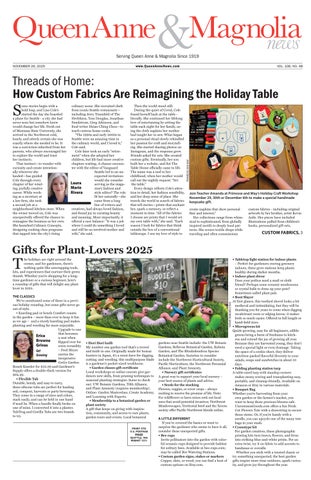
Join Teacher Amanda at Primrose and May’s Holiday Craft Workshop November 29, 30th or December 6th to make a special handmade keepsake gift. create napkins that show personal flair and interest.” Her collections range from whimsical to sophisticated, from globally inspired motifs to deeply local patterns. She scours textile shops while traveling and often commissions
Gifts for Plant-Lovers 2025
T
he holidays are right around the corner, and for gardeners, there’s nothing quite like unwrapping tools, kits, and experiences that nurture their green thumb. Whether you’re shopping for a longtime gardener or a curious beginner, here’s a roundup of gifts that will delight any plant lover in 2025.
ERICA BROWNE GRIVAS
THE CLASSICS We’ve mentioned some of these in a previous holiday roundup, but some gifts never go out of style. • Kneeling pad or bench Comfort counts in the garden – more than ever to keep it fun as we age – and a sturdy kneeling pad makes planting and weeding far more enjoyable. Upgrade to one that becomes Erica a seat when Browne flipped over for Grivas extra versatility – Fred Meyer Get carries the Growing inexpensive GoGo Garden Bench Kneeler for $32.99 and Gardener’s Supply offers a double-thick version for $64.99. • Flexible Tub Durable, bendy, and easy to carry, these silicone tubs are perfect for hauling soil, compost, harvests or party beverages. They come in a range of sizes and colors, stack easily, and can be held in one hand if need be. When a handle finally broke on one of mine, I converted it into a planter. TubTrug and Gorilla Tubs are two brands to try.
• Hori Hori knife My number one garden tool that’s a trowel and knife in one. Originally made for bonsai hunters in Japan, it’s a must-have for digging, cutting, and weeding, this multipurpose blade is a gardener’s pocket-sized workhorse. • Garden classes gift certificate Local workshops or online courses give gardeners new skills, from pruning techniques to seasonal planting strategies. Some to check out: UW Botanic Gardens, Tilth Alliance, and Plant Amnesty (requires membership). Online: Garden Masterclass, Create Academy, and Learning with Experts. • Membership to a botanical garden or plant society A gift that keeps on giving with inspiration, community, and access to rare plants, garden tours and events. Local botanical PRSRT STD U.S. POSTAGE
PAID
SEATTLE, WA PERMIT 1271
gardens near Seattle include: the UW Botanic Gardens, Bellevue Botanical Garden, Kubota Garden, and The Rhododendron Species Botanical Garden. Societies to consider include the Northwest Horticultural Society, Pacific Horticulture, the Northwest Perennial Alliance, and Plant Amnesty. • Nursery gift certificates A great way to support your local nursery – your best source of plants and advice. • Seeds for the stocking Flowers, veggies, or cover crops – always exciting to receive the promise of life. Note: For wildflower or lawn mixes seek out local ones that avoid potential invasives; Northwest Meadowscapes, Territorial Seed and the Xerces society offer Pacific Northwest blends online. A LITTLE DIFFERENT If you’ve covered the basics or want to surprise the gardener who seems to have it all, consider these unexpected gifts. • Bee cups Invite pollinators into the garden with colorful ceramic cups designed to provide habitat for solitary bees. Available at bee-cups.com; may be called Bee Watering Stations. • Custom garden signs, stakes or markers Copper, slate, or wood, you can find a host of custom options on Etsy.com.
custom fabrics - including original artwork by her brother, artist Kevin Astle. Her pieces have included illustrations pulled from children’s books, personalized gift sets,
CUSTOM FABRICS, 3
• Tabletop light station for indoor plants – Perfect for gardeners craving greenery indoors, these grow stations keep plants healthy during darker months. • Indoor plant décor Does your pothos need a snail or sloth friend? Perhaps some ceramic mushrooms or crystal balls to dress up your pots? Sometimes called plant pals. • Root Slayer At first glance, this toothed shovel looks a bit medieval and intimidating, but they will be thanking you for years to come when digging recalcitrant roots or edging lawns; it makes both so much easier. Offered in full length or hand-held sizes. • Microgreens kit Quick-growing, easy for all beginners, edible greens bring a burst of freshness to kitchens and extend the joy of growing all year. Because they are harvested young, they don’t need a special light or even drainage. Taking the space of a cookie sheet, they deliver nutrition-packed flavorful diversity to your salads, soups and sandwiches in about 10 days. • Folding planting station tarp A table-sized tarp with standup corners makes messy sowing and transplanting easy, portable, and cleanup-friendly. Available on Amazon or Etsy in various materials. • Bouquet Bag Whether you’re harvesting from your own garden or the farmer’s market, you want to keep those precious blooms safe. UncommonGoods.com offers a fun Fresh Cut Flowers Tote with a drawstring to secure those stems. Or, if you’re handy with a needle, you can upcycle one of the many tote bags in your stash. • Cyanotype kit For garden creatives, these photographic printing kits turn leaves, flowers, and ferns into striking blue-and-white prints. For an extra twist, try it on fabric to add accents to bandanas or overalls. Whether you stick with a trusted classic or try something unexpected, the best garden gifts inspire more time outdoors, spark curiosity, and grow joy throughout the year.
2
NOVEMBER 26, 2025
Queen Anne & Magnolia
Worship Services
Neighborhood Marketplace HOME SERVICES
HOME SERVICES
CONSTRUCTION & ROOFING
CHIMNEY / MASONRY
Custom Masonry & Stoves, Inc.
Fireplace and Chimney Repair
Sunday Worship at 10am
Live Streamed on our Facebook page and YouTube. Simply look for Magnolia Lutheran Church.
Twelfth Church of Christ, Scientist In Person and Online Church Services
All are welcome & warmly invited to join these healing services For best audio results, please join by clicking on the link from your computer or smartphone and choose “Call Over Internet”
All Zoom Services Meeting ID: 418 806 2637 https://us02web.zoom.us/j/418 806 2637 Sunday Services 11:00am – 12noon Pacific
• All Types of Roofing • Aluminum Gutters • Leak Repairs • Roof & Gutter Cleaning • Moss Removal &Treatments • Dry Rot Repair • Fencing/Decks • Garage/Sheds • Custom Chimney Covers + Caps — 30+ Years Experience — Always FREE Estimates CALL 206-854-1706 206-783-3639 or 206-713-2140 www.bestway-construction.com BESTWC137LW
Brick Home Restoration Tuckpointing / Rebuilding
Pressure Washing LIC# *CUSTOMS077BE•BONDED•INSURED
(206) 524-4714 • Since 1962 Please see our reviews & photos on
Wednesday Testimonies 7:30pm – 8:30pm Pacific
HOME SERVICES
Christian Science Quarterly Bible Lessons Our weekly Bible Lesson Sermon may be found here: https://quarterly.christianscience.com/
ELECTRICAL SERVICES
Additional Healing Resources: ChristianScience.com CSWashington.com ChristianScienceTwelfthSeattle.com
Electric Company of Seattle
For additional assistance, please contact us at seattle12cs@gmail.com or 206.283.230 ChristianScienceTwelfthSeattle.com
For a Healthier You DENTISTS
WHY WAIT?
Skilled Electricians Available Now! Panel changes and service upgrades our specialty! All types residential and commercial wiring. Stephen Brandeis, Master Electrician
206-633-3896
www.elcose.com Lic.#ELECTCI020BN • service@elcose.com
Queen Anne Dental Group
Service Calls Welcome Panel Upgrades • Repairs Senior Discount
206-782-1670
www.kemlyelectric.com Lic#KEMLYE1038DR
Dr. Frank J. Calvo & Family
Cosmetic, Implant, & General Dentistry 400 Boston St. 206-284-7812 www.QADG.net
YOUR AD HERE DEADLINES
Grow Your Business with Weekly Advertising
News Submissions | Friday, noon
Christina Hill, 206-461-1300 ext. 303 or QAMagNews@pacificpublishingcompany.com
✓ Low weekly rates ✓ Flexible ad sizes ✓ No ad? Don't worry! We can make it for you!
Retail Display Advertising | Wednesday, 1:30 p.m.
Christina Hill, 206-461-1300 ext. 305 or ppcadmanager@pacificpublishingcompany.com
Classified and Legal Advertising | Friday, noon
Jody Vinson, 206-461-1300 ext. 304 or legalads@pacificpublishingcompany.com
Subscriber Services |
Mikayla Morris, 206-461-1300 ext. 302 or ppccirc@pacificpublishingcompany.com
www.pacificpublishingcompany.com @pacificpubco
© 2025 Pacific Publishing Co. Inc. Address | 636 S. Alaska St., Seattle, WA 98108
Call today to reserve your space! Contact: Christina Hill 206-461-1300 ext 305
Pacific Publishing Company – Queen Anne & Magnolia News • Madison Park Times • Eatonville Dispatch • Snohomish Tribune
Four free holiday film screenings at the Armory, Nov. 28–Dec. 26 Staff Report
IMAGE COURTESY SEATTLE CENTER
Winterfest is returning to Seattle Center, and with it comes one of the most popular family friendly traditions on the grounds. The season brings festive décor, live entertainment, indoor activities, and a steady calendar of programming that draws visitors from across the region. At the heart of these offerings is Symetra Movie Nights, a series of free Friday evening film screenings held inside the Armory Food and Event Hall. These showings begin at 6:30 p.m. on select dates and give families a warm and welcoming place to gather during the holiday season. The Armory’s central location and variety of food
vendors make it a natural hub for Winterfest attendees, especially as temperatures drop and daylight shortens. The large indoor space provides shelter from the weather, while the 20 foot movie screen creates a theater style experience without the cost of a traditional cinema outing. Families often arrive early to find comfortable seating and to explore the Armory’s dining options. The atmosphere is relaxed and informal, which adds to the appeal for parents with young children or groups meeting up for an easy evening out. Symetra is partnering with Ceres Roasting Company and Seattle Fudge to provide warm beverages and snacks for attendees, adding to the seasonal feel of the event. The
series is designed to be accessible, enjoyable, and suitable for all ages, and it complements the broader Winterfest goal of creating community centered holiday activities at no cost to visitors. THE FILM LINEUP The 2025 schedule features a mix of animated favorites and holiday classics that appeal to a wide range of ages: • Friday, November 28, 6:30 p.m.: The Polar Express (Rated G). A young boy embarks on a magical train ride to the North Pole and discovers the meaning of belief. • Friday, December 5, 6:30 p.m.: The Muppet Christmas Carol (Rated G). Kermit, Miss Piggy, and the Muppets present a lively retelling of the Dickens classic. • Friday, December 12, 6:30 p.m.: A Christmas Story (Rated PG). Ralphie dreams of receiving a Red Ryder BB gun for Christmas while navigating the ups and downs of family life. • Friday, December 26, 6:30 p.m.: Frozen (Rated PG). Anna sets out to save her sister Elsa and the kingdom from an endless winter. All screenings are free and open to the public. Families and film lovers are encouraged to come early, especially for popular titles that traditionally draw large crowds. For more information about Winterfest events, visit seattlecenter.com/winterfest.
down, look closely, and gather with intention. What started as a quiet act of care in a time of uncertainty has grown into a joyful business rooted in heritage, artistry, and the belief that the table—whether in Seattle, Paris, or anywhere else—can be a place where stories live. Set The Table Home will be popping up at several festive events this season. You can find them on Thursday, December 4, from 11 a.m. to 3 p.m. at the Overlake Country Club Jingle & Mingle. On Friday, December 5, they’ll be part of Queen Anne Holiday Magic from 5–8 p.m. at QA Gift and Frame. Then on Saturday, December 6, from 11 a.m. to 5 p.m., Set The Table Home will be at the Alliance Française of Seattle’s Joyeux Bazaar at Washington Hall, 153 14th Avenue in Seattle. Or to order napkins, just go to the website https://setthetable.online/ or email setthetablehome@ gmail.com for custom requests.
CUSTOM FABRICS
From page 1
and large-scale commissions for nonprofit organizations. One of her most memorable projects came when the Woodland Park Zoo asked her to design the VIP table settings for The Jungle Party, their signature fundraising gala. Cole created an array of wildlife-themed napkins that brought the event to life—and guests were invited to take them home at the end of the night. “It was a moment of real joy and gratitude to see my work fill the space,” she said. Her designs have also supported important causes: fundrais-
“Her designs have also supported important causes” ing for Red Cross California Fire Relief, breast cancer awareness in honor of a friend, collaborations with a Ukrainian artist to raise money for World Central Kitchen, and donations to Seattle Art Museum Supporters, among many others. Today, Cole’s work is more than decor - it is a celebration of craft, memory, and place. Each napkin carries a story: where the fabric was found, who inspired it, what moment it might help mark. And each table set with her designs becomes an invitation to slow
3
SETTHETABLE.ONLINE
Winterfest Movie Nights Offer Holiday Magic at Seattle Center
NOVEMBER 26, 2025
Savvy Senior: What Are the Early Signs of Parkinson’s Disease? By Jim Miller
Dear Savvy Senior, What are the early signs of Parkinson’s disease? My husband was recently diagnosed after noticing a slight thumb tremor but we’re wondering if we missed any other early warning signs. —Curious Wife
R
Dear Curious, ecognizing the early signs of Parkinson’s disease is challenging because the symptoms are often subtle and/or similar to those in other health conditions, which means they can easily be overlooked, dismissed or misdiagnosed. Parkinson’s disease, which afflicts around 1 million Americans, is a degenerative disorder that occurs when the brain’s dopamine-producing neurons die or become impaired. This happens in the part of the brain that controls movement, which can cause tremors, stiffness, and difficulty with walking, balance, and coordination. The symptoms usually begin gradually and get worse over time, and the progression of symptoms is often different from one person to another. Some people with Parkinson’s become severely disabled, while others may experience only minor motor disruptions. While the cause of Parkinson’s
disease is unknown, scientists believe genetics and environmental factors (exposure to certain toxins) play a key role. Most people with Parkinson’s first develop the disease around age 60 or older, and men are more likely to develop it than are women. EARLY WARNING SIGNS Parkinson’s disease is difficult to diagnose because there’s no definitive test to confirm it. Doctors, usually neurologists, will do an examination and evaluate a combination of warning signs, but symptoms can vary greatly by patient
which often leads to confusion and misdiagnosis. That said, here are some of the key signs and symptoms everyone should be aware of. Restless sleeping: Talking in your sleep, sleepwalking and/or acting out your dreams by kicking or jerking. This is a REM sleep behavior disorder and one of the strongest and earliest pre-diagnostic symptoms of Parkinson’s disease. Loss of smell: Not being able to smell certain foods very well like bananas, dill pickles or licorice. This early symptom
occurs in around 70 to 90 percent of Parkinson’s patients. Constipation: Problems with digestion and bowel movements are a big problem for people with Parkinson’s, and an early sign that can occur up to 20 years before this disease is diagnosed. Changes in handwriting: Writing may become harder to do, and your handwriting may appear much smaller than it has in the past. Soft voice: According to the Parkinson’s Foundation, 89 percent of people with Parkinson’s will have speech and voice disorders, which often shows up first in volume of the voice, meaning that you may speak more softly. Tremors: Slight shaking or tremor in your finger, thumb, hand or chin. The tremor usually happens at rest, and when you move the extremity, it may disappear. This is the most common and recognizable outward sign of Parkinson’s disease, but by the time tremors start, the brain has already lost more than half of its dopamine-producing cells. Slowed movement: Over time, Parkinson’s disease can slow movements, making simple tasks difficult and timeconsuming. Your steps may
become shorter when you walk. It may be difficult to get out of a chair. You may drag your feet as you try to walk. Masked Face: The muscles in the face experience the same gradual stiffening as in the rest of the body, which results in lack of smiling and facial expressions. Impaired posture and balance: Stooping, leaning or slouching when you stand, and/ or balance problems can all be an early sign of Parkinson’s. Having these symptoms doesn’t necessarily mean that a person has Parkinson’s disease. But if you are experiencing any of them, and you’re over age 60, you should consider talking with your doctor, who may order a DaT scan or Syn-One (Skin Biopsy) Test to help diagnose it. Early detection leads to earlier treatment, which can improve a person’s overall quality of life. For more information, visit the Parkinson’s Foundation at Parkinson.org. Send your questions or comments to questions@savvysenior.org, or to Savvy Senior, P.O. Box 5443, Norman, OK 73070.
4
NOVEMBER 26, 2025
The Better End of the Deal
I
t isn’t smooth or easy, outpacand offer rewards: Look, fear, ing my fear today. But if there you can ride with me but do not is one thing I’ve learned about touch me. If you even lay a paw on fear, it’s that we cannot let it stop me, no treats! I remain calm and us or, at a very young age, we will confident: I know you are really stop. Consequently, there are days good at jumping up and down and when I have to demanding attention, take my fear along but I also know that for the ride or if I pay you no mind, Mary Lou there would be you’ll stop whining. I Sanelli too many days use strong commands Falling when I wouldn’t to establish myself as Awake cycle anywhere. the alpha: No! You And that is not are not allowed to about to happen. speak! You are not I’ve promised myself, double even allowed to sneeze! dared myself, not to catch up on Today, I (well, we) ride out news before bed. But last night I to my friend Sam’s to give her a was between books, my phone was copy of my last book, and seeing right there, and that was the end her all bundled up and working of that. in her winter garden is enough to You know things are amiss when cheer me. you find yourself thankful that It’s enough to cheer anyone. your own father is no longer with More and more I love watching us, but that was my first thought as I watched a clip of ICE agents making, what appeared to be, war right here at home. I felt as if the Earth had shifted on its axis, which is the right response when something feels so wrong, but I wasn’t sure I wanted that to happen because I knew I’d never fall my friends do what they love to do. sleep. That clip would have made What a thing it is, to bring food my dad as afraid as it made me—I into this world. And lucky for me, am sure of this. I think of his we are trading my book for a bag survival story as sort of a miracle. of it: curly kale, cabbage, squash And once he was on his feet in this and onions; even a jar of homecountry, he became the proudest made kombucha. American I know, right down to I definitely got the better end of his flag-bearing coffee mug. the deal. And so, I have to retrain my fear The slugs and snails and rabbits when it lodges in like this, and I have wreaked havoc on her garden, do this pretty much the same way one trains a dog. I establish rules Sam says, and she named the
“she named the largest slug in her beer trap after a certain president”
largest slug in her beer trap after a certain president, and I said that calling the wrecker of her cabbage by an infamous one-syllable wasn’t fair to the slug. “The only thing left to do,” she sighed, “is hope that by some small miracle things get better.” When I asked if she meant in her garden or in general, and she said, “I just don’t get what is going on!” her reply didn’t answer my question, but it did console me. I felt like I was standing in a garden sanctuary, the sort of place you go to ask the universe, “are you feeling fear, too?” as you try to relieve your own by sharing it aloud. And the universe says back—to you alone, it feels like—hell yeah! And maybe the best part of this little story is that talking to Sam grinds my fear down into dust and—poof—it blows away. And when I ride off, happily traveling solo, the kale stands up in my basket like regal green fans that bring such stature to my bike. They enhance it. Before reaching home, I stow my bike between two trees and walk to where I like to sit on the beach. By now, I am much more accepting of the fact that I am going to be stunned by so many things happening in the world and that But I can’t help it, I keep doing this to myself: imagining what kind of country we could be if we thought big because we can no longer afford to think small. And by “big” I mean working together not to sharpen but to blur the lines between “us” and “them.” When I find a place that I love, I try to visit it often. You learn these
kinds of things about yourself early on, the same way you learn what foods you can’t get enough of, and ones you hide under the romaine. You go with what works for you. So even on my worst days, even in the rain, I like to sit where I can see the ocean. Today’s trade was the best. I’m exactly the right person to share homegrown produce with. Writing this today has tired me, but in a good way. And did you know that kale is rich in magnesium and calcium that help
regulate sleep hormones? I didn’t know. Until Sam told me. Even so, sleep can be iffy for me when I’m overtired. And I’m overtired. I’ve always been this way. If I sensed something was amiss in our household, I couldn’t sleep. If my parent’s argued, I couldn’t sleep. If the cat stayed out all night, I couldn’t sleep. Not like my sisters, they slept no matter what. I didn’t get their same DNA strands. I long for them.
Allen Family Philanthropies Announces Nearly $7M in Funding for Arts and Culture Organizations at Seattle Center Courtesy of Allen Family Philanthropies
A
ALEX B. CLARK
llen Family Philanthropies is providing nearly $7 million in funding for nonprofits leading eight projects at the Seattle Center campus, the city’s treasured destination for arts and culture. Projects will increase exposure to and participation in the arts among young people by growing opportunities for diverse creators, increasing access to arts programming and engagement, and reimagining spaces. The assortment of grants focuses on empowering the next generation of artists and audiences. Recent research from ArtsFund finds significant correlations between an accessible and well-funded arts and culture landscape and a vibrant community overall. “By investing in arts organizations that engage young people, we invest in the creators, audiences, and advocates who will contribute to and sustain a vibrant arts and culture sector in Seattle for years to come,” said Anh Nguyen, director of arts, youth and community for Allen Family Philanthropies. “These organizations excel at engaging young artists and young audiences – and know how to ignite curiosity. The
grants will ensure youth arts and culture programming can continue to grow and evolve to meet community needs.” Projects are led by KEXP, Museum of Pop Culture, National Film Festival for Talented Youth (NFFTY, a program of SIFF), Pacific Northwest Ballet, Pacific Science Center, Seattle Repertory Theatre & Seattle Children’s Theatre, TeenTix, and The Vera Project. All organizations operate on the Seattle Center campus. For over 60 years, Seattle Center has been Seattle’s hub for arts, culture, and entertainment – home to some of the nation’s most prestigious arts and culture institutions. With over 12 million visitors annually, Seattle Center is the most visited arts and cultural destination in the Pacific Northwest. “Seattle Center is a place where many young Seattleites engage in the arts and learn about community building,” said Nguyen. “Campus organizations and their programs create varied spaces for young people and families from across the region to engage in arts and culture as a tool to build a community that is rooted in creativity, expression, and collaboration.” Funding for the suite of grants totals $6,868,990 over three years. Grantees, and
their respective projects, include: • KEXP will support emerging artists and cultural workers and enhance audience diversity through extended programs for youth and their families, including the youth DJ programs, all-ages events, expanded youth outreach and programming engagement, and live music events and other activations in the KEXP Gathering Space and courtyard ($879,700 in funding). • Museum of Pop Culture (MOPOP) will develop a residency program that will expand free youth access to interactive, culturally relevant learning experiences ($696,176 in funding). • National Film Festival for Talented Youth (NFFTY) will scale and grow festival programming into year-round, accessible opportunities for film education, mentorship, and professional development for aspiring youth filmmakers at Seattle Center ($480,882 in funding). • Pacific Northwest Ballet (PNB) will unify PNB’s emerging artist efforts into a singular choreographic dance program with more technical training and performance opportunities, increasing engagement for young artists aged 10-26, and expanding the Community Stages program ($1,250,000 in funding). • Pacific Science Center (PacSci) will connect arts and culture with science, reimagining spaces with public artwork and cultural installations commissioned by Pacific Northwest Indigenous artists and culture bearers, through a new artist-in-residence program within the Maker & Innovation Lab ($997,632 in funding). • Seattle Repertory Theatre & Seattle Children’s Theatre will expand their theatrical partnership model with a multi-year initiative to co-produce one mainstage show each season aimed at teens and their families
($1,320,000 in funding). • TeenTix will support a new Teen Connectors program in partnership with Seattle Center arts venues to increase access and engagement of teen audiences in arts and culture experiences ($250,000 in funding). • The Vera Project (Vera) will launch All Ages / All Access, a new slate of all-ages music and arts programming centered on concerts, gallery openings, and creative workforce development opportunities by and for young people ($994,600 in funding). Allen Family Philanthropies recognizes that arts and culture contribute to a deeper understanding of ourselves and others, helping to foster connection and strengthen communities. The funding for Seattle Center organizations follows previous arts investments from the foundation locally – including $9 million to eight downtown arts organizations to support nearly 1,200 public events that have drawn an estimated 230,000 attendees in the past year alone – and the Community Accelerator Grant Program administered by ArtsFund, which has awarded $30 million in funding to more than 1,000 arts and culture organizations across Washington state over the last three years. ABOUT ALLEN FAMILY PHILANTHROPIES: Founded in 1988 by Jody Allen and the late Paul G. Allen, co-founder of Microsoft, Allen Family Philanthropies (formerly known as the Paul G. Allen Family Foundation) invests in communities across the Pacific Northwest and beyond to strengthen arts and culture, empower the next generation of changemakers, and support a global network of partners working to advance biodiversity and human well-being. Learn more at www.allenphilanthropies.org.
Pacific Publishing Company – Queen Anne & Magnolia News • Madison Park Times • Eatonville Dispatch • Snohomish Tribune
NOVEMBER 26, 2025
5
When “Sustainable Sorting” Isn’t Real: How Misleading Waste Bins Amount to Greenwashing Staff Report
S
hoppers have gotten used to seeing neat rows of waste stations at major retailers, with brightly labeled bins for Trash, Recycle, and Compost. It feels responsible, modern, and eco friendly. Scraps are tossed into “Organics,” cups are dropped in “Recycling,” and the whole process creates a sense that the world is just a little better for it.
“Composting and recycling are not decorative choices.” But recent consumer reports have revealed a different reality. In some stores, those separate lids and labels all lead to the same place. One collection bag. One disposal stream. No actual sorting. That is greenwashing, the appearance of sustainability without the work or results to support it. THE ILLUSION OF SUSTAINABILITY Some forms of greenwashing are subtle, and misleading waste stations are one of the clearest examples. A compost bin may look legitimate, complete with printed instructions and symbols of leaves
or arrows, yet the material inside is not collected separately or processed correctly. The setup signals environmental responsibility even when the system behind it does not exist. This disconnect misleads customers and gives businesses the benefit of looking sustainable without investing in actual waste management practices. It is sustainability presented as a stage prop, not a functional process.
non recyclable packaging often ends up in recycling out of hope rather than accuracy. Others skip sorting entirely for convenience or lack of clarity. Even well designed programs struggle when bins are used incorrectly. When either side fails, the entire system collapses. WHAT CONSUMERS CAN DO Awareness makes a difference. • Look for signs of separate liners or coded bins that indicate proper collection. • Ask politely whether compost is actually collected separately from trash. • If you see bins emptied into a single bag, inform store management or local waste authorities. • Support businesses that demonstrate transparency in their waste practices. Many cities have clear requirements for organics separation, and misleading waste programs can be reported when they fall out of compliance.
WHY IT MATTERS Composting and recycling are not decorative choices. They have real environmental consequences. • Organics sent to the landfill create methane, a greenhouse gas far more potent than carbon dioxide. • Contaminated recycling loads are rejected and end up in the landfill. • Public trust declines when shoppers learn the system was never real. When a business offers compost and recycling bins but fails to follow through, it undermines both customer confidence and environmental progress. WHY IT HAPPENS There are practical reasons these systems break down. • Composting service is more expensive than standard waste hauling. • Staff training may be inconsistent, leading to contamination or misuse.
• Organics storage can bring odors or pests if not managed properly. • High traffic locations generate more material than staff can sort or monitor. • The appearance of sorting satisfies customers even when the
back of house system does not support it. At the same time, consumers contribute to the problem through wish sorting. Items that look recyclable or compostable are placed into the wrong bins, and
THE BOTTOM LINE If a business provides compost and recycling bins that do not lead to composting or recycling, it is not a harmless oversight. It is a form of greenwashing. And consumers have a right to call it out, not because the illusion is irritating, but because the planet cannot afford pretend sustainability.
A Holiday Season with Less Waste and More Intention Staff Report
E
very year, before the first carol drifts ouwt of a speaker and before a single bow ends up on a gift, Seattle is already swimming in holiday waste. Not the usual paper and boxes, but
“Choosing items packaged in cardboard supports both responsible businesses and a functioning recycling system.” the sparkly, glitter covered, mixed material clutter that never had a real chance of being recycled. It is a seasonal tradition that quietly fills garbage bins everywhere. The sad truth is that much of the holiday décor on store shelves is designed for the landfill from the moment it is made. It doesn’t have to be this way. A greener holiday season does not require sacrifice. It simply requires attention. GLITTER MAY LOOK CHEERFUL, BUT IT STAYS ON THE PLANET FOREVER There is no polite way to describe glitter. It is microplastic in a festive costume. It clings to cards and wrapping paper in a way that delights shoppers and frustrates Seattle Public Utilities. Glittered paper cannot be recycled. Glittered gift bags cannot be recycled. Glittered decorations cannot be recycled. To lower waste this season, the most powerful tool is saying no to products coated in sparklies. Plain paper, cloth wraps and simple gift bags look just as beautiful under a tree. Many look better.
HOLIDAY DÉCOR IS BECOMING MORE DISPOSABLE Each year more décor arrives in stores wrapped in layered plastics or made from a mix of foam, wire and synthetic greenery. These materials cannot be separated later, which means they cannot be recycled even with effort. They become the kind of lingering garbage no one knows what to do with. There is something refreshing about choosing decorations that are made from a single clear material. Wood. Paper. Fabric. Real greenery. These items last longer, clean up faster and feel more luxurious. CONSCIOUS GIVING CAN CHANGE THE ENTIRE WASTE STREAM Many people in already give with intention, but this season is a good moment to take that idea further. Conscious giving is not a trend. It is the antidote to holiday
clutter. It encourages gifts that do not generate waste or rely on single use plastics. It might be a homemade loaf of bread tied with a saved ribbon and placed in a pretty tea towel. An experience gift like a membership to the museum. A walk together at Kerry Park with hot cocoa and a conversation. A well-made tool that replaces years of flimsy ones. Even a simple donation in someone’s honor is a gift that sits lightly on the environment and heavily on the heart. The goal is not to reduce joy. It is to reduce the kind of joy that comes wrapped in layers of plastic and ends in the garbage two hours later. THOUGHTFUL SHOPPING CAN PREVENT THE JANUARY HEADACHE Anyone who has tried to recycle toy packaging knows it is a losing battle. The clear shells that snap loudly when opened
cannot be recycled in Seattle. Plastic window gift boxes cannot be recycled. Many novelty gadgets stop working before the end of December and quickly land in the garbage. But shoppers have power. Choosing items packaged in cardboard supports both responsible businesses and a functioning recycling system. Buying from local makers often means reusable or compostable packaging. These small choices keep waste out of transfer stations and reduce stress during holiday cleanup. REAL GREENERY BEATS SYNTHETIC REPLACEMENTS A real wreath or tree can be composted as long as it contains no metal or plastic. This is not only more sustainable, it’s also more beautiful. Synthetic trees and wreaths are made from PVC and metal and must be thrown away eventually. Real greenery returns to the earth with far less impact. A HOLIDAY SEASON THAT REFLECTS THE VALUES OF THIS NEIGHBORHOOD Queen Anne has always been a place that balances charm, community and care for the environment. A lower waste holiday is an extension of that identity. It means noticing what we bring into our homes before it becomes a problem on the curb. It means remembering that everything we buy stays on the planet long after the season ends. Most of all, it means choosing joy that does not create harm. The holidays are a time for connection and warmth, not glitter coated trash. If we give with intention and decorate with care, we can create a season that feels lighter in every sense.
6
NOVEMBER 26, 2025
Legal Notices File No: 25-01564WA NOTICE OF TRUSTEE’S SALE Pursuant to RCW 61.24 et seq. Grantor(s) of Deed of Trust Hong Jiang and Xuan Li Current Beneficiary 1 Sharpe Opportunity Intermediate Trust Current Trustee Affinia Default Services, LLC Current Mortgage Servicer FCI Lender Services Deed of Trust Recording Number (Ref. #) 20240223000729 Parcel Number(s) 342604910303 I. NOTICE IS HEREBY GIVEN that the undersigned Trustee will on December 5, 2025, at 10:00 AM sell at public auction located At 4th Ave entrance King County Administration Building, located one block east of the Courthouse, 500 4th Ave, Seattle, WA 98104, to the highest and best bidder, payable at the time of sale, the following-described real property, situated in the County of King, State of Washington, to wit: That Portion Of Government Lot 3 In Section 34, Township 26 North, Range 4 East, W.M., In King County, Washington, Described As Follows: Beginning At A Point Of Intersection Of The Northwesterly Line Of The Northern Pacific Railway Right Of Way With The Southwesterly Line Of Sand Point Way; Thence Southwesterly Along Said Northwesterly Line Of Said Railway Right Of Way On A Curve To The Left With A Radius Of 1610.23 Feet A Distance Of 266.40 Feet; Thence North 29°30’ West 82.29 Feet; The South 60°30’ West 40.00 Feet To The Southerly Line Of East 94th Street; Thence Westerly Along Said East 94th Street On A Curve To The Left Having A Radius Of 100.00 Feet A Distance Of 93.18 Feet; Thence Continue Along Said Southerly Line Of East 94th Street North 82°53’30” West 192.74 Feet; Thence South 7°06’30” West 51.78 Feet To The True Point Of Beginning; Thence South 7°06’30” West 58.72 Feet To The Northerly Line Of East 93rd Street; Thence North 82°53’30” West 46.41 Feet Along Said Northerly Line; Thence On A Curve To The Right With A Radius Of 65.49 Feet A Distance Of 94.08 Feet; Thence Northerly Along 45th Avenue Northeast 2.00 Feet To A Point From Which The True Point Of Beginning Bears South 82°53’30” East; Thence South 82°53’30” East 112.32 Feet To The True Point Of Beginning; (Being Also Known As The Southerly Portion Of Lots 1 And 2 In Block 13 Of The Unrecorded Plat Of J.G. Matthew’s Lake Washington Addition Division 2). Situate In The County Of King, State Of Washington. Commonly known as: 9302 45th Ave. NE, Seattle, WA 98115 The above property is subject to that certain Deed of Trust dated February 22, 2024, recorded February 23, 2024, under Auditor’s File No. 20240223000729, records of King County, Washington, from Hong Jiang and Xuan Li, as Grantor, to Rainier Trustee Services, Inc. as Trustee, to secure an obligation in favor of BFSPV I LLC, as Beneficiary, the beneficial interest in which was assigned to 1 Sharpe Opportunity Intermediate Trust, under an Assignment recorded under Auditor’s File No. 20250225000906. II. No action commenced by the Beneficiary of the Deed of Trust is now pending to seek satisfaction of the obligation in any Court by reason of the Borrower’s or Grantor’s default on the obligation secured by the Deed of Trust. III. The defaults for which this foreclosure is made are as follows: 1. Failure to pay when due the following amounts: o Upon maturity on November 24, 2024 the total debt now owing in the amount of $644,605.91. IV. The sum owing on the obligation secured by the Deed of Trust is: Principal $550,000.00, together with interest as provided in the Note or other instrument secured from November 1, 2024, and such other costs and fees as are due under the Note, and as are provided by statute. V. The above-described real property will be sold to satisfy the expense of sale and the obligation secured by the Deed of Trust as provided by statute. The sale will be made without warranty, express or implied, regarding title, possession, or encumbrances on December 5, 2025. Due to the maturity of the loan, the entirety of the debt is due and owing. The default(s) referred to in paragraph III must be cured before the date of the sale to cause a discontinuance of the sale. The sale will be discontinued and terminated if at any time before the sale date, the default(s) as set forth in paragraph III are cured and the Trustee’s fees and costs are paid. The sale may be terminated any time before the sale by the Borrower, Grantor, any Guarantor, or the holder of any recorded junior lien or encumbrance paying the entire principal and interest secured by the Deed of Trust, plus costs, fees, and advances, if any, made pursuant to the terms of the obligation and/or Deed of Trust, and curing all other defaults. VI. A written notice of default was transmitted by the Trustee to the Borrower and Grantor at the following addresses: Xuan Li 1319 122nd Ave. NE Bellevue, WA 98004 Xuan Li 9302 45th Ave. NE Seattle, WA 98115 Hong Jiang 9302 45th Ave NE Seattle, WA 98115 Hong Jiang 1319 122nd Ave. NE Bellevue, WA 98004 Hong Jiang 1319 102nd Ave. NE Bellevue, WA 98004 Xuan Li 1319 102nd Ave. NE Bellevue, WA 98004 by both first class and certified mail on May 29, 2025; and the notice of default was personally served upon the Borrower and Grantor, or was posted in a conspicuous place on the real property described in paragraph I above on May 29, 2025. The Trustee has possession of proof of mailing, and service or posting. VII. The Trustee whose name and address are set forth below will provide in writing to anyone requesting it, a statement of all costs and
fees due at any time prior to the sale. VIII. The effect of the sale will be to deprive the Grantor and all those who hold by, through or under the Grantor of all their interest in the above-described property. IX. Anyone having an objection to the sale on any grounds whatsoever are afforded an opportunity to be heard as to those objections if they bring a lawsuit to restrain the sale pursuant to the RCW 61.24.130. Failure to bring such a lawsuit may result in a waiver of any proper grounds for invalidating the Trustee’s sale. X. NOTICE TO OCCUPANTS OR TENANTS: The purchaser at the trustee’s sale is entitled to possession of the property on the 20th day following the sale, as against the Grantor under the Deed of Trust (the owner) and anyone having an interest junior to the deed of trust, including occupants who are not tenants. After the 20th day following the sale, the purchaser has the right to evict occupants who are not tenants by summary proceedings chapter 59.12 RCW. For tenant-occupied property, the purchaser shall provide a tenant with written notice in accordance with RCW 61.24.060. THIS NOTICE IS THE FINAL STEP BEFORE THE FORECLOSURE SALE OF YOUR HOME. You have only until 90 calendar days BEFORE the date of sale listed in this Notice of Trustee Sale to be referred to mediation. If this is an amended Notice of Trustee Sale providing a 45-day notice of the sale, mediation must be requested no later than 25 calendar days BEFORE the date of sale listed in this amended Notice of Trustee Sale. DO NOT DELAY. CONTACT A HOUSING COUNSELOR OR AN ATTORNEY LICENSED IN WASHINGTON NOW to assess your situation and refer you to mediation if you are eligible and it may help you save your home. See below for safe sources of help. SEEKING ASSISTANCE Housing counselors and legal assistance may be available at little or no cost to you. If you would like assistance in determining your rights and opportunities to keep your house, you may contact the following: The statewide foreclosure hotline for assistance and referral to housing counselors recommended by the Housing Finance Commission: Telephone: 1-877-894-HOME (1-877-8944663) Website: https://www.homeownership-wa.org/ The United States Department of Housing and Urban Development: Telephone: 1-800-569-4287 Website: https:// a n s w e r s . h u d . g o v / housingcounseling/s/?language=en_US The statewide civil legal aid hotline for assistance and referrals to other housing counselors and attorneys: Telephone: 1-800-606-4819 Website: https://nwjustice. org/home PURSUANT TO THE FAIR DEBT COLLECTION PRACTICES ACT, YOU ARE ADVISED THAT AFFINIA DEFAULT SERVICES, LLC MAY BE DEEMED TO BE A DEBT COLLECTOR AND ANY INFORMATION OBTAINED MAY BE USED FOR THAT PURPOSE. DATED 7/22/2025. By: Omar Solorzano Name: Omar Solorzano Title: Foreclosure Specialist of Affinia Default Services, LLC 16000 Christensen Rd., Suite 310 Tukwila, WA 98188 (425) 8004703 NPP0476934 To: QUEEN ANNE & MAGNOLIA NEWS 11/05/2025, 11/26/2025 IN THE SUPERIOR COURT OF THE STATE OF WASHINGTON FOR KING COUNTY Estate of FAREEDA WELI aka FAREEDA ALI WELI, Deceased. NO. 254-06907-6 SEA PROBATE NOTICE TO CREDITORS (RCW 11.40.030) The Personal Representative named below has been appointed as Personal Representative of this estate. Any person having a claim against the Decedent must, before the time the claim would be barred by any otherwise applicable statute of limitations, present the claim in the manner as provided in RCW 11.40.070 by serving on or mailing to the Personal Representative or the Personal Representative’s attorney at the address stated below a copy of the claim and filing the original of the claim with the court. The claim must be presented within the later of: (1) thirty days after the Personal Representative served or mailed the notice to the creditor as provided under RCW 11.40.020(1)(c); or (2) four months after the date of first publication of the notice. If the claim is not presented within this time frame, the claim is forever barred, except as otherwise provided in RCW 11.40.051 and 11.40.060. This bar is effective as to claims against both the decedent’s probate and nonprobate assets. DATE OF FIRST PUBLICATION: November 19, 2025 PERSONAL REPRESENTATIVE: Ayoob Asad aka Ayoob Fouad Asad ATTORNEY FOR PR: ADDRESS FOR MAILING OR SERVICE: Ashley McAlhaney CMS Law Firm LLC. 811 Kirkland Ave Suite 201 Kirkland, WA 98033 Telephone: 206.659.1512 COURT OF PROBATE PROCEEDINGS: King County Superior Court CAUSE NUMBER: 25-4-06907-6 SEA SIGNED: /s/Ashley McAlhaney Ashley McAlhaney, #50095 Attorney for PR Published in the Queen Anne & Magnolia News November 19, 26 & December 3, 2025 IN THE SUPERIOR COURT OF THE STATE OF WASHINGTON FOR KING COUNTY Estate of JOSEPH FRANK STEGNER, Deceased. NO. 25-4-07748-6 SEA PROBATE NOTICE TO CREDITORS (RCW 11.40.030) The Administrator named below has been appointed as Administrator of this estate. Any person having a claim against the Decedent must, before the time the claim would be barred by any otherwise applicable statute of limitations, present the
claim in the manner as provided in RCW 11.40.070 by serving on or mailing to the Administrator or the Administrator’s attorney at the address stated below a copy of the claim and filing the original of the claim with the court. The claim must be presented within the later of: (1) thirty days after the Administrator served or mailed the notice to the creditor as provided under RCW 11.40.020(1)(c); or (2) four months after the date of first publication of the notice. If the claim is not presented within this time frame, the claim is forever barred, except as otherwise provided in RCW 11.40.051 and 11.40.060. This bar is effective as to claims against both the decedent’s probate and nonprobate assets. DATE OF FIRST PUBLICATION: November 26, 2025 ADMINISTRATOR: Stephen Mark Stegner ATTORNEY FOR ADMINISTRATOR: ADDRESS FOR MAILING OR SERVICE: Ashley McAlhaney CMS Law Firm LLC 811 Kirkland Avenue, Suite 201 Kirkland, WA 98033 206.659.1512 COURT OF PROBATE PROCEEDINGS: King County Superior Court CASE NUMBER: 25-4-07748-6 SEA Published in the Queen Anne & Magnolia News November 26, December 3 & 10, 2025 IN THE SUPERIOR COURT OF THE STATE OF WASHINGTON FOR KING COUNTY Estate of LYNNE MARIE ALLARD, Deceased. NO. 25-4-07652-8 SEA PROBATE NOTICE TO CREDITORS (RCW 11.40.030) The Administrator named below has been appointed as Administrator of this estate. Any person having a claim against the Decedent must, before the time the claim would be barred by any otherwise applicable statute of limitations, present the claim in the manner as provided in RCW 11.40.070 by serving on or mailing to the Administrator or the Administrator’s attorney at the address stated below a copy of the claim and filing the original of the claim with the court. The claim must be presented within the later of: (1) thirty days after the Administrator served or mailed the notice to the creditor as provided under RCW 11.40.020(1)(c); or (2) four months after the date of first publication of the notice. If the claim is not presented within this time frame, the claim is forever barred, except as otherwise provided in RCW 11.40.051 and 11.40.060. This bar is effective as to claims against both the decedent’s probate and nonprobate assets. DATE OF FIRST PUBLICATION: November 26, 2025 ADMINISTRATOR: Huntley Michael Allard ATTORNEY FOR ADMINISTRATOR: Ashley McAlhaney CMS Law Firm LLC. 811 Kirkland Avenue, Suite 201 Kirkland, WA 98033 206.659.1512 COURT OF PROBATE PROCEEDINGS: King County Superior Court CASE NUMBER: 25-4-07652-8 SEA Published in the Queen Anne & Magnolia News November 26, December 3 & 10, 2025 IN THE SUPERIOR COURT OF THE STATE OF WASHINGTON FOR KING COUNTY Estate of MARY LOUISE DAHLGREN, Deceased. NO. 25-4-07718-4 SEA PROBATE NOTICE TO CREDITORS (RCW 11.40.030) The Administrator named below has been appointed as Administrator of this estate. Any person having a claim against the Decedent must, before the time the claim would be barred by any otherwise applicable statute of limitations, present the claim in the manner as provided in RCW 11.40.070 by serving on or mailing to the Administrator or the Administrator’s attorney at the address stated below a copy of the claim and filing the original of the claim with the court. The claim must be presented within the later of: (1) thirty days after the Administrator served or mailed the notice to the creditor as provided under RCW 11.40.020(1)(c); or (2) four months after the date of first publication of the notice. If the claim is not presented within this time frame, the claim is forever barred, except as otherwise provided in RCW 11.40.051 and 11.40.060. This bar is effective as to claims against both the decedent’s probate and nonprobate assets. DATE OF FIRST PUBLICATION: November 26, 2025 ADMINISTRATOR: Thomas William Dahlgren ATTORNEY FOR ADMINISTRATOR: ADDRESS FOR MAILING OR SERVICE: Mitchell Aoki CMS Law Firm LLC 811 Kirkland Avenue, Suite 201 Kirkland, WA 98033 206.659.1512 COURT OF PROBATE PROCEEDINGS: King County Superior Court CASE NUMBER: 25-4-07718-4 SEA Published in the Queen Anne & Magnolia News November 26, December 3 & 10, 2025 IN THE SUPERIOR COURT OF THE STATE OF WASHINGTON FOR KING COUNTY Estate of PAUL WILLIAM BUTCHER, Deceased. NO. 25-4-05107-0 SEA PROBATE NOTICE TO CREDITORS (RCW 11.40.030) The Personal Representative named below has been appointed as Personal Representative of this estate. Any person having a claim against the Decedent must, before the time the claim would be barred by any otherwise applicable statute of limitations, present the claim in the manner as provided in RCW 11.40.070 by serving on or mailing to the Personal Representative or the Personal Representative’s attorney at the address stated below a copy of the claim and filing the original of the claim with the court. The claim must be presented within the later of: (1) thirty days after the Personal Representative served or mailed the notice to the creditor as provided under RCW 11.40.020(1)(c); or (2) four months after the date of first publication of the notice. If the claim is not presented within this time frame, the claim is forever
barred, except as otherwise provided in RCW 11.40.051 and 11.40.060. This bar is effective as to claims against both the decedent’s probate and nonprobate assets. DATE OF FIRST PUBLICATION: November 19, 2025 PERSONAL REPRESENTATIVE: Robert Butcher a/k/a Robert Alan Butcher ATTORNEY FOR PR: Ashley McAlhaney CMS Law Firm LLC. 811 Kirkland Ave Suite 201 Kirkland, WA 98033 Telephone: 206.659.1512 COURT OF PROBATE PROCEEDINGS: King County Superior Court CAUSE NUMBER: 25-4-05107-0 SEA SIGNED: /s/ Ashley McAlhaney Ashley McAlhaney, #50095 Attorney for PR Published in the Queen Anne & Magnolia News November 19, 26 & December 3, 2025 IN THE SUPERIOR COURT OF THE STATE OF WASHINGTON FOR THE COUNTY OF KING MOUNTAINCREST CREDIT UNION, Plaintiff, vs. REBORN RV SALES; DOES 1 THROUGH 50; and ROES ITHROUGH X, inclusive, Defendants. Case No.: 25-2-01640-4 KNT SUMMONS BY PUBLICATION To: REBORN RV SALES THE STATE OF WASHINGTON TO THE SAID DEFENDANTS: You are hereby summoned to appear within sixty days after the date of the first publication of this summons, to wit, within sixty days after the 26th day of November, 2025, and defend the above entitled action in the above entitled court, and answer the complaint of the Plaintiff, MOUNTAINCREST CREDIT UNION, and serve a copy of your answer upon the undersigned attorneys for Plaintiff, McCarthy & Holthus, LLP at the office below stated; and in case of your failure so to do, judgment will be rendered against you according to the demand of the complaint, which has been filed with the clerk of said court. The basis for the complaint is a Declaratory Relief action seeking to quiet title in personal property sold by you and not properly perfected. DATED: November 11, 2025 McCarthy & Holthus, LLP /s/ David M. Swartley Grace Chu WSBA No. 51256 [x] David Swartley WSBA No. 51732 108 1st Avenue South, Ste. 400 Seattle, WA 98104 Attorneys for Plaintiff Published in the Queen Anne & Magnolia News November 26, December 3, 10, 17, 24 & 31, 2025 IN THE SUPERIOR COURT OF THE STATE OF WASHINGTON IN AND FOR THE COUNTY OF KING In re the Estate of KIRSTEN E. HOVERTER, Deceased. No. 25-4-07462-2 SEA PROBATE NOTICE TO CREDITORS (11.40.030) The Personal Representative named below has been appointed as Personal Representative (PR) of this estate. Any person having a claim against the decedent must, before the time the claim would be barred by any otherwise applicable statute of limitations, present the claim in the manner as provided in RCW 11.40.070 by serving on or mailing to the PR or the PR’s attorney at the address stated below a copy of the claim and filing the original of the claim with the court. The claim must be presented within the later of: (1) thirty days after the Personal Representative served or mailed the notice to the creditor as provided under RCW 11.40.020(1)(c); or (2) four months after the date of first publication of the notice. If the claim is not presented within this time frame, the claim is forever barred, except as otherwise provided in RCW 11.40.051 and 11.40.060. This bar is effective as to claims against both the decedent’s probate and nonprobate assets. DATE OF FIRST PUBLICATION November 12, 2025 SAYRE LAW OFFICES, PLLC By: /s/ Karin S. Treadwell, WSBA #27630 Attorneys for PR 1417 31st Ave South Seattle WA 981443909 (206) 625-0092 /s/ Sadie M. Hoverter a/k/a Sadie M. Grill Personal Representative c/o Sayre Law Offices, PLLC 1417 31st Ave South Seattle WA 98144-3909 (206) 625-0092 Published in the Queen Anne & Magnolia News November 12, 19 & 26, 2025 IN THE SUPERIOR COURT OF THE STATE OF WASHINGTON IN AND FOR THE COUNTY OF SNOHOMISH In the Matter of the Estate of Bruce A. Lewis, Deceased CAUSE NO. 25-4-02255-31 NOTICE TO CREDITORS (RCW 11.40.020) The person named below has been appointed Personal Representative of this estate. Any person having a claim against the Decedent must, before the time the claim would be barred by any otherwise applicable statute of limitations, present the claim in the manner provided in RCW 11.40.070 by serving on or mailing to the Personal Representative or the Personal Representative’s attorney at the address stated below a copy of the claim and filing the original of the claim with the court in which the probate proceedings were commenced. The claim must be presented within the later of: (1) Thirty days after the Personal Representative served or mailed the notice to the creditor as provided under RCW 11.40.020(1)(c); or (2) four months after the date of first publication of the notice. If the claim is not presented within this time frame, the claim is forever barred, except as otherwise provided in RCW 11.40.051 and 11.40.060. This bar is effective as to claims against both the Decedent’s probate and nonprobate assets. DATE OF FIRST PUBLICATION: November 26, 2025 PERSONAL REPRESENTATIVE Brad A. Lewis 320 Crescent Village Cir #1339 San Jose, CA 95134 ATTORNEY FOR PERSONAL REPRESENTATIVE Amber L. Hunt Woodinville Law 13901 NE 175th St, Ste G Woodinville, WA 98072 (425) 485-6600 Published in the
Queen Anne & Magnolia News November 26, December 3 & 10, 2025 IN THE SUPERIOR COURT OF THE STATE OF WASHINGTON IN AND FOR THE COUNTY OF SNOHOMISH In the Matter of the Estate of Justin D. Norman, Deceased CAUSE NO. 25-4-02375-31 NOTICE TO CREDITORS (RCW 11.40.020) The person named below has been appointed Administrator of this estate. Any person having a claim against the Decedent must, before the time the claim would be barred by any otherwise applicable statute of limitations, present the claim in the manner provided in RCW 11.40.070 by serving on or mailing to the Administrator or the Administrator’s attorney at the address stated below a copy of the claim and filing the original of the claim with the court in which the probate proceedings were commenced. The claim must be presented within the later of: (1) Thirty days after the Administrator served or mailed the notice to the creditor as provided under RCW 11.40.020(1)(c); or (2) four months after the date of first publication of the notice. If the claim is not presented within this time frame, the claim is forever barred, except as otherwise provided in RCW 11.40.051 and 11.40.060. This bar is effective as to claims against both the Decedent’s probate and nonprobate assets. DATE OF FIRST PUBLICATION: November 26, 2025 ADMINISTRATOR Amilla G. Sather 12207 763rd Ave NE Skykomish, WA 98288 ATTORNEY FOR ADMINISTRATOR Amber L. Hunt Woodinville Law 13901 NE 175th St, Ste G Woodinville, WA 98072 (425) 485-6600 Published in the Queen Anne & Magnolia News November 26, December 3 & 10, 2025 IN THE SUPERIOR COURT OF THE STATE OF WASHINGTON IN AND FOR THE COUNTY OF SNOHOMISH In the Matter of the Estate of Samuel F. Robi, Deceased CAUSE NO. 25-4-02279-31 NOTICE TO CREDITORS (RCW 11.40.020) The person named below has been appointed Personal Representative of this estate. Any person having a claim against the Decedent must, before the time the claim would be barred by any otherwise applicable statute of limitations, present the claim in the manner provided in RCW 11.40.070 by serving on or mailing to the Personal Representative or the Personal Representative’s attorney at the address stated below a copy of the claim and filing the original of the claim with the court in which the probate proceedings were commenced. The claim must be presented within the later of: (1) Thirty days after the Personal Representative served or mailed the notice to the creditor as provided under RCW 11.40.020(1)(c); or (2) four months after the date of first publication of the notice. If the claim is not presented within this time frame, the claim is forever barred, except as otherwise provided in RCW 11.40.051 and 11.40.060. This bar is effective as to claims against both the Decedent’s probate and nonprobate assets. DATE OF FIRST PUBLICATION: November 19, 2025 PERSONAL REPRESENTATIVE Selmawit Gebremedhin 11019 Parkview Ave S Seattle, WA 98178 ATTORNEY FOR PERSONAL REPRESENTATIVE Amber L. Hunt Woodinville Law 13901 NE 175th St, Ste G Woodinville, WA 98072 (425) 485-6600 Published in the Queen Anne & Magnolia News November 19, 26 & December 3, 2025 IN THE SUPERIOR COURT OF THE STATE OF WASHINGTON IN AND FOR THE COUNTY OF SNOHOMISH In the Matter of the Estate of Traci D. Schneider, Deceased CAUSE NO. 25-4-02282-31 NOTICE TO CREDITORS (RCW 11.40.020) The person named below has been appointed Personal Representative of this estate. Any person having a claim against the Decedent must, before the time the claim would be barred by any otherwise applicable statute of limitations, present the claim in the manner provided in RCW 11.40.070 by serving on or mailing to the Personal Representative or the Personal Representative’s attorney at the address stated below a copy of the claim and filing the original of the claim with the court in which the probate proceedings were commenced. The claim must be presented within the later of: (1) Thirty days after the Personal Representative served or mailed the notice to the creditor as provided under RCW 11.40.020(1)(c); or (2) four months after the date of first publication of the notice. If the claim is not presented within this time frame, the claim is forever barred, except as otherwise provided in RCW 11.40.051 and 11.40.060. This bar is effective as to claims against both the Decedent’s probate and nonprobate assets. DATE OF FIRST PUBLICATION: November 19, 2025 PERSONAL REPRESENTATIVE Glenn I. Johnson 12420 NE 136th Place Kirkland, WA 98034 ATTORNEY FOR PERSONAL REPRESENTATIVE Amber L. Hunt Woodinville Law 13901 NE 175th St, Ste G Woodinville, WA 98072 (425) 485-6600 Published in the Queen Anne & Magnolia News November 19, 26 & December 3, 2025 IN THE SUPERIOR COURT OF THE STATE OF WASHINGTON IN AND FOR THE COUNTY OF SNOHOMISH In the Matter of the Estate of: BONNIE MARY BURNS, Deceased. No. 25-4-02214-31 PROBATE NOTICE TO CREDITORS The Personal Representative named below has been appointed and has qualified as the Personal Representative of this estate. Any
7
Pacific Publishing Company – Queen Anne & Magnolia News • Madison Park Times • Eatonville Dispatch • Snohomish Tribune
NOVEMBER 26, 2025
person having a claim against the decedent must, before the time the claim would be barred by any otherwise applicable statute of limitations, present the claim in the manner as provided in RCW 11.40.070 by (a) serving on or mailing to the Personal Representative or the Personal Representative’s attorney at the address stated below a copy of the claim and (b) filing the original of the claim with the court. The claim must be presented within the latter of: (1) thirty days after the Personal Representative served or mailed the notice to the creditor as provided under RCW 11.40.020(1)(c); or (2) four months after the date of first publication of this notice. If the claim is not presented within this time frame, the claim is forever barred, except as otherwise provided in RCW 11.40.051 and 11.40.060. This bar is effective as to claims against both the decedent’s probate and nonprobate assets. DATE OF FILING COPY OF NOTICE TO CREDITORS with Clerk of Court: November 4, 2025. DATE OF FIRST PUBLICATION: November 12, 2025. Personal Representative: Michael Doner P.O. Box 167 Index, WA 98256 Attorney for the Personal Representative: Ceth D. Hickey Address for Mailing or Service: Ceth D. Hickey Hickman Menashe, P.S. 4211 Alderwood Mall Blvd., Ste 204 Lynnwood, WA 98036 DATED: November 4, 2025. HICKMAN MENASHE, P.S. /s/ Ceth D. Hickey, WSBA #55590 Attorney for Personal Representative Published in the Queen Anne & Magnolia News November 12, 19 & 26, 2025
Suite 255 Vancouver, WA 98683 STATE OF WASHINGTON ) ) SS. COUNTY OF CLARK ) This instrument was acknowledged before me this 28 day of July, 2025, by Kira Lynch, Secretary. Fred Howe III Notary Public in and for the State of Washington My Commission Expires: 06/20/2026 FRED HOWE III Notary Public State of Washington Commission Expires 06/20/2026 Commission Number 22021036 NPP0477232 To: QUEEN ANNE & MAGNOLIA NEWS 11/05/2025, 11/26/2025
IN THE SUPERIOR COURT OF WASHINGTON FOR KING COUNTY In Re The Estate of: LOIS MARIE KITTO, Deceased. No. 25-4-07310-3 KNT PROBATE NOTICE TO CREDITORS (RCW 11.40.030) (NTCRD) The person named below has been appointed as Personal Representative of this Estate. Any person having a claim against the decedent must, before the time the claim would be barred by any otherwise applicable statute of limitations, present the claim in the manner as provided in RCW 11.40.070 by serving on or mailing to the Personal Representative or the Personal Representative’s attorney at the address stated below, a copy of the claim and filing the original of the claim with the court in which the probate proceedings were commenced. The claim must be presented within the later of: (1) Thirty days after the Personal Representative served or mailed the notice to the creditors as provided under RCW 11.40.020(1)(c); or (2) four months after the date of first publication of this notice. If the claim is not presented within this time frame, the claim is forever barred, except as otherwise provided in RCW 11.40.051 and RCW 11.40.60. This bar is effective as to claims against both the decedent’s probate and nonprobate assets. Date of First Publication: Wednesday, November 12, 2025 Personal Representative: Kirk Peters DATED this 3rd day of November, 2025. /s/ Peter Klipstein Peter Klipstein, WSBA #26507 CURRAN LAW FIRM, P.S. 33400 9th Avenue S, Suite 120 Federal Way, WA 98003 Telephone: 253-852-2345 Facsimile: 253-852-2030 Email: pklipstein@curranfirm.com Counsel for Personal Representative Address for Mailing or Service: Curran Law Firm, P.S. 33400 9th Avenue S, Suite 120 Federal Way, WA 98003 Published in the Queen Anne & Magnolia News November 12, 19 & 26, 2025 IN THE SUPERIOR COURT OF WASHINGTON FOR KING COUNTY In Re The Estate of: PAUL KRONST, Deceased. No. 25-4-06028-1 SEA PROBATE NOTICE TO CREDITORS (RCW 11.40.030) PLEASE TAKE NOTICE The above Court has appointed me as Personal Representative of Decedent’s estate. Any person having a claim against the Decedent must present the claim: (a) Before the time when the claim would be barred by any applicable statute of limitations, and (b) In the manner provided in RCW 11.40.070: (i) By filing the original of the claim with the foregoing Court, and (ii) By serving on or mailing to me at the address below a copy of the claim. The claim must be presented by the later of: (a) Thirty (30) days after I served or mailed this Notice as provided in RCW 11.40.020(1)(c), or (b) Four (4) months after the date of first publication of this Notice. If the claim is not presented within this time period, the claim will be forever barred except as provided in RCW 11.40.051 and 11.40.060. This bar is effective for claims against both the Decedent’s probate and non-probate assets. Date of First Publication of this Notice: November 12, 2025 NATALIE CATHERINE BURGARD Personal Representative C/O 1380 112TH AVE NE STE 200 BELLEVUE, WA 98004 Prepared by NATALIE CATHERINE BURGARD Personal Representative, pro se Published in the Queen Anne & Magnolia News November 12, 19 & 26, 2025 IN THE SUPERIOR COURT OF WASHINGTON FOR KING COUNTY In Re The Estate of: ROBERT N. PARHANIEMI, Deceased. No. 25-4-07412-6 KNT PROBATE NOTICE TO CREDITORS (RCW 11.40.030) (NTCRD) The person named below has been appointed as Personal Representative of this Estate. Any person having a claim against the decedent must, before the time the claim would be barred by any otherwise applicable statute of limitations, present the claim in the manner as provided in RCW 11.40.070 by serving on or mailing to the Personal Representative or the Personal Representative’s attorney at the address stated below, a copy of the claim and filing the original of the claim with the court in which the probate proceedings were commenced. The claim must be presented
within the later of: (1) Thirty days after the Personal Representative served or mailed the notice to the creditors as provided under RCW 11.40.020(1)(c); or (2) four months after the date of first publication of this notice. If the claim is not presented within this time frame, the claim is forever barred, except as otherwise provided in RCW 11.40.051 and RCW 11.40.60. This bar is effective as to claims against both the decedent’s probate and nonprobate assets. Date of First Publication: Wednesday, November 12, 2025 Personal Representative: Mark Parhaniemi DATED this 31st day of October, 2025. /s/ Peter Klipstein Peter Klipstein, WSBA #26507 CURRAN LAW FIRM, P.S. 33400 9th Avenue S, Suite 120 Federal Way, WA 98003 Telephone: 253-852-2345 Facsimile: 253-852-2030 Email: pklipstein@curranfirm.com Counsel for Personal Representative Address for Mailing or Service: Curran Law Firm, P.S. 33400 9th Avenue S, Suite 120 Federal Way, WA 98003 Published in the Queen Magnolia News November 12, 19 & 26, 2025 IN THE SUPERIOR COURT OF WASHINGTON IN AND FOR KING COUNTY In Re the Estate of MAE VANNA JANE LANG a/k/a Jane Lang, Deceased Probate No. 25-4-07338-3 KNT PROBATE NOTICE TO CREDITORS RCW 11.40.030 The personal representative named below has been appointed as personal representative of this estate. Any person having a claim against the decedent must, before the time the claim would be barred by any otherwise applicable statute of limitations, present the claim in the manner as provided in RCW 11.40.070 by serving on or mailing to the personal representative or the personal representative’s attorney at the address stated below a copy of the claim and filing the original of the claim with the court in which the probate proceedings were commenced. The claim must be presented within the later of: (1) Thirty days after the personal representative served or mailed the notice to the creditor as provided under RCW 11.40.020(1)(c); or (2) four months after the date of first publication of the notice. If the claim is not presented within this time frame, the claim is forever barred, except as otherwise provided in RCW 11.40.051 and 11.40.060. This bar is effective as to claims against both the decedent’s probate and nonprobate assets. Date of First Publication: See Affidavit of Publication Personal Representative: Jeffrey Grant Lang Attorney for the Personal Representative: Robert C. Iddins Address for Mailing or Service: Iddins Law Group 25052 104th Ave SE, Suite B Kent, WA 98030 Court of probate proceedings and cause number: Superior Court 25-4-07338-3 KNT Published in the Queen Anne & Magnolia News November 12, 19 & 26, 2025 IN THE SUPERIOR COURT OF WASHINGTON IN AND FOR KING COUNTY In Re the Estate of Rita Marie Askay, Deceased Probate No. 25-4-07578-5 KNT PROBATE NOTICE TO CREDITORS RCW 11.40.030 The personal representative named below has been appointed as personal representative of this estate. Any person having a claim against the decedent must, before the time the claim would be barred by any otherwise applicable statute of limitations, present the claim in the manner as provided in RCW 11.40.070 by serving on or mailing to the personal representative or the personal representative’s attorney at the address stated below a copy of the claim and filing the original of the claim with the court in which the probate proceedings were commenced. The claim must be presented within the later of: (1) Thirty days after the personal representative served or mailed the notice to the creditor as provided under RCW 11.40.020(1)(c); or (2) four months after the date of first publication of the notice. If the claim is not presented within this time frame, the claim is forever barred, except as otherwise provided in RCW 11.40.051 and 11.40.060. This bar is effective as to claims against both the decedent’s probate and nonprobate assets. Date of First Publication: November 19, 2025 Personal Representative: James & Cheryl Freitag Attorney for the Personal Representative: Brittany S. Stockton Address for Mailing or Service: Iddins Law Group 25052 104th Ave SE, Suite B Kent, WA 98030 Court of probate proceedings and cause number: Superior Court 25-4-07578-5 KNT Published in the Queen Anne & Magnolia News November 19, 26 & December 3, 2025 IN THE SUPERIOR COURT OF WASHINGTON IN AND FOR KING In Re the Trust Estate of Monica Hill Stitzel, Deceased Case No. 25-4-07896-2 KNT NON-PROBATE NOTICE TO CREDITORS RCW 11.42.030 The notice agent named below has elected to give notice to creditors of the above-named decedent. As of the date of the filing of a copy of this notice with the court, the notice agent has no knowledge of any other person acting as notice agent or of the appointment of a personal representative of the decedent’s estate in the state of Washington. According to the records of the court as are available on the date of the filing of this notice with the court, a cause number regarding the decedent has not been issued to any other notice agent and a personal representative of the decedent’s estate has not been appointed. Any person having a claim against the decedent must, before the time the claim would be barred by any otherwise applicable statute of limitations, present the claim in the manner as provided in RCW 11.42.070 by serving on or mailing to the notice agent or the notice agent’s attorney at the address stated below a copy of the claim and fil-
ing the original of the claim with the court in which the notice agent’s declaration and oath were filed. The claim must be presented within the later of: (1) Thirty days after the notice agent served or mailed the notice to the creditor as provided under RCW 11.42.020(2)(c); or (2) four months after the date of first publication of the notice. If the claim is not presented within this time frame, the claim is forever barred, except as otherwise provided in RCW 11.42.050 and 11.42.060. This bar is effective as to claims against both the decedent’s probate and nonprobate assets. Date of First Publication: November 19, 2025 The notice agent declares under penalty of perjury under the laws of the state of Washington on November 12, 2025, at Kent, Washington the foregoing is true and correct Signed: /s/ Mary Jaenicke Mary Jaenicke, Notice Agent Attorney for the Notice Agent: Christian C. Pearson Address for Mailing or Service: Iddins Law Group 25052 104th Ave SE, Suite B Kent, WA 98030 Published in the Queen Anne & Magnolia News November 19, 26 & December 3, 2025 ORIGINAL TRUSTEE SALE RECORDED ON 7/28/2025 IN THE OFFICE OF THE KING COUNTY RECORDER. NOTICE OF TRUSTEE’S SALE File No.:25-130219 Title Order No.:250144727 Grantor: Gary L. Daugharty, as his separate estate Current beneficiary of the deed of trust: U.S. Bank Trust National Association, as trustee of Waterfall Victoria III-NB Grantor Trust Current trustee of the deed of trust: Aztec Foreclosure Corporation of Washington Current mortgage servicer of the deed of trust: Carrington Mortgage Services, LLC Reference number of the deed of trust: 20090908001376 Parcel number(s): 0164000301-08 Abbreviated legal description: PTN LOT 21, BLOCK 4, ALLENDALE ADD TO THE CITY OF SEATTLE, V. 12, PG. 95 Commonly known as: 724 North 137th Street, Seattle, WA 98133 I. NOTICE IS HEREBY GIVEN that the undersigned Trustee, AZTEC FORECLOSURE CORPORATION OF WASHINGTON will on December 5, 2025, at the hour of 10:00 AM at the 4th Avenue Entrance of the King County Administration Building, located one block east of the Courthouse, 500 4th Avenue, in the City of Seattle, WA, State of Washington, sell at public auction to the highest and best bidder, payable at time of sale, the following described real property, situated in the County of King, State of Washington, to-wit: Lot Y of City of Seattle Short Plat No. 8902215 recorded under Recording Number 8909250276, in King County, Washington, being a portion of Lot 21, Block 4, Allendale Addition to the City of Seattle, according to the plat thereof recorded in Volume 12 of Plats, page 95, in King County, Washington; TOGETHER WITH an easement for ingress, egress and utilities as delineated on said short plat. which is the subject of that certain Deed of Trust dated August 31, 2009, recorded September 8, 2009, under Auditor’s File No. 20090908001376, records of King County, Washington, from Gary L. Daugharty, as his separate estate as Grantor, to Commonwealth Land Title Company as Trustee, to secure an obligation in favor of Mortgage Electronic Registration Systems, Inc. (“MERS”), acting solely as nominee for Sun West Mortgage Company, Inc., its successors and assigns as Beneficiary, which as assigned by The Secretary of Housing and Urban Development by Carrington Mortgage Services, LLC, as its attorney-in-fact to U.S. Bank Trust National Association, as trustee of Waterfall Victoria III-NB Grantor Trust under an assignment recorded at Instrument No. 20250331000418. II. No action commenced by the Beneficiary of the Deed of Trust is now pending to seek satisfaction of the obligation in any Court by reason of the Borrower’s or Grantor’s default on the obligation secured by the Deed of Trust. III. The Default(s) for which this foreclosure is made is/are as follows: Failure to pay when due the following amounts which are now in arrears: The Beneficiary has declared the borrower or grantor to be in default. Default alleged: The Reverse Deed of Trust has become due and payable upon the death of the last remaining grantor on June 11, 2022, and all amounts due under the Note which is secured by the abovedescribed Deed of Trust. The Trustee’s fees and costs are estimated at $3,689.01 as of July 21, 2025. The amount to cure the default payments as of the date of this notice is $896,955.62. Interest and late charges may continue to accrue and additional advances to your loan may be made. It is necessary to contact the beneficiary or Trustee prior to the time you tender the cure amount so that you may be advised of the exact amount you would be required to pay. IV. The sum owing on the obligation secured by the Deed of Trust is: Principal Balance $372,896.07, together with interest in the Note or other instrument secured from June 1, 2022, and such other costs and fees as are due under the Note or other instrument secured, and as are provided by statute. The amount necessary to pay off the entire obligation secured by your Deed of Trust as the date of this notice is $896,955.62. Interest and late charges may continue to accrue and additional advances to your loan may be made. It is necessary to contact the beneficiary or Trustee prior to the time you tender the payoff amount so that you may be advised of the exact amount you would be required to pay. V. The above-described real property will be sold to satisfy the expense of sale and the obligation secured by the Deed of Trust as provided by statute. The sale will be made without warranty express or implied regarding title, possession, or encumbrances on December 5, 2025.
The default(s) referred to in paragraph III, together with any subsequent interest, late charges, advances, costs and fees thereafter due, must be cured by November 24, 2025 (11 days before the sale date), to cause a discontinuance of the sale. The sale will be discontinued and terminated if at any time on or before November 24, 2025 (11 days before the sale date), the default(s) as set forth in paragraph III, together with any subsequent interest, late charges, advances, costs and fees thereafter due, is/are cured and the Trustee’s fees and costs are paid. The sale may be terminated any time after November 24, 2025 (11 days before the sale date), and before the sale by the Borrower, Grantor, any Guarantor or the holder of any recorded junior lien or encumbrance paying the entire principal and interest secured by the Deed of Trust, plus costs, fees and advances, if any, made pursuant to the terms of the obligation and/ or Deed of Trust, and curing all other defaults. VI. A written notice of default was transmitted by the Beneficiary or Trustee to the Borrower and Grantor at the following addresses: Estate of Gary L. Daugharty 724 North 137th Street Seattle, WA 98133 Unknown Heirs and Devisees of Gary L. Daugharty 724 North 137th Street Seattle, WA 98133 Kim Marie Curtis, daughter of Gary Lee Daugharty, deceased 23108 83rd Avenue W Edmonds, WA 98026 Helen Baron, informant for Gary Lee Daugherty, deceased 724 North 137th Street Seattle, WA 98133 Occupant(s) 724 North 137th Street Seattle, WA 98133 by both first class and certified mail on June 17, 2025 proof of which is in the possession of the Trustee; and the Borrower and Grantor were personally served on June 18, 2025 with said written notice of default or the written notice of default was posted in a conspicuous place on the real property described in paragraph I above, and the Trustee has possession of proof of such service or posting. The declaration by the beneficiary pursuant to RCW 61.24.030(7)(a) was transmitted by the Beneficiary or Trustee to the Borrower and Grantor at the above addresses on June 17, 2025, proof of which is in possession of the Trustee. VII. The Trustee whose name and address are set forth above, and whose telephone number is (360) 253-8017 / (877) 430-4787 will provide in writing to anyone requesting it, a statement of all costs and fees due at any time prior to the sale. VIII. The effect of the sale will be to deprive the Grantor and all those who hold by, through or under the Grantor of all their interest in the above-described property. IX. Anyone having an objection to the sale on any grounds whatsoever will be afforded an opportunity to be heard as to those objections if they bring a lawsuit to restrain the sale pursuant to RCW 61.24.130. Failure to bring such a lawsuit may result in a waiver of any proper grounds for invalidating the Trustee’s sale. X. NOTICE TO OCCUPANTS OR TENANTS The purchaser at the trustee’s sale is entitled to possession of the property on the 20th day following the sale, as against the grantor under the deed of trust (the owner) and anyone having an interest junior to the deed of trust, including occupants, who are not tenants. After the 20th day following the sale the purchaser has the right to evict occupants who are not tenants by summary proceedings under Chapter 59.12 RCW. For tenant-occupied property, the purchaser shall provide a tenant with written notice in accordance with RCW 61.24.60. XI. THIS NOTICE IS THE FINAL STEP BEFORE THE FORECLOSURE SALE OF YOUR HOME. You have only 90 calendar days BEORE the date of sale listed in the Notice of Trustee’s Sale. If an amended Notice of Sale is recorded providing a 45-day notice of the sale, mediation must be requested no later than 25 days BEFORE the date of sale listed in the amended Notice of Trustee’s Sale. DO NOT DELAY. CONTACT A HOUSING COUNSELOR OR AN ATTORNEY LICENSED IN WASHINGTON NOW to assess your situation and refer you to mediation if you are eligible and it may help you save your home. See below for safe sources of help. SEEKING ASSISTANCE Housing counselors and legal assistance may be available at little or no cost to you. If you would like assistance in determining your rights and opportunities to keep your house, you may contact the following: The statewide foreclosure hotline for assistance and referral to housing counselors recommended by the Washington State Housing Finance Commission: Toll-free: 1-877-894-HOME (1877-894-4663) https://www.homeownership-wa.org/ The United States Department of Housing and Urban Development: Tollfree: 1-800-569-4287 Local counseling agencies in Washington: https://answers. h u d . g o v / housingcounseling/s/?language=en_US The statewide civil legal aid hotline for assistance and referrals to other housing counselors and attorneys: Toll-free: 1-800606-4819 https://nwjustice.org/home XII. FAIR DEBT COLLECTION PRACTICES ACT NOTICE: AZTEC FORECLOSURE CORPORATION OF WASHINGTON is attempting to collect a debt and any information obtained will be used for that purpose. If a discharge has been obtained by any party through bankruptcy proceedings, this shall not be construed to be an attempt to collect the outstanding indebtedness or to hold you personally liable for the debt. DATED this 28th day of July, 2025 AZTEC FORECLOSURE CORPORATION OF WASHINGTON By: Kira Lynch Secretary 1499 SE Tech Center Place, Suite 255 Vancouver, WA 98683 (360) 253-8017 / (877) 430-4787 ADDRESS FOR PERSONAL SERVICE Aztec Foreclosure Corporation of Washington 1499 SE Tech Center Place,
SUPERIOR COURT OF WASHINGTON FOR KING COUNTY IN PROBATE Estate of DELMA J. DISHMAN, Deceased. No. 25-4-07415-1 SEA PROBATE NOTICE TO CREDITORS RCW 11.40.030 THE PERSONAL REPRESENTATIVE NAMED BELOW has been appointed and has qualified as Personal Representative of this estate. Any person having a claim against the decedent must, before the time the claim would be barred by any otherwise applicable statute of limitations, present the claim in the manner as provided in RCW 11.40.070 by serving on or mailing to the personal representative or the personal representative’s attorney at the address stated below a copy of the claim and filing the original of the claim with the court in which the probate proceedings were commenced. The claim must be presented within the later of: (1) thirty days after the personal representative served or mailed the notice to the creditor as provided under RCW 11.40.020(3); or (2) four months after the date of first publication of the notice. If the claim is not presented within this time frame, the claim is forever barred, except as otherwise provided in section 11 of this act and RCW 11.40.051 and 11.40.060. This bar is effective as to claims against both the decedent’s probate and non-probate assets. Date of First Publication: November 12, 2025 /s/RICHARD BRIAN DISHMAN, Personal Representative Attorney for Personal Representative: Cory A. McBride WSBA# 49714 Address for Mailing or Service: P.O. Box 16354 4218 S.W. Andover Seattle, WA 98116 Published in the Queen Anne & Magnolia News November 12, 19 & 26, 2025 SUPERIOR COURT OF WASHINGTON FOR KING COUNTY IN PROBATE Estate of STEPHEN M. GONZALEZ, Deceased. No. 25-4-07697-8 SEA PROBATE NOTICE TO CREDITORS RCW 11.40.030 THE PERSONAL REPRESENTATIVE NAMED BELOW has been appointed and has qualified as Personal Representative of this estate. Any person having a claim against the decedent must, before the time the claim would be barred by any otherwise applicable statute of limitations, present the claim in the manner as provided in RCW 11.40.070 by serving on or mailing to the personal representative or the personal representative’s attorney at the address stated below a copy of the claim and filing the original of the claim with the court in which the probate proceedings were commenced. The claim must be presented within the later of: (1) thirty days after the personal representative served or mailed the notice to the creditor as provided under RCW 11.40.020(3); or (2) four months after the date of first publication of the notice. If the claim is not presented within this time frame, the claim is forever barred, except as otherwise provided in section 11 of this act and RCW 11.40.051 and 11.40.060. This bar is effective as to claims against both the decedent’s probate and non-probate assets. Date of First Publication: November 26, 2025 MARY ANNE GONZALEZ, Personal Representative Attorney for Personal Representative: Cory A. McBride WSBA# 49714 Address for Mailing or Service: P.O. Box 16354 4218 S.W. Andover Seattle, WA 98116 Published in the Queen Anne & Magnolia News November 26, December 3 & 10, 2025 SUPERIOR COURT OF WASHINGTON FOR KING COUNTY IN THE MATTER OF THE ESTATE OF DOUGLAS H. WALKER, Sr., Deceased. Case No. 25-4-07788-5 KNT PROBATE NOTICE TO CREDITORS RCW 11.40.030 The Personal Representative named below has been appointed as Personal Representative of this estate. Any person having a claim against the decedent must, before the time the claim would be barred by any otherwise applicable statute of limitations, present the claim in the manner as provided in RCW 11.40.070 by serving on or mailing to the Personal Representative or the Personal Representative’s attorney at the address stated below a copy of the claim and filing the original of the claim with the court. The claim must be presented within the later of: (1) Thirty days after the Personal Representative served or mailed the notice to the creditor as provided under RCW 11.40.020(1)(c); or (2) four months after the date of first publication of the notice. If the claim is not presented within this time frame, the claim is forever barred, except as otherwise provided in RCW 11.40.051 and 11.40.060. This bar is effective as to claims against both the decedent’s probate and nonprobate assets. DATE OF FIRST PUBLICATION: November 26, 2025 PERSONAL REPRESENTATIVE: Laurel Walker ATTORNEY FOR PERSONAL REPRESENTATIVE: Aaron A. Jennings, WSBA# 30566 Of Lombino Martino, P.S. ADDRESS FOR MAILING OR SERVICE: Lombino Martino, P.S. 9315 Gravelly Lake Dr. SW Suite 201, Lakewood, WA 98499 Published in the Queen Anne & Magnolia News November 26, December 3 & 10, 2025
8
NOVEMBER 26, 2025
CROSSWORD
Your guide to holiday fun and festivities!
Now - Dec 24
November 29
Snowflake Lane
Barrels Bazaar
Bellevue Square
Old Log Cabin Distillery
Snowflake Lane lights up Bellevue every night with falling snow, live drummers, dancers, and holiday characters. Crowds line Bellevue Way for a parade that turns the city into a sparkling seasonal destination.
A festive Holiday Market featuring local artisans, unique gifts, and seasonal cocktail offerings. Shop small, sip craft spirits, and enjoy a cozy, welcoming atmosphere perfect for gift hunting.
Now - Dec 31
November 29
Holidays at the Center
Magic at the Market
Seattle Center
Pike Place
Shop at Christmas Market & the Winterfest World Bazaar. Enjoy the Winter Train & Village, ice sculpting, global traditions November and December. A joyful destination for families, culture lovers, and holiday explorers.
Pike Place Market transforms into a festive hub with Santa photos, live music, and a sparkling tree lighting. Shoppers enjoy holiday treats and local makers as the Market becomes a lively celebration of community and seasonal cheer.
Now - Jan 18
November 28 - 30
Wild Lanterns
GeekCraft Expo
Woodland Park Zoo
Hangar 30 @ Magnuson Park
WildLanterns lights up Woodland Park Zoo with oversized lanterns, glowing creatures, and immersive pathways. Explore colorful worlds, snap striking photos, and enjoy a festive nighttime experience that celebrates nature and imagination.
Holiday Magic lights up the Washington State Fairgrounds with sparkling displays, festive treats, rides, and family activities. Visitors can wander illuminated paths, enjoy seasonal entertainment, and experience a fun, colorful celebration!
November 28
Now - Dec 23
Westlake Tree Lighting
Holidays in the Park
Westlake Park The Westlake Tree Lighting fills Westlake Park with music, and holiday cheer as Seattle’s iconic tree comes to life. Enjoy performances, festive activities, and the beloved countdown that officially kicks off the downtown holiday season.
Volunteer Park A relaxed outdoor celebration with festive lights, music, and refreshments. This event celebrates the holiday season with music, 600 lanterns decorating the park, inviting neighbors to enjoy the season.
November 28
December 5 - 23 (Select Days)
Native Market
Holiday Magic
Duwamish Longhouse
Washington State Fairgrounds
The Native Art Market showcases the creativity of Indigenous artists, featuring jewelry, carvings, prints, textiles, and gifts. Shoppers can explore authentic, culturally grounded work while supporting Native makers and their traditions.
Holiday Magic lights up the Washington State Fairgrounds with sparkling displays, festive treats, rides, and family activities. Visitors can wander illuminated paths, enjoy seasonal entertainment, and experience a fun, colorful celebration!