Savvy Senior: Where to find senior discounts in 2025
By Jim Miller
Dear Savvy Senior,
My husband and I are in our 50’s and would like to know what resources you recommend for locating senior discounts, and what age do they kick in?
Frugal Fay
Dear Fay,
One of the great perks of growing older in America is the many discounts that are available. There are literally thousands of senior discounts on a wide variety of products and services including restaurants, travel and lodging, entertainment, retail, health, grocery stores, automotive services and much more. These discounts – typically ranging between 5 and 25 percent off – can add up to save you hundreds of dollars each year.
So, if you don’t mind admitting your age, here are some tips and tools to help you locate the discounts you may be eligible for.
ALWAYS ASK
The first thing to know is that most businesses don’t advertise them, but many give senior discounts, so don’t be shy about asking. You also need to know that while some discounts are available as soon as you turn 50, many others may not kick in until you turn 55, 60, 62 or 65.
SEARCH ONLINE
Because senior discounts frequently change and can vary depending on where you live and the time of year, the internet is the easiest way to locate them.
A good place to start is at TheSeniorList.com (click on the “Money” tab), which provides a large list of discounts in restaurants, grocery stores, retail stores, and for prescription medications, travel and more. You can also search for discounts by provider. Go to any standard search engine like Google or Bing and type in the business or organization you’re curious about, followed by “senior discount” or “senior discount tickets.” Or use an AI tool like Chat GPT or Gemini to do a search. If you use an iPhone, you can even use the “Senior Discounts & Coupons” app (available in the App Store), which categorizes discounts by age and type.
JOIN A CLUB
Another good avenue to senior discounts is through membership organizations like AARP, which offers its members age 50 and older a wide variety of discounts through affiliate businesses – see AARP. org/ViewMyBenefits.
If, however, you don’t like or agree with AARP, or don’t want to pay the $15 membership fee, there are other organizations
GRIVAS
use eye movement as part of trance induction. In fact, they’ll test if someone can hold their gaze upward toward the forehead—a sign they’re open to suggestion. Similarly, EMDR (Eye Movement Desensitization and Reprocessing), a trauma therapy gaining popularity, uses eye tracking to support emotional processing.
MUSCLE RESET
Clench your fists and mimic a bicep curl, holding tension for 30 seconds and release. The instant relief of tension and warm blood rushing to your arm cues relaxation. Extra tip: if you really want to relax, or need help
you can join that also provide discounts like the Association of Mature American Citizens (AMAC.us), the American Automobile Association (AAA.com), or for retired federal workers, the National Active and Retired Federal Employees Association (NARFE.org).
TYPES OF DISCOUNTS
Here’s an abbreviated rundown of some of the different types of discounts you can expect to find.
Restaurants: Senior discounts are common at restaurants and fast-food establishments – like Chili’s, Denny’s, Golden Corral, Outback Steakhouse, McDonald’s and Sonic – ranging from free/discounted drinks to discounts off your total order.
Retailers: Many thrift stores like Goodwill and Salvation Army, and certain retailers like Joann, Kohl’s, Michaels, Ross, Petsmart and Walgreens stores offer a break to seniors on certain days of the week.
Supermarkets: Many locally owned grocery stores offer senior discount programs, as do some chains like BI-LO, Piggly-Wiggly, Fry’s, New Seasons, Fred Meyer and HyVee, which offer discounts on certain days of the week.
Travel: American, Delta and United Airlines provide discounted senior fares for select destinations in the U.S. to passengers 65 plus, while British Airlines offers AARP members $65 off economy seats. Amtrak provides a 10 percent discount to travelers over 65. Most car rental companies give discounts to 50-plus customers or AARP members. Royal Caribbean, Norwegian and Carnival cruise lines offer senior rates to cruisers 55 and over. And, most hotels offer senior discounts, usually ranging from 10 to 30 percent.
Entertainment: Most movie theaters, museums, golf courses, ski slopes and other public entertainment venues provide reduced admission to seniors over 60 or 65. And the National Park Service offers a lifetime senior pass for those 62 and older for $80.
Send your questions or comments to questions@savvysenior.org, or to Savvy Senior, P.O. Box 5443, Norman, OK 73070.
sleeping, try a progressive muscle release and do your whole body from toes to neck.
OPPOSITE VOICE
This one reminds me of Joe Dispenza’s meditations. In recent years, he’s adopted an eccentric tone and unpredictable rhythm in his recordings—often off-putting to new listeners. But there’s a reason: by keeping your brain slightly disoriented, it can’t anticipate every word and spin its usual stories. For this reset, you’ll take charge of your negative thoughts. The way you do it is: pick the negative thought that’s plaguing you and say it in the silliest cartoon voice you can muster. This takes the emotional sting away from the thought, creating space to question it. Humor is a wonderful pattern-interrupt.
Officials remain confident over $2.1B in federal funds for I-5 bridge replacement
By Brett Davis The Center Square
Officials involved in a major project to replace the aging Interstate 5 bridge over the Columbia River that connects Portland, Ore., and Vancouver, Wash., are confident that federal funding for the project won’t be derailed.
That’s even as the Trump administration has terminated approximately $4 billion in unspent federal funding for California’s High-Speed Rail project. The California High Speed Rail Authority is suing the Trump administration over the cancellation of federal funding.
The nearly $2.1 billion in federal funding so far for the Interstate Bridge Replacement Program comes primarily from two major grant programs: the $600 million Mega Grant Program and the $1.5 billion Bridge Investment Program. The project also received a $30 million Reconnecting Communities grant.
According to Sam Stites with the IBR Communications Team, the IBR Program is a separate endeavor from the California High-Speed Rail, with its own dedicated funding streams and planning process involving the states of Oregon and Washington and the federal government.
“The grant agreements required to access the $2.1 billion in federal funds already awarded to the Program through the Mega Grant and Bridge Investment Program (BIP) Grant were both fully executed and signed earlier this year by ODOT/WSDOT and the Federal Highway Administration,” he emailed The Center Square.
ODOT is the Oregon Department of Transportation, and WSDOT is the Washington State Department of Transportation.
“A portion of the funds from these grants have already been obligated, with future
NON-DOMINANT HAND
Using your non-dominant hand, write your full name slowly. Similar to the above reset, it jars the brain out of autopilot, engaging executive function and curiousity. Try this other fun application from author Jim Quik. Brush your teeth with your nondominant hand to keep your brain sharp.
MIRROR BREAK
Make eye contact with yourself in the mirror for at least 20 seconds. It should anchor you in the present moment and engage your empathy. Bonus points: Mel Robbins suggests high fiving yourself every time you see your reflection. It may feel silly, but it’s said to improve positive selfimage over time.
obligations occurring for the remaining funds once we reach the construction phase,” Stites explained. “The IBR Program currently expects to receive an amended record of decision in early 2026 from the Federal Highway Administration and Federal Transit Administration, which provides federal approval to move to construction.
“The combined $2.1 billion from these grants is critical for the project, and we will continue to work with our federal partners and congressional delegation about our ability to access these funds, and to seek clarity on federal changes as they’re announced.”
Stites noted the complexity of the massive IBR Program, which is estimated to cost between $5 billion and $7.5 billion. This estimate includes the construction of a replacement bridge and other program components, with a projected timeframe of 2025-2035. The IBR Project is currently projected to begin construction in 2026.
“As with any major infrastructure project that requires years of planning and construction, changes in elected leadership from the federal level through local jurisdictions [are] expected,” Stites said. “The IBR Program appreciates the support received across all levels of leadership. We look forward to continued conversations with federal, state and local elected leaders about how we can continue to work together to deliver a safer and more reliable multimodal replacement bridge and corridor.”
The IBR Program is not without controversy, especially regarding the inclusion of light rail. Many in Southwest Washington oppose light rail due to concerns about cost, potential negative impacts on their communities, and a perceived lack of benefit. Proponents argue that light rail is essential for addressing environmental concerns, reducing congestion, improving transportation options, and promoting economic growth.
FAST FORWARD
While tapping your wrist like you would a watch, ask yourself “Will I care about this in five years?” This shifts your perspective through time, lightening the emotional charge of the current moment. I wonder if the tapping ties into EFT – Emotional Freedom Tapping – which hits acupressure points as you reframe difficult concepts. (Note: the EFT wrist point is on the underside of the wrist.)
These techniques aren’t meant to bypass deeper healing work, but they can interrupt cycles of distress and offer a reset when you need it most. Experiment and see which ones feel right for you. The more tools you have, the easier it becomes to “snap out of it”—on your terms.
ADOBE STOCK
ADOBE STOCK
By Spencer Pauley The Center Square
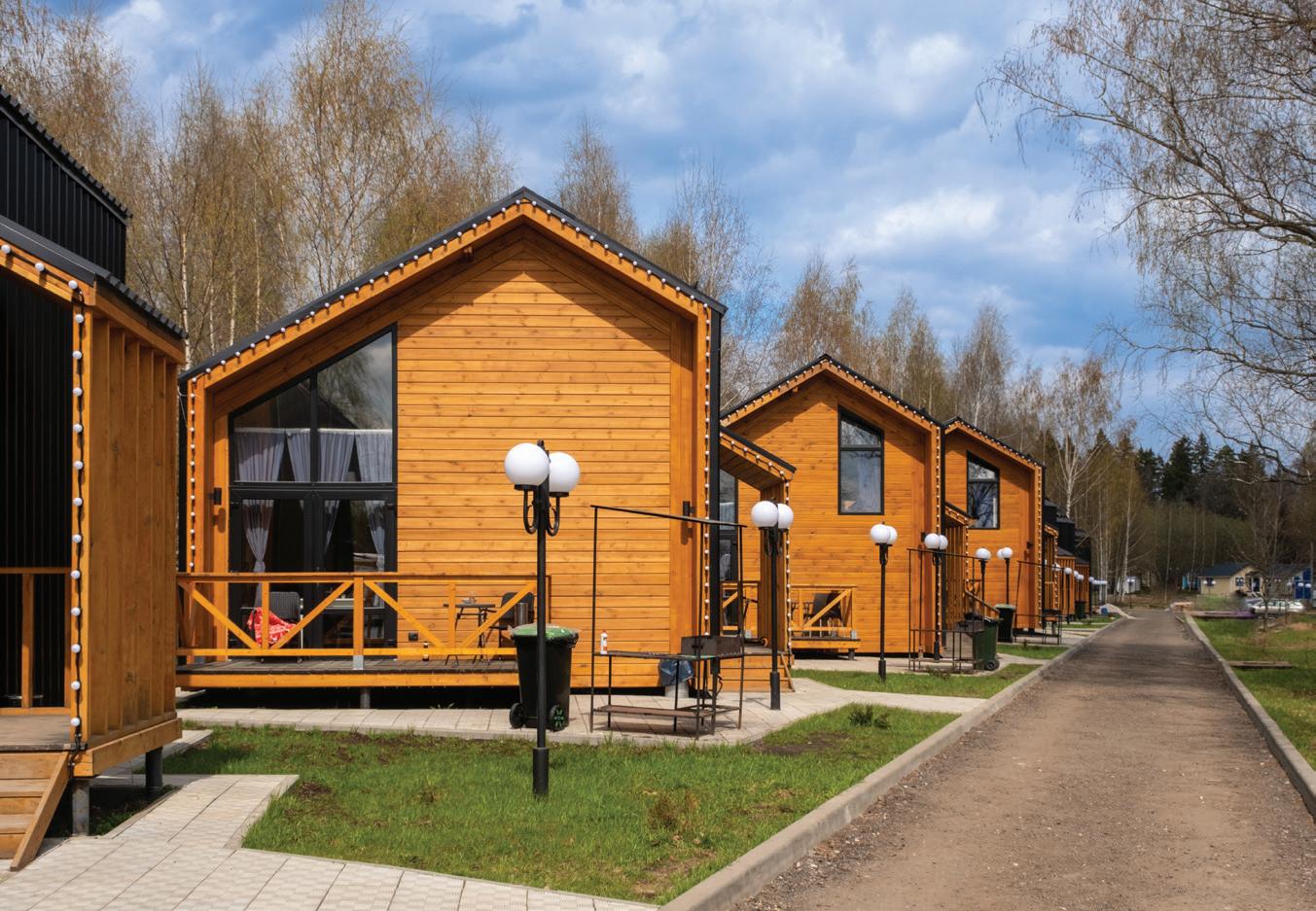
Seattle’s homeless shelter capacity is expected to get a boost in the fall with the announcement of two new tiny house villages in the city.
The city dedicated $5.9 million in its 2025 budget for the two villages’ startup and operation costs, with the Low Income Housing Institute contracted to do the work. However, a location for the villages has yet to be selected.
Through mid-August, the nonprofit organization will conduct outreach in potential locations. If these efforts are successful, the city anticipates both villages to be built and operational by the upcoming fall.
In total, the two new tiny house villages will increase Seattle’s shelter capacity with 104 new tiny homes, including approximately 60 in the larger facility that will be operated by the Low Income Housing Institute and CoLEAD. The second village will include approximately 44 tiny houses that will be operated
solely by the Low Income Housing Institute.
With the addition of the two upcoming tiny house villages, the nonprofit organization will have a total of 13 in Seattle, which the city funds. The Lowing Income Housing Institute received the third largest portion of funding from the King County Regional Homelessness Authority in 2024 with $14.5 million.
“Two new tiny house villages will serve hundreds of people in the years to come,” Low Income Housing Institute
Executive Director Sharon Lee said in a news release. “Our goal is for vulnerable people to be able to move out of living in cold, wet tents and into heated tiny houses this winter.”
The new tiny house villages will reserve units for homeless people referred by Seattle’s Unified Care Team, which is a coordinating hub for city departments and partner agencies like the King County Regional Homelessness Authority to ensure public spaces, sidewalks and streets remain
safe and accessible.
According to KCRHA reports, 46% of people exiting the city’s tiny house programs transitioned to permanent housing in 2024 and 4% were homeless within six months. A press release from Seattle Mayor Bruce Harrell’s office compares these statistics to the latest published national data from the U.S. Department of Housing and Urban Development in 2023, which shows a 32% average for successful transitioning to permanent housing.
Red Cross invites community to help save lives in Seattle
The doors are now open and welcoming donors at the brand new American Red Cross Blood and Platelet Donation Center in Seattle. This state-of-the-art facility brings Red Cross Biomedical and Humanitarian Services (Disaster Response, Preparedness, CPR/First Aid) under one roof.
Strategically located for the opportunity to engage with a new generation of blood donors, the site is easily accessed by mass transit and includes ample free parking. The Seattle Blood and Platelet Donation Center is part of a transformational investment in achieving healthy outcomes for patients battling cancer, accident victims, transplant recipients, and those living with sickle cell disease nationwide.
Hours are Sunday from 7 a.m. to 3 p.m.; Monday through Wednesday from 11 a.m. to 7:30 p.m.; and Thursday from 10 a.m. to 7:30 p.m. The center is located at 1900 25th Ave S, Seattle.
This center's opening marks the first time donors will be able to give platelets with the Red Cross in the greater Puget Sound region. Platelets are the clotting portion of blood and are needed for many reasons, but they are primarily given to cancer patients. These tiny cells have a very short shelf life – just five days from the time they are donated
– so there is a constant, often critical, need for new and current donors to give to keep up with hospital demand for platelets. Having a readily available blood supply is vital for patients whose survival depends on transfusions. Donating blood is essential to community health, and volunteer donors are the only source of blood for those in need. By making an appointment to give blood or platelets at the Seattle collection site, donors can feel good knowing that they may be helping patients not only in their community, but also their family and friends across the nation.
“From mothers experiencing childbirth complications to those facing trauma situations in the emergency room, many of us may be connected to someone who has relied on lifesaving blood products,” said Angel Montes, Donor Services Executive of the Red Cross Northwest Region. “The Red Cross is pleased to offer donors this new opportunity to help provide hope, healing and access to treatment for patients in need.”
In addition to the Seattle fixed site, individuals will also continue to be able to give blood at Red Cross blood drives throughout western Washington.
For more information, please visit redcross.org or cruzrojaamericana.org, or visit us on Twitter at @RedCross.
ADOBE STOCK
American Red Cross