

Advocating for education
McGilvra PTA spreading the word about small community school
By Jessica Keller
Park Times editor
The small size of McGilvra Elementary, the kindergarten-fifth grade school in Madison Park, has always been considered an asset among parents, but the school is now in a precarious position because of shrinking enrollment.
The school’s Parent Teacher Association, however, is trying to change that, however.
Lara Pomernacki, the McGilvra Elementary PTA fundraising chair who has two children currently enrolled at the school, said she and other PTA parents are trying to raise awareness about the small neighborhood school and advocate for its future in the neighborhood.
Pomernacki said, in Washington, state funding for schools is based, in part, on how many students are enrolled in a school. Not only has enrollment dropped in Seattle Public Schools because of the COVID-19 pandemic, in recent years, fewer families have opted to enroll their students at McGilvra.
“We are a small school to start with, so any decrease in funding will certainly decrease our programs,” Pomernacki said.
The problem is not that there is a shortage of families with small children, Pomernacki said. McGilvra’s boundaries covers Madison Valley and on the other side of the arboretum, as well.
“We know we have a lot of families in the area that choose to go to private school,” she said. “I think the difference in the demographic is it’s a fairly higher income area, and so, again, a lot of people just default to private school.”
Mostly, those families have been sending their children to private schools throughout Seattle, “but there’s a pretty heavy concentration of private schools in the central area that are within walking distance of those families,” Pomernacki said.
Loss of enrollment and COVID is also affecting how much the McGilvra PTA can help the school.
In recent years, because of inadequate funding from the state and the school district, the school’s PTA has compensated for positions the school district has not been able to fund, thanks to PTA fundraisers. The school’s PTA raised enough money to pay for a counselor, the art program and
SEE MCGILVRA, PAGE 6







Madison
Photo courtesy Lara Pomernacki
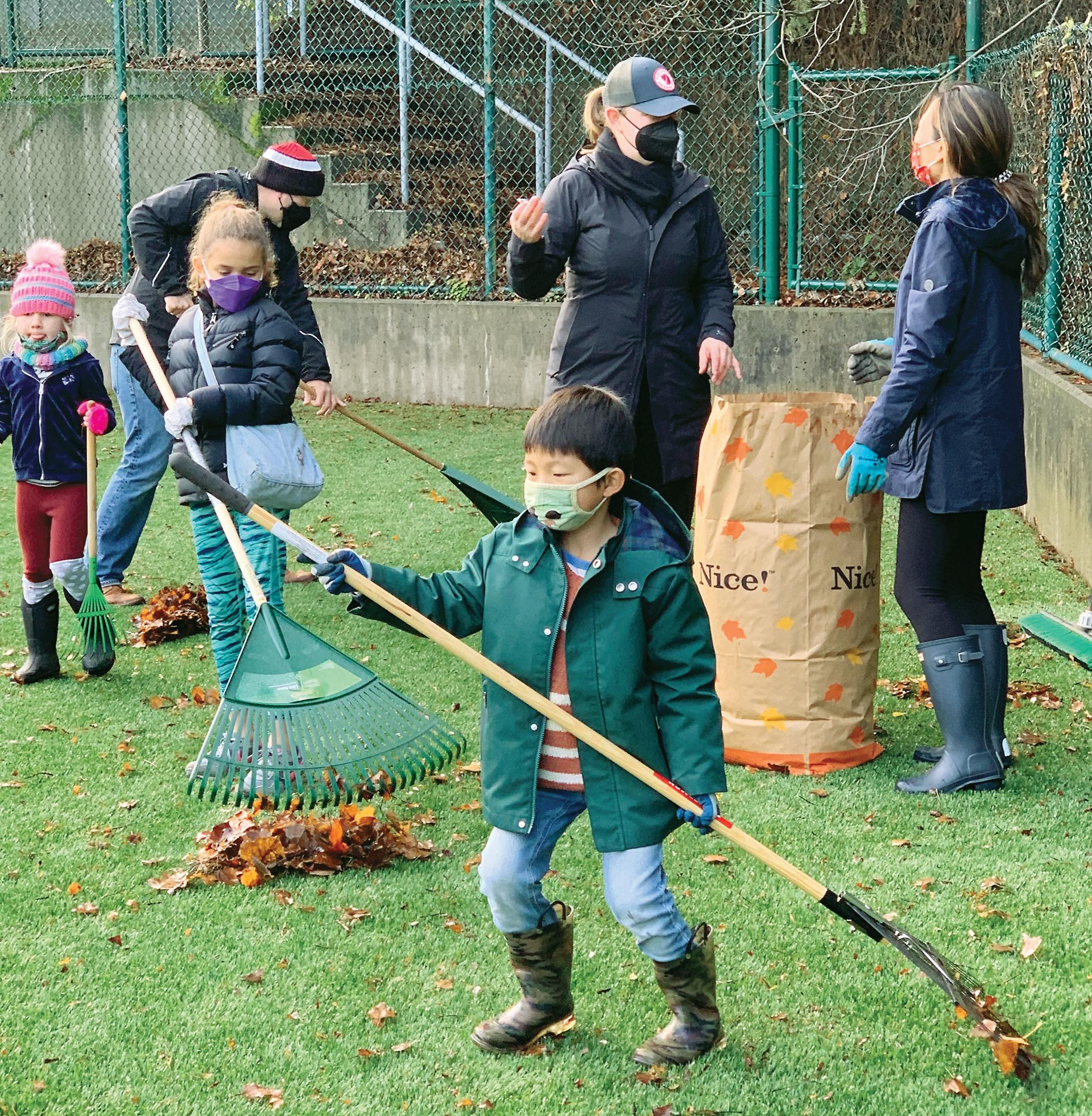
A group of McGilvra Elementary families rake up leaves and tidy the school grounds and neighborhood during a cleanup day in early December.
REVISITING THE PARK War Times
By Richard Carl Lehman
The winter of 1942 was dark, cold and damp. Our lives had been turned upside down. We were at war and we had no TV, iPhone, Gameboy, social media, podcasts or jazz stations for diversion.
On many mornings I walked to Riley’s Café on the corner of Madison and 43rd to get breakfast served by my mom, who worked there. Behind me was the usual stampede of men who began ordering quick breakfasts before boarding the Kirkland ferry to Todd’s Shipyard. The clamor reminded me of soldiers running into battle with the clinking of tool belts and steel-toed boots.
The café was always bright and filled with workers, but sometimes it was so busy I had to eat in a corner in the kitchen. I knew some of the men in there as they lived by us.
I watched as one guy ate a huge stack of pancakes by quartering it, pouring the syrup, folding it, then somehow driving the thing into his mouth. He, like the others, was in a hurry to secure a seat on the ferry.
Another fellow poured his hot coffee into the saucer and sipped it as it cooled. Toast and bacon and/or sausage was folded into a napkin for a snack later. All of these folks managed to carry on conversations and even smoked before, during and after the meal. Some just took a cup of coffee outside to look for the ferry lights. Women were also ship builders and formed lasting alliances, and they all got along fine with the men. Word was there was no smoking allowed in the work area, but many chewed tobacco. I was offered some once, but I am sure it was a joke? Some smoked a pipe, which smelled good, but the chew just left stains on the sidewalk.
There was the usual line of cars, with four or more in each. A schoolmate, Roger Kelly, sold the morning Seattle Post-Intelligencer for five cents to them. Other school friends arrived, and we watched the workers scramble when the ferry horn blew. Too bad if you got in the way of the thundering herd running by. It finally got quiet except for the

café workers clearing the many dishes inside with just a few locals left eating breakfast.
On the walk to school, we greeted store owners as they opened. Traffic was sparse and slow. An ice truck delivered to the grocery store, and the driver gave us a few pieces of ice to cup up our sleeves. Nothing like fresh shaved ice, I guess? Even the friendly dogs who followed us to J. J. McGilvra’s begged for ice. The school hangout was Johnsons’. Miller and John always welcomed us as we collected our supply of energy food — candy — to be stored in our lockers (mine was No. 47). We had no qualms about getting to Mrs. Noon’s class as she was our No. 1 inspiring teacher. She filled our heads with knowledge and made the hardness of war slide into the background for a while.
Madison Avenue was always friendly. When we got our ration
card for meat (sometimes), fish and chicken, that was a good day. Not to knock Spam because with eggs, it wasn’t terrible. Our favorite store was the bakery for indulging in a huge cinnamon roll split two to three ways. Next, it was fun to see what was new at Bill and Ada’s Dime store, a must for ammo for our BB rifles. The Madison Park hardware store was owned by a tall gentleman before Bud and Lola McKee owned it. He usually looked askance at us while we played with small trinkets.
Soon it was time to hang up our skates, put our bikes with playing cards on the spokes to rest and find a hot rod. My first car was a ‘42 Dodge previously owned by an Army general. The joys of car ownership had its place in lifting our spirits.
Years later, four of us sat in the big round booth in the Red Onion and flipped a coin to see
what letter of a last name would be chosen to be drafted. To add to the game, we would disguise our voices on the phone while pretending to be from the draft board and then laugh like hell at the ominous joke.
In the end, two of us were drafted into the Army, one into the Coast Guard, two into the Air Force, two into the Marines and one deferred (some small thing in his past).
We wrote letters home, of course, while biding our time in two-year enlistments. If we chose a three-year stint, we had a choice of Military Occupational Specialist) jobs. A 10-day leave was never enough but always great.
After being discharged, it was time to feel truly hopeful. It was August 1959, and Madison Park was still a sleepy village. The businesses started opening up, college students and flight personnel were moving in, and parties ensued.
Before the war, I had been invited to dinner by a family of five who lived in a garage. Bedrooms were jerry-rigged with blankets separating the rooms for privacy. The plates didn’t match, nor did the silverware, but it all worked just fine.
Many years later, I was invited to a dinner party in that same garage, which had been converted. Hard to believe it was now a fashionable pad for a Flying Tiger flight attendant. She had a workmate who lived in another converted garage in the alley between 42nd and 43rd; Rent was $35 a month. That building is still there but looks to be a bit dilapidated and uninhabited except for a few mice.
In dark times and happy times, Madison Park has always welcomed newcomers. May it continue to be a thriving, fun community to be savored for future generations.
Seattle Shakespeare Company announces indoor 2022 performances
Seattle Shakespeare Company will return to indoor performances with a series of productions this year.
“Shakespeare: Drum and Colours,” an ambitious, alternating repertory of two Shakespeare classics pared to their essence and featuring an all-POC company, will perform in late winter 2022.
Spring 2022 features the rescheduling of a previously COVID-cancelled production of “Much Ado About Nothing.”
“We’re deeply aching to be back on stage again and are doing everything we can to make that happen,” Artistic Director George Mount said in a press release.
“This past summer’s outdoor Wooden O show told us just how much our audiences want to see live theater again. Nearly every park we performed at had more than double the number of patrons that we typically see during the summer. We can’t wait
to welcome our audiences back to theater.”
Managing Director John Bradshaw said staff have been evaluating HVAC systems, lobby traffic patterns and safety procedures to ensure patrons are safe while attending shows at The Center Theatre, according to the press release.
Seattle Shakespeare Company has implemented a mandatory vaccination policy for all employees, volunteers, patrons and
visitors to the Center Theatre as well as mask requirements while in the building.
For the 2022 indoor season, all shows will only be available for single-ticket purchase.
“Shakespeare: Drum and Colours” is an adaptation of two of Shakespeare’s plays — “Hamlet” and “As You Like It” — that will alternate performances.
The production features an all-POC Shakespeare repertory company that includes nine ac-
tors, two directors and an allPOC design team.
:Shakespeare: Drum and Colours” will run in repertory Feb. 15 through March 13 at Center Theatre at Seattle Center.
“Much Ado About Nothing” will perform April 26 through May 22.
Tickets for “Shakespeare: Drum and Colours” are on sale now. To purchase tickets, go to www. seattleshakespeare.org, or call the ticket office at (206) 733-8222.
Do you know your disaster personality?
By Margie Carter MP Emergency Management Team
Over the last year, our Madison Park Emergency Preparation Volunteer team has been trying to educate ourselves and neighbors to plan and gather resources to help each other survive a disaster. Our work began before the COVID pandemic, and that initial preparation has served us well. We now have an enhanced understanding of our adopted motto:
The more we know and work with our neighbors, the better things will go. In her book “The Unthinkable: Who Survives When Disaster Strikes and Why,” Amanda Ripley (2009) raises another important area of preparation: Getting to know our “disaster personalities” before a catastrophe strikes will create a better chance of survival. She offers this notion based on scores of interviews to learn what regular people do before, during and after the disaster and what
they could have done better. Her conclusion: Regular people are the most important people at a disaster scene, every time.
Drawing on stories from disaster survivors, from the research of sociologists, safety experts and neuroscientists, Ripley has developed what she calls a “survival arc” to describe what happens inside us in the midst of a disaster. This typically includes a process of denial, deliberation and then a decisive moment.
Ripley says, “Our disaster

personalities are more complex and ancient than we think. But they are also more malleable.”
Having a basic understanding of how the human brain functions allows you to be more aware and thoughtful in your preparations and responses, thus taking charge of your “disaster personality.”
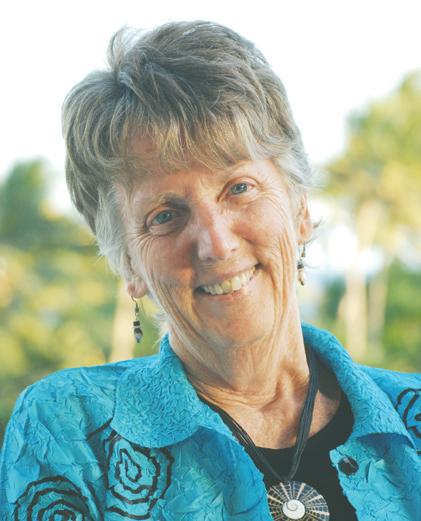
Margie Carter
Knowing your amygdala can get hijacked Brain science 101 starts with learning about your amygdala, a part of the brain’s limbic system responsible for emotional and behavioral responses to things you encounter. When this part of your brain senses danger, the amygdala typically activates a fight-or-flight response without any direction from you. This signals your brain to pump needed hormones like adrenaline and cortisol, which flood your system.
This deeply instinctive function is an old protective mechanism of your nervous system that usually hijacks your response even before you sense there could be a choice about what to do. The active amygdala immediate shuts down the neural pathway to your prefrontal cortex, the part of your brain that regulates voluntary actions like reasoning, decision making and planning.
Unlike the automatic reactions generated by the amygdala, these frontal lobes of your brain have to be activated to allow you to evaluate your emotions and use rational judgement and experience to consciously respond. This takes self-awareness.
If you understand how you are likely to react, you can learn to override instincts that don’t serve you well, even teaching your brain some new tricks.
Uncovering your disaster personality
Getting to know your instincts in the face of calamity might begin in conversations with trusted friends or loved ones. If you find you don’t want to think or talk about potential disasters, that’s a discovery worth understanding itself. Are you concerned about stirring up more worries? Do you
equate not talking with being more in control of your emotions?
Carry on, and consider taking up these questions to learn more:
What are your biggest concerns about engaging in emergency planning? Are there specific fears or worries that would be helpful to address?
Are you a person who likes to be independent and self-reliant, or does working with others give you more confidence?
What resources do you most want to have on hand in an emergency? How does that compare with guidelines for emergency kits?
What resources are you likely to be willing to share with your neighbors?
Who would you be willing to trust with your keys? Your pets? Your kids? Your vital information? What process will you develop for figuring out how to manage your disaster personality?
What steps are you willing to take in the next month? Six months? By the end of the year?
Remember Amanda Ripley’s point that our disaster personalities are more malleable than we think, and this only requires a regular dose of training. Consider visiting Riley’s blog post: “5 Ways to Refine Your Disaster Personality, https://www.amandaripley. com/blog/5-ways-to-refine-yourdisaster-personality.
Two years of living with a global pandemic has given us valuable experiences on which to draw. You may know your own and your neighbors’ strengths and vulnerabilities better. You may be more familiar with resources near your home.
Hopefully you have spent more time walking, biking or hiking outdoors and, as a result, you are stronger and have more weatherproof clothing. Weary and so ready to be done with this, yes, but hopefully we have things to be proud of, along with some awareness of how we’d like to further develop our disaster personalities and relationships with our neighbors.
Steady on, everyone: Take care, be generous and spread good cheer as you can.
www.MadisonParkTimes.com
Naked in the garden
By Steve Lorton Tree Talk
Winter in the Pacific Northwest allows us to see nature disrobed.
From November into March we get to enjoy the sculptural beauty of deciduous trees and shrubs out of leaf. This spectacle is at its peak in January. Autumn debris is raked away; Christmas lights are packed away. The low crawling sun shines its light on and through these powerful forms.
Chattering birds embellish branches, and the acrobatics of squirrels aren’t shrouded in foliage.
Nature’s artful arrangement of branches and twigs juxtaposed against our muted silver skies is horticultural filigree. Low growers form a network over dormant beds or swaths of evergreen ground cover.
A spray of bare limbs and branches against a garden wall or the side of a house complement the architecture like a veil of loose lace over the face of an 18th century beauty. It’s an aesthetic that often goes undiscovered, but once ignited in the psyche, it can become a gentle and pleasing obsession.
In his poem “My November Guest,” Robert Frost celebrates the passions of a somewhat cranky, officious woman with whom he is hopelessly in love.
“She loves the bare, the withered tree….” Frost tells us, attesting to her haughty but endearing ability to savor the subtle.
Once, when I was writing for a native born (and hopelessly geocentric) editor in California, I pitched a story on deciduous trees in winter. “Oh no!” he said in a condescending voice. “Readers don’t want to read about that. Most species here are broad-leafed evergreens … Western privilege trees.”
Western privilege trees? Please … I turned my back, rolled my eyes, but kept my cool. Then this dogmatic editor announced that he’d be going to a remote part of Asia for a month, pretty much out of touch, and his assistant editor would be in charge. His plane was barely off the runway when I pitched the story to the assistant, this time with photographs and a recitation of the entire Frost poem.
I channeled my ancestors, the rolling grandiloquence of the Irish, the showmanship of the Jewish.
It worked! The story got approved and landed in print. Positive comments from subscribers fell on the desk of our Readers Service Department like leaves in October. The real payoff came when one of my sentences was quoted at the annual editorial conference as the the best line of the
“A spray of bare limbs and branches against a garden wall or the side of the house complement the architecture like a veil of loose lace over the face of an 18th century beauty. It’s
an aesthetic that often goes undiscovered, but once ignited in the psyche, it can become a gentle and pleasing obsession."
year: “When I visit a garden in winter and don’t see any defoliated deciduous trees and shrubs, I feel as if I’ve been to an art museum and haven’t seen any nudes.”
Smug as I felt about outfoxing that editor’s California horticultural arrogance, every glowing word I wrote about trees out of leaf was from the heart. I love them.
Oaks, with their massive and marvelous crowns, are among the most spectacular, towering above most everything around them. The delicacy of the deciduous magnolias is striking. Lofty and grand, Magnolia campbellii, M. dawsoniana and M. denudate punctuate the skyline. When it comes to intricacy of branching pattern and winter interest, nothing can surpass the common magnolia soulangeana. Little wonder it appears so often in Chinese scroll paintings.
Smaller, garden-scale trees for naked winter beauty are aplenty. Crepe myrtle (Lagerstroemia fauriei) gifts the garden with its smooth, blondish bark in addition to noble structure.
The bark of Stewartia pseudocamellia is an out-of-leaf eye-catcher with its bark mottled in silver, gray, brown and shades of green. The cinnamon-colored bark of Stewartia monadelpha is equally stunning, shining like polished copper in the winter mist.
Japanese maples are a no-fail choice for year-around interest, not the least of which is their in-the-nude beauty. Several have very colorful bark: Acer palmatum “SangoKaku” for vibrant red winter twigs, A.p. “Bihou” for its yellow branches.
Our native vine maple Acer circinatum couples perfect city garden scale with a handsome arrangement of branches and interesting bark. The newly introduced A.c. “Pacific Fire” has creamy yellow and coral red stems to enliven any winter garden.
The dogwoods Cornus florida and C. kousa are known for their bouquets of bare
WSDOT hosting Montlake project update meeting
Washington State Department of Transportation is hosting a virtual public meeting on the Montlake construction project. It is scheduled for 12:30 p.m. Jan. 19. The construction team will recap the 2021 work, provide updates on what is to come and answer questions. The team will also update people on the Montlake Bridge rehabilitation project. Register at https://bit.ly/Jan19_2022_SR520MonthlyMeeting. The state Route 520 Montlake Project entails improving motorized and non-motorized transportation along the corridor with a new state Route 520 eastbound bridge over Union Bay. The project also features building a three-acre lid covering the highway in Montlake that includes regional transit stops and open green space. East of the lid, a bicycle and pedestrian bridge will be build over SR 520. The project is slated to be complete in summer of 2023 and is projected to cost $455 million.
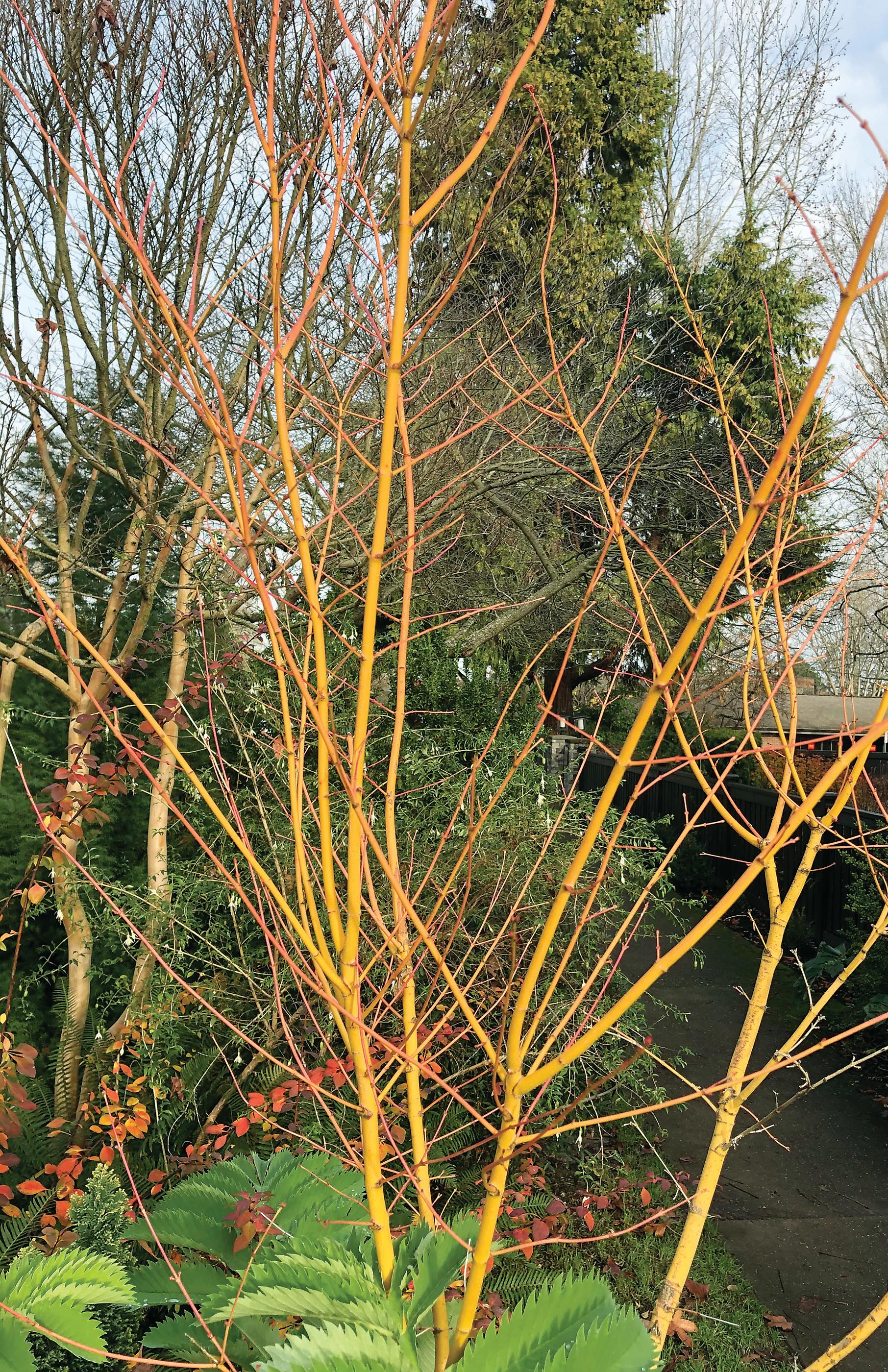
colorful bark, like this A.p. ‘Bihou’ with its yellow branches.
twigs. Their shrubby cousins, the redtwig dogwood (C. stolonoifera) and yellowtwig dogwood (C. s. “Flaviramiea”) will light up the dreariest of January days with vivid bark.
The Pacific Northwest’s mild winters invite planting in all but the few days when the temperature drops below freezing.
Getting plants in the ground now still gives them time to establish before summer heat and drought sets in. They’ll send out roots in what is left of winter and in our cool, moist spring, making the plants more adept at absorbing hot season irrigation.
Visit https://wsdot.wa.gov/construction-planning/ search-projects/sr-520-montlake-project for more information.
Arboretum Foundation annual gala fundraiser Feb.10
Registration for the Arboretum Foundation’s 34th annual gala fundraiser — The Art of Nature — began Jan. 6. This free, livestream event will celebrate Washington Park Arboretum, and explore how nature in this special place inspires artists, visitors and students to create in myriad ways, enhancing the shared community. The event will take place from 6 to 7 p.m. Feb. 10. It will feature surprise guests, performances and silent and live auctions. Go to https:// arboretumfoundation.org/events/art-of-nature/ for more information. All proceeds from The Art of Nature will help fund environmental education, maintenance and volunteerism at the Arboretum, as well as cultural programs at the Seattle Japanese Garden.
Now is a perfect time to scout nurseries and make additions to your garden. Nurseries will be sparsely populated with customers, and the staffs are eager to dispense advice.
Offerings will be surprising: dozens of conifers, early flowering trees like Chinese witch hazel and cornelian cherry, a vast array of broad-leafed evergreens and the seductively beautiful sculptural branches of trees and shrubs out of leaf. You’ll likely ask yourself, “With all there is to choose from, what shall I get?”
My advice is simple: Get naked!
helping you live well your way
Providing quality home care th at supports comfort and independence










Photo by Mary Henry
Japanese maples are a no-fail choice for trees with year-around interest in the garden, not the least of which is their winter in-the-nude beauty. Several have very


Seattle Art Museum presents water-themed exhibit in March
The Seattle Art Museum presents Our Blue Planet: Global Visions of Water, March 18 through May 30. According to a press release, the exhibit explores the many ways artists around the world have engaged with the theme of water. The exhibition features works from SAM’s collection and three local lenders, with over 80 works of art from 16 countries and seven Na-

tive American tribes, including video, sculpture, textiles, paintings, ceramics and photographs. The works date from ancient to contemporary times, including work by 46 living artists and two contemporary works acquired specifically for the exhibition.
Our Blue Planet is a collaboration among three SAM curators: Barbara Brotherton, curator of Native American Art; Natalia Di Pietrantonio, assistant curator of South Asian Art; and Pamela McClusky, curator of African and Oceanic Art.
In the early months of the pandemic, museums and galleries around the world were impacted by exhibition schedule disruptions; SAM began to plan for a future special exhibition primarily relying on its wide-ranging, global collection that would respond to an urgent and relevant topic, according to a press release.
According to the press release, the curators worked closely with many of the living artists on view to develop the themes and points of view in the exhibition. Many of the artists’ thoughts will be represented with labels in the galleries. The artistic responses to water found in Our Blue Planet range from wonder and awe to anger

and revelation, inviting viewers to learn, dream and engage their empathy to create social and environmental change, according to the press release.
“We sought to present diverse perspectives on water, with works from the museum’s collection — from Durer to Hiroshige to Bierstadt — placed alongside younger artists whose work has often not been shown in the Pacific Northwest before,” McClusky
said in the press release. “Our Blue Planet offers reminders of the great pleasures water provides while also turning to artists who help us face the impact of our species on the planet. Indigenous artists in particular offer longterm visions of what is just and sustainable, as we all face increasing environmental emergencies.”
For the most up-to-date information on planning a visit, go to seattleartmuseum.org.
Sensi for Stress
Amid a global pandemic threatening society, effective ways of soothing stress, anxiety, and fatigue are progressively more important. Cannabis has a famed ability to calm the mind, ease the nerves, and boost emotional elasticity. Cannabis is a genetically diverse plant, with a wide range of possible effects. While some cannabis products can have a stimulating effect, other cannabis products have a soothing, relaxing, and potentially drowsy effect. In this article, I’ll explore methods for using cannabis to promote relaxation, and the various products available at your local dispensary.

Let’s start with an overview of the two main varieties of cannabis: sativa and indica. While both sativa and indica varieties often have high levels of THC (the psychoactive cannabinoid produced in cannabis flowers), they have subtly different ratios of trace cannabinoids and terpenes. These slightly different genetic makeups influence the unique characteristics, or personality, of each strain.
THC and CBD are two examples of commonly known cannabinoids (chemical structures produced by the cannabis plant that interact with our bodies). THC induces the psychoactive “high,” while CBD is a non-intoxicating cannabinoid often used for wellness applications. While both THC and CBD can help with stress-relief, some people find the intense mental effects of THC to be over-stimulating.
While these two common cannabinoids alone can restore a sense of calm for many people, newly emerging science indicates that certain trace cannabinoids can also promote relaxation. Trace cannabinoids, as the name implies, are cannabinoids from cannabis just like THC and CBD, except they occur in smaller, trace amounts. Common examples include THCV, CBN, and CBG, to name a few; however, there are dozens of trace cannabinoids with a myriad of potential effects. Since cannabis science
and research are relatively new topics, and because many of these trace cannabinoids occur in such small amounts, we don’t yet understand how many of them work or how they affect the body.
One trace cannabinoid, in particular, CBN (cannabinol), is produced as cannabis ages, causing the cannabinoids to gradually shift in chemical structure from THC to CBN. CBN has been preliminarily researched as a mildly psychoactive cannabinoid that can induce sleep and ease physical pain and tension. For this reason, some users of cannabis who struggle with insomnia or anxiety select aged cannabis with higher levels of CBN.
Certain terpenes, aromatic compounds that give cannabis its unique fragrance, are renowned for their stress-relieving and relaxing qualities. The concept is similar to aromatherapy: the physiological effects of aroma combine with the effects of the cannabinoids to produce an entourage effect. For example, linalool is the chemical structure that smells, to us, like lavender; linalool is found both in lavender flowers and some cannabis flowers. The presence of this terpene can have a similar effect to a lavender aromatherapy diffuser, such as anxiety relief and tranquility. In addition to linalool, myrcene is a terpene shared between cannabis and mango fruit. Myrcene, like linalool, is prominent in indica strains and is thought to help induce their stereotypically relaxing and sedating qualities.
In a first-of-its-kind study, Washington State University compared how peoples’ self-reported levels of stress, anxiety, and depression were affected by smoking different strains and quantities of cannabis at home. The research was published in 2018, and suggests smoking cannabis can significantly reduce short-term levels of depression, anxiety, and stress. “Existing research on the effects of cannabis on depression, anxiety, and stress are very
rare and have almost exclusively been done with orally administered THC pills in a laboratory,” said Carrie Cuttler, clinical assistant professor of psychology at WSU and lead author of the study. “What is unique about our study is that we looked at actual inhaled cannabis by medical marijuana patients who were using it in the comfort of their own homes as opposed to a laboratory.” The WSU research team found that one puff of cannabis high in CBD and low in THC was optimal for reducing symptoms of depression, two puffs of any cannabis was sufficient to reduce symptoms of anxiety, while ten or more puffs of cannabis high in CBD and high in THC produced the most significant reductions in stress.
Additionally, cannabis massage, which features a CBD or THC infused massage oil, is an increasingly popular stressfix. Direct application of cannabis oil through massage improves circulation and streamlines the soothing effects of cannabis directly to tense and tired muscles. Unique formulas for various cannabis oils can provide effective relief for specific ailments, such as a high-CBD joint/tissue gel for arthritis pain, or a cooling mentholated balm for a sore back or stiff neck.
As a final piece of advice, conventional wisdom suggests that lower doses are best for relaxation and stress relief, especially in regards to the potent psychoactive cannabinoid THC. Additionally, set and setting are critical considerations. “Set” refers to your mindset, meaning that cannabis is only so effective on its own, and becomes even more effective with the proper expectations. “Setting” refers to your physical environment, suggesting that a cannabis bubble bath, or cannabis yoga/meditation, will likewise augment the stress-relieving qualities of either THC or CBD.
Cody Funderburk
Photo courtesy SAM Beach Scene is one of the pieces of art that will be on display during the Seattle Art Museum’s water-themed exhibit in March.
a math and reading specialist.
Last year, however, the math and reading specialist positions got combined into one position.
The art teacher is a part-time position, and she goes into the school at least once a week to work with the children.
“The kids absolutely love her, and having her in the class after the pandemic, I think, really saved a lot of the kids,” Pomernacki said.
The school’s counselor, for whom the PTA contributes a portion of the position, focuses on the social and emotional learning for the children, which has been important this year as the children return to school in person after a year of remote learning.
The math and reading specialist has also been important helping children catching up in their learning, Pomernacki said.
“The math and reading specialist, they can work with kids who need a little extra help, and one of the main things I see is they are able to work individually with the kids that need the extra help, and that takes the burden off the teacher, and it’s really what some of the students need, that extra attention,” Pomernacki said.
Parents and PTA members, however, are concerned positions may decrease further in the upcoming years if more parents choose to enroll their children in private schools and the school district allocates fewer dollars to McGilvra.
At a recent meeting with district administrators, PTA members had questions about operating costs and whether state funding could eventually provide for a counselor in every school.
“The goal is to get a counselor in every school eventually, but that’s not going to happen in the next year or even two,” Pomernacki said. “If the district can fund that, then that would take the pressure off the PTA for sure.”
The McGilvra PTA won’t know what positions they will help fund until this spring.
It will vote on the budget and submit a grant to the school district in mid-March. The PTA will decide what it can afford to pay for and how its funds should be allocated in early March.
“In terms of fundraising, we’re really willing to do the work to get our kids what they need, but it’s becoming more and more clear we can’t continue to ask our families for the amount that we’ve attempted to raise in the past,” Pomernacki said.
In addition, just raising that has been a challenge in the time of COVID. The PTA has not been able to host the auctions it has in the past, nor the other events in which children have mainly participated since the school district has stated schools were are closed to outside activities, which has limited the fundraising options for PTA’s.
“And I think that’s kind of shed a little light on the fact that continuing to ask parents to fund these positions is probably not sustainable in the long term,” Pomernacki said.
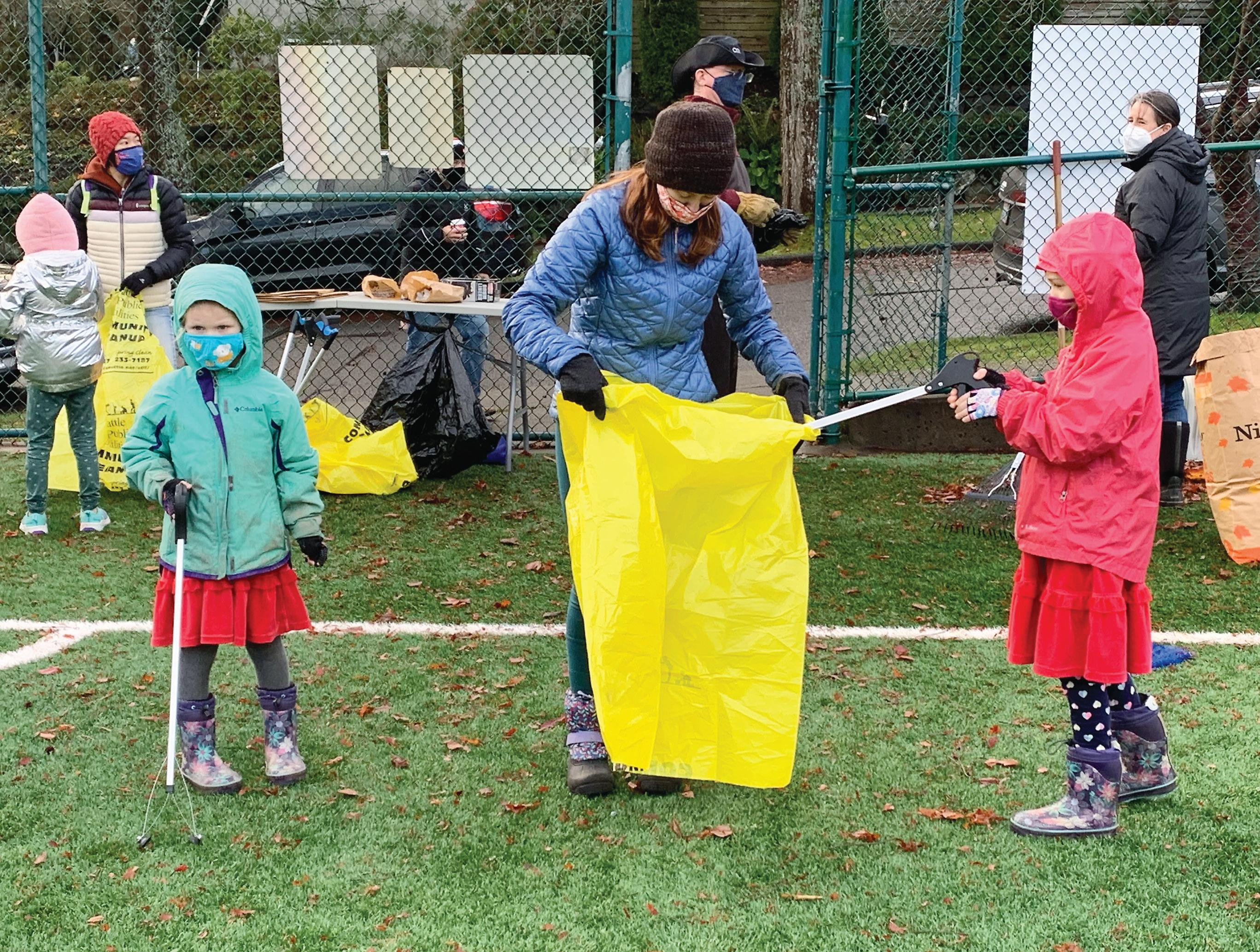
McGilvra parkent Becca Elenzil (center) helps pick up leaves and litter with her daughters Magnolia and Viva
a school cleanup day in December.
“In terms of fundraising, we’re really willing to do the work to get our kids what they need, but it’s becoming more and more clear we can’t continue to ask our families for the amount that we’ve attempted to raise in the past."
— Lara Pomernacki McGilvra PTA
Fundraising is also only a portion of the PTA’s role, Pomernacki said, but it should be focusing more on advocating and getting what the children need. Instead, so much effort is spent on fundraising.
PTA President Neala Kendall said PTA’s like McGilvra’s funding school positions also creates an equity issue as PTA’s at other schools cannot raise those funds to do the same.
“Our goal is to provide the services that we think our kids in our community need,” Kendall said.
She wishes, however, that SPS would fund staff so that PTA’s didn’t have to.
“And that is definitely something that we and other schools will be strongly advocating for this legislative session,” Kendall said.
To help address some of these worries, the PTA has adopted a
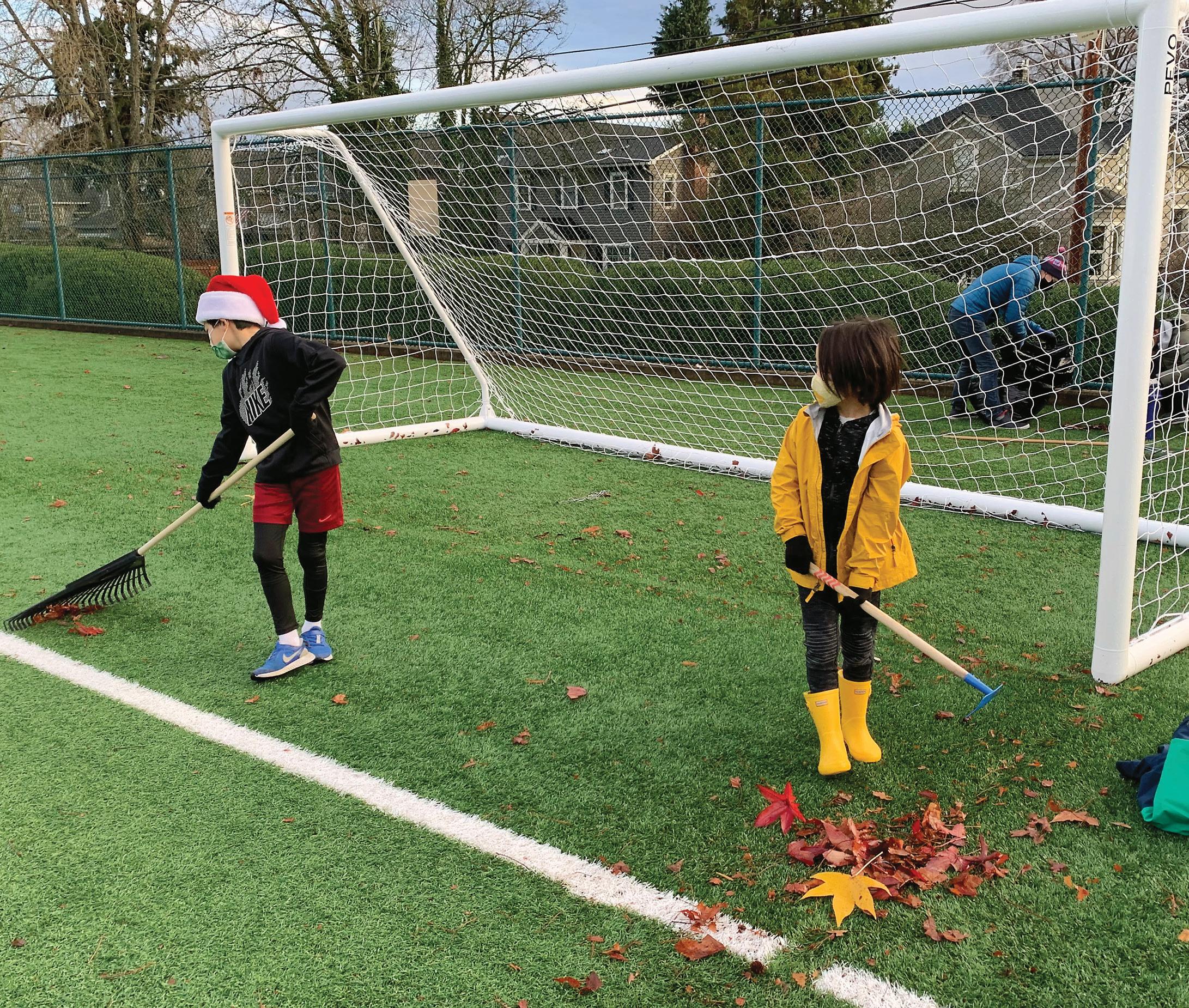
Micah Kim (left), a Mcgilvra graduate, and his brother Noah Kim, a second-grader at McGilvra rake up leaves during a cleanup day at the school in December. Cleanup days such as this are one way the McGilvra PTA is trying to bring awareness of the school to the community.
three-pronged approach to try and improve the situation, Kendall said. The plan adopted focuses on community building, advocacy and fundraising.
“We really think that those are all really important,” Kendall said. Part of their strategy is to work with other PTA’s, and they have already reached out to the
Montlake and Stevens elementary PTAs to share ideas and hear what those schools have been doing to raise funds and advocate for their schools. She said Montlake and McGilvra PTAs have also committed to dedicate a certain amount of funds to other under-funded schools in the area.
Even with its concerns, Kendall and Pomernacki want people to know that McGilvra is a great school, with teachers who care about students’ emotional and academic welfare and committed administrators.
“Why people choose private schools is sometimes a mystery to me,” Pomernacki said.
Photo courtesy Lara Pomernacki
at
Photo courtesy Lara Pomernacki
Lawmakers file bill reducing penalties for drive-by shooters
By Brett Davis
The Center Square
Washington state lawmakers have introduced a bill that would reduce penalties for drive-by shootings with the goal of “promoting racial equity in the criminal legal system.”
The proposed legislation would eliminate drive-by shootings as the basis for elevating a first-degree murder charge to aggravated murder in the first degree, which carries a mandatory sentence of life in prison.
House Bill 1692 was filed on Dec. 23 by Representatives Tarra Simmons, D-Bremerton, and David Hackney, D-Tukwila, ahead of the state’s 2022 60-day legislative session that begins Jan. 10.
Neither lawmaker responded to The Center Square’s requests for comment.
Simmons’ office released a statement to KTTH arguing that first degree murder “is a heinous crime which already carries a long and serious sentence.” But, she added, “it’s clear that [this aggra-
vated classification] was targeted at gangs that were predominately young and Black.” That, she argues is an example of “systemic racism.”
Drive-by shootings were added as an aggravating factor in 1995, at a time when Washington state was experiencing a surge in gang-related crime, according to a 1997 annual report put out by the Washington Association of Sheriffs and Police Chiefs (WASPC).
Per the report, there were three gang-related homicides in Washington state in 1991, followed by 17 in 1992, 31 in 1993, 26 in 1994, and 13 in 1995.
Some GOP lawmakers took exception to the pre-filed legislation at a time of increased violent crime and the “defund the police” movement that has in some cases sapped law enforcement of resources and morale.
“Violent crime is on the rise in our communities, in part, because law enforcement officers do not believe under new laws passed by the Legislature earlier this year that they have the authority to detain or pursue individuals, for
whom they reasonably suspect have committed criminal acts,” said Rep. Gina Mosbrucker (RGoldendale), ranking Republican on the House Public Safety Committee, in a press release. “It was reported during the summer that at least nine drive-by shootings in the Yakima area this year have left a trail of injuries, deaths and traumatized neighborhoods. This horrific crime is happening more and more across our state, taking the lives of innocent victims, destroying families, and leaving neighborhoods and communities in fear.”
Earlier this year, Gov. Jay Inslee signed a dozen police reform bills into law, including House Bill 1310, which seeks to reduce violent interactions with mentally ill people, and House Bill 1054, which limits the use of tear gas, bans the use of chokeholds and neck restraints, and restricts vehicle pursuits to police officers having probable cause.
Rep. Jacquelin Maycumber, R-Republic, House Republican floor leader and a former law
enforcement officer, echoed those comments.
“The Defund the Police movement pushed by progressives in this state brought forth a package of law enforcement ‘reform’ bills during the 2021 legislative session that, in the end, have made families and communities less safe, law enforcement less effective, and criminals were emboldened,” she said in a press release. “With numerous editorials, columns, newspapers articles, radio and television stories highlighting these dangerous bills, you’d think the Legislature had learned its lesson. But here we are again, at the cusp of adopting new policies to coddle criminals at the expense of our safety.”
Maycumber noted the recent spike in violent crime makes the timing of this legislation all the more baffling.
“Washington state is already seeing a surge in violent crime which is currently at a 25-year high, with murders at an all-time high in 2020, up 80 percent from five years ago,” she said. “Rape is
up 40 percent from five years ago and aggravated assaults are up 50 percent from five years ago. In light of this, why are some elected officials so intent on making it easier to be a violent criminal and releasing murderers back onto our streets?
“House Bill 1692 is a tragedy in the making as our children and families will be less safe in their own homes and even their own beds. This bill will allow those who have committed murder when engaged in drive-by shootings to get out of jail sooner.”
A more recent WASPC report shows murder and manslaughter rates in Washington state were up in 2020. There were 302 murders in 2020 compared to 206 murders in 2019, which is an increase of 46.6%, according to the report. Manslaughter was up 100%, with 34 incidents in 2020 compared to 17 in 2019.
HB 1692 would retroactively apply to anyone who was convicted of aggravated murder in the first degree if a drive-by shooting was the sole aggravating factor.





Building a Strong Foundation
Finding people homes is not just our business, it’s our purpose. We understand what it means to have a place to call home and how lives and communities are built on that idea. That’s why over the past 32 years the Windermere Foundation has been dedicated to supporting low-income families and those experiencing housing insecurity or homelessness. Working with local nonprofits, the Foundation funds backpacks full of food so school kids don’t go hungry on the weekends, helps stave off evictions by covering families’ housing costs, and strives to help our homeless neighbors get their most basic needs met with dignity.
Our brokers contribute a portion of the commission from each home sale to the Windermere Foundation, which to date has donated $45M to support hundreds of local organizations and impact thousands of lives. This commitment will continue in 2022. Learn more about the Foundation and the nonprofits it supports at windermere.com/foundation All in, for Community.

32 YEARS OF GIVING