

Cruisers enter postseason play
By Skip Smith | Contributing Writer
The Eatonville Lady Cruisers wrapped up their regular season on a high note this past week, highlighted by a forfeit win, a hard-fought rivalry battle, and a blowout victory on Senior Night that showcased their offensive firepower.
The week began quietly on Monday as the Cruisers were awarded a forfeit win when Clover Park was unable to field a full team. That bump in the standings helped Eatonville keep momentum heading into a challenging road matchup.
On Tuesday, the Cruisers traveled to Orting for a rivalry showdown that turned into a slugfest. Despite 15 hits and a late push, Eatonville fell 15-10.
Senior Grace Field led the way at the plate, going 3-for-5 with a home run, double, and single, and driving in two late runs in the seventh inning. Amy Tozier chipped in early with a sacrifice fly to put Eatonville on the board in the first. Josie Lavergne, Ava Twedt, Lilah Chapman, and Field all notched three hits in the game, while Morgan Laird added two of her own.
Eatonville had little time to dwell on the loss, and they came out swinging two days later on Thursday in front of a home crowd celebrating Senior Night. Before first pitch, seniors Grace Field, Ava Twedt, Lila Downey, Chase Burns, and Zoe Burns were honored for their leadership and contributions to the program.
Then, the bats exploded.
Zoe Burns went a perfect 4-for-4 at the plate, including a double and three singles, helping lead the Lady Cruisers to a 22-0 rout
EATONVILLE TENNIS

Andersen, two doubles teams advance to Districts
By Skip Smith | Contributing Writer
The Eatonville High School girls tennis team delivered a gritty, hard-fought performance at the 2A South Puget Sound League (SPSL) tournament held Wednesday through Friday at Clover Park High School. Several Cruiser athletes stood out, with three entries — including the team’s top singles player and both doubles squads — advancing to next week's West Central District 3 tournament.
Senior Bailey Andersen headlined Eatonville’s showing with a run to the league singles championship match. Her
path through the bracket was anything but easy. After a tense, nearly two-hour semifinal victory over Franklin Pierce, 6-2, 7-6, Andersen dug in for a marathon title match against a Steilacoom opponent that stretched three hours and 20 minutes.
Despite pushing both sets to the brink, she came up just short, falling 5-7, 5-7.
“I cannot recall a match that was so physically and mentally demanding as this championship match,” said head coach Alex Christensen. “Bailey just kept fighting. She’s so tough. The shots ultimately ended up not
TENNIS, 6
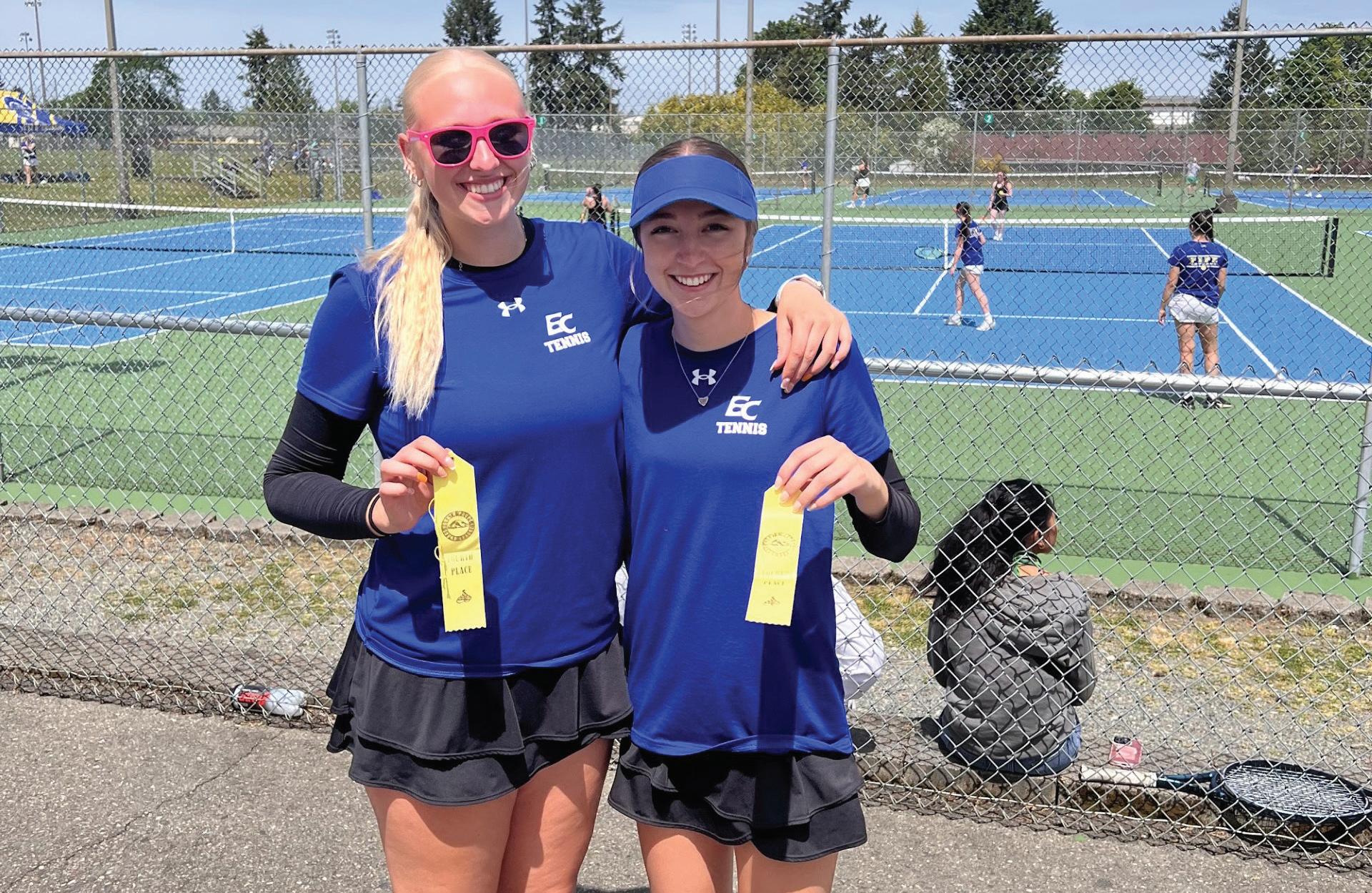
Eatonville doubles team of Lillian Bickford and Alayna Meyer pose for a photo following their district berth clinching 4th place finish at the 2A SPSL tournament this past Friday.
COURTESY MELISSA BICKFORD
Eatonville seniors posed for a photo together prior to the Lady Cruisers' big 22-0 win over Foss.
COURTESY HEATHER QUIRIE
Alcohol Anonymous meetings offered Alcoholics Anonymous is available for people who have a problem with alcohol. Meetings begin at noon Wednesdays and 9 a.m. Saturdays at the American Legion Hall/ Lions Club, 123 Rainier Ave. N.
Community council

Graham-Kapowsin Community Council's Center at Benston Hall has a new class called Flex & Flow on Wednesdays from 10:30-11 a.m. Also, Taichi is from 2-3 p.m. Both are free for members and $4 for non-members.
Graham-Kapowsin Community Council's Center is starting a new art class from noon to 1:30 p.m. Wednesdays at Benston Hall. Gather to pain and draw. Cost is $10. Bring your own supplies to reduce the fee. Contact Malogorzata Hajler at studio@mhajler.com for more information.
Join Graham-Kapowsin Community Council at the Graham, Fredrickson, Eatonville Rotary Shred Fest on May 17 from 10 a.m. to 1 p.m. at Frontier Middle School and or Jimmy's Museum Tour on May 21 at 11 a.m. Call 253-921-2914 for info.
Alanon help
Alanon is available to help people struggling with a loved one’s drinking. Call 425-8300314.
Learn about Friends Of Eatonville Library
The Friends of the Eatonville Library operates as a fundraising group to assist the Eatonville community. Primarily, it does so by accepting books and other donations and conducting book sales during the year. All of the funds are used to supplement the various library programs that enrich the local community.
To learn more about the group, contact Mike Eaton at 253-310–7709 or reach him in person at the library any Friday. There is no obligation. Application forms to join the organization are available at the library.


County completes broadband project
By The Tacoma Weekly
Pierce County and Comcast have completed construction of a fast and reliable fiber-rich broadband network in Key Peninsula ahead of schedule, exceeding the forecast for connected homes and businesses. Originally expected to be completed in late spring, the project has expanded internet services to 600 North Key Peninsula homes and businesses, over 70 more than planned.
“Broadband is more than just infrastructure – it’s a connection to opportunity,” said Pierce County Executive Ryan Mello. “I appreciate the efforts of everyone who made it possible to deliver broadband to these residents faster than expected. Access to the internet is necessary for residents to live, learn, and work across Pierce County.”
Pierce County is facilitating the expansion of broadband infrastructure to underserved areas of Pierce County. This program partners County funding with broadband service providers to build infrastructure for the benefit and quality of life of residents and to enhance economic opportunities for local businesses.
The approximately $5 million high-speed internet expansion project was funded as a public-private partnership between Comcast and Pierce County, with the County contributing $3.75 million of federal funding allocated through the American Rescue Plan Act of 2021 (ARPA).
Comcast and Pierce County are also partnering to bring high-speed Internet to Thun Field with construction beginning soon.
“We are excited to officially be part of the Key Peninsula community. Residents and businesses can now sign up for our affordable Internet, Mobile, streaming TV, and much more – backed by our trusted reliability and outstanding customer service. We look forward to connecting another rural community in our state,” said Roy Novosel, Vice President of Engineering, Comcast Pacific Northwest Region.
Comcast will offer low-income families and individuals access to the Internet Essentials program. The nation’s largest and most successful broadband initiative, Internet Essentials has connected more than 500,000 low-income Washingtonians to the power of the internet, many for the first time.
Comcast also offers NOW WiFi, highspeed internet with a consistent connection – backed by the Xfinity network. Starting at $30 per-month, NOW requires no annual contracts and WiFi equipment is included. More information about Pierce County’s broadband expansion initiative can be found at piercecountywa.gov/boostingbroadband.
Information about Comcast’s broadband investments in rural communities and the Key Peninsula expansion is available at washington.comcast.com/ network-expansion.




The work in Key Peninsula was completed ahead of schedule.
Mello applauds Council on immigration
By The Tacoma Weekly
The Pierce County Council voted 4-3 to adopt Resolution No. R2025-139s, affirming the county’s commitment to public safety, equity, and inclusive access to services for immigrants, refugees, and all residents.
The resolution carefully highlights existing legal frameworks, such as the federal Immigration and Nationality Act and Washington State’s Keep Washington Working Act, which clarify the limits of local government involvement in federal immigration enforcement.
“Essentially, this resolution establishes that County resources – including personnel, facilities, and funds – will not be used to support federal immigration enforcement activities unless explicitly required by law or court order,” said Pierce County Councilmember Bryan Yambe (District 5). “I have a personal connection to what we’re seeing at the federal level, in the form of Executive Order 9066.” Yambe added, “That Executive Order, while not naming Japanese Americans by name, empowered and facilitated the forcible removal by the military and mass incarceration of about 120,000 people, 2/3 of them American citizens. Virtually all persons were of Japanese ancestry on
the West Coast and moved to inland desert wastelands, from the youngest to the very elderly, with accompanying loss of freedom, property, agency, and most importantly, due process. When we look at what’s happening today, the deprivation of our values and constitutionally protected liberties has a familiar ring.”
Resolution No. R2025-139s formally expresses the Council’s policy position of limiting local interaction with federal immigration authorities since immigration enforcement is the sole prerogative of the federal government.
Under the resolution, separately elected County officials are encouraged to adopt and share their own policies publicly and report to the Council’s Health and Human Services Committee by August 31, 2025.
“Pierce County is strongest when every resident feels safe to go about their lives without fear of becoming the subject of racial profiling that results in an ‘administrative error.’ Our Constitution calls for due process for all,” says Pierce County Councilmember Rosie Ayala (District 4). “Councilmembers for this resolution affirm our community-first values, aligns our practices with state law, and reduces liability by ensuring all employees follow the policies and procedures that the resolution calls
on all of us to ensure we have. Resolution R2025-139s is the bare minimum.”
The three opposing votes cited the untenable nature of living in the country undocumented and the message the resolution sends.
“The message of unwavering support for undocumented immigrants is a misleading message. They may build a life, get married, raise families, only to face the harsh reality of deportation,” said Council Vice Chair Paul Herrera (District 2). “After years of contributing to their communities, it is essential that we do not create a false narrative suggesting being undocumented is a viable or secure option.”
Pierce County Sheriff Keith Swank attended the Council meeting to express his opposition to the resolution, saying the Keep Washington Working Act stands in contrast to the United States Constitution.
“I encourage the Sheriff to work through the Courts to strike down things he views as unconstitutional, because he was elected to enforce our laws, not to make unilateral determinations that put the county in legal jeopardy, potentially costing taxpayers millions of dollars. It's irresponsible,” said Council Chair Jani Hitchen (District 6).
The Council also passed an ordinance to discontinue a voluntary employment
Therapeutic Courts continue to yield success
By The Tacoma Weekly
In 2023, Tacoma Municipal Court launched two different therapeutic courts – a Mental Health Court and a Community Court. Since then, many successful outcomes have been achieved by targeting the root cause that led to an individual landing in court in the first place.
Instead of traditional sentencing with jail time or fines, therapeutic courts connect participants with treatment services and community resources. It takes a team of judges, attorneys, coordinators, case managers, treatment providers, law enforcement personnel and peer support staff working together with participants to develop an individual plan and path for recovery and success.
There are more than 150 treatment courts in Washington state. Pierce County Superior Court and Tacoma Municipal Court have been leaders in establishing these courts locally, which continue to be adopted by courts across the country.
With May being National Therapeutic Court Month, Gov. Bob Ferguson has issued a proclamation officially declaring 2025 Therapeutic Court Month for our state’s commitment to the program. It states in part: “The Washington State Department of Social and Health Services found that cost savings due to crime reduction created a $4 return on every tax dollar invested in a Washington state drug court, and analyses of mental health courts and family treatment courts in Washington state have shown savings from reduced recidivism, lower rates of hospitalization, fewer emergency department visits, less involvement in the child welfare system, and few children born drug affected.”
At the county level in our state, Pierce County therapeutic courts include Felony Drug Court, Family Recovery Court, and Felony Mental Health Court. In 2018, Pierce County Superior Court partnered with Comprehensive Life Resources for an Assisted Outpatient Behavioral Health Treatment pilot.
This program delivers community based mental health services under court supervision to individuals with severe mental illness who have demonstrated difficulty adhering to prescribed treatment on a voluntary basis.
In Tacoma’s municipal court system, its Mental Health and Community courts are showing numerous signs of success. Mental Health Court serves community members with mental health diagnoses who are at risk of repeat criminal offenses. A holistic approach promotes well-being, independence, accountability, and safety in our community.
Community Court promotes personal growth by connecting community members to needed health and social services. This program recognizes that individuals charged with misdemeanor offenses are often dealing with significant life challenges such food insecurity, housing instability, mental health concerns, limited job opportunities, substance use disorder, and trauma.
Community Court brings together case management, community partnerships, and treatment providers to reduce recidivism and increase overall independence and rehabilitation.
At Tacoma City Council’s April 22 study session, council members heard updates on both these courts from three Tacoma Municipal Court judges – Presiding Judge Steve Krupa and judges Drew Henke and Dee Sonntag.
“We are so excited about our therapeutic courts. Over the last year, we’ve been able to make some great strides and part of that is the support that you give us in any aspect of our program,” Henke told the council.
Henke, who was first elected in 2015, presides over Mental Health Court. “I’ve been working on it since 2019 and we formally started in 2023. I’m very proud of what we’ve been able to accomplish,” she said.
Sonntag, elected as Tacoma Municipal Court judge in 2022, is developing the therapeutic court system including the launch of Community Court in 2023. Key members of the city’s therapeutic
court team include Court Operations Supervisor Andrea Currin who works closely with Therapeutic Court Coordinator Emily Splinter-Felton; Case managers Elidia Colmenares and Hannah Olver; and defense attorney Kate McCracken and prosecutors Jagbir Atwal and Matt Dixon.
“This is an incredibly hardworking team that makes Mental Health Court and Community Court possible,” Sonntag said. “Our courts would not be possible without them.”
Henke explained that therapeutic courts treat people individually, not as just another case.
“We look to see what the root cause of the problem is, whether it’s treatment issues such as substance use disorder or mental health, or things like not being able to get a job because they can’t get their license or there are housing issues,” she said.
A case manager is assigned to each case as a resource for participants. Case managers are well versed in community resources to connect participants with the resources they need.
“Also, we try to be welcoming and approachable and supportive,” Henke said. “Another benefit of our program is that the individual charges are dismissed at the end of the program upon successful completion.”
Showing the council members Mental Health Court data collected from June 2023 to December 2024, Henke revealed that the program had 25 referrals in that time period. Twelve of these were declined, eight people entered the program, and two have graduated. Looking at gender data, 12.5 percent are female and 87.5 percent are male with the majority of them having some college or trade school experience.
“Because it’s a year-long program, we still have six individuals in the program and we just had someone graduate last week,” she said. “We’re looking at what we can do to encourage people to become more involved in the program.”
In further Mental Health Court data, 100 percent of graduates have

eligibility check known as E-Verify, which is duplicative of the mandatory I-9 form.
The flaws in the E-Verify system are well documented. There are data entry errors and issues for people with hyphenated last names or those who have changed their names. Such errors affect large numbers of people who are legally able to work and have a disproportionate effect on immigrant and refugee workers. These errors cause delays, confusion, and anxiety for employers and potential employees.
had no new charges or convictions. While in the program, 25 percent of participants incurred new charges of which 40 percent were dismissed and 60 percent were added to the client’s Mental Health Court agreement.
Sonntag explained, “We look at those very carefully. The prosecutor and defense talk about how they want to handle those cases and 40 percent of the time, prosecutors decided to dismiss the charge because they (clients) are in Mental Health Court and hopefully addressing the issues that got them the charges. If they are serious enough that the prosecutor wanted to keep the charges, they add them to the Mental Health Court agreement. We’ve been successful in people wanting to do that because they want to continue in the program.”
In Community Court for the period of October 2023 to December 2024, there were 155 referrals, with 41 individuals entering the program and 13 graduations. Sonntag noted that to date in the Community Court program, there have been 227 referrals, 65 entries, 44 current participants, 78 pending referrals and 21 graduations. Community Court participant demographics show 39 percent female and 61 percent male, most of them being high school graduates or GED recipients.
“Who is in our program?” Sonntag said. “As participants submit their referral with their attorney, they submit all this demographic data. We ask them
to collect it so that we know who’s being referred to the program, who’s being successful, and who needs more support as we track our recidivism data after they complete the program.”
After graduating from Community Court, data shows that 92 percent of the graduates have had no new charges.
“We continue to track recidivism data all the way from graduation through six months, one year and up to five years to see how they do,” Sonntag said. “We also track if they have new charges during that time. Our therapeutic court programs are having positive impacts on our participants even before graduation.”
While participating in the program, 20 percent incurred new charges. The outcome of those new charges are as follows: 36 percent were dismissed, 29 percent remain in pending status, 21 percent resulted in a conviction, 7 percent were added to the client’s Community Court agreement, and 7 percent entered in a deferral agreement through traditional court.
Across both Mental Health Court and Community Court, feedback from participants has been exceedingly positive, with 100 percent reporting feeling that they were treated fairly and many plan to continue working with the treatment providers and other community resources they received during the program.
The Executive limited role in immigration enforcement.
COURTESY
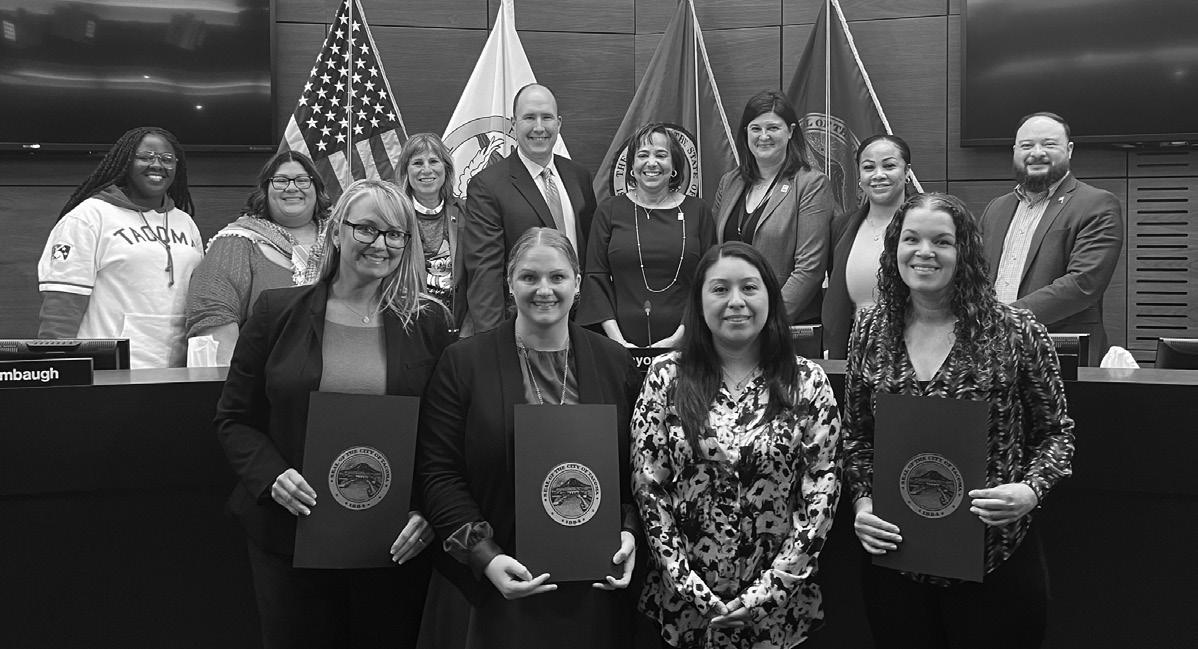
The city council will again present a Therapeutic Court Month proclamation in May, here showing Judge Dee Sonntag (front, second from left) from last year’s council presentation.
COURTESY
County residents urged to prepare for burn ban
By The Tacoma Weekly
The Pierce County Council is joining the Fire Marshal to remind Unincorporated Pierce County residents to prepare for the annual burn ban, which starts at 8 a.m. on June 1 and will remain in place until further notice.
This Stage 1 burn ban only applies to land clearing and burning of yard debris in unincorporated Pierce County. Barbecues (gas, wood, and charcoal) and small recreational fires in established fire pits on private property and approved campgrounds are still allowed.
Residents of incorporated Pierce County cities and towns should check with their local jurisdiction for specific burn regulations.
The Pierce County Fire Marshal, in coordination with the Pierce County Fire Chiefs’ Association, issues a burn ban in anticipation of warmer, drier conditions as summer approaches. These conditions increase fire risk, making it easier for fires to start and spread, threatening people and property.
Starting this year, the burn ban will begin annually on June 1, with the end date determined by weather and ground conditions. Fire risk begins to rise by late May, and while the length of the ban may vary, a fixed start date removes uncertainty about when restrictions take effect.
“We’re giving the community more than a month’s notice so people have time to burn yard

debris or complete land clearing before the ban begins,” said Pierce County Fire Marshal Ken Rice.
“In previous years, the short notice caused frustration, so we’re making the start date predictable to help people plan ahead now and in future years.”
In 2024, the burn ban lasted from June 1 to Sept. 20. The length of this year’s ban will depend on fire risk conditions in the coming months.
This ban does not apply to setting off legal fireworks in unincorporated Pierce County
during the allowed discharge times, which is only on July 4 and Dec. 31. Please see the Pierce County Fire Prevention Bureau’s website for additional information at PierceCountyWa.gov/FPB.
If you have an approved Department of Natural Resources (DNR) burn permit and/or your property falls under the jurisdiction of the DNR, you are advised to call 1-800-323-BURN for more information.
Alternatives to burning yard debris include composting at home or taking trimmings to a transfer
station for composting.
RECREATIONAL FIRE GUIDELINES
Recreational fires are allowed during a burn ban, but they must meet the following safety requirements:
■ Use a proper fire pit: Fires must be built in a metal or concrete fire pit, like those found in designated campgrounds, and cannot be used for debris disposal.
■ Size limits: Fires must be no larger than three feet in diameter.
■ Safe location: Fires must be in
a clear area free of vegetation for at least 10 feet in all directions, at least 25 feet away from structures, and with a 20-foot vertical clearance from overhanging branches.
■ Supervision and safety: Fires must always be attended by an alert individual with fireextinguishing tools, such as a garden hose connected to a water source, hand tools, or at least two five-gallon buckets of water.
■ Wind conditions: Burning is prohibited when winds exceed five mph.

the council.
County’s ‘Vision Zero’ takes shape
By The Tacoma Weekly
The Pierce County Council has adopted Resolution R2025-132, formally approving the Pierce County Vision Zero Action Plan – a roadmap to eliminate trafficrelated deaths and serious injuries on county roads by 2035. The Vision Zero Action Plan is a data-driven effort that will identify strategies and actions addressing the root causes of fatalities and serious injury collisions.
The plan, developed through extensive public engagement and data analysis,
follows the national “Safe System” approach. This strategy acknowledges that human error is inevitable, but fatalities and serious injuries are preventable when roads are designed to be more forgiving. A Safe Streets and Roads for All (SS4A) grant was secured by Pierce County to create the Action Plan, and the council has authorized the Planning and Public Works Department to submit applications for other similar grant funds.
Between 2018 and 2022, 108 people were killed and 296 seriously injured on unincorporated Pierce County roads.
The plan identifies crash hotspots – like dangerous intersections and stretches prone to lane-departure accidents – and recommends proven safety improvements such as lower speed limits, traffic calming infrastructure, and better pedestrian facilities. It also outlines the importance of driver education and enforcement, both which are part of getting to zero.
“Today’s vote gives me hope that no other parent in Pierce County will have to experience the heartbreak my family has endured losing my son Michael,” said Amber Weilert, whose young son was
killed in 2022 while riding his bike. “The Vision Zero Action Plan is a critical step forward, and today’s decision shows that Pierce County is ready to make our roads safer.”
Implementation will depend on support from local, state, and federal partners and ongoing accountability, but having a is the purpose of the plan. The county is better poised to seek funding resources, partnerships and work creatively to make our roads safer for all users.
Amber Weilert, whose young son was killed in 2022 while riding his bike, addressed
COURTESY
Starting this year, burn bans will begin annually on June 1. COURTESY
Child stroke survivor celebrated nationwide
By The Tacoma Weekly
Every 40 seconds someone in the U.S. has a stroke, one of the leading causes of serious, long-term disability. To spotlight the courage and dedication of those impacted by stroke, the American Stroke Association, a division of the American Heart Association, is honoring seven nationwide recipients through its annual Stroke Hero Awards, including 12-year-old Mackenzie Childs of Spanaway who survived a stroke when she was in preschool.

The awards celebrate stroke survivors, caregivers, health care professionals and advocates who are advancing awareness, education and support for the stroke community nationwide.
Recognized each May, during American Stroke Month, the Association – a global force changing the future of health of all – honors these Stroke Heroes and proudly advocates for stroke survivors year-round.
Those who have had a stroke often must work against physical, emotional and cognitive changes to move forward. This year’s winners demonstrate how personal experiences can drive public impact – from publishing support guides and launching nonprofits, to advocating in hospitals and local communities.
Makenzie Childs is being honored as the Pediatric Hero. After suffering a stroke, she not only pulled through after intensive therapy, now she’s a vibrant competitive dancer. The Childs family became involved with a pediatric stroke support and awareness group to help people facing the same crisis. The family also raises awareness as patient ambassadors for the local children’s hospital. Childs shared her experience on the Stroke Stories podcast and danced to raise funds for pediatric stroke care.
Childs survived a pediatric stroke when she was just a preschooler. Her ordeal began in October 2017, on a fateful Pre-K trip to an autumn pumpkin patch, where she suddenly collapsed in the middle of a corn maze. Initially, an urgent care provider diagnosed her with a concussion, but her symptoms got much worse at home. Child’s parents took her to a pediatric hospital emergency room, where the doctor delivered a shattering diagnosis. She had experienced a stroke, the damage was irreversible, and she might have a hole in her heart.
Childs underwent intensive physical, occupational and speech therapy to help her overcome the challenges from her ischemic stroke, which doctors determined was caused
by focal cerebral arteriopathy, a narrowing or thickening of the large cerebral arteries.
Determined to overcome the damage from the stroke, little Makenzie worked hard at outpatient therapy after leaving the hospital. Meanwhile, her family got involved with advocacy for pediatric stroke patients. Childs returned to school and resumed dance lessons. She also took Pilates, which helped her strengthen her muscles.
Child’s family became involved with a pediatric stroke support and awareness group to help people facing the same crisis. Childs has shared her experience on the Stroke Stories podcast and danced to raise funds for pediatric stroke care.
As a vibrant competitive dancer, Childs has become an advocate for dancers of all ability levels. In the past year, Makenzie’s and her dance studio competed at KAR Dance Nationals. Childs’ solo won the National Champions title, and she also won the KAR Miss Inspirational Junior Dancer of the Year.
Her parents say that, while their daughter’s stroke was one of the most difficult times of their life, they feel compelled to share her story with people to spread awareness and inspiration. A terrible diagnosis is devastating, they say, but it doesn’t have to shatter your child’s dreams.
The other winners include Caregiver Hero Lana Wilhelm, St. Louis; Equity Hero Carolyn Brown, Canton, Conn.; F.A.S.T. Hero Sheila Beal, Raleigh, NC; Group Heroes Helping Kids with Hemiplegia, Chapel Hill, NC; Survivor Hero Brisa Alfaro, Apple Valley, Calif.; and Voters’ Choice Hero Kathleen O’Leary, Buffalo, NY.
Winners were selected by a nationwide panel of volunteer judges from the American Stroke Association, except for the Voters’ Choice Award, which was selected by online popular vote.
For more information, visit stroke.org/ heroawards.
Do you know a Stroke Hero? Nominations for 2026 will open in October. Those submitting nominations must be at least 18 years old. Nominees and nominators must be legal residents of the U.S. including District of Columbia and territories. To be eligible to win, a nominee cannot have won a Stroke Hero Award or been recognized as part of a Real Women Class for the American Heart Association in the past five years. Get more information at strokeheroes@heart.org.
Give your salad a new and more delicious taste
By MetroCreative
When the weather starts to heat up, salad typically makes its return to dinner tables across the country. For those who want to give their salad a heartier and more flavorful look, consider the following recipe for "Cucumber and Shrimp Salad (Goi Du'a Chuot)" from Andrew Nguyen's "Into the Vietnamese Kitchen" (Ten Speed Press).
CUCUMBER AND SHRIMP SALAD
Goi Du'a Chuot
Serves 4 to 6
■ 1/4 cup fresh lime juice (about 2 limes)
■ 3 1/2 tablespoons sugar
■ 3 tablespoons fish sauce
■ 2 tablespoons water
■ 1 or 2 Thai or serrano chiles, finely chopped (optional)
■ 2 to 2 1/4 pounds pickling (Kirby) or English cucumbers
■ 1 carrot, peeled and finely shredded
■ 2 1/2 teaspoons salt
■ 1 teaspoon sugar
■ 1 boneless, skinless chicken breast, about 1/4 pound
■ 1 boneless pork loin chop, about 1/4 pound
■ 1/4 pound precooked bay or small salad shrimp
■ 1/3 cup unsalted roasted peanuts, chopped
■ 1 tablespoon sesame seeds, toasted and crushed in a mortar
1. To make the dressing, in a small bowl, combine the lime juice, sugar, fish sauce, water, and chiles and stir to dissolve the sugar. Set aside to develop the flavors.
2. Trim off the ends of each cucumber, and then halve lengthwise. Use a teaspoon to remove the seeds from each half (the English cucumbers will have few seeds). Cut the halves crosswise into slices a scant 1/8-inch thick. A razor sharp knife or a Japanese Benriner slicer produces the most attractive, uniformly thin slices. A food processor can be used but will yield less satisfactory results. Put the cucumbers and carrot in a large bowl, add 11/2 teaspoons of the salt and the sugar, and toss to mix. Set aside for 30 minutes to weep. A pool of juice will accumulate at the bottom of the bowl.
3. Drain the cucumbers and carrot in a colander and place under cold running water to rinse off as much salt and sugar as possible. Working in batches, wring out excess moisture in a non-terry dish towel; position a mound of the vegetables in the center, roll it up in the towel, and then twist the ends in opposite directions to force out the liquid. Do these 3 or 4 times. You want to extract enough water from the cucumber yet not completely crush it. (The cucumber will become a beautiful translucent green, in marked contrast to the color of the carrot.) Return the vegetables to the bowl

and fluff them up to release them from their cramped state. Set aside.
4. Trim any excess fat from the pork chop. Fill a small saucepan half full with water, add the remaining 1 teaspoon salt, and bring to a rolling boil over high heat. Drop in the chicken breast and pork chop. When the water starts bubbling at the edges of the pan, remove the pan from the heat and cover tightly. Let stand for 20 minutes. The pork and chicken should be firm yet still yield a bit to the touch. Remove them from the pan. Reserve the light stock for another use or discard. When the pork and chicken are cool enough to handle, cut the pork into matchsticks, and shred the chicken with your fingers into thin pieces, pulling the meat along its natural grain. Let the pork and chicken continue to cool to room temperate and then add them to the vegetables.
5. Place the shrimp in a colander and rinse with cold running water, then press gently to drain well. Add the shrimp to the bowl of vegetables and meat.
6. Just before serving, add the peanuts and sesame seeds to the salad and toss to distribute evenly. Pour on the dressing and toss again. (If you don't want to bite into a piece of chile unexpectedly, strain the dressing over the salad.) Taste and adjust the flavors to your liking, balancing the sour, sweet, salty, and spicy. Transfer to a serving plate, leaving any unabsorbed dressing behind, and serve.
Note: You may ready the vegetables, pork and chicken, and shrimp a day in advance. Keep them in separate covered containers in the refrigerator and return them to room temperature before tossing the salad. The dressing may be prepared several hours in advance.
For a lighter salad, omit the pork and/or chicken and double the amount of shrimp. Or, you may eliminate the shrimp and add more pork or chicken. Whatever you decide, include at least one of these elements, as they lend richness to the salad.
Savvy Senior: Does Medicare cover vision care and eye exams?
By Jim Miller
DEAR SAVVY SENIOR,
What all does Medicare cover when it comes to vision care? I currently have good vision insurance through my employer but will lose it when I retire. Almost 65
DEAR ALMOST,
Many soon-to-be retirees are a bit blurry with what Medicare does and doesn’t cover when it comes to vision care. The good news is that Medicare covers most medical issues like cataract surgery, treatment of eye diseases and medical emergencies. But unfortunately, routine care like eye exams and eyeglasses are usually the beneficiary’s responsibility. Here’s a breakdown of what is and isn’t covered.
Eye exams and treatments: Medicare does not cover routine eye exams that test for eyeglasses or contact lenses, but they do cover yearly medical eye exams if you have diabetes
or are at high risk for glaucoma. They will also pay for exams to test and treat medical eye diseases if you’re having vision problems that indicate a serious eye problem like macular degeneration, dry eye syndrome, glaucoma, eye infections or if you get something in your eye.
Eye surgeries: Medicare will cover most eye surgeries that help repair the eye function, including cataract surgery to remove cataracts and insert standard intraocular lenses to replace your own. Medicare will not, however, pick up the extra cost if you choose a premium multifocal lens that restores full range of vision, thereby reducing your need for glasses after cataract surgery. The extra cost for a premium lens can run $1,500 to $4,000 per eye.
Eye surgeries that are usually not covered by Medicare include refractive (LASIK) surgery and cosmetic eye surgery that are not considered medically necessary.
Eyeglasses and contact lenses: Medicare will not pay for
eyeglasses or contact lenses, with one exception: If you have had a conventional intraocular lens inserted during cataract surgery, Medicare will pay for eyeglasses or contact lenses following the operation.
Ways to save
Although original Medicare’s vision coverage is limited to medical issues, there are ways you can save on routine care. Here are several to check into.
Medicare Advantage plans: Many of these plans, which are alternatives to original Medicare and sold through private insurance companies, cover routine eye exams and eyeglasses, but coverage is limited so be sure you understand the specifics.
While I don’t recommend enrolling in an Advantage plan just to get vision coverage it is an option you should know about.
To locate Advantage plans in your area that provide vision coverage, go to Medicare.gov/plancompare or call 800-633-4227.
Purchase vision insurance: If
you get routine eye exams and purchase new eyeglasses annually, a vision insurance plan may be worth the costs. These policies typically range between $5 and $30 per month. Most plans will also have copays or deductibles you’ll be responsible for.
Check veterans’ benefits: If you’re a veteran and qualify for VA health care benefits, you may be able to get some or all of your routine vision care through VA. Go to VA.gov/health-care/aboutva-health-benefits/vision-care to learn more.
Find cheaper shopping options: Many retailers provide discounts – between 10 and 50 percent – on eye exams and eyeglasses if you belong to a membership group like AARP or AAA.
You can also save by shopping at discount retailers like Costco Optical, Sam’s Club Optical or Target Optical, which are all recommended by Consumer Reports. Or consider buying
your glasses online at retailers like ZenniOptical. com, EyeBuyDirect. com or GlassesUSA.com which offer big savings.
To purchase glasses online, you’ll need a valid prescription from an eye doctor (no more than a year old), plus your pupillary distance number, which is the distance, measured in millimeters, between the centers of your pupils in each eye.
Look for assistance: There are also health centers and local clinics that provide free or discounted vision exams and eyeglasses to those in need. To find them put a call into your local Lions Club (see Directory.LionsClubs.org) for referrals.
Send your questions or comments to questions@savvysenior.org, or to Savvy Senior, P.O. Box 5443, Norman, OK 73070.
Mackenzie Childs

Cruisers clinch playoff berth
By Skip Smith Contributing Writer
The Eatonville High School baseball team made a major statement last Tuesday, toppling the top-ranked Orting Cardinals 5-3 on their home field in one of the Cruisers’ biggest wins of the season.
The victory marked just the second loss of the season for the Cardinals and showcased Eatonville’s grit and poise down the stretch. Sparked by solid pitching and timely execution, the Cruisers flipped the script on a game many had penciled in as a likely Orting win.
Eatonville struck first in the third inning, taking advantage of a defensive miscue to plate the game’s opening run. Although
TENNIS
From page 1
Orting briefly took the lead in the bottom half of the inning, the Cruisers kept their composure and chipped away. Two more errors by the Cardinals in the sixth allowed Eatonville to reclaim the lead, and they never looked back.
Colton Herbrand came up clutch on the mound, tossing 4.1 scoreless innings in relief to earn the win. The right-hander allowed just three hits and struck out three while issuing only one walk. Ben Smith got the start, striking out three over 2.2 innings of work. The defense backed the effort with a double play and consistent pressure on the base paths.
Offensively, the Cruisers were opportunistic. Michael Laird and Herbrand each collected a hit, while Ethan Evans,
going her way, but I’m so proud of her effort. She just doesn’t quit.”
Andersen’s runner-up finish clinched her a spot in the district tournament, where she’ll receive a firstround bye as a top seed.
In doubles, Eatonville’s top team of Alayna Meyer and Lillian Bickford rebounded from an early setback to claim fourth place and a postseason berth. After dropping their opening match Wednesday, the duo was forced into a must-win scenario for the remainder of the tournament. They responded with three consecutive victories over the next two days.
Meyer and Bickford opened Thursday with backto-back wins over Franklin Pierce and Foss, each by a score of 6-2, 6-3. On Friday morning, with a spot at districts on the line, they battled Washington High School in a tense three-set match. The Cruisers took the first set 6-2 but dropped the second 1-6. They regrouped in the third, dominating 6-1 to punch their ticket to Bremerton.
Not satisfied with just qualifying, the pair put on their best performance of the tournament in the fourth-place match — a rematch against Franklin
Michael Stogsdill, and Herbrand drove in a run apiece. Justen Koch added to the chaos with two stolen bases, keeping the Orting defense off balance.
Riding high from the upset, Eatonville hosted Orting again on Wednesday for Senior Night in their final regular season matchup. While the momentum didn’t carry over in a 14-2 loss, the evening was more than just a scoreboard—it was a chance to celebrate the program’s eight seniors and all they’ve given to the team.
Aaron Leiter, Aaron Tozier, Michael Laird, Ethan Evans, Justen Koch, Michael Stogsdill, Owen Archer, and Brody Thirtyacre were honored following the game, with coaches, families, and the community applauding their leadership and
Pierce. This time, they were nearly flawless, winning 6-0, 6-1 to solidify their spot.
Also advancing are the team’s No. 2 doubles pair, Tia Schanbeck and Tierney Amaral, who took third place in the tournament. After a tough semifinal loss to Fife (6-7, 6-3, 3-6), Schanbeck and Amaral bounced back with a decisive straight-sets win over Steilacoom, 6-2, 6-4, to close their tournament on a high note.
Four additional Eatonville players — Isabel Volk, Megan Blake, Amelia Ferreira, and Kate Marsh — also competed in the league tournament. Each earned at least one win during the week but did not advance to Friday’s action.
With the SPSL tournament in the books, attention now shifts to the West Central District 3 tournament, held May 16-17 at the Kitsap Tennis & Athletic Center in Bremerton. Andersen will enjoy a first-round bye as the league’s No. 2 seed, while Meyer/Bickford and Schanbeck/Amaral are slated to face the No. 5 and No. 6 seeds respectively from the Olympic League. The tournament is double-elimination, and only the top four finishers in each bracket earn a coveted spot in the 2A state tournament.
SOFTBALL
From page 1
dedication.
Despite the loss, the Cruisers closed the regular season at 8-10 overall and 7-7 in 2A SPSL play—good enough to clinch a berth in the West Central District 3 playoffs.
Eatonville now turns its focus to Monday, May 12, when they’ll travel to Port Angeles for a loser-out playoff battle with the Roughriders at Civic Field. First pitch is set for 4 p.m., with a 3:45 pregame show broadcast live on KONP Newsradio 1450 AM and streaming at myclallamcounty.com. Longtime voice Oly Archibald will be on the call alongside color commentator Greg Thomas.
over Foss in a game that ended after five innings. Ava Twedt and Grace Field each drove in four runs, while Lilah Chapman tripled and had three RBIs of her own. Eatonville racked up 18 hits and took advantage of eight walks. On the mound, Laird was lights out, giving up just one hit while striking out seven.
The win improved Eatonville’s final regular-season record to 7-10 overall and 5-8 in league play, earning them a fifth-place league finish and a berth in the West Central District 3 playoffs. The double-elimination tournament is scheduled for May 16–17 at the Regional Athletic Complex in Lacey. Opponent and seeding were not yet announced at press time.
With a playoff spot secured and momentum from a commanding Senior Night win, the Lady Cruisers head into the postseason ready to keep their season alive.
Eatonville's senior players posed for a photo following their Senior Night game against Orting.
COURTESY HEATHER QUIRIE